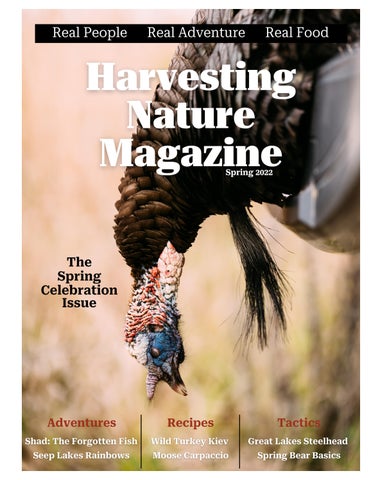
CONTENTS Harvesting Nature Magazine
THE CLOWN OF THE UPLANDS BY TREY JOHNSON
8 Montezuma quail (Cyrotonyx montezumae) are a secretive quail species endemic to desert mountain ranges of Mexico and the southwestern United States. Within the U.S., the species’ range is restricted to sloping pine-oak-juniper woodlands of Texas, New Mexico, and Arizona.
12
CREAMY CREOLE PHEASANT BY JEFF BENDA This one pot pasta dish is perfect for a quick and easy weeknight dinner. We can hunt a variety of upland birds here in North Dakota – turkey, partridge, grouse, and pheasant.
14
SHAD: THE FORGOTTEN FISH BY JOHN VILE The Delaware River is the longest undammed river on the east coast and has historically been home to one of the largest and most stable runs of American shad within its home range. BULLHEAD BLT’S BY ADAM BERKELMANS
18 These bullhead BLT’s are a wonderful way to enjoy
spring-caught bullhead catfish fillets. Sometimes trendy additions to BLT’s don’t make such a great fit, but beer-battered fried fish actually works beautifully!
20 SEEP LAKES RAINBOWS BY BRAD TRUMBO
The drag on my five-weight fly reel zinged against the heavy pressure of a desert rainbow making haste for the opposite end of the small lake. Among the shoreline reeds, red-winged blackbirds cackled and waterfowl bobbed.
26
GHOSTS OF THE SWAMP BY JUSTIN TOWNSEND I found myself in a small town in the middle of the Ocala National Forest because a few months prior I had drawn a Spring Osceola Turkey tag. It was my last year in Florida, and I was set on hunting the ever-elusive bird.
HARVESTING NATURE
-2-
Spring 2022 TURKEY KIEV BY JUSTIN TOWNSEND
29 This recipe is based off of a chicken dish called Chicken Kiev or kotłeta de-voljaj po-kyjivśky. Chicken Kiev is popular throughout much of Eastern Europe and has been for some time.
GREAT LAKES STEELHEAD BY BENJAMIN BURGHOLZER
33
Great Lakes steelheaders are a different breed. When everyone else is hanging up their rods and retiring to their fly tying desks, they’re just getting started. VENISON LOMO SALTADO BY ARA ZADA
36 French Fries in a stir fry? I don’t know about that… I
can assure you this is one of the best Peruvian dishes you can eat. It’s very quick and easy. You will probably find yourself saving french fries from your next dinner outing just to make this dish later.
38
WILDLIFE CROSSINGS BY COLLIN GRUIN
40
SPRING BEAR BASICS BY BENJAMIN BURGHOLZER
Sometimes referred to as wildlife bridges, animal crossings, or wildlife corridors, these constructed pathways over high-traffic roads and highways not only protect wildlife from vehicle collisions, but mutually protect drivers as well. Spring bear hunting has grown in popularity by quite a bit in recent years. In my state of Oregon, participation has increased substantially in the last few years, quickly transitioning from an OTC tag to a limited draw, and it’s easy to see why. MOOSE CARPACCIO BY LORI MCCARTHY
42 This dish is usually made as soon as the moose shows up
home or better yet in the woods. It’s another dish Dad won’t go handy to, as he’s pretty old-school when it comes to cooking moose. “You like to eat your meat while it’s still callin’,” he says.
SPRING 2022
-3-
Contents Continued
44
A SPRING CELEBRATION BY AARON AGOSTO
51
WILD EDIBLES BY ADAM BERKELMANS
Winter here is stubborn, persistent, always lingering in some way or another. Like the last guest at a house party, the snow hangs on to the bitter end.
I’m generally pretty dubious when the newest “superfood” is announced. Kale! Wheatgrass! Hemp seeds! Most serious dietitians and nutrition scientists contend that a superfood is nothing but a promotionally buzzword.
54 DANDELION SALADE LYONNAISE BY ADAM BERKELMANS Put what you’ve learned about this issue’s Wild Edible column to good use with this awesome recipe!
A BEGINNER’S GUIDE TO FLY FISHING BY JASON LUNA
56Tradition, hobby, and a lifestyle are just a few of the
many adjectives to describe being on the fly. With the earliest record of fly fishing being in the 13th century, it’s no secret that it’s been around for quite sometime, and still thriving to this day.
HARVESTING NATURE
-4-
CLICK OR Scan to Shop
HM61R
Multi-Functional Rechargeable Headlamp
MAX 1200 LUMENS RED LIGHT
Grill Where No one has grilled before
Click or Scan to Shop
Click or Scan to Shop
The first purpose built
Hitch Mounted Grill
For all your tailgating needs
SPRING 2022
-5-
From the Editors
Managing Editor: Benjamin Burgholzer
Editor in Chief: Justin Townsend
Justin Townsend and I first hatched the idea for Harvesting Nature Magazine in 2021 during our elk hunting trip in the high country of Colorado. Both of us had noticed most outdoor magazines mostly feature content by celebrity hunters with large endorsement deals taking trips that most people simply will never be able to do. Although this is fun to read on occasion, it often feels monotonous in a way I can’t fully describe. We both agreed that what the magazine world was lacking was real stories by real people. It was from this the idea of this magazine was born: to showcase the experiences of the so-called average hunter, angler, and forager. With this publication, we aim to move away from the world of the celebrity and instead privilege the stories of the everyday adventures. After all, that’s what most of us are, anyway. Furthermore, we hope to showcase both big companies and smaller, up-and-coming businesses who may not be able to afford ad space in some of the larger magazines. We have an excellent lineup of recipes, hunting, fishing, and foraging stories, how-to articles, conservation news, and beautiful photography. As always, our content will be true to our mission and centered around wild food. We are proud of the results and proud to be able to showcase all these awesome writers and awesome companies. We believe this is the beginning of something beautiful, and we hope you enjoy every page. -The Editors
Harvesting Nature Crew Contact Information
Editor in Chief: Justin Townsend jtownsend@harvestingnature.com Managing Editor: Benjamin Burgholzer editor@harvestingnature.com Business Manager: Casey Nordine business@harvestingnature.com Social Media Manager: Collin Gruin community@harvestingnature.com Podcast Manager: Kory Slye kslye@harvestingnature.com Film Managers: Ryan and Emily Long film@harvestingnature.com Please direct all business and advertising inqueries to Justin Townsend and Casey Nordine. Cover photo by Michael Martin https://www.mtmphotovideo.com/ ©2022 Harvesting Nature, LLC. All Rights Reserved.
The Clown of the Uplands By Trey Johnson Montezuma quail (Cyrotonyx montezumae) are a secretive quail species endemic to desert mountain ranges of Mexico and the southwestern United States. Within the U.S., the species’ range is restricted to sloping pine-oak-juniper woodlands of Texas, New Mexico, and Arizona. Montezuma quail have taken on a variety of nicknames, such as fool quail for its “sit and wait” be-
havior, or clown-faced quail after the male’s charismatic mask. These two features paired with the splendid places they live, make Montezuma a bucket list bird for most upland hunters. However, due to significant habitat loss in Texas, the little harlequins can only be hunted in two states, New Mexico and Arizona. Often publicized, certain regions of these states
“Montezuma quail have taken on a variety of nicknames, such as fool quail or clown-faced quail...” HARVESTING NATURE
-8-
receive a disproportionate level of hunting pressure every year, regardless of population trends. Additionally, Montezuma quail country can be difficult to traverse. The rocky, grass-covered mountain slopes, provide challenging footing for even the nimblest bird hunters. This further concentrates hunters who are unwilling to get off the beaten path and explore new territory. We are then left with a Tragedy of the Commons scenario; no one wants to see the resource disappear, but everyone thinks they
deserve a piece of the pie. I encountered this issue several times on a trip last December. I arrived at a dispersed camping site down a deadend road around mid-afternoon the day before the Montezuma quail season opener. I had chosen this location because I believed it was less well known yet might hold birds. I was only half-right. The next morning, before departing from camp, shotgun blasts sounded off up the hill. Someone had a driven in early that morning and hunted over the top of me. It wasn’t long before the whole basin was alive with gunshots. Rather than fighting a crowd of hunters and contributing to local “hotspotting”, I opted to journey further into Montezuma country. The sun set hours before pulling off the pavement. The gear shifted and shrugged, the truck groaned, and Ranger, my German shorthair, and I bounced around the cab
Pictured above, a Montezuma quail on some local flora.
as we pushed deeper and deeper into the mountains. Unfamiliar with the area, I had no idea what to expect come daylight. After only a wink of sleep, the sun peaked over the ridge, shining reddish hues across the entire canyon. It was perfect, pristine, solitary. Emory oaks lined
SPRING 2022
-9-
the canyon floor and crept up each of its wrinkles. Knee-high grasses carpeted the rugged hillsides. The crest above provided a spectacular vantage point to get a lay of the land. Canyon after canyon was the same, an undisturbed landscape of picture-perfect Montezuma quail ha-
the same stretches of river each spring without seeing a single angler. There are a few organizations and events like the Delaware River Shad Fisherman’s Association, the Bi-State Shad Contest, and the Lambertville Shad Festival which do an amazing job of maintaining an awareness among the public, but it’s not enough. American shad are an amazingly resilient species which have persevered through overfishing, water pollution, damming of migratory rivers, introduction of non-native predatory species, and many other obstacles and yet they still continue to fight, just as they do when hooked. There is just no quit in this fish, but without public support and the passage of the Forage Fish Conservation Act, we the sportsmen and women are the ones who quit. We quit caring about this forgotten fish. John Vile is a fisheries biologist with the State of New Jersey and lives in Northeastern Pennsylvania with his wife and two children. As a passionate outdoorsman,he spends much of his free time in the woods and on the water with his family and friends. Scan this QR Code to read more of John’s work!
A Delaware river shad, brought to net.
HARVESTING NATURE
- 16 -
SPRING 2022
- 17 -
SEEP LAKES RAINBOWS Come along with Brad Trumbo on the adventure of a lifetime to some remote lakes in Washington’s Scablands in search of wild rainbows.
HARVESTING NATURE
- 20 -
BY BRAD TRUMBO
TRACKING DOWN THE MEAL
The warm rays of the early March sun cast across my shoulders, combating the fifty-something degree water that encapsulated my lower body. The drag on my five-weight fly reel zinged against the heavy pressure of a desert rainbow making haste for the opposite end of the small lake. Among the shoreline reeds, red-winged blackbirds cackled and waterfowl bobbed. I was about land my first trout on the fly since fall, kicking off spring in the Central Washington scablands in grand fashion. A brilliantly colored rainbow came to the net measuring somewhere around twenty-inches, taking into account the standard angler
estimation error of +/- two inches. Unable to resist the undulation of a marabou streamer, the fish wasted no time in tracking down the meal, slamming the fly on the run and spinning my float tube 180 degrees as the fight ensued. Quality fish with dashing rose lateral lines and fine black speckling are common among scablands lakes, owed to the productivity of the waters and the early spring warmup. But these lakes are characteristically uncommon, right down to their existence. About 18,000 years ago, Ice Age floods ravaged the landscape as a glacier damming the Clark Fork River broke loose, spilling 3,000 square-mile SPRING 2022
- 21 -
“
“
THE FISH WASTED NO TIME
Lake Missoula into eastern Washington. About 150 “coulees” or channels were carved in the area and sediment deposits define the present undulating terrain. Hundreds of lakes are scattered across the geography, but were dry desert pocks before the construction of the Bureau of Reclamation’s “Columbia Basin Project” – the primary feature being Grand Coulee Dam. Grand Coulee was constructed to draw water from the Columbia River, directing it south for irrigation through the scablands, and returning the water to the Columbia River in Pasco, Washington. Presently, Grand Coulee provides
Old growth oak, palms, and tall pines show that this place was spared from logging, an undisturbed sanctuary.
when a man seated near the door caught Craig’s gaze. “What are y’all hunting?,” He asked. Craig smiled and said, “Turkeys, do you know where we can find any?” The man returned the smile and told us to go to the end of town, make a right, and then drive about a mile, and make another right to go down a dirt road. “Head towards the river. They like water,” he said. We turned onto the last dirt road, jumped on the bikes, and pedaled about 2 miles down this two track, bordered by tall pines and a mixture of shorter cabbage palms. Old growth oaks covered with Spanish moss hung over the road. This felt like turkey country. We came to a T on the road with a small meadow naturally formed by the intersection. There in the sand, laid a fresh turkey track, left untouched by the rain overnight. A turkey had visited this spot earlier in the day! An hour before sunrise, the next day, we pedaled
2 miles down to the intersection. We silently set up our blind, using palm fronds, logs, and any brush to conceal our position. We placed one decoy at the intersection and waited. Just moments before sunrise we heard a gobble. Craig returned a call with just silence as a response, but there was hope. An afternoon storm rolled in as we listened to the rain hit our camo tarp. Suddenly, thunder clasped loudly overhead and startled both of us. Adding to the excitement, a turkey flew from high over my right shoulder and landed in view just 20 yards from our blind. I slowly raised my shotgun and steadied the bead on the bird. No go. A hen stood there examining our decoy with a quick peck and strike. We waited and watched for the tom we needed to emerge, but he never did. The hen slipped quietly back into the cabbage palms and was gone. Our next day played out the same. A gobble in the
HARVESTING NATURE
- 28 -
morning and a gobble in the evening, but nothing more. We used those gobbles and a combination of tracks to pinpoint the assumed location of the roost and set up nearby on our last morning. The wake-up gobble happened as predicted. I clucked back in my broken turkey speak and the tom responded, a first for me! I sat and waited, but nothing emerged. Craig was closer to the tree with his bow, so I never knew if he shot. I later met up with Craig at the rendezvous point, and he retold his version of the morning as we pedaled toward the cars. After the gobble, he saw two turkeys moving through the brush at 60 yards, but they never got closer or clear enough for a shot. He heard me cluck and heard the response but never saw the ghosts again. They forever returned to the safety of their swamp, evading capture once more. Justin (Choctaw) is an avid hunter, angler, and chef whose passions for the outdoors lead him to create Harvesting Nature in 2011. He continues to hunt, fish, and cook all while sharing his experiences with others through film, on podcasts, in print, and with recipes. He also proudly serves in the United States Coast Guard in Key West, FL. Scan this QR Code to read more of Justin’s work!
Turkey Kiev BY JUSTIN TOWNSEND
“I will admit that this recipe is over the top, but you will not regret it”
SPRING 2022
- 29 -
Click or Scan to Sign-up
Learn to Shoot-Hunt-Butcher-Cook Two chances to sharpen your wild food skills
Learn Tenkara-Fly Fishing-Fly Tying-Backcountry Cooking
On Frostbite, Viagra, and Great Lakes Steelhead BY BENJAMIN BURGHOLZER
Managing Editor, Benjamin Burgholzer, takes us to the Great Lakes region in this how-to article for steelheaders of all experience levels.
SPRING IS IN THE AIR BY AARON AGOSTO
Aaron lives in Montana’s Flathead valley. When he’s not fishing, he works as a photographer, focusing on fly fishing, hunting, conservation and documentary storytelling. Scan this QR code to see more work from Aaron!
HARVESTING NATURE
- 44 -
“Winter here is stubborn, persistent, always lingering in some way or another. Like the last guest at a house party, the snow hangs on to the bitter end. Early spring mornings are for coffee and relaxing by the river. Dawn patrol fishing missions can wait for now.”
SPRING 2022
- 45 -
Elevate Your Game
Get perfect results every time by cooking to temperature and using Thermapen ® ONE. HARVESTING NATURE
- 50 -
thermoworks.com
Wild Edibles By Adam Berkelmans
I’m generally pretty dubious when the newest “superfood” is announced. Kale! Wheatgrass! Goji berries! Hemp seeds! Most serious dietitians and nutrition scientists contend that a superfood is nothing but a promotional buzz word used by companies to sell products. Television doctors and miracle-cure book authors are likely out there right now, searching for the next big exotic ingredient that will solve all of our problems… for only five easy payments of $39.99, that is.
I happen to know of a real superfood that doesn’t actually cost a penny. This isn’t a superfood in the traditional health sense, though it does happen to be chock full of vitamins, minerals, and phytochemicals. This is a superfood in the sense that it is everywhere and it can do anything. I’m talking about the humble common dandelion (Taraxacum officinale), which can be found growing across pretty much all of the temperate regions of the world, from the SPRING 2022
- 51 -
Americas, to Europe, to the Middle East, to Asia, parts of Africa, and even Australia and New Zealand. We’ve all seen it growing in our backyards, school fields, golf courses, construction sites, baseball diamonds, and pretty much anywhere else the soil has ever been disturbed. A tenacious plant, the dandelion can take hold in the barest hint of soil and will spread rapidly with windborne seeds. Because of this, we’ve come to know it as a