Simon Lee Hong Kong, Europe and Middle East sales@harvest-info.com
Chua Chew Huat Asia Pacific sales-sg@harvest-info.com
Matt Weidner North America mtw@weidcom.com
TECHNICAL SUPPORT
MJ Magsalin tech@harvest-info.com
GRAPHIC LAYOUT
Danico Acosta
EDITOR’S NOTE
Dear Reader,
Cross-border e-commerce continues to create opportunities for businesses of all sizes, but growth is bringing new demands for speed, visibility, and operational agility. As supply chains become more complex, the focus is shifting from simply moving goods to building the systems that make global trade work more efficiently.
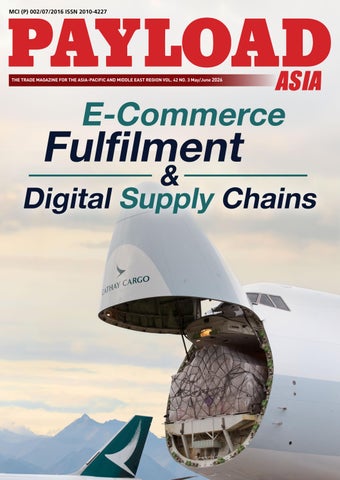
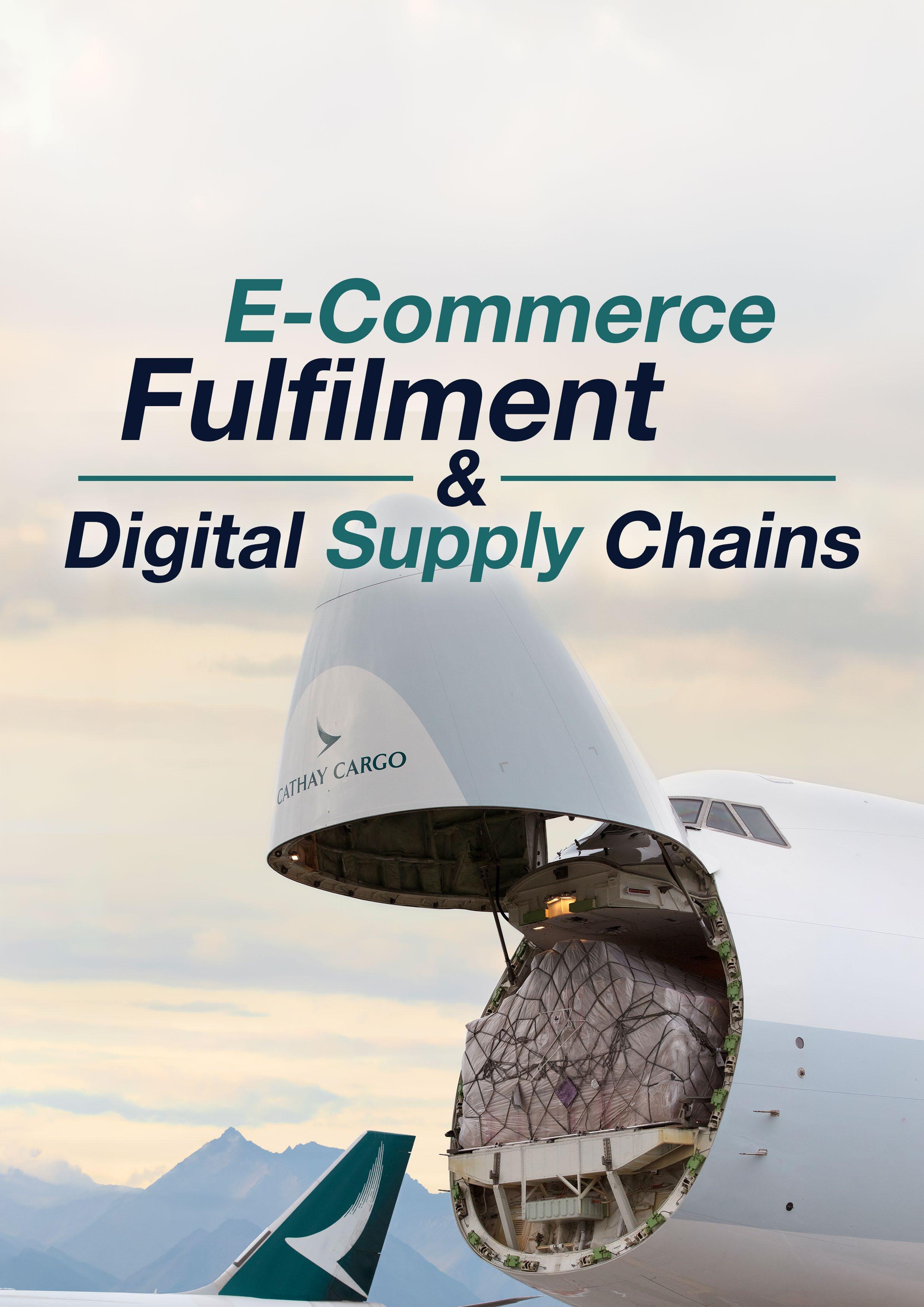
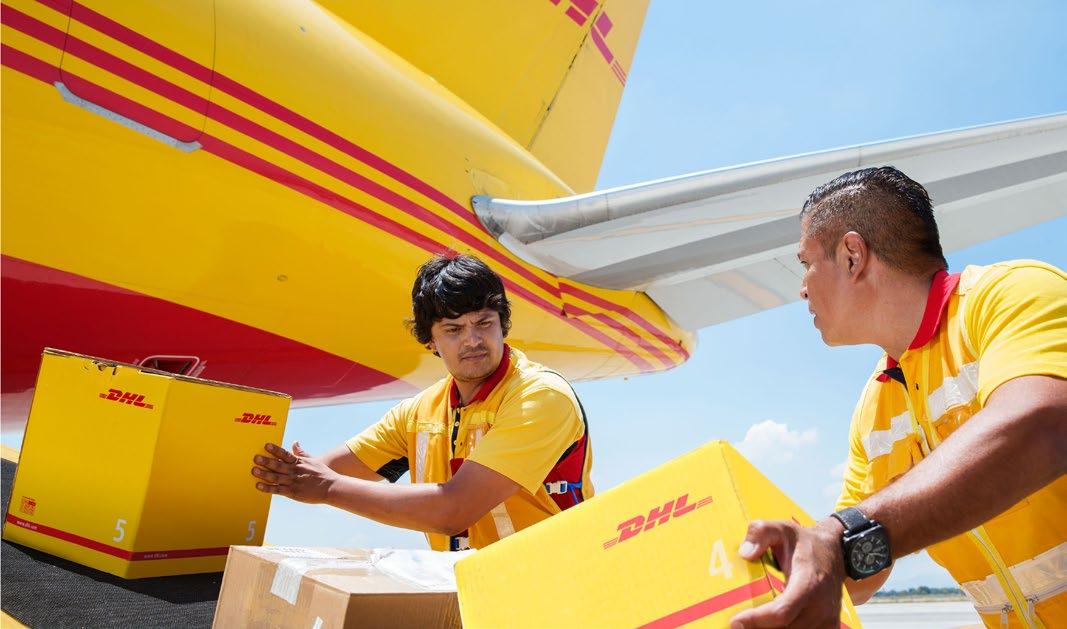
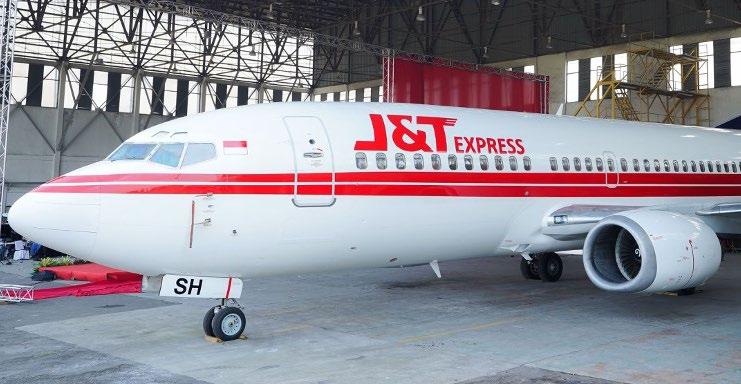
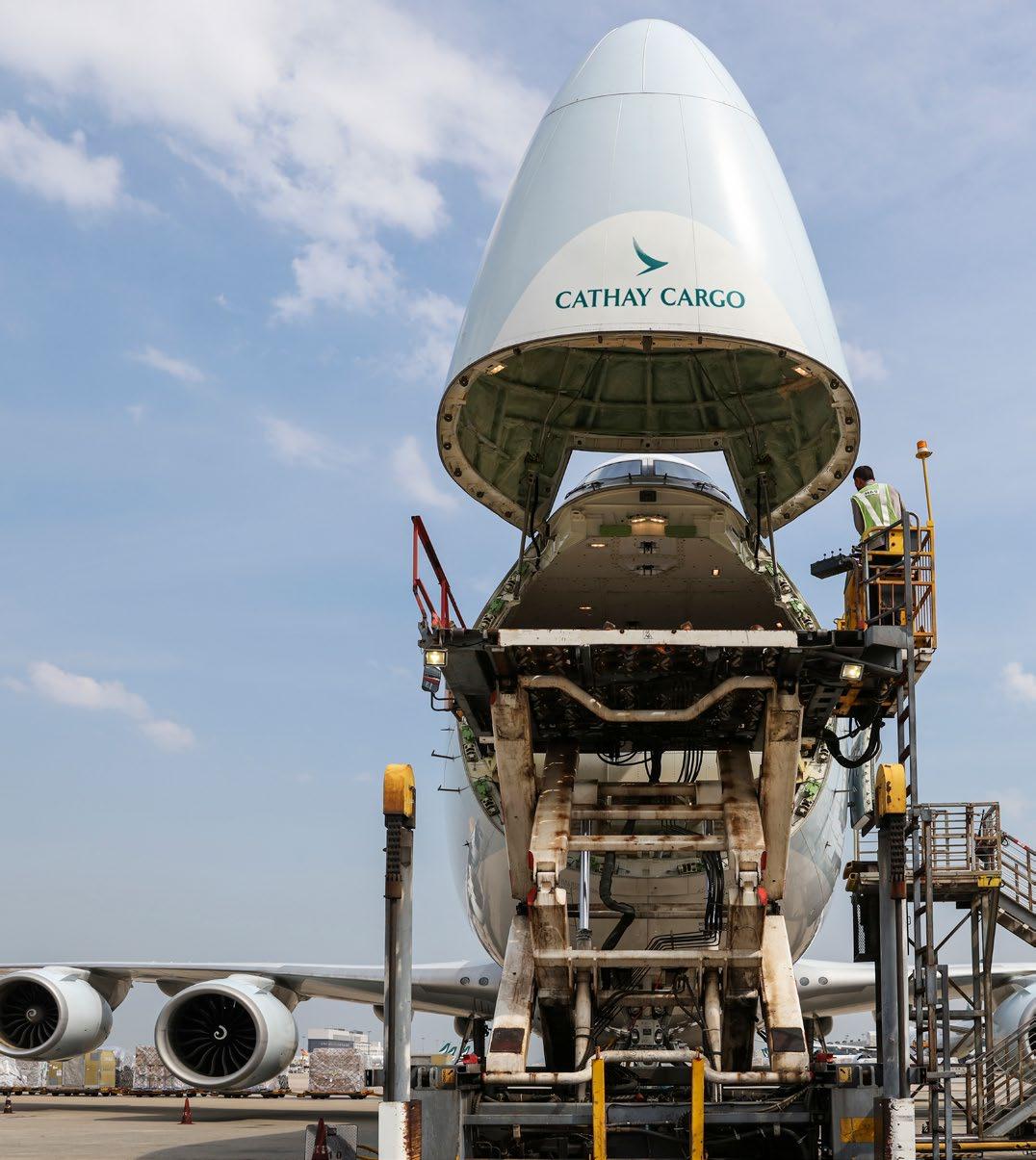
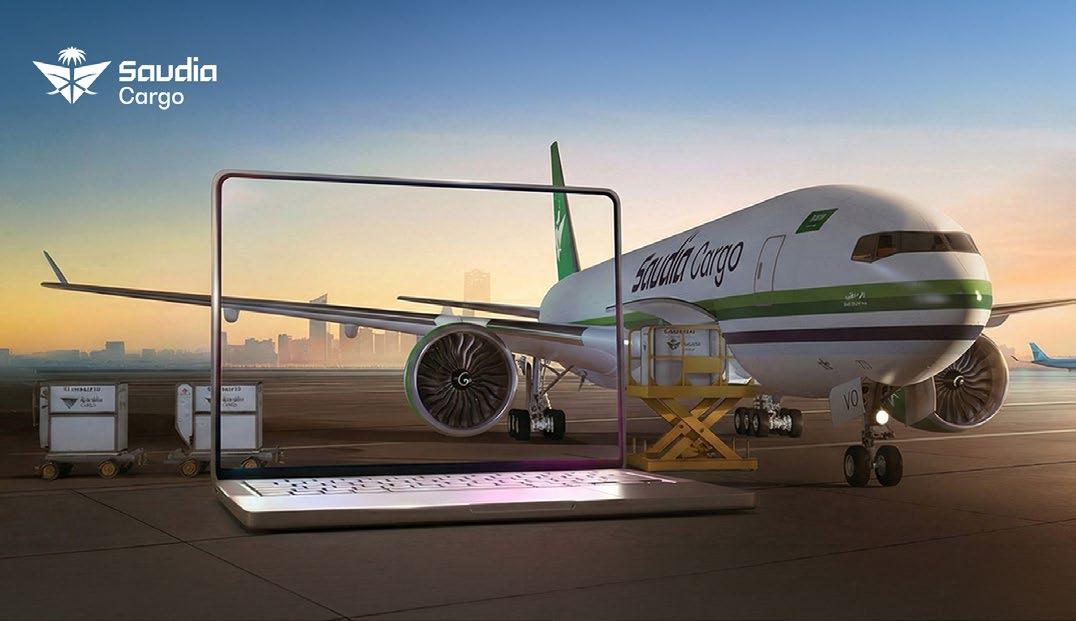
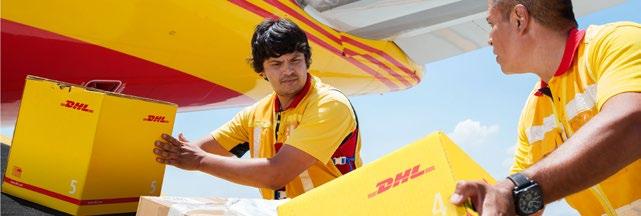
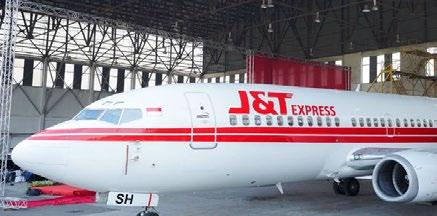
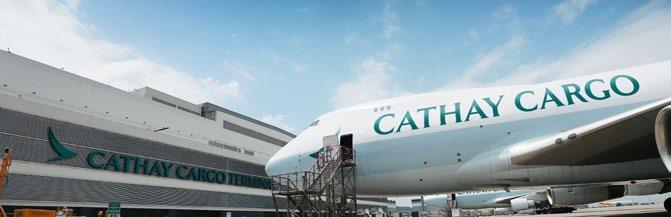
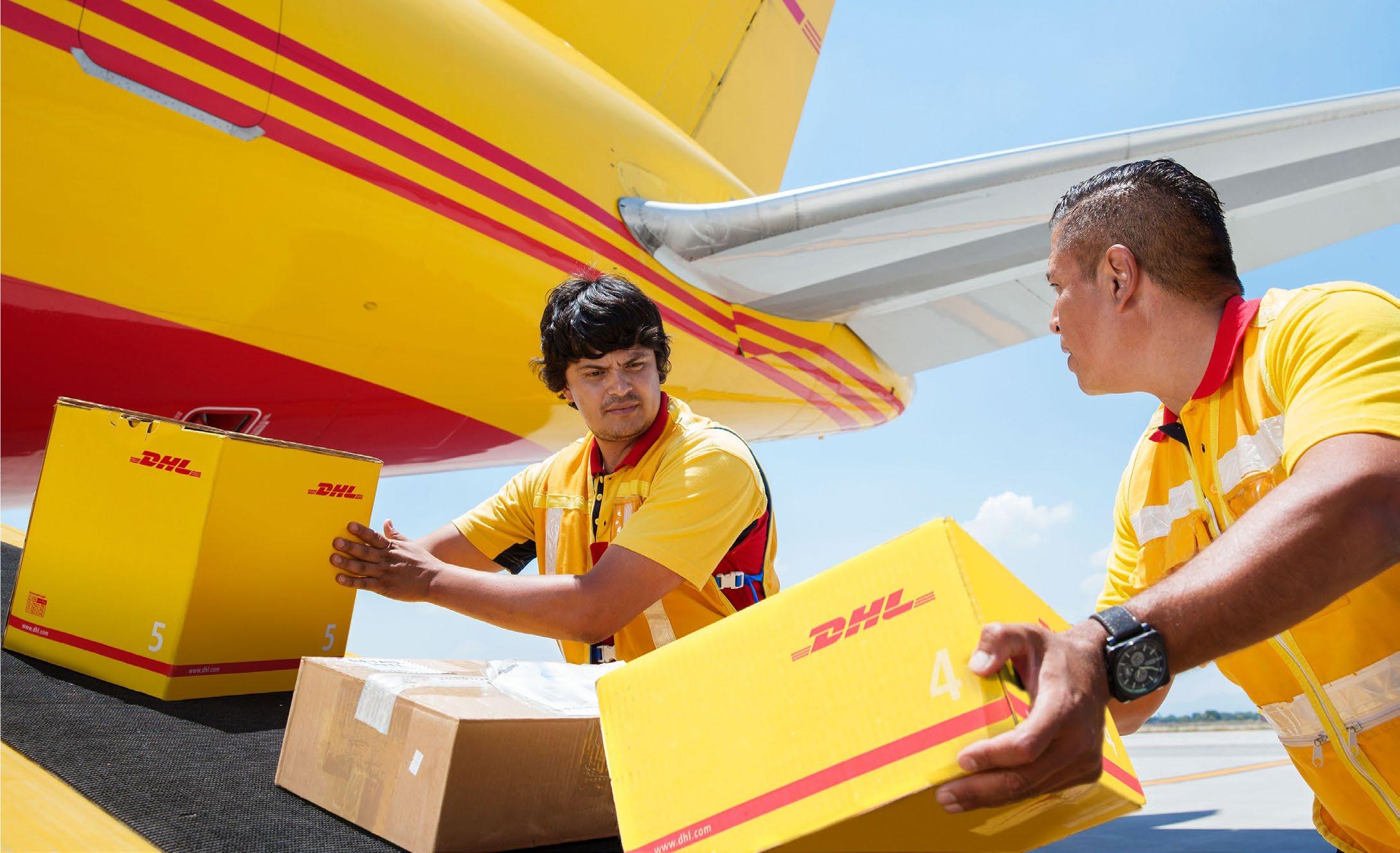
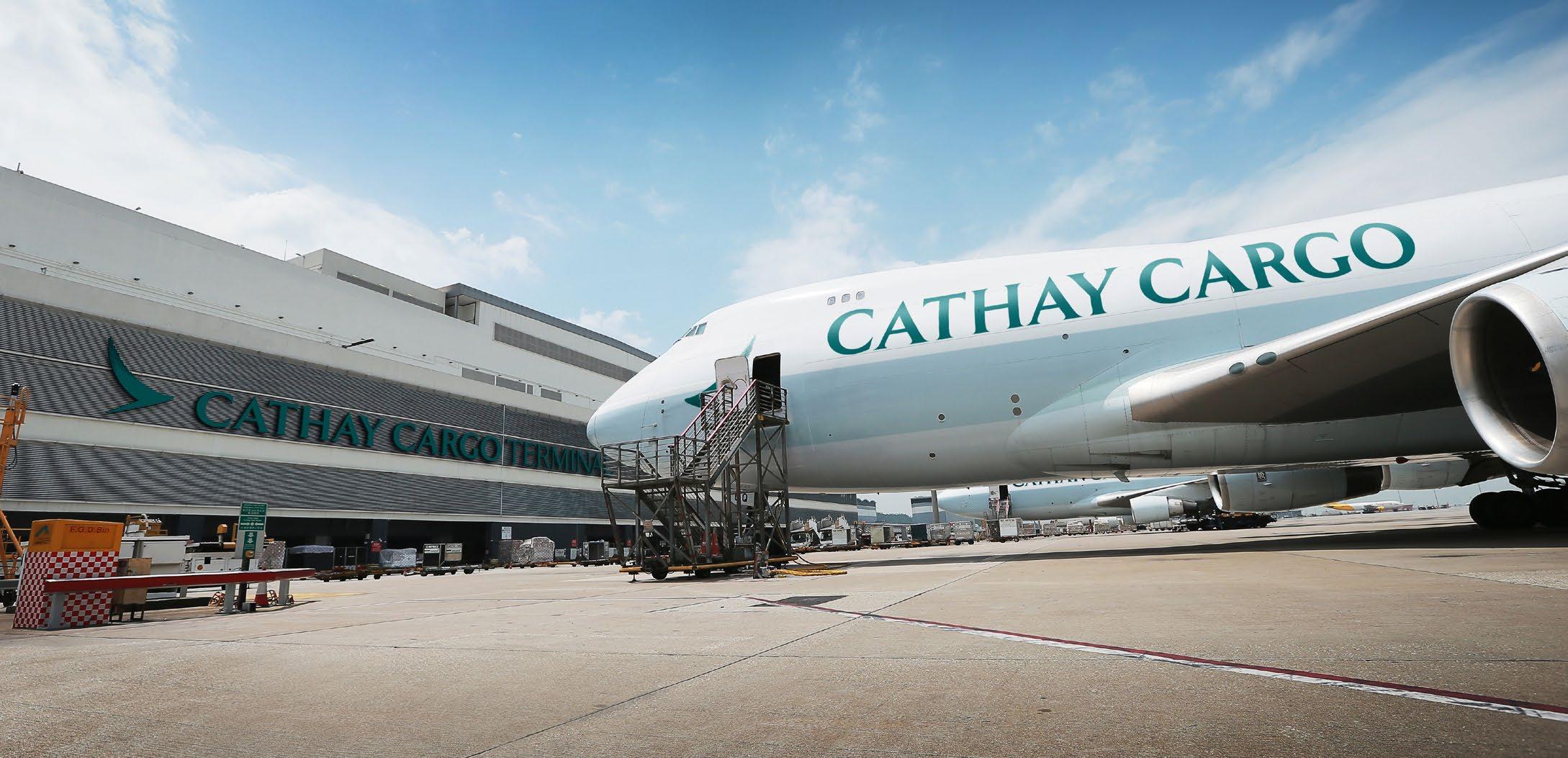
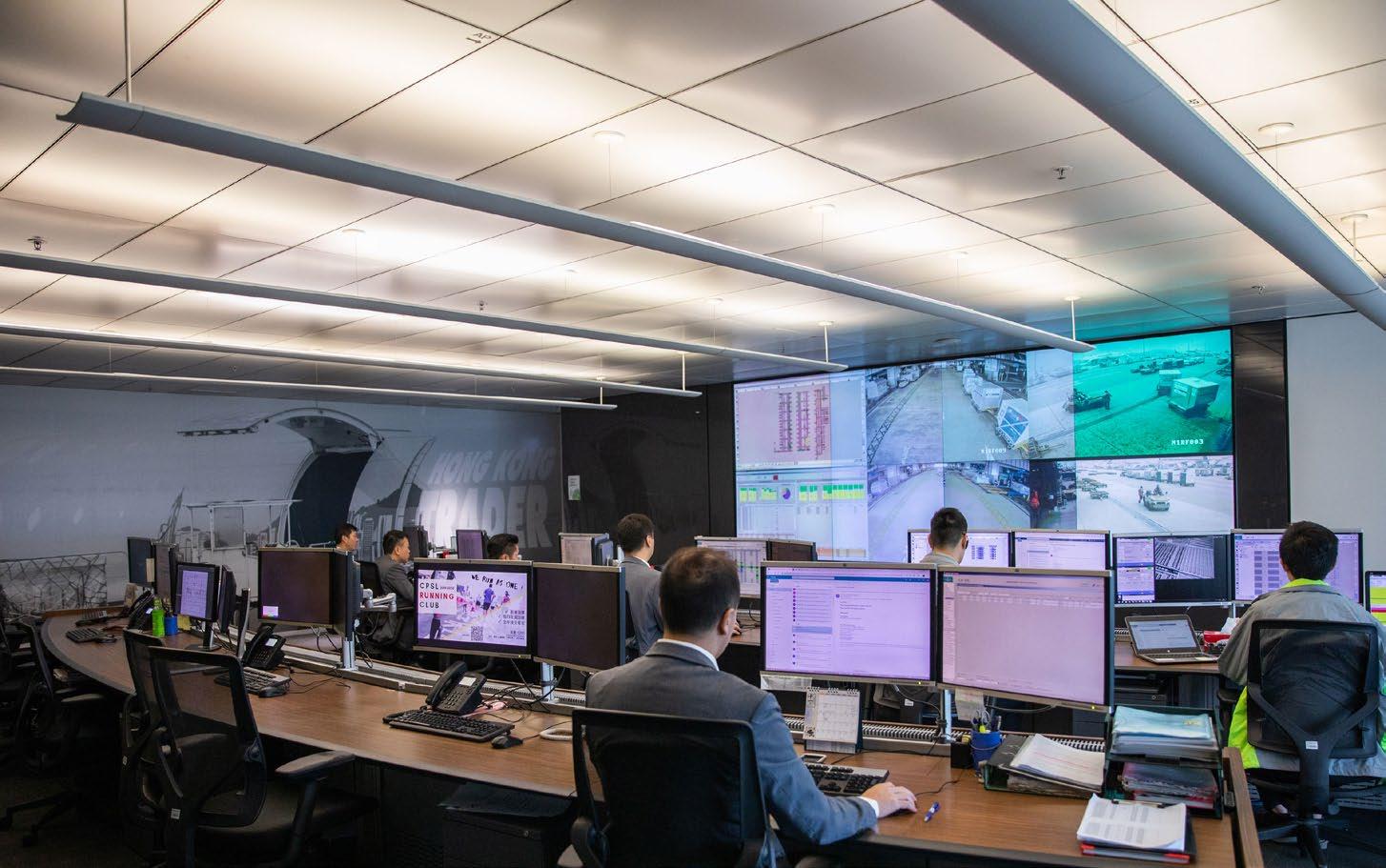
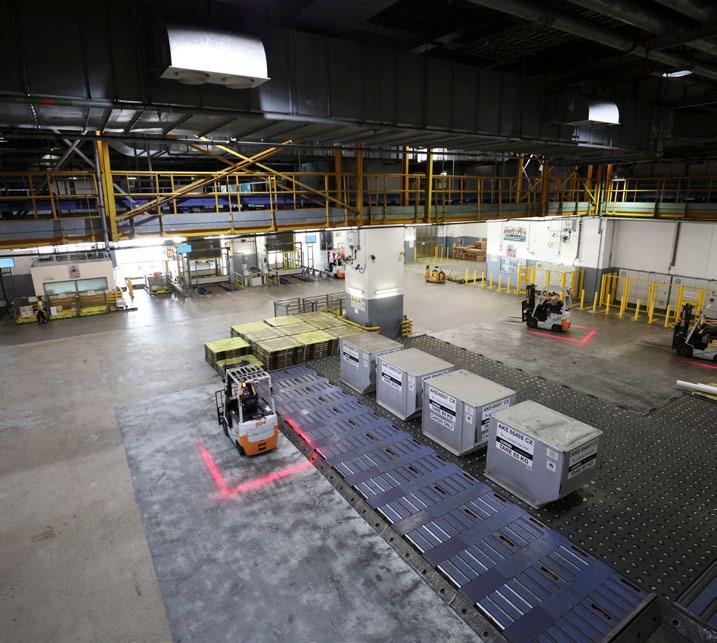
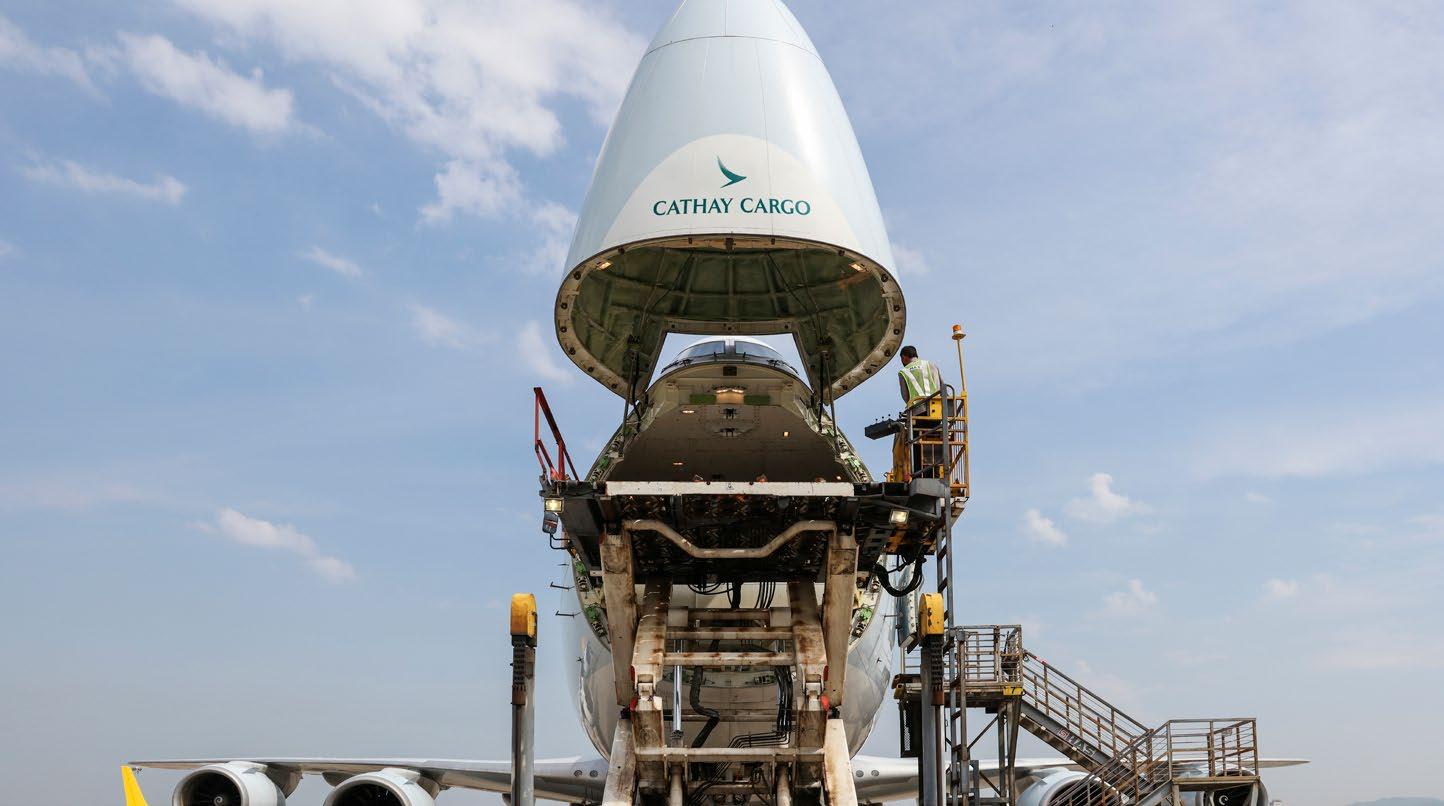
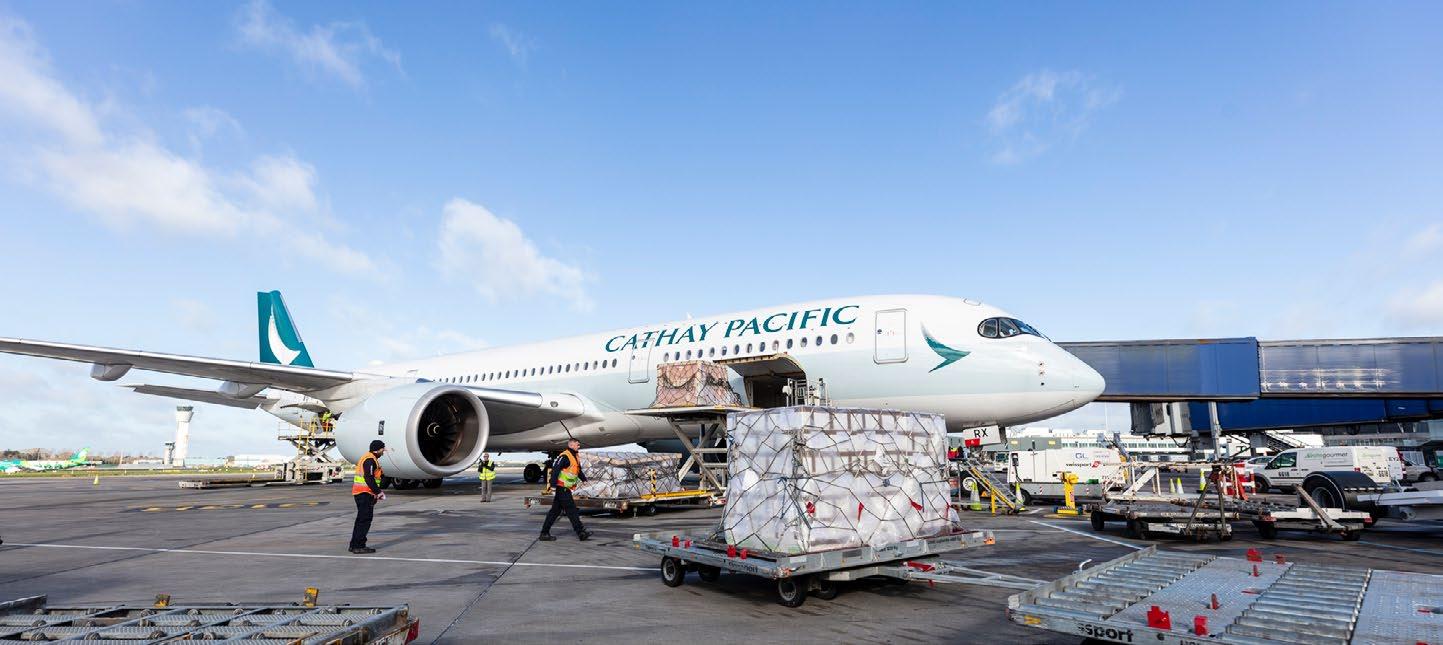
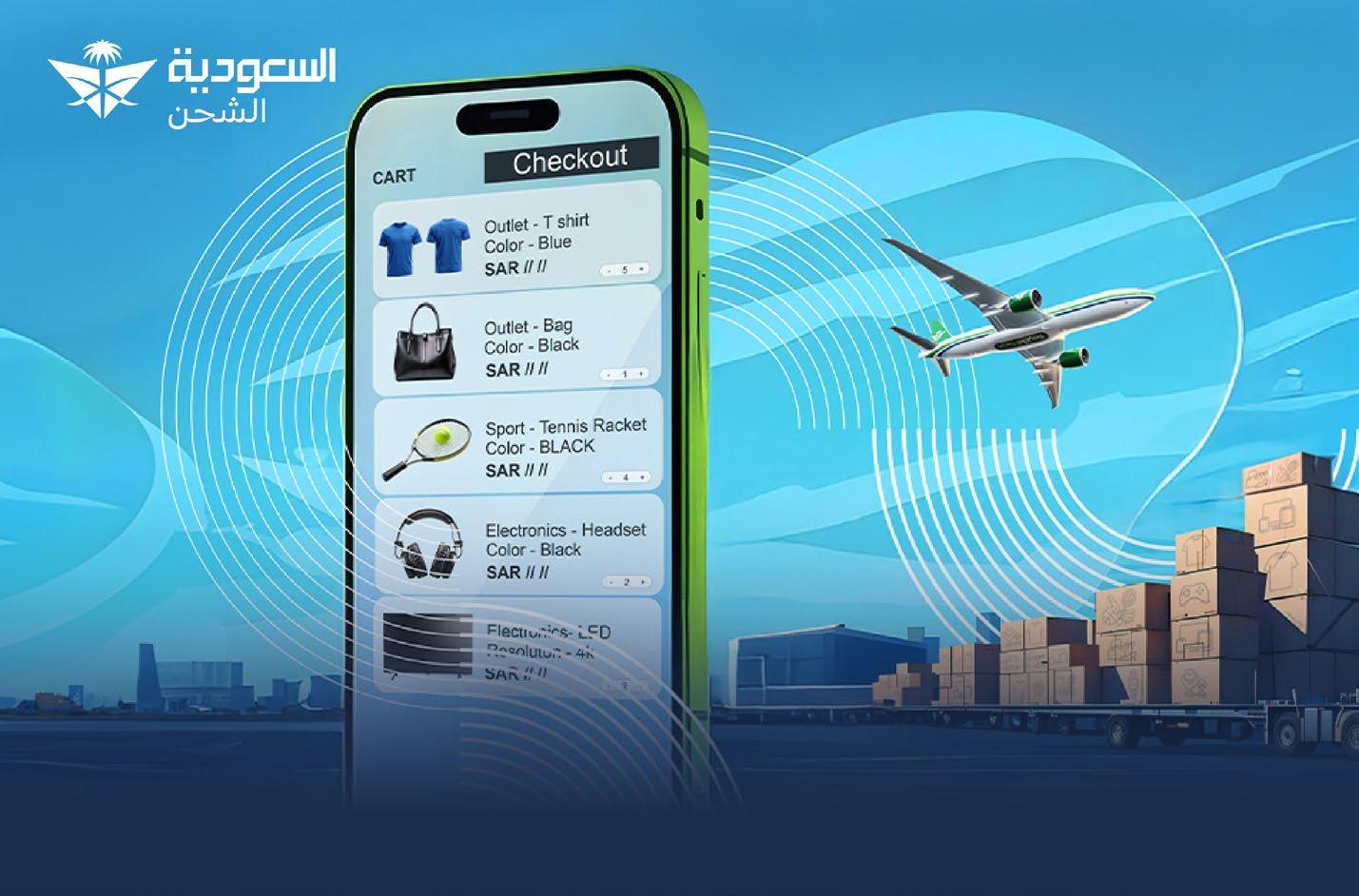
In this issue, we look at how industry players are responding. Cathay Cargo, which is featured on our cover, discusses its digital transformation journey, while Saudia Cargo examines the growing e-commerce corridor linking Asia and the Middle East. DHL Express shares how it is helping SMEs navigate international shipping, and J&T Express reflects on scaling a regional network across Southeast Asia’s diverse markets.
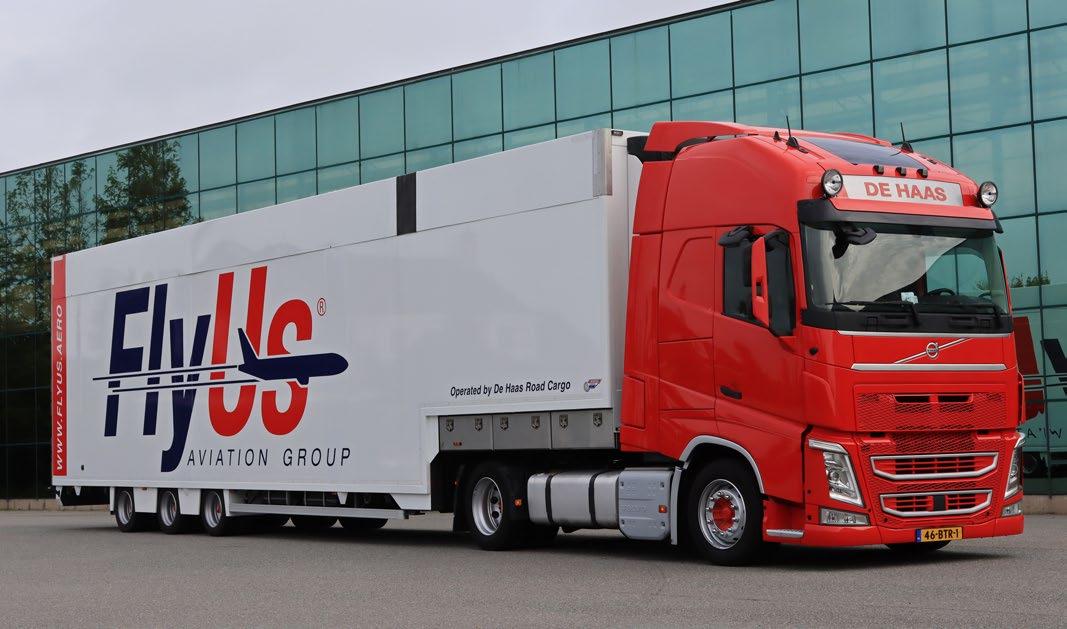
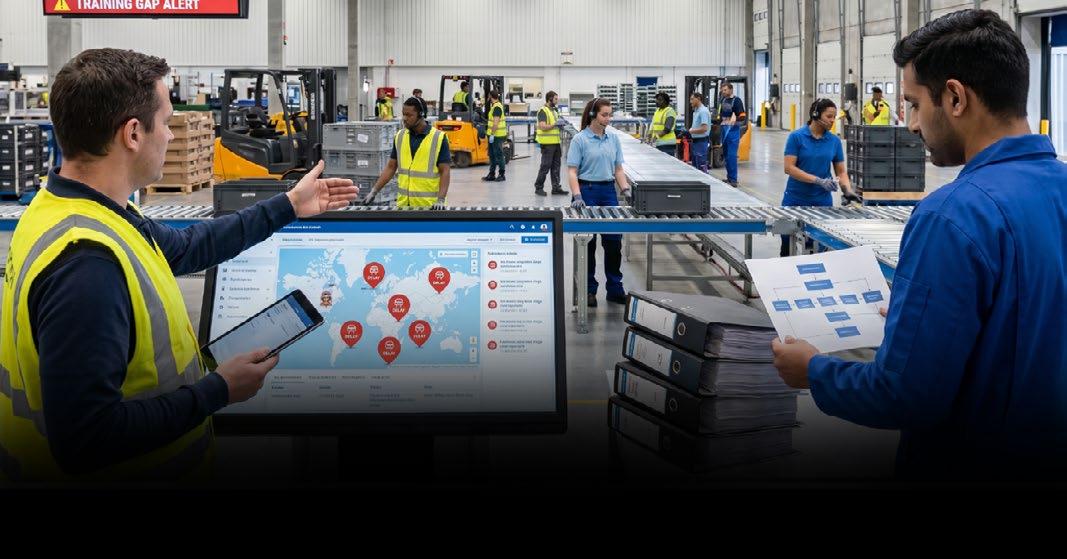
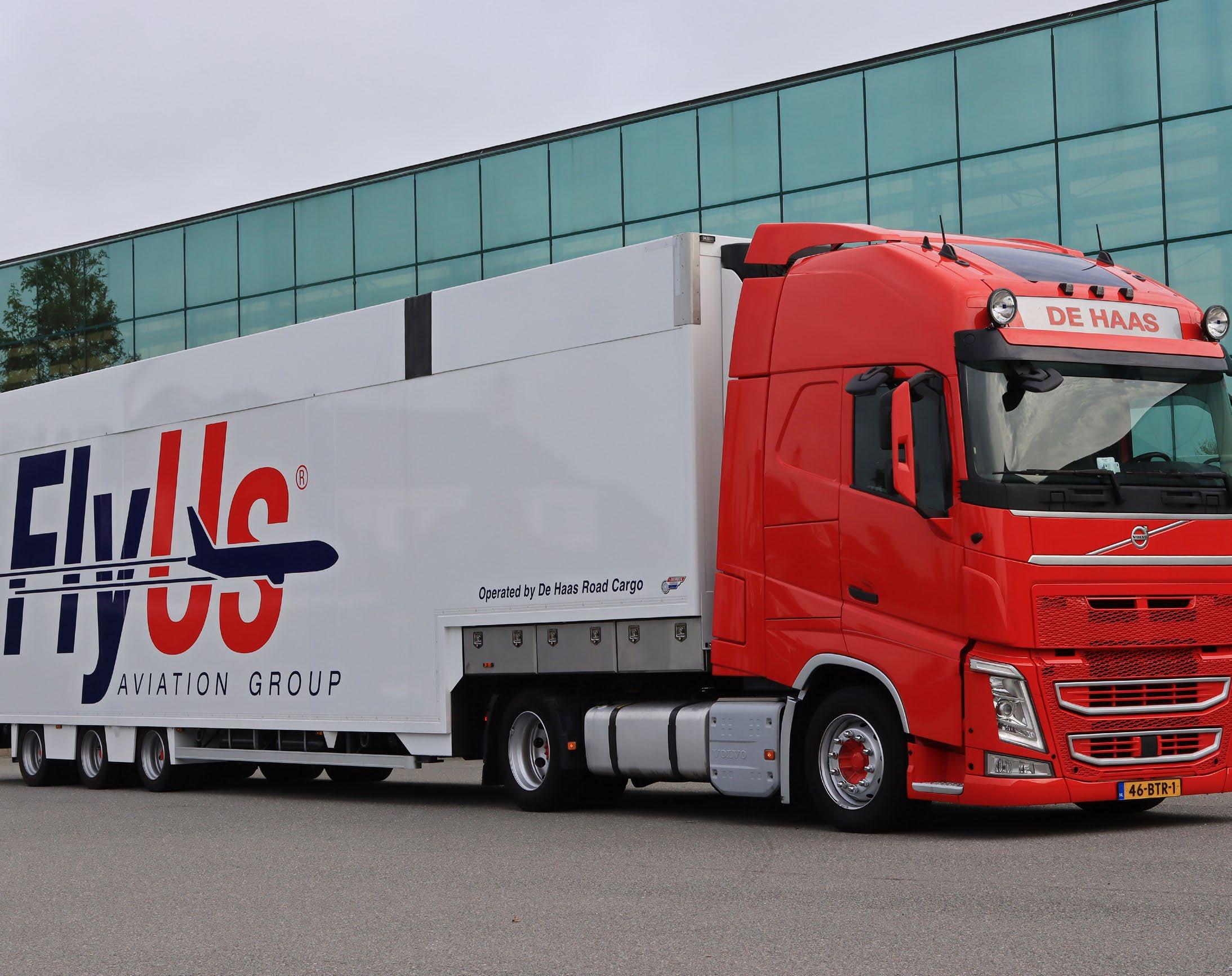
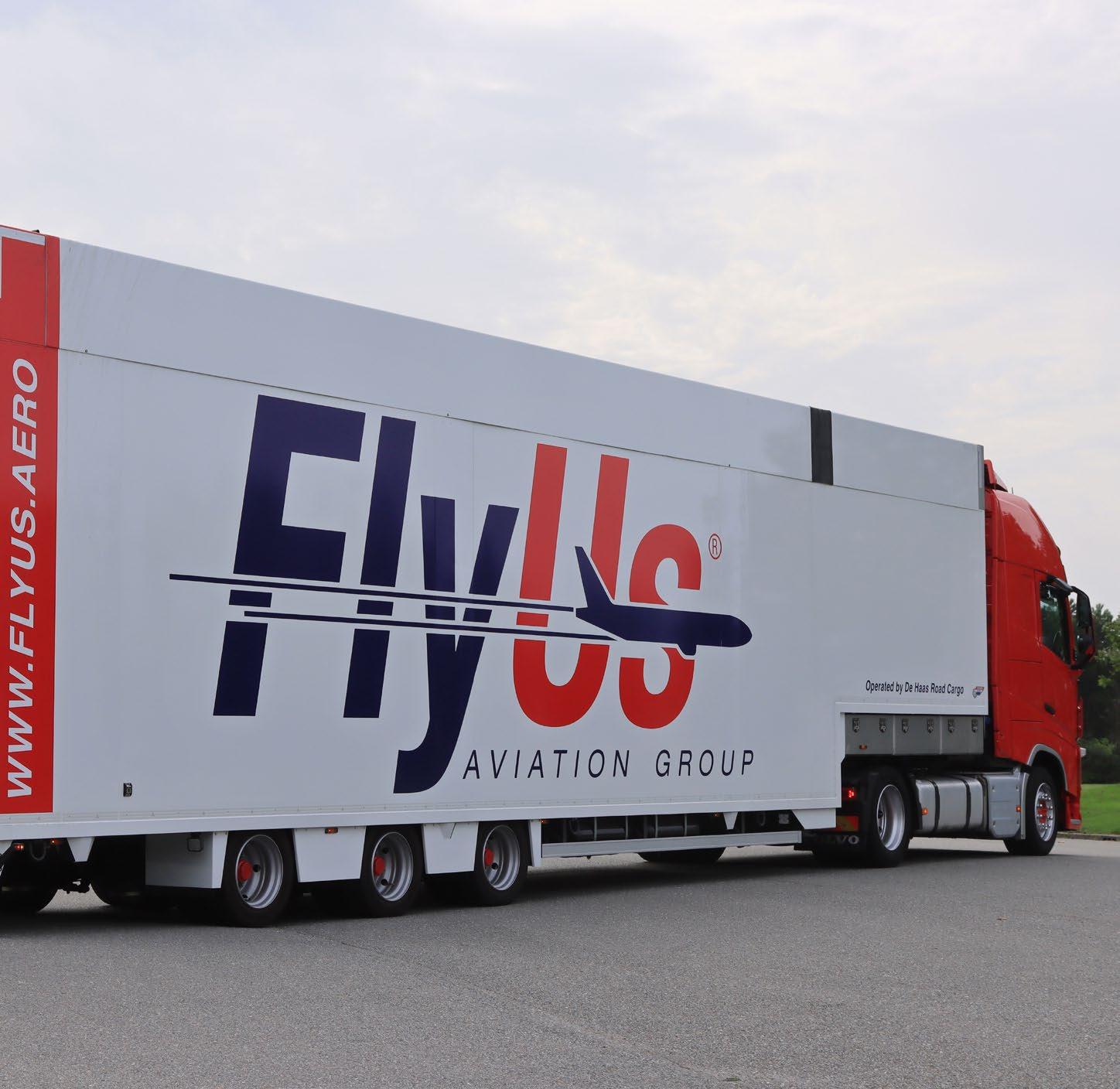
We also feature perspectives from Cainiao on the role of AI in supply chain execution and FlyUs Aviation on how GSSAs continue to help airlines navigate increasingly fragmented cargo markets.
Together, these stories highlight an industry investing not only in capacity, but in the tools, partnerships, and processes needed to keep cross-border commerce moving.
Warm regards,
Monina Eugenio
Chief Editor
MASkargo and Teleport partner to advance regional air cargo connectivity across Southeast Asia
China Eastern Airlines launches first Vienna–Xi’an nonstop service
IndiGo launches CarGo operations between Kunming and Kolkata
Saudia Cargo and SFDA announce major air freight support initiative for pharmaceutical shipments
Turkish Cargo simplifies air cargo processes with its renewed corporate website
Qatar Airways Cargo announces the launch of Pharma Passive FlexTemp
Lufthansa Cargo introduces GlobeCross as subsidiary for cross-border logistics
Emirates SkyCargo available on Pelicargo, expanding digital presence in the US
Glasgow Prestwick Airport secures three new weekly Ethiopian Airlines e-commerce flights
CargoLand by LGG targets Taiwan as a strategic gateway for semiconductor
HKIA named world’s busiest cargo airport in 2025:
Changi Airport Group signs MoU with SF Group on strategic cooperation to develop its first overseas hub in Changi Airport
Royal Air Maroc Cargo meets growing cool chain demand with enhanced facilities
WFS wins Qatar Airways cargo handling contract in Liège
Swissport launches operations at Shanghai Pudong International Airport
SATS posts record FY26 revenue on cargo volume growth and network expansion
dnata wins multi-year Silk Way Group cargo handling contract in Singapore
CEVA Logistics supports Watsons Thailand in expanding electric vehicle adoption
Chapman Freeborn OBC partners with Freeze Carbon to strengthen measurable climate action
Cainiao unveils ZeeBot Climbing Robot, doubling storage and retrieval productivity in live operations
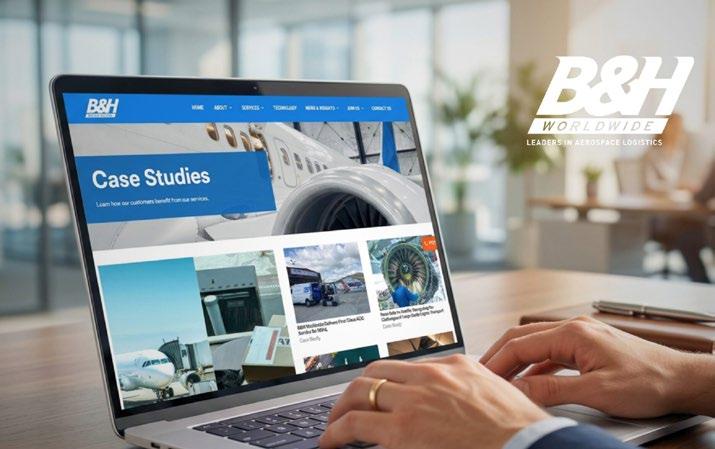
B&H Worldwide unveils comprehensive online case study library showcasing global aerospace logistics expertise
Kuehne+Nagel expands healthcare logistics network with Hyderabad temperature-controlled facility
Hellmann and MAS Holdings launch new fashion logistics hub in Sri
KLN continues to support global customers’ supply chain shifts with proven China-Hong Kong hybrid logistics solutions
DHL Supply Chain breaks ground on European battery logistics hub in the Netherlands
Dachser further expands its largest logistics centre
Envirotainer partners with Cathay to cut air freight emissions
Norse Atlantic Airways extends ULD management partnership with Jettainer
Mammoth Freighters receives FAA certification for 777-200LRMF freighter
HAECO and Atlas Air extend longstanding maintenance partnership
DHL Express launches new direct flight to strengthen
FedEx deepens Asia Pacific trade connectivity through strategic partnership in Vietnam
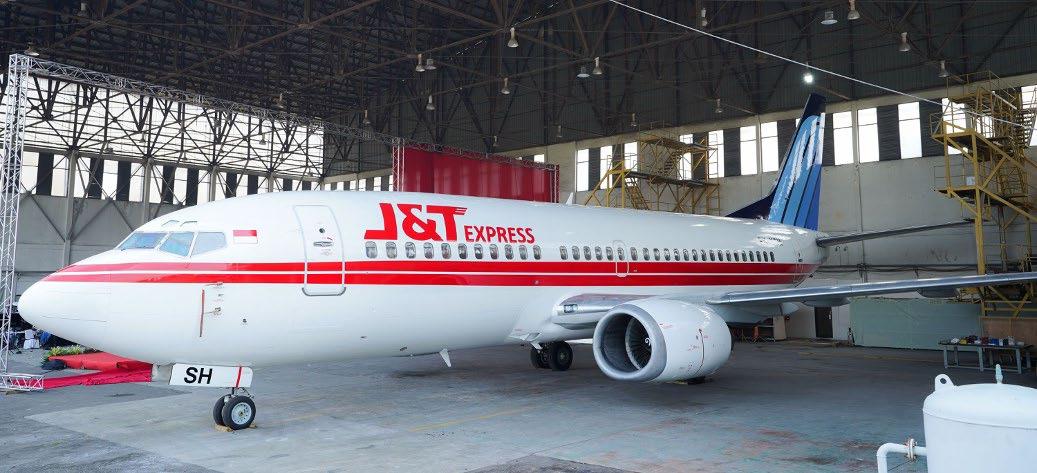
J&T Express releases 2025 ESG report with focus on smart logistics and green growth
Saudia Cargo: Bridging the e-commerce corridor
AERO launches as the first general access network exclusively for air freight forwarders
Yusen Logistics partners with cargo. one to deploy its AI-powered operating system for global air freight sales and procurement
ECS Group accelerates European expansion for My Freighter through strategic commercial partnership
TCE and Virgin Atlantic Cargo chalk up one year and a special sponsorship
Globe Air Cargo is the new GSSA to airBaltic in the UK
Neurored and CHAMP Cargosystems expand partnership to enable ONE Record with 1Neo-Connect and eAWB solutions
Joint Cathay Cargo and GLS team wins Jettainer ULD Challenge at IATA ONE Record Hackathon
Mecalux scales up its tech stack to drive AI agents across its software suite
HAFFA chairman outlines fuel surcharge, ESG and digitalisation priorities at 2026 AGM
IATA: Stronger standard implementation, modern GSE, and digitalisation are key to more resilient ground handling
role of GSSAs in an e-commerce-driven market
future of logistics communication is visual
Turkish Airlines appoints Prof. Murat Şeker as Chairman, Ahmet Olmuştur as CEO
Hactl appoints Frosti Lau as new Chief Executive
Chapman Freeborn appoints Danish Cutleriwala as Country Manager India
DHL Express announces new managing director for Thailand and Head of IndoChina
Gergely Szorcsik of Zoetis elected Chair of Pharma. Aero for 2026–202
Envirotainer appoints Aymeric Chandavoine as Chief Executive Officer as pharmaceutical supply chain complexity continues to grow
FEATURE CAINIAO
THOUGHT LEADERSHIP SHARELOOK
FEATURE SAUDIA CARGO
FEATURE
By Zhang Qiang, Senior Director of Logistics Technology Solutions, Cainiao Group
By James Gidlow, Group Commercial Director, FlyUs Aviation
NEWS - CARRIERS
MASkargo and Teleport partner to advance regional air cargo connectivity across Southeast Asia
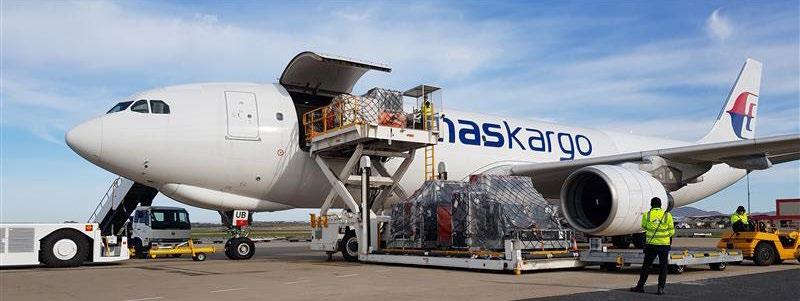
MASkargo has entered a strategic partnership with Teleport to strengthen regional air cargo connectivity and support growing trade flows across Southeast Asia.
The collaboration combines MASkargo’s global network and operational expertise with Teleport’s intra-Southeast Asia logistics network, enabling more seamless cargo flows across regional trade lanes.
As part of the partnership, MASkargo will utilise dedicated freighter capacity operated by Teleport on selected routes, including Kuala Lumpur–Phnom Penh services, improving access to emerging cargo markets such as Cambodia. The companies said the partnership will support growing demand for e-commerce, perishables, and general cargo shipments while improving transit times, flexibility, and routing options for customers.
Mohd Nadziruddin Mohd Basri, chief executive officer of aviation services at Malaysia Aviation Group, said the collaboration reflects MASkargo’s continued focus on expanding regional connectivity and aligning capacity with changing market demand.
Jan Philipp Pöter, chief business officer of Teleport, said the partnership demonstrates the flexibility of The Teleport Network, allowing airlines to respond quickly to shifting cargo demand and network requirements.
Teleport has deployed its Airbus A321 freighter on the Kuala Lumpur–Phnom Penh sector to connect cargo demand into MASkargo’s wider international network via Kuala Lumpur.
The companies said the collaboration marks the start of a broader effort to expand regional connectivity and strengthen cargo flows across Southeast Asia’s evolving logistics landscape.
China Eastern Airlines launches first Vienna–Xi’an nonstop service
the Chinese city of Xi’an. Julian Jäger, joint chief executive officer and chief operating officer of Vienna Airport, said demand for flights to Asia has risen by around 20% since the start of the year, with the new route strengthening Vienna’s position as a hub between Europe and Asia.
China Eastern Airlines said the service would improve connectivity between two major cultural and economic centres, while Austrian tourism officials highlighted the route’s importance for trade, tourism, and business ties between Austria and China.
The new service also supports Vienna Airport’s cargo operations, particularly for time-sensitive shipments such as e-commerce goods, industrial components, pharmaceuticals, and high-tech cargo.
Vienna Airport said the route enhances its role as a logistics gateway between Europe and China, adding cargo capacity for both imports and exports. The inaugural flight carried 12 tonnes of air cargo into Vienna.
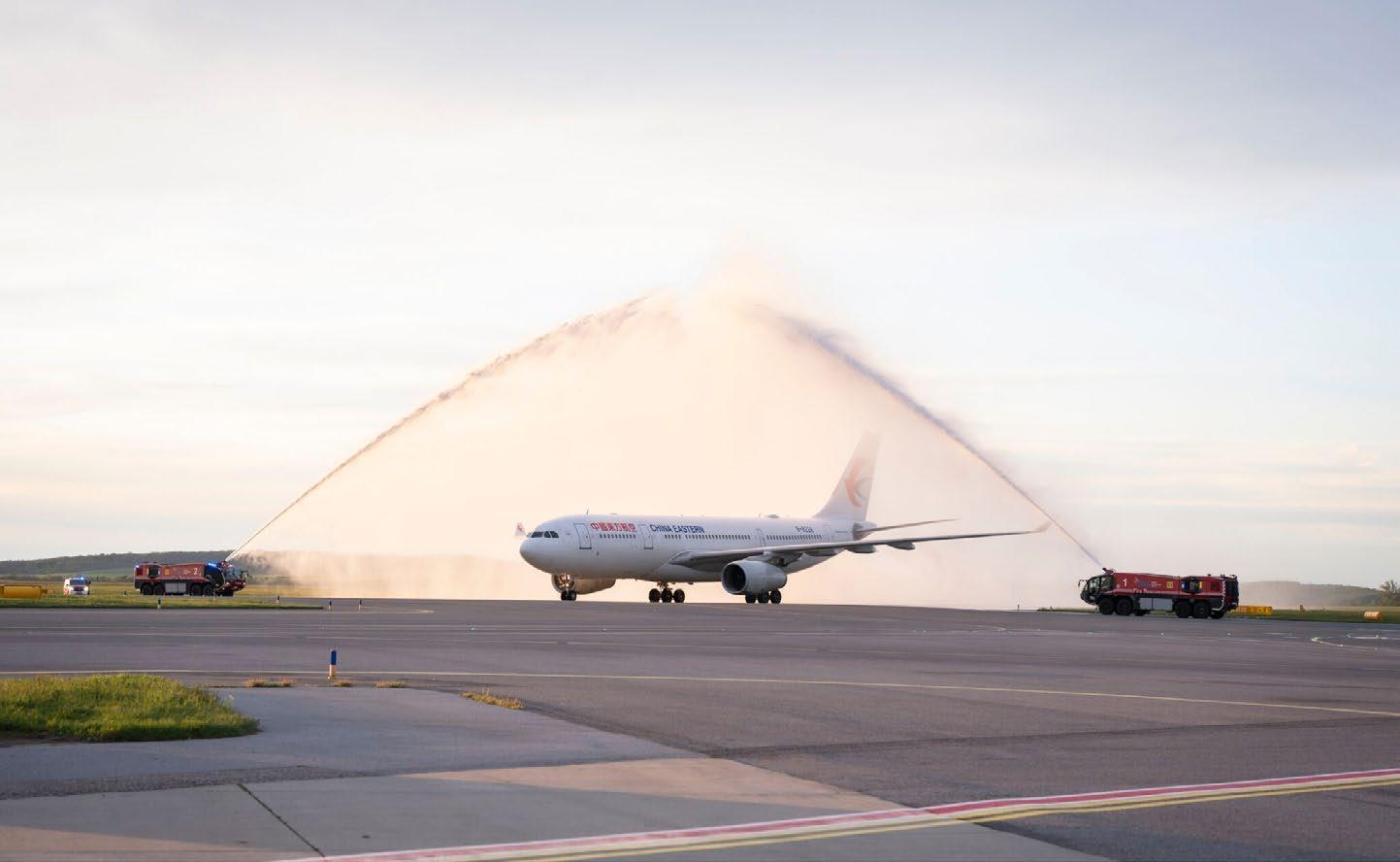
Vienna Airport has expanded its Asia network with the launch of China Eastern Airlines’ first direct service between Xi’an and Vienna.
The year-round route, inaugurated on 20 April 2026, operates three times weekly using an Airbus A330-200, marking the first nonstop connection between Vienna and
China Eastern Airlines will operate the Vienna–Xi’an route every Monday, Thursday, and Saturday.
China Eastern Airlines is now operating three weekly flights between Vienna and Xi’an; the inaugural flight was greeted with a water salute at Vienna Airport. Photo courtesy of Vienna Airport.
IndiGo
launches cargo
operations between Kunming and Kolkata
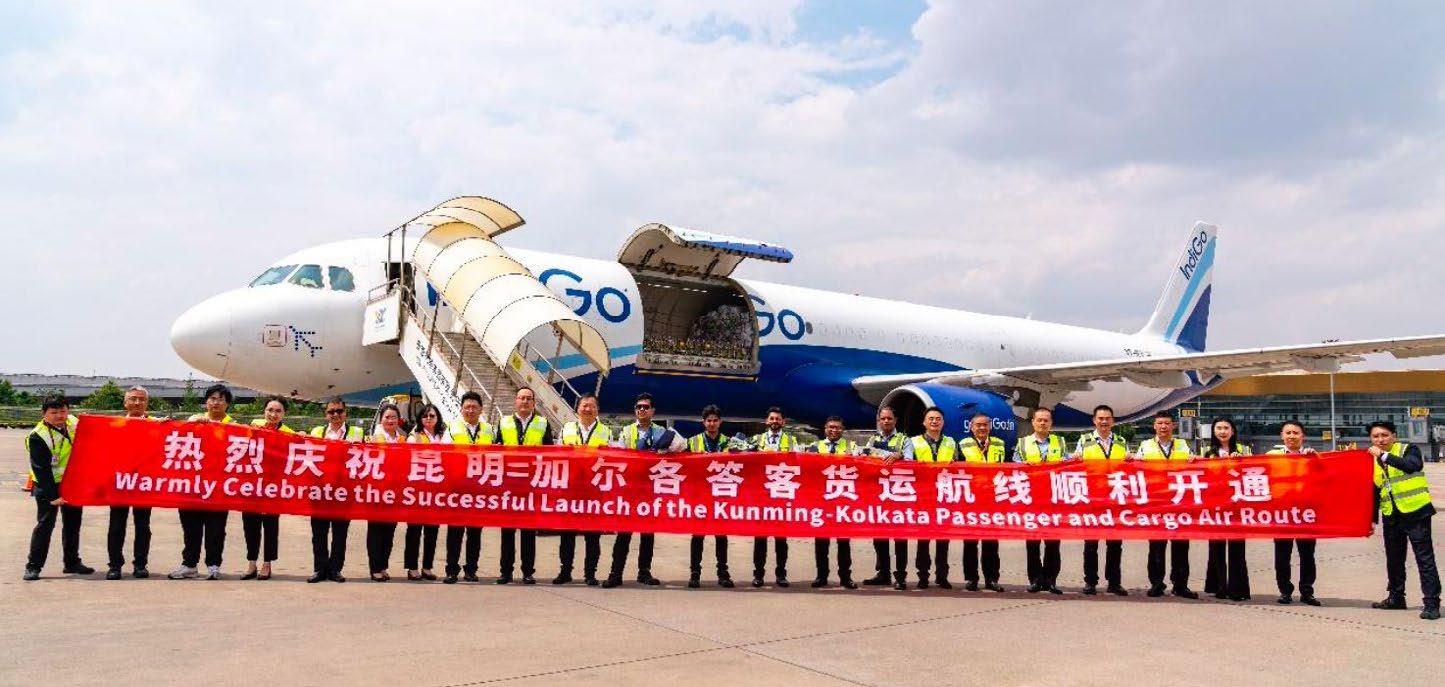
IndiGo launched a new all-cargo service between Kolkata and Kunming on 20 April 2026, strengthening air logistics connectivity between eastern India and southwest China.
The thrice-weekly route is operated using an Airbus A321 freighter and is designed to support the movement of fresh produce, cross-border e-commerce shipments, and general cargo between the two markets.
The inaugural flight carried nine tonnes of crabs from India to Kunming, while the return flight transported around 21.4 tonnes of general cargo.
Representatives from the Consulate General of India in Guangzhou, Yunnan Airport Group, customs authorities, and other logistics stakeholders attended the launch ceremony at Kunming Changshui International Airport.
Gince Kuruvilla Mattam, Consul General of India in Guangzhou, said the new route would strengthen trade and logistics cooperation between China and India while
supporting access to global markets. Yunnan Airport Group said the route forms part of efforts to deepen aviation connectivity and improve cargo and passenger links between Yunnan and India.
Officials also highlighted plans to strengthen cooperation among airlines, logistics providers, and airport authorities to improve cargo handling efficiency and network connectivity.
Kunming is positioning itself as a gateway hub for South and Southeast Asia, while Kolkata serves as a major commercial centre in eastern India.
The new cargo route complements the resumption of passenger services between the two cities, creating what officials described as a “simultaneous passenger and cargo transportation” corridor.
Saudia Cargo and SFDA announce major air freight support initiative for pharmaceutical shipments
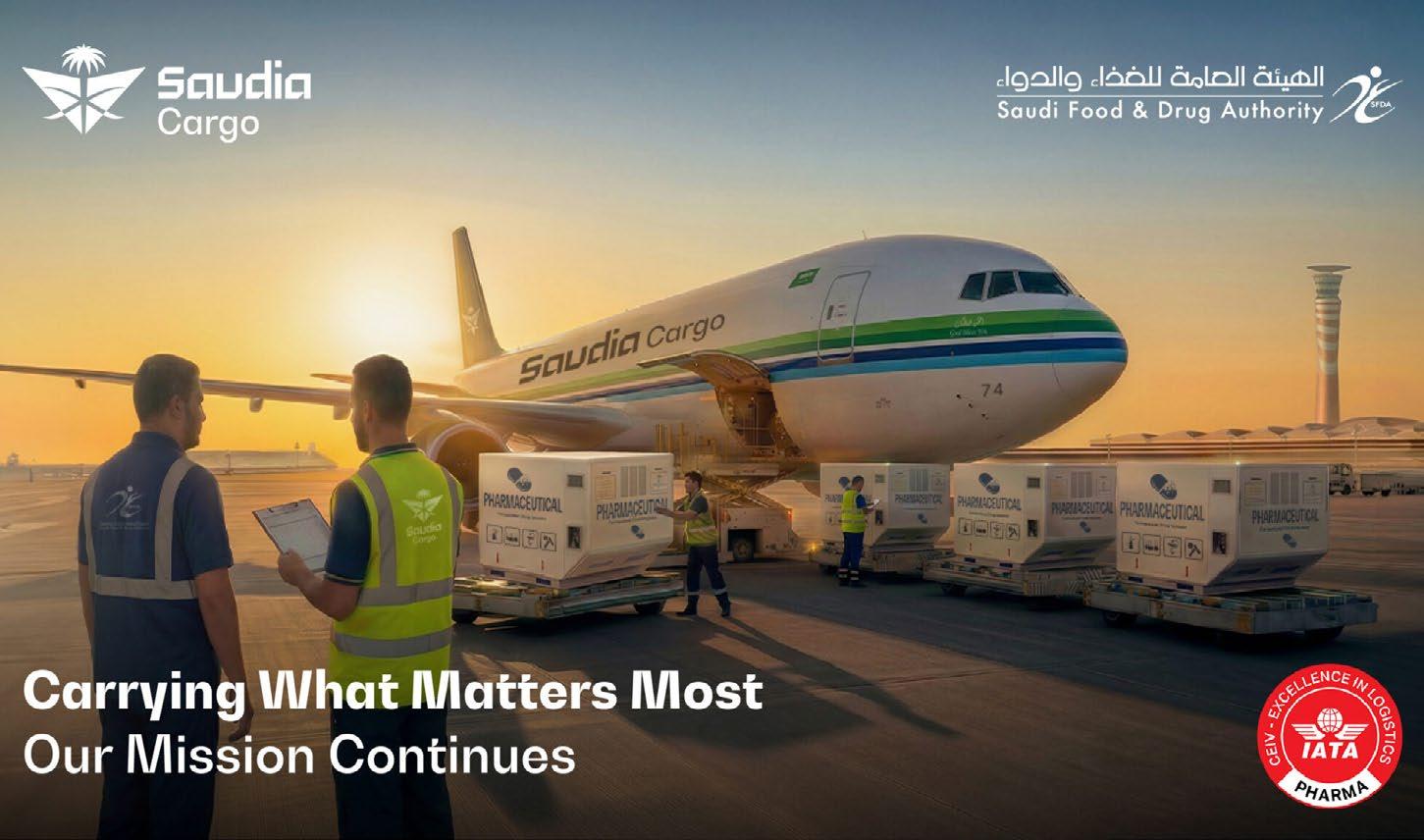
Saudia Cargo has launched a strategic initiative with the Saudi Food and Drug Authority (SFDA) to strengthen pharmaceutical and medical supply chain logistics across the Kingdom.
The initiative includes operational support measures and shipping discounts of up to 50% for pharmaceutical shipments and medical supplies, aimed at ensuring the uninterrupted movement of essential cargo.
Saudia Cargo said the programme supports Saudi Arabia’s national objectives of protecting public health and maintaining supply chain resilience amid evolving market conditions.
The company added that the initiative is expected to help reduce shipping costs for medicine importers while improving the continuity of pharmaceutical logistics flows.
Saudia Cargo highlighted the importance of public and private sector collaboration in strengthening logistics efficiency and enhancing the Kingdom’s transport ecosystem. The carrier said it is equipped to support the initiative through its advanced
cold chain infrastructure and compliance capabilities, backed by its IATA CEIV Pharma and IATA CEIV Fresh certifications. The company’s cold chain solutions are designed to ensure secure transportation and precise temperature control for pharmaceuticals and perishable products
in line with international regulations and SFDA requirements. Saudia Cargo said the initiative further reinforces Saudi Arabia’s position in securing critical pharmaceutical supply chains and supporting healthcare logistics reliability.
Turkish Cargo simplifies air cargo processes with its renewed corporate website
Turkish Cargo has launched a redesigned corporate website as part of its broader digital transformation strategy, aimed at simplifying shipment planning and operational processes for customers.
Developed by Turkish Technology, the new platform consolidates cargo
booking, shipment planning, and tracking tools into a single mobile-compatible interface. The website enables users to manage processes ranging from prebooking to map-based cargo tracking while also providing access to Turkish Cargo’s global flight network through an interactive map. Advanced filtering tools
allow customers to compare routing, product, and equipment options for different shipment types. Ali Türk, chief cargo officer at Turkish Airlines, said the platform forms part of the company’s vision to build a more integrated and transparent digital ecosystem for air cargo operations.
He added that the website is designed to improve speed, accessibility, predictability, and operational efficiency for both customers and logistics partners.
The platform also features a “How to Send My Cargo” section, guiding users through the shipment process from planning to delivery, while a dedicated fleet and equipment page helps customers identify suitable cargo solutions.
Turkish Cargo has also integrated its AI-powered digital assistant, Cargy, to improve site navigation and customer support.
The carrier said the new website supports its goal of making cargo planning and decision-making more streamlined and predictable through digitalisation.
Qatar Airways Cargo announces the launch of Pharma Passive FlexTemp
Qatar Airways Cargo has launched Pharma Passive FlexTemp, a new pharmaceutical transport solution designed to support shipments with changing temperature requirements during transit.
The add-on service is available for the carrier’s Pharma Passive and Pharma Critical Passive products and is aimed at addressing challenges linked to dual-temperature handling for sensitive healthcare cargo.
Qatar Airways Cargo said the solution is designed for shipments using passive packaging, particularly when single-use thermal packaging nears the end of its effective temperature-control cycle during transport.
The carrier described Pharma Passive FlexTemp as the first solution of its kind in the air cargo sector to support evolving temperature requirements within a single shipment journey.
The product is intended to improve shipment flexibility, maintain product integrity, and extend shelf-life protection for temperaturesensitive pharmaceutical cargo moving through the airline’s network.
Qatar Airways Cargo said the launch reinforces its focus on specialised healthcare logistics and pharmaceutical handling solutions.
Pharma Passive FlexTemp is now available for booking alongside Pharma Passive and Pharma Critical Passive services through the carrier’s Digital Lounge platform across all FlexTemp corridors within its network.
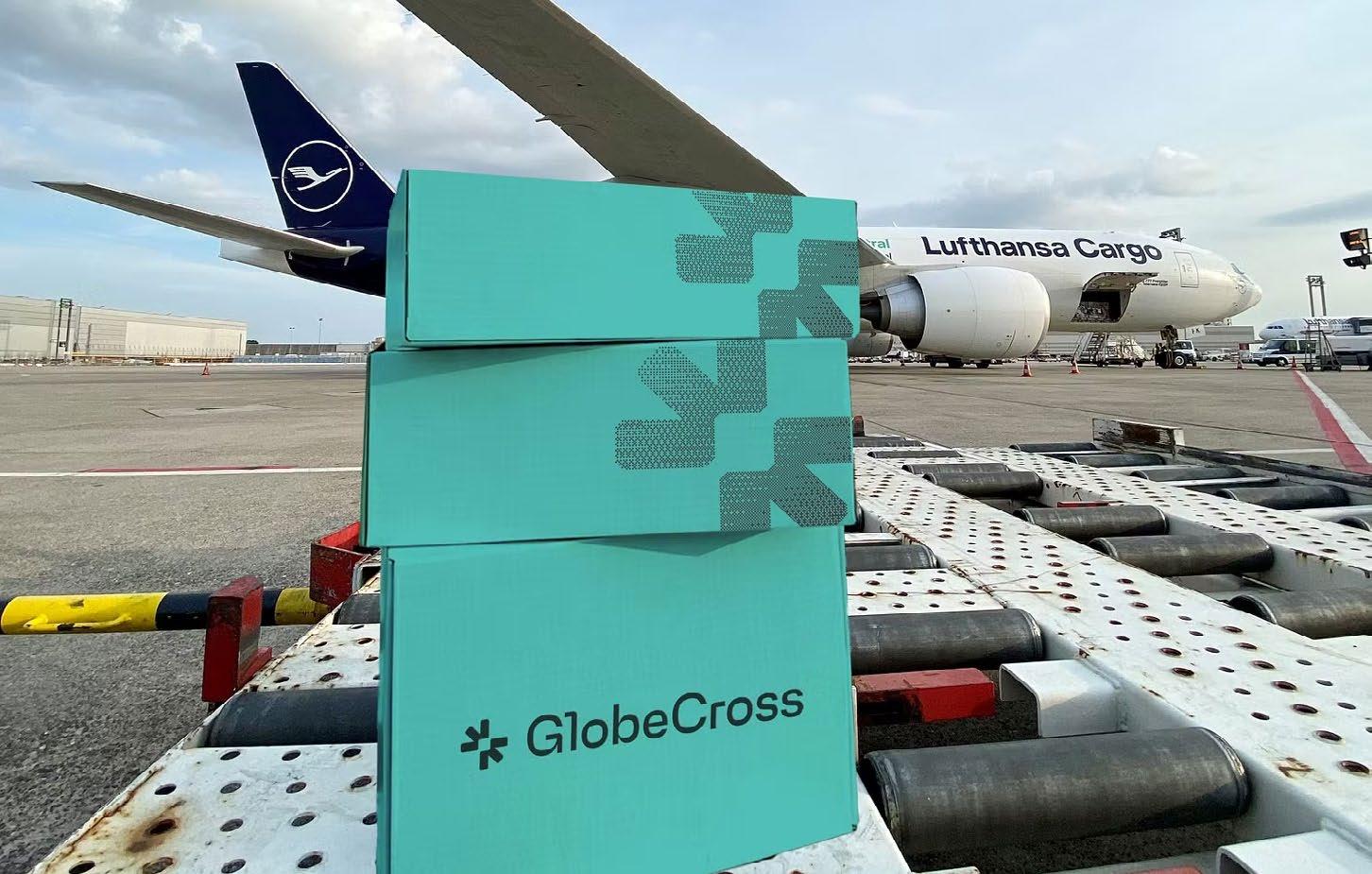
Lufthansa Cargo introduces GlobeCross
as subsidiary for cross-border logistics
Lufthansa Cargo has launched GlobeCross GmbH, a new wholly owned subsidiary focused on cross-border logistics and customs services for e-commerce shipments.
The company was formed through the merger of heyworld and CB Customs Broker and is
designed to provide faster, more transparent, and compliant cross-border logistics solutions in an increasingly complex trade environment.
GlobeCross combines digital e-commerce logistics capabilities with more than 20 years of customs expertise, operating as an integrated
partner for end-to-end cross-border delivery services.
“With GlobeCross, we are significantly expanding our cross-border logistics capabilities and taking a decisive step in offering our customers solutions beyond traditional airport-to-airport transportation,” said Ashwin Bhat, chief executive officer of Lufthansa Cargo.
The new subsidiary’s services are structured around three areas: end-to-end e-commerce logistics, e-commerce import terminals at major cargo hubs, and digital customs clearance solutions for EU imports and exports.
Nikola Todic, managing director of GlobeCross, said the merger simplifies cross-border logistics by combining e-commerce logistics and customs expertise into a single integrated platform.
Lufthansa Cargo said GlobeCross operates using an asset-light model focused on software, processes, and customs expertise rather than physical infrastructure, allowing for flexible scaling and faster rollout of new services. The company will operate independently while benefiting from access to the wider Lufthansa Group logistics ecosystem.
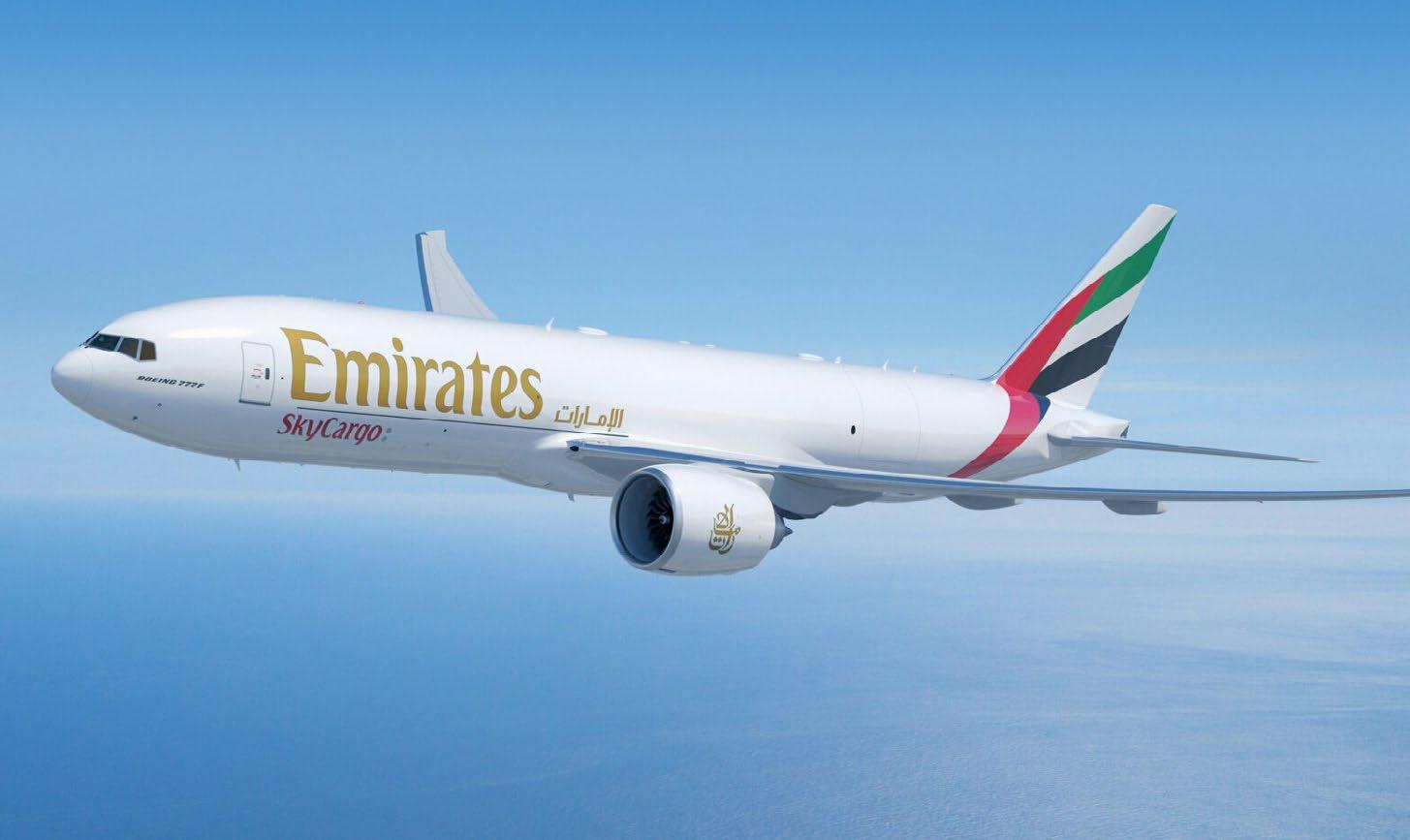
Emirates SkyCargo available on Pelicargo, expanding digital presence in the US
Emirates SkyCargo has expanded its digital booking capabilities through a new integration with Pelicargo, becoming the first Middle Eastern carrier to establish API connectivity with the platform for immediate cargo bookings.
The move strengthens Emirates SkyCargo’s digital presence in the US market, where the carrier said it has seen growing adoption of digital booking channels over the past year alongside a decline in manual transactions.
Through the partnership, Emirates SkyCargo’s products and services will be accessible to thousands of freight forwarders using Pelicargo, enabling 24/7 booking access and greater shipment visibility.
“The digital solutions that we have deployed globally have made a huge impact on the way we operate,” said Badr Abbas, divisional senior vice president at Emirates SkyCargo.
He added that onboarding to Pelicargo supports the carrier’s strategy to improve connectivity with customers in the United States while further advancing digitalisation
across its operations. Jon Acquaviva, cofounder and president of Pelicargo, said the partnership aligns with both companies’ focus on customer-centric and digitally connected air cargo solutions. Five Emirates SkyCargo products are now available on Pelicargo, including Fresh and Fresh Breathe
for perishables, Pharma for temperaturesensitive healthcare shipments, Airfreight Priority for urgent cargo, and AirFreight for general cargo. Pelicargo becomes the fourth digital marketplace to host Emirates SkyCargo capacity after cargo.one, CargoAi, and WebCargo.
NEWS - AIRPORTS
Glasgow Prestwick Airport secures three new weekly Ethiopian Airlines e-commerce flights
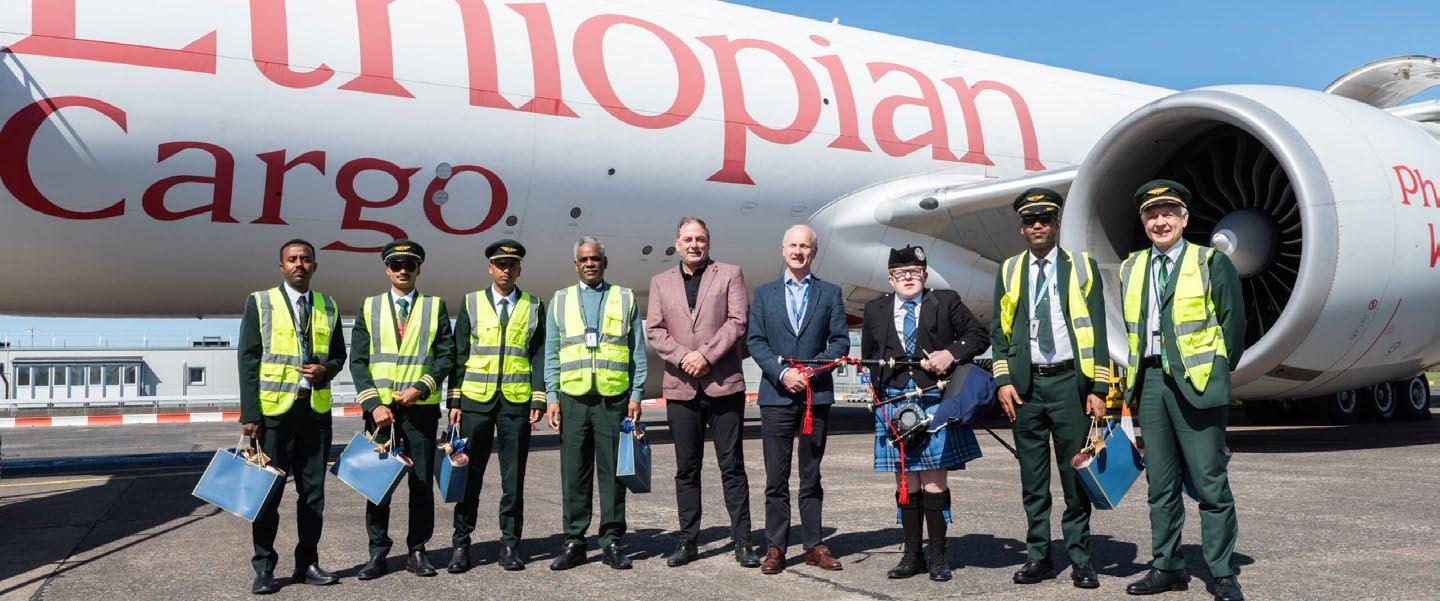
Glasgow Prestwick Airport has secured three new weekly cargo flights from Hong Kong with Ethiopian Airlines, strengthening its growing e-commerce operations and long-haul cargo network. The service will operate every Tuesday, Wednesday, and Saturday, increasing
inbound e-commerce volumes through Prestwick’s cargo hub. “These new flights mark a significant step in scaling Prestwick’s e-commerce operation, with Hong Kong now a key inbound gateway into our network,” said Ian Forgie, chief executive officer of Prestwick. Prestwick
said it has introduced a fast-track cargo handling model for e-commerce aimed at improving cargo processing speed and delivery efficiency.
The airport currently handles 15 weekly flights to and from mainland China, with the additional Hong Kong services expected to support up to GBP250 million in cross-border trade.
Earlier this year, Royal Mail and Evri joined Prestwick in marking 25 million e-commerce parcels processed through its facility. Growth in cargo services has also created more than 250 direct jobs.
Prestwick said new routes to South Korea and Vietnam would provide Scottish exporters with improved access to high-growth markets, supporting industries including salmon exports, pharmaceuticals, life sciences, and perishables through its dedicated cool chain facilities.
CargoLand by LGG targets Taiwan as a strategic gateway for semiconductor flows between Asia and Europe
CargoLand by LGG is strengthening its position as a European gateway for Taiwan’s high-value cargo following a March 24 mission to Taipei that brought together public authorities, airlines, and logistics stakeholders.
The initiative focused on building long-term connectivity between Taiwan and Europe,
particularly for semiconductors, high-tech cargo, and resilient supply chains.
CargoLand highlighted its cargofirst operating model and long-term development strategy, designed for highvalue and time-sensitive shipments. The platform handled 1.32 million tonnes of cargo in 2025, up 14% year-on-year,
supported by continued growth into early 2026. The company said its 100% freighter-focused approach, combined with operational flexibility and integrated logistics processes, makes it well-suited for industries such as semiconductors, pharmaceuticals, and advanced manufacturing.
The mission also underscored the increasing importance of semiconductor logistics between Taiwan and Europe as manufacturers seek stronger and more resilient supply chain links.
“Taiwan is a key market for the future of high-value air cargo, particularly in sectors such as semiconductors and advanced technology,” said Frédéric Brun, vice president sales and marketing at CargoLand by LGG.
“Our objective is to build long-term, structured relationships with airlines, forwarders, and institutional stakeholders, and to demonstrate that CargoLand can offer a reliable, scalable, and performancedriven gateway into Europe.”
CargoLand added that continued investments in infrastructure and digitalisation are aimed at supporting the next generation of strategic supply chains.
Crew from Ethiopian Airlines with Prestwick Operations Director, Jules Matteoni (centre) and Chief Executive Officer Ian Forgie (fourth from right).
HKIA named world’s busiest cargo airport in 2025: ACI
Hong Kong International Airport retained its position as the world’s busiest cargo airport in 2025, handling 5.07 million tonnes of cargo, according to full-year data released by Airports Council International. It marks the 15th time since 2010 that HKIA has topped the global cargo rankings.
“We are greatly honoured to retain our position as the world’s busiest cargo airport,” said Vivian Cheung, chief executive officer of Airport Authority Hong Kong. She cited the airport’s continued expansion in high-value cargo, e-commerce fulfilment, and cross-boundary transhipment despite growing regional competition and economic uncertainty. HKIA continues to strengthen
its cargo capabilities through infrastructure and digital initiatives. In March 2026, UPS began construction of a new cargo hub at HKIA, expected to handle nearly one million tonnes annually when completed in 2028.
The airport also highlighted progress on its Air-Land Fresh Lane initiative with Guangdong authorities, designed to accelerate customs clearance for perishables moving into the Greater Bay Area.
Meanwhile, the HKIA Dongguan Logistics Park has processed cargo valued at more than RMB57 billion since its pilot launch, with permanent first-phase facilities expected to
Brussels Airport and ConnexEurope open new logistics building
Brussels Airport and ConnexEurope have inaugurated a new logistics facility in the airport’s cargo zone, strengthening the company’s European operations and longterm presence at the hub.
Formerly operating under the Comexas name, ConnexEurope specialises in logistics flows between Europe and Africa, covering air freight, sea freight, customs, and transport services.
The new site includes 3,400 sqm of warehouse space and 500 sqm of offices, consolidating the company’s Belgian operations under one roof to improve coordination across shipments and transport modes.
Brussels Airport said sustainability was a key focus of the project, with the building receiving BREEAM Excellent certification for energy efficiency and environmental performance.
“ConnexEurope, formerly Comexas, is part of the history of Brussels Airport’s cargo operations,” said Geert Aerts, chief cargo and real estate officer at Brussels Airport.
ConnexEurope currently employs around 25 people at the airport and is recruiting further as part of its expansion plans.
“The launch of ConnexEurope and the opening of our new headquarters at Brussels Airport represent a key milestone
boost annual handling capacity beyond one million tonnes.
AAHK said its digital platforms, HKIA Cargo Data Platform and HKIA Cargo Connect, continue to support supply chain visibility and cargo ecosystem collaboration.
for the group,” said Jan Willem de Braal, group managing director at ConnexAfrica & ConnexEurope.
From its Brussels hub, ConnexEurope handles air freight via passenger aircraft, freighters and charters, alongside sea freight and specialised cargo such as perishables and mining project shipments for Africa.
The company said the consolidated facility would improve operational efficiency and support long-term cargo growth at Brussels Airport.
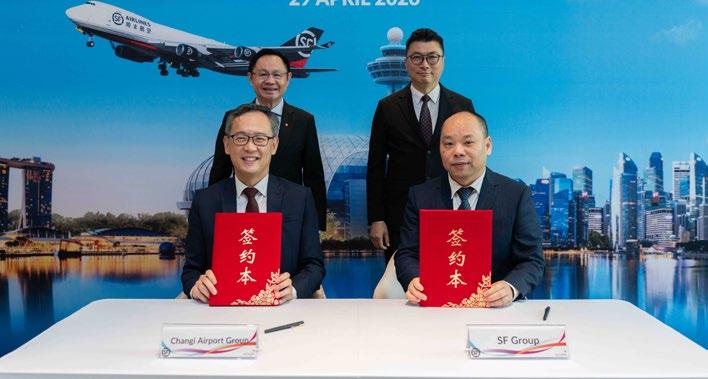
Changi Airport Group signs MoU with SF Group on strategic cooperation to develop its first overseas hub in Changi Airport
Changi Airport Group and Shenzhen S.F. Taisen Holding have signed a five-year Memorandum of Understanding to develop Singapore Changi Airport as SF’s first overseas air cargo hub. The partnership supports SF’s international expansion plans and is expected to strengthen Changi Airport’s express cargo capacity and regional connectivity.
Under the agreement, Changi Airport will serve markets across Southeast Asia, South Asia, and Oceania, supported by the expansion of SF’s network at the airport.
“We are delighted that SF Group has selected Changi Airport as its first overseas hub,” said Yam Kum Weng, chief executive officer of Changi Airport Group. He added that the partnership would enhance the
movement of high-value and time-critical cargo across the Asia Pacific and beyond. Dick Wong, chairman, executive director and general manager of SF Group, said Singapore is a key part of the company’s global expansion strategy, with the collaboration expected to strengthen crossborder logistics capabilities and regional resource integration.
SF Airlines, the aviation arm of SF Group, operates more than 90 freighters and currently flies daily cargo services between Singapore and Shenzhen.
Changi Airport is also home to regional hubs operated by DHL Express, FedEx Express, and UPS, supporting its role as a major express and transhipment hub in the Asia Pacific.
Top (L-R): Mr Yam Kum Weng, CAG’s Chief Executive Officer, and Mr Dick Wong, SF Group’s Chairman, Executive Director and General Manager Bottom (L-R): Mr Lim Ching Kiat, CAG’s Executive Vice President of Air Hub & Cargo Development, and Mr. Sun Haijin, SF Group’s Partner and Senior Vice President, and Chairman of the Board and CEO of SF Intra-City. Courtesy of Changi Airport Group.
NEWS - GROUND HANDLING
Royal Air Maroc Cargo meets growing cool chain demand with enhanced facilities
Royal Air Maroc Cargo is upgrading and expanding its temperature-controlled facilities at Casablanca Mohammed V International Airport to support growing volumes of perishables and pharmaceutical shipments.
Once completed, the airline’s cargo hub will feature five cold chambers— three for imports and two for exports— with a combined area of 590 sqm. The
facilities will offer multiple temperature ranges, including 2°C–8°C, 15°C–25°C, and frozen storage, to accommodate a range of temperature-sensitive cargo.
Rita Chraibi, Vice President Cargo at Royal Air Maroc, said the investment is driven by facility renewal requirements, increasing cargo volumes linked to fleet expansion, and growing demand for pharmaceutical logistics in Morocco and
across Africa. The upgraded facility will include a 240 sqm import chamber and a 140 sqm export chamber operating at 2°C–8°C, alongside dedicated chambers for controlled room temperature and frozen products.
Hicham Kharbach, Head of Cargo Operations at Royal Air Maroc, said the project will increase storage capacity while incorporating newer technologies to improve energy efficiency. The facilities will also be powered by solar energy. Royal Air Maroc Cargo operates temperature-controlled facilities across its Moroccan network, including airports in Casablanca, Fès, Oujda, Rabat, Agadir, and Marrakesh.
The carrier said the investment supports its Fresh Cargo product, which provides specialised handling for perishables such as fresh produce and flowers, as well as temperature-sensitive pharmaceutical shipments.
WFS wins Qatar Airways cargo handling contract in Liège
Worldwide Flight Services (WFS), a SATS company, has won a contract to handle Qatar Airways Cargo’s Boeing 777 Freighter operations at Liège Airport. Commencing on 1 May 2026, WFS will provide ramp and warehouse handling services for the
airline’s Boeing 777 freighters at the Belgian airport, arriving from Doha and other prime international cargo markets.
This latest contract reinforces WFS’ status as the leading cargo handling organisation
at Liège Airport, based on volume. It now handles 11 international airlines, which use Liège as a key European hub to transport cargo and e-commerce traffic.
“We are delighted to be serving Qatar Airways Cargo at another of the airline’s key international cargo stations and proud to be contributing to the growth of Liège Airport. At WFS, we are fully aware of the highest standards Qatar Airways expects for its customers.
Being awarded another significant contract by the airline demonstrates our ability to consistently meet these requirements, and we hope this will lead to more growth opportunities across our respective global networks,” said Philippe Torry, Managing Director Belgium of WFS.
Liège Airport’s cargo growth shows no sign of abating. In 2025, the airport saw its annual cargo tonnage rise 14% to 1.32m tonnes. This upward trend continued in the first quarter of 2026, with the airport reporting a 15.6% year-on-year boost in volumes to 342,845 tonnes.
This was supported by a 7% increase in aircraft movements to 7,247 in the opening three months of this year.
Swissport launches operations at Shanghai Pudong International Airport
Swissport International has launched operations at the Digital & Intelligent International Cargo Terminal at Shanghai Pudong International Airport, marking its entry into the Chinese market and expanding its presence in Asia. The launch follows a partnership agreement signed in October 2025 with Smarex, a joint venture
between Shanghai Airport Authority Logistics Development Company and China Eastern Airlines Logistics. Swissport said the facility combines its global cargo handling expertise with advanced digital and automated infrastructure to support the growth of China’s cross-border e-commerce sector.
Covering 144,000 sqm, the terminal features automated sorting systems, AIenabled operational tools, and fast customs processing. It also includes 15,000 sqm of temperature-controlled space ranging from -60°C to +25°C for pharmaceutical and perishable shipments. Warwick Brady, Chief Executive Officer and President of Swissport International, said the operation strengthens the company’s position in one
of the world’s most important logistics markets while supporting growing global demand for Chinese exports.
Through Swissport’s network of 312 airports in 49 countries, the Shanghai facility will connect customers to major cargo hubs across North America, Europe, the Middle East, Africa, and Asia-Pacific.
Brad Moore, Chief Executive Officer APAC at Swissport, said the company expects cargo volumes through the facility to grow by 8% to 10% in the coming years as connectivity and efficiency improve across key trade lanes. The terminal is fully electrified and incorporates real-time digital systems to support more efficient and sustainable cargo operations.
SATS posts record FY26 revenue on cargo volume growth and network expansion
SATS Ltd reported record revenue of S$6.35 billion for the financial year ended 31 March 2026, up 9.0% year-on-year, while profit attributable to equity holders
increased 17.0% to S$285.2 million.
The company processed 9.65 million tonnes of cargo across its combined SATS and Worldwide Flight Services (WFS) network, representing a 7.0% increase from the previous year.
SATS said cargo growth continued to outperform global industry benchmarks, supported by market share gains and network expansion.
Gateway Services revenue rose 10.8% to S$4.95 billion, while Food Solutions revenue increased 2.9% to S$1.39 billion. EBITDA grew 10.6% to S$1.15 billion, with the EBITDA margin improving to 18.1%.
During the year, SATS renewed its cargo handling partnership with EVA Air across
US stations, expanded its cooperation with Air Europa Cargo in Spain, and acquired Aviapartner Cargo NV at Brussels Airport.
The combined SATS-WFS network now operates more than 225 stations in 27 countries.
Kerry Mok, President and Chief Executive Officer of SATS, said the company continued to demonstrate resilience despite challenges posed by the conflict in the Middle East, which affected industry performance toward the end of the financial year.
SATS said it will continue investing in technology, artificial intelligence, and infrastructure across its global network while adapting to changing market conditions.
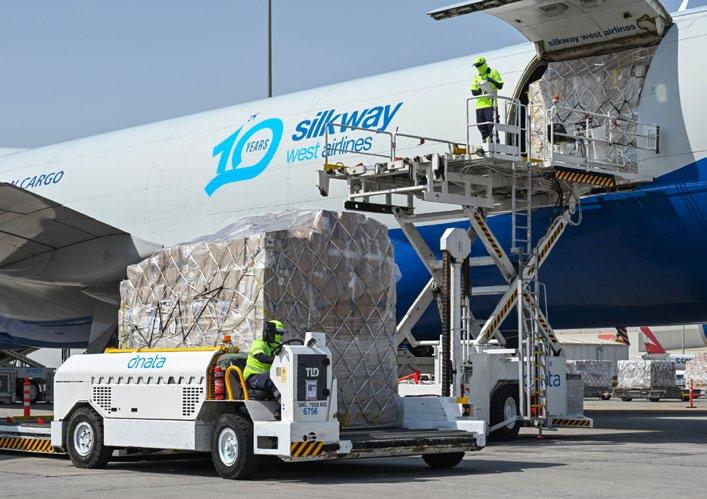
dnata wins multi-year Silk Way Group cargo handling contract in Singapore
dnata has secured a multi-year contract with Silk Way Group to provide cargo and freighter handling services at Singapore Changi Airport.
Under the agreement, dnata will support Silk Way Group’s twice-weekly freighter
operations, handling more than 15,000 tonnes of cargo annually. Shipments will include general cargo, temperaturesensitive products, and specialised freight such as oil and gas, aviation, and aerospace equipment.
The contract was awarded following a competitive tender process and further strengthens the longstanding partnership between the two companies.
Tom Alwyn-Jones, Managing Director of dnata’s Airport Operations unit in Singapore, said the agreement reflects the company’s ability to support freighter carriers in one of Asia’s busiest cargo hubs while maintaining reliable cargo flows and aircraft turnaround performance. The latest contract builds on dnata’s broader
relationship with Silk Way Group, including support for Silk Way West Airlines’ operations in multiple international markets and a joint venture to develop an aviation services hub in Azerbaijan.
Onno Pietersma, Chief Operating Officer of Silk Way West Airlines, said reliable ground and cargo handling is critical to maintaining efficient freighter operations at major transit hubs such as Singapore.
In Singapore, dnata supports more than 30 airline customers, handles approximately 250,000 tonnes of cargo annually, and manages around 22,000 flights each year. Globally, the company provides cargo and ground handling services at more than 90 airports across 16 countries.
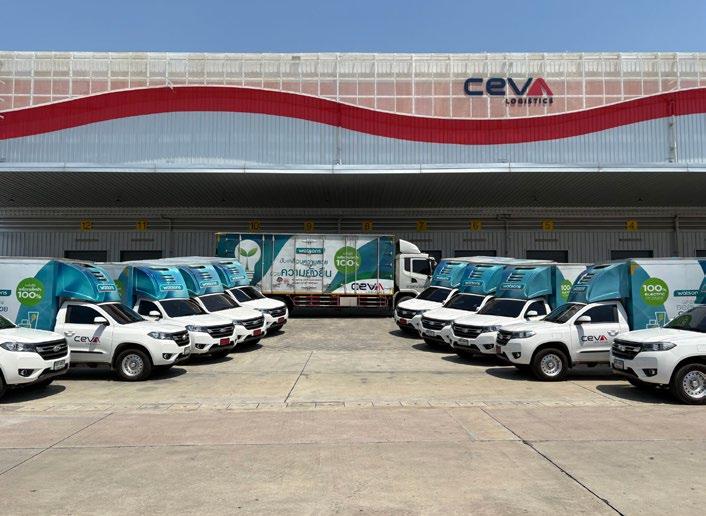
CEVA Logistics supports Watsons Thailand in expanding electric vehicle adoption
CEVA Logistics and Watsons Thailand have expanded their logistics partnership with the deployment of additional electric vehicles (EVs) to support lower-carbon retail supply chains in Thailand.
Chapman
Under a new agreement, CEVA will deploy a total of 11 EVs dedicated to Watsons Thailand’s operations in the Greater Bangkok area. The companies estimate the fleet will help avoid approximately 125,820 kg of CO₂ emissions annually compared with diesel-powered vehicles.
The initiative supports both companies’ netzero ambitions and Watsons Thailand’s goal of reducing Scope 1 and 2 greenhouse gas emissions by 50.4% by 2030.
In addition to the EV rollout, CEVA will provide real-time tracking and mileage data to help Watsons monitor progress against its decarbonisation targets.
Since November 2025, CEVA has managed Watsons Thailand’s high-frequency
distribution network, supporting deliveries across the country through a customised transport model and its Ground Command Centre. Nuanphan Jayanama, Managing Director of Watsons Thailand, said the transition to electric vehicles is a key part of the retailer’s sustainability roadmap while maintaining reliable delivery performance.
Sutanai Hemsrichart, Ground & Rail Director, Thailand at CEVA Logistics, said the partnership reflects a shared commitment to advancing environmental sustainability and promoting low-carbon logistics solutions across Thailand.
CEVA said its operational planning and realtime visibility tools currently support a 99% on-time delivery performance for Watsons Thailand’s retail network.
Freeborn OBC partners with Freeze Carbon to strengthen measurable climate action
Chapman Freeborn OBC has partnered with Freeze Carbon to strengthen emissions measurement and mitigation across its time-critical logistics operations.
Established in October 2025, the partnership supports Chapman Freeborn OBC’s broader climate strategy by improving emissions tracking and addressing residual emissions that cannot currently be avoided due to the urgent nature of on-board courier services
Unlike conventional freight movements, OBC shipments are often arranged at short notice and routed on the next available flight, limiting opportunities to optimise transport from an emissions perspective.
Through Freeze Carbon’s digital tools, Chapman Freeborn OBC will be able to measure its emissions footprint more consistently, improve reporting transparency, and support emissions mitigation efforts across its operations.
The collaboration also provides access to verified climate projects designed to deliver measurable environmental and social benefits. “Through our partnership with Freeze Carbon, we are enhancing
how we track our emissions and address residual emissions in a structured and transparent way, while maintaining the speed and reliability our customers expect,” said Nicolas Estrada, Project Manager at Chapman Freeborn OBC.
The company said its sustainability approach focuses on improving operational efficiency, engaging with partners, and supporting credible climate initiatives while maintaining service performance standards for timecritical shipments. Chapman Freeborn OBC added that emissions management is becoming increasingly integrated into daily planning as the aviation logistics sector seeks practical pathways to reduce its environmental impact.
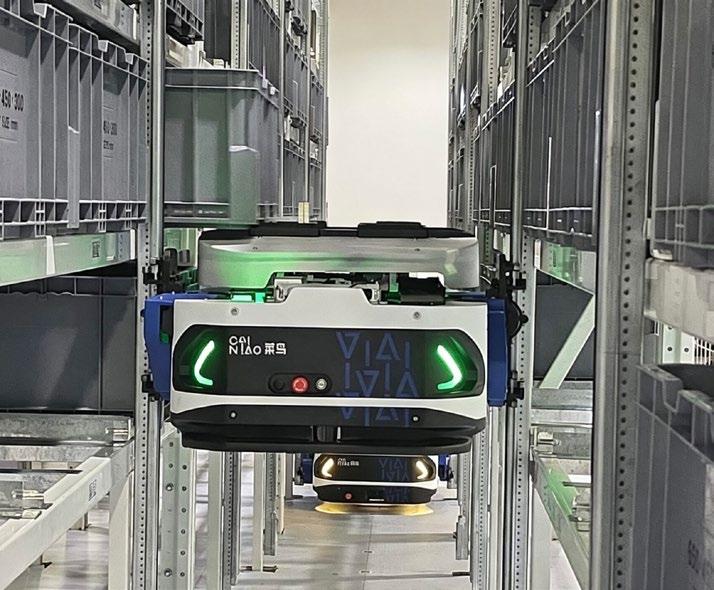
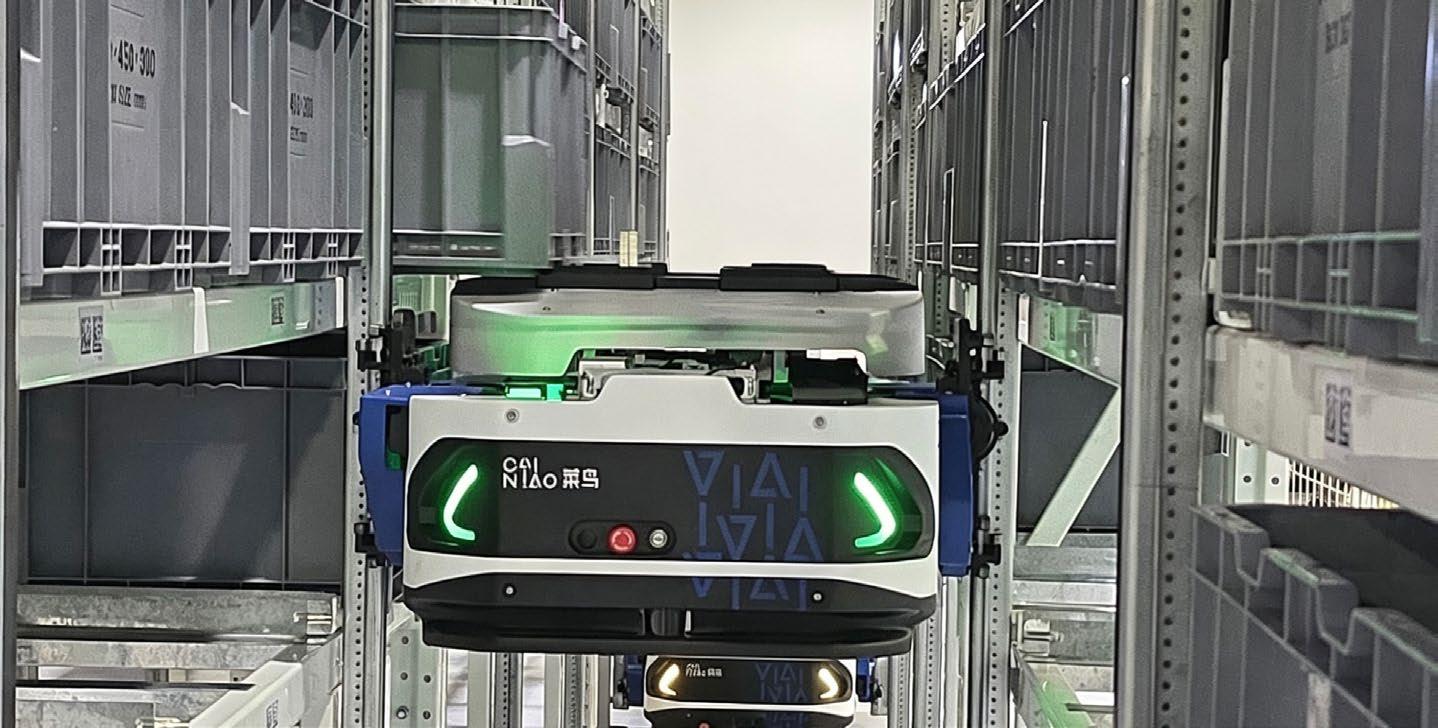
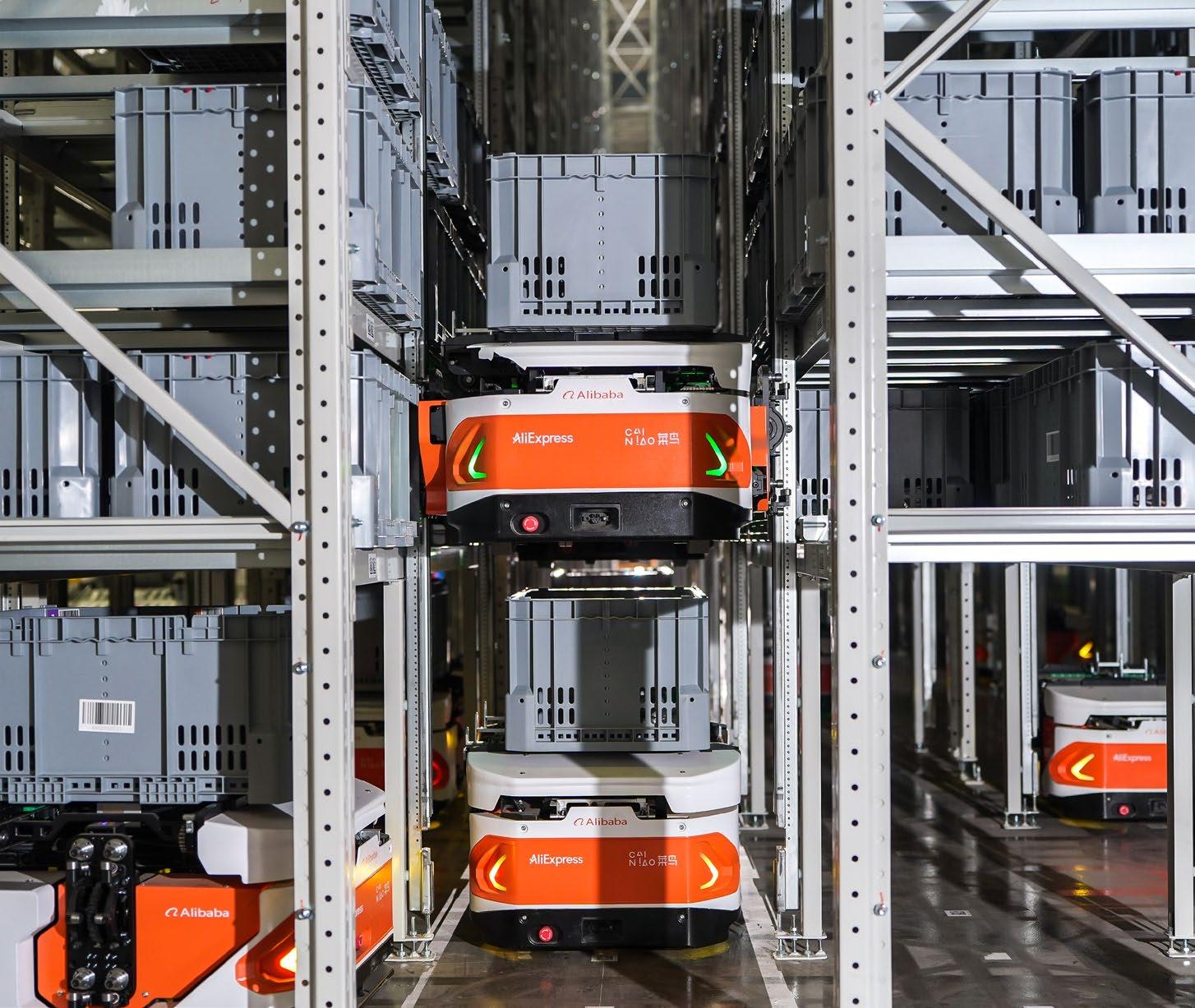
Cainiao unveils ZeeBot Climbing Robot, doubling storage and retrieval productivity in live operations
Cainiao has launched ZeeBot, its first selfdeveloped rack-climbing warehouse robot, at MODEX 2026 in Atlanta, while confirming the deployment of its first commercial
project in Guangdong, China. According to Cainiao, the system has doubled storage and retrieval productivity, with robots able to climb to the height of a five-level rack in as little as 10 seconds.
Designed for warehouse operations, ZeeBot combines horizontal movement and vertical storage functions in a single robot. The system travels through narrow aisles before climbing racking to retrieve and store totes, reducing the need for separate automation systems.
Cainiao said the solution can travel at speeds of up to 4 metres per second and improve storage density by 40% compared with conventional automated warehouse systems.
“ZeeBot will help warehouses move
beyond point automation to a new phase of AI-scheduled, end-to-end multi-robot collaboration,” said Bi Jianghua, Vice President of Cainiao Group and General Manager of Logistics Technology.
More than 100 ZeeBot units are currently operating in a cross-border logistics warehouse in Dongguan, supporting a global e-commerce platform.
The company said the modular design allows warehouses to scale capacity more easily as demand changes, while fleet-level scheduling improves operational flexibility.
Following deployments in China, Cainiao plans to expand ZeeBot to its warehouse operations in Europe and North America as part of its broader logistics technology strategy.
B&H Worldwide unveils comprehensive online case study library showcasing global aerospace logistics expertise
B&H Worldwide has launched a new online Case Study Library showcasing its specialist logistics capabilities for the global aviation industry.
Hosted on the company’s website, the
resource features real-world examples of aerospace logistics projects, including Aircraft on Ground (AOG) support, onboard courier services, aircraft engine transportation, helicopter shipments, warehousing, and aircraft teardown logistics.
The library is designed to provide customers and industry partners with insight into how B&H Worldwide manages complex logistics operations while maintaining safety, compliance, and minimal operational disruption.
“Our goal was to create a seamless, usercentric platform that allows our customers and partners to easily navigate the breadth
of our global operations,” said Darren Lim, Digital Marketing Manager at B&H Worldwide. Kevin Casey Goh, Content Marketing Manager at B&H Worldwide, said the case studies highlight the planning and expertise required to support critical aviation logistics projects.
The company said the library demonstrates its ability to manage complex and timesensitive assignments for airlines, MROs, parts stockists, and OEMs worldwide.
B&H Worldwide added that the platform reinforces its commitment to sharing industry best practices and showcasing its expertise across the aerospace logistics sector.
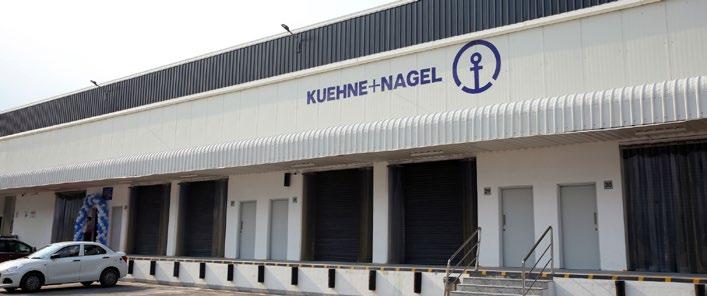
Kuehne+Nagel expands healthcare logistics network with Hyderabad temperature-controlled facility
Kuehne+Nagel has expanded its healthcare logistics network in India with the opening of a new temperaturecontrolled airfreight cross-dock facility in Hyderabad.
The facility is designed to support the safe and compliant handling of pharmaceutical and medical shipments, strengthening Kuehne+Nagel’s presence in one of India’s
largest pharmaceutical manufacturing hubs. Hyderabad accounts for more than 40% of India’s active pharmaceutical ingredient and vaccine production, making it a key location for healthcare supply chains.
The 248 sqm facility features dedicated temperature-controlled zones ranging from +2°C to +8°C and +15°C to +25°C to help maintain product integrity during handling and distribution.
The site complies with Kuehne+Nagel’s HealthChain quality standard, which supports Good Practice (GxP) requirements across healthcare logistics operations. It is the company’s second
HealthChain-certified facility in India, following the opening of its Bengaluru Cool Zone facility in December 2025.
Anish Kumar Jha, Managing Director for India, Sri Lanka and the Maldives at Kuehne+Nagel, said the investment strengthens the company’s healthcare logistics network while bringing it closer to customers in one of the country’s most important pharmaceutical centres.
He added that the facility will support Indian healthcare companies through specialised temperature-controlled infrastructure and improved access to global markets via compliant supply chain solutions.
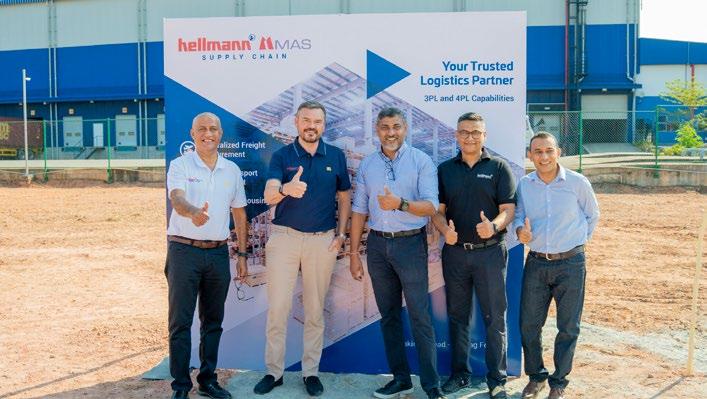
Hellmann and MAS Holdings launch new fashion logistics hub in Sri Lanka
Hellmann Worldwide Logistics and MAS Holdings will develop a new contract logistics facility in Kimbulapitiya, Sri Lanka, through their joint venture, Hellmann MAS
Groundbreaking ceremony in Kimbulapitiya, Sri Lanka: Kamal Boyagama (HMSC), Patrick Grzywa, (Hellmann IMEA), Shakthi Ranatunge (MAS Holdings), Ahamed Rahman, (Hellmann Sri Lanka), Jehan Mutaliph (MAS Holdings).
Supply Chain. Located six kilometres from Bandaranaike International Airport, the facility will serve as a dedicated fashion logistics hub within Hellmann’s South Asia network.
Spanning more than 8,000 sqm, the built-tosuit facility will feature dual-zone humidity and climate control systems, solar panels, and scalable infrastructure designed to support regional distribution across Asia, Africa, and Europe.
The project forms part of Hellmann’s Forward2030 strategy, strengthens its fashion logistics offering, and supports MAS Holdings’ ambitions to expand its integrated supply chain services for global apparel brands. The facility will handle a broad range of fashion logistics requirements and is intended to enhance operational efficiency,
agility, and sustainability across regional supply chains. Patrick Grzywa, Regional COO Contract Logistics IMEA at Hellmann Worldwide Logistics, said the investment strengthens the end-to-end fashion logistics capabilities of the joint venture and supports global brands operating in South Asia.
Shakthi Ranatunge, Chief Operating Officer of MAS Holdings and Board Member of Hellmann MAS Supply Chain, said the facility will help position Sri Lanka as a competitive apparel hub while enabling more integrated supply chain solutions for international customers. The project builds on the partnership established between Hellmann and MAS Holdings in 2018, combining global logistics expertise with apparel manufacturing and supply chain knowledge.
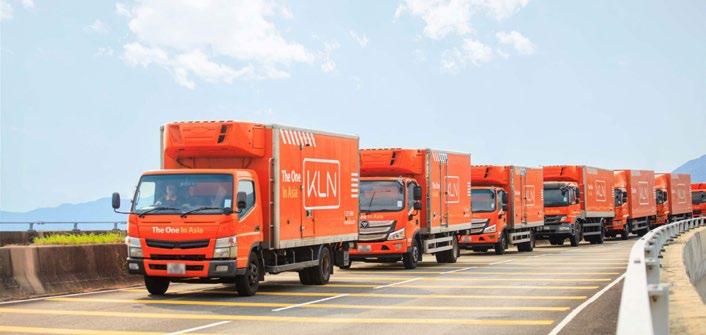
KLN continues to support global customers’ supply chain shifts with proven China-Hong Kong hybrid logistics solutions
KLN Logistics Group Limited is supporting multinational customers relocating supply chain operations into the Greater Bay Area through its China-Hong Kong hybrid logistics model. The company said it recently helped a European confectionery manufacturer, a global fast-food chain, and an international paper distributor shift operations into the region while
maintaining service levels and reducing logistics costs.
KLN’s hybrid logistics solution combines bonded warehousing, cross-border transportation, customs clearance, and digital visibility into an integrated endto-end platform. The company has also expanded its facilities in Yantian, Shenzhen, to support frozen food logistics for food and beverage customers.
A key component of the model is KLN’s Authorised Economic Operator (AEO) status and its partnerships with customs authorities in Hong Kong and mainland China. The company said this enables priority customs clearance, reduced inspections, and same-day or next-
day deliveries. Samuel Lau, Managing Director – Integrated Logistics at KLN, said the solution helps customers optimise inventory, simplify cross-border operations, and improve supply chain resilience while maintaining high service standards.
With dedicated facilities in Qianhai and Yantian, Shenzhen, KLN said it can support a broader range of industries through efficient and cost-effective cross-border logistics services.
The company added that it remains focused on helping international customers build more agile and resilient supply chains through the China-Hong Kong corridor.
DHL Supply Chain breaks ground on European battery logistics hub in the Netherlands
DHL Supply Chain has broken ground on a new European Battery Logistics Hub in Holtum, the Netherlands, expanding its capabilities for battery and energy storage logistics. Scheduled to open in early 2027, the facility will provide 17,000 sqm of specialised storage and service space for high-voltage batteries. Located next to DHL’s existing automotive operation, the site will form
an integrated campus supporting electric mobility and energy storage supply chains across Europe. The company said demand for battery logistics continues to grow as electric vehicle adoption accelerates and battery manufacturers, particularly from Asia, expand their presence in European markets.
The Holtum facility will support batteries used in electric vehicles as well as battery energy storage systems (BESS) for residential and renewable energy applications.
Rainer Haag, Chief Executive Officer of DHL Supply Chain Europe, said the investment strengthens the company’s ability to support customers across the electric mobility and
energy sectors while advancing DHL Group’s Strategy 2030. The facility will offer a range of value-added services, including battery storage, diagnostics, testing, charging, refurbishment, reverse logistics, and recycling preparation.
John Scherders, Chief Executive Officer of DHL Supply Chain Benelux, said the project reinforces Holtum’s role as a logistics and new energy hub by combining battery, automotive, and spare parts operations at a single location.
DHL said the development supports growing demand for safe, compliant, and scalable battery supply chain solutions across Europe.
Dachser further expands its largest logistics centre
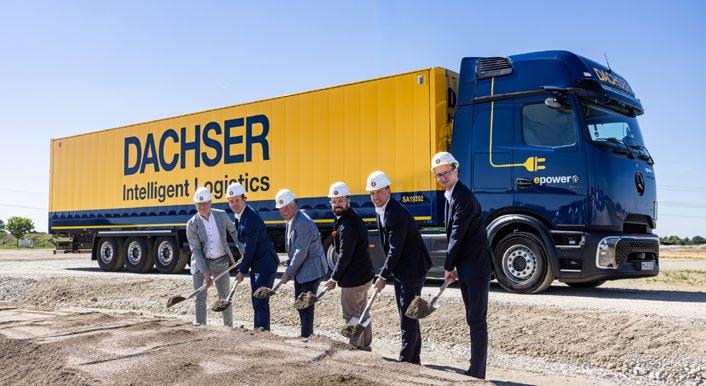
(L-R) Florian Graber, Branch Manager Food Logistics; Daan van der Meer, Operations Manager Euronational Forwarding; Thomas Henkel, General Manager (all 3 DACHSER logistics center Allgäu); Jan Rothenbacher, Mayor City of Memmingen; Alexander Tonn, COO Road Logistics DACHSER; Lukas Unglehrt, authorized signatory and shareholder, Unglehrt GmbH.
Dachser has begun construction of a new logistics facility in Memmingen, Germany, as part of a EUR30 million investment to expand capacity and strengthen its European logistics network.
Located in the industrial park north of Memmingen, the facility is scheduled to open in spring 2027 and will provide 11,000 sqm of cargo handling space, 2,750 sqm of warehousing, and 1,000 sqm of office space. The site will be capable of loading and unloading up to 125 trucks simultaneously.
Thomas Henkel, General Manager of Dachser’s Allgäu Logistics Centre, said the expansion will support future growth and create around 90 additional jobs, bringing total employment at the site to more than 900 by mid-2027. The facility will incorporate digital and sustainability technologies, including Dachser’s @ILO digital twin system,
which automates package recognition and measurement to improve process efficiency and reliability.
The company also plans to install EV charging infrastructure, a 1 MW rooftop solar power system, and district heating to support its sustainability goals.
Alexander Tonn, COO Road Logistics at Dachser, said the investment reflects the company’s continued focus on network expansion, digitalisation, sustainability, and capacity growth despite economic uncertainty.
Dachser’s Allgäu Logistics Centre is the company’s largest operational site globally, handling industrial goods and food logistics with an annual throughput of approximately 1.3 million shipments.
Envirotainer partners with Cathay to
Envirotainer has partnered with Cathay through its Corporate Sustainable Aviation Fuel (SAF) Programme to support lower-emission transportation for temperature-sensitive pharmaceutical cargo.
Under the agreement, Envirotainer will purchase at least 100 tonnes of verified emissions reduction claims, equivalent to around 12,000 US gallons of SAF used within Cathay’s operations.
The partnership aims to accelerate SAF adoption across the air cargo sector while helping reduce emissions linked to shipments using Envirotainer’s temperature-controlled solutions. SAF is considered a key tool in aviation decarbonisation, offering lifecycle carbon emission reductions of more than 70% compared with conventional jet fuel. The fuel is typically produced from wastebased feedstocks such as used cooking oil and household waste.
“Reducing emissions across our supply chain isn’t a future ambition—it’s an immediate responsibility,” said Aymeric Chandavoine, Chief Executive Officer
cut air freight emissions
of Envirotainer. Kuntal Baveja, Regional President APAC at Envirotainer, said the agreement supports the company’s efforts to scale sustainable pharmaceutical logistics across Asia Pacific. Through Cathay’s Corporate SAF Programme, the environmental benefits associated with SAF are allocated to participating companies using an industry-recognised
attribution model, helping organisations address indirect emissions from air freight.
Dominic Perret, Director Cargo at Cathay, said broader collaboration across the air cargo value chain is essential to scaling SAF adoption and supporting industry sustainability goals.
Norse Atlantic Airways extends ULD management partnership with Jettainer
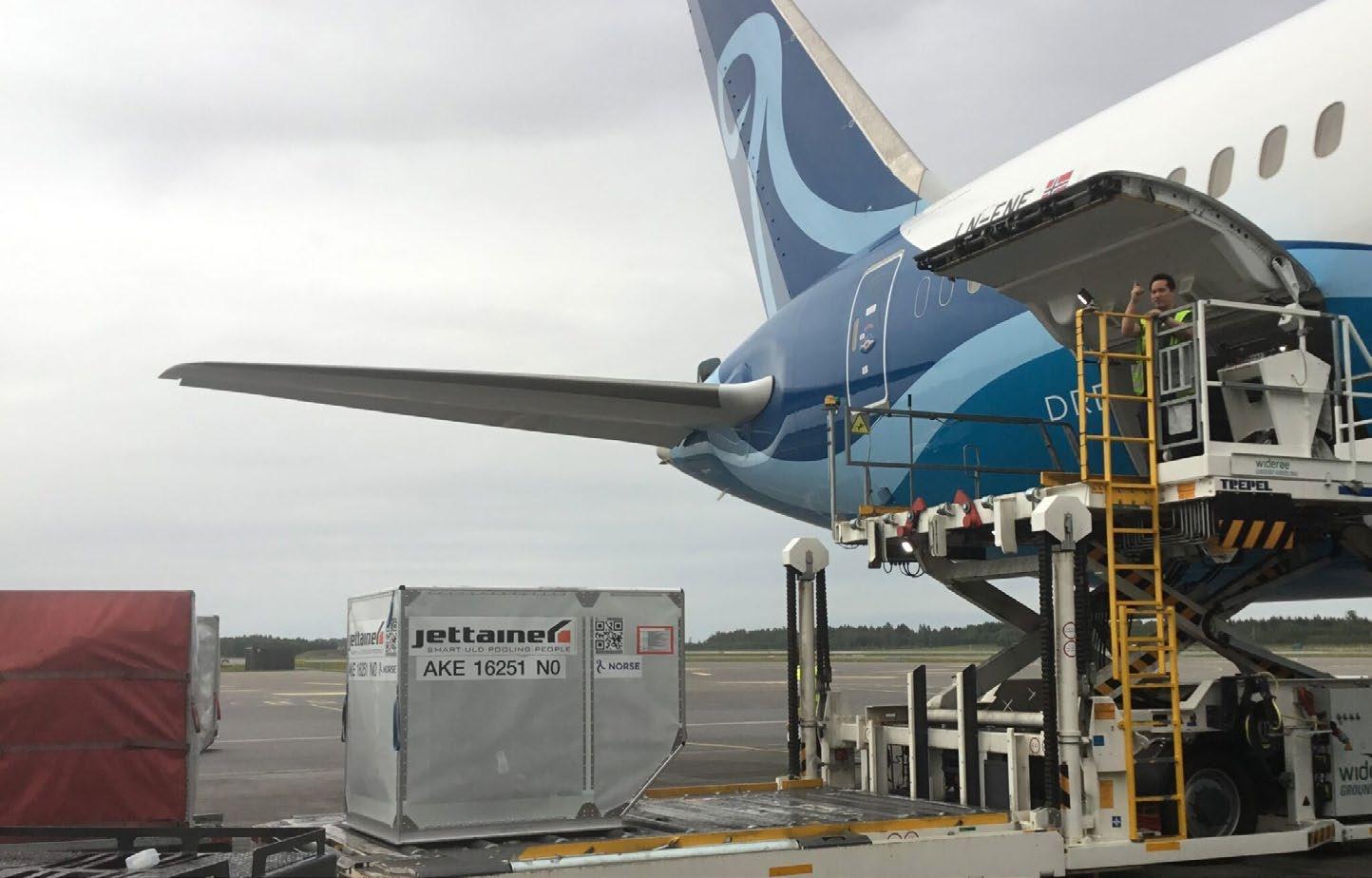
Norse Atlantic Airways has extended its partnership with Jettainer ahead of schedule, continuing the management of its unit load device (ULD) fleet across the airline’s long-haul network.
Under the renewed agreement, Jettainer will continue supplying and managing containers and pallets for Norse Atlantic’s Boeing 787 operations connecting Europe with destinations in the United States, Africa, and Asia.
The partnership is based on a flexible fleet model designed to adapt to seasonal demand changes, supported by Jettainer’s JettwareNG IT platform. The system provides tracking, station inventory monitoring, movement history, and performance reporting across the ULD fleet.
Norse Atlantic Airways Chief Operational Officer Thom-Arne Norheim said the partnership has provided reliable and flexible operational support since its launch in 2022.
“The close operational coordination and transparent fleet monitoring give us the stability we need in a dynamic market environment,” he said. Dr. Jan-Wilhelm Breithaupt, Chief Executive Officer of Jettainer, said extending the contract early reflects the strong partnership between the two companies. He added that transparency and continuous performance monitoring remain essential to ensuring consistent ULD
availability in a highly seasonal operating environment.
Jettainer said its digital fleet management capabilities help support operational efficiency and reliable ULD availability across Norse Atlantic’s expanding network.
NEWS - MRO
Mammoth Freighters receives FAA certification for 777-200LRMF freighter
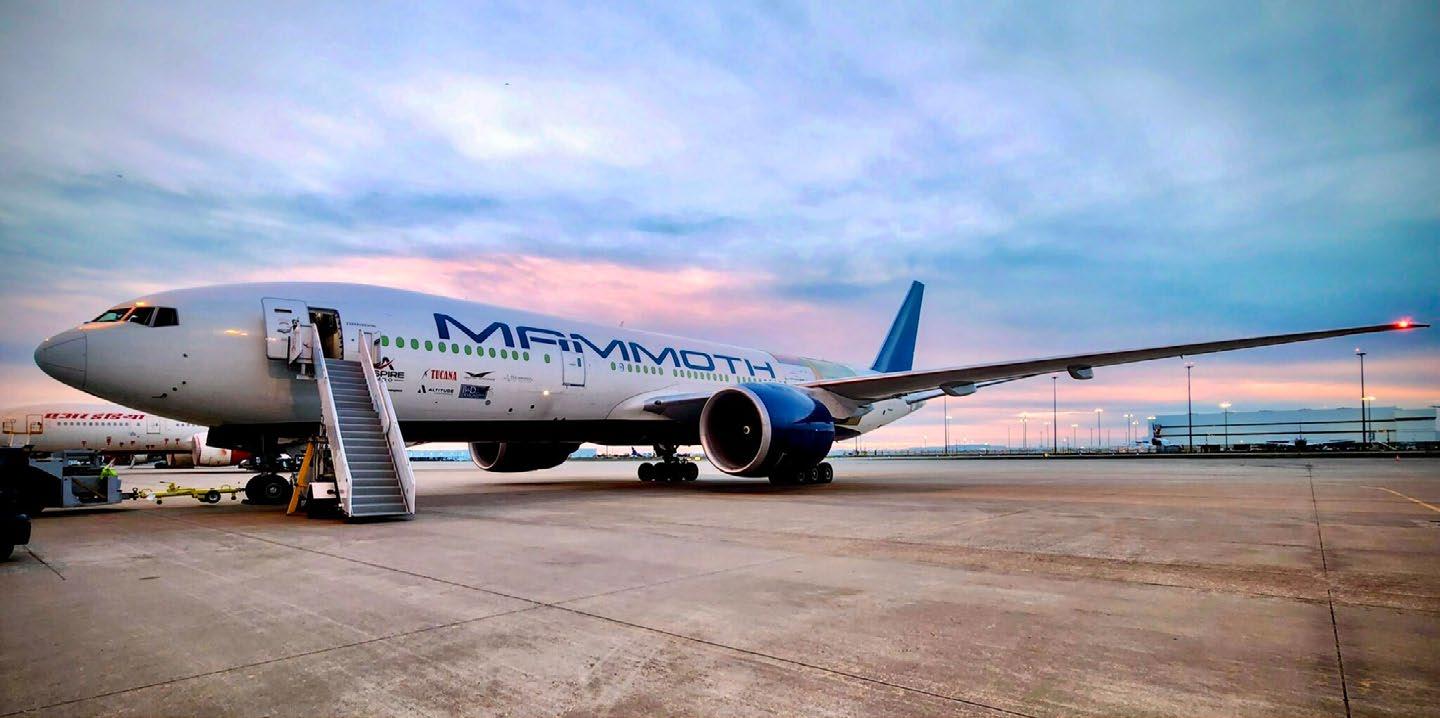
Mammoth Freighters LLC has received Federal Aviation Administration (FAA) certification for its 777-200LRMF (Long Range Mammoth Freighter), clearing the aircraft for commercial service and marking a major milestone for the company’s passenger-to-freighter conversion programme.
The certification validates the aircraft’s design, engineering and performance, enabling deliveries and entry into service. The programme is aimed at meeting growing demand for longrange, fuel-efficient widebody freighters as cargo operators seek additional capacity.
Bill Tarpley, Chief Executive Officer of Mammoth Freighters, said the approval reflects years of engineering work and collaboration with the FAA.
The 777-200LRMF is based on the Boeing 777-200LR platform and incorporates Mammoth’s proprietary conversion design. Key features include a large main-deck cargo door, reinforced floor structure and a flexible cargo handling system designed for both long-haul and regional freight operations.
Jordan Jaffe, Chief Executive Officer of Jetran and launch customer for the programme, said the aircraft is expected to be a competitive option in the longhaul freighter market. Customers for the converted aircraft include DHL, Qatar Airways and Ethiopian Airlines.
Mammoth also said it continues to progress its 777-300ERMF programme and expects FAA certification for that variant later this year.
HAECO and Atlas Air extend longstanding maintenance partnership
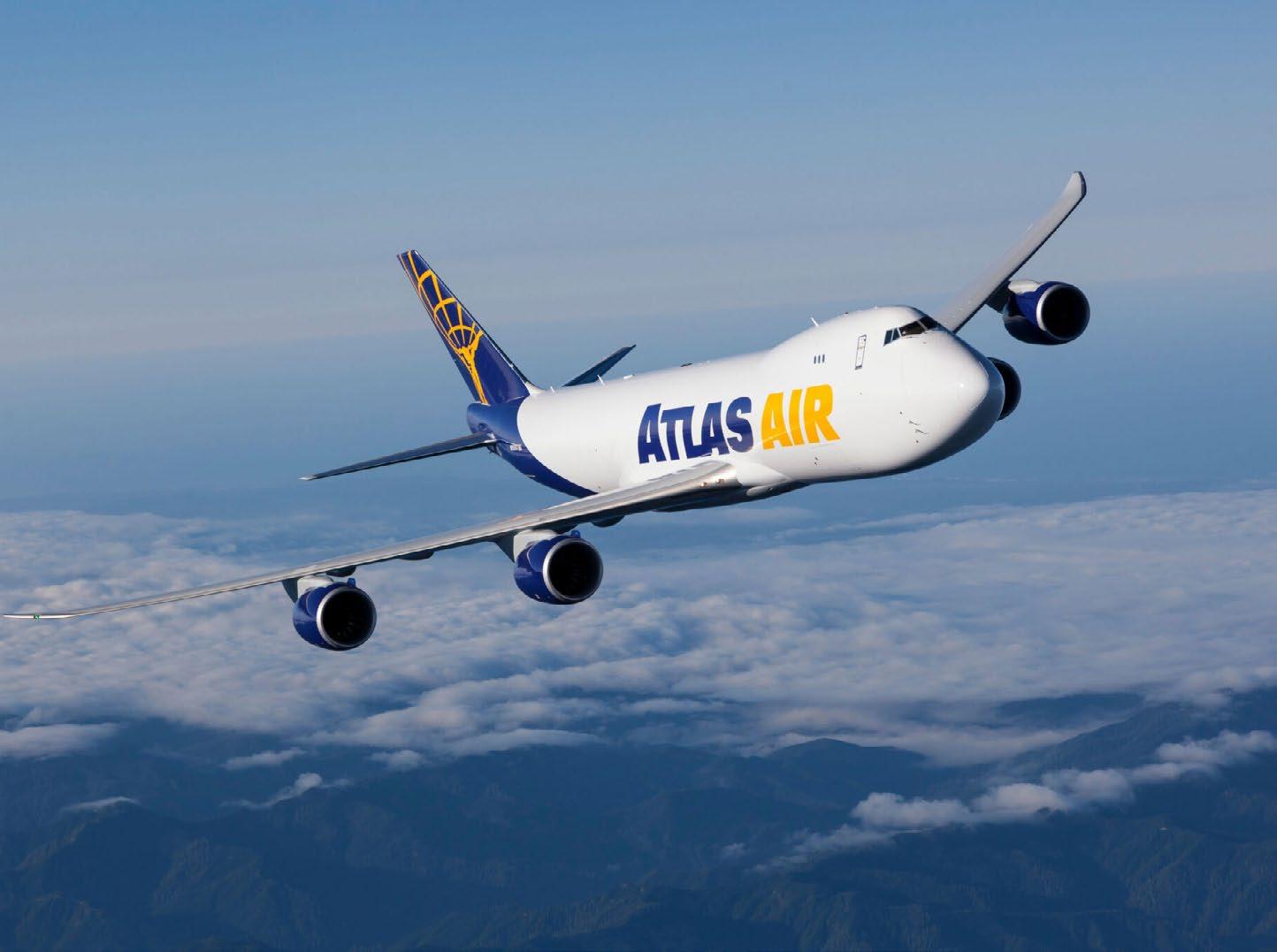
HAECO has extended its maintenance partnership with Atlas Air, building on a relationship that spans more than 25 years. Under the new agreements, HAECO
will continue providing line maintenance support for Atlas Air in Hong Kong from 2026 to 2030, increasing on-site manpower to improve aircraft turnaround times and
operational efficiency. The company will also extend base maintenance support for Atlas Air’s Boeing 747 freighter fleet from 2028 to 2030 at its Hong Kong maintenance facility.
Gerald Steinhoff, Chief Commercial Officer of HAECO Group, said the renewed agreements reflect the companies’ longterm partnership and focus on delivering reliable maintenance support tailored to Atlas Air’s operational requirements.
Rich Steer, Vice President of Technical Operations at Atlas Air, said HAECO remains an important partner in supporting the airline’s technical operations strategy, particularly across the Asia-Pacific region.
Atlas Air operates the world’s largest fleet of Boeing 747 freighters and is a major provider of outsourced aviation logistics services.
HAECO currently provides 24/7 line maintenance support to more than 140 airlines and handles around 200,000 flight movements annually. In addition to line maintenance, the company offers airframe maintenance, cabin services, and aircrafton-ground (AOG) support from facilities in Hong Kong and mainland China.
DHL Express launches new direct flight to strengthen Taiwan-Europe
connectivity
DHL Express has strengthened its AsiaEurope air network with a new TaipeiLeipzig freighter service operated by AeroLogic, a joint venture between DHL Express and Lufthansa Cargo.
The twice-weekly Boeing 777 freighter service provides nearly 200 tonnes of weekly cargo capacity, doubling previous uplift levels while improving transit times between Taiwan and Europe.
Samuel Lee, managing director of DHL Express Taiwan, said the new route strengthens connectivity between Taiwan and Europe while improving operational efficiency and network flexibility for customers expanding into international
markets. The enhanced network also improves inbound cargo operations to southern Taiwan, reducing transit times by approximately half a day.
According to the International Air Transport Association, Taiwan ranked ninth globally in air cargo volume last year, with exports driven largely by AI, semiconductor, and high-tech industries.
DHL cited its 2026 Global Connectedness Report, which showed Taiwan’s trade ranking improving from 36th to 32nd globally due to strong demand for AI chips, servers, and related technology products. More than 60% of shipments to Europe currently come from the high-
FedEx deepens Asia Pacific
tech sector. The Boeing 777 freighter offers higher payload capacity and longer range compared to older aircraft while reducing carbon emissions by up to 18% versus the Boeing 747, supporting DHL’s sustainability goals.
trade connectivity through strategic partnership in Vietnam
Federal Express Corporation has entered a strategic partnership with Viettel Post to strengthen logistics connectivity and support the expansion of its network in Vietnam and across the Asia Pacific. Effective 26 April 2026, Viettel Post became FedEx’s National Network Provider in Vietnam, supporting nationwide pickup and delivery services, warehouse operations, and customs clearance coordination.
The collaboration is designed to improve network efficiency, operational flexibility, and cross-border logistics connectivity as Vietnam’s trade and e-commerce sectors continue to expand. FedEx said customers would benefit from improved transit times,
extended pickup cut-off times, and broader service coverage, helping Vietnamese businesses access international markets more efficiently. Vietnam’s import-export turnover exceeded USD930 billion in 2025, reinforcing its role as a growing regional trade and logistics hub.
“Vietnam continues to be a strategically important market in the company’s regional growth strategy,” said Masamichi Ujiie, president of FedEx North & South Pacific. He added that the partnership with Viettel Post strengthens FedEx’s long-term commitment to Vietnam while enhancing service flexibility and global connectivity. Viettel Post, a subsidiary of Viettel Group, operates
a nationwide logistics network across all 34 provinces and cities in Vietnam.
FedEx said the partnership builds on its transition to a direct-serve operating model in Vietnam in 2025 and forms part of its broader Asia Pacific growth strategy.
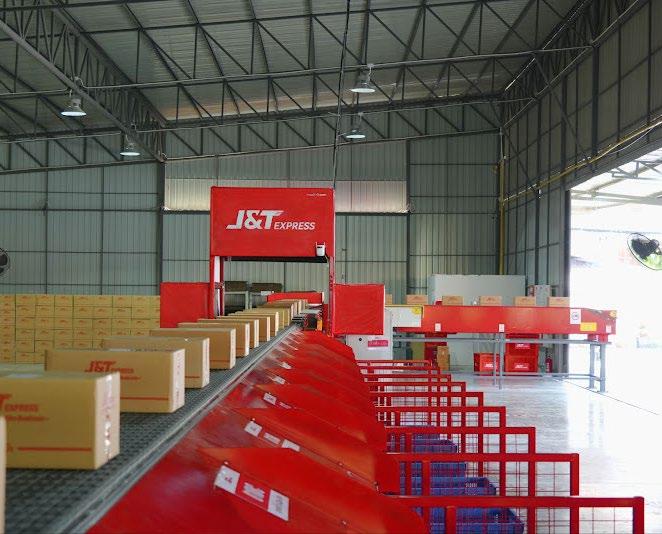
J&T Express releases 2025 ESG report with focus on smart logistics and green growth
J&T Express has released its 2025 Environmental, Social and Governance (ESG) Report, outlining progress in green logistics, employee welfare, and compliance management across its global operations.
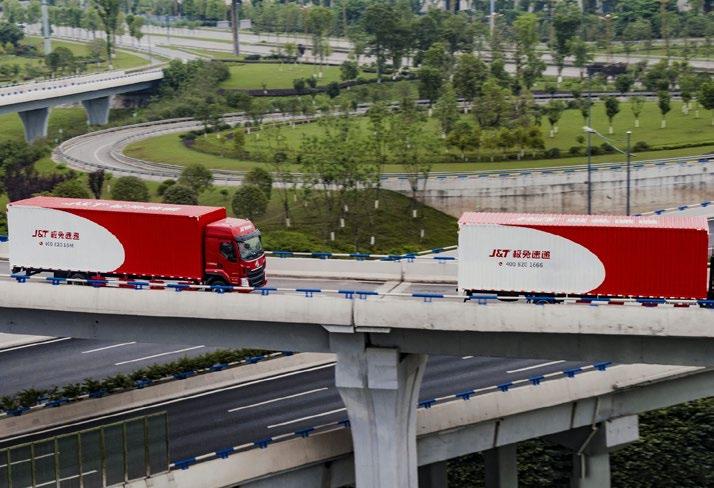
The company said it continued to expand smart logistics and energysaving initiatives using AI and big data to optimise transportation, sorting, and last-mile delivery efficiency. By the end of 2025, J&T Express had established 14 selfbuilt logistics parks globally, covering 1.05 million sqm and deployed more than 1,000 autonomous delivery vehicles.
The report also highlighted investments in low-carbon transportation, including 1,697
LNG tractors in China, representing 30% of its self-owned fleet. In the Philippines, J&T achieved full adoption of B5 biodiesel for transport vehicles, while Singapore introduced electric trucks into its fleet.
J&T Express said it continued to strengthen employee welfare and training programmes, with digital training course offerings increasing 60% year-on-year and safety training sessions exceeding 27,000 globally in 2025.
The company also detailed community initiatives, including agricultural logistics support in China and Thailand, alongside disaster relief efforts in Hong Kong and Indonesia.
In governance, J&T reported 100% anticorruption and anti-money laundering training coverage for directors and senior management as part of efforts to strengthen compliance across its global network.
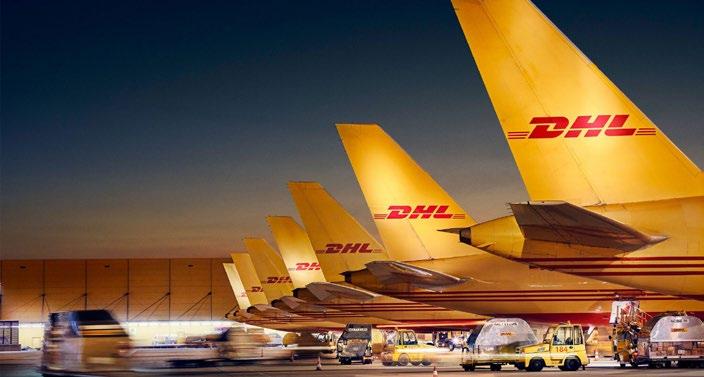
Night shot of the DHL HUB Leipzig.
Senior leadership from Viettel Group, Viettel Post, and FedEx with distinguished guests at the partnership announcement ceremony.
NEWS - FREIGHT FORWARDERS
AERO launches as the first general access network exclusively for air freight forwarders
AERO Logistics Network has launched as a new global network designed exclusively for air freight solution providers, offering members access to vetted partners, business matching tools, and collective purchasing advantages.
The network positions itself as a nonexclusive platform focused solely on air cargo, helping freight forwarders expand
system that connects members based on trade lanes, operational needs, and business objectives, with the aim of turning introductions into commercial opportunities. “We’re not providing a contact directory,” said Leo Barbaroussis, Network Director of AERO Logistics Network. “We’re actively connecting vetted forwarders who can move cargo together.”
In addition, members gain access to carrier incentive programmes, preferred agreements, and capacity solutions that may not be available to independent operators. AERO is currently in its founding member phase, which is limited to 50 companies before opening to broader membership.
AERO’s membership verification process uses a third-party AI-powered compliance platform to assess operational and financial requirements before companies are admitted. The network also uses a proprietary matching
The network plans to hold its first annual conference on 12 October 2026 in Mallorca, Spain. It is also developing a digital rate exchange platform offering real-time air freight pricing, alongside training modules and a young professionals programme.
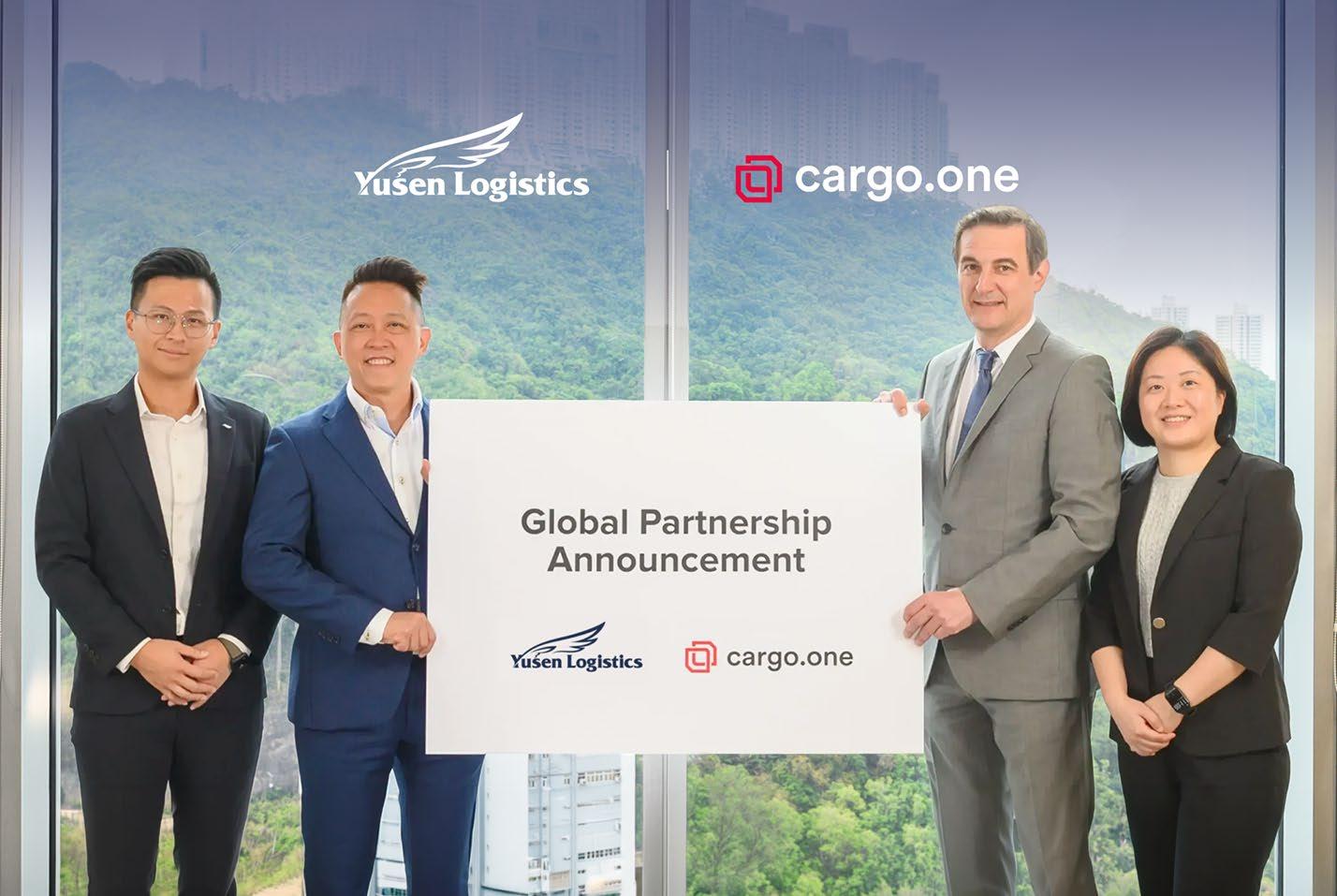
Yusen Logistics partners with cargo.one to deploy its AI-powered operating system for global air freight sales and procurement
procurement, rate management, quoting, and booking functions, including interbranch transactions. The platform enables users to compare live, contract, static, and consolidation rates, as well as local and trucking charges, within a single system.
Yusen Logistics has partnered with cargo. one to enhance its global air freight sales and procurement operations through AI-powered digital tools. Under the agreement, Yusen Logistics is deploying cargo.one’s operating system across rate internationally through specialised partners while maintaining compliance and quality standards.
The company said this will support faster quoting, improved pricing decisions, and greater consistency across its global network. Yusen Logistics also plans to integrate the platform with its Transport Management System (TMS) to further improve operational efficiency. Eisuke Fukagawa, Head of Air Freight Forwarding Unit at Yusen Logistics Global Management Co. Ltd., said the implementation supports the company’s broader pricing digitalisation and procurement modernisation strategy.
Moritz Claussen, Founder and Co-Chief Executive Officer of cargo.one, said the partnership will help Yusen Logistics strengthen its procurement and sales infrastructure using AI-driven technology and market data.
The agreement also includes a managed global network that provides more than 100 Yusen Logistics branches with real-time access to rates and service options across the company’s operations worldwide.
Yusen Logistics said the platform will serve as a central source of rate information, supporting future AI-driven processes such as automated quoting, booking, sales, and customer support.
ECS Group accelerates European expansion for My Freighter through strategic commercial partnership
ECS Group is expanding its European commercial network through a partnership with My Freighter aimed at strengthening cargo connectivity between Europe and Central Asia.
Since launching operations in January 2026, ECS Group has activated sales activities across key European markets through subsidiaries in France, the Netherlands, and Belgium.
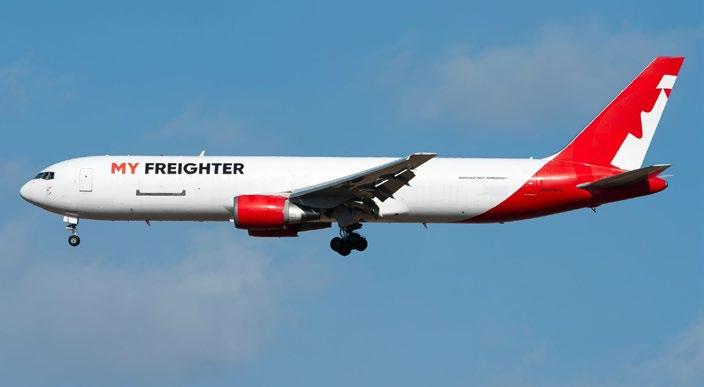
My Freighter operates freighter services from European gateways, including Liège, Maastricht, Basel, Tallinn, and Paris CDG to its hub in Tashkent, with onward connections to destinations such as Almaty.
The partnership is focused heavily on
inbound e-commerce cargo from China, one of the fastest-growing air cargo segments globally. My Freighter currently operates a fleet of Boeing 767-300 freighters supported by a flexible operating model designed to respond quickly to changing market demand.
The airline also operates passenger services using Airbus A320 aircraft to destinations including Istanbul, Dubai World Central, Delhi, and Bangkok, providing additional cargo feed into its Tashkent hub.
Jean Ceccaldi, chief executive officer of ECS Group, said the partnership demonstrates the company’s ability to rapidly scale commercial operations for partner airlines.
“Within weeks, we activated multiple European markets and generated tangible commercial momentum,” he said.
ECS Group added that the collaboration will provide customers with expanded trade lanes, routing flexibility, and higherfrequency cargo capacity between Europe and Central Asia.
TCE and Virgin Atlantic Cargo chalk up one year and a special sponsorship
TCE and Virgin Atlantic Cargo marked the first anniversary of their European partnership during a customer event in Amsterdam, highlighting a year of operational growth and network expansion.
Over the past 12 months, the companies have strengthened Virgin Atlantic Cargo’s European footprint through coordinated trucking and capacity solutions feeding long-haul services via London Heathrow. TCE now represents Virgin Atlantic Cargo across 14 European countries and manages an integrated trucking network into the UK hub.
The partners said the collaboration has delivered revenue growth, enhanced operational processes, and improved
service coordination across Europe. The partnership also extends beyond cargo operations through the joint sponsorship of Dutch professional darts player Gian van Veen, currently ranked world number three.
“At TCE, we go far beyond what is expected of a traditional GSA,” said Sarah Scheibe, managing director of TCE.
“That we can support Gian together with our Virgin Atlantic Cargo partner is particularly meaningful for us.”
Van Veen, nicknamed “The Giant”, studied aviation operations in Amsterdam and previously worked in logistics near Schiphol Airport before pursuing darts professionally.
Scheibe added that the partnership with
Globe Air Cargo is the new GSSA to airBaltic in the UK
Globe Air Cargo UK, a subsidiary of ECS Group, has partnered with airBaltic to manage cargo sales for the carrier’s UK operations.
Since March 2026, Globe Air Cargo UK has been responsible for the belly cargo capacity of airBaltic’s 17 weekly flights from London Gatwick to Riga and Tallinn. Additional Riga services from Aberdeen are set to begin in June, while Manchester operations will resume in December.
The partnership is expected to strengthen cargo connectivity between the UK and the Baltics, supporting shipments including
mail, e-commerce cargo, general freight, and pets aboard airBaltic’s Airbus A220-300 fleet.
“This new GSSA contract with airBaltic offers a true win-win situation,” said Jean Ceccaldi, chief executive officer of ECS Group.
He added that the agreement opens new routing opportunities into the Baltic region while enabling airBaltic to benefit from Globe Air Cargo UK’s digital booking and shipment management capabilities.
Steve Hughes, managing director of Globe Air Cargo UK, said the companies have built
Virgin Atlantic Cargo has created a strong platform for continued European growth and future collaboration.
Virgin Atlantic Cargo and TCE said they expect to further expand their commercial cooperation following a successful first year of operations.
a strong relationship over the past seven years through handling and cargo support services in the UK market. Ilja Seliverstovs, vice president cargo at airBaltic, said the partnership would help strengthen the airline’s cargo growth strategy and position Latvia as a logistics gateway in Northern Europe.
The contract signing took place at airBaltic’s Baltic Cargo Centre in Riga, which can handle up to 45,000 tonnes of cargo annually.
Neurored and CHAMP Cargosystems expand partnership to enable ONE Record
with 1Neo-Connect and eAWB solutions
Neurored and CHAMP Cargosystems have expanded their strategic partnership to support the air cargo industry’s transition to ONE Record through CHAMP’s 1NeoConnect solution. The collaboration builds on the companies’ previous work on
electronic Air Waybill (eAWB) integration and aims to improve digital data exchange, operational efficiency, and shipment visibility across the air cargo supply chain.
ONE Record, an International Air Transport Association initiative and the preferred standard for air cargo data sharing since January 2026, is designed to replace fragmented legacy systems with a unified and standardised data-sharing framework.
By integrating CHAMP’s 1Neo-Connect platform with Neurored’s cloud-based logistics solutions, customers will be able to access, share, and update shipment information in real time while continuing to use existing eAWB workflows. The
companies said the enhanced integration will help freight forwarders, airlines, and logistics providers reduce manual paperwork, improve compliance, minimise data entry errors, and accelerate shipment processing.
CHAMP added that 1Neo-Connect provides secure and scalable connectivity that can adapt to the evolving operational and technology requirements of organisations across the air cargo sector.
The partnership combines CHAMP’s expertise in cargo management systems with Neurored’s strengths in cloud-based logistics platforms to support digitalisation and streamlined data exchange across global supply chains.
Joint Cathay Cargo and GLS team wins Jettainer ULD Challenge at IATA ONE Record Hackathon
Hackathon with a solution designed to improve tracking and monitoring of cool passive pallets. Held from 24 to 26 April at Cathay City in Hong Kong, the hackathon brought together international programming teams to develop digital solutions for the air cargo industry.
platform capable of delivering real-time monitoring and ONE Record integration. The device includes environmental sensors that monitor temperature, humidity, light intensity, and vibration, while Bluetooth, WiFi, and GPS connectivity enable continuous data transmission and shipment visibility.
A joint team from Cathay Cargo and Global Logistics System won the Jettainer ULD Challenge at this year’s IATA ONE Record
The Jettainer challenge focused on maintaining temperature compliance for cool passive pallets throughout the transport chain, an increasingly important requirement as demand for temperaturesensitive air cargo shipments continues to grow. The winning team developed an endto-end pallet tracking solution featuring a proprietary tracking device and analytics
“This is the second time we have participated in the hackathon with a ULD Challenge, and we continue to be impressed by the creativity of the competing teams,” said Dr. Jan Wilhelm Breithaupt, Chief Executive Officer of Jettainer. He added that combining ONE Record with IoT tracking solutions offers significant potential to further enhance ULD management services and cargo visibility.
Mecalux scales up its tech stack to drive AI agents across its software suite
Mecalux has strengthened its technology infrastructure with a new high-performance computing platform designed to accelerate the use of AI agents in its logistics software solutions. This strategic investment will enable the creation and deployment of different types of intelligent entities that businesses can configure to support warehouse decision-making.
AI agents represent a new and rapidly growing generation of software capable of performing actions autonomously to complete tasks or achieve specific goals. Mecalux’s agents will work alongside users in their day-to-day activities, helping them continuously monitor logistics operations and improve efficiency. Organisations will have access to a catalogue of intelligent entities they can activate and configure
according to their needs. Examples include assistants specialised in advanced analytics and operations optimisation.
“This expansion of our AI infrastructure is a key step in advancing agent-based capabilities within our software solutions,” Mecalux said. “Our goal is to enable companies to automate complex digital processes in their warehouses using this intelligent technology.”
The new infrastructure is designed to train deep learning models and evaluate the performance of AI agents to increase their accuracy. This investment is part of Mecalux’s broader strategy to strengthen its AI capabilities and further advance its software solutions with user-centric features.
Stefanie Pauly (far right in the photo), CITO of Jettainer, at the ULD Challenge awards ceremony with the winning team from Cathy Cargo and GLS.
NEWS - ASSOCIATIONS
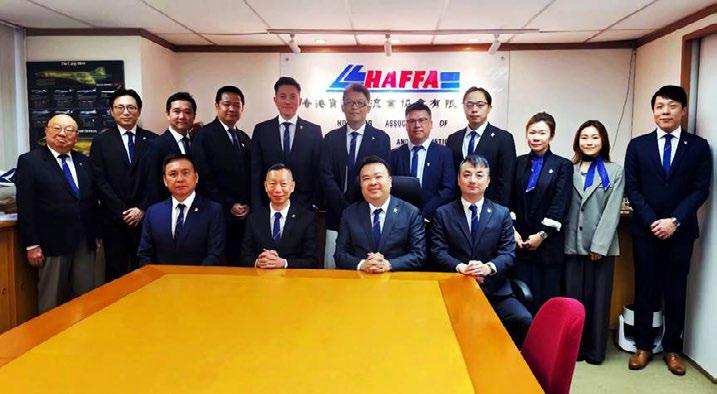
HAFFA chairman outlines fuel surcharge, ESG and digitalisation priorities at 2026 AGM
Hong Kong Association of Freight Forwarding and Logistics (HAFFA) highlighted key industry achievements and challenges during its 2026 Annual General Meeting, as Chairman Gary Lau began the second half of his current twoyear term.
Lau said geopolitical and economic pressures continue to affect the logistics sector, citing recent concerns over rising cargo fuel surcharges (CFS). HAFFA has been actively advocating on behalf of members, arguing that recent surcharge increases by some Hong Kong airlines exceeded movements in global oil prices and risked undermining Hong Kong’s
competitiveness as a logistics hub. Following discussions with Cathay Pacific Airways and the Hong Kong Transport and Logistics Bureau, Cathay introduced a new MediumHaul CFS category and reclassified South Asian destinations from Long-Haul to Medium-Haul, providing partial relief for freight forwarders.
HAFFA also highlighted progress in sustainability and digitalisation initiatives. The association supported the development of ESG tools for logistics SMEs following the government’s ESG Development Roadmap, helping companies improve reporting and sustainability performance. In digitalisation, HAFFA reiterated its support for the Trade
Single Window initiative and continues to serve as a strategic advisor on Hong Kong’s Port Community System, which was officially launched in January 2026 to improve logistics data connectivity and supply chain efficiency.
Established in 1966, HAFFA represents around 300 corporate members and plays a key role in industry advocacy, standards development, and professional training.
IATA: Stronger standard implementation, modern GSE, and digitalisation are key to more resilient ground handling
The International Air Transport Association (IATA) has called for stronger implementation of global standards, greater digitalisation, and accelerated adoption of modern ground support equipment (GSE) to improve safety, efficiency, sustainability, and resilience in ground handling operations. The appeal was made at the 38th IATA Ground Handling Conference in Cairo.
Monika Mejstrikova, Director Ground Operations at IATA, said global standards remain the foundation of safe and efficient operations. In 2025, no fatal ground handling accidents were recorded across nearly 40 million flights, while almost 300 audits were
conducted under the IATA Safety Audit for Ground Operations (ISAGO) programme.
IATA also urged wider adoption of the IATA Ground Operations Manual (IGOM) and Airport Handling Manual (AHM), noting that more than 1,000 users now access its Operational Portal.
To reduce aircraft ground damage, which accounted for more than 29,000 incidents in 2025, IATA highlighted the need for enhanced GSE equipped with anti-collision technology and greater deployment of electric GSE. According to the association, electric equipment can reduce turnaround emissions by 35% to 52%, depending on the
AAPA reports resilient passenger and cargo traffic in April
The Association of Asia Pacific Airlines (AAPA) reported stable international passenger demand in April 2026, with airlines carrying a combined 32.4 million international passengers during the month. While passenger numbers were broadly unchanged year-onyear, revenue passenger kilometres (RPK) increased by 3.3%, supported by stronger demand on longer-haul routes. Association of Asia Pacific Airlines
Available seat capacity rose by 1.4%, resulting in an average international passenger load factor of 84.8%, up 1.6 percentage points from a year earlier.
Air cargo demand also remained positive, with freight tonne kilometres (FTK) increasing by 4.1% year-on-year. AAPA said supply chain
disruptions and higher goods prices linked to the conflict in the Middle East contributed to increased stockpiling activity, supporting demand for air freight services.
Offered freight capacity grew by 4.4%, while the average international freight load factor edged down 0.2 percentage points to 60.5%.
Wong Hong, Director General of AAPA, said Asia Pacific airlines carried 135 million international passengers during the first four months of 2026, representing a 5.1% increase compared with the same period last year. International air cargo demand rose 5.3% over the same period.
He noted that the conflict in the Middle East continues to drive volatility in energy markets,
operating environment. IATA also identified baggage handling, aircraft loading, and de-icing operations as priority areas for digitalisation. The association said modern data-sharing platforms and digital load control systems can improve visibility, reduce errors, and enhance operational decision-making across airport ground operations.
with jet fuel prices averaging US$165 per barrel in April.
Despite ongoing geopolitical and economic uncertainty, Wong said Asia Pacific airlines remain focused on managing costs and deploying capacity carefully to maintain yields and profitability.
Turkish Airlines appoints
Prof. Murat Şeker as Chairman, Ahmet Olmuştur as CEO
Turkish Airlines has announced changes to its executive leadership team, appointing Prof. Murat Şeker as Chairman of the Board of Directors and Executive Committee, and Ahmet Olmuştur as Chief Executive Officer. Prof. Şeker succeeds to the chairmanship after serving as Chief Financial Officer since 2016 and as a member of the airline’s Board and Executive Committee since 2021. During his tenure,
he oversaw finance, treasury, accounting, procurement, and investor relations. He also serves on the boards of Turkish Technic and SunExpress and currently chairs the International Air Transport Association’s Financial Advisory Council. Olmuştur, who most recently served as Chief Commercial Officer, takes over as Chief Executive Officer after more than two decades with the airline.
Hactl appoints Frosti Lau as new Chief Executive
Hong Kong Air Cargo Terminals Limited (Hactl) is pleased to announce that Frosti Lau Yi-sau has been appointed Chief Executive of Hactl with effect from 8th June 2026.
Frosti has over 25 years of senior leadership experience in the aviation and air cargo sectors, working in markets including Hong Kong, Chinese Mainland, Australasia, Southeast Asia and Southern Africa. He joins from Cathay Pacific Airways, where he most recently served as Regional General Manager, Southeast Asia & Oceania. His previous roles at Cathay include Regional General Manager for the Southwest Pacific and General Manager for Cargo Service Delivery, during which he
was also director of the airline’s subsidiary air cargo terminal. His experience is spread across commercial and operational roles, including digital transformation, partnerships and talent development.
Hactl’s Acting Chief Executive, Michelle Choi, said, “Leading the world’s most advanced air cargo handling business demands comprehensive industry experience and strong credentials in digital and technological innovation. We are delighted to welcome Frosti to Hactl, where he will be able to build on the company’s long track record of success and reputation for industry leadership, and guide it confidently into the future.”
He joined Turkish Airlines in 2000 and has held a range of commercial and revenue management roles, including positions in pricing, network planning, sales, marketing, and customer experience.
Since 2014, Olmuştur has led the airline’s sales and marketing functions and was appointed Chief Commercial Officer in 2024. He also serves on the boards of SunExpress and Turkish Technic and is a member of the IATA Distribution Advisory Council.
Turkish Airlines said the leadership changes support its long-term growth strategy, strengthening its position in global aviation through sustainable growth, strong talent development, and a continued focus on customer experience.
Frosti holds a Bachelor of Business Administration and a Master of Science in Financial Analysis from HKUST Business School, a Bachelor of Laws from the University of London, and a Master of Arts from the University of Hong Kong.
Chapman Freeborn appoints Danish Cutleriwala as Country Manager India
Chapman Freeborn has appointed Danish Cutleriwala as Country Manager India, reinforcing its leadership team in one of the world’s fastest-growing aviation and logistics
markets. Based in Mumbai, Cutleriwala will oversee the company’s operations in India, focusing on expanding cargo and passenger charter services, strengthening customer relationships, and driving commercial growth through strategic partnerships.
He brings more than 19 years of experience in logistics, freight forwarding, and supply chain management, with expertise in business development, P&L management, and regional operations across India, Asia, and the Middle East.
Cutleriwala joins Chapman Freeborn from Sciens Logistics, where he served as Country Manager for APAC and the Middle East. He previously held senior positions with FedEx,
Linas Dovydenas, President IMEA at Chapman Freeborn, said India represents a strategically important market with significant growth opportunities across both cargo and passenger charter operations.
Commenting on his appointment, Cutleriwala said he looks forward to strengthening the company’s presence in India, building strategic partnerships, and delivering tailored charter solutions to customers.
The appointment reflects Chapman Freeborn’s continued investment in key growth markets and its commitment to expanding service capabilities across its global network.
Crane Worldwide Logistics, and Wiz Freight.
Prof. Murat Seker and Ahmet Olmustur
DHL Express announces new managing director for Thailand and Head of Indo-China
DHL Express has appointed Parichart Pramukkul as Managing Director for Thailand and Head of Indo China, effective 1 May 2026. Based in Bangkok, Pramukkul succeeds to the role after serving as Vice President, Commercial for DHL Express Thailand. She brings more than 20 years of experience with the company, having held leadership positions across commercial strategy, sales, marketing, pricing, product development, and customer experience.
Prior to her commercial leadership role, she served as Marketing Director for DHL Express Thailand and Indo China, where she helped strengthen the company’s brand
presence and market position. Ken Lee, Chief Executive Officer Asia Pacific at DHL Express, said Pramukkul’s appointment reflects her strong track record and leadership capabilities developed over two decades with the company.
In her new role, she will focus on strengthening DHL Express’s position in Thailand, identifying growth opportunities in new sectors and trade lanes, and expanding solutions such as Heavyweight Express. She will also work with national stakeholders and DHL business units to support trade growth and integrated logistics solutions across Thailand and the Indo-China region. Pramukkul said Thailand’s improving global connectedness and growing
elected Chair of Pharma.Aero
Pharma.Aero has elected Gergely Szorcsik as Chair for the 2026–2028 term, marking the first time the position has been held by a pharmaceutical manufacturer since the
organisation was founded in 2016. Szorcsik, Director, Global Logistics Sourcing and Sustainability at Zoetis, has served on the Pharma.Aero Board of Directors for the past three years. His appointment reflects the growing role of pharmaceutical manufacturers in shaping the organisation’s strategic direction alongside logistics providers and other healthcare supply chain stakeholders. Today, Pharma.Aero brings together nearly 100 organisations across the life sciences and MedTech supply chain, including pharmaceutical companies, airports, airlines, freight forwarders, packaging providers, and technology firms. Commenting on his appointment, Szorcsik said his priorities
Envirotainer appoints Aymeric Chandavoine as Chief Executive Officer as pharmaceutical supply chain complexity continues to grow
Envirotainer, the global leader in secure cold chain solutions for temperature-sensitive pharmaceuticals, announced the appointment of Aymeric Chandavoine as Chief Executive Officer (CEO). He will assume the role on 1 May 2026, succeeding Interim CEO Niklas Adamsson. Chandavoine brings extensive international experience in logistics and supply chain leadership, with a strong track record of driving growth, transformation, and operational excellence in complex global organisations. He joins Envirotainer from Maersk, where he most recently served as Executive Vice President & President, Europe of Maersk. Prior to that, he held the role of Head
of Global Logistics & Services, where he played a central role in expanding Maersk’s integrated logistics offering. His appointment comes at a time of increasing pressure on pharmaceutical supply chains, driven by rapid growth in temperature-sensitive biologics, heightened regulatory scrutiny, and increasingly complex global distribution networks. Commenting on his appointment, Chandavoine said, “Pharmaceutical supply chains are becoming more complex and far less tolerant of disruption. As advanced therapies move across global networks, cold chain reliability is critical not only for efficiency, but for patient safety. Envirotainer is uniquely positioned to
international trade opportunities provide a strong foundation for future growth.
According to DHL’s latest Global Connectedness Report, Thailand ranks 27th globally, up seven places since 2019, and is among the most globally connected countries in its income group. Southeast Asia also continues to emerge as one of the world’s fastest-growing trade corridors.
include strengthening quality and visibility standards, expanding education and training programmes, and further developing Pharma. Aero’s partnership with the University of Antwerp. The leadership transition follows four years under outgoing Chair Trevor Caswell, during which Pharma.Aero expanded its global membership and advanced initiatives focused on multimodal logistics, sustainability, visibility technologies, and collaborative research.
Caswell said the organisation has evolved into a global multimodal ecosystem that supports industry collaboration and healthcare logistics innovation. The newly elected Board for the 2026–2028 term includes representatives from Changi Airport Group, Brussels Airport, Latin America Cargo City, MSD, Edmonton International Airport, and Miami International Airport.
support this evolution, and I am excited to lead the company into its next phase of growth.” Envirotainer plays a critical role in the global transportation of high-value, temperaturesensitive pharmaceuticals, enabling the safe and reliable delivery of life-saving medicines worldwide. As supply chains grow more complex, the company continues to support pharmaceutical manufacturers with proven, secure, and scalable cold chain solutions.
Making cross-border shipping simpler for SMEs
As e-commerce continues to lower the barriers to international trade, small and medium-sized enterprises (SMEs) are increasingly looking beyond their home markets for growth. Yet for many online sellers, navigating customs requirements, duties and taxes, shipment visibility, and cross-border compliance remains a significant hurdle.
DHL Express, which was recognised as Express Provider of the Year at the 12th Payload Asia Awards, is investing in digital tools, API integrations, and automation capabilities designed to help merchants connect more seamlessly with global markets. From simplifying customs processes to providing real-time shipment visibility, the company is focused on making cross-border shipping more accessible for businesses of all sizes.
For Karen Tan, CIO for Asia Pacific at DHL Express, the goal is to make international shipping feel less like a logistical challenge and more like a natural extension of a merchant’s digital business.
“E-commerce merchants today expect cross-border shipping to be as intuitive as domestic delivery,” she says. “For SMEs, we understand that going global is not just about shipping faster; it is about removing uncertainty at every step.”
Making logistics work in the background
As digital commerce expands, merchants increasingly expect logistics to integrate seamlessly into the platforms and systems they already use. Rather than managing multiple applications and manually transferring shipment information between systems, businesses are looking for a more connected approach to crossborder fulfilment.
For DHL Express, API integrations are helping make this possible. By connecting directly with e-commerce platforms and back-end systems, shipping information, customs data, tracking updates, and delivery notifications can flow automatically and in real time, reducing manual inputs and improving efficiency.
“APIs turn logistics from something you manage manually into something that works in the background,” says Tan.
The company is also positioning itself as a plug-and-play logistics layer within merchants’ existing technology environments. Whether customers operate through online marketplaces, cloud-based ERP systems, or proprietary storefronts, DHL’s tools are designed to integrate with those ecosystems rather than replace them.
“Our focus is not to replace customers’ platforms, but to complement them –improving data flow, and enabling end-toend cross-border fulfilment with minimal technical complexity.”
Reducing friction in global trade
For many SMEs, international expansion can be daunting. Beyond shipping costs, businesses often need to navigate documentation requirements, customs procedures, duties and taxes, and varying regulatory frameworks across markets.
To address these challenges, DHL Express has developed digital tools aimed at simplifying the process. Among them is MyGTS, a free online platform that helps businesses understand import and export requirements, prepare documentation, and estimate duties and taxes before shipments are sent.
The company has also enhanced MyDHL+, allowing businesses to obtain shipment quotes quickly while introducing AIpowered capabilities that can generate customs-ready product descriptions and HS codes from a simple product image.
Beyond technology, DHL continues to support SME participation in international trade through its GoTrade programme,
which works with governments, partners, and communities to provide MSMEs with knowledge, connections, and practical support.
Looking ahead, Tan believes one of the biggest opportunities lies in improving how information is shared across the supply chain.
“One of the biggest opportunities lies in earlier, richer data exchange between merchants, logistics providers and authorities. The more structured and standardised this data becomes, the more we can shift from reactive processing to proactive clearance.”
She adds that education remains equally important, particularly for smaller businesses taking their first steps into international markets. When SMEs have access to the right information and intuitive tools, cross-border shipping becomes significantly less intimidating.
Connecting digital and physical networks
While digitalisation is transforming how businesses manage shipments, the movement of goods still relies on a robust physical network.
Asia Pacific remains one of the world’s fastest-growing e-commerce regions, with demand driven by both scale and speed. To support this growth, DHL Express continues to connect its technology investments with its regional express network.
The company has introduced digital tools that provide real-time visibility across shipments, hubs, and routes, helping improve operational predictability and responsiveness. One example is its Advanced Quality Control Centre (AQCC), which monitors shipment movements and proactively recommends corrective actions when issues arise.
At the same time, DHL has enhanced customer feedback tools that help analyse and translate the voice of the customer, enabling operational, commercial, and customer service teams to respond more effectively.
For Tan, the future of e-commerce logistics will depend on how effectively companies combine digital capabilities with physical infrastructure.
“Physical infrastructure will always be essential, but digital platforms help unlock its full value.”
She believes the next phase of growth
will be shaped by organisations that treat infrastructure and technology as a single integrated system rather than separate investments.
Scaling growth responsibly
DHL Express’ digitalisation efforts are taking place alongside a broader commitment to sustainability, an area in which the company was recognised as Sustainability Advocate of the Year at the 12th Payload Asia Awards.
According to Tan, sustainability is increasingly influencing consumer behaviour across the Asia Pacific. Citing research from DHL eCommerce, she notes that almost half of online shoppers in the region have abandoned purchases because of sustainability concerns.
To address these expectations, DHL continues to advance initiatives such as the adoption of sustainable aviation fuel (SAF), fleet electrification, and carbonneutral facilities. Technology also plays a role, with analytics and AI helping optimise routes, consolidate shipments, and reduce unnecessary movements across the network.
“This means we can achieve sustainability improvements by operating the network more intelligently without slowing down service.”
From logistics provider to digital enabler
As e-commerce ecosystems become increasingly interconnected, DHL Express sees digitalisation reshaping the relationship between merchants, online platforms, and logistics providers.
Shared data, integrated systems, and connected digital experiences are becoming central to how businesses engage in international trade. Rather than serving solely as transportation providers, logistics companies are becoming more deeply embedded within the digital infrastructure that supports global commerce.
“Digitalisation will increasingly help shape logistics providers from service vendors into strategic enablers of global commerce,” says Tan.
For SMEs seeking opportunities beyond their domestic markets, that evolution could prove significant. As logistics becomes more connected, automated, and intelligent, the barriers that once limited international expansion may continue to fall, enabling businesses of all sizes to participate more confidently in crossborder trade.
Southeast Asia is not one market. It is thousands of islands, dozens of regulatory regimes, and wildly different infrastructure realities packed into a single region. For J&T Express, building a parcel network that works across all of it has been less about replicating a single model and more about engineering for contradiction, regional scale and hyper-local execution at the same time.
That balancing act is becoming increasingly important as cross-border e-commerce volumes accelerate across the region. What began as a domestic-focused parcel delivery network in Indonesia has rapidly evolved into a broader logistics platform spanning Southeast Asia, supported by investments in automation, fulfilment infrastructure, digital coordination systems, and air-linked capabilities designed to keep parcels moving quickly across increasingly interconnected markets.
For J&T Express, the foundation for that regional strategy was built in one of the most operationally complex logistics environments in Asia.
Indonesia as the proving ground
Founded in 2015, J&T Express began operations in Indonesia, a market where geography alone can complicate almost every aspect of logistics execution. Deliveries often involve movement across thousands of islands, varying infrastructure conditions, and highly fragmented last-mile environments that differ sharply between urban centres and more remote areas.
According to Tagore Zhao, Group Operations Director at J&T Express, those
early operating conditions played a major role in shaping the company’s long-term approach to expansion.
“J&T’s growth in Southeast Asia is closely tied to how the business started,” Zhao explains. “J&T began in Indonesia, a market that gave us early experience operating at scale in a fast-growing and highly diverse e-commerce environment. That foundation helped shape our approach as we expanded across the region.”
The experience also reinforced the importance of localisation. While Southeast Asia is often discussed as a single growth market, the operational realities on the ground vary significantly between countries. Indonesia’s archipelagic geography presents very different logistical challenges compared to more infrastructure-mature and compact markets such as Singapore.
That variation, Zhao notes, means network design cannot rely on a uniform operating model.
“In a market like Indonesia, where the geography is made up of thousands of islands, flexibility is essential, and the network has to support island-to-island deliveries as well as access beyond major city centres,” he says. “In more compact and infrastructure-advanced markets like Singapore, the focus shifts more towards service integration, automation, and stronger fulfilment and cross-border capabilities.”
As e-commerce penetration deepens across the region, the challenge for logistics providers is no longer simply expanding reach. Increasingly, the focus is
shifting towards how networks can operate seamlessly across very different markets while still maintaining delivery consistency, speed, and visibility.
Scaling for billions of parcels
That operational complexity is unfolding against a backdrop of rapidly rising parcel volumes.
In the first quarter of 2026 alone, parcel volume across Southeast Asia rose 79.9% year on year to 2.768 billion shipments, reflecting both the continued growth of regional e-commerce demand and J&T Express’ own network expansion.
On a daily basis, the scale becomes even more apparent. Average daily parcel volume reached 30.8 million in the first quarter, while peak daily volume exceeded 47 million parcels.
Supporting that growth has required significant investment in both physical
Tagore Zhao Group Operations Director, J&T Express
infrastructure and operational systems. Over the same period, the company increased its linehaul vehicle fleet in Southeast Asia to 6,200 units, while the number of automated sorting lines across the region rose to 73 from 64.
For J&T Express, however, scaling successfully is not simply about processing more parcels. The bigger challenge lies in ensuring the network continues operating efficiently even as complexity and shipment density increase.
“Every market is different,” Zhao says. “Across Southeast Asia, each market has its own operating conditions, consumer expectations, and level of infrastructure maturity, so we do not look at scaling success through any single metric alone.”
Instead, the company places heavy emphasis on maintaining operational consistency while volumes grow.
“What we see as most encouraging is when growth is matched by strong service performance and operational consistency,” Zhao adds. “In other words, it is not just about handling more parcels, but about whether the network is becoming better able to support higher volumes while maintaining speed, reliability, and service quality.”
In Singapore, for instance, J&T Express reported next-day delivery success rates exceeding 97%, while three-day delivery rates surpassed 99%.
The infrastructure supporting those service levels increasingly relies on automation and network optimisation. For J&T Express, that has meant continued investment in automated sorting systems, operational visibility tools, and forecasting capabilities designed to improve throughput and better prepare the network for demand spikes.
“By using historical volume analysis and demand forecasting, we are better able to anticipate spikes in demand, prepare the network in advance, and allocate resources more effectively during peak periods without compromising service quality,” Zhao explains.
Efficiency is also becoming more closely tied to sustainability as networks expand. In 2025, J&T Express rolled out energysaving programmes globally, resulting in a 5.6% year-on-year improvement in cargo volume handled per kilowatt-hour at transfer centres across 13 countries, while electricity consumption per shipment fell by 5.3%.
COMPANY PROFILE - J&T EXPRESS
The company has also continued transitioning parts of its transport network towards lower-emission operations. LNGpowered tractors now account for 30% of total tractors in China, while all vehicle transport operations in the Philippines utilise B5 biodiesel. In Singapore, electric trucks currently make up 6% of the company’s fleet.
Building cross-border connectivity
While domestic e-commerce remains a major growth driver across Southeast Asia, logistics providers are increasingly positioning themselves around regional cross-border flows connecting Southeast Asia with key manufacturing and consumption markets such as China.
For J&T Express, the strategy centres on strengthening fulfilment capabilities and international delivery integration while ensuring the network remains scalable for sellers, marketplaces, and logistics partners.
“Our focus is on building a network that can support both local demand and crossborder needs seamlessly,” Zhao says. “That means continuing to strengthen our infrastructure, fulfilment capabilities, and international delivery solutions, while ensuring the network is highly scalable and easily integrable for platforms, sellers, and partners.”
Strategic partnerships are playing a growing role in that effort. Earlier this year, J&T Express announced a strategic crossshareholding with SF Holding, combining J&T’s Southeast Asian last-mile reach and localised operational expertise with SF’s cross-border first-mile and linehaul capabilities.
The company is also working closely with major e-commerce platforms to improve fulfilment visibility and simplify seller integration across markets. In Singapore, J&T Express partners with platforms including TikTok Shop, Sephora, and Watsons to support fulfilment coordination, shipment preparation, customs documentation, and cross-border accessibility for merchants.
“These partnerships extend beyond moving parcels,” Zhao says. “They focus on making fulfilment faster, more flexible, and more transparent.”
Air cargo also continues to play an important role in enabling faster crossborder connectivity across the wider network. Rather than treating air freight as a standalone premium product, J&T
Express positions it as one component within a broader end-to-end logistics ecosystem.
“For J&T Express, the priority is not to treat air freight as a standalone solution, but to integrate it into the wider network so it works well alongside first-mile collection, sorting, linehaul, customs processes, and last-mile delivery,” Zhao explains.
The company’s international delivery network now covers more than 80 countries and over 200 international cities. Alongside strategic airline and air capacity partnerships, J&T Express has also continued strengthening its own air-linked infrastructure, including the introduction of its first dedicated all-cargo aircraft in Indonesia in 2021.
Connecting the region’s next phase of e-commerce growth
Looking ahead, J&T Express expects Southeast Asia’s e-commerce ecosystem to become increasingly interconnected as digital adoption deepens and cross-border trade flows continue to grow.
For the company, the next phase of expansion will depend not only on physical reach but also on how effectively infrastructure, automation, fulfilment, air connectivity, and localisation strategies can work together across multiple markets.
“Shaping the e-commerce logistics ecosystem here is not only about expanding reach, but about building capabilities that are efficient, reliable, and responsive to local market needs,” Zhao says.
In a region where logistics networks must operate across vastly different geographies, infrastructure conditions, and consumer expectations, the challenge is no longer simply moving parcels faster. Increasingly, it is about building crossborder systems capable of scaling across Southeast Asia’s complexity without losing the local responsiveness that made that growth possible in the first place.
COVER STORY - CATHAY CARGO
Beyond the booking: Cathay Cargo’s digital push to reinvent air cargo
Air cargo’s digital transformation is reshaping how cargo is booked, managed, and moved across increasingly fragmented global supply chains. And for global hubs like Hong Kong, geographic advantage alone is no longer enough. For Cathay Cargo, maintaining competitiveness now depends as much on digital infrastructure, visibility, and automation as it does on physical connectivity. This approach is positioning Hong Kong as a digitally enabled gateway linking the Chinese Mainland, Southeast Asia, and global markets.
The airline’s efforts to modernise the cargo journey recently earned industry recognition at the 12th Payload Asia Awards, where Cathay Cargo was named Cargo Booking Platform of the Year alongside Best E-Commerce Carrier – Asia Pacific and Global. While the awards highlight the airline’s progress in digital cargo solutions, they also reflect a much broader transformation taking place across Cathay Cargo’s operations.
“These recognitions are a strong affirmation of the progress we’ve made in transforming the cargo experience through digital innovation—by making booking and managing shipments more intuitive, efficient and transparent for our customers,” Cathay Cargo says.
Digitalisation and automation are increasingly central to the airline’s long-term ambition of becoming what it describes as “the world’s most customer-centric air cargo service brand.” But unlike many cargo digitalisation efforts that remain limited to
customer interfaces, Cathay Cargo’s strategy now spans terminal operations, operational workflows, visibility systems, AI deployment, and ecosystem-wide data integration.
At the same time, the airline is navigating a rapidly evolving market environment. E-commerce demand remains strong across Asia, particularly within the Greater Bay Area, but shifting trade dynamics, changing customer expectations, and increasingly complex supply chains are also forcing airlines to become more agile in how they allocate capacity and manage cargo flows. Cathay Cargo said it remains focused on maintaining a “flexible and diversified cargo strategy” capable of responding to these changing demand patterns.
“With Hong Kong as our home hub, we are uniquely positioned to serve the e-commerce boom in the Greater Bay Area, where rising consumer demand and increased regional trade activity continue to drive strong cargo volumes,” the airline says.
Building a digitally enabled cargo gateway
Hong Kong International Airport remains central to Cathay Cargo’s long-term strategy, but increasingly the competitiveness of major cargo hubs is being shaped not only by scale and location, but also by how effectively they integrate digital systems, automate workflows, and provide real-time visibility across the cargo journey.
At the centre of Cathay Cargo’s operations is the Cathay Cargo Terminal at HKIA, which
the airline describes as one of the world’s most advanced air cargo terminals. The facility has become a key pillar of Cathay Cargo’s digital transformation strategy, combining automation, data visibility, and technology-enabled handling processes to improve operational efficiency, shipment reliability, and customer control.
Among its recent initiatives is the introduction of Electronic Shipment Release Forms (eSRF), making Cathay Cargo Terminal the first terminal in Hong Kong to implement a fully end-to-end digital import process. The terminal has also deployed ePayment solutions for import and export cargo transactions while piloting Autonomous Electric Tractor operations featuring digital check-in processes and precision docking technologies.
These investments reflect a broader shift taking place across the air cargo sector. As supply chains become increasingly datadriven and time-sensitive, operational efficiency is no longer measured solely by throughput capacity or transit times. Airlines and cargo hubs are also being judged on how seamlessly information moves alongside freight itself.
Cathay Cargo is also strengthening specialised cargo capabilities through digital visibility tools, particularly within the pharmaceutical segment, where shipment integrity and temperature monitoring are critical. Cathay Cargo Terminal currently operates HKIA’s largest dedicated Pharma Handling Centre, with 1,250 square metres of temperature-controlled space.
Beyond terminal operations, the launch of Cathay Technologies in 2025 reflects a broader push to scale digital innovation across the cargo value chain, with a focus on improving customer experience, operational performance, and data-driven decision-making.
Connecting the Chinese Mainland, Southeast Asia and global markets
While digitalisation forms a major part of Cathay Cargo’s strategy, physical connectivity and network flexibility remain equally important as trade flows across Asia continue evolving.
The Cathay Group currently operates a network reaching more than 40 freighter destinations and over 100 passenger destinations worldwide, allowing the airline to dynamically adjust capacity across major trade lanes and respond quickly to shifts in market demand. The airline also serves more than 20 destinations across the Chinese Mainland, strengthening Hong Kong’s role as a key gateway linking regional manufacturing centres with international markets.
This regional integration is becoming increasingly important as supply chains grow more interconnected across the Chinese Mainland and Southeast Asia. To support these flows, Cathay Cargo works closely with e-commerce partners on dedicated capacity solutions, including block space agreements and charter services designed to support faster and more reliable exports into major global markets.
The airline’s intermodal operations also form a growing part of that strategy. Cathay Cargo operates cross-border links connecting HKIA with the HKIA Logistics Park in Dongguan, combining air, sea, and land transport solutions to reduce transit times and improve cargo flow efficiency compared with traditional air-to-air transfers. Passenger bellyhold capacity from cities such as Guangzhou further supports cargo flows feeding into Hong Kong.
This emphasis on speed and reliability is also supported by Cathay Cargo’s full suite of CEIV accreditations, reinforcing the airline’s focus on specialised handling standards as competition intensifies across regional cargo markets.
Reworking the cargo booking experience
Cargo booking workflows across the air freight industry have traditionally depended on manual coordination, fragmented communications, and operational backand-forth between airlines and freight
COVER STORY - CATHAY CARGO
forwarders. But as supply chains become increasingly time-sensitive and digitally connected, customer expectations are rapidly shifting toward faster confirmations, self-service capabilities, and real-time shipment control.
Cathay Cargo’s Cargo Digital Hub and newly launched Manage Booking platform form part of the airline’s effort to reduce operational friction while creating a more seamless and responsive customer experience.
“Manage Booking is one of Cathay Cargo’s digital innovations along this journey,” the airline says. “The launch represents a significant step forward in Cathay Cargo’s commitment to customer-centric digitalisation.”
The platform enables forwarders to make post-confirmation booking changes directly through the system, reducing reliance on traditionally manual and time-intensive modification processes. Customers are also provided with real-time access to pricing, schedules, available capacity, and shipment visibility through a more integrated
interface. “Our platforms are designed to simplify the booking process while giving customers greater control and visibility over their shipments,” Cathay Cargo says. “By enabling real-time access to capacity, pricing and flight options, customers can make faster, more informed decisions and secure bookings with instant confirmation.”
The transition toward self-service cargo management mirrors broader changes across logistics and e-commerce supply chains, where customers increasingly expect the same responsiveness, transparency, and ease of interaction found in consumerfacing digital platforms.
That shift is already visible operationally. According to Cathay Cargo, digital booking platforms now account for more than 80% of the airline’s bookings.
Visibility as a competitive advantage
As cargo supply chains become more interconnected, visibility is emerging as one of the sector’s most important competitive differentiators. Customers are no longer simply looking for shipment updates—
COVER STORY - CATHAY CARGO
they increasingly expect proactive, realtime insights that allow them to anticipate disruptions, optimise planning, and maintain tighter control over complex logistics flows.
Cathay Cargo has been expanding API integrations and digital connectivity capabilities to improve shipment transparency across its network. The airline’s adoption of IATA’s ONE Record data protocol is also intended to enable more secure, end-to-end data sharing between stakeholders throughout the cargo journey.
For freight forwarders and e-commerce logistics providers, the benefits extend beyond visibility alone. Digital connectivity enables faster processing, instant booking confirmations, and more integrated shipment management workflows between airlines and logistics partners.
The airline has also introduced solutions such as Ultra Track, which uses low-energy Bluetooth data loggers to provide near real-time airport-to-airport shipment visibility and proactive intervention when irregularities occur. Cathay Courier, meanwhile, offers piece-level tracking for urgent and high-value shipments requiring more granular monitoring.
“Ultimately, these help to create a more transparent and collaborative ecosystem— enabling all parties to strengthen partnerships and improve efficiency,” Cathay Cargo says.
Digitalisation beyond the customer interface
While much of the industry’s digitalisation efforts have focused on customer-facing platforms, Cathay Cargo is also embedding
technology deeper into frontline operations and ground handling workflows. The airline’s Cargo Connect mobile application gives operational teams real-time visibility across cargo handling processes while digitising workflows that previously relied on paper-based coordination.
Cathay Expert, meanwhile, automates engineering calculations for oversized and heavyweight cargo shipments, replacing manual restraint diagram generation processes and accelerating approvals for complex loads. According to the airline, the system has significantly reduced the time required to generate restraint diagrams, and overall approval times have been shortened as well.
Digitalisation is also reshaping workforce training and operational preparedness. Cathay Cargo’s VR CAVE (Virtual Reality Cave Automatic Virtual Environment) allows loading and ramp teams to practice complex cargo handling procedures within an immersive virtual environment before execution on the ground.
Together, these initiatives point toward
a broader operational shift underway within air cargo—one where digitalisation increasingly extends beyond commercial interfaces and into the physical movement, handling, and coordination of freight itself.
The next phase of digital cargo
Looking ahead, Cathay Cargo sees AI integration, operational automation, and wider ecosystem connectivity becoming increasingly important to the future of air cargo operations. The airline said it is continuing to evolve cathaycargo.com into a more comprehensive self-service platform while exploring machine learning capabilities to better respond to market dynamics and customer requirements.
At the same time, AI is being embedded into operational processes, including import and export control checks designed to improve shipment documentation accuracy based on cargo type, origin, and destination. The airline is also evaluating the use of agentic AI to manage selected customer enquiries and improve responsiveness.
Beyond internal systems, Cathay Cargo is also pushing for broader ecosystem integration through initiatives such as ONE Record adoption and increased digital connectivity across stakeholders, including Customs authorities.
“Ultimately, our ambition is to bring together digital platforms, AI and industry collaboration to create a smarter, efficient and more transparent cargo experience for our customers,” Cathay Cargo says.
As supply chains become increasingly datadriven and interconnected, Cathay Cargo’s digital push reflects a broader industry reality: the future competitiveness of global cargo hubs will depend not only on how quickly freight moves. Increasingly, it will also depend on how intelligently the entire cargo ecosystem connects around it.
FEATURE - SAUDIA CARGO
Saudia Cargo: Bridging the e-commerce corridor
Few airlines occupy a geographic position quite like Saudia Cargo’s. Sitting at the intersection of Asia, Europe, and Africa, Saudi Arabia has long held the potential to become a major global logistics gateway — but turning that strategic location into sustained cargo growth has required significant investment, strong partnerships, and a national ambition large enough to match the opportunity.
As cross-border e-commerce continues to reshape global trade, Saudia Cargo is positioning itself to ensure the Kingdom becomes a central hub connecting production centres in Asia with consumers across the Middle East, Africa, and beyond.
The carrier’s recognition as Best E-Commerce Carrier of the Year – Middle East at the 12th Payload Asia Awards reflects a strategy built around freighter expansion and growing network capacity in China, a joint venture in Hong Kong, and
closer partnerships with major e-commerce and logistics players. The challenge now is scaling those investments quickly enough to match the corridor’s accelerating growth.
Building the corridor
E-commerce flows between Asia and the Middle East have accelerated rapidly in recent years, driven by rising digital consumption, growing disposable incomes, and the continued dominance of China as a global manufacturing and e-commerce powerhouse. For airlines operating between the two regions, the opportunity extends beyond simply moving parcels from one destination to another. Increasingly, the focus is on building integrated logistics corridors capable of supporting highfrequency, time-sensitive cargo flows between Asia, the Middle East, Africa, and Europe — an area where Saudi Arabia’s geographic position gives it a natural strategic advantage.
“E-commerce flows between Asia and the Middle East are experiencing significant growth, driven by the region’s youthful, digitally-native population with increasing disposable incomes, and China’s unparalleled role as a global e-commerce powerhouse,” the carrier says. “Saudia Cargo leverages Saudi Arabia’s strategic crossroads location, connecting three continents, positioning the Kingdom as a crucial logistics hub and end-market.”
Supporting that growth has required steady investment in both fleet and network expansion. Saudia Cargo has introduced additional freighter aircraft, including Airbus A330-300 P2F freighters, while strengthening its footprint in mainland China through stations such as Zhengzhou alongside existing operations in Guangzhou, Shanghai, and Shenzhen.
The expansion is not solely about increasing capacity. The carrier says its broader
objective is to strengthen Saudi Arabia’s role as a transfer and consolidation hub capable of supporting onward cargo flows across multiple regions. “This agile routing and improved connectivity support our pivotal role as a transit point, facilitating seamless supply chain continuity and efficient onward connections across Central Asia, linking East and West,” Saudia Cargo notes.
China and Hong Kong connections
Hong Kong and mainland China remain central to Saudia Cargo’s e-commerce strategy, reflecting the region’s importance as one of the world’s largest sources of cross-border parcel traffic.
The carrier has expanded its presence by doubling routes into mainland China and adding weekly e-commerce capacity from Hong Kong, particularly targeting highdemand markets such as Shenzhen. It has also strengthened its regional footprint through the launch of ‘Saudia Cargo Global’ in Hong Kong, a joint venture with TAM Group designed to support freighter operations and specialised e-commerce logistics services across Greater China and the wider Asia-Pacific market.
Partnerships have become another key component of the airline’s strategy. Saudia Cargo has deepened ties with Cainiao, Alibaba’s logistics arm, through dedicated agreements covering freighter services between Hong Kong, Riyadh, and Liège. The airline is also working with WFS and Cainiao at the Liège eHub to improve transit and cargo handling efficiency for cross-border shipments.
On the digital side, the company’s
FEATURE - SAUDIA CARGO
partnership with cargo.one gives freight forwarders access to real-time quotes and instant booking confirmation, reflecting broader industry demand for greater speed, visibility, and flexibility in e-commerce logistics.
Vision 2030 in motion
Much of Saudia Cargo’s expansion strategy is aligned with Saudi Arabia’s Vision 2030 ambitions, which position logistics and supply chain development as major pillars of the Kingdom’s economic diversification plans.
“Saudia Cargo is deeply embedded in Saudi Vision 2030, serving as a crucial enabler in transforming the Kingdom into a global logistics powerhouse,” the carrier says. “Our ambition to become a top 10 air cargo carrier by 2030 is central to the National Industrial Development and Logistics Program.”
The Kingdom’s National Industrial Development and Logistics Program (NIDLP) aims to increase the transport and logistics sector’s contribution to GDP while expanding Saudi Arabia’s air cargo handling capacity to 4.5 million tonnes annually by the end of the decade. For Saudia Cargo, that broader national push is translating into investments across freighter operations, network development, digital systems, and multimodal logistics connectivity.
The strategy extends beyond traditional airfreight operations. Earlier this year, Saudia Cargo expanded its Sea-to-Air Logistics Corridor initiative with Mawani and ZATCA, aimed at reducing transit times for maritime shipments entering
air cargo networks under a single customs declaration. The carrier is also strengthening cooperation with China Henan Aviation Group and China Cargo Airlines through broader “Air Silk Road” development efforts linking Riyadh and Zhengzhou.
Operationally, the airline says it is leveraging more than 100 widebody passenger aircraft alongside dedicated freighter services, while integrated booking and cargo systems are helping streamline end-to-end cargo movement.
Scaling for the next phase
The rapid growth of Middle East–Asia e-commerce corridors is also intensifying competition among airlines, logistics providers, and regional hubs seeking a larger share of cross-border parcel traffic. For carriers operating in the sector, sustaining growth will depend not only on adding capacity but also on navigating increasingly complex regulatory, operational, and geopolitical conditions.
Managing growth is also becoming more complex as e-commerce volumes rise alongside demand from other cargo segments. Saudia Cargo says its e-commerce business has recorded a 20% year-on-year increase, while specialised sectors such as fashion cargo saw an 85% rise in tonnage. To balance competing demands, the carrier is leveraging AI-driven pricing and demand forecasting tools to optimise capacity allocation, prioritise services, and improve resource planning across its network.
Saudia Cargo says intensified competition, evolving regulations, and potential global economic or trade disruptions remain key challenges even as demand continues to expand. “We also recognise the complexities of intensified competition, evolving regulatory frameworks, and potential global economic shifts or trade tensions,” the carrier says.
To stay ahead of demand, the airline says it plans to continue investing in fleet modernisation, AI-driven analytics, and network growth across high-potential markets over the next three to five years. It also aims to deepen partnerships with e-commerce platforms and logistics providers while reinforcing Saudi Arabia’s role as a logistics bridge between East and West.
For Saudia Cargo, the challenge now is less about identifying opportunity than ensuring infrastructure, partnerships, and operational capacity can scale quickly enough to keep pace with the corridor’s accelerating growth.
FEATURE - CAINIAO
How AI-driven supply chains really deliver
By Zhang Qiang, Senior Director of Logistics Technology Solutions, Cainiao Group
When traditional supply chain systems were first built, their core job was simple: record and reconcile. Things happened in the real world, then systems logged the transactions, ran the numbers, and supported post-hoc analysis and review. In an era of relatively stable demand and modest service expectations, that was enough.
However, today’s supply chains face a very different operating environment: disruptions are more frequent, network structures are more complex, and delivery promises are far more demanding.
Against this backdrop, the standard for
judging supply chain performance is shifting. Leading organisations are moving beyond static KPIs like fulfilment rate and cost, and focusing instead on two more fundamental questions: first, when a small anomaly appears, how quickly can the system drive action? Second, once the network takes a hit, how fast can it return to an acceptable level of service? Signal-to-action latency and time to recovery are fast becoming the core tests of supply chain resilience.
On paper, this is exactly where AI should shine. Yet over the past few years, AI in supply chain has often underdelivered against the hype. The problem rarely
lies in the models themselves; it lies in the gap between analysis and execution. It is relatively easy to build a beautiful dashboard; it is far harder to let that “smart dashboard” directly change orders, reallocate inventory, or switch routes.
Seen from that angle, the future potential of AI in supply chain will depend less on how “intelligent” the models are, and more on whether companies can connect data, systems and devices into a coherent whole—so that AI can truly sense, decide and act in a closed loop.
To get there, supply chains must evolve from “having data and analytics” to “having a nervous system.” Real-time streams from IoT devices, logistics platforms and production systems are continuously scanned for early warning signs. Importantly, the system doesn’t stop at raising a flag. It acts, based on predefined strategies: re-planning transport routes, rebalancing inventory across warehouses, switching carriers or modes, adjusting order priorities and execution sequences. Decisions that used to require meetings, emails and multiple approvals are instead triggered and executed by the system itself.
This nervous system architecture, in turn, forces a change in how planning is done. The organisation can no longer treat a static
“global optimum” plan as sacrosanct. It must accept that reality will constantly deviate from plan, and design in flexibility and shock absorption from the start. In some situations, it is worth incurring a higher cost to defend a critical service promise; in others, it is rational to accept controlled delays in exchange for a better overall balance of cost and risk. What truly matters is the ability to maintain continuous, predictable fulfilment under sustained uncertainty.
Cainiao’s AI-driven supply chain illustrates how this self-healing philosophy plays out in real operations. As four-hour and halfday delivery becomes the norm, managers must track order status, capacity utilisation, and delay risk in near real time—and ensure that inventory and replenishment strategies reflect the very different roles and priorities of SKUs across classes.
The traditional “one size fits all” approach to forecasting and replenishment is giving way to intent-driven, configurable logic. Merchants don’t need to understand the underlying models; they simply express their business intent in natural language:
“Keep A class product above 95% on shelf availability. Manage B class products to roughly 40 days of inventory coverage.
Keep total C class inventory below 500 units.”
ZHANG QIANG Senior Director of Logistics Technology Solutions, Cainiao Group
FEATURE - CAINIAO
The system then automatically recalibrates replenishment rules, backtests against historical data, and assigns the most appropriate forecast model and replenishment cadence to each SKU. Of course, algorithms alone are not enough to sustain this kind of closed loop. Data, system and hardware integration are equally critical. Any large enterprise supply chain runs on a mosaic of software and hardware from many vendors. If these systems remain siloed, even the most powerful AI cannot form an accurate picture, let alone execute decisions.
Automation on the warehouse or factory floor is a particularly vivid example. In reality, many sites operate mixed fleets of AGVs from multiple brands, each with its own proprietary control system. Without a unified orchestration layer, scaling automation simply amplifies fragmentation and inefficiency.
By introducing a common scheduling and orchestration platform that abstracts away vendor differences, companies can treat the entire robot fleet as a single resource pool— centrally assigning tasks and optimising routes across all units. A global automotive manufacturer, for instance, worked with Cainiao to build such a robot dispatching system. Through automated collaborative scheduling of AGVs, they established a unified access standard, enabling
vehicles from different vendors to connect seamlessly into the same dispatch layer.
This broke through hardware compatibility bottlenecks and allowed the plant to achieve larger scale, more flexible automation in a highly complex environment.
This integration imperative is also reshaping how enterprises select technology. Companies either look for service providers with true global deployment capabilities and one-stop solutions, or they favour platforms that can be layered on top of their existing stack—connected via open APIs and event-driven architectures.
Only when intelligence is deeply embedded at the point of decision and execution— inside the systems that actually place orders, assign loads and release shipments—can AI begin to operate at the speed and frequency that self-healing resilience demands. At that point, AI is no longer an “add-on” but part of the operating fabric.
As this self-healing paradigm becomes an industry baseline, real differentiation will no longer lie in whose dashboards look better.
It will lie in who can consistently frame the right questions and define clear boundaries for machine autonomy, so that AI can move from analysis to action, and self-healing resilience can shift from a buzzword to a core operating capability.
FEATURE - FLYUS AVIATION GROUP
The role of GSSAs in an e-commerce-driven market
By James Gidlow, Group Commercial Director, FlyUs Aviation Group
Cross-border e-commerce is often described in terms of scale. Volumes are growing, new trade lanes are opening, and more consumers are buying internationally than ever before. From a distance, it can look like a single, expanding global market. What sits behind those volumes is a growing patchwork of local markets, each with its own mix of shippers, regulations, delivery expectations, and operational constraints. For airlines, this shift is just as much about managing complexity as it is about managing growth.
That complexity is changing how cargo is sold and managed, and, in turn, where general sales and service agents (GSSAs) fit into the picture.
From concentrated volumes to distributed demand
One of the more visible changes is the structure of demand itself. Traditional air cargo has long been built around relatively
concentrated volumes, often driven by large forwarders or industrial shippers.
E-commerce has broadened that base. Instead of a small number of high-volume customers, demand is now distributed across a much larger pool of smaller shippers, platforms, and intermediaries. Shipments are typically lighter, more frequent, and less predictable in volume.
At the same time, shipment profiles vary significantly by lane; while some highvolume e-commerce corridors (such as China to Southeast Asia) are characterised by frequent, low-weight consignments, other routes reflect a more mixed picture. Others often combine e-commerce parcels with more traditional cargo, creating variability in shipment size and service expectations.
Adding to this are differences in customs processes, documentation standards, and last-mile delivery models. Some markets
prioritise speed at almost any cost. Others remain highly price-sensitive, with longer delivery windows accepted.
Taken together, these point to a demand environment that is not only larger, but more fragmented and less standardised.
Pressure on traditional models
Airlines, however, are still largely structured around network planning and relatively standardised products. While they have adapted in areas such as capacity allocation and partnerships, their commercial models are not always set up to engage directly with a growing number of smaller, more distributed demand sources across multiple local markets.
This can make it more complex to build a detailed, real-time view of how demand is evolving at a local level. In turn, aligning capacity with shifting market conditions becomes more challenging, especially in
less mature or rapidly changing lanes. Digital booking platforms and data tools are helping to improve transparency, but they do not remove the underlying fragmentation.
The continued role of local representation
This is where the role of GSSAs remains vital, albeit in a slightly different form than in the past. At a basic level, GSSAs provide airlines with commercial coverage in markets where they do not have a direct presence. That function has not changed. What has shifted is the nature of the market they are operating in.
Today, the ability to aggregate demand is more important than ever. Smaller shipments from a wider range of customers need to be consolidated and matched to available capacity.
GSSAs sit at that intersection; they are often better placed to navigate local regulatory requirements, maintain relationships with a fragmented customer base, and ensure that demand is effectively channelled into airline networks. In practice, this also means maintaining close, on-the-ground visibility of how demand is shifting, something that underpins how we structure FlyUs’ local teams.
FEATURE - FLYUS AVIATION GROUP
From aggregation to commercial influence
As demand becomes less predictable, airlines are placing greater emphasis on where and how capacity is deployed. This creates a need not just for volume, but for informed input on which markets are growing, which are becoming more competitive, and where effort should be concentrated.
GSSAs are increasingly contributing to this process by identifying patterns across customers and feeding that back into airline planning. In practice, this kind of input is often built on a combination of booking data, customer interaction, and local market knowledge. It also influences how networks evolve; we have, for example, expanded FlyUs’ presence in line with export activity, including a new office opening in Vietnam.
Technology as a differentiator
As this environment becomes more complex, the role of technology is becoming more central to how GSSAs operate. Assessing demand across partners and markets increasingly depends on having the systems in place to capture, interpret, and act on data in real time.
Group Commercial Director, FlyUs Aviation Group
For airline partners, this has practical implications. Access to more granular booking data, visibility over shifting demand patterns, and the ability to respond more quickly to changes in specific lanes all depend on the capability of the GSSA as much as on the airline itself.
This is driving a shift in how GSSAs invest. More sophisticated digital platforms, data tools, and integration with airline systems are becoming part of the value proposition. Those that can combine local market access with stronger technical infrastructure are better positioned to support airline decisionmaking.
At FlyUs, we have placed a clear emphasis on building out our technology capabilities, enabling us to track trends and provide our partners with actionable insight.
There is little indication that this complexity will reduce in the near term. If anything, the continued entry of new sellers, platforms, and markets is likely to increase it. Therefore, managing growth will continue to involve managing variation. Against that backdrop, the role of GSSAs with local reach and market familiarity is unlikely to disappear. It may, however, continue to evolve away from straightforward sales coverage towards something closer to market coordination.
JAMES GIDLOW
THOUGHT LEADERSHIP - SHARELOOK
The future of logistics communication is visual
In logistics, delays are expensive, miscommunication is operational risk, and training gaps quickly become execution problems. Whether it is warehouse safety, customs compliance, route handling, coldchain procedures, or last-mile delivery protocols, logistics organisations rely on employees making the right decisions in real time. The challenge is that most operational knowledge still lives inside PDFs, spreadsheets, manuals, and disconnected systems.
At the same time, the workforce itself is changing. Operations are becoming more distributed, multilingual, and increasingly dependent on rapid onboarding. Traditional documentation-heavy communication is no longer enough. Video is emerging as the preferred operational communication layer.
According to Wyzowl’s 2026 Video Marketing Report, 91% of businesses now use video as part of their communication strategy, while 84% of consumers say they want to see more video content from brands. But in logistics, this shift is less about marketing and more about operational clarity.
A two-minute visual walkthrough of warehouse picking procedures often communicates more effectively than a 20-page instruction manual. Safety demonstrations, equipment handling, packaging standards, and delivery protocols are easier to understand when shown visually rather than explained textually. The problem is scale.
The hidden bottleneck inside logistics operations
Most logistics companies already have the information they need. They possess years of operational expertise, SOPs, onboarding manuals, compliance documentation, fleet instructions, and customer service processes. What they lack is the ability to convert that knowledge into scalable visual
communication quickly enough.
Traditional video production was never designed for operational agility. Producing training content often involves scripting, filming, editing, approvals, localisation, and multiple production cycles. By the time a video is finalised, procedures may already have changed. This creates a growing communication gap inside fast-moving operational environments.
Research increasingly shows that engagement with traditional long-form training is weak. An analysis of 6.9 million online learning sessions conducted by researchers at MIT found that engagement drops sharply after six minutes of passive video consumption.
That finding matters significantly for logistics organisations where employees often consume training content during shifts, in warehouses, or in operational environments with limited attention windows.
The issue is no longer just creating training content. It is creating operationally usable content.
Why AI video systems are becoming operational tools
This is where AI-powered video creation platforms are beginning to change enterprise communication.
Platforms such as Synthesia, Runway, and Pictory have already automated portions of the production workflow by transforming scripts into visual content. However, logistics organisations face a different challenge than media companies. The difficulty is not only generating visuals. It is structuring operational knowledge into narratives that employees can immediately understand and apply.
This is driving the rise of “knowledge-tostory” workflows. Instead of starting with a
blank script, AI systems begin with existing operational material safety protocols, warehouse procedures, delivery workflows, or customer escalation documentation and transform them into structured visual narratives.
The workflow becomes fundamentally different:
• Upload operational documents
• Define the training objective
• Select audience type and complexity level
• Generate narrative structure
• Convert scenes into AI-assisted video production
This dramatically compresses the time required to produce operational content.
More importantly, it enables subject-matter experts themselves, warehouse supervisors, fleet managers, and compliance teams to participate directly in content creation without depending entirely on external production teams.
The shift toward video-first operations
The implications extend beyond training.
Video is increasingly becoming an infrastructure for operational communication:
• Onboarding distributed teams
• Standardising procedures globally
• Reducing operational errors
• Accelerating compliance updates
• Improving multilingual accessibility
• Communicating process changes faster
In many logistics organizations, operational complexity is growing faster than communication systems can handle. AIassisted storytelling offers a way to close that gap. This is not about replacing human expertise with automation. It is about making expertise scalable. The companies that succeed in the next phase of logistics transformation will not simply be those with the best operational knowledge. They will be the ones capable of communicating that knowledge fastest and most effectively across their networks.
Sharelook’s AI video creator reflects this evolution, enabling organizations to transform operational documentation into scalable visual communication designed for the realities of modern logistics operations.