MCI (P) 002/07/2016 ISSN 2010-4227
THE TRADE MAGAZINE FOR THE ASIA-PACIFIC AND MIDDLE EAST REGION VOL. 42 NO. 4 July/August 2026
Harvest Information Pte. Ltd. 531 Upper Cross Street,#04-16, Singapore 050531
EDITOR’S NOTE EDITORIAL/PUBLISHER Keen Whye Lee Publisher publisher@harvest-info.com Monina Eugenio Chief Editor editor-pla@harvest-info.com
MARKETING Lali Singson Marketing Manager mktg@harvest-info.com
Dear Reader,
SALES
The next generation of air cargo will not be defined by technology alone. It will be defined by how effectively technology brings together the people, systems and infrastructure that keep cargo moving.
Simon Lee Hong Kong, Europe and Middle East sales@harvest-info.com
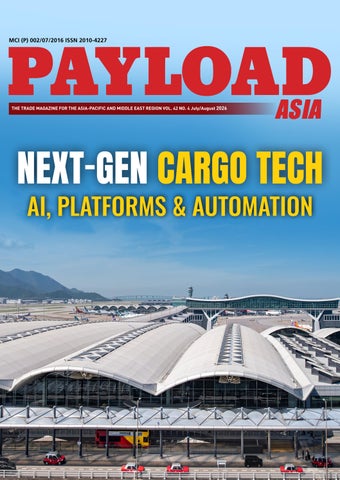
That is the thread running through this issue of Payload Asia. Our cover story looks at how Hong Kong International Airport is building a smarter cargo ecosystem, combining infrastructure, digital platforms, automation and collaboration to support its continued growth.
Chua Chew Huat Asia Pacific sales-sg@harvest-info.com Matt Weidner North America mtw@weidcom.com
TECHNICAL SUPPORT MJ Magsalin tech@harvest-info.com
Across the issue, we explore what happens when digitalisation moves beyond individual processes. IBS Software looks at how AI can turn operational data into proactive decisions, while cargo.one examines the evolution from digital booking to AI-native workflows. On the terminal side, AAT and Lödige Industries offer practical examples of how intelligent platforms and automation can make cargo operations more predictable, flexible and efficient. Kalé Logistics Solutions and CargoTech highlight the importance of interoperability and shared data as the industry moves towards smarter decision-making. Breeze, meanwhile, considers how embedded digital services and AI can bring useful decisions closer to the shipment itself. What emerges is a more measured view of the digital future. AI may be powerful, but its value depends on the quality of the data, the systems it can work with, and the people making the decisions. The goal is not technology for technology’s sake, but a cargo industry that can respond faster, work smarter and operate with greater resilience. Warm regards,
GRAPHIC LAYOUT Danico Acosta
Monina Eugenio Chief Editor
JULY – AUGUST 2026 | www.payloadasia.com
1
CONTENTS
24
26
C-SUITE IBS SOFTWARE
From data to decisions: How AI is reshaping cargo management
COMPANY PROFILE CARGO.ONE
From multimodal quoting to AI workers: cargo.one prepares air cargo for the AI age
28
COVER STORY HKIA
Smart airport, smarter cargo: How HKIA is building the future of global air freight.
32
FEATURE LÖDIGE INDUSTRIES
Smarter, not bigger: How intelligent automation is redefining the future of air cargo terminals
NEWS CA R R I E RS
GROUND HAN DLIN G
Air Cargo launches new daily Road 04 Oman 10 WFS secures five-year freight handling Feeder Service between Dubai and Muscat contract with GEODIS in Brussels
Lufthansa Cargo launches first phase of Frankfurt cargo hub modernisation
LOGISTICS
Airport, Safran begin 15 Brussels construction of LEAP engine module facility
Hactl secures 15-year franchise renewal at Hong Kong International Airport
Air India, SIA Engineering explore MRO collaboration in India
Cargo launches airline-led training secures seven-year ground handling 05 Etihad 11 dnata platform for air cargo professionals licence at Amsterdam Schiphol Cathay Cargo expands intermodal perishables network across Greater Bay Area becomes first airline cargo carrier 06 Emirates to deploy Boeing 777-300ERSF MASkargo expands partnership with Qatar Airways Cargo Turkish Cargo selects Lödige Industries for SMARTIST 2.0 automation Airlines Cargo establishes pharma 07 American corridor linking Europe and the U.S. Saudia Cargo, Riyadh Cargo sign interline agreement to expand global connectivity TAAG launches cargo route to Lusaka. A I R P OR T S
Francisco International Airport expands 08 San cargo capacity with Lödige Industries automation
Liege Airport posts 11% cargo growth in H1 as exports to Asia and North America surge
Swissport opens Integrated Control Centre at Birmingham Airport dnata Italy creates 300 permanent roles across Rome and Milan
EX PRESS
Express surpasses 100 million average 16 J&T daily parcels in Q2 FedEx strengthens intra-Asia connectivity with Guangzhou-Sydney freighter service
LOGISTICS
expands Asia Pacific-U.S. air cargo 12 CEVA capacity with two charters Hellmann marks 20 years in Japan as it targets APAC growth Cainiao named P&G’s global automation partner as projects go live secures IATA CEIV Pharma 13 GEODIS certification for Hyderabad facility Expoline Animal completes logistics project for 35,000 sardines bound for South Korean aquarium KLN partners with Advantech and YDCare on Hong Kong smart healthcare LOGISTICS
Prestwick Airport reports Kuehne+Nagel rolls out cloud-native 09 Glasgow seventh profitable year as cargo volumes 14 warehouse platform across 1,000+ sites
2
Mammoth Freighters selects STAECO for 777 conversion capability in China
surge Changi Airport awards contract for new Terminal 3 office development
MATRADE, DHL Express renew partnership to support Malaysian MSME exports
Western Sydney International launches 24-hour cargo precinct
Hasenkamp consolidates engineering and project logistics expertise
JULY – AUGUST 2026 | www.payloadasia.com
DHL Express launches direct ShanghaiBangkok freighter service FREIGHT FORWARDERS
strengthens controlled air 17 Kuehne+Nagel freight network with Frankfurt addition DHL Global Forwarding launches Bangkok-Cincinnati Transpacific service IT
18 Awery adds Oriental Sky Aviation as the first Chinese GSSA on CargoBooking
Riege Software, CHAMP Cargosystems expand partnership to improve shipment visibility Korean Air integrates direct eBooking access via Freightos
CONTENTS
FEATURE CARGOTECH
34
36
FEATURE KALÉ LOGISTICS SOLUTIONS
Connecting cargo ecosystems with Kalé Logistics Solutions
FEATURE ASIA AIRFREIGHT TERMINAL
Asia Airfreight Terminal: Building the intelligent cargo terminal
NEWS A S S OCI A T I O N S
19
TIACA announces Singapore as host city for Executive Summit 2027 Neutral Air Partner launches NAP Pharma vertical network Cargo iQ restructures Board to drive air cargo quality standards
GSSAs
19
ECS Group accelerates European expansion for My Freighter through strategic commercial partnership
38
By Cedric Millet, President, CargoTech
40
PEOPLE
THOUGHT LEADERSHIP BREEZE
Cargo’s next digital shift is not just another platform
By Eyal Goldberg, Co-founder and Chief Executive Officer, Breeze
PEOPLE
FEATURES
Zahidi appointed IATA Director 22 Saadia General Jettainer appoints Moritz Köhler as Chief Operating Officer
32 LÖDIGE INDUSTRIES
AIR ONE appoints Ilya Gavrilin as Business Development Director APAC
34 KALÉ
C-SUITE
LOGISTICS SOLUTIONS
24 IBS SOFTWARE
36 ASIA AIRFREIGHT
TCE and Virgin Atlantic Cargo chalk up one year and a special sponsorship Globe Air Cargo is the new GSSA to airBaltic in the UK
Connecting the cargo technology ecosystem: How collaboration and interoperability are shaping the future of air cargo
TERMINAL
COMPANY PROFILE
26 CARGO.ONE
36 CARGOTECH
Airways appoints new Chief 20 Qatar Operating and Customer Officers Jules Matteoni appointed CEO of Glasgow Prestwick Airport HAECO announces senior leadership appointments
COVER STORY
THOUGHT LEADERSHIP
28 HKIA
40 BREEZE
Temperature Solutions appoints 21 DoKaSch new commercial leadership Mammen Tharakan appointed next TIACA Director General TAM Group launches Air Charter Division, appoints Charter Director
JULY – AUGUST 2026 | www.payloadasia.com
3
NEWS - CARRIERS Oman Air Cargo launches new daily Road Feeder Service between Dubai and Muscat Dubai and Muscat by complementing traditional air freight operations and enabling the transport of a wider range of cargo types,” said Michael Duggan, Head of Cargo, Oman Air. “As regional supply chains continue to evolve, Oman Air Cargo remains focused on delivering reliable, customer-centric transport solutions that support trade across the Middle East.”
Oman Air Cargo has launched a new daily Road Feeder Service (RFS) between Muscat, Oman and Dubai, United Arab Emirates (UAE), enabling larger and widebody-compatible cargo to be transported between the two countries. Operating daily, the new service supports
The new RFS offering will transport perishables and general cargo, while also accommodating shipments that cannot be carried on narrowbody aircraft, further enhancing trade opportunities between growing trade flows between the UAE and the two countries. Oman by trucking goods in and out of both countries, while providing customers with The new service reinforces Oman’s greater flexibility and connectivity across position as a regional logistics hub, leveraging Oman’s geographic location the region. to facilitate the continued movement of “This new service creates greater cargo across the Middle East through flexibility for cargo movement between Oman Air Cargo.
Lufthansa Cargo launches first phase of Frankfurt cargo hub modernisation fully automated 42-metre-high high-bay warehouse with nearly 3,000 storage positions for cargo pallets, and an automated warehouse for temperaturesensitive and specialised shipments. The high-bay warehouse is designed to handle more than 300 storage and retrieval operations per hour, doubling capacity. Ashwin Bhat, CEO of Lufthansa Cargo, said the launch of the ALPHA phase represents one of the company’s most significant investments and reinforces its commitment to Frankfurt as a global cargo hub. “LCCevo is one of the most significant investments in our company’s history and a clear commitment to Frankfurt as an air cargo hub,” Bhat said. Further construction phases, BRAVO and CHARLIE, will continue through 2030. Alongside greater efficiency and automation, the project will incorporate sustainability measures, including photovoltaic systems across around 19,000 square metres of roof space, energy-efficient building technology, The ALPHA phase forms part of a €600 The new infrastructure features intelligent heat recovery systems and green roofs to million investment to transform the material flow and conveyor systems, a reduce energy consumption and emissions. Lufthansa Cargo has launched operations at the first completed phase of its LCCevo infrastructure project at Frankfurt Airport, marking a key milestone in the modernisation of its cargo hub.
4
Lufthansa Cargo Centre into Europe’s most modern air cargo hub by 2030. Covering around 80,000 square metres, the project is being carried out while the facility continues operating 24/7.
JULY – AUGUST 2026 | www.payloadasia.com
NEWS - CARRIERS Etihad Cargo launches airline-led training platform for air cargo professionals Etihad Cargo has launched the Excellence Hub, which it describes as the air cargo industry’s first airline-led logistics training academy. The platform is designed to support consistent operational, safety and compliance standards across Etihad Cargo’s global partner network through standardised training. It serves Etihad Cargo employees, partners, customers and air cargo professionals worldwide. The curriculum includes training on Etihad Cargo’s operating standards, product and service framework, safety and compliance, as well as industry-certified programmes developed with accredited institutions. Learning is delivered through foundation courses, podcasts, masterclasses and executive education programmes, including a miniMBA, with accredited certifications awarded upon completion.
and performance analytics, while its mobile-first design enables users to access training remotely. Gamification features, including a points-based leaderboard and LinkedIn badges, encourage participation. Complimentary access is also available to university students.
Stanislas Brun, Chief Cargo Officer at Etihad Airways, said the Excellence Hub brings together operational expertise, The platform also incorporates AI-enabled industry knowledge and accredited learning learning to provide personalised feedback pathways on a single platform to help raise
capability standards across the global air cargo ecosystem. Dr Nadia Al Bastaki, Chief People and Corporate Affairs Officer at Etihad Airways, said the initiative reflects Etihad’s commitment to investing in people by supporting professional development and enhancing operational excellence, customer service and efficiency. The Excellence Hub forms part of Etihad Cargo’s broader focus on safety, compliance, operational excellence and workforce development.
Cathay Cargo expands intermodal perishables network across Greater Bay Area Cathay Cargo has strengthened Hong Kong’s position as an international cargo gateway for the Greater Bay Area (GBA) with the launch of a fully integrated intermodal perishables network spanning air, land and sea. The expansion includes a new refrigerated barge service linking Hong Kong International Airport (HKIA) with Cathay Cargo Terminal Dongguan, while its AirLand Fresh Lane has been extended via the Hong Kong-Zhuhai-Macao Bridge to Macao. Combined with the existing air-to-air service to Guangzhou, the network offers shippers greater routing flexibility and improved cold-chain connectivity across the GBA. James Evans, Cathay’s General Manager Cargo Commercial, said the three intermodal routes provide customers with options based on speed, cost and flexibility while supporting growing demand for premium perishables. The new barge service enables commercial air-sea transport of refrigerated perishables into the GBA. Shipments remain palletintact throughout the journey, reducing handling and preserving packaging integrity before arriving at Cathay Cargo Terminal Dongguan.
The extended Air-Land Fresh Lane allows perishables to reach Macao in as little as four hours from HKIA, including customs and quarantine clearance. Refrigerated trucks and 24/7 operations help maintain cold-chain integrity throughout the journey.
All three services operate under a single air waybill and are supported by Cathay Cargo’s IATA CEIV Fresh-certified handling, providing end-to-end cold-chain assurance for customers transporting temperaturesensitive goods.
JULY – AUGUST 2026 | www.payloadasia.com
5
NEWS - CARRIERS Emirates becomes first airline cargo carrier to deploy Boeing 777-300ERSF 777-300ERSF passenger-to-freighter converted aircraft, with the aircraft entering commercial service on a flight from Hong Kong to Dubai carrying more than 100 tonnes of cargo.
and enhances operational flexibility while meeting growing demand for air cargo capacity.
The aircraft is the sixth freighter to join Emirates SkyCargo’s fleet since March The converted Boeing 777-300ERSF 2026, following the delivery of five Boeing offers a payload capacity of 100 tonnes 777-F production freighters. and 811 cubic metres of cargo volume, a 25% increase over the Boeing 777- As part of its fleet expansion strategy, F production freighter. With 47 pallet Emirates SkyCargo expects to take positions, it can accommodate 10 more delivery of five additional Boeing 777-F pallets than the production freighter, aircraft and one more converted Boeing making it well suited for high-volume 777-300ERSF by the end of 2026, followed by three additional converted Boeing shipments such as e-commerce cargo. 777-300ERSFs in 2027. The expansion Badr Abbas, Divisional Senior Vice supports the carrier’s growing global President of Emirates SkyCargo, said freighter network and its commitment Emirates SkyCargo has become the first the converted aircraft marks the next to strengthening international trade airline cargo carrier to deploy the Boeing phase of the carrier’s fleet expansion connectivity.
MASkargo expands partnership with Qatar Airways Cargo
MASkargo has expanded its strategic partnership with Qatar Airways Cargo with the launch of twice-weekly freighter services linking Kuala Lumpur, Bengaluru and Doha,
strengthening Kuala Lumpur’s role as a 1,000 tonnes of cargo have been transported, reflecting strong demand for additional cargo regional cargo gateway. capacity and connectivity. Operated by Qatar Airways Cargo’s Boeing 777 freighters, the KUL-BLR-DOH-KUL service Mark Jason Thomas, Chief Executive Officer adds 200 tonnes of weekly cargo capacity for of MASkargo, said the collaboration supports general cargo, perishables, pharmaceuticals the carrier’s strategy to strengthen Kuala Lumpur’s position as a key cargo gateway while and valuables. enhancing network connectivity, operational The partnership combines MASkargo’s Asian flexibility and logistics solutions for customers. network with Qatar Airways Cargo’s global reach, providing customers with improved MASkargo said the partnership aligns with connectivity to markets across Asia, Europe its long-term growth strategy of expanding and North America through Kuala Lumpur and regional connectivity through strategic partnerships while supporting the movement Bengaluru. of high-value cargo and strengthening AsiaSince the service was introduced, more than linked trade flows.
Turkish Cargo selects Lödige Industries for SMARTIST 2.0 automation The SMARTIST 2.0 project will more than double the hub’s annual handling capacity from 2 million to 4.5 million tonnes, supporting growing global demand while improving cargo handling efficiency. The expansion is also expected to strengthen Istanbul’s position as a major global air cargo gateway.
the storage and retrieval of Unit Load Devices (ULDs) and in-house pallets, enabling faster turnaround times and more efficient cargo handling.
Murat Yalçın KIRCA, Cargo Operations (Global) Vice President at Turkish Cargo, said the project will enable the carrier to manage growing Lödige Industries previously supplied the cargo volumes while maintaining service fully automated cargo handling systems for quality through intelligent infrastructure. SMARTIST’s first phase, which opened in 2021. The second phase will incorporate advanced Björn Ussat, Director Airport Logistic Solutions automation and digital technologies to further at Lödige Industries, said the project reflects the companies’ long-standing partnership and Turkish Cargo has selected Lödige Industries optimise operations and service quality. supports Turkish Cargo’s continued growth to deliver automated cargo handling systems for the expansion of its SMARTIST cargo hub at Spanning 370,000 square metres of enclosed through advanced cargo automation. space, SMARTIST 2.0 is designed to automate Istanbul Airport.
6
JULY – AUGUST 2026 | www.payloadasia.com
NEWS - CARRIERS American Airlines Cargo establishes pharma corridor linking Europe and the U.S. American Airlines Cargo has launched a dedicated pharmaceutical corridor connecting Amsterdam and Brussels with major U.S. destinations via London Heathrow, strengthening temperaturecontrolled logistics between Europe and the United States.
certified trucking service links Amsterdam and Brussels with London Heathrow, one of American Airlines Cargo’s largest international gateways. It supports pharmaceutical and healthcare shipments within temperature ranges of 2°C to 8°C and 15°C to 25°C in both directions.
The corridor standardises ground handling, transfer and air transport processes to maintain temperature control and regulatory compliance throughout the pharmaceutical and healthcare network shipment journey. across Europe and the U.S., providing Eric Mathieu, Managing Director of Customer customers with a reliable, compliant end-toExperience at American Airlines Cargo, said end solution for transporting temperatureOperating daily since 1 May 2026, the GDP- the new corridor strengthens the carrier’s sensitive cargo. Built in line with IATA CEIV Pharma and Good Distribution Practice (GDP) standards, the corridor combines American’s transatlantic network with validated temperaturecontrolled trucking services provided by FlyUs Aviation Group and the carrier’s ExpediteTC service.
Saudia Cargo, Riyadh Cargo sign interline agreement to expand global connectivity Saudia Cargo and Riyadh Cargo have signed an interline agreement to strengthen cargo connectivity, expand network reach and provide customers with greater access to international markets through Saudi Arabia. The partnership combines Saudia Cargo’s established cargo operations with Riyadh Cargo’s expanding network, offering customers broader market access, enhanced routing options and greater flexibility across key trade lanes. The agreement will also support Riyadh Cargo’s network expansion beyond its current destinations, including London, Dubai, Cairo, Jeddah, Madrid and Malaga,
while strengthening connectivity to planned services to Mumbai, Kuala Lumpur and Dhaka. Riyadh Cargo aims to serve more than 100 global destinations by 2030. Eng. Mansour Alasmi, Vice President – Network & Revenue at Saudia Cargo, said the collaboration will provide customers with more integrated logistics solutions while supporting Saudi Arabia’s ambition to become a global logistics hub. Pravin Singh, Vice President of Cargo at Riyadh Air, said the agreement extends Riyadh Cargo’s network reach, creates new trade opportunities and strengthens Riyadh’s position as a future gateway for
global logistics. The interline partnership is expected to expand cargo capacity, improve connectivity for freight forwarders and logistics providers, and support Saudi Arabia’s National Transport and Logistics Strategy and Vision 2030.
TAAG launches cargo route to Lusaka TAAG has launched a dedicated cargo service to Lusaka, Zambia, expanding its African freight network and strengthening regional logistics connectivity.
With the addition of Lusaka, TAAG Cargo now operates dedicated freight services to Lagos, Brazzaville, Abidjan, Accra, Kinshasa, Nairobi and Johannesburg, strengthening its North-South logistics corridor across The inaugural flight, operated on 24 July by Africa. a Boeing 737-800 Freighter, transported 12.8 tonnes of cargo from Amsterdam, The new route is expected to support including machine parts, IT equipment, exports of products including beef, poultry personal effects and other high-value and horticultural goods under the Airlift goods. The airline said subsequent flights Zambia initiative, while improving access are already scheduled to carry 14 and 16 to Angola and TAAG’s wider international tonnes, reflecting strong initial demand. network. The Lusaka service will operate weekly and is supported by a partnership with NAC2000, which serves as TAAG’s ramp and cargo handling provider and general sales and services agent (GSSA) in Zambia.
TAAG Cargo plans to further expand its network with the launch of a new cargo route to Libreville, Gabon, in the fourth quarter of 2026.
JULY – AUGUST 2026 | www.payloadasia.com
7
NEWS - AIRPORTS San Francisco International Airport expands cargo capacity with Lödige Industries automation handling, increase throughput reduce turnaround times.
and
Samuel Chui, Project Manager at San Francisco International Airport, said the investment reflects the airport’s commitment to providing modern cargo facilities that support airline partners and the regional economy.
San Francisco International Airport (SFO) is investing more than US$300 million to expand its air cargo infrastructure, with Lödige Industries selected to supply automated cargo handling technology for the new facility. The 310,000-square-foot, two-storey cargo terminal is designed to increase handling efficiency through advanced automation and is scheduled for
Jonathan Hardy, Managing Director North America at Lödige Industries, said the automated systems will enable SFO to manage growing cargo volumes while completion in spring 2028, with enhancing operational efficiency and operations expected to begin later that scalability. year. Lödige Industries said the project builds The terminal will feature customised on its cargo automation work at New automated storage and retrieval York John F. Kennedy International systems, including three rail-guided Airport and Toronto Pearson Elevating Transfer Vehicles (ETVs) that International Airport as North American can move Unit Load Devices (ULDs) cargo hubs continue to expand in both vertically and horizontally. The response to growing e-commerce and system is designed to streamline cargo global trade.
Liege Airport posts 11% cargo growth in H1 as exports to Asia and North America surge Cargo aircraft movements rose 3.3% year on year to 14,354, indicating improved operational efficiency as cargo volumes grew faster than flight activity. Growth moderated in the second quarter, with tonnage increasing 7.5% compared with 15.6% in the first quarter. Exports were a key driver of performance, rising 19% year on year, while imports increased 6%. Export volumes to Asia grew 17%, while shipments to North America surged 51%. Frédéric Brun, Vice President Sales & Marketing at Liege Airport, said the results reflect the airport’s operational efficiency and its strategic role in supporting international trade amid evolving global supply chains and continued e-commerce growth. Liege Airport noted that new European e-commerce legislation introduced on 1 July 2026 could have a short-term impact on air cargo volumes by prompting shifts from air to sea freight and increasing the number of distribution and fulfilment centres in Liege Airport handled 697,816 tonnes of the same period last year, reinforcing its Europe. The airport said it is monitoring the air cargo in the first half of 2026, an 11.3% position as one of Europe’s leading cargo situation closely, adding that it is too early to assess the long-term effects. increase from 626,690 tonnes during hubs.
8
JULY – AUGUST 2026 | www.payloadasia.com
NEWS - AIRPORTS Glasgow Prestwick Airport reports seventh profitable year as cargo volumes surge Glasgow Prestwick Airport (PIK) has reported its seventh consecutive year of profitability, with cargo growth helping drive an 11% increase in operating profit to GBP3.9 million for the year ended 31 March 2026.
The airport’s dedicated Terminal E e-commerce facility has processed more than 33 million parcels, while Royal Mail and Evri have established operations at the site to support direct airport-to-last-mile handling.
Freight volumes exceeded 46,000 tonnes during the year, supported by 15 weekly freighter services from mainland China and three weekly services from Hong Kong, reinforcing the airport’s position as a UK cargo gateway.
PIK has also expanded its cool chain capabilities, including dedicated personnel, temperature monitoring and 87 tonnes of chilled storage capacity. The investment supported exports of 1.78 million kilograms Sonia Rafferty, Human Resources Director; of Scottish salmon during the first half of Jules Matteoni, Chief Executive Officer; Stephen 2026. Flynn, Cabinet Secretary for Economy, Tourism
Chief Executive Officer Jules Matteoni said freight volumes quadrupled over the past year, driven by expanded long-haul cargo connectivity with Asia and investments in cold storage, cargo handling and bonded warehouse infrastructure.
and Transport; Sheena Beckwith, Chief Financial
The airport expects further cargo growth as it expands freighter services, e-commerce Officer; Dr Willie Mackie, Chairman; Zoe operations and specialist handling for Kilpatrick, Commercial Director; Nico Le Roux, perishables, pharmaceuticals and other Business Development Director. high-value cargo.
Changi Airport awards contract for new Terminal 3 office development Changi Airport Group (CAG) has awarded Nakano Singapore (Pte) Ltd the contract to build a new six-storey office development integrated with a revamped coach stand at Terminal 3.
Terminals 1 to 4 totals around 80,000 square metres and is nearing full occupancy. Steve Tay, Vice President, Rentable Properties at Changi Airport Group, said the project will provide a purpose-built workspace that supports the operational needs of airport partners while encouraging closer collaboration across the airport community.
Located on the landside of Terminal 3, the building will provide approximately 9,600 square metres of office space to support growing demand from airlines, airport partners and businesses requiring an onConstruction will be carried out in two site presence at Changi Airport. phases to minimise operational disruption. The development will be the airport’s first The office building is expected to be standalone office building and forms part completed in the first half of 2028, followed of CAG’s efforts to expand capacity ahead by the upgraded coach stand in the second of the opening of Terminal 5 in the mid- half of the year. Image courtesy of Changi Airport Group 2030s. Existing landside office space across
Western Sydney International launches 24-hour cargo precinct Western Sydney International (Nancy-Bird Walton) Airport (WSI) has officially launched commercial freight operations at its 24hour Cargo Precinct, marking a significant milestone for Australia’s air cargo network and supply chains.
including pharmaceuticals, fresh produce, seafood, advanced manufacturing and e-commerce.
The Cargo Precinct offers direct access via the upgraded Northern Road and connections to the M12 and M7 motorways, The facility is designed to strengthen air linking the airport with key logistics hubs freight capacity while supporting domestic in Kemps Creek, Wetherill Park and the producers, manufacturers and exporters Western Sydney Aerotropolis. through faster access to international Stage one of the facility can accommodate markets. up to eight Boeing 747 or 777 freighters, WSI Chief Executive Officer Simon Hickey or 16 Boeing 737 or Airbus A320 domestic said the cargo hub will initially handle freighters simultaneously. around 250,000 tonnes of freight annually, providing a major boost to Sydney’s air Qantas Freight, Menzies Aviation, dnata cargo capacity and supporting industries Cargo, dnata Catering & Retail, and Texel
Air are among the launch partners at the precinct, which is planned to eventually handle up to 1.8 million tonnes of air cargo annually. WSI is Australia’s first major greenfield international airport developed in more than 50 years.
JULY – AUGUST 2026 | www.payloadasia.com
9
NEWS - GROUND HANDLING WFS secures five-year freight handling contract with GEODIS in Brussels existing partnership, with WFS having provided import and export cargo handling services for GEODIS at Paris Charles de Gaulle Airport since 2021. WFS said its GDP-certified pharmaceutical handling facility in Brussels, featuring two temperaturecontrolled rooms with 300 square metres of dedicated handling space, was a key factor in the agreement, supporting GEODIS’ pharmaceutical logistics operations in Belgium. Philippe Torry, Managing Director Belgium at WFS, said the partnership combines specialised handling capabilities with real-time shipment visibility and operational data to support GEODIS’ service standards and future growth.
Worldwide Flight Services (WFS), a SATS company, has secured a five-year contract with GEODIS at Brussels Airport to provide e-commerce and freight forwarder handling (EFFH) services.
Under the agreement, WFS will manage GEODIS’ freight consolidation and deconsolidation operations, offering 24/7 handling services to support greater operational flexibility. The contract expands the companies’
WFS now provides EFFH services at airports including Amsterdam, Brussels, Dublin, Frankfurt, Liège, Madrid and Stockholm, as well as 12 airports across France, offering services such as cargo preparation, security screening, consolidation, customs support and transport between freight forwarders and handling agents.
Hactl secures 15-year franchise renewal at Hong Kong International Airport Authority Hong Kong, will take effect in July 2028 upon the expiry of the current franchise and run until 2043. Under the renewed franchise, Hactl will continue operating as the airport’s largest independent cargo terminal operator while supporting Hong Kong’s role as an international aviation hub. Chief Executive Frosti Lau said the renewal reflects Hactl’s long-term commitment to Hong Kong’s air cargo industry. The company plans to invest at least HKD1 billion to modernise infrastructure, deploy new technologies and strengthen environmental, social and governance (ESG) initiatives. Lau added that the completion of the airport’s Three-Runway System, including the third runway and Terminal 2, together with government support, provides confidence in the long-term growth of Hong Kong’s air cargo sector and reinforces Hong Kong Air Cargo Terminals Limited International Airport (HKIA). the city’s position as a global aviation and (Hactl) has secured a 15-year extension of its cargo handling franchise at Hong Kong The new agreement, signed with the Airport logistics hub.
10
JULY – AUGUST 2026 | www.payloadasia.com
NEWS - GROUND HANDLING dnata secures seven-year ground handling licence at Amsterdam Schiphol Airport Schiphol (AMS), allowing the company to continue providing passenger, baggage, ramp and cargo services at one of Europe’s busiest aviation hubs.
Thiemo van Spellen, Managing Director of dnata Netherlands, said the award reflects confidence in the company’s operational capabilities and its commitment to delivering safe and reliable ground handling services.
The licence was awarded following a competitive public tender and enables The renewed licence also supports dnata’s dnata to continue supporting Schiphol’s long-term investment in the Netherlands, next phase of ground handling operations. including its €70 million Cargo City Amsterdam facility, which has an annual The company has operated at Amsterdam handling capacity of 600,000 tonnes. The for more than a decade and currently serves company said it will continue investing in more than 20 passenger and cargo airlines. infrastructure, equipment and operational Its team of over 1,200 employees handles capabilities while working closely with dnata has been re-awarded a seven-year approximately 500,000 tonnes of cargo and Schiphol and airline customers during the ground handling licence at Amsterdam around 16,000 flights annually. new licence period.
Swissport opens Integrated Control Centre at Birmingham Airport
Swissport has opened a new Integrated Control Centre (ICC) at Birmingham Airport as part of its investment in safety, operational performance and digital
innovation across its UK and Ireland The centre also enables a more proactive operations. approach to safety by identifying potential risks in real time, supporting equipment The facility provides 24/7 oversight allocation during peak periods and of ground operations by integrating improving operational resilience during operational control, telematics, AI- disruptions. supported monitoring, live video systems and geo-fencing into a single platform. Swissport said the facility will introduce The system provides real-time visibility live monitoring of de-icing operations of more than 2,000 ground support from the 2026/27 winter season to further equipment (GSE) assets, helping improve strengthen coordination during adverse ramp safety, equipment utilisation and weather. aircraft turnaround performance. The Birmingham ICC forms part of the Karen Cox, Chief Executive Officer of company’s wider investment in digital Swissport UK & Ireland, said the ICC technologies and operational intelligence enhances day-to-day decision-making to improve the safety, efficiency and through real-time operational intelligence reliability of its global ground handling while supporting safe, efficient and operations. reliable aircraft turnarounds.
dnata Italy creates 300 permanent roles across Rome and Milan dnata has converted 300 positions into permanent roles across its airport operations in Rome and Milan as part of its long-term workforce strategy in Italy.
Alberto Morosi, Chief Executive Officer of dnata Italy, said the permanent appointments reflect the company’s confidence in the Italian market and its commitment to investing in its workforce The move covers 150 employees at Rome while strengthening operational capability. Fiumicino Airport and a further 150 across Milan Malpensa and Milan Linate airports, At Milan Malpensa, dnata is also supporting employment stability, skills progressing construction of a €25 million development and operational resilience. cargo facility with an annual handling capacity of more than 100,000 tonnes. The announcement comes as dnata Scheduled to open by the end of 2027, the continues to expand one of its largest facility is expected to create a further 200 airport services operations in Europe. The jobs. company employs around 5,000 people across the three airports, serving more The permanent appointments follow than 60 airline customers and handling agreements with trade unions aimed at over 150,000 flights, 46 million passengers supporting workforce development and and nearly 18 million bags annually. employee welfare.
JULY – AUGUST 2026 | www.payloadasia.com
11
NEWS - LOGISTICS CEVA expands Asia Pacific-U.S. air cargo capacity with two charters U.S. with new and renewed charter services CEVA said the Wuxi service will provide connecting Hanoi, Vietnam, and Wuxi, shippers with greater supply chain China, with Chicago. stability and planning reliability, while expanded pickup coverage across China’s The new Hanoi-Chicago service will operate manufacturing and export hubs will support three times weekly using Boeing 777 multi-origin consolidation. freighters, providing same-day departures and arrivals for customers in the high-tech, Both services leverage CEVA’s Chicago industrial, retail and e-commerce sectors. gateway, located near O’Hare International CEVA will support cargo collection and Airport, which includes dedicated freight consolidation from Hanoi, Danang and Ho space, a Free Trade Zone, cold storage and Chi Minh City, alongside customs brokerage cargo screening capabilities. and multimodal transport services. Loic Gay, Vice President of Global Air and The company is also renewing its Wuxi- Ocean Operations at CEVA Logistics, said Chicago charter for a second year following the programmes aim to provide reliable the success of its 2025 programme. The capacity along key transpacific trade twice-weekly service, operated using B777 lanes while supporting Vietnam’s growing CEVA Logistics is expanding its controlled freighters by CMA CGM Air Cargo, offers up manufacturing sector and customers seeking greater supply chain resilience. air cargo capacity between Asia and the to 100 tonnes of capacity per flight.
Hellmann marks 20 years in Japan as it targets APAC growth first Japanese office in 2006, the company has expanded its operations in Tokyo and Osaka, providing airfreight, seafreight, customs brokerage and specialised logistics solutions to customers in sectors including automotive, fashion, healthcare and technology. Japan forms part of Hellmann’s APAC growth strategy under its global “Forward2030” Hellmann representatives mark the 20th programme, with the company identifying anniversary of its operations in Japan. the country as a stable and strategically important market connected to global Hellmann Worldwide Logistics is marking 20 supply chains. years of operations in Japan as it continues to strengthen its presence in the Asia- Jens Drewes, CEO of Hellmann Worldwide Pacific (APAC) region. Since opening its Logistics, said APAC is a key region within
the company’s global strategy, with Japan’s mature market and strong international supply chain links supporting further regional investment and capability development. Sven Raudszus, Regional CEO APAC at Hellmann, said the company has expanded its regional presence by strengthening local teams and developing more connected logistics solutions, adding that Japan provides a strong foundation for its broader APAC growth strategy. Hellmann said it will continue developing its Japanese operations in line with customer needs and market opportunities.
Cainiao named P&G’s global automation partner as projects go live The partnership dates back more than a decade, when Cainiao began providing intelligent warehousing and fulfilment services for P&G in China. It has since expanded to projects incorporating Cainiao’s AI and robotics technologies. Cainiao Vice President Huang Zhong said the longstanding partnership with P&G has helped the company develop its understanding of cross-border operations as it expands internationally. Cainiao said it has completed more than 1,100 projects across 29 countries and serves more than 400 global customers, including 26 Fortune Global 500 companies. for P&G in North America, Europe and Asia. The Guangzhou project has been completed and is now operational, while the Canada project has entered the on-site construction phase. The companies have also reached a preliminary agreement covering warehouse supply chain operations in Europe, North Cainiao is rolling out automation upgrades America and other markets. Cainiao has been named Procter & Gamble’s global strategic automation partner, expanding a collaboration that has grown from logistics services in China into warehouse automation projects across multiple regions.
12
JULY – AUGUST 2026 | www.payloadasia.com
The company is also expanding its automation portfolio, including ZeeBot, a climbing warehouse robot designed to move bins across warehouse floors and racks. Cainiao plans to deploy four large climbing-robot warehouses in Guangzhou, Hong Kong, the Netherlands and Spain over the next four months.
NEWS - LOGISTICS GEODIS secures IATA CEIV Pharma certification for Hyderabad facility India, strengthening its healthcare logistics healthcare logistics network. He added that capabilities in one of the country’s major the certification will support customers pharmaceutical and life sciences hubs. transporting increasingly complex and temperature-sensitive healthcare products The certification confirms that GEODIS’ across global markets. Hyderabad operations, infrastructure, processes and personnel meet international GEODIS now has 29 CEIV Pharma-certified standards for handling pharmaceutical and sites globally, including nine across the Asia healthcare shipments. The assessment Pacific and Middle East region. In India, the covers quality management, operational company employs more than 1,000 people procedures, risk management, staff across 15 locations and serves over 7,000 training, temperature-controlled customers. capabilities and regulatory compliance. The certification forms part of GEODIS’ Chris Cahill, Managing Director, Middle East broader healthcare logistics strategy, Photo by GÜNTER Nils and India Sub-continent at GEODIS, said which combines specialised infrastructure, Hyderabad’s role as a major pharmaceutical trained personnel, shipment visibility GEODIS has secured IATA CEIV Pharma manufacturing and export hub makes and quality controls to support the safe certification for its Hyderabad facility in it a strategic location for the company’s transport of healthcare products.
Expoline Animal completes logistics project for 35,000 sardines bound for South Korean aquarium involved three separate import operations between 28 May and 26 June. The sardines were transported in a Japanese live fish transport truck, which travelled by ferry before arriving at Busan Port. Expoline Animal managed the import procedures and on-site operations required to transfer the fish to the aquarium. Following quarantine inspection and customs clearance, the sardines were moved to the facility’s main Expoline Animal has completed an exhibition tank on the day of arrival. import logistics project supporting the arrival of 35,000 Japanese sardines The company’s responsibilities included (Sardinops melanosticta) for exhibition at bonded cargo release at Busan Port, an aquarium in South Korea. The project escorting the vehicle to the aquarium,
supervising unloading and weighing at the quarantine holding tank, submitting quarantine applications and completing import customs clearance. Expoline Animal said live aquatic animal shipments require close coordination across quarantine, customs, port and ground operations, as delays can affect the condition of the animals. With more than 20 years of experience in specialised animal logistics, the company said it focused on minimising handling time and coordinating each stage of the process to maintain the condition of the fish throughout the import operation.
KLN partners with Advantech and YDCare on Hong Kong smart healthcare support the digital transformation of Hong healthcare institutions. The partners said the solution is intended to improve clinical Kong’s healthcare sector. collaboration, ward management and the Under the agreement, KLN Medical will digitalisation of healthcare workflows. become the sole Hong Kong distributor of Advantech’s iWard smart ward solutions. Samuel Lau, Managing Director – Integrated The partnership combines KLN Medical’s Logistics at KLN, said the partnership healthcare supply chain capabilities with marks an expansion into smart healthcare Samuel Lau, Managing Director – Integrated Advantech’s smart healthcare technology and will enable the company to provide medical institutions with supply chain and Logistics of KLN (centre), Jackson Hsu, PD Head and YDCare’s clinical expertise. support services for the deployment of of Advantech (left) and Serena Xie, Founder KLN Medical will provide medical digital health technologies. and CEO of YDCare (right) sign the tripartite institutions with support covering MOU to support the digital transformation of equipment delivery, after-sales technical Advantech said iWard has already been Hong Kong’s healthcare system and promote services, maintenance and system deployed in healthcare markets including the application and development of advanced implementation coordination for iWard mainland China, Thailand and Japan. healthtech. deployments. KLN Medical said it plans to continue KLN Logistics Group’s healthcare The iWard platform integrates patient working with industry partners to subsidiary, KLN Medical, has signed a information, clinical workflows and introduce medical technologies and tripartite memorandum of understanding medical equipment, while connecting support the development of a smarter (MOU) with Advantech and YDCare to with existing information systems at healthcare ecosystem in Hong Kong.
JULY – AUGUST 2026 | www.payloadasia.com
13
NEWS - LOGISTICS Kuehne+Nagel rolls out cloud-native warehouse platform across 1,000+ sites The transformation, which began in April 2026, is being implemented in phases and is built on Blue Yonder’s Warehouse Management Solution. The platform incorporates agentic AI capabilities and brings KN SwiftLOG into a unified cloudbased environment while retaining it as Kuehne+Nagel’s established warehouse management system. The company said the platform will connect warehouse operations, data and workflows across its global network, supporting more standardised processes, Kuehne+Nagel is rolling out a cloud-native improved visibility and faster responses version of its KN SwiftLOG warehouse to supply chain disruptions and changing management system across more than customer requirements. 1,000 Contract Logistics sites in nearly 100 Eduardo Razuck, Executive Vice President, countries. Kuehne+Nagel and Blue Yonder
Contract Logistics at Kuehne+Nagel, said the move to a cloud-native platform will support consistent execution at scale while maintaining reliable service delivery. For customers operating across multiple countries, the single cloud-based platform is expected to provide greater consistency across locations and support more coordinated warehouse operations. The first customer deployment is scheduled to go live in Asia in July 2026. Blue Yonder CEO Duncan Angove said the platform will support AI-enabled execution and next-generation operating practices designed to improve productivity, speed and agility.
MATRADE, DHL Express renew partnership to support Malaysian MSME exports Under the agreement, MATRADE-registered companies can continue participating in the Trade and Grow Beyond Borders programme, which combines online content and workshops covering e-commerce, financing, marketing, logistics, customs compliance and sustainable business growth.
Brunei. The renewed agreement builds on a partnership established in 2022. Since then, the joint programme has reached nearly 700 participants through sessions across Malaysia, while seven MSMEs have participated in the DHL GoTrade GBSN Fellowship for additional mentoring and learning.
The programme supports MATRADE’s 2026 roadmap to help Malaysian businesses diversify into high-growth markets across Malaysia External Trade Development ASEAN, South Asia, Central Asia and Africa Corporation (MATRADE) and DHL Express amid shifting trade conditions and supply have renewed their strategic partnership chain risks. through a memorandum of understanding (MOU) aimed at strengthening the export The MOU was signed on 16 July by Dato’ readiness and competitiveness of Malaysian Abu Bakar Yusof, Chief Executive Officer micro, small and medium enterprises of MATRADE, and Julian Neo, Managing Director of DHL Express Malaysia and (MSMEs).
Julian Neo said DHL’s global trade expertise can help MSMEs expand their international reach, highlighting the role of publicprivate partnerships in supporting inclusive economic growth.
(L-R) Dato’ Abu Bakar Yusof, Chief Executive Officer of Malaysia External Trade Development Corporation (MATRADE), with Julian Neo, Managing Director of DHL Express Malaysia and Brunei.
The initiative forms part of DHL’s GoTrade programme, which aims to reduce trade barriers and support MSMEs in cross-border trade.
Hasenkamp consolidates engineering and project logistics expertise The expanded Hasenkamp Tech Services GmbH will serve as an international centre of excellence for complex project logistics, specialised technical transport and demanding project execution.
The Hasenkamp Group has consolidated its engineering and project logistics capabilities by merging its Logistics & Engineering Solutions division with Hasenkamp Tech Services GmbH into a single organisation, effective 1 July 2026.
14
with combined technical consultancy, engineering expertise and operational execution through a single organisation.
The expanded unit will draw on Hasenkamp’s network of more than 40 locations and The unit supports customers across sectors more than 120 years of logistics experience. including art and culture, high-tech, IT infrastructure, laboratories, research, Stefan Velte has also joined the management industrial and public-sector organisations. board of Hasenkamp Tech Services GmbH Its capabilities cover technical project as Managing Director, effective 1 July. He will planning, engineering, specialised work with the existing leadership team on handling of sensitive assets, lifting and the strategic development of the business crane operations, installation services and unit. international project execution. Hasenkamp said the integration strengthens Thomas Schneider, CEO of the Hasenkamp its position in technically demanding Group, said the integration will enable project logistics, where quality, safety and the company to provide customers specialised expertise are critical.
JULY – AUGUST 2026 | www.payloadasia.com
NEWS - MRO Brussels Airport, Safran begin construction of LEAP engine module facility Brussels Airport and Safran have begun construction of a more than 15,000-square-metre extension to Safran Aircraft Engine Services Brussels, creating a new facility dedicated to the maintenance of LEAP engine modules.
which has operated since 2024 and specialises in CFM LEAP engine maintenance. The engines power many new-generation single-aisle aircraft, including the Airbus A320neo and Boeing 737 MAX.
The Module Factory will include a workshop of nearly 12,000 square metres and more than 3,000 square metres of office space. By 2028, it is expected to handle up to 1,500 engine modules annually and create around 250 additional jobs, bringing the site’s workforce to more than 600 employees by 2027.
Safran said maintaining engine modules separately from complete engines will help streamline repair operations, improve efficiency and increase specialised MRO capacity in Europe.
Nicolas Potier, Senior Vice President, Support & Services at Safran Aircraft Engines, said the project will support the expansion of the company’s global The facility will complement Safran’s maintenance network as the LEAP fleet existing workshop at Brussels Airport, grows. The extension will also incorporate
energy and water efficiency measures, including on-site energy production designed to offset consumption, rainwater harvesting and the reuse of existing materials and infrastructure.
Air India, SIA Engineering explore MRO collaboration in India Air India and SIA Engineering Company (SIAEC) have signed a memorandum of understanding (MoU) to explore collaboration in aircraft maintenance, repair and overhaul (MRO), with the potential to establish a joint venture in India. Signed in Mumbai on 3 July, the agreement aims to leverage SIAEC’s MRO and technical expertise alongside Air India’s growing fleet and operations network to develop MRO capabilities in India and support the country’s ambition to become a global aviation MRO hub. The potential collaboration could include the formation of an MRO joint venture serving the growing maintenance needs of the Indian and regional aviation markets.
The MoU is non-binding, with further developments expected as discussions progress. The agreement builds on an existing relationship between the two companies. SIAEC signed a 12-year Inventory Technical Management agreement with Air India in 2024 to provide component support for its Airbus A320 family fleet and was appointed the airline’s strategic base maintenance partner for facilities in Bengaluru later that Air India CEO & MD Campbell Wilson and SIAEC year. CEO Chin Yau Seng sign and exchange an MoU in Mumbai on 3 July 2026.
Air India CEO and Managing Director Campbell Wilson said stronger domestic MRO capabilities will be important as India’s could support the progressive development aviation sector and fleet sizes expand. SIAEC of MRO capacity in India as the country’s CEO Chin Yau Seng said the partnership aviation market continues to grow.
Mammoth Freighters selects STAECO for 777 conversion capability in China Mammoth Freighters has selected STAECO as its latest MRO provider for Boeing 777 passenger-to-freighter conversions, expanding its conversion programme to Qingdao, China, to support growing demand for widebody freighter capacity in China and the Asia-Pacific region.
will perform Mammoth’s proprietary modifications, while HAECO Xiamen will provide 777-related expertise and personnel during the programme’s start-up.
STAECO has experience with more than 100 Boeing 737-800 conversions and has previously provided freighter modification Mammoth plans to establish its first services for Boeing and Aeronautical conversion line at STAECO’s new Qingdao Engineers Inc. (AEI). facility in September 2026, with a second line expected to begin operations in early The Qingdao operation will complement 2027. The company will occupy a widebody Mammoth’s existing conversion lines at Aspire MRO in Fort Worth, Texas, and STS hangar with two bays. Aviation Services in Manchester, UK. The first aircraft, a Jetran-owned Boeing 777-200LR, is expected to enter STAECO’s Mammoth received FAA certification for facility for conversion this autumn. STAECO its 777-200LRMF freighter in April 2026,
Mammoth / STAECO signing ceremony
with the first two aircraft expected to enter commercial service this autumn with Qatar Airways and DHL. The company also plans to seek CAAC validation for its 777-300ERMF conversion.
JULY – AUGUST 2026 | www.payloadasia.com
15
NEWS - EXPRESS J&T Express surpasses 100 million average daily parcels in Q2 The milestone marks the first quarter in which the company’s average daily parcel volume exceeded 100 million. Non-China parcel volumes grew 66.9% to 2.966 billion, accounting for 32.3% of the total. Southeast Asia remained a key growth market, with parcel volumes increasing 63.2% year on year to 2.755 billion during the quarter. Average daily volume reached 30.3 million. The company expanded its J&T Global Express, the parent company of regional infrastructure, increasing sorting J&T Express, recorded 9.177 billion parcels centres to 127 and automated sorting in the second quarter of 2026, up 24.2% lines to 75 as of 30 June. year on year, with average daily parcel volume reaching 101 million. In China, parcel volumes rose 10.6%
to 6.211 billion, while other markets recorded a 136.5% increase to 211 million parcels. J&T said growth in markets including Latin America and the Middle East was supported by e-commerce and cross-border logistics opportunities. For the first half of 2026, J&T Express handled 17.503 billion parcels, up 25.1% year on year, with non-China volumes accounting for 33.6% of the total. The company said it will continue investing in infrastructure, network expansion, service quality and operational efficiency to support long-term growth.
FedEx strengthens intra-Asia connectivity with Guangzhou-Sydney freighter service FedEx has launched a new dedicated non-stop freighter service between its Asia-Pacific hub in Guangzhou, China, and Sydney, Australia, strengthening cargo connectivity between key Asian markets and Australia. The service operates five times weekly using Boeing 777 freighters and can provide transit times of as little as two business days for selected shipments from Southern Mainland China, Hong Kong, Japan, South Korea, Malaysia, the Philippines and Thailand. FedEx said the new connection will support time-sensitive and high-value shipments by providing more direct access to the Australian market, while increasing capacity for heavier freight and helping businesses improve supply chain
efficiency. Salil Chari, President, Asia Pacific at FedEx, said the service strengthens the company’s intra-Asia network and enables customers to access key markets more quickly while supporting more resilient supply chains. The Guangzhou-Sydney service forms part of FedEx’s wider investment in intra-Asia connectivity. Recent network enhancements include dedicated nonstop Guangzhou-Penang cargo flights, additional weekly freighter services between Guangzhou and Bangkok, and an enhanced outbound connection from Hanoi to South Korea. FedEx said the network expansion is designed to support growing intra-Asia trade and businesses seeking faster, more regional and resilient supply chains.
DHL Express launches direct Shanghai-Bangkok freighter service DHL Express has launched a new daily direct manufactured in the region. freighter service between Shanghai and Bangkok, increasing capacity between China Bangkok serves as a gateway to the and the growing markets of Southeast Asia. Indochina region, while Bahrain and Brussels are key DHL Express hubs. The new The Shanghai-Bangkok-Bahrain-Brussels- routing will enable the carrier to consolidate Shanghai route is operated by a Boeing 767 shipments from China and Southeast Asia freighter with a maximum payload of 50 before connecting them with destinations tonnes. DHL said the service will strengthen across Europe and the Middle East. connections between manufacturing, sourcing and consumption markets across DHL said the service comes as manufacturers Asia, the Middle East and Europe. and traders in Thailand, Vietnam, Cambodia and Laos increasingly source goods from Peter Bardens, Senior Vice President for China, creating demand for faster and more Network Operations & Aviation – Asia flexible cross-border connections. Pacific at DHL Express, said the new service responds to shifting trade flows The launch follows DHL’s recent expansion between China and Southeast Asia, as of its Shenzhen gateway, which can now well as continued demand from European handle up to 900 tonnes of cargo daily, and Middle Eastern markets for products around three times its previous throughput.
16
JULY – AUGUST 2026 | www.payloadasia.com
NEWS - FREIGHT FORWARDERS Kuehne+Nagel strengthens controlled air freight network with Frankfurt addition Kuehne+Nagel has expanded its owncontrolled air freight network with the addition of Frankfurt to its Inspire aircraft rotation, strengthening connectivity between North America, Europe and Asia. Effective June 2026, the updated rotation includes a weekly Chicago-Frankfurt service continuing to Atlanta, directly connecting two major pharmaceutical production and distribution hubs and supporting timesensitive healthcare shipments. Inspire is Kuehne+Nagel’s own-controlled Boeing 747-8 freighter operated under a long-term charter by Atlas Air. With a cargo capacity of around 140 tonnes, the aircraft supports high-value and time-sensitive semiconductors and cloud infrastructure. shipments across global trade lanes. Martin Schaefer, Senior Vice President Air The updated rotation links Atlanta, Logistics Germany at Kuehne+Nagel, said Chicago, Frankfurt, Liège, Sharjah and Frankfurt’s role as a major European air Taipei, supporting industries including cargo and pharmaceutical hub makes it an pharmaceuticals, aerospace, high-tech, important addition to the Inspire network,
providing customers with greater capacity and connectivity for time-sensitive cargo. Kuehne+Nagel currently operates more than 100 weekly charter connections worldwide as part of its own-controlled air freight network.
DHL Global Forwarding launches Bangkok-Cincinnati Transpacific service DHL Global Forwarding has launched a new dedicated Transpacific cargo service linking Bangkok with Cincinnati, strengthening air freight connectivity between Southeast Asia and the United States. The Bangkok-Cincinnati service operates three times weekly with widebody freighters offering up to 100 tonnes of capacity per flight. It is supported by road feeder services across the U.S. and forms part of DHL Global Forwarding’s new TransPac Connect solution. The service also connects with DHL Global Forwarding’s wider Transpacific network through Hanoi and Taipei, providing access to U.S. gateways including Cincinnati and Chicago. DHL said the dedicated capacity offers stable schedules, main-deck capacity and greater cost predictability, particularly for oversized and high-value shipments, helping customers manage supply chain disruption and fluctuating market conditions. Henk Venema, Global Head of Air Freight at DHL Global Forwarding, said Southeast Asia’s growing importance as a manufacturing and sourcing region is driving demand for reliable transpacific
connections. He added that the new service DHL Global Forwarding’s broader controlled provides customers with greater control, air freight network, which includes dedicated capacity and reliability. services across Asia, Europe and the Middle East, with hubs including Frankfurt, Liège, The Bangkok-Cincinnati route forms part of Amsterdam and Hong Kong.
JULY – AUGUST 2026 | www.payloadasia.com
17
NEWS - IT Awery adds Oriental Sky Aviation as the first Chinese GSSA on CargoBooking Oriental Sky Aviation has joined Awery Aviation Software’s CargoBooking platform, making its airline portfolio available for digital quotes and bookings and becoming the platform’s first Chinese General Sales and Service Agent (GSSA).
Vitaly Smilianets (left), Founder and Chief Executive Officer, Awery Aviation Software, and Rush Wang (right), Founder and President, Oriental Sky Aviation.
said the partnership marks an important milestone for CargoBooking and reflects the growing role of digital technology in China’s air cargo market.
Rush Wang, Founder and President of Oriental Sky, said joining the platform will The agreement was announced at improve access to the company’s network Air Cargo China and builds on the while supporting greater efficiency for companies’ existing relationship. Oriental customers. Sky has used Awery’s Enterprise Resource Planning (ERP) system for its GSSA and Oriental Sky provides cargo charter operations since 2022. representation, total cargo management, charter and interline services, and other Through CargoBooking, freight solutions for airline partners across 21 forwarders will be able to access Oriental countries. Sky’s airline capacity and services through a single digital interface for Awery said the addition strengthens quotations, bookings and shipment CargoBooking’s reach in the Chinese management. Vitaly Smilianets, Founder market and expands digital access to and Chief Executive Officer of Awery, airline capacity for freight forwarders.
Riege Software, CHAMP Cargosystems expand partnership to improve shipment visibility access to real-time shipment status updates across more than 100 airlines. It is particularly aimed at improving visibility for import shipments, where freight forwarders have traditionally faced gaps in tracking information.
Riege Software and CHAMP Cargosystems have expanded their long-standing partnership by integrating CHAMP’s Traxon Premium Tracking service into Riege’s Scope forwarding platform. The integration, delivered through Scope’s new Airline Messaging Premium feature, provides customers with automated
with greater visibility across the airfreight main leg, particularly for import flows, while supporting more automated and transparent operations. Edward Dorr, Vice President, eCargo Portfolio at CHAMP Cargosystems, said the expanded partnership combines CHAMP’s global connectivity with Riege’s forwarding expertise to provide more consistent shipment visibility and datadriven decision-making.
Traxon Premium Tracking uses CHAMP’s Traxon cargoHUB connectivity to provide event-based tracking across multiple airlines and stakeholders. Riege said the integration removes the need for complex individual integrations or manual data collection, allowing forwarders to manage The companies have worked together shipment information through a single since 1994, with the latest integration extending their collaboration around platform. digital air cargo solutions. Christian Riege, CEO of Riege Software, said the integration will provide customers
Korean Air integrates direct eBooking access via Freightos
18
The integration provides an additional digital booking channel alongside Korean Air’s existing infrastructure. Korean Air has selected Freightos as its exclusive launch partner for third-party platform distribution, expanding access to its live capacity and pricing through Freightos’ digital network.
search, obtain quotes and book Korean Air shipments through their Freightos dashboards.
Jae Dong Eum, Executive Vice President and Head of the Cargo Business Division at Korean Air, said expanding its digital reach through Freightos will help deliver a more seamless digital experience to existing Korean Air has integrated its cargo booking freight forwarding customers. capabilities with Freightos, giving freight forwarders access to the carrier’s real-time The initial rollout covers key air cargo rates, live capacity and direct eBooking gateways in North America and Europe. through the Freightos platform. Forwarders in activated markets can
Pablo Pinillos, CEO of Freightos, said direct access to real-time capacity and eBooking will help improve efficiency and resilience across global supply chains.
JULY – AUGUST 2026 | www.payloadasia.com
Korean Air operates a fleet of 166 aircraft, including 23 dedicated freighters, supporting its global cargo network.
The integration was announced during Air Cargo Shanghai 2026 and expands digital access to Korean Air’s cargo capacity for freight forwarders.
NEWS - ASSOCIATIONS TIACA announces Singapore as host city for Executive Summit 2027 The International Air Cargo Association (TIACA) will hold its Executive Summit 2027 in Singapore from 21 to 23 June 2027, bringing together senior executives and decision-makers from across the global air cargo supply chain.
networking. Roos Bakker, Chair of TIACA, said Singapore’s position as a major aviation and logistics hub makes it an appropriate location for the association’s global air cargo community to gather.
The 2027 programme will cover key issues including market developments, digital transformation, sustainability, e-commerce, infrastructure investment, regulatory changes, workforce development and emerging technologies. It will also continue participation makes the Executive Summit a initiatives introduced at the 2026 summit, platform for industry leaders shaping the The summit brings together representatives including the TIACA Keynote Address. future of air cargo. from airlines, airports, freight forwarders, ground handlers, technology providers, TIACA Director General Glyn Hughes said Further details on registration, speakers, logistics companies and shippers for the event’s combination of strategic content, sponsorship and the programme will be strategic discussions and industry executive-level networking and international announced later. TIACA expects more than 350 delegates from over 40 countries to attend the threeday event, following the 2026 Executive Summit in Warsaw, which attracted more than 320 participants.
Neutral Air Partner launches NAP Pharma vertical network Neutral Air Partner (NAP) has launched NAP Pharma, a specialist community for freight forwarders and air cargo partners involved in pharmaceutical, healthcare and life sciences logistics. The new vertical was introduced at NAP’s 10th AGM, OPENAP10, in Marrakech. It brings together pharma-certified SME forwarders, cold chain specialists, packaging providers, technology companies, compliance experts and other life sciences logistics professionals within the NAP network. NAP said the initiative is designed to support independent air cargo specialists operating in the highly regulated pharmaceutical logistics sector, with a focus on quality,
training, compliance, visibility and trusted partnerships. The launch builds on NAP’s strategic partnership with Pharma.Aero, which has been in place for more than four years. The organisations will expand their collaboration through education, knowledge sharing and specialist industry engagement. Several NAP members have already participated in Pharma.Aero’s Pharma Logistics from 14 to 17 September 2026 in Frankfurt and Antwerp, with NAP Pharma set to Masterclass. participate. NAP Pharma is also supported by 4Viso, a compliance and risk intelligence NAP founder and CEO Christos Spyrou said platform for pharmaceutical logistics, with the new vertical will help members develop capabilities covering audit readiness, risk specialised capabilities, connect with visibility and partner intelligence. The next industry experts and expand their presence Pharma Logistics Masterclass will take place in the global pharma logistics market.
Cargo iQ restructures Board to drive air cargo quality standards Cargo iQ has restructured its Board to projects developed over the past two years strengthen representation across the air and supporting their adoption across the cargo supply chain and support wider Cargo iQ membership. adoption of its quality standards. Current priorities include the rollout of the Three new members have joined the Cargo iQ Tiers Implementation System, Board: Jeanne-Mari Reardon, Vice President which provides members with a phased Air Product EMEA at CRANE Worldwide approach to adopting its standards. A Logistics; Paul Glaser, Managing Director – data-driven audit programme launched in Austria at Cargomind; and Calvin Hui, Head April 2026 will measure how consistently of Cargo Customer Experience and Service members follow Cargo iQ processes. Excellence at Cathay Cargo. Four existing members were also re-elected for another Cargo iQ is also working to improve digital two-year term. The Board’s focus this year information sharing by exchanging Route will be on completing and implementing Maps with ONE Record and other API-driven
processes. It is developing Road Feeder Services Business Cases to expand coverage and Station Route Maps to strengthen the value proposition for ground handling agents and airlines. Cargo iQ Board Chair Hendrik Leyssens said the Board will play a key role in driving adoption and implementation of the initiatives across its membership.
JULY – AUGUST 2026 | www.payloadasia.com
19
PEOPLE Qatar Airways appoints new Chief Operating and Customer Officers Chief Operating Officer and Calum Laming as Chief Customer Officer. Both executives will report directly to Group Chief Executive Officer Hamad Al-Khater and will take up their new roles on 1 November 2026.
earlier this year. He has also held senior customer-focused roles at Etihad Airways and Air New Zealand. In his new role, he will bring Qatar Airways’ brand and customer touchpoints under a coordinated focus.
Ali, a Qatari national, has been promoted from his current position as Senior Vice President of Ground Services. He brings experience across airline, airport and network operations and will oversee the Group’s operational functions, with a focus on accountability, performance and safety.
The appointments support the Group’s priorities around passenger experience, expansion of its passenger and cargo network, fleet development and investment in its people.
The leadership changes come as Qatar Airways’ summer 2026 schedule restores Qatar Airways Group has created two new Laming, a dual Irish and British national, the network to 85% of pre-crisis levels, with executive roles as it prepares for its next most recently served as Chief Customer more than 140 daily departures from Doha phase of growth, appointing Abdulla Ali as Officer at British Airways from 2022 until to over 160 destinations.
Jules Matteoni appointed CEO of Glasgow Prestwick Airport Glasgow Prestwick Airport (PIK) has appointed Jules Matteoni as Chief Executive Officer, effective 1 July 2026. He succeeds Ian Forgie, who is retiring after five years in the role. Matteoni has worked at PIK for more than 33 years and most recently served as Operations Director. He has played a key role in developing the airport’s position as a UK gateway for international cargo and e-commerce traffic. PIK Chairman Dr Willie Mackie CBE said Matteoni’s leadership had been instrumental in the development of the airport’s e-commerce business and that his experience positioned him well to lead the airport through its next
phase of growth. Matteoni said he would focus on strengthening existing markets while pursuing new opportunities reflecting the airport’s commercial advantages and position within the UK supply chain. Forgie, who became CEO in March 2021, oversaw significant growth in PIK’s cargo operations, including regular freighter services between Scotland and mainland China, the processing of more than 33 million e-commerce parcels over the past 12 months, and the export of more than 1.5 million kilograms of Scottish salmon between January and May 2026.
Jules Matteoni, Chief Executive Officer designate, Glasgow Prestwick Airport (right), receives a traditional Scottish welcome from a bagpiper (left) at Air Cargo China, where he was greeted to the tune of Auld Lang Syne.
HAECO announces senior leadership appointments Charles de Zoete has been appointed Chief markets, including at Swire Shipping and Financial Officer of HAECO, effective May 2026, United States Cold Storage. succeeding Roy Shearer, who has moved to Edmunds joined HAESL in 2023 and previously Swire Properties as Chief Financial Officer. held roles across the Swire Group and Cathay George Edmunds, currently Chief Executive Pacific, including General Manager Cargo Officer of Hong Kong Aero Engine Services Commercial at Cathay Cargo. Limited (HAESL), will become HAECO’s Group Director of Component and Engine Services. Murton has held leadership positions across Peter Murton, currently Chief Executive Officer HAECO operations in the Chinese Mainland of HAECO Hong Kong, will succeed Edmunds and United States, while Bellamy brings experience across aviation, shipping, logistics as CEO of HAESL. and consultancy. Tom Bellamy, currently Chief Transformation Officer and Director of Swire Projects at Swire HAECO Group CEO Richard Sell said the Shipping, will join HAECO as Chief Executive appointments reflect the depth of talent across HAECO and the wider Swire Group and will HAECO Group has announced a series of senior Officer of HAECO Hong Kong. support the company’s next phase of growth leadership appointments across its businesses to support its long-term growth plans and De Zoete joined the Swire Group in 2010 and and transformation. has held senior finance roles across several continued investment in MRO capabilities.
20
JULY – AUGUST 2026 | www.payloadasia.com
PEOPLE DoKaSch Temperature Solutions appoints new commercial leadership DoKaSch Temperature Solutions has appointed Kersten Drummer as Chief Commercial Officer (CCO), effective 1 July 2026. He will oversee the company’s commercial strategy, including business development and key account management, reporting to Managing Director Andreas Seitz.
expertise in the active container business and international team development.
Drummer brings more than 20 years of experience in the air cargo industry, including more than a decade focused on life sciences and healthcare. His background covers sales, product and operations leadership, with
At the same time, Edwin Visser has been appointed Senior Vice President, Strategic Alliances. Reporting directly to Seitz, the newly created role will support DoKaSch’s global strategy and growth.
He said his focus will be on bringing teams together across regions, maintaining consistent execution and strengthening longterm customer relationships. Visser previously served as CCO for more than three years and will continue to contribute his industry experience and network to the company in his new position.
Mammen Tharakan appointed next TIACA Director General in August 2026. Tharakan will succeed Glyn Hughes, who has led the association since 2021 and is preparing to retire. The transition will include a handover period to ensure continuity. Selected unanimously following a global selection process led by TIACA’s Executive Committee and Board of Directors, Tharakan brings more than 25 years of international leadership experience across the aviation and air cargo sectors. The International Air Cargo Association (TIACA) has appointed Mammen Tharakan as its next Director General, with the aviation and air cargo executive set to assume the role
His career spans airports, airlines, ground handling, e-commerce, route development, infrastructure, tourism and investment attraction. His previous leadership roles include positions at Air France-KLM, Edmonton
International Airport and King International Airport in Riyadh.
Salman
As Director General, Tharakan will lead TIACA’s Secretariat and work with the Board to advance the association’s vision for a safe, profitable and united air cargo industry. TIACA Chair Roos Bakker said Tharakan’s strategic vision, commercial expertise and understanding of the global air cargo ecosystem make him well placed to lead the association’s next phase. Tharakan said his priorities will include growing TIACA’s membership, increasing the value delivered to members and strengthening the association’s global visibility.
TAM Group launches Air Charter Division, appoints Charter Director TAM Group has launched a dedicated Air Charter Division and appointed Fernando Carballal as Group Charter Director, expanding its capacity solutions for airlines, freight forwarders and logistics customers.
network disruptions, project cargo and other time-sensitive shipments. It will also support airline partners with overflow and specialist charter opportunities.
Carballal brings 11 years of air cargo experience across airline, freight forwarding and charter brokerage. As Group Charter Director, he will lead development of the charter business across the region and build a roadmap for its would complement rather than compete with global integration. its GSSA business. Fernando Garreton, Vice President and Managing Partner of the Americas at TAM The company said the new division will initially Based at TAM Group’s Americas headquarters Group, said the company had proven the build on its strength in the Americas while in Miami, the division will provide full and part- charter model locally and was now building the connecting regional capabilities with its wider charter solutions for peak-season demand, structure to scale it, adding that the division global network. The new division formalises an incubation phase that began in September 2024, initially focusing on specialised charter opportunities in South America. During this period, the team coordinated 30 charter operations involving perishables, pharmaceuticals, industrial equipment, live animals and high-value cargo.
JULY – AUGUST 2026 | www.payloadasia.com
21
PEOPLE Saadia Zahidi appointed IATA Director General 1 November 2026. She will become IATA’s experience at the WEF will strengthen ninth Director General and the first woman the association’s role as the voice of the to hold the position. world’s airlines, particularly as technology and geopolitical developments reshape the Zahidi joins IATA from the World Economic industry. Forum (WEF), where she is Managing Director and a member of the Managing Zahidi said she will work with IATA’s member Board. airlines, governments and industry partners to build on the association’s existing She will succeed Willie Walsh, who will foundation, with a focus on innovation, conclude his tenure on 31 July 2026. IATA resilience and sustainable growth. Chief Financial Officer and Senior Vice President for Corporate Services Sandrine She added that aviation’s role in economic Le Borgne will serve as Interim Director growth, trade, tourism, jobs and investment The International Air Transport Association General during the intervening period. makes IATA’s work in bringing the industry (IATA) Board of Directors has appointed together through standards, services and Saadia Zahidi as Director General, effective IATA Board Chair Roberto Alvo said Zahidi’s advocacy increasingly important.
Jettainer appoints Moritz Köhler as Chief Operating Officer Jettainer has appointed Moritz Köhler as Chief Operating Officer (COO), effective July 2026. He will lead the company’s newly restructured Operations division, overseeing global operations, strategic fleet management and its worldwide network of ULD Control Desks and repair partners.
ONE Record data standard.
Köhler brings around 18 years of experience in the air cargo industry and previously held various leadership and management positions at Lufthansa Cargo, including international roles in Commercial Management, market development and digitalisation. Most recently, he was responsible for implementing the IATA
Jettainer CEO Dr Jan-Wilhelm Breithaupt said Köhler’s airline expertise and experience in operational excellence and digital transformation would support the strategic development of the company’s operations operational processes and make greater use of and continued growth. Köhler said he would digitalisation and data-driven decision-making work with Jettainer’s global teams to improve to increase the efficiency of ULD services.
In his new role, Köhler will focus on advancing the digitalisation of operational processes, strengthening data-driven decision-making, optimising ULD fleet availability and enhancing service quality.
AIR ONE appoints Ilya Gavrilin as Business Development Director APAC AIR ONE has appointed Ilya Gavrilin as Business Development Director APAC, supporting the growth of its scheduled and charter Boeing 777F and 747F freighter services across the region. Based at AIR ONE’s new regional headquarters in Hong Kong, Gavrilin will lead commercial growth, strengthen customer partnerships and support network expansion across Asia Pacific. He joins the company from EURES Express in Hong Kong, where he served as Vice President, and previously held senior commercial roles with Volga-Dnepr Airlines and Volga-Dnepr Group.
2,843 Boeing freighter flights connecting APAC with major cargo markets in Europe and beyond, with more than 70% originating from APAC countries. In September 2025, AIR ONE launched its first scheduled B747F services between Asia Pacific and Europe, and now operates two weekly rotations between Hong Kong and East Midlands Airport in the UK.
AIR ONE Chairman Guneet Mirchandani said Gavrilin’s commercial experience across major APAC markets would support the company’s AIR ONE currently manages a freighter fleet regional expansion and help develop new of 11 Boeing 747-400Fs and two 777Fs. Since opportunities through its scheduled and 2020, the company has operated more than charter capabilities.
22
JULY – AUGUST 2026 | www.payloadasia.com
C-SUITE - IBS SOFTWARE
From data to decisions: How AI is reshaping cargo management The air cargo industry has no shortage of data. Every booking, shipment milestone and handling event generates a steady stream of operational information, yet much of it remains trapped in fragmented systems that were never designed to communicate with one another. As market volatility, capacity constraints and rising customer expectations place increasing pressure on operators, the challenge is no longer collecting more data; it is transforming that information into timely, actionable decisions.
in air cargo,” she says. “The constraint was that the data lived in siloed systems and only ever moved when a human went looking for it. AI changes that equation: the data now works proactively, surfacing recommendations on its own rather than waiting to be interrogated.”
Rather than relying on periodic reviews, machine learning enables systems to identify patterns, anticipate potential disruption and recommend actions as conditions evolve. Pricing strategies, capacity allocation and network planning For Abha Dogra, Chief Product Officer at become ongoing processes instead of static IBS Software, this marks the next phase exercises conducted at fixed intervals. of digital transformation. Rather than simply automating routine tasks, artificial Importantly, Dogra stresses that AI intelligence is enabling cargo organisations is intended to augment, not replace, to anticipate disruption, continuously operational expertise. Human judgement evaluate operational conditions and remains central to decision-making, while recommend the next best course of action intelligent systems assume responsibility for analysing vast quantities of operational before problems escalate. information, highlighting emerging risks In an industry where planning windows and recommending possible responses. continue to shrink and operational complexity continues to grow, success will This approach becomes particularly increasingly depend on how effectively valuable during irregular operations organisations convert data into informed (IROPS), where cargo controllers often work under significant time pressure decision-making. with limited visibility across the wider network. Decisions surrounding booking From hindsight to foresight pace, offload risk, aircraft capacity and For years, cargo operators have relied on connection constraints frequently depend historical data to understand performance on experience and manual coordination. and guide future planning. However, traditional reporting often provides To address these challenges, IBS Software answers only after events have unfolded, is developing its Cargo Control Centre, limiting an organisation’s ability to respond scheduled for launch in the first quarter of 2027. Designed as an AI-powered quickly when conditions change. operational layer, the solution continuously Dogra believes AI fundamentally changes monitors changing operational conditions that relationship by shifting operational and recommends actions that help improve planning from retrospective analysis to network performance while balancing continuous decision support. commercial objectives, operational “More data has never been the constraint efficiency and service commitments.
24
JULY – AUGUST 2026 | www.payloadasia.com
Building intelligence foundation
on
a
solid
Despite growing enthusiasm surrounding AI, Dogra argues that technology alone cannot overcome long-standing operational challenges. “The biggest barrier is structural, long before it is technological,” she explains. Legacy messaging standards and disconnected applications continue to divide cargo operations into separate functional silos, making it difficult to establish a consistent operational picture across commercial, warehouse, handling and accounting systems. For many organisations, meaningful transformation therefore begins not with deploying more AI capabilities, but with establishing a common data foundation. “The fix is not more AI layered on top; it is consolidating around a single source of truth first,” Dogra says. IBS Software’s iCargo platform is built around this principle, allowing multiple operational functions to work from the same customer and shipment data rather than maintaining separate copies. According to Dogra, a shared data model not only improves visibility across operations but also creates the conditions required for AI applications to deliver meaningful business value. Equally important is governance. Rather than developing technology in isolation, IBS Software works closely with customers to shape new capabilities around real operational challenges. Dogra believes this collaborative approach helps prioritise integrations and workflows that genuinely improve operational performance rather than simply adding complexity.
C-SUITE - IBS SOFTWARE Beyond automation: cargo operations
Orchestrating Dogra believes organisations should resist viewing automation as a replacement for human expertise. Instead, intelligent As digital capabilities mature, the industry’s systems should provide operators with focus is also shifting beyond automating clear recommendations while explaining individual tasks towards coordinating how those conclusions were reached. decisions across the wider cargo operation. “AI should empower the people doing the Dogra describes intelligent operational work, not replace their judgment,” she orchestration as beginning with a shared, says. Every recommendation generated real-time view of operational data. When by IBS Software’s AI agents is designed to planning, warehouse operations, handling be explainable and reversible, allowing and disruption management, all work from cargo controllers to understand why a the same information; decisions made recommendation has been made before in one area automatically become visible deciding whether to act upon it. across the organisation, eliminating delays caused by manual reconciliation and This becomes particularly important during disconnected reporting. disruptions, where customer relationships, contractual obligations and operational AI then builds upon that shared foundation. realities often require experienced judgement beyond what algorithms alone Within the iCargo platform, specialised intelligent agents support different can provide. In these situations, automation operational domains—including revenue is best applied to repetitive, time-sensitive management, customer service, sales and activities such as rebooking, repricing and mail management—while coordinating anomaly detection, allowing people to their activities in real time. Capacity focus on more complex decisions. decisions can immediately influence pricing Delivering measurable business value strategies, while operational disruptions automatically trigger customer updates While AI discussions often focus on future and recovery recommendations. possibilities, Dogra believes organisations are already seeing measurable operational Although the underlying orchestration is benefits today. highly sophisticated, Dogra emphasises that the user experience should remain Revenue management remains one of simple, allowing operational teams to the earliest areas to demonstrate return delegate tasks through a single interface on investment, with improved forecasting without navigating multiple systems. enabling more confident pricing and capacity decisions while reducing manual The same philosophy extends beyond the intervention. At the same time, disruption airline itself. management is emerging as another highCargo operations depend upon continuous value application, particularly as predictive collaboration between airlines, airports, capabilities begin identifying potential ground handlers, freight forwarders service failures before they occur. and logistics providers. As information increasingly moves across organisational boundaries, interoperability becomes just as important as intelligence.
“I think of this as a connectivity problem first and an AI problem second,” Dogra says. “Intelligence is only as useful as the breadth of data it can see.”
“Fix the data model and the processes that run on it before you layer predictive features on top,” she advises. “Otherwise you are not eliminating fragmentation— you are automating it.” Looking ahead Looking three to five years ahead, Dogra expects cargo technology to become increasingly domain-specific, with AInative platforms designed around the realities of airline cargo operations rather than generic enterprise applications. Predictive capabilities will continue expanding into irregular operations, while stronger collaboration between technology providers and industry stakeholders will become essential for delivering meaningful innovation.
Recognition as IT Provider of the Year at the 12th Payload Asia Awards reinforces IBS Software’s commitment to that long-term approach. For Dogra, the company’s role extends beyond supplying technology to helping customers navigate an increasingly complex operating environment through trusted partnerships, connected data and IBS Software’s forthcoming Cargo Control intelligent systems that support better Centre and Smart Service Resilience decisions every day. capabilities are designed to support this objective by continuously monitoring operations, recommending corrective actions and initiating service recovery when shipment milestones indicate an increased risk of SLA breaches. In testing, the company is targeting reductions of up to 30 per cent in disruption recovery costs and a 50 per cent reduction in manual effort associated with service recovery.
She points to initiatives such as IATA’s ONE Record, together with stronger digital connections across the wider cargo ecosystem, as essential building blocks for enabling AI to operate with a complete and However, Dogra argues that perhaps the greatest value lies in addressing current picture of cargo movements. fragmented data itself. Trust, transparency and operational AI can only perform as well as the information judgement supporting it. Organisations that continue As AI assumes a greater role in cargo operating across disconnected systems ABHA DOGRA management, maintaining trust becomes risk automating existing inefficiencies Chief Product Officer, IBS Software rather than eliminating them. equally important.
JULY – AUGUST 2026 | www.payloadasia.com
25
COMPANY PROFILE - CARGO.ONE
From multimodal quoting to AI workers: cargo.one prepares air cargo for the AI age More than 30,000 users across 172 countries now book air cargo capacity through cargo.one, a figure that reflects how far digital distribution has come in an industry once built on phone calls, email exchanges and static PDF rate sheets.
expect accurate, real-time access to global capacity, and their competitiveness rests on it. The last five years built that foundation. The next five are about what everyone builds on top of it, and that is the bigger opportunity.”
Many global freight forwarders now integrate cargo.one directly into their own transport management systems, allowing booking data and market information to flow seamlessly into existing operational workflows.
Real-time booking, API connectivity and digital marketplaces have become integral to modern air cargo operations, enabling airlines and freight forwarders to connect more efficiently than ever before. Since launching one of the industry’s first digital air freight booking platforms in 2018, cargo.one has helped shape that evolution. Today, the company is looking beyond digitalisation, focusing on how artificial intelligence can build on those digital foundations to deliver faster decisions, greater efficiency and more intelligent workflows.
Building a connected ecosystem
Demmer pointed to Kuehne+Nagel as an example, noting that the logistics provider partnered with cargo.one to accelerate airline connectivity globally rather than developing every airline API independently, reducing costs, shortening implementation timelines and expanding digital capacity access without adding internal complexity.
“Five years ago, most forwarders sourced capacity through phone calls, email chains, and PDF rate sheets, and pricing could often be stale by the time it reached a booking,” says Simson Demmer, Chief Customer Officer at cargo.one.
Central to cargo.one’s strategy is creating stronger digital connections between airlines and freight forwarders. Rather than functioning solely as a booking platform, the company has expanded its network of API integrations to provide real-time access to airline inventory directly within the Digital connectivity, however, is only part of systems freight forwarders already use. the equation. Once booking data becomes According to Demmer, these integrations available in real time, it creates the eliminate much of the friction traditionally foundation for faster decision-making and associated with air cargo bookings. increasingly intelligent workflows across “cargo.one’s API integrations have the booking process.
removed all the distance between an airline’s inventory and a forwarder needing to quote at speed,” he says. “cargo.one has built over 100 live air and ocean carrier connections that now comprise the industry’s leading AI-native multimodal “cargo.one launched the first e-booking rate foundation.” platform for air freight in 2018, and today As more airlines invest in digital over 30,000 users across 172 countries rely distribution, cargo.one has continued to on us every day. In many markets, online broaden its connectivity network. Recent sales exceed offline volumes.” additions include Air India Cargo, enabling For Demmer, the industry’s move towards digital booking represents far more than replacing manual processes with online tools. “The shift is structural: forwarders
26
freight forwarders to access real-time rates and self-service bookings directly for the first time. The company’s API strategy also extends beyond airline partnerships.
JULY – AUGUST 2026 | www.payloadasia.com
Speed and visibility, quantified As shipment volumes continue to grow and customer expectations rise, the ability to respond quickly has become a competitive differentiator for freight forwarders. Realtime pricing and booking visibility allow forwarding teams to issue quotations more quickly while improving confidence in the information behind them. “When hundreds of requests land each day, they need to respond fast and accurately to win,” Demmer says. “When you can quote using the very strongest pricing and cost data around the clock, a quote that used to
COMPANY PROFILE - CARGO.ONE take around 30 minutes now takes under a minute.” The company has extended these capabilities through AI-powered sales operations, helping automate routine quotation processes for both airlines and freight forwarders. “Our AI workers now push that further for both airline and forwarding teams: they handle requests for quotation automatically, turning quotes around 68% faster at 89% accuracy, with anything below the confidence threshold routed to a human,” he says. “Customers get answers faster, and teams significant opportunities for further digital win back time for specialist shipments and adoption. According to Demmer, growing their most valuable customers.” demand across major trade lanes is The combination of real-time pricing, encouraging regional carriers to expand rapid quoting and automated workflows their digital offerings, while customer allows freight forwarders to respond more expectations increasingly mirror those effectively to increasingly time-sensitive seen in Europe and North America. supply chains, where speed, accuracy and visibility have become essential to maintaining service levels. More than a marketplace While digital marketplaces have simplified access to capacity, Demmer believes their broader value lies in strengthening commercial collaboration between airlines and freight forwarders. By placing airline products directly within the daily workflows of thousands of freight forwarders, cargo. one enables carriers to expand market reach while gaining valuable insight into customer demand. “As the go-to AI technology partner for both global carriers and freight forwarders, cargo.one places capacity products and services directly within the digital workflows of thousands of forwarders, and so enhances global accessibility in all the major freight markets,” he says. The company has also become a launch platform for airlines introducing new digital products. Demmer cited United Cargo’s Passive TC capacity as one example, with cargo.one becoming the first sales platform to make the offering available digitally.
that needs judgement: complex shipments, unusual routings, high-value customers, exceptions.”
Looking ahead, Demmer expects AI adoption to accelerate as more organisations establish stronger digital foundations and gain confidence in AI“We now see that those Asia-Pacific carriers supported workflows. that can capitalise upon the API connectivity they built will pull ahead in terms of “The benefit over the next five years is satisfying future market demands,” he not fewer people; it is teams on both sides handling more volume at the same adds. accuracy, airlines getting cleaner demand signals and faster-quoted RFQs to price From co-pilot to autonomy against, and customers receiving a faster, For cargo.one, digitising bookings was more consistent performance regardless never the end goal. The company’s focus is of who handled their quote,” he says. now shifting towards embedding artificial intelligence into the data and workflows Ultimately, he believes technology will continue to enhance, rather than replace, that already underpin digital booking. human expertise. “AI bolted on as a separate tool will not hold up in logistics. It has to be native to “Logistics will always be a people business. the data,” Demmer says. “A unified rate Agentic AI just makes good teams faster, foundation, shared equally by AI and sharper and harder to beat.” human experts, fixes that: faster quoting, fewer missed options, more accurate automation and documentation, and customer answers that match what the team would recommend.” Rather than replacing experienced professionals, cargo.one sees AI as augmenting them by taking on repetitive, time-consuming tasks while leaving more complex decisions to people. Adoption, Demmer explained, is a gradual process.
Digital platforms also provide airlines with greater visibility into customer behaviour. “Forwarders do not hand control to AI on day one. Most teams start in co-pilot mode, “Airlines also gain something they rarely where the AI prepares quotes, RFIs or had before: real-time demand signals,” support replies for review. As the accuracy Demmer explains. “Seeing how forwarders proves itself, they move to supervised actually search and book gives carriers mode, where the AI runs routine work on better information for pricing and inventory its own and flags exceptions.” decisions than sales calls alone.” Simson Demmer He adds: “AI is transformative when it takes The Asia-Pacific region continues to present on repetitive work. People handle the work Chief Customer Officer, cargo.one
JULY – AUGUST 2026 | www.payloadasia.com
27
COVER STORY - HKIA
Few airports can claim to have shaped the evolution of global air cargo as consistently as Hong Kong International Airport (HKIA). In 2025, HKIA was once again named the world’s busiest cargo airport, handling 5.07 million tonnes of freight, the 15th time it has achieved the distinction since 2010. Over the past 25 years, the airport’s cargo throughput has doubled, reinforcing HKIA’s role as a leading international logistics and aviation hub. The commissioning of the three-runway system (3RS) in November 2024 marks another significant milestone in that journey. Beyond expanding capacity to accommodate future demand, the 3RS provides the foundation for HKIA’s next phase of growth, enabling the airport to handle up to 10 million tonnes of cargo annually while strengthening its connectivity to global markets. But infrastructure is only one part of the story. Underpinning HKIA’s long-term strategy is its Smart Airport vision, which focuses on digitalisation and data integration, automation and smart operations, innovation leadership, and ecosystem collaboration. Together, these initiatives are transforming the airport into a connected cargo community where data, technology and partnerships work together to improve operational efficiency, visibility and resilience across the supply chain. As air cargo continues to evolve, HKIA is looking beyond traditional airport operations. Through investments in digital platforms, automation and cross-industry collaboration, the airport is positioning itself not only as a leading global cargo gateway, but also as a key enabler of the next generation of intelligent, connected logistics.
28
JULY – AUGUST 2026 | www.payloadasia.com
COVER STORY - HKIA BUILDING THE DIGITAL CARGO ECOSYSTEM As cargo supply chains become increasingly complex, HKIA is placing digitalisation at the heart of its Smart Airport vision. Rather than viewing technology as standalone solutions, the airport is building an interconnected cargo ecosystem where airlines, freight forwarders, terminal operators, warehouses, truckers, importers, regulators and financial institutions can collaborate through secure, data-driven platforms. Central to this transformation is the HKIA Cargo Data Platform, an integrated and neutral digital platform built on technologies including blockchain, artificial intelligence, Internet of Things (IoT) and smart contracts. Designed to facilitate trusted data exchange, paperless operations and real-time cargo tracking and visibility, the platform supports end-to-end cargo handling while enabling stakeholders to
make faster, more informed operational decisions. The platform modules are already fully digitalised and compatible with IATA ONE Record, further strengthening interoperability across the global air cargo supply chain. Complementing the Cargo Data Platform is HKIA Cargo Connect, the world’s first airport-led initiative designed to foster airline partnerships through an intelligent and interconnected digital ecosystem. By providing visibility into schedules, aircraft types, available capacity and transshipment lead times, the platform helps airlines identify partnership opportunities, streamline communication and maximise network connectivity through Hong Kong.
beyond the airport community. Through collaborations with organisations such as the Hong Kong Monetary Authority and financial institutions, verified cargo data is supporting faster trade financing and helping businesses, particularly small and medium-sized enterprises, gain improved access to financial services. Together, these initiatives demonstrate how digitalisation is evolving beyond operational efficiency to create a more connected, transparent and resilient HKIA’s digital ambitions also extend cargo ecosystem.
At the heart of HKIA’s Smart Airport vision is a trusted digital ecosystem that connects cargo stakeholders through secure data sharing, real-time visibility and seamless collaboration.
HKIA Cargo Connect brings airlines together through an intelligent digital ecosystem that improves visibility, streamlines collaboration and unlocks new transhipment opportunities.
JULY – AUGUST 2026 | www.payloadasia.com
29
COVER STORY - HKIA ENGINEERING THE FUTURE OF AIR CARGO 01
SMART OPERATIONS IN ACTION
Beyond digital platforms, HKIA is integrating automation and intelligent technologies across airport operations to improve efficiency, enhance visibility, and strengthen operational resilience. These initiatives demonstrate how innovation is supporting the airport’s transformation into a smarter, more connected cargo hub.
AUTONOMOUS ELECTRIC TRANSPORTATION
DIGITAL APRON & TOWER MANAGEMENT SYSTEM
56 autonomous electric tractors, six autonomous buses, and eight autonomous patrol vehicles are deployed across HKIA to enhance operational efficiency and support airside operations.
The world’s first large-scale digital apron management system integrates real-time video, flight information, and surveillance data to improve operational efficiency and aviation security.
LEADERSHIP IN SPECIAL CARGO AND SUSTAINABILITY PERFORMANCE HKIA is the first airport community in the world to achieve the full suite of IATA CEIV certifications.
AIR-LAND FRESH LANE An innovative intermodal service for fresh perishables import into the Greater Bay Area of the Chinese Mainland via HKIA.
02 POWERING FUTURE CARGO GROWTH Beyond digital transformation, HKIA continues to invest in infrastructure and strategic partnerships that strengthen its position as a leading international cargo gateway. From e-commerce fulfilment and multimodal connectivity to specialised cargo handling, these initiatives are designed to support the evolving needs of global supply chains.
HKIA DONGGUAN LOGISTICS PARK
CAINIAO SMART GATEWAY EXTENDING HKIA’S REACH INTO THE GREATER BAY AREA
DRIVING NEXT-GENERATION E-COMMERCE LOGISTICS
The world’s first sea-air transhipment model extends HKIA’s cargo network into the Greater Bay Area. The permanent HKIA Dongguan Logistics Park will feature advanced digitalised and automated facilities with an annual handling capacity of approximately one million tonnes.
Equipped with cutting-edge robotics and advanced technologies, the Cainiao Smart Gateway is Hong Kong’s third-largest warehouse and Alibaba’s Smart Hub in Asia, supporting the continued growth of cross-border e-commerce.
DHL CENTRAL ASIA HUB
30
UPS NEW HUB STRENGTHENING REGIONAL CONNECTIVITY
BUILDING CAPACITY FOR FUTURE DEMAND
One of DHL’s key hubs in Asia, the Central Asia Hub enhances regional connectivity and supports faster, more efficient cargo flows across international markets.
Scheduled for completion in 2028, the new UPS Hub will be capable of handling nearly one million tonnes of cargo annually, further reinforcing HKIA’s role as a major regional logistics gateway.
JULY – AUGUST 2026 | www.payloadasia.com
FEATURE - LÖDIGE INDUSTRIES
Smarter, not bigger: How intelligent automation is redefining the future of air cargo terminals For decades, increasing air cargo capacity followed a familiar formula: build larger terminals, install more equipment and recruit more people. Today, many of the world’s busiest cargo hubs face a different reality. Limited airport land, labour shortages and the rapid growth of e-commerce are forcing operators to find new ways to increase throughput without expanding their physical footprint. Instead of building bigger terminals, the industry’s focus is shifting towards making existing facilities work smarter through intelligent automation, integrated software and more efficient warehouse design.
hardware such as automated storage and retrieval systems (ASRS), conveyors and robotics. Today’s challenge is no longer just moving cargo but managing increasingly complex operations where every shipment has different priorities, handling requirements and deadlines.
always require capital-intensive hardware overhauls,” says Tripptree.
“While Artificial Intelligence is a major talking point in next-generation logistics, the industry must recognise that AI can only perform as well as the data underpinning it,” says Tripptree.
This approach allows terminals to expand capacity incrementally while reducing implementation risk.
“A major operational trend we are driving is the optimisation of existing brownfield assets through an intelligent processautomation software layer. Operators can inject data-driven intelligence into their This is where software is becoming the current layouts without installing any new physical machinery.” differentiator.
“Automation is fundamentally transforming cargo flow management by shifting hubs from reactive, manual environments into highly predictable, continuous-flow operations,” says Nicholas Tripptree, Managing Director for Asia-Pacific at Lödige Industries.
Lödige Industries addresses this through Cargo Direct, an operational intelligence platform within its Cargo Professional Suite. By combining e-Air Waybill data, terminal layouts, equipment availability and manpower into a single operational view, the system continuously analyses conditions “In premier, space-constrained aviation and determines the most efficient cargo hubs across the Asia-Pacific region, flow in real time. advanced automation allows operators to The goal is not simply to automate dramatically scale up throughput capacity equipment but to orchestrate terminal within their existing physical footprints while operations, improving predictability and successfully decoupling facility velocity from throughput without requiring additional pure headcount constraints.” infrastructure. His observations reflect a broader industry shift. Automation is no longer simply about replacing manual tasks with machines. Increasingly, it is becoming the intelligence that connects people, equipment and information into a coordinated operating system.
Modernising brownfield terminals
Shanghai Pudong International Airport demonstrates the concept in practice. Across China Eastern Air Logistics’ terminals, Lödige Industries has deployed different automation technologies according to operational requirements rather than relying on a single solution. Terminal 2 uses heavy-duty elevating transfer vehicles (ETVs) for high-density storage, Terminal 3 employs high-speed transfer vehicles for rapid horizontal movement, while Terminal 4 combines automated guided vehicles (AGVs) with China’s first Lift and Run system to support flexible, multi-level ULD handling. Operating under a centralised software platform, the systems work together to coordinate cargo movements across the airport.
The same philosophy is changing how cargo The operational benefits are particularly evident where landside processing meets terminals are upgraded. high-density storage, traditionally one of the Rather than replacing entire facilities, busiest points within a cargo terminal. operators are increasingly modernising existing infrastructure in phases while At Shanghai’s Terminal 2, Lödige Industries replaced legacy transfer vehicles with Beyond automation keeping operations running. next-generation 20-foot elevating transfer Early cargo automation focused largely on “Crucially, this transformation does not vehicles, increasing storage capacity from
32
JULY – AUGUST 2026 | www.payloadasia.com
FEATURE - LÖDIGE INDUSTRIES 40 to 272 positions—a 580 per cent increase—without expanding the facility or interrupting operations. For airports where land is scarce, projects like these demonstrate that creating additional capacity is no longer solely about building new terminals. It is increasingly about extracting more value from the infrastructure already in place. Built for change Creating additional capacity is only part of the challenge. Cargo terminals must also be able to respond to increasingly volatile demand, particularly as cross-border e-commerce continues to reshape cargo flows across Asia-Pacific.
platforms would improve visibility and operational planning across the cargo journey.
“The future-ready cargo terminal must be reframed from a static piece of infrastructure into a continuous, engineered capability.”
“Because prime gateway airport footprints across Asia-Pacific are fixed and real estate costs are exceptionally high, terminal layout design must be treated as a core business driver that maximises volumetric yield per square metre, ensuring facilities can absorb sudden volume surges without experiencing service-level downgrades.”
“The greatest ongoing opportunity for the wider industry lies in completely connecting these advanced terminal management suites with external cargo community platforms such as CHAMP Cargosystems or Unisys Digistics,” says Tripptree. Synchronising physical inventory with operational planning in real time would enable more efficient coordination across landside and airside operations.
He points to the multi-storey Cainiao Smart Gateway at Hong Kong International Airport as an example of this approach. By distributing storage, processing and operational buffers across multiple automated levels, the facility reduces congestion, makes more efficient use of limited airport land and is better equipped to absorb the sharp demand fluctuations associated with e-commerce.
That level of connectivity becomes even more important for specialised cargo. Automated cold chain facilities such as SATS Coolport at Singapore Changi Airport and AAT Coolport at Hong Kong International Airport integrate temperature-controlled handling with automated workflows, helping preserve product integrity while supporting compliance with standards such as IATA CEIV Pharma.
As cargo volumes continue to grow and airport expansion becomes increasingly constrained, competitive advantage will depend less on building larger facilities and more on making existing ones perform better. The next generation of cargo terminals will be defined not simply by automation, but by how effectively operators combine intelligent software, interoperable technologies and flexible infrastructure to create resilient, adaptable operations.
Flexibility is equally important during operational disruptions. Rather than relying on a single automated process, Tripptree advocates combining complementary technologies. High-density storage systems maximise available space, while autonomous guided vehicles can be rerouted around maintenance work or unexpected obstacles, helping terminals maintain cargo flow with minimal interruption.
Building for the future
Tripptree believes terminal design should therefore be viewed as a strategic business decision rather than simply an engineering exercise.
Connecting the ecosystem As automation becomes more sophisticated, the next opportunity lies in connecting terminal operations with the wider digital supply chain. While many facilities already operate advanced warehouse management systems, closer integration with airlines, freight forwarders and cargo community
For an industry under constant pressure to do more with less, the future of air cargo may not lie in building bigger terminals. It may lie in building smarter ones.
For Tripptree, sustainability is measured not only by energy efficiency but also by how long infrastructure continues to deliver value. Rather than replacing entire facilities every few decades, he advocates modular upgrades that allow both software and mechanical systems to evolve alongside changing operational requirements. “Our systems for KLM’s Schiphol hub, operational since 1975, dnata since 1979, and SATS at Changi Airport since 1995 continue to deliver exceptional, energyefficient performance after decades of intensive use,” he says. Looking ahead, he believes terminals should be designed with scalability and interoperability from the outset.
NICHOLAS TRIPPTREE
Managing Director Industries
Asia-Pacific,
Lödige
JULY – AUGUST 2026 | www.payloadasia.com
33
FEATURE - KALÉ LOGISTICS SOLUTIONS
Connecting cargo ecosystems with Kalé Logistics Solutions Across the air cargo industry, digitalisation has moved well beyond digitising paperwork and automating single tasks. As operations grow more interconnected, the industry’s focus is shifting towards building intelligent cargo ecosystems—ones where airlines, airports, ground handlers, freight forwarders, trucking companies and customs authorities can exchange information seamlessly and make faster, better-informed decisions.
about deploying AI on its own, but pairing it with cargo community systems that bring stakeholders, operational data and workflows onto a single platform. As cargo volumes fluctuate, labour shortages persist, and pressure grows to improve efficiency without expanding infrastructure, connected digital ecosystems are becoming the foundation for predictive planning, realtime visibility and faster decision-making across the supply chain.
logistics orchestrators,” says Amar More, Chief Executive Officer and Co-Founder of Kalé Logistics Solutions. “Beyond digitising processes, they will enable predictive coordination, autonomous decisionmaking, and ecosystem-wide visibility.”
That shift, More says, depends on creating a connected digital environment where operational data can flow seamlessly across stakeholders, providing the foundation AI needs to deliver meaningful operational For Kalé Logistics Solutions, the next “Cargo Community Systems are evolving outcomes. phase of digital transformation is not from transaction platforms into intelligent Building a connected cargo community While AI continues to dominate conversations around digital transformation, More believes its effectiveness ultimately depends on the quality and accessibility of operational data. For many cargo stakeholders, fragmented systems remain one of the biggest barriers to achieving meaningful automation and intelligent decision-making. “AI is only as effective as the data it can access,” he says. “Cargo community platforms create a connected environment by integrating fragmented systems through standardised APIs, harmonising data formats, and enabling real-time information exchange.” Rather than functioning as isolated digital platforms, cargo community systems
34
JULY – AUGUST 2026 | www.payloadasia.com
FEATURE - KALÉ LOGISTICS SOLUTIONS provide a shared operational environment where airlines, handlers, freight forwarders, transport providers and regulatory authorities can exchange information through a common platform. According to More, this enables AI models to draw on operational, regulatory and logistics data simultaneously, supporting faster planning, better coordination and more informed decision-making. Despite growing digital adoption, he notes that stronger interoperability standards and data governance frameworks remain essential to eliminate silos and enable seamless collaboration across the logistics ecosystem. From visibility to predictive planning Once stakeholders are connected, the value shifts from simply sharing information to understanding how different operational where they are needed most, while also optimising shift rotations, improving data points interact. employee utilisation and reducing overtime. “The most valuable data points include actual versus planned flight capacity, For truck flow and dock management, warehouse availability, labour availability, intelligent allocation tools can predict no-shows, optimise slot truck queue status, and customs processing booking assignments and match cargo types with times,” says More. “Individually, each provides operational visibility, but their real appropriate dock facilities. More says this helps minimise waiting times, improve value lies in correlation.” dock productivity and increase terminal By combining these data streams, AI can throughput without requiring additional identify patterns that would otherwise infrastructure investment. remain hidden, helping operators anticipate bottlenecks before they occur, allocate Removing friction from cargo movement resources more effectively and improve Beyond operational planning, Kalé cargo throughput across the terminal. Logistics Solutions also sees AI playing an Instead of responding to disruptions after increasingly important role in streamlining they happen, cargo facilities are increasingly documentation and compliance processes able to forecast operational pressures and that continue to slow cargo flows. make proactive adjustments. “AI combined with community platforms Optimising resources across the terminal can automate document validation, preAmong the various AI applications being clearance checks, compliance verification, deployed today, More points to demand and risk profiling,” says More. forecasting, workforce optimisation, and intelligent slot and dock allocation as delivering the most immediate operational benefits. AI-driven demand forecasting enables terminals to anticipate cargo volumes, allowing warehouse space, equipment and labour resources to be planned more efficiently while helping synchronise landside operations and stagger truck arrivals. This not only reduces congestion but also improves the utilisation of existing infrastructure. At the same time, predictive workforce planning enables terminals and ground handlers to better align staffing levels with expected cargo volumes. By forecasting operational workloads in advance, AI helps deploy the right skills
networks often continue to operate using different standards and technologies, creating visibility gaps and limiting the effectiveness of AI-driven decision-making. He says the industry will need standardised APIs, stronger data governance frameworks and greater collaboration between public and private stakeholders to achieve seamless connectivity. Looking ahead, he envisions cargo ecosystems delivering end-to-end visibility, predictive planning, autonomous operations, paperless trade and carbonaware decision-making, supported by AI that continuously optimises labour, warehouse capacity and equipment across the supply chain. “The result will be faster cargo movement, lower logistics costs, greater resilience, improved sustainability, and a truly connected logistics network,” More says.
By identifying discrepancies before cargo arrives and maintaining a single source of truth through the cargo community platform, AI reduces documentation errors while accelerating cargo clearance. Digital assistants can also guide users through complex regulatory requirements in real time, creating a more efficient, secure and paperless cargo environment across multiple stakeholders. The next generation of cargo ecosystems As cargo operations become increasingly data-driven, interoperability will remain critical to unlocking the full value of AI. While AMAR MORE progress has been made, More notes that Chief Executive Officer and Co-Founder, Kalé airport systems, warehouse platforms, Logistics Solutions customs applications and transport
JULY – AUGUST 2026 | www.payloadasia.com
35
FEATURE - ASIA AIRFREIGHT TERMINAL
Asia Airfreight Terminal: Building the intelligent cargo terminal In today’s air cargo industry, speed and precision are no longer enough. As cargo terminals handle increasingly complex cargo flows ranging from e-commerce parcels and pharmaceuticals to perishables, dangerous goods and live animals, intelligent digital systems are becoming essential to maintaining efficiency, safety and resilience. Digitalisation has evolved beyond simply replacing paper-based processes. It now enables connected, datadriven operations that provide greater visibility, faster decision-making and more predictable cargo movements across the supply chain. For Asia Airfreight Terminal (AAT), a subsidiary of SATS Ltd and an affiliate of Eastern Option Ltd, recipient of the Cold Chain Service Provider of the Year – Asia Pacific award at the 12th Payload Asia Awards, this transformation is being driven by integrated digital platforms, automation and artificial intelligence (AI). From realtime cargo visibility and paperless cargo release to autonomous ground equipment and AI-enabled monitoring that supports prompt follow-up by operational teams, the Hong Kong-based cargo terminal operator is reshaping ground operations while strengthening resilience, sustainability and customer experience. “Our strategic focus is to evolve into a fully connected and intelligent cargo terminal,” says Mike Chew, Chief Executive Officer of AAT. “We are prioritising digitising end-toend workflows, scaling automation and embedding AI to enhance safety, security and operational insight.”
36
At the centre of this transformation is COSYS+, AAT’s cloud-based cargo operating system, which serves as the digital backbone of its operations. By connecting cargo acceptance, storage, release, dispatch and stakeholder communications through a unified platform, AAT COSYS+ provides the visibility and operational intelligence needed to support faster, more efficient cargo flow. Through a combination of digitalisation, automation and data-driven decisionmaking, AAT is steadily progressing towards more predictive and autonomous cargo handling. The approach not only enhances operational efficiency but also strengthens the terminal’s ability to manage increasingly complex cargo demands while supporting the development of a more connected and intelligent air cargo ecosystem. Digitising terminal operations Digital transformation begins before cargo reaches the warehouse floor. At AAT, technology connects truck arrivals, cargo acceptance, storage, release and dispatch within a single operating environment, improving coordination across the cargo journey.
truck movements and terminal activities are coordinated through a unified platform. The company has also digitalised cargo release through the electronic Shipment Release Form (eSRF), developed in collaboration with the HKIA Cargo Data Platform. Freight forwarders can now complete shipment release forms, payments, and release documents online, eliminating paper-based processes and reducing unnecessary terminal visits. Integrated with AAT COSYS+ and the Truck Control System, cargo retrieval is automatically initiated while trucks are directed to the nearest available loading dock based on cargo location. The result is a faster cargo collection process, with shorter waiting times, reduced queues and improved convenience for customers. Automation beyond the warehouse Alongside digital workflows, AAT continues to expand automation across its terminal operations to improve productivity, strengthen resilience and support longterm sustainability. In 2024, the company became the first cargo terminal operator in Hong Kong to deploy Autonomous Electric Tractors (AETs) for cargo transfers. The vehicles currently support more than 20 per cent of import cargo transfers and help maintain operational continuity during adverse weather and peak periods.
One example is the enhancement of AAT’s Truck Control System with Automatic Licence Plate Recognition (ALPR). The system automatically identifies arriving vehicles and assigns loading docks based on cargo proximity, helping reduce truck turnaround times while improving traffic AAT is progressively enhancing its AET flow. Fully integrated with AAT COSYS+, capabilities, including automatic dolly
JULY – AUGUST 2026 | www.payloadasia.com
FEATURE - ASIA AIRFREIGHT TERMINAL
AAT launches AI-powered CCTV supervision system to enhance real-time operational oversight—enabling immediate alerts and strengthening cargo safety and security.
handling and precision auto-docking integration with cargo handling systems. Chew says the company’s transformation is being delivered through a phased approach that balances innovation with long-term resilience. “Through this phased approach, we are progressing towards more predictive and increasingly autonomous operations, while ensuring scalability, resilience and long-term sustainability.” Automation and sustainability Beyond operational efficiency, AAT’s automation strategy is delivering measurable environmental and workforce benefits. Compared with conventional diesel tractors, the electric fleet can reduce carbon emissions by up to 35 per cent, depending on operating conditions and usage patterns. Inside the terminal, automated storage and retrieval systems have reduced manual handling for both pre-packed and loose cargo. Wearable exoskeletons are also being explored to help frontline employees perform repetitive lifting tasks more safely by improving ergonomics and reducing physical strain. Together, these initiatives demonstrate how automation can improve productivity while supporting employee well-being. Building a connected cargo ecosystem As supply chains become increasingly interconnected, information is becoming just as important as the physical movement of cargo. Through COSYS+, AAT integrates its cargo portal, mobile application, truck control system, material handling systems and external stakeholder platforms into a single operating environment, providing customers and operational teams with greater visibility throughout the cargo journey.
Chew says the platform has been designed predictive resource deployment, congestion to improve access to information while management and capacity optimisation. strengthening response to disruptions. Preparing for the next generation “The platform was designed to provide realtime data access through both web and While platforms and automation continue mobile channels while maintaining security to reshape terminal operations, AAT views and reliability. This enhanced visibility people as an equally important part of the strengthens operational responsiveness, transformation. allowing faster identification and resolution “Ultimately, we position digital of issues.” transformation as a capability uplift for our The platform also facilitates connectivity people, ensuring that technology enhances with airlines, freight forwarders, government both operational performance and the authorities and the HKIA Cargo Data safety and well-being of our people,” says Platform. Shipment release information Chew. and documentation can be exchanged To support this transition, the company electronically, reducing reliance on paper has prioritised structured training, early while improving coordination between engagement with frontline employees stakeholders. Data exchange is conducted and pilot programmes that introduce new through controlled, purpose-specific and technologies within existing workflows. secure channels in line with applicable These initiatives help build confidence while data governance requirements. Although ensuring digital investments remain aligned industry-wide interoperability continues with operational requirements. to evolve, AAT believes closer integration will remain essential to creating a more Looking ahead, AAT expects cargo connected cargo community. terminals to be increasingly shaped by the convergence of AI, automation and Managing complex cargo deeper ecosystem integration. Building As cargo profiles become more specialised on the foundation established through and regulatory requirements more AAT COSYS+, the company continues demanding, technology is playing an to strengthen enterprise AI capabilities, increasingly important role in safeguarding expand automation across operational compliance and service quality. workflows and deepen collaboration with Terminals process growing volumes of industry partners. pharmaceuticals, perishables, dangerous “As air cargo supply chains become goods and e-commerce shipments, where increasingly data-driven and interconnected, maintaining visibility, compliance, service AAT is positioning itself not simply as a quality and operational control is critical. handler of freight, but as an orchestrator of AAT has introduced AI-enabled technologies intelligent cargo flows. Through continued that strengthen monitoring while enabling investment in AI, automation and ecosystem faster intervention when exceptions occur. connectivity, the company aims to build These include an AI-enabled X-ray screening an operation that is faster, safer and more solution that uses machine learning to resilient, while helping shape the future of identify potential undeclared lithium battery cargo handling in Hong Kong and beyond,” shipments before they enter the cargo says Chew. network. The company has also deployed an AI-powered CCTV supervision system capable of identifying potential workplace safety and cargo security risks early, enabling prompt attention by operational teams. Combined with AAT’s expertise in temperature-controlled logistics and dangerous goods handling, these technologies help maintain service quality while addressing the growing complexity of modern cargo operations. Operational data also supports continuous improvement. Through COSYS+, AAT monitors key indicators, including truck waiting times, dock utilisation, cargo flow MIKE CHEW efficiency, cargo release turnaround and Chief Executive Officer, Asia Airfreight Terminal service reliability, creating opportunities for
JULY – AUGUST 2026 | www.payloadasia.com
37
FEATURE - CARGOTECH
Connecting the cargo technology ecosystem: How collaboration and interoperability are shaping the future of air cargo By Cedric Millet, President, CargoTech
As digitalisation accelerates across the air cargo industry, success increasingly depends on how effectively airlines, airports, freight forwarders, handlers and technology providers exchange data and work together. CargoTech shares six perspectives on why interoperability, AI and connected digital ecosystems are becoming essential to the future of air cargo.
execution cycles are shrinking, and information never stops moving. Against this backdrop, CargoTech works closely with airlines to identify the best path to innovation or solve operational challenges based on their specific needs, rather than prescribing off-the-shelf solutions.
Across the industry, there is growing consensus that digital tools operating in isolation deliver diminishing returns over 1. Why digital collaboration matters time. Instead, the future lies in integrated, The air cargo industry is at a clear turning structured and trusted data flowing point. Global trade volumes are growing seamlessly across the entire supply chain. in both size and complexity, and digital collaboration has shifted from a nice-to- 2. Connecting the cargo ecosystem have to a fundamental requirement. CargoTech’s customer base spans airlines, This wave of change is moving faster than freight forwarders, shippers, GHAs and anything the industry has experienced GSAs across the globe, and its tools have before. AI tools are evolving rapidly, become embedded in the day-to-day
38
JULY – AUGUST 2026 | www.payloadasia.com
operations that keep the air cargo industry moving. Designed to orchestrate data flows, CargoTech’s platform delivers the right information at the right time to support meaningful analytics and better decisionmaking. Critically, CargoTech’s solutions are built to be agnostic when it comes to integration with third-party platforms. As API-native software with MCP standards already in place, they enable customers to interact seamlessly with AI tools and connect across the wider cargo ecosystem. 3. AI, data sharing and smarter decisionmaking The air cargo value chain involves many
FEATURE - CARGOTECH stakeholders working together to move shipments from origin to destination. Ensuring smooth handovers throughout this process requires common standards and protocols that allow software platforms to communicate effectively. AI has significantly narrowed this gap, with model training and learning cycles becoming much shorter, a trend reflected in the rapid pace of advancements across AI platforms. Ultimately, the goal of collaboration and interoperability is to help companies make informed decisions, supported by the right tools and trusted data. CargoTech’s leadership comes directly from the air cargo industry, giving the company firsthand insight into the challenges airline teams face when working with raw data that often requires time-consuming “data cleansing” before it becomes actionable. Addressing this remains a key factor in successful technology adoption. As CargoTech continues to develop solutions for the industry, data security, integrity, and compliance with relevant regulations remain central to its approach. 4. Overcoming interoperability challenges Industry-wide digital adoption involves multiple stakeholders, each with different priorities and long-term visions. This natural misalignment often results in varying business strategies and uneven levels of technology adoption across the supply chain.
partners that can offer strategic insight and technology path, CargoTech focuses on informed judgement, rather than simply solving each client’s specific operational building customised, standalone solutions. needs while preserving flexibility for future growth. With so many stakeholders across the supply chain, the growing number of technology Ultimately, the company’s vision is to solutions has created significant cost and empower every airline to build a technology time burdens for airlines seeking to integrate ecosystem that reflects its own priorities, multiple systems. Historically, airlines have supported by collaboration, interoperability borne this cost through lengthy change and customer choice. requests, but the tide is turning. Technology providers are increasingly expected to be system-agnostic and capable of co-existing within a broader digital ecosystem.
Cargo shipments also move between countries with vastly different levels of economic development, meaning the return on investment (ROI) for digitalisation varies considerably from one market to another. As a result, the pace of digital adoption is rarely uniform across the industry. With APIs and MCPs supporting a connected cargo community, integration timelines that The commitment to implement industry once took months can now be reduced to standards ultimately comes from within weeks or, in less complex cases, even days. an organisation’s business and technology teams, where discussions often centre 6. Looking ahead on whether to build systems in-house or procure external solutions. From CargoTech was founded on the principles of CargoTech’s experience, organisations that collaboration and a connected ecosystem. achieve the fastest and most successful Its solutions are designed to interact digital implementations are those where seamlessly within the CargoTech ecosystem business and technology teams collaborate while remaining compatible with third-party platforms. closely from the outset. 5. Moving beyond standalone solutions Today’s technology landscape favours those with deep expertise in their respective fields, and AI has placed generalist technology providers at risk of disruption. Increasingly, the market is looking for technology
Drawing on the experience of air cargo industry practitioners, the team understands the operational and legacy challenges airlines continue to face, from making fragmented data actionable to navigating CEDRIC MILLET long-standing technology constraints. President, CargoTech Rather than locking customers into a single
JULY – AUGUST 2026 | www.payloadasia.com
39
THOUGHT LEADERSHIP - BREEZE
Cargo’s next digital shift is not just another platform By Eyal Goldberg, Co-founder and Chief Executive Officer, Breeze Tiger Lily/Pexels
Air cargo has a habit of treating digitalisation information, identifying a risk, arranging a several systems, while cover still depends as a systems story. In 2026, that view is service, or responding to a customer before on a manual request or a separate exchange after the main booking decision has been a small issue becomes a costly exception. starting to look too narrow. made. IATA’s push around ONE Record and This is where embedded digital services its recent AI initiatives show where the are beginning to matter. The industry has That gap is not just inconvenient. In a busy conversation is moving. Digital standards already accepted that booking, visibility, forwarding environment, any additional are no longer only about reducing and documentation need to be digital. The step creates room for delay or inconsistency. paperwork or making messages cleaner. harder question is what should happen When teams are handling urgent shipments, They are about creating a more usable around those core processes. Services that difficult lanes, or customers who expect layer of shipment data, which can support once sat outside the workflow are now being rapid answers, insurance needs to be decisions while cargo is still being booked, pulled closer to the shipment, because available at the moment it is relevant. operational teams have less patience for moved, and managed. Embedding insurance into freight workflows avoidable handoffs. changes the timing of the decision. That is an important distinction for forwarders and logistics providers. A Cargo insurance is a useful example. It is Cover can be considered when shipment shipment record has little value if it sits directly linked to the movement of goods, information is already present, rather than passively in a system. Its value increases yet it has often been handled as a separate treated as an administrative task after the when it helps a team decide what to do step. A shipment can be booked online, booking has moved on. Breeze’s integration next, whether that means verifying cargo documented digitally, and tracked through with WebCargo by Freightos is one example
40
JULY – AUGUST 2026 | www.payloadasia.com
THOUGHT LEADERSHIP - BREEZE
Sevcan Alkan/Unsplash
of this wider movement, making cargo insurance available inside a platform already used by freight forwarders to book shipments. The same logic applies to AI. Much of the public debate still treats AI as if the only question is whether it can replace human judgment. In cargo, for now, that is the wrong starting point. Supply chains are currently too physical, fragmented, and exposed to disruption for risk decisions to be reduced to an automated answer. A more realistic use of AI is narrower and more useful. It can help structure messy information, reduce manual data entry, identify unusual patterns, and draw attention to shipments that need a closer look. That may sound less dramatic than some of the claims made about AI, but it is closer to what logistics businesses actually need.
that deserve more attention. For the Asia Pacific and Middle East cargo markets, this is especially relevant. Many routes in and out of the region combine high volumes, tight timelines, varied commodities, and exposure to sudden disruption. A tool that only speeds up administration is useful, but a tool that helps users see risk earlier is more valuable.
real operational problem, fit the way teams work, and earn trust over time.
That is why the next stage of cargo digitalisation should be judged by usefulness rather than novelty. The most important developments will not be the loudest claims about AI or the broadest platform promises. They will be the services that quietly remove friction, improve judgment, and bring the None of this means the industry needs right decision closer to the shipment. another layer of disconnected technology. In fact, the opposite is true. Forwarders Cargo’s digital future will not be defined by have already spent years working across too software alone. It will be defined by whether many portals, documents, and customer technology helps the industry manage risk systems. Any new service that asks users with more confidence at the point where to enter the same information again will decisions are made. struggle, however clever the technology behind it may be.
The more likely direction is a connected cargo ecosystem built around usable data. Services will need to fit into existing workflows, work with the information Breeze’s new AI Quote Autofill sits in that already available, and make decisions easier category. It is not an attempt to remove without hiding the substance of those insurance expertise from the process. decisions from the user. Its purpose is to make the quote stage faster and more consistent by using Transparency will be critical, especially shipment information more efficiently. in insurance. Embedded cover must not For forwarders, that kind of improvement become an invisible extra that users do not matters because small delays are rarely understand. A digital process should make isolated. They accumulate across teams, it easier to see what is being offered, what is excluded, who is underwriting the risk, and customers, and lanes. how a claim would be handled. Simplicity is Risk assessment will follow a similar path. only useful if it improves clarity. Few serious operators are likely to hand cargo risk decisions entirely to an algorithm. There is also a change management point What they will want is better support for that should not be underestimated. Cargo the people making those decisions: clearer businesses do not adopt new tools because EYAL GOLDBERG data, earlier warnings, and a faster way to the language around them is fashionable. Co-founder and Chief Executive Officer, Breeze distinguish routine shipments from those They adopt them when the tools solve a
JULY – AUGUST 2026 | www.payloadasia.com
41
ADVERTISE WITH US! Be part of the Air Freight magazine for Asia Pacific, the Middle East, and Europe.
FOR ADVERTISING INQUIRIES, CONTACT: Chua Chew Huat (+65) 9863 7382 sales-sg@harvest-info.com
Simon Lee (+852) 9437 2779 sales@harvest-info.com
LALI SINGSON (+63) 917 80009 12 mktg@harvest-info.com
PAYLOAD ASIA IS PUBLISHED BY HARVEST INFORMATION PTE. LTD., SINGAPORE