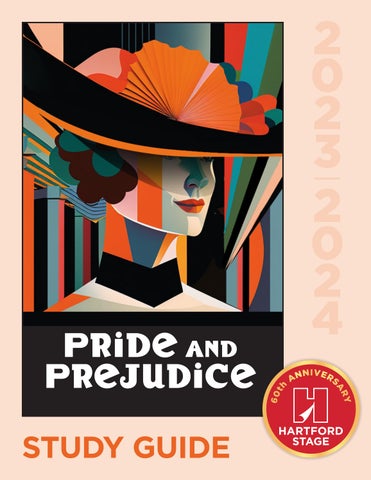
2 0 2 3 — 2 0 2 4 STUDY GUIDE
P R I D E A N D P R E J U D I C E • S T U DY G U I D E
1
GUIDELINES FOR ATTENDING THE THEATER Attending live theatre is a unique experience with many valuable educational and social benefits. To ensure that all audience members are able to enjoy the performance, please take a few minutes to discuss the following audience etiquette topics with your students before you come to Hartford Stage. • How is attending the theatre similar to and different from going to the movies? What behaviors are and are not appropriate when seeing a play? Why? • Remind students that because the performance is live, the audience affects the performance. No two audiences are exactly the same and no two performances are exactly the same—this is part of what makes theatre so special!
Zoë Kim, Madeleine Barker (back), Lana Young, and Renata Eastlick in Pride and Prejudice. Photo by T. Charles Erickson.
• Theatre should be an enjoyable experience for the audience. Audience members are more than welcome to applaud when appropriate and laugh at the funny moments. Talking is distracting to other audience members and the actors on stage. Theatres are constructed to carry sound efficiently! • Any noise or light can be a distraction, so please remind students to make sure their cell phones are turned off. Students should not text, or take photos or video during the performance. • Students should sit with their group as seated by the Front of House staff and should not leave their seats once the performance has begun. Students will have the chance to get a drink or snack, eat lunch, or use the restroom at intermission.
Carman Lacivita and Renata Eastlick in Pride and Prejudice. Photo by T. Charles Erickson. P R I D E A N D P R E J U D I C E • S T U DY G U I D E
3
ABOUT JANE AUSTEN
By Len Fonte Reprinted with permission from Syracuse Stage.
“It isnt what we say or think that defines us, but what we do.” Jane Austen, born in 1775, was the seventh of eight children of Anglican rector George Austen and his wife, Cassandra Leigh. George, coming from the poor branch of a wealthy merchant family, supplemented the household income by farming and teaching boys boarded in their home in Steventon, Hampshire, England. The Austens valued education, and the girls, Jane and her only sister, Cassandra, both attended school away from home until finances made it impossible. From then on, the girls learned from their father and brothers in their home. The Austens encouraged creativity in their children. Cassandra drew pictures, and they staged plays in the rectory barn. Jane showed promise as a writer from an Portrait of Jane Austen. early age, filling notebooks with stories, poems, plays and observations. Her juvenile work included a novel, written in her teens. On her father’s sudden retirement from the ministry in 1800, the family moved to Bath, which twenty-five year old Jane apparently did not like. Her output of writing slowed down. After her father died, the family moved to Southhampton in 1806 and finally to a cottage on the estate owned by her brother Edward in the Hampshire village of Chawton in 1809. There, her published works were completed. In 1811, Sense and Sensibility, Jane Austen’s first adult novel was published with the authorship “By a Lady,” since women were not allowed to sign contracts. It quickly sold out. The other three novels published during her lifetime, Pride and Prejudice (1813), Mansfield Park (1814), and Emma (1816) were accredited as “By the Author of Sense and Sensibility.” She never saw her name as author of her popular works printed on the title page of a book. After her death, Jane’s brother Henry and sister Cassandra had her final novels, Persuasion and Northanger Abbey published as a set in 1818. Although Henry Austen identified her as the author, she wasn’t acknowledged as such until 1833 when her books were republished in Richard Bentley’s Standard Novels series, sold as a set. Austen wrote many letters to her siblings, but most of them were destroyed or censored by them after her death, fearing that her acid commentary on family affairs or the neighbors might cause problems. As a result, we have little accurate accounts of her life. In 1868, her nephew’s Memoirs of Jane Austen cemented the rather hazy image of a Jane Austen who lived a quiet life in the countryside. Jane Austen took ill at the beginning of 1816. During her illness, she continued to write, leaving unfinished novels at her death on July 18, 1817. She is buried in Winchester Cathedral.
P R I D E A N D P R E J U D I C E • S T U DY G U I D E
4
P P Br P
Literary Works
Title Year Published Sense and Sensibility 1811 Title Year Published Pride and Prejudice 1813 Sense and Mansfield SensibilityPark Adaptations 1811 1814 of work Pride and Prejudice 1813 1815 Emma MansfieldPersuasion* Park PRIDE & PREJUDICE Pride & Prejudice TITLE YEAR 1814 1817 Pride & Prejudice Sense and Sensibility 1811 Pride & Prejudice (1940 (1940Film) Film) Emma 1815 Northanger Abbey* Pride & 1817 Prejudice (1995 Film) Pride and Prejudice 1813 Pride & Prejudice (1995 Film)
LITERARY ary Works WORKS
rks Mansfield Park Persuasion* 1814
ADAPTATIONS OF WORK
1817 Jone’s Diary (2001 Film) Bridget Pride & Prejudice (2005 Film) Emma 1815 Northanger Abbey* 1817 Pride & Prejudice (2005 Film) Persuasion* 1817 SENSE AND after herSENSIBILITY death Northanger Abbey* * These 1817 works were published r Published Sense and Sensibility (1995 Film) Sense and Sensibility 1811 Sense and Sensibility (2008 Film) * Published after her death. Sense and Sensibility (1995 Film) From * These works were published after herPrada deathto Nada (2011 Film) 1813 Sense andand Sensibility (2008 Scents Sensibility (2011Film) Film) 1814 From Prada to Nada (2011 Film) EMMA Scents and Sensibility (2011 Film) 1815 1817 1817
after her death
Se Se Fr Sc
Bridget Jone’s Diary (2001 Film)
“E
“E “M
“
“ Mansfi M “ MaN
Emma (1972 BBC TV Special) Clueless (1996 Film) Emma Emma (1996 Film) “Emma” (1972 BBC BBCTV TVSpecial) Special) Emma (2009
Clueless (1996 Film) MANSFIELD PARK Film) Emma (1996 Mansfield Park (1983 BBC TV Special) “Emma” (2009 BBC TV Special) Mansfield Park (1999 Film) Mansfield Park (2007 TV Special)
Mansfield Park
N
“ Nort Wish
Nort R “ Wishbone
NORTHANGER ABBEY “ Mansfield Park” (1983 BBC TV Special) Northanger Abbey (1987 TV Special) Mansfield Park (1999 Film) Northanger Abbey (2007 TV Special) “ Mansfield Park” (2007 Special) Ruby in Paradise (1993TV Film) Wishbone: ‘Pup Ficton’ (90s Children’s Show)
Bridge
“P“ Bridget Jo Northanger Abbey PERSUASION T Northanger Abbey TV Special) Persuasion (1995(1987 TV Special) Bridget Jone’s: Edge Reason (2004 Film) “Pers Northanger AbbeyThe (2007 TVofSpecial) The Lake House (2006 Ruby in Paradise (1993Film) Film) Persuasion (2007 BBC TV Special) “ Wishbone: ‘Pup Ficton’ ” (90s Children’s Show) Persurasion “Persuasion” (1995 TV Special) Bridget Jone’s: The Edge of Reason (2004 Film) The Lake House (2006 Film) “Persuasion” (2007 BBC TV Special)
SYRACUSE STAGE EDUCATION PRIDE AND PREJU DICE • S T U DY GUIDE
| 75
Q & A WITH PLAYWRIGHT KATE HAMILL Reprinted with permission from Seattle Rep.
WHAT MOST INSPIRES YOU ABOUT JANE AUSTEN? Jane was writing in a time when many women were not given an outlet to express themselves—when “respectable” women were not supposed to have any occupation at all. I’m inspired by the way that Jane wrote these absolutely incisive, insightful, funny, cutting novels from a female perspective during a time when the path to self-expression was not always clear. She’s every bit as brilliant as her male contemporaries were, but she’s regularly dismissed as a kind of “chick lit,” and I find that viewpoint quite reductive. This woman was a genius! HOW ARE YOU APPROACHING HER LITERARY CANON? I’m not interested in just reproducing the novels: I want to create works of theater, and my tastes run towards the highly theatrical. The novels are so brilliant—why not let them be themselves, and try to make something new? I want to collaborate with Austen and make unique pieces, versus some cut and paste job. My goal is ultimately to adapt each of her novels in the order they were written—and grow and change myself alongside Jane. I’m also a young woman writing from a female perspective—relatively rare for adaptations—so I bring that lens to it. And I’m a feminist playwright, so that always comes into play. HOW DO YOU APPROACH ADAPTING AUSTEN’S WORK. DO YOU FIND IT READILY THEATRICAL? I’m a big believer that you shouldn’t make any work of art without a strong point of view. I also believe if you’re making a piece of theatre, it should be THEATRICAL—you shouldn’t try to duplicate some television/film experience. I like to explore how high and low a piece can go: I believe plays can have extreme emotional depth AND absurd, wonderfully big humor. So I always try to make pieces surprising and celebratory of the theatrical—I love when audiences leave going, “Wow, that wasn’t what I expected!” HOW DO YOU MAKE DECISIONS ABOUT NARRATIVES, CHARACTERS, AND LANGUAGE AND RETAIN AND WHAT TO OMIT IN YOUR ADAPTATIONS? I think every play teaches you how to write itself. So if something isn’t dramaturgically engaging to me, I tend to axe it. That’s why poor Kitty had to die in the play: because (for me) this play is about how people find partners in life, and I found Kitty’s viewpoint less interesting than Charlotte’s. Pride and Prejudice comes with a lot of expectations: people really know the novel well. I wanted to create something that honored what we love about the novel but was still surprising and new. There are already good, straightforward adaptations of Pride and Prejudice. I wanted to take risks, rattle the cage a bit, and write something that explored the “games” we play in love. Also, I love farce, so this is my homage to farce—I liked the idea of doing a funny version of something that is sometimes presented uber-seriously. I think the humor doesn’t detract: it opens it up! Falling in love is inherently so silly and ridiculous, and I wanted to mirror it in the play. P R I D E A N D P R E J U D I C E • S T U DY G U I D E
6
Q & A WITH PLAYWRIGHT KATE HAMILL WHAT ABOUT JANE AUSTEN DO YOU THINK SPEAKS THE MOST TO CONTEMPORARY AUDIENCES? I mean, her work explores universal themes: love, hypocrisy, social pressures, partnership, friendship, the dictates of family. I think those themes are evergreen. They also deal a lot with class and the tensions and restriction encountered therein—and I think that now, especially, we’re struggling with those issues in society. We so often see how quickly our own dreams—our hopes, our fears, our vulnerabilities—can run up against societal restrictions. The heroines of Austen’s novels are often struggling with how to reconcile the dictates of their consciences with the demands of their society, and I think that many of us identify with that. WHY ADAPT HER WORK NOW? I’m a feminist playwright. One of my favorite (or least favorite depending on how you look at it) statistics to quote is that of last year, three-quarters of all the new plays and adaptations produced in the American theatre were written by men. Believe it or not, that percentage actually represents an uptick! This means that the majority of what the audiences are seeing— the “mirror[s] held up to nature,” as Hamlet said—are male-centric narratives, even though theatre audiences are predominantly female. When you add to that statistic the classics—in which men were often the only people allowed to write the storylines, for millennia—that represents a problem. Now, there’s nothing wrong with male narratives—I love many male-centric scripts with every inch of my being, I am a huge Hamlet fangirl—but when those are the only stories being told, we’re missing out on other perspectives. That’s a problem not only for audiences, who aren’t seeing reflections of their own life journeys, but also for female artists. And because I love Jane Austen and she is a young female artist who explored social and class structures that still resonate, I thought, well, that’s a natural fit for collaboration—to create new female classic stories that would employ both men and women. This is my second Austen adaptation and I just love playing around in her world.
The cast of Pride and Prejudice. Photo by T. Charles Erickson.
P R I D E A N D P R E J U D I C E • S T U DY G U I D E
7
THE CHARACTERS THE BENNETS Mr. Bennet
A middle-aged gentleman of modest means, he is the father of four unmarried young women (In the novel, there are five daughters. Hamill’s adaptation omits one). He dryly comments on the chaos that swirls around his household.
Mrs. Bennet
His wife, who believes her main mission in life is to see her daughters married to wealthy men.
Jane Bennet
The eldest and comeliest Bennet daughter, she is ready for marriage and is in love with Mr. Bingley. She is kind and idealistic.
Elizabeth “Lizzy” Bennet
The clever and sharped-tongued second Bennet sister. She makes judgements on first impressions. Lizzy holds the “Prejudice” of the title.
Mary Bennet
The “Plain-Jane” sister, she is serious and sulky. In Hamill’s adaptation, she can be downright frightening.
Lydia Bennet
The youngest Bennet daughter, she is lively and naive. She is prone to eavesdropping.
Mr. Collins
The Bennet’s clergyman cousin, set to inherit the family’s home when Mr. Bennet dies because of the inheritance laws of the time. Enjoys wealth and privilege, thanks to his benefactor Lady Catherine De Bourgh, but is annoying and rude. Looking for a wife and would gladly consider any of the Bennet daughters P R I D E A N D P R E J U D I C E • S T U DY G U I D E
8
THE CHARACTERS THE DARCYS Mr. Fitzwilliam Darcy
A very rich man. He is aloof, proper, socially awkward, and a thorn in Lizzy’s side. Mr. Darcy is the “Pride” of the title.
Lady Catherine De Bourgh Darcy’s middle-aged, overbearing aunt.
Miss De Bourgh
Lady Catherine’s daughter. She’s a gremlin.
THE BINGLEYS Mr. Bingley
Mr. Darcy’s best friend, he’s like a lively puppy. Jane is in love with him. .
Miss Bingley
His sister, she’s rich, snobbish, and fancies herself witty.
Charlotte Lucas
Lizzy’s sensible friend. She has a good sense of humor.
Mr. Wickham
A very handsome and charming man who was raised with Mr. Darcy.
P R I D E A N D P R E J U D I C E • S T U DY G U I D E
9
GENDER ROLES: THEN & NOW
By Len Fonte Reprinted with permission from Syracuse Stage.
Jane Austen is often referred to as a feminist based on her constant criticism of the pressure put on women to marry and create families. One of the most humorous parts of Kate Hamill’s Pride and Prejudice adaptation is the mother, Mrs. Bennet, who has made it “the business of her life to get her daughters married.” Although this pressure to marry still exists in some cultures for some women, it might be hard for modern audiences to understand the full responsibility placed on the Bennet women. Thus, some historical context might be helpful. Women and Education 19th Century researchers comment how, while women were definitely subjugated to men at that time, there was some progress made in comparison with previous centuries. While the main duties of women at the time were to marry and have kids, it was common for women of higher classes to study and receive an education. In fact, this was seen as an important step in becoming a desirable wife. It is worth noting that while women were encouraged to study, they were never to become more educated than their male counterparts. According to Katherine Hughes in the article, “Gender Roles in the Nineteenth Century,” “Some doctors reported that too much study actually had a damaging effect on the ovaries, turning attractive young women into dried prunes.”
Renata Eastlick, Carman Lacivita (back) and Anne Scurria in Pride and Prejudice. Photo by T. Charles Erickson.
Two Spheres: The Private and the Public According to Hughes, “The ideology of the Separate Spheres rested on a definition of the ‘natural’ characteristics of women and men. Women were considered physically weaker yet morally superior to men, which meant that they were best suited to the domestic sphere. Not only was it their job to counterbalance the moral taint of the public sphere in which their husbands labored all day, they were also preparing the next generation to carry on this way of life. The fact that women had such influence at home was used as an argument against giving them the vote.” To this end, it was expected for women to use their education in the private sphere, such as entertaining at parties. It was not highly regarded for women to publish their writing, but many who did, wrote under pseudonyms. Of course, even Jane Austen wrote under a pseudonym, “A Lady,” and her identity as the author of her books was not revealed until after her death. The Financial Responsibility of Women Once a woman married, she owned no property. Anything she owned before marriage would become her husband’s, as he was deemed her “caretaker. ” Therefore, many women looked for a husband of means who could provide a “good life” for his wife. Women were not allowed to work, so marriage was often the only way women could achieve financial stability. These facts made it extremely difficult for a woman to end her marriage, for she literally had no other way to support herself.
P R I D E A N D P R E J U D I C E • S T U DY G U I D E
10
THE BUSINESS OF MARRIAGE
By Len Fonte Reprinted with permission from Syracuse Stage.
Marriage is one of the oldest social institutions in the world. Perhaps one of the biggest decisions a person can make in their life is who they decide to marry or if they decide to marry at all. In Pride and Prejudice, marriage is undoubtedly the most important event in a young woman’s life. Mrs. Bennet judges and ranks her daughters’ potential suitors in terms of how wealthy they are. The sense of urgency she displays toward her daughters’ marriage prospects is indicative of the reality that women had fewer opportunities for financial independence. The irony of Austen’s legacy is that she kick-started the romantic fiction genre. The modern day obsession that popular culture has with love and marriage can be traced in part to the growing reputation of Austen as a cult figure. Every year, there is a new romantic comedy film, romance novel, and fresh new romance blog that captivates the masses. People young and old yearn for the love they see every day via the various forms of media. Given the omnipresence of romance in the media, it’s natural for people to draw a correlation between love and marriage. According to the MerriamWebster Dictionary, marriage is defined as “The state of being united as spouses in a consensual and contractual relationship recognized by law.” Nowhere in this definition is “love” mentioned. Rather, the definition suggests that marriage is a transaction: a business proposition in which two parties agree upon a mutual exchange of some kind. This definition is consistent with the customs of the society that Austen depicts in Pride and Prejudice. When you think about it, even love is a transaction that potentially leads to marriage. So let’s examine all of this a little bit. What does it mean to be married in the world of Pride and Prejudice? And what does it mean to be married in 2023 America?
JUST HOW RICH ARE WE TALKING? Mr. Darcy is a highly sought after bachelor because he makes £10,000 a year ( £ is the monetary symbol for an English pound). It probably goes without saying that £10,000 a year is not equivalent to the same amount today. During Austen’s time, men were inheritors of land. They would then make money off this land by charging farmers to work it, then investing those profits in other land-owning and financial endeavors. In this way, the most successful men were able to allow their land holdings to work for them, thereby never needing to hold own a steady job, themselves. According to a currency calculator devised by Eric Nye at the University of Wyoming in 2017, the incomes of characters of Pride and Prejudice translate into the figures in this chart. CHARACTER
ENGLAND AMERICA NOW
Mr. Darcy
£
10,000
$
693,106.22
Mr. Bingley
£
4,500
$
311, 897.80
Mr. Bennet
£
2,000
$
138, 621.24
Shopkeepers
£
150
$
10,396.59
Governess
£
15
$
1,039.66
P R I D E A N D P R E J U D I C E • S T U DY G U I D E
11
Special thanks to Syracuse Stage and Seattle Rep for allowing us to reprint articles from their study guides. HARTFORD STAGE EDUCATION PROGRAMS ARE SUPPORTED BY The BFA Endowed Fund at the Hartford Foundation for Public Giving City of Hartford CT State Judicial Branch Ensworth Charitable Foundation Enterprise Foundation Mr. & Mrs. William Foulds Family Foundation Hartford Foundation for Public Giving The George A. & Grace L. Long Foundation The MorningStar Fund New Alliance Foundation The Charles Nelson Robinson Fund SBM Foundation Scripps Family Fund for Education and the Arts State of Connecticut Talcott Resolution The University of Saint Joseph
SEASON SPONSOR
PRODUCTION SPONSOR
STUDENT MATINEE SPONSOR
The Cheryl Chase & Stuart Bear Family Foundation
For more information about education programs at Hartford Stage, please call 860-520-7244 or email education@hartfordstage.org.
P R I D E A N D P R E J U D I C E • S T U DY G U I D E
12