Indian Maharaja Tours jjj
Š Indian Maharaja Tours
India is a place that dazzles and inspires. In reality a continent more than simply a country, its majestic mountains, sweeping plains, verdant plantations, vast deserts and palm-fringed beaches combine in a magnificent and ever-changing kaleidoscope of incredible diversity. Just as awe-inspiring is the extent to which the ancient and the modern are integrated in the reality of everyday life – rich traditions, history, religion and culture maintaining their places in a rapidly modernising and vibrant democracy. A spectacular destination for the first-time visitor, it is a place people find themselves drawn back to time after time. India caters to every type of traveller. You can relax in a rural hideaway trying your hand at chapatti making with your host family, trek through one of the stunning mountain ranges and step back in time to colonial hill-station life, or shop to your heart’s content in a colourful Rajasthani bazaar before retiring to an opulent palace for the night. Catch site of the elusive tiger whilst staying in a beautiful tented camp or relax with a steaming masala chai and a good book in a beautiful heritage hotel.
Delhi
Delhi is often the first destination for travellers in India, with the classic sights and colourful images that many people associate with this inspiring region. If you peel away those less- lovable layers of Delhi – most notably the tenacious touts – you’ ll be on your way to finding the multidimensional core of this unique city. It can take a while though; first time visitors should considers setting aside a day or two simply to acclimatise. As India’s capital - Delhi is a political and business hub, as well as one Iron Pillar of the country’s major travel gateways. This 7m high pillar stands in the courtyard of the mosque and It also has a throng of semi-permanent has been there since long foreigners who work as new before the mosque’s construction. The Delhi iron pillar is testimony to the correspondents, at embassy or at other high level of skill achieved by anient India iron smiths in the extraction and organisation that have foreign processing of iron. The iron pillar at Delhi associations. has attracted the attention of Spacious and planned, New Delhi archaeologists and corrosion technologist as it has withstood corrosion for the last was built as the imperial capital of India 1600 years. by the Britishers, while Old Delhi Alai Minar The ambitious rubble Alai was the capital of Muslim India, Minar started by Alauddin
between the 17 and 19 cent. There’s a rich legacy of mosque, monuments and fort that testifies to this. th
th
Qutub Minar Qutub Minar itself is a Soaring Tower of victory that was started In 1193, immediately after the Defeat of the last Hindu kingdom in Delhi- Prithvi Raj Chauhan. It is nearly 73m high and tapers from a 15m diameter base to just 25m at the top. The tower has 5 distinct stories, each marked by a projecting Balcony. The 1st three stories are made of red sand stone, the 4th and 5th story are of marble and sandstone.
Other Features Quwwat- ul- Islam Mashed At the foot of the Qutub Minar stands the 1st mosque to be built in India. Construction was started in 1193. Then had number of additions and extensions over the periods.
Khaliji but the sultan lived to see it only up to the height of 24.5m. it was Planned to surpass big Qutb Minar. It was not finished coz later kings dint find logical to finish it.
Jama Masjid The great mosque of Old Delhi’s the largest in India and the final architectural extravagance of Shah Jahan. Begun in 1644, the mosque was not completed until 1658. It has 3 great gateways, 4 angel tower and 2 minrates standing 40m high and is constructed of alternating vertical strips red sandstone and marble.
Raj Ghat South of the Red Fort, on the banks of the Yamuna , a simple square plateform of black marble marks the spot where Mahatma Gandhi was cremated following his assassination in 1948. A commemorative ceremony takes place each Friday, the day he was killed.
Rashtrapati Bhawan Also known as president’s House, the official residence of the president of India stands at the opposite end of Rajpath from India Gate. Completed in 1929, the palace like building is an interesting blend of Mughal and western architectural styles.
India Gate This 42m high stone memorial arch stands at the eastern end of Rajpath. It bears the names of 85,000 Indian army soldiers who died in the campaigns of W.W. I and Afghan war.
City walking Tour To get the most out of old Delhi we recommend a walking tour or rickshaw ride of Chandni Chowk passing through places of worship different religions before heading into the narrow lanes of very busy markets, to witness the day to day life of people. Later you can enjoy walking in Janpat. It means market of local people. Here you can shop for shop ethnic dresses and exotic ensembles, Junky Jewellery Indian artefacts from here.
Options for Readymade and 100% Tailor made Tours are available. Same Day tour. Golden Triangle- 4 Days/3 Nights Golden Triangle-6 Days/5 Nights Golden Triangle & Varanasi- 7 D/6 N Golden Triangle & Nepal-10D/9N Golden Triangle & Nepal- 13D/12N
Visit us atwww.indianmaharajatours.com www.facebook.com/indianmaharajatour indianmaharajatours@gmail.com
Agra
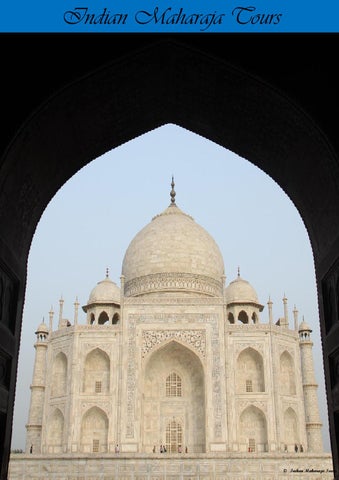
Taj Mahal, Agra
Agra This sprawling industrial town 204 kms. From Delhi, is synonymous with the Taj Mahal, India’s Most famous building, which sits on the bank of the Yamuna river on the east of town. The Mughals established their capital here in 1526 , and for the next 100 years Agra witness a remarkable spate of Architectural activity as each monarch tried to outdo the grandiose monuments built by his predecessor. The city of Agra reached the peak of its magnificence between the mid 16th and mid 17th cent. Under the reigns of Akbar, Jahangir & Shahjehan. It was during this period that the fort, Taj Mahal and major tombs of Agra were built. Now Agra developed as a centre for tourism, leather and Handicraft industry mainly Marble for Peitra dura.
Taj Mahal Described as the most Extravagant ever built For love, this poignant Mughal mausoleum has Become India’s de facto Tourist emblem. Many have tried to some up its beauty, but even the poets of the Time were unable to do this magnificent building justice. The spectacular white marble
mausoleum seems as immaculate today as when it was first constructed by Mughal
Emperor Shah Jahan as an memorial to his beloved wife Mumtaz Mahal to make their love immortal. It took 22 years and 20,000 men to build it; the white marble transported to the site by elephants from a quarry 250 miles away. The perfect proportions of the Taj Mahal and the delicate inlay marble work are amazing. It remain closed on Friday.
Agra Fort Akbar, the grandson of Babur built his capital at Agra and laid the foundation of the Agra Fort. He began construction of this majestic fort in 1565 when he was only 23 years old. This imposing red sandstone structure is the finest example of craftsmanship of the Mughal era. After Taj this was one of the most important group of buildings. The construction was started in 1565 and was completed in about 8 years under the supervision of Qasim Khan. This was built on the bank of the river Yamuna. This fort was just one of the many large fortified residence that the emperor wanted to have at various strategic points of his emperor wanted to have at various strategic points of his empire. According to Abul fazal, the fort contained over 500 buildings. But later on Akbar’s descendants added new buildings, mainly in marble to the fort and demolished the old.
It-mad-ud-Daula Is a Mughal mausoleum often described as 'jewel box', also called the 'Baby Tāj', the tomb of Itimād-ud-Daulah is often regarded as a draft of theTāj Mahal. The tomb, built between 1622 and 1628.The mausoleum was commissioned by Nūr Jahān, the wife of Jahangir, for her father Mirzā Ghiyās Beg, who had been given the title of I'timādud-Daulah (pillar of the state). Mirzā Ghiyās Beg was also the grandfather of Mumtāz Mahāl (originally named Arjūmand Bāno, daughter of Asaf Khān), the wife of the emperor Shāh Jahān, responsible for the building of the Tāj Mahal.
Fatehpur Sikri This Magnificent fortified ghost city was the capital of Mughal Empire between 1571 & 1585. Although brilliant from architectural point of view, Akbar’s city was erected in an area that suffered from water shortages and it was abandoned shortly. The most interesting part of the fort is ruined city. Buland Darwaza is also very important attraction of this fort.
Tours
Agra always very popular destination in all Itineraries. Options for Readymade and 100% Tailor made Itineraries are available. Visitwww.indianmaharajatours.com www.facebook.com/indianmaharajatour
Rajasthan
@Map Of Rajasthan
Deeg Palace- Bharatpur.
History Rajasthan is the very essence of India, with crenulated forts and impregnable palaces that rise like giant fairy-tale sets above dusty sun-scorched plains and shimmering lakes. India’s second largest state- similar in size to France- is largely covered by the ever encroaching thar dessert, but despite its aridity, Rajasthan was once remarkably prosperous: traders from as far afield as Persia and china has to cross its dry plains to reach the southern ports of Gujarat, something the warrior prince of Rajasthan were quick to capitalize on. The post independence name for rajputana, literally “land of princes”- is the large variety of forts and palaces its aristocrats built throughout the centuries, in usually breath taking sites, that makes it one of the most popular destinations in India. But Rajasthan offers so much more than Rajput warrior history, desert castles and culture- from tracking down tigers in Ranthambore jungle to gaping at the World most intricately carved marble temples on historic Mount Abu.
Peopled by proud turbaned men and delicately boned women in saris of dazzling colours, the ‘land of prines’ is rich with possibilities. It’s also high on contrasts: you could bed down amid some of the most sumptuous luxury on earth and then spend the day roaming ancient villages, exploring medieval market places.
Jaipur
by Man Singh I, a Rajput ruler ofJaipur belonging to the Kachwaha clan and a general in the Mughal army, the Amber Rajasthan’s capital, also known as the ‘Pink Palace boasts of spectacular structures such City’,is one of the country’s most atmospheric as the Ganesh Pole, Jai Mandir, Sheesh and spectacular destinations. The enormous Mahal and Sukh Niwas. These are all historic City Palace lies at its heart and houses a monuments, opulent in their designing and museum containing intricately woven lavished with various decorative devises. costumes, weaponry and vintage vehicles, Amber Palace boasts of the dazzling Seesh while the impressive façade of the Palace of Mahal, the hall of Mirrors and Jai Mandir the Winds and the Jantar Mantar Observatory (Temple Of Victory). In the Sukh Niwas are only a short stroll away. There is far more Palace an ingenious use of the natural water to the city than just its famous monuments and flow to recreate an air conditioning effect to get a complete experience of Jaipur, you may be seen. can take a guided tour to uncover the mysteries of the bazaars and visit silversmiths, turban sellers and traditional markets. Close to City Palace Jaipur is the striking 17th century hilltop The City Palace is a Amber Fort. The impressive gateway leads Stunning sample of into the fortified palace and the Maharaja’s Architecture in the royal apartments, richly decorated with elaborate city of Jaipur. The mosaics, ornate murals and a glittering foundations of the palace were laid by mirrored ceiling Maharaja Jai Singh II Kacchawaha Rajput king of Amber in the 18th century. The Amber Fort. beautifully caved marble interiors, magnificent pillars, jali or lattice work and The Amber Palace is a inlaid ornamentations make the palace a magnificent structure cherished tourist attraction. Jaleb Chowk and built within the Amber Tripolia Gate are the two main entrances to Fort. Large, sprawling the City Palace Jaipur. The architect of this gardens, grand opulent structure Colonal Jacob has , chambers and large rooms, a rich decoration successfully combined the Mughal, Rajput and excellent planning mark the construction and European styles of architecture. of the Amber Palace. Built
Jaipur
Jantar Mantar (Observatory) Between 1727 and 1734 Maharajah Jai Singh II of Jaipur constructed five astronomical observatories in west central India. The observatories, or "Jantar Mantars" as they are commonly known, incorporate multiple buildings of unique form, each with a specialized function for astronomical measurement. These structures with their striking combinations of geometric forms at large scale, have captivated the attention of architects, artists, and art historians worldwide, yet remain largely unknown to the general public.
Tours readymade and 100% Tailor made. Golden Triangle- 6D/5N Royal Rajasthan- 14D/13N Majestic Royal India-9D/8N Magical India-12D/11N Heritage India13D/12N Incredible India-21D/20N
Visitwww.indianmaharajatours.com www.facebook.com/indianmaharajatour indianmaharajatours@gmail.com
Buland Darwaza- Fatehpur Sikri
Hawa Mahal- Jaipur
City Palace- Jaipur
Ranthambore
Ranthambore Prior to the formation of the state of Rajasthan, these forests were a part of the Jaipur and Karauli states and they were managed as hunting reserves. After the abolition of the old "jagirs" in 1954 the forest came under the control of the Government of Rajasthan. In 1955 a part of the forest was declared as the Sawai Madhopur Wildlife sanctuary. In the year 1972 it was estimated that barely 1800 tigers were remaining in India and to save this magnificent species from imminent extinction, the "project Tiger" was launched in 1973. Ranthambore had the distinction of being one of the first nine wildlife areas where Project Tiger was launched. Ranthambore was notified as a national park in the year 1980. In 1984 the adjoining areas were elevated to the status of Wildlife sanctuaries, whereby two sanctuaries were notified - The Sawai Mansingh Sanctuary [127.6 sq kms] and the Keladevi Sanctuary [674 sq kms]. To maintain a viable gene pool the adjoining area have been brought under project Tiger
Tours readymade and 100% Tailor made available Golden Triangle with Ranthambore-8D/7N North India Wildlife Tour- 13D/12N
Visitwww.indianmaharajatours.com www.facebook.com/indianmaharajatour indianmaharajatours@gmail.com
Shekhawati
Shekhawati
The Durbar Hall of the palace houses a number of antiques and paintings. Situated in the middle The realm of lovely Havelis, harking back to the of the town, the Mandawa Fort has now been yester years, epitomizes the beauty of converted into a heritage hotel. Shekhawati, yet another landmark tourist destination of the colorful Rajasthan. Shekhawati is a tourist's paradise. The land of Nawalgarh the Shekhawati is laced with innumerable beautiful Havelis or grand mansions, that are This is another small town, with quietly bustling guaranteed to capture one's imagination. It is a streets out from the banyan shaded. The main haven for a true connoisseur of art and building in this town was the fort, founded in architecture. A riot of colours encapsulates the 1737 but today largely disfigured by modern spirit of this vibrant landscape. Exquisitely accretions. Havelis of interest includes the Arti embellished Havelis mushroomed during the Havelis; Hem Raj Kula Havelis, Bhagton –kieighteenth century and former half of the Havelis. twentieth. Mythology and fauna lies at the very core of this wonderful art. Tales narrating the valour of Lord Rama and the miracles of Lord Parsurampura Krishna unfold on a journey of these marvellous mansions. This little village, 20km southeast of Nawalgarh
Mandawa The fort of Mandawa was Founded in the 18th century. Thakur Nawal Singh, son of Shardul Singh, founded the fort in vikram samvat 1812 (1755 AD). The fort dominates the town with a painted arched gateway adorned with Lord Krishna and his cows. Built as per a medieval theme, the castle of Mandawa is adorned with a painted arched gateway adorned with Lord Krishna and his cows. Built as per a medieval theme, the castle of Mandawa is adorned with beautiful frescoes. The rooms of this palace are decorated with Lord Krishna paintings, exquisite carvings and amazing mirror work.
Jaipur had considerable strategic importance. It was sacked by Mohammed of Ghori on one of his periodic forays from Afghanistan, and , later it became a favourite residence of the mighty Mughals.
, has among the best preserved and oldest paintings in Shekhawati. The detailed painting inside the Chhatri of Thakur Sardul Singh dome date from mid 18th cent. Decorated with a mixture of Hindu gods and European, and the small Gopinath ji mandir, a finely Painted Temple, constructed in 1742 By Sardul Singh.
Ajmer It’s a bustling, traffic-filled town by the serene waters of Ana Sagar, frankled by spiky hills. Though for most travellers Ajmer is a stepping stone to nearby Pushkar, its one of India’s most important Muslim pilgrimage centres. Containing the tomb of Khawaja Muin –ud-inChishti. Historically Ajmer, just over 130 Km south –west of
Ajmer Sharif Dargah
Tours readymade and 100% Tailor made available Royal India- 14D/13N Majestic India-9D/8N
Visitwww.indianmaharajatours.com www.facebook.com/indianmaharajatour indianmaharajatours@gmail.com
Pushkar & Ajmer
Pushkar
Pushkar Fair
Pushkar is one city in India that everybody is cognizant of and wishes to visit someday. This "Adi Tirtha" finds a revered mention in the epics of Ramayana and Mahabharat. Lord Bramha is supposed to have killed the asura Vajra Nabha with lotus flower. The asura was destroyed by the contact, and petals fell at three places. One of those places is Pushkar, where a lake was formed. Brahma performed sacrifice on a Kartik Purnima (full moon day in the Hindu Kartik month), sanctifying it. A holy bath in the lake at Pushkar and worship at Brahma temple (one of the very few Brahma temples in the world) is held inPushkar, considered one of the five dhams (Badrinath, Rameswaram, Puri and Dwarka make up the penta), is abound with several temples, which trace their origin to ancient times. Aurangzeb, the Mogul emperor tried his best to eliminate all these temples. However they were always rebuilt and they still stand tall. Legends claim that, at one time, the shores of the Pushkar Lake were hosting 500 temples and 52 palaces. The city of Pushkar is comfortably settled between hills from tri-directions and the magnificent golden desert form the remaining. Though the climatic variations border the extreme ranges as is the true for any desert the always city is abuzz with activities (Festivals, Fairs, Safaris, pilgrimages etc.) throughout the year. The city of Pushkar is comfortably settled between hills from tri-directions and the magnificent golden desert form the remaining very high regards
Come November and the rich tradition of Rajasthan comes alive at Pushkar. A small little hamlet, just around 18 kms from the religious city of Ajmer, Pushkar, is host to an annual event called the Pushkar fair. The fair visited by foreigners and Indian alike is perhaps the largest gathering for a fair from tourists all around the world in Rajasthan. Held in the Hindu month of Kartik or November, the fair is a great crowd puller. The Pushkar Fair has two components -- the camel trading and religious rituals. The camel trading, which is the main attraction for tourists, happens early in the festival (during the initial five days) and then winds up as the focus shifts to pilgrims bathing in the holy lake. Synonymous with the world's largest camel and cattle fair and most highly-rated travel experiences, a spectacle on an epic scale, attracting 300,000 people and up to 20,000 camels, cattle and horses, the Pushkar fair indeed is a unique experience. The onset of winters bringing the cool winds from the south west, the golden sand dunes reflecting various colours with every phase of the Sun; adding to the natural colours are not only the vibrantly dressed men and women or the shops selling various colourful goods, but also the decorated and bedecked Camel and cattle which are at sale here. The charm of the fair and also the reason behind it becoming the world famous fair is its original and very rural charm. Here the people spontaneously break into a song or a dance; they forget their daily miseries and enjoy the camel and the cattle races. They buy goodies and make merry. All this adds to the charm of the place and that too with a religious touch to it.
Pushkar has the only temple in India dedicated to Lord Brahma, creator of the three worlds. According to a legend, as Lord Brahma was searching for a suitable place to perform a yagnya, the lotus fell of his hands and the place where it fell sprung out water. Since then the lake of Pushkar was formed. The lake still stands with 52 bathing Ghat on its banks. People throng to these ghat to take a dip in the holy lake and wash away all their sins, as is the popular belief here. It was on the full moon day in the month of Kartik that the lake was formed. This religious reason has given the world an opportunity to be a part of one of the most spectacular fairs of the world. For visitors it’s a once-in-a-lifetime opportunity to witness the colour, spectacle and carnival of one of the last great traditional melas, which brings livestock, farmers, traders and villagers from all over Rajasthan. We believe that every aspect of such an experience should be special.
Ajmer It’s a bustling, traffic-filled town by the serene waters of Ana Sagar, frankled by spiky hills. Though for most travellers Ajmer is a stepping stone to nearby Pushkar, its one of India’s most important Muslim pilgrimage centres. Containing the tomb of Khawaja Muin –ud-in-Chishti. Historically Ajmer, just over 130 Km south –west of Jaipur had considerable strategic importance. It was sacked by Mohammed of Ghori on one of his periodic forays from Afghanistan, and , later it became a favourite residence of the mighty Mughals. Visit us- www.indianmaharajatours.com www.facebook.com/indianmaharajatour
Jaisalmer .
Jaisalmer Fort
Jaisalmer The History of Jaisalmer has a charm of its own. Like all other cities of Rajasthan, Jaisalmer too has its own glorious past to boast about. History of Jaisalmer draws heavily from the history of the Rajputana. The city is said to be founded by one Raja Rawal Jaisal, a Bhatti Rajput ruler, in approximately 1156 A D. Legends go by that he did it on the behest of a local hermit named Eesaal. The raja choose Trikut hill as the new site for his fort. This was because he thought that his previous abode at Luderwa (16 km from present Jaisalmer) was vulnerable towards possible enemy assault. In medieval times, Jaisalmer continued to be on the focus of the masses because of its location. It falls in the way of one of the two routes, which connected India from Persia, Egypt, Africa and the west. The Bhatti Rajput rulers were still in line. They were the sole guardian of the city and thus mustered enough wealth through taxes levied on the passing caravans, of which there was no scarcity. For many years Jaisalmer remained out of bound from the foreign rulers partly because of its location and partly because of its relief. In the mid Thirteenth century, Ala-ud-din Khilji, the Turk-Afghan ruler of Delhi laid the siege over the city. He was apparently upset with the Bhatti Rajput rulers because they stopped and looted one of his caravans containing royal coffer which was on its way to Sind. The siege lasted for around 9 long years and when the fall seemed eminent the Rajput womenfolk of the city committed Jauhar (self Immolation to avoid disgrace). It is said that Duda, the son of Raja Jaisimha, fought vehemently in the battle but was overpowered after the fierce hand to hand combat. He died fighting. His descendants continued to rule the city. In the modern era, Jaisalmer was still a tough nut to crack and was the last among the Rajputana royals to sign the 'Instrument of Agreement' with the British establishment. Even that was achieved after long hours on the negotiation table and after much cajoling from the British establishment in India. In the year 1947, royals signed the agreement to remain in just independent India. Since then it has developed itself into a major tourist destination as well as a cultural hub of the western India.
Readymade and 100%
Ages have gone by and the monuments of Jaisalmer have withstood the buffering winds of the desert all through. Jaisalmer is a r paragon of beautiful culture and harsh climatic conditions; these together leave Tailor made Itineraries a lasting impression on the visitors. The old city was completely encircled by a wall much of it has are available. crumbled sadly for want of building material in recent years. The massive golden fort, which is the essence of Jaisalmer, is entered through first Gate; is a burrow of narrow streets with Jain Temples and Visit usold Palaces. The main Market, the Sadar Bazar is right below the hill. The bank, offices and several shops www.indianmaharajatours.com are also located near Amar Sagar Gate to the west. www.facebook.com/indianmaharajatour indianmaharajatours@gmail.com
Bikaner Camel Breeding centre
Bikaner Fort
Bikaner Palace
Karni Mata Temple
Bikaner city
Bikaner fort Interior
Bikaner The deserts fascinate from a distance but it is only the true lovers of sun and sand who make it their homes and create miracles smack in the middle of the dry arid land mass. The city Bikaner narrates a similar tales of hardship and bravery of the founder, Rao Bikaji, a descendant of Rao Jodhaji. The city of Bikaner was founded in 1488 from Jangaldesh or the country of wild bushes. It has been almost 550 years since its inception and the city has spread across the desert and has also acquired expertise viz, camel breeding and dry irrigation which is unique to it. Bikaner city alongwith its rocky scrubland, is located on an elevated plain in the desert. The old city is encompassed by a long embattlement wall which intermittently breaks to give way to five huge gates. Now a major trade center for wool, building stones, carpets, blankets, salt and grain, Bikaner has emerged as the lifeline of the state. The handicraft industry of Bikaner and especially the Ivory and Lacquer ware articles are exquisite. The city acquires a yellowish red hue from the presence of various red and yellow sandstone buildings. The fortified town has a medieval charm about it which oozes from every street traversed by the tourists. Bikaner is renowned for the innovative idea of the filter (intricately carved Jharokas)specially created to provide the womenfolk with an window to view the proceedings outside whilst being hidden. Apart from the regular tourism features associated with the desert, Bikaner boasts of a unique for overlooking it as well as a thriving market of various Rajasthani art forms. The taste buds can be satiated with a wide assortment of Bhujias, Rasgullas, Papad and Thandai. The Usta art of miniature paintings and gold embossing which is undertaken upon the ceilings, walls, pillars of buildings as well as wooden & glass items and ivory is a speciality of Bikaner.
Karni Mata Temple Karni Mata Temple is a popular and unusual holy shrine of India. This Temple is in a small town of Deshnok, which is located at a distance of 30 kms in south of Bikaner in Rajasthan. In the 14th century, Goddess Karni is said to have lived and performed many miracles during her existence. Karni Mata was a mystic, who led a virtuous life committed to the service of the poor and the oppressed of all communities. The goddess is said to have laid the foundation of Deshnoke. As per the stories, once when her youngest son drowned, Goddess Karni asked Yama (the god of death) to bring him back to life. Lord Yama replied that he could not return her son's life. Thus, Karni Mata, being an incarnation of Goddess Durga, restored the life of her son. At this point of time, she announced that her family members would die no longer; in fact they would incarnate in the form of rats (kabas) and ultimately, these rats would come back as the members of her family. In Deshnok, there are around 600 families that assert to be the descendants of Karni Mata. Readymade and 100%
Tailor made Itineraries In the main shrine, the image of the goddess is placed with holy things at her feet. Surrounded by rats, On her either side, images of her sisters are placed. Karni Mata Temple attracts numerous tourists and pilgrims through are available. out the year, due to its unique presiding beings. The temple has around 20,000 rats that are fed, protected and Visit usworshipped. The Rats can be seen here eating from huge metal bowls of milk, sweets and grains. To make the www.indianmaharajatours.com holy rats safe, wires and grills are sited over the courtyard to avoid the birds of prey and other animals.
www.facebook.com/indianmaharaj atour
Jodhpur Jodhpur Jodhpur offers a unique honeymoon experience sans the run-ofthe-mill mountains and beaches. If you are a couple who are fascinated by the rustic villages, heritage structures and palaces, Jodhpur is where you want to go. You can explore this ancient land of loyalty, dedication and love through unique village safaris. These village safaris will take you to the interiors of the village and give you ample opportunities to mingle with the locals. The newly weds will be spellbound by the architectural splendor of the majestic forts and palaces. Jodhpur is filled with romantic legends and sagas. Bejeweled camels, enthralling havelis and colorful crafts will add glamour to your honeymoon. Some of the palaces, which have now been converted to hotels, are best to stay in. This will add a touch of yesteryears passion to your honeymoon period. The hotels of Jodhpur have the right historic ambience that will set the atmosphere right for a splendorous romance. You can embark on a romantic excursion to the lakes and historic spots and spend time together as you begin to bond on this land of lovers. Include tours to Umaid Bhawan Palace, Phool Mahal, Mehrangarh Fort, Balsamand Lake and Mandore Gardens in the honeymoon itinerary. The romantic destinations of Jodhpur will leave a romantic spell on the honeymoon couple.
Mehrangarh
Fort- Jodhpur
Don’t forget to pick traditional handicrafts, jewelry and textile items of this region while you are on a shopping spree. Choose Jodhpur as your destination and this land will bear testimony to your love story, as it has been doing to love stories since age-old times.
Kumbhalgarh Fort Kumbhalgarh Fort is the second most important fort of Rajasthan after Chittorgarh. Located at a distance of 64 kms from Udaipur in Rajasmand district, Kumbhalgarh Fort is easily accessible from the city of Udaipur. This unconquerable fortress is secured under the kind protection of the Aravali ranges. Kumbhalgarh Fort was built by Maharana Rana Kumbha in the 15th century. The Fort is also known for its famous palace that resides on the top of structure. This beautiful palace is known as 'Badal Mahal' or the Palace of Cloud. It is also accredited to be the birth place of great warrior Maharana Pratap. This palace has beautiful rooms with lovely color combination of green, turquoise and white presenting a bright contrast to the earthy colors of the Fort. This place gives the appearance of being wandering in the world of clouds. Cloud Palace also offers a fantastic panoramic vista of the down town.
Kumbhalgarh Fort
Chittorgarh Chittorgarh Fort has received the credit of being the largest fort of India. The massive fort is located on a high hill near the Gambheri River in Chittorgarh. Chittorgarh Fort lies at a distance of 112 kms from the city of Udaipur in Rajasthan. This fort was built by various Maurya rulers in the 7th century. This huge fort covers an area of 700 acres, extending to 3 kms in length and 13 kms in peripheral length. Standing on an elevated hill of 180m, the impregnable fort has witnessed three battles. Chittaurgarh Fort is truly an embodiment of chivalry and pride of the Rajputs. The fort has a long story of romance, courage, determination and sacrifice. A glimpse of the fort still makes one to think the glory of the Rajputs who once lived here. The imposing Fort boasts of well-designed palaces, magnificent cenotaphs and huge towers. The Fort of Chittorgarh has a colossal structure that is secured by its several strong gateways.
Options for readymade and 100% Tailor made itinerary available Visit- www.indianmaharajatours.com www.facebook.com/indianmaharajatour
Udaipur
Udaipur City Palace.
Udaipur This city of Dawn, Udaipur is a lovely land around the azure water lakes, hemmedin by the lush hills of the Aravalis drenched in romance and beauty. Udaipur is a fascinating blend of sights, sounds and experiences - an inspiration for the imagination of the poets, painters and writers. Its kaleidoscope of fairy-tale palaces, lakes, temples, gardens and narrow lanes strewn with stalls, carry the flavour of heroic past, epitomising valour and chivalry. Exquisite Lake Palace of Udaipur, shimmering like jewel on Lake Pichhola are overwhelming in splendour.
Udaipur City Palace Udaipur City Palace is one of the architectural marvels of Rajasthan, located peacefully on the banks of Lake Pichola. This majestic City Palace is the most-visited tourist attraction of Udaipur and often distinguished as the largest palace complex in Rajasthan. Initially, Maharana Udai Singh built this superb wonder, but the present form of the Palace is the result of subsequent additions by his successors.
City Palace boasts of the wonderful blend of Medieval, European and Chinese Architecture. The Palace has various towers, domes and arches, which add to the flavor of heritage site. Towering on the banks of Pichola Lake, City Palace is truly a feast to the eyes. City Palace is a marvelous assortment of courtyards, pavilions, terraces, corridors, rooms and hanging gardens. Encircled by fortifications, this imposing Palace is wholly built in granite and marble.
Pichola Lake Pichola Lake is one of the most beautiful and picturesque lakes of Rajasthan, India. Located in the heart of the city, Pichola Lake is the oldest and one of the largest lakes of Udaipur. In 1362, the beautiful lake was built by Pichhu Banjara during the ruling period of Maharana Lakha. Talking about the dimensions of Pichhola Lake, it is extended to 3 miles in length, 2 miles in width and has depth of 30 feet.
Hotel Lake Palace What may have begun as a defiant gesture was turned into one of the most romantic hotels in the world, by Maharana Bhagat Singh in 1963. Being a far-sighted man, he realized that the
Hotel Taj Lake Palace Maharajas were in the twilight o their glory and should quickly seek alternatives to preserve their heritage. The Maharana recognized the potential of the Lake Palace’s romantic location. Its reconstruction began in 1959. In 1963 the Lake Palace opened its doors to its first guests. And in 1971 the Taj took over the hotel Lake Palace, adding 75 luxurious rooms. Giving you a glimpse of elegance and extravagance that had thus far been reserved for royalty
Readymade and 100% Tailor made Itineraries are available. Royal Rajasthan- 14D/13N Incredible India-21D/20N
Visitwww.indianmaharajatours.com www.facebook.com/indianmaharajatour indianmaharajatours@gmail.com
Mt. Abu
Dilwara Temples
Mt. Abu Mount Abu situated at a average height of 1,219 mtr's above sea level is the oasis in the deserted land of Rajasthan and posses the honor of being the only hill-station in Rajasthan as well as north-west India, The world famous tourist destination is known for its Delwara Jain temples and natural beauty world over, situated amidst lush green forested hills on the highest peak in the Aravali range is also the summer capital for the Indian state of Rajasthan, home to lakes, waterfalls and green forests, the hill retreat, has a very cool and soothing climate thanks to its rich flora covering the entire hillside that includes coniferous trees and flowering shrubs. Mount Abu with its word-class tourist facilities with hotels ranging from budget class to three star and heritage provides a great holiday escape and honeymoon attraction. Every year more then three million national and international tourists visit mount abu enjoying its scenic beauty, rich flora & fauna as well as the marble art of delwara jain temples. Once home to the meditating rishi and munis, the legend has it that Mount Abu is home to 33 crore Gods and Goddess
. According to the legend the name Abu means son of Himalayas
Dilwara temples- Mt. Abu The Jain Dilwara temples of India are located about 2½ km from Mount Abu, Rajasthan's only hill station. These temples built by Chalukya between the 11th and 13th centuries AD are world famous for their stunning use of marble. The five legendary marble temples of Dilwara are a sacred pilgrimage place of the Jains. Some consider them to be one of the most beautiful Jain pilgrimage sites in the world.
The marble temples have an opulent entranceway, the simplicity in architecture reflecting Jain values like honesty and frugality. The temples are in the midst of a range of forested hills. A high wall shrouds the temple complex. Although the Jains built some beautiful temples at other places in Rajasthan, some believe that none come close to these in terms of architectural perfection. The ornamental detail spreading over the minutely carved ceilings, doorways, pillars and panels is simply marvellous. For the people who come to perform puja here, there are facilities to bathe and get ready. The facilities use passive solar power to heat up the water for bathing and other things. Guided tour hours for tourists are posted outside the temple. You might see occasional monkeys looking for food outside the temple area.
Readymade and 100% Tailor made Itineraries are available. Incredible India-21D/20N
Visitwww.indianmaharajatours.com www.facebook.com/indianmaharajatour indianmaharajatours@gmail.com
Varanasi
Varanasi
Ghats Varanasi – the land where experience and discovery reach the ultimate bliss.
Varanasi, or Benaras, (also known as Kashi) is one of the oldest living cities in the world. Varanasi`s Prominence in Hindu mythology is virtually unrevealed. Mark Twain, the English author and literature, who was enthralled by the legend and sanctity of Benaras, once wrote: "Benaras is older than history, older than tradition, older even than legend and looks twice as old as all of them put together" . The word ‘Kashi’ originated from the word ‘Kas’ which means to shine. Steeped in tradition and mythological legacy, Kashi is the ‘original ground ‘ created by Shiva and Parvati, upon which they stood at the beginning of time. Varanasi is the microcosm of Hinduism, a city of traditional classical culture, glorified by myth and legend and sanctified by religion, it has always attracted a large number of pilgrims and worshippers from time immemorial. To be in Varanasi is an experience in itself an experience in self–discover an eternal oneness of the body and soul. To every visitor; Varanasi offers a breathtaking experience. The rays of the dawn shimmering across the Ganges, the highbanks, the temples and shrines along the banks bathed in a golden hue soul stirring hymns and mantras alongwith the fragrance of incense filling the air and the refreshing dip in the holy waters gently splashing at the
Ganga Arti The Varanasi Ganga Aarti takes place every sunset at holy Dasaswamedh Ghat, near Kashi Vishwanath Temple. It differs from the aartis at Haridwar and Rishikesh in that it's a highly choreographed ceremony. Although a spectacular must-see, some people consider it to be too much of an artificial and showy extravaganza to have a lot of meaning in a spiritual context. The aarti is performed on a stage by a group of young pandits, all draped in saffron colored robes with their puja plates spread out before them. It commences with the blowing of a conch shell, and continues with the waving of incense sticks in elaborate patterns and circling of large flaming lamps that create a bright hue against the darkened sky. The movement of the lamps, held in the pandits' hands, is tightly synchronizing to the rhythmic chants of hymns and clang of cymbals. The heady scent of sandalwood thickly permeates the air.
One. After the Buddha attained enlightenment in Bodh Gaya he came to Sarnath. Here in the Deer Park, he delivered his first sermon, or in religious language, set in motion the wheel of Law (maha- Dharma chakra Pravirtan). On the day before his death Buddha included Sarnath along with Lumbini, Bodh Gaya and Kushinagar as the four places he thought to be sacred to his followers. The Emperor Ashoka, who spread the Buddha’s message of love and compassion throughout his vast empire, visited Sarnath around 234BC,and erected a stupa here. Several Buddhist structures were raised at Sarnath between the 3rd century BC and the 11th century AD, and today it presents the most expansive ruins amongst places on the Buddhist trail. Sarnath is 10 km from the holy city of Varanasi, and is an exceedingly tranqiuil place. The ruins, the museum and temple are all within walking distance
Options for readymade & 100% tailor made itineraries available
Sarnath Buddhists wordwide look upon India as the land of the Buddha and a visit to this country means a pilgrimage to those places sacred to the memory of the Enlightened
Visit www.indianmaharajatours.com www.facebook.com/indianmaharajatour indianmaharajatours@gmail.com
Khajuraho
Khajuaho Legend has it that Khajuraho was founded by Chardravarman, the son of the moon god Chandra, who descended on a beautiful maiden as she bathed in a stream. The Chandela dynasty built the temples, many of which originally rose from a lake, and survived for five centuries before falling to the Mughal on slaught. Most of the 85 temples – of which some 25 remain – were built during a century-long burst of creative genius from AD 950 to 1050. Almost as intriguing as the temples’ size and beauty is the question of why they were built here. There’s nothing of great interest or beauty to recommend Khajuraho as a building site and no great population centre nearby. How did the Chandelas manage to turn their exhilarating dreams into stone? Building so many temples of such monumental size in just 100 years would have required a huge amount of labour. Whatever the answers, Khajuraho’s isolation helped preserve it from the desecration Muslim invaders inflicted on ‘idolatrous’ temples elsewhere. Under threat from Afghan invaders from the north, the Chandelas forsook Khajuraho for their forts. People no longer prayed at the temples, which fell into ruin and the jungle took over. The wider world remained ignorant until British officer, TS Burt, was guided to the ruins by his palanquin (enclosed seats carried on four men’s
shoulders) bearers in 1838. There this stalwart Victorian soldier was surprised at the architectural treasure house but shocked by what he saw, first describing the erotica as ‘a little warmer than there was any absolute necessity for’.
Orcha Orcha a small town in Madhya Pradesh – is a peaceful place ‘far from the madding crowd’. You will not have to dodge traffic or constantly resist the outstretched hands of beggars and the insistence of shopkeepers. A visit to this ancient capital of Bundelkhand, with its 16th and 17th century palaces and temples situated on the banks of the Betwa river, will give you a glimpse of a bygone era – the ‘India of the Maharajas’ – and, at the same time, provide insights into the challenges that young people, farmers and workers face in India today.
Options for readymade & 100% tailor made itineraries available Visit www.indianmaharajatours.com www.facebook.com/indianmaharajatour indianmaharajatours@gmail.com
Madhya Pradesh
Map of Madhya Pradesh
Madhya Pradesh Signs of habitation date back some 12000 years with the Rock cave paintings at Bhimbetka near Bhopal – excavation have revealed a cultural succession from the late Stone age. Madhya Pradesh’s recorded history can be traced back to the 3rd century BC, when the great Buddhist emperor Ashoka controlled the Maurayan Empire in Malwa. At Sanchi you can see the exceptional
Buddhist Stupas of Ashoka, India’s most important legacy of the great emperor. The Maurya was followed by the Sungas and then by the Guptas, before the Huns swept across the state. Around 1000 years ago the Parmaras ruled in southwest Madhya Pradesh – they’re chiefly remembered for Raja Bhoj, who gave his name to the city of Bhopal, and also ruled over Indore and Mandu. From AD 950 to 1050 the Chandelas constructed the fantastic series of temple
at Khajuraho in the north of the state. Between the 12th and 16th centuries, the region experienced continuing struggles between Hindu and Muslim rulers or invaders. The fortified city of Mandu in the southwest was frequently the scene of these battles. The Mughals finally triumphed but met their fate at the hands of the Marathas, who in turn fell to the British. With the states Reorganisation Act of 1956, several former states were combined to form Madhya Pradesh
Gwalior
Saas- Bahu- Temple barrel,also called shikar and provides a stunning sight.
Gwalior Gwalior , a city in Madhya Pradesh in India has been blessed with art and culture to a great extend. It lies. It lies 76 miles(122km)south of Agra and has a population of over 12 lakh. The state recalls the history since 6th century AD i.e from the time of White Huns and is now the ultimate destination for tourist. This princely state as a number of monuments of which the most interesting are cited below
Gwalior Fort Aroused on an isolated rocks with number of historic bulidings, likes the Gwalior Fort in Gwalior, Madhya Pradesh , India. The fort was built by Raja Man Singh Tomar as a token of love for his wife. This 1000 years fort stands perpendicular and attains a maximum height of 342ft at the northern end. Its length measures 1.5 mile(2.4km) from north-east to south-west and breadth extends to 900yd(820m). The great Mughal Emperor Babur reputedly quote it as, "The pearl in the necklace of the forts of Hind". The fort covers a huge battlements that circles palace,massive water tanks and temples Among the temples are the beautifuly adorned 'Sas Bahu Ka Mandir', Gurudwara, Jain Temple which has been
Saas Bahu Temple
also been praised as a mosque and the Teli-kaMandir. The massive fortress of the Gwalior fort signifies the manifold dynasties of Mughals, Tomars, Britishers and Scindias.This fort have seen the the life of the Buddhist saint Lord Buddha and anecdotes related to the spread of Buddhism. The Chinese dragons that have been crafted at the hilt of the pillars depict the mutual trade between China and India.
A 9th Century shrine, Saas-Bahu temple in the fort allures not only the devotees but also the tourists with its artistic value. As its name denotes, these temples are not dedicated to Sas (mother-in-law) and Bahu (daughterin-law) but rather the short form of Shashtra Bahu, another name of Lord Vishnu. These temples situated adjacent to each other and the larger one is elaborately decorated with beautiful carvings and sculptures. The roof of the larger temple is adorned with a marvelous lotus carving which is very fascinating. These ancient temples display exceptional architectural brilliance and are a perfect destination for pious people.
Teli Ka Mandir This religious place marks the presence of Lord Vishnu in the earth. It was built in 9th century during the reign of Adivaraha Mihir Bhoj of Kannauj in the central part of India. The temple's architecture, design and layout feature an outstanding fusion of architectural styles. The roof of the temple resembles a Dravidian style while the entire decorations highlight the art of North Indian. The temple exhibit a circular
Readymade and 100% Tailor made Itineraries are available. Visitwww.indianmaharajatours.com www.facebook.com/indianmaharajatour indianmaharajatours@gmail.com
Sanchi
Sanchi Sanchi known for its "Stupas" is a small village in Raisen District of the state of Madhya Pradesh, India, it is located 46 km north east ofBhopal, and 10 km from Besnagar and Vidisha in the central part of the state of Madhya Pradesh. It is the location of several Buddhistmonuments dating from the 3rd century BCE to the 12th CE and is one of the important places of Buddhist pilgrimage. It is a nagar panchayat in Raisen district in the Indian state of Madhya Pradesh. Toranas surround the Stupa and they each represent love, peace, trust, and courage. This world heritage site is well maintained and is open to public viewing from 8:00 AM to 5:00 PM
Sanchi Stupa Emperor Asoka (273-236 B.C.) built stupas in Buddha's honour at many places in India. Stupas at Sanchi are the most magnificent structures of ancient India. UNESCO has included them as one of the heritage sites of the world. Stupas are large hemispherical
stupas trace the development of the Buddhist architecture and sculpture at the same location beginning from the 3rd century B.C. to the 12th century A.D. Asoka when he was a governor married Devi, the daughter of a respected citizen of Vidisha, a town 10 km from the Sanchi hill. Prince Mahendra visited Sanchi with his mother before leaving for the island of Lanka for taking Buddhism there. Emperor Asoka had put up at Sanchi a pillar edict and a stupa containing relics of the Buddha. Addition of new stupas and expressions in stone of legends around the life of the Buddha and the monastic activities at the Sanchi hill continued under several dynasties for over fifteen hundred years. Also, the Brahmi script could be deciphered from the similarities in inscriptions carved at different places in the main stupa. Sanchi stupas are noteworthy for their gateways as they contain ornamented depiction of incidents from the life of the Buddha and his previous incarnations as Bodhisattvas described in Jataka tales. Sculptors belonging to different
lions, has been kept in the museum maintained by the Department of Archaeology. The size and the weight of the pillar point to advanced construction technology that was existent at the time of Asoka. It must have been an incredible feat of engineering to bring the stone for carving the pillar from the mine to Sanchi and installing it up the hill.
Readymade and 100% Tailor made Itineraries are available. Visitwww.indianmaharajatours.com www.facebook.com/indianmaharajatour indianmaharajatours@gmail.com
Bandhavgarh
©Indian Maharaja Tours
Bandhavgarh Bandhavgarh National Park is spread at vindhya hills in Madhya Pradesh. Bandhavgarh National Park consists of a core area of 105 sq km and a buffer area of approximately 400 sq km of topography varies between steep ridges, undulating, forest and open meadows. Bandhavgarh National Park is known for the Royal Bengal Tigers. The density of the Tiger population at Bandhavgarh is the highest known in India. Bandhavgarh National Park was the former hunting preserve of the Maharaja of Rewa and at present is a famous natural hub for White Tigers. White Tigers, now a major attraction around the world's zoos, were first discovered in Rewa, not far from here. The terrain is broken, with rocky hill ranges, running roughly east west, interspersed with grassy swamps and forested valleys. Bandhavgarh National Park is one of the finest national park in the India and has the distinction of harboring the highest concentration of tigers per unit area of forest. The Bandhavgarh National Park is spread over on area of 448 sq km with a cross area of 105 sq km. At the center of the park is the bandhavgarh hill, rising 811 meters above sea level and surrounding it are a sloping valleys, These valleys end in small, swampy meadows locally known as “bohera”. Bandhavgarh was declared a national park in 1968. Since then many steps have been taken to retainBandhavgarh National Park as an unspoilt national habitat for a variety of wildlife peculiar to the area. These includes gaur (Indian bison), sloth bear, leopard, porcupine, wild boar, sambhar and spotted deer, among others and of course, the tiger.
Options for readymade & 100% tailor made itineraries available Visit www.indianmaharajatours.com www.facebook.com/indianmah arajatour indianmaharajatours@gmail.co m
Amritsar-Punjab Punjab Punjab, a region in Northern India, has a long history and rich cultural heritage. The region has been invaded and ruled by many different empires and races, including the Aryans, Persians, Greeks, Egyptians, Afghans, and Mongols. Around the time of the 15th Century, Guru Nanak Dev founded the Sikh religion, which quickly came to prominence in the region, and shortly afterwards, Maharaja Ranjit Singh reformed the Punjab into a secular and powerful state. The 19th Century saw the beginning of British rule, which led to the emergence of several heroic Punjabi freedom fighters. In 1947, at the end of British rule, the Punjab was split between Pakistan and India. The British ruled Punjab for 200 years like the rest of India . Many of the Freedom Fighters of the Great Indian Freedom Struggle were from Punjab . Bhagat Singh, Rajguru, Sukhdev , Lala Lajpat Rai, Udham Singh were some of the brave sons of this soil who laid down their life for the country. In addition thousands of unsung heros sacrificed themselves in the "Jalia Wala Bagh" incident. At last on 15 th August 1947, India became independent and the State was divided among India and Pakistan. Punjab was again divided into the states of present day Punjab, Haryana and Himachal Pradesh for administrative reasons in 1966 . Chandigarh on the border of Punjab and Haryana, remains the capital of the two states, yet is administered as a Union Territory from Delhi.
Amritsar Amritsar is one of Punjab´s principal cities, dating back in history over 400 years. It is known more for the world famous Golden Temple, the seat of Sikh religion.Situated on the north-western border of India, the city is also gateway for the travelers on the overland route through Pakistan. The Wagah border, which is the check-post is about 29 kms away. Amritsar literally means "the pool of nectar", the name derived from a pool constructed at the sacred site in the 16th century, gifted by the Mughal Emperor Akbar to Guru Ramdas, the fourth preceptor of the Sikh faith. Under instructions from Guru Amar Das Sahib, this city was founded by Guru Ram Das Sahib in 1574, on the land bought by him for an amount of rupees 700 from the owners of the village Tung. (Earlier Guru Ram Das Sahib had begun building Santokhsar Sarovar, near erstwhile village of Sultanwind in 1564 {according to one source in 1570}. It could not be completed before 1588). In 1574, Guru Ram Das Sahib built his residence and moved to this place. At that time, it was known as Guru-DaChakk. (Later, it came to be known as Chakk Ram Das). Guru Ram Das Sahib began excavation of the Amritsar Sarovar (tank) in 1577. It was ready by 1581. This tank was renovated by Guru Arjun Sahib in 1586. Since then this city is known as Amritsar (after the name of the Sarovar). The foundation of the Darbar Sahib had been laid by Guru Arjan Sahib on January 3, 1588. (Later, it was propagated that the foundation stone of Darbar Sahib was laid by Sain Mian Mir, a
Muslim holy man. Sain Mian Mir was very friendly with Guru Sahib but the foundation of Darbar Sahib was laid by Guru Sahib himself). In 1590, Guru Arjan Sahib moved to village Wadali where Guru Hargobind Sahib was born on June 19, 1590. By 1601, the Darbar Sahib was fully ready. In 160304, the first volume of Guru Granth Sahib, the Sikh scriptures, was prepared in this city and was installed at Darbar Sahib on August 16, 1604. It is here that Akal Takht Sahib (Throne of the Almighty) was revealed by Guru Hargobind Sahib in 1609. Two flags representing temporal and spiritual authority (Sikh sovereignty) have been set up in front of Akal Takht Sahib. Here Guru Hargobind Sahib wore two swords of Miri and Piri (temporal and transcendental authority). The building of Akal Takht Sahib was twice demolished by Afghan armies and was very badly damaged by the Indian regime (in June 1984). The Indian government repaired in in September 1984. The Sikhs began demolishing it on January 26, 1986. The present structure has been constructed by five service-groups headed by Baba Thakar Singh of Bhindran-Mehta Jatha.
Options for readymade & 100% tailor made itineraries available Visit www.indianmaharajatours.com www.facebook.com/indianmaharajatour indianmaharajatours@gmail.com
Golden temple One of the holiest places of India is Golden Temple. Sikh people from various parts of the world desire to pay a visit to this sacred place. Situated in the city of Amritsar, Punjab, it is culturally defined as the symbol of worship for the Sikh people. Guru Arjan Dev ji was its architect. The Golden Temple history is really interesting and if you are willing to know that, then have a look! History of Golden Temple : Golden Temple is popularly known as Sri Harmandir Sahib. This divine place is positioned just at the center of the city. Every year a huge number of people come to India for paying a visit to this sacred place. So, if you are in India, then make sure that you must visit this holy place. This most visited tourist spots of India has a deep history associated with its origin. It is one such area that the people love to explore. So, if too are keen in exploring it then simply glance through the origin of Harmandir Sahib!History says that the foundation of Golden Temple was laid by Guru Arjan Sahib in the year 1588. He took the initiative to build this place in order to create a central worship site for all the people. He made it accessible to every single person without any caste, religion and race inequity. This place symbolizes the philosophies of Sikhism religion. The location of this temple is very picturesque and magnificent as it is positioned amid a pool and there is water all around. It was all conceptualized by Guru Amar Dev. However, the construction of the temple was laid by Guru Arjan Sahib but
history says that this sacred place is the result of tremendous revolution of several years. The land on which this holy temple was built was acquired from the landlords absolutely free from any charges.The total construction was supervised by Guru Arjan Sahib and he was supported by several prominent Sikh personalities. Several times the Sikhs sacrificed their lives for the protection of Sri Harmandir Sahib from the Afghan and other foreign invaders who tried to destroy it. Because of all these reasons, this holy structure is defined as the symbol of new philosophies and faith of Sikhism
Jallianwala Bagh The Jallianwala Bagh massacre (also known as the Amritsar massacre), took place in the Jallianwala Bagh public garden in the northern Indiancity of Amritsar on 13 April 1919. The shooting that took place was ordered by Brigadier-General Reginald E.H. Dyer. On Sunday 13 April 1919, Dyer was convinced that a major insurrection was going on, thus he banned all meetings. On hearing that a meeting of 15,000 to 20,000 people had assembled (which included women, senior citizens and children) at Jallianwala Bagh, he went with fifty riflemen to a raised bank and ordered them to shoot at the crowd. Dyer kept the firing up till the ammunition supply was almost exhausted for about ten minutes with 1,650 rounds fired approx. Official Government of India sources estimated that the fatalities were 379, with 1,100 wounded. The casualty number estimated by Indian National Congress was more than 1,500,
with approx. 1,000 getting killed. At Jalliawalla Bagh out of the 1,302 men, women and children slaughtered, 799 (61%) were Sikhs.
Wagah Border The Wagah border closing 'lowering of the flags' ceremony is a daily military practice that the security forces of India and Pakistan have jointly followed since 1959. This ceremony takes place every evening before sunset at the Wagah border, ceremony starts with a blustering parade by the soldiers from both the sides, and ends up in the perfectly coordinated lowering of the two nations' flags. It is called the beating retreat border ceremony on the international level. One infantryman (Jawan) stands at attention on each side of the gate. As the sun sets, the iron gates at the border are opened and the two flags are lowered simultaneously. The flags are folded and the ceremony ends with a retreat that involves a brusque handshake between soldiers from either side, followed by the closing of the gates again. The spectacle of the ceremony attracts many visitors from both sides of the border, as well as international tourists.
Options for readymade & 100% tailor made itineraries available Visit www.indianmaharajatours.com www.facebook.com/indianmaharajatour indianmaharajatours@gmail.com
Dharamshala
Dharamshala The High snow clad Dhauladhar ranges form a magnificent backdrop to the hill resort of Dharamsala. This is the principal township of Kangra district and overlooks wide spread of the plains. With dense pine and deodar forests, numerous streams, cool healthy air, attractive surroundings and the nearby snowline, Dharamsala has everything for a perfect holiday. It is full of life and yet peaceful. The headquarters of His Holiness the Dalai Lama are at upper Dharamsala. Covering a wide area in the form of twin settlement, lower Dharamsala (1380m) is a busy commercial centre. While upper Dharamsala (1830m) with the suburbs of Mcleodganj and Forsytheganj, retains a British flavor and colonial lifestyle. The charming church of St. John in the wilderness is situated here and this is the final resting place of Lord Elgin, a British Viceroy of India during the 19th century. There is also a large Tibetan community who have made this place their home. Numerous ancient temples like Jwalamukhi, Brijeshwari and Chamunda lie on the plains below Dharamsala.
MCLEODGANJ: Often called the Little Lhasa, at 1770m is the residence of His Holiness, The Dalai Lama. The Tibetan Government in exile has been head quartered here for over three decades. The impressive monastery has larger than life images of the Buddha, Padmasambhava and Avaloktwshwara. The large Tibetan community and the presence of traditional architectural designs drawn from Tibet have enhanced the area. Tibetian handicrafts and garments are available on sale every Sunday. The Tibetian Institute of Performing Arts is just a km away and organises a ten day festival from the second Saturday of April.
Options for readymade & 100% tailor made itineraries available Visit www.indianmaharajatours.com www.facebook.com/indianmaharajatour indianmaharajatours@gmail.com
Kashmir
Kashmir
and commands a grand view of the lake and the mountain beyond.
The tourist attractions of Kashmir consist of some of the finest places in and around the valley. It is one of the most charming and scenic places in India. Sightseeing in Kashmir is mainly about appreciating the beauty of the nature. Glittering glaciers, snow covered mountains and picturesque hill stations all add to the tourist appeal of Kashmir. As you take a trip to the Kashmir valley you will get to know various untouched facets of the wonderful "Paradise on Earth". Have a look at some of the popular tourist spots in the Kashmir valley.
Jama Masjid
Hazratbal Mosque Hazratbal Mosque is located in a village of the same name on the banks of the Dal. Its pristine white marble elegance is reflected in the waters of the lake. Hazratbal's special significance is derived from the fact that it houses a hair of the prophet Muhammad. This is displayed to the public on religious occasions, usually accompanied by fairs. Apart from these occasions, Friday prayers are offered at Hazratbal and attended by throngs of people. Hazratbal is remarkable for being the only domed mosque in Srinagar; the others having distinct pagoda like roofs. The shrine – mosque complex is situated on the western shore of the Dal Lake oppo site Nishat Bagh
The Jama Masjid at Nowhatta, in the heart of the old city, is the other important mosque in Srinagar at which thousands of people congregate for the Friday prayers. Of imposing proportions, the mosque is built around a courtyard and is supported by 370 wooden pillars. Shankaracharya Temple The sacred temple of Shankaracharya occupies the top of the hills known as TakhtI-Sulaiman in the south-east of Srinagar. The site dates back to 250BC. The philosopher Shankaracharya stayed at this place when he visited Kashmir ten centuries ago to revive Sanatan Dharma.
Mughal Gardens With terraced lawns, cascading fountains, paint-box-bright flowerbeds with the panorama of the Dal in front of them - the three Mughal Gardens of Chesmashahi, Nishat and Shalimar are the Mughal Emperors' concept of paradise and are today very popular places for picnics and excursions.
Shalimar Bagh Built by Emperor Jehangir for his wife Nur Jehan, Shalimar, 15 kms from the TRC, is a
beautiful garden with sweeping vistas over gardens and lakes, and shallow terraces. The garden is 539 m by 182 m and has four terraces, rising one above the other. A canal lined with polished stones and supplied with water from Harwan runs through the middle of the garden. The fourth terrace, by far the best, was once reserved for royal ladies
Chashma Shahi At Chashmashai, is a tastefully laid garden in terraces, which commands a magnificent view of the Dal Lake below and surrounding mountain ranges. The cool water of the spring is highly refreshing and digestive. The original garden was laid out by Shah Jehan in 1632 AD.
Nishat Bagh Situated on the banks of the Dal Lake, with the Zabarwan Mountains as its backdrop, (11 km. from TRC), this 'garden of bliss' commands a magnificent view of the lake and the snow capped Pir Panjal mountain range which stands far away to the west of the valley
Options for readymade & 100% tailor made itineraries available Visit www.indianmaharajatours.com www.facebook.com/indianmaharajatour indianmaharajatours@gmail.com
Information
Some Suggested Itineraries and best time to visit.
Best time to Visit Weather conditions always play a vital role in deciding the time when you want to travel. The best time to travel always defers from people to people depending upon their wishes. For few people its climate that’s important, for few crowd like who want to see fairs and festivals, for many economical packages and for some during the vacations they have. So it’s difficult to sum the best months for travelling. Here we have suggestions for travelling, you can choose the categories in which suits you the best. The best time to travel is from Sep. till March. Climate is good little bit cool in early morning and evening. Sep. is a onset for tourism so everything is economical In Sep. and Oct. From Nov onwards its starts getting colder so a very good time for long sightseeing. Early morning and late evening is Foggy that gives a different experience to enjoy the sightseeing. Oct. till Feb. Is a peak season and because of Christmas holidays and New Year Dec. and Jan. is the most busiest and expensive time to travel. Because of less availability of transport, Hotels and flight tickets, prices goes very high sometimes upto 60%. Then from March onwards tourism starts to goes down, so you find some economical packages. From April till Aug. because of heat and very dry climate tourist mainly diverse to some hill stations. So for very budget guest this is best time as prices for everything is very economical. So now you can plan your trip accordingly.
*
- This is a best time to travel because of cold climate but very expensive.
-A very good time to travel because of climate and economical packages (means not very expensive)
-A good time to travel, little bit hot in afternoon and economical in price.
-Hot weather and very economical. Travelling is not easy.
-Not advisable to travel in this heat but because of very low prices, its ideal for budget travellers.
Suggested Itineraries We Offer 100% tailor made Itineraries that suits your needs more. Apart from tailor made here we have some Suggested and popular Itineraries for You. These itineraries serve all the basic needs of the travellers and can be updated as per the requirements.
Golden Triangle.
Golden Triangle with Varanasi
This short India tour gives you opportunity to witness some beautiful world Heritage sites of North India. Top attraction off course will be Taj Mahal, Fort of Agra, Amer of Jaipur and wind palce ending with Qutub minar and Indian Gate of Delhi. Tour Plan-
Day 1- Arrival at Delhi
Day 1- Arrival at Delhi
Day 2- Full day guided tour of Old and New Delhi. Visit Qutub Minar, Jama Masjid and Chandni Chowk Market. Pass through Red fort, India Gate & president house. Day 3- Today you will drive to Jaipur the Pink city.
Day 11- Drive to Jaipur. Day at leisure. Day 12- Full day guided tour of Jaipur. Day 13- Today you will drive to Agra. Enroute visit Fatehpur Sikri. Later check in Hotel in Agra. Day 14- Half day tour of Taj Mahal and Agra fort. Later drive to Delhi. . On arrival either transferred to Hotel or airport to continue with your onward Journey.
Day 2- Full day guided tour of Old and New Delhi. Visit Qutub Minar, Jama Masjid and Chandni Chowk Market. Pass through Red fort, India Gate & president house.
Day 4- Full day guided tour of Jaipur. Day 5- Today you will drive to Agra. Enroute visiting Fatehpur Sikri. Later check in Hotel
Day1- Arrival at Delhi
Day 3-Drive to Agra. Half day tour of Agra fort.
Day 6- Full day Guided tour to Agra. Starting tour of Taj Mahal early morning, continued by Agra Fort and Baby Taj.
Day 2- Full day guided tour of Old and New Delhi. Visit Qutub Minar, Jama Masjid and Chandni Chowk Market. Pass through Red fort, India Gate & president house.
Day 7- This Morning you will be transferred to station to board the train to Jhansi. On arrival you will be drived to Khajuraho via Orcha.
Day 3- Drive to Mandawa. Visit Havelis
Day 8- Today half day sightseeing of Khajuraho erotic temples. Later transferred to airport To take a flight to Varanasi. Later in evening arrive at the ghats at the Ganges to witness the Aarti Ceremony.
Day 5- Drive to Jaipur.
Day 4- Full day guided tour Taj Mahal and Fatehpur Sikri. And continue your drive to Jaipur. Day 5 – Full day Guided tour, visit Amber fort, city palace, observatory and stopping for photo shoot of wind Palace. Day 6- Drive to Delhi for return flight. This tour can be extended by taking flight to other destinations.
Extensions of Golden Triangle. Golden Triangle with Ranthambore. Day 6- This morning drive to Ranthambore. In afternoon take a safari to forest. Day 7-This morning take another safari to forest in tigers trail. This afternoon either you can take another safari or spend noon in leisure. Day 8- This Morning Drive to Delhi for onward Journey.
Majestic Royal India
Day 4- Drive to Bikaner.Visit Fort and Rat Temple.
Day 6- Full day guided tour of Jaipur.
Day 9-Today Early morning experience the beauty of the rising sun on the Ganges and enjoy Boat Ride. After breakfast excursion to Sarnath. Later transferred to airport to take a flight to Delhi. On arrival either transferred to Hotel or airport to continue with your onward Journey.
Day 7- Drive to Ranthambore. In afternoon take a safari to forest.
Royal Rajasthan
Day 9- Drive to Agra. Enroute stop for Fatehpur Sikri.
Day 1- Arrival at Delhi
Day 10- Full day Guided tour to Agra. Starting tour of Taj Mahal early morning, continued by Agra Fort and Baby Taj.
Day 2- Full day guided tour of Old and New Delhi. Visit Qutub Minar, Jama Masjid and Chandni Chowk Market. Pass through Red fort, India Gate & president house.
Day 8- This morning take another safari to forest in tigers trail. This afternoon either you can take another safari or spend noon in leisure.
Day 11- this morning you will transfer to Station to board train for Jhansi. On arrival drive to Khajuraho via Orcha.
Day 3- Drive to Mandawa. Visit Havelis
Golden Triangle with Kashmir Day 6- After breakfast drive to Delhi to take a flight for Srinagar. On arrival you will be transferred to house boat.
Day 4- Drive to Bikaner.Visit Fort and Rat Temple.
Day 12- Visit erotic temples of Khajuraho. Later transfer to Airport to take flight to Varanasi. Later in evening arrive at the ghats at the ganges to witness the Aarti Ceremony.
Day 5– Bikaner to Jaisalmer.
Day 7-This morning visit World famous mughal Gardens. Overnight in Houseboat.
Day 6- Enjoy camel ride in sand dunes of Thar Dessert.
Day 8- This morning full day excursion to Sonmarg.
Day 7- Drive to Jodhpur. Visit Mehrangarh Fort.
Day 9- This morning drive to Gulmarg to beautiful summer resort.
Day 8- Drive to Udaipur enroute visit Jain Temples at Ranakpur.
Day 10- This morning drive to Pahalgam.
Day 9- Visit Lake Palace and enjoy boat ride in Pichola lake, Udaipur.
Day 11- Today you will transferred to airport to take a flight to Delhi. On arrival at Delhi airport assistance in transfer to international airport to onward Flight.
Day 10- Drive to Pushkar. Visit brahama Temple.
Day 13- Today Early morning experience the beauty of the rising sun on the Ganges and enjoy Boat Ride. After breakfast excursion to Sarnath. Later transferred to airport to take a flight to Delhi. On arrival either transferred to Hotel or airport to continue with your onward Journey.
Introduction Mission Our aim is to make that now everyone can travel! To expose the wonders of our Motherland to the world!
India Maharaja Tours
is a well established tour agency in India. It is located in Agra, Uttar Pradesh. Indian Maharaja Tours is a travel company that intends to deliver excellent leisure travel excursions to customers. The owner being the main player has come up with new ideas and innovations to showcase India with different outlook. Indian Maharaja Tours is a team of well trained professionals and associates who are chosen with utmost care. The management is well versed with experience for almost 15 years in this tourism and hospitality industry and has acquired essential business strengths that made it succeed to establish the company. This tour agency always stress on building total customers value, satisfaction and loyalty. It will simply articulate holiday plan to meet customers’ requirement and demand. We always prefer to find out from customers where they want to go within their budget and offer them a personalized service that will save them both time and money. The intention is to provide customers with access to exclusive travel destinations, not just sight-seeing, and access to special interest travel according to the group's or individual's preferences. Being well connected we can provide customer with all the best air fares and hotel deals and our experiences staff are on hand to give you the individual care and attention that your own specific journey requires. The Indian Maharaja Tours is growing tremendously with overwhelmed supports that we are getting from our clients (hotels, transporters and restaurants) and guests from local and overseas as well
Services Whichever trip you choose there are several common features…
Our style of travel is friendly, informal and relaxed
You’ll be travelling in small groups with fellow well-informed and dedicated travellers
Our prices are inclusive; unlike some other companies there are no local payments
Your holiday will be operated in an environmentally positive way; we always aim to give something in return, benefiting local communities, the environment and wildlife.
Each destination and trip has been thoroughly researched by us or our colleagues
We provide you with the highest standards of service.
We offer a 24/7 dedicated emergency number for complete peace of mind.
We organize custom-made escorted, guided and chauffeured tours for groups and individuals wishing to discover Incredible India in the best possible way.
Assistance on Arrival and Departures, Hotel booking, Transport booking, flight and train tickets booking at nominal prices.
Custom made and tailor made packages according to personal requirements.
Although all our tours are custom-made and you are free to choose whatever standards you require and we easily manipulate according to your budget. We usually suggest standard itineraries of impeccable quality: 3-5 star accommodation, all meals included, dinners in fine cuisine restaurants, all entrance fees, tolls and taxes included. To the contrary of almost all other tours offered, our escorted tours usually include everything with the only exception being personal expenses.
The convenience of having hospitality and friendly personal guide always at hand, ready to assist you with a difficult staircase, a menu in Indian Cuisine and Western or aspects of human and natural history of India.
Providing professional and well proficient Tour guides and Escorts in English as well as foreign languages like Spanish, German, Italian, French, and Persian etc.
Additional services for FITs and groups like arrangement of appointment with astrologer-palmist(fortune teller), henna tattoo maker, magic shows, traditional Indian dance shows, arrangement of buffet meal at economical prices in recommended restaurants.
Unlike other tour agency, we also keep customers’ continuous support and feedback even after the tour session is completed.