1
K e r a l a- The God’s own Country History With the Arabian Sea in the west, the Western Ghats towering 500-2700 ms in the east and networked by 44 rivers, Kerala enjoys unique geographical features that have made it one of the most sought after tourist destinations in Asia. An equable climate. A long shoreline with serene beaches. Tranquil stretches of emerald backwaters. Lush hill stations and exotic wildlife. Waterfalls. Sprawling plantations and paddy fields. Ayurvedic health holidays. Enchanting art forms. Magical festivals. Historic and cultural monuments. An exotic cuisine... All of which offer you a unique experience. And what's more, each of these charming destinations is only a two hour drive from the other. A singular advantage no other destination offers. Kerala, India's most advanced society: With hundred percent literacy. World-class health care systems. India's lowest infant mortality and highest life expectancy rates. The highest physical quality of life in India. Peaceful and pristine, Kerala is also India's cleanest state. For administrative purpose, the state of Kerala is divided into fourteen districts. Most of these districts offer all the tourism products typical of the State.
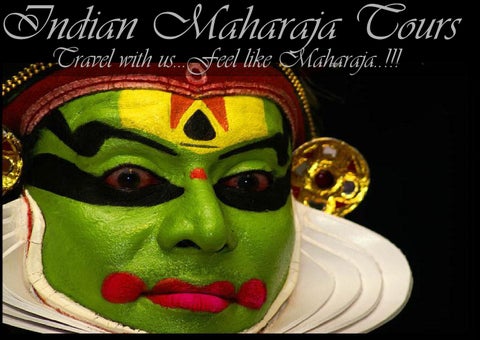
K A T H A K A L I Originated over 500 years ago, Kathakali is a spectacular classical dance form of Kerala. It is a combination of drama, dance, music and ritual. Kathakali is one of the oldest theatre forms in the world. The word 'Katha' in Malayalam means Story and 'kali' means Play. Thus Kathakali literally means 'Story-Play'. The Kathakali dancer's with their elaborately painted faces, peculiar attire and tall headdresses enact stories from the Indian folk epics and the Puranas, especially the Ramayana and the Mahabharata. Kathakali Costume and Make-up Kathakali performers use a luxuriant costume. Characters have their faces elaborately painted and they wear stylized costumes and tall headdresses. Great importance is laid on the Vesham or make-up which are of five types Pacha, Kathi, Thadi, Kari and Minukku. The colours used in the make-up are determined by the nature of the characters. The costumes in Kathakali represents the three qualities of nature viz. satya (nobility), rajas (aggressiveness) and tamas (darkness) represented by pacha, kathi and thadi respectively. Pacha Vesham (Green) in Kathakali Dance. The faces of noble male protagonists, such as virtuous kings, the divine hero Rama, etc., are predominantly green. Kathi Vesham (Knife)- Its a portrays villainous characters. Characters of high birth who have an evil streak, such as the asura king Ravana, are also given a similar green make-up, slashed with red marks on the cheeks. Thadi Vesham (Beard)-Superhuman monkeys like Hanuman, and Nandikeswara are characterized by Vella Thadi (White beard). Chuvanna Thadi (Red beard) is used to portray extremely angry or excessively evil characters. Forest dwellers such as hunters are represented with a predominantly black make-up called Karutha Thadi (Black beard). Kari Vesham (Black-Kari vesham is used to portray she-demons. Minukku Vesham represents women and ascetics who have lustrous, yellowish faces. There are specialists in the green room who help the actors in their dressing. In fact, the makeup is so luxuriant that it is more like a mask than just make-up. These extraordinary costumes and make-up serve to raise the performers above the level of mere mortals that, the audiences are taken into an ecstatic world that the characters replicate onstage.
3
Kerala Temple
AYURVEDA Kerala possesses an unbroken tradition of Ayurveda that has surpassed the many invasions and intrusions both foreign and native. For hundreds of years the Ayurveda Vaidyas (practitioners of Ayurveda) were almost the only access for people seeking healing from every kind of disease in Kerala. The legendary eight families of Vaidyas (Ashta vaidyas) and their successors treated the entire state for centuries. Unlike the other Indian states the status of Ayurveda in Kerala is not alternative but mainstream. In fact, today, Kerala is the only State in India which practices this system of medicine with absolute dedication. Being the only resort of treatment for the people, the Vaidyars of Kerala were challenged to interpret the theories of Ayurveda and adapt them actively into effective healing systems in everyday life. Thus almost all the contemporary procedures and protocols of Ayurveda have evolved in and around Kerala
5
C U I S I N E
The state of Kerala has a large and delectable culinary repertory of it own. Most of its dishes and sweets are popular amongst foodies all over the country. Mix population of the state comes as a boon to the cuisine of Kerala. Hindus in the state excel in the preparation of vegetarian dishes while kitchens of Muslim households offer a rich variety in non-vegetarian dishes. Christians on the other hand have given some interesting fish recipes to the coastal state. Cuisine of Kerala changes from region to region. People living in coastal Kerala consume more sea food, while those living in plains depend take more vegetables in their regular meals. However, tribals and people living in northern part of the state take meat in the main course. An impact of voyagers from Greece, Italy, France, China and Africa can also be seen on the coastal Kerala .
Kerala, the God’s Own Country, is also referred to as the, ‘Land of Spices’. As a major portion of its cuisine is hot and spicy. Coconut too is considered to the be the inevitable part of almost all dishes prepared in Kerala. Staple food for the people of Kerala is rice. The food is made even more interesting with lip-smacking chutneys and pickles. Inhabitants of the state lay a great emphasis on health aspect of their food. Use of oil, sugar and artificial 7 additives is kept to a minimum.
C O C H I N
Cochin (kochi) Kochi, or more familiarly, Cochin is a city of many parts. Around for a long, long time, Kochi played a pivotal role in the development of shipping and trade in the region. Kochi's prime location on the west coast, its fine bay and protected harbour made it popular with seafarers and merchant ships who made frequent stops to stock up on spices, coffee and wood en route to the rich markets of Europe and West Asia. And so down the ages, Kochi prospered as a busy port city and commercial centre. Its seafront is still extremely relevant to Cochin and to India: it houses a Naval Base and one of India’s busiest ports. It’s twin city, Ernakulam, is an important railhead and industrial centre. Kochi's location between the blue, blue waters of the Arabian Sea and Kerala’s emerald
backwaters, its rich medley of Indian and foreign architecture, its truly unusual sights like the Chinese fishing nets and its quaint quiet Localities like the Jewish Quarters demand the attention of all who travel to Kerala.
St Francis Church The St. Francis Church may be the oldest European church on Indian soil. The Portuguese Franciscans built it in wood in 1503, but it now stands in stone after having been rebuilt some years later. Depending on who was the temporal lord, this church has been through a gamut of associations from Franciscan to (Dutch) Protestant to Anglican.
Huge Chinese Nets The pastel interiors of the Santa Cruz Basilica are lovely and the grand exterior is impressive. Along the waters, huge Chinese fishing nets rest on their cantilevered stands. The technique came from Kubla Khan’s court and till date serves the purpose, any wonder the Chinese are going great guns
Mattancherry Palace Mattancherry Palace to the raja in 1556. The double-storied building stands around a quadrangular courtyard that has a temple. Inside the rooms are stunning. Detailed and fine murals cover the walls depicting stories from the Hindu epics of Ramayana and Mahabharata and other legends.
Munnar 9
M U N N A R Munnar It is one of the attractions that contributed to Kerala's popularity as a travel destination among domestic and foreign travellers. Situated at the confluence of three mountain streams - Muthirapuzha, Nallathanni and Kundala, and perched about 1600 m above sea level, the hill station of Munnar once used to be the summer resort of the erstwhile British administration in south India. This hill station is marked by vast expanses of tea plantations, colonial bungalows, rivulets, waterfalls and cool weather. It is also an ideal destination for trekking and mountain biking.
Anamudi Peak Located inside the Eravikulam National Park is the Anamudi Peak. This is the highest peak in south India standing at a height of over 2700 m. Treks to the peak are allowed with permission from the Forest and Wildlife authorities at Eravikulam.
Mattupetty Another place of interest, located about 13 km from Munnar Town, is Mattupetty. Situated at a height of 1700 m above sea level, Mattupetty is known for its storage masonry dam and the beautiful lake, which offers pleasurable boat rides, enabling one to enjoy the surrounding hills and landscape. Mattupetty's fame is also attributed to the dairy farm run by the Indo-
Swiss Livestock Project, where one would come across different high yielding breeds of cows. Mattupetty with its lush green tea plantations, rolling grasslands and the Shola forests is also ideal for trekking and is home to a variety of birds.
Pallivasal Pallivasal, located at about 3 km from Chithirapuram in Munnar is the venue of the first Hydro-electric project in Kerala. It is a place of immense scenic beauty and is often favoured by visitors as a picnic spot.
Elephant Ride The landscape at Munnar will put to shame many of manicured lawns in palatial homes. Thanks to the thousands of acres of tea plantations, Munnar is one large patch of hues of green. Dotted by silver oak trees and separated by valleys & lakes. To compete with the landscape, were the ever changing skyscape colours‌ hues of blue, shades of orange, grey and of course white fluffy clouds. And between the land and the skies, fog & mist played hide & seek. Munnar is sheer romance.
Visit us-www.indianmaharajatours.com www.facebook.com/indianmaharajatour indianmaharajatours@gmail.com Call Us- + 91 97 5899 7888 + 91 92 1909 1822
T H E K K A D Y
Thekkady
Periyar Wildlife
Located in the Idukki district of Kerala, Thekkady makes a wonderful stopover. No matter whether you are here for adventure, fun, wild life or nature, Thekkady will never leave you unimpressed! Thekkady tourism offers something exceptional for every visitor here. There is a bevy of interesting outdoor leisure activities like bird watching, wild life safari and boating in the Periyar lake, which will give you a wonderful chance to spot herds of elephants and other large animals like bisons and deer in their natural habitat.
Periyar Wildlife Sanctuary, which is one of the last homes of the Indian tigers, holds the repute of one of the best maintained wild life sanctuaries in the country. Spread over an area of 777 sq km, dotted with thick evergreen forest, the sanctuary was declared a Tiger Reserve in 1978. Periyar Wildlife Sanctuary is also a treasure trove of some of the rare species of flora and fauna that are native of Kerala. The flora of the park includes over 1965 flowering plants, 171 grass species, 143 species of orchids
and the only South Indian conifer. Apart from the tigers, the park has a diverse wild life including wild elephant, gaur, wild boar, lion tailed macaque, Nilgir Tahr and Malabar giant squirrel among others. The best time to visit animals is during summer (March- May). The Sanctuary Watch Tower situated in the forest interior gives you a panoramic view of the park.
Visit us-www.indianmaharajatours.com www.facebook.com/indianmaharajatour indianmaharajatours@gmail.com Call Us- + 91 97 5899 7888 + 91 92 1909 1822
11
K U M A R A K O M T H E
B A C K W A T E R
History Kumarakom is a minor destination comprised of a collection of small islands in the state of Kerala. Before its popularity as a tourist town, Kumarakom was an area located near a marshy mangrove on the edge of the Vembanad lake. In 1878, George alfred Baker, a missionary from Essex, England, set about clearing the mangrove and replacing it with coconut plantations. Baker was so taken aback by the beauty of Kumarakom that he decided to make it his home and in doing so he became the catalyst for development in the area. Kumarakom can be found in Kerala, a state that wasn't officially established until November Thesuch region's early history saw1956. settlers as the Negrito people focused in three areas, known as: Malabar, Cannanore and Kasargode. The Negrito people still inhabit the mountainous areas in the south of the country. After the Portuguese discovered the route to India from Europe by sea, a wave of visitors arrived, some settling permanently into the area and contributing to Kerala's mix of followers of Christianity, Islam and Hinduism. Keralites celebrate the official recognition of the state on 1 November every year, a day they refer to as Kerala piravi meaning the 'Birth of Kerala'.
The Backwater The Kerala Backwaters are a chain of brackish lagoons and lakes lying parallel to the Arabian Sea coast (known as the Malabar Coast) of Kerala state in southern India. Local people call it KayalsThe backwaters of Kerala- twisty
the backwaters of Kuttanad
Kumarakom Boat & Boat Race
inland lakes networked by canals - extend to over 1900km.. Vembanad lake is the largest of the lakes, covering an area of 200 sq km, and bordered by Alappuzha (Alleppey), Kottayam, and Ernakulam districts. Just 12 km from Kottayam, this exclusive backwater destination sited on the banks of the Vembanad lake is considered the gateway to the backwaters of Kuttanad. The port of Kochi (Cochin) is located at the lake's outlet to the Arabian Sea. Alleppey, populariy known as " Venice of the East" has a network of canals that meander through the town. Boating across these soothing stretches is an experience exclusive to Kerala. Large Kettuvalloms (traditional country crafts over 60ft. in length) have been renewed into luxury houseboats for these cruises.The Vallam Kali (the Snake Boat Race) held every year in August is a major attraction. 12km from Kottayam, this unique backwater destination situated on the banks of the Vembanad lake is considered the gateway to
Kumarakom has a wide variety of houseboats and is well known throughout the world for houseboat experience. They are used only for tourists these days. A separate boat known as Kettuvallam is used by the people to go fishing or to transport goods. Apart from these, there are elegant special boats like Kochu-odi Vallam, Odi-Vallam, Iruttukutthi Vallam, Churulan Vallam and Chundan Vallam(Snake Boat), which take part in the boat races around Onam time. More than 1000 oarsmen in boats of than 1000 oarsmen in boats of different sizes and shapes will participate in this event. Even though Snake Boats participate in this race, the importance is given here is for iruttukuthi, in which about 50 oarsmen row. The Kumarakom boat-race is conducted in the big canal in the centre near the market. The Sree Narayana Ever Rolling Trophy will be given to the winner at the end of the day. There is a private sailing club in Kumarakom, located on the shore of the Vembanad lake.
Visit us-www.indianmaharajatours.com www.facebook.com/indianmaharajatour indianmaharajatours@gmail.com Call Us- + 91 97 5899 7888 + 91 92 1909 1822
13
K O V A L A M
History Situated 16 kms from the Capital of Kerala is a city with four sandy bays called Kovalam. The meaning of Kovalam is 'groove of coconut trees'. This spectacular beach resort in 1930's broke the shackles and emerged as the most magnificent tourist attraction in the south. In earlier days it was a virgin land with not a lot of tourists, but later with the influx of tourists looking for peace & tranquility coming here, there was no looking back. The four sandy beaches are are a sight to behold; all the four bays are separated by rocks. The Samudra Beach, Kovalam Beach, Hawa Beach and the light house beach are what gives Kovalam its beauty. Kovalam is also famous for its Ayurvedic massages and many yoga resorts. Meditation and herbal body toning are some of the things which travelers are treated to for a rejuvenating experience. A number of cultural
programs are also organized along with a catamaran cruise to add to your Kerala experience. You can go shopping in Kovalam and buy a number of items like handicrafts and spices. Rose wood and teak wood statues are popular at Kovalam beach. There are a number of shopping shacks lined along the beach. Kovalam is a beautiful tourist spot and tourists flock all year long but would advise not to visit during the Monsoon which starts from June to October. The tides are high and the shores are not safe for travelers.
Hawa Beach The Hawa beach, also called Eve's Beach is ideal for travelers looking for virgin,secluded & calm stretches of sandy shores. Hawa and Kovalam beaches are separated from each other by the Edakallu foreland. The sunset in all its beauty can be viewed from this headland.
Lighthouse Beach In the extreme south of Kovalam is the magnificent Lighthouse Beach. The name comes from the towering Vizhinjam lighthouse which is built on a rocky headland. Though tourists are not allowed to go inside the lighthouse, the memorials of Ayyanappilla Asan and Ayyippilla Asan around the light house are worthavisit. The beach is a long sandy strip, safe guarded by life guards along the shore. The lighthouse is illuminated and a great place to enjoy a quiet evening. Delicious & fresh sea food available along the shore is just the thing to round up a relaxed evening. The approach to this beach is fairly easy as transport is easily available.
Visit us-www.indianmaharajatours.com www.facebook.com/indianmaharajatour Call Us- + 91 97 5899 7888 + 91 92 1909 1822
K A N Y A K U M A R I
History Kanyakumari gives an overview of the past events that the place once underwent. In ancient times, this wonderful place was known as the Alexandria of the east and was considered to be the major cultural hub. For many years, Kanyakumari remained a remarkable center of civilization, pilgrimage, trade and commerce. According to the Ancient History of Kanyakumari, there is a lot of contribution of Islam, Jainism and Christianity in Kanyakumari's architecture and literary field. It is also said that earlier, this place was under
the rule of Cholas, Pandyas, Cheras and Nayaks, who were the most influential rulers of the Southern India. The fine style of architecture, which now-a-days allures most of the international travelers, is their contribution. It is during the British rule that Kanyakumari was formally given the title of Cape Comorin. It is perhaps due to the English men's lack of ability to pronounce the local names. The past of Kanyakumari also tells one the religious story that the place is associated with.
Vivekananda Rock Memorial
Vivekananda Rock Memorial is one of the most interesting places to see in the southern part oIndia. It is situated in Kanyakumari and it is a fort and an island. Vivekananda Rock Memorial stands on top of a two rocks that are situated approximately 500 meters off the island. Although the Vivekananda Rock Memorial itself is fairly recent and built around the 1970's, the two rocks themselves have been there since the millennia. It is thought that the great philosopher Swami Vivekananda had meditated on the rock seeking enlightenment. Vivekananda Rock Memorial is open everyday and attracts many visitors constantly
15
Vivekananda Rock Memorial
Kanyakumari Temple Kumari Amman or Kanyakumari Temple is built at the edge of the sea, where poor Kanya waited for her groom to arrive. The virgin is worshipped in the form of an exquisitely . beautiful black stone idol, bedecked in silks, gold and diamonds. Kanya’s glittering nose ring shines so brightly that it could be seen from afar. Its radiance sent ships off course, crashing on the rocky shoreline below the temple. So many ships met their untimely end that the eastern door to the shrine was closed off; and is opened only five days each year. The temple also houses two smaller shrines dedicated to the goddess’s friends and playmates, Vijayasundari and Balasundari. East of the temple are two huge rocky outcrops. Sri Padaparai is sacred because it contains an imprint of Kanyakumari’s foot. The Rock Memorial temple complex built by the Ramakrishna Mission in 1970 marks the place where the famous Indian philosopher saint Swami Vivekananda meditated. Ferries take visitors to the temple, which has a remarkably serene atmosphere despite the crowds that come to see it. Designed like a temple, the Gandhi Memorial commemorates the final resting place of the urn containing the Bapu’s ashes, before its immersion in the sacred confluence of three oceans. On the 2nd October (Gandhi’s Birthday) the first rays of the morning sun fall on the exact spot where the urn was kept for the public to pay homage to the Father of the Indian nation. A magnificent wooden palace of the 16th century, Padmanabhapuram Palace lies at the land's end of mainland India Kanyakumari. An enticing ediffice to any lover of art and architecture this old palace of the Rajas of the erstwhile Travancore (1550 to 1750 AD) is a
fine specimen of Kerala's indigenous style of architecture. The antique interiors are replete with intricate rosewood carvings and sculptured decor. The palace also contains 17th and 18th century murals. One can see: the musical bow in mahogany, windows with coloured mica, royal chairs with Chinese carvings, 'Thaikkottaram' or the Queen Mother's palace with painted ceilings, rose wood and teak carved ceilings with 90 different floral designs. Durbar Hall of the palace has a with a shiny black floor specially made from a combination of egg white, jaggery lime, burnt coconut, charcoal and river sand, granite tubs to cool curd and buttermilk, secret underground passages, the King's bedroom with a four poster medicina bed, mural paintings, pictures of Lord Krishna, hanging brass lanterns lit continuously since the 18th century, open air swimming bath, granite dance hal, Saraswati (Goddess
of knowledge) temple, large earthen urns, room for scribes and accountants, carved figures on columns holding oil lamps, pooja (worship) rooms with jackfruit tree columns, fish carvings on the ceilings, enormous teak beams, Belgian mirrors and an outer cyclopean stone wall fitted together without mortar. Visitors to the palace are often overwhelmed by the royal splendour of erstwhile Travancore. Though the palace is situated in Kanyakumari district of Tamilnadu State, it comes under the Government of Kerala's administration.
Visit us-www.indianmaharajatours.com www.facebook.com/indianmaharajatour Call Us- + 91 97 5899 7888 + 91 92 1909 1822
17
T R I V A N D R U M
History Trivandrum, also known as Thiruvananthapuram has been a melting pot of culture and history since times unknown. The Ays are known to be the earliest inhabitants of this city till the beginning of 10th century A.D. Their sudden disappearance led to the rise of the Venads in Trivandrum. It was in 1684, when the city saw a shift in its governing body from Umayamma Rani to the British East India Company. The Britishers had attained a land at Anjengo (located 32 kms away from Thiruvananthapuram ) for the purpose of fortifying it. They further expanded their reigns to various parts of Thiruvithamcore. Trivandrum was a center of intellectual and artistic activities during the days of Marthanda Varma, who is considered to be the Father of the Modern Travancore. The first English school in Trivandrum was set up by him in the year 1834. The construction of an observatory and charitable trust was completed in 1836. Further, during the reign of Ayilyam Thirunal (1860-1880), various art colleges and Tamil schools were established. During the reign of Sri Moolam Thirunal, Trivandrum was involved in various activities of the Indian National Congress. On November 1st 1956, Trivandrum was declared as a city of Kerala.
Culture Trivandrum has been the centre of cultural activities ever since the time it was made the capital of Travancore in 1745. With many avenues like the Trivandrum Museum, Public Library & the Swati Thirunal College of Music; the city has been the pulse of the cultural
scene in Kerala. The illustrious painter Raja Ravi Varma belongs to the city & his works are displayed at the Sri Chitra Art Gallery. Home to the famous Sri Padmanabha Swami Temple, which has several murals dating back to the 18th century are well preserved. Age old traditions which have been passed out through generations are meticulously followed till date. Its culture is not only limited to its museums & temples but extends to a thriving film industry too! The International Film Festival of Kerala held every year in Nov/Dec showcases some of the states best talents from seasoned film makers to the novice ones. From films to finger licking cuisine the capital city of Kerala has loads to offer. The famous festival of Onam is the best time to
experience typical Keralite cuisine, which is generally characterised by an abundance of coconut and spices.
Visit us-www.indianmaharajatours.com www.facebook.com/indianmaharajatour indianmaharajatours@gmail.com Call Us- + 91 97 5899 7888 + 91 92 1909 1822
19
M A R V E L
S
O F
A R C H I T E C T U R E
OF S O U T H I N D I A
Tirurati
Goa
End/ Start Chennai
Bangalore
Kanchipuram Mahabalipuram
Mangalore
Pondicherry
Mysore
Chidambram Calicut Tiruchchirapali Thanjavur
Kodaikanal
Start/ Munnar End cochin
Madurai
Periyar Kumarakom
Rameshwaram
Thiruvananthapuram
Kovalam Kanyakumari
Visit us-www.indianmaharajatours.com www.facebook.com/indianmaharajatour indianmaharajatours@gmail.com Call Us- + 91 97 5899 7888 + 91 92 1909 1822
21
M A D U R A I History
Meenakshi Temple
Madurai is one of the oldest cities of India, with a history dating all the way back to the Sangam period of the pre Christian era. The glory of Madurai returned in a diminished form in the earlier part of this millennium; it later on came under the rule of the Vijayanagar kingdom after its ransack by the ravaging armies of Delhi (Malik Kafur). During the 16th and 18th centuries, Madurai was ruled by the Nayak Emperors, the foremost of whom was Tirumalai Nayakar. The Sangam period poet Nakkeerar is associated with some of the Tiruvilayaadalepisodes of Sundareswarar - that are enacted as a part of temple festival traditions even today.
According to legend, the sacred Suyambulingam discovered by the king of Gods indira at Kadambavanam, was later enshrined by him in Madurai. The fact that the Lord is seen on the vehicle of Indira in this temple is said to be proof for this. Many historical evidences of the temple have been found dating back from early A.D The temple was almost completely destroyed in the year 1310 following the invasion of the Islamic conqueror Malikkapur. As kings who were followers of Islam were noted for their intolerance towards other religions, the invaders destroyed most of the ancient sculptures of the temple. Thirugnanasambandar the Hindu Saint has mentioned the temple in his songs which go back to early 7th century. The Lord has been described as Alavai Iraivan in his songs. The temple was restored to its pristine glory in the late 14th century when the Hindu Kings came back to power in Madurai. This can also be termed as a new beginning of a new era in the history of the temple, when it was almost rebuilt. The King Thirumalai Naicker played an important role in the construction of the new form of the temple according to records. The Madurai Meenakshi Amman Temple is now under the administration of the HR and CE department of Tamil Nadu
The Sangam age or the Golden age of Tamil literature – produced masterpieces way back in the Pre christian era and in early 1st millennium . Madurai was the seat of the Tamil Sangam or Academy of learning. The entire city of Madurai, is built around the Meenakshi Sundareswarar Temple – the temple par excellence. Concentric rectangular streets surround the temple, symbolizing the structure of the cosmos. After independence, Madurai became one of the major commercial districts of Tamil Nadu. It is surrounded by several hills, mainly Annamalai, Pasumalai and Nagamalai, named after their resemblance to an Elephant, a Cow and a Snake respectively. The city is a major exporter of Jasmine flowers. Due to its historical background, the temple city of Madurai attracts thousands of pilgrims and visitors every year from India and abroad.
Visit us-www.indianmaharajatours.com www.facebook.com/indianmaharajatour indianmaharajatours@gmail.com Call Us- + 91 97 5899 7888 + 91 92 1909 1822
1000 Pillars Hall- Meenakshi Temple 23
T R I C H Y History The name Tirucharapalli was derived after a three headed demon named Trisiras with whom Lord Shiva had a fight. According to history Trichy was initially under the reign of Early Cholas only to fall under the Pallavas and then the Pandyas respectively. But however during the 10th century the Cholas regained their power and once again Tiruchirappalli came under the rule of Cholas until the decline of the empire. It was then captured by the Vijayanagara Empire. But in 1565 the Vijayanagara empire came to an end and Trichy went under the rule of the Nayaks of Madurai and this was the period during which the city flourished and advanced in the pursuit of anything desirable. After the Nayaks Trichy was ruled by the Marathas, the Nawabs of Carnatic, the French and finally the British.Trichy are a mix of grandeur past and an applauding divinity of the Dravidian style temples. Tiruchirapalli or Trichy, situated on the banks of river Cauvery, had been a Chola citadel since the Sangam Age. Though the Pandyas and the Pallavas held sway in this region for short periods; the greater part of the town and the historical Rock fort, rising abruptly from the plains to an altitude of 83mts,as they exist today were built by the Nayaks of Madurai.Trichy is also famous for the Ranganatha Temple at Srirangam,a picturesque island on the river Cauvery.Trichy is a blend of history and tradition, a pilgrim centre as well as a thriving commercial city.Trichy is the fourth largest city in the state.Trichy is noted for its famous Rockfort temple, churches and colleges belonging to the early christian era
Rock Fort Vadakkumnatha Kshethram temple noted for its
Kerala style of architecture is situated on top of a hill amidst the town of Thrissur.The presiding deities of this temple are Paramashiva, Parvathi, Sankaranarayana, Antipathy, Sri Rama and Sri Krishna. The other highlights of this temple include the exquisite portrait carved in wood in the central shrine and Koothambalam. It is here in Vadakkumnatha Kshethram the grand Thissur Pooram festival is held in the month of April. Entry to non Hindus is restricted here in the temple. The temple houses many mural paintings and art forms.
Srirangam A picturesque sand between the Cauvery river and its tributary Kollidam, north of Trichy.Sri Ranganathaswamy temple here is one of the largest Vaishnavite temple in South India built around the 13th and 14th centuries. With its 21 magnificent towers and stone pillars covered with a profusion of carvings, the temple is surrounded by seven walls within which the town itself is located.
Chidambaram Temple Since ancient times, it is believed that Chidambaram is the place where Lord Shiva and Parvathy are present, but are invisible to the naked eyes of normal people. In the Chidambaram temple of Lord Nataraja, Chidambara Ragasiyam is hidden by a curtain (Maya). Chidambaram is one of the five places where Lord Shiva displayed his dance and all these places have stages called sabhas. Apart from Chidambaram which has the Por sabhai, the others are the Rathina sabhai at
Thiruvaalangadu (rathinam means ruby / red), ambalam at Madurai Meenakshi Amman Temple (rajatha / velli means silver) and the Thaamira sabhai at Nellaiappar Temple, Tirunelveli (thaamiram means copper). The great four Tamil poet Saints - Thirugnana Sambanthar, Thirunavukkarasar, Sundaramoorthy Nayanar, and Manikkavasagar have written poems praising this temple. The poetic works of the first three saints were stored in palm leaf manuscripts in this temple and were recovered by the Chola King Arunmozhivarman, more famously called Sree Rajaraja Chola under the guidance of Nambiandarnambi. In Hindu literature, Chidambaram Natarajar Temple is the seat of the cosmic dancer Lord Natarajar in an 'Ananda Tandava'• (meaning the Cosmic Dance) pose. Here the main deity Lord Shiva is in a dancing pose of “Bharathnatyam― (South Indian dance form) in a state of extreme happiness. the Chitra sabhai at Courtallam (chitra means painting), the Rajatha sabhai or the Velli
ambram Temple 25 Chidambaram Temple
T A N J O R E
History History of Thanjavur throws light on the important historical and chronological events that had an impact on the social, political and cultural scenario during the ancient times. Thanjavur has been the cradle of civilization during the traditional period. The ancient city of Thanjavur rose to prominence in the 12th and 13th centuries under the able rulers of the Chola dynasty. Under the patronage of the Chola kings, Thanjavur flourished in the fields of art, literature and architecture. Among the mighty rulers of the Chola dynasty, Karikala and Koccengan were the most successful administrators who helped in the development of Sangam Literature. The rulers of the Chola dynasty constructed beautiful temples and monuments that added to the grandeur of Thanjavur. Vijayyalaya was another prominent ruler of the Chola dynasty who further conquered new territories and expanded the province of Thanjavur. Rajaraja I was the most successful ruler of the Cholas who was a brilliant
administrator and had erected the famous Rajarajeshwara Temple. However during the period of 1120 to 1163, the Cholas lost power and the Pandya kings gained importance. After a short rule of the Pandya rulers, the reins of administration of Thanjavur went to the hands of the Muslim rulers. During the 14th century, the Vijaynagar rulers took over the administration of the ancient city that lasted till the 17th century. The Marattas ruled over Thanjavur for a short time span. Thanjavur was ultimately taken over by the British rulers by the Treaty of 1799. The history of the ancient city provides information about Thanjavur during the ancient period.
Brihadisvara Temple The Brihadisvara Temple was completed in 1010 CE, and just had an extensive 1000-year anniversary celebration. It is recognized as a World Heritage Site. As ruling powers changed in South India, the temple was controlled by different ruling groups: first the Cholas, then, in succession, Pandya, Vijayanagara, Nayaka,
and Maratha rulers. Each has inscriptions in the temple. Other temple features were added by different rulers since the initial construction in 1010 CE, so the temple as it is seen today is the product of work done over hundreds of years. In this big temple The tower over the inner sanctum sanctorum rises perpendicularly to a height of 15mts from a square of 28.8 mts and then tapers to make a total height of 64.8mts.An 81.3 tone monolithic stone slab adorned with winged niches on four sides caps the tower. This enormous piece of stone was moved into position along an inclined plane 6km long. A spherical dome tops this block of stone
Visit us-www.indianmaharajatours.com www.facebook.com/indianmaharajatour indianmaharajatours@gmail.com Call Us- + 91 97 5899 7888 + 91 92 1909 1822
.
Brihadisvara Temple 27
P O N D I C H E R R Y History The modern history of Pondicherrybegins with the reign of the Sultan of Bijapur who acceded the throne after the fall of the Vijayanagar Empire that came to an end in the year 1638. The influence of the foreign countries gained prominence in Pondicherry from the beginning of the 16th century. The territory of Pondicherry has enjoyed and participated in the maritime activities for a long time. Realizing the potential of the territory that is placed by the east coast of India, the Portuguese, Danes, Dutch and the English arrived in Pondicherry and set up their colonies in the region. The presence of the foreign countries benefited the commerce and economy of the region of Pondicherry. The Portuguese were the first to set up a factory in the region in the beginning of the 16th century. The Danes and the Dutch followed the Portuguese and established their trading centers in Poto Novo and Cuddalore. The rulers of Gingee were influential in deciding the presence of the foreign countries in Pondicherry. Losing the confidence of the rulers, the Portuguese had to abort the trade in Pondicherry. The French were, on the contrary, invited by the rulers to establish their trade in the region. The architecture of the region flourished under the influence of the foreign countries in Pondicherry who constructed churches and forts that still stands in South India as evidence of the influence of the foreign countries in the region. The strife to control the region continued to shape the modern history of Pondicherry till the region gained independence and became a union territory of India in the year 1954.
Sri Aurobindo Ashram Established by Sri Aurobindo, a revolutionary turned poet, a philosopher and later developed by the Mother, the Aurobindo Ashram has grown into a centre for the practice of Integral Yoga, a seat of learning and a training ground for sadhana. The activities of the Ashram include agriculture, industries, art and cuture. In the main building of the Ashram is the Marble Samadhi where Aurobindo and the Mother have been laid to rest and the houses they lived in.
The Pondicherry Museum Located opposite the Government Park, the Museum provides a glimpse into Pondicherry's rich past and present. The Sculpture gallery contains some specimens of art from Pondicherry and Karaikal. The Archaeological section displays a collection of the famous findings from Arekamedu, like Roman pottery, burial urns, etc. The French Gallery is the most interesting part of the museum which has an office and drawing, dining and bed-rooms with furniture typical of French India. The other sections of the museum are on geology, bronze images, arms, handicrafts and art. The Museum brings back to memory the glorious past of Pondicherry from the days of the pre-Christian era down to the present day providing glimpses of the art and culture of the people of this region during the Pallava, Chola and Vijayanagar days.
Auroville Auroville is described as the city of Tomorrow where an attempt is made to replicate on much larger scale the experiment that is being carried out in Sri Aurobindo Ashram for the evolution of a new society envisioned by Sri Aurobindo and the Mother where people could live "freely as citizens of the world, obeying one single authority that of the Supreme Truth, a place of peace, concord, harmony". Under the Mother's direction it was launched in 1968 with the cooperation of many nations. The small township of Auroville or the City of Dawn was designed by a French architect, Roger Arger. It is an entirely new concept in education and urban living. There are about 40 odd settlements located around a central focus called the Matrimandir. These settlements are engaged in a variety of activities, including afforestation, farming, education and handicrafts. The total area of Auroville is about 50 sq km. No local transport is available inside the township. A conducted tour of Auroville from Boutique d'Auroville, 12 Nehru Street, Pondicherry, takes interested visitors around settlements of Auroville.
Visit us-www.indianmaharajatours.com www.facebook.com/indianmaharajatour indianmaharajatours@gmail.com Call Us- + 91 97 5899 7888 + 91 92 1909 1822
29
M A H A B A L I P U R A M History
The Five Rathas
Mamallapuram (Mahabalipuram) is one of history's intriguing enigmas. The ancient Mamallapuram, as Mahabalipuram was formerly known, was flourishing port town of the Pallava rulers of south India who chiseled in stone a fabulous "open-air museum“of sculpture under the vault of a burning sky. Although the Mahabalipuram is quite famous for the shore temple and the cave temples built during the period of the Pallava Kings. But the beaches in this area came in recognition mainly after the 20th century, from than the ancient land of Mahabalipuram started converting into the famous beach spot for the tourists. Government has been constantly promoting tourism in this region. The beaches in this area provide the excellent gateway from the hustle and bustle of the city life. Most of the temples and rock carvings of this place were built during the reigns of Narsinha Varman I (AD 630-668) and Narsinha Varman II (AD 700-728). Though the initial kings of Pallava dynasty were followers of Jainism, the conversion of Mahendra Varman (AD 600-630) to Shaivism led most of the monuments to be related with Shiva or Vishnu. All but one of the rathas from the first phase of Pallava architecture are modelled on the Budhist viharas or monasteries and chaitya halls with several cells arranged around a courtyard. Art historian Percy Brown, in fact, traces the possible roots of the Pallavan Mandapas to the similar rock-cut caves of Ajanta and Ellora. Referring to Narasimhavarman's victory in AD 642 over the Chalukyan king Pulakesin II, Brown says the Pallavan king may have brought the sculptors and artisans back to Kanchi and Mamallapuram as 'spoils of war'.
The five Rathas include The Dharmaraja,The Bhima,The Arjuna,The Draupadi and The Sahadeva. The Five Rathas,about 200 m south of the main hill,were fashioned out of a smaller hill sloping down from the south. From the largest part was made the biggest of the five rathas,the Dharmaraja. Then followed onwards north,in the descending order of height,the Bhima,the Arjuna and the Draupadi. A little to the west of Draupadi there was a comparatively large rock and out of it the Sahadeva Ratha was made. Immediately in front of the Draupadi again two smaller rocks were sculptured into an elephant and a lion. Behind the Draupadi and the Arjuna,which stand on a common base,there is a Nandi.
Shore Temples Facing the sea and designed to catch the first rays of the rising golden sun, the Shore temple is perched on top of a rocky outcrop. This shrine is dedicated to both Lord Shiva and Lord Vishnu. The temple has interconnected cisterns through which the sea can be let in to transform the temple into a water shrine. But, in recent times, a stone wall as been added to protect the shrine from the rising seas and further erosion. Mandapas - The main hill at Mamallapuram is dotted with pillared halls carved into the rock face. These mandapas, with their graceful columns and intricate figure sculptures bear witness to the artistry of the Pallavan rock cutter. The ten pavilions at Mamallapuram, of which two are unfinished, were designed as
shrine, with a sanctum and on outer hall. The shallow porticoes are adorned with exquisite sculptures of gods, goddesses and mythological figures. The Ganesh mandapa is an active shrine even today, with the idol of the elephantgod being revered by the faithful, fourteen centuries after it was first consecrated.Beyond the circular rock called Krishna's Butterball is the Varaha mandapa dedicated to the two avatars of Vishnu as Varaha the boar and Vamana the dwarf. The pillars of this pavilion are perhaps the earliest to display a motif that became the signature of southern architecturethe lion pilaster, where a heraldic lion support ornamental pillar. The Mahishasuramardini mandapa has the goddess Durga in bas relief, slaying a buffalo-headed demon, and the Vishnu Sayana Mandapa shows Lord Vishnu lying under the protective hood of the seven-headed serpent Adishesha. Of the other mandapas, the Panch Pandava mandapa, that is unfinished, has a more elaborate facade. Its pillars are adorned with rearing lions springing from the capital, and the shrine is the only one surrounded by a passage which allows circumvolutions.
Visit us-www.indianmaharajatours.com www.facebook.com/indianmaharajatour indianmaharajatours@gmail.com Call Us- + 91 97 5899 7888 + 91 92 1909 1822
Shore Temple 31
K A N C H I P U R A M History Kanchipuram is also known as city of thousand temple. Kanchipuram was the historical capital of the pallavas. It was under pallavas from 6th to 7th century AD and later became the citadel of Cholas, Vijayanagar Kings, the Muslim and the British. During the 6th and 7th centuries, some of the best temples in the city were built by the Pallavas. Kanchipuram is hailed as textile city the place is both handloom as well as machine woven silks sarees. The sarees manufactured here are famous across the globe. Kanchipuram town is also known as Silk City since the main profession of the people living in and around is weaving silk sarees, more than 5,000 families are engaged in this industry. The silk weavers of Kanchipuram settled more than 400 years ago and have given it an enviable reputation as the producer of the best silk sarees in India. Woven from pure mulberry silk and have an enviable reputation for texture, durability and finish. The sarees in dazzling colors are available in every imaginable design and variety. Kanchipuram has magnificent temples of unique architectural beauty bearing eloquent testimony to its glorious Dravidian heritage. Adi Sankara established his episcopal seat (Kamakotipeetam).
Sri Varadharajar Temple This is one among the great Divya Desam found in Kanchipuram (Vishnu Kanchi). The Perumal of this temple came out from the "Ashwametha Yagam" performed by Lord Brahma. Aththi Varadhar, Brahmotsavam, Golden / Silver
Lizard are some of the specials of this Temple. Read more about this temple
Ashtabujam - Sri Aadhikesava Perumal Temple The Perumal here is found along with 8 hands and each of them holding 8 different weapons and the 8 weapons are called as "Divya Aayudha Aazhwargal". The Perumal gave His prathyaksham (seva) for Gajendran, the elephant
Thiru Neeragam - Sri Jagadeeshwarar Temple Neer, the water is the primary and necessary element for all the things in this world to survive. To explain this, the Perumal is giving his seva as "Jagadeswar Perumal". The Perumal is also called as "Thiru Neeragathan" found along with "Nilamangai valli Thaayar"
Thiru Kaaragam - Sri Karunakara Perumal Temple This Divyadesam is found inside Ooragathan Temple, Kanchipuram. The Perumal in this sthalam is Sri Karunakara Perumal. He is giving his seva on facing South direction, which is said to be the direction that belongs to the cool breeze.
Thirukkaar Vaanam - Sri Thirukkaar vaanar Temple This Divyadesam is found inside Ooragathan Temple, Kanchipuram. The Perumal in this
sthalam is Thirukkaar vaanar. Sriman Narayanan explains that He himself is the black clouds which gives the rain for the humans and all things to survive.
Thiru Pavala Vannan - Sri Pavala Vannar Temple It is said that both the Pacchai and Pavala Vannan perumal has to be worshipped, without leaving any one of them. Opposite to Pavala Vannar Sannadhi, is the Pacchai Vannar sannadhi is situated.
Thiru Paadagam - Sri Pandava Thoodhar Temple The Moolavar of this sthalam is Sri Pandava Thoodhar. He is found in Irundha (sitting) thirukkolam, facing East direction. Sriman Narayanan gave his seva in Vishwaroopa Dharsanam as "Pandava thoothan" to Janameyjayan .
Visit us-www.indianmaharajatours.com www.facebook.com/indianmaharajatour indianmaharajatours@gmail.com Call Us- + 91 97 5899 7888 + 91 92 1909 1822
33
C H E N N A I History
Fort St. George
The vibrant history of the city of Chennai which was previously named as Madras, traces back to 368 years and Chennai was originally a tiny fishing village. The region surrounding Chennai has served as a significant administrative, military, and economic centre dating back to the 1st century. It has been ruled by renowned South Indian kingdoms like the Pallava, the Chola, the Pandya, and Vijaynagar empires. On 22 August 1639, Francis Day of the British East India Company acquired a small strip of land in the Coromandel Coast from the Vijayanagara King, Peda Venkata Raya (a.k.a. Venkata III) in Chandragiri. The region was under by the Damerla Venkatapathy, Nayak of Vandavasi.The permission was granted to build a factory and warehouse for their trading activities. A year later, Fort St George was built, which gradually became the nucleus around which the colonial city grew. In 1746, Fort St George and Madras were captured by the French under General La Bourdonnais, the Governor of Mauritius, who ransacked the town and its outlying villages. Chennai is the only Indian city to be attacked by the Central Powers during World War I, when an oil depot was shelled by the German light cruiser SMS Emden. After independence in 1947, the city attained the status of the capital of Madras State, which was renamed Tamil Nadu in 1969. From 1965 to 1967, Chennai was an important base for the Tamil agitation against the imposition of Hindi and in the recent past in 2004, the city of Chennai was lashed the shores of the city causing death to thousands of lives
Britain's First Bastion in India, the nucleus from which an empire grew, was established in a banana grove owned by a farmer called Madrasan. The offcial grant for the land, however, was given by venkatadri Nayak, the deputy of the raja of Chandragiri. The first factory within the fortified enclosure was completed on St George's Day, 23 April, 1640, and named Fort St George. This was the East India Company's Principal settlement until 1774, when Calcutta, now Kolkata, was declared the seat of the government.
The Marina Beach The Marina Beach, covered with glittering golden sand and a clear strip of blue sea, is among the most magnificent beaches in India. Sited at Kamarajar Salai Road, at a distance of 3 km from the capital city of Tamil Nadu, it is said to be the second longest beach in the world, extending to a length of 13 km from St. George Fort to Mahabalipuram. Much of credit for converting this beach into a tourist spot goes to Governor Mountstuart Elphinstone Grand Duff who took the needed measures during the 1880s. Here, the experience of watching the sun rise and set is at its captivating best, and breathtaking. Enclosures with palm trees compel you to take a slow and relaxed walk. The horseback ride along the shores will lift up your spirits furth swimming and bathing here can be dangerous because of the undercurrent being turbulent and chaotic. But, rest assured, after visiting the beach, you will feel the waves and winds of rejuvenation take hold of your every sense.
San Thome Basilica is a Roman Catholic (Latin Rite) minor basilica in Santhome, in the city of Chennai (Madras), India. It was built in the 16th century by Portuguese explorers, and rebuilt again with the status of a cathedral by the British in 1893. The British version still stands today. It was designed in Neo-Gothic style, favoured by British architects in the late 19th century.
San Thome Basilica San Thome Basilica is a Roman Catholic (Latin Rite) minor basilica in Santhome, in the city of Chennai (Madras), India. It was built in the 16th century by Portuguese explorers, and rebuilt again with the status of a cathedral by the British in 1893. The British version still stands today. It was designed in Neo-Gothic style, favoured by British architects in the late 19th century.
The Parthasarathy temple The Parthasarathy temple in Chennai dedicated to Lord Krishna is perhaps one of the oldest temples in the city. Dating back to the 8th century BC, it was built by the Pallavas but was renovated by the Vijaynagar kings in the 16th century. The temple is renowned for its architecture and elaborate gopuram. The Parthasarathy temple in Triplicane is spread over 1.5 acres. Sri Venkata Krishnaswamy is the presiding diety, with a conch in the right hand and the Gnana Mudra pointing to his holy feet. Another name for the diety is Geeta Charya.
35
I N F O R M A T I O N Weather conditions always play a vital role in deciding the time when you want to travel. The best time to travel always defers from people to people depending upon their wishes. For few people its climate that’s important, for few crowd like who want to see fairs and festivals, for many economical packages and for some during the vacations they have. So it’s difficult to sum up the best months for travelling. Here we have suggestions for travelling, you can choose the categories that suits you the best. The best time to travel in South Indiais from Sep. till March. Climate is good little bit cool in early morning and evening. Sep. is a onset for tourism so everything is economical In Sep. and Oct. From Nov onwards its starts getting colder so a very good time for long sightseeing. Early morning and late evening is Foggy that gives a different experience to enjoy the sightseeing. Oct. till Feb. Is a peak season and because of Christmas holidays and New Year Dec. and Jan. is the most busiest and expensive time to travel. Because of less availability of transport, Hotels and flight tickets, prices goes very high sometimes upto 60%. Then from March onwards tourism starts to goes down, so you find some economical packages. From April till Aug. because of heat and very dry climate tourist mainly diverse to some hill stations. So for very budget guest this is best time as prices for everything is very economical. So now you can plan your trip accordingly.
Jan Feb Mar Apr May Jun Jul
Aug Sep Oct Nov Dec
-Best time to travel. In terms of Climate It’s a peak season so little bit expensive. -Good time to travel. Little humid but can get economical packages. -Not Recommended because of heavy rain. Ideal time for backpackers as they can make good deal with Hotels and agencies
37
Some Suggested Itinerary Dreams of Kerala 7 Nights/8 Days Day 1- Arrival at Cochin. Visit St. Francis church. Mattancherry Palace, Jewish synagogye & huge Chinese fishing net. Day 2 (130 km/3hrs)- Drive to Munnar. Visit Anamudi Peak, Mattupetty dam. Enjoy elephant ride in Munnar. Day 3 (110 kms/2.5 hrs)- Drive to Thekkady. Enjoy boatride in river Thekkady. Day 4 –Enjoy safari in Periyar national park. Watch herds of elephants bathing in lake. Visit spice Plantation. Day 5(120 Kms/3 hrs)- Drive to Kumarkom. Board the house boat and enjoy the world famous backwater of kerala. Enjoy overnight in houseboat. Day 6 (175 km 3.5 hrs) – Drive to Kovalam. Enjoy the beaches of Kovalam. Day at leisure. Day 7 –Full day city tour. Day 8 – Departure at Cochin/ Trivandrum for onward journey.
India Beach Tour 12 Nights/11days Day1- Arrival at Cochin. Overnight. Day 2- Visit St. Francis church. Mattancherry Palace, Jewish synagogye & huge Chinese fishing net. In evening enjoy traditional Kathakali dance drama in local theatre.
Day 3 (190 kms/5 Hrs)- Drive to Thekkady. In evening enjoy boat ride in Periyar lake. Day 4- Thekkady- Periyar-Thekkady. Enjoy safari in Periyar national park. Watch herds of elephants bathing in lake. Visit spice Plantation. Day 5(120 kms/3 hrs)- Drive to Alleppey. Board the house boat and enjoy the world famous backwater of kerala. Enjoy overnight in houseboat.
Day 03-Full day excursion of Tirupati Day 04 (60 kms/1.5 hrs)-Drive to Mahabalipuram enroute visiting Kanchipuram it is famous as a city of 1000 Temples. Day 05 (95 kms/ 2 hrs)-Drive to Pondicherry. Enroute visit Tiruvannaamalai - a pilgrim centre Day 06 –After breakfast fullday sightseeing of Pondicherry. visit Aurbindo Ashram & Auroville.
Day 6 (175 kms/3.5 Hrs)- Drive to Kovalam. Enjoy the beaches of Kovalam. Day at leisure.
Day 07 (150 kms/ 3.5 hrs)- Today drive to Tanjore enroute visiting Chidambaram.
Day 7- After breakfast drive towards Trivandrum airport to board the flight to Goa. On arrival check in hotel.
Day 08 (48 kms/1 hrs)Drive to Trichy and check in at hotel. City tour
Day 8- Half day sightseeing of old Goa. Rest of the day at leisure at beach. Day 9 & 10- Full day at leisure. Day 11- Drive to airport to board the flight to Chennai/Mumbai. On arrival continue for onward journey or continue the tour of city.
South India Temple Tours 12 Nights/13 Days Day 01- Arrival in Chennai Overnight in Chennai. Day 02- After breakfast proceed with full day sightseeing Overnight in Chennai
Day 09 (200 kms/05 hrs) -Drive to Madurai and check in at hotel. Afternoon city tour. Day 10- Full day excursion of Rameshwaram the most sacred temple town of India. Day 11 (258 kms/5 hrs)-Drive to Trivandrum and check in at hotel. Afternoon at leisure. Day 12- Excursion of Kanyakumari - is the land's end of India where the water of the Arabian Sea, the Bay of Bengal and the Indian Ocean meet. Day 13 Transfer to airport to connect flight for Chennai. On arrival, assistance and transfer International Airport for onwards Journey. . Visit us-www.indianmaharajatours.com
www.facebook.com/indianmaharajatour indianmaharajatours@gmail.com
Call Us- + 91 97 5899 7888 + 91 92 1909 1822
Introduction Mission Our aim is to make that now everyone can travel! To expose the wonders of our Motherland to the world!
India Maharaja Tours travel
is a well established tour agency in India. It is located in Agra, Uttar Pradesh. Indian Maharaja Tours is a company that intends to deliver excellent leisure travel excursions to customers.
The owner being the main player has come up with new ideas and innovations to showcase India with different outlook. Indian Maharaja Tours is a team of well trained professionals and associates who are chosen with utmost care. The management is well versed with experience for almost 15 years in this tourism and hospitality industry and has acquired essential business strengths that made it succeed to establish the company. This tour agency always stress on building total customers value, satisfaction and loyalty. It will simply articulate holiday plan to meet customers’ requirement and demand. We always prefer to find out from customers where they want to go within their budget and offer them a personalized service that will save them both time and money. The intention is to provide customers with access to exclusive travel destinations, not just sight-seeing, and access to special interest travel according to the group's or individual's preferences. Being well connected we can provide customer with all the best air fares and hotel deals and our experiences staff are on hand to give you the individual care and attention that your own specific journey requires. The Indian Maharaja Tours is growing tremendously with overwhelmed supports that we are getting from our clients (hotels, transporters and restaurants) and guests from local and overseas as well.
39
Services Whichever trip you choose there are several common features…
Our style of travel is friendly, informal and relaxed
You’ll be travelling in small groups with fellow well-informed and dedicated travellers
Our prices are inclusive; unlike some other companies there are no local payments
Your holiday will be operated in an environmentally positive way; we always aim to give something in return, benefiting local communities, the environment and wildlife.
Each destination and trip has been thoroughly researched by us or our colleagues
We provide you with the highest standards of service.
We offer a 24/7 dedicated emergency number for complete peace of mind.
We organize custom-made escorted, guided and chauffeured tours for groups and individuals wishing to discover Incredible India in the best possible way.
Assistance on Arrival and Departures, Hotel booking, Transport booking, flight and train tickets booking at nominal prices.
Custom made and tailor made packages according to personal requirements.
Although all our tours are custom-made and you are free to choose whatever standards you require and we easily manipulate according to your budget. We usually suggest standard itineraries of impeccable quality: 3-5 star accommodation, all meals included, dinners in fine cuisine restaurants, all entrance fees, tolls and taxes included. To the contrary of almost all other tours offered, our escorted tours usually include everything with the only exception being personal expenses.
The convenience of having hospitality and friendly personal guide always at hand, ready to assist you with a difficult staircase, a menu in Indian Cuisine and Western or aspects of human and natural history of India.
Providing professional and well proficient Tour guides and Escorts in English as well as foreign languages like Spanish, German, Italian, French, and Persian etc.
Additional services for FITs and groups like arrangement of appointment with astrologer-palmist(fortune teller), henna tattoo maker, magic shows, traditional Indian dance shows, arrangement of buffet meal at economical prices in recommended restaurants.
Unlike other tour agency, we also keep customers’ continuous support and feedback even after the tour session is completed
Visit Us www.indianmaharajatours.com www.facebook.com/indianmaharajatour Send us mail oninfo@indianmaharajatours.com indianmaharajatours@gmail.com Call us+91 92 1909 1822 +91 97 5899 7888 +91 84 4570 9888 41