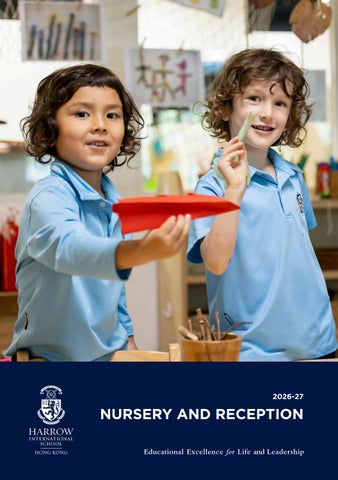
2026-27
NURSERY AND RECEPTION
1
2
WELCOME FROM THE HEAD Dear Parents, I am delighted to welcome you to Harrow Hong Kong and, in particular, our Early Years Department. This is an important and precious time in a child’s educational journey and we are committed to ensuring your son and daughter’s first years of a formal school experience are full of learning, curiosity and fun. Our School has an outstanding reputation for academic excellence and is a School with courteous and considerate pupils who are confident, positive and happy. It is our aim to nurture and guide boys and girls to become well-rounded, healthy and resourceful individuals who will relish a challenge and have the confidence to seize life’s opportunities. Dedicated, creative and experienced teachers deliver an intellectually rigorous curriculum in order to feed curious little minds. We value each child as a unique individual and ensure that all relationships are based on mutual respect. All staff take special care to ensure that children settle down quickly and happily into School. They are also eager to get to know parents and give you a chance to become actively involved with the School. Harrow Hong Kong is an extraordinary place where pupils are offered support and encouragement to develop their potential to the full. I hope that this booklet will help you to prepare for this new, exciting chapter in your little one’s life. I look forward to meeting you soon and seeing your child flourish as they move through the School.
Rosie McColl HEAD
3
WELCOME FROM THE HEAD OF EARLY YEARS It is with great pleasure that I welcome you and your child to Harrow Little Lions Gold Coast. The beginning of a child’s educational journey is both a significant and exciting milestone. Starting school for the very first time is an important step—not only for children, but also for their families—and we are committed to ensuring this transition is a positive, supportive and joyful experience. At the heart of our Early Years provision is a deeply child-centred curriculum. We recognise that every child is unique, arriving with their own interests, experiences and natural curiosity about the world. Our role is to nurture this curiosity by providing rich opportunities for exploration, discovery and meaningful learning. Through carefully planned play and purposeful interactions, children develop confidence, independence and a genuine love of learning from the very start of their educational journey. Wellbeing sits at the centre of everything we do. Children thrive when they feel safe, secure and valued, and we take great care in creating a warm, nurturing environment where every child feels known and understood. Our experienced team builds strong, trusting relationships, ensuring that each child is supported both emotionally and academically as they settle into school life. As your child takes these important first steps, we look forward to working in close partnership with you. Together, we will support them to thrive, develop socially and emotionally, and build strong foundations for the future. We are delighted to welcome you to our Early Years community and look forward to the wonderful learning and growth that lies ahead. Play is the highest form of research — at the heart of every Little Lion’s journey. Sophie Purnell Head of Early Years
4
CONTENTS WELCOME
3
OUR STAFF
6
WHERE THE JOURNEY BEGINS: NURSERY AND RECEPTION
8
AN EXPLANATION OF THE FIVE DISCIPLINES AND TEN DOMAINS
11
STAYING CONNECTED
29
ADDITIONAL INFORMATION
30
DAILY ROUTINE
36
STARTING SCHOOLS WITH CONFIDENCE: GETTING READY
37
USEFUL CONTACTS
38
5
OUR STAFF
SENIOR STAFF The Early Years staff and pupils are supported by a dedicated team of senior staff in the Lower School. Through their collective expertise and leadership, they provide a strong network of pastoral and academic support, fostering a nurturing environment where pupils feel confident, secure and ready to thrive.
MR BRENDAN SHANAHAN HEAD OF LOWER SCHOOL
MRS LAUREN BERNER
MS DAWN CHAMBERS
DEPUTY HEAD OF LOWER SCHOOL (PASTORAL, CO-CURRICULAR AND ORGANISATION)
DEPUTY HEAD OF LOWER SCHOOL (ACADEMIC)
6
OUR STAFF
CLASS TEACHERS At Harrow Little Lions, the Class Teachers play a key role in supporting the day-to-day care, wellbeing, and emotional security of children in their classes. They create a caring and welcoming environment where children feel safe, confident, and ready to explore. Through play, conversation, and carefully planned learning opportunities, teachers support each child’s learning, development, and wellbeing. Our teachers also get to know every child as an individual—understanding their interests, strengths, and needs—so they can help them grow in confidence and independence. We work closely with families and value strong partnerships with parents. The Class Teachers are the first point of contact with parents and together, we support your child to have a positive and successful start to their school journey.
MRS EMMA OAKES
MS AMBER WRAY
MRS KATE ELLISON
OWL CLASS
FLAMINGO CLASS
PENGUIN CLASS
MS JUDY LO
MS AOIBHINN HUME
MS FIONA HENRY
TURTLE CLASS
SEAHORSE CLASS
DOLPHIN CLASS
7
WHERE THE JOURNEY BEGINS: NURSERY AND RECEPTION Early Years at Harrow Little Lions is the crucial starting point of a pupil’s learning journey. At Harrow Little Lions, Gold Coast, we embed learning through a book-based approach. Turning pages, sparking curiosity: nurturing learners through child-centred experiences is our vision, through which the Little Lions Curriculum is promoted. The Little Lions Curriculum is an aspirational curriculum designed to embody the elements of excellence and values, enriching the lives of children and preparing them for the future as well informed, creative and responsible citizens prepared for responsible leadership. The core Harrow values of courage, humility, fellowship and honour are centre staged as the basis on which the rest of the curriculum grows. It is our intention to prepare pupils with diverse backgrounds and abilities for a life of learning, leadership, service and personal fulfilment. Through their strength of character, formed in large measure by their forward and future-facing Harrow education, we equip pupils with the skills needed to adapt and excel in a dynamic world.
8
THE FOUNDATIONS OF LEARNING BEHAVIOURS: THE FIVE LEARNING DISCIPLINES The Disciplines support the ‘how’ of learning. These areas of our curriculum support young learners to develop the learning behaviours, skills and personal attributes necessary to thrive independently. The Learning Disciplines are:
Emotional Development and Wellbeing
Curiosity
Cognitive Development
Motivation
Creativity
9
BUILDING KNOWLEDGE, SKILLS AND UNDERSTANDING: THE TEN LEARNING DOMAINS The learning domains identify the core content that children require to be informed, knowledgeable and skilled as they progress through their educational journey. The Learning Domains are:
Communication and Language
The Arts
Social Development
The World
Physical Development, Health and Hygiene
Sustainability and Environmental Awareness
Literacy
Digital Knowledge and Awareness
Mathematics
Identity and Diversity
10
AN EXPLANATION OF THE
FIVE DISCIPLINES AND TEN DOMAINS OF LEARNING 11
THE FIVE DISCIPLINES
EMOTIONAL DEVELOPMENT & WELLBEING This discipline covers the elements of: •
Emotional Literacy
•
Empathy
•
Co-Regulation / Self-Regulation
Children’s learning in this area is vital to ensure that they develop an understanding of their emotional and mental wellbeing, both in terms of their own self-awareness, and also how this relates to other people. Effective and successful learning and development in all other areas of our curriculum is dependent upon a secure sense of the ‘inner self’ as a strong basis on which to build other vital behaviours, qualities and attributes. A key aspect of this discipline is developing an understanding of our own emotions and feelings and developing strategies for managing and channelling them effectively.
CURIOSITY This discipline covers the elements of: •
Exploration
•
Experimentation
•
Making Links
Curiosity is an innate, biologically primed behaviour and a core driver of learning and development. When effectively recognised and supported, it ensures that children are able to pursue their desire to further understand and make sense of objects, tools, ideas, situations and experiences. Through following this drive, children learn to explore, experiment and hypothesise about the world around them. Children are supported to develop whilst developing a sense of how to utilise use their existing knowledge and skills while at the same time as building and developing new ones to further support future learning. 12
MOTIVATION This discipline covers the elements of: •
Engagement / Involvement
•
Independence
•
Persistence and Resilience
Sustaining motivation is critical not only for ensuring learning and development are successful but also to build effective learning behaviours. Supported and valued intrinsic motivation channels children’s energy to fully engage in experiences and activities, overcome challenges and remain focussed. Through this, they develop the vital life skills of independence, self-management and persistence. Children also establish self awareness and the foundations of resilience.
COGNITIVE DEVELOPMENT This discipline covers the elements of: •
Executive Functioning
•
Meta Cognition
•
Cognitive Flexibility
Supporting the range of children’s cognitive abilities and attributes lies at the heart of the purpose of our Curriculum. The elements of cognition enable children to make sense of, understand and utilise their current knowledge and skills in creative, thoughtful and effective ways. By ensuring that these are specifically maintained and extended, children will be able to optimise their learning opportunities and development.
13
CREATIVITY This discipline covers the elements of: •
Generating Ideas / Originality / Imagination
•
Communicating Ideas
•
Critical Thinking
Understanding and recognising the processes in creativity is important because, although children’s activity is intrinsically creative and their perceptions are unique and original, they still need the opportunity to discover their own strengths and use them to pursue their own expression and communication. Through exploring concepts, materials and knowledge in all learning domains, children develop and sustain the ability to think differently and combine ideas.
14
15
THE TEN DOMAINS
IDENTITY AND DIVERSITY This domain covers the elements of: •
Festivals and Customs
•
International Mindedness
•
Diversity
In order for children to have a strong and confident sense of identity, they need to know and understand the heritage, customs, rituals and traditions of their own community and culture. Knowing the history and significance of events, festivals and celebrations will provide them with the appropriate scaffolding to secure their sense of belonging within their immediate community. From this secure base, children will also need to know about the diversity of the wider world, understanding that other cultures and societies have different customs and traditions and that being aware of these will enable their informed engagement with the global community.
COMMUNICATION AND LANGUAGE This domain covers the elements of: •
Speaking / Expressive Language
•
Listening / Receptive Language
Communication and Language lie at the heart of all learning and development. The ability to communicate with peers and adults enables children to establish a sense of identity and place within their community and the wider world. Children learn the protocols and cultural specifics of communication and develop an awareness of how to utilise this. The acquisition and development of language(s) is a vital element, not just in the ability to communicate but also to access memory, recall knowledge and develop thinking strategies. The process of thought is mediated through language, and so ensuring that children have a rich and varied vocabulary is a central component of this. By developing the ability and knowledge to use words, phrases and idioms, ask questions and effectively engage in dialogues, children will secure a solid foundation for success.
16
SOCIAL DEVELOPMENT This domain covers the elements of: •
Co-operation
•
Relationships
Developing their ability to understand the nature and purpose of social interaction is an important life skill and a key element in the enculturation of children into their community and the wider world. Although the process of attachment and the drive to seek out connections with adults and peers is a biologically given one, this is still an aspect of learning that requires careful acknowledgement, scaffolding and support. By learning the protocols of how to respond to, create and manage relationships, children develop and nurture a sense of security and belonging. By learning how to co-operate, compromise and take into account the needs of others, children refine and develop their knowledge and skills as responsible citizens and are able to function effectively as part of a community.
PHYSICAL DEVELOPMENT, HEALTH AND HYGIENE This domain covers the elements of: •
Physical Development – gross motor
•
Self-care – food and nutrition
•
Self-care – exercise
•
Self-care – personal hygiene
•
Physical Development – fine motor
To ensure that their physical health and wellbeing is fully supported and understood, children need opportunities to develop core muscle strength and refine their fine motor skills. Children are naturally active, and this energy needs to be challenged appropriately to ensure that physical skills in all elements develop and thrive; physical health and development are critically linked to successful outcomes in all aspects of learning and development. Children need to understand the impact and importance of personal health and hygiene, not only grasping the processes for this but also being fully aware of the reasons that underpin them. It is vital for children to be aware of how their behaviour can effectively contribute to maintaining their health and the health of those around them. 17
LITERACY This domain covers the elements of: •
Story telling
•
Writing
•
Reading - Comprehension
•
Letter formation and Punctuation
•
Phonics
•
Word Reading
Understanding the world of print as a means of communication, and as a source of knowledge and information, is the hallmark of all civilisations and vital to ensure that children develop into educated informed citizens. Children should understand the purpose and relevance of literacy in everyday life alongside the introduction and practice of the technical aspects of reading and writing. Through understanding the role of literacy as a concrete expression of language, children will develop an awareness of how this is reflected in the range of print they see around them. Critical to this is also developing a love and understanding of the world of books, both fiction and non-fiction, and gradually developing their decoding skills in order to read independently. Children will also begin to understand how to communicate using letters and characters.
MATHEMATICS This domain covers the elements of: •
Number
•
Time
•
Number Operations
•
Pattern
•
Shape
•
Spatial Awareness
•
Measure
Children need to develop a secure and well-established mathematical understanding as a vital prerequisite for engaging with technical aspects of the world. The need for mathematical knowledge surrounds us and enables us to communicate and understand in a common language. The specific technical skills necessary for proficiency in counting, measuring, understanding geometric shapes, as well as concepts of time and patterns, should be learned in conjunction with their practical applications and relevance to everyday life experiences. The sequential and developmental nature of mathematical learning will enable children to gain confidence in their increasing skills and knowledge and be able to readily apply this in their own exploration and rehearsal of different knowledges and concepts. 18
THE ARTS This domain covers the elements of: •
Art and Design
•
Performing Arts
Artistic expression and communication enable children to explore, understand and value emotions, feelings, stories, thoughts and ideas, as well as to channel their natural desire to create, understand and represent. It enables them to experience the essence of different cultures and times and appreciate the beauty and energy of expression. Through engaging with a range of diverse media, genres, objects and artistic processes, children will learn how to develop their own style, techniques, preferences and individual means of expression and communication. Children will learn to value the Arts not only as a source of enlightenment, reflection, joy, and escape, but also as a valuable means of communication and expression.
THE WORLD This domain covers the elements of: •
Science
•
History
•
Geography
To understand the physical and social world around them, children must acquire a breadth of knowledge that explains and represents what they see, hear, smell and touch. Children also need to develop a core set of appropriate skills to investigate this knowledge and apply and comprehend it in contexts which are meaningful to them. Through the principles of scientific inquiry, children can cultivate an understanding of the material world. Developing a sense of the past and how it influences us, those around us and the wider world is an essential part of understanding our journey as a local and global citizens. Identifying elements of the natural world and recognising their impact on us will help children establish a secure sense of place, and their role within the wider world.
19
SUSTAINABLILTY AND ENVIRONMENTAL AWARENESS This domain covers the elements of: •
Environmental Impact
•
Environmental Activity
Children are growing up in a world where the impact on the environment and global climate are becoming more pronounced and urgent. These issues will increase in intensity and will require all citizens to take action to resolve them. By understanding the fragility of the planet we live on and recognising the finite nature of some of the resources we take for granted, children will develop an ethic of care and responsibility for the world around them. Knowledge and insight, balanced with a practical understanding of the importance and nature of personal and community action, will equip children with the necessary skills and motivations to address these issues locally and globally.
DIGITAL KNOWLEDGE AND AWARENESS This domain covers the elements of: •
Using Technology
•
Developing Digital Innovation
•
Using Digital Devices
•
Pre–Coding
•
Developing Digital Awareness
The fast-changing technological and digital landscape in which children are growing up necessitates their keen awareness of the advantages of both everyday and digital technology in their daily lives. It is essential for them to learn how to use appropriate devices safely, effectively, and creatively to support, enhance, and enrich their learning and development, as well as to utilise these tools for communication. A solid foundational and advanced understanding of how to maximize the potential of technological devices will ensure that children feel comfortable, informed, and familiar with appropriate equipment as they master their usage in a responsible and effective manner.
20
21
SPECIALIST SESSIONS At Harrow Little Lions, we believe that children learn best when they are given rich and varied opportunities to explore the world around them. Alongside their daily classroom experiences, children also take part in a range of specialist-led sessions designed to broaden their interests, nurture their talents, and deepen their learning.
MUSIC Children take part in a weekly music session and singing assembly, where they are encouraged to explore sound, rhythm, and movement in a joyful and engaging way. Through singing, listening, and playing instruments, children develop confidence, creativity, and self-expression.
SWIMMING Children in Reception will take part in a weekly swimming session as part of their school experience. These sessions are designed to build water confidence, develop key swimming skills, and most importantly, provide a fun and enjoyable opportunity for children to learn and grow in the water.
PE Children will take part in regular Physical Education sessions, providing opportunities to be active, develop coordination, build core strength and confidence. Through a range of engaging and enjoyable learning opportunities, children learn key physical skills while also developing teamwork, coordination, resilience, and a positive attitude towards movement and wellbeing.
CHINESE Every week, children will take part in Chinese sessions led by Lower School Chinese Teachers. Sessions take place within the children’s usual classroom and provide a rich linguistic and cultural environment. During these sessions, children are exposed to various elements of the Chinese language through stories, songs and games. By engaging in a playful and immersive environment, children develop confidence in their language abilities.
LIBRARY We have a well-stocked library in Little Lions which the Nursery and Reception children will visit each week. They are able to borrow one book a week to take home and enjoy with their family. Our librarian will read stories to them whilst introducing the importance of positive book behaviours and etiquette. Reception children will visit the Lower School library as part of their transition in the summer term. Most importantly, these experiences are carefully designed to remain playful, engaging, and developmentally appropriate. By weaving specialist experiences into a child-centred environment, we ensure that every experience feels meaningful, joyful, and connected to the wider learning journey. 22
LEADERSHIP ATTRIBUTES At Harrow Little Lions, we strive to prepare our very youngest learners for the future from the very first day they arrive. The Leadership Attributes are built into the very foundation of our routines, expectations, interactions and planning and are modelled consistently by every adult within our community.
We Never Give Up Facing Challenges with Determination
We Work Together Solving Problems Collaboratively
We Are Problem Solvers Solving Problems Creatively
We Like to Help Contributing Positively to the Community
We Are Fair Making Fair and Just Choices
We Care For Others Applying Knowledge with Compassion
PROMOTING POSITIVE BEHAVIOUR At Harrow Little Lions, we are committed to establishing a learning environment that promotes positive behaviour and relationships where every member of our community treats each other with care and respect. Harrow Little Lions is an environment that supports children; guiding them as they grow and develop, taking increasing responsibility for themselves and their actions whilst considering the welfare and wellbeing of others. Underpinning the Harrow Little Lions approach to promoting positive behaviour are the core values of courage, honour, humility and fellowship which are demonstrated by everyone involved in the life of Little Lions. All practitioners at Harrow Little Lions have a shared responsibility for promoting consistent behavioural expectations. Positive behaviour is reinforced through six key phrases, accompanied by a visual. • Listening ears • Looking eyes • Kind words • Gentle hands • Walking feet • Indoor voices Through the use of these expectations, practitioners can always ask for the behaviour that they would like to see from the pupils rather than the behaviour that should be avoided.
23
PEDAGOGY At Harrow Little Lions, we carefully curate stimulating environments and spaces relevant to the children’s age, developmental stage, cultures and communities which provoke curiosity and maximise the potential for deep-level learning. Meaningful learning opportunities are presented through guided play and playful teaching, which support children to take risks in exploring and expressing themselves in multiple ways, personalised to their interests and reflecting their needs. All adults involved appreciate the importance of impactful interactions with children and understand that, at times, there is a need to stand back and observe before support, stretch, and challenge can be offered through conversations, questions, and reflections. The relationships between the children and adults are positive, as the team take time getting to know each child, so that their likes, dislikes, preferences, interests, and challenges are understood and planned for. Continuous observation of children affords the team an opportunity to plan the most appropriate and impactful next steps in each child’s learning journey. Rich and meaningful opportunities are embedded in a book-based approach to learning, where our vision is brought to life as we take the children on a journey of ‘Turning pages, sparking curiosity: nurturing learners through child-centred experiences’. The books chosen support the children to explore a wide range of concepts and language and afford them the opportunity to lead their learning in a direction personal to them.
LEARNING ENVIRONMENTS At Harrow Little Lions, we pride ourselves in providing a warm, nurturing environment where children feel a sense of safety and belonging. Our welcoming learning environment starts from the moment families, children and staff enter the building where we emphasise building strong positive relationships, not just with our teaching teams, but with all the adults working within the setting to support the development and growth of our young learners. Our learning spaces spark curiosity, inspire creativity and promote critical thinking skills in a fun and purposeful way.
24
25
26
27
28
STAYING CONNECTED At Harrow Little Lions we are committed to keeping families informed about how their children are progressing within the school environment. We know that every child is unique. Our aim is to nurture individual strengths and support points for development to ensure that each child reaches their full potential. Our dedicated classroom teams spend time getting to know our pupils, and their families, and employ a wide range of strategies to plan and deliver inspiring learning opportunities. To keep parents informed and involved in their child’s learning journey, we communicate regularly with on both an informal and formal basis throughout the year. Open, honest communication between home and the classroom is key to helping our pupils thrive. Teachers are available at drop-off and pickup to speak to parents about important information which may impact a child during the school day or to report anything parents need to be made aware of at the end of the school day. Teachers are contactable via email or phone and always happy to answer any questions regarding individual children. Should longer, more detailed conversations be necessary, meetings can be arranged.
PARENT/TEACHER CONSULTATIONS Parent/Teacher consultations take place twice during the academic year. Parents have the opportunity to meet with their child’s class teacher to discuss their progress, development, and next steps for learning. These meetings are an important aspect of our partnership with families and help ensure each pupil receives the support they need to thrive.
WRITTEN REPORTS Parents will receive two written reports per year. The first acts as a record of how an individual child has settled into Nursery and Reception with comments and observations on how a child is progressing and attaining in both the disciplines and domains of learning. The second, end of year report, provides a comprehensive overview of their learning and development over the course of the year.
ONLINE LEARNING JOURNEYS Every family will receive weekly observations of their child through Seesaw, our online learning and communication platform. Observations will include photos and a description of the learning taking place.
PUPIL DIARIES Every child will have a Pupil Diary, which will be checked by a member of the classroom team each day. This is used as a written communication tool between home and school. Please check your child’s bag and diary every night.
COLLABORATIVE EVENTS Over the course of the year, families will be invited to a series of events, including ‘Stay and Play’ sessions and festival celebrations, where adults will have the opportunity to spend some with their child in the school environment and experience learning opportunities together in a fun and informal way. 29
ADDITIONAL INFORMATION TRANSITION AND SETTLING IN Every child will settle into the routine of coming to kindergarten in their own way and in their own time. Some children may need longer than others to settle and we would like to reassure you that this is completely typical. Our classroom teams will work closely with you as families to support your child with the transition in the best way for them. Promoting Independence prior to joining Harrow Little Lions, we ask that children are confident with the following personal care routines: •
Have a go at getting dressed e.g. putting on a coat, pulling up trousers, putting arms in a t-shirt etc.
•
Eat by themselves
•
Wash their hands independently
•
Be toilet confident (not wearing nappies or pull-ups)
•
Communicate their wishes and needs appropriately
LEAVING YOUR CHILD Leaving your child at kindergarten for the first time can be both an emotional and significant milestone for families. It is natural to feel a mixture of pride, excitement, and a little uncertainty, but children quickly grow in confidence as they settle into their new environment. With the support of our caring staff and engaging experiences, they will begin to feel secure, form friendships, and develop a love of learning that will carry them forward. To help ease this transition, establishing a consistent morning routine can provide comfort and predictability, while keeping goodbyes calm, positive, and reassuring supports your child’s sense of security. Providing a small familiar item from home, such as a photo or comfort toy, can also help them feel connected. Most importantly, maintaining open communication with our Little Lions Staff allows you to share any concerns and work together to ensure your child feels safe, happy, and ready to explore.
30
COLLECTING YOUR CHILD If there is a change in childcare arrangements for your child, we would encourage you to write changes/ play arrangements in your child’s diary, send a message on Seesaw or directly contact the Harrow Little Lions Office. In the event that someone unfamiliar to the Class Teacher comes to collect a child, parents will be contacted to check before the child is allowed to go. Informing us of any changes in advance makes this process as smooth as possible for everyone involved. The children not taking the bus will be dismissed from the terrace outside the classrooms.
UNIFORM All pupils are expected to wear school uniform everyday. Please see the uniform list on the School website for the full list of items that your child will need each day. Please can all uniform items be clearly named. This helps us to identify items and also helps your child to be responsible for their own belongings.
CATERING We have a fully equipped kitchen that provides nutritious morning snacks and lunches to fuel our pupils throughout the day. Children enjoy dining together in the Harrow Little Lions dining area, where we embrace a family-style approach, with staff sitting alongside the children to encourage positive social interactions and good eating habits. We work closely with our catering partner to ensure the provision of high-quality, nutritious, and appetising meals, regularly reviewing menus and gathering feedback to support continuous improvement. Please inform us of any special dietary requirements so we can accommodate your child’s needs. Details of the meals served in Harrow Little Lions can be found on the School website.
BUS SERVICE The School’s mandatory bus service is provided by Chun Wo Bus Services Limited. Chun Wo Bus Services Limited operates routes to and from a number of areas across Hong Kong. The buses are equipped with appropriate seat belts and each bus has its own adult supervision. Any questions about the service, the fees and the routes should be addressed to the Chun Wo Bus Services Limited via email at harrow@chunwobus.com. All pupils are asked to use the School bus service in line with requirements from the Transport Department.
31
32
NOTIFYING THE SCHOOL OF ILLNESS To help us maintain a healthy environment for all children, parents must inform the school as soon as possible if their child is unwell or will be absent due to illness. Please notify us of any symptoms of infectious conditions (such as fever, cough, flu-like symptoms, sickness, or diarrhoea) or if your child has been diagnosed with a contagious illness. Prompt communication enables us to monitor patterns of illness, take appropriate precautions where necessary, and support the wellbeing of the whole school community.
TOILETING We ask that all children are fully toilet trained and wearing underwear by their first day of school. Being able to use the toilet independently helps children feel confident and comfortable as they settle into their new environment. We understand that accidents can happen, especially during times of change, and this is completely normal. Our teachers and support staff will provide gentle reminders throughout the day and offer reassurance and assistance when needed.
HEALTH CARE CENTRE The health, safety, and wellbeing of our pupils is our priority. It is good practice in Hong Kong to check your child’s temperature each morning before coming to school. Any child with a fever (an oral temperature above 37.5°C or an ear temperature above 38°C) should remain at home for at least 24 hours. If your child requires medicine such as paracetamol to reduce a temperature in order to attend school, they should not be sent in. Similarly, children who have experienced sickness or diarrhoea must stay away from the Early Years Centre for at least 48 hours after the last episode. If a child becomes unwell whilst at school, including developing a fever, sickness, or diarrhoea, we will contact you promptly and ask that they are collected. This approach helps protect all children, particularly the youngest and most vulnerable, from infection. Parents must inform the school immediately if their child has an infectious illness. The School reserves the right to refuse admission on health grounds and follows the whole school sickness policy. Whilst every care is taken to ensure that your child is safe, minor bumps and grazes are a natural part of early childhood play. In these instances, our staff will comfort and care for your child, providing first aid within the Early Years Centre. Any more significant injuries or concerns will be referred to our Health Care Centre for further assessment and treatment.
ANY QUESTIONS? We hope that these activities and the information contained here will assist you in preparing you and your child for Nursery and Reception at Harrow International School Hong Kong. Should you have any further questions, please do not hesitate to contact us at eyc-info@harrowhongkong.hk
33
34
INDIVIDUAL NEEDS Ms Amanda Lam - Head of Individual Needs The Individual Needs Department works alongside Counselling and Year Group teams to ensure that the academic, social and pastoral needs of pupils are met through quality differentiation, effective collaboration between educational stakeholders, and impactful staff development. The Individual Needs Department works with pupils who require extra support or extension beyond regular classroom differentiation in order to meet their learning needs. The Individual Needs Department supports pupils who enter the School with existing reports of individual needs and those who are later identified through the School’s referral system. The department works with members of staff by identifying and sharing differentiation strategies based on specific pupil profiles, monitoring student progress and providing professional development. The department may conduct observations to aid the understanding of a pupil’s profile, and may also refer pupils to external specialists, including Occupational Therapists, Speech and Language Therapists and Educational Psychologists if further information is required. Pupil progress is determined using teacher feedback, observations and communication with educational stakeholders. There are no set formal assessments used by the Individual Needs Department as pupil needs are diverse.
LANGUAGE AND LEARNING (L&L) Ms Elaine Shek - Head of Language & Learning Our main language of learning at Harrow Hong Kong is English. The Language and Learning (L&L) department supports pupils who need specific, more specialised input into the development of their English language skills in order to access the curriculum appropriately. Individualised support from this department, where necessary, begins in Year 3. During their time in Early Years, pupils are immersed in English and increase their vocabulary through daily interactions with teachers and peers as well as stories, songs and rhymes. Should one of the Early Years team observe that a child’s English language skills are hindering them from accessing the curriculum and developing socially, they will communicate with parents and suggest ways that they can support at home which mirror interventions in the classroom.
35
DAILY ROUTINE Our Early Years programme provides a full-time educational offer for both Nursery (K1) and Reception (K2) pupils. From the moment our pupils arrive until they leave to go home, every moment is planned for joyful learning, creative play and personal growth. •
Pupil Arrival, Warm Welcome & Settling In
•
Circle Time & Phonics
•
Exploration Time
•
Break – Rolling Snack
•
Specialist Sessions
•
Lunch
•
Outdoor Learning Time
•
Story Time
•
Home Time
We hope that these activities and the information contained here will assist you in preparing you and your child for Nursery and Reception at Harrow International School Hong Kong. Should you have any further questions, please do not hesitate to contact us at eyc-info@harrowhongkong.hk
36
STARTING SCHOOL WITH CONFIDENCE: GETTING READY A solid and consistent routine is vital for a child’s success at school. Ensuring a positive bedtime routine will allow a child to rest well ahead of a busy day in Little Lions. Starting the day with a healthy breakfast will provide a child with the energy they will need to explore the world around them. The months before starting school provide a valuable opportunity to nurture your child’s growing independence, confidence, and curiosity through simple, meaningful moments at home. There is no need for formal teaching—children learn best through play, conversation, and shared experiences. By gently supporting everyday routines and encouraging your child to have a go for themselves, you are helping to build the strong foundations they need to thrive. Every child’s journey is unique, and children develop at their own pace. What matters most is that your child feels: happy, secure, confident, and ready to explore. Together, we will help ensure a smooth, positive and confident start to their school journey.
IMPROVING GROSS AND FINE MOTOR SKILLS During the holidays, after school and on weekends, encouraging your child to be active will support their stamina and endurance. Before a child can learn to write using the small muscles in their hands, they must first develop strength in their core, shoulders, elbows and wrists. Gross motor: •
Climbing
•
Hanging from monkey bars
•
Balancing
•
Jumping
•
Painting standing up
•
Washing the car
Fine motor: •
Playdough (or making bread)
•
Lego, Duplo, and building blocks
•
Threading
•
Scissors
•
Sand
•
Pencils 37
USEFUL CONTACTS HARROW LITTLE LIONS OFFICE eyc-info@harrowhongkong.hk 2299 6233
MRS SOPHIE PURNELL (HEAD OF EARLY YEARS) spurnell@harrowhongkong.hk
MR BRENDAN SHANAHAN (HEAD OF LOWER SCHOOL) bshanahan@harrowhongkong.hk
HEALTH CARE CENTRE hcc@harrowhongkong.hk 2299 6215
LOWER SCHOOL OFFICE ls-info@harrowhongkong.hk 2299 6122
GOVERNANCE Hon Kenneth Lau, Chairman Address: Asia International Schools Limited (AISL), 35/F, Office Tower, Convention Plaza, 1 Harbour Road, Wan Chai, Hong Kong 2583 3109
RELATIONSHIP STATEMENT The Harrow International Schools, Harrow Hong Kong Children School, Harrow LiDe Schools and Harrow Little Lions (Early Years Centres) use Harrow School’s Name and Badge under a sub-licence granted by Harrow International Schools Limited (HISL), a trading subsidiary of the charity registered in England and Wales with charity number 310033 which owns Harrow School and its trademark, in return for a fee. The educational, administrative, financial and other operational responsibilities of the Harrow International Schools, Harrow Hong Kong Children School, Harrow LiDe Schools and Harrow Little Lions (Early Years Centres) are separate from those of Harrow School and rest with their owners and operators. The schools’ fees are paid to their owners and operators and not to Harrow School or HISL. Under the sub-licence, these schools are required to reflect Harrow School’s educational purpose, practice, strategy and philosophy and each is regularly evaluated by representatives of HISL. The schools’ Governing Boards include two representatives of HISL.
38
39
HARROW INTERNATIONAL SCHOOL HONG KONG 38 Tsing Ying Road, Tuen Mun, New Territories, Hong Kong Tel: (+852) 2824 9099 Fax: (+852) 2824 9928
harrowhongkong.hk
40