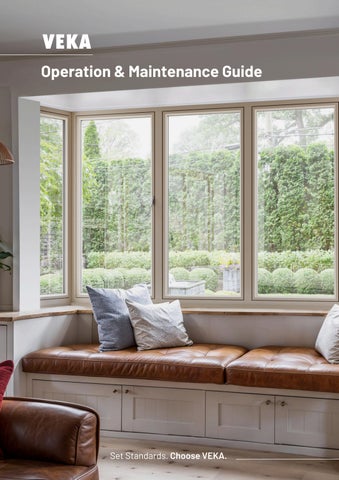
Operation & Maintenance Guide
Set Standards. Choose VEKA.
Thank you for choosing VEKA PVCu Windows & Doors
VEKA systems are designed to provide long-term durability, weather resistance, energy efficiency and secure performance with minimal routine maintenance when properly cared for. This guide provides general guidance on the operation, maintenance and care of VEKA window and door systems following installation.
Contents
3
8
General Maintenance & Cleaning
Fully Reversible Windows
4
9
Hardware & Security
Vertical Sliders
5
10
Condensation & Ventilation
Entrance Doors
6
11
Casement & FlushSash Windows
Patio Doors
7
12
Tilt & Turn
Bi-fold Doors
General Maintenance & Cleaning VEKA PVCu window and door systems are designed to require minimal maintenance. Regular cleaning and routine inspection will help maintain appearance and operational performance.
PVCu Frames & Sashes PVCu surfaces should be cleaned using warm water and a mild detergent solution applied with a soft cloth. Decorative foiled finishes should be cleaned carefully to avoid damage to the surface finish. Do not use: Solvent cleaners, Abrasive cleaning products, Wire wool, Bleachbased cleaners, Acidic products or Highpressure washers. These products may damage PVCu surfaces, decorative finishes and hardware components.
Glass Cleaning Glass should be cleaned using a suitable non-abrasive glass cleaner and a soft cloth. Care should be taken to avoid scratching caused by jewellery, metal objects or debris during cleaning.
Drainage Channels & Weather Seals Drainage slots and channels should be inspected periodically and kept free from dirt or obstruction to allow effective drainage. Weather seals should be wiped clean regularly to remove dirt build-up.
3
Hardware & Security
Hardware Maintenance Moving hardware components should be kept clean and free from obstruction. Hinges, locking points, rollers and door cylinders may require periodic lubrication using a suitable light multi-purpose oil or PTFE-based lubricant. Excess lubricant should be removed following application. Do not use solvent based cleaners or multi purpose lubricants.
Security VEKA systems are designed and tested to support relevant security and performance standards such as PAS24 where specified. For continued security performance:
Close & Lock Ensure windows and doors are closed and locked when unattended
Remove Keys Remove keys from locks while keeping them accessible in an emergency
Check locks Ensure you check locking systems periodically
Report Damage Report damaged hardware promptly
4
Condensation & Ventilation
Condensation on windows occurs when warm, moist air inside your home comes into contact with cool window surfaces. The air cools quickly, can’t hold as much moisture, and releases water droplets onto the window. Common causes include: High indoor humidity from cooking, showering, breathing, drying clothes. Poor ventilation Single-pane or poorly insulated windows Temperature differences External condensation may occasionally form on highly thermally efficient glazing and does not indicate a product fault.
To help reduce condensation: Improve ventilation Open windows regularly Use trickle vents Keep internal doors open Use NSHEV systems for smoke ventilation
Improve insulation Upgrade to double/triple glazing Add window film Use thermal curtains Reduce humidity Keep lids on pans and use extractor fans Avoid drying clothes indoors Use a dehumidifier Limit houseplants Keep home warm Maintain steady heating Avoid sudden temperature drops
5
Casement & FlushSash Windows
Casement windows may be side hung or top hung and are designed to provide controlled ventilation and everyday operation.. Opening & Closing Turn the handle 90° to unlock and open the window Some handles may include push buttons or key locks Return the handle to the closed position to secure the sash
Restricted Opening Where fitted, restrictors limit the opening distance. Press the restrictor release to allow the window to open fully.
Easy-Clean Hinges Some windows may include easy-clean hinges to allow safer cleaning from inside the building. Open the window fully Release the easy-clean mechanism Carefully slide the sash along the hinge track Return the sash fully before closing
Night Vent Facility Open the window as before but only by approximately 20mm so slightly ajar. Turn the handle back to the closed position taking care not to force it and you will feel the lock re-engage into the keeps. If the window has a key it can then be locked in this position.
Maintenance Keep all moving parts clean and free from dirt or obstruction, and do not wedge or jam anything in the window. Lightly lubricate moving parts once a year using a light oil or an acid‑free product (such as petroleum jelly). Avoid spray oils or harsh/acidic products. Apply with a lightly oiled cloth to prevent over‑lubrication. 6
Tilt & Turn Windows
Tilt & turn windows can be opened in two ways: Tilt position for ventilation and turn position for full inward opening.
Opening from closed to tilt position and closing Turn the handle 90º from vertical to horizontal. For the tilt position, pull on the handle and the window will tilt inwards for ventilation. To close push the window forward and turn the handle 90º from horizontal to vertical.
Opening from closed to turn position and closing Close the window and turn the handle a further 90º moving it through 180º to the upward vertical position. Pull on the handle and the window will open inwards. To close, push the window forward and turn the handle 180° to the vertical position
Maintenance Keep all moving parts clean and free from dirt or obstruction, and do not wedge or jam anything in the window. Lightly lubricate moving parts once a year using a light oil or an acid‑free product (such as petroleum jelly). Avoid spray oils or harsh/acidic products. Apply with a lightly oiled cloth to prevent over‑lubrication. 7
Fully Reversible Windows
Fully reversible windows rotate internally to allow safe cleaning of external glazing from inside the building. Where fitted, release the restrictor before fully reversing the sash. Operation Always keep the window in the closed position when moving the handle and never pull on the window whilst turning the handle.
Opening from the closed position: • Turn the handle 90º from horizontal to vertical and push the window forward, it will click into a restricted open position of approximately 100mm. Some handles may have key locks which must first be released. • Press the restrictor, located on the centre hinge to disengage, the window can now be fully opened.
Cleaning • The window can also be fully reversed for cleaning. Once in the fully reversed position the restrictors will engage once again. • When in the fully open position, if the pivot windows are too loose friction adjustment can be made by tightening the grommet located on the top of each hinge with an Allen key. • To return the window to its normal position, disengage the restrictor on the centre hinge and turn the sash back. If it re-engages at around 100mm open, release it again, close the window fully, and rotate the handle 90° from vertical to horizontal.
Maintenance Keep all moving parts clean and free from dirt or obstruction, and do not wedge or jam anything in the window. Lightly lubricate moving parts once a year using a light oil or an acid‑free product (such as petroleum jelly). Avoid spray oils or harsh/acidic products. Apply with a lightly oiled cloth to prevent over‑lubrication. 8
Vertical Sliding Windows
Vertical sliding sash windows are designed to provide controlled ventilation by sliding the sashes vertically. Both top and bottom sashes may be operable depending on system specification. Operation Opening from closed: • First release the sash lock(s) on the central meeting rail. • Pull up the bottom sash or pull down the top sash using the handles.
Tilting inwards for cleaning: • Ensure the sash lock(s) is (are) released. • Pull up the bottom sash approximately 50mm to clear the cill. • Release the childproof spring latches in the top rail of the sash and carefully tilt inwards until the weight of the sash is supported by the restrictor arms. • For the top sash, follow a similar procedure - pulling it down 300mm, releasing the spring latches and carefully tilting inwards. • When closing from the tilt position, reverse the procedure starting with the top sash - ensuring that the spring latches fully engage in the side of the window. • The tilting inwards of the sashes should be used only for cleaning purposes.
Maintenance Keep all moving parts clean and free from obstruction. Do not trap or jam anything in the window. Lubricate moving parts at least once a year using a light multi-purpose oil or an acid-free lubricant (such as petroleum jelly). Avoid spray oils or acidic lubricants, and apply using a lightly oiled cloth to prevent over-lubrication. Note: Spring/coil balances are self-lubricating and do not require oiling. 9
Entrance Doors
VEKA residential doors are fitted with multipoint locking systems designed to support weather performance and security. Operation These instructions are relevant for doors that open-inwards or outwards, usually as entrance doors. These guidelines are primarily for when a lever handle is fitted on both sides of the door.
Unlocking and Opening • Insert the key and turn it to unlock. • Push the handle down and hold to disengage the locking components and open the door.
Closing and Locking • Push or pull the door closed so that it clicks shut. • Lift the handle up to engage the locking components. • Insert the key, turn it to lock and then remove
Maintenance Keep all moving parts clean and free from dirt or obstruction, and do not wedge or jam anything in the door. Lightly lubricate moving parts once a year using a light oil or an acid‑free product (such as petroleum jelly). Avoid spray oils or harsh/acidic products. Apply with a lightly oiled cloth to prevent over‑lubrication. 10
Patio Doors
Sliding patio doors are designed to glide smoothly along a track system. Operation These instructions are relevant whether the sliding pane is internal or external.
Unlocking and opening Insert the key and turn it to unlock. The door is opened by operating the actuating lever to release the locking mechanism By pulling the handle the door will slide sideways. Be careful not to slide the door too fast wide open onto its stop as this may cause the opening door to bounce and cause damage to its runners.
Closing and locking To close the door, reverse the process. Push the door gently into the closed position and throw the actuating lever to engage the locking mechanism. Insert and turn the key to lock
Maintenance Keep all moving parts clean and free from obstruction. Do not trap or jam anything in the door. Tracks and running gear can collect dirt and debris, so these should be checked regularly and cleaned using a small, soft brush, especially after periods of non-use. Lubricate all moving parts at least once a year (or twice a year for doors with external tracks) using a light multi-purpose oil or an acid-free lubricant such as petroleum jelly. Avoid spray oils or acidic products, and apply with a lightly oiled cloth to prevent over-lubrication. 11
Bi-Fold Doors
Bi-fold doors consist of interconnected panels designed to fold and stack neatly together. Operation These instructions are relevant for doors that open inwards or outwards.
Unlocking and opening • Insert the key and turn it to unlock. • Turn the handle gently as far as it will go and pull/push the door away from the frame to 90º. Open each of the remaining doors individually by turning the handles and disengaging the locking mechanisms. • Once all the locks are disengaged, push the doors away from yourself until they fold flat against each other.
Closing and locking • Close the doors by pushing them simultaneously away from the open position starting on the hinged side. Do not pull or drag the first door by its handle as this can restrict the operation of the runners and in worst cases cause it to jam. • Lock off each door individually starting from the hinge side. • Finally turn the handle on the master door and insert and turn the key to lock
Maintenance Keep all moving parts clean and free from obstruction. Do not trap or jam anything in the door. Tracks and running gear can collect dirt and debris, so these should be checked regularly and cleaned using a small, soft brush, especially after periods of non-use. Lubricate all moving parts at least once a year (or twice a year for doors with external tracks) using a light multi-purpose oil or an acid-free lubricant such as petroleum jelly. Avoid spray oils or acidic products, and apply with a lightly oiled cloth to prevent over-lubrication. 12
VEKA plc Farrington Road Rossendale Road Industrial Estate Burnley Lancashire BB11 5DA
veka.co.uk
Set Standards. Choose VEKA.