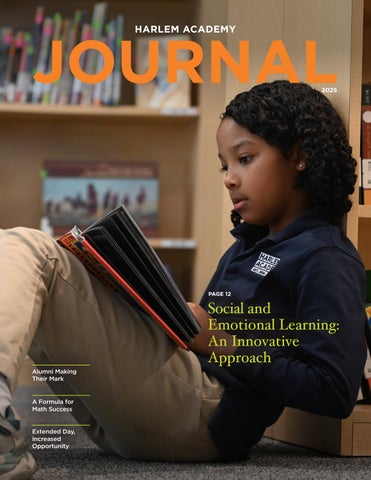
JOURNAL HARLEM ACADEMY
2025
PAGE 12
Alumni Making Their Mark
Social and Emotional Learning: An Innovative Approach
A Formula for Math Success Extended Day, Increased Opportunity 2025 Journal | 1
Rabi ’25 and his mom learning about boarding school options at our annual high school fair. 2 | Harlem Academy
FROM THE HEAD OF SCHOOL
One of my greatest joys is sharing the stories of Harlem Academy’s talented students and the school’s transformational impact. In this magazine, you’ll read about alumni who are forging paths to careers in law, medicine, public health, and nursing, and more recent graduates who might not have drafted a resume just yet but are impacting some of the nation’s top secondary schools with their scholarship and commitment to continue living our School Creed. You’ll learn about the programs that make this extraordinary growth possible, such as team advisory (page 12) and our evidence-based approach to math (page 16), and the people who help drive the results, like dean of co-curricular programs Lamarc Wigfall (page 20). Mr. Wigfall is locally known for his takes on any sports team in America, but his true superpower is his connection and commitment to our kids! Recently, my own work included meeting with each of our 32 seventh graders and their parents as part of the school’s very intentional secondary school placement process. The conversations are radically honest. Using current grades, holistic contributions, and baseline test scores, we share how a student’s overall performance is likely to translate into a set of school choices. Students have a chance to see not only the impact of all of their terrific contributions but also exactly what they need to do to expand their options. It is really empowering because they know they can set ambitious goals for themselves and that all of us – parents, school counselors, teachers, and volunteers – have their backs. Harlem Academy has doubled in size over the past four years and will top out the capacity of our new building with over 200 students in fall 2025. It’s been quite a journey from 12 first graders in a church basement, but the one thing that has never wavered is our commitment to helping each student find their path to academic excellence and one day make a mark on the world.
Vinny Dotoli
2025 Journal | 3
SCHOOL CREED
I am bold and creative. I take opportunities to lead. I seek help when I need it. I am honest and reflective. I choose to do what is right, Even when it is hard or no one is watching. I listen carefully. I speak kindly. I care for my community. I make the most of each day. I learn from my mistakes. I don't give up.
4 | Harlem Academy
Contents 6
Making Their Mark
18
Extended Day, Increased Opportunity
12
Team Advisory: An Innovative Approach to Social and Emotional Learning
15
From En Garde to Match Point
20
Team Spotlight: Lamarc Wigfall
22
Where Are Alumni Now?
16
A Formula for Math Success
2025 Journal | 5
Making Their Mark
Harlem Academy students strive for excellence, meet challenges with determination, and care deeply for their community. No matter what path they choose after leaving our halls, our graduates take these same qualities into the wider world. We caught up with a few alumni to hear how they are making their mark.
Micaela in sixth grade, eager to take part in a class discussion.
Micaela Gonzalez ’21 program and helms the Hispanic Organization for Latino Awareness affinity group.
Senior at Riverdale
Freshmen mentor
Attending UPenn to study nursing
Ask Riverdale senior When she’s not in class, captaining the softball team, or participating in Micaela Gonzalez indoor track and field, Micaela spends a lot of her time at Riverdale helping what is most others. “It’s how I show my gratitude the opportunities granted to me.” important to her, and for Micaela leads Friendly Fridge, a club that educates students about food she’ll say service. insecurity and helps provide food “I’ve always had a passion for giving back to my community.” It’s the reason she will study nursing when she heads to University of Pennsylvania this fall. “Nursing is providing care. I’ve known for a while that it is the career I want to pursue.” 6 | Harlem Academy
for people in need. She is a member of Best Buddies, which helps foster relationships between students and people with intellectual and developmental disabilities. She also mentors incoming freshmen as part of her school’s peer-assisted leadership
Of Micaela’s many activities, one in particular is an investment in her future. “I’m also in the medicine club and have been able to practice suturing, learn about disease prevention and spread, and talk to public health workers and doctors about their experiences. I joined last year because I was interested in furthering my education in the sciences, specifically medicine.” As she excitedly looks ahead to UPenn, Micaela is confident she’ll succeed. “The rigorous course load at Harlem Academy was fundamental to my preparation for Riverdale,” she says. “The analytical writing we did was particularly helpful, and I am so grateful for the close reading practice.” Now, those skills will transfer on to college. “Having faith in myself and my potential is the spark that keeps me going. When you push yourself and never give up, like the Creed says, the reward is big!”
Lexis Lokko ’17
Lexis Lokko, a senior at Tufts, is striving to make a difference in people’s lives. “I realized that I can have a bigger impact than I thought.” That’s why she’s been ramping up her involvement in a variety of programs. Last year, she interned at Harvard T.H. Chan School of Public Health and at Brigham and Women’s Hospital. “As a community health major, those internships helped me to learn different things about serving the community.” During the Harvard internship, Lexis researched free school meals across the United States. “My job was to look at the costs and benefits, including health and education outcomes.” Her experience at Brigham was more hands-on. “I led weekly discussions with ninth and tenth graders on different public health topics, such as health disparities, food insecurity, and homelessness. I did a lot of research to make sure the information was specific to Boston, where the kids lived.” Lexis is currently a peer leader at the college’s Africana Center, leading retreats and hosting events for incoming Black freshmen. “I also meet with my mentees once a month to let them know what’s happening on campus, inform them of job opportunities, and just check in. I see so much of myself in them.”
Senior at Tufts
Peer leader at the Africana Center at Tufts
Plans to pursue master’s in public health
students,” she says. “I loved being able to make sure their voices were heard.” All of Lexis’ experiences have helped fuel her ambitions for the future. “I’m going to work for a year after Tufts, then I’ll go to graduate school for a master’s in public health. My internships have given me so much knowledge, and working in an area related to public health will give me even more.” She’s looking forward to using the added career experience toward success in her graduate studies – a determination she gained at a young age. “Harlem Academy is where I learned how to work diligently to attain the academic excellence I strive for.” Lexis, right, at our three-day middle school wilderness trip.
She has also served as Class of 2025 Senator for Tufts Community Union Senate, the main governing body for undergraduate students. “It was great to spend a year advocating for 2025 Journal | 7
Even as a first grader, Matthew had a burgeoning love of science.
Matthew Centeno ’18
Junior at Case Western Reserve
Ambassador to prospective students
NYU School of Medicine intern
and out of the hospital. “I’ll be able to a point of prioritizing STEM-related When Matthew support patients in the operating room leadership roles. He is president of and also help to maximize people’s school’s chapter of the Society of Centeno talks about health in their daily lives,” he explains. his Advancement of Chicanos/Hispanics and Native Americans in Science and his days at Harlem Matthew is immersing himself in science leads Case for Sight, a vision advocacy as much as possible. He has shadowed club on campus that raises awareness Academy, one subject the chair of the anesthesiology of vision impairments. at Case Western and comes up again and department also did a summer internship at New The training required to reach his York University Grossman School of career goals will be challenging, again: science. Medicine’s Armache Lab, focusing on but Matthew is excited to continue It ignited a passion that has continued to grow. “I remember being fascinated by the lessons on geology and the principles of surface tension in middle school,” he says. “And the labs, dissections, and emergency medicine unit helped to cement my interest in biological science and the health field. Harlem Academy laid the foundation.” As a junior at Case Western Reserve University with a double major in biology and nutrition, Matthew has his sights set on becoming both an anesthesiologist and a registered dietitian so that he can help people in
8 | Harlem Academy
biochemistry.
“Shadowing helped me to understand the anesthesiologist’s role and learn proper procedures,” he says. “And the internship further developed my lab and research skills. The lab was small, so I was able to ask many questions and learned a lot beyond the scope of my college lab work.” This summer, he plans to apply for more internships and research programs. While Matthew is part of many clubs on campus – from cooking to cycling – and serves as a Spartan Ambassador to prospective students, he’s also made
his scientific education. “The most interesting part about science for me is the fact that there is never a wrong answer during research or an experiment. Each failure or unexpected circumstance is a learning experience that benefits future research.”
Amaya McCollough ’17
Amaya McCollough is excited to begin graduate school at Binghamton this fall. She’s currently finishing up her senior year there and can’t wait to start the master’s program in health systems engineering. Amaya’s interest in STEM began at Harlem Academy. “I really enjoyed all the science experiments, the depth of the classes, and especially our eighthgrade architecture unit,” she says. “It’s what drew me to engineering. In high school, I was very focused on math and science and wanted to explore STEM even more in college. So, I chose engineering as a major because it would challenge me and offer a lot of career flexibility.” During her time in college, Amaya has been very intentional about gaining skills and experience that will serve her well in the future. She’s the public relations chair of her college’s chapter of the National Society of Black Engineers (NSBE) and a leader of C-STEP, a government-funded program at Binghamton for students of color in STEM. “As a part of NSBE’s executive board, I manage the chapter’s social media and give STEM presentations at local schools,” she says.
Senior at Binghamton
National Society of Black Engineers leader
of research ranged from manufacturing techniques to disparities in maternal healthcare. “I’m happy that I joined C-STEP because it has helped me figure out what I want to do,” Amaya explains. “I learned that I’m more interested in the healthcare realm of engineering because I feel connected in a humanitarian way. Coming from a lower-income community, I know that access to quality hospitals is a key issue. I can see myself running a clinic in the future, providing people with the healthcare resources they need where they need them.”
C-STEP researcher
Amaya in fourth grade, enjoying a book she selected at the library fair.
C-STEP has enabled her to conduct engineering research under a faculty member for the past two years. Areas
We’re so proud of the way our middle school science curriculum inspires students like Micaela, Lexis, Matthew, and Amaya to pursue STEM. Thank you to the Harry Winston Hope Foundation and Columbia Community Service for supporting our science program.
2025 Journal | 9
Keith Nicholson ’22
Junior at Trevor Day
Taking initiative has been as well; we’re young adults now and are treated as such,” he says. Jumping into leadership is part of how Keith is taking initiative. He leads his school’s Students of Color affinity group, serves as a peer leader and an admissions ambassador, manages girls’ varsity volleyball, and is a member of the varsity volleyball and track teams.
Admissions ambassador and peer leader
Trevor Day junior Keith Nicholson is charting a path toward a career in corporate law, starting with stand-out grades in high school. “I’m getting all A’s, and I’m excited to begin looking at colleges,” he says. “The most challenging part of high school has been the independence. Teachers don’t hold your hand. However, since
Varsity volleyball player
freshman year, I’ve learned to use my time properly and efficiently, and finish assignments long before they’re due.”
“As a peer leader, I help mentor about 20 freshmen and guide their introduction to high school. I remember being confused and scared when I was a freshman. Trevor Day was a big culture shock compared to Harlem Academy. That’s also why I became an admissions ambassador. I wanted to give a sense of comfort to incoming families.” The ambassador role, he adds, has also improved his public speaking and people skills – good preparation for a future in law.
Keith attributes his work ethic to his time as a student here. “Harlem Academy gives students an advanced workload that is challenging, and it really prepares you for high school. It definitely prepared me, and that’s what I’m most grateful for.” The pillar of initiative and the School Creed have also been guideposts for Keith ever since coming to Trevor Day. “I can still recite the Creed because it’s stuck with me since I enrolled at Harlem Academy in fourth grade. Seeking help when I need it, which is one of the lines, has been extremely beneficial to my high school career. Keith, here in fourth grade, still relies on Harlem Academy’s Creed today.
10 | Harlem Academy
Caleb White ’22
Caleb White came to Horace Mann intent on growth. “My goal every year is to do better than the year before, and I think I’ve been successful at that,” says Caleb, who is now a junior. “Harlem Academy’s Junior at Mentor to middle school Photographer for school newspaper curriculum set me up Horace Mann students of color quite well for high The teachers, in particular, he notes, the photographs he takes for Horace school. I realize that are what made the difference. “They Mann’s weekly newspaper, The Record. taught me how to write great papers, “I’m interested in photography and more and more as use evidence to support my theses, really enjoy it because I get to interact write a lab report, and make good with lots of people I may not know.” time goes by.” presentations. Even now, in my junior year, I still call upon things I learned when I was a student at Harlem Academy.”
Nine-year-old Caleb receiving a commendation at a community meeting.
Part of Caleb’s personal growth stems from taking on roles that are steeped in social connection. “Harlem Academy also taught me how to interact with different people and be more socially confident.” He’s been building on it ever since. As a member of Lion’s Report, his school’s sports broadcasting club, he interviews school athletes for various segments. “I love having conversations with the players and learning how they felt during the season.” He brings the same energy to
As a mentor to middle school students of color, Caleb also gets to connect with younger kids, answering their questions about high school and bonding over what’s happening in their lives. “Often, when they see me around campus, they’ll say to one of their friends, ‘Hey, that’s my mentor’ and give me a high five,” he says. “It’s a great feeling.”
2025 Journal | 11
TEAM ADVISORY
An Innovative Approach to Social and Emotional Learning As seventh grader Miley listened to other middle schoolers talk about the emotions that come with being a pre-teen, she began to share her own feelings. She’s admittedly a little shy, so opening up doesn’t always come easily. But because of the new changes to Harlem Academy’s advisory program, Miley is connecting with other students – and herself – on a deeper level. “Team advisory is a very open discussion and you don’t feel judged,” she says. “We’re vulnerable, talking about feelings and things going on in our lives. It really helps, because we’re going through a lot of changes at this age, and it can be difficult to guide yourself when you’re in the middle of it.”
12 | Harlem Academy
The Benefits of a Multi-Age Class Harlem Academy’s middle school advisory program, which occurs in six 30-minute blocks each week and helps students develop habits that live up to our School Creed, has traditionally been divided by grade. “This year, we decided to mix things up – literally. Now, students meet three times a week in small, multi-age groups for team advisory,” explains Pablo Correa, middle school counselor. The change of format gives middle schoolers the opportunity to connect beyond their own classrooms. “Multi-age team blocks allow students to become comfortable interacting with each other outside of their grade and age range,” says Harlem Academy’s wellness and advisory consultant Ouriana Walker P’23. “Team block creates community, builds stronger near-peer relationships, boosts younger students’ confidence because they now have older friends, and allows older students to be in leadership and mentor positions.” As Mr. Correa points out, learning how to interact with people outside their grade is something they will need to do in high school and college.
“It’s important for students to know how to make friends and connections across set groups and in different contexts,” he explains. Sixth grader David feels the same. “I like that the groups are mixed grades. It helps me get to know the other students better and understand how they think and feel.” The effect is being felt throughout the school community. A teacher recently mentioned seeing students of different ages interacting much more now during recess and lunch. “She told me that she believes team advisory has played a role in them getting to know each other better because they’re connecting with their emotions and sharing their personal stories,” recalls Ms. Walker. “That’s how you build strong relationships and mutual respect.”
Multi-age team blocks allow students to become comfortable interacting with each other outside of their grade and age range.” Ouriana Walker P’23, Wellness and Advisory Consultant
Bringing the School Creed to Life Harlem Academy’s character development work has always been rooted in its School Creed and four
Adding a multi-age format to our advisory program enables students to share, bond, and build stronger relationships with near-peers.
pillars: initiative, integrity, compassion, and determination. To help bring these aspirational ideas to life, Ms. Walker developed a three-year middle school curriculum that maps SEL topics – self-awareness, self-management, social awareness, relationship skills, and responsible decision-making – to the Creed and pillars.
media and directly tied to lines from the Creed: I speak kindly. I care for my community.
For instance, when discussing compassion, students explore related SEL topics like social awareness, active listening, and teamwork. When the topic is determination, they focus on stress management, emotional regulation, coping with failure, cultivating optimism, and more.
A Skill Set that Lasts a Lifetime
Students are feeling the impact and appreciate how well team advisory topics align with the Creed. Miley was particularly moved by a session on compassion and empathy. “I learned that there is a difference between caring for someone and showing the action,” she says. “I really liked that takeaway. There are lots of times when people tell me things, and I really feel for them.” Now she’s challenging herself to go further by lending a hand. David was struck by a different session on compassion, which covered social
“We talked about the hazards of the internet and the importance of being kind online,” he recalls. “It was all about being good online citizens, and that really stood out for me.”
Getting the SEL curriculum and format right for our students is important because sixth to eighth grade is a critical developmental time. “At this age, they are in between children and not-quite-teenagers,” says Ms. Walker. Emotionally, a lot is happening, and they need to know how to manage it. “This is the moment when they are highly receptive to social-emotional learning. They’re like sponges, and we want to equip them with the tools they need now and in the future.”
Continued on next page
2025 Journal | 13
Meet Ouriana Walker P’23
WELLNESS AND ADVISORY CONSULTANT
Ouriana Walker is a leadership coach, certified social-emotional learning facilitator, and certified yoga instructor with a bachelor’s degree in psychological counseling from Columbia University.
In her role, Ms. Walker advises on social-emotional learning programming, coaches teachers and staff, and supports all constituents in developing healthy habits. As an alumni parent, Ms. Walker is in a unique position to help strengthen the advisory program. Her son, Noah, who is a sophomore in high school, came to Harlem Academy in first grade. “He was so cared for here. I knew everyone had his best interest at heart,” she says. “As a parent, I’m grateful for the partnership I’ve been able to create with the school, and I’m happy that I can help it be very intentional about social-emotional learning. Together, we are helping children better understand themselves and their emotions so they become well-balanced human beings.” In addition to creating the SEL curriculum, Ms. Walker also serves as a leadership development coach. She meets weekly with the middle school counselor, Pablo Correa, to discuss each lesson and often has one-onone sessions with teachers for their input. “I want to get the teachers’ feedback about what they love and what’s challenging. I ask them a lot of questions. Those one-on-ones are really meaningful.” Observing team advisory blocks firsthand also gives Ms. Walker information she can use to tweak
lessons as needed. “I want to see what the students gravitate toward and what they don’t,” she says. “It’s really interesting and wonderful because I get an amazing amount of data.” After an observation with Mr. Correa and middle school director Will Beller, the three meet to talk through what’s going well and what can be adjusted.
We are helping children better understand themselves and their emotions so they become well-balanced human beings.” Ouriana Walker P’23, Wellness and Advisory Consultant
Mindful moment: Two minutes of guided deep breathing to help students focus and build a powerful skill that they can leverage whenever they need it. Mini-lesson: The teacher shares an introduction to the concept of self-awareness, drawing on research to explain the importance of knowing oneself, including likes and dislikes and recognizing thoughts and emotions, and how it all influences behavior.
A Sample Lesson Exploring Self-Awareness
Activity: Students draw or write down things they like, what makes them happy and upset, and their strengths. Whole group discussion: Students dive into a conversation about how self-awareness can impact daily life. For instance, knowing what you’re good at can boost your confidence, which might remind you to step back when you’re in a group and let others take the lead. Written reflection: Students respond to the prompt, “Write about a time when you felt happy or proud and why you felt that way.”
14 | Harlem Academy
From En Garde to Match Point
We are thrilled to have recently launched four new sports. In elementary school, we introduced tennis and fencing. Students were excited to learn proper racket grip and basic strokes, like forehand and backhand, during their tennis instruction and sword techniques and footwork in fencing. In middle school, Harlem Academy’s interscholastic sports program kicked off this fall with our cross-country team competing against other New York City independent schools during weekly meets in Van Cortlandt Park. For the spring season, our track team heads to Icahn Stadium on Randall’s Island to compete with many of the same schools in a range of disciplines, including sprints, distance running, hurdles, shot put, and long jump.
2025 Journal | 15
Embracing the Research
EVIDENCE-BASED MATH
Formula for Success Much of what students learn in their early years can set them up for success in middle school. That is why Harlem Academy is so intentional about building foundational skills in arithmetic and problem solving, and the majority of our eighthgrade students advance to Algebra 1. “For example, building patterns that children explore in kindergarten are revisited in eighth grade as linear and parabolic equations,” explains math specialist Susanna Brock, Ed.D. “And research shows that understanding fractions in third, fourth, and fifth grade is predictive of students’ success in math later on.” Students also start building their academic identities at a young age. “It’s very important for all students to view themselves as capable mathematicians,” she says. “We want math to be engaging and appropriately challenging for all of our students.”
Sarai ’31
“There is a great deal of cognitive science research about how to teach math most effectively so that students can successfully retain and apply their mathematical knowledge. I’m really excited about translating this research into practical strategies and skills that teachers can use,” says Dr. Brock, whose master’s and doctoral research included the connection between neuroscience and mathematics and bringing evidence-based practices to schools. Her role at Harlem Academy includes coaching teachers, supporting them in class, and working with students. Recently, as the second grade settled in for math class, their teacher, Melissa Lijo, asked them a question based on an earlier lesson, a tactic that helps students retain and apply what they learned previously and that she and Dr. Brock had discussed during one of their coaching sessions. “Part of my goal is to explain the ‘why’ behind teaching practices like this one because it can be motivating to the teacher and help them understand why even small changes in classroom routines can improve learning.” A quick question from a lesson learned previously, whether three days ago or three months ago, jogs a student’s memory – a sort of muscle memory for academic knowledge rather than motor skills. It’s a technique based on research about frequent retrieval practice, a learning strategy rooted in repeated recall. “The point is to constantly retrieve knowledge and do it over and over to move knowledge into long-term memory and to make connections between different topics,” says Dr. Brock.
Building Academic Vocabulary Building strong academic vocabulary is a focus across all subject areas, but is often treated as an afterthought in math. Dr. Brock has encouraged teachers to embed the language of
16 | Harlem Academy
math intentionally into lessons at every grade level. “We used to talk about which ‘numbers’ were used to get an ‘answer,’ but now we are careful to use precise language, such as factors and products, sums and differences, and divisors, dividends, and quotients,” explains third grade teacher Jasmine Ahmed. She continues, “It’s been exciting to see how greater fluency with math vocabulary helps with problem solving. Students are looking for key phrases, such as ‘groups of,’ ‘combined with,’ or ‘difference between’ to decode what a problem is asking and translate the words into number sentences.” Dr. Brock adds, “Everyone on the team is fully embracing a focus on teaching explicit mathematical vocabulary and using that vocabulary in class conversations. Students are gaining much greater fluency using the language of mathematics to describe the world around them.”
Solving Problems with Bar Models
Ms. Lijo also leverages math vocabulary in her classroom, but word problems continued to be a challenge. “Our curriculum has lots of hard problems, and since my students are still developing reading comprehension skills, I was looking for additional tools to help students unpack them.” Dr. Brock commented, “It’s common for early elementary students to struggle with word problems as the complexity of the math concepts can outpace where they are in reading. That’s why it’s so important for our second graders to learn how to build visual representations – what we call bar models.” While we accelerate other parts of the math curriculum to keep our students challenged, Dr. Brock has cautioned that this is a time to slow down and really dig into not just how to use the models, but also the when and why. After taking time to really work with her students on using bar models, Ms. Lijo shared the impact: “Recently, I gave one of my students a word problem that would have tripped him up the week before. He took one look
Our differentiated approach ensures that students who need extra math practice get it and that the most advanced students are challenged with more complex work.
and said, ‘Oh, that’s easy!’ and got right to work. It was definitely a proud moment for me as a teacher.”
Differentiating to Challenge All Students The partnership between Dr. Brock and our teachers is helping to ensure that students who require extra practice in certain areas are getting it and that the most advanced students continue to be challenged with more complex work that pushes them further. “We meet weekly to discuss how the learning is going,” says Ms. Ahmed of her coaching sessions with Dr. Brock. “We review the data and differentiate the work to accommodate all learners.” Adds Ms. Lijo, “Susanna and I talk about upcoming lessons and strategies to make them more engaging to help students grasp new concepts. We also review each student’s progress in math and plan differentiated work for those who need extra practice or a challenge. Thanks to our collaboration, all of my
students have developed a positive attitude toward math.” Differentiation continues in middle school where Dr. Brock works with teachers to determine who is ready for the challenge of the school’s math club. Two dozen students meet for a weekly session where they focus on an advanced problem-solving technique, independently tackle a set of problems, and then work in groups to review and hone their solutions. “The citywide competition is pretty intense but not unlike the high expectations our students face when they matriculate to top secondary schools, so it’s good practice,” explains Coach Serena Cooper ’14. Plus, the future looks bright since plenty of our top finishers from this year’s competition are in seventh grade. Thank you A special thank you to Jeffrey Newman, a retired actuary who has been volunteering as Harlem Academy’s math coach for more than a decade, teaching students a variety of challenging applied math concepts and leading them in team math competitions. Thanks also to the Cat MacRae Fund for its early support of our math program.
2025 Journal | 17
Extended Day, Increased Opportunity Harlem Academy is open from 7:15 a.m. to 6 p.m. to provide a full day of programming for our students and accommodate every family’s circumstances. With time built into the latter part of their day for clubs, quiet study time, mentoring, and more, our students get robust enrichment opportunities that complement our challenging academics. Lena Amanquah, mom of fifth grader Andrew and fourth grader Ava, starts her workday at 7:45 a.m. “Being able to drop the kids off at school by 7:15 in the morning is an absolute lifesaver,” she says. “I truly appreciate that Harlem Academy accommodates parents in this way.” Families new to the school are especially excited when our admissions team walks them through the schedule. “We talk about our extended day at open houses and admissions events, and it’s clearly a priority for parents,” says Vinya Agbor P’21 & P’23, dean of student and family life. “It takes the stress off.” Bailey Jeremie, mom of sixth grader Zoë agrees. “Harlem Academy’s schedule gives me peace of mind,” she says. “I love that there is continuity of care for my daughter.”
EARLY ARRIVAL Early arrivers can start the day with a healthy breakfast in the café, have fun with friends in the play yard, or read in the library until classes begin.
She also loves how much Zoë accomplishes during those later hours at school and how much she enjoys it. “Zoë is able to get all of her homework done, and she’s also in the STEM club. She’s always asking me to pick her up as late as possible,” says Ms. Jeremie. “She doesn’t see it as being a long day at all.” Ms. Amanquah adds, “My children also love STEM days for the great experiments they get to do and arts days when they can show off their creativity.”
CHESS CLUB Our chess team meets weekly for instruction and informal matches and competes in larger weekend competitions.
18 | Harlem Academy
CHOICE BLOCK During choice block after school, our youngest students can enjoy self-selected, educational play – from building blocks to chess and more. Picking their play encourages independence and cultivates creativity and curiosity.
STUDY HALL After 4 p.m., students have time to complete their homework independently in study hall, with their classroom teachers on hand if they need extra help.
SPANISH CLUB The Spanish club gives students an opportunity to further expand the language skills they learned in Spanish class.
STEM CLUB Constructing a tall tower out of dry spaghetti and clay is just one of the fun activities students tackle in STEM club.
MENTORING Students can also participate in our mentoring program, which matches volunteers with students for weekly meetings throughout the year. 2025 Journal | 19
TEAM SPOTLIGHT
Lamarc Wigfall Now in his sixth year at Harlem Academy, Lamarc Wigfall connects with everyone from students to parents to team members as dean of co-curricular programs. He’s at the very center of the school’s community – and it’s his favorite place to be.
Q: What inspired you to work in the field of education, and what drew you to Harlem Academy in particular? A: I’ve always loved working with children and watching them grow and learn. I want to make a positive impact on their lives and help shape their futures, and working at Harlem Academy is an incredible opportunity to do so. I’m contributing to a supportive and inclusive learning environment that fosters student success. Plus, it fulfills my desire to make a difference in the community.
Q: There are many aspects to your role as dean of co-curricular programs. You oversee enrichment opportunities, collaborate with program partners, lead student advisory, and so much more. What do you enjoy most about such multifaceted work? A: I love being able to interact with everyone in our community. My day-today work can be challenging at times, but I always try to lead by example and keep a positive mindset no matter what is going on in the moment. I appreciate the opportunity to make a difference in what’s happening right now as well to help with what’s planned for the future.
20 | Harlem Academy
Dean of Co-Curricular Programs Lamarc Wigfall is determined to go above and beyond for Harlem Academy students and families – no matter the need.
Q: Why are Harlem Academy’s enrichment and late-afternoon programs important?
Q: How does your work contribute to the strongest realization of Harlem Academy’s mission?
A: The programs offer a safe and supportive environment for students to socialize, relax, and engage in activities outside of regular school hours. They help promote physical and mental wellbeing by providing opportunities for exercise, sports, and mindfulness. Lastly, they help students develop essential social skills, such as communication, teamwork, and conflict resolution, while also fostering positive relationships with peers and adults.
A: My role allows me to foster a positive and supportive school culture. By building strong relationships with students, colleagues, and parents, I help foster a sense of community and belonging that is essential to our school’s mission.
Q: Why do you love working with Harlem Academy students?
when I’m approached by families who thank me and the team for building positive relationships with them and their children. It makes coming to work every day a reward.
I aim to equip students with the essential communication and collaboration skills necessary to succeed in all areas of their lives – from personal relationships to professional pursuits. The most gratifying moment for me happens on the final day of school
A: Our students inspire me to continue growing as an educator. Their questions, insights, and perspectives challenge me to think critically, reflect on my practice, and strive for excellence in all that I do. We have a School Creed that some people might think is just for students, but I try to follow it right alongside them. Lamarc fixing a student’s tie before a meeting with senators in DC and offering a congratulatory handshake during a graduation dinner.
I appreciate the opportunity to make a difference in what’s happening right now as well to help with what’s planned for the future.” Lamarc Wigfall, Dean of Co-Curricular Programs
The cross-country team showing their appreciation for coach Lamarc. 2025 Journal | 21
Where Are Alumni Now?
99
97
% of students matriculate at
% of students matriculate at four-year colleges
selective secondary schools
22 | Harlem Academy
Secondary School Enrollment
College Enrollment
INDEPENDENT DAY
American (2)
Pace
Brearley
Rudolf Steiner
Berry
Penn State
Chapin
Sacred Heart
B.U. (3)
Princeton
Columbia Prep (2)
Spence (3)
Binghamton
Purchase (2)
Dalton (2)
Trevor Day (2)
Bowie State
Quinnipiac
Fieldston (2)
Trinity (3)
Carnegie Mellon
Rice
Friends Seminary (2)
Case Western
R.P.I.
Grace Church (3)
CUNY Baruch
Saint Anselm
Greenwich Country Day
DePauw
Skidmore
Horace Mann (3)
G.W. (3)
St. John’s
Riverdale (3)
Georgetown
Spelman
Hamilton
Stanford
Haverford
Suffolk
Hobart and William Smith
Syracuse (3)
Holy Cross
Tufts (2)
INDEPENDENT BOARDING
SELECTIVE PUBLIC & CATHOLIC
Church Farm (9)
Cardinal Spellman (3)
Howard (2)
Union
Frederick Gunn (2)
Cristo Rey
Ithaca
University College London
Kent (2)
Dominican
Jackson State
Univ. of Albany
Lawrenceville
Fordham Prep
Lafayette
Univ. of Buffalo
Miss Hall’s (3)
Humanities Prep
Morehouse
Univ. of Miami
Miss Porter’s
Mount St. Ursula
Morgan State
UNLV
Rabun Gap (2)
Museum
N.Y.U. (2)
Univ. of Rochester (2)
Stoneleigh-Burnham
St. Raymond
Northeastern
Wesleyan
Northwestern
Yale (2)
Westover (3)
Oberlin Lists include the five most recent classes.
From Harlem with Love
FPO
Alumni returned to Harlem Academy to help prepare care packages for the class of 2024. Each box was filled with goodies and notes of advice and encouragement for our most recent graduates as they began their high school journey.
2025 Journal | 23
655 St. Nicholas Avenue New York, NY 10030 harlemacademy.org 212.348.2600
Board of Trustees
Advisory Council
David B. Peterson, Chair
John Belizaire
Rodney Pope, Secretary
Jane Bierwirth
Carol B. Kenney, Treasurer
Will Cook
Tony Asnes
James V. Gemus
Richard A. Axilrod
Doug Griebel
Avi Banyasz
Shirley A. Jackson, Ph.D.
W. Graham Cole
Ben Lavely
Vincent Dotoli, Ex-Officio
Michael Levine
Joshua Easterly
Rashanna Lynch, M.D.
Ty Elie
Lauren W. Marrus
Mary Ganzenmuller
William E. Mayer
Robert L. Harteveldt
Alice Quinn
Valarie A. Hing
Jeremy Raccio
Thomas Klein
David R. Salomon
Ann MacRae
Hunter Serenbetz
Elizabeth McHenry Betsy S. Michel Hank Prybylski Tom Reycraft Richard Schaps Hillary Thomas Melissa C. Thomas-Hunt Alan Washington
Printing and mailing generously donated by Benchmark Education.