ISSUE


Meet your ASB leaders for the 2026-27 school
Explore the art of
or
Birthright citizenship:
Give
One hundred sixty years after the 14th Amendment established citizenship for people born in the United States, the Supreme Court is expected to rule on whether the Trump administration can limit that guarantee for children born to noncitizen parents.
Anyone born in the U.S. automatically becomes a citizen. Trump signed an executive order in January 2025 that eliminated this right.
Continued on page 10.
Adiós, Sra. Moss: Three decades of language and leadership
kristiyan kurtev & lindsay li
After 30 years of teaching at the upper school, Spanish teacher and Green Team Adviser Diana Moss is retiring. From her cheerful greetings in the hallway to her tireless passion for sustainability, Moss has left her indelible mark on the community. Her journey to the classroom was far from linear. Moss didn’t always know she wanted to be a teacher.
Continued on page 6.
JOIN US ON SOCIAL MEDIA



risa chokhawala & claire tian
Students and staff honored Earth Week through events arranged by Green Team and administration, highlighting both climate challenges and growing momentum for change.
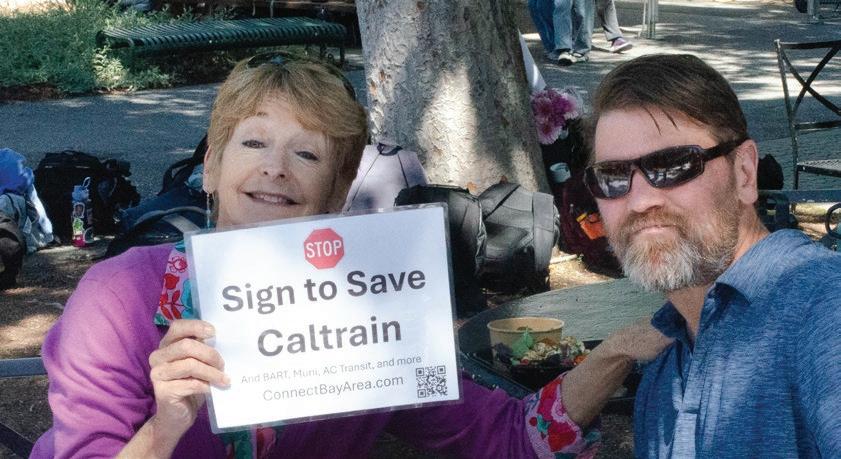
Throughout the week, Green Team emphasized accessible ways to engage with sustainability, from hosting a booth with green smoothies to inviting students and staff to write to local representatives.
“It’s a cool way to get people excited about sustainability,”
Green Team President Kristiyan Kurtev (11) said. “Change happens when people hold conversations.”
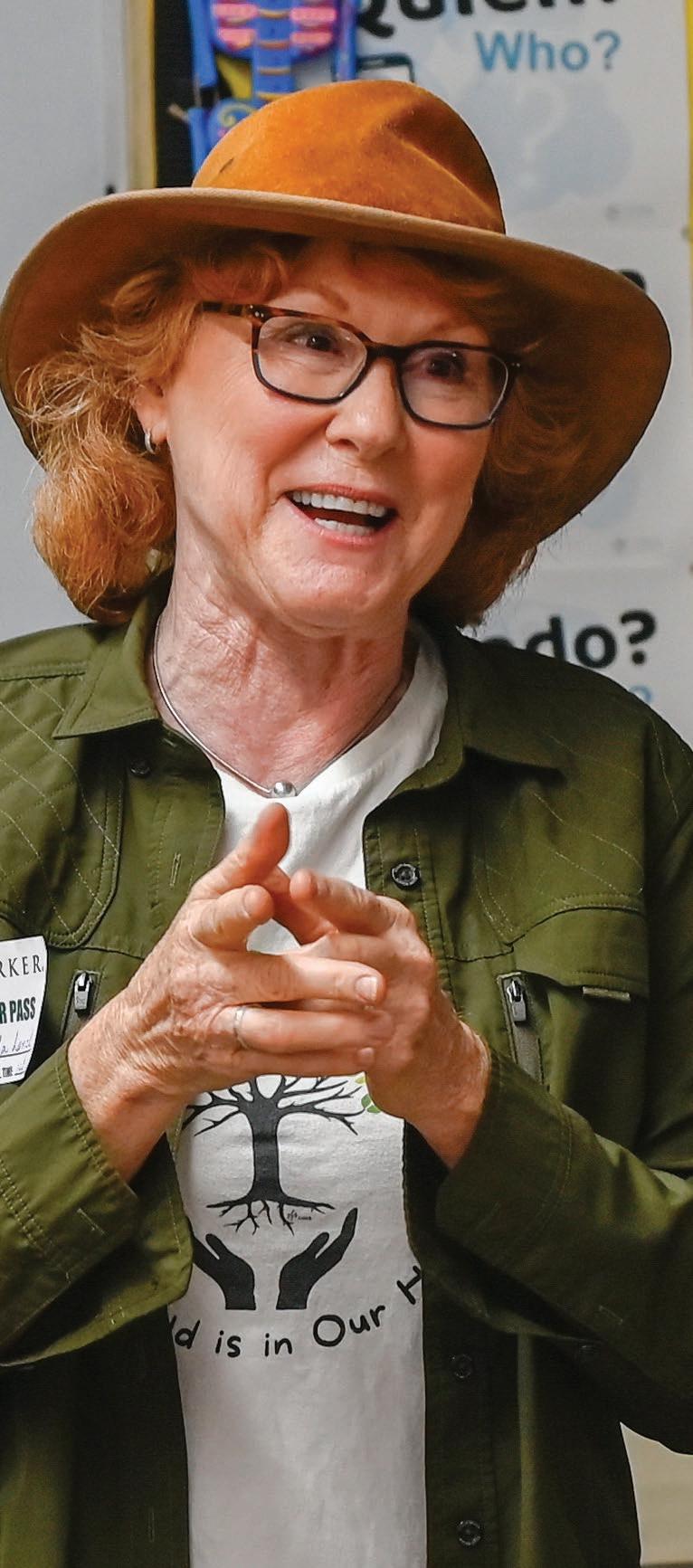
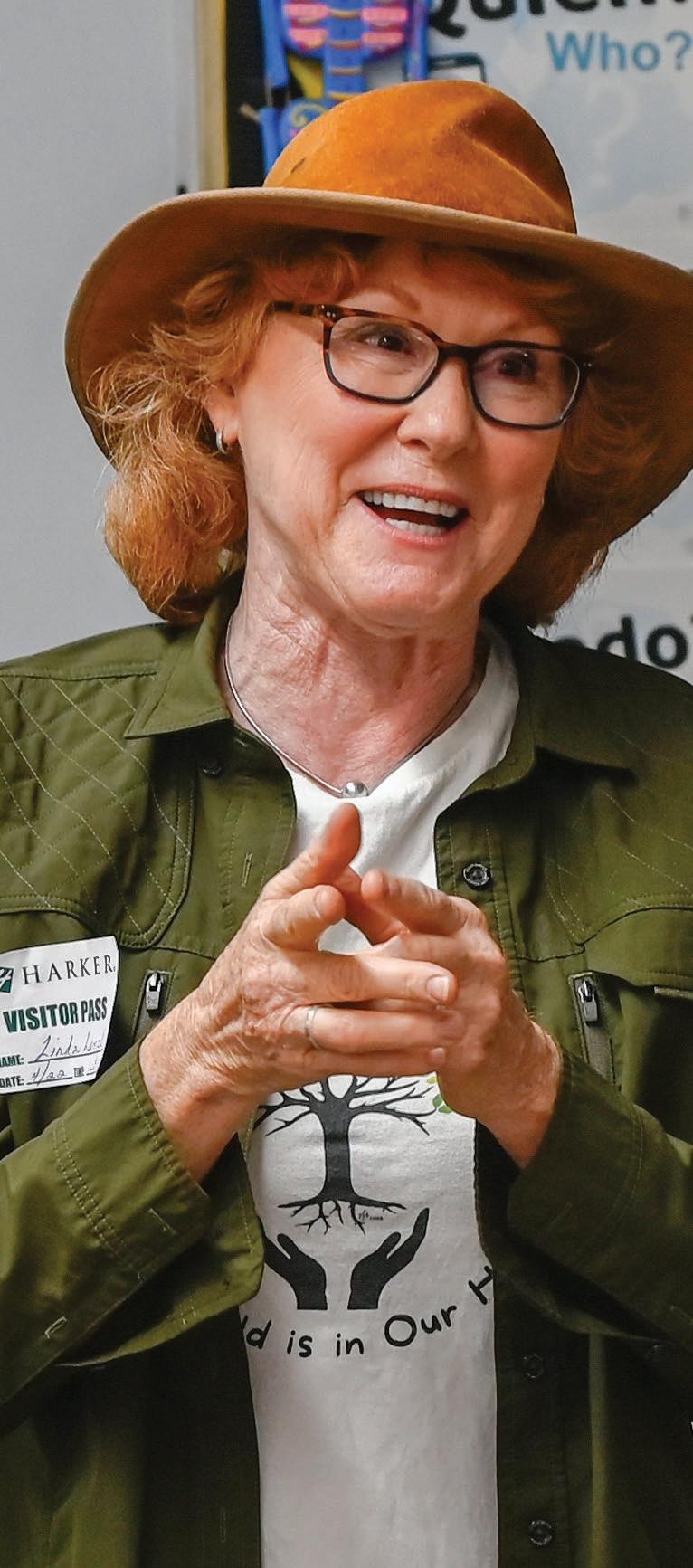
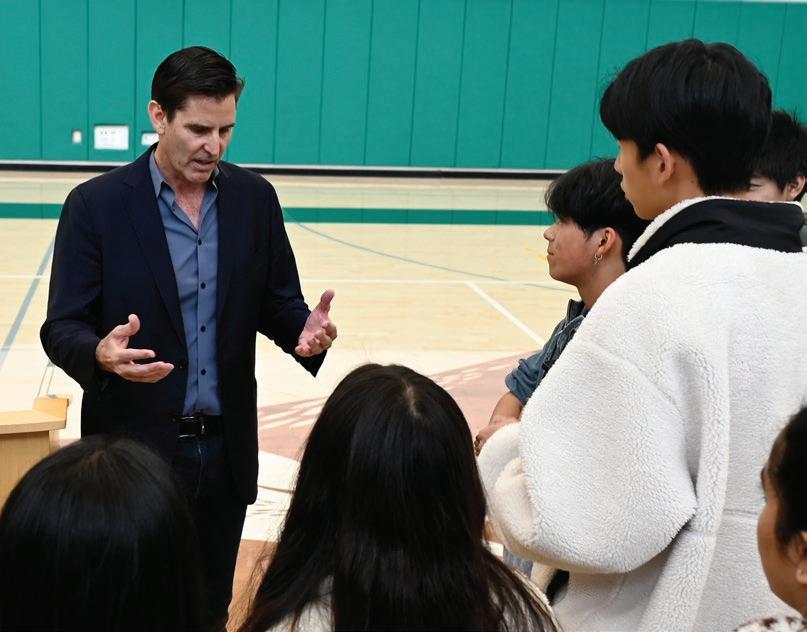
Guest speakers further highlighted the urgency of the climate crisis. Wildlife conservation advocate Linda Lanzl shared her experience touring Africa and encouraged student involvement in environmental activism. Stanford professor Mark Jacobson spoke on renewable energy adoption, citing progress in multiple countries and U.S. states.
“High schoolers are going to inherit the earth, and I’m trying

THE SYSTEM (TOP
outlined stategies to transition to
to provide information that they can evaluate independently,” Jacobson said. “I felt good that I had a good audience that was very receptive to this.”
The week concluded with Earthchella featuring
performances and raffles offering baked goods and succulents to winners.
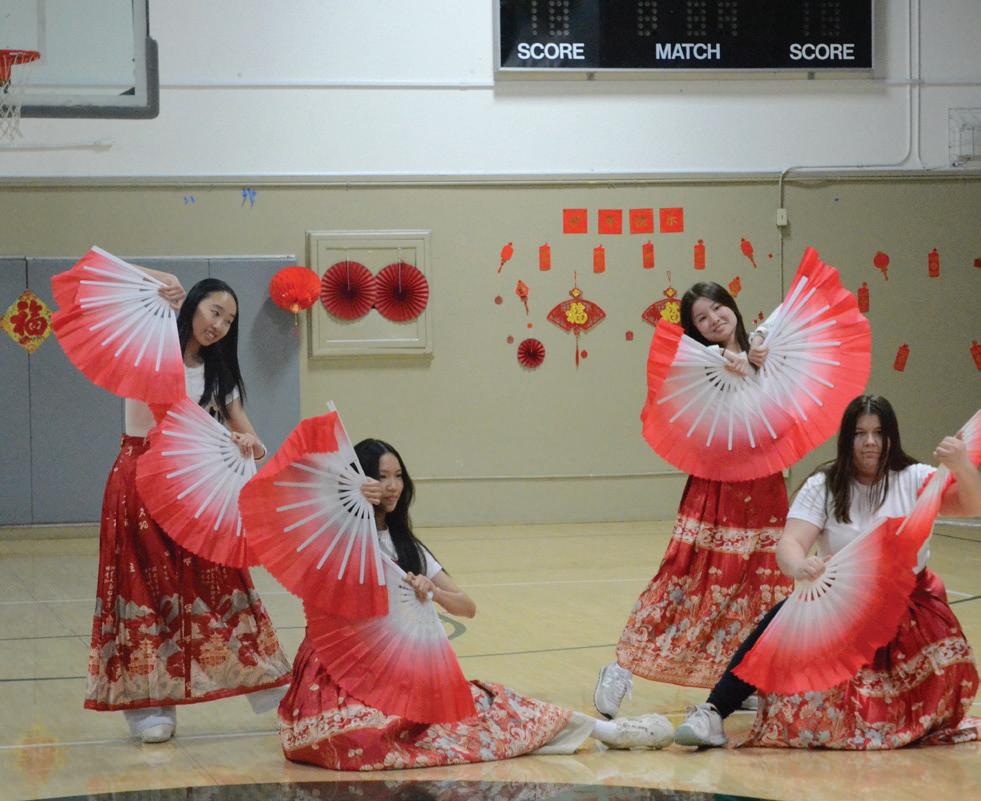
Performances brought the community closer together close the week on a festive and uplifting note.
charlene li & aileen jang
Senior writer at “The Economist” Callum Williams discussed economics and journalism-related ideas as part of Oeconomia’s Econ Week in economics teacher Dean Lizardo’s room on Friday.
He described his role at the publication, writing about topics like the economic impact of artificial intelligence and the housing market, as well as his book “The Classical School,” which explores the history of economics. Having transitioned from pursuing a PhD in history to working in economics, Williams highlighted the reasons that economics drew him in.
“What economics is very good at doing is disciplining your thinking,” Williams said. “With economics, particularly macroeconomics and empirical economics, what you’re fundamentally trying to do is isolate causal variables. It forces you to discard all the other things that may seem important when you first look at it but actually are not that important when you dig down, and that requires a lot of mental discipline and intellectual discipline.”
Oeconomia Newsletter Editor sophomore Avi Gupta began by posing prepared questions about Williams’ writing process and career path. Williams explained that he decides on writing material by looking at what investors in major cities like San Francisco and New York are interested in. During his time at “The Economist,” he has covered topics like the 2024 presidential election.
“Equilibrium” co-Editorin-Chief senior Leana Zhou appreciated how Williams translated market indicators into a roadmap for students.
“My favorite part of the session was when he provided insight into what people are looking for in the job market,” Leana said.

Here prom goes again!
Uaahana sharma
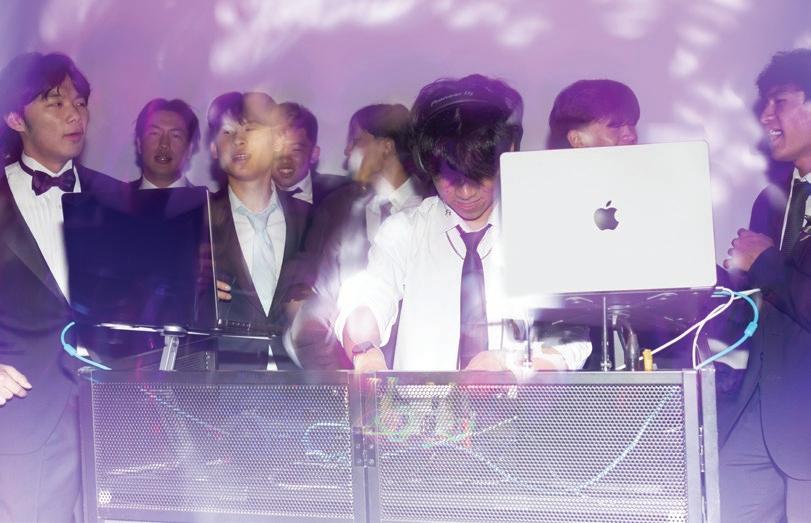
pperclassmen gathered together at this year’s “Mamma Mia!”themed prom for a vibrant night of dancing, games and enjoyment at Blanco Urban Venue in San Jose on April 25.
Inside the venue, three floors offered a variety of activities. The lower level served as the dance floor, complete with a DJ set, disco ball and laser beams to hype up the crowd.
Junior Joyce He reflected on how the atmosphere of prom felt different compared to regular school dances.
“Prom is not at school, and it’s much more fancy,” Joyce said. “I really liked the venue, the colors were really pretty, and everybody looked gorgeous. I looked forward to taking pictures, hanging out with my friends and dancing all night.”
Senior Albert Yao, who recently started experimenting with DJing, manned the DJ set at the start of the night, mixing crowd favorites like “360” by Charli xcx, “like JENNIE” by JENNIE and “Clarity” by Zedd before the main DJ took over.

seniors at their class prom after four years at Harker. You can really see how much it meant to them, how much fun they were having with their friends.”

On the second floor, attendees could grab plushies from a free claw machine, snack on different
treats at the candy bar, or take pictures with friends with the selfie station or photo backdrop decorated with flowers and #HarkerProm. Students could also enter a small indoor balcony in groups of five to take birdseye view photos of the dance floor.
As students arrived, faculty gave them tickets for the photo booth and fake $200 bills, which they could use for gamblingstyle games like roulette and poker on the third floor.
Senior class dean Meredith Cranston helped with tasks like check-in and general supervision alongside junior class dean Brian Larsen. She highlighted the significance of the dance to the graduating class and looked back on the seniors’ time at Harker.
“It’s always neat to see everybody dressed up and coming into prom,” Cranston said. “It was really nice for me as the class dean to see all my
On the third floor, attendees sampled from a buffet of sweet and savory
It was really nice for me to see all my seniors at their class prom after four years at Harker.

finger foods: sushi, macarons, lemon loaves, meatballs and “Mamma Mia!”-themed chocolate strawberries. A drink bar available throughout the evening offered three specialty
mocktails. Senior Chloee Yang noted how the event helped her make meaningful memories with her friends.
“I’m graduating soon, so it was so cool to see so many other people there because I saw some friends I hadn’t talked to in a pretty long time,” Chloee said. “I had dinner with my friends before and went to their house after prom.”
Cranston explained the importance of prom as a meaningful custom for high school students.
“So much of our end-ofyear traditions are a rite of passage,” Cranston said. “When you’re a senior at prom, it’s one of those transitions. It’s one of the celebrations of being a young adult and also one of the points where you’re getting ready to leave our community and it really is not just a party, it’s a moment that marks the end of something and a new beginning in a celebratory way.”
aileen jang & sam li
Twenty-nine journalism students and three staff attended the annual spring Journalism Education Association/National Scholastic Press Association National High School Journalism Convention in Minneapolis from April 16 to 19.
The convention featured various journalism workshops, presentations and speakers as well as the National Journalism Quiz Bowl at the Minneapolis Convention Center from Thursday to Saturday. Harker students attended various presentations, like InDesign tips and covering controversies. Harker journalists presented four workshop sessions to other schools: “67 Ways to Bond,” “Humans of [Your School],” “Celebrate the Silver Lining” and “Rework Your Flow.”
In the closing ceremony, JEA/NSPA board members presented awards to publications and students. Harker Aquila won the 2025-26 Pacemaker
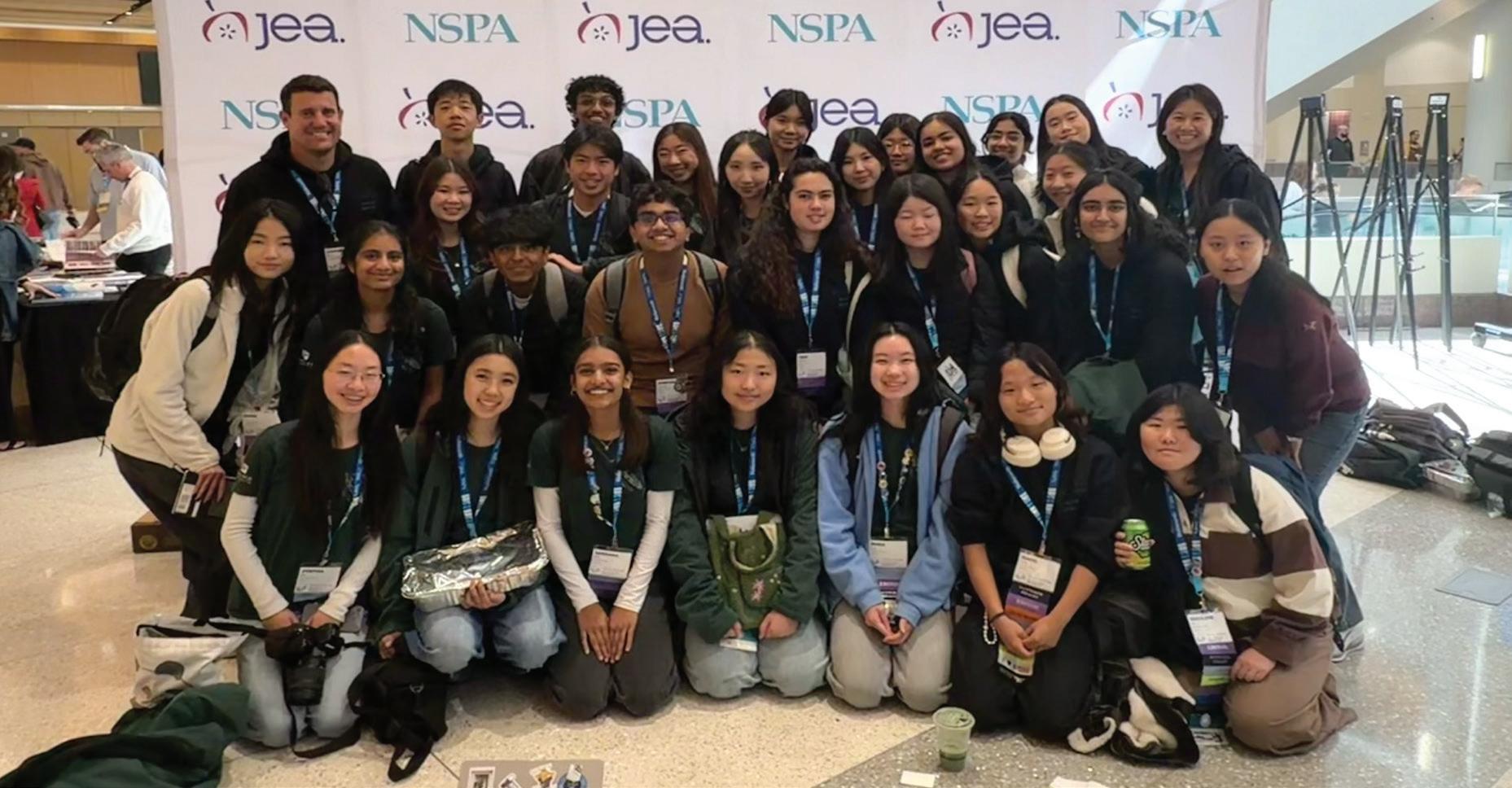
award in the Online category, the most prestigious award in student journalism, for the first time in four years. In the NSPA Best of Show competition, Winged Post placed seventh, while Aquila second in Newspaper and Website, respectively. Talon also won fifth place for Yearbook.
Sixteen Harker editors comprising four teams all advanced to the quarterfinals of the Quiz Bowl which was held on Saturday morning after an online preliminary test on Friday morning.
Visit harkeraquila.com for more.
Moreover, Harker received the First Amendment Press Freedom Award for the fifth consecutive year. Nine journalism students placed in National Student Media Contests (NSMC), a competition where student journalists attending the convention can submit work to receive recognition and professional feedback.
charlene li
Seven student companies competed in the annual Startup World Cup Harker National Youth Qualifier for a share of the $2,500 prize pool and a chance to qualify for the Startup World Cup Grand Finale on April 17.
SchoolAce, founded by Valley Christian High School student Aiden Shankar (9), placed first overall, followed by novel screen time integration Zavion AI and juniors Nicole Dean and Stellan Lindh’s Fika Matcha. The three companies will advance to the Grand Finale in San Francisco on Nov. 6, where they will compete for the 1-million-dollar prize.
Two companies from Harker competed at Startup World Cup, which was hosted in partnership with the Silicon Valley firm Pegasus Tech Ventures. Sophomore Isaac Liu founded his company ForeCast to help golfers more easily secure tee times based on their preferences. Fika showcased its specialty matcha blends and emphasized the drink’s rising popularity, outlining a longterm growth strategy.
“Right before we started pitching, Stellan and I were nervous, but we kept telling ourselves, ‘At the end of the day, what makes Fika so special is our culture and the vibe we bring,’” Nicole said. “We just need to get in the right place where we can bring that energy to the stage and not get too caught up thinking about the perfect thing to say.”
Student founders presented their startups for five minutes to a panel of judges, including Samsung Ventures managing director John Kwon, Khosla Ventures partner Rajesh Swaminathan, Mayfield Fund investor Vijay Reddy and Pear VC partner Ajay Kamat, on the Patil Theater stage.

While the judges deliberated, Mehta scholars Leana Zhou (12) and Tanvi Sivakumar (12) held a fireside chat with Cartesia co-founder Brandon Yang (’14), discussing challenges he faced and mentors he met during his entrepreneurial journey.
“
What’s super important is creating an ecosystem where people can leverage that community.

Over 400 Silicon Valley venture capitalists, angel investors and tech founders attended the Startup World Cup, which was open to the public. Business and Entrepreneurship teacher Michael Acheatel, who helped organize the event, emphasized his hopes that it allowed students and industry professionals to connect.
“One of the main goals, starting with the students, is to give them an opportunity to present what they’ve been working on, to get recognition, to get support from community members,” Acheatel said. “So what’s super important is creating an ecosystem where people can network and leverage that community to do even better things.”
Before the National Youth Qualifier, 10 startups from the Harker Incubator class and other schools held booths in the RPAC lobby and competed in the Quick Pitch Competition. Each company delivered a one-minute speech in front of the audience in Patil Theater, highlighting their current
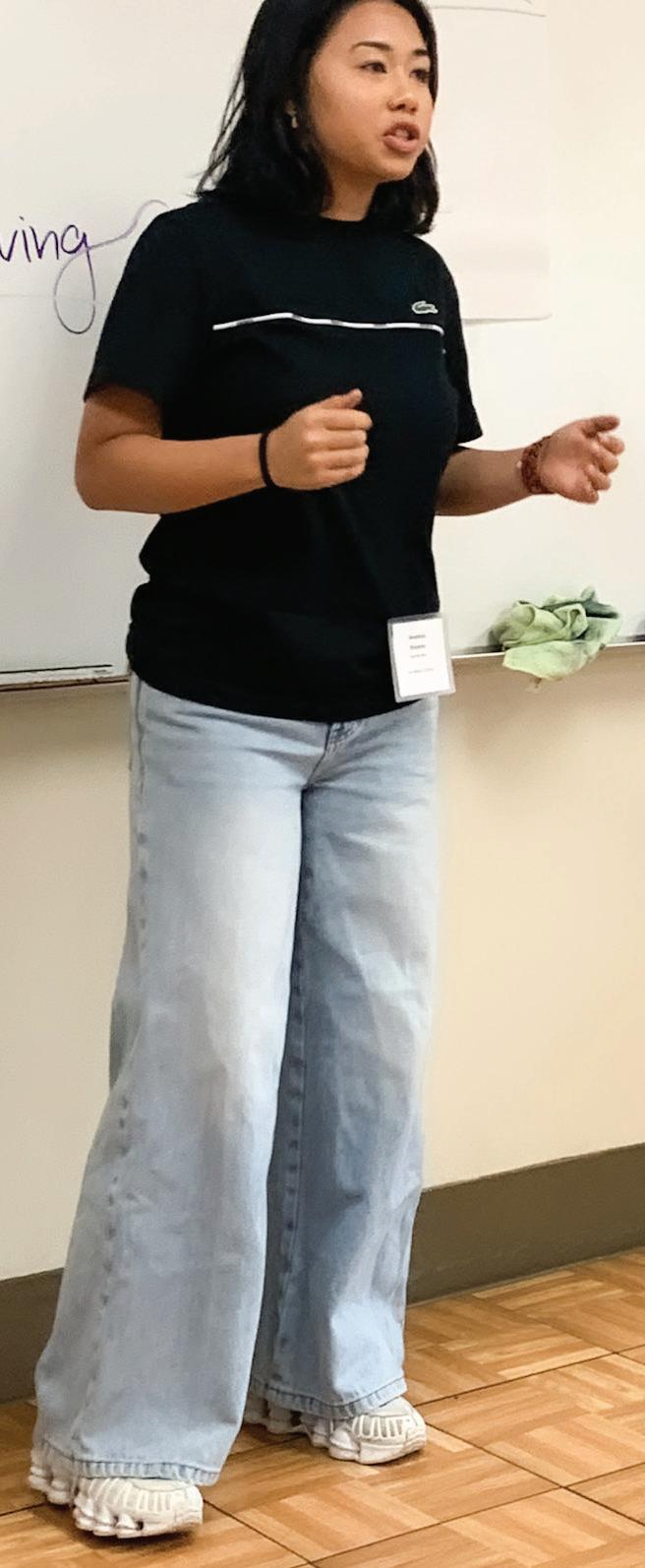


revenue streams and expansion plans. Acheatel invited audience members to vote for the winner before announcing juniors Ian Cheline and Mason Brooks’ ClothnClaw as the top team.

For attendee Colin Campbell (9), Startup World Cup served as an inspiration for him to pursue his business goals.
“I learned that anybody can be a leader,” Colin said. “It’s
much more obtainable. I feel inspired that it’s not that hard to make a company because average kids like me made a company and presented it in front of tons of investors.”
Over 100 students and faculty from 24 schools attended Harker’s annual Student Diversity Leadership Gathering (SDLG) on April 18 at the Upper School. Centered around the theme “From Connection To Change,”
the gathering was a chance for communities across the Bay Area to make friendships, hold thoughtful conversations and share ideas about how to make the world more inclusive.
Participants attended a keynote message, which began with a performance by twin brothers Elijah and Eliah Goss, two motivational storytellers
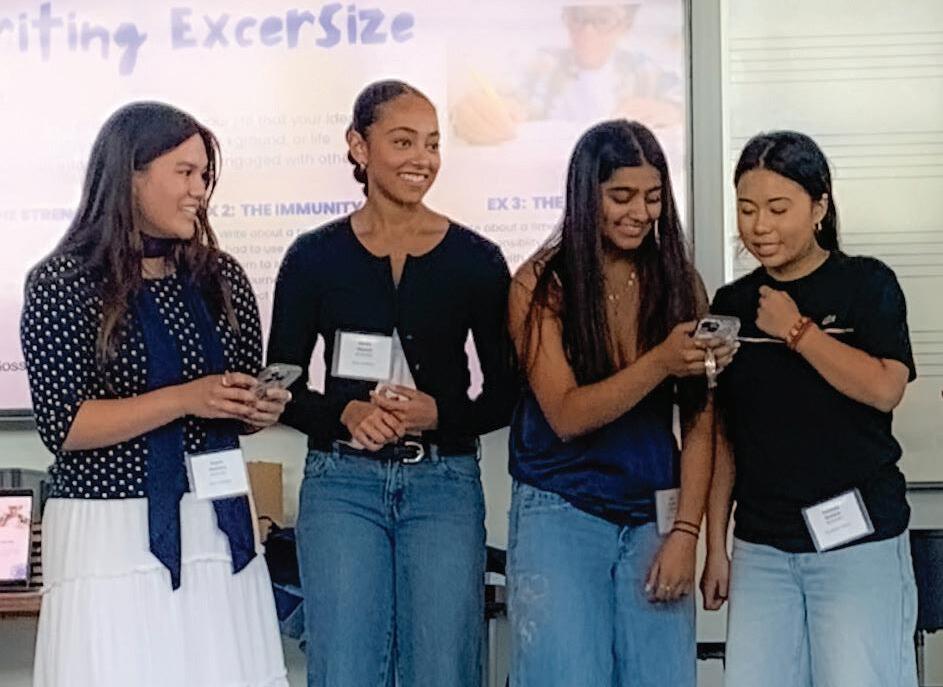
known for their messages of retaining hope in spite of challenges. They described a metaphor of two farmers, one with ample support, and another with limited resources, who was still able to succeed. With that comparison, the Goss twins illustrated the importance of leveraging the legacy and resources of previous generations to success.
After their performance, keynote speaker Walter Greason, founding scholar and historian of the concept of Afrofuturist design, discussed the importance of persistence during distressing times.
“Tap into your courage, whatever its sources,” Dr. Greason said. “We have never needed it as much before. The challenges we face are absolutely monstrous and terrifying. But I guarantee that you are stronger, smarter, better than whatever adversity we might face.”
Junior Anna Lee, a conference attendee from Sacred Heart Preparatory,
commented on the impact of the keynote message.
“The Goss Twins’ acting was powerful — their story was important because some people don’t have the same opportunities, so how we can use connection to foster change,” Anna said. “I loved the way Walter Greason delivered everything. It was this display of resilience and strength, and he also talked about how he had to be courageous in the face of immeasurable crises.”
Participants split up by age into breakout rooms for more focused activities.
Upper school students met upstairs in RPAC, where members of the Student Diversity Coalition (SDC) read out different prompts related to gender, sexual orientation and socioeconomic status, and students who identified with those traits stepped into the circle. Following that activity, students discussed in groups what they had in common.
Visit harkeraquila.com for more.

US hosts discussions for Middle East ceasefire
United States officials hosted direct talks between Lebanese and Israeli representatives to discuss the parameters for a ceasefire and lay the groundwork for longer-term negotiations. Lebanon and Israel have remained in a state of conflict for decades, with the Lebanese political party Hezbollah acting as the main armed actor driving the tensions. These talks are intended to stabilize current tensions and prevent further escalation.
Ukraine gains key financial support
Following a period of frozen financial aid and postponed peace talks, Ukraine secured a major resource boost when the European Union approved a $106 billion loan after Hungary lifted its veto on April 23. The funding will support Ukraine’s economy and military for at least the next two years, showing a shift towards long-term war readiness. With Europe expanding its aid to Ukraine, Russia’s war economy becomes increasingly strained.
Pope Leo XIV visits Africa on historic tour
Crowds welcomed Pope Leo XIV to Malabo, Equatorial Guinea, on April 21, marking the first papal visit since Pope John Paul II in 1982. His visit highlighted contrasts in the country, as there exists strong Catholic faith alongside corruption, poverty and inequality. The pope brought global attention to governance issues under Equatorial Guinea president Teodoro Mbasogo and denounced colonization.
Philippine ex-president set to face trial
Judges at the International Criminal Court decided that former Philippine President Rodrigo Duterte will face trial for crimes against humanity for his anti-narcotics campaign. The court cited substantial grounds to believe that his policy led to thousands of unjust killings carried out by police and vigilante groups on suspected drug users. Duterte denied the allegations and will await trial following further pre-trial processes.
Morocco opens
Mohammed VI Tower
Morocco opened the $700 million Mohammed VI Tower, one of Africa’s tallest skyscrapers, near the Moroccan capital of Rabat on April 24. The 55-story tower includes a luxury hotel, apartments and offices and is expected to create thousands of new job opportunities. Morocco aims to attain more global economic influence and capitalize on tourism through this project, as the country is the most visited nation in Africa.
charlene li
Six candidates vying for the position of California governor participated in a 90-minute televised live debate on KRON4 on April 22. The candidates consist of four Democrats — former hedge fund manager Tom Steyer, former California congresswoman Katie Porter, former Biden administration health and human services secretary Xavier Becerra and current San Jose mayor Matt Mahan — and two Republicans — Trumpendorsed former Fox News host Steve Hilton and Riverside County sheriff Chad Bianco. Current California governor Gavin Newsom is term-limited and cannot seek reelection.
Candidates shared their stances on several topics regarding previous California policies and pressing issues, including homelessness, housing prices, teen social media usage, insurance companies leaving California and English proficiency tests for truck drivers.


BECERRA CALIFORNIA GOVERNER CANDIDATE
I would focus on accountability. We need to pull folks up, help get them back on their feet. ”
When each candidate was asked to give Newsom a grade for his efforts on combating the
issue, the Republicans both gave him an ‘F,’ while Democratic responses ranged from ‘B-’ to ‘A.’ Mahan initially declined to answer before settling on ‘D’ for all politicians in the implementation of plans. They proposed various solutions, with Porter emphasizing homelessness prevention and Mahan using homelessness shelters in San Jose as a model for what could be implemented statewide.
Californian housing prices have jumped dozens of percentage points in the past five years and are now more than double the average U.S. home price. Mahan again portrayed San Jose as the blueprint for building new housing, though Hilton immediately countered that the city was recently named the city with the least affordable housing in the world. Republican candidates
and Steyer characterized the regulations necessary for building houses as excessive.
Teen social media use
A California jury found tech giants Meta and Google responsible for causing mental health issues in social media users and ordered them to pay for compensatory damages earlier this year.
Hilton took the strongest stance on the issue, stating that it should become a norm for teens under 16 not to have smartphones in the first place. Steyer and Becerra declared that they would support a ban on social media for those under 16.
Due to recent wildfires and increased costs, major insurance companies like Allstate and State Farm have stopped offering new insurance policies for homeowners in California.
li & aileen jang
Recent international and domestic events like the Hungarian parliamentary election and U.S. President Donald Trump’s attacks on the Pope demonstrated the limits of Trump’s influence and foreshadow potential shifts in the political landscape, especially with U.S. midterms approaching on Nov. 3.
Former Hungarian Prime Minister Viktor Orban lost the election to opposition party Tisza’s leader Peter
Magyar earlier this month. Trump had supported Magyar’s campaign, and U.S. Vice President J.D. Vance attended a rally. Additionally, Orban’s Fidesz party won only 52 seats in the Hungarian Parliament, compared to Tisza’s 141.
Government and Civics teacher Carol Green explained that the U.S. endorsement of Orban mirrors the country’s precedents. Trump himself has endorsed foreign leaders like Argentinian President Javier Milei and Japanese Prime Minister
and
believed California needs to reduce wildfire risk.
U.S. President Donald Trump signed Executive Order 14286 in 2025, implementing roadside English proficiency tests to ensure truck drivers can communicate with officials and understand signs.
Becerra stated that officers should not discriminate against truck drivers based on appearance, while Bianco pushed back against the idea of racial profiling.
Mahan stressed that the Department of Motor Vehicles should enforce its regulations for issuing driver’s licenses. The top two candidates from the primaries will advance to the gubernatorial election on Nov. 3.
Sanae Takaichi in the past, who share similar political beliefs.
“In the United States, we don’t allow foreign campaign money, and we don’t allow foreign campaigning,” Green said. “That said, the United States has an extended history of supporting regime change and supporting different officials in different countries when it comes to elections. So it’s not unusual for an administration to try to put support behind a candidate to try to get favorable relations with another country.”

Orban’s ideologies strongly reflected Trump’s, specifically regarding immigration and Christian nationalism. U.S. influence since Trump came to power has made right-wing politics less popular, even though economic and immigration issues have given the right a boost globally.
Trump also recently criticized Pope Leo XIV, the first American head of the Catholic Church, for taking a
weak stance on crime and in foreign policy. Exacerbating the tension between them, Trump AI-generated and posted an image of himself as Jesus on Truth Social, though he later removed the post following public backlash and declared that he thought it portrayed him as a doctor.
Trump’s concessions or withdrawals in response to political backlash highlights increasing opposition to his rhetoric.
With hopes of flipping the House of Representatives in their favor during the midterm elections later this year, Democrats claim that Orban’s loss could foreshadow Republican defeats in the fall. Nevertheless, history teacher James Tate explains that it is difficult to draw concrete conclusions.
“I wouldn’t feel comfortable pronouncing that Hungary tells us a Democrat win for the U.S.,” Tate said. “Even local results in the United States or state by state results are not necessarily indicative of trends because we get our news cycle so fast. What’s on everyone’s mind today could be very different tomorrow.”

AMBER WANG SECRETARY
FUN FACT Born in the middle of a snowstorm
“As secretary, I’m really looking forward to prioritizing student input more, especially through adding new features to the ASB website. I’ve already thought of a few things that could be sent out as polls or surveys for students to vote on.
chelsea xie & dyuthi vallamsetty
The elections for 2026-27 Associated Student Body (ASB) concluded a few weeks ago. The newly-elected leadership team will serve from August 2026 through April 2027.

AVI GUPTA TREASURER
OBJECT TO BRING TO A DESERTED ISLAND A camera
I want to have better budget transparency, in terms of better explaining how we’re allocating funds and resources, by making sure that the student body knows where our money is going and why.
With an 89.94% voter turnout, juniors, sophomores and frosh cast their votes through an online voting form on OpaVote, which opened during advisory and closed at 3:30 p.m.

SOPHIA ZHU PRESIDENT
FUN FACT Created Class of 2027’s mascot
“I hope that my legacy is less about the title I held and more about how I made people feel. To me, leadership isn’t about standing above a certain community or a school, but about being able to magnify the voices of people within it.
The candidates participated in a panel-style town hall on April 10, where they answered various questions about their leadership experience and plans for the upcoming school year.

NICOLE DEAN VICE PRESIDENT
FAVORITE BOOK Atomic Habits by James Clear
“I want to take on suggestions directly, so if a committee doesn’t have the bandwidth to write a proposal, I will do that. I also want to give underclassmen an orientation about how student government operates.
”The results concluded one month of campaigning, during which candidates answered written questions and posted flyers around campus. The newly elected ASB will begin

SPIRIT COORDINATOR
FUN FACT Has never missed a dress up day since freshman year
“
I want to get rid of all the worries about spirit, so that there’s no confusion about why certain points were scored or any thoughts that judges are biased. I want to improve the rules around spirit so that people can just participate and have fun.
their positions in August of the 2026-27 school year by planning matriculation, first week of school events and deciding on fall spirit themes.
Visit harkeraquila.com for more.
sam li & aileen jang
Amidst rigorous classes, extracurricular activities and packed schedules, members of the Harker community have found that side hustles offer a middle ground between work and personal interests. Maintaining a business or job on the side can provide them a space where creativity and commerce meet, without the sacrifices of things they enjoy.
Junior Audrey Hu runs a press-on nail business through her instagram account “@ahuu. jpg.” She began getting into nail art during the summer after sophomore year before starting a social media account in junior year.
She was initially drawn to nail art as an outlet for her creativity, as she can create nails with intricate and detailed designs.
“I first got into it by seeing a lot of nail art online,” Audrey said. “One thing about me is I always draw very small, even
with traditional art, so it was really fun to translate that to a nail art business. It’s something more unique, and you also get to experiment with different mediums.”
Audrey’s nails operate at a much higher quality than traditional store-bought varieties. Her sets typically retail between $60 and $70, with each featuring their own unique charms and themes. For her, starting a formal business was a way to carve out dedicated time for her hobby without letting it bleed into the rest of her schedule, alongside the extra benefit of the extra income.
“Part of why I wanted to start a social media account and a business is because I could have separate time for this hobby without feeling like it’s like digging too much into my time,” Audrey said. “With the Miller I usually like to reserve half of my day on Saturday to work on this. That helps me maintain a good work-life balance between school and my business, but also
have time to enjoy this hobby.”
History teacher Mark Janda picked up Uber driving last summer, looking for a way to spend his past-time after his two kids left for college. Although he only Uber drives during the summer, the side-hustle has introduced him to a diverse range of passengers around the world.
“I’ve met world-class water polo and track coaches,” Janda said. “I’ve met a man who tried out for the 1984 Olympic gymnastics team. All of these people have such interesting lives because they’ve been all over the world. That’s fun because then you’re also forming relationships, and for me in Santa Cruz, it’s getting to know my community even more.”
For Junior Stellan Lindh, turning his creativity into a form of commerce came earlier. Stellan founded his clothing company Ablien the summer after freshman year, inspired by a word he used to say to his sister when they were younger.
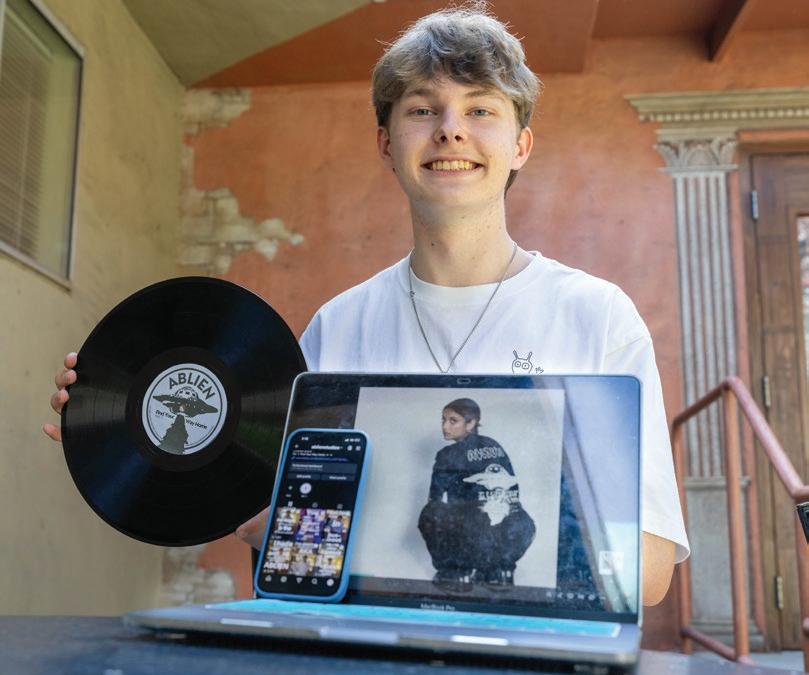
After he made a bag featuring the word in middle school, his mother suggested he turn the idea into something bigger.
The brand’s aesthetic is monochromatic and graphicheavy, with designs inspired by
Stellan’s personal experiences and emotions. He deliberately pushed for a look that would stand apart from what he saw as traditional graphic tees in the market.
Visit harkeraquila.com for more.

After 30 years of teaching at the upper school, Spanish teacher and Green Team Adviser Diana Moss is retiring. From her cheerful greetings in the hallway to her tireless passion for sustainability, Moss has left her indelible mark on the community.
Her journey to the classroom was far from linear. Moss didn’t always know she wanted to be a teacher. After graduating from college, she worked for a stock brokerage firm, only to realize that her passion lay in people and cultures. Inspired by her experience traveling to Spain and majoring in Spanish literature, Moss moved to San Jose and earned her teaching credentials at San Jose University.
As a class dean in 2015, Moss participated in preparations for various classwide activities. It was at that time she first became alarmed by the waste generated by school events such as spirit week. Motivated to find a solution, she began regularly attending the Green Team meetings and eventually stepped
down from serving as class dean to become the adviser to the club. Moss aimed to make the issue of climate change a more accessible and actionable topic of conversation for students.
“Especially with the youth, it can be intimidating to talk about climate because it’s such a downer,” Moss said. “It’s hard for young people to feel comfortable saying, ‘Hey, I’m really concerned about climate and let’s talk about it and how do you feel about it?’ Overcoming that potentially difficult topic to discuss is one thing that makes talking about climate hard.”

Moss’s impact as Green Team’s adviser has been undeniably widespread. Under her leadership, students advocated for clean energy and wrote proposals to reduce plastic waste. Moss also created connections between her work
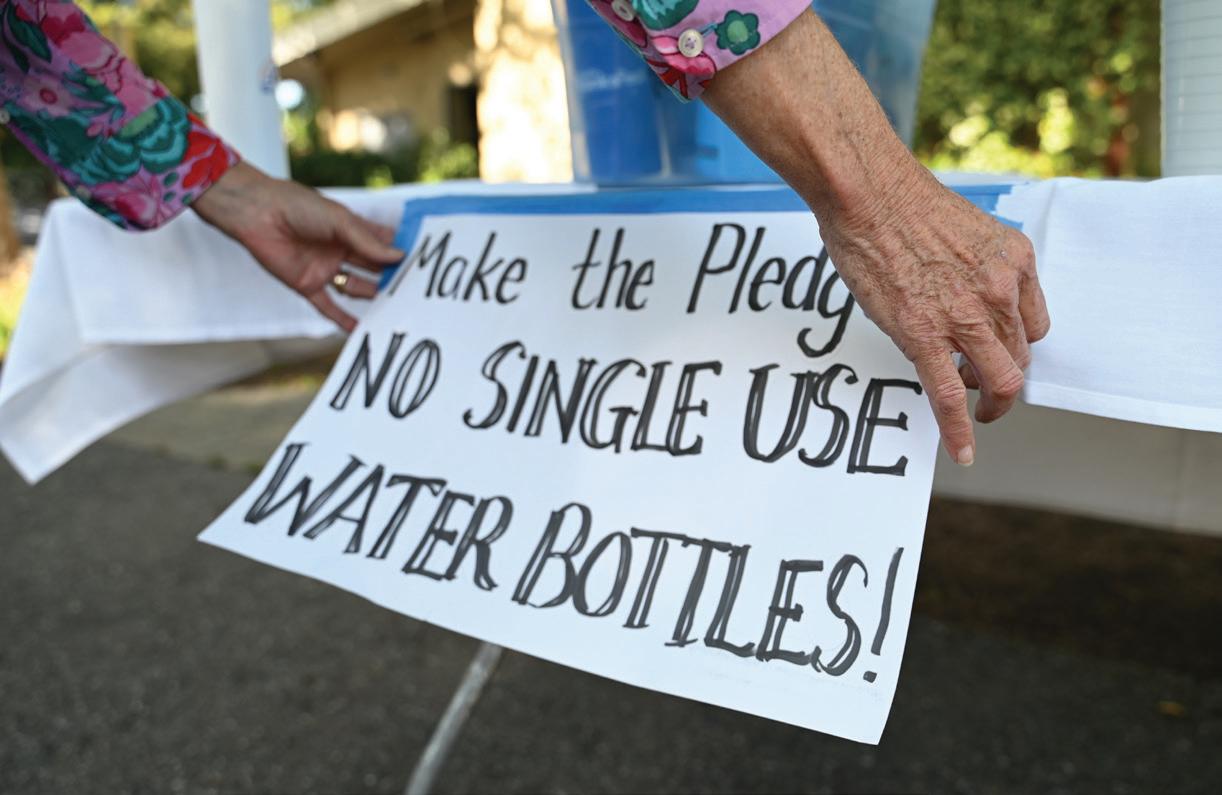
at Harker and her broader activism. Aside from her advisory role in Harker, she volunteers with climate organisations like Citizens Climate Lobby and travels to Washington D.C. to lobby for climate legislation.
“There’s always interesting people to talk to and to bring more information about the climate crisis,” Moss said. “I wish we did more and talked about it more because I really believe it is the biggest issue of your lifetimes, and we have solutions. We know what we need to do, we just need to have the political will to do it.”
Overcoming obstacles has always been a part of Moss’s journey. One of the challenges she encountered was getting broad participation for sustainability from Harker
students due to their packed schedules. And yet, she has
“
Learning the language is a process that takes a lot of time and work and energy. If you’re in a foreign language class and you say something that might not be right, we make it an enjoyable part of the learning process.

DIANA MOSS
SPANISH TEACHER AND GREEN TEAM ADVISER
remained undeterred, always looking for new ways to encourage students to engage in
difficult conversations around climate change.
Looking back, Moss recognizes the decades of growth she has experienced at Harker, as well as the connections she has made with her students through both teaching Spanish and climate efforts. She encourages current students to continue to better the world that they live in.
“Probably the most important thing that I can do is to help raise awareness amongst youth because [students] are the ones that sadly are going to inherit this mess,” Moss said. “It’s important for us, the people who helped take the planet to the place it is now, to really lean in and make a difference about this issue.”
Visit harkeraquila.com for more
Hands sweating and heart racing, students prepare to reveal their new classes for the school year, most importantly, their classmates. They scan their new class lists on Schoology, wondering whether their friends might join them. More often than not, the first day includes meeting unfamiliar classmates who gradually bond over the school year.
Compared to core classes like math or English, where more class periods and teachers are available, students in language classes are usually grouped into a few available periods from middle to high school.
Junior Eva Liu took Japanese starting from sixth grade, moving from introduction levels to the AP course. She explained how this consistency for language classes allowed her to naturally bond with her classmates.
“Having classes together is forced proximity,” Eva said. “You see these people every other day in high school, so you have no other choice except to become friends with them. Because I’ve been in this same course for so many years, I just started getting closer with the people in my class.”
Many language students choose to continue studying a language past the AP level through additional elective courses. Junior Ameera Ramzan, who took Latin up to the postAP course, appreciated the benefits of being surrounded by like-minded students who shared their interest in the language.
“Everyone chooses Latin because they love it, so you already have that camaraderie,” Ameera said. “Having that sense of community for so long and then having everyone in that community also be invested in the class just makes it so much more fun.”
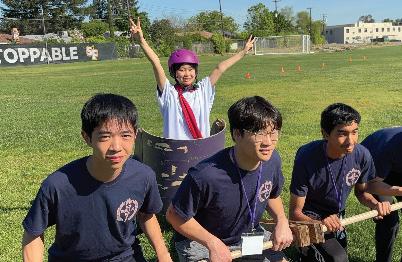
French teacher Galina Tchourilova observes changes in her students as they grow closer together each year. She noted how students become more willing to talk with each other, which also helped them to immerse themselves in the topics and ideas of the class.
“Language teachers are fortunate in this respect, because we see the same students year after year,” Tchourilova said.
“We see their progress, and very often this group of students sticks together and really bonds well. It gives me great pleasure to see them blossoming, , and in the end the students really show their personal interest in the class too.” Ameera emphasized how bonding with others can change their whole perspective on subjects and courses, transforming a regular class into
a small, united community.
“As Harker students and high schoolers, our lives revolve around school, so it’s really important to have a tightknit class,” Ameera said. “My favorite classes have always been the ones where we have this good vibe going. Everyone’s getting along, and you’re having a fun time learning.”
Visit harkeraquila.com for more
WU
earrings, since she does not have pierced ears.
“I thought it was difficult to find specific styles of jewelry online, and I was like, ‘Why don’t I just start making my own?’” Helen said. “I like to make my jewelry themed, so I’ll have these matching pieces or I’ll have specific pieces inspired
“
of chain into sections for the bracelet and finger loop, connecting them with jump rings. She then adds a clasp for wearability and often includes a centerpiece charm by threading a bead onto wire, looping the ends and attaching it between the chains.
SYou get to express yourself in something that you can wear often.
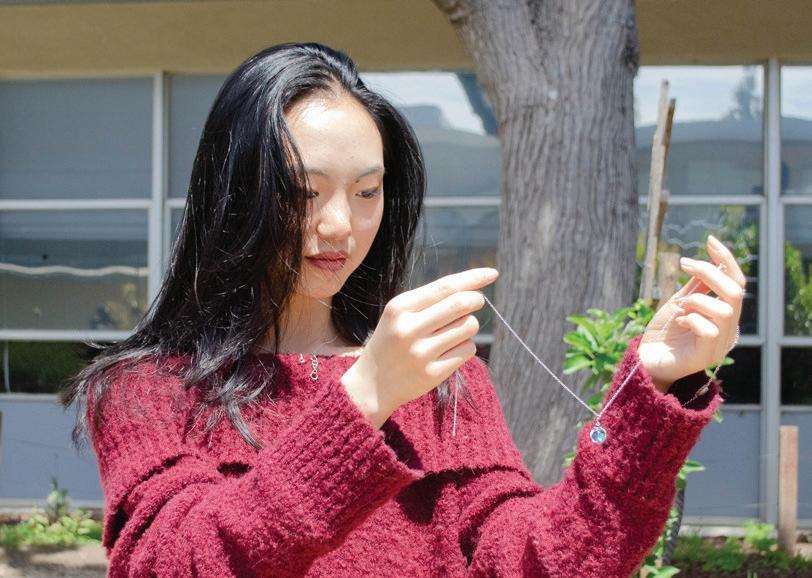
ARTISTIC ACCESSORIES (ABOVE) Wanruo Wang (10) holds and admires her handmade necklace. CREATIVE KEYCHAINS (RIGHT) Assorted keychains with beads, charms and wires. SWEET STRAWBERRY (BELOW) A strawberry heart necklace that Helen Gu (12) created.
&
trawberry charm necklaces litter the desk. Assorted beads glint from individual plastic compartments. Sophomore Wanruo Wang reaches for a pair of pliers and fixes a small blue marble into a steel clasp, looking at her completed work in pride.
The act of taking simple materials like wire and charms and transforming them is a reward for this underrated art form. Wanruo first began making jewelry after she broke one of her necklaces and tried to repair it using pliers and wire cutters. Inspired by Pinterest boards, streetwear fashion and online jewelry shops, she began

recreating looks with tools at home.
“The part of this art that I like the most is its functionality, because it’s cool to be able to use pieces that you made in your daily life,” Wanruo said. “I really like that about jewelry, because it’s functional, but also an art piece. I mainly look at the structure of the jewelry piece that I want to make and then figure it out from there.”
Senior Helen Gu focuses more on hair accessories and earrings in her jewelry, typically using beads and charms to complete her works. She creates clip-on

HELEN GU SENIOR
”
by certain things. I have this one set that I made with bunnies that is my favorite.”

Wanruo also focuses on a specific style. She primarily features silver chains and statement pendants. Her favorite pieces to make are hand chains, which are bracelets connected to a finger loop by a chain. As an officer of the Art Club, she previously hosted a meeting teaching members how to create similar crafts.
To make a hand chain, she starts by cutting a single piece
The most rewarding aspect of jewelry-making for Helen is the ability to turn an idea into something tangible. She encourages others to try handmade jewelry as both a creative outlet and a practical form of selfexpression.
“My favorite part is being able to envision something, putting something together and then having a final art piece,” Helen said. “You get to express yourself in something that you can wear often, so it’s very fun that way. It’s a really relaxing and rewarding process.”


Handmade jewelry can also connect people through personalized gift-giving. Sophomore Finn Westgate started handmaking jewelry the summer before ninth grade after watching videos about it online. He also uses a pair of pliers to create his personal vision, focusing on grunge styles in his designs.
“I like making stuff for my friends,” Finn said. “A lot of my friends have Pinterest, so I’ll search their Pinterest

boards and see what they like and see if I can make it. Everyone has their own style, and everyone can express themselves differently.”
Although many popular styles of jewelry can be purchased in stores, the appeal of hand-crafting a work of art lies in the ability to create something entirely unique and to be able to personalize it to your preference. Through the craft of handmaking jewelry, Harker students transform simple materials like wire, chains and beads into wearable pieces of self-expression. Visit harkeraquila.com for more.
Surrounded by steam-filled bamboo baskets, porcelain tea sets and the rich aroma of roasted duck, Han Chen, the owner of Imperial Treasure, moves through his dining room with practiced ease. Whether checking crispness of a Peking duck skin or greeting a regular at the door, this ritual marks the decades he has spent sharing fresh traditional Chinese flavors with his local community.
Chen’s introduction to the restaurant world came as a necessity rather than a lifelong passion. When he reached college, his parents encouraged him to find work to support his education. Chen decided that a server job at a restaurant would be easiest to manage.
“When I first started, I was just looking for a way to pay the bills,” Chen said. “But the more I worked, the more I realized I had a passion for the energy of it. I loved the challenge of making everything run smoothly.”
From 2015 to 2019, Chen studied the restaurant business from a service and culinary angle. He worked through various positions, from waiter to manager, familiarizing himself with the local network
of established owners. While working in established kitchens, Chen realized he wanted to move beyond executing others’ menus and bridge the cultural gap in the local dining scene.
“ I wanted to create a space where I held the reins on quality and creativity.

HAN CHEN RESTAURANT OWNER ” GRACE
“I saw so many places sticking to rigid traditions or leaning too hard into fast food,” Chen said. “I wanted to create a space where I held the reins on quality and creativity. My vision was a menu that felt familiar to American palates but used authentic, high-heat wok techniques and dishes that felt like a home-cooked bridge between two cultures.”
From 2015 to 2019, Chen studied the restaurant business from a service and culinary angle. He worked through various positions, familiarizing
himself with the local network of established owners. By observing their successes and learning from their mistakes, he gained the confidence to start his own venture.
By the time he opened Imperial Treasure’s doors in 2019, he had refined his vision for an American-Asian cuisine that had people coming back for more.
“My vision was a menu that felt familiar to American palates but used authentic, high-heat wok techniques and dishes that felt like a home-cooked bridge between two cultures.” Chen said.
The menu reflects that balance, pairing dishes like spring rolls and orange chicken with more traditional offerings, alongside a range of meat and vegetarian options. The variety attracts both those looking for authenticity to those trying Chinese cuisine for the first time.
However, just as he opened in late 2019, COVID-19 hit. Suddenly, the ChineseAmerican fusion dine-in experience he had carefully crafted was gone, and he had to pivot entirely to take-out. Despite the shift, the business thrived in a unique situation that allowed Chen to grow.
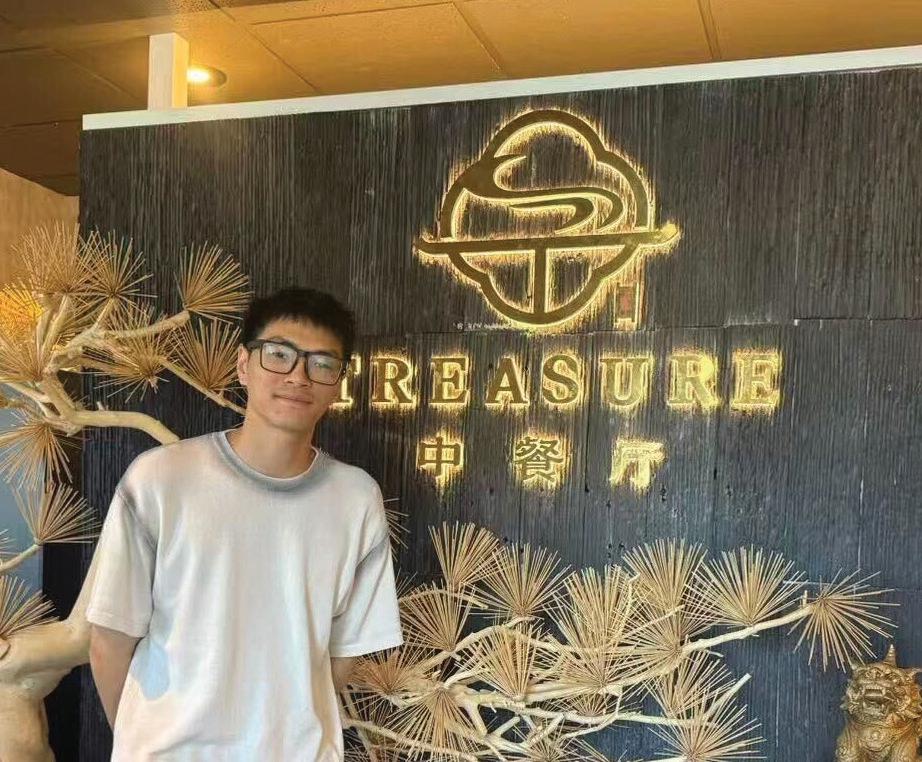
“The pandemic taught me that the most vital element is the honesty of the ingredients.”
Chen said. “Sometimes, that means focusing on the flavor on the plate rather than overpackaging the brand.”
Now, a typical day for Chen involves constant movement between his locations, a grueling circuit that often includes the 120mile stretch between Palo Alto and Sacramento. This isn’t just a commute; it’s a commitment that adds four to five hours of
driving to his already packed schedule. He checks the work at every restaurant, observes staff performance and holds meetings to discuss expectations.
“When you think about it as a dream you’re lucky to have, the long hours and the staff meetings don’t feel like a drag,” Chen said. “I’ve seen people want to do this and stop. I realized that could have been me, so I’m lucky to be here, checking my tables every day.” the modern world.”
Visit harkeraquila.com for more.
leah krupnik
After listening to the same discography by Noah Kahan since 2022 with only a few deluxe songs added to “Stick Season”, I was eagerly anticipating the release of a new album. The wait proved worthwhile, because “The Great Divide” captures everything I could want on a folk-pop record.
Upon listening to “The Great Divide” after its release, I immediately fell in love with the rich acoustic guitar production which both adds depths to the song and makes it sound like it could be played at a campfire while making smores on a summer roadtrip.
This feeling of a summer trip in the mountains permeates the album, marking a departure from Kahan’s previous album “Stick Season” which describes a dreary, cold late autumn.
The last song on the record, and my personal favorite, “Dan” makes direct reference to camping, though it maintains the bittersweetness and vulnerability of the rest of the album. “Seasonal bugs in a canvas tent/Seasonal friendships,” Kahan sings. “I’m
“The album features a powerful exploration of friendship, loneliness and vulnerability.
with my best friend Dan now/ Camping on the county line/… waiting for the sun to rise.”
The intertwining of emotional depth with descriptions of a mundane small town makes the album feel grounded, giving the listener a glimpse into the individual stories of many people.
The album is emotionally deep and features powerful exploration of friendship, loneliness, and vulnerability.
On “Haircut” Kahan sings “You ain’t a god damn hero/ now cuz you cry on live TV,” referencing an imagined conversation with a home-town acquaintance.
Kahan’s unique and irrepalceable ability to blend poetic songwriting with a simple folk-pop sound keeps me coming back again and again, and “The Great Divide” is a record that I will never stop playing over and over again.
Visit harkeraquila.com for more.
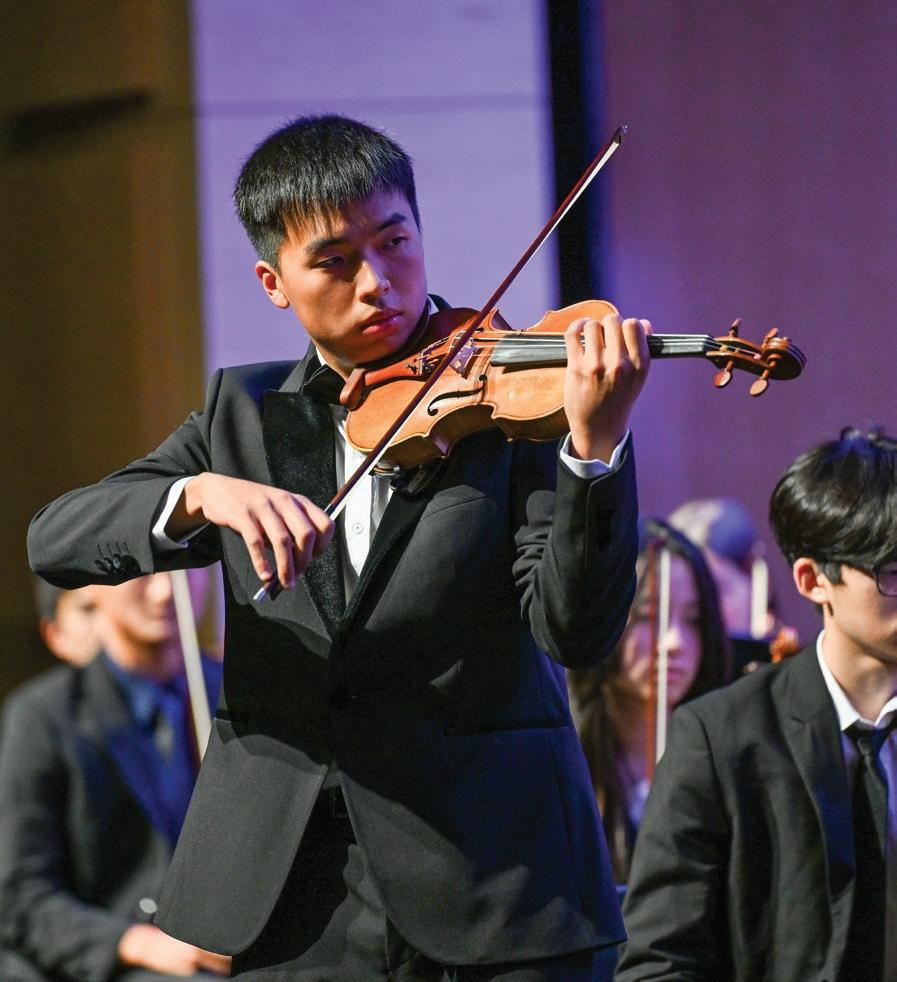
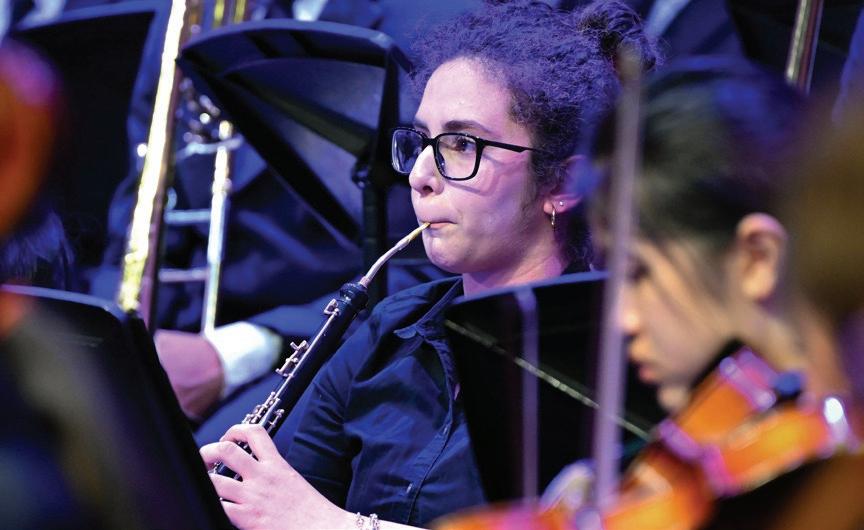
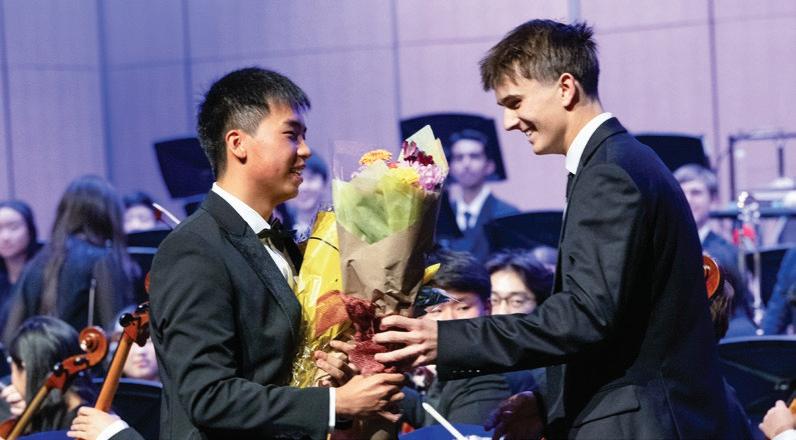
Orchestra members performed in their last concert of the year at the Spring Orchestra Concert on April 23 in the Patil Theater.
The orchestra opened the concert with Bernstein’s “Overture to Candide,” a high-energy piece with prominent brass and percussion interjections. Rachmaninoff’s Symphony No. 2 in E Minor introduced emotional depth, written to celebrate the composer’s overcoming of his deep depression.
Senior concertmaster and violinist George Yang soloed in Tchaikovsky’s “Violin Concerto in D Major” as one of three winners of the Senior Concerto
Competition. All orchestra seniors have the opportunity to choose a concerto and play it for panel of judges, with the winners performing their piece at the
“I’m a little sad because I’ve made so many friends over these years, but I’m looking towards new beginnings as well.

GEORGE YANG CONCERTMASTER
”spring or winter instrumental concert accompanied by the rest of the orchestra.
“I was really nervous at first, but then after rehearsing it a lot with the orchestra, I felt way more comfortable,” George said. “A lot of the pieces we played were the best that we’ve ever played, and I had a lot of fun with my friends.”
In the second half of the concert, many pieces revolved around a theme of celestial objects. Principal violist Keira Chang (12) introduced Missy Mazzoli’s “Sinfonia (for Orbiting Spheres),” discussing how its name referred to the hurdy gurdy, a medieval string instrument with a distinct buzzing sound that the composer aimed to emulate.
The orchestra then played Holst’s “Jupiter, the Bringer of Jollity,” the most famous
movement from the sevenmovement orchestral suite “The Planets.” Holst infused Jupiter’s piece with exuberance and vitality.
Before the last piece, orchestra director Jaco Wong took a moment to honor each of the graduating seniors. Juniors and underclassmen brought them gifts like flowers and signed tote bags. George reflected on the bittersweetness of the performance.
“I’m a little sad because I’ve made so many friends over these four years, but I think I’m looking towards new beginnings as well,” George said. “I’m definitely going to continue the orchestra because this whole process was so inspiring to me.”
Visit harkeraquila.com for more.
ashley mo
The curtain closes and the stage lights dim. For theater, music and dance communities, their last shows of the year are often moments of reflection filled with a mix of emotions, and for seniors, their final moments on the upper school stage.
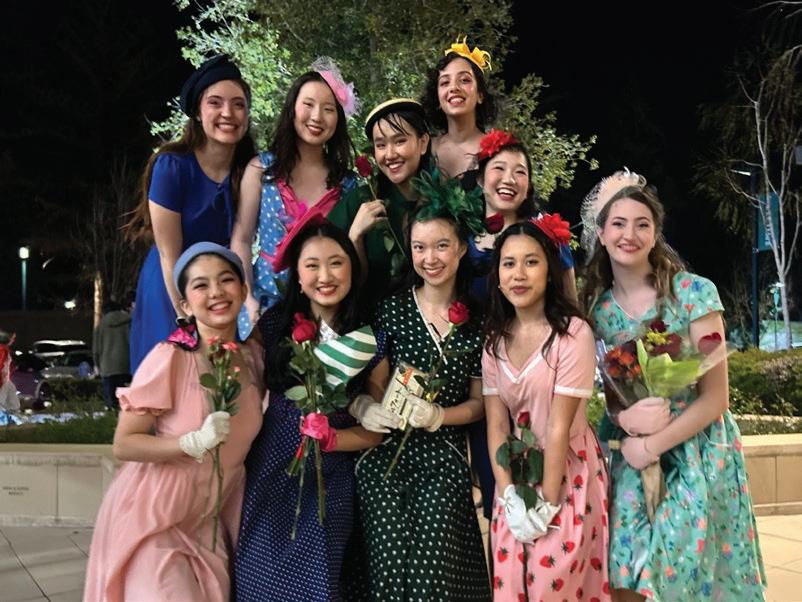
After the conclusion of this year’s spring musical
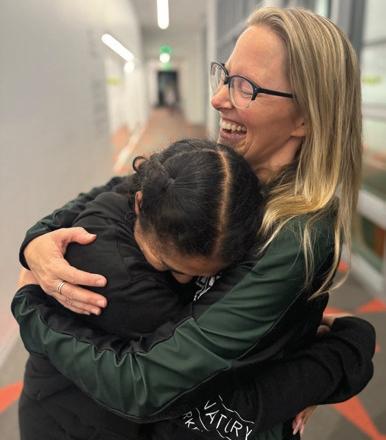
“Something Rotten,” senior Aditya Ramanathan, who played the lead role of Nigel Bottom, found himself reflecting on his four years in performing arts, citing that it has become a defining part of his high school identity.
“The biggest thing I’m going to miss is not the production itself, but the fact that I’ve made so many key memories and my closest friends through this process,” Aditya said. “But especially for us seniors, that was an amazing last show for us to close off at Harker.”
Post-production emotions extend beyond those of seniors. Harker Dance Company member sophomore Wanruo Wang felt both proud and sentimental after her final performance of the year with the Harker dance teams at Just Dance.
“I feel a bit of bittersweetness,” Wanruo said. It’s sad that such an amazing show has come to an end because we all put so much effort into it. It feels strange not having that
anymore, but at the same time, I’m also really happy and proud of what we accomplished.”
Upon embarking on her final trip with the upper school orchestra, principal flute and section leader senior Sophia Bagley acknowledged her role in the broader community of music.
“Seeing the lights on the big stage at Royce Hall made me feel like I was a part of something bigger,” Sophia said. “Being in orchestra these past few years has been so special to me, and giving back to the community as a principal flute leader is so rewarding.”
Visit harkeraquila.com for more.
If you’re not showering at night, you’re basically tucking in your day’s worth of dirt with you. Throughout my entire life, I have always been a night shower person. After hours of sitting through school, playing during sports practice and being outside, I can physically feel the grime on me. Whenever I return from school, I feel unclean, and the last thing I want to do is carry that into a place where I am supposed to be relaxing.
I’ve never understood how people can just go straight to bed after an entire day’s worth of work. My bed is one of the only places that feels mine privately, and the idea of bringing my entire day into it doesn’t sit right with me. A night shower helps end my day, forget about my stresses from homework and have an opportunity to clear my mind before bed.
The purpose of showering at night differs greatly from waking myself up. It’s the one moment of my day where there are no notifications, emails or pressure to respond to anything. I am able to stand in there and let the stress of the entire day wash off, literally.
“I
am able to stand in there and let the stress of the entire day wash off, literally.
Night showers also improve the quality of my sleep by creating a feeling of closure at the end of my day, allowing me to relax fully before I prepare for the upcoming morning. I feel more comfortable when my environment matches how I want to feel, calm and ready to rest.
On the rare occasion that my schedule forces me to shower in the morning, I don’t feel the same. My day starts off with my hair dripping wet, leaving faint wet marks on my shirt —

Morning showers start the day off right
circulation, not to mention washing away the bacteria and sweat produced during sleep, and signaling the body to wake up. For busy students with the need to be immediately ready for classes or morning practices, this cleansing is absolutely necessary. And while wet hair is a nuisance, tell them to consider a hair dryer – the entire world has been using it consistently for over a century.
There’s also the basic question of starting the day clean. Even after sleeping, I don’t wake up refreshed. My hair’s a mess, my face and eyes are dry and I still feel like I just got out of bed. Skipping a morning shower means carrying the feeling of disgust into a significant part
A morning shower forces you to start your day with intention. ”
More than anything, though, morning showers are about routine. A morning shower forces you to start your day with intention. It’s one of the first decisions I make, and it sets a standard for everything that follows. Morning showers serve as an early time block, one more thing to cross off the day’s checklist, even before I set foot in a classroom. When I skip it, my mornings tend to feel rushed and an overall blur, but when I don’t, I am already a mental step ahead, not to mention refreshed, before I even leave the house.
To be fair, night showers aren’t useless. They’re a good way to wind down, and I find myself taking them as a way to clean up, especially after sports. In fact, during the summers, I consistently shower twice a day, once in the morning and once at night. But to answer which one is better, it will always be morning: If I go to school with a bedhead, a dry face and a groggy attitude, I know I’ll regret it.
Talking stage. Situationship. Nonchalant culture. Modern relationships feel like they’ve taken all the romance out of, well … romance.
Dating in high school should be both fun and meaningful, allowing teens to learn about themselves while experiencing more of the world. However, the lack of clarity and initiative in modern dating makes it into a social game rather than a rewarding way to build a close relationship with someone.
In the 1950s, when television was gaining popularity among middle class families, public service announcements geared toward young men who did not yet have dating experience provided clear instructions on how to ask a girl out, what qualities to look for in an ideal partner, how to bid a girl goodnight and more.
Dating has evolved a lot since the ‘50s, especially in moving away from gender
stereotypes that not everyone might want to conform to today. However, there is a striking contrast between societal attitudes toward teen dating then and now, and perhaps we could learn something from dating culture in the past.
For example, it seems that it used to be much more common to ask for a date directly. If you wanted to go out with someone, you just asked them, at least according to old movies, PSAs and stories I’ve heard from my mom. Let’s bring back this clarity. Months-long “what are we?” stages can be easily prevented by one person simply asking the other out.
With prom having just happened, school dances offer an opportunity that seems increasingly rare for high schoolers — taking a date to an event. Many of the ’50s PSAs show teens attending events like carnivals with a date, something that doesn’t seem as common in modern culture. While carnivals may be slightly out of fashion, dating can still provide a great
opportunity to introduce variety into the school-home routine — try a new coffee shop, go on a hike or for a scenic drive, see a new movie or go to a live event.
Of course, asking someone out is not easy. It takes courage, confidence and vulnerability. But it also sends a clear message that sets the tone for the rest of the potential relationship — I care enough about you to put myself out there and make my intentions clear.

Sure, it may be easier to tiptoe around those uncomfortable conversations, but once you’ve set a precedent of poor communication and noncommittal banter, it can be hard to break out of that. Asking someone out is scary because there’s a real chance you will get rejected. However, you should enter the relationship prepared to invest the time, effort and vulnerability necessary to develop a close connection with someone. Looking for a shortcut or a way to save yourself as much emotional effort as
possible is not going to build a good foundation for a potential relationship. At Harker, another obstacle to dating is how busy we all are with academics and extracurriculars. People might not feel they have the free time to go on dates. This is a fair concern, but consider that talking stages and situationships eat up a lot of time and mental energy which could be expended elsewhere. Just as with
anything else, if your romantic relationship is a priority for you, you should be prepared to invest your time and energy in it. There’s nothing wrong with dating not being a priority, but in that case save yourself the uncertainty of situationships and avoid dating altogether. Whether you’re asking someone to prom or out for coffee, make your intentions clear to save you and the other person a lot of stress and emotional turmoil.
rule on the case in May or June.
One hundred sixty years after the 14th Amendment established citizenship for people born in the United States, the Supreme Court is expected to rule on whether Donald Trump’s administration can limit that guarantee for children born to noncitizen
91.6%
The Trump Administration contends that automatic birthright citizenship incentivizes immigration or “travel tourism,” where wealthy foreign nationals travel to the U.S. to give birth so that their children gain the benefits of American citizenship — though this is a relatively rare phenomenon, constituting
66.4% strongly in favor of birthright citizenship


having kids in this country to ensure they have citizenship,” Cameron said. “A lot of times these American citizens will push some of these welfare benefits onto their illegal immigrant parents.”
To attempt to uproot that and redefine it flies in the face of the origins of not just American law, but English language law.

WALTER GREASON ACTIVIST AND AUTHOR

the history of its legal principles dates much further back. Walter Greason is a professor of history at Macalester College in St. Paul, Minn. He explained that the link between birthplace and citizenship is hundreds of years old, a concept inherited from English law.
“The notion of land determining who can be included in the society goes
As debates over birthright citizenship intensify, the question of who belongs becomes more and more personal, especially in a community shaped by immigration.
California is home to the largest population of immigrants in the U.S., and the Bay Area
115 respondents to a school-wide survey have at least one immigrant parent 21% said legal status would change if birthright citizenship was revoked




admission of U.S. citizens’ immediate relatives. Once granted an immigrant visa or equivalent protection like asylum, an individual may apply to become a Lawful Permanent Resident (LPR) and obtain a green card. An LPR can apply to most jobs and remain in the U.S. without having a U.S. passport. After living in the U.S. for at least five years, an LPR can apply
“It’s definitely very difficult to come legally, and even if you do come legally, you are not guaranteed to be safe,” Kayla said. “You could come on a student visa, and you just
“
It’s definitely very difficult to come legally, and even if you do come legally, you are not guaranteed to be safe.

KAYLA CHEN JUNIOR ”
can’t find a job, your student visa expires and now you get deported back to your home country. It’s difficult to find stability in the immigration system.”
Children born in the United States feel different degrees of connection to their parents’ home countries. Junior Beibei Shen
education. She holds a green card and a Chinese passport. “I’m honestly more connected to the U.S. because I’ve grown up here and have spent more of my formative years here.” Beibei said. “I’d still consider myself more Chinese than I am American because of citizenship.”
Mathematics teacher Bradley Stoll emphasized that many people who come to the U.S., whether through legal or unauthorized means, are pursuing the American dream and the freedoms associated with being a U.S. citizen.
“Live in your power”
claire tian & chelsea xie
The end of birthright citizenship would have real ramifications on Harker community members.
Of 115 survey respondents, 21% indicated that their legal status at birth would be different without birthright citizenship. That means they would have needed to go through the immigration process alongside their parents, they wouldn’t have citizenship at all or they would face some other legal complications and instability.
However, legal precedent suggests that Trump’s case likely violates the constitution and immigration law. His argument largely relies on the interpretation of the legal concept of “domicile.”
Trump’s attorney argued that a permanent home or legal residency is required to be “under the jurisdiction of” the U.S., thus excluding temporary visa holders and undocumented immigrants from birthright citizenship. Most Supreme Court justices have not shown support for the Trump administration’s interpretation.
History teacher Chris Gatto said that although the Supreme
Court will likely decide against the executive order aiming to end birthright citizenship for undocumented immigrants, the case has wider implications for immigrants in the U.S.
“As of yet, it doesn’t seem like this case is a serious threat to birthright citizenship,” Dr. Gatto said. “But it is part of a broader plan of attacking illegal immigrants. This is a time of great nativism, and we’ve seen this before in U.S. history. This administration wants to paint illegal immigrants as the source of problems in people’s lives.”
Challenging birthright citizenship is just one arm of anti-immigration policy. Raids and mass deportations conducted by U.S. Immigration and Customs Enforcement (ICE) have reached a recent high, with a fivefold increase in deportations compared to the previous administration according to the Data Deportation Project.
Dr. Greason served as a first responder and community organizer during the ICE raids in the Minneapolis-St. Paul area.
“My home state of Minnesota was under attack by thousands of federal troops in an unprecedented attempt to remove a governor, to install a military police force that was
violating individual citizens’ rights every minute of every day for almost three months,”
Dr. Greason said. “I carry a great deal of pain over the deaths of Renee Good and Alex Pretti, not to mention this shooting, killing, detainment and deportation of thousands of other people in the last year and a half.”
“ This is a time of great nativism. This administration wants to paint illegal immigrants as the source of problems in people’s lives.

CHRIS GATTO HISTORY TEACHER ”
Barbara v. Trump appears in the context of other strategies aimed at reducing immigration. This includes the government’s restrictions of temporary visas, increased presence of ICE in airports and an indefinite, near-total pause in refugee admissions.
“The fact that [the Supreme
MIGRATION Monarch butterflies are a symbol of immigration rights, resilience and migration for survival. For the past 160 years, the U.S. has been a haven for immigration.
Court] is hearing this shows how much power Donald Trump has over the Justice Department,”
Dr. Gatto said. “It shows the extent to which one man has controlled many different parts of the government, and it is striking that this has reached this level.”
Dr. Greason emphasized that, in a time of political turmoil and uncertainty, young voices are more important than ever in shaping change.
“Your choices, your insights, your knowledge are so much more important than you can imagine,” Dr. Greason said.
“As young people, stretching and believing in yourselves, staying connected to each other, you all will build the systems that we need to make the society better over the next decade.”
Fostering open discussion and creating a community where everyone feels welcome is the first step in addressing divisive issues like immigration and nativism.
“You have a really special opportunity at Harker to have more conversations about these topics, to talk about these things in your classes and in your clubs, even when people disagree, to disagree peaceably,” Dr. Greason said. “To actually learn from each other, understand each other’s perspectives — it’s a tremendous gift to do that work in the Bay Area. California and the policies that emerged there shaped the table, the decision making possibilities for the rest of the country. Live in your power.”
Visit harkeraquila.com for more.





shreyas karnam
A few months ago over 100 students demonstrated at school in protest of Immigrations and Customs Enforcement (ICE). And just two weeks ago, two students hosted a debate-style table to discuss broader issues surrounding immigration enforcement. We are in something of a vibrating political moment as a community.
As we plumb all the sides of these political issues, it’s interesting to consider the history of student activism itself. Considered the one of first major school walkouts in American history, the East LA “blowouts” of 1968 represents one of the most powerful examples of student-led civic engagement.
Over 15,000 students from five LA high schools participated. All of these schools had 75% or higher Latinx enrollment; at the same time, many of them
“For one, it is a privilege that our own curricula in English and history classes highlight diverse perspectives and minority voices. We cannot take this for granted.
”had the highest drop-out rates in the Los Angeles Unified School District. Students were protesting poor school conditions, outdated textbooks and low student-teacher ratios. At the same time, the protests were in large part due to the fact that schools simply didn’t encourage Chicano students to pursue college; many were directed away from academic classes and toward vocational training.
The mass walkouts were not without negative responses. Although many teachers supported the students, others barricaded doors to prevent students from leaving, and the police arrested several protesters. But the students’ tactics let loose the rushing waters of walkouts as viable forms of protest, inspiring future demonstrations.
I see two things we can learn here. For one, it is a privilege that our own curricula in English and history classes highlight diverse perspectives and minority voices. And at the same time, it is gratifying and refreshing to see that people at Harker care about politics, about the world at large beyond grades and the academic world.
Artemis II inspires humanity from space
On July 20, 1969, the astronauts of the Apollo 11 mission stepped foot on the moon. They became the first human crew to land on the moon, and in doing so, established a precedent for space exploration that would enable mankind to test the bounds of spaceflight for decades to come. Even during the 1960s, a decade of political turmoil, the mission brought a brief moment of perspective and hope back on Earth.
Now, 57 years later, the Artemis II flight ignites a similar optimism. Lasting from April 1 to April 11, the highlypublicized mission and its crew garnered worldwide adoration. On theday of the launch, I remember watching endless clips of the spacecraft, named Integrity by the crew, blasting off into the atmosphere from various angles. Yet each video carried a similar message, one of joy, wonder and celebration.

Similarly to the 1960s, we are currently in a period of division and uncertainty. Every day it seems like there is a new unbelievable headline, a new crisis going on in some corner of the world. Yet thanks to widespread media coverage of the event, I got to see heartwarming moments of the crew interacting with each other and laugh alongside them during their toilet troubles. The
humanization of this mission through social media allowed further accessibility to this endeavor that could have seemed so sterile and alien to ordinary people.
More importantly than the individual people or the mission objective, Artemis II and space exploration in general teaches us to look beyond borders and differences. From the presence of Canadian astronaut Jeremy Hansen to the guide of the
“
Each video carried a similar message, one of joy, wonder and celebration.
”
European Space Agency’s service module for the Orion vessel, this mission exemplifies a joint effort by humanity.
While some may argue that space exploration detracts from the issues we currently face on our home planet, the hope and optimism that the mission incited is a reminder of what humanity is capable of. Rather than being an expensive distraction, Artemis II has shown the world what creativity and collaboration can achieve.
For me, one of the most touching moments of the mission was when the rest of the
crew proposed naming a moon crater after Commander Reid Wiseman’s late wife Carroll. Even hundreds of thousands of miles away from Earth, it is people and our relationships that we think of first and bring us together.
In traveling to the dark side of the moon and back, Artemis II set the record for farthest human distance from Earth, reaching a maximum distance of 252,756 miles. This exploration exemplified the best part of humanity: that desire to keep reaching further, keep innovating, keep discovering, yet always return back to what makes us human. As Integrity turned back towards Earth, Koch emphasized once more their central goal of connection.
"We will inspire,” Koch said. “But ultimately we will always choose Earth. We will always choose each other."
Read more on harkeraquila.com.

I place an order at a boba shop, tapping my phone onto the card reader when paying. The barista swivels a glowing screen around to face me with multiple buttons: 10%, 15%, 18% and no tip. I have mere seconds to decide which option to select while the worker looks
at me intently. Tipping is a contentious topic for many — while most people generally agree on tipping at sit down restaurants or for Uber rides, take out services and casual coffee shops are often hotly debated. In past years, a jar sat on the counter of the shop, filled with dollar bills and coins as
an optional way for customers to express gratitude. However, with the pressure of needing to physically choose whether to tip or not, there has been a shift towards tipping being expected and sometimes even pressure rather than a kind gesture.
In many countries, tipping is considered optional and can even be rude in other cultures. When tipping first started as a practice in America, it was a way to show appreciation for exceptional service. Today, many services generally have an option to tip, even at selfservice kiosks. When paying eight dollars for water at an airport, seeing the option to tip doesn’t feel genuine. Instead of rewarding experience, tipping has become an oblication in our culture. With the movement to online payment platforms like Square and others, the tipping structure has moved from just a suggestion on a printed check to required digital option choices.
This system can make customers feel compelled to choose a set option based on the given choices rather than accurately evaluate the service experience
“ Instead of rewarding experience, tipping has become an obligation in our culture.
”
they received. In a 2026 study conducted by WalletHub, 2 out of 5 Americans surveyed believed that the U.S. should ban tips, and 55% agree that tipping is usually due to social pressure rather than appreciation for exemplary service. 64% of people think businesses are heavily relying on tips as a substitution for employee salaries. While I disagree with banning the tipping practice, the current system should be examined.

Editors-in-Chief
Claire Tian
Chelsea Xie
Managing Editors
Elizabeth Zhang
Risa Chokhawala
News Editors
Aileen Jang
Charlene Li
Opinions Editor
Shreyas Karnam
Features Editor
Dyuthi Vallamsetty
A&E/Lifestyle Editor
Grace Wu
STEM Editors
Saria Lum
Kanav Gupta
Sports Editors
Liana Barooah
Aahana Sharma
Photo Editors
Charlene Li
Liana Barooah
Senior Copy Editor
William Jiang
Columnist
Shreyas Karnam
Adviser
Whitney Huang, CJE
Aquila Editors-in-Chief
Lily Peng
Cynthia Xie
Aquila Managing Editors
Nathan Yee
Leah Krupnik
William Jiang
Humans of Harker Editors-in-Chief
Heather Wang
Victoria Li
Social Media Specialist
Saria Lum
Reporters
Ella Guo
Janam Chahal
Mendy Mao Kairui Sun
Caden Ruan Wenjie Zou
Lindsay Li Emma Lee
Sarah Wang
Johanna Byun
Kristiyan Kurtev
Ashley Zhou
Maggie Hu
2025-26 Winged Post Strategic
Editors-in-Chief
Ashley Mo
Tiffany Zhu
Managing Editors
Jonathan Szeto
Emma Li
The Winged Post is the official student newspaper of Harker’s upper school and is distributed free of cost to students every four to six weeks except vacations by the Journalism: Newspaper and Advanced Journalism: Newspaper courses at The Harker School, 500 Saratoga Ave., San Jose, California 95129.
We aim to publish balanced stories with professional standards while serving as a public forum for Harker students. All content decisions are made by student editors. Opinions and letters represent the viewpoints of the writers and do not necessarily reflect the opinions of The Winged Post, administration, faculty or journalism advisers. Editorials represent the official opinions of The Winged Post editorial board.
Letters to the Editor may be submitted to Manzanita 70 or to harkeraq@ gmail.com and must be signed and legible. The staff reserves the right to edit letters to conform to Winged Post style, and letters will be published at the discretion of editorial staff. Baseless accusations or libelous statements will not be considered for publication.
editorial board
“Not to be racist, but your eyes are really big for an Asian.”
Despite being worded like compliments, statements like these reduce people to stereotypes — and that’s exactly what racism does, even when disguised in wellintentioned comments or jokes. These remarks prove that racism still permeates our casual conversations, no matter how “anti-racist” people claim to be.
At Harker, where the majority of the student body identifies as Asian — East Asian, Southeast Asian, Central Asian, South Asian or Pacific Islander ancestry, casual racism is especially relevant. In fact, an online survey of 141 Harker students revealed 70.3% of respondents have made a casually racist joke.
The most common racism we see today doesn’t look like outward aggression. In high school communities, racism often shows up in more casual forms: reels on Instagram, accent impressions or jokes laced with innuendos circulating in our school community. 99.3% of survey respondents said that racism frequently manifests as jokes, and 62.7% named mocking accents as another type of racism.
Humans of Harker Managing Editor Sam Li winged post strategic
NSPA Pacemaker Winner: 2024-25, 2019-20, 2017-18
NSPA Pacemaker Finalist: 2023-24, 2020-21, 2018-19, 2016-17
CSPA Gold Crowns: 2025, 2024, 2023, 2019, 2018, 2016



amplified this trend, especially on YouTube. Following the COVID-19 pandemic, East and Southeast Asian content creators Steven He and Uncle Roger built their platforms on social
“
Within high school communities, racism often shows up in more casual forms.
Not to be racist, but...
Many of these instances of casual racism at our school are instigated by the very victims of these comments: Asians. 60.6% of respondents said that they often hear casually racist comments made by people of the race that are being stereotyped in the joke. Even if they are mocking others in their own community and by extension themselves, it still contributes to harmful stereotypes.
Online culture has
media around stereotypes of their cultures. These portrayals have only exacerbated existing racial caricatures. Although exaggerated portrayals of Asian stereotypes like “Tiger moms” or “Chinese uncles” may garner instant media attention due to their absurdity, they perpetuate an overgeneralization that gives people false impressions of Asians.
The same pattern shows up in how people talk about South Asians, sometimes coming up as
viral short-form content on the internet. You might have heard people online, as well as students in our own community, mock the way Indian people maintain their hygiene, for instance. Anti-Asian racism is frequently overlooked due to the “model minority myth,” which falsely frames Asians as uniformly successful and therefore immune to racism. We dismiss blatantly racist acts as seemingly individual incidents rather than the reality: a pattern that we’ve seen on social media over the years.
44.4% of respondents chose “not often” and 23.2% chose “never” when asked how often they feel uncomfortable because of racial comments, either at school or online. Normalization of these comments with racial undertones pushes us further away from the tide of equal treatment.
Casual racism remains socially acceptable only when we allow it to be. 50.4% of survey respondents said they do not intervene when they hear racist

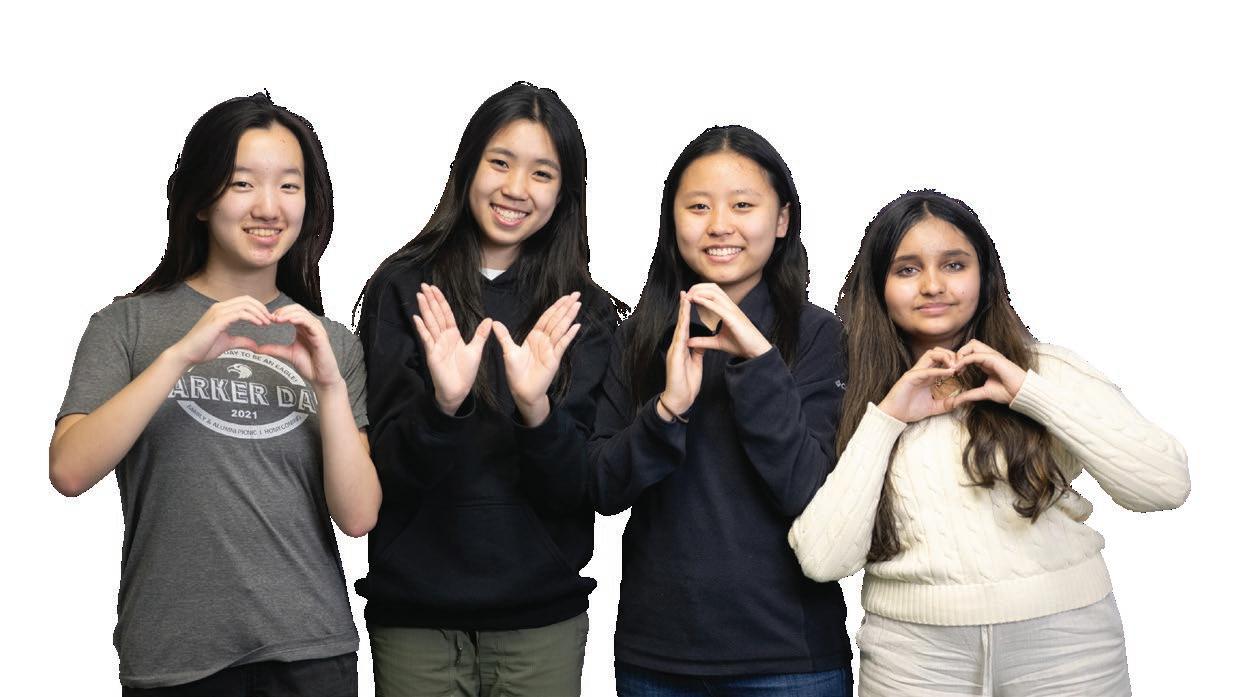
Welcome to the sixth and final issue of the Winged Post for the 2025-26 school year! We are excited to present our first issue as a new strategic team. We would like to thank our graduating seniors for their wonderful leadership this year, as well as our new staff for their hard work so far.
In this issue, we embrace
the end of the year and new beginnings. Read a feature honoring Spanish teacher Diana Moss as she retires, or an opinion on the flight of Artemis II. At the same time, we look to strike a balance between serious and lighthearted topics. Check out our double truck for a longform about birthright citizenship or flip to page 16
to read about the intricacies of bowel movements. Looking forward, we hope to carry on the flame of powerful reporting led by the 2025-26 Winged Post strategic team. we will strive to continuously deliver quality content to the Harker community and beyond. We hope you enjoy reading this issue of the Winged Post.
jokes directed toward any race, and only 4.4% of respondents said they always point them out or confront the speaker.
When someone makes a casually racist joke or remark, say something. Even statements as simple as “that’s racist” or “that’s not okay” can help others realize their insensitivity. If you encounter casually racist remarks online, don’t give the writers the engagement they want by liking or replying.
This is not to ignore racism that affects communities beyond Asians. On the contrary, these observations can be applied to how we address all kinds of casually racist and insensitive jokes.
Today is the first day of Asian American and Pacific Islander Heritage Month, a time to reflect on the historical contributions of AAPI individuals and the systemic barriers that remain. Without awareness and confrontation of casual stereotyping and racist comments, racism will continue to persist.
FRONT PAGE 1: Simon Kjerner should be Simon Kirjner, Adiya Ramanathan should be Aditya Ramanathan
STEM 16: Bose should be Dr. Bose
BACK PAGE 20: Kinetic Crew shoul be Kinetic Krew
CORRECTIONS POLICY:
Our staff strives to represent our community fairly and conduct accurate, truthful storytelling. We list errors of an issue, along with the page number of that error, in the next issue’s corrections box.
Feel free to provide feedback via the QR code below.

Seniors Oliver Chen and Roshan Amurthur uncover new avenues of prosthetics research
Q: What is your research about?
A: “So, our research is about creating a noninvasive neuroprosthetic, which is an arm, an extremity, a limb, or something like that that’s controlled with brain signals. Our research project set out to create an inexpensive alternative to current invasive methods of prosthetic limb operation.”
Q: Why did you choose this topic?
A: “My grandma is actually an amputee herself and when that happened, she lost her passion for cooking because she just wasn’t able to complete daily, like daily simple tasks. That kind of inspired me to see what type of prosthetics there are, and I just found that really fascinating and it kind of drew me to the subject.”
Q: What did you learn?
A: The biggest lesson I learned is it’s much easier to go about solving hard problems when you have someone to solve them for. The reason I’m doing this is for my friend, so at the end of the day he can have a limb, and have their way of having the world restored to them.
Q: What advice do you have for beginning student researchers?
A: “When you’re beginning research, the best thing you could do is literally just cold email as many professors as possible. What most people don’t say is that it’s much, much easier to get someone to believe in you if you give them a reason to believe in you. Explain to the person exactly how you think that they would be the one crucial component that would make your research proposal succeed.”
Ssaria lum & aileen jang
ince its creation in 1907, plastic has been hailed as the creation of the 20th century due to its durable, cheap and versatile nature. As the world continued to modernize, its presence became ubiquitous, composing everyday utensils, computers and even gum.
However, its initial “legacy” has drastically changed since then. With the rise of the mass-produced plastic in the 1960s and 70s, microplastics — five-millimeter-sized pieces of plastic invisible to the eye — have begun to plague the environment, permeating its way into the ocean, sea creatures and now, us. 10 to 40 million metric tons of microplastics are released


specifically on whales in the California coast. As an issue that only recently came to light, microplastics’s long-term impacts are not yet known nor proven by scientific facts.

SOMETHING’S FISHY Microplastics will continue to pose a threat to marine life for as long as they stay in ocean
“The way [thresholds] are determined is in lab studies with things like mice. You can’t really do that well with people certainly, and you can’t really dose wild animals with this stuff. We don’t know how those impacts translate to full species, but it doesn’t mean that we don’t know anything.”
Although recent studies seem to imply that microplastics will begin to harm the environment as a whole, Savoca further emphasized that due to the insufficient information, any hard conclusions are currently difficult to draw.
“Correlation doesn’t imply causation,” Savoca said. “Research has shown a strong correlation between the severity and frequency of things like heart attacks and strokes to microplastics in the arterial plaque of those patients. It’s not microplastic killing you — it’s the heart attack. ”
While research on their permanent repercussions is ongoing, microplastics cause undeniable repercussions to the food chain and start from the very bottom: plankton.
“Zooplankton are really important for storing carbon,” Savoca said. “One interesting thing about plastic is that a lot of it floats. As zooplankton eat more microplastic, their poop becomes more saturated with plastic and more buoyant, which actually becomes a big problem.
When you scale up to whole ecosystems and oceans, if that buoyancy is increased, then the poop doesn’t sink as well, and it doesn’t trap carbon as well, so it affects something the biological carbon pump.”
A lot of the plastics are not like heavy metals and start doing cell damage, but we are seeing that they are being accumulated in the body.

MALA RAGHAVAN CHEMISTRY TEACHER
These sea creatures laced with microplastics end up being the food on our plates. Entering the food chain via plastic debris in oceans, microplastics accumulate throughout the food chain, ultimately reaching the seafood we consume.
“The concept of the human body is that any foreign particle in the human body, which is not supposed to normally be there, is going to disrupt some parts,” Chemistry teacher Mala Raghavan said. “A lot of the plastics are not like heavy metals and start doing cell damage, but we are seeing that they are being accumulated in the body. It’s not a harmful chemical that immediately causes a DNA damage, but we don’t know what the consequences are.”
grams of microplastics weekly, the equivalent of one credit card, through food, water, airborne particles and, to a lesser extent, skin absorption. Once entering the bloodstream, they pervade every part of the human body: lodging themselves in our lungs, liver, gut and even the brain.
TOXIC TIDES
The negative impacts of microplastics go far beyond just the ocean ˛animals. Sadly, Their harmful contents can harm humans, too.
“When researchers are testing out anything, whether it’s a medication, a vaccine or something bad like a pesticide, the actual thresholds that matter.

STANFORD PROFESSOR ”
If current plastic production and waste trends continue, annual ocean pollution is expected to double to 121-280 million tons of plastic. Still, significant efforts from both our own community and beyond are needed to eliminate microplastics for good. If no action is taken, plastic may indeed prey on the very hands that

BREATHLESS Often appearing as airborne pollution, one of the ways microplastics can enter our bodies is through inhalation.
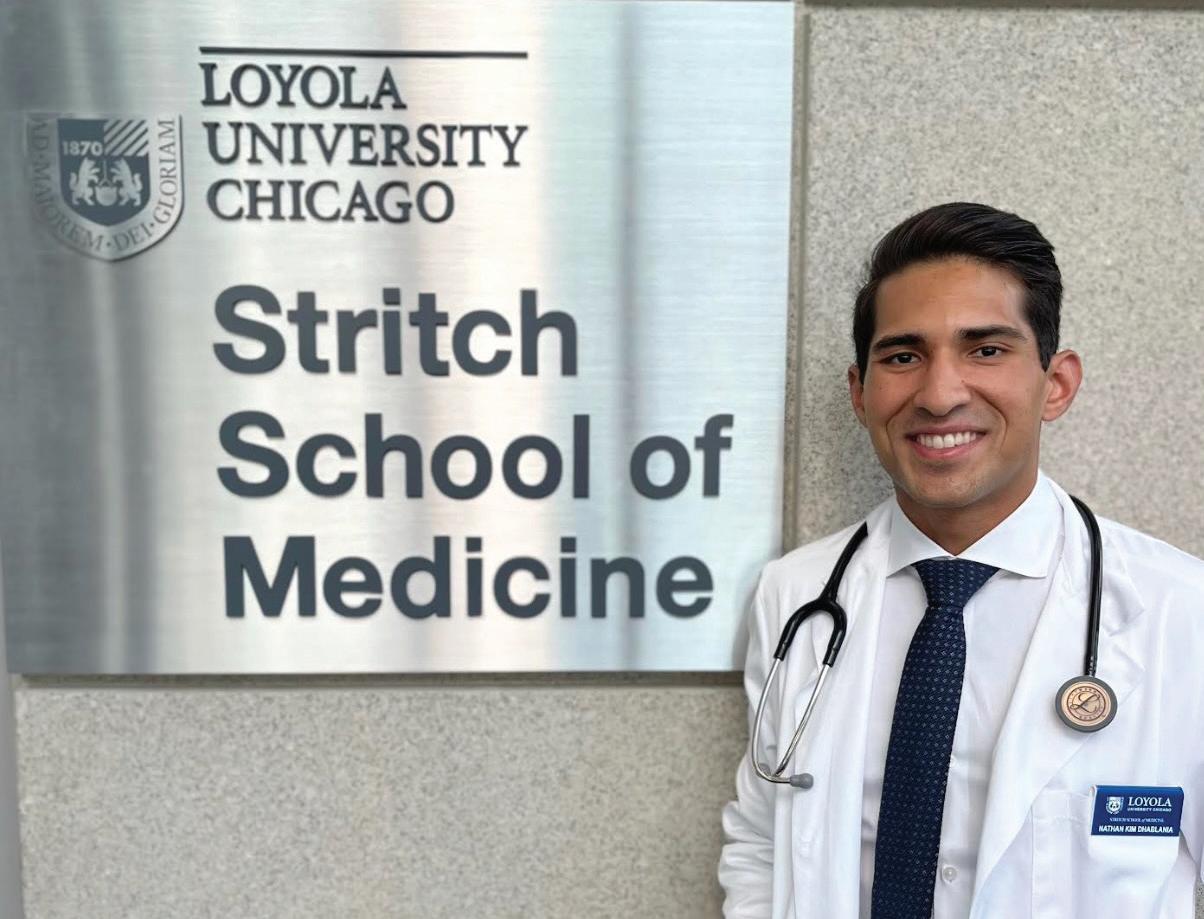
Many modern medicines can treat causes of vision loss, but not all patients receive that care. For Nathan Kim Dhablania (’14), M.S., addressing that lack of accessibility has become central to his work.
Now a fourth-year student at Loyola University Chicago Stritch School of Medicine, Dhablania, who has matched into ophthalmology, focuses on the intersection of science and human impact. He traces that mission back to Harker, where classes in Biology and Chemistry and volunteering at Good Samaritan Hospital first exposed him to patient care.
“Medicine is one of the few fields where you can actually have a profound impact on
someone’s life and some of your patients’ most vulnerable moments,” Dhablania said. “I think it is really powerful to be able to help people during those hard times.”
At the University of Southern California for his undergraduate degree, his interests broadened. Majoring in health promotion and disease prevention, he studied public health while working in research labs: ranging from cardiothoracic studies on aortic aneurysms to stem cell work on kidney growth.
“What I really valued about that experience at USC was being able to develop my own experiments from start to finish,” Dhablania said. “I would figure out exactly what kind of research question I want to develop and how I want to set
up my experiment. I think what I really appreciated was the fact that we had so many different projects to do.”
His eventual interest in ophthalmology came from his previous research and personal experience. While studying stem cell applications to retinal cells, he began to see a new, undiscovered potential for treating degenerative eye diseases. That, coupled with his uncle’s progressive vision loss from undiagnosed diabetic retinopathy, made his fascination concrete.
That new perspective carried into a research fellowship with his mentor, Dr. Rohit Varma, at Southern California Eye Institute, where he analyzed large datasets on eye disease to study the prevalence and risk factors of different
ocular diseases in underserved populations, and published in prestigious journals such as JAMA Ophthalmology.
“There are patients out there who do not have access to a primary care physician to get a referral to an ophthalmologist, or have a lack of transportation or health insurance issues,” Dhablania said. “These factors affect them from getting the refractive care that they need, for example, glasses, and that leads to uncorrected refractive error.”
At Loyola, he carried his knowledge into both his clinical training and research, including a project on screening for retinal toxicity in veterans taking hydroxychloroquine, an antibiotic used to treat autoimmune diseases like lupus and rheumatoid arthritis.
“Because my grandmother was on this medication to manage her lupus, even if she never developed any sort of retinal toxicity, I felt like I had a personal connection to it,” Dhablania said. “It gave me a sense of purpose to do it.”
“These factors affect them from getting the refractive care that they need, for example, glasses.

NATHAN KIM DHABLANIA OPHTHALMOLOGIST
As he prepares for his ophthalmology residency, Dhablania reflects on his journey to ophthalmology, noting that he is drawn to the fields’s combination of surgical precision and long-term patient relationships.
Hair pulling, nail-biting, stress eating. You’re anxious, so you resort to unconscious habits. They happen without you noticing, and suddenly, it feels impossible to stop.
Around 60% of the population will experience some sort of body-induced stress habit at some point in their life. Often first developed in childhood, these stress habits, when untreated, can carry on into adulthood and cause permanent issues like plaque build up in arteries or mental illnesses such as depression and addiction.
An anonymous student, who has a form of dermatitis where they constantly pick at their skin during stressful situations like exams, commented that they never notice this habit in the moment but regret it afterwards.
“When I do pick at my face, it’s something I want to stop doing because it doesn’t make me feel very good about myself,”
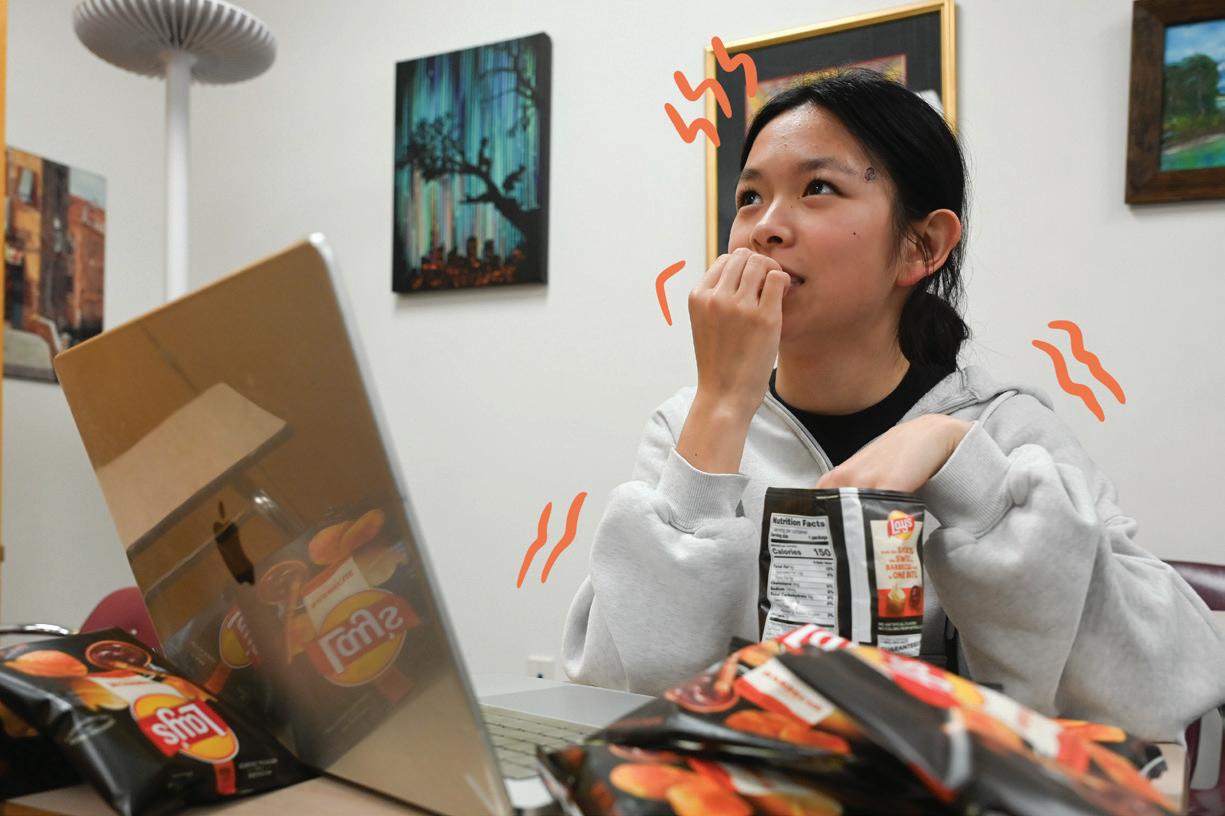
the student said. “It does affect me and my confidence levels, but while I’m taking a test, I’m not really thinking about it.”
When someone is stressed, the hypothalamus in the brain sends a signal to the rest of the body, causing the adrenal glands to release adrenaline and cortisol. From there, these hormones increase blood pressure and
blood sugar, causing the body to enter a fight or flight response. Usually, the body relaxes after the initial causes of stress disappear, but when the body is in a constant state of stress, the brain seeks a distraction by sending signals that cause behaviors such as picking at skin or twisting hair as a coping mechanism. The cycle repeats

Artificial intelligence is becoming a larger part of everyday life. But behind the quick answers and work an AI model provides, there is a much larger system that requires significant amounts of energy, water and computing power.
One reason AI uses so many resources is the type of computers it depends on. Most advanced AI systems run in data centers, which are large facilities filled with servers. These servers often include specialized chips designed to perform huge numbers of calculations very quickly. When someone asks an AI model a question, those computers process the request by analyzing patterns in massive amounts of data. That work happens in seconds, but it still requires substantial electricity.
The training process uses even more resources. During training, the system repeatedly tests and refines itself on large collections of images, texts and audio to improve its predictions. This can take weeks or months and often involves thousands of powerful chips running continuously. The result is a process that consumes large amounts of energy before the public even sees the model.
itself, as the brain releases waves of dopamine to counteract stress and makes these automatic responses to pressure become habitual.
These behaviors are typically sorted into two categories: impulsive and compulsive. Impulsive behaviors occur as a result of boredom or stress and are frequently repeated until they become automatic responses. Compulsive behaviors are also similarly induced by stress, but conscious and intentional, making them more likely to remain present for a longer time and could even cause permanent damage. Even while it is difficult to exit this negative loop, there are possible reversal treatments.
“Other people are dealing with this issue,” the student said. “I used to think it was really weird or gross, but people need to understand that it’s not just some bad habit. It’s something that can be treated and should be addressed more.”
Visit harkeraquila.com for more.
Cooling is another major factor. High-performance computers generate heat, and data centers need cooling systems to prevent equipment from overheating. In many facilities, this means using industrial air conditioning or water-based cooling systems.
The result is a process that consumes large amounts of energy before the public even sees the model.
Scale also matters. A single AI request may not seem significant on its own, but the total grows quickly when millions of people use AI systems every day. Tools that generate images or video often require even more computing power than simple languagebased models. As AI becomes more common in schools, workplaces and social media, its total resource consumption continues to grow.
Visit harkeraquila.com for more.
You feel a weight accumulating in your stomach. It is time for your daily deep bowel cleanse.
While most individuals may not want to discuss their waste elimination routines, excretion is a necessary part of every human’s experience. Furthermore, the frequency, color and shape of stool offer insights into an individual’s digestive system and overall health.
“Those are important things to look at when you go to the restroom,” upper school
Jennifer Olson said. “The gastrointestinal (GI) tract is at its best when it is outside of the level of conscious thought. What we want is for it to work by itself without our attention on the system all the time.”
In the intestines, bacteria break down liver bile into the pigment stercobilin, which is brown. As a result, brown is the normal color for feces, but other shades can appear. For instance, red stools characterize blood leakage from the lower GI tract, and black and sticky stools, known as melena, signify liver issues.
Before coming to Harker, biology teacher Terese Navarra researched the source behind
location of the bleeding is very important,” Navarra said. “If the blood is coming from your colon, it’ll just come out like normal-colored blood. If the cut is somewhere before your stomach, the blood will actually get digested, and it turns a dark black tar color and stinks really bad. No matter the color, blood in your stool is usually a sign that something is happening, so never ignore it.”
“
Blood in your stool is usually a sign that something is happening, so never ignore it.

TERESE NAVARRA BIOLOGY TEACHER
Medical professionals often consult the Bristol Stool Chart, a tool that classifies feces into seven types based on their shape and consistency, to evaluate health. This scale ranges from Type 1, which consists of hard pellets that denote a lack of water, to Type 7, which has a water consistency that signals rapid-transit diarrhea. Types 3 and 4 are considered the most ideal, representing stools that easily pass through.
Frequency of excretion can also serve as an indicator for health, as medical experts typically cite three times a day to three times a week as the normal range.
Director of Health Services
Deborah Nott observed that for a while, the scientific community
assumed the brain activity regarding food cravings was separate from the GI tract, but recent research has uncovered a vital link between the two.
“The bacteria in your GI tract can signal your brain to tell you that you should go eat particular food,” Nott said. “If you eat a highcarb, high-sugar diet, then those are the kind of bacteria that are going to live in your GI tract. If it’s been a while since you’ve had sugar and carbs, those guys down there are going to get a little hungry, and they’ll signal your brain, ‘Let’s have some potato chips right now. Something crunchy and salty, something sweet would be great.’”

DUTY CALLS A Bristol Stool Chart commonly is used to classify feces into 7 different types based on shape and consistency. Stool ranges from hard lumps or pebbles at Level 1 to a fluid consistency at level 7.
more notoriously, though, it can cause irritable bowel syndrome (IBS), a chronic disorder marked by abdominal pain and changed bowel movements.
Besides diet, stress and hormones can be major deciding factors that influence whether someone feels diarrheic or constipated.
Digestive concerns can also stem from inflammation of the bowel, caused by the immune system attacking healthy cells, resulting in swelling and damage in the digestive tract. Studies have found that long exposure to this issue may result in diseases like Alzheimer’s, Parkinson’s and Lou Gehrig’s by enabling toxins to enter the brain. Perhaps
Junior Stellan Lindh, who has IBS, noticed that his bowels were more reactive and sensitive than those of other people, as different types of foods and his stress level affected his stomach issues.
“It’s made me more conscious about what I eat,” Stellan said. “Sometimes if I’m just eating oil and grease all day, it’s not going to be good for my stomach and bowels. Everybody poops. We should just stop being embarrassed and be proud about pooping.”

high levels of cortisol can interfere with sleep. Student researcher Sid Gaur explained the importance of understanding both cortisol’s mental and physical effects on the body.
“People need to understand how stress affects the body physically,” Sid said. “If people know more about cortisol and its negative effects, they might have healthier habits, like better sleep and avoiding being too stressed.”
fight-or-flight response reacts to cortisol in a way that empowers the body physically. Depictions of cortisol are often oversimplified negatively.
Cortisol means stress, but we can’t underestimate the power of stress being a life-saving thing.
It’s Monday. The week starts with a glance at your calendar: a bone-rattling sight that brings a sinking feeling to your stomach. Five tests, two quizzes, homework stacked on top of homework. Your heart beats a little faster, your shoulders tense.
But where does that feeling come from?
That feeling comes from a hormone called cortisol. Often referred to as the body’s primary “stress hormone,” cortisol is released by the adrenal glands when your brain perceives a threat. When stress becomes constant, elevated cortisol can lead to anxiety, fatigue and difficulty concentrating. Problems arise when this system is overused, too. According to a study by Cinnamon A. Stetler on cumulative cortisol exposure,
Different habits like taking routine walks, getting enough sleep, and practicing breathing exercises help immensely with decreasing cortisol levels. According to a study by the NIH, physical activity was shown to lower cortisol levels and could have multiple positive impacts like better sleep quality, lower blood pressure and reduced anxiety.
However, in small doses, cortisol is helpful: it keeps you alert, focused and ready to respond to challenges. Psychology teacher Jeff Sutton mentioned how the body’s

JEFF SUTTON PSYCHOLOGY TEACHER
“Cortisol gets a bad representation in the memes,” Sutton said. “Cortisol means stress, but we can’t underestimate the power of stress being a life saving thing. It gets released into the blood and can cause muscles to contract — so you might run away faster since more of your blood’s going to be shunted through your legs.”
Conversations about stress have also moved beyond classrooms and into social media, especially TikTok. The “low cortisol” trend entails first showing a clip of users struggling through a “high cortisol” or stressful activity, then the person doing a more “low cortisol” activity. A common image in these videos is a green-and-red “cortisol level” scale with the dial pointed to the “low cortisol” side. Medical Club officer Riya Samuel noted how the trend pushed her toward more relaxing activities to lower her cortisol levels.
“The trend is really funny,” Riya said. “Obviously it’s very relatable content, and Gen Z especially tends to find ways to chill out a bit more. These low cortisol activities are things that I also try to do even when I’m supposed to be doing “high cortisol” activities, and it’s interesting how information in the meaning can touch different people’s lives like that.”
Visit harkeraquila.com for more.
Recent growth of the Women’s National Basketball Association (WNBA) has been impossible to ignore. Arena attendance continues to surge and nationally televised games repeatedly expand.
What was once a niche professional league is now part of a much larger conversation about the future of women’s sports. Following recent collective bargaining agreements, WNBA salaries have increased significantly, with maximum contracts more than doubling compared to previous years. Improvements in benefits, travel conditions and revenue-sharing structures have been introduced, showing that the league is ever evolving.
Despite the progress, questions about compensation and visibility remain central and attached to the league’s reputation. Under the latest bargaining proposals, the league’s salary cap is projected to rise from $1.5 million to $5-7 million, with supermax contracts reaching up to $1 million or more. Still, imbalance persists when compared to the National Basketball Association (NBA),

reinforcing the idea that while progress is real, it is ongoing rather than entirely complete.
For WNBA fans like physics teacher Lisa Radice, the change represents growth yet remains unfinished.
“It seemed like a good step in the right direction,” Radice said. “I can understand why

they’re not on par right now, but the progress can’t happen overnight. I definitely believe that this is progress even though the pay is not on par with the men’s league.”
The use of themed merchandise has become a common trend across sports, with athletes increasingly using their televised visibility to bring attention to social issues. By wearing shirts with the slogan “Pay Us What You Owe Us,” the women’s players shifted the focus of the public eye towards their unequal pay. The message not only amplified their own desires but drew visible support



257 players will hear their names called over three days. With Indiana quarterback Fernando Mendoza expected to go No. 1 to the Raiders, all fans are wondering how the rest of the first round works out, and which teams make bold pickups and trades that reshape their future.
from fans, reinforcing the growing pressure for change.
WNBA fan Sophomore Anusha Saha, who used to play basketball, reflected on how fan participation on issues amplifies it.
“It’s important for the players to speak up,” Anusha said. “In addition to that, it’s also really vital that the fans voice their desire for the league to pay their players more generously.”
Radice has followed the WNBA sporadically since its inauguration but went to the first game of the Sacramento Monarchs in 1997. She noted how dramatically the league’s presence has grown over time.
league is insanely
more popular,” Radice said. “We used to have to go to Sacramento to watch games, and they were never sold out the way the Golden State Valkyries sell out now. The atmosphere there is amazing, and the players are very high caliber. It’s a super entertaining experience.”
While differences between the WNBA and the NBA, such as season length and overall revenue, help justify the pay gap, they do not fully justify it. The WNBA season is 38 games shorter than the NBA’s, but the
of games, WNBA players still earn significantly less on average, highlighting that the issue extends beyond simple structural differences.
Varsity girls basketball player Selena Chen (11) highlighted the key aspects of the league that she wants to see expand in the years to come.
“I hope the league continues to grow,” Selena said. “I hope it expands in terms of opportunities for the players over increased visibility on the television. I want to see more support that benefits the players and indirectly helps the game



We need a quarterback and an offensive line. I think our team will end up drafting a safety or a middle linebacker.

I believe the game is won in the trenches — the 49ers should address the offensive line in the draft so that we can have a better run game to utilize our skill position players.

I would like Malachi Fields or Carnell Tate. Makai Lemon seems too high for us since we made the playoffs.

It’s moments before senior Wenjie Zou’s second event in the 2025 Speedo Futures Championship. Coming off of an unsatisfactory finish in his main event, 200 freestyle, he steps onto the diving board and instantly stamps down the previous frustration. He empties his mind and focuses his attention on this new event, new chance. As he positions himself and prepares to swim the 500 freestyle, he reminds himself to trust his training, stroke by stroke.
It was this swim, in his secondary event, that led him to move on to the Speedo Sectionals Championships.
Wenjie first began swimming once a week recreationally at five years old. After the COVID pandemic, when other sports shut down, swimming was the only activity that Wenjie could keep
Senior Wenjie Zou swims with “no pain, no gain” mindset


he continued attending meets, he started seeing results and advancing across championship levels locally.

Wenjie first began swimming once a week recreationally at five years old. After the COVID pandemic, swimming was the only activity that Wenjie could keep up when other sports shut down. As he continued attending meets, he started seeing results and advancing across championship
“I’d been working at one thing for so long, but the progress that I had made and the improvements that I’ve made in my body had also helped me improve in another event,”
Wenjie said. “It finally felt like my work had paid off, and I was just happy for the rest of the day.
The thing is with swimming, usually the end of the season meets is where you do a lot of preparation to get yourself ready
to go fast, but that meet I didn’t taper — it was just coming off of a normal practice week.”
You always have to step out of your comfort zone in order to make improvements.

WENJIE ZOU (12)
VARSITY BOYS SWIMMER
Through endless preparation, Wenjie persisted and focused on nothing but his goal. That “no pain, no gain” mentality has brought him through his worst races, as the ache tells him that he’s utilizing his fullest potential and also helps him sense his arms to
recalibrate and improve his technique mid-race.
“You have to invite struggle, because you know at the end of each practice if you’re not sore, or at the end of a race if you’re not dead, then you know you didn’t do something right,” Wenjie said. “It taught me that nothing good ever comes easy. You always have to step out of your comfort zone in order to make improvements.”
Wenjie currently trains at Santa Clara Swim Club. He notes that part of his motivation to perform well is through their tough love: they constantly tease one another and challenge each other, but this friendly competition encourages them to achieve their goals, rising from the senior group to the national team, together.
“When you’re training, it’s really hard to do a set by yourself because you have no one to pit yourself mentally
against,” Wenjie said. “Through these practices where we’re racing each other, you develop internal rivalries between your teammates. That’s also what helps you get closer to them because you have spent so much time together.”
As he rose to more intense levels of competition, Wenjie found that even with consistent practice, improving his time became more difficult. He found solace in the smaller moments where he saw gradual progress that added up over time.
“It’s about how you apply the mindset and execute the race,” Wenjie said. “When it comes to the end of the season, and your muscles are fully rested for championship meets, you see the big improvements in time. It’s applicable to other parts of life where you can’t see an improvement every day, but just working at it day after day, you’ll eventually see results.”

In the sports world, athletes often develop unhealthy mindsets around illness, nutrition, and physical injury, ignoring physical and mental symptoms in order to stay on the playing field.
Stigmas around these factors create unhealthy expectations that athletes should be able to perform through discomfort, even when their bodies signal otherwise.
due to the harsh consequences of subpar performance. Some athletes even describe experiencing symptoms such as nausea, headaches, loss of appetite and exhaustion in the hours leading up to the competition, attributing these reactions to heightened stress.
Student-athletes in particular are often forced to resort to unhealthy habits in order to manage pressure and simultaneously meet expectations. With school responsibilities and competitive
they contribute to the stressrelated symptoms. Varsity girls basketball captain Claire Yu reflects on the mindset of sacrificing for the benefits of sports.
“You don’t really think about sacrificing vital things for the sport as unhealthy at the moment,” Claire said. “You’re just focused on doing whatever it takes to perform well and help your team win. I do realize that over time these choices can add up, ultimately affecting both people’s health and well being.”
I’m just focused on doing whatever it takes to perform well and help my team win

CLAIRE YU (12)
VARSITY GIRLS
BASKETBALL PLAYER
especially when the stakes of the game feel high. For studentathletes, the combination
of academic demands and athletic pressure can amplify these effects, making it harder to distinguish between mental strain and concrete physical illness.
“If your doctor is saying to stay out, you need to follow that or else it will make the recovery much worse,” nurse Tiffany Gelieanu said. “I see a lot of people that try and push through, especially with concussions, and they don’t always realize how serious the long-term effects can be if they don’t properly rest.”
Junior Ava Alvarez, who runs both cross country and track and field, relates that there have been times when she chose to compete while she was sick or injured, because she felt that it was worth it in the long term.
“I decided to do it because there was a really big meet that we could have qualified for,” Ava said. “I thought it was a really good opportunity to see where we were at. The fact that we qualified while not only I was sick, but a couple other members of my team were sick, was really surprising.”

Success begins earlier than the final outcome.
It starts with the pull of a volleyball net being raised and the unseen work of setting up the court before the game.
Boys Varsity volleyball recently clinched the number one spot in their league after their 3-0 win over Monta Vista High School on April 24, but behind the victories are the key pieces of preparation that come long before the first set of
“
A lot of the momentum that we have is derived from the boys energy and excitement to be here.

ASSISTANT COACH
a game is played. It starts with the coaches setting the tone of practice, preparing the court and sharing pointers that shape their approach. Before games, players stretch, hydrate and reset, turning these moments of recovery into part of the larger process of succeeding. Through the season, a sense of community holds the team dynamic much more tight-night. Everyone on the court is matched by support from the sideline as the team uses popular volleyball chants to encourage each other.

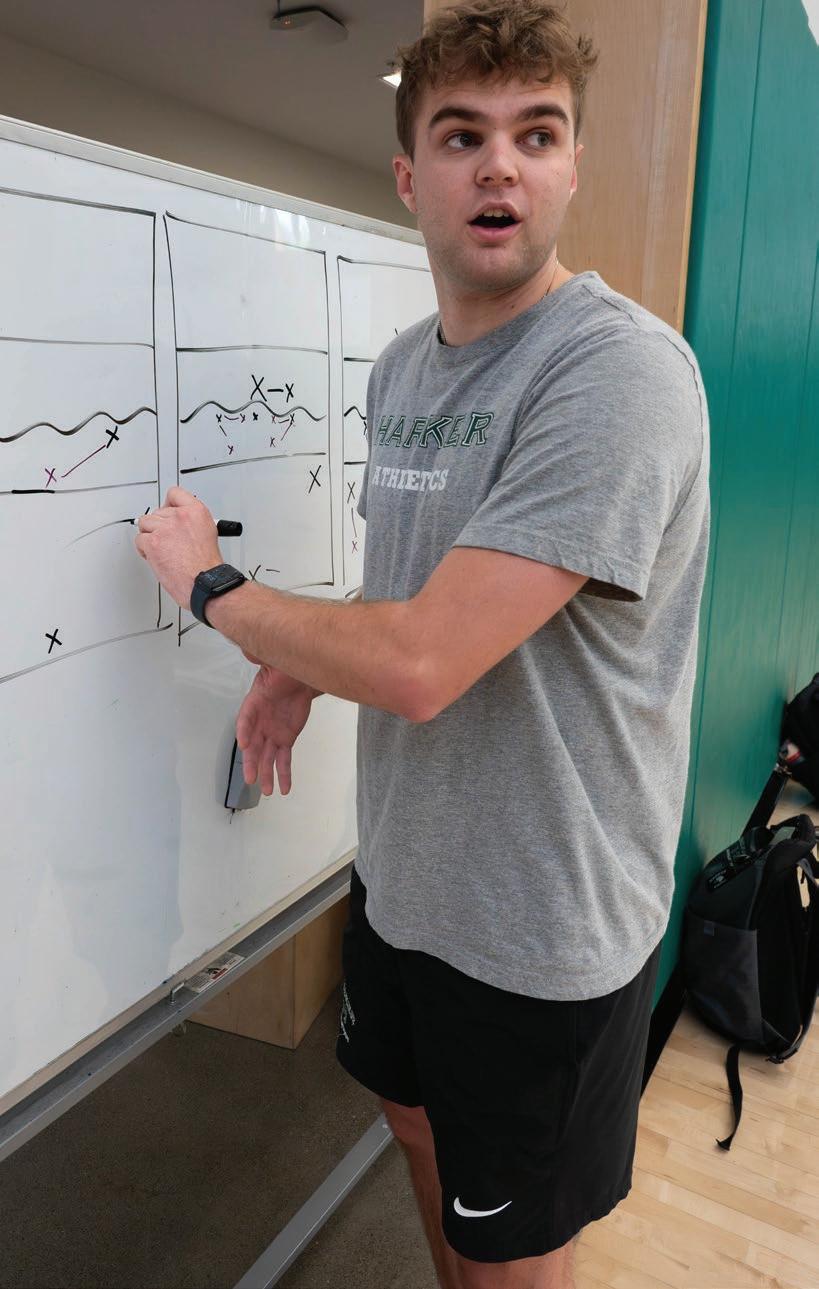
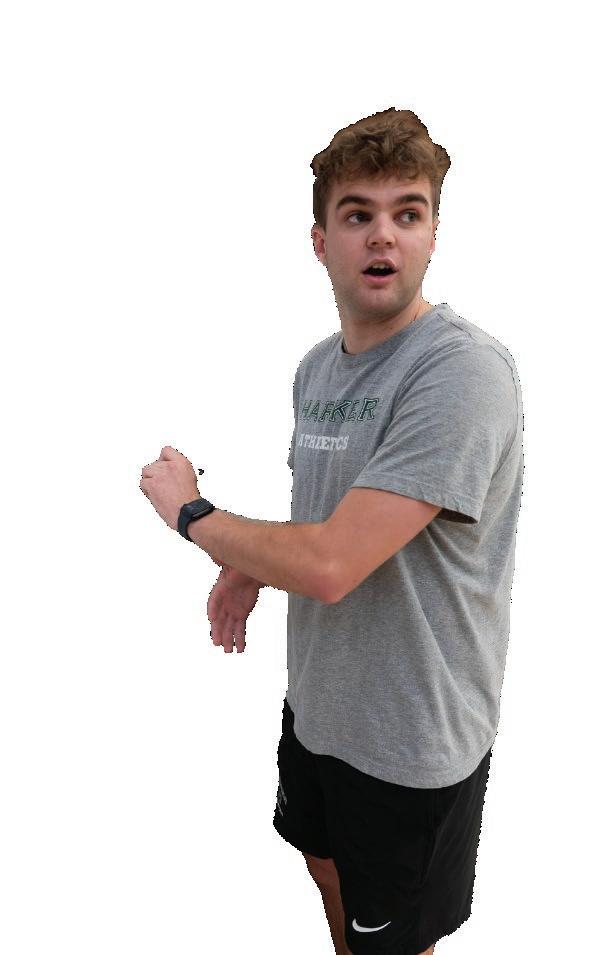
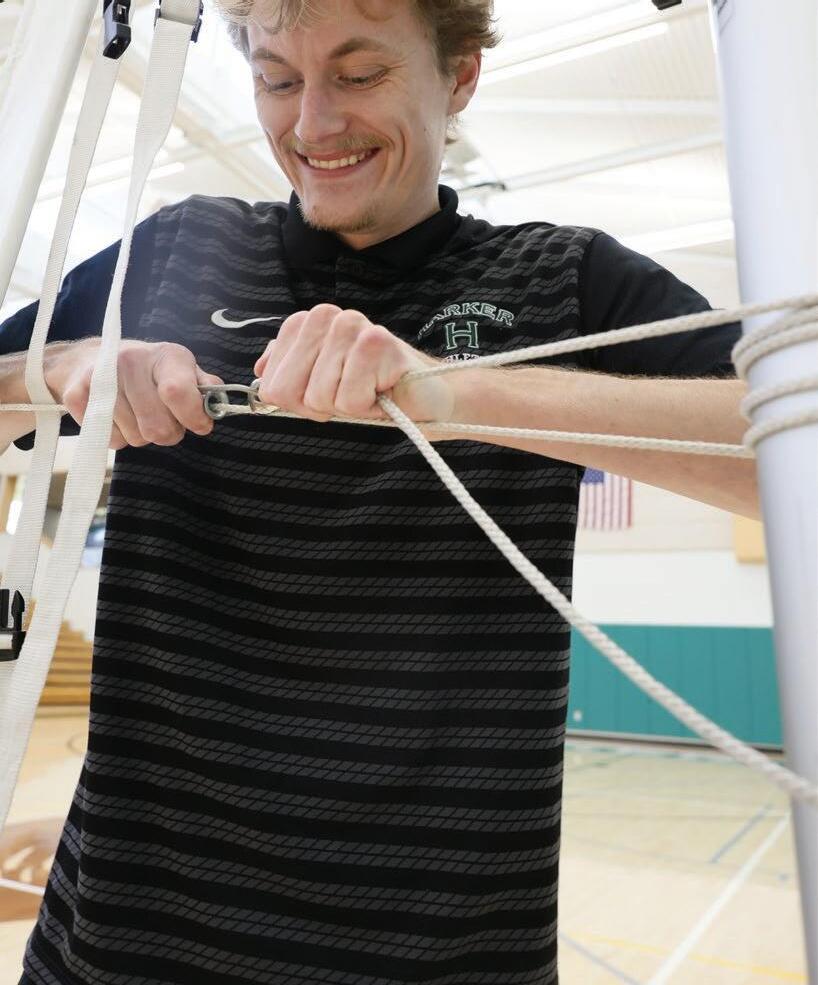

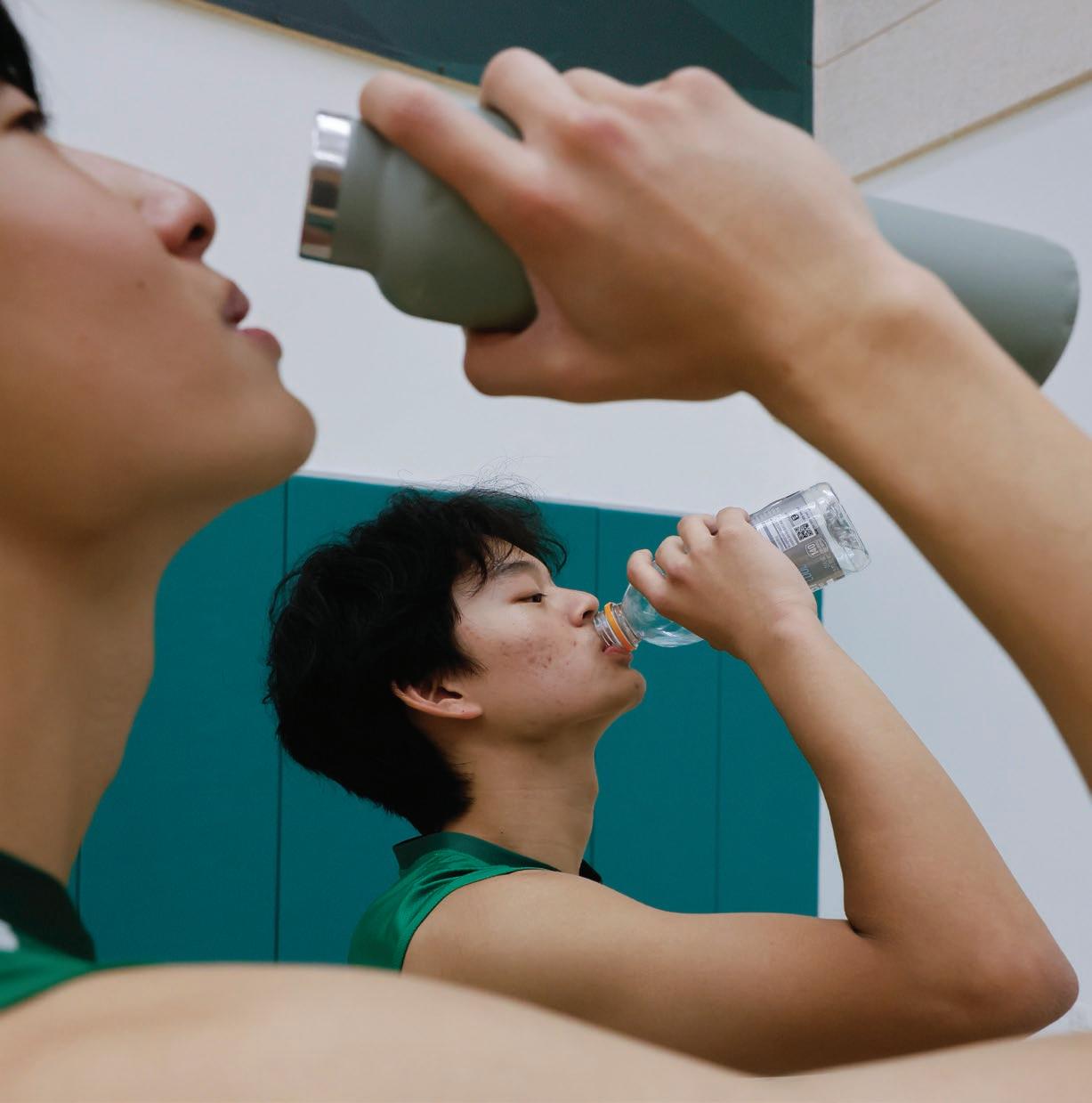
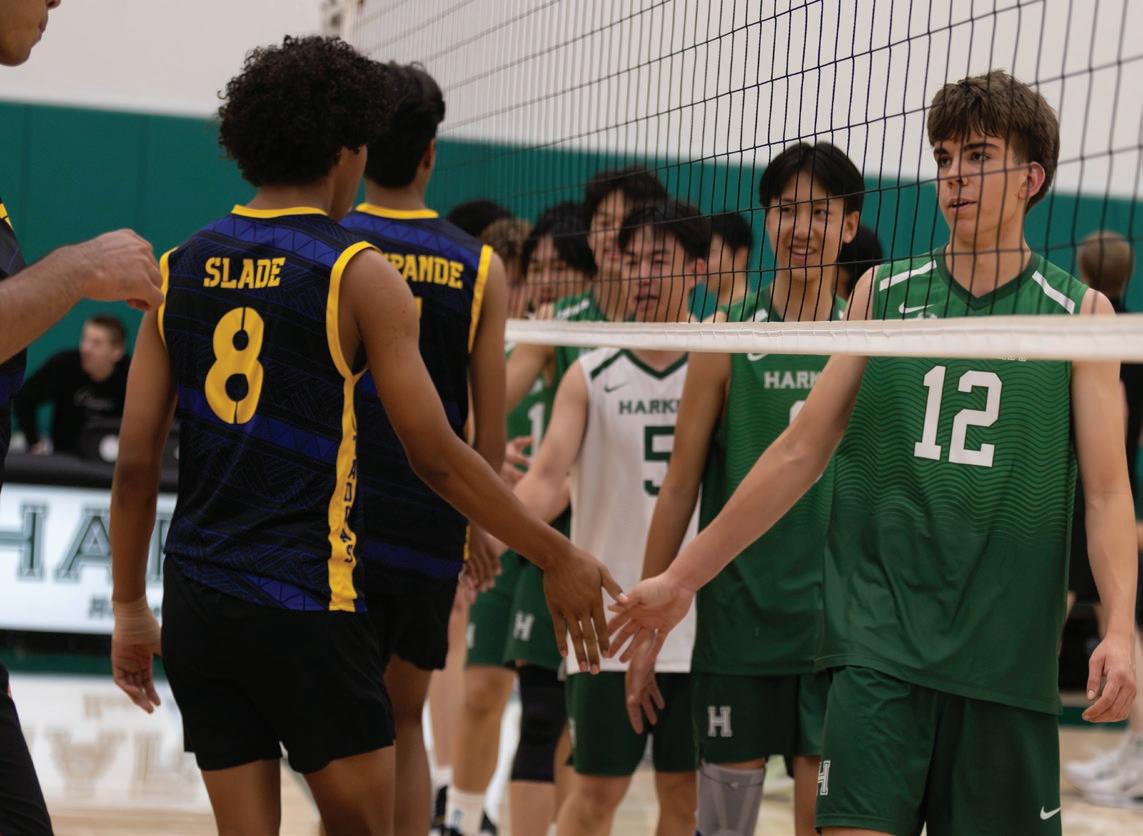
GAME READY (TOP RIGHT)
Assistant varsity boys volleyball coach Mason Ward ties the ropes of the net together. The coaches set up the entire net after school before the games.
DRINK UP (ABOVE) Opposite hitter Gary Xu (10) drinks water before the game. The eagles won over Monta Vista in three sets on April 24.
GATHER & GROW (MIDDLE LEFT) Team members of the varsity boys volleyball team congregate together before the first set. They have a tradition of saying the same loud chant before each game.
THOUGHTFUL TALKS (BOTTOM LEFT) Head coach Jackson Dupler explains a new play during practice. Dupler plays an active coaching role during the games, calling timeouts when resets are necessary.
SHAKE ON IT (LEFT) Boys varsity volleyball captain Topaz Lee (12) shakes the opponents hands before the game. Teams typically shake hands before and after the game.

Walking through the doors of the 2026 prom venue, upperclassmen were whisked away into the party atmosphere characteristic of the “Mamma Mia!” movies. They entered a vibrant space decked out with Mamma Mia!’s iconic pink bougainvillea, warm string lights and glittering tablecloths. In order to transform the three-story venue into an unforgettable prom experience, hundreds of hours of planning, decorating and cooking were poured into bringing the vision to life.
Prom planning began a year in advance, as Director of Student Organizations Eric Kallbrier and Community Service Director and Activities Coordinator Kerry Enzensperger choose a prom venue and date, ensuring that they don’t conflict with weddings or other large events. Once the location and time is solidified, a group of student volunteers form the prom committee, which meets weekly starting from April to decide the prom theme, look for decor inspiration and suggest food items.
HSLT President Leana Zhou (12) elaborated on what helping plan prom looks like, emphasizing that there is less student input compared
“You want there to be hints at the theme, but you don’t want it to overwhelm the most important part of the experience, which is the people.

ERIC KALLBRIER DIRECTOR OF STUDENT ACTIVITIES
to homecoming and winter ball, which are almost entirely planned by HSLT.
“For prom, you’re definitely limited by the venue in terms of theme and decoration, and Mr. Kallbrier and Ms. Enzensperger put in a lot of their own time to make this happen with decorations and set up,” Leana said. “They’ve already seen what systems work and don’t work, and you’re basing every year’s prom off of last year’s, especially
because students have had about only one year for point of reference.”
Although decorations are chosen ahead of time, most of the actual preparation happens on the day of at the venue.
“The most challenging part is taking a space and transforming it within an afternoon,” Kallbrier said. “You want there to be hints at the theme, but you don’t want it to overwhelm the most important part of the experience, which is the people. The other hard part of it is just the physical labor and stress of running around under a time constraint, trying to get things put together.”
Kallbrier emphasized that the focus remains on the significance of prom for the students.
“I hope they will take away a memory of how much the people around them mean to them,” Kallbrier said. “Whether they are coming back next year as seniors or they are going off to college, they will look back and say, I am surrounded by some pretty cool people. I love being able to celebrate all that hard work with the people around me.”

chcocolate-covered strawberries
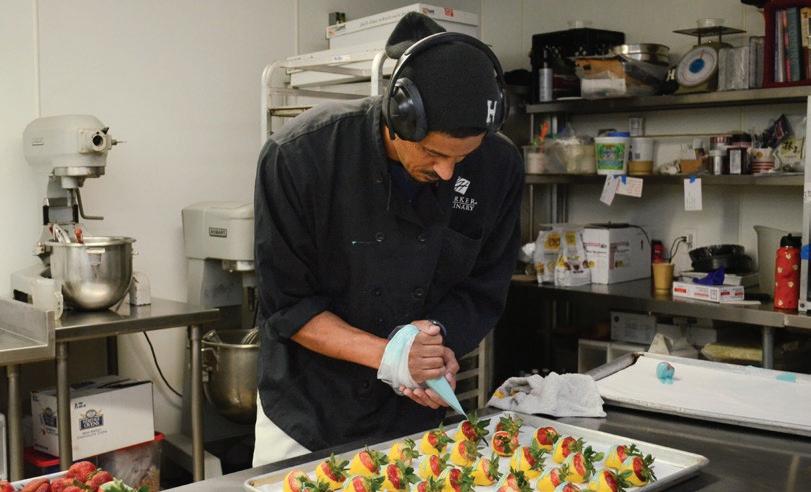

and
This year’s prom introduced a new element to the dance floor for the first time — a guest student DJ. Senior Albert Yao started experimenting with live DJing a month before the event, building on his prior experience in producing music.
“I got my own board, watched some YouTube tutorial videos, messed around and explored it myself,” Albert said. “I thought I could do something at prom, especially since it’s senior year and I want to go off things with a bang.”
In preparation for prom, Albert curated a setlist aimed at energizing the crowd and appealing to a wider audience, incorporating popular tracks and student requests. He noted the transition from practicing independently to performing live came with unexpected challenges when working with unfamiliar equipment.
“Part of the beauty of this kind of experience is going along, trying your best and having friends and peers who are so supportive,” Albert said.
“Even though you might have hiccups and things don’t go perfectly to plan, people still cheer you on.” Professional production also played a key role. Owl Vision, an event production company owned by alumnus David Belogovosky (‘09), handled the lighting and audiovisual events that brought the dance floor to life. They set up illuminated decor and dynamic lighting effects in the event space designed to match the theme of the night.
One of the most anticipated aspects of prom is the food. However, behind the seemingly unlimited supply of delicious dishes and treats is weeks of planning in advance and hours of baking on the day of prom.
The kitchen staff, headed by kitchen manager Raelynn Baldwin, meets with Kallbrier and Enzensperger six weeks before prom to finalize the menu and catering orders. They also customize each item to match the theme of prom.
“We go through the numbers and make sure we have everything we need,” Baldwin said. “We really try to lean into what the theme is. It was Mamma Mia this year, so we used lemon and bright colors because it was a Mediterranean disco.”
Prom attendees chose from a wide selection of food, from savory items like sushi, flatbread and falafel, to sweet treats like
caramel popcorn, chocolatecovered strawberries and lemon cakes. Baldwin explained that they limit the menu to finger foods for convenience.
“We try to keep it as portable as possible because everyone’s going to be picking up small things and going out and dancing,” Baldwin said. “You want something you can easily pick up, eat and put down. Nobody wants a grease stain on their dress.”
Chef Adam Albers prepares all the desserts on the day of prom, covering strawberries with colorful layers of chocolate and baking cookies. Beyond Harker-prepared items, the kitchen staff caters sushi from MC Sushi and transports the rolls in sushi boats to the venue. As with decorations, most of the food preparation happens within 12 hours of prom to maintain freshness and vibrant colors.