VOL 13
NO 4 2026 WM RM10 EM RM11
Malaysia Retail Industry Report (September 2026) Strengthening Retail Bonds and Future-Ready Strategies
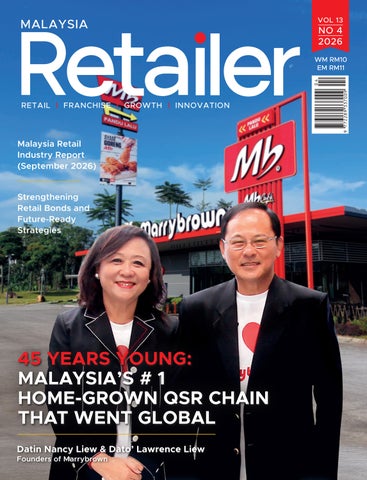
45 YEARS YOUNG: MALAYSIA’S # 1 HOME-GROWN QSR CHAIN THAT WENT GLOBAL Datin Nancy Liew & Dato’ Lawrence Liew Founders of Marrybrown
CONTENTS / VOL. 13 NO. 4
14
MRCA Members Meet & Greet: Strengthening Retail Bonds and Future-Ready Strategies
26
18
Celebrating 20 Years of Growth and Innovation
Little Caesars Makes Its Puchong Grand Opening Official on July 13 with Free Pizza for the First 100 Customers
COVER STORY 2 45 Years Young: Malaysia’s #1 Home-Grown QSR Chain That Went Global
22 Toppen Elevates The Sky Pavilion Experience with Immersive‘Scenes to be Seen’ Concept
24 Sunway Malls Unveils Malaysia’s First Smart Malls
MRCA EVENTS/MARKET INFO 7 ON THE COVER
Malaysia Retail Industry Report (September 2026)
12 Interoperability and Trust Key to AI Commerce: Report
14 Japanese Innovation Meets Personalised Living
16 Beyond the Massage Chair: Making Idle Time Matter
18 Celebrating 20 Years of Growth and Innovation Datin Nancy Liew & Dato’ Lawrence Liew Founders of Marrybrown
20 The Water Behind Better F&B Operations
26 Little Caesars Makes Its Puchong Grand Opening Official on July 13 with Free Pizza for the First 100 Customers
28 MRCA Members Meet & Greet: Strengthening Retail Bonds and Future-Ready Strategies
32 New Member – Alpha Galaxy/RFID CLOUD
33 Funding Societies Secures Financing Facility from MDV
34 Zuka Izakaya – A New Taste of Japanese Hospitality
Cover Story
2
45 Years Young: Malaysia’s #1 Home-Grown QSR Chain That Went Global From one small restaurant in Johor Bahru to more than 500 outlets across 16 countries, Marrybrown’s journey is a story of Malaysian ambition, resilience and a belief that local flavours can travel far.
T
here was a time when the idea of a Malaysian fast-food brand going head on with international giants might have seemed overly ambitious. When Datin Nancy and her husband, Dato’ Lawrence Liew, opened the first Marrybrown restaurant in Johor Bahru in 1981, the fastfood landscape was dominated by familiar American names. A home-grown brand was hardly the obvious contender. Yet the couple saw an opportunity where others saw a crowded market. They believed Malaysians could enjoy a fast-food experience that was affordable, Malaysia Retailer Vol 13 No 4
enjoyable and, importantly, familiar. Four and a half decades later, that early conviction has grown into one of Malaysia’s best-known home-grown food brands, with more than 500 Marrybrown restaurants serving millions of customers across more than 16 countries. For Datin Nancy Liew, Cofounder and Group Managing Director of Marrybrown Sdn Bhd, the journey remains both humbling and deeply personal. “When I look back on the journey of Marrybrown, I feel grateful and humbled by how far we have come,” she says. “What started as a simple
dream between my husband and myself has grown into a Malaysian brand recognised in many parts of the world.”
STARTING WITH SOMETHING DIFFERENT
The idea behind Marrybrown was straightforward: create a fastfood concept that could offer Malaysians something different without asking them to leave their culinary comfort zone. From the beginning, the menu went beyond the standard burgers and fried chicken associated with Western fast food. Rice meals, porridge and spicy flavours found their way
3 into the offering, alongside familiar fast-food favourites. That willingness to adapt became one of the brand’s defining characteristics. “We saw an opportunity to create a unique fast-food experience that stays true to our roots by offering both a taste of home and Western flavours,” says Liew. It was a philosophy that would eventually become central to Marrybrown’s identity: bringing the taste of Malaysia to the world while also understanding and respecting the markets in which it operates. Today, that philosophy is expressed through the brand’s “Rasa Malaysia, Pilihan Kita” proposition. Its menu spans signature crispy chicken, burgers, fish meals, wraps and kiddy meals, alongside distinctly local offerings such as Nasi Lemak MB, Nasi Kandar MB and Bubur Ayam MB. For Liew, the food is only part of the equation. Marrybrown’s outlets were envisioned as welcoming spaces where people could eat, meet and create memories. That sense of belonging has helped the brand build an emotional connection with customers beyond the food itself. “Marrybrown is not just a fast-food destination; it’s a celebration of Malaysian heritage and a symbol of national pride,” she says.
BUILDING A BUSINESS ON TRUST
Growing a restaurant business is one challenge. Building a franchise network that can reproduce the same experience across different locations and countries is another.
For Marrybrown, franchising became the engine for expansion.Over the years, the company developed a comprehensive support system covering everything from franchise consultancy and restaurant operations to kitchen equipment, engineering, interior design, culinary development, training, technology, branding and marketing. The objective is to give franchise partners the support they need not only to open a restaurant, but also to sustain it. That infrastructure has
allowed Marrybrown to expand while maintaining its focus on Quality, Service and Cleanliness (QSC), principles that Nancy identifies as central to the brand’s competitiveness. “By staying ahead of industry trends and continually refining our offerings, we ensure our products and services meet the evolving needs of our customers,” Liew says. The model has also allowed Marrybrown to combine a consistent brand identity with local market knowledge. In Cambodia and Egypt, Malaysia Retailer Vol 13 No 4
Cover Story
4
for instance, the company has adopted a localisation strategy, incorporating regional preferences into its offerings while retaining the essence of the Marrybrown brand. For a company that started with one Malaysian outlet, the ability to make that transition has been significant. Today, its international footprint stretches across markets including Australia, China, India, Maldives, Myanmar, Malaysia Retailer Vol 13 No 4
Singapore, Thailand and Cambodia, as well as countries in Africa and the Middle East, with Egypt among its latest expansion markets.
KEEPING THE MALAYSIAN FLAVOUR
Global expansion, however, does not mean leaving its Malaysian identity behind. In fact, it is that identity that Liew believes gives Marrybrown an important point of difference.
The company remains Malaysian-owned and managed, with its global headquarters in Johor Bahru and regional support offices in Dubai and China. Its international growth has therefore become more than a business strategy. It is also a means of introducing Malaysian flavours and hospitality to new audiences. “I am proud to have put a home-grown brand and local delights on a global pedestal through the Marrybrown franchising system,” she says. The journey has also benefited from support from Malaysian government agencies and ministries, particularly through initiatives that encourage local companies to venture abroad. For Liew, that support has been part of a wider ecosystem that has enabled Malaysian brands to think beyond domestic borders. “Marrybrown has always been more than a business,” she says. “It is a mission to show that Malaysian brands can stand proudly on the global stage.”
5
WHEN I LOOK TO THE FUTURE, OVER THE NEXT DECADE ●
●
GROWING THROUGH CHANGE
Reaching 45 years is itself a milestone, but longevity in the fast-food business requires constant reinvention. Consumer habits have changed dramatically since 1981. Technology has transformed how customers discover, order and receive their food, while rising costs and economic volatility have created new pressures for food operators. Marrybrown has responded by investing in technology, digital ordering, e-Commerce and omnichannel capabilities, while continuing to refine its restaurant and delivery experience. Its growth strategy is built around retaining existing customers, regaining those who may have moved away and attracting new customers — supported by technology and continued product development. The past five years have brought their share of challenges. Adapting to different markets while protecting the brand’s core identity, rising raw material costs and volatile foreign exchange rates have tested the business.
Yet Liew sees these challenges as part of what has made Marrybrown stronger. “Maintaining high standards of Quality, Service and Cleanliness allows us to deliver exceptional value despite economic fluctuations,” she says. The experience, she adds, has strengthened the organisation’s resilience and operational flexibility.
●
●
●
PEOPLE BEHIND THE BRAND
Behind a network of hundreds of restaurants is also a large community of people — employees, franchisees, suppliers and partners — whose work ultimately determines how customers experience the brand. Liew’s management philosophy is rooted in trust, respect and continuous learning. She believes that people should feel valued and empowered, while innovation should be encouraged at every level. “Nurturing talent and encouraging innovation ensures that our team remains agile and responsive to the ever-changing market landscape,” she says. It is an approach that
●
●
●
To be the world’s largest Halal quick service restaurant. The MB brand touching everyone, everyday, everywhere we do business. MB deliver fresh, great tasty food and customer satisfaction through Quality food, friendly Service at Clean Restaurant with a menu that provides Value. We have the most affordable price for our customer and special emphasis on innovation and variety. MB is a socially responsible leader. We care about and give back to the communities where we live and work. MB as the best employer for our people in each community around the world. We lead through Innovation – innovating in menu, facilities, marketing, operation, practice and technology. We are committed to franchising. We maintain a highly collaborative relationship with business partners. Celebrate 45 years as One Team One Family. One Marrybrown.
Malaysia Retailer Vol 13 No 4
Cover Story
6
becomes increasingly important as the company expands into new territories and navigates different customer expectations. For a franchise business, growth is ultimately not just about opening more outlets. It is about building a system and culture strong enough to support the people who operate them.
For Liew, the formula for that journey can be distilled into three words: innovation, quality and authentic Malaysian heritage. It is a deceptively simple recipe. But 45 years on, it is one that has taken Marrybrown a very long way.
GIVING BACK AS IT GROWS
When Liew looks to the future, she does so with the perspective of someone who has experienced the many stages of building a business — from suffering and struggling to stability, success and significance. The 45-year journey, she says, has been “like a roller coaster but colourful”, filled with obstacles and challenges. Yet through it all, there have been moments that made the journey worthwhile. “Sometimes gruelling, mostly glorious and always gratifying,” she reflects. Those experiences have shaped Marrybrown’s ambitions for the decade ahead. The goal is bold: to become the world’s largest Halal quickservice restaurant, while bringing the Marrybrown brand
Marrybrown’s sense of community extends beyond its restaurants. Through the Marrybrown Charities Association, the company supports education, charitable initiatives and community programmes. Its ESG efforts also include sustainable sourcing, waste reduction, energy-efficient operations and reducing plastic use in packaging, alongside its emphasis on ethical governance and transparency. For Liew, being a successful business also means recognising its responsibilities to the communities that support it. The philosophy is simple: growth and giving back should not be separate pursuits. Malaysia Retailer Vol 13 No 4
LOOKING TO THE FUTURE
to more people, every day and everywhere it does business. At the heart of that ambition is a commitment to fresh, greattasting food, friendly service, clean restaurants and value, with affordability, innovation and variety continuing to drive the brand. Liew also sees innovation as key to the future, across everything from menu development and restaurant facilities to marketing, operations and technology. But growth, she believes, must go hand in hand with responsibility. Marrybrown aims to give back to the communities where it operates, be an employer of choice for its people and maintain strong, collaborative relationships with its franchise partners. After 45 years, the ambition remains firmly forward-looking. Yet for Liew, the journey itself is as important as what lies ahead — a journey that has weathered struggles, celebrated successes and ultimately shown that a Malaysian brand can dream big, grow globally and remain true to its roots. ■ Made In Malaysia for the World.
Market Info
7
Malaysia Retail Industry Report (September 2026) Compiled by Retail Group Malaysia
PREAMBLE Members of Malaysia Retailers Association (MRA) and Malaysia Retail Chain Association (MRCA) were interviewed on their retail sales performances for the second and third quarters of 2026. This is the 29th anniversary of Malaysia Retail Industry Report. The first report was published in 1998 during the Asian financial and economic crisis. It is the longestrunning retail industry survey in Malaysia.
LATEST RETAIL PERFORMANCE For the second quarter of 2026, Malaysia’s retail industry recorded a poorer-than-expected growth rate of 2.5% in retail sales, as compared to the same period in 2025 (Table 1). This latest quarterly result fell below market expectation. In June 2026, Members of MRA and MRCA projected an average growth rate of 4.8% for the second quarter of 2026. It was closer to the first estimate made by Retail Group Malaysia in March 2026 at 3.3%. During the second quarter of 2025, the retail industry contracted
by 3.0%. Hari Raya Aidilfitri celebration in 2025 began from March 31. The pre-festive sales were captured in the first quarter of 2025. Cash transfers, including Sumbangan Tunai Rahmah (STR) and Sumbangan Asas Rahmah (SARA), supported basic household spending of majority of Malaysians during the second quarter of 2026. In addition, the Budi95 petrol subsidy empowered Malaysians to optimise their monthly expenditures. During this period, Malaysians made lesser shopping trips and always compared prices before
purchases. They bought more retail goods and services from outlets that offered discounts and vouchers. They purchased more generic brands instead of branded goods. They shopped online for goods with lower prices. They reduced trips to services such as haircut, nail spa, beauty treatment, car wash, car maintenance, etc.. They cut down on trips to movies and theatres. And they travelled locally instead of overseas. For the first 6 months of this year, Malaysia’s retail industry grew by 3.1%, as compared to the same period in 2025.
TABLE 1: YEAR ON YEAR PERCENTAGE CHANGE IN RETAIL SALES (WEIGHTED), 2025/26 Type Retail sales
Period
% Growth
Apr-Jun 2025
-3.0
Jan-Mar 2026
3.7
Apr-Jun 2026
2.5
Jan-Jun 2026
3.1
Source: MRA/ MRCA/ Retail Group Malaysia
Malaysia Retailer Vol 13 No 4
Market Info
8
TABLE 2: COMPARISON OF RETAIL SALES WITH OTHER ECONOMIC INDICATORS, 2026
COMPARISON OF RETAIL SALES WITH OTHER ECONOMIC INDICATORS For the second quarter of 2026, Malaysia’s national economy expanded by 6.0% (Table 2, at constant prices), as compared to 2.5% for retail sales (at current prices). The latest economic performance was driven mainly by robust export growth for electrical and electronics (E&E) products due to rising global AIrelated demand. Higher demand for petroleum products and sustainable foreign tourist arrival also contributed to the latest economic growth. Furthermore, the economic growth was supported by the growing needs for more information and communication technology (ICT) services to meet rising demand for data centres as well as in the finance and insurance sub-sector. The average inflation rate during the second quarter of 2026 climbed higher to 1.9%. During the month of June, the main groups with the highest increases included Insurance & Financial Services at 5.7%; Personal Care, Social Protection & Miscellaneous Goods & Services at 3.4%; Alcohol Beverages & Tobacco
1st Qtr
2nd Qtr
GDP (%)
5.4
6.0
Inflation rate (%)
1.6
1.9
Private consumption (%)
4.7
4.8
Economic Indicator
Retail sales (%)
3.7
2.5
Unemployment rate (%)
2.9
3.0
Source: Bank Negara/ Department of Statistics/ Retail Group Malaysia
at 2.8%; Transport at 2.8% as well as Restaurants & Accommodation Services at 2.6%. During the second quarter, the average price of Food Away from Home rose by 2.5%. For the same period, the average price of Restaurant & Accommodation Services increased by 2.6%. 45.5% of CPI items registered increases during the second quarter, as compared to only 38.3% in the previous quarter. Private consumption increased by 4.8% during the second quarter of 2026. Sustainable household’ spending, steady income growth and stable labour market contributed to the healthy growth rate.
Unemployment rate during the second quarter of 2026 returned to 3.0% level after a slight reduction in the previous quarter. Labour force participation rate remained at historical high of 70.9% during the quarter.
RETAIL SUB-SECTORS’ SALES COMPARISON The sales performances of retail sub-sectors during the second quarter of 2026 (refer to Table 3) were mixed. The retail sales of the Department Store cum Supermarket sub- sector dropped by 2.4% during the second quarter of 2026, as compared to the same period a year ago.
TABLE 3: YEAR ON YEAR PERCENTAGE CHANGE IN RETAIL SALES BY RETAIL SUB-SECTOR, 2026 Retail Sub-Sector
1st Qtr.
1st Qtr. %
-2.4
Department store cum supermarket
-1.0
Department store
0.3
-7.2
Supermarket and hypermarket
1.4
-9.0
Mini-market, convenience store & cooperative
NA
NA
Fashion and fashion accessories
4.2
12.9
Pharmacy 4.2
3.7
Personal care
-0.7
4.1
Furniture & furnishing, home improvement as well as electrical & electronics
9.3
-5.8
Other specialty retail stores
-16.5
-3.4
Note: NA- not available Source: MRA/ MRCA/ Retail Group Malaysia
Malaysia Retailer Vol 13 No 4
quarter of 2026. This is the most Similarly, the retail business of are hopeful of better retail prospect optimistic projection among the the Department Store sub-sector in the next 3 months. They estimate retail sub-sectors. declined by 7.2% during second an average growth rate of 4.7% in Pharmacy operators are 3-month period of this year. retail sales during the third quarter expecting to maintain their retail The growth rate of the of 2026 (Table 4). sales momentum with a growth rate Supermarket and Hypermarket subThe department store cum of 4.1% during the third quarter of sector shrank by 9.0% during the supermarket operators are this year. second quarter of 2026. This was the predicting their sales to grow Similarly, retailers in the personal worst performing sub-sector for the marginally at 0.5% for the third care sub-sector are optimistic of their quarter. quarter of this year. businesses in the next 3 months During the second quarter of On the other hand, the with a projected growth rate of 3.8%. 2026, the growth rate of the Fashion department store operators are Operators of furniture & and Fashion Accessories sub-sector expecting to turn around with a furnishing, home improvement jumped by 12.9%, as compared to positive growth rate of 3.8% for the as well as electrical & electronics a year ago. This was the highest third 3-month period of this year. are foreseeing their businesses to growth rate achieved among the Sadly, the supermarket and expand moderately by 1.8%. retail sub-sectors during the quarter. hypermarket operators are expecting Retailers in other specialty stores During the second quarter of their businesses to remain in the sub-sector (including photo shops, this year, the Pharmacy sub-sector negative zone with a growth rate stores retailing musical instruments, reported a sustainable growth rate of -11.1% during the third quarter second-hand goods’ stores, stores of 3.7%, as compared to the same of 2026. This is the least optimistic selling fitness equipment, arts & period a year ago. projection among the retail subcrafts stores, toy stores, gifts stores Likewise, the sales of Personal sectors. as well as online retail stores) are Care sub-sector grew by 4.1% during Retailers in the fashion and expecting their sales to stay flat with the second 3-month period of this fashion accessories sector remain a growth rate of 0.4% during the year. upbeat on their businesses for the next 3-month period. After a short turnaround in the next quarter. They anticipate their previous quarter, the Furniture & businesses to strengthen with a Furnishing, Home Improvement growth rate of 17.0% during the third THE REST OF YEAR 2026 as well as Electrical & In June this year, Electronics sub-sector Retail Group Malaysia returned to the red zone (RGM) estimated TABLE 4: 3-MONTH RETAIL with -5.8% in growth rate 3.8% growth rate in SALES FORECAST BY RETAIL during the second quarter retail sales for 2026. SUB-SECTOR, of 2026. RGM maintains this JULY-SEPT 2026 The retail business of annual retail industry the Other Specialty Stores projection (Table 5). This Retail Sub-Sector Growth Rate % sub-sector (including photo latest update took into Overall (weighted) 4.7 shops, stores retailing consideration of the Department store cum supermarket 0.5 musical instrument, secondweaker-than-expected Department store 3.8 hand goods’ stores, stores result reported in the Supermarket and hypermarket -11.1 selling fitness equipment, second quarter as well Mini-mart, convenience store & coop. NA arts & crafts stores, toy as higher expectation stores, gift stores as well for the third quarter. Fashion and fashion accessories 17.0 as online retail stores) This update also Pharmacy 4.1 suffered a negative growth took into account the Personal care 3.8 rate of 3.4% during the current and future F&F, home improvement and E&E# 1.8 second quarter of 2026, as negative impacts on the Other specialty retail stores 0.4 compared to last year. purchasing power of Note: Malaysian consumers #- furniture & furnishing, home improvement and electrical & due to the outbreak of NEXT 3 MONTHS’ electronics the Middle East war FORECAST NA- not available since February this year. Majority members of the Source: MRA/ MRCA/ Retail Group Malaysia In 2026, the two retailers’ associations Malaysia Retailer Vol 13 No 4
Market Info
9
Market Info
10 Malaysian government expects its national economy to grow between 4.0% and 5.0%. Based on the latest developments within the country and around the world, Bank Negara Malaysia has indicated that the annual economic growth could be around 5.0%. This growth projection is mainly supported by sustainable domestic demand and strong export growth. The Malaysian government has allocated RM15 billion for Sumbangan Tunai Rahmah (STR) and Sumbangan Asas Rahmah (SARA) for 2026, up from RM13 billion in 2025. These government cash transfers have been supporting basic household spendings for Malaysian B40 families. Phase 3 of STR distribution took place on August 15. The last phase of STR distribution will happen in October. Based on the latest Bank Negara Malaysia economic report, it has maintained its annual inflation rate projection to be between 1.5% and 2.5% in 2026 (as compared to between 1.3% and 2.0% estimated during early of this year). Despite the on- going Middle East conflict, there have been improvements in global supply conditions and easing pressures on key commodity prices. According to the Department of Statistics Malaysia, inflation had climbed by 1.8% during the month of July. The top 5 increments were Information & Communication (3.4%), Personal Care, Social Protection & Miscellaneous Goods & Services (2.9%), Alcoholic Beverages & Tobacco (2.7%), Education (2.0%) as well as Restaurant & Accommodation Services (2.0%). Once again, Food Away from Home had the highest increase at 2.5% within the Food & Beverages subgroup. The US-Israel strikes on Iran since February has affected the purchasing power of Malaysian consumers. As a result, prices of Malaysia Retailer Vol 13 No 4
many retail goods and TABLE 5: MALAYSIA RETAIL services in Malaysia INDUSTRY QUARTERLY have increased since GROWTH RATE, 2026 second quarter of this year. During the last few months, Malaysians Quarter Growth rate (%) have been dealing with First 3.7 higher prices on grocery Second 2.5 items; take-away foods; Third (e) 4.7 dining out; online Fourth (e) 3.9 purchases; subscription Whole year (e) 3.8 services; car repairs; car parts’ replacements; (e)- estimate house rental; domestic Source: Retail Group Malaysia electricity usage; house repair services; medicines; medical consultations monthly quota will increase from and treatments; insurance the current 200 litres to 300 litres. protections; tuition fees; private For Budi Diesel scheme, the ceiling and school bus fees; domestic and for approved pick-up truck and jeep international airline tickets; domestic users will rise from the current 300 tour packages and many others. litres to 400 litres. Another round of retail price Year 2026 is Visit Malaysia increases was expected to begin Year. the Malaysian government from June this year. However, the has targeted 47 million foreign introduction of Budi Diesel since tourist arrivals and RM329 billion in July 1 has helped many Malaysian tourism receipts during this yearSME businesses to manage its long campaign. This has benefited operation costs. Budi Diesel allows retail businesses located in major eligible Malaysians to purchase cities and tourism towns throughout subsidised B10 diesel at RM2.10 per Malaysia. litre (instead of RM4.72 as at last Malaysia will be hosting the week of August) at petrol stations Formula 1 Gulf Air Bahrain Grand Prix using their MyKad. So far, 500,000 at the Sepang International Circuit private diesel vehicle owners have from October 2-4. Hotels near to the registered to participate in this latest motorsport race track have been scheme. In addition, the Malaysian fully taken up and the event ticket government has allowed Budi Diesel sales have been brisk. Higher tourist to cover owners of company-owned arrival is expected during this short private pickup trucks and jeeps who time period. This will boost retail rely on diesel vehicles for their daily and F&B sales for outlets located at works. the international airports, near to The Budi95 targeted fuel subsidy the motorsport race track and within programme has allowed inflation Kuala Lumpur city. to stay partly under control with Based on projections by RON95 petrol price to stay low at members of MRA and MRCA, RM1.99 per litre for more than 16 the retail sector in the country is million Malaysian car drivers since anticipated to expand by 4.7% September last year. during the third quarter of 2026. On August 30, the prime minister For the last quarter of 2026, of Malaysia announced that the Malaysia’s retail industry is hopeful government will increase the of 3.9% growth rate with the yearmonthy fuel subsidy quotas from end festival and school holidays. September 1. For Budi95 scheme, the
FOOD & BEVERAGE SECTOR During the second quarter of 2026, Malaysian consumers who patronised many F&B outlets ended with bigger bills. The volatile fuel prices due to the Middle East war had affected both the diners and the F&B operators in Malaysia. With the rising costs of living, some diners decided to eat out less and cut down food deliveries. Others have ordered lower- priced foods and drinks from their regular cafes, restaurants and beverage outlets. Some switched to F&B outlets that offered cheaper foods and drinks. Certain customers changed their dining habit by not ordering drinks. Others made coffee/ tea at home/ office instead of ordered take away. Certain customers reduced the cup size of their favourite beverages to save money. Some bought frozen buns and pastries from supermarkets instead of buying fresh from their regular bakeries. Others started eating breakfast at home instead of dining out before going to work. In addition, many avoided unnecessary social gathering to save money. The Middle East war had also affected local F&B operators severely during the second quarter. These operators suffered from sudden jump in food prices (raw materials and food ingredients) and rising operation costs (shop rental, fuel prices, utilities costs, staff expenses and food packaging costs). During the second quarter, numerous long-established independent operators chose to end their businesses, while many chain operators decided not to renew the leases of their underperforming
Market Info
11 TABLE 6: MALAYSIA FOOD & BEVERAGE INDUSTRY QUARTERLY GROWTH RATE, 2025/26 Growth Rate (%)
1st Qtr
2nd Qtr
3rd Qtr (e)
Cafe and restaurant
-4.6
-2.4
-2.1
Take-away, kiosk and stall
-1.4
9.1
4.7
Notes: -Cafe and restaurant include fast food restaurant, cafe, coffee cafe, bakery cafe, restaurant, full-service restaurant and caterer. -Take-away, kiosk and stall include food outlet caters for take- away only, bakery without seating, kiosk and food stall. (e)- estimate Source: MRA/ MRCA/ Retail Group Malaysia
outlets located in both matured commercial centres and popular shopping malls. Other operators reduced food portion sizes and/ or switched to cheaper food ingredients in order to survive. Some operators increased the prices of their meals and beverages in order to prevent further losses. Food & Beverage Outlets (Cafe and Restaurant) suffered a decline in growth rate of 2.4% during the third quarter of 2026, as compared to the same quarter a year ago (Table 6). This was in line with the estimate (-2.3%) made by these F&B operators in June this year. On the other hand, the sales of Food & Beverage Outlets (TakeAway, Kiosk and Stall) jumped by 9.1% during the second quarter of 2026, as compared to the same period one year ago. This was contrary to the estimate (-0.8%) made by these F&B operators in June this year. During the third quarter of 2026, the rising prices continue to
affect both the diners and the F&B operators in Malaysia. Diners will continue to look for ways to save money from their daily meals and drinks. F&B outlets that offer value-for-money foods and beverages will capture diners’ strong interest. F&B operators will continue to streamline their operations in order to save costs. More F&B operators (including national chain operators and independent F&B outlets) are expected to close down during the third quarter of this year due to heavy losses. Cafe and restaurant operators remain pessimistic about their businesses for the next quarter. The average sales are expected to decline by 2.1% during the third quarter of this year, as compared to the same period a year ago. On the other hand, food and beverage kiosk and stall operators are projecting their businesses to expand by 4.7% during the third quarter of 2026. ■
Footnote: • This report is provided as a service to members of MRA, MRCA and the retail industry. It provides industry data that give retailers better analytical tools for running their retail businesses. • This report is not allowed to be reproduced or duplicated, in whole or part, for any person or organisation without written permission from Malaysia Retailers Association, Malaysia Retail Chain Association or Retail Group Malaysia. • Retail Group Malaysia is an independent retail research firm in Malaysia. The comments, opinions and views expressed in this report are of writer’s own, and they are not necessary the comments, opinions and views of MRA, MRCA and their members. • For more information, please write to tanhaihsin@yahoo.com.
Malaysia Retailer Vol 13 No 4
Market Info
12
Interoperability and Trust Key to AI Commerce: Report Consumers expect mobile wallets to evolve beyond payments into integrated platforms for travel, rewards, commerce and AI-powered services.
report by Alipay+ in partnership with S&P Global, reveals a growing “commerce digitalisation gap”, with people increasingly expecting seamless mobile payments and intelligent digital assistance, yet friction from inconsistent payment acceptance to trust in AI still define their experience. The study, which surveyed 6,000 consumers across nine markets in Asia, Europe and the US on their cross-border spending habits, point to a major shift underway in global commerce.
A
CROSS-BORDER COMMERCE While consumers are moving fluidly between e-Wallets, cards, QR codes and NFC-based payment ecosystems across borders, yet the travel journey remains fragmented across local payment environments, creating growing friction between rising consumer expectations and existing commerce infrastructure. Mobile payments are now the preferred method for everyday, in-destination spending for food, shopping and local attractions, while cards continue to dominate pre-trip bookings, particularly for those in Germany and the US. Mobile payments, across both QR NFC, are also rapidly gaining traction, with 63% of consumers already using them for most transactions while travelling. Preferences, however, diverge across markets, with consumers from China, Malaysia and Thailand Malaysia Retailer Vol 13 No 4
preferring QR payments, while those from the US, UK and Germany favour NFC-based, card-linked wallets. Respondents who do not use digital payments express a clear intent to adopt them, saying they are either “very likely” (49%) or “somewhat likely” (51%) to use these methods on future trips.
TRAVEL PAINS This divergence is creating growing friction across the travel journey. More than half of consumers cite concerns around transaction security (62%), exchange rates and fees (56%), unfamiliar payment terminal steps (56%) and merchant acceptance (53%) when using mobile payments abroad. Friction also begins before consumers depart, with 54% reporting challenges using preferred payment methods during pre-trip bookings. As a result, one in four still carry cash as a fallback, particularly among older consumers and in markets perceived as less interoperable.
INTEGRATED ECOSYSTEMS Travel is accelerating the shift from payment apps into global-native wallet ecosystems, as consumers
gravitate towards integrated platforms that combine discovery, booking, payments, rewards and indestination services within a single experience. This shift is being driven by growing complexity across the travel journey itself. Consumers increasingly cite overwhelming choices, fragmented booking platforms and lack of destination-specific guidance as major frustrations when planning travel. At the same time, rewards and cashback (52%), better FX rates (51%) and expense tracking (50%) rank among the strongest drivers of wallet usage globally Demand for integrated in-app travel services is also accelerating, with consumers expressing strong interest in restaurant reservations and payments (61%), all-in-one travel booking (58%), attraction tickets and passes (57%), and local transportation booking (54%). Expectations, however, vary across markets. Consumers from China, Thailand, Malaysia and Singapore show stronger demand for integrated experiences within a single app, while those in Japan and Germany
13 President of Ant International Douglas Feagin believes the world has become mobile-first and borderless, and the challenge now is whether commerce infrastructure can evolve quickly enough to keep pace with consumer expectations.
“The next phase of global commerce will not be defined by whether payments are digital, but whether ecosystems are intelligent, interoperable and globally connected.” President of Ant International Douglas Feagin
prioritise security, transparency and predictable payment experiences.
MORE NEEDS TO BE DONE AI adoption is accelerating rapidly, with 81.3% of consumers already using AI-powered tools to explore destinations and experiences. However, adoption becomes more selective as AI moves from exploration to action. While 73.2% of consumers are open to using AI for hotel or flight bookings over the next 12 months, confidence declines as AI moves closer to payments and autonomous decision-making, with only 26% of consumers stating interest in doing so. Yet, openness towards AIenabled commerce remains strong, particularly in markets such as China, Malaysia and Thailand. When asked about using an AI travel assistant during their trips, 87.7% of global consumers said they value AI-supported bookings and rebookings, AI-assisted payments and refunds (86.9%), and realtime travel guidance and support (84.6%). The gap between AI discovery and execution ultimately comes down to trust and control. Privacy concerns remain high globally (43%), while two in five consumers (43%) say they hesitate to use AI assistants because they prefer planning travel themselves, and a third (32%) citing a preference for human advice.
“The opportunity lies in embedding AI securely within trusted ecosystems, allowing consumers to act on intent more seamlessly while retaining trust and user control across the commerce journey,” added Feagin.
AGENTIC COMMERCE As consumer behaviours become increasingly digital and mobilefirst, payment apps are the natural convergence point for commerce, rewards and AI services. Ant International supports this shift through Alipay+, its unified wallet gateway that connects 2 billion user accounts across 50 global payment partners to merchants in more than 220 destination markets across QR and NFC. Alipay+ also partners with more than 10 national payment schemes across Asia and beyond, supporting inclusive payments and growth for millions of small local merchants. To help build the next era of AI commerce, Ant International has introduced a growing suite of interoperable and AI-powered solutions designed to help wallet partners evolve into integrated mobile ecosystems. This includes the Alipay+ Agentic Mobile Protocol (AMP), the world’s first open-source framework for agentic payments for mobile devices, alongside the Alipay+ Super App Engine (ASAP 2.0), GenAI Cockpit and Voyager AI travel agent, empowering partners to build AI-native solutions for their users. ■
THESE ARE SOME OF THE KEY FINDINGS OF THE REPORT: ● Travel exposes gaps in global
commerce infrastructure More than half of consumers cite uncertainty around merchant acceptance (53%) or lack of access to preferred payment methods (54%), leading one in four to still carry cash as a fallback. ● Shift to hyper-local, high-
frequency spending highlights need for localised payment acceptance Food and beverage (67%) and local attractions (66%) now see the largest increase in traveller spending, with more than half of consumers (54%) spending more at local shops and eateries than malls or chain restaurants. ● Consumers want payment apps to do more
Restaurant reservations (61%), all-in-one booking (58%), and attraction access (57%) emerged as the most in-demand in-app services globally. ● AI adoption stronger for
exploration than action While 81% already use AI tools for travel discovery and planning, consumers become more selective as AI moves closer to bookings, refunds and payments. ● Trust critical to agentic commerce
Global privacy concerns remain high at 43%, reinforcing need for trusted platforms within consumers’ daily behaviours.
Malaysia Retailer Vol 13 No 4
Market Info
14
Japanese Innovation Meets Personalised Living A New Vision of Modern Home Living.
HARP Malaysia, NITORI Malaysia and Aatas Living joined forces to showcase a new approach to modern home living with the launch of the “SHARP Japanese Living to My Home – Personalised Home Experiences Showcase” on 20 May 2026 at the Aatas Living showroom, Jalan Gasing, Petaling Jaya. Built around the belief that every individual has a unique lifestyle, the immersive showcase brings together Japanese technology, customised interior design and premium home furnishings to create a cohesive living environment.
S
TECHNOLOGY, DESIGN AND COMFORT A key highlight is SHARP’s “Direct from Japan” product series, which combines advanced technology with Japanese craftsmanship while addressing the practical needs of Malaysian households. The showcase also features SHARP’s Mattelia white appliance series, reinforcing the “Pure White Living” concept through a minimalist aesthetic designed to create visual harmony and a sense of spaciousness. The collaboration demonstrates how appliances and furnishings can work together as part of an integrated home ecosystem. Malaysia Retailer Vol 13 No 4
SHARP’s smart appliances, such as the J-Tech Inverter air conditioners, are paired with NITORI’s minimalist furniture and cooling solutions, including its N-COOL bedding range, while Aatas Living creates bespoke interior layouts tailored to different lifestyles.
BRINGING PERSONALISATION HOME Beyond showcasing products, the collaboration offers visitors an
opportunity to experience how Japanese innovation can be integrated into everyday Malaysian homes. From intelligent appliances and cooling technology to furniture, storage and interior styling, each element contributes to a more personalised living experience. The partnership was further supported by SHARP’s Duduk Jimat campaign (1 June – 31 July 2026), which offered exclusive NITORI e-vouchers to eligible appliance buyers. Together, SHARP, NITORI and Aatas Living demonstrate that modern living is not simply about having better products, but about creating a home that reflects individual needs, preferences and lifestyles. ■
Market Info
16
Beyond the Massage Chair: Making Idle Time Matter What looks like a simple moment of rest is backed by a technology-enabled ecosystem that turns idle time and underutilized space into something valuable – for customers, partners and the business itself.
A GOLDEN OPPORTUNITY HIDDEN IN PLAIN SIGHT Waiting; at an airport, in a shopping mall or at a transport hub, is often time to be endured. However, RNG Tech Berhad saw something beyond mere idle time: a golden opportunity to make rest and recovery part of the journey itself. “We saw an opportunity to transform that idle time into a convenient, affordable and monetizable wellness experience,” says Terence Chang Kai Ren, Group CEO of RNG Tech Berhad. What
Malaysia Retailer Vol 13 No 4
appears straightforward from the outside, is in fact supported by an impressively complex ecosystem behind the scenes. Culminating from research and development in 2008, the first Rest N Go station was launched in 2009. Today, the network has achieved a staggering growth, expanding to more than 8 000 massage chairs across over 1100 locations, serving more than one million customer sessions each month, alongside over 700 000 registered app users. Despite this massive footprint,
17
Chang is clear that the real story lies behind the chair.
THE ECOSYSTEM BEHIND THE EXPERIENCE “We do not view the massage chair as the business itself,” Chang explains. “It is the customerfacing endpoint of a much broader infrastructure platform.” According to Chang, behind every Rest N Go location, sits an intricate ecosystem: site selection, deployment, IoT connectivity, digital payments, mobile app integration, maintenance, customer engagement and performance analytics supported by RNG Tech’s proprietary Meter Reading System; an ecosystem that manages the operating model that can scale without losing efficiency, control and consistency despite the challenges.
Driving this ecosystem is one idea: delivering practical value to the end user. “For customers, we make wellness more accessible, convenient and affordable by bringing it directly into places where people already spend their time,” Chang says. It also turns underutilized spaces in malls and airports into productive, revenue -generating assets. On a broader scale, RNG Tech has reframed an industry that once saw massage chairs merely as a home appliance, transforming them into an ondemand service designed around where people actually are.
DISCIPLINE FOR SUSTAINABLE GROWTH Chang emphasizes that scaling up means nothing without balancing customer and commercial value. “Do not chase scale before building
capability to manage scale. Build a system first,” he advises. He also believes management must always remain deeply connected to daily operations. This fundamental philosophy now shapes RNG Tech’s next chapter following its listing on Bursa Malaysia’s ACE Market in July 2026. Driven by the long-term vision to evolve from a distributed equipment network into an integrated regional wellness ecosystem, the company is looking towards deeper regional expansion, a stronger digital ecosystem, and higher-value wellness concepts across Southeast Asia. While customers might only see a massage chair and a few quiet minutes to themselves, RNG Tech’s true goal is to ensure wellness woven naturally into everyday movement. ■ Malaysia Retailer Vol 13 No 4
Market Info
18
Celebrating 20 Years of Growth and Innovation nT Global Logistics marked its 20th anniversary with a memorable Dinner & Appreciation Night at M World Hotel in July 2026, bringing together employees, customers, sponsors, partners, industry leaders and ecosystem friends to celebrate two decades of growth and transformation. The milestone reflected SnT’s remarkable journey from its early beginnings in IT to becoming an omnichannel logistics and fulfilment provider. Over the years, the company has navigated challenges, embraced change and evolved its capabilities to meet the changing needs of businesses and consumers.
S
A NIGHT OF CELEBRATION The evening was filled with entertainment, energy and innovation. Performances by Stan Singh and Phil Captain kept guests entertained, while The Studio10 Experience, featuring the PIKOM Band MP3Plus, added a distinctive musical touch to the celebrations. One of the evening’s highlights was a performance featuring robots
Malaysia Retailer Vol 13 No 4
dancing to SnT’s original corporate song, composed by The Studio10 Experience. The creative spectacle brought together technology and entertainment, reflecting SnT’s forward-looking approach.
LOOKING TOWARDS THE FUTURE The anniversary also marked the unveiling of SnT’s new logo and a renewed vision for the company. Founder and CEO David Wong reflected on the journey with gratitude and optimism. “From our early days in IT to
building a logistics business from the ground up, this journey has been filled with challenges, pivots and growth. Today, we stand as an omnichannel fulfilment leader, thanks to the trust of our customers and partners, and the dedication of our amazing team.” He added that the new logo reaffirmed SnT’s vision: “To be our customer’s greatest advantage for growth.” As SnT enters its next chapter, the company remains focused on building growth through trust, innovation and togetherness. ■
The Water Filtration Solution Built for Your F&B Business
Reliable water. Smoother operations. Better business.
HIGH FLOW RATE
ALL-IN-ONE SOLUTION
EXCLUSIVE FOR MRCA MEMBERS Enjoy 15% OFF BACFREE ADDO Series Upgrade your F&B water filtration system with a solution designed for reliable daily operations. Enquire with BACFREE today for a consultation and site visit. T&Cs apply.
Market Info
20
The Water Behind Better F&B Operations As water quality affects everything from equipment performance to hygiene, businesses need filtration solutions built around how they operate.
or F&B businesses, water is not just an ingredient. It is part of the operation. From food preparation and drinking water to coffee machines, ice makers, boilers, steamers and combi ovens, water quality can directly influence consistency, equipment performance and day-to-day efficiency. As businesses grow across multiple outlets, differences in water pressure, sediment, chlorine, hardness and piping conditions can
F
Malaysia Retailer Vol 13 No 4
create different challenges from one location to another. This makes it important to select a filtration solution based on the actual application, water condition and operational requirement, rather than applying the same setup everywhere. With over four decades of experience in water filtration, BACFREE has established itself as one of Malaysia’s leading water filtration solution providers for the F&B industry.
BACFREE supports restaurants, cafés, commercial kitchens and multi-outlet operators with practical and reliable water filtration solutions designed around their operational needs. From high volume kitchen usage and drinking water to coffee machines, ice makers and steam-based equipment, BACFREE assesses each application before recommending a suitable point of use or point of entry filtration system. This application focused approach helps businesses achieve reliable water flow, effective filtration and better long-term operational efficiency while also helping to protect valuable downstream equipment. Beyond installation, BACFREE provides a complete approach to water filtration through system planning, servicing, cartridge replacement and ongoing technical support. For expanding F&B businesses, a structured filtration programme can help maintain greater consistency across multiple outlets while ensuring that system capacity continues to meet changing operational demands. Whether supporting a single restaurant or a growing F&B network, BACFREE remains committed to providing dependable water filtration solutions that support operational efficiency, equipment protection and longterm business performance, making
21
ADDO SERIES: BUILT FOR HIGH-DEMAND KITCHENS BACFREE a trusted water filtration partner for the F&B industry.
THE HIDDEN COST OF WATER For F&B operators, water is so fundamental to daily operations that it can easily become invisible. Yet the quality of the water flowing through a kitchen, café, central kitchen or production facility can have a direct impact on equipment, maintenance and operational efficiency. Poor water quality can create a series of hidden costs. Scale buildup can affect equipment and infrastructure, while frequent maintenance interventions and unplanned downtime can disrupt operations. Inconsistent water quality can also affect output, while the absence of proper documentation can add another layer of complexity for businesses operating in compliance-sensitive environments. The answer is not simply to install a filter, but to have a filtration solution designed around the demands of the business — from water source and usage patterns to capacity, infrastructure and longterm servicing. This is where BACFREE’s commercial range comes in, with solutions designed for different operational requirements. ■
The ADDO Series is designed for central kitchens, food preparation facilities, cafés, restaurants and smaller F&B manufacturing operations where higher water demand requires consistent flow and reliable filtration. Its parallel-flow configuration allows water to move through multiple filtration channels simultaneously, supporting higher flow rates across multiple usage points. Depending on the model, ADDO systems can support applications ranging from small cafés and food trucks to midsized restaurants, cloud kitchens, high-turnover restaurants, central kitchens and canteens.
HORECA SERIES: ADDED PROTECTION FOR PROFESSIONAL ENVIRONMENTS For hotels, restaurants and catering operations where water hygiene and reliability are critical, the HoReCa Series combines high-flow filtration with UV disinfection. Designed for multiple usage points, it can support applications including combi ovens, steamers, ice machines and direct drinking points. The system’s UV disinfection provides an additional layer of protection against microorganisms, while its heavy-duty design is intended for demanding commercial operations.
BSSB SERIES: ENGINEERED FOR LARGER OPERATIONS For industrial and commercial applications requiring higher-capacity water treatment, the BSSB Series provides multi-media filtration with an automatic programmable self-backwash system. Its design maintains water pressure across multiple points while using a food-grade stainlesssteel casing. With applications spanning food production, factories, F&B operations, hotels, medical centres and confinement centres, BSSB is designed to deliver purified water efficiently while reducing the need for manual maintenance. Together, the three series demonstrate a broader approach to commercial water management: filtration designed not merely to treat water, but to support the way businesses operate.
Malaysia Retailer Vol 13 No 4
Market Info
22
Toppen Elevates The Sky Pavilion Experience with Immersive ‘Scenes to be Seen’ Concept oppen Shopping Centre is a 1.25 million sq ft meeting place anchored by the first IKEA store outside of the Klang Valley. The rooftop, known as The Topp, is home to the first-of-its-kind community hub, offering something for everyone, from endless fun and entertainment to alfresco dining and cinema. The centre is one among the portfolios of centres owned by Ikano Retail. Together with IKEA Tebrau, Toppen delivers a fun day out for the many people of Southern Malaysia and beyond Toppen Shopping Centre, owned by Ikano Retail, showcases the enhanced The Sky Pavilion, highlighting its evolution into a versatile, experience-led event space designed to host a wide range of occasions, from corporate functions and brand activations to weddings, private celebrations and social gatherings. Offering adaptable layouts and event configurations, The Sky Pavilion provides organisers with the flexibility to transform the venue according to different event formats, capacities and creative requirements. Its supporting facilities and connection to the Toppen’s garden further extend the possibilities for indoor and outdoor experiences, receptions and social gatherings. The venue’s versatility was demonstrated through “Scenes to Be Seen @ The Sky Pavilion at Toppen”, where guests experienced three different event settings
T
Malaysia Retailer Vol 13 No 4
within the space: Corporate Events, Weddings and Private Parties. A floral arrangement workshop and a balloon-sculpting challenge were incorporated to illustrate the range of experiential programmes that can be hosted at the venue. The showcase was complemented by Nanyang Seafood Restaurant, which presented its refreshed, muslim-friendly Nanyang dining experience. Inspired by more than a decade of Teochew culinary heritage, its offering brings together traditional flavours, fresh ingredients
and contemporary touches, providing an additional dining and catering option for events hosted at The Sky Pavilion. The enhancement of The Sky Pavilion reflects Toppen’s commitment to creating adaptable spaces that bring businesses, brands, families and communities together. With its flexible setting and range of event possibilities, the venue offers event organisers a convenient destination where ideas can be transformed into meaningful and memorable experiences. ■
Market Info
24
Sunway Malls Unveils Malaysia’s First Smart Malls The mall operator implements a group-wide AI and IoT ecosystem that drives operational efficiency and productivity.
n the age of artificial intelligence, Sunway Malls emerges as Malaysia’s first smart malls. This group-wide evolution integrates an AI-powered and Internet of Things (IoT) ecosystem that maximises operational efficiency and productivity, reducing dependence on manual processes while delivering a seamless, intuitive experience for every shopper. Building on the pioneering success of Sunway Pyramid’s IoT integration in 2021, and successfully implemented at Sunway Square, Sunway Malls is now strategically scaling its smart initiative across its entire portfolio in phases,
I
Malaysia Retailer Vol 13 No 4
ensuring group-wide operational excellence.
GAME CHANGER Sunway Malls Group Managing Director HC Chan believes that the transition is driven by a clear purpose. “Moving into the future, digital technology will increasingly become a critical and strategic enabler for businesses. Its timeliness, accuracy and relevancy allow better incisive and decisive interventions in a highly competitive market.” From backend to frontend, the transformation translates into a range of practical digital features and technical improvements designed
for seamless mall operations and to make every visit more intuitive and effortless for the customers.
SMART MANAGEMENT At the heart of this initiative is an integrated IoT network that connects all Sunway Malls operations into a single, unified management system. By replacing manual monitoring and reactive processes with automated, data-driven oversight, Sunway Malls significantly reduces the manpower required to manage its facilities while raising the standard of the environment it delivers. Resources are allocated
25 intelligently, maintenance issues are resolved before they surface and the entire operation runs leaner without compromising quality. ● Integrated operations centre (IOC): A master command centre that unifies security, facility management and proactive operations within Sunway City Kuala Lumpur. ● 5G connectivity: Serving as the backbone of the mall’s entire digital ecosystem, 5G delivers the ultra-fast network speeds and low latency needed to power all subsequent smart initiatives. This robust connectivity acts as the primary enabler for IoT devices, real-time monitoring, and intelligent recognition systems, allowing the entire operation to function with minimal manual intervention. ● Smart toilets: Restroom hygiene is enhanced by an automated, sensor-enabled system that monitors cleanliness, occupancy and supply levels in real-time. Rather than relying on scheduled manual rounds, instant IoT dashboard alerts ensure cleaning and restocking happen exactly when needed – reducing labour requirements while delivering a consistently pleasant, odour-free experience for shoppers. ● Smart Escalators: Equipped with motion sensors and real-time fault detection, these systems replace scheduled manual inspections with predictive, automated alerts that cut downtime by up to 50%. Maintenance teams are mobilised only when and where needed, ensuring a consistently seamless flow for shoppers with significantly less on-ground oversight. • AI CCTV: Beyond standard surveillance, the AI CCTV delivers intelligent, real-time monitoring to enhance safety and operational efficiency across malls. Its capabilities include weapon detection, after-hours loitering alerts,
unmanned bag detection, crowd monitoring, illegal carpark exits, fire and smoke detection, virtual security fencing, and vehicle and footfall counting. This allows for faster response times, improves crowd management, smarter traffic flow and stronger overall security. • Retail operations technology: Sunway Malls’ building management software centralises the control of maintenance, workforce and vendor coordination into a single platform. By automating routine processes and enabling proactive issue resolution, it reduces the manual coordination burden on operations teams allowing them to focus on strategic priorities rather than day-to-day administration. ● Marketing medium management: Managing inmall digital screens through an automated and centralised system eliminates the need for manual content updates across premises. Real-time event updates and retail promotions are consistently displayed throughout the mall without requiring dedicated onground staff to manage each screen. ● Smart sustainability: Onsite food waste digesters that use microbes and enzymes to convert food waste into grey water and, potentially, drinking water, drastically reducing the volume of solid waste and eliminating the logistical overhead of frequent waste collections.
CUSTOMER EXPERIENCE The customer-facing innovations are designed to simplify the visitor experience by addressing common points of friction encountered during a mall visit. By integrating intuitive digital tools into the shopper journey, the mall provides helpful, real-time support that makes navigating, finding information and moving through the space more effortless for all.
• Customer chatbot: Enhances the shopper experience with 24/7 instant assistance that supports over 50 languages. Integrated across all Sunway Malls websites and mobile apps, it allows shoppers to obtain information seamlessly, minimise waiting time at concierge counters and receive guided directions to stores, facilities and amenities. • Sunway super app: An all-inone lifestyle platform that connects users to shopping, dining, rewards, parking, entertainment, healthcare and other Sunway services in a single seamless experience. Users can discover exclusive promotions, earn and redeem loyalty points, access member benefits and enjoy greater convenience across the Sunway ecosystem all through one app. ● Real-time navigation: Navigation is made more inclusive and engaging through directory features available in Sunway Malls. Visitors can also utilise wheelchairfriendly route planning for a barrierfree journey. ● Makan claw: Undecided diners benefit from this function’s suggested eateries. Once a decision is made, the virtual assistants provide step-by-step directions to the chosen restaurant. ● Smart parking: License plate recognition (LPR) technology automates vehicle entry and exit, eliminating the need for manual ticketing and reducing congestion management at peak hours. Cashless, seamless payments are processed automatically, minimising wait times and freeing up operational staff for higher-value tasks. ● Video parking guidance system: The stress of locating one’s vehicle is eliminated. The Video Parking Guidance System is available at the carpark, allowing shoppers to easily locate their parked cars by entering their car plate number. ■ Malaysia Retailer Vol 13 No 4
Market Info
26
Little Caesars Makes Its Puchong Grand Opening Official on July 13 with Free Pizza for the First 100 Customers he world’s third-largest pizza chain marked its second location’s official launch on July 13 with a two-day celebration and giveaways for the Puchong community Little Caesars, the world’s third-largest pizza chain, launched its second outlet in Bandar Puteri Puchong, marking a milestone that caps the brand’s remarkable entry
T
into the Malaysian market. To mark the occasion, the first 100 customers received a complimentary 12-inch Chicken Hawaiian pizza. Meanwhile, until July 14, customers received a complimentary Crazy Bread with their every pizza purchase. The outlet had been building a loyal following ahead of its official launch. July 13 marked the brand’s formal celebration of the location
and an opportunity to give back to the community that had welcomed it, with the fanfare and giveaways that a grand opening deserves. The Puchong outlet is Little Caesars’ second Malaysian location, following its debut in Damansara Uptown in May. The pace of expansion reflects strong early consumer demand and the franchise team’s ambition to establish Little Caesars as a fixture in Malaysian pizza dining, with additional locations planned across the country in the months ahead. Bandar Puteri Puchong was chosen for its large and established residential base, high footfall and a community appetite for quality and affordably priced dining. The location places Little Caesars at the heart of one of the Klang Valley’s most dynamic and familyoriented townships.
A MENU BUILT FOR MALAYSIA The Bandar Puteri Puchong outlet carries the full Little Caesars menu, including iconic global favourites Malaysia Retailer Vol 13 No 4
27 such as the Hot-N-Ready Classic Pepperoni Pizza and Crazy Puffs Pepperoni, alongside locally inspired creations developed for Malaysian palates: Chicken Hawaiian, 3 Cheese Edge to Edge, and Classic Veggie pizza. Every item is made fresh, upholding the quality and everyday affordability that have made Little Caesars a household name across 31 countries. “The energy here, the passion for food, the pace of growth, reflect exactly the kind of market where Little Caesars thrives. Puchong is our second location, but it represents something bigger: our commitment to building a long-term, meaningful presence across this country. We are just getting started.” ■
“The response since our opening in Damansara Uptown has been beyond what we expected, and it gave us the confidence to move quickly. Puchng was a natural next step – it is a community that understands value, loves food, and we are excited to be part of it. The grand opening is our way of saying thank you for welcoming Little Caesars to Malaysia.” – Dato’ Vincent Choo and Datin Cynthia Cheong Franchisees, Little Caesars Malaysia.
Malaysia Retailer Vol 13 No 4
MRCA Event
28
MRCA Members Meet & Greet: Strengthening Retail Bonds and Future-Ready Strategies Convening industry leaders for its August gathering, the Malaysia Retail Chain Association tackled pressing cost pressures, championed aggressive talent upskilling, and showcased robust cross-sector networking to fortify Malaysia’s retail ecosystem. he Malaysia Retail Chain Association (MRCA) recently gathered 100 industry leaders, corporate patrons, and retail professionals for its Members Meet & Greet August 2026. Held on August 26, 2026, the formal evening event served as a dynamic platform for member updates, strategic alignments, and high-level networking.
T
DRIVING ADVOCACY AND INDUSTRY GROWTH The evening commenced with opening remarks by SecretaryGeneral Henry Low, followed by a
Malaysia Retailer Vol 13 No 4
welcoming address from President Dato’ Liew Bin. In his address, Liew highlighted critical industry concerns, emphasizing the pressures of rising operational costs and the intensifying impact of cross-border e-commerce and aggressive lowpricing strategies on local Malaysian businesses. He called for a balanced competitive landscape and proactive government engagement to protect the domestic retail ecosystem. Further expanding on policy advocacy, Vice President Dr. Afendi Dahlan outlined MRCA’s robust engagement with government
bodies and ministries - including the Ministry of Economy, Ministry of Domestic Trade and Costs of Living of Malaysia, and SME Corp - focusing on economic resilience, cost-ofliving insights, and policy inputs for Budget 2027. Additionally, Deputy President Dato’ Vincent Choo underscored the importance of cross-association collaborations, highlighting joint initiatives with Malaysia Shopping Malls Association, Persatuan Industri Komputer Dan Multimedia Malaysia and Malaysian Association Of Convention & Exhibition Organisers & Suppliers to strengthen the retail sector’s wider business network.
29
EMPOWERING TALENT AND FUTURE-READY SKILLS A core pillar of the association’s recent focus has been professional development through the MRCA Academy, led by Council Member Dr. Cassandra Chan. The academy has actively rolled out targeted training modules ranging from Retail Supervisory & Leadership Skills and AI Productivity to Managing Non-Performing Staff and AI for LinkedIn thought leadership. Highlighting ongoing talent investment, the event also drew attention to the fully funded MRCA Academy Scholarship 2026 for the OTHM UK Level 4 Retail Trainer & Coach Diploma, worth RM12,880.
EXPANDING NETWORKS AND STRATEGIC PARTNERSHIPS The event featured valuable insights from key partners and hosts. Kakitangan.com presented as the event host, while Tourism Malaysia and AirAsia (Move) shared strategic updates as guest speakers, focusing on retail-tourism synergies and the upcoming Year End Sale 2026. Participating member KLM Land also showcased collaborative opportunities. Membership updates revealed a strong and growing community, with total membership reaching 576 across Ordinary, Associate, and Affiliate categories as of August 2026. The association warmly welcomed several new members in July and August 2026, including Super Memory Map, My Pickleball, FPT Software, and Paywatch Malaysia, further broadening its multi-industry reach. The evening concluded on a festive note with an August birthday celebration and networking dinners, cementing new partnerships as the association looks toward its major year-end milestones. ■
FAST FACTS Event Snapshot Date: 26 August 2026 Attendance: 100 industry leaders and members Venue: W Nexus, Petaling Jaya, Selangor Membership Growth At-A-Glance Ordinary - 302 Associate - 256 Affiliate - 18 Total - 576 members Summary of MRCA Past Events (24 June 2026 – 24 August 2026) ●
Meetings/Dialogues/Events with Government Ministries/Agencies - 9
●
Meetings/Activities with NGOs/Other Organizations - 17
●
Networking Activities/Events by External Parties - 13
●
Trainings, Seminars, Webinars by MRCA - 3
●
Charitable Activities - 1
●
Events and Activities by MRCA/Trade Mission by MRCA - 10
●
Members/Council Meetings - 2
●
Visitations to Members Companies/MoU Signings/Media Interview - 0
Total - 55 Upcoming Events ●
●
25 September 2026: MRCA Installation & 34th Anniversary Night at Sunway Resort Hotel, Subang Jaya, Selangor 22 October 2026: MRCA Retail Tech Summit 2026 at W Kuala Lumpur.
Malaysia Retailer Vol 13 No 4
MRCA Event
30
Malaysia Retailer Vol 13 No 4
New Member
32
SHAPING THE FUTURE OF PUNCAK ALAM Established in 1991, Alpha Galaxy Group is an investment holding and property development group specialising in commercial, industrial and masterplanned developments. With a proven track record spanning more than 4 million sq ft of commercial and industrial space nationwide, the Group has built a strong reputation for delivering quality developments and longterm value. Its flagship Galaxy Exchange is a landmark 166-acre, RM2 billion master-planned township strategically located in the heart of Puncak Alam. With excellent visibility and connectivity to major highways, the development is envisioned as a vibrant destination where commerce, community and modern living converge.
SMARTER OPERATIONS WITH RFID CLOUD RFID Cloud is a Malaysian technology company helping retailers, manufacturers, warehouses and distributors accelerate digital transformation through RFID, IoT and cloud-based solutions. Its end-to-end capabilities encompass RFID hardware, software development, cloud platforms, mobile applications and seamless integration with ERP and other business systems. Beyond RFID, the company develops customised digital solutions that automate manual processes, streamline workflows and improve operational efficiency. Designed with accessibility and measurable results in mind, RFID Cloud is introducing a modular RFID system that combines handheld and desktop readers, RFID Cloud software and a monthly RFID tag supply under a simple subscription model. The solution enables businesses to deploy RFID technology quickly without a high upfront Malaysia Retailer Vol 13 No 4
At its commercial heart is Galaxy Avenue, a RM509 million development comprising 204 double-storey shop offices across four parcels. Ranging from 2,930 to 3,765 sq ft, the units feature prominent glass frontages, column-free interiors, mezzanine levels, wide internal roads and ample parking, offering versatile spaces for retail, dining, offices and flagship stores. For businesses and investors alike, Galaxy Avenue offers an opportunity to establish a presence in one of Puncak Alam’s emerging growth areas. ■
investment, making it particularly suitable for SMEs and mid-market companies. By providing real-time inventory tracking, greater accuracy and actionable business insights, RFID Cloud empowers businesses to reduce costs, improve visibility and make faster, better-informed decisions. ■
Facility extends the digital financing reaching SMEs, who make up 96.1% of businesses and contribute close to 39% of GDP.
unding Societies announced that it has secured a new working capital financing facility from Malaysia Debt Ventures Bhd (MDV), a subsidiary of the Minister of Finance (Incorporated), to support technology-driven and underserved Malaysian SMEs through its platform. The facility is structured as a multi-year facility and builds on a relationship between the two organisations that began in 2022, when MDV first participated on the platform to support Malaysia’s technology-based SMEs. MDV’s mandate is to support the growth of technology-based companies in Malaysia through flexible and specialised financing solutions. This enables businesses to move up the value chain and support their progression towards mid-tier company status, a key priority under Malaysia’s New Industrial Master Plan 2030. The facility advances this agenda by extending Funding Societies’ digital, alternative-data-driven financing to SMEs at a critical stage of their growth.
F
WIDE REACH Digital SME financing makes it possible to reach underserved SMEs at scale by leveraging alternative data, enabling faster turnaround times and reducing the cost of serving each financing account compared with conventional credit assessment.
SMEs account for 96.1% of business establishments in Malaysia, close to 39% of GDP, and roughly half of national employment. Supporting a platform that can extend financing across this broad segment has the potential to generate wider economic impact through business growth, job creation and higher incomes, beyond providing credit access to individual SMEs.
SUCCESS STORY To date, Funding Societies has disbursed close to RM7 billion in financing to more than 10,000 businesses in Malaysia, while MDV has approved over RM14 billion in financing for more than 1,184 technology projects across various high-impact sectors since its establishment in 2002. Funding Societies Malaysia Country Head Chai Kien Poon believes in the multiplier effect of financing a platform. “One facility from MDV reaches thousands of businesses instead of one at a time. For MDV, that is development financing doing what it is meant to do at the scale and speed Malaysia’s SME economy actually needs. MDV has backed
us since 2022, and we are grateful for that continued support – this is the next step in a long-term partnership,” he said. MDV Chief Business Officer Sharul Sazman Samaan said the nation’s tech financer is confident of its role in widening financing access for technology-based SMEs. “By supporting an established platform with strong reach and digital financing capabilities, MDV is able to channel developmental capital more efficiently to businesses with smaller, faster-moving financing needs,” he said. “Through this facility, MDV aims to extend the reach of its financing support while helping more SMEs access the capital they need to grow and contribute to Malaysia’s economy.” The facility demonstrates both organisations’ shared commitment to strengthening Malaysia’s SME financing ecosystem by combining institutional funding with digital platform capabilities. Moving forward, MDV and Funding Societies will continue to explore opportunities to support the financing needs of technologybased and growth-oriented SMEs in Malaysia. ■ Malaysia Retailer Vol 13 No 4
Market Info
Funding Societies Secures Financing Facility from MDV
33
Market Info
34
Zuka Izakaya – A New Taste of Japanese Hospitality An inspiring reflection on hospitality, tourism and brand building.
he grand opening of Zuka Izakaya Japanese Restaurant at St Giles, The Gardens, Mid Valley, Kuala Lumpur was more than the launch of another dining destination. It was a timely celebration of confidence, creativity and collaboration within Malaysia’s hospitality and tourism industry. The opening in early May was made even more meaningful with the presence of Tourism, Arts and Culture Minister Dato’ Sri Tiong King Sing, who officiated the opening of Zuka Restaurant with the owner, Datuk Seri Garry Chua. The event also brought together prominent leaders and industry personalities, including Tan Boon Lee from IGB, Tan Sri Danny Ooi, Tan Sri Mazlan and Dr Victor SL Tan of Kl Strategic Change Consulting Group. Their presence reflected not only
T
Malaysia Retailer Vol 13 No 4
support for a new restaurant, but also a deeper belief in Malaysia’s growing potential as a regional and global lifestyle destination.
DINING EXPERIENCE Zuka Izakaya arrives at an important moment. As Visit Malaysia 2026 gathers momentum, every new hospitality concept that raises standards, creates memorable experiences and strengthens the country’s dining landscape contributes to the larger national aspiration. Tourism today is no longer limited to sightseeing. It is about experience, culture, food, service, ambience and storytelling. In this sense, Zuka Izakaya is not merely serving Japanese cuisine; it is helping to tell a new story about Malaysia as a place where international concepts can flourish with local warmth and world-class service.
The word izakaya itself refers to a relaxed Japanese dining place where people gather after work to enjoy food, drinks and conversation. It is not a mere restaurant; it is a social experience. Zuka takes this spirit and reimagines it for modern Kuala Lumpur – blending contemporary Japanese fusion with the energy of one of the city’s most vibrant commercial and lifestyle hubs.
GOOD LOCATION Located within St Giles at The Gardens, Mid Valley, Zuka enjoys a strategic position. The Mid Valley area is already one of Kuala Lumpur’s most recognisable destinations, attracting locals, business travellers, tourists, shoppers and families. A restaurant like Zuka adds another layer of attraction to the area by giving visitors a refined
35
yet approachable Japanese dining experience. What makes the opening especially meaningful is its alignment with three important pillars of hospitality excellence: consistency of service quality, international customer experience and brand building. Consistency of service quality remains the foundation of any successful hospitality business. A restaurant may attract attention during its opening, but it earns loyalty through repeated excellence. International customer experience is becoming increasingly important as Malaysia positions itself as a destination of choice. Tourists today compare their
experiences across countries. They expect high standards, authentic concepts, efficient service and emotional connection. Zuka’s Japanese concept, presented in a contemporary Malaysian setting, has the opportunity to appeal to both local and international guests. Finally, building a strong brand is essential in a competitive food and beverage landscape. A restaurant is no longer judged only by its menu. It is judged by its identity, design, story, consistency, service culture and emotional appeal.
CULINARY TREASURE Zuka has the potential to become more than a dining outlet. With the right positioning, it can
become a brand associated with refined Japanese fusion, elegant hospitality and memorable social experiences. For Kuala Lumpur, Zuka Izakaya adds another attractive name to the city’s growing culinary map. For The Gardens and Mid Valley, it enhances the destination’s appeal. For Malaysia, it is one more contribution towards making the country a more exciting, vibrant and globally recognised tourism destination. The opening of Zuka Izakaya reminds us that great hospitality begins with vision. It grows through service. It is strengthened by collaboration. And it becomes unforgettable when it creates experiences that touch people beyond the meal itself. ■ Malaysia Retailer Vol 13 No 4