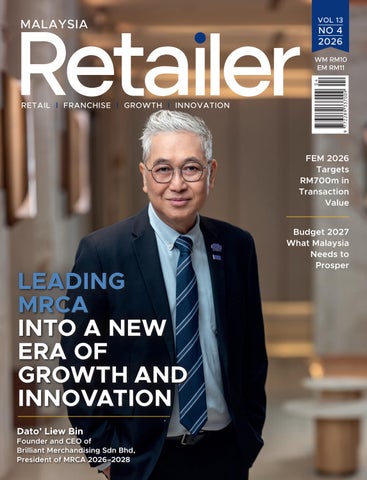
VOL 13
NO 4 2026 WM RM10 EM RM11
FEM 2026 Targets RM700m in Transaction Value
LEADING MRCA INTO A NEW ERA OF GROWTH AND INNOVATION Dato’ Liew Bin
Founder and CEO of Brilliant Merchandising Sdn Bhd, President of MRCA 2026–2028
Budget 2027 What Malaysia Needs to Prosper
MRCA Corporate Patrons
A-5-2, 3, 3A, Level 5, Block A, Sky Park One City, Jalan USJ25/1, 47650 Subang Jaya, Selangor. Tel: +603-5882 4333 Fax: 1 700 810 950 Website: www.mrca.org.my PRESIDENT Dato’ Liew Bin BRILLIANT MERCHANDISING SDN BHD IMMEDIATE PAST PRESIDENT Datuk Dr. Ken Phua BENTLEY MUSIC SDN BHD DEPUTY PRESIDENT Dato’ Vincent Choo Kok Leong URBAN IDEA SDN BHD VICE PRESIDENTS Valerie Choo Yoke Shiem SIMPLY AWESOME SDN BHD Dato’ Winnie Lim Yoke Chin SOLUTION RISK CONSULTANTS SDN BHD Dr. Afendi Dahlan DR GROUP HOLDINGS SDN BHD Michael Liew Fong Tzer MARRYBROWN SDN BHD SECRETARY GENERAL Henry Low Kar Onn SPECTRUM OUTDOOR MARKETING SDN BHD DEPUTY SECRETARY GENERAL Christine Tan Gaik Lin CT F&B HOLDINGS SDN BHD TREASURER GENERAL Aiveen Wong Choy Ching CHIN SWEE FOOD SDN BHD DEPUTY TREASURER GENERAL Terry Tay Eng Yeou AATAS LIVING SDN BHD COUNCIL MEMBERS Dr. Cassandra Chan Yi Rong SENHENG ELECTRIC (KL) SDN BHD Edison Choon King Han POH KONG HOLDINGS SDN BHD Jit Singh A/L Santok Singh IRONHORSE ASIA SDN BHD Liang Foo Kuan BIG ONION FOOD CATERER SDN BHD Nevinn Leow Shue Min SOUPER TANG GROUP SDN BHD Kelvin Liaw Kai Xuan FOCUS POINT HOLDINGS BERHAD Lim Ben Jie TUNE GROUP SDN BHD (AIRASIA) Racheal Tan Siok Khim WELLOUS SDN BHD Vincent Wong Yong Kang YFS CORPORATE (M) SDN BHD Marcus Chew Phai Hau OASIS HOME HOLDING BERHAD Linda Lo AMBON BOENDA SDN BHD
TRUSTEES OF MRCA FOUNDATION Dato’ Tay Sim Kim FOUNDATION FOUNDER CHAIRMAN AATAS LIVING SDN BHD Datuk Seri Garry Chua Foundation Chairman 2026-2028 ROTOL FOOD-CHAIN (M) SDN BHD Dato’ Eddie Choon POH KONG HOLDINGS BERHAD Datuk Albert Chiang BONIA CORPORATION BERHAD Datuk Lee Hwa Cheng PLATFORM MANAGEMENT SOLUTIONS SDN BHD Datuk Seri Nelson Kwok T. T., JP HONORARY CONSUL OF THE REPUBLIC OF MOZAMBIQUE TO MALAYSIA NELSON’S FRANCHISE SDN BHD Dato’ Liaw Choon Liang, JP FOCUS POINT SDN BHD Shirley Tay Bee Koo PHIPURE SDN BHD Dato’ Sharan Jethanand Valiram VALIRAM HOLDINGS SDN BHD Datuk Dr. Ken Phua BENTLEY MUSIC SDN BHD BOARD OF ADVISORS Tan Sri Dato’ Sri Leong Hoy Kum GROUP MD, MAH SING GROUP BHD Tan Sri Dato’ Sri Barry Goh Ming Choon CHAIRMAN, MCT BHD Tan Sri Dr Lim Wee Chai CHAIRMAN, TOP GLOVE CORPORATION BHD Tan Sri Datuk Ter Leong Yap EXECUTIVE CHAIRMAN, SUNSURIA BHD Tan Sri Dato’ Sri Tang Yeam Soon GROUP MANAGING DIRECTOR, THE STORE CORPORATION BHD Dato’ Dr. Jennifer Low, JP GROUP MANAGING DIRECTOR, QUILL GROUP OF COMPANIES PRESIDENT ADVISOR 2026-2028 Datuk Manoharan Periasamy CHAIRMAN, MALAYSIA TOURISM PROMOTION BOARD (MTPB) Dato’ Seri Ivan Teh SENIOR ADVISOR, ILLUMINEXT SDN BHD Ben Teh CHAIRMAN, EVOLUTE ASIA SDN BHD LEGAL ADVISORS Dato’ Dr Manjit Singh MANJIT SINGH SACHDEV, MOHAMMAD RADZI & PARTNERS Datuk Ringo Low RINGO LOW & ASSOCIATES HONORARY AUDITORS Dato’ Sri Dr. Raymond Liew Lee Leong MCMILLAN WOODS Datin Yap Shin Siang YYC GST CONSULTANTS SDN BHD
MALAYSIA RETAILER is produced for MRCA by
HARINI MANAGEMENT SERVICES SDN BHD (609031-W) W-9-12, Menara Melawangi, Amcorp Trade Centre, 18, Persiaran Barat, 46050 Petaling Jaya, Selangor. Tel: 603-7932 3259 Email: harini.mservices@gmail.com www.harini.com.my
Publisher/CEO V.S. Ganesan Senior Editor V. Sharmila Editor Khor Hui Min Writers Jenny Shree Anthony, Ezra Lew Kai Zhe Creative Designer Goh Wei Lee Advertising Consultant Faridah Ismail Marketing Manager Karthik Ganesan Operations Manager G. Revathi PRINTER UNITED MISSION PRESS SDN BHD (755329-X) No. 15, Perindustrian BS 9, Jalan BS 9/10, Taman Bukit Serdang, 43300 Seri Kembangan, Selangor. Tel: +603-8958 0186 All articles featured in Malaysia Retailer magazine represent the personal views of contributors and are not necessarily those of MRCA & Harini Management Services Sdn Bhd. All writers automatically agree to indemnify MRCA and Harini Management Services Sdn Bhd against any loss, costs, expenses (including legal fees), damages and liabilities that might arise from their own incapacity, negligence, breach of contract or other civil misdeeds. We reserve the right to edit all articles. All rights reserved. Copyright © 2026 by MRCA and Harini Management Services Sdn Bhd. No part of this publication may be reproduced in any form without prior written permission from the publisher. MRCA and Harini Management Services Sdn Bhd accept no responsibility for unsolicited manuscripts, photography, illustration and other editorial materials.
CONTENTS / VOL. 13 NO. 4
10
A New Chapter Begins for MRCA
32
12
FEM 2026 Targets RM700m in Transaction Value
Inside the F&B Playbook: Lessons From Leaders Building Successful Food Brands
COVER STORY ON THE COVER
4
Leading MRCA Into A New Era Of Growth, Innovation
MRCA EVENTS/MARKET INFO 10 A New Chapter Begins for MRCA 12 FEM 2026 Targets RM700m in Transaction Value
19 MRCA Budget 2027 Wishlist For Dato’ Liew Bin Founder, CEO of Brilliant Merchandising Sdn Bhd and President of MRCA 2026-2028
A Sustainable Retail Ecosystem
20 Malaysia Retail Industry Report (June 2026)
26 Budget 2027: What Malaysia Needs to Prosper
29 Doing Business in Malaysia: Insights for Entrepreneurs and Investors
32 Inside the F&B Playbook: Lessons from Leaders Building Successful Food Brands
34 Connect Circle 1.0 Empowers Women
36 Air Asia Move Forge Strategic Retail Tourism Partnership/ Exclusive Opportunity for MRCA Members
Cover Story
4
LEADING MRCA INTO A NEW ERA OF GROWTH AND INNOVATION Infusing the association with optimism, resilience and progress.
A
fter three decades of building a successful business through creativity, innovation and perseverance, Dato’ Liew Bin has taken on one of the most significant leadership roles in Malaysia’s retail industry. As the newly elected President of the Malaysia Retail Chain Association (MRCA), he brings not only extensive entrepreneurial experience but also a clear vision of transforming the association into a stronger voice for retailers and a catalyst for the industry’s future. Having previously served as MRCA Deputy President, Dato’ Liew understands both the responsibilities and opportunities that come with the presidency. His appointment marks a new chapter for the 34-year-old association, one that places greater emphasis on strengthening the entire retail ecosystem while delivering meaningful value to its members.
Malaysia Retailer Vol 13 No 4
THREE DECADES OF BUILDING AN AWARDWINNING BUSINESS
Dato’ Liew is the founder and CEO of Brilliant Merchandising Sdn Bhd, a company established in 1994 that specialises in the design, development and distribution of bags. Over the past 30 years, the company has grown into a recognised market leader in custom-made bespoke bags, serving thousands of corporate clients locally and internationally. “We have an unwavering commitment to design and innovation. Rather than competing solely on price, we have built our reputation through intensive product research and development, producing functional, high-quality products tailored to clients’ specific needs and budgets,” said Dato’ Liew. The company’s achievements reflect this philosophy. It has delivered more than 200 million bags worldwide while supporting over 5,000 corporate businesses.
Its in-house brand, Terminus, has earned international recognition through prestigious accolades such as Germany’s Red Dot Design Award and the iF Design Award. The company has also secured numerous international industrial design patents, further demonstrating its strong innovation capabilities. Like many manufacturers, the company has adapted to changing global economic conditions over the years. It initially operated its own manufacturing facilities in Malaysia before expanding production to China. As the industry evolved, the company shifted towards outsourcing its manufacturing operations while maintaining its emphasis on design excellence and product development. Dato’ Liew’s ability to adapt to changing market realities has become one of the defining characteristics of his business career, an approach that now shapes his leadership of MRCA.
5
FROM DEPUTY PRESIDENT TO PRESIDENT
For Dato’ Liew, becoming MRCA President represents a fundamental shift in responsibility. He explains that serving as Deputy President was primarily about supporting the president’s initiatives and assisting in executing decisions. The presidency, however, requires setting the association’s direction and leading its overall development. “Deputy and president are totally two different roles,” he said. “As a deputy, you deputise... now as the president, you set the direction, and basically you lead the whole association.” This transition also reflects a broader change in his vision for MRCA itself. Having spent many years focusing on member benefits, Dato’ Liew believes the association has now reached a stage where it must play a larger role within Malaysia’s retail landscape. “MRCA has been supporting retailers for 34 years now, and our new tagline is ‘The Home of Retailers’,” he said. While member welfare remains important, he believes the association should increasingly focus on shaping and supporting the retail industry as a whole. “I focus more on the whole retail industry,” he explained. “I’m looking at a bigger scope.” He believes MRCA has developed sufficiently to become a stronger industry leader capable of driving positive change beyond its membership.
“For 30 years, Brilliant Merchandising has been driven by one belief: that great design creates lasting value. From delivering over 200 million bags worldwide to earning internationally recognised design awards, our success is built on creativity, innovation and quality. We will continue to push the boundaries of design and develop functional solutions that help businesses grow in an ever-evolving global market.” Dato’ Liew Bin, Founder and CEO of Brilliant Merchandising Sdn Bhd, President of MRCA 2026–2028
Malaysia Retailer Vol 13 No 4
Cover Story
6
UNDERSTANDING THE CHALLENGES FACING RETAIL
Dato’ Liew assumes the presidency at a time when retailers are navigating multiple economic pressures. He points to both global and domestic factors affecting businesses today. International geopolitical tensions continue to disrupt global supply chains and contribute to rising costs. These higher costs ultimately affect consumers, who have become more cautious about spending. According to Dato’ Liew, rising living costs mean customers are purchasing less and making more considered spending decisions. At the same time, businesses are facing increasing operational expenses. He recognises that many government initiatives are necessary as Malaysia modernises its economy, citing e-invoicing as an example of a forward-looking policy. However, he also notes that the cumulative
Malaysia Retailer Vol 13 No 4
effect of new regulations, taxes and additional compliance requirements inevitably increases business costs. Higher rental expenses, electricity costs and various operational overheads further reduce retailers’ profit margins. Another major challenge comes from the growing influx of low-priced imported goods, particularly from China. While consumers benefit from greater affordability, local retailers often face intense price competition that squeezes already narrow margins. These combined pressures create an increasingly difficult operating environment for businesses across the retail sector.
He argues that finding employees has become even more difficult than training them. “Talent is becoming increasingly important,” he said. “The expansion of new foreign retail players has intensified competition for workers, pushing salaries higher while making recruitment more challenging.” For many retailers, the problem is no longer developing talent but simply finding sufficient employees to support business growth. As president, Dato’ Liew sees workforce development as an important area where MRCA can continue supporting its members through training, education and industry collaboration.
ADDRESSING THE TALENT SHORTAGE
A CREATIVE AND RESILIENT LEADERSHIP STYLE
Beyond economic challenges, Dato’ Liew believes the shortage of talent has become one of the industry’s most pressing concerns.
Dato’ Liew describes himself as a creative and dynamic leader who enjoys approaching problems from different perspectives.
7 Greater representation also improves the association’s ability to negotiate with the government on issues affecting retailers while advocating for policies that support sustainable business growth. He believes stronger membership ultimately leads to stronger member benefits, creating a positive cycle that attracts even more retailers to join.
CREATING A NEW HOME FOR RETAILERS
“I’m a creative person,” he said. “I always look at things from different angles.” This creative mindset has shaped both his entrepreneurial success and his leadership philosophy. Equally important is his people-centred approach. “I’m a very PR person,” he said, emphasising his ability to connect with people from different backgrounds. However, perhaps the greatest influence on his leadership has come from a deeply personal experience. In recent months, Dato’ Liew faced a serious health challenge that tested his resilience. Rather than stepping away from his responsibilities, he chose to persevere. “I never said no. I never said I want to stop. I never said I want to quit as president,” he shared. Overcoming this difficult period strengthened his determination and reinforced the importance of resilience. He hopes his experience serves as an example to fellow council members and the wider business community.
He believes this fighting spirit has inspired those around him and encouraged the entire leadership team to become more ambitious in serving both MRCA members and the retail community.
GROWING MRCA TO 1,000 MEMBERS
One of Dato’ Liew’s most ambitious goals is to almost double MRCA’s membership. Currently comprising approximately 530 members, he hopes to increase this figure to 1,000. “That’s my top priority,” he said. For Dato’ Liew, membership growth is about far more than numbers. A larger membership strengthens MRCA’s financial stability, enabling the association to invest more resources into member programmes, training and industry initiatives. More importantly, a larger membership gives MRCA a stronger voice when engaging with policymakers. “When members increase, our voice can be heard louder and clearer,” he explained.
Another major initiative under Dato’ Liew’s presidency is the establishment of a permanent home for MRCA. The association has acquired a new office in Icon City, which he envisions as much more than an administrative headquarters. Instead, he wants it to become a vibrant one-stop centre where retailers can gather, collaborate and learn. The new premises will host meetings, networking sessions, training programmes, seminars and town hall discussions. It will also serve as a welcoming space where both members and prospective members can interact, exchange ideas and experience the value of belonging to MRCA. In line with the association’s new tagline, Dato’ Liew hopes the facility will truly become ‘The Home of Retailers’.
EXPANDING MEMBER BENEFITS THROUGH TECHNOLOGY
Technology will play an increasingly important role in Dato’ Liew’s plans for MRCA. Among his proposed initiatives is the development of an MRCA mobile application designed to strengthen collaboration among members. The app would Malaysia Retailer Vol 13 No 4
Cover Story
8 enable members to search for products and services offered by fellow members, conduct business transactions and enjoy exclusive member privileges. One of its key features would be special discounts provided by participating MRCA members. Dato’ Liew believes the benefits could extend beyond business owners to their employees as well. With current membership already exceeding 500 companies, and potentially reaching 1,000, the programme could eventually benefit hundreds of thousands of employees through exclusive offers and promotions. By encouraging members to support one another, the app aims to create a stronger internal business ecosystem within MRCA.
STRENGTHENING INDUSTRY INFLUENCE
Dato’ Liew also plans to launch an MRCA podcast as part of the association’s communication strategy. He believes podcasts offer an effective platform to raise MRCA’s profile while sharing valuable insights with both members and the broader public. The podcast could feature interviews with successful entrepreneurs, renowned MRCA members and even government ministers, creating meaningful discussions on retail trends, business challenges and public policy. By embracing modern communication channels, MRCA can become more influential while expanding its reach to new audiences. This complements Dato’ Liew’s broader goal of positioning MRCA as a thought leader within Malaysia’s retail industry. Malaysia Retailer Vol 13 No 4
ENCOURAGING GREATER MEMBER ENGAGEMENT
Although expanding membership remains a priority, Dato’ Liew also wants existing members to become more actively involved in association activities. He believes many members underestimate the value available because they do not participate regularly. MRCA already organises approximately 200 activities annually, with plans to increase this number further. Its seven pillars and specialised committees provide members with opportunities to engage in various sectors, including physical retail, franchising, digital business, women’s initiatives, youth programmes and education. MRCA also collaborates with universities through its academy and scholarship programmes to help member companies develop more competent employees. Dato’ Liew encourages members to take full advantage of these opportunities by actively participating rather than expecting benefits to come automatically. His message is simple: meaningful value comes through engagement.
EMBRACING ARTIFICIAL INTELLIGENCE
Like many business leaders today, Dato’ Liew recognises that Artificial Intelligence (AI) is becoming increasingly important. He believes businesses cannot afford to ignore technological developments. However, he also acknowledges that AI may not immediately benefit every retailer, particularly smaller businesses with limited resources. Instead of viewing AI as a complete solution, he sees it primarily as a powerful analytical tool. By analysing customer behaviour, purchasing patterns
and business data, AI enables retailers to make better-informed decisions. While technology will continue transforming retail, Dato’ Liew believes businesses must still apply their own judgement and industry knowledge when interpreting the information AI provides.
LOOKING AHEAD
Dato’ Liew Bin enters the MRCA presidency with a combination of entrepreneurial experience, creative thinking and personal resilience forged over three decades in business. His vision extends beyond expanding membership or introducing new programmes. He wants MRCA to become the definitive home for Malaysia’s retailers, a vibrant association that supports its members while shaping the future of the nation’s retail industry. From establishing a permanent headquarters and launching digital platforms to strengthening government engagement and embracing emerging technologies, his plans reflect a forwardlooking approach to industry leadership. At the heart of his presidency is a simple but powerful belief: a stronger MRCA creates a stronger retail industry. Through collaboration, innovation and active participation, Dato’ Liew hopes to position the association as a trusted partner for retailers while ensuring their collective voice is heard more clearly than ever before. As he embarks on this new chapter, his message is one of optimism, resilience and progress: qualities that have defined his own business journey and now underpin his vision for the future of MRCA. ■
MRCA Event
10
A New Chapter Begins for MRCA The Malaysia Retail Chain Association’s 29th Annual General Meeting marked the close of one leadership chapter and the beginning of another, as members reflected on the Association’s achievements while charting its course for the future.
he Malaysia Retail Chain Association (MRCA) ushered in a new chapter during its 29th Annual General Meeting (AGM) on 28 April 2026 at One World Hotel, Petaling Jaya, where members gathered to review the Association’s progress, endorse key resolutions and elect a new leadership team for the 2026–2028 term. Attended by 49 ordinary members representing the Association’s diverse retail, food and beverage, franchise and allied sectors, the AGM served as a platform to reflect on the past two
T
Malaysia Retailer Vol 13 No 4
years while reaffirming MRCA’s commitment to advancing Malaysia’s retail industry through collaboration, advocacy and innovation.
REFLECTING ON PROGRESS Opening the meeting, outgoing President Datuk Dr Ken Phua reflected on MRCA’s journey over the past two years, highlighting the Association’s active engagement with government agencies and policymakers, stronger industry collaboration, digital transformation initiatives, strategic partnerships and community programmes.
Expressing his appreciation to the Council, members and partners for their unwavering support, he said the Association had continued to strengthen its role as the collective voice of Malaysia’s retail industry while laying the foundation for future growth.
KEY RESOLUTIONS APPROVED Members unanimously adopted the minutes of the previous AGM and Extraordinary General Meeting before receiving the Secretary-General’s report on the Association’s activities from March 2025 to March 2026.
11
The AGM also approved the audited financial statements for the financial year ended 31 December 2025, the Foundation’s financial report and the Association’s 2026 revenue and expenditure estimates. Another significant milestone was the approval of proposed amendments to MRCA’s Constitution, aimed at strengthening the Association’s governance framework and ensuring it remains relevant to the evolving needs of the retail industry. The amendments will take effect upon approval by the Registrar of Societies.
WELCOMING A NEW LEADERSHIP TEAM A key highlight of the AGM was the election of MRCA’s new Council for the 2026–2028 term. Following the conclusion of the election process, Dato’ Liew Bin officially succeeded Phua as President, ushering in a
new leadership chapter for the Association. The AGM also confirmed the appointment of the Association’s auditors, honorary auditors and legal advisers for the new term. In his inaugural address, Bin thanked members for their confidence and paid tribute to the outgoing leadership for its dedication and contributions in strengthening MRCA. Looking ahead, he outlined his vision of further strengthening MRCA as the voice of Malaysian retailers by expanding membership, fostering closer collaboration across the industry, creating more platforms for networking and knowledge-sharing, and continuing to support talent development through meaningful initiatives. He also emphasised the importance of building a stronger and more connected retail ecosystem that enables businesses to innovate, remain competitive
and seize new opportunities in an increasingly dynamic marketplace.
IN THE PIPELINE Members were also updated on several initiatives in the pipeline, including the MRCA Youth Leadership Series, the Association’s mobile app, the Value+ Campaign and preparations for Franchise Expo Malaysia (FEM) 2026, all of which reflect MRCA’s continued focus on creating value for members through learning, networking and business opportunities. As the Association embarks on a new leadership term, the 29th AGM represented more than an annual governance exercise. It marked the passing of the baton from one leadership team to the next, while reaffirming MRCA’s shared commitment to strengthening Malaysia’s retail industry and creating greater opportunities for its members in the years ahead. ■ Malaysia Retailer Vol 13 No 4
MRCA Event
12
FEM 2026 Targets RM700m in Transaction Value The target reflects growing investor confidence in the franchising model as a mechanism for business expansion amid evolving economic conditions. he Malaysia Retail Chain Association officially opened its annual flagship event, the three-day Franchise Expo Malaysia 2026 (FEM 2026) in July at the Kuala Lumpur Convention Centre (KLCC). The opening ceremony was graced by the Selangor State Executive Councillor (EXCO) for Investment, Trade and Mobility YB Ng Sze Han, who was also the guest of honour.
T
Malaysia Retailer Vol 13 No 4
The presence of YB Ng reflected the government’s continued support for entrepreneurship, franchising and the development of Malaysia’s retail sector. This 9th edition of FEM set a target of RM700 million in transaction value, representing a 40% increase from the actual transaction value of RM500 million recorded last year. The higher target reflects growing
investor confidence in the franchising model as a sustainable mechanism for business expansion amid evolving economic conditions.
ROBUST GROWTH Spanning five major exhibition halls, FEM 2026 featured more than 450 exhibition booths. The expo saw some 20,000 visitors, signalling robust growth across the retail and franchise sectors. Malaysian home-grown brands accounted for 60% of the participating brands, while the remaining 40% comprised international franchises. The expo serves as a highefficiency business-matching platform connecting brand owners, prospective franchisees and investors, while supporting the overall advancement of the retail ecosystem. On the international front, FEM 2026 featured strong global representation, with participating countries including Thailand, China, the US, the UK, the Philippines,
13
Malaysia Retailer Vol 13 No 4
MRCA Event
14 South Korea, India, Spain, Australia and Indonesia, to name a few. Notably, the Department of Business Development (DBD) under Thailand’s Ministry of Commerce anchored a dedicated Thailand Pavilion. Other major international organisations participating in the exhibition included the China Bakery Association, the Catering Franchise Alliance (China) and the World Franchise Association.
BUILDING BRANDS Embracing the global shift towards short-form video and digital retail, FEM 2026 introduced an exclusive live streaming zone, which encouraged exhibitors to synchronise their physical booths with online promotional channels to strengthen brand awareness and generate business leads. This digital initiative forms part of MRCA’s broader strategy to introduce a more youthful and international
Malaysia Retailer Vol 13 No 4
dimension to the exhibition.
COLLABORATION FEM 2026 also witnessed the signing of an MOU between MRCA and Tunku Abdul Rahman University of Management and Technology, aimed at strengthening collaboration in education and talent development. Under the partnership, both parties will collaborate on talent development, education, industry engagement, scholarships, internships, career opportunities, knowledge sharing and corporate social responsibility initiatives. Organising Chairman of FEM 2026 Terry Tay said one of the core objectives of this year’s expo is to lower the barrier to entry for aspiring entrepreneurs by providing them with transparent and reliable brand information. “Every brand showcasing at FEM 2026 underwent a rigorous screening process. Exhibitors are required to
be members of MRCA, ensuring that they possess an established business scale and solid credibility,” he said. “This stringent measure is in place to protect the rights and investments of prospective franchisees.”. FEM 2026 received strong support from retail industry players, with Nu Vending as the Platinum Sponsor, Xilnex and Reveillon Group Sdn Bhd as the Silver Sponsors and Gintell as the Bronze Sponsor. Meanwhile, U Business served as the Patron and Connectivity Partner, ensuring seamless digital connectivity throughout the threeday event. FEM 2026 ended on a high note. By combining innovation with youthcentric elements, it successfully bridged the gap between traditional retail models and modern business strategies, ultimately cultivating a more resilient, dynamic and futureready local retail ecosystem. ■
15
Malaysia Retailer Vol 13 No 4
MRCA Event
16
Malaysia Retailer Vol 13 No 4
17
Malaysia Retailer Vol 13 No 4
MRCA Event
18
Malaysia Retailer Vol 13 No 4
The association wishes for a sustainable, competitive and resilient retail ecosystem. s Malaysia prepares for the tabling of Budget 2027 by Prime Minister and Finance Minister Dato Seri Anwar Ibrahim on Oct 9, 2026, MRCA has outlined a strategic fiscal wishlist to foster a sustainable, competitive and resilient retail sector. Malaysian businesses are navigating an increasingly complex environment, contending with compounding operational costs and external competition. To drive productivity and job creation, the MRCA emphasises the critical need for policy consistency, regulatory clarity, and equitable economic frameworks. The MRCA urges the Finance Ministry to incorporate the following macroeconomic solutions into the drafting of Budget 2027:
A
1
Ensure Equitable Compliance for Cross-Border e-Commerce Platforms Local brick-and-mortar retailers continue to face substantial compliance disparities compared to untaxed or under-taxed foreign e-commerce platforms offering ultra-low prices. This structural imbalance not only threatens local enterprises but results in significant tax base erosion for the nation. Equalising Surcharges and LVG Enforcement: We strongly urge the Government to secure national revenue by implementing stricter policies and equalising surcharges on cross-border e-commerce transactions, including the stricter enforcement of the Sales Tax on Low-Value Goods (LVG). Combatting Counterfeits: We call for stringent regulatory controls to mitigate the proliferation of
counterfeit and inferior goods on e-commerce platforms, thereby protecting consumer safety, preserving quality standards, and defending the intellectual property of legitimate brand owners.
2
Optimise Taxation to Alleviate Operational Burdens and Incentivise ESG Upgrades The MRCA is deeply concerned by the escalating tax burden on commercial operations, particularly regarding the taxation of pure operational reimbursements. Utility Pass-Through SST Exemption: We urgently request the Government to exempt the 6% Service Tax on utility supplies for commercial tenants paying via mall management, which took effect on 1 July 2026. Taxing these pure passthrough reimbursements creates an inequitable double-taxation effect, necessitating a regulatory fix to prevent cascading operational costs. Tax Rebates for ESG Operational Upgrades: We propose targeted tax rebates or double tax deductions for commercial stakeholders investing in ESG operational upgrades, particularly regarding facility governance and public safety. Incentivising capital expenditures for active fire safety and modernised infrastructure. Renovation Service Tax Reduction: Additionally, we maintain our proposal to reduce the Service Tax on construction and renovation services to 3%, as building materials are already subject to tax. Phased Reintroduction of GST: We urge the Finance Ministry to reintroduce the Goods and Services Tax (GST) utilising a staggered, step-up structure. Starting from
an accessible, low base and progressively adjusting upward over five-year intervals will grant businesses adequate gestation to adapt, cushion household sentiment, and safeguard economic stability. A transparent, multi-stage consumption tax with a reliable refund mechanism and strict zero-rating for essential goods will eliminate the compounding costs of SST, broaden the national revenue base, and establish a fairer tax ecosystem for businesses and consumers alike.
3
Stimulate the Domestic Retail Economy via Targeted Tax Reliefs and Local Product Incentives Enhance Domestic Retail Competitiveness: We advocate for the elimination of sales taxes on locally manufactured goods. Removing these cascading costs will allow domestic retailers to maintain highly competitive pricing against foreign imports, thereby stimulating local production and consumption. Expand Tourism Tax Relief: We urge the Government to extend the RM1,000 domestic tourism tax relief through 2027 and expand its scope. Rather than limiting it to specific sectors, the relief should explicitly include hotel accommodations and targeted retail shopping expenditures to maximise the economic multiplier effect of domestic tourism. The MRCA believes that a stable and business friendly policy framework will reduce compliance costs and improve investor confidence. We remain committed to working closely with the Government, providing actionable industry insights to shape a Budget 2027 that supports a globally competitive and sustainable Malaysian retail sector. ■ Malaysia Retailer Vol 13 No 4
Market Info
MRCA Budget 2027 Wishlist
19
Market Info
20
Malaysia Retail Industry Report (June 2026) Compiled by Retail Group Malaysia
PREAMBLE Members of Malaysia Retailers Association (MRA) and Malaysia Retail Chain Association (MRCA) were interviewed on their retail sales performances for the first half-year of 2026. This is the 29th anniversary of Malaysia Retail Industry Report. It is the longest-running retail industry survey in Malaysia.
LATEST RETAIL PERFORMANCE For the first quarter of 2026, the Malaysian retail industry recorded a positive growth rate of 3.7% in retail sales, as compared to the same period in 2025 (Table 1). This latest quarterly result was below market expectation. In March 2026, members of MRA and MRCA estimated the growth rate at 4.4%. The two largest festivals in Malaysia were celebrated during the first quarter. Chinese New Year took place in the month of February and Hari Raya Aidilfitri was celebrated from March 21. Malaysia Retailer Vol 13 No 4
Phase 1 of Sumbangan Tunai Rahmah (STR) was distributed from January 20 and Phase 2 of STR was brought forward to March 10 (instead of early April). 5 million eligible Malaysians received payments totalling RM2.4 billion during the first quarter of 2026. Since February 9, the Malaysian government had provided a one- off RM100 Sumbangan Asas Rahmah (SARA) to 22 million Malaysians aged 18 years and above with a total cost of RM2.2 billion. For the first 3 weeks, it had been redeemed by
12.5 million people with a total value exceeding RM1 billion. These monetary incentives had sustained retail spending in conjunction with the celebration of Chinese New Year in February and Hari Raya in March. Despite the geopolitical tension in the Middle East, Malaysia attracted 10.65 million foreign tourist arrivals during the first quarter of 2026. For the second consecutive year, it was the most visited country in Southeast Asia during this quarter. China and Australia registered the
TABLE 1: YEAR ON YEAR PERCENTAGE CHANGE IN RETAIL SALES (WEIGHTED), 2025/26 Type Retail sales
Source: MRA/ MRCA/ Retail Group Malaysia
Period
% Growth
Jan-Mar 2025
5.6
Oct-Dec 2025
2.5
Jan-Mar 2026
3.7
highest growth rates with 25% and 11% respectively.
COMPARISON OF RETAIL SALES WITH OTHER ECONOMIC INDICATORS For the first quarter of 2026, the Malaysian national economy reported a positive growth rate of 5.4% (Table 2, at constant prices), as compared to 3.7% for retail sales (at current prices). This latest economic result was contributed by sustainable private consumption, resilient growth of private investment as well as steady export growth driven by strong demand for electrical and electronics products. The services, manufacturing and construction sectors were the main drivers of growth. The services sector rose by 5.6%, manufacturing sector grew by 5.9%, and construction sector expanded by 7.7%. The average inflation rate during the first quarter of 2026 increased by 1.6% due partly to the Middle East war.
Restaurants & Accommodation Services as well as Education climbed by 2.6% and 2.5% respectively during March. Private consumption grew moderately at 4.7% during the first quarter of 2026 because of sustainable retail spending and stable labour market. The unemployment rate during the first quarter of 2026 declined slightly to 2.9%. Labour force participation rate maintained at a historical high of 70.9% during the quarter.
Rising prices in various consumers’ services were the main causes of higher inflation during the first 3 months of this year. During the month of March, the prices of Personal Care, Social Protection & Miscellaneous Goods & Services rose sharply by 7.0%. In addition, the prices of Insurance and Financial Services increased by 4.9% during March. The main group of Alcoholic Beverages & Tobacco recorded 2.7% higher in prices during the same month. Furthermore, the prices of
TABLE 2: COMPARISON OF RETAIL SALES WITH OTHER ECONOMIC INDICATORS, 2025/26 Economic Indicator
4th Qtr. 2025
1st Qtr. 2026
6.2
5.4
GDP (%) Inflation rate (%)
1.3
1.6
Private consumption (%)
5.6
4.7
Retail sales (%)
2.5
3.7
Unemployment rate (%)
3.0
2.9
Source: Bank Negara/ Department of Statistics/ Retail Group Malaysia
TABLE 3: YEAR ON YEAR PERCENTAGE CHANGE IN RETAIL SALES BY RETAIL SUB-SECTOR, 2025/26 Retail Sub-Sector
1st Qtr.
4th Qtr.
1st Qtr.
2025
2026
% Department store cum supermarket
5.8
-2.3
-1.0
Department store
2.7
-4.5
0.3
Supermarket and hypermarket
3.7
-1.8
1.4
Mini-market, convenience store & cooperative
8.2
15.9
NA
Fashion and fashion accessories
12.2
3.7
4.2
Pharmacy
4.6
3.6
4.2
Personal care
-3.7
NA
-0.7
Furniture & furnishing, home improvement as well as electrical & electronics
-1.1
-7.6
9.3
Other specialty retail stores
-5.8
8.1
-16.5
Notes: *- children and baby products include apparel, accessories, equipment, school uniform and toys NA- not available Source: MRA/ MRCA/ Retail Group Malaysia
Malaysia Retailer Vol 13 No 4
Market Info
21
Market Info
22
RETAIL SUB-SECTORS’ SALES COMPARISON
shops, fitness equipment stores, store retailing musical instrument, second-hand goods’ stores, arts and crafts stores, as well as gift shops) fell by 16.5% during the first quarter of 2026, as compared to the same period last year. This was the worst performing retail sub-sector during the quarter.
The department store operators are expecting their sales to increase by 6.8% for the second 3-month The sales performances of retail period of this year. sub-sectors during the first quarter Conversely, the supermarket of 2026 (Table 3) were mixed. and hypermarket operators are not Despite the two major festival optimistic about their businesses celebrations, the Department during the second quarter of 2026. Store cum Supermarket sub-sector They expect their sales to decline by recorded a negative growth rate 2.3% for the quarter. of 1.0% during the first quarter of Retailers in the fashion and 2026, as compared to the same NEXT 3 MONTHS’ fashion accessories sector expect period a year ago. FORECAST their businesses to leap by 12.0% The Department Store subMembers of the two retailers’ in terms of growth rate during sector achieved a near-zero growth associations expect their businesses the second quarter of 2026, as rate of 0.3% in terms of sales during to achieve an average growth rate compared to the same period a first 3-month period of this year. of 4.8% during the second quarter year ago. This sub-sector has the The Supermarket and of 2026 (Table 4). This relatively best estimate among the retail subHypermarket sub-sector reported a high growth rate is due mainly to sectors during the quarter. marginal growth rate of 1.4% during the low base effect. For the same Pharmacy operators anticipate the first quarter of 2026. period a year ago, Malaysia’s retail their retail sales during the second During the first quarter of 2026, industry suffered a drop in business quarter of this year to grow at a the Fashion and Fashion Accessories by 3.0%. sustainable rate of 4.1%. sub-sector achieved a promising The department store cum Retailers in the personal care growth rate of 4.2%. supermarket operators are sub-sector are expecting their During the first quarter of this expecting their business to expand businesses to rebound during the year, the sales of the Pharmacy subby 2.5% for the second quarter of second quarter of 2026 with a sector rose by 4.2%, as compared to this year. growth rate of 11.0%. the same quarter a year ago. Operators of On the other hand, furniture & furnishing, the Personal Care subhome improvement sector suffered another TABLE 4: 3-MONTH RETAIL as well as electrical & decline in sales. During SALES FORECAST electronics are optimistic the first 3-month period BY RETAIL SUB-SECTOR, of a growth rate of 9.4% of this year, the business APRIL-JUNE 2026 during the second 3 of this sub-sector months of this year. contracted by 0.7%. Retailers in other The Furniture & Retail Sub-Sector Growth Rate % specialty stores subFurnishing, Home Overall (weighted) 4.8 sector (including Improvement as well as Department store cum supermarket 2.5 photo shops, fitness Electrical & Electronics Department store 6.8 equipment stores, sub-sector enjoyed an Supermarket and hypermarket -2.3 stores retailing musical uplifting performance Mini-mart, convenience store & coop. NA instrument, second-hand during the first quarter Fashion and fashion accessories 12.0 goods’ stores, arts and of 2026. This subPharmacy 4.1 crafts stores as well as sector grew by 9.3% Personal care 11.0 gift shops) are projecting in sales, as compared F&F, home improvement and E&E# 9.4 their businesses to to a year ago. This was Other specialty retail stores -17.8 weaken by as much the highest growth rate as -17.8% during the achieved among the Note: second quarter of 2026. retail sub-sectors during #- furniture & furnishing, home improvement and electrical & This sub- sector has this quarter. electronics the worst retail sales The sales of Other NA- not available forecast for the quarter. Specialty Stores subSource: MRA/ MRCA/ Retail Group Malaysia sector (including photo Malaysia Retailer Vol 13 No 4
THE REST OF YEAR 2026 Retail Group Malaysia (RGM) revises downwards slightly on its projection for the annual growth rate of retail sales in 2026 from 4.0% to 3.8% (Table 5). This latest projection has taken into account the current and likely negative impacts on the purchasing power of Malaysian consumers since the outbreak of the Middle East war in February this year. In 2026, the Malaysian government expects its national economy to grow between 4.0% and 4.5%. This economy is expected to be driven by sustainable household spending, positive private and public investments, increased export growth (especially for E&E goods) as well as higher foreign tourist arrival. The Malaysian government has allocated RM15 billion for Sumbangan Tunai Rahmah (STR) and Sumbangan Asas Rahmah (SARA) for 2026, up from RM13 billion in 2025. These government cash transfers should continue to support basic household spendings throughout the year. The Malaysian government has raised its annual inflation rate projection to be between 1.5% and
TABLE 5: MALAYSIA RETAIL INDUSTRY QUARTERLY GROWTH RATE, 2026 Quarter First
Growth rate (%) 3.7
Second
(e) 4.8
Third
(e) 2.9
Fourth
(e) 3.9
Whole year
(e) 3.8
(e)- estimate Source: Retail Group Malaysia
2.5% in 2026 (as compared to 1.3% and 2.0% estimated during early of this year). In fact, it will likely to be closer to the upper end of this latest range. The US-Israel strikes on Iran since February has affected the purchasing power of Malaysian consumers. The main cause of the erosion of buying power has been the rising fuel prices. Between first week of March and first week of June, unsubsidized RON95 had risen from RM2.67 to RM3.72 (increment by 39%). Diesel price (Peninsular Malaysia) had jumped from RM3.21 to RM4.67 (higher by 45%) during the same period. As a result, prices of many retail goods and services in Malaysia have increased. In recent months, Malaysians
have been dealing with higher prices on grocery items; take-away foods; dining out; car repairs; car parts’ replacements; house rental; house repair services; medicines; medical consultations and treatments; insurance protections; tuition fees; private and school bus fees; domestic and international airline tickets; domestic tour packages and many others. To make matters worse, a new wave of retail price increases is expected to begin from June this year. According to the Department of Statistics Malaysia, inflation had climbed by 1.9% during the month of April. The top three increments were Insurance and Financial Services (4.9%), Personal Care, Social Protection & Miscellaneous Goods & Services (4.8%) as well as Transport (4.1%). Food Away from Home had the highest increase at 2.6% within the Food & Beverages subgroup. Simultaneously, this prolonged Middle East conflict has affected Malaysian manufacturers due to rising energy prices, severe supplychain disruption and surging logistic costs. Manufacturers in Malaysia have to deal with higher input costs and weaker demand from major export markets. This has affected the economic prospect of Malaysia in 2026. Year 2026 is Visit Malaysia Year. The Malaysian government is targeting 47 million foreign tourist arrivals and RM329 billion in tourism receipts during this year-long campaign. High tourists’ (both domestic and international) spending is expected this year. This should benefit retail businesses located in major cities and tourism towns throughout Malaysia. However, the Middle East war has affected the holiday plans for Malaysia Retailer Vol 13 No 4
Market Info
23
Market Info
24 tourists coming from West Asia and Europe since March. In addition, the fuel crisis has resulted in many flight cancelations coming into Malaysia. Domestic tourism is also being impacted due to high diesel price. Malaysia’s retail industry is projected to grow by 4.8% during the second quarter in 2026, as compared to the same period a year ago. This relatively high growth rate is due mainly to the low base effect. During the second quarter of 2025, the retail industry contracted by 3.0%. The third quarter and fourth quarter of Malaysia’s retail sector are anticipated to expand by 2.9% and 3.9% respectively. These are downward revisions from the estimates published in March this year after taking into consideration the likely slowing consumers’ spending during the second half of this year.
FOOD & BEVERAGE SECTOR During the first quarter of 2026, Malaysian consumers dined in various F&B outlets throughout the country in celebration of their major festivals as well as during their children’s school holidays. In spite of these special occasions, Food & Beverage Outlets (Cafe and Restaurant) reported a disappointing growth rate of -4.6% during the first quarter of 2026, as compared to the same quarter a year ago (Table 6). This was below the estimate (1.9%) made by F&B operators in March this year. Similarly, the sales of Food
TABLE 6: MALAYSIA FOOD & BEVERAGE INDUSTRY QUARTERLY GROWTH RATE, 2025/26 Year
2025
2026
4th Qtr.
1st Qtr.
2ndQtr. (e)
Cafe and restaurant
3.1
-4.6
-2.3
Take-away, kiosk and stall
NA
-1.4
-0.8
Growth Rate (%)
Notes: -Cafe and restaurant include fast food restaurant, cafe, coffee cafe, bakery cafe, restaurant, full-service restaurant and caterer. -Take-away, kiosk and stall include food outlet caters for take-away only, bakery without seating, kiosk and food stall. NA- not available (e)- estimate Source: MRA/ MRCA/ Retail Group Malaysia
& Beverage Outlets (Take-Away, Kiosk and Stall) contracted by 1.4% during the first quarter of 2026, as compared to the same period one year ago. During the second quarter, the soaring fuel prices have affected both the diners and the F&B operators in Malaysia. Due to rising costs of living, diners have chosen to eat out less. Others have ordered lower-priced foods and drinks from their regular cafes, restaurants and beverage outlets. The Middle East war has affected local F&B operators severely during the second quarter and it is expected to be worsened in the second half of this year. These operators have suffered from sudden jump in food prices (raw materials and food ingredients) and rising operation costs (shop rental, fuel prices, utilities costs, staff expenses and food packaging costs).
During the second quarter, some established independent operators have chosen to end their businesses, while some chain operators have chosen not to renew the leases of some of their underperforming mall outlets. Other operators have reduced food portion sizes and/ or switched to cheaper food ingredients in order to survive. Some operators have increased the prices of its meals and beverages in order to prevent heavy losses. Cafe and restaurant operators remain pessimistic about their businesses for the next quarter. Average sales is expected to decline by 2.3% during the second 3 months of this year, as compared to the same period a year ago. In addition, food and beverage kiosk and stall operators are projecting their business to drop by 0.8% during the second quarter of 2026. ■
Footnote: • This report is provided as a service to members of MRA, MRCA and the retail industry. It provides industry data that give retailers better analytical tools for running their retail businesses. • This report is not allowed to be reproduced or duplicated, in whole or part, for any person or organisation without written permission from Malaysia Retailers Association, Malaysia Retail Chain Association or Retail Group Malaysia. • Retail Group Malaysia is an independent retail research firm in Malaysia. The comments, opinions and views expressed in this report are of writer’s own, and they are not necessary the comments, opinions and views of MRA, MRCA and their members. • For more information, please write to tanhaihsin@yahoo.com.
Malaysia Retailer Vol 13 No 4
Market Info
26
Budget 2027: What Malaysia Needs to Prosper 2026 2024
2027
2025
2023
s Malaysia strives to strengthen its economic resilience and position itself as a preferred destination for investment, Budget 2027 presents an important opportunity to reshape the country’s tax and business environment. While tax incentives remain an essential catalyst for economic growth, equal priority should be given to creating a tax system that is simple, transparent, predictable and costefficient. Today, businesses face increasing compliance obligations arising from e-Invoicing, Transfer Pricing
A
Malaysia Retailer Vol 13 No 3
Documentation, the Stamp Duty Self-Assessment System and the expanded Sales and Service Tax (SST). These requirements, although well-intentioned, have significantly increased the cost and complexity of doing business, particularly for small and medium-sized enterprises (SMEs). A modern tax system should not merely collect revenue – it should facilitate investment, encourage entrepreneurship and support economic expansion. The following proposals are therefore recommended for consideration in Budget 2027.
1
REDUCE COMPLIANCE COSTS FOR BUSINESSES
Businesses are investing substantial resources to comply with evolving tax and regulatory requirements. Budget 2027 should alleviate these burdens by: ● Allowing a full tax deduction for all statutory compliance, tax advisory and governance-related costs. ● Extending tax incentives for digitalisation, accounting software, artificial intelligence (AI) and automation adopted by SMEs. ● Increasing the deductible
27 threshold for accounting, tax filing, company secretarial and corporate governance expenses. ● Introducing accelerated capital allowances for investments in digital compliance systems and AI-enabled business solutions. Reducing compliance costs will improve productivity and allow businesses to focus more resources on growth and innovation.
2
IMPROVE TAX CERTAINTY
A key concern among taxpayers is uncertainty arising from differing interpretations of tax legislation and inconsistent administrative practices. The Government should therefore: ● Issue more Public Rulings, Practice Notes and Frequently Asked Questions covering common tax issues. ● Introduce administrative safe harbour rules where appropriate. ● Establish a formal advance ruling mechanism with defined response timelines. ● Permit taxpayers to defer payment of disputed taxes while appeals are pending before the Special Commissioners of Income Tax or the courts. Greater certainty enhances voluntary compliance, reduces disputes and strengthens Malaysia’s attractiveness to investors.
3
SIMPLIFY THE STAMP DUTY SYSTEM
The implementation of the Stamp Duty Self-Assessment System has transferred greater responsibility to taxpayers. However, many businesses continue to face uncertainty in determining whether documents are dutiable. Budget 2027 should therefore consider: ● Simplifying stamp duty rules for common commercial agreements.
● Exempting low-value and lowrisk documents from stamp duty. ● Introducing an online stamp duty calculator together with practical guidance notes. ● Allowing businesses with high transaction volumes to submit periodic stamp duty returns instead of stamping every individual document. These measures would significantly reduce administrative costs while maintaining effective revenue collection.
intellectual property creation and commercialisation. ● Extending the Reinvestment Allowance beyond its current limitation to encourage continuous automation and expansion. ● Introducing enhanced deductions for investments in environmental sustainability, renewable energy and ESG initiatives. Such measures would strengthen Malaysia’s position as a regional business hub.
4
5
ENHANCE MALAYSIA’S INVESTMENT COMPETITIVENESS
Malaysia continues to compete aggressively with regional economies for foreign direct investment. The tax system should therefore encourage longterm investment and business expansion. The Government may consider: ● Introducing more attractive tax incentives for digital businesses, regional headquarters and highvalue service industries. ● Enhancing incentives for research and development,
STRENGTHEN SMES AND PROFESSIONAL SERVICES
SMEs remain the backbone of Malaysia’s economy but continue to face rising operating costs and increasing regulatory obligations. Budget 2027 should provide: ● Additional automation and AI grants. ● Enhanced tax deductions for employee training, professional development and digital upskilling. ● Incentives encouraging the adoption of cloud accounting, cybersecurity and digital transformation technologies. Malaysia Retailer Vol 13 No 3
Market Info
28 ● Special incentives supporting professional service firms that invest in technology and innovation to improve service quality and productivity. Professional firms play an important role in supporting business compliance and should themselves be recognised as strategic enablers of economic growth.
6
REVIEW THE SALES AND SERVICE TAX FRAMEWORK
While the expanded SST has strengthened Government revenue, there remains scope to simplify its administration and reduce unnecessary business costs. The Government should consider: ● Zero-rating or exempting exported services to improve international competitiveness. ● Simplifying SST legislation and administrative procedures. ● Expanding group relief provisions to minimise cascading tax costs within corporate groups. ● Introducing clearer industryspecific guidance to reduce uncertainty and compliance disputes. A more efficient SST framework will improve compliance while reducing administrative burdens.
7
EXPAND INDIVIDUAL TAX RELIEFS
As Malaysians continue to face rising living costs, Budget 2027 should provide meaningful tax relief to support households and encourage lifelong learning. Possible measures include: ● Reintroducing parental care relief. ● Increasing relief limits for medical expenses, medical insurance and critical illness coverage. ● Introducing tax relief Malaysia Retailer Vol 13 No 3
for AI-related learning, digital skills training and professional certifications. ● Reviewing individual income tax bands to better reflect current income levels, wage growth and inflation. These measures would strengthen household purchasing power while encouraging workforce development.
SUMMARY CONCLUSION Budget 2027 presents Malaysia with a defining opportunity to modernise its tax system into one that is not only capable of generating sustainable revenue, but also promotes investment, innovation and economic growth. While targeted tax incentives will continue to play an important role in supporting strategic industries, equal priority must be given to simplifying tax legislation, reducing compliance burdens and providing taxpayers with greater certainty and consistency in the administration of tax laws. A tax framework that is fair, transparent, practical and predictable will foster greater investor confidence, strengthen voluntary compliance, enhance Malaysia’s global competitiveness
and position the country as a preferred destination for both domestic and foreign investment. The success of Malaysia’s tax system should not be measured solely by the amount of revenue it collects, but by its ability to encourage enterprise, facilitate economic activity and promote voluntary compliance through simplicity, certainty and trust. Budget 2027 should therefore mark a decisive shift towards a modern, efficient and internationally competitive tax regime that supports sustainable economic prosperity for businesses, taxpayers and the nation as a whole. ■
Dato’ Seri Dr Raymond Liew is a senior Audit Practitioner & the President of McMillan Woods, a global business advisory network – The McMillan Woods Worldwide. Visit www.mcmillanwoods.com Disclaimer: The information herein is simplified for brevity. Kindly seek case-specific consultation prior to any action. The write-up may contain our interpretation, to which the authorities and Courts may not necessarily concur. Strictly no liability is assumed.
Market Info
29
Doing Business in Malaysia: Insights for Entrepreneurs and Investors In Malaysia, incorporation is easy but compliance sustains business success and longevity. alaysia continues to stand out as one of Southeast Asia’s most attractive destinations for business and investment. Its strategic location, developed infrastructure, stable regulatory environment and business-friendly policies make it a compelling choice for both local entrepreneurs and foreign investors. While company incorporation
M
in Malaysia is relatively straightforward, sustaining a business requires a clear understanding of ongoing compliance obligations. In particular, investors and business owners must pay close attention to three key pillars of compliance, namely corporate secretarial, audit, and tax, as these form the foundation of a well-governed and sustainable business structure.
CORPORATE SECRETARIAL Corporate secretarial compliance is a statutory requirement for all companies incorporated in Malaysia. Under the Companies Act 2016, every company must appoint at least one qualified company secretary within 30 days of incorporation. The company secretary plays a pivotal role in ensuring that the company adheres to legal and regulatory requirements while Malaysia Retailer Vol 13 No 4
Market Info
30 supporting the board of directors in governance matters. This function goes beyond administrative duties and is integral to maintaining corporate integrity. Failure to comply with these obligations may expose the company and its directors to penalties, compounds or enforcement actions. More importantly, poor governance practices can erode investor confidence and affect the company’s reputation. A well-managed corporate secretarial function not only ensures compliance but also strengthens governance, enhances transparency and supports long-term business sustainability.
AUDIT Audit serves as a critical mechanism for ensuring the accuracy and reliability of financial information. In Malaysia, companies are required to prepare audited financial statements annually, unless they qualify for audit exemption under prescribed criteria. Audits are conducted in accordance with standards issued by the Malaysian Institute of Accountants, which align with international auditing frameworks. The external auditor’s role is to express an independent opinion on whether the financial statements present a true and fair view of the company’s financial position.
For investors, lenders and business partners, audited financial statements provide assurance on the credibility of financial reporting. They are often a key requirement in securing financing, attracting investment and supporting business transactions. In addition to fulfilling statutory obligations, the audit process helps identify internal control weaknesses, financial risks and areas for operational improvement. Even for companies eligible for audit exemption, maintaining proper accounting records remains essential for compliance and business management purposes.
TAX Malaysia adopts a self-assessment tax system, where taxpayers are responsible for calculating, reporting
and paying their own taxes. The Inland Revenue Board of Malaysia oversees compliance through audits and reviews, making it important for investors and foreign businesses to understand their obligations. For companies, corporate income tax is generally imposed at 24%, with lower rates available for qualifying small and medium enterprises. Businesses are required to submit estimated tax (CP204), pay monthly instalments and file annual tax returns. In addition, Sales and Service Tax (SST) applies to certain goods and services, and registration is required once the prescribed threshold is met. Cross-border transactions introduce further considerations. Payments to non-residents, such as royalties, interest and technical fees, may be subject to withholding tax, which must be deducted and remitted by the payer. Companies operating within a group must also comply with transfer pricing rules, ensuring that related-party transactions are conducted at arm’s length and supported by proper documentation. Malaysia is also implementing e-Invoicing, which will enhance transparency and digitalise tax reporting. Businesses should begin preparing their systems early to ensure a smooth transition. For individuals, Malaysia follows
Key responsibilities include: ● Maintaining statutory registers and corporate records
● Preparing and lodging annual returns with the Companies Commission of Malaysia
Malaysia Retailer Vol 13 No 4
● Drafting board and shareholder resolutions
● Ensuring proper documentation of corporate changes such as share allotments, director appointments and restructuring exercises
● Monitoring compliance with statutory deadlines and filing requirements
31 However, long-term success requires more than just setting up a business, it depends on maintaining strong governance and effectively managing ongoing compliance obligations. By adopting an integrated and proactive approach, maintaining proper documentation, and ensuring consistency across corporate secretarial, audit and tax matters, investors can reduce risks, build credibility, and position their businesses for sustainable growth.
SUMMARY CONCLUSION
a territorial tax system, meaning only Malaysian-sourced income is taxed. Residents are taxed at progressive rates, while nonresidents are subject to a flat rate. Common taxable income includes employment, rental and business income.
INTEGRATED APPROACH TO COMPLIANCE For investors and foreign business owners, corporate secretarial, audit and tax functions in Malaysia should not be viewed in isolation. Financial statements prepared for audit form the foundation for tax computations, while corporate decisions such as dividend distributions, share restructuring and intercompany transactions often carry both tax and compliance implications. In addition, statutory records maintained by the company secretary play a key role in supporting audit verification and tax reviews. Any inconsistencies between these areas may attract regulatory scrutiny or create issues during audits. An integrated approach helps
ensure consistency across all functions, improves operational efficiency, and reduces the risk of errors or omissions. It also enables businesses to better adapt to regulatory changes and maintain compliance in a structured and coordinated manner.
KEY CONSIDERATIONS In practice, investors and foreign business owners often face challenges such as keeping up with evolving regulations, managing multiple statutory deadlines, maintaining accurate financial and tax records, and handling crossborder transactions, including transfer pricing requirements. Coordinating compliance across different functions can be complex without proper systems and professional support. If not properly managed, these challenges may result in compliance gaps, penalties and unnecessary operational risks. Malaysia offers a stable and attractive environment for investment, supported by a well-established regulatory framework.
Ultimately, doing business in Malaysia is not just about entering the market, it is about sustaining credibility within it. Compliance is not a procedural burden but a strategic necessity. Businesses that neglect corporate secretarial, audit and tax obligations may operate unnoticed for a time, but when scrutiny arises, the cost of non-compliance can be severe and unforgiving. Those who invest in getting it right from the outset build not only resilience, but trust which is the very currency that underpins longterm success! ■
Dato’ Seri Dr Raymond Liew is a senior audit practitioner and the President of McMillan Woods, a global business advisory network – The McMillan Woods Worldwide. Visit www. mcmillanwoods.com
Disclaimer: The information herein is simplified for brevity. Kindly seek case-specific consultation prior to any action. The write-up may contain our interpretation, to which the authorities and Courts may not necessarily concur. Strictly no liability is assumed.
Malaysia Retailer Vol 13 No 4
Market Info
32
Inside the F&B Playbook: Lessons From Leaders Building Successful Food Brands he MRCA F&B Division brought together F&B professionals and business leaders on 18 August 2026 for Inside the F&B Playbook: Lessons From Leaders Building Successful Food Brands, held at O’Brien’s Irish Sandwich Cafe, Wisma UOA Damansara II, Damansara Heights. The session offered members an opportunity to step beyond the usual business conversations and hear directly from leaders who have built and grown their own food brands. Moderated by Valerie Choo, MRCA Vice President and Chief of MRCA F&B Division, the panel featured Brian Pua, CEO of O’Brien’s Irish Sandwich Cafe; Kelvin Liaw,
T
Malaysia Retailer Vol 13 No 4
Deputy CEO of KOMUGI; and Nick Ng, CEO of Hock Kee Kopitiam. Each speaker brought a different perspective to the table, sharing experiences from their respective businesses and the lessons they have picked up along the way. The conversation touched on the realities of running and growing an F&B brand, from understanding customers and building a strong identity to choosing the right locations, exploring new business opportunities and adapting to an ever-changing market. What made the discussion particularly meaningful was that the insights came from real experiences. Behind every successful food brand are challenges, decisions
and lessons that are often not visible to customers. The panel gave members a chance to hear about these experiences firsthand and gain a better understanding of what goes into keeping a business relevant and sustainable. The event also reflected the MRCA F&B Division’s “Connect, Learn and Grow” philosophy. More than simply sharing knowledge, the session created a space for members to meet fellow F&B professionals, exchange ideas and learn from one another. At the heart of Inside the F&B Playbook was a simple but important message: there is no single recipe for building a successful food brand. Every
33
business has its own journey, challenges and opportunities. What matters is the willingness to learn, adapt and keep moving forward. For the members who attended, the session was not just an opportunity to hear from established industry leaders, but also a chance to take away practical ideas and inspiration for their own businesses. It was a valuable reminder that in an industry as fastmoving and competitive as F&B, growth comes not only from having a good product, but from having the right people, mindset and willingness to evolve. ■
Malaysia Retailer Vol 13 No 4
Market Info
34
Connect Circle 1.0 Empowers Women Entrepreneurs Through Connection, Cybersecurity Awareness and Global Business Opportunities.
s the global trade and digital landscape continues to evolve, women entrepreneurs face challenges that extend beyond growing their businesses – from expanding into international markets to navigating cybersecurity risks and online fraud. In response to these evolving needs, the MRCA Women Division hosted Women’s Connect Circle 1.0 at Sunway University, its venue partner, bringing together women entrepreneurs, leaders and professionals to explore business growth and personal journeys, international trade opportunities and cybersecurity awareness. Centred around the pillars of “Connect. Inspire. Collaborate.
A
Malaysia Retailer Vol 13 No 4
Elevate.” the inaugural event attracted 115 women, with 30-40 attending an MRCA Women’s event for the first time, reflecting the continued expansion of the women business community. MRCA Women Division Chief Racheal Tan pointed out that the original intention of holding the Women’s Connect Circle was to enable female entrepreneurs to understand each other’s experiences through deeper interaction and to learn from each other’s successes, failures and challenges to build cooperative relationships. She emphasised that business growth requires mutual support and complementary strengths rather than individual efforts alone. “We don’t believe that only
successful people or large corporations are worth learning from. Everyone has their own story, and learning is for everyone,” she said. The event went beyond simple business card exchanges, providing real business stories and experience sharing to help attendees find partners and gain actionable inspiration. The programme featured Spotlight sessions with 10 MRCA Women Division female entrepreneurs and professionals from the retail, catering, education, finance, real estate, technology and professional services sectors. The spotlight sessions were designed not merely as inspirational talks, but as opportunities
35
for participants to learn from real business and leadership journeys –including setbacks, uncertainty, resilience and eventual breakthroughs. The event also addressed two critical areas for women entrepreneurs and business leaders, namely digital security and global expansion. ACP(R) Lai Lee Ching, a pioneer in anti-fraud advocacy and a former police officer, cautioned businesses against the growing threat of AIdriven fraud, including phishing, telephone scams and deepfakes used to impersonate corporate executives. She stressed that SMEs must strengthen their cybersecurity defences as breaches can bring significant financial, legal, operational and reputational risks. Lai urged businesses and the public to remain vigilant, avoid
suspicious links and messages, and be alert to scams involving investments, online dating and money transfers. She also advised scam victims to contact the National Scam Response Centre (NSRC) at 997 immediately to improve the chances of recovering losses. Meanwhile, Matrade’s Transformation and Digital Trade Division Deputy Director Diana D Talit encouraged Malaysian businesses to look beyond domestic markets and pursue global expansion with confidence, emphasising that a company’s current size should never limit its international ambitions. She highlighted the importance of assessing business readiness, identifying the right markets and developing suitable market-entry strategies. Ultimately, to compete successfully on the global stage, she encourages companies to localise their approach, build strong business networks and strategically leverage the market access and tariff advantages of free trade agreements like the CPTPP and RCEP. Expanding MRCA’s Reach, Network and Influence MRCA President Dato’ Liew Bin highlighted the association’s growth trajectory, noting that MRCA currently has about 600 members and plans to expand to 1,000 to
broaden its business network and influence. He emphasised that the true value of the association lies not only in its member count, but also in the employees and extensive business networks backing them. As the inaugural Women Connect Circle concluded, participants were encouraged to turn the inspiration, knowledge and connections gained into meaningful action and new opportunities. At its heart, Women Connect Circle is about building a community where women do not have to grow alone – a space where they can connect, inspire, collaborate and elevate one another, while gaining valuable insights from industry leaders on strengthening, growing and protecting their businesses. Notable attendees present were MRCA Immediate Past President Datuk Dr Ken Phua, Vice Presidents Dato’ Winnie Lim and Valerie Choo, Secretary-General Henry Low, Past President and Founder of the Women Division Shirley Tay, Treasurer and Immediate Past Chief of the Women Division Aiveen Wong, Council Member and Deputy Chief of the Women Division Linda Lo, Women Connect Circle (WCC 1.0) Organising Chairperson Corinne Chieng and Co-Organising Chairperson Dr Cassandra Chan, among others. ■ Malaysia Retailer Vol 13 No 4
Market Info
36
MRCA and AirAsia MOVE Forge Strategic Retail Tourism Partnership The collaboration connects MRCA members’ extensive retail network with millions of shoppers through MOVE’s digital travel ecosystem.
RCA and AirAsia MOVE announced a landmark retail tourism partnership in support of Visit Malaysia 2026. This collaboration was commemorated during a signing ceremony between MRCA and MOVE, witnessed by Tourism Malaysia Chairman Datuk Manoharan Periasamy during the Franchise Expo Malaysia 2026 in KLCC. The alliance, launching in Q4 2026, is designed to cement Malaysia’s status as a premier retail destination. It connects MRCA members’ extensive retail network with millions of shoppers through MOVE’s digital travel ecosystem, driving consumer spending through exclusive promotions and incentives nationwide. Retail incentives on travel platforms have traditionally been confined to the pre-trip planning stage. This partnership marks a shift. For the first time, MOVE users will be reached across every touchpoint of the journey, from digital pre-trip planning to in-destination browsing and direct redemptions at MRCA member retail stores nationwide during their trip, extending more value into the travel experience. The partnership also addresses the rising travel behaviour of Shop & Stay. This traveller group selects accommodation based on proximity to shopping precincts, alongside known attractions. By pairing MOVE’s
M
Malaysia Retailer Vol 13 No 4
accommodation and travel offerings with MRCA’s retail network, the partnership strengthens the position of Malaysia as a premier shopping destination. The outcome is a set of exclusive, tangible discounts designed to make Malaysia a compelling travel destination in its own right for domestic and international visitors alike.
DELIVERING VALUE With Visit Malaysia 2026 targeting 47 million international visitor arrivals, and with 17.5 million arrivals already recorded as of May 2026, the partnership is timed to capture a significant wave of inbound spending across MRCA’s network of 40,000 outlets and 600 member businesses, reinforcing Malaysia’s position as one of the region’s most compelling shopping destinations. “At AirAsia MOVE, we are redefining what travellers should expect from an online travel
platform, said AirAsia MOVE CEO Nadia Omar. “This partnership with MRCA allows us to continue delivering value after travellers arrive at their destination. The MOVE app becomes a travel companion, unlocking exclusive retail rewards and helping travellers discover more of Malaysia throughout their journey. “Together, we are creating a more rewarding travel experience while supporting local retailers and the goals of Visit Malaysia 2026.” MRCA President Dato’ Liew Bin said Visit Malaysia 2026 is a call to action for every retailer in this country to raise their standards and deliver an experience that will make every visitor want to return. “Through this partnership with AirAsia MOVE, MRCA members will have the platform, reach and visibility to do exactly that. We are proud to stand at the forefront of shaping Malaysia’s retail tourism future.” ■
EXCLUSIVE
ADVERTISING OPPORTUNITY FOR MRCA MEMBERS MALAYSIA
Vol 13 No 3 2026
WM RM9 / EM RM11
RETAIL I FRANCHISE Malaysia Retail lndustry Report March 2026 Audit - Where Accountability Meets Confidence
Reach More Audiences with Redcap & Malaysia Retailer We are pleased to announce an exciting collaboration between MRCA and Redcap, the official inflight magazine of AirAsia, offering MRCA members an exclusive opportunity to expand their brand visibility through two complementary publications. Under this special collaboration, MRCA members can now advertise in both Redcap and Malaysia Retailer, the official magazine of MRCA, at a special discounted rate. Redcap showcases inspiring stories on Southeast Asian travel, culture, food, style and hidden gems, reaching travellers across AirAsia’s extensive network. Meanwhile, Malaysia Retailer connects brands with key players and decisionmakers across Malaysia’s retail industry. By advertising in both publications, members can benefit from broader exposure across travel, consumer and business audiences, while strengthening their brand presence in both regional and local markets.
The Great Retail Reset Ron Ng, Country Lead at Lark shares about the biggest shifts in Malaysia retail – and why brands must act now 00_MRCA Cover_Vol13 No 3_LARK.indd 2
24/04/2026 10:58 AM
Why Advertise in Both?
• Reach a wider audience through two established publications (est potential 5 million combine readership) • Boost brand visibility among travellers, consumers and retail professionals • Connect with diverse audiences across lifestyle, travel and business sectors • Maximise your advertising impact through complementary media platforms • Enjoy an exclusive discounted rate available specially to MRCA members This is a limited-time special offer, and we encourage members to take advantage of this opportunity while it lasts. Whether you are launching a new product, promoting your latest campaign or simply looking to strengthen your brand presence, this collaboration offers an excellent platform to put your brand in front of more people and create greater impact.
For advertising rates for a full advertisement in both magazine you only pay RM18,500 plus 8% SST. Normal rate is RM34,500 plus 8% SST.
Don’t miss this opportunity to give your brand greater reach, greater visibility and greater value through Redcap and Malaysia Retailer.
For details please contact V.S.Ganesan at 012-373 9422 or email harini.mservices@gmail.com