DEVOTED TO MENTAL HEALTH & WELLBEING
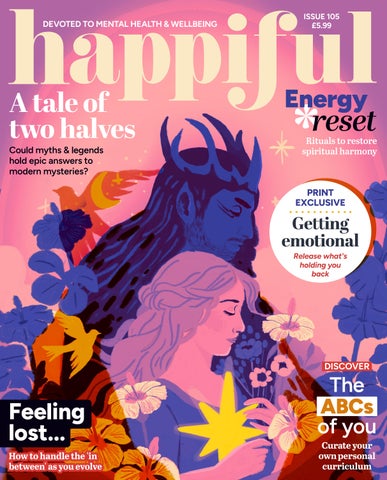
A tale of two halves
Could myths & legends hold epic answers to modern mysteries?
ISSUE 105 £5.99
Energy
*
reset
Rituals to restore spiritual harmony
PRINT EXCLUSIVE
Getting emotional Release what's holding you back
DISCOVER
Feeling lost... How to handle the 'in between' as you evolve
The ABCs of you Curate your own personal curriculum
Enjoy the little things, for one day you may look back and realise they were the big things Robert Brault
Photography | Katerina Holmes
Life is an epic adventure Growing up, I explored countless worlds. I traversed Middle-earth with the Fellowship, and scaled Mount Doom to destroy the ring with Frodo and Sam. I searched for the sugar bowl, and uncovered the true meaning of VFD with the Baudelaire orphans. I went down the rabbit hole with Alice, and developed a taste for chocolate with Charlie. But the stories that have captivated me long into adulthood have always been the Greek myths – and seeing how often their narratives, archetypes, and character journeys crop up in modern-day media is fascinating.
Rebecca portrait | Studio Rouge
From the hit musical Hadestown to Taylor Swift’s song ‘Cassandra’, the sentiments of these tales still resonate so strongly. It’s this idea that underpins mythotherapy (p32), encouraging us to see patterns in human behaviour, and how our challenges are woven into the tapestry of life. This opportunity for self-discovery through tales as old as time can be truly eye-opening. And it may even have the ability to help us through other difficulties in life – such as navigating the feeling of being in an identity void while in periods of transition (p15) – or making sense of complex emotions – like the grief surrounding anniversaries of traumatic events (p65), or feeling like a burden due to your health (p47).
While our experience might be unique, character studies can allow us to find comfort, inspiration, or compassion for ourselves through recognising behaviour patterns. And, in doing so, we might just release the hold that things like shame and isolation have over us. We can read between the lines of narratives such as ‘overdiagnosis’ in mental health (p25), and empower ourselves by seeking stories of kindness and hope when the world seems bleak (p80). In Mythos, Sir Stephen Fry’s recent retelling of the Greek myths, he writes: “Even meaning and destiny themselves can be read in ordinary things, if you have the gift.” So, take these words to heart. You are the author of your own story; you can decide when one chapter ends, and another begins. Selfdiscovery doesn’t have to sit on the shelf any longer.
At Happiful, inclusivity, representation, and creating a happier, healthier society are at the forefront of our mission. To find out more about our social and environmental pledges, visit happiful.com/pledges
Happy reading,
W | happiful.com F | happifulhq X | @happifulhq I | @happiful_magazine
REBECCA THAIR | EDITOR-IN-CHIEF
T | @happiful_magazine
32
Enlightening reads 12 That funny feeling A double take on déjà vu
15 Who am I? Find your footing through shifting identity stages
32 Mythical magic Explore the wisdom hidden within tales as old as time
41 Love of learning Expand your mind by formulating your own ‘personal curriculum’
47 Releasing shame Work through the feeling of being a burden with your mental health
80 Finding kindness We investigate how acts of kindness can instil hope during hard times
65 Try this at home
Positive pointers 21 Fitting tributes
20 Savour some self-care
Uplifting ways to honour loss
36 Picturing progress
50 Clearing the air
Rethink your concept of success
Energy cleansing rituals to create space in mind, body, and home
68 Stress-busting ingredients
52 Bigger and better
69 Get puzzling
Stop shrinking and start playing big
55 The ‘Zeigarnik’ effect Why unfinished tasks haunt us, and how to use it to your advantage PRINT EXCLUSIVE
83 Writing to reset Let go of what’s holding you back and set intentions for future you, with our guided journaling pages
Wellbeing
Culture
25 Are we overdiagnosed?
7 Latest news
Setting the record straight on potentially stigmatising suggestions
11 Wellbeing wrap
65 Reframing reminders
37 Notewothy reads
Dealing with difficult anniversaries
Books to add to your TBR stack
73 Avoiding microplastics
70 Ten things to try
47
Relationships 18 Diverse dating Approaches to make neurodiverse relationships better than ever
22 The perfect blend Navigating the challenges facing step-families
27
78 Teaching money ABCs How to talk to kids about cash
Food & health 38 Fact vs fiction Hone your misinformation detection skills with our top tips
44 Plates to protect the planet 60 Immunity-boosting eats Fill up on these healing recipes
Happiful
R EG U LA R S
28 Anxiety on your mind A busy mum-of-four shares how she curates moments of calm
30 Ask the experts In this issue, we’re asking a nutrionist’s view on probiotics
58 Community corner Meet the Cardiff group supporting single parents’ wellbeing
62 Expert column
50
Why is it so hard to quit vaping?
76 Michelle Elman Practical steps to send your self-confidence sky-high
52
* Expert review
Every issue of Happiful is reviewed by an accredited counsellor, to ensure we deliver the highest quality content while handling topics sensitively. Life takes us on a vast journey. As we move through it, we are often faced with big questions about who we are, and while these can feel tricky to answer with clarity, they are often very helpful. Turn to p15 for deeper insight into this question around identity, and the wonderful power of introspection. By getting to know ourselves in this way, it opens up great potential for change – leading to a profound impact on how you experience the path forward. RAV SEKHON BA MA MBACP (Accred)
Rav is an integrative counsellor and psychotherapist specialising in spirituality and working with males.
Happiful Community Meet the team of experts providing information, guidance, and insight throughout this issue JENNY WARWICK
GEORGINA STURMER
MScPsych MBACP
BA (Hons) MBACP
Jenny offers counselling support for parents of tweens and teens.
Georgina is an integrative counsellor helping clients create a more confident life.
Our team EDITORIAL Rebecca Thair | Editor-in-Chief Kathryn Wheeler | Features Editor Fiona Fletcher Reid | Features Editor Lauren Bromley-Bird | Editorial Assistant Kat Nicholls | Brand & Integrity Manager Bonnie Evie Gifford | Content Writer & Editor Michelle Elman, Chris O’Connor | Columnists Ellen Lees | Head of Content Keith Howitt | Sub-Editor Rav Sekhon | Expert Advisor
CLAIRE BARNES
BEA APPLEBY
BA (Hons) DipNT MBANT MCNHC
BSc (Hons) Dip MBACP
Claire is a registered nutritional therapist specialising in gut-mind health and stress resilience.
Bea is a humanistic counsellor, working with adults and couples.
ART & DESIGN Charlotte Noel | Design & Commerce Manager Rosan Magar | Illustrator & Videographer
COMMUNICATIONS Alice Greedus | PR Manager Isobel Owen | Content Editor
CONTRIBUTORS
ASTRID KORIN
CHRIS O’CONNOR
MA BSc EMCC
HPD DSFH MAfSFH MNCH (Reg) NCH (Reg)
Astrid is an executive coach who helps leaders thrive in work and life.
Chris is an experienced clinical hypnotherapist who has helped hundreds of clients.
KRISTIN MCILQUHAM MA Dip Cert
Kristin offers creative, evidence-based life coaching.
ANNABEL SMITH BA (Hons) MSc ADTC PGCE ACC EMCC
Annabel is a leadership and career development coach and mentor.
Maxine Ali, Bea Appleby, Claire Barnes, Natalie Bell, Sophie Campbell, Kai Conibear, Rebekah Crilly, Jenna Farmer, Jayne Higgins, Kerry Law, Samantha Redgrave Hogg, Emma Victoria Stokes
SPECIAL THANKS Fajri Aitken, Abena BakenRa, Sandhya Bhattacharya, Rachel Brydon, Dr Justine Butler, Katherine Cavallo, Tina Chummun, Dr Sarah Davis, Dr Sabina Dosani, Dr Sammie Gill, Jo Hooper, Samantha Hoyle, Shireen Jayyusi, Dr Rachael Kent, Astrid Korin, Kate Lewis, Kristin Mcilquham, Annabel Smith, Anna Wood, Georgina Sturmer, Dr Elena Touroni, Corrine Toyn, Jenny Warwick, Rachel (SPW), Naomi (SPW)
MANAGEMENT Amy-Jean Burns | Chief Executive Officer Claire Vince | Chief Operations Officer
JAYNE HIGGINS
KATHERINE CAVALLO
PGDip MBANT CNHC
MA BA(Hons) PGDip MUKCP MBACP MAFT
Jayne is a nutritional therapist specialising in gut health, immune support, and reducing inflammation.
Katherine is a systemic family and couples psychotherapist, offering remote psychotherapy.
SUBSCRIPTIONS
For new orders and back orders, visit shop.happiful.com, or call Newsstand on +44 (0)1227 277 248 or email subenquiries@newsstand.co.uk
CONTACT
KATE LEWIS
TINA CHUMMUN
PGDip MBACP
MSc UKCP
Kate is a psychotherapist and counsellor, helping you navigate life’s challenges.
Tina is an accredited psychotherapist and trauma specialist.
Happiful, c/o Memiah, Building B, Riverside Way, Camberley, Surrey, GU15 3YL Email us at hello@happiful.com
HAPPIFUL FAMILY
Helping you find the help you need. Counselling Directory, Life Coach Directory, Hypnotherapy Directory, Nutritionist Resource, Therapy Directory
SANDHYA BHATTACHARYA MA Psych. MBACP
Sandhya is an experienced systemic and psychodynamic therapist. CBP006075
The Uplift KIDS
How Lego toys reduce anxiety for kids needing MRI scans Many children around the world in need of an MRI scan have the opportunity to learn more about what to expect through the power of play, with the help of very special Lego sets donated by the company. The play sets, which feature an MRI scanner, patient, staff, and equipment, help children understand the procedure ahead of time, in an effort to address how anxiety-inducing, and stressful, the experience can be when faced with loud, scary, unfamiliar, hospital equipment. More than one million children around the world have already played with the Lego Group’s MRI scanner set, helping a potentially stressful medical procedure become a little less daunting.
According to new research, 96% of healthcare professionals who used the Lego MRI scanner set say it helps alleviate kid’s anxiety. Meanwhile, 46% say it reduces the need for sedation or anaesthesia during MRI procedures – something that is often used to help children remain calm during scans. The sets aren’t available for sale, but, instead, have been donated
to hospitals via the Lego Group’s social responsibility arm, with more than 10,000 sets provided to hospitals and healthcare professionals across the globe since 2023. This just goes to show that imaginative tools can really build new ways of experiencing the world, and that a little play can go a long way. Writing | Bonnie Evie Gifford happiful.com | Issue 105 | 7
8 | Issue 105 | happiful.com
WELLBEING
New 14-year study finds hope could be key to long-term wellbeing A major new study, published in the journal Health Economics, has found that hope, not happiness or optimism, may be one of the most powerful predictors of wellbeing, health, and success. Researchers from the Brookings Institution, analysed data from 25,000 people over 14 years to explore how hope influences life outcomes. Their findings show that people with higher levels of hope tend to enjoy better physical and mental health, stronger relationships, and greater educational and professional achievement. “Hope is likely the most important positive emotion and socioemotional trait directly relevant to long-term outcomes,” write the authors, Carol Graham and Redzo Mujcic. “It also serves as a psychological buffer during difficult times, helping people adapt and recover more quickly from life’s challenges.” Unlike optimism – the belief that things will turn out well – hope involves the determination to take action, and create change. The researchers found that hopeful individuals were not only more resilient, but also more likely to feel in control of their lives, and less affected by stress or loneliness. Encouragingly, the study also revealed that hope is not fixed. It can be strengthened throughout life through supportive communities, access to education, and positive social connections. As concerns about despair and burnout grow globally, this research offers a clear message: nurturing hope could be one of the most effective tools to create lasting change. Writing | Fiona Fletcher Reid happiful.com | Issue 105 | 9
ENVIRONMENT
Bamboo breakthrough: eco bioplastic disappears in 50 days In a world searching for greener alternatives, bamboo might just hold the key to a cleaner future, thanks to researchers in China, who have developed a new type of plastic that’s strong, versatile, and fully biodegradable in as little as 50 days. Traditional plastics can take hundreds of years to decompose, and release harmful microplastics into our air, soil, and waterways. But this new material, created by scientists at Northeast Forestry University and Shenyang University of Chemical Technology, offers an eco-friendly alternative.
By dissolving bamboo cellulose in a non-toxic solvent, and reforming it into a durable structure, the team created a plastic-like material with impressive strength and heat resistance. In tests, the bamboo bioplastic matched, and even outperformed, many commercial plastics, meaning it could be used in industrial contexts. It’s also completely recyclable, retains 90% of its strength when reused, and safely breaks down with no harmful residue or lingering waste. “This work establishes a method for transforming abundant bamboo cellulose
into high-performance, ecofriendly materials, offering a viable pathway to reduce plastic pollution and fossil resource dependence,” says study co-author Dr Dawei Zhao. While it may take time for largescale production to catch up, this discovery offers hope: a future where the everyday materials we rely on can be both strong and kind to the planet. Writing | Fiona Fletcher Reid
SPORTS
A goal for equality: female representation in gaming In a much-anticipated win for female football players and gamers, the popular video game Football Manager 26, launched on 4 November, now includes female leagues and players within its immersive gameplay. Football Manager is played by millions of football enthusiasts every year, but despite its popularity since it first launched in 2004, only male teams and players had been featured – until now. The change is one that the director of Sports Interactive, Miles Jacobson, has said came into play after a much-needed conversation with three players from England 10 | Issue 105 | happiful.com
women’s national football team (‘The Lionesses’), who told him that “it would never be commercially viable unless people like us [him] got behind it”. This exciting development gives gamers the option to manage an allfemale team, with more than 36,000 extraordinary female football players to choose from, across 14 leagues and 11 nations. Each avatar is embedded with in-depth characteristics and statistics to accurately represent each player, as well as unique movements, rules, and capabilities. Interest in women’s football has surged following The Lionesses’
Euro 2025 win, and this will help to further grow visibility and representation for women in sport. Speaking of its potential among younger generations, the head of women’s football research at Sports Interactive, Tina Keech, says: “I wish I was a young girl discovering this game again, experiencing it with fresh eyes, and getting to see myself in a video game playing the sport I love.” While further upgrades will be made in the future, the redesign is another small change propelling a more equal playing field within the sporting culture. Writing | Lauren Bromley-Bird
The
wellbeing wrap
At 99, Sir David Attenborough has become the oldest person to win a Daytime Emmy award for narrating the series Secret Lives of Orangutans
Actor Jonathan Bailey has become the first openlygay man to be named PEOPLE’s Sexiest Man Alive
London firefighter Zekel Johnson, 30, recently saved three children from a fire in a flat on just his fourth day in the job
Billie Eilish is donating £8.7 million from her recent tour profits, supporting charities and organisations fighting climate change, and food insecurity
HOLIDAY WISHES COME TRUE
‘Tis the season of goodwill, and that’s no different for our animal AN OPEN BOOK A new law has come into friends, with Chewy Claus accepting A prestiguous prize place in China that requires letters and fulfilling wishes for pets. A is expanding to recent success story saw Chewy create a influencers to hold a relevant celebrate children’s custom lead to allow Brooke Eby, who has degree (and provide evidence fiction, as, in 2026, ALS, to walk her pooch Dray while in her of their credentials) to discuss the Children’s Booker wheelchair. Brooke’s focus is on her new or give advice on subjects like Prize is launching. The mantra, ‘living life in dog years’, to inspire finance, health, medicine, law UK’s Children’s Laureate, her to make every second count, with or education. The move looks Frank Cottrell-Boyce, will Chewy Claus donating $10,000 to chair the judges, who to curb misinformation, and ALS charity Team Gleason will curate a shortlist prevent the spread of harmful in their honour. ahead of children joining content online, however, it the judging to pick has faced some criticism Eight-legged advances the winner. Frank says: from those concerned about “Every child deserves the Warning: arachnophobes might the impact on free speech chance to experience not want to read on! The world’s and creativity. So, do you the happiness that largest recorded spiderweb – think it’s a credible move, or a diving into a great book spanning 1,040+ square feet – shame for social media? can bring.” and holding 110,000 spiders, has been discovered by scientists in a A sea-change for sun protection sulphur cave on the Albania-Greece Scientists from Singapore have developed a border. It’s the first documented new sunscreen made from Camellia flower case of two species, Tegenaria pollen, which not only performed as effectively domestica and Prinerigone as current commercially-available products in vagans, building a web together. testing, but is both cooling for the wearer, and has Interestingly, their adaptations to a reduced ecologicial impact. With an estimated the extreme environment, and the 6,000–14,000 tonnes of sunscreen making its genetic isolation there, are what way into oceans each year, the researchers from Nanyang scientists believe has lead to this Technological University noted that existing sunscreens first-time colonial behaviour. caused coral bleaching in two days, and resulted in the coral actually dying after six days. In contrast, their new MONEY MATTERS pollen-based sunscreen had no negative impact on coral, which was found to be healthy, even 60 days later. With financial inclusivity in mind,
An exercise in kindness
Gary O’Shaughnessy, from Hampshire, took part in a monthlong sports fundraiser in aid of Parkinson’s UK, and raised more than £22,000 by doing 30 sports in 30 days. His active endeavours are nothing new though, as Gary, who was diagnosed with Parkinson’s in 2015, has raised an astonishing £500,000+ for the charity over the past decade, and continues to add to this impressive total!
In the UK, pornography showing choking is set to be made illegal in an effort to tackle violence against women and girls. The change would make both the publication and possession of this material a criminal offence.
homeless people in the UK will be able to open bank accounts for the first time, thanks to the ‘breaking the cycle’ programme, which sees big banks waiving the requirement to have a fixed address. The initiative, piloted by charity Shelter, looks to remove a barrier to people getting back on their feet.
Man of the match In recognition of his heroic efforts to confront the Huntington train attacker, Nottingham Forest FC donated £10,000 to 61-year-old supporter Stephen Crean. He was stabbed seven times while on the way home from the team’s match against Manchester United. The club also offered him a free season ticket for 2026, as well as inviting him to fly with the squad to a Europa League match.
Do you get déjà vu?
Despite the mystery surrounding this phenomenon, we’re connecting the dots about what can cause déjà vu, and uncovering why it can be so anxiety-inducing Writing | Samantha Redgrave Hogg
F
or some it’s intriguing, and others unsettling, but, regardless of our reaction, most of us will relate to the familiarity of that fleeting feeling: ‘This has happened before’ – AKA déjà vu. You know the one: you’re midconversation, and suddenly the here-and-now feels like a rerun of an old moment, making you question whether you’ve had this interaction before, or experienced this exact discussion, even when you know you haven’t. But what do we know about déjà vu, precisely, and how can we manage any anxiety when it seems like we’re stuck in a loop?
From the expression ‘a glitch in the matrix’ to describe the strange occurrence of seeing something twice, to that hit single by Olivia Rodrigo – to express painful romantic experiences – déjà vu has a way of repeating itself in our modern-day culture. But what does it feel like? “It’s [...] a sense that you’re reliving a moment in time that you’ve already experienced,” says counsellor Kate Lewis. “We could think of déjà vu as being triggered or activated, like being zip-wired back to a time where you once lived the same thoughts, feelings, and sensations.”
What is déjà vu, and how does it feel?
While those with specific conditions, such as vascular dementia and temporal lobe epilepsy, are more likely to experience déjà vu, there are various theories, and studies, to explain these occurrences. For example, a study published in the journal Cortex (notably from 2012) shows that people who frequently experience déjà vu have differences in certain
Who hasn’t felt déjà vu? Not many of us, it seems. Reports suggest that as many as 97% of people have déjà vu at least once in their lives. And, if you haven’t yet experienced the sensation of having already seen something before (which is the French translation of the phenomenon), you’ve probably heard of it. 12 | Issue 105 | happiful.com
What causes déjà vu?
grey matter regions responsible for recognising familiarity. Plus, research presented by lecturer Dr Akira O’Connor, at the International Conference on Memory in 2016, suggests that déjà vu is a result of the brain’s memory-checking processes at work. Additionally, there are spiritual or philosophical perspectives to consider. In some ancient traditions, déjà vu was seen as a premonition, or even a memory from a past life. What is coming to the fore, however, is the effect stress has on our ability to process information, specifically the link between high anxiety levels and the recurrence of déjà vu.
Anxiety and déjà vu
While more research is needed, there are reports of a link, with it being noted as a potential symptom for those experiencing anxiety and panic attacks. Supporting this is a 2021 surveybased study, published in the journal Memory, which found episodes of déjà vu were more intense and frequent within the >>>
If you experience déjà vu regularly, consider consulting your doctor, especially if other symptoms accompany it, or if it lasts longer than a few seconds.
What makes anxiety so powerful is its ability to warp the way we interpret and remember experiences
happiful.com | Issue 105 | 13
anxiety control group, suggesting that people with anxiety may be susceptible to ‘decoupled familiarity’, which is where that sense of familiarity gets separated from real memory. So, why might anxiety cause the brain to ‘misfire’? “Anxiety has a remarkable ability to block a person’s capacity to think clearly. When anxiety becomes heightened, it can distort our very perception of reality,” notes Kate. “What makes anxiety so powerful is its ability to warp the way we interpret and remember experiences. When we view the world through the lens of an anxious mind, our perceptions can become unreliable,” she adds.
A double-take
When we feel anxious, we tend to second-guess everything, including our sense of familiarity. To illustrate how anxiety can make us more vigilant, or even critical, Kate outlines the relatable example of saying something you perceived as embarrassing at a party. “Anxiety can make you believe that everyone noticed and judged you harshly, even if no one gave it a second thought. This distorted perception of reality becomes ‘your reality’ for the anxious mind, reinforcing the fear that others are [...] always judging you. “People with high levels of anxiety often experience life through a heightened autonomic nervous system – the body’s internal alarm designed for fight or flight. This heightened state can make them more susceptible to triggers that evoke powerful emotional or sensory responses.” 14 | Issue 105 | happiful.com
And, summarising the link between the nervous system and déjà vu, she notes: “Our nervous system has an extraordinary memory; the body remembers. A smell, a tone of voice, or even a sequence of events – details that might seem meaningless on the surface – can suddenly spark the eerie feeling of déjà vu. So, a more sensitive nervous system could mean we experience déjà vu more often.”
Managing the anxiety loop
The experience can feel distressing or unsettling, and when déjà vu becomes more common, it can feed into an ‘anxiety-loop’, where each episode accelerates more anxiety, in turn, leading to more experiences of déjà vu. Kate shares how some people worry about thoughts becoming too overwhelming to manage, but learning to work through anxiety, both in general and about déjà vu, specifically, will help you feel calmer. Grounding yourself when you have anxiety about déjà vu is useful. For example, naming six different colours, tasting a piece of fruit, and even feeling the earth beneath you, are helpful here-and-now examples. Additionally, addressing underlying anxiety, such as journaling, breathing practices to calm the mind, or consulting a professional, can be beneficial. Kate notes how déjà vu can be the result of unprocessed trauma, referencing psychoanalyst Donald Winnicott, who theorised that old wounds can be processed or ‘reintegrated’ within a
Kate Lewis is a psychotherapist and counsellor, helping you navigate life’s challenges. Reach out via the Counselling Directory.
safe, empathic therapeutic environment. “Trauma must be metabolised in the body, and integrated into our nervous system; if it is not, it may communicate with us when we least expect it. If episodes of déjà vu are happening regularly, it could be the body’s way of signalling readiness to process an old, unintegrated trauma.” Whatever the exact reason for déjà vu, knowing that it’s a sign of your brain working hard can, ultimately, help you feel more self-compassionate – something we all need in a world where being self-critical is an all-toofamiliar story.
enlightening reads
Finding yourself in the void As individuals, we’re always evolving. But navigating that in-between stage can bring up difficult feelings. Here’s how to make it through the ‘identity void’… Writing | Fiona Fletcher Reid
H
ave you ever found yourself lying awake at night, staring at the ceiling, asking yourself the question: who am I? I suspect it’s something most of us have felt at some point in our lives, especially as a consequence of life-changing events, such as an unexpected health diagnosis, losing a loved one, or going through a breakup. Ruptures in our ‘normal’ way of life can have a profound impact on how we view ourselves, because so much of our identity is wrapped up
in the place we buy our morning coffee, where we go to work, and the people we connect with on a daily basis. So, is it any wonder that, back in 2020 when the world shut down, many of us – myself included – felt like we were floating aimlessly in a void, disconnected from our sense of self? Looking back, I can see that it marked the beginning of a significant shift in how I understood myself – a journey that, over the next few years, led me to come out as gay, and make the decision to end my marriage.
Even if, like me, your identity is shifting in a positive direction, the experience can be unsettling. Some might call it an identity crisis, but I’ve come to describe it as an ‘identity void’ – the seemingly blank space between who you were, and who you are yet to become. But, how can we find something stable to cling on to as we navigate the void?
Notice the signs you’re shifting
You might notice that your hobbies no longer excite you, or that your >>> happiful.com | Issue 105 | 15
career lacks the sense of purpose it once had. Perhaps you’re questioning your values, noticing your beliefs are changing, or that something seems ‘missing’ – although you can’t quite put your finger on what. Relationships can mirror the shift too, with an increasing sense of disconnect appearing between you and the people you used to feel aligned with. According to Katherine Cavallo, a systemic family and couples psychotherapist, when how we perceive ourselves changes, it will naturally impact relationships with others. “Some [people] may be firmly attached to the old sense of self, and find it difficult to accept the changes that feel authentic to you, in which case, the relationship may struggle to withstand the transition,” she says. This kind of disconnect, or conflict, can create added stress during a time when things already feel difficult to process.
enlightening reads
Reconnecting with yourself
In this void, one of the hardest parts to face is the grief; even if you know things are changing for the better, it doesn’t negate the sense of loss. “Accepting these feelings with compassion, rather than trying to push them away, can be more helpful,” says Katherine. “Acknowledge that what you’re feeling is temporary, and that painful emotions will gradually dissipate.” Leadership and career coach Annabel Smith says that exploring your values, and sense of purpose, can give you a feeling of control. “Lots of people like journaling, but I also work with people who paint or collage. Others find that their best thinking is when they’re walking or running.” Ask yourself: what do I care deeply about? What kind of impact do I want to have on the people around me? What beliefs or values have stayed consistent throughout my life? Which ones have shifted? When everything that used to make you ‘you’ seems to have fallen away, reflecting on what matters most can help you find an internal stability. In turn, your mindset will move from fear to curiosity, and that’s where optimism about the future can begin to take root. “When they’re feeling more positive about the change, I may ask what their 15-year-old self would tell them to do, or what they would like to be written in their obituary,” says Annabel. “Some clients really enjoy thinking about what they might
be wearing in their new identity – and one, whose secret dream was to own a flower shop, loved thinking about working in a place that always smelled wonderful!” With that said, it may take longer than you would like to find the strength to start dreaming about what’s next. “It’s normal for change to feel a bit messy and complicated at times. We all carry internal narratives about how our lives should pan out, which rarely go to plan,” says Katherine. “Being faced with unexpected change can generate feelings of vulnerability or shame, but it’s also important to recognise that these challenging times can bring a deep sense of self-actualisation, and to focus on embracing the process, rather than aiming for perfection.” That means taking things at a pace that is comfortable for you, being honest with others about where you’re at, and giving yourself grace as you try to find your footing in unknown terrain.
Friction of growth
Something I found particularly confusing while going through my own identity shift was the discomfort of the new. A few months after coming out, I went to visit family in Melbourne, Australia, to honour my dream of travelling solo. But after a week of feeling deeply lost, I wanted to cut my trip short and fly home. During an online session with my therapist, she gently asked: “Do you think that self-growth always has to be comfortable?” Suddenly, my urge to retreat from the situation dissipated, because I could see that the
discomfort I was experiencing was proof that I was making brave choices, and that didn’t mean I was on the wrong path. So, although moving through the identity void can be unpleasant, it doesn’t necessarily mean you should change course. Instead, it’s about recognising when being out of your comfort zone is actually a good thing! Noticing this difference is key. When you’ve spent time on selfreflection, had conversations with people you trust, and made decisions from a place of selfawareness, then feelings of discomfort are likely to feel more manageable. But, if you make impulsive decisions, act in fear, or feel totally overwhelmed, it’s probably time to take a step back, and maybe even consider getting professional support. There’s something undeniably disorienting about watching yourself become someone you no longer recognise. But that sense of unfamiliarity doesn’t mean you’re lost – it means you’re growing. Like seeds buried in the dark soil, identity shifts often begin in quiet, messy places, before they push toward the light, and bloom into something new.
Katherine Cavallo is a systemic family and couples psychotherapist. View her profile on the Counselling Directory. Annabel Smith is a leadership and career coach. Connect with her via the Life Coach Directory. happiful.com | Issue 105 | 17
How to navigate dating someone with ADHD
From the first spark of attraction to ever-lasting love, experts explain how to embrace neurodiversity in your relationship Writing | Kerry Law
E
very relationship comes with its ups and downs, and for those dating someone with attention deficit hyperactivity disorder (ADHD), this is no different. While some of their neurodivergent qualities may even be what attracted you to them in the first place – such as their creativity, spontaneity, or energy – other ADHD-
18 | Issue 105 | happiful.com
Illustrating | Rosan Magar
related attributes can present unique challenges in romantic partnerships. So, here’s how to approach your relationship with a deeper understanding of how ADHD shows up.
Master the art of flirting
Certain facial expressions and body language may be harder for someone with ADHD to pick up
on, as noted in a 2022 review in Frontiers in Psychology. Try using clear verbal cues, such as “You’re really fun to talk to” or “I love your energy” to signal romantic interest without ambiguity. “People with ADHD often wear their emotions on their sleeve, which can make their interest come across as enthusiastic or intense,” explains Dr Elena
relationships
Touroni, consultant psychologist and founder of the Chelsea Psychology Clinic. While you can be clear about your boundaries, don’t assume their intensity means things are mismatched – if they’re animated or oversharing, it’s often a sign they’re engaged.
Don’t take the posthoneymoon crash personally According to a 2021 paper, in Psychological Research, people with ADHD tend to experience ‘hyperfocus’ more intensely and frequently. Shireen Jayyusi, neurodiversity coach at The Soke, explains that during the honeymoon period, this focus is often directed towards their love interest. “They may be spontaneous, exciting, and make big dramatic gestures,” she says. “You may feel like you’re the centre of their world – it can be the stuff of fairytale romances.” But this phase can sometimes end abruptly. “The intense, undivided attention that one person received might wane, or in some cases disappear overnight,” says Shireen. This shift isn’t necessarily about them losing interest; it’s often the ADHD brain seeking new stimulation, or simply returning to baseline. Try not to take this personally, consider opening up about how that shift feels, and remember to celebrate the slow burn stage of your romance, too.
Avoid the ‘parentchild’ dynamic
Any couple that moves in together must accept that, in reality, it’s not all excitement – eventually
domestic chores, and mundane requirements need attention. “People with unmanaged ADHD can struggle with the routine aspects of life, including repetitive household chores,” explains Shireen. “What often develops is an unhealthy parent-child dynamic, with the neurotypical partner either picking up the slack and becoming increasingly resentful, or nagging and blaming the ADHD partner continually.” To avoid this, try dividing responsibilities based on strengths and preferences, making use of shared calendars, chore charts, or timers to create structures you can both follow. Ask your partner if there is any way to make chores more engaging, such as playing their favourite music, gamifying tasks, or doing tasks together. And when things inevitably slip, practise pausing before reacting. Ask: “Is this an ADHD moment or something else?” That shift in mindset can defuse tension, and give them a chance to share how they’re feeling.
Deal with emotional dysregulation together
All couples argue, but when ADHD is in the mix there may be more emotional flashpoints. Many with ADHD experience emotional dysregulation, meaning they may react more intensely to stress, criticism, or conflict. “They’ve often been criticised all their life, so are even more hypervigilant and sensitive,” says Shireen. As with all relationship issues, both individuals should embrace a new way of relating without this
falling solely on the neurotypical partner. Shireen says: “Ideally, both partners should work together to develop strategies that support the ADHD person, and offer the non-ADHD person the presence and attention they crave.” Agree ahead of time on a phrase that means ‘Let’s pause and regroup.’ This allows both of you a way to safely exit the conversation, and avoid saying anything you might regret. When reflecting on the conflict, try pointing to the pattern, not the person. E.g. you might say “I notice we spiral when things get tense,” instead of “You always overreact.” This shifts the focus from blame to teamwork. Similarly, it can be good to validate before jumping to problem-solving. ADHD brains often need emotional reassurance before they can engage in logic. Try: “I get that this feels overwhelming,” before jumping into solutions.
See the positives
These relationships can be truly special, as Dr Touroni says: “ADHD can bring spontaneity, creativity, and passion to a relationship, which often keeps things lively and exciting. When both partners are open and communicative, they can find common ground, even developing a shared love language that balances structure with spontaneity. “Ultimately, many of the challenges in an ‘ADHD/nonADHD’ relationship aren’t so different from any other; understanding each other’s needs, strengths, and limits, is key to thriving together.” happiful.com | Issue 105 | 19
Remember to fill your cup with… Practising daily gratitude
Embracing positive Spending quality time self-talk with loved ones
Activities that spark Relaxing pastimes to your creativity reset your energy
Healthy habits and routines
Reconnecting with nature
Laughter and joy to raise spirits
Familiar favourites to provide comfort
Enjoying your own company
Following curiosity and learning something new
Allowing yourself the space to rest
What do you need most today? 20 | Issue 105 | happiful.com
5 ways to honour a loved one’s memory Explore these ideas for emotional outlets and ways to pay tribute to the people that mean most to us, even once they’ve passed Writing | Rebecca Thair
Memory benches and trees
Whether you have a place with special meaning, or want a lasting and accessible tribute, dedicating a bench or tree can be a poignant way to celebrate someone. It can create a safe space for you to think about the person, taking in the view or watching the seasons pass, with roots that live on. Search for memory gifts on nationaltrust.org.uk
Clothing recreations
A person’s favourite clothes can be incredibly comforting after they have gone, capturing memories, scent, and something tangible to hold on to. Rather than being stored in boxes, you could transform them into household items that can be either on display, or to hand when you need them – perhaps a quilt, cushion, or even a plush toy, enabling you to have the physical sensation of being held or hugging when needed. You might want to get creative with guides online, or find keepsake companies on Etsy.
Advocate for a charity
If there’s a cause that was close to their heart, you might look to do some volunteer work, or raise funds as a tribute to them. You could join organised activities, such as fun runs, or an activity that prompts memories of your loved one – such as a bake sale after their love of the pastime, or holding a quiz night if they were a known trivia buff.
Repair and care
Tending to and restoring items that were meaningful to your loved one can be a symbolic way of honouring them, caring for something that holds sentimental value, and can prompt memories of them whenever you see it. Whether it’s the watch that sat on their wrist for as long as you can remember, or tending to a plant that was their pride and joy, taking care of a physical item can create regular opportunities for you to reminisce.
Create an ‘ethical will’
Allow their legacy to live on through you by contemplating the values they lived by, lessons they imparted, and wisdom that you can look to embody. Curating this list allows you to really think about the impact they had on the world, and you, along with how you can keep that spirit alive in the actions you take, choices you make, and how you interact with those around you going forward. happiful.com | Issue 105 | 21
one
When two families become
Blending families can be a beautiful thing, but also something that comes with unprecedented challenges. Here, we’re exploring five of the most common ones – along with expert insight on how to navigate them
B
lended families can be complex and complicated, as anyone who’s part of one will tell you. They form when one or both parents bring children from previous relationships into a new household, combining two units into one. This kind of new family can create a mix of emotions, relationships, and expectations that challenge even the most patient adults. Children may struggle with divided loyalties, step-parents can feel like outsiders, and parents often find themselves juggling more than they ever imagined. Understanding these challenges, and working out how to address them thoughtfully, is the first step toward building a new family dynamic that works for everyone.
22 | Issue 105 | happiful.com
Writing | Bea Appleby
And recognising them early, rather than pretending they don’t exist, can make a real difference. With that in mind, here are five common emotional challenges that blended families face, along with effective ways to approach them.
High expectations
Parents forming a new family may hope and wish that enough love will make everything work itself out. Couples might expect children to quickly accept a stepparent, or for siblings to bond easily. This often stems from optimism, and a desire to move past pain, which is completely understandable. Adults may also assume that, because their new loving relationship has brought them
comfort and happiness after loss, that it will do the same for everyone else. While there can be surprising and wonderful new relationships formed in time, the myth of ‘the instant blended family’ can set us up for disappointment. Experts in stepfamily relationships emphasise having patience while bonds develop slowly, comparing it to a slow-cooked meal, rather than a quick fix. How to manage it: Set realistic expectations for both children and adults. Celebrate small moments of closeness, and introduce shared routines gradually, like weekly meals or one-on-one time, instead of pushing for instant harmony. Remember that longterm connections come from
relationships
consistent, small interactions, rather than grand gestures.
Divided loyalties
Children in blended families often carry a heavy emotional load, as they move between two homes they love. They may worry that affection for a step-parent means betraying a biological parent, which can leave them feeling torn. Meanwhile, step-parents can feel unsure of their place, and biological parents may fear losing closeness with their own child. Family therapist and author Ron L Deal calls this the ‘loyalty bind’, which is the emotional tug that children can feel when they are caught between the love they feel for multiple adults, often leading to feelings of stress and guilt. Protecting children from being forced to choose sides is critical for their emotional health in this situation. How to help: Acknowledge that these feelings are not only real, but normal, and allow children to express the conflict they are feeling, rather than hiding it, or thinking they have to handle it alone. Step-parents might try to build trust gradually, letting relationships grow at their own pace. Parents can reassure children that their love is unshakable, and that caring for a step-parent doesn’t mean loving a biological parent
any less. This may be difficult for parents, and requires inner work and self-reflection, perhaps journaling or personal therapy, to help them cope with their own conflicting feelings about the new relationships that their children will be forming.
Parenting across two households
Navigating different parenting styles, rules, and expectations
is essential for blended families, because what’s acceptable in one house may not be in the other, and children can test boundaries or misbehave, depending on which parent is present. The adults need to commit to working together on co-parenting. This will involve communicating and agreeing on shared >>>
boundaries, as as well as revisiting these agreements regularly as relationships evolve and children grow up. How to manage it: Define core family values, and agree on consistent approaches to things like discipline, screen time, and curfews. Keep communication open, and schedule check-ins to prevent misunderstandings. If the two households aren’t especially amicable, focus on what you can control. Keep your own home predictable, calm, and loving, so children feel secure no matter what’s happening elsewhere. Avoid criticising the other parent in front of the children, and help them to navigate any tensions.
Grief and loss
Every blended family begins with change – often after divorce, separation, or sometimes death – which can come with grief. Children may miss the familiarity of their old life, routines, or simply having both parents together. Adults, too, can grieve the life they once imagined, or the time they now share differently with their children. Grief can show up as anger, silence, or resistance. A child might pull away from a stepparent, not out of dislike, but because they’re still holding on to love for a parent who isn’t there. Recognising this helps families respond with understanding. How to manage it: Try to talk openly about what has changed, and what each person misses. 24 | Issue 105 | happiful.com
Fairness doesn’t always mean treating everyone the same, but ensuring each child feels equally valued, and emotionally supported Rituals can be especially powerful, providing continuity, stability, and shared experiences that create a sense of belonging. Keeping a few traditions from the past reassures children that what they loved before still matters, and introducing new family rituals can create connection. A new blended family doesn’t mean forgetting the past; it’s about allowing the past and present to exist side by side, giving children and adults a sense of safety and emotional continuity.
Fairness and belonging
Children may notice differences in how attention, privileges, or discipline are handled. Sibling tensions can intensify, and stepchildren may worry about being treated as outsiders. Experts stress that fairness doesn’t always mean treating everyone the same, but ensuring each child feels equally valued, and emotionally supported. When fairness feels missing, trust and belonging can erode. How to manage it: Spend oneon-one time with each child, so that they feel important in this new family. Family meetingscan ensure that everyone has a voice, and feels seen. Acknowledge
feelings of jealousy or unfairness without judgement, and make sure every child knows they matter, and has a secure place in the family. Allowing space for conversations about difficult feelings, rather than ignoring them, will make a big difference. Blending a family takes time, reflection, and a willingness to understand the experiences of everyone involved. But stability grows from empathy, and from adults doing the inner work of processing their own complex emotions, so that they can create a safe, steady environment for the children. With compassion, curiosity, and emotional awareness, a blended family can become a place of genuine connection, where everyone feels valued, understood, and hopeful about what lies ahead.
Bea Appleby is a humanistic counsellor, working with adults and couples. Get in touch via the Counselling Directory.
wellbeing
A spotlight on:
The ‘surge of overdiagnosis’ There’s often a picture painted in the media that mental health conditions are being ‘overdiagnosed’, but, when we investigate, what’s the reality, and how does this perception impact access to support systems? Writing | Maxine Ali
T
here is an ‘overdiagnosis’ of mental health conditions, according to the UK’s health secretary, Wes Streeting. Speaking to the BBC in 2025 about Labour’s welfare reform plans, which included targets to reduce the number of people who can claim disability benefits, the MP agreed with suggestions that increasing sensitivity to mental health challenges risked pathologising ‘normal’ experiences. Streeting’s comments chimed with past statements from other political figures, including former Prime Minister and Conservative leader Rishi Sunak, who, in 2024, claimed that Britain was suffering from a “sick note culture”, and ex-PM and Labour
leader Tony Blair who, during a recent podcast appearance, also warned against “medicalising the ‘ups and downs’ of life”. Demand for mental health support is on the rise, with a record 5.2 million referrals for mental health services made during 2024, up 37.9% from 2019, a report from the British Medical Association revealed. While the pandemic saw a marked increase in individuals seeking help for conditions such as anxiety and depression, rates of reported mental illness have been steadily climbing since 2016. The upsurge is most stark among children and young people, with almost five times as many under-18s reportedly in contact with mental health
services compared to a decade ago, according to NHS figures. Against this backdrop, concerns over an alleged crisis of ‘overdiagnosis’ have gained momentum, suggesting that societal definitions of mental ill-health and neurodivergence are being stretched ‘too far’, and ultimately pushing public services to ‘breaking point’. Responding to these claims, however, experts caution that framing the growing demand for mental health support as an issue of diagnostic excess paints a misleading, and harmful, picture. “The story is not one of overdetecting mild difficulties. Rather, it’s one of unmet need and, for many, ongoing underrecognition,” explains Dr Sabina >>> happiful.com | Issue 105 | 25
T h e
f a c t
m o r e a r e h e l p a
t h a t
p e o p l e
a s k i n g
f o r
r e f l e c t s
p o w e r f u l
r e t a l i a t i o n a g a i n s t s t i g m a , c h a l l e n g i n g p e r c e p t i o n s t h a t s u f f e r i n g s h o u l d
b e
e n d u r e d
i n
s i l e n c e
a n d
s o l i t u d e
Dosani, a consultant child and adolescent psychiatrist and clinical academic. For Dr Dosani, increased diagnostic recognition actually represents something hopeful: the possibility that people who were previously overlooked are now being seen, and given opportunities to access the support they need. The fact that more people are asking for help reflects a powerful retaliation against stigma, challenging perceptions that suffering should be endured in silence and solitude. 26 | Issue 105 | happiful.com
Overdiagnosis or evolving understanding? Although the rise in diagnoses is, in part, driven by a complex interplay of biological, developmental, social, and systemic factors, Dr Dosani also attributes this to evolving understandings of mental health conditions. “When I trained, autism and attention deficit hyperactivity disorder (ADHD) were largely taught through a male framework. Girls who masked, compensated academically, or channelled distress inward, were missed.
“I only began fully recognising the breadth of female autistic and ADHD presentations once I was already a consultant.” Minoritised ethnic groups have historically experienced inequalities in both access to and quality of mental health services as well. A 2022 review of dominant mental health models, published in PLOS Medicine, found that monocultural and reductionist assessment and treatment frameworks represent a significant barrier to mental health care, often due to a failure to recognise distress linked to
wellbeing
particularised experiences of migration, systemic racism, and complex trauma. Even after securing a diagnosis, many still face long waits for interventions, leading to worsened conditions and exacerbated distress. As Dr Dosani tells me, “The heartbreak I hear from parents is not over diagnostic labels, it is about wanting their child to flourish, and struggling to access the means to help them do so. “When support isn’t accessed early, families arrive at services in crisis, not because the problems appeared suddenly, but because they were not recognised or resourced sooner.”
Social media and self-diagnosis With many unable to access timely mental health support and treatment through official pathways, social media has become a go-to source of guidance. However, experts warn that these platforms risk fuelling incorrect self-diagnosis, and dangerous misinformation. Dr Rachael Kent, a senior lecturer in digital economy and society at King’s College London, explains that social media sites like Instagram and TikTok operate as unregulated public health platforms, where content caters to the demands of the attention economy, rather than clinical accuracy.
“Social media enable the reduction of complex medical conditions into oversimplified, reductive, and quite often sensationalised formats,” she explains, adding that platform economics reward ‘trendy’ and aestheticised representations of neurodiversity. “This minimises the nuances of what those conditions look like for the person experiencing them,” she adds. Fajri Aitken, assistant headteacher at The Courtyard Islington, a specialist school supporting students with autism spectrum condition, also shared his frustration over the rise of content promoting the self-diagnosis of autism and ADHD. “I see clinically undiagnosed creators share their quirks, their sensory likes and dislikes, wrapped up in some atmospheric music, captions, and carefully edited frames. It makes neurodiversity into a ‘cute personality type’. “This is an insult to the students I serve who struggle with getting out of bed due to their diagnosis. It dismisses rigorous processes of getting a diagnosis in order to provide the right support in education and day-to-day life.” Although social media platforms offer valuable avenues for connection and community, their emphasis on virality through curated relatability has led to homogenised portrayals of
conditions, with creators often reducing ADHD symptoms to ‘trouble concentrating’, and OCD to ritualistic behaviours. “It creates a sense that everyone’s on the spectrum a little bit, which is medically not true,” says Dr Kent. Yet, with claims of ‘overdiagnosis’ driving cuts to mental health services, reliance on social media as a self-diagnostic tool is likely to intensify. This leaves even more people vulnerable to misleading information, hindering rather than helping them find appropriate knowledge and care. “Young people are not turning to TikTok and online forums because they are attentionseeking or impressionable,” says Dr Dosani. “They are doing so because healthcare and education systems are overstretched, waiting lists are long, and formal support is difficult to access early. “The solution, as I see it, is not to shame teenagers for seeking information. It is to build clinical pathways that are accessible, timely, and humane, so that online content becomes an entry point to help, not a substitute for it.” Maxine Ali is a writer and researcher in linguistics at King’s College London. Her work explores the relationship between language, health, and technology. happiful.com | Issue 105 | 27
ANXIETY ON YOUR MIND
Natalie’s week
Welcome to Anxiety on Your Mind, the series where we explore the reality of living with anxiety. In this edition, Natalie Bell, 44, from York, shares how she copes with busy family life… Writing | Natalie Bell as told to Fiona Fletcher Reid
W
ith two part-time jobs, two volunteer roles, and four children to look after, you could say I have a lot on my plate. It means that my dayto-day involves managing a lot of competing needs and schedules, so I often feel like if one little thing goes wrong, or I’m running late, everything will fall apart. Although I try my best to stay calm and organised, the reality is that I’m always squeezing more into my day than is comfortable. This fact is more present than ever, on Monday, as I manage the logistics of getting two of my children to separate after-school activities, before heading to my volunteer role as a Beaver Scout leader. Anxiety shows up in these moments as a sense of overwhelm, and struggling to regulate my emotions, especially when I’m trying to be there for my children, as well as the kids I’m working with. I just worry that I’m going to forget something important, or let others down. One thing that helps is finding a few minutes to clear my head
28 | Issue 105 | happiful.com
before I start with the Beavers; it’s those little moments that make all the difference. Realistically, I’m not going to find time for hours of meditation or relaxation, but, for me, just having a minute to take a few deep breaths is a gamechanger. If I’m at home, I try to take a moment to get outside (even if it’s to hang the washing), or stand by the door and listen to the rain – those are pockets of stillness that I cherish, because they give me the chance to dial down the volume on my anxiety, at least temporarily. Midweek, I have an evening meeting online, which takes a whole day of planning in order to make sure it can go ahead. After a full day of working in my role as operational lead for several local churches, I drive the kids to a dentist appointment, make it back home, cook dinner, do the bedtime routine, and pray that I won’t be disturbed during the call. It’s days like these where I get physical symptoms, like a tight throat and a general sense of panic. It’s as though I have to keep moving, fast, or everything
will come crashing down, and sometimes, the amount of forward thinking and mental gymnastics needed to create space for things is exhausting. Something that helps me manage the logistics is timeblocking – mapping out time on the family calendar for specific tasks or events – as it gives me a visual picture of how my week looks. This eases the fear of thinking I’ve forgotten something, or am getting mixed up with everyone’s comings and goings. But there are only so many hours in the day, and something I’m still learning to do is being more realistic about my capacity. It can be so easy to get into the rhythm of being busy all the time, so I have to remind myself that I’m only one person, and I don’t have to get everything done immediately. Sharing thoughts like this with family is beneficial, and I try to create a home environment where we can all open up about how we’re feeling – myself included! I’m not saying it comes easily, but I’ve got better at talking over my triggers
ANXIETY ON YOUR MIND
Learn more at evergreenexploring.org
with family, and I’ve noticed that opening up really does soothe my anxiety. On Friday, I try to schedule some self-care time, but I end up working for longer than planned, and all I can do is grab a coffee and croissant in one of my favourite cafes. I like to sit at the window seat, where I can look outside and enjoy the sunshine. That way, it feels like a space just for me. The weekend is where I get a little more space to decompress,
and I love getting out in nature with the children. On Saturday, I feel like I’m able to prevent my anxiety from kicking in by going out and about. We have a lot of fun, counting spiders as we walk between swimming lessons and the library, and it’s exactly what we all need to set us up for a harmonious day. The weekend ends with me celebrating my wins, as this is something I can often miss when I see all the things I haven’t been able to
achieve, due to life being so busy. Getting everyone to their clubs, playing with the kids, and checking quite a few things off my to-do list fills me with a sense of calm as I see the progress I’m making, despite my busy schedule. So yes, my plate is full – but I’m learning that it’s OK to acknowledge when things feel hard, and that, sometimes, the best thing I can do is simply pause, breathe, and remind myself that I’m doing enough. happiful.com | Issue 105 | 29
Ask the experts
Investigating the power of probiotics Nutritional therapist Claire Barnes explores how probiotics, food, and daily habits can work together to build a happier, healthier gut Read more about Claire Barnes on Nutritionist Resource.
Q
What are probiotics, and how do they work within the body?
A
Found naturally in fermented foods such as kefir and sauerkraut, probiotics are live micro-organisms – mostly beneficial bacteria – that, when consumed in the right amounts, can support gut and overall
health. They can also be taken as supplements. Rather than taking up permanent residence in the gut, probiotics are like friendly visitors. They travel through the intestines, helping digestion, immune balance, and maintaining the gut lining, before moving on. Along the way, they create a healthier environment by lowering pH,
strengthening the intestinal barrier, and producing compounds like B vitamins, vitamin K, and shortchain fatty acids. Since around 70% of our immune cells live in the gut, probiotics also have an important role in immune function – helping to keep harmful microbes in check, and creating conditions where beneficial bacteria can thrive.
They also support those with gut imbalances (when harmful microbes outweigh beneficial ones) – often presenting as heartburn, irregular bowel movements, or bloating. Probiotics can be effective in a broader gut-healing plan, particularly if you struggle to tolerate fermented foods. For most of us, gut health can be maintained through food.
Traditionally, fermented foods like sauerkraut, kefir, kombucha, and kimchi were everyday staples – until they largely disappeared from modern Western diets. Reintroducing these probioticrich foods helps nourish the microbiome, and build lasting resilience, while supplements offer targeted support when your gut needs an extra helping hand.
Q Should everyone take probiotics, or only in certain circumstances?
A
Most people don’t need to take probiotic supplements every day long-term, but they can be helpful at certain times – e.g. when taking antibiotics (at least two hours apart), travelling abroad, or recovering from illness.
Nutritionist Resource is part of the Happiful Family | Helping you find the help you need
Q
What simple daily habits can help people nurture their gut health in the long-term?
A
Q
What are some natural, food-based ways to support a healthy gut?
A
A diverse, fibre-rich diet is one of the best ways to keep your gut happy. Aim for at least 30 different plant foods each week – fruits, vegetables, nuts, seeds, legumes, pulses, wholegrains, herbs, and spices – as variety helps your microbes thrive. Try to include fermented foods daily, such as kefir, yoghurt, sauerkraut, kimchi, tempeh, miso, and kombucha, all of which naturally provide beneficial bacteria for your gut.
Feed your gut microbes with prebiotic fibres found in onions, garlic, leeks, asparagus, oats, mushrooms, chicory, yacon root, and Jerusalem artichoke, as well as colourful polyphenol-rich foods like pomegranates and berries. Bone broth adds amino acids, such as glutamine and glycine, which help protect the intestinal lining, while butter and ghee contain butyrate – a key energy source for gut cells. You can also give digestion a boost by including bitter leaves like rocket, or a splash of apple cider vinegar, before meals to stimulate digestive juices and enzyme release.
Gut health thrives on rhythm, variety, and consistency. Aim to eat around 30 different plant foods each week, along with prebiotic and fermented foods daily, for a probiotic boost. Before eating, take a moment to relax and switch into ‘rest and digest’ mode. Try spacing meals around four hours apart to allow the gut’s migrating motor complex (MMC) to perform its natural ‘housekeeping’ between meals. Whenever possible, eat at regular times: breakfast within an hour of waking; your main meal around midday; and a lighter evening meal, at least two hours before bed, in order to support overnight repair. Finally, move your body, stay hydrated, and wind down with an evening ritual – perhaps a warming adaptogenic latte – to encourage relaxation, sound sleep, and gentle repair. happiful.com | Issue 105 | 31
The power of mythotherapy (It’s the stuff of legend)
From confronting conflicts to navigating insecurities and life changes, adult life can feel like a lot. But what if we could rethink, or reimagine, the everyday by exploring myths and folklore to uncover answers to our biggest questions? Writing | Samantha Redgrave Hogg
E
Illustrating | Rosan Magar
ntertaining as myths and legends are, I’ve always been fascinated by old stories and how they serve a purpose beyond escapism. These stories are infused into so much of our modern world, found everywhere from films to literature, and everyday language – who hasn’t used the expression ‘my Achilles heel’ from the eponymous myth to describe a weak spot, or ‘caught between a rock and a hard place’ to refer to a no-win dilemma from Homer’s Odyssey? They can connect us to something much deeper – a sense of hope, morality, creative power – and even help us make sense of the world around us.
Essentially, it involves integrating myths and folklore into therapy to help us explore our personal issues, and navigate life’s challenging transitions – all within the wider context of archetypes and symbolism. The recognisable archetypal figures and timehonoured themes provide a lasting framework for this kind of self-discovery, as well as inspiring us toward a collective wisdom. “By exploring universal themes – such as loss, renewal, struggle and conflict – clients can begin to recognise their own stories as part of timeless patterns, rather than as isolated or shameful events,” Jenny continues.
So, what is mythotherapy, exactly?
As someone who enjoys exploring archetypes, particularly within the stages of a woman’s life, I use them to make sense of the world. Sometimes, there are things in life that simply feel too big to put into words.
“Mythotherapy invites clients to view their experiences as part of a larger story of being human,” counsellor and parenting expert Jenny Warwick explains. 32 | Issue 105 | happiful.com
Thinking outside the (Pandora’s) box
“Myths [...] help access the unconscious, showing images that make sense of, and contain, overwhelming emotions,” Jenny reflects. So, when we witness our fears and desires mirrored through a call to action, or quest within a character’s journey, we feel recognised and heard in a way that transcends the usual limits of everyday living. We come to know ourselves beyond social conventions, while making sense of them, feeling connected to something bigger – both in relation to a larger truth and, more specifically, our past, ancestors, and cultural wisdom or identity. Myths, legends, and folklore that embody values from a particular society or region have been told and retold for as long as language has, being passed down from generation to generation as a way to convey lessons, and foster a feeling of belonging when facing the unknown. >>>
happiful.com | Issue 105 | 33
For me, Lisa Marchiano, author and Jungian analyst, sums up the notion of myths as guiding stories in her book, Motherhood: Facing and Finding Yourself, beautifully: “Others have been there before us. Maybe we can see our plight a little differently, or maybe we can imagine more options for ourselves. And we have some sense of where we are going, because we know what story we are in.”
The inside story
We all have a favourite myth or folk story that we relate to on a deeper level. Mine is the tale of Ceridwen and her cauldron of transformation – perhaps because of her connection to fate and regeneration. What’s yours, I wonder? Is it the folktale of Anansi, the spider god and trickster, demonstrating survival through cleverness; the legend of Robin Hood as a symbol of justice for the people; 34 | Issue 105 | happiful.com
The folk story of Ceridwen
One of my favourite folktales to tell is the story of Ceridwen, who is known in Welsh mythology as a goddess of wisdom and transformation. It goes like this: Ceridwen, watched by her white cats, concocted a potion in her legendary cauldron for her son Morfran (or Avagddu), who was cursed to be ‘monstrous’, to transform him into a remarkable leader. After one year and one day, her special brew was finally prepared. However, her servant, Gwion Bach, who was guarding the potion with a large spoon, accidentally spilt some and instinctively tasted it, gaining the magical knowledge within. Incensed, Ceridwen pursued Gwion relentlessly, shapeshifting into various forms, including a greyhound and an otter. Gwion’s fate was sealed when he transformed into a single grain of wheat, believing he could outsmart her. However, she transformed into a hen and ate the seed, which took root in her body, causing her to become pregnant. He was later reborn, becoming a great poet of his time. The myth of Ceridwen can present a parallel to the experience of change. Through this shapeshifting pursuit, we understand the natural impermanence of life and the seasons, as well as the psychological themes of death and rebirth. This goddess brings transition (whether we like it or not!), encouraging us to release the past, accept what we cannot control, and open ourselves to greater potential. (Please note: There are many different spellings of the name Ceridwen, as well as variations of the story itself.)
enlightening reads
or the myth of Persephone and Demeter? This Greek myth portrays how Hades abducted Persephone to the underworld, causing her mother Demeter’s grief to bring winter to the Earth – and the season of spring upon her daughter’s return. With this example, Jenny highlights the “themes of loss and renewal, reminding us that challenges can bring transformation and, eventually, return”. There are various frameworks for classifying myths, but this story, and many others like it, reflect the stages of the human experience – including grief, separation, and family bonds. Showing an overlap of etiological, psychological, and metaphysical purposes, these stories can help us to understand the cycles of the seasons, life and death, as well as loss and gain.
Folklore in therapy
Jenny describes some of the different archetypes within old stories, and how language and imagery, which are usually layered and non-literal, can be used to map the relationship between personal struggle and the mythic endeavour. “Working with archetypes, such as ‘the hero’, ‘the wise one’, and ‘the trickster’, offers symbolic language that allows clients to explore their strengths and vulnerability, as well as their courage and self-doubt,” she says. “This perspective helps us recognise and understand recurring patterns, like repeated challenges, relational dynamics, or life transitions.”
These symbolic meanings, which often involve a journey of obstacles leading to transformation, and a return with renewed strength and knowledge, can offer context for this selfdiscovery. “Mythic imagery can reframe difficulties as part of a journey of transformation, rather than a cycle of futile steps,” Jenny says. “This opens up space to explore what the different characters, or even monsters, might represent within the client.” Research supports this notion, particularly in terms of helping children and young people. A paper, published in the Mental Health, Religion & Culture journal, noted that “harnessing the child’s imagination can be a powerful vehicle for a transforming experience, [...] with consequent positive benefits for emotional wellbeing”. It opens up the possibilities for mental health practitioners to use mythic narratives to support youngsters in understanding how they interpret risk, and make sense of their struggles. And, so, what is the role of the counsellor in this exploration? “The therapist acts as a conarrator, collaborating with the client to work out where they are in their story, and how they might reshape it,” Jenny explains. Reframing an issue is something stories can give space to: “Storytelling gives some distance and perspective, allowing the client to find clarity and some room for self-compassion, as they reimagine challenging experiences,” she says.
Jenny Warwick is a counsellor and parenting expert with a special interest in working with parents and carers of tweens and teens. Contact her via the Counselling Directory.
“Mythotherapy works on many layers – including psychological, cultural, and personal – giving clients a sense of belonging to something universal, while still allowing space for individual experiences.”
A beginning, a middle, and an end?
Of course, there are downsides to myth-telling, too. Oversimplification, stereotypes, and telling myths without context, or even as a means to manipulate, are some of the potential challenges. But one thing I believe is that myths, and their journeys of meaning, can give us insight into who we are, and where we stand in the world, as we pursue a greater truth of belonging – something most of us need right now. And while that, dear reader, might not be a full conclusion, it may offer some resolution – and the ability to turn the page. Samantha Redgrave Hogg is the published author of ‘Flow’, which outlines archetypes and rituals for cyclical self-care. Visit samantharedgrave.com for more. happiful.com | Issue 105 | 35
People often think improvement comes from a one-off endeavour
Idea
Action
Goal
But, in reality, it ’s a continuous cycle
Idea Repeat
Review
Plan
Implement changes
True progress comes from small, consistent steps, and implementing learning from both your successes and mistakes
Happiful reads... From a nature book teaching us how to observe seasonal change to a memoir about an uncle with a hidden talent, be inspired by our latest essentials for your TBR list Writing | Lauren Bromley-Bird
C
hildren are always taught to be kind and polite to others, but not so much about how to show kindness to themselves. Planting and nurturing this skill should not be underestimated though, because it’s fundamental in helping them flourish into a
Growing SelfCompassionate Children: A Family Guide for Nurturing Resiliency and Kindness by Wendy O’Leary and Louise Shanagher
more resilient and confident human being. Written by two educators, who have extensive backgrounds in working with children, this guide compassionately mentors parents in how to support their children to cultivate a kinder relationship with themselves.
Complete with practical activities, meditations, and games for the whole family to get involved with.
Around the World in 80 Games by Marcus du Sautoy Although the fun of board games comes from getting together with friends and playing them, it would be nice to win once in a while! From Monopoly to Snakes and Ladders, Oxford University’s professor of mathematics shares his tips and tricks on how to play the games we love with confident strategy.
The Hidden Seasons by Tristan Gooley Nature has so much it has to say to us – we just have to learn how to read it. Thankfully, naturalist Tristan Gooley is on hand to teach us how to do exactly that. He reveals the hidden clues of nature within each season, making the seasonal cycle all that more enjoyable to experience.
Must reads The Secret Painter by Joe Tucker The Secret Painter is a touching memoir by BBC writer Joe Tucker about his uncle and the mysterious life he led. He was an unconventional, private man who had been hiding his extraordinary talent as a painter for years, secretly amassing hundreds of paintings, which depicted his everyday northern life.
happiful.com | Issue 105 | 37
How to spot mental health misinformation online More than half of mental health TikTok videos contain false information, so here’s how to think critically about the content we consume Writing | Rebekah Crilly
S
crolling online can be a blessing and a curse when it comes to learning more about mental health. With so much information available, on everything from clinically diagnosable conditions to TikTok trends, it can be tempting to dive into the ‘knowledge’ of the internet, but research, such as a 2024 paper in JMIR Infodemiology, tells us that while people are aware that mental health misinformation exists, we find it hard to spot. The consequences of this can often do more harm than good. Although taken in the context of Covid-19, research published in the Journal of Public Health shows that health misinformation can lead to psychological disorders and induce panic, fear, depression, and fatigue. Realistically, most of us will need to rely on the internet to investigate initial health concerns, but before you type into that Google search bar, here are some words of wisdom to help you find the facts you can trust.
38 | Issue 105 | happiful.com
Check the source location
Before you take any mental health information as gospel, counsellor Georgina Sturmer encourages you to check what location the content originates from. “For people in the UK, it’s useful to be aware that a lot of online mental health content stems from the USA, where they have an entirely different structure around mental health care and diagnosis.” If someone from the UK, or generally outside the US, is relying on outside information to find a pathway for support, the information will be very different, resulting in unreliable advice for your circumstances. Georgina says: “You can often spot the difference by looking for alternative spellings, any mention of ‘insurance providers’, or more US-centric words such as ‘physician’.”
Use trusted sites
Georgina also recommends prioritising trusted websites, as opposed to random blogs or social media accounts. “When we are
talking about any aspect of health, whether it’s our physical or mental wellbeing, I would always signpost people to the NHS website, along with reputable mental health charities, such as Mind.” It can also be helpful to look for websites affiliated with government organisations, established health organisations, or those with a strong focus on evidence-based research.
Critique creators
Chartered integrative counselling psychologist Dr Sarah Davis takes the curation process a step further, suggesting we investigate the credentials of online content creators. “For clinically accurate information, check to see if the person is registered with a regulatory body,” she says. “Qualified psychotherapists and psychologists in the UK will be registered to a regulatory body, such as BACP or UKCP, and you can check these registers online.” Normally, qualified professionals will be very transparent about
food & health
what they are trained in, so if you get the sense that someone is being purposely vague or misleading, question the validity of their expertise. In line with this, you might want to look at their motivation for posting their content – what does this creator seek to gain? Is it sponsored? Do they have a brand affiliation or another potential agenda? This isn’t about being distrustful, but about staying informed and aware of who’s shaping the message.
Question the research
While it’s important to look for research behind claims, the nature of the research itself needs to be simultaneously explored. Even in seemingly robust scientific studies, bias can be present in the planning, implementation, and analysis of trials, which means we must consider how bias could have influenced a study’s conclusions. You can do this by reviewing the sample size – research
is less accurate when studies conducted in a field are smaller. In addition, what is the date of the research? Where research evolves rapidly – such as in the area of health – older studies may not be the most reliable. Evaluate the author’s credentials and any potential biases related to the subject, for example, if a nutrition study promoting a high-protein diet was funded by a company that sells protein supplements, the results might be influenced by commercial interests.
“How did the content make you feel?” asks Dr Davis, signalling that misinformation often reels vulnerable users in with scare tactics – an approach that a trained professional would avoid. If a post leaves you feeling panicked, ashamed, or pressured to act immediately, pause and reflect. Genuine mental health support should feel grounding, not alarming. Your emotional response is a powerful filter – if something feels off, it probably deserves a second look.
Trust your gut
When exploring mental health online, particularly within the realms of social media, it’s important for users to bear in mind the nature of social media; it is subjective and designed to draw users in.
Georgina Sturmer is an integrative counsellor. Find out more on the Counselling Directory. happiful.com | Issue 105 | 39
Heraclitus
40 | Issue 105 | happiful.com
Photography | Daria Nekipelova
There is nothing permanent except change
enlightening reads
Life lessons Forget grades and gold stars – your ‘personal curriculum’ is all about the joy of self-growth Writing | Fiona Fletcher Reid
G
rowing up, many of us were taught that learning had a clear destination – good grades could lead to a steady job, and a sense of success. But your relationship with learning doesn’t have to follow a prescribed path. What if, instead of learning to climb a ladder, you turned to learning for its enjoyment? As we get older, and busier, we often stop asking questions that excite us, or exploring ideas just for the fun of it. But learning doesn’t have to be reserved for classrooms or career goals. It can be playful, personal, and deeply nourishing. That’s the idea behind a ‘personal curriculum’ – a selfdirected approach to learning that centres around joy, meaning, and emotional wellbeing. Whether you find yourself drawn to mythology, mental health, or mushroom foraging, it’s about choosing what matters most to
you, and allowing that to guide your growth.
What is a personal curriculum?
In the same way that schools, colleges, and universities create a curriculum to teach their students, a personal curriculum invites you to build your own tailor-made plan to study subjects you enjoy. Think cosy nights in listening to podcasts about the French revolution, or highlighting textbooks about the psychology of habits, just because it fascinates you. It’s about curiosity, not a qualification, and permission to learn on your own terms by choosing topics that light you up, setting your own pace, and shaping your learning around the life you want to lead. Whether you’re craving creative inspiration, deeper self-understanding, or simply a break from the scroll, here’s what you need to know.
Syllabus of the self
Learning in private, at your own pace, can do more than just improve your general knowledge or teach you a new skill; it can actually shift you into an altered state. Research in Frontiers in Public Health, from 2022, showed that learners with a strong, selfdirected learning attitude were more likely to enter ‘flow’ – the mental state linked to focus, satisfaction, and reduced anxiety. Developing your own personal curriculum even has the potential to impact those around you. Researchers note in a 2025 article, in The Learning Organisation, that workplace teams saw enhanced employee engagement, more creativity and innovation, and even market adaptability, as a result of leaders demonstrating a commitment to learning and development. But bringing out the textbooks isn’t just for people in the workplace. In fact, 2021 research >>> happiful.com | Issue 105 | 41
G o a l s g ive yo u st r uctur e a n d m i lest o n e s , but i nt e nt i o n s offe r f le xibi lity a n d s e l f- c o mpa s s i o n in The Lancet Healthy Longevity has shown that later-in-life learning provides “intellectually enriching experiences and social engagement opportunities”, which can enhance psychological wellbeing, a sense of empowerment, and decisionmaking skills for ageing adults.
Class is in session
If you like the idea of having a personal curriculum, leadership coach Astrid Korin suggests imagining the kind of future you are trying to create for yourself. “Start with the kind of life you want to live,” she says. “I know, it’s a big question! But without a sense of direction, it’s hard to know who you want to be in order to live the kind of life you truly want.” Astrid suggests making time for some self-reflection by asking yourself: what’s most important to me? What do I want my 100-year-old self to see when I look back on my life? What kind of person was I? What did I pay attention to? And what did I let go of? For example, perhaps you want to look back and feel proud of the relationships you built. From there, you might realise you want to have an impact on the children 42 | Issue 105 | happiful.com
in your life, or build a local network of friends who create a sense of belonging for you. Or maybe, when you picture your future self, you hope they’ll feel connected with nature. That might lead you to explore subjects like sustainable living, seasonal gardening, or even the history of local landscapes. The point isn’t to become an expert necessarily, but to deepen your relationship with something that matters to you.
Set your goals
If you’re someone who likes to see tangible progress, consider setting specific, realistic goals you can work towards in a timeframe. For example, if you want to learn more about philosophy, you could set yourself the goal to learn the basics of three key schools of thought – say, stoicism, existentialism, and structuralism – over a set period. Bear in mind that a year-long study plan doesn’t leave you much flexibility, and could feel overwhelming if you start to ‘fall behind’. Try thinking in seasons, or six-month ‘terms’, where you focus on one goal at a time before moving on.
Astrid points out that if setting goals feels too pressurised, that’s OK. “I always prefer intentions to goals,” she says, “because they allow for more fluidity and less striving – which always feels like hard work.” Unlike goals, intentions aren’t about reaching a finish line, but more about setting the tone for your experience. While a goal might be to write a screenplay by the end of the year, an intention could be to explore creative writing as a form of self-expression. Goals give you structure and milestones, but intentions offer flexibility and self-compassion.
Gather your resources
Depending on your preferences, budget, and what’s on offer, now it’s time to think about how you
want to go about learning. Spend a few hours in research-mode, looking at all the books, podcasts, documentaries, and websites that are available relating to your chosen subject. There are lots of free resources on offer, so don’t jump straight into an expensive textbook – search your local library or charity shops for interesting books, watch TED talks on YouTube, or create a playlist of podcast episodes in your area of interest.
Design your syllabus
You don’t need to plan every detail, but having a rough map of where you’re headed will help you stay on track, and see your
progress. Plan a loose structure: what you’ll explore first; what formats you’ll use (books, podcasts, video tutorials); and how deep you want to go into a subject. But remember to keep it flexible, by considering how much time you can realistically dedicate to your curriculum on a regular basis.
Set yourself assignments
To stay engaged, give yourself small tasks that help you apply what you’re learning as you go. For those learning a practical skill, such as drawing, it could be challenging yourself to create a sketch using a limited colour palette, or experimenting with
different shading techniques each week. These mini-assignments can help you build confidence, while also pushing yourself to evolve. So, whether you’re sketching in the quiet hours, reading about ancient myths, or simply following a spark of curiosity down a rabbit hole, remember, this is your curriculum. It doesn’t need to impress anyone but you, and it might even leave you feeling top of the class. Astrid Korin is an executive coach who helps leaders thrive in work and life. Reach out via her profile on the Life Coach Directory. happiful.com | Issue 105 | 43
D ow n t o e a r t h With a recent report showing that eating a diet supporting the planet could be the most mutually beneficial for both its, and our, health, here’s everything you need to know about making food choices that sow the seeds of a greener future Writing | Jenna Farmer
B
arely a week goes by these days before a new diet trend pops up on social media. So, you’d be forgiven for not knowing if you should be tucking into the Mediterranean diet, giving veganism a try, or focusing on upping your protein. But the latest discussion around the planetary health diet could offer you the best of both worlds – and the stats supporting it are compelling. A recent report, published in The Lancet in 2025, found that more than half of the world’s population struggles to access healthy diets. This doesn’t just impact our health and wellbeing, but, also, has real consequences on our environment, with around 30% of all the greenhouse gasses we produce coming from our food systems. Enter the planetary health diet (PHD) – a recommendation that can not only improve our health,
44 | Issue 105 | happiful.com
but also reduce diet-related chronic disease, and potentially slash the food-related emissions we make by an impressive 50% by 2050. And with the report being produced by 70 leading experts, from 35 countries, and building on previous research, it sounds like a win-win for both our own wellbeing, and the world. But what actually is the PHD, and how can we follow it?
What is the planetary health diet?
A PHD is (unsurprisingly) centred around a plant-rich diet, but with a more flexible approach. It recommends at least five portions of fruit and veg a day, while also making sure you tuck into a portion of legumes (i.e. beans or lentils), a portion of nuts, and plenty of wholegrains. Animal products aren’t necessarily off the menu all together, but it’s suggested that chicken, fish, and red meat play
a much smaller role in your diet, with most of your protein coming from plants (which make up around half your plate). It also suggests consuming seasonally available foods, for example strawberries in summer and root vegetables in the winter months. Because of this, it recommends flexibility for different cultures, centering around local dishes and produce – those in Greece may tuck into traditional gigantes plaki (giant beans in tomato sauce), while those in Vietnam may enjoy broth soup with Asian greens.
Why should we follow it?
According to Dr Justine Butler, who is head of research at Viva!, the UK’s leading vegan campaigning charity, the environmental benefits of the PHD could be huge, purely from its reduction of animal-produce. “Looking specifically at environmental impacts, studies
food & health
It recommends flexibility for different cultures, centering around local dishes and produce show that a diet free from animal products has been found to produce just 25% of the foodrelated greenhouse gas emissions of a typical meat-eater’s diet in the UK, while also reducing foods’ land use by 76%, and water use by over 50%,” she says. Dr Butler notes that eating this way can reduce the impact of production on wildlife by half, which makes the vegan diet, in general, the best one for our planet. The benefit of the PHD is that it offers flexibility without requiring the full commitment of going meat-free, as with vegetarian or vegan approaches. Eating seasonally, and around local foods, can also support the environment, while being intentional about the food we eat can help to limit food waste. “Globally, around one-third of all food produced for human consumption is lost or wasted, equal to roughly 1.3bn tonnes every year, and this waste has
a devastating impact on the planet. Every item of food we throw away effectively ‘carries’ the land, water, and energy that went into producing it. When that food ends up in landfill, it releases methane, a gas that is 28 times more potent than CO₂,” says Anna Wood, founder of JUX Food, which uses freeze-drying technology to make everyday food last longer. Evidence reveals that opting for the planetary health diet comes with notable health benefits, too. The EAT-Lancet Commission claims the PHD could prevent a whopping 11 million premature adult deaths every single year, thanks to limiting saturated fats (which can be linked to high cholesterol and heart disease), and sugar. And those greens make a difference; plant-based diets, in general, are linked with reducing cardiovascular disease, diabetes, chronic kidney disease, and even cancer. >>> happiful.com | Issue 105 | 45
How can we get started with the planetary health diet? Divide your plate A simple way to begin is just to be more aware of how your plate is divided. As a rule, around half should be made up with a colourful mix of fruit and veg, while a third will be wholegrains. The rest is plant proteins (e.g. pulses), and moderate amounts of animal protein and dairy, if you consume animal products. Don’t get too hung up on exact amounts; even a move towards more plants on your plate is a big shift that can make an impact.
Eat a rainbow One way to get the variety of the PHD is to focus on making half your plate a rainbow, with a mix of colourful fruit and 46 | Issue 105 | happiful.com
vegetables: think green peppers, red strawberries, aubergines, and more! If your plate looks like a rainbow, you’re on the right track!
Swap daily meat dishes to weekly The planetary diet might be centred around fruit, veg, and wholegrains, but it doesn’t have to be completely meat-free. Instead, aim to reduce meat consumption to once a week, and poultry and/ or fish to twice a week, making sure to have a few days each week where you eat plant-based.
Small steps make a big difference The PHD isn’t necessarily about a huge diet overhaul, but consistent small steps, which can make a massive impact. “By adding an extra serving of vegetables to your plate, choosing
whole grains, swapping meat for plant-based proteins once or twice a week, and reducing your food waste at home, we can all take steps toward a healthier, more sustainable food system – potentially preventing millions of deaths globally,” says Corrine Toyn, a dietitian who runs chickpeamarketing.com. The principles of the planetary health diet are grounded in sound evidence, and even following a few of its core ideas could be great for your health and your environment. So, the next time you’re meal prepping, batch cooking, or writing your shopping list, why not do it with the planetary diet in mind? Jenna Farmer is a freelance journalist specialising gut health. She has Crohn’s disease, and blogs at abalancedbelly.co.uk
enlightening reads
Feeling like a burden?
Expert insight and practical tips on how to handle the shame, and self-stigma, that can arise when seeking mental health support Writing | Kai Conibear
F
or many of us who live with a mental illness, it’s not just the symptoms and condition itself we have to navigate – there can also be complicated emotions that arise, including guilt. It seems to be intrinsically linked to how we perceive ourselves when we are going through a difficult time. And it’s this underlying sense of guilt that raises a question which plagues my mind when I’ve felt particularly unwell with bipolar disorder: am I a burden?
What impact does feeling like a burden have on recovery?
Although mental illness and mental health, in general, are now more openly discussed, stigma (whether real or perceived) still persists, and can create a sense of pressure to appear ‘well’. This impacts our judgement on whether we can, or are able to, seek support. We might refuse to reach out because we believe we shouldn’t talk about our feelings, especially
if they’re perceived as negative, or we compare our experiences to others and either think we should cope alone, or that we aren’t as deserving of help. This is not an uncommon experience, as explained by therapist Sandhya Bhattacharya. “It is common to hold guilt and shame around a mental health diagnosis, both for what it represents to us, and our perception about how others might see us,” Sandhya says, noting that these accompanying emotions can create added anxiety, and have complex consequences for individuals. “Feelings of guilt and shame can be equally debilitating, leading a person to become stuck in thoughts around being ‘not good enough’, and therefore unable to be helped,” she continues. “More often than not, it is not the mental health diagnosis alone that hinders our ability to seek help; it is a sense of anxiety and fear that we may not be able to be helped that is debilitating.”
So, not only can the emotional repercussions be severe when we feel like a burden, having a further detrimental impact on our mental health, but it can also inhibit or delay someone receiving support full-stop. With the latter, we might hide what we’re experiencing from those closest to us, out of fear that we are burdening them with too great a responsibility. Our illnesses can cause us to selfsabotage, and not ask for the help and support that we both need, and deserve.
Changing the internal narrative
“In therapy, we often think about the idea that ‘shame begets shame through silence’. This means that the less we talk about what is shameful to us, the more ashamed we feel,” Sandhya explains. “Silence has the power to increase shame. While compassion and understanding help us recognise, and tolerate, shameful and anxious feelings.” >>>
It is by no means easy to override that internal narrator, telling you that you’re not worthy of help. But the crucial thing to recognise is that silence creates an echo chamber for those feelings of being a burden – there are no other voices to reinforce that you’re not, or that you don’t have to face things alone. When you talk about how you’re feeling, most of the time you’ll be met with love and support. It’s important to acknowledge that it isn’t easy for our loved ones when we are unwell – but this doesn’t undermine how much they care. They will have the urge to make everything better, to find some magical cure, and to fix everything. They want to find an answer, and sometimes, their frustration that there isn’t an easy solution can spill out in unhelpful words and behaviours – but this is why we need to communicate, and clarify expectations, rather than withdraw. “Providing compassion and understanding means listening to one’s experience without needing to ‘rescue’ or ‘make it better’. Often, a person experiencing mental health difficulties is trying to make sense of their world, and is generally trying their best every day,” Sandhya says. Our role is to recognise how challenging this can be for them, too, and to acknowledge there isn’t an easy route to follow. Instead, we should highlight how they can help us – even if that is just by listening or offering simple practical support – when so many things might feel beyond their control. 48 | Issue 105 | happiful.com
Having difficult conversations where we accept how each person feels, allows us to move forward together, and learn how to cope with mental illness a bit better each time.
These are deep-seated statements and ideas we believe about ourselves. Notice when one arises, and write it down, such as: “I am a burden to others.” Then, use a critical eye to challenge it with evidence, and question whether it’s actually supported by any facts – what proves this, and what disproves this? With this recognition that a thought isn’t always a fact, you could combat these limiting beliefs by focusing on what others have said, such as: “The people in my life who support and care for me are happy to do it. They have told me I am not a burden.” Additionally, you can reframe it to review it in a more compassionate and balanced light. For example: “I take care of people in my life when they’re struggling, and they do the same for me.”
ourselves – but that doesn’t make them realistic, or true. These tend to be more surface-level than our core beliefs, as reactions to what’s happening in the here and now. But, in a similar vein, identifying them when they crop up means we can begin to challenge them. First, start with the trigger – what happened in the moment, and what was the accompanying thought? As an example, you might be going through a difficult time, and at the end of a long day, accidentally drop your dinner on the floor. The automatic thought might be: “Why can’t I do anything right?” Challenge yourself to identify the associated emotion when saying the thought aloud (which could be frustration, sadness, anxiety, or anger) to help understand why you’ve responded a certain way, without having to agree with it. As with core beliefs, think about evidence that doesn’t support the negative thought, and then come up with an alternative: “Accidents are frustrating, but they happen. It’s not a reflection on me as a person.” Consider the associated emotion when you say this new thought out loud – the difference could be really transformative.
Challenge negative thoughts
Show yourself compassion
Practical techniques to tackle feeling like a burden Analyse your core beliefs
Silence has the power to increase shame
Automatic negative thoughts can be our brain’s default, as a survival mechanism to protect
Write a letter to yourself focusing on accepting your emotions. Start by describing a thought or
enlightening reads
situation that made you feel like a burden. Then, craft a response as if you are talking to a friend, and comfort them as if they feel the way you do. Read back what you’ve written, and keep the letter as a reminder when you need to gain a fresh perspective, and show yourself more compassion in future. No one should feel guilt or shame for having a mental illness, and relying on others
for support – we all go through ebbs and flows in life, and require different levels of connection and support to get through them. This does not make you a burden, and you deserve love, empathy, and compassion regardless of how much help you need right now. Kai Conibear is a writer and mental health advocate. His first book, ‘Living at the Speed of Light’, about bipolar disorder, is out now.
Sandhya Bhattacharya is a systemic and psychodynamic therapist. Connect via the Counselling Directory.
happiful.com | Issue 105 | 49
Energetic reset
Feeling stuck? Sometimes the act of cleansing your energy can bring the balance you need Writing | Fiona Fletcher Reid
W
e’ve all experienced that heavy feeling that lingers after getting into an argument with a friend, or been so drained after scrolling through social media that we can’t make a decision about what to eat for dinner. However you describe it, humans, although made of matter, often report carrying an invisible emotional residue in our bodies, heads, and homes. For some, talking things through can be a good outlet, but others might seek a more spiritual solution. In fact, practising energy cleansing habits can be a low-risk, affordable way to find calm. You don’t have to believe in energy healing (a term for complementary medicine, such as Reiki and acupuncture), and, granted, there is a significant lack of research into this field of medicine, but when you’re bogged down or overstimulated, actively performing rituals to cleanse your energy could be a powerful way to reset your body and mind. Whether you’re doing a spiritual ‘energy cleanse’, or are simply choosing to release some emotional weight, why not give these a go? 50 | Issue 105 | happiful.com
positive pointers
The declutter cleanse
Our surroundings play a huge part in how we feel, with one study, published in Personality and Social Psychology Bulletin, linking increased household clutter to higher levels of the stress hormone cortisol. For that reason, you might find that making your bed, clearing the kitchen counters, or sorting a single drawer can immediately shift your energy. You don’t have to scrub your home from top to bottom – start small. Clear the overflowing coffee table, fill a bag and donate it to charity, or crack a window open, and see if the fog lifts. The key is to act with intention – tune into your breathing and posture, noticing how they shift once you’ve moved things around.
The movement cleanse
So much of our perceived negative energy is a result of overthinking, and when we’re all up in our heads, it can feel like our energy is being pulled away from us, which can be discombobulating. Movement reminds us to ease our grip on mental processing, and switch to being present in the body. Tuning into bodily sensations can lead to brain stimulation, which creates focused attention, and “opens individuals to see themselves, others, and the environment from a new perspective, and may elicit new understandings and changes in behaviour”, as noted in a 2025 article published in Healthcare. It stands to reason then, that when energy feels stagnant, movement is your friend.
There’s no need to sign up for a 10K or join the gym though – gentle stretching, dancing in the kitchen, or a brisk walk can clear your energy. Before you start, notice where the energy is concentrated in your body, then, imagine it dissolving and leaving as you move.
The water cleanse
Water has been used in cleansing rituals since ancient times, symbolising renewal, purification, and emotional release. So, the next time you feel energetically weighed down, or as though someone else’s energy has leaked into your space, try stepping under the shower head. It can be helpful to set an intention first: to rinse away what feels stressful, or let go of what no longer serves you. Focus on the sound and temperature of the flowing water, imagining that it’s charged with healing light that is neutralising your energy. Alternatively, immerse yourself in the bathtub and add Epsom salts, essential oils, or a few drops of lavender to create a soothing bedtime ritual.
The sound cleanse
You only have to watch a baby fall asleep to a lullaby, or witness the dancefloor fill up when the DJ plays a banger, to see how music can shift energy. To use sound as a form of energy clearing, search online for specific sound baths and frequencies – there are curated playlists with the intention to ease anxiety, support healing, and even provide pain relief from migraines.
While wellness practitioners will often use gongs, singing bowls, and drums to initiate a shift in energy, you don’t need special equipment to reap the benefits. Just playing your favourite music and singing along can have a similar impact to the powerful effects of humming – which stimulates the vagus nerve, and activates the parasympathetic nervous system. This can reduce stress and reverse the fight-or-flight response, as noted in a 2023 paper published in the journal Cureus.
The crystal cleanse
Whether or not you believe crystals have mystical properties, the ritual of choosing, holding, and focusing on a physical object can be a helpful tool. Try selenite, which is believed to be a powerful energy cleanser that can purify your space. Or black tourmaline, which is said to absorb negative energy. To recentre, amethyst is great for tapping into your intuition – perfect if your energy feels tangled up with those around you. Keep your chosen crystal in your pocket for when your energy needs attention, then, focus on its weight, temperature, and texture, mentally setting the intention for the stone to absorb and neutralise excess energy. You might place black obsidian near your doorway for protection, or keep rose quartz by your bed to promote self-love. Sometimes, just knowing that these little rocks have the potential to clear the energy in your space, without added effort, can be enough to mentally offload some daily stress. happiful.com | Issue 105 | 51
How to ‘play big’ in life Sometimes we don’t go after the things we truly want, because we’re trying to blend in, avoid failure, or simply can’t find the energy. But something magical can happen when we stop ‘playing small’, and start stepping out of our comfort zone Writing | Sophie Campbell
Y
ou may have heard the saying: “You’re never too old to dream a new dream.” But do you ever feel like you’re holding back on chasing that dream? Like you’re waiting on a permission slip to really go for it? Taking action on your big dreams (AKA ‘playing big’) can feel scary. To avoid disappointment, many of us play small – setting goals that feel safe, and prevent us from feeling too vulnerable. But, what if you allowed yourself to set bigger goals, and took consistent action towards them? If you want to start being a little more audacious, here’s how to get started.
Make a ‘want-to-do’ list Playing big doesn’t necessarily mean mapping out a complex business idea, or relocating to another country – it’s about taking up space and fulfilling your potential, whatever that means to you. Jo Hooper, life and business coach at Get Wildly Free, recommends making a ‘wantto-do’ list. From running a marathon to paying off a chunk of debt, she says: “Ask yourself what would make you proud to have done in six months’ time. 52 | Issue 105 | happiful.com
Take regular small actions towards it, and reward yourself for taking the action – that’s the bit we often forget.” ADHD coach Kristin Mcilquham also encourages her clients to articulate exactly what they want out of life. “This will often be met with resistance, but the key is to have fun with it. You can journal, make a vision board, or note down ideas on your phone. The key is to track your excitement, and what gives you a reaction in your body.” Goals are often associated with career or academic success. But playing big is about your whole life, from career, relationships, and health to creativity, and personal growth. So, when you’re making your want-to-do list, make sure you’re thinking about various aspects of your life, like where you want to live, the pottery course you want to take, or the lasting impact of your parenting.
Do an energy audit Before you can start playing big, you need to know what’s contributing to playing small. An energy audit (developed by the Energy Project’s CEO Tony Schwartz) is a powerful way
to assess where your precious energy is going, and what’s holding you back. Grab a notebook and explore four key areas: • Physical energy: Are you sleeping well, eating nourishing food, and moving your body in ways that energise you? Playing big requires stamina, and that starts with self-care. • Emotional energy: What brings you joy and gratitude? What drains you? Understanding your emotional landscape helps you protect your spark, and bounce back from setbacks. • Mental focus: Are you able to stay on task, think creatively, and organise your thoughts? Big goals need clear thinking, and space to imagine. • Spiritual alignment: Are you living in line with your values? Do you feel connected to something meaningful? Playing big isn’t just about ambition, it’s about purpose. These reflections help you identify what’s depleting you, so you can refine your focus, and create space for bold action.
positive pointers
What if you allowed yourself to set bigger goals, and took consistent action towards them?
Start living your minimum viable dream Your minimum viable dream (MVD) is a version of your dream life you can start living right now – embodying the energy of the life you aspire to, but accessible to you in the here and now. If you dream of being an awardwinning actor on Broadway, then your MVD could be joining a local theatre group. If you dream of owning a bakery, your MVD could be practising baking a new cake every week. You might be surprised how many aspects of your dream life are already accessible to you.
Learn to love rejection
Kristin Mcilquham is a life coach specialising in ADHD. Get in touch via the Life Coach Directory.
Fear of rejection plays a big part in why people play it small. In his TED Talk, entrepreneur Jia Jiang explains how he overcame the fear of being told ‘no’ by actively seeking rejection, every single day, for 100 days. Why not try your own version of this? Set a goal of putting yourself out there in one area of focus, X number of times, regardless of the number of rejections you get. For that acting goal, it could be 10 auditions that don’t land you any roles. For a career pivot, it could be 20 rejections to start an internship. Eventually, all the rejections will start to roll off your back and, in turn, become less of a perceived obstacle in your pursuit of success. Because ultimately, playing big isn’t about winning every time, or even having it all figured out – it’s about choosing courage over comfort, in order to chase the big life you’ve been dreaming of. happiful.com | Issue 105 | 53
Inside each of us is a natural-born storyteller, waiting to be released Robin Moore
Photography | Cottonbro studio
positive pointers
Unfinished business The ‘Zeigarnik effect’ explains why we can’t stop thinking about the things we haven’t done, but how can we stop the spiral? Writing | Fiona Fletcher Reid
W
hile being busy shouldn’t be a badge of honour, there’s no denying the thrill that comes with checking lots of things off an ever-growing to-do list. But often, even when we’ve completed 99% of the tasks we set out to do, we still can’t seem to enjoy our successes, because of that pesky 1%. I felt this recently, when I stopped off at the supermarket to pick up some groceries after a stressful day. It wasn’t until I got home that I realised I’d forgotten to purchase the face cream that my partner had asked me to buy. Even as I unpacked a bag full of ingredients and household items that we desperately
needed, I couldn’t help but feel like a failure for missing that one particular thing on the list, and was preoccupied with the need to buy it the following day. It turns out that this urge to focus on the things we didn’t do – the unfinished tasks – is pretty common, and it has a name: the Zeigarnik effect.
What is the Zeigarnik effect? The concept was first studied in 1927 by Soviet psychologist Bluma Zeigarnik, who observed that interrupting people midway through a task made them more likely to remember it, when compared to tasks that were allowed to be completed without disruption.
According to counsellor Bea Appleby, this tendency is a normal part of being human. “In Gestalt theory, of which Zeigarnik was a student, a central belief is that humans seek wholeness, or closure, and when an experience is incomplete, it creates psychological strain,” she says. This mental tension can feel uncomfortable. One 2014 study, published in the Journal of Occupational Health Psychology, found that leaving tasks unfinished was a weekend stressor for employees, causing rumination and impaired sleep. It seems that the brain purposefully keeps these tasks lingering in our minds as a reminder to ‘close the loop’ – and get that sense of wholeness we naturally crave. >>> happiful.com | Issue 105 | 55
Each open loop creates tension, and many incomplete loops together can make us feel stressed “When a task is incomplete and it plays on our minds, we need to resolve it to restore psychological balance,” says Bea. “Each open loop creates tension, and many incomplete loops together can make us feel stressed.” So, when that creeping feeling of ‘unfinished business’ plagues your thoughts, how can you shake it off?
Tying up loose ends You might be tempted to stay late at work to finish every task on your list, or to cancel plans with friends to tackle the half-done DIY project at home, but there will always be times when you simply have no other option than to leave tasks incomplete.
56 | Issue 105 | happiful.com
To combat this, try writing a ‘loose ends’ list – on your phone or in the back of your diary – where you can safely store unfinished tasks. Because part of the tension involved in unfinished tasks is our brain trying to make sure we don’t forget about them, writing a list can ease that pressure and clear out mental clutter. Interestingly, a small study, published in the Journal of Experimental Psychology, found that writing to-do lists before bed can even help you fall asleep faster, when compared to writing a list of things you achieved that day.
The one that got away If you’ve got an unfinished task that you know you’ll never get back to, because you chose to step away, or didn’t have the capacity or time to reach the finish line, the work then becomes about focusing on the context around the task. Instead of trying to ignore it, or act like it’s not bothering you, Bea suggests investigating the unfinished task a little further, in order to make peace with the difficult feelings attached to it. “When thinking about a task that’s unfinished, learn to reframe thoughts like ‘I gave
positive pointers
up’ into ‘I made a choice to stop, based on my capacity at the time,’” she says. Take a few minutes to write a list of the reasons why it wasn’t completed, remembering to acknowledge the contributing factors outside of your control, such as the resources available to you, skillset, interruptions, time, and energy levels – even the unexpected things that arose. Acknowledging the circumstances around the unfinished task can help to satisfy that need for closure, even if the outcome wasn’t what you hoped. When those feelings of disappointment, failure, guilt, or shame, simply refuse to budge, Bea recommends using the RAIN technique, which was invented by meditation teacher Tara Brach: • Recognise: First, acknowledge what you’re feeling, for example ‘I’m feeling like a failure for not finishing this task.’ • Allow: Let the feelings exist, giving yourself permission to feel, while repeating a statement such as ‘This is normal, anyone in my situation would feel like this.’ • Investigate: Get curious about the feeling. For example, ‘What am I believing about myself right now?’, or ‘Is this really about something else?’ • Nurture: Finally, place a hand on your chest and offer yourself compassionate words, as though you were talking to a friend.
Embracing interruptions The good news is that knowing how the Zeigarnik effect works can actually be harnessed to your advantage. By understanding that your brain is wired to keep unfinished tasks top of mind, you can use that mental nudge as a motivational tool, rather than a source of stress.
You can use that mental nudge as a motivational tool, rather than a source of stress One way to do this is by setting SMART goals – that is, goals that are specific, measurable, achievable, relevant, and time-based. When tasks are clearly defined, and broken into manageable steps, they’re less likely to linger in that uncomfortable ‘open loop’ state. So, instead of vaguely telling yourself to ‘get more exercise’ or ‘sort out the house’, a SMART goal might be ‘go to one fitness class this week’ or ‘clear out the hall cupboard by Friday’. These give your brain a clear endpoint, which helps satisfy the craving for closure.
You could also look to use the Zeigarnik effect to your benefit by intentionally stopping a task part-way through. This gentle tension can boost the likelihood of picking the task back up again, because you’re keen to finish, and check it off your list.
Looking for closure And for that unfinished business that transcends to-do lists – such as regrets around relationships, or things you wish you could have said, or done – sometimes there’s no replacement for opening up about the grief that accompanies the lack of closure. As Bea says, talking therapy can help you make sense of what you’re experiencing, work through what it represents for you, and reflect on “what values or dreams are tied to these incomplete experiences”. So, the next time you find yourself dwelling on that forgotten face cream or unfinished project, take a breath. Acknowledge the feeling, yes – but remember that you’re not defined by what you leave incomplete, but instead, by how you show up and keep going.
Bea Appleby is a humanistic counsellor, working with adults and couples. Reach out via the Counselling Directory. happiful.com | Issue 105 | 57
Thriving solo
While there are countless challenges facing single parents, this community initiative in Wales is offering support and connection, to ensure no one feels they have to do it alone Writing | Fiona Fletcher Reid
A
t Single Parents Wellbeing, we believe that no parent should feel alone,” says director Rachel Brydon. And for the approximate two million single parents across the UK, who, according to the 2021 ONS Census, are less likely to be working and more likely to have a bad, or very bad, health status, support is crucial. That’s where community-led organisations like Single Parents Wellbeing (SPW) come in. The Cardiff-based community interest company initially started a walking group – designed to offer a practical solution for the loneliness and stigma, and resulting profound mental health impact, so often felt within the community – by co-founders Rachel Cule and Amy Holland. Now, the team has a regular, and varied, programme of events and workshops. But events aren’t simply designed for single parents — they’re designed with them, ensuring they reflect the true needs of the community. For example, its Connecting Creatively project offers free and low-cost workshops where parents and kids can paint, draw, “
58 | Issue 105 | happiful.com
or express themselves side-byside. And with a summary of major cohort studies, conducted by University College London and published in 2023, noting that cultural activities like these can halve an adult’s risk of developing depression, lead to improved wellbeing, and lower the risk of loneliness and developing chronic pain, it highlights just how powerful these experiences can be – not only as a way to bond, but as a tool for supporting mental and physical health. But it’s also important for single parents to get access to activities that don’t involve their children, helping them maintain a sense of identity and belonging outside of their role as caregivers. Whether it’s a workshop for mums going through menopause, or a grief circle for those experiencing bereavement, SPW offers a variety of spaces for those who often feel left behind. “When many people think of single parents, the image is often one of struggle,” director Rachel Brydon says. “We’re here to change that narrative – to show that single parents are strong, capable, and thriving together.”
Sharing spaces where single parents can evolve at their own pace is a cornerstone of SPW’s mission, and this is seen clearly in their volunteer programme, where parents are trained to run local meetups. With regular oneto-one check-ins and monthly in-person meetings, volunteers are nurtured to build self-confidence, develop new skills, and increase employability. But this isn’t just about plastering over the problems that single parent families face; it’s about standing up for the community as a whole, which is why SPW plays an active role in campaigning for change. From lobbying for the introduction of ‘support bubbles’ for single parent households during the pandemic to partnering with TPAS Cymru to advocate for flooring provision in new social housing tenancies, the team is passionate about seeing the lived realities of single parents represented in policy decisions. With lived experience embedded in the staff and volunteer infrastructure, SPW is uniquely placed to offer events and services that address the specific needs of the many families they serve.
COMMUNITY CORNER
Visit singleparentswellbeing.com to find out more about the community
Every detail is carefully considered, with organisers well aware of the practical resources required for adults to make time to attend events that support their mental health. Single parent Rachael experienced this first-hand when she attended a sound bath session, where free childcare was provided alongside the main event. “I had been feeling utterly lost and pretty frightened about the future,” says Rachael. “My faith in others – especially myself – has been damaged, and it took a lot to arrive [at the sound bath]. “I was greeted with kindness, warmth, and immediate acceptance. I was offered a safe space, and care for my little son, who is only three. The sound bath was a beautiful experience and one that I would not have prioritised for myself, even if I had the means to
pay for it. [...] I felt held, seen, and quiet. It was the first moment I had had away from my son in months, and so even the benefit of that, without all the other lovely stuff, was profound.” Now, the community is taking to the road, with its recently launched Connection Cafe on Wheels – a colourful, volunteerled, van that serves tea, coffee, and conversation. “This initiative gets exactly to the heart of SPW values and aims: a friendly non-intrusive way of making contact with us, while having a cuppa and a chat,” says director Rachel Brydon. “If you’re feeling outnumbered at the side of the sports field during a match, and we pull up, you know you’ll have a friendly ear and an understanding chat.” For Naomi, a mum of two, finding SPW was life-changing. “It gave me
community when I felt like I had none,” she says. “Being part of SPW has shown me that being a single parent isn’t something to be ashamed of – it’s something to be proud of.” happiful.com | Issue 105 | 59
Nourish your immunity this winter Whole-food recipes to strengthen your body’s natural defences Writing | Jayne Higgins
A
s the colder, darker months settle in, our immune systems face greater challenges – from reduced sunlight and vitamin D synthesis to seasonal viruses, and inflammation. With whole foods being among the best strategies for staying resilient, as your gut prefers them, here I’m sharing a one-day, easy-to-prep meal plan utilising whole foods, that blends the power of the gut-immune axis, vitamin D-rich ingredients, and antioxidant-packed foods, to harness synergistic effects to nourish and fortify your body against cold and viruses throughout winter.
BREAKFAST
A warming ginger turmeric smoothie Ingredients • 1 inch piece of fresh ginger • 2 tsp turmeric powder or fresh root • ½ tsp pepper • 1 banana • 20g unflavoured pea protein powder (optional) • 3 handfuls of fresh spinach • 50ml orange juice • 1 tbsp flaxseeds • 50ml kefir • 1 tsp manuka honey
Method • Blend all ingredients until smooth, adding a splash of water if it’s too thick.
MID-MORNING SNACK
Mixed berries (blueberries, raspberries, blackberries), and walnuts
food & health
The healthy bit
LUNCH
Salmon and vegetable bake This can be prepped in advance, and reheated for convenience.
Ingredients (serves 2) • 1 sweet potato, chopped • 2 carrots, chopped • 2 parsnips, chopped • 1 red onion, sliced • 1 drizzle of olive oil • 2 garlic cloves, crushed • ½ tsp turmeric powder • 2 tsp dried herbs • 2 salmon fillets • Salt and pepper
Method: • Preheat the oven to 200°C. • Toss the vegetables and onion in olive oil, garlic, turmeric, black pepper, and herbs. • Spread on a baking tray and roast for 20 minutes. • Place salmon fillets on top,
DINNER
Lentil and mushroom miso stew Ingredients (serves 2) • Olive oil • 1 onion, diced • 2 garlic cloves, peeled and chopped • 1 carrot, sliced • 200g brown or green lentils • 100g Shiitake mushrooms • 400ml hot water • 50g kale • 1 tbsp miso paste
drizzle with olive oil, and season with salt and pepper. • Return to the oven and bake for further 15 minutes, or until the salmon is cooked through.
AFTERNOON TEA
Hot ginger, turmeric and lemon tea Ingredients • 1 inch piece of fresh ginger, finely sliced • 1 tsp turmeric powder • Juice of 1 lemon • Black pepper • Squeeze of honey
Preparation: • Simmer sliced ginger and turmeric in water for 5 minutes. • Strain into a cup and add lemon juice, black pepper, and honey to taste.
Preparation • Drizzle oil in a pan and heat. • Sauté the onion, garlic, and carrots on a medium heat until soft. • Add the lentils, mushrooms, and water. Simmer until lentils are tender. • Remove from the heat and stir in the kale, allowing to soften. • Stir in the miso paste. Serve.
EVENING SNACK
Pumpkin seeds and dark chocolate
Ginger and turmeric contain powerful bioactive compounds – natural chemicals that help the body function and protect itself. These roots are known for anti-inflammatory, antiviral, and antioxidant properties. A healthy gut is essential, not only for digestion, but also maintaining a strong immune barrier. Support this by feeding the beneficial bacteria in your gut with vegetables, legumes, and fermented foods. Colourful fruits and vegetables rich in vitamins C and E, quercetin, and polyphenols, can protect cells from damage caused by everyday stress and pollution. These nutrients act as antioxidants – a natural defence against oxidative damage, which can wear down tissues and immune cells. Plus, vitamin D – in fatty fish, and mushrooms – helps cells recognise and fight infections. Finally, omega-3 fatty acids help the body produce pro-resolving mediators — molecules that signal to calm inflammation once healing has begun. This ensures that your immune system stays balanced, rather than overactive. This creates a nourishing foundation for immune resilience, to strengthen your body’s defences. Jayne Higgins is a registered nutritional therapist supporting gut health, immunity, and with inflammation. Connect via the Nutritionist Resource. happiful.com | Issue 105 | 61
How to stop vaping
A look into the underlying cause of our urge to vape, and how we can support ourselves in quitting successfully
T
he difficulty with any coping mechanism, such as vaping, is that it becomes an ingrained behaviour – a habit we turn to and repeat, whether it’s effective or not. Even though most vapes contain nicotine, some people use them as a transition from smoking cigarettes, while others seek relief from stress and anxiety. And for those who want to quit, it can be perceived as a test of willpower. But in reality, this isn’t the case. Vaping is a pattern of behaviour created by the brain’s stress response, and once that pattern forms, it can run automatically. The good news is that, with a solution-focused approach, it can be changed completely. There’s been a sharp rise in the number of people vaping in the UK over the past few years, with around 13.5% of adults reportedly vaping in 2024, compared to 8.9% in 2022, according to a study in the journal Addiction. It also noted that in the 16 to 24 age group, the prevalence increased from 17% to 26.5%. However the research (from UCL and funded by Cancer Research UK) noted that, since
62 | Issue 105 | happiful.com
the announcement of government plans to restrict vaping in January 2024, until January 2025, the proportion of people vaping remained constant, rather than growing (as was seen previously). The study also revealed that there has been a substantial decline in the use of disposable e-cigarettes at least – with 16 to 24-year-olds dropping from 63% to 35%. This highlights that more people seem keen to kick the habit.
Why do you feel the need to vape?
Much like cigarettes, vapes contains nicotine, which is highly addictive. It prompts the release of dopamine (the ‘feel-good’ hormone), which reinforces the behaviour. However, it’s a temporary response, and withdrawal can bring further anxiety, irritability, and stress. People often say to me: “But I’m not stressed – why do I keep reaching for my vape?” But you don’t need to feel stressed for the primitive brain – responsible for our fight-or-flight response – to behave as if you are. This part of the brain is instinctive, basic, and
CHRIS O’CONNOR HPD DSFH MAfSFH MNCH (Reg) NCH (Reg)
Chris O’Connor is an experienced clinical hypnotherapist, who has helped hundreds improve their lives through hypnotherapy. Get in touch via the Hypnotherapy Directory. focused on survival. It doesn’t understand logic or long-term thinking; it simply notices that vaping gives momentary relief, and treats it as something ‘useful’. While modern life isn’t full of packs of lions stalking us and life-or-death threats on a daily basis, the brain reacts to everyday pressures – work stress, worry, guilt, overthinking – in exactly the same way. It can’t differentiate between the real and the perceived threat. These pressures and worries can build up over time; it can be helpful to visualise this in terms of the ‘stress bucket’. Every unprocessed negative thought goes into the bucket, and when too many build up inside it, it can overflow. When it does, the primitive brain takes over, and drives habits such as vaping.
EXPERT COLUMN Understandably, it just wants immediate relief from discomfort.
How to quit vaping
One of the key contributing factors as to whether your stress bucket can start to empty, or keeps filling up, is whether you get enough rapid eye movement (REM) sleep – known as the dreaming stage. It’s during REM sleep that the brain processes the emotional experiences of the day. If you struggle to fall asleep, wake frequently during the night, wake up tired in the morning, or don’t remember dreaming, it’s often a sign that your brain isn’t completing this process properly. When that happens, the stress bucket stays full.
When this happens, three key areas of the brain start functioning differently: • The amygdala, which detects threats, becomes more reactive. • The hippocampus, which stores habits, repeats learned behaviours automatically. • The hypothalamus, which controls stress hormones, keeps the body on high alert. This combination pushes you to seek quick dopamine fixes – such as vaping. The primitive brain thinks that it’s helping you cope. It’s wrong, of course, but the brain doesn’t understand that.
Breaking the cycle of turning to unhelpful coping mechanisms, like vaping, isn’t simply about being stricter with yourself. It’s about calming the primitive brain so it no longer feels the need to send you towards the vape in the first place. A tool that supports clients with this is solution-focused hypnotherapy, which helps by guiding the brain into a trance state, similar to REM sleep, allowing it to process old thoughts, reduce anxiety, and update unhelpful patterns. Alongside this, the brain needs healthy levels of serotonin – the neurotransmitter that supports with regulating mood, sleep, and digestion. We produce serotonin when we focus on positive thinking, interactions, and keeping ourselves active – getting enough sunlight, increasing tryptophan-rich foods in our diet, and exploring meditation can be simple ways of doing this. These behaviours support longterm wellbeing, and shift the brain away from survival mode. Essentially, we start to empty the stress bucket, and allow serotonin levels to rise, which settles the primitive brain. At this point, cravings should reduce naturally, and the urge to vape fades without such a fight – or the need to rely solely on willpower. You’re not forcing yourself to quit – the brain simply stops asking for it. That’s how real, lasting change happens. happiful.com | Issue 105 | 63
AT RE T R IBE R C BS U S LY H NT O M
You deserve a reward!
Happiful monthly rolling subscribers now receive thoughtfully crafted gifts at renewal milestones, meaning that committing to your wellbeing is truly rewarding – in more ways than one! • Enjoy guided journaling booklets, seeded affirmation cards, and beautifully designed notebooks – completely free! • Award-winning, psychotherapist-reviewed and approved content • Discover fascinating features, science-backed practical tips, inspiring stories, and expert advice • Print-exclusive guided journaling pages in each edition • You’re in control, so cancel any time And remember, the longer you subscribe, the more rewards you’ll receive. So roll with it, and enjoy the monthly delivery of positivity as a reminder to make some much-needed time for you.
Join today at shop.happiful.com 64 | Issue 96 24 105| happiful.com | happiful.com*Happiful monthly rolling subscriber rewards are for UK (excluding NI) addressees only.
Reward items are subject to change, depending on stock levels. Terms and conditions apply.
wellbeing
Coping with grief on the anniversary of loss Understanding the lasting impact that anniversaries of traumatic events or losses of loved ones can have, and how you can navigate painful reminders as they arise, whether it’s months, or years, down the line Writing | Bonnie Evie Gifford
T
here’s something about certain dates that stay etched in our hearts, reminding us of moments that changed us. Whether it’s the loss of someone we held dear, a difficult breakup, an accident, or another personal trauma, these dates often carry with them a weight that words can’t fully express. It’s natural to feel unsettled or reflective as these anniversaries approach. But, by learning to recognise how you are feeling, and prepare in advance, you can begin to navigate these periods of time with more understanding, self-compassion, and kindness. So, here we’re
exploring how to handle the ongoing aftermath of personal loss and trauma, along with ways we can both support others through tough times, and open up about our own needs, too.
COPING WITH THE FIRST ANNIVERSARY
Knowing that the first anniversary of a significant life event is coming up can feel overwhelming. You might try to put it out of your mind until it’s almost upon you, or find your thoughts lingering, making it hard to focus on anything else. It’s important to remember that there is no right or wrong way to approach things.
“However you’re feeling is OK and valid. The first anniversary can bring a wave of emotions: grief, anxiety, anger, numbness, or even guilt for ‘moving on’,” Tina Chummun, a UKCP trauma specialist psychotherapist, says. “Give yourself permission to feel what you are without judgement. You don’t have to be ‘over it’. Grief and trauma don’t follow timelines.” People find solace in various ways of coping. Some find it more helpful to take a break and have time alone to reflect on how they are feeling, or to remember who, or what, they’ve lost. Others prefer to be surrounded by people, comfort, or distractions. >>> happiful.com | Issue 105 | 65
Tina recommends creating a meaningful ritual, like visiting a place of significance, journaling, or allowing yourself to cry. “These acts aren’t about ‘closure’; they’re about acknowledging that this changed you. You’re making space for it to be a part of your present life, and that’s OK.”
SHOULD I LET OTHERS KNOW AHEAD OF TIME?
People can be unaware of how an approaching anniversary may affect you, so letting them know can be an act of self-compassion. You might not know how you’re going to feel, or worry about feeling judged for opening up. But sharing that a tough anniversary is coming up starts the conversation, and lets others know you may need support. “The key is to be specific about what would help you. People often want to support you, but don’t know how. Giving them clear guidance, whether that’s ‘I need distraction’ or ‘I need permission to fall apart,’ helps them show up for you,” Tina says. It’s just as important to remember that you don’t have to share this with anyone if you don’t want to. “You don’t owe anyone an explanation,” she adds. “Share with those who have earned your trust, and who can hold space for your pain, without making it about them.” 66 | Issue 105 | happiful.com
wellbeing
WORDS OF COMFORT
Tina shares three things to say to someone with a traumatic anniversary approaching: • “I'm here if you want to talk, or if you just want company.” • “There's no right way to feel. Whatever comes up for you is OK.” • “I don’t know what to say. I am thinking of you, and I want to be there for you.” And three things not to say, to avoid minimising their pain, or putting pressure on them to seem alright. • “Everything happens for a reason.” • “I know exactly how you feel.” • “You're so strong.”
HOW CAN I PREPARE AND PROTECT MYSELF FROM GETTING BLINDSIDED?
Whether your trauma was recent or a while ago, you can’t always anticipate how anniversaries will affect you, or even which dates, events, or milestones will become triggers. You might anticipate thoughts lingering around the anniversary itself, or other significant moments like birthdays, holidays, or family events. But there are other times when feelings of grief, loss, and anger can arise. “If it happened in autumn, the first crisp day might bring it
back,” Tina says. Seasonal shifts can be just one of the ways we might not anticipate our loss and trauma showing up in our minds. Sensory triggers, such as specific smells, tastes, hearing certain songs that are meaningful to us, or even visiting certain locations, can all have similar effects. We can’t prepare for every possibility – and that’s OK. Preparing can be useful, but it can’t fully protect us, either. “Preparing doesn’t mean you won’t feel pain,” Tina explains, “but it does mean you won’t be caught off-guard. Your awareness of your preparation can help you manage, and process, what you may feel like ahead of when you do feel it.”
WAYS TO OFFER COMFORT DURING TRAUMATIC ANNIVERSARIES Seeing someone we care for in pain, or struggling, hurts. How can we offer support and comfort, without making it about ourselves? Knowing what to say, what to do – and what not to do – can feel like an impossible task. So, how can we be there for the people we care about, without putting more pressure on them? It’s our presence, Tina says, that makes all the difference. “The most powerful thing you can offer is presence without pressure. You don’t need to fix
their pain, or fill the silences with words. Sometimes, just sitting with someone in their grief, witnessing it without trying to change it, is the most healing gift you can give.”
BEING KIND AND PATIENT WITH YOURSELF
Some dates will always hold meaning. These anniversaries aren’t just about what happened; they’re about how you continue to carry, and care for, yourself. Some might feel heavier than others. Others pass more calmly than we expect. Each one offers a moment to pause and honour what has been lost. It’s the quiet choices that we make that allow us to keep going, to keep breathing, remembering, and finding our way forward, piece by piece. It’s in these small, tender moments that we learn how to live alongside what’s happened, without letting it define all that’s still to come.
Tina Chummun is an accredited psychotherapist and trauma specialist. Connect with her via the Counselling Directory. happiful.com | Issue 105 | 67
Stress-soothing nutrients
Seek more of these in your diet to help reduce the impact of stress on your system Magnesium Found in: leafy green vegetables, Brazil nuts, chia seeds, brown rice, mackerel This micronutrient helps to ensure our brain and organs function properly, and plays an important role in stabilising mood by regulating the release of neurotransmitters, such as cortisol and adrenaline (which activate our ‘fight-orflight’ response). It also can counter the physical effects of stress on our bodies, as it helps to relax muscle tension and cramps. The NHS recommends adult women get 270mg a day, while men should aim for 300mg.
Omega 3 Found in: oily fish (salmon, sardines), walnuts, spinach, kale, flaxseed This is the name given to a family of fatty acids – ALA (a short-chain fatty acid), and DHA and EPA (long-chain) – which are considered ‘essential’ nutrients for our bodies to function. It can impact stress levels by reducing inflammation in the body, and boosting neurotransmitters like dopamine and serotonin, along with the production of beneficial proteins for brain health (brain-derived neurotrophic factor; BDNF) to help regulate mood.
Protein Found in: eggs, chicken, turkey, tofu, beans High-quality proteins are considered the building blocks for our bodies, providing the amino acids that formulate the hormones and neurotransmitters that create our stress responses. These can be both in the form of positive boosts (with serotonin and dopamine) that support mood, along with helping to lower cortisol levels. Additionally, tryptophan (an amino acid) can aid the quality and duration of sleep – which can both be impacted by and a cause of stress.
Vitamin D Found in: sunlight, eggs, cheese, mushrooms, salmon, orange juice Much like the other nutrients, vitamin D (known as the ‘sunshine vitamin’) can help to alleviate stress by reducing inflammation in the body, as well as impacting the HPA axis (the body’s stress-response system). It can help prevent cortisol spiking for too long, aid emotional regulation with the production of serotonin, dopamine, and norepinephrine, as well as improve sleep quality by supporting melatonin production and our circadian rhythm.
Things to avoid when stressed: Caffeine | Alcohol | Artificial sugars | Fried or processed foods | Foods high in sodium 68 | Issue 105 | happiful.com
Take 5
Unwind from the stresses of the world with a few moments of peaceful puzzling fun
Wordsearch
Warm up those thinking gears as you scour the grid for 11 fictional creatures hidden within. Want an extra challenge? Try to find the three additional ones not included in the list. Good luck! CHIMERA DRAGON FAIRY GNOME KELPIE MERMAID MINOTAUR OGRE PHOENIX TROLL VAMPIRE
K
R
F
A
K
E
L
P
I
E
C
M
E
C
X
M
I
R
Y
N
L
O
H
N
P
H
O
E
N
I
X
L
N
D
I
I
L
I
F
R
A
P
V
O
L
R
M
T
F
R
A
M
D
M
G
A
P
O
E
A
L
M
I
A
M
A
R
F
M
U
R
U
O
E
R
I
R
V
I
D
A
N
A
T
W
E
R
D
E
D
F
P
E
I
A
O
E
R
M
R
E
N
F
X
E
C
R
G
R
G
N
O
M
E
I
E
G
O
E
Y
E
O
E
X
I
N
N
P
M
R
D
R
W
G
L
L
R
U
A
T
O
N
I
M
Cross sum
Use the digits 1 to 9 in the grid in order to solve six different sums. Each number can only be used once, and the operations in each equation (+, -, x, ÷) apply left to right, or top to bottom. Thinking caps at the ready…
– x
x +
– ÷
– +
x x
=4
=18
=11
+ ÷
= 25
=15 =4
How d id do? Vi you s it th ‘Freebi es’ sec e tio shop.h appifu n on l.c to find the an om and mo swers, re!
Happiful recommends
From an app for long-distance friendships to a soothing minimalist photographer, we share 10 wellbeing recommendations waiting to be unwrapped Writing | Lauren Bromley-Bird
3
Become a gig buddy The mission behind Gig Buddies is to help those with learning difficulties and autism, who require extra support, to build genuine connections that go beyond professional, paid carers. The charity-led project matches them with volunteers who share the same interests, so that they can enjoy the things they love in good company. (Get involved at gigbuddies.org.uk)
1
PAGE-TURNERS Always Remember: The Boy, the Mole, the Fox, the Horse and the Storm by Charlie Mackesy Warming our hearts this winter is artist Charlie Mackesy, who has written a sequel to his bestselling book, The Boy, the Mole, the Fox, and the Horse. Drawing on the wisdom that the four friends learn while facing a new storm together, it’s the reminder we all need to live compassionately and courageously. (Out now)
2
ACT OF KINDNESS
4
LEND US YOUR EARS ‘No Appointment Necessary’ More of us are turning to the internet for health advice, but with misinformation prevalent, it can be difficult to know what’s reliable. Fortunately, Dr Amir Khan and Cherry Healey offer a trusted space, where you can find general health advice, trusted tips, and open conversations. (Available on all podcast platforms)
OUT AND ABOUT
Join the Big Garden Birdwatch 2026 From the 23–25 January, join charity RSPB on a communitywide birdwatch. All you need to do is spend an hour relaxing in your local park or garden, watching the birds, and record your sightings. The house sparrow was the most widely sighted last year. Which species do you think will take the top spot in the coming year? (Find out more at rspb.org.uk) 70 | Issue 105 | happiful.com
5
PLUGGED-IN
Sara – minimalist photographer There is a beautiful stillness during twilight, which Sara, a minimalist photographer, has an extraordinary talent for capturing. Her delicate portraits, combining the sky and nature, offer a soothing alternative to bright and noisy social media posts, which can sometimes leave us feeling fatigued and overstimulated. (Follow @misskittinn on Instagram)
culture
7
TECH TIP-OFFS
Cappucino Brewing the relationships with your long-distance family and pals is easy, with social app Cappuccino. You can record audio life updates, and tune-in to friend’s silly stories as if they were your own daily podcasts, which you can then listen back to on a rainy day. (Download on the App Store or Google Play)
6
LESSON LEARNED
Find out what your creative style is Whether we know it or not, we all show creativity through the way we think, perceive, and engage. However, to nurture this skill, we must understand our creative thinking style. Retail company Crayola invites you to discover this with its easy self-assessment tool. (Learn more at crayola-creativeprofile.squarespace.com/tool)
9
SQUARE EYES
8
GET GOING
Hot pilates Hot pilates is exactly what it sounds like – pilates, but in a heated studio. The heat element adds another layer of depth to the significant benefits that the low-impact workout already offers, such as increasing blood circulation and enhancing the mind-body connection. Not to mention, it’s ideal for the winter period. (Search ‘hot pilates’ online for a class near you)
Our Lives We are all unique, so it’s only natural that our interests and passions differ as well. In this series, we take a peek into the diverse lives of those doing extraordinary things. From a mountain biker closing in on his eight-year challenge to metal-detecting sisters on a mission to find a Roman fort. (Available to watch on BBC iPlayer)
10
TREAT YOURSELF
Well-Being Candles Essential Oil Trio Gift Set With candle season well and truly under way, it’s a great time to start building up your self-care routine to carry forward into the year ahead. What we love about these candles is that each scent has been carefully curated to serve a function – to promote sleep, to enhance happiness, and to induce calm. (Kindredfires.com, £48)
WIN 1 X WELL-BEING CANDLES ESSENTIAL OIL TRIO GIFT SET For your chance to win, simply email your answer to the following question to competitions@happiful.com Which is not a type of candle? a) Votive b) Deep tissue c) Taper *Competition closes 31 January 2026. UK and NI only. Good luck! happiful.com | Issue 105 | 71
An original is worth more than a copy Suzy Kassem
Photography | RDNE Stock project
72 | Issue 105 | happiful.com
wellbeing
Putting microplastics under the microscope Investigating the rise of microplastics to understand their real impact, along with methods to reduce their influence on our lives Writing | Rebekah Crilly
I
n an age where so many of us are preoccupied with what we consume – both literally and figuratively – understanding how this impacts both our own health and that of the planet is of paramount importance. And one material that consistently makes headlines is, of course, microplastics. From coating the pans we cook with to lining our clothes, and making up the packaging of most of what we buy on a daily basis, given how closely we coexist, it’s not surprising that microplastics have become a point of concern.
What are microplastics? “Microplastics are tiny plastic particles that measure less than 5mm in size. The term was first coined in 2004, and, since then, awareness of microplastics has
gained traction, as emerging data sheds a light on their potentially negative health impacts,” explains registered dietitian and British Dietetic Association spokesperson Dr Sammie Gill. Referred to as ‘a material with 1,000 uses’, plastic’s commercialisation dates back to the 1950s, and its use has grown exponentially in every facet of our lives – from toys to tools, appliances and accessories. As plastic use soars (with waste estimated to triple in the next 30 years, according to the Organisation for Economic Cooperation and Development), our exposure to microplastics will also increase significantly.
How do microplastics enter our lives? One of the key reasons microplastics can be so pervasive
is their size, allowing them to infiltrate all sorts of everyday processes. In the home, we can be exposed to particles through cleaning products, and synthetic fabrics like polyester, nylon, and acrylic, that shed microplastics when manufactured, washed, and even worn. Looking to nature, microplastics could infiltrate soil through farming practices, and particles drifting down from the air. Dr Gill highlights that nanoplastics can accumulate in the roots of plants, and are then transported to other parts of the organism, such as the leaves and stems. When considering the main culprits for ingestion, Dr Gill cites seafood and salt, but it’s also worth being conscious of bottled water. A 2024 study, published in the Proceedings of >>> happiful.com | Issue 105 | 73
the National Academy of Sciences, found that the average litre of bottled water contains almost a quarter of a million nanoplastic fragments (plastic particles smaller than one micrometer, formed when microplastics break down further) – 100 times higher than previously thought. While the figure of around 5 grams a week is often repeated in relation to how many microplastics we’re believed to consume, research from a 2022 paper, published in the Journal of Hazardous Materials Letters, actively questions the calculations behind these stats. Given how anxiety-inducing environmental matters can be, microplastics are certainly something to be aware and cautious of, but it’s worth bearing in mind that there can be unhelpful sensationalising in the media as well.
The problem with particles Where, then, lies the harm in these tiny plastic particles? It appears that their stature is the key issue, as researcher Abena BakenRa explains: “Due to their small size, microplastics are readily able to enter and distribute in the human body in comparison to larger particles. Microplastics have been shown to bioaccumulate, meaning that they build up over time.” We know this because postmortem analysis has confirmed their existence inside the body – they’ve been found in organs including the brain, liver, kidney, placenta, and even the testes. 74 | Issue 105 | happiful.com
Additionally, they’ve been found in a baby’s first stool, demonstrating just how invasive these polymers are. If we take into account the harmful chemicals found in plastic, it stands to reason that there might be biological consequences to their presence. And while Dr Gill acknowledges that there are “big knowledge gaps and many unknowns”, the correlative data suggests microplastics can be detrimental to our health. Abena and team conducted the first systematic review of existing research, which was published in 2024 in the journal Environmental Science & Technology. They found that exposure to microplastics is linked to harm to the reproductive, respiratory, and digestive systems. Specifically, they found links to various serious health effects, including lung and colon cancer, decreased sperm quality, and immunosuppression. Additionally, in early 2025, a major study, published in Nature Medicine found much higher micro and nano plastics concentrations (up to 10 times) in people diagnosed with dementia, and, while they cannot definitely conclude they are linked, it raises valid concerns.
What can we do about the plastic problem? While all of this points to the harsh reality that microplastics are hard to avoid, Abena says that there is value in any change you can make. “Even small reductions in exposure can reduce the
overall load of microplastics in our bodies,” she says. Both Abena and Dr Gill suggest avoiding plastic water bottles, and opting instead for stainless steel, glass, or ceramic as a step in the right direction. Interestingly, tap water often contains fewer microplastics than bottled water, so installing a home water filter can be beneficial. Another option can be to avoid eating food packaged in plastic. If you can purchase items in paper packaging or, better yet, no packaging at all, that can make a big difference. Choose loose tea over tea bags, which can release billions of microplastic particles when steeped, and opt for fresh foods over processed ones whenever possible. Additionally, there are plenty of alternatives to using plastic food storage and non-stick cookware, which have the potential to leach chemicals and microplastics into our foods. Glass and stainlesssteel containers, as well as beeswax wraps, are better options for storing foods, plus cast iron, stainless steel, and ceramic cookware are advisable instead of non-stick cookware. For utensils, swap plastics for an old fashioned wooden spoon if you can. In particular, it’s important to avoid microwaving plastic storage containers, as heating them in this way accelerates the breakdown of the plastic. A 2024 study in Environmental Science & Technology revealed that millions of plastic particles can be released in as little as three minutes.
wellbeing
Opting for natural fibres, such as cotton or wool, can limit your exposure Given the level of particles in textiles, cutting down on the number of clothes you purchase can limit your exposure, so too can opting for natural fibres, such as cotton or wool. Washing synthetic clothes less frequently, and using cold water can also reduce microfibre shedding into waterways. At home, simple changes like using natural cleaning products, vacuuming regularly to remove settled particles, and bringing reusable bags when shopping can all help to reduce exposure. At the end of the day, plastic is here to stay, and we can’t control
what every manufacturer uses to produce household items. But, by educating ourselves on some of the biggest contributors when it comes to microplastics, and taking steps
to limit our exposure, we can at least mitigate some of the harm caused, and make more informed decisions. With that knowledge, we can begin to break the mould. happiful.com | Issue 105 | 75
Self-confidence masterclass
Be bold: home-in on how to level-up your self-confidence, and learn to believe in yourself more
C
onfidence is one of those lofty words that is hard to summarise, and yet we instinctively seem to know when others have it – and we most certainly notice when we don’t. It might be seen as a bit controversial, but I believe confidence is overrated. In reality, if you are perceived as being confident, it actually doesn’t matter what’s going on inside your head, as long as you have the desired outcome. In real world terms, if you feel the butterflies in your stomach, nerves ramping up as you get on stage to give a talk, but you deliver your message in a way that you can be proud of, and the audience leaves feeling satisfied, does it matter that how you felt in your head didn’t line up with what you were projecting? This is where one of my top tips comes in. A large portion of confidence comes from competency, and the prior awareness of knowing you can do something while scared. When you have lived experience of being self-assured, even in the
76 | Issue 105 | happiful.com
Writing | Michelle Elman
face of fear, it gives you greater confidence to say ‘yes’ next time. All this to say: confidence is not the absence of fear, but, instead, allowing the fear to exist, and doing it anyway. Author Elizabeth Gilbert has an interesting metaphor for this, as shared in her book Big Magic, that says fear is allowed to be in the car, but just not in the driver’s seat. But what about if you are about to go into a high pressure situation where you aren’t sure whether you can project the level of confidence that is needed? This is where your self-belief comes in. Repeating to yourself that you are going to fail can create a self-fulfilling prophecy, so be cautious of the narrative you tell yourself. The first step is in noticing this behaviour, so pay attention to when these self-doubt inducing stories arise – and then remember that you don’t have to ‘believe’ your brain. Just because you ‘think’ it’s going to go badly, doesn’t mean it will. To counteract these limiting thoughts, try collecting plenty of evidence to challenge them.
Create a list of every time you thought you couldn’t do something, but you did it anyway, it was a success, or, in hindsight, you were glad you said yes. This list gives you a practical way to counteract self-doubt with evidence, and by spending time on it, you are taking control of your attention and focus, retraining your brain to think differently. It also doesn’t matter if the examples you come up with might be in a completely different context, because the confidence you are building isn’t in the specific skill, but rather in yourself as a whole. To take things further, you might want to set yourself the challenge of creating a list of 100 reasons why you are good at the thing you’re trying to achieve. Through forcing yourself to come up with such an extensive list, it means you know what you bring to the table. However, as a word of warning, a list like this should take a few hours to curate, so you may find you get stumped. This action is about making the conscious decision that you’re worth spending time on, though,
@MICHELLELELMAN Top takeaways
• Know that it’s OK to be afraid or • • • •
so, by refusing to quit the exercise, you will likely get a second wave of inspiration. Since confidence is largely communication, another way you can project it is by slowing down your speech. A lot of people think that talking quickly allows us to squeeze in more information, but by slowing down, your speech becomes more deliberate – whether that’s on a stage or in a job interview, or even on a date.
You allow yourself to pause, think, and reflect, and are therefore less likely to use filler words like ‘um’ or ‘basically’. The best orators in the world, such as Barack Obama, tend to capture audiences because they believe they deserve the time to communicate their thoughts, and moments of silences and extended pauses actually mean they hold the attention of everyone better. It communicates certainty and self-assuredness.
nervous – but that you don’t have to let these feelings take over. Recognise limiting thoughts when they arise. Create an evidence list of your capabilities and achievements. Don’t rush – take your time to communicate. Show yourself compassion when things don’t go to plan.
My final tip might sound counterintuitive, but it’s actually building your confidence to survive, no matter what happens – and that includes if it all does go wrong. Confidence isn’t the avoidance of failure, but, instead maintaining your self-compassion when things don’t go to plan. I don’t know a single public speaker who has never had at least one talk go wrong; it’s the ability to bounce back and still turn up the next day that matters. Ultimately, when we speak about confidence, we aren’t talking about the individual confidence in daily tasks, and much more so your belief in yourself, so that, whatever life throws at you, you are capable of handling it. The truth is that sometimes we build that confidence through our successes, and, sometimes, we build that confidence by letting things go wrong, and being able to be flexible, adapt, and figure out a solution!
‘Bad Friend: Why Friendship Breakups Hurt and How to Heal’ by Michelle Elman is out now (Renegade Books, £20) happiful.com | Issue 105 | 77
How to teach your kids about money From talking points to savings goals, here’s how to educate your little spenders about financial matters Writing | Emma Victoria Stokes
A
ccording to the Money and Pensions Service, children have welldeveloped attitudes towards money by the age of seven. Yep, by the time they’ve mastered tying their laces, they’ve already absorbed ideas about saving, spending, and whether it’s OK to ask for that overpriced toy in the gift shop. I remember my own five-yearold locking eyes with a plastic periscope at a waterpark – one with a price tag that made me do a double take. We didn’t say no. Instead, we said: “You can buy it, but it’ll come out of your allowance.” That meant no sweets for the rest of the week, and he knew it. But it was his choice – and that’s the point. Teaching kids about money isn’t just about coins and piggy banks. It’s about helping them understand value in a world where things magically arrive at the door with a tap on a phone screen. It’s an abstract concept to try to communicate, but when we give our kids the tools to make mindful
78 | Issue 105 | happiful.com
Illustrating | Rosan Magar
choices, we’re not just raising savvy spenders – we’re raising future adults who know how to navigate the financial world with confidence.
The benefits of money transparency No one’s saying your child needs a pension tracker, but starting early goes a long way. Talking transparently about cashflow doesn’t have to be boring. In fact, it can be wildly engaging, while actively boosting your children’s problem-solving skills. “Talking openly about money helps take the mystery out of it for children,” explains Samantha Hoyle, a chartered accountant and financial strategist at Harmony Accounting. “But when we treat money as something secret, or stressful, kids will pick up on that. So if we weave money chat into everyday life, like explaining how contactless payments work or showing them how we compare prices, they can start to see money as a tool, not a taboo subject that can’t be spoken about.”
Ask the important questions A great way to kick off money conversations is by asking kids what they think. Questions like: “How many pound coins make £100?” or “What do you think money is used for?” gets their cogs turning. You’re not just testing their knowledge, but opening the door to a bigger and more meaningful chat, without it feeling like a lecture. Plus, you might be surprised by their answers. Some children might think that ‘money comes straight from the wall’ or ‘you just tap your phone’. These are great opportunities to explore the topic more deeply.
Involve them in financial decisions Once a general understanding is formed, you can consider talking more openly about how it could be earned as pocket money. Simple tasks like putting cutlery away, or tidying away their toys, will give them a proud sense of ownership. “One common obstacle is that many of us weren’t taught how
relationships
to manage money ourselves, so we don’t always feel confident passing those lessons on to our children,” says Samantha. “But the best thing we can do is let our kids learn alongside us.” Samantha suggests helping them set a savings goal for something they really want, like a toy, or a day out. “Use a clear jar or savings tracker, so they can physically see their money grow, as this makes the process visual and rewarding. Another idea is giving them a small budget for a family activity, like a movie night. It teaches decision-making, planning, and that money isn’t just for spending, it is something we can use intentionally to have a joyful experience together.”
Try an age-appropriate money app Depending on how old your child is, you might want to let them experience having a bank account or money app. Many banks will let children open a current account from the age of 11, and
£
It teaches that money isn’t just for spending, it is something we can use intentionally to have a joyful experience together apps like NatWest Rooster Money or GoHenry are readily available to give kids a powerful visual to track their money. For older kids, apps like Hyper Jar or even Starling Kite can introduce more complex saving and spending tools, with the benefit of having full parental oversight. Rest assured, kids’ bank accounts don’t come with overdrafts, so there’s no danger in spending more than they have.
Teach them to wait Delayed gratification is one of the most valuable money lessons a child can learn – and the earlier, the better. When your little one spots a must-have toy mid-supermarket meltdown, try saying:
£
“Let’s take a photo and add it to your birthday or Christmas list.” It’s a gentle way to introduce the idea that not everything has to be bought right now. You can also weave in money lessons through everyday play, with the board game Monopoly, pocket money jars, or kid-friendly apps that simulate real-life spending. These small, consistent habits lay the groundwork for a healthy relationship with money, so go ahead and cash in on those teachable moments. Your future financially-savvy grown-up may just thank you for it.
£
IN SEARCH OF
KINDNESS In turbulent times, could kindness be the key to having hope for the future? Writing | Fiona Fletcher Reid
S
ome days are just hard: you get unexpectedly soaked in a rain shower, and have to spend the day in soggy shoes and drenched clothes; a family member says something that rubs you up the wrong way; there aren’t enough hours to keep up with your responsibilities, never mind actually making time to take care of yourself. When days like these turn into a heavy cloud that lasts for weeks, or even months, it can feel impossible to find any semblance of a silver lining. Firstly, know that you are not alone. Mind’s most recent Big Mental Health Report confirms that, in the UK, mental wellbeing has been gradually declining since 2016–17, and, with 82% of people feeling anxious about major issues like war and conflict, there’s no denying that many of us are feeling a general sense of hopelessness. While anger, sadness, disappointment, and fear are always valid emotions, hope is essential for good health. In fact, a 2022 paper published in Frontiers in Psychology shows that
80 | Issue 105 | happiful.com
an optimistic outlook is related to fewer symptoms of depression, and higher levels of wellbeing. It has also been linked to promoting healthy behaviours and coping strategies, is associated with better cardiovascular health, and an increased likelihood of experiencing healthy ageing.
LOOKING FOR THE LIGHT One of the most effective ways to find that sense of brighter days ahead is to look for the light that is shining around us today. And you can do that right now, by embodying the kindness you wish to see in the world. Not convinced? Well, one study from 2014, published in the Journal of Happiness Studies, found that when people with mental health issues, like depression and anxiety, performed acts of kindness, they reported more daily satisfaction, higher levels of optimism, and lower anxiety, when compared to other participants in the control group. Researchers hypothesise that if an individual feels able to do something for others that
will make a difference in that person’s life, they tend to feel more optimistic that they can be an active agent of self-change in their own lives, too, and that performing kindness is a “proactive way of preventing helplessness”. There is even evidence, as noted in a 2018 paper in The Journal of Positive Psychology, to suggest that simply remembering kind things we have done in the past may increase our wellbeing. Similarly, expecting others to be kind is actually a strong predictor of happiness! And of course, it goes without saying that being on the receiving end of kindness is a mood-booster, helping to relieve stress and strengthen social connections. But how can you take the steps to find kindness in your everyday life?
HOW TO SEARCH FOR KINDNESS Kindness isn’t always easy to notice when your mind is foggy, your heart feels heavy, or the world seems dark. But it is there, and you can train yourself to find >>>
PERFORMING KINDNESS IS A ‘PROACTIVE WAY OF PREVENTING HELPLESSNESS’ happiful.com | Issue 105 | 81
it more regularly, actively invite it in, and even create it yourself.
Use a kindness lens Before you leave the house, set a simple intention: “Today, I will notice kindness.” Look for it in gestures, tone, and body language. Witness a parent helping their child, a shop owner going the extra mile for a customer, or a dog wearing a raincoat to keep dry. Try spotting five kind acts today, even if they’re not directed at you. This builds your awareness, and rewires your attention towards hope.
Collect evidence of kindness Start a folder in your phone, or email account where you save uplifting messages from kind friends, family, and co-workers.
Be it a compliment about your work, a thank you for being a shoulder to cry on, or even a customer service representative who helped you source what you needed – on tough days, you’ll be able to revisit the folder for proof that kindness exists.
Reverse-engineer an act of kindness Think of a moment that gave you a boost – such as a friend randomly checking in, or a stranger offering to take a photograph of you and your partner. Now flip it: who in your life might need that same kind gesture today?
Ask for kindness directly If you’re feeling low, try saying: “I’m having a hard day, could you check-in with
me later?” or “I’d love a bit of encouragement.” Not only is this act of acknowledgement a brave way to ask for what you need, but you’ll find that people are willing to help when you give them the chance.
Run a kindness experiment For one week, do one small kind act each day. These don’t have to take much planning, time, or cost a lot of money. Simply thank the bus driver with a smile. Offer to help a neighbour with their groceries. Then reflect: did it shift your mood, even slightly? And if you’re looking for more inspiration, look no further than our reader recommendations – you really are an extremely kind and loving bunch!
READERS SHARE THEIR MOMENTS OF KINDNESS A friend of mine checks in on me by texting every day. It helps – it lifts my spirits. – Jacqueline, Surrey I lost my heart rate monitor last year, and my friend mailed me a new one because she knew how important fitness is to me. – Melly, New Jersey
We asked you to send in examples of how kindness has touched your life, and how it made you feel. We were so inspired by the results, we had to share them, so that others could pay it forward.
I sent a message to Royal Mail about my postman, telling them how wonderful he is, and always smiling. He was so happy I did this – and so was I. – Fiona, Brighton
My friend sent me a tiny emotional support pickle. It made me laugh, but also reminded me she’s there for me. – Pauline, Liverpool
82 | Issue 105 | happiful.com
My car battery died, and a kind stranger saved me with a portable jump starter. I bought one and did the same for an elderly couple the very next week. – Amy, Devon
I witnessed someone offering to help a person in a wheelchair at Kings Cross yesterday. It restored my faith in humanity. – Anna, North Yorkshire
IVE PRINT EXCLUS
Issue 105: Writing to reset
Let go of what’s holding you back and set intentions for future you, with our guided journaling pages
Want to try Happiful journaling pages? Get your print copy here!
Where to find help
HAPPIFUL.COM
| £5.99
Energy
*reset
e Rituals to restor ny spiritual harmo
PRINT EXCLUSIVE
Getting nal emotio what's Release holding you back
05
If you are in crisis and are concerned for your own safety, call 999 or go to A&E
& legends Could myths rs to hold epic answe ries? modern myste
ISSUE 105 £5.99
373017
CRISIS SUPPORT
A tale of two halves
9 772514
Looking for support with your mental health? Here are some places that can help:
Illustrating | Rosan Magar
H & WELLBEING MENTAL HEALT DEVOTED TO
DISCOVER
Feeling lost...
e the 'in How to handl evolve between' as you
The ABCs of you
Curate your own personal curriculum
Call Samaritans on 116 123 or email them at jo@samaritans.org
Finished with your magazine?
GENERAL LISTENING LINES
Why not…
SANEline
• Pass me on to a friend who might appreciate some articles. • Get crafty and use me for a vision board or collage. • Keep me on a coffee table to pick up when you need a boost • Remember I’m 100% recyclable, so pop me in your recycling bin.
SANEline offers support and information from 4pm–10pm: 0300 304 7000
Mind Mind offers advice Mon–Fri 9am–6pm, except bank holidays: 0300 123 3393. Or email: info@mind.org.uk
Switchboard Switchboard is a line for LGBT+ support. Open from 10am–10pm: 0800 0119 100. Or web chat: switchboard.lgbt
p18
p58
p65
ADHD ADVICE Visit adhduk.co.uk to find online support groups and access practical tools and advice.
SINGLE PARENT SUPPORT For information, forums, and advice for single parents visit gingerbread.org.uk
BEREAVEMENT HELPLINE Call 0808 808 1677. Lines are open Mon/Wed/Thu/Fri 9:30am–5pm and Tue 1–8pm. Visit cruse.org.uk
Head to happiful.com for more services and support
Our two-for-one tree commitment is made of two parts. Firstly, we source all our paper from FSC® certified sources. The FSC® label guarantees that the trees harvested are replaced, or allowed to regenerate naturally. Secondly, we will ensure an additional tree is planted for each one used, by making a suitable donation to a forestry charity. Happiful is a brand of Memiah Limited. The opinions, views and values expressed in Happiful are those of the authors of that content and do not necessarily represent our opinions, views or values. Nothing in the magazine constitutes advice on which you should rely. It is provided for general information purposes only. We work hard to achieve the highest possible editorial standards, however if you would like to pass on your feedback or have a complaint about Happiful, please email us at feedback@happiful.com. We do not accept liability for products and/or services offered by third parties. Memiah Limited is a private company limited by shares and registered in England and Wales with company number 05489185 and VAT number GB 920805837. Our registered office address is Building B, Riverside Way, Camberley, Surrey, GU15 3YL.
Psychotherapist-reviewed
only £5.99 Exclusive journaling section per month Cancel at any time Delivering on our mission to create a happier, healthier, and more sustainable society.