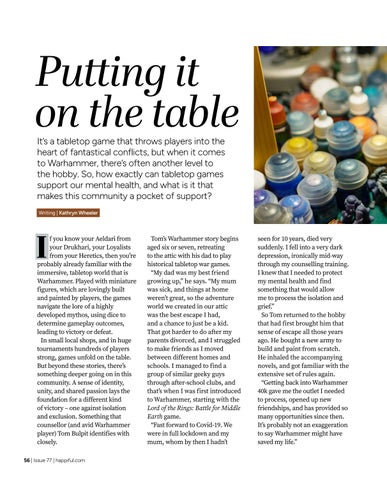
Putting it on the table It’s a tabletop game that throws players into the heart of fantastical conflicts, but when it comes to Warhammer, there’s often another level to the hobby. So, how exactly can tabletop games support our mental health, and what is it that makes this community a pocket of support? Writing | Kathryn Wheeler
I
f you know your Aeldari from your Drukhari, your Loyalists from your Heretics, then you’re probably already familiar with the immersive, tabletop world that is Warhammer. Played with miniature figures, which are lovingly built and painted by players, the games navigate the lore of a highly developed mythos, using dice to determine gameplay outcomes, leading to victory or defeat. In small local shops, and in huge tournaments hundreds of players strong, games unfold on the table. But beyond these stories, there’s something deeper going on in this community. A sense of identity, unity, and shared passion lays the foundation for a different kind of victory – one against isolation and exclusion. Something that counsellor (and avid Warhammer player) Tom Bulpit identifies with closely.
56 | Issue 77 | happiful.com
Tom’s Warhammer story begins aged six or seven, retreating to the attic with his dad to play historical tabletop war games. “My dad was my best friend growing up,” he says. “My mum was sick, and things at home weren’t great, so the adventure world we created in our attic was the best escape I had, and a chance to just be a kid. That got harder to do after my parents divorced, and I struggled to make friends as I moved between different homes and schools. I managed to find a group of similar geeky guys through after-school clubs, and that’s when I was first introduced to Warhammer, starting with the Lord of the Rings: Battle for Middle Earth game. “Fast forward to Covid-19. We were in full lockdown and my mum, whom by then I hadn’t
seen for 10 years, died very suddenly. I fell into a very dark depression, ironically mid-way through my counselling training. I knew that I needed to protect my mental health and find something that would allow me to process the isolation and grief.” So Tom returned to the hobby that had first brought him that sense of escape all those years ago. He bought a new army to build and paint from scratch. He inhaled the accompanying novels, and got familiar with the extensive set of rules again. “Getting back into Warhammer 40k gave me the outlet I needed to process, opened up new friendships, and has provided so many opportunities since then. It’s probably not an exaggeration to say Warhammer might have saved my life.”