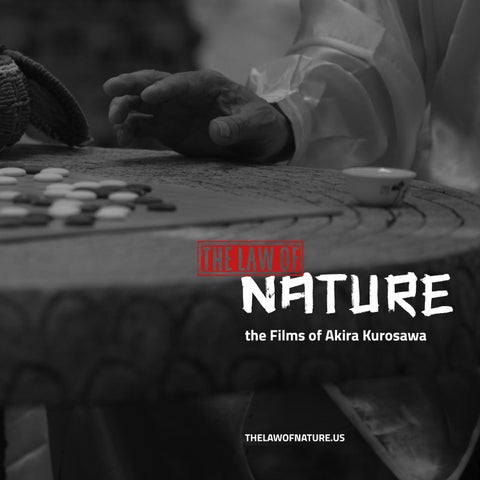
the Films of Akira Kurosawa
THELAWOFNATURE.US
“People today have forgotten they're really just a part of nature. Yet, they destroy the nature on which our lives depend. They always think they can make something better.” —Akira Kurosawa
3
4
The Law of Nature
5
CONTENTS
01
AKIRA KUROSAWA Biography The Inter view Filmography Awards Legacy
6
The Law of Nature
6
The Law of Nature
02
03
Ran
Introduction
Shadow Warrior
Location
FEATURED FILMS
THE FESTIVAL
04
REFERENCES
Throne of Blood Seven Samurai Rashomon
7 7
8 6
The Law of Nature
01 AKIRA KRUOSAWA Biography The Inter view Filmography Awards Legacy
79
黑 澤 明
10
The Law of Nature
“He is noted for his visually arresting and intellectually adventurous evocations of Japan’s mythic past and agonized present. His films have established him as one of the great epic poets of the cinema.” —Encyclopedia of World Biography, by Gale, Paula K. Byers
Biography from Encyclopedia of World Biography. Up-Covering nearly 7000 notable figures from many cultures and time periods right up to the present day.
Early Life Kurosawa’s father, who had once been an army officer, was a teacher who contributed to the development of athletics instruction in Japan. After leaving secondary school, Kurosawa attended an art school and began painting in the Western style. Although he was awarded important art prizes, he gave up his ambition to become a painter and in 1936 became an assistant director in the PCL cinema studio. Until he worked there mainly as an assistant to Yamamoto Kajirō, one of Japan’s major directors of World War II films. During this period Kurosawa became known as an excellent scenarist. Some of his best scenarios were never filmed but only published in journals; yet they were noticed by specialists for their freshness of representation and were awarded prizes.
First Films In 1943 Kurosawa was promoted to director and made his first feature film, Sanshiro Sugata, from his own scenario; this story of Japanese judo masters of the 1880s scored a great popular success. In 1944 he made his second film, Ichiban utsukushiku (The Most Beautiful), a story about girls at work in an arsenal. Immediately thereafter, he married the actress who had played the leading part in the picture, Yaguchi Yoko; they had two children, a son and a daughter. In August 1945, when Japan offered to surrender in World War II, he was shooting his picture Tora no o fumu otokotachi (They Who Step on the Tiger’s Tail), a parody of a well-known Kabuki drama. The Allied occupation forces, however, prohibited the release of most films dealing with Japan’s feudal past, and this outstanding comedy was not distributed until 1952.
Biography
11
12
The Law of Nature
13
“For me, filmmaking combines everything. That’s the reason I’ve made cinema my life’s work. In films, painting and literature, theatre and music come together. But a film is still a film.” —Akira Kurosawa
Kurosawa followed his first domestic success with what would become his first international hit, Rashomon (1950), a samurai murder story told from the perspective of four different characters. It is now considered a masterfully innovative storytelling device for the time, but it was met with mixed reactions in Japan. However, its genius was not lost on the international circuit and it won both the top prize of the Venice Film Festival and the Academy Award for best foreign film. Working from a script by Kurosawa, Martin Ritt remade it as the 1964 Western The Outrage. It became the earliest of many of Kurosawa’s works adapted to this genre.
14
The Law of Nature
The International Now recognized as an important voice in cinema, over the course of the next decade, Kurosawa made some of his most influential and entertaining films. In 1952, he released the internationally acclaimed Ikiru and in 1954, he released the epic Seven Samurai, a homage to Westerns that would later come full circle when it was remade as The Magnificent Seven (1960). Once more demonstrating his range and flair for adaptation, in 1957, Kurosawa released Throne of Blood. A reimagining of Macbeth, it is widely considered to be one of the finest interpretations of Shakespeare’s works. Following on its heels was 1958's Hidden Fortress, the story of princess, her general and their two bumbling peasant companions on a quest to reach home. It marked a milestone as the first film in Japan to make use of the widescreen format, but it is arguably even more important for the influence it had on the young American filmmaker George Lucas, who names Hidden Fortress as a primary influence for Star Wars.
Resurrection On the verge of fading into obscurity, Kurosawa was approached by a Russian production company to make the adventure epic Dersu Uzala about a hermit. Shot on location in Siberia and premiering in 1975, international audiences enthusiastically received the film. However, the production took a toll on Kuro-
Dreams In 1990, the 80-year-old director returned with Dreams, an experimental offering brought to the screen with help from yet another of his admirers, Steven Spielberg. Though the film met with a lukewarm reception, at that year’s Academy Awards Spielberg and Lucas presented Kurosawa with an honorary Oscar by in
sawa’s health. Although he was finding it increasingly difficult to win backing for his projects, Kurosawa persevered in his efforts to bring his vision to the screen.
recognition of his body of work. The director made the mildly successful Rhapsody in August in 1990 and Madadayo in 1993. In 1995, he was working on his next project when he fell and broke his back. The injuries he sustained confined him to a wheelchair for the remainder of life and led to a rapid deterioration of his health. He died from a stroke on September 6, 1998, in Tokyo. He was 88. Since his passing, his impact on film continues to be felt through new interpretations of his work and the lasting influence he has had on some of the industry’s brightest lights.
Quick Facts Name Akira Kurosawa
Birth March 23, 1910
Death September 6, 1998
Place of birth Tokyo, Japan
Biography
15
THE INTERVIEW Paradise is around here: A Rare Interview with Akira Kurosawa
Interviewer: Maani Petgar, Iranian director, Photographer, producer Film Monthly (No. 225-1998)
16
The Law of Nature
Maani Petgar (Left), Akira Kurosawa (Right)
We got there at 35 o’clock sharp. (Of course, we had killed some time at the station so that we wouldn’t get there too early.) As the taxi approached Kurosawa’s hilltop villa, we noticed a man, about 35 years old, come out of the house and walk across the yard to the driveway to lead us to the entrance. Between the
We were immediately served cold drinks: iced coffee topped with a little whipped cream. I will never forget the taste of that drink which was very refreshing, but not enough for me. Anyway, when we mentioned to his assistant that we were ready, two minutes later Mr. Kurosawa walked in. A woman, about 35 years
entrance and the main door to the living room, there was an area, just like in Iranian homes, where everyone took off their shoes. The living room was quite large and had some huge windows on three sides with a view of Mountain Fuji. We were led to a table in one corner of the living room. We were asked how long we’d need to set up. I asked his assistant where Mr. Kurosawa prefers to sit. He pointed to a chair and that’s when I noticed a fan facing it. It was mid-summer and very hot. We were pouring sweat. The heat reminded me of the detective’s desperation, in his Stray Dog.
old, followed him in, who I believed to be his daughter. Kurosawa walked towards us and after greetings and hand shakes; he sat himself in his rather dignified chair. Our producer had brought him a gift: a book of some of Australia’s nature scenes, laid out on the two pages. Since the main reason for requesting this interview was to hear his words on Kiarostami, I wanted to get through that part as soon as possible, and then hopefully, to move on to more personal aspects of his own films.
17 7
“The people that are depicted on screen in their films are not molded characters. They express human problems in a natural way.” —Akira Kurosawa
Mr. Kurosawa, I was wondering how you were introduced to Iranian cinema. The first film I saw was a Kiarostami film. During the Shah’s regime, I was invited to Iran to judge in the Tehran Film Festival which I declined since it was a huge responsibility. After the revolution, I saw Mr. Kiarostami’s film (Where is the Friend’s House?) and was quite amazed at how well it was made. Then he continued on describing Kiarostami films, and talked about similarities between his own Madadayo and Kiarostami’s Where is the Friend’s House? The screen is like a major square in which everyone can gather and talk to each other. For example, I bring to the screen my own country’s problems and Kiarostami his. The actors voice our words and touch everyone’s heart and this is the role of cinemad talk to each other. And that’s the responsibility of the cinema.
18
The Law of Nature
(For the complete conversation, please refer to The Emperor and I: Abbas Kiarostami Meets Akira Kurosawa. Maybe is worth mentioning that after seeing the published interview, Mr. Kurosawa was rather upset with the main title). A film must be made with the heart, not the mind. I think today’s young filmmakers have forgotten this and instead they make films through their calculations. That is why Japanese films no longer have an audience. In all honesty, films must be made to target the hearts. During the time of Ozu, my mentor, and also in my time, no filmmaker made films based on theory and calculation, and that was why Japan’s cinema was capable of shaping its golden years. Young filmmakers use techniques to humiliate the audience. This is wrong. We must serve cinema and make a film that would stimulate the audience. Ultimately, the aim should be to make an artistic film. That’s simple, isn’t it?
In your older films there was always some concern about human situations. What is the root of this? When there is talk of humanity in Japan, everyone thinks of complex subjects and stories. However, whatever an ordinary human feels, we try to project on the screen in an honest way. That’s all. You were keen on American cinema… Regarding American cinema, I could say that much better films were made in the past. Today’s American cinema provides the wrong service to the audience. Violence and car crashes are often seen. What pleasure is there in watching such scenes? Old American films expressed human problems quite well, but these days the American cinema has problems. There is no doubt that a film like Jurassic Park is interesting, but there used to be more impressive films in the past. In contrast, films, like those of Kiarostami, touch the heart and are very beautiful. These new sci-fi, action films, are good but they are not cinema.
From left: Michelangelo Antonioni, Akira Kurosawa, and Satyajit Ray at the Taj Mahal in 1977.
You said something about humanity in Japan. Can you please elaborate on that? I can talk politics also, but I tend to speak about people more often. For example, such and such kind of humans used to exist in the past but they no longer do. Society is heading towards corruption. In the past, we didn’t have abundance or any means of comfort, but man lived in a natural way. Nowadays there’s always news of murders and violence on Japanese TV and in newspapers. When I was young, there were rarely any murders, and if one was committed it aroused a great deal of commotion. I’ve heard that it’s worse in America. In the past, people were more decent.
The Interview
19
FILMOGRAPHY
1943-1959
1949
Stray Dog 1950
Scandal Rashomon
1951
The Idiot
1952
Ikiru (To Live)
1943
Sanshiro Sugata
1954
Seven Samurai
1944
The Most Beautiful
1955
I Live in Fear (Record of a Living Being)
1945
Sanshiro Sugata Part II
1957
Throne of Blood (Spider Web Castle)
The Men Who Tread on the Tiger's Tail
20
The Quiet Duel
1946
No Regrets for Our Youth
1947
One Wonderful Sunday
1948
Drunken Angel
The Law of Nature
The Lower Depths 1958
The Hidden Fortress
From left: Roshomon (1950) Seven Samurai (1954). Credit: Toho Co., Ltd
1960-1993
1960
The Bad Sleep Well
1961
Yojimbo (The Bodyguard)
1962
SanjurĹ?
1963
High and Low (Heaven and Hell)
1965
Red Beard
1970
Dodesukaden
1975
Dersu Uzala
1980
Kagemusha (The Shadow Warrior)
1985
Ran
1990
Dreams (Akira Kurosawa's Dreams)
1991
Rhapsody in August
1993
Madadayo (Not Yet)
Filmography
21
22
The Law of Nature
02 FEATURED FILMS Seven Samurai Throne of Blood Ran Shadow Warrior Rashomon
23
RAN ‘Ran’ is by all standards one of master Kurosawa’s best films in his resume
By Kenneth Turan Film Critic
24
The Law of Nature
Tatsuya Nakadai, right, portrays the aristocratic warrior Hidetora (Rialto Pictures)
Influenced to a degree by William Shakespeare’s King Lear, Akira Kurosawa’s Ran combines the elements of the well-known story of the British author’s king with a Japanese medieval epic to create a, first and foremost, beautiful, touching film of lasting value and invaluable depth. Even though Kurosawa experienced a lot of success
Enjoying the benefits of having the biggest budget in Japanese cinematography up to that point, Kurosawa created an epic depiction of an aging, ailing warlord determined to abdicate and divide his power onto his three sons. Many have noted the similarities evident between the protagonist and the filmmaker himself, choosing to believe
and international and domestic recognition in the earlier part of his career, after 1965 he found it difficult to secure financial support necessary for the production of his films. He wrestled with the notion of being too old-fashioned, he was hurt by box office struggles of his works, going through a tough period both professionally and emotionally. But then he found a welcome helping hand in the French producer Serge Silberman, a man willing to gamble on Kurosawa’s next project. And that’s how the world of film was enriched by Ran.
Ran was just as much a story about Kurosawa and his struggles as it was about the warlord. After all, despite the fact that they function in different areas of business and life, don’t both a national leader and a filmmaker offer their vision to the people that follow them, presenting it in a way that inevitably seeks the audience’ opinion, causes their reaction? Grappling with the themes of family, honor, pride and chaos, this nihilistic story enhanced by a delightfully unforgettable soundtrack by Toru Takemitsu, allegedly drawing inspiration from Gustav Mahler, is by all standards one of master Kurosawa’s best films in his resume.
25 7
26
The Law of Nature
27
RASHOMON Is ‘Rashomon’ Kurosawa’s Best Film?
By Phillip Lopate The New York Times (Dec. 2, 2016)
28
The Law of Nature
In September 1951, the Venice Film Festival awarded its top prize, the Golden Lion, to “Rashomon,” by a little-known Japanese director, Akira Kurosawa. Immediately, the film and its maker became international sensations. It is easy to see why, given its dynamic, virtuoso cinematic technique, sensationalistic story
Paul Anderer, who teaches Japanese literature and film at Columbia University, has written a well-researched study that is part biography of Kurosawa, part cultural history of modern Japan and part film monograph. He is previously the author of two scholarly works, but his prose in “Kurosawa’s Rashomon” is ener-
involving a bandit raping a samurai’s wife, “Bolero”-like musical score and tantalizing if schematic structure of flashbacks contradicting one another. The title quickly entered the English language and became shorthand for the relativity of truth: “the Rashomon effect,” invoked to indicate how witnesses to the same event may see it differently.
getic, straightforward and free of academic jargon — if rhetorically overheated, at times, seeming to mirror his subject’s excitable style. He has chosen to focus on “Rashomon” as the fulcrum of Kurosawa’s career, emphasizing what he regards as the early influences in the filmmaker’s life that fed his thematic vision — specifically, its mixture of the appalling and the redemptive, the apocalyptic and the humanistic.
Among these influences was a pair of catastrophes that left his city devastated: the earthquake of 1923 and the firebombings of Tokyo in 1945. “Kurosawa’s was an imagination of disaster, lined by fear and an often overwhelming darkness. His most daring work, though, moves beyond the shadows, perseveres to locate
Anderer views the newspapers’ contradictory accounts of that tragedy as a template for “Rashomon.” More important, he sees the older brother looming over Kurosawa throughout his career, imbuing him with a love of 1920s silent, experimental cinema and a passion for Russian literature, especially Dostoyevsky.
some sliver of light,” Anderer writes. Kurosawa was only 13 when the earthquake occurred, but his older brother, Heigo, insisted they walk through the ruins and view the corpses, ostensibly to overcome fear by staring reality in the face. That older brother exerted a major influence on Kurosawa: A movie buff, he took Akira along to silent film classics, mostly foreign, and even became a benshi: “The benshi were there to explain the plot but also to impersonate the characters. Such a narrator, standing at the podium to the left of the stage, made faintly visible by the lectern light, would declaim from the start to the finish of a feature film.” Heigo was a celebrated benshi, but when sound came in, his profession evaporated. Depressed, he com-
So taken is the author with this brother motif that he locates Kurosawa’s “core” narrative as “variations on a story about one brother’s rise and fall, and another brother’s efforts to recall their life together in its vitality, complexity and memory-shaping force.” This seems a bit farfetched, but Anderer presses on, squeezing the brother into the tail of sentence after sentence: “Kurosawa knew, of course, that a shadow character was more than just a filmic cliché, that such a character could be someone you knew intimately, someone you feared or relied on, as you would a brother.” He also hits the shadow/ light metaphor pretty hard.
The samurai’s wife: Machiko Kyo in Rashomon, 1950
mitted double suicide with a waitress. 29
Kurosawa’s Rashomon: a Vanished City, a Lost Brother, and the Voice Inside His Iconic Films —Paul Anderer
30
The Law of Nature
The book’s strength lies in its grasp of Japan’s cultural history: the dominant literary figures; the political currents that drew the young Kurosawa into the proletarian art movement; the country’s rightward shift in a militaristic direction; and the war years, when Kurosawa began directing under heavy censorship, keeping his
Curiously, given the book’s title, there is not that much formal analysis of “Rashomon.” There is scant discussion of the acting: The seductive star Machiko Kyo is mentioned only once in passing, and the superb Masayuki Mori, who plays the samurai, is singled out not for his performance but for his writer-father, who committed double
head down, followed by the American occupation and a chance to make more expressive films. Throughout, Anderer engages in animated dialogue with Kurosawa’s own written account, “Something Like an Autobiography,” at least as much as with the films themselves.
suicide. The great cinematographer Kazuo Miyagawa, so crucial to the film’s appeal, is complimented without exploring how his work for Kurosawa contrasted with that done elsewhere. More significant, there is little attempt to place “Rashomon” in the larger context of Japanese cinematic practice. Part of what made Kurosawa’s technique stand out — and be accused by Japanese critics as too “Western” in spirit — was his extreme close-ups and the way he moved the camera. Kenji Mizoguchi and Yasujiro Ozu both disdained close-ups, and Mizoguchi used elaborate, choreographed camera movements but in long shot, affording a more detached perspective.
Anderer argues that Kurosawa required “a more melodramatically charged, allegorical framework for his postwar film project, which was to shock what had become a cultural dead zone back to life.” And he quotes Kurosawa’s rather self-serving 1945 statement that Japanese films “ ‘have lost their youth, vigor and high aspira-
Anderer sees Kurosawa as retrieving Japan’s honor after its shameful war defeat, by winning the Golden Lion for “Rashomon” and going on to make “Seven Samurai” and “Ikiru.” In my opinion he overrates “Rashomon.” The fact that it is “iconic” does not necessarily make it a masterpiece—certainly not one of comparable
tion.’ Movies, look like the work of tired, old men, ‘who make petty judgments, have driedup feelings, and whose hearts are clogged.’ He adds, ‘If we say films made by such people are mature, we should throw such “maturity” to the dogs.’ ” So much for the sublime pre-and postwar efforts of Ozu, Mizoguchi, Mikio Naruse and Keisuke Kinoshita.
depth to, say, Mizoguchi’s “Ugetsu” or Ozu’s “Late Spring.” Visually dazzling, yes, but the hammy and naïve aspects remain irksome. Toshiro Mifune’s monkey-scratching bandit, charming at first, becomes one-note; the drifter’s cynical laughter is excessive; and the woodcutter’s rescue of the baby at the end, a crudely sentimental device. Kurosawa’s Big Thoughts, like What is truth? and Is man inherently evil?, seem trite. The problem is not that these questions are undeserving of consideration, but that Kurosawa poses them in a didactic, simplistic, self-congratulatory manner.
31 7
SEVEN WARRIORS Why it can be one of the 100 greatest foreign-language films
By Anne Billson 30 October 2018
32
The Law of Nature
The film’s ‘assembling the team’ sequence has been imitated by countless action and heist movies
Akira Kurosawa's Seven Samurai (1954) is a three-and-a half-hour-long black-and-white epic set in war-torn, 16th-Century Japan. As elevator pitches go, it’s hardly ideal, yet not only did Seven Samurai take first place in BBC Culture’s 100 greatest foreign-language film poll, with 41 critics (20 per cent of the total)
To begin with, he was the first Japanese director to win international acclaim when his film Rashomon was awarded the Golden Lion at the 1951 Venice Film Festival. And Seven Samurai surely owes part of its popularity in the West to the fact that, in the pre-video era, it was one of the first Japanese films many
voting for it, Kurosawa was one of the most popular directors overall, with three of his other films (Rashomon, Ikiru and Ran) all making the top 100. Tellingly, though, Kurosawa’s global appeal didn’t reach as far as the Japanese critics who took part; not one of them voted for Seven Samurai, or any other Kurosawa film, preferring the subtler homegrown talents of Yasujirô Ozu and Kenji Mizoguchi. But perhaps that’s what we should have expected. Even during his most successful film-making years, Kurosawa was often held in higher esteem abroad than in his own country.
viewers had ever seen. It introduced a culture that was foreign yet intriguing, and accessible to audiences weaned on Hollywood westerns. In later years, Kurosawa tended to downplay his enthusiasm for the films of John Ford, but his achievement was to combine the conventions of the western with a radical new fusion of Japanese genres: the chambara (swordplay film) and the jidaigeki (period drama).
33 7
"If Westerners found Kurosawa’s films so appealing, perhaps this meant they weren’t as authentically Japanese as quieter offerings by Mizoguchi or Ozu."
34
The Law of Nature
After all this meticulous scene-setting, the film’s final hour-and-a-half unfurls in an escalating series of skirmishes. The climactic battle, drenched by torrential rain, is a miracle of brilliantly choreographed chaos: combatants running hither and thither through the mud, galloping horses, spears, arrows and the occa-
Kurosawa followed Seven Samurai with other chambara pictures, including Yojimbo (1961) and Sanjuro (1962), but his popularity in the West seemed to work against him in his native land, where there was a certain amount of resentment and suspicion; if Westerners found Kurosawa’s films so appealing, perhaps this
sional bullet, all filmed with multiple cameras, which insert the audience into the thick of the action. We always know who’s who, where everyone is, what they’re doing and–thanks to an infographic-style banner–exactly how many bandits there are left to kill at any given moment. There are casualties among the samurai, too, and, because we have come to know them, every death hits hard.
meant they weren’t as authentically Japanese as quieter offerings by Mizoguchi or Ozu. Amid the artistic turbulence of the new waves and countercultures of the mid-1960s, Kurosawa’s last two films for the Toho Company flopped, and his unwillingness to downgrade from epic productions to smaller projects shut him out in the cold. In 1971 he attempted suicide, and his next three projects – Dersu Uzala (1975), Kagemusha (1980) and Ran (1985) – got off the ground only thanks to support from admirers in the USSR, the US and France.
But just as Kurosawa’s samurai movies were influenced by Hollywood westerns, they in their turn have been hugely influential on cinema in the West. The plot of Seven Samurai has been recyclednot just in The Magnificent Seven Hollywood made two versions, one in 1960, the other in 2016 – but in science fic-
That unparalleled influence is a sign that Seven Samurai’s appeal lies in emotions and mythologies not only specific to feudal Japan, but which strike a universal chord. Kurosawa may, to some extent, be a prophet without honour in his own country. But, after more than six decades, his greatest film remains the
tion (Battle Beyond the Stars and Rogue One) and animation (A Bug's Life). The Hidden Fortress (1958) was an influence on Star Wars, and Yojimbo (itself a reworking of Dashiell Hammett’s novel Red Harvest) was rehashed by Sergio Leone as A Fistful of Dollars, which kick-started the spaghetti western craze.
gold standard for action movies that are both exciting and coherent. Its epic sweep and fierce humanity will continue to move and thrill audiences around the world for generations to come.
Kikuchiyo, played by Kurosawa favourite Toshiro Mifune, is a half-crazed swaggerer who turns out to be less of a buffoon than he first appears.
35
SHADOW WARRIOR The Cultural Importance of Kurosawa’s Film “Shadow Warrior”
By Dean J. Scott Miller
36
The Law of Nature
When a Japanese warlord’s body double takes his place after his untimely death, what happens to his identity? This question figures prominently in Akira Kurosawa’s 1980 film Shadow Warrior (Kagemusha). As part of an International Cinema “Director’s Favorites” film series celebrating the 50th anniversary of the College
Shadow Warrior takes place in 1575 Japan, when warlords controlled different areas and were trying to dominate Japan for the sake of securing it for the emperor. The film tells the story of a thief who is about to be crucified for his crimes, but he is saved due to his uncanny resemblance to the warlord Takeda Shingen.
of Humanities, Dean J. Scott Miller, a professor of Japanese and comparative literature and former International Cinema director (2006-2008), discussed Shadow Warrior’s significance and its personal meaning to him.
He is then brought on as Shingen’s kagemusha, or political decoy. When Shingen is mortally wounded in battle, the decoy begins to impersonate the leader full-time to protect the clan against attacks from its opponents. He becomes such a believable impersonator that even those closest to Shingen do not immediately recognize the kagemusha as a decoy.
37 7
"The nature of man was naked in those (medieval) times. Society was changing and we can have a clear image of man in those times."
38
“Watch the thief carefully, because he undergoes a change, and it’s one of the most interesting things about the movie,” said Miller. “As you watch the film, consider the question ‘Who are we when we try to be somebody else, and what are the consequences, and the costs?’” This film has personal meaning to Miller, who was teach-
When the film was released in the U.S., Miller took some of his friends to see it in Salt Lake City. However, during that screening he came to the conclusion that subtitled films in a foreign context deliver a different kind of viewing experience. He explained that studying a culture and language helps you understand a film,
ing English in Japan the summer Shadow Warrior premiered. He went to see the movie in Tokyo and was the only foreigner in the packed theater. “When it was over, I was in tears. It just profoundly moved me. It was a very powerful reaction because I was experiencing an art form, in this case film, in its original context, in its intended setting and as one of its intended audience members,” said Miller.
but if you are dependent upon the subtitles you are limited by their quality. Being able to watch a film in a foreign language without subtitles, then, is both a good indicator of language proficiency as well as a reward for all the work that goes into learning it, he said.
The Law of Nature
“This film showed me how a foreign language opens your eyes to new values and new perspectives about life not limited by your own native tongue,” said Miller. According to Miller, Shadow Warrior is a great film from the International Cinema library. There are many cultural and language elements that do not make sense to the average viewer, so the viewer is forced to become an active observer to make sense of the film. He further explained that this is one of Japan’s best films by an international filmmaker, so viewers get to observe “something of good report” in this film. Finally, it is a rich film that Miller said reveals something new each time he watches it. “I’m sure that you’ll see something new, and you’ll walk away with some fresh ideas,” Miller told students in attendance.
39
THRONE OF BLOOD 1957: When Akira Kurosawa's 'Throne of Blood' Was Ahead of Its Time
by Gavin J. Blair
40
The Law of Nature
As part of a showcase trio of film interpretations of Macbeth to mark the 400th anniversary of Shakespeare’s death, the Hong Kong International Film Festival is screening Akira Kurosawa’s Throne of Blood. The 1957 production substituted the 16th century Sengoku (Warring States) era of Japan for 11th century Scotland,
In Japan, Kurosawa was accused at the time of being stuck in the past for his heavy use of techniques from Noh, a theatrical tradition that predates Shakespeare by a few centuries. Meanwhile, a 1961 New York Times review dismissed the film as “serio-comic” and “a pictorial extravagance that provides a conclu-
reworked much of the storyline and made no attempt to translate the original dialogue. Lord Macbeth became samurai General Washizu, played by Kurosawa’s favorite leading man Toshiro Mifune in a memorably intense performance. The central themes of loyalty, betrayal, tragedy and superstition that define the original play remained intact in what has been latterly hailed as one of the finest celluloid renderings of the Bard’s work. However, much of the praise lavished on Throne of Blood came in recent decades.
sive howl.” Titled Kumonosu Jo, literally Castle of the Spider’s Web, in Japan, it was one of a trilogy of Kurosawa films loosely based on Shakespeare plays: The Bad Sleep Well (1965) was a reimagining of Hamlet and also starred Mifune, while 1985’s Ran borrowed heavily from King Lear. As in a number of Kurosawa films, the elements become almost a protagonist in the story of Throne of Blood.
41 7
"In Japan, the filmmaker was accused at the time of being stuck in the past." Kurosawa, cast and crew members on the set of Throne of blood
42
The Law of Nature
Mifune’s Washizu and General Odagura— played by the prolific Takashi Shimura, who appeared in 21 Kurosawa films—get lost while riding in thick fog back to their castle. The fog then clears to reveals the castle, an allegorical reference to the clarity of vision Washizu acquires after meeting the witch who
The volley of arrows that rain down on the samurai included real shafts shot by expert archers. Mifune’s frantic arm waves at the arrows stuck in the wood around him also signaled to the archers which way he would move next: a safety measure concocted to reduce the probability of him being skewered
foretells his destiny. Where most directors would have simply used artificial smoke for the scene, the famously perfectionist Kurosawa waited for days with his crew high on Mt. Fuji, where the castle set was built, for fog to envelop the slopes and then lift. Kurosawa’s insistence on realism was demonstrated even more dramatically in the climactic scene of Washizu’s betrayal.
for real.
43
44
The Law of Nature
03 THE FESTIVAL Introduction Location
45
FESTIVAL INTRODUCTION The Law of Nature: The films of Akira Kurosawa
46
The Law of Nature
The Akira Kurosawa Film Festival is to review some of best-known Japanese director's films. The festival activities include special screenings, an exhibition about culture elements in the films and a lecture by a Japanese director. With this curated selection of films and events, the festival creates an opportunity to help people under-
The Akira Kurosawa Film Festival is to review some of best-known Japanese director’s films, which are Ran, Shadow Warrior, Seven Warriors, Roshomon and Throne of Blood. The festival activities include special screenings, an exhibition about culture elements in the films and a lecture by contemporary filmmak-
stand Kurosawa's interpretation of humanity and insights of the force of nature. The films help people to understand the value of their life in a higher level.
ers. With this curated selection of films and events, the festival creates an opportunity to help you understand Kurosawa’s interpretation of humanity and insights of the law of nature. The films can help you to understand the value of their life in a higher level.
47 7
LOCATION AMC Kabuki 8, San Francisco
48
The Law of Nature
The theater was the first multiplex in San Francisco. As part of the original Japan Center mission to showcase Japanese culture, it was the first authentic Kabuki theater in America, designed in a traditional 17th century style with a proscenium, stage entrance/exit ramp, revolving stage, and trap doors. The theater
Formerly the AMC Kabuki Cinema 8, it was acquired by Robert Redford's Sundance Cinemas chain in 2006 as part of an anti-trust agreement allowing AMC to acquire Loews. Sundance renovated the theater, and reopened it under its current name in December 2007, as the chain's second theater. On October 6,
was designed with dining tables so audiences could eat while watching Kabuki performances. The restaurant, named the Kabuki Theater Restaurant, was limited to serving Chinese and American food so it would not draw business away from the Japan Center Japanese restaurants.
2015, it was announced that Carmike Cinemas has acquired Sundance Cinemas for $36 million. On November 15, 2016 Carmike was purchased by AMC Theatres (which is owned by the China-based Wanda Group) for $1.2 Billion, bringing the theater back into AMC's control. AMC announced on March 1, 2017 that the Carmike owned brands will be retired and all theaters would be placed under one of three new AMC brands. The Sundance Kabuki as of April 2017 was renamed the AMC Dine-in Kabuki 8. On April 4, 2018 the theater was re branded as the AMC Kabuki 8 and dropped the AMC Dine-in menu.
49 7
50
The Law of Nature
04 REFERENCES
51
REFERENCES
Websites wikiwand.com/en/Throne_of_Blood cinephiliabeyond.org/throne-blood-value-meaning-kurosawas-fog-drenched-masterpiece/ en.wikipedia.org/wiki/AMC_Kabuki_8 cinephiliabeyond.org/akira-kurosawas-ran/ dvdbeaver.com/film/DVDReviews10/kagemusha_.htm cinephiliabeyond.org/paradise-around-rare-interview-akira-kurosawa-maani-petgar/ movie.mtime.com/14882/reviews/7957700.html humanities.byu.edu/the-cultural-importance-of-kurosawas-film-shadow-warrior/ www.rogerebert.com/reviews/great-movie-rashomon-1950 Photos shutterstock.com nipic.com
52
The Law of Nature
Type Rockwell ITC Galliard Pro Titillium Web Mongoose Course GR.612 Integrated Communication (Fall 2019) Academy of Art University Instructor Hunter Wimmer Designed by Steven Lyu
53
“but ignorance is a kind of insanity in the human animal. People who delight in torturing defenseless children or tiny creatures are in reality insane. The terrible thing is that people who are madmen in private may wear a totally bland and innocent expression in public.” —Akira Kurosawa
54
The Law of Nature
55