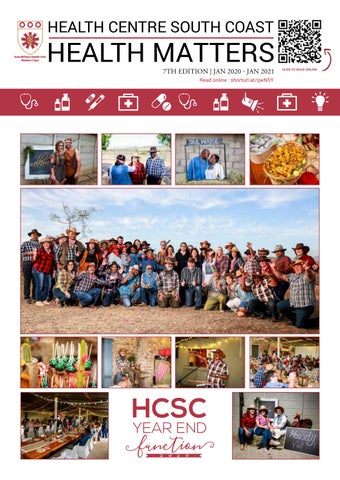
HCSC
LETTER FROM THE EDITOR “Wonder is the heaviest element in the periodic table of the heart, (for) even a tiny piece of it can stop time” (Diane Ackerman)
learn a new skill and visit a place that he's never been to before. This (costly) approach of pursuing new experiences is associated with personal growth.
At the start of a new year and against the 2020 backdrop of uncertainty and non-stop adjustment, what would be a suitable New Year's resolution and appropriate wish to express to one another?
With the loss of health and lives, lockdown, curfews and cancellation of sporting events this type of New Year's resolutions feels inappropriate for the "new normal". Viktor Frankl, famous psychiatrist and holocaust survivor liked to quote "If we have a why to live, we can endure almost any how". The "why" is essential in our search for meaning, even if it was in the direst of circumstances.
Reflecting on this question took me back to my time as a wedding photographer, during which time I had the opportunity to listen to many striking speeches. One that I still remember was by a groom that spoke of his annual New Year's resolution. This yearly resolution would consist of three components – he would complete a novel physical challenge (i.e. run the Comrades marathon),
How can we still sense and experience our freedom? If we can pause, take a few steps back and allow for a wider perspective of our situation of being in the world to appear, we'll be able to recognise that there is one journey that can never be subjected to lockdown - the sense-making process, an inner journey that finds expression in the way we engage with life itself.
In this latter type of resolution, growth is found in revisiting the familiar. Spend time with that which we believe we already know, gently holding onto our existing beliefs is essential for this process of unfolding discovery. Slow down and explore the stories that I believe about my identity, my culture, my expectations of acceptable and unacceptable. Opportunities to practice are everywhere – on anything or anyone that we have previously made our minds up about is an opportunity for practice! The longest journey may not necessarily be measured in the number of kilometres travelled, but may be in the ability to see the everyday and to see it for the first time.
CAPT H. VAN DER VEEN EDITOR
Ms A. Swart (CS pharmacist), CO L. Goliath (physiotherapist), Lt Col S.J. Henrico (OIC), Dr S. Jensen (MO) and Capt A. Kriek (ANM) Absent: Dr Ibtisaam Ahmed (CS Dentist)
P2 P3 - P4 P5 P6 P7 P8 - P9 P10 - P11 P12 - P14 P15 P16 P17 P18 - P19
LETTER FROM THE EDITOR LETTER FROM OIC FAREWELL OF CAPT ISAACS & WO2 BEUKES PATIENT ADMIN SOCIAL WORK PHARMACY MEDICAL PSYCHOLOGY DIETETICS ORAL HEALTH HCSC COVID-19 AWARENESS CAMPAIGN HCSC YEAR END
P20 - P23 COVID-19: FAKE NEWS AND MISINFORMATION KILL P23 - P25 MY COVID-19 EXPERIENCE P26 - P27 NURSING DEPARTMENT P28 GEORGE SICKBAY NEWS P29 MY STORY: FINDING POSITIVITY IN A PANDEMIC P30 HCSC COURTYARD P31 IN THE SPOTLIGHT P32 SOCIAL NEWS P33 CERTIFICATES OF APPRECIATION AND PRIZE GIVING P34 MOVEMBER 2020 P35 16 DAYS OF ACTIVISM P36 SPORT
LETTER FROM THE OIC pamby rules and regulations, but our sawbones nurses made sure that we can have ourselves a proper hoedown in these stables tonight . Generally they say that you ain’t learning when your mouths a-jawing, so I won’t be wasting you sunshine time in mouthing off too much. Just because trouble comes visiting, it doesn’t mean you have to offer it a place to sit down, so let us all try and adhere to the COVID-19 protocols as far as possible.
Howdy folks. We had an opportunity to wet our whistles at the saloon. Luckily our saloon was away from this COVID bandit, but we still had to be on the on the wary for these crooks. Now this country of ours is full of namby
P3
Unfortunately we also had to do without the following members: •
• • • • •
Ssgt Willem Wagner is currently on internal deployment. Our thoughts are with him and his family who will be separated over the festive period. Thank you for your sacrifice. Major Lorraine Muller went on pension Maj Wilma Flink was transferred to EC Capt Cindy Oudshoorn resigned as did Ssgt Mbete Dr Tevin Naidu completed his CS and moved on to CT
WHAT DID 2020 GIVE US?
We wish them well in their new ventures.
We were fortunate to obtain the services of the following members who made a huge difference in our service delivery:
Congratulations to the following families who added to their families since last we met:
• • • •
WO2 Jay Goliath who took over our log department Dr Bernice du Toit, Community Service Dentist Dr Melanie Parkin, Community Service Medical Doctor Miss Anne Britz, Community Service Pharmacist
• • • • • •
Anika and Heindre Keuler Tanya and Thurston Louw Cindy and Willem Oudtshoorn Wilma and Ursheon Flink Duran and Eureka Johannes WO2 Witbooi
There were a number of members who lost fathers, mothers, grand parents, siblings and family members during this year and our condolences again goes out to all of you especially with the festive season looming. May you find peace and solace during his period. It would again be imprudent of me to not to recognise the spouses, partners and families of the members of the Health Centre South Coast. Association with a soldier will forever be challenging irrespective of their mustering. It takes a special kind of human being to tolerate the dynamic life of a soldier. Especially durin this COVID-19 period…..I do not want to dwell too much on this subject now. We had four Inspector General inspections this year and I must say that it was the best inspection reports I have seen in a very long time. Thank you to everyone who was and is involved in the quality of these reports. The result of this inspection is testimony to the hard work our HCP’s put in to manage the clinical work we are required to do. Our Sport achievements were limited during COVID-19 • •
Dr Nel is still the No1 Squash player in the SAMHS and was included in the SANDF Masters team Our team won the Oudtshoorn Bowls Club Business league. Thanks for the enormous support.
LETTER FROM THE OIC
From the bottom of my heart I would like to thank every single person and organisation who contributes to the succes of the Health Centre South Coast. From our HQ in Cape Town right down to the last patient, we would like to extend a word of thanks to them. They give us right to existance and we are thankfull to be of service here in the South Cape. I would also like to thank my fortune teller who gave me this wisdom and foresight last year. I said the following last year at the function: “ 2020 is going to be tough on us, tougher than the preceding years, but not tougher than the future. Steel yourself! Aqcuire skills that will arm you for the future we are facing. Change your mindset to be prepared for the worst. If you leave your life to chance, you can’t make a change. Chance may favour the prepared mind, but it doesn’t create change. Only a will to create change will create change.” How right we were in this prediction? We perservered and conquered! There are a lot of people who we can thank for a lot that was done during this year and specifically during the COVID period. It would be unfair to single out and individual, but I need to give recognition to my own family who supported me. You raised me up when I was down and kept me standing and I need to thank you for that. I believe that there are a lot of us who can say the same. Can we give a round of applause to all families of health care workers who are not recognised even though they play such a big part whether you are a cleaner or a specialist,
ICU nurse or patient admin clerk, you and your families matter. Thank you to nursing for the arrangements of this exceptional evening. I know how much effort went into this event, relax, it is a tremendous success. Good luck to to the OECP and Patient Admin departments who will arrange the year-end of 2021 and no we will not settle for a bring and braai. Thank you for 2020 and good luck for 2021. Enjoy the festive season and if you are travelling, please travel safe. If you remain behind at home, enjoy so too. Come back in 2021 reinvigorated and ready for the challenge.
P4
I leave you with these cowboy wisdoms: “Do not squat with your spurs on.” “Don’t dig for water under the outhouse” Never approach a Bull front the front, a horse from the rear and a fool from any direction” “Speak your mind, but ride a fast horse” If you climb on a horse, be ready for the ride. If you get thrown from a horse, you have to get back on…….unless you landed on a cactus; then you have to roll around and scream in pain” Thank you LT COL S.J. HENRICO OIC
FAREWELL OF CAPT ISAACS AND WO2 BEUKES
P5
WO2 Beukes started as a staff nurse at 1 Military Hospital in 1992. In 1994 she was transferred to the Ops Dept at Wits Medical Command. She says that she hasn't regretted this move for one moment as she really enjoyed her deployments. Seeing so much during her deployments have developed a love for camping, which she's planning to do much of during retirement. Capt Isaacs 32 years service in SAMHS started at 2 Military Hospital. She was transferred to Oudtshoorn Sickbay in 1996. Since 1996 she spent 11 years on deployment with the UN. She is currently hosting a program on Heartbeat FM and plans to do more community work in the future, which include social upliftment via job creation (i.e. needlework lessons, making of fashion jewelry). A rehabilitation centre for Oudtshoorn is part of her long-term vision.
PATIENT ADMIN DEPARTMENT OUDTSHOORN SICKBAY CONTACT LIST RANK
SURNAME / INIT
APPOINTMENT
P6
OUDTSHOORN SICKBAY ROUTINE ROUTINE
TELEPHONE
Lt Col
Henrico S.J.
Officer in Charge
044 203 4162
Maj
Andrews P.K.
Social Worker
044 203 4051
Maj(Dr)
Nel G. J.
Chief Medical Officer
044 203 4237
Capt
America U.
Nursing Officer In Charge
044 203 4151
Capt
Jansen K.K.
Nursing Officer (Chronic Clinic)
044 203 4199
Capt
Isaacs E.M.
Nursing Officer in Charge
044 203 4151
Capt
Kriek A.
Area Nursing Manager
TIME
Dental Emergencies (weekdays)
0800B
Key duty member on duty
0710B
Roll call
0730B
Sick Reports (students) Mon, Tue, Thu, Fri
0800B-1000B
044 203 4177
Sick Reports (students) Wed
0900B-1100B
Sick reports (others) Mon, Tue, Thu, Fri
1030B-1500B
Sick reports (others) Wed
1100B-1500B
Tea Time
1010B-1030B
Lunch
1245B-1330B
Capt
Smith N.
Responsible Pharmacist
044 203 4033
Capt
Louw S.
Dietician
044 203 4199
Capt
Sauer A.L
Social Worker
044 203 4298
Capt
Van der Veen H.
Psychologist
044 203 4221
Capt
Van Deventer M.
Nursing Officer (Baby Clinic)
044 203 4186
Capt(Dr)
Vorster A.
Chief Dentist
044 203 4192
Lt
Rossouw E.M.
RSN (Welness Clinic)
044 203 4186
Phakamisa (PT) Mon, Thu
1500B-1600B
Maintenance Tue, Wed, Fri
1500B-1600B
Inpost Training Wed
0745B - 0900B
Weekend and Public Holiday Clinic at Sickbay
0900B-1100B
Sport Wednesday
1245B - 1600B
Repeat prescription collections (Please book 7 days in advance)
1100B-1430B
Pest Control 2nd Wednesday of the month Sickbay close at 1400B no lunch taken
1400B
WO2
Venter R.C.
Case Manager
044 203 4014
WO2
Witbooi K.
Medical Platoon WO
044 203 4163
Ssgt
Goliath J.
Log WO
044 203 4026
Sgt
Oktober V.
Patient Admin (Sick Report Reception)
044 203 4227
Cpl
Maropa T.
Health Informatics Clerk
044 203 4162
Lcpl
Ross C.A.
Patient Admin (GP Authorities)
044 203 4120
Ms
Claassen B.E.
Health Centre Clerk
044 203 4162
Me
Prins L.
Patient Admin (session Dr Authorities)
044 203 4120
GEORGE SICKBAY ROUTINE
GEORGE SICKBAY CONTACT LIST RANK
SURNAME / INIT
APPOINTMENT
Capt
Reitz A.M.
Nursing Officer In Charge
044 874 0678
Capt
Greeff L.
Nursing Officer
044 874 0680
Capt
Keuler A.
Responsible Pharmacist
044 874 0680
Ssgt
Africa A.
Pharmacy Assistant
044 874 0680
Capt
Barnard E.
Logistical Clerk
ROUTINE
TELEPHONE
044 874 0680
Capt
Fouche E.
MO
044 874 0680
Mrsh
Barnard A.
Patient Admin (Special Authorities)
044 874 0680
Key duty member on duty Roll call
TIME 0720B 0730B
Sick Reports Mon, Tue, Fri
0800B-1500B
Sick Reports Wed
0900B-1500B
Sick Reports Thu
0800B-1415B
Tea Time
1010B-1030B
Lunch Mon, Tue, Wed, Fri (No lunch on Thu)
1245B-1330B
Phakamisa (PT) Mon
1500B-1600B
Phakamisa (PT) Thu
1415B-1600B
Maintenance Tue, Wed, Fri
1500B-1600B
Session Doctors Mo, Thu, Fri on appointment
0800B-0900B
Session Doctors Wed, Tue, Wed on appointment
1200B-1300B
Physiotherapist Tue on appointment
1030B-1500B
Dietician Tue on appointment
1030B-1500B
Psychologist Tue on appointment
0900B-1500B
Uniform Inspection 1st Monday of the month
0745B
Pest Control 2nd Thursday of the month, Sickbay close at 1400B
1400B
SOCIAL WORK DEPARTMENT
P7
HOW TO RENDER SOCIAL SUPPORT DURING SOCIAL DISTANCING… (TOGETHER WE ARE STRONGER) TECHNOLOGY DISTRIBUTION Third, empower community institutions to distribute information and communications technology, whether public schools, senior centers, faith-based organizations, public housing authorities, and other frontline organizations, with connections to households more likely to lack reliable internet access and computers. These organizations possess databases of constituents as well as access to charitable and government funding streams to deliver hotspots, laptops, and other devices to bridge the digital divide.
CULTURALLY APPROPRIATE CARE
INTERSOS UNICEF outreach worker Abdoul Bassite walks for a few minutes with sevenyear-old Francesca [NAME CHANGED], as part of the process of measuring oxygen saturation in her blood, during a mobile clinic health screening in an informal settlement in Rome, Italy, on 31 March 2020. For community members for whom social support is essential to their health and wellbeing, social distancing is not just isolating, but perilous to their mental health, to their community and family stability, to their survival. For people in recovery, pregnant and birthing people, older adults, people with disabilities, single parents, and people at risk of intimate partner violence, among others — social distancing disproportionately increases risks of depression, anxiety, loneliness, trauma, and violence — to potentially lethal levels. The primary directive of social distancing runs counter to our most ingrained disaster response: reaching out to help one another in a time of need through our community networks and institutions. The primary directive of social distancing runs counter to our most ingrained disaster response: reaching out to help one another in a time of need through our community networks and institutions. Yet, establishing contact to provide material and social support is still possible. I recommend a series of steps that local public sector and philanthropic
leaders can take right now to provide vital social support during the pandemic
VIRTUAL SUPPORT First, transform face-to-face peer support to virtual models, including buddy systems, phone trees, text threads, and online support groups. These provide a safe means of communicating, “I see you. I hear you. You are not alone. We are in this together.” Increasingly, addiction recovery programs are offering virtual connections, a lifeline when social isolation can be a key relapse trigger. In order to increase our virtual reach, organizations that provide emotional support can offer virtual trainings of proven models.
RESILIENCE HUBS Second, fund community-based organizations to set up resilience hubs to provide material support through the collection and distribution of goods such as groceries, meals, educational enrichment, etc. These hubs can build a network of neighbors and volunteers and enable a routine point-ofcontact with vulnerable households. This is a model proposed in Rockaway, Queens, New York City after Hurricane Sandy, and one expanding now as local food pantries and local businesses innovate to reach the exponential number of families in need.
In all of these efforts, we must prioritize culturally appropriate social care, through investments in mutual aid and communitybased networks, that recognizes and integrates history, local context, socioeconomic realities, and cultural traditions into outreach, community building, and service delivery. In this slow rolling global pandemic, we must come together to reimagine social support when social distancing is the public health imperative. Community, political, business and philanthropic leaders are positioned to take our nation’s indefatigable charitable spirit and collectively organize it through our community networks and institutions, using virtual, light touch adaptations of best practices for assisting our most vulnerable groups. Those of us representing and working with these groups can pool resources and models to create a vital support network that will survive the pandemic and become a best practice for a robust “civic infrastructure” that provides inclusive care, social support, and resources to our most vulnerable neighbors in times of stability and crisis. When we center the most vulnerable, we design systems and approaches that can work for us all now and in the future. Leigh Graham is the Scientific Lead for the Cities Challenge of the Delivery Decisions Initiative at Ariadne Labs, and a Research Scientist at Harvard T.H. Chan School of Public Health. She has worked in disaster recovery since September 11, 2001, including after Hurricane Katrina in New Orleans and Hurricane Sandy in Rockaway, Queens. MAJ P.K. ANDREWS & CAPT A.L. SAUER THE SOCIAL WORK DEPARTMENT
PHARMACY DEPARTMENT
P8
TAKE CONTROL OVER DIABETES
INTRODUCTION The past couple of months has seen us inundated with an influx of information concerning the COVID-19 pandemic. Whilst much time and information has been devoted to curbing the spread of the pandemic, little focus has been placed on the co-morbidities that make many of our patients more susceptible.
STATISTICS Diabetes is one of the leading chronic diseases in South Africa and among the top ten causing up to 76% percent of those deaths in people under the age of 60. In 2019, 90 000 of deaths in South Africa were attributed to diabetes alone. The International Diabetes Federation (IDF) reports that Diabetes affects approximately 4.5 million people in our country, of whom approximately 2 million are unaware of their condition until they become seriously ill. Many more are estimated to have pre-diabetes, most of whom remain undiagnosed. South Africa is currently among the top 10 countries in the world with regards to the absolute increase in diabetes prevalence. According to the World Health Organisation (WHO), nearly 463 million adults worldwide are living with diabetes. The United Nations Health Agency (UNHA) has estimated that 3.4 million people die annually of diabetes.
DIABETES AND COVID-19
TYPES OF DIABETES
Whilst many Type 1 Diabetics may experience no to relatively mild symptoms similar to a bout of common cold or influenza, the risk for older patients with diabetes is greater during the COVID-19 pandemic, especially with the chronic complications. When people with Diabetes develop a viral infection, it can be harder to treat, due to fluctuations in blood glucose levels and, possibly, the presence of diabetes complications. The reasons for this is an already compromised immune system and the fact that the virus may thrive in an elevated blood glucose environment. These factors make it harder for the body to fight the virus and may likely mean a longer recovery period. A study by the NHS (National Health Service) and Imperial College in London has found that Type 2 Diabetics are twice as likely to die from the Corona virus and Type 1 Diabetics three and a half times more likely. The figures doubled in Type 2 Diabetic patients who were also severely obese, with a Body Mass Index (BMI) over 40. They also found that one third of deaths from the virus have occurred in patients with diabetes.
1.
It takes on average 7 years for a person to be diagnosed with Type 2 diabetes as the symptoms may start out mild and develop gradually. This means that nearly 30% of those diagnosed with Type 2 Diabetes, will have already developed complications by the time they are diagnosed. Therefore early detection and treatment is vital if we are to decrease the burden on our already strained healthcare system. Considering the above, it is imperative that we move to educate our population and work together to address our diabetes prevalence. World Diabetes day is November 14th and should be one of the occasions utilised to create various platforms for raising awareness of Diabetes.
2.
3. 4.
THE SIGNS AND SYMPTOMS OF DIABETES • • • • • • • • • • •
Frequent urination, more than usual Sudden weight loss Wounds that won’t heal Always hungry, despite regular eating Always thirsty/unquenchable thirst Feeling tired and listless all the time Poor memory or short attention span Recurrent skin infections Sexual problems/ vaginal infections Blurred vision Numb or tingling hands and feet
HOW TO CONTROL DIABETES 1. 2.
WHAT IS DIABETES? Diabetes is a disorder that affects how your body uses food for energy. Normally the sugar in the food you eat is broken down into simple sugars called glucose. The glucose circulates in your blood where it waits to enter the cells to be used as energy. The pancreas makes and releases a hormone called insulin, to move the glucose into the cells. When you have Diabetes, your pancreas either doesn’t make enough insulin or the body can’t use the insulin as well as it should. This causes sugar to build up in your blood. Diabetes can be caused by genetics, hormonal imbalances (eg. during pregnancy), aging, environmental and auto-immune factors.
Type 1 Diabetes – usually affects adolescents, an auto-immune reaction in which the body’s immune system attacks the insulin-producing beta cells of the pancreas so that the body produces little or no insulin. Type 2 Diabetes – usually affects adults, where the body becomes resistant to insulin which results in dangerously high blood sugar levels. It is usually caused by lifestyle or genetic factors. Gestational Diabetes – developed during pregnancy when the mother’s body does not secrete excess insulin Pre-Diabetes – usually in overweight adults and those over 45 years of age (leading sedentary lifestyles), when blood sugar is higher than normal but not high enough to be classed as diabetic
3. 4. 5.
Take your medication regularly and as prescribed Work towards reaching and maintaining a healthy weight by following an exercise routine (20-30 minutes of exercise session, 3 times a week. If you have a heart condition, please consult your doctor before starting an exercise routine) and a balanced meal plan (your dietician can assist you with a tailored meal plan). Maintain good control over your Hemoglobin A1c, blood pressure and cholesterol levels. If you are a smoker and drinker, kick the smoking habit and don’t consume alcohol. Exercise good foot care
DIABETES COMPLICATIONS Poor control over your condition may lead to complications. Complications can be avoided
PHARMACY DEPARTMENT
P9
DO’S AND DON’TS – GOOD PRACTICES FOR MANAGING DIABETES DO
DONT
•
Take your medication REGULARLY and as prescribed (WITH MEALS where indicated) to achieve the optimal therapeutic effects
•
Skip doses or stop taking your medication without first consulting your Doctor and Pharmacist
•
Return all unused or expired medication, insulin pens and needles to your pharmacy to ensure the correct disposal thereof
•
Share medication
•
Take Expired Medication
•
Inform the Doctor and Pharmacist of any new or existing allergies and conditions (eg. Glaucoma, Porphyria, Sulpha allergies)
•
Discard any unused medication by flushing it down the toilet or in the sink
•
Report any unwanted side effects to your Doctor and Pharmacist immediately
•
Discard any empty insulin pens and used needles with your domestic refuse
•
Report and return any defective products (insulin pens/glucose monitors) to your Pharmacist
•
•
Know what chronic medication you are taking and always keep a copy of the prescription with you
Start taking any herbal remedies concomitantly without first consulting your Doctor or Pharmacist as there may be potential drug interactions with your current medication
•
Ensure that you know how to store, travel with and discard of your medication correctly
•
Ensure you have a sufficient supply of medication to cover you for periods of travel, detached duty and deployment or on course.
•
See your Doctor every 6 months to re-evaluate your treatment plan and renew your prescription
OTHER DIABETIC SUPPORT
Sources: Statistics South Africa, South Africa. Mid-year population estimates 2019. 2019 (July). Available from http://www. statssa.gov.za/publications/P0302/P03022019.pdf
Diabetics generally suffer from poor circulation to their extremities. This is why wounds take longer to heal and why they often develop numbness and tingling in their hands and feet. It is therefore important to exercise regularly for at least 20-30 minutes in order to improve blood flow to these areas and do the following:
Diabetes South Africa and the South African Non-Communicable Diseases Alliance (SANCDA) offer free support during the current COVID-19 crisis. One can WhatsApp 081 578 6636 or send an email to diabeteshelp@ sancda.org.za with any diabetes challenge that you have and they reply or call you back between 08:00 and 17:00. Roche Diabetes care is offering free access to the mySugr pro app during the COVID-19 pandemic on the App Store or Google Play. It will allow one to digitally provide your healthcare professional with your blood glucose monitoring information and has additional features to help with diabetes self-management.
•
CONCLUSION
with early diagnosis and proper treatment. These include but are not limited to: gum disease, skin infections, nerve damage, amputations, depression, blindness, kidney disease, heart failure, fertility problems and fatty liver disease,
TIPS FOR GOOD FOOT CARE
• • • • •
Check your feet and toes daily for any bruises, cuts and swelling – see the doctor at once if you have hurt your feet or develop ulcers Wear shoes and socks that fit well – do not go barefoot Use a moisturiser to avoid dry feet (but not between the toes) Wash the feet daily with warm water and a mild soap Ensure you dry the feet properly, especially between the toes File your toenails straight across to prevent ingrown toenails
Managing diabetes effectively requires daily treatment, regular monitoring, a healthy diet and lifestyle and ongoing medication. The Pharmacist is a Health Care Practitioner one can trust to assist with the monitoring of progress on the prescribed treatment plan and to provide appropriate medication and nondrug counseling. Please consult with them for any questions and concerns that may arise. In these are difficult and uncertain times and it is important that we all remain strong and supportive of each other. Health Care Practitioners are there to assist members of the military community to live a healthier and better quality of life.
International Diabetes Federation, IDF Diabetes Atlas, 9th edition. Brussels IDF, 2019 SEMDSA guidelines 2012. Guidelines for the Management of type 2 Diabetes (revised). Journal of Endocrinology, Metabolism and Diabetes of South Africa 2012, 17 (2 Suppl1): S6, S9, S24, S32, S36, S55 https://www.who.int/home/news-room/fact-sheets/ detail/diabetes, last accessed 24/06/2020. https://beyondtype1.org/risk-covid-diabetes/, accessed 23/06/2020.
last
https://www.diabetessa.org.za https://www.diabetesresaerch.org/coronavirus-anddiabetes, last accessed 24/06/2020. https://coronavirusdiabetes.org /wp-content/ uploads/2020/04/PDF-VERSION-FINA-427.pdf http://www.cdediabetes.co.za/home/diabetes/diabetescare-programmes.html
CAPT N. SMITH RESPONSIBLE PHARMACIST HOD PHARMACY
Erratum: This article was credited to Capt Keuler on a previous occasion.
MEDICAL DEPARTMENT
P10 P10
FOUR-LEGGED BIODETECTORS
During these trying times, scientists and infectious disease experts have had to think “outside the box” when trying to detect COVID-19 and preventing future outbreaks. There has long been evidence that many, if not all, diseases have a tell-tale odour. Yellow fever is said to smell like raw meat, whereas tuberculosis starts of as wafts of stale beer, but later progresses to soggy cardboard with notes of brine. The olfactory epithelium of our canine friends is 30 to 40% larger compared to us, meaning that a dog can place an odour between 10 000 and 100 000 times better than an average human. Dogs also inhale up to 300 times per minute in short breaths, meaning that their olfactory cells are constantly supplied with new odour particles. In addition, dogs' noses differentiate between right and left. “We
could detect a spoonful of sugar in a cup of tea, but a dog could detect a spoonful of sugar in two Olympic-sized swimming pools” says Professor James Logan, head of department of disease control at the London School of Hygiene and Tropical Medicine. A recent trial done by the UAE Ministry of Interior, showed that dogs were successful in identifying the virus in 92 percent of cases. It also showed that one dog can screen over 250 people per hour – faster than any human possibly could. Fernando Mardones, professor of veterinary epidemiology at Universidad Catolica explained that from what they can tell, the virus has no smell, but rather infection generates metabolic changes which in turn are picked up in sweat. Dogs have successfully been trained in the past to identify Malaria, cancer, an
oncoming seizure , Parkinson’s disease (years before symptoms emerge) and hypo-andhyperglycaemia, to only name a few. It only then makes sense to use our furry friends in the fight against this pandemic. Six dogs – Norman, Digby, Storm, Star, Jasper and Asher are currently being trained to sniff out the virus in the United Kingdom and they are being backed with £500000 (almost R10 000 000) of government funding. Researchers at the National Veterinary School of Alfort, outside Paris, trained eight Belgian Malinois shepherd dogs to identify people infected with the coronavirus and in Chile, four dogs (three Golden retrievers and a Labrador) are being trained to do the same. They could then possibly be used at points of entry into the country to detect potential carriers of the virus or at testing centres as another form of screening. When they identify a possible carrier of the virus, the person is sent for testing and placed under quarantine. Experts hope to have dogs trained and working in the field by August 2020. DR MELANI PARKIN MO HCSC
MEDICAL DEPARTMENT
P11 P11
DR. TEVIN NAIDU SAYS GOODBYE much you do not know. That level of humility comes in handy. Your body is a temple, your prayers should come in the form of learning more about it and treating it with love and respect. I pride myself in knowing that ranks did not affect my management of patients while at the HCSC. Whether you're a Recruit or Major, you deserve the same level of care.
All good things must come to an end. This is, unfortunately, the case with regards to my journey at Health Centre South Coast. It was an absolute privilege working as a community service medical officer for the South African Military Health Services. Not only did the Health Centre welcome me with open arms but they also held me tightly with a grip filled with love, friendship, hospitality and so much more. It was a fascinating experience. Both my parents were police officers with ranks of their own, my father - a Sergeant and my mother - a Colonel, so it was exciting to entertain the idea that I would possibly become a Captain for the South African National Defence Force. Alas, I was told on day one that comm serve doctors actually do not get ranks, to my disappointment! However, rank or no rank, I always felt like a soldier as I worked among those who "serve the brave". I learnt about military ranks, experienced morning salutes, and even got to attend interesting administrative meetings. Overall, working at the HCSC came with many perks. Much more than I imagined. I was fortunate enough to forge a bond with my
colleagues and patients that extended into my personal life. Something I had never done in the past. Because Oudtshoorn is such a small town, it was interesting to see my patients in the Town's shopping centers, restaurants etc. I became known as "Doc" wherever I went. Whether it be filling petrol at the garage or paying a bill at a store, "Doc" became my identity. I look back at the year that has gone by and I am thankful for the journey provided for me by the HCSC and the Oudtshoorn community at large. I hope the Town benefitted from my public lectures on Covid. That was an amazing aspect of my journey, lecturing the SAPS, Correctional Services, Traffic Police, Business Chamber, Military and even doing radio interviews to help the Oudtshoorn Health Cluster educate the public. I am eternally grateful for the holistic community health service I was able to assist the HCSC provide. I'd like for everyone reading Health Matters to remember what I've been preaching since day one, that ignorance is not bliss. Remain a student for life. Learn more whenever you can, especially about your health if possible. The more you know, the more you realise how
The primary healthcare exposure was fantastic! I really felt like a physician while there. Great supervision and support from my colleagues made the journey that much better. What a kind bunch of people work at HCSC. The relationships made between all of us are ones worth cherishing for a lifetime. I enjoyed working with everyone at the HCSC. I will not mention names because I'd like for everyone I worked with to know that they had a huge impact on my growth and I am grateful for that. The friendly faces, kind smiles, warm hugs did not go unnoticed. I will miss the heartwarming environment that I got so accustomed to over the past year. As I bid HCSC farewell, I take solace in the fact that I came to Oudtshoorn as a post Intern doctor and I leave as a registered Medical Practitioner. My journey continues and I hope I get to come back sometime to see you all again. Thank you for your welcome and continue to serve the brave with pride, joy and enthusiasm. All that you do is for the greater good and it was a pleasure to work alongside you all! Take care of yourselves and each other. Cheers! DR. TEVIN NAIDU CS MO 2019/20 HCSC
YOUR FEEDBACK!
QR WeCODE have created a short electronic questionnaire to help
us get a better sense of patient / client experience when visiting HCSC. Completing it will only take about 3 minutes of your time. Please use your mobile phone to scan and visit the QR Code to the left. Thank you!
PSYCHOLOGY DEPARTMENT
P12
THAT DISCOMFORT YOU’RE FEELING IS GRIEF
This article by Scott Berinato first appeared in Harvard Business Review (HBR) and was one of the most widely read of 2020. It was send to me by friends after the CEO of their company shared it between their staff members. The HBR is well known for the quality and cutting edge approaches to management. Our reaction to the COVID-19 pandemic is explained through the different stages of grief that was initially developed by Elisabeth Kübler-Ross. The article consists of an interview with David Kessler, who expanded the Kübler-Ross model to include a sixth stage, Meaning. HBR: People are feeling any number of things right now. Is it right to call some of what they’re feeling grief? Kessler: Yes, and we’re feeling a number of different griefs. We feel the world has changed, and it has. We know this is temporary, but it doesn’t feel that way, and we realize things will be different. Just as going to the airport is forever different from how it was before 9/11, things will change and this is the point at which they changed. The loss of normalcy; the fear of economic toll; the loss of connection. This is hitting us and we’re grieving. Collectively. We are not used to this kind of collective grief in the air. You said we’re feeling more than one kind of grief? Yes, we’re also feeling anticipatory grief. Anticipatory grief is that feeling we get about what the future holds when we’re uncertain. Usually it centers on death. We feel it when someone gets a dire diagnosis or when we have the normal thought that we’ll lose a parent
someday. Anticipatory grief is also more broadly imagined futures. There is a storm coming. There’s something bad out there. With a virus, this kind of grief is so confusing for people. Our primitive mind knows something bad is happening, but you can’t see it. This breaks our sense of safety. We’re feeling that loss of safety. I don’t think we’ve collectively lost our sense of general safety like this. Individually or as smaller groups, people have felt this. But all together, this is new. We are grieving on a micro and a macro level. What can individuals do to manage all this grief? Understanding the stages of grief is a start. But whenever I talk about the stages of grief, I have to remind people that the stages aren’t linear and may not happen in this order. It’s not a map but it provides some scaffolding for this unknown world. There’s denial, which we say a lot of early on: This virus won’t affect us. There’s anger: You’re making me stay home and taking away my activities. There’s bargaining: Okay, if I social distance for two weeks everything will be better, right? There’s sadness: I don’t know when this will end. And finally there’s acceptance. This is happening; I have to figure out how to proceed. Acceptance, as you might imagine, is where the power lies. We find control in acceptance. I can wash my hands. I can keep a safe distance. I can learn how to work virtually. When we’re feeling grief there’s that physical pain. And the racing mind. Are there techniques to deal with that to make it less intense?
Let’s go back to anticipatory grief. Unhealthy anticipatory grief is really anxiety, and that’s the feeling you’re talking about. Our mind begins to show us images. My parents getting sick. We see the worst scenarios. That’s our minds being protective. Our goal is not to ignore those images or to try to make them go away — your mind won’t let you do that and it can be painful to try and force it. The goal is to find balance in the things you’re thinking. If you feel the worst image taking shape, make yourself think of the best image. We all get a little sick and the world continues. Not everyone I love dies. Maybe no one does because we’re all taking the right steps. Neither scenario should be ignored but neither should dominate either. Anticipatory grief is the mind going to the future and imagining the worst. To calm yourself, you want to come into the present. This will be familiar advice to anyone who has meditated or practiced mindfulness but people are always surprised at how prosaic this can be. You can name five things in the room. There’s a computer, a chair, a picture of the dog, an old rug, and a coffee mug. It’s that simple. Breathe. Realize that in the present moment, nothing you’ve anticipated has happened. In this moment, you’re okay. You have food. You are not sick. Use your senses and think about what they feel. The desk is hard. The blanket is soft. I can feel the breath coming into my nose. This really will work to dampen some of that pain. You can also think about how to let go of what you can’t control. What your neighbor is doing is out of your control. What is in your control is staying six feet away from them and washing your hands. Focus on that.
PSYCHOLOGY DEPARTMENT
P13
THAT DISCOMFORT YOU’RE FEELING IS GRIEF (CONT.) Finally, it’s a good time to stock up on compassion. Everyone will have different levels of fear and grief and it manifests in different ways. A coworker got very snippy with me the other day and I thought, That’s not like this person; that’s how they’re dealing with this. I’m seeing their fear and anxiety. So be patient. Think about who someone usually is and not who they seem to be in this moment. One particularly troubling aspect of this pandemic is the open-endedness of it. This is a temporary state. It helps to say it. I worked for 10 years in the hospital system. I’ve been trained for situations like this. I’ve also studied the 1918 flu pandemic. The precautions we’re taking are the right ones. History tells us that. This is survivable. We will survive. This is a time to overprotect but not overreact. And, I believe we will find meaning in it. I’ve been honored that Elisabeth Kübler-Ross’s1 family has given me permission to add a sixth stage to grief: Meaning. I had talked to Elisabeth quite a bit about what came
after acceptance. I did not want to stop at acceptance when I experienced some personal grief. I wanted meaning in those darkest hours. And I do believe we find light in those times. Even now people are realizing they can connect through technology. They are not as remote as they thought. They are realizing they can use their phones for long conversations. They’re appreciating walks. I believe we will continue to find meaning now and when this is over. What do you say to someone who’s read all this and is still feeling overwhelmed with grief? Keep trying. There is something powerful about naming this as grief. It helps us feel what’s inside of us. So many have told me in the past week, “I’m telling my coworkers I’m having a hard time,” or “I cried last night.” When you name it, you feel it and it moves through you. Emotions need motion. It’s important we acknowledge what we go through. One unfortunate byproduct of the self-help movement is we’re the
first generation to have feelings about our feelings. We tell ourselves things like, I feel sad, but I shouldn’t feel that; other people have it worse. We can — we should — stop at the first feeling. I feel sad. Let me go for five minutes to feel sad. Your work is to feel your sadness and fear and anger whether or not someone else is feeling something. Fighting it doesn’t help because your body is producing the feeling. If we allow the feelings to happen, they’ll happen in an orderly way, and it empowers us. Then we’re not victims. In an orderly way? Yes. Sometimes we try not to feel what we’re feeling because we have this image of a “gang of feelings.” If I feel sad and let that in, it’ll never go away. The gang of bad feelings will overrun me. The truth is a feeling that moves through us. We feel it and it goes and then we go to the next feeling. There’s no gang out to get us. It’s absurd to think we shouldn’t feel grief right now. Let yourself feel the grief and keep going. CAPT H. VAN DER VEEN HOD: PSYCHOLOGY
PEOPLE NEED PEOPLE PROGRAM The Psycho-Social Departments of HCSC hosted a People Need People (PNP) program to the staff members at HCSC. PNP programs provide a supportive space for building and strengthening relationships. The program ran over five sessions and topics like What am I serving / protecting? What is essential, What should continue? What should change? What is mine to do? These questions were used as guiding questions for dialogues to open up. Feedback was positive and we are planning to continue having more of these PNP sessions during 2021. CAPT H. VAN DER VEEN PNP HOST | HCSC PSYCHOLOGIST
YOUR FEEDBACK!
QR WeCODE have created a short electronic questionnaire to help
us get a better sense of patient / client experience when visiting HCSC. Completing it will only take about 3 minutes of your time. Please use your mobile phone to scan and visit the QR Code to the left. Thank you!
PSYCHOLOGY DEPARTMENT
P14
REFLECTING ON HAPPY TIMES During the nationwide lockdown in 2020 I requested a temporary detachment to HCSC where I would be privy to the luxury of grandparents to assist with child care. I was initially reluctant but was pleasantly surprised by what awaited me in Oudtshoorn... I was greeted with open arms by the professional team at the Oudtshoorn Sickbay. Thank you also to the Officer In Charge; Lt Col Henrico; for making me feel very welcome and so always having an open door. What struck me was the fact that everyone seemed to genuinely care for each other and made time to engage with each other professionally (and personally). Team work was observed as well as an eagerness to assist each other with duties etc. A few times I was stuck with a client and unable to attend to COVID-screening in the tent and what surprised me was that not only one, but multiple colleagues would
offer to assist! Professionally I felt inspired as I was privileged enough to assist my fellow psychologist , Capt Hans van der Veen with creative workshops, pushing the boundaries a little if I could say so with “social poetics” workshops. Workshops aimed at facilitating better coping during COVID-19. It made me excited about being a psychologist in the military again, being in a position where we can assist and change the way people cope and hopefully live their lives more meaningfully, with insight. Small towns have a certain charm. No rush hour traffic’ the veld, the mountains, the slower pace of life, sense of community, caring and sharing. My short experience in Oudtshoorn had an impact on me in more ways than one. So much so that I requested a transfer to HCSC! I hope to be able to come back and form part of the team in Oudtshoorn were we can hopefully keep positively impacting and assisting members of the SANDF. Hopefully see you all soon!
CAPT R. ARRENBRECHT PSYCHOLOGIST
CHA SUPPORT
The Psychology Department was elated to have the support of their Psychology Staff Officer, Lt Col Dixon (on right) as well as Maj Jasson (left) from HCWC to assist with the Psychology CHA of almost 600 recruits.
YOUR FEEDBACK!
QR WeCODE have created a short electronic questionnaire to help
us get a better sense of patient / client experience when visiting HCSC. Completing it will only take about 3 minutes of your time. Please use your mobile phone to scan and visit the QR Code to the left. Thank you!
PSYCHOLOGY DEPARTMENT DIETETICS DEPARTMENT
P15 P15
NUTRITION DURING COVID-19 are high in protein, such as peanuts, peanut butter, boiled eggs and yoghurt. Combine these with high fibre items, such as fresh fruit and wholewheat crackers.
WHAT TO DO WHEN THERE IS A MEAT SHORTAGE
Even before the pandemic, dietitians have recommended preparing food at home rather than going out to eat, as we have control over what’s going into our meals. The best way to ensure that you are protected against any virus is to ensure that your immune system is strong. Now that we have no choice but to prepare our meals at home, let’s look at some issues regarding food during this pandemic.
The issue is that fresh produce is difficult to keep that long. Look up on how certain fresh produce can be stored to have them lasting much longer. Some last longer in glass containers and others in water, for example. Be sure to eat those with a shorter shelf life first and keep those with a longer shelf life for later.
FOCUS ON WHOLE FOODS & A VARIED DIETS
Shopping is much easier when you go in prepared. Draw up a meal plan and make it up in a shopping list. This will prevent frequent visits to the grocery store. Ensure that you also include snacks.
Look for food that are as close to their natural state, so lots of fruit & vegetables. These are highly recommended, as they are immuneboosting foods. Opt for a variety of different colours. A bigger variety leads to a bigger variety of nutrients. It is ideal to keep grocery shopping to a minimum - every second week.
DRAW UP A MEAL PLAN
GUILT-FREE SNACKS
Plant-based protein can be quite a shift to many people, but is extremely healthy and good for our hearts. Many of these can be very shelf stable. If you consider this, take it one step at a time and start including beans and nuts instead of chicken and seafood. Use lentils rather than meats & chicken in taco’s or wraps. They still contain the proteins that your body needs. Also opt for eggs. They have an extended shelf life and are also an excellent source of protein
FOODS TO AVOID Processed Food & Juices should best be avoided. These foods have been stripped from all the good parts that actually feed our immune system and are usually pure sugar. Usually this is not represented on the food label, but they do in fact contain tons of sugar. This is a crucial time to adapt eating habits and ditch the bad old ones. These new habits should not be ditches after this period in time, but rather be adopted as a lifestyle.
When we look at snacks, we want something to fill us up. Good options are snacks that
CAPT S. LOUW DIETICIAN
JERSULEMA DANCE CHALLENGE “Jerusalema”, the song by South African DJ and record producer Master KG went “viral” during the isolation and lockdown period brought about by COVID-19. People from all over the globe, but especially frontline workers, started taking part in the Jerusalema Dance Challenge – challenging other hospitals, clinics etc. to join in the dance. During a time where overall morale was quite low amongst our HCSC members, many verging on the point of burnout in an attempt to fight this pandemic, we thought to join the “Jerusalema Challenge”. The directly translated words for the Zulu song are “Jerusalem, my home, don’t leave me here. My place is not here, my kingdom is not here.” – and although at the time many might not have known the meaning of the words or the song, there was one resonating theme – we are in this together and better days are coming. It only took two practise sessions (filled with many laughs) and one 45 minute filming session to produce, what I believe to be, a splendid video! As we finished the recording, I remember looking around at everyone laughing and feeling so warm inside –what a privilege it is to serve amongst these brave warriors. Everyone played a part in this masterpiece, but I need to specifically mention Captain Van der Veen for capturing the footage and his lovely wife for editing it. Also, to Ssgt Fila who took the award for best dancer –believe me, this is something you need to see. Scan the QR Code and enjoy!
ORAL HEALTH DEPARTMENT
P16
BAD BREATH UNDER YOUR FACE MASK? UNMASKING THE SMELL. WHY DOES MY BREATH STINK?
The cause may be difficult to pinpoint. The most obvious external factor is smoking but may also include tea, coffee or garlic (food with strong odours). Internal factors include plaque and poor oral hygiene.
Now that you’re wearing a face mask, are you frequently struck by an unpleasant odour? Oh wait, that’s your breath. Although you may not have noticed it in the past, now that your breath is hitting you in the face, the smell is hard to ignore.
Dehydration can also cause bad breath. When wearing a mask, you tend to breathe through your mouth, instead of through your nose. Breathing through the mouth can cause dryness of the oral cavity which promotes bad breath. When the mouth is dry, saliva isn’t working to wash away food particles and moisten oral tissues. Problems in the sinuses or the tonsils can be contributing factors, too.
Don’t feel too bad though, over 80 million people in the world suffer from halitosis (bad breath). Now that we have to constantly wear a mask (thanks Covid), it is impossible not to notice the smell of our own breath.
In certain cases, however, bad breath could be more than just an oral cavity problem. There are so many things connected to the mouth and bad breath can be a symptom of other diseases like heart disease and diabetes.
ELIMINATING FACTORS Since the cause could be multifactorial, the best way to determine the cause is through a process of elimination. You can approach your oral hygiene issues first. Cavities and bacteria in your mouth produce bad breath and could worsen if not given proper attention. If your oral hygiene is good but you're still having problems, you can follow up further with your GP.
PRIORITIZE ORAL HEALTH You could start by brushing and flossing your teeth twice daily. Don’t forget to brush your tongue as your tongue has the same bacteria as your teeth and therefore has the same potential to cause bad breath. CAPT A. VORSTER HOD: ORAL HEALTH
DENTAL CARE AND THE COVID-19 PANDEMIC becomes aerosolized, the large droplets that quickly fall to the floor or other surfaces instead can hang in the air for longer periods of time. A number of precautionary measures have been put in place to create a “safe” working environment for dental staff members and patients. •
• The COVID-19 Pandemic had a significant impact on the Dental Department as Dentistry was identified as a “very high risk” occupation for the transmission of the coronavirus by Occupational Health and Safety. This is an easy conclusion to make for obvious reasons since a dentist, oral hygienist and dental assistant are in direct contact with a patient’s mouth and saliva when treating a patient. In addition to this, dental equipment that rotates at a very high speed causes aerosolisation of the water and saliva droplets. According to the CDC the coronavirus is known to spread through respiratory droplets emitted when an infected person sneezes, coughs or talks. However, many standard dental procedures that require ultrasonic instruments can aerosolize the virus by creating a spray containing a mix of water, saliva and other debris. When the coronavirus
• • • •
•
•
Dental appointments are scheduled to allow for enough time to prepare and clean the surgery before and after each patient. A maximum of 2 patients are allowed in the waiting room at the same time. No magazines or pens are available in the waiting room to prevent sharing of items. All patients should wear a face mask and disinfect their hands when entering the waiting area. Each patient is screened telephonically and before treatment for flu symptoms and their temperature is taken. A patient that presents with flu symptoms or a fever will not receive dental care, the appointment will be post-poned by 14 days. If a member has a dental appointment and developed flu symptoms or is in selfisolation or placed in quarantine due to contact with a COVID-19 positive patient or travelling, the member should phone in advance to cancel the appointment. All staff members should wear a mask in
• •
the department. The dentist and dental assistant wear proper personal protective clothing during the treatment procedure. The proper disinfectants and sterilisation methods are used to disinfectant surfaces and instruments.
In order to limit exposure, appointments are restricted to dental emergencies i.e. toothache/facial swelling or in exceptional cases that can potentially lead to pain. The clinical discretion of the dentist is used to determine whether the case is classified as an emergency or not. Dental cleanings (scale and polish) and new dentures are not seen as emergencies. There are no theatre appointments available at 2 Military Hospital or Oudtshoorn Provincial Hospital for dental procedures until further notice. Irrespective of the difficult times and challenges that we currently face, the personnel of the Dental Department at HCSC will always strive to create a safe environment, to help all patients and to provide the best service and dental treatment to our patients. Please phone the Dental reception on 044 203 4136 to make an appointment or if you have any enquiries.
CAPT A. VORSTER HOD: ORAL HEALTH
HCSC COVID-19 AWARENESS CAMPAIGN
P17
COVID-19 : FAKE NEWS AND MISINFORMATION KILL
P20
HOW CAN YOU TRUST WHAT YOU ARE TOLD ABOUT COVID-19 process. And, in general, debate and dissent are not suppressed or controlled. Over the last few months however, while frontline health workers have been risking their lives (and many healthcare workers have died in South Africa, as have some of their family members) to treat people ill with Covid-19, we have been dismayed at the spread of accusations that we “know nothing about this virus”. This is simply untrue; a huge amount of new knowledge has emerged since January 2020, and this has built on substantial prior knowledge about this class of virus, as well as the novel coronaviruses responsible for Severe Acute Respiratory Syndrome (SARS) and Middle East Respiratory Syndrome (MERS). This improved knowledge has had positive effects: For example, the survival rate of people with Covid-19 has improved. In the past 10 months, as Covid-19 has swept the globe, the internet and media have also been ablaze with stories, reports and everchanging guidelines on how to stay safe in a world that appears to be out of control. But what should we believe and what can we trust? As importantly, how do we spot ‘fake news’ and misinformation? In this special advisory, a collective of over 20 of SA’s leading doctors and scientists offer their advice. Living in a digital world means that we have access to the latest information on just about any subject. While this can be powerful and empowering, it can also be harmful. Access to information online is empowering because we can stay abreast of the latest knowledge about Covid-19 and can share useful data that, in the interests of public health, can help people change their behaviour and stay safe. However, it’s increasingly difficult to know how to sift out the truth from the masses of lies, misinformation and myths that are also all over the internet and social media, in an environment where the phrase “fake news” is applied to anything someone does not agree with, and truth is a political and ideological tool. As scientists and clinicians, we are in a challenging position with Covid-19. We are discovering how to approach this novel virus in real time, just as it creates chaos and devastates communities all over the world. We still don’t know enough about why the virus manifests so severely in some people and not others; whether some people can be infected more than once, and what the lasting impacts of Covid-19 are on the body. Scientific and medical advice around Covid-19
has changed since we first began our steep learning curve in early 2020. To begin with, public health advice focused on physical distancing and hand hygiene. As the peerreviewed, evidence-based, scientifically sound research emerged, we also began recommending that people wear masks, with South Africa one of the first countries to recommend universal mask-wearing outside of Asia. The practice was already common in many east Asian countries, so was more easily adopted there.
EVIDENCE IS CLEAR THAT THE COVID BUNDLE WORKS This bundle is a collection of practices such as increasing ventilation by opening windows, physical distancing, wearing a mask in crowded spaces and sanitising your hands, which reduces the number of viral particles you might inhale. Debates and disagreements are usual in the world of scientific and medical research. We welcome debate among colleagues, and we have rigorous processes like peer review, ethics committees, regulatory oversight, safety boards and double-blind research methods that help to inform our discoveries and ensure that any biases are brought to light. These processes are not always perfect – the sciences are not immune to fraudsters, media-hungry charlatans, and reckless outsized egos – but agreement on what we know tends to be a self-correcting, iterative
We are even more dismayed at the extraordinary claims that some researchers have falsified evidence or misled public health officials around the best ways to handle this pandemic.The scientists and clinicians in this advisory group live in a world where we exchange data, new research, hypotheses, disagreement, controversy and wild ideas every day. In fact, research thrives on these debates and disagreements. We have active discussion groups on WhatsApp, where we discuss and critique everything from the government’s approach to lockdown to new understandings of immunology. We represent a wide array of disciplines, which stimulates interesting and challenging discussions, and our research and other collaborations means we are wired into scientific debates from every corner of the globe. We do not suppress evidence-based dissent. We have seen this during the Covid-19 pandemic already – some substandard or even fraudulent “research results” were published but soon called out and corrected or withdrawn. There is a strong incentive for scientists to not remain quiet when they encounter poor research. Apart from scientific ethics, one can gain a lot (recognition, research grants, promotion) from publishing valid evidence to the contrary. When scientific consensus supports a measure such as mask wearing, this is not based on suppressing dissent, but simply expresses the fact that the best available scientific data indicates that wearing masks in public spaces, especially when indoors and when gathering
COVID-19 : FAKE NEWS AND MISINFORMATION KILL in groups, helps to slow transmission of Covid-19 and protects people who may be particularly vulnerable to infection. This is not controversial; it is established science and it is best practice. It is not up for debate. It is not only pointless to set up debates about this, but it is also an actively harmful fake controversy. We advocate wearing masks, not because we want to make life difficult for the public, but because we are doing our best to save lives and ensure that the virus is contained in the absence of biomedical preventive measures, including prophylaxis and vaccines.
the reasons behind decisions, professionals must call these behaviours out. Where senior media personalities or advocacy groups put us all in danger with misinformation, they must be held to account. Control of this virus, in some ways more than ever before, demands a collective sense of responsible community – this means we must be critical of those hiding behind cries of “groupthink”, conspiracy theories, or reckless and inexpert interpretation of data. Scientists who collude with governments to legitimise unscientific approaches have been a feature of many country responses across the globe and need to be challenged.
TRUTH AND FICTION
TIPS ON HOW TO MISINFORMATION
There is a famous adage that journalism students are taught: if you have one person telling you it’s raining and one person telling you it’s sunny, you do not just quote them both. Instead, you look out the window and find out for yourself which person is telling the truth.
We urge the South African public to take this mandate to end “fake news” as seriously as we do. To this end, we encourage every single person to become critically aware of misinformation and fake news, and we recommend the following tips to help:
In this digital age, there are many people claiming it is raining outside when all the scientific and medical evidence tells us it’s sunny. Ordinary people don’t know who to believe, especially when some of those promoting the lies are people with resources and power and hidden agendas. Rumours and misinformation spread quickly on platforms like Facebook or in WhatsApp message groups.
1.
Check the source. Be sceptical of any information that does not come from a credible scientific source. Any scientific research worth its salt will contain references to research conducted by universities and reputable research bodies.
2.
Ask yourself who is publishing this information and what their agenda might be. Be very cautious of anything that promises “ground-breaking” new developments unless it is being widely shared by well-established and reputable channels. By this, we mean journalists working for established media organisations where they will do factchecking and have good editors in place. Or journals that have been in publication for a long time, and that provide peerreviewed scientific articles. There are many websites out there that look credible and have lots of information on them, and that even promise this information is evidence-based, but it only takes a little investigation to show that these are not legitimate and not backed up by honest scientific endeavour.
We, as scientific and medical professionals, have a duty to ensure that we communicate scientific fact properly and make this information as widely accessible as possible for all to see. We are bound by professional ethics to make sure that anything we communicate can be defended by evidence, and we try to be transparent about this. When we don’t know something, we are honour-bound to admit it. And when we do know, we have a responsibility to ensure that we disseminate these findings far and wide in a way that is easily digestible to a wide array of audiences. This is the essence of public health; to use our knowledge to communicate to the populace and to develop strategies and behaviours to keep people safe and well.
WE ALSO HAVE A DUTY TO SPEAK TRUTH TO POWER Where a government makes poor choices or lapses into secrecy and does not communicate
3.
COUNTER
Search engines are your friend. If you have any doubts, enter the name of the person you’re seeing spreading this information or look up the article online. See what comes up, follow the links to the names of those involved and test their veracity. Real medical experts are easy to find online because they participate in publicly available research; they attend
P21
conferences with their peers, and they work for credible scientific organisations like universities or public hospitals. Try googling the names of the people who wrote this article. 4.
Use the services of established factcheckers. In South Africa, we have an excellent organisation called Africa Check – their only purpose is to very carefully and thoroughly investigate information in the media and in the public domain to assess whether or not it’s true. They’re doing a great job on Covid-19 too. The World Health Organisation offers a WhatsApp service (+41798931892) for updates on fake news.
5.
Be alert to emotion. If you receive a video that makes you feel angry, scared or anxious, be very cautious. Evidencebased science might have significant implications but, in most instances, it won’t seek to make you fearful. Be careful to avoid those pundits who whip up emotion in order to make people afraid to follow their doctor’s advice.
6.
Just because they wear a white coat, have certificates on a wall or have graphs or statistics doesn’t mean they are a doctor or a scientist. Just because they speak with calm authority, have lots of papers on their desk and books on shelves behind them, does not mean they are an expert. There are too many people out there claiming to be scientists and some of them are very sophisticated in using props to create an image of scientific integrity.
Use your critical mind to ask yourself the following questions: who is this person? Are they properly trained and accredited? Are they trying to sell a “quack” remedy that makes them a lot of money? Is their message supported by other scientists or professionals that are trustworthy? 1.
A single person spouting a lot of information about Covid-19 that’s not backed up by lots of other credible sources should make your fake news antennae quiver. If a friend or relative, co-worker or community group sends you something about Covid-19 (or any other health condition), ask them where they got it. If they can’t or won’t give you a recognisable source, then it might be fake news. And “my brother’s friend’s cousin” is not a reputable source.
2.
Similarly, if you’ve found something interesting online, consider checking its validity before sharing it uncritically with others in your circle. Don’t become an unwitting accomplice to the distribution of unreliable and unhelpful fake news,
COVID-19 : FAKE NEWS AND MISINFORMATION KILL but rather take a conscious stand in support of evidence-based, reliable public health information. Each of us has a responsibility to take Covid-19 seriously, and it’s only through every citizen actively playing his or her part that we will overcome this pandemic. 3.
When considering whether you might be supporting a conspiracy theory, ask yourself how many people would have to be lying or covering up for this claim to be true, and how plausible it really is that this is happening. Even if you think it is plausible that one government could create a fake pandemic for political purposes, is it really plausible that governments all round the world, including democratic and not democratic, libertarian capitalist oriented and social welfare oriented, Western and nonWestern, high and low income, could all be promoting a hoax pandemic? Is it really plausible that most scientists in Europe, Asia, Africa and elsewhere are sheeple, subject to group-think, while one person or a small number of people have seen the truth?
SOME OF THE MORE COMMON MYTHS ABOUT COVID-19
someone has tested positive, no matter what they die of, whether it is cancer or a car accident, with Covid massively overreported.” Absolutely not. South Africa has one of the world’s best mechanisms for reporting deaths. There are currently delays (related to lockdown’s impact on paperwork), and cause of death without an autopsy is dependent on the judgement of the health worker filling in the form. However, in our experience, the cause of death is usually reported with the most obvious cause. In fact, if someone dies due to cancer or in a car accident, where Covid precipitated that death, it is likely Covid is not reported unless very clearly diagnosed, and hence is likely to be under-reported. Therefore, looking at the numbers of “excess mortality’’ is really important to get a sense of this under-reporting. Check out the MRC’s weekly reports www.samrc.ac.za/reports/ report-weekly-deaths-south-africa
“Covid-19 is a scam and there is no virus.”
“The World Health Organisation was created by people like the Rockefeller or Gates families to control global health policy.”
There is no evidence to support this claim. The information communicated by the World Health Organisation, National Institute for Communicable Diseases, and the national department of health, as well as from other stakeholders, is reliable and credible.
No. The World Health Organisation is a specialised agency of the United Nations and was created by the member states of the United Nations. Those driving the Covid-19 response are scientists and public health experts.
The new coronavirus (SARS-CoV-2) is totally real.
The funding of the WHO is completely transparent, although it is under-resourced for its vital public health mandate. Member states contribute to the funding of the WHO. Private charities, such as Rotary International and the Bill and Melinda Gates Foundation, are also major donors.
At the time of writing, there are just under 50 million people globally who have been confirmed to have been infected with SARSCoV-2. More than 1.2 million people have died of Covid-19. While comorbidities may present an additional risk to some affected persons, this does not negate the existence or direct impact that Covid-19 has had on the health and lifespan of millions around the world. Some of us are clinicians who have first-hand experience of this virus in the last few months.
Some countries – like the United States – have refused to pay their UN dues, which undermines the work of the WHO.
We promise it’s real and can be severe and scary – not because we saw it on YouTube, but because we have seen it in our hospitals and clinics, among our colleagues, friends and families.
The WHO employs thousands of well-trained, experienced staff from all over the world. Many of the people on this advisory are part of WHO processes, as volunteers. It makes recommendations based on scientific evidence and has been known to revise its recommendations when new evidence comes to light. There is absolutely no evidence we have seen of any conspiracy in the way the WHO operates.
“Doctors write Covid as cause of death if
“The virus (SARS-CoV-2) which causes
P22
Covid-19 hasn’t actually been isolated in South Africa.” Not true. A collaborative effort between the University of the Western Cape and Stellenbosch University obtained the firstknown laboratory isolate of SARS-CoV-2 in South Africa on 1 April 2020 “The SARS-CoV-2 virus was created in a Chinese laboratory (or by the CIA or the Russians).” No. We have no evidence of this. We do, however, have evidence that this virus came through infection in animals, a process we have seen before with coronaviruses and others. The facts show us that the virus “jumped” from an animal species into the human population. This virus was not deliberately created in any laboratory. “Covid is no more dangerous than the flu and it is crazy to worry about a disease that is more than 99% survivable.” How likely you are to die from it is evolving, with a complex interaction of factors including your own health, the health care you have access to and possibly how high the infectious dose was. Some people claim Covid is less dangerous than the common flu and claims of a 99.9 percent survivability rate are promoted by those who think it is grossly exaggerated. The CDC currently estimates that Covid in the US has a 0.65% infection fatality rate (deaths per person infected); that is six times the flu infection fatality rate of 0.1%. And 0.65% of the South African population is 390,000 people, nearly eight times our current excess deaths in the past months and nearly 20 times our official Covid deaths. Also, comparing your frail granny to a healthy 14-year-old is silly. Your granny’s chance of getting severely ill and dying is far, far higher. If a 14-year-old falls down the stairs, she is likely to be okay, bar a few bruises. Granny is way more likely to get hurt or die. Aggregating their risk does not help anyone. And this is only considering deaths; we are learning more every day about long-term effects of Covid (explained in our Advisory here) which can be very serious and debilitating, so of course the fatality rate is not the only concern. “Mask-wearing is controversial.” Aspects of mask-wearing (for example, the precise degree of protection they provide from getting the virus or stopping transmission) may be a debate, or which kind of mask is the best, but no one reputable now debates
COVID-19 : FAKE NEWS AND MISINFORMATION KILL whether masks should be a major part of our response (for more advice and science on masks, see here, here, here). “The vaccines are just a money-making scheme, and are a way to track you/collude with 5G networks.” This is one of the most pernicious and dangerous falsehoods. You can trust (see here, here and here) that there are huge checks and balances in place before a vaccine gets on to the market, including from sceptical regulators and scientists reviewing the data on both efficacy and safety. If a vaccine gets offered to you, it means it has been subjected to meticulous scrutiny, and if you read the package insert, you should get a good sense of how effective and safe it is. Fears that it is linked to tracking mechanisms and weird associations with 5G are false. Worry about your cellphone, your search history, your bank password, and your FaceBook public profile – not about a Gates
P23
Foundation-linked microchip in a vaccine.
to share his weird theories.
“Fogging/deep-cleansing/mouthwash (insert your favourite intervention here) will save you.”
In this time of coronavirus uncertainty, myths and misinformation can be especially disempowering. You can beat that by playing detective – follow the tips we have suggested if you see something that makes you feel uneasy; if it sounds too good to be true, or if it seems to be whipping up emotions in a destructive manner.
These myths crop up everywhere, often promoted by commercial interests trying to make quick money from your fear, or by those who inexplicably enjoy drumming up controversy. The Scientists Collective offers practical guidance here. We applaud when governments, news outlets and social media fact-check and at times penalise people who spread misinformation, or at least flag that the media being posted is dodgy and that their fact-checking suggests it should be viewed with scepticism. This is not “gagging’’ or groupthink or censorship – they can tell their stories on endless blogs and social platforms – it is responsible information sharing. When you have an uncle who thinks UFOs are controlling the world, you may roll your eyes at his Facebook posts but you don’t help him
EMERGENCE We are, perhaps for the first time in our living memory, plunged into a collective experience that is emphasizing the inextricable interconnections and interdependence of all life on earth — human and non-human — that form this fragile web of life. We are learning the hard way that we are not only our brother’s keepers, but also that of the whales, the bears, the bees, the birds, the forests, the oceans, the mountains, and the seas. However, discerning this deep interconnection requires us to slow down, widen our perception, see the interlinks between ecological breakdown and our economic and political systems, and our ways of relating with this planet to the current catastrophe.
Then, if you want to do something about it, report it to Real411.org, an excellent local online resource that can sift truth from fiction. That way, not only will you be helping to combat disinformation, but you will also be helping ensure others are less likely to fall for it. Every little bit helps. And, in the meantime, please do wear your mask, keep a physical distance and practise regular hand hygiene. (Source: The Scientist Collective, published in the Daily Maverick 22 November 2020) CAPT H. VAN DER VEEN HOD: PSYCHOLOGY
MY COVID-19 EXPERIENCE BY SSGT RENATA CALVIN I felt sick the week of 10 August 2020. I got a flu pack. I went to visit my mother from 19 till 28 August 2020. On 06 September a family member that I was in contact with tested positive for Covid 19. On 07 September I took the Covid test and it came back positive.
We have been offered a pause to reimagine and reinvent a new way of being on this planet — of co-creating a regenerative future for all sentient beings. And to do this, we must befriend uncertainty!
I did not have severe symptoms. My chest was sore and I had an occasional headache. The sore chest was present for the next 3 weeks. I felt like I wanted to do things for myself that I could not. I could not go to the shop. I wasn’t able to see family members and friends. I felt excluded from all my people.
It is about coming out of our auto-pilot mode and acknowledging our overwhelm, our fear, our exhaustion, and being a witness to all that rises within. It’s about tuning in to what is truly wanting to emerge through us, and then taking awareness-based, thoughtful action.
My kids are too small to understand but they were happy that there was no school. They had no symptoms at all. My family was very worried about us. For myself it was time to rest as I had no leave since July 2019.
Be patient toward all that is unsolved in your heart and to try to love the questions themselves like locked rooms and like books that are written in a very foreign tongue (Rilke) in times of uncertainty it is profoundly important to create spaces for deep listening and generative conversations to practice the skills, to facilitate sensemaking and emergence, to steward the envisioned future into being.
Do not think that it won’t happen to you. Look after your health by eating right and doing exercise to limit chronic disease.
“how do we become the humans our world needs?”
I still feel that I am not completely healed as I sometimes have a sore chest and a cough or a headache.
Imagination is the first step to healing our planet. We can imagine the new paradigms. We can create the new paradigms. We can live the new paradigms. CAPT H. VAN DER VEEN HOD: PSYCHOLOGY
The 10 days rest and family time had more healing powers than the medication that I have received.
SSGT R. CALVIN OECP HCSC
MY COVID EXPERIENCE
P24
MY COVID-19 EXPERIENCE BY LT COL F.M. MOTHOGWANE I then withdraw to my house and joined my family for a Potjiekos dinner. We went to rest for the night after enjoying the meal. 28 JUNE 2020 (SUNDAY): TURNING POINT
26 JUNE 2020 (FRIDAY): THE GENESIS The day began like any other day in my office, morning coordination meeting and daily admin tasks etc. At about 10:00am I felt tension on my back and neck muscles. I remember going outside my office, I felt like stretching my back. I just felt so tired, I thought it was due to a small shooting exercise I took part in with E-Coy, I shot few rounds with a shotgun the previous day. On the very same day I remember Lt Pasha, training admin officer, standing against the wall with her face down. I asked her, “Beauty why are you standing like that against the wall?” She replied, “Col I am not feeling okay, my whole body is sore and I feel so tired”. I responded by assuring her that she will be okay, she needs to see the doctor. The day went by and it was time to knock off. My body still sore, so I went home. 27 JUNE 2020 (SATURDAY): THE BATTLE I woke up early and still felt tension on my back, I thought perhaps if I take a jog and break some sweat I’d feel better. I invited my son Tlhogi and my daughter Katlego to accompany me on a cross-country jog. The day went by and the fatigue just worsened. I started to feel some mild headache. Weather changed to be cold as the day went by. I put on warm clothes and a “background” coat, I experienced a diarrhoea. With all these experiences I suspected nothing. As the day was getting by, I had an emergency call at work and I went to address the recruits at the parade ground at around 18:00. As I was addressing them, I started to sweat. That’s when I started to suspect that it could be COVID 19 symptoms. Yes, I did tell the recruits that I feel like I am having COVID 19 symptoms, but they must not worry because I will conquer it.
At about 03:00 am I felt an excruciating pain between the shoulder blades. I went to the toilet, upon my return. I threw myself on the bed with my face down. I said to my wife, “Ma-Letlhogonolo this pain is too much for me, if I pass away, just go to HR, my file is ready”. I took some pain killers and I fell asleep. At about 06:00am I woke up, the pain had subsided a bit, but my neck muscles were very tense. (Ironically the previous week I gone to check my personnel file at HR). The bed was soaked with sweat. This got me really worried, I then decided to write a message to Lt Col Henrico about my experiences. I also informed my OC about it. Lt Col Henrico, OIC HCSC, responded and instructed that he will inform Dr Nel. My OC responded by saying we should sick report. (Some of my colleagues also complained about similar symptoms the previous week) 29 JUNE 2020 (MONDAY) My colleagues, Maj Mthethwa, Lt Pasha and myself, went to sick report. I asked Dr Naidu to test Lt Pasha 1st since she had serious symptoms. She was tested and the results came back positive. 30 JUNE 2020 (TUESDAY): THE BREAKTHROUGH Dr Nel summoned all the contacts at Thekiso hall, we were addressed on COVID 19 pandemic, and we got tested (22 MSDTW staff members). Of the 22 tested, 11 came back positive, and Lt Col F.M. Mothogwane was also positive. While I was waiting for the results I told my wife that I am positive, the results would only be a confirmation. Yes the results were confirmed on Thursday, 02 July 2020, Dr Nel personally called me. When I received the results that afternoon, I was sitting with my wife and our son in the bedroom. I saw my son dropping his face and for ± 5 min he could not talk. I asked him why so quiet, he just said he is fine. I could see sadness in his face. Since we got tested the young man was up to date with all the stats as they were flashed on TV news channels. I could read in his mind that my son had already put me on the fatalities. ROAD TO RECOVERY / THE BATTLE / THE ISOLATION My wife started to show symptoms, and I knew in my heart that she was also positive. We informed Dr Nel to come for testing on Friday 3/07/2020, but the weekend went by and Dr Nel was not available for testing.
Sunday, 4/7/2020, I decided to take my wife to the sickbay for the tests. When I got to the reception the staff were also friendly and welcoming. But, as soon as I told them that I am positive, they almost ran away and they went hysterical because I was not supposed to be walking around. Yes, I know I had to be home but I could not let my wife suffer because of COVID 19 isolation regulations. I took the risk. She was indeed tested, and the results confirmed my suspicion. (When I tested positive my wife said “Papa Tlhogi, don’t worry we will fight this battle together.”) We took daily prescriptions from the HCSC, with other home remedies (including daily steaming in the evening). I started experiencing a bad sense of taste, everything tasted “weird”, ie either too salty, spicy, sweet, etc. I could only tolerate an orange (anything would come back). I therefore started to loose strength and weight and my skin started to peel off like a snake shedding its skin. It was bad, I could barely walk because my joints were very weak. We have 4 beautiful children, and 2 are 3 and 6 years old. These little souls did not understand what isolation or social distancing is all about. They became even more attached to us, especially their mom who was also very sick. That almost got me depressed. I was afraid that if they get infected they would not be able to handle the pain. The other 2 children are 12, they had to prepare all the meals, clean the house and nurse the patients (mom and dad). A week went by with all the pains and we positively took it one day at a time. On daily basis I still had to answer calls from work iot give certain guidelines and make certain decisions. Most of the command group (Company Commanders) at my wing were either in isolation or quarantine. Therefore my 2IC (Maj Gerryts) had to literally run the show, with the assistance of Capt Kwaieng. COVID 19 is a scary monster, I remember one of my colleagues coming to fetch a laptop at my house. He was just too scared to touch it, in case it’s got the virus. I actually laughs out very loud. The week was not easy, my wife said that one night I was sleeping face up and I looked like a dead person, because she could not see me breathing. Yes, it was difficult to breathe normally. It was a very shallow breath, like a day old baby breathing. She was so afraid and traumatised. 12 JULY 2020: THE RESURRECTION My wife woke up very early and for some reason she had regained strength. She was singing praises to God. I just thought it’s because it was a Sunday. She loudly said “to hell with CORONA, You must shave your beard and wear nice clothes, today we must enjoy a normal Sunday meal around the table”. Of course I executed those orders. For the first time in 2 weeks I tasted food, and finished
MY COVID EXPERIENCE the meal. I had my favourite coffee for the 1st time in 2 weeks. For the 1st time there was laughter and singing in the house. My wife was so excited that she wanted us to go out to the street and tell the world how wonderful God is. It’s by His grace that we conquered this monster called CORONA. IN CONCLUSION: GOD IS GREAT My body became weak, but my spirit grew stronger day by day, and I was thanking God for every second of my life. Nothing mattered that time except to appreciate life wholeheartedly, I learnt that every breath counts.
I appreciate the support that we received daily from HCSC, Dr Nel in particular. He made home visits to check how we were doing. He would call regularly to confirm if we having challenges with breathing etc. He is a doctor indeed. He is a God sent. Let me also thank our family friend and sister, Ms Xoliswa Ngxwitha, for her support with home remedies and moral support she gave to my wife. Thanks to my pastor, Reverend Mafilika (African Gospel Church Oudtshoorn) for the divine intervention and support. I also thank the OC SA Army Inf School, Col D.M. Madie, and 2IC, Lt Col Z. Mbi for the regular calls just to check on me. My sincere gratitude to MSDTW staff members for their support, and
P25
their strength to continue with training in our absence. Covid 19 pandemic is real, we cannot be casual about it because there will be more casualties, let us continue to be vigilant and stay alive. I have now recovered and slowly regaining strength. However, psychological effects of the ordeal still remain. I hope with time they will disappear because I believe in the supernatural powers of my living God. Amen! LT COL F. M. MOTHOGWANE MSDS WING CMDR
MY COVID-19 EXPERIENCE BY SSGT ELIZE BARNARD Background: Please share with us the timeline between becoming infected and receiving the diagnosis. We were looking forward to a long weekend away, the first for 2020… and then on Tuesday 22 September 2020, I noticed that I am not feeling well. I suffered from lower back pain, which I thought on that stage, was a urinary tract infection. Wednesday morning I woke up with severe body aches, light sensitive eyes, a headache like never before and diarrhea. Covid-19 crossed my mind… When arriving at work, my husband phoned me and told me the lady that is working with him tested Covid-19 positive the previous day after feeling not well for a week. My husband was showing no symptoms at that stage. I contacted the doctor and she suggested that I rather must go home and wait for my husband to be tested. His doctor did not test him for Covid-19 since he was asymptomatic. On Thursday 24 September 2020 my symptoms even got worse, but I still wanted to wish that it is not the dreaded virus. On Friday the 25th of September 2020, Dr Fouche wanted to test both my husband and I for Covid-19. The hours waiting and hoping were definitely the longest ever, and then the telephone call from the doctor, telling me that I am positive… my first reaction was to start laughing, it was a shock and not a reality at all to become part of the statistics. Covid-19 impacts people in very different ways. Please share with us your experience by describing the physical and mental impact it had on you. For three consecutive days after receiving
the diagnosis, I COULD NOT SLEEP AT ALL. My mind was in overdrive. Who were my contacts, were they close contacts, what about my children, what about my work, what about my colleagues, what if, what if? The guilt at that stage was much worse than the symptoms. Every sniff, sneeze or complaint was worrying. Every negative test result that came back for my colleagues was such a relief. You must try to stay strong and positive for your own family, but I became very emotional and questions were bombarding me 24/7. There were no answers to questions or guidelines – you try to obtain information on how long are you going to feel like this, are you going to get better, why is the medicine not working for you, when will my children be safe, until when am I contagious? Yes there were definitely more questions than answers. Physically you are in constant pain that you can’t explain to anyone, while mentally your mind is playing all kind of games. Stress makes you believe that everything needs to happen right now. Covid-19 was indeed a roller-coaster experience which drained you physically and mentally. How did you and your family manage the diagnosis? Luckily my husband and I were both positive, so we don’t have to isolate in separate rooms. We were there for each other and could share our emotions, symptoms and concerns with each other. My 16 year old son, who was not showing any symptoms and tested negative 12 days later, had to isolate with us. At first he try to avoid us, but unfortunately staying together, using one kitchen and the same bathroom, we have to face reality. Cleaning was a full time
job and I think quiet annoying for him and my husband. EVERYTHING we touched, had to be cleaned, light switches, door handles, fridge, kettle, microwave, cupboard handles, taps etc. All of us counted the days to get back to work, freedom and the new normal. To be part of the statistics is not something that we wanted to be. Covid-19 can happen to anybody, even if you try to do the right things right. You can read as much as you like and try to be informed about Corona, but nothing prepares you for when it actually happens to you. There are limited guidelines on how to handle it, because everybody experiences it differently and timeframes are different for everybody. Covid-19 is scary and really not nice… FULLSTOP, but for us as a family it reminded us to live life 100%. Try to be healthy again, start exercise, be positive and appreciate small thing in life like to taste, to smell, friends and freedom. Covid-19 don’t have to be the end. Is there anything that you’d like to add? I would like to thank our medical facility for excellent medical treatment. I think if it was not for Dr Fouche’s speedy treatment plan, my symptoms could have been much worse. Thank you for colleagues and friends who either delivered food or groceries or just phone or whatsapp a “how are you doing?’ Don’t be too hard on yourself, things happened for a reason, try to make something positive from a negative Covid-19 experience. SSGT ELIZE BARNARD LOG CLERK GEORGE SICKBAY
NURSING DEPARTMENT
P26
CAN ONE VIEW INTERNAL DERAILMENT? (otherwise nothing will change except the expression on your face)
such a broad impact spectrum. One thing is undeniably true... "You have to train your mind to be tougher than your emotions, it will take you so much further” – author unknown, and only achieved through God’s Grace.
One patient at a time, Covid 19 made itself known to mankind globally. Since it reached us in the Klein Karoo the impact was gradual, but significant. As a Registered Primary Health Care Nurse, the scientific knowledge of what disease entails, and the holistic management thereoff was imminent and constantly evolving from the start. Knowledge is power they say... However, my experience proved to be significantly more than the scientific knowledge of a virus with it’s well equipped resumé. What do you really do when you experience the boundaries of science in the management and care of your patients? Those affected and those living in fear and denial of a virus with
For me the introspect this season brought is far greater than the physical battle fought. For some it opened the exploration of innovative ideas and a sense of euphoria as they realise their own capabilities exceeded expectations. Even in the medical field, the impact of positive willingness shifted boundaries of what can be done to sustain livelihood in all its spheres. The opposite however also founded to be true, when daily “know how” and routine came to an immediate halt as certain demands and activities could no longer be sustained or permitted. For some this resulted in physical and emotional mortality. On a daily basis we deal with illness and disease and experience the onset, duration and effect of it. We triage, we examine, we diagnose and investigate, we train and educate our patient with the communal aim of a holistic healthy society where we find ourselves an integrable part of. When you join the military, one has to complete a course of military training. This forms the foundation of your military career. Military principles and procedures engrave you as a certain transformation takes place. Covid 19 has reminded me a bit hereof. The way things ought to be done in order to achieve an effective, productive outcome. •
•
Respect each other (distance and opinion)
•
Basic hygiene (This was copious in biblical times as meals was timeously prepared and “fast food” didn’t exist) Such a lightbulb moment, don’t you think?
•
What you put out their will find its way back to you (wearing a mask correctively protects
•
the people around you – In practice... speak life)
•
Prioritise – Steer clear of the illusion and stick to Vitality
•
Foundation! Be routed as you measure up to social media and messages from the masses.
•
If most of it was true, we would all be Einstein in our genres.
•
FOCUS! Stop wasting time and energy working up an unstable emotion with no durable result. Spend your irreplaceable unique self on what is good with positive impact and sustainable difference.
In conclusion, be cautious of your expectations and never ever assume! Once your onbattlefield’s edge, ensure your dressed in armour that won’t disappoint. CAPT M. VAN DEVENTER NURSING OFFICER: HCSC
Focus on the facts, not the emotion
The value of presence When you love someone, the best thing you can offer that person is your presence. How can you love if you are not there? Come back to yourself, look into [their] eyes, and say, “Darling, you know something? I’m here for you.” You’re offering [them] your presence. To be there is the first step, and recognizing the presence of the other person is the second step. Because you are fully there, you recognize that the presence of your beloved is something very precious. You embrace your beloved with mindfulness, and he or she will bloom like a flower. To be loved means first of all to be recognized as existing. Your presence is a miracle, your understanding of his or her pain is a miracle, and you are able to offer this aspect of your love immediately. Really try to be there, for yourself, for life, for the people you love. Recognize the presence of those who live in the same place as you, and try to be there when one of them is suffering, because your presence is so precious for this person. (Nhat Hanh as quoted by Maria Popova)
NURSING DEPARTMENT
P27
HCSC NURSING DEPT – TRAINING INTERVENTION.
I don’t think there is anything more exhilarating to a nursing professional than mastering new skills. The responsibility of identifying potential health concerns, managing and maintaining optimal patient care and treatment is vital and can be undeniably challenging without the correct training and necessary skills experience. At Health Centre South Coast we render primary health care to our patients. Clinics typically provide non-emergency outpatient care that's routine or preventive. Our facility is equipped with equipment to assist in the primary diagnosing, treatment and care of our patients. Although hospitals can also provide outpatient services, they focus more on providing inpatient care. You'll typically go to a hospital for specialist care, surgery, or for more serious, life-threatening conditions whose requirements needs to fulfil admission and hospitalisation of patients. As in most professions one gains vital expertise the more time you spend rendering a specific service or task. Being a nurse definitely comes with an immense flexibility factor and diversity
of skills. This said, mastering competency in specialised fields requires commitment and experience in that area of expertise. During this year we however experienced real and uncertain challenges with Covid-19.
enable us to assist these professionals in rendering patient care outside our comfort zone. Should the need demand, more so due to the impact Covid-19 proved to have on the respiratory and cardiac systems.
The medical profession was pushed out of its comfort zone AND capabilities. As is the case during a disaster. Health care facilities and personnel had to accept, adapt and overcome these challenges in more ways than words can justify.
This experience was overwhelmingly satisfying and effective! Kofi Annan said “Knowledge is power. Information is liberating. Education is the premise of progress, in every society, in every family.” This proved to be more than true and we are excited to put it all to practice in our strife to render optimal patient care as Healthcare Warriors serving the Brave!
The Nursing department of Health Centre South Coast consisting of Registered Professional and Staff nurses are privileged and honoured to render health care to our community. Serving in the SANDF, however comes with its own set of variables. In order for us to assist and treat patients which we wouldn’t normally treat at our health care clinic, demanded some skills update and training in more specialised areas. We were privileged to be visited and trained by a team of professionals from 1 Military Hospital. The primary focus for this was to
CAPT M. VAN DEVENTER NURSING OFFICER: HCSC
GEORGE SICKBAY NEWS
P28
BE SUNSMART, PREVENT SKIN CANCER Sunburn usually is a first-degree burn that involves the outer surface of the skin. Sunburns are painful but can usually be treated at home unless they are extensive.
•
Severe sunburns can be serious in infants, small children and older adults.
•
Repeated sun exposure and sunburns increase the risk of skin cancer. PREVENTION: • Wear broad spectrum sunscreen of SPF 15 or higher. • Apply the sunscreen at least 30 minutes before you are exposed to the sun. • Apply sunscreen to all sin that may be exposed to the sun, including the nose, ears, neck scalp and lips. Apply it evenly over all areas. • Re-apply generously every hour as well as after swimming, towel-drying or perspiring. • Wear light-coloured, loose-fitting, longsleeved clothes and a broad brimmed hat to shade your face. Wear sunglasses that provide ultraviolet (UV) protection. • Older adults have sensitive skin and should always use a sunscreen with an SPF of 30 or higher. • Drink lots of water. Sweating helps cool the skin. Avoid the sun between 10am and 4pm, when the burning rays are the strongest. Seek shade whenever possible. • Do not forget the kids. Sun exposure is very hard on their tender skin. Teach young children safe sun habits from an early age – hats and sunscreens. • Avoid sunbeds: a sunbed is not safer than the sun and does not prepare your skin for UV exposure. The use of a sunbed doubles your risk of developing skin cancer. HOME TREATMENT FOR SUNBURN: • Drink plenty of water and watch for signs of dehydration (especially in infants and children). Also watch for signs of heat exhaustion. • Cool baths or compresses can be very
NEW ADDITIONS
soothing. Take paracetamol or asprin for pain. Do not give asprin for anyone younger than 20. A mild fever and headache can accompany sunburn, lie down in a cool, quiet room to relieve headache. There is nothing you can do to prevent peeling; it is part of the healing process. Lotion can help relieve itching.
SKIN CANCER in the form of melanoma is a high risk and it can be treated if detected early enough.
sores in the middle. Appears most often on exposed areas of the body. MALIGNANT MELANOMA: Often small brown or black, or larger multicoloured patches with an irregular outline, which may crust and bleed. Malignant melanoma may occur in pre-existing moles or skin spots. They can also arise like freckles from previously normal skin. HOW TO AVOID OR WATCH OUT FOR MELANOMA
Types of skin with different degrees of possibility for melanoma development.
The first sign to watch out for is change in size, colour, and form of moles.
This types are graded from zero to six:
Most of melanomas have a black or bluish area and does not look good.
Zero to three highest risk; four to six smaller chance of skin cancer. • Type 0: albinism • Type 1: people with white skin, red hair and freckles. They always get sunburn and do not get brown skin • Type 2: people with white skin that always get sunburn, with a brown texture. • Type 3: white skin that always get sunburn and always brown texture • Type 4: Mediterranean type • Type 5: Asiatic skin type • Type 6: black skin type. It is very rare in SA. WHAT ARE THE DIFFERENT TYPES OF SKIN CANCER? There are three major forms of skin cancer, of which melanoma is the most serious. If left untreated, skin cancer can be life threatening. BASAL CELL CARCINOMA: Raised, translucent, pearly nodules that may crust, ulcerate and sometimes bleed. Occurs most often on the face and other exposed areas, but can appear anywhere. SQUAMOUS CELL CARCINOMA: Usually raised, pink, opaque nodules or patches, which frequently form ulcers or
George Sickbay received a few new additions this year. We welcomed dr PE Fouche in May. Capt A Keuler started as the first military pharmacist in July and we had our first SAMHS cleaner, Mrs NA Dayizi , appointed in October 2020. During Lockdown Mrs N du Plessis was tasked to work in George Sickbay as well.
to become part of our team here at George Sickbay. They fit in well and each have their own special quality that makes it a pleasure to come to work.
We appreciate the efforts of these members
I thank each and every one of the George
The rest of George Sickbay always strive to deliver a service of excellence and these members continue with the same.
Make use of the following guideline: • A = (ASYMMETRY). Be on the lookout for moles with irregular forms. If one side of the mole differs from the other side, be aware. • B = (BORDER). Be aware of moles with irregular, jagged or sliced – it is the most commonly signs of melanoma. If it blend in with the surrounding skin, it is a bad sign. • C = (COLOUR). Be on the lookout for moles with multicolouring of irregular colouring. Be on the lookout for moles peeling, get healed and again peeling off. This is not a good sign! • D = ( DIAMETER). Be on the lookout for moles getting bigger than 5mm in diameter and still growing. BE AWARE OF ANY CHANGE OF MOLES ON YOUR SKIN AND ANY AREA OF SKIN THAT IS NOT GETTING HEALED NORMAL. THE BEST DEFENCE AGAINST SKIN CANCER – APART FROM PREVENTION – IS EARLY DETECTION. If detected at an early stage, most skin cancers are curable.
Sickbay team for their patience, availability, endurance and positive attitude during this year. Keep up the good work team!
Capt AM Reitz NOIC George Sickbay
MY STORY
P29
FINDING POSITIVITY IN A PANDEMIC – MY EXPERIENCE AS ACTING OIC HCSC over something much bigger. I cannot recall exactly when I had defaulted as the acting officer in charge (A/OIC), as it was mostly just a blur. It mainly started off as standing in for a day or two and later became 3 consecutive weeks. There was a period where it was 35 consecutive day that I was at work – weekends and public holidays included. Thankfully it was not full working days. I recall sending my mother a selfie on day 33, telling her that I had aged by 40 years within 1 month. This period was not a joke. Suddenly I found myself running back & forth to various meetings, sitting as a junior officer among wing commanders of Oudtshoorn Infantry School. Attending meetings at Infantry School on Mondays, Wednesdays and Fridays formed a big part of being A/OIC. I felt that I needed to be prepared for each one and would totally overthink and stress about everything. This was a major contributor to my aging face. I realised that I had to find a coping mechanism. One year ago I would never have expected to ever write something in these lines, but here goes. Let’s start at the beginning… Lt Col S.J. Henrico and I did not sit around the same fire for quite some time. The outbreak of the COVID-19 pandemic unexpectedly hit us and we, as HOD’s, were summoned on a Sunday late-afternoon to discuss the way forward. Things were uncertain and Lt Col Henrico was literally running back & forth to various meetings in the early stages of the lockdown. As I am quite the observer, I could tell that Lt Col Henrico was going through a lot in attempt to fight against the pandemic. It was clear that he was not in a good space and I genuinely felt sorry for him. I realised that from my side I cannot hold personal grudges against him, especially during these times. My exact words were: “Differences aside, we have to start working together.” It seems childish to prioritise my own little sideshow
I began to intensely listen YouTube videos in line with positive mind-set and leadership. Initially it was shorter videos and later it would progress to more than 8-hour audiobooks while preparing myself for work in the mornings. Many golden nuggets were mined from these books, but one that one hundred percent recurred in every video is how meditation can help to calm your mind. Lately there has been many medical research done on the benefits of meditation. These include reducing stress and anxiety, improving focus and concentration and may increase feelings of calm and relaxation. In summary, meditation is an ancient practice, training one’s awareness, attention and compassion. It allows you to observe your thoughts and to better control them. In combination with meditation, I also stumbled upon ancient philosophers such as Marcus Aurelius (Stoicism) and Lao Tzu (Taoism). These two specifically highlight the importance of being a good person and living
in harmony with nature – more relevant that ever today! It helped me focus on things that I can change and not overthink external things that I have no control over. One thing lead to another and months later I never skip on my daily meditation – 10 minutes in the morning and 10 minutes in the evening before bedtime. I am more positive than ever. Another major part of keeping positive is to avoid negativity. Avoid those with negative auras, as they bring you down. Looking back, I learned a lot as A/OIC. It did not always go well, as I had no background whatsoever about the HCSC and each department. You learn as you go. Thrown into the deep end, you WILL find a way out. If you don’t know, ask. There will always be someone willing to help. You learn from one another, irrespective of rank. Take one day at a time and remember that a major part of being in a leadership position will involve things out of your control. DON’T STRESS ABOUT THEM, as stressing will not affect the situation. It is out of your control. Let it be and switch your focus elsewhere. You build confidence as you go. The beauty of this whole pandemic was how for the longest time my colleagues put their sideshows aside and everyone worked together. I am thankful to most HOD’s who gave all their support to me during the most difficult times. Being in the OIC chair, you WILL lose friends, but you will gain the necessary ones. You will be surprised by many. I will never wish a pandemic upon anyone, but it had some life-changing effects on me. I now have a very good relationship with the OIC HCSC and my mentor, Lt Col Henrico. With a changed mind-set, you can change your game, change your life. CAPT S. LOUW DIETICIAN: HCSC
Attention, taken to its highest degree, is the same thing as prayer. It presupposes faith and love. Absolutely unmixed attention is prayer. If we turn our mind toward the good, it is impossible that little by little the whole soul will not be attracted thereto in spite of itself. Simone Weil
HCSC COURTYARD I GAVE MY LIFE I started growing as a tiny “Haak-en-Steek seed in 2005 next to you, my Big Brother, an already big Acasia (Doringboom)… You were at that time already everthing I aspired to be when I grow up! As the years gone by I started to grow tall and strong and even surpassed you in height. During 2020, in my eagerness to be just like you, my top branches became too heavy for my roots and I started to topple over. I became a threat to the humans that share my garden and had to be taken out…but I became a support beam to you, my Big Brother. With me supporting you, you can still stand strong and give our humans shade for many years to come! I’ll forever be with you, supporting you and one day become one with you……. WO2 RETHA ROSSOUW RSN: HCSC
P30
IN THE SPOTLIGHT
P31
IN THE SPOTLIGHT: WO2 A. BEUKES assisting any person that crosses my path. What are highlights (and perhaps also disappointments) from your career? Some highlights of my career were the deployments to safeguard our borders. I was actually paid to go camping and to see and experience places that other people does not see every day. The downside is to give medical support in situations where own forces was taken out. If you could give advice to younger version of yourself or to another OECP that has just joined SAMHS, what would that be? My advice to young aspirant OECP’s is as follows: If you are here to earn a salary at the end of the month, you are at the wrong place and in the wrong organization. Where did you grow up? Please share something about your growing up years. I grew up on a farm in the Southern parts of South West Africa, now Namibia. My family consist of seven children, 4 brothers and three sisters. The nearest village to our farm was Koës (pronounced Kois) about 50Km away. The village consist of a Church, a school, a Police station and a Co-op. I started my primary school career in this village. For my secondary school I had to go to Keetmanshoop which was about 120km from the farm. My parents used to tell us that the day we finished school we are on our own. What made you choose soldiering as n profession? Therefore when I finished school I did what most of the country girls of those years did. I left the countryside to start a nursing career in the big city. In 1984 I started my nursing career as a student nurse at H.F. Verwoerd hospital in Pretoria. Please share with us you care path – where did you qualify, places that you’ve worked, in with role and for how long.
As I said I started my career as a student nurse in HF Verwoerd Hospital in Pretoria. Thereafter I went to various private institutions as a nurse. This includes Medforum in Kempton Park and Meulmed in Pretoria. During 1992 the SADF recruited for medical personnel. I decided to apply and the next moment I was a Cpl nurse in 1 Military Hospital. In 1994 I was introduced to the Ops department of SAMS. I was offered a position as an Ops Medic. This was so fulfilling that I stayed on as an Ops Medic till the end of my career.
If you are here with a passion to support and defend your country and its people, knowing that you can die in the process, than this is the career for you.
Tell us about one or two people that your worked with that had a major impact on your professional life.
What are you looking forward to about your retirement?
People that made an impact on my live were Lt Col Rave Bird from Wit Medical Command. He taught me to be a soldier first and then an Ops Medic. That principle I applied throughout my career. The other person that stood out was Capt Piet Stander also from Wit Medical Command, who taught me to keep record of everything I do. That has kept me out of trouble many times in my career. And then of course there was Maj Stephan Henrico that taught me in Lohatla the importance of
Please share something about yourself that we don’t know! One thing about me that very few people know is that although I don’t seem to be scared of snakes and various kinds of bugs, I am scared to death of wheat crickets (koringkrieke).
What am I looking forward to about my retirement: Me and my husband want to travel to all the beautiful destinations that this country has to offer, either by Adventure Motorcycle or by 4X4 Vehicle. To enjoy my life and to make memories (One Life, Live It). Only live for today, but plan for tomorrow. Yesterday is in the past. WO2 ANNARIE BEUKES OECP (RET): HCSC
YOUR FEEDBACK!
QR WeCODE have created a short electronic questionnaire to help
us get a better sense of patient / client experience when visiting HCSC. Completing it will only take about 3 minutes of your time. Please use your mobile phone to scan and visit the QR Code to the left. Thank you!
SOCIAL NEWS PINK LADIES
All the members of the HCSC dressed up in pink to show our support and solidarity to woman and breast cancer awareness
OFFICERS LTU
All work and no play makes Jack a dull boy. The officers enjoyed a well deserved lunch at Karusa Wine Estate
P32
SOCIAL NEWS
P33
CERTIFICATES PRIZE GIVING
Best Civilian in the HCSC 2020: Miss B.E. Claassen | Facta Non Verba Award 2021 Psychology, Facta Non Verba Award 2020 Social Work, Best Staff Member George Sickbay 2020: Capt L. Greeff | Best Section HCSC 2020: George Sickbay, Apis Agilis Award 2020: Maj (Dr) G.J. Nel, Best Officer in the HCSC 2020: Capt S. Louw | Best Warrant Officer in the HCSC 2020: WO2 A. Beukes | Best NCO in the HCSC 2020 : Ssgt B.F. Joubert
The annual prize giving ceremony was held in the courtyard of the HCSC. The Oudtshoorn Sickbay is very proud of our well maintained courtyard. Certificates of appreciation as well as certificates of achievements were handed out.
MOVEMBER 2020
This year the Health Centre South Coast launched our 4th consecutive Movember Campaign in support of Male Health Awarenessamid the COVID-19 pandemic. This effort was supported by buying a R20 commitment ticket that allowed male members to grow a beard according military standards and prescripts over the period 01 October to 30 November 2020. This year we also invited members from local SAPS, DCS and EMS to join us and they did. 15 of the 186 tickets soldwasfrom members outside of the DOD. Thank you again to the Officer Commanding SA Army Infantry School, Col D.M. Madie for allowing the SA ArmyInfantry Schoolto participatein this
campaign. We will go from strengthto strength.We were fortunate to have Bosbek Baardolies and Buffelsfontein Baardolies on board for the 4th consecutive year. Lucky draw prizes were at stake and the luckynumbers were drawnon 19 November 2020; being International Men’s’Day; by Lt Col Mindah Dixon, SO1 Psychology Area Military Health Unit Western Cape. The prizes were bolstered with biltong and other good men“stuff”.The following members won prizes: 3rd prize: Lt Col Aaron Malgas(prize worth R450).
P34 P34
2nd prize: WO2 Thandeka. Moni. What is interesting is that WO2 T Moni is a female who supported our campaign(prize worth R550). 1st prize: Capt WillemHerbst(prize worth R650). Over the period 01 October to 30 November a large number of men visited the sickbay for prostate and other general health checkups. CANSA Oudtshoorn also provided an opportunity for men to go for free Prostate Specific Antigen (PSA) finger prick tests on 06 November 2020.Usually the balance of the proceeds goes towards the lucky draw prizes
LT Col Mindah Dixon, SO1 Psychology AMHU WC and T Col Stephan Henrico handed out the prizes to the lucky draw winners
16 DAYS OF ACTIVISM and the balance is handed over to our WAD celebrations. This year however the men decided to enterthe fight against gender based violence (GBV) and we also made a pledge to help end GBV in the military and civilian community.A blocked canvas pledge was made and men pledged their support by means of a thumbprinton the canvas. A thumbprint is anonymous, but very personal, which reflect the commitment to end GBV. We can speak out without
the fear of retribution, because anonymityis ensured. GBV should also be a personal commitment of every man in South Africa. Male members also pledged to get active during the period of 16 Days Of Activism For No Violence Against Woman And Children Campaignover period 25 November(International Day of No Violence Against Woman) to 10 December2020 (International Human Rights Day) and we will
P35
extend our beard growth in solidarity with this effort. The Health Centre South Coast is very proud of this effort of ours and we hope that this campaign can grow within the military and civilian community. As males we have an obligation to look after our own health in order for us to be strong enough to stand-up against issues like GBV. Thank you so much.See you next year. LT COL S.J. HENRICO OIC
SPORT OUDTSHOORN BUSINESS LEAGUE BOWLS TOURNAMENT HCSC Oudtshoorn Bowls Team consisting of Lt Col S. Henrico, Maj (Dr) G. Nel, Capt E. Isaacs, SSgt G. Fila, SSgt J. Matthys, Romano Isaacs and Shaun Isaacs and coached by WO2 R. Venter, participated in the Business Bowls Tournament in Oudtshoorn. The tournament consisted of 24 teams, which competed against each over a period of 6 weeks and aims to bring local businesses as well as the public together and build new relationships. Going into the final match of the tournament, HCSC was lying second behind the PSP team. In the final the HCSC team, represented by Maj (Dr) Nel, SSgt Fila, SSgt Matthys and Romano Isaacs faced off against the PSP team. Great was the excitement when HCSC won the final 15 – 4. A cash prize as well as the Business League Trophy was presented to HCSC. HCSC took part to broaden our footprint in the Greater Oudtshoorn Region and to showcase involvement and transparency of our organisation and that of the Department of Defence. WO2 RUDI VENTER CASE MANAGER HCSC
P36 P36