New perspectives
ON BUSINESS
MAGAZINE
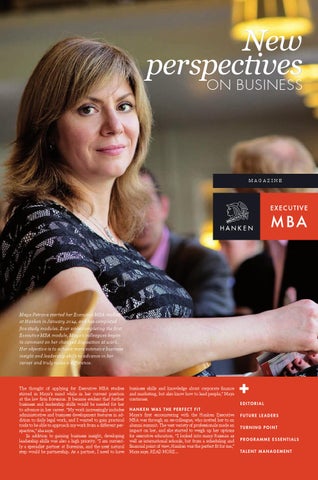
Maya Petrova started her Executive MBA studies at Hanken in January 2014, and has completed five study modules. Ever since completing the first Executive MBA module, Maya’s colleagues began to comment on her changed disposition at work. Her objective is to achieve more extensive business insight and leadership skills to advance in her career and truly make a difference.
The thought of applying for Executive MBA studies stirred in Maya’s mind while in her current position at the law firm Borenius. It became evident that further business and leadership skills would be needed for her to advance in her career. “My work increasingly includes administrative and business development features in addition to daily legal work, and I wanted to gain practical tools to be able to approach my work from a different perspective,” she says. In addition to gaining business insight, developing leadership skills was also a high priority. “I am currently a specialist partner at Borenius, and the next natural step would be partnership. As a partner, I need to have
business skills and knowledge about corporate finance and marketing, but also know how to lead people,” Maya continues. H A N K E N WA S T H E P E R F E C T F I T Maya’s first encountering with the Hanken Executive MBA was through an ex-colleague, who invited her to an alumni summit. The vast variety of professionals made an impact on her, and she started to weigh up her options for executive education. “I looked into many Russian as well as international schools, but from a scheduling and financial point of view, Hanken was the perfect fit for me,” Maya says. READ MORE...
EDITORIAL FUTURE LEADERS TURNING POINT PROGRAMME ESSENTIALS TA L E N T M A N A G E M E N T
UP LEFT Maya visits Helsinki each month to attend Hanken Executive MBA modules.
New perspectives ON BUSINESS
Choosing a Nordic institution was natural due to her post in a Finnish company. “I travel to Helsinki frequently for business reasons, so work and studies blend together beautifully. The three-day modules are from Wednesday to Friday, which is very convenient as I’m able to devote the weekend to my family and friends,” Maya explains. For Maya, using English as a language for study was also a vital condition. She discovered that many Russian and foreign universities offer education in Russian, but in her list that counted as a con. “I find it important to achieve knowledge and competence in English, as many of our customers are international,” she says. IN SEARCH OF NEW PERSPECTIVES Maya expects to gain a new, broader perspective on her career as well as on the Russian business environment. Developing leadership skills is also a high priority. In Maya’s words, “I want to learn how to motivate people, convince them and lead them. This is a unique opportunity to get feedback and opinions from my study peers, instructors and alumni, which is an incredible asset.” Her future career plans include initiating social projects in St. Petersburg, such as housing for elderly people. She believes that executive education will provide her with the necessary tools for such an ambitious project. “To succeed, I need a solid base and sufficient communication
2
MIDDLE To Maya, one of the biggest benefits of the Executive MBA programme is the possibility to create great networks, that encourage one to think differently and find a different approach to problems. UPRIGHT Study modules in Helsinki allow Maya to free her mind from ordinary life, and concentrate on learning and self-development.
skills to be able to present the financial structure and legal frameworks of the projects convincingly in order to attract the interest of investors and charity funds,” she explains. Moreover, she is certain that these skills can be applied universally – outside the business sphere – and be of great use to her in many situations. B E S T E X P E R I E N C E S O FA R : P E O P L E An aspect that Maya can’t emphasise enough is the scope of the networks she has been able to establish already. “The lecturers, instructors and professors are brilliant and charismatic. I feel lucky to receive their guidance and input regarding my own work-related topics. On top of that, the whole network created through this education is invaluable. We are all from very different backgrounds and business areas, and get to exchange ideas and offer new insight on each other’s questions,” she enthuses. The group is building team spirit by organising the next alumni summit together. Spending time together outside the modules is also important. According to Maya, they usually have a bit of free time during modules, which they often use to get to know each other even better. “Through Hanken, the door is now open to a vast network of professionals all over the world, and this network will definitely be beneficial in the future,” states Maya.
Ever since the first module, I started to think differently S T. P E T E R S B U R G BORENIUS Maya lives in St. Petersburg, completed her engineering and legal studies there and currently works in the St. Petersburg office of the Finnish law firm Borenius.
INTENSIVE DIALOGUE AS THE PERFECT STUDY METHOD “I enjoy the intensive study pace. It keeps my brain active at all times. Between modules, we have exercises and reading that push us to think about the next topic all the time,” says Maya. The Executive MBA participants work in groups during the modules, and the composition of the groups varies from module to module. Maya’s group comprises people from four different nationalities, offering a wide range of experiences and insight. “We get constant feedback on our performance, which is the best way to develop ourselves. In addition, we give feedback about the programme continuously, and the teaching methods are improved accordingly.” For Maya, such an intensive dialogue is a new learning method, one that she endorses and is planning on to apply in her own work.
FA M I L Y TRAVELLING Maya tries to give her son different experiences in life. They travel whenever possible, this year the location being Tenerife.
T I M E M A N A G E M E N T W I T H H I G H M O T I VAT I O N Apart from the modules, Maya completes the reading assignments and exercises during her free time. “Time management is challenging, but also something that I can develop and become better at,” she says. For Executive MBA students, finding the time to complete the studies is the biggest challenge, as most work full-time and some have families. According to Maya, motivation and a bit of resourcefulness in distributing one’s time is the key. She also mentions that due to the voluntary nature of Executive MBA education, there is no lack of motivation in her group.
Maya wants to introduce her son to different cultures, people and histories, and make him perceive that people are the same everywhere.
SEEING CONCRETE RESULTS Maya’s eyes light up as she starts explaining the concrete impact the studies have had on her life: “To me, the best part of the education is that theory can be turned into practice as we learn more. The tools and ideas can be implemented immediately in one’s own work, and the results are seen at once. This, of course, motivates and pushes me forward even more,” she explains with enthusiasm. “My life is now more interesting than it has ever been before, and I can’t wait to be able to apply the achieved knowledge and insight from the Executive MBA to my future social projects. My focus derives not only from commercial and business reasons, but I also want to give my own input to society. Now I am gaining tools, contacts and skills, and when these are added to business insight and leadership, I believe I can really make a difference,”
PRIORITY BALANCE The most important thing in combining one´s studies, work and private life is to divide time in a balanced way – dedicating enough time for each area of life.
OUR MISSION: TO DEVELOP STRATEGIC LEADERS COMPETENCE REQUIREMENTS for successful management and the role of Executive MBA education are widely discussed. Three central areas of proficiency are in high demand: 1) social competence and leadership skills, 2) a global mind-set, and 3) the ability to innovate. Yet many MBA programmes are more focused on providing discipline-based knowledge than on strengthening these abilities. Our mission at Hanken is to develop strategic leaders. Our participants work by interacting with people, and so learn how to motivate and inspire them. Developing these abilities, along with cultivating self-awareness, takes place through our new Leadership and Strategic Impact process, which entails a shift from plain analytical knowing, to doing and being. Hence our graduates know how to make a real impact in their respective organisations including implementing strategy through people. The programme gives a holistic view of organisations and management, linking the discipline-based insight tightly to companies’ business strategy. We share the view that a global mind-set is essential. Our participants increase their cultural awareness through modules in Nordic capitals and Asia, realising which strategies, practices and behaviours are universal, and which contingent. The Nordic business philosophy permeates our programme: we emphasise internationality, innovation, sustainabilty and dialogue. Our small group sizes maximise interaction and learning between participants and with faculty. We warmly welcome all managers, senior experts, top talents and entrepreneurs to participate in our programme and co-create the contents through their expertise! A N N I K A VATA N EN Director H a n ke n E x e c u t i v e M B A
3
A BUSINESS LANDSCAPE IN TRANSITION CALLS FOR NEW FORMS OF LEADERSHIP The digital age provides a great opportunity to make the whole world your market, which increases the importance of leadership and communication skills. An Executive MBA offers valuable tools to increase competitiveness in a global business environment, where Nordic competence and reliability is held in high esteem.
HANNU RYÖPPÖNEN CHAIRMAN OF THE HANKEN EXECUTIVE MBA ADVISORY BOARD Hannu Ryöppönen, a 1976 graduate of Hanken, left Finland in 1977 and during the 25 years of his professional life has been a top executive and CFO of companies such as the IKEA Group, Royal Ahold, Industri Kapital and Stora Enso. To d a y, H a n n u s e r v e s a s n o n - e x e c u t i v e director of several global Nordic companies and resides in the UK. Hannu has been Chairman of the Hanken Executive MBA Advisor y Board since 2011.
4
? W H AT A R E T H E M A I N CHALLENGES OF FUTURE BUSINESS LEADERS?
During the last decade, the business environment has changed dramatically from a leadership point of view. In the past, the people you worked with have been physically present, whereas today the focus is shifting towards virtual communication in order to use resources more efficiently – time is money. The increasing pace of IT development enables channels for global communication, but also imposes instant forms of communication. As the amount of messages rapidly increases, leaders will need tools to strengthen their self-management skills as well as their ability to prioritise, that is, to quickly decide which messages to react to and, moreover, when to react. Globalisation in general also sets new demands on tomorrow’s leaders, not only in terms of language skills, but also as regards to the ability to be culturally fluent. In the future, leaders will increasingly lead not only businesses, but also people with culturally diverse backgrounds. In addition to having resolute strategic management skills, leaders are also required to have the ability to motivate their employees, as well as to both create a vision and know how to communicate it – across borders and cultures. Making an impact on your people in a fast-paced and complex world is critical, which is why leaders need to possess both self-awareness and emotional intelligence. Alongside leadership and communication skills, it is a given that corporate social responsibility and increased transparency will become prerequisites for doing business. This will reflect on how we lead our people, what kind of business models we adopt, and what kinds of products and ideas we bring to the market. Indifference towards responsibility can cause major damage to a company’s reputation. For Nordic leaders, this is an asset. We already have the advantage of coming from neutral countries that need to adapt to a global market and who are used to conciliating our path to the top. Our people skills and diplomacy in tough situations makes us a reliable and desired choice for leading global businesses. The design and structure of the Hanken Executive MBA has recently undergone substantial development in order for it to meet the specific needs of tomorrow’s leaders, with emphasis on solid knowledge, leadership and communication skills, the ability to make an impact, and Nordic business values. The Advisory Board, with vast experience in both business and academia, will continue to have an active role in creating the prerequisites for our participants to develop in their role as the leaders and experts that will shape the future of business.
SATU HUBER Deputy CEO Elo Mutual Pension Insurance Company In the financial sector, corporate responsibility and increased transparency are key issues that affect also leadership. Acting responsibly is an important factor that makes organisations attractive to both customers and personnel. In addition, emotional intelligence is of utmost importance for leaders, in order to motivate, inspire and make an impact on employees.
KARI KAUNISKANGAS President and CEO Fiskars In the global consumer business, business leaders’ challenges consist of changing values – ethical values, corporate social responsibility demands and those focusing on the individual – together with continuous change in retail market distribution channels and global market dynamics. As the power shifts from traditionally strong economies more towards emerging markets, there is a need for cultural awareness in addition to language skills.
MARKUS is currently based at the Augsburg office of UPM Sales GmbH. He and his family have lived in Germany since 2005.
Turning point MARKUS JALKANEN, SALES DEVELOPMENT MANAGER, UPM SALES GMBH
Markus Jalkanen graduated from Hanken Executive MBA in 2002, specialising in Strategy and Customer Relationship Marketing. He explains the part these studies played in his career journey. My initial university education was oriented towards engineering, process technology and printing, all of which set me in good stead for a career in the paper industry. I did express an interest in commercial studies when considering options for my minor, but a tutor advised me to wait. He suggested that a few years in working life would give me a deeper view of business and a more solid basis on which to build my studies. I took his advice, and I’m very glad to have done so. The early years of my working life show a gradual shift towards dealing with customers, whether through technical support or sales. Above all, I enjoyed building relationships with them. As this trend continued, I never forgot my ambition to develop my sales and marketing knowledge through further education. I was able to pursue Executive MBA studies in 2001, definitely the right moment for me. In fact, my employer’s HR director recommended the Hanken Executive MBA specifically, and I had a strong prior impression of Hanken as an institution that represented quality. Once the course was underway, I remember the biggest challenges for me were topics such as corporate finance, which were something really
1994 Graduates from Helsinki University of Technology, with an M.Sc. in graphic arts technology and papermaking
1996 Takes a position at Myllykoski, becomes increasingly involved in sales
quite new to me. But the most important elements from my perspective were on corporations’ strategy processes. Here we got into the logic behind strategic thinking in a company. How do you establish your aims and reach them as a company? How do you implement strategy? This is essentially what I do now in my work, so you can imagine how important a thorough grounding in these questions must be to me. It was also nice that I was able to let my studies feed into my work at the time, and vice versa. I based my final thesis on my on-going work with customers, who responded enthusiastically when they heard about my studies. And when it came to the class trips abroad for summer school, I had the opportunity to combine these with customer visits. The work was intense, but we were spurred on by clear deadlines and strong discipline, which emanated from our programme coordinator, and was amplified by my peers on the course. There was a healthy sense of mutual support among us, and we spurred each other on with the promise that we would all graduate simultaneously, and at the first opportunity. At the end of 2002, all but one of our group graduated as planned: a very good result I’d say.
2002 Graduates, along with most of the others in his class
2003 Takes a new position as Sales Manager with Rani Plast Oy
2005 Returns to Myllykoski, which is acquired by UPM in 2011
2013 Latest appointment at UPM as Sales Development Manager, based in Germany’s Augsburg region
2001 Sponsored by Myllykoski to undertake MBA studies at Hanken
5
PROGRAMME INTRODUCTION
The Hanken Executive MBA programme is designed to benefit both the individual and create value for the organisation by helping graduates become better strategic decision-makers and leaders. By taking part in the Hanken Executive MBA, managers and top talents are able to excel and gain new motivation through an internationally accredited programme. We provide insight and help our MBAs turn insight into impact of strategic relevance.
HELSINKI STOCKHOLM
COPENHAGEN
H A N K E N E X E C U T I V E M B A AT A G L A N C E • • • • • • • •
Programme duration: 2 years Programme language: English Group size: max. 30 Programme start: January 23 modules held approximately every 3–4 weeks Core modules: 3 days in length and held Wednesday to Friday from 9 am to 5 pm International modules in Stockholm, Copenhagen and Shanghai One cross-group module per semester on a contemporary topic, open for both Hanken Executive MBA participants and alumni
SHANGHAI
CORE MODULES • Macro- & Microeconomics • Financial Management • International Finance • Value Based Management • Corporate & Management Accounting
PROGRAMME DELIVERABLES • Focus on strategic understanding providing strengthened strategic decision-making and implementation capacity • Strategy projects integrating knowledge on key business areas and processes, and applying learning in practice
• Core subjects draw on a Nordic approach to business whenever relevant and are linked to strategy • Management, marketing and finance, areas Hanken excels in, are central subjects in the programme • Dialogue between the academic and business communities
• Tools to turn insight into impact of strategic relevance
I M PA C T
S T R AT E G I C
NORDIC
PROGRAMME CHARACTERISTICS
• In Helsinki with modules in the Nordic capitals and Asia • Nordic and international lecturers • Nordic approach to business • Strong international orientation
• Understanding & Operationalising Marketing • Sustainability & Stakeholder Theory • Supply Chain Management
INSIGHT
• Strategic Thinking • Strategic Leadership • Understanding Organisations • People in Organisations • Change in Industries and Organisations
PA R T I C I PA N T S We look for managers and other top talents who are highly motivated to challenge themselves and to share their experience. To be eligible for the Hanken Executive MBA programme, the participants generally must have a Bachelor’s degree, at least five years of relevant professional experience, and a high level of proficiency in English. In addition, our participants should meet at least one of the following criteria: • Manager in charge of leading people, complex projects or entities • Experienced senior expert, with large overall responsibility • Entrepreneur with an established business • Top talent with a solid track record of exceptionally high performance (in career development, studies, etc.) and strong recommendations
AV E R A G E PA R T I C I PA N T W O R K E X P E R I E N C E ( Y E A R S )
CITIZENSHIP DISTRIBUTION (%)
16 14 12 10 8
Finland 81
6
Europe
4 2 0
6
MBA15
MBA16
MBA17
12
Asia
5
Middle East
1
Latin Amerika
1
• Leadership skills • Tools to share insight and engage others to find solutions and drive change • Self-awareness • Leadership and strategic impact process throughout programme
CHRISTIAN GRÖNROOS PROFESSOR OF SERVICE AND RELATIONSHIP MARKETING HANKEN SCHOOL OF ECONOMICS
The importance of understanding the nature of service
TIMO KORKEAMÄKI PROFESSOR OF FINANCE HANKEN SCHOOL OF ECONOMICS
Solid tools for sound financial management During the modules in financial management, participants of the Hanken Executive MBA will get decision-making tools regarding evaluation of corporate capital investments, and learn how to optimally finance those investments. The key learning points also include important factors affecting corporate decisions to retain cash instead of paying it out to investors. These kinds of decisions obviously touch people across the firm, regardless of whether their position is in financial management, marketing, operations, or somewhere else. It is therefore essential that corporate managers master finance at a level where they see and understand the relevance of their actions to the corporation, and in particular its valuation. The finance modules also aim to enhance the partici-
pants‘ ability to see their firms from an outside investor’s point of view. As firms in Europe, and even in Finland, increasingly rely on public debt and equity markets for their financing, it is imperative that managers have insight on the type of issues this kind of investors are interested in, and what they value in a corporation. After all, any firm with a growth objective needs these financiers. The financial management modules in the Hanken Executive MBA rely on a robust and logical set of decision-making tools, based on internationally recognised research, yet having a solid practical outlook. With this tool box, an MBA graduate is not only a valuable player for his or her employer, but can also make sophisticated choices regarding personal financial management.
Every firm is more or less in the service economy. B2B and B2C customers alike use everything they acquire as service in their own processes in order to achieve their goals. A resource, such as a production machine or a financial solution, is of no value to customers as such. It is what they do for the customer that counts and defines their value. Today, understanding service business marketing and service management – meaning management requirements and implementation – are a must for any firm. Why?
Simply, because customers both use everything as service and buy everything as service. Hence, regardless of market and competition, firms must be prepared to sell and market their offering as a service, whatever they provide their customers with products: services or projects. In addition, all firms are judged based on the service they provide, not on their products. After learning about the service business approach at the Hanken Executive MBA, our graduates understand the meaning of adopting service
as a business perspective. They have insight in what it requires from management as well as how to market and sell products and services as service. Hanken is a pioneer of service research and is one of the founding fathers of the Nordic school of thought within marketing. This research is the foundation for the service business modules within the Hanken Executive MBA, enabling a shift from an exchange-based perspective to a more value-based one.
CHRISTINA DAHLBLOM LEADERSHIP DEVELOPMENT HANKEN EXECUTIVE MBA
Developing highperforming leaders - sustainably What sets extraordinary leaders – those that deliver positively deviant results apart from other leaders? They are competent, driven, and deliver great results. But so do more ordinary leaders, at least in the short run. The extraordinary leaders, however, do this without sacrificing their own or others’ well-being. In a reality where the only constant is change, where complexity makes processes and systems fall short, and where the pace keeps growing, what sets extraordinary leaders out, is their ability to
focus, to lead themselves, and to create such relationships that other people want to follow them. The Hanken Executive MBA Leadership and Strategic Impact process (LSI) aims to support the participants in developing extraordinary, positively deviant leadership – on a long-term, sustainable basis. During the LSI process, participants get support in developing their self-awareness, identifying ambitious, but realistic, future goals and planning the path toward those goals,
while acquiring new skills, tools and peer coaching from fellow participants. In its pedagogical approach, the LSI process relies on the latest research from positive psychology, positive organisational scholarship and neuroscience. The participants are encouraged to build on their strengths and learn to handle their weaknesses. In addition, they get insight into and get to try a broad range of tools for leadership, communication, time management, and change leadership.
HOW TO APPLY
The next Hanken Executive MBA programme starts in January. We have two application rounds: one with application deadline at the end of August and another with application deadline at the end of October.
REQUIREMENTS AND SELECTION Based on applications and personal interviews, we select a maximum of 30 experienced and talented professionals. Selection is based on a combination of the applicant’s professional experience and educational background, leadership potential, interpersonal and cultural skills as well as motivation.
I N F O R M AT I O N S E S S I O N S By taking part in one of our information sessions you will get an insight into our programme. You will also meet representatives of the school, programme staff, faculty, and alumni who will share their experiences. For more information about the programme, application and upcoming information sessions, please visit our website: hanken.fi/mba
7
PÄ I V I C A S T R É N G R O U P V I C E P R E S I D E N T, H R WÄ R T S I L Ä C O R P O R AT I O N “ Ve r s a t i l e a n d t a l e n t e d p e r s o n n e l is an asset that continues to increase its importance for companies’ competitiveness.”
Talent management and development plays a major role in the HR strategy and in building employer image CECILIA WIRÉN SENIOR DIRECTOR, HEAD OF HR NORDIC INVESTMENT BANK NIB is the international financial institution of the Nordic and the Baltic countries. The bank adds value and complements commercial lending to help ensure sustainable growth. Read more about C e c i l i a ’s v i e w s o n t h e r o l e o f t a l e n t m a n a g e m e n t and HR at hanken.fi/mba.
WA N T T O K N O W M O R E ? Online you can find Cecilia Wirén’s and Päivi Castrén’s full accounts of the benefits of talent management to a company’s strategy. More information about the programme, including application instructions, faculty and alumni testimonials, can be found at hanken.fi/mba
HANKEN MBA MAGAZINE is a publication for anyone interested in Hanken Executive MBA Education. PUBLISHER: Hanken School of Economics, www.hanken.fi EDITORIAL TEAM: Nina Olin, Jaana Pakkala, Noora Puro, Annika Vatanen VISUAL DESIGN AND PRODUCTION: Miltton Ltd PRINTED BY: Edita COVER PHOTO: Riitta Supperi PHOTOS: Riitta Supperi and Hanken CONTACT INFORMATION: Annika Vatanen, Director, Hanken MBA, Email: annika.vatanen(at)hanken.fi, Phone: +358 (0)9 431 331 Address: Arkadiankatu 22 (Hanken reception), Helsinki, Email: mba(at)hanken.fi, Web: hanken.fi/mba