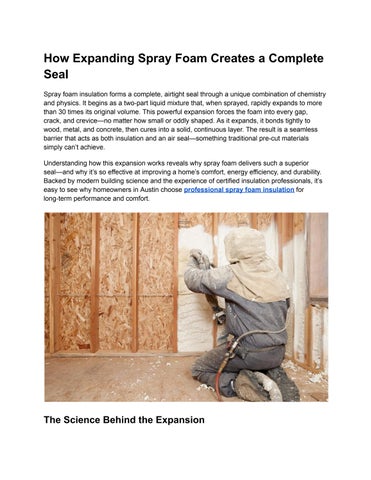
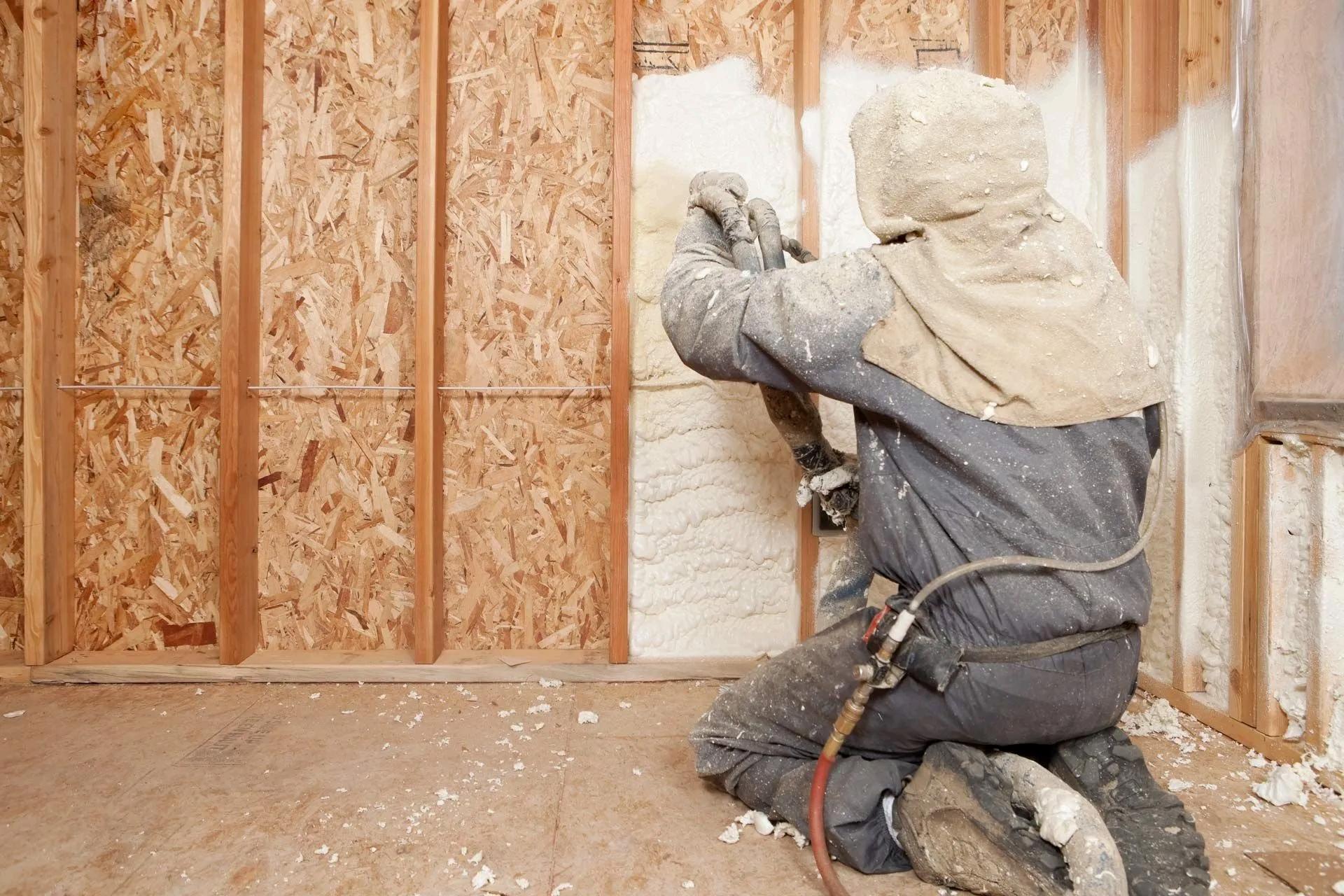
Spray foam insulation forms a complete, airtight seal through a unique combination of chemistry and physics. It begins as a two-part liquid mixture that, when sprayed, rapidly expands to more than 30 times its original volume This powerful expansion forces the foam into every gap, crack, and crevice—no matter how small or oddly shaped. As it expands, it bonds tightly to wood, metal, and concrete, then cures into a solid, continuous layer The result is a seamless barrier that acts as both insulation and an air seal something traditional pre-cut materials simply can’t achieve.
Understanding how this expansion works reveals why spray foam delivers such a superior seal and why it’s so effective at improving a home’s comfort, energy efficiency, and durability. Backed by modern building science and the experience of certified insulation professionals, it’s easy to see why homeowners in Austin choose professional spray foam insulation for long-term performance and comfort.
The Science Behind the Expansion
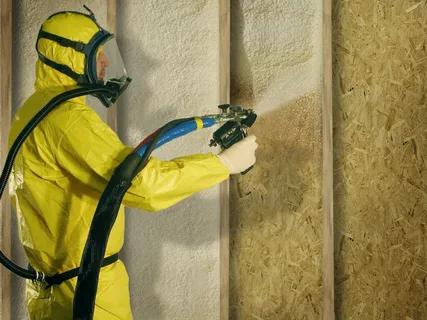
The process starts when two liquid components polyol resin and isocyanate are pumped through heated hoses to a spray gun. When mixed at the gun’s tip, a rapid exothermic chemical reaction occurs This reaction creates polyurethane foam and releases a gas that acts as a blowing agent. The blowing agent forms countless microscopic bubbles, causing the foam to expand dramatically.
The amount of expansion depends on the type of foam used:
Open-cell spray foam is a light, flexible material that can expand up to 100 times its liquid volume Its open-cell structure makes it soft and excellent at sound absorption
Closed-cell spray foam is denser and more rigid, expanding about 30–40 times its volume. Its tightly packed, closed-cell structure makes it highly resistant to both heat transfer and moisture
Bonus Tip: Professional installers carefully control the chemical and surface temperatures to ensure proper reaction and adhesion Factors like substrate temperature and humidity greatly affect the quality of the seal one reason why professional application is so critical
From Liquid to Solid: A Monolithic Barrier
Unlike fiberglass batts that come in fixed sizes, spray foam starts as a liquid that perfectly conforms to any space. As it expands, it pushes into even the smallest voids around electrical wiring, plumbing, and framing joints creating a seamless, gap-free layer
Once cured, the foam hardens into a single, durable mass that fully bonds to the structure. This creates a continuous, solid insulation layer without seams or joints Unlike traditional materials, spray foam won’t sag, settle, or shrink, ensuring that its seal remains intact for the life of the home.
Air Sealing: The Key to Energy Efficiency
Spray foam’s expansion doesn’t just insulate it also seals. While traditional insulation slows heat transfer, spray foam blocks unwanted air movement entirely Building science experts estimate that uncontrolled air leakage can account for up to 40% of a home’s heating and cooling energy loss.
By creating an air barrier, spray foam eliminates this waste The benefits are substantial:
● Lower Energy Bills: HVAC systems operate more efficiently, reducing monthly costs.
● Improved Comfort: Eliminates drafts and uneven temperatures throughout the home
● Better Indoor Air Quality: Prevents pollen, dust, and pollutants from entering through cracks and gaps.
How Different Insulators Handle Air Sealing
Insulation Type Air Sealing Ability
Spray Foam Excellent
How It Works
Expands to fill and seal all gaps, forming a continuous barrier
Fiberglass Batts Poor Relies on a separate air barrier like drywall; does not stop airflow.
Blown-in Cellulose Good
Rigid Foam Boards Good
Dense-packed fibers reduce airflow but don’t create a true air seal
Boards are airtight, but seams need careful taping and sealing
Common Failure Points
Poor mixing or temperature control can reduce adhesion
Gaps around framing; compression near wiring or obstacles.
Settles over time, leaving voids in walls or ceilings.
Tape failure or gaps at penetrations can cause leaks
The Dual Role of Closed-Cell Foam: A Moisture Barrier
In humid regions like Central Texas, closed-cell spray foam adds another layer of protection it acts as a moisture barrier. Its tightly packed structure prevents water and vapor from passing through, blocking humidity from entering walls, attics, or crawl spaces
This is vital for preventing condensation, mold growth, and wood rot By stopping both air and moisture movement, closed-cell foam protects the structure’s integrity while supporting healthier indoor air
Open-cell foam, by contrast, allows vapor to pass through, making it suitable for certain designs where controlled breathability is desired
Bonus Tip: In crawl spaces, applying closed-cell spray foam to foundation walls and rim joists creates a conditioned space protecting pipes from freezing and preventing damp, musty air from rising into living areas
Things to Consider Before Making a Decision
While the benefits are clear, spray foam’s effectiveness depends entirely on professional installation and correct application:
● Professional Application: Proper temperature, pressure, and mixing are crucial this is not a DIY job
● Choosing the Right Foam: Open-cell vs. closed-cell depends on your building’s design and moisture conditions
● Ventilation Planning: Because spray foam seals so tightly, mechanical ventilation may be needed for fresh air
● Surface Prep: Surfaces must be clean, dry, and dust-free for the foam to adhere correctly
Questions About the Application Process
Does the expansion pressure damage walls?
No Professionals apply foam in controlled layers (“lifts”), allowing partial curing between passes to prevent pressure damage.
How long does spray foam take to cure? It becomes tack-free within minutes and fully cures in about 24 hours. During this time, proper ventilation is essential
Can it be installed in existing homes?
Yes. Spray foam is excellent for retrofits it can be sprayed in attics, crawl spaces, or even injected into wall cavities
Questions About Performance and Durability
Can spray foam be used in an old, drafty home?
Absolutely Its expanding nature fills irregular framing gaps common in older houses, dramatically improving comfort.
Does spray foam shrink or pull away over time?
High-quality, professionally installed foam is dimensionally stable it won’t shrink or detach.
Can you spray foam over old insulation?
No. Old insulation must be removed to ensure proper adhesion and air sealing.
What if closed-cell foam gets wet?
It’s waterproof closed-cell foam won’t absorb water or lose insulating power, even after moisture exposure.
Does it strengthen the structure?
Yes. Closed-cell spray foam adds rigidity and racking strength to walls, improving overall durability
The Result: A High-Performance Building Envelope
Spray foam stands apart because it doesn’t just fill space it bonds to it, creating a single, continuous protective layer This seamless barrier stops heat loss, air leaks, and moisture intrusion all at once. For homeowners wanting to maximize comfort, efficiency, and building longevity, understanding how this seal works is key to making an informed investment
Learn More About Spray Foam Sealing
To find out how spray foam’s complete sealing system can benefit your home, schedule a professional consultation H&R Spray Foam Insulation offers expert assessments for homeowners across the Austin area.
Call: (512) 862-9637
Email: info@hrfoam.com
Author: Edith, with 15 years in banking and five years managing H&R Foam Insulation, focuses on helping clients create comfortable, energy-efficient homes.
Reviewer: Ella Adams, with seven years of spray foam industry experience, reviewed this article to ensure accuracy and practical guidance