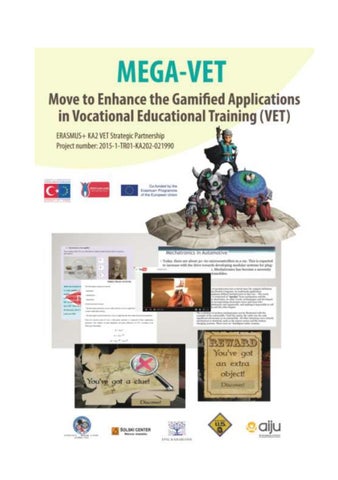
Move to Enhance Gamified Applications In Vocational Education & Training
Editor in chief: Lorena Mihelać Authors: Lorena Mihelač (Slovenia), Roman Kapš (Slovenia), Ercan Küçükarslan (Turkey), Ahmet Koca (Turkey), Angelos Makris (Greece), Despoina Kostidou (Greece), Mario Cannizzo (Italy), Cesar Carrion (Spain) Published by: EPAL Kaisarianis Proofread by: Marjana Pogačnik Page layout and design: Dejan Čurk 1st print, January 2017
ISBN 978-618-83241-0-7
CONTENTS EDITORS FOREWORD ........................................................................................ 1 1
ICONS WITH EXPLANATIONS..................................................................... 2
2
GAMIFICATION .......................................................................................... 3
3
4
2.1
Introduction ...................................................................................... 3
2.2
Gamification ...................................................................................... 3
2.3
Game-Based Learning ....................................................................... 7
2.4
Comparing Gamification and Game-Based Learning ........................ 9
2.5
Conclusions ..................................................................................... 10
BENEFITS OF GAMIFICATION .................................................................. 11 3.1
Benefits from gamification? ............................................................ 11
3.2
Benefits of Gamification in eLearning ............................................. 13
3.3
Success factors ................................................................................ 14
3.4
What about benefits of gamification in real life? .......................... 15
GAME DYNAMICS AND MECHANICS ....................................................... 17 4.1
MDA Framework ............................................................................. 17
4.2
MDA Framework with different definitions and explanations ...... 19
4.3
MDA FRAMEWORK THORUGH IMAGES .......................................... 21
4.3.1
GAME MECHANICS.................................................................. 21
4.3.2
LIST OF GAME MECHANICS: .................................................... 22
4.3.3
GAME DYNAMICS .................................................................... 25
4.3.4
LIST OF GAME DYNAMICS ....................................................... 27
5
6
7
4.3.5
THE RELATION BETWEEN THESE TWO GAME ELEMENTS ....... 28
4.3.6
AESTHETICS ............................................................................. 28
TEACHERS’ SKILLS IN GAMIFICATION ...................................................... 31 5.1
Incorporating games in educational work ...................................... 32
5.2
Gamification in classroom ............................................................... 33
5.3
Supervision of tools in classroom ................................................... 36
5.4
Teacher as “conductor” of game-based activities in classroom ..... 37
WHY AND HOW TO MAKE IT? ................................................................. 42 6.1
Challenges in Education .................................................................. 42
6.2
Useful links ...................................................................................... 44
6.3
Teaching Strategies ........................................................................ 45
6.4
Blended Learning (Hybrid Learning, Flipped Classroom) ................ 46
6.5
Useful links about Challenge Based Learning ................................. 48
6.6
Gamification as a way to effective teaching ................................... 49
6.7
Useful links about gamification....................................................... 51
6.8
Advantages of Gamification in Education ....................................... 52
6.9
How to Gamify in Classroom – Methodological Proposal .............. 53
REFERENCES ............................................................................................ 55
EDITORS FOREWORD Students love to play and it makes no difference if we talk about children in kindergartens or students in colleges. Games are natural to humans, because they are fun and fun in learning is the most effective way to engage students. By playing games and competing one against another, engaging groups to compete, setting a human as an opposing party to a computer or last but not least playing any kind of games by themselves, students get inspired, involved and excited. Games are usually associated with rewards and gamification uses the same concepts like levels, game points, achievements and badges without harsh penalties and gaming principles in the field of education. To step outside the comfort zone and not to be afraid to fail, is a step towards overcoming the students’ fear of failure and to get them ready to learn. MegaVET is a book about gamification and about the android application. It is written by members involved in the Erasmus+ project “Move to Enhance the Gamified Applications in Vocational Education Training (MEGAVET).” The book, free of charge, includes chapters which are an offline teachers’ guide following the android application and explaining the most important facts about gamification. The MegaVET book is not only a guide but also a turnaround especially for teachers involved in the educational process. It enables teachers to understand their new mission in reorganizing teaching methods in order to generate the desired results. What is more, it tells us how to provide effective learning experiences in students through gamification and how to develop challenges in order to find solutions to different problems. Lorena Mihelač Šolski center Novo mesto, Novo mesto
1
1 ICONS WITH EXPLANATIONS The authors of this book have decided to use icons – small images that are designed to call your attention to specific pieces of information. The icons are actually a sort of flag which are very often used in education textbooks in order to split up the text and to make it easier to scan the page. The description of what they mean is provided below.
Exam or quiz
Exercises
Checkwork
Stop and think
Reading
Note and write
Video and flashcard app
Group work, listening and speaking
2
Link
Task or homework
2 GAMIFICATION 2.1 Introduction An ancient Chinese proverb says: "Tell me, and I'll forget. Show me, and I may remember. Involve me, and I'll understand." This is what teachers want to achieve in a learning environment, namely more interactive and highly engaged students. The existing teaching methods are antiquated and passive. Thus, the gap between teaching/training methods and teachers/trainers who want to introduce interactive teaching techniques continues to grow. Tools and products of digital technology can be created and used, bridging that gap and generating productive and engaged learners. When education or training isn’t inspiring, students view it as a disturbance and are not being engaged. Thus, learners are not really learning. “Learning� doesn't mean rote memorization, it means having the skills to cope with a variety of situations under pressure.
2.2 Gamification
https://en.wikipedia.org/wiki/Gamification Have you seen the link above?
3
Gamification is the layering of game mechanics on non-game environments... … It has the potential to turn routine, mundane tasks into refreshing, motivating experiences.
“Gamification is the concept of applying game mechanics and game design techniques to engage and motivate people to achieve their goals.” Editorial Team, “Gamification”, (retrieved from https://badgeville.com/wiki/Gamification 25/3/2016) Gamification is the method of using game-based elements, or mechanics, to non-game learning environments, in order to turn a routine and dull task into a fresh & interactive experience. The growth of learner's interest and inspiration is accomplished by game-mechanics, which can be used in the form of points, badges, achievement, rewards, or recognition, opportunity of self-expression, or even old plain competition. Game mechanics lead learners to succeed more through targeting, growing maintenance, learning by repetition or through working together with peers. Therefore, gamified education and training include the use of game design elements and mechanics in activities that are not game-based. This affects learners to become more motivated and to participate more actively in their learning process. Gamified rewards like badges, points, level evolution and quests, transform the educational procedure into a game. These are the game parameters that help students achieve their learning goals.
4
In Vocational Education and Training, the most difficult part is to find effective strategies for teaching academic contents to VET students, especially as technology is a fast growing field. Nowadays it is unavoidable to support teaching with digital learning tools since they are becoming widely accessible.
Source: Sara Mravlja StegenĹĄek
Gamification can create educational environments that reduce the learning time of basic ideas and give students the chance to explore terms while reinforcing the natural incentive of learning. The interaction with a gamified environment leads to a higher level of commitment. This happens because grappling with games gives players the pleasure of understanding and conquering a new system. Gamification is expected to be applied particularly to students with learning disabilities such as Attention Deficit Disorder (ADD). These students are distracted from the learning procedure especially when the procedure is dull and monotonous. Using gamified learning elements helps in capturing the attention of students with ADD and as a result information retention is increased.
5
Write down the elements of gamification!
Through the mechanism of gamification students are assigned to collect badges, points for each level of the game. These elements aren’t predefined from certain actions and this makes the accomplishment more fascinating. “…………………. According to a report on educational games presented by Don Menn at the 2006 Summit of the Federation of American Scientists, students recall just 10% of what they read and 20% of what they hear. If there are visuals accompanying an oral presentation, the number rises to 30%, and if they observe someone carrying out an action while explaining it, 50%. But students remember 90% "if they do the job themselves, even if only as a simulation………….". 23 Top Gamification Professionals. "Free Learning eBook - How Gamification Reshapes Learning" ,2014 (retrieved from https://elearningindustry.com/how-gamification-reshapes-learning#marioherger (20/3/2016) Based on the previous research, gamification activates students to do their exploration as part of their homework, as well as collaborative practice in the classroom. So students acquire knowledge by doing the job themselves. In brief, gamification can make students: 1. Think more effectively as they have to cope with the strategy of a game 2. Act at multiple levels as they have to respond to the game as well as follow the learning goal 3. Work on a team basis and collaborate effectively with peers 4. Realize that through the commitment to the game procedure they will be rewarded 5. Learn to be competitive, but in a proper, “healthy” way 6
2.3 Game-Based Learning
https://www.youtube.com/watch?v=Uj_8C2L9bXI Have you checked the link above?
Game-Based Learning: “Get tips, techniques and tools that apply the principles of game design to the learning process - a dynamic way to engage learners and help educators assess learning.” Editorial Team, “Game-Based Learning”, retrieved from https://www.edutopia.org/blogs/beat/game-based-learning 25/3/2016) Game-Based Learning (GBL) is a captivating process, which actuates learners to think logically, move strategically towards the goal. The goal of a gamebased learning environment is to teach a specific concept (e.g. Ohm’s Law) which has been designed by the teacher. Teaching a specific subject through GBL can be fun both for teachers and students. A game in education can have many different forms. The most common form today is digital games that students play on their personal computers or on their cell phones.
7
“Digital Game-Based Learning (DGBL) is the pedagogical method of teaching theories or concepts through play in digital simulations. “ https://quality4digitallearning.org/wp-content/uploads/2016/03/HowGamification-Reshapes-Learning.pdf, by Sherry Jones (1/4/2016) DGBL has been developed in the last 20 years, alongside with general progress in technology. Today, students are familiar with technology much more than their teachers. Thus, the learning process has to be adapted to new learning styles. DGBL has a variety of activities that can range from very simple assignments to the development of very complex skills. Learners have to be engaged and rewarded in the game process. Additionally, students have to be active not only with the game but with peers as well. Within a game, students learn from their own mistakes in a harmless and effective way. Generally, digital games create a simulated environment in which students acquire knowledge that can easily be transferred to the real life situations.
“Have Fun While You Learn” seems to be the next mantra of education.
8
2.4 Comparing Gamification and Game-Based Learning On the one hand gamification utilizes game mechanics to transform the learning experience to a game, and on the other, game-based learning enables teachers/educators to integrate appropriate online games into the learning process to reach a specific skill or learning objective. A variation of applications that were designed as games are appropriately used as learning activities offering to learners, the chance to obtain new knowledge, fresh experiences or skills sets –simulation, through a pleasant, impressive and engaging environment. Learning games have by default more or less their specific rules and objectives, therefore “players” are familiar with the risk of “losing”. A great difference between gamification and game-based learning is that in a gamebased learning strategy, the content is designed to fit into the confines of the game, while gamification fits the game on the learning content. The differences between Gamification and Game-Based Learning are elaborated below: GAME-BASED LEARNING
GAMIFICATION
Games have defined learning objectives Losing may or may not be possible because the point is to motivate people to take some action and learn as an end result
May just be a collection of tasks with points of some form of reward Losing may or may not be possible because the point is to motivate people to take some action and do something
Sometimes just playing the game is intrinsically rewarding Are usually hard and expensive to build
Being intrinsically rewarding is optional Gamification is usually easier and cheaper Usually game-like features are added to the system, rather than the content
Content is usually morphed to fit the story sense of the game
Figure 1: Comparison between Game Based Learning and Gamification 9
Write down the differences between gamebased learning and gamification!
2.5 Conclusions • Time in the classroom can be reduced in order to teach our students more effectively and help them confront real-life situations. • Learning environment becomes more effective and strongly interactive. This will actuate all members of a classroom and make them participate in the educational process. • Gamified education enables students, post-graduate students as well as professionals to develop the skills and mindset for self-learning. All in all, the best idea is to start slowly and to gradually employ mini games or flash games into one’s teaching process, which will enable students to understand the lessons in a more effective way. That’s where “gamification” and “game-based learning” come in.
Write the most important facts about gamification
10
3 BENEFITS OF GAMIFICATION According to Wikipedia, "Gamification techniques strive to leverage people's natural desires for socializing, learning, mastery, competition, achievement, status, selfexpression, altruism, or closure.�
3.1 Benefits from gamification? "If you have ever played any kind of game where there are multiple levels with achievements to unlock then you know how persuasive that setup can be in making you want to try harder" (Prensky)
11
Let’s point out:
Playing games and implementing game elements considered as gamification in educational process, are two different concepts;
According to McGonigal (2012) males spend over 10.000 hours on online gaming, which means that games should be important in any learning programs.
Let us emphasize another very important fact … According to Platonov and Sapunov successful learning is a combination of three basic elements:
70% from real-life and on-the-job experiences, tasks, and problem solving; 20% from working, observing and feedback from peers and role models; 10% from formal training
Using gamification as an educational approach can be very beneficial in learning new contents. It has an impact also on these features:
12
It develops a sense of friendly competition;
It develops the sense of achievement in learners;
It has a great impact on the learner’s experience, which can change the anticipated behaviour;
It has a great impact on the learner’s motivation.
3.2 Benefits of Gamification in eLearning
Better learning experience
Experiencing “fun” during the learning process can improve the level of engagement. A higher level of engagement leads towards the increase of retention and recall.
Better learning environment
Gamification in eLearning provides a learning environment, which can improve knowledge, and learning experience. Arranging an informal learning environment means to enable safe and real-life situations and challenges as well.
Instant feedback
For the students, gamification in eLearning means having constant feedback about their knowledge.. The knowledge the students have already gained and are still to gain is of crucial importance to them and it is gamification that can contribute to better and faster recall and retention of it.
Prompting behavioural change
Points, badges, and leader boards would surely make training more appealing. However, gamification is about a lot more than just those surface level benefits. Different research works have proved the huge impact of gamification on behavioural change especially when gamification is combined with repeated retrieval (Karpicke and Roediger, 2007) and spaced repetition (Gupta, 2016).
Can be applied for most learning needs
According to John Doe, gamification can be used to “fulfil most learning needs including induction and on boarding, product sales, customer support, soft skills, awareness creation, and compliance”. 13
Impact on bottom-line
Gamification can create a huge performance gain for an educational organization as it affects students at different stages of their learning process e.g. facilitates higher recall and higher retention,. What is more, it creates changes in behaviour and gives better learning experience.
3.3 Success factors While gamification provides several benefits, as outlined already, much depends on the concept that is used to drive the learning. The mantra to succeed in using gamification in educational process is to create a concept that:
Captures (and retains) students' attention, Challenges them, Keeps the students' focus on important content, Entertains them, and Imparts their knowledge.
https://www.youtube.com/watch?v=VOSHI6ipkpU
Already watched the video? See the link above!
14
3.4 What about benefits of gamification in real life? "Games activate certain very deep and core aspects of our psychology, which is why every civilization has had them," says Kevin Werbach.1 Nowadays gamification has actually had an impact on various aspects of our society, for example in business, economics, art, healthcare ‌
Good examples in the area of healthcare (King et all, 2013) are several apps, which provide people to improve their health (e.g. apps for weight loss, apps for tracing healthy food, apps for improving healthy way of living), in business gamified competition between teams, between company and customer (e.g. company Samsung), solving problem situations with different solutions (Gears and Braun, 2013), in economics creating healthy competition and rivalry between fictitious societies or countries (Hamari et all, 2015).
1
Associate professor of legal studies and business ethics at the University of Pennsylvania's Wharton School and a leader in the emerging field of gamification.
15
It’s fun to see trophies appear ‌ do you agree? What about the desire for mastery?
16
4 GAME DYNAMICS AND MECHANICS In this chapter MDA framework (standing for Mechanics, Dynamics, and Aesthetics), is introduced, which is developed and designed specifically for those who are interested in seeing game-based applications closely and which is also part of Gamification. MDA is a formal approach to understanding games - one which attempts to bridge the gap between game design and development, game criticism, and technical game research. We believe this methodology will clarify and strengthen the iterative processes of developers, scholars and researchers alike, making it easier for all parties to decompose, study and design a broad class of game designs and game artefacts. Furthermore, this unit offers you a broad range of opportunities to get more information about game mechanics, dynamics and aesthetics which are deepened and elaborated through filmed videos, lectures, images, link, etc.
4.1 MDA Framework The MDA Framework (standing for Mechanics, Dynamics and Aesthetics), formalised by Robert Hunicke, Marc LeBlanc and Robert Zubek in 2001, enables an analysis of game elements by breaking down its production and consumption into components. Mechanics describes the components used when producing the environment of the game, while dynamics refers to the behaviour of both the mechanics and the player when interacting with one another and aesthetics describes the emotions awakened when the player interacts with the game.
17
It is commonly acknowledged that the cycle formularizes the fundamental components of any gamified content:
Mechanics
Dynamics
Code
Behaviours
Emotions
Rules
Process
Fun
https://www.youtube.com/watch?v=Yn9fTc_WMbo
Already watched the video? See the link above!
18
Aesthetics
How about looking closely at the fundamental components of gamification – MDA Framework through the table below?
LeBlanc, M. 2004b. “Mechanics, Dynamics, Aesthetics: A Formal Approach to Game Design.”
4.2 MDA Framework with different definitions and explanations Ian Schreiber (as cited in Game Design Concepts, 2009) offers the following example to summarize the MDA framework through a common game; We can illustrate these concepts with the classic game Pac-Man. The pathfinding logic of the enemies is defined by a formal set of rules. Each ghost has a unique seeking mechanics: Blinky targets the tile that the player currently occupies, while Pinky targets four tiles ahead. Together, these rules create dynamics wherein the player becomes boxed in by Pinky in the front and Blinky from behind. The enemy dynamics presents a challenge to the player, creating aesthetics of fun and excitement. 19
Schreiber (adopted from his post on MDA) also offers the following example; In a First-Person Shooter video game, common mechanics is for players to have “spawn points” – dedicated places on the map where they re-appear after getting killed. Spawn points are the mechanics. This leads to the dynamics where a player may sit next to a spawn point and may immediately kill anyone as soon as they respawn. And lastly, the aesthetics would likely be frustration at the prospect of coming back into play only to be killed again immediately. LeBlanc et al. define a game in terms of its Mechanics, Dynamics, and Aesthetics: Mechanics are a synonym for the “rules” of the game. These are the constraints under which the game operates. How is the game set up? What actions can players take, and what effects do those actions have on the game state? When does the game end, and how is a resolution determined? These are defined by the mechanics. Dynamics describe the play of the game when the rules are set in motion. What strategies emerge from the rules? How do players interact with one another? Aesthetics (in the MDA sense) do not refer to the visual elements of the game, but rather the player experience of the game: the effect that the dynamics have on the players themselves. Is the game “fun”? Is the play frustrating, or boring, or interesting? Is the play emotionally or intellectually engaging? 20
4.3 MDA FRAMEWORK THORUGH IMAGES 4.3.1
GAME MECHANICS
It is almost impossible to define game mechanics with a single explanation or
term as the context of game mechanics is currently updated by possible users, game developers by taking into consideration the ever-changing technological advancements. The following definitions may help you understand better this term up to a certain point;
Game mechanics are used to describe how players interact with rules, and as more formal properties of a game such as game goals, player actions and strategies, and game states.
Game mechanics, Cook’s (2005), are rule based systems / simulations that facilitate and encourage a user to explore and learn the properties of their possibility space through the use of feedback mechanisms.”
Game Mechanics are tools, techniques, and widgets that are used as building blocks for gamifying a website or application. Utilizing them correctly can build a highly motivational user experience around existing website functionality or content.
21
4.3.2
LIST OF GAME MECHANICS:
POINTS
WIN CONDITIONS
LEVELS
GAME MECHANICS GIFTING
CHALLENGES
LEADERBOARDS
VIRTUAL GOODS
Each game mechanic is categorized by 3 attributes: 1. Game mechanic type Progression
/
Feedback
/
Behavioural
2. Boosts (Benefits) Engagement Fun
/
Loyalty
/
Time Spent
Explorers
/
Socializers
/
Influence
3. Personality types Achievers
22
/
/
Killers
/
According to the Bartle test of Gamer Psychology, l’m an achiever. If you wonder your personality type, please visit this web site
http://matthewbarr.co.uk/bartle/
23
HAVE YOU EVER HEARD THAT BEFORE? Tom Edward lists examples of 6 brands using Gamification and the specific mechanisms they use to engage users. If you wonder the rest of the companies not included in the list, use any search engine to find them.
1.
Xbox Live
Achievements, leader boards
2.
Foursquare
Badges, rewards
3.
Gowalla
Badges, pins
4.
GetGlue
Rewards
5.
Progress bar
6.
SalesForce
Leader board, achievements, levelling
24
4.3.3
GAME DYNAMICS
These two terms, referring to game mechanics and dynamics, are often used interchangeably as most people have trouble in distinguishing them clearly due to similar meanings. Marc LeBlanc and his colleagues wrote a paper proposing a game design framework around the concepts of Mechanics, Dynamics and Aesthetics. They define those terms as follows: Mechanics are the agents, objects, elements and their relationships in the game. They define the game as a rule-based system, specifying what there is, how everything behaves, and how the player can interact with the gameworld. Dynamics are the emergent behaviour that arises from gameplay, when the Mechanics are put into use. Aesthetics are the emotional response from the players to the gameplay. Take Monopoly, for example. The mechanics are the relationship between the board, the pieces, and the rules. Everything you need to play, and the rules specifying how you play. The dynamics are the processes and behaviours that arise when you actually play the game. During the beginning of the game, everybody starts equal, but sooner or later one player will get richer than the rest, and sooner or later the other players are driven into poverty and will lose the game. The aesthetics are the feeling of tension and joy in the beginning, the gradual loss of interest for the losing players and the joy of winning for the winner.
25
by JENNA MULLINS, 2016
26
4.3.4
LIST OF GAME DYNAMICS
REWARDS
NARRATIVE
RANK (STATUS)
GAME DYNAMICS ALTRUISM
PROGRESSION
COMPETITION
INDIVIDUALITY
27
4.3.5
THE RELATION BETWEEN THESE TWO GAME ELEMENTS
DYNAMICS
MECHANICS
Rewards
* Points
Rank (Status)
* Status
Progression
* Challenges
Individuality
* Virtual Goods
Competition
* Leaderboards
Altruism
* Gifting
Narrative
* Win Conditions
4.3.6
AESTHETICS
Aesthetics is closely related to the factor of fun in game and Koster, (Koster, 2004) states that beauty is found in the tension between our expectations and reality. Although this form of visual enjoyment does not last forever, the prettiest game can only be pretty for a certain period of time.
28
Eight kinds of FUN
Source: http://www.cs.uu.nl/docs/vakken/b2go/lectures/04%20MDA%20framework.pdf 29
For example, consider (adopted from Information Science Reference, 2012) the games Charades, Quake, The Sims and Final Fantasy. While each is fun in its own way, it is much more informative to consider the aesthetic components that create their respective player experiences: Charades: Fellowship, Expression, Challenge Quake: Sensation, Competition, Fantasy and Challenge The Sims: Discovery, Fantasy, Expression, Narrative Final Fantasy: Discovery, Fantasy, Expression, Narrative, Challenge, Submission.
30
5 TEACHERS’ SKILLS IN GAMIFICATION The task of integrating games into an educational setting is a compatible section of a bigger system of learning that requires teachers to organize a multitude of complex organizational resources. Traditionally, the field of virtual game-based schooling research has had an inclination to focus heavily on the pairing between game designs, previously established learning rules, student arrangement and learning results much to the charge of perceiving how games influence the teachers’ operation mode. Given the considerable investments of time and resources teachers need to make in order to conduct game-based learning activities, this study gap is problematic. Teachers should reach a certain level of gaming literacy if they want to supervise dynamically, support, and guide their students before, during, and after the play.
Teachers are also expected to be competent in arranging play sessions in a limited period of time and face off eventual technical difficulties. Beyond these demands, teachers also have to work as a leading thread between the schooling background and the play context, and need to know how to continuously contextualize game activities and the content that students experience in the chosen subject matter.
31
Today, while games' educational values keep being lauded, examples of games being integrated into educational settings are relatively few. An explanation for this discrepancy in the game-based learning community was that the wide-ranging community of educators was hostile to games. Recent studies, however, have indicated this to be a false assumption as the majority of teachers in Europe and in the USA are positive towards the idea of using games.
5.1 Incorporating games in educational work Actually, games are exhaustive support to practice, and there are not many recognized standards leading teachers through the complex practice of integrating games into their working settings. First of all, teachers who want to integrate this kind of activities into their work, have to consider what they might do in reference to the conditions they are working under. Any learning setting involves elements that can either simplify or complicate game-based learning processes. So, in the initial stages, teachers always complain about certain conditions that could complicate their work, as well as about supplies and arrangements available in their contexts.
32
1. Are you using as teacher games in educational work? Why? 2. Is your teacher using games in educational work? Why not?
5.2 Gamification in classroom An important problem that a teacher needs to solve in the initial phases of a game-based learning project is what kind of gaming terms to include in their schedule and curriculum. Some cases from research prove that the curriculum demands and the accessibility of hardware both influence the type of game to choose and the strategies for conducting gaming sessions. A well-equipped class with plenty of laptops, short periods of time, with defined potential difficulties and educational aims recognized in the curriculum made the teacher gravitate towards shorter individual sessions. In fact, in an individual session arrangement, students mostly collaborated in groups of two or played individually on tasks with fixed starting-end points, which permitted an easier evaluation of students' progress. Considering each class term as an individual exercise also had the benefit of permitting variations in the game design assignments in proportion with what the students learned. On the contrary, in a less equipped class where the period time was longer (90 minutes) and the curriculum goals were “softer�, a more long-form collaborative classroom exercises were chosen. 33
The restrictions imposed by curriculum difficulties and scheduling also play a crucial part when one needs to choose the type of game to work with. In many studied cases, it was possible for teachers to model gaming challenges after considering their own educational goals and working circumstances (i.e. the activity is easily customizable), computers' stage, students' familiarity with ITC etc. These benefits balanced the potential weaknesses of the game, such as its low physical, functional, and visual fidelity. For example, it is hard to create spherical objects in the game (due to its blocky nature), and objects sometimes have little visual resemblance to their real-world counterparts. However, while these types of disadvantages presented some challenges, they didn’t represent a major source of distress for teachers. When we want to integrate the game into a classroom, the main worries are: the doubt of hardware consistency, the teachers' self-admitted low gamingtechnology literacy and the restricted extent of working hours they could practically spend on preparing gaming sessions. Many times, the low gamingtechnology teachers' literacy would make it extremely unworkable to start any type of game-based learning if it were not for some upgrading situations: the presence of a researcher or of some very proficient students with both computers and games.
34
So, the process of game integration into a classroom often depended mainly on the researcher, and when the researcher was not present, on the support teachers could get from the more skilled students in ITC. Creating an arrangement that supports gaming includes monitoring the resources currently accessible, securing resources that are currently deficient, and verifying that the necessary software and hardware are available and set for gaming sessions. The details of this procedure are likely to differ from school to school and from classroom to classroom depending on logistic support structures, technological infrastructures, and teachers' technology literacy. Nevertheless, the reports from teachers and various surveys carried out suggest that these unfavorable conditions for game-based learning are not uncommon.
Thus, founding a concrete structure that allows for consistent and wellorganized gaming sessions is a task that should not be minimized as it requires important investments in incomes and determination.
35
5.3 Supervision of tools in classroom An inevitable part of using games for educational purposes is the endless supervision of the tools that make gaming sessions possible. Computer games are complicated pieces of software that need innovative hardware to function constantly and proficiently. Planning and coordinating these components in a class group environment, even for elementary game-based learning activities, constitutes an important time deal and needs a strong standard of technological ability. In many studied cases, the organizational efforts need to arrange and manage gaming sessions, were different. Nevertheless, while specific details of the process varied between the cases, there are some stages that both needed to go through: recording the existing educational setting and procedures, implementing the selected game into the environment and showing care between and during gaming sessions. Each of these steps consisted of several smaller activities. Stand-alone exercise strategy decreases the need to organize the game environments students played in. As students in those classes also work on their own computers, the classroom and hardware don't need any remarkable planning before game exercises, nor is scheduling servers or saving and keeping reserve copy of game data necessary. On the contrary, because of the higher quantity of computers, the procedure of installing the game software is longer, more complicated, and more inclined to errors. As the stand-alone sessions follows a steady advancement of tasks, the classes need trainings of in-game examples. That is not essential in a not well equipped class, since they work on a long-form inspired exercise where students mostly track their own building plans.
36
5.4 Teacher as “conductor” of game-based activities in classroom Once the circumstances compulsory for game-based classroom activities are joined up, teachers can start focusing on conducting activities: · Classroom gaming involves the teacher to be multipurpose as they demand to achieve the required trainings before gaming sessions, but also perform as game administrators during them. · During exercises, the teacher also needs to train students both in the skilled topic and in the gameplay of the selected game, and will also need to step into a reliable position, necessary to keep students focused in. · The teacher needs to be able to lead and support students' gaming experiences during gaming activities as well. Being a game tutor for students involves a lot of the teacher’s duties and, because of the dissimilarity in singular students' skills and interests, this task can be rather difficult. The heterogeneity of a classroom as a gaming audience cannot be low-key. Each student has his/her own level of gaming mastery, gaming inclinations, topic awareness, engine skills, motivations to play and learn, socioeconomical context and common interests. In many of the studied cases, a wide percentage of the teachers' classroom involvements consisted of helping students start the game, and then to understand the elementary interface and notions of it. The heterogeneity of students can make classroom sessions hard to project and check as the students who have never played a computer game before, need to be able to cooperate and interconnect with students who are very skillful performers. In fact, students' ability in using technology and playing games can diverge strictly in a classroom. While some students are fighting with the elementary interface, others are excellent enough to complain about hardware 37
performance, or will start to adjust the game to upgrade their gameplay since the basic game is not attractive enough. Not only beginner students need supervision, but also expert players often require to be guided towards productive partnerships with their peers. In previous studies, Frank (2012) has shown that proficient players can become excessively focused on self-actualization through mastery of game mechanics or achievement of game goals, to the omission of engaging with the topic that the game is intended to represent. A productive and focused student-to-student interaction depends on the gaming activity remaining 'framed' as an educational activity that students partake in by playing with a spontaneous and systematic mind-set. Student groups often became unfocused when the act of gameplay detached itself from the educational aims of the classroom sessions. In these situations, the teacher's presence seemed to support the educational enclosing of the gaming activity. In many of these cases, the teacher is engaged by some learners as a 'technique' to get their more gamefocused working partners to concentrate on the class task. These situations commonly occurred in groups where students with strong “gamer� dispositions were partnered with less game-skillful students.
38
A frequent question the teacher had to find the answer to during gaming sessions was to find the bond between the game content and the details of the topic the game was planned to teach. If it is necessary, games often make compromises in physical-, task- and functional fidelity. Games depend a lot on notions and demonstrations, and players constantly 'translate' game actions to real-world actions - if the game action is very divergent to the realworld action, there is always a possibility that things “get lost” in translation. If a game is not exactly designed to teach the details of the contents with a high standard of authenticity and fidelity, the task falls on the teacher to create relations between the game content and the subject matter. In circumstances where there is a break between the game's presentation of an action or object and its real world corresponding item, the teacher needs to mediate and arrange for context to fill the gap. Working with complex themes and concepts (e.g. history, social sciences, ecology, biology, etc.), students often require to cooperatively simulate that certain objects should be interpreted and used in a certain way. For example, some students used “Spider Nets” as clouds of smoke as a result of their graphic resemblance to small white clouds, even though the mechanics of the object have no connections to smoke. On the other side, students sometimes ignored an object's graphics if its functionality was coherent with what they intended to express. For instance, students trusted in the “Chest” object as a worldwide symbol for 'storage', and used it even when its images disagreed with the setting. Some learners are really proficient at transferring what qualities of objects they should 'see' and which ones they should ignore, but not quite for the gaming proficiency - this skill differs drastically between individual students. The teacher's charge in these situations is to sustain the established 'contract' that affirm that the fiction of the theme is to be preserved, even when the game does not grow itself in any way or even leads students on to break it. 39
At the start of a game-based learning project, the teacher needs to be able to check the conditions of the educational environment. Logistic support structures, accessibility of hardware and software, and the disposal of other resources or obstacles, need to be well-thought-off before the game-based learning curriculum is designed. Basic practicalities like class plans, educational aims, as reported by national curricula, and technological setup, each suggests what kind of game can (or should) be employed, including the design of gaming phases and tasks. These results, in contrast to the ones made by Chee, Mehrotra and Ong (2014) who suggests that “the key challenges teachers face are not technology centric but practice centric”, identify technology readiness and mastery as a central bottleneck and managing feature in the combination of virtual game-based learning in schools. During a typical gaming session, teachers need to perform as game managers, subject matter newscasters, game trainers, speakers and expert people that preserve students in a learning approach of play. In a big classroom, it can be hard for teachers with low gaming literacy to recognize situations where beginner students are fighting with the game line, or when learners are not operating towards educational goals. Nevertheless, being game learned does not automatically involve game mastery, but rather that the teacher can comprehend gaming and game topic especially to handle it. In fact, “teachers don't necessarily need to become experts with every new medium, but at the very least need to know what is going on […] in order to participate” (Bourgonjon and Hanghøj 2011). Gaming mastery is not only essential for gaming terms, but also for the teacher to be skillful enough to organize and manage contextualizing activities all over their gaming session. Sometimes productive educational circumstances occur during gameplay as well, but the contiguous trainings provide the required background awareness that permit such situations to happen. The gameplay itself does 40
not have much intrinsic didactic worth, but when it is contextualized properly and performed resolutely, it plays a motivating and important part of bigger learning processes. In the game-based learning teachers are expected to play many different roles, each of which involves a specific skillset. Incorporating games into traditional learning situations is a difficult and intricate process. This is fairly due to the fact that schools are not organized for game-based learning, making the process a rising fight, but it is also due to games not being appropriately helpful for the necessities of teachers or the many features a learning setting may have. For game-based learning to progress on, teachers need to have a better awareness of games and in what manner to work with them, and game designers need to comprehend teachers' operational settings and know how to assist the changeable features of traditional learning settings with their products.
41
6 WHY AND HOW TO MAKE IT? In this chapter “Why and how to implement gamification in your classroom” is presented. It is started by introducing the field of education, to be more exact by education challenges, considering education changes in recent years in terms of technology, the way students learn nowadays and all the changes we are facing in teaching methodology. Throughout the chapter one can learn why gamification is the way forward. Innovative techniques like fipped-classroom or videogames can enable us to capture students’ interest. The next stop in the chapter is the advantages of gamification in education for students, teachers as well as schools. At the end of this chapter a methodological proposal about how to implement gamification in a classroom is explained in detail.
6.1 Challenges in Education Changes in education in recent years have been accelerated in a profound way, much of what we (experienced teachers) could not even imagine just a few years ago. The prospects for change in the short term are huge. Teachers must take into consideration that students now learn in a different way, which is due to the fact that they have grown up in an environment strongly influenced by technology and consequently they perceive reality and process information in a different way.
42
This means that we have to reconsider the students’ abilities to gain knowledge and skills, and therefore to rethink the way the teaching-learning process is performed. It is no longer just about course-planning and its execution but also about proper application of the means and resources to achieve students’ engagement in their own process of learning and skills development. The possibilities offered by technology and the way it processes information, enable new models of organizing the ways in which we learn and teach; the challenge is not to know and master the latest advancement in technology applied in education, a real challenge is to take decisions to apply the best technology for different subject matters to enhance the development of a specific students ‘competence.
Discuss in the classroom each video!
43
6.2 Useful links MORE PEDAGOGIC CHANGE IN 10 YEARS THAN LAST 1000 YEARS (Donald Clark at TEDxGlasgow)
http://www.youtube.com/watch?v=dEJ_ATgrnnY HOW TO ESAPE EDUCATION’S DEATH VALLEY (Ken Robinson at TEDxGlasgow)
http://www.youtube.co/watch?w=wX78iKhlnsc
44
6.3 Teaching Strategies The original meaning of the word strategy, comes from military references. The strategist was able to plan, order and orient military operations and expected to do so with sufficient ability to lead his troops to meet its goals. Applied to Educational environment, it is a didactic procedure used and planned by teachers, schools as a part of learning schedule. Didactic strategies are, in general, procedures used to search effectively, through different steps, behaviors and results.
Main strategies Collaborative Based Learning Project Oriented Based Learning User Case Based Learning Searching Based Learning Service Based Learning Challenge Based Learning Rotational Model Blended Learning Ilustrator: FĂŠlix VallĂŠs Calvo (CC BY-NC-SA 3.0) 45
https://creativecommons.org/licenses/by-nc-sa/3.0/es/
6.4 Blended Learning (Hybrid Learning, Flipped Classroom) Blended learning and their modalities combine face to face learning with online learning in order to enrich the learning experience of the student and foster an environment that considers their needs and characteristics. Learning environment, where the lessons are executed, is enriched, on the one hand by the use of Information and Communication Technologies ICT), and on the other, by various teaching strategies ensuring flexibility in interaction, time, pace and / or location. In hybrid learning the teacher is responsible for lesson plans, monitoring and evaluation, and the student is responsible just for their learning process.
46
47
6.5 Useful links about Challenge Based Learning CHALLENGE BASED LEARNING – CBL (Allan Carrington)
http://www.youtube.com/watch?v=Bdj-IRFBe5o
THE FLIPPED CLASSROOM MODEL (MADDrawProductions)
https://www.youtube.com/watch?v=ojiebVw8O0g 48
6.6 Gamification as a way to effective teaching Gamification is already applied into areas such as marketing, human resources, or manager- customer relationships, or even to the formation of senior management, however in the domains of teaching/learning processes we have hardly experienced any endeavor to introduce gaming into teaching in VET training. Gamification in Education is the use of the methodologies described in previous chapters (mechanics and dynamics) to promote student participation to achieve some results in terms of skills. Some of the very little experience in Educational Gamification can be found in the contributions of Smith (2011) and Lee (2011). But nevertheless, there is a growing interest of the scientific community in applying gamification to many areas of gaining knowledge, therefore valuable experience from other fields can be applied to the domain of teaching. One of the most important forums, where you can find references to related experience in multiple sectors Gamification workshop, which is held within the CHI 2011 conference Deter ding et. to the. (2011). Our students spend much of their free time on Videogames, or other similar pastime activities, so being able to bring their training/studying to the dynamics that they find in video games, can motivate them in their studies, promote healthy competition among them or guide them in the learning process.
49
Author: Francisco Javier Pulido (CC BY-NC-SA 3.0) https://creativecommons.org/licenses/by-nc-sa/3.0/es/
50
6.7 Useful links about gamification GAMING CAN MAKE A BETTER WORLD (Jane McGonigal)
https://www.youtube.com/watch?v=dE1DuBesGYM
BRAIN TRAINING: VIDEOGAMES AND LEARNING (Daniel Floyd)
https://www.youtube.com/watch?v=rN0qRKjfX3s
51
6.8 Advantages of Gamification in Education The benefits of gamification applied to the top teaching: 1. Students side: Effort Reward Warns and penalizes the lack of interest It indicates the exact moment a student enters an area of "danger". That is, he approaches the suspense. EXTRA work Reward It provides a clear measure of the performance of each student Proposes ways to improve your grade in the subject, and to improve their learning curriculum 2. Teachers side: Offers a way to promote work in the classroom It facilitates reward those who actually deserve It allows automatic control status of students Unloading task management 3. Benefits for the institution: Can provide a measure of student performance to parents It is a novel and effective system
CC0 Public Domain https://pixabay.com/photo-163509/ 52
6.9 How to Gamify in Classroom – Methodological Proposal For our first experience of applying gamification to a subject, we suggest a simple method which can bring great value to both students and teachers, just as we have already discussed in the previous chapter. The objective of this methodological proposal is to motivate students, encourage competitiveness, and provide instant feedback to the student, so that his/her achievement can be compared with the rest of his teammates at all times, and also to have a clear idea of their possible final grade. The key points of our proposal: 1. The course is based on the activities, each of which allows you to score points in the final grade. The aim is to allow a student to pass the course delivering all the activities. 2. A series of achievements associated with activities is defined. These achievements make it possible to multiply the value of the activity on the note. 3. The basic achievements associated with the delivery of activities are: a) Achievement "Just in Time": Deliver practice time b) Achievement "You're a crack" Best activity of all delivered c) Achievement "Happy Idea": activities that present an innovative way to solve them is granted. d) The "check-in" in class X can climb point’s total grade. The idea is to encourage school attendance. e) Achievements associated skills. A number of achievements associated with specific skills, which will be awarded by the teacher to students or groups are defined.
53
Examples of these achievements:
"The boss has come": Associated to good leadership
"Quiet, I solve this I": Associated collaboration between individuals or teams "
At all times, students will have a clear view of their "status" in the subject thanks to the following tools that the teacher should control: "Leaderboard" which compares to all students in the class. Points accumulated for each student as well as the maximum number of points that could have been achieved so far, and also the number of points the student should have achieved so far to be in a position to pass the course. List of accumulated achievements.
54
7 REFERENCES
23 Top Gamification Professionals. "Free Learning eBook - How Gamification Reshapes Learning", 2014 (retrieved from http://elearningindustry.com/how-gamification-reshapes-learning 25/3/2016)
Editorial Team, “What is Game-Based Learning?”,2013 {retrieved from http://edtechreview.in 25/3/2016)
Editorial Team, “Gamification” (retrieved from https://badgeville.com/wiki/Gamification 25/3/2016)
Editorial Team, “Game-Based Learning”, retrieved from https://www.edutopia.org/blogs/beat/game-based-learning 25/3/2016)
Majumdar, Aronima. “Know The Difference Between Gamification And Game Based Learning To Reap The Benefits Of Both”, 2015 (retrieved from http://elearningindustry.com/gamification-andgame-based-learning-yes-they-are-different 25/3/2016)
Pappas, Christopher. “Gamification vs Game-Based eLearning: How To Integrate Them Into Your eLearning Course Design”, 2015 (retrieved http://elearningindustry.com/gamification-vs-game-basedelearning-can-you-tell-the-difference 25/3/2016)
Stathakis, Rebekah. “Five Reasons to Use Games in the Classroom”,2013 (retrieved from http://www.educationworld.com/a_curr/reasons-to-play-games-inthe-classroom.shtml 25/3/2016)
Trybus, Jessica. “Game-Based Learning: What it is, Why it Works, and Where it's Going”,2014 (retrieved from 55
http://www.newmedia.org/game-based-learning--what-it-is-why-itworks- and-where-its-going.html 25/3/2016)
56
http://www.cs.northwestern.edu/~hunicke/MDA.pdf
http://spin.atomicobject.com/2013/09/03/mda-game-designframework/
http://www.nolithius.com/game-design/the-mda-framework
http://badgeville.com/wiki/Game_Mechanics
http://gamedev.stackexchange.com/questions/3131/what-are-theother-three-game-dynamics
http://www.whatgamesare.com/2011/01/game-dynamics-andloops-game-design.html
http://8kindsoffun.com/
http://gangles.ca/2009/08/21/mda/
http://www.cs.uu.nl/docs/vakken/b2go/lectures/04%20MDA%20fra mework.pdf
https://www.wpi.edu/Pubs/ETD/Available/etd-050415150927/unrestricted/Report_Xie.pdf
http://4you2learn.com/bartle/
LeBlanc, M. 2004b. ìMechanics, Dynamics, Aesthetics: A Formal Approach to Game Design.î Lecture at Northwestern University, April 2004.
Hershey PA : Information Science Reference, ©2012.
Smith, S., (2011): “This Game Sucks”: How to Improve the Gamification of Education. En EDUCAUSE Review, Vol. 467, N. 1, 5859.
Lee, J. J. & Hammer, J. (2011). Gamification in Education: What, How, Why Bother? Academic Exchange Quarterly, 15(2).
Deterding, S., Sicart, M., Nacke, L., O’Hara, K. and Dixon, D. (2011): Gamification:
Using Game Design Elements in Non-Gaming Contexts, Libro de actas de CHI 2011. Workshop Gamification: Using Game Design Elements in Non-Game Contexts
TEC21 – Modelos y tendencias educativas – CEDDIE – February 2014
http://4you2learn.com/bartle/
ΙSBN 978-618-83241-0-7
57