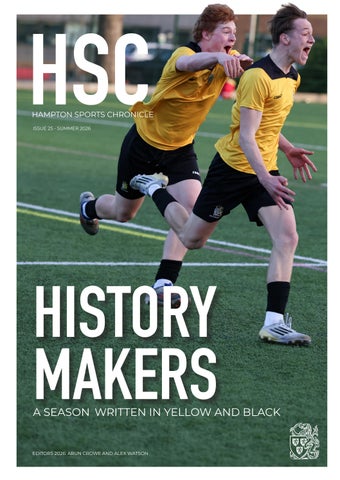
HAMPTON SPORTS CHRONICLE
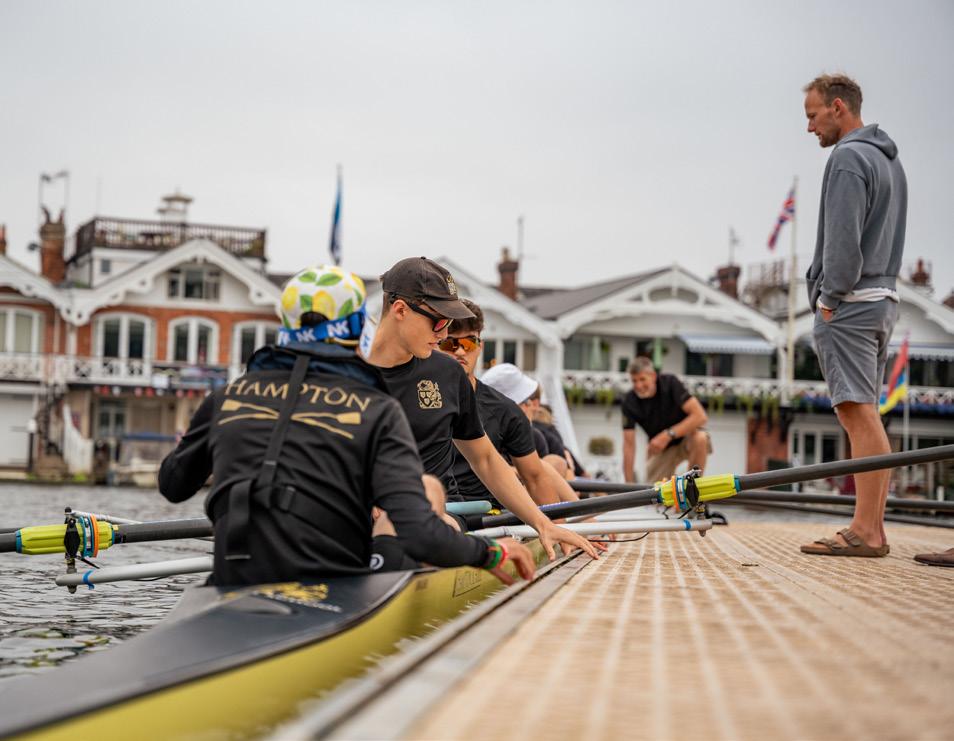
Senior Rowing Coach, Mr Butler, sits down with Archer Jones to discuss life on the river.
Sport is embedded into Hampton’s DNA; anyone can tell you how important it is at Hanworth Road, but perhaps no one better than the HSC team.
Over the past year, HSC has continued to serve as the voice of Hampton Sport, capturing the breadth, depth and overwhelming success that have become standard on our pitches, courts and out on the water. This has been a year perhaps best defined by the latter of those words: success.
First Year reporter Felix Payne narrates the rugby successes of the three Lynagh brothers, both at club and international level. HSC writers, 2025-26: 8 11 12 16 28
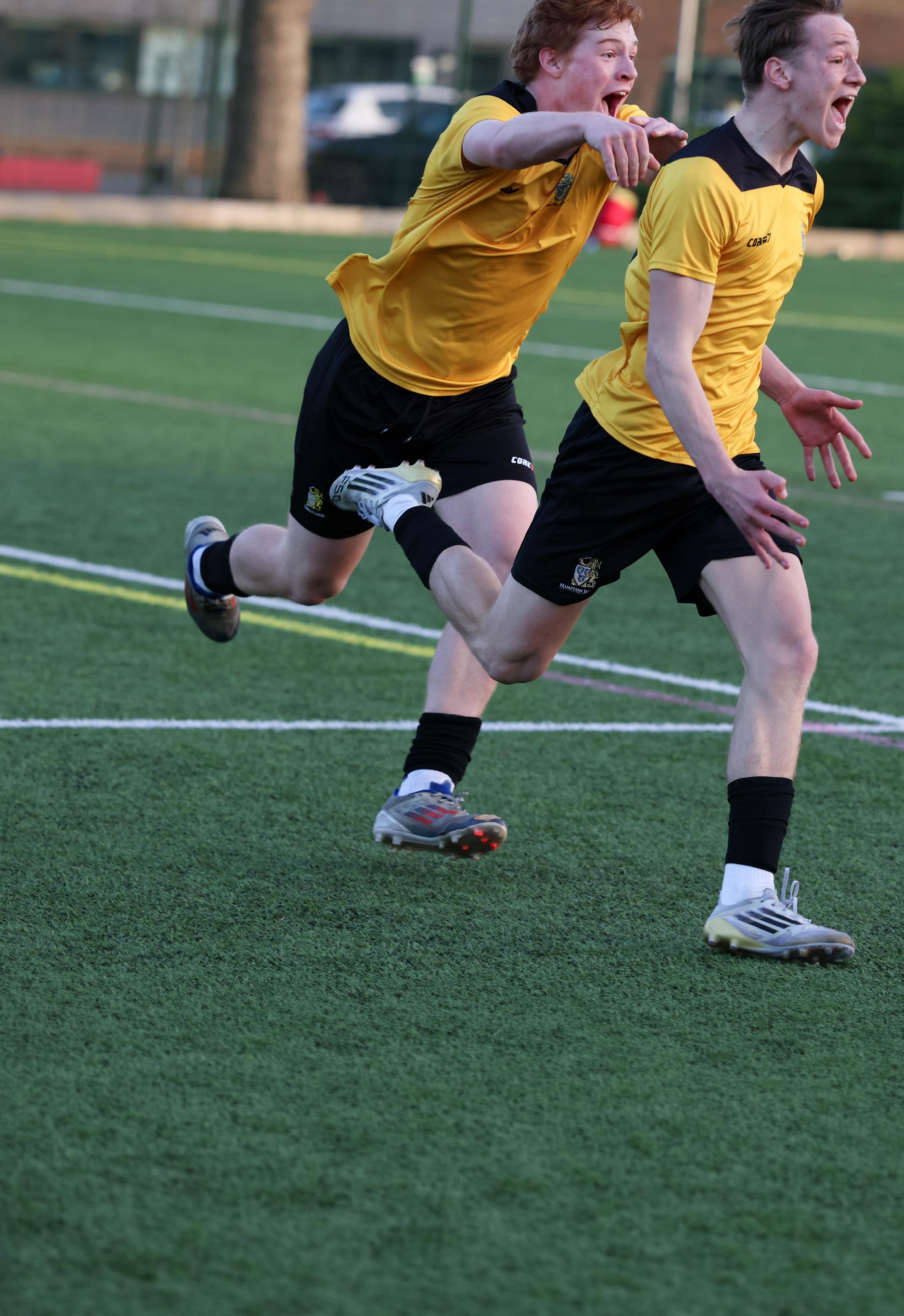
Hampton teams across all age groups have reached unprecedented highs, and this year’s edition celebrates those achievements. The remarkable accomplishments of our senior football sides will, quite literally, grab the headlines, but our writers have worked hard to record the successes from all strands of sporting life.
Elite Hampton athlete, Marcus Solomon, discusses his training, achievements and aspirations in running.
Lower Sixth cricketer, Adhrit Pande, relives the story of the U17 national success, a historic first for the School.
Arun Crowe and Alex Watson discover how the Hampton Common Room would cope out on the football pitch.
Whether it be a national cricket trophy, a hat-trick of ESFA finals at the bet365 Stadium, or breakthroughs at academy rugby level, the School’s athletes have excelled in every discipline — all while embodying Hampton values of fun, sportsmanship and hard work.
Hampton staff and alumni have also enjoyed successful sporting campaigns, and feature prominently in this year’s magazine. Celebrating the achievements of the School’s Common Room and former pupils is an important part of HSC, helping to foster a wider sporting community — something that has been more evident than ever in 2025-26.
And yet, while Hampton sport has undoubtedly been at its brilliant best this year, chronicling it would not have been possible without the HSC team. Dr Liz Colvine has worked tirelessly to put this year’s magazine together, whilst Mr Mike Baker’s creativity and unwavering support have played a pivotal role throughout — a huge thank you to both of them. And, finally, our writers deserve an unbelievable amount of gratitude, as they’ve kept match reports, features and ideas coming in all year round.
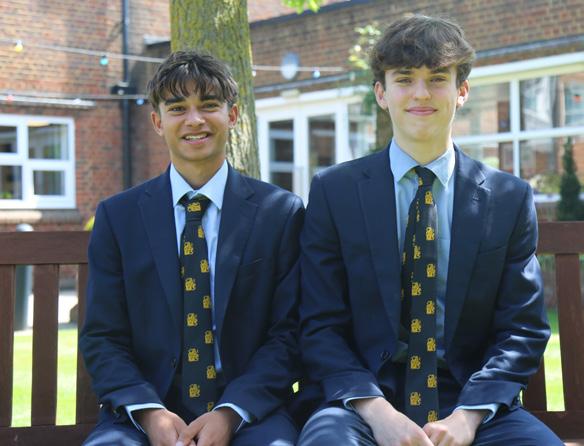
ARUN CROWE AND ALEX WATSON
Aneesh Agrawal
Mohammed Ali
Miguel Badimon
Jack Bason
Joshua Chapman
Francisco Conte
Ireland
Arun Crowe
Jack Dorsett
Thomas Fulford
Ridhaan Gala
Sam Greaney
Lewie Green
Arthur Hanna
Archer Jones
Kaarthikan Mayouran
Harry Morris
Jack Morris
Mahir Olcer
Will Olsen
Adhrit Pande
Ranvi Paul
Felix Payne
George Scholes
Ollie Scrimshaw
Tom Scrimshaw
Oliver Shanley
Alex Watson
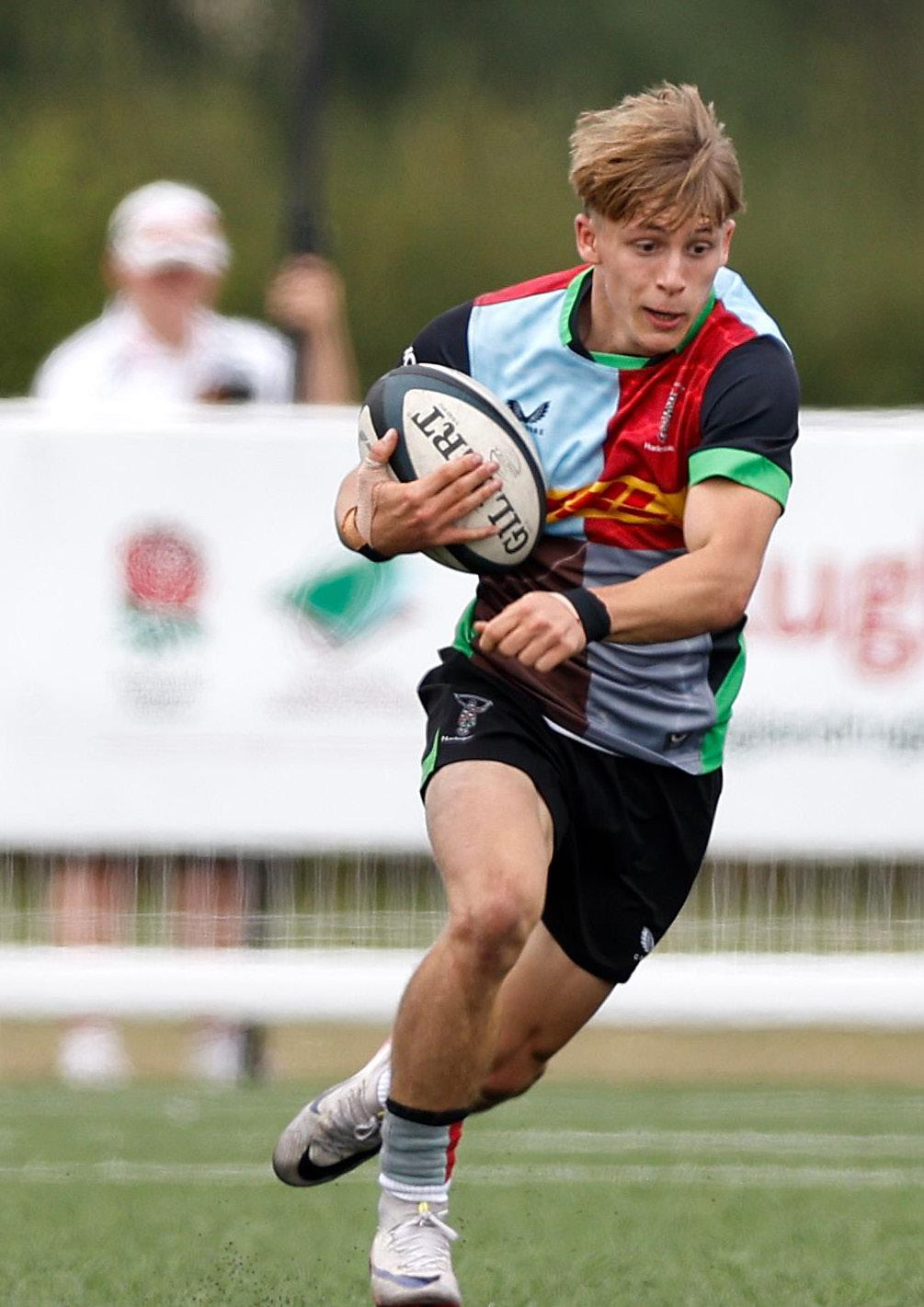
Hampton Rugby player Stan Amor has enjoyed success for both Harlequins and England. Find out more about Stan and his fellow academy stars, Toby Brotherstone and Seb Habdank-Toczyski, on page 18.
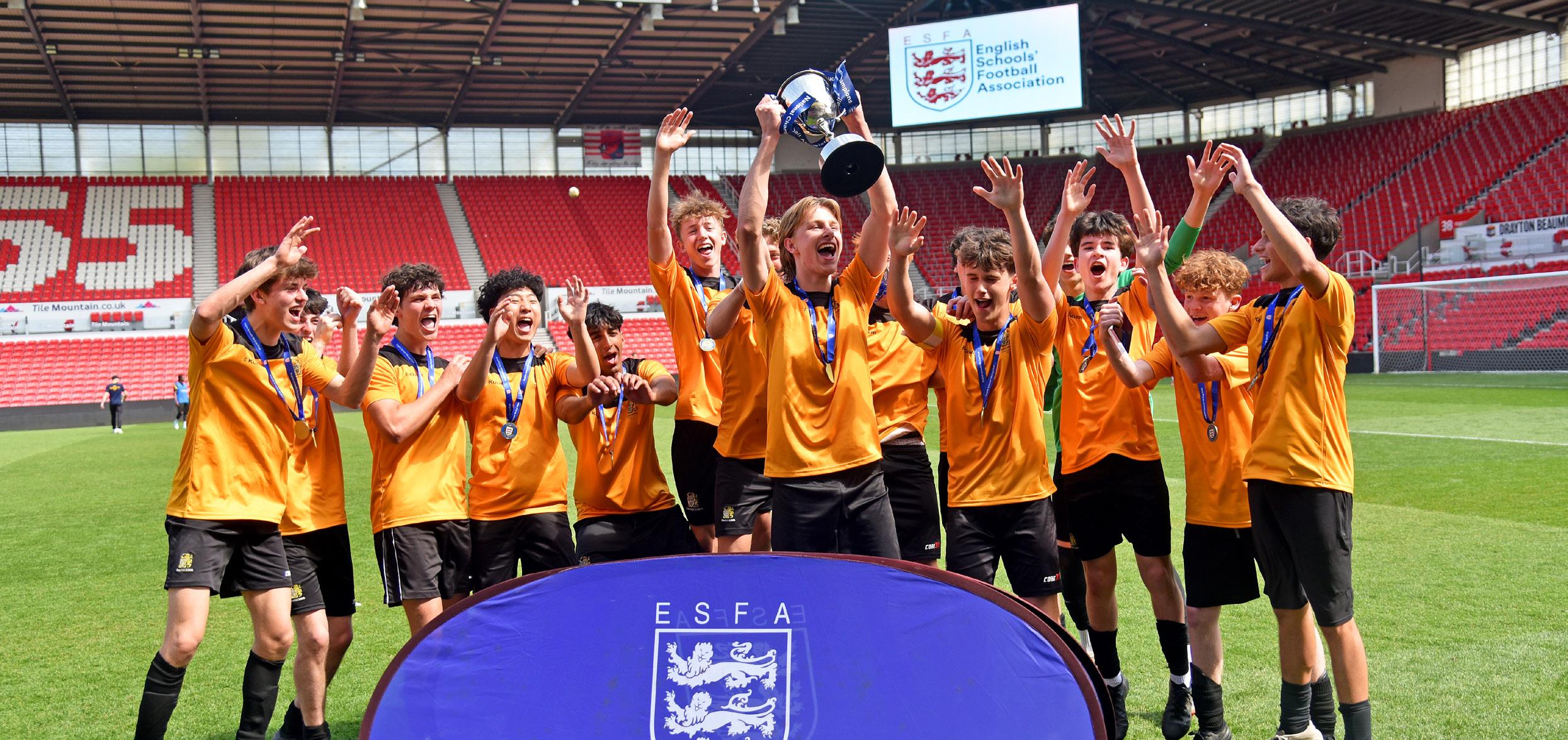
Goals, trophies and history-making moments — our footballers delivered one of the most successful seasons the School has ever seen. Alex Watson relives the highlights.
Hampton have always been one of the strongest footballing schools in the UK. From the First XI to the U13As, many sides have enjoyed national success in the ESFA Cup, whether by winning finals at the home of Shrewsbury, West Bromwich Albion or, more recently, Stoke City. There have been many more wins and impressive finishes in competitions, such as ISFA and the Surrey Cup, and, just last year, the Second XI produced an incredible treble-winning season.
In the 2025-26 campaign, Hampton’s senior footballers reached a new high. Their success is not unexpected, given the incredible achievements of the Second XI, and the First XI’s superb ESFA victories of 2019 and 2023. But, for both sides to reach the national final in the same year marked a first in Hampton history. This wasn’t all these two teams accomplished either; but, before their triumphs are described in more detail, a special mention has to go to the U12B team, who were successful in their own ESFA Cup Final. Read more about it on page 31. Other notable Hampton victories this season include a Surrey Cup win for the U16A team, and Elgin League glory for the Third XI and U15B squads.
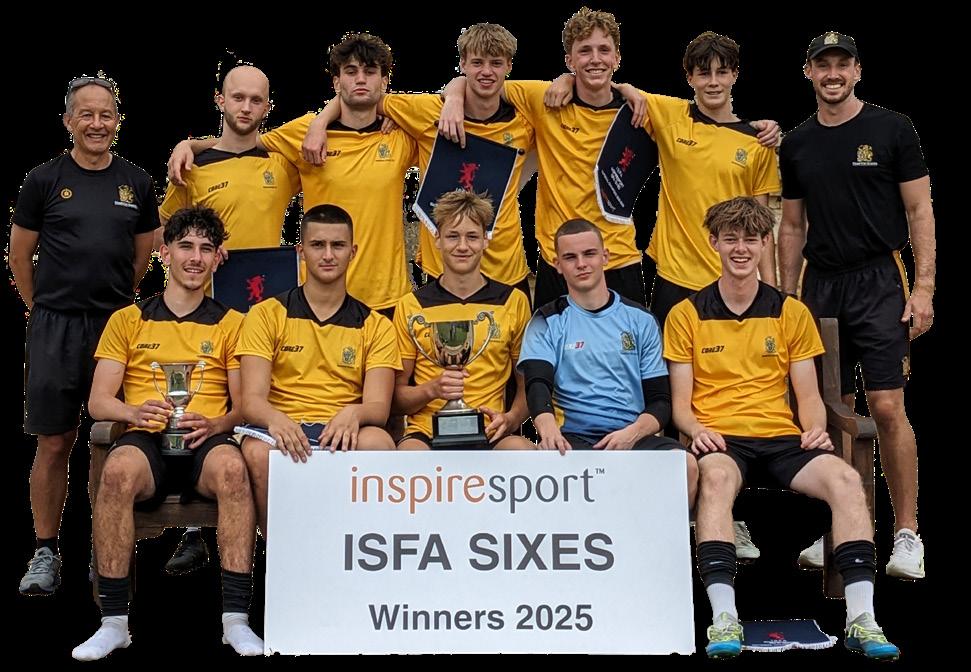
In fact, the winning spree began just a few days into the school year. At the ISFA Sixes competition, the Hampton First XI, led by coaches Mr Burke and Mr Hurst, got their season off to the perfect start. Playing some attractive six-a-side football; they topped their group ahead of the likes of Dulwich College and Shrewsbury School, before two more commanding victories took them into the final against Royal Russell. Goals from Alex Ashton and Nick Avetoom saw them triumph 2-1 and end the School’s near 30year drought at the competition. This was certainly a
statement for the season to come, but there was a lot of football still to be played before the Firsts could get their hands on more silverware.
For Mr Leafe’s Second XI, the prospect of a trophy seemed a lot further away. To get to even one final, they would need to progress through various rounds of competition throughout the autumn and spring terms: a task they set about with authority — reaching later rounds in ESFA and the IS London Cup by Christmas, and all but assuring their place in the Elgin League semi-finals.
The First XI’s autumn proceeded in a similar fashion. They made strong starts in a variety of competitions — progression into the last 16 of both the ESFA and Surrey Cups was backed up by an imperious start to their Hudl League campaign, winning their first five games. The only major blow came in the ISFA Cup third round, as Hampton suffered a narrow 3-2 defeat in extra time against Millfield. This was a pivotal moment in their season; would they let their first real setback throw off their rhythm and confidence, or
would they be able to produce a suitably strong response in the second half of the campaign?
This question was answered quickly and emphatically by Hampton’s most senior footballers. Eight victories in January saw them set up several exciting cup ties, most notably an ESFA semi-final fixture against Maidstone Grammar School. Though they were unable to move past the quarter-finals of the Surrey Cup, losing out to Royal Russell, the First XI’s attention was now on the contest that could potentially send them to their first ESFA Final in three years. When the day finally came, dozens of Hamptonians flocked to the 3G to watch the School’s most senior footballers in their bid to reach a national cup final — and Mr Burke’s men did not disappoint.
Maidstone proved extremely tough opposition, and nothing could separate the two sides over 90 minutes, though Hampton went close on many occasions, with Rio Felonov-Tzanev even having a goal disallowed. Then, in the final moments of extra time, a cross from Angus Hacking found the feet of Felonov-Tzanev once again. His shot was saved, but captain Ollie Swetman slotted home the rebound to send both the team and the crowd into raptures. An incredible win for the Firsts, and an incredible day for the School — bring on the final!
competitions to win in the meantime.
For Mr Burke’s First XI, the next aim was securing top spot in the prestigious Hudl Independent Schools’ League. With three games of the season left to go, they would have to fight for every point to come out on top in what was a tight title race between Hampton, Millfield, Royal Russell and Bradfield College. And, ultimately, despite an unfortunate defeat to Millfield, it was the reigning ISFA Sixes champions who pulled through, ensuring top spot in style with an emphatic 9-0 win over Rossall School in their final game – the first ever Hudl League title for the School. Felonov-Tzanev was awarded Hudl Player of the season, putting the finishing touches on a thoroughly successful Hampton campaign.
Meanwhile, Mr Leafe’s Seconds were also winning trophies — though, in their case, not for the first time. A dominant display in the Elgin League final saw them defeat rivals Whitgift School 5-1, before they secured the London IS Cup with a comfortable 3-0 victory over Highgate. Two trophies apiece now for Hampton’s top two teams, but both were now looking to cap off their incredible seasons in Stoke with a third piece of silverware.
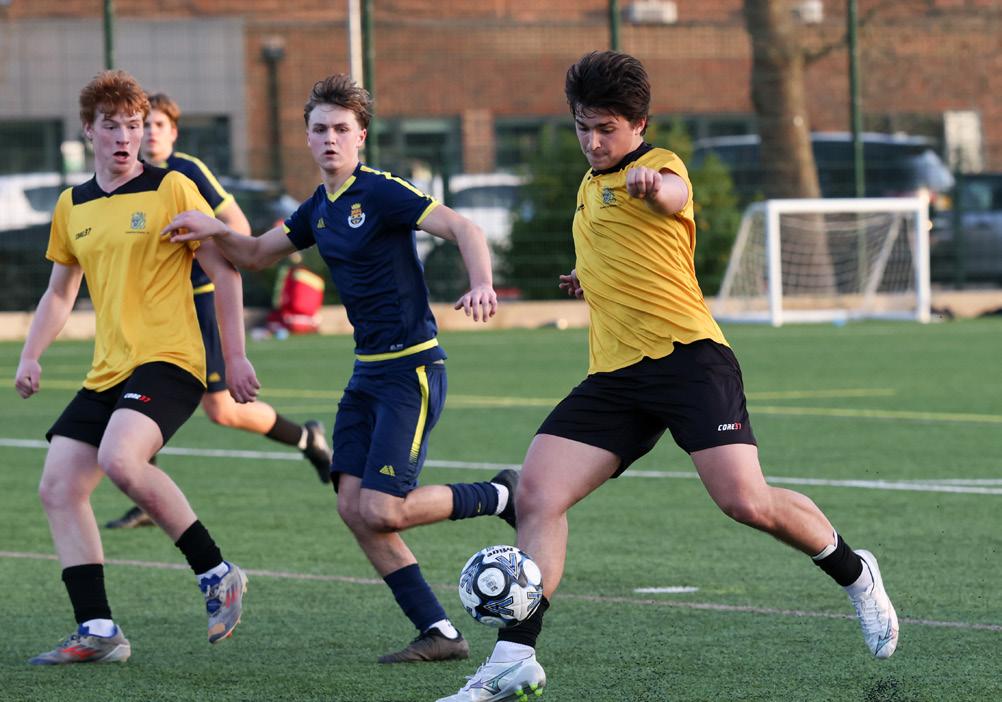

The only question now was whether the Second XI footballers could join their peers at Stoke City's Bet365 Stadium. Not to be outdone, they had enjoyed an equally successful beginning to the spring term, one which had seen them advance into the semi-finals of not only ESFA, but the Elgin League and London IS Cup as well. Surely the treble couldn’t be on again? The first step was a national semi-final clash against Buckswood School, which would also be played on the 3G. Once again, those in yellow and black performed excellently on the hallowed turf, as goals from Dominic Stenning, Connor Hendricks and Freddie Tranter in a 3-1 win ensured that the team would also have an ESFA Final to look forward to. Victories in the London IS Cup (2-0 against Alleyn’s School) and Elgin League (3-1 against Highgate) meant that the ‘double treble’ was still very much on. With both ESFA Finals booked for the same day, Hampton’s two history-making teams had other
Both sides travelled up to Stoke the day before their respective finals, allowing them to fully focus on the task at hand. The Seconds were set to play in the first match of the day, against Thomas Telford School, before the Firsts’ fixture against Samuel Whitbread Academy. The stage was set, and, as the two teams made their final preparations the next morning, 700 fans from Hanworth Road were piling onto coaches travelling to the Bet365 Stadium.
With the sun beaming down, Mr Leafe’s men arrived at the ground — one intense warm up later, and they were ready to go. With every player’s thoughts focused on a historic double treble, the team began their second successive ESFA Final in familiarly aggressive fashion, pressing Thomas Telford hard without being able to carve out any meaningful chances. Their opponents were also fired-up, and with 15 minutes on the clock, a long-ball forward from a Thomas Telford centre-back found the feet of their left winger — one touch and finish later and the ball was in the Hampton net. This was not so familiar for a team who had only lost two matches all season.

Yet the response from the Seconds was brilliant; buoyed up by the arrival of 700 Hampton fans, they quickly sought a response, and found one through Finley Milner, who diverted centre-back Felix Robinson’s cross-goal header into the bottom right-hand corner of the Thomas Telford net. Unfortunately, after ecstatic celebrations, Milner was injured soon after the game’s resumption, and missed out on the remainder of the final — but his contribution will certainly be remembered.
Half-time came and went with the two teams still locked together at 1-1, though it could have been worse for Hampton if not for some great shotstopping from Max Cooper in goal. As the final entered its last 20 minutes, the team started to take control, outworking a tired Thomas Telford side in the heat. Amidst several players going down with cramp, they created half-chances, with Hendricks, Marcus Solomon and Will Kirk all going close.
Yet, with the clock ticking away, the two teams remained level. In the last minute of the 90, Hampton mounted one final attack, as Hendricks was sent baring down on goal after winning the ball back on the halfway line. With a Thomas Telford defender on his heels, he had the presence of mind to slide a pass into the feet of striker Tranter, leaving the onrushing goalkeeper stranded and Tranter able to slot the ball into an empty net.

Jubilant celebrations ensued both on the pitch and in the stands, before the team had to regain their focus for the few remaining minutes of stoppage time. Four frantic minutes later, and the final whistle came — with a 2-1 victory, Mr Leafe’s men had successfully defended their ESFA title from 2025, and, even more impressively, secured a historic double treble. Tranter was awarded Player of the Match for his tireless performance and last-gasp winner, before the team were able to lift the trophy in front of the Hampton faithful - one down, one to go.
Just 20 minutes later, and it was the Firsts’ turn to kick off, producing a similarly energetic start. However, their opponents were more than a match for them, and the expectant Hampton fans were soon silenced by some effective play from Samuel Whitbread. With ten minutes played, their left winger
burst down the flank and unlocked the Hampton defence, before setting up the goal to break the deadlock. In a similar vein to the Seconds, Mr Burke’s men responded well, as two attempts flashed off the woodwork to revive the Hampton crowd. But coming close wasn’t enough, and the team were made to pay for their missed chances, as on the stroke of half-time it was the Whitbread right-winger's turn to work his magic. His dangerous delivery across the box was turned in at the near post, forcing Hampton to go into half-time two goals down.
When they returned from the dressing room, they were reminded by the crowd that they still had every chance to get back into the game, and with the scene set for an unprecedented comeback, the mood suddenly seemed to change as the second half kicked off. Some defensive heroics from Seb Rautenberg and Louis Basing kept them in the game, before they went close on several occasions.
Then, finally, with just five minutes to play, forward Dexter Boyle bundled home a loose ball in the box to halve the deficit and relight belief in the crowd. Hampton pushed forward desperately, but Samuel Whitbread held firm – until the Firsts won a corner with just seconds to play. The crowd held their breath as every Hampton player filled the box, including goalkeeper Rautenberg — unfortunately, it was Whitbread who managed to get their head onto the ball and clear it out, charging down the other end of the pitch to make it 3-1 with the last kick of the final. It was a valiant effort from everyone involved, and though it wasn’t quite enough to seize a second trophy of the day, players and fans alike left the stadium feeling proud of what they’d achieved and excited for the future of Hampton football.
Not only had ESFA finals day been a historic one for the School, with the First and Second teams both reaching the last two for the first time, but the season more broadly had been one of the best and most successful Hampton senior campaigns to date. Five trophies won between the two sides, hundreds of goals scored, and countless magic moments produced — this will be a football season looked back on fondly for years to come. What a year!

BY ARUN CROWE
Life at Hampton can feel demanding, with expectations from teachers and peers often competing for our time and attention. Yet it’s worth remembering the many opportunities around us — and that with good organisation, there are few we can’t make the most of.
Perhaps the two finest examples of this can be found on Hampton’s tennis courts: Dario Puljic and Juan-Leonardo Solari Hernandez, our very own Federer and Nadal. Beginning their careers at ages three and four respectively, tennis has been in their lives for as long as they can remember. As they chose to pursue tennis more seriously, the training hours increased. Now in the Lower Sixth, both have found a way to excel on court while thriving academically.
They have both come a long way from running around the court with their dads, “hitting foam balls around and chasing after anything I could reach,” which Solari recalls as his earliest memory of the sport. Now, they compete regularly on the international circuit, travelling across the globe to face — and often defeat —some of the world’s best young tennis players.
In summer 2023, Puljic played in an international event in England that he calls the defining moment of his career. Matched against an opponent who would become the U14 world number one just a year later, he was undeterred, playing his game and ultimately coming out on top. The performance, he says, proved the level he could reach and confirmed his ability to compete with – and beat – the best in his age group.
Solari references a recent success: 2025 U18 Grade 3 tournament, where he challenged players two years older. He relished the test, playing "some of the best tennis of my life" and winning the final in straight sets. It was one of three trophies he won that week, a remarkable achievement, especially as he “always struggled with finals, because there’s such a big difference between being the winner and coming second.” That first win, he says, “had finally broken through that mental barrier,” and more trophies flooded in.
These achievements are not only a testament to the talent of the Hamptonians but also to the countless hours of training they have undertaken
over the past few years. During term time, Solari trains twelve hours every week: group sessions, individual lessons and just hitting with friends, in addition to four hours of strength and conditioning to meet the requirements of elite tennis, as it “demands fitness, agility, and explosiveness as well as skill.”
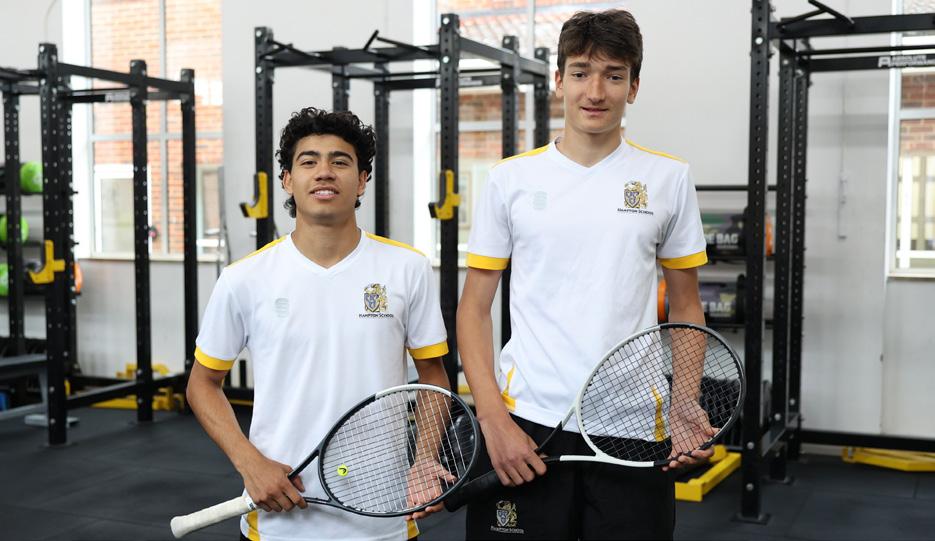
Puljic’s routine is similarly exacting, playing for "two or three hours every day after school, along with a few more hours on the weekends." The considerable time getting to and from training and matches, leaves little time to complete homework and fulfil other school commitments. And so Puljic takes advantage of those various car rides and rest breaks in between sessions to get work done, quoting this constant dearth of time as “the most difficult thing about playing tennis to a high level as a junior.” But Solari commented on how the task of balancing his different sides of life can be enjoyable, “it keeps me busy and I get to spend my time doing things I love.”
Puljic and Solari show that school life extends far beyond classrooms, corridors, and the 3G. Whether it’s joining a club, starting a new sport, or discovering a hobby, there are countless opportunities both in and outside of School — all while managing regular academic work. Of course they don’t have to be completed to an international standard, but with enough hard work and dedication, who knows?
The future certainly looks bright for these two, whose ambitions lie firmly in professional tennis. More international tournaments and potential scholarships abroad form the next steps in their journey. And not too far beyond that horizon lies the dream of the ATP Tour — and perhaps even an appearance just a few miles down the road at the world’s most prestigious tennis tournament.
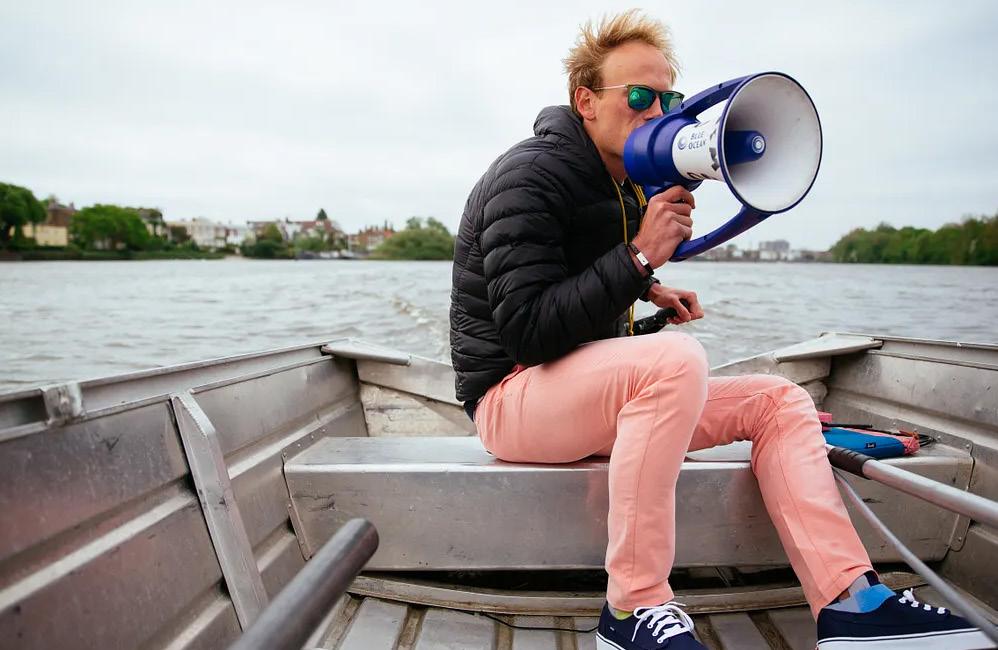
Senior Rowing Coach Mr Butler discusses his innovative coaching methods and life on the
Mr Josh Butler is a former international rower, having competed at Henley Royal Regatta — the most prestigious annual rowing event in the world — and winning the Wyfold Challenge Cup in 2017. Having been involved in rowing coaching since 2015, Mr Butler took up the position as Senior Rowing Coach at Hampton in 2023. Since then, he has overseen some impressive achievements, including the First VIII reaching the Henley semi-finals for the first time in a decade, and five rowers representing Great Britain on the international stage — all within his first two years at the School.
Ever since his arrival, Mr Butler has been working to further strengthen senior rowing at Hampton. His aim is to build on the School's proud rowing tradition and help the programme establish itself among the leading schoolboy crews in the country. The programme has made significant progress in recent years, and Mr Butler believes there is more to come as the Boat Club continues to develop. I caught up with him to discuss Hampton's recent resurgence and to understand his views on what makes a successful rowing programme.
Previously, Mr Butler worked at Westminster School as their Head Rowing Coach from 2015 to 2023. Given his rowing pedigree and strong track record as a coach, he understandably received job offers from all around the country upon leaving Westminster, yet he chose to come to
Hampton. Having grown up rowing as a junior, Mr Butler remembers "the yellow and black oars and the big noise around them." Evidently, he was aware of Hampton's past success, and he "thought [he] could add some value."
While Hampton rowing had enjoyed success before his arrival, Mr Butler was keen to identify areas where the programme could continue to improve and compete consistently among the country's leading schoolboy crews. He says it comes down largely to mentality and psychology. When he first arrived, he mentions having to push his rowers to keep training.
Whereas now, he appears to have fostered a different atmosphere. Challenging weather conditions, difficult sessions, and other potential setbacks are increasingly viewed "as a challenge rather than a threat," with each outing seen "more like an experience rather than a result." Clearly, this mentality change is working for Mr Butler and his squad, who are now putting out pairs that regularly "beat world champions from previous years."
Another change in psychology that Mr Butler wanted to input was developing a real "pack mentality." Rather than being a collection of single rowers, his squad functions more as a collective: bringing each other up and pushing each other further and further.
His main way of doing this was by developing the "third eight mentality," a principle that attracted him to Hampton originally. He believes that the third eight idea is the core of the Boat Club. He believes one of the most important things about running a successful boat club is creating a competitive spirit, in races but also for seats in the boat. For Mr Butler, if the top end of the third eight have the competitive desire and "want to be in the second eight, then it’s all running well." The competitive desire within a crew and within each individual rower is the key desire of his working philosophy.
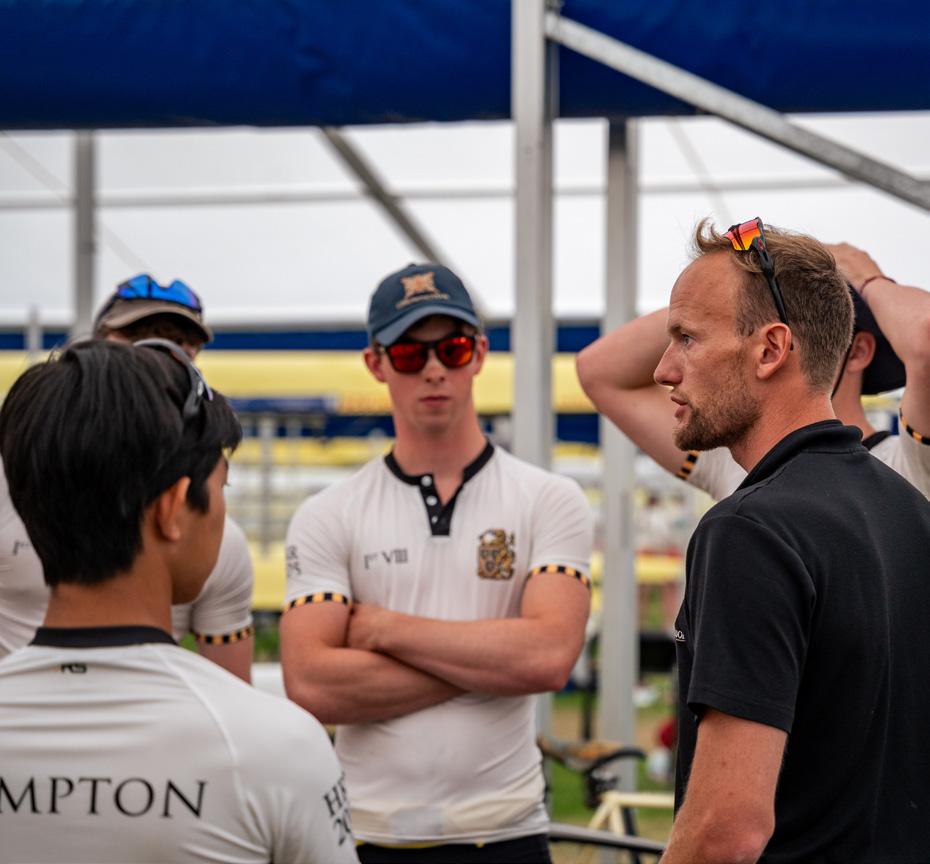
Despite every boat club running differently with different challenges, Mr Butler believes there is one thing that is essential for all clubs to function successfully. "The biggest thing is the backing from the boys. If you don’t have the backing from the boys, you could be the best coach in the world and still not have a truly functioning club. Once this has been established, once the boys have bought in, it’s (the Boat Club) just running itself."
Since Mr Butler arrived at Hampton, the rowing squad has changed and grown in many ways: size, ability and atmosphere. With this, there are obviously evolving challenges, with each year bringing a new method of coaching to try and get the most out of rowers. Yet, Mr Butler says he prefers this. "If I don’t have something to do, a current goal to work towards, I struggle to kind of organise my life. I know that if my plate’s quite busy, I’m going to be alright." Mr Butler’s drive to stay busy is very evident when examining how he divides his time. Currently, he is working toward completing an Iron Man later this year, with much of his training happening late into the evening after
working all day down at the Boat Club. His effort in all parts of his life is certainly commendable. For many coaches, in all forms of sport, it seems reasonable to assume that their best moment, their coaching highlight, would be seeing the top end of their squad doing well and performing at very high standards. Yet, for Mr Butler, his is "seeing the third eight last year, watching them get their medals. Simply seeing how happy they are, how they are moving in a boat, their drive to train. Watching them do all the same training as the rest of the seniors, and trying to give them as much encouragement as possible. Then, watching them coming over with the medals that they truly earned. Yeah, that was pretty cool."
Finally, Mr Butler explained how he’s personally adjusted as the Hampton rowing programme has changel; last year with the squad size. In some of the previous jobs I’ve had there’s only been small squads, so I’ve learned how to manage that size of group. While I did enjoy the larger squad, I find that in a smaller one things become a lot more laser-focused and the coaching can become more personal. Nobody’s forgotten in a smaller squad, whereas sometimes there is a risk that some people become, I don’t want to say numbers, but when you’ve only got two hours in a session, it becomes very hard to address every single rower."
Yet, one thing he has loved about the rowing at Hampton since his arrival is the School’s spirit. "I find that there are schools that row and then there’s rowing schools, and this is definitely a rowing school. I know there’s a huge alumni base who are super proud of the Boat Club, I know that the School is super proud of the rowing. I think that all round support for the Boat Club from every direction is what truly makes this rowing club something special and something that I’m happy to be a part of."
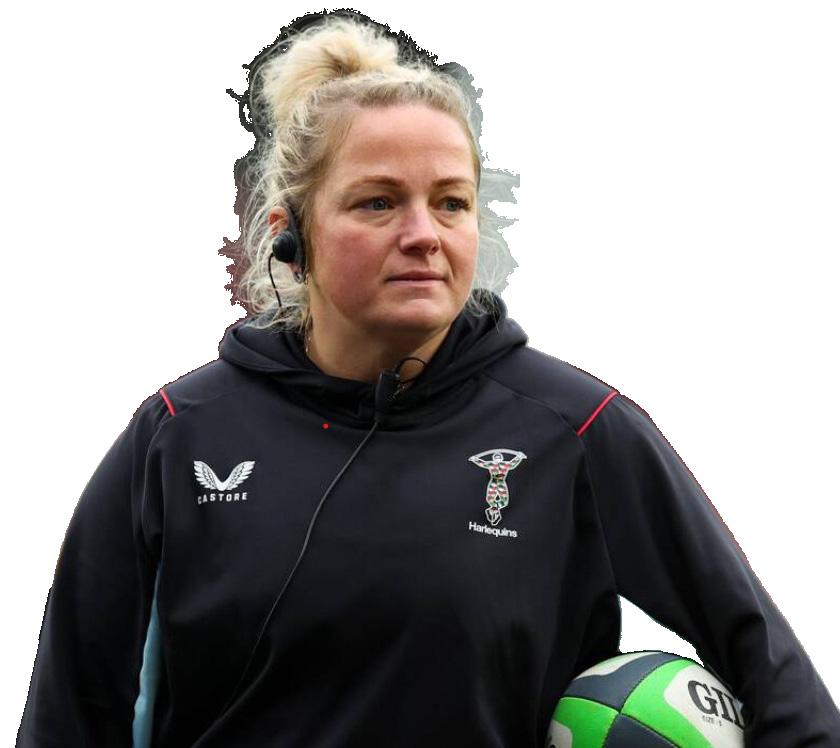
First year reporters Jack Morris and Felix Payne interview Hampton rugby coach Miss Turner on her stellar career and rugby philosophy.
Earlier this year, Hampton welcomed Miss Amy Turner, a fantastic addition to the rugby coaching team. She has had a stellar career in the sport, earning 59 caps for England and playing in two Rugby World Cups, before ending her journey with Harlequins and retiring in 2018. But Miss Turner was more than just a player. Resilient and strong-minded, she carried her passion for rugby into coaching, leading at Quins before joining Hampton to inspire the next generation.
Miss Turner grew up in a strong rugby environment; her parents ran the bar at her local club. She began playing at the age of six and competed with boys until she was a teenager, when she was scouted by Wasps. Her early career helped her gain essential skills before she was spotted by England. Her ambition to make it to the highest level of the game drove her on to reach new goals.
Miss Turner attended several England trial camps and impressed enough to earn her place in the squad. She was preparing for her debut against Canada, but a broken finger ruled her out. She didn’t let this stop her, and soon made her England debut against Wales in Cardiff. She said that the feeling before the game — knowing that she was about to represent her country — was incredible and one she would never forget.
She shared that her favourite highlights in rugby were playing in New Zealand and Samoa — places she rarely had the chance to visit, which made the experience of competing there even more special. Her funniest moment was when one of her teammates jumped to catch a ball, but she misjudged it, and it landed on her head.
We asked Miss Turner the hardest question of all: how has women’s rugby changed during her career? When she was growing up, people didn't recognise women’s rugby as they do now. Players didn't get paid much, so would have another job alongside their rugby — Miss Turner was a police officer. Now players make a lifetime out of rugby and can fully focus on the game.
Another massive change is that women’s rugby is now all over the television. People that
wouldn’t normally watch the sport see matches like the World Cup final and are inspired to watch more. Now girls and young women see great opportunities in rugby and no longer need to worry about their financial situation.
Miss Turner is delighted to see the change in her sport and believes it has a very bright future indeed. She hopes that she can see the current England team develop, as well as for young talented players to be introduced into the side. She still has great relationships with many of the England team and highlighted that rugby "makes friends for life."
Lastly, she explained why she came to coach at Hampton. After her playing career, she coached at Quins before retiring. She is local to Hampton and had heard a lot about its rugby programme. Having already coached at a professional level, she was interested in coaching younger players and inspiring the next generation. She explained that she was immediately struck by Hampton's approach to the game, as well as their ethos of always trying to be the best you can. She is really enjoying her time at the School, and we are very lucky to have her.
Hampton Sports Chronicle meetings take place on a weekly basis at lunchtimes. See Mr Baker in the English Department for more details.
BY ALEX WATSON
HSC co-editor Alex Watson takes a look at the impressive cross country career of running star Marcus Solomon.
On the surface, running is a simple sport. It requires no equipment, teammates or facilities — just a pair of trainers and space to move. Often, it feels easiest at a young age, when we are at our most fearless and energetic.
Unfortunately, for many of us, long-distance running becomes less appealing as we grow older, with the physical and mental demands steadily increasing. Many adolescents drop the sport altogether — some never return, while others rediscover it later in life. Only a few manage to stay motivated and continue to find satisfaction in running during their teenage years. Lower Sixth Hamptonian, Marcus Solomon, is one of those few, however, and he has excelled at the highest level of cross country and longdistance running from a young age.
Having recorded top-ten finishes in national races as early as age 12, he achieved his most impressive milestone in October 2025, becoming a National Road Relay champion with St Mary’s Richmond AC team — missing the course record by one second. He followed this with a superb second-place finish in the Middlesex Cross Country Championships, a competition he has won three times. And, two days later, he claimed his third victory at Bushy parkrun, completing the 5km course in an impressive 15:42.
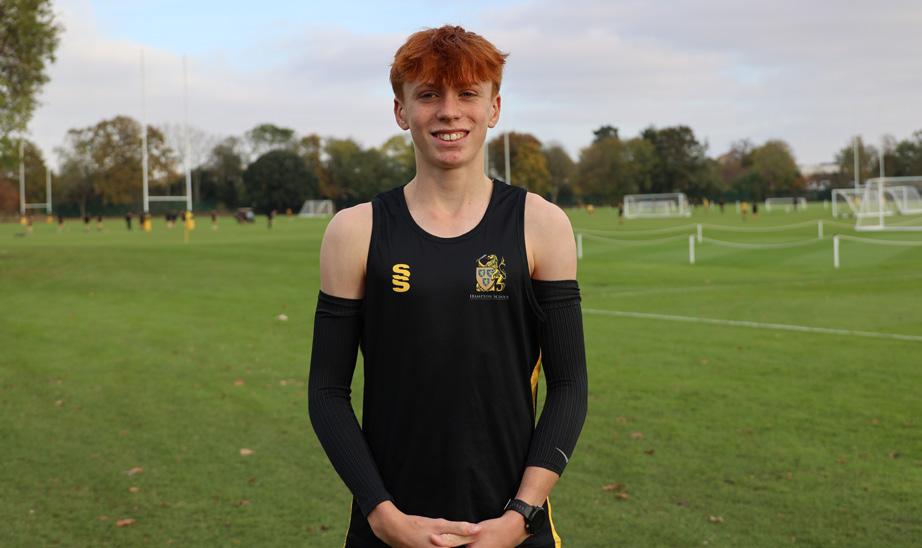
Such a list of accolades is no mean feat, and Solomon has talent and hard work to credit for his success. Surprisingly, he did not see running as his main sport until the age of 13, when he began to realise how good he was and prioritise it over football. It quickly became a central part of his life, as he chose to join St Mary’s Richmond AC, which prompted a significant increase in the frequency and intensity of his training. Over the years, this trajectory has continued; he now trains with St Mary’s University endurance
group, covering up to 90km every week. This demanding workload is only possible with highlevel coaching, a motivating running community, and significant physical and mental strength.
While Solomon can access the first two through his athletics club, the latter comes entirely from himself. His psychological resolve is a key factor that sets him apart from the average runner. He acknowledges that the sport is tough, but finds the sense of achievement at the end of each run more than worth the effort.
Simply enjoying the sport is not enough, however. Solomon has to balance training with sporting, academic and social commitments, often requiring sacrifices and sometimes going straight from long runs into high-intensity football matches. His routine is complicated and mentally draining, and it can also lead to physical setbacks — poor races and, more seriously, injuries that wipe out weeks of progress. With all this in mind, it’s no surprise that one of his proudest achievements is simply not giving up.
This is something he wishes more people would do, as he believes that it’s important for people, particularly young children, to keep healthy and active, and that the payoff can be very enjoyable if not taken too seriously. The recent growth of running as a sport, both in the UK and elsewhere, would suggest that others are beginning to align themselves with Solomon’s ideas.
Looking to the future, Solomon is confident that his running journey will continue after Hampton, though he is unsure of what path it will take. The School has certainly been a significant part of it, providing a pathway to national level, whilst former teacher and Olympian, Mr Clarke, played a big role in his athletics career, giving him important advice in his first few years.
While many people can be thanked for contributing to Solomon’s success, his many triumphs — winning national relays and parkruns, competing at the highest level of school cross country — are primarily a result of his constant hard work, desire to improve and dedication to his sport. He may be uncertain about what’s to come in his running career, but it’s obvious that he has a bright future ahead.
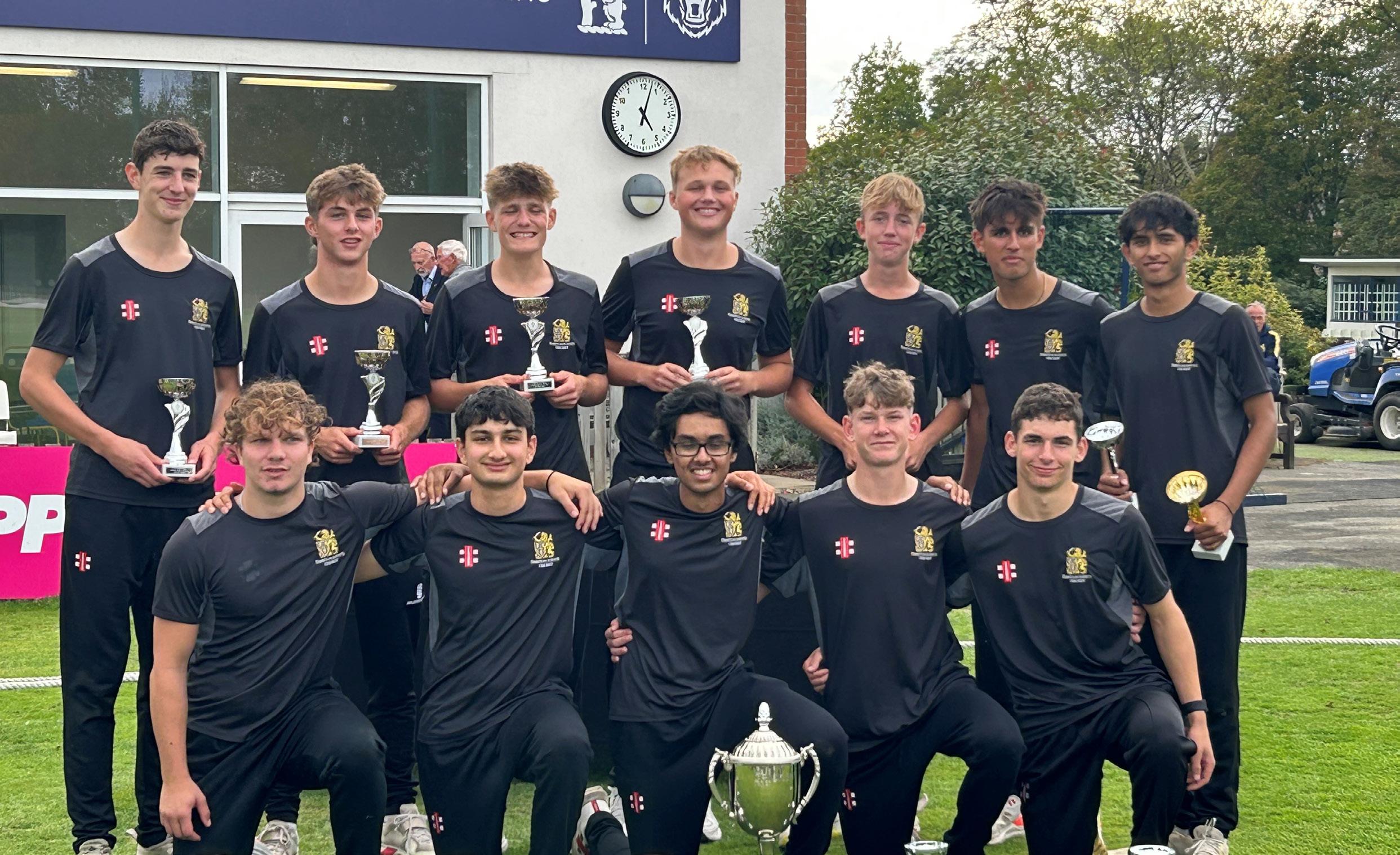
U17 cricketer Adhrit Pande reflects on a remarkable last-ball National Cup triumph in their final against Rugby School — a phenomenal first for Hampton cricket.
Hampton School’s U17 cricketers were crowned National Champions after a hard-fought and thrilling victory over Rugby School in the 2025 U17 Cricket Paper National Cup Final.
The final, although played at the start of the autumn term, was the culmination of a campaign that had begun in the previous academic year, when Hampton progressed through four rounds of the competition, playing strong cricketing schools such as Harrow and Millfield along the way. These were all closely contested matches that helped shape a wellbalanced and confident side.
Having lost the toss, Hampton were put into bat first, with James Stanworth and Oliver Khaksar opening the innings. The pair put together a strong opening partnership of 78, taking Hampton through the early overs without losing a wicket. Stanworth led the way with a controlled 55, anchoring the innings, while Khaksar’s 38 provided important support at the other end, helping Hampton build a solid foundation early on.
With Hampton looking to capitalise on the positive start, Ashton Crossley increased the tempo by putting pressure on the Rugby bowlers, scoring freely and taking advantage of anything loose. His innings of
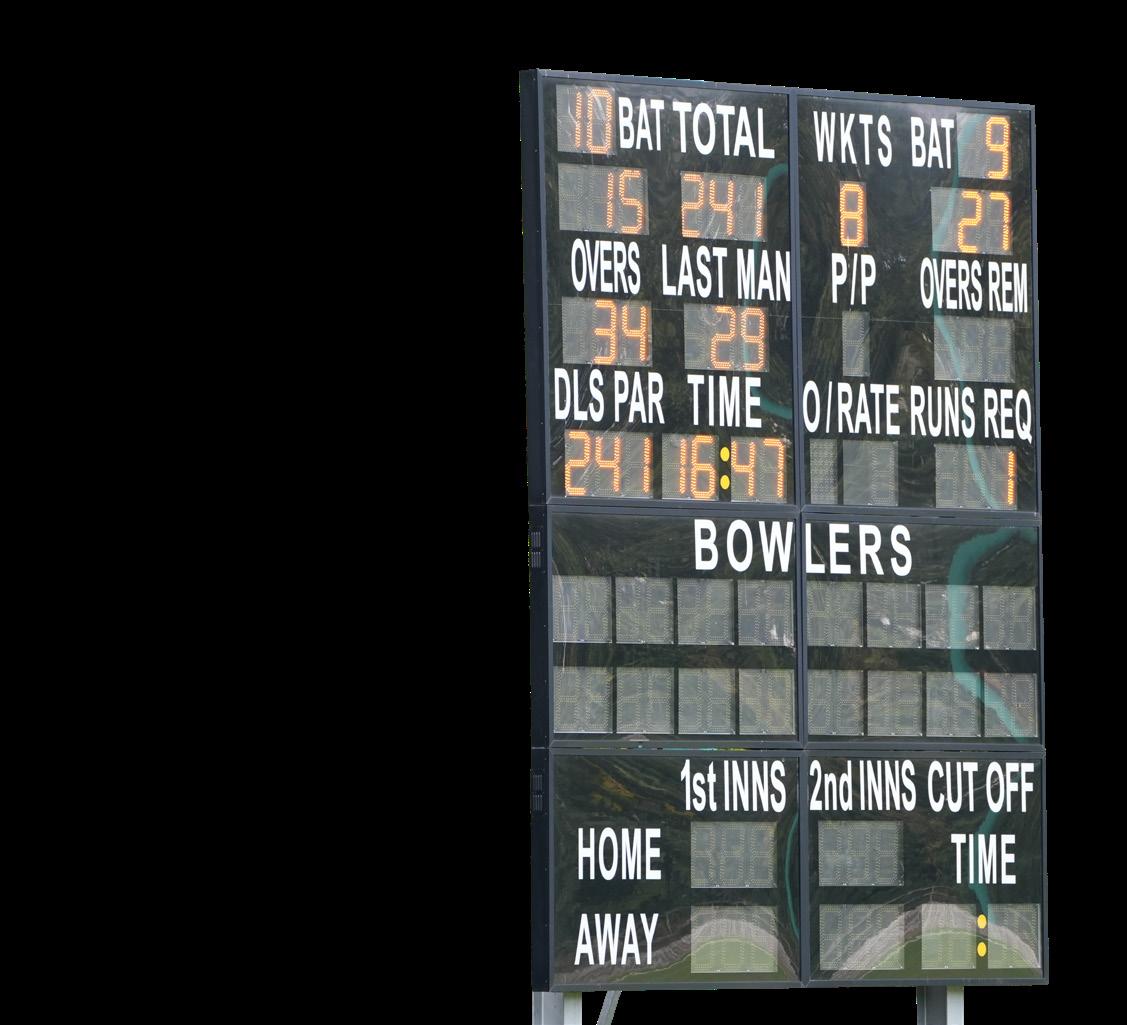
65 from 42 balls helped to maintain a high-scoring rate through the middle overs. Rohan Muktieh then added a useful 26, continuing the momentum and ensuring the scoreboard kept ticking over. In the final overs, James Eggleton delivered the important finish, scoring an unbeaten 27 off 8 balls, finding the boundary regularly with clean striking. His late acceleration helped Hampton surge in the final overs, closing the innings on 241 for 6 from their 35 overs.
In reply, Rugby were rocked early with Edward Reilly taking a wicket on the very first ball of the innings. Along with Joe Perry, they kept things tight early on, limiting scoring opportunities and building pressure. As Rugby worked to rebuild, Hampton’s first-change bowlers Raphael Taylor and Muktieh maintained control, consistently hitting their lines and lengths and picking up crucial wickets, preventing the Rugby batsmen from forming long partnerships.
Through the middle overs, Rugby stayed in contention with a number of steady contributions from the middle order. At this stage, Hampton turned to their spinners; Adhrit Pande and Xavier Knowles, who between them picked up five wickets. Bowling with a tight line and length, they were able to restrict the flow of runs for the Rugby batsmen, keeping them below the required rate.
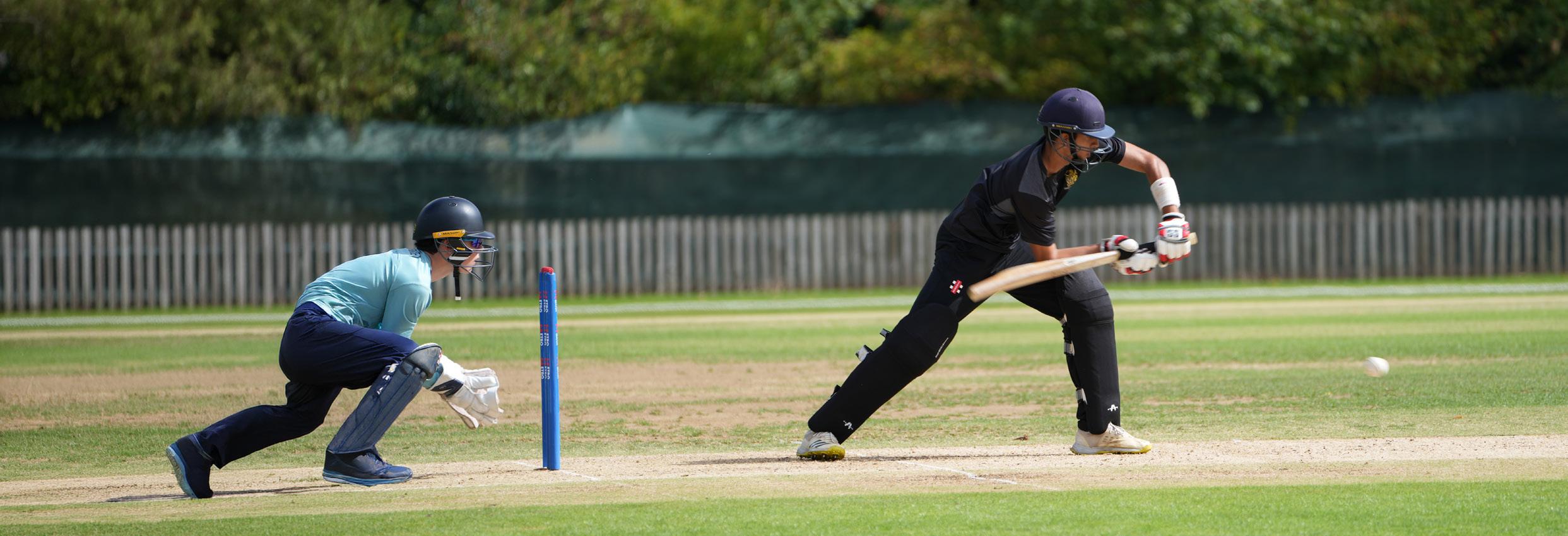
In the field, Hampton were sharp in the ring and disciplined on the boundary, with important catches from Richard Page and Reilly helping to back up the bowlers.
As the match moved into the final overs, the responsibility fell onto Perry and Muktieh with Rugby accelerating and pushing towards the target. With the tension in the ground mounting ball by ball, Hampton stuck to their plan and executed under pressure; while the Rugby batsmen were able to find the boundaries at key moments, they were prevented from getting ahead, leaving the game to be decided in the final over with Rugby needing 12 to win.
Muktieh was given the task of bowling the final over, with the outcome still hanging in the balance and everything riding on the last six deliveries. Around the ground, the tension was palpable, with supporters on edge and anxiety high. The first four balls brought six runs, with the ball going in the air twice and coming down both times; the sense of occasion was showing, as these two massive moments could have easily swung the game in Hampton’s favour.
Nevertheless, with six runs off two balls required, Muktieh went for a wide yorker, but missed his length slightly, allowing the Rugby batsmen to get underneath the ball and slice it over extra cover, with the ball trickling over the boundary for four. With the tension on a knife-edge and Rugby needing two runs from the last ball, Muktieh nailed a leg stump yorker, hitting the batsman on the pad. The batters could only scramble through for a leg-bye to short fine leg leaving the scores level at the end of the match, the first time in the competition’s history!
since they had lost fewer wickets than Rugby, 241-6 against 241-8, Hampton School were crowned The Cricket Paper National Cup Champions. Muktieh was awarded player of the match for his cameo with the bat and the composure he showed in bowling the final over to win Hampton the game.
Captain Zaid Ahmed described the victory:
Lifting the National Cup for the first time in the School’s history is an incredibly special feeling, particularly in such a tight final where every run mattered. The way every player stepped up throughout the season says a lot about our character. It’s one of those moments you dream about as a team, and one that will stay with us for a long time.
With the game tied, as per the competition rules,
BY ARTHUR HANNA
Motor Neurone Disease, examining its impact on athletes and sporting communities.
Motor Neurone Disease (MND) is a progressive and ultimately fatal neurological condition affecting motor neurones in the brain and spinal cord. These nerves control essential muscle activity, meaning the disease gradually impairs movement, speech and breathing.
Early symptoms include a weakened grip, muscle cramps, and an increased tendency to fall. As the condition develops, patients may experience difficulty speaking, swallowing and breathing. At present there is no cure; life expectancy is significantly reduced, with many patients living only a few years after diagnosis.
In recent years, growing attention has been given to the impact of MND on professional sport, particularly in high-contact disciplines.
Several high-profile rugby players have been diagnosed with MND following the conclusion of their careers, including Lewis Moody, Doddie Weir and Rob Burrow.
Doctors have suggested this may be due to head impacts and concussions, which may occur during a professional rugby career. Research in Scotland found that the risk of MND more than doubled for rugby players compared to the general population. Consequently, researchers have called for reduced head collisions and improved player safety across the sport.
In football, there have been fewer reported cases, but it is still a topic that requires more coverage than it has received in recent years. One notable case is former Hull City player, Stephen Darby, who was diagnosed at the age of 29, forcing him to retire immediately from the sport.
Seven years on, he is still battling the disease and has been a major advocate for MND research, co-founding the Darby Rimmer MND Foundation to raise awareness for the disease. He has spoken publicly about how MND developed from initial muscle weakness, highlighting the realities of living with the condition.
While there is currently no cure for MND, treatment is focused on slowing down the progression of the disease and managing the symptoms. There have been a few medical advancements, such as Riluzole, a commonly used drug to slow progression of the disease and extend life expectancy.
Supportive therapies also play an important role in slowing the progression of MND; physiotherapy and exercise can help maintain muscle strength and mobility. Medical professionals can also provide nutritional and respiratory support to help with swallowing and breathing as the disease progresses. Ongoing trials are testing various drugs to see whether they can improve outcomes for those affected by MND.
Although links have been suggested between elite sport and MND, the causes of the disease remain complex and not fully understood. It is most commonly diagnosed in people over the age of 55 and there are many other factors it can be attributed to; 5-10% of MND cases are linked to genetic factors. However, approximately 90% of cases appear without any family history and research continues to see whether these various factors do play a role in being diagnosed with the disease.
Researchers from the University of Sheffield have recently studied cases of males and females separately, looking at exercise and genetic data between people with and without MND. They found a link between extreme exercise and MND in men, and the data suggested that men who exercise to an extreme extent have an increased risk of developing MND at a younger age. While findings indicate a possible association, there is still no definitive evidence of direct causation.
MND remains a devastating condition with farreaching consequences for those affected. While new research has raised important questions about potential risk factors in professional sport, further investigation is needed to fully understand these links.
BY HARRY MORRIS
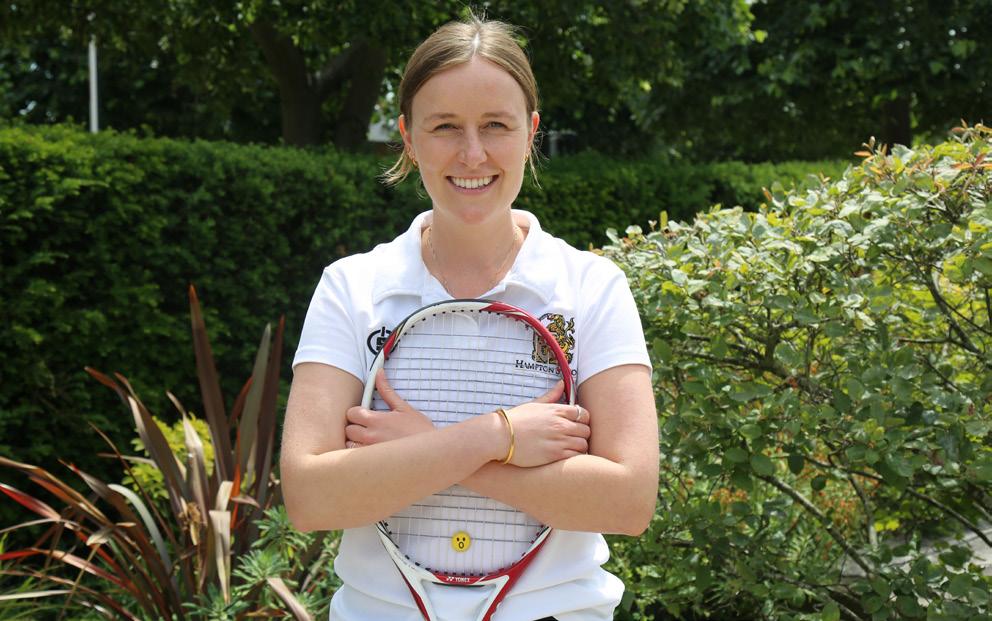
Harry Morris chats to Head of Tennis Miss Todd about her experiences playing and coaching the sport. ANYONE
Hamptonians know Miss Georgina Todd — or Mademoiselle Todd — as a French teacher and Head of Tennis. What many may not realise, however, is that she was a highly talented youth tennis player, with standout achievements including a memorable win over former GB Number 1, Katie Boulter. In our interview, she reflects on both the highs and lows of her tennis career — including the injury that ended her dreams — and shares her plans for tennis at Hampton, along with advice for young players.
From a young age, Miss Todd’s talent was obvious. She joined the county setup at seven and trained intensely: “before school probably three or four mornings a week for an hour,” and if she couldn’t play in games lessons, she trained again in the evenings. She explains that when she played, she could “very easily get into a flow state,” allowing her to play freely and fluently.
Her dedication opened doors to national and then international tournaments. She travelled around Europe with her mother, a fantastic experience, but one that required sacrifices. At 16 she made the decision to leave school and focus entirely on tennis, although her parents “wisely insisted that I did my A Levels with a tutor.”
One of her greatest achievements came at 17, when she won the Junior International Tennis Federation doubles competition. She also faced British greats such as Katie Boulter, beating her a couple of times. A memorable moment was a “very tough match” in doubles against Harriet Dart, who would later reach a ranking of 70 in 2025. Miss Todd also competed in the Road to Wimbledon Finals — the tournament below Junior Wimbledon.
But, at 18, everything changed. She suffered a back injury and could no longer play at a high level. She describes the experience as “like having a divorce, because it was a huge part of my life and identity that I had to very quickly give up.” She never played competitive tennis again.
She had to step away from her tennis dreams, but this allowed her to return to school and complete her A Levels. Although her hopes of achieving more in tennis had ended, she still believes her training and tournaments were worthwhile, as “tennis made me who I am today in all aspects of my life.” Even her injury taught her “self-discipline and resilience.” She
admits one of the harder parts has been meeting people later in life who don’t know tennis was once a major part of her identity.
After moving on from her playing career, Miss Todd tried different jobs, but none felt purposeful enough. She eventually decided to go into teaching, and she joined Hampton because she could tell it was the kind of school she would enjoy being part of.
Despite giving so much to tennis, she never expected it to become part of her teaching life. But now she loves being Head of Tennis alongside teaching French. She enjoys working with a real mix of year groups and focuses strongly on the mental side of the sport. “Tennis is such an individual sport,” she says, so it’s crucial to build “mental resilience and mental strength on court.”
Under her leadership, more boys are getting involved. “A record number of First Years are coming out to practise at lunchtime,” which is hugely positive for the tennis setup. She has also introduced a tennis tour to Portugal, giving players the chance to experience clay courts in the sun! She believes Hampton is one of the strongest tennis schools in London and has been performing very well in fixtures. She hopes to build on these successes and get even more pupils started in the sport.
Miss Todd offers some advice for young tennis players: “if you love the sport then step out on to a court as much as you can. Whether that means hitting with a partner or practising serves with targets. Never miss an opportunity to be on a court, because that’s how you improve." And for all Hamptonians “if you haven’t played tennis yet, give it a go — it’s an incredibly social sport and one you can carry through life.”
Football is a big part of life at Hanworth Road. Over the years, there’s been plenty of debate about the footballing abilities of the Common Room - but no proof. Today, that all changes.
Arun Crowe and Alex Watson have assembled two sides for what might just be the most eagerly anticipated fixture in Hampton history. Let’s meet the players:
GK Mr Holdaway (Captain): After many years in the workshop, there’s no one better at using their hands. He’s always on the alert, ready to snuff out potential accidents.
LB Miss Smith: Already a fierce and determined competitor, and that’s before she finds out that the opposing winger hasn’t shaved.
CB Madame Yoxon: Loads of experience, charismatic and brings the French winning mentality to the team.
CB Mr John: The leader and organiser of the back four, he thrives in bad conditions and on suspect surfaces. Infinite stamina.
RB Mr Baker: Quick-talking, thinking and moving, he always puts in a shift in defence and brings a creative edge to the attack.
LM Mr Blachford: Alongside his Spanish mastery, his skill and prowess in the realm of Body Balance gives him the agility to dance past defenders.
CM Mr Griller: A tactical genius who calculates xG in real time and sees endless patterns on the pitch.
CM Mr Scaratt: A born leader who works tirelessly for the team, always coming up with new ideas. Like Maradona, he’s not afraid to call upon the spiritual realm in times of need.
RM Mrs Knibbs: Always one of the loudest on the pitch, this winger isn’t afraid to experiment. Iconic partnership with Mr Knibbs up front.
ST Mr Knibbs: The other half of the devastating duo, he’s the most influential player in the squad. A lifelong Arsenal fan, he’s especially dangerous from a set-piece.
ST Mr Ellison: Self-named ‘Da Big Cheese’, a confident and accomplished forward who brings energy to the team. Injury prone but makes up for it with his jokes in the dressing room.
Assistant Manager Mr Leafe: The double-treblewinning coach was a shoe-in for the assistant gaffer role — hopefully Watson’s Wizards are able to display some of his famous ‘twogetherness’.
GK Mr Morris: As safeguarding officer, who else is better placed to keep our goal secure?
RB Mrs Rigby: One of the most eloquent members of the Common Room, this trusty fullback could persuade the opposition to shoot the other way.
CB Mrs Jones: There is perhaps no one out there with a better stage presence; this protagonist truly shines under the spotlight.
CB Miss Singleton: With past martial arts experience, and prone to the occasional rugby tackle, she’ll be taking no prisoners in defence.
LB Mr Green: He may have once been a First XI player at Hampton, but he’s only reaching his prime now; years in the English department have taught him to read the play like no other.
CDM Mr Studt: Fresh off a 400km run in Scotland, this midfielder will be running long after the final whistle (and ensuring that every teammate always has their shirt tucked in).
CM Mr Schofield: He’ll be getting green links with every player all across the pitch, shifting the play like his idol, Le Chatelier.
CM Mr Doyle: But with no one better than his central midfielder partner, a particularly bright spark in the middle of the action.
RW Mrs Owen: A lifelong Oldham Athletic fan, she knows a thing or two about loyalty, and complements her French experience to produce a fearsome mix of Zidane and Mellon.
LW Mr Bracken: As former U14D coach, he has priceless experience at the highest level of football. Any spontaneous handballs may be explained by his love for Gaelic football.
ST Mr Langton (Captain): At 6'4" and with his own army of bees, this striker is packing quite a sting.

With the team sheets out, stadium packed and millions more watching worldwide, Mr Langton kicked off one of the most anticipated matches in the world footballing calendar.
The match didn’t take long to light up, with just four minutes on the clock, Mrs Knibbs found herself in behind the defence of Crowe's Crew, and took advantage of lacklustre defending to fire past Mr Morris, putting her team a goal up. This was a huge wake-up call for those in red.
The defence, led by the formidable Mrs Jones, heeded that warning, and pushed onto attack themselves. A long ball was thrust into the box by Mr Schofield, where Mr Bracken rose highest and curled a beautiful header into the top corner; a moment of calculated quality to equalise. But the Crew weren’t done there. Just a minute later, Mr Bracken turned provider, feeding a pass into the perfectly-timed run of Mr Doyle, who smashed home emphatically, sinking Watson's Wizards to an unlikely deficit at half time.
The game was intriguingly poised at 2-1 as the Wizards kicked off the second half. But it was only going to get worse for the team in blue as the Crew doubled their advantage. And of course, it was Mr Doyle once more. This time assisted by Mr Studt’s industrious midfield play, he slalomed past the defence and fired home. 3-1 with just twenty minutes left to play.
Accepting his own tactical inexperience, Alex Watson turned to his number two, Mr Leafe, for a spark of strategic brilliance to kickstart their very own Remontada. And with Mr Leafe at the helm, they regained a foothold in the game. In the 81st minute, the ball fell to Mr Griller on the edge of the
box. He calculated the probabilities, the angles, and leathered it home. 3-2.
The Wizards pushed on, fighting for every header, tackle and loose ball, and earning a corner in the 90th minute. It was Mr Griller to take. Mr Holdaway raced up into the box; there wasn’t a single player back for the Wizards. As the ball floated into the front post, Mr Leafe watched on in delight as Mr Knibbs rose highest, towering above the defence and equalising in the most dramatic of fashions.
Despite the late resurgence, there would now be another thirty minutes , during which Crew resumed their dominance. The Wizards’ defence was hanging on by a thread for most of extra time, and in the 111th minute, it looked for all the world like this was going to snap.
It was Mr Doyle again, looking to restore his side’s lead and secure a historic hat-trick. But his fierce strike was denied by a world-class save from Mr Holdaway; the skipper stepped up when his side needed him most, keeping the score level and Wimbledon hopes intact.
Then, in the final moments of the match, in the 120th minute with tensions at their peak and penalties looming, Crowe's Crew burst forward one last time. In a desperate last throw of the dice, Miss Todd, a late substitute for Crew, volleyed home from a cross and set off pandemonium amongst the fans with the final kick. of the game.
Joy and despair ensued for the two teams, as it was Crew captain, Mr Schofield, who lifted the trophy in front of a distraught Wizards side — the perfect ending to a thrilling, high-stakes game of Hampton football.

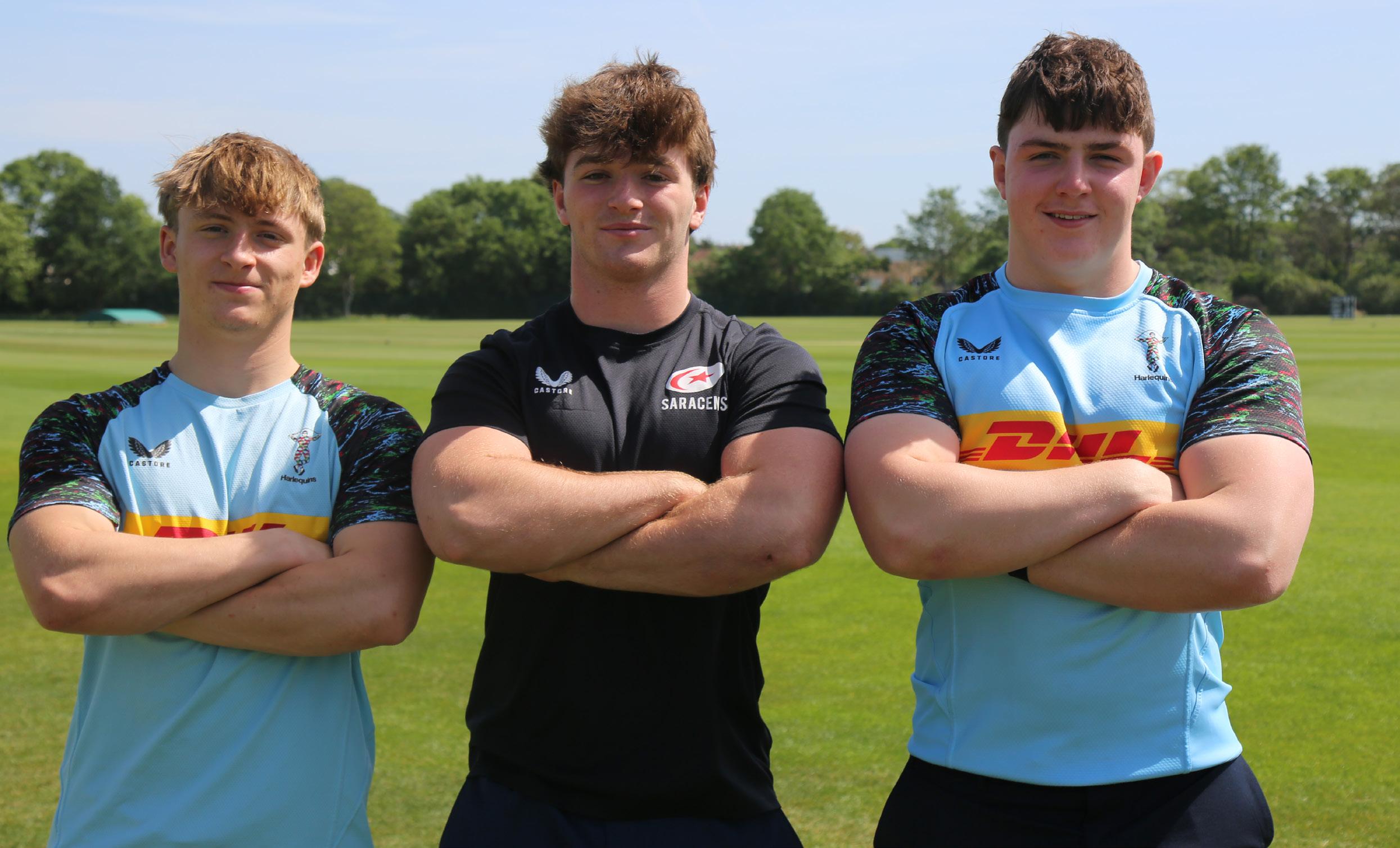
Will Olsen talks to rugby superstars Stan Amor, Toby Brotherstone and Seb Habdank-Toczyski about their dreams of top flight rugby.
What does it take? A question pondered by thousands of athletes every day. Is it the grit and determination of Muhammad Ali, the relentless willpower that drove Michael Phelps to 23 gold medals, or the fierce competitiveness that carried Rory McIlroy to a career grand slam and back-toback Masters victories? Or maybe it’s so much simpler; could it just be that drive and passion to do what they love every day?
I sat down with Hampton’s very own Lower Sixth academy rugby players: Stan, Toby and Seb, three guys quietly living that question every week.
Stan follows the Michael Phelps school of thought: relentless pursuit. Rugby, rugby, rugby. Getting home and throwing 200 passes because something felt just a bit off at training, spending evenings obsessing over footage of past games, keeping recovery compulsively on point. Toby has the grit Muhammad Ali was built on, 200 hooker throws as the benchmark, grinding in the gym for every extra rep, never leaving the practice field until it feels right. And Seb has that McIlroy
winning side in every contact, every shuttle run, and every argument with his mates.
Now don’t get me wrong, they have a long way to go, but it gives you a feel for who these three are. Stan plays at Harlequins, where he has already earned call-ups to England camps. Toby is also at Quins and on the brink of receiving a Scotland cap. Seb is at Saracens looking for that U18 starting shirt. So, what is it actually like: the highs, the lows, the stuff nobody tells you about living the academy rugby life?
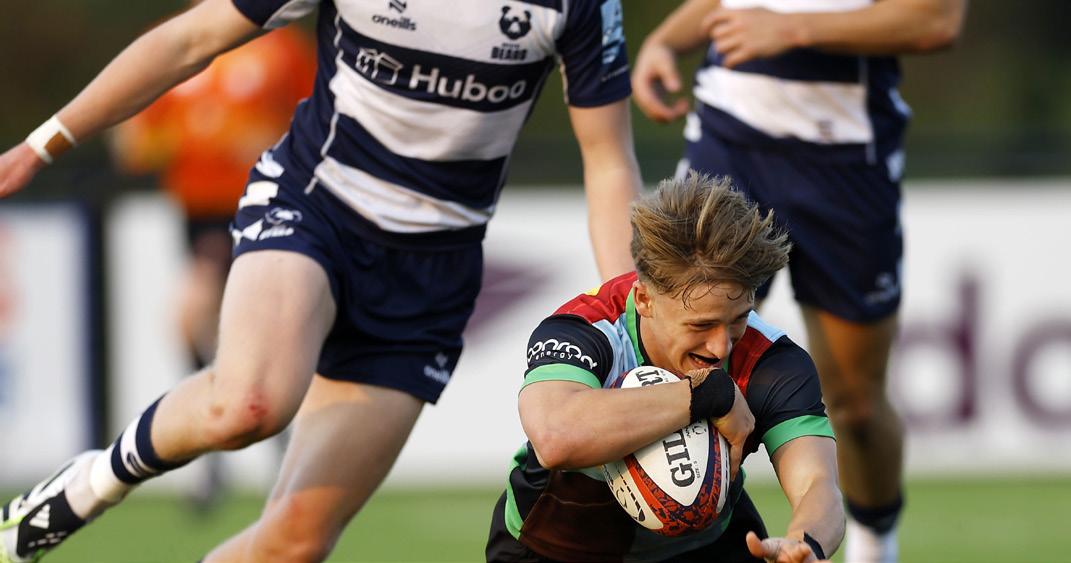
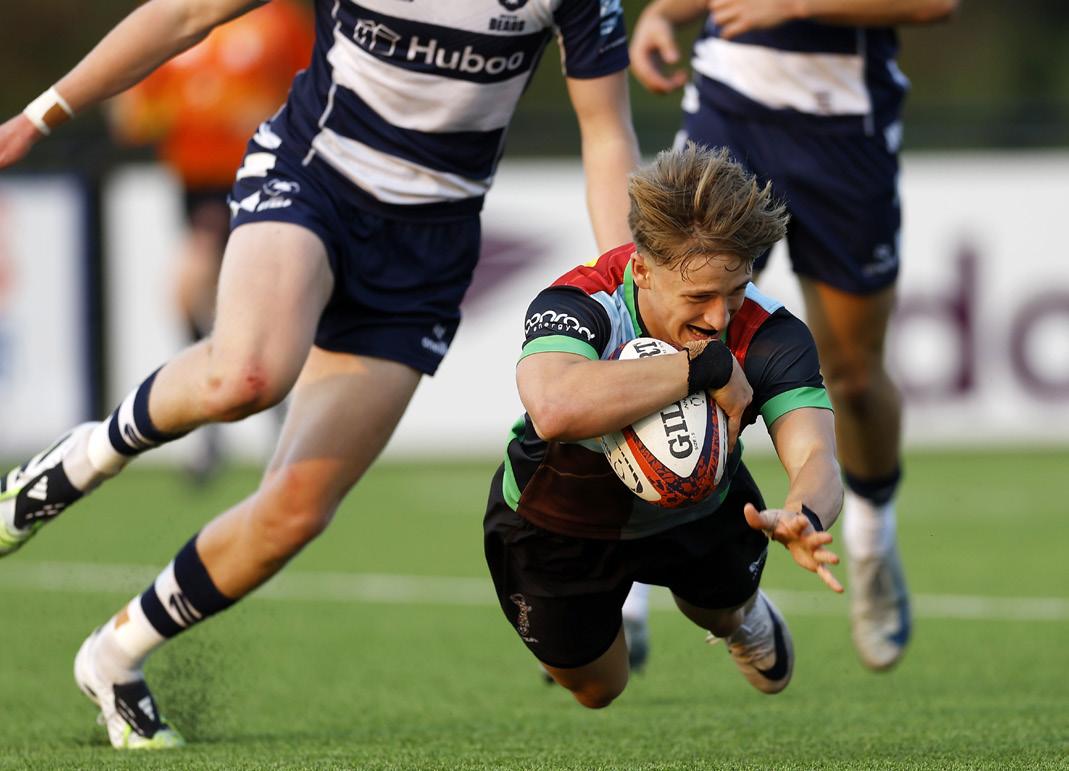
Ask any of the Hamptonians about their favourite academy memory and you immediately see why they do it. For Stan, it was a full-pitch try against Northampton in February: “I do regret not hitting a celly,” he admits. For Toby, it was his U18s debut against Yorkshire, scoring on
his first appearance after just one week of training with the squad – a difficult feat at any level, let alone U18 academy. However, Seb’s moment came from a different place entirely, less about a single score and more about a mental breakthrough. It was a tense moment in a knife-edge contest, he got the ball and made a pivotal line break to change the game, but that wasn’t the important bit. It was the feeling he had overcome the mental block of high performance: “It showed me I was getting past it,” he says.
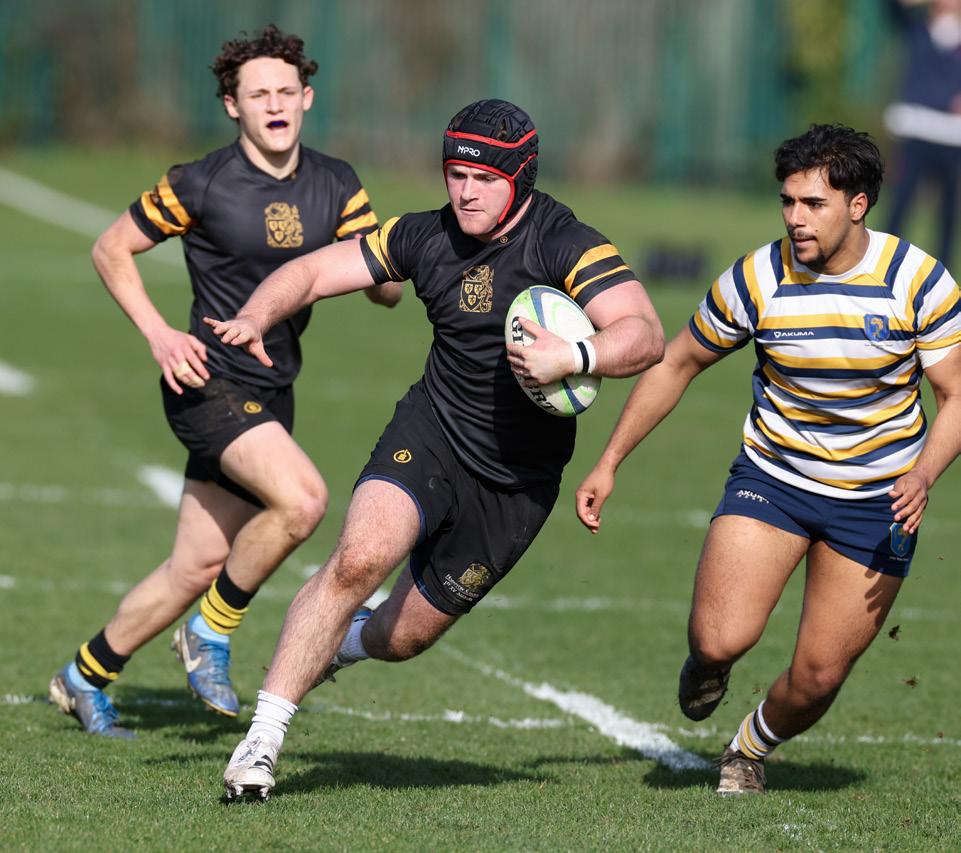
It is clear through all three that Hampton has shaped their academy careers in ways that go beyond rugby ability. For Stan it’s about confidence. Performing week in, week out for School gives him the platform to carry that form into Quins. Toby points to something more specific: getting used in different positions at Hampton has forced him to develop aspects of his game he wouldn’t otherwise have worked on, like ballcarrying and defending in wider channels from the back row. For Seb, who recently moved from London Irish to Saracens, Hampton gave him the licence to be a primary carrier, a role that has defined his identity as a player and that he has carried into life as a hooker at academy level.
The most revealing answers came when I asked about the hardest obstacles they’d faced. This is where the picture of academy rugby gets more complicated than the highlights reel suggests. Stan was dropped from Quins U18s mid-season, having been involved all year. Being pushed back down to U17s stung: “it was annoying,” he says imaginatively. But he was able to use this as motivation and got himself back in the team. Toby, meanwhile, describes the mental challenge of walking into the U18s squad after one week of
training and being expected to know the calls and match the intensity, however he knew he couldn’t have that mental block while playing at the top: “once I was actually in the game, everything seemed to click into place.”
Seb’s account is the most candid. For three years, he struggled to perform at the level he knew he was capable of, weighed down by his own selfcriticism and the mental pressure he placed on himself. His confidence as a player took a real hit. “I recently have started to get past it,” he says – that ability to get back up and keep going starts to define the best.
Toby perhaps best captures the culture that makes this possible: “The pressure to perform isn’t measured by individual performances, it’s about how much you develop throughout the programme.” That reframe, from outcome to growth, is what keeps players like these three going through the difficult patches and helps players develop to a high level.
Then there’s the small stuff that outsiders never see. At the end of every Saracens session, forwards and backs split into two groups; the backs have a chant, where one player goes “Jumulai,” then group responds “Jai” twice. Then the forwards, it’s “Beefy” and “Beef.” It sounds trivial. But in a world built on pressure, obstacles and the constant fear of being dropped, those small rituals are the glue.
The world is full of ‘wannabe’ superstars, but few are willing to do what it takes. To get up for those early sessions, reflect after a poor performance spell or get back up after being dropped. But these guys are doing it every day, bit by bit, and only time will tell if they really have what it takes.

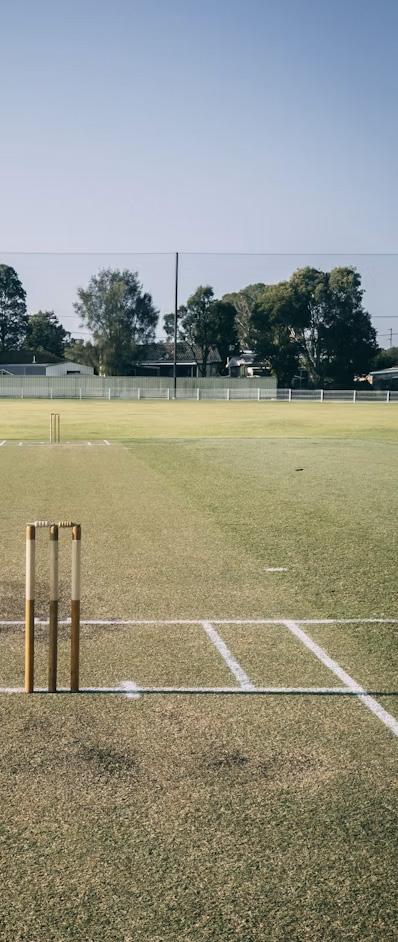
From the professional game to grassroots level, Aneesh Agrawal weighs up the impact of franchise cricket.
Cricket is constantly changing. The rise of T20 and franchise cricket has reshaped how the game is played, influencing both the professional game and how it is played here at Hampton. This article explores how franchises have driven change, for the better and for the worse.
Where do franchises come in?
The most famous T20 competitions come from franchise cricket, such as the Indian Premier League (IPL). There is no doubt that this has helped globalise the sport, with expansion into the UAE (ILT20) and the USA (Major League Cricket).
Originally a cash grab, the IPL has turned cricket into a more watchable sport, with over a billion viewers worldwide. The IPL net worth — as reported by the Hindustan Times — has increased from 2 billion dollars in 2009 to over 10 billion in 2024.
How has it affected International Cricket?
T20 has encouraged more aggressive playing styles. Bazball in Test Cricket, draws heavily on T20 batting, and has renewed public interest, revolutionising the longer format game. More people are starting to enjoy Test Cricket, and it's come a long way since the failures of the 2021-22 Ashes.
However, there have also been negative consequences. In 2024, South Africa sent a weakened team to face New Zealand, prioritising their domestic SA20 competition. This shows that cricketers are choosing money over playing for their national team.
Spin it to win it? Too
Former England spinner Graeme Swann recently said that spinners aren’t prepared to take risks, as they’re afraid of being hit for boundaries — an idea which began in franchise cricket. Many spinners I play with during school games don’t turn the ball because they are afraid of being hit. Often they don’t get hit for as many runs and their captains and coaches are happy.
Other bowlers turn it more, and get more wickets, but also go for more runs. Captains
don’t trust them and coaches may see them as worse. This is a risk many are willing to take but it shouldn’t be a risk at all.
Professional cricketers offer mixed views regarding franchise cricket.
South African wicketkeeper-batter, Dane Vilas, noted that it has put a new spin on cricket with the shorter boundaries, shorter numbers of overs (e.g. Abu Dhabi T10 and the Hundred) and the number of tournaments expanding through the IPL with mass globalisation. However, he added that it has weakened international cricket as more players are retiring to play only franchise cricket — and often these players are key to their national sides.
Surrey opener, Rory Burns, highlighted the increasing competitiveness of the game but also that the numbers playing Test Cricket have been declining, with finding players for the Test team becoming increasingly difficult. Many of the requirements for the Test team are based on the T20 game, which is heavily influenced by franchise cricket.
Meanwhile, his teammates had more positive views. Jason Roy said that franchise cricket is a good way for kids to see him play and for cricket to be shown across the world. He wants more youngsters to play cricket, and is happy that franchises are attracting more people to the game.
Ryan Patel went further, asserting that franchise cricket has actually given a positive base for young players, increasing the overall talent pool in cricket today. Cameron Steel and Tom Lawes had similar viewpoints, including that franchise cricket seems to bring more money into the game and that increased creativity and innovation is required from young players.
Franchises have evolved cricket into more than just a game — it has touched the hearts of many and is the reason most of us play and watch cricket today.
BY OLIVER SHANLEY
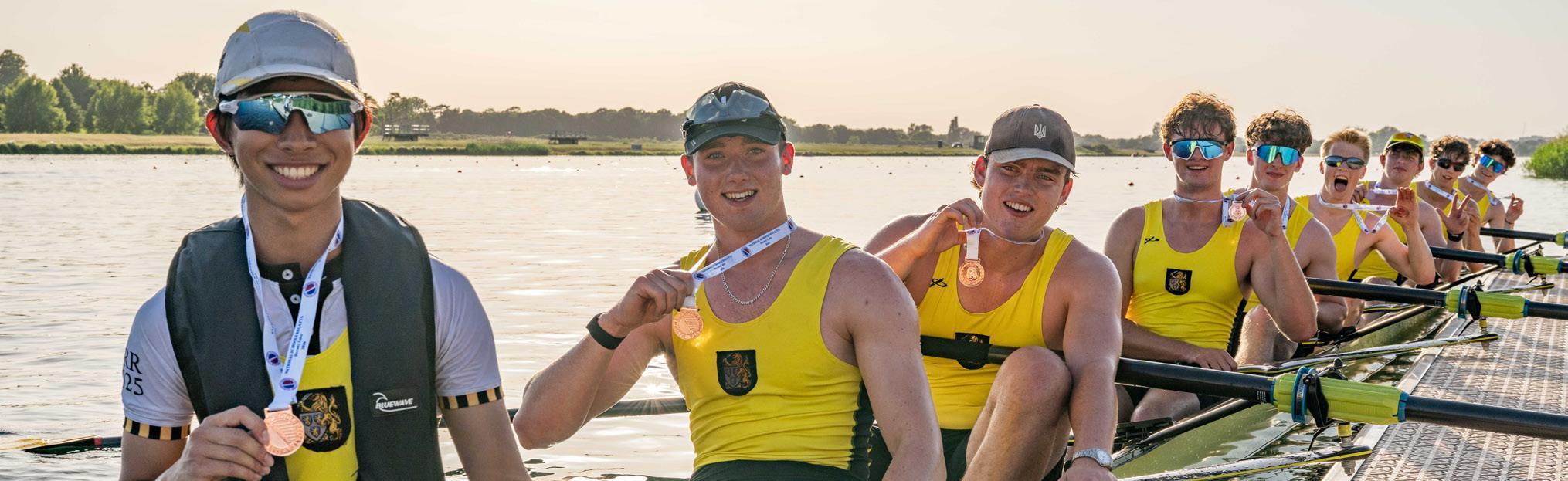
From earning First VIII seats as J16s to contributing to Hampton’s first Championship VIII medal at National Schools’ Regatta in 12 years, Leo Robertson and Monty Hunt talk to Oliver Shanley about the key moments in their rowing development.
How did you get into rowing?
Monty switched from football after advice from history teacher, Mr Cross. “I gave rowing a go because he said I’d be good at it” even though his first memories of rowing was “everyone capsizing!”
Leo moved from rugby; after enjoying sailing and kayaking he found that rowing was “something [he] was good at, which was not something [he] had experienced with sport before.”
What are your biggest achievements and proudest moments in rowing?
Both point to the 2024 GB vs France match, with Leo saying, “it was a very rewarding experience to go through it with other Hampton boys after a successful domestic season of third at the Schools’ Head and fourth at NSR.”
For Monty, highlights include making Henley weekend, winning Hampton’s first Championship VIII medal, and breaking the School 5km record, which he called “pretty special.”
What do you think makes our rowers so successful?
Monty praised the “team spirit” that has built up over the last few years and the “motivation and hunger to win after coming fourth so many times” as being key to the Hampton resurgence.
Leo praised the coaching staff: “They’re always motivating you. They’re always leaving you with very few excuses to not keep working, training and being your best self.”
How do you motivate yourself to train as hard and as often as you do?
It may be a shock to non-rowers that Monty claimed that he “feels bored when there’s no training.
Training is a way to spend lots of time with my friends and chase our goals together.”
Conversely, Leo says that “motivation is quite a big issue,” yet he still does all the training and more “because rowing is a team sport, and you’ve got to show up for others.” He also says that “no matter how hard it might be, if you show up, others will show up and then the squad will really show up when it comes to racing. The camaraderie you build with others is the motivation."
Do you have advice for aspiring Hampton rowers?
Monty’s advice is: “If you haven’t tried it before and you haven’t found a sport that you like, give it a go. It’s very different to other sports, but you make friends for life and winning is an unmatched feeling. If you currently row, stick out those tough sessions as they will reward you later on when you start to perform at a high level.”
Leo echoed Monty: ‘If you’re keen and someone who likes sports, throw yourself into it, but at the same time, you shouldn’t sacrifice other elements of your life to row. You need the balance of social, work and sporting life.”
What are your aspirations for the future?
Leo’s goals are firmly set, as he wants “the club to have a really strong performance at Henley" and then “win Henley, whether that be with Hampton, at uni, or with a club post-school.”
In the autumn, Monty is heading to Brown University in America, as a rowing recruit, so his next aims are “trying to do the best [he] can there and hopefully make the GB U23 team.” Post-uni, Monty’s sights are set high, as he hopes to follow his dream of getting into the GB senior team and maybe go to the Olympics, “but who knows!”

BY HARRY MORRIS
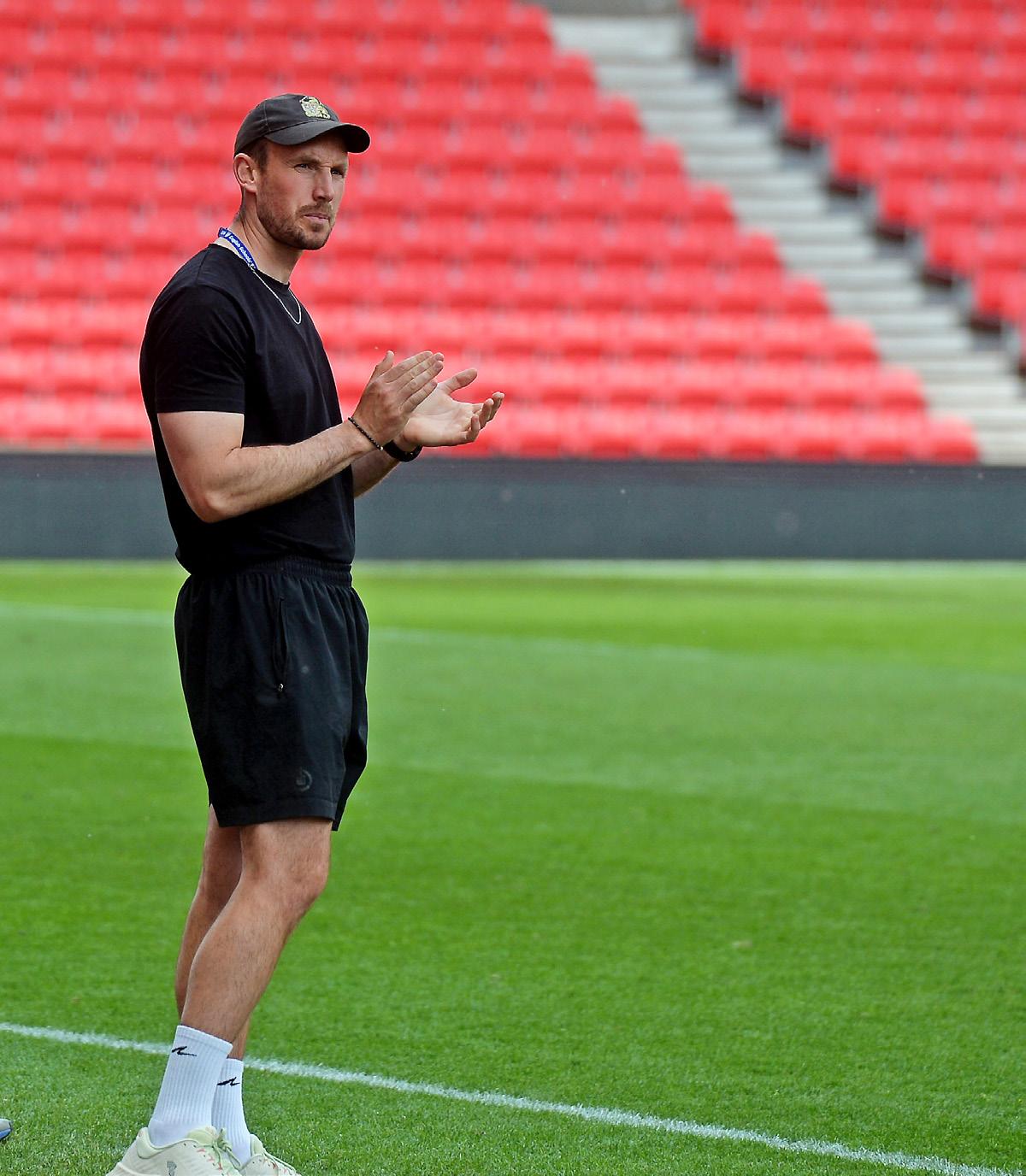
Mr Hurst, Assistant Director of Football, looks back on his coaching career and shares advice for young footballers with Harry Morris.
Recently, I was lucky enough to interview Mr Christian Hurst, a familiar face amongst Hampton boys, whether he teaches them PE or they see him on the fields on sports afternoon, coaching the sport that is his passion: football.
Mr Hurst started coaching when he was at school, completing coaching badges, while also doing summer camps, which provided him with valuable pocket money and invaluable experience. He has built up his portfolio throughout the years; various stints of coaching at a wide range of clubs, schools and organisations, have all helped turn him into the coach he is today.
At university, he coached at Cheltenham Town, a well-established professional side, while he was completing his coaching and teaching degree. He then became an intern at Fulham with the U23 squad, where he had the prestigious title of the “bibs, balls, and cones person,” which, as the title suggests, required him to help organise the drills, as well as being the on-hand assistant for the coach.
During his tenure at Fulham, he got to see firsthand talent, such as Ryan Sessegnon, who is a well-respected player in the Premier League, playing for both Tottenham and TSG Hoffenheim before returning to his boyhood club, Fulham. When asked to compare Ryan and Hampton footballing star Josh King OH (2025), who is also at Fulham, Mr Hurst noted that while he saw them both at different points in their career, King was “a little bit better” given he was at a younger age. Hopefully these words will bode well for an illustrious career in first team football!
Like many children across England, Mr Hurst joined a local side as a boy where he began to develop his love for football. Hamptonians may not know that Mr Hurst went to an international school and played in tournaments in different countries across Europe. Here, he reached the international schools’ equivalent of the ISFA final twice, but never quite managed to win the trophy.
As well as football, Mr Hurst also played rugby for his local club and in the second term for his
school, as he just wanted to play “any sport I could get my hands on,” with tennis and baseball also featuring sporadically in his routine. However, once he reached university, he made the decision to focus solely on football; at university, you can’t play both football and rugby because their matches and training sessions clash. He said he’d like to give coaching rugby a go, but admitted “there are a lot more qualified people at Hampton” than him!
More recently, Mr Hurst has been a coach for the ISFA representative sides, which he does when his Hampton commitments allow. ISFA is responsible for the development of the game in the independent school sector, and includes many Hamptonians whom Mr Hurst can keep an extra eye on. He mainly helps coach the U13 London representative team, but he is also a cover coach for all ISFA age-groups, so is called upon when he is needed for other teams.
While you may assume Mr Hurst joined Hampton as a Football Coach or a PE teacher, he actually joined Hampton not to do anything sport-related, but rather to be a cover supervisor, though “[his] goal was always to try and become a PE teacher at Hampton.” He is very grateful to the then Head of PE Mr Bolton who helped him to do his teacher training here, and he “hasn’t looked back since.”
Since becoming Assistant Director of Football, Mr Hurst has played a key role in a successful period for the school, with teams winning multiple finals
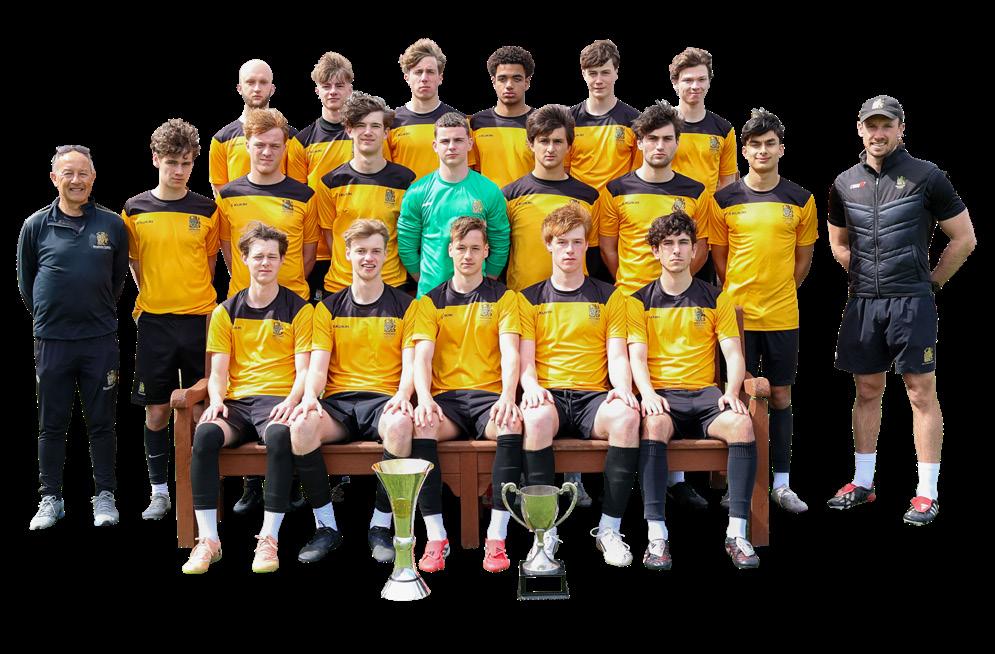
across all age groups, as well as countless county cups and other competitions. Yet, Mr Hurst enjoys all these successes equally, as what he really appreciates is seeing all the players “get a reward from all their hard work.” He also does not mind if they lose a final as at least “they’ve experienced it.” Although, of course, he doesn’t like seeing the players lose as “they’ve put so much hard work into it.” He still hopes that, when they look back and reflect on it, they will see “that actually it was a really fun experience.”
The reason for Hampton’s success over the past couple of years is largely thanks to Mr Burke’s and Mr Hurst’s progression plan for each age group, which helps develop Hampton footballers into elite athletes and players. This, coupled with genuine enjoyment on the players’ side, helps them achieve success along the way.
One reason why Mr Hurst is so dedicated to his job at Hampton, and all his coaching duties in general, is because he really enjoys it — he believes that “you shouldn’t do anything that you don’t enjoy or love.” He admits that while on a wet Wednesday afternoon he may not be initially up for coaching, he tells me that “as soon as I get to a training session and start setting up, that feeling goes away.”
While Mr Hurst remembers his playing days with fondness, he feels he made some errors in relation to his mindset and how he saw the game, and, therefore he tries to stop the players he coaches from making these same mistakes. When he was playing, he thinks that he “let the setbacks affect me more than they should have,” as he remembers short periods of time where he would “look to blame someone else and maybe try to sulk a little bit.” To young players who might not always be starting or getting picked for the team they want to be in, he says that you should “work harder when things aren’t going your way. Don’t take it personally or think you should be picked over somebody else. Just keep working hard and you know you’ll get the rewards from that.”
As a coach, Mr Hurst tries his best to first set an enjoyable environment, because he strongly believes players should “play football for enjoyment.” He builds on this by tailoring every training session to the age group, according to his and Mr Burke’s progression plan, whether that be more technical coaching for U12 and U13 squads, or more tactical skills with U14, U15 or senior teams, where the main aim is to win. Mr Hurst helps to
show off his array of coaching skills while always sticking to that all-important rule — making it enjoyable — so that, as players get older, they are still involved with football, whether that’s watching, playing, refereeing or just doing anything football related — this is “really important” to him.
Finally, Mr Hurst has a message he would like to share with Hampton footballers of all standards, one which you will have heard many times throughout this piece which is simply: “play for enjoyment.” When playing football, you could get bogged down with “What do I need to improve?” or “I’m working so hard at this and it’s not coming off, and I’ve had three bad games in a row." Mr Hurst believes that when you start to think like that, you lose your enjoyment, which is the main driving force that helps you to progress and get better.
You can make great friends from it, you get great experience from it, and the more you enjoy it, the more you will learn.
BY RANVI PAUL
Akshat Pruthi on his relentless training schedule and life as a triathlete.
If you ever find yourself at Thames Turbo Triathlon Club (TTTC) on a Tuesday, Wednesday, Thursday or even a Saturday, you’ll probably spot Akshat Pruthi powering through the water, pounding the pavements, or even pushing pedals with a quiet intensity. At just 11-years-old, Akshat isn’t just participating — he’s living and breathing the sport.
His week is a blur of movement. It begins on Monday with a gentle run at Hampton’s Cross Country Club, readying him for the busy six days ahead. Tuesday, the pace picks up. TTTC swimming demands focus and stamina, with the young triathlete swimming 1.5km, which is no small feat for someone his age. Wednesday brings a fast-paced cross country run, and Thursday another swim session. Friday brings a lighter run, with Akshat going eagerly to Hampton’s Cross Country Club at lunchtime. But weekends? That’s when Akshat goes full throttle.
Saturday is his long run day — 6 to 12km at least — and if he is not completely wiped out, then Sunday is parkrun time and another stamina session.
“But it’s only if I am not too dead,’’ he joked. It’s the type of humour that only someone who is truly exhausted can pull off.
But Akshat isn’t just training — he’s competing. And he’s making waves. In TTTC duathlon. He clinched a narrow second place finish with a run time that turned heads in his age group. He’s raced in three aquathlons, going up against teams from across London. In one of them, the young triathlete, aged only ten at the time, placed seventh in the 12-13 age group category. That kind of result doesn’t come from luck. It comes from grit.
One race in particular stands out. Akshat was placed at the back of the pack after a tough swim, trailing by two whole minutes. Most
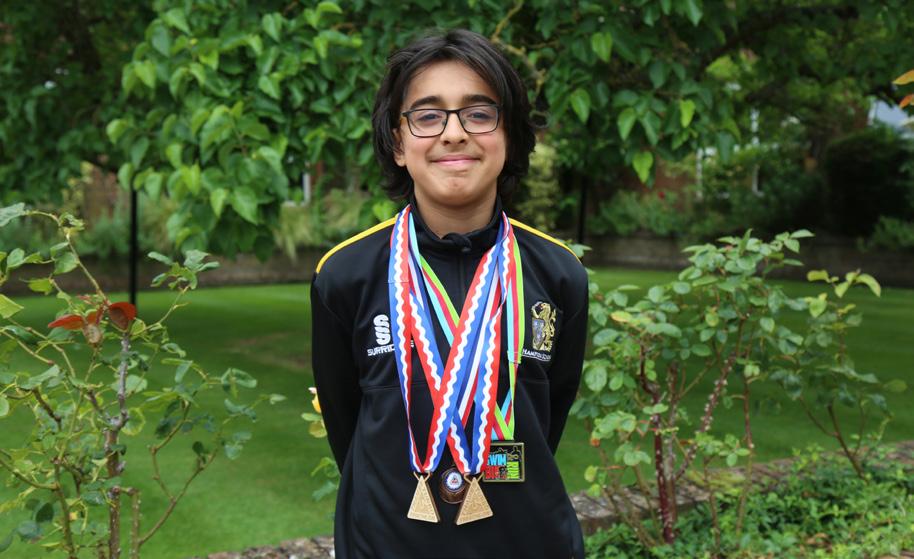
athletes would have panicked. But Akshat didn’t – he dug deep. When I interviewed him, he said, “I gave everything I could in that run.” And it showed. He surged forward in that race from 56th to second with a 7:59 for 2km. One of the fastest in his club’s history for that age group. Not bad for someone who started off last.
Ask him about his medals, and he’ll laugh.
“I can’t find any right now,” he says. But it’s clear, to him, the real prize isn’t metal — it’s momentum. It’s the feeling of clawing your way back, pushing past the pain and giving everything you’ve got.
Akshat’s story isn’t just about sport — it’s about character. He’s the kind of athlete who doesn’t just train hard but also smart. He knows when to push himself, when to recover and how to keep going while everything hurts. He’s got the mindset of someone far beyond his years.
And while his schedule might sound exhausting, Akshat wouldn’t trade it for the world.
“It’s tiring," he admitted, “but rewarding."
It’s the quiet pride of knowing you showed up, gave your all and left nothing behind.
For anyone watching from the sidelines, Akshat Pruthi is more than just a promising young triathlete. He’s proof that passion and perseverance can take you far even when you start at the back of the pack.
Hampton Sports Chronicle meetings take place on a weekly basis at lunchtimes. See Mr Baker in the English Department for more details.
BY JACK DORSETT AND MAHIR OLCER
You might know Mr Vitaly Berezhnoi for his passion for Classics, but there is another side to him that you’re probably not aware of. From training across the globe to competing on the international stage, Mr Berezhnoi has spent years mastering two incredibly intense, high-energy disciplines outside of the classroom: breakdancing and jujitsu. He knows exactly what it takes to build real physical strength, mental resilience, and stay dedicated to a craft even when beginning later in life.
In this interview, Mr Berezhnoi opens up about his journey, his biggest competitive achievements, the support from his family, and his thoughts on a major controversy at the 2024 Paris Olympics. He also shares how his unique passions led him into teaching.
Can you tell us exactly what breakdancing is? Breakdancing is a form of dance. It originated in the United States in the 1980s and includes lots of cool, acrobatic moves. I learnt it in Edinburgh and Russia when I lived there.
At what age did you start doing breakdancing and jujitsu?
I started both quite late when I was a young adult. I used to really enjoy playing football and basketball, but I didn’t start breakdancing until I was aged 22 and jujitsu even later, around 27-years-old.
What is your biggest achievement in either sport?
I didn’t win a lot in breakdancing, but in jujitsu I compete regularly. My biggest achievement was winning gold at an IBJJF international jujitsu tournament in London. I have also won the occasional bronze, silver, and gold medals.
What would you say the hardest part of breakdancing is for you?
I think the hardest part is maintaining consistent training and fitness. You can end up doing things you like or find easy, rather than what you actually need to improve. It’s also difficult to find places to train because it’s quite an unusual sport.
What inspired you to do breakdancing?
I had a friend after school who was a breakdancer in a group called the B Beasts. That really inspired me.
What support did you have from your family?
My parents and my wife really helped me. It’s always good to have people supporting you because you can’t do everything by yourself.
What would you change if you could go back in time?
With breakdancing, I would have liked to start younger, as it helps to build strength from an earlier age.
What did you think about the controversial breakdancing event at the 2024 Paris Olympics? I think the competitor was probably messing around a little, but people also took it too seriously. In some ways, she was dancing culturally, but in the end she did not medal at the event.
Do you think these sports should be included at School for younger Hamptonians?
I think dance is a great form of exercise because it helps build a strong core. Jujitsu is also good, but probably more suitable for older pupils as it is a full-contact combat sport. Breakdancing is also excellent for strength and has a positive effect on your whole body.
What made you decide to become a schoolteacher?
After school, I went to university. A friend who was already a teacher suggested I try it. Since I really enjoyed the classical subjects, I thought it sounded like a good idea and something I would really enjoy.
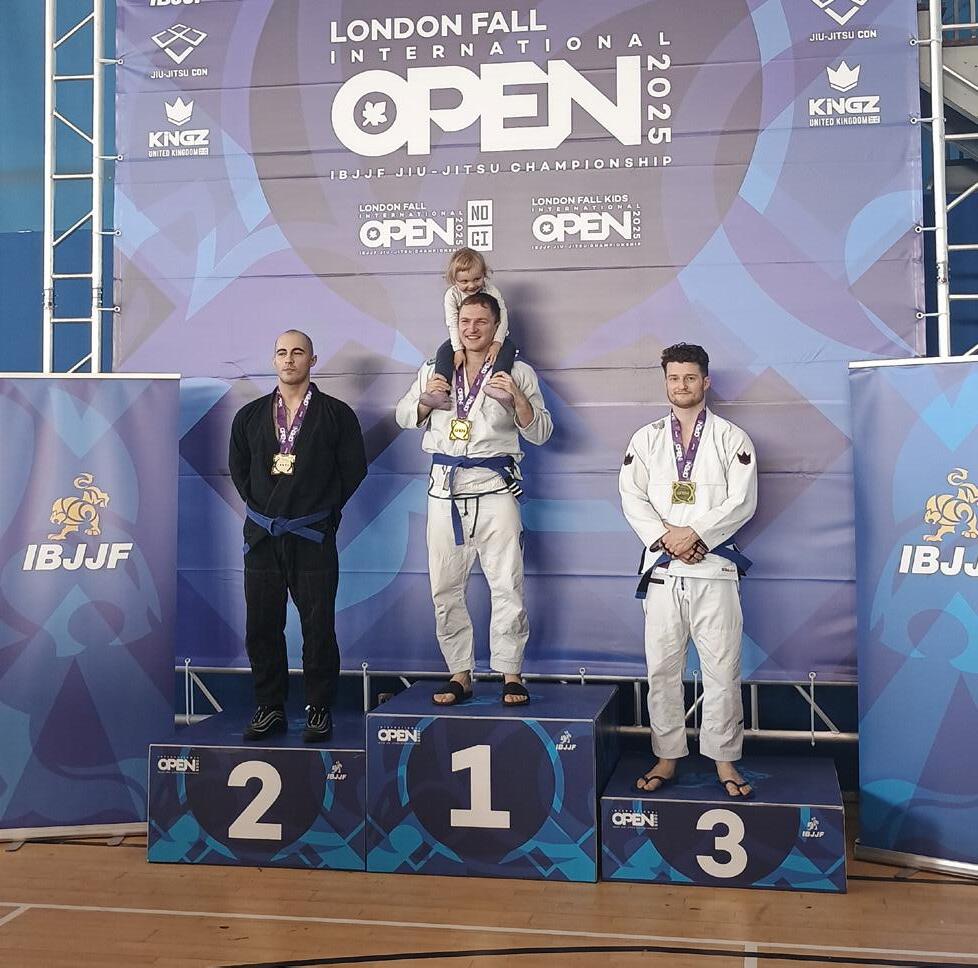

BY TOM SCRIMSHAW
Tom Scrimshaw finds out who the Hampton Common Room is backing in the 2026 World Cup.
As the 2026 FIFA World Cup draws closer, excitement is building ahead of what promises to be the sporting event of the summer. Beginning in June, the 23rd edition of the tournament is due to be hosted by three nations: the USA, Canada and Mexico, in an attempt to spread the load after FIFA’s decision to expand the tournament from 32 to 48 teams.
With no clear favourite heading into the tournament, the footballing world has been watching closely, and the emergence of several previously discounted nations certainly throws a spanner in the works. Ahead of this year's competition, I asked members of the Hampton Common Room for their predictions.
Whilst opinion remains divided over the frontrunner for the World Cup, it would be naïve to ignore the mighty presence of France on the world footballing stage. Amongst those backing them is Mr Hall, citing that “their strength in depth is unbelievable and they seem to have pretty much everybody fit and in form going into the World Cup.” If European success is anything to go by, then Miss Allocco believes Spain are the favourites, given their accomplishments at Euro 2024 that undoubtedly give them a psychological boost preceding the tournament.
As always, England fans remain hopeful that this will finally be the year where they win their first piece of major silverware since 1966. Whilst many claim that it’s the hope that kills you, Mr Hooper is confident that “it’s not the hope that kills you, it’s the knowing it’s the hope that kills you that kills you.”
Having experienced recent continental success, Mr Baker and Mr Hemsley believe it will be Portugal that go all the way, with the former explaining that “they don’t get the same number of column inches in the run up, but you would be foolish to forget their creativity, firepower, and pedigree at the major tournaments.”
When asked about the underdogs flying under the radar, the consensus was one of scepticism yet intrigue, given the way in which the Scandinavian nations have gone largely unnoticed. Given their 100% qualifying record, Mr
Baker senses that Norway are the outsiders and warns fans to be prepared for the Scandinavian nations “to put chills down the spines of spectators.”
Beyond Europe, Miss Cookson believes Japan have a better chance than people may think “as they have been steadily improving and play a very modern, high-tempo style.”
For those that believe in home advantage, the USA should be carefully considered according to Mr Hooper given the experience of manager Mauricio Pochettino and “the fact that they have put a lot of time and effort into their football team over the past years.”
Mr Hall, meanwhile, suggests it is teams such as Morocco and Turkey that should have a close eye kept on them, given how the former won the Africa Cup of Nations, and how if the latter get it right, “they could be a tricky team to beat, and the draw could open up for them.”
The controversy surrounding the footballing rulebook continues to steal the limelight in the buildup to the event, with the unpopularity of Video Assistant Referee (VAR) and rise of the so-called ‘dark arts’ threatening the integrity of the beautiful game. To combat time-wasting, Miss Cookson believes that “a strict timekeeping system” should be implemented, “essentially stopping the clock when the ball is out of play (like in basketball). It would eliminate time wasting and make matches more transparent.”
Rather understandably, Mr Hemsley thinks “instead of sending refs to a screen, I’d have the VAR officials making decisions themselves. That way, VAR would step in only for obvious mistakes instead of passing the buck to the ref.”
Keen to see a crackdown on unsportsmanlike conduct, Mr Baker proposes the introduction of “sin bins of five to ten minutes for dissent and time-wasting. It would be great viewing to see France playing with only seven players…!” He also went so far as to suggest getting rid of the offside rule but did acknowledge that if he had his way about this, as in hockey, it “would leave football fans with precious little to argue about!”
HSC co-editor, Arun Crowe, catches up with Freddie Skinner OH (2023) on how his rugby career has developed beyond the pitches of Hanworth Road.
Sport and Hampton are almost synonymous. Throughout their time at the School, most Hamptonians have the chance to wear the yellow and black, representing Hampton across a variety of sports. These opportunities don't just sit alongside academic life, they complement, enrich it and help shape the Hampton experience. However, not everyone who steps onto those pitches, courts and tracks will become a Josh King OH (2025) or a Louis Lynagh OH (2019), going on to represent their country on the international stage. And so it raises the important question: what does sport look like after Hampton?
Freddie Skinner OH (2023) started his sporting life at Hanworth Road like countless others before him and many since. After being signed up by his dad at six-years-old to London Scottish Rugby Club, he had developed that same love for the sport, and started his schoolboy rugby as a fullback for the U12A team, continuing for three years in that same position.
Third Year brought the hardest moments of his Hampton career. After years of being a consistent and prominent player for the A team, he was dropped unexpectedly to the Bs, a huge knock to his confidence. But Skinner was determined not to be weighed down by this setback, using it to fire his graft in the gym and on the training pitch. It took just three matches for him to be moved back up to the As, something he never took for granted again. Instead, he pushed further forwards, utilising these newfound strengths of resilience and appreciation to work harder than ever. The following year, in an U15 season ravaged by injuries, Skinner adapted his game to the needs of the squad, playing every possible position across the back, including the unchartered, and slightly perilous, territories of scrum half, and thus becoming a crucial player for the A team.
These qualities of open-mindedness and versatility elevated his game even further, seeing him earn a place in the First XV, where he played for two years at the highest level of schoolboy rugby. Skinner helped the team reach an impressive seventh place in the national NextGen rankings, whilst also claiming individual success in the form of the ‘Most Improved Player’ award at the end of his time at Hampton.
However, after those years of triumphs and camaraderie out on the Hampton pitches, there can be an uncertainty about what comes next. With
the imminent pressures of university and future job prospects, many end up leaving sport behind in pursuit of academic targets.
But Skinner decided against this, feeling unable to give up such an important part of his life. Studying economics at Exeter University, he opted to continue his rugby in tandem with his course, taking the lessons learnt from Hampton into this next chapter. The outstanding facilities, the teachings of exprofessionals like Mr Beattie, the social aspect of the sport were what he used to push his game further; these efforts brought with them unprecedented success.
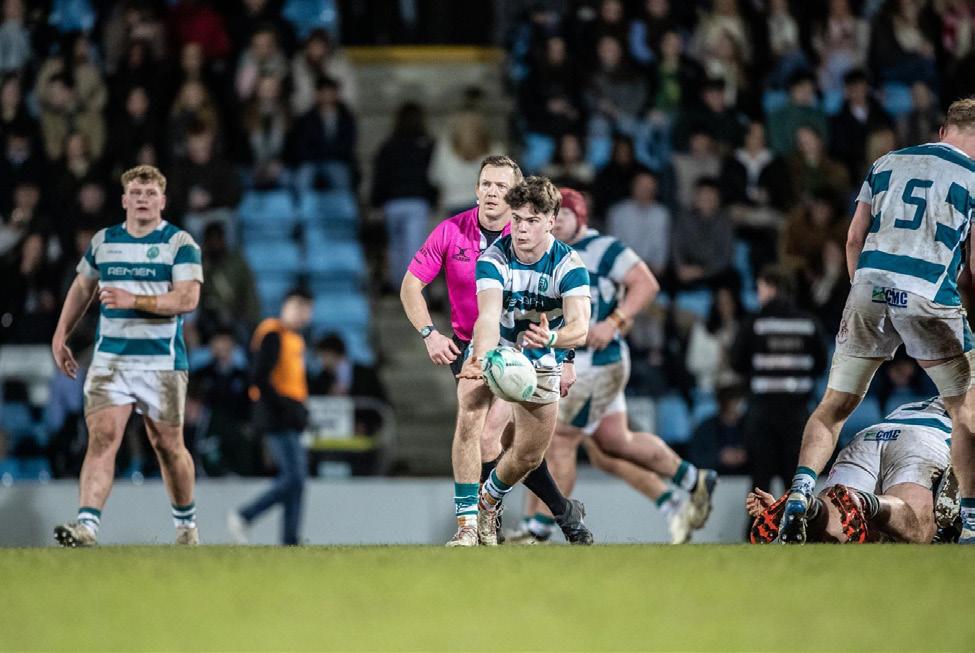
Attending fresher’s trials, Skinner’s standout performance landed him in the position of starting nine in the third team. And this already considerable achievement was only the start, as a string of impressive displays prompted his promotion to the second team, where he played nine games and even featured once for the First XV, a feat almost unheardof for a fresher at one of the country’s most highly competitive rugby universities. In his second year, his meteoric rise continued, with Skinner claiming the position of starting scrum half for the First XV, earning 21 caps, helping the team reach the BUCS Super Rugby semi-final and even win the University Sevens.
As Skinner’s time at Exeter continues, chasing dream careers in both rugby and finance, his experiences underline the possibilities of maintaining sport and academic balance after leaving Hampton. The importance of sport, at any and every level, can never be underestimated, and so that balance, if struck correctly as Skinner has, can allow and help sportsmen to flourish both in the classroom and out on the fields.

First Year writer Felix Payne takes a look at the phenomenal rugby success of the three Lynagh Brothers Louis OH (2019), Tom, and Nick OH (2025). What makes them so accomplished in their Lynagh work?
I first came across the Lynagh brothers when I saw a poster of Louis Lynagh OH (2019) in his Harlequins kit at School. I was very interested in him, and when I saw that he had been signed for Italy and had moved to Benneton Rugby (an Italian club), I was flabbergasted at how, in just five years, he had gone from being a Hamptonian to an international rugby player. I had to find out more about him.
I first looked at Louis’s brothers. I was intrigued when I saw that his middle brother Tom played for Queensland Reds, and his youngest brother Nick Lynagh OH (2025) had recently signed for the Harlequins Academy. This was a trio of extreme talent, and I soon discovered why. Their father is an ex-Australian rugby player. Michael Lynagh received 72 caps for Australia and captained them for two years, from 1993 to 1995.
The mum of the Lynagh brothers is Italian, so they have a three-way passport. UK, Italy and Australia.
Louis
Louis was born in Treviso, Italy, which is also where both of his brothers were born. The Lynagh family moved to England when Louis was four and he attended Hampton School.
He joined Harlequins Academy when he was 13-years-old and made his debut for the professional team in 2019 against Leicester Tigers, scoring a try.
Louis then signed a two-year contract with the Italian side Benneton Rugby for the 2024-25 season. Lynagh also represented the England U16 team and in the summer of 2018, was part of the U18 side that toured South Africa.
In September 2021, he received a call-up from the England head coach Eddie Jones for the summer training camp, though he was not capped. Then, in February 2024, he received a call up from the head coach of the Italian team Gonzalo Quesada to play in the next Six Nations tournament.
He played on the wing for his debut match, against Scotland, in which he scored a try and Italy won. Now he is still playing for Benetton in the United Rugby Championship and the Italian National team. This young player has a long road ahead of him and has great prospects in his future. Personally, he is one of my favourite players, and I can’t wait to see how he fares in the upcoming Six Nations. Now, on to his brother, Nick Lynagh.
Nick
Nick was a clear talent from a young age; he started playing for the Hampton First XV when he was in Fifth Year. Hampton School was very proud of him and his brother Louis, as they both graduated from Hampton to Quins.
When they announced his arrival in the setup, Quins said that they were excited by him and stated him as another incredibly talented Lynagh brother. Mr Beattie said “Everyone at Hampton is delighted for Nick. A talented winger and he has been a big part of rugby at Hampton since joining in Third Year and we look forward to seeing him develop as a player with Quins.”
Nick also stated that he was incredibly grateful for the opportunity and that he realised that this had been a dream since his childhood. He is much admired, and is a great prospect for Harlequins. These two Hamptonians will stay long in the School’s memory. Now, the third brother: Tom Lynagh.
Tom
Tom was the only brother who didn’t attend Hampton; instead, he studied at Epsom College. Like his brother Louis, Tom began his rugby journey with Harlequins. At 17, he faced a life-changing moment in his career when the Queensland Reds offered him a contract in Australia. Choosing to commit to the green and gold of the Wallabies — despite remaining eligible for England and Italy — Tom followed in his father’s footsteps and made his international debut for Australia in 2024, coming off the bench in a match against Wales.
Tom said after the game, “This is something that I have always wanted to do. I am living the dream.” Tom is still playing for Australia, and exactly like his siblings, he has a very bright future ahead.
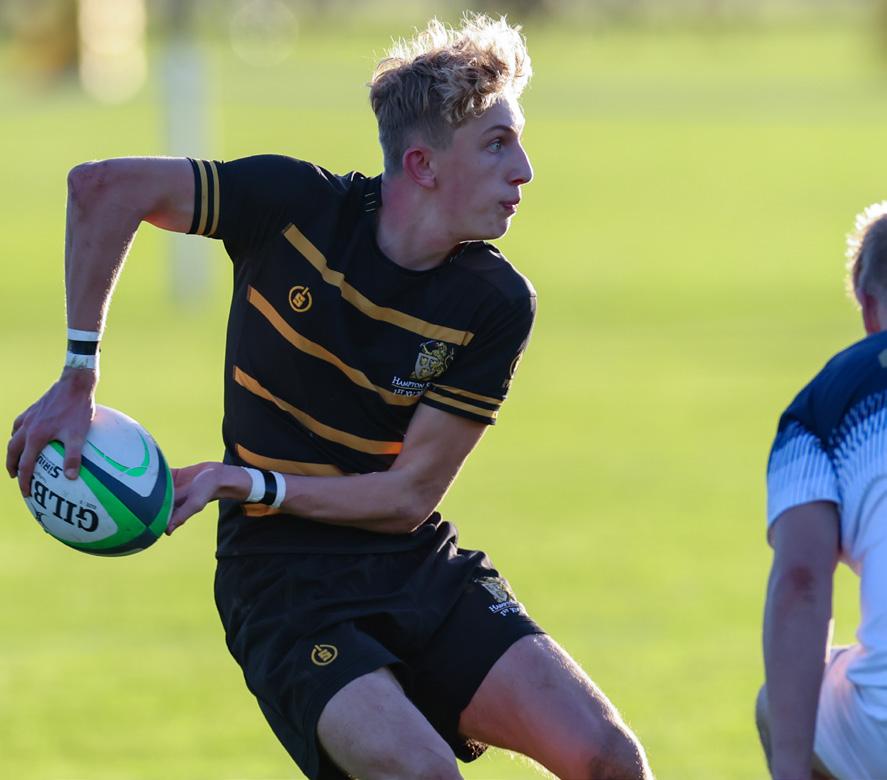

But, I still have some questions lingering in my mind. How do we explain the remarkable success of the three brothers? Is it because of their dad or is there more to it? Michael Lynagh was a legend of the game and played many games for Australia, Benneton, and Saracens. He was a great player and has strongly influenced his three sons, playing a massive role in their development.
But is that all?
Louis is very complimentary and grateful to Hampton rugby. In a Talk! with his dad (at Hampton) he said that he had so many memories, with his favourite one being a victory over Dulwich School, which included a stunning try at the end of the match to beat their arch-rivals. He added that he felt happy coming back to Hampton and presenting himself in front of hundreds of Hamptonians.
His brother Nick said, “I am so grateful for my amazing life at Hampton and for all the others that helped me along the way.” Tom also enjoyed Epsom College. He played in the first team for rugby, football and cricket and was praised for being a “great and humble kid.”
So the question is, is the secret of their talent their heritage or the superb schools they went to? There is much more to come from the Lynagh brothers and we can't wait to see it play out on rugby pitches all over the world.
The U15 squad enjoyed a fantastic experience at Villarreal CF in Spain, playing high-quality football, participating in excellent training sessions, and developing skills to carry into the rest of the year.
The tour began with training at a local pitch, followed by an early session the next morning at Villarreal's superb facilities. This was followed by a fascinating tour of Estadio De La Cerámica, the Villarreal stadium, where the players visited the museum and changing rooms and took in the pitchside view.
Following this, Hampton had two tough fixtures against strong club-affiliated sides. The A team game began evenly, but after falling behind, the match swung in Villarreal’s favour and Hampton were unable to respond. In the B team fixture, the Spanish side proved similarly challenging under the floodlights, and, despite an unbeaten start to the season, Hampton found it difficult to break them down. Although the results did not go their way, both matches provided a valuable insight into the level required leaving the Fourth Years plenty to take forward for the rest of the season.
The next day began with another training session on the Villarreal pitches. Tired from the previous day's matches, the squad remained motivated as they prepared for their final fixtures. After training, they watched part of the Villarreal CF vs Manchester City U21 match at the training facility, before turning their focus to the last fixtures of the tour.
In the A team match, Hampton faced IDA Valencia, and, despite conceding an early scrappy goal, they turned the game around to win 3-1. In the B team match, a hard fought game in very hot conditions against Vall De Uxo, ended in a 1-0 win for Hampton, thanks to an outstanding goal and solid defending.
The tour proved a great experience, providing opportunities to face high-quality opposition with varied tactical approaches and to benefit from expert coaching in professional-level facilities. Both teams have already begun to apply these lessons, achieving strong results during the 202526 season, and can be very excited about what's to come next.
The U13 team had its first cross country race of the year at Harrow School. The course was 2.5km with some hills, but overall it was quite flat. Hills can slow down your momentum, so it was good to hear that there were only a few.
Our team was Noah, myself, Aizhou, Vivaan, Ethan, Filipos, and Thomas. We had a strong squad and were confident that we could make it to the next round. In this competition, the top four in your team score points for the place they finish, and the team with the least points win. My 3km time was 11:36, and I was hoping to run under 10 minutes.
The start line was nerve-racking, with lots of runners ready to go. The honk of the horn set us off. At the start, unless you get out quickly, you can be boxed in by all the runners, and, with the year 7, 8, and 9 girls running with us, it made it extremely hard. My starts aren’t usually that great as I conserve my energy for later, so I had around 40 people ahead of me in the first 200m.
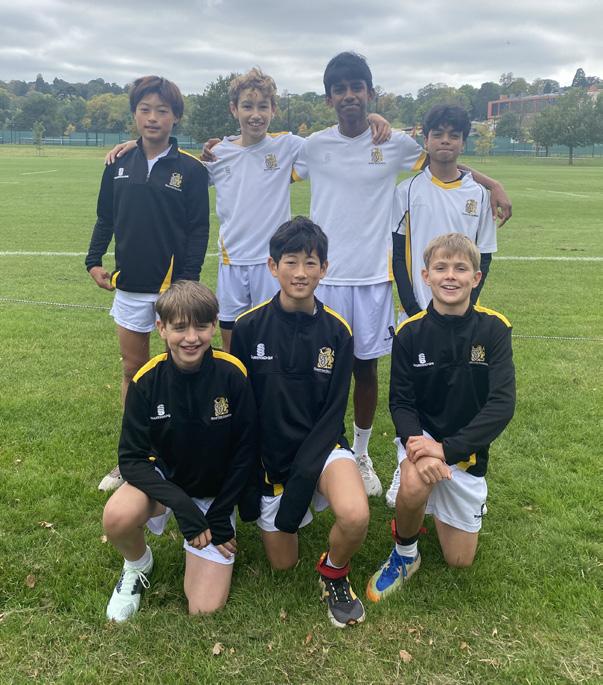
I started to pick people off, and, by halfway, I was around 20th. There was a steep gravel hill, which drained me a little, but I still felt in great shape and kept pushing on. I was in 9th and quickly gained a place, but there was a 15 second gap between me and the next runner. I was able to close this gap slightly but still finished around ten seconds behind seventh with a time of 9:29. First place finished with a blistering time of 9:01, but I was still extremely happy with my time.
Noah, our dominant runner, unfortunately picked up a hamstring injury with a kilometre to go, meaning he couldn’t be on the points with us. However, the rest of the team had strong positions, and, with 53 boys racing in total, we were all happy. Overall, it was a great performance and, hopefully, we will qualify for round two.
On 18 May, the Hampton U12B footballers played in the ESFA final at Stoke City. Before the match, we stayed at St George’s Park, where the England teams train. After a session at Stoke City's Academy Dome, we left for the Bet 365 Stadium – Stoke’s home ground – and stepped out onto the pitch to warm up, greeted by cheers from our parents in the stands. The pitch was sized down for 9-a-side football, and we ran a possession drill before returning to the dugouts. We then met the referees and opposition, Blessed Thomas Holford College, ahead of kick-off.
It was a tight match, with our opponents hitting the post twice in the first half and our defence working well to keep the ball out of the net. Al Malston, our keeper and captain, pulled off a series of brilliant saves. We rarely got a run in behind and when we did, it was met by their defenders either intercepting the ball or tackling us.
After the coaches half-time team talk, we started to attack left and right. They managed to get a few chances in front of goal but were met with rock solid defence from Hampton. Lenny McNulty scored a tap in early in the second half before Alex Dale lobbed the keeper from just outside the area. 2-0! When the whistle finally blew, everyone came running out onto the pitch.
We were champions of England! Henry Lawrie, our midfield technician, collected the Man of the Match prize – he played brilliantly. We were called up to collect our medals, before captain Malston collected the ESFA trophy. He brought it to the group and we lifted the cup!
We were all so happy! We celebrated with our supporters and then headed to the locker rooms to celebrate some more. We all had dinner in a massive box at the top of the stadium and talked about the match. The day was one of the best experiences of my life, and there is no doubt that we will do our best to defend the title next year.

Hat-trick inspires U13A Rugby Masterclass by Arthur Hanna
The Hampton rugby players woke up on a cold January morning ready to face Merchant Taylor’s School on the pitches of Hanworth Road. The sides had never met before, so both teams were unsure how the other would play.
Hampton began on the front foot and capitalised after a Merchant Taylor knock on to have the first scrum of the match. After a few phases, the ball found its way to Hampton’s lock, Luke Bennett, who powered through the defence to score the opening try. Hampton gained momentum and scored a second try, with Arthur Hanna feeding the ball to Benjamin McCune, who ran a beautiful line to pierce the defensive line.
In a superb solo effort, Dylan Turrell got the ball on the halfway line, produced a stunning turn of pace to sprint down the touchline, and, as the opposition’s fullback came to make the tackle, Turrell stepped inside to evade the last man and score a wonderful try. At half-time, the scoreboard read 25-0.
With the second half underway, Hampton knew they had to be wary of the Merchant Taylor’s centre, who had previously been playing wing but was now in the thick of the action, making bulldozing runs through the middle of the pitch. Hampton kept the pressure on, and, with a two-on-one, it looked certain that Hampton would score. However, the wrong decision was made under pressure, and the try went begging.
A few phases later the ball was taken into contact by Hampton and their new scrumhalf, Arthur Hanna; he spun the ball down the blindside to Ralph Leverett, who dived in to extend the lead. Hampton kept up the pressure and added more tries to the scoreboard. But, a sudden burst from the opposition centre put him in for the first try for their team. Hampton didn’t let this faze them, and Leverett completed his second half hat-trick before Sol Welch powered through a tired Merchant Taylor’s defence to round off a superb team display, with the final score 45-5.