Good Tidings News from the Hampton Roads Community Foundation
Summer
2026
Together, Virginia Legal Aid and ForKids Create a Powerful Team Foundation grant helps nonprofits continue to offer free civil legal aid and rental assistance to low-income Hampton Roads residents
The man rocks in his chair, obviously nervous, clutching a sheaf of papers in the tiny meeting room outside Suffolk General District Courtroom One. His neighbor brought him the eviction notice. He moved to Suffolk to take care of his mother, who has been ill with schizophrenia for as long as he can remember. When he was in college, she rented an apartment in his name. She didn’t pay the rent or the utility bills and ruined his credit. “She would go for six months to a year not answering the phone,” he said. “She doesn’t even remember it.” He landed a job when he moved here, but his start date was delayed. He got behind on his rent, all while he and his cousin tried to care for his mom. He did not want to share his name because he worried about what his new employer would think of his predicament. Now he waits for his case to be called, one of dozens of people on the morning’s eviction docket wondering if they will still have a home at the end of the day. He looks down the hall at Virginia Legal Aid Society attorney Amy Disel Allman, who waits outside the courtroom doors. “Hopefully she’s working magic,” he says. Fortunately, she can. For nearly 50 years, Virginia Legal Aid has provided free civil legal services to lowincome residents in 26 cities and counties in Central, Southside, and Western Tidewater Virginia. In 2020, during the COVID-19 pandemic, Virginia Legal Aid began offering eviction clinics. “We had to be boots on the ground where it was happening,” said Allman, who was then Director of Advocacy for Legal Aid. “We couldn’t wait for people to come to us. It was urgent.”
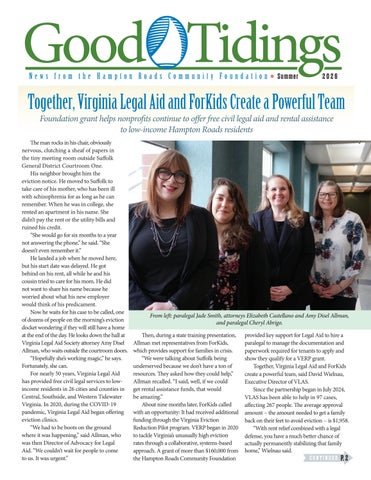
From left: paralegal Jade Smith, attorneys Elizabeth Castellano and Amy Disel Allman, and paralegal Cheryl Abrigo. Then, during a state training presentation, Allman met representatives from ForKids, which provides support for families in crisis. “We were talking about Suffolk being underserved because we don’t have a ton of resources. They asked how they could help,” Allman recalled. “I said, well, if we could get rental assistance funds, that would be amazing.” About nine months later, ForKids called with an opportunity: It had received additional funding through the Virginia Eviction Reduction Pilot program. VERP began in 2020 to tackle Virginia’s unusually high eviction rates through a collaborative, systems-based approach. A grant of more than $160,000 from the Hampton Roads Community Foundation
provided key support for Legal Aid to hire a paralegal to manage the documentation and paperwork required for tenants to apply and show they qualify for a VERP grant. Together, Virginia Legal Aid and ForKids create a powerful team, said David Wielnau, Executive Director of VLAS. Since the partnership began in July 2024, VLAS has been able to help in 97 cases, affecting 267 people. The average approval amount – the amount needed to get a family back on their feet to avoid eviction – is $1,958. “With rent relief combined with a legal defense, you have a much better chance of actually permanently stabilizing that family home,” Wielnau said. C O N T I N U E D P. 2
Continued from page 1
Virginia has one of the highest eviction rates in the country. Five of the top 20 cities with the highest eviction rates in the country are in Hampton Roads, according to the University of Virginia’s Equity Center: Hampton, Newport News, Norfolk, Portsmouth, and Virginia Beach. According to the Eviction Lab at Princeton University, more than 25 percent of renters in Newport News and Hampton have faced eviction proceedings. Richmond has the highest eviction rate in Virginia. Suffolk, Franklin, and Isle of Wight are home to more than 2,200 eviction proceedings a year, more than double the national average. That’s in part because in Virginia the eviction process moves quickly: Until July 1 of this year, tenants had five days to comply after receiving written notice of falling behind on rent. Landlords must now give 14 days. After that, a landlord can take a tenant to court to seek eviction. Tenants can go from notice to ouster in less than two months. “The Virginia process is definitely designed from the ground up to help the landlord get the tenant out as quickly as possible,” Wielnau said. “Virtually every time the landlord is going to win on the spot.” Evictions are also high because of a shortage of housing supply, which drives up rent, according to the Equity Center, as well as rising rent in property purchased by real estate investment firms. Shirley Brackett, the crisis response director at ForKids, said most families it supports are working full-time jobs but are “severely rent-burdened” – more than 50 percent of their income goes toward rent. That means it’s impossible to cover the rent out of just one paycheck per month. A single unexpected expense – a flat tire, an illness, a delayed paycheck – can set the eviction process in motion. Crystal Rosario landed on the Suffolk eviction docket. “I’m a type 1 diabetic, and I have a stomach condition that can put me out of work,” she said. “I have FMLA, but it’s unpaid. Then I got the flu twice. I got behind.” So did Angela Copeland. After years of dealing with doctors’ visits for his chronic pain, Copeland’s 13-year-old son was diagnosed with stomach cancer. She, too, has unpaid time off to care for her son through the Family Medical Leave Act. “When I don’t work, I don’t get paid,” Copeland said. “I’m behind now.” She said the eviction notice was posted to
her door on Christmas Eve. She had to reschedule her son’s first radiation treatment to attend the court hearing. Brackett said a missed rent payment sets in motion a spiral of debt. “Then you have a 10 percent late fee, $200 to $400 in court fees and attorneys’ fees added to your bill. Attorneys’ fees are being collected whether you ever go to court,” Brackett said. “They never catch up.” Add to that lasting effects: an eviction ruling means a tenant’s chance of finding a decent place to live again plummets. “There’s a perception that people make bad choices and don’t pay their rent,” Allman said. “We don’t see that. The people we see are doing their best. They want to pay their rent. They want to be good tenants.”
Amy Disel Allman talks with a client who received an eviction notice. He fell behind on rent payments when his new job started later than he anticipated. With the eviction clinics, VLAS tries to break the cycle. Allman and her team – attorney Elizabeth Castellano and paralegals Cheryl Abrigo and Jade Smith – stake out that little meeting room before every eviction docket at the Suffolk General District Court. The room is stocked with brochures on Virginia Legal Aid, the eviction process, and tenants’ rights. Allman and her team announce their presence to those waiting in the hall: “Good morning! Legal Aid is here for its weekly legal clinic. We may be able to offer you free legal advice.” Several people ask for help. Allman pulls up a chair, yellow legal pad on the table in front of her, to talk to people hoping to stay in their homes. “Have you made any payments at all?” she asks. “Do you have documentation of communication with your landlord? Do you have pay stubs? Do you have your lease?”
2 H a m p to n R oa d s C o m m u n i t y Fo u n dat i o n
“Something I could use as a defense,” she says. The program is strictly designed to help people who are highly likely to continue making rent payments on time after debt elimination through the Virginia Eviction Reduction Pilot program. Only about 50 percent of applicants are approved. “VERP is not your answer if you have nothing,” Brackett said. “This is down and dirty let’s get you on your feet.” Even that narrowly applied support has had a significant impact, Brackett said. “For every eviction we prevent, two more filings are not happening,” Brackett said. “We’ve had a 30 percent reduction on the filing rate in Chesapeake. When we look at it there’s no other interventions that started in the same time period.” The financial savings are similarly impressive. It costs “at least $8,600 for each family that ends up in shelter” for the unhoused for 100 days, Brackett said. “Just to move someone into a new house and stabilize them is over $3,600.” And that does not consider other financial costs, such as emergency room visits or the burden on schools that provide services, including transportation to students experiencing homelessness. Allman said the VERP program also benefits landlords. “Most people who get a judgment, it’s just on paper,” she said. “If someone has fallen that far behind, they’re not collectable. The landlord is never going to see that money. It’s a hollow victory.” “So the rent relief program was crucial. It got cases off the docket and allowed them to deal with more substantive cases.” With Allman’s help, the man with the sheaf of papers was approved for VERP rental assistance after he paid his portion of the rent. ForKids cut a check to his landlord, and his case was dismissed. Crystal Rosario also received rental assistance through VERP and was able to pay her portion of the rent and remain in her home. Legal Aid negotiated additional time for Angela Copeland, who was able to pay her balance. Her case was dismissed, too. Since all the cases were dismissed, none of these three will have a dent from eviction on their tenant record. That’s huge, Allman said. “Those folks motivate you to try to do better,” Allman said. “I’m really proud of the work we do. We have an amazing team. It’s a godsend to have rental assistance in our toolbelt again.”
Recent Grants Nonprofits around the region will receive nearly $1.2 million in grant funding for work in the arts, educational success, and for addressing youth at risk of gun violence, gang violence, or teen pregnancy. The Hampton Roads Community Foundation awarded $936,000 in educational success grants to programs that strive to improve educational achievement of under-performing youth from our region. Grants awarded were:
$30,000 over three years to the Don Carey REECH Foundation
$300,000 over three years to An Achievable Dream to support
The Foundation awarded $218,570 in cultural vitality grants to programs that offer hands-on arts and cultural experiences for children in our region with the goal of helping the educational, social or emotional well-being of youth through arts and culture. Grants awarded were:
its afterschool program.
$150,000 over three years to Give Back 2 Da Block
for its L.E.A.D. program, a school- and community-based mentoring, academic support, and empowerment program serving elementary-aged boys in Portsmouth. $120,000 over three years to G.I.R.L.S. Club to support its
mentoring, academic support, and leadership development programs for girls in grades 3-12 attending Portsmouth Public Schools. $90,000 over three years to Next Step to Success to expand its
year-round after-school and summer programming for Norfolk youth aged 13-18. $75,000 over three years to Walk In It to support its Ladies
of Distinction for girls aged 4-12 including tutoring, homework assistance, mentoring, leadership, and Max Potential programs, which provide tutoring and social emotional skill development to students in grades 4-12. $61,000 to Mile High Kids and Community Development Inc. to
purchase the Frog Street pre-K curriculum for use in Head Start early childhood education and aftercare programs. $60,000 over three years to Together We Can Foundation to
launch the Smart Transitions Online program.
$50,000 over two years to EQUI-KIDS Therapeutic Riding Program to expand its School Partnership Program to support
students with special needs or who are at-risk academically in Virginia Beach City Public Schools.
to expand its STEAM (science, technology, engineering, arts and mathematics) in School program for underserved middle school students.
$91,700 over three years to d’Art Center for the Youth Arts
and Access program to expand arts instruction to more youth who may not otherwise have access to high-quality arts education. $90,870 over three years to Arts for Learning to support
the IDEAL Viewpoint program, a 10-week after-school digital photography residency for students attending Title I schools. $36,000 over three years to the Suffolk Art League to support a
visual arts afterschool program at each Suffolk middle school.
Visionaries for Change, a giving circle of the Foundation, awarded $42,600 in grants to organizations that offer development and mentoring programs that address youth at risk of gun violence, gang violence or teen pregnancy. Grants awarded were: $10,000 to G.I.R.L.S. Club for the Me I See
Is the Me I’ll Be program in Portsmouth.
$10,000 to Give Back 2 Da Block for the
Community Violence Intervention Hub at the Dale Homes Community in Portsmouth. $9,000 to Walk In It for the Ladies of
Distinction program.
$7,600 to LIFEBuild Inc. for the BRIDGE
Re-entry Program with the Virginia Beach Juvenile Detention Center.
$6,000 to Project ORF for the Mending Minds program.
In June we thanked Sharon Goodwyn for her tremendous service as our Board chair for the last three years. Although her term as chair expired, she will remain on our Board until 2028. We are so grateful for her example and her dedication. Goodwyn was the first Black person to serve as Foundation Board chair. As a token of our esteem, the Foundation gave Goodwyn this incredible painting by local artist Ken Wright. Additionally, we will provide a grant of $5,000 to the nonprofit of Goodwyn’s choosing.
John O. Wynne Jr.
became Chair of the Board.
Frank Batten Jr.
became Vice Chair.
H a m p to n R oa d s C o m m u n i t y Fo u n dat i o n
3
Scholarship Spotlights: Five Faces of the Future Access to education provides a pathway to a thriving community with equitable opportunity for all. That’s why the Foundation has offered scholarships since its beginning.
Anna Claire McGrew
When she graduates with a doctorate in physical therapy, Anna Claire McGrew hopes to specialize in treating patients recovering from neurological injuries such as stroke or traumatic brain injury. She is in her first year of study at Pacific University, with support from the Hampton Roads Community Foundation’s Victor and Ruth N. Goodman Anna Claire McGrew Memorial Scholarship. Since 1996, it has helped students pursuing careers in medicine, nursing, or health professions. McGrew found her passion while an undergraduate student at William & Mary – also with support from a Foundation scholarship. She received the Gertrude “Betty” Ward Scholarship to help pay for her college tuition. “I just happened to enroll in an introduction to kinesiology class,” she said. “I realized there’s an entire major, an entire profession, where I can study the human body. I found physical therapy.” She plans to come back home someday. “It’s a great privilege to live in Hampton Roads,” McGrew said. “It makes me very proud to be from Hampton Roads, a place that has such generous people.” Since 1950, the Foundation has awarded more than $24 million to more than 4,900 students. McGrew encourages anyone continuing their education to apply for scholarships at the Foundation. “I’m just really grateful,” she said. “I’m grateful for the longevity and the
relationship. A scholarship shows you have people that believe in you. It keeps you accountable. I’m giving you this because I believe you can do it and I believe, in this case, you will be a good practitioner. It’s really impactful.”
Bailey Drake
Read the scholarship listings. Check your eligibility. Ask questions. “Your later self will thank you for going the extra mile,” said Foundation scholarship recipient Bailey Drake. “Just try to put your best foot forward with that, because your later self, now in medical school, will thank you for that support.” Drake, a first-generation college student, lived in Suffolk but went to school in Southampton County. When she began searching for scholarships to help pay for college, she found that she was excluded
“Everybody who I’ve talked to there [at the Foundation] has been so wonderful and encouraging.” Drake’s perseverance was rewarded. She received the Perry and Bunny Morgan Scholarship to support her undergraduate studies at Clemson University. She earned excellent grades, volunteered as a Health Professions Advising Ambassador, and completed a 180-hour Health Science Internship with Clemson Rural Health. Now she attends Edward Via College of Osteopathic Medicine in pursuit of her doctor of osteopathy. She was awarded the Victor and Ruth N. Goodman Memorial Scholarship, which helps students pursue careers in medicine, nursing, or health professions. “I think medicine is the most servicefilled industry,” Drake said. “I have a very service-centered purpose, and that’s what I felt when I decided to go into medicine. I really do believe that it’s a calling.” While it’s early in her medical school years, she’s thinking about specializing in family medicine or pediatrics. And she’s looking forward to the thanks she will receive from her future self: Dr. Drake. “The Hampton Roads Community Foundation has changed my life,” she said.
Jonathan Taylor-Fishwick Bailey Drake
from many because of geography – not a resident where she attended school, not a student in the community where she lived. But her mom works for The Children’s Hospital of The King’s Daughters, a Foundation grant recipient. Her mom pointed Drake to the Hampton Roads Community Foundation scholarships page. The Foundation offers more than 100 scholarships, including some with eligibility that extends to most Virginia residents – for many career paths, specific schools, and for graduate work. “I had so many questions, trying to confirm that I was eligible,” Drake said.
4 H a m p to n R oa d s C o m m u n i t y Fo u n dat i o n
During his fourth year of medical school, Jonathan Taylor-Fishwick attended the annual Smith Scholars dinner for the Hampton Roads Community Foundation. The event brings together some of the hundreds of physicians who received the Foundation’s Florence L. Smith Medical Scholarship to support their medical school education. Jonathan Taylor-Fishwick
For 2025-26, 547 students received scholarship support worth more than $2.1 million. “That was the point I really understood the legacy of it,” Taylor-Fishwick said. “Seeing the people that it’s helped out. That joint memory and the joint connection.” The Smith Scholarship has helped future doctors to pay for medical school since 1952, when Florence Smith left a bequest in honor of her father, who was a doctor in the 1870s and 1880s, and later had a medical practice in Norfolk. Smith’s initial gift of $460,000 has grown to more than $3 million thanks to investment and stewardship by the Foundation. Smith Scholarships supported 19 students for 2024-25. Taylor-Fishwick received the scholarship while he was at Eastern Virginia Medical School, now part of Macon & Joan Brock Virginia Health Sciences at Old Dominion University. While he was enrolled, he studied in a program that helped him learn to speak Spanish with a focus on medical terminology. The school had just opened a free clinic for Spanish-speaking patients. Taylor-Fishwick became its director and ran it for three years, expanding the program to include a clinic for pediatric patients. “It was important for me to continue the grounding in ‘Why am I doing this?’” TaylorFishwick said. “I really loved working with underserved populations. I felt a draw. I was doing something important and something helpful – helping people.” Taylor-Fishwick is now a fellow in cardiology at Duke University School of Medicine. He has continued working to help populations in areas where medical care is difficult to come by, including by serving with the nonprofit medical organization Team Heart to improve the cardiovascular health of patients in Rwanda. The Smith Scholarship, he said, remains a reminder of where he comes from and what’s important. “It’s an ongoing mandate to keep doing our best,” Taylor-Fishwick said. “People have believed in us. Believed in me. Believed in other Smith Scholars. They put
money on the table to support us, support our ambitions, and what we want to become. It’s our mandate to go and achieve those goals.”
“I’m really excited... for the person I will become,” Lu said. Lu received the Gertrude “Betty” Ward Scholarship, which is awarded to students who went to Princess Anne High School (as Lu did) or who want to study English. At first, Gabby Staton She said the scholarship thought she would go helped to fill a financial to college to become a gap and freed her to veterinarian. pursue valuable activities “Then I realized I’ve that enhance her college always wanted to help experience. That’s how people,” Staton said. “I she has lived her life so realized I was also interested far, racking up activities in the human body.” and experiences that She wanted to study enrich her life and the nursing. Her mom pointed lives of others. She played her toward the Hampton violin in the Bay Youth Gabby Staton Roads Community Orchestras of Virginia and Foundation’s scholarships and helped her in the Hampton Roads Chamber Players complete the application. Now, Staton is in and started a music education program at her first year of college studying nursing at her school in which high school students Norfolk State University. provided free lessons to middle school “I applied to NSU because I knew it was musicians. She created an app to make a fun such an alive school,” Staton said. “I wanted and interactive game of social emotional to go to an HBCU. I wanted to feel more learning tools for students post-pandemic. connected to Black culture.” As a child, she and her parents split time Receiving the Perry and Bunny between the United Morgan Scholarship meant she could States and China focus on her studies and continue her other so that Lu could passion: singing in the choir. learn her family’s “I’m very thankful to be given the language and opportunity for this scholarship,” she said. culture. “It meant a lot, especially … to not be Lu encouraged debt-ridden exiting college.” students still in To students considering applying for a high school to Foundation scholarship, Staton said: “Go enjoy their senior ahead. It can definitely help you moving year. forward.” “Go outside. Look at the trees,” she said. “Enjoy It’s her first year at Cornell University. the moment.” Sometimes she’s homesick for Virginia Also, she Beach. Sometimes she misses her mom’s said, look to your Erica Lu food. community while But mostly, Erica Lu has thrown herself applying for scholarships. Ask other seniors. into her major of biological sciences, and And definitely, she said, apply through the diversity and ideas and opinions of her the Hampton Roads Community classmates. Foundation.
Gabby Staton
Erica Lu
H a m p to n R oa d s C o m m u n i t y Fo u n dat i o n
5
A Connection That Will Last Forever: The Mary Meyer-Alice Pyle Memorial Nursing Scholarship Fund Nursing has kept the Meyer and Pyle her dream. “She said ‘Oh, you want to families intertwined for decades. go to architecture school? Go do that.’ I The connection took root when Alice Pyle realized in retrospect how much I was and her family moved indebted to her in right across the street for my feistiness from Mary Meyer and and ambition and her family in Virginia desire to work Beach. The women with my gifts and were both married to not be constrained Navy men, had children because of societal around the same age, assumptions about and had both become what women nurses at a time when few could do.” women worked outside “For us, the the home. scholarship was not It was such a big deal, only her legacy but in fact, that Mary Meyer recognizing that was front page news the community of Mary Meyer in the region when she nurses at what was completed a federal program to refresh her then Virginia Beach General Hospital – they nurse’s training and return to the workforce in were an extraordinary part of her fellowship the late 1960s. and her friendship,” Beth Meyer said. “We “She went back to work to put us wanted to support the continuing education through college and create a little nest egg,” of nurses.” said her daughter, Elizabeth Meyer. “It was Alice Pyle was “a go-getter,” said Pam interesting to see her evolve as a nurse and as Pyle. She grew up in a small town in southwest a professional.” With her siblings, Meyer said, Virginia but left at age 16 to attend nursing “we were all inspired by her seriousness and school at Norfolk General Hospital. As a Navy her compassion.” wife, she worked all over the world. When her In 1994, when Mary Meyer developed family moved in across the street from the lung cancer, she wanted to spend her last days Meyers, she worked as a labor and delivery in the hospital. “She died surrounded by the nurse, often taking the night shift so she could doctors and nurses who she had worked with care for her children during the day. That may and cared for her,” Beth Meyer said. Mary be what inspired Pam Pyle to specialize in Meyer was 59. obstetrics and gynecology. Her husband, Don, asked family and “They were Energizer bunnies,” Pam Pyle friends to contribute to a scholarship fund said of the two moms. Her mom eventually in Mary Meyer’s name. The left nursing and, nurses who worked with with her husband, Mary Meyer wanted to do founded Pyle something, too, said Dr. Pam Realty, which is Pyle, Alice Pyle’s daughter still run today by and a longtime family friend Pam’s brother and of the Meyers. his two sons. “She was revered and “The next respected,” Pyle said. “The thing you know nurses were a big part of she was head of that.” the ethics board,” At her memorial service, Pam Pyle said. fellow nurses approached Like her Beth Meyer to say her friend, Alice Pyle mother had inspired them also died far too Alice Pyle because she was such a young. She was feminist. just 60 when doctors discovered a brain “I thought: My mother? Was a feminist?” tumor. She died on Thanksgiving morning Beth Meyer laughed. “I realized we took it for in 1997. granted.” Beth Meyer, who is now a professor Her husband, Roger, asked his friend of landscape architecture at the University of Don Meyer if his family could join in the Virginia, remembers her mother encouraging scholarship fund.
6 H a m p to n R oa d s C o m m u n i t y Fo u n dat i o n
For years, Pam Pyle and Beth Meyer ran the Mary Meyer-Alice Pyle Memorial Nursing Scholarship Fund together, awarding more than $150,000 in scholarships since its founding in 1995. Doctors and nurses recommended potential recipients. They tried to offer scholarships to both undergraduate and graduate level nursing students. When her father, Don Meyer died, Beth Meyer said, “We realized we needed a better steward of the money. We needed an endowment versus something that was supplemented each year by donations.” The scholarship came to the Hampton Roads Community Foundation in 2024. It means nursing students will forever receive scholarship support in the names of Mary Meyer and Alice Pyle. Teniya Jordan, a sophomore nursing student at George Mason University, is the first to receive the scholarship through the Foundation. “I’ve always been drawn to helping people,” Jordan said, “but what really made me choose nursing was seeing how much of a difference nurses made in people’s lives every day.” Jordan attended Kings Fork High School in Suffolk. She said she called her mom as soon as she found out she had been awarded the scholarship. “It meant so much more than financial help,” she said. “It literally represented support and belief in my future as a nurse. It makes me want to go harder. It makes me study a lot more. I want to make those two women proud.” Pam Pyle and Beth Meyer love that their mothers’ bonds of friendship and nursing will live on. “We really wanted to honor their lives and give back to the community in a way that will benefit others,” Pam Pyle said. “Mary and Alice would be both proud and humbled by this endowment on their behalf. We are happy to have it here, and for it to be selfperpetuating, and not dependent on us to have to manage it ourselves.” “We are extremely grateful to be part of this bigger community fund,” Meyer said.
Teniya Jordan is the first student to receive the Meyer-Pyle Nursing Scholarship since it came to the Foundation.
Florence L. Smith Medical Scholarship
Forever Helping Virginians to Become Doctors
Dr. Ed Lilly, retired, in his home in Norfolk’s Harbor’s Edge.
Ed Lilly waited for his interview in a room with dark mahogany furniture. He felt intimidated – did he belong in this place? What would they see in him? It was 1964, and Lilly hoped more than anything to go to medical school. His father, Rodman, had wanted to be a doctor. During the Great Depression he and his wife, Louise, could not afford it. They saved for years. When Rodman Lilly had finally saved enough, he interviewed for acceptance to medical school – and was told he was too old to attend. Now Ed Lilly, a senior at RandolphMacon College, wanted to study medicine. But his younger brother was starting college at the same time. Lilly found himself in the same situation his father
had faced: a dream and no way to pay for it. But the interview in that room with the dark mahogany furniture changed Ed Lilly’s life. He had applied for the Smith Medical Scholarship, established by Florence Smith in 1952 at what was then the Norfolk Foundation to help students attend medical school. She created the scholarship in honor of her father, a Norfolk doctor who treated yellow fever patients during the 1870s and 1880s. “I got the scholarship,” Lilly said. “It was for $1,000 a year.” Along with moonlighting jobs throughout medical school and his residency, and with his wife Linda’s job as a French teacher, “that was what I needed to help me,” Lilly said, “so that it was perfectly feasible for me to go to medical school.”
Florence Smith’s bequest has provided more than $4.5 million in scholarships and has helped hundreds of Virginians to become doctors. Eighteen Smith Scholars are in medical school right now. Lilly earned his medical degree from the Medical College of Virginia in Richmond and went on to a distinguished career in medicine. He served as the chairman and vice chair of internal medicine at Sentara Norfolk General Hospital. He served as president of the medical staff at DePaul Hospital. Throughout Lilly’s career, he has continued to benefit from the Smith Scholarship – meeting fellow physicians such as Dr. Russell Evett, one of the very first Smith Scholars, who founded Consultants in Internal Medicine. After they connected at a Smith Scholars reception, Lilly became part of the practice. And Dr. Richard C. Brown, a Smith Scholar who served as a medical missionary in Africa for 30 years. Lilly and Brown traveled together as missionaries to Mali and Senegal and Nigeria. Lilly continues to Scan to watch a serve on a committee video featuring Lilly connecting current and and current medical students from the past Smith Scholars at 2025 Smith Scholars the Hampton Roads gathering. Community Foundation. “It has made medical education possible for a lot of people who might not have been able to do it otherwise,” Lilly said. He also became a charter member of the Foundation’s Legacy Society, which honors donors who have arranged for a planned gift to the Foundation. He will always remember and be part of the Smith Scholarship program, he said. “It was just very simple. Gratitude,” Lilly said. “I was just floored that something like that existed, and I could take advantage of it. And I knew that if I was ever able to help repay it and make it possible for other people like me to get a scholarship, I sure wanted to be involved in that.”
H a m p to n R oa d s C o m m u n i t y Fo u n dat i o n
7
F. Ludwig Diehn: His Music and His Legacy Live On A portrait of F. Ludwig Diehn hangs in the music school that bears his name.
Violins soared above the rolling thunder of viola and cello as a string quartet performed F. Ludwig Diehn’s Streichquartett No. 2, Opus 5. Violinist Dr. Emily Ondracek-Peterson, the executive director of the Diehn School of Music at Old Dominion University, said Diehn composed throughout most of his 85 years. She and several musicians from around the region gathered in March to perform Diehn’s music to celebrate his life and legacy. The concert at ODU’s Chandler Recital Hall, which was part of the Virginia Arts Festival and co-sponsored by the Hampton Roads Community Foundation, joined arts lovers and philanthropists in appreciation of what one person’s passion can mean to a community. Ondracek-Peterson spoke briefly to prepare the crowd for Diehn’s musical style: German Romantic with modern influences. “We’re not entirely sure where this falls in his writing output, but it’s early in there,” said Ondracek-Peterson. “There are many beautiful moments. There are also some crunchy moments,” she said, to chuckles from the crowd. “We’re excited to lean into the crunch and the dissonances. They always come to these beautiful harmonies and consonances.” In a sequined jacket and red suede shoes, with a resonant, gleaming violin, OndracekPeterson led the quartet through movements filled with discord and sunlight. During his lifetime, F. Ludwig Diehn established himself as a prolific and respected composer, with works premiered here in Norfolk and around the world. He also established himself as a giant in philanthropy. He took steps to create a fund in the late 1980s at what was then the Norfolk Foundation. After his death in 1995, his gift of more than $7 million, the majority of his estate, created a legacy that endures to this day through the Hampton Roads Community Foundation. His fund allowed creation of the Diehn School of Music at Old Dominion University – one of the few schools in the country with a named school of music. Grants from the
8
H a m p to n R oa d s C o m m u n i t y Fo u n dat i o n
fund supported the Diehn Center for the Performing Arts, an endowed music faculty chair, and the Diehn Concert Series. It also supports scholarships for talented young musicians. Indeed, Diehn’s gift has allowed the Foundation to award more than $16 million in grants to ensembles, youth orchestras, international music festivals, educational institutions, and cultural organizations across the region and beyond. “The Virginia Arts Festival is honored to celebrate the life and legacy of composer and philanthropist F. Ludwig Diehn,” said Rob Cross, the festival’s executive and artistic director. “The power and impact of the Diehn Fund will continue for generations thanks to Ludwig’s extraordinary vision and generosity.” The festival concert included five Diehn works:
• Sonata for Violin and Piano, Op. 13, from
1942, performed by Ondracek-Peterson and pianist Zachary Deak.
• Sonata for Flute and Piano, Op. 20, from
1965, performed by flutist Debra W. Cross and Deak.
• Streichquartett No. 2, Op. 5, undated,
performed by Ondracek-Peterson, Fanny Pointet, also on violin, Celia Daggy on viola and Jake Fowler on cello.
• And two choral works, “A Simple Prayer”
(1980) and the “Lord’s Prayer”(1965), performed by the Diehn Chorale under the direction of Dr. Nancy K. Klein and with Bobbie Kesler-Corleto, accompanist.
Despite his international renown, said Ondracek-Peterson, only a few recordings of Diehn’s music exist, although many of his written works reside in the Diehn Composers Room at ODU. Banks of microphones recorded the festival performance. Ondracek-Peterson said that students had been working to transcribe and digitize many of his musical manuscripts. A commemorative booklet researched by staff at the Virginia Arts Festival provided highlights from Diehn’s life. “For Mr. Diehn, music is a vital public good,” wrote Foundation President and CEO Deborah M. DiCroce in the book’s welcome letter. “More than an art form, it is a living, scholarly, and communal enterprise we must preserve, study, and share.” Grants from the fund “embody Mr. Diehn’s conviction that art belongs to the community and that music, especially, flourishes when it is both rigorously cultivated and widely shared.” Diehn was born in 1910 to German parents. His father was the head of the German potash syndicate. (Potash is often used as
fertilizer.) His mother was a renowned concert pianist. Diehn began composing as a child, writing military marches as young as age 13. His first symphony was performed by the Dresden Philharmonic, with his mother at the piano, when he was 22. Diehn left Germany as Hitler rose to power. For a time, he worked in the family potash business. But after his father’s death in 1942, Diehn dedicated himself full-time to composing. During his 45 years in Hampton Roads, Diehn worked closely with the Norfolk Symphony Orchestra, now the Virginia Symphony Orchestra. Diehn and Symphony Director Russell Stanger became close friends – Diehn traveled to the New York Summer School of the Arts, where Stanger’s students performed Diehn’s works. Diehn’s love for music students endures. Nancy Phillips, a vocal performance major at ODU, said she has received a scholarship through the Diehn Fund for about three years. “I cried tears of joy,” Phillips told the crowd. “I could not imagine feeling so affirmed in my potential as a musician at such a young age.” Diehn Scholarship recipient Pablo Miranda, who plays the upright bass, said he has been able to broaden his musical education, playing in both classical and jazz ensembles. “Additionally, the scholarship has inspired me to hold myself to a higher standard. … I hope to continue growing as a musician during my time here, and to carry what I have learned into my future career as a professional musician.” Leigh Davis, vice president for donor engagement at the Foundation, thanked the advisors who continue to guide Diehn’s philanthropy – Bruce Bradley, Dudley Ware, Lisa Smith, and Blair Wimbush. Davis said she is fortunate to see how generous people turn personal passions into lasting public good. “F. Ludwig Diehn believed that Hampton Roads, and Old Dominion University in particular, should be a center for classical music,” Davis said. “Through his generosity and vision, that belief continues to support musicians, students, and audiences today. His gifts do more than fund programs – they inspire excellence, they sustain the cultural life of our community, and help our region thrive.”
Pianist Zachary Deak and flutist Debra W. Cross perform Diehn’s Sonata for Flute and Piano, Op. 20.
Full Sail Ahead
Create a Legacy that Lasts Forever
Any time is a great time to create an estate plan. Why not start today? Penny Sanchez, a financial advisor with Edward Jones in Virginia Beach and a member of our Professional Advisors Committee, said there is no way to know when you will need an estate plan. Her advice: Expect the unexpected. “First and foremost, in any estate plan, the planning is the vital part,” Sanchez said. “You want to assure that your assets are managed properly and that your loved ones are cared for as you wish.” She talks with clients to find out what is important to them. Sometimes, she said, that means leaving a legacy, an enduring way to support nonprofits or causes that are important. A planned gift through the Hampton Roads Community Financial Advisor Penny Sanchez Foundation allows charitably serves on our Professional minded people to remember Advisors Committee. causes and nonprofits they love.
“One of the pluses of leaving a legacy with the Hampton Roads Community Foundation is that it lasts forever,” she said. “The Foundation can customize. You sit down with the team and talk about what you want.” Another plus: Those who include a charitable gift to the Foundation through a will or estate plan can join our Legacy Society and enjoy invitations to special events, special recognition (or anonymity, if preferred) and become part of a network of other forwardthinking, generous people. Sanchez said the Foundation’s 75 years of philanthropic service means it has deep knowledge of the region’s nonprofits and the needs of the community. And as a community foundation, charitable dollars stay local to support the region where we live. We are grateful for professional Kay A. Stine advisors like Penny Sanchez who share Vice President for Development their time and expertise with us. If you are ready to create an estate plan, talk with your financial advisor. If your plans include support for your favorite charitable organizations, we’re ready to help you create a legacy that lasts forever.
To learn more, call Kay Stine at 757-622-7951 or email KStine@HamptonRoadsCF.org.
Rapid Response Grants
Foodbank & ForKids Emergency Funding
The Hampton Roads Community Foundation has invested $500,000 in our community to mitigate the effects of reductions in federal grant funding to nonprofits. An emergency grant of $200,000 was awarded to ForKids to mitigate the federal freeze in Emergency Food and Shelter Program funding. This funding provided supplemental funds for nonprofit and governmental organizations to assist people with economic emergencies such as housing loss or eviction, lack of shelter, food insecurity or overdue utility bills. The last such funding to come to Hampton Roads was $300,000 in 2024. It was frozen by executive order in January 2025. Hampton Roads faces severe housing instability, said Foundation President and CEO Deborah M. DiCroce. “The region’s loss of the federal EFSP funding has only heightened the severity of the challenge,” DiCroce said. “Our hope is that this emergency grant to ForKids will help triage this loss.” ForKids provides services including eviction prevention, emergency shelter, rapid rehousing and supportive housing.
In 2025, its housing hotline received more than 77,000 calls. ForKids assists nearly 400 families with more than 850 children each day. The Foundation also awarded $300,000 to the Foodbank of Southeastern Virginia and the Eastern Shore. Food prices drove up costs even as providers lost federal funding sources such as The Emergency Food Assistance Program and Local Food Purchase Assistance. Additionally, many individuals lost support from the Supplemental Nutrition Assistance Program (SNAP) and the Women, Infants and Children (WIC) program. The Foodbank serves residents in a 4,745 square-mile service area and works with more than 225 partner agencies, including food pantries, soup kitchens, and shelters. The funding allowed the Foodbank - through these partners - to provide additional fresh foods such as eggs, milk, and produce to people struggling with food insecurity in our region. H a m p to n R oa d s C o m m u n i t y Fo u n dat i o n
9
Community Peacemaking Circle - Listen, Learn, and Develop Empathy
Community Peacemaking Circle, hosted by the Foundation and YWCA-SHR at Freemason Street Baptist Church, offer participants food and fellowship. Community Peacemaking Circle entered its third year with nearly 100 participants ready for truth-telling, reconciliation, and racial healing. The Hampton Roads Community Foundation again joined with the YWCA South Hampton Roads for the series at Freemason Street Baptist Church. The circle provides a safe space for sometimes difficult conversations, including around race and ethnicity and the history and continuance of racism. The circle format has roots in ritual and in modern practices, and allows members to participate face to face, on equal footing. Discussions acknowledge the truth about past wrongs created by systemic racism, foster trust, and build authentic relationships, discuss present consequences, and bridge divides created by real and perceived differences. Participants share a meal before each session to build community spirit. Trained circle facilitators help to keep conversations open, honest, and welcoming to different perspectives and experiences.
Dr. Ricardo Randall, a Circle facilitator, said he learned during his career as an educator that communication builds trust. “This circle program allows people to really put out there what they are feeling,” he said. “I was really struck by the courage of people sharing vulnerable moments, or really hard parts of their story, and not masking how they were feeling.” Vivian Oden, the Foundation’s vice president for equity and inclusion, said she is grateful to offer a safe place for residents to share experiences and perspectives, especially during turbulent times. “The Foundation’s mission is to make life better for all in Hampton Roads,” Oden said. “To do that, we must better understand each other so that our cities and neighborhoods are inclusive and welcoming to all. Understanding comes from communication.” Circle continues the civic leadership work of the Hampton Roads Community Foundation, in partnership with the YWCASHR, and demonstrate the Foundation’s continued commitment to racial equity.
Communication can help people understand they have something in common. Learning to listen can help people to really hear one another. Peacemaking Circles bring the pieces together to explore difficult topics. Scan the QR codes to hear from Circle participants about their experiences.
10 H a m p t o n R o a d s C o m m u n i t y F o u n d a t i o n
This story is continued from page 12
“Eat right and exercise has been said for rainbow chicken power bowls and oatmeal carrot decades,” Turnbull said. “And it’s not doing the breakfast muffins. trick.” Participants lowered their blood pressure That’s why she built a program that and A1C levels – one participant in the Norfolk incorporates multiple components of wellness classes lowered her A1C from 10.4 to 6.5 – a to help people better manage chronic health huge improvement in a short period. They conditions. reported feeling more confident about making The T2 Fresh Start Initiative is available for healthy meals and diet decisions even during free to residents in Suffolk, Franklin, Isle of Wight, times of stress. and Norfolk. The Hampton Roads Community Suffolk resident Damita Boney-Nichols said Foundation awarded a grant of $150,000 over she has participated in the T2 Fitness cohort three three years to help the program expand to times. She lost 15 pounds, lowered her blood Portsmouth. In addition to fitness and exercise pressure and was able to decrease one of the classes, participants receive life coaching, diet medications she took. She also was able to and nutrition guidance, healthy cooking classes, better manage her sleep apnea. stress management, and food-based mental health “You know, I was putting everyone in front of group therapy. The program includes blood pressure check-ins for myself, and I needed to take time to take care of Damita,” she said. people with hypertension and checks on glucose and A1C levels for The program taught her healthier eating habits, and gave her practical diabetics, as well as a private substitutions for fat, flour, salt social media group for and sugar. She also learned to support and accountability. refrain from beating herself “People have real up for eating fries or candy, challenges, and there needs and to start fresh each day. to be a real solution so that “I believe in this we can have a true impact program,” Boney-Nichols in changing the health of said. “I know what it can do. individuals,” Turnbull said. Tasha is doing a great service She knows from to her community by having her own experience. this program.” She described herself as In under-resourced overweight during high communities where diabetes school and college, until she and high blood pressure rates started lifting weights. She rise, these interventions are lost 100 pounds. crucial, Turnbull said. Program participants saw improved health, including lower weight, “After I lost the weight, “Ninety-five percent blood pressure and A1C counts. there were still other pieces of our participants are to the puzzle I was struggling with,” she said, “such African-American women,” Turnbull said. “People as my mental health.” can move and do things inside of the fitness studio Some of that struggle can be attributed to our I once owned, but the other 23 hours of the day relationship with food, she said. seemed to be very much a challenge for them, “People use food for everything,” Turnbull which makes it difficult to stay consistent. … said. “They could be happy, sad, tired, bored, they’re just like, man, I’ve had a stressful day. I’m irritable, ticked off, stressed – and food is the just going to turn into Bojangles and get something option. This is what people do for calming and to eat, you know? We needed to teach people in comfort. However, we need to have other options a practical way how to utilize wellness to manage to deal with the challenges that continue to come their stress levels.” in life.” Turnbull is excited about the new Portsmouth With a team that includes support for mental program, which already had 35 women enrolled. health, basic health checkups, and nutrition, the “We are really helping women to understand T2 Fresh Start Initiative teaches participants to put how to enhance their lifestyle,” Turnbull said, effort into movement, stress management, and “which will, in turn, reduce the side effects and food choices, and how to make those changes into symptoms of their medical condition. So it’s not habits. Instructors hold classes to demonstrate like ‘I’m a diabetic.’ It’s: ‘I’m a person who chooses how to cook inexpensive, healthy foods, like to live my life in a healthier way.’ ” H a m p to n R oa d s C o m m u n i t y Fo u n dat i o n
11
Non-Profit Org. U.S. Postage
PAID
Norfolk, VA Permit No. 3253
101 W. Main St. Suite 4500 Norfolk, VA 23510
Change Ser vice Requested
B oard Of Directors John O. Wynne Jr., Chair Frank Batten Jr., Vice Chair Dawn S. Glynn, Treasurer Deborah M. DiCroce, Secretary President & CEO Joan P. Brock Sharon Goodwyn Owen D. Griffin
Akhil Jain Howard P. Kern Lemuel E. Lewis Miles Leon J. Christopher Perry Cynthia C. Romero, M.D. Rony Thomas Lynne Mallory Winter
Michelle Washington, Editor and Writer • Laurie Vergott, Copy Editor Tracie Paige, Photographer • Bart Morris, Graphic Designer
The mission of the Hampton Roads Community Foundation is to make life better in Hampton Roads through civic leadership, philanthropy, and grantmaking. Its vision is a thriving community with equitable opportunity for all.
Keep up with us on HamptonRoadsCF.org | @HamptonRoadsCF on FB,
Confirmed in Compliance with National Standards for U.S. Community Foundations
IG,
X,
LI
| 757-622-7951 | Info@HamptonRoadsCF.org
T2 Fitness Foundation
Improving the Health of Our Friends and Neighbors Music pulses at the start of the 7 p.m. class. Instructor Mona Walls leads the group, but most of the women in the gym at the East Suffolk Recreation Center know the routine – march, step, turn, slide – energetic dance moves punched up with lots of smiles. This workout comes toward the end of their 12-week T2 Fresh
Start Initiative program. It’s the brainchild of Tasha Turnbull, a personal trainer turned executive director of the T2 Fitness Foundation, a nonprofit created to empower and equip high-risk individuals with the necessary skills and strategies to inexpensively C O N T I N U E D P. 11 lead a permanently healthier lifestyle.
Tasha Turnbull, center in white, motivates participants in the Fresh Start Initiative with pep talks, real-world advice, and movement that’s fun.