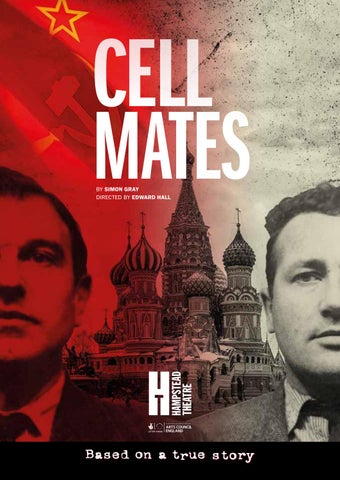
BY SIMON GRAY DIRECTED BY EDWARD HALL
Based on a true story
MAIN STAGE
WHAT’S ON DRY POWDER
BY SARAH BURGESS DIRECTED BY ANNA LEDWICH STARRING HAYLEY ATWELL & TOM RILEY 26 JANUARY – 3 MARCH
CAROLINE, OR CHANGE DOWNSTAIRS
BOOK & LYRICS BY TONY KUSHNER MUSIC BY JEANINE TESORI DIRECTED BY MICHAEL LONGHURST STARRING SHARON D. CLARKE 12 MARCH – 21 APRIL
MOTHER CHRISTM AS BY DAVID LEWIS DIRECTED BY DONNACADH O’BRIAIN 8 DECEMBER – 13 JANUARY
YOUS T WO BY GEORGIA CHRISTOU DIRECTED BY CHELSEA WALKER 18 JANUARY – 24 FEBRUARY
ACCEP TANCE BY AMY NG DIRECTED BY ANNA LEDWICH 2 MARCH – 7 APRIL
THE PHLEBOTOMIST
ELSEWHERE
BY ELLA ROAD 12 APRIL – 19 MAY
HAMPSTEAD THEATRE IN ASSOCIATION WITH THE BUNKER PRESENTS
KEN
BY TERRY JOHNSON DIRECTED BY LISA SPIRLING 24 JANUARY – 24 FEBRUARY | THE BUNKER
WELCOME Cell Mates is one of those unfairly disregarded plays – like The Judas Kiss and Hapgood – that is ripe to receive its first major revival at Hampstead. The first and last production in 1995 was overshadowed by a tabloid frenzy which unfairly obscured much wonderful work as well as the play itself, which had received rather good reviews. Simon Gray always insisted it was one of his best pieces of writing and was hoping for a restorative revival right up to his untimely death in 2008. In his lifetime Gray was mostly viewed as a ‘mainstream’ playwright of West End heritage, and only one of his plays premiered at the National Theatre, notwithstanding Peter Hall’s enthusiasm for his work. This now seems surprising, though perhaps commentators were deceived by the surface naturalism of the writing without fully appreciating how it camouflages deep and unsettling substrata of shifting meanings and emotions. Indeed, textually the plays have more in common with Pinter’s work than is usually acknowledged, which perhaps explains Pinter’s personal affection for Gray and his enthusiasm for his plays (he directed the premieres of nine of them). Thus, at one level Cell Mates operates as a spy drama, but Gray isn’t solely interested in the Cold War paraphernalia. Taking the isolated professional condition of the spy as a central metaphor, the play is also about the human condition, and our struggle to maintain our dignity and identity in the face of existential terror and the dread of loneliness. We all die alone, of course, though apparently the elderly and ailing George Blake is, to this day, still finding solace in his Cold War ideals. And the shadow of those ideals – at least the brutal realpolitik they engendered - are evident in the chill wind that currently blows across the world from a Russia governed by an ex-KGB agent. All the hallmarks of ‘tradecraft’ are present: misinformation, leaks of selected intelligence material, blackmail and bullying – except now they are being used on a massive scale and against entire populations rather than in a covert game of cat and mouse. So Cell Mates does feel particularly pertinent - though it’s also a great yarn and I hope perfect seasonal entertainment, which we offer up with deep gratitude for your continued generosity and support. EDWARD HALL ARTISTIC DIRECTOR
THE WILL MORTIMER INTERVIEW The following ‘responses’ to the questions I would have liked to ask the late Simon Gray about the writing of the play are excerpted from his production diary dealing with Cell Mates. WM Tell me how you came to write the play. SG I don’t know exactly where to begin the story of Cell Mates, unless at the beginning of the writing of it... I was in Tucson, Arizona, directing a revised (to the point of obliteration, I fear) play of mine. In the mornings, before rehearsal, I began making notes on a project commissioned by the BBC – the story of the relationship between George Blake and Sean Bourke. WM So it was originally a BBC commission. What was your starting point? SG The primary source material of the play was Bourke’s The Springing of George Blake. Blake’s autobiography devotes only three pages to the springing, the escape, the years spent with Bourke, his liberator. Those three pages, blandly patronizing in their treatment (dismissal, really) of Bourke, made me so contemptuous of Blake that I constantly choked when attempting to write the many drafts and versions of the film, the radio play, the screenplay. It took me, on and off, something like five years to get close to Blake, to tolerate and even to excuse him. It was only when I realised how lonely he must have been in his perpetual and self-imprisoning secretiveness that the story assumed a shape that worked. For me, anyway. WM So what happened with the BBC? SG When I finally produced a film script that satisfied the BBC producers, the director of our choice and myself, I was invited to an interview with the head of one of the drama departments. He sat behind his desk, cool and correct, a combination of schoolmaster and Anglican minister. He said he liked the script a lot and so did his script editor. He nodded to his script editor, a pleasant-faced woman in her thirties, who struck me as someone out of the Workers’ Revolutionary Party. She said she also liked it a lot, a lot more than most of my other work, yes, she liked it far, far better than almost anything that had appeared on the screen under my name, and she didn’t really have any reservations. Not really. The
head of the department then came rolling around the desk in his wheelchair – he had been the victim of a car accident some years back – and proclaimed that these days it didn’t matter how good the script was, what they needed was stars, yes, stars – his voice reverberating on the word as if he were talking of Christs – stars to put bums on seats. The producer, an odd, vaguely ex-European (i.e. not British) chap with a lisp and rolling foreign ‘r’s, made a counterperoration in agreement and disagreement – yes, he said, of course we needed a couple of stars, but on the other hand the story was so good that what we needed was serious actors who could do the parts, to hell with the stars, whom he agreed we needed. The pleasant-faced script editor chipped in with some blatantly capitalist affirmations of her boss’s spiritually resonant position - ‘Get us some stars,’ she said, ‘and we’ll get the show on the screen.’ We left, the producer, the director and I, with the head of drama rolling back behind his desk, the script editor smiling placidly at the thought of another job done, another execution faultlessly executed.
WITH THE WRITER
SIMON GRAY followed, but here is – I hope – a swiftish summary. Two very famous (though not by the BBC’s standards – one of them had been greeted as dead prey by the overlord and his script editor) actors, to whom I’d sent the play before I’d sent it to Michael, were both eager to do it, one going for Blake, the other for Bourke. I raised these names with Michael; he gave them his blessing, withdrew his blessing, interviewed them with me – we both knew them and their work very well – because he said he wanted to see what they looked like side by side, though as one was small, dark and famously handsome, the other a trifle portly, with gingery-white hair and a famously vibrant physique, we didn’t actually have to see them seated, with elbows touching, to know what they’d look like side by side. So what was Michael really up to in organizing this unnecessary charade? My suspicion was that it expressed formally a growing uncertainty about the play itself. A suspicion that was confirmed when week by week he withdrew his blessings, first from one actor, then from the other, then from the play. He didn’t actually excommunicate so much as dither,
bow and procrastinate his way out of a situation that he’d clearly come to find embarrassing. I learned later that he’d taken advice from a couple of directors who’d pronounced the text undirectable. At least by them. As a matter of fact, I thought they were right. They must have been because, before I’d received this news, I’d gone back to the drawing board – ‘Ah well, back to the drawing board,’ my late agent and still
WM So that was that? SG I gave up on the BBC, feeling that the BBC had given up on writers, and this one in particular, but I didn’t, couldn’t give up on Bourke and Blake. I wanted them, no, needed them, to live in some form, if not on screen, on stage perhaps. I set about rewriting, first following the line of the film script and then, as I burrowed further into it, becoming more and more involved with the two central characters. I suddenly found myself, in order to burrow some more, going in a quite different direction, turning the play into a weird duologue in which there were two voices but four characters, Blake, Bourke, and the two tape recorders they each spoke into as they wrote their respective books. WM So it became a play… What happened next? SG I sent it off to Michael Codron, the producer with whom I went back some thirty years. He responded quickly – which he always does, a great virtue in a producer – and enthusiastically, which delighted me, as enthusiasm is always a producer’s greatest virtue. The play at that time was called, by the way, Says I Says He. I won’t go into all the ins and outs of what
GEOFFREY STREATFEILD