
The Magazine of Hampden-Sydney College | Fall 2025

The Magazine of Hampden-Sydney College | Fall 2025
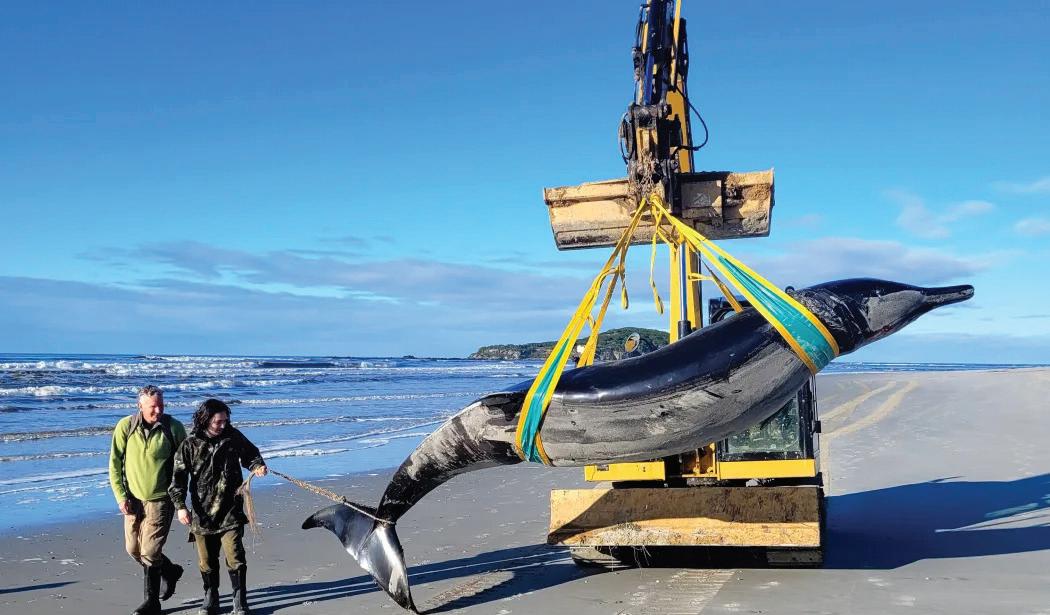
After a rare spade-toothed beaked whale washed ashore in New Zealand, Patterson Professor of Biology Alexander Werth joined an international team invited to study one of the least-known whales on Earth. In a race against time to conduct the first-ever dissection of the species, unprecedented collaboration between the indigenous Māori people, who regard whales as sacred, and Western science offered new insight into a mysterious species and a powerful model for cultural respect in scientific discovery.
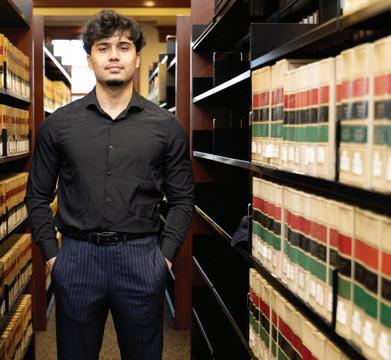
After fleeing Taliban-controlled Afghanistan and enduring exile, rejection, and uncertainty, Kamal Iqbal '27 is rebuilding his future stick by stick.
Rob '87 and Cindy Citrone have made another transformational investment in Hampden-Sydney College, donating $50 million to establish the Citrone Scholars Program.
25 Help Crown the Best of H-SC
Nominate now to celebrate the people and moments that make Hampden-Sydney the best.
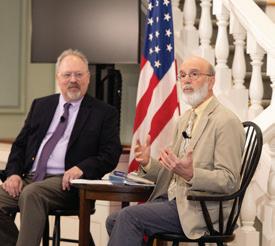
As the College's 250th anniversary celebrations continue, the HampdenSydney community came together for a three-day symposium to explore the role of civic virtue in the founding of the College and its ever-important place in society today.
EDITOR AND CONTRIBUTORS
Alexandra Evans
Alexandria Grant
Copyright © 2026 by Hampden-Sydney College. Non-profit standard postage paid at Farmville, Virginia, 23901, and at additional mailing offices.
Published by Hampden-Sydney College, Hampden Sydney, Virginia 23943, as a service to its alumni and friends. Content of the Record is determined by the editor. Although the editor welcomes news about alumni, the Record does not print unsolicited articles or articles that are solicited without prior consent of the editor.
Hampden-Sydney College, while exempted from Subpart C of the Title IX regulation with respect to its admissions and recruitment activities, does not discriminate on the basis of race, color, sex, religion, age, national origin, handicap, sexual orientation, or veteran status in the operation of its education programs and with respect to employment.
For information on this non-discrimination policy, contact the Office of Human Resources, Box 127, Hampden-Sydney College, Hampden Sydney, VA 23943, (434) 223-6220.
This issue may be viewed online at
In response to the cover of the summer '25 issue of the Record, featuring the planisphere in Bortz Library:
When then Vice President for Business Affairs and Treasurer
Norm Krueger first called me, he said the College wanted a midnight sky on the cupola of the new Bortz Library. I went to the Science Museum of Virginia to get a poster for my presentation and found Phillipe de Le Hire's Planisphere Celeste of 1705, so I took both and they said, "The night sky is boring; we want that!" As the fourth floor is dedicated to the College's cartography collection, it was a perfect fit! And so, the journey began.
It took Dr. David Hagan of the Science Museum of Virginia and I a year of research to complete the rendering. The positioning of the stars inside the constellations had to be adjusted to the view from Hampden-Sydney on November 10, 1775, at 9:00 p.m. All maps are made with the view from the ecliptic, the yearly path the Sun follows on the celestial sphere. This was an arduous task. The experience was very exhilarating, but uncovering each puzzle piece sometimes stalled the painting process until we could find the missing piece.
I built a ten-foot square table in my spare bedroom and climbed on to paint. We put the scaffolding up in the library only for cutting and sizing the canvas and installing.
After attending the 250th Anniversary Founders Day Convocation, I am even more truly honored for my work to be a part of this great college. Seeing so many young men of such high integrity in attendance gave my husband and me comfort that the future will be in good hands.
I see a countenance and a standard of excellence and stewardship carried by these young men—qualities our world especially needs in such evolutionary times.
I am grateful to Hampden-Sydney for their many years of dedication and many more to come. Grateful to have had the opportunity to create for you!
Bright Blessings, Elaine Tucker-Haviland
Faux Finish Creations
In response to the release of Amy Simes' book The House on the Hill of Time, covered in the spring '25 issue of the Record:
Dear Ms. Simes, The 2025 issue of the Record brought your new book The House on the Hill of Time to my attention. Thank you for capturing a piece of Hampden-Sydney's story in such a meaningful way. As a student at Hampden-Sydney College from 1967 to 1971, I was touched by your reflections of life on an all-male campus during those same years, when you lived at the Hampden House with your parents, Molly and Dr. Frank Simes, and your dog, Sparky.
You did a wonderful job describing what it was like to grow up in that historic setting—a place filled with tradition, character, and a sense of continuity that makes Hampden-Sydney special. On one of my return visits to campus years later, I actually stayed overnight at the Hampden House, and your stories brought that visit back to me as if it were yesterday.
I also enjoyed your thoughtful history of John Hampden and Algernon Sidney and how their patriotic ideals helped shape the College's founding and its proud motto, "a tradition older than the nation." It would be valuable for all entering students to take an introductory course about Hampden and Sidney themselves—understanding the men for whom the College is named would give new students a deeper appreciation for its principles and 250-year heritage.
Reading your book brought back many vivid memories of my own time there, and I truly appreciated the opportunity to see the College through your eyes. Thank you for capturing a piece of Hampden-Sydney's story in such a meaningful way.
With best wishes, Bill Rayburn '71
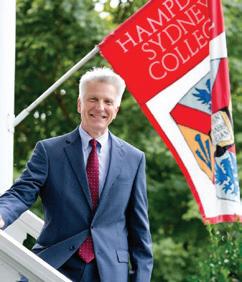
Now well into the spring semester of Hampden-Sydney College's 250th anniversary year, the celebration continues with lectures and events that highlight the vitality of campus life and the people who make the Hampden-Sydney experience so distinctive. Among the fall's signature moments was the three-day symposium, Civic Virtue and Hampden-Sydney College: Then and Now, featuring distinguished scholars and several of our own faculty members. The symposium, the well-attended November 10 Founders Day Convocation, and many other programs can be viewed on the 250th Anniversary website, accessible from the College homepage.
We've welcomed 10 new faculty colleagues, installed new trustees and James Madison Society members, announced Chrystal Russell as vice president for enrollment, and welcomed Tim Verhey as College Church pastor and College chaplain. This year is also the 50th anniversary of the Hampden-Sydney Poetry Review, celebrated with visits from poets Lisa Russ Spaar and Adam Clay and recognition of founding editor Adjunct Associate Professor Emeritus of English Tom O'Grady. At a time when many institutions have stepped back from literary publishing, our Poetry Review continues to thrive under the leadership of editor Elliott Professor of English Nathaniel Perry, offering students meaningful hands-on experience in literary production.
Athletics also shone. Our nationally ranked football team finished 7–3, and soccer earned its first NCAA tournament appearance and win, with Hampden-Sydney hosting the opening rounds at Helmuth-Gibson Field. Cross country placed 20th at the NCAA regional meet. We inducted another outstanding H-SC Hall of Fame class and celebrated the induction of four Tigers to the inaugural ODAC Hall of Fame.
This issue spotlights individuals who embody the College's mission in action. Faculty members continue advancing their fields and enriching student learning, including Patterson Professor of Biology Alex Werth and his whale research. Our students, like Kamal Iqbal '27, remain a source of pride for their resilience, drive, and commitment to lives of purpose. The generosity of alumni and friends is securing Hampden-Sydney's future. Through the generosity of major benefactors such as Rob '87 and Cindy Citrone, who have established the Citrone Scholars Program, and thousands of other investors, the It's Time, Good Men campaign has surpassed $370 million.
All are invited to campus April 22–25 for the culminating 250th Anniversary and campaign celebrations (including fireworks!) and the annual Society of Founders gathering. It is an exciting moment in the College's history, and we hope you will join us!
President, Hampden-Sydney College
The Hampden-Sydney College 250th Anniversary Academic Symposium was held October 21–23, 2025, in the Schoellkopf Family & Friends Lounge in Venable Hall.
Sponsored by the H-SC 250 th Anniversary Commemoration Committee, Office of the President, and Department of History, the 250 th Anniversary Symposium empowered community members to explore how civic virtue, one of the College's founding ideals, has manifested itself in common society through religion, higher education, political ideology, and even film, art, and music.
"[I
realized that] civic virtue cannot exist without private virtue [and Hampden-Sydney fosters both]" - John Sievers '29
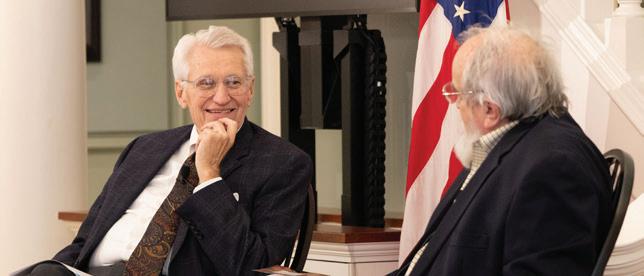
"I gained insight into civic virtue through Mr. Shomo's portrayal of the Honor Code as a moral standard that binds Hampden-Sydney students to something greater than themselves and fosters a shared sense of identity at H-SC." -William Cole '28
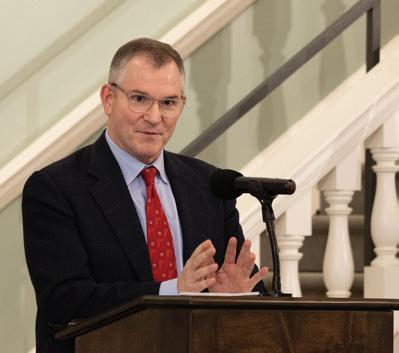
"Mr. Bruni addressed civic virtue through the idea of ‘we, not me,' drawing on his own life experiences to illustrate that there is no meaningful ‘me' without the larger ‘we.' He argued that caring for the broader community is an act of virtue, prioritizing the common good over individual selfinterest." -Wyatt Klinger '28
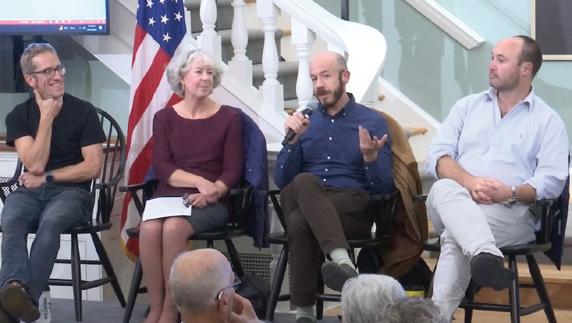
"Dr. Szabo connected the concept of civic virtue to Afrika Bambaataa by showing how Bambaataa used innovative musical forms to unite diverse cultures and pave the way for other artists throughout the 20th century." -Wesley Walsh '28
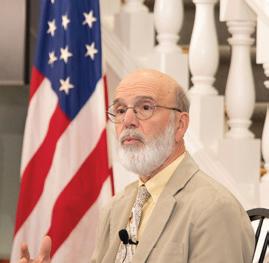
"[It
made me think about how] it is setting aside your own wants and desires for the common good."
-Will Stout '29
"Dr. Taylor made me think about how to be a student in a college built on republican ideals. It's important to live these ideals because without them, the republic of the United States could fall, just like how many others fell." -Muftada Abdulwahab '29
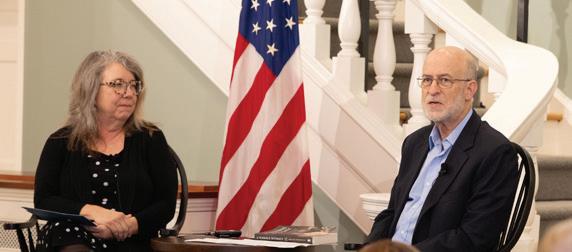
"The sessions made me think about myself differently as a student of Hampden-Sydney because I see that I'm at a college that really deeply prides itself on its history and its mission to form us to be good men and good citizens." -Skylar Dougherty '29
Dissenters and Patriots: Civic Virtue, Religion, and the Founding of the College
In conversation: Dr. Michael Utzinger, Ewing Professor of Religion and Dr. John Ragosta, Fellow at Virginia Humanities
The Virtue of the Educated Voter: Saving the Early Republic
Dr. Alan Taylor, Thomas Jefferson Foundation Chair, Emeritus
Myth, Memory, and Meaning in the College's Saga
In conversation: Mr. Thomas Shomo '69 and Rev. Dr. William Thompson, Former College Church Chaplain
American Identity as Reflected in the Arts Faculty Panel: Dr. Nicholas Morgan, Assistant Professor of Fine Arts; Mr. Nathaniel Perry, Elliott Professor of English; Dr. Victor Szabo, Elliott Associate Professor of Fine Arts; and Dr. Katherine Weese, Venable Professor of English Chair: Dr. John Coombs, Professor of History
The ‘Distractions of Our Times:' Society and Culture in Prince Edward County, 1750-1820
In Conversation: Dr. Caroline Emmons, Elliott Professor of History, and Dr. Melvin Ely, William R. Kenan Jr. Professor of Humanities, William & Mary
"Me" to "We": Thoughts on Civic Virtue
Mr. Frank Bruni, New York Times opinion writer, Eugene C. Patterson Professor of the Practice of Journalism and Public Policy, the Sanford School of Public Policy, Duke University
A recording of each session can be found at youtube.com/@ hampdensydneycollege.
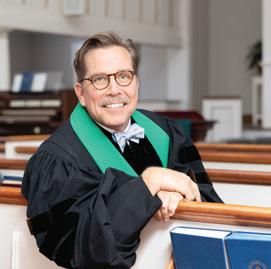
He's a pastor, a professor, and possibly a heretic? He's Tim Verhey, the new Hampden-Sydney chaplain and College Church pastor. In a world that increasingly demands strict adherence to ideological doctrine, Dr. Verhey holds advice from his father dear: "If they don't call you a heretic every once in a while, you're just not thinking."
"What I admired most about my dad was his sense that loyalty did not exclude criticism, but required it," Verhey says. "He stayed true to the institutions he cared about, but he never stopped asking the hard questions. He was smart and articulate, but he was also deeply humble, kind, and open. Even when his honesty brought criticism, neither his loyalty nor his kindness ever wavered." It's this ethos of charity and hospitality that Dr. Verhey uses as a north star in his own ministry and humanity.
Hospitality comes up a lot in conversation with Dr. Verhey. For a transplant who has now spent more of his life in the South than his native Michigan, that's not too surprising. What may be more unusual is how Dr. Verhey lives hospitality. His hospitality is not perfunctory. It does more than smile and shake hands. Dr. Verhey's hospitality makes room: for people, for ideas, even for— maybe especially for—uncomfortable questions.
The big, uncomfortable questions are what drew Dr. Verhey to the study of philosophy, in which he earned his Bachelor of Arts degree from Hope College. Having grown up in the Christian Reform Church with a theologian for a father, Verhey says he had a bit of a love/ hate relationship with religion. "It fundamentally shaped who I was," he explains, "but I wasn't sure I bought all of it, and I was, and still am, certainly troubled by what I see as the un-Christlike behavior of Christians."
Philosophy allowed Verhey to wrestle with universal questions in a greater context. At the end of the day though, he realized that philosophy is not the language and practice that everyday people use to understand their lives. That job falls to religion, the everyman's philosophy, Verhey says. With that realization, he returned to religion and came South to earn his Master of Divinity at Union Presbyterian Seminary, where his firstyear suitemate was Rev. Dr. Randy Harris '89, and then his doctorate in theological ethics from Emory University. From there, Verhey became an ordained pastor through
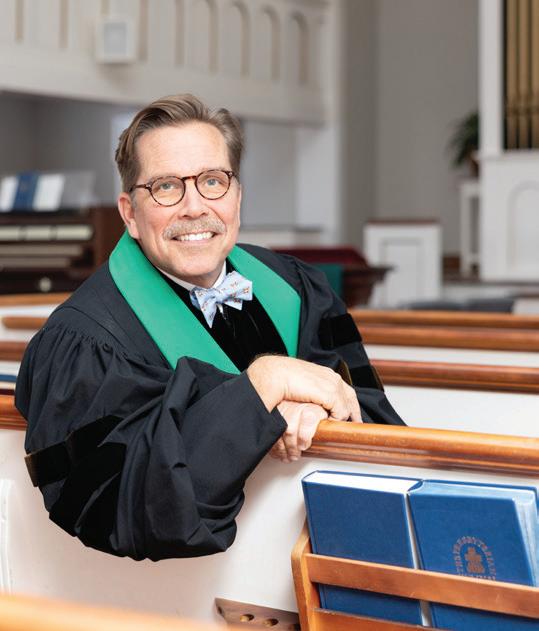
the Presbyterian Church and most recently served as assistant professor of religious studies and philosophy and dean of students at St. Andrews University in Laurinburg, North Carolina. College campuses hold a unique draw for Dr. Verhey.
"One of the reasons being on a college campus is so wonderful is because people come from all different faith backgrounds or no faith background at all," Verhey says. "It gives us as Christians a chance to be both ecumenical in our approach and to learn from a diverse array of perspectives."
In his roles as College chaplain and pastor of College Church, Verhey places community building at the top of his vision board: a community that thrums with differences of opinion, an innate ability to see God within one another, and a healthy aversion to dogma.
"Being in true community requires noticing that you're not seeing the full truth," he says. "There is a full truth, but no one person will ever see it completely. We can serve the full truth, though, by loving our neighbors, welcoming those who are different, and listening to views unlike our own." The way Verhey talks about truth is quietly radical in an age often devoid of nuance.
"Society is so deeply divided today that we don't even comprehend each other," Verhey says. "People who think
differently feel they either have to change to be accepted by the group, remain silent, or go elsewhere. That level of distrust and incomprehension leads us to think of people who believe different things as fundamentally other. It's dangerous to our souls to imagine that half of the world is evil."
"It's my job to help create a rich and diverse environment in which people can have nurturing, meaningful, deep conversations that help shape who they are, how they live, and discover what's important in life."
That kind of estrangement, Verhey suggests, does more than divide us. It leaves us searching for something to hold onto. In the absence of a shared moral framework, society often fractures into tribes or sects that share narrower, more rigid identities—ideological, political, or cultural—and promise community but deepen division and isolation, defining belonging by exclusion. Verhey believes the Christian faith, at its best, transcends differences by grounding identity not in ideology or status but in divine grace. "Christ came to reconcile us to God and to one another," Verhey explains. "Our enemies are not really enemies. They are our brothers and sisters, fellow children of God. The message of the Christian faith is one of inclusion, empathy, hospitality, and humility.
"In Luke, Jesus describes a sort of upside-down kingdom," he continues. "Those who are lowly are lifted up. The high and mighty are brought down. The
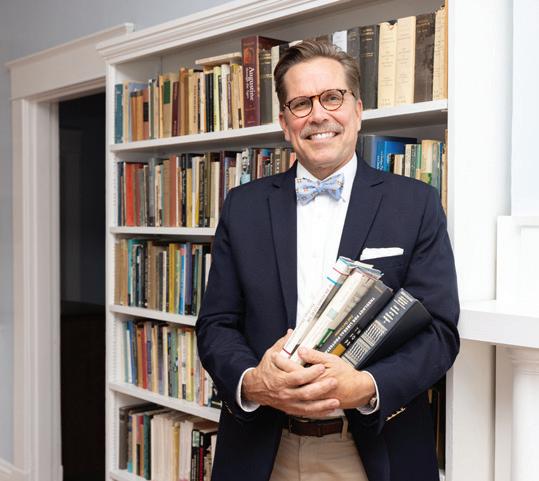
outsiders are brought in, and the insiders are turned away. That's what the Christian faith can do at a place like Hampden-Sydney. It helps students, faculty, and staff welcome one another despite our differences. In that sense, I see the Christian faith as essential to what young people are hungry for right now."
Amid concerning reports of youth loneliness, Verhey sees the rise of identity politics as both understandable and perilous: a symptom of spiritual hunger. "We used to have common convictions to wrestle with, something shared to question or resist. Now, we have this diffuse, commercialized sense of self that says we're in charge of creating ourselves. While that sounds freeing, it actually leaves young people rudderless, lonely, and anxious."
The solution? Conversation. Verhey's mission to create a truly hospitable environment where people of all beliefs are welcomed and engaged in genuine conversation reflects his faith that says God is bigger than any individual convictions about God, which he likens to sandcastles on the shore. "God is the only eternal thing," Verhey says. "Our aim is to be faithful to God by being humble in the presence of one another and to learn to love one another despite our differences."
Verhey envisions a vibrant campus environment where everyone can find their place. Only a few months into the job, he attends regular meetings of the various faith organizations on the Hill; he has attended programs and services at various churches; and he has plans for pulpit exchanges and opportunities for joint worship with neighboring congregations.
"It's my job to help create a rich and diverse environment in which people can have nurturing, meaningful, deep conversations that help shape who they are, how they live, and discover what's important in life," Verhey concludes.
Hampden-Sydney College has long prided itself on teaching students how to think, not what to think. Dr. Verhey joins in on that long tradition, providing pupils and parishioners alike not with answers but with an invitation and a place to question bravely, to listen deeply, and to love heretically.

The marbled paper seen on this issue's cover was created by Ean Larsen '25 and first appeared on the cover of Climbing the Hill: African American History at Hampden-Sydney College by Elliott Professor of History Caroline Emmons, one of a series of six pamphlets created for the 250th anniversary. The marbled papers in this layout appear on other pamphlets produced in the series. Elliott Professor of English Evan Davis has long taught students to marble paper in his Compass course Authorship and the History of the Book (ENGL 360). Paper marbling is a decorative art form in which floating pigments are manipulated on a liquid surface and then transferred onto paper, creating stone-like patterns. The process begins with a shallow tray filled with water thickened using carrageenan, a natural sizing agent. Students then drop acrylic paints on the surface of the water and use tools such as straws, nonpareil rakes, and bouquet combs to create intricate designs. To transfer the design to their hand-made paper, students carefully lay their paper onto the surface, lifting the design in a single, unrepeatable impression.
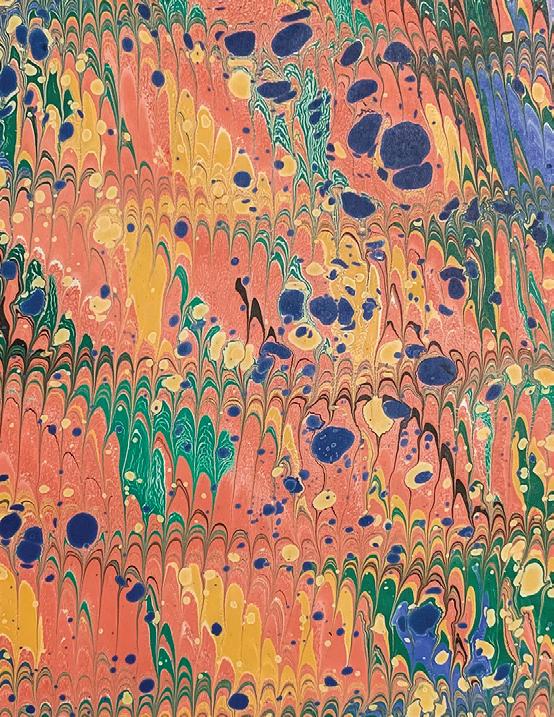

The origins of paper marbling can be traced to East Asia, where similar techniques were practiced in China and Japan as early as the 12th century. The art was later refined in the Ottoman Empire, particularly in Turkey, where it became known as ebru. Turkish marblers developed distinctive styles and used marbled papers to decorate calligraphy, book covers, and official documents. By the 17th century, marbling had spread to Europe, where it was widely used in bookbinding as decorative endpapers and covers.

The Hampden-Sydney College Board of Trustees inducted two new members into its ranks in August 2025. Trustees are volunteers charged with stewarding the College's finances, safeguarding its future and ensuring viability for generations of Hampden-Sydney men to come.
Palm Beach, Florida
Richmond, Virginia
The James Madison Society recognizes the dedicated men and women and their spouses who have completed one full term on the Hampden-Sydney College Board of Trustees. This society serves to preserve the invaluable relationships that have been forged during active service to the College.
Atlanta, Georgia
Nashville, Tennessee
At a time when many colleges are shuttering their literary journals, Hampden-Sydney College is celebrating the 50th anniversary of The Hampden-Sydney Poetry Review, the nation's second-longest continuously published poetry journal. At the anniversary celebration in Bortz Library this fall, the College affirmed the enduring place of the arts at the heart of a liberal arts education.
Founded in 1975 by Adjunct Associate Professor Emeritus of English and Poetin-Residence Tom O'Grady and fellow poet Michael Egan, the Poetry Review was conceived as a literary magazine that was itself a work of art. Over five decades, it has earned national recognition and published the works of Pulitzer Prize winners including former U.S. poet laureate Charles Simic, W.D. Snodgrass, and Claudia Emerson; Henry Taylor National Book Award winners Robert Bly, A. R. Ammons, and William Stafford; and Terrance Hayes Forward Prize and T.S. Eliot Prize winner John Burnside.
"The magazine is a small but durable piece of the culture," says Elliott Professor of English and Poetry Review Editor Nathaniel Perry. "It remains committed to being a piece of physical media in an increasingly digital world. It's impossible to predict how or when a poem will impact the culture, but literary magazines like this make that impact possible."
Even more than a beautiful publication, the Poetry Review is a classroom. Dr. Perry and Elliott Associate Professor of Rhetoric Nicholas Nace actively engage Hampden-Sydney students to assist with editing and design and help debut each new issue at the Association of Writers & Writing Programs Conference, gaining firsthand experience in literary culture and craft.
From youth poet laureate Amanda Gorman's stirring recitation of "The Hill We Climb" at President Joe Biden's inauguration to the influence of John Berryman's Dream Song 29 on the hit HBO show Succession, poetry has the power to shape societies and cultures. The enduring legacy of The Hampden-Sydney Poetry Review is a testament to the power of creativity, reflection, and the written word in forming thoughtful citizens and influencing the world we live in.
"
Satisfaction leads to complacency, and that's not us. Growth demands evolution."
–Coach Luvara
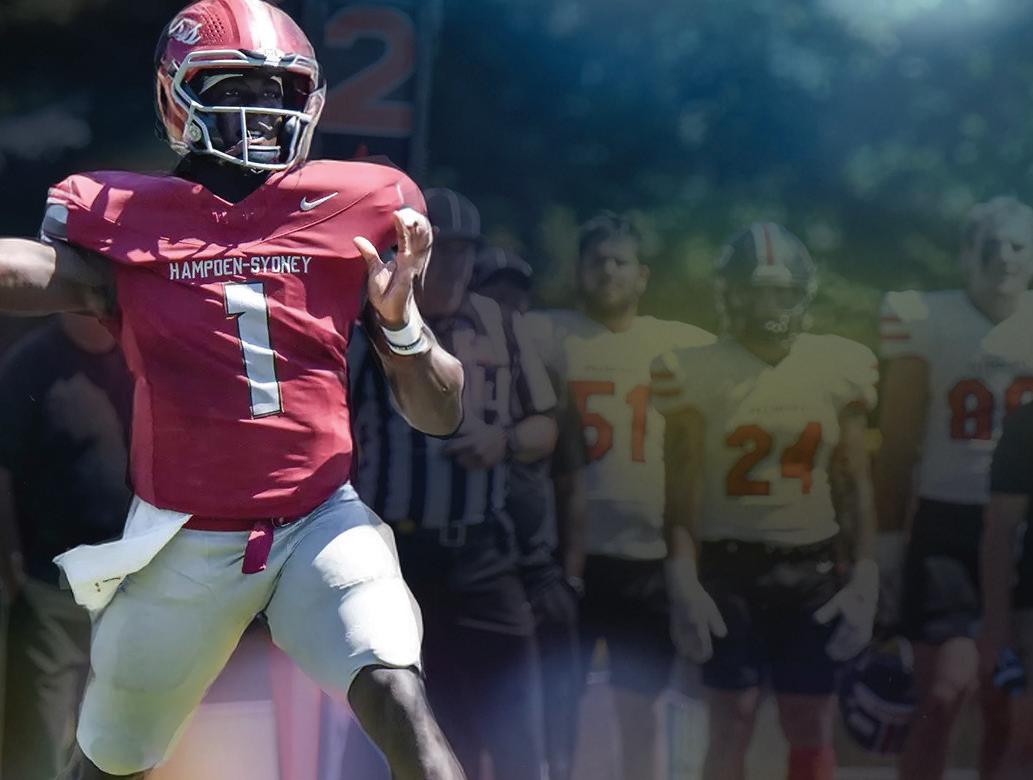
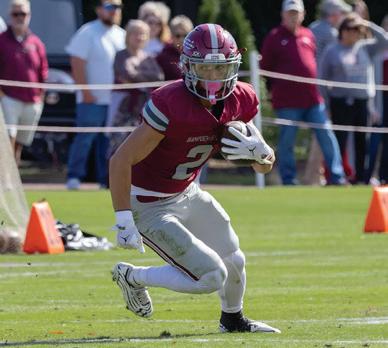
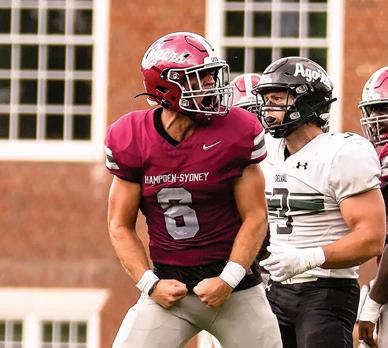
Tiger Football set a new standard of excellence for itself this season, putting up a 7–3 record, its best showing since 2013, and going undefeated in the first four games of the season for the first time since 2010. Yet for secondyear Head Coach Vince Luvara, this season's success is just the starting point. "Satisfaction leads to complacency, and that's not us," Luvara says. "We have to keep evaluating every part of how we operate and find ways to get better. Growth demands evolution."
This season was all about building the future. With a culture rooted in accountability, ambition, and evolution, Tiger Football has made it clear that they've only just begun.
» Tiger Football ranked in both Top 25 national polls for the first time since 2014, coming in at No. 21 in the AFCA D3 Coaches Poll and No. 24 in the D3football.com Top 25 on September 29.
» The Tigers defeated a playoff team for the second year in a row when they took a 38–31 win at home over Washington & Jefferson College (PA).
» Robert Clarke '27 was named the College's sixth consecutive William V. Campbell Trophy semifinalist.
» Mason Cunningham '26 was named the ODAC J. Stokeley Fulton Offensive Player of the Year, H-SC's first ODAC Player of the Year since 2017.
Tiger Football earned 12 All-ODAC and 5 AllRegion selections, the most picks since 2017 and 2005 respectively.
All-ODAC Standouts
» Mason Cunningham '26, First Team
» Joseph Gonzalez '26, First Team
» Carter Sido '26, First Team
» Terry Hicks '27, First Team
» Parks Cromwell '28, First Team
» Cash Topinka '28, First Team
» Robert Clarke '26, Second Team
» Manning Lasso '28, Second Team
» Thomas Wilson '28, Second Team
» Wyatt Croson '26, Third Team
» James Townsend '26, Third Team
» Kam Mahoney '28, Third Team
All-Region Honors
» Terry Hicks '27, First Team
» Cash Topinka '28, First Team
» Mason Cunningham '26, Second Team
» Carter Sido '26, Third Team
» Parks Cromwell '28, Third Team
In a ceremony on September 19, 2025, in Snyder Hall at the Kirk Athletic Center, Hampden-Sydney inducted the 38th class of honorees to its Athletic Hall of Fame.
two-time lacrosse All-American
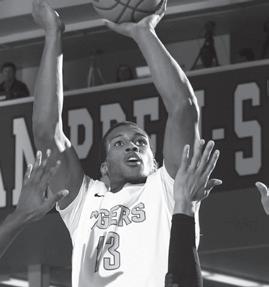
Khobi Williamson '14 three-time All-ODAC basketball honoree
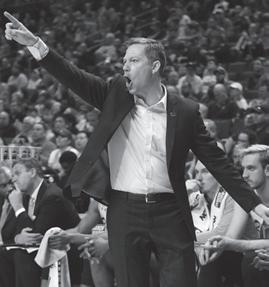
Ryan Odom '96 Special Citation All-ODAC basketball standout and current University of Virginia Men's Basketball Head Coach
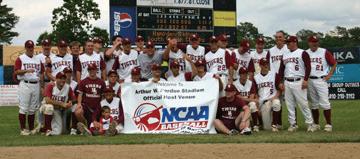
2005 Tiger Baseball Team 27-15, advanced to the 2005 NCAA Division III Championship World Series
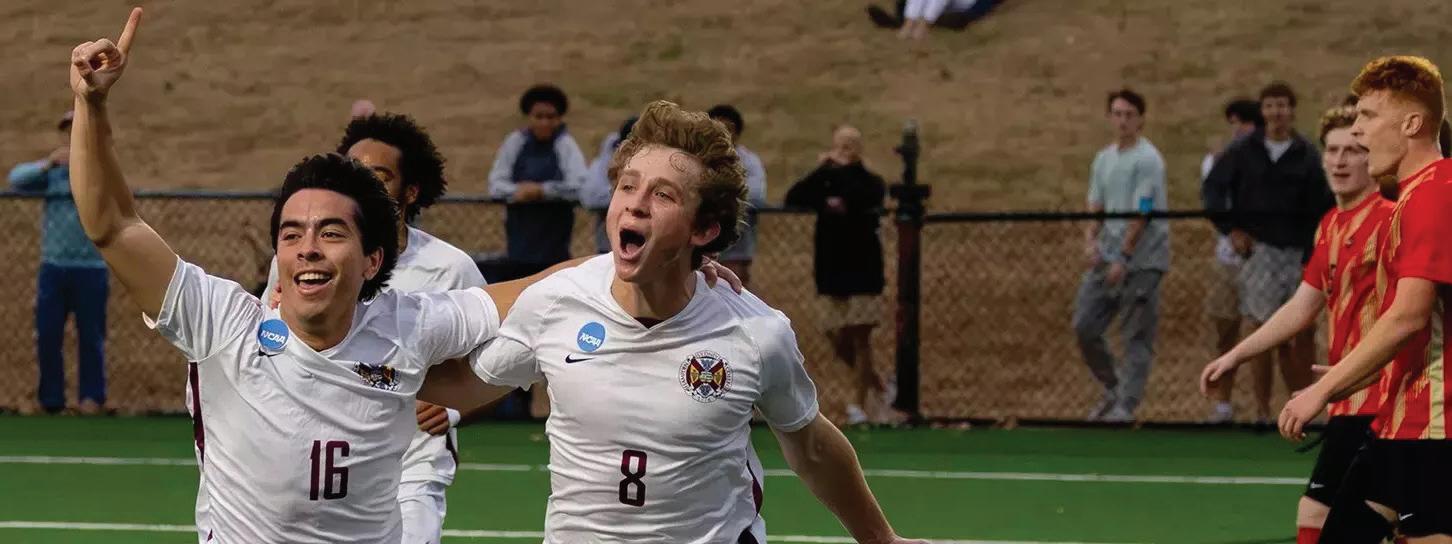

Hampden-Sydney Soccer rewrote program history in 2025, earning their first-ever NCAA Tournament berth and securing the program's first NCAA Tournament victory. Under ninth-year head coach , the Tigers posted a 14–4–2 record and went
"The goal going into this season was to make history, and we accomplished that," DiNuzzo says. "This group had exceptional character, and that showed up every day."
After going 12-2-2 in the regular season, the Tigers earned the No. 3 seed in the ODAC Tournament and surged past Randolph in the quarterfinals.
Despite a semifinal loss to Washington and Lee, H-SC received an at-large NCAA bid and hosted tournament matches for the first time in program history.
In the opening round, Jack Delaney '26 scored the program's first NCAA Tournament goal, while Walker Stebbings '26 and Zakky Johnston '28 sealed a 3–0 win over Otterbein. The season ended in a 3–0 loss in the second round against Emory.
"Now the hard part begins," DiNuzzo says. "It's our responsibility to raise our standards even more." With momentum, leadership, and belief, Tiger Soccer heads into next season with as many as 23 returners, ready to use their historic 2025 run as a launching pad to the next level.
–Coach DiNuzzo
The goal going into this season was to make history, and we accomplished that."
All-ODAC
» Walker Stebbings '26, First Team
» Victor Ovalle-Mares '26, Second Team
» Mauricio Jimenez '27, Second Team
» Tyler Petz '27, Second Team
» Zakky Johnston '28, Second Team
» Mason Dudley '26, Third Team
» Charlie Letson '26, Third Team
» Stig Larson '29, Third Team
United Soccer Coaches Division III
Men's Soccer All-Region VI Teams
» Walker Stebbings '26, Second Team
» Tyler Petz '27, Second Team
» Victor Ovalle-Mares '26, Fourth Team
» Mauricio Jimenez '27, Fourth Team
College Sports Communicators
Academic All-District®
Men's Soccer Team
» Walker Stebbings '26
» Pierce Boerner '26
» Colin Hallman '28
The 2025 season was a testament to perseverance for Tiger Cross Country. Facing some of the region's most competitive fields, the team finished sixth at the ODAC Championships and placed 20th at the NCAA South Regional.
At the center of that momentum was Jackson Herndon '27, whose consistency and leadership set the tone from the starting pistol to the home stretch.
Six other season-best 8K performances came from across the roster:
» Kam Maldonado '27 – 28:13.0
» Winston Ransone '26 – 28:28.2
» Jordan Chorbaji '28 – 28:34.6
» Dylan Evans '27 – 30:18.7
» Davis Mills '27 – 35:07.9
» Jack Ruble '29 – 35:24.9
With a young core and growing depth, the Tigers continue to build toward a future defined by endurance, discipline, and determination.
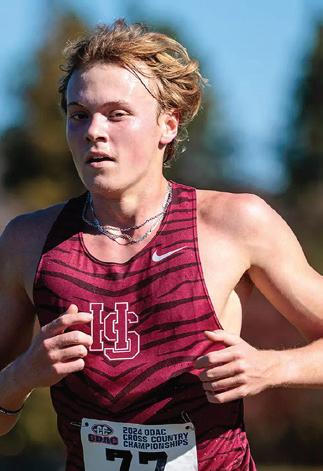
Jackson Herndon '27
Herndon led the Tigers in six of seven races this season, posting a team-best 8K time of 27:16.9 at the Roanoke Invitational South Region Showdown—the 12th-fastest in program history.
He followed with two more Top 30 performances:
27:31.8 at the ODAC Championships (23rd-best all-time)
27:35.9 at the Berry Invitational (27th-best all-time)
Beyond the results, Herndon was named to the ODAC Fall Sportsmanship Team, reflecting the character and competitive spirit he brought to every race.
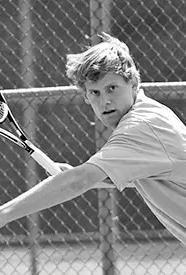
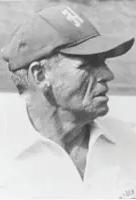
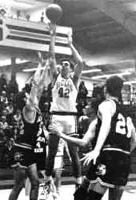
In celebration of its 50th year of operation in 2025–26, the Old Dominion Athletic Conference (ODAC) inducted 50 of the conference's all-time great student-athletes, coaches, and administrators to the inaugural ODAC Hall of Fame class. Hampden-Sydney is represented in the 2025 class by legendary football and baseball head coach J. Stokeley Fulton '55, four-time ODAC Men's Tennis Player of the Year William Moss '10, former basketball head coach Tony Shaver and two-time All-American and ODAC Men's Basketball Player of the Year Russell Turner '92
By Alexandra Evans
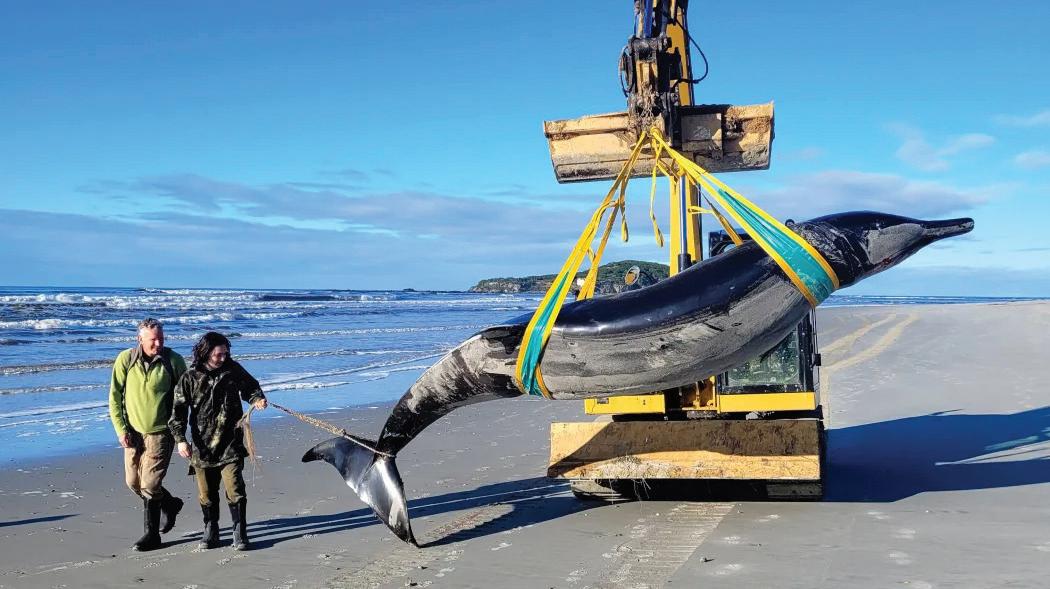
On July 4, 2024, in the dead of winter, Patrick Gallagher was having a cup of tea on his couch in Dunedin on the South Island of New Zealand. Thinking he might go surfing later, he logged onto the webcam footage of Taiari Mouth to see what the waves were doing. Instead of swell, though, Gallagher noticed an odd-looking object on the sand. Assuming it to be a beached animal, he phoned the sighting into the local conservation field office. What happened next is nothing short of a miracle; a serendipitous chain of events that resulted in unprecedented cultural cooperation and the potential for groundbreaking scientific progress.
studied beaked whales for more than 35 years, van Helden knew he was standing on the precipice of possibility.
After being alerted to the presence of the shored animal, local coastal marine ranger Jim Fyfe noted the nearly pristine condition and the unusual physiology of the creature, which at five meters long was much larger than the porpoise that he had been expecting to find based on Gallagher's description. Fyfe began sending photos back to Te Papa Atawhai, New Zealand's Department of Conservation (DOC), which eventually made their way to Anton van Helden, senior marine science adviser for the DOC. Van Helden tentatively identified the animal as a spadetoothed beaked whale, a species which has never been seen alive at sea and had never been dissected. Having
This whale, now named Ōnumia, which reflects the traditional name of the area where it was found beached, is only the seventh spade-toothed whale specimen ever discovered. The bones of the first were discovered on New Zealand's Pitt Island in 1872, but the remains of each of the other six were buried before any meaningful examination could be conducted. There are 22 species of beaked whales, 13 of which are known to strand along New Zealand's coastline, but the spade-toothed is considered the rarest and least-studied of them all. These whales are so elusive that even basic information such as where throughout the world other than the South Pacific they may live and their diet is unknown to scientists. What is known is that the M āori people indigenous
to New Zealand consider them taonga—a precious treasure, regarded as ancestors.
It was this elevated status of whales, or tohorā s, in M āori culture that necessitated the cultural collaboration and deference to heritage that is as central to this story as are the revolutionary scientific insights anticipated to come from the study of the animal itself.
Two days after the initial discovery, Patterson Professor of Biology Alexander Werth received a call from Dr. van Helden, whom Werth had previously worked with in New Zealand. Dr. Werth, one of the world's foremost experts on cetaceans, was invited to be one of a three-member international coalition to support the dissection of the spade-toothed whale and accompanying research efforts. He was joined by fellow Americans Dr. Joy Reidenberg, an anatomy professor at the Icahn School of Medicine at Mount Sinai in New York City, and Dr. Michael Denk, a veterinarian from Woods Hole Oceanographic Institution. Each of the three scientists brought unique expertise to the project. Dr. Reidenberg is an expert on airways and respiration; Dr. Denk specializes in whale sound production; and Dr. Werth provided digestive, reproductive, and vasculature expertise.
However, because of mana whenua, M āori authority over their land and territory, the scientists had to first seek permission from Te R ū nanga o Ōt ā kou, the local governing body for the Ngā i Tahu M āori people in the Ōt ā kou region, to access the animal. They had to act quickly, before the local tribe harvested the meat and blubber and ceremonially disposed of the animal.
"I received a call from Anton a day or two after the whale was discovered," Werth recounts. "He said there was a really incredible opportunity for dissection, but they first had to get permission from the local tribe. That launched months of negotiation, where we pleaded with them to let us do the dissection under their supervision."
Dr. Werth points out that antipathy is present on both sides of the relationship between Western and cultural science, saying that the historic lack of respect for indigenous cultural understanding and explanations of the physical world leads to understandable apprehension when situations like this arise.
"I can appreciate why they didn't want to turn over anything to us," Werth continues. "The negotiations were quite tense."
Recognizing that meaningful concessions were necessary if the opportunity were not to be lost entirely, the scientists proposed an approach in which tribal members would lead and oversee every aspect of the dissection, with final authority resting in their hands. Dr. Werth's prior work with the Iñupiat in Alaska's high Arctic and with the Tlingit of Southeast Alaska had given him a deeper understanding of the cultural considerations, sovereignty, and respect required when scientific inquiry intersects with Indigenous traditions. That experience helped guide the conversations in New Zealand, and ultimately, negotiations concluded favorably for all involved, allowing the dissection to proceed with the M āori's consent.
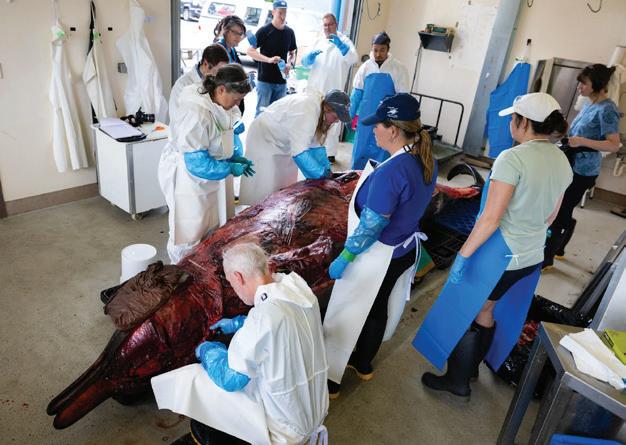
Racing against the clock, the team began finalizing the logistics, including transfer of Ōnumia from the cold storage where it had been kept since the discovery, set up of a secondary cold storage area with access to dissection tools and lab equipment, and acquisition of additional materials such as personal protective equipment. The Invermay Agricultural Centre offered everything the scientists needed: veterinary clinics with necropsy equipment, a scanning facility, and even an MRI machine.
Dr. Werth arrived in New Zealand on December 1, 2024, his third time conducting scientific research in the country. To formally launch the partnership and the project, the tribe members invited the scientists to a welcoming ceremony known as a p ōwhiri at the Ōt ā kou Marae, a M āori gathering place and cultural venue.
"It was just a remarkable experience," Werth beams. "I'd call it the icing on the cake, but it was just as much the cake because I was learning so much. We were welcomed into the wharenui, their meeting house, where Western people almost never get access. We participated in all of the traditional customs such as the removal of shoes; the karanga, or call; and the hongi, the traditional M āori greeting, where people press their noses and foreheads together. I was just eyes agog, soaking it all up. It was a once-in-a-lifetime opportunity to get to work with these people and experience their culture in this way."
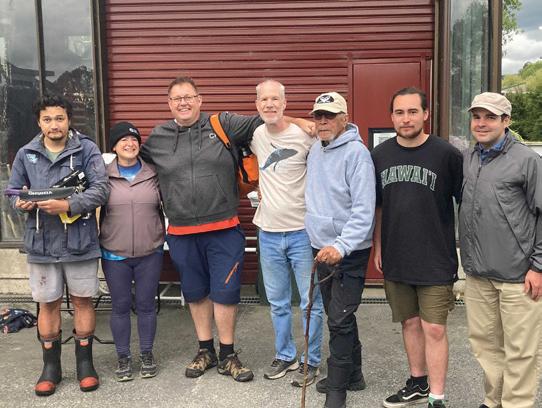
The purpose of the p ōwhiri is to welcome the manuhiri, or guests; assess their intentions; and build unity, solidifying mutual respect. But the ceremony was almost the undoing of the whole project.
"A couple of tribal elders who came down from the North Island for the p ōwhiri hadn't been part of the earlier negotiations," Werth explains. "They didn't really understand what these non-M āori New Zealand scientists and these three Westerners were doing there. We had to go through all the explanations and assurances again. It was a fraught moment. Even at that stage of the game, they could have sent us home, and for a moment, it looked like they might."
Luckily, a M āori elder stepped in and diffused the tension, allowing both the p ōwhiri and the dissection to proceed. The following morning, anxious energy was palpable as the team of scientists finally met Ōnumia. With only five days to complete the dissection, the scientists were eager to get started.
Werth acknowledges that it took time to establish a rhythm that honored the tribe's wishes while meeting the scientific team's need to work quickly with the perishable material, but the researchers upheld their commitments at every stage. Each 10hour workday began with tribal blessings, prayers, and songs. Tribe members were given the honor of making the first and other significant cuts, such as the
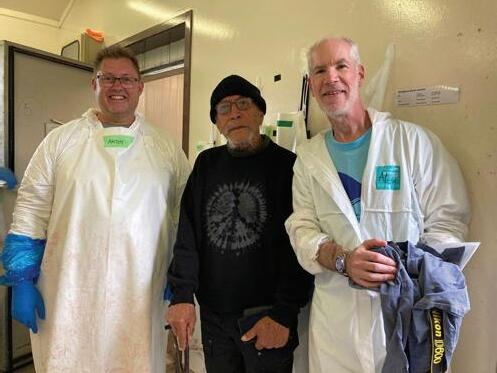
initial opening of major organs. In keeping with their agreement, the scientists did not examine the brain, eyes, or jaw, which are regarded as highly sacred by the M āori. The tribe was also able to harvest all the meat and blubber they wished to retain.
"It was a delicate dance," Werth says, "between trying to get tissue samples that would be useful to us and wouldn't spoil or decompose and ensuring the tribe could really observe and participate in the process as much as they wanted to."
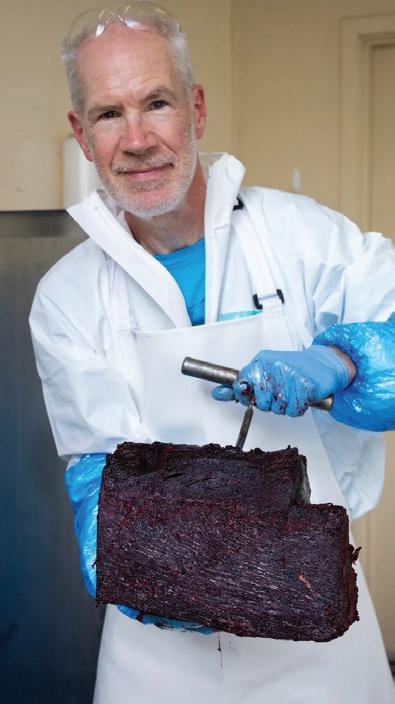
Though the analysis of their findings is still ongoing, the initial dissection and investigation yielded fascinating discoveries. Dr. Denk identified vestigial teeth in the upper jaw. The team also observed nine stomach chambers, which contained squid beaks and eye lenses, giving clues to the whale's diet. Referring to the spade-toothed beaked whale as a living submarine, Dr. Werth notes that the whale's muscle tissue was very heavy and nearly black in color because of the abundance of ironbased myoglobin from its ability to dive up to 1.8 miles and stay underwater for hours at a time— a characteristic that contributes greatly to the mystery around the animal.
"[This was] the first time our hapū (subtribe) worked with scientists to pull together indigenous and western knowledge systems so we can all gain a better understanding of the whale and its behaviours," said R ū nanga, or council, member Rachel Wesley in a December 13, 2024, media release. "…
By working with and learning from leaders in te ao M āori, as well as leaders in western science, our rakatahi (young people) can revive ancient matauraka (knowledge) and develop an in-depth knowledge system to pass onto the next generations."
The skeleton of the whale will be displayed at Tū hura Otago Museum, with the exception of the jawbone, which remains with Te R ū nanga o Ōt ā kou, the tribal council representing the Ōt ā kou region, for cultural purposes. A 3D replica of the jaw will be created for presentation by the museum.
"I'm so happy with how it turned out," Dr. Werth smiles. "What really made it work was the fact that we were not only willing to abide by the rules but that we actively sought ways to bring the tribe along. All of the M āori people who were involved in the dissection have been listed in our presentations and will be listed as co-authors in future publications. This is a new paradigm, a great way forward, where both sides can learn from each other and work together."
When he started teaching at Hampden-Sydney 34 years ago, Dr. Werth says he loved the high-level classes. Though, now, he says he most appreciates teaching the courses that open his students' eyes to the ways in which the world in all its physical and cultural diversity is interconnected and that open their minds to new perspectives. This partnership between the scientists and the M āori people is a testament to the power of a liberal arts foundation —a way of thinking that values the soul as much as it values the brain. Even more than technical scientific acumen this work was made possible by the humanistic skills of cultural literacy, ethical reasoning, and considerate communication that are cultivated through liberal learning. The success of this unprecedented collaboration demonstrates that the most meaningful discoveries are not achieved through science alone, but through the integration of and respect for alternate disciplines, perspectives, and traditions.
By Alexandra Evans
As Hampden-Sydney College celebrates its 250th anniversary, a historic investment is paving the way forward and reaffirming its mission. With a commitment of more than $50 million—the largest single gift in College history— Rob '87 and Cindy Citrone have established the Citrone Scholars Program. The program delivers immediate and sustained impact, funding fouryear, full-tuition merit scholarships that expand opportunity now while strengthening the College's long-term capacity to support students of promise.
The Citrone Scholars Program arrives at a pivotal moment. During the It's Time, Good Men comprehensive campaign, Hampden-Sydney has announced the ambitious goal of meeting full demonstrated financial need for every student. The Citrones' investment accelerates momentum towards meeting that goal—ensuring that ability and character, not financial circumstance, define who can attend the nation's premier liberal arts college for men.
"This gift bolsters the College's ability to attract even more of the most talented young men to Hampden-Sydney," says President Larry Stimpert "Rob and Cindy's generosity strengthens our capacity to deliver on our mission and ensures that the transformational Hampden-Sydney experience remains accessible to students who will both benefit from it and contribute to it for generations to come."
The Citrone Scholars Program has the potential to do far more than recognize academic merit; it advances the College's broader institutional goals. As Hampden-Sydney works toward meeting full demonstrated financial need for every student, sustained scholarship support plays a critical role. It allows the College to make meaningful, longterm commitments to students and families while reducing uncertainty around affordability.
Hampden-Sydney has long invested deeply in student support, offering a robust mix of merit- and need-based aid, including scholarships for highachieving students, Eagle Scouts, and Boys State participants. The Citrone Scholars Program builds on this foundation, elevating the College's ability to compete nationally for students of exceptional talent.
At the heart of the College's comprehensive campaign is a focus on long-term sustainability and increasing access for deserving students. Scholarship support provides reliable funding that protects students and families from rising costs and economic uncertainty. The Citrone gift, designed to benefit
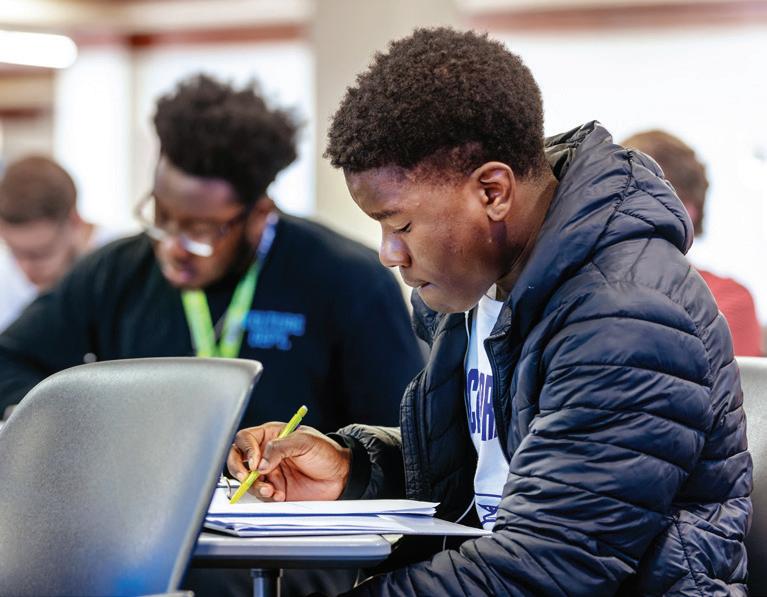
students well into the future, strengthens the College in ways that will ripple across generations.
For Rob, the motivation is deeply personal.
"Hampden-Sydney shaped the foundation of who I am—as a thinker, a leader, and a person," he says. "The education I received here didn't just prepare me for a career—it prepared me for life. This College gave me the tools, the discipline, and the values that have guided me in every chapter since. Cindy and I believe deeply in Hampden-Sydney's mission to form good men and good citizens, and we're honored to help provide that same opportunity to the next generation."
That belief aligns squarely with the College's priorities: ensuring that every admitted student can afford to enroll, thrive, and graduate prepared to lead a life of significance and service.
This is not the first time that Rob and Cindy have invested strategically in the College's academic and co-curricular life, supporting scholarships, student research, and innovative programs designed to connect learning with real-world experience.
In 2020, the Citrones provided $6 million to
launch Compass, Hampden-Sydney's experiential learning program, which guarantees every student a funded internship, research project, or study abroad opportunity. Compass has since become a defining feature of the College's educational model—one that blends rigorous classroom learning with practical preparation for life after graduation.
The timing of the Citrones' latest investment is especially meaningful. As Hampden-Sydney marks 250 years of educating men for lives of consequence, the College is also looking forward with clarity and confidence.
"This gift puts additional momentum behind the College," says President Stimpert. "It ensures that Hampden-Sydney enters its second quarter millennium from a position of strength."
With a nationally ranked career center and a powerful alumni network, Hampden-Sydney offers outcomes that rival those of far larger institutions. Students benefit from close faculty mentorship, leadership development through the Wilson Center for Leadership in the Public Interest, and entrepreneurial opportunities at the Flemming Center for Entrepreneurship and Innovation. By expanding scholarship capacity, the Citrone Scholars Program helps ensure that these opportunities remain accessible to students of talent and character.
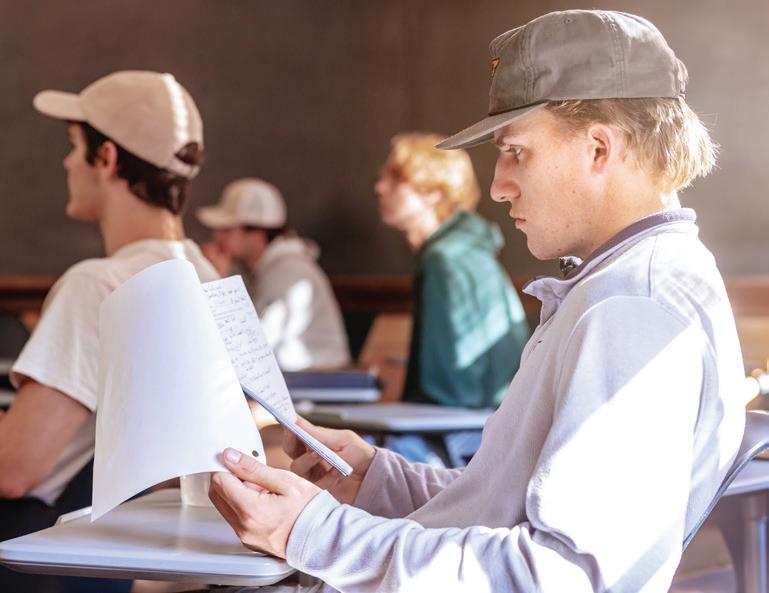
For a College founded in 1775 and committed to the future, it is a gift worthy of the moment— and the momentum.
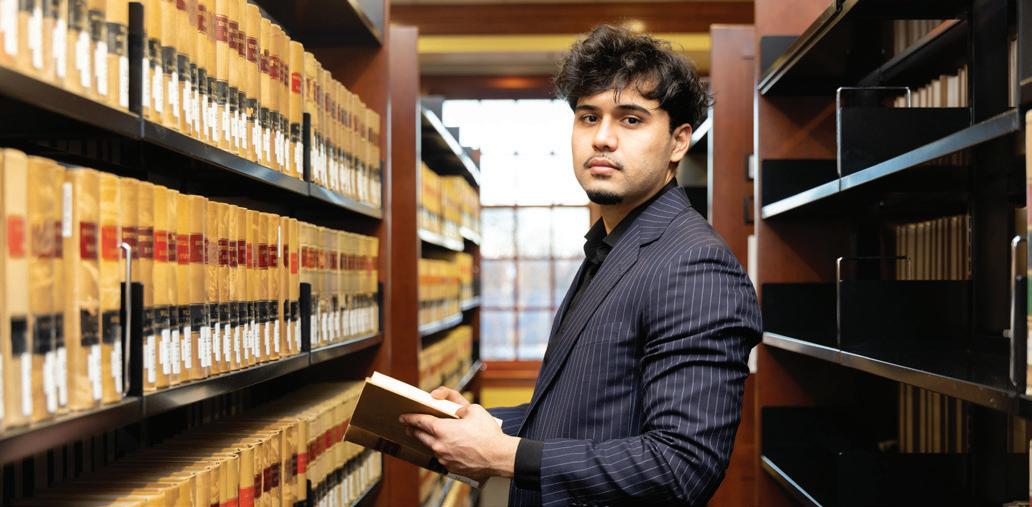
By Alexandra Evans
When Afghanistan fell back into the hands of the Taliban in 2021, Kamal Iqbal '27 and his family were forced into hiding. With their ties to the U.S. Embassy in Kabul, the Iqbal family was high on the Taliban's hit list—with the new government actively trying to track them down, calling their home and questioning their neighbors as to the family's whereabouts.
With all flights out of the country grounded and Taliban soldiers at every checkpoint, it took the Iqbal family nearly four months to safely cross the border into Pakistan. They left behind everything but each other. More than personal belongings and documents, though, Kamal and his family lost their very sense of home. As long as the Taliban is in power, the Iqbals will live in exile from their ancestral land.
The youngest of six children, Kamal lost his father, Mohammad Nasim, to skin cancer when he was only one year old. His mother, Bibi Hurmat Amiri, carried the weight of raising six children alone. "My mother has been my greatest strength, carrying our family with patience, faith, and endless sacrifice. As hard as
it was on my mother," Kamal says, "I can't imagine how hard the thought of leaving his family behind was on my dad. Cancer is bad, but the stress of knowing he was leaving his family behind is maybe the other thing that killed him."
Despite the loss, Kamal's memories of childhood in Afghanistan are filled with warmth. "We were together, and that was what mattered."
When the Taliban returned to power, that togetherness was shattered. Kamal's eldest brother,
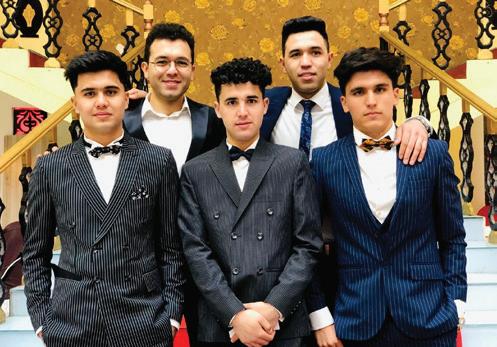
Islam, had worked as an education advisor for the U.S. Embassy in Kabul. His efforts to support Afghan youth—especially women—seeking higher education in America made him a target. Mere hours before the Taliban seized Kabul, Islam fled the country, just days after celebrating his wedding in Mazar-i-Sharif. Islam eventually resettled in Canada, where he has become an outspoken advocate for refugees and immigrants, even addressing the 2024 World Economic Forum on the topic in Davos.
The Iqbals were now scattered across four countries: Islam in Canada; his sister, Zarmina, studying at a university in Qatar; his brother Zia in South Korea; and Kamal, his brothers Ekram and Jamal, and their mother in Pakistan. "We lost our home," he says, "and we were no longer all together."
Islam, whom Kamal says guided him like a second father, reminded Kamal that though the family had lost their material things, their true wealth was in their mindset and their education.
Kamal had always dreamt of studying biology in the U.S. and had been preparing to study for the SAT when the Taliban returned to power. Now in Pakistan, with only a few PDFs of SAT prep documents that weren't even in his native language, a handful of pens, and a notepad, Kamal committed to studying, often up to 10 hours a day in a sweltering room with no air conditioning and intermittent electricity. "When you don't have anything," he says, "you start with the sticks that you do have—and you build from there."
For two years, Kamal studied, preparing himself to take the SAT and begin applying to colleges. One of the sticks Kamal held on to during this time was his goal of becoming an oncology physician assistant in honor of his father's battle with cancer.
"It has been difficult not having memories of my father," Kamal says. "Though, in some ways, it has defined my life. I want to help patients and families fight this horrific disease and give them hope."
After taking the SAT twice, Kamal was satisfied with his score, and he began the college search. Stumbling upon Hampden-Sydney's website among the list of Common App schools, Kamal was drawn in by the Honor Code and the College's mission of forming good men and good citizens. "Honor means doing what's right, even when no one is watching,"
Kamal says. "I like that Hampden-Sydney's entire mission emphasizes ‘forming good men and good citizens' through moral character, sound learning, and responsible leadership. Because I grew up valuing honesty and respect, I felt H-SC would feel like home: a community where people treat each other with dignity, where trust is real, and where I could grow not just in knowledge, but in character. That made me want to be part of it."
Then there was the daunting task of collecting the documents needed to apply to college. Kamal was able to get in touch with friends back in Afghanistan who rallied behind him and located and sent the required documents. Other friends and family members assisted Kamal in setting up bank accounts and providing financial support to cover application and student visa fees.
"It's really hard to just get an interview for student visas, and even then, more than 90 percent of student visa applications are rejected," Kamal says. "Even after all that work, there was a good chance I would not be able to go anywhere. But I said, at least I will try."
Having to wait more than a month for an appointment, Kamal went in for his visa interview on July 19, 2023. After just two questions from the interviewer, he walked out with a yellow slip of paper—rejected.
In 1991, a young Steve Harvey was living in his car, with just $35 to his name and all his worldly possessions in two bags, trying to break into show business. On the verge of giving up, Harvey receives an invitation to perform at the Apollo. Not knowing how to turn $35 into a plane ticket from Pensacola, Florida, to New York City, Harvey had arrived at his turn back moment. Forging ahead, he arrived in New York City two days later and soon after became the longestrunning host of Showtime at the Apollo.
Harvey later recalled this story to a captivated audience, saying that, "In your life, everybody has a turn back moment. You have a moment where you can go forward or you can give up. But the thing you have to keep in mind before you give up is that if you give up, the guarantee is it will never happen. That's the guarantee of quitting."
Kamal says his initial visa rejection was his turn back moment. "I had come this far, though," Kamal
remembers. "I had to see it through to the end."
Applying for another interview was Kamal's first hurdle. He was given an interview date in October, but to start the school year on time, he needed to have his visa in hand by August 15—coincidentally, two years to the day that the Taliban recaptured Kabul. With no existing avenue to request an expedited appointment for a student visa, Kamal turned to the alumni network he will one day join. Hugo Rodriguez '88, former principal deputy assistant secretary with the Bureau of Consular Affairs, assisted Kamal with securing a timely interview appointment. "Ensuring outstanding international students like Kamal have the opportunity to study and engage with U.S. culture at a place like Hampden-Sydney is in our national interest," says Rodriguez, now H-SC Wheat chair of leadership. "I was happy to help him find a way to get the visa issued in time for classes. One of the best parts of my former job!"
Going into his second interview, Kamal admits that he had very little hope left, but he had spent extensive time preparing for the interview and sought the help of Director of Global Education Dani Widdows and Assistant Dean of Students for Student Conduct Dwayne Bowyer '92. After a much more fulsome interview, Kamal left with the blue slip—approved.
"I was in disbelief," Kamal says, almost as though he still can't quite believe it.
From a shy boy who would cry if he had to sit next to anyone but his brother in school, to leaving his family to pursue college in a country he had never been to, Kamal was growing stronger by the day. With just a few days until classes started, Kamal and his family began making arrangements for his journey. On August 21, 2023, Kamal headed to the Islamabad International Airport (ISB) for the first leg of his journey, and his first plane ride ever. But things weren't about to get easy now. Because of a baggage agreement issue with the airline provider on the second leg of his journey, ISB airport employees told Kamal that he could only bring half of his bags, and he had just minutes to decide, or he would miss his flight, rendering his visa invalid.
"I came to the U.S. with just with one carry-on
bag," Kamal remembers. "Because there was an issue with my flight ticket, they did not let me take all my belongings with me. I had to send the rest of my belongings home to my family with the help of a taxi driver."
Once in the air on the first leg of his trip from Pakistan to Abu Dhabi, Kamal had a moment to think, and the doubts began. "All of a sudden, I wasn't sure that what I was doing was right," he says. "I had spent two years trying to get to this point, but I was also leaving everything behind. I had no idea when I would see my family again."
There was no turning back, though, so Kamal continued on, boarding his second flight from Abu Dhabi to Belgium, and finally landing in Washington D.C., where a shuttle was waiting to bring him on the last leg of his journey to the Hill.
More than 35 hours after leaving his family at ISB, Kamal arrived at Hampden-Sydney on August 22, 2023. He was greeted by his new Hampden-Sydney brothers, who gathered outside of Carpenter X to welcome him home. "I cannot describe the feeling I had when I finally got to Hampden-Sydney," Kamal says. "No one can possibly understand it unless they've been through a similar experience."
"Kamal was quiet during the first few days," says his freshman-year roommate, Alexander Albright '27, "as I would expect anybody moving to a foreign country might be. Over time, we opened up to each other. We became fast friends, and we've been hanging out ever since. I've learned a lot from Kamal, and I admire him a lot. He's been through a lot of challenges in his life, but he doesn't fret over every single inconvenience. I'm proud of how far he's come in the two years since he's started here."
When the sun rose the next morning, Kamal hit the ground running, already two days behind his fellow students. Kamal says that his memories from the first few days on campus are dark, as he just focused on finding his way around and catching up on missed classwork. Retaining the same drive he had when studying for the SAT, Kamal spent hours each day in Bortz Library.
"It was very hard at first," he recalls. "But it's like anything you do for the first time, like going to the gym, it gets easier with time. You just have to stay consistent."
Things have gotten easier for Kamal. He has made friends, maintains a 3.5 GPA, and is able to look to the future. The food, though, is still a big adjustment for him.
"My family are at home eating the good food," he laughs. "I miss bolani and mantu the most. My mom and my sister always made them for me, and they feel like home." Kamal now enjoys a few American delicacies like buffalo wings and chicken burgers.
While he would love for his biggest worry to be where he'll go for spring break, Kamal still deals with hurdles most people can't understand. Just last summer, Kamal was forced to live in his car for a week after he was unable to make rent, another parallel with Steve Harvey's own story. Then there are bigger challenges, such as seeking legal asylum on his own, having no financial means to secure a lawyer, and relying on the guidance of family members who have been through the asylum process already.
Office of Student Affairs helped him purchase clothes and other necessities with the One Brotherhood Fund. Kamal's advisor, McGavacks Professor of Biology Mike Wolyniak , offers unwavering support and encouragement. When he lost his sponsor, Kamal feared he would have to withdraw from school until Hampden-Sydney stepped in with additional funding to keep him enrolled.
"The people that work here, they help without expecting anything," Kamal says. "I have never met such kind people in my life. That's what makes this college special, and that's why we have such a great alumni network, because people help each other without expecting anything. One day, if I become successful, I will come back and help some other student. Each one must teach one."
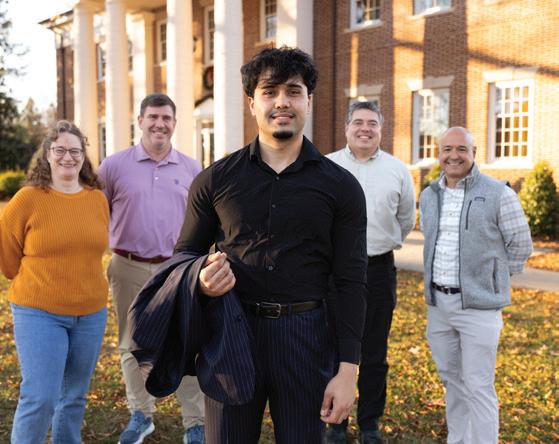
"Kamal has been an incredible addition to the College community and the Hampden-Sydney brotherhood," says Dean Bowyer. "He is wise beyond his years, and the students who have taken the time to know Kamal and understand his background have benefited greatly. Kamal's story of family tragedy, personal struggle, desire to learn and grow, and his resiliency to seek opportunities for himself and his family is inspirational."
The Hampden-Sydney community has been there for Kamal time and again, reaffirming what initially drew him to the College. Dr. Widdows, Dean Bowyer, and Mr. Rodriguez went above and beyond to support Kamal through the visa and travel process. Facilities and the Office of Student Affairs ensured he had bedding and school supplies upon arrival. The
For now, Kamal is focusing on the tasks in front of him, completing his undergraduate degree, applying to physician assistant programs, and seeing his asylum case through. Kamal isn't waiting until he graduates to make the difference he can, though. He is already taking an EMT class, and he runs an Instagram account and website that provides free guidance to international students on the U.S. college admissions process.
"Life can be difficult," he says. "I have not had an easy life, but I can't let the past affect my mind and distract me. Because if I lose my mind, it doesn't matter what else I do. I have to keep my mind safe and focus on the sticks I have."
For Kamal, those sticks—his mindset, his education, his vision—have become the foundation of something inspirational: a life rebuilt stick-by-stick from the ground up, not in the shadow of what was lost, but in the light of what is still to come.
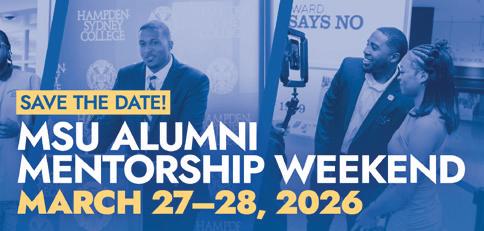





April 24, 2026
All members of the College community are welcome for a day of celebration, concluding with fireworks and a concert.
MAY 9, 2026

Connected While Staying Active
Join one of Hampden-Sydney's Virtual Fitness Groups
Strava | Hampden-Sydney College Running Club www.strava.com/clubs/hscalumnirun
Strava | Hampden-Sydney College Cycling Club www.strava.com/clubs/hscalumnicycle
Peloton | #HampdenSydneyAlumni
In 2025–26, Hampden-Sydney College celebrates two extraordinary milestones: 250 years of the College and 100 years of the Record. In honor of these anniversaries, the Office of Alumni and Parent Engagement and the Record invite alumni, students, faculty and staff members, and friends to help us crown The Best of Hampden-Sydney.
From the unforgettable concerts and legendary professors to the most spirited rivalries and timeless traditions, we need the entire Tiger community to nominate their favorites. Whether your memories stretch back decades or just a few years, join us in a lighthearted, nostalgia-filled celebration of the people, moments, and traditions that make HampdenSydney the best.
Nominations are now open for the following categories:
{ Best Campus Concert
{ Best Greek Life Event
{ Most Legendary Professors
{ Best Commencement Speaker
{ Most Legendary Staff Member
{ Most Memorable Tiger Athletics Moment
{ Best College-sponsored Off-campus Trip
{ Most Memorable Prank
{ Favorite College Tradition
{ Biggest Fraternity Rivalry
{ Most Historic Campus Moment
{ Favorite College Legend
{ Most Beloved Community Member
{ Or suggest a new category!
Relevant photo uploads and accompanying stories or memories are encouraged.
Visit go.hsc.edu/BestofHSC to nominate now!
Nominations close June 1, 2026.


250 SEATS. ONE NIGHT. FOR THE BROTHERHOOD.
An expertly curated epicurean experience by renowned alumni restaurateurs, chefs, and distillers in celebration of the College's legacy.
Crafted by John Currence '87 of Big Bad Breakfast, Walter Bundy '90 of Shagbark, Alex Harrell '97 of The Gloriette, and Michael Lennox '07 of Electric Hospitality, each course will incorporate small-batch Garrison Brothers Bourbon from Charles Garrison '89.
More than a meal, this event savors tradition and feeds the future, with proceeds benefitting the 250th Anniversary Scholarship.
April 23, 2026
Tickets required. go.hsc.edu/BourbonDinner
The Record of Hampden-Sydney College welcomes news of your milestones—career updates, weddings, births and adoptions, and brotherhood beyond the Hill.
You can submit a note by visiting alumni.hsc.edu or emailing classnotes@hsc.edu.
Submissions are encouraged, but subject to editing.
We look forward to hearing from you!
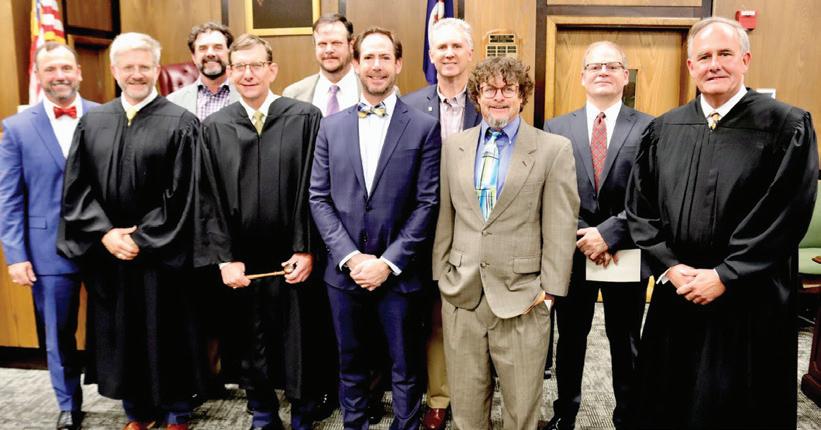
Alumni reunited to celebrate the investiture of Judge J. Matthew Haynes, Jr. '97 to Judicial District 2-A of Accomack and Northampton General District Courts. From left to right: Mike Luter '94, Hon. Cal Spencer '94, Chris Buck '97, Judge Haynes '97, Ralph Johnson '94, Greg Seamster '97, Hugh Stevens '97, Gordon Johnson '97, John Lee '97, Hon. Lynwood Lewis '84
Larry Hill '77 remains retired from urology, but he continues to teach at the University of South Carolina School of Medicine Greenville; work for the SC Board of Medical Examiners; and work at local skilled nursing, rehabilitation, memory care, long-term care, and assisted living units.
Dr. Richard Leggett '82 was a featured speaker at the 50th anniversary celebration of the behavioral health program at the Lewis Gale Medical Center in Salem, Virginia, on July 15, 2025. In his speech, Dr. Leggett paid tribute to the leadership of Dr. Brian Wood '82, program director of the psychiatry residency, in making the program an ongoing success.
Toby Usnik '85 has co-authored Connecting the Dots: Building Your Network and Legacy with Samir Kunaga, published by Blue Ocean Press.
Nolan R. Nicely Jr. '91 has been named to The Alleghany Foundation Board of Directors reported a July 16, 2025, article in Virginia Review Nolan is a partner/attorney for Updike, Nicely & Crawford PLC inn Covington, Virginia.
Matthew Ford, Esq. '92, has been named head of claims and litigation for AXA and as such has become a member of their executive leadership team. AXA is a French multinational insurance corporation headquartered in the 8th arrondissement of Paris and provides investment management and other financial services via its subsidiaries. AXA currently ranks as the 48th largest company in the world according to the Forbes Global 2000.
Porter Banister '93 has been named to the Yellowhammer News 2025 edition of the Power & Influence 'Top 50 list. He is vice chancellor for state affairs at The University of Alabama system.
David Prevette '97 has been named higher education sector leader at Moseley Architects in Blacksburg, Virginia, according to a May 13, 2025, School Construction News article.
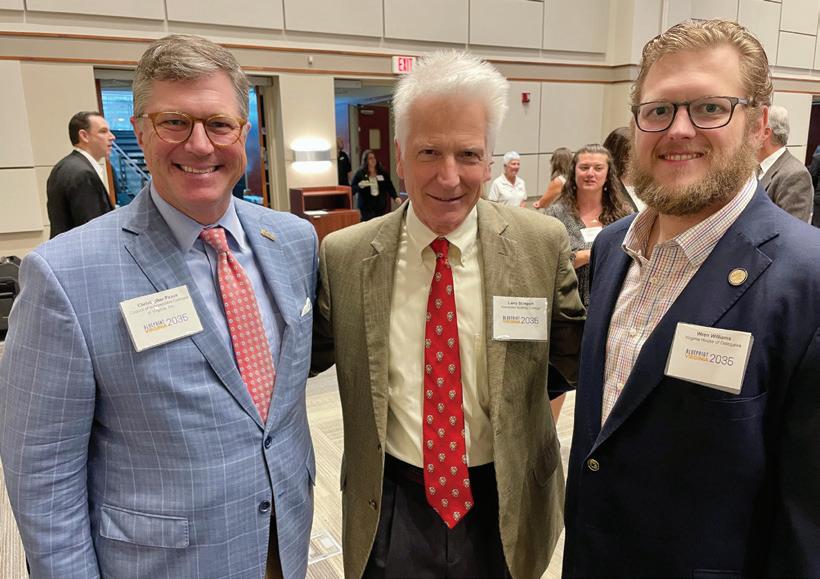
Virginia Foundation for Independent Colleges President Chris Peace '98, HampdenSydney President Larry Stimpert, and Virginia State Delegate Wren Williams '11 attended the Virginia Chamber of Commerce Blueprint 2035 tour stop for Go Virginia Region 3 in Danville, Virginia.
Former H-SC Trustee Richard P. Cook '99 has been named to the Coca-Cola Bottling Company United, Inc. Board of Directors reported a May 1, 2025, organization press release. Cook is co-founder, partner and portfolio manager at Birmingham-based Cook & Bynum Capital Management.
James F. "Jimmy" Goodmon Jr. '99 has been elected president and CEO of Capital Broadcasting Co. (CBC) based in Raleigh, North Carolina, reported a May 22, 2025, news release. His father, Jim, is chairman of the board and brother, Michael '03, is executive vice president.
David Bozell '00 will move into the role of president at Media Research Center in Herndon, Virginia, Fox News reported on May 19, 2025.
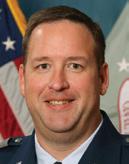
Dennis Bissell '01, currently commander of the North Carolina Wing, has been chosen to command the MidAtlantic Region of Civil Air Patrol (CAP) reported a July 14, 2025, CAP article. Bissell assumed command on October 11. He is also a financial advisor for Prosperity Advisors in Greensboro, North Carolina.
Dr. Barrett W. R. Peters '02 has entered the Master of Product Innovation program at the Virginia Commonwealth University da Vinci Center for Innovation. Peters says, "I knew I wanted to continue clinically practicing but desired to make more space for creativity, collaboration, and innovation in my professional life. So I began to contemplate ways in which to hybridize my career. I kept thinking of all the many challenges in this rapidly changing world and felt compelled to use these rediscovered aptitudes to create beautiful, functional product solutions to our shared challenges in healthcare, medicine and/or dentistry. I am excited to get started and grateful to be a part of the da Vinci community." A pediatric
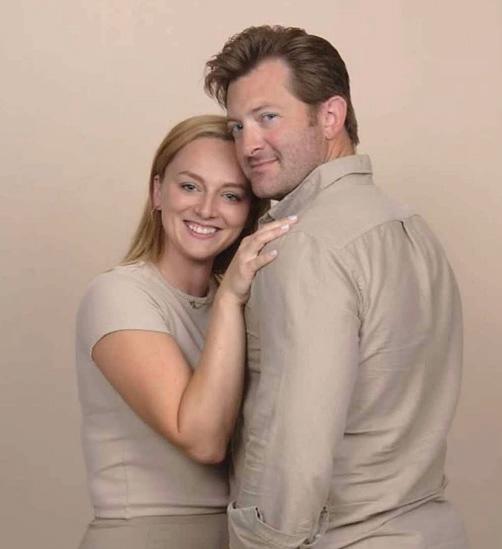
When your nickname is Hollywood, the stage is a natural place to end up. But it isn't where Andrew "Hollywood" Mitakides '07 began. Mitakides had his sights set on dentistry, just like his father, when he matriculated at Hampden-Sydney, but a stress-induced nosebleed during an organic chemistry class disavowed him of that notion. Wandering past Johns Auditorium after leaving that class and his best laid plans behind, Mitakides crossed paths with Barger-Barclay Professor of Theater Shirley Kagan. That chance encounter led Mitakides to a vibrant acting
of Dayton, Ohio. Weary from the stress of caring for his ailing father and the relentless politics of showbiz, Mitakides was spending more time teaching golf than chasing auditions.
It was this moment of, ‘Oh—that's what we were missing.'"
Scareer from sound studios doing voiceover work to the bright lights of Broadway.
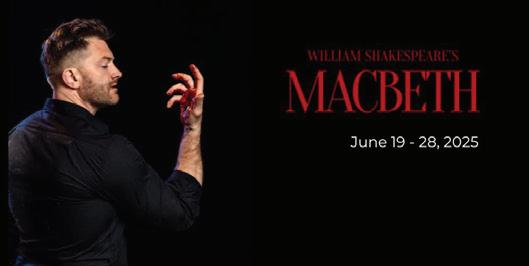
"Once I met Professor Kagan, I was in every production in some capacity from then on during my time at Hampden-Sydney. My debut role was Macduff in Macbeth, and I just I fell in love with Shakespeare." Mitakides says. "But every day, I second guessed myself thinking, ‘Am I good enough to do this? Can I make a living doing this?' And I remember Professor Kagan saying, ‘People need to see the stories that you can tell.'"
The industry agreed. Mitakides pressed on and had a dazzling career, performing in theater, television, movies, and voiceover work across the country. In 2016, though, Mitakides found himself back in his hometown
Realizing that his first love was and always would be Shakespeare, Mitakides applied for and received a coveted spot in the George Washington University Master of Fine Arts in Classical Acting program through the Shakespeare Theater Academy. After graduating in 2024, Mitakides returned home to Dayton, where he saw a need for a Shakespearefocused theater. Thus, Gem City Groundlings, Dayton's only Shakespeare Theatre Association-registered theater, was born. Mitakides and his wife, Riki, are cofounders. Andrew serves as chief executive officer and artistic director, and Riki is the director of marketing.
The response from the Dayton community has been overwhelming. "I didn't realize Daytonians would chomp at the bit for Shakespeare," Mitakides says. "But people were driving hours to other cities for professional theater, and now we're in their backyard.
eventeen years after his debut as Macduff on the Johns Auditorium stage, Mitakides returned to Macbeth—this time in the title role, on his own stage, with his own company. Macbeth isn't the only Hampden-Sydney influence audiences will see at Gem City Groundlings. Ed Bartholomew '09 is on the creative council and Dave Maggio '06 is a longtime sponsor.
In Shakespeare's time, groundlings were the people in the cheap seats, the everyman, and they were who Shakespeare was speaking to. Mitakides and the Gem City Groundlings strive to serve that same audience today, with a mission "…to bridge the gap between classic theater and modern audiences by making high-quality performances, education, and artistic opportunities accessible to all…[because] the works of Shakespeare… [belong] to everyone."
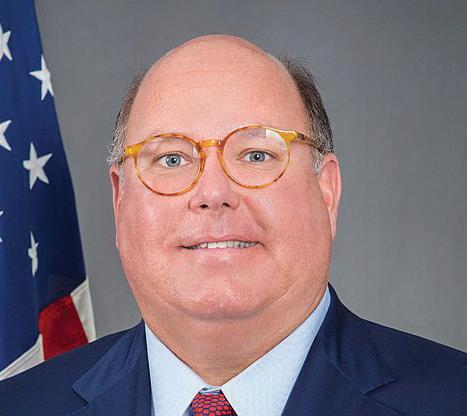
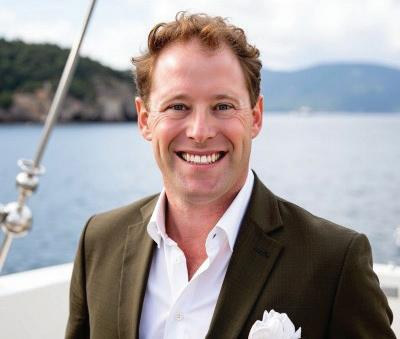
Ed McMullen '86, former U.S. ambassador to Switzerland and Liechtenstein, and Cameron Marshall '12, president of Bespoke Strategies, have been named to the Bedrock Advocacy Communications Advisory Board. "Bedrock partner Bernie Merritt said that McMullen and Marshall would bring a ‘new level of knowledge and creativity to our firm's vision, as we work to develop effective campaigns to deal with an uncertain and changing public policy environment,'" reported the June 3, 2025, O'Dwyer's PR article.
dentist by training, Peters has also entered the Graduate Certificate in Healthcare Innovation program at the VCU School of Nursing.
Andrew M. Sinclair '03 has been named vice president of public policy and development with the Virginia Chamber of Commerce in Richmond, Virginia, reported a June 26, 2025, organization announcement. He will also serve as executive director of the Virginia Chamber Foundation.
Robert Luther III '03 was made associate professor of law in 2025 after serving as distinguished professor of law from 2024 to 2025 and adjunct professor of law from 2019 to 2024 at Antonin Scalia Law School at George Mason University.
Rusty Foster '04 was named chairman of the board of directors for Visit Loudoun: D.C.'s Wine Country, the County of Loudoun's Convention and Visitors Association.
Russ Carmichael '04 was named vice president of finance and administrative services at Rappahannock Community College according to a July 7, 2025, college release.
Donald F. Walter Jr. '04 has been appointed judge for the Harford County District Court in Maryland per an August 01, 2025, announcement from the office of Maryland Governor Wes Moore.
W. T. Hillman Terzian, MD, FACS '08, assistant professor of surgery at the University of Nebraska Medical Center in Omaha and medical director of emergency general surgery at Nebraska Medicine, was
named an admiral in the Great Navy of the State of Nebraska—Nebraska's highest (and tongue-in-cheek) civic honor. The title, bestowed by Governor Jim Pillen, recognizes contributions to the state and promotion of "the Good Life." Dr. Terzian received the honor in appreciation for the care he provided the governor following a serious horseback riding injury.
Harry Dixon '09 has been named to the Legal Elite of the Midlands reported an August 8, 2025, firm press release. He is an associate at Callison Tighe & Robinson in Columbia, South Carolina.
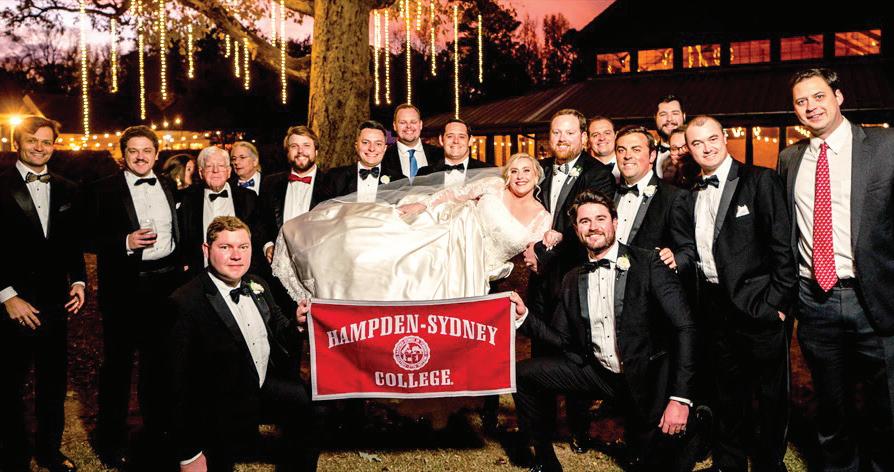
Holden McLemore '16 married Jessica Binion on November 23, 2024, in Wake Forest, North Carolina. The McLemore's reside in Wake Forest, North Carolina, where Holden serves as law partner at Perry, Brandt &; McLemore. Jessica received her doctorate in pharmacy from Campbell University in 2019 and serves as a pharmacist in Raleigh, North Carolina. Tigers pictured: Matt Goodrich '16, Cameron Tilley '16, Dr. James Pontuso, Emmalee Burke (née Klein) '16, David Klein '78, Ryan Kluk '17, Max Mauer '16, Zach Criswell '18, Ford Scott '16, Ben Bardill '16, Holden McLemore '16, H-SC Dean of Students Richard Pantele '13, Tim Morgan '16, Graves Anthony '16, Ethan Sabo '16, Drew DiStanislao '15, Will Outlaw '16, Jake Edmonds '18
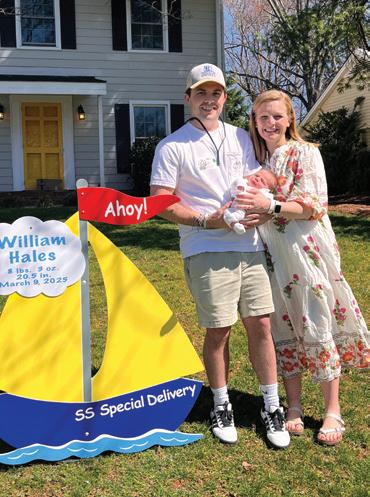
William '16 and Mackenzie Duncan welcomed a son, William Hales, on March 9, 2025. The family resides in Matthews, North Carolina.
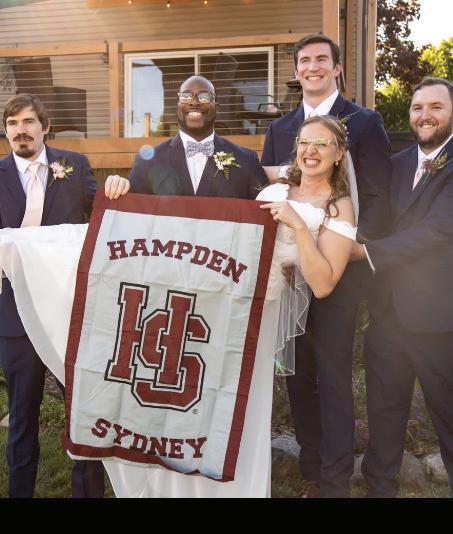
Kerrington Shields '14 married Rachel Nemeth on June 28, 2025. They were married on June 28, 2025, in Oskemos, Michigan. Tigers pictured: Dylan Keen '14, James "Putney" Smith '14, and Thomas "Drew" Fletcher '14.
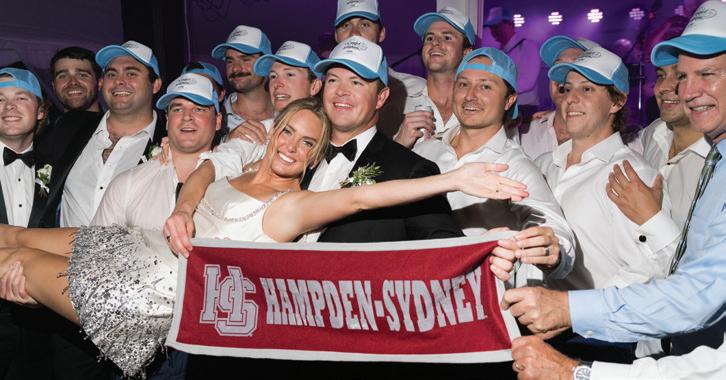
Ben Anderson '20 married Lindsey Walker on September 28, 2024 at Tides Inn in Irvington, Virginia. A 2021 graduate of Longwood University, the bride is a registered nurse in the PICU at Children's Hospital of The King's Daughters. The groom is a senior associate with Colliers. The couple resides in Norfolk, Virginia. Tigers in attendance included Trent Taylor '20, Austin Salmon '19, Austin Glaser '20, Graham Moore '20, Addison Peak '19, Willy Martin '20, Michael Good '19, Patrick Phillips '20, Tyler Summers '20, Liam Kenny '19, Brother Mason '20, Landon Kennedy '20, Morgan Wentz '20, Worth Remick '82, Ashton Williamson '85, Chamie Burroughs '99, and Scott Breeden '21
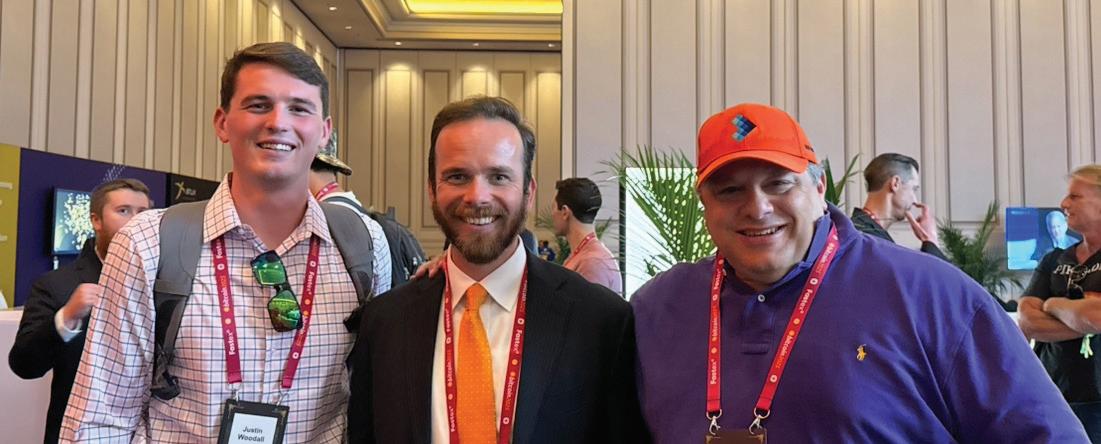
(Top l-r) Justin Woodall '23; Pierre Rochard, author and Bitcoin entrepreneur; and Mark Finelli '98, founder of INX.co
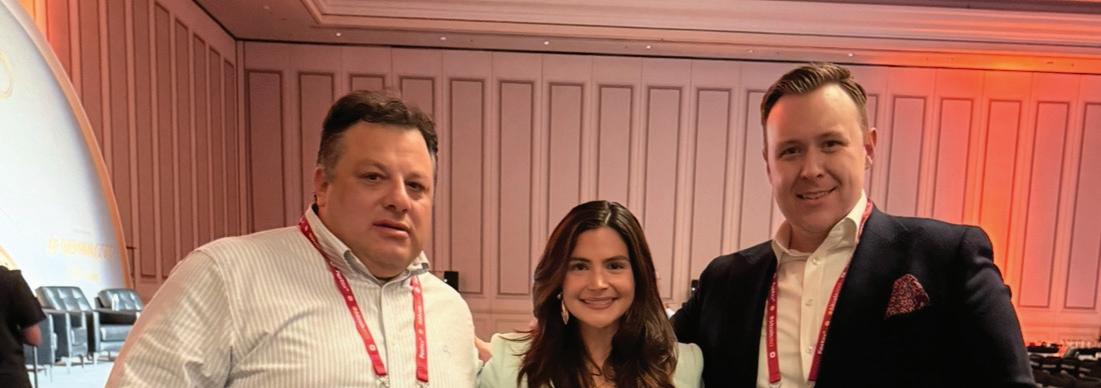
(Bottom l-r) Finelli; Valentina Gomez, Texas GOP congressional candidate; and Alexander Cartwright '13, chief economist at GreatX
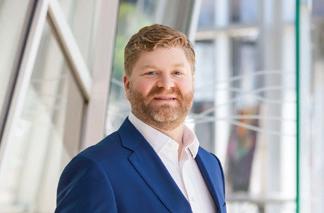
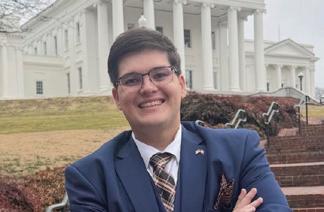
R. Patrick Bolling '09 was among the Virginia Forty Under 40 in the May 2025 issue of Virginia Business. He is principal/attorney at both the Lynchburg and Norfolk offices of Woods Rogers.
Conner Francis '20 has been selected to the 2025 edition of Lynchburg Business Magazine Top 20 Under 40 list. Conner is assistant chief deputy treasurer for Campbell County.
David L. Rouen III '11, COO of Superior Medical Equipment, has been elected as a board trustee of the Foundation for Physical Therapy Research, which is the only national nonprofit solely dedicated to funding physical therapy research and fostering the growth of promising researchers. To date, the foundation has awarded over $24 million to physical therapy research, grants, and scholarships.
Connor Winstead '12 has been named the development and infrastructure director and assistant town manager for the Town of Duck, North Carolina, reported a July 14, 2025, press release.
John Wirges '15 was promoted to major on July 1, 2025, at a ceremony on Fort Bragg, North Carolina. John is heading to the United Kingdom in August to attend the Defence Academy of the UK Advanced Command and Staff Course.
Lukas Epps-Dawson '15 has joined Young Moore and Henderson, P.A. in Raleigh, North Carolina, as an associate attorney according to an August 27, 2025, firm press release.
Charles Graves Anthony III '16 celebrated the grand opening of his law firm as managing attorney of The Elder Law & Estate Planning Center of Southwestern Virginia, PLLC. Anthony is a member of the Virginia Academy of Elder Law Attorneys and the National Academy of Elder Law Attorneys, and his firm's focus is on estate planning needs such as wills, powers of attorney and trusts, along with elder law needs including asset protection and Medicaid planning.
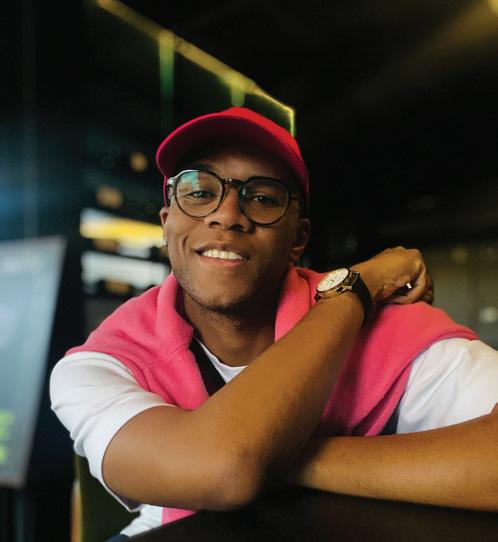
n 2023, overlooking the English Channel from his flat in Bexhill-on-Sea, Terrance Harris '16 was deep in work on a screenplay inspired by the tragic death of his childhood best friend, Austin, from an accidental overdose. A sudden realization hit him that in the 13 years since Austin's passing, Harris had moved significantly through the healing process, and he was ready to pay it forward. Not one to sit on an idea, Harris got to work, and Austin's Second Chance was born. The nonprofit aims to "build and create a comprehensible social and need based network for young men" in the Henry County, Virginia, area, where Harris and Austin grew up.
Returning to his hometown of Henry County was bittersweet for Harris. Confronting memories of a tumultuous childhood journey to personal acceptance while
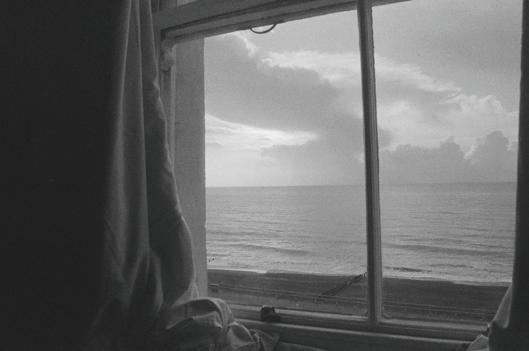
also finding ways to support the community that raised him was both difficult and restorative. "I've been able to work through and break free of many difficult things in my own life such as mental health struggles and substance abuse, and I want to help others unshackle themselves from the things that are holding them down," Harris says.
Having been away from the southwestern Virginia community for more than a decade, Harris began by listening. He identified the community's most pressing needs and sought to build trust. He soon realized that many in the blue-collar workforce lacked access to information about their labor rights. In response, he began offering OSHA training and certification courses to empower local workers and help the town attract betterpaying state and federal jobs. During the two-day trainings, Harris also offers workshops on mindfulness practices such as meditation, breathwork, and yoga with the goal of building out these services and others such as art therapy. In addition to Austin's Second Chance,
Harris also recently set up Confident Care, a mobile crisis response and regional community-based stabilization intervention service that provides mental health support for Henry County residents.
After overseeing the initial development and staffing of the two Henry Country services, Harris returned to Europe, where he is pursuing his doctorate degree in design and applied arts at the University of Edinburgh in Scotland. Harris also spends significant time in Galway, Ireland, where another branch of Austin's Second Chance provides mental health and sobriety support to teens and adolescents.
Filmmaking remains Harris's modus operandi for processing pain and transformation, and he believes in the power of art and creative expression to help people heal. Through his own film projects and through the mission of Austin's Second Chance, Harris continues to find and create beauty from grief. "I'm living life for two now," Harris says. "I am Austin's second chance."
McLin Sheddan Choate, Jr. '50 died on May 19, 2025. After graduating from Hampden-Sydney, McLin entered the U.S. Army when the Korean War broke out. He served in personnel management, training 130,000 medics at Camp Pickett. Upon returning home, McLin worked with his father at Purdum Paint Company before earning his Master of Science degree in clinical psychology at Rensselaer Polytechnic Institute (RPI), while working as a graduate assistant. McLin was hired by the Medical College of Virginia (MCV) to test the development of subjects in The Collaborative Perinatal Project, where MCV was one of several institutions that followed infants and mothers for 12 years. McLin eventually became the chief psychologist at MCV. Following this, he joined another colleague in providing psychological testing to school systems, as well as doing some early work on lead poisoning at the Anderson Clinic. McLin is survived by two children, five grandchildren, and one great-grandchild.
Dr. Lacy Jeffreys '51 died on May 15, 2025. At H-SC, Lacy was a Sigma Chi brother, before going on to graduate from University of Richmond in 1951. He then earned his master's degree in psychology from Virginia Commonwealth University in 1968 and his Ph.D. in counseling from the University of Maryland in 1971. In the '70s he taught courses in psychology and human relations at Catonsville Community College and
Antioch College. He also worked as a counselor at Anne Arundel Community College. For over 20 years, he served as a counselor and psychotherapist at the Family Life Center in Columbia, Maryland, where he was also on the board of directors, and at Psychological Services and Shepard-Pratt Counseling Centers in Annapolis, Maryland. He also had a private practice in Columbia during the '80s and '90s and was a member of the American Psychological Association, the Maryland Psychological Association, and the American Association of Counseling. He is survived by his wife, Sandra; two sons; and a step-daughter.
Roger Kent Elliott '56 died on August 19, 2025. He graduated from HampdenSydney College, Union Presbyterian Seminary, and Florida State University. Roger served as a Presbyterian minister in Virginia, before the young family moved for Roger to attend Florida State University for his Masters of Fine Art. Afterwards, they returned to Virginia where Roger taught art for the rest of his career at Central Virginia Community College in Lynchburg. Roger was a man of great faith, immense talent, and unwavering devotion to family. He was a master of puns and trompe-l'oeil-style painting, with a keen artist's eye, unbounded creativity, and quiet strength. Roger is survived by his loving wife, Jane; two sons; six grandchildren; six stepgrandchildren; and 10 great-grandchildren.
G. Otis Mead III '56 died on June 21, 2025. At HampdenSydney, Mead played football, sang in the Glee Club, and was a proud member of Chi Phi fraternity. After HampdenSydney, Mead moved to Lexington, Virginia, where he took a job at a clothing store under the tutelage of Earl N. Levitt to pay off his wardrobe debt. He served in the National Guard, and within three years in Lexington joined what became KinnearMead Real Estate, later Mead Associates. In 1972, Mead was elected president of the Virginia Association of Realtors and held leadership roles in the national organization, the Jaycees, the local and state chambers of commerce, Southern Seminary College, the Lexington School Board, Stonewall Jackson Hospital, the Lion's Club, and many other organizations. For his extraordinary community engagement, Mead was awarded membership in the ODK national honorary society. 'Mead is survived by two children, four grandchildren, and one greatgrandchild.
John Young Nicholson III '56 died on July 3, 2024. He was an Eagle Scout and graduated summa cum laude and Phi Beta Kappa from Hampden-Sydney. After college he taught high school science, which he enjoyed. Later he completed coursework for a Ph.D. in chemistry and worked for Dupont as a chemist. Most chemistry literature at that time was in German, so he taught himself to read German. In 1972 he earned a Ph.D. in solid-state physics. Afterwards he worked at NASA Langley Research Center in Hampton, Virginia, measuring and modeling components of the Earth's atmosphere using micro-g and nano-g accelerometers flown on the NASA space shuttle. He was a learned gentleman, unfailingly interesting, with insights and stories to share. He lived the life he wanted and left this world a better place. He enjoyed investing, and though he lived a modest lifestyle he accumulated substantial worth. He left the lion's share to his cherished alma mater Hampden-Sydney College to support future students in need. John dearly loved Lesley, Joanna, and his extended family and friends across the U.S.
Edward William Early '57 died on April 11, 2025. Many of Ed's happiest hours were spent outdoors in nature, farming, gardening, and roaming through the woods and fields with his wife and daughter. Always a wildlife advocate, he also was an avid duck hunter. Ed loved learning history through reading, visiting historic sites, and being active in local historic preservation and conservation projects. He was a lifetime Presbyterian. His mischievous and fun-loving streak amused his family and friends. Ed reluctantly retired from a country law practice in October 2023, after practicing over 58 years. Ed is survived by his wife of almost 49 years, Janet, and daughter.
The Rev. Bernard K. Bangley '59 died on June 21, 2025. Bernard felt a calling to ministry early in his life. He earned his Bachelor of Arts degree from Hampden-Sydney and his Master of Divinity at Union Theological Seminary. Following his ordination, he served congregations at Blue Ridge Presbyterian in Ararat, Virginia; Bethesda Presbyterian in Rockbridge Baths, Virginia; First Presbyterian Church in Lynchburg, Virginia; Pine Shores Presbyterian in Sarasota, Florida; and Quaker Memorial Presbyterian in Lynchburg. Beyond his
ministry, Bernard was an accomplished author. His writings, which often explored themes of faith, spirituality, and the human condition, resonated deeply with readers. He had a gift for modernizing the writings of great Christian mystics for modern readers, reviving the words of Bernard of Clairvaux, Evelyn Underhill, Francis de Sales, and many others, leaving a lasting legacy. Bernard is survived by his beloved wife of 67 years, Anna; three children; and four grandchildren.
Lawrence Barron "Barry" Wood Jr. '59 died on May 24, 2025. Barry earned a B.A. in English from HampdenSydney College, graduating summa cum laude as the second honor graduate. He received a Woodrow Wilson Fellowship for the 1959–60 school year and earned an M.A. in English from the University of Pennsylvania in 1961. In 1961 he returned to Newport News to become a charter member of the faculty of what is now Christopher Newport University (CNU). During Barry's 42-year career with CNU, he served as the director of numerous programs and was the founder of the college's Performing Art Series. He also spent 10 years serving first as the assistant dean of academic affairs and later as the director of development for CNU. He finished out his career by returning to the classroom and chairing the fine and performing arts department.
In 2001, Barry was awarded an honorary doctorate from CNU. Barry also served as a board member with the Riverside Hospital Community Health Center, Peninsula Alcohol Safety Advisory Board, Peninsula Council of the Arts, Peninsula Family Service/ Traveler's Aid, Peninsula SPCA, Esperance Dance Studio and Co., Norfolk Theater Center, Jewish Community Center Film Society, Virginia Symphony Orchestra's Advisory Committee on Programs and Guest Artists, Young Audiences of Virginia, Peninsula Pastoral Counseling Center, Hampton Fine Arts Commission, and the Hampton Rotary Club. As a member of the Hampton Rotary Club, he received the Paul Harris Fellow award, recognizing both his outstanding record of achievement as university faculty member and administrator, as well as his major contributions to the community and civic endeavors. His volunteer work as a citizen included The Advisory Committee to the Hampton School Board and City of Hampton's Advisory Committee on Animal Laws. He served as chairman for both and was the author of the final report for both groups. His committee work included the Cultural Alliance of the Greater Hampton Roads, the Charles Taylor Memorial Library, and the City of Hampton's Fine Arts Commission. Barry is survived by the love of his life of 66 years, Ann; three children; seven grandchildren; and nephew Bobby Hatten '69
Dr. Phillip M. Cook Sr. '62 died on May 27, 2025. At HampdenSydney College, he was a proud member of the Kappa Alpha Order. Phil earned his Doctor of Dental Surgery degree from the Medical College of Virginia in 1966 and practiced general dentistry in Chesterfield County, Virginia, until his retirement in 1992. Phil also served as president of the Southside Study Club. He was an avid hunter, fisherman, and golfer, and loved nothing more than working on his farm. Phil's legacy is one of laughter, love, loyalty, and deep devotion to his family, his friends, his profession, and to living life with heart and humor. He is survived by his devoted wife of 58 years, Nancy; two children; and four grandchildren.
Jerry Carlin Heifner '62 died on July 5, 2025. After attending Hampden-Sydney College, he went into the Army and later worked for AT&T for 26 years at Spears Mountain; Buckingham County; and Goddard Space Center, Greenbelt, Maryland. He also worked numerous jobs, including Buckingham Correctional Center for nine years. Jerry is survived by his wife of 61 years, Barbara, and one daughter.
Dr. Robert B. "Bob" Albee Jr. '67 died on March 21, 2025. Bob received his undergrad degree from HampdenSydney College and earned his medical degree from the University of Virginia. Later, he served his internship at Roanoke Memorial Hospital and his residency in obstetrics and gynecology at the University of Virginia Hospital. Among the early leaders in advanced gynecologic surgery and use of the laser for excision of endometriosis and treatment of pelvic pain gynepathologies, both on this continent and abroad, Bob taught his techniques to countless physicians and surgeons in every corner of the globe. Bob co-founded the Center for Endometriosis Care (formerly known as the Endometriosis Care Center) in 1991 to execute his vision of providing dedicated treatment to those affected by endometriosis. One of the first 100 surgeons to receive the honor of being awarded Certification in Advanced Operative Laparoscopy by the Accreditation Council for Gynecologic Endoscopy, Bob shared his expertise with various endometriosis organizations and remained active throughout his lifetime career in many medical societies, including the Medical Association of Georgia, ACOG, the GYN Laser Society, the AAGL and others. He also made multiple humanitarian trips to provide medical assistance to the Penan tribes in the Baram River area of Sarawak in East Malaysia. Bob received countless awards throughout his career for his humble,
compassionate work, including as a "Top 10 Doctor" and "Best of." He was also included in Who's Who for his accomplishments and contributions to medicine. Bob is survived by two children and his beloved grandchildren.
Richard Earl Potter '67 died on July 9, 2025. Richard graduated from HampdenSydney College, served as an M.P. in the U.S. Army obtaining a rank of sergeant E5, was a teacher at New Kent High, worked at Ford Motor Company for 22 years, and later as a security guard at Dewitt Wallace Museum in Williamsburg, Virginia, for 17 years. Richard was a true Southern gentleman, history lover, and animal lover. He is survived by his wife, Brigitte; three stepchildren; and two grandchildren.
Thomas Arnold Mills Jr. '69 died on June 16, 2025. Tom graduated from HampdenSydney with a degree in science and physics. He then earned a Class A Unlimited Electrical License in Virginia, North Carolina, and Florida. Professionally, Tom served as vice president and production manager for Dorey Electric in Virginia and Pedro Falcon in Florida. His leadership and expertise left a lasting impact on those he worked with and mentored throughout his career. Tom loved boating, fishing, diving and loved to tell corny jokes or quote his favorite humorist, Dave Barry. His laughter was infectious. Tom is survived by his wife, Christine; two children; and two grandchildren.
Trustee Emeritus Charles L. Cabell '74 died on June 26, 2025. Charles earned his bachelor's degree from HampdenSydney College and his Juris Doctor from the William & Mary Law School. He was a partner at the law firm Williams Mullen, where he was widely respected for his expertise in real estate, land use, estate planning, and business law. Beyond his legal work, Charles was a tireless advocate for philanthropy and civic engagement, serving as president of The Cabell Foundation, chairman of the Board of Trustees of the Virginia Museum of History & Culture, trustee emeritus of Hampden-Sydney, on The Commonwealth Club Board of Governors, the boards of trustees of the Virginia Foundation for Independent Colleges and Brookfield, and as a member of the Society of the Cincinnati and the Sons of the Revolution. His lifelong commitment to public service was recognized by commendations from the governor of Virginia and his alma mater, Hampden-Sydney College, acknowledging his impact as a benefactor, advisor, and civic steward. Charles is survived by his devoted wife, Elizabeth; three daughters; one stepson; and two grandchildren. His father was former H-SC Trustee Royal E. Cabell Jr. '43; his brother was Royal E. Cabell III '72; and his uncle was Dr. Charles L. Cabell '30.
John Gurganey Overstreet '69 died on July 23rd, 2025. After graduating from H-SC, Johnny earned his law degree from T.C. Williams School of Law at the University of Richmond. He began his legal career at Putney and Putney and later founded his own law practice. Johnny also served for many years as Bedford County Attorney, as well as representing Bedford Social
Services. Later he served as Appomattox County Attorney. Johnny loved genealogy and was a member of many lineage societies, serving as the president of the Ligon Family & Kinsmen Association. John and his wife, Vickie, also served as Parent Council chairs when their son, Hunter, was a student at H-SC. Johnny is survived by his wife of 54 years, Vickie; two children— Hunter Overstreet '03; two step-grandchildren; and two grandchildren.
Thomas H. Shomo '69 died on December 1, 2025. As a student, Tommy was active in Omicron Delta Kappa (ODK), Union-Philanthropic Literary Society, Honor Council, and the literary magazine. After graduating, he devoted most of his professional career to the College, including service as an admission officer, director of financial aid, assistant dean of students, and interim dean of students. He retired after serving many years as the College's director of communications.
Tommy is probably best known as the author of To Manner Born, To Manners Bred: A Hip-Pocket Guide to Etiquette for the Hampden-Sydney Man, which continues to be distributed to every Hampden-Sydney freshman. This booklet earned widespread notoriety when it was cited by Lisa Birnbach in her 1980 The Official Preppy Handbook and her 2010 True Prep. While the booklet offers much guidance on matters of etiquette, it is also a guide to living a life of character. In the epilogue, he wrote that "Good manners alone…are not the measure of a man," emphasizing that the measure of a man is his character, that which is "etched" on his heart.
Even after his retirement in 2016, Tommy continued hosting his famous etiquette dinners. A reliable source of knowledge about the College's history, he was always available to offer input on matters large and small. During ODK's centennial year in 2023, the honorary leadership society honored Tommy's many years of service to the College in renaming an award that recognizes sophomores who demonstrate leadership during their freshman year—the Thomas H. Shomo '69 ODK Award for Leadership Potential. At the time of his death, he was serving as co-chair of Hampden-Sydney's 250th Anniversary Committe.
Daniel Spencer Smith '72 died on July, 27, 2025. Dan attended HampdenSydney College and graduated from the University of Richmond. He began his professional life at a local surgical supply company, General Medical (now McKesson) and later purchased a travel agency, Travel Advisors, Inc., which he owned and operated for three decades before merging with Covington Travel. He was a former member of West Richmond Rotary, NoInc. Investment Club, 55 Golf Association, Society of Cincinnati, Jamestowne Society, Sons of the Revolution, and the Richmond Cotillion. Dan was a devoted and loyal husband, father, brother, grandfather, and friend. He was an honest business man and a charitable community member. He was always gracious and polite, but his most important legacy is fierce love and compassion for his family and friends. Dan is survived by his wife, Cheryl; two daughters; and six grandchildren.
John A. Beverly Jr. '73 died on August 2, 2025. John was a gifted athlete and scholar, earning a B.A. in history and economics from Hampden-Sydney College in 1973. He was inducted into the Hampden-Sydney Hall of Fame in 2011 for football and baseball, having started all 42 football games in his college
career and leading his teams to multiple championships. His 1970–71 football team was also inducted into the H-SC Athletic Hall of Fame in 2023. John served as a reference librarian for Chesterfield County for over three decades and later supported local schools and sports teams. He especially enjoyed teaching and playing tennis, becoming known for his strong backhand and love of the game. John is survived by his wife, Katherine, and one child.
Thomas Moss "Rusty" Heery '78 died on June 23, 2025. Rusty graduated from HampdenSydney College with a Bachelor of Arts in economics in 1978. After a short stint with the C&S Bank in LaGrange, Rusty moved back to Athens, Georgia, to work with his father at Heery's Clothes Closet, turning it into one of the South's premiere women's fashion businesses. Rusty also served as president of the Athens Downtown Development Authority. He is survived by his wife of 42 years, Ginger; three children— Frank Heery '07; and two grandchildren.
William Benedict "Billy" Lumpkin III '78 died on July 30, 2025. Billy was a graduate of HampdenSydney College. Billy lived a life full of passion, humor and a deep love for his family and sports. Billy never met a stranger. He was known to walk up and meet someone for the first time and say, "Hi, my name is Billy, what do you think of me so far?" Billy was an avid sports enthusiast and found great joy in golf, football, and baseball, both as participant and spectator. Billy is survived by his wife, Betty; and one daughter.
Charles James Arrington III '86 died on July 9, 2025. At HampdenSydney, Chuck was a member of the Tiger Football team, an economics major, and a brother of Kappa Alpha. Chuck was a unique and competitive guy who loved games, his favorite foods, sports, nature, and burning debris in his fire pit. Chuck is survived by his mother and brother.
Christopher Raymond Lea '00 died on March 18, 2025.
Venable Professor Emeritus of Chemistry
Joel Emmett Williams '79 died on May 9, 2025. A HampdenSydney graduate, Joel went on to work for the State
Corporation Commission as a financial analyst until his retirement in 2023. In his free time, he enjoyed spending time on the water and on his boat with his family and friends. Joel is survived by his wife of 36 years, Linda.
Christopher was an alumnus of HampdenSydney College and the University of Illinois-UrbanaChampaign and was a former patent examiner for the United States Patent and Trademark Office. A conversation with Christopher was a unique experience that engaged all aspects of one's intellect. Christopher was an excellent conversationalist; he especially excelled in the topics of LEGO, Star Wars, Indiana Jones, chemistry, physics, quantum mechanics, philosophy, video games, and proper grammar etiquette. Christopher is survived by his brother, Geoffrey Lea '04
William W. "Bill" Porterfield died on December 13, 2025. Bill taught chemistry at Hampden-Sydney from 1964 until his retirement as in 2012. Bill witnessed the Chemistry Department's move from Bagby Hall to Gilmer Hall, "the Science Palace," in 1968 and the growth in the number of science faculty members from a handful of colleagues to the 30 at the College today. He was instrumental in shaping and modernizing the College's chemistry program, emphasizing undergraduate research, and preparing students for graduate school. He authored more than a dozen scientific journal articles and a textbook in inorganic chemistry, as well as an advanced level general chemistry textbook. In addition to teaching chemistry, Bill served as a member of the HampdenSydney Volunteer Fire Department early in his time at the College. He was an avid photographer, and he loved classical music. He was an enthusiastic fan of HampdenSydney basketball, rarely missing a home game. As an eyewitness to near one-fourth of the College's history, Bill was also a passionate enthusiast of Hampden-Sydney history. He was the author of Chemistry at HampdenSydney, which provides a detailed history of chemistry and science instruction at the College from its founding until Bill's retirement. In an earlier volume, Things That Might Have Happened at Hampden-Sydney, Bill compiled interesting happenings at the College during its first quarter millennium as told to him by "highly upright people," including Professor of Physics Tom Gilmer, Class of 1923; Professor of Classics Graves Thompson, Class of 1927; Professor of Philosophy Maurice Allen, Class of 1916; and former Buildings and Grounds Manager Herman Duncan, who had been on the staff since the 1930s. Last year, Bill offered a series of lectures, "Hampden-Sydney Over Its First Two Centuries," as part of the College's 250th anniversary commemoration. Bill is survived by two sons, five grandchildren, and three great-grandchildren.
MARKETING AND COMMUNICATIONS
"I'm a big believer in private higher education—it's essential. Even when Bobbie and I were living on borrowed money in the '70s, I always tried to give something. Giving becomes a habit, which is a good thing."
–Pete Mowbray '67
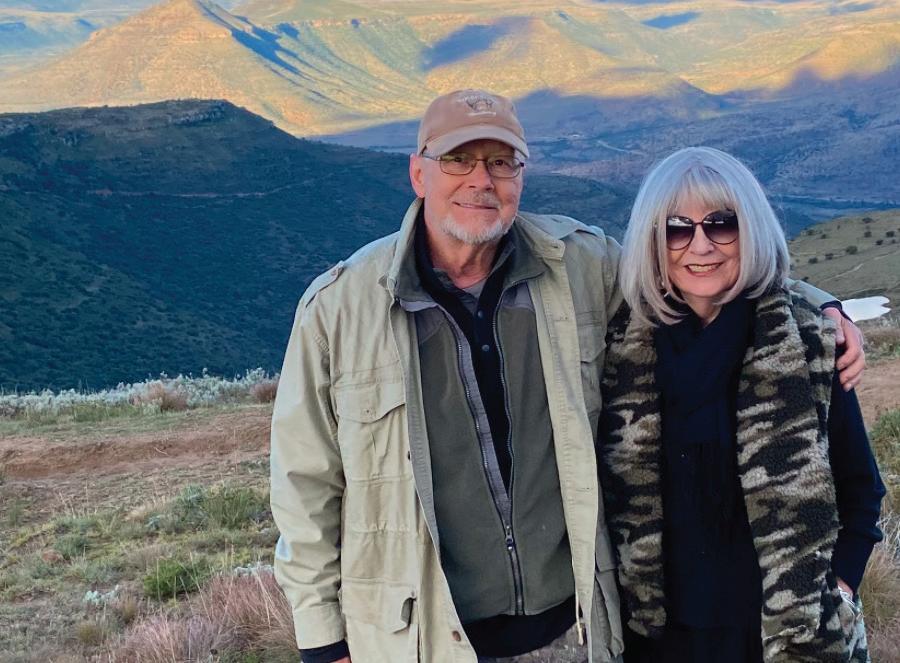
Become a Tiger for Life!
If you are interested in leaving a legacy gift to Hampden-Sydney or if you have already included the College in your estate plans, please let us know so that we can thank you and honor you for your generosity.
223-6780 hscgiving.org