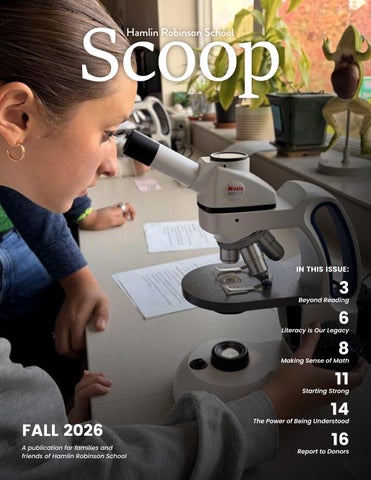
IN THIS ISSUE:
3
Beyond Reading
6
Literacy is Our Legacy
8
Making Sense of Math
11
Starting Strong
FALL 2026
A publication for families and friends of Hamlin Robinson School
14
The Power of Being Understood
16
Report to Donors
MISSION
FROM THE DESK OF STACY TURNER, HEAD OF SCHOOL
Hamlin Robinson School ignites the academic and creative potential of students with dyslexia and other language-based learning differences.
The HRS Difference: Where Every Student’s Potential Takes Flight
VISION
Dear HRS Community,
The world class educational program at Hamlin Robinson School is a catalyst for students to discover the joy of learning within a rich, comprehensive school experience.
CORE VALUES Respect, Responsibility, Purpose, Perseverance
EQUITY STATEMENT The Hamlin Robinson School community strives to ensure each student and their family has access to the supports they need within an inclusive environment that recognizes and honors all aspects of identity. We aspire to create an equitable environment for each student, family, faculty and staff, and all members within our community where everyone thrives and knows they belong. We are committed to this journey which requires continual self-reflection, vulnerability, intentionality, and accountability from each of us.
COVER: 8th Grade Science Class; Photo credit: Natasha Tresh
What makes Hamlin Robinson School so special? It’s a question I think about often, and one that goes far beyond our specialized approach to teaching students with dyslexia and other language-based learning differences. The answer can be found in our classrooms, in the expertise and dedication of our teachers, in the confidence our students develop, and in the community that surrounds and supports them. At HRS, nothing about the learning experience happens by accident. Every instructional decision, every opportunity for connection, and every investment in our programs is rooted in a deep understanding of how students learn and what they need to thrive. This issue of Scoop explores that intentionality and the many ways it shapes the HRS experience. You’ll discover how our commitment to the Slingerland® Approach, which has been part of our identity since the school’s founding, continues to evolve through exceptional teacher training and professional growth. You’ll learn about our partnership with the University of Washington, where research into mathematical thinking and instructional
practices is helping us better understand how students learn. And you’ll see why an HRS education is about so much more than literacy, encompassing the academic, creative, social, and emotional development of every student. Perhaps most importantly, you’ll hear about the power of being understood. For students who may have spent years questioning their abilities, finding a school where teachers understand how they learn and peers share similar experiences can be transformative. The confidence that grows from that sense of belonging extends well beyond the classroom. We’re also excited to share a glimpse into our new Early Childhood Education Program, where our youngest learners are beginning their educational journeys in a language-rich, play-based environment designed to build strong foundations for lifelong learning. Together, these stories reflect both our legacy and our future.
This issue also serves as our annual report for the 2025–2026 fiscal year. As you explore the pages recognizing our donors and highlighting our endowments, I hope you’ll see more than names and numbers. You’ll see a community of people who believe deeply in our mission and make this extraordinary learning environment possible. Your generosity helps us invest in outstanding educators, expand opportunities for students and families, strengthen our programs, and ensure that more children have access to an education designed for the way they learn. To our families, faculty, staff, alumni, trustees, donors, and community partners: thank you. Each of you plays an important role in the HRS story. As we look ahead, I am inspired by what we are building together. We honor a remarkable educational legacy while continuing to ask questions, explore new possibilities, and deepen our understanding of how to help every student succeed. That is the HRS difference. And it is a difference we create together. With gratitude,
Stacy Turner Head of School
Beyond Reading: Why HRS Is So Much More Than a Literacy Program
Lindsey Key, Director of Teaching & Learning Everyone knows we get literacy. And we know it well. We’re not shy about that, either. But here’s what we know about dyslexia: our students are so much more than their dyslexia. Our students are smart, complex, creative people with incredible potential. They deserve an education that challenges them, nurtures their interests, and provides opportunities to discover their full potential. We believe students can learn anything, and our job is to help them build the skills, confidence, and independence to do just that. So, what’s in our recipe for success beyond literacy? Start with a generous helping of belonging. Add teachers who understand how students learn and know how to make learning accessible without sacrificing rigor. Fold in multisensory instruction, purposeful routines, and thoughtfully designed classrooms that help students focus their energy on learning. Next, weave reading and writing into every subject. Language is a tool for thinking and communicating, not just something that happens during literacy instruction. Add challenging math, hands-on science in real labs, technology, social studies, and opportunities to explore ideas from multiple perspectives. Now, for a heaping scoop of joy and a generous swirl of creativity: art, music, physical education, and wellness classes that make room for physical, social, and creative expression. Mix in field trips, camps, dances, talent shows, Dungeons & Dragons, affinity groups, and community service. These experiences help students discover new interests, develop friendships, become well-rounded, and enjoy all the things that make school, well, school. continued » Fall 2026 | 3
And don’t forget one of the most important ingredients: support baked right into the program. At HRS, many supports are so seamlessly integrated into the school day that they can be easy to miss. Students know they can ask for extra time when they need it or request that a math word problem be read aloud. Classrooms are intentionally arranged, and class sizes allow for meaningful teacher-student interactions. Our middle school students also develop accommodation plans that emphasize understanding their learning needs and practicing self-advocacy.
4 | The HRS Scoop
These supports aren’t an afterthought or something students have to earn. They are part of how we design learning to meet students’ needs. When specialized instruction, accommodations, and thoughtful classroom design are woven into the school day, students can spend less energy navigating barriers and more energy learning, creating, and contributing. These are so seamlessly embedded into the fabric of our program that it’s easy to forget that they’re even there. Our program is designed to feel like a school, not an isolated special education program. Students experience a full, challenging academic day alongside peers who understand them, with support that helps them participate and grow. That’s part of our secret sauce.
But does it work? It’s a question we continually ask ourselves. We look at many measures of success, including whether students feel a sense of belonging and accomplishment, develop confidence and independence, and make academic progress. That sense of success has to be genuine. Students need opportunities to experience success for themselves, not simply hear from adults that they’re wonderful. We use Renaissance STAR testing to examine patterns in student performance in reading and math. No single assessment tells the whole story, and we cannot promise a particular outcome for any individual student. Every learner is unique, and our approach must respond to the students in front of us.
Still, the schoolwide trends are encouraging. Since fall 2022, the percentage of HRS students meeting or exceeding the district benchmark on STAR Reading has increased from 35.1% to 59.5%. In math, that percentage has increased from 40.9% to 63.7%. These results represent different groups of students across the years, not the same students tracked over time. They offer snapshots of schoolwide performance, not guarantees of individual outcomes. But they
provide one important window into the academic experiences of the students we serve. And the story extends beyond what we can measure on a graph. You can’t assign a percentage to belonging or quantify the moment a student realizes they can tackle something they once thought was impossible. Yet we see those moments every day, in classroom discussions, in the risks students are willing to take, and in the new strengths they discover. Literacy is an essential ingredient in an HRS education, but it isn’t the
whole recipe. We’re proud of our expertise in literacy and equally proud of the comprehensive education built around it, one that challenges students academically, makes room for creativity, and helps them recognize their own potential. At HRS, the goal isn’t simply to address what’s difficult. It’s to build on what’s possible. Literacy may be where the journey begins, but it’s certainly not where the possibilities end. And that’s a recipe worth sharing.
Fall 2026 | 5
LITERACY IS OUR LEGACY Literacy isn’t simply a subject taught at Hamlin Robinson School. It’s the foundation on which the school was built, the expertise its teachers cultivate, and the opportunity it creates for students to discover their potential. HRS began as a demonstration site for the Slingerland® Literacy Institute, putting into practice an instructional approach specifically designed to help students with dyslexia and other languagebased learning differences. After two years, HRS became an independent nonprofit school, but its commitment to the Slingerland® Approach remained firmly rooted in its identity. Today, that legacy continues in every classroom, where highly trained educators bring together the science of reading, specialized instructional techniques, and a deep understanding of how students learn. Expertise Doesn’t Happen by Accident Every new HRS teacher is enrolled in an intensive four-week Slingerland® training program that includes 133 hours of instruction and hands-on teaching experience with students. But that initial preparation is only the beginning. 6 | The HRS Scoop
“Effective implementation requires more than following a prescribed sequence,” explains Bonnie Meyer, former HRS Head of School and current Slingerland Specialist. “Teachers must understand the purpose behind each instructional component and make informed decisions about pacing, scaffolding, and opportunities for students to apply their learning.”
learning pathways, helping students build connections that strengthen reading, writing, and language skills.
Unlike a scripted curriculum, the Slingerland® Approach requires teachers to thoughtfully design lessons that respond to the individual needs of their students. Instruction integrates kinesthetic, auditory, and visual
For fourth-grade teacher Erin McDougall, completing her second year of Slingerland training transformed her understanding of the approach.
Through ongoing professional development, teachers deepen their understanding of English language structures, refine their instructional techniques, and learn how to help students progress from foundational skills toward independent application. Growing as Teachers, Growing Student Potential
She describes her initial training as helping her “launch the boat,” but she wanted to understand more deeply why the approach works and how its interconnected components support student learning. The advanced training gave her a bigger instructional toolkit and greater confidence in making decisions that help students succeed. “Not only am I able to help students with their learning, but I feel much more confident in knowing where and how to remove scaffolding so that students can become more independent learners,” Erin shares. Her ultimate goal is simple: helping every student experience success in school. The experience has also inspired her to pursue becoming a Slingerland® Instructor of Teachers, extending her impact beyond her own classroom.
Approach, the more I am able to give my students the individualized support that they need,” she explains.
unfamiliar language independently.
One of her favorite aspects of Slingerland is helping students discover that English spelling isn’t simply a collection of words to memorize. There are patterns, histories, and linguistic structures waiting to be explored.
The Slingerland® Institute recognizes HRS as a model school, reflecting the depth of instructional expertise cultivated across its faculty.
Her students can explain why spell ends with two L’s, while spoil ends with one. They begin asking their own questions, like why bus has only one S, leading to discoveries about word origins, including its connection to omnibus. “They really start thinking deeply about words!” Helena says. That curiosity is exactly what makes the approach so powerful. Students aren’t simply learning to decode or spell individual words. They’re developing the analytical skills and confidence to approach
A Legacy That Continues to Grow
But the true measure of that expertise is found in classrooms, where teachers thoughtfully adapt instruction, recognize when students are ready for greater independence, and help them tackle increasingly complex reading and writing challenges. More than four decades after its founding, HRS continues to honor its origins while investing in the educators who bring its mission to life. Literacy is our legacy. And through exceptional teaching, it becomes a foundation for every student’s future.
“Why wouldn’t I want to get better at my craft?” she asks. Understanding the Why Behind Words Fourth-grade teacher Helena Myler has taken that next step and now trains other educators in the Slingerland® Approach. For Helena, advanced training has strengthened her ability to individualize instruction while nurturing students’ natural curiosity about language. “The more I learn about the building blocks of the Slingerland® Fall 2026 | 7
MATH
MAKING SENSE OF
At Hamlin Robinson School, we are so lucky to have Dr. Emily Starrett as part of our Instructional Support Team. She has a BA in Special Education and Elementary Education, a MEd in Learning Design and Technologies, and a PhD in Learning Literacies and Technologies. She is bringing that expertise to HRS to help strengthen students’ access to and understanding of grade-level mathematics. 8 | The HRS Scoop
2024-2025 School Year In the fall of 2024 under Dr. Starrett’s leadership, HRS began a partnership with the University of Washington to better understand how students learn math and what teaching approaches best help them succeed. The research focuses particularly on students with language-based learning differences, exploring how teachers can strengthen students’ critical thinking and problem-
solving skills. What makes this research unique is its focus on the strengths students with dyslexia already have and how teachers can build on these strengths to help them thrive in the classroom. In this initial research year, Dr. Starrett interviewed and observed participating teachers to learn about their ideas on high-quality math instruction. She recorded classroom lessons and met with teachers afterward to talk about
In the fall of 2024 under Dr. Starrett’s leadership, HRS began a partnership with the University of Washington to better understand how students learn math and what teaching approaches best help them succeed. what worked well and how they could create more opportunities for students to think critically, collaborate, and push through challenges. Dr. Starrett also partnered with Dr. Katie Lewis, an Associate Professor in the University of Washington’s College of Education. They met individually with students, conducting clinical interviews (open-ended questions about various math concepts). These conversations helped them understand how students solve problems, which tools and strategies they prefer, and how they explain their thinking. Dr. Starrett updated families with session summaries and provided suggested strategies that would work well for individual students. Since the researchers could not meet with all students who had agreed to participate during that first year, these sessions continue to happen. 2025-2026 School Year During the second year, Dr. Starrett expanded the research to explore how students see themselves as math learners and what helps them feel confident and successful. She interviewed students in both the lower and middle schools to better understand their strengths, barriers, and preferred ways of learning. Students shared that having access to tools such as
calculators, number lines, and multiplication charts, while also having time to think and discuss ideas with classmates, helped them feel more engaged and confident in math. The research also focused on helping teachers facilitate more complex word problems in math. Working with fourth graders, Dr. Starrett used assessments and interviews to see how students approached multi-step problems. Additionally, one teacher, who intentionally focused on connecting math to real-world applications through word problems, participated in a more detailed study. Through this work, the teacher observed students becoming more independent, flexibly trying different strategies, discussing their thinking with classmates, and gaining confidence to take risks in math. (See infographic on page 10 for an overview of the findings.) Looking Ahead Building on what Dr. Starrett and Dr. Lewis have learned, they are now exploring which tools and teaching strategies best help students understand and persist through complex math word problems. They are also looking at ways to help students check their own work and ask an important question: “Does my answer make sense?”
To do this, Dr. Starrett is working closely with HRS teachers and students to develop and test different tools, visual aids, and questions that support problemsolving. By listening to student feedback and reviewing their work, Dr. Starrett and teachers can identify what works best and refine what tools students are provided. These strategies will be tested across different classrooms and grade levels to see how they work with various student ages and teachers. HRS is honored that findings from the past two years are also being shared at research conferences and in academic journals, helping educators beyond HRS benefit from what is being learned. This continues to help HRS grow as a national leader in the education of students with dyslexia and other language-based learning differences. This ongoing partnership is not only strengthening math instruction at HRS but also helping students become more confident, independent problem-solvers. Note: to learn more about clinical interviews, Dr Starrett highly recommends Dr. Lewis’ recently published book Exploring Dyscalculia: Learning From and Supporting Students (Lewis, Anderson, & Dylan, 2026) continued » Fall 2026 | 9
MATHEMATICAL SENSEMAKING This research is an on-going exploration of supports and resources to engage students with dyslexia in complex mathematical word problems WHAT WE’VE DONE
WHAT WE WONDERED How can we make math word problems more accessible while preserving complexity? What can happen when we design instruction to emphasize student sensemaking and mathematical literacy?
Facilitated specific activities that emphasized critical thinking and literacy into daily math instruction
The activies helped students: TALK
REPRESENT
REVISE
DESIGN
Explain Question Compare
Draw Visualize Model
Try Assess Persist
Create their own problems
WHAT WE’RE NOTICING
Teaching is shifting toward
And students are gaining:
More Independence
More Flexibility
More Talk
More Risk Taking
Students took initiative to start and read problems on their own
Students used and moved between strategies and representations
Students increased thier willingness and ability to share ideas
Students tried new strategies and persisted through struggle
“What helps me push myself is trying to do my best and knowing I might not get this right, so I guess I should at least try” - Student
10 | The HRS Scoop
Weaving word problems throughout daily practice Creating problems with multiple solutions or pathways to solutions Emphasizing processes and reasoning over answers Questioning students to guide toward understanding Focusing on student collaboration
“I see a lot more confidence and risk taking in representing thinking in different ways” - Teacher
“Everyone does different ways of doing math... and sharing ideas, you can figure out like, ‘oh, your strategy might work better than mine’ and you can do it more efficiently” - Student
STARTING STRONG “I think I want to get a milkshake with you at Old McDonalds.” “My mom drinks Diet Coke in bed.” “Green means go, yellow means you go slow, and traffic means you don’t go anywhere.” And, while proudly displaying the multiple tags inside a shirt: “I have a book in my shirt. Want me to read it to you?”
At HRS’s new preschool, everyday conversations and playful discoveries are building the foundation for a lifetime of learning.
Spend a little time in the new Hamlin Robinson School preschool classroom, and one thing becomes immediately clear: our youngest learners have plenty to say! These spontaneous, sometimes hilarious conversations offer a glimpse into something much bigger than the charming observations of three- and fouryear-olds. They represent the beginnings of essential skills that
will shape how children learn, communicate, build relationships, and understand the world around them. At HRS, those skills are at the heart of a new Early Childhood Education Program where purposeful play, rich conversation, and intentional teaching come together to create a strong foundation for learning. continued » Fall 2026 | 11
In lead teacher Heather Shappell’s classroom, language development isn’t limited to a designated lesson. It’s woven throughout the day. It All Begins with Language Long before children learn to read, they are developing the language skills that make reading possible. Every question asked, story told, song sung, and conversation shared helps children build vocabulary, understand how language works, and develop the ability to express their thoughts and ideas. These early experiences are closely connected to later success in reading, writing, and learning. In lead teacher Heather Shappell’s classroom, language development isn’t limited to a designated lesson. It’s woven throughout the day. Whether children are exploring materials, engaging in imaginative play, listening to stories, or interacting with classmates, opportunities for communication and discovery are everywhere. A child’s observation about the tags inside a shirt becomes an opportunity to explore the connection between symbols, print, and meaning. An unexpected question becomes an opportunity for conversation. A playful exchange becomes practice in listening, responding, and building relationships.
12 | The HRS Scoop
These moments may seem small, but they are part of the foundation upon which future learning is built. Purposeful Play, Meaningful Learning To a preschooler, the most important work of the day might involve building a tower, pretending to run a restaurant, painting a picture, or discovering something fascinating on the playground. But beneath the surface of these playful experiences, important learning is taking place. Children are developing problemsolving skills, practicing cooperation, strengthening their ability to focus, and learning to navigate relationships. They are
discovering how to communicate their needs, express their emotions, and approach unfamiliar challenges with curiosity and confidence. At HRS, play and learning aren’t competing priorities. They are deeply connected. The preschool program is designed to nurture the whole child, recognizing that cognitive, social, emotional, physical, and language development all contribute to a child’s readiness for future learning. Building on What Makes HRS Different For decades, Hamlin Robinson School has specialized in understanding how children with
At HRS, play and learning aren’t competing priorities. They are deeply connected.
dyslexia and other languagebased learning differences learn. The opening of the preschool extends that commitment to an earlier stage of development. Designed for children ages three and four, including those with risk factors for dyslexia and other language-based learning differences as well as those without, the program emphasizes the importance of strong oral language, early literacy experiences, and responsive instruction.
A Strong Start for What’s Ahead The benefits of a language-rich early childhood experience extend well beyond preschool. Children who develop strong communication skills are better equipped to express their ideas, ask for help, build friendships, and participate actively in learning. When they feel understood and supported, they are more willing to explore, take risks, and discover what they’re capable of accomplishing.
And sometimes, those important first steps sound a lot like an invitation to get a milkshake at Old McDonald’s. At HRS, we’re listening. Because every conversation, every question, and every discovery is part of something bigger: helping children develop the skills, confidence, and curiosity to thrive. It all starts here.
The goal isn’t to rush children into academics or expect every child to develop at the same pace. It’s to create an environment where educators understand the building blocks of learning and intentionally nurture them through developmentally appropriate experiences. Just as importantly, the program celebrates each child’s individuality, encouraging curiosity, creativity, confidence, and a sense of belonging. Fall 2026 | 13
The Power of Being
UNDERSTOOD Lauren Tipton, Lower School Counselor and Janet Goldstein, Middle School Counselor
Long before some students with dyslexia begin to question their ability to read, they begin to question their ability to succeed. Students come to Hamlin Robinson from a variety of educational backgrounds, often carrying an invisible emotional weight from past school experiences. Watching peers read seemingly effortlessly, students with dyslexia may begin to believe that their reading difficulties reflect their intelligence or effort. Over time, this can impact their confidence and self-worth. Some students mask their struggles through withdrawal, perfectionism, humor, avoidance, or frustration. Belonging at Hamlin Robinson When students enter an environment like Hamlin Robinson, where instruction aligns with how their brains learn to read, the shift extends beyond academics. As one student shared, “Calmer learning environment than my 14 | The HRS Scoop
previous school.” For many students, a calmer, more supportive environment helps reduce the daily stress associated with learning and creates space for confidence to grow. Being surrounded by peers who share the experience of dyslexia helps students realize they are not alone. As another student explained, “I like learning with people who understand me.” Feelings of isolation can begin to give way to connection, understanding, and belonging. Learning alongside peers with similar strengths and challenges can help students build resilience, develop self-advocacy skills, and regain confidence in their abilities.
Equally important is the relationship students build with teachers who understand how they learn. One student reflected, “Teachers are more understanding and supportive here.” When students feel understood and supported, they can begin to see themselves differently, not as students who aren’t trying hard enough, but as capable learners who need an approach to learning that works for their brains. At Hamlin Robinson, this shift in perspective is about more than reading. It’s about helping students recognize their strengths, believe in their potential, and experience what it feels like to truly belong.
Fall 2026 | 15
NEW SCHOOL YEAR!
REPORT TO DONORS
THANK YOU TO ALL OUR GENEROUS DONORS This report to Donors includes gifts made from July 1, 2025 through June 30, 2026.
Max Beron Nafisa Bhojawala and Eshwar Somashekar David Billings Alan and Darcey Blinn Elizabeth Blumer Fred and Caren Boecher Greg and Susan Bonin Zach and Channy Bowman Sonja Bradford David Brannon-Cirone and John Cirone Andrew Brauer Meena and Alec Brinegar Shad and Leigh Bris Colleen and Matthew Bromen Rachelle and Joseph Brooke Joan Brookhyser, MD
Individual Donors Kara Aborn Rita Acosta Maria Adams Winston Addis Genevieve Ail Susan Alexander Ed and Char Alkire Don Anderson Sasha Anderson-Smith and Anthony Smith Philip and Jessica Andrews Andrea and Jon Archer Christine and David Aronson Ashley Arrington and John Edwar Cale Ash and Crystal Stumpf Earlene Ash Wakembie Atkins Timothy Atwill Lacey Auden Sunshine and Charles Bacon Caleb Baker and Paula Schachtel Dani Baker Ron Baker Heather and Lael Banner
16 | The HRS Scoop
Eva Barrett Barbara and Brett Barrilleaux Sarah Baumgartner Anne and Jay Baunach Jonathan and Natalee Baunach Elizabeth Bayley and John Marshall Joan Beauregard and James Woeppel Brent Beecher and Ara Greer
Will Brooks Amanda and Elliott Brueggeman Jeremy Brumitt Baillie and Bill Buchanan Rosemary and Philip Buchmeier Karen and Mike Buelterman Alexander Buhayar Andrew and Sarah Buhayar Ben Buhayar
REPORT TO DONORS
THANK YOU TO ALL OUR GENEROUS DONORS Noah Buhayar Heather Burgess Katharine Burgess Tim and Joleen Burgess Kimberly Burgess Simms Kristine Calhoun Solveig Joann Calhoun Alexis Call Frances Call Amanda and Andy Campbell Emma Cantrell Ian and Jessie Caruso Bryan Cashion Elisabeth and Dahm Choi Elaine Christensen Rosemary Coffey Bob Colleran Andrew Collins and Gwendolyn Kestrel Greg Collins Jan Collins William Collins and Katie Robinson Collins Grace Colton Ulrike Connelly Jack H. Cook Mary Cook Tristan and Alexis Cook Symantha Cornish Ginger Corona Jeremy Corona Priscilla Corona Juan Cortes Thomas and Shannon Craig Tim Cranton Nonna Crook David Crum Jerry Cunningham Jess and Brian Cunningham Scott and Viki Cunningham Jerod and Paige Curley Dee Dee Curran Nathalie Curtis Kristi Dahlstrom
Pat and Jane Davitt
Dianne Farah
Asha Sundae Dean
Endla Feustel
Gary Devendorf
Zach and Janel Fink
Alex Dixon
Michael and Molly Firth
Michael Doherty and Eric Akines
Thomas and Cheryl Fogarty
Sue Donaldson and Paul Fletcher
Steven Fong and Alyssa Brock
Ann and Dennis Donovan
Michael and Marta Fortin
Carl Donovan
Owen Fox
Ben and Naomi Dowling
David and Raechel Frick
Malia and Peter Drennan
Brenda Fukai-Allison
Harrison and Betsy Drinkwater
Jen and Rich Fukutaki
Robyn Duckett
Kyle and Susan Fuller
Laura Ducolon
Marianne Gardner
Lennox Dugan
Rebecca and Glenn Gardner
William Dugan
Tyler Gaspard and Ashley Ward Gaspard
Bryce Dunlap Tracey Dunlap Sally Eagan Katherina Edgerton Eva Edwards Jeremy Eisenman Chuck and Janie Ekberg Anne Ensminger and David Sax Ernesto Espinoza Francesco Faggioli and Rosa Gabriele Rachel Fan
Jessica Gianolli and Brendan Eagan Robert and Michelle Gilb Jan and Thomas Gill Nicholas and Jen Gill Linda and Alex Givens Daniel Godbout and Josee Amyot Amy and Brian Gordon Tom and Jeannene Gould Matt Goyer and Chelsea Mitchell Joe and Christina Grachek
Fall 2026 | 17
REPORT TO DONORS
THANK YOU TO ALL OUR GENEROUS DONORS Christopher Kirk Juliana and Lance Kirmeyer Mandy and Korey Knote Emily Kolar Luke Kolpin Alexa and Eric Kopicky Arthur and Janet Kopicky Nathan and Amy Kostal Howard and Jodi Kosumba Azur Koteen and Erin Usher Elise Krueger Edward and Lisa Kuh Amy Kupper Nicole Kurtz Patrick Kwan Judy Lackey and Ethan Sorrelgreen Madeline and Ian Grant
Megan Hooper
Jenny Gruenberg
Albert Horn
Signe Grunau Hill and Robert Grunau
Anna and Justin Howell
Carlos Guerra
Catherine and Parker Howell
Philip Guess and Alice Ikeda
Randi Huard
Ann Guilford
Jimmy Hung and Heather Jensen
Georgia Gullick
April Hunziker and Scott Smith
Rachel and Paul Gunther
Matthew Hutchins and Donna Wilson
Brent Hall
Peggy Iversen
Marianna Halpert and Christopher Graves
Aric and Jennifer Jarrett
Bruce and Dodee Hand
Kaj Johansen and Hillary Horder
Ronald Hansen Tamara and Brett Hansen Carolyn Hanson Kenna and Eric Hart Robert Headley Greg and Jennifer Headrick Rebecca Hegde Sanket Hegde Jennifer and Nathaniel Hickey Delney and Gil Hilen John Hillman Jenny Ho Mark Holden Sarah Hollander
18 | The HRS Scoop
Fred and Susan Jarrett Larrissa and Shawn Johnson Sheri and Patrick Kabore Linda and Jeremy Kampp Charles Kauffman Isamu and Gloria Kawabori Nichole Kayo Kathy Kearney David and Andrea Kearns Matthew Kelly Peggy Kero and Ron Kero Mary and Peter Kerr Lindsey and Justin Key Nick Kiley Sandra Kim
Anusha Ladha Ellen Lamontaggne Maria Landin Mariko Langan Brandon Larson and Kathleen Fugere Heather and Nic Lauer Chloe Lavigne Chris and Sonja Lavin Francois Lebel and Heather Pleva Charles Lee Eleanor Lee and Eric Wagner Jill and Bill Leedom Jansen Lefever Shaunda and Dietmar Leibfried Aurora Leichner Tom and Carolyn Leigh Michael Lenzlinger Elaine Leonard Sylvia LeRahl Ming and Jonathan Lesaca Shannon and Renton Leversedge Smaranda and Brian Lieuallen Kristen and Simon Livingstone Lindsay Lockhart and Matthew Brown Crystal and Chris Lockwood Heidi and Christopher Loeffler
REPORT TO DONORS
THANK YOU TO ALL OUR GENEROUS DONORS Susan Loganbill
Allison McCoy and Brendan Hogan
Emma Lopez and Brittany Black
Erin McDougall
Marco and Minkyung Lowe
Jeff McDowell
Zoe Lowe
Andrea McFadden
David and Ellen Ludwig
Kelsie and Kyle McGee
David Lundry
Steven and Jessica McKenzie
Janis Mackie
Nicole and Bill McNichols
Trance Maharaj and Stephanie Blecha-Maharaj
Kim Mekilo
Christina Mancebo
Danielle Melilli
Carol Manzo Janice Manzo Kelly Manzo Michael Manzo Susan Manzo Thomas Manzo Jenifer Marks Matt Martin Christopher Martinez and Krystal Puga-Martinez Rajiv and Mary Anne Mashruwala Patricia and Gary Massoth Adam Maxwell Shannon and David Mayo Lela and Adam Mazzo Kristina McAteer Leonard McComas
Nina Melencio Kendall Melonson Sarah Mercier and Rita Acosta Bonnie and David Meyer Margaret Meyer Lilly Milanovic Theodore Millan Karen and Jeff Miller Holly and Scott Miller Petrich John Mills Philip Minami Zoey and Jordan Minkove Charlotte Mitchell Steven and Bronwynn Mitchelmore Barbara Monsey Maureen Mooney and Daniel Kingston Alexandra Moore-Wulsin and William Wulsin
Anya Morgan Polly Morrison Michelle Morse and Peter Grieshaber Molly Muller William Muller Carrie Murillo-Oaks Marilyn Murphy Pat Murphy Charlotte and Jeffrey Mushen Peter Myers Helena Myler Howard Nakase and Jill Nishi Megan Narwold Kalee and Eric Nelson Milana and Matthew Norbut Claire and Charlie Nordloh Patricia Oakes and Timothy Joos Hannah Olivares Carmen Orsillo John Osebold and Montana von Fliss David and Melissa Oseran Amy Paden and Paul Drain Karen Pala Sarah Pan and Ayman Ghafir Veronica Parra and Florentino Medina Michelle and Fred Parton
Fall 2026 | 19
REPORT TO DONORS
THANK YOU TO ALL OUR GENEROUS DONORS Abbey Spangler Rob St. Clair Emily Starrett Andrew and Robin Stefan Elizabeth Strom and William McFadden Kay Strom Mari Strom Dominic Sullivan Rie Sumitani and Sebastian Ruehlmann Eric and Erin Summa Justin and Renee Sundberg Alyssa and William Sunderland Alisa and Ryan Swank Jordan Swanson Heather and David Sweet Laurel-Lynn Swol and Frank Lockhart Josh Phillips and Tamura Turney
Will Sadler
Robin and Tom Pierce
Sandra Salinas and Ruben Conejo
Christine and Keith Playstead
Martha and Robert Sander
Stacia Price
Donald Scaramastra
David and Kristen Quilici
Samantha and Mick Schlegel
Tycho C. Ray
Melissa Schmoll
Joe and Kelly Reimer
Tracy Schultz and David Banks
Sally and Jamos Richardson
Heather and Abram Schwindt
Christina Richmond
Jeff and Jennifer Sebenik
Garret and Laura Richwilson
Nate Seiberling
Lindsay and Jared Robillard
Giovanna Senese
Alan and Gail Robinson
Jenny Senh and Jeremy Nelson
Daniel Robinson
Amy and Aaron Serabia
Elizabeth Robinson
Chris Sewell
Emily Robinson and James Hughes
Joy Sherman
Katherine Robinson
Nicholas Sherman and Jin Lai
Kris and Daniel Robinson
Mairead and Jason Shutt
Charmaine Robles and Daniel McCoy
Cedar Simmons
Patrick and Melissa Rodgers
Tammy Siu and Daniel Kim
Joana and Rafael Rodriguez
Joelle Skaga Nausin and Tim Nausin
Dana and Adam Rohde
Samantha and Robert Sloane
Zack and Stephanie Rohde
Katherine Smith and Jesse Alton
Hal and Linda Ross
Molly Smith Stenovec and Matt Stenovec
Catherine Roth-Baker Jessica Ruger Courtney Ryan and Blake Trask
20 | The HRS Scoop
Brianna and James Snyder Robina Souza and Eduardo Rossi
Gina and Tom Tarnacki Brett Tate Phillip Tavel Donnie and Kimberly Taylor Rebbecca and Jon Teipen Traci and Ryan Terry Meade Thayer and Ray Fernandez Bradley Thompson and Susie McDonald Matthew and Kelly Thompson
REPORT TO DONORS
THANK YOU TO ALL OUR GENEROUS DONORS Jennifer Thomsen Riann Tice Cindi and Kevin Tigges Lauren Tipton Nancy and Erez Toker Jaymie and Edwin Torres Ibarra Laura Townsend and Eric Morrell Sandra and Myburgh Truter Stacy Turner and Cinda Kelley Samantha Twardowski and Greg Williams Sam Uzwack Camille Varela Lizanne Vaughan Fabricio and Lilian Voznika Stacey Wallace Ashleigh Walls Preston Walls Roderic Walton Tali and Tom Wang David Washington Shannon Waterman Russell Webb Logan Wegmeyer Michelle Wehrly Bill Welk Jen Wells Helen and Gale Wergeland Ana Wesson Janny and Brian Wheelwright Paul and Teri Whyatt Shoshanna Wilbur Emily Wilson and Michael Rich Jenny Wilson and Aaron Baldie Mia and Tom Wise Mikese Wolde Cheryl and Donald Woods Kimberly Wronkiewicz
Poyraz Ali Yildiz
Fidelity Charitable Trust
Carrie York Williams
Foster Foundation
Clarese and Eric Zahl
Google LLC
Andrew Zea
Green Diamond Resource Co.
Ozy Zebarjadi and David Delafield
Groundswell Charitable Foundation
Mindy Ziffren-Hall and Brian Hall
Hasbro, Inc.
Brian and Mariya Zorotovich
HUB International JP Morgan Chase
Corporations and Foundations 47th Avenue Foundation ACG Builds Alaska Airlines Apple Bill & Melinda Gates Foundation Boeing Company Box Tops for Education Canon U.S.A., Inc. Comcast Corporation Community Foundation of New Jersey DAFgiving360 Earl B Gilmore Foundation
LinkedIn Microsoft Corporation Morgan Stanley National Christian Foundation Nationwide Pledgeling Foundation Principal Financial Group Seattle Foundation Seattle-Rainier Lions Club Starbucks Corporation T-mobile US, Inc. The Kroger Company Zevenbergen Capital Investments
Robert and Joan Wubbena Susan Wyckoff Carson Wykle and Keisha Teel Wykle Jennifer Yeh and Matthew McQuinn Nuray and Fatih Yildiz
A Note About Our Donor List: We have made every effort to ensure the accuracy of this donor list and sincerely apologize for any errors or omissions. If you notice a correction that needs to be made, please contact the Advancement Office at info@hamlinrobinson.org. We appreciate your help in ensuring that every donor is recognized appropriately.
Fall 2026 | 21
REPORT TO DONORS
REVENUE + EXPENSES
71+7+42113K 64+10+9521K 2025-2026 OPERATING REVENUES
2025-2026 OPERATING EXPENSES
REVENUE $19,271,559
EXPENSES $18,405,765
71.00% Tuition
63.80% Salaries, Taxes and Benefits
6.10% Fundraising
10.30% Tuition Assistance
4.30% Auxiliary Programs
9.10% Educational Programs
2.30% Learning Center
5.70% Interest on Loans
11.10% Investment Earnings
9.70% Facilities/Maintenance
2.00% Summer Program
1.2% Advancement/Admissions/Marketing
3.20% Other Revenue
0.20% Summer Program/Learning Center
ENDOWMENT GROWTH Total Endowment Fund $5,805,884
Total Endowment Fund $6,802,094
$8,000,000
$6,000,000
Joan Beauregard Endowment for Discovery & Enrichment
$4,000,000
Fortin Professional Development Endowment Tuition Assistance Endowment
$2,000,000
BALANCE AS OF JUNE 30, 2025
22 | The HRS Scoop
BALANCE AS OF JUNE 30, 2026
REPORT TO DONORS
Investing in Today. Sustaining Tomorrow. The Hamlin Robinson School Endowment This year marks an important milestone in the financial history of Hamlin Robinson School. As of June 30, 2026, our endowment reached $6.8 million, growing by more than $1 million, or 18%, over the previous year. Benefiting from strong investment market performance, this growth reflects the power of long-term investing and the generosity of donors who have helped build a lasting financial foundation for HRS. Reaching this milestone allows HRS to begin putting our endowment to work in a new way. With a sustainable spending policy we can now provide ongoing support for students, teachers, and programs while preserving resources for future generations. Our three established endowed funds support tuition assistance, professional development for educators, and student discovery and enrichment, investments that strengthen the HRS experience today and help ensure its vitality tomorrow. And our endowment story continues to grow. Generous donors are currently working toward establishing a new endowed fund to support our speech and language program. Once the $100,000 minimum is reached, this fund will create another lasting source of support for the specialized services that help students develop essential communication and language skills. While this emerging fund is not yet reflected in the financial report below, it represents another meaningful investment in the future of HRS. We are deeply grateful to the donors whose vision and generosity have made this possible. Their commitment ensures that the impact of today’s gifts will extend far beyond the present, helping HRS continue to ignite the academic and creative potential of students with dyslexia and other language-based learning differences for generations to come.
Fall 2026 | 23
NON-PROFIT ORG U.S. POSTAGE PAID SEATTLE, WA PERMIT #573 1701 20th Avenue S. Seattle, WA 98144 206.763.1167 hamlinrobinson.org
UPCOMING EVENTS: November 23 & 24: Winter Conferences November 25 - 27: Fall Break December 4: First Friday December 16 - 18: Grands Days December 23 January 1: Winter Break