Hamilton Historical
An Undergraduate Journal est. 2020
Volume V Issue I: Spring 2026
Peer-reviwed by Undergraduates for Undergraduates
Based out of Hamilton College, Clinton NY.
Volume V Issue I: Spring 2026
Peer-reviwed by Undergraduates for Undergraduates
Based out of Hamilton College, Clinton NY.
Volume V, Issue I
Spring 2026
Kate Broeksmit
Peter Hinkle
Kate Broeksmit
Peter Hinkle
Clara Bennett-Jones
Joseph Fandrey
Elizabeth Jacoby
Chris Zhu
Liv Piersall
Stella Hay
Amelie Heying
Vivienne Lehner
Grace Conhagen
Readers
Samuel Reynolds
Elizabeth Rudge
Olivia Piersall
Ronak Aggarwal
Fatima Cortes
Savannah Wick
Katerina Sabella
Johan Ramirez
Criseyda Turner
Dear readers of history,
We are pleased to present the 2025-2026 academic year’s edition of the Hamilton Historical Journal. In 2020, Hamilton History Department students and faculty established this journal as a means of celebrating and learning from Hamilton students’ strongest historical writing. The journal has published at least once a year since 2020 to carry out this mission. We, Peter and Kate, owe a debt of gratitude to the previous leaders of and contributors for their efforts. We also owe thanks to those who have supported the process for this year’s edition. Thank you to our staff of student readers and editors for their great work this year. Thank you to Professor and History Department Chair John Eldevik and to History Office Assistant Michele Witt for their devotion to this ongoing project.
As we write this letter, we are just one month away from graduation. As such, we can reflect on the long and fulfilling journey we have had as Hamilton students and as members of the Hamilton History Department. The department proudly maintains rigorously high standards for all in its community. As such, it has enabled us and countless others to truly embrace Hamilton’s liberal arts mission. The department and by extension, this journal, empower students to grow as thinkers by challenging their critical thinking and pushing them to communicate intentionally and eloquently. The joy of the work we do is that we will never walk away feeling it was easy.
This edition of the Hamilton Historical features six Hamilton students’ pieces. The journal staff chose each of these pieces for their adherence to strong standards of historical research, methodology, analysis, and prose. We are glad to share papers covering a range of topics from the ramifications of spatial colonialism in Morocco to reshaping our understanding of Alexander Hamilton. These chosen authors demonstrated writing worthy of celebration, so we congratulate them all for their strong work. That said, their work did not stop after submission. These authors also underwent multiple rounds of peer revision, to which they responded enthusiastically.
It was a pleasure to organize the journal this year. We are excited to now pass the reigns onto two capable members of the class of 2027, Editor-in-Chief, Samuel Reynolds, and Layout Czar, Amelie Heying.
Thank you for your continued readership and support of the Hamilton Historical.
Sincerely,
Kate Broeksmit and Peter Hinkle Editors-in-Chief, 2025-2026
Henry Mueller Hamilton College - Class of 2029
In 2015, Lin-Manuel Miranda released a hiphop musical retelling the life of Founding Father, Alexander Hamilton, which is now one of the most successful and popular musicals of the twenty-first century. As his inspiration for Hamilton: An American Musical, Miranda credits Ron Chernow’s 800-page biography of Hamilton. Chernow’s biography, aptly titled Alexander Hamilton, is one of the most cited sources not only on Hamilton, but also on the American Revolution, because it includes a vast amount of information, much of which was not previously accessible. However, Ron Chernow misinterprets the life of Alexander Hamilton by underrepresenting the women in his life, cherry-picking details about his homosexuality, and overexaggerating his role in the abolition of slavery. The result is a widespread misunderstanding of the complexities of Hamilton’s life.
In Ron Chernow’s discussion of the women in Alexander Hamilton’s life, he forms a theory based on Hamilton’s life in the Caribbean, which ultimately puts the women in the narrative in one of two boxes. The first category is a woman who is a morally good, modest Christian who is subservient to men, especially a husband. The second is a woman who is rebellious, seductive, crafty, and untrustworthy. In Chernow’s narrative, these two categories of women are in constant competition for Hamilton’s attention because “no one woman can satisfy all the needs of this complex man with his checkered childhood.”1
The childhood in question is a large focus of Chernow’s novel. Hamilton’s namesake play has made his origin story popular knowledge; however, it great-
1 Ron Chernow, Alexander Hamilton (The Penguin Press, 2004), 9-10.
ly simplifies the story of Hamilton’s mother, Rachel Fawcette. Fawcette was a young woman who married a wealthy older gentleman. The older man eventually spent his whole fortune, prompting her to flee from him and their son. She then met Hamilton’s father, James, with whom she had two children. However, she was never officially divorced from her first husband. Her failure to appear in court doomed her to never being allowed to marry again, making her children illegitimate. James Hamilton eventually left due to his debts, leaving her alone to raise two children and manage a small mercantile store. She died of an unknown illness that afflicted both her and her youngest son, Alexander, and left him and his brother self-reliant on two separate paths. Chernow gives Fawcette great dignity, describing her as exhibiting “remarkable resilience” after James Hamilton abandoned her, and places her upon a pedestal, showcasing her position inthe first category of women.2 However, Fawcette’s reputation was smeared by her ex-husband, and Chernow uses this version of her to establish Hamilton’s foundational understanding of what Chernow states is the second category of women in his life.3
Chernow falsely claims that several of the women in Hamilton’s life were his sexual partners, supporting his bias on this matter is with more documented figures. To support his two women theory and anti-British views, Ron Chernow portrays Peggy Arnold, the wife of Benedict Arnold, as conniving and vindictive.4After finding out about her husband’s treason, Peggy feigned a psychotic break to absolve herself and her child. Hamilton was emotionally affected by this display, so Chernow portrays Peggy as intentionally soliciting this reaction, whereas in reality she was 2 Ibid, 22.
3 Ibid, 11.
4 Ibid, 143.
doing what she believed was necessary for her life and that of her child.5
Chernow’s treatment of women is based on their social class, as well as their characteristics. The primary example of this is Angelica Schuyler Church, who Chernow believes had an affair with her brother-in-law, Alexander Hamilton.6 Chernow’s evidence for this is dubiously based on correspondence between Church and Hamilton, as well as Church’s correspondence with her sister, all of which contain flirtatious remarks between the two that are generally interpreted as being humorous within the context.7Chernow’s cherry-picking of evidence, disregard of context, and his refusal to refer to female figures by their last names as he does with the males–making them appear as inferior players, make this theory seem almost plausible. However, reading the entire quotations that Chernow references makes it obvious that he is intentionally misconstruing evidence to negatively portray a woman, such as Angelica, as being morally depraved, rather than including legitimate reasons for criticizing her. Chernow is willing to disregard significant events that show more complexity in Church’s character, such as the purchase of enslaved people amidst active abolitionist efforts from her family members, to maintain two simple stereotypes of women.8 Despite this, he speaks far more kindly about Church than he does about the lower-class women in Hamilton’s life, most notably Maria “Reynolds” Matthew.
Maria “Reynolds” Matthew was Hamilton’s mistress in the 1790s, an affair which Hamilton documented in a pamphlet exposing his adultery to absolve him of embezzlement accusations while serving as Treasury Secretary. Again, Chernow pays little respect to the women he writes about and consistently refers to Maria with only her first husband’s last name, Reynolds. He also created the idea that her name was pronounced as “Ma-rye-uh”, though he does not attempt to support this claim with any evidence.9Chernow consistently speaks about Matthew in a mocking tone, such as referring to her as having “a mercurial personality prone to wild mood swings,” while describing the
5 Lee Boomer, “Life Story: Margaret ‘Peggy’ Shippen Arnold,” Women & the American Story, March 13, 2024. 6 Ron Chernow, Alexander Hamilton (The Penguin Press, 2004), 133
6 Ron Chernow, Alexander Hamilton (The Penguin Press, 2004), 133.
7 Angelica Church to Alexander Hamilton, October 2, 1787.
8 Jessie Serfilippi, “‘As Odious and Immoral a Thing’: Alexander Hamilton’s Hidden History as an Enslaver,” Schuyler Mansion Historical Site.
9 Ron Chernow, Alexander Hamilton (The Penguin Press, 2004), 364.
abuse she endured at the hand of her husband.10He recounts her story, as she was married as a teenager to a much older man who squandered their fortune and resorted to trafficking her to rich men, whom he then extorted with blackmail about the affair.11Paying no mind to the similarities between Matthew’s experiences and Hamilton’s mother’s tragedy, nor the fact that these abuses against Matthew are substantiated in court records from Matthew’s divorce from Reynolds, Chernow vilifies this young woman.12 The historical and legal records both corroborate the fact that Matthew was a victim of Reynolds and was publicly shamed by Hamilton.13 This portrayal is almost exactly replicated in Hamilton: An American Musical, where Maria, under an incorrect name, appears in a sultry red dress working with her husband against Hamilton. Though Maria is given more sympathy in Miranda’s musical, the optics of her characterization further demonize an already misunderstood victim and show the extent of Chernow’s influence.
There is only one figure in Chernow’s novel who fully fits the definition of the first, more modest and moral category of women: Elizabeth Schuyler Hamilton. Elizabeth is consistently juxtaposed against the women mentioned previously, allowing Chernow to compare her to them and places her in competition with them.14Chernow paints Elizabeth as an obedient, forgiving wife who dedicated her entire life after Hamilton’s death to philanthropic efforts in his name. In his narrative, Elizabeth is the perfect Christian who sought only to please her husband and God.15This is just as much of a misrepresentation as Chernow’s characterizations of the other women, as it entirely ignores the fact that Elizabeth had her own personality, beliefs, and career. Elizabeth’s philanthropic efforts existed long before Hamilton’s death, and she stayed occupied with regular charity work and raised the younger set of her children, as Hamilton educated the eldest.16 The Hamiltons’ equal efforts in child-rearing are not a kindness on her husband’s end, as Chernow portrays it, but a demonstration of the fact that Elizabeth had other commitments besides taking care of her family. Additionally, Elizabeth had a vibrant personality, which
10 Ibid, 366.
11Ibid, 366-367.
12 Ibid, 418.
13Ibid, 533.
14 Ibid, 367.
15 Ibid, 130.
16 Ibid, 204.
is shown even in the short paper trail she left behind. She was not blindly obedient to men, and her husband respected her for it.17 Chernow’s attempt at glorifying Elizabeth ultimately erases her complexity and ties her eternally to her husband, rather than considering her as her own person.
18
Chernow’s two women theory is damaging to women on both sides of his imaginary spectrum. It is clearly an attempt to simplify a complex history that simultaneously glorifies a man and perpetuates modern views on women that are not accurate. However, there is more nuance that is overlooked in Chernow’s theory, as Hamilton did not only have romantic relationships with women.
Opportunities provided by the American Revolution brought men from across North America and Europe together, and many of their motivations extended beyond the desire to overthrow British control of their colonies. One of these men was a Prussian soldier, Baron von Steuben, who had been informally exiled from both Prussia and France because of his rumored homosexuality.19While Steuben remains a prominent figure in retellings, other queer revolutionaries are left out of popular media, such as Lieutenant Colonel John Laurens. John Laurens became the eldest son of the prominent South Carolina merchant Henry Laurens after several of his sibling’s deaths. He was educated in Geneva, Switzerland, which was considered the pinnacle of Western education, and then in London at Middle Temple. It was in Geneva that he met another student, Francis Kinloch, with whom he exchanged affectionate, homoerotic letters. After Kinloch appeared to cut off the relationship, Laurens married a young woman out of wedlock, Martha Manning.20
Henry Laurens secured a position for his son as one of George Washington’s aides-de-camp, a coveted administrative position in the Continental Army headquarters. Among these aides was Alexander Hamilton, who became fast friends with John Laurens, along with Baron von Steuben and the Marquis de Lafayette. There was nothing extraordinary about their relationship until Laurens left Washing-
17 Alexander Hamilton to Elizabeth Schuyler Hamilton, August 25, 1781.
18 Ron Chernow, Alexander Hamilton (The Penguin Press, 2004), 731.
19 “Now on view: New case explores the life of Baron von Steuben” (Museum of the American Revolution, May 31, 2024.)
20 Gregory D. Massy, “‘I Hate the Name of King’: Biding Time in England November 1774-December 1776,” in John Laurens and the American Revolution, (University of South Carolina Press, 2000), 67.
ton’s staff to defend South Carolina against the British siege. The distance between Hamilton and Laurens caused them to express their affection for one another through letters, such as Hamilton’s letter to Laurens in April of 1779, in which he declares: “Cold in my professions, warm in [my] friend ships, I wish, my Dear Laurens, it m[ight] be in my power, by action rather than words, [to] convince you that I love you… You sh[ould] not have taken advantage of my sensibility to ste[al] into my affections without my consent. But as you have done it and as we are generally indulgent to those we love, I shall not scruple to pardon the fraud you have committed, on condition that for my sake, if not for your own, you will always continue to merit the partiality, which you have so artfully instilled into [me].”21
However, this letter takes a distinctly different tone after Hamilton mentions that Laurens’ wife had sent correspondence to headquarters, not yet knowing Laurens had left for South Carolina. Hamilton suddenly transitions into describing his ideal wife, using terms such as “young, handsome (I lay most stress upon a good shape) sensible… well bred…”22All of these adjectives were either later used by Hamilton to describe Laurens, or are objectively true about him, such as his breeding. A reading of this entire letter in context with Hamilton discovering the existence of Laurens’ wife exemplifies that Hamilton started out flattering Laurens, but turned to anger, taunting Laurens with the thought of Hamilton marrying someone else. Sexual references through contemporary slang towards the end of the letter serve as confirmation of this implication.23
In Chernow’s analysis of this letter, he does not discuss it as a whole. He includes the first paragraph in discussing Hamilton and Laurens’ relationship, then references the second half out of context, claiming Hamilton was telling his friend about a woman he met, Elizabeth Schuyler.24The evidence does not support this claim, as it is not coherent with the letter in its entirety, and is illogical because Hamilton met Schuyler in 1777 but made no mention of her in his correspondence until they met again in 1780. If this passage is about Schuyler, it would not have first appeared two years after their first meeting. Still, Hamilton is not speaking about a specific woman in this passage; rather, he is speaking directly to Laurens.
21 Alexander Hamilton to John Laurens, April 1779.
22 Ibid
23 Ibid.
24 Ron Chernow, Alexander Hamilton (The Penguin Press, 2004), 127.
Chernow does not deny that Hamilton had a romantic relationship with Laurens but acknowledges it as a possibility. However, his cherry-picking of evidence and retrospective bias in analyzing the evidence allow him to misconstrue Hamilton and Laurens’ relationship to match his novel’s narrative. If Chernow explicitly acknowledged their relationship, he would have to include that in his evaluation of Hamilton’s romantic relationships with women, while also risking controversy from traditionalist scholars who reject the idea of a Founding Father being homosexual. He also could not deny Hamilton’s homosexuality because modern historians generally agree on this idea. By acknowledging the possibility but glossing over the most substantial evidence that indicates a homosexual relationship, Chernow dodges both controversy and a nuanced understanding of Hamilton’s romantic connections.
Alexander Hamilton was one of many Founding Fathers who opposed the institution of chattel slavery in North America and believed the practice of enslaving Africans should be abolished. These principles emerged from the Western Enlightenment, with philosophers such as John Locke and Montesquieu influencing late 18th-century revolutionaries like Hamilton to define and implement the concept of liberty into society.25It is undeniable that Alexander Hamilton was against slavery; however, Chernow portrays him as entirely guiltless. He goes further to say that “Few, if any, other founding fathers… toiled harder to eradicate [slavery] than Hamilton…”26While this may be a true comparison, this sentiment overestimates Hamilton’s involvement in slavery’s abolition.
Born in the Caribbean islands, Hamilton was exposed to the slave trade more directly than those who were raised in mainland North America, who likely would have only seen enslaved people in the form of household staff. After his mother’s death, Hamilton found employment at a mercantile company that traded in human cargo. Chernow cites this as a reason for Hamilton’s abolitionism, as he witnessed the inhumane and graphic conditions that African enslaved people were subjected to. However, there is no evidence of Hamilton being particularly disgusted by this at the time.27 This did likely have a lifelong impact on Hamilton, but the claim Chernow makes here is baseless.
25 Alexander Hamilton, “The Farmer Refuted &c.” February 23, 1775.
26. Ron Chernow, Alexander Hamilton (The Penguin Press, 2004), 731.
27 Ibid, 32.
By emphasizing Hamilton as a victim of witnessing the slave trade, Chernow fails to acknowledge the fact that Hamilton was only able to enter what would become the United States by working for a slave mercantile. It is more likely that Hamilton’s education in Enlightenment principles at Columbia University had the most lasting impact on his views towards slavery.28 This education was given a stage in the form of the American Revolution and served as motivation for Hamilton’s ambitious military career, as well as a network of connections with revolutionary thinkers. John Laurens was a staunch abolitionist throughout his life, and persisted in the war effort a year longer than Hamilton to implement his plan to form a battalion of enslaved men. These men would be compensated for their service by guaranteed freedom from slavery.29 Unfortunately, Laurens was killed in battle before he was able to implement this plan. It was during the Revolution that Hamilton expressed his strongest abolitionist sentiments and was active in assisting Laurens in his manumission plan.30
This is the extent of Hamilton’s individual abolitionist efforts. He would later join the New York Manumission Society, a group of wealthy white men who funded abolitionist projects.31 Hamilton would remain a member, but his contribution was largely financial because he was either occupied with his political career or law practice. Hamilton would abandon the abolitionist platform when it became a threat to the implementation of his controversial financial plan, so his involvement in manumission efforts nearly disappeared after this point.32
Chernow makes the claim that Hamilton did not own slaves based on the fact that there were no enslaved workers in his household by the 1790s; however, this assertion does not account for the decade before.33 Hamilton indeed purchased several enslaved people in the name of his brother-in-law andthere is also some indication that he had enslaved people working in his home, either in his own name or in his wife’s.34 Chernow cites the evidence that implicates this, but he disregards it as being inconclusive, and any otherr
28 Ibid, 51-52.
29 Ibid, 121.
30 Alexander Hamilton to John Laurens, September 11, 1779.
31 “New-York Manumission Society Records: NYU Special Collections Finding Aids,” (The New York Historical).
32 Ron Chernow, Alexander Hamilton (The Penguin Press, 2004), 307.
33 Ibid, 121.
34 Ibid, 210-216.
evidence he cites is a secondary interpretation of this ambiguous evidence. This evidence warrants attention as it complicates the discussion of Hamilton’s stance on slavery, yet Chernow writes it off as irrelevant to maintain his portrayal of Hamilton as an abolitionist hero.
Chernow goes further to describe Hamilton not only as an abolitionist but a believer in racial equality. He contrasts Hamilton’s beliefs on racial equality to Thomas Jefferson’s statements, who referred to Black people as being “as incapable as children,” and incorporated white supremacist ideology into his writings and politics.35By the same standards that Alexander Hamilton was an abolitionist, Thomas Jefferson was as well. He made plans for gradual abolition, worried about the impact slavery as an institution would have on the United States, and was heralded by his contemporaries and future generations as an abolitionist thinker.
36If Chernow’s logic regarding Jefferson was applied to Hamilton, it would also show that he did not believe in complete racial equality. Some sources claim that Hamilton “respected the faculties of blacks,” but this is not any real indication of his beliefs in racial equality. Chernow does not attempt to give any evidence to suggest that Hamilton held this belief. 37With that in mind, it is inaccurate to frame Hamilton as a pioneer in racial equality when he was raised in the same white supremacist culture as men such as Jefferson, and Chernow gives no substantial evidence that Hamilton saw Black people as equal to white people.
Ron Chernow’s distortion of Hamilton’s relationships with both men and women, as well as his involvement in anti-slavery movements, has caused substantial misunderstandings of Hamilton in popular culture. Hamilton: An American Musical gave Chernow’s ideas an international audience, which has exacerbated these misunderstandings. When the misinterpretations caused by Chernow’s cherry-picking of evidence become so prominent , it means fewer people are willing to question the assumptions that glorify the Founding Fathers. While both Chernow and Lin-Manuel Miranda are credited as progressive in their representations of Hamilton, the impacts of their misconstructions reverse the efforts made by scholars to question uncritical veneration of the Founders in the public’s understanding of American history. Giv-
35 Ibid, 210-216.
36 Thomas Jefferson to Edward Coles, August 25, 1814.
37 “Alexander Hamilton: The Man Who Made Modern America,” (American Library Association).
en the amount of influence Chernow’s prejudices have had on popular culture, one must consider whether our current understanding of Alexander Hamilton was created by misinformation.
Kate Broeksmit
Hamilton College - Class of 2026
For over 40 years, The French Protectorate in Morocco weaponized urban planning to experiment with modern methods of urban design and also, more subversively, to promote social cohesion and control. As Gwendolyn Wright explains in The Politics of Design in French Colonial Urbanism (1991), for French authorities, “Morocco offered a chance to create de novo a vision of the contemporary metropolis.”1 Wright showcases how manipulation of the built environment became a tool designed to “curb resistance,” produce loyal colonial subjects, and create a series of urban landscapes that would teach planners to solve the problems of the French metropole.2Scholars like Wright help showcase that the French Protectorate’s urban planning projects were both aesthetic and architectural planning experiments and systems of control that perpetuated colonial power structures and entrenched social inequalities. However, while many scholars, such as Wright, have contributed dramatically to the understanding of urban planning’s role as a tool of social and political control in colonial Morocco, cities such as Agadir, key to uncovering complex negotiations surrounding urban planning in post-colonial Morocco, have received very little attention.
Agadir, located in southwestern Morocco, experienced a devastating earthquake in 1960 that killed between ten and fifteen thousand people and damaged the majority of the city’s structures.3 Exploring how scholars have studied the rapid reconstruction of the city can help reveal the various entanglements and continuities between colonial and post-colonial Moroccan administrations, urban planning techniques,
1 Gwendolyn Wright, The Politics of Design in French Colonial Urbanism (Chicago: University of Chicago Press, 1991), 88.
2 Wright, The Politics of Design, 8.
3 Daniel Willford, “Seismic Politics: Risk and Reconstruction After the 1960 Earthquake in Agadir, Morocco,” Technology and Culture 58, no. 4 (2017a), 982.
and architectural conventions. Particularly, examining recent scholarship through James Holston’s framework, outlined in The Modernist City: An Anthropological Critique of Brasilia (1989), begins to showcase the complex myths, agendas, and results of Agadir’s reconstruction.
As Holston explains, one of his aims was to deconstruct the “mythological account” of Brasilia’s founding to “restore the Master Plan’s subversive character” and “examine the hidden agenda of radical intentions which motivate its specific proposals.”4While the myth and hidden agendas in Agadir’s reconstruction differ from those in Brasilia, working to identify this myth and the scholarship that perpetuates or challenges it helps uncover the hidden agendas embedded in Agadir’s reconstruction. Further, Holston showcases that although Brasilia was conceived to create a particular vision of modernized society, “it was built and occupied by an entirely different one.”5 He terms this “contradiction” the “Brazilianization of the city.”6 Similarly, later scholars examining Agadir identify how Moroccan residents of Agadir reshaped the city’s reconstructed spaces, adapting the city to align with their social and cultural practices and ultimately challenging the intentions of the original urban design. Through utilizing Holston’s methodology, I aim to trace discussions of Agadir’s foundation myth, hidden agendas, and Moroccanizations within scholarship on the city.7 This framework reveals that Agadir’s reconstruction involved a complex interplay of colonial, political, and social forces that transformed rebuilding
4 James Holston, The Modernist City:An Anthropological Critique of Brasília (Chicago: University of Chicago Press, 1989), 84.
5 Holston, The Modernist City, 98.
6 Holston, The Modernist City, 98.
7 I use the term “Moroccanization” to describe the process Holston terms Brazilianization in Brasilia in Agadir..
strategies into vehicles of socio-spatial control that reshaped the city’s built environment and social fabric. Further, applying Holston’s methodology reveals that scholars who approach Agadir as a case study in modernist architecture and urban planning often obscure these critical dynamics and the hidden agendas that shaped reconstruction.
As Holston describes, “Foundation myths provide precedents for the orders of lived experience. They justify why things are the way they are.”8 In Brasilia, Holston showcases how the foundation myth “dehistoricized” the city’s founding, while in Agadir (as later scholarship reveals), the foundation myth framed the city’s transformation as a radical departure from colonial urban planning necessary to promote seismic safety.9 King Hassan II, who oversaw most of the reconstruction, declared in 1966 that Agadir’s reconstruction, guided by seismic safety regulations such as the “Normes de Agadir,” would create “a total city, virtually a dream city, rethought in entirety, remade… by the Moroccan for the Moroccans and Morocco.”10 David T. Hicks’s 1967 article “Rebuilt Agadir” presents the proliferation of this foundation myth in early scholarship on the city. Published in Architectural Review just seven years after the earthquake, Hicks’s article presents one of the earliest discussions of Agadir’s reconstruction. In his article, Hicks proclaims that “stricken city has been reborn, almost entirely by Morocco’s own effort.”11 By emphasizing that “Morocco’s town planning department, mostly without outside help,” was responsible for reconstruction, Hicks frames it as a complete departure from French colonial urban planning.12 Further, Hicks asserts that rebuilt Agadir represents “a new city, much more beautiful than the old, radiant in the brilliant sun of southern Morocco, and also much more suited to its purpose.”13 Hicks attributes much of Agadir’s improvement to the “special code of standards” created to guide Agadir’s rebuilding.14 Hicks justifies the utilization of these codes by highlighting that in the Talborjt, Kasbah, Yachech, and Founti districts, those with the most severe damage,
8 Holston, The Modernist City, 66.
9 Holston, The Modernist City, 59.
10 Spencer Segalla, Empire and Catastrophe: Decolonization and Environmental Disaster in North Africa and Mediterranean France since 1954 (Nebraska: University of Nebraska Press, 2020), 155.
11 David T Hicks, “Rebuilt Agadir,” The Architectural Review 142, (1967), 293.
12 Hicks, “Rebuilt Agadir,” 293
13 Ibid
14 Hicks, “Rebuilt Agadir,” 295.
many buildings were made of “traditional materials” and thus were “poor quality.”15 Hicks’ article is representative of early scholarship on Agadir in that it typically reinforces Agadir’s foundation myth: the Moroccan-led project of reconstructing Agadir was guided by seismic principles.
Between 1967 and the early 2000s, Agadir’s reconstruction received little attention from many historians; however, in 2011, Aziza Chaouni published “Depoliticizing Group GAMMA: Contesting Modernism in Morocco” within the volume Third World Modernism: Architecture, Development and Identity. Although not exclusively focused on Agadir, Chaouni’s analysis highlights the lasting influence of the Groupe d’Architectes Modernes Marocains (GAMMA), a subgroup of the Congrès Internationaux d’Architecture Moderne (CIAM), in post-colonial Morocco. She critiques the “bifurcated paradigm” between studies of colonial and post-colonial modernism in Morocco, arguing that it “is overdetermined by political history.”16 Chaouni challenges this “bifurcated paradigm” by showcasing that despite GAMMA’s official disbanding in 1959, its members continued to meet and work informally in post-colonial Morocco, particularly on the reconstruction of Agadir.17 Chaouni emphasizes how GAMMA’s “smooth, conflict-free transition” between preand post-colonial periods showcases its “flexibility to accommodate conflicting political contexts.”18 While Chaouni demonstrates GAMMA’s legacy in post-colonial Morocco and begins to challenge Agadir’s foundation myth, her focus on understanding the history of modernism in Morocco and “depoliticizing” GAMMA ignores the importance of the political and social agendas that shaped Agadir’s reconstruction.19Chouani showcases how many early examinations of Agadir, because of their focus on modernism, overlook the complex social and political negotiations occurring in post-colonial Agadir.
In recent years, historians Daniel Willford and Spencer Segalla (who often build upon each other’s work) have demonstrated that examining the political and social contexts of Agadir’s earthquake and the seismic politics that shaped its reconstruction challenge the obscurities perpetuated by scholars that study Aga-
15 Hicks, “Rebuilt Agadir,” 294.
16 Aziza Chaouni, “Depoliticizing Group GAMMA: Contesting Modernism in Morocco,” in Third World Modernism: Architecture, Development and Identity, edited by Duanfang Lu (New York, NY: Routledge, 2011), 57.
17 Chaouni, “Depoliticizing Group GAMMA,” 58.
18 Chaouni, “Depoliticizing Group GAMMA,” 81.
19 Ibid
dir as an instance of modern urban planning and architecture. For example, Willford’s “Seismic Politics: Risk and Reconstruction after the 1960 Earthquake in Agadir, Morocco” (2017) focuses on the role of international teams and technical experts and their strategic mobilization of “seismic risk” to shape reconstruction.20 This focus directly challenges Agadir’s foundation myth and reveals the hidden agendas present in its reconstruction. Willford’s analysis relies heavily on materials published by international technical missions sent to Morocco following the earthquake, reports from the Moroccan Ministry of Public Works and the Haut-Commissariat à la Reconstruction (HCRA), and records from the French Consulate General in Morocco.21As he was informed municipal records from the years of reconstruction under the HCRA most likely no longer exist, he focuses mainly on the formal, visible process of reconstruction in state reports and the places these accounts diverge from newspaper sources and French Embassy records.
Willford directly challenges Agadir’s foundation myth, particularly as an example of a sharp break from French colonial planning, in revealing how French experts, especially scientists and engineers, perpetuated the legacy of French colonialism by their prominent role in shaping the city’s reconstruction. As he explains, despite the dissolution of the French Protectorate in 1956, the majority of scientists and engineers who worked on the rebuilding project were French colonialists, “coopérants,” who stayed in Morocco as technical assistants or retained semi-permanent positions in Morocco’s universities and scientific institutions.22 Coopération, which Willford describes as “the new mantra” of a rapidly decolonizing French empire, allowed France to maintain influence in post-colonial administrations.23 Willford showcases how French coopérants took advantage of the Moroccan administration’s need for technical experts to retain power in post-colonial Morocco. These French technical experts played a key role in “rewriting” Agadir as seismically vulnerable, thus justifying the reconstruction project, particularly the new techniques for managing urban buildings and dwellings.24 Ultimately, Willford highlights that foreign experts contributed to a transition in which the “scientific practices and epistemologies de-
20 Willford, “Seismic Politics,” 982.
21 Willford, “Seismic Politics,” 984.
22 Willford, “Seismic Politics,” 988.
23 Ibid.
24 Willford, “Seismic Politics,” 989.
ployed by the colonial state to render Morocco legible became strategies of post-colonial rule.”25 Thus, Willford deconstructs the myth that the legacy of French colonialism was absent in Agadir’s reconstruction and showcases the continuity of colonial urban planning strategies.
Furthermore, Willford helps reveal the hidden agendas shaping Agadir’s reconstruction through examining “seismic politics,” a process by which “strategies for managing risk became vehicles of socio-spatial exclusion.”26 With this examination, he showcases how the intentional calculation and mobilization of risk by a variety of actors led to “a strategic rearrangement of space, knowledge, and state-society relations.”27By creating a narrative of seismic risk, authorities “enabled unprecedented levels of direct administrative oversight,” demonstrated through the creation of organizations such as the HCRA, technologies like isometric maps, and regulations such as the Normes d’Agadir. Through these strategies, administrators “mobilized” seismic risk to assert authority over “building practices and the built form of the city.”28Willford’s critical examination of the HCRA’s measures, such as construction codes, building bans, and land expropriations, reveals that these measures did not simply aim to reduce future seismic damage but extend the state’s technical, aesthetic, and political influence over the city. For instance, Agadir’s post-earthquake anti-seismic building codes, the “Normes d’Agadir 1960,” fundamentally transformed the built environment in Agadir. These codes diagnosed “local building practices as the source of seismic destruction,” making local practices the target of administrative intervention.29Not only did these assertions obscure the role “of material inequalities between European and Moroccan neighborhoods… in shaping the distribution of fatalities,” but they also meant that traditional building practices were deemed unfit in the vision of a seismically sound Agadir. Further, the codes utilized seismic politics to justify “technical and aesthetic judgments,” mandating simple forms and banning excessive ornamentation in reconstructed buildings.30 Inspired by Le Corbusier and CIAM principles of “uniformity, separation, simplicity, and functionality,” the architectural codes equat-
25 Willford, “Seismic Politics,” 989.
26 Willford, “Seismic Politics,” 986.
27 Willford, “Seismic Politics,” 986.
28 Ibid
29 Willford, “Seismic Politics,” 999.
30 Willford, “Seismic Politics,” 1005.
ed safety with minimalist, unadorned exteriors.31This blending of technical and aesthetic mandates demonstrates how administrators used seismic justifications to create a new aesthetic idiom that mandated “without exception,” relying on reinforced concrete and modern design principles.
Highlighting the expropriation of nearly all privately held property, justified as a measure to promote seismic safety, Williford helps showcase how reconstruction allowed administrators to reshape the city’s social fabric. Administrators used the earthquake to “radically extend the colonial precedent of seizing private lands considered ‘essential for the public interest’ (d’utilité publique).”32 The administration redistributed properties by assigning plots according to the city’s new urban plan; however, this system excluded those who lacked official property titles, including a significant portion of poorer Moroccans in areas like the Kasbah, Founti, and Yachech.33Even for those with official property titles, the cost of building according to Agadir’s new seismic codes was often exorbitant, meaning that many less wealthy Moroccans were pushed to the periphery of the new city. Further, Willford showcases that what began as the clearing of post-earthquake rubble evolved into a systematic removal of structures and slums deemed non-compliant with the master plan, further displacing lower-income inhabitants. Thus, administrators used seismic safety to reshape Agadir’s built environment and determine who could inhabit the re-envisioned modernist city. Ultimately, Willford’s focus on seismic policy and the ways earthquakes create “opportunities for state centralization, territorial consolidation, and the weakening of local forms of authority” allows him to uncover the hidden aesthetic and social agendas embedded in Agadir’s reconstruction, gaining insights absent from those who view the city as a symbol of modern urban planning and architecture.34
In his 2021 monograph Empire and Catastrophe: Decolonization and Environmental Disaster in North Africa and Mediterranean France since 1954, Spencer Segalla examines four environmental catastrophes in North Africa, including the Agadir earthquake. Segalla builds upon Willford’s frameworks, particularly in emphasizing the earthquake’s pivotal role in reshaping the city’s reconstruction project. Both scholars highlight how the “unique possibilities” of
31 Willford, “Seismic Politics,” 1005.
32 Willford, “Seismic Politics,” 1002.
33 Willford, “Seismic Politics,” 1006.
34Willford, “Seismic Politics,” 1006.
the earthquake, considered a natural instance of tabula rasa, profoundly influenced reconstruction efforts. Segalla focuses on the earthquake’s aftermath, highlighting how the architectural form of the rebuilt city became, as Willford describes in his review of Segalla’s work, a “vehicle in the debate over the meaning and the temporal arch of decolonization.”35 Through this examination, which pays particular attention to the “inseparability of the human and the environment” and of “disaster and decolonization,” Segalla helps uproot Agadir’s foundation myth.36 Like Willford, he analyzes the political and social stakeholders involved in Agadir’s reconstruction and uncovers the hidden agendas that shaped the project. Finally, his work offers one of the first examinations of how Agadir’s reconstruction has shaped lived experiences in the city.
In Chapter 5, “Death, Diplomacy, and Reconstruction in Agadir, 1960,” Segalla investigates the political leaders, rulers, and diplomats who viewed Agadir’s reconstruction as a venue for negotiating political and social power. As he explains, Agadir’s reconstruction demonstrated the complex negotiations surrounding “the attempt to maintain Morocco’s dependence on France; the attempt to extend American influence in Morocco [and] the attempt to demonstrate Morocco’s independence from France.”37 During this period, many French officials were concerned about France’s “declining role” in Morocco and the future of French colonists in “post-imperial spaces.”38 Thus, French authorities had a vested interest in influencing Agadir’s reconstruction, as they saw it as a vehicle to maintain their cultural and political influence in Morocco. Meanwhile, the Cold War geopolitical situation meant the U.S. saw Agadir’s reconstruction as an opportunity to counter Soviet influence and expand U.S. influence in Morocco.39 Finally, the increasingly authoritarian Moroccan state saw the earthquake as an opportunity to use American assistance to lessen Moroccan dependence on France.40 Morocco utilized French anxieties about growing American political, economic, and cultural influence as a tool for “diplo-
35 Willford, “Seismic Politics,” 1009.
36 Segalla focuses on Agadir’s Earthquake and Reconstruction process in Chapters 5, 6, and 7 of Empire and Catastrophe.
37 Daniel Willford, “Spencer D. Segalla, Empire and Catastrophe: Decolonization and Environmental Disaster in North Africa and Mediterranean France since 1954.” French Politics, Culture and Society 41, no. 1 (2023), 127.
38 Segalla, Empire and Catastrophe, 5.
39 Segalla, Empire and Catastrophe, 14.
40 Segalla, Empire and Catastrophe, 14.
matic leverage.”41 Ultimately, France salvaged its role as “Morocco’s provider of technical assistance in the field of urbanism,” which led to the implementation of the French seismic safety policies both Willford and Segalla describe in their work.42 However, the Moroccan government avoided publicizing the role of French coopérants in Agadir, fearing “domestic criticism of the ongoing Franco-Moroccan cooperation.”43 Thus, Segalla deconstructs Agadir’s foundation myth and reveals Agadir as a politically contested site, where France’s, America’s, and Mococo’s competing hidden agendas aimed to shape the city’s rebuilding process.
Chapter 6 of Segalla’s work, “The Soul of a City” represents a new turn in scholarship on Agadir, one that focuses on how the city’s reconstruction shaped, and continues to shape, lived experiences. In this chapter, Segalla explores how the rebuilding project fostered a “peculiar idea about the reconstructed city of Agadir” as a “city without a soul.”44 To examine this phenomenon, Segalla utilizes Moroccan memoirs, literature (including poems, plays, and films), and accounts from local historians to create what Willford describes in a review as a “humanitarian, and expert account” of lived experiences in Agadir.45 As Segalla emphasizes, the earthquake allowed French and French-educated urban planners to apply “Corbusierian ideas of universalist modernism on the scale of an entire city.”46 Universal modernism, particularly in the fragmentation of the city into functional zones and large open spaces created “a series of yawning, solemn spaces, and abstract and imperative zones.”47 Segalla cites scholars such as Mohammed Charef, a Professor of Geography at Université Ibn Zohr, Agadir, who argue that a “disregard for tradition and heritage produced not only a lack of urban vitality but psychological suffering,” as “inhabitants…feel lost, crushed, and would have certainly imagined a different city conforming to their culture if one had asked their opinion.”48 Ultimately, Segalla showcases that Agadir’s reconstruction both radically transformed the built environment and left many residents living in a “soulless city,” one that, despite its foundational goals, to represent a “new
41 Segalla, Empire and Catastrophe, 130.
42 Segalla, Empire and Catastrophe, 163.
43 Segalla, Empire and Catastrophe, 137.
44 Segalla, Empire and Catastrophe, 141.
45 Willford, “Spencer D. Segalla,” 127.
46 Segalla, Empire and Catastrophe, 163.
47 Segalla, Empire and Catastrophe, 145.
48 Segalla, Empire and Catastrophe, 147.
Morocco,” imposed external modernist ideals of planning, architecture, and space.49 Both Segalla and Willford, historians with particular interests in the political and cultural impact of natural disasters and colonial modernization projects (respectively), showcase how scholarship that interrogates the social and political dimensions of Agadir’s reconstruction reveals that reconstruction not only reshaped the built environment but also fundamentally altered Agadir’s social fabric and lived experiences of the city.
The most recent scholarship on Agadir, Agadir: Building the Modern Afropolis, includes a collection of essays edited by Tom Avermaete and Maxime Zaugg. The 2022 project represents a collaborative effort from members of the History and Theory of Urban Design departments at ETH Zurich. It presents essays from twelve scholars that, as a whole, attempt to showcase that “urbanisation and urban design are not prerogatives of the Western World.”50 Many scholars included in this work are professionally trained architects, meaning they approach the city with a different framework. The work argues that Agadir has remained “in the shadow of the canonical histories” of urban design despite the “innovative strategies and tools” utilized in Agadir’s reconstruction.51 As the most recent and arguably most extensive examination of Agadir’s reconstruction, Agadir: Building the Modern Afropolis holds a crucial place in shaping the trajectory of scholarship surrounding the city. As the authors explain, their intensive research in Agadir “revealed that the entire planning record of the reconstruction by the Haut Commissariat had long been lying unnoticed in the basement of the Hôtel de Ville (Town Hall) as a sort of ‘hidden archive.”52 Thus, Agadir: Building the Modern Afropolis’s most essential innovation is its gathering of previously unpublished archival records, documents, and essays that have the potential to shape future scholarship.
However, despite these crucial archival interventions, Agadir: Building the Modern Afropolis also reveals that scholarship on Agadir that stems from an interest in the city as a feat of modern architecture and urban planning techniques largely fails in interrogating the complex debates as well as political and social con-
49 Segalla, Empire and Catastrophe, 129.
50 Tom Avermaete and Maxime Zaugg, Agadir: Building the Modern Afropolis (Zürich: Park Books, 2022), 8.
51Avermaete and Zaugg, Agadir, 9.
52 Maxime Zaugg, “Building Agadir” in Agadir: Building the Modern Afropolis, ed. Tom Avermaete and Mazime Zaugg, (Zurich: Park Books, 2022), 105.
texts that shaped the city’s reconstruction. The editors divide the work into three sections: Foundations, Translations, and Transformations. While the essays in the last two sections of the work begin to question the foundation myth, reveal hidden agendas present in reconstruction, and, most effectively, showcase how residents reshaped Agadir, the book’s main shortcoming lies in overlooking the stakes in the involvement of international architects and planners in charge of the reconstruction.53 As Jacobé Huet, a scholar of architecture and art history, notes, the “enduring presence of French designers in Agadir, despite Moroccan authorities’ original intentions to sever ties with France” raises important questions surrounding the persistence of colonial ideology in the post-colonial era.54However, the authors do not directly address the ideological stakes of Agadir’s reconstruction, such as the enduring presence of French experts, and ultimately risk “presenting a partially depoliticized history of modernism in post-colonial Agadir.”55
“Foundations,” which focuses on understanding the “principles which the reconstruction relied on,” showcases that focusing on Agadir as a feat of modernist architecture and urban planning can obscure the hidden agendas that scholars like Willford and Segalla reveal.56 For instance, “Brutalism: The Gem of Morocco’s Contribution to World Culture” by Laure Augereau, Imad Dahami, and Lahbib El Moumni focuses on Agadir as representing one of the first full-scale implementations of Brutalist architecture in Morocco. As the authors explain, Agadir “allowed a new generation to put into practice on a large scale the latest stage of modern architecture.”57However, the authors do not explore the stakes of implementing Brutalism, such as the social ramifications of the Normes de Agadir, obscuring important implications of Agadir’s reconstruction. Similarly, Tom Avemaete, in his essay “Urbanisme Solidarie: Codes and Conventions as Project for a New City,” focuses on Agadir’s reconstruction as a case study of new urban planning techniques, obscuring the hidden agendas present in Agadir’s reconstruction. As he explains, The Normes Agadir 1960 and
53 Jacobé Huet, Review: Agadir: Building the Modern Afropolis, Journal of the Society of Architectural Historians, June 1 2023; 82 (2) doi: https://doi. org/10.1525/jsah.2023.82.2.217, 218.
54 Huet, Review: Agadir: Building the Modern Afropolis, 218.
55 Huet, Review: Agadir: Building the Modern Afropolis, 218.
56 Avermaete and Zaugg, Agadir, 11.
57 Laure Augereau, Imad Dahami, and Lahbib El Moumni, “Brutalism: The Gem of Morocco’s Contribution to World Culture,” in Agadir: Building the Modern Afropolis, ed. Tom Avermaete and Mazime Zaugg, (Zurich: Park Books, 2022), 90.
intense oversight from the Haut Commissariat offered “a new definition” of urban design that conceptualized reconstruction as a “matter of collective labor.”58 Further, he illustrates that the Normes d’Agadir 1960, originally intended as a set of technical standards that would prevent future seismic damage, outlined “a particular architectural idiom,” one that gave Agadir’s reconstruction an “urban consistency” defined by the required use of “béton brut (raw concrete).”59 While Willford and Segalla interrogate the implications of this “urban consistency,” particularly in its rejection of traditional building practices, Avermaete obscures the implications of this “new definition” of urban design.60 As the essays in “Foundations” reveal, framing Agadir as an emblem of modern architectural and urban design risks obscuring the hidden agendas underpinning its reconstruction. However, the last two sections of the volume, while not explicitly focused on political or social elements of reconstruction, focus on lived experiences in the built environment, revealing another critical dimension of Agadir’s reconstruction, the “Moroccanization” of the city.
For instance, the final essays in the “Translations” section, which explores how “the concepts and approaches to the modern Afropolis…were translated into built form,” help reveal tensions between modernist ideals and lived experiences.61 Notably, Janina Gosseye’s “Reorganising Agadir, Reconstructing the Neighbourhood,” Irina Davidovici’s “Housing Figures: Social and Spatial A-Synchronicities,” and Michael Blaser and Maxime Zugg’s “Inhabiting Agadir” begin to acknowledge how these tensions showcase complex motivations present in the city’s reconstruction. Gosseye’s essay echoes many of the themes Segalla covers in this work, particularly in examining how rebuilding unfolded in a “field of tension between a country seeking to assert its newly won freedom and a desire for foreign powers to gain influence.”62Further, Gosseye showcases how international urban planning paradigms, particularly Le Corbusier’s functional city, the Dynapolis, and Ecochard’s eight-meter by eight-meter neighborhood grid, shaped Agadir’s reconstruction.63
58 Tom Avermaete, “Urbanisme Solidarie: Codes and Conventions as Project for a New City,” in Agadir: Building the Modern Afropolis, ed. Tom Avermaete and Mazime Zaugg, (Zurich: Park Books, 2022), 65.
59 Avermaete, “Urbanisme Solidarie,” 60, 65.
60 Avermaete, “Urbanisme Solidarie,” 65.
61 1Avermaete and Zaugg, Agadir, 12.
62 Janina Gosseye, “Reorganising Agadir, Reconstructing the Neighbourhood,” in Agadir: Building the Modern Afropolis, ed. Tom Avermaete and Mazime Zaugg, (Zurich: Park Books, 2022), 292.
63 Gosseye, “Reorganising Agadir,” 292.
However, her claim that adopting international models and paradigms “did not fundamentally change Agadir’s demographic organisation” ignores how the Normes de Agadir and land expropriations, as Wilford discusses, pushed poorer Moroccan residents of Agadir to the city’s periphery.64 Thus, while Gosseye’s work begins to recognize the hidden political agendas influencing Agadir’s reconstruction, her analysis does not investigate them thoroughly.
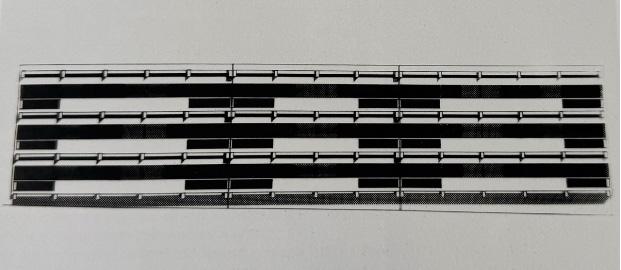
Davidovici builds on Gosseye’s analysis to examine how housing typologies created social and spatial divisions that led to social and spatial a-synchronicities in Agadir. By focusing on the disconnect between the built environment and lived experience in Agadir, Davidovici showcases that “progressive” urban designs and housing typologies had an “implicit social-engineering agenda” that aimed to create a “most modern class of citizens.”65Further, she showcases how the Plan Directeur (masterplan) of 1960 (Fig. 1) propagated practices of colonial planning by separating the city into six distinct districts, using decentralization as an “intentional strategy to retain the social status quo,” and matching the different types of housing “to specific social and ethnic groups.”66Thus, Davidovici helps uncover the way housing a-synchronicities can help reveal the hidden agendas in Agadir’s reconstruction.
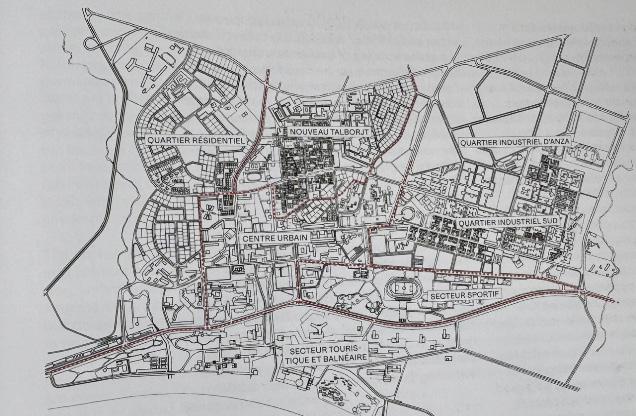
associations between housing types and social
“Housing Figures: Social and Spatial A-Synchronicities.” In Agadir: Building the Modern Afropolis, edited by Tom Avermaete and Maxime Zaugg, Zürich, Switzerland: Park Books, Zurich, 2022, 299.
Zaugg showcase how attempts to use modern housing typologies and spatial practices to create a modern citizenry ultimately failed as they were incompatible with Moroccan ways of life. For instance, that open public squares such as the Place Hassan II have been “little frequented” as it is “climatically and socially unusual to use such exposed spaces” showcases how residents have rejected elements of the modern architectural vision for Agadir.67 Similarly, the authors showcase how residents adapted the building typologies Davidovici outlines, for instance, by turning outdoor spaces of apartments, such as balconies or loggias, into indoor spaces or by reclaiming threshold spaces between buildings as public spaces.68Ultimately, Blaser and Zaugg demonstrate that despite the desire to use modern housing typologies and spatial practices to create a modern Moroccan citizenry, these strategies were incompatible with Moroccan ways of life. Together, Gosseye, Davidovici, Blaser, and Zaugg reveal that grounding research on Agadir with a focus on the built environment and lived experience can reveal some of the hidden goals in Agadir’s reconstruction and showcase the “Moroccanization” of the city.
Finally, Tom Avermaete and Irinia Davidovici’s “Architecture of Resilience: Privacy and Privatisation in Agadir Housing,” in the final section of the volume, “Transformations,” expands on the framework Davidovici utilized in her examination of social and spatial a-synchronicities. Together, Avermaete and Davidovici further explore how planners saw Agadir as an innovative urban environment, that aimed to create “a true modern Afropolis” that would fashion “the modern citizenry” of the newly independent Moroccan state.69However, as the authors emphasize, the reality of Moroccan life was out of step with the ambitions of politicians, urban planners, and architects, meaning that the transformation of Agadir’s residents into “the most modern citizens possible never materialised.”70The authors highlight that rather than passively accepting the built environment that foreign planners and architects designed, citizens reshaped modernist structures through informal practices of appropriation, fostering what Avermaete and Dacidovici term an “architecture
Finally, in “Inhabiting Agadir” Blaser and
64 Gosseye, “Reorganising Agadir,” 292.
65 Irina Davidovici,“Housing Figures: Social and Spatial A-Synchronicities,” in Agadir: Building the Modern Afropolis, ed. Tom Avermaete and Mazime Zaugg, (Zurich: Park Books, 2022), 317.
66 Davidovici,“Housing Figures,” 298.
67 Michael Blaser and Maxime Zaugg, “Inhabiting Agadir” in Agadir: Building the Modern Afropolis, ed. Tom Avermaete and Mazime Zaugg, (Zurich: Park Books, 2022), 319.
68 Blaser and Zaugg, “Inhabiting Agadir,” 319.
69 Tom Avermaete and Irinia Davidovici, “Architecture of Resilience: Privacy and Privatisation in Agadir Housing,” in Agadir: Building the Modern Afropolis, ed. Tom Avermaete and Mazime Zaugg, (Zurich: Park Books, 2022), 338.
70 Avermaete and Davidovici, “Architecture of Resilience,” 338.
The authors outline three manifestations of this architecture of resilience, particularly “Micro-Transformations,” “Mid-transformations,” and “Macro-level resistance.”72 Micro-Transformations are often seen at points of encounter between public and private spaces (i.e., doors and fences), where citizens often added screens, railings, colors, and tiles to transform harsh modernist buildings in a “neo-vernacular” style. The appropriation of the space and function of entire buildings, such as Immeuble D, represents the practice of mid-transformations. In Immeuble D, residents both turned open loggias, which cater to a mostly Wester lifestyle, into indoor spaces and transformed a strictly residential structure into a commercial area where many units are now used for small businesses and service companies (Fig. 2, Fig. 3).73 Finally, the authors argue that a “macro-level” of resilience can be identified at the scale of the entire city. Over time, residents have moved away from the modern city center to newer peripheries, where they returned to “traditional ways of dwelling and land ownership.”74This macro-level resistance ultimately created “new geographies of urbanity” across Agadir.75 These instances showcase how Agadir’s residents reshaped their environment to foster “domestic livability” in a city that was not designed for them.76Avermaete and Davidovici further demonstrate that a concrete grounding in understanding lived experiences can reveal the dissonance between the built environment and the social and spatial practices of Moroccan, a dissonance that eventually led to the implementation of an architecture of resilience, or the Moroccanization of the city.
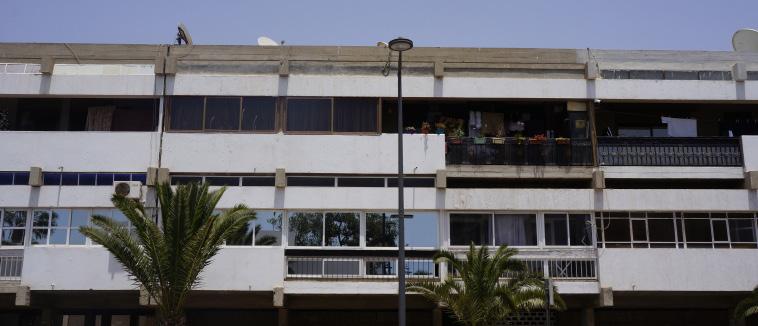
72 Avermaete and Davidovici, “Architecture of Resilience,” 348.
73 Avermaete and Davidovici, “Architecture of Resilience,” 341.
74 Avermaete and Davidovici, “Architecture of Resilience,” 348.
75 Avermaete and Davidovici, “Architecture of Resilience,” 341.
76 Avermaete and Davidovici, “Architecture of Resilience,” 348.
By examining scholarship on Agadir through Holston’s framework, the contrast between scholars who focus on Agadir’s reconstruction as an emblem of modern architectural and urban planning, often reinforcing Agadir’s foundation myth and obscuring hidden agendas, and those who prioritize understanding the political and social dynamics that shaped reconstruction becomes clear. The latter group uncovers how reconstruction continued French influence in Morocco, expanded direct control of the built environment, and enforced regulations that pushed marginalized groups to the city’s periphery. Scholars such as Segalla and Willford represent a break from earlier studies of Agadir in their focus on the seismic politics that shaped reconstruction. Further, while the first section of Agadir: Building the Modern Afropolis showcases the persistence of scholarship that treats Agadir as a symbol of modern urban planning and architecture, scholars in the later parts of the volume, especially those who build upon Segalla’s focus on lived experiences, demonstrate critical new directions in scholarship that explores how Agadir’s citizens have reshaped the city. Ultimately, Agadir, still a relatively understudied city, presents a unique opportunity for scholars to examine the entanglements between colonial and post-colonial urban planning and architecture. While Agadir: Building the Modern Afropolis, in its current form, risks presenting a somewhat depoliticized history of Agadir, the archival leaps the volume has made will likely, as Huet explains, “catalyze new waves of scholarship remedying this interpretive gap.”77 Future researchers should utilize the large body of archival records Agadir: Building the Modern Afropolis uncovers to challenge Agadir’s foundation myth, expose the hidden agendas present in its reconstruction, and highlight the architecture of resilience (Moroccanization) that has developed in Agadir as these examinations help reveal 77Avermaete and Davidovici, “Architecture of Resilience,” 348. of resilience.”71
complicated entanglements between colonial legacies, postcolonial identity building, and modern urban development.
Carolyn Cotta
College
In 1418, Christine de Pizan, fearing a Burgundian invasion, fled Paris for the Abbey at Poissy.1 Although an Italian native, the writer was renowned for her French patriotism, and she described her years in exile as a “wintry season” where she “wept” and “lived [her] life in sorrow.”2 There is no record of the prolific author writing anything during these eleven years. Then, in the summer of 1429, Joan of Arc turned the tide of the Hundred Years’ War, lifting the Siege of Orleans and crowning Charles at Reims. Christine picked up her pen, wrote her swan song, and died shortly thereafter.3 If we are to believe the writer herself, God worked through Joan of Arc to coronate King Charles VII, which inspired Christine both religiously and patriotically to record the events for posterity.4 However, Christine de Pizan’s Ditié de Jehanne D’Arc was not just a celebration of French liberation; Christine wrote it to prove that women were undervalued in society, to further the spiritual connections of all French patriots, and to push radical military policy on King Charles.
Christine devoted much of her life to advocating for feminism, and she highlighted Joan’s heroism in the Ditié in order to promote the feminist cause and defend her own life choices. In the interest of clarity, “feminism” in this essay refers to female radicalism as Christine viewed it, rather than our modern notions of gender equality. Based on her surviving manuscripts, Christine argued that society undervalued womens’ capabilities and that women are creatures of God who deserve education and the power to influence personal
1 Charity Cannon Willard, Christine de Pizan : Her Life and Works. New York, N.Y: Persea Books, 1984, 203.
2 Christine de Pizan, Ditié de Jehanne D’Arc, trans. Angus J. Kennedy and Kenneth Varty (Oxford: Society for the Study of Mediaeval Languages and Literature, 1977), 41.
3 Christine de Pizan, Ditié, 1-3.
4 Christine de Pizan, Ditié, 41-42.
and national affairs.5Scholars ascribe this viewpoint to Christine based on her published correspondence with French intellectuals regarding the Roman de Rose (1402), as well as on her allegorical books, the Livre de La Cité de Dames (1405), and the Livre des Trois Vertus (1405).6 In these works, Christine held up mythological and historical examples of intelligent, courageous, and virtuous women to disprove medieval notions about female inferiority.7 She was, no doubt, delighted when a prominent contemporary woman displayed all these values while saving France from English domination. Joan was the example par excellence of everything Christine sought to prove in her allegories—or she could be, if Christine wrote her that way. Indeed, Christine extols both Joan’s femininity and her virtues by comparing her to the great figures of classical antiquity and those found in the Bible. She calls Joan a “young virgin” and describes how she “feeds France with the sweet, nourishing milk of peace,” an allusion to motherhood.8 At the same time, she writes at length about Joan’s “intelligence… strength and power…[and] heart,” claiming that her heroics are greater than those of biblical and classical men like Moses and Achilles.9 Christine writes, “Oh! What honour for the female sex! It is perfectly obvious that God has special regard for it when [Joan achieved] something that 5000 men could not have done.”10While it is easy to assume that Christine’s professed adoration of Joan’s character was representative of the time, one must remember her feminist biases. Glorifying Joan vindicates Christine’s earlier arguments about wom-
5 Willard, Christine de Pizan, 87 & 146.
6 Willard, Christine de Pizan, 82-86 & 135.
7 Willard, Christine de Pizna, 136.
8 Christine de Pizan, Ditié, 44.
9 Christine de Pizan, Ditié, 44-46.
10 Christine de Pizan, Ditié, 44-46.
ens’ worth. Christine McWebb recently argued that because Christine endured misogyny from her literary peers, Joan empowered Christine, validating her life’s choice to pursue a career considered outside the norm for women.11She writes, “Both women remain exceptional for their time: Christine as a female writer and defender of her sex with her pen and Joan as a female fighter and defender of her sex and her country with her sword.”12Just as Joan heard voices from God instructing her to defend France, more than twenty years earlier, Christine wrote a representation of herself in La Cité de Dames as commanded by God to defend women.13 Thus, Christine may have decided to focus on Joan’s worth as a woman and role in the conflict in order to provide a female parallel to herself, a paragon that would vindicate her argument When considering the Ditié as a historical source, Christine’s feminism is a significant bias and may not have reflected the common attitude of this historical moment.
Just as Christine emphasized Joan’s role as a woman for personal benefit, she may also have extolled Joan’s connection with God in order to feel closer to the divine. In the Ditié, Christine unabashedly extols Joan’s role as a saintly messenger, writing, “[m]aiden sent from God, into whom the Holy Spirit poured His great grace…He never performed so striking a miracle as He does for this woman.”14Heather M. Arden recently pointed out that, in earlier works, Chirstine wrote herself as a protagonist interacting with female messengers of God: “With the coming of Joan, Chirstine is in contact, not with a mythic, imaginary, or long-dead messenger from God, but with a living emissary, a being through whom Christine can feel herself in touch with the divine.”15Christine was undoubtedly spiritually moved by Joan; she was, after all, a devout Christian, and here was one of Christine’s beloved female messengers—only modern and French. However, Christine may have taken her spiritual movement a step further. In the Ditié, Christine supports the conversion and destruction of heresy, i.e., unbelievers.16Casting
11 Christine McWebb, “Joan of Arc and Christine de Pizan: The Symbiosis of Two Warriors in The Ditié de Jehanne D’Arc,” in Fresh Verdicts on Joan of Arc, ed. Bonnie Wheeler and Charles T Wood. New York: Garland Pub., 1999, 135.
12 McWebb, “The Symbiosis,” 135.
13 Willard, Christine de Pizan, 136.
14 Christine de Pizan, Ditié, 47.
15 Heather M. Arden, “Christine de Pizan’s Ditié de Jehanne D’Arc. History, Feminism, and God’s Grace,” in Joan of Arc and Spirituality. ed. Ann W. Astell and Bonnie Wheeler. New York, N.Y: Palgrave Macmillan, 2003.
16 Christine de Pizan, Ditié, 47.
Joan as a uniquely divine figure extends the personal spiritual connection that Christine feels to all the liberated people of France. A proselytizing French partisan like Christine would consider this a great benefit. Thus, Christine’s bias as a woman who viewed her vocation as a female author to be divinely inspired may have influenced her to emphasize Joan’s religious connection.
Establishing Joan as sent from God also furthers Christine’s political goals. Christine claimed that she wrote the Ditié as a celebration and record, but in the latter part of the poem, she explicitly ventured into the political. She urged the English to leave France and implored the remaining English-allied cities to surrender to Charles to prevent unnecessary bloodshed, with particular emphasis on Paris (“[Paris] you are quite miscalculating!”).17 Indeed, Christine spends numerous stanzas on the subject of sieging Paris. Historians Anne D. Lutkus and Julia M. Walker argue that Christine’s focus on Paris proves that she backdated the Ditié for political purposes. King Charles was coronated at Reims on July 17th, 1429. Immediately afterwards, he entered into a truce with the duke of Burgundy which provided that fighting would cease for two weeks, and then the duke would hand Paris to Charles (the duke would later renege on his promise). Christine de Pizan dated her poem July 31, the last day of the truce, and shortly before the duke of Burgundy was due to hand Paris to Charles.18 Lutkus and Walker argue that writing the Ditié during a truce would have been “meaningless,” as “even Joan’s rhetoric on [Paris] was couched in the subjunctive.” Writing the poem in late August or early September would give the Ditié “the force of political immediacy” because only then was the question of attacking Paris a debate.19The most reliable surviving record of the Ditié is found in the Berne manuscript, which is bound nonchronologically.20The only evidence we have on the poem’s date of completion is Christine herself, and Christine spent much of the poem emphasizing that Joan fulfills ancient prophecies and is thus acting by divine will.21 By dating the poem before Christine could have known that the truce had fallen, Christine aligns it—and thus herself—with prophecy.
17 Christine de Pizan, Ditié, 49.
18 Anne D. Lutkus and Julia M. Walker, “PR PAS PC: Christine de Pizan’s Pro-Joan Propaganda,” in Fresh Verdicts on Joan of Arc, ed. Bonnie Wheeler and Charles T Wood. New York: Garland Pub., 1999, 149.
19 Lutkus and Walker, “Pizan’s Pro-Joan Propaganda,” 149.
20 Lutkus and Walker, “Pizan’s Pro-Joan Propaganda,” 146.
21 Christine de Pizan, Ditié, 45.
Throughout the Ditié, Christine attempted to align herself with prophecy in order to put more power in Joans’ hands. Christine wrote of Joan as God’s chosen one, and she repeatedly urged Charles to be grateful for Joan’s (and thus God’s) assistance. She wrote, “I pray to God that you [Charles] may be the person I have described.”22 Christine emphasized that unlike Joan, God’s messenger, Charles was a mere mortal man, capable of many things both right and wrong. When Christine wrote, “[the King] will enter Paris, no matter who may grumble about it!—The Maid has given her word that he will,” she alluded to the fact that Charles received his power from Joan, and thus should follow her on matters of policy.23 It was also a reference to prophecy; by establishing herself a quasi-sibylline figure, Christine may have tried to influence Charles, who was known to be a superstitious man, to attack Paris.24 Christine further predicted that Charles would not stop at Paris; she claimed Joan would lead him on Crusade to the Holy Land, where Joan would reign over Jerusalem as the last Emperor where the two would end their days, having restored faith to the world.25This is, admittedly, a large claim to make—and quite a deviation from her stated purpose of celebrating French liberation.
Now aligned with prophecy, Joan could choose to extend her divine power to King Charles. Historian Benjamin Cornford writes, “The literature surrounding Joan was designed to manufacture an authoritative image…[so] Charles could be safely linked with what was promoted as a vital mission from God, and encouraged to pursue it.”26If not a pseudo-prophetic poem, Christine’s Ditié is at least a blatant policy proposal to King Charles. Indeed, Christine’s biographers note that the writer frequently took part in the humanist practice of writing public letters of advice to prominent members of society; she also wrote treatises on war, peace, and policy.27Therefore, it is likely that Christine would have used the Ditié to offer political advice to the King of France. Some scholars have even proposed that Charles’s advisors commissioned the piece in order to influence Charles (and the public) to take action on
Paris and Jerusalem.28 In this case, the Ditié wouldn’t just be a poem, but an active push to influence war policy. When reading the Ditié, it is essential to consider Christine’s political intentions as a bias, keeping in mind that it is not an objective history.
Ultimately, Christine de Pizan’s Ditié de Jehanne D’Arc stands out among writings on Joan of Arc because it is the only work written by a woman while Joan was still alive. But, it is remarkable for much more than just the circumstances of its creation. Christine’s dual identity as a feminist and Catholic simultaneously cause her to magnify both Joan’s heroics and her connection to God, while the latter part of her poem explicitly and implicitly urges King Charles to follow Joan and take specific military actions. Scholars studying Christine or Joan should keep her objectives in mind when interpreting the source as an historical document. They should look to the Ditié not only to uncover what happened, but for insight into medieval mindsets and how women pursued power in a deeply misogynistic society.
22 Christine de Pizan, Ditié, 43 & 48.
23 Christine de Pizan, Ditié, 49.
24 Benjamin Cornford, “Christine de Pizan’s Ditie de Jehanne d’Arc: Poetry and Propaganda at the Court of Charles VII,” Parergon 17, no. 2 (2000): 75–106, 84.
25 Christine de Pizan, Ditié, 47.
26 Cornford, “Poetry and Propaganda,” 103 & 106.
27 Willard, Christine de Pizan, 197.
Douglas H. Burggraf
Hamilton College - Class of 2027
The Register of Pope Gregory VII, compiled during his pontificate (1073-1085), provides a crucial window into the transformation of papal authority during a period of intense church reform.1 Gregory’s papal staff recorded outgoing letters and occasional other items in small batches shortly after drafting, though the specific criteria for which letters were preserved and which were omitted remains unknown.2 Evidence of papal registers predates Gregory VII— most notably the fragmentary remains of Gregory the Great’s (590-604), after whom Gregory VII deliberately named himself.3 Gregory the Great maintained his register as a part of tradition dating back to Pope Leo I (440-461), using it as an administrative tool for church reform, particularly addressing simony across distant territories.4
Unlike these fragmentary predecessors, Gregory VII’s Register stands uniquely as the oldest complete surviving papal register, with no intact predecessors and no successors until Innocent III (1198-1216).5 Gregory’s Register emerged during what scholars characterize as “polemical warfare” between papal and royal chanceries; many argue that Gregory VII strategically preserved in his Register communications to diverse audiences (clerics, princes, the people), deliberately expanding his reform message beyond traditional ecclesiastical circles.6 The Register served to document, legitimize, and propagate Gregory’s re-
1 Gregory VII, The Register of Pope Gregory VII, 1073-1085: An English Translation, Trans. H. E. J. Cowdrey (Oxford University Press, 2002).
2 Gregory VII, Register, xii; 3 Leidulf Melve, Inventing the public sphere: the public debate during the investiture contest (c. 1030- 1122) (Brill, 2007), 179.
3 Gregory VII, Register, xii.
4 Bronwen Neil and Matthew Dal Santo, A Companion to Gregory the Great (Brill, 2013), 16; Neil and Dal Santo, Gregory the Great, 16; Neil and Dal Santo, Gregory the Great, 17.
5 Gregory VII, Register, xi.
6 Melve, Inventing the Public Sphere, 187.
forms to the church and revolutionary vision of papal supremacy. This transformation is evident in how he strategically frames opposition to secular rulers, such as King Henry IV, as a theological battle rather than a mere political dispute. Gregory VII’s Register reveals how spiritual rhetoric was used not merely to defend papal authority, but to redefine the pope as a political actor, using theology to reshape the boundaries of medieval power.
The Roman church prior to Gregory had a largely provincial influence, with only occasional periods of wider significance.7 Although many acknowledged the pope’s religious supremacy, this was not enough for him to have jurisdiction in his own ecclesiastical province. By the mid-eleventh century, the papacy was in complete disarray. There were three rival popes vying for power (one of them was accused of buying office as well), as King Henry III of Germany was traveling down to Rome to receive official imperial coronation as Emperor by the pope—just as his predecessors had done.8 Henry sought to end the chaos and deposed the three rival popes, ultimately backing a new candidate, Clement II, who was elected pope the following day.9 This action, though, raised fundamental questions about who ultimately held authority over the Christian community. The emperor’s intervention exposed the complicated Carolingian legacy that had blurred the boundaries between secular and ecclesiastical power. The question of who could hold whom accountable for governance reflected competing visions of Christian leadership that Gregory would later address directly in his Register. These longstanding tensions help contextualize Gregory’s revolutionary
7 Gerd Tellenbach, The Church in western Europe from the tenth to the early twelfth century, trans. Timothy Reuter, (Cambridge University Press, 1993), 185.
8 Tellenbach, The Church in Western Europe, 141-142.
9 Tellenbach, The Church in Western Europe, 142.
rethinking of papal authority.
Ecclesiastical reform discourse was growing more influential in the period before Gegory’s pontificate. The practice of simony—named after Simon Magus, who attempted to purchase spiritual powers from the apostles—had become widespread, with church offices often openly bought and sold as commodities.10 Reformers condemned this as a corruption of sacramental authority and came to see it as a heresy. Additionally, many priests maintained romantic relationships despite growing calls for clerical celibacy.11 Reformers insisted that such relations compromised the ritual purity necessary for priests to administer sacraments. Also contentious was the concept of lay investiture: the appointment of bishops and abbots by secular rulers.12 While Gregory was certainly concerned with simony and clerical marriage, these were not the core issues that defined his revolutionary approach.13 Gregory’s Register reveals a more fundamental concern with the proper relations between spiritual and secular authorities. This concern led him to view royal control of church appointments as inherently problematic, regardless of whether individual kings used this power for good.14 The Register reveals that while Gregory occasionally made tactical compromises in practice, he generally remained unwavering on the principle that the church must be free from secular control.
Historians have approached Gregory VII’s Register from multiple perspectives. H.E.J. Cowdrey’s analysis of the Register demonstrates how Gregory initially sought collaboration rather than confrontation, pursuing what he called “the concordant unity of sacerdotium and regnum” during the early years of his pontificate.15 Cowdrey argues that through correspondence with figures such Empress Agnes and various German dukes, Gregory built political networks that could influence Henry IV indirectly; this suggests that the Register should be read not merely as theological pronouncements but as evidence of sophisticated political strategy.16 Gerd Tellenbach interprets the Register through a broader theoretical lens, emphasizing how it reflects Gregory’s vision for restructuring Christian 10 Tellenbach, The Church in Western Europe, 30.
11 Gerd Tellenbach, Church, State and Christian Society at the Time of the Investiture Contest, trans. R. F. Bennett (Basil Blackwell, 1940), xiii-xiv.
12 Tellenbach, The Church in Western Europe, 30.
13 Tellenbach, Church, State and Christian Society, xiii-xiv.
14 Tellenbach, Church, State and Christian Society, xiv.
15 H.E.J. Cowdrey, Pope Gregory VII, 1073-1085 (Oxford University Press, 1998), 92-93.
16 Cowdrey, Pope Gregory VII, 93.
society according to divine principles of hierarchy and order.17 Tellenbach argues that Gregory’s reform vision extended beyond institutional church matters to a comprehensive reordering of Christian society with clear spiritual hierarchies. Uta-Renate Blumenthal emphasizes the revolutionary nature of Gregory’s vision, interpreting the Register as evidence of a decisive break from earlier traditions of papal authority rather than incremental reform.18 These varying scholarly interpretations illuminate both Gregory’s practical political maneuvering and his theological vision. The Register reveals how Gregory strategically blurred theological and political boundaries, using spiritual rhetoric to redefine papal authority.
The Dictatus Papae, recorded in Gregory VII’s Register in March 1075, is one of his clearest statements of views on papal authority.19 Though comprising only twenty seven propositions, this document encapsulates Gregory’s revolutionary vision for restructuring Christendom according to a divinely ordained hierarchy with the papacy at the top (only below God). Before becoming pope, Gregory VII (then Hildebrand) was involved with various reform movements in the Church that likely shaped his theological vision displayed in this dictation. Hildebrand also had some connections with the monastery of Cluny.20 Founded in Burgundy in 910, the Cluniac monastery represented a revolutionary model of monastic independence. Its foundation charter expressly freed the monastery from secular control, placing it directly under papal authority—a structural relationship that would later find resonance in Gregory’s vision for the entire church.21 Gregory himself did practice Benedictine monasticism, although not at Cluny (the house and the year of his entrance into the order, both remain undetermined).22 It is likely, however, that he had stayed at Cluny as a visitor for some time, and he exchanged various letters with Hugh of Cluny, the abbot of Cluny.23 In the winter of 1048-1049, Hildebrand, though seemingly reluctant to leave his monastic life, accompanied Bishop Bruno of Toul to Rome.24 There, Bruno was consecrated as Pope Leo IX and subsequently appointed Hildebrand
17 Tellenbach, Church, State and Christian Society, xiv.
18 Uta-Renate Blumenthal, The Investiture Controversy: Church and Monarchy from the Ninth to the Twelfth Century (University of Pennsylvania Press, 1988).
19 Gregory VII, Register, 2.55a, 149.
20 Cowdrey, Pope Gregory VII, 29.
21 Blumenthal, The Investiture Controversy, 11.
22 Cowdrey, Pope Gregory VII, 29-30.
23 Cowdrey, Pope Gregory VII, 30
24 Cowdrey, Pope Gregory VII, 30.
as a deacon and papal administrator. During his years as an archdeacon and papal legate in the 1050s-60s, he worked closely with several reform-minded figures— including Peter Damian.25 Damian was an Italian reforming Benedictine monk and cardinal in the circle of Pope Leo IX, who was committed to ecclesiastical purity and strengthening papal authority.26
These experiences during Hildebrand’s earlier ecclesiastical career provide crucial context for understanding the Dictatus Papae not as entirely novel ideas, but as a bold papal assertion of principles already developing within reform circles. For example, Peter Damian had previously articulated the principle that anyone disagreeing with the Roman church constitutes a heretic, an idea that appears almost verbatim in the Dictatus Papae: “That he is not to be considered Catholic who does not agree with the Roman Church.”27
Direct textual parallels such as this reveal how Gregory seemingly systematically incorporated and expanded upon existing reformist principles. He transformed what had been primarily theological assertions into a comprehensive program for restructuring political authority throughout Christian Europe. The document’s opening propositions establish the unique position of papal authority within Christendom by asserting divine origins for papal supremacy. Gregory declares that “the Roman church was founded by God alone” and that “the Roman pontiff alone can with right be called universal.”28 These claims position the pope as God’s singular representative on earth, possessing authority derived directly from divine mandate rather than human tradition. By emphasizing this theological foundation, Gregory frames his subsequent political assertions not as innovations or personal ambitions but as the restoration of proper divine order. This rhetorical strategy allowed Gregory to present even his most controversial claims as defenses of established spiritual truth rather than revolutionary political assertions.
Gregory’s most famous assertion of papal supremacy came in the context of the Investiture Controversy. The dramatic confrontation between Pope Gregory VII and King Henry IV showcased how Gregory’s theological language could be used to transform the political landscape of medieval Europe. Even prior to Gregory’s pontificate, friction had emerged between
25 Cowdrey, Pope Gregory VII, 31.
26 Tellenbach, Church, State and Christian Society, 49-50, 68.
27 Cowdrey, Pope Gregory VII, 29-31; Gregory VII, Register of Pope Gregory VII, 2.55a, 149-150.
28 Gregory VII, Register of Pope Gregory VII, 2.55a, 149-150.
the royal government in Germany and the papacy. A disputed election of a Milanese bishop in 1071 resulted in Pope Alexander II and King Henry IV supporting opposing candidates.29 When Henry countered by having his own nominee consecrated by the Lombard bishops, Alexander excommunicated those bishops. Henry initially refused to yield, but at the time of Gregory’s election in 1073, Henry’s royal power was threatened by a rebellion in Saxony.30 Henry then wrote to Gregory submissively, asking for help to address the Milan problem.31
When Gregory received this letter, he was so impressed that, in a rare fashion for an incoming letter, he had it copied into his Register in August of 1073.32 Henry’s letter acknowledged that Gregory was “distinguished by heaven with apostilic dignity.”33 Henry, drawing on biblical imagery of the prodigal son, presents himself with calculated humility, promising “the most faithful performance of his due service.”34 Henry acknowledged his sins, attributing them to his youthful impulses, lust for power, and by the influence of corrupt advisors. Notably, the king effectively renounced his right of investiture and begged Gregory to come in and fix the dispute: “But now, because we cannot alone without your authority set right the churches… your command is most zealously kept in all matters.”35 Gregory’s response was equally warm, expressing his “sincere love” for Henry and even sharing his aspirations for a potential crusade to the East.36 Gregory subsequently viewed Henry as an ally in church reform, though this relationship would soon deteriorate.
With the new pope’s assistance, Henry ultimately defeated the Saxon rebellion in 1075.37 In February of that year, however, Gregory issued a papal decree forbidding all lay investiture.38 This decree represented a radical departure from centuries of accepted practice.39 Before Gregory, even politically active popes had maintained the traditional separation of spheres, where spiritual authorities held higher
29 Brian Tierney, The Crisis of Church & State, 1050–1300: With Selected Documents (Prentice-Hall, 1964), 53.
30 Tierney, Crisis of Church & State, 53.
31 Tierney, Crisis of Church & State, 53.
32 Cowdrey, Pope Gregory VII, 95.
33 Gregory VII, Register of Pope Gregory VII, 1.29a, 34.
34 Gregory VII, Register of Pope Gregory VII, 1.29a, 34.
35 Gregory VII, Register of Pope Gregory VII, 1.29a, 35.
36 Gregory VII, Register of Pope Gregory VII, 2.31, 122.
37 Cowdrey, Pope Gregory VII, 96.
38 Tierney, Crisis of Church & State, 53
39 Tellenbach, Church, State and Christian Society, 64-67.
metaphysical rank, but secular rulers maintained clear authority over political affairs. Earlier ecclesiastical thought recognized kings as divinely appointed, with only God as their true judge.40 Gregory’s prohibition of lay investiture directly challenged this long-established division of powers by asserting papal authority over what had previously been considered standard royal conduct. Henry never intended to comply with this decree, despite his heartfelt letter regarding the Milan dispute, indicating he would.41 After riots erupted in Milan, Henry renewed his support for a royal candidate against the papally-approved bishop. In December 1075, Gregory wrote to Henry about this matter disapprovingly and threatened Henry, reminding him that kings, like all Christians, were bound by papal decrees.42
Gregory’s letter to Henry IV marked a decisive turning point in their relations. He begins the letter by making his blessing conditional on Henry’s obedience to St. Peter’s successor, immediately establishing spiritual authority as the precondition for political legitimacy.43 Through strategic biblical references, Gregory constructs a theological framework that reconfigures medieval power relationships. When he declares he sits “in his [Peter’s] seat and apostolic ministration by divine disposition,” he positions himself as Peter’s direct successor.44 Gregory deliberately invokes Christ’s commands to Peter about feeding his sheep and binding things on earth and in heaven.45 These references are foundational moments in the Gospel where Jesus transferred divine authority to Peter. By invoking them, Gregory equates disobedience to papal authority equivalent to disobedience to Christ himself. This rhetorical strategy elevates Henry’s appointment of bishops from administrative disagreements to violations of divine order. Gregory continues, comparing Henry to King Saul of the Old Testament, who was rejected by God after disobeying the prophet Samuel following his victory over the Amalekites.46 He warns that, just as Saul lost divine favor for disobeying God’s prophet, Henry risks losing God’s favor by defying papal authority after his recent triumph over the Saxons.47
40 Tellenbach, Church, State and Christian Society, 64-67.
41 Tierney, Crisis of Church & State, 53.
42Tierney, Crisis of Church & State, 53.
43 Gregory VII, Register of Pope Gregory VII, 3.10, 188.
44Gregory VII, Register of Pope Gregory VII, 1.29a, 188-189.
45 Gregory VII, Register of Pope Gregory VII, 1.29a, 188-189.
46 1 Samuel 15:23 (New Revised Standard Version).
47 Cowdrey, Register of Pope Gregory VII, 3.10, 190.
Through this theological framing, Gregory creates his most powerful political weapon—a framework that equates opposition to papal authority with opposition to God himself.
In addition to the letter, Gregory had sent messengers to Henry with verbal warnings more severe than his written correspondence. In these, Gregory explicitly threatened excommunication if Henry continued associating with his excommunicated counselors.48 Henry perceived these things as an ultimatum threatening both his earthly kingdom and his eternal salvation.49 Rather than heeding Gregory’s warnings, Henry convened an assembly of German bishops at Worms in January 1076; there, twenty-six bishops formally renounced their obedience to Gregory.50 The bishops leveled serious accusations against Gregory, claiming his election was invalid and his conduct was scandalous. Henry, invoking his authority as from God, sent his own letter addressing Gregory merely as “Hildebrand,” declaring his “accession was vitiated by gross perjuries.”51
This rejection of papal authority prompted an unprecedented response from Gregory at the Lent Synod of February 1076. There, in 1076, Gregory excommunicated Henry. This was functionally an attempt to have him deposed as king, because the direct consequence of excommunication was that Henry’s subordinates, officials, soldiers, etc., were obliged to desert him.52 As word spread of Henry’s excommunication, his position became gradually more and more isolated.53 German princes rebelled against Henry, threatening to elect a new king unless he reconciled with Gregory, which led to Henry’s later journey to Canossa in 1077.54 In this synod, Gregory continually invokes his authority as descending from the Apostle Peter, as a reassurance that he is exercising in accordance with Christ’s most trusted disciple. Gregory goes on to declare, “I deny to King Henry... the government of the entire kingdom of the Germans and of Italy, and I absolve all Christians from the bond of any oath that they have taken” to him.”55 The Register’s formal heading for this declaration, “Ex-communicatio Henrici regis
48 Cowdrey, Pope Gregory VII, 134.
49 Cowdrey, Pope Gregory VII, 135.
50 Cowdrey, Pope Gregory VII, 137.
51 Cowdrey, Pope Gregory VII, 137.
52 A.H. Matthew, The Life and Times of Hildebrand, Pope Gregory VII (Francis Griffiths, 1910), 112.
53 Matthew, Life and Times of Hildebrand, 112.
54 Blumenthal, The Investiture Controversy, 122.
55 Gregory VII, Register of Pope Gregory VII, 3.10a, 192.
Teutonicorum,” represented a revolutionary development in ecclesiastical history; the specific Latin formulation Gregory used was without precedent, as no pope had ever before formally excommunicated a reigning monarch.56 This unprecedented action demonstrates how excommunication was used as a spiritual censure and also a political weapon. Gregory’s simultaneous excommunication of Henry’s supporting bishops demonstrated a comprehensive claim to authority over all who challenged papal supremacy.57 Gregory’s assertion of papal supremacy fundamentally reconfigured medieval power relationships by attempting to make political legitimacy contingent upon obedience to papal authority.
At their ensuing encounter at Canossa in January 1077, King Henry IV stood barefoot in the snow for three days before Pope Gregory VII granted him absolution from excommunication.58 The Register reveals Gregory’s strategic framing of this event—not as political capitulation but as spiritual redemption. Gregory writes that Henry came wretched and barefoot seeking “apostolic mercy” while carefully informing German princes he remained bound to Henry only “in whatever conducted to his salvation and honor.”59 By documenting Henry’s formal oath in theological rather than political terms, Gregory transformed what was fundamentally a power struggle into a divine judgment. He did this in an effort to redefine medieval authority through spiritual rhetoric that positioned the papacy above royal power.
Once absolved and back in Germany, Henry swiftly consolidated power, suppressed the rebellion, and immediately sought revenge against the papacy. By 1080, Henry had declared Gregory deposed and backed his own pope, Clement III.60 As Henry marched on Rome, Gregory’s position became increasingly desperate despite his continued insistence that the conflict was primarily spiritual rather than political. When Henry’s forces took Rome in 1084, Gregory was rescued by his Norman allies, though he avoided characterizing this retreat to Salerno as a defeat.61 Instead, he maintained his portrayal of himself as a righteous leader defending the church against corrupt secular au-
56 Gregory VII, Register of Pope Gregory VII, 3.10a, 192; Matthew, Life and Times of Hildebrand, 110.
57 Gregory VII, Register of Pope Gregory VII, 3.10a, 192.
58 Blumenthal, The Investiture Controversy, 123.
59 Gregory VII, Register of Pope Gregory VII, 4.12, 221-222.
60 Tellenbach, The Church in Western Europe, 246.
61 Tellenbach, The Church in Western Europe, 251.
thority. Gregory died in Salerno in 1085, never having returned to Rome.62 Though his immediate political project had failed, his revolutionary reimagining of papal authority had established a theological framework that would influence church-state relations for centuries. Gregory’s papacy demonstrated both the powerful potential and practical limitations of papal authority in medieval society.
The Register of Pope Gregory VII demonstrates how theological language was strategically deployed in an attempt to fundamentally reshape medieval power structures. By documenting his correspondence, Gregory transformed administrative disputes into matters of divine order, framing opposition to papal authority as opposition to God himself. This rhetorical strategy proved extraordinarily effective in his confrontations with Henry IV, where Gregory positioned himself not as a rival political figure but as the divinely appointed arbiter of legitimate Christian leadership. Although Henry’s military response ultimately forced Gregory into exile, the theological framework established in the Register had profound and lasting implications for church-state relations. Gregory’s systematic blurring of boundaries between theological and political spheres effectively transformed the papacy from a primarily religious authority into a direct political actor with claims to legitimate authority over secular rulers. The Register thus stands as testament to how effectively spiritual rhetoric could be mobilized to reshape the boundaries of political authority in medieval Christendom.
62
Annabel Pearson
Hamilton College - Class of 2027
In 1979, growing economic and social tensions in Iran sparked an Islamic Revolution which ended the reign of Pahlavi shahs and instated Shi’i cleric Ayatollah Ruhollah Khomeini as Iran’s religious and political leader. Before the revolution, Muhammad Reza Shah (r. 1941-1979) tried to convey dynastic and international legitimacy to mass audiences through film, posters, and the press, but distributing images of the unpopular monarchy without effectively reforming failed to win him public support. Anti-Shah demonstrators successfully cultivated a revolutionary visual culture by appropriating the Shah’s official imagery, rallying around Khomeini’s portrait, and emphasizing the Shah’s cruelty. Khomeini gained mass support by permitting Western photojournalism, and as head of the Islamic Republic, he used politically charged imagery to attack political opponents, legitimize the new government, and ground state power in Islam. Khomeini succeeded in legitimizing his rule through imagery where the Shah had failed because Khomeini harnessed the existing beliefs and visual vocabulary of ordinary Iranians.
Muhammad Reza Shah used documentary film to depict himself as the rightful leader of a powerful, ancient Iranian nation, demonstrating that he understood imagery as a way to establish legitimacy. In 1971, the Shah hosted an extravagant celebration of the 2500th anniversary of Iranian monarchy at Persepolis, the ancient capital of the Persian Empire.1 The Iranian National Film Board released a film of the celebration titled Forugh-e Javidan (The Eternal Flame of Persia), emphasizing the Shah’s imagined connection to the greatness of pre-Islam Iran. The film opens with several shots of Muhammad Reza Shah in military regalia, walking in step with Queen Farah, the ten-year-old Crown Prince, and two rows of military personnel to1 William L. Cleveland and Martin Bunton, A History of the Modern Middle East, 6th ed. (New York: Westview Press, 2016), 282.
ward the tomb of Cyrus the Great, the Persian Empire’s first shah. Close-range shots show the shah saluting the military personnel lining his path to the tomb.2 In these opening moments, the National Film Board portrayed the Shah as a successor of the nation’s founder and as an official of the Iranian state, engaged in the military protection of his people. Muhammad Reza Shah attempted to bolster royal legitimacy with visual signals of connection to Iran’s past glory and present strength.
Muhamad Reza Shah decorated the anniversary celebration with symbolic motifs to portray the Iranian monarchy as a legitimate power in the twentieth-century global order. The Shah invited leaders from five continents to stay in an opulent resort near the ruins of Persepolis for the anniversary celebration. Forugh-e Javidan describes how the resort was shaped like a five-pointed star, with a wing for leaders from each continent branching out from the shah’s royal pavilion. A close-range shot one minute later in the film shows that the five-pointed star surrounding a circular center also appeared on drums played during the celebrations.3 This symbol presented the Iranian monarchy as a nexus of world powers, including the People’s Republic of China, the Soviet Union, and the United States. At the paramount display of monarchical power, Muhammad Reza Shah used visual motifs to portray himself as an important, legitimate ruler in relation to global superpowers.
Muhammad Reza Shah performed in Forugh-e Javidan to communicate legitimacy to a wide audience, but the presentation of these images alienated ordinary Iranians. After the opening procession to-
2 Macdonald Hastings, Forugh-e Javidan, directed by Farrokh Golestan (1972; Persepolis: National Film Board, 2024), YouTube; Appendix A, Procession to the tomb of Cyrus the Great.
3 Macdonald Hastings, Forugh-e Javidan; Appendix B- Resort at Persepolis.
ward the tomb of Cyrus the Great, credits in Persian and French cross the screen while American writer Orson Welles narrates.4 The language of the credits and high-profile narration indicate that this vision of the monarchy was directed toward Western viewers and the Iranian elite, who were educated in European languages or at least supported cultural exchange with the West. International and internal audiences criticized the $100-million production, though, noting the Shah’s apparent alienation from the economic and social issues that many ordinary Iranians blamed on Western interference.5 The Shah intended to construct an image of legitimate leadership for an adoring audience, but distributing this pageantry in ways that suited his own sensibilities highlighted economic and cultural disparities between classes in Iranian society and fueled animosity toward the Pahlavi regime.
The Pahlavi regime distributed posters depicting the Shah as a legitimate ruler, understanding the power of photographs to convey political messages but misjudging how ordinary Iranians would interpret these messages. Large photographs of the Shah, Queen Farah, and the Crown Prince plastered public and commercial spaces. Posters depicted the Shah in different roles: military regalia studded with medals emphasized his role as commander-in-chief, glittering royal uniforms displayed his wealth, and formal and casual civilian outfits related him to the cosmopolitan Iranian elite.6 By emphasizing the Shah’s duty, prosperity, and relatability, photographers and graphic designers turned royal portraits into symbols of the regime’s political, economic, and social legitimacy. As soon as the Shah loosened his control over Iran’s media, revolutionary demonstrators defaced his posters, seeing his portrait as a symbol of corruption and cultural elitism, not stability.7 The Shah tried to garner public support using specific imagery, but he inadvertently broadcast his inadequacies to working-class Iranians.
Muhammad Reza Shah tried to salvage the monarchy’s public image amid failing health and rising discontent by releasing images of the royal family that he believed promised dynastic stability, but he failed to win public favor because these visual promises were not supported by effective policy change. By the fall
4 Macdonald Hastings, Forugh-e Javidan
5 Cleveland and Bunton, A History of the Modern Middle East, 282.
6 Peter J. Chelkowski and Hamid Dabashi, Staging a Revolution : the Art of Persuasion in the Islamic Republic of Iran (New York: New York University Press, 1999), 142-143.; Appendix C- Poster of Muhammad Reza Shah and Queen Farah.
7 Chelkowski and Dabashi, Staging a Revolution, 143.
of 1977, Muhammad Reza Shah was terminally ill with cancer. The Shah rarely appeared in newspapers and on television during this period, and he appeared frail when he was shown. In October 1977, visual media sources began to replace the Shah’s image with “severe, unglamorous” photographs of Queen Farah engaging with the public service.8 When the Shah could no longer use his own portrait to convey royal power, he tried to present a strong, politically engaged, authoritative queen who could rule in his place. Photographs of the wealthy queen could not overcome animosity toward the Pahlavi regime amid rising economic inequality, and the Shah’s final attempt at winning public favor failed.9 Without effective improvements in most Iranian’s quality of life, the Shah’s strategic images only emphasized his detachment from demonstrator’s needs.
Artists who opposed the Shah appropriated well-known imagery to critique the regime’s political messaging, creating a visual culture that was essential in spreading revolutionary attitudes. Several left-wing professors and students at the University of Tehran’s Fine Arts College formed a collective named Group 57, which opposed the Shah, American intervention, imperialism, and inequality. These dissenters drew on their training in visual arts and well-known political imagery to create posters that they hoped would persuade others of all ideologies to join the revolution.10 In the years leading up to the revolution, Group 57 artist Nicky Nodjoumi created a poster depicting the military uniformed Shah being thrown into the “garbage bin of history” by a large disembodied hand.11 Nodjoumi appropriated a ubiquitous image of the Shah, which the Pahlavi regime had propagated, to juxtapose Muhammad Reza’s appearance of military authority with his powerlessness against rising criticism of his actions. Group 57 used existing political imagery to create revolutionary artwork that could affirm and mobilize the discontented masses.
Anti-Shah demonstrators rallied around Ayatollah Khomeini’s portrait, using his uncaptioned im-
8 Nikki R. Keddie and Yann Richard, Modern Iran: Roots and Results of Revolution (New Haven: Yale University Press, 2006), 215.
9 Ervand Abrahamian, A History of Modern Iran: Revised and Updates (Cambridge: Cambridge Unity Press, 2018), 143.
10 Anne Eakin Moss, Niloofar Haeri, and Narges Bajoghli, “Legacies of Protest Art in Iran: The Revolutionary Art Workshop of 1979,” Public Culture 36, no. 2 (2004): 162.
11 Moss, Haeri, and Bajoghli, “Legacies of Protest Art in Iran,” 163; Appendix D- “Forward to the formation of the People’s Revolutionary Court.”
age as a symbol for their political goals and religious ideals and of their opposition to the decorated, secular Shah. Michel Lipchitz, a French photographer for the Agence France-Presse, captured a scene from an anti-Shah demonstration on January 1, 1979, one month before revolutionary leader Ayatollah Khomeini returned from exile in France. Demonstrators carried a portrait of Ayatollah Khomeini wearing the clerical clothing in which he was always depicted.12 A sea of faces in the foreground are turned toward the portrait, not toward one another, and some demonstrators held red tulips, symbolizing the martyrdom of Imam Husayn in Shi’i tradition, up to the portrait.13 For the demonstrators, Khomeini’s portrait was a symbol of Islamist opposition, and for Lipchitz, it was a signal of his subjects’ stance that international audiences could quickly understand. The demonstrators rallied around the consistent, recognizable portrait of Ayatollah Khomeini, using imagery to symbolize their ideologies and to unite around a common goal.
Revolutionary demonstrators replaced official images of the Shah with those of Khomeini, which fueled growing revolutionary visual culture and strengthened the tie between opposition to the monarchy and support for Khomeini. Immediately after the Shah left Iran on January 16, 1979, some demonstrators cut the Shah’s face out of banknotes and replaced it with an image of Khomeini.14 Even after the Shah had fallen from power and left the country, Iranian people and the government could not tolerate his image, which to them represented cruelty and corruption, on currency. Free from the Shah’s control over official visual culture, Khomeini’s supporters sought to legitimize the revolution with parallel portraits. While the Shah had imposed political messages on his people through carefully constructed images, revolutionaries used images to construct a new regime from the ground up.
While portraits of revolutionary leaders were essential in generating support for a new regime, demonstrators’ use of evocative imagery to draw attention to the Shah’s cruelty was just as important in communicating a vision for post-revolution Iran. On January 19, 1979, an anti-Shah demonstrator stood above a crowd
12 Chelkowski and Dabashi, Staging a Revolution, 174.; Michel Lipchitz, Untitled. January 1, 1979. Tehran; Appendix E- Demonstrators hold up a poster of Khomeini on January 1, 1979.
13 Chelkowski and Dabashi, Staging a Revolution, 41.; Michel Lipchitz, Untitled. January 1, 1979. Tehran.
14 David Burnett, 44 Days: Iran and the Remaking of the World, (Washington D.C.:National Geographic Books, 2009), 103; Appendix F- Demonstrators replace the Shah’s portrait with Khomeini’s on a banknote on January 16, 1979.
wearing a coat on which he had pinned photographs of people executed on the Shah’s orders. Photographs of this demonstrator show that other demonstrators paused their marching to quietly consider the pinned photographs.15 The demonstrator with the coat visually communicates that he and his fellows are protesting not just in support of Khomeini, as portraits held up in the background suggest, but against the Shah’s violence. Revolutionary demonstrators used emotionally charged imagery to show why they had revolted and what they hoped to leave behind after the revolution. Khomeini allowed Western photojournalists to document the revolution despite his distrust of Western intervention because he recognized the importance of visual media in garnering mass support. On January 26, 1979, Khomeini announced from exile that his supporters in Iran should treat the foreign press as friends, not Western enemies, because Western radio helped disseminate the revolutionary message. After the announcement, Iranian demonstrators helped Burnett, an American photojournalist who had been berated by demonstrators before the announcement, pass a roll of film across the crowd to a French photographer.16 Khomeini understood that international press significantly increased his ability to reach massive audiences, which outweighed his distrust of the West. Before establishing control over a stable revolutionary government and in turn Iranian presses, Khomeini relied on international photographers to bolster his influence in Iran.
Khomeini and his advisors gave Western photojournalists access to private settings because images of Khomeini as a humble leader spread the idea that he would help the Iranian people, not just reign through a cult of personality. After returning from exile on February 1, 1979, Khomeini and his advisors camped out inside Refah School.17 After three days of attending laconic press conferences at the school led by an economist named Javad whom Khomeini had selected to handle foreign press, Burnett convinced Javad to let him photograph inside the school by telling him that the Ayatollah’s wave resembled the Nazi salute. Inside the school, Burnett photographed Khomeini drinking tea on the floor and consulting with his advisors, all in clerical dress, before greeting his adoring supporters
15 Burnett, 44 Days, 119-121; Appendix G- Demonstrator with photographs of the Shah’s victims pinned to his coat.
16 Ibid., 133.
17 Burnett, 44 Days, 191.
out the window.18 Having seen demonstrators villainize Muhammad Reza Shah and rally around himself using politically charged images, Khomeini understood that photographs associated with Nazism would injure internal and international support. Burnett’s more intimate photographs reframed Khomeini as a humble Islamic leader who wanted to help his followers as opposed to a charismatic autocrat. Khomeini permitted Western photojournalists to capture the revolution in a way that fit his political narrative.
As revolutionary leaders consolidated power, young Iranians transformed Khomeini’s portrait from a sign of dissent to a symbol of the Islamic Republic’s anti-American stance. In November 1979, a group of students who supported Khomeini seized the United States embassy in Tehran and took 57 American foreign service personnel hostage.19 On November 27, French photographer Herve Merliac documented students hoisting large portraits of Ayatollah Khomeini above their heads as they demonstrated inside the gate of the Embassy.20 The hostage crisis poisoned relations between Iran and the United States, sewing deep American distrust in Khomeini’s regime.21 By raising Khomeini’s portrait at the gate of the American embassy, where Western photographers could easily capture their demonstration, the Iranian student tied Khomeini’s image and animosity toward the United States to the nascent Islamic Republic’s foreign policy. The students understood that imagery could communicate strong political and ideological messages and used photographs to define Iranian attitudes on the international stage.
The revolutionary government used simple graphics to turn public opinion against its political opponents, succeeding in dominating political artistic culture because it has associated itself with anti-Western sentiment. In 1981, Khomeini’s government launched a propaganda campaign against left-wing and non-Islamic nationalists, framing dissidents as counter-revolutionaries who, by opposing the Islamic Republic, aligned themselves with foreign aggressors.22 One poster depicted the hands of the United States, Israel, and the People’s Republic of China controlling a marionette stamped with the logo of left-wing dissi-
18 Ibid., 199, 202-203; Appendix H- Khomeini inside Refah School.
19 Cleveland and Bunton, A History of the Modern Middle East, 365.
20 Herve Merliac, Untitled, November 27, 1979. Tehran; Appendix I- students hold up portraits of Khomeini inside the gates of the U.S. Embassy on November 27, 1979.
21 Cleveland and Bunton, A History of the Modern Middle East, 365.
22 Chelkowski and Dabashi, Staging a Revolution, 175.
dent group Mujahedin-e Khalq, which had carried out a wave of terrorist attacks on the new regime’s political and religious leaders.23 After this propaganda campaign, left-wing and non-Islamic artists produced noticeably less vibrant posters than Islamist artists.24 As it had done to villainize the Shah, the revolutionary government used simple graphics to aim existing distrust of foreign interference at internal political opponents and establish the revolutionary government as the only legitimate leader of Iran.
The 1979 revolution transformed photography in Iran from small-scale medium in newsprint and fine arts to an important aspect of social documentary, and the revolutionary regime embraced rising photojournalism to gain legitimacy. In 1981 and 1982, under new government censorship of art that did not directly support Khomeini’s vision of Islamist governance, the Tehran Museum of Contemporary Arts exhibited two photo series depicting impoverished children in rural and impoverished areas of Iran.25 The Iranian and French-Iranian photographers behind these exhibitions saw photography as an essential means of social documentary which exposed social issues that needed attention and condemned the Pahlavi monarchy for abandoning innocent, ordinary Iranians.26 In a period of rigid media control, the revolutionary leaders allowed artwork that justified change and legitimized Khomeini’s populist break from the Shah’s form of leadership. While the Shah tried to win popularity by projecting his own royal power on posters, the revolutionary regime embraced socio-politically committed imagery to gain popularity from the ground up.
After consolidating power, the revolutionary government used banknotes to legitimize Khomeini as Iran’s new leader, producing more effective visual signals of legitimacy through juxtaposition with the out of touch Pahlavi regime. From 1981 to 1985, Khomeini’s government implemented the Revolutionary Series of bank notes which depicted not only clerics and religious sites but also crowds of Iranian people
23 Chelkowski and Dabashi, Staging a Revolution, 175; Cleveland and Bunton, A History of the Modern Middle East, 366; Appendix J- Poster of Mujahedin-e Khalq as a puppet.
24 Chelkowski and Dabashi, Staging a Revolution, 174.
25 Hadi Azari Azqandi, Asghar Fahimifar, and Ali Sheikhmehdi, “From Commitment to Expressionism: A Survey on the Changing Concept of Photography in Iran,” Visual Studies 37, no. 5 (2022): 570-571; Appendix K- Reza Deghati, untitled, 1981 (Contemporary Iran photography-children exhibit).
26 Azari, “From Commitment to Expressionism,” 572-573.
holding up portraits of Khomeini.27 While banknotes of the monarchy depicted the Pahlavi crown and the Shah in dress uniform, legitimizing the regime through displays of individual power, revolutionary banknotes presented Khomeini as a symbol of the people’s interests.28 The revolutionary government used Khomeini’s portrait to legitimize the Islamic Republic in everyday life.
The revolutionary government used images on postage stamps to anchor the state in Shi’a Islam, legitimizing the new regime through religious institutions, not just the power of select individuals. A number of postage stamps depicting the Shah remained in circulation after the 1979 revolution with his portrait crossed out and the title “Islamic Republic” was stamped across it.29 By the early 1980s, the revolutionary regime had the administrative ability to issue stamps depicting Shi’i leaders. Unlike the stamps of the Pahlavi era, which depicted dynastic power and royal wealth to convey stability, the Islamic Republic’s stamps aimed to convey stability by Islamizing Iranian nationalism.30 Both the Pahlavi and revolutionary regimes used imagery on stamps to demonstrate their power, but the Islamic Republic more effectively bolstered its legitimacy by associating the power of the state with Shi’i religious identity. The revolutionary government combined emotive images of contemporary events with Islamic symbols to appropriate political action into support for the Islamic state, subtly manipulating how familiar scenes were understood to cement Islamist power. Throughout the 1980s, the revolutionary regime issued stamps with increasingly abstract and stylized images of the revolution and Islamic power.31 During the Iran-Iraq war, women participated in spontaneous street rallies to grieve fallen soldiers, who had been sent to die for the Shi’i community as vengeance of Hussein’s martyrdom at Karbala. In 1985, the Islamic Republic’s government released stamps depicting a woman in blood-red chador above a crowd of women demonstrators. The woman in red holds her hand up toward a flagstaff shaped like the hand of Abbas, Hussein’s half brother. Her position
27 Nail Elhan, “Banal Nationalism in Iran: Daily Re-Production of National and Religious Identity,” Insan ve Toplum 6, no. 1 (2016): 128-129; Appendix LObverse sides of 2,000, 5,000, and 10,000-rial banknotes.
28 Chelkowski and Dabashi, Staging a Revolution, 194.
29 Ibid., 214.; Appendix M- Postage stamps before and after the Islamic Revolution.
30 Abrahamian, A History of Modern Iran, 140-141, 182; Appendix M- Postage stamps before and after the Islamic Revolution.
31 Abrahamian., A History of Modern Iran, 182.
matches an image of Khomeini held by one of the women in black.32 In this instance of everyday nationalism, the revolutionary government grounded women’s political activity in Shi’i tradition and Khomeini’s cult of personality, transforming scenes of pain into scenes of support for the Islamic Republic’s agenda. The revolutionary government used small, frequently seen images to reinforce an acceptable form of women’s rallying that supported the Islamic Republic’s religious and political goals.
Muhammad Reza Shah and the Pahlavi regime used symbolic pageantry and visual media to project an image of legitimate authority, but strategic imagery alone could not overcome rising discontent. Iranian anti-Shah demonstrators undermined royal imagery by appropriating it into artistic critiques, replacing it with Khomeini’s portrait, and displaying images of the Shah’s cruelty, gradually developing a revolutionary visual culture. Khomeini used Western media to reach wide audiences, helping his portrait become synonymous with the Iranian state on the international stage. As the revolutionary government consolidated power, it controlled political art to bolster the legitimacy of the Islamist government. Once stable, the government of the Islamic Republic used banknotes and stamps to cultivate nationalism surrounding Ayatollah Khomeini and his distinction from the deposed Shah.
Appendix A- Procession to the tomb of Cyrus the Great
Macdonald Hastings, Forugh-e Javidan, directed by Farrokh Golestan (1972; Persepolis: National Film Board, 2024), YouTube.
Appendix B- Resort at Persepolis

Macdonald Hastings, Forugh-e Javidan, directed by Farrokh Golestan (1972; Persepolis: National Film Board, 2024), YouTube.
Appendix C- Poster of Muhammad Reza Shah and Queen Farah
Peter J. Chelkowski and Hamid Dabashi, Staging a Revolution: the Art of Persuasion in the Islamic Republic of Iran (New York: New York University Press, 1999), 141.
Appendix D- “Forward to the formation of the People’s Revolutionary Court.”
Anne Eakin Moss, Niloofar Haeri, and Narges Bajoghli, “Legacies of Protest Art in Iran: The Revolutionary Art Workshop of 1979,” Public Culture 36, no. 2 (2004):163.
Appendix E- Demonstrators hold up a poster of Khomeini on January 1, 1979.
Michel Lipchitz, Untitled. January 1, 1979.
Appendix F- Demonstrators replace the Shah’s portrait with Khomeini’s on a banknote on January 16, 1979.
David Burnett, 44 Days: Iran and the Remaking of the World, (Washington D.C.:National Geographic Books, 2009): 103.
Appendix G- Demonstrator with photographs of the Shah’s victims pinned to his coat.
David Burnett, 44 Days: Iran and the Remaking of the World, (Washington D.C.:National Geographic Books, 2009), 121.
Appendix I- students hold up portraits of Khomeini inside the gates of the U.S. Embassy on November 27, 1979.
Merliac, Untitled, November 27, 1979. Tehran
Appendix J- Poster of Mujahedin-e Khalq as a puppet.
Peter J. Chelkowski and Hamid Dabashi, Staging a Revolution : the Art of Persuasion in the Islamic Republic of Iran (New York: New York University Press,
Appendix K- Reza Deghati, untitled, 1981 (Contemporary Iran photography-children exhibit).
Hadi Azari Azqandi, Asghar Fahimifar, and Ali Sheikhmehdi, “From Commitment to Expressionism: A Survey on the Changing Concept of Photography in Iran,” Visual Studies 37, no. 5 (2022): 571.
Appendix L- Obverse sides of 2,000, 5,000, and 10,000-rial banknotes.
Nail Elhan, “Banal Nationalism in Iran: Daily Re-Production of National and Religious Identity,” Insan ve Toplum 6, no. 1 (2016): 128.
Appendix M- Postage stamps before and after the Islamic Revolution.
Peter J. Chelkowski and Hamid Dabashi, Staging a Revolution : the Art of Persuasion in the Islamic Republic of Iran (New York: New York University Press, 1999), 214.
Ervand Abrahamian, A History of Modern Iran: Revised and Updates (Cambridge: Cambridge Unity Press, 2018), 141, 176.
Appendix N- Postage stamp showing women protesting during the Iran-Iraq War.
Peter J. Chelkowski and Hamid Dabashi, Staging a Revolution : the Art of Persuasion in the Islamic Republic of Iran (New York: New York University Press, 1999), 217.
Lucy Meola Hamilton College - Class of 2026
In 1776, London cartographers Robert Sayer and John Bennett published a pocket atlas for British military officers that included “A Survey of Lake Champlain, including Lake George, Crown Point, and St. John.”1 Sayer and Bennett published this map during the Revolutionary War when American rebels posed a new challenge to British hegemony in this region, adding on to extant indigenous and French resistance to British rule. In the face of these threats to British power, Sayer and Bennett attempt to maximize the impression of British control over the Lake Champlain region. Not only does this map minimize the landscape’s political complexity, but it also hints at the strategies of extracting indigenous knowledge and exploiting natural resources that British colonizers levied to amplify their power in this portion of North America. Sayer and Bennett’s attempts to mask the precarity of this power demonstrate that European dominance in this region was not inevitable at the time of this map’s publication but rather reliant on deliberate efforts to craft the fiction of European supremacy.
Although Sayer and Bennett portray all land south of Quebec as under unequivocal British control, traces of indigenous occupation and claims from other colonial powers visible in multilingual toponyms and representations of territorial battles reveal a landscape caught between various political powers. The mapmakers demarcate only two political units on the map: the British “Province of New York” and the French “Province of Quebec” on either side of a neat border along the 45th parallel.2 Conspicuously absent are any indications that indigenous peoples or American reb-
1 Robert Sayer and John Bennett, A Survey of Lake Champlain, including Lake George, Crown Point and St. John. 1776, 1:400,000, 48 x 66 cm, David Rumsey Historical Map Collection, https://www.davidrumsey.com/luna/servlet/detail/ RUMSEY~8~1~1141~90019.
2 Ibid.
els control any of the land that the map depicts. The map’s finer details, however, reveal that the inhabitants of the supposedly British “Province of New York” are far from homogenous. Place-names in this area appear in French, Dutch, and anglicized transliterations of indigenous languages as well as English, suggesting the presence of individuals with varied cultural and political affiliations. Sayer and Bennett provide further evidence of political rivalry by noting the locations of battles between the British and adversaries such as “a large body of French and Indians” or an “American Fleet consisting of 15 vessels, under Benedict Arnold.”3 Sayer and Bennett even mark the location of an “Indian Castle,” describing this indigenous stronghold in the language of European military fortifications in an indication that they viewed indigenous groups as a genuine military threat. Although Sayer and Bennett do their best to diminish the visual presence of non-British powers on the map, the reality of many peoples coinhabiting the Lake Champlain region obliges them to include details, such as multilingual toponyms and battles, that hint that British control is far from complete.
Despite Sayer and Bennett’s minimization of non-British peoples on the map, their inclusions of geographic information in indigenous languages reveals their reliance on extracting knowledge from indigenous inhabitants to navigate this unfamiliar landscape. On one hand, Sayer and Bennett refer to all of the multiple indigenous groups inhabiting the Lake Champlain area as “Indians,” overlooking the linguistic and cultural diversity within the indigenous inhabitants of the region. On the other hand, the mapmakers appear to pride themselves on their knowledge of indigenous languages, scoffing that “Cheronderoga” is
“improperly Ticonderago called by the French.” Sayer and Bennett also translate indigenous terms for Lake Champlain and Lake George as “the Mouth or Door of the Country” and “the Tail of the Lake” respectively, thus transmitting indigenous ideas about these lakes’ relationships to the broader landscape. In the case of “‘Ond eri-guegon’ or the Conflux of Waters” they let indigenous toponyms speak for themselves, offering no English alternative.4 These uses of indigenous geographic knowledge demonstrate Sayer and Bennett’s involvement in a process of extracting information from indigenous peoples similar to the colonial practice of bioprospecting, or appropriating indigenous medical knowledge for economic and military gain.5 The mapmakers pursue geographic rather than medicinal knowledge, but they cite only European surveyors on their map, drawing on the tradition of exploiting indigenous knowledge without credit that enabled bioprospectors. The very need to hire European surveyors may indicate that indigenous inhabitants of the Lake Champlain region chose to withhold their geographic expertise from invaders just as many indigenous medical practitioners resisted European attempts to extract their trade secrets.6 Consequently, even as Sayer and Bennett made use of the same tradition of colonial knowledge extraction as bioprospectors, indigenous decisions regarding knowledge-sharing shaped their ability to understand the landscape.
Sayer and Bennett employ geographic knowledge to demonstrate British mastery over the Lake Champlain region by reducing, or “cheapening,” this landscape to a collection of resources to exploit. In A History of the World in Seven Cheap Things, Patel and Moore argue that colonizers wielded scientific mapmaking as a tool to “cheapen” the environment into a resource to manipulate at will.7 This map’s emphasis on quantifying the landscape through precise latitudes, a scale in miles, and depth measurements of the lakes represents such an attempt to “cheapen” nature. In addition to these numerical measurements, Sayer and Bennett identify multiple sites of natural resource extraction, including a lead mine and quarries for marble, slate, and stone.8 Some of these resources, like lead,
4 Ibid.
5 Londa Schiebinger, Plants and Empire: Colonial Bioprospecting in the Atlantic World (Cambridge, MA: Harvard University Press, 2004): 75.
6 Ibid., 90-91.
7 Raj Patel and Jason Moore, A History of the World in Seven Cheap Things: A Guide to Capitalism, Nature, and the Future of the Planet (Berkeley: University of California Press, 2017): 54-58.
8 Sayer and Bennett.
may have caught the mapmakers’ attention because of their utility in the war effort against the American rebels, but Sayer and Bennett’s inclusion of materials like marble and slate with fewer connections to military technology reveal their interest in the long-term economic potential of this region. To build an impression of economic potential in this area despite its political turmoil, Sayer and Bennett employ another hallmark of Patel and Moore’s theory of “cheap nature:” reducing indigenous peoples to the realm of nature.9 Although the mapmakers do acknowledge the presence of indigenous peoples in a select few scenarios, the map includes hardly any indications of indigenous inhabitation, implying that most of the Lake Champlain region is entirely natural and free from human settlement that might complicate British authority.
With its attempts at cheapening nature and identifying resources for British colonial benefit, this map depicts a nascent form of the philosophy of extractivism that scholars like Timothy Mitchell characterize as integral to Western imperialism from the nineteenth century onward. Mitchell contends that the ability to extract raw materials indiscriminately from colonies was an integral feature of the economic circumstances that allowed the Industrial Revolution to occur in Western Europe.10 His discussion of the Industrial Revolution begins with the rise of coal power in England around 1800, but Sayer and Bennett’s interest in natural resources reveals an early form of extractivist thinking already at work by 1776.11 The specific resources that Sayer and Bennett focus on— lead, marble, slate, and stone—are different from the commodities that Mitchell highlights as important to the Industrial Revolution—such as sugar and cotton— but the British interest in gathering raw materials from their colonial holdings is consistent with his argument. 12In fact, the possibility of shipping natural resources across Lake Champlain and surrounding waterways is part of the reason that this region is important enough to merit a map in Sayer and Bennett’s atlas. At this point, the mapmaker’s interest in transportation may be mostly related to military movement, but this interest also lends itself to the philosophy of extraction that the British espoused and that the United States would later continue.
9 Patel and Moore, 51.
10 Timothy Mitchell, Carbon Democracy: Political Power in the Age of Oil (New York: Verso, 2013): 15-16.
11 Mitchell, 12.
12 Ibid., 17; Sayer and Bennett.
Sayer and Bennett’s map provides a glimpse of a stage of colonialism at which Western powers had not yet cemented their power, undermining the narrative that inherent military and political advantages allowed European colonists to easily subject indigenous peoples worldwide to complete foreign rule. Guns, Germs, and Steel is emblematic of this teleological narrative, with Diamond arguing that “those technological and political differences as of A.D. 1500 were the immediate cause of the modern world’s inequalities.”13 Diamond draws direct causation between the rise of metal tools and the nation-state in Western Europe by 1500, Western imperialist expansion in the Early Modern period, European industrialization in the 19th and 20th centuries, and Western nations’ current geopolitical supremacy, leaving little room in his narrative for indigenous contributions, resistance, or resilience. Sayer and Bennett’s map, created almost 300 years after the 1500 A.D. turning point that Diamond identifies paints a different picture: one in which European powers struggled for centuries against indigenous peoples and amongst each other for power in the Lake Champlain region. Wilcox explains that colonizers spent centuries cultivating a fiction of indigenous disappearance that enabled Diamond to diminish the protracted power struggle visible on Sayer and Bennett’s map.14 This fiction serves to diminish both colonizers’ struggle to gain control in places like the Lake Champlain region and indigenous peoples’ resistance to colonizers’ presence.15 Even as Sayer and Bennett’s occasional acknowledgements of the indigenous presence near Lake Champlain in 1776 undermines the narrative of indigenous disappearance, their limited references to indigenous presence reveal an early colonial attempt to conduct the erasure that Wilcox describes.
Although Sayer and Bennett’s map focuses on the immediate context of the American Revolution, its details hint at ways of thinking, like exaggerating British colonial control, appropriating indigenous knowledge, and valuing land as the sum of its natural resources, that would eventually become integral to Early Modern colonialism. The ultimate irony of this map is that the British lost power in this region shortly after its publication, but the ideological tools that Sayer and Bennett employ to assert British dominance
13 Jared Diamond, Guns, Germs, and Steel: The Fates of Human Societies (New York: W.W. Norton & Co., 1997): 16.
14 Michael Wilcox, “Marketing Conquest and the Vanishing Indian: An Indigenous Response to Jared Diamond’s Guns, Germs, and Steel and Collapse,” Journal of Social Archaeology 10, no. 1 (2010): 96-97. 15 Ibid., 96-97.
in this map continued to fuel the British Empire’s colonial projects across the globe and the United States’ fight for hegemony in the landscape this map depicts. This map, even if it is just a single snapshot from one small corner of the world, complicates the narrative that Western powers possessed innate advantages that dictated their colonial successes, instead drawing attention to the ideology that colonizers wielded to create a false impression of authority in the areas they colonized.