Magazine
THE LONG GAME How culture and character built Hamilton’s first national men’s hockey championship
Summer 2026
THINGS YOU’LL LEARN Ball girls are ambassadors Riffle Award-winning softball player Emma Tasky ’25 traded buff and blue for red pinstripes for her role as a Philadelphia Phillies ball girl. Read about her experience, and that of other alumni, in the Know Thyself section starting on PAGE 5.
The elves have spoken Author Terry Brooks ’66, who’s written 23 New York Times bestsellers including the wildly popular Shannara series, looks back on 50 years of bringing fantasy worlds to life. PAGE 36
They’ve always had it in them What do these award-winning novelists, poets, journalists, and playwrights have in common? They all got their start on College Hill. To mark the 50th anniversary of the literary journal Red Weather, we dug through College Archives for samples of their early work. PAGE 40
Passion and persistence pay off Meet writer Connor Hines ’10, whose project Love Story: John F. Kennedy Jr. & Carolyn Bessette became FX’s most-watched limited series ever on Hulu and Disney+. PAGE 50
Anyone can be Hermione Granger That’s just one thing you’ll discover about the incoming Class of 2030 when reading their college admission essays. We selected nine examples that reflect the character, diversity, and extraordinary potential of the next generation of Hamiltonians. PAGE 52
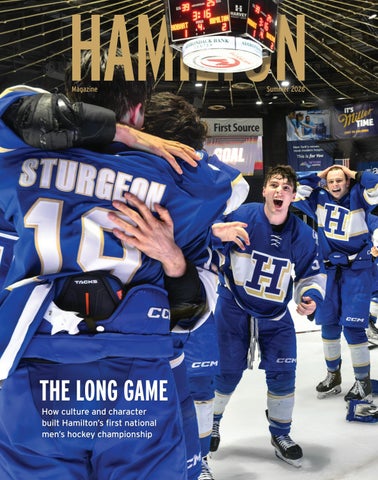
On the cover A celebration erupted moments after the overtime goal sailed into the net. Hamilton’s first national men’s hockey championship didn’t come from a breakthrough strategy or a singular star, but from something less tangible that has been a long time in the making. PAGE 28 PHOTO BY NANCY L. FORD
THIS PAGE: Who died of scarlet fever? Who fought in the Italian Revolution? How many were members of the Root family? Learn about the more than 300 occupants of the Hamilton Cemetery by exploring a new, searchable website. PAGE 14 PHOTO BY NANCY L. FORD
COMMENTS
HAMILTON MAGAZINE SUMMER 2026 VOLUME 91, NO. 2 EDITOR Stacey J. Himmelberger P’15,’22 (shimmelb@hamilton.edu) STAFF WRITERS Megan S. Bernier Holly A. Foster ART DIRECTOR & DESIGNER Bradley J. Lewthwaite PRODUCTION MANAGER Mona M. Dunn PRODUCTION ASSISTANT Phyllis L. Jackson CONTRIBUTING WRITERS Dana Blatte ’26 Michael Blanding Sabrina Grossman ’28 Ella Lyons ’29 Holly Mirales ’26 PHOTOGRAPHERS Nancy L. Ford Zack S. Stanek Kevin M. Waldron WEB COORDINATORS Esena J. Jackson Katherine Rook ’10 SOCIAL MEDIA COORDINATORS Claire Cross Corinne Becker VICE PRESIDENT, COMMUNICATIONS AND MARKETING Marisa S. Benincasa
CONTACT Email: editor@hamilton.edu Phone: 866-729-0313 © 2026, Trustees of Hamilton College
Email letters, story ideas, and feedback to editor@hamilton.edu or mail to: Hamilton Magazine 198 College Hill Road Clinton, NY 13323 We welcome comments on topics discussed in the magazine or on any subject of possible interest to the College community. Please include your name and class year, and whether you intend for your letter to be published. We reserve the right to judge whether a letter is appropriate for publication and to edit for accuracy and length.
2
H A M I LTO N
I
WAS HEARTENED to read “The Ever-Evolving Curriculum” in the Winter 2026 issue of Hamilton Magazine and, in particular, the sub-heading “The Impact of Kirkland” with a photograph of Kirkland students lying in a circle on the floor of an academic space with work papers splayed around them. One of the many things I loved about Kirkland was the blurring of lines between formal classrooms and residential/ social life. It was one of many things that made Kirkland special. Did you know that many Kirkland dorms were built with lounge areas on the first floor that were used as classrooms? I took Cultural Anthropology in this environment, and I think that is one reason I was so energized by that class. Unfortunately, in the years after Hamilton’s closure of Kirkland, Hamilton largely chose to tell only Hamilton’s story, as if Kirkland had not existed. In place of our accurate history, myths grew — some flattering; others mean-spirited. Even positive stories about Kirkland’s contributions to Hamilton often misstated facts. In the Winter 2025 issue, the Hamilton Magazine printed a story about innovation on the Hill.* Kirkland wasn’t mentioned. This omission spurred members of the Kirkland Class of 1975, who were preparing for our 50th reunion, to reach out to President Tepper and begin what has become an extremely fruitful dialogue. One year later, this article has a subheading
addressing some of Kirkland’s curricular innovations. This most recent article illustrates our work is not complete, nor would I expect it to be so quickly. The subheading on Kirkland devotes more space to Hamilton’s extremely modest curriculum changes than it does to Kirkland’s audacious rethinking of what and how students best learn and grow. Yes, Hamilton got rid of Saturday morning classes; Kirkland did away with grades! Fortunately, the College communications staff have the very best people available to help the Hamilton community learn the story of Kirkland and how our existence changed Hamilton: the Kirkland and Hamilton students of the Kirkland era. Talk to us! And don’t be afraid to challenge assumptions, write what may seem risky, and insist on bravely telling the truth. It is our legacy to you. Carolyn York K’75 * Editor’s Note: The article referenced above appeared in the Fall 2024 magazine. Titled “The Open Thinker Meets the Open Curriculum,” it introduced Hamilton’s new president, Steven Tepper.
I
JUST READ “The EverEvolving Curriculum” in the Winter 2026 Hamilton Magazine and am distressed at the odd way Kirkland is incorporated (or actually not incorporated) into the history of Hamilton and its changing curriculum.
The section on “The Impact of Kirkland,” although it discusses Kirkland’s approach and the focus of Sam Babbitt, is really about how the Committee on Academic Policy at Hamilton used the creation of Kirkland to start making some changes at Hamilton, and uses the pronouns “his” and “him” without ever mentioning “her” or “hers,” as if Kirkland was a concept rather than a place where actual women resided and interacted and learned — with each other and with the men at Hamilton with whom we shared campuses, classrooms, majors, ideas, and so much more in whatever ways worked for each of us. The article then jumps to 1986 and discusses further changes at Hamilton without ever acknowledging the fact that Kirkland was incorporated into Hamilton in 1978 and no longer exists (at which point Hamilton became a co-educational school; a huge change in and of itself after 166 years of being a men’s college). The way the article is written, if one knew nothing about Kirkland, one might think it continues to exist as a kind of side project of Hamilton with little importance. Hamilton has changed and evolved, in significant and positive ways since I was on the Hill in the early 1970s. Yet the truth is that so much of what Hamilton has been in the process of becoming, so much of what it is now, has emerged out of the existence of Kirkland and the ways in which the
COMMENTS
The Alexander Hamilton statue, as captured by Bruce Hogman during his undergraduate days.
THE TRUSTEES
essence of Kirkland — our ways of interacting, of learning, of teaching, of having open curriculum and seminars and papers rather than large lectures and exams, of allowing for creative majors, and everything else Kirkland was — has imbued Hamilton’s positively changed curriculum and focus. It would help for a history of Hamilton and the evolution of its changing curriculum to [include] how important so much about Kirkland has been for those changes, and to acknowledge the wisdom of Hamilton administration over the years for seeing how important it has been to incorporate that into the institution that Hamilton has become. Julie Weinstein K’75
I
WAS STRUCK by a quotation in last summer’s Hamilton magazine by Allie Ennis ’25. She succinctly articulated what a simple (even common) gesture can mean. I tore the page from the publication and pinned it up near my office desk where I glance over and reread it occasionally: “This is a place where people hold doors open for one another — literally and metaphorically. It may seem like a small thing, but what are you saying when you hold a door for someone? ‘I see you, you go first, come with me.’” You see, a couple years ago, I was considering closing my architectural practice of 25 years. I had an opportunity to teach
David M. Solomon ’84, P’16, Chair Robert V. Delaney ’79, Vice Chair Linda E. Johnson ’80, Vice Chair
O
n Friday, Feb. 20, Bruce Hogman ’68 sent the following email to the College, and it found its way to my inbox:
“During my years at Hamilton, I took photography and took a night photo of the Alexander Hamilton statue lit only by the light behind me from the College Chapel. It showed the spring bloom of a weeping willow that framed the statue, in B&W on Agfa paper and matte surround. F22 for 22 minutes on a 3x5 double lens film camera. Can you see if that photo still exists? If memory serves, my photo graced the cover of the College Catalogue for a year or more. I’d like a copy as my own collection burned in a house fire. Thanks.” I’ll admit, I thought locating this photo over a half-century later was a long shot. Nevertheless, the inquiry was forwarded to Jeremy Katz, Hamilton’s archivist. By Monday, Feb. 23, not only did he find the photo in question, he sent it along to its creator, who immediately wrote back: “INCREDIBLE! Thank you so much for that, and yes, I would like a physical copy of this photo, and you have my complete permission to use this photo as a gift to the College in its Alumni Collection or in any other way that the College wants. I regard this as my gift to the College that gave me my long career.” And what a career it was. After Hamilton, Hogman served in the U.S. Air Force until 1982 when he left active duty as a captain. During that time, he pursued coursework in computer systems management and served as a technical instructor with the Marine Corps and computer systems security officer at the Pentagon. Up until his retirement in 2017 as senior systems consultant, he held a variety of roles with organizations including the U.S. Department of Energy, U.S. House of Representatives, IBM, Continental Airlines, and HewlettPackard. At age 80, he continues to volunteer his computer expertise to nonprofits in the Fort Lauderdale, Fla., area. Although Hogman never pursued photography as a career, he does credit Professor Dwight Lindley and the public speaking and English courses he took at Hamilton with giving him the skills needed to speak before groups of generals at the Pentagon and before Congress. — Stacey Himmelberger
CHARTER TRUSTEES Aron J. Ain ’79, P’09,’11 Mason P. Ashe ’85 Richard Bernstein ’80 Craig Calhoun Peter B. Coffin ’81, P’14 Julia K. Cowles ’84 Mark T. Fedorcik ’95 Daniel C. Fielding ’07 Amy Owens Goodfriend ’82 Philip L. Hawkins ’78 Lea Haber Kuck ’87, P’24 Anthony H. Leness ‘94, P’26 Sharon D. Madison ’84 Christopher P. Marshall ’90 Daniel T.H. Nye ’88, P’24 Montgomery G. Pooley ’84, P’16,’19 Imad I. Qasim ’79 R. Christopher Regan ’77, P’08 Lindsey L. Rotolo ’97 Alexander C. Sacerdote ’94 Jack R. Selby ’96 Steven Tepper ALUMNI TRUSTEES Josie M. Collier ’97, P’14 Robert Fryklund ’80 Heather Hage ’02 Valarie Hing ’90 Stuart P. Ingis ’93 Edvige Jean-François ’90 Kevin J. O’Donnell ’89, P’22,’25 William C. Schmoker ’89 Alice Davis Tornquist ’86 Vidal Torres ’00, P’29 Kiki Yang ’00 Gillian B. Zucker ’90 LIFE TRUSTEES Henry W. Bedford II ’76 David W. Blood ’81 Harold W. Bogle ’75, P’14 Brian T. Bristol P’11 Christina E. Carroll P’90 Gerald V. Dirvin ’59, P’84, GP’17 Sean K. Fitzpatrick ’63, P’87 Carol T. Friscia K’77 Lee C. Garcia ’67 Eugenie A. Havemeyer GP’00 David P. Hess ’77 Joel W. Johnson ’65, P’93 Kevin W. Kennedy ’70 † A.G. Lafley ’69 † George F. Little II ’71, P’04 Arthur J. Massolo ’64, P’93 Robert S. Morris ’76, P’16,’17 John G. Rice ’78 Stephen I. Sadove ’73, P’07,’10,’13 † Thomas J. Schwarz ’66, P’01 A. Barrett Seaman ’67 Chester A. Siuda ’70, P’06, GP’25 Susan E. Skerritt K’77, P’11 Charles O. Svenson ’61, P’00 Thomas J. Tull ’92, P’13 Susan Valentine K’73 Jack Withiam, Jr. ’71, P’16,’20 Jaime E. Yordán ’71 Srilata Zaheer † Chairmen Emeriti PRESIDENT OF THE ALUMNI ASSOCIATION Paul Reichert ’90
SUMMER 2026
3
COMMENTS
at a nearby university and was weighing this life change. Was switching careers at 59 years old crazy? Could I do this? More importantly, is this an institution I can devote myself to for my remaining productive years? On a mid-semester visit to assess the campus and explore the facilities, I noticed some-
thing: Whenever I entered a building with others, students or staff, they held the door for me. And when I did so for others, they acknowledged my gesture. My gut told me then: yes, this is a place I can be. This community feels right. I now teach full-time at the University of Hartford with
E
ditor’s Note: Shortly before he retired this summer, Professor of Economics Emeritus Erol Balkan wrote the following and asked if we might send it to his former students. Due to the sheer number, that task proved too difficult, so instead we’re sharing his thoughts with all readers. Dear Students, This isn’t another message from Hamilton asking for your money or your time — so relax. This is simply a note from that once-young Turk who, as you may recall, taught you everything you ever needed to know about economics, the world, and perhaps a few other things along the way. After 39 remarkable years on College Hill, I will be retiring in July 2026. I hesitate to call it an ending. It feels more like a change of key. So long — it’s been good to know you. Not a last word. Not even close. Just a quiet step to the side, while the music carries on — without me in the room, but not, I hope, without some echo. When I first arrived at Hamilton, I never imagined I would stay this long. And yet, each year, I found myself asking the same question: “Erol, what in the name of Hades are you doing here?” Istanbul — my birthplace — still lives vividly in me. I can hear the street noises, the chaos of traffic, the relentless pace of the city, feel the press of the crowds — and then, somehow, find a moment of peace, sitting with a glass of tea in Üsküdar, watching the ships glide by along the Bosphorus. Clinton, as you well know, is not Istanbul. And yet, somehow, it became a home of another kind. So why did I stay? The answer, simple and complicated at once, has always been the same: I stayed because of you. Teaching has been my life. Like the best jazz,
4
H A M I LTO N
great satisfaction and gratification. I wish all Hamilton alumni (especially Ms. Ennis) the opportunity to continue this community-building habit in their lives beyond the Hill. Carissima! ... Wait, was that too cheesy? Lindsay Suter ’86
it asks for improvisation, risk, attentiveness — and above all, a responsive audience. You were that audience. You challenged me, surprised me, disagreed with me, and, more often than not, taught me as much as I taught you. The classroom was never just a place of instruction; it was a shared space of discovery. And now comes the bittersweet part. Gratitude is easy. Leaving is not. There is a quiet sadness in knowing there will be no new classes, no first-day energy, no unexpected questions that send us down entirely new paths. But there is also a deep and steady joy in knowing that the conversations do not end here — they continue in your lives, your work, your thinking. So this is, simply, a thank you — though “thank you” feels far too small for what I mean. Thank you for your curiosity, your impatience, your generosity of spirit. Thank you for keeping me intellectually honest and, in many ways, young. If I have carried something forward from these 39 years, it is not just what I taught, but what I learned from you. Now, I step into a new phase of life — one less defined by the classroom, but still guided by curiosity. I will be exploring new projects, new ideas, and new meanings, seeking ways — large and small — to contribute to making the world better. Philosophers have long sought to understand the world; the point, however, is to change it. So long — it’s been good to know you. And, in a way that is both comforting and a little melancholic, it still is. Warm regards, Erol Balkan
D
ON CHALLENGER’S reminiscence [see Winter 2026 issue] about the late Mike Castle’s ’61 only electoral loss brought to mind not only a similar circumstance, with my then boss New York Senator Jacob Javits’ first and only election defeat in 1980, but also a connection with Joe Biden, whom Mike was on track to succeed in the Senate. In the 1980 New York Republican primary, Javits, at the time the longest-serving senator in the state’s history (four terms), lost to the little-known, much more conservative challenger Alphonse D’Amato, who was elected in November in a squeaker over Rep. Liz Holtzman. Javits, who stayed in the race as the Liberal Party candidate, got about 11% of the vote and is generally believed to have swung the race to Holtzman (although, having examined detailed election tallies from Upstate and the New York City suburbs, I disagree with that assessment). The Biden-Javits connection is described in a commentary I wrote for the New York Daily News and published less than a week before Biden dropped out of the 2024 presidential race. I originally submitted it to The New York Times, but they preferred to go with a similar piece by George Clooney. Go figure. David Morse ’74
Know Thyself
KNOW THYSELF MEET PEOPLE TAKING HAMILTON’S MOTTO TO HEART AS THEY DISCOVER AND EXPLORE THEIR PASSIONS WHILE MAKING VALUABLE CONTRIBUTIONS ON COLLEGE HILL AND BEYOND.
Richard Burns at an American LGBTQ+ Museum event. INSET: Burns’ identification card from his stint at the Gay Community News shortly after he graduated from Hamilton.
A Mirror of the Past Richard Burns ’77 When Richard Burns ’77 came out as gay in his sophomore year at Hamilton, there were no other models on campus, but he felt a personal conviction to be unapologetically who he was. “It was very challenging from a mental health perspective, but I had no choice,” he said. “I wouldn’t have survived if I hadn’t come out of the closet.” Despite weathering harassment from some students, he was supported by a strong network of friends and found unexpected support from Dean Gordon Bingham, who encouraged him to get a charter and funds for an official LGBTQ group. “My experience at Hamilton created a personal imperative for me — that I had to be an activist,” he said. Burns went on to become managing editor of the national newsweekly Gay
Community News in Boston, before co-founding GLAD Law in 1978, the first legal organization to advocate for LGBTQ rights in New England. After graduating from Northeastern University School of Law, he led the LGBT Community Center in New York, the hub for AIDS activism in the 1980s, for 22 years. His latest venture has been spearheading creation of the American LGBTQ+ Museum, set to open in 2028 on the top floor of the New York Historical Society on New York’s Upper West Side. The 5,000 square-foot space will consist of a permanent exhibit showcasing LGBTQ history, as well as rotating exhibits and online and educational resources. “We knew from the start this wasn’t just going to be a repository of old things,” he said. “It had to be the cultural arm of our movement for LGBTQ liberation and equality.”
To fulfill that goal, Burns helped assemble a national board of directors that includes a diverse range of queer experience, race, gender and age to ensure that “all of the voices of our community are at the table as we build an institution that preserves, celebrates and examines our lives and our movement during a time when LGBTQ identity is again under attack.” “Culture has to be a mirror in which we can see ourselves reflected,” Burns said. “We want to preserve and herald the stories of the incredibly courageous queer people who came before us, so that every person who comes to the museum can see themselves in this cultural mirror and see they can have a life filled with success and joy and love.” • — Michael Blanding
SUMMER 2026
5
KNOW THYSELF
The Burden of Memory Joe Cincotta ’71 He was 14 when his quiet childhood in Bellmore, N.Y., was upended with news from the Congo. His aunt, Sister Mary Antoinette, a missionary with the Daughters of Wisdom, had been murdered alongside another sister and two priests by Simba rebels in Isangi. It was November 1964, during the dark final days of the rebellion shaking the newly independent country. Her body was cast into the Congo River. For Joe Cincotta ’71 and his family, the tragedy went almost unmentioned for decades, noted only briefly on the anniversary of her death. As a boy, Cincotta was struck by “Aunt Nana” in her habit, with a rosary at her belt
Lights, Camera, Reviews Joanna Langfield K’76 Joanna Langfield K’76 has built her long-held passion for the arts into a successful career as a film critic and media personality. From writing reviews to hosting programs, she has built a reputation for garnering celebrities’ insights that
6
H A M I LTO N
and a cross upon her chest. She had been a missionary for 12 years, first in Malawi and then in the Congo, writing frequently to her family on Long Island about her work in a country fractured by colonial rule and civil war. Cincotta recalls her favorite phrase, always saying she was “storming the gates of heaven.” Despite the persistent danger, her life was full of kindness, compassion, and joy. Decades later, when a French memoir by a surviving Belgian priest came into Cincotta’s possession, he felt an obligation to preserve the account. To him, people dying for their faith belonged to ancient history, not the 20th century, yet he realized his aunt was one of the unheralded “saints among us today.” Finding a translator, he confronted the grim details of the Isangi massacre. “It was a while before I could bring myself to read it,” Cincotta said. The text
go beyond just news about their latest projects. Through her website, The Movie Minute (themovieminute.com), she has reached millions with her insightful capsule reviews of the latest films. Langfield got her start on TV and radio in Boston before moving to New York where she worked as executive producer for talk show personalities such as Sally Jessy Raphael. She eventually began hosting a one-minute movie review spot, which led to her own weekend call-in show and role as a regular contributing commentator for CNN, Fox News, and CNBC. Langfield is no stranger to developing things from the ground up. At Kirkland, she created her own major, concentrating as much as possible on theater and film, and took courses with her favorite professors, including Carole Bellini-Sharp and Nat Boxer. She also performed at Minor Theater and was a DJ on WHCL.
revealed the precarious reality his aunt and her colleagues faced, trying to care for Congolese children amid a brutal insurgency. In May, prior to his 55th reunion, Joe self-published the completed translation, Hostages in Congo. The book is a permanent ledger of an ordinary family’s extraordinary grief and an enduring monument to a beloved aunt who never came home. • — by J. Frederick Rogers P’21, who helped translate Hostages in Congo from French to English. Rogers worked in Hamilton’s
“While much of my broadcast career was on TV, cable, talk, and news stations, my DJ time at WHCL gave me my first try at any kind of radio,” she recalled. “I was as nervous as could be behind the mic but learned to transform those nerves into a positive energy, something I still do today.” When not screening — or reviewing — the latest films, Langfield and her husband, Michael Rose, spend time babysitting their grandsons, playing tennis, and traveling. This fall, she’s looking forward to seeing the mix of commercial and smaller, perhaps more artistic, films that debut at the annual New York Film Festival. “Walking into those screenings often feels like going back to school after summer break. We are all so happy to be there,” she said. • — Sabrina Grossman ’28
KNOW THYSELF
Matching Fashion and Art Sky Gellatly ’03 Sky Gellatly ’03 is a matchmaker. Through his company ICNCLST, he brings together contemporary artists and big brands such as Marc Jacobs, Comme des Garçons, and Nike. His work is making him a major force in the intersection between blue chip art and brand collaborations. As one example, Gellatly recently paired luxury fashion house Louis Vuitton with contemporary artists Lady Pink, Lee Quiñones, and the Estate of Rammellzee to create a series of limited-edition LV trainer sneakers. The collaboration, forged in partnership with his longtime friend Virgil Abloh, was featured at an exhibition in Milan where visitors were treated to a live painting session, an oversized sneaker overlaid with 4D image-mapping, and a short film about the process. “The thing that I enjoy most about my career is the part that is not about me; it’s what I get to share with others,” Gellatly said. “It’s the human experience.” At Hamilton, Gellatly studied English and played three sports, including soccer, for which he earned recognition as a scholar-athlete All-American. He also hosted a WHCL show and served on SGA and the Judicial Board. He emphasized the support he received from professors, such as Tina Hall (English/creative writing) and Lisa Trivedi (history), as well as from soccer coach Perry Nizzi. With guidance from the Career Center, he learned the importance of preparedness and representing yourself in the best possible way for job interviews. Gellatly’s current work includes a variety of projects for Nike and EA Sports surrounding the recent soccer World Cup. His agency also recently signed some new talent, such as LA-based contemporary artist Lauren
The thing that I enjoy most about my career is the part that is not about me; it’s what I get to share with others. It’s the human experience.
Halsey, and he will be working on related opportunities with the 2028 Olympics in Los Angeles. In between all of this, he is also an adjunct professor at Columbia University’s Graduate School of Architecture. In terms of his journey from Hamilton to where he is now, Gellatly said, “It’s funny, wearing Nike soccer cleats while playing for Hamilton and playing EA the video game [formerly FIFA] in dorm rooms in college, and now I’m working on both of those things during the World Cup as part of my career. I think that’s pretty cool.” • — Sabrina Grossman ’28
Sky Gellatly (bottom, center) with some artists at an exhibition opening in Japan.
SUMMER 2026
7
KNOW THYSELF
A Passion for Plants Grace Papetti ’27
8
H A M I LTO N
designing “Tree of the Month” educational posters to display in the Glen. Among her favorite projects have been caring for the Saunders peonies and identifying species in the alpine plant bed. Papetti continued her plant science research this summer at Cornell University as part of the Programmable Plant Systems Research Experiences for Undergraduates program. She focused on examining how carbon moves through maize plants and how plants respond
physiologically to environmental stresses such as drought. By tracking carbon allocation above and below ground, she worked to better understand how plants function under changing conditions. Looking ahead, Papetti hopes to build a career as a plant biology researcher. “Working with plants every day — and constantly getting to learn new things about how they function and their evolution — is what I want to do,” she said. • — Ella Lyons ’29
Grace Papetti examining Saunders peonies in Hamilton’s Grant Garden.
ZACK STANEK
For Grace Papetti ’27, a love of plants took root during her first year at Hamilton. A biology major with minors in geoscience and environmental studies, Papetti traces her interest in plant science to Assistant Professor of Biology Pete Guiden’s introductory biology course Secret Life of Plants. Through the class and its herbarium project, she discovered a new way of looking at the natural world. “[It] allowed me to see plants in a way I hadn’t before,” she said. “While many biology classes have you look at animals as separate life forms and organisms, this class reminded me to look at plants the same way. It intrigued me because every plant is beautiful and different.” Papetti knew she wanted to pursue plant biology more seriously. She joined Guiden’s plant-animal lab as an independent researcher, where she began studying tree masting behavior and seed dispersal. That passion took her to the Arnold Arboretum of Harvard University where she spent the summer conducting research under Arboretum Director and Professor of Organismic and Evolutionary Biology Ned Friedman. Her project focused on the roots of plants in the Boraginaceae family, examining changes in plant form across species and genus levels. That experience confirmed that plant research was what she wanted to pursue. “I never wanted the internship to come to an end,” she said. Before returning to campus last fall, Papetti reached out to Hamilton’s Arboretum staff in hopes of continuing her work with plants. She was hired by Facilities Management and has since contributed to several projects in the Root Glen, including creating a Google Maps walking tour and
KNOW THYSELF
When you arrived at Hamilton, you came as a pre-med chemistry major, but switched to computer science after taking an intro class — why? It was really about the structure of the curriculum at Hamilton, which didn’t let you take all your science credits in one discipline. I thought maybe I should do something different, and computers seemed to be important (laughs). Once in computer science, I was drawn to the problem solving and structured thinking it required, and the fact that there was no ambiguity in the outcome. If you wrote a program to do a certain thing, the outcome was assured. But it also allowed for creative problem solving, because there wasn’t only one way to create an outcome.
Transforming Through Tech Aditya Bhasin ’94 Aditya Bhasin ’94 has spent his career transforming companies through technology. In two decades at Bank of America, he led teams that launched mobile apps; directed the creation of peer-to-peer payment system Zelle; instituted the revolutionary AI financial assistant Erica; and oversaw a portfolio of 4,500 patents, ultimately serving as chief technology and information officer. During his tenure, the firm earned numerous accolades, including making Fortune’s list of “America’s Most Innovative Companies.” This past year, Bhasin embarked on a new venture as a partner at Falfurrias Management Partners — a $3.8 billion private equity firm in Charlotte, N.C. — working with middle market companies on their technology and growth strategies. A chemistry and computer science major at Hamilton, he served on the College’s Board of Trustees and is now vice chair of Discovery Place, a children’s science and technology museum in Charlotte.
What’s something you’ve learned about the realm where business and technology intersect that might surprise people? The most important learning for me is that it’s not about the technology at all. Too many projects begin with “Hey, here’s a cool new technology, how should we use it?” and that almost always yields a bad set of outcomes. It’s more important to start by asking what are the business problems you are trying to solve and what are the processes involved in that — and then asking how technology can enable or accelerate or eliminate those processes.
You oversaw a portfolio of 4,500 patents at Bank of America. Were there any that you were excited about that didn’t see the light of day? The biggest thing we were trying to drive in the patent program wasn’t necessarily how many of them turned into actual products. It was to get everybody in the team engaged in a culture of innovation. Too often big companies will create an innovation lab and say, that’s the cool place where these 20 “innovators” are — we rejected that notion completely. Our technology team had 60,000
people in it, and I wanted everyone to be able to get out of their job for a minute, think about an innovative idea, and write it down. That made everyone better at their jobs.
The breakthrough virtual financial assistant Erica was recognized as a model in chatbot technology. What did it teach you about what customers really wanted? It goes back to being relentlessly focused on the customer and asking the right questions. Erica was started as a result of asking how we can help customers use the thousands of features in a mobile app better. If you want to order foreign currency, you can’t have that on the homepage because it’s used infrequently. So we said what if there is a textbox where you could just say what you wanted, and the interface would point you to it. It turns out one of the top things customers still ask for is “What is my routing number?” and now they can easily find the answer to that question.
You’ve said that artificial intelligence isn’t really a new technology but a new chapter of a familiar technology. How does that influence how you advise companies to use it? In financial services, we’ve been analyzing spending patterns and debt payments to predict future payment ability for a long time. You might say, “That’s really innovative use of AI,” but it’s called a credit score and we’ve been doing it for 40 years. The basics remain the same — focus on your customers, know the business problem you are trying to solve, and look at your processes and figure out where AI can be most beneficial. What can be fully automated, what can be partially automated, and what controls you need to put in at each step to make sure it didn’t make a mistake. • — Michael Blanding
SUMMER 2026
9
KNOW THYSELF
Give Opera a Try Bill Powers ’94 When Bill Powers ’94 took over as general director of the Pittsburgh Opera this summer, it was a homecoming. He spent more than a decade there in various roles before leaving in 2021 to briefly head the Pittsburgh Youth Symphony Orchestra. Powers has a long record of performing arts leadership. After majoring in music at Hamilton, he earned his MBA in finance at Fordham University. He’s worked with such institutions as The Juilliard School’s Department of Vocal Arts, the Artistic Department at The Metropolitan Opera, Berkshire Opera Company, Aspen Music Festival, and The Music Academy of the West. He and his wife, an accomplished opera singer who serves on the voice faculty
at Carnegie Mellon University, are parents to Katharine ’28. In his new role, Powers hopes to expand the company’s reach through collaboration with area cultural and community organizations, engaging younger audiences, and creating a broader, more diverse repertoire. We asked Powers to share three reasons why you should take in an opera.
1. It’s viscerally compelling. Yes, opera can be grand in size and spectacle, but it can also be small and intimate (particularly newer works). In any form, there's always something about opera that strikes the audience with its virtuosity, emotion, musical storytelling, and reflection of life.
2. The unamplified vocal and musical power. We all know what it is like to watch finely tuned athletes compete. Opera singers and
Getting the Call Emma Tansky ’25 Softball standout Emma Tansky ’25 didn’t retire her bat and glove after her career as a Continental came to an end. When not working as a dermatology assistant at Bryn Mawr Skin & Cancer Institute, she’s a ball girl for the Philadelphia Phillies. Tansky learned about the position last fall. Three rounds of interviews followed, including a quiz on Phillies history and fielding/hitting drills at Citizens Bank Park. While many people picture ball girls stationed along the first- and third-base lines during games handing foul balls to enthusiastic fans, the role is much broader. Ball girls work 15-20 hours a week and each year make over 150 off-field apearances — visiting schools and nursing homes, and hosting community events
10
H A M I LTO N
instrumentalists are so highly trained and skilled that it’s mesmerizing and thrilling to watch them perform — nothing artificial, no engineering or AI, just the power and beauty of human talent.
3. Why not? It’s like trying wine, or food, or new technology, or anything where perceptions and stereotypes might get in the way. You really don’t need to know much about opera to find it entertaining and engaging. I think people like having new experiences these days, and you will discover that the cost for tickets is less than you think. So why not be curious and give it a shot? •
such as the Christmas in July toy drive. “The best part of the job is getting to meet so many people and interacting with fans,” Tansky said. “We do everything from sell 50/50 tickets to raise funds for charities, to assist at youth softball clinics. Just recently I worked at a summer camp in New Jersey called Camp No Worries that supports kids with cancer and their siblings.” A pitcher and infielder for Hamilton, Tansky earned the Riffle Award as the top female senior athlete. She holds College records for most stolen bases and ranks second all-time in hits and runs scored. Tansky posted a .408 batting average and played a key role in leading Hamilton to a NESCAC postseason appearance in 2024. Ball girl positions typically last two years, and Tansky hopes to continue next season. The biology major then plans to enter a graduate program to become a physician assistant. •
KNOW THYSELF
Lillia McEnaney, sporting her Hamilton cap, on a hike in New Mexico.
HAIDEN RENAE GOULD (DINÉ)
Exploring Indigenous Cultures Lillia McEnaney ’17 Relationality and reciprocity are at the core of Lillia McEnaney’s ’17 work — so much so that it hardly feels like work to her. McEnaney is a museum anthropologist, independent curator, and assistant professor of museum studies at the Institute of American Indian Arts, a tribal arts college in Santa Fe, N.M.. There, her work centers on museum anthropology and community-based curatorial theory and practice. Growing up with parents who held a love for the landscapes and arts of both New England and the American Southwest, McEnaney gained exposure to museum communities from an early age. A January admit at Hamilton, she was hired in her first week on campus as a research assistant for Professor of American Studies Seth Schermerhorn, who specializes in the interdisciplinary study of Native American and Indigenous communities and traditions. “He really was transformational — and continues to be — in how I approach the field,” McEnaney said of her mentor, who
remains an inspiring collaborator and friend. “Today, as a teacher myself, I view Dr. Schermerhorn’s mentorship through a new lens. Though I always valued and admired his approach, I now strive to be the person to my students that Seth was to me.” Toward the end of her master’s program in museum studies at New York University, McEnaney relocated to New Mexico. Over her time in Santa Fe, she has co-curated community-driven exhibitions; facilitated public programming for museums and cultural organizations; published articles and organized conference sessions; written, implemented, and reviewed national grants; and directed a program for local high school students who aspire to be museum curators. While serving as an adjunct instructor in Lehigh University’s Department of Art, Architecture, and Design and through Lehigh Launch: Semester in the American West — an experiential, integrative program for first-year students — she was reminded of her Jan experience at Hamilton, for which she feels continued gratitude. “[Being a mentor] is an incredible opportunity and responsibility,” McEnaney acknowledged. She hopes to foster intellectual curiosity and creative inquiry for
Indigenous students in museum studies at the Institute of American Indian Arts, a challenging task in a field that is rooted in — and often continues to perpetuate — colonial violence. Yet, the ability to communicate effectively about the value of the arts and humanities is of increasing importance. She reminds her students, “Your voices are needed and valued in the world,” a lesson she learned at Hamilton. Relationships anchor McEnaney’s projects. Her upcoming book, co-edited with Jennifer Nez Denetdale, professor of American Studies at the University of New Mexico and the first Diné person to earn a Ph.D. in history, is no exception. The 14 contributors to “Our Livestock Will Never Diminish” “Nihinaaldlooshii doo nídínééshgóó k'ee'aa yilzhish dooleel”: Breathing Life into the Photography of Milton Snow Across Diné Bikéyah include a variety of Diné scholars, artists, community members, and allies. Although McEnaney recently submitted the final manuscript for review, “learning how to work in collaboration and partnership is an ongoing process” — and she hopes to be far from done. • — Dana Blatte ’26
SUMMER 2026
11
RECENT NEWS HIGHLIGHTS
From across the Hamilverse 1 KIRNER-JOHNSON BUILDING
Hey guys! Oops, can we say that? Or should we say “people” or “folks”? Inclusive language aims to foster belonging by respecting diverse identities; however, the practice can raise eyebrows — or hackles. Do changes to language create confusion or push people to change habits that aren’t really harmful? Or does “inclusive” language create a more welcoming and respectful atmosphere for everyone? The Levitt Center opened the issue up for discussion at a Community Conversation event on April 9.
1 2
2 SADOVE STUDENT CENTER
The Sadove Terrace was transformed into a Closet Thrift Pop-Up on April 26 to close out activities marking Green Week. Organized by the Hamilton Sustainability Coordinators, the initiative raises awareness about environmental issues and promotes sustainable practices on campus. Other events included an EV car show, tree planting, and talk on food insecurity.
3 TOLLES PAVILION
Pride Month falls in June when most students are off campus, so we moved up the celebration! Events spotlighting the LGBTQIA+ community throughout April included a Pride dinner, Pride parade, and a Day of Silence that concluded with an open mic where students, faculty, and staff shared their experiences as queer individuals and allies.
H
12
3
4 DUNHAM GREEN
WANT MORE HAMILTON NEWS? Visit hamilton.edu/news. And if you’re not receiving our monthly Hamilton Headlines in your inbox, send a note to editor@hamilton.edu, and we’ll add you to the list.
H A M I LTO N
Strawberries & Champagne, a tradition that began at a Kirkland College Commencement, took place on May 22. The event celebrates achievements of our current women, femme, and non-binary students while paying homage to Kirkland graduates. Members of the Class of 2026 enjoyed a brunch — with strawberries and sparkling champagne, of course — and received a green apple pin.
5 ROOT HALL
Solve this problem: Given an array, A, of integers, return all of the pivots in A. (A pivot, for this problem, is defined as an element of the array that is no less than any element to its left and no greater than any element to its right.) Stumped? You’d find all of the pivots — in linear time — if you joined Hamilton’s Coding Team. The group meets weekly to host technical workshops, work on programming projects, and attend hackathons.
6 BLOOD FITNESS CENTER
The Charleston, Shim Sham, Lindy Hop. Students interested in “swinging” into something new gathered each Friday afternoon to learn the basics of swing dance under the direction of Assistant Professor of Biology Ariel Kahrl and Assistant Professor of Instruction in Microscopy Kyle Martin.
4 6 5
7 CHAPEL
7
8
What did the Founding Fathers intend in the words included in The Declaration of Independence? How has its interpretation changed over time? As the U.S. marks its 250th anniversary, Hamilton’s Common Ground program hosted “The Meaning of the Declaration of Independence” featuring scholars David Blight (Yale University) and Lucas Morel (Washington and Lee University) on April 22.
8 BURKE LIBRARY
Companies at the cutting edge of AI-enabled Command and Control, autonomous systems, quantum sensing, and technology for the U.S. military brought their best ideas to Hamilton on April 28 for a pitch showcase. The event featured five startups from Griffiss Institute’s HUSTLE (Helping Upstate Science and Technology Leaders and Entrepreneurs) Defense Accelerator.
ILLUSTRATION BY TOM WOOLLEY
SUMMER 2026
13
AROUND COLLEGE A screenshot from a new interactive website featuring the Hamilton College Cemetery.
Every Stone Has a Story … Online
M
ORE THAN 300 SOULS reside in the Hamilton College Cemetery, and Connor Havelka ’28 has come to know nearly all of them. As a Curatorial Studies Initiative intern in the College Archives, he spent the summer researching and writing biographical descriptions for a new cemetery website. In addition to a brief history of the 206-year-old resting grounds, the site includes historical maps, call-outs for prominent occupants, and a chart detailing causes of death — which range from pneumonia and cancer to lost at sea and a broken heart. But the highlight of the site is its interactive search function. Users can locate individuals by entering a name or other known information. An overhead view features clickable dots marking each headstone, and a menu allows users to zoom and find a specific location. Information gathering on cemetery occupants has been ongoing, with the “Last Dormitory” tour given at Reunions first by the late College Archivist Frank Lorenz, followed by Fred Rogers, former director of the Hamilton Fund, and most recently Steven Starnes ’80. Serious work on the digital project began last fall when College Archivist Jeremy Katz solicited help from Digital Scholarship
14
H A M I LTO N
Technologist Doug Higgins. He, in turn, recruited Ella Strasser ’26, an art and environmental studies major, to design the site. Strasser, an intern on the Burke Library’s Digital Initiative Scholarship and Collaboration team, had previously worked with filter search systems; she created a story map for a cemetery in Utica. Using ArcGIS, an online tool that incorporates the use of global positioning software, she spent her senior year working with initial data to determine what information could appear on Hamilton’s map. “The coolest thing about the cemetery site is the search feature,” said Strasser, who is considering a career in landscape architecture. “You can easily find and read about a particular person who’s buried there, or just click around and explore.” Much of the intense work on the project came this summer when Havelka got involved. “I’ve always been interested in library and archive work,” said the classics and creative writing major who also works at the library’s circulation desk. “After taking Jeremy Katz’s Archival Studies course, I learned about this opportunity to not only gain experience in the field, but also make an impact on campus.” Havelka inherited a spreadsheet with entries for each individual buried in the cemetery. While plenty of details were available for former presidents, trustees, and professors, little had been gathered for spouses, children, or other relatives.
“I also stumbled across a few cases of confused or obscured identities — instances where a headstone might have a name and birth date in the 19th century, but no death date. Turns out, three people [buried at the cemetery] don’t have headstones, and two or three have headstones, but aren’t actually buried here.” As an example, College records indicated that both Cornelius deRegt, an early Hamilton groundskeeper, and his father, also Cornelius deRegt, were both buried in the cemetery; however, Havelka noticed that the elder deRegt died years before his son even started work at the College. “That was the point when I realized I was doing more than just cataloguing,” Havelka said. “We joked that, at the end of my first four weeks, we realized I wasn’t a researcher, but an auditor. At the end of my last four weeks, we realized I wasn’t actually an auditor, but a necromancer.” Although many of the older headstones have weathered significantly over the years, Havelka said that they were “exceptionally lucky” to have been able to transcribe the writing on all but a few of the markers. Only one is entirely lost. What’s the most interesting thing he uncovered? A stone in the cemetery that features an unusual carving — that of a hardware bolt. The marker isn’t tied to an individual, but instead honors the Class of 1884 whose members “bolted” campus in protest after a dispute with President Darling and the faculty over what students felt were unfair disciplinary suspensions. The event, which made repeated national headlines, lasted a month. “It’s a fascinating story and, interestingly, shows what remains true over a century later. Students, when given the opportunity to protest for the right thing, will do it,” said Havelka, who plans to Scan to visit the eventually pursue a career Hamilton College as a librarian or archivist. n Cemetery website.
AROUND COLLEGE
From Hamilton to a Master’s
H
AMILTON STUDENTS now have direct pathways from bachelor’s to master’s degrees thanks to new graduate study partnerships with several of the world’s top research universities — Duke University Fuqua School of Business, Harvard Graduate School of Education, University of Chicago, University of Pennsylvania Graduate School of Education, Vanderbilt University Owen Graduate School of Management, and Washington University in St. Louis McKelvey School of Engineering. Interested students apply to a pathway at the same time they apply to Hamilton. Those admitted to the program arrive for their first year on College Hill already connected to program-specific cohorts supported by Hamilton faculty and staff. The students also receive opportunities for mentorship, advising, professional development, and engagement with the partner institution throughout their undergraduate experience. “Many of the students and families we meet during the college search process also ask what comes after Hamilton; they are already thinking about the next step,” said John McLaughlin, vice president for enrollment management and dean of admission,
when the program was announced in April. “Hamilton’s partnerships … provide students with a degree of certainty that is rare in higher education, and particularly among liberal arts colleges: a clear, accessible pathway from undergraduate enrollment through graduate completion.” The pathways program enables students to plan their Hamilton coursework strategically, take full advantage of the residential liberal arts experience by engaging in relevant curricular and co-curricular activities — such as studying abroad and conducting research — and embark on their senior year with confidence and purpose. Depending on the partnership, students may benefit from application fee waivers, guaranteed interviews, scholarships, accelerated timelines, mentorship opportunities, and access to professional networks and alumni communities. Starting with the class entering Hamilton in fall 2027, students will be eligible for the following: ■ Duke University Fuqua School of Business: Students may pursue select master’s programs in management, business analytics, sustainability, and related fields. ■ Harvard Graduate School of Education: Students may pursue graduate study through the Teaching and Teacher Leadership; Human Development
and Education; or Learning Design, Innovation, and Technology programs, all leading to the Master of Education degree. ■ University of Chicago: Students begin exploring graduate-level work as early as their first year through the Advanced Scholars program and may apply to roughly two dozen master’s programs in the arts and humanities, as well as programs in the social and natural sciences. ■ University of Pennsylvania Graduate School of Education: Students will explore areas such as education policy, higher education, and learning sciences, examining how education shapes institutions and communities. ■ Washington University in St. Louis McKelvey School of Engineering: Students may apply during their junior or senior year to fields such as engineering, computer science, data analytics, and cybersecurity. ■ Vanderbilt University Owen Graduate School of Management: This pathway creates a structured 4+1 route from Hamilton to Vanderbilt’s Master of Science in Finance program. n
HamTrek Turns 21!
N
OW HEADING INTO its third decade, the popular HamTrek event drew a record number of participants this spring. Highlighting the afternoon was the sprint triathlon where students, faculty, and staff competed individually or as three-person relay teams in swimming, on-road biking, and cross-country running. The swimming portion is 525 yards (21 lengths of Bristol Pool), biking is 9 miles (around the Griffin Road loop twice) or a 30-minute time trial on a spin bike, and running is a 5K down the Nordic ski trail. Others took part by strolling
SUMMER 2026
15
AROUND COLLEGE
HamTrek 2026 By the Numbers ■ 257 participants (92 individuals and
55 relay teams) ■ 110 conventional triathlon division entries ■ 37 spin division race entries ■ 58 Wellness Walk participants ■ 44 volunteers provided support
throughout the day ■ 31,663 steps recorded by organizer Steph Kowell on HamTrek day!
ZACK STANEK
The Winners! ■ 57:11 — winning time of men’s triathlon (Aidan Olson ’29) ■ 1:03:35 — winning time of women’s triathlon (Maggie Winstead ’26) ■ 48:27 — winning time of relay triathlon (Team Chambon: Loui Chambon ’28, Henry Wiemeyer, and Vincent Manni) — a new HamTrek record! ■ Spin Bike Division winners — Alex Vasquez ’27, Charlotte Moulson ’26, and Team Flynn McDonnell ’28 n
16
H A M I LTO N
Journalism intern Paige Hescock ’27 (left) and Managing Editor Pam Sperbeck hard at work at the Rome (N.Y.) Sentinel.
NANCY L. FORD
around Pritchard Track for a 1-mile Wellness Walk. All participants celebrated at a community barbecue held afterward at the finish line. “HamTrek is one of the events I look forward to most each year,” said Steph Kowell, assistant athletics director for fitness and recreation. “Seeing all sides of campus come together for this tradition — whether competing, supporting friends and colleagues, or simply enjoying the day — is such a rewarding experience and a great way to cap off the year.”
Work in Progress
E
ACH SUMMER, hundreds of Hamilton students apply what they’ve learned in the classroom — and about themselves — through internships. Here are a few examples of the roles and places students spent test-driving career possibilities this year:
Dental Assistant
Free Clinic of Virginia
Financial and Credit Risk Analysis
JPMorgan Chase
Astronomy Intern
Springfield Museums
Lobbying
U.S. Nuclear Industry Council
Clinical Researcher
Herscot Center for Tuberous Sclerosis Complex
Investment Banking Analyst
Deutsche Bank
Journalism Intern
Providence Journal
Social Responsibility Intern
National Football League (NFL)
AI Software Engineering
Lockheed Martin
Curatorial Studies Intern
Fenimore Art Museum
Lab Research
Indiana University Simon Comprehensive Cancer Center
Production and Lighting
Fort Wayne Civic Theatre
Policy Intern
National Urban League (Washington Bureau)
Animal Care
Zoo Tampa at Lowry Park
Communications Intern
Democratic Minority Whip Katherine Clark
Teacher
New England Center for Children
Data collection, Field Research
Center for Alaskan Coastal Studies
Financial Advisor
Northwestern Mutual
Sports Media/Broadcasting
Alton River Dragons
Cardiovascular Research
Stanford University
Legal Intake Intern
Legal Aid DC
Park Ranger
Department of Conservation and Recreation/Waquoit Bay
International Law Permanent Mission of the Kingdom of Bhutan to the United Nations Operations Intern
Urbanity Dance
FIELD WORK
The London Philharmonic Orchestra performing Ryan Carter’s Piano Concerto with live electronics and video.
Because ‘Humans Want to Make Music’
F
OR ASSOCIATE PROFESSOR of Music Ryan Carter, composing a new piano concerto was an opportunity to explore one of today’s biggest questions: what role does human creativity play in an increasingly technological world? Last spring, Carter premiered his work, Piano Concerto, with the London Philharmonic Orchestra. The multimedia piece combines live orchestral performance with real-time electronic sound processing and video generation, using technology to expand the concert experience while keeping live performance at its center. The collaboration grew out of an earlier project with the orchestra. After the London Philharmonic premiered an
arrangement of one of Carter’s compositions in 2024, he and then-Artistic Director Elena Dubinets began discussing ideas for a new project. Those conversations eventually led to Piano Concerto. For more than two decades, Carter’s work as a composer has explored how emerging technologies shape the way people create and experience music. As advances in artificial intelligence continue to raise questions about the future of artistic expression, his answer remains the same. “Humans will keep making music because humans want to make music,” Carter said. That philosophy guides every aspect of Piano Concerto. During the performance, a microphone inside the piano sends audio to Carter’s laptop, where software processes the sound in real time. The audience hears both the piano and transformed versions of its music projected through speakers around the concert hall, while abstract visuals, generated in response to the pianist’s
performance, unfold on a screen behind the orchestra. “My work does not reject technology, but rather seeks to use technology to enhance and expand human potential without replacing it,” Carter wrote in the program notes. “Above all else, this piece is a celebration of how live music reaffirms our shared humanity.” Creating the concerto took nearly two years, much of it spent learning new technologies and solving technical challenges before the music itself could be written. Carter developed new methods for using audio signals to generate live video and learned a new music engraving program after the software he had relied on for more than 30 years was discontinued. Despite the sophisticated technology behind the performance, Carter’s composing process remains remarkably traditional. “I always write everything entirely by hand before later engraving the manuscript using software,” he said. The concerto was performed by pianist and visual artist Tomoko Mukaiyama under the direction of conductor Lidiya Yankovskaya. Supported by Hamilton’s Daniel W. Dietrich ’64 Fund for Innovation in the Arts, Piano Concerto reflects Carter’s belief that technology can expand artistic possibilities, but that the power of music ultimately comes from the people who create and experience it together. n — Ella Lyons ’29
SUMMER 2026
17
FIELD WORK
DOUG SANFORD
Olivia Piersall pores over materials at the Library of Congress in Washington, D.C.
Making History Accessible
P
ROVING THAT HISTORY isn’t confined to textbooks, Olivia Piersall ’27 spent her summer preserving one of the nation’s most significant historical archives at the world’s largest library. Piersall served as a junior fellow in the Serial and Government Publications Division at the Library of Congress, where she processed the library’s 9/11 Newspaper Collection. The archive documents coverage of the September 11 attacks, preserving how communities across the world understood and responded to the events of that day. In her role, Piersall made the collection more accessible to researchers by processing materials, preparing a digital landing page, and curating an in-house display commemorating the 25th anniversary of 9/11. For her, the internship continued an exploration she began at Hamilton where she’s been thinking critically about the relationship among text, images, and historical memory, particularly during periods of crisis and conflict.
18
H A M I LTO N
“As a history and art history double major, I’ve been especially interested in how the media shapes public understanding of historical events,” she said. Piersall credits Professor of History Kevin Grant and Assistant Professor of Art History Nadya Bair with shaping her interests in photography, media history, and archival work. Grant’s course Europe in Photos introduced her to the history of photography and the complex networks through which images are produced and circulated, while Bair’s Visual Culture of World War II gave her experience working with sensitive historical materials. “Grant and Bair’s emphasis on critically engaging with text and image encouraged me to think more deeply about the role archives play in preserving and interpreting history,” she said. Outside the classroom, Piersall serves as a docent at Hamilton’s Wellin Museum and editor for its Collection magazine. She also interned at the Fenimore Art Museum in Cooperstown, N.Y., through the Curatorial Studies program. There, she curated a photography exhibition featuring Associated Press photographs of the Civil Rights Movement and the Vietnam War.
Last spring, Piersall studied at the University of Edinburgh, where she explored U.S. history and avant-garde art history while volunteering at the university’s Talbot Rice Gallery. She also gained archival experience through College Archivist Jeremy Katz’s Archives Practice course, processing materials related to former Hamilton Professor of Art James Penney and making them accessible to the campus community. “Although my previous museum and curatorial experiences differ somewhat from my current work at the Library of Congress, the core goals of accessibility, preservation, and public engagement remain the same,” Piersall said. “I’m grateful for the opportunity to contribute to accessibility efforts on a national scale while gaining invaluable hands-on experience in a humanities career.” n — Ella Lyons ’29
Backing Big Ideas
H
ERE’S A LIST of some recent grants awarded to Hamilton faculty and College initiatives:
Hamilton received a $1.975-million matching grant from the Dormitory Authority of the State of New York for ongoing renovations to Sage Rink. The funds, supplemented by gifts from Hamilton donors, will support new locker rooms, a conference room, and office space. Hamilton received a grant from the New York State Energy Research and Development Authority to support construction of the Nye Center for Innovation and Technology. The $2 million award will support energy efficiency in the building, set to open in early 2027.
FIELD WORK
Associate Professor of Geosciences Catherine Beck’s project, “Turkana BAsin DRillinG ProjEcT (TARGET): Exploring links between environmental factors and hominin evolution over the past 4 million years,” received $1.9 million from the International Continental Scientific Drilling Program. This project is a continuation of Beck’s ongoing research in the East African Rift Valley. Associate Professor of Government Erica De Bruin has been awarded a grant from the Social Sciences and Humanities Research Council of Canada to fund the project “The U.S. Military in a Political Crisis.” Working with colleagues from the University of Montreal and Marquette University, De Bruin will investigate how military service members, veterans, and the American public would react to situations in which the U.S. military is sent to manage domestic protests.
Rebecca Gruskin, assistant professor of history, received a one-year fellowship from the American Council of Learned Societies for her project “Empire of Extraction: Tunisian Phosphate Mining and the Making of Modern Agriculture.” Assistant Professor of Biology Peter Guiden’s new project, funded by a $500,000 National Science Foundation grant, will help him, Associate Professor of Biology Andrea Townsend, and a colleague from Northern Illinois University untangle the complex relationships between deer and rodents that could be shaping our forests. Jaime Kucinskas, associate professor of sociology, and Aaron Strong, associate professor of environmental studies, received $30,000 from Siemens for their project “Developing Data Infrastructure and Piloting Digital Environmental Dashboards,”
which will promote energy efficiency at Hamilton and in the Clinton schools. Assistant Professor of Biology Elena Tonc recently received funding from the National Vulvodynia Association to study the pathophysiology of vulvodynia and identify therapeutic targets for this chronic pain condition that she says affects roughly 10 percent of cisgender women. Lisa Trivedi, the Christian A. Johnson Professor of Excellence in Teaching Professor of History, is co-author of a threeyear, $500,000 grant from the Henry Luce Foundation to ASIANetwork, a scholarly society that serves 150 liberal arts colleges with Asian Studies programs, including Hamilton. n
NANCY L. FORD
Alumni took a tour of the future Nye Center for Innovation and Technology during Reunions in June.
SUMMER 2026
19
Carry It Forward COMMENCEMENT 2026 marked the half-century anniversary of a Hamilton tradition — the presentation of a commemorative cane to each graduating senior. Curious about what becomes of these wooden keepsakes after they depart College Hill? Read more at hamilton.edu/seniorcanes. PHOTO BY NANCY L. FORD
SHOW AND TELL
BUFF AND BLUE & RED, WHITE, AND BLUE
To mark the USA’s 250th birthday, we tracked down a few objects of national historic significance found in Hamilton’s archives and at the Clinton Historical Society.
I
n 1887, William McLaren Bristol, Class of 1882, and John Myers, Class of 1887, purchased the failing Clinton Pharmaceutical Co., located down the hill from Hamilton. Today it is known as the global biopharmaceutical giant Bristol Myers Squibb. This patent medicine bottle from the Bristol Myers Co. originally held Cascara Active, a popular laxative.
T
he founding endorsement from President George Washington and Secretary of the Treasury Alexander Hamilton in 1793 established the Hamilton-Oneida Academy, which would become Hamilton College in 1812.
22
H A M I LTO N
E
lihu Root, Class of 1864, served as U.S. secretary of war and secretary of state. For his work advancing international arbitration and diplomacy, he was awarded the 1912 Nobel Peace Prize, the certificate and box for which are in Hamilton’s collection.
SHOW AND TELL
T
hrough his sound design for the Tower of Voices at the Flight 93 National Memorial in Shanksville, Pa., the late Professor of Music Sam Pellman created a lasting tribute, giving voice to the 40 passengers and crew members who died aboard United Flight 93 on Sept. 11, 2001. Two large boxes of his audio recordings, mostly on reel-to-reel tape, are held in Hamilton’s collection.
A
t the 1936 Olympics in Berlin, Francis Baker ’36 was a backup goalie for the U.S. Olympic hockey team and the only member who spoke German. Having studied the language at Hamilton, Baker was asked to translate when Chancellor Adolf Hitler visited the team prior to their first game. The Führer’s visit was precipitated by his demand to have athletes from all nations salute him in the customary Nazi fashion, with right arms extended and rigid, during the opening ceremony. The American team had defied his order. Hitler and his cadre entered the room and began shouting at Coach Albert Prettyman and the players, saying, “We will beat your American team on the ice tomorrow!” Baker, deviating from his role as a translator, replied, “We will not only beat Germany in hockey tomorrow, [but] the United States will always defeat Germany.” His prediction was spot on. The game was close, but the end result was a victory for the USA, 1-0. The U.S. team went on to win bronze behind Great Britain and Canada. The cap (above) was worn by all members of the 1936 U.S. Olympic squad.
D
onald “Max” McGibeny, Class of 1914, returned to campus in 1916 to speak with students about his experiences in the frontline trenches during World War I serving with the Army Ambulance Corps. His reflections stirred up so much enthusiasm that within a few weeks $1,200 was collected to purchase a Hamilton Ambulance. Five men made application for the position of driver, and T.L. Orr, Class of 1917, was chosen. He left for France in January 1917. This is the plaque that appeared on the Hamilton ambulance.
SUMMER 2026
23
HILL IN HISTORY
The Life and Legacy of Justus Doolittle
J
USTUS DOOLITTLE, CLASS OF 1846, was among the first American Protestant missionaries to build cultural and educational connections between the United States and China. His legacy not only represents Hamilton’s broader historical contributions to global scholarship and intercultural exchange, but also continues to inform research and inquiry on campus today.
MORE THAN A MISSIONARY Born in 1824 in Rutland, N.Y., Doolittle traveled with his family first to western New York and then Indiana before returning to New York at age 17 to attend Hamilton. Despite several leaves of absence spent as a school teacher in order to secure funds to support himself, he excelled as a student and was selected to deliver the Greek oration at the Junior Exhibition of 1844-45. He graduated with his class as a First Class Scholar. After more time teaching, Doolittle entered Auburn Theological Seminary. In his senior year, he applied to the American Board of Commissioners for Foreign Missions and was accepted and assigned to China, his first choice. Shortly after graduation he married, and the young couple sailed from Boston by way of the Cape of Good Hope, arriving in China six months later in 1849.
24
H A M I LTO N
Stationed in the city of Foochow (present-day Fuzhou) and later in Tientsin, Doolittle spent the next 13 years as a missionary. It was perilous work; two successive wives and one of his children died of disease. After many tribulations, due undoubtedly in part to the Taiping Rebellion then raging in eastern China, he established one of the earliest Chinese Protestant congregations. Doolittle’s importance extended beyond missionary work. He served as linguist, educator, ethnographer, and cultural intermediary between East and West. Sensitive to the importance of two forces valuable to the Chinese — Western education and Western medicine — he spent a great deal of time and money on the schools connected with his mission, and in spite of repeated failures, continued the work. A long letter to the American Board in 1854 is devoted to an urgent request that a physician be sent to Foochow to serve the mission. Unlike many Western observers of his era, Doolittle carefully documented Chinese customs, language, family structures, and religious practices with great detail. His best-known work, the two-volume Social Life of the Chinese (Harper & Brothers, 1865), became one of the most comprehensive English-language studies of Chinese society of the 19th century. Historians continue to value the book for
its astute observations of everyday life in southeastern China during a time of enormous political and social change. Rather than focusing solely on religious conversion, Doolittle recorded the rhythms of ordinary life, offering Western readers one of their clearest windows into Chinese culture at the time. During his last few years in China, he served as an interpreter before returning to missionary work in Shanghai, this time through the Presbyterian press. There he finished his extensive Chinese dictionary, an important contribution to the lexicography of the language. In precarious health, Doolittle returned to the U.S. with his third wife in 1873. He spent his last years in Clinton, where he died on June 15, 1880.
HIS LEGACY ON CAMPUS During his time abroad, Doolittle amassed an impressive collection of items illustrating the social customs of the Chinese, several of which were donated to Hamilton by his sons. Included are two miniature octagonal soapstone pagodas and a ceremonial gate — or paifang — now on permanent display in the Wellin Museum of Art. The missionary’s 254-page diary and several of his publications are held in the College Archives. After learning about Doolittle and his connection to Hamilton in Professor Thomas Wilson’s class on Imperial China, Zerui “Chris” Zhu ’28 found his interest piqued. Not only is Zhu a history major from Shanghai, but he also works as a
HILL IN HISTORY
LEFT: Justus Doolittle, Class of 1846, and his family, circa 1860. RIGHT: Zerui “Chris” Zhu ’28 with a pagoda (rear) and ceremonial gate from Doolittle’s collection now on permanent display at the Wellin Museum.
Material for this article was obtained from College Archives, editions of the Hamilton Alumni Review, and On the Hill: A Bicentennial History of Hamilton College by Maurice Isserman.
Chinese Inscription Chinese 年是洛阳才 Inscription Chinese 年是洛阳才 Inscription Chinese CHINESE 年是洛阳才 Inscription INSCRIPTION 年是洛阳才 清泉石上流 清泉石上流 清泉石上流 明月松间照 清泉石上流 明月松间照 明月松间照 贵为金马客 明月松间照 贵为金马客 贵为金马客 贵为金马客
Explanati English Translation Explanati English :] [Possibly This phrase is grammatically unc Translation “He/You are a like a standard line from classica Explanati English person seems to imitate the languageunc of Possibly :] [talented This phrase is grammatically Translation Explanati English from Luoyang.” culture, but it feels “He/You are a like a standard line fragmentary from classicaa ENGLISH CHRIS ZHU’S Possibly :] [talented This phrase is grammatically Translation part of to a meaningful poem or unc for seems imitate the language of EXPLANATION TRANSLATIONperson “He/You are a like a standard line from classica from Luoyang.” culture, but it feels fragmentary a [Possibly:] phrase is grammatically unclear and does not sound Possibly :] This [talented This phrase is grammatically unc person seems to imitate the language of part apart meaningful poem for like a standard line fromof classical Chinese It seems “He/You are a Clear springs flow This is of poetry. a famous lineorfrom “He/You are ato imitate the language like aof literary standard line from classicaa talent and elite culture, talented person from Luoyang.” culture, but it feels fragmentary over the stones. Tang-dynasty poem “Autumn Ev but it feels fragmentary andto decorative rather than of from Luoyang.” person talented seems imitate thepartlanguage of part of a meaningful poem or for a meaningful poem or formal inscription. is aispoetic oft Clear springs flow It This part oflandscape a famousimage line from from Luoyang.” culture, but it feels fragmentary a purposes. over the stones. Tang-dynasty poem “Autumn Ev apart meaningful poem for Clear springs flow is part of apart famous of line from Wang Wei’s Tang-dynasty Clear springs This flow This oflandscape a famous lineorfrom is ainisthe poetic image oft poem “Autumn It Evening Mountains. ” It is a poetic over the stones. The moon This is also from Wei’s original overbright the stones. Tang-dynasty poem “Autumn Evp landscape image often used for decorative purposes. purposes. Clear springs This part oflandscape a famous lineChin from shines among flow the suggests a general classical It is aispoetic image oft The bright moon This is also from Wei’s original poem. Its use here suggests over the stones. Tang-dynasty poem “Autumn Evp pine trees. moon specific historical dedication. The bright This is also from Wei’s original purposes. a general classical Chinese style rather than a specific shines among the It is a poetic landscape image oft shines the dedication. suggests a general classical Chin pine trees. amonghistorical The bright This is also from Wei’s original p purposes. pine trees. moon specific historical dedication. “Golden Horse Gate” gives the p Honored as a “Golden Horse Gate” gives the phrase an ancient, officialshines among the suggests a general classical Chin Honored as a guest sounding tone, but the line does not read like a coherent guest or official The bright This is also from Wei’s original official-sounding tone, but the linp pine trees. atmoon specific historical dedication. or the traditional Chinese poem. Instead, it feels like a decorative at theofficial Golden shines among the suggests a general classical coherent traditional Chinese poem “Golden Horse Gate” gives Chin the p that uses classical-looking words to suggest prestige. Horse Gate. Horse Honored as a phrase guest Golden pine trees. specific historical dedication. decorative phrase tone, that uses classi official-sounding but the lin Gate. or official at the “Golden Horse Gate” gives the p suggest prestige. coherent traditional Chinese poem HonoredHorse as a guest Golden official-sounding but the lin decorative phrase tone, that uses classi or official at the Gate. “Golden Horse Gate” gives the p coherent traditional Chinese poem HonoredHorse as a guest suggest prestige. Golden official-sounding but the lin decorative phrase tone, that uses classi or official at the Gate. coherent traditional Chinese poem suggest prestige. Golden Horse decorative uses S U M Mphrase E R 2 0 2 that 6 25 classi Gate. suggest prestige. KEVIN M. WALDRON
student docent at the Wellin. It wasn’t long before his curiosity led him to seek out Doolittle’s relics, especially the paifang, a ritual architectural structure found at temples and city gates throughout imperial China. Associated with honor and filial piety, its columns are often inscribed to honor someone of importance. “I spent some time looking closely at the Chinese characters on the gate [and discovered] only the two middle lines are actually from a real classical poem. The other two lines do not form coherent classical Chinese text; they’re there because they look like they belong on a traditional Chinese gate,” Zhu said. “On an actual honorary gate, all four lines would form a complete, meaningful inscription. So this mix-and-match text suggests that this was probably made as a souvenir for foreign visitors rather than as a real architectural model.” Zhu suspects that the models were likely made for the export or souvenir market. Soapstone is abundant in Fujian, and many local workshops in the mid-to-late 19th century produced small architectural models for visiting foreigners, officials, and merchants. Despite the “errors,” Zhu finds the paifang valuable both aesthetically and historically. And he says it was fun to have had the opportunity to decode it after nearly 150 years. “These objects don’t just tell us about China; they tell us about Hamilton’s 19th-century relationship with China through a returning missionary,” Zhu said. “Missionary collecting played a major role in shaping American museums’ early Chinese collections.” n — Stacey Himmelberger
VOICES
VIEW FROM COLLEGE HILL
Writing the “Right” Essay BY J OHN MCLAUGHLIN Vice President for Enrollment Management and Dean of Admission
M
OST OF YOU READING THIS column once were offered admission to Hamilton College. Whether you received the “fat” acceptance packet by mail or you learned of your admission decision via our online portal, to our alumni I extend my congratulations! The following observations and advice, however, are meant for prospective future Hamiltonians. We review lots of different things in the application process. Naturally, we start with academics. But in a deep and talented pool of prospective candidates, most students we encounter have the ability to succeed at Hamilton. More often than not, what will distinguish you in a competitive pool isn’t one more “A” or a slightly higher test score. Instead, we focus on the things that make you, you — involvement and passion in extracurricular activities, and responsibilities you’ve taken on within your family or in your community. Ultimately, we want to know who you are, who you want to become, and why you want Hamilton to be part of your journey. These final and most important questions are best exemplified in the essays we ask students to write as part of their application. I’ve read tens of thousands of applications throughout my career in admission, and I can tell you without hesitation that student essays remain my favorite part of an applicant’s file. Every other component is mediated in some way. Grades are reported by schools. Test scores are generated by testing agencies. Activities are listed and summarized by students or counselors. Recommendations are written by teachers and counselors. But the essays are different. They provide a direct connection between you and the admission officer reading your
26
H A M I LTO N
application. They offer us the chance to hear from you directly, in your own words, unfiltered and authentic. Students typically complete two types of essays as part of their Hamilton application. The first is a personal statement, selected from prompts offered by the Common Application. I encourage students to be themselves, always, because that’s who we want to get to know. If you’re funny, then go for it. I’ve read essays that still make me laugh out loud years later. But if you’re not funny, now is probably not the time to start trying. The personal statement is your opportunity to reveal the dimensions of your character, perspective, and experience that numbers cannot possibly capture. It’s where we encounter your resilience in facing challenges, intellectual curiosity about the world around you, and your sense of purpose. The second essay is the school-specific essay, in our case “Why Hamilton?” Here’s some candid advice: Be thoughtful and specific. Because many schools ask some version of this question, it can be tempting to craft one template that can be easily modified for multiple institutions. Too often, “Why Hamilton” essays that could just as easily be “Why Colgate,” “Why Williams,” or “Why generic-prestigious-liberal-arts-college-with-strong-academics-and-a-strong-residential-culture.” If you can replace “Hamilton” with another school’s name and the essay still reads perfectly, it’s probably not a great essay for either school. Instead, identify specific things that matter to Hamilton and to you. Show us concretely how this particular institution can help you achieve your goals in a way no other place can. How will you make
use of our open curriculum? What draws you to our community of 2,000 students on a hill in the Mohawk Valley? How do you envision your time on campus? When you ask yourself these questions and answer them honestly, you’re on the right track. I should address one final question, as it’s by far the one we receive most often: Can I use AI to help me write my essay? The answer is nuanced. Go ahead and use AI to support your writing process through brainstorming, organizing ideas, or checking grammar. For years, students have used parents, counselors, and friends to provide feedback. AI can serve a similar role. But here’s something to keep in mind: AI output tends toward standardization and sameness. If many students input similar prompts into the same engine, the outputs will inevitably look quite similar. The result will be fine, but it probably won’t be particularly distinctive. Essays are your real chance to stand out, to be yourself, and to speak to us in your authentic voice. An over-reliance on AI ultimately deprives you of that opportunity. So, alumni, if you know of a promising high school student who will soon be applying to colleges — or if you just want to enjoy some terrific writing that offers insight into what the next generation of Hamiltonians are all about — I encourage you to turn to page 52 for “Even More Essays that Worked.” These members of the incoming Class of 2030 shared their authentic voices with us. Their words represent what we’re looking for: honesty, genuine reflection, and the courage to be themselves on the page. n
QUOTABLES
Every leaked document absorbed without consequence, every ethics violation quietly settled, every financial disclosure confirming what everyone suspected. Each adds another layer of callus over the public conscience. Outrage needs friction to sustain itself. When corruption becomes ambient, friction disappears. The bar doesn’t need lowering. It needs remembering.
Evan Fernando ’29 in the Wall Street Journal’s April 28 edition of Future Views, where students discussed how the threshold for public disgrace has changed.
You won’t find belonging. You actually have to create it. Emmy Award-winning storyteller Maryam Banikarim’s advice to the Class of ’26 during Baccalaureate on May 23. She relayed her journey from coming to the U.S. as a girl during the Iranian revolution to hosting the popular Messy Parts podcast.
Professor of Art Ella Gant, one of 10 Hamilton faculty members who retired this summer. (See their comments about teaching at hamilton.edu/retiring-faculty)
As I have done my best to prepare each student for a ‘life of meaning,’ they have given ‘meaning to my life.’
Joe Verga ’87, one of the many Continentals fans who sent notes of congratulations and delight following the men’s hockey team’s national championship win in March. He’s referencing Curtiss Sturgeon ’29, who scored the winning goal in overtime.
Who needs caviar when you’ve got a Sturgeon?
It’s in my library next to the fireplace. For years it was adorned by my old driver cover. Rob Morris ’76, a Hamilton trustee and this year’s half-century class annalist, talking about where he keeps his senior cane. It’s the 50th anniversary of the tradition; at every Commencement since 1976, a wooden cane has been presented graduates. (See more reflections: hamilton.edu/canes)
SUMMER 2026
27
By John Pitarresi ’70
28
H A M I LTO N
I
T SEEMED HARMLESS ENOUGH and happened within seconds. Zach Walsh ’29 backhanded the puck out of the defensive zone, and Luke Tchor ’27 corralled it up against the left boards at mid ice. Nothing special to that point. But Tchor quickly was past two defenders. He continued up the left wing and feathered a pass into the slot. Curtiss Sturgeon ’29 steamed down the middle, connected with the puck, and knocked it past the Hobart goalie. Game over. At that moment, the near-capacity crowd of more than 3,500 — minus several hundred Hobart College fans on the other side of the rink — figuratively blew the roof off of the Utica Memorial Auditorium. Hamilton 2, Hobart 1, and the Continentals grabbed their first-ever NCAA Division III men’s hockey championship. The goal came at 16:44 of overtime and pushed the Continentals past the perennially powerful Statesmen who came into the game 30-0, unbeaten in their previous 43 games and winners of three consecutive national titles. March 29, 2026. That date will live in Hamilton memories for a long, long while.
THAT MAGICAL MOMENT
What was that moment like for Sturgeon, a first-year student who had lost much of the early season to injury and had scored just one previous goal as a college player? “I don’t think words can describe what I felt,” he said. “I didn’t expect the pass to come that fast. I don’t even remember shooting the puck. I can’t really describe it, but it was the best feeling of my life.” It was a pretty good feeling for anyone associated with Hamilton hockey and the College’s entire athletics program. That goal secured just the second national team championship for a Hamilton team —women’s lacrosse stormed to a national title in 2008 — as the Continentals finished the season with a school-record number of wins (23-5-2). Sturgeon’s goal, an earlier one by Tchor, a stupefying 39 saves by goaltender Aksel Reid ’27, and a solid all-around performance by the entire team added up to victory. But if Hobart was a prohibitive favorite, the Continentals hardly thought of themselves as sacrificial lambs. “There was no avoiding the résumé Hobart put together,” said Noah Leibl ’27, next season’s captain. “But it’s funny. All the things that describe Hobart — depth,
SUMMER 2026
29
NANCY L. FORD
Captain Jackson Krock ’26 hoists the trophy to the delight of a roaring crowd after capturing the national championship.
The championship had been brewing for some time. The Continentals reached the NESCAC semifinals in 2022, the quarterfinals in 2023, and the semifinals again in 2024. Last year, they went 21-7-1 and won the NESCAC title for the first time before the campaign ended with a loss to Curry College in the NCAA quarterfinals. Coach Rob Haberbusch, who also holds the title Jerome Gottlieb ’64 Fellow for Exemplary Coaching and professor of physical education, is the first to acknowledge that this year’s success came as the result of a finely honed recipe — the perfect blend of talent, work ethic, camaraderie, leadership — that takes time and collaboration to develop. “Really our only goal going into each year is to just reach our potential, to play our best, and maximize what we have.” said the reserved, soft-spoken Haberbusch, 186-135-40 in his 15 seasons on the Hill. “We knew we had a pretty good team after winning the league last year, but we just stuck to the process. We talk a lot about
30
H A M I LTO N
Luke Tchor ’27
trying to get better each day and to peak at the end of the season. We knew the ceiling was pretty high if we did that.” It’s said that championships rarely emerge from a single extraordinary season. More often, they grow from decades of shared expectations, steady leadership, and a culture that quietly insists on excellence. Although this year’s team captured the NCAA title, Haberbusch and his players are quick to point out that it also belongs to every team that helped build one of Division III’s most enduring hockey traditions. The trophy is a milestone, not a beginning. Others within the Continentals hockey family agreed: “Watching Luke’s perfect pass and Curtiss’ flawless closer made possible by Aksel’s extraordinary performance between the pipes was both improbable and so incredibly appropriate,” said former defenseman Monty Pooley ’84, a trustee and longtime supporter of the team. “Hamilton Hockey’s proud past and bright future came together in a team of student athletes who exhibited the immense power of a disciplined system on and off the ice, the elevating impact of committed team play, and the limitless potential for achievement and success on the Hill.”
JOSH MCKEE
A DREAM IN THE MAKING
I thought, ‘Oh, my God, I can’t believe this just happened.’ It didn’t really kick in until we all were lined up along the blue line. It felt surreal.
NANCY L. FORD
skill — I think we were playing a team that was very similar to ourselves, set up in a very similar way. You just have to have confidence and put your head down and work.” As the red light behind the net flashed and the horn blared indicating the winning goal, the crowd erupted and the love fest for the team went into high gear. About everyone associated with the College — from President Steven Tepper on down — celebrated wildly in the stands and on the ice (and that doesn’t include the countless others watching via live stream). The festivities continued with a fire engine and police escort through Clinton as the players returned to campus that evening. “It felt great,” Tchor said. “I thought, ‘Oh, my God, I can’t believe this just happened.’ It didn’t really kick in until we all were lined up along the blue line. It felt surreal.”
NANCY L. FORD
JOSH MCKEE
31
SUMMER 2026
JOSH MCKEE
It was a team assembled for success. Tchor, from Mississauga, Ontario, led the squad in scoring (18 goals, 16 assists) and won a host of honors, including an All-American berth, New England Small College Athletic Conference (NESCAC) Player of the Year, and Division III Player of the Year finalist. The Continentals also had to replace some key people from the previous season — Charlie Archer ’25, an All-American in goal, and much of the blue line corps — with Walsh, Sturgeon, and Connor Thue ’29 among the newcomers filling some of those holes. The roster also reflected how popular and widespread hockey has become. Five Canadian provinces were represented, and nine states, including three players from California and one from Texas. “It was like a dream come true. Winning was the next step, and it meant the world to all of us,” said former player Dave Lahey ’83, a supporter of the program and player mentor, who had the honor of carrying the championship trophy during the postgame event.
32
H A M I LTO N
THE RIGHT CHEMISTRY
Great talent and excellent coaching were a given. Hamilton’s success also resulted from a team culture that the players agreed led to a very tight, together group. “I would say it took everyone,” Tchor said. “Honestly. The reason we beat them was because everyone did their job — just getting pucks out, forwards finishing checks. Everyone did everything. Our goaltending was phenomenal. Reid had his best game of the season, and it came at a perfect time. We knew we had to execute, and that’s just what we did.” It also might not have happened without a team that was especially mature, with great leadership, something many of the players reiterated many times. “I feel like we’re always there for each other. Whether it be career-related, or hockey-related, or life in general, there is always someone on the team who’s willing to help you,” Tchor said. “It makes it that much easier to be successful when you have 30 guys you know you can count on as a support system.” Yet the recipe wasn’t complete without another key ingredient — strong direction.
“Beyond the players we had — and we had really good players — we had really good leadership,” Haberbusch said. “It was a team in every sense of the word. They really cared about each other. No one was selfish. They really appreciated the opportunity they had, and the state of the program. They didn’t want to let people down and were focused on putting in the work and making the most of the opportunity. They understood nothing was going to be automatic.” And how did the team get that way? Leibl wasn’t afraid to say it. “We love each other,” he said. “It’s funny; it’s partly due to the sport we play. For me, it’s how we approach the game and do our preparation — team first, sacrificing your body. Hockey demands respect. The coaches and the leadership group have done a great job of getting everybody on the same page — backchecking, blocking shots. Even the guys who don’t get to play have unbelievable attitudes. They are fully invested. That’s what the coaches expect, what the captains expect. The seniors and upperclassmen do a great job of letting people know what is expected.” That sentiment was seconded by Reid, who came to Hamilton after starting his
LEFT: Curtiss Sturgeon ’29 lifts the winning goal past the Hobart goalie in overtime. BOTTOM: Coach Rob Haberbush joins the on-ice celebration following the victory.
collegiate career at Union College. “There’s no other group I’d rather do this with,” the goalie said. “The biggest reason I decided to transfer here was the culture. Just talking to guys while I was in the transfer portal, I could tell that this was already a tight group. There is a lot of love here. There’s a lot of commitment to getting better. When I came in last year, I was welcomed like a long-lost brother immediately. It was unbelievable. I just love these guys. They’ve been there for me no matter what.” That work ethic and mutual support system became apparent as the season progressed. The Continentals got off to a roaring start, going 18-1-2 before a late regular-season slump that saw them lose their last two games. Then they won their opening league playoff game against Connecticut College before losing in overtime to Williams in the NESCAC tournament. Then came the NCAA tournament. It was not an easy road to navigate.
“We weren’t playing well,” Haberbusch said. “There were some injuries, etc., but that was the bottom line; we weren’t playing well enough to win. I give the guys a ton of credit. They showed a lot of determination to get going in the right direction. It wasn’t going to fix itself, and we had to respond immediately.” And they did — at exactly the right time. The team downed Neumann 6-2 in the first round of the NCAA tournament, edged Norwich 2-1 on captain Jackson Krock’s ’26 overtime goal, and defeated Aurora 6-3 in a very close game that included two empty-net insurance goals. That set up the dramatic, nail-biting battle with the Hobart Statesmen.
IT STARTS AT THE TOP
Haberbusch — “Habs” to the players; everyone in hockey has a nickname — who was assisted by Steve Castriota and Casey Boone, led the whole deal, and his
leadership was readily acknowledged by the players. “He is very respected and appreciated by the guys,” Reid said. “He’s a really good players coach. He understands what we’re going through, and that translates to us trusting him on the ice.” A former player at Fairfield University, Haberbusch served as an assistant coach at the University of Findlay and Iona University and was associate head coach at West Point before arriving in Clinton in 2011. He firmly believes that team culture is extremely important. “Our team values are where I spend the most time,” he said. “Citizenship, work ethic, expectations as a teammate. I think the best teams are player-led. I try to bring in players who share those values and empower them to lead the team. Players listen to their teammates more than they do the coach. The captains, they’re almost like our first sergeants.”
NANCY L. FORD
SUMMER 2026
33
CHAMPIONS OFF THE ICE
In the end, the first championship didn’t come from something the program had been missing, but from something this group already had and carried with them. The players’ empathy, awareness, and perspective didn’t start with hockey; hockey is just where it became visible. This dynamic resulted in wins reflected not only on the scoreboard, but also for the community. After taking Nature & Technology with Associate Professor of Environmental Studies Aaron Strong, forwards Carson Hall ’26 and Ben Zimmerman ’26 got the idea to investigate ways to offset carbon emissions associated with team travel. Working with the Hamilton Sustainability Coordinators — and getting other players involved — the team spent a Saturday planting over 50 trees in Utica. “That project was emblematic of our team buying into everything we do,” defenseman Lucas Constantine ’27 said. Last season, led by Krock and Cam Miranda ’26, the team raised funds to buy a professional grade telescope for a local teenager by hosting a Make-A-Wish game. “That was one of the most incredible things I’ve ever been involved in,” Constantine added. “We’re constantly impacting not only our campus, but also the greater community. We also participated in the Breaking Bread program, where we get paired with local youth hockey players. We go to their games, and they come to ours.” Because most hockey players hone their skills at prep schools or in junior hockey programs before heading to college, they arrive on campus a year or two older than most of
34
H A M I LTO N
their student peers. This contributes to their maturity and is certainly reflected in the team’s impressive academic performance. “I don’t think you can find a national championship team with a 3.76 GPA,” said Constantine, one of next season’s assistant captains, who received the coveted Milton F. Fillius, Jr./Joseph Drown Prize Scholarship awarded to a student completing the junior year who has excelled academically, demonstrated outstanding leadership qualities at Hamilton, and is likely to make a significant contribution to society in the future. Several rising seniors spent the summer pursing career-related experiences, including Tchor (working with Doug Famigletti ’94) and Leibl, who interned in New York City at Griffin Asset Management and JP
Morgan, respectively. Constantine and Reid, both pre-med, conducted research at Utica’s Masonic Medical Research Institute (Reid as the inaugural recipient of the Mary McLean Evans ’82 and Allen H. Van Dyke Internship Fund). Among recent graduates, Zimmerman is working in Denver at Copley Equity Partners; Krock is with the investment bank and financial services company William Blair in New York; Miranda has joined Bank of America in Boston; and Hall is attending law school at Temple University.
WHAT’S NEXT?
The Continentals can’t do better than they did this year, but can they do just as well? It won’t be easy. NESCAC will be a tough grind, as always — “Every game is a playoff game,” Haberbusch said — and another trip to the NCAA tournament is not a given. “We should have confidence after what we accomplished, but we’re going to have a target on our backs,” Leibl said. “We have to take it day by day. Nothing will be handed to us. From the first game on, we’ll be getting everyone’s 100 percent. It’s a different
NANCY L. FORD
NANCY L. FORD
LEFT: Team members volunteer for a day of planting trees after partnering with the Utica Urban Revitilization Project in an effort to offset travel emissions. BOTTOM: Aksel Reid ‘27 and Lydia DeTraglia ‘28 work in the lab at Utica’s Masonic Medical Research Institute.
season. The goal is the next game. Shortterm focus will be key for us. Our goalie is arguably the best in the country; all our D men are back. It’s time to do as much work or more than we did last year.” The Continentals finished the season with a nuomber of high statistical rankings in Division III. Tchor was 10th in goals per game at .69; Reid ranked eighth with a .778 goalie winning percentage; the team was fifth in goals against at 1.83; Devon de Vries ’27 was 16th in assists per game at .83. Hamilton also piled up many post-season honors. Tchor had his All-American and league player of the year awards. Haberbusch was the NESCAC Coach of the Year, as well as the USCHO and the D3 Hockey News Coach of the Year. Tchor and defenseman John Wojciechowski ’28 — five goals, 21 assists — were first team AllNESCAC, while Reid, de Vries, Krock, and Thue were named to the second team. As the record (and history) books closed on the 2025-26 season, it became clear that what set this team apart wasn’t easy to quantify — and that may be the point. If there were a single, simple explanation for what took this group of Hamiltonians to a national title, it would have happened before and be easily repeated. Instead, what separated this team is something harder to name. But Krock gave it a try: “One thing that’s been a staple of this program for my four years has been the culture,” the captain said right after the championship trophy presentation. “This is by far the closest team I’ve ever been a part of, and I’ve said that every single year that I’ve been here. We’ve always stuck with it. We’ve always believed in ourselves. That was the message throughout today.” n John Pitarresi ’70 is a journalist who spent more than four decades covering sports and other topics for the Utica newspapers. Now retired, he often can be found in the stands cheering on the Continentals.
“The greatest thing that I love about [our players] is how much respect they have for the people who have come before them. … They have so much respect and gratitude [for being] a Hamilton Continental and joining this Hamilton hockey family, this fraternity of brothers. It’s just built into their DNA.” HEAD COACH
Rob Haberbusch
Whether it’s to relive the historic moment or enjoy it for the first time, fans can watch the entire championship game at
ncaa.com/game/6538074
THE LOVE POURED IN … Here are excerpts from just a few of the many notes of congratulations that Hamilton hockey alumni and fans shared in the days following the championship win. “Yesterday was a proud day for me and a lot of people who’ve been part of Hamilton hockey. My wife [Janet MacInnis Boyer ’91] and I went to a bar afterward to share a celebratory drink and enjoy our phones blowing up with happy texts.” Iain Boyer ’90 “From a [former coach] Greg Batt alum, Chip Pickering ’52, comes a gigantic congratulations on a historic win! Watching the Continentals yesterday was a glorious treat of a lifetime. We all share in your success.” “These boys have certainly put Hamilton on the map and achieved something none of us, unfortunately, were able to. Extraordinary achievement! Proud of them and happy to experience this in person with my son.” Gus Katsuras ’06 “My ability to focus on work these past couple days has been seriously impaired. About every 10 minutes I find myself re-watching the video of the game-winning goal! Then I sit in my office and get deliriously happy all over again. Then, already hopelessly distracted, I look again at the seemingly endless flood of texts, emails and pictures ... so easy to get lost in true happiness!” Steve Grygiel ’79 “What an amazing run by such an exciting, hardworking, talented group of young men! Congrats to Coach Haberbusch and the players. They have made Hamilton hockey alumni very proud to have worn that uniform!” Joe Mucha ’96
SUMMER 2026
35
36
H A M I LTO N
Searching
for Magic
T
erry Brooks ’66 was at Hamilton, studying literature and lamenting the absence of women on the all-male campus, when a high school friend gave him the book that changed his life — J.R.R. Tolkien’s The Lord of the Rings. He became instantly immersed in its fantastical world of elves and dwarves, vicious orcs, and talking trees. “I read that book and I was mesmerized,” he remembers now. “It was magical; it was otherworldly. I wanted to write something with that kind of power.” The book he eventually ended up writing, The Sword of Shannara, changed the world of fantasy writing when it became the first in its genre to make The New York Times bestseller list upon its 1977 release, eventually selling millions of copies. Brooks is as responsible as anyone for turning fantasy into the popular genre it is today, following up that first book with another 50 over a five-decade career before his retirement in 2024 at age 80. His works include 23 bestsellers, many set in the world of Shannara, a broken version of our own earth, in which generations of humans,
Fantasy Author Terry Brooks ’66 Reflects on a 50-Year Career By Michael Blanding
druids, and elves wield magic to keep the forces of darkness at bay. In exploring those themes, Brooks was influenced as much by modern American writer William Faulkner — whom he discovered in classes at Hamilton, eventually writing his thesis on him — as by Tolkien or other fantasy or science fiction authors. “Tolkien was the driver for the setting of the story I wanted to tell, but Faulkner was the driver for the way I wanted the story to feel,” Brooks says, citing as a prime influence Faulkner’s masterful short story “The Bear,” about generations of a family struggling with issues around wilderness, civilization, race, and heritage in the American South. “It’s so powerful to see the evolution of self during the course of the story, following generations of families and relationships, and all of the things we live with in the real world,” he says. “But I wanted it to be stronger than real life by adding elements of magic.” The theme of magic as a force for both hope and corruption runs like a current
SUMMER 2026
37
Terry Brooks is passing the wand to his successor, fellow fantasy author Delilah Dawson.
through all of the Shannara books, creating a larger-than-life setting for storytelling long before Harry Potter entered the world, and becoming an obsession for Brooks throughout his long career. “We are all looking for magical things to happen in our relationships and experiences,” he says, “and for the most part they do in some way if we look hard enough.” Brooks grew up in Illinois as a voracious reader of Arthurian legends and adventure stories of the likes of the Hardy Boys and Tarzan. He came to Hamilton to “escape the Midwest,” he says, continuing his habit of voracious reading, even if by his admission, “I never was a stellar student. But I sure learned a lot about being a writer. I never got a chance to thank all those teachers for the interest they generated in me for books and writing.” While Brooks always aspired to be a writer, he had no idea how to go about it. At the urging of his parents, he enrolled in law school more to escape going to Vietnam than for any interest in the field. He applied to Washington and Lee in Virginia, finding out only after acceptance that it, too, was an all-male school. “How could I make the same mistake twice?” he laughs. Crushed with the weight of the law-school curriculum, he turned to writing to escape, working on the novel that became The Sword of Shannara. It tells the story of half-elven farm boy Shea Ohmsford, who is visited by the mysterious druid Allanon and told he is the last surviving progeny of the elven House of Shannara. As such, he is the only one who can wield the titular sword to defeat the evil Warlock Lord who is amassing his armies of trolls and gnomes to take over the Four Lands. The strength of his storytelling caught the attention of science fiction editor Lester Del Rey, who published it as one of the first books of his new imprint Del Rey Books, which became synonymous with modern fantasy. Early critics blasted the book as too
38
H A M I LTO N
derivative of Tolkien, but readers lapped it up, buying 125,000 copies in its first year alone. “I got ripped apart by reviewers who said this was a Tolkien rip-off,” Brooks says. “They took me apart at the seams in every newspaper in the country.” While he doesn’t think the criticism was warranted necessarily, Brooks admits he was naïve as a young writer. “The first book was an experiment. I didn’t know what I was doing in the beginning,” he says. Del Rey reassured him everything would be okay. “He said, ‘Don’t worry, it will all work out in your favor,” Brooks recalls. “People are going to love these books.’ And he was right. I don’t hear anything about Tolkien these days.” He became more serious about writing, challenging himself to become a better writer. “The competition was always with myself — how can I write a better book? How can I make this book more interesting? How can I reach more people?” He’d already improved significantly with his next book, The Elfstones of Shannara, which follows Shea’s son Wil Ohmsford and remains arguably his most beloved novel, and The Wishsong of Shannara about Wil’s children Brin and Jair, who inherit their family’s magical powers. After finishing the trilogy, Brooks decided he wanted to write a different story. Del Rey coyly told him he had an idea, but he wasn’t sure Brooks was right for it — which of course made him more eager for the challenge. “He led me on, but finally
he told me his idea”: a middle-aged man, unhappy with his life, who sees an ad for a magic kingdom in a catalog. Brooks dove into the tale, publishing it as Magic Kingdom for Sale — Sold! in 1986, telling a more traditional story of fairies, wizards, and dragons with a more humorous tone. The success of that book allowed him to quit the law and write full time; at the same time, he met his future wife, Judine, and settled in the Pacific Northwest. Brooks followed that up with several more Magic Kingdom books, as well as a series of darker novels known as the Word and the Void trilogy, an urban fantasy story about demons menacing an Illinois town. “It wasn’t real after a while,” he says of his meteoric success, with hit after hit throughout the 1980s and ’90s. Even as other fantasy writers followed in the path he’d blazed, he maintained his humility. After going to a book signing where a publisher charged for the author’s signature, he vowed never to charge for anything he did for a reader. Even now, he maintains a reputation in the industry as a warm and generous author at his many appearances at conferences and signings. “I feel if you are lucky enough to be where I am — and I feel extraordinarily lucky — then you owe it to people to be decent to them,” he says. On his many book tours, Brooks has often passed through Upstate New York, stopping by Hamilton when he can, including a talk he gave at his alma mater in 1998.
He marveled at all of the changes, including co-education, since 1978. “When I went back the last time and saw all those women walking around!” he says, shaking his head. Along the way, he’s had some missteps, including accepting an opportunity to write the novelization for the Stephen Spielberg movie Hook about Peter Pan’s nemesis. “It was one of the big mistakes of my life,” he laments. Spielberg wouldn’t talk to him — and neither would anyone else associated with the film. Nor was he invited to set, leaving him to largely write the book from his own imagination. That experience made him reluctant to accept another commission in the late 1990s, when George Lucas approached him to write a novelization for a new Star Wars movie. “I could turn it down and walk away, but if my kids ever found out, they’d never let me live it down,” he recalls. Thankfully, the experience was completely different, including three days spent with Lucas at Skywalker Ranch viewing storyboards and hearing the whole background of the story. In writing the book for The Phantom Menace, Brooks added his own touches, which Lucas accepted into the lore. The book hit #1 on The New York Times bestseller list for four weeks in 1999 and was lauded by fans in helping flesh out some lackluster aspects of the film. More than anything in his career, Brooks returned again and again to his first love, Shannara. He wrote prequels and sequels to the original trilogy, tracing not only the Ohmsford family over the years, but also the history of the druids and other families. As he explored the expanded universe, the books became darker, as he revealed that the world was actually our own, set 3,000 years after a nuclear holocaust. Magic becomes more dangerous as well, just as often a source of temptation and corruption as one of redemption. “I wanted things to be dangerous for the characters not only because of what’s out there in the great beyond, but also from
“ I wanted things to be dangerous for the characters not only because of what’s out there in the great beyond, but also from what’s within themselves. Everyone says, ‘Wouldn’t it be wonderful to have magic?’ And well, yes — but also, maybe not.” what’s within themselves,” Brooks explains. “Everyone says, ‘Wouldn’t it be wonderful to have magic?’ And well, yes — but also, maybe not.” The same power that could heal the world, he surmises, could also be used to hurt. “With magic, it seems to me, you would always be struggling with how to control something more powerful than you. It was more interesting to see people struggling with difficulties than seeing them succeed.” Despite such difficulties, however, Brooks’ novels are prized by fans for always containing a kernel of hope no matter how dark they get. That positive outlook, he says, is shaped by his own. “I’m a pretty hopeful guy and have a pretty positive attitude about life. That’s why I’m still smiling at 82.” Brooks insists he never thought of himself as old until he turned 80 two years ago and felt his brain wasn’t quite as sharp as it once was. When his editor told him a new book wasn’t up to snuff, he decided it was time to quit. “She said, ‘You can’t quit, you’ve just started a new series.’ I said, ‘Yeah, I’m done.’ I think I had just burned myself out. I had worked hard for 50 years, and I think that’s enough for God’s sake.”
To maintain the Shannara legacy, he tapped a successor, Delilah Dawson, a virtuoso genre author of fantasy, sci-fi, young adult, and romance, who is set to come out with the second book in Brooks’ The First Druids of Shannara series in August. In retirement, he has turned back to his first love, reading, surprising his wife by staying true to his word not to write another book. “I have hours and hours every day to just read books,” he says excitedly. His interests span genres, though these days, he’s been enjoying the detective fiction of writers Jo Nesbø, William Kent Krueger, and John Connolly. Brooks still finds time to go to fantasy conventions, where he’s been pleased to see the new gender and ethnic diversity in the fantasy genre. “When I started out, authors were almost all male, with very few exceptions,” he says. “Now, the dominating force are young female writers. Some of them are extraordinarily good — they make me jealous.” When he considers his own legacy as one of the founders of the modern fantasy novel, Brooks remains modest. Asked what he hopes readers find when they pick up one of his books, he says, “I hope they’ll find good storytelling — that they’ll be engaged in the story of the characters, and it will carry them away and make them think about the world.” He pauses, considering his own lifetime of writing and reading. “I always want them to have the same experience I have with some of the writers I’m reading now, and say, ‘Wow, did he or she tell one hell of a story.’” •
Michael Blanding is a journalist and author of several books. His work has appeared in The New York Times, Smithsonian, The Nation, and WIRED, among other publications. He notes, “I had a great time talking with Terry! Wish I could have told my 13-year-old self I’d have that opportunity in the future.”
SUMMER 2026
39
It All Started Here Profiles by Dana Blatte ’26
Red Weather SPRING 1981
A
spiring poets, novelists, playwrights, and journalists have long graced College Hill with their intrepid pursuit of the written word. This year marks the 50th anniversary of the student literary and arts magazine Red Weather, and to celebrate we ventured into the College archives in search of poems, short stories, and articles composed by Hamilton and Kirkland students-turned-celebratedwriters. The strides they took not only inform student life on the Hill today; they influence audiences everywhere. Dana Blatte ’26, outgoing co-editor of Red Weather, caught up with a few of these authors whose words have filled bookshelves, newspapers, and screens spanning six decades. Join us as we revisit a selection of early works published during their undergraduate days, and discover how they continue to turn the page on imaginative projects, pressing public issues, and lingering questions about our shared world.
40
H A M I LTO N
Peter Cameron ’82
T
hroughout Peter Cameron’s early life, literature was a persistent joy, and Hamilton showed him that he could write about his own life and emotions. Having served as editor of Red Weather his senior year (the first male to do so), he transitioned from poetry to fiction and, emboldened by English professors/mentors Fred Wagner and John O’Neill, began sending his work to top literary outlets. Cameron sold his first short story to The New Yorker, which incentivized him to eschew writing full time, to put distance between passion and career. He found his fit in the nonprofit sphere at the Trust for Public Land and later the Lambda Legal Defense and Education Fund. However, he never lost his appetite for writing. His first book, One Way or Another, is a collection of 14 short stories published in 1986; it earned a citation from the PEN/Hemingway Award for First Book of Fiction. Several of Cameron’s eight subsequent novels have been adapted into films, the latest of which, What Happens at Night (2020), is currently in production with director Martin Scorsese. Cameron maintains, “Supporting myself through my writing was something I never thought was possible. I never aspired to that … I could not have done that if I hadn’t spent four years at Hamilton.”
Homework My dog was lost and sitting outside the A&P when he got smashed by some kid pushing a shopping cart. It was cold and raining. He broke two legs but later we found out he was bleeding internally everytime he opened his mouth blood would seep out like dull red words in a bad silent dream. Things are no better at home. My mother and step-father are shut up two clams chucked out of a truck window and smashed on the highway. After dinner my sister washes her hair in the kitchen sink with eggs and beer and mayonnaise it runs down her white back and I sit and watch it trickle on the cold floor. She says all languages are dead languages and all tongues defunct tongues. Outside the trees stand around whispering words like fuck and shit lowly so you can only hear them right before you go to sleep. Blotched and sweating they stand in line like dumb kids in the high school gym class on an afternoon when it’s snowing and prematurely dark. My mother drives into the A&P parking lot just to show me where they found my dog. Sometimes I’m flying in a plane and I can’t imagine ever landing coming back again. “Homework” marked Cameron’s transition from poetry to prose and served as the basis for one of the first stories he sold to The New Yorker. That piece, also called “Homework,” was selected for inclusion in Prize Stories 1986: The O. Henry Awards.
Kathleen McGrory ’05
K
at McGrory has always harbored a curiosity about the world. She wrote for the News and Arts and Entertainment sections of The Spectator, eventually assuming the role of editor-in-chief, but a potential career in journalism didn’t crystallize for her until she interned at the Utica Observer-Dispatch. She later secured an internship at the Miami Herald, which turned into a full-time, nine-year gig and solidified her niche in investigative reporting. The work was not glamorous, but her stories, including the Pulitzer Prize-winning article “Targeted” for the Tampa Bay
Times, held powerful people and institutions accountable. Currently, she edits and coaches early to mid-career reporters from local and regional outlets for The New York Times Local Investigations Fellowship. Through the Mohawk Valley Funded Journalism Internship Program, she also supports pathways for aspiring journalists at Hamilton. “The work that journalists do remains critical,” McGrory insists. “The industry needs Hamilton graduates.” The future investigative reporter’s byline appears on over 90 Spectator news articles — from “Fire drill procedure calls student rights into question” (Sept. 27, 2002) to “Ex professor, Clonaid claim to
have cloned first human” (Jan. 24, 2003) to “Rosenberg hiring sparks controversy” (Nov. 5, 2004). In the clip above, she reported on the College’s first web class registration. “Definitely a moment in Hamilton history,” she recalls. “Funny to think that students used to wait in line outside the registrar’s office to choose their classes.”
SCAN FOR MORE … Check out all back issues of The Spectator by visiting our searchable digital library.
SUMMER 2026
41
Red Weather FA L L 1 9 76 inaugural issue
The Dispossessed It is fickle of the moon to take the trees like that. This is how I recall childhood, disappearing from the light like a swift bird. Memory is given up, bent and distorted at the root. Elms shed leaves as frantically as a man who knows that trust must be won and rewon. How simply elms recover themselves. The silences we keep accumulate. I deny you were ever here with me, only birds could see us by the lake. There is so much diminished the way the word sock said over and over is diminished. Or cloth. In touch there is a friend half-darkened and another half-darkened in memory. Because I am afraid to look at your hands to find them wrapped around me, I do not look.
Stuart Kestenbaum ’73
F
or Stu Kestenbaum, poetry is a means of presenting information through language. It’s also best used to move people in unexpected times, a conviction that he acquired through coursework in English literature and comparative religion at Hamilton. After a number of years as a studio potter, Kestenbaum realized his aptitude for community development and organization. Poetry, however, remained consistently engaged in his on-the-ground work, as evident during his term as poet laureate for the state of Maine from 2016 to 2021. He is also the author of six collections of poems and served as director of the Haystack Mountain School of Crafts in Deer Isle for more than 25 years. While conveying the dual beauty and grit of Maine culture through radio programming, a podcast spotlighting youth writers, and a poetry distribution initiative with the Maine Office of Tourism, Kestenbaum also strove to dispel the public’s discomfort with poetry. “There’s a way that you recognize yourself in someone else that makes you feel possible,” he says. “Engaging people in an idea … is really engaging them in a sense of imagination, in a sense of possibility.”
Jo Pitkin K’78
W
hen Jo Pitkin arrived at Kirkland, it was one of the few colleges or universities to boast a creative writing bachelor’s degree — let alone one for women. In the spring of 1976, Pitkin assumed leadership of Hamilton and Kirkland’s literary magazine, Dessert at the Plaza. She rebranded the publication as Red Weather, which 50 years later continues to showcase the creative work of Hamilton students. Every ounce of the skills she picked up from Red Weather —
42
H A M I LTO N
from soliciting submissions to copyediting to working with a staff and an outside printer — later came in handy, whether as an editor at Houghton Mifflin, an educational writer, an executive board member of a community arts education center, or a poetry instructor. “I never thought of poetry as a career, and guess what? All I’m doing is poetry,” Pitkin jokes. “It’s not an easy path. But it is a path.”
Wintersetl OCTOBER 1972
My Grandfather’s Wagon My father once told me of his father’s horse running wild crazy in the streets of Newark. He was a junkman then holding tight to the horse the wheels clackety on the cobblestones He must have been strong then to do that with a horse, hands gripping the reins noise of the street rushing by quickly past peddlers and markets, high in the seat of the wagon He must have been young then, when he walked home to tell his wife and son, my father who was young then And told them the story of junk falling out of the wagon and the screams of the crowd. A young immigrant in a city of immigrants he did not walk with a halting step nor cough the cough of death then Hair blown back, eyes watering he held tight to the reins in the rapidly moving city of the new land until the horse stopped. Wintersetl was a Hamilton student literary journal published from 1972 to 1974.
Cameron McWhirter ’86
A
contributor to both Red Weather and The Spectator, Cameron McWhirter amassed an interest in not only studying but writing history. While studying abroad in Kenya, he joined a Nairobi-based newspaper as a reporter and encountered Ethiopian refugees who were living quasi-legally in the city. After graduating from
Hamilton, he received a Watson Fellowship and investigated ethnic divisions among the Eritrean guerrilla groups fighting in Ethiopia, which pulled him into an active war zone. Since then, he has written for the Chicago Tribune, The Cincinnati Enquirer, The Detroit News, The Atlanta Journal-Constitution, and now serves as a national affairs reporter for The Wall Street Journal. He has authored two nonfiction
books, most recently American Gun: The True Story of the AR-15 (2023). He writes out of love for the craft and a deep love of history, which he developed at Hamilton. “[Journalism] is not for the faint of heart,” he admits. “[But] the idea that students from Hamilton could become writers … That’s what Hamilton gave me.”
SUMMER 2026
43
Jim Willse ’67
S
pending the summer of 1964 as a copy boy at The New York Times marked Jim Willse’s foray into journalism. He followed that by taking time off from his studies on College Hill to spend time in Tuscaloosa, Ala., where he picked up the pen at The Southern Courier, a newspaper that provided coverage of the Civil Rights Movement and racial realities in the Deep South. From a gig at the Utica Daily Press
44
H A M I LTO N
to the editorship of both The New York Daily News (1989-93) and Newark, N.J.’s The Star-Ledger (1995-2011), Willse has repeatedly reinvented community journalism while weathering the headwinds of the information age. In 2000, the National Press Foundation named him editor of the year. During his 15-year tenure, The Star-Ledger was a finalist for the Pulitzer Prize eight times, winning twice. Even in retirement, he reminisces on the comforting orderliness of the newsroom, which
he believes holds a firm place amidst transformations in storytelling technology. “The virtues of Hamilton — critical thinking, reading, and writing — are just as valuable now as they were when I was a student,” Willse says. Above is a partial clipping from an article Willse wrote during his leave from Hamilton. In appeared in the Nov. 6, 1965, edition of The Southern Courier.
Richard Nelson ’72
T
he Theatre Department did not yet exist at Hamilton when Richard Nelson was a student, so he made his own stage, experimenting through at least 14 plays over four years. After graduating, Nelson received a Watson Fellowship to study playwriting in Manchester, England. Once settled back in the States, he and a few Hamilton friends approached a Philadelphia public radio station about delivering plays over the airwaves. A few years later, Nelson’s plays were being performed in both major theaters and smaller venues across the country, which led to a long-term partnership with the Royal Shakespeare Co. in Warwickshire, England. Also a librettist, Nelson wrote the book for the 2000 Broadway musical James Joyce’s The Dead, for which he won a Tony Award, as well as the book for the 1988 Broadway production of Chess. In recent years, he has directed productions in Kyiv, Ukraine, translated major Russian-language plays into English, and overseen the Rhinebeck Panorama, a 12-play cycle with a 13th installment coming this November. “A play is many, many things,” Nelson says, echoing Shakespeare. “Write what you want to write, not what you feel you should write.”
SCAN FOR MORE … Read the complete short play The Dying Joke by Richard Nelson.
The Dying Joke Written during his time as an undergraduate, The Dying Joke is a short farce by Nelson performed during his senior year at Hamilton. It features three characters: a student (David), a recently deceased professor, and a Camus-quoting existential dog. With no set, each actor moves the story along by speaking directly to the audience. Below is an excerpt: DAVID: I walk on the pathways of the college today with my boney and brain tendered head buried low, and with a cold heart because I have chosen to end my first love affair, to never see the woman I will always love ever again, and because a professor who once smiled to me has died. I walk first with my right foot, then with my other foot, a dreaded and dragged out march like that of a mutilated foot-soldier: who having lost not only most of his toes at the toe hair-line, but like some vulture-eaten god who had lost or had removed a fair-sized chunk of flesh off his flank and back-side, and who now looks neither crippled, nor an idiot, but only like a man leaning heavily forward, anxiously reaching for some goal or finish-line or like an excited child finding a quarter on the street. I walk with an appearance that is neglected, as a ghostly and aimless figure, drifting or just about crawling with the many paths, posed as a statue for the mutually miserable. Leering as if in some Danish castle from the torrents and into the winds. Others may have, but I will not curse my fate. I walk in tattered and stained newly become rags strung loosely together across my chest and loins: becoming my appearance. In such a get-up, I approach her on the quadrangle. I looked cold, she said, and she as a mother or wife for a moment tried to button me up. I walk to and fro with her paw-like hands on the buttons of my rag-a-muffin frock. We must look from a distance like one strange animal, almost beast, devouring itself without a struggle, or as two animals sensuously engaged. I cannot decide which we look like, though I lean toward the latter. We walked after meeting, quite by accident or fate I thought, though she said that I had said to meet her here. I could not remember saying anything of the kind. We talked, I talked as a ruffian, almost as a slob, with my gut in my throat. She talked effortlessly. I said, I wanted to end this, and I said, I wanted to be the one who said I wanted to end this. She did not cry. That of course surprised the hell out of me. I walk without thinking, without noticing the snow swirling through my naked hair, seeing my figure clearly, leering at the body’s forms and its evil which grabs me like fetters, and grabs my arms and pulls inward, inside where all is unruly fear, bubbling pools and arching labyrinths, inside to this nether world of evil and flux. I say, we must go and see for ourselves; I will lead you by the hand, I say, here take my hand as a child, and we will walk as on cobbled stones through the evil I have in mind.
SUMMER 2026
45
Kyandreia Jones ’19
K
yandreia Jones was in fourth grade when she learned how books were created. She was hooked. After publishing a monologue in Red Weather and contributing to The Spectator and Grasping Roots, she realized that writing — her cherished hobby — could be a potential career. The class Indians, Aliens, and Others, taught by Professor of Literature Pavitra Sundar, instilled in Jones the richness of difference and the crucial role that empathy plays in daily interactions. Then, Professor of Philosophy Emerita Katheryn Doran introduced her to an editor of the “Choose Your Own Adventure” series at Penguin Random House who selected Jones, then only a junior at Hamilton, to write a book about James Armistead Lafayette, an enslaved African American who served the Continental Army during the American Revolution. Jones completed the manuscript while in Paris with the Hamilton in France Program. Her love of all written media — screenplays, monologues, poetry, fiction — continues to guide her work. “Play. Do things outside of your comfort zone,” she recommends. “Always have a project that excites your ‘riches of the soul.’”
46
H A M I LTO N
Grasping Roots M AY 3 R D , 2 0 1 8
LUCID After months of falling in and out of poetry, I emerge naked. Born again to tell my ghost stories I rub blood from my mouth with a warm washcloth. Dap the corners of my eyes where whispers escaped. Tears tell my pitter-patter secrets, running across my cheeks. All I speak is brokenness. Cut my tongue with the sharp edges of my everlasting depression, my heartfelt confessions, my stupid, girly obsessions. How can anyone stand to hear me perform when this voice only knows sorrow songs? I tried to pretty my struggles by suiting them for sonnets but at the end of the day, I’m just a scared black girl in her bonnet. One who cannot afford to sleep because her ambitions ate all the sheep. Now, I only have myself to count on.
Olivia B. Waxman ’11
O The article below appeared in the Jan. 28, 2010, edition of The Spectator.
livia Waxman’s editorial acumen traverses many disciplines. She contributed to multiple sections of The Spectator, including Features, Arts and Entertainment, and Science and Technology, with a focus on higher education. Through the Hamilton Program in Washington, D.C., Waxman learned the inner workings of political writing as an intern in U.S. Senator Chuck Schumer’s press office. Canvassing for candidates with the Hamilton Democrats, in combination with internships at Talking Points Memo and NY1 News, further enmeshed her academic interests with preparation for her career as a reporter — as did completing her master’s degree from Columbia University’s Graduate School of Journalism. Since starting at TIME in 2011, she has written for sections as varied as News, Health, Entertainment, and History; her beat changes with the news cycle. “There is no one set path [into journalism],” Waxman reiterates. “Getting into a newsroom is a feat in itself, but it need not preclude you from your other interests.”
Lauren Reynolds ’02
A
fter a disappointing injury altered Lauren Reynolds’ plans to play varsity basketball, then Director of Student Activities Beverly Low encouraged her to reframe her setback as an opportunity. Reynolds increased her editorial responsibilities at The Spectator, dabbling in genres such as humor and opinion writing, though sports captivated her the most. After graduating, she joined The Globe in North
Carolina, the longest-running newspaper of the U.S. Marine Corps. On a whim, she applied for a position at ESPN’s first-ever copy desk in 2005. Since starting as an entry-level associate editor — and the only woman in the room — she is now vice president of Universal Coverage Group, for which she leads the merger of ESPN’s print reporting with the digital age. “The jobs you’ll have in five-10 years aren’t the ones you’re even aware of at the present,” Reynolds reflects. “Curiosity is the
best characteristic you can have in this industry.” During her time on staff, Reynolds wrote numerous Spectator pieces on women’s lacrosse. Below is one from the April 5, 2002, edition.
SUMMER 2026
47
Kamila Shamsie ’94
A
t Hamilton, Kamila Shamsie realized the novel’s ability to accommodate different kinds of worlds — a reassurance during her studies, far away from her home in Pakistan. Another reassurance was the approachability of her professors. Mentors, including poet Agha Shahid Ali, Professor of Literature Emerita Patricia O’Neill, and Associate Professor of Comparative Literature Emerita Victoria Vernon, fomented intellectual openness and experimentation for Shamsie, which her service on the board of Red Weather furthered. Months after graduation, Shamsie returned to Hamilton for a conference, where she met a literary agent who encouraged her to turn the short story “Hasan” into a novel. That novel was published four years later. She has since published seven other novels, including Home Fire, which was longlisted for the 2017 Booker Prize and in 2018 won the Women’s Prize for Fiction. “Don’t wait for a point in your life when you have more time for writing,” Shamsie advises, “or the waiting will never end.”
48
H A M I LTO N
Red Weather WINTER 1994
Hasan That night of Shab-e-Miraj while the faithful stayed up to pray till dawn, and angels descended from heaven bearing divine grace in their cupped hands, Hasan went to sleep. It was not as though he had ceased to believe, simply that his father had said, “O Hasan, now that you’re a big man, big enough to buy your own motor-cycle and come home late for dinner without telling your mother beforehand, does this mean you won’t pray for forgiveness tonight? You think your Vespa will take you vroom-vroom, exceeding speed-limits, into heaven?” Hasan had always stayed up to pray on Shab-e-Miraj, even before he was old enough to know the rituals to prayer, but now pride overcame his desire to glimpse an angel. “I can be absolved of sin next year,” he said, then yawned and stretched, wishing his mother were present to soothe all egos. But she was at her sister’s child-bed, so his father had no recourse but to glower at Hasan, and say, “The way you drive, you may not live that long!” Hasan took his bedding up to the rooftop, knowing that his father, while praying in the courtyard, would look heaven-wards, see Hasan’s sleeping form and lose the tranquility which only God and good food could bring to him. He lay down, trying not to look at the shadows of kites caught in electricity wires; they reminded him too strongly of the scene he had seen earlier that day: a boy ran backwards on his roof, reeled in his kite, ran further back, back off his roof, his mouth screamed, his hands gripped the kite-string. For a moment he was air-borne. Time started again, his head hit the cement, his eyes stared at nothing, his fists still closed tight, and the kite fluttered in the breeze. Hasan shivered, and reached out a hand to the sky. He was sure that one night he
would touch the sky, tear off a piece, and put it in his mouth. His imagination had tasted the sky many times. Its texture was like that of the “doll’s hair” which vendors wrapped around sticks; it felt like cobwebs in your mouth for a second, before dissolving into sugar. The difference was that the sky dissolved, not into sugar, but charcoal and the stars were, incongruently, shards of ice. A shooting star streaked across the sky. “An angel,” Hasan murmured, before turning over to sleep. As he slept an angel flew into his dreams. But this angel was no bright-light Jibreel of illustrated religious texts; it was a shadow, a shadow against the moon, a shadow which poured out the contents of its cupped hands on Hasan, and covered him with shredded kites. Hasan shuddered awake. Morning light diffused across the sky, and in the central courtyard Hasan’s father rolled up his prayer-rug. The entrance door squeaked open, and Hasan’s mother walked in, shaking her head. “Twins,” she informed her husband, her voice carrying over to Hasan, “But one of them was still-born. It may be the will of Allah, but with what emotion shall I hold my sister, when she weeps laughter and laughs tears?” “Ami,” Hasan called out. He jumped from the roof onto a tree-branch and clambered to the ground. “Ami, the angel of death came to me in my dreams. Must I die soon?” “What is this nonsense,” his father said. “You are too old for such fancies.” Hasan’s mother patted her son’s stubbled cheek. “We are in God’s hands,” she said, “and if He chooses to bring you closer to Himself, you must not fear it. But you are young, there is no need for such thoughts to fill your mind.” That night Hasan dreamt of the angel again. The next morning he went to consult his uncle, who read a great deal and could
always predict the result of a cricket match before the first five overs were bowled. “Son,” his uncle said to Hasan. “When you were younger I told you that to avoid cavities by brushing your teeth; I told you to avoid pimples by rubbing lemon-juice and salt on your face; I told you to avoid bad eye-sight by eating plenty of carrots. I could say all this because I know what causes cavities, pimples and loss of sight. So if you wish to avoid Death, you must first discover what causes it. That is as far as I can help you.” That night Hasan did not sleep. He lay awake, looked up at the sky, and wondered what caused Death. He looked up at the stars and thought how terrible it would be to die without once feeling a star burn cold against his tongue. Almost crying, he wondered if he would lose his sense of taste in death, and if so, how much time was left to him to taste the world. In the morning he went to see the oldest man. “It is the spirit,” said the oldest man. “When the spirit leaves, Death claims you. I know this because many years ago I nearly died. I was sick, sick with an illness which had no name and which killed five members of my family. One night, as I slept, my spirit tried to leave my body through my open mouth. I woke up just in time, however, and shut my mouth tight like a trap. My spirit rushed up to my nose, to escape through my nostrils, but before it could do that I addressed it mentally. “Spirit,” I said, “why would you desert me? Stay with me longer, and I will show you a life of wonder.” My spirit acquiesced, and then my life began anew as we read together, travelled together, loved together. And now, we are so harmoniously united I think I shall never die. But I was lucky to discover my spirit, and discover its desires. It is one thing to know you have a spirit, and quite another to get in touch with it and learn its particular characteristics.
Mine, for example, dislikes mangoes, and wanted to leave me primarily because I used to eat so many. Now I never eat mangoes, but that is a small price to pay for continued life. I miss them though — mangoes, I mean — and one day during the monsoon season when the air is heady with rain-smells, I will take an armload of mangoes, sit under a tree, and gorge myself on them. Then I will die.” Hasan tried talking to his spirit on his way home, but it did not respond. Throughout dinner that night he paused before eating each handful of food, waiting to detect any dissent from within himself to any of the food, but he could sense nothing. He was careful to avoid the mango pickle altogether. “What’s wrong with you?” his father asked. “You stare at every handful of food as though you expect it to attack you. Do you want us to sit here all night waiting for you to finish.” “You’re tired,” his mother said to Hasan. “Too tired to eat, perhaps? Well, go to sleep. Tomorrow we will talk.” Hasan thought of the boy with the kite as he lay on the roof that night. He remembered how the boy’s mouth had opened in a scream as he fell through the air, and he wondered if that was when the spirit had left the boy’s body. People had survived worse falls, he knew, and wondered if that was because they recognized and responded to their spirits in the moment when it was about to leave their bodies. “But if my spirit’s want is to taste the sky, how can I promise it that?” he thought to himself. “I can not.” In that instant he felt something stir inside him. He knew then that his spirit had heard his thought and wanted to escape him. “No,” he started to scream, but remembered the oldest man’s words and clamped his mouth tight and pinched his nostrils closed. For a few seconds he felt nothing,
and thought perhaps his spirit had changed its mind. And then he felt it charge up his wind-pipe, burst into his mouth, push against his lips, push against his nostrils; but Hasan would not be defeated, he clamped his mouth shut tighter, pinched his nostrils harder, fought the spirit, fought the spirit, fought the spirit, his head awhirl, a mist of blood before his eyes, behind his eye-lids two angels burst into flame! and Hasan was night. •
In addition to co-editing Red Weather, Dana Blatte ’26 worked for four years as a writer in Hamilton’s Communications Office. An anthropology and creative writing major, she is now pursuing her master’s degree in engaged and public humanities at Georgetown University.
As we mark the 50th anniversary of Red Weather, read an account of the literary journal’s history written by founder Jo Pitkin K’78.
SUMMER 2026
49
A PASSION PROJECT CALLED
b
efore Carolyn Bessette and John F. Kennedy, Jr.’s relationship became national news, they were just Carolyn and John, young and in love in New York City. And before Love Story, the FX series based on that famous romance, took viewers by storm this past February, it was a passion project that Connor Hines ’10 worked on alone in his studio apartment. What was it like exposing your labor of love to the public? “It feels so personal for so long, just you and your computer — nobody else knows what you’re doing,” said Hines, creator and writer on the nine-part series. “It’s a very strange release-andsurrender that you have to engage in.” Executive produced by the ubiquitous writer, director, and producer Ryan Murphy, Love Story has become FX’s most watched limited series on Hulu and Disney+. The resulting buzz led to an over 9,000% increase in TikTok searches for John and Carolyn a month after the series released with viewership more than quintupling between the first and fifth episodes. Starring Sarah Pidgeon and Paul Anthony Kelly, Love Story takes the viewer through the couple’s seven-year relationship, from their introduction by Calvin Klein at a charity gala in 1992 through their marriage
50
H A M I LTO N
Love Story By Genevieve Shuster ’20
to that fateful plane crash in 1999. We meet Carolyn and John, briefly, before they’re introduced and grieve with their families in the final episode. In between, the viewer travels with them through their honeymoon phase, meeting each other’s families, his proposal and their decision to marry, and throughout it all, dealing with the crushing ever-presence of the paparazzi. The son of parents from two large Irish Catholic families from the Boston area, Hines — like many Americans — grew up aware of the Kennedys’ cultural prominence. This widespread affinity contributed both to the series’ creation and its popular success. Reception by critics and individuals connected to the Kennedys, however, has been mixed. Some awarded it 10s across the board, while others saw the show as lacking the historical and popular context that make the Kennedys compelling. Then came the personal reactions. Actress Daryl Hannah, a former girlfriend of JFK, Jr., and Jack Schlossberg, a Kennedy family member, took open offense at the fictionalized portrayals. Both heavily criticized the show for misrepresentation and exploitation. “For the most part,” Hines said, “I felt like what we told aligned really closely with the narrative of their lives based on everything I
read.” He focuses on what he could control: “As long as you can stand by your intentions with the project, that’s really the only thing you can hold on to. The rest is not yours.” Hines’ intentions with the project are reflected in his approach. Before a writer’s room assembled around him, flanked by a professional research agency, he spent years working quietly with his producers pouring over “every book imaginable that had anything to do with the Kennedys.” As any diligent Hamilton student knows, successful research is both broad and minute. Hines looked closely at material about Carolyn and John’s relationship, of course. But he also fleshed out the personalities of the supporting cast, including JFK, Jr.’s mother and sister, Jacqueline Kennedy Onassis and Caroline Kennedy, and Carolyn’s mentor Calvin Klein, all of whom “could very much have their own series.” He took a maximalist approach. He remembers asking himself, “There’s always more to learn; you can always dig deeper. You can always extract more. Have you read everything that’s out there?” Unfortunately, “everything that’s out there” on series protagonist Carolyn Bessette was hardly enough. Particularly if you’re interested in the woman who existed before a Kennedy came into her life. Love Story viewers encounter Carolyn as a hardworking righthand to fashion designer Calvin Klein, driven, vibrant, and suspicious of JFK, Jr.’s shimmer. Bringing that person to life required extrapolating from the smallest details. Hines learned, for instance,
LEFT: Connor Hines ’10 at an event for Love Story: John F. Kennedy Jr. and Carolyn Bessette at Paramount Studios in June. BOTTOM: Actors Paul Anthony Kelly and Sarah Pidgeon portraying John and Carolyn.
that she “swore like a sailor” and “loved to be physical. She loved to hold your hand. She loved to brush your hair out of your face.” These elements helped him access the notoriously private woman not represented in sensational headlines and static images. Not only did this deep dive undergird Hines’ writing and allow him to council actors on their motivations, but it bolstered his creativity and confidence. Whenever he lost his way in the writing process, returning to the research gave him “a sense of comfort and safety.” It was also a guiding
light personally. Working on Love Story was the “first really, really big job in my career,” he said, adding how he reminded himself, “There were a lot of ways that [I] could fumble this, but it’s not gonna be from a lack of preparation or knowledge.” Before his big break with Love Story, Hines spent 10 years as an actor and writer in Hollywood. In 2007, he created and starred in the YouTube series Local Attraction where in every episode he played a different terrible archetype of a Tinder date. This led to a script deal with ABC. He went on to play a supporting role in Hulu’s 2019 series Dollface, a post-breakup comedy starring Kat Dennings. More recently, he wrote for Netflix’s 2020 sitcom Space Force starring Steve Carell and the forthcoming Apple series Wild Things starring Jude Law and Andrew Garfield as Siegfried and Roy. Considering Hines’ career path, one may assume he majored in theatre or creative writing. But his concentration at Hamilton
ERIC LIEBOWITZ/FX
was government. “The reality is that I was doing theatre through all of Hamilton. I just was not confident enough to make it my major,” he said. Instead, he talked himself into what he thought would be a more stable career. But when senior spring came around, “I remember saying to my parents, ‘I still want to do the same thing that I wanted to do when I was 10 years old.” Hines decided to give it his all, knowing the worst that could happen was failure followed by a course correction. In the end the decision made itself: “I just knew that if I didn’t pursue [my passion], that regret would follow me forever,” he said. While Hines can now look back knowing he made his 10-year-old-self proud, he wasn’t always so sure. “I was a government major at Hamilton, and then I was catering and nannying in my late 20s,” he said. But, as he advises Hamilton students and graduates to do, he stayed the course. “Everybody will tell you how important it is to self-generate, but nobody really understands what that means,” said Hines, adding that for him it meant “taking the smallest of steps every day to prevent that feeling that you are stuck.” Writing in his Notes app or picking someone’s brain over coffee — these small actions kept him on track. What are his words of wisdom for Hamilton graduates? “Don’t be afraid to be lost for however long it takes, because I spent a decade knocking on the door with nobody really opening it, and now I’m doing everything that I hoped I’d be doing and more.” n
Genevieve Shuster ’20 majored in creative writing and minored in sociology at Hamilton. She earned her MFA in writing from Columbia University where she also spent two years teaching an essay writing course for first-year students. She now works at a women’s sports bar, Athena Keke’s, in Brooklyn.
SUMMER 2026
51
Essays that Worked A N OTH E R RO U N D OF
Tymofii “Tima” Kolisnyk KY IV, U KRAINE
Back in June, I carved a week out of my calendar for something I look forward to every four or five years. Iced tea in hand in a seat outside in the beautiful Clinton sunshine, I read through 477 admission essays written by students accepted into the incoming class. My goal is to choose a few to share with you. Each time I tackle this project, I come away even more amazed by the quality and execution of the writing — and by the remarkable range of backgrounds and experiences, perceptive insights, and enthusiasm of our students. Some essays are so raw and powerful I end up in tears; others are crafted with such amusing irony or humor that I laugh out loud. As a collection, the essays reflect the character and and extraordinary potential of the next generation of Hamiltonians. Truth be told, many of the essays are worthy of publication. After all, they’re all “essays that worked” because their authors have now joined the Class of 2030! But because you probably don’t have a week — and because the magazine has only 64 pages — I hope you enjoy these nine examples. — Stacey Himmelberger
52
H A M I LTO N
N
“
ov 26, 2075: Congratulations on making it to your 68th birthday! To celebrate, we have gathered a selection of your digital files from half a century ago!” A message appeared in front of my eyes as I woke up. “Well, they’ve never done that before,” I think to myself and proceed to press “continue” by blinking. A kaleidoscope of files pops up: I can see blurry icons, oddly named folders, half-finished projects, and loads of corrupted files. “I appreciate the developers’ effort, but this UI? Pure user-hostility,” I laugh. Still, the more I stare at those files, the more I feel like gears are starting to turn in my head, as I am getting carried away to the past ...
tima@home:~$ memories loaded successfully *backpack.jpg*: Kyiv, Ukraine. I’m 14. Yesterday, I left my backpack at school, which I only realized when my teacher posted a photo of it in our chat and asked to whom it belonged. Today, Feb. 24, 2022, my life was upended when my city was bombed. I never managed to retrieve my backpack.
*kombinatoryka.pdf *: I’m in Poland with my mom now, escaping the dangers of war. Discovering a math club at Szczecin Lyceum XIII proved to be a lifeline. I met incredible people and made new friends. My teacher, Ms. Beata Bogdanska, gifted me one of the advanced math books written by herself, and that present became invaluable! I still return to it during my high school. *math_club_pset_6.pdf *: Missouri, U.S. Sitting in front of my laptop in the dorm at my boarding school, I open Photoshop and see two neatly done pages of puzzles that I am going to present at tomorrow’s math club meeting. Some types of puzzles can generally be done by mere guessing, intuition, and by using established strategies, but others can unfold their complexity through unique constructions made by the puzzle designers. While I’ve been a part of numerous math communities before, it’s the first time that I’m responsible for running the meetings, yet it doesn’t feel too overwhelming thanks to the members of the club, many of whom are enthusiastic to learn about topics not typically associated with high school math — think origami, topology games, encryption. *yulias_dream.zip*: This zip folder contains so much content about the color groups, the research topic of my group in MIT PRIMES Yulia’s Dream. Being part of that program proved to be really meaningful to me as the experience with more advanced concepts opened my eyes to the fact that math has an infinite number of dimensions!
*voronogo_quarry_guidebook.jpg*: There’s a different kind of problem solving on a cliff face. Since 2017, climbing has taught me how to trust my balance through uncertainty. Expeditions to the Chalaadi glacier in Sakartvelo and climbing guidebooks I helped create in Ukraine became a notable part of my archive. A canceled expedition to Nepal in 2022 is still an empty folder, but the joy of climbing remains. *unbothered_ducks.jpg*: There is a particular kind of peace in watching ducks on a quiet pond, undisturbed by the world around them. Not sure why, but what you see in real life often gets lost in photos, so currently I’m trying to make this image look more realistic with the help of filters. But in many other settings, I find myself needing to get rid of misleading filters that instead of enhancing simply distort. *cooookies.jpg*: I can smell the ginger, even through the photo! From my early years, every winter, my brother, parents, and I all gather to bake ginger cookies, a tradition that has never been skipped, even
during the war. I love this tradition because the cookies we bake might be the best-tasting cookies in the entire world! Even though not all of us can gather together every time, the spirit of celebration lets us enjoy the moment to its highest!
tima@home:~$ file extraction has failed Some files are harder to open than others. These scattered files, pulled from the phone and laptop I used back in 2025, are stories of how I grew up. They trace the struggles, people, and passions that shaped me, revealing how I became who I am today. There were moments when it felt like the world I knew had faded into something unrecognizable. Living away from my family since I was 14 was never easy, but the people I met helped me rebuild a sense of home, piece by piece. Today, on my 68th birthday, I have a lecture to give. I will tell my students in academia: some memories might be blurry, unfinished, or mislabeled, but together, they form the archive of who we are. And sometimes, it is the files we couldn’t easily open that may hold the first traces of who we were becoming. n
ILLUSTRATIONS BY BHARATI MAHAJAN
SUMMER 2026
53
Martin Amuso CLI NTO N , N .Y.
I
’d started becoming a shadow of myself sophomore year when I developed symptoms of Crohn’s Disease, shedding 15 pounds from my lean frame over the next eight months. I looked like an extra in an apocalypse movie; I felt like one too. I was just a shadow. But that’s not what this story is about — not Martin Amuso the Unfortunate Fella but Martin Amuso the Comeback Kid, the Wiffle Baller. With my diagnosis in April and treatment unapproved, Wiffle Ball became my escape. I played behind the school during lunch with a constantly rotating set of friends taking the field. Even my U.S. history teacher, Mr. Zogby, would pop by every now and then to show us his slider — he swore there would have been more motion to the pitch if he hadn’t hurt his shoulder shoveling. I brought the bat, and a friend brought the ball, and we became the co-commissioners of this spontaneous league. As the ringleaders of this lunch-time operation, we became interested in Wiffle Ball and how to really play the game. We learned about scuffing balls, so we could get the perfect pitch — from a parabolic, sluggish eephus to a blistering fastball. We gained a passion for a game that just a couple of months ago none of us had thought about playing since we were 8. Sophomore year ended, but I wouldn’t let that mean an end to Wiffle Ball. I decided to start a summer league with my schoolyear-co-commissioner as my partner. We had game 1 scheduled for Tuesday, July 2, 2024, at 7 p.m. Everyone was aching to take to the field. I know I was, but that could have been just another stomach ache. Fortunately, and coincidentally, on June 30, I had been approved for Biologic Infusion Therapy.
54
H A M I LTO N
Treatment was scheduled to begin on, wouldn’t you know it, Tuesday, July 2 at 7 a.m. I’d be heading to Wiffle Ball with a win before the first pitch was even thrown. I remember that first infusion. I weighed 110 pounds, the smallest I’d been since my symptoms started progressing. But, as the sun rose while driving to the hospital, I felt a light coming back inside of me. No longer a shrinking shadow of a shrinking person, I was going to be made whole again. No. From that morning forward, my shadow grew with me, and I had a great benchmark that night. As the game went on and the sun set in front of the pitcher’s mound, I watched my shadow through the rising dust of the batter’s box, caught in the beams of the golden hour, I crouched in wait for the perfect pitch to swing at. I waited. The pitcher stretched, lunged toward me in quiet concentration, wound up, and finally released, his arm slashing across his chest, propelling the ball toward me. I watched the ball spin, the light falling through the holes on its top half, making its own strange shadow in that golden light; I watched it curve to my bat as I swung and made contact; I heard the dull crack a good hit makes, and I ran. I was in the zone. I stayed in the zone for another six weeks of Wiffle Ball, two more infusions, and the beginning of a lot of
rebuilding. I felt growth for the first time in a year and I loved it. The newfound appreciation for my physical growth widened to appreciation for growth in other areas of my life, especially my friends and family. Light shines into my life all over again, radiating into every shadowy corner of myself and showing me amazing things within. n
Taylor Barnes MA P L EWOO D, N . J.
I
t was the first and only time I visited the Sunshine State, but I never made it to pristine beaches or Disney. Instead I sat in a vast, over air-conditioned ballroom in Orlando, watching as the proposal my Girl Scout troop worked on for six years was debated by women, many decades our senior, at the National Girl Scout Convention. Our proposal, the only girl-led agenda topic, was the most controversial. We had the audacity to suggest a change to the Promise, a pledge recited at the beginning of every meeting, sacred in the Girl Scouting world. Our simple proposal, opening the Promise with “I will” rather than “I will try,” caused an uproar. Our journey began at a meeting when I was in fourth grade and our leaders had
us compare the Girl Scout Promise to the Boy Scout Law. We quickly identified that the Boy Scout Law clearly states who boys are and what they will do. The Girl Scout Promise says what girls will “try” to do. Words matter. We immediately modified the Promise for our meetings. Removing “try” instilled confidence in us so we told our leaders we wanted Girl Scouts everywhere to feel empowered in the same way. The #IWILL movement was born. We started by writing letters to GSUSA, meeting with our service unit leadership, and posting a video on YouTube. We partnered with a psychologist with expertise in female leadership. I quickly learned what it meant to be part of a grassroots campaign and the effort and grit needed to advocate for a cause. Although in New Jersey we received unanimously positive support, as our campaign went national we encountered pushback that surprised me. Some Girl Scouts didn’t like the idea of #IWILL and even made websites dedicated to tearing us down. They believed our campaign subjected girls to undue pressure to achieve perfection. Eventually, we met with a Girl Scout official who said she loved what we were doing, but cautioned that not
all girls see themselves as equals to boys. My head spun. We did not let that stop us. In Girl Scouts, a change of this magnitude can only happen by a live vote at the national convention. After years of outreach, coalition building, countless presentations, and a meeting with the president of the GSUSA Board of Directors, #IWILL secured one of four spots on the 2023 agenda. In the lead-up, I educated attendees on our proposal and why we believed in it. I spent a week in Florida handing out #IWILL rubber bracelets and talking, listening, and debating with Girl Scouts, leaders, and elders. I sat in the back of the room during the vote, my eyes burning into the screen where the outcome would be projected. I could hear each of the delegates registering their vote with a clicker. After a few agonizing moments, the results flashed onto the screen. We lost. I fell back into my seat and turned to my troop mates, disappointment clear across our faces. Years of hard work were wiped away in minutes. #IWILL taught me that change is hard won. While we weren’t successful on the national level, we were able to spread our message to other troops who wanted to make similar changes. The patience and passion for advocacy I developed are priceless. Now I focus my energy toward actions where I can see more immediate and tangible results. I aim to speak clearly so there is strength behind my words. I work hard in male-dominated math and science classes to prove to my teachers and peers that I can and will excel. I co-founded SOMA BuildHers with a local female carpenter to help girls build confidence through construction. I co-founded the Women In STEM club to create a space for girls to connect and embrace their love of science. When I see an opportunity to make an impact, #IWILL. n
SUMMER 2026
55
Shiwani Paudel PORTS M OU TH , N . H .
I
’m no Hermione Granger — anyone with half-decent vision from Wizards and Wands camp can see that from a mile away. As I glance down at the campers’ hungry gazes, yearning to prove me wrong, I’m reminded that I have to convince these children that what I’m wearing is not just a costume. Juliet, an experienced camper at 9 years old, gives me a cynical look. Wig? Check. Uniform? Check. Mary Janes? Check. I even have Hermione’s brown eyes and thin lips. My accent isn’t half bad either. Niko, a 6-year-old camper, interrupts the tense silence: “There’s no way you’re Hermione. You have brown skin, silly!” Well, that came out of left field. I freeze. At that moment, I realize that I stand out like a sore thumb at camp. I’m the only member
56
H A M I LTO N
of the leadership team — and, in fact, the entire camp — with a different skin color. It’s never mattered before this moment. I thought I had perfected the costume, but you can’t hide who you are. I stand there, scrambling for words, but nothing comes to mind. “Ummm…no! That’s not true. I tanned a lot at the beach near my Muggle home this summer before going through the portal,” I ramble, glancing down at the campers’ faces, praying they’ll believe me. Skepticism reigns. Of course, she would never tan — Hermione lives in London, for God’s sake. “A-actually, you speak of this Shiwani, right? I believe she and I are distant cousins. That’s why I can get so tan, you see.” Then, weakly, I add, “Plus, I do Irish step dancing?” Before the campers can voice anything else, Juliet jumps in, saying, “Wait, you’re right! Guys, Shiwani is at the vault working on making camper wands, remember?” She tries to wink at me but ends up blinking instead. The other campers, including Niko,
nod their heads in acknowledgment. I did it — all thanks to Juliet, my now favorite camper. I am Hermione! I fit the role! I can fit in! That moment taught me that I can “fit in” wherever I find myself. My family moved frequently during my childhood, from Nepal to Canada and throughout the United States. I faced the challenge of making new friends and adjusting to different customs in places I’d never imagined. For one, I never envisioned finding a sense of belonging at Phillips Exeter Academy. Yet here I am — doing water balloon challenges every Easter with my lacrosse teammates, inviting friends to join in my talk show, The Tea Talk, and serving as a proctor in the best dorm on campus and my second home, Dunbar. These roles taught me that fitting in isn’t about being identical to those around me, but about contributing in my own way to my communities. I’ve found community even outside of Exeter. I’m volunteering at a local food pantry staffed primarily by people in their 60s and 70s — where I’m the youngest person by at least 40 years. I’ve made great friends there. I even go to their dinner parties! I love their ’70s music, and the dinners — mostly desserts — are legendary. Key lime pie is a fan favorite. And don’t get started on their charcuterie boards. They take them quite seriously. What I’ve learned is that, yes, I can “fit in” anywhere, but I’m bound to be different somehow. We’re all different. I can make friends of all ages, but I know that I’m still just a kid born in a pretty cool country of momos and chai, now living in Portsmouth, N.H. Yes, I feel like an impostor sometimes — whether on a field, at family dinners, in a dorm, or under a wizard hat. But I’ve learned belonging isn’t about fitting in perfectly. It’s about finding “your people.” All it takes is an open mind, a friendly face, and a willingness to listen and share (plus a bit of creativity if you’re dealing with 6-year-olds). n
Emily Huryk LYN C H BU RG, VA .
T
he chill of the linoleum floor cooled my knees through the thin fabric of my scrubs. My forearms balanced, hands clasped, on the gurney railing. I looked into Ilsa’s small eyes, curtained by thick folds of aged skin. My voice seemed foreign, even to myself, as I began to pray. “Dear god, please look over your child, Ilsa, during this trying time” I riffed. “Grant her the steadiness of heart to find strength in you. May your everlasting love shine upon her forevermore. In your name we pray, amen.” “Amen,” Ilsa echoed. “Thank you for everything, darling.” “Of course, ma’am,” I replied. Contrary to this anecdote, I am not a Christian. Never have been, do not plan to be. My relationship with religion stays undefined as far as I’m concerned. Its haziness is part of my identity. However, working in a hospital only 15 minutes from Liberty University — a school infamous for its religious fervor — has sent an onslaught of heavily devout and god-fearing individuals my way. Ilsa was no exception. I peeked my head into Bay 39 and surveyed the woman inside. She was thin, her
white hair in a short frizzy perm, and her face scrawled with wrinkles and creases. “Hello ma’am, can I get you anything?” I said, a slight Southern twang slipping into the undertones. Just like I’m not a Christian, I’m not Southern. I grew up in New Jersey. “Oh, I don’t know…” she considered. The way she sat up slightly told me she needed something, so I pressed on. “Would you like another blanket?” I asked. She nodded. I laid it over her, tucking it under her sides. Her face close to my ear, she whispered, “Would you stay for a bit? To keep me company?” I looked at her with understanding. This wasn’t an unusual request, especially from elders, but they felt so uncomfortable asking. “Of course, ma’am,” I agreed, smiling genuinely. These times were some of my favorites. Not often the happiest, but always worthwhile. I led with a question, “Who is your favorite person?” “God,” she said, her eyes shining. I was taken aback, though not entirely surprised. She pressed on. “He is the only consistency in my life. He will protect me no matter what hardships He sends.” “Yes ma’am, he will,” I agreed. “Your love of him will grant you nothing but grace.” I then gave her room to speak, in which she detailed how God has led her to strength under her ex-husband’s abuse and the passing of her eldest daughter. I stood, giving
sympathetic nods, then did what I’d learned was the best thing I can offer those like her. “May I pray for you?” I asked. “Oh, please,” she replied. “What’s your name, ma’am?” “Ilsa.” I lowered to my knees beside her bed. Clasping my hands over hers, eyes closed, I began. Some may call me disingenuous, but in the hardest moments of our lives, the words of others can affect so much. In that moment, Ilsa didn’t need to know who I really am. What she needed was comfort in who she was. I know who I am. I know I don’t believe in god, and I don’t need to prove it to anyone but myself. I’ve spent far too much time in my life trying to prove myself to others. But people like Ilsa have taught me that knowing myself is enough. Knowing that the funny and eccentric person I truly am can step away for a bit, and that the Southern Christian girl can come out when she’s needed. The frustrated daughter can take the backseat as the willing therapist listens to my dad rattle on about my mom. I get to be myself in the good times, but not everyone needs the same Em when things get hard. n The name of the patient has been changed in adherence to HIPAA.
SUMMER 2026
57
Benjamin Frenkel BROOKLY N , N .Y.
T
hree of the most powerful figures in the world deliberate in a conference room. They each vie to be heard and answer the critical question: What is Ben going to do tomorrow? My General of Wellness is a seasoned military man insisting that it’s leg day, while my Chairman of Chores, donning
58
H A M I LTO N
a suit, argues that the dog should be walked before exercising. Meanwhile, my Secretary of Media, staring out the window, internally searches for time to finish A Tale of Two Cities. This isn’t reality, but the world I’ve built in my head to support me through life. The formality and structure of what I will call my Council always seemed ideal to me; the way things should be, or just an excuse to act like free time in gym class was below me when, really, I had nobody to play with. The vividness of my Council came to life when I stopped playing with toys and was instead forced into swimming lessons
and SHSAT practice by my too-loving parents. The leftover imagination from an interrupted childhood seeped inward and transformed into a coping mechanism for isolation that felt extreme, even for COVID. It started small: grinding wins in Fortnite was easier if I dedicated weekends to it. As I grew older and replaced video games with homework and crushes, more Council members appeared for the sole purpose of making a plan of action for each responsibility or worry I had. My Specialist of Relations signed an order banning me from making a move on a girl I liked, dissipating the worrying of whether she felt the same. Naturally, my Council helped with anything requiring clear thinking too. Time management became second nature, which proved beneficial in school where everything was “advanced” or “gifted.” What started as a product of boredom snowballed into my lifestyle, shaping how I approached challenges and interacted with others. Having a real impact on others was foreign to me, but through volunteering as an SAT tutor, I saw how consistent planning helped my tutees turn struggle into progress and its value to them. At the end of every program, I would dedicate 20 minutes to talk about the college process and address their concerns while assuring them that their goals truly were within reach. I was imparting on my tutees the same lessons that my Council taught me. I was doing good for the world instead of just for myself. But there were some places my Council didn’t belong. This became painfully clear when I decided to do nothing but toss a pack of tissues at a friend crying next to me during class instead of being a shoulder to cry on. I didn’t know what else to do. By that point, I had a few friends but no way to show them that I cared, that I wanted to help; compassion had no place in the Council. My Council had become allencompassing, attempting to control me and do to others what I would never want to.
Letting these self-proclaimed experts control my life only took me so far. While structure helped me excel, it could also do unnecessary harm. Relying so heavily on my Council only worsened the very issue it was created to address: my struggle to live a life I could feel content with. After realizing this, I knew change was necessary. Life is more than a to-do list; I control my life and need to let myself enjoy it. A fourth figure enters the conference room: me. The room goes silent. I declare that I want to sleep in until 2 p.m. and hang out with my dog tomorrow. Immediately, I’m met with a barrage of “Yes, sir” and “Of course” as the three exit the room and wait to be called on if needed. While my Council may support me through life, each decision is ultimately mine to make. n
Cate Leydig B IG SKY, MON T.
I
t is the final day of one of the biggest events in professional golf. Tommy Fleetwood has a two-shot lead with a chance to take home $3.6 million and his first career PGA win. As he prepares to hit his tee shot, the immense crowd surrounding him buzzes in anticipation. Tommy Fleetwood is going to win. Until he doesn’t. Three holes later he is tied for third, having lost his first-place finish because of overconfidence. In golf, you are only as good as your last score. This sport demands perfection. But unfortunately, as I have come to learn, no one is perfect.
Golf forces a player to suppress emotional reactions to both good and bad, one of countless components that makes the game so formidable. No celebration. No temper tantrums. In order to play a solid round of golf and attempt to replicate their last best score, a player must embody the mental and emotional state of a robot. But humans are not robots, and emotions are only one of the uncontrollable factors that make playing a flawless round impossible. No one can hit every shot just as intended, no one can sink every putt. Even though I’m a skilled player, I know that more often than not I will leave the golf course feeling defeated. So why do I show up again the next day? Honestly, because I just can’t stop trying for perfection. Most good games are addictive because they offer a strategic challenge that needs to be conquered. With determination we can eventually reach our goal, cement the path to victory, and move on. But this can never happen with golf. Golf is a never-ending challenge because golf is unbeatable. No matter how good you are, something can always go wrong: a mistimed turn of the wrist, a water hazard, even a momentary second of premature joy. Any one of these details can result in a stroke left on the course. Imagine, for example, that it’s a 90-degree day in Connecticut, a day so
humid that sweat plasters your shirt to your body, and it feels hard to breathe. This is me, two months ago. Despite the weather, I am on a roll, my swing feeling the best it has in weeks. I’ve tuned out all distractions: my competitors, the towering oak trees lining the golf course, the elite college coaches watching me like hawks. It’s just me, my club, and the golf ball. Everything goes seemingly perfect; I shoot my best score ever. Yet sitting in the passenger seat enroute to my hotel, I can’t help but replay each shot. The short missed putt. The drive hit out-of-bounds. Golf is addictive because even when the game is good, even when I’ve accomplished what I intended, I can’t stop thinking about what I’ll do next time. I actually can’t seem to stop playing golf. When I get home, I practice. I hit 54-foot putts in a row. I perfect my iron distances. I work tirelessly on aim with my driver. Then I go back to the golf course and try to break my new personal best. People say the definition of insanity is doing the same thing over and over, expecting a different result. After his heartbreaking finish, Tommy Fleetwood said, “There’s another week that’s next, and I’ve just got to try [to] put myself in that position again.” I think that anyone truly dedicated to golf is a little bit insane. But then again, love is crazy. Fleetwood also said, “Golf ’s not an easy game. You keep working at it and sooner or later, something good will happen.” I suppose that when you really love something, it’s hard to let it go. n
SUMMER 2026
59
Nina De Jesus Santiago EL PASO, TEXAS
I
used to be a doll. When I got out of bed, my mom would rush to dress me in the frilliest dresses. In public, I’d sit for hours. Sweet, polite, and well trained. My dad drove us to fancy houses, filled with two distinct languages. I remember bright lights shining on bistec and mofongo at dinner tables. Then, the dollhouse began to rot. My mother became an “evil marionette,” trapping me in a world of rusty laundry machines, bug-infested rooms, and broken air conditioners. My dad became my sock-puppet hero, using the power of ice cream shops to protect me. But that escapism didn’t last. So, my last resort was to craft a humble, non-confrontational mask to separate a perfect, mature, and obedient woman from an imaginative girl named Nina. As time passed, that porcelain mask cracked, the crevices revealing a black swirling knot of insecurity. I’m a teen with divorced parents. That story’s been heard hundreds of times. Yes, I’m independent, struggle financially, and my family is strained. None of this is groundbreakingly tragic or new. But somewhere along the way, I forgot something important: my parents are human. Not storybook characters following stereotypes or fitting into a black-and-white world. My mom isn’t a villain, nor is my dad a perfect hero. They are constantly changing. By extension, I was never a damsel in distress. So I shattered the mask and cut the first string. After years of tension, I spoke with my mother, voicing the frustrations I’d buried. In return, she shared the burdens she’d been carrying. I opened up to my
60
H A M I LTO N
father and saw him clearly: imperfect, struggling, human. Those conversations didn’t fix everything, but they changed how I understood my world. I cut the second string. I rediscovered parts of myself I’d hidden. I nurtured the girl who sang Paramore in her backyard, who sketched characters from the Persona series. These moments weren’t distractions; they were reminders I could still dream. And from those dreams, purpose and understanding emerged. Instead of using immersion as a sign of weakness, I molded it and forged it into a strength. Analyzing characters from my favorite graphic novels and TV shows nourished my media literacy. My obsession with fictional worlds and cultures shifted to reality, where I grasped every memoir, document, and movie I could to learn more about Julia de Burgos, Shidzue Katō, or Daisy Bates. About women who were real, who left a lasting impact. Poems, documents, and writings made them immortal. History and the thousands of new stories I could explore, dissect, and immerse myself in became my new obsession. I found bits and pieces from thousands of unique stories that resonated and motivated me to aim for change. I started small, volunteering at a local law office. I translated for immigrants crossing from Juarez to El Paso as I sorted files. I saw families like mine, navigating divorce and hardship. I saw kids my age accused of crimes as I scanned files, their story bleeding through the words. I didn’t like seeing those words leaving such a permanent mark. After that, I began helping at a local food
pantry. I handed out bags to single mothers, grandparents, and college students. Often times they’d share their struggles, finding comfort in someone like me. But I wanted to address the roots, not just the symptoms. Just like those historical women, I want to help others who feel silenced, overlooked, or misjudged. I want to advocate for those failed by systems and circumstance, to be someone who sees people for who they truly are, flaws and all. My story may not be unique, but my empathy is. I’ve lived what many others have, and because of that, I want to be a source of light in someone else’s dark. I cut the final string. I tore away the curtain that hid reality and confronted it. I accepted myself for who I am: an awkward but smart, driven girl. And I’ll continue to discover parts of myself as I experience new chapters of my life. To do that, I’ll study people, cultures, and systems. Not just to understand them, but to change them and learn from them. I’ll intertwine my passions with curiosity and forge a path unique to me, outside that dollhouse. I haven’t found the cure for cancer, built thousands of shelters, or saved a country from ruins. But I have connected communities, built meaningful connections, and found security in myself. If I can make one person’s life happier, brighter, or better, then I can live satisfied, even if it’s been done before. Cutting the strings that once controlled her, the Puerto Rican muñequita named Nina, with paper and pencil in hand, will pave her way to a new reality — one that is true, honest, and hers. n
Rowan Johnson RO C H ESTER, MIN N .
C
harles paced side to side, agitated under my saddle. He felt the tight girth and flailed his head around, clearly disturbed. I temporarily calmed him down with scratches under his braids. Once he lowered his head calmly, we walked into the ring. Almost immediately, his demeanor shifted. His head raised high and his ears perked, pointing toward the kids playing in the stands. I drew on the reins to turn him, facing our first fence. I felt confident, leaning forward into what I thought would be a smooth jump, but he didn’t. Whether it was the pulsing LED lights or the poker-faced judge, he stopped, launching me forward over the fence and into the cold, sandy arena floor. Before the horse show, I trained infrequently because Charlie always made it extremely difficult. He would gallop away from the entrance gate, making me walk far to get him. He’d poop in his water bucket, making it a pain to clean up all the stains with soap and a power washer. In return, I didn’t give him treats or groom him properly. I was trying to get home as quickly as possible. This cycle of pettiness continued up until our fateful horse show. Sitting on the cold sand, I froze. My ears tuned out the buzz of the LED lights as I fell into what felt like quicksand, trying to grasp what little control I had on my body. I stumbled to my feet, only to collapse again to my hands and knees. At first I was mad. I thought Charlie should have walked over to see if I was okay, and I finally started walking out of anger, only to stop myself. I looked at him, his
legs stiff, his eyes darting around trying to decipher which person in the stands was more dangerous than the others, his ears perked up like they were when we entered. I watched him, trying to pin the label of “prick” I thought he deserved, but my mind drew blanks. Our similarity in the moment was evident, and it made me realize he didn’t just need me; we needed each other. I didn’t see a problematic animal anymore; I saw another creature overwhelmed by the moment, and realized my anger was just my own fear, misdirected. Days later, at the end of the first practice back home, I gave him a peppermint — a small gesture, but a start that didn’t go unnoticed. After another lesson, as I stayed late grooming him with a stiff brush making sure all the sweat was gone, he leaned into the brush’s scratch, fully relaxed. The interaction in the ring not only helped my relationship with Charlie. At home, I stopped trying to “win” arguments
with my little sister; instead, I noticed how her eyebrows would raise when she was overwhelmed, and I gave her offerings to help with homework or to listen to how at recess she was being called a “stinky-head.” I gave her the same consistent support that Charlie needed before that fateful horse show. The next time my brother complained about his coding project, I put my phone down. The frustration in his eyes reminded me of Charlie. I asked about the specific function he was stuck on and listened as he talked it out for 10 minutes, lying back in his chair. At the barn, on a warm summer’s evening, I knew my bond with Charlie had become evident. Our coach was putting out hay for the horses at the back of the pasture. The rest of the horses walked to get their food as I approached the gate. Charlie noticed me, ignored the food, and turned without hesitation to meet me at the entrance. That was trust. n
SUMMER 2026
61
Bookshelf Jim Windolf ’86
Where the Music Had to Go: How Bob Dylan and the Beatles Changed Each Other — And the World (Scribner, 2026)
F
rom a features editor at The New York Times comes this book that’s more than your typical music biography; it’s a front-row seat to the forces that shaped an era. From Dylan’s initial dismissal description of the Beatles as being “bubblegum” for “teenyboppers,” to his realization that they were “pointing the direction where music had to go” — and from Paul McCartney once calling Dylan’s music “folk crap” to the Fab Fours’ impromptu renditions of 15 Dylan songs during the 1969 Get Back sessions — Windolf captures the moments that pushed Dylan to “go electric” and inspired the Beatles to deepen their lyrics. Chock full of surprising interconnections and backstage anecdotes, Where the Music Had to Go is a close look into a previously unexamined relationship — one of camaraderie, competition, and mutual evolution. The author notes how all of these musicians came from hardscrabble post-industrial towns, which helped form their defiant sensibilities. Other tidbits
include Dylan introducing the Beatles to marijuana and multiple ways their music overlaps; for example, John Lennon’s “I Want You” shares not only a title but a tone with one of Dylan’s songs. The book is described this way by singer/ songwriter Rosanne Cash, “Exquisitely researched, thrilling, and moving … I thought I’d been down every Beatles and Bob Dylan rabbit hole, traveling far into their separate histories — and I consider myself well-versed in their individual influences — but this book was revelatory. Windolf is extraordinarily attentive to the details of the Beatles’ and Dylan’s parallel evolutionary tracks, and he is an impressive harvester of their interactions. … I felt as if I were listening for the first time to a riveting story, carefully told in cinematic detail, about the most interesting people on the planet.” See also a review of the book by Brad Auerbach ’79 that appeared on bestclassicbands.com/bob-dylan-beatlesbook-5-16-26. •
CLAIRE CARUSILLO ’13. The Responsible Party (Henry Holt and Co., 2026).
HARRY HUTSON ’69 and Barbara Perry. Hope at Work:
NANCY DAFOE K’74. Got Some River in Us (Finishing Line Press, 2026). KIM HOFFMAN, digital curation and preservation librarian, co-editor. From Interrogation to Integration:
Centering Social Justice in Special Collections, Archives, and Preservation (American Library Association, 2025).
62
H A M I LTO N
T KIRA MADDEN, assistant professor of literature and creative writing. Whidbey (Harper Collins, 2026). JACK MARTÍNEZ-ARIAS, assistant professor of Hispanic studies. Literatura y minería en los Andes.
Una lectura de los imaginarios extractivistas (Literature and Mining in the Andes: A Reading of Extractivist Imaginaries) (Ediciones MYL, 2026).
LAURA NAGLE ’99, translation. Confidences (Bucknell University Press, 2026). R.B. QUINN ’83, co-author. Self-Rising: The Magic Rise Behind Biscuit and Cornbread Culture (University Press of Kentucky, 2026). LORI ROTTENBERG ’87. The Enchantress Queen and The Ghost Who Made Me (Livingston Press, 2026). TREY SAGER ’95. Pretend I’m Not Here (ELJ editions, 2026). GABRIELLE SHER ’15. Odessa (Little Brown and
Co., 2026).
PETER SIMONS, New York Six Consortium project manager.
Global Heartland: Cultivating the American Century on the Midwestern Farm (University of Minnesota Press, 2025).
MICHELLE SMOLEN TARBY ’90. Gather & Color: From My Kitchen to Yours (self-published, 2025). HUGH VICKERY ’80. The Autobiography of Judas Iscariot (Veritas Resurgence Publishing, 2024) and The Ticket (Veritas Resurgence Publishing, 2025).
5 Principles to Breathe Life into Your Organization (Armin Lear Press, 2026).
CHARLES W. B. WARDELL III ’67. Come Up Big: My Journey Through Vietnam, Harvard, the White House, the Department of State and as Corporate CEO (BookGo, 2025).
CAROL GOODMAN KAUFMAN K’74. Crak, Bam, Dead (Next Chapter Press, 2025).
PETER WELTNER ’64. After Dwelling on Earth (Marrowstone Press, 2026).
CAROL GOODMAN KAUFMAN K’74 (aka Carolinda Goodman).
THOMAS WILSON, the Bates and Benjamin Professor of Classical and Religious Studies. Confucian Gods: An
Tuck and Friends (Next Chapter Press, 2025) and Detective Bears and Friends (Little Cottage Press, 2024).
Archaeology of Devotional Practice (Oxford University Press, 2026).
Courtney Estill Collins ’99 and Clarke Collins ’99
In the Name of Pride
(Shadow Spark Publishing, 2026)
ISORA LITHGOW CREATIONS
F
ollowing In the Name of Honor in the Vows & Valor series, this book continues the story of Kaleela, a half-elven princess, and Dimitar, her newly knighted true love. After defeating the Corrupted, rescuing the king, and restoring peace to the land in Book 1, the couple face new challenges “in the name of pride” when extremist exiles overtake the elven kingdom. This harrowing tale — more than 25 years in the making — is brought to life by the husband-and-wife duo of Courtney Estill Collins ’99 and Clarke Collins ’99. In many ways, their story parallels that of the books’ protagonists. Dating during their junior year at Hamilton, Courtney was on campus while Clarke spent a semester studying in Germany. The inklings of a story idea came to Clarke during his travels, and he drafted a first chapter and sent it back to his girlfriend on College Hill. In turn, she sent him her thoughts and a subsequent chapter. This exchange continued as they created the tale. “We formed this unique, imaginative connection to stay in touch with each other over time and distance,” Courtney said. “In doing so, we grew closer together creating this world. When Clarke returned the following semester, the story writing didn’t end; instead, it felt like the beginning of something larger.” When asked how they write as a team, the couple pose the counter question: How does one write solo? “Writing together automatically gives you a content creator, alpha reader, and super fan just as passionate about your characters and fantasy world as you are,” Courtney said. “Our collaboration extends from
the discovery phase to outlining, drafting, revising, and editing.” While Clarke tends to favor the earlier stages, Courtney prefers the latter. They take turns writing scenes not in a perfunctory way, but in terms of who’s most excited to take on the next stretch. “Sometimes, we rock/paper/ scissors for it, because in the end, we both equally love the story we’re telling,” she said. Courtney entered Hamilton intending to major in creative writing, but an aversion to poetry plus the intrigue of brain science led her to psychology. “Hamilton pushed us to be more curious and creative in our thinking,” she said. “I distinctly recall receiving eye-opening feedback from the Writing Center that ultimately taught me stronger sentence structure.” Likewise, Hamilton laid the foundation that led to Clarke’s decision in Germany to begin writing a novel. Since then, their balance between work and creativity continues. Clarke has taken on a director role in human resources for the state of Vermont and earned his black belt in kung fu. Courtney works as an assistant director at the Vermont Law and Graduate School and performs as a burlesque dancer. The couple continued the story over the decades; sometimes they’d work closely on the manuscript, while other times years would pass before they picked up on it. It wasn’t until a few years ago that they decided to get serious about polishing their work and seeking out a publisher. (Helping them was Shannon MacDowell ’98, Courtney’s Hamilton roommate, who served as an early draft reader for both books and offered feedback to improve upon the stories.) The result is a captivating tale, which one reviewer describes as “pure fantasy escapist joy. … This sequel delivers.” • — Stacey Himmelberger
More Hamilton Ties Courtney and Clarke Collins shared this reflection: “Fresh out of college, we did the most bright-eyed, bushy-tailed, innocent gesture imaginable and wrote Terry Brooks [’66] a letter to introduce ourselves as fellow alums and ask for his publishing advice. Hamilton had taught us the value of connections, and our youth gave us the fearlessness to reach out. We made sure to enclose a self-addressed, stamped envelope. (It was the early 2000s; most correspondence was still via paper versus email!) “Mr. Brooks did us the greatest honor by writing back. We ended up exchanging a few letters over that decade as we persisted with our questions, and he so generously replied. We often wonder if the correspondence would’ve continued had our last letter not gotten returned due to an address change. Thinking back, we realize how bold we’d been — and we still have his letters tucked away somewhere. We’ll never forget the kindness Mr. Brooks showed us, two fresh-faced college graduates. He’s part of the foundation to our current success. Thank you, Terry!” • For descriptions of the books listed, and links to where you might purchase them, visit hamilton.edu/alumni/books.
SUMMER 2026
63
Home-run Territory Belongs to the Locals WHETHER HOPING TO SNAG A FLY BALL or just fill up on concessions, these visitors to Hamilton’s softball field take advantage of a sunny afternoon. PHOTO BY NANCY L. FORD
HAMILTON
Non-Profit Org. U.S. Postage PAID Hamilton College
198 College Hill Road Clinton, NY 13323
Home Sweet Hill. The sounds of alumni bands filled the night air and fireworks illuminated the sky as more than 1,200 alumni, family members, and friends gathered to celebrate Reunions ’26.
NANCY L. FORD