001_PMM_SEP26_Layout 1 04/08/2026 13:41 Page 1
SEPTEMBER 2026
PMM
FREE TO THE TRADE
PROFESSIONAL MOTOR MECHANIC
Also inside... CPD ZONE INDUSTRY NEWS BATTERIES & IGNITION ENGINES & TURBOS MOT
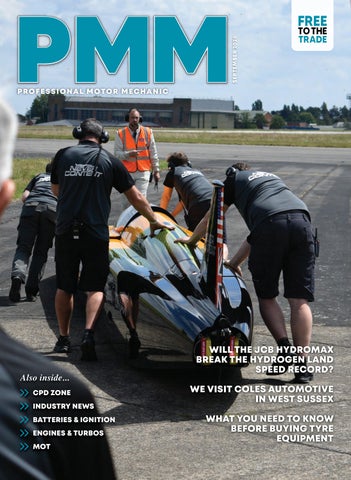
WILL THE JCB HYDROMAX BREAK THE HYDROGEN LAND SPEED RECORD? WE VISIT COLES AUTOMOTIVE IN WEST SUSSEX WHAT YOU NEED TO KNOW BEFORE BUYING TYRE EQUIPMENT
PMM grid_Layout 1 30/07/2026 10:55 Page 1
Contents
003_PMM_SEP26_Layout 1 04/08/2026 01:02 Page 3
Regulars 8-11
VOLUME 27 ISSUE 9
EDITOR’S PICKS
NEWS
Find out the latest going on in the industry.
13-21
SEPTEMBER 2026
CPD ZONE Scan the QR code on page 21 to claim your free CPD credit.
Welcome to the September issue of Professional Motor Mechanic! It’s been a long summer and I hope you got away somewhere... cold, in fact. That’s not something I thought I’d ever be writing! We’ve got a deep dive into hydrogen and whether it has potential for passenger vehicles on page 23. Following on from that, we visited Coles Automotive, a busy rural garage, and you can read about that on page 26. We’ve got an issue full of diagnostics troubleshooters this month, from the likes of Laser Tools, Febi, Alldata and Valeo. Lastly, turn to page 50 to read all about MOT compliance. Enjoy!
23-27 IN THE MIDDLE 28
BATTERIES & IGNITION
38
ENGINES & TURBOS
48
MOT
What does it take to run a large garage in the prosperous south? Well, turn to page 26 to find out!
IN THE WORKSHOP
FEATURES
Turn to page 61
Turn to page 28
23
28
30
54
PAG oils are
The diesel land speed record
Nearly a third of cars
Over 40 per cent of the
5.5m part-worn tyres
hygroscopic, meaning
setting JCB Dieselmax will get
that enter
car parc was over a
are sold in the UK
they absorb moisture
you from John O’Groats to
workshops have a
decade-old by the end of
each year.
from the surrounding air.
Land’s End in less than 2.5 hours.
battery in need of
December 2024.
.
recharging.
14
Total Average Net Distribution 57,460 July – December 2025
Image credits: Pg. 42 ©AdobeStock/Kunakorn Pg. 48 ©AdobeStock/AlexGo
PMM SEPTEMBER 2026 3
PMM grid_Layout 1 30/07/2026 11:26 Page 1
PMM grid_Layout 1 30/07/2026 11:27 Page 2
PMM grid_Layout 1 30/07/2026 10:30 Page 1
007_PMM_SEP26_Layout 1 04/08/2026 01:08 Page 5
VIEWPOINT
DON’T FORGET TO SMILE!
Editor KIERAN NEE Digital Manager KELLY NEWSTEAD Group Manager ALEX DILLEIGH Advertisement Manager MARCUS HOOPER Magazine Designer ADEEL QADRI Group Production Manager CAROL PADGETT Production Assistant CLAIRE SWENDELL Distribution Manager KARL CLARK
ast year I visited MOT Juice to speak to Dave Long to discuss what was then in its first trial stage: Photo evidence at the MOT. At the time, Dave essentially gave it a big thumbs up and explained how easy it was. Could it be, I wondered to myself, that all the naysayers on facebook forums were blowing this minor inconvenience out of all proportion? It seems so, and the DVSA agrees, because they have recently announced that it will be rolling out at national level very soon. So soon, in fact, that it will have been rolled out by the time you’re reading this. But what is it, exactly, and why has it been introduced? Essentially, MOT testers will need to take a photo on their phone of the car they’re testing, with its registration plate included, and upload it to the DVSA platform there and then. The image is not stored on your phone or tablet, rather it works a bit like the government passport website, which brings up the camera and uploads the image directly to the website. What you will need is an internet connection and a smartphone, which these days is a bit like saying you’ll need a spoon to eat soup. The reason this has been introduced is simple: Fraud. All you have to do is go online and search for MOTs and in no time at all you will come across adverts openly selling fraudulent MOTs. Pay a bit more for the test, but you don’t need to actually bring your vehicle in for it. In fact, I spoke to one garage recently who found their own branding being used to advertise fraudulent MOTs. So, the DVSA reckons, a photo proving that the car is physically there being tested would go a long way in fighting these ghost MOTs. So what was introduced at the beginning of August, and why have you not heard about it yet? Well, this first phase only involves 2,500 garages. So that’s just over 10 per cent of the total amount of MOT test stations. At this stage, what’s more, the feature remains optional. Of the selected 2,500 garages, all are encouraged by the Government to upload photos to each test, but they won’t be penalised for not doing so. Besides the usual debate around remuneration, it’s hard to see what argument there is against this new measure. In 2024, the DVSA uncovered 1,809 fraudulent MOTs, nearly double the previous year’s figure of 976. Considering just one tester was accountable for a whopping 223 of them, it’s fairly reasonable to assume that there are in fact many more that haven’t been uncovered. Hopefully, a few more will be caught red-handed. Or should that be, empty handed...
L
Subscriptions PROFESSIONAL MOTOR MECHANIC is a business magazine for firms and individuals involved in all aspects of the motor trade. It is published eleven times a year and is available nationally FREE to the trade through leading motor factors. It is also available through the post at a cost of £30. EUROPE and OVERSEAS UK £30 post paid Airmail £80 post paid Europe £50 post paid Printed by PCP Telford Published by HAMERVILLE MEDIA GROUP Regal House, Regal Way, Watford, Herts, WD24 4YF. Tel: Watford (01923) 237799 Fax: (01923) 246901 E-mail: pmm@hamerville.co.uk Sales enquiries: pmmsales@hamerville.co.uk Website: www.pmmonline.co.uk Copyright © 2026 The publishers and editor do not necessarily agree with the views expressed by contributors, nor do they accept responsibility for any errors of translation in the subject matter in this publication.
Associate member
Kieran Nee Editor
JOIN ME EACH MONTH ON THE PMM PODCAST Find every episode at www.pmmonline.co.uk/podcasts Also available:
008_PMM_SEP26_Layout 1 04/08/2026 01:16 Page 8
PMM NEWS NEWS IN
BRIEF MERSEY MERSEY ME The Motor Ombudsman has opened a new office in Liverpool, on Mann Island, next to the river Mersey. The new office will sit alongside the organisation’s London HQ, allowing it to attract and recruit staff from a new geographical area. The first five months of 2026 saw 23,499 cases raised with the ombudsman, a 22 per cent year-onyear rise. RAC MVP ANNOUNCED Congratulations to Ross Templeman, recently named RAC’s Patrol of the Year. The roadside mechanic, who has only been with the company for 14 months, was praised for going “above and beyond to get the best resolution for members”. As a reward, he gets to a brand-new Ford Transit with a P1 RAC registration plate.
8 SEPTEMBER 2026 PMM
in association with
MOT fee cap: “We’ve reached crisis point” As the industry starts to put pressure on the Government to finally act on the MOT fee cap, which hasn’t moved with inflation since 2010, PMM caught up with the top independent tester in the country to find out what the fee means to them. Based across four sites in and around South East London and Kent, The Test Centre boasts not only 80,000 plus tests per year, but also the busiest individual tester in the country. Speaking to PMM editor Kieran Nee, founder Ian Wills revealed that the industry is at “crisis point”, as he outlined an industry which encouraging bad behaviour due to a lack of Government intervention on the price MOT test stations are allowed to charge customers. At £54.85, the price for a standard MOT test has not changed since Gordon Brown was in power, 16 years ago. Had it been raised in line with inflation, today it would stand at around £85. Meanwhile the IAAF argues that due to the increase in specialised equipment needed now, the price should be closer to £95. According to Ian, the DVSA’s reasoning behind the lower cap is faulty: “The MOT is about the safety of the vehicle. It's not about winning extra work from it and charging a higher labour rate. The DVSA thinks it should be a loss leader… we don’t do repairs, only the MOT, so we provide an unbiased test. It’s a method that is becoming more popular in the UK, thanks to people like Martin Lewis recommending it. However if the DVSA don’t do something about the price cap, it won’t survive much longer.” Ian has written an open letter pleading with the IMI to take this matter up directly with the Government, and he reports a very enthusiastic response from the IMI’s CEO Nick Connor. Meanwhile, the IGA has been busy petitioning Government officials on the issue. The Independent Garage Association released a
statement recently, saying they have written to senior officials at the Department for Transport as well as the Treasury to make the case for the urgent need to increase the current MOT fee. This is following the Department for Transport communicating with the IGA their expectation to consult with stakeholders on this matter towards the latter part of 2025. The IGA is arguing that since 2010, independent garages have incurred and continue to incur cost pressures over and above inflation relating to labour, rent, equipment, fuel, energy, compliance and administrative costs. Whilst the DVSA has announced increases to MOT fees for busses, coaches, HGVs and trailers – the fees for class 4, 5 and 7 vehicles have not been included as part of these announcements. Stuart James, CEO of the Independent Garage Association, comments that, “Our members are advising us that the current situation, relating to the stagnant MOT fee cap, is leading to garages setting up their facilities to prioritise more profitable work, reducing the number of bays available for MOT testing and therefore reducing the national capacity. “We need to ensure that independent garages are able to prioritise the availability of workshop facilities and resources for this vital service. If the MOT does not remain economically viable for garages, this would have a significant impact on consumer choice with regards to accessibility, locality and convenience of available MOT test stations.” For more information
WWW.RDR.LINK/ACH001
008_PMM_SEP26_Layout 1 04/08/2026 01:16 Page 9
FOR UP-TO-DATE NEWS, SIGN UP FOR OUR WEEKLY E-NEWSLETTER. SIMPLY SCAN THE QR CODE
IMI: Gov plan for EV mileage tax test at MOT “flawed” As the Government plans how best to tax electric vehicles going forward, the IMI is arguing that they can’t rely on all MOT test stations having the ability to investigate mileage anomalies. In a news release from the Institute of the Motor Industry (IMI), the organisation aims to “highlight flaw in government plan” to monitor EVs’ mileage at the point of MOT, while acknowledging that much of its own advice appears to have been listened to by ministers. The IMI welcomed the government’s response to its Consultation on the introduction of electric Vehicle Excise Duty (eVED). However, the IMI is warning that a critical delivery risk remains unresolved: the assumption that every MOT garage will be equipped to deal with EV mileage anomalies. The IMI’s Consultation submission supported the principle of a mileage-linked model, but stressed that implementation must reflect real-world workshop capability, EV technical complexity, odometer discrepancies, diagnostic access issues and workforce capacity constraints. Nick Connor, CEO of the IMI, said: “The Consultation outcome shows the government has genuinely listened to the automotive profession. Ruling out mandatory telematics, building eVED into the existing VED and DVLA systems, anchoring mileage validation in the MOT, and committing to simple reconciliation and sensible
arrangements for fleets and lifecycle events are all things the IMI called for. That is a pragmatic foundation, and we welcome it. “However, there is one big question the response does not yet answer: can eVED be delivered safely and consistently if the system assumes every MOT garage can deal with EV mileage anomalies? The risks around odometer tampering, mileage data being held in more than one place in a vehicle, and the central role MOT garages will play in recording mileage have been recognised in the Consultation response, yet there is no clear plan of how those risks will be managed on the workshop floor. “Diagnostic capability varies significantly across the MOT network. Reading a dashboard odometer is one thing; investigating a disputed, missing or potentially tampered mileage reading on an electric vehicle is quite another. “We are, therefore, urging government to adopt a number of practices we proposed in our submission to the Consultation. There need to be clear diagnostic escalation routes, competence-based accreditation and standards aligned with IMI TechSafe. There also needs to be a clear commitment to support for garages on equipment and training. Without these, disputes will fall inconsistently on garages, motorists and the DVLA, and public confidence in the new tax will suffer.” For more information
NEWS IN
NUMBERS
15,000 The number of vacancies in the motor trade according to the IMI. Regular readers might notice this is a full 1,000 higher than last month’s figure.
14.9% Of all new cars sold in the UK are now of Chinese origin, the highest in Europe according to IAAF and GiPA.
10:29.483 The speed at which an autonomous EV, the Xiaomi YU7 GT, recently completed the 20.8km Nurburgring’s Nordschleife circuit. The record for a street legal car is 6:29.090.
4,140 The amount of times “female mechanic” was googled in the UK last year. Searches in general for female tradespeople have increased by 36 per cent in the past year, according to MoneySuperMarket.
WWW.RDR.LINK/ACH002
PMM SEPTEMBER 2026 9
008_PMM_SEP26_Layout 1 04/08/2026 01:17 Page 10
PMM NEWS “The introduction of a payper-mile charge for electric vehicles from 2028 is a tactical mistake that risks slowing the UK's transition to cleaner transport. EVs are becoming more affordable and are critical to reducing our reliance on imported fossil fuels and cutting emissions. Introducing a new tax at this pivotal moment sends entirely the wrong signal to motorists and risks undermining the momentum behind EV adoption.”
Matt Galvin, managing director at Polestar on the news that the Government will be introducing pay-per-mile taxation on EVs.
“Converting a historic or classic vehicle to electric motive power is a significant engineering undertaking that should only be carried out by competent professionals. Our new Minimum Professional Standards, developed by industry experts and made available to UK regulatory agencies, establish a benchmark for safety and quality, helping owners make informed choices while supporting businesses committed to the highest professional standards.”
Dale Keller, CEO of the Historic & Classic Vehicles Alliance, on the establishment of a framework for converting classics to battery power.
10 SEPTEMBER 2026 PMM
in association with
Laser Tools transitions to employee ownership Laser Tools and its umbrella company The Tool Connection has continued its founder Martin Smith’s employee-first ethos by becoming an MTS Employee Ownership Trust, meaning ownership remains focused on the long-term success of the business and the people who help drive it forward every day. Founded by Smith in 1976, Laser Tools has grown from humble beginnings selling kindling at local markets into one of the UK's leading suppliers of professional automotive tools, employing more than 158 people across its UK locations.
The move to employee ownership fulfils a vision held by Martin Smith for many years, as MD Eddie Altham explained: "Martin always believed that the people who helped build the company should share in its future. Employee ownership protects the independence of the business, preserves the culture that has made us successful and ensures our employees remain at the heart of everything we do.” For more information
Greetings from the race track!
WWW.RDR.LINK/ACH003
PMM has recently started sponsoring a young go-kart driver by the name of Hanley Yates. Each month we’ll be keeping you updated with the postcards he sends us with his progress. Here’s the first!
Dear PMM, I’m delighted to share some fantastic news… I took my first win of the MK Karting Championship in Round 5! As you can probably tell from the photo, I’m absolutely over the moon. It was a fantastic weekend from start to finish. The day before the championship, I spent valuable time testing at Whilton Mill, which gave me plenty of confidence and some really useful track time heading into race day. That momentum carried into Round 5, where everything just clicked. I topped the practice sessions, secured pole position in qualifying, and then converted that pace into my first championship victory. Standing on the top step of the podium for the first time was an incredible feeling and a real milestone in my karting journey. This result now puts me just two points behind the championship leader, with six rounds still to go, so everything is still to play for in the second half of the season. Best regards, Hanley
008_PMM_SEP26_Layout 1 04/08/2026 14:45 Page 11
FOR UP-TO-DATE NEWS, SIGN UP FOR OUR WEEKLY E-NEWSLETTER. SIMPLY SCAN THE QR CODE
Are you binning loyalty points without scanning them?
Next time you throw a box in the recycling, think, “am I throwing away something of value?” That’s what Valeo is urging UK garages to start doing, arguing that they are throwing away thousands of pounds of overlooked loyalty points.
The company’s Specialist Club programme allows technicians to scan product barcodes to earn points instantly. However, the company believes that simple step of scanning before binning is being overlooked.
Many manufacturers offer a wide variety of loyalty points, so always remember to check the packaging and scan the code before you recycle the box.
Recruiting from abroad might be common in some sectors, but it’s still a relatively new practice for UK independent workshops. One garage in Sheffield, however, has had such positive results from their first hire, they’re now planning a second. The Garage Sheffield, an 11-ramp mega garage, recently turned to specialist recruitment firm Easy2Recruit, after recruitment pressures had begun limiting capacity and restricting growth in the workshop. Senior multi-brand technician, Tapiwa Chimbwanda joined the team in March, having specialised in Volkswagens in South Africa. Owner Ryan Tandy said the appointment has delivered more than additional capability, with the biggest impact coming from a shift in attitude across the workshop that is now feeding directly into productivity and growth. He said: “Tapiwa’s work ethic has been a game-changer. Every job is approached in the same way – 100 percent effort, no complaints, he just gets on with it. “It’s changed the whole mindset in the workshop. Previously, like many independents, we felt under pressure to tolerate certain behaviours because of how difficult it is to replace skilled technicians. Tapiwa’s attitude has helped to set a new standard.” The recruitment process was completed quickly after The Garage Sheffield opted to fast-track its sponsor licence. Easy2Recruit
supplied CVs and candidate videos before Ryan shortlisted candidates and carried out interviews remotely. He interviewed Chimbwanda on a Thursday, with the technician arriving in the workshop the following Tuesday. The Garage Sheffield is already in the process of recruiting a second technician through Easy2Recruit, with Tandy now using
the route to support expansion into an adjoining unit. He said the plan is to grow from 11 to up to 14 ramps within the next 12 months, alongside the continued development of a dedicated ADAS centre.
For more information
WWW.RDR.LINK/ACH004
Sheffield mega garage’s foreign hire “a game-changer”
For more information
WWW.RDR.LINK/ACH047
PMM SEPTEMBER 2026 11
PMM grid_Layout 1 30/07/2026 10:30 Page 1
013_PMM_SEP26_Layout 1 04/08/2026 01:24 Page 13
READ ME TO COLLECT YOUR CPD POINT
CPD ZONE
BEST PRACTICE Citroën timing chain update ALLDATA is highlighting the importance of reading technical service bulletins – as one recent example from Citroën illustrates. ometimes crucial information is to be found in technical service bulletins and that is definitely the case with certain Citroën models equipped with Euro 6.3 compliant DV engines. For these vehicles, a Stellantis TSB contains vital information that can be easily overlooked – applicable to fault codes P0017, P050B, P02ED and P00BC. Some of the issues being reported to ALLDATA’s Info Centre include failure to start, rough engine operation and abnormal noises from the camshaft timing chain area. Diagnostic Trouble Codes are being stored, indicating possible timing chain elongation or incorrect valve timing. In many cases, additional combustion or backpressure noises can also be heard in the intake system. The root cause is often a broken or dislodged timing chain, which might happen during engine start or while driving. This can lead to substantial damage in the valve train.
S
“Instead of the original design, an upgraded 8mm timing chain is specified.”
Upgraded timing chain Stellantis has responded to this issue by releasing a TSB that describes a technical modification as part of a service measure. Instead of the original design, an upgraded 8mm timing chain is specified. However, this information is not clearly documented in standard repair manuals or parts catalogues. Without being aware of the TSB, there is a risk that an unsuitable 7mm timing chain will be used again.
How to proceed While the original repair may have been performed correctly, because of the updated documents, a real risk remains. If a repeat failure is brought into the workshop later, not only do time and costs increase, but so does legal liability. The Stellantis TSB describes how to identify the current chain type and how to perform an inspection and up-to-date repair – up to and including replacement of the
internal combustion engine, depending on the condition of the chambers. Current TSBs can guide even the most experienced technicians, helping them to avoid costly repairs, reduce the risk of comebacks and consequential damage, and ensure compliant repairs. ALLDATA provides the latest, unedited technical information – directly from the manufacturer. This includes TSBs, recalls, and technical updates that are not always clearly identified in standard documentation. The platform provides data from 44 VMs and more than 167,000 unique combinations of make, model, year and powertrain – representing 97 per cent of the European car parc.
FOR A FREE TRIAL FROM ALLDATA go to www.rdr.link/ach005 or scan the QR code
PMM SEPTEMBER 2026 13
014_PMM_SEP26_Layout 1 04/08/2026 01:26 Page 14
CPD ZONE
READ ME TO COLLECT YOUR CPD POINT
BEST PRACTICE Choosing the right oil for modern A/C systems Mahle guides PMM readers through the various oils available for A/C compressors. ubricants are fundamental to the reliability and efficiency of modern vehicle systems, yet they are often overlooked during service and repair. Nowhere is this more evident than in air conditioning systems, where compressor oil plays a critical role in protecting components, maintaining performance and ensuring long-term durability. Just like engine oil, air conditioning compressor oil lubricates moving parts, reduces friction and heat, and helps seal internal components. If the wrong oil is used, or if poor-quality lubricants are introduced, the result can be increased wear, reduced system performance and ultimately premature compressor failure. With multiple refrigerants and compressor designs now on the market, selecting the correct lubricant has become increasingly important for workshops.
L
Understanding the role of compressor oil In an A/C system, the compressor oil circulates with the refrigerant throughout the system, lubricating internal components and helping maintain an effective seal between moving parts. This continuous movement means the oil must remain stable under varying pressures and temperatures while maintaining the correct viscosity. High-quality oils also help reduce energy consumption by minimising internal friction and lowering operating temperatures within the compressor. When the wrong oil is used, however, it can lead to accelerated wear, corrosion,
14 SEPTEMBER 2026 PMM
leaks or even system contamination. Understanding the different oil types available is therefore essential.
PAG oils – the industry standard Polyalkylene glycol (PAG) oils are among the most widely used lubricants in modern automotive air conditioning systems. These fully synthetic oils are commonly specified by vehicle manufacturers for systems operating with the R134a refrigerant and are available in several viscosity grades, typically PAG 46, PAG 100 and PAG 150.
Their main advantage is excellent miscibility with refrigerant, allowing them to circulate efficiently through the system and lubricate the compressor effectively. Because of this compatibility, PAG oils remain the default choice for many passenger cars and commercial vehicles. However, PAG oils are hygroscopic, meaning they absorb moisture from the surrounding air. If moisture levels rise within the system, acids can form which may lead to corrosion and component damage. For this reason, PAG oils must be stored and handled carefully, and containers should always be resealed immediately after use.
014_PMM_SEP26_Layout 1 04/08/2026 01:26 Page 15
For newer R1234yf systems, Mahle provides advanced double end-capped PAG oils, offering greater chemical stability and preventing oil degradation when interacting with the refrigerant while remaining compatible with R134a systems.
PAO oils offering an alternative? Polyalphaolefin (PAO) oils offer an alternative approach to compressor lubrication. Unlike PAG (and POE) oils, PAO oils are non-hygroscopic, meaning they do not absorb moisture from the surrounding environment. This simplifies storage and handling in workshop environments. Another benefit is their ability to retain viscosity even when mixed with refrigerant. Because refrigerant solubility in PAO oils is relatively low, the lubricant remains stable within the compressor and continues to provide effective protection against friction and wear. PAO oils can often replace several PAG viscosity grades, allowing workshops and factors to reduce the number of oil types they need to stock. They also help improve sealing within the compressor, reduce operating temperatures and contribute to lower energy consumption and noise levels during operation.
Lubricants for hybrid and electric vehicles As vehicle electrification continues to accelerate, lubricant requirements are also evolving. Hybrid and electric vehicles frequently use electrically driven air conditioning compressors that contain high-voltage electric motors. In these applications, conventional compressor oils may not be suitable. Instead, polyol ester (POE) oils are typically required. These synthetic oils provide excellent electrical insulation while maintaining effective lubrication.
“Because compressor oil may come into direct contact with electric motor windings, it must maintain high dielectric strength to prevent electrical short circuits.” Because compressor oil may come into direct contact with electric motor windings, it must maintain high dielectric strength to prevent electrical short circuits. Cross-contamination is therefore a major risk. Even a small amount of standard PAG oil entering an EV system can destroy the oil’s insulating properties and potentially trigger a high-voltage system shutdown.
Workshop essentials Selecting the correct oil type is only part of the equation. The correct oil quantity is equally critical to system performance and compressor longevity. Technicians can quickly identify the correct PAG oil type and filling quantity using Mahle’s filling quantity tool, ensuring the A/C system is serviced according to manufacturer specifications. Using the right service equipment also plays an important role in ensuring accuracy. The ArcticPRO air conditioning service machines are designed to help workshops perform precise and repeatable A/C servicing while ensuring PAG oils are applied correctly. The machines carry out a fully automatic process including refrigerant recovery, vacuum and refill, helping reduce the risk of manual error. A patented coupling system with zero gas loss prevents refrigerant escaping during servicing, helping workshops save money on refrigerant while reducing environmental impact. Mahle air conditioning service units also feature timed automatic oil injection
with an integrated cleaning function, allowing the correct quantity of oil to be introduced into the compressor without manual intervention. In addition, the system incorporates an oil care system using hermetically sealed bottles, which protects fresh oil and UV tracer from moisture contamination and helps preserve lubricant quality. Together, these features ensure the correct refrigerant and oil quantities are applied consistently, supporting reliable compressor operation and long-term system performance.
Lasting repairs For workshops, choosing the correct lubricant is not simply a technical detail, it can determine whether a repair lasts or results in repeat failures. Best practice also dictates that when replacing a failed compressor or switching oil types, the entire A/C system should be thoroughly flushed to remove contaminated oil and debris. Different compressor designs, refrigerants and vehicle architectures all require specific lubricant formulations. Motor factors therefore play an increasingly important role in helping technicians select the correct product and ensure reliable A/C system performance. Mahle’s portfolio of compressor oils reflects this growing complexity, covering PAG, PAO and POE formulations for conventional vehicles, hybrid and electric platforms and a wide range of refrigerants. As air conditioning systems continue to evolve alongside vehicle technology, the role of lubricants will only become more critical. Understanding the differences between oil types, and using the correct tools to apply them accurately, remains essential to keeping modern A/C systems operating efficiently and reliably.
FOR FREE TRAINING FROM MAHLE go to www.rdr.link/ach006 or scan the QR code
PMM SEPTEMBER 2026 15
016_PMM_SEP26_Layout 1 04/08/2026 01:28 Page 16
READ ME TO COLLECT YOUR CPD POINT
CPD ZONE
BEST PRACTICE What can your customer’s tyres tell you about their car? Julia Blake, marketing director at Supertracker, is encouraging technicians to spot the diagnostic clues hidden in plain sight on tyres. ike a black box recording a flight’s every twist and turn, a car’s tyres also act as a record – and not only of twists and turns. Reading that record and acting accordingly is an essential skill for every technician. Long before a warning light appears on a customer’s dashboard, the evidence of a vehicle’s underlying problem is often already available to see and feel in the tyre’s tread. At Supertracker, we spend a lot of time working with workshops that are diagnosing alignment and suspension issues and one thing we can say is that the tyre isn't usually the problem: It's the clue.
L
Don't just look: Feel An often-overlooked aspect of tyre inspection is that some wear patterns are easier to feel than they are to see. Inner-edge wear is regularly missed because it sits underneath the vehicle and isn't visible during a quick walk-around inspection. Feathering often becomes obvious to the hand before it becomes obvious to the eye. That's why one of the simplest habits technicians can adopt is to physically run their hand across the tread. A feathered tyre will feel smooth in one direction and sharp in the other. Cupping will feel like a series of dips and high spots around the tyre.
Not every wear pattern points to alignment Not every unevenly worn tyre needs an alignment check. Both shoulders worn with a healthy centre tread often point to under-inflation. A worn
centre section typically suggests over-inflation. Neither issue is something wheel alignment equipment can correct. The first question should always be whether tyre pressures are correct. Pressure faults are incredibly common and can often mimic alignment-related wear. Ruling out the simple causes first saves time and helps workshops reach the correct diagnosis more quickly.
When alignment isn't the root cause Of all tyre wear patterns, cupping is one of the most commonly misdiagnosed. The distinctive series of dips and high spots around the tread is frequently blamed on alignment when the underlying cause is often worn dampers, ride-control components, imbalance or excessive wheel movement – an alignment adjustment alone is unlikely to resolve the problem. Recognising the difference is important because it prevents workshops from recommending corrective work that will not address the root cause.
Sometimes the fault starts at the rear Another diagnostic trap occurs when technicians see different wear patterns across the front axle. One front tyre may be wearing heavily on the inside edge while the opposite tyre wears on the outside. At first glance, it appears to be a front-end issue but in reality, the cause may sit at the rear of the vehicle.
“Of all tyre wear patterns, cupping is one of the most commonly misdiagnosed.” A rear thrust angle outside specification can effectively steer the vehicle from behind, creating uneven loading across the steer axle. Identifying this requires a full four-wheel measurement rather than a front-only check.
Turning clues into confidence Tyre wear should never be treated as a replacement conversation alone. It should be the beginning of a diagnostic process. At Supertracker, we encourage workshops to follow a simple approach: Check tyre pressures; inspect steering and suspension components; measure alignment accurately; and confirm the repair with before-and-after data. The wear pattern narrows the field and the measurement confirms the diagnosis. The best workshops don't guess. They use the clues the vehicle is giving them and back them up with accurate measurements. That's what builds trust with customers and that's what prevents unnecessary comebacks. Every tyre tells a story. The question is whether we're taking the time to read it.
FOR MORE INFORMATION ON SUPERTRACKER go to www.rdr.link/ach007 or scan the QR code
16 SEPTEMBER 2026 PMM
PMM grid_Layout 1 30/07/2026 10:31 Page 1
018_PMM_SEP26_Layout 1 04/08/2026 13:55 Page 18
CPD ZONE
READ ME TO COLLECT YOUR CPD POINT
BEST PRACTICE Diagnosing Chinese vehicles The growing presence of new Chinese brands in the UK is creating fresh demands for the aftermarket, requiring tools capable of supporting conventional vehicles, electrified platforms and increasingly complex repair processes. Could Xtool provide the answer? he arrival of a growing number of Chinese vehicles on the UK market is expanding the range of cars that independent garages will be expected to service. Brands such as BYD, MG, Geely, Leapmotor and XPeng are introducing conventional, hybrid and electric models featuring their own electronic architectures, communication protocols and control systems. This development will require independent garages to progressively broaden their diagnostic capabilities. Addressing it will take more than a tool that can simply read and clear generic OBD fault codes.
T
Comprehensive passenger vehicle diagnostics Even on conventionally powered passenger vehicles, increasing electronic complexity requires access to all the vehicle’s systems. Technicians need to be able to read manufacturer-specific fault codes and data, perform full-system scans, carry out bidirectional tests and complete service functions such as resets, adaptations, calibrations and DPF regeneration. Depending on the application, module configuration, coding or programming may also be required. These requirements are compounded by communication protocols such as CAN FD, DoIP, Ethernet and UDS, as well as security gateways and authentication systems that can restrict access to advanced functions. It is also important to verify that diagnostic equipment supports the vehicle versions sold in the UK and Europe, as these may differ from models intended for the Chinese domestic market in terms of hardware, software and configuration.
“The growth of Chinese vehicles therefore represents more than an additional layer of complexity. It requires independent garages to prepare themselves with the right equipment, technical information and specialist skills.” Advanced diagnostics for electrified vehicles On electric and hybrid vehicles, diagnostics must extend to the traction battery and the entire high voltage system A professional diagnostic tool may need to analyse individual cell voltages, internal resistance, battery state of health and insulation status. It should also allow technicians to test components such as electric compressors, onboard chargers and DC/DC converters. The ability to test batteries and components after they have been removed from the vehicle can help technicians locate faults without repeatedly reinstalling them, reducing the number of operations carried out on the high-voltage system.
Greater workshop efficiency Diagnostic depth also has a direct impact on workshop efficiency. A full-system scan allows multiple control units to be checked in a single procedure, helping technicians identify related faults and compare the condition of the vehicle before and after a repair. Off-vehicle testing can reduce repeated dismantling, refitting and verification, while diagnostic reports and
battery health assessments provide a documented record of the work carried out. Continuous software updates, technical information, training and support therefore become integral parts of the diagnostic solution, helping technicians reduce fault-finding time and minimise the risk of repeat repairs. Xtool addresses these requirements through two complementary platforms: Prodigy, designed for comprehensive vehicle diagnostics, active tests and advanced passenger-car functions, and E2 Pro, developed for battery and electrified-system diagnostics. “Xtool has focused on automotive diagnostics for more than ten years. We did not simply observe the growth of electric vehicles: we anticipated it and prepared for it by investing in research, development and technical expertise,” says Luo Mengjin, head of sales, Xtool. The growth of Chinese vehicles therefore represents more than an additional layer of complexity. It requires independent garages to prepare themselves with the right equipment, technical information and specialist skills.
FOR MORE INFORMATION ON XTOOL go to www.rdr.link/ach008 or scan the QR code
18 SEPTEMBER 2026 PMM
PMM grid_Layout 1 30/07/2026 10:31 Page 1
020_PMM_SEP26_Layout 1 04/08/2026 13:37 Page 20
CPD ZONE
READ ME TO COLLECT YOUR CPD POINT
BEST PRACTICE A/C system maintenance All workshops have at one point or another been told by a customer, “my air con isn’t blowing cold enough”. Well, that’s a problem this month’s cover star Auto Air Gloucester is seeking to help garages solve. t’s a phrase almost every automotive technician hears on a regular basis: “My air con isn’t blowing cold enough.” While it may sound like a simple complaint, diagnosing the root cause of poor air conditioning performance can be surprisingly complex. Modern vehicle A/C systems rely on a network of components that must all work together in harmony. When even one part begins to fail, the result can be warm air, intermittent cooling, or a system that doesn’t operate at all. Here, let’s take a detailed look at the most common causes of weak A/C performance, along with best practice guidance for servicing and maintaining vehicle air conditioning systems.
I
Low refrigerant levels One of the most frequent causes of poor cooling is low refrigerant. Even a small loss, sometimes as little as 10-15 per cent, can significantly reduce the temperature coming through the vents. Refrigerant doesn’t get “used up,” so if levels are low, there is always a leak somewhere in the system. Signs of low refrigerant: • The compressor clutch rapidly cycles on and off • Reduced cooling, especially at idle • Bubbles visible in the sight glass (if fitted) Technicians often look for oil stains on the
20 SEPTEMBER 2026 PMM
condenser, compressor body, hoses, or fittings. These stains can indicate where refrigerant and oil have escaped. However, leaks can be extremely small and difficult to locate, even for experienced professionals. Always remember to inspect the service ports, as Schrader valves, caps, and O‑rings are common leak points.
Cooling fans and problems Even with the correct refrigerant charge, the A/C system cannot function properly without adequate airflow across the condenser. When airflow is restricted, refrigerant pressures rise, temperatures increase, and cooling performance drops. Common airflow issues: • Cooling fans not operating when the A/C is switched on • Leaves, dirt, or debris blocking the condenser • Bent or damaged cooling fins • Blocked cabin air filter restricting airflow inside the vehicle A quick visual inspection can often reveal external blockages. Ensuring the cooling fans activate when the A/C is running is essential, if they don’t, the system will struggle to remove heat.
Compressor and clutch problems The compressor is the heart of the A/C system, and if it isn’t functioning correctly, cooling will be compromised. With the engine running, blower on maximum, and A/C set to the coldest setting, the compressor clutch should engage. You may hear a click or notice a slight change in engine tone when it does. If the clutch does not engage, possible causes include: • Extremely low refrigerant • Failed clutch assembly • Electrical issues such as blown fuses, faulty relays, or damaged wiring • Faulty pressure or temperature sensors preventing activation A non-engaging clutch is often a symptom rather than the root cause, so proper diagnosis is essential.
The importance of the accumulator/receiver drier Many people underestimate the role of the accumulator or receiver drier. These
020_PMM_SEP26_Layout 1 04/08/2026 13:37 Page 21
components contain desiccant bags designed to absorb moisture within the A/C system. Moisture is the enemy of air‑conditioning systems: It reacts with refrigerant to form corrosive acids and sludge. What happens when the desiccant becomes oversaturated? • Desiccant material can break down and spread through the system • Blockages form in the expansion valve, orifice tube, or condenser • Compressor damage becomes likely • Overall system performance drops dramatically Despite being relatively inexpensive, driers are often overlooked during repairs. In reality, they should be replaced every time the system is opened or whenever a new compressor is installed.
Contaminated refrigerant and the need for flushing Contaminated refrigerant, often caused by internal corrosion or previous poor quality repairs, can cause major damage. Metal particles, sludge, and degraded oil can circulate through the system, blocking components and eventually destroying the compressor. This is why flushing the system is essential whenever: • A major component has failed • The system has been open to the atmosphere • Contamination is suspected Skipping this step risks immediate failure of new components.
Electrical and sensor‑related issues Modern A/C systems rely heavily on electronics. A single faulty sensor can prevent the system from operating correctly. Potential electrical causes of poor cooling: • Blown fuses • Faulty pressure switches • Temperature sensors sending incorrect readings
• Loose, corroded, or damaged wiring • Engine control module (ECM) intervention The ECM can disable the A/C under certain conditions, such as engine overheating or low voltage. Always ensure electrical connections are clean, tight, and secure.
The overlooked cabin air filter One of the simplest, yet most overlooked, causes of weak cooling is a dirty cabin air filter. When the filter becomes clogged, airflow through the evaporator is restricted, reducing cooling output dramatically. Replacing the cabin filter is quick, inexpensive, and should be part of routine maintenance.
Best practice advice Encouraging drivers to run the A/C for around 10 minutes each week, even during winter, helps keep the system lubricated. This circulates refrigerant oil, conditions O‑rings and seals, and reduces the likelihood of leaks developing during long periods of inactivity. Working on vehicle A/C systems requires skill, knowledge, and the correct equipment. To ensure safe, reliable, and long‑lasting repairs, technicians should always follow industry best practices. 1. Only qualified technicians should service A/C systems A/C systems operate under high pressure and require specialist tools. A trained technician can correctly diagnose faults, handle refrigerant safely, and ensure the system is restored to full working order.
Cheap parts often lead to repeat failures. Using reputable brands ensures reliability, performance, and customer satisfaction. Fit once, fit right. 3. Prepare the system properly before installing new parts This includes: • Flushing the system • Replacing the drier/accumulator • Installing a new expansion valve or orifice tube • Ensuring all lines and components are clean and free from debris These parts act as filters and are essential for protecting the compressor and maintaining correct system operation. 4. Follow manufacturer instructions Always use the correct type and quantity of oil, torque settings, and installation procedures. Incorrect oil levels are a leading cause of compressor failure. It’s important to use reliable parts you can trust. Coolzone quality components are available from reputable motor factors across the UK. Choosing high‑quality parts gives technicians confidence in the repairs they carry out and ensures customers receive the cooling performance they expect.
2. Use high‑quality components
FOR MORE INFORMATION ON AUTO AIR GLOUCESTER go to www.rdr.link/ach045 or scan the QR code
REDEEM YOUR CPD CREDIT Congratulations, you have reached the end of the CPD Zone! To access your CPD credit from The CPD Group, scan the QR Code
PMM SEPTEMBER 2026 21
PMM grid_Layout 1 30/07/2026 10:31 Page 1
023_PMM_SEP26_Layout 1 04/08/2026 01:32 Page 23
Driver Andy Green debriefing journalists on the outcome of the day’s testing. The vehicle reached 178 mph, close to the speed ceiling at RAF Wittering.
Alternative fuels debate. Could hydrogen really be the future? PMM editor Kieran Nee was invited recently to observe testing of JCB’s Hydromax vehicle – designed to break the land speed record for alternative fuels – and it got him thinking, could hydrogen technology jump across from industry to passenger transport?
I
t’s not something which features often in the pages of PMM, but if JCB’s recent forays into the technology are anything to by, the thing that Elon Musk called “the most dumb thing I could possibly imagine for energy storage,” might well be appearing more frequently. I am talking, of course, about hydrogen. Before delving into the technology itself and the pros and cons of using it to power passenger cars, let’s address the elephant in the room: What the hell is JCB doing in Professional Motor Mechanic magazine? Well, to answer that, it must be explained that besides its output in backhoe loaders and its leader Anthony Bamford’s outspoken comments on Brexit, JCB is also a big player in engines for offhighway equipment. To demonstrate the efficacy of its diesel engine, in 2006 the firm built a highspeed aerodynamic car powered by two JCB diesel engines, providing 750 bhp each and each accompanied by a turbocharger. With Andy Green at the helm – the driver who held and still holds
the overall land speed record – Dieselmax broke the diesel-powered land speed record at the Bonneville Salt Flats in Utah, reaching 350 mph. This is some way off the 763 mph Andy reached with the sound-barrier breaking, jetpowered Thrust SSC car in 1997, but still fast enough to get you from Land’s End to John O’Groats in less than 2.5 hours, or from Harrogate to York in 3 minutes 40 seconds.
Replicating the magic Displaying an uncanny nous for capturing the moment, upon noticing that the 20year anniversary was fast approaching, Mr Bamford declared that he wanted to repeat and even surpass the previous record. Only this time, they would use their latest engine – the Hydomax – and prove once and for all that hydrogen is a feasible alternative to traditional fuel. And what’s more, Andy Green, the man, the legend, would be back to do it. So that’s what JCB have got to do with it all. But what about hydrogen itself? For a long time now, advancements in
PMM SEPTEMBER 2026 23
023_PMM_SEP26_Layout 1 04/08/2026 01:32 Page 24
vehicle production have centred around reducing local emissions. Petrol and diesel engines have incorporated a number of new technologies to drive efficiencies and reduce tailpipe emissions – with great success, it must be said, even if some of the improvements have resulted in much disgruntlement from drivers and garages alike (we’re looking at you, belt-in-oil).
Zero emissions But that wasn’t ambitious enough according to Governments and policymakers around the world. Why limit ourselves to reducing local emissions when the technology exists to eliminate them completely? Step forward the previously mentioned Mr Musk, who, politics and personality aside, has done more to shake up the automotive industry than anyone else in the past 30 years. His solution, which was a pipe dream 20 years ago, was the battery-powered electric vehicle. For years, Tesla held the top spot for sales in EVs. Still today Tesla is a by-word for EVs (and, confusingly, autonomous cars). As the quote from Musk above indicates, his view is that electric is the only way forward in the fight against emissions. That is a view largely shared by politicians who had mandated that the sale of combustion engines specifically is to be proscribed from 2030 on in the UK,
24 SEPTEMBER 2026 PMM
and severely curtailed from 2035 in the EU. This will put the UK at the forefront of the global fight against carbon emissions. But is it the only way, or even the smartest way to achieve that goal? Many commentators in the industry, including the recently retired technical director of the IAAF, Neil Pattemore, have argued that the UK should be less proscriptive in its decrees. The argument is that instead of banning combustion engines, the Government should require zero emissions vehicles. How vehicle manufacturers get to that point is up to them. I’m not going to get into the endless morass of pro and anti EV arguments. This is not an article about electric vehicles and batteries, but rather about hydrogen and whether there is any potential future in using it to power passenger vehicles.
Path to hydrogen Many of you reading this might assume that JCB is hardly coming from a neutral standpoint on the issue. After all, combustion engines are their bread and butter and, given the general political outline that the EV vs. ICE debate has taken, the overtly right-wing Anthony Bamford was never going to be an EV fan. Well, the truth is that JCB introduced the first electric powered mini-diggers to the market (and have kept selling them)
and their road to hydrogen developed out of the limitations of electricity. Engineering director at JCB, Ryan Ballard, told the assembled journalists at RAF Wittering (where the Hydromax testing was taking place), how the firm came to hydrogen in the first place. JCB owns four quarries and were looking to electrify all the machines on one of them, necessitating a connection to the grid. Being a quarry, it was far away from the closest grid connection and was going to cost £13 million to lay the power lines over the 13km distance. Driving back and forth to the power station with a huge battery pack was also unfeasible and way too costly. That’s when they started thinking seriously about hydrogen. “We need a mobile fuel for remote areas, we need fast refueling for maximum uptime,” Ryan explained. Bio-fuels were considered first. “The lorries that say they’re powered by chip fat? That’s Biodiesel, B100, they’re using,” the engineering director told us. “The problem is that it’s not all coming from the local chippy, but rather from forests being cut down for palm oil.” Relying on the power of the natural world – wind, solar etc – was also impractical. How do you transport around a solar farm from construction site to construction site? How do you store so much energy over time?
023_PMM_SEP26_Layout 1 04/08/2026 01:33 Page 25
So, onto hydrogen. Hydrogen comes in two technological guises: Fuel cell technology and combustion. Fuel cell technology is similar to an EV. In place of a battery, fuel cells are used which convert hydrogen and oxygen into electricity, heat and water vapour. The problem JCB faced, is that these fuel
been working on this, the engines have been used, maintained and serviced all over the world, with user experience matching diesel completely.” JCB has a hydrogen-powered excavator in production, available to buy today. The International Energy Agency has said that hydrogen is “one of the
power every car in the country? That’s quite another. And I’m sure there are lots of issues with hydrogen which people far smarter than me are aware of – nothing is ever quite so simple as it seems. But I think the point is not that it is the one solution to the carbon crisis, but that it might be worth exploring alongside EV
cells aren’t well suited to sudden shifts in power demand – such as an excavator breaking ground for instance.
leading options for storing energy from renewables and looks promising to be a lowest-cost option for storing electricity over days, weeks or even months.” Storing hydrogen is cited as one major pitfall. Musk claimed “gigantic tanks” would be required to hold it in liquid form and “even bigger” in gas form. The compressed gas tanks the JCB digger uses fit neatly above the cab. Some estimates say the digger can go a week before being refilled. None of this addresses the production of hydrogen, which after all might be the real issue. Producing enough for a few hundred diggers is one thing, but to
technology. EVs have come on in leaps and bounds in recent years but still present huge barriers to usage for lots of people. Whilst hydrogen might not be feasible as things currently stand, are we really saying that the situation can’t change? Scientists and engineers have achieved more miraculous things in the past century, after all. As you are reading this, it could well be that JCB have broken their diesel speed record with Hydrogen and that alone should make people take notice.
Just make an engine! Here, again, was where Mr Bamford’s knack for simplicity and efficacy cut through the noise: Why don’t we just make an engine, he asked his engineers. “We researched it, and everything we read told us not to do it,” Ryan admits. “The two things we wanted was firstly, you put hydrogen in and get nothing but water out, and secondly, it had to match the performance of existing technology. Over the course of the five years we’ve
FOR MORE INFORMATION ON JCB HYRDROMAX go to www.rdr.link/ach009 or scan the QR code
PMM SEPTEMBER 2026 25
026_PMM_SEP26_Layout 1 04/08/2026 01:35 Page 26
Garage visit. Coles Automotive
Movin’ on up NOW PMM reporter Alex Wells recently visited a Land Rover specialist on the verge of moving to a new site after 40 years in business. est Sussex-based Coles Automotive might be turning 40 in 2027, but this is no midlife crisis; this is a business just getting into its stride. Leveraging its established national reputation as a Land Rover/Range Rover specialist, it has recently become an approved repairer for the Ineos brand and is on the cusp of expanding to a new purposebuilt facility three years in the planning. Nestled just under the South Downs, north of Brighton & Hove and Shoreham, Coles Automotive sits in a bucolic spot surrounded by fields, just outside the village of Edburton. Despite the idyllic setting, the garage is a hive of automotive activity, with nine techs working on 10 ramps based across two main workshops, with a pair of smaller facilities used for classics and additional jobs. MOTs are a factor as well, with a Class 4 and a Class 7 bay. In addition, the site has a valeting bay and a tyre bay. When customers arrive, there is a purpose-built reception, manned by four front-of-house staff. Founder Alex Cole first opened the doors on the business in 1987, and he rented the site for the first 10 years before getting the opportunity to buy. While the garage covers all marques, its USP is appropriate
W
26 SEPTEMBER 2026 PMM
considering the rural location. “We specialise in Land Rovers and Range Rovers,” explained Alex, “partly because of my personal interest. We see old-school Land Rovers, but also a lot of Evoques, Range Rover Sports and the new Range Rovers. On an average day we might we have about 75 vehicles onsite, including in the workshop. It varies, plus we sell cars too.” Then there are the 25 courtesy cars. “It’s a lot,” admitted Alex, “but it enables us to get the jobs in. It can be high pressure enough with people demanding their cars back. At least we can say, ‘it might not be what you're used to, but at least you can get to and from work’.”
“When it comes to the hardcore Land Rover customers, the sky’s the limit, or at least Yorkshire, whichever comes first…” Alex Cole, Coles Automotive
Many of the customers come in from nearby small towns like Henfield and Steyning, or the larger coastal conurbations on the other side of the South Downs. They tend to keep their clients though, even when they move away. “We have customers who arrange their servicing with us to coincide with their local visits,” he explained. “They
026_PMM_SEP26_Layout 1 04/08/2026 01:35 Page 27
“We charge £150 an hour for the Ineos warranty work, and they are not quick jobs. There’s a lot that needs doing on them.” Alex Cole, Coles Automotive
can come from as far away as the West Country. Today, we dropped a car back to Kent, and we went to another part of Kent to pick up another to bring it back here.” When it comes to the hardcore Land Rover customers, the sky’s the limit, or at least Yorkshire, whichever comes first: “We have one customer drives down from Leeds. He'd had a lot of work done up there, and they'd made quite a few mistakes, and couldn't get it sorted, so it came back to us.”
Opportunity Since Land Rover stopped making the original Defender, the gap in the market has been decisively filled by the Ineos Grenadier. With the vehicle attracting buyers who are often former or concurrent Land Rover owners, Alex spotted an opportunity and the business recently became an authorised repairer for the brand. “Overall, 35-40 per cent is Land Rover, and now 10-15 per cent is Ineos too,” he revealed. “We charge £150 an hour for the Ineos warranty work, and they are not quick jobs. There’s a lot that needs doing on them. A customer will bring one in for a standard service, and it's got multiple outstanding campaigns that could be take an extra 20 hours.”
Fortunately, when it comes to Grenadier owners, they are dealing with enthusiasts. “They're nice people,” noted Alex. “Very passionate about the brand. They liked old Land Rovers, and they’ve switched to Ineos. Actually, quite a few will have a Grenadier, and a Land Rover, and a VW Golf, and something else.”
Alex is a great believer in training, but he finds the networking almost as useful as the courses: “Generally speaking, local garages don't get together, but you meet on the various courses, and then everyone's very keen to tell you what they do to improve their business. I speak to those in my team, and my wife as well, and I get ideas, but it's really good to speak to others in the trade.”
All-new The next big challenge is the opening of a purpose-built all-new facility, a few miles away outside Henfield, a move which will take Coles Automotive to the status of a multi-site. “We've been building for the last three years,” Alex explained, “and it's finally coming together.” “We'll have 10 ramps up there, with six down here, taking us up to 16 ramps. There’s zero passing trade here, but at the new site we’ll be much more visible. If we get really busy, as we predict, we can use this site as an overflow.” Building up the business has meant that Alex has gradually moved away from a hands-on role. “Over the last three years I have really pulled back from working on the cars. I dropped out of being an MOT Tester about two years ago. Although I’ve got four people in the office, and the dayto-day stuff now is run by the guys down there, I’m needed to look at the bigger stuff, and implement the major changes, like the move.”
Skillset With almost 40 years behind him, Alex reflected on the future. “There are fewer and fewer small garages, as they just can't communicate with the cars. If you're turning a Hyundai i10 away because you can’t access it, then you're going to be turning everything away. You need to be able to communicate with the vehicle. There's only certain things that are restricted, such as key coding, which is covered by SERMI, which we recently signed up to. We have genuine Land Rover diagnostic kit which costs a fortune. But equally, if you don't have that, you just can't fix the car. We also use Opus IVS for diagnostic support with repairs.” If you want to stay in business Alex believes you need to keep your options open: “Our new site will be an EV centre. You’ve got to adapt. If there are more EVs, then the opportunity is in MOTs, tyres, brakes, and being able to do everything under one roof.”
FOR MORE GARAGE VISITS go to www.rdr.link/ach010 or scan the QR code
PMM SEPTEMBER 2026 27
028_PMM_SEP26_Layout 1 04/08/2026 01:41 Page 28
BATTERIES
& IGNITION
PUT TO THE TEST Have you implemented battery testing as a standard routine in the workshop? Banner Batteries has just launched a new battery tester – will it make life easier for the workshop technicians? s with most things in life, it’s very often a case of sticking to the simple things, and when it comes to one important aspect of life in the garage then this should certainly be the case. Yes, we’re talking about battery testing. As most technicians will agree, it is, after all, simply battery best practice. That said, it still seems to be a procedure that for some reason or other continues to be overlooked – to the detriment of both the garage owner and customer. So why does implementing a battery testing procedure make sense? To start with, it is believed that nearly a third of cars that enter a vehicle workshop have a battery that is in need of recharging, with a further 10 per cent that should be replaced. Simply doing the maths means that over 40 per cent of vehicles that a garage services enter their garage with an issue. So, for whatever reason a vehicle is in a workshop, surely it makes perfect sense to undertake a voltage test and to check its condition? Not only does such a procedure show a duty of care to the customer, it helps reduce the incidence of battery failure whilst out on the road, which is obviously the scourge of any driver. So it is here that the likes of Banner’s latest heavy-duty tester, the BBT HD1+ has the chance to shine in your workshop.
A
Step-by-step As is the case with most test equipment these days, deploying the BBT HD1+ couldn’t be easier, it’s purely and simply a case of following the procedure below: • Locate the battery in the vehicle. • Connect the positive and negative terminals with the respective ones on the tester.
A look at the BBT HD1+
“It is believed that nearly a third of cars that enter a vehicle workshop have a battery that is in need of recharging, with a further 10 per cent that should be replaced.”
• Current battery voltage is displayed immediately. • Select the battery type – Standard, AGM, GEL. • Select the standard (EN Europe). • Select the cold start current (Cold Cranking Amps – CCA). • The ‘Charge & Check’ test result will be displayed. • The result can be printed out directly. • If required, charge the battery using an Accucharger. • Repeat the battery test. • Reprint the test results.
Featuring a robust rubber case design, the BBT HD1+ is the ideal tool to test the charging/starting system of car, truck and motorcycle batteries. Designed to be user friendly, the BBT HD1+ is, Banner say, suited to the intensive demands of a busy garage or vehicle service environment. The BBT HD1+ serves to test the voltage (including internal resistance in mΩ) and charging-starting status of 6V and 12V batteries, including temperature compensation, without overburdening the battery. Lightweight and easy to operate, both new and used standard, AGM or GEL batteries can be tested, with full report information being displayed on the BBT HD1+’s internal, large, illuminated LCD display. This serves to detail measured values that can be used by the technician to discuss with the customer. All of the test information, such as the battery’s state of health and state of charge can also be printed out using the HD1+’s integrated graphics printer. Capable of being programmed in eight different languages, the user-friendliness of the BBT HD1+ is also enhanced by the incorporation of a robust and heavy-duty clamp set, together with an over-extended cable; a feature that makes the BBT HD1+ particularly useful when batteries are in inaccessible locations. Last but not least, software is also included for the logging of the measurement results on PCs. As Lee Quinney, Banner’s UK country manager explains: “The BBT HD1+ is a very versatile, easy to operate and extremely lightweight tester that can be used when testing all types of batteries – SAE, EN, IEC, DIN and JIS.”
FOR MORE INFORMATION ON BANNER BATTERIES go to www.rdr.link/ach011 or scan the QR code
28 SEPTEMBER 2026 PMM
PMM grid_Layout 1 30/07/2026 10:32 Page 1
030_PMM_SEP26_Layout 1 04/08/2026 01:44 Page 30
BATTERIES
& IGNITION
BORN TO PLAY THE PART As big suppliers focus on fast-moving, high volume replacement parts, the need for older or more obscure parts persists. Autoelectro argues that remanufacturing is keeping those high margin jobs viable for garages. hile the average age of a car in the UK continues to grow, recent figures say the new car part of the sector is fighting back – what does this mean for the aftermarket? Autoelectro believes remanufacturing is vital if the gap between old and new persists. The traditional automotive aftermarket model has long assumed that as vehicles age, they are replaced by newer models, naturally reducing demand for parts supporting older platforms. Yet, market dynamics suggest different with consumers keeping vehicles for longer, resulting in a larger and older vehicle parc that demands sustained aftermarket support. The average age of UK cars reached 10 by the end of 2024 – an increase of 16 per cent compared to the end of December 2019 – while just over 40 per cent of the car parc was over a decade-old by the end of December 2024, compared with just one in three at the end of 2015. Autoelectro believes vehicle prices, economic uncertainty, improved durability and longer warranties further supports the current trend.
W
Are things about to change? Intriguingly, though, the Society of Motor Manufacturers and Traders’ new car figures for May showed the month’s strongest performance since before the pandemic, with registrations rising
30 SEPTEMBER 2026 PMM
just over seven percent to 160,662 vehicles. It is worth noting that this figure is 12.6 percent down on pre-pandemic levels. The SMMT hailed a “resurgence” in private buyers, with registrations in the sector up 17.2 percent as consumers responded to “increasingly competitive offers” from an “unprecedented” range of brands.
“Even if new-car demand continues to strengthen, the huge number of older vehicles already on the road is likely to sustain demand for aftermarket parts, like starter motors and alternators, for many years to come. “The more significant question is whether the aftermarket is prepared for this transition.”
Hard-to-find parts
Transition period Autoelectro’s Harnek Bhogal acknowledges the SMMT’s latest figures but doesn’t believe the market is reverting – rather a trade in transition. He said: “Recent new-car registration figures suggest the market may be entering a recovery phase. Despite record May numbers, these remain well below pre-pandemic levels and the UK’s car parc is turning over relatively slowly.
At Autoelectro, celebrating 40 years of serving the trade in 2026, the remanufacturer is primed for all scenarios. Thanks to its modern equipment and staff with decades’ worth of expertise, the company has the ability to remanufacture, stock and supply legacy and hard-to-find parts to meet demand from the ageing car parc while continuing to adapt alongside the market. Just in the last few months, Autoelectro has sold starter motors and alternators for the likes of a VW Golf Mk1 1.6 (1980), Range Rover Mk1 3.5 (1980), Austin Metro 1.4 (1990) and Porsche 944 2.5 (1986). Harnek continued: “The traditional supply chain focuses on higher-volume, fastermoving parts, which means factors and workshops can struggle to source parts for rare or ageing applications. “While acknowledging the ‘supply and demand’ logic, the issue is when demand is high and supply is low. We argue that a workshop’s opportunity to add value and margin is huge – how many filters does a
030_PMM_SEP26_Layout 1 04/08/2026 14:32 Page 31
“Even if new-car demand continues to strengthen, the huge number of older vehicles already on the road is likely to sustain demand for aftermarket parts, like starter motors and alternators, for many years to come.” Harnek Bhogal, Autoelectro
workshop have to fit to make similar margin to that of fitting a starter motor for a 1990 Lamborghini Diablo?” How is Autoelectro able to keep such varied stock? As a remanufacturer, Autoelectro is uniquely placed to meet lower volume demands because it is not restricted by traditional production volumes, which are designed for high output. Its work with old cores allows low-volume applications to remain available for longer than conventional thinking would suggest.
Profitable jobs Harnek said: “This hands-on approach in production enables us to offer technical insights that might otherwise be lost as the market evolves, helping to preserve valuable skills and knowledge within the industry.” Because of its focus at the top-end, the aftermarket can forget the tail-end of the range, despite it being where significant margins can be gained. Autoelectro knows that, with remanufacturing, these forgotten references can be given a new lease of life – for the benefit of the motor factor and end-user. Harnek pointed to the importance of an efficient and reliable core recovery system: “We invest in systems and processes, along with technical and production expertise, specialist inventory management software and systems to ensure we remain efficient enough to sustain this. “Maintaining this is crucial for the process to remain cost-effective, allowing us to continue operating.”
FOR MORE INFORMATION ON AUTOELECTRO go to www.rdr.link/ ach012 or scan the QR code
032_PMM_SEP26_Layout 1 04/08/2026 01:47 Page 32
BATTERIES
& IGNITION
CHARGING AHEAD Europe’s largest battery distributor Veloris (formely Ecobat Battery) discusses how it is supporting workshops. ighlighting the availability of products that workshops increasingly need, but which many manufacturers and suppliers can’t source, is a great example. As the primary battery specialist in the automotive aftermarket, Veloris is in tune to the changing technology and demands. The evolution from SLI to start/stop technology batteries has shifted patterns that affect stock profiles and as hybrid and electric vehicle 12-volt battery sales increase this demand, the pattern will change again. Many workshops will now be aware that several vehicles are equipped with two batteries, one for starting the engine and running the main systems and an auxiliary, nominally for its back up systems. However, as is the case with many applications, in the Land Rover Discovery/Discovery Sport, for example, both batteries contribute to the correct operation of the start-stop function, so both need to be tested. Exide is the original equipment supplier of the EK151 used not only in the Discovery/Discovery Sport, but also the Jaguar E-Pace, F-Pace, F-Type and XF, plus the Range Rover and Range Rover Sport, as well as the Evoque and Velar. So, as the brand’s primary supply partner, it is readily available from Veloris, along with many other auxiliary batteries, to allow workshops to make a like-for-like swap for the first fit battery. Electric vehicles are never far from the news and these also feature two batteries because, alongside the high voltage battery that powers the motors that provide their propulsion, is a 12-volt battery that powers the vehicle’s other systems like the lights, doors and windows, as well as the alarm and starting circuit.
H
Interestingly, in common with combustion enginepowered vehicles, aside from tyre problems, most EV breakdowns are as a result of an issue with the 12-volt battery. This provides the independent workshop with a great opportunity, particularly as Veloris stocks numerous types, including the AGM U1 for the Tesla Model S and the VARTA A10, which is used in the Ford Mustang Mach-E.
Workshop support In addition to access to a wide range of brands, from original equipment manufacturers like Exide and VARTA to premium quality aftermarket solutions such as Lucas and Numax, Veloris also provides support through best practice advice. For example, Veloris encourages technicians to test every battery that comes into the workshop, and to support every battery with a stable 12-volt power supply while the vehicle is being worked on, particularly during diagnostic processes. By applying these two straightforward principles workshops demonstrate a caring and professional approach to their customers. The first by informing them of the condition of their battery, and providing them with the opportunity to proactively
replace it and avoid a possible breakdown, should it be nearing the end of its life, and the second, to allow technicians to undertake day to day service and repair work with confidence, in the knowledge that the decisions that they take are not adversely influenced by a discharged or failing battery, that might otherwise mask an underlying problem. A discharged 12-volt battery can severely compromise the accuracy of vehicle diagnostics, often leading to false DTCs and incomplete scans. When the voltage drops below normal levels, electronic modules may shut down or operate erratically, causing the diagnostic tool to misinterpret low-power issues as component failures.
FOR MORE INFORMATION ON VELORIS go to www.rdr.link/ach013 or scan the QR code
32 SEPTEMBER 2026 PMM
PMM grid_Layout 1 30/07/2026 10:33 Page 1
034_PMM_SEP26_Layout 1 04/08/2026 01:49 Page 34
BATTERIES
& IGNITION
COMMON FAULTS 5 problems with starters and alternators Febi discusses five common problems with starter motors and alternators and how to proceed with each issue. Starter issues Problem #1: The starter does not rotate the crankshaft Cause • The battery is nearly discharged • Blown fuse • Electromagnetic starter motor relay contact switch malfunction • Starter motor malfunction • Mechanical problem in the engine
Solution
Solution
• The battery charge level must be checked and recharged or replaced as necessary • Wiring harness and battery cables have to be checked and replaced as necessary • The electromagnetic relay has to be replaced • The starter has to be replaced
• The condition of the pinion has to be checked • The starter has to be replaced • The condition of the ignition switch has to be checked and replaced as necessary
Problem #3: The starter rotates but it does not turn the crankshaft Cause
Solution • The battery condition needs to be checked and replaced as necessary • Fuse has to be replaced • The electromagnetic relay has to be replaced • The starter has to be replaced • The condition of the engine has to be checked
Problem #2: The starter rotates the crankshaft too slowly
• Damaged/worn out starter pinion or flywheel ring • Damaged starter bendix
Solution • The condition of the pinion has to be checked • The starter has to be replaced
Problem #4: The starter does not stop rotating
Cause • The battery is nearly discharged • The wiring harness or battery cables may be loose and/or corroded • Poor connection in electromagnetic contact switch • Starter motor malfunction (worn out brushes)
Problem #5: Excessive noise coming from the starter Cause • Worn out bush • Pinion worn
Solution • The condition of the starter has to be checked • The starter has to be replaced
Alternators Problem #1: Control light doesn’t appear after ignition Cause
Cause • Damaged/worn out starter pinion or flywheel ring • Damaged electromagnetic switch • Damaged or faulty ignition switch
• Defective light or bulb • Loose wiring harness or battery cables • Damaged or defective voltage regulator
Solution • The light and/or bulb should be replaced • Wiring harness or battery cables require checking and repairing • The alternator has to be replaced
Problem #2: The battery does not charge Cause • Faulty battery or damaged battery cables and/or fixings • Faulty alternator
Solution • The battery and cables have to be checked and replaced if necessary • The output voltage has to be checked • The alternator has to be replaced
34 SEPTEMBER 2026 PMM
034_PMM_SEP26_Layout 1 04/08/2026 01:50 Page 35
BATTERIES
& IGNITION
• Faulty regulator
Solution • Check drive-belt tension and adjust, or replace the drive-belt as necessary • Check all fixings and tensioner • The alternator has to be replaced
Problem #5: Excessive noise Cause Problem #3: The battery is continuously overcharged
Problem #4: Intermittent battery charging
Cause
Cause
• Faulty battery • Defective voltage regulator
• Loose drive-belt • Faulty rectifier • Damaged windings
• Loose or worn out drive-belt • Worn bearings
Solution
Solution • The battery has to be replaced • The alternator has to be replaced
• The drive-belt tension has to be adjusted, or replace the drive-belt as necessary • The alternator has to be replaced
FOR MORE INFORMATION ON FEBI go to www.rdr.link/ach014 or scan the QR code
PMM grid_Layout 1 30/07/2026 10:33 Page 1
037_PMM_SEP26_Layout 1 04/08/2026 14:35 Page 37
BATTERIES
CHARGE ‘N’ START
& IGNITION
Ring’s RSCP5024 is a complete battery support unit, suitable for 12V and 24V vehicles with mixed battery types
Maintaining your customers’ batteries starts with having the right equipment. Here, we take a look at what equipment Ring Automotive has to offer workshops. s the hot weather can damage a battery the same, if not more, as the cold weather does, it’s of the utmost importance that technicians to look at their battery care solutions to efficiently service batteries. The heat that the sun creates evaporates the vital fluids in a battery, resulting in weaker charge being sent to other areas of the vehicle. The warm temperatures also speeds up the corrosion process in a battery. The damage the heat causes to the battery can remain for months, meaning that when the weather turns colder, it’s likely the battery will fail due to the effects the sun had on it. With batteries being a common issue for drivers, technicians should have the best equipment at hand to test and assist with any battery problems that enter the workshop. Ring Automotive offers a range of battery care solutions, from jump starters, analysers and chargers.
A
voltage level at both 12V and 24V for when appliances or programming and vehicle diagnostic equipment is connected and drawing power. The multi-chemistry and charging level selection allows the user to set the specific charge required for different battery types.
There are occasions when a battery just needs a jump start, Ring’s Jumpstart Pro 3000 (RJST3000) is a powerful, portable lithium jump starter designed for workshops, mobile mechanics and fleet workshops who need reliable performance for a wide variety of vehicles. The Ultraboost 2000A jump starter is capable of jump starting 8l petrol and 4l diesel engines
Battery chargers There should always be a powerful battery charger on hand at a workshop. Ring’s Professional range of smart chargers will not only add charge to the battery, but due to the nine stage charge cycle for Lead Acid/Gel/AGM/Calcium/EFB batteries and seven stage charging for Lithium batteries, ensures they can be left safely connected on a permanent basis, compared to traditional trickle chargers. Ring’s RSCP5024 is a complete battery support unit, suitable for 12V and 24V vehicles with mixed battery types, including Lithium and start/stop. Slimline and light, it’s built for intensive use in garages, as it also has test functions that provide battery and alternator diagnosis, which is crucial to find out the health of the battery. Using the power supply function, technicians can maintain a constant battery
The Jumpstart Pro 3000 is a portable lithium jump starter
Battery starters
“The damage the heat causes to the battery can remain for months, meaning that when the weather turns colder, it’s likely the battery will fail due to the effects the sun had on it.” The RJST3000 is 12V and 24V compatible and will jump start all petrol engines and up to 13l diesel engines, which makes it suitable for a wide range of vehicles, including heavy duty trucks and tractors.
The unit has been designed to not only be tough but simple to use, so jobs can be done quickly. The interface uses easy to navigate lights to signify the different modes and battery status. There is also a warning light that alerts the user if there is an issue with the connection. A solid light indicates reverse polarity protection and a flashing light for temperature protection. Auto voltage detection, ensures safe operation across different vehicle types. The RJST3000 has a boost function which revives completely flat batteries, reducing downtime for customers. With a compact design, RJST3000 only weighs 3kg, making it easy to carry. The built-in clamp holders are great for storage and keep the wires tidy and safe. Another option is Ring’s Ultraboost 2000A (RJS040) jump starter, which is capable of jump starting 8l petrol and 4l diesel engines, making it suitable for the vast majority of the car parc. It also has a boost button that can energise batteries that are completely dead and comes with long cables, making it a convenient piece of equipment. The Ultraboost 2000A is quick and easy to use, taking just 60 seconds to connect and start the engine effectively. It has a large colour screen that has a battery indicator and colour status so the health of the battery is easy to determine.
FOR MORE INFORMATION ON RING go to www.rdr.link/015 or scan the QR code
PMM SEPTEMBER 2026 37
038_PMM_SEP26_Layout 1 04/08/2026 01:53 Page 38
ENGINES
& TURBOS
MORE THAN DYED WATER! Engine oil has come on in leaps and bounds in recent years to eke out every iota of efficiency from an engine. But it’s not the only fluid plying a vital role under the bonnet. Here, Morris Lubricants’ technical director Adrian Hill highlights the importance of antifreeze coolants. t’s no secret that engine oil technology has moved at a fair pace over recent years to keep up with engine hardware changes introduced to improve fuel efficiency and reduce emissions. However, there are other vital fluids that work behind the scenes that are just as essential to optimise an engine’s operation and these are antifreeze coolants. Antifreeze coolants are often-misunderstood products, but they do provide a wide range of benefits when used in passenger car engines. They are far more than just a coloured fluid. Internal combustion engines generate heat and are designed to run at an optimum temperature for maximum efficiency. Whether a passenger car is being driven or
I
left standing, using the correct antifreeze coolants is vital. They are critical fluids that help ensure engine operational efficiency, while protecting engine components and maintaining reliability.
High temperature operation When a passenger car engine reaches running temperature, it is essential that it doesn’t exceed this as damage can arise. Water is great as a cooling medium, however, there is a catch. In the hotter parts of the engine, particularly around the combustion chamber area, the temperature will exceed the boiling
“The language of antifreeze coolants tends to be based on their colour. But be aware, colour is not an indication of quality or performance and is purely cosmetic having no impact on how the antifreeze coolant performs in terms of engine protection.” point of water. If the water boils away, catastrophic damage can occur. At abnormally high temperatures, engine components can expand, affecting build tolerances and potentially causing seizure or disastrous failure. To combat this, the addition of Monoethylene Glycol (MEG) typically raises the boiling point up to around 108°C. Engine cooling systems are pressurised raising this further to between 120°C and 130°C. This provides a good level of safety margin and prevents boiling and thus protecting the engine.
Low temperature operation Before any passenger car engine reaches its optimum operating temperature, it has to start from cold. As highlighted above, the best
38 SEPTEMBER 2026 PMM
038_PMM_SEP26_Layout 1 04/08/2026 01:54 Page 39
ENGINES
cooling medium is water, which is extremely effective at removing heat and ensuring that the engine operates at its optimum temperature. Great news, but at 0°C water freezes and turns to ice. This is an issue when ambient temperatures are very low. Ice is less dense than water and expands, taking up a greater volume in the cooling system. When this happens in the engine cooling system, there is nowhere for this expansion to take place, and high internal pressures can be generated that can crack heads, cause splits in cylinder liners and damage hoses etc. MEG is added to the water to reduce its freezing point, potentially driving it down to -35°C. This is very effective and the MEG works by disrupting the formation of ice crystals.
cooling system, whether susceptible to rusting/corrosion or not. This constant level of activity results in it becoming depleted after around two years. At this point it should be drained and changed. Organic Acid Technology only targets materials where rusting/corrosion is starting to take place. This chemistry is selective and does not become depleted as quickly and will work for up to five years. Some manufacturers may require a combination of these technologies and ‘hybrid’ antifreezes are available for specific engine designs. For instance, one ‘old school’ addition, in the form of silicate, is very effective at protecting water pumps and may be added to a five-year OAT antifreeze coolant to boost performance. The OEMs that design the passenger car engines are very particular about the type of chemistry used in the formulation of antifreeze coolants. As the designs of engines evolve and become more complex, so too does the formulation of the antifreeze coolants to help ensure efficient and effective operation.
The role of inhibitors
Additional additives
The use of antifreeze coolants in passenger cars has many other benefits which are supported by the addition of various inhibitors. These inhibitors provide further important functions of an antifreeze coolant including the prevention of any metallic components in the cooling system from rusting or corroding. For these benefits to work, essential additional chemistry is required. The inhibitor package is a combination of chemical compounds chosen to optimise its ability to protect the cooling system. This chemistry is referred to as either inorganic or Organic Acid Technology (OAT). Inorganic chemistry is extremely active and will seek out all materials in the
Cooling systems found in petrol, diesel and hybrid engines are manufactured using a wide variety of materials, including metals, alloys, plastics, rubber and elastomers. All these components must be protected from rusting, corrosion, deterioration and degradation etc. Additional additives may also form part of the antifreeze coolant to help protect these materials, such as antioxidants to stop corrosive acid formation, as well as compounds to prevent hard water deposits. The addition of pH buffering agents are present to maintain an optimum pH level (around 8.0) which, like antioxidants, stop the formation of acids that can attack cooling system materials, particularly metals.
“Whether a passenger car is being driven or left standing, using the correct antifreeze coolants is vital. They are critical fluids that help ensure engine operational efficiency, while protecting engine components and maintaining reliability.”
& TURBOS
Furthermore, as the antifreeze coolant is pumped and churned around the cooling system, air can become entrained, so the product must also have antifoaming properties. Foam is basically air bubbles, and air is not very good at removing heat. This will not only lead to overheating, but also cavitation that will impede antifreeze coolant flow, making matters even worse. Antifoam chemical additives ‘break’ the foam and release the air.
Don’t select on colour The final characteristic is colour. The language of antifreeze coolants tends to be based on their colour. But be aware, colour is not an indication of quality or performance and is purely cosmetic having no impact on how the antifreeze coolant performs in terms of engine protection. The many different engine designs mean that there is no single antifreeze coolant that is universally suitable for all types of passenger car engines. Antifreeze coolant formulations are developed and tailored to meet the strict demands of the OEMs, of whom there are many. Morris Lubricants has developed the Ultralife range of antifreeze coolants to cover a wide range of petrol, diesel and hybrid engines and across many different manufacturers. The Ultralife range is ideal for fleet managers, dealerships and mechanics that are responsible for a variety of different vehicle technologies, OEM brands and vehicle models.
FOR MORE INFORMATION ON MORRIS LUBRICANTS go to www.rdr.link/ach016 or scan the QR code
PMM SEPTEMBER 2026 39
040_PMM_SEP26_Layout 1 04/08/2026 04:37 Page 40
ENGINES
& TURBOS
STEP-BY-STEP TURBOCHARGER REPLACEMENT As a turbocharger in now a standard feature on the vast majority of combustion engine powered vehicles, its replacement due to mechanical failure is becoming an increasingly common job. Here, Nissens Automotive guides readers through some steps that need to be followed to ensure an effective replacement.
ue to the central role the turbocharger plays to ensure the engine meets its design performance, in terms of both its power delivery and emissions levels, meticulously following the correct replacement process is paramount to achieving a successful repair.
D
Prior to installation Technicians should begin the installation process by finding out if the vehicle manufacturer has issued a service bulletin with special procedures for turbo replacement, as this could save valuable time and avoid future problems. As turbo failure can be caused by multiple factors, its associated components should also be replaced during the process to prevent any reoccurrence of the issue. This means that alongside the engine specific turbo, other parts such as oil feed and drain lines, oil and air filters, hose clamps seals and O rings, and if necessary, intercooler crankcase ventilation, EGR valve, plus charge air hoses and pipes, will also be needed.
40 SEPTEMBER 2026 PMM
As stated, most turbo breakdowns are consequential to other system failures, so thorough troubleshooting is an essential part of the replacement process. So, before installing the new turbo, establish whether the vehicle suffers from a lack of power, excessive smoking, abnormal engine noise or high oil consumption, as these are often caused by something other than turbo failures and their root causes must be eliminated first. If the problem does lie with the turbo, run the vehicle’s on-board diagnostics to spot any relevant errors and thoroughly examine all parts around it, paying particular attention to the intercooler, replacing it if it’s in poor condition. However, if the turbo has suffered seizure, irrespective of what it looks like, the intercooler must be replaced. In addition, check the exhaust manifold, all the pipes and hoses around the turbo, the crankcase pressure and ventilation, air intake system and the exhaust system, specifically the EGR valve, diesel particulate filter and/or catalyst. Any faults such as damage,
cracks or contamination must be eliminated, so replace these parts if there is any doubt.
Handling the new turbo After removing the old turbo, discard the old gaskets and thoroughly clean the surface of the flanges before fitting the new seals. Replace the oil and air filters and fill the engine with new oil of the correct specification Nissens turbos are first fit products, which means the most important installation parts are included in the box, but despite their weight, turbos are fragile, so need to be handled with care. Never grab them by the actuator, rods or the hoses, and do not change any settings or calibration on the actuator’s rod. Before installation, remove the protective caps, but make sure no impurities get inside any part of the turbo, as these could cause catastrophic damage to it and the engine. Inject the oil from the syringe helpfully supplied in the box into the turbo spool feed hole to prelubricate the turbo shaft before
040_PMM_SEP26_Layout 1 04/08/2026 04:37 Page 41
ENGINES
& TURBOS
“Due to the central role it plays to ensure the engine meets its design performance, in terms of both its power delivery and emissions levels, meticulously following the correct replacement process is paramount to achieving a successful repair.”
connecting the oil feed pipe. Spin the compressor wheel by hand several times, which will rotate the shaft and introduce the fresh oil to the bearings before the initial engine start. Install the new gasket from the Nissens kit, but first check that all the gaskets precisely match with the centre holes and the flange, because any incorrect positioning will restrict the flow and cause the turbo and the engine to fail. Then fit the turbo on the engine block or manifold, reconnect the exhaust pipe after replacing the O rings, gaskets and hose clamps. For information on tightening torques and for
any further installation instructions always refer to the VM’s specifications.
Check the wiring With turbos controlled by actuators with an electronic position sensor, check the condition of the vehicle’s wiring and the connection socket, paying attention to the insulation and for any signs of breakage or moisture within the circuit. If any issue is found, the connection or wiring must be replaced. Providing all is well, carefully plug in to the connection stick. Lubrication is crucial to the turbo’s correct operation, so the proper connection of the oil channels is critical and best practice is to install new oil feed and drain lines, which is why Nissens has introduced a complementary range to support its turbo programme. If the lines are reused however, they must be thoroughly cleaned and be free of any inner restrictions, as well as having
no bends or surface abrasions. Remember to refit any heat shields that were originally applied, as these prevent the oil lines from oil coking and then carbonising if the line is placed close to an excessive heat source. Install the air inlet and outlet to the turbo compressor housing and ensure that the connection is leak proof by performing a pressure test on the system with a leak detector kit. Start the engine and let it idle for three minutes and inspect for any air, oil or exhaust gas leaks. Check the back pressure in the exhaust and ensure there is the necessary oil flow throughout the turbo while the engine is idling, by either measuring the oil pressure at the feed line, which should be between three and four bars or 40 to 60 PSI, or alternatively check the oil flow when the drain line is disconnected, then stop the engine check that the oil is at the correct level. Connect the OBD testing equipment once again and reset the previous faults, then take the car out for a drive and check if the engine operates properly running with the expected boost and power. A correctly fitted Nissens turbo is designed to serve the engine well throughout its lifespan, ensuring it delivers the correct power output and exhaust emissions and so providing the customer satisfaction that every workshop strives for.
TO SEE THE REPLACEMENT IN ACTION go to www.rdr.link/ach017 or scan the QR code
PMM SEPTEMBER 2026 41
042_PMM_SEP26_Layout 1 04/08/2026 04:45 Page 42
ENGINES
& TURBOS
SEVEN STEPS TO CYLINDER HEAD HAPPINESS Apex Auto Parts has assembled seven things that you and your customers need to think about when it comes to cylinder heads.
ost garage customers never think about what happens inside their engine until something goes wrong. Yet one part quietly controls how well an engine breathes, burns fuel, and stays cool: The cylinder head. Understanding this component can help you help your customers spot early warning signs, make smarter repair decisions and avoid costly breakdowns down the road. The cylinder head is the gateway that controls airflow in and out of your engine. Air and fuel enter through the intake valves, combustion happens and exhaust gases exit through the exhaust valves. Without a properly working cylinder head, your engine cannot run efficiently, or sometimes at all.
M
1. It keeps the engine sealed and running efficiently One of the most important jobs of the cylinder head is sealing the combustion chamber. Each time fuel burns, it creates intense pressure. The cylinder head must contain that pressure so the energy pushes the pistons down and powers your vehicle. If the seal fails, that pressure escapes. The result is lost power, poor fuel economy and rough engine performance. A wellfunctioning cylinder head ensures every drop of fuel is used effectively, which directly affects how smoothly and economically a car runs. This is why a healthy cylinder head matters for everyday driving. It keeps your engine producing consistent power while protecting overall efficiency.
42 SEPTEMBER 2026 PMM
2. Heat helps it work — but too much heat can destroy it Engines need heat to operate. Combustion only happens because of high temperatures inside the cylinder. The cylinder head is built to handle this heat while also helping move it away through the cooling system. The problem starts when temperatures climb too high. Excessive heat is one of the leading causes of cylinder head failure. When an engine overheats, the head can warp, crack, or develop leaks. Once that happens, the seal weakens and serious engine damage can follow. Common causes of overheating include low coolant levels, a failing radiator, or a stuck thermostat. If your temperature gauge climbs into the red, it is always best to stop driving and let the engine cool. Continuing to drive an overheated engine is one of the fastest ways to ruin a cylinder head.
3. The head gasket plays a critical supporting role The cylinder head does not seal the engine on its own. It relies on the head gasket, a thin but vital layer that sits between the cylinder head and the engine block. The head gasket keeps coolant, oil, and combustion gases separated and in their proper channels. When it fails, these fluids can mix or leak. A blown head gasket often shows
symptoms such as white exhaust smoke, milkylooking oil, loss of coolant, or overheating. A failing gasket can also damage the cylinder head itself if ignored. That is why drivers should treat any sign of a head gasket problem as urgent. Catching it early can mean the difference between a manageable repair and a major engine rebuild.
4. Aluminium vs cast iron — why does the material matter? Aluminium heads are lighter and release heat more quickly. This helps reduce overall vehicle weight and lowers the risk of overheating. Most modern engines use aluminium for these reasons. The trade-off is that aluminium can be more sensitive to warping under extreme heat. Cast iron heads are heavier but extremely tough. They handle high pressure and heat well, which is why they appear in many older engines and heavy-duty applications. The downside is the added weight, which can slightly reduce fuel efficiency.
042_PMM_SEP26_Layout 1 04/08/2026 04:45 Page 43
ENGINES
“A cylinder head develops problems, you generally have two paths: repair or replace…” 5. SOHC vs DOHC — design affects performance and repair These terms describe how the camshafts are arranged inside the cylinder head, and the design influences both performance and repair complexity. SOHC stands for Single Overhead Camshaft. It uses one camshaft to operate both intake and exhaust valves. This design is simpler, often more affordable to repair, and reliable for everyday driving. DOHC stands for Double Overhead
Camshaft. It uses two camshafts, allowing for more valves and better airflow. This typically delivers more power and higher performance, but the added complexity can make repairs more involved. Neither design is universally better. SOHC favours simplicity and efficiency, while DOHC favours performance. The right choice depends on what you want from your vehicle.
6. Why is correct fitment nonnegotiable? A cylinder head that is not an exact match may fail to seal properly, leading to leaks, poor performance, or further engine damage. It can also throw off timing and airflow, which affects how the entire engine runs.
& TURBOS
7. Repair or replace? understanding your options When a cylinder head develops problems, you generally have two paths: repair or replace. The right choice depends on the type and severity of the damage. Minor issues, such as a small crack or a warped surface, can sometimes be repaired through machining or resurfacing. This is often more affordable and works well when the damage is limited. More serious damage, such as deep cracks, severe warping, or repeated failures, usually calls for a full replacement. While replacement costs more upfront, it often provides a more reliable, long-term solution.
FOR MORE INFORMATION ON APEX AUTO PARTS go to www.rdr.link/ach018 or scan the QR code
PMM SEPTEMBER 2026 43
044_PMM_SEP26_Layout 1 04/08/2026 04:47 Page 44
ENGINES
& TURBOS
COMMON FAULTS
TURBO FAULTS Laser Tools has provided some advice to follow to diagnose turbo issues. urbocharger failures are rarely as simple as a "bad turbo". Over-reliance on the vehicle's OBD system can easily lead to misdiagnosis. Almost any fuelling or engine issue can cause the ECU to generate turbo pressure regulation fault codes. A code for underboost (P0299, for example) is not saying the turbocharger is faulty; it simply indicates that, for some reason, the expected boost pressure has not been achieved. The technician's next step should be to investigate everything that could cause reduced boost pressure. In many cases, if the turbocharger has failed, it has done so because of another underlying issue. Turbo failures are often due to a problem elsewhere in the engine, intake, exhaust or lubrication system. Replacing the turbocharger without identifying the cause risks a comeback, a disputed warranty claim and a frustrated customer. For the technician, it’s essential to gather as much information and evidence as possible from multiple sources before condemning the turbo.
T
Why turbos fail Modern turbochargers operate at extreme speed and temperature, so small faults can become major damage very quickly. By identifying the symptoms of turbo trouble, you can then address the causes. Some of the warning signs to look out for include: • Loss of power, poor acceleration, limp-home mode or an illuminated engine management light • Excessive black smoke caused by low boost or poor air control. • Blue smoke caused by oil entering the intake or exhaust side. • Whining, siren-like or scraping noises
44 SEPTEMBER 2026 PMM
from the turbo area. • Boost pressure fault codes, actuator position faults or DPF-related faults. • Oil in the intercooler pipework, intake tract or exhaust system. The most common causes are oil starvation, oil contamination, foreign object damage, over speeding, overheating and variable-geometry mechanism faults. Oil starvation can destroy bearings and thrust components in seconds. Common causes include blocked or restricted oil feed pipes, carbon build-up, low oil level and poor oil pressure. The Laser 4851 Oil Pressure Test Kit, which tests for oil pump pressure and can detect faulty oil pressure switches and warning lights, is ideal for carrying out such checks. Oil contamination is also just as damaging. Degraded oil, debris from a previous failure, poor-quality filters or carbon deposits can score bearing surfaces and shorten the life of a new
unit. A replacement turbo should never be treated as a standalone part swap; the oil system must be cleaned, checked and protected. Modern turbocharged engines rely on high-quality engine oil that is kept clean and changed at the correct intervals. So, always check the oil feed, confirm the correct oil specification has been used and inspect the oil for signs of contamination.
The diagnostic route First, inspect the basics. Check the air filter, intake hoses, intercooler, boost pipes and clamps for splits, collapsed sections, restriction or oil saturation. A leak between the compressor outlet and the engine can make the turbo work harder than intended, leading to overspeeding and premature failure. Start with the fault history, not the turbo. Scan the vehicle and record all engine, boost, actuator, EGR and DPF
044_PMM_SEP26_Layout 1 04/08/2026 04:47 Page 45
ENGINES
codes before clearing anything. A professional diagnostic scan tool such as the Laser 5091 OBDII/EOBD Code Reader & Reset Tool will provide live data, actuator tests and adaptation functions, all helping to simplify the diagnostic process. Similarly, when inspecting compressor blades, turbine damage, intake pipes and intercooler contamination, a borescope such as the Laser 9195 & 9196, is well suited to the job. Do not ignore the exhaust side. A restricted DPF, catalytic converter or exhaust blockage can raise backpressure and exhaust gas temperature, slow turbo response, damage seals and bearings. Differential pressure testing is an essential part of the diagnostic routine – Laser Tools 3752 Vacuum/Pressure Test Kit, which creates and holds a metered vacuum for testing, is ideal for this task and should be done before condemning the turbo.
Variable geometry and actuator issues Variable-geometry turbochargers add another layer of diagnosis. Sticking
vanes, carbon build-up, worn linkages, wiring faults, poor earths, CAN communication faults or a failed electronic actuator can all produce similar symptoms. Replacing an actuator without checking that the vane mechanism moves freely can lead to rapid repeat failure.
Lasting fixes The correct repair depends on the cause. If oil starvation is the issue, replace restricted feed pipes, confirm oil pressure and flow, fit the correct gaskets, change the oil and filter, and prime the turbo before first start. If contamination is present, flush or clean the oil system as appropriate and investigate engine wear or previous failure debris. If foreign object damage is found, inspect and clean the entire intake and exhaust path. Replace damaged hoses, air filters and gaskets, remove fragments from previous failures and check the intercooler for trapped oil or debris. If over-speeding is suspected, smoketest the boost system and check for leaks, incorrect mapping, over-fuelling, actuator faults or wastegate problems. Laser offers two smoke machines – 8831
& TURBOS
“Turbo failures are often due to a problem elsewhere in the engine, intake, exhaust or lubrication system.” and 9275 – for introducing smoke into the intake or exhaust system to identify leaks. When used with the Laser 7981 Turbo System Tester Set, sections of pipework can also be isolated for pressure and smoke testing. For DPF-related failures, cleaning or replacement of the turbo alone will not cure the vehicle. The DPF condition, differential pressure sensor, pipework, EGR operation, injector condition and regeneration strategy must all be checked to ensure the exhaust system is no longer forcing the turbo to operate in damaging conditions.
Fitting best practice Before fitting a replacement turbo, clean the intake tract, inspect the intercooler, replace the oil and filter, renew the oil feed pipe where required, fit new gaskets, check the oil return path and prime the unit with clean oil. Crank the engine as specified to build oil pressure before allowing it to fire, then check for leaks, abnormal noise and correct boost control. After the repair, always road test the vehicle under controlled conditions while monitoring live data. Confirm boost response, actuator movement, exhaust backpressure and smoke output. A turbocharger is a precision component, but it depends on the health of the entire engine system. Workshops that minimise comebacks are those that diagnose the root cause, not just the consequence. With the right tooling, disciplined checks and a system-based approach, turbocharger repairs can be profitable, reliable and easier to defend should warranty questions arise.
FOR MORE INFORMATION ON LASER TOOLS go to www.rdr.link/ach019 or scan the QR code
PMM SEPTEMBER 2026 45
MX HOUSE AD PMM - SEPT26_Layout 1 29/07/2026 12:01 Page 1
THE HANDS-ON TRADESHOW FOR INDEPENDENT WORKSHOPS
MECHANEX PROFESSIONAL MOTOR MECHANIC LIVE
SANDOWN PARK, SURREY 10TH & 11TH NOVEMBER 2026
TOP AUTOMOTIVE BRANDS ● LATEST PRODUCTS AND INNOVATIONS
● SPECIAL SHOW DISCOUNTS ● FREE CPD TECHNICAL SEMINARS ● FREE ENTRY
● FREE PARKING ● FREE PROFESSIONAL MOTOR MECHANIC T-SHIRT ● FREE BACON ROLL
REGISTER FOR FREE AT WWW.MECHANEX.INFO
047_PMM_SEP26_Layout 1 04/08/2026 04:51 Page 47
BRAKES
& CLUTCHES
TROUBLESHOOTER What caused the coolant leak after turbo installation? Febi explores the cause behind a common issue affecting vehicles after a new turbocharger has been installed. This relates to parts 190678 and 197135, affecting BMW 1 Series (F20, F21) 116i, 118i, 2 Series (F22, F23) 218i, 3 Series (F30, F31) 318i, 4 Series (F32, F36) 418i. Problem Coolant leak at the manifold shortly after installation of the new turbocharger.
Cause The seal between the cylinder head and the turbocharger is leaking. The turbocharger’s exhaust housing was originally engineered using an aluminium alloy to allow its integration into the engine’s coolant circuit. Consequently, the cylinder head features coolant passages near the exhaust ports. These are sealed, together with the exhaust ducts, by a single gasket. Another distinctive feature is the mounting of the turbocharger. It is clamped to the underside of the manifold solely by means of a clamping strip and keyways. As such, the manifold must be carefully aligned with the cylinder head during installation to guarantee a proper seal. Note: The clamping strip does not need to be loosened for the turbocharger to be removed.
Solution To avoid coolant leaks, it is essential to follow procedure and specific tightening instructions: • Ensure all mating surfaces are clean and free from any debris or corrosion before assembly. • Check the turbocharger feed and return lines for contamination and obstructions and clean or renew as necessary. • Replace the engine oil and filter. • Check the condition of the air filter and replace as necessary.
• Replace all necessary gaskets. Before installing the turbocharger, use a syringe of motor oil to fill the oil inlet and rotate the turbine shaft. Position the new turbocharger into the clamping strip, aligning the keyways, then angle the assembly forward against the cylinder head. The sequence for tightening the nuts is shown below. This process must be carried out in the following five stages: Tighten all nuts to 10 Nm, then repeat 10 Nm, then tighten all nuts to 16 Nm, then repeat 16 Nm, then repeat 16 Nm again.
FOR MORE INFORMATION ON FEBI go to www.rdr.link/ach020 or scan the QR code
PMM SEPTEMBER 2026 47
048_PMM_SEP26_Layout 1 04/08/2026 04:52 Page 48
MOT
SUSPENSION UNDER STRAIN With suspension failures already a leading cause of MOT failures, the added weight of electric vehicles will only see the numbers increase – something, Comline argues, independent workshops can capitalise on. he rise in vehicle weight, primarily due to the substantial battery packs in EVs, is a significant contributing factor behind EVs entering workshops. These battery packs exert a constant load on steering and suspension components, especially during cornering, braking, or driving on uneven road surfaces. Consequently, there’s increased stress on joints, leading to accelerated wear and tear if the components aren’t adequately designed to withstand the load. The RAC believes the UK has more than one million potholes – around six per mile on council-controlled roads in England and Wales – with the government holding a pot of £1.6 billion to tackle the issue for the rest of 20261.
T
Regenerative braking The way an EV is driven can also affect steering components; for instance, electric motors deliver instant torque, which can generate sudden and repeated forces during acceleration. In another example, regenerative braking, which is used more frequently in an EV than a conventional braking system, creates repeated deceleration forces. These are transferred through the chassis and steering system. Over time, these load patterns can hasten wear on tie rod ends, ball joints and related components, highlighting the importance of strong materials, accurate tolerances and robust manufacturing and testing.
Reduce early comebacks Reliable, easy-to-fit parts are important to workshops, Comline says. By technicians fitting dependable steering and suspension components, motorists can expect their vehicle to maintain correct steering geometry and enjoy smooth handling behind the wheel.
EV steering and suspension range Comline hasn’t had its head in the sand when it comes to EVs. In fact, it has been developing a range across all of its product groups to support the emerging sector and currently has more than 3,700 part numbers for these vehicles. What’s more, a dedicated
FOR MORE INFORMATION ON COMLINE go to www.rdr.link/ach021 or scan the QR code
48 SEPTEMBER 2026 PMM
development team is adding new references every month. Specific to steering and suspension, there are 1,300 hybrid and EV-related references in Comline’s portfolio. These include tie rod ends, ball joints, control arms and bushings, stabiliser mountings and links, and axial joints. Parts are manufactured using quality raw materials and subjected to a 900-hour salt spray test and 3 & 4 axis testing, to ensure that each part performs to the highest standard under pressure. As a show of confidence, Comline steering and suspension parts are supported by a threeyear warranty.
PMM grid_Layout 1 30/07/2026 10:34 Page 1
050_PMM_SEP26_Layout 1 04/08/2026 04:53 Page 50
MOT
COMPLIANCE: THE HIDDEN THREAT Ross Laurence, managing director of the MOT Compliance Group, discusses how easy it is for honest, hard-working garages to fall foul of compliance in their MOT duties. f you asked most independent garage owners whether their MOT operation complies with DVSA requirements, most would answer without hesitation: “Yes.” That is exactly the answer we hear from many of the businesses our consultants visit before carrying out an independent compliance review. Over the past twelve months we have reviewed hundreds of MOT businesses across England, Scotland and Wales. The overwhelming majority were not dishonest, were not trying to manipulate the MOT scheme and were not deliberately ignoring the rules. They simply believed they were compliant because nobody had independently challenged whether their processes, records, governance and legal structure still met current DVSA requirements. That is the hidden risk. Compliance is no longer simply about carrying out a good MOT. It is about demonstrating that every aspect of the operation continues to satisfy DVSA expectations and, more importantly, being able to evidence that when challenged.
I
The Quality Control that wasn't One garage had documented Quality Control inspections, completed paperwork and management oversight. Everything appeared correct until our review identified that the individual carrying out the inspections was no longer currently qualified in that class of vehicle.
50 SEPTEMBER 2026 PMM
Nobody was attempting to avoid the rules. The individual was experienced and had previously held the qualification. However, DVSA requirements are clear: Quality Control must be completed by someone currently qualified in the class of vehicle being inspected. The garage corrected the issue immediately. The process existed, but it no longer met current requirements. Without an independent review, management would never have known.
The Test Quality Information nobody reviewed Another review involved a business whose Test Quality Information looked entirely normal. Failure rates were consistent, testing times appeared reasonable and there were no obvious warning signs. The issue was not the reports themselves. Nobody could demonstrate when they had last been reviewed, whether unusual trends had been
050_PMM_SEP26_Layout 1 04/08/2026 04:53 Page 51
MOT
investigated or whether management action had been taken. During a separate review, analysis of Test Quality Information highlighted unusual testing activity that management had not previously identified. Further investigation enabled the business to review those tests immediately and address the issue before it became something much more significant. With the DVSA self-assessment now asking businesses when Test Quality Information was reviewed and whether unusual or spurious tests have been investigated, simply producing reports is no longer enough. Evidence of management oversight is becoming just as important.
When compliance has nothing to do with testing vehicles Some of the most significant compliance issues we identify have nothing whatsoever to do with MOT testing. One business preparing for sale believed it had traded correctly as a limited company for well over a decade. Our review identified that although the business had incorporated years earlier, DVSA had never been notified and the limited company had never become the Authorised Examiner. The MOT station was operating under the wrong legal entity. Working with the owner, we corrected the documentation, submitted the required applications and ensured the DVSA records reflected the correct Authorised Examiner before the sale proceeded.
The governance issues nobody expected In another case, DVSA still recorded the business as a partnership despite one of the named partners having died more than ten years earlier.
Elsewhere we identified new company directors who had been appointed without a VT01 ever being submitted because the owner assumed Companies House would notify DVSA automatically. It doesn't. We have also found businesses where accountants changed the registered office address with Companies House but nobody informed DVSA. None of these businesses intended to mislead the regulator. Every one believed everything was correct because nobody had independently checked. One of the biggest challenges our consultants now face is not deliberate non-compliance, but misinformation. It is increasingly common to hear businesses confidently repeat advice they have read on social media or online forums as fact. Unfortunately, much of that information is incomplete, out of date or simply wrong. Our consultants continually monitor DVSA updates, policy changes and operational guidance so that the advice we provide reflects current requirements rather than internet opinion. Compliance decisions should always be based on current evidence and official guidance, not hearsay.
What every review teaches us Although every business is different, the same themes appear repeatedly. Good garages naturally focus on customers, technicians and repairing vehicles. Compliance administration quietly sits in the background. Staff change, businesses expand, responsibilities move between people and procedures gradually drift away from current expectations. Almost every significant issue we identify is one management genuinely didn't know existed.
Independent validation provides something businesses cannot easily achieve themselves: an objective assessment by someone with no preconceptions about how the business operates.
Why the reviewer matters Every consultant within MOT Compliance Group remains a currently qualified MOT Tester in the vehicle classes they support. Many are also former DVSA Vehicle Examiners and Vehicle Examiner Managers. That combination means advice is based not only on regulatory experience but also on today's testing standards and current competency requirements.
Looking ahead The MOT scheme will continue to evolve. Technology will develop, regulatory expectations will change and businesses will continue adapting. Most garages do not deliberately fall out of compliance. They simply continue doing what they have always done while the regulatory landscape moves around them. The purpose of an independent compliance review is not to find bad garages. It is to give good garages confidence that their systems remain compliant, that hidden risks have been identified before they become problems and that, if DVSA asked the question tomorrow, they could evidence exactly what they had done and why. In our experience, many of the compliance issues we identify don’t arise through negligence – they arise because businesses have acted on advice that was simply wrong. If there is one lesson we have learned from reviewing hundreds of MOT businesses, it is this: good intentions do not prove compliance. Evidence does.
FOR MORE INFORMATION ON THE MOT COMPLIANCE GROUP go to www.rdr.link/ach022 or scan the QR code
PMM SEPTEMBER 2026 51
052_PMM_SEP26_Layout 1 04/08/2026 04:58 Page 52
MOT
MOMENT OF TRUTH? Garages we’ve spoken to have suggested that over the past year, drivers have started putting off servicing or skipping it altogether. Now, the surveys are confirming it. Kalimex’s marketing whizz Dee Blick FCIM advises garages on how to change customers’ minds. he research says it all. And it’s coming from several trusted sources. UK drivers are seriously slashing their vehicle maintenance spend, with the annual service being the first cut. 25 per cent of people surveyed by the RAC confirmed, “they’re either delaying maintenance or choosing to carry out their own car servicing at home or through friends.” Motorists are either opting for DIY or are choosing a minor service over a full one. And they’re shopping around for the lowest bidder. The Motor Ombudsman has suggested that 65 per cent of “independent garages and dealer workshops were contending with motorists putting off essential repairs due to the national squeeze on incomes.” An RAC spokesperson commented: “This is a false economy because poor vehicle maintenance leads to more breakdowns with the resultant repair bill being significantly higher than if a motorist had ensured their vehicle was well maintained in the first place… repair costs are likely to snowball when things start to go wrong.”
T
52 SEPTEMBER 2026 PMM
For any motorist taking their car for its annual MOT, it really is a Moment Of Truth. Have they loaded the dice in their favour by keeping vehicle servicing alive and kicking or are they about to land a huge repair bill and a failure? And what can garages do to tilt the balance back in their favour?
No silver bullet At Kalimex, we work with many workshop technicians: Hardworking, incredibly talented individuals and teams, often having to justify a premium service at a more-thanfair price tag. To suggest there’s one magic bullet that will solve this problem, which will re-educate motorists to the folly of their behaviour, is delusional. All is not lost! As an in-the-trenches marketer let me reassure you there are several things a workshop can do, starting with: Keeping in close contact with customers. If the only time you communicate with customers is when their service is due, you’re missing out on building a relationship that motivates a customer to book their car in for servicing. Most people still have money; they’re now choosing how
they will spend it and who will be on the cutting room floor. If you’re reminding them in the months leading up to their vehicle servicing that you can help them to keep their vehicle on the road for longer, how a problem resolved at servicing can prevent a big bill further down the road, their car failing its MOT, you’re planting that proverbial seed. Offering free inspections. These have never been more important as we undergo the hottest temperatures on record. A late summer vehicle check is as important as a winter check and it paves the way for essential repair work a customer may be unaware of. With the heatwaves of recent months, vehicles have been put under immense pressure. High temperatures place extra strain on the engine and cooling system; there’s a greater risk of tyre blowouts with the heat causing tyres to
052_PMM_SEP26_Layout 1 04/08/2026 04:58 Page 53
MOT
become overinflated. Engine oil, brake fluid, transmission fluid, and power steering fluid all degrade more quickly and may even evaporate, especially under the stress of stop-start traffic and overheating. Add to this our melting, poorly maintained roads and the opportunity to offer customers an essential check is there for the taking. Be sure to share the importance of this with
customers; limit the numbers of free inspections per week to encourage take up and walk customers through the problems you’ve found, pointing out the folly of not acting on your professional advice. Substitute additives for repairs where appropriate. Premium, trade tested brands such as JLM Lubricants are renowned for their first time fix reputation. Workshop bills are lower and additive sales will increase when you show your customers how they can be used as essential maintenance in between workshop visits. Drive home the benefits you offer. It’s time to review your marketing communications. Do they really highlight all your headline benefits or are they stuck in a time warp, making you guilty of serious underselling? Remind customers of what
4 JLM products to consider: Ahead of the MOT test (or possibly the re-test if the car failed) Pre-Test Emission Fixer (Petrol) Pre-Test Emission Fixer (Diesel) For routine maintenance in between MOTs and services Performance Fuel System Cleaner (Petrol) Performance Fuel System Cleaner (Diesel) they’re missing out on by defecting to a competitor or considering DIY servicing. Don’t assume they have this information at their fingertips. Providing the facts and the compelling benefits might just stop them from going elsewhere or resorting to DIY servicing.
FOR MORE INFORMATION ON JLM go to www.rdr.link/ach023 or scan the QR code
FULL PAGE_Layout 1 30/10/2024 23:13 Page 1
SCAN THE QR CODE TO LISTEN AND SUBSCRIBE NOW
AVAILABLE ON THE PODCAST PLATFORM OF YOUR CHOICE
Listen on
Listen on
Listen on
Listen on
Google Podcasts
Amazon Podcasts
Spotify Podcasts
Apple Podcasts
055_PMM_SEP26_Layout 1 04/08/2026 04:59 Page 55
MOT
CASE STUDY Hogg MOT Garage Known for engine cooling parts, NRF has found a champion in one Newcastle-based business whose owner is looking for reliability – especially when it comes to servicing Teslas. or Daniel Hogg, choosing the right replacement part is about more than price. Availability, fit, reliability and the support behind the product all matter when customers are relying on the workshop to get them safely back on the road. Daniel has been part of Hogg MOT Garage for almost his entire working life. He first began helping at the family business when he was just 14 and joined full-time after leaving school. Around 2004, Daniel took over responsibility for running the family business. Daniel has continued to develop the business, investing in new skills and preparing the workshop for the changing vehicle landscape. “We’ve worked hard to bring the garage up to date and expand our capabilities to include electric vehicles,” Daniel explains. “I completed an intensive week of training at the Tesla factory in the Netherlands, developing the skills needed to work on Tesla and other electric vehicles.” It is an investment in both the garage’s immediate future and the next generation. One of Daniel’s sons plays a key part in the business, with hopes that his other son will join them after leaving school.
F
Avoiding delays Operating an efficient workshop means having the right parts available at the right time. Hogg MOT Garage works to a carefully managed appointment schedule, so delays can quickly affect both the business and its customers. “Availability is key because we like to get vehicles in, repaired and back to the customer as quickly as possible,” says Daniel. “Aftercare, technical support and warranty are also really important when we’re choosing parts.”
Daniel first discovered NRF at a trade show around four or five years ago, where conversations about product development and innovation encouraged him to begin fitting the brand. Today, Hogg MOT Garage regularly uses NRF components including condensers and parts for electric vehicles. “Availability is getting better all the time,” Daniel says. “Being able to access EV parts, including Tesla applications, for next-day delivery helps us avoid additional charges and lengthy delivery delays.”
Fit and forget A replacement part may look right in the box, but for the technician fitting it, accuracy and quality are what really count. Daniel’s experience with NRF products has been consistently positive. “We haven’t had any issues. The products are straightforward to fit and the fit is always good,” he says. “Some other brands can be tricky to install, but we haven’t found that with NRF.” That consistent performance gives Daniel confidence when recommending NRF products to his customers. “I’m very confident recommending NRF. We haven’t had a single issue,” he adds. “We’ve previously experienced problems with products from other brands, including parts that hadn’t been pressure tested. Knowing the quality is there makes a real difference.”
Garage support As vehicles become increasingly complex, Daniel believes manufacturers have an
Rhys Winmill, UK NRF Technical Trainer & Daniel Hogg, Owner Hogg MOT
important role to play beyond simply supplying parts. Technical information and training are now essential for helping workshops navigate different vehicle systems, repair procedures and emerging technologies. “There are so many different procedures now,” he explains. “Sometimes you need that additional support to make sure the repair is completed correctly and in line with best practice.” NRF supports UK workshops through technical trainer Rhys Winmill, backed by a wider network of technical specialists across Europe. This shared knowledge means workshops can access practical guidance, even when a question requires additional expertise from elsewhere within the NRF technical team.
FOR MORE INFORMATION ON NRF go to www.rdr.link/ach024 or scan the QR code
PMM SEPTEMBER 2026 55
056_PMM_SEP26_Layout 1 04/08/2026 14:49 Page 56
MOT
Q&A PMM talks part worn tyres with Lindley’s Following on from the last issue’s news of the Motor Ombudsman’s campaign against part-worn tyres, PMM decided to find out more by speaking to the campaign’s workshop partners at the UK Garage and Bodyshop Event. Hi guys, could you introduce yourselves for our readers?
Ryan: Hi I’m Ryan O'Donnell, marketing director at Lindley's Auto Centres. Paul: And I’m Paul Brown, general manager tyre division at Lindley's.
What relationship have you had with the Ombudsman in the past?
Ryan: We’ve had a great deal of vehicles come through our workshop over the years and naturally have dealt extensively with the Ombudsman. We’ve always had a great relationship and found them to be very fair. They approached us last year regarding a different campaign which had great success, so when they brought up tyres this year, we thought, let’s get involved. We do around 2.5k tyres a month across our sites, so I guess we have something valuable to add!
How important are tyres to Lindley’s overall operations?
Paul: It’s been a big part of the strategy since 2012, but really it’s come into focus since 2018. Typically, the tyre market has been driven by price, and that still holds true today. You do get a section of customers, however, who want the premium end and even the OE standard tyre, to keep it as it was when it left the factory. When it comes to choosing what tyre, good garages should be discussing the options openly with the customer. The best option is always to stick with the ones that the vehicle manufacturer chose. But at the end of the day, it’s the customer who has that choice.
So tell me about the campaign that you’re promoting today.
Paul: So the campaign is called “WORNWARN”, and it’s about the hidden dangers of
part-worn tyres. Most drivers would look at a tyre and think, it’s got 3-4mm thread, that’ll do. But what they don’t realise is that that’s not the only potential danger. Age is also an important factor. Tyres have their date of birth, or a DOT code on the sidewall. This is when it was manufactured and most drivers don’t know it’s there. Repairs are also an issue. There is a British Standard puncture repair which is allowed on tyres, but again, most drivers don’t know what the standard is. Generally, drivers need to look out for cracks, bulges and uneven wear. We want customers to be fully informed before making the decision. If they choose part worn, well it’s not something we would fit at Lindleys, but as long as they’re making an informed decision, that’s what this campaign is about.
“If a garage fits a partworn tyre without fully inspecting and marking them, they’re breaking the law at the end of the day.” Where are the part-worn tyres coming from?
Paul: Generally from the UK, and about 5.5m of them are sold here each year. About 25 per cent come from abroad, however. And they can come from all kinds of routes, including accident damage, reaching the end of its life, vehicle dismantlers and reclaimers. History matters when it comes to tyres and with part-worns, you don’t know the history.
Isn’t one piece of rubber as good as another?
Paul: I would say tyres are the most safety critical component on a vehicle and aren’t
being given the consideration they deserve. That small footprint of rubber is the only point of contact between your vehicle and the road.
Would you like to see part-worn tyres banned?
Paul: I would like to see legislation ramped up, standards improved and more information given to the customer. There is legislation already in place, in fact, but no recourse against those who flaunt it. They are the sustainable option, it’s true, but I believe safety trumps sustainability. If a garage fits a part-worn tyre without fully inspecting and marking them, they’re breaking the law at the end of the day.
FOR MORE INFORMATION ON THE MOTOR OMBUDSMAN go to www.rdr.link/ach025 or scan the QR code
56 SEPTEMBER 2026 PMM
PMM grid_Layout 1 30/07/2026 10:29 Page 1
058_PMM_SEP26_Layout 1 04/08/2026 05:01 Page 58
TOOLS
& EQUIPMENT
TYRE EQUIPMENT: A BUYING GUIDE Think choosing new equipment is about finding the right price? Think again, says A1 ADAS’ garage equipment specialist Ant Yates. very day, technicians identify worn tyres, uneven wear patterns and balancing issues during servicing and inspection work. Yet many garages send that work elsewhere because they either don't have tyre changing equipment, or the equipment they do have no longer reflects the vehicles coming through the door. For any workshop carrying out servicing, that raises an obvious question: how much potential revenue is being left on the table? Garages without the equipment they need are often left with two choices: point the customer towards another business or send a technician out with the wheels and tyres and hope there is still enough margin left in the job to make it worthwhile. “It’s always about balancing cost and performance,” said Ant Yates, who has more than a decade of experience advising garages on tyre equipment and workshop investment decisions. “But before you spend any money, you need to know what you're buying, why you're buying it and whether it's right for the work coming through your doors. “If you're upgrading, why are you upgrading? Are the wheels getting bigger? Are you getting busier? Is your current equipment struggling to keep up, or not capable of dealing with more modern vehicles? If you don't have tyre equipment at all, then the question is different. How much work are you
E
58 SEPTEMBER 2026 PMM
currently sending away, and what could that be costing you? “If you send a customer down the road for tyres, you're potentially sending them to another business that may also offer servicing, MOTs and repairs. Customers are busy. If they realise they can get everything done in one place, there's always a chance they won't come back.”
Outsourcing time and profit? Outsourcing tyre work can also drain time from the workshop. If a technician takes wheels out to a third party, waits while the work is completed or makes a second trip to collect them, they’re out of the workshop instead of working on something productive. “When you take an aerial view, tyre equipment is not just about making a margin on a tyre,” Ant continued. “It's about keeping
the customer, keeping the work in-house and keeping technicians doing profitable jobs rather than driving around.” The trap for many garages is assuming the right equipment is simply the cheapest machine that will get them started. “A garage might say, ‘We only do five tyres a week,’ and that's fine,” he said. “But if two of those are run-flats and another couple are low-profile tyres on larger wheels, the cheapest machine may not be able to do the job. At that point, you've bought equipment, and you're still sending work away. “Make a tally. Look at the wheel sizes in the workshop right now. Check the tyre sizes from the last few months via the automatic VRM lookup on your garage management system or on job cards. If nothing is bigger than 22 inches, that tells you one thing. If you're regularly seeing 23 or 24-inch wheels
058_PMM_SEP26_Layout 1 04/08/2026 05:02 Page 59
TOOLS
& EQUIPMENT
“A garage might only do five tyres a week, but if two of those are run-flats and another couple are low-profile tyres on larger wheels, the cheapest machine may not be able to do the job. At that point, you've bought equipment, and you're still sending work away.” Ant Yates, A1 ADAS. on executive cars, that tells you something very different.”
Let reality dictate choice That real-world evidence gives the workshop a much stronger starting point and prevents the business from buying either too little or too much machine for the work it needs to handle. “It’s not about pushing everyone towards the most expensive option,” said Ant. “If you only do one or two tyres a week and the machine is capable of doing those tyres properly, a more cost-effective option may get you a faster return. But if you buy cheap and it can't do the job, or it keeps breaking because you're putting too much work through it, it stops being cheap very quickly. “I'll usually quote three options. I might suggest the middle one is the best fit, but I'll still show the customer what they lose by going down a level and what they gain by going up. Then they can make the decision properly, rather than just comparing prices without knowing what sits behind them.” Those differences might include clamping capability, assist arms, leverless functions, bead breaker design, balancer accuracy, laser positioning, sonar measurement or the level of warranty and backup included. Technology within tyre equipment hasn’t changed as dramatically as some other workshop equipment, but useful features have
become more accessible. Leverless heads and assist arms help with stiffer, lower-profile tyres, while wheel balancers with laser guidance and sonar measurement can improve speed and reduce human error. “A lot of the improvements are about making the job quicker and more accurate,” said Ant. “Features that were once mainly on premium machines are now filtering into more cost-effective equipment, which is good news for garages.”
Wheel alignment next? With tyre changing and balancing equipment in place, the natural next step to consider is wheel alignment, provided there’s ramp capacity to support it. “It all goes hand in hand,” Ant said. “If you're doing a service and spot uneven tyre wear, that indicates the vehicle needs a wheel alignment check. If you're already fitting tyres, you could then offer alignment as part of the conversation you’re going to have with the customer. Every alignment job then quickly chips away at the initial equipment cost until it becomes selfsufficient and an additional profitable revenue stream for the garage.
“To make that happen, the tyre fitter or technician doing the service has to diligently flag uneven wear. Then, crucially, the frontof-house team must be properly trained in how to explain it to the customer in a way they understand. “It’s not just a money-making exercise. It's about explaining why the work is safety critical – and your professional duty to help them keep their vehicle and its occupants as safe as possible. “Poor alignment can shorten tyre life, affect handling and increase stopping distances. Helping customers understand those issues is often what turns a tyre fitting job into a wider wheel and tyre service offering.” Workshops don't invest in tyre equipment very often, which is why taking the time to understand the requirement is so important. Garages seeing the strongest returns are rarely those that simply bought the cheapest or most expensive machine. More often, they're the businesses that understood their workload, bought equipment that matched it, and made tyre safety part of the customer conversation.
FOR MORE INFORMATION ON A1 ADAS go to www.rdr.link/026 or scan the QR code
PMM SEPTEMBER 2026 59
060_PMM Ad grid_Layout 1 03/08/2026 10:20 Page 60
What’s new
061_PMM_SEP26_Layout 1 04/08/2026 05:05 Page 61
IN THE WORKSHOP? ADAS investment doubles Lancashire garage’s turnover
PRODUCTS IN PRACTICE
Chorley-based Lancashire ADAS has more
substantial growth," said
than doubled its monthly ADAS revenue
Wren. "ADAS work
after investing in an integrated calibration,
alone can generate as
wheel alignment and remote diagnostics
much as £10k in
workflow designed to remove workshop
monthly turnover.
bottlenecks. Supplied by A1 ADAS, the new
"The equipment has
equipment has allowed Andy Wren and his
transformed the way we
team to cope with rising workloads and
operate. Everything
even recruit a new full-time ADAS tech.
flows through one
The ADAS specialist has increased
process, we don't have
monthly ADAS turnover from £4k to as much
delays anymore, and
as £10k after replacing equipment that was
we’re not outsourcing
struggling to cope with rising workloads. The
long-wheelbase work."
investment has also enabled the business to
The A1 Remote
recruit an additional full-time ADAS
Diagnostics interface
technician and puts the business on course to
has also significantly reduced diagnostic
immediately. I honestly wouldn't dream of
recoup its investment within six months.
delays by giving technicians immediate
going anywhere else."
Owner Andy Wren said the business had simply outgrown its previous setup. "When we were carrying out around 10 ADAS calibrations a month, the limitations
access to specialist support for secure
ADAS Group, said Lancashire ADAS reflects
diagnostic procedures.
a growing number of specialist workshops
"Sometimes technicians simply get stuck.
weren't really an issue. Once we were
It isn't because they aren't good technicians;
doing around 40 vehicles, the problems
modern vehicles are changing so quickly that
became obvious.
you need access to broader expertise.
"The old software was hard work, jobs
Ant Yates, regional sales manager at A1
gateway access, programming and complex
"With our previous supplier we could
whose success has overtaken the capability of older equipment. "Five years ago, workshops could often work around the limitations of their equipment. Today, the latest vehicle
were taking longer, and there were vehicles
sometimes be waiting two days for an
technology, secure gateways and
we simply couldn't complete. Anything with
answer. Now we can usually speak to A1
manufacturer requirements mean it just
larger wheels, long-wheelbase vans or some
within half an hour. Having that support
isn't possible.
of the latest vehicles, particularly Hyundai
behind us means we can confidently take
models, could become difficult.
on work from every manufacturer."
“The last thing we want is cars hanging around waiting to be finished."
The business has also significantly reduced the cost of secure gateway access.
"The biggest gains don't come from buying a calibration rig on its own. They come from creating a complete workflow where lifting equipment, wheel alignment,
"We were previously paying £99 every
calibration technology and technical
ADAS invested in an Autel IA900WA ADAS
time we needed gateway access. Now we're
expertise work together. That's what
calibration system with integrated wheel
paying a flat fee per year, so our margins on
enables workshops to complete more
alignment, a new four-post lift to use
those jobs are far healthier while still
vehicles, keep repairs in-house and have
alongside the system to maximise its
providing customers with the same service."
confidence that every calibration is
To remove those bottlenecks, Lancashire
completed correctly."
capability across a wider range of vehicles,
As part of the investment, A1 ADAS
and an A1 Remote Diagnostics interface, all
Group provided both ADAS technicians
supplied by A1 ADAS Group.
with a complimentary two-day training
were slowing productivity, Lancashire
course on the IA900WA system.
ADAS is now focused on supporting
The integrated workflow now enables the business to complete every calibration
Wren added: "From the first site visit
Having removed the bottlenecks that
growing demand from both trade
in-house while producing comprehensive
through to installation, training and
customers and retail motorists, with
geometry reports, pre- and post-scan
ongoing support, Ant Yates and the team
plans to further expand its ADAS
documentation and calibration evidence for
have gone the extra mile. Nothing has
capability in the future.
customers and insurers.
been too much trouble.
"Improved efficiency has enabled us to complete more vehicles every day, driving
"The knowledge throughout A1 is incredible. If we need help, it's there almost
WANT TO KNOW MORE? WWW.RDR.LINK/ACH027
PMM SEPTEMBER 2026 61
What’s new
061_PMM_SEP26_Layout 1 04/08/2026 05:05 Page 62
IN THE WORKSHOP? Motaquip adds tie rod ends to Mercedes-Benz Sprinter availability
Motaquip has expanded its steering and
suspension range with tie rod ends for the Mercedes-Benz Sprinter (2018-2021). The brand already provides various components for the model. The tie rod ends have been engineered in Europe, using the latest techniques and heat-treated materials. Helpfully, they are supplied as complete kits – including locking rings – so the technician should enjoy a simple, quick fit. FOR MORE INFORMATION
Q3 Tool Promotion from Sealey
WWW.RDR.LINK/ACH028
The latest Sealey Tool Promotion is packed
From demo to the road
Is there a way to test engine oil under extreme conditions without leaving the lab? Castrol believes so. Its new process for testing oils is a unique one: Get Australian Supercars driver Tom Randle to drive at maximum pace in a professional-grade race simulator on a carefully planned sequence of iconic motorsport circuits and rally stages, then plug that route into an actual engine and run it through 120 times to last 30,000km. After 14 days of non-stop driving the test is complete – much easier!
Halve your heating costs FOR MORE INFORMATION
WWW.RDR.LINK/ACH030
Puls-air is a heating oil-powered warm air
heater for workshops, developed in Austria. The patented pulsating combustion claims an efficiency of 97 per cent, meaning that almost all the fuel supplied is converted into heat. Pulsating combustion originally comes from power unit research and has now been used by Puls-air to heat workshops since 1984. During combustion, an oscillating gas
with discounts across
column is created that changes direction 62 times a second. This means a slowly
the range, offering
rotating thermal air roll is created, with the entire room heating evenly and quickly.
great value on
WANT TO KNOW MORE?
trusted workshop essentials and specialist equipment. One new product addition is the heavy duty adjustable
WWW.RDR.LINK/ACH031
AI speeding up parts identification Klipboard has just launched its all-new
sawhorse set (FDT25). Built for strength and
AutoCat V10, combining intelligent
versatility, the set provides a combined load
search, AI and an intuitive user
capacity of 1,180kg. Adjustable legs offer
experience to make parts identification
flexible working heights.
faster, smarter and more accurate. The
Win a heavy-duty cordless tool bundle! To
latest version of the software brings
celebrate the launch, Sealey is offering
together vehicle data, supplier
customers the chance to win a prize including
information and intelligent search. From
a selection of powerful cordless tool bodies, a
vehicle lookup through to part matching
wet & dry vacuum cleaner and shared 20V
and cross-reference confirmation, the
batteries.
platform helps reduce lookup time and improve accuracy across every interaction.
FOR MORE INFORMATION
WANT TO KNOW MORE?
WWW.RDR.LINK/ACH029
62 SEPTEMBER 2026 PMM
WWW.RDR.LINK/ACH032
061_PMM_SEP26_Layout 1 04/08/2026 05:06 Page 63
New CLS clutch kit range
The new Rymec CLS Clutch Kit range from TGL combines clutch kits and hydraulics in one reference, supporting easier ordering and clearer parts identification. Each kit includes a clutch drive plate, clutch cover, release bearing and clutch slave cylinder. The initial launch includes 20 new references, covering popular European passenger car and light commercial vehicle applications, including models from Volkswagen Group, Stellantis, Hyundai and Kia brands.
New glow plugs launched
FOR MORE INFORMATION
Vehicle prep app launched for garages
WWW.RDR.LINK/ACH033
Elta Automotive has launched a new range of Lucas glow plugs, siming to deliver rapid warm-up, cleaner starts and dependable long-term performance. Ready to fire in under a second, even in freezing conditions, the range features extended postglow technology to help maintain optimum combustion chamber temperatures during warm-up, supporting smoother running and reduced emissions while helping eliminate white and blue exhaust smoke.
Re-usable nylon seat covers
FOR MORE INFORMATION WWW.RDR.LINK/ACH034
A new company s helping
reduce waste with its seat and steering wheel covers. Maxpro Products has launched 100 per cent nylon covers which are re-usable and washable. The universal seat covers are made from a tough, durable, high-quality 420 denier nylon. The covers offer protection from oil, grease and dirt, as well as being water resistant. Also, the covers can be personalised
Launched specifically for independent garages, the new vAutoStock Lite vehicle preparation app is available for a 14 day trial before purchase. Designed to replace spreadsheets and written notes, the app turns the clunky and manually demanding vehicle prep process into an automated and seamless operation with no human interaction needed to bridge the gap between one stage and the next. The best part for small, independent garages is that the whole thing can be accessed from your phone.
Compact 2-in-1 mini air ratchet WANT TO KNOW MORE?
WWW.RDR.LINK/ACH036
The 9295 Mini Air Ratchet from Laser Tools is a compact 2-in-1 tool that combines a 3/8in. square drive ratchet with an integral 1/4in. hex bit holder. Part of the company's 50th Anniversary range, it is designed to increase productivity when working in confined engine bays, dashboards, interiors and other restricted-access areas. Powered by a high-output 0.3HP five-blade air motor, the 9295 allows technicians to switch quickly between driving sockets and screwdriver bits without changing tools.
Hella remote diagnostics team expands WANT TO KNOW MORE?
WWW.RDR.LINK/ACH037
Reflecting the growing interest in remote diagnostics in the workshop, Hella Gutmann has taken the step of expanding its macsRemote operations with the appointment of Leah Cudone as remote diagnostics technician. The hire significantly increases the service capacity of its remote diagnostic support for complex vehicle systems. Having entered the trade at 17, Leah has worked in both independent, family-run garages and within a Mercedes-Benz franchised dealer, progressing from service advisor to workshop controller.
with your company logo. WANT TO KNOW MORE?
WWW.RDR.LINK/ACH038
FOR MORE INFORMATION WWW.RDR.LINK/ACH035 PMM SEPTEMBER 2026 63
What’s new
061_PMM_SEP26_Layout 1 04/08/2026 05:06 Page 64
IN THE WORKSHOP? Febi prepares for Chinese vehicle influx
Once considered emerging players, Chinese brands have quickly become major forces in the global automotive industry, including the UK. This presents several challenges to garages: Unfamiliar brands; new vehicle platforms; limited OE parts availability; and increasing complexity in parts identification. Febi has taken a research-driven approach to develop a dedicated parts range for Chinese vehicles – built on verified OE data, expert cataloguing and real market demand. Today, the programme includes 700+ articles across more than 70 product types, with 1,000 additional articles in development.
Supplier collab produces battery support unit
FOR MORE INFORMATION WWW.RDR.LINK/ACH039
Remote diagnostics experts Core Diagnostics has launched the Power Pro 100, a new 100A battery support unit and charger manufactured exclusively by GYS, one of the most trusted names in vehicle battery charging. The unit aims to give workshops a genuinely affordable route to a high-specification, GYS-built battery support unit and charger. The diagnostic mode supports power requirements of up to 100A during programming, coding and general maintenance work, while voltage can be adjusted from 12 to 14.8V in precise 0.1V steps to match OEM specifications exactly. FOR MORE INFORMATION WWW.RDR.LINK/ACH040
EV tool case
Working safely on an EV’s electrical system requires insulated tools that are properly rated for the job. Luckily, the Knipex tool case "Basic" E-Mobility (00 21 05 EV) brings everything needed together in one organised place. The case has 34 parts, including 29 insulated tools, all VDE-tested and fit for all work on EVs. A foam insert with colour-coded recesses keeps every tool organised and makes it immediately obvious if anything has been left out.
Diagonal cutting pliers FOR MORE INFORMATION
British manufacturer Maun Industries has spent more than 80 years developing tools that solve practical workshop challenges, and its Diagonal Cutting Pliers are an example of that engineering philosophy in action. The pliers deliver clean, precise cuts whilst significantly reducing the effort required by the user. At the heart of the design is a compound-lever mechanism that multiplies hand force by up to 25 times, allowing hard wire to be cut with considerably less effort than conventional diagonal cutters of a similar size.
Valeo expands EV thermal exchanger range
WANT TO KNOW MORE?
WWW.RDR.LINK/ACH042
Valeo is helping distributors and workshops prepare for the continued growth of electrified vehicles with a major expansion of its thermal exchanger product range, introducing more than 70 new references engineered specifically for hybrid and EV applications in the first half of 2026. The latest additions strengthen coverage across critical thermal systems, including high- and low-temperature radiators and condensers. New applications covered include the Audi E-Tron, BMW 4 Series, Mercedes CLA, EQE and GLA, Opel Grandland, and Volkswagen ID.3, ID.4, ID.5 and ID.7.
Drive shaft impact removal adaptor WANT TO KNOW MORE?
WWW.RDR.LINK/ACH043
New to the Laser Tools’ range of professional technicians’ tools, this purpose-built kit for stubborn, spline-mounted drive shafts, the 9322 drive shaft impact removal adaptor set gives technicians a fast, safe way to separate shafts from hubs where sealant or corrosion has bonded the splines. Designed for use with an air impact hammer, the set pushes shafts free without harming the wheel-hub threads — saving time and avoiding costly replacement parts. WANT TO KNOW MORE?
64 SEPTEMBER 2026 PMM
WWW.RDR.LINK/ACH041
WWW.RDR.LINK/ACH044
065_PMM Ad grid_Layout 1 03/08/2026 10:27 Page 65
066_PMM_SEP26_Layout 1 04/08/2026 15:00 Page 67
ADVERTISEMENT INDEX
Here is a useful summary of all the adverts that appear in this issue of Professional Motor Mechanic. Each is listed with its page number and a direct URL that will get you straight to the relevant online information
Arnott Europe ........................................................(page 49)
Mann & Hummel (UK) Ltd ..................................(page 12)
www.rdr.link/ACH100
www.rdr.link/ACH112
Banner Batteries ....................................................(page 31)
Mechanex ..............................................................(page 46)
www.rdr.link/ACH101
www.rdr.link/ACH113
BEN ..............................................................(page 67/IBC)
NFU Mutual Ins Society Ltd ................................(page 2,3)
www.rdr.link/ACH102
www.rdr.link/ACH114
Borg Warner ..........................................................(page 19)
Nissens ..................................................................(page 53)
www.rdr.link/ACH103
www.rdr.link/ACH115
Dayco Europe ........................................................(page 43)
Ring Automotive Ltd ............................................(page 60)
www.rdr.link/ACH104
www.rdr.link/ACH116
Ferdinand Bilstein UK Ltd ......................................(page 6)
Robert Bosch Ltd ..................................................(page 29)
www.rdr.link/ACH105
www.rdr.link/ACH117
Ferdinand Bilstein UK Ltd ....................................(page 17)
Rotronics ......................................................(page 68/OBC)
www.rdr.link/ACH106
www.rdr.link/ACH118
Ing.W.Pletzer Autohaus-Puls Air ..........................(page 65)
Schaeffler Vehicle ..........................................(page 2/IFC)
www.rdr.link/ACH107
www.rdr.link/ACH119
Jack Sealey Ltd ....................................................(page 22)
TotalEnergies Mktg UK Ltd ................................(page 33)
www.rdr.link/ACH108
www.rdr.link/ACH120
Kalimex Ltd ..........................................................(page 65)
Valeo Service (UK) Ltd ........................................(page 36)
www.rdr.link/ACH109
www.rdr.link/ACH121
Klarius Products Ltd ............................................(page 57)
VLS (UK) Ltd ......................................................(page 35)
www.rdr.link/ACH110
www.rdr.link/ACH122
KYB UK ..............................................................(page 60) www.rdr.link/ACH111
PMM grid_Layout 1 04/08/2026 14:36 Page 1
PMM grid_Layout 1 03/08/2026 10:39 Page 1