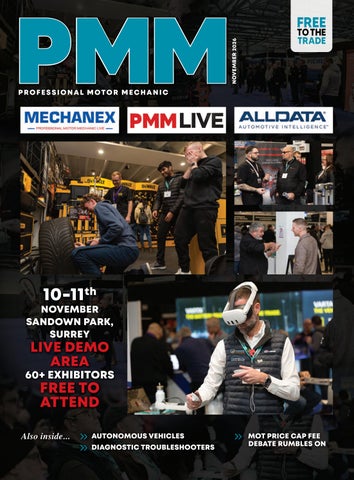
001_PMM_NOV26_Layout 1 27/09/2026 08:48 Page 1
NOVEMBER 2026
PMM
FREE TO THE TRADE
PROFESSIONAL MOTOR MECHANIC
10-11th NOVEMBER SANDOWN PARK, SURREY
LIVE DEMO AREA 60+ EXHIBITORS
FREE TO ATTEND Also inside...
AUTONOMOUS VEHICLES DIAGNOSTIC TROUBLESHOOTERS
MOT PRICE CAP FEE DEBATE RUMBLES ON
PMM grid_Layout 1 30/09/2026 15:46 Page 1
Contents
003_PMM_NOV26_Layout 1 02/10/2026 12:53 Page 3
Regulars 8-9
NOVEMBER 2026 VOLUME 27 ISSUE 11
EDITOR’S PICKS
NEWS Find out the latest going on in the industry.
10-28 CPD ZONE Scan the QR code on page 28 to claim your free CPD credit.
Welcome to the latest issue of Professional Motor Mechanic. In this issue of the magazine we explore the ongoing debate around the MOT fee cap and whether the Government will raise it in line with industry needs and expectations. Turn to page 40 to read more about that. Looking forwards, we’ve got our Mechanex show coming up on the 10th and 11th of November, so be sure to check out our show preview on page 31. We’re also featuring an insightful article on the impact autonomous cars will have on the independent garage sector and you can read that on page 36. Enjoy the issue!
31-34 MECHANEX PREVIEW 36-50 IN THE MIDDLE 52
DIAGNOSTICS & ENGINE MANAGEMENT
62
TOOLS & GARAGE EQUIPMENT
74
WINTER SERVICE & LIGHTING
Turn to page 44 to read our interview with ALLDATA, carried out at the recent Automechanika show in Frankfurt.
FEATURES
Turn to page 52
IN THE WORKSHOP
Turn to page 61
28
40
Certain brake pads designed
The Land Rover
for race track usage actually
Discovery Sport was
exceed the maximum
20
64
66
The IGA is calling on
Figures comparing new
Many newer vehicles require
the Government to
cars sold in 2016 and 2023
PIN codes, security
recently found to be
raise the MOT Fee to
show the average vehicle
authorisations or manufacturer
£95
friction levels permitted by
the worst DPF
weight rising by almost
approval before replacement
ECE R90 and are therefore
offender on UK
400kg, from 1,553kg to
keys can be programmed.
not road legal.
roads.
1,947kg.
Total Average Net Distribution 57,460 July – December 2025
Image credits: Pg.36 ©AdobeStock/Design Science Tech Pg.43 ©AdobeStock/Deemerwha studio Pg.52 ©AdobeStock/Thew Pg.60 ©AdobeStock/Standret
PMM NOVEMBER 2026 3
PMM grid_Layout 1 30/09/2026 15:47 Page 1
005_PMM_NOV26_Layout 1 02/10/2026 15:39 Page 5
VIEWPOINT
THE CHARMED LIFE
Editor KIERAN NEE Digital Manager KELLY NEWSTEAD Group Manager ALEX DILLEIGH Advertisement Manager MARCUS HOOPER Magazine Designer ADEEL QADRI Group Production Manager CAROL PADGETT Production Assistant CLAIRE SWENDELL Distribution Manager KARL CLARK
portsmen are, by rule, a superstitious bunch. Like life out on the sea, time spent on the pitch or on track brings you to the very limit of what you can achieve. Once you reach the limits of peak physical fitness, tactical ability, team spirit, there will always be one irrefutable factor that you can’t train your way past: chance. Chance can bring a violent storm on the sea. It can send your perfectly executed shot into the arm of a fellow teammate. It can be another driver’s crash ahead of you, throwing you off your best lap yet. So how to defend yourself against the unpredictable? Well, you could do like Bobby Charlton, whose belief in being the last out on the pitch even got in the way of him accepting the captaincy. Or you could be like Lewis Hamilton who used to carry a lucky conker in his race suit... until he lost it, that is. The amount of lucky (and unwashed) pairs of underpants that have graced the F1 track is also astronomically high – who would have guessed that unwashed underpants would go hand in hand with a sport dominated by very young men? The question is, do you, as a garage owner, keep any good luck charms around the workshop? Do you stick rigidly to any rituals that you believe will auger good things? What can you do to keep away the customers with an ongoing battery drain and a desire to quibble over every penny? What can you do to attract the customers who want a regular service and don’t argue when you tell them their car needs preventative work done? I once met a garage owner who dropped a cup of takeaway coffee one morning on entering the workshop. That day he received a phone call which eventually led to him regularly servicing a large fleet of vehicles. Now, he ceremoniously begins each day by pouring out a small amount of coffee on the floor in the hope that the good fortune of that day will repeat itself. Beyond the dubious luck it brings, it has developed into a daily ritual which the entire team enjoy and depend on. If for some reason the coffee isn’t poured (for instance, if the boss is too busy, stressed or angry), everyone knows it’s going to be a bad day. In that way, it has become a self-fulfilling prophecy. There isn’t much room left for superstition these days. Everything has been spreadsheeted and analysed to the point that luck or fortune have been completely discredited. And, yet, I can’t help but feel that a lot of what happens does come down to mere chance. Look at cars themselves. You do everything you can to keep it running well, but at the end of the day, you can’t control everything. For all you know, a day after getting your suspension sorted and new tyres fitted you could turn the corner and hit the mother of all potholes and find yourself back to square one. I suppose there are two sides to chance – sometimes the customer’s bad luck is your good luck. The only thing to do is to soften the blow by telling them those magic words: “You’re lucky you came to me instead of the guy down the road!”
S
Subscriptions PROFESSIONAL MOTOR MECHANIC is a business magazine for firms and individuals involved in all aspects of the motor trade. It is published eleven times a year and is available nationally FREE to the trade through leading motor factors. It is also available through the post at a cost of £30. EUROPE and OVERSEAS UK £30 post paid Airmail £80 post paid Europe £50 post paid Printed by William Gibbons & Sons Ltd from PCP Telford. Published by HAMERVILLE MEDIA GROUP Regal House, Regal Way, Watford, Herts, WD24 4YF. Tel: Watford (01923) 237799 Fax: (01923) 246901 E-mail: pmm@hamerville.co.uk Sales enquiries: pmmsales@hamerville.co.uk Website: www.pmmonline.co.uk Copyright © 2026 The publishers and editor do not necessarily agree with the views expressed by contributors, nor do they accept responsibility for any errors of translation in the subject matter in this publication.
Kieran Nee Editor
Associate member
JOIN ME EACH MONTH ON THE PMM PODCAST Find every episode at www.pmmonline.co.uk/podcasts Also available:
PMM grid_Layout 1 05/10/2026 10:14 Page 1
PMM grid_Layout 1 05/10/2026 10:14 Page 2
008_PMM_NOV26_Layout 1 23/10/2026 03:30 Page 8
PMM NEWS IMI expands Annual Awards with new categories
The Institute of the Motor Industry has announced an expanded line-up of categories for its 2027 Annual Awards. It sees the introduction of new accolades that recognise community champions, exceptional further education providers and future leaders, who together will help to shape the future of the automotive sector. Taking place on 10th March 2027 at InterContinental London, Park Lane, the IMI's Annual Dinner is the premier celebration of automotive excellence, recognising the people, organisations and achievements shaping the future of the motor industry. From apprentices and learners to industry leaders, the awards celebrate achievement at every level. Nominations across eight award categories, including three new additions – IMI Community Champion, Further Education College of the Year and Future Leaders – are now open. The introduction of these new awards aims to recognise the outstanding service and commitment made by those who volunteer their time in support of the automotive industry and the education providers that go above and beyond to tackle the industry's skills challenge. The Future Leaders Award, sponsored by IMI Vice President Daksh Gupta, is inspired by the stories of individuals nominated for previous IMI Awards. The Award recognises high-potential managers in the automotive sector who demonstrate leadership, innovation, and measurable business impact early in their careers. Nominees’ ambition and capability to grow into senior leadership will also be considered, alongside their customer focus and operational excellence. The winner will be mentored by Daksh for 12 months and receive a £2,000 bursary. The evening will also celebrate emerging talent, outstanding partnerships and organisations advocating inclusion, while recognising industry figures whose
8 NOVEMBER 2026 PMM
development of individuals across the sector, reinforcing the IMI's commitment to lifelong learning and career progression. "The IMI Annual Dinner and Awards is one of the most prestigious celebrations of achievement in the automotive industry," said Nick Connor, CEO of the IMI. "Every year we put a spotlight on those whose work is making a real difference, whether that's developing the next generation of talent, raising professional standards or leading innovation across the sector. "Being recognised by the IMI is a mark of excellence that demonstrates real impact. We urge employers, colleges, training providers, businesses and individuals from across the automotive community to review the categories and submit nominations so that we can celebrate the outstanding people and organisations helping our industry thrive." careers have made a lasting contribution to automotive. And bursaries announced on the night will support the professional
For more information on the IMI
WWW.RDR.LINK/ACK001 OR
SCAN THE QR CODE
008_PMM_NOV26_Layout 1 02/10/2026 12:57 Page 9
FOR UP-TO-DATE NEWS, SIGN UP FOR OUR WEEKLY E-NEWSLETTER. SIMPLY SCAN THE QR CODE
EV data concerns
Concerns about accessing the diagnostics needed to repair newer EV brands are the biggest factor discouraging independent garages from investing further in electric vehicle servicing and repair capability, according to the first LKQ Euro Car Parts Plug In-Dex. Nearly nine in 10 independent garages have turned away or referred at least one EV or plug-in hybrid enquiry in the past six months, despite the sector investing significantly in the skills, training and equipment needed to support the transition to electric vehicles. LKQ Euro Car Parts warns that unless garages can access the vehicle data, diagnostics and technical information needed to keep this work in-house, drivers could face fewer local repair options and greater reliance on costlier franchised dealers. Its analysis suggests this could collectively add at least £260m to UK plug-in car drivers’ servicing bills across one round of routine servicing – and potentially as much as £550m. The findings come from the first LKQ Euro Car Parts Plug In-Dex, a new tracker measuring how independent garages are adapting to the shift towards electric and plug-in hybrid vehicles. More than one in four garages (27%) identified concerns about diagnostic access for newer EV brands as a barrier to further investment, making it the most commonly cited factor. The findings suggest local workshops are willing to adapt, but uncertainty around access to vehicle information is making it harder for them to invest with confidence and keep EV work in-house. Mark Cranmer, owner at Station Garage in Hyde, Manchester, said: “We’re consistently seeing more EVs and hybrids coming through the door, and our customers need to know that, as their local independent garage, we’re able to service and repair them safely and to the right standard. “For us, it’s about staying competitive and making sure we can keep offering the level of service our customers expect as vehicles
NEWS IN
NUMBERS
47% change. People come to independent garages because they trust us and value the relationship they have with us, so we want to be able to keep supporting them as their cars become more complex. The more straightforward it is to access the information, training and support we need, the easier it is for garages like ours to keep more of that work in the workshop.” As newer cars become more reliant on software, digital fault codes and manufacturer-controlled systems, garages may need specialist information from the vehicle manufacturer before they can identify and repair a problem. One framework designed to address part of this challenge is SERMI – the SecurityRelated Vehicle Repair and Maintenance Information scheme – which went live in the UK in April this year and gives approved technicians secure access to manufacturer data specifically related to security systems. SERMI has been rolling out across the EU and Northern Ireland since 2023, giving approved technicians a recognised route to access security-related repair and maintenance information from vehicle manufacturers. While SERMI is mandatory in the EU, in the UK, participation remains voluntary. This means some manufacturers can continue to operate separate access schemes, adding cost and complexity for independent repairers that may need multiple approvals to work on the vehicles coming through their workshops.
EV purchase intent among buyers in 2026, 5 per cent higher than in 2025. That figure rises to 64 per cent among those on the hunt for a new car, according to A utomotive Insights.
£4,000 The amount raised recently by parts supplier Schaeffler at its REPX PERT conference and donated to industry charity Ben.
288 MOT Testers had their authorisation withdrawn by the DV SA last year, according to A utotech Training. The group says this highlights the pressure garages are under to comply.
For more information on LKQ Euro Car WWW.RDR.LINK/ACK002 Parts OR SCAN THE QR CODE
PMM NOVEMBER 2026 9
010_PMM_NOV26_Layout 1 04/10/2026 18:27 Page 10
CPD ZONE
READ ME TO COLLECT YOUR CPD POINT
BEST PRACTICE Hyundai dual dry clutch replacement Valeo provides some essential advice for garages faced with the dreaded dual dry clutch being used by Hyundai and Kia in certain models. or many garages, the words “dual dry clutch” can suggest a complicated repair involving measurements, calculations and specialist procedures. But it doesn’t have to be that way. Valeo’s Dual Dry Clutch Kits for Hyundai and Kia applications feature 100 per cent shim-free fitting, removing the need for manual depth measurements, tolerance calculations and shim selection while dedicated Valeo tooling is available to support the clutch and actuator installation process. Dual clutch transmissions are now well established in the UK, including a number of Hyundai and Kia applications. As these vehicles enter the independent aftermarket, garages are increasingly being asked to take on dual dry clutch replacement work. For a technician who is used to conventional manual clutch replacement, however, a DDC repair can appear more involved. There can be additional procedures to understand, specialist tools to consider and, depending on the clutch design, measurements and calculations that need to be completed before the new clutch can be correctly installed. That perceived complexity can be enough to make some garages think twice about taking on the job. Valeo's approach is designed to make the process more straightforward. One feature in particular can make a significant difference to the technician carrying out the repair: 100 per cent shim-free fitting.
mean additional time spent measuring, checking figures and selecting the correct components before the repair can be completed. It can also create uncertainty for a technician who doesn't regularly work on dual dry clutch systems. The obvious question is therefore: Why make the fitting process more complicated than it needs to be? This is where Valeo's Dual Dry Clutch Kits offer a clear advantage. 100 per cent Shim-Free Fitting means there is no need for manual clutch depth measurements, tolerance mathematics or shim selection as part of the clutch installation process. In practical terms, the technician isn't required to measure the installation depth and then work through a series of calculations to determine which shim combination is required. Instead, Valeo's design removes that particular part of the fitting process.
F
The shim challenge One of the concerns with some dual dry clutch replacement procedures is the additional measurement and adjustment process.
10 NOVEMBER 2026 PMM
What does that mean for the technician?
A technician may have to determine clutch depth, calculate tolerances and then use those measurements to establish which shim or combination of shims is required. That adds another stage to the repair – and another opportunity for measurements or calculations to go wrong. For a busy independent garage, this isn't simply a technical consideration. It can
No manual depth measurements: There is no need to carry out the additional manual depth measurement associated with determining the required shim arrangement. No tolerance mathematics: The technician doesn't have to calculate the relevant tolerances to establish the required shim selection. No shim selection: There is no need to select and install a combination of shims to achieve the required installation dimension. That doesn't mean fitting a Valeo DDC is a completely tool-free or procedure-free job. Correct removal, installation, actuator adjustment and calibration still matter. But Valeo removes one of the specific areas of
010_PMM_NOV26_Layout 1 04/10/2026 18:28 Page 11
“Valeo's approach is designed to make the process more straightforward. One feature in particular can make a significant difference to the technician carrying out the repair: 100 per cent shim-free fitting.” For garages that don't regularly replace dual dry clutches, that can make the job feel much more approachable. And for technicians who already have DDC experience, eliminating an additional measurement and shim-selection procedure can make the installation process more straightforward and repeatable.
Beyond the clutch kit Valeo's approach doesn't stop at the design of the clutch itself. Valeo can also supply dedicated specialist tooling to support the DDC installation and associated actuator procedures.
complexity that can make DDC replacement seem daunting in the first place. Less calculation. Less adjustment. Less opportunity for confusion around shim selection. A technician doesn't need to stop and work through a set of depth measurements and tolerance calculations before determining the correct shim arrangement. That means fewer individual stages to manage during the installation.
DDC assembly extractor Removing the existing DDC assembly with a controlled extraction from its seated position on the transmission input shaft. This helps the technician remove the DDC assembly safely and handle it during removal from and installation into the gearbox bellhousing. DDC assembly installer Once the new clutch is ready to be fitted, the DDC assembly installer can be used to safely press the DDC assembly onto the transmission input shaft and into the correct seating position. This is important because the DDC
assembly needs to be installed correctly rather than simply forced into position. Actuator rod adjusting tool The associated actuator system also needs to be correctly adjusted. The actuator rod adjusting tool assists the technician in setting the actuator rod length during the calibration process. Actuator calibration tool The actuator calibration tool is used to measure the clutch actuator rods and complete the required calibration measurement. Valeo's technical information specifically highlights actuator adjustment following DDC installation, with a special jig used as part of the adjustment procedure. Hybrid rotor coupling installer For applications incorporating a hybrid rotor coupling, Valeo also offers a Hybrid Rotor Coupling Installer. This is used together with the DDC assembly installer to correctly install the DDC assembly with the hybrid rotor coupling. This broader tooling provision is important because the job isn't simply about getting a new clutch into the gearbox. The associated installation and actuator procedures also need to be completed correctly.
FOR MORE INFORMATION ON VALEO go to www.rdr.link/ack003 or scan the QR code
PMM NOVEMBER 2026 11
PMM grid_Layout 1 30/09/2026 15:48 Page 1
013_PMM_NOV26_Layout 1 04/10/2026 18:37 Page 13
READ ME TO COLLECT YOUR CPD POINT
CPD ZONE
TROUBLESHOOTER Why was the BMW E90 not starting or even cranking? PMM’s hot-wired herald Ben Johnson brings news of a fault-filled E90 with a dashboard rivalling Picadilly Circus for bright lights and razzle-dazzle. But what could be holding back this German gizmo’s get-up-and-go? here are few things quite as persuasive as a BMW dashboard when it decides the world is ending. A case in point was a recent veteran I had come before me in the workshop – an E90 whose dashboard was lit up with transmission, all-wheel-drive and stabilitycontrol warnings. A diagnostic scan told the same apocalyptic story with more than 50 faults across the car coming together with seemingly one goal in mind: To ruin my week. Looking through the list, there was a CAS terminal 50 complaint relating to the starter command, along with repeated undervoltage and missing-message faults in several control units. The airbag system, instrument cluster, CIC and DSC were all represented in the electronic misery. I cheered myself up with the knowledge that that Santa’s list of naughty components did not mean that all of those modules had failed. It just meant they had all experienced the same bad day. When supply voltage collapses, control units reset, stop transmitting or report messages missing from other modules. The resulting scan can look like a communication catastrophe, but the fault list is often describing the consequences rather than the cause. Fifty codes do not necessarily mean fifty problems. Sometimes they are simply fifty witnesses pointing towards one weak electrical supply. The vehicle also produced an obvious nocrank condition. That brought the starter circuit into the investigation, but it did not condemn the starter. A starter motor is one of the largest electrical loads on the car. If the supply path cannot carry current, it will expose the weakness very quickly.
T
“Fifty codes do not necessarily mean fifty problems. Sometimes they are simply fifty witnesses pointing towards one weak electrical supply.” A failing junction box was worth considering because these cars are known to suffer powerdistribution problems. However, the central locking still operated. That did not prove the junction box perfect, but it weakened the theory because central-locking trouble is
commonly one of the first visible symptoms when that unit loses its main supply. The useful pattern was broader: Widespread undervoltage, missing communications and a starter that would not operate properly. Before opening control units, ordering a starter or disappearing into wiring
The iDrive display reported AWD/DSC and transmission malfunctions. These were symptoms within the wider low-voltage
The scan contained numerous undervoltage and missingmessage faults across several systems. The pattern mattered
Reading the pattern, not the list
PMM NOVMEBER 2026 13
013_PMM_NOV26_Layout 1 04/10/2026 18:37 Page 14
CPD ZONE
READ ME TO COLLECT YOUR CPD POINT
diagrams for half a day, the sensible question was whether battery voltage could actually travel from the rear of the car to the front. The earth side had already received attention. Someone had replaced the original ground lead with what appeared to be a positive cable, then covered it in black so that its new career as an earth cable looked respectable. It was not factory-pretty, but the cable was substantial and better than the original item it replaced. That made the main positive feed the next obvious path to test. This is where diagnosis becomes pleasantly unfashionable. No software update, no module programming and no parts cannon. Just two voltage readings taken at opposite ends of a very thick cable.
An unloaded test that should have been boring The battery was in the boot and a charger was connected, so the first measurement was taken
With the charger connected, the rear measurement showed 13.36
The front jump point showed 13.8 V, leaving an abnormal difference of roughly 0.45 V across the main B+ path even without cranking.
at the rear supply point (Fig.3). The reading was 13.36 volts. At the front jump-start terminal, (Fig.4) the meter showed 13.81 volts. The important figure was not either voltage on its own. It was the difference between them: Roughly half a volt across the main B+ cable. That should not have been there. At this stage the circuit was not being asked to crank the engine. There was no enormous starter current flowing through the lead. Yet a cable
14 NOVMEBER 2026 PMM
roughly as thick as a thumb was already losing around 0.45 volt from one end to the other. A sound main cable should make an unloaded comparison spectacularly dull. Both ends should sit at virtually the same potential. Voltage drop is often misunderstood because technicians measure battery voltage, see a respectable number and move on. The battery can be healthy and the cable can still be useless. A voltmeter connected at one point only tells you what is available there. Comparing the two ends tells you what is being lost along the route. The moment that unloaded difference appeared, the case had changed. There was no need to wonder whether the car might have a supply problem. It had one. The remaining task was to find where the resistance lived and prove how badly it behaved under load.
“Resistance measurements on heavy cables can be misleading because the values involved are extremely small and ordinary meter leads introduce their own resistance. Testing the circuit while it is doing the job reveals whether the complete path can carry current. In this case it could not.”
The failure hiding under the cap The physical evidence was not shy once the main cable connection was inspected. The terminal cap had split and the surrounding metal showed severe corrosion, with green deposits and rust around the connection (Fig.5). Water had been entering the boot and had never been properly dealt with. In winter, trapped water had frozen and expanded, cracking the terminal housing. Moisture then
worked from the inside out and travelled along the cable connection by capillary action. What looked from a distance like a heavy, indestructible B+ lead had become compromised at the point where current had to pass through the terminal. The cable itself may have looked serviceable further along its length, if somewhat tired, but the end connection was finished. The corroded terminal was expected to crumble when unbolted. This was not a connection to clean, tighten and send back into service with a hopeful expression. The full cable required replacement. This is an important distinction. Corrosion on the outside can sometimes be superficial. Here, the split housing and evidence of moisture migration showed that the deterioration was inside the electrical joint. Cleaning the visible surface would not restore the missing cross-sectional area or remove
The split terminal housing and heavy green corrosion exposed the physical failure at the main positive cable connection.
During the loaded start attempt, available voltage fell to 6.73 V after only a few seconds.
resistance hidden within the crimped and bolted sections.
Loading the circuit makes the fault confess The unloaded test had already proved an abnormal drop, but the cranking test showed what the driver experienced. With one person operating the start control and the voltage monitored at the front, the supply immediately fell to 8.17 volts on the first
013_PMM_NOV26_Layout 1 04/10/2026 18:37 Page 15
attempt. After only about five or six seconds, it collapsed further to 6.73 volts (Fig.6). That is not a subtle loss. At those voltages, control units begin dropping off the network, relays cannot behave normally and the starter has little chance of doing useful work. The transmission, DSC and communication warnings were not separate mysteries. They were the electronic fallout from a supply system falling on its face. The resistance in the cable restricted current flow and consumed voltage. Under load, the effect became far more dramatic because the voltage lost across a resistance rises with current. The missing electrical energy did not vanish. Much of it appeared as heat at the damaged connection and cable. This is why a loaded voltage-drop test is so effective. Resistance measurements on heavy cables can be misleading because the values involved are extremely small and ordinary meter leads introduce their own resistance. Testing the circuit while it is doing the job reveals whether the complete path can carry current. In this case it could not.
All three observations told the same story. Current was trying to pass through a high-resistance connection. Voltage was being lost before it reached the front of the car, while energy accumulated as heat in the damaged area. The cable was not transmitting power efficiently; it was obstructing it. Heat is a valuable diagnostic clue, but it should not replace measurement. A warm
The charger displayed 14.8 V and 72.7 A. High current, cable heating and lower voltage at the front all supported the resistance diagnosis.
Heat and charger current: Clues you can feel The charger added another piece of evidence. After only two or three minutes, the cable became extremely uncomfortable to hold and was estimated to be above 50°C. A main battery lead should not become hand-warming equipment simply because a charger has been connected. The charger display showed 14.8 volts and 72.7 amps. At the front jump point, only about 13.8 volts was available. The battery had also been tested and was not merely flat, although its measured capacity was down by roughly 200 amps. The exceptionally high charger current therefore needed to be considered alongside the voltage difference and the heat in the cable.
A complete positive battery lead and safety-terminal assembly illustrates the type of unit required rather than a cosmetic repair to the damaged cap.
terminal may tell you where to look, while a voltage-drop test proves whether that point is affecting circuit operation. Here, the temperature, the unloaded drop and the cranking collapse supported one another perfectly.
What had to be replaced The required repair was the complete main positive cable, not just the visible cap. The damage had progressed through the terminal area and into the cable connection, making a local cosmetic repair inappropriate. The safety battery terminal also required replacement. This assembly contains a small
pyrotechnic device intended to disconnect the battery supply during a serious collision. Once its surrounding cable and connection have suffered this level of corrosion and structural damage, it cannot sensibly be treated as an unrelated reusable part. The proper finish to the job would therefore be replacement of the affected B+ cable and safety terminal, a new cable the full length of the car, correction of the boot water leak, then repetition of both unloaded and cranking voltage-drop tests. The fault codes would also need clearing before a fresh vehicle scan confirmed which complaints were genuine and which were simply scars from the undervoltage event.
Five minutes, provided you measure the right thing This fault was found in roughly five minutes because the test matched the symptom. The car had widespread undervoltage faults and would not crank, so the main power path was checked from end to end. The first comparison already showed an impossible loss. Loading the circuit then made the failure undeniable. It would have been easy to replace the battery, condemn the starter or become distracted by the transmission warning. None of those actions would have repaired a rotten cable hidden in the boot. The dashboard was noisy, but the electrical principle was simple. The wider lesson applies to any make of vehicle. When a car presents with a nocrank condition and a scan full of lowvoltage chaos, do not count fault codes and assume each one deserves a part. Check whether voltage reaches the load. Compare both ends of the supply and ground paths. Test them unloaded if the difference is already suspicious, then load the circuit and watch what happens. A cable can look thick enough to tow a small boat and still be electrically useless at one corroded connection. The meter does not care how impressive it looks. Neither should the diagnostician.
TO SEE BEN JOHNSON’S YOUTUBE CHANNEL go to www.rdr.link/ack004 or scan the QR code
PMM NOVMEBER 2026 15
PMM grid_Layout 1 30/09/2026 15:48 Page 1
017_PMM_NOV26_Layout 1 05/10/2026 00:08 Page 17
READ ME TO COLLECT YOUR CPD POINT
CPD ZONE
KNOW YOUR PARTS Wet belts Dayco is spreading the message: Wet belts are here to stay and you should seize the opportunity. he weight saving, friction reducing and stretch resistance properties that a flexible belt running within a bath of oil provides, have delivered a solution that has helped vehicle manufacturers to be able to design and produce much smaller capacity engines that are still able to deliver the power and performance they require, while also allowing them to comply with global emissions reduction targets. The wet belt is, therefore, a component that is here to stay and workshops and technicians need to understand that its ongoing maintenance and periodic replacement are opportunities they should embrace.
T
temperature for reasonable periods, for example, then the primary message is to ensure they strictly adhere to the VM’s service and replacement intervals and not be tempted to delay them. However, for a customer who uses the car infrequently and for very short journeys, in addition to following the annual stipulations
Failure to maintain Stating the obvious, and in common with an external primary drive belt, as well as an internal chain, wet timing belt failure will have catastrophic consequences for an interference engine and result in a large repair bill for the owner. So, the first opportunity that a vehicle with a wet belt affords the workshop is the chance to engage with the customer and to understand how, and how often, they use their car and also to emphasise the importance of following the VMs scheduled service intervals, as prevention is considerably better than cure. This is particularly important because looking at the reality behind the negativity that is often associated with wet timing belt failure, two factors generally come to light: The condition of the engine oil and regularity of the servicing. This brings the focus back to developing a relationship with the customer and understanding how their car is used. For someone who uses the vehicle regularly and for journeys that allow the engine to fully warm up and operate at its ‘normal’ operating
“Looking at the reality behind the negativity that is often associated with wet timing belt failure, two factors generally come to light: The condition of the engine oil and regularity of the servicing.” of the VM’s service and replacement schedule, the condition of the oil, most notably from potential fuel contamination, must be regularly assessed.
Driven by the car makers Dayco is the original equipment supplier of the wet belt solution for several engines for a number of VMs, including Ford, Stellantis and VAG, so is therefore in the ideal position to comment on the most common causes of belt failure.
Technical account manager, Glen Goldstone, takes up the story: “Although it’s no longer an unusual component for them to come across, some technicians still question the validity of a wet belt compared to a chain. So, it’s worth pointing out that despite Dayco being the specialist supplier that found the solution, it was the VMs that inspired the concept, and it was to their design specifications that it was successfully developed. “Statistically, owners who rigidly follow the VM’s service and replacement intervals, rarely have issues with the wet belt in their vehicle. However, ignoring either the specified mileage or timeframe hugely increases the potential of a belt failure. “In addition, other mitigating factors, such as a higher degree of contamination in the oil than originally anticipated in the VM’s design specifications, can reduce the lifespan of the belt, in extreme instances to less than the specified service interval. “This threat, therefore, requires workshops to be more proactive with these vehicles than with others, and to check for the presence of fuel or debris in the oil, when the vehicle is in for a routine oil and filter change, for example. “Due to the fact there are now many engines that use wet belt technology, which include Ford’s EcoBoost and EcoBlue, PSA’s 1.2-litre PureTech and VAG’s 1.6 TDI, there are clearly a lot of vehicles that are likely to visit the independent workshop, and at some point they will require a wet belt change. “The introduction of wet belt technology therefore provides an obvious long term revenue stream for independents, which can only be good for the profitability of their businesses, irrespective of the personal opinions of the technicians that are undertaking the work.”
FOR MORE INFORMATION ON DAYCO go to www.rdr.link/ack005 or scan the QR code
PMM NOVEMBER 2026 17
PMM grid_Layout 1 05/10/2026 10:13 Page 1
PMM grid_Layout 1 05/10/2026 10:13 Page 2
020_PMM_NOV26_Layout 1 05/10/2026 00:09 Page 20
CPD ZONE
READ ME TO COLLECT YOUR CPD POINT
KNOW YOUR PARTS OE brake pads Why is it more important now to fit OE-quality brake pads on your customers’ cars than ever before? Well, ZF explains. s braking systems become more integrated with vehicle electronics, driver assistance technology and electrified powertrains, independent workshops are increasingly being asked for advice that goes beyond simple replacement. Customers want to know whether different pads will stop them faster, whether upgraded components are safer and whether additional services are worth the investment. According to Stuart McLeod, ZF Aftermarket technical support & training lead, the challenge for technicians is balancing customer expectations with the reality that modern braking systems are engineered as complete, finely tuned packages.
A
ECE R90 confusion One area that frequently causes confusion is ECE R90 approval. While pads and discs sold for road use in Europe must meet this regulation, McLeod explains that compliance alone does not guarantee identical performance. “ECE R90 sets an upper and lower friction limit. As long as a pad sits within that range, it can be approved,” he says. “But a pad operating at the lower end of that scale will perform very differently to one at the upper end.” This variation comes down to friction material composition. Different compounds generate different friction levels, behave differently under heat, and transmit energy into the braking system in different ways. Some track-focused pads actually exceed the maximum friction levels permitted by ECE R90 and are therefore not road legal. “These products are designed for motorsport or heavy track use,” McLeod explains. “They can generate too much friction for road applications and should not be fitted to vehicles used on public roads.”
20 NOVEMBER 2026 PMM
“The vehicle manufacturer calculates stopping distances and braking forces using the original OE components. If you mechanically alter those characteristics by fitting parts that perform differently, ADAS systems such as autonomous emergency braking cannot compensate.” Stuart McLeod, ZF Aftermarket In the independent aftermarket, the temptation to fit cheaper or ‘alternative’ braking components has become more problematic as ADAS technology has moved from premium models into the mainstream. McLeod stresses that braking performance is not an isolated function that modern vehicles can simply adapt to.
“The vehicle manufacturer calculates stopping distances and braking forces using the original OE components,” he says. “If you mechanically alter those characteristics by fitting parts that perform differently, ADAS systems such as autonomous emergency braking cannot compensate.”
020_PMM_NOV26_Layout 1 06/10/2026 10:01 Page 21
This means that fitting pads or discs that do not match OE performance can prevent safety systems from operating as intended, potentially creating dangerous situations for drivers. For workshops, this presents a clear opportunity to explain why OE-quality components are not just about longevity or refinement, but about preserving vehicle safety systems.
What OE performance really means From a product perspective, McLeod notes that OE suppliers tend to focus on replacement parts that replicate original performance rather than offering performance upgrades. Within ZF Aftermarket’s TRW braking range, the emphasis is on optimising braking for different vehicle requirements rather than increasing outright stopping power. “We offer pads with a COTEC coating to improve braking performance during bedding-in, DTEC pads that reduce brake dust while maintaining OE performance, and Electric Blue pads designed to improve noise, vibration and harshness characteristics on hybrid and electric vehicles,” he explains. These options allow workshops to tailor braking solutions to customer needs, such as cleanliness, comfort or suitability for EV use, without compromising system compatibility. McLeod is also cautious about the growing trend of fitting racing or track pads to road cars in the belief that they represent an upgrade “Race pads are designed to perform at very high temperatures under extreme braking,” he says. “In everyday driving they often don’t reach their optimal operating range, can be very noisy, and may perform worse during normal use.” There are also thermal implications to consider. Altering friction material can change how heat is transferred into calipers, pistons and brake fluid, potentially increasing stress on components that were never designed for those conditions.
Braking fluids Brake fluid is another area where education can add value. Most commonly used fluids, including DOT 3, DOT 4 and DOT 5.1, are hygroscopic and absorb moisture over time. McLeod explains that after around two years, this moisture content can significantly reduce the fluid’s boiling point and increase the risk of internal corrosion. “Under heavy braking, absorbed moisture can vaporise, creating compressible gas pockets in the system,” he says. “This can lead to partial or complete brake fade.” While DOT 5.1 offers a higher boiling point than DOT 4, McLeod advises workshops to follow manufacturer specifications rather than automatically
upselling a higher-rated fluid. He also warns against confusion with DOT 5 silicone fluid, which is incompatible with glycol-based systems and only suitable for specific applications such as classic cars stored long-term.
EV braking Electrified vehicles introduce further complexity. Although EV friction brakes are used less frequently due to regenerative braking, McLeod points out that
manufacturers account for this in system design. If issues do occur, a strip and clean service may be appropriate, but unnecessary upselling should be avoided. When customers ask about fitting larger brakes, McLeod encourages technicians to step back and assess the entire vehicle. “Bigger brakes require more space, often bigger wheels, changes in offset and potentially spacers,” he says. “That affects wheel bearings, suspension geometry and tyre clearance.” Increased braking force also raises questions around tyre grip, master cylinder capacity and suspension control under heavy braking. Without addressing these areas, a perceived upgrade can quickly introduce instability or unpredictable behaviour. Finally, McLeod highlights smaller but often overlooked braking services that can improve reliability and customer satisfaction. Replacing worn pad fitting kits, inspecting piston dust seals and exercising caution with disc skimming all help maintain braking performance without compromising safety. “Braking should always be viewed as a complete system,” he concludes. “When workshops understand that, and communicate it clearly to customers, they protect not just the vehicle, but their own reputation as well.”
FOR MORE INFORMATION ON ZF go to www.rdr.link/ack006 or scan the QR code
PMM NOVEMBER 2026 21
022_PMM_NOV26_Layout 1 05/10/2026 00:11 Page 22
READ ME TO COLLECT YOUR CPD POINT
CPD ZONE
Oil pressure valves Pierburg oil pressure valves: 100 per cent tested y further expanding its product range of precision oil pressure valves from Pierburg, MS Motorservice is aiming to strengthen its position as a leading supplier in the global aftermarket. The current line-up of 30 Pierburg oil pressure valves – developed in Europe and 100 per cent tested – covers a global vehicle population of around 80 million passenger cars and light commercial vehicles. Oil pressure valves play a key role in controlling modern oil circuits, working in conjunction with variable oil pumps and oil pressure sensors to regulate both the pressure and the volumetric flow of the engine oil. The valves are used at various locations within the engine – for example on the oil pump, on the oil filter, or in the crankcase for piston crown cooling. All Pierburg valves currently available are 2/2‑way or 3/2‑way valves controlled via a PWM (pulse width modulation) signal. This allows oil circuits to be precisely adapted to different load conditions. The result is optimised lubrication, more efficient cooling, fewer pressure peaks and reduced power requirements for the oil pump – all of which help lower CO₂ emissions and pollutant output.
B
Maximum reliability Every single Pierburg oil pressure valve undergoes a comprehensive functional test after production. The valves are energised, and typical load conditions are simulated using an oil substitute. The packaging is then welded to ensure oil tightness. This ensures consistently high product quality. Many valves also feature a fine-mesh protective screen in front of the switchable oil channels, which filters out larger particles and extends the valve’s service life. However, the most common cause of failure remains poor-quality or outdated engine oil.
“Oil pressure valves play a key role in controlling modern oil circuits, working in conjunction with variable oil pumps and oil pressure sensors to regulate both the pressure and the volumetric flow of the engine oil.” From compact cars to the premium segment The constantly expanding portfolio covers applications for almost all relevant vehicle segments and manufacturers, including Audi, BMW, Mercedes‑Benz, Opel, Peugeot, Volvo, Toyota, Jeep, Chevrolet, Porsche and many more.
The range extends from 1.0-litre threecylinder engines to high-performance engines with a displacement of over 6 litres, such as those used in premium SUVs or performance models. Motorservice therefore offers repair shops and parts dealers a reliable, OE‑quality solution for a wide variety of repair scenarios.
FOR MORE INFORMATION ON MS MOTORSERVICE go to www.rdr.link/ack007 or scan the QR code
22 NOVEMBER 2026 PMM
PMM grid_Layout 1 30/09/2026 15:49 Page 1
024_PMM_NOV26_Layout 1 05/10/2026 00:17 Page 24
CPD ZONE
READ ME TO COLLECT YOUR CPD POINT
COMMON FAULTS Exhaust pressure sensor This relates to febi part number 194893, fitting Mazda 3, 6 and CX-5 vehicles equipped with the 2.2 diesel engine. Problem Engine warning lamp illuminated. Lack of power. Possible fault codes stored in the engine control unit: • P0470 Exhaust gas pressure sensor. Malfunction • P0471 Exhaust gas pressure sensor. Outside specified range • P0472 Exhaust gas pressure sensor. Open circuit/signal too low • P0473 Exhaust gas pressure sensor. Signal too high • P0474 Exhaust gas pressure sensor. Malfunction • P2262 Exhaust gas turbocharger. Electrical/mechanical fault
Cause Exhaust pressure sensor is faulty, or the pipe from the exhaust to the sensor is blocked with carbon deposits.
Solution After identifying the symptoms and fault codes, unplug the exhaust pressure sensor from the rubber hose and check the data with a suitable diagnostic tool. If the sensor is working correctly, it should read atmospheric pressure – approximately 1 bar.
24 NOVEMBER 2026 PMM
To test the sensor, attach a handheld vacuum/pressure pump and adjust the pressure, then compare it to the data on the diagnostic tool. If the sensor does not read correctly then it is faulty. However, the metal pipe from the exhaust to the sensor is susceptible to becoming blocked with carbon deposits. Therefore, before replacing the sensor,
check that the pipe is not blocked. febi replacement Exhaust Pressure Sensor 194893 follows the current updated design from the vehicle manufacturer. As such, it is possible that the sensor being replaced is of a different design to the original part fitted to the car. To replace the sensor, first remove the plastic engine cover, then unplug the
024_PMM_NOV26_Layout 1 05/10/2026 00:17 Page 25
electrical connectors to some of the injectors so that it is easier to gain access to the exhaust pressure sensor (Fig.1). Unbolt the original exhaust pressure sensor metal retaining bracket. Discard the bracket but retain the bolts (Fig.2). Unplug the sensor from the rubber hose, then carry out comparative data tests to confirm diagnosis (Fig.3). Unplug the original sensor from the wiring harness and discard. Remove the original rubber hose from the metal pipe and check for carbon deposits (Fig.4). Install the new shorter rubber hose from the kit and fit the new metal bracket using one of the original retaining bolts. Install the new sensor
with the second part of the new metal bracket (Figs.5&6). Plug the new adaptor wiring harness into the new sensor and original wiring harness. Refit the injector wiring harness, using the
cable ties included to retain the adapter wire, then refit the engine cover (Fig.7). Clear all known fault codes and road test the vehicle.
FOR MORE INFORMATION ON FEBI go to www.rdr.link/ack008 or scan the QR code
026_PMM_NOV26_Layout 1 05/10/2026 00:19 Page 26
CPD ZONE
READ ME TO COLLECT YOUR CPD POINT
BEST PRACTICE How heavy EVs are affecting tyre wear Electric vehicles are, among other things, a good deal heavier than their internal combustion engine counterparts – in fact, up to half a tonne heavier. Accordingly, the wear on tyres is greater, but also produces different outcomes. Here, Giti Tire provides their expertise to aid readers in tyre wear diagnosis. lectric vehicles do not require workshops to abandon the fundamentals of tyre diagnosis, rather they require technicians to apply those fundamentals with tighter control over load, pressure, geometry and vehicle history. That distinction matters. Some battery-electric vehicles are heavier than comparable combustion models, and electric motors can deliver high torque from very low speed. Both can increase the forces passing through the contact patch. But rapid or uneven EV tyre wear should not automatically be blamed on the battery or the powertrain. Vehicle mass is one factor among many, including inflation pressure, alignment, suspension condition, tyre specification, road use and driver input. The practical change is therefore not a new list of wear patterns. It is a more disciplined diagnostic process, one that starts with the vehicle’s approved specification and records enough evidence to separate normal service wear from a correctable fault.
E
Start with the vehicle, not the EV label Before interpreting the tread, confirm the exact vehicle, derivative, wheel and tyre combination. Two versions of the same model can have different kerb weights, axle loads, tyre sizes and cold-
26 NOVEMBER 2026 PMM
pressure requirements. Optional wheels, towing use and frequent heavy loading can change the picture again. The workshop baseline should come from current manufacturer information, the tyre placard, owner information and applicable service data. Record the specified size, load index, speed rating and cold pressures before deciding whether the fitted tyre is suitable or the observed wear is abnormal. An XL marking, a high load index or an ‘EV’ description should not be treated as a substitute for checking the vehicle’s approved fitment. Nor should a technician assume that any tyre matching the nominal size will deliver the same load capacity, rolling resistance, noise behaviour or durability.
Measure the wear before explaining it A quick glance at the outer shoulder is not enough. Measure each tyre at repeatable points across the tread and record the position on the vehicle. Comparing front to rear and left to right often reveals more than looking at one tyre in isolation. A useful inspection record should include: • Tread depth at the inner, centre and outer zones of each tyre. • Cold pressure, where possible, compared with the vehicle specification. • Odometer reading and, if known, mileage since fitment or rotation. • Tyre make, pattern, size, load and
026_PMM_NOV26_Layout 1 05/10/2026 00:19 Page 27
•
• •
•
speed rating, and production identification. Signs of feathering, cupping, localised scuffing, cracking, impact damage or repair. Which axle and corner each tyre occupied and The customer’s typical use, including urban acceleration, motorway mileage, towing and repeated heavy loads. Record the DOT tyre code as part of the inspection, but do not treat the manufacturing date alone as proof of a tyre’s condition. Storage history, environmental exposure and physical condition also matter.
Treat the pattern as a clue, not a verdict Traditional pattern recognition still helps, but it should guide the next test rather than close the job. This is particularly important with EV tyre wear because several influences can overlap. A heavier vehicle running slightly below its specified pressure can increase carcass deflection and shoulder loading. Add misalignment or repeated high-torque acceleration and the visible result may have more than one cause.
Pressure errors become more expensive Inflation pressure affects the tyre’s load-carrying behaviour, footprint, heat generation and rolling resistance. On a heavier vehicle, a pressure error can consume the available operating margin more quickly, so the accuracy of the measurement matters. Use a calibrated gauge and compare like with like. A warm tyre reading cannot be judged as though it were a specified cold pressure. If the customer has just arrived, record the condition and avoid releasing or adding pressure on the basis of an invalid comparison.
Check for seasonal temperature change, slow punctures, valve leakage and damage where pressure loss is reported.
Ask specific questions instead of telling the customer that ‘EVs eat tyres’. Is most use short urban journeys? Is the vehicle driven in a high-performance mode? Has the wear appeared on the driven axle, one corner or all four tyres? Has the rotation procedure permitted by the manufacturer been followed? The answers help separate operating pattern from a pressure, geometry or component fault.
Alignment deserves evidence, not guesswork
Replacement choice is part of the diagnosis
The combination of high vehicle mass, wide tyres and low-profile fitments can make geometry errors costly. A pothole strike or worn suspension component may place toe or camber outside tolerance, but replacing the tyres without identifying the cause simply resets the clock. Inspect for play and damage before relying on alignment readings. Confirm wheel and tyre condition, ride height and any manufacturer requirements for loading, calibration or driver-assistance systems. Then produce before-and-after measurements. A green screen is not enough if the equipment used the wrong vehicle variant or a worn component allowed the setting to move under load.
A replacement tyre must satisfy the vehicle manufacturer’s size, load and speed requirements and any other applicable specification. Beyond basic fitment, the workshop may also need to discuss durability, wet grip, rolling resistance and noise according to the customer’s use. Tyre manufacturers are addressing these competing requirements through compounds, constructions and pattern designs intended to work across modern powertrains. Giti Tyre’s EV-ready tyre development is one example of how weight, torque, efficiency, noise and durability are considered together rather than as isolated features. Heavier EVs can increase the consequences of poor pressure control, unsuitable fitment and small geometry errors. They can also expose weak workshop habits: visual-only inspection, no baseline measurements and an assumption that the powertrain explains everything. A defensible diagnosis does the opposite. It verifies the vehicle specification, measures every tyre, checks the mechanical causes and accounts for how the vehicle is used. That approach is more useful than blaming EV weight and it gives the customer a clear reason for every recommendation.
“The combination of high vehicle mass, wide tyres and low-profile fitments can make geometry errors costly.”
Account for torque and regenerative braking, carefully Instant torque can increase tread stress when the driver repeatedly asks for strong acceleration, especially from low speed. Regenerative braking can also change how deceleration work is distributed through the driven wheels. Neither feature creates one universal EV wear pattern, because control software, drive layout, suspension geometry, tyre design and driver behaviour vary widely.
FOR MORE INFORMATION ON GITI TIRE go to www.rdr.link/ack009 or scan the QR code
PMM NOVEMBER 2026 27
028_PMM_NOV26_Layout 1 05/10/2026 01:05 Page 28
CPD ZONE
READ ME TO COLLECT YOUR CPD POINT
COMMON FAULTS BLOCKED DPFS Recent analysis from DPF Fixer shows that nearly a third of blocked DPFs never light the DPF lamp. 36,135-case analysis finds one in five cars with blocked DPF filter symptoms show no DPF warning light, with only an engine management light illuminated. One in ten show no warning light at all. Almost a third of blocked diesel particulate filters give the driver no DPFspecific warning, according to an analysis of 36,135 DPF cases handled by national mobile specialist DPF Fixer between November 2024 and July 2026, of which 16,557 vehicles were inspected by a technician. Across the vehicles attended, 30.4 per cent showed no DPF-specific warning light. The breakdown is 48.2 per cent presenting on the DPF light only, 21.3 per cent on both the DPF and engine management lights, 20.5 per cent on an engine management light alone, and 9.9 per cent with no warning light showing at all. Shaun Clarke, general manager, DPF Fixer, commented: “One in five of these cars comes in on an engine light and nothing else, and one in ten comes in with a clean dashboard. If a technician is using the DPF lamp as the trigger for a DPF diagnosis, a third of the cases will not present that way. Power loss is the more reliable prompt: Twothirds of the vehicles we attended were reported as down on power.”
A
intermittent in only 2.2 per cent – by the time anyone calls, the lamp is on and staying on. It was amber in 88.4 per cent of cases and red in 11.6 per cent, though that splits sharply by vehicle type: 14.7 per cent of private cars had reached a red DPF warning against just 4.1 per cent of commercial vehicles. Customers act quickly. Some 97.4 per cent called within a week of the warning light appearing, and only 0.3 per cent had left it longer than a month. Notably, 69.2 per cent arrived with no prior garage diagnosis at all, going straight to a specialist.
The typical vehicle The median vehicle in the dataset was 10.7 years old with 96,875 miles. Private cars, which make up 75.5 per cent of all cases, cluster later still: 46.7 per cent were between 10 and 15 years old, and only 1.7 per cent were under five. Euro 6b was the largest single emissions band at 34.5 per cent of all cases, followed by Euro 5b at 23.0 per cent. Low mileage offers no protection. One vehicle in eight arrived with under 50,000 miles on the clock, and cars covering less than 5,000 miles a year blocked at a median of 44,824 miles – a fraction of the reading their high-mileage equivalents reach, and at a greater age rather than a lesser one.
Worst offenders What the light means when it shows Where a DPF light was present, it was permanent in 97.8 per cent of cases and
The analysis indexes each model against its share of the UK licensed diesel car parc, so that popularity is stripped out. The Land Rover Discovery Sport carries the highest
DPF problem index of any model at 4.66, followed by the Mazda CX-5 at 3.89, the Range Rover Evoque at 2.97, the Jaguar XF at 2.54 and the Honda CR-V at 2.21. Among makes, Mazda is the highest in the dataset at 4.17, driven almost entirely by the CX-5. Two models block unusually early. The Range Rover Evoque reached a blocked filter at a median 69,809 miles and the Discovery Sport at 75,215 — the lowest readings of any highvolume model in the analysis, against a dataset median of 96,875. Shaun elaborates: “The Land Rover figure is the one most often misread. It is not a Land Rover problem – the full-size Discovery sits at 0.75 and the Freelander at 0.51, both at or below par. The pattern belongs to the Discovery Sport and the Evoque, and not to the badge on the front. That distinction matters if you are quoting a customer or deciding what to stock.” At the opposite end, the VW Golf (0.50), the Land Rover Freelander (0.51) and the Ford Focus (0.62) turned up least often for their numbers on the road, with the BMW 3 Series at 0.66. The 3 Series also ran furthest before blocking, at a median 137,981 miles and 14.2 years. Volkswagen (0.52) and BMW (0.64) were the most under-represented major car makes for DPF issues.
FOR MORE INFORMATION ON DPF FIXER go to www.rdr.link/ack010 or scan the QR code
REDEEM YOUR CPD CREDIT Congratulations, you have reached the end of the CPD Zone! To access your CPD credit from The CPD Group, scan the QR Code
28 NOVEMBER 2026 PMM
PMM grid_Layout 1 02/09/2026 16:06 Page 1
PMM grid_Layout 1 30/09/2026 15:50 Page 1
031_PMM_NOV26_Layout 1 05/10/2026 16:27 Page 31
Supported by
THINKING ABOUT GOING TO MECHANEX THIS MONTH? Turn the page to find out 5 essential things you should know beforehand!
Free to attend
60+ exhibitors Live demo area
10-11th November Sandown Park, Surrey To register for your free ticket scan the QR code Or go to www.mechanex.info
PMM NOVEMBER 2026 31
031_PMM_NOV26_Layout 1 05/10/2026 16:27 Page 32
Supported by
5 THINGS YOU NEED TO KNOW BEFORE COMING TO MECHANEX! Make sure you’re prepared to make the most out of Mechanex this year with PMM’s not-so-serious trade show survival kit.
1
MAKE SURE YOUR VEHICLE’S STORAGE SPACE IS EMPTY This is the number one thing you need to remember this year. Every year, at the end of each day of the two-day event, there is someone who is left scratching their head in the car park, asking themselves: “how on earth am I meant to fit all these tools and all this equipment I’ve just bought into this boot full of my children’s toys?” Needless to say, the toys get left behind at the Sandown Park car park. So, remember, before you stock up on bargain deals, keep the children happy and remove their stuff from your boot!
2
DO YOUR VOCAL EXERCISES IN THE QUEUE ON THE WAY IN With over 60 exhibitors at the show, each with new tools and technology to talk your ear off about, you should be prepared to do a lot of chatting. PMM’s official advice is to pack cough sweets, make sure to drink plenty of hot tea before and during the show and run through a few quick vocal warm-ups as you’re queueing to get into the show. Nothing too strenuous is required, but we have relied on our personal favourite, “I am the very model of a modern Major General…” for years now and frankly you can’t get us to shut up from the start of the show to the finish.
32 NOVEMBER 2026 PMM
3
FOOD AND DRINK ARE KEY! All serious adventurers stress the importance of keeping your energy up during a day of strenuous activity and Mechanex is no different! If you seriously think you can make it around every stand AND visit the new LIVE demo area with over ten different speakers across both todays without ongoing sustenance, then you’re madder than you look. Luckily, we have you covered! As many of you are aware by now, visitors to Mechanex are provided with a free bacon roll. So don’t worry, you’ll have the energy to keep going from stand to stand, carrying ever multiplying bags of goodies.
4
BRING THE APPRENTICE It’s a well-known fact of life that an apprentice left unsupervised is a recipe for disaster. So what to do whilst you’re spending the morning at Mechanex? Why not bring them along for the ride! There is plenty of fun and games at the show, such as Dewalt’s Wheel Change Challenge to keep them entertained, great seminars from Bosch, Pico Technology and others to keep them informed, and free bacon rolls to keep them fed so their mum won’t be mad at you. Plus, it’s always handy to have an extra pair of hands to carry your bags for you!
5
NOTIFY YOUR FRIENDS So you’re planning to spend an hour or two at Mechanex, nip in there in the morning and be back in the garage for lunch. Ok. We’ve heard this one before and we have something to tell you: There is a large chance that you will stay longer than you planned. You may even come back for the second day. With over 60 of the top companies from the aftermarket, including Comma Oil, Dayco, Gates, JLM, Launch, Liqui Moly, LKQ, Opus IVS, Bosch, Pico Technology, Pichler Tools, Pro-Align, the IGA, Rotronics, Thinkcar, FAI, Topdon… the list goes on! There is a LOT to see. In fact, this one may be a two-hander, so why not tell a friend about the show and get them to come with you and help you out.
031_PMM_NOV26_Layout 1 05/10/2026 16:28 Page 33
FREE TO ATTEND
60+ EXHIBITORS LIVE DEMO AREA
10-11TH NOVEMBER SANDOWN PARK, SURREY
TO REGISTER FOR YOUR FREE TICKET SCAN THE QR CODE OR GO TO WWW.MECHANEX.INFO
WHEN AND WHERE? Tuesday 10th and Wednesday 11th November, 10am-4pm Sandown Park Racecourse, Surrey.
HOW DO I VISIT? Getting to the show couldn’t be easier. The address for the show is: Sandown Park Portsmouth Road Esher Surrey KT10 9AJ If you’re coming by car head to the free car park. If you’re coming by public transport, the nearest train station is Esher, a 13 minute walk from the venue.
COME AND SAY HI!
Register for your free tickets! GO TO WWW.MECHANEX.INFO
As always, PMM will have a stand at the show, so come and say hi and let us know what you like (or dislike!) about the magazine. We may even be podcasting at the show, so please do come armed with your strongest opinions!
Did you know you can claim CPD points for each seminar you attend at Mechanex? Simply scan the QR code at the stand at the end of each seminar, it couldn’t be easier.
DID YOU KNOW?
PMM NOVEMBER 2026 33
031_PMM_NOV26_Layout 1 05/10/2026 16:28 Page 34
60+ EXHIBITORS 10-11TH NOVEMBER FREE TO ATTEND LIVE DEMO AREA SANDOWN PARK, SURREY
Supported by
THE EXHIBITOR LIST IN FULL 3D Group .......................................C50
DruOps ........................................E100
MOT Manager ............................D140
A1 Diagnostics ..............................E70
Easy2recruit ...................................E40
Motor Parts Direct ......................D170
Absolute Alignment ......................C20
Federation of Engine
NFU Mutual ..................................D12
Alldata ...........................................B70
Remanufacturing .........................E110
Oliveston .....................................A120
Alliance Automotive Group .........D10
Garage Services Online ................A40
OM Gloves ....................................C60
AP Air ...........................................B40
Gates .............................................D80
Opus IVS .....................................D110
Arnott Europe ................................E20
Giuliano Automotive ..................D210
Pichler Tools .................................D20
Ashford Garage Equipment ..........D58
Halfords .......................................B140
Pico Technology .........................D230
Autel/A1 ADAS ............................C40
Hazet ...........................................D166
PneuFlo Supply Co .......................B50
Autel ..............................................D90
Hickleys .........................................E90
Pro-Align .......................................A10
Auto Garage Network ...................A80
Hugh J Boswell .............................A60
RAC ............................................D164
Autocharge ..................................D168
Infopro Digital ..............................A20
Recoturbo ....................................D120
Autoparts UK ................................E10
ISN Group .....................................D40
Rotronics .......................................C10
Bardahl UK .................................B128
Ivor Searle ...................................E120
Sharkeye ......................................B130
Beal UK ......................................A108
JHM Butt .......................................B20
Steer-Tec .....................................B100
Ben ................................................B86
Kalimex .......................................B120
Straightset ......................................B90
BG Products ..................................E60
KAP Diagnostics ...........................E50
Techman ........................................D16
BookMyGarage ...........................D130
Laser Tools ...................................A90
Texa – D100Thinkcar .................D160
Bosch .............................................B80
Launch Tech .................................D30
The Turbo Guy .............................A50
Clickmechanic ...............................A30
Liqui Moly ....................................D50
Thermobile ....................................E30
Comma Oil ....................................A70
Mahle ..............................................D8
Topdon ..........................................B10
Cooling Edge ..............................D124
Mexichem ....................................E150
Wallmek ......................................B150
Dewalt .........................................D190
MOT Expert ..................................C70
Welzh ..........................................B110
TO REGISTER FOR YOUR FREE TICKET SCAN THE QR CODE OR GO TO WWW.MECHANEX.INFO 34 NOVEMBER 2026 PMM
PMM grid_Layout 1 10/02/2026 14:38 Page 1
036_PMM_NOV26_Layout 1 05/10/2026 01:11 Page 36
Industry comment. Autonomous taxis.
Getting a steer on driverless vehicles Self-driving taxis are now being trialled in the nation’s capital. Among the myriad legal questions this throws up are: Who will repair and maintain these cars, and what challenges does that present compared to a regular car? Here, Clare Galo, senior associate at Reeds Solicitors LLP gets under the bonnet of autonomy. or decades, the motor industry has measured progress in horsepower, efficiency and emissions. Today, the next revolution is being judged by something very different: Software. In September 2026, London's first autonomous taxi service began carrying paying passengers through the Uber app using vehicles equipped with Wayve's selfdriving technology. While the fleet is small –
F
36 NOVEMBER 2026 PMM
just 15 vehicles – it represents the first real glimpse of how automated driving could become part of everyday transport in the UK. For mechanics and workshop professionals, however, the story extends far beyond the novelty of a car driving itself. These vehicles introduce new questions about diagnostics, maintenance, data recording and, perhaps most importantly, legal responsibility when a fault or collision occurs.
Autonomous does not mean driverless Despite the headlines, the vehicles currently operating in London are not legally driverless. Every taxi still carries a licensed safety driver in the front seat whose role is to supervise the automated system and immediately take control if necessary. That distinction is crucial. Under existing road traffic law, the safety driver remains
036_PMM_NOV26_Layout 1 05/10/2026 01:11 Page 37
responsible for the vehicle while monitoring its operation. If they fail to intervene when the system requires human input, they may face the same criminal liability as any other driver. From a technical perspective, these vehicles are operating in a supervised automated mode rather than replacing the human altogether.
“These vehicles introduce new questions about diagnostics, maintenance, data recording and, perhaps most importantly, legal responsibility when a fault or collision occurs.”
The technology is already familiar Many technicians are already servicing vehicles fitted with advanced driver assistance systems (ADAS). Features including lane keeping assistance, adaptive cruise control, automatic emergency braking and automated parking have become increasingly common across mainstream manufacturers. Although these systems can steer, brake or accelerate in specific circumstances, they are fundamentally different from authorised selfdriving technology. ADAS is designed to assist the driver; it does not remove the driver's legal responsibility. That difference will become increasingly important as workshops calibrate cameras, radar sensors and lidar-equipped systems. A poorly calibrated sensor is no longer simply a customer satisfaction issue – it could directly affect the safe operation of automated driving functions.
Why software history matters as much as service history Traditional vehicle servicing revolves around mechanical condition: brakes, suspension, tyres and steering components. Autonomous vehicles add another layer of complexity through software integrity. Fleet operators will need detailed records of software versions, updates and system diagnostics alongside conventional maintenance schedules. If an incident occurs, investigators may ask not only whether the brakes were correctly serviced, but whether the vehicle was running the latest approved software and whether its sensors had been correctly calibrated after repair. For independent garages, accurate documentation is likely to become
increasingly valuable. Recording calibration procedures and retaining evidence of completed ADAS work may prove just as important as stamping a service book.
A new type of evidence One of the biggest changes brought by autonomous vehicles is the nature of forensic evidence. In a conventional collision, investigators typically rely on witness statements, CCTV, dashcam footage and physical damage. With automated vehicles, the most valuable evidence may instead come from the vehicle itself. Internal telemetry can record steering inputs, braking commands, sensor readings, software decisions and the exact moment control transfers between the automated system and the human driver. These digital logs may ultimately determine whether an incident resulted from human error, a mechanical defect or the behaviour of the autonomous software. For repairers, preserving that data could become an important consideration. Disconnecting modules, replacing control units or carrying out software resets may have implications if a vehicle is subject to investigation following a serious incident.
The Automated Vehicles Act 2024 The legal framework is also evolving. The Automated Vehicles Act 2024 is expected to become fully operational in late 2027 and introduces the concept of a user-in-charge. When an authorised vehicle is genuinely driving itself in approved autonomous mode,
the occupant in the driving seat will generally receive immunity from prosecution for offences arising solely from the way the vehicle drives. Responsibility may instead shift towards the organisation responsible for the automated driving system. That protection is not unlimited. A user may still commit offences by ignoring a request to retake control, activating self-driving mode where it is not authorised or interfering with the vehicle's automated systems. In practice, liability may change several times during a single journey depending upon whether the human or the vehicle was controlling the driving task.
What workshops should expect next The arrival of autonomous fleets is unlikely to reduce the demand for skilled technicians – it will change the skills required. Mechanical expertise will remain essential, but it will increasingly sit alongside electronic diagnostics, sensor calibration and software verification. Workshops servicing autonomous vehicles may need manufacturerapproved calibration equipment, controlled workshop environments and technicians trained to validate complex sensing systems after routine repairs. The industry's role is also becoming more closely connected with legal accountability. A correctly repaired bumper may now require precise radar alignment; a windscreen replacement may involve recalibrating multiple forward-facing cameras; and maintaining detailed digital records could become vital evidence months or even years later. London's self-driving taxi trial is only the beginning, but it signals the direction of travel. As vehicles become more intelligent, the definition of roadworthiness will extend beyond mechanical reliability to include the integrity of the software and sensor systems that make autonomous driving possible. For the modern motor trade, the future is no longer just about fixing cars – it's about maintaining the technology that drives them.
FOR MORE INFORMATION ON REED SOLICITORS go to www.rdr.link/ack013 or scan the QR code
PMM NOVEMBER 2026 37
MX HOUSE AD PMM DPS - NOV26_Layout 1 15/09/2026 16:59 Page 1
MECHANEX PROFESSIONAL MOTOR MECHANIC LIVE
SANDOWN PARK, SURREY 10TH & 11TH NOVEMBER 2026
TOP BRANDS ON SHOW INCLUDING:
THE HANDS-ON TRADESHOW FOR INDEPENDENT WORKSHOPS
MX HOUSE AD PMM DPS - NOV26_Layout 1 15/09/2026 17:00 Page 2
TOP AUTOMOTIVE BRANDS ● LATEST PRODUCTS AND INNOVATIONS
● SPECIAL SHOW DISCOUNTS ● FREE CPD TECHNICAL SEMINARS ● FREE ENTRY
● FREE PARKING ● FREE PROFESSIONAL MOTOR MECHANIC T-SHIRT ● FREE BACON ROLL
SPONSORED BY:
REGISTER FOR FREE AT WWW.MECHANEX.INFO
040_PMM_NOV26.qxd_Layout 1 05/10/2026 01:14 Page 40
Come and see us at Mechanex – stand A30
MOT fee debate.
MOT fee: What can garages do? Fee debate highlights new ways for garages to improve MOT returns. ndependent garages are being urged to look beyond the long-running debate over MOT fees and find immediate ways to increase the value of every testing slot, as ClickMechanic backs calls for more sustainable economics on testing. The Independent Garage Association has made the case to government for an increase in the statutory MOT fee cap to £95, reflecting 16 years of rising overheads, connected equipment investment and skilled technician wage inflation. Meanwhile, the Independent Automotive Aftermarket Federation is championing a statutory £54.85 minimum price to help tackle discounting and protect workshop margins. ClickMechanic is supporting all calls for an MOT fee review, agreeing that testing stations need improved commercial returns after more than a decade and a half of frozen fees. Alongside the longer-term push for regulatory change, however, the booking platform says garages can take practical steps now to increase the value of their MOT work. Through ClickMechanic, workshops and technicians can fulfil MOT with Collection & Delivery, priced at £98, giving motorists a convenient vehicle collection and return service while increasing the net revenue from each test.
I
“The IGA and the IAAF are doing fantastic, necessary work in highlighting the severe cost pressures facing MOT stations,” said Andrew Jervis, Co-Founder and CEO of ClickMechanic. “Whether looking at the IGA’s case for a long-overdue fee cap increase or the IAAF’s focus on establishing a sensible price floor, the entire trade agrees that workshops need healthier, sustainable economics. “Bundling the MOT with routine maintenance or dedicated pre-checks turns a standard statutory test into a far more productive workshop booking,” added Andrew. “We fully support the industry bodies fighting for fair statutory frameworks, and we want to empower independent workshops with practical booking models that maximise workshop revenue today.” PMM contacted Mark Field at the IAAF, to get his thoughts on the MOT fee cap debate: “I think successive governments have neglected the aftermarket through the lack of sector specific legislation and failed to recognise the enormous contribution of the independent aftermarket to the UK economy and road safety. As a result, we have an outdated, under-funded vehicle testing system in the MOT, which will take years to bring up
“The Independent Garage Association has made the case to government for an increase in the statutory MOT fee cap to £95, reflecting 16 years of rising overheads, connected equipment investment and skilled technician wage inflation. Meanwhile, the Independent Automotive Aftermarket Federation is championing a statutory £54.85 minimum price to help tackle discounting and protect workshop margins.”
to the required level as the cost of delivering a thorough and compliant MOT continues to rise. "We will not get an increase backdated in line with inflation as that will threaten the current testing frequency. But, IAAF has proposed that £54.85 becomes the minimum fee for a Class 4 MOT test, ensuring the true value of the inspection is recognised. Vehicle testing stations are facing rising costs in technician recruitment, training, equipment calibration and regulatory compliance, while also preparing for future testing requirements linked to advanced driver assistance systems, electric vehicles and emissions monitoring.” “The MOT remains one of the most important road safety checks carried out on UK vehicles. It is essential that the testing network is properly funded and that MOT inspections are valued appropriately. A mandatory minimum fee of £54.85 would be a sensible first step towards achieving this, while maintaining the current 3-1-1 MOT testing frequency to protect road safety standards.” The IGA’s chief executive Stuart James has also commented after a recent meeting with the DVSA to discuss the issue, saying “The reality is that this issue can no longer be kicked down the road. Garages cannot continue absorbing rising costs indefinitely while the MOT fee remains frozen. We made that point very clearly during our discussions and will continue to press for action.”
FOR MORE INFORMATION ON CLICKMECHANIC go to www.rdr.link/ack014 or scan the QR code
40 NOVEMBER 2026 PMM
PMM grid_Layout 1 01/10/2026 11:03 Page 1
PMM grid_Layout 1 30/09/2026 15:54 Page 1
043_PMM_NOV26_Layout 1 05/10/2026 17:12 Page 43
Industry comment
Entering the age of tech One thing PMM noticed at this year’s Automechanika show in Frankfurt was the steps being taken by suppliers to consolidate advanced technology’s role in the workshop. Your garage is going to rely on it more and more. Here, Autotech Connect’s client services director Darren Dowling discusses. he UK automotive industry is globally recognised for its engineering expertise, technical innovation and ability to adapt to change. But while vehicle technology has evolved rapidly over the last decade, many independent workshops are still operating with processes that belong to a very different era. Today’s technicians are no longer simply repairing vehicles. They are navigating increasingly complex diagnostics, softwaredriven systems, ADAS calibration procedures, EV architecture, compliance reporting and manufacturer repair processes, often while still manually writing job notes, searching through multiple technical systems and duplicating administration across different platforms. That pressure is only going to intensify. As the next generation of connected, softwaredefined and increasingly intelligent vehicles start entering the aftermarket in larger volumes, the gap between workshop capability and vehicle complexity will become much harder to manage using traditional working methods alone. For independent garages, the challenge is no longer just about keeping pace with repair technology, it is about remaining commercially competitive in an environment where efficiency, access to technical information and speed of diagnosis are becoming critical differentiators.
T
Independents cannot afford to view technology as something separate from workshop operations because modern vehicle repair increasingly depends on it. That does not mean replacing technicians with technology. Far from it. The biggest misconception around AI and digital workshop systems is that they are designed to think for technicians or pull generic information from the internet. In reality, the most effective solutions are the ones built specifically around workshop environments, manufacturer processes and technician workflows. When technology is implemented properly, it simply removes friction. It reduces the time spent searching for technical information. It cuts duplicated administration. It enables technicians to capture diagnostics and repair notes naturally while carrying out the task. It improves access to experienced technical support when needed. Most importantly, it gives technicians more time to focus on productive workshop activity rather than paperwork.
Technology should support, not disrupt
Operational efficiency
For independent workshops already under pressure from technician shortages, rising operating costs and an increasingly complex vehicle parc, improving operational efficiency is no longer a nice-to-have – it is essential to remaining competitive.
The reality is that dealer groups are already investing heavily in integrated digital workflows, voice-supported diagnostics and connected technical support systems designed to reduce downtime and increase workshop productivity.
And this is where perceptions around technology in the independent sector are beginning to shift. Many workshop owners are not resistant to digital solutions, but they are cautious about introducing systems that feel
“The biggest misconception around AI and digital workshop systems is that they are designed to think for technicians or pull generic information from the internet.” disruptive, overly complicated or disconnected from the realities of day-to-day workshop life. The industry has spent years talking about digital transformation as though it requires wholesale operational change. In practice, the most valuable technologies are often the simplest to integrate because they support existing workshop processes rather than replacing them. Voice-supported reporting, remote technical assistance and guided digital workflows are not futuristic concepts anymore. They are practical tools designed to solve practical workshop problems.
Speed equals advantage The independent sector has always adapted. It adapted to diagnostics. It adapted to hybrid technology. It adapted to EVs. The next stage of evolution is not just about repairing increasingly advanced vehicles; it is about creating workshops that can operate efficiently enough to remain competitive while doing so. Technology will not replace skilled technicians. But workshops using the right technology will increasingly outperform those that do not.
FOR MORE INFORMATION ON AUTOTECH CONNECT go to www.rdr.link/ack034 or scan the QR code
PMM NOVEMBER 2026 43
044_PMM_NOV26_Layout 1 05/10/2026 01:25 Page 44
Come and see us at Mechanex – stand B70
Automechanika. ALLDATA
Q&A PMM talks to ALLDATA’s Damian Milling ALLDATA used Automechanika Frankfurt 2026 to make an exciting announcement – the coming of AI to its Repair platform. Editor Kieran visited the stand to find out how this benefits workshops, speaking to sales director, Damian Milling. What have you been presenting to visitors at Automechanika? We've invested massively in the ALLDATA platform. We've invested an immense amount of time, money and development in the last 12 months in bringing the product up to the speed and the responsiveness that our customers have been asking for. We want to be able to equip our workshops to be able do more, be more efficient, to say yes to more work, get more work done right first time more often without comebacks, which ultimately creates the ability for them to make more profit. So when you look at the product today, it has that same familiar user interface that it's always had, but now it comes with the updated speed of usage, needing less clicks. We're trying to make that whole process far more efficient for technicians, so that they can spend more time repairing and less time hunting for the information that they need. And then we link that into the advancements that we're seeing.
“We're really trying to understand vehicle by vehicle what are the problems that vehicle continually seems to exhibit, what are people searching for, what are their findings and what are the common solutions.”
You are using AI to bring this streamlined usage? Yes. Utilising our large language model of databases, we've revolutionised what we can offer customers. ALLDATA not only gives them the actual information to service, maintain and repair exactly the same as vehicle technicians would expect it to do, it now guides them to a quick and easy fault diagnosis, cutting down on that wasted time of searching, head scratching, looking for the what ifs, where do I go, what do I do. We call it Diagnostic Intelligence, because it is a very, very intelligent, trained model using master tech linguistics to really
44 NOVEMBER 2026 PMM
understand what the fault code is that’s being given from a diagnostic tool, the symptoms that the customer or the driver is experiencing. We type it into the product, it utilises all the technical service bill to do so.
Is this an out-of-the-box AI model? No, this is an ALLDATA product, written and developed by us. Our team of data
scientists and IT technicians have been working on this for months. It launched in the US just over three months ago and it's constantly evolving. We are constantly looking at how we train the agents and the language search model to suit the market, the vehicle population, the vehicle markets that are in the market, the customer searching.
044_PMM_NOV26_Layout 1 05/10/2026 01:25 Page 45
So whilst the overall model will be the same for the whole of ALLDATA globally, how we search it within the UK will vary to France, Italy, to Germany and to the US. In terms of the language the technicians use, in terms of vehicle makes, models, engines, variations that are in that market, we're really trying to understand vehicle by vehicle what are the problems that vehicle continually seems to exhibit, what are people searching for, what are their findings and what are the common solutions.
Does this enable the independent workshop to compete with the dealer? 100 per cent. We're now at a position where ALLDATA is always provided the same level of information that a vehicle assembler dealer franchise would have. So there's never been a differentiation of that. But what the latest generation brings is that ease of use, that intuitive approach and search functionality that takes away some of that searching time to allow them to get to the solution more quickly, more efficiently and carry out that job.
What has it been trained on? So it's been trained to understand what are the TSBs, the technical service bulletins or diagnostic trouble codes, that are on the specific vehicle within the product. The first thing you need to do is you need to understand what you're looking at before you can understand what you've got to try and
“ALLDATA not only gives them the actual information to service, maintain and repair exactly the same as vehicle technicians would expect it to do, it now guides them to a quick and easy fault diagnosis, cutting down on that wasted time of searching.” find the fault with. Then it's looking at all those TSBs and understanding what the language is used, what the faults are, what the symptoms are and utilising all of those faults and problems. So you can ask what to do if you receive fault code B12345 with symptom poor idle, poor running, non-start and it will take all those keywords and link it back to 115 million difficult power articles in the click of a button, literally seconds, and bring back the most likely causes of problems.
So it understands a normal person’s way of describing symptoms? Yes, if you've got knocking noise at the front, you can put that in and then it will go on to say, these are the possible causes, these are the possible concerns, these are where you need to test first and these are the known fixes.
Doesn’t this run the risk of killing off the diagnostic skillset? The core basis of our programme and our offering is the OEM data. And you still need to have the skills of a technician to understand
the data and to do that job right. This is not a product that's designed to eliminate workshops and create a DIY market. I may understand myself how this works, but could I repair it myself? No, I couldn't. And that is not the intention. The idea is to take away some of that search and that head-scratcher time of the technicians and allow us to use their time more efficiently. If you've got a Master Tech and he's earning £45 an hour, you don't want him spending half an hour searching for something that a product like ALLDATA and Diagnostic Intelligence can deliver in five minutes. It's about the efficiency and the assisting a qualified technician not doing the math.
If you've got a Master Tech on £45/hour, you don't want him spending half an hour searching for something that ALLDATA and Diagnostic Intelligence can deliver in five minutes.
FOR MORE INFORMATION ON ALLDATA go to www.rdr.link/ack015 or scan the QR code
PMM NOVEMBER 2026 45
046_PMM_NOV26_Layout 1 05/10/2026 01:29 Page 46
Automechanika. Castrol
Q&A
PMM Talks to Castrol’s Jaime Garcia PMM editor caught up with Castrol Europe’s vice president for automotive, Jaime Garcia, to discuss the challenges oil suppliers have faced in recent years, the potential for hydrogen as a technology and the rise of the Chinese vehicle.
Are workshops looking for the same from their oil as 10 years ago? What they are looking first of all is for a quality brand, so a product that will be reliable in terms of the operations that isn't going to cause any trouble. Of course, as the market is evolving, especially in 2026, the biggest concern for them has been product availability. I think some garages are looking for more budget products as well. This is important for Castrol in terms of being able to demonstrate what is the added value because we're a premium brand. So we will have to show the independent workshop why it's worth paying additional money for Castrol.
Has it been a challenge for Castrol to provide a reliable product over the past five years? Castrol as a global company has very solid foundations in terms of sourcing materials. We are one of the largest
46 NOVEMBER 2026 PMM
buyers of raw materials across the globe. So at the end of the day, I think that others have struggled and have suffered more than us in terms of the product availability.
“Of course, as the market is evolving, especially in 2026, the biggest concern for garages has been product availability.”
Another important point is that Castrol continues to work and continues to develop products to have alternatives in terms of formulation, base oils and additives to be able to mitigate that if one product is being impacted because of shortfalls we have an alternative product to be able to supply the market.
Maybe a bigger challenge for you is the rise of EVs? Well, I think that that represents in the long term, an impact when we are considering what is our traditional business, because of course the car parc is electrifying. It will mean we need to reduce volumes. But we are focussing on the development of EV fluids that are required for partner OEMs. Eight out of ten OEMs work with us in terms of the launches of the product and some very important like in Germany Volkswagen Group, BMW and others.
Do you think hybrids will have a big role to play going forward? That's a very interesting question. I would say that governments are trying to force the transition to pure EV, abandoning what we know today as an internal combustion engine, because of emissions. But I think there are automotive players that are deciding that hybrid is more the future in that respect. And then I think that hybrid will provide what will be a more lasting solution.
046_PMM_NOV26_Layout 1 05/10/2026 01:29 Page 47
Of course I don't have a crystal ball to define what will be the final outcome, but I think that it will be a balance between the two technologies and potentially some other technologies that will be appearing, like the hydrogen cell or in the future new technologies that might be coming along.
Castrol would presumably quite like to see hydrogen be taken seriously. Well, let's see. Of course, we work and we have the right technology for every solution in the automotive industry. We have built our technology leadership on the back of the internal combustion engine, but we responded properly and in time to be able to develop EV fluids and
we will be prepared to respond to any new technology.
Chinese vehicles now are making up quite a large part of the new vehicle sector. How is Castrol adapting to that new reality? Europe traditionally was a market dominated by the European players and in fact the European players were also dominating the Chinese market. We see that this is being reversed now. We have seen a significant amount of new brands appearing in Europe and some of them are doing an incredible job in terms of scaling sales. Castrol is partnering with many of them. We have an MG partnership. We have as
well with Cherry Group, with Omoda, Jaecoo, Ebro, as well as European partnership. We are working with BYD in some markets. So we are in a very close contact with them, building on what has been our leadership in China and our presence in China over the years. What we are trying to support them with the right product range, in terms of distribution, because some of them are very focussed on new car sales, but not so much on the aftersales. And that's the biggest difficulty that they are facing in terms of the logistics and product availability. And that's where Castrol is showing their strength and being able to support them.
FOR MORE INFORMATION ON CASTROL go to www.rdr.link/ack016 or scan the QR code
PMM grid_Layout 1 30/09/2026 15:51 Page 1
049_PMM_NOV26_Layout 1 05/10/2026 01:33 Page 49
Automechanika. Borgwarner
Q&A PMM talks to Borgwarner’s Noureddine Saidi PMM’s editor Kieran Nee dropped by the Borgwarner stand at Automechanika Frankfurt to talk to general manager global aftermarket Noureddine Saidi, to find out how the parts manufacturer has adapted to alternative powertrains. What’s new with Borgwarner? It starts with the organisation. Okay, so it’s a global organisation with different business units and the aftermarket side was not unified. So one of the biggest moves that we are doing is really to consolidate our aftermarket offering. That means we have one team, one face to the customer, making the business easier for the customer instead of how in the past, if you wanted a transmission part you went to one team, if you want a turbo it's a second team and if you want a thermal part you go to another team. They were all Borgwarner, right? They all are experts in the aftermarket, but we were making it a little bit difficult for the customer. All the product now will come to one central warehouse and go to the customer. We’re trying to make it really lean and simple to deal with us. Starting from January 1st 2027, everything will go through one team.
On product, we're announcing about 800 part numbers this year. It's not only turbos, we have ten different product lines. Turbo is one of the biggest lines, but we have also diesel cold start and ignition, so under the Borgwarner Beru brand. The same for transmission, we are number one in transmission.
Are you transitioning away from turbos? No absolutely not. The turbo is not only for diesel, the turbo is also for gasoline applications. We do the turbo for passenger car and for the commercial vehicle. We have ignition coil spare plugs for gasoline, we have glow plugs for the diesel. So we still keep whatever we have as OE, where we are OE manufacturer, where we are supporting our OEM customers to bring it to the aftermarket. The turbo is one of our mainlines and we don’t even see the peak for OE turbo demand coming before 2032. So for the aftermarket, they will be selling until 2045, potentially.
Which vehicle manufacturers are you working with? We work with all of them. We are a global organisation, so all the OEMs, including the local Chinese OEMs. We did a lot of
acquisition in the past to prepare ourselves on the e-product. We are already supporting EVs.
And how do you see the aftermarket changing? We don't see it changing immediately. The challenge is really to prepare our customers at a workshop level on how to service new parts, especially high voltage. Luckily all the knowledge that we have from the OE side, we can use that to help the aftermarket.
Does that come down to training or parts? Both. Our main goal is really to prepare the workshop. When you are changing high voltage parts, you need to take precautions – you are touching a high voltage part, right? And it's becoming more electronic and more software-driven. So we want really to bring them training, but also the right tools and the knowledge on how to service those parts.
FOR MORE INFORMATION ON BORGWARNER go to www.rdr.link/ack017 or scan the QR code
PMM NOVEMBER 2026 49
050_PMM_NOV26_Layout 1 05/10/2026 15:52 Page 50
Come and see us at Mechanex – stand D80
Automechanika. Gates
Q&A PMM talks to Gates’ Drew Conkling PMM editor Kieran Nee stopped by the Gates stand at Automechanika Frankfurt to chat about the enduring popularity of belt kits, service intervals and how Gates is negotiating the transition towards beltless powertrains. we're seeing really high replacement needs for more forced induction engines with higher emission standards, and there's no real inspection standard even for timing chains, generally speaking. Obviously, if the tensioner starts wearing or you start hearing vibrations or clacking. Preventative maintenance is still very much needed.
Tell me what's new with Gates We’re launching our Smart Kits this year at the show. Basically they combin either our Power Grip timing belt kits with the Micro V kits or our timing chain kits with the Power Grip belt kits, depending on the application. Gates is big on kits, you know we were one the first ones to really embrace the kits and it's a message that we continue to push. And so obviously now you know there are engines that have timing chain systems or timing belt systems. And then you still have a micro V system or a serpentine belt system on the outside of it. So it’s really about simplifying the repair and the number of SKUs for everybody involved and then ultimately pushing a complete job for the workshop. One vehicle, one part number, one box, you get everything you need.
Kits are still popular, then? We still see very strong demand for sure. Go back 20 years, a timing belt kit was a pulley tensioner and a belt: Three part numbers. So sourcing it by itself wasn’t as challenging. Now, obviously, with timing chain kits in particular, and even timing belt kits, you know, there are 12, 15 SKUs in these things. So obviously, just trying to provide them with the value added benefit of not having to source multiple components. Maybe your favourite distributor only has three of the four SKUs in stock, you have to call somebody else for the fourth.
“Timing chains, especially the newer ones, they keep making them thinner and thinner and so they're stretching… Now we're seeing really high replacement needs and there's no real inspection standard, generally speaking.”
Is there still education needed around service intervals and replacement intervals? I think so, especially with chain kits, right? Timing belt kits are much more predetermined by the OEs, right? They still put it in the OEM manual, 150,000km or whatever it may be. But timing chains, especially the newer ones, they keep making them thinner and thinner and so they're stretching. If we go back 60, 70 years, timing chains never got replaced in cars. And now
Where does the rise of the EV leave Gates, primarily known for belts? It’s obviously been a very common question in recent years. Most people think of Gates as a belt company, and certainly that's how we were founded 115 years ago. But you know, walking around the booth, you can see our portfolios expanded dramatically. Obviously hybrids offer us the most opportunity. We still get the engines so there's still the belt, the tensioner, all of that stuff. But then you also get the electrified components, right? The high voltage battery, battery sensing systems. That requires much more complex cooling than just a traditional ICE engine. And then as we get to full battery electric vehicles and even fuel cells honestly, we're prepared for that future also. We've been a cooling system expert ever since water cooled engines really started to come around. And so for us it really comes down to the heart of the system being the pumps, pumping the coolant through the vehicle. They're all electric, so highly complex versus a belt-driven mechanical pump.
FOR MORE INFORMATION ON GATES go to www.rdr.link/ack018 or scan the QR code
50 NOVEMBER 2026 PMM
PMM grid_Layout 1 30/09/2026 15:52 Page 1
052_PMM_NOV26_Layout 1 05/10/2026 01:38 Page 52
DIAGNOSTICS
& ENGINE MANAGEMENT Come and see us at Mechanex – stand B10
DIAGNOSTICS CAN MAKE YOUR LIFE EASIER A practical guide to reducing diagnostic bottlenecks, improving first-time fix rates and maintaining workshop profitability, from the team at Topdon. very workshop owner has experienced it: A vehicle arrives with multiple warning lights illuminated, intermittent faults that refuse to be replicated, or customer complaints that don't immediately point to a clear root cause. What should be a straightforward repair quickly turns into hours of investigation, repeated testing and valuable ramp time being consumed. The challenge isn't necessarily a lack of technician knowledge – so why are fault-finding jobs taking longer than they used to? Twenty years ago, many faults could be traced using basic diagnostic equipment and traditional testing methods. Today's vehicle parc is very different.
E
Modern vehicles incorporate: • ADAS systems • Multiple CAN and network communications systems • High-voltage hybrid and EV components • Electronically controlled drivetrains • Intelligent battery management systems • Dozens of interconnected ECUs A fault recorded in one module may originate elsewhere within the vehicle network. Without comprehensive scan capability and guided testing functions, technicians can spend excessive time simply determining where to begin. Is a basic code reader still enough for today's workshop? For many garages, the answer is increasingly no. Reading and clearing fault codes remains an important first step, but fault codes alone rarely identify the failed component. A fault code simply indicates where the system detected an issue.
52 NOVEMBER 2026 PMM
Technicians still need access to: • Live data • Bi-directional controls • Service functions • System topology mapping • ECU coding and adaptation functions Without these capabilities, garages often resort to parts substitution, creating unnecessary costs and customer dissatisfaction.
Improving first-fix rates The most effective strategy is to combine technician expertise with OEM-level diagnostic capability. Tools such as the Topdon Phoenix and new “ONE” platforms provide technicians with access to extensive vehicle coverage, intelligent diagnostics and advanced service functions from a single device. This allows workshops to: • Perform comprehensive health checks quickly • View system-wide fault information
• Access advanced service procedures • Carry out coding and adaptations • Reduce unnecessary component replacement The objective is not simply identifying a fault code but understanding the root cause behind it.
Topology mapping Vehicle topology is becoming one of the most valuable diagnostic features available to workshops. Rather than viewing fault codes module by module, topology displays provide a visual representation of the entire vehicle network. This enables technicians to quickly identify: • Communication faults • Network-related issues • Offline modules • Interconnected system failures Tools such as the Topdon Phoenix or “ONE” series provide network topology mapping on supported vehicles, helping
052_PMM_NOV26_Layout 1 05/10/2026 01:38 Page 53
DIAGNOSTICS
technicians see the bigger picture and significantly reduce diagnostic time. For workshops handling an increasing volume of premium and technologically advanced vehicles, this capability can dramatically improve efficiency and accuracy. Are battery and charging system faults becoming a bigger issue? Absolutely. Battery-related problems remain one of the leading causes of vehicle breakdowns and customer complaints. However, modern battery management systems make diagnosis considerably more complex than measuring voltage alone. Professional battery analysers such as the Topdon BTMobile ProS and BT600 can provide deeper insight into: • State of Health (SOH) • State of Charge (SOC) • Charging system performance • Starter motor performance • Battery replacement requirements This allows garages to provide customers with objective test results rather than estimates or assumptions.
Battery support during diagnostics and programming Many technicians still associate battery support units purely with ECU programming, but modern vehicles place significant electrical demands on the battery whenever diagnostic work is being performed. Even with the engine switched off, numerous control modules, infotainment systems, telematics units and gateway controllers remain active throughout the diagnostic process. During software updates, coding procedures or ADAS calibrations, voltage fluctuations can cause serious problems. Common consequences of insufficient voltage support include: • Failed ECU programming • Corrupted software installations • Lost coding data
& ENGINE MANAGEMENT
“Reading and clearing fault codes remains an important first step, but fault codes alone rarely identify the failed component. A fault code simply indicates where the system detected an issue.” • Incomplete service procedures • Unexpected fault codes • Vehicle immobilisation in severe cases What may appear to be a simple battery issue can quickly become a costly recovery exercise for the workshop. Isn't a standard battery charger sufficient? Often not, and why risk it! A conventional battery charger is designed primarily to recharge the battery, however, during lengthy diagnostic sessions or module programming, the vehicle requires a stable power supply capable of maintaining consistent voltage while handling fluctuating current demands. This is where a dedicated battery support unit becomes invaluable and removes the some of the risk. Equipment such as the Topdon Tornado 120000 provides stable voltage and high-current support specifically for professional workshop environments. This helps ensure that programming, coding and advanced service functions can be completed without voltage interruption.
What about ADAS-equipped vehicles? ADAS calibration is one of the fastestgrowing opportunities for independent workshops. Even seemingly routine procedures such as: • Wheel alignment • Suspension repairs • Windscreen replacement • Steering component replacement Can require calibration of cameras, radars or sensors. Failing to verify calibration status can lead to customer safety concerns and potential liability issues. Advanced diagnostic platforms that support ADAS workflows help garages
carry out required calibration procedures guide technicians through the processes. Often, finding an affordable ADAS option can be the point where it goes wrong. Topdon UK’s Phoenix Mobile ADAS is a more affordable option for most. Can investing in better diagnostics and equipment really improve profitability? Most workshop owners evaluate equipment purchases based on upfront cost alone however the more important metric is often labour recovery. Consider a technician spending an additional hour diagnosing just two vehicles per day because of equipment limitations. Across a full year, the lost labour opportunity can represent thousands of pounds in unrealised revenue.
The bottom line As vehicles become more technologically advanced, diagnostic efficiency is becoming one of the biggest differentiators between profitable workshops and those struggling with productivity. The garages achieving the best results are not necessarily those with the largest teams. They are the workshops equipping technicians with the tools and training needed to diagnose faults quickly, accurately and confidently. Whether it's advanced scan tools such as the Topdon Phoenix or One series, vehicle network analysis, battery diagnostics, battery support solutions or ADAS capability, the goal remains the same: Reduce diagnostic guesswork, improve first-time fix rates and maximise productive workshop time. Because in today's workshop environment, the most expensive repair is often the one that takes too long to diagnose.
FOR MORE INFORMATION ON TOPDON go to www.rdr.link/ack019 or scan the QR code
PMM NOVEMBER 2026 53
PMM grid_Layout 1 06/10/2026 08:05 Page 1
055_PMM_NOV26_Layout 1 05/10/2026 01:44 Page 55
DIAGNOSTICS
& ENGINE MANAGEMENT
COMMON FAULTS CABLE FOR CAMSHAFT SENSOR This relates to part number febi 107574, fitting various Mercedes-Benz models. Problem The engine management warning lamp is illuminated, with various fault code entries – referring to the oxygen sensors – logged in the engine control unit.
Cause A malfunction of one – or both – of the oxygen sensors, due to the capillary action of the engine oil reaching the engine wiring harness. In turn, this affects the sensors via the camshaft-control solenoid valve.
Solution Check all oxygen sensors for oil ingress and replace if necessary. Check all camshaft-control solenoid valves for oil leaks and replace if necessary. Locate any other contamination caused by loss of engine oil, and carry out any necessary repairs. Install adaptor cable set 107574 between the camshaft-control solenoid valve and the engine wiring harness. The fine copper sleeves incorporated into this adaptor cable prevent the oil from spreading, reducing the risk of future electronic failures. It is recommended to install one adaptor cable for each camshaft-control solenoid valve fitted to the vehicle. Check the engine oil level according to the manufacturer’s specifications and correct if necessary.
Manifold Pressure Sensor This relates to part number febi 1000801, fitting Honda Civic (FK3), CRV (RE6), HRV (RU8) with a 1.6i-DTEC engine. Problem Engine warning lamp illuminated, reduced engine power and the vehicle going into limp home mode.
resistance characteristics, resulting in an incorrect reading. This then illuminates the engine warning lamp, stores the diagnostic trouble codes and causes the vehicle to go into limp home mode.
The following diagnostic trouble codes may be found: • P0181 - Fuel Temperature / Engine Coolant, Temperature (ECT) Intake Air Temperature (IAT) Sensor • Incorrect Voltage Correlation. • P2199 - Intake Air Temperature (IAT) Sensor 1/2 Incorrect Voltage Correlation.
Cause Moisture in the exhaust gas recirculation system can adversely affect the MAP sensor’s temperature-sensing element. This can alter the sensor’s voltage, current and
Solution Turn the ignition switch to on or press the engine start/stop button to select the ‘on’ mode. Record, then clear the diagnostic trouble codes with a suitable diagnostic tool. Start the engine and hold it at 2,000 rpm without load (in neutral) until the radiator fan comes on, then let it idle. Check for pending or confirmed diagnostic trouble codes. Check the data from the sensor with a suitable diagnostic tool, then replace the faulty MAP sensor and clear any fault codes.
FOR MORE INFORMATION ON FEBI go to www.rdr.link/ack020 or scan the QR code
PMM NOVEMBER 2026 55
056_PMM_NOV26_Layout 1 05/10/2026 01:48 Page 56
DIAGNOSTICS
& ENGINE MANAGEMENT Come and see us at Mechanex – stand D90
SEEING IS BELIEVING Autel discusses the importance of getting a hands-on demonstration of diagnostic equipment before purchasing. hoosing the right diagnostic equipment is an important decision for any workshop. With increasingly sophisticated vehicle systems, technicians need equipment that is not only capable of handling the latest vehicles and technologies, but is also straightforward to use and backed by knowledgeable support. For Autel, one of the most effective ways of helping workshops make that decision is simple: Put the equipment in the hands of the technician and demonstrate what it can actually do.
C
56 NOVEMBER 2026 PMM
Rather than relying solely on brochures, specification sheets or online videos, Autel offers face-to-face demonstrations designed around the individual workshop and the vehicles it works on. For one new workshop preparing to launch in early 2027, that approach played an important role in its decision to invest in Autel UK and Ireland diagnostic equipment.
Understanding what the workshop actually needs The customer is currently preparing to launch a new automotive business, with the venture due to start in early 2027.
Before considering Autel, their experience with aftermarket diagnostic equipment was primarily based around a Snap-on Triton D8. When looking for new equipment, the requirements were relatively straightforward: Something up-to-date and easy to navigate. Those requirements may sound simple, but they are increasingly important in a modern workshop. Diagnostic equipment needs to keep pace with new vehicle technology while remaining intuitive enough for technicians to use efficiently during the working day.
056_PMM_NOV26_Layout 1 05/10/2026 01:48 Page 57
DIAGNOSTICS
“While online demonstrations have their place, the experience reinforced an important point: Being able to sit down with the equipment and ask questions directly makes a significant difference.”
This is where a demonstration can provide considerably more value than a specification sheet.
as they arise, test functions themselves and see how the equipment behaves on the vehicles they are familiar with.
Putting the equipment to the test
Experience and support
The opportunity to see the equipment came through a parts supplier used by the customer, leading to a face-to-face demonstration. The customer had previously experienced a demonstration from another manufacturer conducted via video call. While online demonstrations have their place, the experience reinforced an important point: Being able to sit down with the equipment and ask questions directly makes a significant difference. As the customer explained: “The faceto-face demo was definitely preferred. It’s easier to tailor to our needs this way.” That ability to tailor the demonstration is central to the Autel UK and Ireland approach. The customer was able to test the equipment on vehicles they would actually encounter in their day-to-day business. For a technician, there is a major difference between being told that a diagnostic tool can perform a particular function and actually seeing it carried out on a vehicle.
Why a real vehicle matters Modern diagnostic equipment can offer an enormous range of functions, vehicle coverage and special capabilities. However, knowing that a feature exists does not necessarily tell a technician how useful it will be in their own workshop. A live demonstration provides the opportunity for technicians to ask questions
Interestingly, the deciding factor wasn't one particular diagnostic function. Instead, the customer highlighted the experience and background of the demonstrator, Tom, as being key to their decision. Having someone who understands diagnostics, understands workshop requirements and can answer questions based on practical experience provides an additional level of confidence when making a significant equipment investment. The customer described the support provided during the demonstration as “very important”, and agreed that being able to speak directly with someone who understood the workshop's requirements gave them greater confidence. That personal interaction is something Autel believes remains extremely valuable, particularly as diagnostic equipment becomes more sophisticated.
More than just a diagnostic tool Another significant factor in the purchasing decision was Autel UK and Ireland's three-year subscription offering. For a new business, controlling costs and understanding the long-term value of an equipment investment are particularly important considerations. A package that combines capable diagnostic hardware with an extended subscription can provide greater visibility over the ownership proposition. Ultimately, the customer identified two key factors in their decision: The knowledge
& ENGINE MANAGEMENT
and experience of the demonstrator and the three-year subscription. There wasn't a single “killer feature” that made the decision for them. Instead, it was the combination of the equipment, the demonstration, the advice provided and the overall proposition. Perhaps one of the most important points from this experience is that the customer wasn't persuaded by being shown a long list of impressive functions. In fact, when asked whether anything particularly surprised them during the demonstration, their answer was simply “no”. A good diagnostic demonstration doesn't need to manufacture a “wow” moment. Its purpose is to give the technician the opportunity to make an informed decision. The customer was able to test the equipment, ask questions, understand how it could fit into their business and discuss their requirements directly with an experienced demonstrator. As they put it themselves: “Actively using the equipment is a far better way to sell the brand.”
Big purchase For a workshop investing in diagnostic equipment, that simplicity is important. The process shouldn't stop once the demonstration finishes. Customers need access to knowledgeable people who can help them through the purchase and continue to provide support as they begin using the equipment. The experience highlights why Autel continues to put demonstrations at the heart of its approach. A diagnostic tool is a significant investment, and every workshop has different requirements. The vehicles being worked on, the technician's experience, existing equipment and the type of diagnostic work being undertaken can all influence which equipment is the right choice.
FOR MORE INFORMATION ON AUTEL go to www.rdr.link/ack021 or scan the QR code
PMM NOVEMBER 2026 57
058_PMM_NOV26_Layout 1 05/10/2026 01:50 Page 58
DIAGNOSTICS
& ENGINE MANAGEMENT Come and see us at Mechanex – stand D30
PREPARING FOR THE FUTURE
Launch is arguing that
or today’s independent workshop, diagnostic capability is becoming just as important as mechanical skill. With vehicles becoming increasingly software-driven, the ability to access, understand and act on complex vehicle data is changing the way technicians approach the job. The conversation around diagnostics is no longer simply about how many functions a tool can perform – it is about how effectively that technology helps a technician diagnose a vehicle, find the right information and get the repair completed. “It’s a significant change in the way technicians are working,” says Jon Woolley, sales & marketing director at Launch UK & Ireland. “As vehicles become more complex, having access to the right diagnostic capability is increasingly important if workshops want to deal with more of these jobs themselves.”
troubleshooting and official software licences, helping technicians get more from their equipment. “Ultimately, we want to give workshops more than just the equipment,” adds Woolley. “It is about giving technicians the tools, knowledge and backing they need to take on more work with confidence.”
F
From security gateway to ADAS That shift can be seen across the workshop, from security gateways and online coding through to ADAS, EV diagnostics and increasingly sophisticated vehicle systems. Jobs that might once have required specialist intervention can now potentially be brought back in-house – provided the workshop has the right equipment, software and support. “Garages are under increasing pressure to keep pace with the rapid advancement of vehicle technology, while consumers are also becoming more cautious with their spending,” adds Woolley. “That is putting significant pressure on aftermarket and workshop profitability, so having the right
advanced knowledge of diagnostics is enabling workshops to take specialist jobs back in-house.
More to come
“We want to give workshops more than just the equipment. It is about giving technicians the tools, knowledge and backing they need to take on more work with confidence.” Jon Woolley, Launch UK & Ireland diagnostic capability is becoming increasingly important. It’s one of the reasons why we’re running our Winter Saver Event.” Running until 31st December, the Launch Winter Saver Event offers savings across three key X-431 diagnostic solutions, giving professional workshops an opportunity to expand their capabilities and bring more repair work in-house. But technology alone is not the whole answer. As diagnostic procedures become more complex, the support available alongside the tool is increasingly important. Launch provides UK-based technical support, setup and onboarding, advanced
Launch is preparing to introduce a significant new development in diagnostic technology in January. For now, the details remain under wraps, but it will bring a fresh approach to how technicians interact with diagnostic information and how diagnostic tools can support the way modern workshops actually work. While Launch isn’t giving much away yet, the next generation of diagnostic technology needs to do more than simply add another function to a specification sheet. “It has to be about making life easier for the technician,” says Woolley. “The technology needs to provide the right information when it is needed, help technicians work more efficiently and ultimately deliver more capability from the equipment they have on the workshop floor.” That is the direction Launch is exploring as it looks ahead to 2027 – and January will reveal more. Meanwhile, technicians can see the latest Launch equipment in action at Mechanex Sandown this November. Visit the team to discuss your workshop requirements and discover more about the Winter Saver Event.
FOR MORE INFORMATION ON LAUNCH go to www.rdr.link/ack022 or scan the QR code
58 NOVEMBER 2026 PMM
PMM grid_Layout 1 30/09/2026 15:53 Page 1
060_PMM_NOV26_Layout 1 05/10/2026 01:53 Page 60
DIAGNOSTICS
& ENGINE MANAGEMENT Come and see us at Mechanex – stand B10
SIX TIPS FOR A BETTER DIAGNOSTIC HANDOVER A useful diagnostic record starts before the first reset. iCarsoft sets out a practical six-field approach for UK independent garages, linking the customer's complaint to the evidence collected, the tests performed and the conditions under which a repair is checked. onsider an older hatchback arriving with an intermittent warning lamp and several stored faults. One technician scans it, another investigates it after lunch, and the service adviser needs to explain the next step. If the codes have already been cleared, everyone starts with less information. A diagnostic trouble code identifies a detected condition; further testing is needed to establish its cause. The six fields below are a proposed job-card structure, not a mandatory industry standard. They can be recorded on paper or in workshop software, with scan files attached. Establish the vehicle registration, VIN, engine identification, mileage and job number first. Then preserve the initial evidence before changing the vehicle's state, wherever it is safe to do so.
C
1. Record the exact customer complaint Write down what the driver actually experienced. Ask when it happens, whether the engine is cold or warm, which warning appears, and whether restarting changes the symptom. Include recent repairs, a flat battery or a jump-start when reported. Separate the customer's account from observations made in the workshop. For example, an illustrative complaint might be: “Hesitates on the first uphill journey of the morning; runs normally after restarting.” That directs the investigation more usefully than “engine fault”. Record whether the symptom was reproduced. If it was not, retain that uncertainty rather than translating a customer's suspicion into a confirmed defective component.
60 NOVEMBER 2026 PMM
“A workshop timestamp shows when the scan was taken, not necessarily when the fault occurred. Preserve any event mileage or occurrence information separately where available.” 2. Identify the scan stage and time Date each scan and identify its stage: Initial assessment, testing, after repair or final verification. Add the technician's initials, tool identification and relevant software version. Record whether the ignition was on, the engine running, or the vehicle connected to a support supply. A workshop timestamp shows when the scan was taken, not necessarily when the fault occurred. Preserve any event mileage or occurrence information separately where available. Name saved reports consistently, using the job number and stage, so a
colleague can distinguish the arrival scan from a report created after a connector was unplugged during testing. Add a short intervention log when anything changes: a connector disconnected, a supply restored or a code cleared. Record the reason and time. This prevents a testinduced entry being silently treated as part of the customer's original complaint, while preserving any uncertainty about its origin.
3. Keep the code with its module and status Capture the complete code, any available suffix or failure description, the reporting
060_PMM_NOV26_Layout 1 05/10/2026 01:53 Page 61
DIAGNOSTICS
control module and the status exactly as displayed. Do not flatten current, historic, pending or permanent labels into one undifferentiated list. Their meanings and availability depend on the system and diagnostic application. Record the warninglamp state separately. The iCarsoft CR MAX manual distinguishes code reading, status information and available freeze-frame data, while noting that functions vary between vehicles. That is a reason to verify coverage for the particular vehicle, not to assume every scanner reaches every module. Mark a module that did not communicate as 'not accessed', rather than 'no faults'.
4. Save the operating conditions Where available, save the freeze frame associated with the fault before erasing anything. It provides stored operating data around the event, whereas live data describes the vehicle during the present observation. The CR MAX manual warns that clearing faults can remove associated freeze-frame information. A screenshot or saved report therefore needs to precede the reset. Select the parameters relevant to the complaint, such as engine speed, coolant temperature, load and vehicle speed. Retain
units and identify the source module. Do not fill missing fields with estimates or attach one frame to every code without checking its association. An unavailable frame is a limitation to record, not evidence that the reported fault never happened. Keep later live-data recordings separately labelled. When comparing two observations, note whether temperature, speed and load were reasonably comparable. A value captured at warm idle should not be presented as a direct repeat of an event recorded under load. Preserve enough surrounding data for another technician to understand the comparison.
5. Document voltage and communication conditions Record the low-voltage supply measurement with the test conditions and measurement point. A figure taken at rest, during cranking or with a support unit connected answers a different question. Use the vehicle manufacturer's procedure and limits; a single universal voltage threshold is an inadequate basis for condemning a battery, cable or control unit. Also note interrupted scans, connection problems and which systems remained inaccessible. HELLA's ADAS guidance explains how voltage problems, bus loading or gateway faults can affect sensordata availability. That supports investigating supply and communication conditions, but does not prove they caused
& ENGINE MANAGEMENT
a particular warning. A healthy reading taken now cannot establish what happened during yesterday's starting event.
6. Record what confirms the cause At the first handover, this field may contain a working hypothesis and the next discriminating test. Complete it with the actual finding as the investigation progresses. Record the test method, relevant manufacturer information, expected result and measured result. Where the cause remains unconfirmed, say so and identify the next action. A sensor-related code does not, by itself, establish a failed sensor. Appropriate checks may involve wiring, supplies, signal plausibility or mechanical condition. HELLA's ride-height guidance illustrates the value of comparing parameters with the system's circuit information and observing vehicle-specific repair instructions. Describe why the findings support the repair decision; 'replaced the part named by the code' leaves that reasoning missing. For a referral, include tests already completed and the questions still open. A specialist can then see whether the job requires further electrical testing, mechanical investigation or access to additional manufacturer functions. Specify the evidence being requested rather than asking only for the codes to be read again.
FOR MORE INFORMATION ON ICARSOFT go to www.rdr.link/ack023 or scan the QR code
PMM NOVEMBER 2026 61
062_PMM_NOV26_Layout 1 05/10/2026 14:27 Page 62
TOOLS
& GARAGE EQUIPMENT
5 WAYS AN ENDOSCOPE CAN HELP YOU Automotive tools specialist Draper is highlighting five diagnostic jobs that can easily be sped up with the use of an endoscope.
O
valve was staring back at them within minutes, which was proof enough to show the customer without a single bolt removed from the cylinder head.
1. Cylinder and valve inspection through the spark plug hole A misfire that survives a coil-and-plug swap usually means something more serious lurking inside the cylinder. One independent workshop we spoke to had exactly this on a Mini with a persistent cylinder 2 misfire – coils swapped, plugs swapped, misfire staying put. A technician fed an endoscope through the plug hole to bring the valves into view. A chunk missing from the edge of a
coked-up intake manifolds and soot-loaded DPFs are a big part of that. Rather than stripping intake tracts apart, several technicians simply pull the MAP sensor or a temperature sensor boss and drop the camera straight in to check manifold runners and EGR cooler galleries for blockage and to check for the tell-tale signs of an internal coolant leak inside an EGR cooler. A sidefacing lens is particularly useful here, letting
ver the years inspection cameras have quietly become one of a garage’s most valuable tools. An endoscope or inspection camera is relatively cheap when compared with the labour hours it saves, it doesn't take up much room in the toolbox and once you've used one to avoid stripping down a manifold or a dashboard, you never want to go back to guessing. The principle is simple: Most diagnostic time isn't actually spent fixing anything, it's spent on finding the problem. An endoscope, particularly one with a duallens head offering both a forward view and a 90° side view, usually reduces the time spent searching from hours to minutes. Here tools and equipment specialist Draper lists five jobs where garages are putting endoscopes to good use.
2. Diesel intake, EGR and DPF carbon build-up Diesel diagnostics remain steady work for many garages and clogged EGR valves,
“Timing belts in oil can be a contentious job, with degraded belts shedding rubber into the oil pick-up and taking engines with them. Instead of dropping the sump or cracking open the timing cover just to have a look, a probe fed down the oil filler neck or dipstick tube can bring the belt edges and teeth into view.”
62 NOVEMBER 2026 PMM
you change the angle to judge soot levels or check for melted ceramic before recommending a forced regen or a clean, rather than a full replacement.
3. Wet belt condition checks Timing belts running in oil (as fitted to the Ford 1.0 EcoBoost engine for example) can sometimes be a contentious job in the garage, with degraded belts shedding rubber into the oil pick-up and taking engines with them. Instead of dropping the sump or cracking open the timing cover just to have a look, a probe fed down the oil filler neck or dipstick tube can bring the belt edges and teeth into view. Fraying, swelling or cracking shows up clearly enough to back up a replacement recommendation, which is useful both for your own decision-making and for showing a sceptical customer why the job is needed.
062_PMM_NOV26_Layout 1 05/10/2026 14:28 Page 63
TOOLS
housing or a vent duct lets you check the evaporator fins for mould, corrosion or a pinhole coolant leak in a fraction of the time. If you’re using a dual lens model, switching to the side lens gives you a more detailed and complete view, helping avoid any guesswork.
4. Leak tracing Most technicians will have experience of how oil and coolant leaks are notoriously good at hiding their true source, especially once they've dripped from a manifold onto something else entirely. Making use of a flexible camera behind the block or under the inlet is often the fastest way to find the actual origin. The same logic applies to HVAC complaints, rather than a long dashboard-out job to reach the evaporator, feeding the camera through the cabin filter
5. Hidden corrosion and structural checks With salted winter roads, corrosion inside sills, chassis rails and box sections can be a real issue. Rather than drilling inspection holes speculatively, most vehicles already have drain plugs or bungs that a slim probe will fit through, giving you a genuine look at the internal condition before you commit to bodywork or write off a job as uneconomical.
Beyond diagnostics It's worth remembering the simpler uses of an inspection camera too. One garage told us about using theirs for
& GARAGE EQUIPMENT
Land Rover chassis swaps where the wiring loom needs guiding through the chassis without snagging. There is also the task of finding and retrieving a dropped bolt from deep in the engine bay, or simply reading a corroded part number stamped somewhere the naked eye can't reach. None of these are big, complex jobs, but they're exactly the kind of small time-savers that add up across the working week. Using an endoscope can make everyday diagnostic jobs much quicker and easier without requiring a major investment. Models such as Draper’s dual-lens endoscope inspection camera are a practical option for garages looking to save time and reduce unnecessary stripdowns. Once you have one in your kit, the key is to build the habit, before reaching for a socket set, ask whether a camera could give you the same answer in a fraction of the time.
FOR MORE INFORMATION ON DRAPER go to www.rdr.link/ack024 or scan the QR code
064_PMM_NOV26_Layout 1 05/10/2026 14:36 Page 64
TOOLS
& GARAGE EQUIPMENT
HEAVY METAL Cars are becoming heavier and wider, while electric vehicles bring their own lifting and access demands. A1 ADAS Group's Jamie Willis explains why garages should assess the workshop as a complete working system, rather than replacing equipment one item at a time. he vehicles arriving in independent garages have changed considerably, but much of the equipment beneath and around them has not. Figures comparing new cars sold in 2016 and 2023 show the average vehicle weight rising by almost 400kg, from 1,553kg to 1,947kg. Electric cars typically add another 250kg to 500kg compared with equivalent petrol or diesel models. A lift installed 15 or 20 years ago may still appear serviceable, yet it may be operating much closer to its rated capacity for an ordinary family car than anyone could have anticipated two decades ago. Vehicle width is changing too: the average car is now around 1.8m wide, while many SUVs are approaching two metres. "The question is no longer simply whether a lift goes up and down," says Jamie Willis of A1 ADAS Group. "A garage needs to know the weight it is being asked to carry every day, whether vehicles can be loaded without risking wheel or body damage, and whether the equipment will remain suitable for the work the business wants to take on."
T
Capacity needs context Older four-post lifts were commonly rated at around three tonnes. Current models are more likely to offer four or five tonnes, turning what was once a commercial specification into an everyday requirement. And capacity is only the starting point: weight distribution, platform width, post position and approved lifting points all matter. EV battery packs make correct contact particularly important. Pads or arms must
64 NOVEMBER 2026 PMM
not bear against the casing. Battery removal may require a wheel-engaging EV lift that leaves the underside clear, or arm adaptations capable of reaching vehiclespecific jacking points. Willis says: "It is easy to look at the maximum tonnage and assume the job is done, but the vehicle still has to fit the lift and be supported in the right places. EVs have made that much more visible. The safest specification is the one based on the vehicles and procedures the garage actually handles, not simply the biggest number in a brochure."
The cost of keeping an old lift A leaking hose, worn component or control fault can take a bay out of use, while parts support for equipment that is 20 or 30 years old may be limited or non-
Come and see us at Mechanex – stand E70 existent. A next-day repair can become several days of lost capacity. Downtime should form part of the replacement calculation, along with time spent repositioning wider vehicles or moving jobs because only one bay can accommodate them. A cheaper decision on paper can become expensive when it repeatedly slows technicians down. Newer lifts also incorporate safeguards that may not be present on older equipment, although designs differ between manufacturers. These can include mechanical locking or grab systems to restrict a platform's fall, and staged lowering with an audible warning before
064_PMM_NOV26_Layout 1 05/10/2026 14:36 Page 65
TOOLS
the lift reaches floor level. Garages should compare the actual protective features, certification, parts availability and service support rather than treating all lifts of the same capacity as equivalent.
Look beyond the lift If heavier vehicles are prompting an equipment review, the garage should consider the jobs carried out before, during and after the vehicle is raised. A wheel alignment system, for example, needs to work with the lift and the wheelbases, track widths and wheel sizes entering the workshop. Tyre changers and wheel balancers must be able to handle the larger and heavier wheel and tyre assemblies now common on SUVs and EVs. Diagnostic equipment needs appropriate vehicle coverage and technical support, while ADAS calibration requires suitable floor space, lighting, level conditions and an efficient route from alignment and mechanical work to calibration. "These purchases are connected," says Willis. "There is little benefit in installing a higher-capacity lift if the tyre equipment cannot handle the wheels, the alignment
“It is easy to look at the maximum tonnage and assume the job is done, but the vehicle still has to fit the lift and be supported in the right places. EVs have made that much more visible.” Jamie Willis, A1 ADAS Group set-up creates another bottleneck or an ADAS job then has to be sent elsewhere. Looking at the full workflow helps a garage invest in equipment that works together and earns its place."
Specify for tomorrow's work The answer will not be the same for every garage. Space, floor construction, power and air supplies, vehicle mix and future services all influence the specification. The workshop does not necessarily need the most automated or expensive option, but it does need
& GARAGE EQUIPMENT
equipment chosen for a clear reason and backed by installation, training and aftersales support. An equipment audit with A1 ADAS Group will typically ask which vehicles are close to each bay's limits; which jobs are delayed, declined or outsourced; where technicians lose time; and what work the garage expects to add. The answers help prioritise lifting, diagnostics, ADAS, alignment and tyre equipment before an ageing item finally stops. Willis concludes: "Vehicle weight and size are moving in one direction. Garages do not need to replace everything at once, but they do need an informed plan. Equipment should be safe for today's work, supported when something goes wrong and capable of handling the vehicles workshops expect to see next." A1 Diagnostic Solutions is the equipment supply division of A1 ADAS Group. It supplies diagnostic and ADAS systems, vehicle lifts, wheel alignment and tyre equipment, along with a wider range of garage equipment, training and ongoing support.
FOR MORE INFORMATION ON A1 ADAS go to www.rdr.link/ack025 or scan the QR code
PMM NOVEMBER 2026 65
066_PMM_NOV26_Layout 1 05/10/2026 14:46 Page 66
TOOLS
& GARAGE EQUIPMENT
KEEPING PACE Accessing dealer diagnostic platforms is more important than ever to programme replacement parts – not to mention the recent influx of Chinese vehicles. Here, OSCA discusses what it can offer the modern workshop. ne of the biggest challenges facing independent workshops is the rapid growth of new vehicle manufacturers entering the UK market. Many of these brands operate within closed diagnostic ecosystems, making access to programming, coding, and software functions difficult for garages without direct manufacturer support. OSCA has invested heavily in dealer-level access and licensed OEM tooling for a growing number of these manufacturers, including: • BYD • OMODA • Jaecoo • Chery • KGM • MG • Leapmotor In addition, OSCA also has dealer-level access to Geely, Zeekr and the latest generation of Smart vehicles. As these brands continue to gain market share in the UK, independent garages are increasingly being asked to repair and programme vehicles that many aftermarket diagnostic platforms do not yet fully support. Direct dealer-level access lets workshops complete software updates, coding procedures, diagnostics, and module programming without relying on the franchised network. This capability is becoming increasingly important as vehicles from BYD, OMODA and Jaecoo move beyond servicing and into more advanced repair work within the independent aftermarket.
O
Volvo and Ford key programming Key programming and immobiliser work remain some of the most challenging areas of modern vehicle repair. Many newer vehicles require PIN codes, security authorisations or manufacturer approval before replacement keys can be programmed. In some cases, workshops can
Come and see us at Mechanex – stand C50 be left waiting hours, or even days, before they can complete the work. OSCA can programme Volvo vehicles up to the 2026 model year without the traditional delays associated with PIN retrieval. Jobs that may previously have involved waiting up to 48 hours for security access can often be completed in around 20 minutes. For workshops, that can mean the difference between a vehicle occupying valuable workshop space for several days or being returned to the customer the same day. The same level of support is available across the latest Ford platforms, including newer VW-derived models. Key programming procedures that would traditionally require dealer involvement can often be completed remotely in minutes, helping workshops reduce downtime and maintain customer satisfaction. As vehicle security systems become increasingly sophisticated, quick access to authorised programming procedures is rapidly becoming a valuable competitive advantage for independent repairers.
Supporting the latest BMW platforms BMW continues to introduce increasingly complex electronic systems, requiring more calibration, coding, and software-related procedures after repair work. OSCA supports a range of dealer-level functions on 2026 BMW models, including: • New module coding • Vehicle configuration • ADAS calibrations • Software updates
“Direct dealer-level access lets workshops complete software updates, coding procedures, diagnostics, and module programming without relying on the franchised network.” These procedures are often essential following accident repairs, module replacement and electronic system faults. Without correct coding and calibration, vehicles may continue to display warning messages, operate with reduced functionality or fail to recognise newly installed components. Access to dealer-level functionality allows workshops to complete repairs correctly the first time, reducing delays while keeping more profitable work in-house.
Specialist access The depth of OSCA's capability is reflected not only by the vehicles it supports, but also by the businesses that use the service. In one recent example, a Chery dealership turned to OSCA for assistance with vehicle diagnosis. Using direct dealer-level access, specialist equipment, and advanced technical support, OSCA helped identify the fault and support the repair process. This is an important point. While many remote programming providers support workshops with everyday coding and configuration tasks, OSCA is increasingly involved in specialist diagnostic and programming work where manufacturer-level access and technical expertise are critical. Supporting both independent garages and franchised dealers demonstrates the depth of coverage available across the platform.
FOR MORE INFORMATION ON OSCA go to www.rdr.link/ack026 or scan the QR code
66 NOVEMBER 2026 PMM
PMM grid_Layout 1 30/09/2026 15:53 Page 1
068_PMM_NOV26_Layout 1 05/10/2026 14:49 Page 68
TOOLS
& GARAGE EQUIPMENT
BEST PRACTICE
4-GAS ANALYSER EEC’s technical trainer Stuart Still explains all you need to know
he 4-gas analyser is one of the most valuable diagnostic tools available to technicians working in the engine repair sector. Yet, despite its ability to provide a wealth of information about engine and emissions performance, it is often used simply as a way of determining whether a vehicle will pass or fail an MOT emissions test. This can mean that valuable diagnostic information is being overlooked. Too often, the outcome of an emissions test is simply communicated to the customer as: “Your vehicle will pass” or “Your vehicle has failed.” However, the readings from a 4-gas analyser can tell a technician considerably more about what is happening inside the engine and exhaust system.
T
68 NOVEMBER 2026 PMM
Looking beyond the MOT test The MOT emissions test requires readings for CO, HC and lambda. However, a 4-gas analyser also provides readings for CO₂ and O₂, and these additional measurements can be extremely useful when diagnosing an emissions fault. For example, imagine a vehicle produces a CO reading of 0.35%, HC of 123 ppm and a lambda reading of 0.99 at 2,500 rpm. On these figures alone, it would be easy to conclude that the catalytic converter is no longer operating effectively because the CO level is too high. Replacing the catalytic converter could bring the CO reading down to around 0.20%, allowing the vehicle to pass the emissions section of the MOT. The HC reading of 123
ppm would also be within the 200 ppm limit. But while the vehicle may now pass, the underlying problem may still be there. This is where simply replacing the catalytic converter can become a short-term solution rather than a proper repair. If the original fault has not been identified, the emissions levels can increase again, and the replacement catalyst could eventually suffer the same fate as the original.
The importance of CO₂ and O₂ Adding the two additional readings from the 4-gas analyser can provide a much clearer picture. In this example, the readings could be: CO 0.35% | HC 123 ppm | Lambda 0.99 | CO₂ 13.6% | O₂ 0.56%
068_PMM_NOV26_Layout 1 05/10/2026 14:49 Page 69
TOOLS
“This is a clear example of how better use of existing diagnostic technology can make a real difference. Rather than simply replacing a component because an emissions reading is outside the required limit, technicians can use the information available to identify the root cause of the problem.” The O₂ reading immediately stands out. Ideally, O₂ should be below 0.2%, yet the vehicle is showing 0.56%. This could indicate that additional oxygen is entering the exhaust system. A small hole, damaged gasket, failed exhaust manifold gasket or even a loose manifold stud could allow air to be drawn into the exhaust system before the first lambda sensor. This is an important finding because the additional oxygen can affect the information being received by the ECU. If the ECU interprets the increased oxygen as an indication that the engine is running lean, it can compensate by increasing fuelling. This can result in a richer mixture, increasing CO and HC levels and potentially causing damage to the catalytic converter. The result is a situation where the catalytic converter may appear to be the problem when, in fact, the real fault lies elsewhere.
Find the cause before replacing the component Once the 4-gas readings indicate that an air leak could be present, the next step is to locate it. A smoke machine is an effective way of finding exhaust-system leaks that may otherwise be difficult to identify. Using the 4-gas analyser alongside a smoke machine gives the technician a much better opportunity to identify and repair the underlying problem before fitting a replacement catalytic converter. This approach can save both the customer and the workshop time and money, while also helping to prevent
premature failure of the replacement component.
Always test after a catalyst replacement Carrying out a full 4-gas emissions test should not just be part of the initial diagnosis. Repeating the test after fitting a new catalytic converter can provide valuable confirmation that the emissions system is operating correctly. A new catalytic converter should be working efficiently, so if the readings remain outside the expected range, the technician has a strong indication that another fault needs to be investigated. Potential causes can include over fuelling, air intake problems, a restricted air filter, exhaust back pressure, ignition faults, lambda sensor problems or other engine-management issues. It is also important to check the 4-gas readings after replacing a failed coil pack. An ignition misfire can allow unburnt fuel to enter the exhaust system, creating excessive heat and potentially contributing to catalytic converter failure.
A diagnostic tool, not just a test instrument The benefits of using a 4-gas analyser as a diagnostic tool can be significant. Earlier this year, I presented an emissions training course for a midlands free-fit and repair chain. Following the training, the company invested in a handheld 4-gas analyser for each of its sites. Since then, their diagnosis of catalytic converter failure has halved.
& GARAGE EQUIPMENT
This is a clear example of how better use of existing diagnostic technology can make a real difference. Rather than simply replacing a component because an emissions reading is outside the required limit, technicians can use the information available to identify the root cause of the problem.
What should the readings look like? As a general guide, ideal readings at approximately 2,500 rpm are: Measurement
Ideal Value
CO
<0.2%
CO₂
>13.5%
O₂
<0.2%
HC
<15 ppm
Lambda
0.99–1.01
Diagnosis before replacement With increasing pressure on workshops to diagnose faults accurately and avoid unnecessary parts replacement, the 4-gas analyser deserves to be used to its full potential. A catalytic converter should not automatically be considered the cause of an emissions failure simply because the emissions readings are outside the required limits. By looking at the complete picture including CO, CO₂, HC, O₂ and lambda technicians have a much better chance of identifying the underlying fault. Taking the time to carry out a full 4-gas analysis can help prevent repeat failures, protect replacement catalytic converters and reduce unnecessary costs for both the workshop and the customer. The 4-gas analyser is far more than a pass-or-fail testing device. Used correctly, it is a powerful diagnostic tool that can help technicians find the fault, fix it correctly and get the vehicle back on the road with confidence. The message is simple: Don't just ask whether the vehicle will pass, find out why.
FOR MORE INFORMATION ON EEC go to www.rdr.link/ack027 or scan the QR code
PMM NOVEMBER 2026 69
070_PMM_NOV26_Layout 1 05/10/2026 14:53 Page 70
TOOLS
& GARAGE EQUIPMENT
HAND TOOLS WITH TASTE Gusto is a new independent British hand tool brand, but the story behind it stretches back more than a century. here are plenty of companies selling tools. Gusto Tool Co. was created with a slightly different ambition: To build professionalquality hand tools that mechanics can rely on for years, backed by fair pricing, proper customer service and a lifetime guarantee. Founder Tom Hobbs comes from a family with over 100 years of engineering and mechanical heritage. His father was a mechanic and plant fitter, his grandfather a plant fitter and his uncle a mechanic. Tom was helping his father in the shed from the age of four and grew up surrounded by tools, motorcycles and engineering. Some of the tools his father gave him decades ago are still in Tom's toolbox and still being used today. That philosophy has become an important part of Gusto. Good tools shouldn't be disposable. Buy them once, look after them and they should become part of your toolbox for life – perhaps eventually being passed on to the next generation.
T
Building a team After more than 35 years building and growing manufacturing businesses, Tom brought together a team with extensive experience across engineering, mechanics, manufacturing, international sourcing and business. The objective was simple: Create a genuine alternative for professional mechanics, technicians and serious enthusiasts who demand excellent tools but increasingly question some of the prices associated with traditional premium brands. Gusto works with carefully selected manufacturing partners with established experience producing professional-quality hand tools. Quality, fit, finish and performance are taken seriously, but equally important is how the tools actually feel and perform in the hands of someone using them every day.
That's why professional mechanics play such an important role in the development of the brand. Rather than simply telling customers how good Gusto tools are, the company has been putting them directly into the hands of working mechanics for independent testing and feedback. The response has been extremely encouraging, with mechanics using
“Quality, fit, finish and performance are taken seriously, but equally important is how the tools actually feel and perform in the hands of someone using them every day.” Gusto tools in workshops, garages and motorsport environments.
Sensible prices Gusto's professional combination spanner set reflects that approach. Designed for serious use and featuring Gusto Grip, which drives on the flat of the fastener rather than the corners, the set is aimed squarely at customers looking for professional performance and long-term value rather than simply the cheapest tool on the shelf. The range is growing, with Gusto applying the same philosophy to every new
FOR MORE INFORMATION ON GUSTO go to www.rdr.link/ack028
70 NOVEMBER 2026 PMM
product it develops: Professional quality, sensible pricing and tools people genuinely enjoy owning and using. Motorsport is also part of Gusto's DNA. Tom has been involved with motorcycles and racing for most of his life and still races today. Gusto now works with racers and mechanics, providing another demanding real-world
environment in which its tools can earn their reputation. Gusto may be a new name in the British tool market, but the values behind it are decidedly old-fashioned: Make something properly. Charge a fair price. Stand behind what you sell. Look after your customers. And perhaps, many years from now, somebody will open a toolbox, pick up a well-used Gusto spanner handed down to them and put it straight back to work. That's what tools for life really means.
Project4_Layout 1 11/02/2020 09:29 Page 1
072_PMM Ad grid_Layout 1 05/10/2026 10:34 Page 72
073_PMM_NOV26_Layout 1 05/10/2026 15:00 Page 73
TOOLS
& GARAGE EQUIPMENT
WHAT’S NEW IN TPMS? Bartec keeps PMM readers up-to-date with developments in TPMS. yre technology – and the way tyres communicate with vehicles – is advancing rapidly, creating new opportunities and challenges for UK tyre businesses. As TPMS technology continues to develop, tyre workshops need to ensure their tools, sensors and systems are ready not only for today’s vehicles, but for the next generation arriving in the workshop.
T
TPMS & BLE The aftermarket now offers a wide range of programmable TPMS sensors and service tools, from professional solutions designed to maximise workshop productivity to lowercost alternatives. However, not all solutions offer the same level of capability, vehicle coverage or future compatibility. Understanding these differences matters more than ever when investing in new TPMS equipment. Bluetooth Low Energy (BLE) is one technology workshops need to consider. Initially introduced into TPMS applications by Tesla, BLE sensors are now appearing on vehicles from other manufacturers. BLE provides a different method of communication between the sensor and vehicle, but many existing TPMS tools were not designed with sufficient BLE capability. As adoption increases, workshops should consider BLE support and future vehicle coverage when selecting their next TPMS tool.
exploring closer integration between RFID, TPMS and connected vehicle systems. For the aftermarket, this could change the way tyres and sensors are identified, fitted and registered to vehicles – creating new requirements for both workshop equipment and service processes.
The connected workshop Connectivity is becoming another important part of modern TPMS servicing. Integration between TPMS tools, workshop management systems and backoffice software is particularly valuable for larger tyre groups, multi-site businesses and fleet service operations. Modern TPMS tools can capture useful service data, including diagnostic results, repairs completed, parts and sensors used, technician activity and repair times. Used effectively, this information can help businesses identify additional sales opportunities, improve workshop efficiency, highlight training requirements and monitor tool and sensor performance. Wi-Fi connectivity also allows compatible tools to receive regular software and vehicle coverage updates without lengthy manual update processes. Remote support can provide another advantage. Connected tools can enable technical support teams to assist technicians when they encounter a difficult vehicle or TPMS repair, helping reduce diagnostic time and get vehicles back on the road.
and TPMS equipment needs the appropriate technology, software and security infrastructure to maintain access to the functions technicians require.
RFID technology RFID is becoming increasingly important in the tyre industry, providing a way to identify and track individual tyres throughout their lifecycle. Potential applications include: • Tyre identification and traceability • Stock and inventory management • Performance monitoring • Manufacturing and quality control • Lifecycle and service information Vehicle and tyre manufacturers are also
“Modern TPMS tools can capture useful service data, including diagnostic results, repairs completed, parts and sensors used, technician activity and repair times.” Vehicle security Vehicle cybersecurity is also changing aftermarket diagnostics. Manufacturers are increasingly introducing Security Gateway (SGW) and other protected vehicle communication systems. This means aftermarket diagnostic
When choosing new TPMS equipment, workshops should therefore consider not only current vehicle coverage, but also whether the solution is equipped for future vehicle communication and security requirements.
FOR MORE INFORMATION ON BARTEC go to www.rdr.link/ack029 or scan the QR code
PMM NOVEMBER 2026 73
074_PMM_NOV26_Layout 1 05/10/2026 15:07 Page 74
WINTER SERVICE
& LIGHTING
DON’T LET CUSTOMERS BE CAUGHT OUT THIS WINTER!
B
attery care
Batteries can be negatively impacted by the cold weather, as when the temperature drops to freezing, a battery can lose up to 35 per cent of its power, which is why it’s important for technicians to keep an eye on their customer’s batteries over winter and ensure they have the best tools to prevent the battery from failing. Ring’s SMARTCHARGE PRO 100A battery support unit (RSCP10024) is a 100A smart battery charger with multiple charge rate settings. A complete battery support unit, it is suitable for 12V and 24V vehicles with mixed battery types including Lithium and Start/Stop. Slimline and light, ideal for intensive use with fleets of mixed vehicles and within workshops for diagnostic and remapping purposes.
74 NOVEMBER 2026 PMM
Using the power supply function, the unit can maintain a constant battery voltage level at both 12V and 24V for when appliances or programming and vehicle diagnostic equipment is connected and drawing power. A multi-chemistry and charging level selection allows the user to set the specific charge required for different battery types. Further, test functions provide battery and alternator diagnosis. It has two dedicated charging curves, seven stage for Lithium batteries and nine stage for all other chemistries, optimising the battery performance and improving the ability to hold charge.
Alternatively Ring’s JUMPSTART PRO 3000 (RJST3000) a powerful, portable lithium jump starter designed for workshops, mobile mechanics and fleet operators who need reliable performance for a wide variety of vehicles. The RJST3000 is 12V and 24V compatible and will jump start all petrol engines and up to 13L diesel engines, which makes it suitable for a wide range of vehicles, including heavy duty trucks and tractors. The unit has been designed to not only be tough but simple to use, so jobs can be done quickly. The interface uses easy to navigate lights to signify the different
074_PMM_NOV26_Layout 1 05/10/2026 15:08 Page 75
WINTER SERVICE
modes and battery status. There is also a warning light that alerts the user if there is an issue with the connection. A solid light indicates reverse polarity protection and a flashing light for temperature protection. Auto voltage detection, ensures safe operation across different vehicle types. The RJST3000 has a Boost function which revives completely flat batteries, reducing downtime for customers or fleets.
Got to pump it up – tyre inflators Another important element for technicians to check is tyres. Maintaining the correct tyre pressure is essential, particularly during the winter months when road conditions can be more challenging. Regular tyre pressure checks can help improve safety, vehicle handling and fuel efficiency.
“Bulbs will be a popular item throughout winter and Ring’s impressive range of more than 900 bulb types covers approximately 99 per cent of the vehicle car parc, meaning there is a bulb for almost every application on a car, motorbike or truck.”
& LIGHTING
The Ring RAC830 Digital Tyre Inflator offers a quick and convenient solution for tyre maintenance. Designed for ease of use, it features a clear digital display for accurate pressure readings and inflates a standard car tyre in just a few minutes. The RAC830 also includes an auto-stop function, allowing the user to set their desired pressure and let the inflator do the rest, helping to prevent overinflation. Compact and portable, it is ideal for keeping in the workshop and ensuring tyres are always maintained at the correct pressure.
See the light – bulbs Finally, bulbs will be a popular item throughout winter and Ring’s impressive range of more than 900 bulb types covers approximately 99 per cent of the vehicle car parc, meaning there is a bulb for almost every application on a car, motorbike or truck. Dependent on the type of bulb a customer would prefer, Ring offers its Brighter range, such as Xenon 220, which as the name suggests, puts more light on the road for the driver. The Whiter bulbs, Xenon 5000, give a high spec look, to match the white light emitted by LED daytime running bulbs, which are road legal and require no wiring change. Ring suggests technicians asking their customers if they want Brighter or Whiter bulbs, the workshop could increase its revenue from a £5 sale to a £30 sale!
FOR MORE INFORMATION ON RING go to www.rdr.link/ack030 or scan the QR code
PMM NOVEMBER 2026 75
076_PMM_NOV26_Layout 1 05/10/2026 15:09 Page 76
WINTER SERVICE
& LIGHTING
WHAT ARE THE BEST DISPOSABLE GLOVES FOR MECHANICS THIS WINTER? We asked Tough Glove for their top advice on keeping mechanics’ hands warm and protected this winter. old workshops make choosing the right mechanic's glove even more important. You need protection from oil, fuel, solvents and workshop chemicals, but you still need enough grip and feel to actually do the job. Add cold metal, wet components and constantly taking gloves off to use a phone, and the cheap box of disposables can quickly become a false economy. Tough Glove has spent the last four years developing disposable nitrile gloves around how technicians actually work. For winter, the range comes down to three straightforward choices.
C
Best overall: Gator Gripz For the toughest jobs, Gator Gripz is the clear winner in the Tough Glove range. At 8.6g with full diamond grip and heavyduty high-ACN nitrile construction, this is the glove for engine and gearbox removal, tyres, heavy repairs and jobs involving oils, fuels, thinners, MEK, brake cleaner, carb cleaner and other aggressive workshop chemicals. Orange, Black and Long Cuff Gator Gripz have achieved Type A chemical testing under EN ISO 374-1, giving technicians serious tested chemical resistance alongside the physical durability expected from a substantially heavier disposable glove. For anyone looking for the toughest disposable gloves or strongest nitrile gloves for workshop use, thickness is only half the story. A glove still has to flex, grip and let you feel what you're working with. That's why Gator Gripz uses a high-ACN nitrile formulation designed to combine heavyduty construction with flexibility and comfort. The diamond texture gives grip across the hand and fingers, while the glove remains tactile enough for proper mechanical work. In winter, that heavier construction also creates a more substantial barrier between
your hands and cold metal, water and fluids. They're waterproof when intact and touchscreen compatible too, so you don't have to expose your hands every time you check a job, use a workshop app or answer the phone. The value comes from durability. Instead of repeatedly tearing through lightweight gloves during a difficult job, Gator Gripz is designed to stay intact and reduce unnecessary glove changes. Winter pro tip: Go for Long Cuff Gator Gripz and tuck your hoodie or base layer inside the extended cuff. It closes that annoying gap around the wrist and makes a surprisingly effective wind seal in a freezing workshop. As with any chemical-resistant glove, technicians should still check compatibility and breakthrough data for the specific chemical being handled.
Want something lighter? BOA Gripz Not every job needs an 8.6g glove. BOA Gripz uses the same full diamondgrip concept in a lighter 6.5g construction, prioritising feel and dexterity while maintaining serious grip and durability. It's the sweet spot for servicing and everyday mechanical work: oily components, filters, tools and fixings where you want more feedback through your fingertips without dropping back to a conventional lightweight disposable. And although it's lighter, BOA Gripz has also achieved Type A chemical testing. Think Gator Gripz, just leaner and more agile.
Best value and everyday choice: BOA Pro For technicians who normally buy boxes of smooth black nitrile gloves, BOA Pro is the all-rounder.
At 4.8g, it looks familiar but is designed to last considerably longer than a typical lightweight disposable while retaining excellent feel. It's particularly well suited to servicing, preparation, paintwork, accident repair and the hundreds of smaller jobs a technician tackles every week. The latest BOA Pro has achieved Type B chemical testing and comes with 100 gloves per box, making it the value choice for mechanics who want one dependable everyday glove without paying heavy-duty glove money on every job.
The story behind the gloves Tough Glove only launched four years ago.Since then, hundreds of millions of gloves have been sold, the products have generated thousands of customer reviews and the range has rolled out through major UK retail and trade networks. The idea behind that growth is simple: disposable shouldn't have to mean throwaway quality. For PMM readers wanting to trial the range, Tough Glove is offering 35 per cent off orders of 20 boxes or more with free UK shipping using code TRADECST at ToughGlove.co.uk.
FOR MORE INFORMATION ON TOUGH GLOVE go to www.rdr.link/ack031 or scan the QR code
76 NOVEMBER 2026 PMM
077_PMM Ad grid_Layout 1 05/10/2026 10:36 Page 77
078_PMM Ad grid_Layout 1 05/10/2026 10:39 Page 78
079_PMM_NOV26_Layout 1 05/10/2026 15:12 Page 79
WINTER SERVICE
& LIGHTING
STOCKING UP FOR WINTER Leading automotive distributor, JRP Distribution, is advising garages on what to stock this winter. hile technicians, workshops and factors might focus on the traditional product groups for winter, which with a host of brands such as Invisible Glass, Simply Brands, EcoMotive, FRSH Scents and QUIXX, JRP can naturally support, the distribution company is also providing them some different ways to make additional profit this winter.
W
auxiliary, LED auxiliary, headlight, LED headlight and fog light bulbs. All bulbs are made to original equipment (OE) specification to ensure durability and reliability and are competitively priced. Furthermore, as it’s getting dark earlier, it’s important to check the condition of
Tyres One area that should be a focus all year round, but especially during winter when it gets dark quickly, is breakdown products, and among these, TyreFix from EcoMotive is one that should always be in a vehicle. TyreFix is a permanent gel-like tyre sealant that requires only a single application for the entire life of the tyre. This protective coating of the inner liners of the tyre is formulated to prevent flat tyres caused by punctures. It also extends tyre life by lowering operating temperatures and helping tyres to maintain set-point pressures by eliminating porosity air loss, and can be used on tubed, tubeless and run-flat tyres.
Batteries Batteries are a common concern during colder months, so at the bare minimum, it’s recommended to keep a set of booster cables (jump leads) in the vehicle. However a more modern approach is to keep a ready charged jump starter. These can jump start a car directly from their built in battery, without the need for a donor vehicle. Simply Brands has a number of different power versions, right up to 1000A (large enough to start up to a 7L engine), but still small enough to keep out of sight in the vehicle’s glove compartment.
Lights Simply Brands has an impressive range of bulbs that consists of 160 references. Simply Brands’ bulb offering includes performance,
headlight units. The headlight restoration kit from QUIXX was the first of its kind when it was launched and can effectively clean the surface that may have turned yellow due to sun, dirt or rain, all of which impact the amount of light that can get through it. The kit consists of a polish and sealer that quickly and permanently restores the units.
Windscreen With winter comes rain, so wiper blades are a must in the upcoming months. Simply Brands has a competitively priced range consisting of both multi-fit flat blades and traditional conventional blades, which will cover the vast majority of the car parc. The multi-fit flat blade offering will cover 98 per cent of the car parc and consists of 15 SKUs with eight OE fit adaptors that cover the
10 most popular OE arm types. This will include a retro fit hook adaptor to upgrade older vehicles to the latest flat blade technology. The conventional blade range has 11 SKUs in lengths 280-700mm, and all are a metal vented frame design with a universal pre-attached adaptor to fit all hook wiper arms, as well as legacy side pin and 7mm bayonet wiper arms. Alternatively, recently launched brand, SBxPRO, has a wiper blade range that comes as twin packs and consists of 110 SKUs that are direct OE replacements, covering more than 95 per cent of the beam and hybrid car parc. To further assist with visibility, Rain Repellent from Invisible Glass is a durable hydrophobic coating that ensures water doesn’t stick to the windscreen, helping drivers see better, stop sooner and drive safer in wet weather.
Scents One consumable that’s usually an impulse purchase is an air freshener, yet it can be a great earner providing its location is prominent and the range available in store. FRSH recommends having a counter-top display unit to encourage the impulse purchases and to switch up the stock depending on the season. FRSH has an impressive range that will suit most drivers, from the classic formats of hanging cards, liquid membranes, gel pots, scented polymer and vent sticks, through to the new super sleek ultrasonic diffuser and its exciting novelty vacation range, which has Christmas themed air fresheners to suit the season.
FOR MORE INFORMATION ON JRP go to www.rdr.link/ack032 or scan the QR code
PMM NOVEMBER 2026 79
080_PMM_NOV26_Layout 1 05/10/2026 15:15 Page 80
WINTER SERVICE
& LIGHTING
WORKING THROUGH WINTER Sealey guides technicians through winter. inter brings a combination of challenges for workshop technicians. Shorter daylight hours, lower temperatures and damp conditions can make routine servicing more difficult, particularly when vehicles need to be worked on outside or in areas with limited natural light. Maintaining good visibility, keeping working areas at a comfortable temperature and ensuring vehicle batteries remain ready for use are therefore important considerations during the colder months. The right equipment can help reduce some of the practical difficulties associated with winter working. Sealey offers a range of workshop products designed to address these seasonal requirements, from rechargeable inspection lighting and space heaters to portable battery starting equipment.
W
longevity, while a Type-C charging cable provides convenient recharging between jobs.
Keeping the workshop warm Cold working conditions can affect comfort and make some tasks more challenging, particularly in larger or semi-open workshop environments.
Reliable starting in cold conditions
Light where it’s needed Poor visibility can make accessing components and identifying faults more difficult, particularly in engine bays, under vehicles and inside confined spaces. The Rechargeable Extendable Inspection Light 10W COB LED (Model No. LED187) combines a conventional inspection light with a deployable slimline section that can reach into restricted areas. The extendable light provides up to 1,000 lumens, while the diffused light uses an opal diffuser to produce even illumination with reduced shadows and glare. A top spotlight provides an additional 100 lumens for more targeted lighting. With runtimes of up to seven hours depending on the setting, technicians can select the appropriate output for the task. A magnetic base and integrated hook allow the light to be positioned without needing to hold it, leaving both hands available for the job. Built-in overcharge and over-discharge protection supports battery
produces a 40kW output and can run on either kerosene or diesel. Its 50-litre tank provides approximately 14 hours of operation, while wheels allow the unit to be repositioned around the workshop as required. Designed for use in well-ventilated applications, the heater incorporates automatic overheat safety shut off and a solenoid valve, with relatively quiet operation helping minimise disruption during workshop activity.
“Designed for use in wellventilated applications, the heater incorporates automatic overheat safety shut off and a solenoid valve, with relatively quiet operation helping minimise disruption during workshop activity.” Heating equipment therefore becomes an important consideration during winter. The Infrared Kerosene/Diesel Heater with Wheels 136,500Btu/hr (Model No. IR37)
Lower temperatures can place additional demands on vehicle batteries, increasing the likelihood of starting difficulties. A portable jump starter can provide a useful contingency when a vehicle needs to be moved or returned to service. Sealey’s 12/24V Lithium Jump Starter Power Pack 3500A (Model No. SL36S) uses lithium-ion technology and delivers a peak output of 3,500A. It can start 12V and 24V vehicles up to 560hp, while its force-start function allows severely discharged, zero-volt batteries to be boosted. Its compact format makes it easier to keep close at hand than larger starting equipment, while an integrated 1W worklight provides illumination when assistance is required in low-light conditions. The 453.25Wh battery also incorporates two USB outputs, allowing the unit to act as a portable power bank for compatible devices. These are practical considerations that come with winter working, and having the right equipment to hand can help workshop teams maintain efficient day-to-day operations throughout the season.
FOR MORE INFORMATION ON SEALEY go to www.rdr.link/033 or scan the QR code
80 NOVEMBER 2026 PMM
FULL PAGE_Layout 1 30/10/2024 23:13 Page 1
SCAN THE QR CODE TO LISTEN AND SUBSCRIBE NOW
AVAILABLE ON THE PODCAST PLATFORM OF YOUR CHOICE
Listen on
Listen on
Listen on
Listen on
Google Podcasts
Amazon Podcasts
Spotify Podcasts
Apple Podcasts
082_PMM_NOV26_Layout 1 05/10/2026 15:38 Page 67
ADVERTISEMENT INDEX
Here is a useful summary of all the adverts that appear in this issue of Professional Motor Mechanic. Each is listed with its page number and a direct URL that will get you straight to the relevant online information
AC Tronics Ltd ....................................................(page 78) www.rdr.link/ACK100
LaunchTech ..........................................................(page 54) www.rdr.link/ACK114
Arnott Europe ........................................................(page 77) www.rdr.link/ACK101
Mann & Hummel (UK) Ltd ..................................(page 12) www.rdr.link/ACK115
Bilstein ............................................................(page 2/IFC) www.rdr.link/ACK102
Mechanex ......................................................(pages 38,39) www.rdr.link/ACK116
Borg Warner Aftermarket ....................................(page 59) www.rdr.link/ACK103
Mercedes-Benz Cars UK Ltd ..........................(pages 18,19) www.rdr.link/ACK117
Esprit ....................................................................(page 72) www.rdr.link/ACK104
NFU Mutual Ins Society Ltd ..............................(pages 6,7) www.rdr.link/ACK118
Ferdinand Bilstein UK Ltd ......................................(page 4) www.rdr.link/ACK105
Niterra UK Ltd ......................................................(page 48) www.rdr.link/ACK119
Ferdinand Bilstein UK Ltd ....................................(page 16) www.rdr.link/ACK106
NRF ......................................................................(page 41) www.rdr.link/ACK120
Garrett Motion SARL ..................................(page 84/OBC) www.rdr.link/ACK107
Pico Technology ..................................................(page 30) www.rdr.link/ACK121
GEA ......................................................................(page 63) www.rdr.link/ACK108
Rewire Security ....................................................(page 47) www.rdr.link/ACK122
Gates Industrial Europe ........................................(page 35) www.rdr.link/ACK109
Ring Automotive Ltd ............................................(page 77) www.rdr.link/ACK123
Ing.Werner Pletzer ................................................(page 67) www.rdr.link/ACK110
Schaeffler ..............................................................(page 23) www.rdr.link/ACK124
Kalimex Ltd ..........................................................(page 72) www.rdr.link/ACK111
TotalEnergies Marketing UK Ltd ........................(page 51) www.rdr.link/ACK125
Kalimex Ltd ..........................................................(page 78) www.rdr.link/ACK112
VLS (UK) Ltd ......................................................(page 25) www.rdr.link/ACK126
Kumho Tyre (UK) Ltd ..........................................(page 42) www.rdr.link/ACK113
Wynn Oil UK ........................................................(page 29) www.rdr.link/ACK127
PMM grid_Layout 1 05/10/2026 10:11 Page 1
PMM grid_Layout 1 30/09/2026 15:50 Page 1