Certificate of Average Net Circulation for the issues distributed between July 2025 and December 2025
Net total: 4,977
United Kingdom: 4,977
The publishers and editor do not necessarily agree with the views expressed by contributors, nor do they accept responsibility for any errors of translation in the subject matter in this publication.
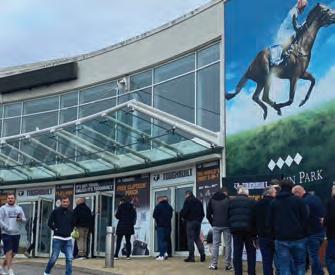
The invites have been flooding in; events are on the horizon, and I’ll be there to cover them all. From attending a posh luncheon with the Verification of Lubrication Specifications at the RAC Club in London and hosting duties at Schaeffler’s REPXPERT Conference at the British Motor Museum, to meeting industry colleagues at MECHANEX and UK Garage & Bodyshop Event, it promises to be a busy few months.
And if the calendar wasn’t already brimming, the next task will be carving out the time to properly take in what each event has to offer and share the important stuff with you.
These events aren’t just about shaking hands and collecting business cards; they’re a pulse check on our industry. It never stands still. The conversations over coffee, the live demos and thought leadership seminars and panels, the off-the-record insights from seasoned professionals – these are often where the value lies.
If you’re attending the REPXPERT Conference, MECHANEX or UK Garage & Bodyshop Event, please reach out – it’d be great to have a chat over a coffee and compare notes on what’s shaping the industry right now.
As I’ve mentioned, the aftermarket never stands still, and the ongoing conflict in Iran is continuing to have an impact. Rising oil prices and supply chain disruption are feeding through into our sector.
With crude prices reacting to instability around key transit routes, such as the Strait of Hormuz, energy markets have tightened. For the aftermarket, will it go beyond higher fuel costs? Will it also push up the price of raw materials and lead to supplier price increases?
Moving on, diving into the May issue, there is a developing story about Shaftec. The Birmingham-based company went into administration at the end of March, with the majority of the 90-person staff made redundant. Upon putting the article onto the PMF website and sharing it on LinkedIn, former members of staff and industry stakeholders reacted to it – a mix of anger, sadness and sympathy.
In April, however, it was announced that MJ Allen Automotive had acquired the Shaftec brand, its intellectual property and stock inventory. You can read the full story and statement on page eight, but to reiterate, this is a developing story and PMF is seeking further comment from MJ Allen Automotive about its plans.
Elsewhere in this edition, you can read the latest – and final – counter columns from Oldfields Garage’s Tim Benson and Car Spares Factors’ Sanjiv Shah (page 17). After a year in post, providing energetic, passionate and genuine insights into factor and workshop practices, both have put pen to paper on their final articles. Two new columnists are ready to step in, with their first columns appearing in the June edition. Tim and Sanjiv have been fantastic contributors, and I wish them well.
Enjoy the issue and have a great month.
Tom Henman Editor
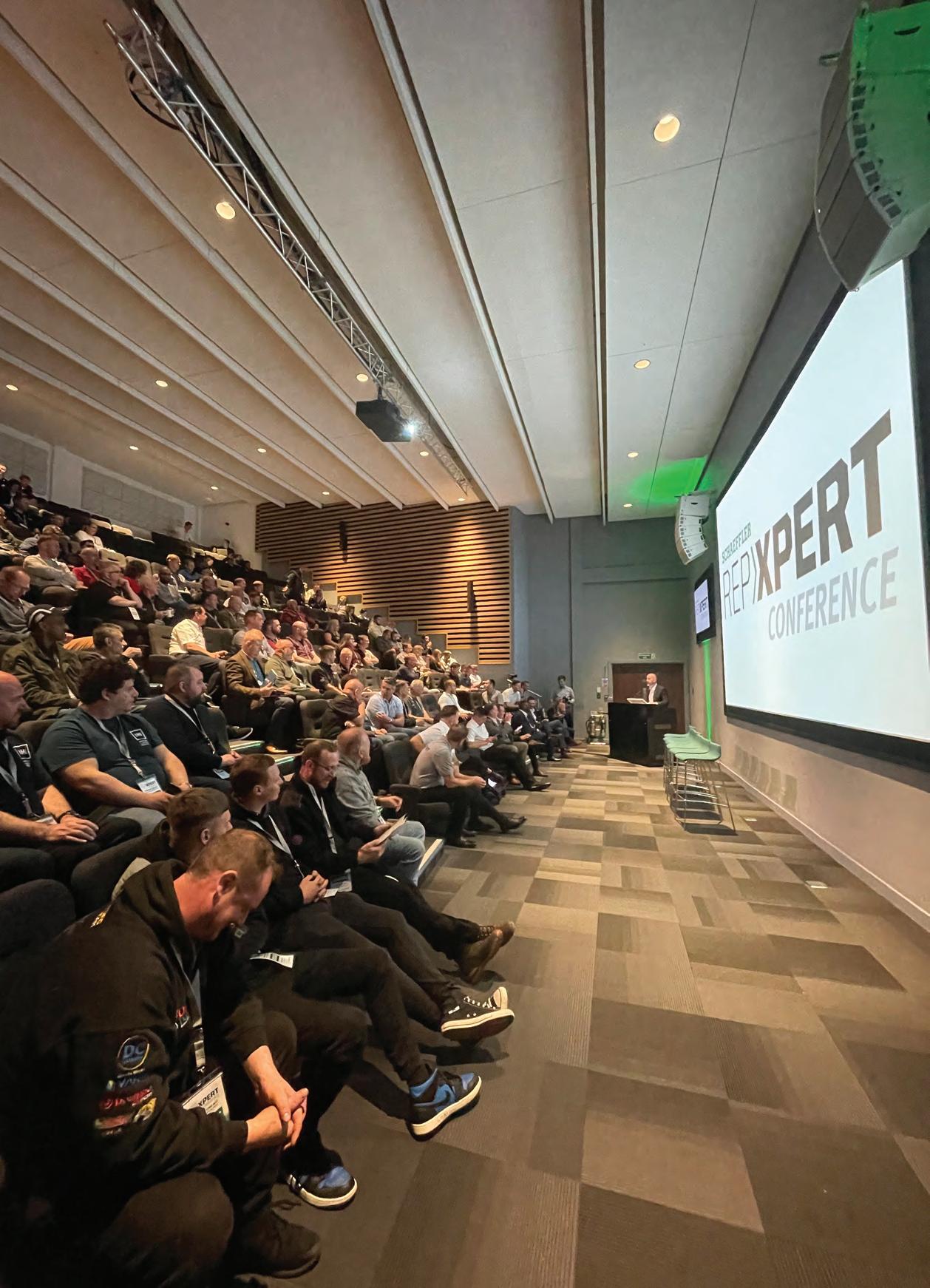
SCHAEFFLER’S REPXPERT CONFERENCE
2026 TAKES PLACE ON 14 MAY, AT THE BRITISH MOTOR MUSEUM
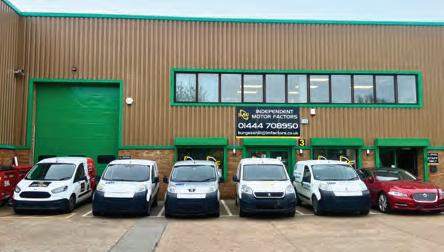
JAYAR CAR PARTS COMPLETES TAKEOVER OF INDEPENDENT MOTOR FACTORS
Jayar Car Parts has announced the total acquisition of Independent Motor Factors (IMF) – increasing its branch network to 70.
Having already held a share in IMF – a fellow IFA member – both parties have agreed to a complete takeover. Initially, IMF will continue as a subsidiary of Jayar, maintaining all existing staff, supplier relationships and day-to-day operations. Jayar will announce its long-term strategy for the IMF brand and its 22 branches in due course.
By acquiring IMF, Jayar – celebrating 50 years of serving the trade in 2026 – says it is “better positioned to accelerate its growth”, which includes expanding its branch network, increasing stockholding and strengthening product availability across a wider geographical footprint.
Jayar says its immediate priority, though, is to retain and support all IMF staff.
Jayar Car Parts General Manager, Tom Curtis, said: “e acquisition of IMF marks a significant milestone in Jayar’s proud 50-year history. It also highlights our ambition to grow as a business, strengthen our presence, and provide even greater support to our customers and suppliers.
“Retaining and investing in the talented teams at IMF is a priority, and we look forward to combining our expertise so we can continue to deliver the quality service our customers are accustomed to.”
IMF Managing Director, John Austin, added: “We are excited to join the Jayar family
and look forward to the opportunities this brings. It’s business as usual for our customers, as we continue to deliver outstanding service to both existing and new customers.
“Together with Jayar, we will continue to train and develop our staff to ensure everyone is aligned and build on our success across the trade.”
LKQ UK AND IRELAND BACKS ACTRONICS CAPABILITY AFTER LKQ EUROPE ACQUISITION
LKQ UK and Ireland is confident LKQ Europe’s acquisition of ACtronics, a specialist in repairing and remanufacturing electronic components, will expand access to cost-effective repair solutions for customers.
ACtronics assists workshops to fix complex faults – without needing to replace parts – and LKQ Europe, through its network, believes these services give its customers a practical option when dealing with increasingly complex vehicle electronics.
ACtronics repairs a wide range of components, including ABS/ESP units, instrument clusters and displays, TCUs, ECUs and BCUs, as well as specialist components for EVs – parts that are oen only available new from the manufacturer.
LKQ UK and Ireland CEO, Kevan Wooden, said: “As vehicles become more complex and the cost of replacing electronic components continues to rise, remanufacturing and repair are becoming an increasingly important part of the solution.
“Expanding access to specialist electronic repairs gives workshops more flexibility in how they approach a job – whether that’s fitting a new part or repairing an existing one – helping them balance cost, availability and customer needs.”
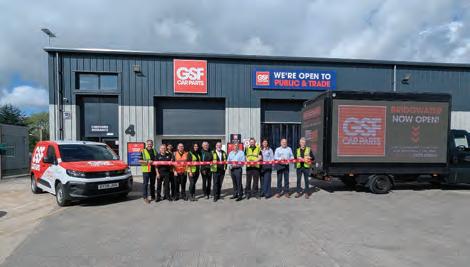
GSF CAR PARTS OPENS BRANCH IN BRIDGWATER
GSF Car Parts has announced further expansion of its national network with the opening of a branch in Bridgwater.
e new branch – operated by 10 employees – occupies a unit at Bridgwater Trade Park, Bristol Road, Bridgwater, offering stockholding and access to GSF’s product range.
e unit is led by Branch Manager, Wayne Mitchell, who previously held the same role at GSF Exeter.
Wayne said: “I’ve been at GSF for around 15 months and have loved getting to see the
business grow. e potential is massive, and the team here goes above and beyond to go aer the sale, make sure the customer is happy, and, ultimately, be the easiest to trade with. Our expansion in the area is an opportunity to disrupt and scale the service we provide to local garages every day.”
NEWS
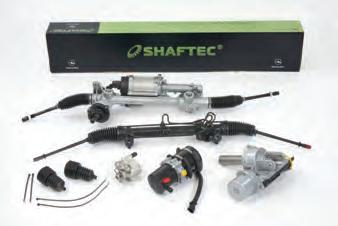
MJ ALLEN AUTOMOTIVE ACQUIRES SHAFTEC BRAND
MJ Allen Automotive has acquired the Shaftec brand, its intellectual property and stock inventory. This comes after the majority of the remanufacturer’s 90person workforce was made redundant and the company put into administration in March.
“Increasing financial pressure” linked to “challenging trading conditions” was cited, and despite an “extensive marketing process”, a buyer for the Birmingham-based business could not be secured. Consequently, administrators were called in.
However, a statement released by MJ Allen Automotive on Monday 13 April, said: “e acquisition strengthens our steering, braking and drivetrain offering and expands our all-around-the-wheel portfolio,
alongside our wider range including clutch and engine management.
“Shaec adds a well-known name, technical know-how and a comprehensive product range, including a market-leading caliper programme. Customers will continue to benefit from Shaec’s steering racks and pumps, known for precision and reliability, alongside calipers, CV joints, driveshas and boot kits.
“e addition of Shaec’s steering, braking and drivetrain components complements MJ Allen Automotive’s existing range, including pads, calipers, discs, drums, fitting kits, shoes and wheel bearings within our around-the-wheel product portfolio. is comprehensive integration allows us to deliver a complete suite of solutions that
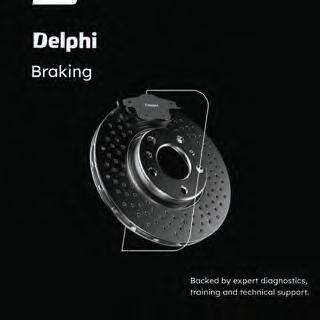
DELPHI ENCOURAGES AFTERMARKET TO PREPARE FOR SPIKE IN BRAKING DEMAND
Delphi has urged the trade to prepare for increased demand in braking components as the sector enters the spring MOT period, following a winter that has likely taken a toll on vehicles.
Months of cold temperatures, standing water and repeated freeze-thaw cycles have le some roads heavily damaged, with potholes and uneven surfaces causing issues. Delphi says this has created additional strain on key vehicle systems, particularly brakes, as repeated impacts accelerate wear and exacerbate underlying issues such as corrosion.
While improved weather conditions typically arrive in spring, the effects of winter driving remain evident in vehicles arriving for maintenance and inspection. According to Delphi, this presents an opportunity to support workshop customers with the right product availability and technical guidance.
e timing is particularly significant; industry data from GiPA indicated that more than 3.3 million MOTs were due to expire in March 2026 – an 8.1% increase compared with the same period last year. is seasonal spike is expected to drive
PACT AND MOTUL COLLABORATE TO ‘ACCELERATE DIGITALISATION’
PACT and Motul have announced a new partnership in a bid to bolster digitalisation in the industry.
Motul has implemented electronic trading, via PACT, to streamline order processing, improve accuracy and deliver an efficient digital trading experience for customers throughout the UK and Ireland.
Motul UK and Ireland Sales Manager PCMO, Mike Hansford, said: “Before joining PACT, one of our key challenges was ensuring a more efficient and standardised way of receiving
and processing customer orders. As our customer base and product range continued to grow, we needed a solution that could reduce manual handling, improve order accuracy and better align with how our customers increasingly prefer to trade digitally.”
Motul’s decision to partner with PACT was driven by TecCom’s reputation across the sector, with many of Motul’s customers already using the platform.
Mike added: “e decision to implement PACT was driven by the opportunity to
support every aspect of vehicle performance and safety.”
PMF approached both MJ Allen Automotive and FRP Advisory, the appointed administrator, for further comment; MJ Allen said it would not be providing additional detail at this stage, while FRP had not responded at the time of publication.
strong demand for safety-critical components, with braking systems among the most frequently replaced items.
integrate seamlessly into existing customer workflows as a lot of our customers were already using the platform, so it was easy to implement rather than asking them to adapt to new, bespoke or manual processes. PACT’s local market expertise in the UK and Ireland was also a key factor that helped us make the decision.”
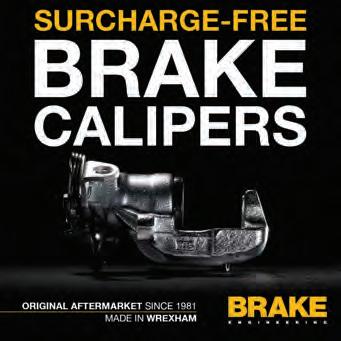
BRAKE ENGINEERING MAKES TOP 110 CALIPERS SURCHARGE-FREE
Brake Engineering has revealed a “major reduction” in surcharge costs across its bestselling range of brake calipers.
Brake Engineering’s top 110 brake calipers are now completely surcharge-free, while the next 90 bestselling calipers carry a maximum surcharge of just £5. e company says the move represents a significant shi in the traditional remanufacturing model, where surcharges have typically been applied as a refundable deposit linked to the return of old units.
By removing surcharges entirely on its highest-volume lines and reducing them across a further 90 products, Brake Engineering believes it is streamlining the buying process and responding to growing demand from workshops.
ZF Aftermarket Head of Passenger Car Sales, Cyril Daly, said: “This is a major step forward in making remanufactured calipers easier to buy and easier to work with. We know that surcharges can sometimes be seen as an extra layer of complexity, so by removing them across our most popular products, we’re helping garages save time and reduce admin, while still benefiting from a high-quality, OEstandard solution.”
Traditionally, surcharges have played a role in ensuring used calipers are returned for remanufacturing; however, Brake Engineering claimed that the process can be seen as “cumbersome” in a fast-paced workshop environment, particularly when
compared to alternative products that do not carry a surcharge at the point of purchase.
Brake Engineering is confident the move to reduce and remove surcharges across its most popular products marks an important step in “modernising” the remanufacturing model.
SELECT AUTOMOTIVE JOINS IAAF
e IAAF has welcomed Select Automotive as its latest member, a decision that reflects the part provider’s ambition to “align with like-minded organisations that are actively working to support and improve the industry through shared knowledge, partnership and representation”.
Based in the UK, Select Automotive’s product range covers more than 3,000 references, including window regulators, door lock actuators, suspension components and blower fan motors.
Select Automotive Director, Jon Caunce, said: “Joining the IAAF was a natural
decision for us. We are keen to be associated with an automotive trade organisation that not only represents its members but also plays an active role in improving the sector through education and collaboration with others who share the same vision.”
By becoming a member, IAAF says Select Automotive will benefit from access to industry insights, technical guidance and networking opportunities.
IAAF Chief Executive, Mark Field, added: “We’re delighted to welcome Select Automotive to the IAAF. As a growing parts provider with a strong product offering, they bring valuable
perspective to our membership. It’s great to see businesses that recognise the importance of collaboration and shared learning in driving the aermarket forward.”
PMF introduces this month’s movers and shakers as they begin a new stage of their career in the UK aftermarket.
Movers & Shakers
BANNER
Banner has appointed Gemma Hall as its finance manager, following the announcement that Lisa Jackson is to retire from her position of accounts manager after seven years with the company.
Reporting to Banner Country Manager, Lee Quinney, Gemma has joined Banner after holding a position of commercial accountant over the last 21 years.
Gemma will oversee and manage all day-to-day accounting processes, whilst taking ownership of statutory accounts, managing local and group reporting systems, and assisting with all relevant and required external and internal audits.
Commenting on Gemma’s appointment, Lee said: “The whole team at Banner is delighted to welcome Gemma into the fold. She has a proven track record in the arena of commercial accounting, and we are confident she will prove instrumental in supporting Banner’s ongoing development here in the UK. She joins a hard-working team, all of whom are dedicated to delivering continued growth and success.
“I would also like to extend my personal thanks, and that of the entire Banner GB Team, to Lisa Jackson, who is set to retire this summer. Lisa has helped drive forward the efficiency of Banner’s finance operation over the last seven years, and she will be sadly missed by us all. Together with the rest of the team, I hope Lisa enjoys a long, happy and healthy retirement.”
SCHAEFFLER
Waldemar Bach has joined Schaeffler as territory manager for Wales and the South West, bringing 25 years of automotive aftermarket knowledge to the role and company.
In his new role, Waldemar will focus on supporting customers across the region and strengthening Schaeffler’s presence in the market.
Waldemar said: “I’m excited to join a professional company, like Schaeffler, known for its quality products and outstanding support. Throughout my career, I have always prioritised delivering comprehensive value rather than competing on price alone. I look forward to working closely with my customers and supporting them at the level they deserve.”
Outside of work, Waldemar enjoys an active lifestyle, including gym training, skiing, martial arts and spending quality time with his family.
Schaeffler Sales and Marketing Director, Matt Selby, added: “Waldemar brings a wealth of experience to Schaeffler and will be a great asset to the Schaeffler team.”
KUMHO TYRE
Luke Emery has returned to Kumho Tyre to take on the role of area sales manager, covering South East England.
Luke rejoins Kumho with more than 22 years of experience in the tyre industry, having built a career across both passenger car and motorsport sectors.
Kumho Tyre Managing Director, Richard Lyons, said: “We are delighted to welcome Luke to the Kumho team, adding to the enrichment of our team that we have seen over the past few months.
“The UK market has shown excellent acceptance of our latest products, and Luke’s appointment reflects our commitment to building a talented, future-focused team that can support our customers and continue driving the growth of the Kumho brand across the UK."
Commenting on his new role, Luke said: “Having worked at Kumho in the past, I’m delighted to return at such an exciting time for the brand. Kumho has built a strong reputation for delivering highquality tyres that offer excellent value and performance, and the market response to the new products has been extremely positive.”
To connect with Waldemar on LinkedIn, www.rdr.link/FBB002
FACTOR SALES AIMING HIGH WITH LAUNCH OF NEW ERA
Factor Sales has been a fixture in the trade for 15 years, but under new leadership and ownership, the company says it’s entering a new era. PMF sat down with Commercial Director, Sebastian de Pedro, to find out what’s changed, what the data is showing and what comes next.
Sebastian, thank you for joining PMF at a time when Factor Sales is embarking on a new chapter – what prompted this change in strategy?
Factor Sales has been around for 15 years, and we’re one of the only companies in the aftermarket doing what we do, tracking real transaction data between motor factors and garages. There’s a huge gap in this market when it comes to data. There isn’t one body that bridges the gap between guesswork and genuinely understanding what’s happening at the point of sale.
I was brought in about eight months ago to look at the foundations and scale the business. When I started digging into what Factor Sales has and what the opportunity looks like, it became clear very quickly that we were sitting on something valuable that the market needs. The opportunity in front of us is enormous, and it was important that we took a step back, got the foundations right and set ourselves up to really grow.
A Q A Q A Q
Can you share the key points of this fresh start – arguably a new era for Factor Sales?
We’ve rebuilt the platform from the ground up. New website, completely redesigned interface, much cleaner and less clunky than it’s been in the past. We’ve spent the last few months working closely with our clients to understand their frustrations and pain points, and we’ve built the new platform around what they actually need.
When Factor Sales was acquired by Pearson Ham Group – a pricing consultancy – two years ago, there was an initial push towards pricing, but transparently, we lost touch with the core value of what Factor Sales is. This fresh start is about getting back to that, showing the market the real value of what we can offer, educating the industry on what’s possible with real transaction data, and making the platform accessible to a wider range of businesses than before.
What tangible differences will this make to participating factors’ dayto-day activities?
The biggest difference is clarity; motor factors already have access to their own sales data. They can see
what they’re selling and at what price, but they don’t have context – how does the rest of the market compare? Are they up or down against the national average in certain categories? Which products are trending? Are they selling above or below the market price?
With the new platform, factors get access to cleaner dashboards and reports that let them compare their performance against the wider market. They can deep dive into specific categories, whether that’s
braking, lubricants, electrical – whatever matters to them – and see which parts are trending, which are selling for higher or lower prices than the market average, and whether they’re performing above or below the rest of the network.
It provides factors with visibility – acting on evidence, rather than instinct.
How will the changes make a difference to factors’ profitability or ability to seize previously missed opportunities?
It’s traditionally been difficult to see what the rest of the market is doing. If a factor is selling a product for more than the market average and margins are healthy, that tells them the prices are elastic – but if they’re selling below the market and margins are tight, is that factor too cheap or is there demand at a higher price point?
Without that market context, they’re guessing. With it, they can make informed decisions about pricing, stocking and where to focus their energy.
The other thing is time; most factors don’t have the resource to analyse vast amounts of data – our dashboards simplify that. They let factors target their relevant categories, compare against the market, and make better decisions without needing a data team to do it.
What kind of data or insights does Factor Sales provide that factors can’t easily access themselves?
What’s selling across the aftermarket, at what price, in what volume, based on real transactions, not estimates or surveys.
It gives factors visibility into how they compete against their peers, how they’re performing relative to the wider market, what’s really selling in each category, and whether their stocking and pricing decisions are in line with what the market is doing.
And the key point is that this is built on real transaction data from across our motor factor network, currently covering around 60% of the UK market.
What is Factor Sales’ data telling you right now about the challenges of the sector?
The UK aftermarket contracted 4.3% in value and 3.2% in units across 2025 – but the headline numbers don’t tell the full story. The category-level detail is where it gets interesting.
A Q A Q A Q A
body and exhaust (down 7.7%) and brakes (down 7%). These are significant declines. At the other end, cooling and heating was marginally positive, service parts were effectively flat, and suspension and steering was only down 1%.
We also see some fascinating microtrends in the data – the ‘battery blip’, for example. Every December and January, we see a clear spike in battery sales because people leave their cars sitting over Christmas, the cold weather kills the battery and they need a replacement. Potholes are another one; we’re seeing the impact in suspension and steering components.
Can you share more about 2025?
The big theme across 2025 was the divergence between value and unit performance. In several categories, units held up better than value, which points to ongoing pricing pressure and a shift in purchasing behaviour.
Garages are still doing the work, still fitting the parts – but they’re buying differently. There’s a noticeable trend towards lower price points in some categories.
A Q A Q Q
What does success look like for Factor Sales over the next couple of years?
In the short term, success looks like establishing Factor Sales as the UK’s leader in automotive aftermarket insights. We’re working with suppliers and factors alike to strengthen our reputation and demonstrate the value of what real data can do for this industry.
Once we’ve consolidated the UK –completed our network coverage, standardised the product and built a solid foundation – the next step is Europe. Many of our clients operate across Germany, France, Italy and Spain, and they are asking us for the same visibility in those markets.
But we’re doing this properly; foundations first, then scale. The UK has to be bulletproof before we go anywhere else.
What experience do you bring?
The categories under the most pressure were transmission (down 9.2% in value),
The first half of 2025 set a weaker tone (value down 4.2% and units down 3.5%). The second half didn’t deliver the recovery many in the industry were hoping for (value declined further, down 4.5%).
We anticipate that the ageing UK car parc and the volume of MOTs due will drive increased repair demand. We’ll be releasing our Q1 2026 report soon, and our half-year update will follow at the end of Q2 in June. These reports will be freely available.
I’m relatively new to the trade – and I’ll be honest about that! What I’ve learned quickly is that this is an industry built on relationships and trust. That resonates with me because that’s how I operate. Conversations I’ve had in this industry have reinforced that – people want to work with people they trust, and they want partners who deliver on what they promise – that's what I’m bringing to Factor Sales.
I am also bringing energy, focus, a willingness to get stuck in and a genuine belief that what we have here can make a real difference to how this industry makes decisions.
RING AUTOMOTIVE MD: THE MOTOR FACTOR SPACE IS CHANGING
Nick Davy was appointed as Ring Automotive’s managing director back in August last year. With his feet firmly under the desk, PMF took the opportunity to ask him how his first few months in the ‘hotseat’ have gone. He explains why the aftermarket is facing a “sink or swim” moment.
Hi Nick, thank you for talking to PMF – how would you assess your first few months as managing director?
It’s been a busy few months for Ring Automotive and at the start of any new job you always feel like you’ve been thrown in at the deep end as you respond to new priorities. In the last few months, I’ve been able to adapt to my new role quickly and enjoyed the challenges and opportunities we’ve had as a business.
Previously, you were operations director – did the promotion feel a natural succession?
A Q A A Q Q
We had a successful 2025, with many new products introduced, awards won and customer relationships strengthened, but there are always stresses to any job, and I’ve had to navigate my way through it. I’m happy to say that everything has worked out, and we as a company know where we need to improve and where we thrive.
I was managing a large proportion of the business, so it definitely felt like a natural step; however, when you actually take the reins it makes you realise just how many hats you need to wear. I made it my priority to plan how to run the business with the skills I have. We’re all different and everyone will tackle things with their own approach and style, so while it was the next step in my career, it was exciting but also grounding to then have the final say when it comes to how we run in the UK.
As managing director, you are the leader of the business – what is
your leadership style? How do you get the best out of people?
I enjoy working with a wide range of people and have worked in many industries over the years during which I have developed an open, approachable and personable leadership style. I think this is
one of my greatest strengths, and spending time with the team is what I enjoy the most. I believe in ‘one team’, and it’s our job to support and train every team member to ensure they are able to play their part in delivering the best service and quality product to our customers and making the business and enjoyable place to be.
Given you’re speaking to PMF, how would you describe Ring’s approach to building partnerships with motor factors?
We try to assist them every way we can. With motor factors in particular, we have found that they can be best supported by speaking to our sales team directly to discuss their needs. The sales team can then share feedback to the wider business to deliver the solution, whether that’s providing marketing materials, point of sale or working together to organise a promotion.
I’m very proud of our sales team and their ability to walk into any factor and have an open and productive discussion with anyone in the store. Their focus is not just about selling a product; it’s about being available and known to people so that we can provide the support motor factors need in what is a fast-paced industry.
From your experience, what do motor factors value most in a supplier like Ring? How do you ensure you meet those expectations consistently?
Communication – and not just when there’s something to sell! Our customers like the fact they can call us to ask for help or advice on how best to sell or stock a product. It’s not just about the
A Q A Q A A Q Q
sale for us; it’s about putting the customer first and building a relationship with motor factors, so that they can depend on us.
How does Ring decide which innovations or product lines to develop for motor factors?
We have an excellent product development team based in the UK that design and develop all our new lines. They spend a lot of time in discussions with motor factors, technicians and our sales team, which enables them to identify a gap in the market for a new product. This team is also constantly scanning other sectors and markets in other countries to understand future design trends and what could be the next big success in the UK.
We want to make sure the products we introduce to the market are of premium quality, so that involves a lot of product and market research and quality testing to ensure safety standards and longevity. We are proud of our quality labs based in the UK and around the world – testing and development is part of our DNA.
We understand there’s a cost of living
crisis; however, there’s something to be said for ‘buy cheap, buy twice’. It’s worth investing that little bit more to guarantee a quality, compliant product that is designed to last.
It is important we educate the end-user on the benefits of buying quality over the cheapest option. We need to find the delicate balance of premium quality but still affordable, and a lot of this responsibility does fall on the end user to request product from a trusted brand.
How do you see motor factors evolving over the next few years, and how is Ring positioning itself to adapt?
It’s interesting to think about the future of the aftermarket and how things are bound to change. There are many aspects we need to prepare for over the coming years, including the SERMI scheme and the manufacturing ban of petrol and diesel cars coming in the next few years – this is a pivotal point in the aftermarket where it’ll be sink or swim.
Not only are these things happening, but more independent factors have been bought or are disappearing, meaning the motor factor space is changing and will continue to do so over the coming decade.
We need to adapt to survive, and we’re proud to be continuously introducing innovative products to ensure motor factors can work in a flexible way to respond to the customers’ needs in the changing environment. It’s a balance of understanding how EVs will develop in the marketplace and how ICE vehicles will be maintained potentially with synthetic fuels. We are, therefore, developing our EV range of products but also ensuring the continued supply of components and workshop tools.
IGNITION POINT
WHAT’S THE DEFINITION OF SUCCESS?
TIM BENSON OLDFIELDS GARAGE OWNER
People sometimes assume motivation for a garage owner comes from big milestones, awards, turnover targets or the next expansion project. I’m not going to pretend that those things don’t have their place, but in truth, that is not what keeps me going day to day. What keeps me motivated is much simpler and much more important: it is the responsibility of building something worthwhile for our customers, our team and the wider industry.
Running a garage properly has never been easy, and it certainly is not getting easier. The vehicles are more complex, customer expectations are higher, costs continue to rise and finding and keeping good people is one of the biggest challenges any of us face. But that is also exactly why the role still matters. A good garage is not just fixing cars; it is keeping people mobile, protecting families, supporting local businesses and creating careers in an industry that still offers huge opportunity to those prepared to take it seriously.
For me, motivation comes from progress. Not perfection, because that is unrealistic, but progress. Seeing the team improve. Seeing systems work better. Seeing a customer trust us not because of a special offer, but because they know we care about doing the job properly. Seeing the business become stronger, more capable and more valuable year by year. That is what keeps the fire lit.
Success, in my view, is often misunderstood. It is not simply being busy; plenty of garages are busy while making life harder for themselves, their staff and their customers. Real success is building a business that is respected, profitable, organised and sustainable. It is having standards that mean something. It is investing in equipment, training and process – even when it would be easier not to. It is attracting good people and creating an environment where they want to stay and develop. It is being able to look at the business and know it is not dependent on luck.
At Oldfields Garage – and across the independent sector more broadly – success should mean delivering a level of professionalism that gives motorists genuine confidence and genuine choice. For me personally, success is knowing we are still improving, still relevant and still setting out to raise the bar. That is what keeps me motivated because once you stop wanting to get better, you start going backwards.
SANJIV SHAH CAR SPARES FACTORS OWNER
I’ve found myself reflecting on what has kept me motivated throughout my time as a motor factor and what success really looks like after all these years.
Car Spares Factors was established by my dad and uncles back in 1977, and next year, we’ll celebrate 50 years in business. That milestone means a great deal to me, not just as a business owner, but as someone who grew up around the trade. I witnessed the hard work, long hours and determination that built the company from the ground up. Back then, success meant survival – keeping the doors open, supporting customers and building a reputation people could trust.
Over the years, success has taken shape in many ways. One of the proudest achievements has been growing the business into a network of six busy branches across North London, Hertfordshire, Essex and Middlesex. Expansion is never easy, but seeing each branch develop while maintaining the same standards and culture we started with has been incredibly rewarding.
For me, though, success has never just been about growth or numbers – it’s about people. Many of our employees have been with us for decades and that kind of commitment and loyalty speaks volumes. We’ve always believed in creating a workplace where people feel respected and valued, where everyone understands they play a key role in the bigger picture. Watching team members develop over the years, and knowing they still feel proud to be part of the business, is one of the things that keeps me motivated every day.
Our customers are another major driving force. The motor trade runs on relationships, and we’re fortunate to serve customers who have supported us across generations. Some businesses that traded with my dad and uncle still work with us today. We’re also fortunate to work with trusted supplier partners who provide the car parts, tools and accessories that keep our customers moving. Their reliability, innovation and support play a vital role in helping us deliver the service our customers rely on.
The aftermarket itself is also a constant source of motivation. Advances in vehicle technology and the pace of change across the industry mean there’s always something new to learn. It keeps us on our toes and pushes us to keep improving.
As we look ahead to celebrating 50 years, I feel grateful to those who built the foundations, to the team who carry the business forward and to the customers and partners who continue to trust us. For me, success isn’t a destination; it’s about building something that lasts, staying true to your values and continuing to move forward together.
AUTOELECTRO AT 40: FROM DINING TABLE TO SUCCESS STORY
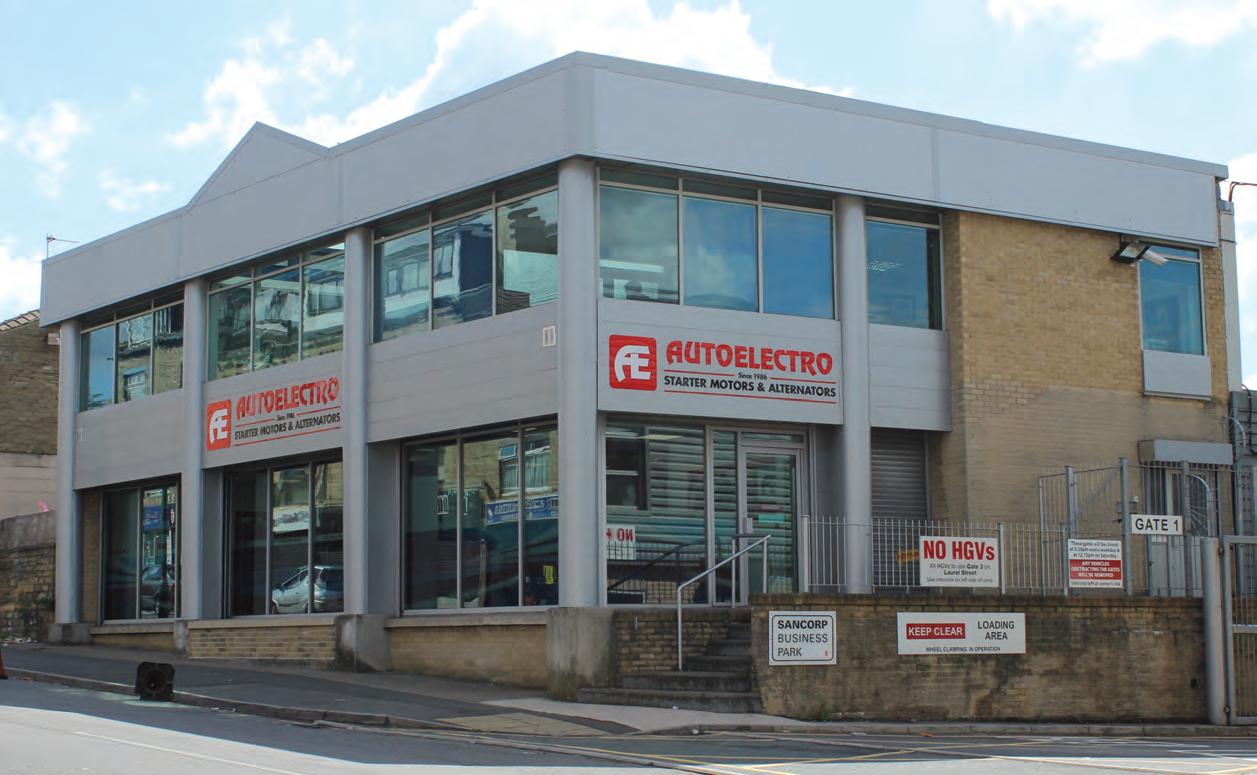
Throughout 2026, Autoelectro is celebrating 40 years of service. A family business that started on the dining table, the rotating electrics specialist is one of the UK’s established remanufacturers and a staple of the local community – PMF takes a trip to Bradford.
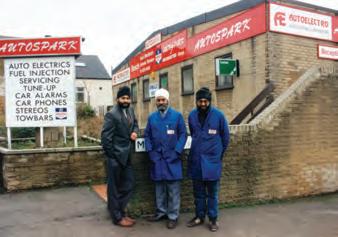
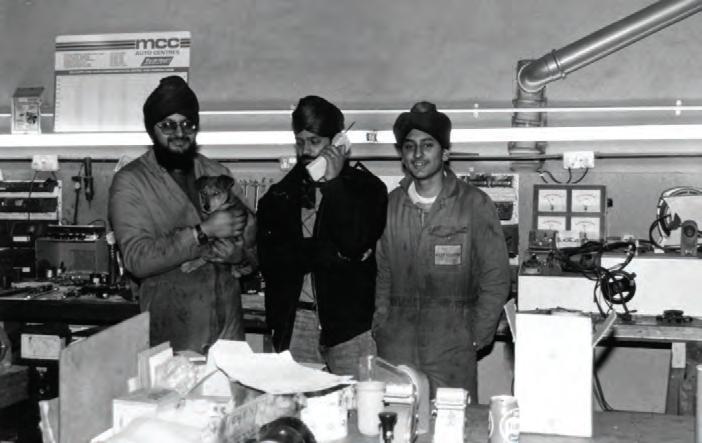
Founded by Santokh Singh Bhogal in 1986, he was a quality control engineer determined to build something on his own. Starting out by dismantling starter motors and alternators on the family dining table, Autoelectro quickly grew and moved into a workshop within months and expanded to 6,500sqft in just a couple of years, servicing customers locally around Bradford and West Yorkshire, and eventually across the UK.
BEHIND THE SCENES: THE BEGINNING OF A LONG ROAD
The early days were defined by grit, ingenuity and hands-on effort, as Paul Bhogal, one of Santokh’s three sons – all of whom would later join the business –recalled: “Everything was hands-on. Dad would take an alternator apart, we’d clean,
test and rebuild it, all in the same space where we ate dinner. There were no shortcuts, and every part had to be done properly. If something didn’t work, we’d figure it out, often learning as we went.”
Space and tools were limited, and everyone in the family pitched in. Paul continued: “It wasn’t just Dad working. Mum was there every step of the way –keeping us fed while Dad worked late into the night, helping with paperwork, and even packing orders when needed. My brothers and I all learned to chip in wherever we could – from sweeping floors to labelling parts. Everyone contributed.”
Roles weren’t formally assigned; they evolved naturally based on skills and interest. One person would test alternators, another handle customer calls, another manage stock – all learning multiple aspects of the business along the way.
“The early years taught us resilience,” said Paul. “We learned the value of quality, attention to detail and teamwork. Those lessons shaped the culture that still defines Autoelectro today.”
WELCOME HOME!
Today, Autoelectro remains in Nirmalec House – its home since 1991. It is where every starter motor and alternator is remanufactured and distributed to customers across the UK. It is where old cores are inspected, tested, stripped and then remanufactured.
Paul reflected: “The hard work was done at the beginning. From home to the garage, to a small unit and then a larger purpose-built premises – within a few years, it had grown into a professional operation. That foundation is what everything else has been built on.”
(L-R) Tony, Santokh and Nicky Bhogal – outside Nirmalec House (1991)
A FAMILY BUSINESS AT THE CORE
Not by design but by choice, Autoelectro has always been a family-run business. As the company grew, family members gravitated into roles aligned with their strengths – production, technical expertise, sales, finance and marketing – creating the optimum environment.
Paul explained: “There was never a formal structure in the early days –everyone just found their place! It evolved naturally, and that’s probably why it’s worked so well over the years.”
Today, the business spans multiple generations – Harnek Bhogal is the third, bringing his own attributes, personality and experience. Paul added: “It’s not about changing everything for the sake of it. Each generation has taken what’s there and improved it. That continuity is vital.”
POWER OF SPECIALISATION
Rather than diversify across multiple product lines, the business focused on two technically demanding and evolving areas instead.
Paul said: “We made a conscious decision early on to specialise. You can spread yourself across many product groups and potentially struggle or focus on two and be successful. We chose the latter, concentrating on what we knew best.”
That decision proved to be the right one; Autoelectro’s staff – many of whom possess decades of know-how – have deep levels of technical expertise, giving the company a competitive edge and ability to control quality and performance.
ADJUSTING TO MARKET SHIFTS
From a decline is some competing remanufacturers and a rise of imports to increasing vehicle complexity – and that’s before the impact of recessions, pandemics and cost of living crises are considered – Autoelectro acknowledges the automotive aftermarket has undergone significant change.
Consequently, the company had a choice to make – stick to its model as a remanufacturer or switch paths to become an importer – but the decision proved to be a simple one, as Paul explained:
Admittedly, that decision came with consequences – including stepping away from OEM subcontracting work when it no longer aligned with Autoelectro’s business model: “Sometimes you have to walk away from things,” Paul said, “even if they look good on the surface. If it’s not right in the long-term, it’s better to step away before it’s too late.”
Curiously, OE work has returned to Autoelectro in recent years.
STRENGTH OF ITS TEAM
A consistent theme throughout Autoelectro’s history is its trust in people and creating a tight-knit culture. Paul recognised the staff that have played a role in “maintaining standards and continuity”:
“We’ve got people here who have been with us for decades. It’s about creating the right environment and treating people properly. That environment is built on respect, inclusion and letting people find roles that match their strengths.
“Staff are encouraged to contribute where they excel, while our stability and multi-generational continuity gives employees a sense of belonging. Loyalty and long service are recognised and valued, reflecting a culture where people, as much as products, are at the heart of our success.”
LOOKING TO THE FUTURE
With the growth of smart charging systems and 48V MHEV technology, Autoelectro believes the role of technical expertise is becoming increasingly important.
Paul said: “The technology is changing, but that actually plays to our strengths. The more complex things become, the more important it is to understand the product and be able to test it properly. We’ve heavily invested in equipment to ensure we’re able to cater to new demands but also cover an increasingly older car parc.”
“When imports started emerging, the market changed almost overnight. It became incredibly price focused. At that point, we had to decide whether to follow that trend or stick to what we knew. It was an easy choice in the end, reinforcing our position as a specialist.”
While electrification is set to continue making its mark on the aftermarket, Autoelectro remains confident in its longterm relevance – apt given 2026 marks 40 years of service to the trade.
Paul concluded: “We’re proud of what we’ve achieved, but the focus has always been on what comes next. The business has never stood still and that won’t change. After 40 years, we’re committed to quality, people and expertise – ensuring we remain a trusted partner for decades to come.”
(L-R) Nicky, Tony and Paul Bhogal (1989)
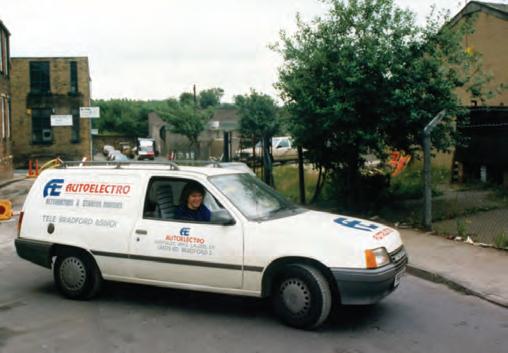
Autoelectro van (1988)
Schaeffler has introduced a new AI-assisted online enquiry tool, designed to help professionals in the trade quickly identify the correct replacement parts they need. PMF catches up with Schaeffler Technical Hotline expert, Simon Perring.
SCHAEFFLER INTRODUCES AI-ASSISTED PARTFINDER SYSTEM
Available through a link on the Schaeffler online catalogue page, or by heading direct to www.rdr.link/FBB007, PartFinder allows users to submit part identification enquiries directly online. Once submitted, users receive a unique ticket reference number and email confirmation, ensuring every enquiry is tracked.
Schaeffler reported the tool has been introduced to support the “growing number of technical and product number enquiry
calls” made to the REPXPERT hotline by both workshops and motor factors.
While the technical hotline remains fully available, Schaeffler believes the new online system offers several advantages, particularly for workshops:
Free and faster enquiry submission
Clear tracking through a ticket reference number
Email confirmation for records
How does PartFinder fit into a motor factor’s day-to-day workflow, particularly when handling high volumes of part identification enquiries?
A Q A Q
As vehicles and systems become ever more complex, with a much wider selection of engine and transmission options, the number of enquiries we receive asking for help in identifying the correct components continues to grow.
The whole concept behind the creation of Schaeffler’s AI PartFinder system is to free up the time spent by both installers and parts distributors in trying to get assistance identifying these correct parts.
The PartFinder system will help installers and parts distribution staff get some of this time back, so they can handle all the other aspects of the business.
Easier to follow-up previous requests
Reduced waiting times during busy periods
Schaeffler added that PartFinder is especially useful for workshops needing quick clarification on vehicle applications, part references or product identification, and by submitting enquiries online, users can provide detailed vehicle information to help the Schaeffler technical team respond more efficiently.
What kind of response times can users expect compared to the REPXPERT hotline, and how will this improve service levels to trade customers?
Schaeffler’s technical hotline currently receives up to 300 calls per day, with a limited number of technical staff available to answer them.
With the number of basic catalogue enquires growing, the team is unable to concentrate on assisting with technical enquiries, which means that the queue of callers requiring genuine technical support will continue to grow, even if the overall number of calls remains the same.
The PartFinder system requires the user to add vehicle details, such as VRN, and tick some basic drop-down boxes, like manual or semi-automatic transmission and with or without start stop.
They then select the components they require – RepSet DMF or RepSet Pro, for instance – and then press send. They can then carry on dealing with their day-to-day business, returning to check their e-mail inbox later to see the result of their enquiry, with no hanging around waiting on the phone.
Since its soft launch in mid-January, PartFinder has already handled over 3,000 cases, with an average response time of 7.5 minutes. Once it reaches full capacity, it will operate 24/7, with a target response time of approximately four minutes and resolutions delivered by email.
Can PartFinder support cross-referencing between OE and aftermarket part numbers to help reduce ordering errors and returns?
APartFinder is capable of providing accurate crossreferences from OE numbers; however, we find that OE number crossover in some motor factor systems can sometimes highlight just elements of a kit, but they do not consider certain important qualifiers, such as accurate build dates, transmission variants or component mix etc. Schaeffler always advises using the VRN as the primary search option in PartFinder, with VIN number as a secondary qualifier which can ensure a more accurate identification of the parts required for each specific vehicle.
How does this launch reflect Schaeffler’s wider investment in AI, and what future developments can the trade, not just motor factors, expect from this technology?
Q A Q
Schaeffler has implemented various AI systems for internal operations for some time and invested in teams dedicated to ensuring that AI development is targeted so each application delivers a direct and positive result in operational or manufacturing procedures.
Schaeffler’s PartFinder is the first AI-based system that had been specifically created for external use, by an international development team assembled to work on this specific project. Since its inception in January 2024, a team of IT/software/holistic/programme developers and vehicle technical specialists has adapted and improved the PartFinder experience to ensure it delivers the best possible performance and accuracy in the most userfriendly way.
Future additional functions planned for the system will add full connectivity to not just our catalogue systems, but also to additional valuable information relating to the requested parts, the latest service information, technical bulletins, workshop manuals and training videos.
So, the current version of PartFinder is only laying the foundations for a more advanced system that will provide a wealth of value-added benefits to the entire motor trade as it evolves.
For more information about Schaeffler, www.rdr.link/FBB008
Valeo Service has launched its new omnichannel Help Centre, designed to help both distributors and workshops navigate the complexity of modern vehicle repairs. To learn more, PMF puts some questions to Valeo Division General Manager, Andy Swann.
VALEO LAUNCHES NEW SUPPORT HUB TO HELP PART IDENTIFICATION AND FITTING
With over 17 million part references worldwide, Valeo believes finding the right component and fitting it correctly has become a daily challenge –
and its new service goes “beyond the traditional hotline”, giving professionals instant access to experts via live chat, email and phone.
Can the Help Centre suggest compatible alternatives if the exact part isn’t in stock?
Absolutely. Our omnichannel team can guide factors through product queries via live chat, messenger, or phone to identify the right solution quickly. We also back this up with the Valeo Tech Assist portal, which features an intuitive search engine covering over 45,000 references to help locate exactly what they need.
Can the service help confirm whether a part will fit before motor factors sell it – reducing returns or mistakes?
That is exactly what it’s designed to do. We want the Help Centre to act as a safety net at the parts counter for our distributors. By providing clear, immediate answers to questions like “does it fit this car?”, we actively help reduce ordering errors and returns before the component ever leaves the building.
How quickly can motor factors get support if they run into a tricky parts query during a busy day?
Valeo’s Help Centre acts as a safety net at the parts counter, helping with catalogue searches and product queries to provide the exact part match for the vehicle type.
Definitely. If a garage asks a factor “how should it be fitted?”, our team is on hand to provide practical guidance. For more complex application requirements or specific fitment issues, our dedicated UK technical hotline is ready to step in and provide fast professional answers. Plus, our digital library is packed with service bulletins and detailed assembly instructions to help troubleshoot common problems. HELP CENTRE Q&A WITH ANDY SWANN A Q A Q A Q A Q A Q
Technical hotlines can often be frustrating, especially when you’re on a tight schedule. We’ve moved beyond the traditional model to give professionals instant access to our automotive experts. It delivers support you can count on when you need it and without the usual headaches.
Are there tools or resources in the Help Centre that will help motor factors train staff or improve their product knowledge?
Yes, engaging with the new service provides seamless access to the Valeo Tech Academy. Additionally, motor factors and their garage customers can use Valeo Tech Assist. It’s a completely free platform that includes an e-training hub offering weekly live and ondemand webinars, empowering mechanics and distributor staff with comprehensive training programmes.
Will the Help Centre provide advice on common fitment issues or troubleshooting questions that customers often ask?
For more information about Valeo, www.rdr.link/FBB009
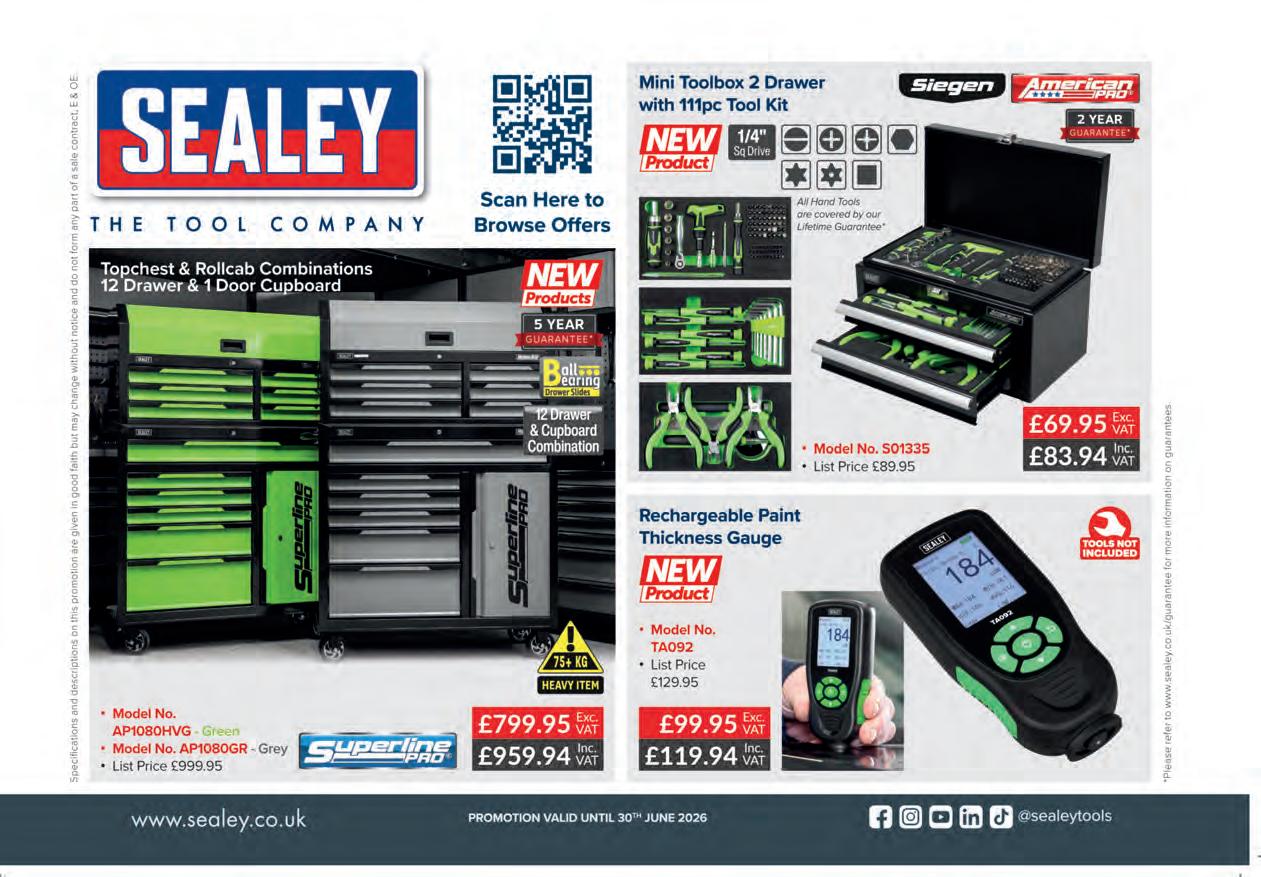
SEALEY REVEALS LATEST TOOL PROMOTION
Sealey has unveiled its spring tool promotion, bringing a wave of new products and seasonal offers to the trade. Running from 1 April through to 30 June, the campaign combines targeted discounts with more than 200 new product launches.
Akey focus of the promotion is seasonal readiness, with a strong emphasis on pressure washers, hose reels and garden equipment –categories that typically see increased demand during warmer months; however, the promotion extends beyond seasonal lines, reinforcing the brand’s position across a wide range of professional applications.
WHAT’S INCLUDED IN THE TOOL PROMOTION?
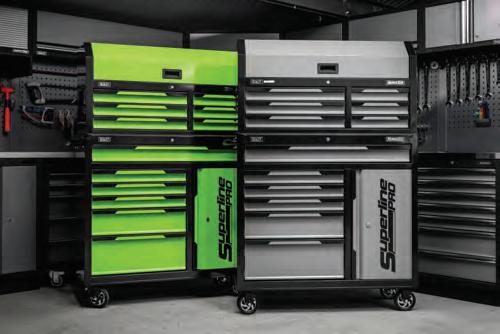
Among the additions are new heavy-duty workshop tool cabinets, available in both green and grey finishes. Designed for high-use environments, the units pair a top chest with a mobile roll cab, offering 12 drawers alongside a cupboard for larger items. Build quality, secure locking systems and smooth drawer operation are central to the design, with the range backed by a five-year guarantee.
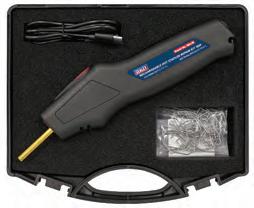
Sealey has also introduced a rechargeable hot stapler repair kit. The cordless unit, capable of reaching temperatures up to 500°C, is intended to streamline plastic repair work. Sealey says features, such as an integrated LED light and USB charging, reflect a desire for portability and convenience in workshop tooling, particularly for technicians working across multiple bays or in mobile roles.
To support engagement with the promotion, Sealey is also running a prize draw featuring a cordless garden tool kit valued at over £690. The bundle is based on Sealey’s 20V one-battery platform and includes a selection of tools and personal protective equipment. GIVEAWAY!
For more information about Sealey, www.rdr.link/FBB010
WINDSCREEN REPAIR OR REPLACEMENT? ESPRIT
MAKES A BUSINESS CASE
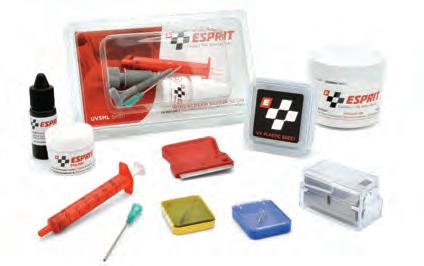
ADAS, in particular, has “changed the game”; Esprit’s Victoria Evans tells PMF how savvy technicians can adapt to boost their profits while providing a better service – and how you can benefit too: “Back in the 1980s, when Esprit began offering screen repairs, it was a simple job. By the 1990s, British Standards dictated where and how repairs could be made, based on size and location. But in 2022, those standards were updated again, this time with ADAS in mind.
“ADAS has made windscreen replacement far more complex and expensive. Recalibration takes time, requires specialist equipment, and adds to the customer’s bill. That’s why repair is becoming the go-to solution wherever possible.”
NOT EVERY CHIP CAN BE FIXED!
The rules surrounding windscreen repair and ADAS are clear:
● Avoid repairing in the hatched area around cameras or sensors
● Avoid the direct field of view if the damage is larger than 20mm
● Any other area? No problem – and ADAS won’t be affected
Victoria told PMF that there needn’t be any concerns about how a repair impacts safety systems: “ADAS is designed to handle slight distortions, like a raindrop or smudge. A quality repair using a tested kit won’t interfere with the system.”
Victoria added that Esprit’s kit is certified by TÜV Rheinland to the ECE R43 standard – the same standard as a brand-new screen.
REPAIR MEANS REVENUE
Once just a piece of laminated glass, with the rise of ADAS, head-up displays and augmented reality technology, today’s windscreens are much more sophisticated. As such, the approach to their repair and replacement has changed too – and Esprit believes this can form part of a sales strategy.
Windscreen replacements used to be the more profitable route, Victoria acknowledged, but not anymore! She reported that a typical screen repair costs only around £2-£3 in materials, yet a technician can charge £35-£40 for the job. The process itself takes roughly 20 minutes to complete, requires no recalibration or specialist tools. Once finished, the customer can simply be sent away quickly, with minimal downtime and a straightforward service experience.
That is an excellent profit margin for a job that can be undertaken while the car’s already on the ramp! Victoria said: “Once
“ADAS has made windscreen replacement far more complex and expensive. Recalibration takes time, requires specialist equipment, and adds to the customer’s bill. That’s why repair is becoming the goto solution wherever possible.”
garages realise they don’t need to remove or recalibrate anything, and the customer gets a cheaper, faster fix, it’s a no-brainer.”
A SUSTAINABLE SELL
Victoria believes the “rising interest in sustainability” means end-users are more open to repair options – after-all, a repaired windscreen keeps waste out of landfills and lowers the overall carbon footprint of the job. What’s more, early repairs prevent full replacements, which saves that customer time and money, likely keeping them loyal to your workshop or garage customer.
Victoria concluded: “If you’re not already offering windscreen repair kits to your customers, you’re missing a quick, profitable and customer-friendly opportunity. Screen repair is cost-effective, quick, low-risk, compatible with modern technology and good for both the bottom line and planet.”
For more information about Esprit, www.rdr.link/FBB011
MANN-FILTER ON FILTRATION EVOLUTION: AFTERMARKET LIKELY TO SEE GRADUAL REBALANCING
While battery electric vehicles (BEVs) remove the need for traditional engine oil and fuel filters, they do not remove the need for filtration altogether. Instead, they are shifting into new areas, creating fresh opportunities for workshops, motor factors and suppliers alike that are ready to adapt quickly, as MANN-HUMMEL
Product and Marketing Manager – Aftermarket, Gary Winslow, explains:
One of the clearest trends is the growing importance of cabin air filtration. EV drivers are often aware of comfort, in-car air quality and refinement. In a vehicle where powertrain noise is reduced, the overall cabin experience becomes more noticeable, and so does the performance of the heating, ventilation and air conditioning system. A quality cabin air filter helps protect occupants from dust, pollen and fine airborne particles, while supporting consistent airflow and effective climate control all year round.
This matters in the UK, where many vehicles operate in congested urban environments and where customer expectations around comfort and wellbeing continue to rise. For the independent aftermarket, cabin air filtration is no longer just a seasonal or secondary service item – it is becoming a more visible part of the value that workshops can offer, particularly as they look to retain EV drivers who may otherwise believe their vehicles require less routine maintenance.
PAY CLOSE ATTENTION TO THERMAL MANAGEMENT AND NON-EXHAUST EMISSIONS
BEVs depend on tightly controlled cooling systems to support battery efficiency, durability and charging performance. As EVs age and mileages increase, the aftermarket is likely to see greater focus on components and service practices that help maintain system cleanliness and long-term reliability. That may not yet resemble the familiar service pattern of ICE vehicles, but it clearly points to a more specialised future.
Regenerative braking can reduce brake wear, but EVs are often heavier vehicles, which means tyres, particulates and overall vehicle efficiency are becoming important topics. As attention shifts beyond the tailpipe, filtration and separation technologies will continue to support cleaner mobility in broader ways.
THE MESSAGE IS PRACTICAL
Service opportunities are changing, not disappearing. Success will depend on understanding new maintenance needs,
stocking the right categories and giving technicians and customers clear guidance on where filtration still matters. Trusted suppliers, including brands such as MANN-FILTER, have an important role to play here by delivering reliable fit, consistent quality and strong vehicle parc coverage without overcomplicating the message.
LOOKING AHEAD
The aftermarket is unlikely to experience one dramatic switch from old filtration to new filtration. Instead, it will see a gradual rebalancing: less dependence on enginerelated service items, and greater emphasis on cabin air quality, thermal system protection and application-specific performance.
EVs do not signal the end of filtration in the aftermarket; they mark the beginning of a new and more specialised chapter, and one that the trade should already be preparing for.
CARWOOD: HOW TO TURN WASTE INTO VALUE FOR THE AFTERMARKET
Carwood believes businesses face mounting pressure from rising costs, tightening legislation and increasing demand for sustainable solutions; therefore, circular economy practices will continue to gain momentum. Carwood says it is at the centre of this shift, stating its remanufacturing model demonstrates how closed loop principles can unlock significant energy and material savings, whilst also delivering commercial benefits for their customers. Here is Carwood Deputy Managing Director, Simon Quantrell.
The circular economy is about keeping components and materials in use for as long as possible. Rather than a linear ‘take-make-dispose’ approach, where raw material is extracted, a new component made, then thrown away at the end of its life, remanufacturing closes the loop on material flow. By recovering used components and restoring them back to their original spec, it retains not only the material, but the energy, labour and engineering that was embedded in the original part too. From a circular economy perspective, this is designed to improve resource efficiency compared with producing equivalent new components.
ENERGY SAVINGS ARE “COMPELLING”
Take complex components, such as fuel pumps, injectors and turbochargers. By reusing the core and any non-wearable parts that perform to OE-spec, we can help reduce the reliance on finite materials and resources. Indeed, remanufacturing uses up to 70% less raw materials than new –when you think about how many components are fitted annually, these savings soon add up.
The energy savings are equally compelling. Producing a new component from scratch is an energy-intensive process; from raw material mining all the way through to manufacturing. Yet, because much of the material already exists in its final form, remanufacturing avoids many of these steps, resulting in a significant reduction in energy consumption – by as much as 80% compared to a brand new part.
Of course, lower energy usage translates directly to lower carbon emissions. Meaning remanufacturing offers a practical and immediate way for aftermarket companies, factors included, to meet their own decarbonisation goals. It’s also an opportunity to offer customers a
“Take
sustainable choice. In a crowded marketplace, and with the environment increasingly high on consumers’ agendas, this is another differentiator.
Finally, by keeping existing materials and resources in the production cycle for longer, there is significantly less waste to dispose of, meaning less material ends up in landfill – the loop is effectively closed.
SUPPORTING COSTS TOO
However, these savings aren’t just limited to the environment – they deliver on cost too. Since remanufacturing uses less raw material and energy, at Carwood we can provide a genuine alternative to new OE, at, on average, 25% less.
complex components, such as fuel pumps, injectors and turbochargers. By reusing the core and any nonwearable parts that perform to OE-spec, we can help reduce the reliance on finite materials and resources. Indeed, remanufacturing uses up to 70% less raw materials than new – when you think about how many components are fitted annually, these savings soon add up.”
It’s important to note that this is not at the expense of quality. As an approved remanufacturer for leading OEMs, every one of our reman parts is disassembled, cleaned, inspected, rebuilt using OE or OEapproved components and 100% end-ofline tested and calibrated, to ensure it meets or exceeds the OE spec.
This process has been likened to the production of the original part – the only real difference being that we use an old part, rather than producing a brand new one. This combination – high quality at a lower cost – allows you to offer a choice of competitively-priced solutions, without compromising on performance or reliability.
SUPPLY CHAIN CONTINUITY ANOTHER DRIVER
Recent years have seen continued disruption to global networks – whether it’s raw material shortages or logistical bottlenecks caused by pandemics, geopolitical instability etc. By both sourcing core and remanufacturing locally, we are able to mitigate many of these challenges. Linked to availability, OEMs are phasing out parts faster than ever before. Driven by
technology and regulatory change, electronic components that were once on a 10-year lifecycle may now only be supported for a handful of years. As the gap between OEM production and the vehicle being scrapped gets bigger, remanufacturing can, in certain cases, be the most practical solution to ensure parts availability through the vehicle’s lifetime. Ultimately, remanufacturing is fast becoming one of the most effective and commercially viable pathways to a circular
economy. By embracing sustainable solutions from an OE-approved supplier, you can play your part and turn circularity, once considered a niche strategy, into an equally important and profitable part of business. In doing so, branches can save money, reduce waste and cut emissions, whilst building a more resilient and futureready business.
IVOR SEARLE CITES SMMT REPORT TO HIGHLIGHT REMANUFACTURING BENEFITS
While price and availability remain key considerations for sales, the environmental advantages of remanufactured products are becoming increasingly important, according to David Eszenyi, the commercial director of remanufacturer Ivor Searle.
Major remanufactured automotive units, such as engines and gearboxes, offer environmental savings and help promote a circular economy by ensuring continuing parts availability for the UK’s ageing vehicle parc. According to the Society of Motor Manufacturers and Traders (SMMT) Powering Circular Growth: Remanufacturing report (2025), returning complex and costly vehicle parts to same-asnew or better condition can save up to 88% of raw materials compared with manufacturing a new product.
As well as saving natural resources, remanufactured products also offer a much more sustainable solution, as considerably less energy and materials are used in the remanufacturing process. The same SMMT report also reveals that
compared to producing a new product, remanufacturing decreases greenhouse gas emissions by 53%, while energy consumption is lowered by 56%.
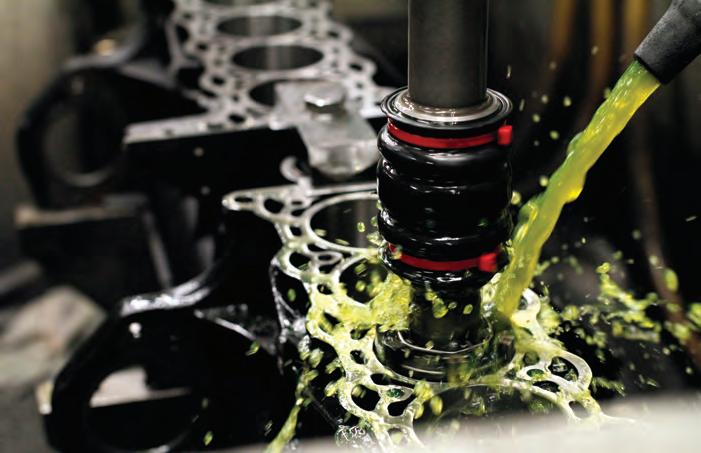
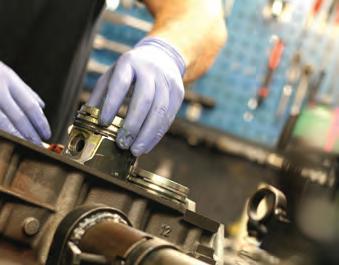
This is also reflected in our own experience, with engines remanufactured by Ivor Searle conserving around 55kg in core metal, while approximately 85% of the unit’s original components are returned to OEM specification. In addition, all waste metal from the process, such as old pistons and machining swarf, is also carefully collected for recycling.
REMANUFACTURING PLAYING SIGNIFICANT ROLE
Replacement components are needed to repair and maintain the UK’s ageing vehicle parc, with over 40% of the 42 million
vehicles on the road over a decade old, according to the SMMT report.
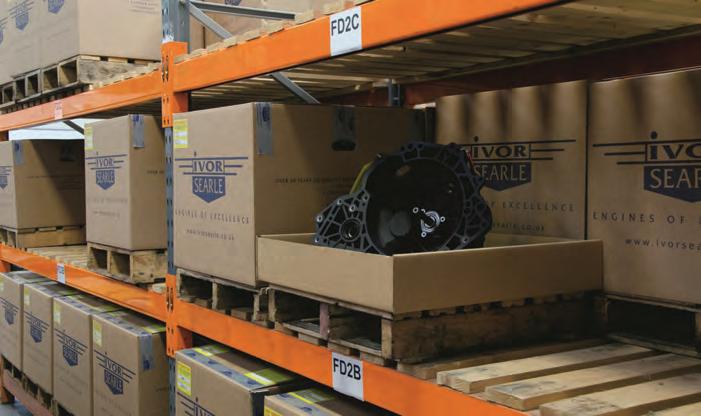
Based on our own experience as a wellestablished supplier to over 1,500 factor distribution outlets throughout the UK and EU, it is clear that awareness of sustainability is gradually increasing, along with an understanding of the environmental advantages of remanufactured components and major units.
Although cost, product availability and quality continue to be the main considerations for workshops purchasing remanufactured products, end-users –including fleet customers and private motorists – will increasingly demand a more sustainable approach to vehicle repairs and maintenance and the parts that are used.
WHAT ABOUT WARRANTY PROTECTION?
Quality remanufacturing also offers customers the benefit of full warranty protection; for example, engines, cylinder heads and gearboxes from Ivor Searle are provided with a transferrable 12-month unlimited parts and labour warranty, while a two-year covers turbochargers.
For more information about Ivor Searle, www.rdr.link/FBB014
AS-PL: WHY CHARGING SYSTEM FAILURES PERSIST – DESPITE A NEW ALTERNATOR
It is a frustrating scenario: a vehicle returns to the workshop only days after an alternator replacement, still suffering from a charging system fault. The assumption can be immediate – the replacement unit must be defective – but, in practice, this outcome is usually more complex and points to issues elsewhere in the vehicle’s electrical system. A spokesperson from AS-PL explains.
For motor factors supplying alternators into the aftermarket, these cases highlight an increasingly important reality: supplying a quality component is only part of the solution. Ensuring correct diagnosis at workshop level is just as critical in reducing returns and protecting customer confidence.
THE PROBLEM LIES BEYOND THE ALTERNATOR
In many cases, the root cause of the failure is located elsewhere. One of the most frequent sources of issues is the electrical system; damaged wiring, corroded
connectors or hidden open circuits can disrupt the workings of the entire system.
Ground connections are another common culprit. Their deterioration leads to voltage drops and unstable operation of vehicle systems, which can easily be mistaken for an alternator fault.
The role of the battery should not be overlooked either. A worn or faulty battery affects how the entire charging system operates, and its condition is often misinterpreted as a problem with the newly installed component.
Modern vehicles increasingly rely on intelligent energy management systems.
This means that the alternator no longer operates independently but is controlled by the vehicle’s electronics.
In practice, a lack of charging may result not from a failure, but from system operation or communication issues between components. Without considering this context, misdiagnosis is highly likely.
WHY IS THE PROBLEM A RECURRING ONE?
These issues are most often the result of a ‘replace and check’ approach. Replacing the alternator without verifying the entire
system may bring only temporary improvement – or none at all.
Time pressure in the workshop often leads to incomplete diagnostics, increasing the risk of comebacks and customer complaints. In many cases, only measuring voltage under load or checking for voltage drops across wiring allows the true source of the problem to be identified.
WHAT SHOULD BE CHECKED BEFORE REPLACEMENT?
To avoid unnecessary costs and incorrect decisions, workshops are urged to follow a simple diagnostic sequence:
● Battery condition
● Ground connections
● Wiring and connectors (including potential open circuits)
● Correct alternator installation
● Operation of the control system
THE SYSTEM APPROACH: A KEY MESSAGE
Cases where a new alternator does not solve the issue highlight one key point:
“More and more often, the source of the problem is not the part itself, but the way the fault is diagnosed. This is particularly important when working with remanufactured alternators. In many cases, the component itself meets all technical requirements, but unresolved issues within the vehicle lead to repeated failures and unnecessary warranty claims.”
effective repair starts with thorough diagnostics. The charging system should be treated as a whole, not as a set of independent components.
More and more often, the source of the problem is not the part itself, but the way the fault is diagnosed. This is particularly important when working with remanufactured alternators. In many cases, the component itself meets all technical requirements, but unresolved issues within the vehicle lead to repeated failures and preventable warranty claims.
Supporting workshops with technical understanding and promoting correct diagnostic procedures is therefore essential. It reduces unnecessary returns, improves first-time fix rates, and strengthens confidence in both the product and the supply chain.
THE TURBO GUY EXPANDS
REMANUFACTURING OUTPUT AS DEMAND FOR TURBOS GROWS
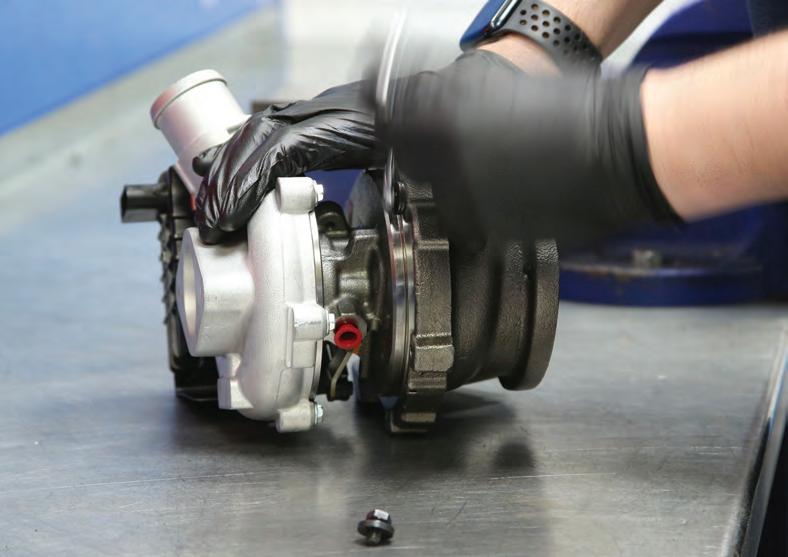
The role of remanufacturing is essential for meeting the growing aftermarket demand for turbos and ensuring you can meet the needs of workshops when it comes to sourcing replacement units. This is especially relevant for late-model cars and vans where brand new OEM replacement turbos may not be available, and remanufactured units provide a primary option.
TREND SET TO CONTINUE
Stringent emissions rules are in place, which has seen an uptick in the use of compact turbocharged engines and hybrid powertrains, many of which have twin turbo systems, as a transitional technology in the drive to electrification.
The use of electric turbos is also increasing in new cars in order to eliminate ‘turbo lag’ and support the introduction of 48V mild hybrid power systems. For older vehicles, remanufacturing supported by exchange units also ensures that turbos are
available for some time after production of a particular model has ended.
Remanufactured units from The Turbo Guy cost around 40% less than brand new OEM turbos, which offers workshops costeffective and sustainable options, as less energy and materials are used in the remanufacturing process. This is confirmed by analysis from the Automotive Parts Remanufacturers Association (APRA) Europe, which has found that remanufacturing saves 85% of raw materials and 55% of energy compared to manufacturing brand new components.
PROCESS OF REMANUFACTURING A TURBO
Remanufacturing has been a mainstay of The Turbo Guy since the business was established in 2010. The process involves a complete strip-down and thorough cleaning of the turbo. All external housings are examined and checked against OE specification and any non-conforming
Remanufacturing is key to meeting automotive aftermarket demand for turbochargers, according to Allan Mitchell, the managing director of The Turbo Guy.
components are replaced, while all internal components are also automatically replaced. The turbo’s rotating assembly is balanced to OEM specification and oil flow rates are also checked. Once fully assembled, turbos are subjected to a detailed final inspection and are flow tested to ensure performance.
For peace of mind, our remanufactured units are supplied with a 12-month warranty through our trade-only distributor network. The quality of our turbos is shown in the appearance of every unit, which is comparable in finish to a brand-new turbo.
Recognising the importance of aftersales support for distributors, we have a dedicated sales technical support team, which can be reached via a range of contact options including phone, email and WhatsApp. We have also just moved our full range of exchange units, as well as warranty claim processing, onto the TecCom portal to provide direct access to information.
We remanufacture 2,000 turbos per month and are expanding our presence across the UK, to meet growing demand from the trade. We sell turbos exclusively to the trade, with stock availability that covers over 90% of the UK’s petrol and diesel car and LCV vehicles.
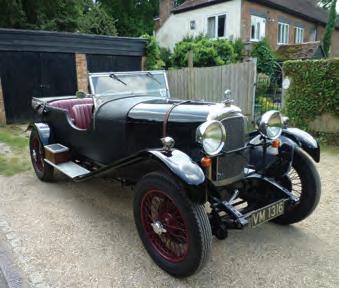
Arguably, the Easter weekend was the first chance for classic car owners to remove the dust sheet, check the vitals of their model, then hit the ground running. As modern engine oils get thinner, questions can arise around suitability for older engines, as Motaquip explains.
MOTAQUIP: WHY LOW-DETERGENT
OILS ARE OFTEN CONSIDERED FOR CLASSIC CARS
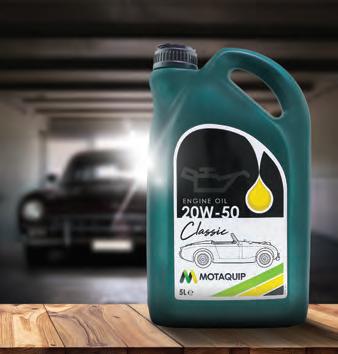
The issue, according to Motaquip, lies in oil formulation. Modern lubricants typically comprise detergent and dispersant additives designed to keep engines clean and prevent deposit buildup, but the company says that some classic engines are not designed for these types of additive packages.
It suggests that in certain cases, using high-detergent oils in older engines may lead to problems, as the cleaning action can potentially loosen existing deposits. These could, in some circumstances, contribute to blockages in oilways, increased oil consumption or leaks. Motaquip highlights this as an area where product knowledge and customer awareness are important.
UPSELLING OPPORTUNITY
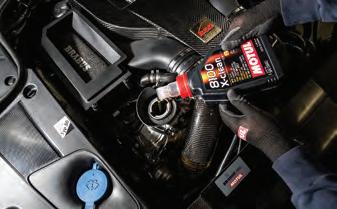
Motaquip believes there is increasing interest in low-detergent, classic-specific oils, which are often considered more suitable for older applications. Products, like 20W-50
multigrade formulations, are engineered with minimal dispersant additives.
Viscosity is a consideration too; many traditional engines were built with wider tolerances than their modern-day cousins. This means they need a thicker oil to maintain effective lubrication – again, the 20W-50 grade delivers. It provides sufficient flow during cold starts while maintaining stability under operating temperatures. Given classic cars spend long periods off the road and stored in garages, this viscosity can be beneficial.
STEP FORWARD MOTAQUIP
Motaquip offers a 20W-50 motor oil, a low-detergent multigrade lubricant that is designed for the classic car market. Formulated with few dispersant additives, VOL200 is suitable for naturally-aspirated four-stroke petrol and diesel engines.
This engine oil is recommended in vintage, classic and veteran cars, as well as
“Motaquip believes there is increasing interest in low-detergent, classic-specific oils, which are often considered more suitable for older applications. Products, like 20W-50 multigrade formulations, are engineered with minimal dispersant additives.”
motorcycles, commercial vehicles and agricultural tractors.
According to Motaquip, for motor factors operating in rural or mixed markets, there is potential to maximise the commercial opportunity that arises this time of year.
A company spokesperson said: “Ultimately, those that stock a classic car oil, like the 20W-50 from Motaquip, will be presented with both responsibility and a sales opening. By bolstering knowledge and understanding, motor factors can better support customers while strengthening their position in a specialist and popular market.”
For more information about Motaquip, www.rdr.link/FBB016
HOW FIRST LINE IS ACCOMMODATING VINTAGE AND MODERN CLASSICS HOW FIRST LINE IS ACCOMMODATING
First Line reports that demand across its classic range continues to grow, reflecting the strength of the UK’s enthusiast market. Intriguingly, this growth is no longer limited to traditional heritage marques.
Through its Borg & Beck brand, the company draws on more than 100 years of OE heritage supplying clutches to iconic UK marques, including Jaguar, Triumph, Austin-Healey, Lotus and Land Rover, many of which now sit firmly in classic territory.
Beyond these traditional classics, First Line is also seeing steady movement in the need for parts that fit emerging modern classics where younger enthusiasts are increasingly investing in vehicles, like the BMW E30, Volkswagen GTI, Mazda MX-5 and Toyota MR2.
First Line Product Director, Kelvin Olds, said: “With more drivers holding onto petrol and diesel vehicles and the 2030 phaseout of new ICE sales approaching, we expect continued interest in classic and modern-classic vehicles.
“For the aftermarket, that means sustained demand for high-quality replacement components that technicians can fit with confidence.
“Owners of classic vehicles understandably want components that preserve the character of the car while also
standing up to modern driving conditions. What we’re seeing is that usage patterns have changed, and that can put additional strain on some traditional components.”
SOLUTION TO CLUTCH LONGEVITY
First Line believes there is a growing, realworld issue affecting clutch longevity, in that many drivers now keep the clutch pedal depressed while stationary rather than selecting neutral, a habit that can accelerate wear on traditional carbon release bearings.
To address this issue, Borg & Beck offers clutch kits featuring more robust ball race bearings alongside original carbon bearing options. These heavy-duty options are available for a range of popular classics, including Jaguar E-Type, Mk II and XK models (1950-1970), MGB and MGB GT, MGC, and Austin Healey 3000 applications.
While offering these heavy-duty options, Borg & Beck also offers original spec, such as HK8854 for Austin Mini and HK9702 for the Jaguar E-Type and Daimler 4.2. This availability of both original-spec and
upgraded solutions gives technicians the flexibility to match repairs to vehicle usage and owner expectations.
ACCURACY AND DURABILITY REMAIN IMPORTANT
First Line has “invested heavily” in its inhouse technical clutch centre to support this. The facility enables Borg & Beck to test every aspect of clutch performance; however, when it comes to classics, First Line acknowledged the focus is sometimes on OE-equivalent clutches, but there is also a need for other parts for these vehicles as well. That is why Borg & Beck has 65 other product groups that cover other classic parts, such as steering and suspension, braking, filtration, cooling and wheel bearings.
First Line believes the classic car segment remains a stable and potentially expanding opportunity, provided parts quality and availability keep pace with customer expectations.
For more information about First Line, www.rdr.link/FBB017
KALIMEX: CLASSIC CAR OWNERS TURN TO ADDITIVES AND LEAK REPAIRS AS DIY MAINTENANCE GROWS
With many classic car owners fixing and maintaining their own cars, it’s big business for motor factors, believes Kalimex. For said owners, working on their car is part of the fun of owning it, and with clubs, forums and manuals encouraging DIY, it’s a trend set to continue.
According to Kalimex, classic car owners are increasingly taking a more considered approach to maintenance, with demand for specialist additives extending beyond modern daily drivers into the enthusiast segment.
While products, such as JLM Lubricants DPF treatments, remain popular for everyday diesel vehicles, classic owners are also turning to the wider JLM range to support long-term vehicle preservation. This includes fuel stabilisers, engine oil stop leak and stop smoke additives, as well as fuel system cleaners designed to help maintain performance in ageing engines.
Mike Schlup, the managing director of Kalimex – the UK distributor of the JLM Lubricants range, plus the pioneers of KSeal Coolant Leak Repair – has decades of experience working with motor factors, helping to build lucrative product portfolios for classic car customers.
He said: “Modern fuels and classic cars are not natural bedfellows, so it’s important that classic car owners protect the components in the fuel system and maintain the quality of the fuel in the tank, especially for low mileage classics. Modern petrol in the UK contains 10% ethanol,
which causes a variety of problems in older or classic vehicles.
“Using JLM Lubricants’ E10 Fuel Treatment helps to prevent corrosion in the fuel system, conditions the fuel and lubricates valves and valve seats. This all helps to maintain and prolong the life of crucial, sometimes rare components. The ethanol in modern fuel is hygroscopic (attracts moisture), which separates from the fuel, resulting in corrosion and damage. A fuel stabiliser prevents this and is essential for low mileage or long-term storage.”
SOURCING REPLACEMENTS A CHALLENGE
Kalimex argued another headache with classic vehicles is struggling to source replacement parts. When it comes to the cooling system, major components, such as blocks, heads and radiators, are either extremely expensive or in many cases, no longer available.
Kalimex believes K-Seal Permanent Coolant Leak Repair is a solution; in fact, KSeal has been used on many classics, including a prewar Alfa Romeo GP car, a 110year-old Bugatti and recently a 1928 Lagonda. The owner, Dick Slaugter,
contacted K-Seal having successfully used the product to seal a leak from the aluminum water cover plate. He was naturally delighted to get his pride and joy back on the road with minimal fuss and cost.
Many classic vehicles run what is termed ‘waterless coolant’. These are 100% ethylene glycol-based; therefore, Kalimex says it is vital to select a coolant leak repair that is safe to use with such a high concentration of EG. K-Seal’s ceramic micro fibre formulation means it is compatible with all types of antifreeze concentration.
For more information about Kalimex, www.rdr.link/FBB018
What's New?
SINGLE BOX PROGRAMME
HELLA has unveiled a new single-box programme for its premium 12V and 24V bulb ranges, providing a practical solution for fast, reliable bulb replacement. The initiative includes a range of displays, from wall-mounted stands to versatile wire stands that can be positioned on a countertop or mounted to a wall.
“We’ve developed the single-box offering in direct response to feedback,” said Dave Clark, lighting product and brand manager at HELLA. “By combining premium, fit-first-time bulbs with easy-to-use display solutions, we’re helping workshops work more efficiently while giving distributors a ready-to-go sales tool that adds real value.”
The single boxes and complimentary stands offer a ready-to-go point-of-sale solution, simplifying stock management while providing a high-value tool to engage their customers.
WWW.RDR.LINK/FBB019
KEY SERVICE AND REPAIR AREAS COVERED
febi has expanded its passenger car and LCV offering with 348 new part numbers introduced during March. The expansion focuses on key service and repair areas, including thermal management, suspension and convenience components.
A notable development is the introduction of a new range of refrigerant pipes, supporting popular models, such as the Audi A3, SEAT Leon, Škoda Octavia and Volkswagen Golf, alongside applications for the Ford Fiesta.
Suspension also sees substantial growth, with 138 additional shock absorber references added. These include coverage for premium and volume models, such as the Mercedes-Benz A-Class, B-Class and CLA, as well as the BMW 1 Series, and 2 and 4 Series ranges.
Further additions within the febiPLUS line highlight a focus on repair solutions often only available through OE channels. New door lock units have been introduced for vehicles, such as the Vauxhall Astra, alongside components designed to enhance convenience and functionality, including heated windscreen washer nozzles for several Mercedes-Benz C-Class applications.
WWW.RDR.LINK/FBB020
VERSATILE NEW-TO-RANGE UPDATE
FAI has expanded its product offerings with over 80 new parts. These include 65 new steering and suspension components – which, FAI reports, meet the current demand from workshops after the winter season – and 15 additions to its internal engine, engine sealing, bolts and valve train, pumps and pulleys and water pump categories.
FAI’s steering and suspension category now includes arms and tie rod ends for Opel/Vauxhall models (2010-2017). Its product team has also highlighted a bare cylinder head, covering a range of Mercedes applications, such as A-Class, CLA, E-Class, GLA and Sprinter (2017-onwards).
This new-to-range also sees three new Yenmak pistons, including part numbers for Ford – including the Focus, C-Max and Galaxy – and Volvo –including the S60, V40 and V70 – 1.6 engines (2010-2019).
WWW.RDR.LINK/FBB021
NEW BRAKE FLUID
LIQUI MOLY has launched a new Brake Fluid 4 in 1, designed to meet the increasing demands of modern braking systems across combustion, hybrid and electric vehicles.
Developed for everyday workshop use, the fluid combines four key specifications – DOT 4, DOT 5.1, SL6 DOT 4 and DOT 5.1 LV – into a single product, helping to reduce complexity, minimise the risk of misapplication and streamline stockholding. With high wet and dry boiling points, the formulation delivers consistent braking performance under heavy loads, including high temperatures and demanding driving conditions. LIQUI MOLY says the product’s low viscosity supports faster pressure build-up and accurate operation of advanced safety systems, such as ABS and ESP.
It is also reported that the fluid helps protect components from corrosion and wear, extending service life. It is available in 5 (pictured), 20 and 60L containers.
WWW.RDR.LINK/FBB022
‘MOST POWERFUL’ ULTRABOOST YET
Ring Automotive has revealed the ULTRABOOST 2000A (RJS040) jump starter, hailed as its most powerful ULTRABOOST yet.
The ULTRABOOST 2000A is capable of jump starting 8L petrol and 4L diesel engines, making it suitable for the majority of the car parc. It also has a ‘boost’ button that can energise batteries that are dead and comes with long cables.
The ULTRABOOST 2000A takes just 60 seconds to connect and start the engine effectively. It also has a large colour screen that has a battery indicator and colour status, so the health of the battery is easy to determine.
The screen also provides clear instructions for the user, such as the green star, which indicates the driver can turn the engine over and a red warning light for reverse polarity protection.
There is also an ‘in’ signal which shows the unit is recharging and an ‘out’ signal to show the unit is charging another device by power bank. Finally, it has an orange coloured ‘low’ to show battery power is too low for a jump start, so the Boost button should be used.
WWW.RDR.LINK/FBB023
BRAKE AND CLUTCH PRESSURE BLEED KIT
Laser Tools has introduced a new brake and clutch pressure bleed kit, offering a compact and versatile solution for professional technicians. Designed with portability in mind, the unit can be powered via 230V mains, a 12V vehicle supply or a detachable 21V rechargeable battery, making it suitable for workshop, mobile and roadside use.
The kit features adjustable pressure from 0-50 psi for controlled, consistent bleeding, while bottle-fed operation helps reduce contamination and simplify refilling. Supplied with 16 aluminium adaptors and master cylinder caps, it supports a wide range of European and Japanese vehicles. Twin-bottle capability allows simultaneous servicing of two axles, improving efficiency. Compatible with DOT 3, 4, 4+ and 5.1 fluids, the unit is aimed at garages and fleet operators.
WWW.RDR.LINK/FBB024
What's New?
HYDRAULIC PORTA POWER KIT
A robust, ready-to-use hydraulic porta power kit, Power-TEC has introduced one in response to customer demand for a strong, reliable source of pushing and pulling when restoring and repairing damaged vehicle body and chassis structures.
The hydraulic porta power kit provides a traditional, highly effective method of applying measured linear force to bent panels, subframes and chassis members. In workshop practice, having a dependable, controllable source of push/pull force is important, as it reduces the chance of causing secondary damage. Power-TEC says this allows technicians to apply incremental correction and gives repair teams the confidence to tackle everything from local panel straightening to heavier chassis realignment tasks.
The system delivers up to 10 tonnes of controlled force to help prevent overloading during repairs. It includes a hydraulic ram with 135mm stroke, hand pump, spreader ram, six interchangeable foot connections and four steel extension tubes (100-550mm). With a 355-490mm working range and 28kg total weight, it is designed for quick, intuitive workshop use.
WWW.RDR.LINK/FBB025
MILLIONS OF VEHICLES COVERED THANKS TO NEW-TO-RANGE UPDATE
BM Catalysts has expanded its offering with the introduction of 28 new references. The March release delivers 466 new fitments, providing coverage for approximately 15.3 million vehicles across Europe.
The update includes six EU6 part numbers covering 51 fitments, reinforcing BM Catalysts’ focus on supporting newer, lower-emission vehicles.
The release also features a mix of product types, including three CAT references covering over half-amillion vehicles, 13 DPF references covering 7.6 million vehicles, and five connecting pipe references covering one million vehicles. In addition, seven pressure pipe part numbers further strengthen BM Catalysts’ range.
The company says this latest expansion is a direct result of its investment in research, development and manufacturing capabilities.
WWW.RDR.LINK/FBB026
STC TIMING CHAIN KIT RANGE BOLSTERED
UPG UK and Ireland has strengthened its engine components portfolio with the latest expansion of its STC timing kit range, adding new applications to support a broad selection of popular passenger car and LCV engines.
The expanded range now covers more than 7,000 applications across Volkswagen, Ford, BMW, Vauxhall, Hyundai, Renault and Nissan.
UPG says timing systems remain one of the most critical service areas for both cars and LCVs, where reliability and accurate component fitment are essential to prevent costly engine damage. By extending its STC timing kit coverage, UPG aims to ensure the trade has access to the right parts quickly.