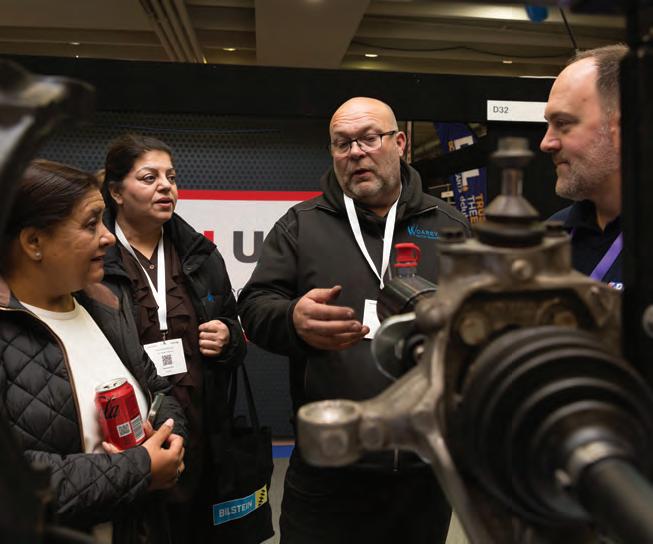
Also inside: HOW CAN YOU PRESERVE YOUR CUSTOMERS’ CLASSIC CARS ? HAVEYOU HEARD ABOUTTHE NEW BMW SCREW SET TO CAUSE PROBLEMS?
COULD MECHANEX NORTH BE YOUR NEW FAVOURITE TRADESHOW? WE THINK SO!
EDITOR’S PICKS
Welcome to the April issue of Professional Motor Mechanic magazine! After a long, hard winter, things are finally warming up a little and just in time too, because we’ve got Mechanex North next month – not that it’s outdoors of course. Turn to page 16 to read and see what awaits you at next month’s show! We sent a reporter out to the West Country earlier this year to visit J Day Engineering, a garage who is leading the way when it comes to ADAS and EVs, so be sure to check out his report on page 20. Lastly, we’ve got an interesting opinion piece on page 22 regarding garages letting success go to their head. I highly recommend you give that a read as it provides much food for thought. Enjoy the issue!
but this process must only be done once . This is because it can lead to
cause damage to historic vehicle engines.
According to the RAC Foundation, the average car in the UK is the oldest it has ever been. As of December 2025, the average car was nine years and 10 months old
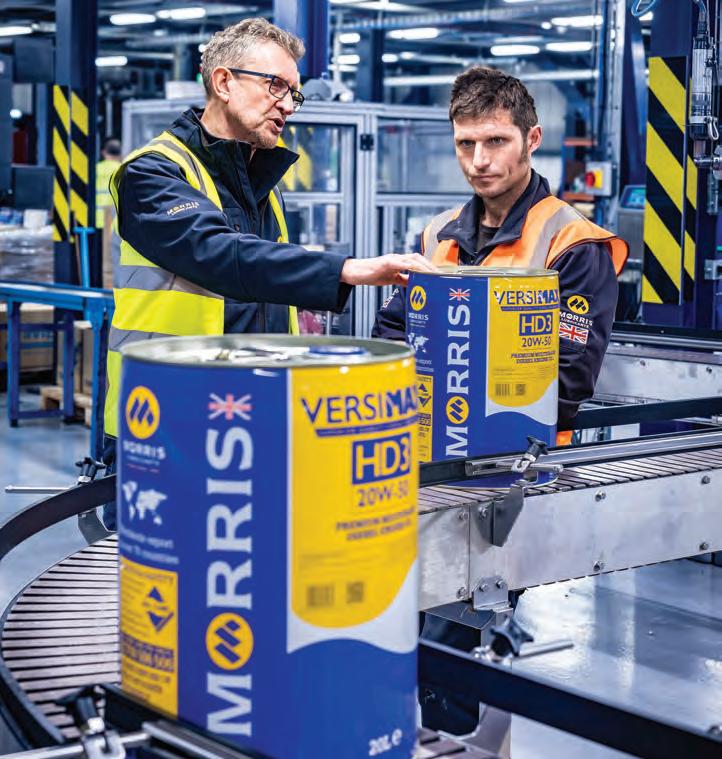
Guy Martin was back at Morris Lubricants’ facilities in Shrewsbury for filming recently, turn to page 43 to find out what he got up to this time.
Editor KIERAN NEE
Digital Manager
KELLY NEWSTEAD
Group Manager
ALEX DILLEIGH
Senior Account Manager
MATTHEW BOASE
Magazine Designer
GEMMA WATSON
Group Production Manager
CAROL PADGETT
Production Assistant
CLAIRE SWENDELL
Distribution Manager
KARL CLARK
Subscriptions
PROFESSIONAL MOTOR MECHANIC is a business magazine for firms and individuals involved in all aspects of the motor trade. It is published eleven times a year and is available nationally FREE to the trade through leading motor factors. It is also available through the post at a cost of £30.
Sometimes it’s better to ask forgiveness than ask for permission. This is advice which often holds up: Go ahead, do what it is you want to do and hope that once it’s done, it will be accepted and no one will seriously think about challenging you. What’s rarely remembered, however, is that whilst there will be many occasions that incur little more than a slap on the wrist, from time to time this devil-may-care approach to your actions will incur rather more punitive measures. Think, for instance, of the Carlton Tavern in Kilburn in London. The historic boozer was bought by a developer who was then denied planning permission on it. Quick thinking patrons decided to get Historic England involved to get the building Grade-II listed. Two days before that could happen, the builders rushed in and knocked the entire thing to the ground, leaving the local community high and, quite literally, dry. One stalwart pintsmith said “not on my round” and sprung into action to get the Council to do something about it. In the end the Council ordered the developer to rebuild the timeserved tavern brick by brick, sticky carpets and all. This is where the asking forgiveness really kicks in, as they offered up the excuse that they’d love to rebuild it, but it was quite simply impossible. At that point, our hoppy heroine said “try again, mate” and produced the reems of plaster casts, photos and documents of, literally, every brick in the place that Historic England had compiled. Check. Mate.
It would be a cynical person indeed (or one completely guided by greed) who would side with the developer in this scenario. They broke every rule in the book in their effort to erode the local community and for what? A few tiny, badly buit, over-priced flats no doubt. But what if something similar happened to you? Well, that’s just the scenario in which one Bradford garage has indeed found itself in. After having been operating on a side street for nine years, the garage has only recently filed for planning permission. At a planning meeting to discuss the garage’s post-hoc request, an objection (one of 65, it might be pointed out) came from an 11 year old child who objected to the garage’s use of on-street parking. I would say that if your (decade late) planning permission request is opposed by 65 local residents, you probably shouldn’t have a leg to stand on. And, indeed, the council has found against the garage. The problem is that it’s not the first time they have told the garage to pack its bags: in 2018 they gave the workshop four months’ notice to leave. But alas... Whilst this might be an open and shut case –unfortunately an all-too-familiar example of a rogue trader bringing down the area and disregarding the rules –there are important questions that need to be asked around planning permission, expansion of premises and, importantly, parking. Parking is a dirty word these days, but a garage can’t rightly function without some of it. Is the answer to hide every garage away on industrial estates on the edge of town, or should the council be a little more accommodating to those garages serving the local community? Whatever the answer, clowns like the garage owner in Bradford only make matters worse. Now, who fancies a flagon of the flat stuff?
KieranNee Editor
PMM NEWS
NEWSIN BRIEF
■ WHAT A SCOOP!
TV PERSONALITYEd China has partnered with Road Runner Insurance to bring petrolheads a five part YouTube series in which he customises a classic 1980s ice cream van.
■ LUCKY NUMBER SEVEN MORE GOOD NEWSfor Motul. Not only were they announced last year as McLaren’s official F1 partner, this year they have also renewed their contract as first fill supplier for the beloved Caterham Sevens.
■ BURNING RUBBER
YORKSHIRE GARAGEcredits its recent rapid growth to having joined the 1TEC Auto Hub network. The network, which provides access to training, tools and support, has allowed Sherburn Rubber to compete with big name garages in the area and they have added three new hires and as many ramps in just a year and a half.
Somerset garage wins TotalEnergies’ Fit for the Future award
TotalEnergies has announced that Bowleys Garage in Wells has been named the winner of its 2025 Fit for the Future award.
Now in its third year, the TotalEnergies Fit for the Future award celebrates independent garages and workshops who are making their businesses more sustainable, with the winner awarded a prize package worth £5,000 to support the transition to more environmentally responsible products. This year, the award welcomed nominations from garages who had undertaken a wide range of qualifying initiatives; from carbon footprint reduction and EV instalments, to recycling and waste management programmes, and renewable energy investments.
Bowleys Garage particularly impressed the judges with their waste oil recycling scheme, where waste oil is collected, rerefined and distributed for re-use –including as heating oil for schools. At the same time, Bowleys has also contributed to environmental progress by adopting 100 per cent recyclable containers for the oil and lubricants they stock – including Quartz by TotalEnergies. The prize was a Quartz bundle worth £5,000.
David Valentyne, business development manager at TotalEnergies, said: “Bowleys Garage showcase how an independent workshop can deliver sustainable changes with benefits for its customers, the environment and the business.”
For more information on TotalEnergies
WWW.RDR.LINK/ACD001
Car drivers are risking engine damage by delaying essential oil checks
Many owners of internal combustion engine cars are risking damage to their vehicle’s vital components by delaying essential checks of the oil level, according to a new survey by Castrol.
The survey found that 59 per cent of car owners last checked their vehicle’s oil level up to three months ago, while a further 31 per cent left it for four months or longer. However, Castrol recommends that drivers check their engine oil at least once every 1,000 miles, and always before a long trip. Ensuring a vehicle’s
oil level is sufficient helps to safeguard an engine’s vital components, including the valvetrain, timing chain, pistons, and bearings, from damage and wear. When asked: ‘How often is the oil level of your car checked?’, only 24 per cent of drivers said at least once a month, compared to 26 per cent once every three months, 19 per cent once every six months, and 16 per cent at least once a year.
For more information
WWW.RDR.LINK/ACD002
FOR UP-TO-DATE NEWS, SIGN UP FOR OUR WEEKLY E-NEWSLETTER. SIMPLY SCAN THE QR CODE
LKQ chief executive provides exclusive SERMI comment to PMM
The recent news that the Independent Garage Association has secured SERMI access for UK garages has met a mixture of praise and scepticism from industry figures, including the IAAF, which in a statement earlier this year lambasted the scheme as it currently stands as offering “minimal business case for garages”.
doesn’t rest on regulation alone. There is a strong practical incentive for vehicle manufacturers to engage, particularly in having one secure, recognised framework that works across Europe and the UK, rather than maintaining different approaches in different markets.
Also weighing in on the topic was LKQ’s chief executive Kevan Wooden, who in a statement released to the press said the approval “should be warmly welcomed.”
Amongst much praise for the scheme and the IGA’s efforts in getting it approved, Wooden did also address the main point of structural weakness in the scheme, offering his conclusion, thus: “Looking ahead, mandating the scheme would be the logical next step to ensure consistency, reduce uncertainty, and create a genuinely level playing field across the UK.”
We followed up with the LKQ chief exec to find out, in his opinion, whether the scheme was doomed if it fails to achieve that mandatory status. Here is what he told us:
“Mandating SERMI would undoubtedly provide the greatest certainty and consistency for the long term, but its success
“SERMI already operates successfully across the EU and Northern Ireland, and that experience shows the value of a single, trusted standard for protecting vehicle security while enabling fair access to repair. In Great Britain, its long-term success will depend on the level of manufacturer participation and continued collaboration across the industry.
“There is clear alignment between trade bodies, suppliers and garage representatives in wanting SERMI to work, and we will continue to work constructively with OEMs and industry partners to encourage adoption. Mandating the policy would accelerate that process, but meaningful progress can still be made by manufacturers choosing to engage with the scheme in the interests of consistency, security and customer choice.”
For more information on LKQ
WWW.RDR.LINK/ACD003
91 , 556
Of the total 262,339 Category N cars written off in 2025 were scrapped unnecessarily by insurance firms, according to smart repairer Revive!
71
The number of pothole-related breakdowns the RAC attended to every day in 2025. 15 per cent up on 2024.
9.8 %
The UK market share of new passenger cars now held by Chinese vehicle manufacturers, according to GiPA
COMMON FAULTS
Tesla Gigacasting: How to approach repairs?
Gigacasting is changing vehicle manufacturing – and repair practices along with it. Here, ALLDATA provides a little more background for when it comes to replacing or repairing complex aluminium structures, like those on Tesla models.
The body structure on certain Teslas differs from conventional vehicles, as the manufacturer promotes the use of gigacastings: large-format structural parts that are made of aluminium in a single casting. This technology makes production more efficient, reduces weight and increases the rigidity of the body – but what happens when it is damaged?
A rear frame, for example, is cast entirely from a single piece of aluminium. While a repair may seem difficult because the material is light and stable but is difficult to weld and strengthen, ALLDATA Repair and OEM Tesla repair data offers a solution.
Solution
Tesla’s guidelines provide precise specifications, with colour-coded diagrams showing which repairs are permitted:
● Blue and green areas: Minor welding or straightening work is permitted
● Yellow and orange areas: May be repaired within certain limits – in some cases with reinforcement plates
● Red areas: Safety-relevant – only a replacement is permitted
Assuming the damaged rear frame falls into the green area, welding and straightening is permitted up to a certain length – but only using cold methods and without heat distortion.
ALLDATA Repair can provide the technician with both the exact work area and information on permissible materials,
structural adhesives and torques for fasteners. As a result, the frame could be repaired safely – without the need for a complete replacement. This would save time and money while ensuring the structural integrity of the vehicle.
ALLDATA Repair provides professionals with direct access to original Tesla repair information, including safety regulations, material guidelines, repair limits and illustrated diagrams of gigacast structures. This allows them to accurately assess damage and make educated decisions about whether repair or replacement is necessary.
Modern manufacturing techniques, like gigacasting, highlight the importance of having accurate data to ensure repairs are performed correctly, efficiently and according to manufacturer guidelines.
HOW TO Replace the timing chain on the VW EA111 1.4 TSi engine
Parts supplier febi discusses timing chain rattle in the EA111 engine 1.4 TSi and what you can do about it.
The 1.4 Turbocharged Stratified Injection (TSi) variant of the EA111 Volkswagen Group engine was produced from 2005 to 2015, after which it was replaced by the current belt-driven EA211 series of engines.
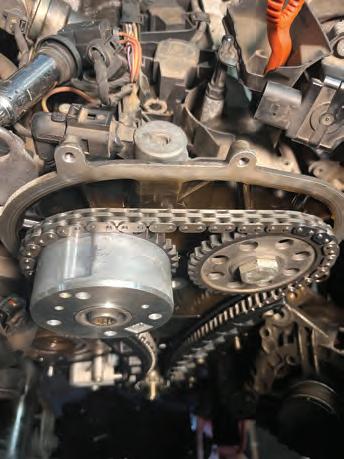
This engine was used in many different models with various power outputs and is represented by at least 22 different engine codes. The engine timing is driven by a metal-toothed silent chain, tensioned by a hydraulic tensioner pressing against a plastic tensioner guide, a guide and three toothed gears, one on the crankshaft and two on the camshafts.
The inlet camshaft has a variator that allows adjustment of up to 20° of the camshaft position. This gives a variation of up to 40° at the inlet valves at the moment of opening and closing. The hydraulic tensioner sets the correct tension of the chain, without the need of any maintenance. The oil pressure holds the chain tense whilst an internal spring guarantees minimum tension during the engine start-up phase.
The two guides prevent chain vibrations when the engine is running. A second chain and a mechanical tensioner transmit motion from the crankshaft to drive the oil pump.
The timing chain used on this engine is, in theory, maintenance-free if the engine is regularly serviced with quality lubricants. However, its inherent weak point is the original chain wearing and elongating. Taking up this slack causes the tensioner to overcompensate, which results in a noticeable metallic noise being present after the engine starts and during operation.
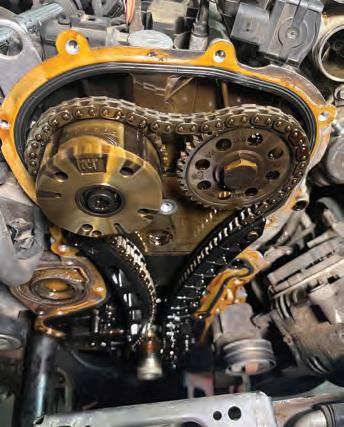
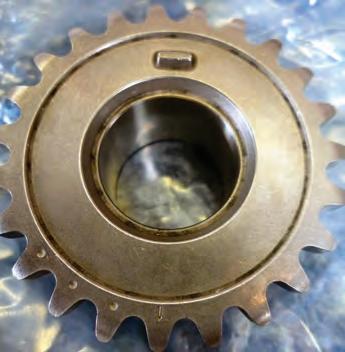
This noise is the result of a change in the chain’s length, which may in turn alter the timing (Fig.1).
“To set the timing, the camshafts must be synchronised, and the crankshaft set at cylinders 1 and 4 top dead centre.”
Timing chain replacement
It is essential that the vehicle manufacturer’s repair procedures are strictly followed. Always refer to the latest service instructions or technical service bulletins to establish any procedures and data. Due to differences with engine codes and in service updates, careful attention must be paid to selecting the correct replacement timing chain kit part number for the vehicle being worked on. Before replacing the timing chain kit, certain special tools should be acquired: Dial gauge, dial gauge adaptor, camshaft clamp, camshaft and crankshaft counter-hold tools, tensioner locking pin, crankshaft locking pin.
Drain the coolant from the engine cooling system along with the engine oil. Remove and inspect the auxiliary drive belt and water pump.
Remove the air cleaner housing and the cover plates at the rear of the camshafts, then unclip and remove all necessary pipes and wiring harnesses as required – subject to the vehicle model and engine variant.
To set the timing, the camshafts must be synchronised, and the crankshaft set at cylinders 1 and 4 top dead centre.
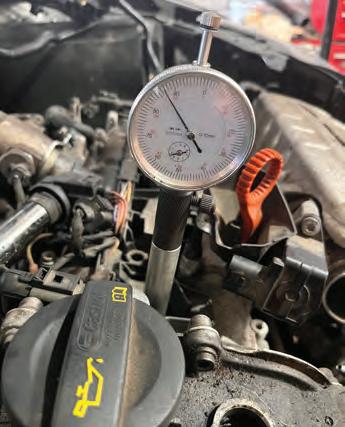
Next, remove the spark plug from the No.1 cylinder. Install the dial gauge into the adaptor and screw the tool fully into the spark plug hole of the No.1 cylinder. Turn the crankshaft in the normal direction of the engine rotation so that the piston reacts on the indicator pin of the dial gauge and moves the needle.
TDC is achieved when the needle reaches its highest reading, prior to it starting to move in the opposite direction (Fig.2).
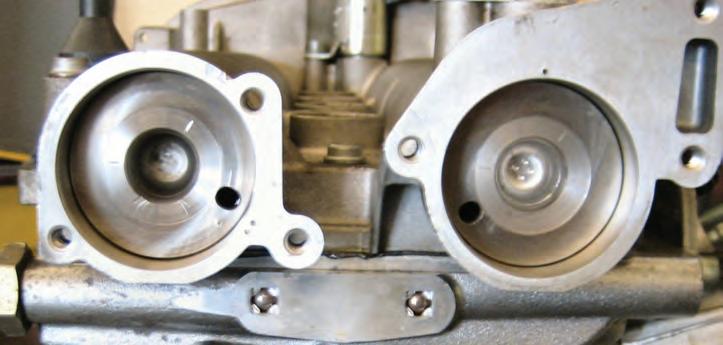
Check that the holes in the rear of the camshafts are positioned as shown (Fig.3). If not, turn the crankshaft one more turn (360°) and establish the TDC No.1 cylinder position using the adaptor and the dial gauge, then insert the crankshaft locking pin.
Insert the camshaft clamp into the recesses and the two holes at the rear of the camshafts, ensuring it is correctly inserted, and that the tool is at the right orientation. If the camshaft clamp cannot be installed, the engine timing is incorrect and must be adjusted.
Using a crankshaft pulley holding tool as a counter hold, release and extract the pulley centre bolt. Next, remove the crankshaft pulley, timing chain cover and the engine sump to gain access to the oil pump chain.
Whilst releasing the sprocket bolts and the tensioner, remove the camshaft sprockets/variable valve timing unit, timing
chain and bolts using a sprocket holding tool as a counter hold. Attention: The camshaft timing adjuster bolt (inlet camshaft sprocket) has a left-hand thread.
Take off the oil pump chain and sprockets, then inspect the condition of all the parts that have been removed.
Replacement timing chain kit
It is important to replace the timing chain kit with quality parts and follow any vehicle manufacturer updates.
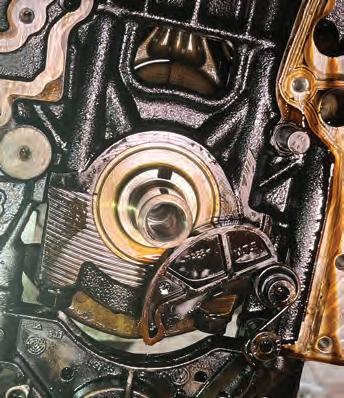
Clean all mating surfaces. Fit the new camshaft sprockets with the new bolts and guide sleeves. Install the crankshaft sprocket, ensuring the lug is located into the recess of the crankshaft (Fig.4). Replace or refit the oil pump drive chain and tensioner as required. Install the new chain guides, tensioner and chain, release the tensioner and tighten the camshaft sprockets to 40 Nm (inlet) and 50 Nm (exhaust) using a counter hold tool.
Remove all locking pins, rotate the engine twice and recheck the static engine timing. Once satisfied, tighten the camshaft sprockets by a further 90°.
Refit the timing chain cover with a new gasket and ‘O’ ring and crankshaft seals, apply sealant to the oil pan and refit it, then install the new water pump.
Install the crankshaft bearing spacer with a new ‘O’ ring, followed by the crankshaft pully, then tighten the new bolt to 150 Nm + 180° while holding the pully with a counter hold tool.
Replace the auxiliary drive belt then refit the air cleaner housing and cover plates at the rear of the camshafts. Refit all necessary pipes and wiring harnesses.
Fill engine with fresh oil and replace the oil filter, along with fresh coolant.
Start the engine, which will rattle on initial start-up for a few seconds until the fresh oil has circulated. Allow to idle and check for any fault codes, clear as necessary and road test. Rely on tested, OE-matching quality replacement parts from febi. The entire range of timing chain replacement parts can be found at partsfinder.bilsteingroup.com
BEST PRACTICE
Should you be using copper grease on brake pads?
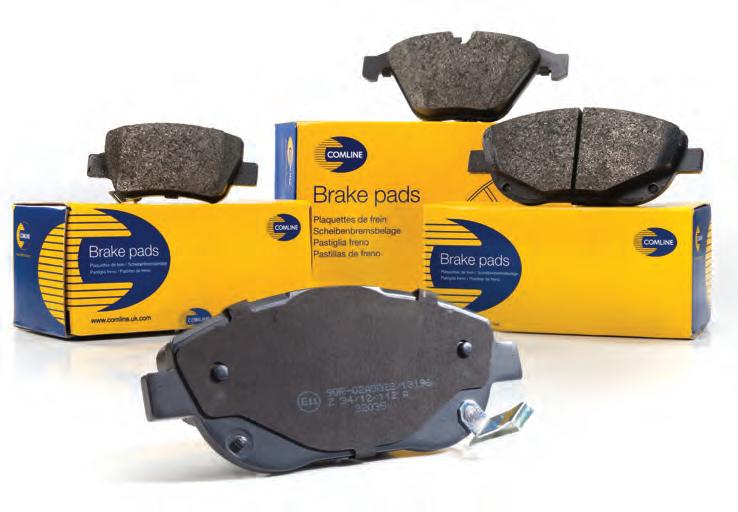
Comline is reminding independent workshops of the importance of not applying copper grease to brake pads.
Comline is urging independent workshops to reconsider the use of copper-based grease on brake pads, as modern braking systems become ever more reliant on electronic sensors and precise component movement.
While it is not a legal requirement, Comline’s brake pads have never contained copper in its friction formulation. As a result, the company earned the distinguished ‘N’rated leaf mark from the Automotive Aftermarket Suppliers Association – a recognised symbol of environmental responsibility in friction materials. However, while copper-free brake pads are becoming more common, some workshops continue to use copper-based greases during brake installation. It is this practice that Comline is now urging the trade to reconsider, as part of its ongoing commitment to brake safety and professional repair standards.
PMM PODCAST
To listen to Comline discuss its brakes in more detail on the PMM Podcast, simply scan the QR code!
Why should copper grease be avoided?
While copper grease is commonly applied to reduce brake noise, it poses safety pitfalls:
● Interference with ABS and ESP systems: While copper grease is electrically conductive, if it spreads onto wheel speed sensors or electronic components, it can disrupt signal transmission. This can cause faults in ABS or ESP systems.
● Restricted brake pad movement: Copper grease attracts brake dust and road debris. Over time, this accumulates into an abrasive paste that can stop brake pads from moving freely inside the caliper. This can lead to uneven wear, noise or brake binding.
● Rubber seal deterioration: Most copper greases are petroleum-based and should not be used near rubber components. Prolonged contact can cause rubber seals and boots to swell, soften or crack. This can increase the risk of fluid leaks, contamination and reduce braking performance.
Comline’s braking expert, Dr Keith Ellis, said: “This is an important reminder about the threats associated with using copper grease with brake pads. By adhering to this
advisory, workshops can ensure a professional repair and ensure motorists don’t return prematurely with issues – maintaining their relationship with the customer.”
Comline supplies a comprehensive range of independently verified ECE R90-approved brake pads, alongside brake discs and calipers. In fact, Comline’s brake pads have been scrutinised further with a series of voluntary tests that validate their real-world performance credentials.
Hot shear testing at 300°C, noise testing at varying speeds and pressure, AK master testing on a dynamometer and wear testing mean Comline is proud to offer a range it calls R90+. With 800 references covering applications for popular European, Japanese and Korean passenger cars and light commercial vehicles, supported by a robust testing process, Comline’s brake pads aim to provide a valuable and dependable option.
KNOW YOUR PARTS
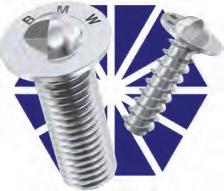
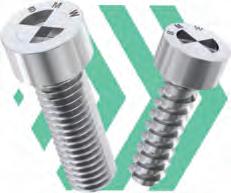
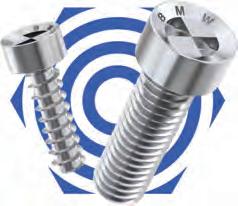
BMW’s new logo screws
The experts at Accu, provider engineering components, have analysed BMW's patent fastener (DE469242297), which covers three head styles: cap head, countersunk and flanged button head. What does this means for mechanics when branding collides with the wrench.
The automotive fastener industry has evolved strategically over the past century: from slotted and Phillips heads for low-torque applications to hex socket and Torx designs that handle high torque efficiently. Thread forms were standardised to ISO metrics, and the industry aligned around drives with proven performance and ubiquitous tooling.
The BMW design disrupts this. Where Torx distributes torque across six contact points, the BMW fastener concentrates force into two opposing quadrants.
hex bolts accessible from multiple angles, this creates challenges in tight spaces behind dash panels or cramped engine bays.
Cost: Bespoke production tooling and unique service tools add expense throughout the supply chain, while established drives benefit from standardised, ubiquitous infrastructure.
“Two parallel faces for a drive is by no means novel, but few other brands have used their logos as a usable feature in a design such as this,” observes Patrick Faulkner, lead engineer at Accu. "The shaped recesses should naturally lead to positive engagement, but as someone who occasionally has to work on vehicles, non-standard fasteners are a pain to encounter.”
Here are some of the engineering trade-offs that come with this new design:
Performance: With only two engagement points, the design risks cam-out if not perfectly aligned. To achieve equivalent torque without shearing, the head likely needs to be physically larger than comparable Torx fasteners. In EV design where every gram affects range, thousands of heavier fasteners matter.
Faulkner comments: “The fact that they have taken so much care in creating a design with visual interest, I imagine it will be used in places where the user will see it, such as trim pieces, interiors or decorative elements.”
Overcoming barriers
“This patent acts as a physical firewall around the component, challenging the ‘Right to Repair’ movement,” notes Alastair Morris, managing director at Accu. “But if history has taught us anything, looking at the Apple pentalobe for one, it's that the aftermarket views these barriers as puzzles to be solved, not permanent stops. Accessibility usually wins in the end.”
Access: The drive is strictly axial; it must be approached from directly above. Unlike
For independent workshops, initial frustration with proprietary tooling creates an opportunity. Reverse-engineered drivers will emerge, and for vehicles outside warranty where BMW fasteners prove troublesome, mechanics may simply replace them with conventional alternatives, except where the logo adds aesthetic value.
The industry perspective
Having spent much of his career focused on chassis design, Richard Rackham, former head of concept at Lotus Cars, offers a measured assessment: “Commercially, it may pay off for BMW. It's certainly a provocative concept that will attract discussion and good press. But in terms of practicality, it's a retrograde step compared to industry norms like Pozidrive and Torx.” “Once out of warranty, if the BMW fasteners have proven frustrating, the service network will simply replace them with conventional items, apart from when aesthetics are paramount,” Rackham predicts, before concluding: “It’s almost like a bit of vanity to further embellish their status whilst adding to the perceived value of the product to owners.”
History proves the point: Apple’s pentalobe, Nintendo’s gamebit and security Torx were all exclusive until aftermarket manufacturers reverse-engineered them. With modern 3D scanning and CNC machining, “BMW compatible” bits can be manufactured easily. While BMW can patent the screw, preventing global tool sales is far harder.
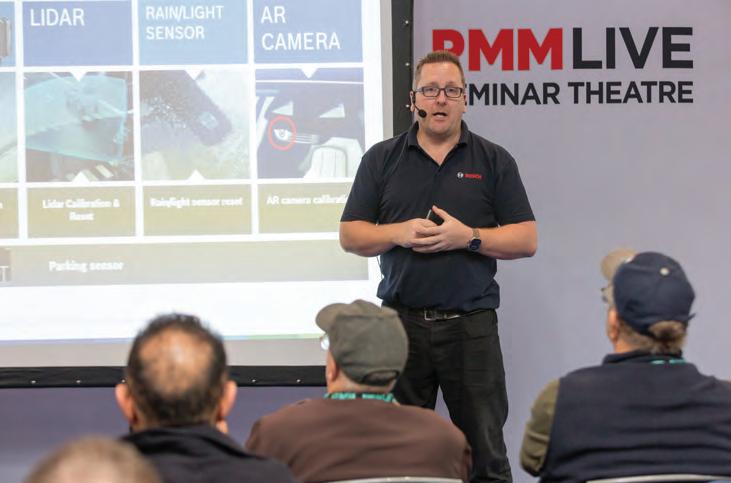
14th-15th May ● Free to attend ● YEC, Harrogate
Not just another trade show!
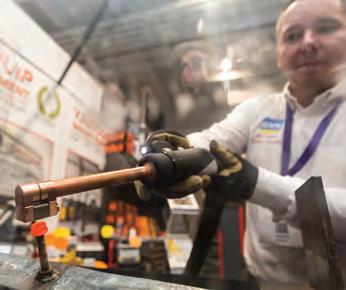
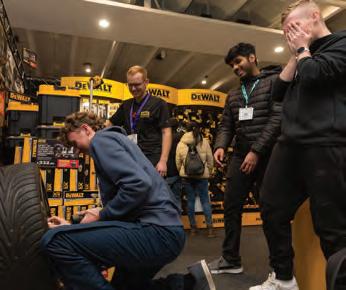
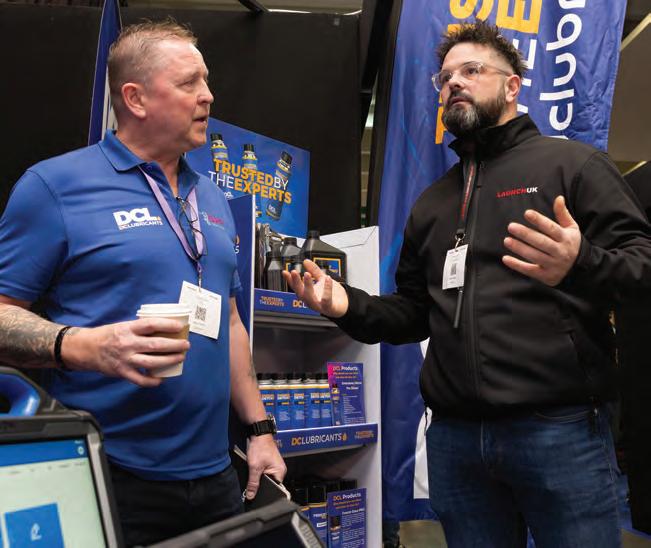
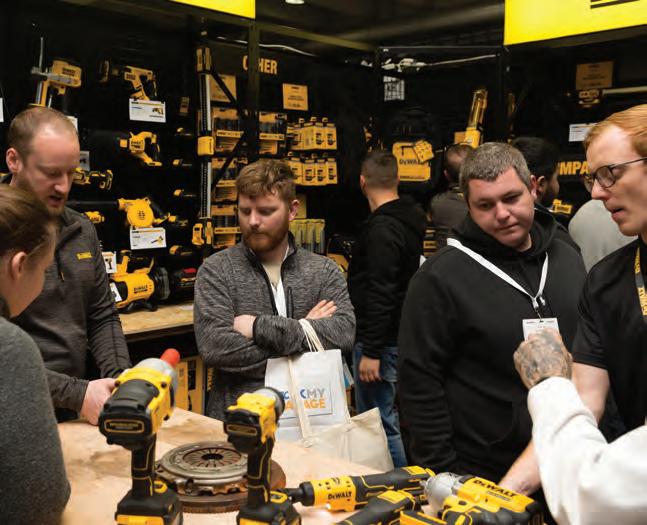
Mechanex North returns to Harrogate this May with a new and improved live technical area for technicians to take advantage of.
What would the ideal trade show look like to you? If you could choose, you would probably want something located close to where you live and work. Somewhere convenient –with parking, of course.
You would want it to feature the brands and companies that you work with on a daily basis – even the trade organisations you’re a member of. That would be handy.
You might want to browse a few tools and, if the price is right, even come away with something. Everyone likes a bargain, after all.
But you want to come away with more than just some new equipment and a few brochures. A decent trade show these days needs to be, well, less trade show and more technical seminar. Technology’s moving fast, and the perfect trade show should be bursting with technical information. Oh and, lastly, if you’re leaving the workshop for half a day, it’s got to be fun, right?
Well, you’re in luck.
Mechanex North is the only automotive aftermarket trade show that fits the bill. It’s in the heart of the North and brings together tools, diagnostics and garage equipment in one hall.
Like Mechanex South, the show is packed with show exclusive offers, so you need to be there on the day to bag a bargain. And just like its southern counterpart, Mechanex North brings you a completely free-to-attend technical seminar lineup that will inspire, educate and inform you all day long! And, if last year is anything to go by, your mates will be there too.
Oh, and we forgot to mention, there are free bacon rolls and a t-shirt for everyone who attends – now how’s that for a good day out?
Listen. Inside the PMM Podcast
On the road
Terri, tell us about the new Nightbreaker 220 bulbs.
When we launched them they were the first 220 per cent brighter bulbs launched in the UK and across Europe. They’re 20 per cent whiter and give drivers a 150m longer beam on the road ahead. It's a halogen bulb so it's a combination of the gases and the tightly coiled filament that produce the brighter, whiter light on the road.
Halogen bulbs have been around for a long time now, 100 years in fact. You've got halogen technology, you've got HID, high intensity discharge technology and you've also got LED coming through, we see that more and more on the roads today. Drivers are going for a whiter light.
What's the benefit of a whiter light?
Whiter light is to basically give a clearer vision of the road ahead. It highlights and illuminates the road signs and pedestrians on the side of the road a lot more clearly. And at times like this
where it's twilight, where it's kind of a bit dark, a bit light, that could probably help quite a lot.
What kind of conversations are garages having with drivers around bulbs?
Customers are coming into the garage and they need the new thing at the moment, but I think we're not really educating them enough. It’s easy for the garage to get hold of all the standard like-for-like replacement bulbs, but I think it's just making them understand there is a choice to be had when it comes to bulbs.
You've recently launched a range for classic cars, right?
Yes, so we've launched the Osram LEDriving HL Vintage range. This is a range of LED bulbs which of course are for offroad use only because LED is still not ECE-approved for road use in the UK. The range is
PMM hits the byways and highways of Surrey on a wintry evening with Ring-OSRAM’s lighting marketing manager
Terri Clark to discuss the brand’s Nightbreaker 220 rangeand the pros and cons of retrofitting LED bulbs.
basically for classic cars ultimately and just giving them an LED option to put into their vehicles. It’s not a bright white light: the purpose of LED vintage is more of a softer lift, I think with 2,700 Kelvins on that particular product.
So it’s not the high brightness that you'll get from the other LEDs, the 6,000 Kelvins. This is a muted LED bulb specifically targeted to the vintage classic car market.
The good thing about the vintage range is that within the MOT test, cars pre-1986 you can actually fit LED bulbs and they won't fail the MOT test.
That’s strange. How do the regulations work around bulbs then?
The ECE Regulation 37 was developed years ago regarding the placement of filament inin a bulb, so it's all around filament placement and by retrofitting an LED bulb in a headlamp, you no longer comply with that EC regulation because it's LED and not a filament. It's simply that things haven't kept up with technology. So LED isn't approved for use on road in the UK, however, in Ireland it is. And Germany has been working hard to legalise and they have the first street legal LED bulb launched. And that is being approved for use across more and more countries. And one of those countries in particular is Ireland. It's very close to home.
TO LISTEN TO ALL OF THE EPISODES SO FAR ON THE PLATFORM OF YOUR CHOICE, SIMPLY SCAN THE QR CODE
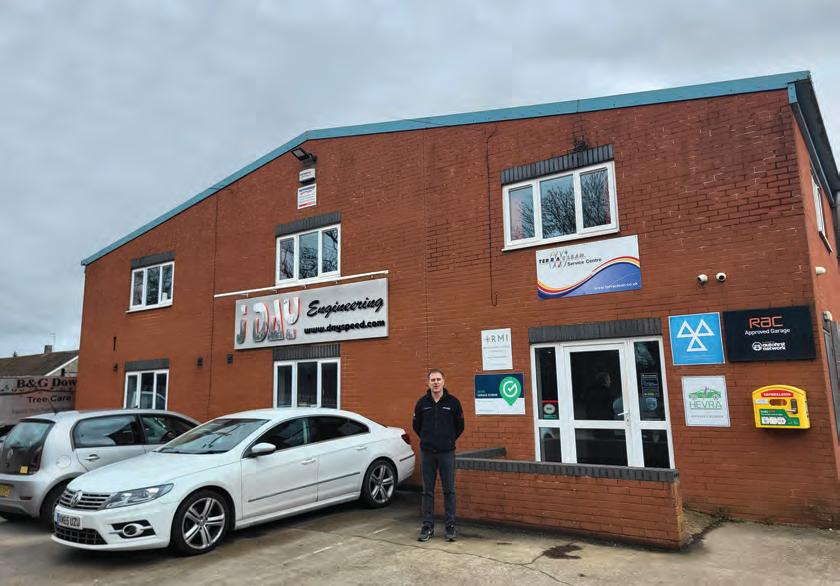
Garage Visit. J Day Engineering Getting ahead of the game
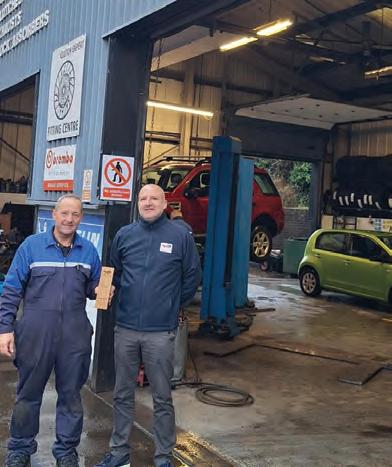
ADAS is a massive missed opportunity for garages, Somerset-based garage J Day Engineering has warned, with the multi-award winning independent looking to lead the way in the South West and beyond with a dedicated tyres and alignment centre.
“Very few garages are doing alignment properly at the moment,” said founder and owner James Day, “meaning there’s a huge gap between what’s required and what’s currently being done.”
He continued: “DVSA are already looking at integrating ADAS into the MOT, so everyone should be concerned.” His message is blunt: “On modern vehicles, alignment without considering ADAS calibration is an increasingly risky proposition”
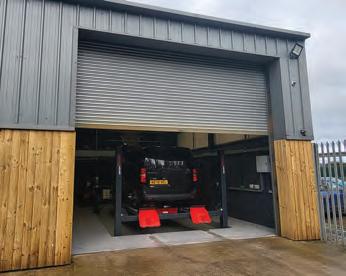
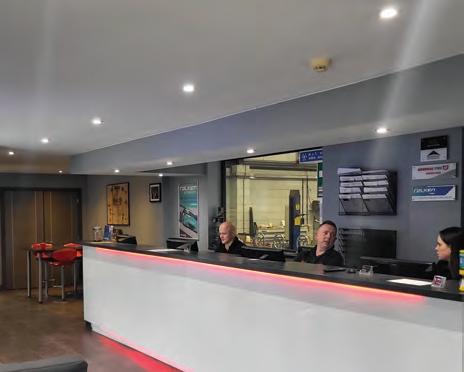
The business has set up a separate workshop for its tyre bay and ADAS centre, complete with a dedicated reception and parking area, with the setup being marketed directly to the public. “A lot of work needs to be done industrywide to communicate the importance of accurate alignment.”
Meanwhile, the business, which sits squarely on the Somerset/Dorset border between Shaftesbury and Yeovil, is
PMM reporter Alex Wells heads out to Somerset to visit J Day Engineering to see whether, when it comes to workshop innovation at least, the West really is best.
mine, and then I started repairing them for other people. Everything else in terms of expansion and employees just followed. When we started we couldn’t even afford a phone!”
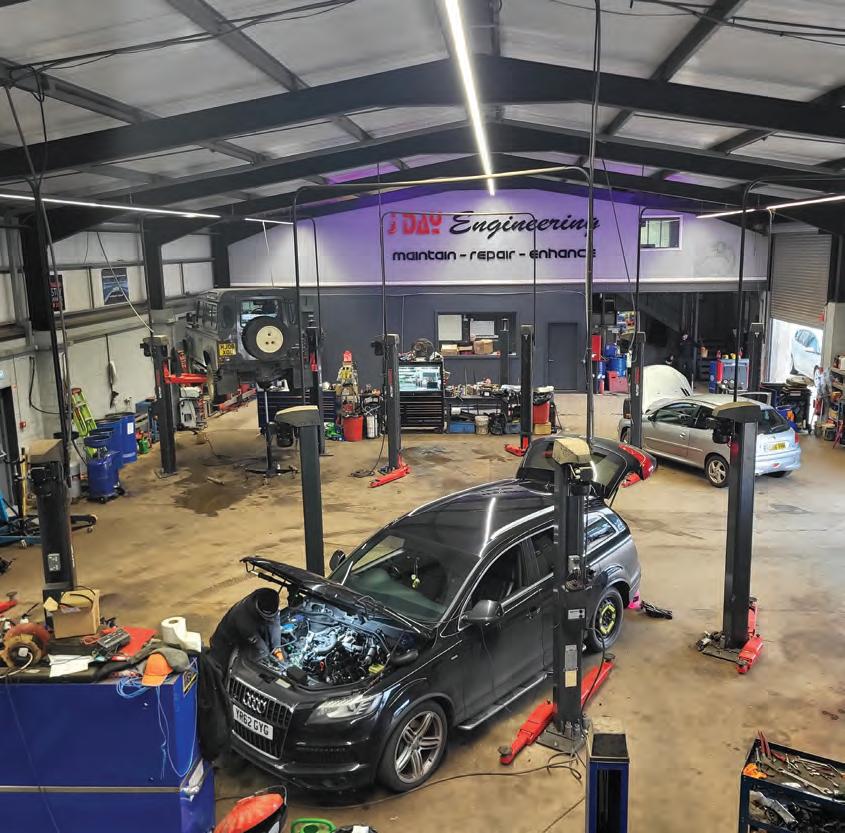
expanding its electric vehicle offering via a purpose-built EV centre. As well as focusing their EV repairs and servicing, the facility will also be used to support other garages to make the most of the EV opportunity. “We had this unit specially built,” said James. “This will become our EV centre for repairs and a training centre. We will show people how it should be done.”
Expansion
This would be a major endeavour for any garage business, but J Day Engineering is already leading the way at scale, drawing customers from across the region. The business first opened its doors in 1999. “I got started because I was a Peugeot 205 lover,” James reminisced. “I was repairing
Still based on the same eight-acre site, the garage opened its current main workshop in 2006, and the expansion continues. Around 25 members of staff work across three buildings, including technicians, workshop and parts managers, front-of-house and more. Behind the reception and visible to customers through a large picture window you can see the main workshop. “We've got a Class 4 and 7 MOT bay here,” noted James, “as well as six general service bays.” The workshop also includes a drive-through alignment bay.
The garage sees all makes, with a few brands being ever-present. “We’re in the countryside, so do lots of Land Rover by default,” laughed James. “We love them.”
Keeping everything under control
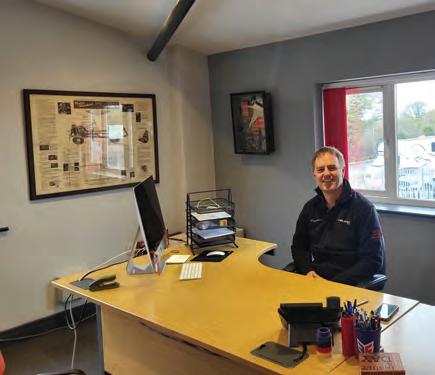
Between the main area and the second workshop dedicated to LCVs and other large vehicles like motorhomes –complete with its own MOT lane – sits a brand-new administration hub. “We set this up in the last year,” James tells me.
“We could see the business was getting too busy, too big and too fragmented. There were inefficiencies and areas that were being underutilised, but we could see where the chokepoints were. We set this up as our HQ, and we have based the workshop manager and parts manager in here, so they are able to co-ordinate the jobs.”
All the techs are equipped with tablets, with the business using TechMan to run their operations. “We like TechMan,” observed James. “Parts and consumables come in and are allocated by registration number and date to the jobs. The technician knows where to come and pick. There's a place for everything and everything is in its place.”
Parts used to be kept upstairs, but this space has been repurposed as well. “We're turning that into a staff welfare facility, doubling up as canteen,” said James. This is vital, as their rural location means the techs can’t just pop out to buy lunch: “Staff and customers have to travel to us. We've become a destination repairer, which is what I always wanted.”
Despite their rural location, James said they do not have any issues attracting staff. “We’ve upped our game and this is reflected in the quality of applicants we receive when we are recruiting. That's due to the culture and the quality of our facilities. Most of our recruitment is via Facebook. We don't pay to advertise for staff at all. We've got varying degrees of requirement as well, so we can accommodate techs at all levels.” The business grows its own too. “We always have apprentices. We will focus on having one or two and take them all the way through.”
“We developed a relationship with Drive Green, an EV-only used car dealer based near us... Within 12 months they became one of our largest customers and we ended up training a number of EV technicians.”
EV-trained and certified
On the EV side, the garage has been slowly building up its capabilities over an extended period. “We developed a relationship with Drive Green, an EV-only used car dealer based near us. They couldn’t get their vehicles fixed in the dealer network, and we needed experience working on the cars. Within 12 months they became one of our largest customers and we ended up training a number of EV technicians.”
They were also the first independent garage in the UK to gain Electric Vehicle
Approval (EVA) certifying that the garage offers trained EV technicians, on-site charging and more.
The commitment to innovation at J Day Engineering has meant that the business was named as Independent Garage of the Year at the Motor Trader Awards in 2022, 2023 and 2024, with the business also a finalist for 2025. “Entering this sort of competition is good because it pushes you to continue to try being better than you are,” said James. “It also means there is a degree of accountability.”
Looking ahead, James said: “We’ve invested a lot in terms of facilities, equipment and our people in the last year and we will be able to amortise that over the next five years. We've got demand in all areas and we intend to keep growing, but we are at the point where we can take stock. We could grow exponentially, but if we decided to consolidate our recent expansion and stay at our current scale, we'd be fine. Equally, we could double the size of our operations, and that would work too.”
On what he credits J Day Engineering’s ongoing growth and success to, James concluded: “Honesty, transparency and consistency in all things are crucial.”
Salvaging the soul of the family garage
Longtime workshop professional Dan got in touch with PMM recently to express his dismay at workshops expanding at the expense of the values upon which they were founded. Here, he asks whether garages have become the very thing they set out to compete against and whether another way of doing things is still possible.
For most people, a garage is built on trust long before it’s built on bricks and ramps. Traditionally, independent garages grew through and depended on their reputation. Word of mouth was all they had to win new customers and that relied on handling customers honestly and assuring them that the person handing you back the keys actually cared about the outcome, not just the invoice total.
Yet across the motor trade, I believe many garages have drifted away from those foundations, often without even realising it. Expanding your business, setting systematic processes and targets, improving your branding, all whilst carried out with the best intentions, can risk demolishing the fabric of the small family business. The mindset that provided a solid base to grow on is often reduced to little more than a sign above the door. Inside, however, customers find something more corporate and, in my view, far less personal.
I previously worked for a garage that proudly presented itself as a high-end, premium operation. It had a smart reception, polished processes, strong branding – all the hallmarks of a modern, upmarket workshop. The business started life as a family concern, sown from the same honest principles as most independents. As the business grew, however, something changed.
Losing sight of the customer
Decisions that were once made with the customer at the centre became decisions driven by structure, pricing matrices, and a need to justify overheads. Experience, which is arguably the most valuable asset in any workshop, became something to bill for rather than something to use in the customer’s favour. Here’s the thing though: Experience should reduce cost, not inflate it!
Decisions that were once made with the customer at the centre became decisions driven by structure, pricing matrices, and a need to justify overheads.
Let me describe to you a real-world example that, unfortunately, became rather common. A vehicle arrives in limp mode. As technicians, we’d seen the fault ten or twenty times before. We knew full well what the likely outcome would be: An oil service, an oil dilution reset, and the vehicle would be back on the road.
Instead of using that experience to resolve the issue quickly and fairly, the
process demanded a paid diagnostic assessment — typically £125. Only after this would the customer be informed that the vehicle required a service and resets. By the time the job was complete, the bill would often be approaching £400.
The justification was always the same: investment in training, tooling, and systems has to be recovered somewhere.
I don’t disagree that training and tooling matter – they absolutely do. But I strongly disagree that the cost of that investment should be passed to the customer in situations where experience already provides the answer.
This is where professionalism and procedure don’t always overlap.
Following procedure or a set process certainly has its place. Following a diagnostic process, for instance, is intended to protect customers and businesses alike from individual error or oversight. But when processes override common sense, they surely stop serving their purpose. Charging a customer for a diagnostic path when you are already certain what the end result will be might earn you bonus points within the four walls of the garage, but externally it erodes trust.
Customers aren’t naïve. They may not understand fault codes or oil dilution values, but they do understand fairness and they certainly remember how a business made them feel.
Finding a new formula for success
At my current place of work, the philosophy is different, and it feels like a return to something the trade is at risk of losing for good.
Experience is used as a tool to reduce cost, not inflate it. If we know the likely fix, we explain it clearly, confirm it sensibly and get the customer back on the road quickly – often for less than half the price they might expect elsewhere.
Yes, we still invest in training. Yes, we still buy tooling. But we see those as the foundations for doing the job properly –not as a justification to overcomplicate straightforward repairs.
This isn’t an attack on growth, professionalism or success. Garages should evolve. They should invest. They
Evolution shouldn’t mean abandoning the principles that built the business in the first place.
should improve. But evolution shouldn’t mean abandoning the principles that built the business in the first place.
Independent garages have always had one advantage over main dealers and large chains and that’s our capacity for humanity. Humans are not uniform creatures and nor are their needs. And whilst many will say that processes are
designed to account for just that –finding a different outcome based on each individual’s needed – there must also be an option for circumventing process and procedure. Flexibility and experience must play their part if we are to continue to serve our customers well.
The ability to say, “We’ve seen this before, let’s sort it properly and fairly” is simple but important.
If the trade loses that ability, it doesn’t just lose its identity – it loses the trust that keeps customers coming back. So perhaps it’s time we ask ourselves whether our experience is being used to serve the customer… or simply to justify the invoice.
Aftermarket voices. Tales from the Niterra podcast.
Strength through diversity
In the Aftermarket Voices series of articles, Niterra UK’s marketing manager Becca Knight reflects on some of the conversations she’s had while co-hosting The Spark Inside podcast. In this final article, she looks at inclusivity in the aftermarket and the importance of community.
The UK aftermarket is changing. But for many, barriers still remain – especially for ethnic minorities and LGBTQ+ professionals. What does it really take to make this sector open to all?
Jahee Campbell-Brennan, engineer and founder of Wavy Dynamics, shared his journey: "I was applying for jobs but had no motorsport experience, so I started creating content, building knowledge and putting myself out there. Eventually, people started coming to me for work.”
And racing driver Charlie Martin, an LGBTQ+ advocate, is clear on why visibility matters: "Growing up, I didn't see anyone like me in motorsport. It made me wonder if I belonged. Now I use my platform to show others they can.”
The aftermarket is built on problemsolving, collaboration and trust – values that only strengthen with diversity. Having a team with different life experiences leads to more innovative ideas and a better understanding of the customers we serve. Progress requires action. That might mean rethinking recruitment, offering flexible training, or supporting industry initiatives like Driven By Us or Racing Pride. More voices at the table means better outcomes for the entire trade.
“The aftermarket is built on problem-solving, collaboration and trust –values that only strengthen with diversity.”
Charlie Martin
Encouragingly, initiatives like IMI’s Diversity Task Force and Niterra’s support for inclusive workshops are helping to shift perceptions. When technicians see people like themselves succeed, it builds confidence across the board. The trade becomes more welcoming, and businesses become stronger for it.
Every garage, factor and aftermarket business has a role to play – whether through mentoring, outreach, or simply making space for different perspectives. Inclusivity isn’t a tick-box exercise; it’s a foundation for a stronger, more sustainable industry.
Building a community
The automotive sector is more than an industry – it's a community. From apprentices to veterans, trackside to trade counters, the shared passion for vehicles creates lasting bonds. And that
community is evolving.
As I highlighted myself on the The Spark Inside podcast, there’s a real sense of pride and trust when you’re part of this automotive aftermarket world. It’s more than fixing cars. It’s being part of something bigger.
Whether it’s restoring a Mini, mastering diagnostics, or attending your local car meet, what keeps the aftermarket moving isn’t just innovation – it’s connection.
Phil McGovern, founder of Caffeine & Machine, understands that too: "We built a place where people feel welcome. It doesn’t matter if you’re into classics, drift, bikes or EVs. It’s about sharing the same spark."
Jonny Smith, presenter of The Late Brake Show, also reflected on the power of the industry to bring people together when discussing his own passion for classic cars: "They aren’t just old machines.” he said. “They’re stories. They carry history, character and community. We shouldn’t lose that as the industry modernises."
McGovern
Phil
Community also means support. In workshops, it’s the colleague who shares a tool or a tip. At events, it’s the shared admiration for a build or a clever fix. For Niterra UK, it’s about showing up with more than just parts. Over five decades, its technical, customer service and sales teams have built long-standing relationships. It sees every motor factor, workshop, technician or apprentice as part of a wider network of mutual success. That sense of belonging helps businesses grow, fosters knowledgesharing, and reinforces trust across the sector.
FOR MORE INFORMATION ON NITERRA
THE SECRETS TOASUCCESSFUL GARAGE
Putting the right habits in place
The customer journey should be repeatable. Before we reach for another tool or another piece of software, it is worth stepping back and asking a simple question: What does a customer actually experience from the moment they think about booking, to the moment they drive away?
In previous pieces we have talked about digital journeys, the value of mystery shopping your own business and how a phone call can either build trust or lose the booking.
The common thread is that first impressions are not one moment. They are a chain. A weak link anywhere makes the whole thing feel shaky.
At Oldfields we started treating the customer journey like a workshop process.
You would never let every technician do a timing belt their own way. You use manufacturer data, adapt to your workshop, you train it and you keep improving it. The same thinking works for customer experience.
Start by mapping your touchpoints and then write a process for each one: website
and online booking, phone call, arrival and parking, reception, customer updates and authorisations, payment, handover, and aftercare.
At Oldfields, this isn’t a corporate script. It’s an expectation. How quickly do you respond? What information must be captured? What does a good update look like? Who owns the follow up if a customer goes quiet?
Next, measure: missed calls, unanswered enquiries, time to confirm bookings, percentage
of estimates approved, comeback rate and repeat visits. These operational numbers are also trust indicators. Finally, coach it. Listen to calls each week. Walk the reception once a day with fresh eyes. Ask one customer a week what was unclear.
Small habits, repeated, turn the playbook into culture. The goal is not to be perfect. It is to be consistent, clear, and easy to deal with, every time. In a garage, that is what keeps customers coming back.
WWW.RDR.LINK/ACD012 or scan the QR code
Jonny Smith
Watch. Car repair on screen YouTube
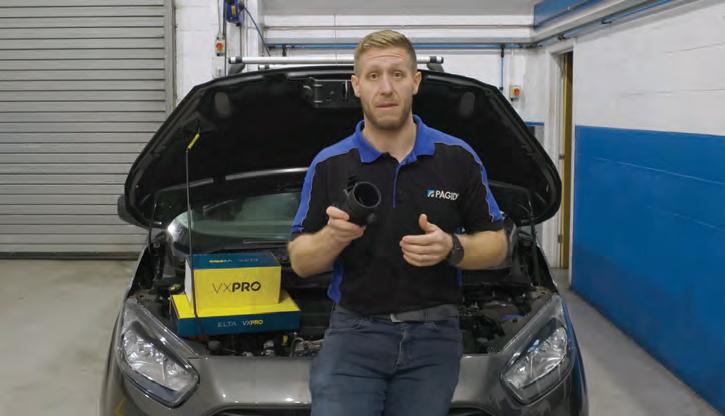
Edd from Uckfield Motor Services looks at some best practice advice when it comes to mass air flow sensors with Elta Automotive.
So mass air flow sensors basically do what it says on a tin. They detect the amount of air that's taken in through the intake and that's going into the engine at any one time. There are two types: hot wire and hot film. Hot wire is generally on older vehicles, hot film on the newer. They both detect the amount of air going past. It cools down the sensor and then it sends a signal back to the engine ECU to tell the ECU how much air is going into that engine so it can inject the right amount of petrol and diesel.
They do get a little bit more complicated than that, especially on modern vehicles because they're used for detecting if some of the EGRs are opening and closing and even down to something like a DPF blocked. We've had cases where a DPF's been blocked and it throws a air mass sensor off because obviously it can't push the right amount of air through the engine.
So there are a lot of things that the mass air flow sensor data is used for and to keep the
engine running exactly how it should be. We see a lot of new mass air flow sensors fitted to vehicles just because a fault code is thrown up. But it might be something else that's causing that mass air flow sensor fault code to come up: It might be too high, too low because there's not enough air going through the system.
Diagnosing faults
So something I've banged on about in previous videos is a good diagnosis. It's the first thing you need to get right before putting any part on a car. And one of the most misdiagnosed things we see is mass air flow sensors.
First things first, you need to get the symptoms from the customers. You need to get a good description from them. Then the next thing is a fault code read, but that's not the be all and end all.
Probably 90 per cent of the time it's not a mass air flow sensor issue. It's something else causing it to also flag that fault code. So first thing’s first, I would check for air leaks. Smoke detectors are a brilliant bit of kit. They can show pretty much any air leak on a vehicle when used correctly. Next thing is just looking at the live data. Is the EGR open and closing correctly when it's meant to. Is the DPF filled up? Is there something else you're missing on the vehicle? Check the general state of the engine because it is a car that hasn't been serviced that much and it's full of carbon and horrible and it's horrible like that, it may well be flagging out the mass air flow sensor.
You can also scope the sensor, make sure it's working correctly. So, there's plenty of stuff you can do before just throwing a new sensor at it. Another great example is always, as I said, check the servicing of the vehicle because we've had plenty of air flow sensors fault codes thrown up because of blocked air filters. And even on some of Mercedes, you actually have to reset an air filter service code inside the diagnostic platform to let it know that the air filter has been changed. So, make sure you check that.
We've been fitting Elta's products for many years. They're a British brand which is always nice these days. A lot of their stuff comes with a 5 year no quibble warranty. And what I love about it is we've had no problems with fitment, their technical support is really good as well. I would really recommend just choosing a product that you can really trust and you know is going to sort the problem out on the car, right?
BEST PRACTICE
AC Servicing for EVs
Electric vehicles need their air conditioning system serviced as part of a routine maintenance schedule, writes Denso.
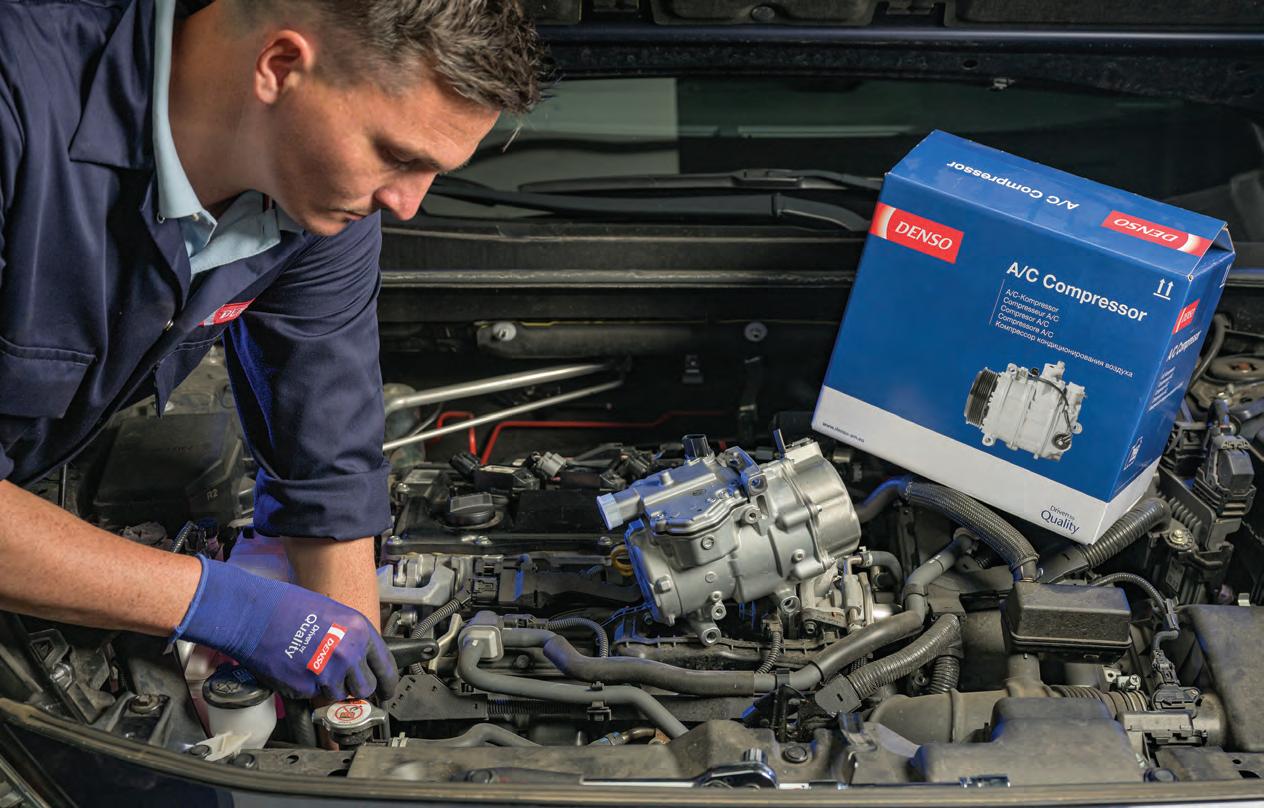
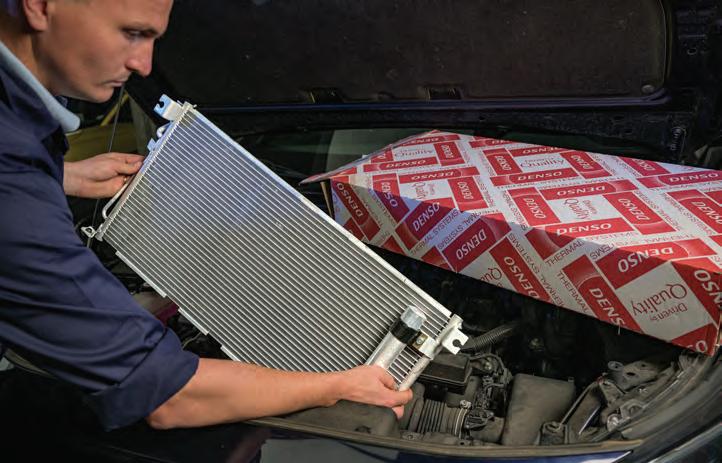
Although maintenance of the air conditioning system has not generally been listed as a task in the scheduled service plan of a typical combustion engine powered vehicle, when it comes to battery electric vehicles (BEV) and some modern hybrids, things are different. This change, suggests Denso, gives independents a great opportunity to develop their A/C offering and benefit from the revenue generating potential that servicing these systems provides.
The reasons why A/C maintenance has not previously featured in these schedules largely revolved around the perceived costs, particularly the projected total cost of ownership over the life of the many vehicles
owned by leasing companies. However, the end result is that despite being an important system within a vehicle, A/C remains one of the least understood subjects in the independent workshop.
To make matters worse, there is no mention of A/C servicing in the owner’s handbook, so motorists don’t think of it as being a standard service item. Ironically, the one A/C offering that most workshops do provide, namely ‘topping up the gas’, is perhaps the
least appropriate solution. This is because it is usually a symptom of an underlying problem, which is the issue that should be dealt with, but is almost always overlooked.
Having addressed the rather gloomy background, there is a more positive outlook, one that is brought into even greater focus with the growth in the number of BEVs and modern hybrids now in the vehicle parc, which are gradually beginning to find their way into independent workshops.
The one A/C offering that most workshops do provide, namely ‘topping up the gas’, is perhaps the least appropriate solution.
These vehicles generally do include the A/C system in their prescribed service schedules, as it not only provides important cabin comfort for the occupants, but is also a crucial factor in the thermal management of the vehicle, particularly the high voltage battery, which is vital to ensuring the range, efficiency and reliability of the whole vehicle. With this change in its priority comes the opportunity to specialise in A/C service, argues Denso.
What does an A/C service include?
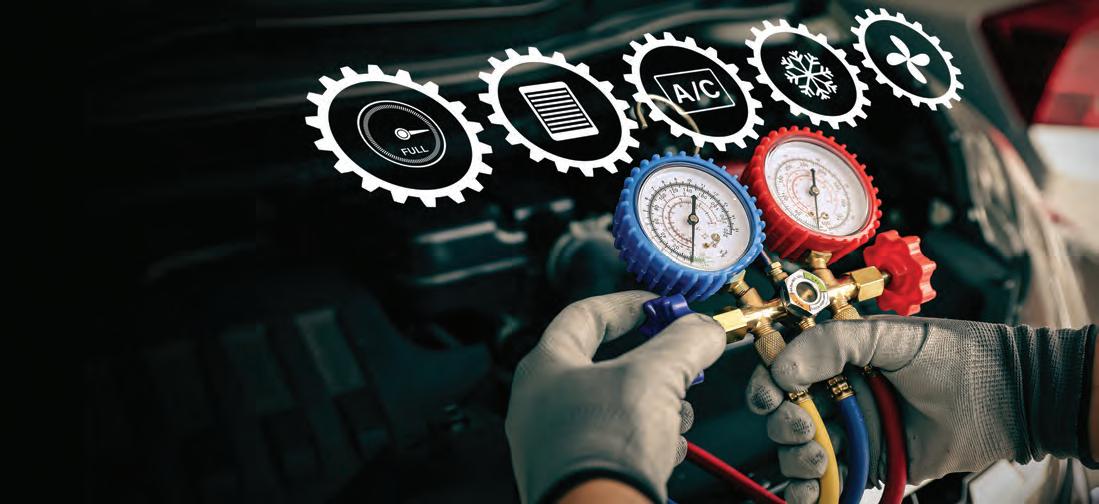
In a nutshell, the process comprises the recovery of the refrigerant, visual inspection of the system, leak finding, evacuation, charging and performance testing.
Naturally, in common with almost all service and repair work, specialist equipment is necessary to undertake A/C service and unfortunately, even here difficulties can arise.
Understandably, many workshops will opt for an automatic machine as, theoretically, it can do the job more efficiently, allowing the technician to carry out other tasks, like draining the engine oil or checking the brakes, during the procedure. However, while they are good at running a predetermined cycle, they provide limited process control, and can potentially mask an underlying problem, as the technician is often unaware of what it is actually doing, and so has no idea if something is wrong.
To help potential leak detection, for example, many machines will automatically introduce UV-dye into the system, which is helpful to find the source of a leak before rectifying the problem and re-gassing, but this process must only be done once. This is because, in effect, it dilutes the oil/refrigerant mix, and a mixture that is too dilute can lead to compressor failure due to lack of lubrication. So, without knowing if the system already has UV-dye, the technician doesn’t know whether to override this function of not.
Each of the service steps highlighted previously are crucial in ensuring the overall health of the A/C system, and each must be undertaken proficiently to guarantee the right outcome. Examples include only using the low pressure side of the loop to recover refrigerant, to check for damage or corrosion throughout the system, to use the most appropriate method for leak testing, to use both the low and high pressure connections to evacuate the system, to understand which ports to use when charging the system, and then to carry out a thorough performance test of the system after the service is completed.
Opportunity for profit
Although the examples highlighted emphasise the complexities of the A/C system, it is also a fact that in contrast to some vehicle technologies that are coming to the end of their development, and some cases even their lifecycle, the A/C system will be ever present, irrespective of the powertrain
and vehicle design. Therefore, overlooking the ongoing profit opportunities associated with an A/C specialism would be a mistake.
Training available
As is apparent, A/C service and repair cannot be undertaken lightly, rather it requires specific training to equip technicians with the knowledge and skills they need to tackle these important vehicle systems with confidence and to ensure they can complete the work thoroughly and successfully.
As an original equipment manufacturer and A/C system supplier to vehicle manufacturers globally, Denso is ideally placed to provide the required training, as well as having the ability to supply the premium quality replacement parts needed to complete the process.
Denso’s training programmes can be conducted face to face, initiated via the company’s trusted distributors in all markets throughout Europe, but they are also supplemented by its comprehensive online resources through the denso-technic.com eLearning portal.
These online tutorials address subjects such as the Basics of A/C, Oil Contamination, Common Compressor Failures, as well as the Seven Basic Steps of A/C Service, which brings us neatly back to the beginning and the necessity to upskill the workforce, to enable independent workshops to address the existing and ongoing demand for A/C service and repair.
RANGE expansion
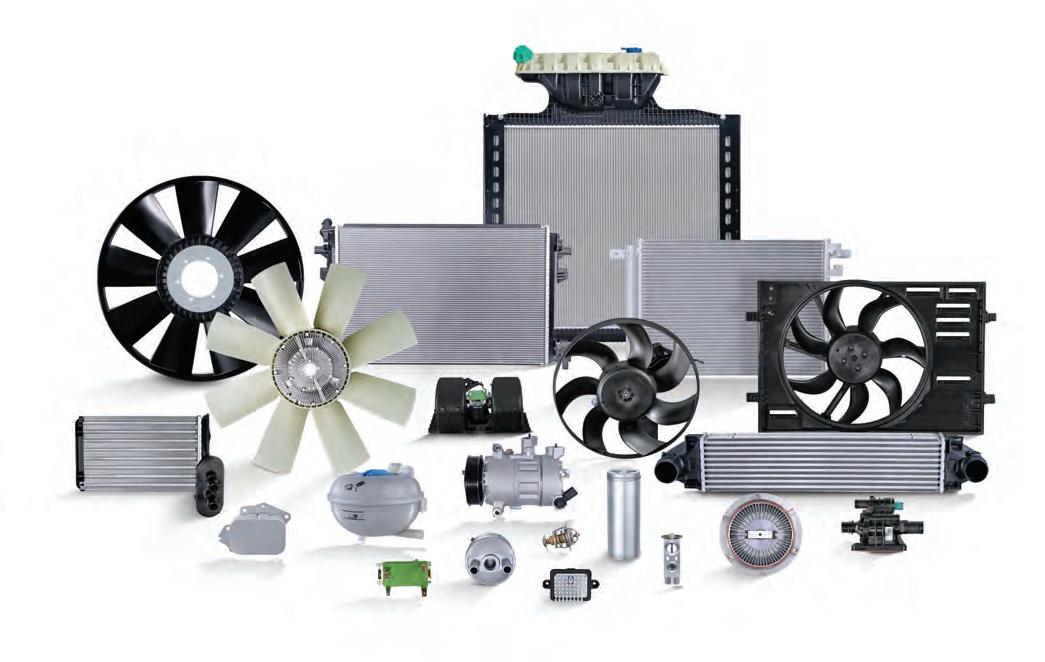
Hella adds 1,500 new parts, bringing its aftermarket thermal portfolio to 2,400 items for passenger cars, LCVs, and heavy-duty vehicles.
As part of Hella’s latest expansion to its thermal management range, the parts supplier is introducing eleven brand-new product categories to the UK market. The new additions include fan clutches for engine cooling, oil coolers, coolant expansion tanks and expansion valves, ensuring workshops have access to everything they need.
Increasingly complex
“Strengthening our thermal management rangeis a vital step in our commitment to the independent aftermarket,” said Neil Grant, managing director at Hella UK. “With workshops facing increasingly complex cooling systems in conventional, hybrid and electric vehicles, having access to a comprehensive, OE-quality range from a single trusted supplier has never been more critical.”
This latest milestone keeps the company firmly on track to more than double its thermal management range to approximately 6,000 p arts by 2027. The roadmap focuses on combining maximum
market shelf-presence with the OE-grade innovation the brand is known for.
Hella is leveraging decades of original equipment expertise to bring high-tech solutions, such as the Coolant Control Hub (CCH), directly into the independent sector. This hardware is bolstered by the brand's established Electrical & Electronic portfolio, which includes everything from coolant thermostats and temperature sensors to advanced air quality modules.
To ensure ‘first-time fit’ reliability, all components undergo rigorous checks at HELLA laboratories in Germany and China, supported by additional independent testing.
“Beyond its parts offering, Hella is helping close the skills gap through Hella Tech World, an online platform providing technicians with detailed technical information.”
“Expanding our thermal management range ensures workshops and distributors have the parts availability and technical insight they need to stay ahead,” said Ian Mattacola, Hella UK product manager for thermal. “With Easy2Fit, technicians get everything for the job in a single box, cutting installation time and helping deliver a right-first-time repair every time.”
Training offering
Beyond its parts offering, Hella is helping close the skills gap through Hella Tech World, an online platform providing technicians with detailed technical information.
Combined with HGS Data’s vehicle repair procedures and Hella Gutmann diagnostics, workshops are equipped to handle even the most complex thermal management faults.
Looking ahead, HELLA plans to launch targeted training programmes aimed at boosting efficiency in repairing complex cooling systems and preparing technicians for the demands of modern thermal management technologies.
BESTPRACTICE
Compressor installation
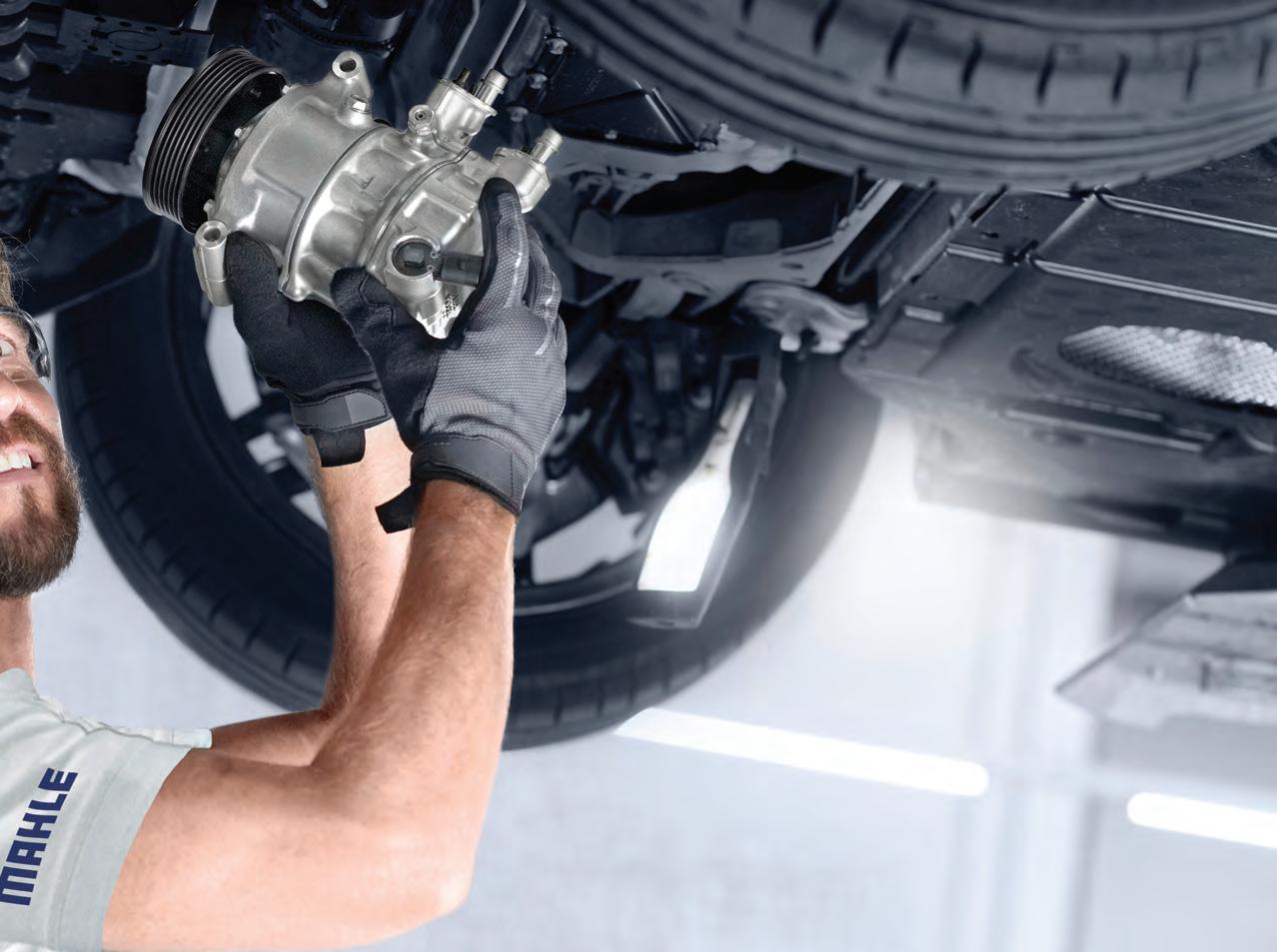
Is replacing the air conditioning system’s compressor a simple in-out job? No, it requires care and attention and that way, argues Mahle, needless returns can be minimised.
Few components in the air conditioning system are as critical, or as costly, as the compressor. Yet in the aftermarket, compressors are also one of the most commonly returned parts. The problem is that a large proportion of these returns are not down to a defective unit, but to mistakes made during installation. According to Mahle, the story is often the same: A new compressor is fitted, but the surrounding system hasn’t been prepared correctly, or vital installation steps have been skipped. The result? Premature failure, frustrated customers and warranty claims that could easily have been avoided.
Mahle knows compressors inside out. As an OE-supplier, one in three vehicles produced worldwide is equipped with one of their compressors. That expertise flows directly into the aftermarket. To meet the needs of workshops, Mahle offers a dual quality programme: References ending in “P” (Premium), are the exact same part as originally fitted by the OEM, whereas references ending on “S” (Standard) provide a more competitively-priced alternative. This dual offering ensures that workshops can always find the right solution for their customers, whether the priority is true OE quality or a cost-effective repair.
The compressor is, in many ways, the heart of the air conditioning circuit. If it fails, the entire system is compromised. But dropping in a new unit is not enough, the whole system needs to be ready to accept it. That means flushing away contaminants, checking oil levels, replacing non-reusable components and ensuring the first start-up is handled with care. Each of these tasks is critical and missing one can cut short the life of the new compressor.
Removing debris
Take flushing, for example. Whenever a compressor has failed mechanically, debris such as swarf and metal abrasion will almost certainly have spread throughout the circuit. Add to that the possibility of sealant residues, degraded rubber particles, or even desiccant granules from a saturated dryer, and you have a system full of contaminants waiting to damage the new part. Mahle stresses that flushing is not an optional extra, it is the only reliable way to remove these risks. Some components, like the dryer, accumulator, expansion valve or most modern condensers, can’t actually be flushed, meaning the part must be replaced outright. Skipping this step is one of the quickest routes to another failure.
“A large proportion of compressor returns are not down to a defective unit, but to mistakes made during installation.”
Oil
Oil is another area where oversight is common. Mahle compressors are supplied pre-filled with refrigerant oil, but because the same unit can be specified for multiple vehicle applications, the oil quantity must always be checked and adjusted before installation. Draining the oil into a clean container, measuring it, and then matching it to the vehicle manufacturer’s specification ensures the correct fill. Too much oil and you risk hydraulic lock or reduced cooling performance; too little and the compressor is starved of the lubrication it needs. Once
adjusted, the oil is refilled and the compressor prepared by standing it upright to lubricate the shaft seal, before carefully rotating the pulley to distribute oil evenly. It’s a small but vital detail that can mean the difference between smooth operation and an early failure. To support technicians, Mahle provides a filling quantity tool, which gives precise oil specifications for different vehicles and can be accessed here ( WWW.RDR.LINK/ACD016 ).
Pre-start checks
Even with the system flushed and the oil correctly measured, there are still pitfalls to avoid. Compressors should be installed with new seals at every connection point and drive belts must be perfectly aligned. Moisture and air must be fully evacuated before refrigerant is charged and only the correct refrigerant specified by the vehicle manufacturer should be used. Finally, how the system is started for the first time is crucial: running the engine at idle before engaging the A/C and then cycling the system on and off several
times, allows oil to circulate gradually. Miss this stage, and the compressor can suffer an oil shock that places immediate strain on internal components.
It’s easy to see why Mahle places such emphasis on correct procedures. Too often, technicians view compressor replacement as a quick part swap. In reality, it is a systemlevel repair. Without the supporting steps, even the best-quality compressor cannot be expected to last. For Mahle, this is not just about protecting its own brand reputation, but about giving workshops the tools to protect theirs too. A warranty rejection is bad news for the factor, the garage and the end customer alike.
Training
That is why Mahle continues to invest in technical resources for the aftermarket. From its Technical Messenger bulletins to training
videos and online guides, the company makes detailed fitting advice readily available. Technicians can also access Mahle’s dedicated training portal on its website and use the TechTool platform to gain practical knowledge about how air conditioning systems work and how to avoid common pitfalls. The message is simple: if the system is properly prepared and the installation process followed carefully, premature failures can be avoided, customers stay happy, and warranty claims become the exception rather than the rule.
A compressor may be the heart of the A/C system, but it can only beat strongly if the arteries around it are clear and the oil flows as it should. Workshops that treat compressor installation as a precision process, not a shortcut, will see the benefits in fewer returns, more reliable repairs, and long-term customer satisfaction and trust.
KEY POINTS FOR CORRECT COMPRESSOR INSTALLATION:
● Always flush the system before fitting a new compressor –contaminants left behind will damage the replacement.
● Replace non-flushable components such as the filterdrier, accumulator, expansion valve, and most modern condensers.
● Check and adjust oil quantity –don’t assume the pre-fill is correct for the vehicle; drain, measure, and refill to spec.
● Prepare the compressor correctly by lubricating the shaft seal and rotating the pulley by hand before installation.
● Use new seals and align belts during fitting to prevent leaks and premature wear.
● Evacuate moisture and air before recharging, and only use the refrigerant specified by the manufacturer.
● Carry out a careful start-up: idle the engine first, then cycle the A/C on and off to allow oil to distribute evenly.
● Document all steps – flushing, parts replaced, oil fill, and refrigerant used – as this protects warranty validity.
HOSE LINE is it anyway?
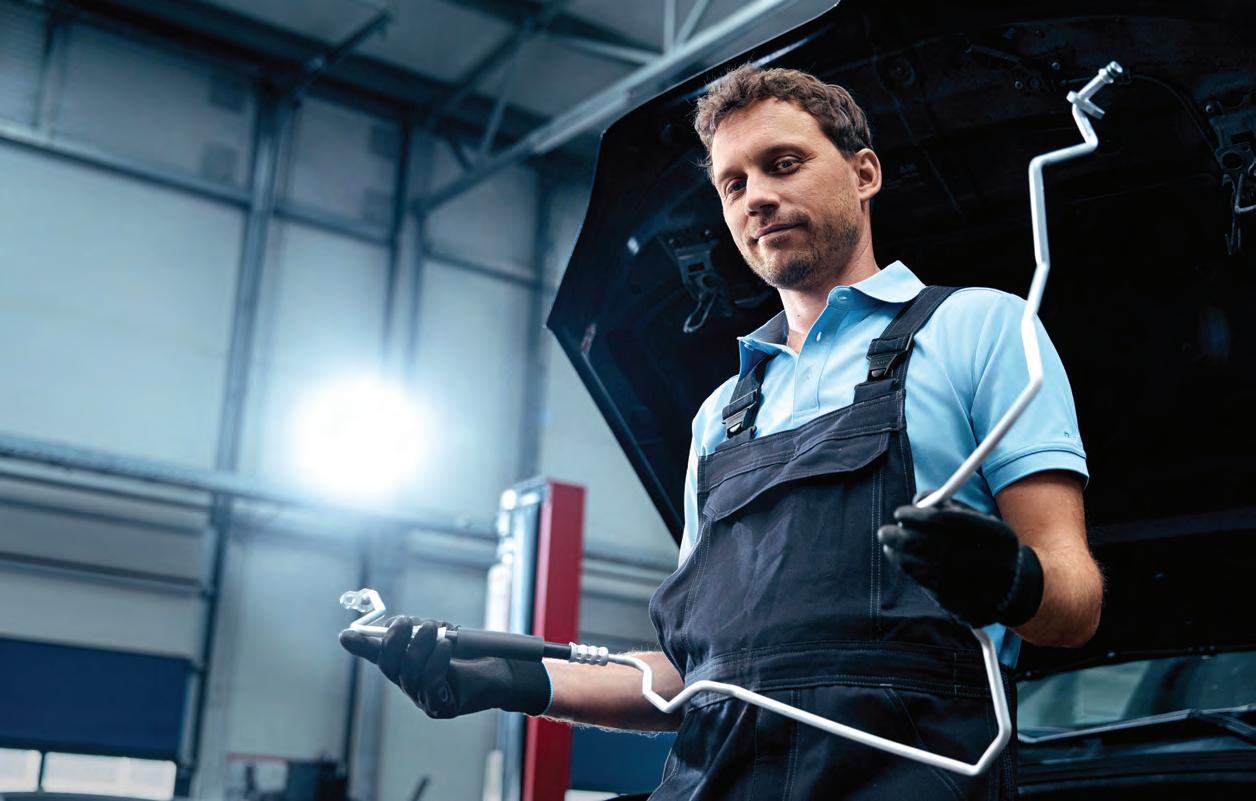
To function correctly and operate at its optimum efficiency, all of the elements within every vehicle system need to be in good condition and working in harmony with all the others. This is particularly true of the air conditioning, which, although it utilises certain common properties, such as electrical power from the battery and drive from the engine, in many ways is a standalone system that works independently of many of the vehicle’s other systems. Due to its central role within the A/C system, the compressor is often referred to as its heart, but the hoses, which connect all of the components together and transport the oil/refrigerant mixture around the sealed loop, are also vital for the system to function correctly, so can perhaps be compared to its arteries.
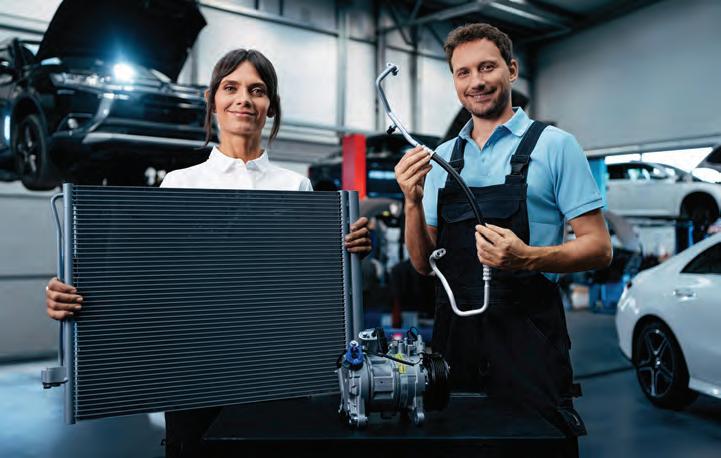
Annually checking the condition of the A/C system is an important job for the independent workshop and to enable them to carry out the work proficiently and to use premium quality replacement components, aftermarket specialist Nissens Automotive, is on hand to help them with both expert instruction and the required parts. As a leader in thermal management solutions, Nissens has the specialist knowledge required to understand the requirements of the A/C system and therefore the quality of the components needed to support its correct operation.
In addition, being totally dedicated to the needs of the aftermarket, its ambition is to provide the industry with a holistic approach, not only in terms of the quality of the parts it supplies and the technical support it makes available, but also when it comes to the breadth of its offering.
With this in mind, Nissens is pleased to announce the introduction of replacement A/C hoses into its growing product portfolio. This launch provides a premium quality solution to the need for reliable, high performance and long-lasting replacements, that fulfil the functional demands of the A/C system.
Looking for trouble
One of the most important aspects of A/C service is to check the condition of the entire sealed loop, not just around the joints to the system’s major components like the
compressor, condenser and heat exchangers, but also along the length of the hoses, whether they are sections of solid tube or flexible hose.
Telltale signs of potential A/C hose problems/refrigerant leaks include oily, dustattracting areas because the oil remains on the surface and dust and dirt then stick to it, so soiling on the hose, joins or surface are clear signs of a leak problem.
In addition, the flexible rubber-based sections can become porous, causing the gradual escape of the refrigerant. Older and higher mileage cars should therefore undergo particularly careful inspection in these areas.
Finally, mechanical damage, even if only light in nature, or vibrations, can both expose the hose to risk or the loosening of joints and subsequent refrigerant loss. Cracks, bends and perforations cannot be repaired.
“Telltale signs of potential A/C hose problems/refrigerant leaks include oily, dustattracting areas.”
KEY FEATURES
Genuine Nissens quality: Designed, developed and rigorously tested for performance and longevity. Compliant with or exceeding SAE J3062 and J2064 standards.
Double-wall barrier construction (5-Layer Design): Combines EPDM, PA (nylon), and PET layers for superior refrigerant retention, vibration resistance, and corrosion protection.
Helium-tested and 100 per cent inspected: Ensures leak free performance and precise bend alignment for seamless integration into tight layouts.
Temperature range: -40°C to +135°C, suitable for extreme operating conditions.
First-fit product: Includes pre-mounted O-rings, gaskets and fixed brackets, reducing installation time and eliminating the need for sourcing additional required parts. Orifice tubes, filters and mufflers are also included when applicable.
Compatibility with R134a and R1234yf refrigerants: Future-proof repairs guaranteed.
Safe, recyclable packaging: Protects against dirt and moisture during storage and transportation. Features a sustainable, single material design.
Testing for leaks
If a potential leak is detected, a proper leak test procedure should be undertaken, including a long-term test using a nitrogenbased solution and leak sensor support.
This best practice principle is important because the refrigerant and lubricant, which is necessary for the A/C system’s efficient operation, needs to be in the correct ratio. System leaks can easily disrupt this balance. In addition, these leaks can potentially cause contamination from moisture or foreign
particles. Should a failing joint, crack or split become apparent, the A/C hose will need to be replaced, which also provides the opportunity to flush out the old mixture and replenish it with new oil and refrigerant, something that should also be part of a standard A/C service. However, this will also require the appropriate pulled vacuum process to remove moisture and facilitate the final charge.
So as you can see, A/C hoses are a vital component. What’s more, they remain relevant irrespective of the vehicle’s powertrain. They are used in the heat pump systems associated with electric vehicles, as much as they are in traditional combustion engine systems.
With an initial range covering approximately 25-30 per cent of the European passenger and light commercial vehicle parc, the Nissens A/C hose range is designed to offer a premium quality aftermarket product featuring a meticulous design, fully compatible with vehicle layouts and modern refrigerants. The hoses are thoroughly tested to ensure a leak tight, efficient and long, trouble-free service life. Combined with the company’s first-fit inclusive parts policy, this should tick all the boxes for the independent workshop.
BEST PRACTICE
Jacking up Teslas
Febi provides guidance for jacking up Tesla models S/3/X/Y, using febi jack pad sets 173025, 196121, 196441.
When performing maintenance (which requires the vehicle to be raised from the ground) on any of the Tesla models listed above, it is essential that the vehicle is lifted correctly in order to avoid any damage to the high voltage battery that is located under the car.
All of these Tesla models have four dedicated jacking points, which require the use of one of the adapter sets listed to fit into the locating points designed for this purpose. These can be used with a hydraulic jack or vehicle lift in order to raise the vehicle safely and efficiently.
Note: Never raise the vehicle with the charging cable connected, even if charging is not in progress.
An incorrectly supported vehicle should also never be worked on.
Before starting any work, check if the vehicle is equipped with air suspension as this will automatically self-level (even when the power is off). You must disable this system by engaging Jack Mode before lifting or jacking. If you do not disable the air suspension, the vehicle can attempt to self-level –resulting in possible vehicle damage.
“Before starting any work, check if the vehicle is equipped with air suspension as this will automatically self-level.”
Model S and X Jacking procedure using a wheel-free lift
Position the car centrally between the lift posts.
To prevent damage when jacking or lifting the vehicle, you must activate Jack Mode to disable the self-levelling air suspension. Use the touchscreen to set the suspension as follows:
● Touch Controls > Suspension
● Press the brake pedal and then touch Very High to maximise the height of the suspension
● Touch Controls > Service > Jack Mode (to disable self-levelling)
When Jack Mode is active, an indicator light is displayed on the instrument panel, along with a message telling you that active suspension is disabled. To deactivate this, touch Jack again. Alternatively, Jack mode automatically cancels when the car is driven over 4.5 mph (7 km/h).
Close the falcon wing doors (Model X only).
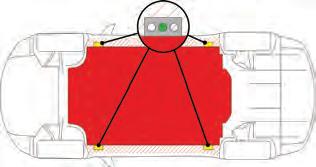
Locate the dedicated jacking points on the vehicle (illustrated in yellow on Fig.1). Ensure all points are free from debris and insert adaptor in the central
location (as marked in green). Position the lift arm pads under the adaptor to avoid damaging the high voltage battery area (highlighted in red).
Check and adjust the height and position of the lift arm pads to ensure they are correctly located.
With assistance, raise the lift, ensuring that the lift arm pads remain in their correct positions.
Model
3 and Y Jacking procedure using a wheel-free lift
Position the vehicle centrally between the lift posts.
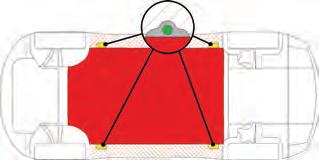
Locate the dedicated jacking points on the vehicle (illustrated in yellow on Fig.2). Ensure all points are free from debris and insert adaptor (as marked in green).
Position the lift arm pads under the adaptor to avoid damaging the high voltage battery area (highlighted in red).
Check and adjust the height and position of the lift arm pads to ensure they are correctly located.
With assistance, raise the lift, ensuring the lift arm pads remain in their correct positions.
OILS and the role they play in preserving ageingengines
According to the latest annual report from the Federation of British Historic Vehicle Clubs, the UK’s historic vehicle movement continues to thrive, supporting a substantial slice of the economy and representing a vast fleet of vehicles now well beyond their original design life. In practical terms, that means more classics on the road, more restorations in workshops, and a growing responsibility on technicians to understand lubrication not just as maintenance, but as long-term conservation. In this article, Nigel Bottom, group managing director of British lubricant manufacturer Witham Group, takes a look at how motor oil has evolved, why modern oils don’t always suit older engines and what mechanics can do to keep vintage motors running sweetly for decades to come.
Mineral to modern: How did we get here?
When many of the classics we service were built, engine oils were simple mineral blends. Early monograde oils (SAE 30, SAE 40) had limited additive packages and relied largely on frequent changes to control wear and contamination. Engines were designed with looser tolerances, flat-tappet camshafts and relatively low operating temperatures, so these straightforward oils were entirely appropriate. As engine technology advanced through the 1960s-1990s, oils evolved too: Detergent additives were introduced to keep engines cleaner; Multigrade oils (e.g. 10W40) improved cold-start protection; Antiwear additives, particularly ZDDP (zinc
dialkyldithiophosphate for those wondering), protected cam lobes and followers. Later, synthetic base oils delivered higher stability and longer drain intervals.
Today’s engines, with tight tolerances, turbochargers and emissions equipment, demand low-viscosity, low-SAPS oils. But here’s the catch: those modern formulations don’t always suit older engines.
Today’s engines, with tight tolerances, turbochargers and emissions equipment, demand low-viscosity, lowSAPS oils. But here’s the catch: those modern formulations don’t always suit older engines.
Historic vehicles in modern workshops
The latest FBHVC report emphasises that the historic vehicle parc is ageing and used differently from modern cars: Lower annual mileages; more time in storage; and more vehicles undergoing restoration or sympathetic rebuilds. For mechanics, this translates into a different lubrication mindset:
● Engines are often under-used, not over-used
Long lay-ups increase condensation, fuel dilution and corrosion risk – issues oil must actively combat
● Original engine designs are still in service
Flat-tappet cams, cork seals and rope rear mains all place unique demands on lubricant chemistry.
● Longevity is the priority
Owners are rarely chasing maximum performance; they want reliable starts, minimal wear, and preservation of original components.
When traditional is better
It’s tempting to assume that the latest synthetic oil will automatically improve an older engine. In reality, several factors make classic-compatible lubricants essential:
● Zinc content matters
Many classic engines rely on higher ZDDP levels to protect flat-tappet camshafts. Modern low-zinc oils –designed to protect catalytic converters –can accelerate wear in older valvetrain designs.
equipment as a spanner or torque wrench.
● Seal compatibility
Modern synthetic oils can be more aggressive on aged seals and gaskets, sometimes leading to leaks in engines that were perfectly dry on older mineral formulations.
● Detergent levels
Highly detergent modern oils can dislodge decades of harmless sludge in an unrestored engine, potentially blocking oilways or filters. Controlledcleanliness formulations are often safer for original units.
Keeping vintage motors running “as long as possible” is less about pushing performance and more about controlled ageing. Today’s workshop has to consider:
● Low mileage, high time
Classic cars might only cover 1,000 miles a year, but the oil is ageing continuously. Moisture and acids build up even when mileage is low, making annual oil changes essential regardless of distance covered.
● Storage and seasonal use
Extended lay-ups call for oils with good corrosion inhibitors. Pre-storage oil changes help remove acidic contaminants, while a fresh change before recommissioning provides optimum protection.
● Rebuilt vs. original engines
Fresh rebuilds need running-in oils with appropriate additive levels. Unrestored originals often benefit from gentler detergency and slightly higher viscosity to maintain oil pressure and reduce blow-by.
Best practice
To give customers confidence and engines longevity, consider these key lubrication strategies:
Match viscosity to design, not fashion: Many classics were designed around 20W-50 oils, and that thicker film can be vital for worn clearances.
Prioritise anti-wear protection: Engines with flat-tappet cams need adequate zinc/phosphorus levels.
Change oil on time, not just mileage: Ageing oil causes corrosion even when the
vehicle is rarely driven.
Watch for fuel dilution: Carburetted engines and short runs can thin oil quickly.
Use specialist formulations where appropriate: Oils tailored for classic and historic vehicles often strike the right balance between protection and compatibility.
Ensure your oil supplier has the technical expertise to give the right recommendations, no matter how old or modified it is. Modifications can make a real difference to what lubricants are required.
Working on vintage motors isn’t just mechanical repair: it’s stewardship. These vehicles are preserved not merely as transport, but as cultural and engineering artefacts. For the technician, that means every oil change, rebuild and recommissioning job contributes to the survival of machines that were never designed to last this long.
Understanding lubrication history gives us an edge:
It explains why some engines prefer “oldschool” oil chemistry.
It helps diagnose wear patterns linked to modern low-zinc oils.
It informs restoration decisions –especially when originality matters as much as reliability.
Being a classic and vintage car technician, never mind the owner, comes with the responsibility to choose lubricants that respect both the engineering of the past and the realities of modern use.
In short, the right oil isn’t just about lubrication, it’s about ensuring that the engines we service today will still be running, sounding and performing as intended for the next generation of enthusiasts to enjoy. Quality is key, with care and pride as given.
If you would like to discuss any lubricant queries or discuss a new lubricant partnership with a company that knows a thing or two about car engine oil since 1921, please get in touch with Witham Group.
Out with the NEW, in with the OLD
Think those rubies in the rubble are a waste of time? Well, JLM is here to tell you how you could be coining it in by offering vintage vehicles a new lease of additive-powered life.
According to the RAC Foundation, the average car in the UK is the oldest it has ever been. As of December 2025, the average car was nine years and 10 months old. 10 years ago, the average age of a car was only seven years and five months. For petrol and diesel cars, their average age is even older: 10 years and four months and 10 years and one month, respectively. The RAC Foundation believes that one of the reasons for this ageing car par is that cars now last longer. Commenting on this, Steve Gooding, the transport research charity’s director said: “The days of them rusting away before your eyes are well and truly behind us. Even a 20year-old car with a full-service history can be a good bet for someone seeking a bargain buy that still looks up to date.”
As a time-served, professional technician I would imagine you’re seeing some of these older vehicles in your workshop, set against the worrying trend of motorists delaying vehicle servicing or avoiding it altogether.
In some cases, parts are hard to source with delivery often weeks or months away.
It’s the perfect storm, of course, with the naive motorist paying for their desire to cut costs and so cut big corners by ignoring vehicle servicing. An ageing vehicle, poorly maintained with a patchy or non-existent service history is not going to make that last gasp or even reach its potential full lifespan.
A race to the bottom
Commenting on this, Mike Schlup, MD of Kalimex, the UK distributors of the JLM Lubricants range of automotive additives said: “We know from the number of calls and messages we’re receiving every day from motorists and from technicians, that the demand for additives has risen as vehicle servicing has plummeted. In some ways it’s great news that the professional technician has cottoned on to the fact that in some cases a premium trade-tested additive can tick a box for vehicle maintenance, even a repair over a part. Most technicians now see how additives
fit into the bigger picture of repair over replace and products over parts. However, the economic backdrop is not good and chatting to technicians in the last few days, I can’t see it changing this year. With fuel bills still high, the cost of living increasing and wages in some sectors stagnating, many motorists will only take their vehicle to a technician when it has a major problem they cannot fix.
“What this points to is the pressing need for technicians to be strident in tone and firm of voice when promoting their expertise and when talking to customers about the folly of DIY repairs and sporadic servicing. And they must partner with additives brands like JLM Lubricants, with a strong record of developing products with the highest concentration of active ingredients. The market remains flooded with cheap as chips products, which most technicians are taking a stand against. Reassuringly for all, research from Castrol, indicated that motorists look to their technician to recommend high quality additives and despite their overall reluctance to spend money on their vehicle, they recognise the value in paying more for an additive if the technician explains the benefits to them.”
Selling additives to customers
Every encounter with a customer, new, old, returning, occasional and regular – is an
opportunity to talk about the additives you’ve used on their vehicle, why you have used the brand, as well as the additives you recommend in between workshop visits. Build this extra time into your schedule and watch your sales rise. Be like the awardwinning AJ Fleetcare and ensure that your front of house team is involved in product training so they can talk about products at vehicle collection time. Having the additive in your hands when talking to a customer will focus their mind. If you can explain the headline benefits, for example: Improving performance, reducing power loss, extending the life of the DPF, improving fuel consumption, extending engine life and so on, you’re less likely to encounter resistance, more likely to be given a fair hearing. Demonstrate how they can use the product, so they realise they don’t have to be a pro like you to get professional standard results. If you know your customer is likely to fall into the category of delaying servicing, aim to sell them more than one unit, again explaining how frequently they should dose their vehicle. Talking about the JLM DPF Cleaner, for example, with a customer, how they should use it at the first sign of a DPF warning light and then comparing the modest outlay for this product with the cost of a professional DPF clean, is an eye opener. Similarly, the JLM Pre Test Emission Fixer (petrol and diesel) make for powerful conversations. If a customer knows that by adding a can before their vehicle has its MOT, it can bring emissions within legal limits, again, they’re more likely to buy the product in multiples.
“Everything comes down to technicians standing in their circle of expertise and power,” continues Mike. “Explaining to customers why a reluctance to bring their vehicle in for scheduled servicing or at the first sign of a potential problem, is a false economy, if they want to keep it in good working order, on the road for longer. A workshop plays a key part in extending vehicle life, which today is the Holy Grail for many motorists. Technicians should not be afraid to talk about this.”
JLM’S TOP FIVE PICKS
Pre Test Emission Reduction Treatment: Reduce MOT failures with this in-tank additive. Formulas for petrol and diesel remove carbon deposits in the fuel, combustion, and exhaust system, helping to reduce emissions and protect components.
DPF ReGen Plus: For older diesels now running shorter journeys, this product assists regeneration where exhaust temperatures are struggling to reach full operating temperature. This helps to burn off trapped soot at a lower temperature, helping prevent premature DPF failure.
Diesel Extreme Clean: If a motorist doesn't want to commit to regular treatments, one dose of this will clean the internals of the fuel, combustion and exhaust system, including the turbo, EGR and DPF. Perfect spring clean on older, unloved diesels.
GPF Petrol Cleaner: More modern petrol cars incorporate a gasoline particulate filter into the exhaust system. As these vehicles come onto the used car market, this product will help protect the filter and prevent unnecessary parts failures.
Performance Fuel System Cleaner: Recommended for regular care and maintenance of the fuel system, including injectors. Offer to customers as a bundle to last until the next service. Four applications would last a year for most vehicles.
WHATA GUY !
Guy Martin revisits Morris Lubricants’ factory for new video series.
UK manufacturer Morris Lubricants has reunited with brand ambassador Guy Martin – the popular lorry mechanic, motorbike racer, tractor lover, TV presenter and engineering enthusiast – for a new video series covering the manufacture, filling, and distribution of its oils and lubricants.
The new videos follow the previous 2022 series about how oil is made, which proved a stunning success, with an immense number of views across the Morris Lubricants’ social
media platforms. Designed to provide important information before choosing a lubricant brand, the videos show Guy and Morris Lubricants’ Technology Manager, Adrian Hill, inspect the new £6 million operational developments that have been made at Morris Lubricants’ factory and facilities in Shrewsbury. This video series also provides a rare behind-the-scenes look at how Morris Lubricants manufactures and distributes its high-quality products around the world.
or simply scan the QR code
These episodes include details of a new stainless-steel tank farm to meet the increased demand for various product formulations; an updated pigging system that minimises waste between production runs; and a new bulk blending tank with ultrasonic blending capabilities for faster, more flexible and sustainable bulk manufacture of oils and lubricants.
Going places
Adrian then shows Guy the Morris Lubricants’ new Worldwide Distribution Centre, where they look at how the company distributes its high-quality oils, lubricants, and greases throughout the UK and to over 100 countries across the globe.
Guy comments: “It was so impressive to see everything Morris Lubricants have done since I was last at the factory. They’ve clearly spent money in all the right places, and what shines through is how the aim is always to produce the best, get it done right, and never cut corners. It’s great to see a British manufacturer investing like this.”
Adrian adds: “It was brilliant to invite Guy back to show him the boost we’ve had in our manufacturing, production, storage, and logistics capabilities. Once again, his enthusiasm was infectious. The new video series makes a perfect resource and insight for professional mechanics, service engineers, maintenance technicians, end users plus anyone else interested in our oils, lubricants and greases and the vehicles that use them.”
EMISSIONS TRAINING
As the UK automotive aftermarket continues to evolve at pace, the need for accessible, high-quality technical training has never been greater. Emissions legislation, increasingly complex vehicle systems and heightened customer expectations are placing new demands on independent workshops, making continuous professional development a critical priority.
Against this backdrop, BM Garage Pro continues to play a key role in supporting technicians across the UK aftermarket, providing practical, relevant e-learning designed to keep pace with industry change.
Futureproofing skills
Originally introduced to help garages strengthen their technical understanding of emissions control systems, BM Garage Pro has developed into a trusted e-learning platform for installers looking to futureproof their skills. The programme offers a growing library of video-based training modules, covering product knowledge, emissions technologies, and regulatory updates, enabling technicians to build confidence in an increasingly technical repair environment.
Designed with workshop realities in mind, the platform allows technicians to complete training at their own pace, fitting learning around busy schedules without time away from the ramp. Each completed module is accompanied by an official BM Garage Pro certificate, giving technicians tangible recognition for their commitment to
“As vehicle technology continues to advance, staying informed has become as important as hands-on experience.”
professional development and helping garages demonstrate credibility and competence to customers.
As vehicle technology continues to advance, staying informed has become as important as hands-on experience. BM Garage Pro supports this shift by providing ongoing updates and new content, ensuring technicians have access to current information as emissions standards, vehicle platforms and aftermarket requirements evolve.
Mark Blinston, commercial director at BM Catalysts, said: “The aftermarket is changing rapidly, and technicians are expected to understand increasingly complex systems while maintaining high service standards. BM Garage Pro was created to provide practical,
accessible training that supports technicians in their day-to-day roles and helps them stay ahead of industry developments.”
He added: “The continued engagement we are seeing with Garage Pro reinforces the importance of education in the aftermarket. Investing in technician knowledge is essential to ensuring garages remain confident, capable, and competitive.”
With new training content regularly added, BM Catalysts remains committed to supporting the independent workshop through education, helping technicians build the skills they need to meet the challenges of a fast-changing industry.
BM Garage Pro continues to support technicians in a changing aftermarket.
EXHAUST diagnostics
European Exhaust and Catalyst (EEC) is helping technicians understand the impact of exhaust back pressure.
Modern exhaust systems are no longer simple bolt-on replacements. With Euro I through to Euro VI emissions legislation, they are precision engineered components integral to engine management. For workshops, accurately diagnosing exhaust problems protects both the vehicle and the customer’s wallet. At EEC, we provide workshops with premium components and technical guidance helping garages tackle exhaust issues efficiently and correctly.
Back pressure: The key to performance and emissions
Maintaining correct exhaust back pressure is critical: too high or too low, and performance, fuel economy, and emissions all suffer. A properly functioning exhaust system ensures:
● Accurate combustion efficiency
● Protection for catalytic converters and DPFs
● Reliable lambda sensor readings
● Extended life for exhaust valves and EGR systems
● Maximum fuel economy
Recommendation: Using our exhaust systems ensures correct back pressure and protects the catalytic converter saving your workshop from repeat failures.
Low back pressure: The hidden catalyst killer
Common causes:
● Corrosion holes or porosity in silencers
● Damaged gaskets
● Internal silencer breakdown
When gases escape too quickly, unburnt fuel can reach the catalytic converter, overheating and damaging it. Many workshops make the mistake of replacing
or simply scan the QR code
the converter without addressing the root cause resulting in repeat failures.
Recommendation: Always inspect the full exhaust system before replacing catalytic converters. Our premium components and guidance prevent costly comebacks.
High back pressure: Power loss and engine damage
Excessive back pressure often comes from:
● Blocked catalytic converters
● Failing DPFs
● Collapsed internal pipework
Symptoms include:
● Reduced power
● Sluggish acceleration
● Higher fuel consumption
Left untreated, this can damage exhaust valves and destroy catalytic converters.
Recommendation: Measure back pressure by connecting a gauge to the exhaust (usually at the manifold or before a DPF/CAT) and reading pressure while the engine runs under load.
Vibration and mounting failures
Worn hangers or engine mounts stress:
● Flexi pipes
● Welded joints
● Flanges
● Catalytic casings
Recommendation: Always fit new mounting components when installing replacements. EEC kits include mountings, preventing vibration-related failures and costly callbacks.
Protecting your workshop and customers
Regular inspections and precise diagnostics
prevent comeback jobs and protect your reputation. With EEC’s support, guidance, and premium exhaust components, your workshop can deliver professional, long lasting solutions every time.
Quick tips for technicians:
● Inspect before replacing: Check for leaks, back pressure issues, and worn mounts.
● Use smoke machines: Locate hidden leaks before fitting new parts.
● Measure back pressure: Confirm restriction or low pressure issues.
● Fit new mountings: Prevent vibrationrelated failures all EEC kits include them.
● Full 4-gas analysis: Include CO₂ and O₂ to identify hidden faults early.
The 4-gas analyser: Your most underused tool
Most workshops rely on CO, HC, and lambda readings. EEC recommends a full 4-gas analysis, including:
● CO
● CO₂
● HC
● O₂
● Lambda
● Engine Temperature
This identifies hidden faults such as small leaks or gasket failures before they damage catalytic converters.
Recommendation: Elevated O₂ before the first lambda sensor often indicates an air leak. Repair first, then reassess emissions don’t just replace the converter.
What’s new IN THE WORKSHOP?
Head torch from Nightsearcher
The newest addition to the Wave Sensor head torch range combines a focused LED spot beam with a wide COB floodlight bar for ultimate versatility. Delivering up to 800 lumens, hands-free wave sensor control, and USB-C fast charging, it’s suitable for indoor and outdoor use.complexity.
Welding Range from GYS
The Multiweld range from GYS offers technicians the ability to switch between welding types with a single machine. As true multiprocess inverter welders, they are capable of delivering high-quality MIG/MAG, MMA and FluxCore welds, with or without gas.
FOR MORE INFORMATION
WWW.RDR.LINK/ACD025
“My name is Paul Totten and I have worked in motor mechanics since 1995, with my own garage since 2005. I spotted a gap in the market for reliable plug&play wiring looms, making lighting and accessory installations quick, safe and warranty friendly. We design and build 12-Volt wiring looms that garages can fit without touching the original wiring, thus keeping the warranty in-tact. So far, we cover Ford Rangers, Transit Customs, Nissan Nivara, Toyota Hilux and the Mitsubishi L200. We’ve sold over 1,000 kits in just nine months.”
FOR MORE INFORMATION
WWW.RDR.LINK/ACD027
Fluid Testing from Febi
Hybrid wipers from Valeo
The new SILENCIO line of windscreen wipers from Valeo offer an exact-match replacement, meeting OE standards. Hybrid wiper blades bring together the mechanical sturdiness of a traditional metal frame with the aerodynamics of a flat blade. This offers a streak-free wipe, even at high speeds, alongside reduced wind noise.
FOR MORE INFORMATION
Febi is enabling workshops to analyse the condition of their customers’ vehicle’s fluids: engine oil, brake fluid, transmission fluid (automatic and manual), hyrdraulic fluid and power steering fluid. The AI-powered device detects soot, coking and metal abrasion, assesses oil condition and wear, and identifies contaminants such as condensation, coolant or fuel. This enables workshops to make precise, data-driven service recommendations.
FOR MORE INFORMATION
Hub cleaning kits from Juratek
WWW.RDR.LINK/ACD029
Developed to help technicians achieve cleaner hub surfaces, improved disc installation, and better braking performance, these new kits are designed to work with a low-speed air impact wrench or power drill for optimum efficiency. There are two kit options to choose from, including a twopiece set which features a large cleaning disc and holder, and a five-piece kit.
FOR MORE INFORMATION
WWW.RDR.LINK/ACD030
Cloud Link ADAS Pro from Core claims to be the first ADAS calibration tool to independently verify vehicle and target alignment in real time against cloudbased OEM calibration data, ensuring every calibration meets manufacturer standards. Precision-engineered hardware, a full-size digital target display and wireless sensors eliminate setup errors.
FOR MORE INFORMATION
WWW.RDR.LINK/ACD031
MESSAGE US YOUR PRODUCT RELEASES OR YOUR FAVOURITE PRODUCTS AT PMM@HAMERVILLE.CO.UK
Timing chain kits from Comline
The latest launch from Comline is their new timing chain kits, engineered to deliver OEmatching quality and reliability. The kits are backed by a four year/100,000km warranty. Developed by Comline’s engine parts department with over 40 years of specialist experience, each kit is manufactured in OE factories, features OXICOAT chain pin coating and is rigorously tested to ensure durability and peace of mind.
FOR MORE INFORMATION WWW.RDR.LINK/ACD032
Vehicle lift range from Supertracker
“Deliberately simplified, specification-led” is how Supertracker describes its new vehicle lift range. Introduced, they say, to combat overengineered workshop equipment in the market. Following an 18-month programme of evaluation, testing and production, the new range includes two-post lifts, scissor lifts and EV battery handling solutions, designed to meet modern workshop demands without unnecessary complexity.
FOR MORE INFORMATION
WWW.RDR.LINK/ACD033
Tool promotion from Draper Tools
The new Workshop promotion by Draper Tools is designed to help you find everything you need for the garage at great prices. This 100+ page booklet is packed with essential automotive tools and equipment for the garage, and it runs right through to 31st May. Pick up a copy of Workshop and you’ll spot an eye-catching £500 tool giveaway on the cover. All you have to do is scan the QR code on the back cover of your Workshop booklet to enter.
FOR MORE INFORMATION
WWW.RDR.LINK/ACD034
Cabin air filter from Denso
This new Denso ClearAir+ cabin air filter range uses five active layers that incorporate the latest developments in filtration technology, to deliver unmatched purification, that provides advanced levels of protection against dust, harmful gases and odours, as well as allergens, bacteria and viruses.
FOR MORE INFORMATION WWW.RDR.LINK/ACD035
Waste oil collection from TotalEnergies
TotalEnergies has launched a new waste oil collection, packaged waste and recycling service, in partnership with Enva, a leading environmental services business. Collected waste oils undergo quality control, are stored, and transported to Finland to produce more environmentally friendly Re-Refined Base Oils.
FOR MORE INFORMATION
WWW.RDR.LINK/ACD036
Here is a useful summary of all the adverts that appear in this issue of Professional Motor Mechanic Each is listed with its page number and a direct URL that will get you straight to the relevant online information