26How to protect against sealant shrinking and cracking
28We discuss smart taps
30Talon turns 40!
32We’re on site with a Korniche bifold door installation
34What is the future of
10On site with a garden room renovation
12Are you struggling with fuel prices?
16Price Doctor looks at how UK builders are
38A heat pump installer tells us the do’s and don’ts
41How has the FHS changed how we insulate our homes?
44Keep pace with the industry with heat pump training
46Ancon Staifix wall tie system – reviewed!
47Why product selection matters for your next cladding project
49Transforming homes with the right render
53How small housebuilders can get more support to build
54Top tips for avoiding new build common errors
56NEW PRODUCTS
58Our life with a Musso series continues
goes to Bobcat Demo Days
adds a new finance option
Professional Podcast
AND YOU CAN TOO, AS WE CATCH UP WITH SOME OF THE CONSTRUCTION INDUSTRY’S MOST INTERESTING AND KNOWLEDGEABLE CHARACTERS ON THE GROUND BREAKING PROFESSIONAL BUILDER PODCAST WITH LEE JONES, LUKE CUNEEN ANDEDWARD KELLY LEARN A NEW BUSINESS SKILL OR FINE TUNE AN OLD ONE FROM THE GUYS AND GIRLS AT THE SHARP END, WHO HAVE BEEN THERE, DONE IT AND GOT THE PB T-SHIRT TO BOOT!
To be removed from this magazine’s circulation, please call 01923 237799 or email circulation@hamerville.co.uk.
Subscriptions to Professional Builder are available at the following rates: UK: 1 year (11 issues) –£30.00 post paid Europe & Overseas: 1 year (11 issues) –
£70.00 post paid
Airmail: 1 year (11 issues) –
£99.00 post paid
viewpoint
IT’S GOOD To TALK
Any small building business owner leads a life of split personalities. Plying a trade by day is only part of the package, with leisure and family time all too often sacrificed on the altar of company finance and admin. Quotes and accounts don’t make themselves, not to mention the time taken with staying fully conversant with the client, all of which eats into precious evenings and weekends.
It is here that yet another role is added to the relentless multi-tasking and that is customer service representative. For any homeowner, allowing a builder into their own personal sanctuary from a sinister world is a traumatic experience, especially if you’re doing something as dramatic as knocking walls through for an extension, lifting the roof for a loft conversion, or the homeowner is making do without a kitchen. It’s a situation that can be exacerbated if the property owner is far from fully conversant with the build process and requires walking through the schedule at very regular intervals.
value of in-person interaction should never be underestimated especially if money is the topic at hand.
Words are, of course, slippery things and meaning can shift like sand beneath your feet very quickly. New research from leading business platform, Tide has, for instance, revealed that SME business owners are eight times more likely to be ‘ghosted’ or paid late when softening their language. An over-emphasis on sounding polite, such as apologising unnecessarily, can correlate with late payment, or haggling over pricing.
“The builder and client relationship is as integral to the success of a project as the bricks and mortar, and it is in words that it needs to be won out.”
The flip side of that, of course, is the client who comes armed with all the latest TikTok and Instagram trends and has expectations that are virtually impossible to satisfy. In either instance words matter and communication is king. The best builders use WhatApp groups as a standard to keep all parties in the loop, and set clear ground rules from the outset, including the likes of staged payments to avoid any awkward conversations over the budget.
There is, in fact, a whole range of digital tools now available, from job management software to estimating programmes, that can establish professional channels of communication –and keep them open. At the same time the
When you complete with a healthy profit margin – and the homeowner a domestic space transformed – then being direct and honest with a client will have had its own rewards. It doesn’t have to feel confrontational and should always be framed as a professional relationship of confidence and trust. This brings us on to a phenomenon which is given nowhere near as much media time as its counterpart and that is the rogue customer. Many builders will be all too familiar with the client who quibbles over extras and tries to have features and fixtures removed from the invoice. When margins are tight the amounts can matter and the courts are little redress. Despite what the media will have you believe the balance of power is firmly in favour of the property owner, and the only salvation is those aforementioned lines of communication.
Nobody becomes a builder because they like quotes, accounts, or indeed customer service. These are skills that are learned and the best tradespeople have often learnt the hard way that they have to be mastered. The builder and client relationship is as integral to the success of a project as the bricks and mortar, and it is in words that it needs to be won out.
To learn more about how Tide can help new business owners visit WWW.RDR.LINK/BCC002
THE TAXMAN COMETH
Only 30% of sole traders have a clear understanding of Making Tax Digital for Income Tax
More than half a million UK sole traders could be unprepared for the government’s first Making Tax Digital (MTD) deadline on 7 August, according to Sage, which found just 8% are currently using accounting software to manage digital tax records. 70% of sole traders do not feel confident about the steps needed to stay compliant and only 37% correctly identified the 7 August deadline.
To raise awareness ahead of the deadline, Sage has teamed up with Gary Neville to launch a new ‘back-of-shirt’ sponsorship for UK tradespeople, offering 10,000 free hi-vis kits alongside access to Sage Sole Trader, its free MTDcompatible accounting software.
PERMISSION GRANTED
CITB supports over 30,000 learners with apprenticeship grants
The Construction Industry Training Board (CITB) has provided a total of £120 million for all grants, including £68 million in apprenticeship grants. In the FY 2025-26, 30,837 apprentices were supported. The apprenticeship grants provided have also supported 10,410 construction employers in the past year – of which 9,258 are small and micro businesses. Help available includes a Travel to Train grant, and qualification grants, which support registered construction employers with the cost of training their workforce beyond just apprentices.
BUILD IT BETTER
Catnic invests £200,000 in future workforce
The Catnic Build It Better College Scheme has increased from 12 colleges in 2025 to over 30 institutions across the UK in 2026. Through this initiative, Catnic provides free premium products, hands-on training, and comprehensive classroom resources designed to bridge the gap between academic learning and on-site excellence.
RETIRING TYPE
One in five tradespeople don’t plan to fully retire
One in five tradies admit they don’t ever expect to fully stop working as retirement planning remains an afterthought for many in the industry. The research, from NFU Mutual, found that half of tradespeople admit they have done no planning for retirement, and a quarter have no pension arrangements in place. 44% said they were actually unsure how they would make their exit, pointing to a need for more understanding and information on the topic.
GET TOUGH
Trades back tougher tool theft laws amid awareness gap
More than seven in 10 UK tradespeople are unaware of new legislation designed to tackle tool theft, despite growing support for tougher action against offenders, according to new research. Nearly three-quarters (71%) of tradespeople haven’t heard of the Theft of Tools of Trade (Sentencing) Bill which aims to recognise the wider impact that tool theft has on livelihoods by increasing the severity of sentencing. The research was commissioned by Tradesman Saver, one of the UK’s leading providers of specialist insurance.
MANAGEMENT MATERIAL
Admin overload could cost over £14,000 a year for building professionals
The job management software company, Powered Now found that lost time on tasks such as tracking invoices, payments and expenses amounts to an average of 7 hours per week, or up to 48 days annually. Based on an average day rate of £300 for building services, this time equates to a potential loss of over £14,000 annually – impacting profitability and viability in the longer-term.
HIGHLY DECORATED
Johnstone’s Paint reveals winners of The Johnstone’s Painter of the Year Awards 2025 Johnstone’s Paint, a brand by PPG, has unveiled Lee Burns Decorators as the Supreme Winner at the 42nd annual Johnstone’s Painter of the Year Awards. Voted for on the night by fellow attendees, Lee Burns Decorators Ltd was awarded the prestigious title as their second win of the night after they took home the Residential category award for the outstanding work on Matheson Church, Dunoon.
COUNTING THE COST
Materials cost crisis: experts call for government intervention
Rising material costs and oil prices are placing the trades industry under increasing pressure, with a recent study by Trade Direct Insurance revealing that 35% of bricklayers are stressed about costs. Amid an ongoing skills crisis, one in three (34%) tradespeople are also experiencing poor mental health. Rising costs are adding to the pressure, heightened concerns about future job demand, and creating further barriers for individuals considering a career in the industry.
DEVELOPING ISSUE
Small housebuilders are being held back through lack of finance
Small housebuilders cannot help fix the housing crisis without better access to development finance, says leading property finance expert Phoenix Funding. If policymakers are serious about increasing housing supply, they need to look beyond planning reform and land availability, and address the finance barriers that prevent smaller developers from getting viable schemes moving. Better support is needed for SME developers, and this would help decrease the reliance on smaller groups of major housebuilders.
WATER WINNER
New mindset needed to protect from water bankruptcy
Following predictions that Summer 2026 will see droughts in the UK, ACO Technologies is urging those involved in projects that include drainage to ensure they are implementing sustainable practices around water management.
These include designing drainage collection systems to handle extreme rainfall events and attenuating water on site.
2020 saw the popularity of garden rooms explode, with no signs of the trend slowing down. Indeed, with younger generations having a harder time flying the nest, and working from home still being the new status quo for a lot of office jobs, there’s a real need amongst homeowners to maximise their
TIDINGS! ‘CLAD’
steering a certain way too. Whilst fibre cement offers a more modern alternative, using traditional timber is becoming more in vogue again. Fashion, art, media, and all the rest, always ends up being pretty cyclical (just look how much flares have come back into fashion!). As such, it’s no surprise that traditional building materials are coming back to the fore. There’s a timeless aesthetic to using timber and for the eco-conscious, well, fibre cement doesn’t exactly grow on trees!
The garden room
This is where cladding oil can come into play. Take Southampton-based James’ garden room/ home office as an example. James built this himself with a friend from a metal frame kit that he ordered online (an experience he likened to Mechano) which he then clad in a gorgeous cedar. A few years on, and the cladding was beginning to show signs of age (yes, what little sun we have here does have an effect). Whilst James has tried to make a
something new that could keep his garden room looking good as new. James had recently had his whole garden renovated and so there seemed no better time to reinvigorate his place of work (and garden centre piece!).
‘Sands’ good!
The first step in doing this was to sand the cedar cladding back down to the original substrate. For this, James went at the old coating it with a random orbit sander. Thankfully, the wood hadn’t begun to
any issues enjoying his owner’s garden.
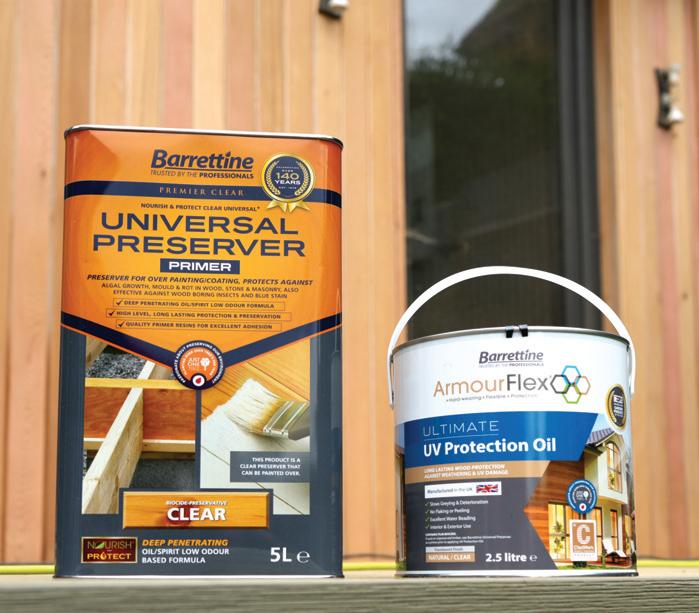
1 litre of Barrettine’s Universal Wood Preserver will cover 6.25m2 and will take 12 hours to dry under normal conditions (20°C/65% rel. humidity). A minimum of 24 hours drying time under normal conditions should be allowed before a topcoat is applied. With James’ garden room, two coats of Universal Wood Preserver were used.
UV Protection
With the primer coat on, it was now time to apply the topcoat to the cedar cladding. For this, James used Barrettine’s Armourflex® Ultimate UV Protection Oil. A blend of natural oils, waxes, and resins, this incorporates the latest UV stabilising technology to protect against weathering and UV damage. It is UV damage that is so often the cause of wood swelling, twisting, and greying. James admitted himself that choosing cedar to clad his garden room was no small expense. It would then seem counterproductive to let an investment like that go to waste!
few months.
Ideal for all exterior wood types including doors, windows, and structural timbers, the UV Protection Oil imparts excellent water repellence to both softwood and hardwood, giving a microporous finish that is resistant to flaking, peeling, cracking and blistering.
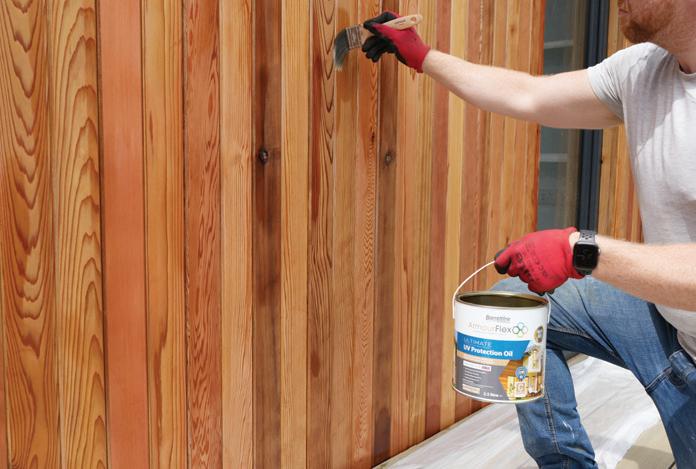
To apply, James did two coats. The first was done generously, after this it’s recommended to go sparingly to suit the aesthetic; the more generous, the more a gloss will build up.
For drying, allow a minimum of 4 hours between coats and 10 hours until fully dry. As a guide, a 1L tin will cover 8 m2 with 2 coats (although this depends on the wood itself and how much it absorbs the product). From an after-care perspective, it can vary on sun position and UV levels but in a year and a half’s time or more, James can simply buy a fresh tin of UV oil and just apply it on.
Universal Wood Preserver. This is instrumental in protecting the wood against rot, insects and fungi. It penetrates the surface, keeping the wood durable and defends it against the elements. Because it’s wax-free, the Wood Preserver is incredibly easy to apply on liberally and James had an easy time of coating the cedar cladding. It’s easy and straightforward to use, ready to go from the tin and is colourless and low odour. In this instance it’s working as a base layer for the next treatment to be added.
The Universal Wood Preserver can be used internally or externally (as long as the timber is out of ground) and is suitable for use on all types of timber, rough, sawn or smooth.
It is also harmless to plants and pets when dry. So James’ dog, Bazil, won’t have
By the same notion, if you’ve got a customer who wants quality timber cladding on a project. Be that a garden room or a new house facade, they won’t be too pleased if they’re left with something that’s greying in the sun after a
The final result? James is feeling rather chuffed with his revamped and protected garden room and can rest easy knowing his workplace investment is well protected.
FIND MORE INFORMATION ON BARRENTINE VISIT
WWW.RDR.LINK/BCC013
FACE THE FUEL
PB’s Luke Cuneen on fuel prices hitting the trades’ pockets
It is no exaggeration to say that in the last few months fuel costs have become a nightmare for us all.
Recent geopolitical events have driven fuel prices up the bend, around the corner and frankly straight to the heavens above with just how expensive things are getting. Of course, I’m not saying that fuel is at its most expensive ever, but it is definitely getting there. Despite the old saying, the reality of the situation is not getting better with time. If anything, it feels like it’s getting worse.
Petrol and diesel seem to become more expensive month by month, with no real relief in sight to suggest that eye watering prices are likely to majorly come down anytime soon. Even my tiny Fiat 500, a car known for being economical, is getting more expensive to fill up every time I take it to the petrol station. Even though I am usually an optimist about these things, it is starting to worry me.
Indeed, it is starting to worry us all. It feels as though fears about real and tangible fuel shortages are becoming a frightening reality. Yet amongst all this speculation about the future, there is one group of society that is affected by the current fuel crisis more than most, and that group happens to be you, the tradespeople of this country.
Tradespeople are easily among the most well-travelled workers in the UK, often driving hundreds of miles each week to reach clients and job sites. It is what allows you to do what you do best, practise your trade, provide for yourselves and your families, and keep the country moving. While it is incredibly hard work, it is also one of the few reliable sectors that keeps everything afloat as you build what needs to be built and fix whatever needs fixing.
Yet now, instead of focusing entirely on your trade, many of you are probably spending sleepless nights worrying whether your daily commute could end up bankrupting you. The fact is that most
tradespeople drive vans, many of which run on diesel. According to a report by MoneySuperMarket.com, diesel now costs around £1.91 per litre compared with £1.42 per litre in 2025.
Those are staggering prices, but the reality is that no amount of government intervention, price caps or legislation is likely to stop those extra fuel costs from affecting you and your business. So, while we cannot do anything about the price itself, here at PB we can offer a few helpful suggestions and alternative solutions that may help lessen the burden.
Less is more
It may seem like an old-fashioned solution, but less really is more when you are counting your pennies. In the current climate, it can be tempting to use every last drop of fuel before that menacing red warning light appears on the dashboard, leaving you scrambling for the nearest petrol station.
However, making smaller and more frequent top-ups can help you keep a closer eye on your fuel spending. While it may be more time consuming than filling the tank in one go, it is a legitimate way of managing fuel costs while keeping your van on the road. It is also a costsaving measure that many tradespeople may already have adopted.
Price comparison
One of the benefits of living in the digital age is that information is always at your fingertips. This is especially true when it comes to fuel prices.
There are now multiple apps, such as PetrolPrices, that allow you to identify the cheapest fuel stations near your location. This gives forward thinking tradespeople the opportunity to secure the best possible deal on petrol or diesel. If you are smart enough to plan your route in advance, you can make considerable savings over time simply by choosing where you fill up.
An electric choice
As regular readers will know, here at PB we are very excited about the future that electric vehicles could have in the trades. Given the current fuel situation, some may even argue that the future has already arrived.
Many tradespeople have already swapped their old diesel vans for brand new electric alternatives, with the sight of such vehicles becoming more common every day. Now, I am not saying that electric vehicles are the perfect solution. However, they do offer an opportunity to dramatically reduce day-to-day running costs and lessen dependence on increasingly expensive fossil fuels. Well, if you’ve got a home charger that is!
THE INTELLIGENT ANSWER
In part one of our AI on site analysis, Price Doctor looks at how UK builders are using artificial intelligence to win more work, save time and protect margins
For most small builders, the work doesn’t stop when you put the tools down. Running an SME construction business means wearing every hat – estimator, project manager, site supervisor, accounts department and customer services, often all in the same day. And while the actual building might be going well, it’s the stuff around the edges that kills margins and costs stress and sleep.
Which is why a growing number of UK builders are starting to pay attention to artificial intelligence – not because they’ve been wowed by tech industry hype, but because they’re desperate for anything that saves them time and stops the business overwhelming them.
Why builders can’t afford to ignore this anymore
The domestic construction sector is under real pressure. Labour costs have risen sharply. Material prices swing from month to month. Homeowners expect faster responses, slicker communication and more professional-looking proposals than ever before. Meanwhile, margins on extension and renovation work have been squeezed to the point where a few missed items on a quote or a week’s delay on a variation can wipe out the profit on an entire job.
On top of all that, the admin burden on owner-operators is heavier than it’s ever been. And legalisation is adding to this; CIS, reverse VAT, Making Tax digital, CDM compliance all add to the burden.
AI won’t fix the skills shortage or magic away material costs. But the statistics are starting to be difficult to ignore. According to the Houzz UK AI report 2026, around 46% of UK construction and design firms are already using AI tools in some form, and those who use them regularly report saving more than three hours per week on
administrative tasks alone. That’s not nothing – for a sole trader or small team, three hours a week is the difference between getting your quotes out on Monday or Thursday.
So, where are builders already using AI?
Estimating and quoting
A decent extension quote takes hours –measuring up, pricing materials, working out labour, writing a scope of works that won’t come back to bite you six weeks in. AI-assisted tools, like Price Doctor, are starting to make this faster. Platforms that use AI to help with take-offs and bill of quantities generation are becoming more common, and general-purpose AI tools like ChatGPT or Claude can be used to draft scope of works documents, help write specification clauses, or cross-check that you haven’t missed a trade.
The golden rule is never trust AI pricing without checking it yourself. AI tools can produce a plausible-looking materials list with prices that bear no relation to what your merchant is currently charging. They’re useful for speed and structure – getting a first draft together quickly – but the numbers need human eyes before anything goes to a client.
“And while the actual building might be going well, it’s the stuff around the edges that kills margins and costs stress and sleep.”
Admin and office work
Writing a follow-up email after a meeting, drafting a letter about a variation, chasing a subcontractor for an invoice, updating a client on progress – all of this can be done faster with AI assistance.
Tools like ChatGPT, Claude, or Microsoft Copilot can draft emails in seconds based on a few bullet points. Some builders use them to generate meeting notes after a site walk-around, turning a voice memo into a written record that goes to both parties. Others use AI to help manage their CRM –automatically logging enquiries, sending follow-up messages, or qualifying leads before they pick up the phone.
Customer communication
Poor communication is still the number one cause of disputes and bad reviews in domestic construction. AI tools can help you set up templated messages that go out automatically at key project stages –work starting, first fix complete, materials arriving on Tuesday – keeping clients in the loop without you having to personally draft every update. A CRM or job management solution like Price Doctor can assist you with this and these features will already be built in.
When a client raises a concern or queries a variation, AI can help you write a clear, professional response that explains the situation without being defensive or vague.
Design and visualisation
For extension and renovation specialists, one of the trickier parts of winning work is helping homeowners visualise what they’re actually buying.
AI image generation tools –Midjourney, Adobe Firefly, and others, including most of the common AI chat bots like ChatGPT – can produce rough visual concepts of exterior extensions, internal renovations and material combinations in minutes. These aren’t architectural drawings and shouldn’t be presented as such. But as a sales tool for a first meeting, a rough visual of what a kitchen extension might look like – with bi-fold doors, a specific brick finish, lantern roof light – can be the difference between a homeowner saying “let’s go
ahead” or asking a second builder to come round.
Planning, compliance and retrofit
The planning system is confusing, and retrofit work – insulation, heat pumps, EPCs, ventilation – requires navigating guidance that changes regularly. AI tools are increasingly useful for helping builders get their bearings before they call a consultant.
Using an AI tool to get a plain-English summary of permitted development rules, or to understand what’s typically required for a Part L-compliant extension, won’t replace a planning consultant or building control officer – but it can help you have a more informed conversation, spot potential issues early, and avoid expensive surprises.
With the government’s retrofit agenda still driving demand for insulation upgrades, heat pump installations and whole-house energy improvements, builders who can navigate this space competently are going to win more work. AI can help you get up to speed faster on technical requirements you don’t deal with every day.
Next month we look at some of the risks associated with AI and how you can start to use AI safely.
We give our verdict on new products in our unique site tests, but now we want to give you the chance to try them – AND KEEP THEM – for yourself! All you have to do to enter the free draws is simply just type in www.rdr.link followed by the unique code.
FREEFOR ALL!
50 X DECKING FIXING KITS
APTUS G&B
TIMBERFIX OUTDOOR COLLECTION
Think fixing. Think fastening. Think Aptus. This specialist business, which is now part of the G&B group, offers solutions to the widest range of fixing and fastening needs. The task of fixing decking is no exception and especially as the company has just launched new decking fixing kits. Each kit contains everything you need to fix 2.4m2 of decking including black hex landscaping screws, PZ green treated decking screws, a hex socket and a PZ driver bit.
We’ve got 50 of these handy kits to give away to lucky Pro Builder readers.
10
X FIXING HELPERS AND 25X KEYRINGS
CHUMP
CHUMPROUND
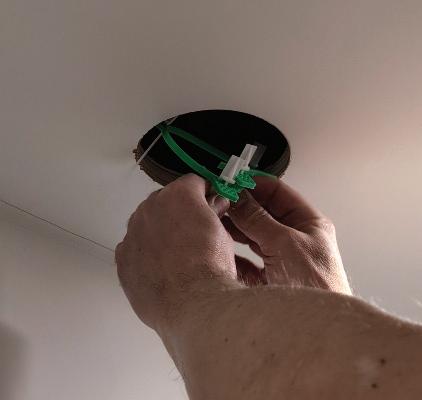
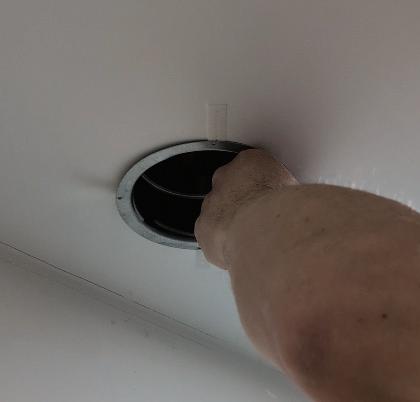
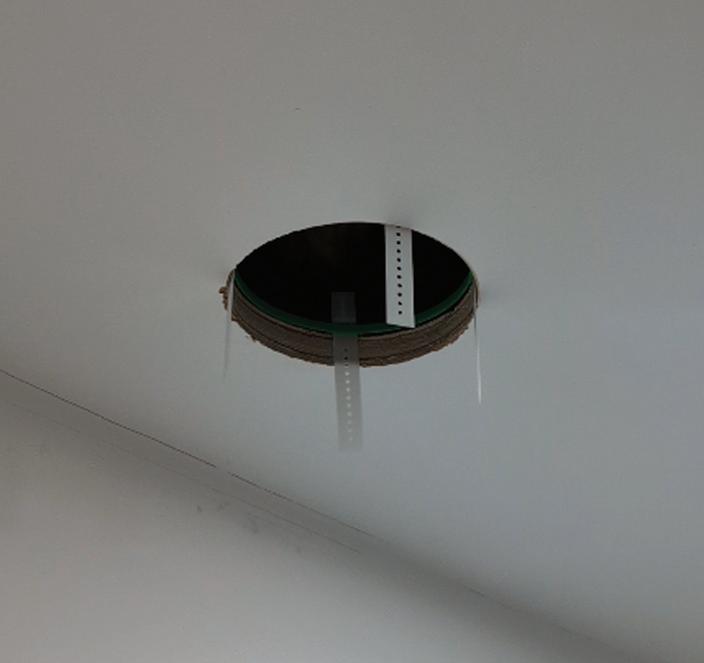
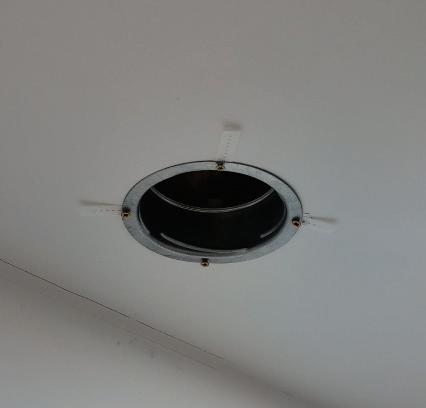
We have ten packs of CHUMPRound with a 4” and 5” version in the pack, plus 25x keyrings to give away. CHUMPRounds are designed to help when securing a vent or fan to plasterboard, with wings that have multiple holes to receive screws. The second part is a pack of four tabs. These tabs clip easily into the ring inside of each wing. It’s designed to be like having an extra pair of hands! 25 CHUMP keyrings are also up for grabs. You can read more on page 24. Don’t be a chump! Use the rdr below to enter this great competition.
FOR YOUR CHANCE TO WIN VISIT:
3 X TROWELS
ROLLINS
W. ROSE BRICKLAYING TROWEL
W. Rose has built a reputation as a trusted name in the bricklaying industry, known for producing premium American-made trowels crafted for professional performance. Each trowel is forged from a single piece of carbon steel, creating superior strength, balance, and durability on-site. Carefully heat treated for added toughness and hand polished for a smooth finish, W. Rose tools are designed to deliver precision, comfort, and reliability for bricklayers who demand the highest standards from their equipment every day.
2 X MEASURING TOOLS
OX TOOLS
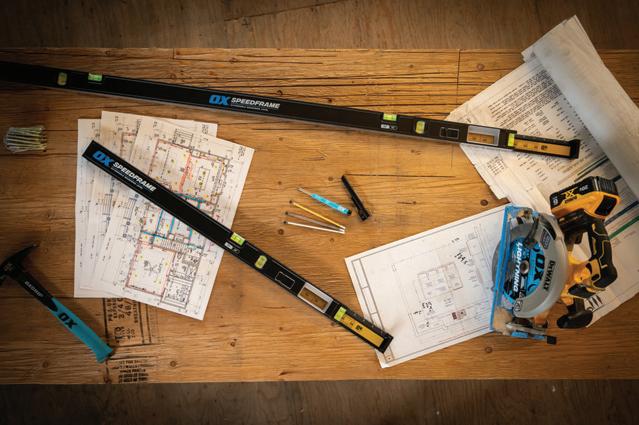
OX PRO SPEEDFRAME
OX Tools is giving away two sizes of the recently launched OX Pro SPEEDFRAME™.
Designed to improve accuracy and efficiency, SPEEDFRAME™ is an extendable level and point-topoint measuring tool featuring a high-precision readout window, patented twin-rail extension system, dual vials for accurate level readings, and a continuous scribing edge. The giveaway includes the 29”–48” model (extending up to 4 feet) and 53”–96” model (extending up to 8 feet). Created by a 30year home builder to address common frustrations, SPEEDFRAME™ supports a range of applications, including framing, door installation, finish carpentry, and more. Measure up and take part in this great competition!
FOR YOUR CHANCE TO WIN VISIT:
KITCHEN DEMANDS
Rachel Tuckey,
Chief Marketing and Product Officer
at Häfele UK, looks at what homeowners now expect from their kitchens and what this means for builders and tradespeople
The kitchen has always been one of the hardest-working rooms in the home, but customers are now asking more of it than ever.
In our new 2026 Homes for Living report, we found that 84% of homeowners use their kitchen for cooking, but 48% also use it for laundry, 43% for cleaning and 36% for eating. Use of the kitchen as an office has also risen from 15% in 2022 to 18% in 2026.
With more and more uses, there is increasing pressure on the kitchen. Almost half of homeowners (44%) say they use their kitchen for multiple purposes but do not have enough space to do everything comfortably. One in five say they dislike their kitchen, while 26% say fixing their biggest kitchen issue would greatly improve their quality of life.
For trades, this shows that their customers want more than just getting their kitchens’ tired features replaced –they want help to make their spaces work better for them, their families and their lifestyles.
What customers want now
Those changing expectations are reshaping what customers want in a kitchen. The focus is no longer just on appearance, but on spaces that feel calmer, more organised and easier to use
every day.
Our research found that more than half of homeowners (52%) now say a clean, tidy and easy-to-maintain kitchen is most important, up from 46% in 2023. Function has also become more important, rising from 37% to 40%, while wellbeing has increased from 16% to a quarter and accessibility from 18% to 24%.
Storage is one of the strongest examples of this change in thinking. Alongside cluttered worktops, it is the joint biggest kitchen pain point, with 29% of homeowners naming storage limitations or difficulty accessing storage as a problem in their space. A quarter say more storage would be one of their top priorities in a future kitchen, while 18%
would prioritise smarter storage solutions that make better use of awkward spaces. The most wanted features also show how much customers value convenience and organisation. Pantries or larders top the list at 32%, followed by speciality water taps at 31%, appliance storage at 31%, smart lighting at 30% and built-in charging points also at 30%. Overall, these choices show homeowners want kitchens that save time, reduce clutter, and support how they actually live.
Value over cost
Our research also shows a change in how customers think about value. While they are still budget-conscious, today’s homeowner is thinking carefully about how
“Today’s homeowner is thinking carefully about how well the kitchen will perform over time. For builders, installers and carpenters, this creates an opportunity to frame good quality products and well-considered design as long-term value.”
well the kitchen will perform over time.
Quality and longevity have now overtaken budget and cost as the top future influence on kitchen decisions, which suggests homeowners are looking beyond the lowest upfront price and placing greater importance on durability, usability and everyday performance.
For builders, installers and carpenters, this creates an opportunity to frame good quality products and well-considered design as long-term value. A kitchen that lasts, works smoothly and makes daily life easier is likely to feel like a better investment than one that meets the brief at the lowest possible cost.
As carpenter Gary Banks told us: “Customers want to make sure they’re getting something that’s a good investment and going to last a long time.”
Guiding the customer
As customers become more considered in their decision-making, confidence
cost and practical concerns make them hesitant. A similar proportion, 48%, worry about making the wrong design choices.
This is where tradespeople can add real value. Customers do not always know which products will work best, how to make awkward spaces more usable or where their budget will have the biggest impact. They may want better storage, improved lighting or smarter fittings, but need practical guidance on what is achievable in their home.
Our findings back up the importance of trades, with 58% of homeowners saying they would seek advice from a local kitchen designer or installer before designing and buying their kitchen.
For tradespeople, selecting a supplier
installers need access to products, technical advice and services they can trust. Working with a supplier that offers a broad range, reliable availability and practical support can make it easier to recommend the right solution, keep projects moving and deliver kitchens that meet customer expectations.
WINNING ROUND
Professional Builder puts the questions to the developers of the CHUMPRound a new tool for ventilation and fan installation
QWe understand the new tool has been developed by the trades? What problem does it solve?
You know that when a product has been created by a tradesman for the trades to solve an everyday problem, it will make an improvement on the speed and quality of installation work. The current problem is how do I secure a vent or fan to plasterboard when the manufacturers put the fixing holes so close to the edge of the board? Anyone who fitted these vents or fans will have their own history of struggles and possible failures, and also their own customary words of encouragement to the manufacturers about the locations of the screw holes. Now, with a simple fixing, we can be working faster and with greater ease.
QTell us about the installation?
The installation process is possibly simpler than you may expect. We are used to trying to get a screw fixing near the edge of the hole, fiddling with some wood above a ceiling, or, quite often, having a second person crawling in the loft space with pieces of wood to push down onto the screw we are putting up into the ceiling.
With the CHUMPRound the entire process is carried out from below the ceiling, and by one person. Obviously this innovation will be even more useful when access to the other side of the ceiling or wall is restricted.
QSounds interesting – let’s drill down into its construction
The CHUMPRound comes in two parts. The main part is the ring with four wings. The wings are just like the ends of the CHUMPFix with multiple holes to receive screws. The second part is a pack of four
“This has got to be one of the most innovative and simple products entering the ventilation industry since backdraft shutters. It is also going to be one of the most useful products for any installer.”
tabs. These tabs clip easily into the ring inside of each wing.
QTell us more about how it works in practice?
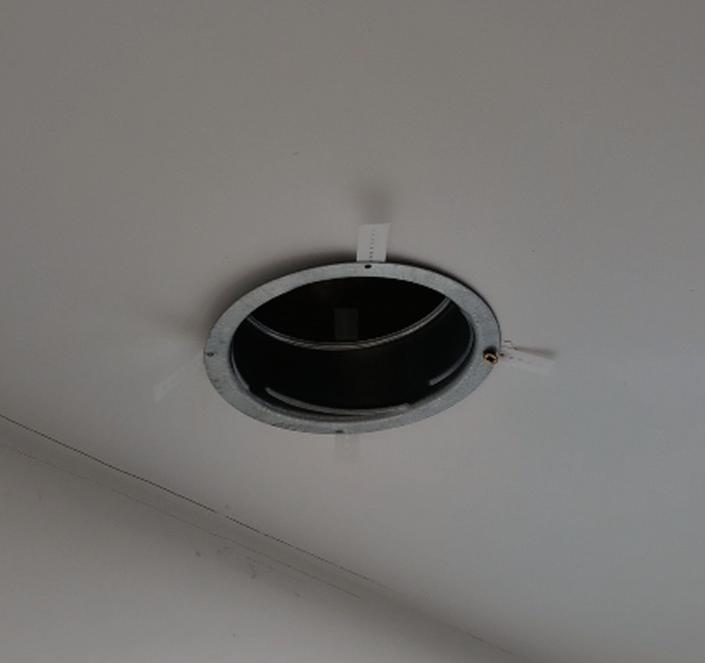
To install the CHUMPRound the ring is squeezed and placed through your hole in the ceiling, or wall, and it can rest on top of the ceiling or behind the board of the wall. Next you insert the vent or fan into the hole. The fantastic part is that there are four thin tabs hanging from the edge of the hole. You can now work both above and below the ceiling using these tabs. Simply align the screw holes in the vent with the tabs and pull on the tabs to bring the wings flush with the plasterboard. Now any screw that you put through the ceiling will find a solid fixing
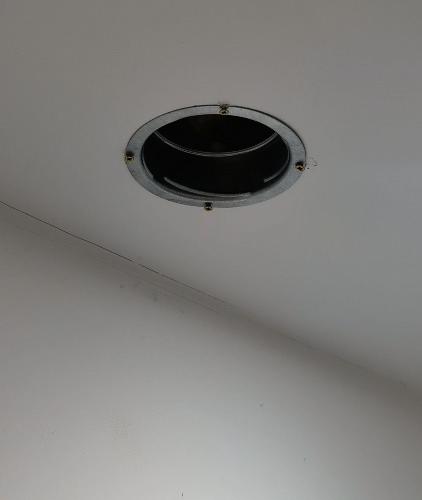
above the ceiling. Screwing through the tabs also makes it easier to fix the vent to the ceiling, as this holds the tabs, and therefore the CHUMPRound above in place. Once your vent is on the ceiling, simply cut off the ends of the tabs before you fit the grill or cover.
The launch product is available in 4” and 5” versions to suit the majority of installations.
Q Are there other products on the market from the same team?
The CHUMPRound comes from the same company as the CHUMPFix and CHUMPFixL, and follows in the same high quality standard. All the manufacturing is carried out in the UK to ISO9001 to guarantee the quality of every product.
kitchens and bathrooms
ROCKET SCIENCE
Silicone sealants form a key part of any tradesperson’s arsenal. With numerous sealants available, all designed to suit different applications and environments, it’s always handy to have a selection in the back of your van, ready for that next job. However, how can you know you’re choosing the right sealant? You need products that you can trust to deliver a top-quality finish that will last, protecting your reputation and avoiding any callbacks further down the line.
It’s important to check out what’s in the cartridge, understanding the science behind the product attributes so you don’t get caught out or fooled by gimmicks.
Bathrooms and kitchens
Water damage is one of the most common reasons for homeowner insurance claims in the UK, particularly from kitchen and bathroom leaks. Often, leaks can either be caused by or further exacerbated by low-cost sealants having failed. As well as shrinking as it cures and ages, poor quality sealant can provide poor adhesion or lose adhesion over time. In both cases, this can create a route for water ingress, allowing water to seep into areas that it shouldn’t, causing further damage.
The cause? Cheaper silicone sealant
Choosing the right sealant for the job is essential, ensuring a top quality finish and a happy customer. But there’s more to a sealant than first meets the eye. Here, Andy Cummins, Senior Product Manager at Geocel, explores the science behind high-quality silicone sealants and how you can protect against shrinking, cracking and discolouration
solutions can be bulked out with other chemicals and additives that evaporate as they cure, leading to shrinkage and forming a weak bond that can cause cracks and lifts.
Lower quality sealants are also more vulnerable to discoloration and mould and bacteria build up. This can present a big problem when you consider that buildings and homes are becoming increasingly airtight to ensure energy efficiency, with an increase of humid air and condensation.
Glazing
Moving outside and one of the biggest obstacles to an effective sealant application in exterior applications is the weather. Ultraviolet (UV) radiation, rain, wind and significant changes in temperature can all impact the lifespan of a sealant. As such, the product selected needs to have a high level of durability, UV and weather resistance to be able to withstand these conditions, season after season.
Take glazing as an example. There will always be a significant amount of movement expected between the frame and the rest of the building. Changes in temperature can also cause the frame to
expand and contract over time, meaning sealants must maintain a significant amount of permanent flexibility to ensure they can accommodate movement longterm.
Here, high-quality silicone sealants will deliver a flexible seal, adhere to a wide range of common substrates and offer excellent resistance to the effects of weather and changes in temperature. Good quality silicone sealants will not crack, shrink or discolour for a longer-
lasting finish that retains its appearance and performs well.
Roofs and gutters
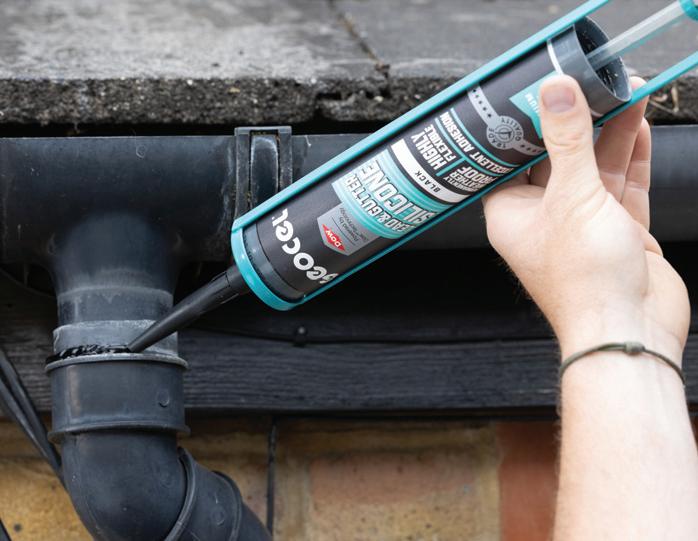
When it comes to roofing projects, you can encounter a variety of different substrates and surfaces. This can be a challenge for lower priced sealants, with some struggling to fully adhere or bond to a range of materials. Likewise, the impact of shrinkage when it comes to roofs and gutters can be severe, leading to weaker joins and the perfect opportunity for rainwater to make its way into a building.
For these jobs, silicone’s excellent adhesion to a range of materials makes it the ideal and versatile choice.
It’s also worth looking out for sealants that are neutral curing. This means that you can say goodbye to the unpleasant odours released during curing, as well as not having to worry about it corroding or
sealants. While for rainwater systems, this could mean damage to the painted surface of your customer’s chosen gutters and downpipes.
No gimmicks, just science
Some sealant manufacturers choose to bulk out their formulations with other impurities and ingredients in addition to the silicone, which in turn can affect the long-term performance reliability of the
has set the standard in performance, reliability and quality. All its products under the newly consolidated “Powered by Dow” range benefit from premium grade silicone from Dowsil, the global leader in silicone technology, with all additional ingredients carefully selected to enhance performance for its specific application.
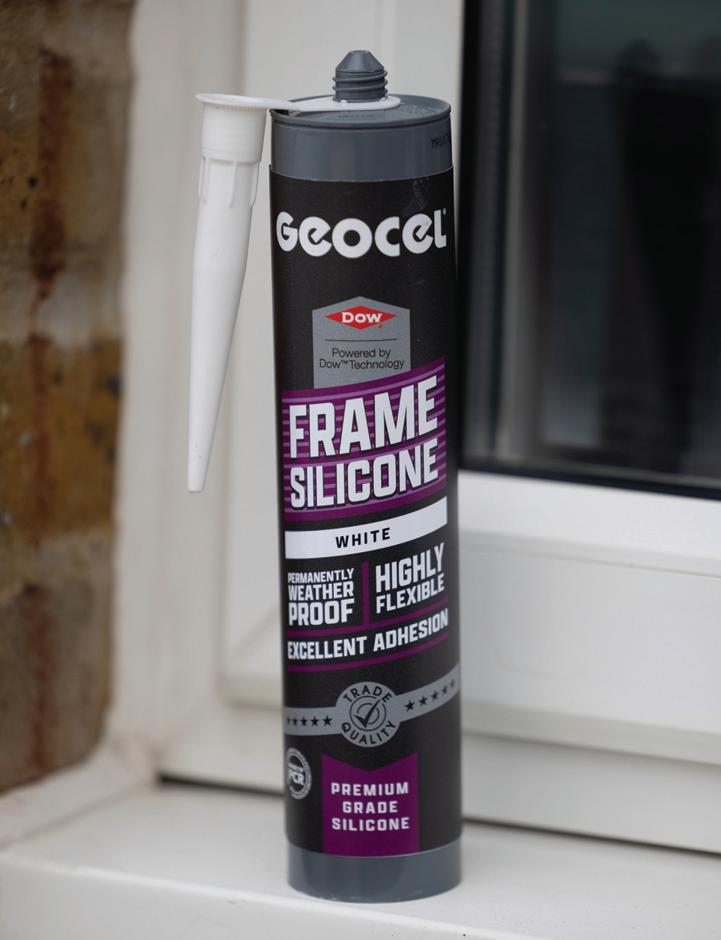
Take its Sanitary Silicone, a fast-curing sealant that provides excellent unprimed adhesion, high movement capability and prevention against cracking, shrinking or discolouring. It also features a fungicide, to actively resist mould growth in wet and humid environments. Or the expertly curated formulation of Frame Silicone, neutrally curing and providing superior protection against weather, all combined with excellent adhesion and high movement capability.
TO LEARN MORE ABOUT GEOCEL
TAP INTO THE FUTURE!
PB’s Luke Cuneen looks at the rise of the smart tap
If it ain’t broke, don’t fix it.” That is very much the attitude many people have when technology and innovation take a simple and well developed concept such as a tap and attempt to improve it. Traditional taps are, well, simple. Operated by handles, these mechanisms work perfectly well, with there generally being only two water options, hot or cold, making them easy to maintain and, if needed, repair.
Taps like these have worked for hundreds of years, so why change them? Well, the fact is that they are no longer the most advanced option the kitchen world has to offer. Smart taps, using the latest motion sensing, water filtering and heating technologies, are. Given that the traditional tap system is now well over a century old, perhaps it really is time for a change.
A smart tap?
Smart and sensor taps are commonly found in public washrooms, restaurants, cinemas and office buildings, where they help improve efficiency while also creating a modern and professional appearance.
Only in recent years has there been a growing demand for smart taps in the home, particularly in kitchens. As a result, a wide range of manufacturers now offer products designed specifically for domestic use.
Smart taps are most commonly
more than simply dispense hot or cold water without touching a handle. One of their most impressive and practical features, especially for British households, is the ability to provide instant boiling water. Many models allow users to pour boiling water directly from the tap into a mug, effectively removing the need for a kettle altogether.
For busy families or homeowners who enjoy a quick cup of tea or coffee, this feature alone can make a significant difference to day-to-day convenience.
Long term benefits
While these devices are certainly impressive and would make a welcome addition to almost any modern kitchen, it is important to look beyond the novelty factor and consider the genuine practical and financial benefits they offer. This is especially useful when discussing smart taps with customers who may be considering having one installed.
One of the biggest advantages of smart taps is their ability to reduce water consumption. Thanks to advanced technology and highly efficient design, they are able to precisely control the amount of water being used. Features such as integrated aerators help maintain strong water pressure while reducing waste, ensuring water is only used when needed.
This can make a considerable difference over time. Think about how often a traditional tap is left running unnecessarily or continues dripping after use. Smart taps are designed to minimise these issues, helping households conserve water while also reducing their water bills.
The benefits extend beyond water savings. Smart taps can also help reduce energy usage. While they do require electricity to operate, many advanced models are capable of maintaining water at a consistent temperature. Traditional taps often require users to spend time adjusting hot and cold settings until they
reach the desired temperature, wasting both water and energy in the process.
By delivering water at the correct temperature almost instantly, smart taps can reduce unnecessary energy consumption and improve overall efficiency within the home.
According to research conducted by washroom experts Intelligent, the average British household uses around 360 litres of water per day. Installing smart taps could reduce water usage by between 30 and 50 per cent, potentially saving significant amounts of money while also helping the environment.
Of course, smart taps are not without their disadvantages. The most obvious drawback is cost. Because they rely on advanced electronics, sensors and heating systems, they are generally far more expensive than traditional taps.
There is also the issue of reliability during service interruptions. If a property experiences a power cut, many smart tap features may become unavailable. Likewise, if there is a disruption to the water supply, all of the advanced technology in the world cannot solve the simple problem of no water coming through the tap.
Where to start?
There are now dozens of smart tap models available for domestic use, with prices ranging from under £100 to well over £1,000.
As always, here at Professional Builder, we recommend doing your own research before making any recommendations. As the tradesperson, you are best placed to understand your client’s needs and budget. It might not be bye-bye to the kettle just yet!
Forty years after its first hinged clip was launched, Talon Manufacturing is still solving the everyday site frustrations that builders come up against daily
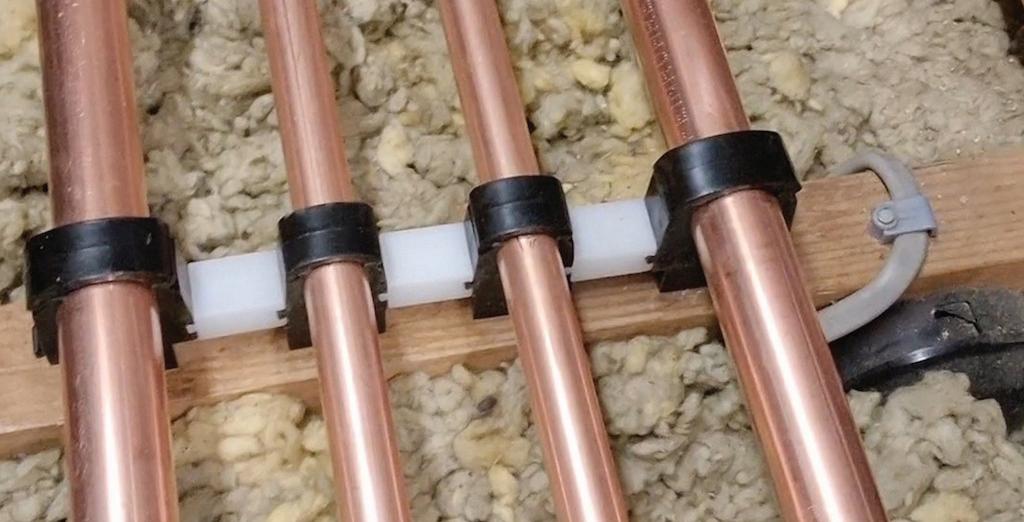
Back in the 1980s, failing clips were causing no end of headaches for anyone tasked with installing pipework. A cold snap over the weekend could be enough for pipework to shift and spring loose, leaving installers returning to jobs on Monday mornings to find pipes hanging free and clips scattered across the floor.
For travelling salesman Mike Dudney, the complaints became impossible to ignore. Everywhere he went, plumbers were saying the same thing. The hinged clips available at the time simply weren’t gripping properly. Instead of accepting that as part of the job, Mike decided there had to be a better option. That thinking became the foundation of Talon Manufacturing, which this year marks 40 years in business.
The company’s beginnings were straightforward. Mike wasn’t trying to reinvent plumbing fittings or launch a revolutionary new product category. The hinged clip already existed. The issue was that installers didn’t trust many of the versions on the market.
“He went to the drawing board, started drawing the first clip and then showed a few people on his rounds,” explains Talon QHSE Manager, Nick Josey. “One of his pals was a tool maker, so he gave him all the drawings and together they created the clip – and people started to show a
FORTY UP!
and shown at a plumbing trade exhibition where installers immediately understood the benefit because they were already familiar with the problem being solved. Encouraged by the response, Mike expanded the range and officially launched Talon Manufacturing in May 1986.
From the beginning, the business was rooted in British manufacturing. While many manufacturers have shifted production overseas over the years, Talon has retained that local manufacturing base throughout its growth.
during the early years, that growth came from listening carefully to installers and merchants rather than trying to chase
Problem solving
The original logo reflected the great grip of the hinged clips: an osprey copied from an encyclopaedia to symbolise precision and strength. The bird may have disappeared over time, but part of it still remains within the branding today through the claw shape built into the Talon logo.
As sales increased, the business expanded steadily rather than dramatically. According to those involved
If plumbers highlighted a recurring issue on site, Talon looked for a practical answer. As lagging requirements became more common, spacers were introduced. Nail-in clips were improved and refined. Different clip sizes followed. Every addition to the range came from conversations taking place in merchants, vans and on building sites. That same approach still drives product development four decades later.
One of the company’s best-known later additions was Snappit pipe covers. Installers regularly pointed out the difficulty of leaving exposed copper pipework looking neat and consistent, particularly in domestic settings. Painting pipes could look untidy and wrapping them often added time to jobs.
Snappit offered a cleaner finish using UV-stabilised uPVC covers that clip neatly
around copper pipework without the need for painting. Manufactured to resist discolouration, flaking and chipping, the product gave installers a simple way to improve the appearance of finished work.
The company expanded further in 2023 with the acquisition of PipeSnugwhich we originally featured in Professional Builder back in 2017another product born from solving a common installation frustration. Designed to create airtight seals around pipe penetrations without mortar, tape or sealant, PipeSnug helps installers comply with Part L requirements while cutting down installation time.
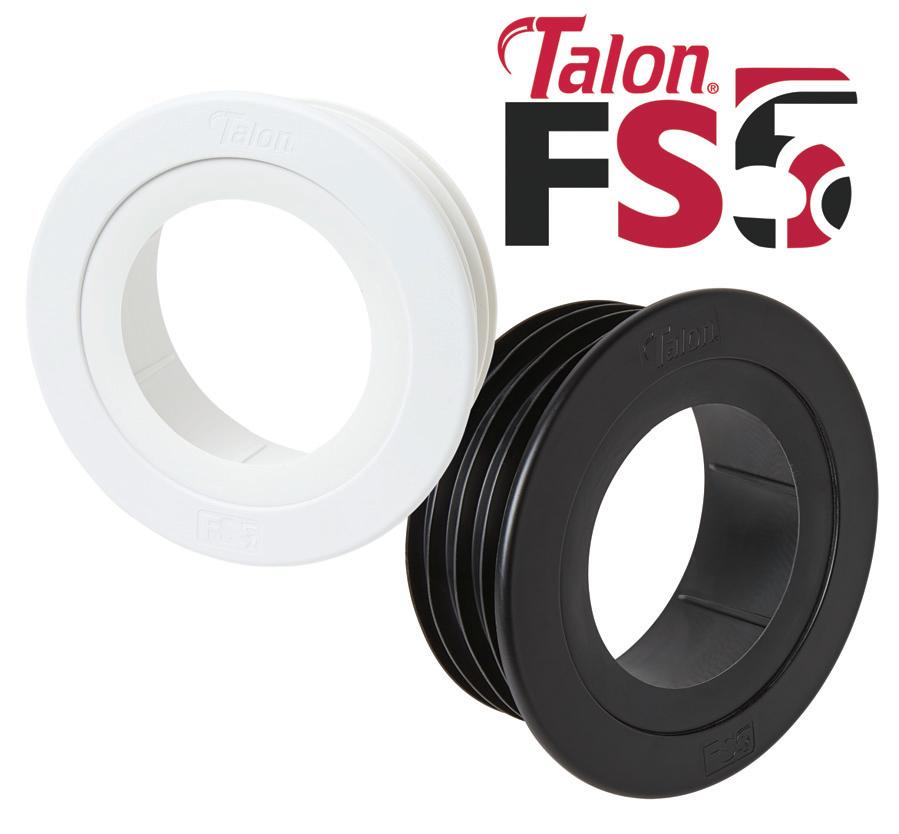
FlueSnug followed, alongside the more recent FS5, developed to simplify boiler replacement work. The FS5 fits directly into a standard 127mm core-drilled opening, helping installers align replacement flues without widening holes
industry, Talon prioritised quick turnaround and dependable supply.
The company has grown considerably since its earliest days and now employs more than 50 people, but there are still members of staff who remember the original years of the business firsthand. For Nick Josey, the reason Talon has lasted comes back to the motivation behind why it started in the first place.
“He didn’t do it for the money,” says Nick. “He did it for something for his family, really, to pay the rent. And he built up something just from listening, talking, taking something already there and making it better.”
That attitude has helped Talon navigate changes across both construction and manufacturing over the last four decades. Products, regulations and working practices may have shifted,
history came with the acquisition of Davidson Holdings by Genuit Group PLC in October 2025. For Talon, the move provides additional investment backing while keeping manufacturing and development roots firmly in place.
Forty years after those first hinged clips appeared, Talon continues to provide products that save time, reduce hassle and are up to the job. It comes down to the same principle every time: spot the problem, improve the solution
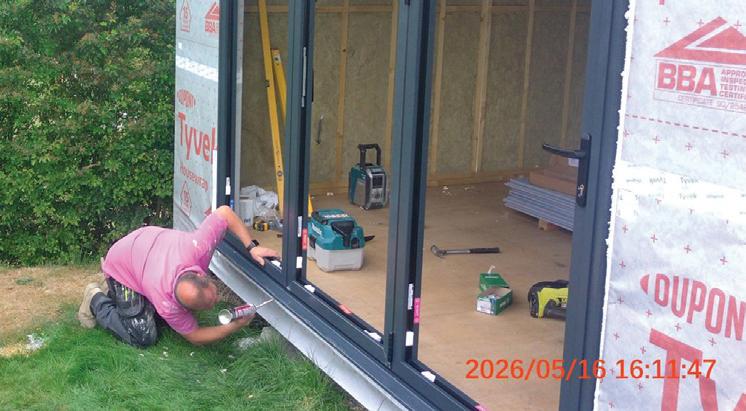
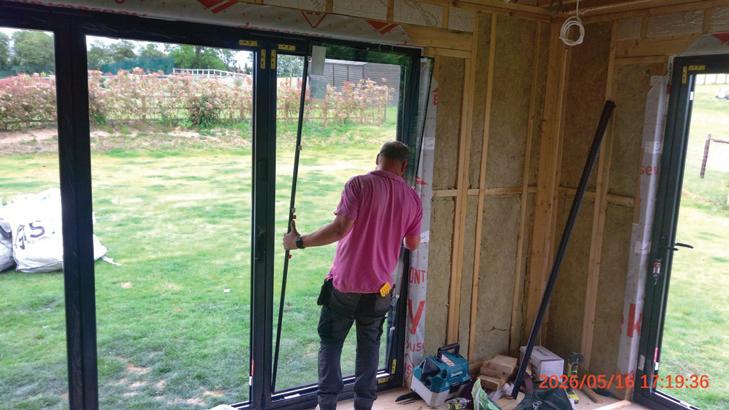
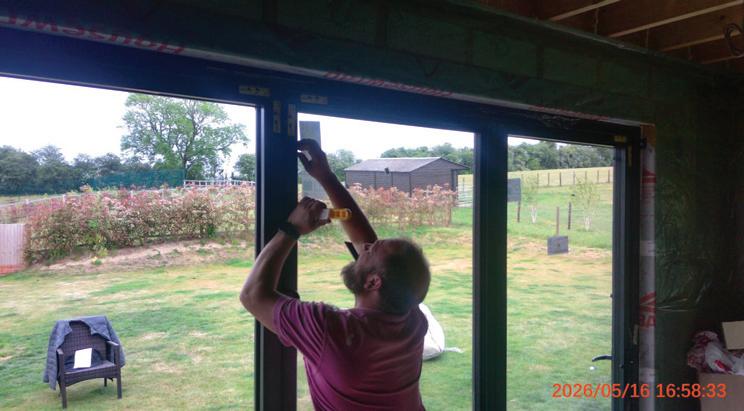
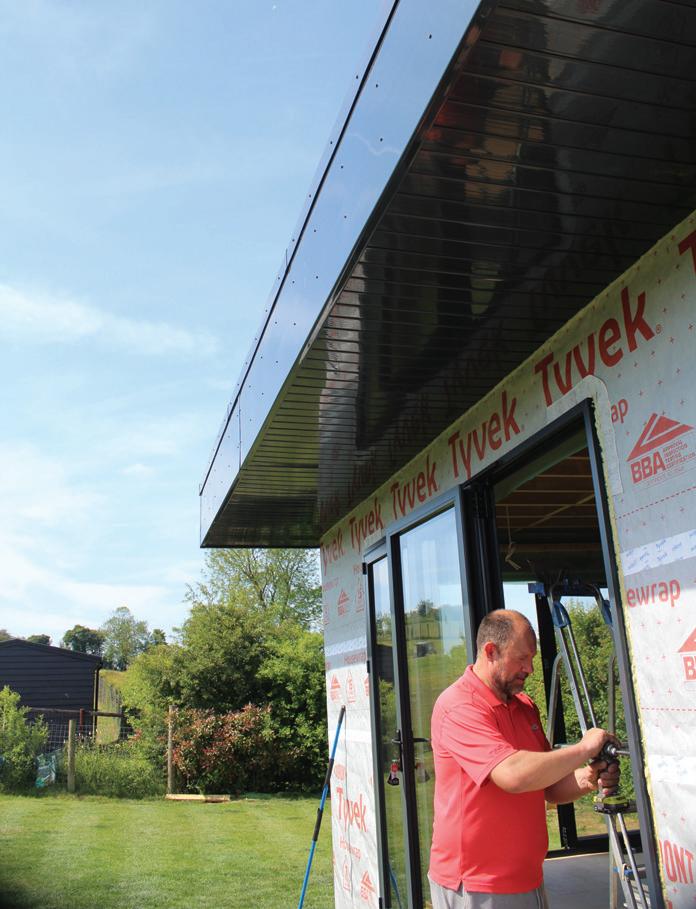
GLAZE OF GLORY
As you’ll read about earlier in this issue, garden rooms are certainly trendy at the moment. Their popularity has continued to grow since the advent of that funny ‘C’ word that seemed to change the world as we know it.
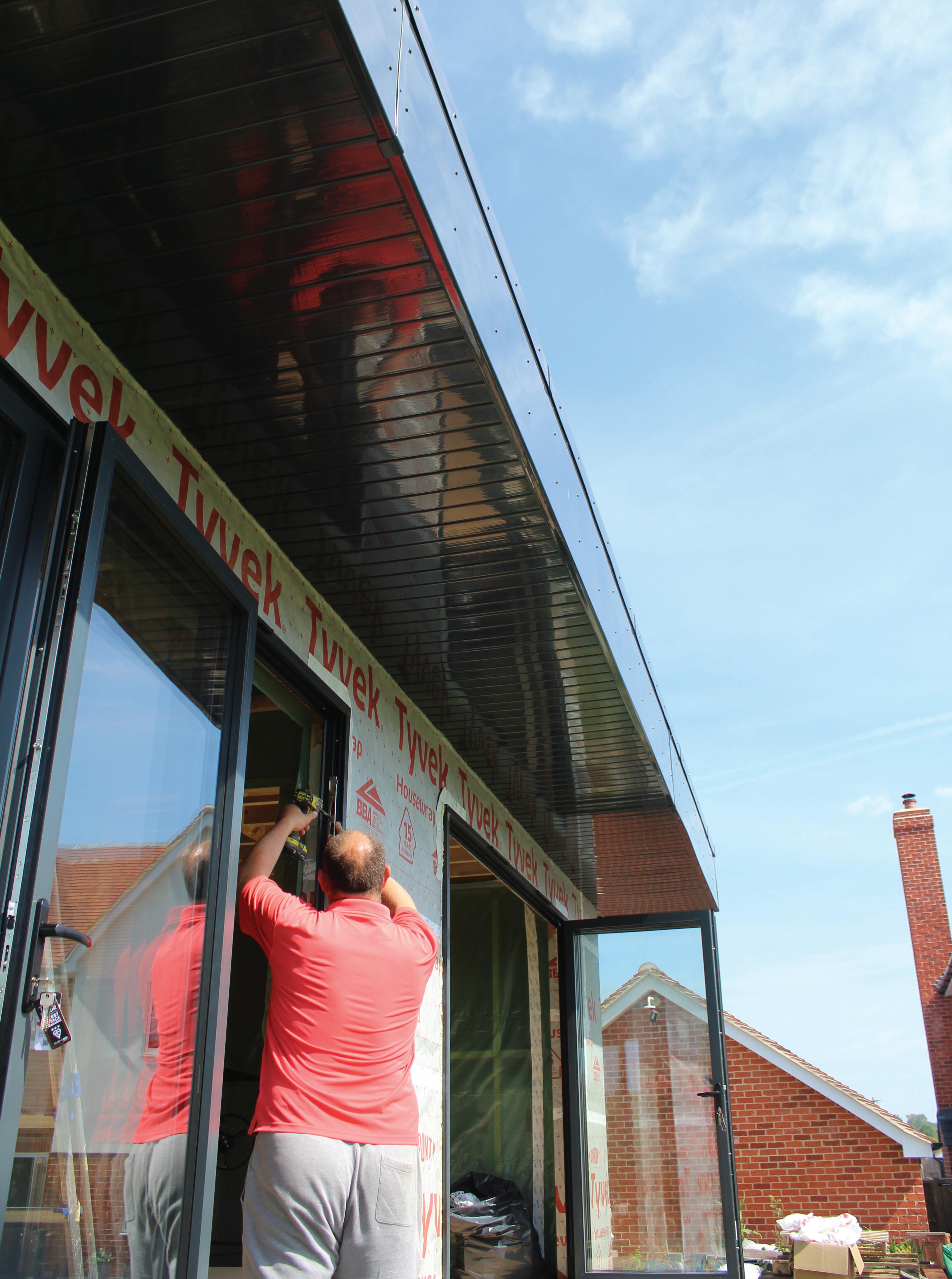
Latest to hop on the trend is homeowner Simon, who’s looking to upgrade his Hertfordshire property with a new office and home gym. Thankfully, his sizeable garden is able to accommodate both in one new building with a partition wall in the middle; fancy!
One of the main benefits to a garden room (and what distinguishes it from a shed if we’re honest) is the glazing. If you’re in your garden, you might as well make the most of it. Whether it’s a sliding door or bifolds, it would seem a waste to not capitalise on essentially being outdoors.
As with Simon, these spaces are mostly used as offices or home gyms, both spaces that benefit from being able to look outside and have a moment to mentally escape from whatever it is you’re doing in the moment. If you’re asked to build a garden room for a homeowner, the doors and windows you put on it are likely
going to be a deal breaker for them. Simon himself has a neighbour with alpacas and you wouldn’t want to miss out on those! Being a deal breaker of sorts, it’s
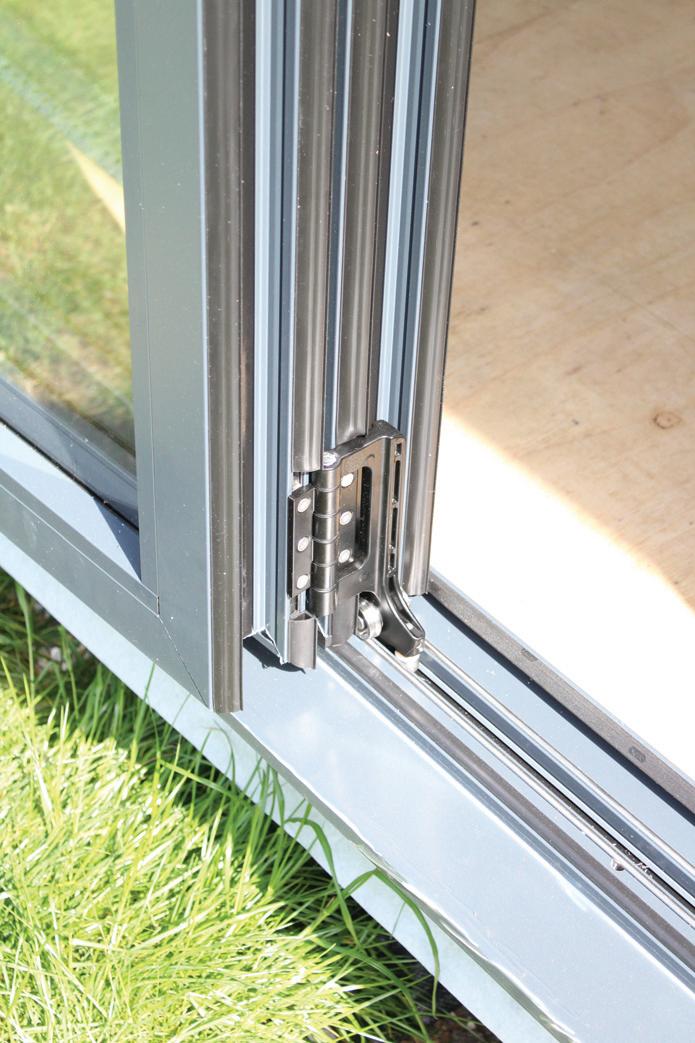
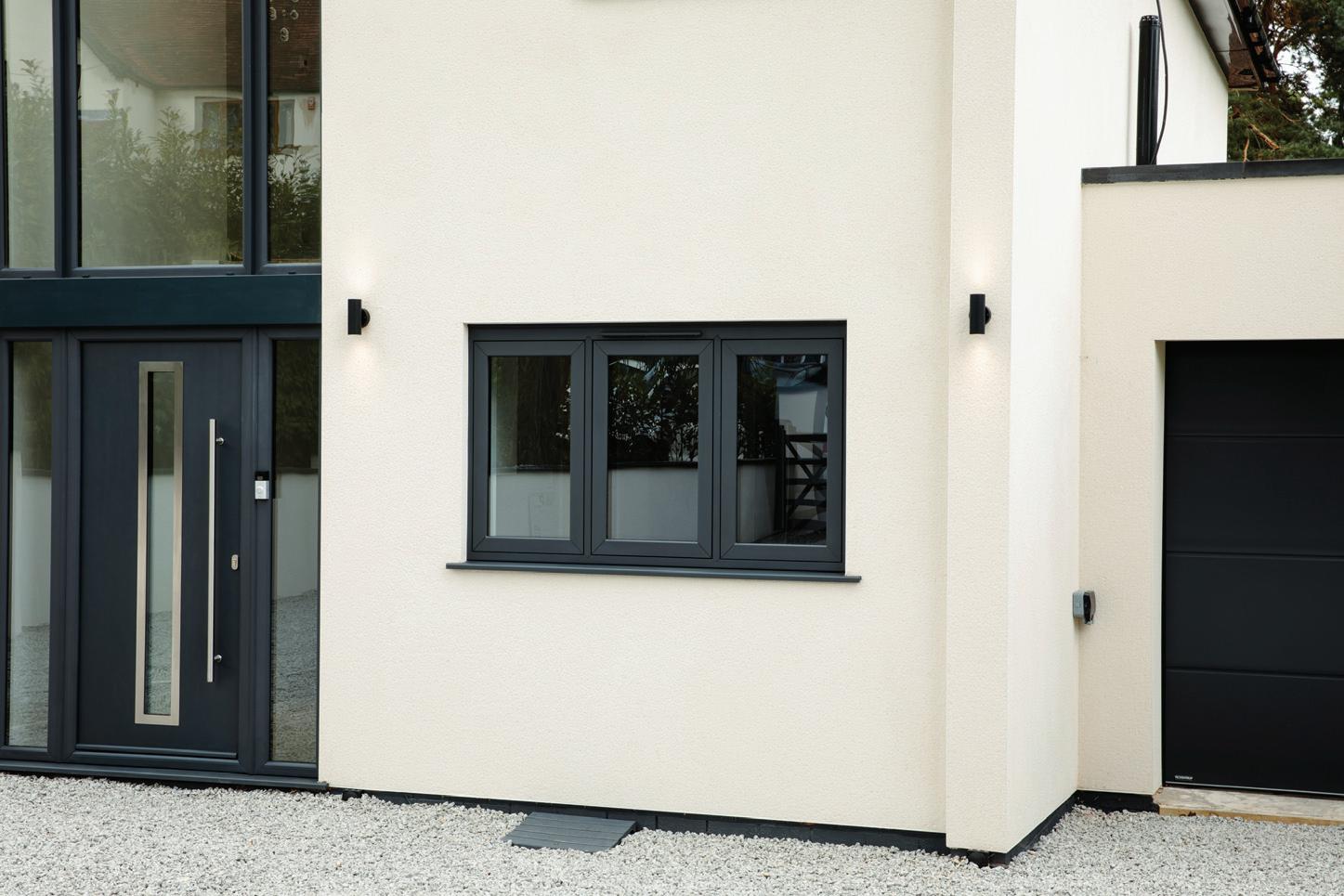
doors you’re choosing in general). Simon went for Korniche bifold doors on his garden room. These make good use of self-cleaning glass, which combines selfcleaning and solar control properties, making it an excellent choice for lowmaintenance glazing. This works using a special coating which is applied to the
glass and breaks down organic dirt, reducing the ability of other dirt particles to stick to the surface. When it rains, water spreads evenly across the glass rather than forming droplets. This thin sheet of water then washes away the loosened dirt as it runs off. The result is cleaner glass with less maintenance and visibly clearer views. He won’t be missing out on those alpacas!
Glazing that’s going to impress customers is a big win for your projects. A lot of the time, homeowners will have a very specific vision in mind for additions to their home. Be it a swanky new garden room or an extension.
Customisable options really come into play here. Homeowners want something that will work around them, not the other way around. This was a big plus for Simon and his bifolds. Korniche offers a huge range of combinations for their doors as well as hardware options. Doors can be up to 6.4m wide and 2.5m high, with 1-7 sashes available in multiple configurations. Doors open in or out and traffic doors are an option too.
If, like Simon, a homeowner is putting gym or office equipment in there, they want to be sure it’s going to be safe. Certified to the advanced PAS24:2016 standard, the Korniche frames come with enhanced security that includes a 3 Star Yale locking barrel, high strength shootbolts and multi-point locking systems.
The look is important too for homeowners and there are 150 RAL/BS colours available in high-quality polyester powder coatings that reduce weathering damage and result in a far more durable finish than wet paint. Add to that, the aluminium profiles are thermally broken, so Simon won’t spend half the year chattering his teeth off.
It’s all well and good having doors that are great for a homewoner, but the last thing you want is something that’s a hassle to install. Simon’s builder was rather relieved that Korniche bifolds were what Simon wanted. There’s a reason the manufacturer trades under the name Made For Trade.
Need for speed
The manufacturer’s smart technology includes a specially designed and patented clip-in glazing bead, the Korniche Speedbead, that allows the glass to be installed and replaced in seconds. The Speedbead provides a far faster installation process and peace of mind that a glass panel can be replaced in the future without damage to the bead or door frame, averting costly repairs in the event of an accident. Traditional aluminium systems use a separate bead that must be tightened with a wedge gasket, which can be time-consuming to install and may result in inconsistent finishes. Speed Bead simplifies the process. It features a pre-fitted gasket and clip-in design, allowing the bead to be installed quickly and securely.
It’s this trade-first mindset that carries through everything Made For Trade does. Korniche products are supplied through the trade and sold directly to businesses, not directly to homeowners. It’s for that reason too that the manufacturer always recommends that Korniche products are installed by an experienced installer or builder to ensure the best performance, finish and long-term reliability.
Glazing is becoming more and more of a focus point in homes. With more knowledge on the benefits of daylight, homeowners are trying to maximise the natural light inside the home (or out in
Simon’s case!). This doesn’t just hold true for bigger doors. Windows and roof lanterns too are moving further to the fore. Because of this, there’ll be a lot of products out there trying to appeal to homeowners so that they’ll ask builders to install them for them. That’s all good and proper, but make sure you’re installing something that’s been made with you in mind too.
some proper walls up!
A REAL ‘GLASS’ ACT
The doors and windows sector is continuing to evolve at pace, shaped by a combination of regulatory pressure, sustainability targets, and changing homeowner expectations. For professional builders, the challenge is clear: deliver high-performance building envelopes that combine efficiency, comfort, and intelligent design. Within this context, roof windows are playing an increasingly significant role, and VELUX remains at the forefront of innovation in this space.
At its core, the role of doors and windows has shifted significantly. They are no longer simply about access, light, and basic ventilation, they are integral to thermal performance, airtightness, and overall building efficiency. With the Future Homes Standard approaching, achieving lower U-values and minimising heat loss is now a critical consideration on every project. At the same time, homeowners are increasingly aware of the benefits of natural daylight and good ventilation, both in terms of health and overall quality of living. This shift is driving demand for more advanced, integrated solutions.
One of the most significant recent
Trevor Smith, National Housing Development Manager –
VELUX discusses how the glazing market is changing and what you should do about it
vacuum between panes to dramatically reduce heat transfer. The result is excellent insulation performance delivered in a slim profile—an important consideration for roof windows where weight, build-up depth and structural constraints all come into play. For builders, VIG provides a practical route to meeting demanding energy targets without compromising design intent or installation feasibility.
Alongside VIG, VELUX continues to enhance its wider glazing range, with advanced double and triple glazing options offering an effective balance between insulation and high levels of daylight transmission. Maintaining this balance is vital, particularly in roof windows where natural light is a key selling point but can also contribute to solar gain if not carefully managed.
Managing overheating
Overheating, in fact, is becoming one of the biggest challenges in modern, well-
insulated homes. As insulation levels improve, properties can be prone to excessive internal temperatures, especially during warmer months. VELUX has addressed this with integrated heat protection solutions, including external blinds, awnings and shutters that work seamlessly with its roof windows. These systems allow builders to offer clients a more complete solution to climate control, helping to future-proof homes against more extreme and unpredictable weather patterns.
Smart technology is another area seeing rapid growth. Products such as VELUX ACTIVE bring automation into the equation, using sensors to monitor temperature, humidity, and CO₂ levels. Roof windows and shading products can then adjust automatically, maintaining a healthy indoor climate with minimal user intervention. From an installation perspective, the use of solar-powered and wireless technology reduces complexity on site, making it easier to
incorporate into both new-build and retrofit projects.
Beyond individual roof windows, VELUX dormer solutions are increasingly relevant, particularly in loft conversions and extensions where maximising usable space and daylight are key. Prefabricated dormer systems offer a streamlined approach, combining roof windows with an engineered structural solution that simplifies design and installation. For builders, this approach offers clear advantages in terms of speed, accuracy, and reduced on-site complexity. From a design standpoint, dormers enhance both internal space and external aesthetics, while also improving light ingress and outward views compared to standard roof
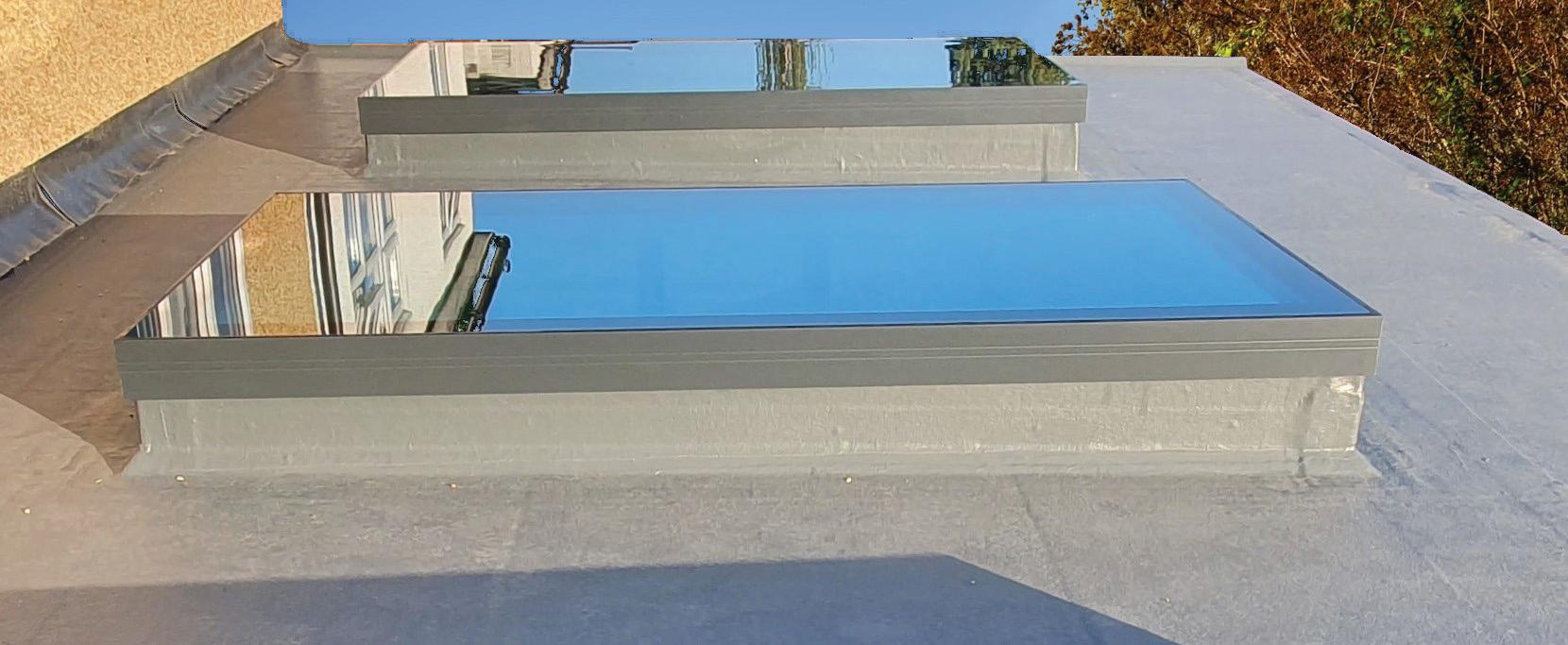
expand its flat roof offering the new, with a new cost-effective solution due to launch in September. Positioned in the mid-price segment, the Standard Glass Roof light combines the proven standard base unit with a flat glass top element in a robust aluminium design, bringing a more premium aesthetic to cost-conscious projects. Suitable for 2°–15° roof pitches, it is available in fixed and openable variants, with the latter including a standard
glazing is required but budget constraints remain a key consideration.
Sustainability underpins all these developments. From responsibly sourced materials to lower-carbon manufacturing processes, VELUX is aligning its product range with the wider push towards greener construction. For builders working to meet environmental targets or certification schemes, specifying highperformance roof windows and dormer solutions can make a meaningful contribution to overall project outcomes.
In summary, the doors and windows market is undergoing a significant transformation, with performance, technology and design all moving rapidly forward. The latest developments from VELUX, from vacuum insulated glass to integrated dormer systems, and soon a new flat roof solution, highlight how innovation is rising to meet the challenge and how manufacturers are responding to the evolving needs of the construction industry. For professional builders, staying informed on these innovations is essential to delivering homes that not only meet regulatory requirements, but also exceed client expectations in an increasingly demanding market.
BRIGHTER ‘GLAZE’ AHEAD
Paul Higgins, Commercial Director at TuffX, explores why glazing specification is fast becoming one of the most exciting areas for builders delivering new homes, as rising standards in thermal performance and incoming regulations drive product innovation
More than a design choice
On any new-build project, glazing is about far more than aesthetics because the products specified directly influence how a plot performs once it’s occupied. Once complete, glazing directly affects thermal efficiency and occupant comfort.
Regulatory compliance is also set to increase as the Future Homes Standard comes into force for most new homes in England from March 2027, bringing updated guidance under Approved Document L and a continued focus on overheating risk under Approved Document O. This means glazing must now work harder to tick every box.
make early in the project. There are so many choices, and TuffX offers everything from its Infinity rooflights to low-carbon glass solutions. When these products are thoughtfully specified and combined, they shape how a completed plot looks and performs.
While standard sizing can keep plots uniform, when design is the focus, bespoke options offer complete design freedom. As all TuffX products are made in the UK, bespoke orders can be turned around quickly, helping to keep the build on track and avoiding the knock-on sequencing delays that late glazing deliveries so often cause.
Thermal performance first
Overheating is now a compliance consideration under Approved Document O, which means that heavily glazed new builds require careful management of solar gain to satisfy both regulatory requirements and occupant thermal comfort.
High-performance solar-control glass addresses this directly by applying a specialised coating to the outer pane to reflect solar energy before it penetrates
the building envelope. Advanced solar glass variants also reflect twice as much heat as standard products, offering an easily justified specification uplift for projects where overheating risk is identified as a primary compliance concern during the design stage, such as south-facing spaces.
Frame specification also deserves equal attention to glass selection, as insulating frames are engineered to work with the glass itself to minimise heat loss in winter and manage solar heat gain in summer. Both of these considerations are fundamental to achieving the fabric performance targets set by the Future Homes Standard.
Reducing embodied carbon
With embodied carbon under increased focus, the materials specified are starting to matter just as much as operational performance. TuffX, the first manufacturer in the UK to bring low-carbon glass to market, offers a product with 64% recycled content and produced entirely using renewable electricity, without compromising its optical clarity or thermal performance.
Glazing and the Future Homes Standard: five topline takeaways
• Tougher carbon targets – new homes must produce 75–80% fewer carbon emissions, making high-performance glazing a compliance essential.
• Lower U-values required – windows and doors must meet significantly stricter thresholds; standard double glazing is unlikely to comply.
• Overheating matters as much as heat loss – Part O requires builders to manage solar gain, so glazing must work in both winter and summer.
• Premium is becoming standard – triple glazing and thermally broken frames are moving from optional upgrades to regular specifications.
• Specifying early – getting glazing right at the design stage avoids costly late swaps and protects margins.
“As all TuffX products are made in the UK, bespoke orders can be turned around quickly”
At the same time, an extended product lifecycle reduces the need for replacement units and the associated environmental burden. These factors make low-carbon glass a specification choice that supports compliance with today’s Future Homes Standard targets while also ensuring the occupant’s environmental demands are met.
Scan the QR code to learn more about the speedy installation process for TuffX’s Infinity roof lights.
THE NO NO’S
Why boilers and heat pumps shouldn’t be treated the same. Shaun Mangan, from Harpenden Heat Pumps, explains the fundamental differences in the application and maintenance of boilers and heat pumps.
As heat pumps become increasingly common across the UK, one of the biggest mistakes I continue to see is people treating them like boilers.
The reality is that a heat pump is not simply a boiler with a different fuel source. While both systems have the same job, keeping a building warm and providing hot water, they achieve it in very different ways.
Heat Loss
Before selecting a heat pump, it’s essential to understand how much heat the building actually loses. One of the most important things to remember is that a building has the same heat loss regardless of whether it’s heated by a heat pump or a gas,oil, or electric boiler.
At the design outdoor temperature (DOT), the heat pump only needs to replace that heat loss in order to maintain the desired indoor temperature. This is where correct sizing becomes critical. If a heat pump is undersized, it may struggle to maintain comfort during the coldest weather.
If the heat pump is oversized, it’s not just more expensive to install, it will cost a lot more to run as the heat pump's compressor will keep turning on and off, this is called short cycling. When a compressor first turns on, it’s very inefficient, so the longer it’s able to stay on and running, the higher the efficiency. Imagine a diesel car's performance in a town vs on the motorway.
Designing emitters around
flow temperature
Once the heat loss is known, the emitters can be designed correctly. Whether that’s radiators, underfloor heating or a combination of both, they must be capable of delivering the required heat output at the intended flow temperature. This is one of the biggest differences between heat pumps and boilers. For many years, heating systems have relied on high water temperatures to
compensate for undersized emitters. If a room wasn’t getting warm enough, the answer was often to simply turn the boiler temperature up.
Heat pumps work most efficiently at lower flow temperatures. The lower the flow temperature, the higher the efficiency and the lower the running costs.
This means emitter sizing becomes far more important. The goal should always be to deliver the required room heat loss at the lowest practical flow temperature.
The importance of controls and weather compensation
Most modern heat pumps come with sophisticated weather compensation controls that continuously adjust the flow temperature based on outdoor conditions. On a mild day, the system may only need to produce 30°C water. As outdoor temperatures fall, the flow temperature gradually increases to match the building’s heat demand.
This allows the heat pump to operate efficiently throughout the year while maintaining stable indoor temperatures. Unfortunately, I still see many systems controlled as though they are boilers, relying on frequent on/off operation and aggressive temperature setbacks.
Rather than delivering short bursts of heat, the aim is to gently maintain the temperature of the building and keep the fabric of the property charged with heat. Heat pumps generally perform best when allowed to run steadily for longer periods.
I often explain it to homeowners like this: you wouldn’t switch your fridge off every time you left the house for a few hours and then expect it to operate efficiently when you got home. Heating a building works in a similar way.
Pipe sizing and the difference between DT20 and DT5
Another area where boiler thinking causes problems is pipe sizing. Traditional boiler systems were often designed around a DT20 temperature difference. For example, 80°C flow and 60°C return.
Most modern heat pump systems are designed around a DT5 temperature difference, although the amount of heat being delivered may be exactly the same, the smaller temperature difference means higher water flow rates are required.
As an example, a 10kW heat load at DT20 requires approximately 7 litres per minute of flow with same 10kW heat load at DT5 requires around 29 litres per minute. That’s more than four times the flow rate and has a direct impact on pipe sizing, pump selection and overall system design.
A heat pump can be perfectly sized, but if the system can’t move enough water performance will suffer. Good hydraulic design is fundamental to a successful heat pump installation.
“I often explain it to homeowners like this: you wouldn’t switch your fridge off every time you left the house for a few hours and then expect it to operate efficiently when you got home.
Domestic hot water considerations
Domestic hot water is another area where expectations sometimes need adjusting as a gas boiler can often recover hot water very quickly because of its high output.
Heat pumps typically operate at lower temperatures and can therefore take longer to reheat a cylinder. That isn’t usually a problem if the system has been designed correctly.
Cylinder sizing is important, but so is the size of the coil within the cylinder. A larger coil allows heat to transfer more effectively from the heat pump into the stored water, improving recovery times and overall hot water performance.
In regard to controls, I’d emphasise that the house doesn’t need thermostats everywhere like we currently see on underfloor heating installs. Having the whole house on together is usually always the most efficient.
Heat pumps don’t require magic. They require good design. A building loses the same amount of heat whether it’s heated by a boiler or a heat pump. The difference is that a heat pump rewards good design and exposes bad design.
NEXT STOP, INSULATION!
How has the Future Homes Standard changed how we insulate our homes? Philip Beckett, Technical Support Specialist at Knauf Insulation provides four lessons for insulating future homes
The construction industry has waited a long time for the Future Homes Standard, but for contractors the priority is straightforward: how to meet the compliance requirements on site.
Much of the groundwork was laid with the 2021 updates to Part L. What has changed is the level of scrutiny. It is no longer enough to design for compliance. You now have to prove that what is built performs as intended.
The good news is that there are practical, cost-effective approaches to achieving compliance through the building fabric that can be applied across most house types.
The three targets
The updated Approved Document L: Energy and Greenhouse Gas Emissions set out three performance targets that all homes built from 2028 will need to meet: the Target Emissions Rate (TER), the Target Primary Energy Rate (TPER), and the Target Fabric Energy Efficiency rate
(TFEE).
While TER and TPER are achieved largely with solar PV and heat pumps, fabric performance underpins all three targets. A well-performing envelope reduces overall energy demand and allows those systems to operate efficiently.
For contractors, this means compliance starts with the fabric. A well-designed and properly constructed thermal envelope
New homes will need low-carbon heating, renewable energy and a highly efficient building fabric
One of the simplest ways to achieve compliance is by using deeper loft insulation and wider wall cavities
Lower heat demand improves overall efficiency and helps systems such as heat pumps operate as intended
new build and property development
As-built performance is now central to compliance
A key shift is the requirement to demonstrate as-built performance. This began with the 2021 introduction of the Building Regulations England Part L (BREL) report, which must be completed at both the design stage and on completion.
The upcoming Home Energy Model (HEM) will in time replace SAP 10.3 and allow more detailed assessments, but the principle remains the same: compliance must be evidenced before work starts and once it is finished.
In practice, this means closer coordination between design and site teams, and a focus on buildable solutions that can be delivered consistently. Any gap between specification and site delivery now risks non-compliance.
Keep it simple and repeatable
Meeting these requirements does not have to be complex. In many cases, compliance can be achieved using standardised fabric specifications that are already well understood.
For example, 500mm of glass mineral wool insulation at loft level combined with 150mm in masonry cavity walls will achieve TFEE in most house types. Alongside thermal performance, glass mineral wool also offers lower embodied carbon, is typically non-combustible, and provides acoustic performance equivalent to rock mineral wool.
Fire safety should also be considered as part of the fabric specification. Fires
associated with solar PV are a recognised risk, and using non-combustible insulation can help limit fire spread if an incident occurs. Glass mineral wool is typically
classified as A1 or A2-s1,d0 under the Euroclass reaction to fire system, although ratings can vary between products.
Acoustic performance is another practical consideration. Glass mineral wool is just as effective as rock mineral wool in acoustic applications, while being easier to handle on site and supporting lower embodied carbon targets.
Using a consistent specification across plots helps to reduce variation, simplify procurement, and support faster installation. This makes it easier to deliver what was designed, and to evidence that it has been delivered.
Combined with simple, approved construction details, this optimised approach gives contractors a practical route to compliance without adding unnecessary cost or complexity.
Future homes
Fabric performance sits at the centre of meeting the Future Homes Standard, and the performance gap between design and as-built is under more scrutiny than ever.
Contractors who adopt robust, repeatable fabric solutions and focus on delivering as-built performance will be in the strongest position to demonstrate compliance. With the right approach, compliance becomes a matter of process and consistency, rather than a risk to manage at the end of the project.
Material choice can also support better outcomes
It is now common to see loft insulation specified at depths of up to 500mm
150mm wall cavities are also becoming standard practice
LEARN ON DEMAND
As heating technologies continue to evolve, ongoing training helps builders improve their knowledge, expand their skills and keep pace with industry change, says
Steve Ellison, Assistant Training Manager at Grant UK
The Government’s
Warm Homes Plan is expected to accelerate the transition to lowcarbon heating in existing homes while in new developments, the Future Homes Standard places a key role for heat pumps in the UK’s move to cleaner energy sources.
So now is a good time for builders to develop the skills needed to specify, install and coordinate low-carbon heating systems effectively, helping to avoid costly mistakes, improve delivery and demonstrate compliance with the new standards and expectations. Builders with the right expertise will be better positioned to win contracts, meet client expectations and deliver warm, efficient, compliant homes. Hands-on experience is invaluable, but ongoing training is increasingly important for professionals,
Time
Finding the time to attend face-to-face courses can be difficult so that’s where an online option comes into its own. Grant UK’s eLearning Academy, for example, is a flexible alternative. It’s an online training platform designed specifically for heating installers and other professionals working in the heating sector and importantly, means users can access training at a time and place to suit them. The eLearning Academy is open to professionals of all experience levels; users can choose
Unlike traditional classroom-based courses, this online platform means users can self-enrol and start learning immediately. There are no waiting lists or fixed training dates so learning can fit around work commitments and customer appointments. Courses can be completed at the user’s own pace, with modules and sessions that can be paused and resumed whenever required and can be completed over several sittings rather than committing to a full day away from site. There is training available for heat pumps, hybrid heating systems, solar thermal, hot water cylinders and accessories and the courses are a mix of short introductory modules that give
concise overviews of products, technologies and industry topics, and indepth courses that offer detailed technical training equivalent to the face-to-face sessions delivered at Grant UK’s training centres.
Heat pumps are no longer a niche technology. According to MCS data, 51,886 retrofit heat pump installations were recorded in 2025, representing a 7% increase on the previous year and more than four-and-a-half times the number installed five years earlier. For those looking to expand into this growing market, the eLearning Academy includes a range of heat pump training options, from introductory courses covering the fundamentals of the technology through to the in-depth Aerona 290 Air Source Heat Pump Installer programme, which explores specification, installation, commissioning and servicing requirements for Grant’s R290 heat pumps.
Understanding heat pumps also means understanding the wider heating system. Because these technologies operate at lower flow temperatures than traditional boilers, factors such as hot water storage, heat emitters and system design play an important role in achieving optimum performance. The eLearning Academy also has courses covering products such as Grant’s Afinia aluminium radiators and Uflex underfloor heating systems, helping learners develop an understanding of heat emitters specifically designed to work with low-temperature heating systems.
Alongside product-specific training, the Academy also includes broader industry learning. Courses covering subjects such as Net Zero and Part L Building Regulations help heating professionals stay informed about wider developments affecting the sector. With legislation and policy continuing to influence how heating systems are designed and installed, these resources offer a convenient way to keep knowledge up to date.
Certificate
Once a course has been successfully completed, learners receive a digital certificate that can be downloaded directly from their eLearning account. These certificates provide a useful record
“Understanding heat pumps also means understanding the wider heating system. Because these technologies operate at lower flow temperatures than traditional boilers, factors such as hot water storage, heat emitters and system design play an important role in achieving optimum performance.”
of completed training and can contribute towards ongoing professional development activities. Some of the more in-depth training programmes, such as Aerona 290 ASHP Installer or Aerona3 ASHP Installer courses, can also aid progression towards Grant UK’s G1 Installer Scheme.
The Academy supports a broad range of professionals across the heating industry. While installers are a core audience, the training is also relevant to builders, merchants, specifiers and others who want to improve their understanding of heating technologies and industry developments.
As the sector continues its transition towards lower carbon solutions, training will play an increasingly important role in helping businesses adapt. The ability to access learning quickly and conveniently is becoming just as important as the content itself, particularly for busy builders and their installers balancing site work, customer demands and business responsibilities.
Exclusive access!
Professional Builder readers can access the Grant eLearning Academy by visiting WWW.RDR.LINK/BCC031 and registering with the enrolment key PROBUILD26. Once registered, learners can explore the available training courses and resources and begin learning immediately.
new build and property development
ALL TIED UP
Successful extensions and home improvement projects rely on more than good design; they depend on how well new masonry connects to the existing structure.
In a recent YouTube video, professional bricklayers Kirk and Cory put two products from Leviat’s Ancon Staifix range to the test: the Ancon Staifix Wall Starter Kit and Ancon Staifix HRT4 Housing Ties. Their hands-on review highlights how these systems perform on real domestic builds.
Ancon Staifix Wall Starter Kit
The first product under review is Leviat’s Ancon Staifix Wall Starter Kit, designed to connect new masonry to an existing structure and effectively “start” a new wall. Traditionally, this would involve cutting individual bricks out of the existing wall, a labour-intensive approach that has largely fallen out of favour. As Kirk explains, modern systems like the wall starter kit offer a far more efficient and consistent solution.
Reviewing the kit itself, Kirk highlights the Grade 304 stainless-steel bars, chosen for durability and long-term resistance to corrosion. Each bar measures approximately 1.2 metres,
giving 2.4 metres of total coverage, enough to span a full lift of brickwork, something Cory demonstrates as the wall progresses. Kirk recommends using around five fixings per kit, including top, bottom and central fixings to securely tie the bars together.
The final step is fitting the steel wall ties. These use a key-fit system, allowing them to be inserted quickly and held securely within the starter bar once in place.
Ancon Staifix HRT4 Housing Ties
Professional bricklayers put Ancon Staifix Wall Starter Kit and Wall Ties to the test, sharing practical insight into building reliable connections on domestic extension projects.
with current regulations.
The video then shifts focus to installing Ancon Staifix HRT4 Wall Ties, with Cory explaining correct placement and spacing. Wall ties should be installed in a 450 x 900mm diamond formation, with spacing increased to 225mm at corners, where additional strength is required.
Best practice, Cory explains, is to install wall ties on the mortar bed, ensuring they are pushed into the centre of the cavity. Consistent spacing is key, a point Kirk demonstrates using a tape measure during the build. Once the first course of ties has been installed, the next set should be placed two courses above, creating the staggered pattern required to achieve the diamond formation in line
Both bricklayers highlight the practicality of the system, noting that these ties make cavity walls and party walls easier to build while delivering reliable long-term performance. As Cory points out, the use of wall ties is a requirement under NHBC standards and other relevant regulatory bodies. He also notes that Ancon Staifix packaging includes a QR code, allowing quick access to additional technical information and installation instructions on site.
Built for modern extensions
As Kirk and Cory’s hands-on review shows, the Ancon Staifix Wall Starter Kit and Ancon Staifix Wall Ties offer practical, site-tested solutions. Manufactured by Leviat, they help professionals deliver strong, consistent masonry connections, supporting extensions and home improvements built to perform.
TO FIND OUT MORE AND SEE THE FULL INSTALLATION IN ACTION, WATCH THE COMPLETE VIDEO ON THE PRO BUILDER YOUTUBE CHANNEL. FOR MORE INFORMATION, VISIT WWW.RDR.LINK/BCC033
CHOOSE WISELY!
Why product selection matters for your next cladding project
Contractors are under pressure to deliver projects that combine aesthetic appeal, long-term durability and compliance. Whether working on residential developments, commercial schemes or refurbishment projects, choosing the right cladding solution has never been more important.
That is why more building contractors across the UK are turning Cedral cladding as their preferred external facade system.
Colour choice is crucial Architects, developers and homeowners all want buildings that stand out visually while maintaining a clean, contemporary finish. Cedral gives contractors the flexibility to meet those expectations with one of the most extensive ranges on the market.
Cedral cladding is available in both Lap and Click formats, allowing contractors to achieve either a traditional overlapping appearance or a sleek, flush-fitting contemporary finish. This versatility makes the product suitable for a wide range of projects and architectural styles.
In addition, Cedral offers an impressive colour palette, helping contractors and specifiers create distinctive facades without compromise. Boards are available in both smooth and textured finishes and can be installed horizontally or vertically, providing even greater creative freedom.
For contractors, that means fewer design limitations and more opportunities to satisfy clients seeking high-quality visual impact.
Reliable stock availability
Product availability has become a growing concern throughout the construction industry. Delays in material supply can quickly affect project schedules, labour planning and overall profitability.
Cedral’s manufacturing and distribution network has been designed to help contractors avoid those issues. With manufacturing facilities in nearby Europe,
supported by a strong UK distribution network, Cedral is well positioned to maintain consistent product availability across the country.
This gives installers greater confidence when specifying products, improved continuity of supply and reduced risk of costly delays. The same applies to fixings and accessories, which are also supported through Cedral’s merchant and approved distributor network.
Built to last
Durability remains one of the key considerations when selecting an external cladding solution, particularly for projects where long-term maintenance is a concern.
Cedral facades are renowned for their quality and robustness. Engineered to withstand demanding weather conditions, Cedral boards offer long-term performance and resilience compared with many alternative products.
Backing that quality is a comprehensive 10-year product guarantee when installed in accordance with manufacturer guidelines, alongside a minimum life expectancy of 50 years. This provides reassurance for both contractors and end clients.
The combination of strength, longevity and low maintenance makes Cedral a practical and commercially attractive solution for modern construction projects.
UK-based technical support
One of Cedral’s strongest differentiators is the level of technical support available. Cedral provides access to a dedicated
UK-based technical helpdesk staffed by fully qualified experts. Whether it’s installation guidance, specification support or assistance with technical queries on-site, Cedral’s specialist team is on-hand to help projects run smoothly. That level of accessible expertise can be invaluable when working to tight deadlines or navigating increasingly complex building regulations.
Compliance without compromise
Building safety remains one of the most important considerations in modern construction, particularly in facade specification.
Cedral boards are designed and tested to meet the latest European safety standards and regulations. The products achieve an A2 fire rating, demonstrating excellent fire performance and helping contractors meet stringent compliance requirements.
For contractors, developers and specifiers, choosing products that conform to the highest safety standards is essential.
From design flexibility and dependable availability to quality, technical support and strong safety credentials, Cedral offers contractors a complete facade solution for modern construction projects.
FACE LIFT
Transforming homes with the right render
Whether you are rendering a new property, tackling an extension or refreshing a tired façade, choosing the right materials at the outset can make a difference and will determine the look of a building for years to come. Jason Nicholson, Render Product Manager at K Rend explains why a silicone render can protect long-term performance and minimise remedial costs. By following manufacturer advice and working closely with experienced installers, specifiers will have the confidence their façade is designed to last.
For many years, render was associated with labour-intensive processes and inconsistent results. Traditional sand cement mixes were prone to cracking, staining and ongoing maintenance, adding significant burden on installers and homeowners. Today’s modern systems are manufactured under controlled conditions, ensuring reliability and consistency.
Silicone renders The introduction of silicone-based technologies has been particularly influential. Silicone renders deliver enhanced breathability and water repellence to help prolong resistance to algae growth. Traditional renders absorb water, which accelerates deterioration and increases maintenance demands
over time. Silicone renders repel water at the surface while still allowing moisture vapour to escape from within the wall, which is a critical balance particularly in retrofit and refurbishment projects where
new build and property development
renders a more sustainable option.
The shift toward ready-mixed, throughcoloured products has been equally important. Factory-prepared render eliminates the variability of on-site mixing, improving quality control and saving valuable time during application. With the colour integrated into the product rather than existing as a coating on the surface, there is no need for post-application painting, further streamlining construction processes and reducing costs for the homeowner.
Getting the substrate and preparation right
Proper preparation is a critical consideration when it comes to older properties and extensions. The substrate will vary from project to project across brick, block, stone and existing render, and the approach needs to reflect that. Assessing the condition of the existing
surface, establishing whether old render can be overcoated or needs to be removed completely, and ensuring the wall is clean, sound and properly primed before work begins are all critical steps that directly affect how the finished system performs.
Silicone renders perform particularly well in exposed locations where there is high rainfall and significant weather exposure. They also perform strongly on external wall insulation systems where a breathable, water repellent finish is essential to the long term integrity of the whole system, helping to improve thermal performance and reduce energy costs for the homeowner.
Ease of application
For builders and applicators working to tight deadlines and budgets, modern render systems deliver practical on-site advantages. Fast-drying and machineapplied solutions enable same-day application and finishing, significantly reducing on-site labour time. With the construction industry’s continued skills shortage, systems that reduce reliance on specialist trades are particularly valuable when it comes to refurbishment and extension work.
colours, finishes and textures allows builders and applicators to create unique facades that enhance visual appeal and respond to local environment.
With homeowners focused on improving the exterior aesthetics of their properties and boosting kerb appeal, the ability to transform a tired exterior into something distinctive and characterful is a compelling part of the offer. Throughcolour renders also deliver a long term benefit, with no painting over the lifetime of the finish and significantly reduced maintenance compared to a painted approach.
Common mistakes
The most frequent errors in render specification come down to choosing a product unsuitable for the substrate, mixing components from different manufacturers to reduce costs, and underestimating the impact of environmental exposure. Using an incompatible system can result in poor adhesion, cracking, trapped moisture and ultimately failure of the facade. Each of these issues are avoidable with the right specification from the outset and by following manufacturer guidance.
Specifying with confidence
Render manufacturers now offer ongoing and extensive support beyond the product itself, including technical guidance, installer training, marketing resources and specification advice. Specification support helps project teams select the right system for the substrate, exposure and build type from the outset, reducing the risk of costly errors further down the line.
For builders tackling new builds, renovations and extension work, engaging with that support and specifying a complete compatible systems from a single manufacturer is one of the best ways to protect the quality of your work, the satisfaction of your client and reputation of your business.
new build and property development
BANKING ON IT
How small housebuilders can get more support to build
Small housebuilders have never really had it easy. While there is certainly plenty of room and potential for growth and expansion, the reality is that both the construction industry and the wider economy often act as a genuine obstacle to success and prosperity. The irony of the current situation is that there has never been a greater demand for new homes in this country, while at the same time there remains a clear hesitation when it comes to funding and investing in new developments.
As a result, small housebuilders are having to find new and innovative ways to secure funding for their projects and developments. Meanwhile, larger and more established housebuilders, while
This allows them to secure projects that could just as easily have been delivered by smaller firms.
The result is a system in which larger developers are often awarded contracts and projects in bulk, while smaller housebuilders are left fighting simply to get a foot in the door. This reality runs contrary to the idea that all builders should have a fair opportunity to compete and contribute to solving the country’s housing shortage. So what support schemes are available to help small housebuilders access the funding they need to grow and succeed?
An equal chance
The National Housing Bank (NHB) is a new Government backed scheme aimed at supporting and accelerating the growth and sustainability of small housebuilders, both as businesses and as an important part of the wider housing sector.
Under the scheme, any small housebuilder looking to deliver five homes or more can apply for a three-year loan ranging from £250,000 up to £200 million. The equity requirement is typically around 20 per cent, although this can be reduced to as little as 10 per cent for strategic schemes. Interest margins generally range between 3 and 7 per cent.
The main advantage of the scheme is
that, provided applicants meet the eligibility criteria, it can make securing finance for projects considerably easier. It recognises that housebuilding will always involve an element of risk due to unforeseen costs, market conditions and other challenges that can arise throughout the construction process. By helping to ease financial pressures, the scheme allows smaller builders to focus more of their attention on delivering high quality homes.
While this latest Government initiative is certainly a positive step in the right direction, more support is still needed if small housebuilders are to truly thrive. Access to finance is only one part of the challenge. Restrictive planning processes, lengthy approval times and excessive bureaucracy continue to create obstacles that can delay projects and increase costs.
It is only by addressing all of these issues together that small housebuilders will be able to reach their full potential. If that happens, the result will be a stronger housebuilding sector, more opportunities for smaller firms and, most importantly, more homes being built where they are needed most.
HITTING A SNAG
They don’t build them like they used to is a saying that reflected in my mind a couple of months ago as I walked through the busy crowds of Oxford Street in London and, on multiple occasions, looked up to have my breath taken away by the frankly gorgeous Victorian and Georgian architecture above me. The craftsmanship, attention to detail and clear dedication demonstrated by the builders of those fine structures, at a time when construction technology was limited and health and safety was barely a consideration, is truly incredible.
In some ways there is something nostalgic about a time when tradespeople and craftsmen were allowed to take their time and fully demonstrate their talents when building something. The aim was not necessarily to complete a project by a certain deadline, but to build it well and to make it last.
Fast forward to the modern age,
however, and it seems we have moved away from that philosophy. With the Government’s Future Homes Standard now fully in effect, the race is on to build around 1.5 million homes by the end of the current Parliament. These homes are packed with the latest features, from heat pumps to solar technologies and other
With the Government’s Future Homes Standard now fully in effect, the race is on to build around 1.5 million homes by the end of the current Parliament. These homes are packed with the latest features, from heat pumps to solar technologies and other energy efficient innovations.
energy efficient innovations.
Yet this rush, because that is essentially what it is, has raised concerns about quality. Many new homes suffer from issues with construction, fittings and brickwork that can create major headaches for both small housebuilders and large developers alike.
This trend has led to the rise of the snagging trade, where professionals inspect newly built homes for defects and faults before they become larger problems. Considering that most housing contracts give buyers a significant period in which to report issues, these inspections can be a real wake up call for builders and contractors who may find themselves returning to a property months after completion to carry out remedial work at their own expense.
With that in mind, we have put together a simple guide to some of the most common new build issues and how you can avoid them on your next project.
Professional Builder provides some top tips to avoid common errors with new builds
Doors and windows
Easily one of the most common issues found in new build properties, poorly fitted doors and windows can lead to cold draughts during winter and even water ingress during periods of heavy rain.
The causes are often simple enough: rushed sealant application, damaged frames or frames that have bowed during installation. These seemingly small faults can leave gaps that allow both air and moisture into the property.
If these issues are identified by the homeowner, you may find yourself returning to rectify the problem, potentially at your own cost depending on the terms of the contract. Taking the time to properly check seals, fittings and frame alignment before completion can save significant time and money further down the line.
Brickwork
Substandard workmanship or poorly applied mortar can lead to cracks appearing in brickwork. Left untreated, these cracks may allow water penetration which, over time, can cause more serious structural concerns.
Carefully inspecting brickwork for signs of cracking, weak pointing or water ingress before handing over a property can help identify potential problems early. Fixing a small issue during construction is always easier than dealing with a major repair after the homeowner has moved in.
Plastering and decorating
While generally less serious than issues involving doors, windows or brickwork, poor plastering can still leave a negative
impression on homeowners.
Dry, uneven or poorly applied plaster can make a newly completed home look tired only months after completion. Although many homeowners may choose to patch or repair minor imperfections themselves, it is still important to ensure the work is completed to a high standard from the outset.
Ultimately, avoiding common snagging issues comes down to one simple principle: taking pride in your work. A few extra checks before handover can make all the
The first site development by a new luxury housebuilder is benefiting from Proctor Group’s Proctor Air® underlay on the pitched roof. Braddus Homes chose to use the air permeable, low resistance underlay Proctor Air. It allows the passage of both air and moisture vapour reducing condensation risk in roofs.
ACOUSTIC INSULATION
Armacell has expanded its sustainability documentation with the publication of Environmental Product Declarations (EPDs) for its ArmaComfort acoustic insulation. It has the lowest carbon footprint among comparable EPDdocumented products with the EPDs providing transparent, verified data on environmental performance.
SUSTAINABLE PANEL
Strength, versatility and environmental credentials are some of the characteristics of West Fraser’s SterlingOSB Zero high-performance, sustainable panel solution. One among many applications for this oriented strand board (OSB) is a solid and dependable base for roofing tiles, slates and membranes in pitched and flat systems.
INSULATION
“Builders need to futureproof the homes they build to help us cope with the impact of regular heatwaves.” That’s the view of Actis UK and Ireland sales director Mark Cooper who is recommending the company’s Eolis HC insulation. It can keep buildings cool in the summer, reflecting around 94% of infrared radiation.
ROOF-INTEGRATED SOLAR
Russell Roof Tiles has formed a partnership with solar specialists Solfit, focused on supporting the deployment of roofintegrated solar systems across UK housing developments. Solar PV expected to become standard across new-build housing under forthcoming energy efficiency regulations.
BRICK SLIP SYSTEM
The first extruded brick slip product where the full system –including rails, fixings, and brick slips – can be sourced from a single supplier. That’s the promise from Forterra for its Omnia mechanical brick slip brand. The slips mechanically fix to a steel single rail system to create a light weight, A1 (non-combustible) rated rainscreen façade.
OSB3 PANEL
Thanks to a flame-retardant intumescent coating, EGGER OSB Flammex is a structural OSB3 panel that combines the performance of a standard OSB3 board with a declared reactionto-fire classification. The product achieves a Euroclass B-s1, d0 reaction-to-fire classification on the coated side when installed as specified.
‘TRUCKLE’ up!
PB’s ‘life with a Musso’ series continues
It’s interesting the difference the last few months has had on my day-to-day life. Where I usually drive a pretty small hatchback (I live in a city so have always tried to avoid bigger cars where possible), my wife now actively asks to go in the truck instead of our usual car. (I think the heated and cooled seats in particular may have won her over for a comfier ride, regardless of the weather).
Built to last
Another month, another instalment in our ‘life with a Musso series’. It would feel wrong not to provide another mileage update on how accustomed I am to driving round my Saracen that I’ll still be charioting around in for another few months. We’re now up to 3,500 miles on the clock.
The maneuverability of the Musso is really surprising. It just feels like driving round a car. No big deal. And while the cameras have helped me avoid any knocks and bumps, any builder will know this isn’t 100% avoidable, especially when working on busy and constricted sites. From loose bits of stone flying up to all the rest, the
reality is your work vehicle will be put through its paces day in day out. The more you drive it, the more this effect multiplies.
You want something you can rely on to stay strong and resilient. A work vehicle has to be sturdy, reliable, and dependable. This doesn’t just go for 4x4 modes when you’re traversing less than optimal terrain. It goes for longevity too.
It’s pleasing that KGM offers a 5year/100,000-mileage warranty (whichever is first) with 12-month/ 10,000mile service intervals. This goes in tandem with 12-month RAC roadside assistance, 6-year anti-corrosion warranty and 3-year paint work warranty. There’s a KGM service plan available at £41 per month. This is always a good sign. If a manufacturer is happy to stand behind
their product, investing in it feels easier. (This is their way of doing the same thing).
There’s a number of service centres and dealer networks across the UK, so you won’t be short of communication options if something does go wrong either.
While my wife’s opinion on the truck is naturally incredibly well regarded, the opinions of real builders and
tradespeople does offer slightly more weight when it comes to a commercial vehicle like this one.
Catching up
Being involved with Professional Builder means a lot of time out on site with real builders, like you, and it’s always interesting turning up to a site with a vehicle, because an actual tradesperson’s
reaction will tell you far more than anything else.
Intrigue is the best way to describe the reaction. KGM isn’t necessarily a brand that’s as well known as some of the other pick up manufacturers in the field. And that’s simply because they’ve not been doing it as long. With that, one of the main things I often hear from builders is “woah, what’s that?”.
It’s an eye-catching vehicle and while it may not yet be as well known as some of the others on the field. It’s certainly catching up.
The more time I spend with the Musso, the more I’m dreading the thought of giving it back. Being a part of PB, and with in-laws that live in North Wales, this vehicle is getting a lot of use, be it to city construction sites or a few hundred miles up north on the motorway. It handles both with ease: tough enough for the former and comfortable enough for the latter.
As a builder’s vehicle, you something that can comfortably do both: business and leisure!
the cat’s out the bag!
PB attends Bobcat Demo Days
Dobris, Czech Republic, might not be the first place you think of when talking about big cats in the wild, and yet here is where you’ll find Bobcat’s Europe HQ and one of its major production plants. We were recently lucky enough to be invited here for Bobcat Demo Days. A yearly tradition for the company, where it shows off everything new and gives plant operators and hirers to try out the latest gear. Here’s how we got on...
R-Series
The new R-Series was unveiled at Demo Days and it represents the next step for the Bobcat compact loader line-up, delivering more choice; more control and more operator-ready technology.
These next generation R-Series skidsteer and compact track loaders introduce significant enhancements in operator experience, performance and reliability. Examples include a more powerful 115 HP engine on the S86-2 and T86-2 models to support high-demanding applications, alongside the addition of up to 3.7 m (12 ft) lift height capability, a new 8-inch touchscreen display with integrated technology and four selectable drive modes that allow operators to tailor machine responsiveness, complemented by further enhancements to machine quality, durability and uptime.
can simply hop into any of the machines out on display and go for a whizz around. Or in the case of a remote control skid steer, you didn’t even need to hop in! The range on display included everything from mini excavators to compact wheel loaders and telehandlers. Jumping from the older series straight into the new R-Series is a great way of highlighting the difference, with controls that feel far more natural and intuitive. The power difference here was immediately noticeable too.
T650
Bobcat is expanding its portfolio with the new T650 Stage V compact track loader
performance of this 600-frame M-Series loader with full Stage V emissions compliance – without the need for AdBlue. Powered by a reliable 2.4-litre Bobcat engine delivering 55 kW (74 HP), the machine offers strong, efficient performance for demanding applications. Despite its compact footprint, the new T650 delivers impressive work capacity with a vertical lift path and 1192 kg rated operating capacity, making it ideal for truck loading, pallet handling and earthmoving in confined or sensitive job sites.
regions. Built at the Bobcat plant in Dobris,
A robust steel frame ensures durability and uptime along with efficient cooling, broad attachment compatibility, with the Bob-Tach mounting system, optional HighFlow hydraulics and standard Machine IQ telematics. Operator comfort and precise control complete the package.
Thanks to the forward cab position and fully transparent door, operators always have a full and direct view of the attachment and the job site. And with the powerful LED working lights, they will continue to be productive even in lowlight conditions.
Behind the scenes
What was interesting was being able to see these T650s actually being made alongside various other Bobcat
machinery. A behind the scenes factory tour gave a glimpse into how these things are built and you can see it all coming together, step-by-step right from the metal bending at the beginning. This factory tour was well complemented with a look at Bobcat’s innovation centre. A fascinating hub with all manner of contraptions, that were testing and recording away. The climatic chamber was certainly a highlight. With temperature control from –40°C to +55°C, machines are left in here for a period of time and then turned on. This is a great
certainly hope we don’t start seeing temperatures as low as -40°C in the UK!) One of the chambers was sitting nicely at –5°C, which, after a long amount of time spent out in the sun, was an absolute treat!
Other highlights included a winchequipped, 7m deep, testing pit to measure machine arm strength and a tilt table that could elevate machines to 45°. Strangest of all goes to the soundproof chamber (equipped with a machine treadmill) that is designed to measure how loud a machine is on the move and
thanks to soundproofing slabs that are over 1.5m deep. The absence of noise in here is so intense that time spent in there is restricted, less you start hearing your own blood moving!
While these different gadgets are certainly entertaining to observe, they do serve a real purpose and provide an insight into the way Bobcat operates. Here, machines are seemingly built to be tough and tested to stand up the rough requirements of on-site work. We’re certainly impressed!
FLEXI BEAST
Building firms can take advantage of a new concept in mini excavator finance
For SME contractors investing in a mini excavator is a considerable outlay. Anything that can ease the financial pressures will be welcome and JCB is on hand with a solution. Inspired by the automotive industry, JCB FlexiBuy is a Business Contract Purchase (BCP) facility that offers low initial outlay, affordable monthly payments and flexible end-of-term options, helping customers invest in new equipment while managing cashflow.
Available through JCB Finance, it is intended to reduce upfront costs making it easier for micro and small business owners to access the machinery that will boost their business and on-site productivity.
The new finance option is available across the manufacturer’s mini excavator range from 1.5 to five tonnes, including the 19C-1E electric excavator. Weekly payments start from the equivalent of £82 for the 1.8-tonne, 18Z-1 zero tailswing model, making new machines more accessible to smaller businesses and firsttime buyers.
Customers pay an initial deposit followed by fixed monthly payments over two or three years. At the end of the agreement, they can choose to return the
365 Building Solutions
A north London contractor has used JCB FlexiBuy to introduce a 16C-1 mini excavator to the firm. The compact machine was initially chosen to meet the specific demands of a live site with restricted access. In the future it will be used on the company’s residential construction work including restoration projects, basement conversions and new build extensions.
365 Building Solutions Director Gavin Byrne said: “The project we’re currently delivering requires additional compact machinery due to restricted access via a narrow site entrance and this model is well suited to our needs. We have previously operated JCB equipment and value its reputation for reliability and performance.
“The JCB FlexiBuy option made the transaction much easier than traditional finance deals. Everything was very smooth with efficient communication throughout the purchase process and this new finance route is a great added extra.”
365 Building Solutions is a family-run business with a heritage spanning three generations in stone masonry, restoration, construction and plant and tool hire, delivering high-quality residential and commercial projects across London and the South-East.
Back to the future
JCB has added to its considerable portfolio of equipment, with a new Backhoe arrival
If you think of a JCB machine then the iconic backhoe would be amongst the first to spring to mind and, with its latest incarnation, the Staffordshire-based manufacturer has gone back to its roots. The latest JCB Sitemaster is intended as an entry level unit and benefits from a
FOR MORE INFORMATION ON JCB FLEXIBUY GO TO WWW.RDR.LINK/BCC047
single, well-equipped specification, with servo levers and a six-in-one front bucket as standard. It also features the company’s Smooth Ride System of loader arm suspension, an extending dipper arm and a return-to-dig function. The 3CX Sitemaster is being offered at just £55,000, or £271 per week, through JCB Finance.
SCREEN TIME
Nancy Lloyd, Channel Marketing Manager at Marley, talks about the business’s latest sun safety research and the simple habits that could make all the difference
QWhat has your research found about sun safety attitudes?
The headline figures are generally positive. We surveyed 250 outdoor workers across roofing, landscaping and rendering, and 83% told us they use sunscreen on the job. Even better, 68% already think of it as a form of PPE.
But scratch beneath the surface and a different picture emerges. Only 31% apply sunscreen every day during summer, and just 26% do so consistently across spring and summer, the two seasons when UV levels are at their highest. More than a fifth (21%) only reach for it when it feels hot or sunny. However, the sun doesn’t take a day off because the sky is grey. Even on cloudy days, outdoor workers are exposed to potentially dangerous levels of UV radiation.
We also looked at what’s stopping people applying sunscreen. Nearly half (47%) admitted they simply forget. A third (34%) said reapplying throughout the day
QWhat is Marley doing to support outdoor workers, including builders?
Our Safe in the Sun campaign has been running for more than 20 years, and the goal has always been the same: keep outdoor workers protected. This year, we’re pushing one clear message: treat sunscreen like you would other forms of PPE.
Nobody questions whether to put on a hard hat or a high-vis vest. They go on without a second thought because the industry recognises the risk. We want sunscreen to sit in the same category.
Crucially, this isn’t just down to the individual. Responsibility sits across the board – with business owners, site managers and workers alike. Our research found that a quarter of workers would use sunscreen more often if it was simply available on site, which tells us provision matters.
QHow can outdoor workers look after themselves?
The best protection comes in layers, and the trade is already doing a lot right. Our survey found 79% wear a hat or cap when they’re not in a hard hat, 58% use safety glasses with UV protection, and 54% cover up with clothing like long sleeves or a T-shirt. Each of those adds another line of protection.
Here’s some practical advice for any builders heading out on site:
• Use a broad-spectrum sunscreen of SPF 30 or higher on any exposed skin.
• Reapply throughout the day – one morning application won’t last, especially when you’re sweating.
• Cover up with long sleeves and a hat or cap wherever the job allows.
• Protect your eyes with UV-rated safety glasses.
• Seek shade during breaks and keep your water topped up.
The trade has come a long way on sun safety, but best practice isn’t yet universal. The risk is real; it builds over a working life, but importantly, it is entirely manageable. By making sunscreen part of your everyday kit, you’ve taken a simple step that could protect your health for years to come.
tools and equipment
CUT-OFF SAW
IMPACT DRIVER
The TD004G 40VMax XGT Brushless Impact Driver is the most powerful in Makita’s XGT line-up. Powered by a 40VMax XGT Li-Ion battery, there is a maximum fastening torque of 230 Newton metres (Nm), a no-load speed of up to 3,900 rpm and up to 3,900 impacts per minute (ipm). Despite its power it is still compact and lightweight.
The 3.3kW power output on the STIHL TSA 350 battery-powered cut-off unit delivers a performance comparable to the manufacturer’s mpetrol-powered TS 420. The 14”/350mm cutting wheel, low-noise and low-vibration machine cuts through mineral and metal materials to depths of 125mm.
GREEN BEAM LASER
A compact, versatile and immediately ready-to-use cross line laser is how Stabila is describing its LAX 60 G. Thanks to GreenBeam technology, it projects extremely bright, razor-sharp green laser lines which are visible at a distance of up to 30m, even in daylight. A levelling accuracy of ± 0.3 mm/m offers high precision.
ADVERTISEMENT INDEX
SAFETY FOOTWEAR
Overland Shoes, the company behind Bobcat Safety Footwear, has emphasised the importance of choosing the right safety boots to help cope with the summer heat. The manufacturer’s Rockford boot provides a lightweight design, breathable materials and comfort, with Redbacks® Leaf Spring Technology absorbing shock and reducing fatigue.
Each is listed with its page number and a direct URL that will get you straight to the relevant online information
Here is a useful summary of all the adverts that appear in this issue of Professional Builder
HEAR, HEAR!
This month we are going to cover work related hearing issues once again. Protecting your hearing at work remains important ALL the time so a little reminder might come in useful! Work –related hearing loss is the most reported occupational condition. The people most at risk are those who work loud industries that include construction, the music industry, and the military. Hearing loss due to noise exposure is irreversible- there is no cure for deafness.
Hearing is one of the five senses we use to interact and make sense of the world around us. Experiencing hearing loss can be really disabling as it can make everyday interactions more difficult. Hearing other people speaking, keeping up with conversations, using the telephone and just generally being aware of what is happening around you is more challenging if you cannot hear properly. Not being able to hear well can also affect safety- if you cannot hear alarms or approaching vehicles for example, you may put yourself at risk. These difficulties may be felt particularly at work but also in everyday life. It is known that workers affected by hearing loss are more likely to struggle at work, be forced into early retirement or be unemployed. With severe hearing loss, you may even be five times more likely to develop dementia.
Many people in the construction industry work in noisy environments or operate machinery and tools that are very loud. You might be used to it, or never think it could cause an issue, but it is putting you at serious risk. The damage might be gradual due to noise exposure over time, but it could also be sudden if you were exposed to an episode of extremely loud noise (eg, an explosion). Loss of hearing is not the only problem caused by excessive exposure to noise. Some people may also develop tinnitus (ringing, whistling, buzzing or humming in the ears), which is a distressing condition that can be difficult to manage. Tinnitus is
associated with sleeping difficulties and both tinnitus and hearing loss are associated with depression.
The Health and Safety Executive suggest anyone who answers yes to any of these questions about noise in their workplace is at risk of hearing loss:
• Is the noise intrusive - like a busy street, a vacuum cleaner or a crowded restaurant - for most of the working day?
• Do you have to raise your voice to have a normal conversation when about 2 m apart for at least part of the day?
• Do you use noisy powered tools or machinery for over 30 minutes a day?
• Do you work in a noisy industry, eg construction, demolition or road repair or woodworking (among others)?
• Are there noises because of impacts (eg hammering, drop forging, pneumatic impact tools etc), explosive sources such as cartridge-operated tools or detonators, or guns?
• Do you have muffled hearing at the end of the day, even if it is better by the next morning?
Under the Control of Noise at Work Regulations 2005 employers have a duty to protect workers and take steps to reduce the risk of hearing damage. In the UK, the law obliges employers to give their employees hearing protectors if they are likely to be exposed to daily or weekly average noise levels equal to or more than 80 decibels.
Managing the risk from noise falls to both employers and employees. Steps
THIS MONTH GP ALICE FITZGIBBON REVISITS WORK RELATED HEARING ISSUES
should be taken to ensure the work environment is not unnecessarily loud for workers by using silencing devices, the quietest versions of machinery, issuing hearing protection, having regular hearing checks for workers, and increasing awareness of the risks.
Hearing protection only protects your hearing if it is worn! So as an employee it is important you also take steps to protect yourself by using following any noise control measures put in place and by correctly wearing any ear protection you are given. When this is provided, you should be trained in how to use it and look after it. Hearing protection should be worn all the time you are doing noisy work, and when you are in hearing protection areas. Taking it off even for a short while means that your hearing could still be damaged.
So why is this entirely preventable condition still an issue? It is an issue as ear protection is not being provided and/or worn consistently. And it’s understandable why- by blocking out all the noise you end up with the same issue as if you were deaf! It’s harder to do your job properly if you can’t hear things you need to or interact with others as well. These factors can impact on safety as well especially on busy sites with heavy machinery in operation. This is why more work needs to be put into the development of improved hearing protection devices.
For now, it’s important to work with what is available and use it consistently to get the benefit. If you have concerns about noise at work or your hearing speak to your boss and seek a hearing assessment.