001_PMM_JULYAUG22_Layout 1 31/07/2022 20:15 Page 1
PROFESSIONAL
SEPTEMBER 2022
MOTOR
F R T E R E A
T T O H E
D E
S E R V I C I N G ■ R E P A I R ■ D I A G N O S T I C S ■ M O T
THE TRADE MAGAZINE FOR SERVICING AND REPAIR PROFESSIONALS
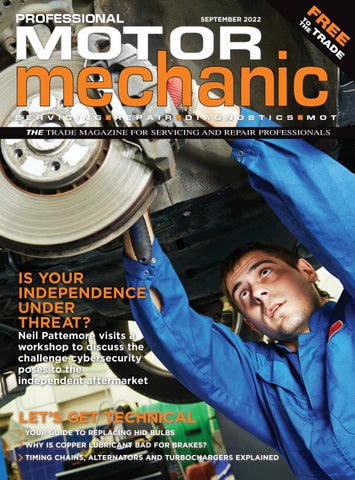
IS YOUR INDEPENDENCE UNDER THREAT? Neil Pattemore visits a workshop to discuss the challenge cybersecurity poses to the independent aftermarket
LET’S GET TECHNICAL YOUR GUIDE TO REPLACING HID BULBS WHY IS COPPER LUBRICANT BAD FOR BRAKES? TIMING CHAINS, ALTERNATORS AND TURBOCHARGERS EXPLAINED
PMM grid_Layout 1 26/07/2022 10:31 Page 1
003_PMM_SEPT22_Layout 1 31/07/2022 11:14 Page 3
Contents Regulars 6-10
NEWS & VIEWS
12-14
TROUBLESHOOTER
16-17
CLUTCH CLINIC
18- 25
TECH TIPS
26-32
BUSINESS & TRAINING
34- 43
SPECIAL REPORTS
40
PIT STOP
76
PRODUCT TEST
80
COMPETITION
81- 82
WHAT’S NEW?
VOLUME 23 ISSUE 8 SEPTEMBER 2022
Features
45-52 BRAKES & CLUTCHES
Editor’s Picks 12
BAD VIBRATIONS Make sure to catch the second part of this troubleshooter from Pico Technology to find out why this Honda Civic is vibrating under acceleration.
27
LISTEN UP! Look no further than the Professional Motor Mechanic podcast to find out the latest issues surrounding running an independent workshop.
34
73-79 TOOLS & EQUIPMENT
CYBERSECURITY PMM and Neil Pattemore visit a garage to discuss the issues cybersecurity poses to the independent aftermarket.
76
63-71 ENGINES & TURBOS
PUT TO THE TEST Find out what Helen Dixon from Dixons of Pudsey has to say about Midtronics’ CPX-900 battery analyser in this month’s product test.
80
WIN! One lucky reader will win a BossComm IFIX 980 diagnostic tablet, courtesy of Autowave
55-61 BATTERIES & IGNITION
Total Average Net Distribution 54,426 1st July 2020 – 30th June 2021
PMM SEPTEMBER 2022 3
PMM grid_Layout 1 25/07/2022 13:04 Page 1
005_PMM_SEPT22_Layout 1 01/08/2022 13:04 Page 5
VIEWPOINT
Editor
Put to rights
KIERAN NEE Editorial Assistant FREYA COLEMAN Digital Manager
I
KELLY NEWSTEAD Group Manager ROBERT GILHAM Account Manager ALEX DILLEIGH Magazine Designer GEMMA WATSON Group Production Manager CAROL PADGETT Production Assistant CLAIRE SWENDELL Distribution Manager KARL CLARK Subscriptions
PROFESSIONAL MOTOR MECHANIC is a business magazine for firms and individuals involved in all aspects of the motor trade. It is published eleven times a year and is available nationally FREE to the trade through leading motor factors. It is also available through the post at a cost of £30. EUROPE and OVERSEAS 1 year (11 issues) £50 Airmail 1 year (11 issues) £65 Printed by Walstead Peterborough Published by HAMERVILLE MEDIA GROUP Regal House, Regal Way, Watford, Herts, WD24 4YF. Tel: Watford (01923) 237799 Fax: (01923) 246901 E-mail: pmm@hamerville.co.uk Sales enquiries: pmmsales@hamerville.co.uk Website: www.pmmonline.co.uk Facebook: /ProfessionalMotorMechanic Twitter: @pmmmagazine Copyright © 2022 Pg.74 ©AdobeStock/Andrew_shots
t’s commonly said of cars these days – they’re more like computers on wheels than traditional vehicles. As cliché as it may be, it’s a useful analogy – especially when it comes to cybersecurity and the right to repair. Let’s begin by looking at the second of those terms. Perhaps you heard about the “right to repair” when Joe Biden, US president, made a speech about it last year. He was referring mostly to consumer electronics, such as smartphones, but made sure to include a wider breadth of vision, including everything “from a smartphone to a tractor” – voters from all walks of life need to be appealed to, after all. This “right to repair” will remain a theoretical right for many consumers. The well documented decline in robust manufacturing of modern consumer goods means that for most, replacing rather than repairing will continue to be the most “financially viable” option – and I am well aware of the irony of that term. One area where that is most certainly not the case, however, and it is an area little talked about beyond the trade itself, is passenger vehicle repair. As he has outlined in many shapes and forms over the year, our friend and yours Neil Pattemore is continuing the fight to ensure that the right to repair, as it currently stands, is upheld within the market for automotive repair. In our sector, this essentially equates to letting independent workshops retain access (at a competitive price) to the data, information and parts needed to conduct repairs on any given manufacturer’s vehicles. This right stems from competition regulations preventing the vehicle manufacturers’ authorised dealers from having a monopoly over repair. However, the current legislation enshrining that right in law is coming to an end next year and has yet to be renewed by the UK government (incidentally, the EU has committed to renewing the legislation). So, if laws around monopolies haven’t changed, what’s there to debate about extending the right to repair? Well, that’s where the first of those terms I mentioned earlier comes in: cybersecurity. As cars utilise more and more on-board computers, sensors and data, they are more vulnerable to both malicious tampering and repairers replacing OE parts with unsuitable, potentially dangerous, parts. The general idea is that vehicle manufacturers nowadays need to be sure that the person repairing one of their vehicles is appropriately trained, follows the correct procedure, uses authorised parts and leaves a well-defined paper trail showing what work they’ve done and when (something insurance companies will no doubt be keen on too). What this means in practice is that either a vehicle is repaired at an authorised dealer, where all of those boxes are ticked on every job, or permission is given to an independent workshop. How that permission is given, and at what cost, is really what’s up for debate.
Kieran Nee Editor
Associate member
The publishers and editor do not necessarily agree with the views expressed by contributors, nor do they accept responsibility for any errors of translation in the subject matter in this publication.
PMM SEPTEMBER 2022 5
006_PMM_SEPT22_Layout 1 31/07/2022 20:21 Page 6
PMM NEWS
with Freya Coleman
NEWS IN
BRIEF ■ A recent survey by CASTROL has found that 45 per cent of UK drivers will stay loyal to a workshop if they believe they’re getting ‘good value’. Location was the second most important factor, with customers looking for ‘convenience’. ■ NGK SPARK PLUG has announced its decision to change the English language company name to ‘Niterra’. This follows the company’s sustainable business objectives, as well as the forecasted shift away from ICE powertrains, NGK feeling the name no longer describes their direction. Brand names NGK and NTK will continue to be used. ■ Despite the loss of the Russian market, LIQUI MOLY has recorded an 8 per cent increase in sales in the first half of the year. Managing director says they’re satisfied with this but not happy.
■ THE SCOTTISH GARAGE AWARDS’ inaugural event will take place on 24th September 2022, celebrating the highest standards of excellence in all aspects of the vehicle repair industry. There are 18 awards available, including Scottish Garage of the Year and Scottish Apprentice of the Year.
6 SEPTEMBER 2022 PMM
Mandatory speed limiters All newly launched car models in EU countries are now required by law to be fitted with speed-limiting technology and experts are saying “it is only a matter of time” before the UK follows suit. The new EU rules came into effect on the 6th of July and initially apply to all-new models being launched, before being extended to all new vans and cars from July 2024. All cars and vans will get Intelligent Speed Assistance (ISA) technology that will use GPS data and cameras to identify the local speed limit. For instance, if you’re driving on the M1, the ISA will limit your speed to a maximum of 70 mph. Road accidents are a leading cause of death and injury in the UK, and speeding is a major contributory factor; 27 per cent of fatal collisions in 2020 were caused by drivers either exceeding the speed limit or travelling too fast for road conditions. Despite this, The Department for Transport (DfT) says the new rules will not come into effect in Great Britain yet. However, according to Dan Powell, Senior Editor at the online car and van
marketplace AutoVillage, it is likely that the technology will become widespread, regardless of whether ministers pass the legislation in the UK. The legislation states that all new vehicles introduced to the market will need to be fitted with an ISA which will then become mandatory for all new cars and vans sold from July 2024 onwards. Despite leaving the EU, the UK looks set to follow the European Commission’s lead and introduce the same law for our roads. This means that all new cars and vans will be fitted with an ISA - there will be no option to remove or disable it. The legislation does not apply to cars and vans already in circulation. However, some carmakers – such as Mercedes-Benz – already include ISA systems in their vehicles. Potential benefits include a reduction in fatal crashes, an easing of traffic and also a cut in emissions. However, some drawbacks are said to be an over-reliance on technology and a potential safety issue due to the fact you can only override the ISA system by depressing the accelerator beyond the system’s limits.
006_PMM_SEPT22_Layout 1 01/08/2022 13:06 Page 7
MESSAGE ME YOUR NEWS AT FCOLEMAN@HAMERVILLE.CO.UK
BenWell launch
NEWS IN
Ben, the automotive industry charity, has announced the nationwide launch of BenWell. This is their new wellbeing platform, developed specifically for the automotive industry in partnership with Wellonomics. Underpinning BenWell is a web portal which automotive businesses can use to take the emotional and physical temperament of their team, enabling companies to better support their employees with their wellbeing.
QUOTES “
Each month, employees spend less than 10 minutes answering questions across six key personal wellbeing areas, and five management areas. Once completed, their personal dashboard gives a real-time view of their wellbeing and offers tailored support and guidance from experts in each area, accessed via mobile, tablet or desktop.
Free vehicle health checks Motul are offering oil analysis, free of charge, to competitors and to those visiting who are members of one of the car clubs in attendance as part of their partnerships with the following events. So far, they’ve brought two of their Mobile Laboratories to the Classic at Silverstone and are bringing them to the Goodwood Revival also. The process uses a small sample of engine or transmission oil to analyse the elements present in the oil sample; they pick out those which it would
expect to be present and those which indicate something amiss, and the quantities thereof. From this, it is able to determine which are healthy and which might either have problems, or might be expected to develop them. This type of oil analysis has proved universally popular on events including the gruelling Dakar Rally. Silverstone visitors got to see the Dakar Mobile Lab Truck for themselves, while those attending Goodwood will see Motul’s Mobile Lab facilities housed in something more period-appropriate.
The promising increase in technicians who have taken EV qualifications so far this year, which in turn makes them eligible to obtain IMI TechSafe recognition, is extremely encouraging…it’s a real sign that the sector is responding to the increasing adoption of EV motoring” Steve Nash, IMI CEO, commenting on the rise in the number of EV-ready vehicle technicians
“
We are proud of the significant progress we have made in recent years towards embracing sustainability in our culture and advancing electrification efforts in everything we do. We look forward to taking additional concrete steps in changing the world of mobility, alongside our partners, customers, suppliers and communities” Frédéric Lissalde, President and CEO, BorgWarner, following the release of their 2022 sustainability report
“
With the resilience of the sector’s supply chain having been hit particularly hard over the last 12 months in particular, it seems likely that standard practices such as just-intime sourcing will need to give way to a more pragmatic approach for the foreseeable future” Katie Tamblin, Chief Product Officer, Achilles on how the automotive supply chain will need to adapt to future challenges
PMM SEPTEMBER 2022 7
006_PMM_SEPT22_Layout 1 31/07/2022 20:25 Page 8
PMM NEWS
with Freya Coleman
NEWS IN
NUMBERS
2.32 million additional vehicles due an MOT between August and November according to BookMyGarage.com
79% of businesses have said that increasing operational costs are their biggest concern according to The Motor Ombudsman’s summer survey
58% of drivers still say ‘range anxiety’ is their biggest barrier to going electric according to research by Aidan McClean, founder of Ufodrive
Comparing EVs Thanks to BookMyGarage.com, drivers are now able to compare instant local prices and book a service specifically for their electric vehicle. The new service enables drivers to compare a range of prices, but also choose a garage that is suitably qualified to work on EVs. Alongside the latest EV servicing comparison capability, BookMyGarage.com
has also launched an EV content hub on the website. The hub comprises a series of userfriendly guides on EV ownership. Whilst drivers could previously compare MOT prices for their EVs through BookMyGarage.com, the additional servicing functionality and the EV Hub mark the comparison site’s drive to make EV ownership easier than ever before.
‘Tyre tax’ proposal
Whilst electric vehicles reduce tailpipe emissions, they could be causing other health dangers. Alistar Lewis, chairman of the government’s Independent Science Advisory Group on clean air and professor of atmospheric chemistry at the University of York, has suggested a tyre tax should be placed on EVs due to the dangerous levels of particulate matter they emit. This matter from tyres is known as PM2.5 and is said to be more dangerous to public health than nitrogen oxides emissions which arise from diesel vehicles. The proposed tax is believed to encourage a shift away from heavy SUV type electric vehicles to lighter and smaller compact cars as it’s said that especially heavy EVs produce the most tyre wear.
£90million uplift in energy bills this year faces firms as revealed by new analysis in the latest SMMT report
90% of automotive businesses are having trouble recruiting skilled staff postpandemic according to Autotech Recruit
8 SEPTEMBER 2022 PMM
PMM grid_Layout 1 25/07/2022 12:26 Page 1
006_PMM_SEPT22_Layout 1 31/07/2022 20:28 Page 10
PMM NEWS
with Freya Coleman
DATES IN THE DIARY ■ The next MECHANEX show is set to take place on Tuesday 8th and Wednesday 9th November at Sandown Park in Surrey. Exhibitors so far include Varta, Dayco, Continental and Autowave among others, as well as a free seminar programme hosted by Tom Denton and Hayley Pells. You can find full details on page 42 and WWW.RDR.LINK/AAO001
■ Taking place from the 13th to the 17th September in Frankfurt, this year’s AUTOMECHANIKA event allows visitors to learn more about new technologies and trends in the automotive trade. You can find the full programme of the event on their website WWW.RDR.LINK/AAO002
■ The historic motor race meeting, the GOODWOOD REVIVAL, is taking place on the 16th to 18th September, staged entirely in a period theme making it an immersive celebration. To see full details WWW.RDR.LINK/AAO003
■ On the 6th to 18th September, Brembo is presenting THE ART OF BRAKING, an engaging exhibition about brakes, at the Museo delle Culture di Milano in Milan. The exhibition features interactive installations, light design and videos to highlight to brand’s 60 years of history. To find out more WWW.RDR.LINK/AAO004
10 SEPTEMBER 2022 PMM
Registering restrictions Independent garages can now register any restrictions they face on access to vehicle manufacturer repair and maintenance information with a new form produced by UK AFCAR. The organisation fights to ensure the rights of the independent aftermarket are upheld in the post-Brexit era. The form is available by clicking here at WWW.RDR.LINK/AAO005. Any information provided will be treated in the strictest confidence and will only be
used to provide the evidence needed to show a vehicle manufacturer’s noncompliance, or restrictive practices, regarding the requirements of legislation that supports the aftermarket. Examples include denial of access to RMI information or data/functions in the vehicle, excessive charges, incorrect information, having to prove competency, having to go to a main dealer to complete the job, or when garages are unable to use aftermarket parts due to the vehicle manufacturer’s restrictions.
In pictures: Charity Speed of Sight hosted a track day for disabled people enabling them to drive at Llandow Circuit in Wales.
PMM grid_Layout 1 25/07/2022 12:27 Page 1
012_PMM_SEPT22_Layout 1 31/07/2022 11:39 Page 12
TROUBLESHOOTER
PART TWO Why is the Honda Civic vibrating so much under acceleration? We follow up on last month’s case study from Pico Technology detailing Ives Garage’s diagnosis of a Honda Civic experiencing abnormal levels of vibration whilst accelerating.
W
elcome back. Hopefully by this point you will have read part one (if you haven’t, you can read it here: WWW.RDR.LINK /AAO006) and watched the video showing the vibration beneath the vehicle alongside the live NVH data. In the video, you will note how the engine physically moves in a repetitive lateral direction during acceleration and returns to rest during deceleration. Focus on both screens between 11 and 30 seconds. The NVH file in the video highlights the lateral movement of the engine, which in turn is responsible for what we feel in the chassis. The keen-eyed among you will have spotted that Channel C in the video is returning a huge lateral vibration level, above 229 mg. We relocated the accelerometer that was connected to the right-hand front shock absorber to the right-hand driveshaft support bearing, which was attached to the cylinder block. (Channel C below = 365 mg.)
���
���
Fig.1 shows a screenshot from PicoDiagnostics NVH, showing the recorded data after relocating the accelerometer from the right-hand shock absorber to the righthand driveshaft support bearing. Regarding the T1 amplitude recorded above, I would like you to think for a moment about the energy level required to
���
repeatedly move an engine and transmission assembly side-to-side at a frequency of 10 cycles per second. If you were to repeat this process manually with a prybar, the effort required would be immense and no doubt physically challenging. So, what component on our drivetrain could create enough energy to move the engine/transmission in a lateral direction? Let’s recap: ■ The engine/transmission assembly was
■ ■
■
■
12 SEPTMBER 2022 PMM
forced in a lateral direction under acceleration. We detected T1, T2 and T3 vibration orders, but the main offender was T1. The accelerometer connected to the lefthand shock absorber indicated energy spikes The wheels/tyres required attention but were not responsible for the lateral engine movement. The offending component was rotating at road wheel frequency/speed.
012_PMM_SEPT22_Layout 1 31/07/2022 11:43 Page 13
When reading the recap above, the only components capable of developing such energy are the driveshafts. But which one was causing our problem? We carried out radial, lateral and axial measurements on each driveshaft in an attempt to differentiate the levels of wear between the shafts (Figs. 2 &3) The measurements revealed the following: On the left: The inner driveshaft joint lifted (within transmission) 1.20 mm. The axial movement between the inner and outer driveshaft joints was 0.95 mm. The radial runout of the shaft was 0.60 mm.
���
���
���
���
On the right: The inner driveshaft joint lifted (in the extension shaft) 0.55 mm. The axial movement between the inner and outer driveshaft joints was 0.90 mm. The radial runout of the shaft was 0.70 mm. Based on the amount of lift in the inner drive shaft joint (the majority of which is within the differential carrier bearings), I leaned towards the removal and inspection of the left-hand driveshaft. From a PicoScope measurement perspective, it was difficult to determine which was the offending shaft from the Frequency view alone. However, by using the Time Domain view, the energy spikes described earlier in this case study were used as further evidence to support the removal and dismantling of the left-hand driveshaft's inner
tripod joint. Figs. 4-7 reveal a multitude of sins, including damage to the ball case, spider and the inside of the tripod joint housing. Tripod joints are typically responsible for three disturbances for every one revolution of the road wheel (T3). However, the images above reveal considerable damage to a single ball case and the associated guide in the inner tripod joint housing, which would create one disturbance per revolution (T1). Looking at the joint guide, it would appear that the ball case may have been sticking, dragging or locking against the guide under the transfer of load when accelerating. This
���
could explain why the fault was occasionally intermittent and temperature-related. Such an event would have the potential for a repeated push-back against the final drive instead of the desired seamless axial movement of the spider inside the joint. The result here would be the repeated lateral movement of the engine/transmission that we captured on camera. We replaced the left-hand front driveshaft and measured for radial, lateral and axial movement again. On the left: The inner driveshaft joint lifted 0.90 mm (within transmission). A reduction of 0.30 mm. The axial movement between the inner and outer driveshaft joints was 0.45 mm. A reduction of 0.50 mm. The radial runout of the shaft was 0.60 mm.
Confirmation of repair Fig.8 captures the T1 lateral vibration level at the right-hand driveshaft support bearing (attached to the cylinder block) at 34 mg. Previously, this was recorded at 365 mg, which equates to an improvement of 331 mg or approximately 89 per cent. From a human perspective (subjective), the vehicle felt like a completely different car to drive.
PMM SEPTMBER 2022 13
012_PMM_SEPT22_Layout 1 31/07/2022 11:48 Page 14
TROUBLESHOOTER
쐅
Note the peak at E2. This is normal for a 4-cylinder engine under acceleration (2,874 rpm) due to combustion and is not related to our customer's complaint. In Fig.9 we view the same vibrations as in Fig.8, but this time in the Time Domain view. Note the absence of the energy spikes (Channel B) and the smoothness of Channel A compared to the Time Domain capture before the replacement of the driveshaft.
Conclusion There is never time to review why components fail, given the time constraints and pressures of a typical workshop environment. You know the drill: “If it’s fixed, great, get it out and get the next one in”. I understand this wholeheartedly but let us pause for a moment. Why did the inner driveshaft joint fail in such a fashion? Without any valid vehicle history, we can only assume there had been a previous intrusion, leakage of joint grease, or driver abuse. Road wheel damage is often a clue of the latter. The differential carrier bearings did concern me, based on the amount of lift in the left-hand inner tripod joint (0.90 mm post-fix), but with that said, there were no differential noises and so only time can tell. When reviewing this case study, it occurred to me just how vital it was to introduce multiple accelerometers and record the data for post-capture analysis in multiple views with included narration. These are all essential features that are not available with NVH mobile phone apps.
“When reviewing this case study, it occurred to me just how vital it was to introduce multiple accelerometers and record the data for post-capture analysis in multiple views with included narration.” The ability to zone into the source of a vibration by using multiple sensors is key to success. Objective data cannot lie and provides measurements as evidence both pre and post-fix for our customers. I must add that the recent improvements to our NVH software have made this tool a joy to use when road-testing. The M&S hot-key functions we describe here provide a rapid means to marking and saving your data for later review when it is safe to do so. One final word on post-fix captures. Our customer's complaint was a severe vibration at 45-55 mph, which is now resolved. Best practice should from now on also include a
���
sweep of vibrations across the entire road/engine speed ranges. This is to make sure that there are no other non-typical vibrations present. The capture in Fig.10 is one such example, where T1 raises its head again in a lateral direction at the left-hand front shock absorber. Note: The accelerometer attached to the left-hand front shock absorber captured an increased lateral T1 vibration of 162 mg at approximately 95 mph. Channel C (connected to the right-hand driveshaft support bearing, which is attached to the cylinder block), however, reported only 8.66 mg at this same T1 frequency. (E.g. a minimal lateral movement of the engine.) Therefore, the stronger vibration on the front shock absorber is no longer related to our driveshaft as this vibration is now greater than the driveshaft vibration and most probably linked to our pick and mix array of wheel and tyre errors at high road speeds. This is proof indeed why a logical approach to diagnosis is essential, as this vibration could be misinterpreted as the initial fault when the facts confirm another component is now responsible for a vibration at the same frequency of the road wheel and tyre. WANT TO KNOW MORE? FOR MORE INFORMATION WWW.RDR.LINK /AAO007
14 SEPTMBER 2022 PMM
PMM grid_Layout 1 25/07/2022 12:29 Page 1
016_PMM_SEPT22_Layout 1 31/07/2022 11:54 Page 16
CLUTCH CLINIC
HOW TO Replace the clutch on a 1.7 CDTi Vauxhall Astra In this month’s Clutch Clinic, Charles Figgins, Technical Marketing Manager at Blue Print, takes readers step-by-step through a clutch replacement on a 2013 Vauxhall Astra. Vehicle Information Make
Volkswagen
Model
Astra
Year
2013
Engine
1.7 CTDi
Transmission
Six speed
T
he Vauxhall Astra is a popular compact family car and has a strong presence all over the globe. Depending on the region, the Astra has been badged as brands such as Opel, Holden, Chevrolet and Buick and has been reinvented a number of times since its launch – making this a common model in many markets. The vehicle featured in this article is a 2013 Astra 1.7 CDTi, equipped with a six-speed transmission which had been brought into the workshop with a possible clutch failure. The transmission was required to be removed for diagnosis and the car was then put on the ramp for repair. The driver’s window was left in the ‘down’ position and the steering wheel was
���
16 SEPTEMBER 2022 PMM
set straight ahead, for removal of the steering column later in the repair. To start the clutch replacement procedure, open the bonnet and disconnect the battery and the engine ECU attached to the battery box. Remove the battery and the engine wiring harness, which needs to be unclipped from the battery box before removal. This will reveal the top of the transmission. here, unclip the gear-selector cables, disconnect the ‘reverse’ and ‘neutral’ switches, and detach the clutchconcentric slave cylinder (CSC) hydraulic hose from the ‘T’-piece connector. Once the hose has been disconnected, it is important to cap it to stop excess fluid loss (Fig. 1). The next step involves cable ties – these are required to be able to support the air conditioning condenser and the upper
���
mounts of the radiator fan assembly to the radiator. Once sufficiently secure, the subframe – which supports these components – will be ready for removal. Set the steering wheel in the straight ahead position, then disconnect the steering column from the steering rack (Fig. 2).
016_PMM_SEPT22_Layout 1 31/07/2022 11:54 Page 17
���
Raise the vehicle in order to remove both front wheels and the wheel-arch liners, then raise it again to a ‘working’ height. You will then be able to remove the engine and radiator’s plastic under-trays, revealing what is required to remove the subframe and, subsequently, gain access to the transmission assembly (Fig. 3). Remove the exhaust-differential pressure sensor hose and the exhaust-temperature sensor, followed by the front section of the exhaust. Next, unclip both front ABS sensor wiring harnesses and unbolt the lower-suspension arm joints, stabiliser links and track rod ends from the suspension. Then, remove the front and rear engine mounts. The wiring harness for the electricpowered steering rack is the last part that needs removal before the subframe can be taken out. Unplug the wiring harness from the steering rack motor, then unbolt the power and earth cables (which can disappear towards the battery area) from the junction box and earth points. Once the engine and transmission is fully supported, the four subframe-retaining bolts can be unscrewed and the complete subframe (including steering rack, stabiliser bar and lower arms) should be lowered to the ground (Fig. 4).
���
With the subframe taken out, there is significantly more room for the transmission-removal process. Drain the transmission oil and remove the front driveshafts from the transmission. Remove all but a few of the bell-housing bolts in readiness for removal of the transmission. The starter motor can be left in position. Make sure the engine is supported before releasing the top transmission mount and removing the last of the bell-housing bolts. Then, separate the transmission from the engine. Lower the transmission to the floor for inspection.
���
Align the clutch kit and fit it onto the flywheel
Unbolt the CSC from the transmission and unclip the plastic ‘T’-piece connector from it for cleaning. You should also thoroughly clean the bell-housing and transmission-input shaft, to remove all grease, dirt and friction fibres from the previous clutch. Next, the input-shaft seal needs inspection before you can fit the new CSC to the transmission. Refit the ‘T’-piece connector to the CSC and lightly grease the transmission-input shaft splines in preparation for the reinstallation of the transmission. Remove and inspect the clutch pressure plate and friction disc; also check the condition of the dual-mass flywheel. For the Astra used in this article, clutch kit ADBP300007 was selected for the repair, along with a replacement flywheel. For the flywheel replacement, remove the original flywheel from the engine and inspect the main rear oil seal for any potential oil leaks. Clean the area thoroughly
before fitting the new flywheel and bolts. Tighten the new flywheel bolts to the recommended settings, align the clutch kit, and then fit it to the flywheel (Fig. 5). The transmission was aligned to the engine and secured in place with a few of the bell housing bolts. This was followed by refitting all of the parts to the transmission, and all other parts that were removed in the process of the transmission removal. Align the transmission to the engine and secure it in place with a few of the bell-housing bolts. Then, refit all parts back to the transmission – as well as all other parts that were removed in the transmission-removal process. With the transmission securely in place, the subframe can be refitted along with all steering and suspension components, the wiring harness, and the front section of the exhaust. Lower the vehicle and fill the transmission with fresh oil via the filler located on the top of the transmission; the required service capacity is 1.76 litres. Following this, refit the plug (Fig. 6). The brake and clutch fluid reservoir can now be topped-up with fresh fluid. Afterwards, bleed the new CSC of any excess air. Refit the gear-selector cables and battery tray (along with all associated wiring), as well as refitting the battery and other covers. Reset the one-touch windows and check the clutch pedal operation. Finally, carry out a road test to ensure the clutch is back to full operational order.
���
WANT TO KNOW MORE? FOR MORE INFORMATION WWW.RDR.LINK/AAO008
PMM SEPTEMBER 2022 17
018_PMM_SEPT22_Layout 1 31/07/2022 12:02 Page 18
TECH TIPS
HOW TO
Scan the QR code below to watch the step-by-step guide on our website
Replace a HID bulb Ring Automotive has showcased a step-by-step guide to removing and replacing high intensity discharge bulbs in a video guide which can be viewed on our website. Here, we guide readers through the process.
V
ehicle bulbs are a consumable part and Ring’s universal fitting guide offers a visual walkthrough on new bulb fitment depending on how the light is accessed, either via the headlamp unit via clips under the bonnet, or through an access panel in the wheel arch. According to Terri Clark, lighting marketing manager at Ring: “The automotive aftermarket has seen an increase in the demand for replacement Xenon HID bulbs. Ring stocks a full and comprehensive range, including the latest D3, D4 and D5 references, all E-marked and of OE matching quality. “We recommend that Xenon HID bulbs are replaced every five years and in pairs, to maintain optimum light output.”
Step-by-step Remember to ensure the bulb reference has been identified in advance of removing the old bulbs before commencing any fitting work. This can be found in the vehicle’s handbook, on the headlamp unit or through Ring’s Find My Bulb App, ( WWW.RDR.LINK /AAO009).
���
18 SEPTEMBER 2022 PMM
Once the vehicle is ready to be worked on, you must isolate the lighting circuit, turning off the ignition and removing the keys, and turning the headlight switch off. The fuse box needs to be accessed, and all headlamp fuses removing, ensuring safety while the bulb is replaced (Fig.1). Regardless of the access position of the unit, the replacement of a headlamp bulb needs to be done carefully to ensure not to scratch the lens on any surfaces. Technicians
���
should remove the protective cover (Fig.2) from the back of the headlamp unit, as well as unclipping the metal retainer (if present) and the power lead from the bulb (Fig.3). If there is no metal retainer clip, quarter rotate the bulb anticlockwise to unlock. Replace the bulb with the new one and refasten the retaining clip. With the power supply reconnected and protective covers replaced, carefully reposition the headlamp and fasten the retaining clip.
���
018_PMM_SEPT22_Layout 1 31/07/2022 12:03 Page 19
���
���
“The automotive aftermarket has seen an increase in the demand for replacement Xenon HID bulbs.” Terri Clark, lighting marketing manager, Ring
With under wheel arch bulb replacement, turning the wheel to full lock will enable full access. After the fuse removal process has been completed, the wheel arch access panel can be removed, and the protective cover removed (Fig.4). The power lead is then removed from the bulb and the bulb removed. The new bulb is inserted, metal retaining clip (if present) reattached and power supply reconnected (Fig.5). The bulbs are successfully fitted with the replacement of the protective cover and wheel arch panel.
Now the new bulbs have been fitted, replace all the fuses and protective covers. Check the headlights are working correctly as well as the headlight alignment (Fig.6). Due to the unique ageing process of Xenon HID bulbs, technicians are advised to replace bulbs in pairs to ensure a colour match. Ring stocks a full and comprehensive range of OE matching quality Xenon HID bulbs. Drivers and technicians are reminded to register the product online to activate the three-year warranty.
��� WANT TO KNOW MORE? FOR MORE INFORMATION WWW.RDR.LINK /AAO010
PMM grid_Layout 1 27/07/2022 14:20 Page 1
021_PMM_SEPT22_Layout 1 31/07/2022 12:17 Page 21
TECH TIPS
HOW TO Install an in-tank fuel module in Mercedes Benz CLS-Class and E-Class vehicles Where are the fuel delivery modules in the Mercedes CLS-Class and E-Class vehicles? Where is the fuel tank sender unit located and how do you replace it? Why does the return line only have one connection point? Can the fuel tank sender unit and the pump module be replaced individually or do they have to be installed together? MS Motorservice explains all.
Replacing for the first time The pressure line is connected directly to the fuel pump by a 90° quick connector. Both return lines are clipped into the fuel delivery module. The plug of the electrical line leading to the fuel tank sender unit is located behind the two return lines.
Replacing only the fuel delivery module
Connect the quick connector to the straight piece of tubing on the fuel pump then clip both return lines into the pump module. Insert the plug of the electrical line that leads to the fuel tank sender unit into the pump module.
Replacing only the fuel tank sender unit
Insert the electrical plug of the fuel tank sender unit into the socket below the return line. Attach the pressure line with the 90° quick connector directly to the fuel pump. Then clip the return line with the straight quick connector into one of the two available brackets on the pump module.
Replacing both fuel delivery module and fuel tank sender unit Connect the pressure line with the 90° quick connector to the straight piece of tubing on the fuel pump. Clip the return line with the straight quick connector into one of the two available brackets on the pump module. Insert the plug of the electrical line that leads to the fuel tank sender unit into the pump module. WANT TO KNOW MORE? FOR MORE INFORMATION WWW.RDR.LINK /AAO011
PMM SEPTEMBER 2022 21
022_PMM_SEPT22_Layout 1 31/07/2022 12:20 Page 22
TECH TIPS
���
���
���
HOW TO Replace the ball joint on a Ford Transit OESAA members Laser Tools and Schaeffler have joined forces to ensure aftermarket operators have access to the installation guidance you need to perform your job. Here, we present their guide to removing and replacing the ball joint of a Ford Transit.
W
ith the Transit remaining one of the most popular vans on our roads and often subjected to arduous driving conditions (to put it lightly), it is to be expected that at some point in its life, the bottom ball joints will need replacing.
Steering and suspension repairs are ‘safety critical’, so quality should be the dominant factor, not only with the parts being fitted but also with the workmanship involved — it is important to make sure the customer understands this.
Bolt-in style ball joints The two main causes for premature wear on ball joints are: ��� Lack of lubrication, due to the grease leaking out or being washed out – possibly caused by damage to the protective boot ��� General wear that accelerates the onset of excess free play in the joint
���
22 SEPTEMBER 2022 PMM
The late-model Ford Transit bolt-in style front lower ball joints are notoriously difficult to remove – being a very tight fit, even after the securing bolts have been removed. Laser’s ball joint removal and installation tool (part number 8272) is designed to easily extract and refit this bolt-in type of front lower ball joint on the vehicle, removing the need to use heat, hammer blows or a workshop press. It’s simple to use: just remove the lower
���
arm to ball joint nut, swing the arm out of the way, and then remove the ball joint securing bolts. Assemble the tool according to the detailed instructions supplied, then simply wind out the bush. Installation of the new bush is just as simple. Applications include the Transit bus (2013-onwards) and Transit platform/chassis (2014-onwards). Use it to remove and install OEM ball joints references 1451917 and KT6C113K209AA Note: 8272 is suitable for bolt-in type lower ball joints only. For clip type ball joints, use Laser part number 6614. Schaeffler’s Ford Transit FAG Ball joint (825 0104 10), like all of its FAG steering and suspension components, is manufactured to OE specifications and includes everything
���
022_PMM_SEPT22_Layout 1 31/07/2022 12:26 Page 23
���
needed for a complete repair inside the box. All metal ancillary parts are zinc flake coated to protect against corrosion, and its clear TPU (Thermo Plastic Polyurethane) boots give the strength of plastic with the flexibility of rubber, combined with the latest sealing technology. This component is supported with repair instructions on the REPXPERT information portal.
���
Removal (1-7) Always refer to the vehicle manufacturer’s instructions for each specific application. It is best practice to replace both front ball joints as a pair. Support the vehicle with both front wheels off the ground and the front suspension hanging at full droop. Remove front wheels. ■ Remove the lower ball joint taper nut. ■ Separate the joint from the arm to access the bottom of the hub. ■ Remove the two ball joint fixing bolts from the hub. ■ Assemble the components of the kit and lubricate the main force screw with molybdenum disulphide grease. ■ Ensure that the support rods are screwed in fully. ■ Ensure that the ball joint adaptor has been fully screwed onto the ball joint taper thread. Ensure that the top plate threaded adaptor and the support rod nuts and washers are all correctly tightened. Start to pull the ball joint out by turning the bearing nut, while holding the force screw steady.
���
쐈 쐅
쐉 ■ Continue turning until the ball joint is
fully removed.
Ball joint installation (8-12) ■ Remove the extraction assembly and
■
■ ■ ■
reassemble the 8272 press-frame using the installation force screw. Lubricate the force screw with molybdenum disulphide grease. Place the new ball joint in position then refit the support rods to the hub. Fit the insertion cup over the joint, then assemble the top plate to the support rods and force screw. Check the support rods are evenly tightened and the top plate is level to the hub face. Press the ball joint into place by tightening the force screw. Steadily bring it into place. When the ball joint is fully inserted, refit the fixing bolts.
Refitting of removed suspension components can then be carried out in reverse order of removal. Remember to torque up all bolts to the manufacturer’s specification, and it is always recommended to carry out a wheel alignment after work has been carried out on the steering and suspension system.
WANT TO KNOW MORE? OESAA PROVIDES A PLATFORM FOR ORIGINAL EQUIPMENT MANUFACTURERS TO OFFER ENGAGING AND IN-DEPTH TRAINING TO ENSURE TECHNICIANS HAVE THE PRACTICAL SKILLS TO DIAGNOSE AND REPAIR MODERN VEHICLES. FOR MORE INFORMATION
WWW.RDR.LINK/AAO012
PMM SEPTEMBER 2022 23
024_PMM_SEPT22_Layout 1 31/07/2022 12:27 Page 29
Vehic le Ca se Files In this series of articles, Liqui Moly investigates common vehicle problems and proposes a solution. PROBLEM: High oil consumption SOLUTION: Pro-Line Engine Flush ASSESSMENT: A car consuming a lot of oil is not only costly for the owner, but also risks the oil level falling below the minimum, creating that wear which can clog the engine. With this high oil consumption, ash-forming additives in the oil can leave deposits in the combustion chamber or damage the exhaust gas treatment system. Some car manufacturers define the limits of what they consider normal oil consumption quite broadly: up to one litre of oil per 1,000 kilometres or 625 miles is acceptable, they say. Converted to an oil change interval of 30,000 kilometres (18,750 miles), this means oil consumption of 30 litres. Sometimes dirty and stuck piston or oil scraper rings are the cause for high oil consumption. As a result, they can no longer wipe off the oil on the cylinder wall as well; it enters the combustion chamber and the oil is burned. Of course, this issue
could be solved by removing the piston and then cleaning or replacing the piston rings. It’s easier, faster and cheaper with Pro-Line Engine Flush by LIQUI MOLY. This additive is added to the existing motor oil shortly before the oil change and the engine is run at idling speed for around 10 to 15 minutes. It also loosens deposits at other points in the oil circuit. The loosened dirt is then drained together with the used motor oil. The fresh motor oil enters a clean engine and can then deploy its maximum performance. Cleaning the oil circuit in this way helps to increase the performance, reliability and service life of the engine, meaning you can go ahead even without much prior fault diagnosis. Even if the oil consumption does not decrease because it was not due to dirty piston rings, the car still benefits.
WANT TO KNOW MORE? FOR MORE INFORMATION GO TO WWW.RDR.LINK/AAO013
025_PMM_SEPT22_Layout 1 01/08/2022 13:07 Page 25
Sponsored by
HOW DO
EV
MOTORS WORK?
EV drive motors operate using three-phase electricity. An inverter is used to create this AC from the DC battery. Alternating current motors are more efficient than direct current motors, for EV applications, and are also easier to control. DC motors were used up to the 90s but all modern vehicles use AC. We tend to describe these components as motors but they are just as efficient operating as generators, when the movement of the car drives them through the transmission. This generates electricity which is returned to the battery. The process is known as regeneration or recuperation. Fig.1 shows a motor from an Audi e-tron, together with the gearbox, differential, driveshafts and control electronics system. You can see a nice animation of the e-engine, as Audi call it, by going to www.rdr.link/AAO058 This compact unit, which contains almost all the drive and control elements, is one of the key advantages of the EV layout. This is because it uses fewer components than an equivalent internal combustion engine, but is also more flexible as to where it
FIG.1
can be positioned on the vehicle. The motor shown has a permanent magnet rotor (the rotating part), which is surrounded by stationary windings, called the stator. The rotor has alternating north and south pole permanent (and incredibly strong) magnets. The stator has a corresponding number of windings. As the stator windings are energised or de-
energised (switched on or off) they create magnetism and the rotor turns to align to this. Fig.2 shows the operating principle of an EV motor and the associated circuit. I have simplified the rotor to just one magnet and the stator to three phase windings. In reality there may be 30 or more. The majority of EV motors operate on three phase AC. To operate the motor,
FIG.2
WANT TO KNOW MORE? FOR MORE INFORMATION ON LASER TOOLS GO TO WWW.RDR.LINK/AAO014
Last month we looked at the EV as a whole. In this article I will concentrate on how the motor (also a generator) works. separate phases are switched on at various times to cause rotation. The signals used to switch the power transistors come from the electronic control system. A basic three-step sequence is shown below. As each phase is switched on the rotor magnet is attracted to it and rotates. If the switching sequence reverses, then so does the motor, which is why no reverse gear is needed on an EV. In simple terms, to control the motor speed the frequency of the switching is changed. To control the motor torque, the current is varied. A sensor is used so the electronic control system ‘knows’ the exact speed and position of the rotor at all times. This type of control system results in a vehicle drive system that is very smooth and responsive. I am a huge fan of EVs (which must be obvious by now!), but do take the opportunity to drive one if you haven’t yet, the flat torque ‘curve’ that these motors produce makes them very responsive and smooth. In the next instalment I will take a detailed look at how a lithium-ion (Li-ion) EV battery works.
026_PMM_SEPT22_Layout 1 31/07/2022 12:34 Page 1
ADVERTORIAL
SUSPENSION FUNDAMENTALS: PART FIVE
WIN! WWW.RDR.LINK/AAO015
AND TELL BILSTEIN WHERE YOU FOUND THESE WORKSHOP TIPS AND YOU CAN LAY YOUR HANDS ON AN EXCLUSIVE BILSTEIN BRANDED WORKSHOP LAMP (ONLY AVAILABLE WHILE STOCKS LAST).
SHOCK ABSORBER DIAGNOSIS Not all shock absorbers are the same – a fact
chamber, the oil is pressed back and forth
that is especially true when it comes to
through the valve (spring disc pack) in the
problems with the suspension. Mono-tube
working chamber, creating the required
shock absorbers, twin-tube shock absorbers
damping forces for the compression and
and electronic systems: different types require
rebound stages. Behind the separating piston
different approaches to fault analysis in the
is the gas chamber. This gas has two tasks, as
workshop. One person who knows them is
Rainer Popiol reveals: “One task is to compress
Rainer Popiol. The head of BILSTEIN Academy
the oil column so that no bubbles form – so-
reveals what mechanics need to look out for
called cavitation. This ensures that the mono-
– and why certain dampers become harder
tube shock absorber remains stable. In
when oil leaks out. All the information on this
addition, the gas chamber must accommodate
can be found in the fifth part of the video
the volume of the piston rod, because when
always easy - whether it’s a mono-tube shock
series “Suspension Fundamentals – powered
the shock absorber is working, the piston rod
absorber or a twin-tube shock absorber,
by BILSTEIN Academy" by going to
is pressed into the working chamber. The
mechanics have to keep a few things in mind
WWW.RDR.LINK/AAO016
separating piston moves a little accordingly."
when it comes to fault analysis. Rainer
shock absorber no longer works force-locked”. Fault analysis with shock absorbers is not
Popiol: “Usually it is like this: If the shock
In the event of problems with the shock absorbers, mechanics should first be aware
Twin-tube shock absorber
absorber loses oil, it becomes softer. But
of which system they are dealing with in
In the twin-tube shock absorber, the working
then there is a type of construction where
order to quickly and safely track down the
piston also works in a working chamber filled
the shock absorber becomes tighter. This
source of the fault. “Most shock absorbers
with oil. When the piston rod is pressed into
means that the piston rod no longer enters
look the same from the outside. But there
the shock absorber, the oil is displaced and
the shock absorber properly. This is the
are fundamental differences and functional
forced through the bottom valve into the
mono-tube shock absorber. When it loses oil,
principles,” explains Rainer Popiol.
compensation chamber, which is located
the separating piston moves upwards
between tube one and tube two. “Unlike the
towards the working chamber. At some point
Mono-tube shock absorber
mono-tube shock absorber, however, the
the piston rod then touches the separating
In the mono-tube shock absorber, the working
twin-tube shock absorber does not work
piston and that gives a loud knocking noise
piston operates in a tube, the working chamber
independently of position,” says Rainer Popiol.
and the car behaves harder.”
filled with oil as well as the piston chamber are
“If the shock absorber is inclined more than
located here between the closure package
45°, it pulls the gas into the inner tube due to
and a separating piston. From the piston
the inclined position. Then the gas pressure
BWWW.FACEBOOK.COM/BILSTEIN.UK
D WWW.INSTAGRAM.COM/BILSTEIN
Want to know more? For more information WWW.RDR.LINK/AAO017
F WWW.YOUTUBE.COM/BILSTEINDE
027_PMM_SEPT22_Layout 1 31/07/2022 12:39 Page 27
PMM’s Editor Kieran Nee hard at work recording episode three of the podcast: ‘Where are the garage technicians of the future?’
BUSINESS
& TRAINING
HEAR HEAR! Are you frustrated at the pitfalls surrounding running your own business? Well look no further than the Professional Motor Mechanic podcast! PMM’s Freya Coleman grinning at next month’s podcast news!
R
unning an independent workshop in 2022 is no easy prospect. With costs soaring on even the most basic of provisions (including eggs and bicycle parts), workshop owners are finding themselves in an uneasy balancing act between pay rise demands from your workforce, paying extra (or even struggling to find) for quality parts and negotiating with customers who feel they’re being “ripped off” (“and by the way, would you fit this part I found on ebay for a tenner?”). It can feel a little like you’re being attacked on all sides. Well, we at PMM thought we would try and help you out. On the second Tuesday of each month you can tune in to the latest episode of the Professional Motor Mechanic podcast. We’ll take you along with us to meet the workshop owners that are going through the same problems as you are. We’ll talk to the organisations that are set up to help independent garages thrive. Each month we delve into the issues we know are affecting your business. How do we know? Because you tell us! We are in and out of garages each week, listening to the concerns you have for the future of the industry and even the future of your own workshop. Not only will we take you along to the garages, but you’ll get to come with us behind the scenes at racetracks such as
SantaPod Raceway and Brands Hatch. You’ll be at the launch of the latest products entering the workshop and at all the biggest events and exhibitions. Thanks to the PMM podcast, you’ll know what’s coming to factors even before they do.
So listen up! Although we only launched the podcast a few months ago, it is already ranking within the top 1 per cent of all podcasts, which means that many of you are already listening. So far, some of the topics covered include the price of parts, recruitment issues and the challenges surrounding pricing your jobs. As you can see, we are tackling real issues with complex answers, not just toeing the corporate line! We know you care about your industry and we do too. That’s why it’s so important to keep informed on the big issues affecting your business. So why not pop us on your phone in the break room, or on the bluetooth speaker on the workshop floor – it’s a half hour that we promise will educate and entertain you and, hopefully, improve your business. WANT TO KNOW MORE? FOR MORE INFORMATION WWW.RDR.LINK /AAO018
PMM SEPTEMBER 2022 27
028_PMM ad grid_Layout 1 01/08/2022 10:31 Page 28
029_PMM_SEPT22_Layout 1 31/07/2022 12:46 Page 29
BUSINESS
& TRAINING
Q&A Darren Darling: In his own words Darren Darling, head of training and technical support at the DPF Doctor Network, talks to PMM about everything from how he got into the aftermarket to his partnership with JLM. On starting out
been educated it’s just to say that if you’re not sure it’s safe to do so, please don’t do it. It’s important to brush up on your knowledge and practise ongoing training.
A lot of technicians talk about going into the industry because of their dad or because they follow racing and grew up around cars, but I just wanted a real job where I could get my hands dirty. So, I left school and my dad kicked me out the door one morning and said not to come back unless I got a job – and that was pretty much it, I came back with a job in a garage!
On working with JLM
On beginning DPF work I worked on trucks to begin with and so naturally saw a lot of diesel engines and the first DPF started coming out on vehicles in the late 90s. I’ve been self-employed for probably around 18 years now, initially specialising in diagnostics work and around seven or eight years ago this took me on a natural progression to specialise in DPF work. A lot of people were asking for it and were having repetitive problems, making it clear to us there was a fundamental flaw in the process – so we honed our skills in it. We never set out to do the training and everything that came along with it, just to be a local, good quality DPF repair specialist.
On specialising It's important to emphasise that we didn’t immediately drop all other work we do, we just made a conscious step to be truly specialist and know the job inside out – this meant cutting out distractions like keeping up to date with other technology. There has to be a transition and once you start getting a good at what you do and the jobs start queuing up, that’s when you have to stop other work because there’s just not time for it.
“When I’m using a product the cost doesn’t matter, it’s all about quality.” On becoming the DPF Doctor Network Originally, the DPF doctor was just a tagline for me and Callum, my right-hand man, but the network came about when the phone starting ringing from workshops who needed help. From this, and with help from my wife, we added some structure where training and help was offered alongside a forum. The network itself was kind of an accident but now we work with other workshop to provide full access to our help, training and support. If they’re stuck on a job there are resources available.
On forced regenerations One big thing for us is that we don’t carry out forced regenerations, full stop. There are two jobs in our workshop today where the DPFs are beyond repair – that’s generally down to a use of additives reset when it’s not safe to do so. This isn’t to criticise or patronise someone for doing it because they haven’t
Working with JLM came about because I was a customer with very high standards – when I’m using a product the cost doesn’t matter, it’s all about quality. It’s really important when working with DPFs that the products are working with us and that they clean at safe temperatures. I worked my way through various products and found that JLM delivers, but the company itself is also small enough to listen. Now, I’m a global brand ambassador. We have a few products in the range and we normally have an annual sound board and wish lists so we’re kind of the guys on the ground. They listen to us, they’ll go and do the R&D and then we do the real world testing, which is brilliant.
On joining the DPF Doctor Network To join, send an enquiry form to WWW.RDR.LINK /AAO019 and after that I just like to have a chat to each person as it’s important to me that they have the right attitude and want to improve themselves. It’s not so much needing to be an expert but it's important that if a customer goes into a workshop that's listed on our website that they are greeted by a friendly face and that the car's fixed properly. WANT TO KNOW MORE? FOR MORE INFORMATION WWW.RDR.LINK /AAO020
PMM SEPTEMBER 2022 29
030_PMM_SEPT22_Layout 1 31/07/2022 12:50 Page 30
BUSINESS
& TRAINING
SECURITY CLEARANCE: access granted
A
s many of you will know already, numerous vehicles require a manufacturer-specific access authorisation in order to perform active diagnostic tasks such as the calibration of driver assistance systems or resetting of service notifications. This can present most independent workshops with some serious problems. For this reason, Bosch has developed a standardised solution: Bosch Secure Diagnostic Access (SDA) provides access to security-protected diagnostic contents using ESI[tronic] diagnostic software. Since August 2021, workshops using ESI[tronic] 2.0 Online, combined with a license for Control Unit Diagnosis are able to access protected electronic systems of several vehicles produced by the Volkswagen group via SDA. Bosch SDA thus meets the requirements of the current security level for tasks on vehicles produced by the VW group. Ever since the ESI[tronic] 2.0 Online and KTS 250 software updates released earlier this year, users can now also use SDA to access protected vehicle data of Fiat, Alfa Romeo, Lancia, Abarth, Chrysler, Jeep and Dodge/RAM vehicles. Furthermore, SDA has been expanded in June to provide access to current Mercedes-Benz vehicles as well. In addition, Bosch is also closely cooperating with the development departments of additional vehicle manufacturers in order to continuously expand the access possibilities via SDA.
30 SEPTEMBER 2022 PMM
Bosch has widened the net when it comes to accessing secured vehicle data, helping improve the competitiveness of the independent sector.
Personal Bosch ID for straightforward SDA use Bosch SDA is your single access point for secure and authorised diagnostics with no extra charges to your workshop if you have an ESI subscription. To use Secure Diagnostic Access, members of workshop staff need to create a personal Bosch ID consisting of an e-mail address and a selfchosen password via a guided process. A single registration is sufficient. Once registered, they will be granted access to all protected diagnostic data via SDA. Only for the access to protected data of Mercedes-Benz vehicles is an additional step required, as user identification for two factor authentication (2FA) – besides creating a Bosch ID – is required for the network identification. Afterwards, this protected data is available as well. There are basically two ways of accessing SDA via ESI[tronic] workshop software. On
the one hand, users can activate the SDA access within ESI[tronic] right at the beginning of their diagnosis using their Bosch ID. On the other hand, ESI[tronic] also informs the users: Once the vehicle is connected for diagnostic purposes, ESI[tronic] opens a pop-up window pointing out that the respective vehicle is equipped with a protected electronic system. By means of a link, users can also access the SDA help centre providing additional support. It contains important information concerning topics related to Secure Diagnostic Access, such as frequently asked questions as well as explanatory images and videos. A prerequisite for the use of Bosch Secure Diagnostic Access is ESI[tronic] 2.0 Online diagnostic software and a valid license for Control Unit Diagnosis, as well as a stable internet connection. Furthermore, a diagnostic tester of the current Bosch KTS generation – such as KTS 590, KTS 560, KTS 350 or KTS 250 – is also required. This enables even multi-brand workshops to perform active diagnostic tasks on modern vehicle models, thereby ensuring their competitiveness.
WANT TO KNOW MORE? FOR MORE INFORMATION WWW.RDR.LINK /AAO021
031_PMM_SEPT22_Layout 1 31/07/2022 12:56 Page 1
At your
SERVICE With the aftermarket suffering from acute skills shortages and crying out for new talent, Mission Motorsport may just have the answer…
N
estled away on a small Oxfordshire-based industrial site, Mission Motorsport – the forces’ motorsport charity which aids in the recovery of those who have been affected by military operations – is taking active steps to plug the EV skills shortage that plagues the industry. Living by its motto “Race, Retrain, Recover”, the charity uses motorsport and all things automotive to engage those affected by military operations on a recovery journey to success throughout life after the HM Forces. From sporting output to qualifications and employment, the charity supports individuals suffering from both physical and mental injuries in a range of different ways. The charity’s training wing is an approved IMI training centre which provides service leavers and veterans, alongside those already working in the industry, the opportunity to upskill and study specialist EV courses including both IMI level two and three awards in Electric/Hybrid Vehicle System Repair & Replacement. Since 2020, when specialist EV courses were introduced to the training wing’s
offering, 156 individuals have successfully gained industry qualifications which has enhanced their careers and enabled them to gain employment. David Guilfoyle, technical training manager at the charity, spoke about the EV courses offered: “When we first looked into EV qualifications, it was clear that there was, and still is, a shortage of suitably qualified technicians nationwide. We identified a plethora of people – service leavers and veterans with “High Voltage” skills as a perfect fit for an industry in desperate need of these exact skills.”
Transferable skills Explaining how underutilised this national resource of talented people is, he continued: “A lot of military equipment like tanks, aircraft, ships, or radio systems use voltages above 200 V and in some cases voltages in excess of 1,000 V. Service leavers are used to working in and around voltages that exceed the automotive industries over 60 V DC and 30 V AC set out in ECE R100. “With a lot of veterans and industry employers not knowing about this
transferable skill, we work with both industry and veterans to educate them on their transferable skill sets and ensure that they receive the right qualifications.” Keeping up with demand, Mission Motorsport will soon be launching its first level four award in Diagnosis, Testing and Repair of Electric/Hybrid Vehicles and Components in September, increasing the number of courses available to study. Alongside the level two and three awards in Electric/Hybrid Vehicle System Repair & Replacement the training facility already offers a longer level three Diploma in Light Vehicle Maintenance and Repair Principles (VRQ) and the level three award in Automotive Refrigerant Handling. Each course varies in length and is adapted to best fit the student’s needs. Primarily open to veterans, the charity is opening up its courses to other civilian technicians seeking to gain those all-important EV qualifications. WANT TO KNOW MORE? FOR MORE INFORMATION WWW.RDR.LINK /AAO022
032_PMM_SEPT22_Layout 1 31/07/2022 13:00 Page 32
BUSINESS
& TRAINING
Don’t lose out on work to the franchise dealer – learn to negotiate the security gateway with Delphi Technologies Academy.
GAINING ENTRY
T
he Delphi Technologies Academy has added security gateway training, giving the aftermarket an insight that is needed to access and update vital data inside the newest vehicles, and win business traditionally confined to franchised repairers. For many years, readily available diagnostic tools have allowed mechanics and garages to solve a myriad mechanical issues simply by accessing a car’s onboard diagnostics port. However, this is becoming more challenging due to newer vehicles (for example, those with self-driving capabilities) requiring secure protection from hackers, who want to access the vehicle’s systems for nefarious gains. To prevent this, manufacturers are using a ‘master’ module sometimes called a Security Gateway (SGW). This module communicates with all the other ECUs in the vehicle, such as those for telematics, climate control and ABS. The latest course added to the online training platform aims to provide the aftermarket with an insight into how the Security Gateway functions and how it can be correctly negotiated to allow fault-finding and for independents to complete repairs that may usually be reserved for franchised dealerships. The new content consists of a series of Security Gateway explanation videos, broken up into bite-size sessions that are easily accommodated into a technician’s busy schedule. As with other Delphi
32 SEPTEMBER 2022 PMM
Technical Academy training, they assume no prior knowledge and explain the concepts and principles of Security Gateway diagnostics at a very accessible level. In addition, a second instalment details how to unlock the Security Gateway for Renault vehicles, with participants able to undertake an end test. Once the course has been completed, a certificate is then available that grants the user 0.8 IMI CPD credits. While fault codes can be read by traditional diagnostic tooling, in order to clear a fault code on a security gatewayequipped vehicle special access needs to be acquired from the manufacturer. The same applies when adjusting settings or installing software updates – any action that writes data to the car requires authorised credentials, sometimes called a ‘token’.
Accessing tokens Tokens are usually only available through the official OEM service site. Each individual OEM group has its own website – Volkswagen Group has one method, Fiat Chrysler Alliance and so on. The Delphi Technologies Academy training takes viewers through the necessary steps to gain access to the vehicle’s security gateway and get customers back on the road. The ‘how to’ element shows the steps needed to acquire a security token which can then be used with older OBD tools, such as the Delphi Technologies DS150.
Technicians using a Delphi BlueTech diagnostics tool can take advantage of the company’s tier-one relationship with OEMs. The BlueTech unit can access many OEMs’ token requests via a one-time online form, saving technicians the hassle of registering each time they come across a different brand. Phil Mitchell, Technical Services Manager, Delphi Technologies Aftermarket said: “The hurdles placed in front of independent repairers by a security gateway can seem daunting. Our answer is to simplify diagnostics as much as possible by providing concise, efficient training to empower technicians in a friendly and accessible way. “Security gateways are a fact of life for OEMs now, and customer security is of the utmost importance. Legitimate access to the vehicle’s systems is still possible, but as with all new innovations, it requires a new approach and fresh learning. We’ve worked to integrate our diagnostic systems and training together, to save the technician valuable time, and enable profitable repair work previously only possible through franchised workshops.” WANT TO KNOW MORE? FOR MORE INFORMATION WWW.RDR.LINK /AAO023
033_AD GRID_Layout 1 01/08/2022 10:35 Page 33
034_PMM_SEPT22_Layout 1 31/07/2022 13:08 Page 34
SPECIAL REPORT
Q&A PMM interviews Neil Pattemore & Neville Smith Is cybersecurity being used by vehicle manufacturers to force the hand of the independent aftermarket? Recently, PMM ’s Kieran Nee and UK AFCAR’s Neil Pattemore visited Tonbridge’s Nev’ll Fix It to meet up with workshop owner Neville Smith to discuss the issue. Hi guys, could you introduce yourselves for readers?
Neil Pattemore
Neil Pattemore (NP): Hi, my name is Neil Pattemore. I’ve worked pretty much all my professional life in the aftermarket, and now I work for UK AFCAR as technical director, talking to the UK government about what automotive aftermarket legislation needs to be considered, addressed and updated here in the UK. Neville Smith (NS): My name is Neville Smith. I'm the owner and director of Nev’ll Fix It, an independent repairs garage in Tonbridge, Kent. I started the business in 1985 and we’ve expanded to now house eight hoists. We have 10 staff in all and we’ve now become one of the leading independent repairers in this area. Neil, could you explain some of the key pieces of regulation that are going to be relevant to our readers? NP: There are two main pillars of legislation. One is competition law, which is represented by motor vehicle block exemption regulation (MVBER). For the aftermarket this is particularly important because it brings in non-discrimination between authorised repairers, main dealers as most people would know them, and independent repair workshops. In other words, both levels of workshop, both types of workshop, I should say, have the rights to access all of the tools and the replacement parts and the training
34 SEPTEMBER 2022 PMM
The other pillar is vehicle type approval, which contains repair and maintenance, and it’s a different legal basis, partly because it’s more technical in the type approval, partly because those technical requirements can be used to judge whether there are noncompliance issues in relation to access to data, access to technical documentation, wiring diagrams and repair processes and all the things that that means. And it can be challenged if there is a non-compliance through a vehicle type approval authority as opposed to competition law, which has to be done through a court. Neville, how much of what Neil's just been talking about were you aware of before today?
“One of the threats, if I use that word in the sense of the control that cybersecurity will give to the vehicle manufacturer.” Neil Pattemore, UK AFCAR and everything needed for that complete repair process. So motor vehicle block exemption is very important and it’s due to expire at the end of May next year. The Government currently is consulting about whether they will replace it. I think they probably will, but that's yet to be decided and announced.
NS: Well, I was aware that the block exemption is coming to a close and that we need to do something with regards to extending that to keep us on a level playing field [with the main dealers], so that we have access to the data and the information and, of course, the parts that are required to repair the job. Without that information, we wouldn’t have a business. Primarily we need vehicle information to enable us to provide an effective, efficient repair and put the vehicle back to the same as it was when it left the factory. For that, we need the dealer data and obviously the supply of OE quality or OE parts to ensure that the vehicle is compliant. Do you think you have a right to repair and access vehicles?
034_PMM_SEPT22_Layout 1 31/07/2022 13:09 Page 35
NS: Yes, I do. I feel that if the dealers were to exclude us from repairing vehicles, they would not cope. Already, we’re finding that with some vehicles, customers are getting upset because we can’t get logged in with a dealer for weeks on end, in some cases months. NP: I would totally endorse what Neville has just said. Ultimately the aftermarket exists to provide choices to consumers. If they choose to use us, we have a business that’s in competition with the vehicle manufacturers. So the VMs, through vehicle technology and things like the security gateway and the wider cybersecurity – which is coming imminently, all new cars by July 2024 – are getting into a position where they can much more effectively control who can access a vehicle and for what purpose. Some of the discussions we’re having with the UK Government’s departments is how we make sure the market is able to continue to offer those competitive choices and that vehicle manufacturers don’t just use security certificates to control the aftermarket, and that includes pricing because the cost of the certificates, the cost of coding that has a certificate, the cost of a replacement part that needs to be integrated into a vehicle can increasingly come with a cost. Those costs can make the aftermarket parts, which typically are cheaper, suddenly become more expensive – if indeed you’re allowed to fit an aftermarket part. Neil, could you explain what you mean by “security gateway” and what ramifications that could have on the aftermarket? NP: One of the threats, if I use that word in the sense of the control that cybersecurity will give to the vehicle manufacturer. Equally, the vehicle manufacturer has a responsibility to ensure that its product, the
“We need vehicle information to enable us to provide an effective, efficient repair.” Neville Smith, Nev’ll Fix It car, remains safe and secure. But in doing that, it’s too easy to define what’s known as the rights and roles to a certificate because that certificate controls what you can do. To access that certificate, you will need to register with the vehicle manufacturer and so on. But there is equally an increasing pressure to have more control over the type approval of replacement parts, the registration of independent workshops and the technicians. The key part is that the decision should be taken by and defined by a legislator to avoid an arbitrary decision from a vehicle manufacturer who says, I don’t like that guy and I’m just going to cut him out by accusing him of doing something and stopping him accessing my certificates. That’s an over-thetop description, but there are elements of that already happening. NS: I think as Neil has rightly said, you don’t want the manufacturer, just because he got up on a Friday morning with the hump, suddenly cutting you off! Neville, when you started in the industry, did you ever expect barriers could potentially be put in place between you and your work?
NS: I started my apprenticeship when I was 16 or so and I’m now 68. I absolutely love the job. I love the technology. I love what we do. Every day is different, particularly in this building, because we see a great many cars with different makes and I’m on the tools as much as I should be or could be. To have someone turn around and say, “you can’t do that job”, when I’ve been doing that for the last 30 odd years or more. You know, it’s a bit of a kick in the teeth. Well, guys, before we wrap up, I’d like to ask: Are you feeling optimistic about the future of the independent aftermarket? NP: The short answer is yes, and I won’t expand on that, and there’s a lot of work to be done still. But the government’s aware of that. I am, along with some other colleagues, working hard to do that, but yes I am optimistic. NS: Yeah, I hope so – as long as we’ve got people like Neil looking after our interests and steering the ship, shall we say. Many thanks to Neil and Neville for participating. You can listen to more of our conversation on the Professional Motor Mechanic podcast using the link below. WANT TO KNOW MORE? FOR MORE INFORMATION WWW.RDR.LINK /AAO024
PMM SEPTEMBER 2022 35
036_PMM ad grid_Layout 1 01/08/2022 10:39 Page 36
037_PMM_SEPT22_Layout 1 31/07/2022 13:11 Page 37
SPECIAL REPORT
TRAINING for today and tomorrow Schaeffler REPXPERT visits Rayment’s Garage in Great Shelford.
S
chaeffler’s stated long-term aim is to equip the independent sector with the original equipment replacement parts it needs, plus the technical information and support required to fit them with confidence. This can be seen through its presence at training events such as Autoinform Live and REPXPERT Academy Live, relaunched at the beginning of Summer in Bridgend, as well as the online ‘Tea-break’ training sessions developed during lockdown. The events hosted by the company are supplemented by training workshops on behalf of its distribution partners, as well as independent garage visits, such as one recent trip to Rayment’s Garage near Cambridge, where the REPXPERT team provided a oneon-one session for the staff. “Although presenting our comprehensive training sessions at large events with lots of attendees is absolutely vital, it’s also great for us to take the opportunity to visit single-site businesses, such as John Rayment’s workshop in rural Cambridgeshire,” explains technical manager, Alistair Mason. “After an initial introduction to Schaeffler and its products and services, we move on to the
more product and technical specific information that’s required to tackle work with confidence and, in this instance, it was LuK double clutch technology that was the primary focus of the training. “Although John has only had to turn away work on a double clutch system once, he is an astute garage owner and very aware that the number of vehicles using double clutch gearboxes is growing rapidly, so being able to work on these vehicles is an important
profit-making opportunity which could help to futureproof his business.” The REPXPERT team is familiar with all the current variations of the double clutch gearbox, so the first real technical element of the training was to explain the principle of the system, because understanding the basic operation of the system can be a great help when going through the preparation and dismantling process before carrying out an actual replacement.
PMM SEPTEMBER 2022 37
037_PMM_SEPT22_Layout 1 31/07/2022 13:15 Page 38
SPECIAL REPORT
This was followed by a live clutch replacement demonstration, installing a LuK RepSet 2CT repair kit into a DQ381 wet double clutch gearbox from a VW Golf R. Thanks to the minicam, projector and screen, John and his entire team could watch everything from their seats, allowing them to see right down in the system to understand where the various shims and snap rings are located and how they should be removed. Once Alistair had demonstrated the clutch removal, he then went through the replacement process, including the vital measurement of the replacement shims that ensures the correct amount of free play between the clutch and the input shafts, all to a very precise VM specification that can be found on REPXPERT. The clutch removal and replacement demonstration was followed by a discussion concerning gearbox renovation, and the potential opportunities that undertaking this work in-house using LuK GearBOX repair kits can provide. Each kit has been specially developed to repair specific, high wear applications and contains all the parts necessary to carry out a complete gearbox overhaul. The morning session was rounded off with a detailed presentation of current belt drive system technology, as INA are the ‘Engine Experts’, with a particular focus on oval pulleys that, in common with Overrunning Alternator Pulleys (OAPs), are designed to minimise belt ‘slap’, caused by the vibrations inherent in smaller capacity engines.
The number of vehicles using double clutch gearboxes is growing rapidly, so being able to work on these vehicles is an important profitmaking opportunity which could help to futureproof businesses.
Catch up After a break for lunch, the Rayment’s team got hands-on and had a go at dry double clutch replacements for themselves, under Alistair’s instruction. Schaeffler’s Tony Yates took this opportunity to have a chat with John and hear his views on the market, the future and his feedback of the support extended by Schaeffler and the REPXPERT team. When asked how he saw the aftermarket developing in the next few years, John gave a reply which probably sums up what many people in his position are thinking: “Hopefully, not too much!” Of course, whilst a leap into the unknowns of EVs and driverless cars is one thing, John is looking forward to other, hopefully imminent, changes: “At the moment there are certainly supply issues, but I hope that’s a temporary
38 SEPTEMBER 2022 PMM
problem, as the aftermarket is my lifeblood and people need choice when it comes to vehicle service and repair, and I can’t see that changing too much.” None of this is to say John is burying his head in the sand when it comes to electric technology, in fact he has been preparing for it, as he told Tony: “I have been on an EV training course to get an overview of the issues, but my feeling is that things aren’t going to change as much as the gloom merchants do. For example, I think there’ll be a massive buy up of vehicles with combustion engines as the cut off for all electric vehicle sales comes in, and they’ll be in the aftermarket for the following 10 years, so there’s still a good future for petrol and diesel engines. However, we will keep looking at
EV training and will invest in the tools needed to work on them, because ultimately, that’s where things are going.” Whilst EV training might be one way to adapt to the future, John’s business plan so far has been decidedly more down-to-earth and simple. When asked what the secret to the workshop’s 50+ years of success was, he said: “We hopefully make our customers feel wanted and that we’re approachable, that we are somewhere they can comfortably leave their car and with people who will listen to them and understand and help to explain things clearly if they’re unsure. I think it’s working because we do have many long-term customers, in fact we still have two that were with us when my dad started the business in 1970!” As the training drew to a close, John reflected on the day and was clearly appreciative of the experience. “I’d just like to thank Schaeffler and the REPXPERT team for giving us the opportunity to host them and for giving us so much good advice, demonstrating the tools and products and showing us how we can move forward and tackle this type of work with confidence.” WANT TO KNOW MORE? FOR MORE INFORMATION WWW.RDR.LINK /AAO025
039_PMM ad grid_Layout 1 01/08/2022 10:41 Page 39
040_PMM_SEPT22_Layout 1 31/07/2022 13:19 Page 1
PIT STOP
In need of a refuel?
FIND THE LINK... This month’s quiz is a little different – the answer to each question is linked. Try and see if you can figure out the connection! ● Which author wrote the 2003 novel ‘The Da
WORD WHEEL
●
How many words of four letters or more can you make from the letters provided? You have to use the central letter in each word, and there is one nine-letter word that can be made from every letter in the wheel. See how many you can get! Here’s what you should aim for: 18 four-letter words, 14 five-letter words, 7 six-letter words, 5 sevenletter words, 2 eight-letter words and 1 nine-letter word. Good Luck!
● ● ●
● ● ● ●
●
Vinci code’? Which sea is connected to the Mediterranean sea via the Suez Canal? Complete this lyric from the 1966 Beatles song ”We all live in a...” What is the largest island in the world? Which wildlife documentary series, presented and narrated by David Attenborough, explores Earth’s oceans? Which cocktail features blue curaçao, grenadine, lemonade and vodka? The 1964 Aston Martin DB5 features in which James Bond film? Which fruit is said to be high in vitamin c? ‘So what’, ‘Just give me a Reason’ and ‘Raise your Glass’ are all songs by which artist? What links all of the answers together?
A D I
H
G
L T
E
GARAGE GAGS What do you call a Ford Fiesta that ran out of gas?
H HOW DID YOU DO? TO FIND OUT THE ANSWERS GO TO WWW.RDR.LINK/ AAO026
A Ford Siesta! Fancy a crack at a joke? Send in your (clean) attempts to fcoleman@hamerville.co.uk
041_PMM_SEPT22_Layout 1 08/08/2022 13:05 Page 41
SPECIAL REPORT
BEST PRACTICE The Chain Gang FAI Auto guides readers through the twists and turns of the timing chain.
I
Working closely with technicians, FAI has tested hundreds of oil samples that all tell the same story of oil problems. It’s for this reason that we promote the use of manufacturer grade oil when fitting an FAI kit. For any engine to operate correctly, it must use the correct grade of oil as modern oils are very complex structures that are critical to an engine’s performance and long life. This is particularly important when the valve timing is chain driven.
n the 30 years before the millennium, engine timing was the work of the belt, not the chain. Whilst the technology has been used on and off for decades, only prestige brands like BMW and Mercedes have consistently opted for chains over the quietness and easy maintenance of belts.
Failure reasons In the mid-2000s, manufacturers utilised the advances in technology to produce chain setups that benefited from strength and longevity, often referend to as ‘fit for life’ products. What we’ve actually seen is that in most instances the chain is maintenancefree while in warranty periods but with more mileage and possible service neglect over the subsequent years, failures are very common. As workshops have seen increased demand for chains and associated
Loss of oil pressure, decreased lubrication properties and particles in the oil system are the main issues behind the failures commonly seen.
Recommendations
components, chain kits have become more popular within the aftermarket. Longer service periods set by manufacturers and owners’ delays in adhering to maintenance schedules can contribute to the deterioration of oil properties, something that is vital for a correct operating environment that a chain requires. Loss of oil pressure, decreased lubrication properties and particles in the oil system are the main issues behind the failures commonly seen.
To enable today’s chain kit to survive it must be fitted to a clean and uncontaminated environment. FAI also recommends that the engine lubrication system be flushed just before work is started to remove the old timing chain kit. This will remove the majority of contaminants that will have built up over the life of the engine and during installation, the sump should be removed and inspected/cleaned along with the oil pump and pick up pipe.
WANT TO KNOW MORE? FOR MORE INFORMATION WWW.RDR.LINK /AAO027
PMM SEPTEMBER 2022 41
042_PMM_SEPT22_Layout 1 31/07/2022 13:29 Page 1
PROFESSIONAL MOTOR MECHANIC
MECHANEX
THE REGIONAL TRADESHOW FOR AUTO REPAIR PROFESSIONALS
LET’S MAKE 2022 THE BEST MECHANEX YET! The UK’s only regional tradeshow dedicated to garage ain in businesses is back ag ach pro 2022, with a fresh ap and a host of exciting new content.
2022 SHOW DETAILS Sandown Park, Esher, Surrey, KT10 9AJ, 8th & 9th November It’s an unmissable opportunity to attend FREE seminars, sample the latest products on the market, and take advantage of exclusive show special offers. So, why not bring the full workforce along and make a day of it?
GET SOCIAL To keep up to date with all things MECHANEX in 2022, be sure to visit WWW.MECHANEX.INFO, like us on Facebook and follow us on Twitter!
MECHANEXShow
@MECHANEXShow
REGISTER FOR FREE TICKETS AT:
WWW.MECHANEX.INFO
042_PMM_SEPT22_Layout 1 31/07/2022 16:10 Page 2
WHO’S EXHIBITING?
And many more
SEMINARS This year we are proud to announce the seminar area will be hosted by two titans of the aftermarket, none other than Hayley Pells and Tom Denton! The dynamic duo will be keeping the information going and the conversation flowing in the dedicated seminar area this November. They both bring a wealth of experience and knowledge to the table, with each of them ideally placed to foresee and engage with the most up-to-date industry developments. Alongside talks from Hayley and Tom we have lined up Neil Pattemore, Darren Darling, Autotech, the IGA and many more!
PMM grid_Layout 1 25/07/2022 12:36 Page 1
045_PMM_SEPT22_Layout 1 31/07/2022 13:33 Page 45
BRAKES
& CLUTCHES
Topping the
COPPER
A
lthough brake lubricant is often an inexpensive item used with the brake replacement process, it is integral to how the system operates. Some copper-based substances can have a negative effect on a vehicle’s brakes, and it’s important for mechanics to understand these pitfalls. Most garage professionals will agree the brake replacement process takes time and there is nothing worse than a customer returning with a noise or judder complaint. Even when meticulous steps have been taken to clean down the system correctly, while conducting all the necessary checks, sometimes the brakes still do not perform quite right. But, why? The answer could lie in the type of lubricant being used within the system or the condition of the grease. When visiting garages, it’s not uncommon to see a tin of copper slip sitting open on a mechanic’s bench, exposed to the elements. Should contamination from airborne dirt and moisture occur, the lubricant will become ineffective, causing problems for the brakes. The best way to avoid these issues and ensure that a grease that complements a vehicle’s brakes is used, choosing a copper-free product. There are several disadvantages of using a copper-
Scott Irwin MIMI, head of technical training at TMD Friction, discusses the issues surrounding brake lubricants and which types are best suited for which jobs. based substance within a braking system, which should be enough to discourage mechanics from using them altogether. Firstly, products such as copper slip cannot withstand high temperatures. This is an issue as it stops the pads from moving freely within the system, in turn causing drag and premature ware. It can react with steel and aluminium, increasing corrosion between these two metals should contact occur. If you’ve ever had to knock the wheel off from the hub and wonder why, corrosion due to a copper-based lubricant could be the reason. A third issue with copper grease is the effect it can have on a vehicle’s ABS, ESP and EPB systems. As brakes are becoming more sophisticated, this is an important issue, as year-on-year more electronics are being added to the methods behind how vehicles brake safely. As copper is conductive, the presence of the metal in the braking system can interfere with the magnetic sensors found within a car’s ABS and electronics. If this was to occur, it could cause the ABS to
malfunction, which could lead to issues with warning lights, or potential wheel locking. Not only this, but copper lubricants can increase the likelihood of excessive run out when smeared on the surface of a hub, as they can contain foreign bodies such as metal particles when left open on the bench, as previously mentioned. While it’s clear that the use of copper-based greases can cause problems for mechanics, there are an array of lubricants that do not include metal particles such as Ceratec. This grease can withstand the braking system’s high temperatures. This, unlike copper-based lubricants, allows the pads to move freely, eliminating issues such as drag and wear. It can also be used where electronics are utilised within a vehicle, as it is non-conductive and does not contain metal particles. As well as being more suited to how a braking system operates, the product is userfriendly and versatile. One tube can cater to approximately 35 sets of pads and it also protects against scratching and corrosion. WANT TO KNOW MORE? FOR MORE INFORMATION WWW.RDR.LINK /AAO028
PMM SEPTEMBER 2022 45
PMM grid_Layout 1 25/07/2022 12:40 Page 1
047_PMM_SEPT22_Layout 1 31/07/2022 13:37 Page 47
BRAKES
& CLUTCHES
CLEAN RECORD Rozone provides a guide to the safest and most environmentally friendly methods of brake servicing and cleaning.
W
hen we focus on brakes, the issue at the very front of our minds is driver and passenger safety. Poorly maintained braking systems are not only dangerous but can be costly if regular service intervals are missed. Brake discs and calipers can be damaged and tyres exposed to unnecessary wear and tear. When it comes to brake servicing, corners cannot be cut. Technicians need a safe, efficient and non-hazardous process to clean and bleed braking systems. Many methods in use across independent workshops involve time consuming processes, aggressive solvents and overspray inhalation. These methods can have a negative environmental impact and can be unpleasant for technicians to use in the workplace. Let’s look at a safe alternative to solvent and aerosol brake cleaning. Exposure to brake dust is a known hazard. Inhalation of these particles can damage an employee’s health, so it is vital to prevent dust becoming airborne when servicing brakes.
The Rozone Brake Washer stops brake dust from being dispersed into the atmosphere by saturating the brakes with a non-hazardous aqueous-based cleaning solution. Andy Ratcliffe, technical sales consultant at Rozone, says: “We want to help save technicians’ time and money and safeguard their health. This is a great safe alternative to solvents. It’s a mobile, air-powered cleaning system, it’s bright yellow, so easy to spot in a busy workshop, and made of roto-moulded plastic instead of traditional metal, to limit any damage if it accidentally bumps into a customer’s vehicle. We provide all the attachments you need for a quick, easy clean; a brush to agitate, a nozzle to saturate and an air blade to dry the brakes off – ensuring no risk of corrosion.” The washer is designed to be easy to use, as technicians can simply wheel it to their workstation, connect to an air supply and clean – there are no trailing power leads to electrical sockets which can cause a potential trip hazard.
Poorly maintained braking systems are not only dangerous but can be costly if regular service intervals are missed.
PMM SEPTEMBER 2022 47
047_PMM_SEPT22_Layout 1 31/07/2022 13:39 Page 48
BRAKES
& CLUTCHES
Andy continues: “Our BCE500 Brake Washer is really flexible and can be wheeled directly under the vehicle on scissor ramps so the cleaning fluid falls straight back into the sink. It can also be used on standard ramps, and we provide a tray to sit on the ramp under the brakes, to catch the cleaning solution before it is poured back into the sink. Either way there is no need to remove the brake drum – all cleaning can be carried out in-situ without the dismantling, lifting and carrying of heavy parts.” Traditional brake cleaning involves aerosol brake cleaners which are expensive and contain aggressive solvents. These are not good to breathe in and release harmful VOCs, which are not good for the environment. There is also a potential slip hazard from brake cleaner overspray on the workshop floor and they produce hazardous waste in the form of aerosol canisters and dirty rags – both of which need to be disposed of properly. Andy explains: “Rozone’s Brake Washer negates all of these headaches for a workshop manager or garage owner and provides a cost-effective, economic, concentrated cleaning fluid. Maintaining the washer is
simply a matter of changing the sock filter and cleaning fluid according to your usage. There are no service contracts to sign up to or aerosol waste to dispose.”
A job for one Servicing brakes can be costly and such a vital element of a vehicle’s maintenance must be done accurately, otherwise the safety of a car will be affected. Old brake fluid becomes discoloured as it takes on contaminants from the environment and dirt, air and water can cause major issues in a vehicle’s braking system. By replacing the brake fluid at the manufacturer’s recommended service intervals (usually every two years or 24,000 miles, whichever comes first) these contaminants are kept to a minimum and a vehicle’s braking performance is like new. Andy Ratcliffe says: “Our brake and clutch bleeders are approved by the likes of
Servicing brakes can be costly and such a vital element of a vehicle’s maintenance must be done accurately, otherwise the safety of a car will be affected.
Mercedes, BMW, VW, Ford, Volvo, and Renault. They are suitable for motorbikes, cars and vans, and enable technicians to fulfil brake servicing tasks safely and more efficiently. “The mobile units only need one-person to operate them and in around five minutes, a brake and clutch fluid change will be achieved, quickly, safely and easily. No compressed air is needed as they work electronically.”
How does the brake bleeding range work? ■ The brake fluid is
pumped from the tank into a master cylinder fluid reservoir fitted with a special quick-lock adapter. ■ When the electric pump is switched on, pressure in the tank builds up slowly to prevent the brake fluid from churning. ■ The flow flushes and vents the smallest of air and moisture locks and any dirt and debris out of the hydraulic system for a complete flush and bleed. ■ The integrated shut-off valve allows a leakage test to be performed after repair of the brake or clutch system.
How is the fluid level monitored? ■ A floater valve monitors the fluid level ■ On reaching the minimum fluid level of
1.5 litres, the pump automatically shuts off to avoid air being inadvertently pumped into the hydraulic system. An audible buzzer or traffic light system warns the operator of low fluid level.
What brake systems can it be used with? ■ The complete vent and bleed of the system
ensures functional reliability of ABS, ESP, EDS, SBC brake systems and clutches. ■ Machines come equipped with a standard adapter to cover most vehicles and a waste fluid bottle that connects to the brake nipple to collect waste fluid. WANT TO KNOW MORE? FOR MORE INFORMATION WWW.RDR.LINK /AAO029
48 SEPTEMBER 2022 PMM
PMM grid_Layout 1 28/07/2022 17:09 Page 1
PMM grid_Layout 1 25/07/2022 12:41 Page 1
051_PMM_SEPT22_Layout 1 31/07/2022 13:44 Page 51
BRAKES
& CLUTCHES
FAQS Them’s the brakes! Comline’s brake doctor – aka Dr Keith Ellis – answers some of the most frequently asked questions surrounding brakes. What are the main causes of brake noise? Brake noise has been a common problem for drivers since motorised vehicles started to replace the horse and cart, and the automotive industry as a whole invests many millions each year in developing solutions to this problem. Arguably, the most common form of noise is brake squeal; in simple terms, squeal is caused by vibrations that result from the interaction between a brake disc, brake caliper, and brake pad. Squeal is directly influenced by various internal and external factors, including the temperature of the disc or pad, the ambient temperature in which they are operating, the speed that the vehicle is travelling, and the pressure being exerted under braking. Brake pad shape can also influence brake noise, particularly under light braking pressures. The wrong shape can result in excessive noise, which is why you will see such a variation in pad shape by make and model and the use of noise prevention technologies, such as backing shims, slots and chamfers. From a development perspective, any noise that exceeds 70db-80db is seen as problematic, as it is distinguishable by the human ear from inside the vehicle.
Ask the vehicle owner to explain the noise and when it occurs or, alternatively, conduct an initial test-drive to help establish a prognosis.
How do I detect the cause of brake noise? Ask the vehicle owner to explain the noise and when it occurs or, alternatively, conduct an initial test-drive to help establish a prognosis. Technical service bulletins may also advise if the noise has a known source and are a handy point of reference. Inspect the brake system and associated components; brake noise can be magnified or even caused by faulty components outside of the braking system. Brake springs, anti-rattle clips and shims will deteriorate and can cause brake noise to increase. It’s
recommended to replace these accessory items when installing new pads. Worn or damaged mountings and bushings can cause caliper movement, resulting in uneven pad application and wear, all of which can contribute to noise. Look out for corrosion and/or sticking pistons. Worn wheel bearings can allow too much play, which can again result in uneven pad application and wear causing brake noise. A worn bearing flange can also cause disc thickness variation which can contribute to excessive brake noise.
PMM SEPTEMBER 2022 51
051_PMM_SEPT22_Layout 1 31/07/2022 13:48 Page 52
BRAKES
& CLUTCHES
What process should I follow to prevent excessive brake noise? Check the brake disc for wear and corrosion – replace disc or remove corrosion as required. Clean the inside and outside of the caliper using brake cleaner to remove any dirt and corrosion. Clean the caliper slide bolts and end pad where it sits on carrier, then lubricate with specialised braking grease. Extra care should be taken to avoid greasing the face of the pad. Replace any damaged brake hardware, ensure brake pistons are fully retracted into the caliper and ensure the correct fitment of shims and accessories. Educate the vehicle owner about the importance of ‘bedding-in’ new pads and discs for the first 200 miles/320 kilometres.
Brake squeal is caused by vibrations that result from the interaction between a brake disc, brake caliper, and brake pad. rest of the portfolio. Focusing on pads, Comline offers a comprehensive range of ECE R90 approved brake pads – more than 800 references, in fact, for popular European, Japanese and Korean passenger and light commercial vehicles. All of the firm’s brake pads are independently certified as part of ECE R90 regulations to be within +/- 15 per cent of the original part, but Comline also elects to put its pads through a series of additional group of tests that go beyond the regulatory requirement. Comline proudly refers to these tests as R90+ and they include:
Comline’s braking range Comline’s braking products are not just used in the UK but around the world. As two of the brand’s core product categories, Comline pads and discs are sold by distributors and installed by technicians in more than 50 countries. What’s more, brake calipers are now also an integral part of the company’s range, crafted with the same level of design, manufacture, testing and reliability as the
52 SEPTEMBER 2022 PMM
■ ■ ■ ■
Hot shear at 300°C Wear testing AK master testing (on dyno) Noise testing at varying speeds and pressures
Switching to discs, the manufacturer produces more than 1,350 applications that cover over 90 per cent of European, Japanese
and Korean passenger and LCV models. Approximately 800 feature an anti-corrosion coating, which is applied to all areas of the disc, including the hub and friction surface, to a maximum thickness of 25 microns, which offers effective rust protection. Onto brake calipers, first launched in 2020, these all-new units are manufactured to original equipment specification and supplied with a two-year (40,000mile/65,000km) warranty. The company aims to assure quality, once again thanks to extensive control procedures, including the testing of components in varying environments against stringent criteria. These include pressure performance monitoring and corrosion resistance analysis via accelerated salt spray testing.
WANT TO KNOW MORE? FOR MORE INFORMATION WWW.RDR.LINK /AAO030
PMM grid_Layout 1 26/07/2022 13:19 Page 1
PMM grid_Layout 1 25/07/2022 12:42 Page 1
055_PMM_SEPT22_Layout 1 31/07/2022 13:50 Page 55
BATTERIES
& IGNITION
COMMON FAULTS What could have gone wrong with your customer’s spark plugs Spark plug specialist NGK offers readers of PMM its advice on the most common spark plug issues.
U
K workshops carrying out service and MOT work on their customers’ cars need ignition components they can trust… ones they can ‘fit and forget’. NGK iridium spark plugs feature an iridiumalloy on the middle electrode. One of the world’s hardest metals, iridium starts melting at a temperature of 2,450˚C and is therefore very resistant to spark erosion. Consequently, the service life is doubled on average in comparison to standard nickel spark plugs. Platinum spark plugs have a platinum plate on the middle electrode ensuring a more constant output of the spark plug over the entire service life, even under difficult conditions. Precious metal spark plugs may be more expensive, but when specified by vehicle manufacturers (VMs) and used during service and repair they will prevent possible problems due to: ■ Poor ignition performances ■ Poor tolerance to fouling ■ Higher ignition coil loads ■ Increasing unwanted emissions.
Terminal Corrugations To prevent flash over NGK and part no. Special packing Excellent air tightness Robust construction Insulator Made of high purity alumina providing better heat dissipation, higher electrical insulation and stronger thermal shock resistance Metal shell Zinc plated and chromated to guard against corrosion Gasket
Copper core Deeply inserted in the centre electrode for improved thermal conductivity. Providing an ultra wide heat range plug that gives maximum performance at both high and low speeds Spark gap Centre and ground electrodes Special nickel alloy ensures superior heat resistance and durability Ceramic Resistor A 5k ceramic resistor to supress radio frequency noise protecting: car radios, mobile phones, engine management systems
Most issues in relation to spark plugs are invariably down to a plug being affected by either an engine running/set up problem or something that has gone awry during installation. The common ‘misfire’ complaint in connection with spark plugs is first tackled by plug removal and examination. Plug fouling can cause a misfire. This can be, for example, in the form of excessive carbon build up caused by an engine running in a rich condition, coated with oil due to an engine condition issue. Fouling will not be the fault of the plug itself provided the correct plug for the engine is installed. Closely inspect the plug insulator for
cracks, which will cause a misfire due to the voltage no longer being contained. A crack to the top portion of the insulator is caused by either over tightening or the plug being tightened with the wrench canted out of line. This puts pressure on the top of the plug. A crack in the insulator on the firing end is usually caused by ‘thermal shock’, the result of neat or poorly atomised fuel hitting the hot insulator surface causing it to cool rapidly. Black vertical electrical lines on the white insulator surface (sometimes mistaken for cracks) are a sign of ‘flashover’. They can occur between the top terminal and the metal shell body. These are the result of a worn or deteriorated plug rubber sealing boot on the lead or ignition coil. Replacement of the plug alone may not cure unless the connection on to the plug is secure and the seal over the insulator is tight. A broken plug metal shell is the result of over tightening. This occurs at the top of the thread or just above. There is no requirement to use any anti-seize grease on NGK spark plugs. Use either the vehicle manufacturers or NGK’s recommended torque. If the threads are not dry or an anti-seize grease has been applied, then do not torque, but use the tightening angle advice displayed on NGK spark plug packaging. Torque and tightening angle advice varies depending on the plug thread size, sealing method (taper or gasket seal) and varies between gasket material and construction types. WANT TO KNOW MORE? FOR MORE INFORMATION WWW.RDR.LINK /AAO031
PMM SEPTEMBER 2022 55
056_PMM_SEPT22_Layout 1 31/07/2022 15:58 Page 56
BATTERIES
& IGNITION
COMMON FAULTS Issues with starters AS-PL investigates some common issues surrounding starters. The starter does not stop turning
Damage to the pinions does not always cause the starter to run continuously. Sometimes it can also come to a delayed disconnection. Nevertheless, if you notice any problems with the starter, it is worth conducting a detailed diagnostic investigation. It may be necessary to replace the flywheel rim or even the bendix.
The most common starters used in vehicles with internal combustion engines are electric starters. These can be otherwise known as DC motors, which turn the crankshaft of the engine and give it enough speed to start running on its own. The starter draws most of its electricity from the battery when the engine starts. The starter can suffer from various faults, which can be electrical or mechanical in nature. Electrical causes One of them may be the starter not responding when you turn the key to idle. It continues to work while it should stop. This could be: ■ Defective ignition switch or electronic system switching on the starter (in the case of cars, in which we do not need the key to start), that is the final power stage (relay or transistor keying this relay). The solution to this problem should be sought in the electrical starting system. If we have eliminated the failure of the ignition switch, then further diagnostics will be necessary. ■ A starter (solenoid switch contacts) that has become stuck/short. The solution to this problem is to buy a new one. If the bendix has taken on the colour of black burnt steel, it also indicates damage and should be replaced.
Starter rotates the engine crankshaft too slowly If we have eliminated the causes of electrical failures, we should look at the mechanical side of these components as well. Mechanical causes Mechanical causes of continued starter operation include: A damaged bendix pinion, especially if it will jam into the flywheel pinion. A damaged and worn solenoid switch in the bushing or in the fork, which can be caused by contamination with dust or thickened old grease. In this case, the electromagnetic switch must be cleaned or replaced with a new one. A damaged flywheel rim pinion that is sticking in the bendix pinion or the sum of the damage to both.
The crankshaft is an element of the piston engine that converts the sliding motion of the piston and the connecting rod into a rotary motion. It consists of journals (main and crankpin) shifted in relation to its axis, shaft arms with counterweights, a flywheel disc and a crank arm that connects the pins. The shape of the shaft depends, among others, on the number and arrangement of cylinders in the engine, the engine design, firing sequence, number of main shaft journals, etc. The crankshaft is forged mostly from higher-quality, non-alloyed steel. Cast shafts are used less frequently. In order to ensure its proper hardness, the surface
“If you notice any problems with the starter, it is worth conducting a detailed diagnostic investigation.” 56 SEPTEMBER 2022 PMM
056_PMM_SEPT22_Layout 1 31/07/2022 16:00 Page 57
hardening or carburising (for shafts made of alloy steel) is used. Most engines have a crankshaft bearing at every cylinder, which increases the stiffness of this system. There is usually a flange at the rear of the crankshaft for mounting the flywheel, and the timing drive is usually at the front. A starter starts an internal combustion engine and the most common starters used are electric starters, which are DC motors. They rotate the engine crankshaft and give it the proper speed that allows the engine to start running independently on its own.
Analysing failures The electric starter of an internal combustion engine draws most of its electrical energy from the battery when starting the engine. The starter consists of, among other parts, the head, the bendix (including the protection base), the gearbox, the automaton and its spring, the rotor, the stator, the brush-stopper and the rear cover. If we were to rule out engine damage as the cause of the starter turning the crankshaft by the starter, we can go into an analysis of the potential causes of this situation. The cause of the failure could be the sliding bushings that have worn out. It could also be "play" that develops between the axle and bushing and causes the rotor transformer plates to rub against the magnetic/electromagnetic stator. The rotor, to which current is applied through a commutator, acts as an electromagnet, which attracts more than it rotates. In turn, the higher flow-through current, flowing through the brushes can cause more wear on these components. The starter must be replaced for the vehicle to operate properly. As an alternative to costly replacement with a new model, a remanufacturing of the worn-out product may prove to be an option. In this case, such a regeneration consists of replacing the bushings, brushes/brush tops. However, it is worth approaching the reconditioning comprehensively and examining all working elements. WANT TO KNOW MORE? FOR MORE INFORMATION WWW.RDR.LINK /AAO032
058_PMM_SEPT22_Layout 1 31/07/2022 20:09 Page 58
BATTERIES
& IGNITION
ALTERNATE REALITY Valeo outlines the challenges facing batteries and alternators in modern passenger vehicles and what the company is doing to meet those needs.
A
s vehicles are becoming increasingly complex and additional safety and comfort systems are constantly added, the strain on the conventional 12 V battery is increasing dramatically. Vehicle manufacturers are constantly looking for solutions to provide the necessary electrical output whilst also looking at reducing CO2 emissions. Since the 2000s, the output of alternators has been increased by 40 per cent. At that point the average alternator had the ability to produce 105 amps with the highest performing alternators delivering approximately 140 amps. Today, the global average output is at 145 amps and vehicle manufacturers demanding alternators that can deliver up to 300 amps.
Boosting comfort Alternators have always been the heart of vehicle electric systems and throughout the years manufacturers have demanded more refinement to meet their requirements whether it be to reduce noise levels, to make the vehicle more comfortable to drive, or to reduce losses of power so that fuel economy and electrical efficiency is maximised. It is constantly evolving.
“Since the 2000s, the output of alternators has been increased by 40 per cent.”
58 SEPTEMBER 2022 PMM
Valeo is constantly exploring new ways of meeting manufacturer’s requirements. Whether it is the invention of the stop/start system or the introduction of the 48 V Integrated Belt Starter Generator (iBSG), we are constantly looking for solutions that will help with emissions reduction whilst still providing the vehicle with the electricity it requires. In 2014, Valeo introduced the efficient generation alternator to reduce the amount of voltage drop or losses within the system. Standard alternators contain a rectifier and it is the job of the rectifier to convert the alternating current into direct current. This process is known as rectification. It allows the positive voltage to pass onto the Bat+ terminal and onto the battery, while allowing negative voltage to pass to the ground. The rectifier is a bridge made up of a series of diodes. Diodes serve as one way check valves that allow current to flow in only one direction. Most alternators have three or six diodes. If one of these fail, it will reduce alternator output by approximately one third. The efficient generation alternator, whose current rectifying, from alternative into direct current for the network, is no longer produced by standard diodes but with a power electronic component:
The MOSFET bridge. The MOSFET bridge utilises Metal Oxide Semiconductor Field Effect Transistors instead of diodes. Thanks to their micro‐electronic structure, MOSFETs are able to almost eliminate the voltage drop during current rectifying – instead of 1.0 V it is at < 0.2 V. Given that Power = Voltage x Current, power losses inside the bridge are divided by the factor of five. Already implemented on StARS (stop-start technology), this technology has the following advantages: ■ Reduces voltage drops by factor of five versus diodes ■ It generates less heat ■ Gains in amps at idle RPM ■ Gains in efficiency by eight points ■ CO2 reduction of about 2 g/km.
058_PMM_SEPT22_Layout 1 31/07/2022 20:09 Page 59
Thanks to higher efficiency, the alternator takes less power from the crankshaft to generate a certain amount of electricity. This saving can be converted into fuel and finally into CO2. The European Commission awarded the EG High Efficiency Alternator as an Eco Innovation. It is the second Eco Innovation recognition and the first ever given to a system supplier.
Efficiency drive As we move forward into the electrification revolution, the efficient generation alternator has once again been adapted. The latest adaption of this technology is within the Valeo 48 V system. This system allows manufacturers flexibility when producing mild hybrid vehicles. Valeo’s 48 V system is the result of a better trade-off between price and performance, making hybrid technology affordable for everyone. It is suitable for all types of vehicle, particularly entry-level vehicles. The 48 V system combines a conventional combustion engine with a low-power electric machine, generating up to 15 per cent reductions in fuel consumption and halving the cost per gram of
“Thanks to higher efficiency, the alternator takes less power from the crankshaft to generate a certain amount of electricity.” CO2 saved compared to a hybrid on the market today. And, 48 V doesn’t impact engine architecture – the combustion engine is the same, only adding a 48 V IBSG and a DC/DC converter. 48 V is also safe for humans. The voltage is classed as non-dangerous so no additional qualification is needed to work on this technology/system. The standard components of the 48 V iBSG (based on the efficient generation alternator) which can be incorporated into the
position of a standard alternator due to the dimensions being very similar, is a DC/DC converter, which is able to step voltage down to 12 V to feed the 12 V network or to step 12 V up to 48 V to precharge the iBSG for start-up. And a 48 V battery pack, both of which are small enough to fit under seats or boot compartments. With the 48 V iBSG, this not only works as an alternator producing alternating current, it is also capable of restarting the vehicle in stop/start scenarios as well as additional support for the engine when required – whether that be boosting the engine when pulling away or under load or keeping the vehicle at a steady speed whilst coasting. All these benefits contribute towards lowering the strain on the combustion engine and therefore reduce CO2 emissions and improve the fuel economy.
Reducing engine load further The 48 V system can be adapted even further by adding components that would normally be driven by the vehicles auxiliary belt, such as the air conditioning compressor and power steering pump and electrify them using the 48 V system to run them. This in turn again is reducing the load on the engine and improving our fuel economy and reducing emissions. So to summarise, the constant evolution of the alternator, which was once a critical but simple component within a vehicle, has now evolved to be a pivotal part of affordable hybridisation for manufacturers. As with all components within a vehicle there are always ways to improve and the alternator evolution will continue. WANT TO KNOW MORE? FOR MORE INFORMATION WWW.RDR.LINK /AAO033
PMM SEPTEMBER 2022 59
060_PMM ad grid_Layout 1 01/08/2022 10:52 Page 60
Life can throw the odd curved ball no matter what stage of life you're at: money worries, illness, mental health issues, social isolation. It can create a downward spiral for you and your family. It's why Ben's here. At these moments our support and care services can be life-changing. Ever since there's been an automotive industry Ben has been helping its people and their loved ones keep life on track. Together we’ll tackle the challenges that get in life’s way and make sure they don’t, for life.
&IR æ 1SXSV ERH %PPMIH 8VEHIW &IRIZSPIRX *YRH 0]R[SSH 'SYVX 0]R[SSH :MPPEKI 6MWI 6SEH %WGSX 70 *+ % GLEVMX] VIKMWXIVIH MR )RKPERH ERH ;EPIW RS ERH 7GSXPERH RS 7' 6IKMWXIVIH [MXL XLI ,SQIW ERH 'SQQYRMXMIW %KIRG] RS 0, -QEKIW used are for representational purposes only.
Find plenty of advice, online chat and self-help tools on our website, or talk to us on the helpline, free and in complete GSRćHIRGI 1SRHE]æ8LYVWHE] EQæ TQ *VMHE] EQæ TQ
061_PMM_SEPT22_Layout 1 31/07/2022 16:21 Page 61
BATTERIES
& IGNITION
Diagnosing alternator and starter issues Autoelectro’s UK sales manager Nick Hood offers his advice to technicians diagnosing and replacing ignition parts.
T
echnicians faced with replacing alternators should be wary of delicate data connections, as technology evolution has made life trickier for those under the bonnet. Even with the arrival of smart alternators, 48 V electronics and combined starter motor and alternators, the unit is installed the same way it was previously; however, advances in technology mean the technician is replacing a part that is more like computer equipment, meaning they need to be cautious. With the amount of overall electronics on a modern vehicle, if the cabling and everything was done in the same style it was 30 years ago, then the whole loom would be a lot bigger and heavier. Technology has improved in terms of the size of connection and the structure of cabling, which is great from a production perspective, but the practicality of removing and installing an alternator isn’t as robust.
Rotating electrics replacement and diagnosis Autoelectro’s in-house remanufacturing facility, not to mention the three-and-a-half decades experience it has, means it is wellplaced to investigate returns under warranty and offer advice on diagnosis. An issue could be something basic, like the tensioning or wearing of belts; however, a fault might be more complex, perhaps linked to the design of the vehicle in question. For a starter motor, dual mass flywheel dust interference is a typical diagnosis, while, for an alternator, problems are more difficult to identify because of the number of sensors that are relaying information to the electronic control unit – each one of those links can create issues.
“With the amount of overall electronics on a modern vehicle, if the cabling and everything was done in the same style it was 30 years ago, then the whole loom would be a lot bigger and heavier.” Nick Hood, Autoelectro If the starter motor has burnt out but the solenoid is operational, it is likely there is something on that vehicle that’s created the problem. Something’s held the starter motor in operation, an electrical current, which could indicate an ignition switch failure. On a smart charge system that can charge at variable voltages, the system is reliant on information coming from other sensors within the vehicle, so there can be a situation where an alternator appears to not be charging at the correct voltage or not charging at all – something else on the vehicle might be creating that situation. Ultimately, the root cause needs resolving, rather than just swapping the part. To support the technician, Autoelectro places useful fitting and technical information into its product boxes, to ensure they’re equipped to diagnose the true problem. WANT TO KNOW MORE? FOR MORE INFORMATION WWW.RDR.LINK /AAO034
PMM SEPTEMBER 2022 61
062_PMM ad grid_Layout 1 01/08/2022 15:09 Page 62
063_PMM_SEPT22_Layout 1 04/08/2022 10:02 Page 63
ENGINES
& TURBOS
BEST PRACTICE How does oil affect the turbocharger Tom Wright, product manager at Melett, outlines the core purpose of oil in relation to the turbocharger. There are many ways in which oil-related issues can damage the components, and in that respect, oil is the lifeblood of a turbocharger.
L
ubrication is a key element to ensuring a turbocharger is doing its job correctly. It is essential, therefore, to check that a vehicle’s oil is the correct grade. When fitting a replacement turbo, it is important that the oil system has been primed and is in full working order. If this is not the case, it can lead to premature failure.
Scoring to journal bearings
Oil contamination Causes Dirty oil, often referred to as ‘oil contamination’, is one of the top killers of a turbocharger and can happen in a multitude of ways. When repairing the vehicle, if the oil system is not emptied, purged and changed correctly, it can leave debris from the previous failure, which can contaminate the new oil and cause premature failure. If a damaged, or poor-quality oil filter is
Scoring to thrust parts
used, this is another way debris can pass through the filters and into the oil system. In addition, liquid contaminants can lead to premature oil degradation, and increased corrosion and wear, while oil degrading can also be caused by excessive temperatures or extended service intervals.
Prevention If a turbo has failed, it’s important to ensure that all the oil systems are purged and free from any foreign objects. A simple way of preventing dirty oil from affecting the turbocharger is by taking extra care when changing the oil during servicing to prevent accidental contamination, adds Wright. It is also key to check for engine wear that could leave swarf deposits. Something that must be done is to replace or clean the oil inlet pipes and in-line micro filters, as this helps to prevent carbon deposits entering the oil flow to the bearings. Wright concludes: It is important to get a vehicle serviced every year or every 10,000 miles, as well as changing the oil in accordance with the vehicle manual, as it gives a turbo the best chance of having a longer life cycle.
PMM SEPTEMBER 2022 63
063_PMM_SEPT22_Layout 1 04/08/2022 10:02 Page 64
ENGINES
& TURBOS
Insufficient lubrication Causes Insufficient lubrication is also known as oil starvation or lack of lubrication. It is often caused by blockages in the oil feed pipe and micro filters within, damaged or bent oil feed pipes, a lack of priming of the new turbo, as well as a damaged or worn oil pump, or sludge and coke build up in the bearing housing from hot shutdowns, says Wright.
Excessive wear to thrust bearing
Perhaps more crucially, Wright goes on to share a little-known fact that many vehicle owners are unaware of: It is important that drivers are aware that they need to allow time for the engine to warm up at the start of each journey and cool down at the end.
Oil leaks Material transfer from journal bearing
Prevention Using the correct grade of engine oil specified by the OEM engine manufacturer is essential to give the turbocharger a long-lasting life cycle. If the incorrect grade is used this can lead to overheating or insufficient lubrication. Equally, oil supply is critical to the turbo, so it is important that a technician ensures the oil flow is correct. Priming the turbocharger and oil systems can stop the turbo from instant failure. Oil inlet pipes should also be cleaned or replaced to remove carbon deposits or sludge that could restrict oil flow to the bearing systems.
Causes Oil leaks are somewhat of a myth when it comes to the turbo being at fault, comments Wright. The biggest cause of oil leaks comes from the environment that the turbo is situated in. There are very few cases where an oil leak happens because of a component or manufacturing issue. Oil leaks can occur when an engine is running on idle. This is because the pressure within the housings is lower, which in turn can lead to a vacuum being created, causing the oil to leak into the turbine housing. Once the engine starts to run at normal speeds the pressures will be restored, and the leak will stop. Wright adds: Other things to consider are ‘engine blow by’ and ‘crank case blow by,’
both of which cause the same effect, as they increase the pressure in the crank case. This affects the oil flowing to the turbo at the correct rate, which acts as a restriction to the oil return pipe, causing the turbo to leak oil at either the turbine or compressor end. Oil leaks can occur on VSR (high speed) balancing machines, as the ambient pressures required to create the seal are not present as no housings are used. This can then force out oil from both the compressor and turbine ends, giving the impression of a leak. This is unlikely to occur when the replacement turbo is fitted to the engine. Prevention When it comes to oil leaks, it is imperative that the vehicle technician ensures air, exhaust, and oil drain systems are clear from blockages or restrictions, before moving on to check there are no leaks present in the exhaust system. The use of silicone on oil gaskets is not advised as both can easily become detached and block oil passages. Similarly, technicians should ensure the diesel particulate filter (DPF) and catalytic converter are free of blockages. The correct gaskets and o-rings should always be used, and only the correct standard of turbine housings and compressor housings should be fitted. Lastly, technicians should always check for correct oil levels and pressure. WANT TO KNOW MORE? FOR MORE INFORMATION WWW.RDR.LINK /AAO035
64 SEPTEMBER 2022 PMM
065_PMM ad grid_Layout 1 01/08/2022 11:00 Page 65
066_PMM_SEPT22_Layout 1 31/07/2022 16:30 Page 66
ENGINES
& TURBOS
Remanufactured EGR valves: the alternative to OEM parts BORG Automotive explains all you need to know about EGR valves.
T
he concept of Exhaust Gas Recirculation was developed by General Motors in the 1970s. The goal was to reduce emissions of nitrogen oxides (NOx), a gas harmful to health. One of the central elements of the EGR concept is the EGR valve, which controls the flow of recirculated exhausts. In most cases, if failure of the valve occurs, it needs to be replaced by a new one, which is a costly repair job. That’s why a growing number of workshops use remanufactured EGR valves from BORG Automotive. Today, the concept of EGR is common to both petrol and diesel cars; ever stricter emission regulations have made it vital for modern engines. As the conditions for producing NOx are best at very high combustion temperatures, diesel engines are very good at producing NOx, as there is a very lean fuel mixture and very high pressure at ignition. However, many modern petrol engines have such high temperatures at combustion that they too produce a lot of NOx.
66 SEPTEMBER 2022 PMM
But what does EGR mean exactly? To keep the answer short and simple: EGR redirects a certain amount of exhausts from the manifold and adds it to the freshly aspirated air. In doing so, it reduces the share of oxygen in the air-fuel-ratio, thus decreasing the combustion temperature in the cylinders. Thanks to this temperature reduction, up to 50 per cent less NOx is emitted. Depending on the engine, the share of recirculated gases varies from 5 to 35 per cent. In many cases a cooler is added to the recirculated exhaust gas, cooling the gas using coolant from the engine, which cools down the gas, helping to make it possible to
To offer a repair of uncompromising quality at a favourable price point, a growing number of workshops are turning to remanufactured parts.
add more exhaust to the intake at a lower temperature. In many cases, these also have a bypass valve to allow gas to flow around the cooler when warming up. On some newer vehicles there are two valves adding exhaust to the intake – one taking gas from behind the DPF and one taking the high pressure gas from the exhaust manifold.
EGR valves: the gatekeepers In general, the EGR valve operates at partial throttle and under 2,500 rpm. It is part of a complex regulated circle steered by the engine control unit. The ECU uses data supplied by various engine sensors and RPM speed to calculate how much exhaust needs to be recirculated and instructs the EGR valve accordingly. Simply put: A high EGR flow is mainly used at cruising speeds and at midrange acceleration. At low speeds and partial load, the EGR flow is low. There are also times when there is no EGR flow at all, such as when the engine is warming up or idling – or when it runs at full throttle.
066_PMM_SEPT22_Layout 1 31/07/2022 16:34 Page 67
In principle, when servicing cars, workshop personnel can come across four types of EGR valves, which also mirror the further development of technology over the past decades: pneumatic; solenoid; DC motor powered; and electronically controlled. ■ Pneumatic EGR valves feature a vacuum air inlet, a membrane and a return spring. The inlet is operated by negative pressure. The inlet manifold pressure serves as control parameter. ■ Solenoid EGR valves are operated by an electric unit, which is installed on the valve. They were developed to become independent from the manifold vacuum and to allow for a more precise and quicker adjustment of the valve. They run at 12 V and come with a three-pin terminal linked to the ECU. Inside of the solenoid unit is a plunger surrounded by a coil. By energising this coil, the ECU pushes the plunger up or down to open or close the valve. ■ EGR valves with DC motors offer increased opening force and a quicker response time. They feature an electrical motor and a gearing system (also a sensor which provides information about the position of the valve), which transfers the motor’s movement to the valve cover. ■ Electronically controlled, digital EGR valves include an integrated computer to regulate the valve movement. The digital unit monitors the position and condition of the valve and communicates constantly with the ECU.
BORG claims to offer the widest range of EGR valves with more than 400 part numbers, and a European car parc coverage of 95 per cent. The most common sources of failure As with all parts, EGR valves are subject to wear. If they operate under bad conditions, they might break down before they have reached the end of the originally planned lifespan. The most common sources of failure include suboptimal injection, failing injectors and defects that cause higher oil consumption, causing abnormal amounts of soot to be produced at combustion. Also, the driving pattern of the vehicle can have influence on the lifespan of the valve – short drives with cold engine and low loads tend to build up soot in the exhaust and therefore also the EGR. This all leads to an abnormal accumulation of carbon deposits, and a stuck valve. “If an EGR valve defect occurs, the workshop would be well advised to search for the true source of the failure,” says Jesper A. Jensen, Product Manager at BORG Automotive, European remanufacturer of EGR valves. “If the cause of the damage is a faulty sensor or a defective injection, a new EGR valve would only solve the problem for a short period of time. If the underlying malfunction is not fixed properly, any EGR valve will fail too early.” In some cases, the engine light can be switched on and an EGR failure can be stored in the ECU, even when the valve is still working – most often this can be caused by a faulty air mass sensor, which is used to calculate flow of EGR, or clogging of tubes in the EGR system.
Remanufactured EGR valves Using original parts for replacement of a faulty EGR valve is costly and even more expensive the younger the car is. To offer a repair of uncompromising quality at a favourable price point, a growing number of workshops are turning to remanufactured parts. BORG claims to offer the widest range of EGR valves with more than 400 part numbers, and a European car parc coverage of 95 per cent. WANT TO KNOW MORE? FOR MORE INFORMATION WWW.RDR.LINK /AAO036
068_PMM_SEPT22_Layout 1 31/07/2022 16:40 Page 68
ENGINES
& TURBOS
Ready to cast the
DYE? Microscopic leaks in engines can be detected utilising UV technology. Richard Doran, managing director of Primalec, goes into further detail.
F
luid leakage that goes unstemmed or undetected is a major cause of equipment failure and environmental contamination. Tight retention of fluids or refrigerants is critical for the safe, efficient and reliable operation of all kinds of equipment. Glo-Leak UV offers a simple and reliable method for achieving this. Most automotive technicians are familiar with UV-fluorescent dye for leak testing car air conditioners and finding those elusive, invisible refrigerant leaks. But did you know that the same system is widely used in engines, hydraulics, cooling and refrigeration systems at vehicle and engine manufacturing plants as well as in garages? Large industrial manufacturing plants which use huge tonnages of hydraulic and lubricating oils are also saving money and time with Glo-Leak, even more so with the high cost of oils today. Yet in this high tech age, few things are simpler than the UV system for pinpointing hard to find leaks. It
No leak, according to the naked eye…
UV technology …but under a UV light, it’s a different story
is akin to turning the invisible into the visible at the flick of a switch. The system is a series of special tracer fluids whose UV-fluorescent properties make them glow under high intensity UV light. They are designed to be totally compatible with the fluids with which they are to be mixed, and can stay in the system after the tests. Simply add a dose to the system under test, run it until the dye is well mixed and had the opportunity to leak out. Then carefully scan the exterior with the UV light. The range of available Leak Test fluids for garages consists of: Automotive oils and fuels, coolant systems, rainwater ingress and air conditioning. Each is formulated for its
68 SEPTEMBER 2022 PMM
compatibility with the respective host fluid. What will you need? A good UV light source, preferably a rechargeable one that will last and the tracer fluids – oils, coolant and A/C. You can buy them in smartly-cased kits or just as individual parts. I recommend using a UV light with an output at 365 nm in the electromagnetic spectrum. This is the best wavelength for fluorescing the dyes used in engine and hydraulic oils and fuel, and is also excellent with A/C tracer dyes. There is much less blue light at 365 nm compared to the 400 nm lights mostly sold for A/C dyes but which do not work well with oils. Do wear the supplied amber tinted Extra-Glo glasses because they protect your eyes and enhance the fluorescent effect.
UV-fluorescent leak detection was first commercialised in the European aftermarket by Primalec in 1986, although the principle was not new at that time. It was quickly adopted as required equipment for the aftermarket dealer programmes of VMs including Ford of Europe, Jaguar and the Rover Group, who had already used it on their production lines. In those days, UV lights were big and expensive. Now they are small, inexpensive and LED driven. UV leak detection is one of the most valuable and most affordable essentials for every technician’s diagnostic war chest. WANT TO KNOW MORE? FOR MORE INFORMATION WWW.RDR.LINK /AAO037
PMM grid_Layout 1 01/08/2022 11:07 Page 1
070_PMM_SEPT22_Layout 1 31/07/2022 16:44 Page 70
ENGINES
& TURBOS
Modern
GASKETS explained Ajusa charts the evolution of the cylinder head gasket. here are different types of ■ Authorities demanding more regulations on cylinder head gaskets depending engines, so they generate lower emissions. on the materials used in their Therefore, we need cylinder head gaskets that manufacturing. In the market, resist high temperatures, enable the engine to Ajusa offers a complete coverage of cylinder expand and contract, to resist dilatation and head gaskets from FibreMax, MLS and contraction of the materials, can withstand Metal-Elastomer. The evolution and changes the attack of chemical products of the in the materials used in the manufacture of antifreeze and additives. All of this while gaskets can mainly be put down to the sealing the combustion chambers, the cooling changes of the engine. and lubricating circuit during engine lifetime. The cylinder head gasket is the most Engine component manufacturers solved these important gasket in the engine. The main challenges with the development of the MLS function is to seal the combustion chamber, gasket, substituting the classic fibre head gasket. the water and coolant holes between the block and the cylinder head. Multilayer gasket Current engine design is based Multilayer gaskets are composed on several points: of several sheets of steel in WATCH different thickness and ■ Manufacturing engines Watch a video with tips on installing a different types of materials. more powerful with a head gasket on better advantage of the PMM’s website thermal cycle, leading to increasing temperature and pressure inside the combustion chambers. ■ New engines are smaller and lighter to save fuel, leading to the use of aluminium and light alloys compared to the old engines that were entirely steel casting. As lighter metals are often softer, they are more sensitive to high temperatures, so the expansion and contraction of the engine is greater.
T
70 SEPTEMBER 2022 PMM
The different types of sheets that we can find in this type of gasket are: ■ Spacer layer – it is a layer made of stainless steel which varies in thickness providing different thicknesses to the gasket. ■ Functional layer (external layers) – it’s a layer of cold-rolled stainless-steel and is the one which contains the sealing beads. ■ Stopper layer – used to increase the sealing pressure around the combustion chamber and to reduce the deformation of the beads which are in the functional layer, moreover, increasing the durability of these and therefore of the gasket. ■ Reinforcements/sealing ring – made of metal, elastomer, copper, etc. to prevent contact of different additives with the gasket.
070_PMM_SEPT22_Layout 1 31/07/2022 16:45 Page 71
Elastomer coating is applied between the layers to improve the sealing capabilities, and to absorb vibrations in the engine. The distribution of previous sheets will depend on the requirements of the engine.
very common in industrial applications, such as buses and vans, where the demands are greater than in conventional vehicles.
Cylinder head gasket assembly tips Fibre head gasket The classic fibre head gasket is a compressible flat gasket. It’s composed using a stainless-steel layer compressed between a fibre material layer on both sides. The gasket contains metal rings around the cylinders to increase the sealing pressure and to avoid contact with the high temperatures produced inside the combustion chamber. A silicone coating is used to prevent swelling of the fibre by contact with the antifreeze. It also helps to adapt the gasket to the different roughness present on the surfaces of the cylinder head and engine block. The Viton coatings (elastomeric materials) ensure continuous contact with the surface so that areas such as oil passages holes are sealed at high pressure, creating a barrier which prevents leakage inside the engine. Reinforcements of metal, elastomer, copper, etc. are introduced in those holes where it is necessary to avoid contact with different additives. Due to the changes mentioned above in current engines, the fibre gasket is being progressively replaced by the MLS gasket, which adapts to the increases of engine requirements and provides a better seal.
Metal elastomer gaskets Unlike the MLS gasket where the ribs are metallic, in this type of gaskets the ribs are made of elastomer, except for the rib that surrounds the cylinders, which is still metallic due to the high temperatures it supports and is made up of a single sheet of steel from 0.5 mm to 2 mm thick. Due to the high stiffness of the joint, they are
��� Let the engine cool to room temperature – this is very important for aluminium cylinder heads. ��� Open the cap of the expansion tank of the cooling system. ��� Loosen head bolts in reverse order of tightening. ��� Clean and degrease block and cylinder head – it is important that the block and cylinder head are complete clean and free of any dust or particles. ��� Introduce a tap tool with the same metric and pitch as the bolts into the housing of the block. Remove any dirt by blowing or vacuuming inside the bolt housing. ��� Check the flatness of the block and cylinder head by the gasket surface. Deformations must not exceed, in general, the value of 0.5 mm. Depending on engine, this value can be different. In case there is any deformation higher than allowed, the cylinder head and block must be resurfaced. Once the block is resurfaced, you need to measure the height of the piston to the height of the block to choose the correct cylinder head gasket thickness. If it is not necessary to resurface the block you can assemble a new cylinder head gasket that has the same thickness as the one that was removed. ��� Check that the roughness of block and cylinder head are within the parameters allowed. ��� Check the height of cylinder sleeve to block’s plane. WANT TO KNOW MORE? FOR MORE INFORMATION WWW.RDR.LINK /AAO038
PMM grid_Layout 1 25/07/2022 12:42 Page 1
073_PMM_SEPT22_Layout 1 31/07/2022 16:52 Page 73
TOOLS
& EQUIPMENT
Talk the
TORQUE PCL has released a new, higher torque impact wrench for the independent aftermarket and is celebrating one year of success for its blowguns.
P
CL’s drive to maximise its product range potential continues with the release of a new heavy duty ½ in. impact wrench featuring 1,400 nm of torque. Housed in a durable composite casing with forward and reverse modes, the APP210S features a twin hammer mechanism. Weighing 2.1 kg with a ¼ in. air inlet, the impact wrench is designed for safe and comfortable use, with speed adjustment and a non-slip, soft grip rubber handle for protection against the cold compressed air. Despite reaching a speed of 7,000 RPM, the company claims the impact wrench has low noise and vibration output. Meanwhile its design with the classic blue and grey PCL branding aims to provide a professionallooking addition to the workshop.
A year of success for safety blowguns As PCL’s Ergo and Ergo Extreme reach their first birthday, the Sheffield-based pneumatics expert has announced they’ve blown the competition away. Created for strength, comfort and affordability, these better and best safety blowguns have proved a hit with customers, who have been impressed with the quality of design and performance. Based on a tried and tested UK design, these sturdy young additions to the PCL family have the brand’s DNA running right through them, from handle to tip. Made from durable plastic that looks and feels good in the hand, they replaced the previous ‘best’ range of blowguns, building on the high quality and performance for which PCL is renowned.
Based on a tried and tested UK design, these sturdy young additions to the PCL family have the brand’s DNA running right through them, from handle to tip.
Ergo and Ergo Extreme formed PCL’s new extended range, created to meet the needs of those looking for competitive price points. Available in 14 types, including safety and non-safety versions, all feature PCL’s striking branding and scalloped handle with three dips for comfort during prolonged use. PCL’s Ergo range adds value to its ergonomically designed and versatile portfolio of air blowguns – which includes the even more competitively priced ‘good’ entry level plastic range and the existing metal Pistol/Palm Grip range.
WANT TO KNOW MORE? FOR MORE INFORMATION WWW.RDR.LINK /AAO039
PMM SEPTEMBER 2022 73
074_PMM_SEPT22_Layout 1 31/07/2022 17:00 Page 74
TOOLS
& EQUIPMENT
Coming up with the
GOODS Combining a personal approach to helping customers with a national reach and big name diagnostic equipment, Alex Gillbanks’ Impact Diagnosctics is providing UK independent workshops with an option for a bespoke diagnostic offering. Here, he introduces himself to readers of PMM.
A
fter studying motorsport engineering at university, and then working for a successful race team for a number of years, I entered the diagnostics industry in 2004. After working for two large diagnostic suppliers and learning vast amounts in the trade over these years, I made the decision to start my own business and Impact Diagnostics was born. We began full time trading at the start of 2017 and have become the UK’s fastest growing specialist diagnostics supplier. Over the last five years, we have gone from strength to strength, even in spite of the pandemic and the challenges it has brought with it. I have been selling diagnostic equipment for over 18 years now and am proud to say that the first garage I ever sold diagnostics to is still a customer to this day! The rapid expansion of Impact Diagnostics required me to take on another employee. Luke was my top choice and he joined the company in 2021. He has 25 years’ experience working for a number of motor factors as well as being workshop manager for a large unit on the south coast. He brings with him a wealth of knowledge of the motor industry. Being a small team, we are able to assist our customers further than ever before and can continue to
74 SEPTEMBER 2022 PMM
Alex (right): “All equipment sold is thoroughly tested in our own workshop”
this day to provide individualised support in ways that larger companies simply cannot. Building up the team was imperative to scale and continue to support our customers. Despite the team growth, we still are able to supply equipment at very competitive prices. We know that running a workshop is an expensive business, and we aim to keep those costs low for our customers. Partnering with leading manufacturers to offer customers a wide variety of options has been the ultimate key to success – every workshop is different, with varying degrees of needs and wants from their diagnostics tools and services. Our wide range allows us to service all needs.
We are the main UK agent for Thinkcar products and official dealers for Autel, Autocom, OTOFIX, Telwin, Rosstech and the new multimeter from N2 Neuron. Operating from a small base in Sevenoaks, we can supply and, more importantly, service equipment nationwide. Quality products and service are very important and every product is hand-picked to fit neatly into the product range. Because Impact Diagnostics is 100 per cent independent, we can give tailored product advice and direct the customer to the product that best suits their requirements, rather than overselling the most expensive (but not the most appropriate) product. Only recently, we were asked by a customer if we could price match against a competitor on a particular product. However, on further discussion, we were able to find him a more suitable product for £1,400 less over a twoyear period! All equipment sold is thoroughly tested in our own workshop, and by a group of trusted local garages, and won’t be sold unless quality, functionality and value are all guaranteed. We have recently taken on the Thinkcar range of equipment as the UK main agent. Thinkcar products have been developed over 20 years and offer exceptional value in comparison
074_PMM_SEPT22_Layout 1 31/07/2022 17:01 Page 75
to the mainstream brands. Thinkcar products allow cloud programming on their own servers, functions include BMW Cip programming as well as VAG software updating. Over the next couple of months, we will be releasing our own remote programming and diagnostics service for the ThinkCar range. This will be run by multiple specialists in the UK and Germany. We are really excited about ThinkCar Max in particular – it really is the ultimate ‘tech in your draw’, and is the most powerful modular programming diagnostic tool, with intelligent programming function available for Audi, BMW, LAND ROVER, Mazda, Mercedes-Benz, Nissan, Porsche, Seat, SGM, Skoda, Subaru, VW and more. We are now offering free product demonstrations for the entre ThinkCar range, held at your garage! Also we are offering an up to £1,000 cashback option (T&Cs apply) on purchases of the ThinkCar Max (Euromaster) – to find out more WWW.RDR.LINK /AAO040.
FEEDBACK Simon Hooper from Broadstairs MOT Centre: “I have dealt with Alex at Impact Diagnostics for the past 16 years. Alex is at the forefront of technology and his knowledge base is second-to-none. He is on the tools himself, so you have confidence because he is not just a salesman, but a fellow technician. He is always on hand to give advice on new equipment and has sound technical guidance too. “Alex keeps me up-to-date with technical information and equipment upgrades. He is honest when advising on equipment needed and how it will meet our particular business needs. Dealing with suppliers that are like-minded makes business far easier.”
WANT TO KNOW MORE? FOR MORE INFORMATION
WWW.RDR.LINK /AAO041
076_PMM_SEPT22_Layout 1 01/08/2022 13:08 Page 76
PRODUCT TEST
Dixons of Pudsey’s Helen Dixon writes on the workshop’s observations of Midtronics’ CPX-900 battery analyser.
T
he opportunity arose to test the Midtronics CPX-900 battery analyser earlier this year and considering ours had just bitten the dust, we decided to give it a try. The tester is described by the brand thus: “Advanced diagnostics in a handheld onepiece diagnostic tool. The CPX-900 features Conductance Profiling, a patented Midtronics technology that identifies batteries with low
reserve capacity, a key capability to accurately diagnose the increasing electrical demands placed on modern vehicles.” The tester arrived quickly as promised and it was up to me to set it up for the workshop. Setting up was okay – it requires some effort with everything you need to input so make sure you have 20 minutes or so to spare to input everything and set up the wifi. It comes with a paper roll installed for the printer, but
Midtronics CPX-900 battery analyser beware – the roll amount is small! It does however come with three spare rolls and a dongle with the instructions on. Once set up, it does a search for updates. You can manually search for updates periodically too – thus ensuring it is always up-to-date.
On to the test! The menu and machine itself are relatively straight forward to use – well, I thought so anyway. Simple button navigation between car/truck/motorcycle/new battery etc. ensures you get to the correct screen and test as quickly as possible. The testing instructions are on screen to guide you with picture prompts too when needed, for example capturing the temperature of a battery. The results are plain and easy to read on screen and you have the choice to either print the results or email them directly to yourself for printing or emailing to the customer. We like the emailed version as it is in colour and easy for the customer to understand. We have noticed that there have been a few occasions where the printer has jammed, which is frustrating, so now if it is a test result that we are passing onto a customer we just email them over. A handy feature, though, is the history button on the device menu. This enables you to go back through the history on the device and see the results, so if someone had been in a few days previous for a test and returns, you can check the history on the device if needed.
76 SEPTEMBER 2022 PMM
076_PMM_SEPT22_Layout 1 31/07/2022 17:12 Page 77
We have so far tested lead acid, flat plate glass matt and spiral AGM batteries, car, motorcycle, and even invalid carriage batteries. We have yet to test on lithium so cannot comment on that yet. It also has a “Look up by VIN” facility, which in all honesty for us is a little difficult to use but there if needed. When using with batteries with clamps, you can’t see the AmpH on the battery to input for the test, so on these occasions VIN is useful, albeit in our opinion awkward. The tester really came into its own on a recent job. A distressed customer brought in her Kia complaining that the car kept cutting out at random moments, with seemingly no rhyme nor reason. She jumpstarted the battery a few times and had even gone so far as to get a battery test at a different garage. They ran a basic test and told her everything was alright and sent her on her way. Luckily, she came to us for a second opinion. We ran the initial test and it said the battery was ok. We decided then to run an in-depth diagnostic
“We decided then to run an in-depth diagnostic test and the full test which showed that when the tester put the car under load, it was clear it needed a new battery, which we fitted for her there and then.”
test and the full test which showed that when the tester put the car under load, it was clear it needed a new battery, which we fitted for her there and then. All in all, the CPX-900’s diagnostic capability resulted in a great job for us and a working order car for a very happy customer. Jobs like the one I’ve just described made us appreciate the CPX-900, however I imagine many small workshops like ours would have to think twice about the investment. At the end of the day it really depends on what you are looking for in a tester and how much you will get to use it. It’s an expensive bit of kit and will be more capable than what’s really needed for many workshops, however it’s been a good asset to our workshop and indispensable for certain jobs. WANT TO KNOW MORE? FOR MORE INFORMATION WWW.RDR.LINK /AAO042
078_PMM_SEPT22_Layout 1 31/07/2022 17:15 Page 78
PRODUCT SPOTLIGHT
WORKSHOP STORAGE Draper Tools’ Bunker storage system PMM takes a look at the latest workshop storage collection from Draper Tools.
Simple Many workshops struggle to find suitable storage that can withstand the demands of a busy garage environment. Draper Tools believes a simple upgrade can make all the difference when it comes to restoring order in the workplace. This is the driving force behind Bunker, the new modular storage collection designed to protect your tools.
Flexible Bunker is designed for flexibility, with functional, highly practical add-ons, including a built-in stainless steel sink, integrated bin and paper towel roll holder. With the added reassurance of a 10-year warranty, you can build a storage system to last.
Protect Whether you’re looking to protect and store vital tools or simply banish clutter for good, this is storage that makes an impact. Bunker features four ready-made convenient combos (11, 14, 16 or 25 pieces) or 24 individual modular options, allowing you to design your own bespoke storage system.
78 SEPTEMBER 2022 PMM
Customised Make the most of your space with your own original set-up. There’s a choice of hardwood or stainless steel worktops, and each unit is made from quality steel, with a matt black textured finish to protect against scratches, wear and corrosion. The foam-lined drawers are soft-close, and the doors have quiet gas struts. For added flexibility and usability, there’s versatile shelving on the cabinets, while the adjustable feet make the storage suitable for uneven flooring.
WANT TO KNOW MORE? FOR MORE INFORMATION WWW.RDR.LINK /AAO043
079_PMM_SEPT22_Layout 1 01/08/2022 10:59 Page 79
TOOLS
& EQUIPMENT
Filling the TOOL box Catch up on the latest tools from Sealey.
S
ealey has recently launched several new lines to their vehicle service and hand tool ranges, including the comprehensive VS2662 Hose Clip Removal Tool Set. The set includes a space saver hose clip plier, for areas where clip contact is restricted, along with a Swivel Clic-R type plier, multipurpose hose clamp plier, remote action flexi clamp plier, hose clamp interchangeable head plier, hose clamp compressor and ear type CV boot/hose clip plier. Three new tablet video borescopes models are available, with cameras ranging from 3.9mm up to 8mm diameter. Each model features a large 110mm LCD screen with up to 1080p full HD resolution for video recording, playback and still images. The portable tablet design provides incredibly clear imaging and features controls for light intensity, digital zoom and image rotation. The kit includes 45° mirror, hook and magnetic pick-up, waterproof probe pod with IP67 rating and 2m cable length. Powered by a 2,600 mAh rechargeable battery, the units operate for up to five hours and have the option to store files on an SD card (not supplied).
New 33-piece GripMAX Screwdriver and Bit Sets are available, with either red or hi-vis green ergonomic handles. Their largest set yet offers increased coverage of Slotted, Phillips, Pozi, Hex and TRX-Star fixings. New Platinum Socket Sets and Impact Sockets Sets have also been introduced, featuring colour-coded rings for fast identification. Check out the comprehensive AK7179 27-piece Master Hex Key Set covering metric, imperial and TRX-Star sizes. Each key set is supplied in an easy-access case for safe storage and quick key selection and contained in an EVA storage tray to fit neatly inside your tool chest. With Sealey’s hand tools you also benefit from their lifetime guarantee.
These models are just a few examples of the 140 new lines launched in Sealey’s tool promotion, valid until 30th September 2022. There are also savings to be had on several new additions to their ever-growing 20 V onebattery range, including the HVD16CCOMBO High Velocity Drum Fan. Complete with 20 V 6 Ah lithium-ion battery and charger, this model offers you the versatility of both mains powered or cordless operation with five hour running time. The 360° tilting stand allows precise control of airflow whilst the carefully balanced and fully guarded aluminium blades provide quiet and safe operation. To view Sealey’s full range and browse their latest promotions WWW.RDR.LINK /AAO044. Here, you can also enter their latest competitions, register warranties, request a copy of their catalogue and keep up to date with product launches by signing up to newsletters. WANT TO KNOW MORE? FOR MORE INFORMATION WWW.RDR.LINK /AAO045
080_PMM_SEPT22_Layout 1 31/07/2022 17:19 Page 80
COMPETITION
Auto-locksmith and diagnostics specialist Autowave is sending one member of the PMM readership home with a special prize – a BossComm IFIX 980 diagnostic tablet. Could you add auto-locksmithing work to your offering?
WHO’S THE BOSS?
A
utowave specialises in autolocksmithing equipment and diagnostic tools; and any products relating to either industry sector. Although according to CEO Ravi Kotecha, recently “we have found that the lines between these industries are blurring, and many diagnostic technicians, mechanics and garages are now adding auto key programming to their repertoire.”
Revenue opportunities Autowave attributes this to the attractive profit margins achievable with autolocksmithing work, as well as the greater potential for earning that comes with an increased customer base. Often, the addition of auto-locksmithing to a diagnostic technician is one easily achieved, as a large portion of the necessary skills and knowledge are already acquired through their diagnostic work. This addition also works in reverse, as many previously dedicated auto-locksmiths are adding diagnostic work to their arsenal. Many equipment manufacturers are now embracing this industry change and are creating tools to fulfil these needs. Brands such as OBDStar and XTool have designed tools that feature both diagnostic and key programming software within the same device. Other companies, such as Autek with their BossComm devices, have designed diagnostic and key programming devices, rather than simply focussing on one market.
80 SEPTEMBER 2022 PMM
and auto-locksmithing nature. Many modern vehicles require a full battery, holding charge, to provide accurate data and ensure no damage to crucial components or vital electronic data. Autowave prides itself on working closely with its customers to grow their businesses and increase their capabilities – offering a full aftersales service and a dedicated technical team to help users while on the job. Beyond this, the firm has close links with a number of manufacturers, enabling it to provide real world user feedback directly to their engineers to suggest future updates.
WIN! How do you enter? To be in with a chance of winning the BossComm IFIX 980 diagnostic tablet, all you have to do is WWW.RDR.LINK /AAO046
and fill out the form Deadline for entries is 10/10/2022
Autowave claims to be at the forefront of this change, bringing to market tools which suit the needs of both types of users. The Auto-XT range includes a multimeter oscilloscope, something not often found on a compact handheld device, and aims to provide ease of use when diagnosing vehicle issues. When detecting a potential fault, having a small device the size of a multimeter to scope a waveform (or not, as the case may be) can prove useful for customers. Alongside this, the company has also introduced a battery support unit crucial for many jobs of both a diagnostic
The tablet Ravi is positive your workshop can benefit from adding another string to your bow: “The auto-locksmithing market is the next big step for diagnostic technicians, mechanics and garages to make. The possibilities are huge and Autowave can be the gateway to this new, lucrative market.” Autowave is giving away a BossComm IFIX 980 diagnostic tablet to one lucky reader. This tablet features professional diagnostic and auto-repair functions built into an 8 in. Android tablet. WANT TO KNOW MORE? FOR MORE INFORMATION WWW.RDR.LINK /AAO047
081_PMM_SEPT22_Layout 1 31/07/2022 17:21 Page 81
WHATS NEW?
FO MORE IN in Just type wed fo link llo www.rdr. e ique cod by the un ht ig get stra shown to . fo to more in
■ HIGH-LEVERAGE PLIERS
■ TOOL CASE The Knipex “Big Move” Tool Case features a telescopic handle set in the base as well as two external skater wheels, making it easier to transport tools around the workshop, out on the track or on the road. This case is equipped with 12 essential tools, including the Cobra high tech water pump pliers, Diagonal Cutters and ErgoStrip Universal Stripping Tool. The case also carries 90 branded tools in total including a vast array of Torx and Phillips screwdrivers, ratchets, chisels and more. You can also configure the lay out as you wish, with 54 tool insertion options, and there are two removable tool boards with 31 tool pockets, while the base tray can be fixed by a push button. The case itself has two metal flip locks and a threedigit combination lock for secure locking of the cover and a label field with two stickers for individual labelling. Lastly, the case has a strong, ergonomic handle and is built from a black heavy-duty ABS material with a circumferential aluminium frame. WANT TO KNOW MORE?
For more information
WWW.RDR.LINK /AAO048
New to the Laser Tools range are these heavy duty pliers that feature a double high-leverage design said to reduce effort by up to 60 per cent. There are three different pairs in the range; side cutters (part number 8325), long-nose pliers (8326), and combination pliers (8327). Manufactured from chrome molybdenum steel, the pliers are sprung loaded for one-handed operation and have a thumb lock for safety when not in use. The side cutters are 190 mm in length and feature induction-hardened cutting blades, which are said to stay sharp for longer. The long-nose pliers are 230 mm in length and also feature induction-hardened cutting blades on the wire cutter. WANT TO KNOW MORE?
For more information
WWW.RDR.LINK /AAO050
■ HUBS & BEARINGS These new products from Comline undergo testing to guarantee consistent performance, with the range encompassing a variety of design styles – from two-piece ‘generation 0’ to ‘generation 2 and 3’ variants, arriving at the workshop as a complete kit. The Ford Kuga II (2012-onwards), Kuga III (2019-onwards), Volvo XC60 I (2009-2017), Toyota C-HR (2016onwards) and Honda CR-V all feature in the latest bulletin. Land Rover Range Rover, Peugeot, Kia, Citroën, Nissan, VW, Jaguar, Hyundai, Vauxhall/Opel all feature in the latest part numbers. WANT TO KNOW MORE?
For more information
WWW.RDR.LINK /AAO051
■ INSPECTION LAMPS
■ WINDSCREEN WASHER PIPE REPAIR KIT
Ring Automotive has expanded their range of inspection lamps with the launch of the hands-free RIL0265 Detachable Neck Light and RIL0115 Flexible Head Torch. The Detachable Neck Light offers up to a 265 lumen output for up to three hours of operation, or 135 lumens for six hours of continuous use. The Flexible Head Torch offers a high output of 115 lumens for four and a half hours use, or 50 lumens for five and a half-hours’ use. Both products recharge via USB fully in just 90 minutes. The RIL0265 features two separate magnetic torches that can be kept mounted to their bases and worn around the user’s neck, or detached and held to provide clear sight into areas with poor visibility. The multi-angled RIL0265 inspection lamp’s design is tested to IK07 impact ratings and is weatherproof to IP65 standards.
This windscreen washer pipe repair kit from Connect Workshop ( part number 36757), has been brought together as a one-stop box, bringing all common parts together. Included are five of each 3/16 in. (4.7mm) 90° elbow joints, straight joints, T-piece connectors, two one-way valves and 4 metres of clear PVC tube. No clips are required; the PVC hose is sized to fit securely to the kit connectors. Additionally, all the components are available separately, to replace them as they are used.
WANT TO KNOW MORE?
WANT TO KNOW MORE?
For more information
WWW.RDR.LINK /AAO049
For more information
WWW.RDR.LINK /AAO052
PMM SEPTEMBER 2022 81
081_PMM_SEPT22_Layout 1 31/07/2022 17:23 Page 82
WHAT’S NEW?
■ BRAKE CALIPERS Borg Automotive has launched 12 part numbers to their range of electric brake calipers. The assortment currently comprises a total of 176 part numbers, representing a total European fleet of 48 million cars, equivalent to 95 per cent of the EPB car parc. They are available under the company's brands Elstock, TMI and DRI. The calipers aim is to provide distributors, wholesalers and workshops with an OE-quality matching solution amongst others for the 2018 Mercedes-Benz s560, the 2018 Mitsubishi Outlander and the new Eclipse cross PHEV. Also with the extension, the range holds calipers for the 2019 Toyota C-HR hybrid and 2019 Corolla hybrid, as well as for the Opel Insignia from year 2017 and onwards. WANT TO KNOW MORE?
For more information
WWW.RDR.LINK /AAO053
■ WORK LIGHTS NightSearcher has launched the Kanga Star range – three high-powered work lights designed to operate from power tool batteries. This range includes The Kanga Star 2.2K featuring 2,200 lumens, High/Medium/Low power, 25-metre beam and strong magnetic base. The Kanga Star 5K 5,000 lumens, and Kanga Star 10K 10,000 lumens model features a three-in-one power supply system. Both models can be mounted on a tripod, have five illumination settings and up to 15 hours runtime. The range is constructed from aluminium with rubberised edging and a tempered glass lens. WANT TO KNOW MORE?
■ DOUBLE HYDRAULIC STOPS A collaboration between KYB and Citroën has introduced a new suspension concept based on passive shock absorbers, but is said to be capable of approaching the high performance of the semi-active shock absorbers. Until now, this technology has only been fitted to brand new manufactured vehicles, however, in 2022 it will be available as aftermarket parts from KYB Europe – part numbers 3348095 & 3448033. With this technology, the total stroke of the shock absorbers can be divided into three differentiated parts for which the shock absorber will provide different characteristics. The first part corresponds to the position around the centre of the stroke. The second and third parts correspond to the positions close to the end of the rebound and the compression strokes, with the hydraulic compression and rebound stops responsible for providing additional energy absorption. This split is said to allow the shock absorbers main valves to focus on comfort and the two hydraulic stops take responsibility when more demanding situations are encountered, thus increasing both comfort and handling performance. WANT TO KNOW MORE?
For more information
WWW.RDR.LINK /AAO056
■ NEW-TO-RANGE
The latest edition of Sealey’s Tool Promotion sees the launch of over 140 lines, including the AP22 range of American Pro tool chests. You can choose the all black combination, or bold, contrasting drawers with five colour options. A new hi-vis green version of their mechanic’s tool kit is also available. There are savings to be had on several new additions in the 20 V One-Battery range, as well as the new brushless reciprocating saw and rotary polisher. All models are available to purchase as a complete kit or body only.
Aftermarket automotive supplier BGA has expanded their product offering with 40 new references across various product categories – valves, head-gaskets, steering and suspension, oil control valves, timing chains, thermostats, and water pumps. Steering and suspension components have been introduced for Ford, BMW, Audi, Mercedes and more. New gaskets have also been released for a range of popular vehicles including: Audi, BMW, Opel/Vauxhall and Seat. The company’s timing chain range has also been extended with applications for Mercedes, Opel/VAUXHALL and VAG with ‘TC9509FK’ fitting Opel/Vauxhall Astra 2015 onwards and Insignia 2017 onwards. Their lubrication range has also seen an expansion with oil control valve ‘OCV0910’ covering applications such as BMW 1 series 2012-2017 and 3 series 2011-2018. Sump pan ‘SP0127’ covers applications for Audi A4 2015-2019, A6 2021 onwards, Q7 2015 onwards.
WANT TO KNOW MORE?
WANT TO KNOW MORE?
For more information
WWW.RDR.LINK /AAO054
■ TOOL PROMOTION
For more information
82 SEPTEMBER 2022 PMM
WWW.RDR.LINK /AAO055
For more information
WWW.RDR.LINK /AAO057
3
YEARS WARRANTY
Wheel Bearings
NEW TO RANGE
The Starline range includes over 700 sets of bearings and wheel hubs for front and rear axles. They include all of the accessories and the grease needed. All bearings come with a 3 year warranty and cover 90% of the vehicle car parc. • • • • • •
A full range of kits Contains all necessary components Complete range, standard Gen1 bearings to Gen2/3 Complete assembly’s including ABS sensors where required Full vehicle coverage including LCV, passenger vehicles, EV and Hybrid High precision production process produces highest quality components to tightest tolerances.
Find out more about this range – omnipart.eurocarparts.com/omnihub/ Call your local branch now!
083_PMM_SEPT22_Layout 1 01/08/2022 13:43 Page 50
ADVERTISEMENT INDEX
Here is a useful summary of all the adverts that appear in this issue of Professional Motor Mechanic. Each is listed with its page number and a direct URL that will get you straight to the relevant online information Aisin .......................................................................... (page 50)
Jack Sealey Ltd .......................................................... (page 72)
www.rdr.link/AAO100
www.rdr.link/AAO120
Alliance Automotive UK ............................................ (page 44)
Juratek Ltd.................................................................. (page 46)
www.rdr.link/AAO101
www.rdr.link/AAO121
Ajusa .......................................................................... (page 65)
Kalimex Ltd ................................................................ (page 33)
www.rdr.link/AAO102
www.rdr.link/AAO122
Alfa Distribution Ltd .................................................. (page 36)
KYB UK .................................................................... (page 24)
www.rdr.link/AAO103
www.rdr.link/AAO123
Autotech Recruit ........................................................ (page 28)
Launch ........................................................................ (page 69)
www.rdr.link/AAO104
www.rdr.link/AAO124
Autowave .................................................................... (page 43)
Mann & Hummel UK Ltd .............................. (page OBC/084)
www.rdr.link/AAO105
www.rdr.link/AAO125
Banner Batteries ........................................................ (page 57)
MAM Software Ltd .................................................... (page 31)
www.rdr.link/AAO106
www.rdr.link/AAO126
Bailcast ...................................................................... (page 77)
Messe Frankfurt Ltd .................................................. (page 28)
www.rdr.link/AAO107
www.rdr.link/AAO127
Ben Ad ........................................................................ (page 60)
Motul SA .................................................................... (page 36)
www.rdr.link/AAO108
www.rdr.link/AAO128
Bilstein ........................................................................ (page 26)
MS Motor Service ...................................................... (page 39)
www.rdr.link/AAO109
www.rdr.link/AAO129
Borgwarner/Delpi ........................................................ (page 9)
Pico ............................................................................ (page 20)
www.rdr.link/AAO110
www.rdr.link/AAO130
Bonaprene Products .................................................... (page 65)
Podcast Ad .................................................................. (page 62)
www.rdr.link/AAO111
www.rdr.link/AAO131
Bowmonk .................................................................. (page 33)
Primalec ...................................................................... (page 71)
www.rdr.link/AAO112
www.rdr.link/AAO132
Clarios ........................................................................ (page 54)
Ring Automotive ........................................................ (page 60)
www.rdr.link/AAO113
www.rdr.link/AAO133
Comline Autoparts Ltd .............................................. (page 11)
Robert Bosch Ltd ........................................................ (page 4)
www.rdr.link/AAO114
www.rdr.link/AAO134
Contitech Power ........................................................ (page 33)
Schaeffler .............................................................. (page IFC/2)
www.rdr.link/AAO115
www.rdr.link/AAO135
Ecobat ........................................................................ (page 39)
Shaftec Automotive .................................................... (page 62)
www.rdr.link/AAO116
www.rdr.link/AAO136
FAI Automotive .......................................................... (page 53)
Traction Charger Co .................................................. (page 67)
www.rdr.link/AAO117
www.rdr.link/AAO137
Federal Mogul Ltd/DRIV .......................................... (page 15)
TMD Friction UK Ltd ................................................ (page 49)
www.rdr.link/AAO118
www.rdr.link/AAO138
Induction Innovations ................................................ (page 75)
VLS (UK) Ltd ............................................................ (page 19)
www.rdr.link/AAO119
www.rdr.link/AAO139
PMM grid_Layout 1 25/07/2022 12:43 Page 1