001_LABM_JUL-AUG21_Layout 1 05/07/2021 14:03 Page 1
LABMONLINE.CO.UK
JULY/AUGUST 2021
LOCAL AUTHORITY BUILDING & MAINTENANCE
SCHOOLS, HOSPITALS & PUBLIC BUILDINGS DOORS, WINDOWS & HARDWARE DIGITAL TRANSFORMATION
ACHIEVING NET ZERO HOMES Sero’s Andy Sutton outlines why new and existing homes need to work in harmony with the National Grid to ensure our housing stock can deliver genuine decarbonisation
THE LEADING MAGAZINE FOR LOCAL AUTHORITY AND HOUSING ASSOCIATION SPECIFIERS, INCORPORATING
LABM AD_Layout 1 29/06/2021 10:07 Page 1
003_LABM_JUL-AUG21_Layout 1 05/07/2021 14:05 Page 3
CONTENTS
July/August 2021 Vol.37 No.4
REGULARS 5 COMMENT Climate of Change 6 NEWS New partnership launched to tackle homelessness — Housing and homelessness services research 7 PROJECT UPDATE Nottingham City Homes appoints Lovell Partnerships as construction delivery partner to build over 100 new council homes in Nottingham 8 INDUSTRY COMMENT Matthew Warburton, Policy Advisor at the Association of Retained Council Housing (ARCH) considers whether planning really is a problem 10 OFFSITE INSIGHTS MTX Contracts discusses how offsite construction helped create a new rooftop hospital ward at Glenfield Hospital 11 INDUSTRY EVENTS A round-up of key sector events for local authorities and housing associations SPECIAL REPORT 14 Occupant Centred Colour Schemes How colour can be used to support people living with dementia 16 ACHIEVING NET ZERO HOMES Andy Sutton, Co Founder and Director of Design & Innovation at Sero explores how we make UK housing Net Zero 19 Q&A: DOMESTIC CIRCUIT PROTECTION STANDARDS Honeywell discuss Arc Fault Detection Devices and answer questions about the current wiring regulations
Digital solutions to help improve the efficiency of housing repairs and maintenance for social housing providers SCHOOLS, HOSPITALS & PUBLIC BUILDINGS
| 48
DOORS, WINDOWS & HARDWARE
17 Making the Grade The key electrical and mechanical upgrades that can enable schools to save energy 23 Circular Economy The circular economy route to sustainable construction and the benefits of cork flooring 29 Embracing Change and Innovation The innovations driving transformation across NHS estates 32 LOCK AND KEY Why traditional keys still offer a best-fit solution for student accommodation buildings
36 Achieving Tenant Satisfaction The role of contractors in helping local authorities achieve their KPIs 39 Caring for Building Interiors Advice on the specification of wall and door protection systems 42 Collaborative Spirit The benefits of taking a more collaborative approach to tender design for aluminium windows, doors and curtain walling 44 ROUND-UP
35 ROUND-UP
DIGITAL TRANSFORMATION 45 The Age of The Transformer What’s driving digital channel shift and automation in housing?
Housing 2021 at Manchester Central
| 13
Specifying cork flooring for schools
| 23
48 Repairs and Maintenance A look at how digitisation is evolving maintenance and safety services 50 ROUND-UP
J U L Y / A U G U S T
2 0 2 1
L A B M
I
3
LABM AD_Layout 1 29/06/2021 10:08 Page 1
005_LABM_JUL-AUG21_Layout 1 05/07/2021 14:09 Page 5
EDITOR’S COMMENT
Editor Claire Clutten labm@hamerville.co.uk
Climate of change
Advertisement Manager Jacob Tatum jtatum@hamerville.co.uk
The term climate change has permeated our consciousness. It’s something we can’t ignore or avoid, and if we don’t collectively try to do something to halt it’s potentially catastrophic consequences, a bleak future beckons. This may sound like the opening to a dystopian novel or TV series, but it’s important not to downplay the seriousness of the issue. On a global level we’re already witnessing the impact of climate change with rising sea levels, increased incidences of flooding and devastating storm events. We also face massive issues around waste and more specifically plastic, I’m sure most people have heard of the Great Pacific Garbage Patch, which covers a surface area estimated to be around 1.6 million square kilometres, (twice the size of Texas or three times the size of France), hard to comprehend until you actually see the images. How could we let this happen… The detrimental impact this has on our wildlife is far reaching. Thankfully, with an increasing amount of TV shows and documentaries dedicated to raising awareness and climate change regularly making the front pages of major news outlets, it feels like pressure to do something to make a difference is gaining more momentum. A growing number of government’s have committed to strengthening their climate change policies, including our own and with the recent G7 Summit in June and COP26 in Glasgow on the horizon later this year, positive change seems possible. According to figures released on the Climate Agency’s website earlier this year, 300 (74%) District, County and Metropolitan Councils and eight Combined Authorities/City Regions have declared a Climate Emergency. Dr Terry Keech from Calfordseaden said in a presentation for a webinar in June, hosted by The Housing Forum, that 149 (44%) local authorities have set zero carbon targets for 2030. Clearly local authorities have identified climate change as a major
Northern & Midland Area Sales Eddie Wright ewright@hamerville.co.uk Group Advertising Manager Craig Jowsey Digital Group Manager Stuart Duff Digital Assistant David Molloy Design Adeel Qadri Group Production Manager Carol Padgett Production Assistant Claire Swendell Circulation Manager Kirstie Day Managing Editor Terry Smith Printed by WALSTEAD ROCHE Published by Hamerville Media Group Regal House, Regal Way, Watford, Herts WD24 4YF 01923 237799 Email: labm@hamerville.co.uk
© 2021 Subscriptions to LABM are available at the following rates: UK: 1 year — £30.00 post paid Europe and Overseas: 1 year — £50.00 post paid Airmail: 1 year — £65.00 post paid 14,289 (1 July 2019 — 30 June 2020)
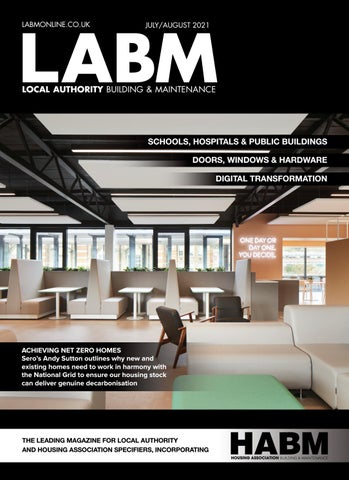
To be removed from LABM’s circulation please call 01923 237799 or email: circulation@hamerville.co.uk FRONT COVER IMAGE: AKO Sixth Form Centre at University College School. Photo ©Jack Hobhouse
challenge and it’s great to see a commitment from the sector to tackle this issue through the imposition of tough targets. Now the hard work comes in meeting those targets.
…149 (44%) local authorities “have set zero carbon targets for 2030. ”
Recently UK100, a network for UK locally elected leaders, nearly 60 local authorities, representing 35% of the UK population, committed to meeting net zero at least five years earlier than central government. There are some great examples of local authorities and housing associations spearheading their own sustainability campaigns, such as believe housing, who earlier this year achieved the Carbon Neutral International Standard and Hastoe, a pioneer in delivering rural Passivhaus schemes who recently developed their own New-Build Standard which addresses future-proofing. Also, housing associations Abri, Anchor Hanover, Home Group, Hyde and Sanctuary have formed The Greener Futures Partnership with the aim of improving the energy efficiency of 300,000 homes. Another example is Dacorum Borough Council, who in June became the first Silver level Carbon Literate borough council in the UK after working with APSE Energy to deliver Carbon Literacy Training to 60 key members of staff. Chief Executive Claire Hamilton says: “Being recognised as a Carbon Literate Organisation is just one of the many steps that we are taking on our journey to help reduce our carbon emissions.” It’s great to see local authorities and housing associations setting the standard, showing ambition and real intent.
A word on our publisher, Bryan Shannon It is with much sadness that we have to announce the recent passing of our publisher Bryan Shannon. In a career spanning more than 50 years its no exaggeration to say that Bryan helped to change the established order of trade magazine publishing in the UK. His visionary ideas on distribution, commitment to editorial excellence and market leading circulations quickly established a wide range of titles as essential reading for thousands of specifiers, tradespeople and small businesses. Today, the extensive portfolio includes highly regarded titles ranging from construction, to motor mechanics and hairdressers plus the highly popular Toolfair and Elex trade shows. As well as considerable magazine success, Bryan’s other great legacy is the wonderful opportunities afforded to legions of budding journalists and advertising sales representatives to cut their teeth at Hamerville Media, many of whom have subsequently gone on to run their own successful businesses within the sector. The iconic cockerel figurehead which he chose to reflect the importance of being up first with the news will continue to have much to crow about in the years to come. J U LY / A U G U S T
2021
LABM
I
5
006_LABM_JUL-AUG21_Layout 1 05/07/2021 16:23 Page 6
NEWS New partnership launches to tackle homelessness
IN BRIEF Housing services research Tyfu Tai Cymru (TTC — a five-year policy research project managed by CIH Cymru) has published its findings from a survey of local authority housing professionals conducted towards the end of 2020. The survey asked them how working through the pandemic has impacted on the delivery of housing and housing services, as well as staff wellbeing and resilience. Almost a third of respondents (30%) felt that effort to house people experiencing homelessness to provide protection and limit the spread of COVID-19 was one of the key positive actions to come about as a result of the pandemic. It was also found that a combined lack of housing stock, staff capacity and the need to manage the impact of COVID-19 on top of already busy day jobs combined represent the most significant pressures facing local government housing staff.
■ You can download the report here www.rdr.link/lw028 Stonewater public art competition Artists are invited to play their part in building community spirit and inspiring residents at new affordable housing developments across England. Leading housing provider Stonewater has launched the George Blunden Public Art Prize, a competition to find an artist who can produce creative public artworks as a focal point for five new schemes it is building over the coming year. Entrants are being asked to pitch an idea for a long-term, low maintenance installation for one of the HA’s developments currently under construction and demonstrate how they would propose working with colleagues and communities to develop such artworks. Mosaic panel for Stonewater’s development in Uckfield depicting local historical events, by Budd Mosaics
■ Entries are open until 6th August. To find out how to enter, go to: www.stonewater.org/media-packblunden-prize/public-art-competition/
6
I
L A B M
J U L Y / A U G U S T
2 0 2 1
In June three leading organisations combined forces to launch a formidable new partnership to help single people experiencing homelessness get their lives back on track. Award-winning developer Hill Group, The Salvation Army and Citizens UK have together formed the SHC Partnership, following a £12m project by the developer to gift 200 specially designed and fully equipped modular homes over the next five years to organisations supporting people experiencing homelessness (at least half of these gifted units will be delivered through the partnership). The Partnership will create community-led supported accommodation projects, with The Salvation Army and Citizens UK working in partnership with people who have experienced homelessness, learning from their experience and building rich and inclusive communities. In the grounds of Westminster Abbey, to mark the launch, the SHC Partnership unveiled the SoloHaus, a modular home specially designed by Hill, furnished and ready to move into, which is at the heart of the new campaign to help tackle homelessness. The homes have running costs of less than £5 a week and are designed to Future Homes Standards, exceeding Building Regulations for energy efficiency and sound insulation, and with a design life of 60 years.
The Partnership is now calling on the Government, local authorities, and landowners to back its programme, provide funding and help identify small pockets of land as sites for the homes. The Salvation Army and Citizens UK already partner on Malachi Place, a modular community-led supported accommodation project for single people experiencing homelessness in Ilford, East London. The initiative, started by 10-year old Malachi Justin donating his tooth fairy money to the Salvation Army, has now provided homes for more than 56 people since it opened in March 2020 and is supported by the London Borough of Redbridge. Lieutenant Colonel Drew McCombe, of The Salvation Army, on behalf of the Partnership, says: “We have well designed modular homes ready to be installed, nationwide expertise in providing support to people experiencing homelessness and projects already in the pipeline. We need the Government and local authorities to give planning permission for modular housing, especially as ministers have missed their target for providing homes for people who experienced rough sleeping in March 2020.”
From left to right: Captain John Clifton, The Reverend Anthony Ball, Emmanuel Gotora, Stephen Serrant, Andy Hill, Lieutenant Colonel Drew McCombe, Tom Hill, Eddie Hughes MP and The Reverend Dr James Hawkey
007_LABM_JUL-AUG21_Layout 1 05/07/2021 14:13 Page 7
PROJECT UPDATE: NOTTINGHAM CITY HOMES
Nottingham council housing project One of Nottingham’s biggest council housing developments took a step forward in June, when Nottingham City Homes appointed Lovell Partnerships as construction delivery partner. Planning permission to build up to 130 council homes in Bestwood was granted last year. The homes will be built on land off Beckhampton Road and consist of twoand three-bedroom houses, bungalows and flats, which are all in high demand from local families in the Bestwood area. Following a tender process, national housebuilder Lovell Partnerships was awarded the contract for one of the biggest Building a Better Nottingham developments in the city. Once built, the properties will be owned by Nottingham City Council and managed on their behalf by Nottingham City Homes. They will be let to households on the city’s council house waiting list at affordable rents. The site used to be a playing field for the former Padstow School, which closed
more than a decade ago, but after consulting with Sports England, the field is no longer required for its former use and has been released for housing. However, around 50% of the site will be kept and improved for publicly accessible green open space. The plan is to start on site later this year. Councillor Linda Woodings, Portfolio Holder for Planning, Housing and Heritage at Nottingham City Council, says: "Working with Nottingham City Homes and partners, we've been transforming unused sites like the one in Bestwood into new council homes for affordable rent for those people most in need. “Building social homes, not only helps to address Nottingham’s housing need, but also encourages investment, creates
jobs and helps to support local supply chain businesses which will be increasingly important as the city recovers from COVID-19." Nick Murphy, Chief Executive at Nottingham City Homes, comments: “The Beckhampton development gives NCH and the Council a great opportunity to provide much needed council homes for local people in Bestwood, and I am delighted that we have appointed Lovell Homes as our construction partner for the development. “They will help us to not only create safe, warm and modern homes for the area, but they will work with us to transform the green and open space as part of the development which the whole community can enjoy.”
J U L Y / A U G U S T
2 0 2 1
L A B M
I
7
008_LABM_JUL-AUG21_Layout 1 05/07/2021 16:26 Page 8
IN ASSOCIATION WITH
INDUSTRY COMMENT
Is planning really a problem? Matthew Warburton, Policy Advisor at the Association of Retained Council Housing (ARCH), looks at the issues surrounding planning and argues that councils need more powers to incentivise developers to build once planning permission has been granted, and to be able build themselves should developers’ proposals fail to meet local needs. he shock result of the Chesham and Amersham by-election in June has left commentators scrambling for explanations. The Conservatives have been riding high in the national polls for some time, and recently celebrated victory in the Hartlepool byelection and in local council results in many parts of the country. So the most popular explanation given for the 25% swing from the Conservatives that secured victory for Liberal Democrat Sarah Green has been to attribute it to local issues, particularly HS2, but also the Government’s proposed reforms to the planning system. The white paper Planning for the Future, published last summer but containing no evaluation of the impact of COVID on the housing market or building industry, contained several controversial proposals. The one that provoked an immediate backlash in Conservative ranks was the re-imposition of top-down targets for the number of new homes to be provided — particularly given that the proposed formula for calculation of the targets implied a significant increase in new development in many Conservative areas in the South and East. The Government moved quickly to amend the formula to shift more of the new development to urban areas, many of them Labour-held. But opposition to the white paper has persisted, particularly to its central proposal to remove the ability of local residents to challenge individual
T
8
I
L A B M
J U L Y / A U G U S T
planning applications, through the introduction of a zoning system.
…the White Paper “focuses too narrowly on
Questions raised
the number of homes that are needed, without adequate attention to why they are needed and who will live in them.
It is easy to pretend that opposition to this proposal, particularly in the leafy shires, is driven just by NIMBYism. But there are other good reasons to question the white paper proposals. First is to argue that they address the wrong problem. The white paper alleges that the chronic undersupply of housing in most parts of England is down to the failure of planning authorities to identify and make available enough land for housing. It may — or may not — be true that some local planning authorities have failed to identify land for enough housing to meet future housing needs. However, as the Local Government Association has shown, there is clear evidence that, where land has been identified for housing, developers — large and small — have been too slow in taking up the opportunity to build on it. The LGA analysis suggests that more than a million homes granted planning permission in the last decade have not yet been built, and that land sufficient for a further million homes has been identified in local plans for which developers are yet to submit a planning application. This is not to argue that the planning system is not in need of reform. However, the white paper focuses too narrowly on the number of homes that are needed, without adequate attention to why they
2 0 2 1
”
are needed and who will live in them. In particular, the issue of affordability and the need for more affordable housing is inadequately addressed. ARCH members are both local planning and local housing authorities, with powers and responsibilities under both planning and housing legislation. In theory, these functions should complement each other to support joinedup and effective action to meet local housing need. Currently they do not. The planning system places the onus on local authorities to make land available for housing, but provides local authorities with too little power to ensure that it is built on. Councils need more powers to incentivise developers to build when planning permission has been granted, and to build themselves or allow housing associations to build when developers’ proposals fail to meet local needs.
■ www.arch-housing.org.uk
LABM AD_Layout 1 29/06/2021 10:09 Page 1
010_LABM_JUL-AUG21_Layout 1 05/07/2021 14:16 Page 10
OFFSITE INSIGHTS: SOLVING PROBLEMS WITH MODULAR CONSTRUCTION DAVID HARTLEY, MANAGING DIRECTOR OF MTX CONTRACTS, DISCUSSES THE RECENT UPDATES AND PRIORITIES ALIGNED TO OFFSITE CONSTRUCTION.
University Hospitals of Leicester NHS Trust’s Glenfield Hospital
MODULAR SOLUTIONS FOR HEALTHCARE
T
he COVID-19 pandemic has shone a particular light on ventilation in the healthcare sector when it comes to modular and offsite construction. However, there is a concern that the drive to get the best value can result in a lack of consideration for patient care, in particular infection control and patient comfort. Many buildings are supplied with no mechanical ventilation or air-handling system, and whilst that may be considered adequate in meeting minimum standards, the world has changed following the pandemic. It is expected that later this year there will be an update to the HTM 03-01 standards, which will reflect the need for improvements in this area, and at MTX, all modular buildings go above and beyond the minimal requirements where standards of ventilation are concerned. Technology and the consideration around the emergence of ‘smart’ hospitals is also a hot topic, not just for modular construction, but industry wide. The trade must become much more agile and savvy
where this is concerned, reflecting it at every stage of the design and construction process to ensure client needs and demands are met. Patients and user needs remain at the forefront, however the
David Hartley - Managing Director
building must support the technological advances and ensure that this successfully adds benefit to the end user as opposed to just being a box ticking exercise. Benefits of modular for healthcare The availability of high-quality modular buildings has been a huge advantage for hospitals and health trusts that have been faced with urgent needs for additional facilities, especially given the increased pressure on funding. Modern Methods of Construction (MMC) offers a number of benefits to both the public and private healthcare sector, and these typically fall into three main categories — speed, cost and efficiency. The speed of delivery when using MMC is far quicker when compared to the traditional construction methods, it can cut build times by as much as 50%, dependent on the various factors at play. A recent project completed by MTX at Norfolk and Norwich University Hospital cut what would have typically been a three-year project into just one, even in
010_LABM_JUL-AUG21_Layout 1 05/07/2021 14:17 Page 11
A bespoke offsite rooftop solution was specified for Glenfield Hospital to create a new 12-bed renal ward department
With available ground space limited on the busy site, options for constructing new wards were restricted, so the Pre-Construction Team at MTX proposed a rooftop solution.
“
”
the midst of a global pandemic when demands, difficulties and disruptions were at an all-time high. This reduction in time also benefits from a cost perspective. Although overall construction costs are similar to that of traditional approach, the reduction in build time and the subsequent financial savings associated to that are substantial, making it a far more economical option. Additional benefits The build accuracy and the ability to control more factors with pre-manufactured solutions mean that there is an increased level of cost-predictability with MMC, which particularly in the public sector means projects can delivered on budget and in line with funding demands. The nature of
volumetric modular construction greatly improves the cost certainty as the superstructure is built up from repeatable steel frames. This type of construction is also inherently lower in carbon, and the efficiency of offsite construction reduces travel requirements to and from site. With majority of the works able to take place offsite, the pre-manufactured value of the project means that there is much less disruption to the healthcare provider. Given the recent increase in demands on the NHS, this is particularly important as it means they can continue to serve their patients and provide them with the care that they need. The ability to have a smaller site means that the construction process can typically be managed to limit issues with accessibility to other departments. Although with some healthcare projects MTX work on standalone builds on the healthcare site, other times, the new constructions will be joined to existing buildings, meaning that departments must be quickly and efficiently connected. Glenfield Hospital Innovative Rooftop Ward Extension University Hospitals of Leicester NHS Trust had a requirement to develop their existing site to create a new 12-bed renal ward department, plus an extra 52 acute beds at Glenfield Hospital.
MTX and modular construction provided Glenfield Hospital with an innovative solution — something that was impossible via traditional methods. With available ground space limited on the busy site, options for constructing new wards were restricted, so the Pre-Construction Team at MTX proposed a rooftop solution. A bespoke, offsite solution situated on top of the current hospital and sandwiched between the university building, pathology department, mortuary and live wards underneath, ensured the hospital was able to deliver the new wards they needed, without taking up any further ground space. Built on a roof directly above live wards and within a concealed courtyard, inaccessible through the hospital, an engineering excellence choice via onsite volumetric construction was the only feasible method. As all-encompassing facilities remained operational throughout the whole construction period, MTX had to ensure minimal disruption to the existing estate infrastructure. To facilitate this, a pre-cast lift shaft solution was built on site and craned into place to reduce time and workforce on site and deliveries were restricted around peak traffic flow times.
■ For more information on MTX’s modular solutions for healthcare facilities visit www.rdr.link/lw001
J U L Y / A U G U S T
2 0 2 1
L A B M
I
1 1
012_LABM_JUL-AUG21_Layout 1 05/07/2021 14:20 Page 1
ADVERTISEMENT FEATURE Metalclad CP consumer unit from Honeywell
Exceeding expectations As expected from a company with a reputation for innovation and reliability, Honeywell has entered the circuit protection market with a new cost-effective consumer unit range — Metalclad CP — which goes beyond the mandatory standards required by the current 18th edition wiring regulations. Ashley Clements-Smith, Senior Channel Lead from Honeywell, looks at how the new Honeywell Metalclad CP range helps electrical contractors protect social housing properties and residents. he 18th edition wiring regulations underwent an overhaul when it came into full effect in 2019. Further possible changes are on the horizon, so with the proposed second amendment to the regulations in mind, we look at how Honeywell’s Metalclad CP meets and exceeds important IET 18th edition wiring requirements.
T
When lightning strikes A Surge Protection Device (SPD) is designed to absorb overvoltage caused by nearby lightning. This is offered as an optional extra in the Honeywell Metalclad CP consumer unit. Although it is recommended, rather than mandatory, in the current 18th edition, an SPD can provide reassurance to housing providers who wish to protect their tenants and properties from lightning currents entering their buildings.
disconnects the circuit if any are found. Two AFDDs can be included in the Honeywell Metalclad CP consumer unit so that households can be protected from the dangers of these electrical faults, which are often unknown until it’s too late.
Configurable control The Honeywell Metalclad CP consumer unit comes either empty with a switch disconnector or fully populated with four Type-AC and two Type-A Double Pole Residual Current Devices (RCDs), Miniature Circuit Breakers (MCBs), and Residual Current Breakers with Overload Protection (RCBOs), the setup of which can be configured to suit the property’s requirements. So whether it’s a retrofit or a new-build project, Honeywell Metalclad Consumer Protection offers a versatile option that can be adapted to suit the property’s needs.
Hidden dangers Dangerous arcs caused by problematic connections in a faulty piece of equipment, insulation defects in cables, damaged cables or loose terminal connections, can lead to fires in electrical equipment or the fixed wiring. An Arc Fault Detection Device (AFDD) is an intelligent device, which monitors the power system to detect unsafe arcs and
1 2
I
L A B M
J U L Y / A U G U S T
Easy and safe With multiple extra-large knock outs and four-point fixing holes to cope with uneven surfaces, the consumer unit is easy to install. What’s more, it is fully earthed and lockable, which is not always a standard feature on other consumer units available on the
2 0 2 1
market. A lockable lift-up front cover further ensures that the unit cannot be tampered with, making it ideal for homes where safeguarding is a consideration. By using Honeywell’s Metalclad Consumer Protection range for circuit protection, social landlords can reassure tenants that they have complied with the latest industry requirements and recommendations using a product made by a brand known for innovation and reliability. This way, housing providers can concentrate on other aspects of asset management, knowing that their tenants’ homes are safeguarded.
■ Honeywell Metalclad Consumer Protection products are available exclusively at Edmundson Electrical stores. For more information, visit hwll.co/Metalclad
013_LABM_JUL-AUG21_Layout 1 05/07/2021 14:20 Page 1
INDUSTRY EVENTS Housing 2021
©duncanandison/AdobeStock
WSPF policy conference The Westminster Social Policy Forum keynote seminar: Next steps for house building in England — policy developments, planning, investment and innovation, will be taking place on 11th October. Confirmed speakers include Rt Hon Christopher Pincher MP, Minister of State for Housing at MHCLG, Lord Kerslake, Chair of Peabody and Councillor David Renard, Leader, Swindon Council and Chairman, Economy, Environment, Housing and Transport Board at the Local Government Association. The conference will be an opportunity to assess a range of significant policy initiatives and developments affecting the sector, including the National Home Building Fund, the Levelling Up Fund and plan to Build Back Better in the recovery from the COVID-19 pandemic, the Affordable Homes Programme, the forthcoming Planning Bill and the Fire Safety Act 2021. Areas for discussion include tackling barriers to housing delivery, supporting sector recovery from the pandemic, reform of the planning system, the role of innovation in design and construction and improving safety across a building’s life cycle.
■ More about the event here www.westminsterforumproject s.co.uk/book/house-building-21
©Tupungato/AdobeStock
The Chartered Institute of Housing's annual conference and Europe's leading housing festival returns to Manchester Central from the 7th – 9th September. After a year of virtual discussions, debates and dialogue, the industry’s leading show for the affordable and social housing sectors is a must-attend event for local authorities, housing associations, key partners and suppliers, government, housebuilders and developers. The speaker line-up includes The Rt Hon Christopher Pincher MP, Minister of State for Housing and Planning and The Rt Hon Robert Jenrick MP, Secretary of State for Housing, Communities and Local Government. Attendees will also get to hear from the likes of Gavin Smart, Chief Executive of the Chartered Institute of Housing, Kate Henerson, Chief Executive
Offsite Expo
of the National Housing Federation, John Bibby, Chief Executive of the Association of Retained Council Housing and Eamon McGoldrick, Managing Director of the National Federation of ALMOs. Topics up for debate range from building safety, Housing First, MMC and health and wellbeing, to future living and achieving net zero. There will be a number of dedicated sessions entitled ‘The place that COVID built’, as part of the Future of Living stream, which will cover lessons learnt, meeting local need and shaping places for the future. There will also be sessions tackling the net zero procurement and skills challenge, and putting biodiversity at the forefront of UK housing.
■ For more information visit https://cihhousing.com
©macrovector/AdobeStock
This event will be returning to the Ricoh Arena in Coventry on the 21st and 22nd September to showcase the latest in offsite technology and solutions. It is aimed at architects, engineers, contractors, local authorities and specifiers. A variety of offsite installations will be positioned throughout the exhibition for visitors to look around. There will also be custombuilt seminar theatres using the very materials and technology which form the seminar and masterclass content. The event includes a Masterclass programme covering an array of subjects, from digital construction, training, skills and innovation, to volumetric technology.
■ You can find out more about the event here www.offsite-expo.co.uk
J U L Y / A U G U S T
2 0 2 1
L A B M
I
1 3
014_LABM_JUL-AUG21_Layout 1 05/07/2021 14:23 Page 12
SPECIAL REPORT: COLOUR SCHEMES TO SUPPORT PEOPLE LIVING WITH DEMENTIA Chris and Sally’s House is used to showcase design solutions that support people with dementia living independently in their own homes. Image ©BRE
Andrew Cleaver, Healthcare Sector Manager at Dulux Trade, explains how colour can be used to support people living with dementia in a home or healthcare environment.
Occupant centred colour schemes ementia is a growing challenge across the world. In the UK, the number of people with dementia currently stands at an estimated 850,000 — with someone being diagnosed every three minutes, and one in four diagnosed is currently in an acute hospital ward. While dementia is a global concern, it’s an issue prevalent in countries where people are likely to live into very old age, including the UK — as it mostly affects people over 65. Therefore, addressing the challenges faced by increasing rates of dementia is high on the agenda for both the NHS and the UK Government. As vital work gets underway to improve care services, it’s important that design professionals — from architects to decorators — understand how the use of colour and design can help improve living spaces for those diagnosed with the disease. At Dulux Trade, we understand
D
the way people engage with a building can be directly affected by its colour and design, and we strive to ensure professionals have access to best practice colour and design initiatives that promote accessible and inclusive environments — including for people with dementia. We have this year launched our new Occupant Centred Colour and Design (OCCD) hub, which was set up to provide architects, designers and specifiers with information to create spaces that have a positive impact on the wellbeing of its occupants across a range of sectors, including healthcare and education.
Knowledge hub The hub has been bolstered with a new specialist section called Designing for Aged Care and Dementia, which sets out how design can be used to create optimal environments for dementia care in both healthcare and residential settings.
It features the Dulux Trade DementiaFriendly Colour Palette & Design Guide, a set of design principles defined by our colour experts following comprehensive research. The guide incorporates a sympathetic yet contemporary colour palette, as well as offering helpful tips to guide the user. The careful selection of dementia friendly colours for walls, woodwork and doors is supported by advice about patterns and materials that can help those living with dementia to move around their living spaces more easily. The design hub also includes our Healthcare Design Principles, an evidence-based colour palette, which
014_LABM_JUL-AUG21_Layout 1 05/07/2021 14:23 Page 13
Within a care home setting, “critical surfaces — such as walls, floors and doors — should be defined and have contrast between them.
”
Dementia Demonstration Home, Chris & Sally's House at the BRE Innovation Park in Watford. Image ©BRE
offers ready-made solutions to help foster better healthcare outcomes in residential homes and hospitals nationwide.
Creating zones One of the key ways colour can be used is by creating zones and highlighting areas of interest to help people with dementia navigate their home or care setting. Personalising the entrance to a resident’s private living space can further support residents. By introducing a familiar house number, a bedroom nameplate, a piece of art or a display box, a door can be made more recognisable. Meanwhile, feature walls also help aid wayfinding. Shapes, symbols and landmark objects on walls can help with wayfinding to communal areas that carers may want residents to visit more regularly. The Dulux Trade Dementia-Friendly Colour Palette includes colours for the main wall scheme, as well as providing plenty of options for feature walls that not only help with wayfinding, but also create a warm and inviting space for visitors and staff alike. Contrast is really important when designing for people with dementia. Within
Chris and Sally’s House. Image ©BRE
a care home setting, critical surfaces —such as walls, floors and doors — should be defined and have contrast between them. The recommendation is a minimum of 30 points of Light Reflectance Value (LRV). For example, in areas where carers may want to discourage access, reducing the contrast between the wall colour and the door colour enables the door to blend into the background, which helps prevent residents from focusing on the door and entering. Other doors where residents are given general access should have sufficient visual contrast (visible standout) to the surrounding walls, to be easily identified by all users.
Other important considerations While the colour of the space is crucial, it's not the only important aspect to consider when decorating spaces for people with dementia. All surfaces should be as nonreflective as possible, as gloss produces glare and light bounce, which will hinder residents with visual impairments. We’d recommend using Dulux Trade Diamond Matt and Eggshell products as they are highly durable, low sheen products which can be used on walls. Meanwhile, Dulux Trade Diamond Satinwood would be the ideal choice for interior doors and trim. Furnishings are also very important to consider. Professionals should use design to give clear indicators of the use of a room. In a dining room for example, try keeping the table laid with place mats and choosing crockery that contrasts with the
table. Or use imagery and symbols on doors, to help reinforce what a room is used for. Meanwhile, furniture, such as chairs, tables and beds, should contrast against surrounding surfaces to avoid confusion and reduce the potential for trips and bumps. For those with visual impairments, very dark rugs and mats can give the appearance of holes in the floor, and therefore should be avoided.
Dementia demonstration home As well as offering support to our customers and design professionals, Dulux Trade is committed to long-term initiatives and research to drive forward the design of accessible and inclusive care environments and change the way we think about dementia care. That’s why, in partnership with BRE, BRE Trust, Loughborough University and Halsall Lloyd Partnership, Dulux Trade has helped build a dementia demonstration home adapted to cater for different types and stages of dementia. Located within the BRE Innovation Park in Watford, the project — called Chris and Sally’s House — is used to showcase design solutions that support people with dementia living independently in their own homes, with Dulux Trade adding its extensive knowledge about inclusive colour and design to enable both functional and wellbeing occupant outcomes. We know our work is never done in helping to address the growing challenges of an ageing population. We’re dedicated to doing continuous work to develop innovative solutions that enrich the lives of people with dementia, their families and carers.
■ For more information, visit the Designing for Dementia and AgedCare section of the Dulux Trade OCCD hub www.rdr.link/lw002
J U L Y / A U G U S T
2 0 2 1
L A B M
I
1 5
016_LABM_MAY-JUNE21_Layout 1 05/07/2021 14:24 Page 16
ACHIEVING NET ZERO HOMES in association with
Net zero housing — how do we do that? Is Grid Harmony one way to make UK housing net zero? In the second in his series of articles, Andy Sutton, Co Founder and Director of Design & Innovation at Sero, outlines the need for new and refurbished homes to work in harmony with the National Grid to ensure our housing stock can deliver genuine decarbonisation. n the UK, we hardly ever think about our energy networks. If we have any power cuts, they are headline news precisely because they’re so rare: testimony to the robust infrastructure. But our home energy supplies are a major source of our personal carbon footprints and being smarter about them can support the energy grids whilst reducing our carbon footprints and saving us money. It’s a real win-win-win, and to deliver net zero successfully we need to grasp the opportunity.
I
Daily variation in the Grid The UK’s National Grid — the electricity network — emits a varying amount of carbon for the energy it supplies to our homes. For one unit of electricity (a kWh), during any given day it’s commonly true that the carbon emitted could be more than 300g of CO2eq, or less than 300g of CO2eq. The difference in the emissions relates to when the electricity is drawn from the Grid, what the UK Green Building Council’s definition of Net Zero Carbon in Operation calls “time of use”. Let’s ponder that for a second. The awareness of this daily variation in the Grid could easily mean that the single biggest carbon reduction measure any home can make is changing the timing that it draws electricity from the Grid. Not LED lights, not external wall insulation, not photovoltaics (though they’re all good of course), but simply shifting when the electricity is supplied to the home so that it aligns with when the
1 6
I
L A B M
J U L Y / A U G U S T
most renewable generation is occurring across the UK. A modern new-build home will emit 2-3 tonnes CO2eq every year assuming it’s electrified — but adjusting when it draws the electricity could halve that figure. The National Grid has also been, and is continuing to, undertake significant decarbonisation. Since 2010, average annual Grid electricity emissions have dropped from 500 CO2eq to around 200 CO2eq, and contracts are in place for this to be nearly CO2eq by 2030. Whilst achieving zero emissions all of the time is not likely to happen for decades (if ever), achieving net zero electricity supply some of the time will be happening by 2040. And the homes that only draw electricity from the Grid at those times will therefore be demonstrably net zero in operation.
Aligning with the Grid What does all this mean? Well, one answer is we need residents to be watching the Grid carbon emissions, weather forecasts across the UK, and their energy usage. It means education, a change in behaviours and adjusting when they use their TV, kettle, bath and so forth, to align with when Grid carbon is lowest. And, for some “prosumers”, to a degree that’s what they are doing. For the rest of us, technology can do the heavy lifting. By designing homes with energy storage systems including hot water tanks and electrical batteries, combined with intelligent controls that spend their time (not ours) watching Grid emissions and weather forecasts, the majority of us can actually carry on living our daily lives much as before. Via the intelligent controls, the homes’ will seamlessly shift from “on grid” to “off grid” in the background, delivering power and heat when we demand it, but ensuring that has the smallest carbon footprint each and every time. That’s not to say we don’t all need to try and be prudent about our energy usage, but with homes built to work in harmony with the Grid, our effort to mitigate will be magnified on our behalf.
■ For more information on Sero and its work visit https://sero.group/
2 0 2 1
LABM AD_Layout 1 29/06/2021 10:09 Page 1
LABM AD_Layout 1 29/06/2021 10:10 Page 1
019_LABM_JUL-AUG21_Layout 1 05/07/2021 16:28 Page 19
Q&A: DOMESTIC CIRCUIT PROTECTION STANDARDS Ashley Clements-Smith, Senior Channel Lead at Honeywell, discusses how Arc Fault Detection Devices would provide better protection against electrical fires in domestic properties and answers questions about the current requirements.
Circuit protection ccording to data from the Home Office, electrically-instigated fires accounted for around 18% of all fires in dwellings between 201020201. Considering the potential danger which could result from electrical faults, it has been proposed to make the use of Arc Fault Detection Devices mandatory in AC final circuits in the next amendment to the 18th edition, however a decision on these possible amendments will not be made until early 2022. When the 18th edition wiring regulations were published in 2018, several changes were made which could affect how circuits are protected, including possible use of Arc Fault Detection Devices (AFDDs). Conditions under which protection against surges in voltage due to lightning were also amended as well as new guidance on the use of specific types of RCD for installations. In anticipation of the second amendment to the regulations, which is currently under consideration, let’s look at potential changes for domestic circuit protection and examine devices that meet the criteria.
A
Why has it been proposed to make the use of AFDDs mandatory? An AFDD is an intelligent device that monitors the power system to detect dangerous arcs. These types of arcs could be caused by issues like problematic connections in a faulty piece of equipment, insulation defects in cables, damaged cables or loose terminal connections. Dangerous arcs generate heat and if undetected, they could lead to fires in electrical equipment or the fixed wiring.
When an unsafe arc is detected, AFDDs disconnect the circuit. They are programmed to tell the differences between safe and dangerous arcs so that normal ones such as those caused by switching cycles do not trip the AFDD.
Why does the current 18th edition recommend the use of type A RCDs? Over the past 50 years, the industry globally has moved away from traditional linear loads from electrical products such as incandescent lighting, to power devices which have switch mode power supplies. Where the former take their power along the whole current wave form so that the load is linear, the latter take different chunks of current out of the sine wave. This distorts the waveform, which causes peaks and troughs. Type-A Residual Current Devices (RCDs) like those featured on our Metalclad CP can detect DC fault currents whereas type AC RCDs will not. Although the use of these type-A devices is not mandatory, they are now becoming increasingly specified by consultants and contractors and are recommended in the 18th edition to provide better protection. This means they should be considered for inclusion in a consumer unit when a property uses LED lighting, lighting and heating controls, and appliances such as washing machines, induction hobs, dishwashers and fridges. Type A RCDs as a minimum are mandatory for circuits supplying electric vehicle charging points, so the use of these RCDs in a consumer unit now could also prepare a dwelling for the future.
Are Surge Protection Devices necessary for domestic properties to meet the 18th edition regulations? When lightning strikes, voltage can be induced onto the local power line, causing a sudden rush of voltage entering properties. A Surge Protection Device (SPD) is designed to absorb this voltage to protect properties and their electrical equipment. It is not mandatory but a recommendation in the 18th edition depending on the probability of lightning strikes in an area. SPDs are offered as an optional extra in the Honeywell Metalclad consumer unit. Regulations regarding electrical installations are rapidly changing. Over the past decade, there have been three updates to the 17th edition, and the publication of the current 18th edition, which came into effect in 2019. With plans to make a second set of amendments to the wiring regulations, the challenge is for housing providers and specifiers to keep abreast of — or even ahead of — ongoing developments. Deploying advanced technology can provide compliance now and anticipate possible upcoming changes, is helping housing providers to meet electrical safety standards for future installations. 1
https://www.researchgate.net/publication/ 345910304_Arc_Fault_Detection_Devices_ AFDDs_-_Are_they_worth_it
■ Honeywell Metalclad CP products are available exclusively at Edmundson Electrical stores. For more information visit www.rdr.link/lw003
J U L Y / A U G U S T
2 0 2 1
L A B M
I
1 9
020_LABM_JUL-AUG21_Layout 1 05/07/2021 14:28 Page 20
SCHOOLS, HOSPITALS & PUBLIC BUILDINGS
West & West were awarded the M&E contract for a new-build school extension at Loddon Primary School
Making the grade Daniel West, Managing Director of West & West, explains the key electrical and mechanical upgrades that can enable schools to save energy and costs.
T
here has long been a need for schools to drive energy efficiency, yet many are still struggling to do so. The pressure to do more with less can mean that sustainability is pushed down the agenda, resulting in reactive strategies that miss opportunities to save both energy and costs. Taking a more proactive and tailored approach, which considers long-term benefits, can make a significant difference to a school’s carbon footprint and its budget.
LED technology According to the Carbon Trust, lighting represents around 20% of a school’s energy costs, so is the best place for schools to start making improvements. Schools built before 2015 are unlikely to be using LED lighting, relying on halogen lamps instead. Switching to LED technology will realise many benefits, especially in terms of maintenance. On average, a halogen lamp will require changing around every 18 months. Select the right type of LED and it could be 11 years before it needs replacing. The key here is to invest in a highquality LED lamp and not to be swayed by the lowest purchase price. Opting for a lamp around the £60 price range will generate significant savings further down
2 0
I
L A B M
J U L Y / A U G U S T
the line as it could last twice as long as an LED that costs half that price.
A lighting control system can drive further efficiencies. This technology can be used for a number of purposes, including dimming lights when required. Not only can this help to create a more appropriate teaching environment in certain classrooms, but consumption can be cut by up to 60% resulting in significant energy savings and costs. Lights can also be dimmed to work in harmony with natural light in a classroom, providing an energy-efficient solution when lighting is required to be in continuous use. In addition, smart controls can turn lights on and off if there has been no movement in a space for a certain time period.
roof, solar panels can significantly reduce electricity bills, save carbon emissions and generate a revenue stream over the longterm. They can also be used to help run equipment that uses high amounts of energy, such as a kiln in an art department, lowering consumption from the grid. Another form of renewable technology suitable for schools is a heat recovery system, which prevents any heat from being wasted. A ventilation system feeds air in and out of a space. The heat from the stale air is extracted and returned to the fresh air that is circulating back into the system. This recycling of air can keep schools warm in the winter and cooler in the summer. This releases pressure on other heating systems, leading to lower fuel bills and carbon emissions as well improved comfort for students and staff.
Renewable energy technology
Energy monitoring
The use of renewables has been relatively low in schools, yet the technology provides one of the most cost-effective ways of harnessing green energy. Advances in technology mean that solar panels are now more affordable to purchase, and energy storage is more efficient. As large installations are often possible thanks to the size of a school’s
Implementing an energy monitoring tool is a simple and highly effective way to make savings. There are various options depending on the needs of the school. For example, meter reading devices can be installed to measure energy consumption online over set periods of time helping to identify any unusual patterns or peaks in demand.
Automatic lighting control
2 0 2 1
020_LABM_JUL-AUG21_Layout 1 05/07/2021 14:28 Page 21
The Loddon Primary School extension contract included the installation of incoming electrical supply, internal and external lighting, small power and mechanical plant supplies
Peaks could be caused by leaving electrical equipment on unnecessarily, or less obvious issues such as time clocks being set wrong. We worked with a school to install a monitoring system, which identified that a hot water cylinder had been turning on in the evenings for years when it was not required. Rectifying this issue saved the school thousands on their fuel bills. Monitoring does not just rely on technology. The power of people should not be underestimated. Some simple checks by staff, and even students, can help to drive down costs and energy use. Ensuring that lights, sockets and computers are switched off at the end of the day can significantly reduce waste. Similarly, ensuring any faulty electrical items, including lights, are identified and fixed at the earliest opportunity is not only essential from a health and safety perspective, but can prevent bills from rising unexpectedly.
Striking the right balance With the pressure growing on all of us to reduce our energy use, there is a growing need for schools to take action and be more proactive. Investing in electrical and mechanical upgrades can significantly boost efficiencies. With the right advice, these improvements can be tailored to specific needs ensuring any initial costs are hugely outweighed by savings on energy bills and lower carbon footprints.
www.west-west.co.uk
LABM AD_Layout 1 29/06/2021 10:10 Page 1
023_LABM_JUL-AUG21_Layout 1 05/07/2021 15:20 Page 23
SCHOOLS, HOSPITALS & PUBLIC BUILDINGS
AKO Sixth Form Centre in Hampstead, London, designed by Lewandowski Architects. Photography ©Jack Hobhouse
Circular economy James Scully, Managing Director at Quadrant, discusses the circular economy route to genuinely sustainable construction and the benefits of specifying cork flooring. he leaders of the top world economies met at the G7 Summit in June to discuss sustainability among other global issues. The UK, who hosted the event in Cornwall, has already enshrined into law a commitment to meet net zero emission targets set for 2050. However, to meet this ambitious target all contributors must play their part. The construction sector is one of the largest contributors of carbon emissions and its challenge now is to find and use more eco-friendly and sustainable building solutions to drastically reduce its output. Research shows there is overwhelming public support for sustainable development as the issues of climate change and global warming come to a head. Genuine sustainability means having an allencompassing solution. One that promotes the wellbeing of its occupiers, adds value for building owners and is designed to work in hand with its surrounding natural environment and supports minimum material wastage and lower energy bills. Many governments around the world are driving the use of circular economy
T
strategies. These aim to minimise or even eliminate waste and pollution by improving efficiency and keeping products and materials in use. In construction, this includes all aspects from the design phase through building, usage and eventually deconstruction and recycling. The UK Government’s construction policy encourages the use of Modern Methods of Construction (MMC), which includes modular and offsite construction and digital working. In fact, government (including wider public sector) spending on modular buildings stands at £750m per year, making it an area of growth that should encourage more players in the construction industry to get involved.
approach is widely embraced by public sector priority programmes in the schools, hospitals, and housing sectors. One of the ways public sector specifiers are incorporating green practices into their projects is with the use of recyclable and reusable materials. Along with recycled
Waste reduction Currently, only 40% of construction waste is recycled or reused and most of the recycled materials are downcycled for second-grade construction like roads, rather than new buildings. To remedy this, forward-thinking projects are increasingly incorporating more sustainable measures in their designs, plans and processes. This
The new 300m2 facility at the AKO Sixth Form Centre delivers a dynamic range of spaces. Photography ©Jack Hobhouse
J U L Y / A U G U S T
2 0 2 1
L A B M
I
2 3
023_LABM_JUL-AUG21_Layout 1 05/07/2021 15:20 Page 24
SCHOOLS, HOSPITALS & PUBLIC BUILDINGS
that help reduce acoustic noise by up to 50%, a plus for busy spaces such as in offices, schools, and hospitals.
Free of VOCs
Queen Mary University in London
steel, cork flooring is proving to be a popular choice for specification as it is made from recycled cork and is infinitely recyclable and reusable. What makes cork truly sustainable is the fact that as a raw material it is usually harvested from a living tree, as it is a tree bark, which continues to grow and reproduce more cork. And for every tonne of cork produced, it is estimated that cork oak forests absorb around 73 tonnes of carbon dioxide. The knock-on effect is a reduction in greenhouse gas emissions and slowing climate change. Even after manufacture, cork flooring materials are infinitely recyclable as they retain the ability to store carbon dioxide
throughout their entire lifecycle. Sustainable cork flooring is also produced within a circular economy model that upcycles waste and used corks from the bottle stopper industry. As a result, the best cork flooring manufacturers are building on the natural sustainability of cork by recycling cork products because they can be reconfigured and reused repeatedly without compromise. Cork’s resistance to wear, resilience, flexibility, and ability to revert to its original shape after enduring sustaining pressure are not the only characteristics that make it the ideal sustainable flooring material. The health and wellbeing of a building’s user must also be considered. In this regard, cork is carbon neutral and has properties
Understanding the impact chemicals within building materials have on human health must also be considered when discussing sustainable construction. Flooring products should therefore be free from volatile organic compounds (VOCs) in line with current UK and EU indoor air quality standards. A circular approach in construction will increase the amount of recycling and reusing of resources, while reducing the amount of waste that it leaves. Having a robust, well-designed build process, which uses technological and innovative solutions, can aid the transition to a more sustainable and cost-effective future for the entire industry and benefit our environment for future generations. The benefits of a circular economy approach stretch beyond the ecological. It has the potential to provide further social and economic benefits, for example, the creation of recycling and upcycling businesses with the sole aim of supplying the construction industry with sustainable building materials, which in turn can create jobs for local economies. Collaboration between clients, engineers, contractors, architects, designers, and manufacturers is a must to create an entirely new construction ecosystem that is truly sustainable.
■ To find out more about Quadrant and it’s cork flooring solutions visit www.rdr.link/lw004
LABM AD_Layout 1 29/06/2021 10:11 Page 1
026_LABM_JUL-AUG21_Layout 1 05/07/2021 16:29 Page 26
ADVERTISEMENT FEATURE
Spotlight on building safety The continuing focus on building safety should be welcomed, but all hazards need to be identified and put under the spotlight, says Wrexham Mineral Cables Commercial Manager Steve Williams.
S
ince the tragedy at Grenfell Tower four years ago, building safety has rarely been out of the headlines. In the aftermath, Dame Judith Hackitt’s independent review set out more than 50 recommendations regarding the delivery of a more robust building regulatory system. And in response, the Government has sought to introduce legislation to address these concerns — such as the draft Building Safety Bill — which has been seen by many as the most sweeping changes to building safety in the last 40 years. The aim is to introduce a new era of accountability, impacting almost everybody in the supply chain. When
introduced, the reforms will make it clear where the responsibility for managing safety risks lies throughout the design, construction, and occupation of buildings, with tougher sanctions for those that fail to meet their obligations. Sadly, the recent fire at New Providence Wharf in London highlighted how much work still needs to be done in keeping building occupants safe. Initial findings from London Fire Brigade show that smoke detectors on the 8th floor communal corridor failed to operate both the Automatic Opening Vent (AOV) and the cross-corridor fire doors. This serious failure of a vital building safety system resulted in the building acting like a
“broken chimney”, leaving residents’ only escape route smoke logged.1 It is another wake-up call that cannot be ignored. Indeed, London Fire Brigade Deputy Commissioner Richard Mills commented: “Despite our response to this fire and drawing on the many lessons learned from the Grenfell Tower fire, in many cases we are sadly still not seeing a culture change in all those responsible for fire safety in high-rise buildings. The New Providence Wharf fire needs to be an urgent wake-up call to all building owners and managers. Look at the fire safety solutions inside your building and take action if they are not performing correctly. It is too late to wait for a fire to see if they work.”
026_LABM_JUL-AUG21_Layout 1 05/07/2021 14:31 Page 27
Building a safer future With a clear message that occupant safety needs to be a greater priority throughout the entire life cycle of a building, we can only truly make buildings safe by identifying all possible hazards. To date, the focus has been largely on identified defects. But it is the unidentified issues — such as the installation of inferior fireresistant cables — which, we believe, need to be put under the spotlight. It has also become clear that steps need to be taken to ensure the tests which construction products are subjected to are relevant and can be relied upon, especially in tall buildings or anywhere that requires extended evacuation times. Sadly, the Grenfell Tower Inquiry exposed evidence of testing irregularities and, in some cases, deliberate attempts to game the system and rig the results of safety tests. This is particularly important for specifiers and designers with whom the responsibility of product specification lies. How can they be held accountable if products cannot be relied upon and do not perform as marketed? To ensure products used on buildings meet the highest safety standards,
“The New Providence Wharf
the Government has since ordered a review of the current certification system for testing construction products, which will examine how it can be strengthened.
fire needs to be an urgent
Higher classification needed
owners and managers. Look
Should a fire break-out, fire-resistant cables play a fundamental role in ensuring that the emergency and building critical systems are supported — including emergency lighting, sprinkler systems, extraction systems, smoke dampers and shutters, emergency generators, pressurisation fans, emergency voice comms and fire alarms — in the event of a fire, providing vital time for the safe passage of occupants out of the building, and allowing for shutdown procedures to take place. In order to meet the requirements of a fire-resistant cable, they must meet the British Standard appropriate to their type of fire-resistant cable. There are several references for fire performance on cables including BS 50200, BS8434, BS8519 and BS6387. All of these standards have a variant of time and temperature the cables are tested at under fire conditions. These can range from a 30-minute rated cable tested at 830˚C (PH30 cable as per BS
wake-up call to all building
at the fire safety solutions inside your building and take action if they are not performing correctly. It is too late to wait for a fire to see if they work.
”
50200) to a three hour rated cable tested at 940˚C (BS 6387 category C). All of these standards should provide reassurance to the specifier that the chosen cable will continue to work in the event of a fire. However, as we all know, fire is a dynamic force that moves, expands, and changes the shape, size, and properties of all it comes into contact with. And as a
J U L Y / A U G U S T
2 0 2 1
L A B M
I
2 7
026_LABM_JUL-AUG21_Layout 1 05/07/2021 14:31 Page 28
ADVERTISEMENT FEATURE
Should a fire break-out, fire-resistant cables play a “fundamental role in ensuring that the emergency and building critical systems are supported, in the event of a fire, providing vital time for the safe passage of occupants out of the building, and allowing for shutdown procedures to take place.
”
leading manufacturer of fire-resistant cables, we have been calling for more stringent testing standards for years. We believe there needs to be a single test for ENHANCED fire-resistant cables. Regardless of size or construction, if a cable is required to function in the event of a fire, each single cable sample must have to pass a true fire scenario test. Due to its unique construction, no polymers or plastics are used to aid fire protection on Mineral Insulated Copper Cable (MICC). This means over 85% of the entire MICC range fall in the under 20mm category.
Currently, only fire-resistant cables that are greater in diameter than 20mm must undergo testing for direct impacts to reflect falling debris and water testing on a single test sample. For fire resistant cables under 20mm, no direct impact takes place and different stages of each test are carried out on different samples of cable. As the call for mandatory sprinkler systems in taller buildings gathers momentum, it becomes even more concerning that smaller fire-resistant cables, especially those under 20mm, may not survive fire, water, and direct impact — a true fire scenario.
2 8
2 0 2 1
I
L A B M
J U L Y / A U G U S T
This has resulted in too many cables being classed as fire resistant, but that would not be adequate in the event of a fire, as the tests do not represent realworld conditions. We strongly believe there should be a higher classification of cables introduced to help specifiers and designers identify those, which can survive, rather than simply resist fire. In an era of greater accountability, there should be no compromise, and as an industry we can no longer aim for minimum compliance to get the job done. 1. https://www.london-fire.gov.uk/news/2021news/june/new-report-into-new-providencewharf-fire-shows-serious-fire-safety-issuesin-building/
■ To find out more information Wrexham Mineral Cables and the company’s range of Mineral Insulated Copper Cable (MICC) range, visit www.wrexhammineralcables.com
029_LABM_JUL-AUG21_Layout 1 05/07/2021 14:32 Page 29
SCHOOLS, HOSPITALS & PUBLIC BUILDINGS Ben Farrar, Market Development Manager at Traka UK, looks at the effects of the pandemic and the recovery period from the perspective of the NHS. Ben suggests now is a pivotal moment, where local authorities can utilise innovative technology and support services to coordinate an intensive period of positive transformation for the benefit of staff and patients.
Embracing change and innovation ince its inception the NHS has gone through many changes, improvements, updates and modernisation processes, all with an aim to deliver its vision to provide good, strong and reliable healthcare for all. No-one back in 1948 would have been able to foresee the way in which the NHS developed, succeeded, pioneered and expanded, culminating in its impressive handling of the global pandemic in 2020 and 2021, with NHS workers presenting as a “miracle,” “magic” and “having superpowers.” Health Secretary Sajid Javid highlighted “the incredible work they have been doing throughout the pandemic.” As local authorities look for support to recover, in a recent speech made by the Department for Health and Social Care, it was stated, “now is the time to fulfil our duty to the 130,000 who have died — and the millions who have suffered or been bereaved by COVID” to “make this a turning point from which we build the best health system in the world.”
S
well, even when we get past the worst of the pandemic.” Coping with NHS workforce fatigue and morale, meeting demand, especially with the elective backlog, and gaining resources are all highlighted as essential to sustainability. But key to success, innovation has been seen as being ‘unleashed by the pandemic and embraced by the workforce.’ Innovation includes transformation of NHS Estates. In the heart of the pandemic,
NHS Open Space launched 40 new sites in September 2020, providing flexible clinical and meeting space on a pay-asyou-go basis. The scheme represents a step change in how we think about the NHS estate, and will also generate additional funds that can be reinvested back into the health service. Technology has also been factored into the design of new schemes, with motion sensors in some rooms to monitor space usage and help improve efficiencies. While
Demand, Resources and Innovation There are three areas that local authorities need to support NHS teams to recover, with Mr Javid offering, “everything they need during this time, especially as we look forward to dealing with the backlog as
J U L Y / A U G U S T
2 0 2 1
L A B M
I
2 9
029_LABM_JUL-AUG21_Layout 1 05/07/2021 14:33 Page 30
SCHOOLS, HOSPITALS & PUBLIC BUILDINGS in place by Traka’s secure iFobs, which means a hierarchy of access rights can be given to each key, depending on the strength or skill of administrating each drug. Within the cabinet, only certain keys will be available depending on the predetermined access rights. To maximise security, the key cabinet has been programmed so that two members of staff need to swipe their credential to take and to return a key to the system. This creates greater efficiencies, accountability and encourages an easy-toachieve ‘working together’ culture and best practice amongst ward staff.
Looking to the future it’s true that this is a fairly humble application of technology, it still signifies a promising shift towards designing digital technologies into the way in which we use and optimise our healthcare spaces. The Department for Health and Social Care is looking to empower NHS teams “to deliver the best care they can through the best data architecture,” with use of technology and intelligent asset management to ensure essential medical information, drugs and resources are instantly and efficiently available to authorised personnel as required to deliver exceptional care.
Brighton & Hove Sussex NHS Trust Brighton and Sussex NHS Trust is one example of how healthcare facilities are making changes and use of innovative resources such as key management, embedding the technology into its health, safety and security procedures. The Trust
itself highlighted its own agenda, with a dedicated ‘Patient first programme,’ supported by five pillars, each designed to help achieve its vision. The first is about getting front-line staff to approach problem solving and root cause analysis from a different, ceaselessly inquisitive perspective. Traka worked with staff to improve the safety and accountability of the drugs issuing process at Brighton and Sussex NHS Trust, by installing its key management solutions. Previously, keys to drugs lockers were issued manually, with one member of staff acting as a steward. However, this led to human error, difficulties in locating the keys and additional administration duties for busy ward staff. After working with Traka, the keys to the drug lockers are stored within an intelligent key cabinet. Through the ward staff’s existing credentials, only authorised personnel are able to access the cabinet. The keys inside the system are also locked
“Imagine an NHS in which you can access right data, the right information, at the right time with the touch of a button, as easily as you can check the weather on your phone.” This is the vision highlighted by The Department of Health to work on a local authority basis to achieve. Whilst the NHS has faced countless challenges in its 73year history, at no time has it experienced, “possibly the greatest wave of innovation in the history of our NHS that is going on right now.” Whilst elements such as Traka key and asset management represent just one component to enhancements being made to NHS estates, it paves the way to opening up our healthcare workers to greater efficiencies, transparent working practices and encourages collaborative use of resources. Such integration of the right technology represents a prime opportunity to realise the Department for Health and Social Care’s vision for a “world-leading technology- and data-driven health and social care system.” One that is available for all to access. It also helps work towards an aim to “fulfil the NHS’s potential to be the best health service in the world.”
■ Traka’s white paper, entitled ‘Embracing change for our NHS and UK Healthcare,’ is now available to download visit www.rdr.link/lw005 ■ For more information on Traka’s healthcare solutions, please visit www.rdr.link/lw006
3 0
I
L A B M
J U L Y / A U G U S T
2 0 2 1
031_LABM J/A ad grid AD_Layout 1 05/07/2021 18:38 Page 31
032_LABM_JUL-AUG21_Layout 1 05/07/2021 14:34 Page 32
SCHOOLS, HOSPITALS & PUBLIC BUILDINGS
Locking Systems provided a bespoke solution for 12 student blocks at Hull University
UAP’s MILOS 100 grade 6 unique lock cylinders are EN 1303 compliant
Lock and key Bill Murray, General Manager of Locking Systems, a UAP Ltd Company and specialist in bespoke locking solutions, discusses the reasons why traditional keys still offer a best-fit solution for student accommodation buildings. tudent accommodation has changed considerably over the past couple of decades. The private, en-suite study bedroom within a shared apartment has become the standard model for most universities and their private sector student living partners. It’s not just the layout of accommodation that has changed, either. The calibre of student living has also become more diverse, with increasing demand for highend luxury accommodation. The scale and number of student living developments has also escalated, with many universities now managing more property assets that ever before. All these factors affect the choice of security strategies for student living projects. For many students, life on campus, or within a city centre student block, is their first taste of living independently from the family home. With modern lifestyles and study trends, most will bring expensive gadgets with them when they start their student life and they are less likely than homeowners to have insurance. Consequently, the security
S
choices must ensure students feel confident in their own safety and the security of their possessions, while also reassuring their parents and delivering a duty of care that combines ease and convenience with safety and security. Meanwhile, the property assets also need to be cost-effective to build and operate and easy to manage. Estate management and maintenance teams must be able to access apartments for repairs and upgrades, or for emergency purposes. It is also important that any areas out of bounds to students, such as electrical cupboards and plant rooms for example, can only be accessed by authorised personnel. Finally, it is also wise to develop a security strategy that prevents subletting or additional ‘unofficial’ tenants. Working with an architectural ironmongery specialist and their locking solutions supply chain to install traditional locks with patent protected keys remains the most effective, reliable and secure way to achieve all of this. Moreover, by designing the locking system for the specific student living assets, with a
hierarchy of key control for the estate manager, the dual goals of student security and ease of management and maintenance can be embedded in the door hardware.
Robust, reliable and durable Security is the first priority for any student accommodation building and the method for securing each apartment and en-suite private room must, therefore, be robust, reliable and durable. While access control systems are commonly used for entrance to the building, particularly where there is a manned reception or concierge, it is neither practical, nor cost-effective to use access control technology for each apartment or individual rooms. Aside from the installation cost and potential maintenance burden, it is arguably unnecessary in an era when every student has a mobile phone and guests can simply enter the building and knock on the apartment door.
032_LABM_JUL-AUG21_Layout 1 05/07/2021 14:34 Page 33
Hull University
For Hull University, Locking Systems designed each of the 700 lock cylinders with individual pin configurations
For apartment and private room security, the alternative to a traditional lock would be a card key, which could be programmed for individual tenants and deactivated if lost or stolen, in the same way as a hotel card key. However, the reliability of card key systems depends on mains or battery power and, should the power source fail, the student could potentially be locked out of their accommodation…or locked in. With a traditional, precision manufactured, lock and key, access relies only on the right key being turned in the corresponding lock. Specifying an EN 1303 compliant, grade 6 unique lock cylinders for every door ensure that locks are highly secure, robust and durable, while hand-pinning of the lock provides both excellent security and smooth operation over years of use. If this is combined with a patented key that can only be duplicated by the manufacturer, rather than re-cut on the high street, the locking system will also prevent duplication for use by unauthorised occupiers. Arguably, it also encourages students to take good care of their key, as they will have to pay for a replacement.
Hierarchy of key control The ideal scenario when specifying traditional locks and keys for student
accommodation is to implement a hierarchy of key control that makes management and maintenance of the properties as simple as possible, while delivering high levels of security. Ideally, each student will have a single key that opens their shared apartment and their private room only, offering them two levels of security for their possessions and the reassurance that their private space can be secured effectively. In addition, the building management and maintenance team will have master keys in keyed-alike groups defined by their management criteria. Often this may be a single master key to gain access to any apartment or en-suite room in each building, along with specific master keys to access keyed-alike locations across all buildings — such as loft hatches or plant areas. The aim is to make the hierarchy of key control as simple as possible for the maintenance and management team. Hand-pinning of the cylinders to precision, software-generated specifications, along with advanced key cutting technology, ensures all locks operate smoothly and reliably only when the correct key or master key is used. In this way, universities can be confident that students are safe and secure, potentially dangerous areas of the building are controlled and authorised access to any secured location is simple and efficient.
A bespoke solution from Locking Systems was chosen for the refurbishment of 12 student blocks at the University of Hull. Ensuring the lock barrels were compatible with the existing lock cases, Locking Systems designed each of the 700 lock cylinders with individual pin configurations. This enables a single key to open both the apartment and private study bedroom door, with just eight master keys to operate all locks across the blocks. The lock barrels were manufactured at the company’s factory in Gateshead, with the pinning for each lock carried out by hand and the keys machine-cut for precision accuracy, smooth operation and reliable security. Two keys were provided for each lock and, as part of the security strategy, patent protected keys were supplied to prevent unauthorised duplication. In addition, a number of additional master-keyed cylinder locks, for loft hatches and electrical cupboards, were provided with a single master key and all locks and keys were produced aligned to the installation schedule for the phased refurbishment. this way, students can feel secure in their apartment or room, while being able to exit quickly in the event of a fire without having to locate their key or any risk of malfunction of an electronic-based locking system due to a power cut. While new technology may offer options, when it comes to student accommodation, the most appropriate use of technology is to automate algorithms and precision manufacture complex lock and key design for security installations that are smooth and simple to operate, easy to manage and difficult to penetrate.
Safety first In addition to security considerations, the locking strategy for student accommodation should also consider safety. Ease of evacuation is just as important as security and, once again, the simple operation of a traditional mechanical lock offers enhanced reliability. Ideally, EN 1303 compliant, grade 6 locks should be specified with thumb turns to enable exit via the locked door. In
■ For more information on Locking Systems and its services visit www.rdr.link/lw007 ■ For more information on UAP’s door locks and cylinders visit www.rdr.link/lw008
J U L Y / A U G U S T
2 0 2 1
L A B M
I
3 3
LABM AD_Layout 1 29/06/2021 10:11 Page 1
035_LABM_JUL-AUG21_Layout 1 05/07/2021 14:37 Page 35
SCHOOLS, HOSPITALS & PUBLIC BUILDINGS ROUND-UP White paper on UK school heating refurbishment Taking immediate action to refurbish ageing school heating systems is vital to put ‘hardto-tackle’ educational buildings on the road to the future of heating, according to a report by Baxi Heating. The ‘Refurbishment of School Heating Systems’ white paper reveals that 57% of England’s schools have faulty boilers or heaters that add an unnecessary financial burden for this sector. The Carbon Trust Whole School Approach to Energy Savings report estimates that UK schools could save £60m annually through improved energy management, including upgraded heating and hot water systems. The report aims to deliver better outcomes for students and teachers, with reduced operational costs, through a focus on systems thinking from design to installation — and to reduce emissions.
■ To download the white paper visit www.rdr.link/lw009 Care home development in Kent benefits from BoilerMag filters The new Bostal Group developed £6.6m West Hill Care Home offers a modern care facility with en-suite accommodation, catering for residents with dementia, physical disability, sensory impairment and younger adults requiring round-the-clock care. NCC Mechanical Services carried out a new installation of two boilers to heat 140 low surface temperature (LST) radiators and 1,000 litres of stored water. To protect the heating systems from a build-up problem of ferrous oxide and scale, NCC installed two BoilerMag XL 1 ½ inch magnetic filters within the rooftop plant room. The solution’s dual-flow technology allows for water to filter twice on the first pass, removing virtually 100% of magnetic and non-magnetic debris from the system.
■ To find out more about the BoilerMag range visit www.rdr.link/lw010 Lighting the way in healthcare UV-C solutions Ultraviolet lighting solutions provide extremely effective disinfection for air, surfaces, objects and water, without chemicals or toxic compounds, benefitting medical facilities in this time of heightened sanitation measures. LEDVANCE is showcasing a range of UV-C products designed to provide peace of mind in hospitals and healthcare facilities, through disinfecting light solutions. The LEDVANCE T8 UV-C and the Linear Housing UV-C Sensor can be installed in wards, offices, waiting rooms, break rooms and other hospital spaces to make employees and patients feel safer. The LEDVANCE IR Sensor Safety Kit gives a 30 second delay at start-up and switches off the lamp as soon as people are detected. The Linear Housing UV-C Sensor comes with an integrated longlasting ECG (electronic control gear to regulate dimming).
■ More information can be found at www.rdr.link/lw011
New tap range remove over 99.99% of microbes and viruses NotJustTaps has launched an Ozone tap range, a three in one system incorporating hot, cold and 03 water that is ideal for hygiene critical applications such as public washrooms, schools and hospitals. The tap produces Ozone water, which is a natural gas providing natural anti-bacterial properties — the ideal ‘chemical free' sanitiser and oxidiser agent. O3 is said to be 3,000 times more powerful than traditional oxidants such as chlorine. It has no toxicity issues and produces no by-products. The range includes styles for commercial use, with its motion sensor O3 system activated by just a wave of a hand. It's chrome finish and solid brass construction provides a deep protective coating and slimline design, ideal for space saving installations.
■ More information on the Ozone tap range here www.rdr.link/lw012 Valuable community assets protected The Middlesbrough Institute of Modern Art's (MIMA) operates as an art museum and gallery, as well as a creative resource and cultural hub, and has been part of Teesside University since 2017. The building’s existing single-ply roofing system had lost its elasticity and was in need of remediation, so in March 2021, StructureCare embarked on a four-week full roof waterproofing scheme. Before starting work, StructureCare carried out pull-off adhesion tests to ensure that the existing single ply system could be overcoated with the chosen TOR Elastaseal Z system, a liquid waterproofing solution that is quick to apply on existing roofs with weather-worn substrates and is particularly beneficial as a longterm solution for commercial flat roofs. A detailed moisture mapping survey was also undertaken to identify areas of saturated insulation, which were removed and replaced as part of the works.
■ More information on StructureCare's services here www.rdr.link/lw013
J U L Y / A U G U S T
2 0 2 1
L A B M
I
3 5
036_LABM_JUL-AUG21_Layout 1 05/07/2021 14:39 Page 36
DOORS, WINDOWS & HARDWARE
Achieving tenant satisfaction Adrian Pavey, Commercial Director of Nationwide Windows and Doors, discusses the role of contractors in helping local authorities achieve their KPIs. e all know that, compared to how most companies do business, the model for local authorities and councils is very different. As they are often employing contractors to carry out works in their tenants’ homes, an extra party involved can potentially cause complications in the process between consumer and contractor. When local authorities choose contractors to work in tenants’ homes, there has to be a level of trust. These companies are representing them, so they need reassurance that the contractors are doing a good job, as it is their reputation on the line. From the council’s point of view though, what is a good job? How do we distinguish between a well-run delivery process and a badly run one? Although they have to work within a budget, their success is not so heavily
W
measured on money as for-profit businesses, so one of the key performance indicators for local authorities is tenant satisfaction. When it comes to having work carried out, with contractors working in the tenants’ homes, this KPI is out of their hands, which is why they need to be able to choose a delivery partner they can trust to keep tenants happy.
Measuring tenant satisfaction There are two ways that you can measure tenant satisfaction: qualitative and quantitative. Qualitative is determined through the feedback received from tenants and customers, with a focus on the comments. Quantitative focuses on the numbers left when receiving reviews. Quantitative provides a good understanding on your overall performance through the average rating, whereas qualitative
When local authorities choose contractors to work in tenants’ homes, there has to be a level of trust
3 6
I
L A B M
J U L Y / A U G U S T
2 0 2 1
measurements go into more detail about the specific things which are being done well or not so well — essentially, they add background information to the numbers. Tenant or customer satisfaction is a significant KPI for contractors too, and this is a great indicator to help local authorities choose a delivery partner to represent them. If the contractor has good reviews, there will be a better chance that you will achieve good tenant feedback.
Helping local authorities At Nationwide, we pride ourselves on our customer approach. We understand the challenges that local authorities face, and know that their reputation is in our hands, so when we provide the best service to tenants, it keeps everyone happy. All our employees undertake regular training which focuses on customer care because we want to leave a positive mark on every tenant we work for, which benefits us, the tenant’s and local authorities. A great example of this would be when Nationwide Windows received this fivestar review from a lady whose father had some windows replaced: “My elderly father recently had his windows replaced (last week in Nottingham) and was very impressed with the service he received from the two fitters at Nationwide (Scott & Adam). They worked non-stop, cleaned up after themselves and were most
036_LABM_JUL-AUG21_Layout 1 05/07/2021 14:40 Page 37
Portable hand washing station
personable to him. My father doesn't often give praise for workmanship but on this occasion, he was over the moon and said the chaps are a credit to the organisation. The windows are great too! Thank you.”
The COVID-19 approach Our tenant-focused approach has been crucial in the work we have continued doing throughout lockdown. With residents worried about letting others into their home, it was clear that we would need to take every precaution necessary to reassure tenants and make them feel completely at ease, which is why we created a comprehensive guide for our workers to follow in order to create a safe working environment. After the first lockdown, trades people faced uncertainties as most of their work was carried out in the home. It meant there were several clarifications that had to be made to help people understand who could continue working in the home. We kept in close contact with the relevant authorities to clarify this and as soon as we had the relevant confirmation, we put plans in place to get our employees back working in homes, while keeping tenants safe. As we made every effort to get working again so soon after the first lockdown, we led the way with our safety-first approach and COVID measures. We accounted for every possibility to keep both tenants and staff safe, including a portable hand washing station, to help our team avoid using high-contact areas of tenants’ homes such as bathrooms.
Keeping tenants safe A survey recently undertaken by Watersafe, the UK register of approved plumbers, shows the main priorities for homeowners is to stay safe during the pandemic when allowing trades people into their homes. The precautions most valued were removing all waste (64%), maintaining social distance (61%), wearing a mask or face covering (60%) and sanitising hands and cleaning surfaces after working on them (55%). These are all standard procedures at Nationwide, and we have been doing them since the first lockdown. Our approach to customer care helps local authorities to trust us to carry out work in homes to a high standard, while also prioritising the safety, care and wellbeing of the tenants. Our reviews show a high level of trust between Nationwide and the tenant which gives confidence to local authorities that Nationwide is a company who can help them keep their tenants happy and reach their KPIs.
■ To find out more about Nationwide’s solutions and to watch a new short film showing the measures the company has put in place to ensure safe working practices during the pandemic, visit www.rdr.link/lw014
LABM AD_Layout 1 17/05/2021 10:26 Page 1
039_LABM_JUL-AUG21_Layout 1 05/07/2021 14:41 Page 37
DOORS, WINDOWS & HARDWARE
Caring for building interiors A well designed, high quality wall and door protection system can provide a solution to unsightly and costly interior impact damage that can be problematic in public buildings, such as hospitals, schools and care homes, says Yeoman Shield’s Sally Moores. roducts including protection rails, handrails, protection panels and fire-rated full door protection systems are designed to offer exceptional performance with a combination of system styles and colourways accomplishing a smart and welcoming setting. Installing a thoroughbred wall and door protection system will stop serious damage happening to the fabric of interiors, caused by the everyday activity of service users, staff and cleaners, along with the movement of equipment such as beds, trolleys and cleaning apparatus. This holds a twofold benefit for any establishment. Firstly, it helps to protect the original décor, keeping the smart, attractive interior which was originally intended whilst also conveying a well-maintained, hygienic building. It is also of financial benefit to install a protection system as it assists in reducing costs for repair and redecoration throughout the lifetime of a building, assuring sustainability and affordability, whilst keeping a check on maintenance budgets.
P
Playing a part in extending the lifecycle of a building can make the inclusion of wall and door protection systems into the plans of a new-build establishment a smart option when considering ecological and BREEAM requirements.
Thoughtful design It has been well documented that the look and condition of the inside of a building can have an effect on the people using it. A mixture of colourful hues, designs and finish textures can help to set a mood, whether it be a calming or stimulating one that is require. Choosing wall and door protection from a manufacturer that can present a wide pallet of colours to choose from makes it easier to dovetail protection systems into design schemes, whether matching colours to complement existing decoration or making bold contrasting statements. The availability of decorative wall protection panels has become more widespread with printed designs ranging from text, drawn images, photos or shapes
and colours being digitally printed either to the surface or reverse of the panels. These can effectively create landscape features or inspirational wording or instructions to be fitted in to the interior protection of walls reducing that sterile feel that maybe associated with protection systems. Contrasting the colours of handrails, door protection panels and corner protection can also be an addition to wayfinding schemes, aiding service users
J U L Y / A U G U S T
2 0 2 1
L A B M
I
3 9
039_LABM_JUL-AUG21_Layout 1 05/07/2021 14:42 Page 38
DOORS, WINDOWS & HARDWARE
Wall Protection system installed at North Tees Hospital
A wall or door protection “system not only safeguards surfaces from damage, but, manufactured from a rigid PVC-U, also offers a surface that is easy to clean and impervious to commercial solvents and cleaners.
”
coping with conditions such as dementia or dyslexia, to locate areas more easily by following colours and symbols which are clearer to comprehend.
you are the responsible person, it is paramount you appoint a competent person to assist in meeting your duties under the fire safety order to ensure fire safety measures including fire doors are functioning efficiently. Companies that provide fire door services can help to take the guess work out of fire door maintenance by providing inspections, assessments, remedial work and installation. When looking to engage with such a company it is essential to source one that is part of a recognised accredited scheme appropriate to the service they are offering and one that has garnered a knowledgable, highley regarded reputation in the field. Working on fire doors can really become a life or death situation if not done so with competence.
Maintaining hygiene standards Impact damage can result in cracks and crevices in walls and doors, which proving difficult to clean, can unfortunately start to harbour and promote the growth of bacteria and virus. A wall or door protection system not only safeguards surfaces from damage, but, manufactured from a rigid PVC-U, also offers a surface that is easy to clean and impervious to commercial solvents and cleaners, helping to maintain the high standards of hygiene required in any environment but particularly in healthcare and education premises.
Fire door protection
Fire Doors are an imperative part of fire safety and are considerations of the design and maintenance of any building, but especially residential. Article 17 — RRFSO states fire safety provisions (includes fire doors) must be maintained in a suitable condition and working order. If
Fire doors are certainly on the front line when it comes to receiving impact damage from the everyday use of a building. Being proactive in the prevention of impact damage rather than reacting once it has occurred along with a good maintenance routine will reduce the need of remedial work. The application of reputable, fire-rated, door protection products will help in the proactive maintenance regime offering financial benefits by halting impact damage from the start, eliminating many repairs and door replacements in the future. Ensure when using on fire doors that the door protection products such as, protection panels, door edge protectors and PVC-U glazing bead units, you choose are fire rated and have been tested by an accredited third party testing house. Always request to see the test evidence from the manufacturer and by doing so
4 0
2 0 2 1
Taking the guess work out of fire doors
I
L A B M
J U L Y / A U G U S T
It’s important a competent person is appointed to assist in meeting fire safety order duties
you can be confident that installing the door protection products will not affect the integrity of the fire door, as all products have been tested in situ, to the current standard required. Vulnerable frames and architraves can also be protected from impact with a PVCU system designed to prevent dangerous splintering and splitting making the timeconsuming, repetitive need for repainting a thing of the past.
Be smart The above is just a brief overview on how a reputable wall and door protection system can be incorporated into a design scheme — adding rather than subtracting from the overall style. The system will stop serious damage happening to the fabric of a building, keeping the smart, attractive and safe interior which was originally intended, whilst conveying a thoughtfully designed, well-maintained building. The financial benefits of preventing damage in the first place have also been highlighted. Considering such protection products for your next new-build, refurbishment or redecoration project could be a smart move, appreciated not only by those who use the building but also by those who maintain it.
■ For more information and to download a brochure on Yeoman Shield’s wall protection solutions visit www.rdr.link/lw015 ■ For more information and to download a brochure on Yeoman Shield’s door protection solutions visit www.rdr.link/lw016
LABM AD_Layout 1 29/06/2021 10:12 Page 1
042_LABM_JUL-AUG21_Layout 1 05/07/2021 14:45 Page 26
DOORS, WINDOWS AND HARDWARE
Westmark Tower in Marylebone features AluK curtain walling
Collaborative spirit A more collaborative approach to tender design could benefit public sector clients, saving months on procurement and helping to reduce costs, says Jon Sheaf, Major Projects Manager at AluK. dopting a more collaborative approach to design for aluminium windows, doors and curtain walling can save clients months on procurement and reduce costs. It has already been proven to work in the new-build private sector and is something that could potentially be extended into the public sector as well. It involves a level of trust of course between client, consultant, supplier and contractors, but the effect that it has in derisking the tender process for the client means it is worth exploring on complex and large-scale projects. It works by putting the client at the centre of the process and allowing the
preferred systems house to work with them and the design team on the technical and commercial elements of the project at pre-tender stage. Inviting input from an aluminium systems house into a RIBA 4 system design means that the commercial and design iteration of the fenestration elements can take place prebid and not be left for the façade contractors to interpret, whilst they are trying to build a quotation. The results of that are: time saved on the normal procurement route, tender returns that are more accurate and comparable, a system backed by a systems house, and greater cost certainty for the client. There is also a bigger
4 2
2 0 2 1
A
I
L A B M
J U L Y / A U G U S T
incentive for busy façade contractors to submit bids because the information is accurate and complete, with the need for far fewer RFIs.
Westmark Tower Probably the best example we’ve seen of the approach in action was at the 110m, 29storey curved on plan Westmark Tower, recently completed by Berkeley Homes at the West End Gate development in Marylebone. The Tower features more than 14,000m2 of unitised curtain wall, nearly 250 lift and slide doors, 750 concealed vents and 60 swing doors. Almost at the outset, AluK was able to work with the client and the architect to
042_LABM_JUL-AUG21_Layout 1 05/07/2021 14:45 Page 27
Close up of AluK curtain walling at Westmark Tower in Marylebone
create a unitised façade solution for the post-tensioned concrete frame, which satisfied the design intent, whilst designing in sensible savings on metal and accessory costs. For example, the challenge of how to dead load the unitised curtain walling cells back to a post tensioned concrete frame was overcome by designing a 3dimensional floor bracket. Once the RIBA 4 design was produced and the optimum solutions were clearly communicated in the tender documents, only three RFIs were issued by the tendering façade contractors. The completed façade installation features more than 2,200 unitised cells of three principal configurations. Each floor comprises: a vision cell, typically housing a concealed vent and full height glass units, a panel cell, specifically designed to carry articulated GRC (Glass Reinforced Concrete) feature piers and spandrels, and a recessed balcony cell with an integrated floating glass balustrade. Cost savings came from minimising the number of bespoke profiles and gaskets and focusing on a value engineered solution from the beginning. From a client’s perspective, this approach requires early engagement, a commitment to regular workshops, sharing expectations with the design, fabrication and installation teams, and a collaborative ethos. The benefits in terms of reduced timescales and cost certainty more than justify that commitment, however.
■ For more information about AluK, its services and solutions visit www.rdr.link/lw017
044_LABM_JUL-AUG21_Layout 1 05/07/2021 14:47 Page 44
DOORS, WINDOWS & HARDWARE ROUND-UP
New composite fire door range launched tested to BS EN 1634 Bowater Doors introduces FireShield, a composite fire door that has been extensively tested and sealed with the BM TRADA Q Mark certification scheme to ensure consistent high quality. The range includes glazed and solid designs, all of which have been thoroughly tested to BS EN 1634, the latest standard for fire resistance and smoke control. For additional peace of mind, it is supplied with a low maintenance fully finished frame specifically designed for use with fire doors. FireShield has been tested to PAS 24 and holds Secured by Design accreditation. It also features an AV2 slam shut lock to ensure that when the door is closed it is secure and ready to perform in the event of a fire.
■ For more information on FireShield visit www.rdr.link/lw018 Safety recommendations for a ‘touch free’ environment The Door & Hardware Federation’s marketing sub-committee for its Building Hardware Group members has been working hard to identify the issues currently facing the building hardware sector. “One of the more current and continuing problems the sector faces are the measures that will need to be taken going forward to limit transmission of the virus, and central to this is reducing ‘touchpoints’ throughout a building by means of anti-Covid hardware and fully-automated doors to enable access with no human contact,” explains DHF’s Head of Commercial Operations, Patricia Sowsbery-Stevens. “This is crucial for building owners and facilities managers.” In particular, doors are the one item we all touch every day; they form a physical barrier to keep us secure and safe, but how can risk be mitigated in the post-Covid world? The DHF has produced a publication entitled Biosafe Hardware Best Practice Guide offering advice.
■ To download a free copy visit www.rdr.link/lw019 Build your bespoke PAS24 FD60 door Enfield Speciality Doors is now offering custom-built high-security one-hour fire doorsets. The PAS24 FD60 internal entrance doors are certified for fire and security and are ideal for apartments for social housing. Enfield’s new entrance doors meet BS 476 for fire resistance and smoke control, as well as PAS24 for enhanced security. Thirty-minute fire door options are also available with PAS24 certification. Single doorsets in this range come with up to 33 dB acoustic performance. The high-security fire doorsets are all built to order, with a variety of finishes and veneers to choose from. They incorporate a severeduty core with a hardwood frame and a range of high-quality ironmongery available in satin or polished stainless steel.
■ For more information on specialist fire, security and acoustic doors visit www.rdr.link/lw020
4 4
I
L A B M
J U L Y / A U G U S T
2 0 2 1
Framing the future of window recycling
REHAU has invested £10m into a state-of-the-art recycling facility located in the North of England, and unveiled ambitious targets. Millions of windows are replaced in the UK each year on average as frames become time-expired or property owners look to upgrade. In order to significantly reduce the many tonnes that still go to landfill, REHAU says it is committed to the circular economy and a ‘planet before profit’ mantra. The company has invested over £60m in recycling infrastructure across the REHAU Group, with its new window recycling facility in the North of England a shining example of this commitment in action, and key to the organisation’s highly ambitious sustainability targets.
■ Find out more about the REHAU’s window recycling here www.rdr.link/lw021 Yale products chosen for timber doorsets
Falcon Panel Products — a market leader for certified timber doorset components and timber panels — has opted to take the full range of Yale hardware on its new Stredor external doorset system. Ideal for housing providers, the Stredor doorset range is designed for external and internal use in fire, smoke, security and acoustic applications. It will incorporate Yale’s Lockmaster AutoEngage multi-point lock, Platinum 3 Star Cylinder, Postmaster Professional FD letterplate, and Quartus anti-microbial combi door handle. The Yale Lockmaster AutoEngage multi-point lock is designed to achieve PAS 24:2016, FD30 and FD60 when tested as part of a door assembly and has been tested to exceed 100,000 cycles.
■ For more information on Yale Door and Windows Solutions visit www.rdr.link/lw022 ■ To learn more about Falcon Panel Products visit www.rdr.link/lw023
045_LABM_JUL-AUG21_Layout 1 05/07/2021 14:49 Page 43
DIGITAL TRANSFORMATION
©panuwat/AdobeStock
The age of the Transformer What’s driving digital channel shift and automation? Futr’s Housing Account Manager, Kitty Hadaway, gives her view on housing’s digital transformation, and a market that seems in an increasing hurry to innovate. here’s been much talk regarding the recent acceleration of digital transformation in social housing, with landlords innovating to make information and services more readily available through new channels. Futr has worked with a range of social landlords over the course of the last 12 months. Some have been well ahead in their digital transformation journey, while most have been less well advanced, but all have recognised that this is a time to act and introduce new digital solutions. Why? A Futr ‘chatbot’ customer since September 2020, Ryan Heseltine, Solutions Architect at Ongo, explains: “It’s been clear that housing customer contact needed to move on if it was to be effective and sustainable, and that over time we needed to shift as much customer interaction as possible onto digital channels, without excluding anyone from that journey. “We have a mantra when it comes to customer service — ‘digital first — but with no one left behind’. But significantly, society has been changing — particularly people’s
T
technical ability and expectations around customer services, which are moving the goalposts on ‘no one left behind’. “Add to this the impact of the pandemic accelerating change way beyond housing, these barriers feel less of a concern. It’s felt like pushing on an open door.”
Change, change, change Ryan and Ongo are far from being the only landlords to feel the force of accelerated change, and over the course of the past year we’ve received consistent feedback themes from landlords. These have included: ● Customers seem more willing to use new or existing online services ● Increasing numbers of customers are using online services for the first time ● Residents’ expectations of their landlords are changing, in part as a result of their digital experiences in the private sector ● Our tenant offering needs to mirror our new more agile ways of working ● We need to reduce the burden on our customer contact teams so they can
●
deal with more complex customer needs This is the right time to further tenant self-service, and increase usage of tenant portals
Based on our engagement with the market, although the online accessibility gap is narrowing, the digital divide could be at risk of widening. A recent Ofcom report revealed that the number of UK homes without internet access has fallen by 5% to 6% since the start of the first 2020 lockdown, and also highlighted that online shopping, banking and video calling family and friends, as being the biggest factors in encouraging new internet use — particularly amongst older age groups. Other research suggests however that the real driving force behind digital growth has come from an explosion in existing web users adopting new services. It is therefore crucial that inclusive digital channels are developed to encourage and enable as many people to benefit from new online services as possible — channels that are logical and easy to use
J U L Y / A U G U S T
2 0 2 1
L A B M
I
4 5
045_LABM_JUL-AUG21_Layout 1 05/07/2021 17:12 Page 44
DIGITAL TRANSFORMATION Statistics: September 2020 to June 2021 across four complex issues (and the pandemic social landlords has created plenty of these), and those people who really need their experience. But most importantly, customers are now being given more choice as to how and when they can engage with and access information. Rather than being constrained by nine-to-five, Monday to Friday, they can make a 24/7 automated channel their first port of call and take it from there. To better understand what’s going on, Futr took the opportunity to review aggregated chatbot data from across four landlords with a total of around Of the 32,625 requests 70,000 homes from September 2020 to made by tenants via landlord June 2021. Of the 32,625 requests made by tenants via landlord chatbots, almost chatbots, almost 28% of 28% of those were made outside of core working hours. So the bots are still working those were made outside of hard when staff are at home. core working hours. Automated contact channels are also lifting the barriers on language, Futr’s bot has responded to customers using 31 languages other than English. This is a big they want in their own words and chosen step forward for enabling engagement with language, rather than having to select from diverse communities. Landlords are also a limited number of pre-programmed reporting that 80 or even 90% of customer options, as with early chatbots. enquiries are being resolved — and the Looking ahead, I can only see the pace average response time taking 1.39 seconds. of change getting even quicker. The more Most questions from residents are tenants become used to digital channels, understood by the bot and answered the more willing and ready they will be to straight away, often signposting or adopt new ones. upskilling residents towards new and We know from our experience, that existing other self-serve tools, rather than some landlords have been hesitant to an ongoing automated conversation. promote or market new digital services, waiting instead until they are confident in their readiness, preferring to initially soft So how does it work? launch. This will change. Futr’s chatbots have been designed AI and automation is also ready to jump specifically for civic markets such as another level. For example, as mentioned housing, the police and local authorities, Futr’s chatbots are being seamlessly and are the result of sector-specific integrated into existing live chat channels refinement, learning from every customer such as WhatsApp and Facebook — and interaction. Once a question is submitted we’re already integrating voice-activated via a landlord’s channel of choice (either recognition via Alexa for clients. This could on their website, customer portal, via have very positive implications for older social media or WhatsApp), it’s then people or those with certain disabilities — analysed using something called natural such as the visually impaired. language processing (NLP). Users have a licence to chat naturally with the system, allowing them (not the ■ For more information on Futr’s chatbot) to set the terms of the chatbots and digital solutions for conversation. This new level of freedom in housing visit www.rdr.link/l024 expression means customers can ask what
“
for the vast majority. As Ongo’s Ryan Heseltine observes: “Our focus is now on ensuring that our digital services are of a quality that customers switch to them permanently.” True digital transformation only occurs as and when a new channel is tried, accepted and permanently adopted.
Efficiency, choice and accessibility In our experience, a more digital savvy customer base is enabling landlords and tenants to embrace and share in a number of mutual benefits. Firstly, making more processes digital or automated is reducing the need for human involvement, particularly on simple, repetitive tasks such as reporting a repair or checking a rent balance. This in turn is helping to address certain stubborn inefficiencies, particularly in how and where skilled people use their knowledge. For example, customer contact staff can now focus their attention on more ©panuwat/AdobeStock
4 6
I
L A B M
J U L Y / A U G U S T
”
2 0 2 1
LABM AD_Layout 1 05/07/2021 17:11 Page 47
rdr.link
Introducing rdr.link A new digital service for our readers
With a wide array of online resources supporting the latest solutions – from videos to technical guides, PDFs to Podcasts – it can be a challenge to locate what you need. To ensure you don’t miss out on these valuable resources, we are introducing rdr.link – a new, rapid service to transport you immediately to the online resources mentioned in our stories. So, in articles you may now see things like: “To view an exclusive time-lapse video of the process use rdr.link/AB101” Simply enter rdr.link/ with the unique 5 digit code into a browser and it will take you directly to the mentioned resource – in this case the video. Or, on other pages, you may notice: “For more new products & solutions use rdr.link/AB101” Just type rdr.link/AB101 into your browser and be transported to the products section on our website, packed full of new solutions. Designed to help busy professionals rapidly locate more information – look out for & use
rdr.link
048_LABM_JUL-AUG21_Layout 1 05/07/2021 14:57 Page 48
DIGITAL TRANSFORMATION The hands-on aspect of building maintenance, repairs and safety inspections are not typically associated with digital transformation. Fixing problems and quality checks rely on inperson expertise and onsite experience, which is not always possible to replicate remotely. Although this remains the case in a post-pandemic world, John Doyle, CEO of public and third sector technology provider Voicescape, explains how digitisation is evolving maintenance and safety services.
©NicoElNino/AdobeStock
Repairs and maintenance
S
ocial distancing has encouraged many different industries and organisations to think differently. They’ve had to face the challenge of delivering services, while safely managing human interactions between staff and customers. This has promoted new ways of managing gas and electrical safety inspections and maintenance work, with local authority landlords showing how challenges can be turned into opportunities to improve efficiencies, as well as resident satisfaction. Maintaining the safety and standards of houses is a top priority for social landlords. Tenant welfare and respect are high on the Government’s agenda and the quality of homes is increasingly subject to evercloser scrutiny and tighter regulation. As a result, local authorities will work extensively to complete robust programmes of housing maintenance and safety checks. Despite this, they still risk falling short of regulatory requirements because of a factor they have little control over — resident availability. Social landlords face a tough task of ensuring they can access resident homes to complete works and checks. To overcome the problem of no access to homes, social landlords have tended
to adopt either a prescriptive approach or a more consultative method to arranging appointments.
4 8
2 0 2 1
I
L A B M
J U L Y / A U G U S T
A postcode-led approach The prescriptive approach sees social landlords organise appointments for housing maintenance according to postcode. This is a logical method that can prove advantageous, especially for a local authority, which may have homes spread across a large area. Systematically scheduling appointments according to geography is designed to optimise the movement of engineers, increasing the time they have to physically deliver services, rather than this being used for travel between properties. The approach can be disadvantageous though, as it’s less resident-focussed. Tenants will often be informed via letter or a text message about the date an engineer will be in their area and an approximate time they will visit their home. The emphasis is on the resident to make themselves available — a system that does not always work if a tenant has other plans or forgets about the proposed visit. This leads to missed appointments resulting from no access, meaning the social landlord must attempt to reorganise the
appointment. The intended efficiencies are quickly lost and there’s still little guarantee that a resident will make themselves available for the revisit. Arguably, people working from home during lockdowns should have made this approach more effective. Unfortunately, as the method relies on one-way communication to residents, it does not allow for discussion of any resident concerns about other people entering their home and COVID-safety. People being at home more during lockdown still does not guarantee engineer access.
Less prescriptive, more consultative The consultative method allows for resident feedback, but can prove time and labour intensive. As the name suggests, this method involves consulting with residents to find a time and date that suits them for an engineer to visit. The notion being that investing more time in arranging the appointment will reduce the possibility of no access, saving the time and costs of rearranging visits and engineers having to return to addresses. Decentralised teams caused by working from home has made this approach more time and cost intensive. People working in different places can add another layer of
048_LABM_JUL-AUG21_Layout 1 05/07/2021 17:19 Page 49
Automated calls are scheduled to contact tenants
coordination. There’s also the consideration that this approach can lead to fragmented engineering schedules, with appointments organised according to resident preference, rather than the most efficient travel route for engineers.
The best of both worlds Rethinking the pros and cons of each approach during the pandemic has seen social landlords embrace a trend of digital transformation, which combines the efficiencies and effectiveness of each method. Automated calls are scheduled to contact tenants, which provide them with a proposed time and date for an appointment. The resident then has the option to press a button to confirm the appointment or to be connected with an advisor to make alternative arrangements that are more convenient for them. Automated calls can be scheduled according to postcodes, meaning routes can be more effectively planned to be as efficient as possible, whilst the resident engagement during the call minimises the possibility of no access appointments on these routes. The opportunity for tenants to speak with advisors also helps to address any social distancing and COVID-compliance concerns that residents may have. Call automation can reduce the time and staff resources associated with making outgoing calls, freeing-up advisor time to help residents that require support. The systematic logging of automated calls can also be used to create comprehensive audit trails, which support compliance requirements, as well as for scheduling appointment reminders that further reduce the volume of no access visits. We believe that this digital evolution of organising maintenance visits and gas and electrical safety inspections can improve operational efficiencies by as much as 60%, while driving up the rate of completed visits by 150%. Minimising no access appointments will not only save social landlords time and enhance compliance, it will also help dedicate more time and resources to supporting residents, boosting both standards and satisfaction.
■ https://voicescape.co.uk
050_LABM_JUL-AUG21_Layout 1 05/07/2021 15:06 Page 50
DIGITAL TRANSFORMATION ROUND-UP
New video door entry solution improves resident safety Alertacall is improving resident safety and security with the launch of its new video door entry system, which residents interact with from the comfort of their armchair. Full colour, high resolution video calls of visitors are sent to either a Housing Proactive touchscreen device in a resident’s property or on to their own smartphone. Both options provide an on screen door release button and have been designed for greater convenience. The digital intercom panel for use in the communal entry points is made of a tamper-proof material to improve security and also utilises multiple power supplies to ensure service continuity. An HD camera also uses infrared to capture night vision footage and keeps recording for a few seconds after visitors (including, family, friends or carers) enter the building. This helps identify potential intruders and create safer, smarter and more connected homes.
Social Housing Resource Hub launched Stone wool insulation manufacturer, ROCKWOOL has bolstered its technical resources, with a new Social Housing Resource Hub. The area makes it easier for specifiers to access the latest information and advice on specialist insulation solutions for social housing, helping them create comfortable and safe properties that improve the lives of residents. The new Hub brings a wealth of technical information into one place giving stakeholders access to product data and benefits, case studies and direct links to further helpful resources at their fingertips. In particular, the area features a comprehensive retrofit solutions section, exploring products such as the manufacturer’s non-combustible ventilated cladding insulation that also provides excellent thermal and acoustic performance. Stakeholders can also find an approved System Holder that is accredited to install ROCKWOOL EWI insulation and find out more about the company’s OEM recycling scheme for waste material generated on site. Additional Resource Hubs include Flat Roofs, Ventilated Façades, HVAC and passive fire protection.
■ For the Social Housing Resource Hub visit www.rdr.link/lw026
■ For more details please visit www.rdr.link/lw025
■ All hubs can be accessed from www.rdr.link/lw027
Advertisement index ACV UK Ltd ................................................(page 34)
Nationwide Windows ................................(page 41)
Advance Appliances ................................(page 49)
Polypipe Plc .....................................(page 52/OBC)
Aico Ltd ........................................................(page 18)
Proctor Group Ltd .......................................(page 4)
Akzo Nobel ...................................................(page 9)
Robert Bosch Ltd ......................................(page 22)
Aluk GB Ltd ................................................(page 38)
Rockwool Ltd .............................................(page 47)
Andreas Stihl Ltd ........................................(page 17)
Samuel Heath & Sons ..............................(page 43)
Bloom Procurement .................................(page 24)
Sika/Parex ............................................(page 51/IBC)
Dulux Decorator ...................................(page 2/IFC)
Structherm Ltd ............................................(page 31)
Eurocell ........................................................(page 37)
Stuart Turner Ltd ........................................(page 31)
Honeywell ....................................................(page 12)
Wrexham Mineral Cables ......................(page 25)
Icynene .........................................................(page 21)
5 0
I
L A B M
J U L Y / A U G U S T
2 0 2 1
LABM AD_Layout 1 29/06/2021 10:14 Page 1
LABM AD_Layout 1 29/06/2021 10:15 Page 1