001_CVW_OCT26.e$S_Layout 1 21/09/2026 17:02 Page 1
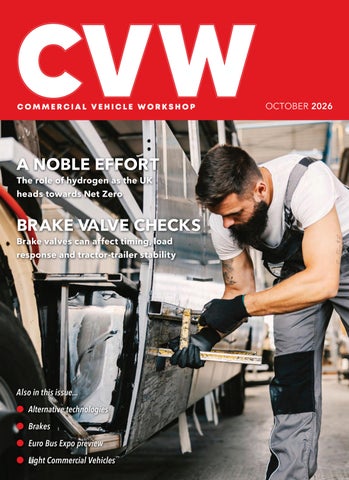
COMMERCIAL VEHICLE WORKSHOP
A NOBLE EFFORT The role of hydrogen as the UK heads towards Net Zero
BRAKE VALVE CHECKS Brake valves can affect timing, load response and tractor-trailer stability
Also in this issue...
● Alternative technologies ● Brakes ● Euro Bus Expo preview ● Light Commercial Vehicles
OCTOBER 2026
CPN.PEW full page_Layout 1 17/09/2026 10:51 Page 1
003_CVW_OCT26_Layout 1 21/09/2026 18:01 Page 3
CONTENTS
Volume 23
18
Issue 9
REGULARS 5
Viewpoint
10 Business & Training
6
News
36 Digital Digest
8
Tech Tips
39 What’s new?
EURO BUS EXPO PREVIEW 10 Everything you need to know about the upcoming Euro Bus Expo show, taking place at the NEC in Birmingham from the 3rd to the 5th of November 2026.
BRAKES 18 Diesel Technic’s parts specialists explain how brake valves keep tractor and trailer braking synchronised, and what workshops should inspect when a combination fails to perform as expected.
10
21 BPW emphasises the importance of reliable braking systems, such as it’s vehicle safety platform Brake Trak Pro, as even well-maintained trailers can experience brake performance issues. 22 MAHA UK addresses the hot topic that arose after the recent RTX show at Stoneleigh Park: rising roller brake testing. 23 Forvia Hella is introducing brake pads for trucks, buses and trailers for the first time. CVW has the details.
ALTERNATIVE TECHNOLOGY 24 Rob White of TAD Electronics outlines what workshops should look for in electronic and telemetry systems to help keep buses and coaches operating reliably. 27 Intangles explores how AI is giving fleet operators a new way to turn commercial vehicle data into actionable insight to ultimately reduce downtime. 28 VLS’s Alan Outhwaite on the role of hydrogen in the industry’s transition to net zero.
LIGHT COMMERCIAL VEHICLES
31
32 Schaeffler’s REPXPERT Alistair Mason is replacing the clutch on a 2006 Ford Transit Connect 1.5 TDCi with just over 51,000 miles on the clock. The customer reported that the clutch has “slipped” on a couple of occasions. 35 CVW hears all about Davanti’s range of LCV tyres, aiming to provide a reliable, quality and cost-effective solution.
24 OCTOBER 2026 CVW 3
CPN.PEW full page_Layout 1 30/07/2026 14:40 Page 1
005_CVW_OCT26.e$S_Layout 1 21/09/2026 19:17 Page 5
VIEWPOINT
www.cvwmagazine.co.uk
CVWmagazine
@CVWmagazine
HAVE YOU TRIED SWITCHING IT OFF AND ON AGAIN?
Editor FREYA COLEMAN cvw@hamerville.co.uk Group Editor KIERAN NEE
T
Digital Manager KELLY NEWSTEAD Digital Assistant JOE CLARKE Group Manager ALEX DILLEIGH Advertisement Manager MARCUS HOOPER Graphic Designer GEMMA WATSON Group Production Manager CAROL PADGETT Subscriptions Commercial Vehicle Workshop is a business magazine for companies and individuals involved in all aspects of commercial vehicle servicing. It is published 11 times a year and is available on free subscription to qualified readers. Subscription rates: UK £30 post paid Airmail £99 post paid Europe £70 post paid To be removed from this magazine’s circulation, please call 01923 237799 or email circulation@hamerville.co.uk. Printed by Stephens and George Published by HAMERVILLE MEDIA GROUP Regal House, Regal Way, Watford, Herts WD24 4YF Tel: (01923) 237799 Website: www.hamerville.co.uk Copyright © 2026
12,545 From July to December 2025
Associate member
The publishers and editor do not necessarily agree with the views expressed by contributors, nor do they accept responsibility for any errors of translation in the subject matter in this publication
here was a time when diagnosing a truck involved a decent set of tools, a keen ear and somebody staring thoughtfully into the engine bay before announcing: “That doesn’t sound right.” Today, there’s every chance the conversation starts with: “Have you tried turning it off and on again?” Somewhere along the way, the commercial vehicle workshop has started sounding suspiciously like an IT helpdesk. “Is it connected?” “What fault code are you getting?” “Has it had the latest update?” “It was working yesterday.” And the phrase guaranteed to brighten any technician’s morning: “It only does it sometimes.” Ah, the intermittent fault. A truck can spend three days coughing, flashing warnings and generally behaving like it’s preparing for an expensive breakdown. Then it rolls through the workshop doors and is instantly cured. No warning lights. No strange noises. Nothing. I’ve definitely had cars somewhat like this. You can almost hear it whistling innocently while the technician looks at the driver and wonders whether the whole thing was imagined. Behind the joke, though, is quite a transformation. The spanners and sockets are still there, but now they’re joined by laptops, diagnostic kit and software. A technician might go from investigating a mechanical problem to chasing a sensor fault, interrogating an ECU or trying to work out why two perfectly intelligent bits of a truck have apparently stopped speaking to each other. And things aren’t exactly getting simpler. Electric trucks bring high-voltage systems into the workshop, while connected vehicles, software updates and increasingly sophisticated electronics add yet more to the technician’s skillset. Calling someone a “mechanic” hardly seems to cover it anymore. Mechanical engineer, electrician, electronics specialist, IT support and parttime detective might be closer. To be fair, modern diagnostics can be brilliant. Problems that once took hours to track down can sometimes be pinpointed remarkably quickly. But the cleverer trucks become, the funnier it seems when the solution turns out to be something we'd all try on a troublesome laptop. So perhaps one workshop procedure will survive every technological revolution still to come. Switch it off. Give it a moment. Then switch it back on again. And if that works, whatever you do, don’t ask why.
Freya Coleman Editor
Image credits: AdobeStock/@Dusan Petkovic
GET IN TOUCH AT CVW@HAMERVILLE.CO.UK
006_CVW_OCT26_Layout 1 20/09/2026 18:11 Page 6
CVW NEWS NEWS IN
BRIEF
■ Workshop tool range launched by AES. AES UK will use RTX Scotland in Glasgow this November to launch Wallmek’s heavy-duty hydraulic workshop tool range across Great Britain, following a new supply partnership with the Swedish manufacturer.
■ Dawsongroup Vans reveals what fleet data shows about EV van suitability. According to statistics from Uswitch van, the average annual mileage for van drivers in the UK was 8,232 miles, meaning that the majority of working vans are well within the range where electric vehicles tend to perform best.
CVWmagazine @CVWmagazine www.cvwmagazine.co.uk
UK Commercial vehicle industry sees investment More than £1.1bn has been committed to Britain’s commercial vehicle manufacturing sector and supply chains over the past five years, according to new SMMT analysis. Published at IAA Transportation in Hanover, the figures show more than 30 van, truck and bus models and conversions are being produced or planned in the UK, including 18 zero-emission vehicles. The supporting supply chain covers batteries, hydrogen fuel cells, semiconductors and electric drive systems, with businesses from more than 20 countries operating in the sector. Further investment is being supported by the government’s £4.5bn DRIVE35
programme, which has backed 42 zeroemission vehicle and supply chain projects relevant to commercial vehicles. More than half of UK-built commercial vehicles are exported, with around 90 per cent destined for Europe. State of the market The UK was Europe’s second-largest market for vans and HGVs in 2025 and its largest zero-emission bus market, registering 2,508 vehicles. More than 80 zero-tailpipeemission commercial vehicle models are now available to UK operators, while government incentives and infrastructure investment have exceeded £1.7bn.
■ A Teletrac Navman study emphasises the importance of correct onboarding. New research shows that well-prepared drivers are three times more likely to rate safety coaching as highly effective — making onboarding the critical first step for fleet operators.
■ TotalKare acquired by Levanta Group. The acquisition by Australia and New Zealands leading workshop solutions business aims to bring together established businesses with extensive expertise across the commercial vehicle, transport and rail sectors and will continue to trade under the TotalKare name.
6 CVW OCTOBER 2026
AEM calls for closer OEM collaboration as new EU trailer rules approach Regulation (EU) 2024/1610 brings trailers into EU emissions legislation for the first time, setting CO2 reduction targets from 2030 of 10 per cent for semi-trailers and 7.5 per cent for other trailer types. AEM says technologies such as e-axles could play a key role. By providing propulsion assistance and regenerative energy recovery, e-axles can reduce tractor energy demand across both diesel and electric combinations. Electric refrigeration systems offer another route, replacing dieselpowered units to cut emissions and noise. AEM is also pushing rare earth-free motor technology as manufacturers look to reduce
exposure to overseas supply constraints. Its magnet-free HDRM motors can safely freewheel when inactive, avoiding unnecessary drag in trailer applications. SAF-Holland collaboration The company has already worked with SAF-Holland on the SAF TRAKr e-axle, developing a bespoke rare earth-free motor designed to integrate into existing vehicle architectures. “The manufacturers that engage with technology partners early will be the ones that turn compliance into a performance advantage,” said Tom Elliott, AEM’s Global business development director.
006_CVW_OCT26_Layout 1 21/09/2026 18:06 Page 7
FOR UP-TO-DATE NEWS, SIGN UP FOR OUR WEEKLY E-NEWSLETTER. SIMPLY SCAN THE QR CODE
DATES FOR THE
DIARY ■ RTX SCOTLAND
Nilfisk targets safer, more efficient workshop cleaning Nilfisk has put workshop safety, efficiency and ease of use at the heart of its latest cleaning equipment developments, as the manufacturer marked 100 years of operation in the UK. Speaking to Commercial Vehicle Workshop at a Nilfisk Discovery Day, commercial product manager Gary Matthews highlighted the changing demands being placed on cleaning equipment in modern workshops – from controlling potentially hazardous dust to reducing fuel and detergent use. Matthews said choosing the correct vacuum and filtration system is particularly important when dealing with fine workshop dust. “If you’ve got the wrong filtration, that dust that you’ve taken off the floor, all you’ve done is make it airborne,” he explained. Nilfisk offers L-, M- and H-class vacuum options for different applications, with Matthews warning that workshops need to consider what is being collected rather than treating all vacuum equipment as interchangeable. Hot-water pressure The manufacturer is also focusing on efficiency with its latest hot-water pressure washing technology. Its system uses heat that would otherwise be lost from the heating chamber to preheat incoming water before it reaches the coil. According to Matthews, this reduces the energy required to bring the water up to operating temperature and, in turn, can cut fuel use. Hot water also has particular benefits when removing oil, grease and other
stubborn contamination, while reducing the reliance on detergent compared with cold-water cleaning. Alongside efficiency, operator usability is becoming an increasingly important part of Nilfisk’s product development. A look to the future Matthews said the company has invested heavily in customer insights over the past 18 months, with feedback from operators and sales teams feeding into future machines. “The workforce, while the work is doubling, is diminishing,” he said. “So, we’re looking at making machines lighter but still functional.” Product development can typically take 18 months or longer, with projects passing through a series of stages before reaching the market. A new backpack vacuum is among the products Matthews said is due to launch in the new year. UK marketing manager Audrey Ball said continued product innovation will sit alongside a growing focus on autonomous cleaning, with robotics remaining an important part of Nilfisk’s future plans. The Discovery Day also formed part of Nilfisk’s anniversary celebrations, marking 120 years since the company was founded and 100 years of its UK operation. For workshops investing in new equipment, Matthews’ message was simple: specification should come before price. “The reality of the machine you need is a machine that’s right for your purpose,” he said, with Nilfisk encouraging site surveys to help ensure equipment is correctly matched to its intended workload.
RTX Scotland has revealed it will return to Glasgow’s Scottish Event Campus (SEC) on 18-19 November 2026 with an expanded exhibition, longer opening hours and enhanced networking facilities. The expanded event will feature a larger exhibition hall to accommodate more exhibitors, two full exhibition days running from 9am to 5pm, and increased catering and networking areas throughout the venue to encourage business meetings, industry discussions and relationship-building.
■ EURO BUS EXPO Euro Bus Expo, The UK’s leading bus and coach exhibition, is returning to the NEC Birmingham on 3-5 November 2026. Discover the latest buses, coaches, mini and midi vehicles alongside cuttingedge equipment, components, and services. Explore innovations, compare products, gain insights from industry experts and find solutions designed to enhance the passenger experience and drive your business forward. Find out more on page 10 of this issue.
■ MECHANEX Mechanex PMM Live is returning to Sandown Park on the 10th and 11th of November. Mechanex is well known within the independent aftermarket for offering visitors a hands-on experience, bringing them the latest updates and expertise from across the industry and providing an exciting day away from the workshop. Registration to visit the show is free and so is parking. If you like PMM, you’ll love Mechanex – it’s simply the magazine in a live format. OCTOBER 2026 CVW 7
008_CVW_OCT26_Layout 1 20/09/2026 18:20 Page 8
TECH TIPS
COMMON FAULTS Clutch noise Clutch specialist febi shares some repair solutions for when the clutch is being extra noisy.
SYMPTOM:
SYMPTOM:
SYMPTOM:
Pressure plate diaphragm finger tips, prematurely worn
Torsion spring broken
Hub profile splines worn / damaged
Cause: ● Incorrectly adjusted clutch release system. ● Incorrect driving practice: resting foot on the clutch pedal or prolonged operation of the clutch e.g. at red lights. ● Clutch release system stiff / seized. ● Clutch release bearing obstructed / faulty.
Cause: ● Incorrect clutch disc fitted. ● Engine tuning. ● Incorrect driving practice: driving in a too high gear at low revs. ● Oil or grease on the clutch facing. ● Judder vibrations. Solution: ● Eliminate the cause of the fault and replace the clutch disc
Solution: ● Check the clutch release bearing mechanism and adjust / replace if necessary. ● Replace the clutch pressure plate.
SYMPTOM:
SYMPTOM:
Clutch release bearing defective
Marks on the clutch disc e.g. on the riveted joint or on the side plates
Cause: ● Incorrect clutch disc. ● Incorrect driving practice: driving in a too high gear at low revs. ● Motor tuning and judder vibrations. Solution: ● Eliminate the cause of the fault and replace the clutch disc
Solution: ● Eliminate cause of the fault and replace the release bearing
WANT TO KNOW MORE? Make sure to scan the QR code!
8 CVW OCTOBER 2026
Solution: ● Check the pilot or gearbox input shaft bearing and replace if necessary. ● Check the dowel pins between engine and gearbox, and the flywheel dowel pins and replace if necessary.
SYMPTOM: Cause: ● Defective release system (cable or hydraulics). ● Overheated release bearing due to incorrect adjustment of the release system. ● Contact surface with the clutch fork not greased. ● Incorrect adjustment of the release system
Clutch disc, centre retaining rivet worn
Cause: ● Problem with alignment. ● Incorrect installation practice: splines damaged during installation. ● Pilot bearing damaged /Dowel pins damaged.
Cause: ● Clutch disc fitted incorrectly. ● Incorrect clutch parts fitted. Solution: ● Check the clutch disc and replace in the case of severe damage.
CPN.PEW full page_Layout 1 16/09/2026 14:26 Page 1
010_CVW_OCT26_Layout 1 21/09/2026 17:23 Page 10
EURO BUS EXPO PREVIEW Everything you need to know about the upcoming Euro Bus Expo show taking place at the NEC from the 3rd to the 5th of November.
F
or more than three decades, Euro Bus Expo has brought the coach and bus sector together to discover new products, compare options, exchange ideas and make decisions influencing operations for years to come. The 2026 edition builds on the 2024 event, which welcomed more than 7,000 attendees from 40 countries. With 49 exhibitors appearing for the first time, operators have a wider field of suppliers to compare in one visit. The event will bring together 29 vehicle exhibitors, with around 75 buses, coaches,
10 CVW OCTOBER 2026
midibuses and minibuses expected on display. The lineup spans manufacturers, converters and dealers, giving visitors the opportunity to compare vehicles and WHEN? rd th specifications side by side. 3 – 5 November Confirmed vehicle dealers WHERE? and manufacturers include: Alexander Dennis, Apex NEC Birmingham Buses, Arobus, BASE, BYD, COST? Coach Traders, Daimler Bus, FREE EVM, GM Coachwork, Harris Group, Irizar, London Hire, HOW? Mellor, Minibus Options, Scan the QR code! Noone Turas, Pelican Bus and Coach / Yutong, PHVC Minibus and Fleet Suppliers, Scania, TBC Conversions, Temsa, Treka, VDL / Van Hool, Volvo, Woodall Nicholson, and Wrightbus. Among the 49 businesses making their Euro Bus Expo debut are vehicle exhibitors Zhongtong Bus Holdings, Custom Denning, Minicoach World and Tekaydinlar Minibus Design. Newcomers also include organisations Hankook Tyre UK, Castrol and National Highways, alongside technology exhibitors spanning charging, payments, planning, data, connectivity and AI.
VEHICLE MANUFACTURERS and SPECIALISTS The biennial trade show brings together an extensive range of bus and coach suppliers, from global manufacturers and leading UK builders to specialist converters, dealers and leasing providers. The 2024 event featured over 75 vehicles on display. With 19 vehicle exhibitors so far confirmed for 2026, operators gain direct access to vehicles designed specifically for the UK-market. The latest names to join the line-up include Arobus, Daimler Buses UK, Harris Bus & Coach UK, Volvo and Woodall Nicholson. They are joined by Custom Denning, Australia’s longestestablished bus manufacturer, making its first appearance at a UK exhibition. Bringing this breadth of vehicle suppliers together enables side-by-side discussion of powertrain choice, total cost of ownership, vehicle availability and long-term support with the teams responsible for design, build and delivery.
010_CVW_OCT26_Layout 1 21/09/2026 17:43 Page 11
EURO BUS EXPO PREVIEW
TELEMATICS and PASSENGERS
ROUNDTABLE sessions New for 2026, focused roundtable sessions will run alongside the Masterclass Theatre, bringing together operators and invited contributors. The interactive format will be built around questions and shared experience, allowing practical challenges to be worked through in greater depth.
Beyond vehicles, the show spans telematics and passenger information, safety, training, parts, software and fleet support. Operators can compare a range of products and solutions in one visit. Following an industry-wide call for speakers, the Masterclass Theatre programme returns, bringing together operators, manufacturers, authorities, associations and industry specialists. Sessions will explore policy and regulation; franchising and enhanced partnerships; AI and data-led operations; zero-emission fleets; compliance and fleet safety; accessibility; and workforce challenges. A mix of presentations, case studies and panel discussions will give operators practical experience to draw on, alongside discussion of what comes next.
Roundtables cover franchising – including in rural areas, and enhanced partnerships. Other discussions will explore electric fleets, depot infrastructure and energy, hydrogen, AI and data, driver retention, engineering and maintenance, PSVAR from 2030, BODS and passenger information. Helen Conway, event director, commented: “That mix of established industry names and companies exhibiting with us for the first time keeps the show floor evolving and gives operators more businesses, products and ideas to discover. We’re also developing the content offer, with focused roundtable discussions alongside the Masterclass Theatre – giving operators more opportunities to ask questions, share experiences and explore practical challenges in greater depth.”
Beyond VEHICLES Euro Bus Expo has never been a vehicleonly event, and its wider value continues to grow. Technology, data and operational specialists will showcase the systems that increasingly define fleet performance and day-to-day delivery. Payment platforms, passenger information, telematics, driver safety, fleet optimisation and compliance tools are all represented, with signings including Geotab, Masabi, Littlepay, Tranzaura, Thetis IT and DriveTech. Alongside established technology providers, the line-up also includes specialists in driver training, vehicle safety, seating, connectivity and fleet support services, reflecting the increasingly integrated ecosystem operators rely on to improve efficiency, safety and service. Event director Helen Conway says: “The
strength of industry engagement means operators will benefit from real breadth and depth on the show floor. We are seeing a real commitment from across the supply chain, driven by the fact that Euro Bus Expo brings decision-makers and solutions together in one place. For operators, that means being able to assess options, ask the right questions and move projects forward far more efficiently”. Attending Euro Bus Expo saves operators from multiple site visits, fragmented supplier conversations and extended research cycles. From vehicles and powertrains to passenger technology, finance structures to driver welfare, and safety systems to business services, everything can be assessed in a single, focused environment.
OCTOBER 2026 CVW 11
010_CVW_OCT26_Layout 1 21/09/2026 17:46 Page 12
EURO BUS EXPO PREVIEW
SEMINAR sessions Across 25 sessions, operators, policymakers, manufacturers and local authorities will share practical experience and explore what is working across the sector. CPT Chief Executive Graham Vidler will open the programme with The Road Ahead for Bus & Coach: Navigating Change, Seizing Opportunity, setting out the political, operational and investment landscape. Sessions will examine bus reform, franchising and partnership, including case studies from Leicester and Jersey, while discussions on AI, automation, data and network optimisation will focus on real-world applications and their potential impact. Fleet transition will also feature prominently, with sessions covering electric and hydrogen vehicles, funding and project planning, as well as the challenges of second-life EVs, maintenance and compliance. The programme will address operational and regulatory developments, accessibility, passenger and driver safety, and the future of coach operations, including new European requirements. Workforce sessions will explore driver shortages, recruitment, retention, wellbeing and diversity, with industry leaders considering how operators can build a more resilient and future-ready workforce.
WHO will be there? AQUARIUS Aquarius IT delivers UK-developed software connecting drivers, vehicles, and operations in one integrated platform. Its award-winning tachograph and asset maintenance technology provides real-time visibility, stronger control, and audit-ready compliance. It aims to help bus and coach operators increase efficiency and simplify compliance management.
Stand number: 164
ECLIPSE DIAGNOSTICS Eclipse is the UK's leading supplier of multibrand diagnostic tools for the bus and coach sector. Covering all major brands, such as Mercedes-Benz, Volvo, Optare, Irisbus, Neoplan, Setra, etc., Jaltest saves workshops and fleet operators thousands in downtime costs across the UK with the backing of a technical support service.
Stand number: 130
ESTIVAN OTOMOTIV Estivan Automotive formed by two experienced peeople whom is been working in commercial vehicle business for 15 years. Estivan Automotive is a company who supplies parts for commercial vehicle
conversion companies. Parts like passenger seats, glass sets, special glass, air vents, ABS interior trim kits, lifts, doors and any other parts for a vehicle conversion.
Stand number: 554
FREEWAY FLEET SYSTEMS Freeway is an all-in-one solution to manage workshops, defects, stores, purchasing and compliance. Enabling the transition to digital working using mobile devices, Freeway interchanges with other systems to provide total visibility of bus/coach fleet maintenance activity and status. Freeway will also be demonstrating Insight-AI, new fleet data analysis innovation.
Stand number: 368
GALLAGHER INSURANCE Gallagher is the largest broker to the bus and coach industry where we act for over 850 operators, of all sizes and throughout the UK. It is the only UK broker to have direct access to all bus and coach motor insurers.
Stand number: 482
GUCHEN INDUSTRY Guchen is a supplier of automotive thermal management solutions. Its main products include bus air conditioners, refrigeration units and related equipment.
Stand number: 534
HANKOOK TYRE Hankook Tyre is a leading global tyre manufacturer supplying innovative, premium tyre solutions for commercial vehicles, buses and coaches. With a strong focus on performance, safety and sustainability, Hankook delivers advanced tyre technology that reduces total cost of ownership while supporting fleet efficiency, reliability and transition to more sustainable transport.
Stand number: 38
010_CVW_OCT26_Layout 1 21/09/2026 17:46 Page 13
KERNOW OILS Kernow Oils is a leading UK supplier of premium bus and coach lubricants, providing Castrol commercial vehicle oils, transmission fluids, greases and technical support. It helps operators reduce downtime, extend service intervals, improve fleet reliability and lower total operating costs through expert product selection and nationwide service.
Stand number: 42
KONVEKTA Konvekta develops efficient heating, cooling and thermal-management systems for buses and electric vehicles. As a specialist in CO₂ heat-pump technology, Konvekta maintains optimal temperatures in the driver’s area, passenger compartment, batteries and electronic components. By using natural refrigerant CO₂, the systems reduce energy consumption and support reliable, sustainable thermal solutions.
vehicle wash equipment. Renowned for expertise and industry knowledge, Motion offers comprehensive solutions for all cleaning equipment needs.
Stand number: 284
Stand number: 528
MAHA
MOTORMAX GROUP
In 2024, MAHA enjoyed a phenomenal event – connecting with the audience, showcasing its workshop solutions and confronting real-world challenges in the bus and coach sector – and the company is confident the 2026 edition will, once again, unlock new opportunities and create meaningful conversations with delegates. At previous industry events, MAHA has been told by operators that by bringing brake testing in-house, rather than outsourcing to a third party, they can cut costs and reduce vehicle downtime. Rather than waiting for an open slot, investing in a brake tester means the company can control its schedule better too. MAHA UK expects its mobile column lifts to be popular too, with several bus and coach operators investing in the C_RGA model after Euro Bus Expo 2024. Delaine Buses, for instance, wanted to re-place ageing equipment and immediately saw a positive day-to-day impact after the lifts were delivered and put to use. Efficiency, useability, versatility, space-saving storage and the ability to charge with just one 13-amp socket were just some of the benefits cited.
With over 25 years of experience, Motormax Group provides innovative telematics, vehicle tracking, and fleet safety solutions to businesses across the UK and abroad. Trusted by some of the world's largest fleet operators, it helps improve vehicle security, driver safety, compliance, and operational efficiency through expertly designed and installed technology solutions.
heating and cooling system products for the automotive industry and stationary applications for over 60 years. We offer a wide range of products, including axial fans and centrifugal blowers, as well as high-performance coolant pumps. The company is specialised in brushed and brushless motors and has developed advanced fans with smart features for high performance and long life. SPAL is recognized in the industry as a major player globally, actively working with leading vehicle manufacturers to meet their thermal management needs, offering advanced solutions that perform in the most extreme conditions.
Stand number: 264
Stand number: 370
PARKSAFE
TD TYRES
Specialising in vehicle safety equipment, Parksafe Group has been manufacturing and supplying a comprehensive range of reliable, cost-effective, and quality assured products for the automotive industry for almost 40 years!
TD Tyres, a trusted name in the industry for over 25 years, specialises in the direct supply of tyres, wheels, and accessories to coach and bus companies. As part of its inhouse technical and fleet management team, it offers cost-saving advice on sustainable tyre management.
Stand number: 572
MOTION CLEANING MACHINES Motion Cleaning Machines, UK distributor for Bitimec Speedy Wash, specialise in the sale, hire, and service of cleaning and
Stand number: 62
PREMIER PITS Premier Pits, the UK's longest-established prefabricated pit manufacturer, has led the industry for over 30 providing tailored inspection, maintenance, ATF, and rail pits and accessories. Premier Pits is also the UK distributor for the BrakeMate and Thread Saver range of products.
Stand number: 570
SPAL AUTOMOTIVE SPAL has been leading the way in the design, production, and sale of innovative
Stand number: 320
TEXA TEXA UK Ltd is a leading provider of advanced vehicle diagnostic equipment, ADAS calibration systems and air conditioning service solutions. Supporting car, truck, motorcycle, agricultural and marine sectors, TEXA delivers innovative technology, expert technical support and industry-leading training to help workshops improve efficiency, accuracy and performance.
Stand number: 306 OCTOBER 2026 CVW 13
014_CVW_OCT26_Layout 1 21/09/2026 18:07 Page 14
BUSINESS & TRAINING
HEAVYWEIGHT TALENT The next generation of heavy vehicle technicians put their skills under the spotlight as six of the UK’s leading apprentices went head-to-head in the inaugural IMI Skills Competition Heavy Vehicle Technology National Final. CVW was there and has the details below.
H
eld at the DAF Apprentice Academy on the 11th of September, the competition brought together finalists from across the country for a demanding day designed to test not only technical knowledge, but diagnostic ability, methodical working and performance under pressure. At the end of six intensive challenges, it was Monty Gambrell of Motus Commercials Ltd (DAF) who emerged victorious. The final represented an important new chapter for heavy vehicle skills competitions. The Institute of the Motor Industry (IMI) launched the competition earlier this year following changes to the WorldSkills UK competition portfolio, which meant Heavy Vehicle Technology would no longer feature from 2026.
14 CVW OCTOBER 2026
Determined that apprentices should continue to have the opportunity to test themselves against their peers on a national stage, the IMI stepped in to establish a structured competition focused on skills development and career progression. Following national qualifiers at the Renault Trucks UK Training Centre in Leicester in July, six apprentices progressed to the final: Arseni Delchev of FCC Environment; Cai Williams of Dennis Eagle; Jayden Fossett; Monty Gambrell; Romeo Beeby of Keltruck (Scania); and Theo Lanham. Waiting for them at the DAF Apprentice Academy were six 60-minute tasks covering the breadth of skills required of a modern HGV technician.Daniel Bennet, lead judge and head of curriculum and quality assurance at GTGtTraining, explained that the challenges deliberately covered very different disciplines.
The task at hand One involved diagnosing a fault on a WABCO trailer rig, while another required competitors to remove and replace a mechanical component in accordance with manufacturer guidelines. There was also an electrical lighting fault requiring the apprentices to interpret wiring diagrams and use testing equipment, alongside a computer-based transmission diagnosis. Competitors additionally faced a vehicle inspection in which planted defects had to be identified and correctly recorded to legal and MOT requirements, plus an engine management and emissions fault requiring components and systems to be tested before arriving at the correct diagnosis.
014_CVW_OCT26_Layout 1 21/09/2026 18:08 Page 15
Crucially, finding the answer was only part of the challenge. Judges were looking closely at how competitors arrived at it. “We judge them based on a process, so a logical process,” Daniel explained. Diagnostic tasks required apprentices to interpret information correctly, determine where testing was needed and demonstrate the proper use of test equipment. For the inspection challenge, judges were looking for a structured approach, industry-recognised testing methods and correct use of the inspection manual. In the remove-and-replace exercise, meanwhile, competitors had to follow manufacturer instructions, use the appropriate torque settings and ensure the vehicle would ultimately be safe to return to the road. The variety was intentional. Rather than finding the apprentice who excelled at one particular discipline, the competition was designed to identify a genuinely rounded technician. “We’re looking for a good allrounder,” said Daniel. “They’ve got to be good at all different types of skills to win.” Ensuring a level playing field was also an important consideration. Although the final was held at DAF and three of the six finalists came from DAF businesses, the organisers used universal diagnostic equipment rather than DAF-specific tools. Competitors were supplied with the information they needed, ensuring manufacturer familiarity did not provide an advantage.
Behind the scenes was a judging team largely made up of trainers and education professionals who volunteered their time, supported by their employers. Bennet and several colleagues have been involved in judging heavy vehicle skills competitions for around nine years, bringing considerable experience to the new IMI event. For the apprentices, however, the value of taking part goes well beyond the final results table. Aimee Wallis, careers and partnerships lead at the IMI, described competitions of this kind as an important milestone that can become “a springboard” to a successful career.
They give young technicians an opportunity to prove themselves, build confidence and benchmark their abilities against some of the best apprentices in the country. In time, Aimee believes that experience can have a wider impact, with former competitors going on to mentor colleagues and encourage others to follow the same path. There are benefits for employers, too. Skills competitions provide businesses with an opportunity to demonstrate the calibre of people coming through their apprenticeship and early-career programmes and, in turn, highlight the value of investing in training. “It’s an excellent lens into what the sector is,” said Aimee. “Seeing these [competitors] really at the top of their game so early on in their career is incredibly exciting.”
Importance of apprentices That investment in future skills is particularly significant for a commercial vehicle sector that increasingly requires technicians to combine traditional mechanical expertise with sophisticated diagnostic and electrical knowledge. Michael Massey, IMI skills competition manager, said the professionalism and passion displayed throughout the final demonstrated what can be achieved when the industry invests in early talent and provides apprentices with opportunities to reach their potential. For Daniel, the standard of the finalists also offered reason for optimism about the workforce coming through. “It’s rewarding to see it thriving and continuing to provide opportunities for the next generation of technicians,” he said. “The standard on display today has been exceptional, and it gives me great confidence for the future of the HGV sector.” For winner Monty Gambrell, the day ended with the top prize. But for all six finalists, reaching the national stage offered something potentially longer-lasting: the chance to test their abilities, learn under pressure and demonstrate just how much talent is already making its way into the commercial vehicle workshop.
WANT TO KNOW MORE? Make sure to scan the QR code!
OCTOBER 2026 CVW 15
CPN.PEW full page_Layout 1 15/09/2026 09:19 Page 1
017_CVW_OCT26_Layout 1 21/09/2026 19:11 Page 17
SPECIAL REPORT
ALL LIFTED UP Arriva invests in additional Stertil-Koni column lifts at Stevenage depot.
A
rriva has expanded its vehicle maintenance capabilities at its Stevenage depot with the addition of two sets of four Stertil-Koni ST1075FWA wireless mobile column lifts, building on its existing investment in Stertil-Koni lifting equipment. Each mobile column has a lifting capacity of 7.5 tonnes, providing a combined lifting capacity of up to 30 tonnes per four-column set - ideal for safely lifting Arriva's fleet of buses and coaches. The latest investment reflects the operator's continued confidence in Stertil-Koni's lifting technology while supporting the efficient maintenance of its fleet.
Flexibility A key advantage of the mobile columns is their flexibility. Unlike fixed lifting systems, the columns can be positioned wherever they are needed before being moved and stored away when not in use. This enables the workshop layout to be adapted to changing maintenance demands, helping engineers maximise available space and reduce vehicle downtime.
Wireless The wireless design of the lifts improves workshop efficiency by eliminating interconnecting cables, reducing setup time and removing trip hazards. Stertil-Koni's
intuitive ebright smart control system complements this with a full-colour touchscreen, allowing engineers to quickly operate individual columns, or complete lifting sets from any column. The lifts communicate via Stertil-Koni's advanced wireless mesh network which maintains reliable communication between all columns, even in busy workshop environments. Unlike conventional Bluetooth or radio-based systems, the mesh network enables every column to communicate with every other column in the set, providing greater reliability and resilience. Powered by long-life deep-cycle batteries that typically provide up to a week's operation between charges, the lifts only consume energy while lifting, delivering an efficient and dependable solution for demanding commercial vehicle workshops.
Safety first Safety remains central to the design, with each column incorporating an integrated mechanical locking system and advanced synchronisation technology. Any height difference greater than 15 mm between columns is automatically corrected, ensuring smooth, stable lifting and lowering, even with unevenly distributed loads. For additional peace of mind, the ST1075FWA is independently tested to meet demanding international safety standards.
WANT TO KNOW MORE? Make sure to scan the QR code!
OCTOBER 2026 CVW 17
018_CVW_OCT26_Layout 1 20/09/2026 18:24 Page 18
BRAKES
VALUABLE VALVES Diesel Technic’s parts specialists look at how brake valves help keep tractor and trailer braking in step, and what workshops should check when a combination does not behave as expected.
D
rivers will sometimes report that a tractor and trailer combination simply doesn’t feel right under braking. The trailer may feel as though it is pushing the tractor on, the whole outfit may feel unsettled, or the braking response may just feel different. The first checks will often be around the brake components at each wheel on both tractor and trailer, but if nothing obvious shows up, it is worth looking further upstream at the brake valves controlling when and how braking force is applied to the trailer.
What happens before the brakes apply? In a Diesel Technic PS Tips video on brake valves, Parts Specialist Niklas explains that the foot brake valve includes an advance function, which applies the trailer brakes slightly ahead of the tractor to help keep the whole combination stable as braking begins. That timing matters when the complaint is about how the combination feels rather than a clear loss of braking at one wheel or axle. If the trailer seems to be pushing the tractor on, or the two do not seem to be
18 CVW OCTOBER 2026
braking together, check the sequence in which braking force is being applied rather than looking only at the wheel ends. The foot brake valve also has electrical as well as pneumatic functions. Diesel Technic’s own testing looks at pressure outputs alongside pedal position and electrical switching functions, so if a braking fault does not add up from the pneumatic checks alone, the electrical side should not be ignored.
Does braking behaviour change with the load? Trailer load is another useful clue. Diesel Technic Spare Parts offer a load-sensitive valve for multi-axle trailers with air suspension, where braking force is adjusted using control pressure from the air suspension bellows. With more load, braking effect is increased; with less load, it is reduced.
If braking behaviour changes noticeably between an empty and loaded trailer, check the load-sensitive side of the system too. Correct set-up matters: Diesel Technic advises workshops to follow the vehicle or trailer manufacturer’s installation instructions and setting data rather than treating adjustment as a one-size-fits-all job.
What is actually holding the combination? Parking brake checks raise another useful question: which part of the combination is actually holding it? In the same Diesel Technic PS Tips video, Niklas demonstrates the test position on a handbrake valve. Using it releases the trailer brake, so the tractor’s parking brake can be checked on its own. The tractor should be able to secure the complete combination. That can help separate a tractor-side issue from something happening on the trailer.
018_CVW_OCT26_Layout 1 21/09/2026 14:05 Page 19
Match the part to the application Brake valves may sit away from the wheel end, but they have a direct influence on how the whole combination behaves. That is why correct diagnosis and application identification matter. The DT Spare Parts range includes more than 200 brake valves through the Diesel Technic Partner Portal, including handbrake valves, trailer control valves, foot brake valves and repair kits, with coverage across major commercial vehicle makes. For workshops, the practical message is straightforward: when a tractor and trailer do not feel right under braking, do the usual wheel-end checks, but do not stop there. Think about when the trailer is being told to brake, how load is influencing braking force and whether the tractor and trailer are doing the jobs expected of them.
WANT TO KNOW MORE? Make sure to scan the QR code!
CPN.PEW full page_Layout 1 15/09/2026 13:21 Page 1
021_CVW_OCT26_Layout 1 21/09/2026 19:12 Page 21
BRAKES
DIAGNOSING BRAKE PROBLEMS As demand for efficient transport grows, reliable trailer braking systems are essential. Even well-maintained trailers can still experience brake performance issues. Identifying potential faults early is vital to maintaining safety, regulatory compliance, and operational efficiency.
T
o overcome these challenges, operators use Brake Trak Pro. This new vehicle safety platform from BPW idem telematics provides a brake performance monitoring system that offers real-time visibility into trailer braking efficiency. By collecting data from the trailer's electronic braking system (EBS), it uses advanced algorithms to generate clear, detailed, and actionable brake performance reports. Continuous monitoring makes it easier to identify braking irregularities or faults, enabling prompt corrective action. If such issues arise, the BPW technical service team can provide expert technical and diagnostic support.
Case study A transport company operating more than 1,000 trailers on a 12-week maintenance inspection schedule noticed a gradual decline in braking efficiency on specific trailer. Brake Trak Pro detected that the trailer's combined braking threshold had fallen below the legal 45 per cent requirement, raising immediate safety and compliance concerns. The fleet manager contacted the BPW technical service team for assistance. After reviewing the trailer’s roller brake test, BPW arranged an on-site visit to conduct a thorough diagnostic investigation.
EBS Data analysis The investigation began with a comprehensive review of the trailer's EBS,
did not match the original trailer brake calculation, reducing braking force and causing the gradual performance decline. The slack adjuster reaction bracket also detached, preventing the automatic slack adjuster from operating properly. After correctly installing the brake chamber and securely refitting the reaction bracket, braking performance returned to above the legal minimum requirement, as confirmed by subsequent Brake Trak Pro data.
Proactive problem solving
including system parameters, fault reports, and historical operational data. EBS reports often flag unusual braking activity or issues beyond normal wear and tear. In this case, initial checks revealed only minor inconsistencies, with no direct fault identified.
Foundation brake inspection As no active EBS fault codes were present, the BPW team proceeded with a foundation brake inspection. This inspection examines the friction material (linings or brake pads) and the surface of the drum or disc brakes to assess under-utilisation or uneven wear that could explain reduced braking performance. The inspection confirmed that the foundation brake components were generally in good condition and were not the primary cause of the reduced brake performance. However, the BPW technicians discovered two critical issues: one incorrectly fitted component and another that had become detached. Both issues were immediately rectified, and a further roller brake test was conducted to compare brake performance.
The Diagnosis The BPW technical service team determined that a replacement brake chamber had been incorrectly mounted and
Without Brake Trak Pro, this defect could have gone unnoticed. Poor brake performance can pose operational risks: ● Increased stopping distances and higher accident risk. ● Accelerated wear and overheating, resulting in costly repairs. ● Unplanned downtime and delivery delays. ● Non-compliance penalties, fines, or vehicle prohibitions. This case demonstrates the value of pairing routine inspections with intelligent telematics reporting. Brake Trak Pro’s brake performance monitoring system does more than highlight active faults; it helps operators plan preventive maintenance and avoid prolonged downtime. Smarter decision-making enables fleet managers to make more informed choices, increasing efficiency, improving safety, and reducing operating costs. More than a service supplier: BPW is a dedicated partner committed to providing expert guidance at every stage of your journey. With industry-leading support, diagnostics, and seamless implementation, BPW ensures customers maximise the full potential of Brake Trak Pro, driving operational reliability and long-term success.
WANT TO KNOW MORE? Make sure to scan the QR code!
OCTOBER 2026 CVW 21
022_CVW_OCT26_Layout 1 20/09/2026 18:28 Page 22
BRAKES
MAHA UK found that rising roller brake testing was the main talking point at the Road Transport Expo at Stoneleigh Park in the summer.
BRAKING BUZZ WORD R ising roller brake testing was the hot topic of conversation on MAHA UK’s RTX stand. Representatives from the workshop equipment supplier have revealed that both existing and potential customers were keen to understand the cost and efficiency advantages of this growing need for frequent brake testing. During the threeday event aimed at trucking professionals, MAHA’s MBT 7250 rising roller brake tester – demonstrated using chains, axles and wheels – drew significant attention. MAHA believes this stems from the requirements of the meaningful brake test which requires trailers to be loaded, ideally at least 65 per cent of their total maximum weight during roller brake testing – but rising rollers elevate and simulate loaded conditions without any physical cargo. These tests need to be conducted at least four times a year, including at the MOT. MAHA UK regional sales executive, James Thompson, reported a positive reception to the company’s rising roller set, sparking numerous discussions with both current and prospective customers. He said: “Many customers that have our MBT 7250 commercial brake tester were asking about the modifications needed to adapt a current set rather than a complete overhaul.” James also noted the interest shown in MAHA’s C_RGA mobile column lifts, thanks largely to the presence of Bowler Racing’s British Truck Racing Championship MAN TGX challenger. The race truck was securely held by columns, each capable of lifting 7.5 tonnes.
Save time, boost efficiency and productivity
Physically loading a trailer with significant weight can take time and resources; however, rising roller brake testers should save time and bolster efficiency by raising a vehicle’s axle up to 250mm, shifting the weight of the vehicle to replicate a load of up to 13 tonnes. This creates the downward pressure and grip needed for a compliant test. MAHA UK regional sales executive, Luke Fuller, concurred with James – but added that many of his conversations were with independent or non-maintenance providers. These professionals are increasingly recognising the time and cost associated with manual vehicle loading. He said: “Our rising roller emerged as a cost-effective and efficient alternative.”
More in-house testing Luke and James’s colleague, Louis Tunmore, added that the need for more brake tests and improved record-keeping has led some operators to consider bringing brake testing in-house. Ultimately, this year’s Road Transport Expo proved an invaluable experience for MAHA UK. It provided an opportunity to showcase its innovative workshop equipment solutions and engage with industry professionals, gaining valuable feedback and insights. As illustrated, rising roller brake testing remains a buzzword in the sector, and MAHA UK encourages professionals to contact the company should they have any questions about the practice.
WANT TO KNOW MORE? Make sure to scan the QR code!
22 CVW OCTOBER 2026
About MAHA UK MAHA is a premium workshop equipment manufacturer, one that is trusted by MOT and ATF centres, as well as maintenance and repair workshops across the UK. Its portfolio includes brake testers, workshop lifts, headlight aligners and axle play detectors – all vital solutions to help technicians and testers inspect, test and repair all types of vehicles, such as passenger vehicles, LCVs, HGVs, motorcycles, utility and special-purpose vehicles. Another key part of MAHA UK’s business is its array of chassis dynamometers. MAHA has been a long-standing and trusted partner to vehicle performance centres, motorsport teams and racetracks worldwide, thanks to the dynamometers’ ability to conduct performance measurements accurately and consistently, as well as support customers with tuning and diagnostic capabilities.
023_CVW_OCT26_Layout 1 21/09/2026 18:09 Page 1
BRAKES
BRAKING NEWS FORVIA HELLA, is introducing brake pads for trucks, buses, and trailers company-wide for the first time.
‘‘U
nder the strong HELLA brand, we are consistently expanding our brake portfolio. We are starting with brake pads for trucks, buses, and trailers and will gradually expand the range,” says Dr. Marcel Wiedmann, head of the global aftermarket business at FORVIA HELLA. “Building on our established brake offering for passenger cars, we are now transferring our expertise to the commercial vehicle sector, reaching additional customer groups and strengthening our position as a leading brake supplier in the independent aftermarket.” HELLA is launching an initial portfolio of 58 references, covering a wide range of applications and model variants. This gives the company competitive market coverage for fleet operators, wholesalers, and independent
workshops, with broad parts availability and a clearly structured product range. The new commercial vehicle program is specifically designed for the high thermal and mechanical loads in heavy-duty applications. Each brake lining features optimally matched friction materials, ensuring maximum braking performance, long service life, and high comfort in daily operation. In addition, the linings are supplied with accessories for the respective application where necessary. All brake pads are tested and certified according to international safety and quality standards, including ECE R90.
WANT TO KNOW MORE? Make sure to scan the QR code!
Since 2024, HELLA has offered brake products under its own brand name, thus clearly positioning itself in the market; previously, the brake business was part of a former joint venture. HELLA offers brake pads, brake discs, brake hydraulics, brake fluids and chemicals, as well as a comprehensive range of brake electronics for almost all common vehicle types. The existing range of brake pads also covers over 90 percent of the European fleet of electric and hybrid vehicles. For brake discs, the figure is more than 85 per cent.
024_CVW_OCT26_Layout 1 20/09/2026 18:34 Page 24
ALTERNATIVE TECHNOLOGY
BUS AND COACH
ELEC TRONIC S B
us and coach operators face constant pressure to keep vehicles available, reliable and ready for service. As workshop teams use connected electronics to monitor vehicles, diagnose faults and plan maintenance, the reliability of those electronic systems becomes just as important as the information they provide.
Choosing electronics for the operating environment Moving vehicles are a demanding environment for electronics. A device may work perfectly on a test bench but can behave very differently once it is installed in a bus or coach. Equipment may be exposed to constant vibration, moisture, dust, temperature extremes, long cable runs and electrical disturbances. On vehicles with combustion engines, cold starts can cause sharp supplyvoltage dips, while jump-starts can place additional stress on electronic hardware. Some avoidable electronics failures can be traced back to design and specification decisions. If a control unit, telemetry device or sensor system has not been designed around the actual operating environment, small weaknesses gradually become operational problems. A connector loosens under vibration. A cable entry lets in moisture. A power rail dips during starting and resets a unit at the wrong time. A batterypowered tracker transmits too often and stops working months earlier than expected. Reliable commercial vehicle electronics should therefore be designed around the
24 CVW OCTOBER 2026
Rob White, head of engineering and technical sales at electronics design and manufacturing partner, TAD, explains what workshop teams should look for in electronics and telemetry systems to help keep buses and coaches on the road. environment in which they will operate, rather than simply the functionality. For a workshop, that means asking suppliers what environmental and electrical testing supports the intended installation, and following their guidance on mounting, connectors and cable routing.
Low power helps reliability Specifying electronics with power consumption in mind can help batterypowered sensors and trackers run for years with minimal intervention in suitable applications. Battery capacity, reporting frequency and operating conditions determine what is achievable. Low-power design is often associated with extending battery life, but its importance goes further still. Power management is as much a
reliability consideration. A device that consumes unnecessary power can create its own maintenance demands. Battery-powered equipment may require more frequent intervention, while poorly optimised vehicle-powered systems can place additional demands on the vehicle's battery when parked. Workshop teams should ask suppliers for the current draw with the ignition off and the expected effect over a typical period out of service. Efficient sleep modes, sensible reporting intervals and carefully managed communications can reduce energy consumption while still providing operators with the information they require to help manage vehicle performance. Sampling and reporting intervals must match the urgency of the information: a sleeping device may not be immediately reachable, and infrequent readings can delay detection of a developing problem. For example, a tracker does not always have to transmit its location continuously. A system can use vehicle movement or ignition status to determine when a location update is useful.
Technology choice There is no single communications technology that will suit every scenario. The starting point should therefore be the application itself, considering which information needs to be collected and how frequently, whether the vehicle is moving or stationary and what power is available. Coverage and the required response time matter too.
024_CVW_OCT26_Layout 1 20/09/2026 18:36 Page 25
Using diagnostics
Wi-Fi can be useful when vehicles return to a depot, particularly for transferring larger amounts of information such as diagnostic data or software updates. Bluetooth Low Energy can provide a simple, low-power way for a technician to connect to equipment locally for setup, maintenance or fault-finding, while wired connections such as Ethernet can also be useful for equipment that needs to exchange larger amounts of information within the vehicle.
Using the vehicle's existing data Answering these questions first can help operators and their suppliers select a communications solution that meets the requirement without unnecessary complexity or power consumption. Cellular connectivity is often a practical way to send information back to the depot from a bus or coach on the road. It works across different routes and locations where suitable mobile coverage is available, without relying on a Wi-Fi network. Operators should also ask how the system stores data during a connection loss and forwards information when service returns. The right type of cellular connection depends on how much information needs to be sent, how quickly it must arrive and how important low power consumption is. Some applications need a continuous connection, while others only need to send small amounts of information at regular intervals.
Connected equipment doesn't always need its own sensors. Modern vehicles already generate a large amount of useful information through their electronic systems. A connected gateway can collect the information that matters through a manufacturer-approved interface. Access depends on the vehicle and its equipment, so operators should confirm which signals are available before specifying a system. With suitable software, a system could recognise a fault or unusual reading and alert the operator when it needs attention. Processing data locally and sending selected data points can reduce transmission demands, while retaining the history needed for diagnosis. For a technician, a fault code is more useful when it comes with a timestamp and relevant operating conditions, such as supply voltage when the fault occurred.
One of the biggest advantages of modern commercial vehicle electronics is the ability to help identify some developing problems before they become failures and result in downtime. Scheduled inspections, driver reports and physical checks remain central to vehicle maintenance. Connected diagnostics and telemetry complement those activities, enabling operators to track information from the vehicle itself and turn it into timely maintenance action. For example, a tracker could report a low battery level before it stops communicating. Unexpected or excessive voltage dips could indicate an electrical problem elsewhere in the vehicle rather than a fault with the telemetry device itself, although normal cranking also causes voltage dips. A recurring fault code could identify a developing problem before it results in a roadside failure. Keeping a tracker working preserves visibility; keeping a bus available also requires the right maintenance response. For example, an early warning about an airconditioning fault can help a workshop plan an investigation before passenger comfort is affected. In essence, good telemetry reduces guesswork. When a fault occurs, operators need to identify whether it’s the result of a power failure, a sensor fault, an installation problem or a component failure. Welldesigned diagnostics built into commercial vehicle electronics can provide that context, helping reduce unnecessary callouts and increasing the opportunities for a first-time fix. The benefit depends on alerts reaching someone who can investigate and arrange the appropriate work. The best electronics should work quietly in the background, collecting the right information, communicating it efficiently and coping with the harsh realities of the operating environment. For bus and coach operators, reliable equipment and a clear maintenance response can mean fewer avoidable interventions and more time with vehicles in service.
WANT TO KNOW MORE? Make sure to scan the QR code!
OCTOBER 2026 CVW 25
MX HOUSE AD CVW & PMF - SEPT26_Layout 1 03/08/2026 14:13 Page 1
THE HANDS-ON TRADESHOW FOR INDEPENDENT WORKSHOPS
MECHANEX PROFESSIONAL MOTOR MECHANIC LIVE TOP AUTOMOTIVE BRANDS ● LATEST PRODUCTS AND INNOVATIONS
● SPECIAL SHOW DISCOUNTS ● FREE CPD TECHNICAL SEMINARS ● FREE ENTRY
● FREE PARKING ● FREE PROFESSIONAL MOTOR MECHANIC T-SHIRT ● FREE BACON ROLL
SANDOWN PARK, SURREY 10TH & 11TH NOVEMBER 2026
REGISTER FOR FREE AT WWW.MECHANEX.INFO
027_CVW_OCT26_Layout 1 21/09/2026 17:18 Page 27
ALTERNATIVE TECHNOLOGY
MAINTENANCE MADE PREDICTIVE As commercial vehicles generate ever-growing volumes of data, AI is giving fleet operators a way to turn that information into actionable insight, argues Intangles.
M
odern commercial vehicles are becoming increasingly intelligent, generating more data about their functions and operations than ever before. But the value of that data depends on what can be done with it. For operators working to tight schedules and budgets, how can they analyse the huge range of information available to them without teams of data specialists? For fleet operators, the question is no longer simply whether AI can streamline operations and identify problems, but how it can become part of their core operations. The answer is not to replace human expertise with AI, but to use it to augment it. Driver behaviour analytics, smart routing and loading software are increasingly commonplace. Now, advances in data analytics and AI are opening up another opportunity: predictive maintenance. By processing vehicle telemetry and identifying patterns that can indicate emerging faults, these systems can help fleets get ahead of breakdowns while saving time, money and potentially reducing unnecessary emissions.
Proactive, preventative, predictive When it comes to maintenance, strategies can broadly be divided into proactive, preventive and, increasingly, predictive. Proactive maintenance – based on driver feedback and engineer experience – will always have an important role. A skilled fleet engineer can often identify when a problem is developing and intervene before it becomes serious. Data, however, has become the bedrock of modern maintenance decisions. As fleets face growing pressure to keep vehicles on the road while meeting increasingly demanding compliance requirements, maintenance strategies have evolved towards prevention. Preventive maintenance is typically based on mean time between failure (MTBF)
analysis and threshold-based servicing. Parts may be replaced because a particular mileage, time or operating threshold has been reached, regardless of whether there are signs of impending failure. This provides reassurance and is generally preferable to an unexpected breakdown, but it can also mean replacing components earlier than necessary. Predictive maintenance takes the process a step further. By identifying developing problems before they trigger a fault code or warning light, fleets can potentially avoid breakdowns, reduce downtime and make maintenance more targeted. Doing this effectively requires AI capable of analysing large volumes of vehicle data in real time. AI can identify relationships and patterns across multiple data points, highlighting indications of an emerging fault. For fleet managers, this creates the opportunity to plan maintenance before a vehicle fails, moving towards a more prescriptive approach. Problems can be addressed ahead of time, helping keep vehicles on the road while giving technicians a more predictable and efficient workflow. This is where Intangles comes into the picture. The company has more than 500,000 vehicles on its platform, spanning multiple OEMs, use cases, climates and operating conditions. That dataset provides the foundation for understanding how vehicles behave in different circumstances
and comparing individual vehicle behaviour against a broader picture of vehicle performance. Intangles uses physics-based algorithms to analyse vehicle data and identify patterns and anomalies. Its approach creates a digital twin of an individual vehicle, effectively providing a continuously updated picture of how that vehicle is behaving. Context is critical. A fully loaded truck operating in an English city is subject to very different conditions from an empty vehicle travelling through the foothills of the Himalayas in India. A parameter that appears abnormal in one environment may be entirely normal in another. Rather than looking for a single value that falls outside a predetermined range, the system evaluates live data in context, taking account of the vehicle and its operating environment. It can also assess relationships between multiple parameters over time. A change in one parameter may appear insignificant on its own, but become meaningful when combined with changes elsewhere in the vehicle. It is this combination of data, context and pattern recognition that turns raw vehicle information into an actionable prediction – allowing AI to support the expertise of the people who ultimately keep commercial vehicles moving.
WANT TO KNOW MORE? Make sure to scan the QR code!
OCTOBER 2026 CVW 27
028_CVW_OCT26_Layout 1 20/09/2026 18:42 Page 28
ALTERNATIVE TECHNOLOGY
HYDROGEN AHEAD CVW spoke to Alan Outhwaite, head of the Verification of Lubricant Specifications (VLS) technical review panel, about the role of hydrogen in the net zero transition.
A
lternative technologies are gaining momentum in the UK, with hybrid and battery electric vehicles accounting for the majority of new car registrations, according to SMMT data. Yet diesel still dominates new light commercial vehicle, heavy goods vehicle and bus and coach registrations. The need for zero-emission commercial vehicle transport is clear, but the solution is not. Major manufacturers, including DAF, Man, Volvo and Mercedes-Benz, already offer electric trucks. But concerns remain about range, charging infrastructure and charging time. According to a recent Toyota presentation, the average weekly cost of lost time for a 44t HGV (rigid) is somewhere between £300 and £900, a cost fleets and hauliers would rather reduce. The United Kingdom Lubricants Association (UKLA) recently responded to
28 CVW OCTOBER 2026
the government consultation on the Zero Emissions Vehicle mandate review. In its response, the association highlighted the benefits of hydrogen fuel as a low-carbon alternative to electric vehicles, allowing vehicle owners to reduce their carbon footprints.
Reality of hydrogen technology Could hydrogen technology be a viable alternative for commercial vehicles? Momentum is certainly building, particularly for hydrogen fuel cell trucks. In these vehicles, hydrogen is used as fuel to produce electricity, which then powers electric motors. It reacts with atmospheric oxygen in an electrolytic cell containing catalysts.
In 2023, Daimler Truck demonstrated the potential of hydrogen fuel cell trucks when its Mercedes-Benz GenH2 Truck, with a gross combined vehicle weight of around 40 tonnes, covered 1,047 km on a single filling of liquid hydrogen. Building on that success, in 2026 Daimler launched its Mercedes-Benz NextGenH2 Truck, citing the refuelling benefits: “At -253°C, liquid hydrogen has a significantly higher energy density compared to gaseous hydrogen, allowing more hydrogen to be stored, substantially increasing range and delivering performance comparable to conventional diesel trucks... Using the sLH2 refuelling standard developed by Daimler Truck and Linde, the truck can be filled with liquid hydrogen within 10–15 minutes – as safe, fast, and simple as refuelling today’s diesel trucks.” 10-15 minutes is a significant improvement over the 1-2 hours required to charge an electric truck. JCB has continued to make progress with hydrogen power. Alongside its hydrogen-fuelled telescopic handlers and backhoe loaders, it launched its first hydrogen-fuelled generator this year. The pioneering G60RS H is powered by the EU Stage V-certified JCB hydrogen combustion engine, providing clean electricity to sites. Through its joint venture with investment company HYCAP and green pioneer HydraB Group, HYKIT has launched a mobile hydrogen refuelling system designed to bring fast, reliable hydrogen infrastructure directly to sites. The MHR – X75 has a refuelling turnaround time of around 10-15 minutes and a total hydrogen capacity of 75kg, supporting up to seven vehicles at a time. In August 2026, the JCB Hydromax hydrogen combustion engine vehicle set a new world land speed record of 406.320mph and became the fastest hydrogen-powered vehicle of any kind in history.
028_CVW_OCT26_Layout 1 21/09/2026 18:14 Page 29
Needed lubricants
Bus and coach sector Hydrogen is also entering the bus sector, with Transport for London currently trialling 20 hydrogen fuel cell double-deck buses. These vehicles produce only water as a by-product and emit zero emissions. Several Councils in Scotland have already adopted hydrogen fuel cell refuse collection vehicles and hydrogen-diesel hybrid gritters and road sweepers. As Dr Emma Guthrie, chief executive of the Hydrogen Energy Association, says in The State of the Hydrogen Nation Report 2026, “Hydrogen has moved from concept to concrete projects and investments, ... The Government’s ambition for hydrogen is clear, and support to date is recognised across the industry.” Developing green hydrogen energy infrastructure is a critical step. Green hydrogen is a ‘clean energy’ made using electricity from renewable energy sources, such as solar or wind power, to electrolyse
For lubricants, combusting hydrogen creates an incredibly aggressive environment as temperatures are far higher.
water. As cellcentric, a joint venture between Daimler Truck, Volvo Group, and Toyota, highlights: “Hydrogen is one of the most abundant elements in the universe. The only limiting factor for its intensive use in transportation and industry is its technical availability today. But with the need for a more sustainable approach to mobility and energy in general, the importance and production of hydrogen is sure to increase in the coming years.”
Looking abroad China is already investing massively in hydrogen, repeating the electric-vehicle playbook with coordinated scaling of vehicles, H2 supply and refuelling, enabling rapid execution and global cost competitiveness. China is dominating EVs now, and hydrogen is likely to be next. European countries are also making progress. Germany is bringing together the full ecosystem needed to scale hydrogen truck deployment by 2030. Volvo Group, Daimler Truck, Toyota Motor Corporation, Bosch, Air Liquide, TotalEnergies, TEAL Mobility, MB Energy, and other companies are coming together to build the ecosystem needed to scale hydrogen-powered mobility across the value chain, including vehicles, infrastructure, and supply.
For lubricants, combusting hydrogen creates an incredibly aggressive environment. Temperatures are far higher than with conventional fuels. Water is produced, which is aggressive and detrimental to the engine and additives. Lubricants are likely to degrade far quicker. Specialist hydrogen-compatible lubricants will be needed, and service intervals will be different. However, the lubricants industry has an excellent track record of resolving issues, like Low Speed Pre-Ignition (LSPI) and sludge control. I have every faith the industry will rise to the challenge. The future vehicle parc will likely include a mix of solutions, including hybrid, battery electric and hydrogen-based technologies. Operators will need to consider typical duty cycle, range, load, etc., and then identify the solution. In the meantime, many fleet operators will hang onto their current ICE vehicles for as long as possible, as shown by the already ageing vehicle parc. According to the Automobile Manufacturers Association (ACEA) 2026 ‘Vehicles on European Roads’ report, the average age of UK vans is now 9.9 years, up from 7.8 in 2021. Trucks are now, on average, 11.8 years old, up from 7.3 years in 2021, and buses are now 15.9 years old, compared to 9.9 years in 2021. For lubricant and specialist fluid manufacturers, motor factors and workshops, this means dealing with a more extensive and complex product range for the near future, catering to the needs of older vehicles as well as the latest models and a variety of powertrains.
WANT TO KNOW MORE? Make sure to scan the QR code!
OCTOBER 2026 CVW 29
CPN.PEW full page_Layout 1 01/09/2026 12:04 Page 1
031_CVW_OCT26_Layout 1 20/09/2026 18:49 Page 31
LIGHT COMMERCIAL VEHICLE
CLUTCH FOCUS Clutch replacement on a Ford Transit Connect REPXPERT Alistair Mason is replacing the clutch on a 2006 1.5 TDCi Ford Transit Connect that has covered just over 51,000 miles. The customer has reported that the clutch has “slipped” on a couple of occasions. Vehicle Information Make
Fiat
Model
Transit Connect
Year
2006
Engine
1.5 TDCi
Mileage
51,000
Scheduled Time
4.2 hours
O
n initial diagnosis, the “bite point” of the clutch seemed high but also on starting and stopping the engine a rattle was evident from the bell housing area, indicating possible wear to the dual mass flywheel. A short road test concluded that the clutch has reached the end of its service life. The customer was advised clutch replacement is required and that the DMF would be inspected at the same time.
���
Authorisation was given for the repair, parts were ordered in and technical bulletins were checked using Schaeffler’s REPXPERT app.
Gearbox removal With the vehicle placed on the lift, open the bonnet and remove the following items: engine cover, air filter assembly, battery cover, battery, DPF senser (Fig.1). Unclip the battery wiring loom from the battery tray, remove the battery tray and its retaining bracket. This now gives good access to the top of the gearbox. Disconnect the reverse light switch and the gear recognition switch multiplugs, disconnect the gearchange cables and earth strap. Clamp the hydraulic clutch pipe and disconnect from the hydraulic concentric
OCTOBER 2026 CVW 31
031_CVW_OCT26_Layout 1 20/09/2026 18:51 Page 32
LIGHT COMMERCIAL VEHICLE
��� slave cylinder (CSC). Remove the top bell housing bolts & the starter motor bolts. Raise the vehicle lift to gain access to the underside. Remove the undertray and drain the gearbox oil. Whilst draining, lower the vehicle lift to waist height and remove the N/S/F and O/S/F wheels. Next, remove the N/S/F hub nut and both bottom ball joint pinch bolts. Lever down on the bottom arms to disconnect the ball joint from the hub assembly. Raise the vehicle lift and lever the N/S driveshaft out of the gearbox, removing it from the vehicle. On the O/S driveshaft, remove the centre bearing clamp (Fig.2) and ease the O/S hub assembly outwards. This will draw the driveshaft out of the gearbox.
���
���
32 CVW OCTOBER 2026
Prop the hub assembly in the outwards position to hold the driveshaft out of the gearbox, refit the oil drain plug and tighten to the manufacturer’s specification. Remove the gearbox lower pendulum mounting (Fig.3). Remove the lower bell housing bolts and starter motor bolt, remembering to leave two easily accessible bolts to support the gearbox. Remove the front subframe to front panel brace bar. Support the gearbox with a
transmission jack and remove the gearbox mounting before, slightly, lowering the engine and gearbox to aid removal. With the engine and gearbox supported, remove the final bellhousing bolts to ease the gearbox off the engine alignment dowels. Draw the gearbox far enough back so the gearbox input shaft is clear of the clutch. Once clear, lower the transmission jack and remove the gearbox from the vehicle.
“With the engine and gearbox supported, remove the final bellhousing bolts to ease the gearbox off the engine alignment dowels.”
Clutch replacement
���
With the gearbox removed, remove the six clutch pressure plate bolts. Remove the clutch pressure plate and clutch plate. At this point clutch slip was evident due to the “bluing” on the pressure plate and DMF surfaces. The clutch plate was worn close to the lining rivets. Rotational free play was evident on the DMF and, with the presence of the “bluing” (excess heat) (Fig.4), DMF replacement was advised and authorised. Remove the DMF, checking for any leaks on the back of the engine, rectifying if required. Clean the back of the engine with a clutch and brake dust cleaner (Fig.5). Mount the new DMF onto the crankshaft. Insert the new DMF bolts and tighten to the manufacture’s specification. Note: the torque is also easily available on the REPXPERT app in DMF checkpoint. Finally, degrease the DMF face with clutch and brake dust cleaner. Remove all the clutch dust from the bell housing using brake and clutch dust cleaner, remove the old concentric slave cylinder and ensure the mounting surface for the new CSC is clean.
031_CVW_OCT26_Layout 1 20/09/2026 18:57 Page 33
“Smear a small amount of high melting point grease on the splines of the input shaft and slide the new clutch plate onto the input shaft.”
��� When fitting the new CSC, do not squeeze the cylinder as this can cause internal damage and when fitting it to the gearbox. Take care not to damage the gearbox input shaft seal located in the new CSC and, once in position, fit the new bolts and torque to the manufacture’s specification. Smear a small amount of high melting point grease on the splines of the input shaft and slide the new clutch plate onto the input shaft. This will evenly distribute the grease on the splines and also ensure the spline fitment is correct. Remove the clutch plate and wipe of any excess grease. The new clutch we are fitting is a different design in self-adjusting clutches. Known as a Travel Adjusting Clutch (TAC), it can be identified by the square sprung steel plate controlling the adjuster wheel (Fig.6). Note: it is strongly advised, when mounting a self-adjusting, to use the selfadjusting clutch mounting tool. Mount the clutch plate on the flywheel using a clutch plate alignment tool and ensure the clutch plate is fitted correctly with “Gearbox side” (or “Getriebe Seite”: German for gearbox side) stamped in the centre of the clutch plate is facing outwards. Locate the clutch pressure plate/cover and install into position correctly with the self-adjusting clutch tool (Fig.7). Once in position, secure with three bolts. Remove the self-adjusting clutch tool and fit the remaining three bolts, then torque to the manufacturer’s specification.
��� Before re-fitting the gearbox, it is always best practice to flush/change the clutch hydraulic fluid. This is done by simply placing a drain tray under the clutch pipe, removing the clamp and allowing the fluid to drain out. As the fluid is draining, top up the reservoir as required until clean/new fluid is flowing through and then re-clamp. This will ensure that the new CSC and rubber seal will not become contaminated that may cause a premature failure.
Gearbox installation
gearbox, taking time to ensure correct alignment and angle is achieved during installation. Once located on the dowels, re-fit in reverse order of removal. Once the gearbox is bolted to the engine and secured on the mounting, install the hydraulic clutch pipe and bleed the clutch as it is easily accessible. When the drive shafts have been fitted, remember to replace the gearbox oil with the correct quantity and specification of oil. After battery installation, reset electrical systems and control units as required.
Check that the alignment dowels are located correctly in the engine block. Re-fit the
WANT TO KNOW MORE? Make sure to scan the QR code!
OCTOBER 2026 CVW 33
CPN.PEW full page_Layout 1 18/09/2026 10:44 Page 1
035_CVW_OCT26_Layout 1 20/09/2026 18:59 Page 35
LIGHT COMMERCIAL VEHICLE
‘TYRED’ AND TESTED CVW hears all about Davanti’s range of LCV tyres, aiming to provide a reliable, quality and cost-effective solution.
A
fter a summer of extreme dry, hot weather, the UK is set to experience heavy rainfall and stormy weather over autumn, with travel disruption expected. This change in conditions can have a major impact on road surfaces and tyre health, so it’s important for fleets to be prepared with the right rubber and keep business moving whatever the weather.
Vantoura DX450 The Vantoura DX450 is a highly durable van tyre with exceptional mileage capabilities. Its specially designed compound provides a balanced, stable performance in all loading scenarios. Key features: ● A specially-formulated compound that ensures wear resistance, giving fleets more miles for their money. ● An optimised tread pattern, designed with three deep circumferential grooves for effective water dispersion, and an inner block section that provides traction in dry conditions, both on and off road. ● Solid shoulder blocks and a strong central rib design that deliver a stable drive, allowing the driver to concentrate on the job.
Vantoura 4-Seasons The Vantoura 4-Seasons is engineered to offer superior levels of all-season performance with its balance of longevity, reliability and versatility thanks to the following features: ● 3PMSF certification for all-season confidence ● Reinforced shoulder blocks that protect the tyre against damage and increase endurance under heavy load. ● Deep outer longitudinal grooves that enable dependable handling with enhanced water evacuation and mechanical snow traction throughout all points of treadwear. ● Sawtooth sipes that cut through the main block sections and are engineered to actively bite into icy surfaces when the cold weather hits. Peter Cross, CEO of Davanti Tyres, comments: “Tyre care is critical to ensure the smooth running of commercial fleets and protect their bottom line. “As managers across the country consider the next tyre for their fleets, our commercial
“This change in conditions can have a major impact on road surfaces and tyre health.”
vehicle range offers yearround reliability and cost efficiency. These tyres not only provide critical safety and performance but they also offer longevity, helping fleets get the most miles for their money.”
Davanti Tyres Based in the North of England, Davanti Tyres was launched in 2015 to establish a new range of tyres, designed and engineered in Britain, to the global marketplace. Now sold in more than 80 countries, Davanti Tyres’ extensive product range spans applications for a wide variety of commercial and passenger car vehicles, including all-season, UHP, allterrain, race, runflat and 3PMSF tyres. One of Davanti’s newest developments is its first-ever track tyre, Protoura Race. Designed to provide unbeatable performance on the track, its semi-slick tread design provides a combination of excellent dry grip and control in the wet without compromising speed, making it a successful formula to outpace the ordinary. As testament to its unbeatable proficiency on track, Protoura Race was selected as the control tyre in the 2025 inaugural Suzuki Swift Challenge and the Mini Challenge Clubsport series. All Davanti tyres are designed in the UK by experienced industry experts, manufactured in a state-of- the-art plant to exacting E-mark standards and tested at Europe’s leading proving grounds, including Davanti’s new European Development Centre at Applus IDIADA in Spain.
WANT TO KNOW MORE? Make sure to scan the QR code!
OCTOBER 2026 CVW 35
036_CVW_OCT26_Layout 1 20/09/2026 19:03 Page 36
DIGITAL DIGEST
5 4
SEPTEMBER'S
3
TOP FIVE
2
Those of you not taking advantage of the CVW website are truly missing out. With an array of technical articles, breaking news and helpful business tips, it’s a great source of information right at your fingertips. If you’re not already convinced, this month, CVW takes a look back at the most popular articles on the website from the past month.
1
1
2
3
4
5
MODERN DEMANDS, MODERN BATTERIES
BRANCHING OUT
COMPANY EVOLUTION
EMC PROTECTION
BATTERY EQUIPMENT IMPORTANCE
Kicking off this month’s list of popular online articles is Banner Batteries, explaining the demands of modern commercial batteries and how its product offering is meeting this demand.
WWW.RDR.LINK/ VCJ014
36 CVW OCTOBER 2026
Next up, read all about CVW ’s visit to the opening of the new Scania workshop branch with a whistlestop-tour of the shiny new facility from branch manager Sally Mcfarlene.
WWW.RDR.LINK/ VCJ015
CVW recently spoke to the managing director of AME Auto about the company’s evolution and its plans to grow Hazet Tools’ presence in the UK. Find out more by following the RDR link below!
WWW.RDR.LINK/ VCJ016
Within modern commercial vehicles increasingly reliant on sensitive electronic systems, inadequate EMC can lead to radio interference, electronic faults and repeat visits. HELLA explains why EMC protection matters when specifying auxiliary lighting.
WWW.RDR.LINK/ VCJ017
Rounding off this month’s online article hits is Ring, highlighting the need for technicians to have the correct battery support equipment – especially following the relentless UK heatwaves!
WWW.RDR.LINK/ VCJ018
CPN.PEW full page_Layout 1 22/09/2026 09:11 Page 1
CPN.PEW full page_Layout 1 22/09/2026 09:07 Page 1
039_CVW_OCT26_Layout 1 22/09/2026 11:09 Page 39
PRODUCT SPOTLIGHT
PRODUCT SPOTLIGHT Parts for Mercedes-Benz Tourismo With more than 250 components available for the MercedesBenz Tourismo, febi provides independent workshops with extensive coverage for this widely used coach, spanning steering, fuel, engine, cooling and drivetrain applications.
T
he Mercedes-Benz Tourismo is a popular coach across the UK and Europe, commonly used throughout the sport and leisure industries. Built to balance performance with passenger comfort, it is equipped with an inline six-cylinder diesel engine from the OM 470 or OM 471 series, featuring common-rail direct injection and turbocharging. This setup delivers high torque at low engine speeds, supporting the demands of regular coach operation. Depending on the vehicle specification, power is transferred through either a servoassisted six-speed manual transmission or a fully automated eight-speed PowerShift transmission. Its chassis combines independent front suspension with an airsprung rear axle and electronically controlled air suspension, helping to provide driving stability and a comfortable journey.
Engine and cooling system coverage includes the febi 172025 oil spray nozzle and the febi 172140 coolant expansion tank. The range also includes the febi 24960 flywheel, extending coverage into the vehicle’s drivetrain. Together, these products give independent workshops a selection of components for maintaining a coach that must deliver dependable service across demanding journeys.
High quality
warranty, giving workshops added reassurance when carrying out Tourismo repairs and maintenance, and helping operators keep their vehicles moving.
All febi Truck components are manufactured to high standards and can be fitted without invalidating the original vehicle manufacturer’s
Febi's offering To support the maintenance and repair of the Tourismo, febi offers more than 250 components across key areas of the vehicle. Highlights include the febi 39456 angle ball joint for steering repairs and the febi 103282 fuel filter assembly for the fuel system.
WANT TO KNOW MORE? Make sure to scan the QR code!
OCTOBER 2026 CVW 39
040_CVW_OCT26_Layout 1 21/09/2026 19:13 Page 40
WHAT'S NEW?
씰 PLASTIC REPAIR KIT MIRKA
쑿 HIGH-TORQUE
DIGITAL ADAPTOR
LASER TOOLS
Accurate tightening of high-torque fasteners is essential in commercial vehicle, plant and motorsport applications, but dedicated large-capacity torque wrenches can be expensive and take up valuable workshop space. The new Laser Tools 9410 Digital Torque Adaptor offers a practical alternative, instantly converting any standard 3/4 inch drive ratchet or power bar into a precision digital torque wrench capable of accurately applying up to 1,000Nm. Suitable for use with existing 3/4 inch drive tools, including Laser Tools power bars and ratchets, the adaptor measures torque from 200Nm to 1,000Nm, providing an accuracy of ±2 per cent clockwise and ±3 per cent anticlockwise. This makes it ideal for tightening critical fasteners on HGVs, buses, and heavy-duty industrial machinery. The clear digital display offers a choice of Nm, lb-ft and kg-m units, while selectable Peak and Track operating modes allow technicians to monitor either the maximum torque achieved or live torque as it is applied. Audible and LED alerts signal when the preset torque value has been reached, helping prevent over-tightening and improving consistency on safety-critical fasteners. Powered by two AA batteries, the adaptor provides approximately 50 hours of operating time and stores up to 50 torque readings in its internal memory. As with all Laser Tools mechanical and digital torque products, it is supplied with a certificate of conformance and calibration produced at the point of manufacture. WANT TO KNOW MORE? GO TO WWW.RDR.LINK/VCJ020
40 CVW OCTOBER 2026
Mirka UK is expanding its automotive product portfolio with the launch of the Mirka Plastic Repair Solution. This new kit has been designed to provide collision repair centres with a solution that offers a standardised repair to damaged plastic components. It also enables the bodyshops to open more repair opportunities and reduce their dependency on replacement parts. The kit has been designed with the user in mind and contains all the components needed throughout the plastic repair process, including Mirka’s abrasives, easy weld strips, easy weld tri rods, ABS strips, a bumper push tool, mini tab repair jig kit, plastic shaving file, burr grinder, weld support tape and plastic bond. This ensures that the user has all the necessary items for reshaping, aligning, supporting, welding, guiding, trimming and finishing damaged plastic components. In addition, it means that the technician does not need to rely on individual products or improvised techniques to perform the job, which, in turn, leads to increased efficiency. Alongside this, it provides technicians with a standardised and repeatable repair method that delivers a consistent repair quality. The kit has also been designed to be versatile, highlighted by some of the products that come with it. The easy weld strips achieve consistent thermal fusion with the original plastic substrate, which ensures reliable repairs across almost any modern bumper system. The easy weld tri tod is used for more precise welding that is required in corners, edges, angled sections of vehicles and reinforced geometries found in bumper repairs. For more rugged welding, the ABS welding rods have been developed for use on plastic components such as grills, mirror housings, trims, and other rigid automotive exterior parts that are open to the elements. WANT TO KNOW MORE? GO TO WWW.RDR.LINK/VCJ021
씱 TYRE MANAGEMENT
PLATFORM
PROMETEON
The Pro Management portal plays a key role in supporting Prometeon’s fleet customers by providing a single, consistent system for tyre-related activity across its national dealer network. Developed in-house, the enhanced platform replaces the previous version and delivers faster workflows, improved visibility and greater flexibility for fleets, dealers and Prometeon teams alike. Enhancements include clearer navigation, improved search and filtering functionality, and a cleaner visual layout that makes it easier to review job history, approvals and costs. For fleet customers, the platform now provides improved visibility across multiple depots, allowing transport and fleet managers to track activity, authorisations and spend at both account and branch level. Benefits include faster job processing, simpler booking workflows and clearer information — helping reduce errors and save time. WANT TO KNOW MORE? GO TO WWW.RDR.LINK/VCJ022
040_CVW_OCT26_Layout 1 21/09/2026 19:15 Page 41
쑼 EXTRA-LARGE OIL FILTER PLIERS LASER TOOLS Spin-on oil and fuel filters can be notoriously difficult to remove, particularly the larger filters fitted to commercial vehicles, agricultural machinery and industrial engines. The new Laser Tools 9416 Self-Adjusting Oil Filter Pliers are designed to tackle these larger filters while remaining versatile enough to handle a wide range of workshop applications. With an impressive working range of 95mm to 178mm, the heavy-duty pliers cover many of the larger oil and fuel filters fitted to HGVs, buses, agricultural machinery, plant equipment and light commercial vehicles. The wide adjustment range also makes them ideal for oversized filters found on industrial engines and stationary equipment, reducing the need for multiple filter removal tools. The self-adjusting pivot automatically positions itself to provide the optimum leverage as the jaws close around the filter, ensuring a powerful grip with minimal effort. Curved, serrated laminated carbon steel jaws bite securely into stubborn spinon filters, making removal easier even where filters have been overtightened or have seized after extended service intervals. Measuring 457mm (18 inch) in length, the pliers provide excellent leverage while the durable PVC-coated handles offer a comfortable, non-slip grip suitable for daily workshop use. The Laser Tools 9416 aims to provide a simple, effective and highly versatile solution for removing difficult spin-on oil and fuel filters. ● Self-adjusting oil and fuel filter pliers. ● Suitable for filters from 95mm to 178mm in diameter. ● Ideal for HGV, bus, agricultural, plant and industrial applications. ● Self-adjusting pivot maximises leverage and gripping force. ● Curved serrated laminated carbon steel jaws for a secure grip. ● Overall length: 457mm (18 inch). ● Durable PVC-coated handles. WANT TO KNOW MORE? GO TO WWW.RDR.LINK/VCJ023
쑿 REFRIGERATED BOX
BODY RANGE
COOLKIT
CoolKit, the UK’s largest specialist converter of temperature-controlled panel vans, has launched BoxClever, a standardised range of refrigerated box bodies designed for food and pharmaceutical distributors, and other temperature-controlled fleet operators who need certainty over when their vehicles will be delivered and how productive they will be once in service. Developed by CoolKit’s dedicated engineering team using data gained across hundreds of previous box body builds, BoxClever brings together a range of proven specifications designed to meet the real-world requirements of refrigerated fleet operations. Available across leading chassis manufacturers including MercedesBenz, Volkswagen and Renault, each BoxClever specification is engineered to balance payload, thermal performance, durability and day-to-day usability, so customers can be confident they are choosing a design already refined for the industry they work in. Rather than designing every vehicle from the ground up, BoxClever offers a choice of proven standard specifications and options. That lets CoolKit plan production more effectively, giving customers shorter, more predictable lead times and a delivery date they can plan around. Fully bespoke box bodies remain available for operators with more specialist requirements. The range is aimed at operators of fleets of up to around 100 vehicles, who value dependable delivery, consistent quality and straightforward service. WANT TO KNOW MORE? GO TO WWW.RDR.LINK/VCJ024
OCTOBER 2026 CVW 41
CPN.PEW full page_Layout 1 21/08/2026 10:59 Page 1
043_CVW_OCT26_Layout 1 22/09/2026 11:05 Page 43
ADVERTISEMENT INDEX Here is a useful summary of all the adverts that appear in this issue of Commercial Vehicle Workshop. Each is listed with its page number and a direct URL that will get you straight to the relevant online information.
Borg Warner Aftermarket Europe GmbH ................ (page 34)
Mann+Hummel (UK) Ltd .......................................... (page 9)
www.rdr.link/VCJ100
www.rdr.link/VCJ107
BPW Limited ........................................................ (page 37)
Mechanex .............................................................. (page 26)
www.rdr.link/VCJ101
www.rdr.link/VCJ108
Diesel Technic UK ................................................ (page 38)
Premier Diagnostics .............................................. (page 30)
www.rdr.link/VCJ102
www.rdr.link/VCJ109
Eminox .................................................................. (page 23)
Premier Pits .......................................................... (page 19)
www.rdr.link/VCJ103
www.rdr.link/VCJ110
Febi ........................................ (page 44 outside back cover)
Robert Bosch Ltd .................................................. (page 20)
www.rdr.link/VCJ104
www.rdr.link/VCJ111
MA Business Ltd .................................................. (page 16)
SIP Industrial Products .......................................... (page 23)
www.rdr.link/VCJ105
www.rdr.link/VCJ112
MAHA UK ................................................................ (page 4)
Stertil UK Ltd .............................. (page 2 inside front cover)
www.rdr.link/VCJ106
www.rdr.link/VCJ113
KEEP UP TO DATE WITH CV W
FOLLOW US ON X @CVWMAGAZINE
B
LIKE US ON FACEBOOK @CVWMAGAZINE
VISIT OUR WEBSITE WWW.CVWMAGAZINE.CO.UK
CPN.PEW full page_Layout 1 15/09/2026 14:02 Page 1