001_CVW_NOV26_Layout 1 26/10/2026 09:51 Page 1
COMMERCIAL VEHICLE WORKSHOP
NOVEMBER 2026
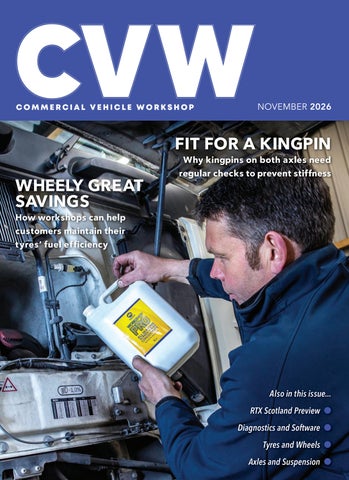
FIT FOR A KINGPIN Why kingpins on both axles need regular checks to prevent stiffness
WHEELY GREAT SAVINGS How workshops can help customers maintain their t yres’ fuel ef ficiency
Also in this issue... RTX Scotland Preview ● Diagnostics and Software ● Tyres and Wheels ● Axles and Suspension ●
CPN.PEW full page_Layout 1 21/10/2026 12:02 Page 1
003_CVW_NOV26_Layout 1 26/10/2026 13:48 Page 3
CONTENTS
Volume 23
Issue 10
REGULARS
14
5
Viewpoint
17 Business & Training
6
News
45 What’s new?
8
Tech Tips
SPECIAL REPORTS 11 Kernow Oils looks at what the new oil specifications mean for compatibility, product choice and stock management. 12 CVW caught up with MAHA UK's Neil Ebbs to talk about about roller brake testing, EVs and the challenges facing the commercial vehicle sector.
26
14 Find out what the CVW team got up to at Fleet Guy Live and at a recent Iveco press event!
AXLES & SUSPENSION 25 Look no further than this BPW article to find out how its suspension systems are a smart choice for workshops, aiming to deliver efficiency and reliability. 26 Reduced movement can increase the risk of stiffness in kingpins, making those fitted to leading and trailing axles worthy of closer attention than workshops might expect, explains Diesel Technic’s parts specialists. 29 Suspension specialist febi is here with everything you need to know about a common fault with AdBlue dosage modules.
TYRES & WHEELS 30 Vaculug argues that public-sector fleet tyre procurement needs a rethink. 33 Davanti shares its top tips to van drivers as the weather gets colder and the nights get longer. 34 As diesel prices continue to challenge operators, Prometeon highlights how workshops can help customers maintain the fuel-saving performance of their tyres. 36 Sailun says application-led tyre selection can help fleets improve safety, efficiency and tyre life while cutting costs with its GEN2 range.
34
38 Yokohoma emphasises the importance of tyre maintenance for commercial vehicles.
DIAGNOSTICS & SOFTWARE 41 With truck and trailer diagnostics becoming more complex year on year, EMS explains how its giving workshops the best tools to tackle modern vehicle diagnostics.
42
42 Mahle argues that early detection of faults in commercial vehicle engine cooling systems is crucial to preventing costly breakdowns, reducing downtime and avoiding serious engine damage.
NOVEMBER 2026 CVW 3
CPN.PEW full page_Layout 1 16/10/2026 13:53 Page 1
005_CVW_NOV26.e$S_Layout 1 23/10/2026 17:11 Page 5
VIEWPOINT
www.cvwmagazine.co.uk
CVWmagazine
@CVWmagazine
WHY TALKING STILL MAT TERS
Editor FREYA COLEMAN cvw@hamerville.co.uk Group Editor KIERAN NEE Digital Manager
O
KELLY NEWSTEAD Digital Assistant JOE CLARKE Group Manager ALEX DILLEIGH Advertisement Manager MARCUS HOOPER Graphic Designer GEMMA WATSON Group Production Manager CAROL PADGETT Subscriptions Commercial Vehicle Workshop is a business magazine for companies and individuals involved in all aspects of commercial vehicle servicing. It is published 11 times a year and is available on free subscription to qualified readers. Subscription rates: UK £30 post paid Airmail £99 post paid Europe £70 post paid To be removed from this magazine’s circulation, please call 01923 237799 or email circulation@hamerville.co.uk. Printed by Stephens and George Published by HAMERVILLE MEDIA GROUP Regal House, Regal Way, Watford, Herts WD24 4YF Tel: (01923) 237799 Website: www.hamerville.co.uk Copyright © 2026
12,545 From July to December 2025
Associate member
The publishers and editor do not necessarily agree with the views expressed by contributors, nor do they accept responsibility for any errors of translation in the subject matter in this publication
ne thing that came through loud and clear for me at the recent Fleet Guy Live event hosted by Tim Guidotti was that when it comes to keeping fleets moving, good communication is still one of the most important tools in the box. The irony being, of course, that it costs absolutely nothing. Fleet managers and workshops are ultimately trying to achieve the same thing – keep vehicles on the road, keep drivers happy and avoid unnecessary downtime. So, when can the relationship between the two sometimes feel like they're speaking completely different languages? Part of the problem is pressure. Fleet managers are dealing with customers, drivers, budgets, vehicle availability and constant pressure to keep the wheels turning. Workshops have their own pressures – technicians, parts availability, diagnostics challenges, booked-in work and the inevitable jobs that turn out to be more complicated than they first appeared. As I'm sure you're aware, it's easy for frustration to creep in. This is where communication matters the most, not just when there's a problem but all the time. A workshop needs to be able to tell a fleet manager honestly what's happening with a vehicle, what's needed and when it's likely to be ready and fleet managers need to give workshops the information they need and understand that sometimes a repair simply can't be rushed. Transparency is key. It may sound simply, but good communication builds trust and this just makes everything easier. It's particularly important now, with vehicles becoming more complicated and technology playing an ever-bigger role in repairs and maintenance. Diagnostics, ADAS, EVs and increasingly sophisticated vehicle systems mean that workshops need the right information AND the time to do the job properly. There's also a bigger opportunity here – workshops aren't just there to fix things when they break. They see what's happening to a fleet at ground level. If they spot a recurring issue or something that could become a bigger problem, that information and be incredible valuable to a fleet manager. But this only works if people are prepared to listen to each other. For me, that was one of the big takeaways from Fleet Guy Live. We can talk all day about technology, uptime and efficiency, but sometimes the biggest improvement we can make is much simpler. Pick up the phone. Have the conversation. Be honest. Because the best fleet/workshop relationships aren’t transactional, they’re partnerships, and in an industry where every hour of downtime matters, that partnership can make a pretty big difference.
Freya Coleman Editor
GET IN TOUCH AT CVW@HAMERVILLE.CO.UK
006_CVW_NOV26_Layout 1 26/10/2026 12:38 Page 6
CVW NEWS NEWS IN
BRIEF
■ Calisen fits solar technology to electric van fleet. The UK’s largest smart meter provider to around 40 per cent of British homes, has fitted Genie Insights’ solar battery maintenance solution across its electric van fleet.
■ Straightset and Supertracker align with TyreSafe. Becoming Commercial Supporters brings together two garage equipment brands with one of the UK’s leading tyre safety charities, with a shared aim of helping workshops and motorists understand the importance of looking after their tyres.
CVWmagazine @CVWmagazine www.cvwmagazine.co.uk
Rising fuel costs drive fleet transition, survey finds GXO’s latest “Future of Transport” research reveals that while commitment to lower-emission transport is growing, rising costs, infrastructure challenges and uncertainty over future fuel technologies continue to delay investment. The survey of more than 1,000 UK supply chain, transport and logistics decision-makers found that 63 per cent said rising fuel costs are accelerating interest in alternative fuel vehicles. However, adoption remains limited: just 38 per cent of organisations currently operate them, despite 87 per cent identifying emissions reduction as a key priority. Commercial returns are increasingly
central to investment decisions, with 76 per cent saying proven cost savings or operational efficiencies are essential before committing funding to lower-emission vehicle technologies. High upfront costs, uncertainty over future technologies and infrastructure concerns remain key barriers. As a result, many operators are prioritising immediate efficiency gains, including reducing partload journeys (43 per cent), cutting empty running (41 per cent), exploring fleetsharing (41 per cent) and optimising delivery routes (39 per cent). All have increased since GXO’s previous 2024 survey.
Broughton Transport Solutions has added two new Krone Cool Liner refrigerated semi-trailers to its fleet, strengthening the company’s temperature-controlled transport capability for UK and European operations.
■ VLS welcomes new chairman. Witham Group MD, Nigel Bottom, has been appointed the new Chairman of the Verification of Lubricant Specifications, succeeding its previous Chair Darren Frogson, CEO at Exol Lubricants.
■ Volvo Trucks wins international truck of the year. Volvo Trucks’ global heavy-duty electric range has been named International Truck of the Year 2027, the company’s eighth win of the award and the second for the Volvo FH Electric.
■ Fleet Operations raises money for cancer unit. A team from Fleet Operations has taken on a North Wales Three Peaks Challenge, raising more than fifteen hundren pounds for Shooting Star cancer support.
6 CVW NOVEMBER 2026
Light commercial vehicle market continues to grow September saw the UK new light commercial vehicle market grow for the sixth consecutive month, increasing by 4.8 per cent to 49,704 units, according to the latest figures published by the Society of Motor Manufacturers and Traders (SMMT). Large vans led volume growth, rising 11.1 per cent to 36,302 units indicating confidence in the fleet sector to continue upgrading their fleets, while medium and small van registrations rose by 2.2 per cent
(7,304 units) and 13.2 per cent (1,361 units) respectively. Demand for 4x4 vehicles rose to 2,079 units, a huge percentage increase of 221.3 per cent which could be related in the downturn in pick-up sales where some private dual-purpose buyers could have moves across from the 4x4 market in this number plate prefix change month. The 4x4 increases to 67.7 per cent year to date. Pickup registrations dropped 53.8 per cent to 2,658 units following tax reclassifications.
006_CVW_NOV26_Layout 1 26/10/2026 12:39 Page 7
FOR UP-TO-DATE NEWS, SIGN UP FOR OUR WEEKLY E-NEWSLETTER. SIMPLY SCAN THE QR CODE
Investment in eight Stertil-Koni Freedomlifts Auto Services Perth Ltd, a family-owned business specialising in the servicing and repair of light commercial vehicles, motorhomes and pick-ups, has invested in another Stertil-Koni 2-Post Freedomlift to support its expanding workshop operations. Having already invested in seven Freedomlifts, the Scottish company selected the same model for its latest workshop expansion, reflecting its confidence in the equipment's versatility and reliability. Following its recent appointment to provide truck repairs and bus recovery services for a major commercial vehicle manufacturer, the business has expanded its workshop capacity with an additional service bay and a new Freedomlift SK2055EFA. With a lifting capacity of 5,500kg, the Freedomlift SK2055EFA provides a versatile solution for lifting a wide range of commercial and specialist vehicles. Its
DATE FOR THE
DIARY ■ MECHANEX
double-telescopic arms and hinged elbow joints allow technicians to position the lifting arms to suit different vehicle types and sizes. The Freedomlift reaches its maximum lifting height of 2,045mm in just 39 seconds, allowing technicians to raise vehicles quickly for inspection, servicing and repair. With no floor-level base or overhead crossbar, the open design provides clear access around the vehicle and greater freedom of movement within the workshop.
Mechanex PMM Live is returning to Sandown Park on the 10th and 11th of November. Mechanex is well known within the independent aftermarket for offering visitors a hands-on experience, bringing them the latest updates and expertise from across the industry and providing an exciting day away from the workshop. Registration to visit the show is free and so is parking. If you like PMM, you’ll love Mechanex – it’s simply the magazine in a live format.
008_CVW_NOV26_Layout 1 26/10/2026 12:40 Page 8
TECH TIPS
KNOW YOUR PARTS NOx sensors Everything you need to know about how NOx Sensors work from febi.
I
n order to meet the high requirements of the current emission standards, the proportion of harmful nitrogen oxides in the exhaust gas must be reduced, among other things. This is achieved by a chemical process that uses a reduction agent to selectively reduce the nitrogen oxides NOx in the exhaust gas by removing oxygen. NOx is a collective term for the nitrogen oxides nitrogen monoxide (NO), nitrogen dioxide (NO₂) and other nitrous gases. The chemical process for reducing nitrogen oxides is called selective catalytic reduction (SCR). Ammonia NH₃ has proven to be the best reducing agent, because it achieves the highest selectivity. The ammonia is carried in the form of a urea-water solution, also known as AdBlue, in a separate tank. The urea-water solution is injected into the exhaust system where it is converted into ammonia by the high temperature of the exhaust gas and in a hydrolysis catalytic converter. Subsequently, the harmful nitrogen oxides are reduced to harmless nitrogen and water in the SCR catalytic converter.
Exhaust silencer of a Euro6 commercial vehicle
Construction of a NOx sensor
��� ��� ���
���
“Current NOx measurement technology is based on electrochemical sensors with yttrium-stabilised zirconium dioxide ZrO2” ��� Exhaust gas flow ��� NOx sensor ��� Diesel oxidation catalyst DOC ��� Diesel particulate filter DPF ��� Temperature sensor ��� AdBlue injection ��� Mixing and hydrolysis section for the ammonia generation from urea ��� SCR catalyst module (reduction catalytic converter) ��� Barrier catalytic converter to prevent ammonia slip
8 CVW NOVEMBER 2026
��� A NOx sensor consists of a probe ��� A connection cable ��� A control module ��� A connector plug To monitor the reduction process, current vehicles are equipped with either one NOx sensor (nitrogen oxide sensor) downstream of the SCR catalytic converter or two NOx sensors, one upstream and one downstream of the SCR catalytic converter. They monitor the function and effectiveness of the SCR system by measuring the nitrogen and oxygen concentration in the exhaust gas. The data from the NOx sensors is also used to calculate the amount of AdBlue required for an optimal reduction process.
The measuring principle Current NOx measurement technology is based on electrochemical sensors with yttrium-stabilised zirconium dioxide ZrO₂, whose design and mode of operation is similar to broadband oxygen sensors (lambda sensors). The sensor usually uses two adjacent measuring chambers with two electrochemical cells, also called pump cells.
008_CVW_NOV26_Layout 1 23/10/2026 17:21 Page 9
“In current vehicles that meet high exhaust emission standards, the exhaust gas management is monitored in real time.”
Function of the second measuring chamber
Measuring chambers inside the probe
Measuring chamber 1
The exhaust gas flows into the first chamber, where oxygen O₂ is removed electrochemically. This is necessary because otherwise the nitrogen oxide measurement in the second chamber would be affected. With the help of an electrical voltage applied to the pump cell, the O₂ molecules are broken down into ions. They penetrate the solid electrolyte consisting of zirconium dioxide and are thus removed from the measuring chamber. The electrical power that has to be applied for this is inversely proportional to the air-fuel ratio. This value is also made available to the engine control unit, which then additionally fulfils the function of a lambda probe for measuring the oxygen content in the exhaust gas.
Measuring chamber 2
In the second chamber, the NOx content in the exhaust gas is determined. For this purpose, the remaining nitrogen oxide NOx is reduced to nitrogen and oxygen by the catalytic material of a platinum-rhodium electrode. The oxygen produced is then pumped out of the measuring chamber through this electrode. To achieve this, a current flows through the electrode that is proportional to the concentration of nitrogen oxide NOx in the exhaust gas. It is precisely this necessary pumping current that is the measurand for the NOx content in the exhaust gas. This is then used to calculate whether the NOx storage catalytic converter needs to be regenerated, the AdBlue injection quantity needs to be adjusted and whether the SCR system is functioning correctly at all.
Function of the first measuring chamber
Warning light for faulty gas management
In current vehicles that meet high exhaust emission standards, the exhaust gas management is monitored in real time. The AdBlue level, quality and consumption as well as the injection system and the NOx values are permanently monitored. In the event of a defect in the SCR system or deviations from the target values, warnings are sent to the driver. If the driver does not react, the engine output is reduced according to the vehicle manufacturer’s specifications. In the worst case, the driver can only drive at walking speed to the next workshop. NOx sensors have a limited lifetime. Due to ageing of the materials in the sensor, the reliability of the measurements decreases after a certain time and the driver receives an error message. Rely on febi‘s NOx sensors in the usual high original equipment quality.
WANT TO KNOW MORE? Make sure to scan the QR code!
NOVEMBER 2026 CVW 9
CPN.PEW full page_Layout 1 07/10/2026 10:52 Page 1
011_CVW_NOV26_Layout 1 23/10/2026 14:49 Page 11
SPECIAL REPORT
OIL SWITCH
HELP
The move from ACEA E6 and E9 to the newer E8 and E11 specifications is changing the engine oils workshops encounter. But what has changed, can newer oils replace existing products, and could the transition simplify lubricant stocks? Kernow Oils, Castrol distrbutor, has the answers you will need.
C
ommercial vehicle engine oils have become increasingly sophisticated. Modern engines must combine performance and efficiency with lower emissions, while DPF, EGR and SCR systems place additional demands on lubricants. One important development is the introduction of ACEA E8 and E11, replacing E6 and E9 respectively for new claims within the ACEA Heavy-Duty Engine Oil Sequences. Put simply, E8 succeeds E6, while E11 succeeds E9. However, workshops shouldn't assume the specifications are automatically interchangeable.
Why the change? E6 and E9 were already highly capable specifications for demanding heavy-duty applications and modern exhaust aftertreatment systems. E8 and E11 build on these foundations, reflecting developments in engine technology and updating the tests used to assess lubricant performance. Important areas include oxidation and aeration control, alongside updated requirements such as piston cleanliness. High temperatures and demanding operating conditions can degrade oil over time. Improved oxidation resistance helps the lubricant continue protecting critical components throughout its service life. E8/E11 is therefore best viewed as an evolution of E6/E9 rather than a completely new approach.
Does E8/E11 replace E6/E9? This requires some caution. Although E8 succeeds E6 and E11 succeeds E9, this
doesn't mean every E8/E11 oil can automatically be used in every engine previously requiring E6 or E9. Commercial vehicle oils can carry several ACEA performance claims alongside manufacturer-specific requirements from companies such as Mercedes-Benz/DTFR, MAN, Volvo and Renault Trucks. Workshops should identify the engine manufacturer's requirements and select an oil carrying the correct viscosity, performance specification and OEM approvals. Remember: two 10W-40 oils aren't necessarily interchangeable simply because their viscosity is identical.
An opportunity to rationalise For workshops maintaining different manufacturers and generations of vehicles, E8/E11 also presents an opportunity. Lubricant stores can accumulate different oils as specifications change. Modern E8/E11 products can offer broad coverage, with some carrying previous E6, E7 and E9 claims alongside E8 and E11, plus multiple OEM approvals. Rather than simply adding another oil, workshops should consider a lubricant rationalisation review. Identify the viscosity, ACEA/API specifications and OEM approvals required across the vehicles maintained and compare these against the oils currently stocked. Where coverage overlaps, several products may be safely consolidated. This can mean lower stockholding, better stock rotation, reduced storage and
simpler lubricant selection, while helping reduce the risk of using the wrong oil.
What does the new generation look like? The new Castrol Vecton Long Drain E8/E11 range provides a good example and includes three key viscosity grades: Castrol Vecton Long Drain 5W-30 E8/E11 Castrol Vecton Long Drain 10W-30 E8/E11 Castrol Vecton Long Drain 10W-40 E8/E11 Depending on the product, these oils carry combinations of ACEA E6, E7, E8, E9 and E11 performance claims alongside a range of OEM specifications and approvals. For workshops, this breadth of coverage could allow a relatively small number of carefully selected oils to service a much wider range of vehicles. However, rationalisation should never mean compromising specification. The objective isn't one oil for everything, but the fewest correct oils capable of covering the vehicles a workshop maintains. As E8 and E11 become increasingly common, now is a good time to review lubricant inventories rather than simply adding new products to the shelf. Done correctly, the transition can make lubricant management simpler, safer and more efficient. Kernow Oils can support workshops with lubricant surveys and product rationalisation advice to identify the smallest practical range of correctly approved lubricants for their vehicles.
WANT TO KNOW MORE? Make sure to scan the QR code!
NOVEMBER 2026 CVW 11
012_CVW_NOV26_Layout 1 26/10/2026 12:43 Page 12
SPECIAL REPORT
THE FUTURE OF
COMMERCIAL VEHICLE TESTING MAHA UK managing director Neil Ebbs talks with CVW editor Freya Coleman about rising roller brake testing, EVs, workshop skills and the challenges facing the commercial vehicle sector. It’s about looking at the actual operation of the workshop. If a customer comes to us with an existing MAHA brake tester, there’s an advantage because, provided the brake tester is less than 12 years old, it can fit into our rising roller frame. There’s also a very straightforward way of looking at return on investment. If you establish how many vehicles you’re testing each day and how long it takes to load those vehicles, you can calculate how much time is being saved. Once you put those figures together, it becomes quite an easy calculation.
N
eil Ebbs has been with MAHA for more than two decades, joining the company as a project manager in 2004 before becoming managing director in 2008. During that time, the business has evolved from a company with a greater reliance on distribution into one with a stronger focus on the commercial vehicle market. With brake testing, workshop technology and vehicle electrification all undergoing significant change, we spoke to Neil about where the industry is heading – and whether workshops are prepared for what comes next.
Q
Brake testing has been a major focus for MAHA. Are operators now carrying out genuinely meaningful brake tests, or is there still an element of box-ticking? There is definitely an uptake in meaningful brake testing. We’re seeing some manufacturers and independents taking it on board, with DAF being one of the key ones. There are still others that are carrying out meaningful brake tests, but not using rising roller technology. Instead, they’re
12 CVW NOVEMBER 2026
loading vehicles with weights, water ballast or other methods to achieve the correct axle weights. We still feel that’s quite longwinded, particularly when you have rising roller technology available.
Q
What is still misunderstood about rising roller brake testing? Probably the biggest issue is simply misunderstanding. People don’t always realise the advantages it can offer. Once they see it and use it, they understand the benefits. It isn’t necessarily just about ATF testing; there are significant advantages for a workshop carrying out its own testing as well. A laden test gives you a better overall evaluation of brake performance. It can sometimes highlight a fault within the braking system because the vehicle is being tested under load. If you test an unladen vehicle, you may not necessarily identify that issue.
Q
How do you demonstrate the business case for investing in rising rollers?
Q
Could rising roller testing eventually become standard practice across CV workshops? I don’t think it will ever become the norm everywhere. I think it will be a slow progression, with some businesses choosing to go down that route over time. I’d say it could take around 10 years before the market reaches its maximum level of adoption. There was definitely a rush at the beginning and now it’s more of a trickle. We’re still selling them very well, but I think it will eventually peter out unless you keep the focus on it. I think the DVSA needs to keep the pressure on as well, particularly around compliance.
Q
Where does continuous brake performance monitoring fit into that picture? I see it as a complement rather than a replacement. Continuous monitoring gives you live data every time the vehicle’s brakes are applied, so there is certainly value in that. But there are so many different scenarios involved when a vehicle is being driven on the road.
012_CVW_NOV26_Layout 1 26/10/2026 12:44 Page 13
Weather conditions, the road surface and the circumstances in which the brakes are applied can all affect the readings. A roller brake tester provides a much more consistent and repeatable environment. The rollers are a certain size, the coating is a certain material and, when you’re loading the vehicle, you’re testing it under a known load. If somebody suddenly pulls out in front of a driver, for example, they’re going to brake much harder than they would under normal conditions. The data might suddenly show harsh braking, but that doesn’t necessarily mean there’s something wrong with the vehicle. So I see continuous monitoring as complementary rather than something that removes the need for brake testing.
Q
Looking beyond brake testing, what technology will have the biggest impact on CV workshops? It has to be EV-related, but exactly what that means is difficult to predict. It could be battery removal, for instance, or equipment to ensure the battery is stable when it’s not in the vehicle. There are a lot of possibilities. The problem is that workshops and operators are being asked to make investment decisions when there’s still a lot of uncertainty about what the future looks like.
Q
Potentially, yes. Not all workshops can repair EVs or deal with the technology and specialist tools involved. That could affect the ability of independents to support these vehicles as they move into the used market. There’s also the question of residual value. We’re already seeing some electric cars that cost around £60,000 new being worth less than £20,000 after three years. The residual value has dropped dramatically in some cases. Then you have battery replacement costs. If you’re talking about a £12,000 battery, that can represent a significant proportion of the value of a cheaper vehicle. But the market is still in its infancy. Nobody really knows how that is going to develop.
Q
What other technologies could emerge?
Hydrogen could potentially come into the picture. There are still a lot of different methods that could develop within the industry. The truck market hasn’t moved into EVs at anything like the same pace as passenger cars, and you can understand why. There are also interesting developments elsewhere. The Chinese manufacturers, for example, have clearly got a strong grip on EV technology and are developing some very different solutions.
Are workshops ready for the growth of electric vehicles?
I don’t think the network is ready. The passenger car market is being pushed towards electric vehicles much more quickly than the commercial vehicle market, but the workshops and dealer networks aren’t necessarily ready to support them. You’ve got the safety requirements, specialist equipment and training. Not every workshop can currently repair these vehicles or deal with them safely. The other issue is that the goalposts keep moving. Manufacturers don’t necessarily want to invest heavily to prepare for a deadline that might subsequently change. There needs to be more security and confidence.
Q
Whether one technology eventually becomes dominant across the whole market is difficult to say.
Q
How has MAHA itself evolved during your time with the company? We’ve diversified. In the early days, we were more reliant on distribution across the car and truck markets, whereas we’ve evolved more towards the truck market. Some of that has been driven by me, but it’s also about responding to what the market needs. If a particular product isn’t available from MAHA, you have to ask how you can put together a package that is suitable for the customer. We’re a premium brand, so you’re trying to sell a premium product. That’s a harder way to sell, but it’s also about demonstrating the value behind the product.
Q
Finally, what is the biggest issue facing CV workshops?
I’d say the biggest problem is getting the right people into workshops. There’s a staffing problem, and we certainly see people who misunderstand brake test results. We get people calling and saying that the brake tester isn’t doing something correctly, but when you look at the results, it isn’t the brake tester – it’s physics. If you understand the weight you’re putting on the vehicle and the results you’re getting, that’s physics. It’s nothing to do with the brake tester. So I think understanding brake test results is a major challenge for the industry. That comes down to staffing, training and getting the right people into workshops. And that’s not an easy problem to solve. For us, it reinforces the importance of not just supplying equipment, but supporting customers over the long term. A brake tester can remain in service for 15, 20 or even 25 years with the right maintenance, servicing and after-sales support. That longevity is an important part of the value proposition – and something we believe customers should be looking.
Could this create problems for independent workshops?
WANT TO KNOW MORE? Make sure to scan the QR code!
NOVEMBER 2026 CVW 13
014_CVW_NOV26_Layout 1 23/10/2026 17:23 Page 14
SPECIAL REPORT
CVW
ON THE ROAD See what the CVW te
am has been up to rece
ntly...
Hosted at The Bond in Birmingham, a rather swanky venue.
FLEET GUY LIFE Designed to unite the fleet focused independent garage community for a full day of insight, connection and industry discussion, the event saw more than 180 attendees gathered in the heart of Digbeth. The winners of the inaugural Fleet Guy Awards were also revealed, designed to celebrate excellence, raise standards and shine a spotlight on the people who keep fleets moving. Winners included the Rising Star Award winner Castle Garage and the Going the Extra Mile Award winner Magnet Autos. The awards form part of Fleet Guy’s wider mission to help garages grow profitable fleet work and build a confident, capable and connected national community. Tim Guidotti, Founder of Fleet Guy and Owner of Ferdotti Motor Services, said: “What a day. The energy in the room was incredible, and it was fantastic to see so
14 CVW NOVEMBER 2026
many garages committed to raising standards in fleet work. Every shortlisted garage had something special to offer and our winners should be incredibly proud. They represent the very best of our growing fleet community. A huge thanks to sponsors, speakers and everyone involved.”
The man himself, Tim Guidotti!
There was even a live band, bringing the vibes and the tunes!
014_CVW_NOV26_Layout 1 23/10/2026 17:24 Page 15
IVECO PRESS DAY Iveco UK is continuing to boost its products and services by taking a focus on quality and customer centricity. It welcomed journalists to have a gander at its product offering. It is enhancing dealership interactions, the people behind them, and digital capabilities, which will serve to strengthen the IVECO network and the support available to customers. Iveco offers an extensive range of products from 3.1 to 44-tonnes GVW across multiple fuel sources. The latest generation of efficient diesel engines, powerful natural gas alternatives, and innovative BEV platforms underpin durable platforms for every use case. The latest technology will also serve a key role with the introduction of cutting-edge innovations into workshops such as digital job cards that will reduce paperwork, artificial intelligence aiding in faster problem solving, augmented reality can give greater support with fault-finding, while virtual reality helps train the people who know your vehicle best. All of this culminates in more efficient and greater workshop service capability. Mike Cutts commented “This is a significant moment in the UK, and alongside the introduction of the MY26 range, we are committed on our qualityfocused mission. By putting the spotlight on people, technology, facilities and processes, we strengthen our ability to deliver on class-leading products, services and support for our customers.”
The various products on display.
Editor Freya also went for a spin around in one of the trucks (as a passenger of course).
IVECO S-eWay Artic making its UK debut.
The Iveco team were even kind enough to let this editor have a spin around in its e-Jolly van.
NOVEMBER 2026 CVW 15
CPN.PEW full page_Layout 1 15/09/2026 13:21 Page 1
017_CVW_NOV26_Layout 1 26/10/2026 14:01 Page 17
BUSINESS & TRAINING
ROAD TRANSPORT EXPO SCOTL AND PREVIEW HOW DO I ATTEND? RTX Scotland takes place on 18-19 November at the Scottish Event Campus (SEC), Glasgow. Scottish Event Campus (SEC) Exhibition Way Glasgow G3 8YW Attendance is completely free! Scan the QR code below to register!
From new trucks and workshop equipment to compliance, maintenance and alternative fuels, RTX Scotland 2026 brings together the products, expertise and industry insight helping operators keep fleets safe, efficient and profitable.
H
GV operators, fleet engineers and workshop professionals will have even more reasons to visit RTX Scotland when the event returns to Glasgow in November. Following a successful launch, the show is set to increase in size for 2026, creating a larger two-day event where visitors can get hands-on with the latest trucks, trailers, workshop equipment, maintenance solutions and fleet technology. Taking place at the Scottish Event Campus (SEC) on 18-19 November, the Road Transport Media exhibition will feature a significantly expanded exhibition hall, additional floor space and extended opening hours from 9am to 5pm on both days. For operators and workshop teams, the enlarged format offers the opportunity to compare vehicles, workshop products and service solutions side by side, while speaking directly with manufacturers and technical experts about the challenges they face every day.
Leading vehicle and body manufacturers already confirmed include DAF, MAN, Isuzu, Renault Trucks, Volvo, Thompsons and Terberg DTS. They will be joined by suppliers specialising in tools, tyres, components and workshop equipment, such as AES, Automint, Continental, Giti, Hankook, Kirkby, Michelin, Laser Tools, MAHA UK and Premier Pits. As fleets adapt to changing regulations, new technologies and evolving customer demands, RTX Scotland provides a practical environment to assess what works in the real world. Whether visitors are evaluating alternative fuels, planning for vehicle electrification, improving workshop productivity or looking for ways to reduce downtime, the event brings together the people and products needed to support informed decision-making. For workshop managers and engineering teams, the ability to see products first-hand and discuss technical
NOVEMBER 2026 CVW 17
017_CVW_NOV26_Layout 1 26/10/2026 13:00 Page 18
BUSINESS & TRAINING
requirements directly with suppliers can be just as valuable as comparing vehicle specifications. From maintenance equipment and diagnostic tools to parts, consumables and digital fleet management systems, visitors will have the opportunity to explore solutions designed to improve reliability, efficiency and vehicle uptime. At the heart of the show, the free-toattend Knowledge Zone conference programme will bring together fleet operators, industry experts, manufacturers and policymakers to discuss the issues shaping the future of road transport. Through a mix of presentations, panel discussions and case studies, visitors will gain practical insight into fleet maintenance, road safety, skills, operational efficiency and the transition to lower-emission transport. The second day of the conference programme will open with a keynote address from Scottish Cabinet Secretary for Economy, Tourism and Transport Stephen Flynn. Sessions across both days will focus
18 CVW NOVEMBER 2026
on real-world challenges and opportunities facing operators, providing delegates with ideas and practical takeaways they can apply within their own businesses. RTX Scotland takes place during a landmark week for Scotland's road transport sector, coinciding with the Transport News Scottish Rewards event. Together, the two gatherings will bring operators, suppliers and industry stakeholders to Glasgow, creating even more opportunities for networking, knowledge sharing and business discussions. For many visitors, one of the biggest benefits of attending RTX Scotland is the opportunity to speak directly with manufacturers, suppliers and fellow operators facing similar challenges. Those conversations can provide valuable insights into everything from vehicle maintenance strategies and workshop efficiency to fuel choices, compliance requirements and whole-life operating costs.
017_CVW_NOV26_Layout 1 26/10/2026 08:51 Page 19
sons FiveTOreaVISIT RTX SCOTLAND 2026
1
SEE THE LATEST VEHICLES AND WORKSHOP TECHNOLOGY Compare trucks, bodies, workshop equipment, diagnostic tools and maintenance solutions from leading manufacturers and suppliers.
2
IMPROVE WORKSHOP EFFICIENCY Discover products and services designed to reduce downtime, increase productivity and streamline maintenance operations.
3
SPEAK DIRECTLY WITH INDUSTRY EXPERTS
The event also offers a platform for operators to compare experiences, exchange ideas and learn from peers tackling issues such as recruitment, vehicle performance, maintenance planning and future fleet investment. Alongside the exhibition and conference programme, enhanced networking and hospitality areas will provide dedicated space for informal meetings, business discussions and the kind of conversations that often lead to lasting industry connections and practical solutions. RTX Scotland Show Director Vic Bunby said: “The response to our first event exceeded expectations, with strong visitor numbers and excellent feedback from exhibitors and visitors alike. “By expanding the show for 2026, we're creating an even better opportunity for operators, workshop professionals and suppliers to meet face to face, see the latest
products in action and discuss the challenges and opportunities facing the industry. “We look forward to welcoming visitors from across the road transport sector for two days of hands-on product discovery, practical insight and valuable industry connections.” With more exhibitors, additional floor space and extended opening hours, RTX Scotland 2026 is designed to give visitors more time to engage with suppliers, attend conference sessions and evaluate technologies that could help shape future fleet and workshop operations. By bringing together operators, workshop professionals, manufacturers and service providers under one roof, RTX Scotland aims to provide a practical, business-focused event where visitors can discover new products, share experiences and find solutions that deliver tangible operational benefits.
Get practical advice from vehicle manufacturers, workshop specialists, technology providers and service suppliers on the challenges facing modern fleet operations.
4
EXPLORE FUTURE FLEET TECHNOLOGIES Learn how alternative fuels, electric vehicles and connected technologies could affect your fleet, workshop and maintenance planning.
5
NETWORK WITH INDUSTRY PEERS Meet operators, engineers, workshop managers and suppliers from across Scotland's commercial vehicle sector and share experiences with those facing similar challenges.
CPN.PEW full page_Layout 1 20/10/2026 09:44 Page 1
021_CVW_NOV26_Layout 1 26/10/2026 13:59 Page 21
BUSINESS & TRAINING
UPGRADING
PASSENGER TRANSPORT SAFETY Brigade looks at how AI is helping bus and coach operators add human form recognition to existing safety systems.
A
s bus and coach operators continue to improve safety standards, artificial intelligence (AI) is opening up new possibilities for how vehicle safety technology can be used to protect drivers, passengers and vulnerable road users (VRUs). Human Form Recognition (HFR) is an important development in this evolution. By using AI-powered image analysis to identify human forms within a camera's field of view, HFR can help drivers recognise pedestrians, cyclists and other people around the vehicle and respond to potential hazards. For passenger transport operators, this is particularly relevant. Buses and coaches regularly operate in busy urban environments, at bus stations, depots and other locations where pedestrians and vehicles can be in close proximity. Blind spots and restricted visibility can make these environments challenging, particularly during low-speed manoeuvring and reversing.
Traditional camera systems have already transformed visibility around commercial vehicles, giving drivers access to views that would otherwise be difficult to obtain. AI takes this technology a step further by adding intelligence to the image. Rather than simply detecting movement, HFR is designed to recognise human forms. Conventional motion detection can respond to any movement within a camera's view, whereas HFR uses AI to distinguish people from the surrounding environment. This enables the system to focus alerts on the presence of a person within a defined detection area.
“The ability to add AI capability to existing safety cameras provides a practical option...starting again from scratch.”
The result is a progression from simply providing visibility to actively helping the driver identify potential hazards. The rapid development of AI-enabled safety technology presents an important question for operators: how can established fleets benefit from these advances without having to replace equipment? For many bus and coach operators, replacing an entire camera system across a fleet could involve significant capital investment, vehicle downtime and installation work. It may also mean replacing cameras, monitors and cabling that still have useful service life remaining. An alternative approach is to add the AI capability to the existing system. Brigade Electronics' AI HFR Box has been developed around this retrofit principle, allowing compatible existing analogue camera systems to be upgraded with Human Form Recognition. The AI processor works in-line with the existing camera system, analysing the video feed and adding intelligent human-form
NOVEMBER 2026 CVW 21
021_CVW_NOV26_Layout 1 23/10/2026 15:03 Page 22
BUSINESS & TRAINING
detection without requiring the complete camera infrastructure to be replaced. The system supports up to two analogue cameras and a range of video formats, including AHD, CVBS, NTSC and PAL, with support for 720p and 1080p systems. This approach reflects an important development in vehicle safety technology. AI does not necessarily have to be incorporated directly into a new camera. The processing capability can be introduced into the existing system, allowing established camera infrastructure to benefit from advances in AI. Jordan Marshall, Brigade's UK marketing manager, says: “Human Form Recognition is becoming an increasingly important consideration for operators looking to improve safety around vehicles and equipment. The ability to add AI capability to existing safety cameras provides a practical option for fleets looking to improve their safety systems without starting again from scratch.” However, the benefits of a retrofit approach extend beyond the introduction of HFR itself. By retaining compatible cameras, monitors and vehicle cabling, operators can potentially reduce the scale of installation work required compared with a complete camera-system replacement. This can help minimise vehicle downtime and make the process of upgrading large or mixed fleets more manageable.
Upgrading It also provides operators with greater flexibility over how they introduce new technology. Rather than having to replace every vehicle at once, fleets can consider where existing equipment can be upgraded and progressively introduce AI capability across their operations. There is a sustainability benefit, too. Extending the useful life of functioning safety equipment means that cameras, monitors and associated infrastructure do not have to be discarded simply to access newer technology. This supports the growing focus across the transport industry on resource efficiency, circular-economy principles and reducing unnecessary electronic waste, while allowing safety improvements and sustainability objectives to work alongside one another.
At the heart of HFR is the ability to analyse the camera image and identify human forms within configurable detection zones. When a person enters a relevant area, the system can provide visual and audible alerts to the driver. For bus and coach operators, detection zones can be configured around the areas where human presence is most relevant, whether that is alongside the vehicle, towards the rear or in areas used for lowspeed manoeuvring.
“Rather than simply detecting movement, HFR is designed to recognise human forms.” This provides drivers with more than simply an image. It gives them an additional source of information, helping to bring attention to vulnerable road users who may otherwise be difficult to identify in a busy operating environment. AI therefore represents another layer in the development of vehicle safety. Camera technology provides visibility; HFR adds intelligent analysis; and alerts help turn that analysis into information the driver can act upon. Where video recording is incorporated into the wider safety system, AI technology can also support privacy requirements through features such as face blurring or face-mosaic functionality.
WANT TO KNOW MORE? Make sure to scan the QR code!
22 CVW NOVEMBER 2026
The development of HFR demonstrates how alternative technologies can evolve alongside the systems already in use. For fleet operators, adopting new technology does not always have to mean replacing everything that came before. Retrofit solutions provide a way to build on existing investments while introducing new capabilities that can improve safety and situational awareness.
A look at bus and coach For bus and coach operators in particular, this offers a practical route towards increasingly intelligent safety systems. The technology can evolve while the fleet continues to operate, existing equipment can remain productive for longer, and operators can introduce AI without necessarily undertaking a wholesale replacement programme. As the commercial vehicle industry continues to embrace AI, this ability to upgrade rather than replace could become increasingly important. Human Form Recognition represents the next step in the development of vehicle camera technology – moving from simply showing drivers what is around their vehicle to helping them identify the people within that environment. Through retrofit technology, operators can take that step without starting again, adding AI-powered capability to existing safety infrastructure while continuing to focus on the priorities that matter most: protecting vulnerable road users, supporting drivers and making passenger transport safer.
CPN.PEW full page_Layout 1 07/10/2026 10:21 Page 1
CPN.PEW full page_Layout 1 08/10/2026 13:24 Page 1
025_CVW_NOV26_Layout 1 26/10/2026 12:46 Page 25
AXLES & SUSPENSION
SUSPEND
YOUR DISBELIEF Leading suspension specialist BPW details how its suspension systems are a smart choice for workshops, aiming to deliver efficiency and reliability for commercial vehicles.
H
igh performance, low maintenance, and reduced whole-life costs define BPW suspension systems, making them a top choice for fleet operators who demand reliability and efficiency. BPW aims to set industry standards by delivering innovations that maximise vehicle uptime without compromising safety or durability.
Tailored suspension solutions BPW offers a wide range of air suspension systems, for different transport needs. For long-haul or heavy-duty operations, BPW delivers solutions that keep trailers performing optimally and maintain low maintenance costs. For 9-tonne axles, the company offers three suspension types. The latest Airlight II Round (AL II-R), an advancement of the proven Airlight II (AL-II), features a conventional sprung steel trailing arm for reliable trailer performance. The ECO Air, with its cast trailing arm design, offers the same properties as the Airlight II and accommodates a variety of trailer designs and operating conditions. For more demanding requirements, the Airlight Heavy Duty (AL-HD) incorporates reinforced components to withstand higher stresses. For even greater loads, the SL suspension supports up to 14 tonnes.
Performance The Airlight II Round (AL II-R) suspension is among the lightest axle and suspension systems on the market. The design of the trailing arms, hanger brackets, and axle clamping can reduce the weight of a tri-axle trailer by up to 93kg, thereby improving efficiency. A lighter unladen weight means lower fuel consumption and larger payloads, resulting in increased revenue. The suspension’s modular design allows for easy, low-cost replacement of individual parts and components, reducing repair costs by only needing to replace damaged or wornout parts. The Airlight II Round also features flexible trailing arm technology, which can be precisely adapted to a particular vehicle and its application. The sprung steel trailing arm absorbs the strongest vibrations from the running gear and uneven road surfaces, reducing stress on the tyres, frame, vehicle body, and the load itself, which extends the lifespan of the trailer.
All road conditions ECO Air is a robust and modular air suspension system that aims to performs well across multiple road conditions. Its two-part cast trailing arm, combined with BPW’s precision-engineered steel rubber bush, ensures long-term durability and ease of maintenance. Unlike welded alternatives, the modular design says to allow quick replacement of individual components. This reduces downtime and lowers repair costs. A key feature of ECO Air is BPW’s patented high-tech laser production process. It combines BPW’s typical
clamped modular air suspension mounting with round-axle beams. By integrating the three-dimensional laser profile, etched on the bottom of the casting interface, the system creates a positive location with less clamping force. This technology ensures a secure fit with minimal clamping force, improving overall durability and stability. The asymmetrical steel-rubber bush enhances load absorption and guidance while reducing tyre wear and improving ride comfort. ECO Air offers a cost-effective option for fleet operators needing efficient air suspension.
Heavy loads Designed for the heaviest loads and extreme conditions, the SL suspension system supports axle loads up to 14 tonnes. Featuring a low-maintenance U-bolt clamping arrangement, it allows for straightforward component replacement, helping to minimise operational downtime. With a 100mm-wide spring steel trailing arm, available in single or twin-leaf configurations, BPW SL suspension aims to deliver durability for off-road or specialist transport applications. The combination of axle, connection, and trailing arm forms a robust unit that can handle the toughest loads while remaining stable. BPW suspension systems are said to give operators the flexibility to select solutions tailored to their transport requirements. Whether prioritising lightweight efficiency, modular maintenance, or heavy-duty strength, BPW delivers technology that reduces costs and maximises vehicle lifetime.
WANT TO KNOW MORE? Make sure to scan the QR code!
NOVEMBER 2026 CVW 25
026_CVW_NOV26_Layout 1 26/10/2026 12:51 Page 26
AXLES & SUSPENSION
ATTENTION TO KINGPINS Diesel Technic’s parts specialists explain why kingpins leading and trailing axles can need closer attention than workshops might expect, and why reduced movement can increase the risk of stiffness.
W
ear and movement usually go hand in hand, so it might seem logical to assume that a component which moves less will need less attention. With kingpins, however, that is not always the case. That is why Diesel Technic’s parts specialists can help workshops identify the correct kingpin components through the Diesel Technic Spare Parts Range.
On leading and trailing axles, kingpins can become stiff more quickly because they are not moved as frequently as those on a conventional front steering axle. Diesel Technic’s parts specialists therefore advise workshops to check these applications carefully and, where appropriate, lubricate them more frequently than the normal maintenance interval.
Why does reduced movement matter? The kingpin forms the pivot between the steering knuckle and axle. Depending on the application, it is supported by bearings which need regular lubrication to continue moving freely. Grease nipples are provided for this purpose. On a normal front axle, the steering mechanism is continually being operated as the vehicle changes direction. Leading and trailing axles may see considerably less movement. It can be tempting to interpret that as an easier working life. In practice, Diesel Technic advises that the reduced movement means kingpins on these axles can become stiff more readily, making regular inspection and lubrication particularly important.
26 CVW NOVEMBER 2026
The key for workshops is therefore not simply to rely on mileage or the standard service interval, but to consider how the axle actually operates.
Look for the early signs Stiffness is one warning sign, but kingpin problems can also show themselves through noises when steering or abnormal tyre wear. These symptoms do not automatically mean the steering system itself is at fault. The kingpins and its bearings should also form part of the investigation. Checking for play is another useful part of the diagnosis. With the vehicle lifted, movement between the steering knuckle and axle can indicate that further investigation is needed, although permissible play should always be checked against the vehicle manufacturer’s specification.
026_CVW_NOV26_Layout 1 26/10/2026 12:53 Page 27
Before committing to a full strip-down, Diesel Technic also recommends checking whether stiffness can be improved through lubrication. Kingpin removal is a labourintensive job, so establishing whether dismantling is actually necessary can avoid unnecessary work.
Keep dirt and water out Lubrication is only part of the picture. Seals and protective caps also need attention. If a seal is damaged, dirt and water can reach the bearing surfaces, leading to corrosion and premature wear. On applications fitted with protective caps, removing and checking them can reveal contamination or corrosion residue that might otherwise remain hidden. Once contamination has taken hold, simply adding more grease may no longer be enough. Identifying deteriorated seals or protective components early can help stop
a lubrication problem becoming a more involved kingpin repair.
Maintenance should follow the application Kingpin may all perform the same fundamental job, but the conditions in which they operate are not identical. That is particularly relevant on leading and trailing axles, where less frequent movement can mean that a component which appears to have an easier life actually benefits from closer maintenance attention.
WANT TO KNOW MORE? Make sure to scan the QR code!
As a global supplier of commercial vehicle parts, Diesel Technic offers more than 100 kingpins products through its DT Spare Parts range, covering major truck and trailer applications. Kits include bearings, pressure discs, sealing rings, grease nipples and other components required for the application, with full product information available through the Diesel Technic Partner Portal. For workshops, the practical message is straightforward: do not assume less movement means less maintenance. Pay attention to axle type, keep lubrication under review and act on stiffness, contamination or play before a relatively small maintenance issue turns into a much bigger repair. For help identifying the correct kingpin components or with technical questions, workshops can contact Diesel Technic’s parts specialists through the HelpDesk or parts specialists app.
MX HOUSE AD CVW & PMF NOV26_Layout 1 16/09/2026 14:11 Page 1
THE HANDS-ON TRADESHOW FOR INDEPENDENT WORKSHOPS
MECHANEX PROFESSIONAL MOTOR MECHANIC LIVE
SANDOWN PARK, SURREY 10TH & 11TH NOVEMBER 2026
TOP AUTOMOTIVE BRANDS ● LATEST PRODUCTS AND INNOVATIONS
● SPECIAL SHOW DISCOUNTS ● FREE CPD TECHNICAL SEMINARS ● FREE ENTRY
● FREE PARKING ● FREE PROFESSIONAL MOTOR MECHANIC T-SHIRT ● FREE BACON ROLL
SPONSORED BY:
REGISTER FOR FREE AT WWW.MECHANEX.INFO
029_CVW_NOV26_Layout 1 26/10/2026 13:53 Page 29
AXLES & SUSPENSION
KNOW YOUR PARTS AdBlue Dosing Module Suspension specialist febi share everything you need to know about dosage modules, and a common fault found in them.
Function Dosage modules are important components within SCR systems for reducing nitrogen oxide emissions in the exhaust tract. The dosage module ensures the precise metering of the urea-water solution required for the reduction process - also known as AdBlue, and is responsible for its atomisation and distribution in the exhaust pipe.
Cause of failure The urea in the urea-water solution has the property of crystallising when the liquid dries. This can occur when the system is open, air enters it, or it is not operated for a long period, leading to the dosing module becoming clogged. Contaminated or poor-quality AdBlue can also damage or clog the dosing module. In addition, corroded contacts, broken cables and electronic defects inside the dosing module can lead to failure. Suitable for: Scania Series F, K, N; P, G, L; P, G, R, T; R, S
WANT TO KNOW MORE? Make sure to scan the QR code!
030_CVW_NOV26_Layout 1 23/10/2026 15:32 Page 30
TYRES & WHEELS
THE UNSEEN LEVER OF
NET ZERO
Vaculug makes a case for why public procurement must rethink commercial fleet tyres.
When a commercial tyre reaches the end of its initial tread lifecycle, the casing remains largely intact. In a circular manufacturing model, this casing undergoes rigorous testing, to verify structural integrity. Once cleared, the remaining tread material is buffed away, and a new tread compound is bonded onto the casing through computercontrolled vulcanisation processes. The environmental benefits of this circular approach are immense:
I
n the race toward net-zero targets, public sector procurement officers and local authority fleet managers operate under relentless dual pressures. On one side, legislative mandates and civic expectations demand actionable, transparent decarbonisation strategies. On the other, tight municipal budgets require rigorous fiscal discipline and maximum value for every pound of public expenditure. Yet, despite searching for innovative ways to eliminate operational carbon, public bodies frequently overlook one of the most practical, cost-effective and immediately scalable tools at their disposal: commercial tyre remanufacturing. Tyre remanufacturing represents a circular industrial process. Rather than treating tyres as consumable items destined for disposal, remanufacturing integrates high-precision engineering to extend the lifecycle of high-grade casings across multiple operational lives. With local government fleets spanning refuse collection, highway maintenance, public
30 CVW NOVEMBER 2026
transport and municipal services, reforming tyre specification policies presents a significant, untapped opportunity to cut emissions, reduce fleet overheads, and strengthen domestic British manufacturing. To understand the value of remanufactured tyres, it is essential to dismantle common misconceptions about retreading. Commercial tyre remanufacturing is not a cosmetic repair or a temporary fix; it is advanced industrial engineering built on intense manufacturing standards that match the performance, durability and safety of a brand-new tyre.
Remanufactured commercial tyres deliver comparable mileage, wet grip, and rolling resistance performance to premium new tyres.
● Raw material savings: Remanufacturing a commercial truck tyre uses up to 70 per cent less raw material, compared to producing a new tyre from virgin resources. ● Direct carbon reduction: Because the energy-intensive process, each remanufactured tyre prevents an average of 60kg of CO₂ emissions from entering the atmosphere. ● Resource preservation: By extending the functional service life of high-quality casings, remanufacturing diverts thousands of tonnes of commercial rubber from prematurely entering waste and recycling streams. For fleet operators, these environmental benefits are paired with direct financial performance. Remanufactured commercial tyres deliver comparable mileage, wet grip, and rolling resistance performance to premium new tyres, but at a dramatically lower unit price. For local authorities managing large fleets of heavy goods vehicles and service buses, this translates into immediate cost-per-mile savings and operational budget relief. While the private commercial logistics sector has integrated circular tyre management into standard operating practice, public sector procurement has lagged behind.
030_CVW_NOV26_Layout 1 23/10/2026 15:32 Page 31
Vaculug’s ongoing work was formally recognised with the prestigious King’s Award for Enterprise in Sustainable Development.
Across commercial trucking, waste logistics and retail distribution, retreads are widely accepted as the standard choice for cost control and ESG compliance. Industry data demonstrates that 70 per cent of major UK supermarket fleets and 65 per cent of commercial waste management fleets routinely run on remanufactured truck tyres. These commercial operators rely on retreads because their bottom lines depend on balancing high reliability with stringent financial management. By contrast, public sector practice presents a starkly different picture. A Freedom of Information request submitted by Vaculug revealed a substantial policy disconnect across local government fleet purchasing. Of the 68 Borough, District and City Councils responding to queries regarding their purchasing practices ● 43 per cent purchased zero remanufactured truck tyres across their entire fleet operations. ● 21 per cent fitted single-life tyres exclusively.
Parliamentary rounudtable
This reliance on single-life imported tyres creates a large problem. Cheap, low-grade imported tyres are engineered down to a price point; their casings are unsuitable for remanufacturing. Once worn, they cannot be safely retreaded, meaning they pass straight into the waste stream after a single life. Public money spent on low-cost singlelife tyres actively fuels a linear "take-make-dispose" economy while missing out on the long-term savings offered by circular supply chains.
To address this challenge and spark industry-wide conversation, Vaculug hosted a Parliamentary Roundtable at Westminster with the support of Gareth Davies MP. Bringing together key leaders across commercial logistics, vehicle manufacturing, tyre distribution and public policy, the roundtable examined the structural barriers facing the remanufacturing sector. A primary conclusion was clear: while government policy explicitly encourages sustainable spending and Scope 3 carbon reduction,
The decline in remanufactured tyre uptake across public procurement is not merely an environmental oversight; it poses a direct threat to British manufacturing capability and regional employment. The UK tyre remanufacturing sector is a vital industrial asset. The industry contributes an estimated £230 million annually to the UK economy and directly and indirectly supports over 5,500 skilled jobs. Importantly, many of these factories and technical sites are located in former industrial towns that need investment, giving local workers reliable jobs.
municipal fleet tender frameworks rarely mandate or incentivise the selection of remanufactured goods. Vaculug’s ongoing work to champion high-grade circular manufacturing was formally recognised with the prestigious King’s Award for Enterprise in Sustainable Development. This award highlights the company's commitment to advancing industrial decarbonisation while reinforcing the UK's domestic manufacturing base.
To the future As the British tyre remanufacturing sector unifies to draft an industry-wide manifesto, the focus turns to local authorities and public transport bodies. Reforming fleet procurement does not require complex technological adoption, capital expenditure or infrastructure overhauls. Reforming fleet procurement doesn't need to be complicated; it just takes a practical shift in how councils buy tyres. Local authorities should update their fleet tenders to give preference to remanufactured and retreadable commercial tyres, track their worn casings so quality units are sent back into domestic remanufacturing rather than scrapped, and log the resulting 60kg-pertyre carbon savings toward their annual net-zero targets. Switching public fleets to British remanufactured tyres turns an everyday maintenance cost into a straightforward way to cut carbon, save taxpayers money and support UK manufacturing jobs.
WANT TO KNOW MORE? Make sure to scan the QR code!
NOVEMBER 2026 CVW 31
CPN.PEW full page_Layout 1 01/09/2026 12:04 Page 1
033_CVW_NOV26_Layout 1 27/10/2026 10:37 Page 33
TYRES & WHEELS
TOP
WINTER TYRE TIPS
With the clocks going back and the nights growing both colder and longer, Davanti Tyres share its top tips to help van drivers stay safe on the road as the evenings start to draw in. Ultimately reducing costly repairs and replacements for fleet managers.
D
avanti Tyres’ CEO, Peter Cross, explained: “Driving in the dark comes with its own challenges and it’s something some drivers may not have experienced for a few months as we have all enjoyed the summer with its longer periods of daylight. “With the earlier sunsets usually comes colder and wetter weather too, impacting on visibility and road surfaces. That makes it vital for drivers take a few extra precautions to keep themselves and others safe on the road as we move into autumn and winter.”
1
Check your lights Walk around your vehicle daily to make sure your headlights, rear lights, indicators, and fog lights are all working. Check your brake lights too – you may need someone to stand behind the van while you apply the brake to ensure they are functioning as they should be. When out and about, turn your lights on earlier rather than later. Using dipped headlights from about an hour before sunset will help other drivers spot you easily. Be sure you know how to activate your full beam, particularly when driving on rural or poorly lit roads.
2
Deal with glare If an oncoming vehicle has very bright high beams, don't stare at them. Instead, glance toward the left-hand kerb or edge line to keep your bearings. Adjust your rear-view mirror to night mode to block the glare from
headlights behind you and turn down your dashboard screen brightness so it doesn't impact your night vision.
3
Optimise your visibility Keep your windscreen and windows clean inside and out to optimise your view, and clean headlight lenses so that grime doesn’t scatter light. A regular check of the screen wash levels will help ensure you can keep your windscreen clear too.
4
Adjust your driving habits Give yourself more time to react by dropping your speed, especially on unlit rural roads, and increase your following distance behind other vehicles to at least a four-second gap. Furthermore, keep a sharp eye out for pedestrians and cyclists, who are much harder to spot in the sudden early darkness.
5
Look after your tyres Tyres are what connects the vehicle to the road, so failing to take care of them is not only dangerous but could be expensive too. Their role is even more important in wet road conditions, especially if you need to stop quickly. The police can impose heavy fines for illegal tyres so it’s vital to check wear and inflation levels regularly. Tyre Safety Month, that took place last month in October, highlights the ACT Routine which encourages drivers to check Air pressure, Condition, and Tread, and that is sound advice.
Tyre pressures should be checked at least weekly, including the spare tyre, and inflated to the recommended level – this information can usually be found on a placed on the driver’s door jamb or in the vehicle’s handbook. Underinflated tyres will not provide the required grip and may wear prematurely too. Carry out a visual check of each tyre too. Any visible perforation, cut or deformation could make the tyre unsafe to use - so consult a garage immediately if you spot something unusual. The 20p test is a simple, quick, and easy way of checking your tyre tread. Take a 20p coin and insert it into the tread grooves on the tyre. If the outer band on the coin is not visible, your tyres are above the legal limit and safe to use. If not, the tyre should be replaced. As we enter winter, it’s also worth considering allseason tyres built for year-round performance, meaning there is no need to change tyres between seasons.
WANT TO KNOW MORE? Make sure to scan the QR code!
NOVEMBER 2026 CVW 33
034_CVW_NOV26_Layout 1 23/10/2026 15:37 Page 34
TYRES & WHEELS
CONSIDERING
FUEL EFFICIENCY With diesel costs once again putting pressure on operators, Prometeon looks at how workshops can help customers protect the fuel-efficiency benefits built into their tyres.
F
or an experienced workshop, checking tyre pressure is hardly new advice. The more useful question is what happens when pressures repeatedly drift, or when a vehicle fitted with fuel-efficient tyres begins showing wear patterns that suggest something else is working against them. That question is particularly relevant now. Diesel prices have risen sharply again in recent months, adding further pressure to already tight fleet operating costs. Operators will inevitably look for savings across the vehicle, but the workshop has an important part to play too. A fleet can invest in tyres designed to reduce rolling resistance, but those tyres can only deliver the performance intended if they continue to operate in the right conditions. So the workshop question is not simply whether a tyre is legal and serviceable. It is whether it is still performing as efficiently as it should.
Look beyond the pressure reading Correct inflation remains fundamental, but for technicians the more interesting information can be what happens between checks. A pressure reading is only a
34 CVW NOVEMBER 2026
snapshot. If the same tyre or axle repeatedly comes back outside its expected range, simply correcting the pressure may be treating the symptom rather than addressing what is causing it. Repeated pressure loss warrants investigation, while differences across an axle may also provide clues that something else needs attention.
“Irregular wear should not automatically be regarded as a problem confined to the tyre itself. It may point towards inflation, alignment or other vehicle issues.” From an efficiency perspective, this matters because rolling resistance is effectively energy lost as the tyre moves. More energy loss means more energy is required to keep the vehicle moving, which ultimately means more fuel. Incorrect inflation can therefore undermine some of the efficiency benefit designed into the tyre.
The objective therefore is not simply to restore the correct pressure before the vehicle leaves the workshop. It is to understand whether the tyre is maintaining that pressure consistently and, where it is not, why.
Read what the tyre is telling you Experienced technicians will already use tyre wear as a useful indicator of what may be happening elsewhere on the vehicle. Irregular wear should not automatically be regarded as a problem confined to the tyre itself. It may point towards inflation, alignment or other vehicle issues that warrant closer investigation. The value lies in recognising those patterns early. Replacing a worn tyre might solve the immediate problem, but if the underlying cause remains, the replacement may simply begin following the same pattern. It can also mean the operator is losing tyre life and potentially increasing resistance unnecessarily. Prometeon sees this through the tyre audits and fleet support it provides to customers. Pressure anomalies, tracking issues and irregular wear are among the problems its team looks to identify before
034_CVW_NOV26_Layout 1 23/10/2026 16:14 Page 35
they contribute to additional cost or vehicle downtime. For the workshop, that makes the tyre a useful diagnostic tool as well as a consumable.
Protecting the efficiency Modern commercial vehicle tyres are increasingly engineered around the competing demands of fuel efficiency, mileage, durability, wet performance and casing life. Prometeon’s H02 Profuel range, for example, has been developed specifically for long-haul applications with low rolling resistance as a key design objective. The H02 Profuel Drive carries an A rollingresistance classification, while its tread and construction are also designed around even wear, mileage and wet-road performance. The company’s R02 PROFUEL Steer takes the same approach for regional operation, using tread, compound and structural developments designed to reduce energy loss while supporting mileage and even wear. Prometeon’s Low Energy Dissipation Belts are specifically intended to minimise energy dissipation and generate lower rolling resistance. For other truck drivers less conscious about fuel savings over the lifetime of the tyre, R02 Proway range may be the best option. This is the best performing, versatile tyre for tackling long distances in all conditions. Some drivers value optimal tyre performance and longevity while minimising downtime or uncertainty. But choosing the best tyre for the job is only the starting point. If pressures are allowed to drift, alignment is incorrect or a tyre begins wearing unevenly, some of the advantage engineered into it can be lost in service. That is where tyre specification and workshop maintenance meet. The fleet may make the initial decision about which tyre to fit, but the workshop plays an important role in ensuring that tyre continues operating as intended.
“With fuel representing such a major operating cost, fleets are looking closely at any area where efficiency can be protected. ” premature removal may tell the workshop more than a single inspection ever could. Where possible, considering what has happened previously to the vehicle or axle can help identify whether the workshop is dealing with an isolated tyre issue or a recurring vehicle-related problem. That can be valuable information for the customer too. Instead of simply being told that another tyre requires replacement, the operator gains a clearer understanding of why it is happening and what can be done to prevent the same cost returning. It is a small shift in thinking, but one that moves tyre maintenance from reactive towards preventative management.
A familiar job with a wider impact None of this requires workshops to reinvent the way they maintain commercial vehicles. Pressure, alignment, tyre condition and wear are already familiar parts of the job. What has changed is the commercial significance attached to them. With fuel representing such a major operating cost, fleets are looking closely at any area where efficiency can be protected. Tyres are one of those areas, and the workshop can influence how well the performance designed into them survives throughout their working life. The workshop’s influence may be indirect, but it is still significant. Spotting pressure, wear or alignment issues early can help protect both tyre life and the efficiency built into the product. For operators facing higher running costs, that makes good tyre maintenance part of the fuel-efficiency conversation, not just a compliance issue.
Don’t treat wear in isolation This is also why looking at individual tyres in isolation can miss part of the picture. A recurring wear pattern across a particular axle, repeated pressure problems or
WANT TO KNOW MORE? Make sure to scan the QR code!
NOVEMBER 2026 CVW 35
036_CVW_NOV26_Layout 1 23/10/2026 16:22 Page 36
TYRES & WHEELS
GETTING T YRE SELECTION RIGHT Sailun is urging commercial garages to take an application-led approach to tyre selection, helping fleet operators improve safety, efficiency and tyre longevity while reducing total cost of ownership through its latest GEN2 commercial tyre range.
C
ommercial garages are often a key adviser to fleet operators when it comes to tyre selection. With commercial vehicles transporting variable, heavy loads across multiple operating conditions, fitting the wrong tyre can lead to safety issues, higher fuel consumption, driver discomfort and costly downtime. Every commercial vehicle has different operating requirements, from long-haul motorway work to urban multidrop routes. Understanding these demands allows garages to recommend tyres that are best suited to the vehicle's application, helping operators maximise safety, efficiency and service life. Key considerations include load rating, ensuring the tyre can support the vehicle's maximum laden and unladen weight, alongside speed capability and structural construction. All-steel radial construction may be better suited to applications involving uneven or demanding loads. Axle position also plays an important role in tyre specification, with differing performance requirements across steer, drive and trailer axles. In dual-wheel applications, maintaining consistency in brand, size, structure and range across tyre pairings helps to promote even load distribution and predictable performance. Consideration should also be given to tyre age, condition and remaining tread depth, particularly on front-steered axles.
36 CVW NOVEMBER 2026
Installation key to tyre performance Selecting the right tyre is only part of the equation. Correct fitment and installation play an equally important role in achieving optimum performance, longevity and fuel efficiency. The assembly should be precisely calibrated and balanced to deliver driving stability and comfort, while preventing rapid or uneven wear and optimising fuel economy. Maintaining pressures in line with manufacturer recommendations is equally important in supporting tyre life, vehicle efficiency and overall performance. Tyre performance data can also provide valuable insight when advising customers on future tyre selection. By logging previous issues such as rapid shoulder wear or frequent punctures, a garage can recommend switching to a more appropriate tyre compound or design, depending on whether the vehicle is operating in urban short-haul, regional or long-distance highway applications.
Why the total cost of ownership should drive tyre selection For many operators, these factors reinforce why purchase price alone provides only a partial picture of tyre value. Total cost of ownership should be central, with decisions based on
a tyre’s overall performance, including factors such as durability, rolling resistance, grip, handling and braking performance across road and weather conditions, as well as driver comfort. Traditionally, achieving higher performance in one of these areas has often meant a compromise elsewhere. However, advances in tyre design, materials and construction are helping manufacturers to reduce many of these traditional compromises. Sailun’s Smart Performance ethos is focused on reducing traditional trade-offs by developing tyres that balance technology, safety, efficiency, durability and value in real-world fleet applications. This is reflected in a commercial tyre portfolio developed around the different needs of long-haul, regional distribution and urban delivery applications. Its latest GEN2 products have been developed to improve on their predecessors in several key areas. In particular, the wider and stiffer tread blocks, incorporating innovations such as bionic tree-leaf sipes, distribute ground contact pressure more evenly, reducing heat build-up and optimising overall mileage.
036_CVW_NOV26_Layout 1 23/10/2026 16:23 Page 37
Equally, reinforced internal carcass structures ensure these tyres can safely withstand the instant high torque and heavier weights of modern electric and hybrid commercial vehicle fleets. This application-led approach is reflected across the GEN2 Pro Series, where each range has a clearly defined role. Transport Pro S and Transport Pro D are positioned for long-haul and motorwayfocused operations where fleets need mileage, durability, wet-road confidence, stable handling and efficient operation. Delivery Pro S and Delivery Pro D are the application-specific solution for regional distribution and delivery work,
where vehicles face frequent stopping and starting, tighter manoeuvring, variable loads and damaged road surfaces. Where additional traction is required, Delivery Pro XD provides a further option. For efficiency-led longhaul operations, Ecomax Pro S, Ecomax Pro D and Ecomax Pro T support fleets where rolling resistance, fuel use and cost-per-mile are key priorities.
WANT TO KNOW MORE? Make sure to scan the QR code!
This is backed by continued investment in product design, materials, casing construction and manufacturing processes, which in turn support lower downtime, optimised efficiency and reduced total cost of ownership. With products covering long-haul transport, regional distribution and urban delivery applications, Sailun offers a broad portfolio capable of addressing a wide range of fleet requirements.
038_CVW_NOV26_Layout 1 26/10/2026 13:24 Page 38
TYRES & WHEELS
IMPORTANCE OF
Yokohama HPT is urging transport operators and workshops to prioritise regular tyre maintenance to improve fleet safety, reduce costly downtime and boost fuel efficiency, while inviting fleets to put its commercial tyres to the test in a no-obligation monitored trial.
TYRE MAINTENANCE
C
ommercial vehicles cover long distances over extensive hours, making them some of the hardest working vehicles on the roads. This means that tyre maintenance should be a priority for transport operators and workshops. Indeed, with driver safety high on the agenda, together with time-sensitive logistics for efficient and smooth operations, it is even more important to have correct procedures for tyre checks in place and implemented regularly. This will not only help prevent expensive vehicle downtime, but also ensure that tyres are road legal and safe for use. There is a checklist of tyre maintenance processes and checks to carry out. One of the main areas to consider, and of major importance, is tyre pressure which should be monitored regularly to minimise and reduce potential inconsistent wear patterns, whatever the type of vehicle. Meanwhile, wheel alignment should also be checked on a regular basis to get the most out of the tyre’s useful lifespan.
If a tyre is under-inflated by 10 per cent, it costs around an extra 1.5 per cent in fuel costs alone. 38 CVW NOVEMBER 2026
Additionally, an urban environment brings its own set of tyre damage hazards for vehicles carrying out multi-drop deliveries. Cuts and damage to sidewalls can come from regularly mounting or scuffing kerbs, navigating side streets and uneven road surfaces, such as potholes. A daily visual check around the vehicle can quickly determine a tyre’s current condition. Fuel efficiency is a further factor for workshops and transport operators to consider and selecting tyres with low rolling resistance will help to improve fuel savings, resulting in more time between filling up
on fuel and, ultimately, reduced fuel bills. The industry’s reference figures show that if a tyre is under-inflated by 10 per cent, it costs around an extra 1.5 per cent in fuel costs alone; meanwhile 20 per cent means a tyre loses around 30 per cent of its life; furthermore, an estimated 90 per cent of blowouts can be traced back to underinflation as a direct cause. Cold weather can contribute to this damage. For example, a tyre set to 120psi at 20°C will read around 111psi at 0°C – a drop of roughly 9psi, or 7 per cent, before anyone has touched it.
038_CVW_NOV26_Layout 1 26/10/2026 13:24 Page 39
Add a slow leak and the tyre is quickly into the 20 per cent under inflated zone meaning costs can rise rapidly and unnecessarily. Pressures should be checked when the tyre is cold, regularly, with a calibrated gauge set to the manufacturer’s load and inflation table for the loaded axle weight – then re-checked as the temperature falls, not just at the start of the season.
A tyre set to 120psi at 20°C will read around 111psi at 0°C – a drop of roughly 9psi, or 7 per cent.
A practical checklist: Tread depth – treads should be regularly checked to ensure they are safe and legal, while regrooving at that point where the tyre is marked regroovable. Daily driver walk-round – these checks should look out for cuts, bulges or exposed cords on both sidewalls of each tyre (including the inside walls of twins), stones trapped between twins or drilled into the grooves, checking that valve caps are fitted, and wheel-nut indicators aligned. Cold pressure checks – regular, with a calibrated gauge, set to the load and inflation table for the loaded axle weight and re-set as temperatures change. TPMS – working, every sensor reading, alarm threshold understood by drivers; retrofit older vehicles and trailers.
Twin matching on drive axles – same size and pattern, tread depths within a few millimetres, equal pressures. Wheel alignment – check regularly and particularly after any kerb strike. Post-impact inspection – any tyre that has taken a kerb strike, pothole or verge excursion inspected before the next journey.
Invitation to transport operators With full confidence in its ability to make commercial fleets safer and help improve their bottom line, Yokohama is offering transport operators a no-obligation monitored trial on their range of commercial vehicle tyres. Using matched vehicles and comparing the incumbent tyre alongside Yokohama’s, the results are carefully monitored and shared in full, whichever way they fall.
Scott Dalziel, TBR sales manager UK & Ireland at tyre manufacturer Yokohama HPT, said: “We’re not asking fleets to take our word for it – we’re asking them to put us to the test. Run our tyres against whatever you’re on now, on your hardest work, and measure the mileage and pence per kilometre. We’re confident that not only will it help improve the financial position of the fleet, it will also help workshops reduce their workload.”
About Yokohoma Yokohama HPT Ltd is the UK distributor of passenger car, 4x4, motorsport and commercial vehicle tyres from Japanese manufacturer Yokohama, the oldest Japanese and world’s eighth largest tyre manufacturer who celebrated its centenary in 2017. Many vehicle manufacturers around the world select Yokohama tyres as original equipment on their cars including all major Japanese and a growing number of premium European makers including Audi, BMW, Mercedes-Benz and Porsche. The company’s products have developed an enviable reputation with performance enthusiasts which reflect its motorsport pedigree.
WANT TO KNOW MORE? Make sure to scan the QR code!
NOVEMBER 2026 CVW 39
CPN.PEW ad grid_Layout 1 26/10/2026 14:47 Page 40
041_CVW_NOV26_Layout 1 23/10/2026 16:28 Page 41
DIAGNOSTICS & SOFTWARE
FULLY EQUIPPED EMS explains how its giving workshops the tools to solve today’s CV diagnostics challenges.
workshops meet these requirements without relying on third parties. Winter also brings its own challenges. Falling temperatures place additional demands on batteries, starting and charging systems, making it particularly important to identify potential faults before they result in a breakdown. With commercial vehicles needing to remain operational in challenging conditions, accurate diagnostics can help workshops pinpoint problems, avoid unnecessary component replacement and minimise downtime.
Technical support
T
rucks and trailers are getting more complex every year, and as such, keeping them on the road increasingly comes down to diagnostics. Engine management and emissions systems are only the start; workshops are now dealing with driver assistance systems and air conditioning faults too. Getting to the root of a fault quickly takes more than a good tool; it needs the latest software and people who know how to use it. For independent and CV workshops, the right diagnostic machine can make a real difference to a workshop. Being able to trace a fault in-house means less time with a vehicle stuck on the ramp, a smoother flow of work through the workshop, and technicians who can decide what actually needs fixing rather than guessing. At EMS Truck and Trailer Parts, we know diagnostics is about far more than plugging a tool into a vehicle and reading a code; it’s about having access to equipment that covers the vehicles and systems a workshop works on, backed by the support and expertise needed to get the most from that investment.
EMS is an approved distributor for Eclipse Diagnostics for Jaltest, providing workshops with access to one of the leading multi-brand diagnostic solutions for commercial vehicles. Jaltest is designed specifically for the commercial vehicle market, giving technicians the ability to diagnose a wide range of truck, trailer and other off-highway applications. For workshops looking for broader diagnostic capability, EMS is also an approved distributor for Texa, covering diagnostics, ADAS and air conditioning. Together, these solutions cover several areas that are becoming increasingly relevant to commercial vehicle workshops.
Considering ADAS ADAS is a particularly significant consideration as vehicle technology continues to develop. Systems such as cameras, radar and other driver assistance technologies are becoming commonplace, and when components are removed, replaced or adjusted, correct calibration can be essential. Having the correct diagnostic and calibration equipment in-house helps
But the kit is only half of the story. For workshops, buying the most suitable diagnostic equipment also means considering technical support, training, software updates and ongoing access to expertise. With vehicle downtime so costly, a diagnostic platform is a long-term investment, and the quality of the supplier behind it can matter as much as the tool itself. This is where EMS can help. With a national branch network and experienced parts and workshop specialists, EMS can support customers in identifying the most suitable diagnostic solution for their business and the vehicles they work on. For independent workshops, having the ability to diagnose more systems in-house is becoming less of a luxury and more of a practical necessity. Diagnostics are no longer the preserve of dealerships and large operators. They belong in the independent workshop toolkit too. With solutions from JALTEST and TEXA available through EMS, workshops can invest in the diagnostic equipment and support they need to keep pace with changing vehicle technology and keep their customers' vehicles moving.
WANT TO KNOW MORE? Make sure to scan the QR code!
NOVEMBER 2026 CVW 41
042_CVW_NOV26_Layout 1 23/10/2026 16:34 Page 42
DIAGNOSTICS & SOFTWARE
KEEPING YOUR COOL E
arly diagnosis of commercial vehicle engine cooling system faults is essential to preventing costly breakdowns, minimising downtime and avoiding serious engine damage, argues Mahle. When a commercial vehicle engine overheats, the root cause is not always immediately obvious. Modern cooling systems are highly interconnected, meaning the failure of one component can quickly affect multiple others throughout the circuit. For commercial vehicle workshops, this makes accurate fault identification essential, because symptoms such as overheating, coolant loss or poor cab heating can often originate from entirely different causes. Understanding the cooling circuit as a complete system is essential. A defective thermostat may restrict coolant flow, a failing water pump may reduce circulation, contamination may block narrow radiator channels, or pressure faults within the expansion tank could create overheating and cavitation elsewhere in the system. As a trusted OE supplier, MAHLE brings decades of expertise in engine cooling to the aftermarket. This knowledge is reflected across its range of radiators, thermostats, expansion tanks, cooling fans, oil coolers and charge air coolers, which is engineered to deliver reliable performance, precise fitment and long service life. To support the varying needs of workshops and vehicle operators, Mahle offers a unique dual-quality programme. Part numbers carrying the suffix “P” (premium) are identical to the components supplied to vehicle manufacturers, while those ending in “S” (standard) provide a cost-conscious alternative without compromising on quality, safety or reliability. This approach enables distributors and technicians to select the most appropriate solution for every repair, whether the requirement is genuine OE specification or a competitively priced replacement from a trusted manufacturer.
Beyond the failed component One of the biggest challenges in diagnosing cooling system faults is that the failed part is not always the root cause.
42 CVW NOVEMBER 2026
Early diagnosis of commercial vehicle engine cooling system faults is essential to preventing costly breakdowns, minimising downtime and avoiding serious engine damage, argues Mahle.
For example, a leaking radiator may be the result of excessive pressure caused by a defective expansion tank cap or a blocked cooling circuit. Likewise, recurring thermostat failures can often stem from contamination within the system, while a damaged coolant pump may point towards incorrect belt tension, unsuitable coolant or even cavitation caused by pressure irregularities. Cooling system contamination is a particularly common issue. Corrosion deposits, remnants of sealing compound, radiator sealants and debris from previously failed components can restrict coolant flow and damage newly installed parts. In many cases, workshops may unknowingly replace a failed component without addressing the contamination that caused the issue in the first place. This is why flushing the entire cooling circuit after major component replacement is critical. Whether replacing a radiator, thermostat, water pump or oil cooler, removing deposits, foreign objects and degraded coolant helps protect replacement parts and restore correct system operation.
Common symptoms Many cooling system faults share similar symptoms, making diagnosis more complex than simply replacing the visibly failed component. Persistent overheating, coolant loss, fluctuating temperature readings or poor cab heater performance can all point towards multiple possible causes. Examples include: ● Overheating during slow-moving traffic may indicate a defective radiator fan, faulty fan controller or electrical connection issue ● Poor cab heating may be caused by a thermostat stuck open, blocked heat exchanger or insufficient coolant circulation ● Rising engine temperatures combined with coolant loss may suggest pressure issues within the expansion tank or leakage elsewhere in the system ● Oil contamination within the coolant can indicate a defective oil cooler or cylinder head gasket failure ● Black smoke and reduced performance on
042_CVW_NOV26_Layout 1 23/10/2026 16:33 Page 43
turbocharged engines may point towards leaks within the charge air cooling system According to MAHLE’s technical guidance, even seemingly minor issues such as blocked radiator fins caused by leaves, dirt or insects can significantly reduce cooling efficiency and increase thermal stress on the entire system.
Coolant quality matters Using the correct coolant specification is another crucial factor in preventing premature component failure. Coolant does far more than simply prevent freezing. It also increases boiling resistance, lubricates the coolant pump and protects internal components from corrosion and cavitation. Incorrect coolant mixtures or excessive water dilution can accelerate corrosion, damage seals and
reduce overall cooling performance. Tap water should never be used in a vehicle cooling system, as it can contain minerals, metals and other contaminants that may cause corrosion and damage critical components. Instead, technicians should use either a ready-mixed coolant or a concentrated coolant mixed with deionised water to ensure optimum system performance and long-term reliability. For commercial vehicle workshops, following the vehicle manufacturer’s specifications for coolant type, mixture ratio and installation procedures remains essential to ensuring long-term system reliability.
Installation quality Many cooling system failures are not caused by the component itself, but by incorrect installation practices. Overtightened
WANT TO KNOW MORE? Make sure to scan the QR code!
fasteners can crack plastic radiator tanks, incorrectly routed or tensioned belts can damage water pump bearings, while trapped air caused by improper bleeding procedures can create localised hot spots and inaccurate temperature readings. Even something as simple as failing to replace sealing rings or O-rings during installation can lead to coolant leaks and repeat repairs. Mahle also highlights the importance of avoiding unsuitable sealants within the cooling system. Excess sealing compound can break away and circulate through the system, potentially blocking thermostats, radiators and heat exchangers. Similarly, radiator sealants can clog narrow cooling passages and reduce heat transfer efficiency.
CPN.PEW ad grid_Layout 1 26/10/2026 14:47 Page 44
045_CVW_NOV26_Layout 1 26/10/2026 12:55 Page 45
PRODUCT SPOTLIGHT
PRODUCT SPOTLIGHT Winter product highlight Morris Lubricants’ technical director, Adrian Hill has put together a top ten list of products that will help make sure commercial vehicles are winter-ready.
A
s winter approaches, temperatures drop and driving conditions can dramatically change. Regular winter maintenance can help ensure commercial vehicles run smoothly, minimise the risk of breakdowns and can help improve the safety of driving in the unpredictable conditions that winter can bring.
1
Antifreeze coolant
Morris Lubricants’ Ultralife range of high-performance antifreeze coolants can be used in a wide variety of commercial vehicle engines. The Ultralife antifreeze coolant range covers a wide number of different manufacturers and international specifications, helping to provide all-yearround protection, outstanding defence against rust and corrosion, as well as optimum temperature control.
2
Screen wash
Commercial vehicles can be on the road for many hours, traveling for many miles, which means that windscreens can quickly become dirty and hard to see through. Morris Lubricants’ Workshop Pro All Seasons Screen Wash can become an essential product to use to clear the windscreen. As a super concentrated screen wash, the Morris Lubricant product can produce the best results as it can keep washer systems frostfree to -25 °C, as well as helping to remove road residues such as road salt remnants, dirt
and grime, ensuring a clean and smear-free windscreen. Winter driving brings constant exposure to grit, road salt, and road spray, which can quickly obscure visibility. Morris Lubricants’ Workshop Pro All Seasons Screen Wash is a super concentrate that not only helps prevent freezing in severe conditions but also delivers powerful cleaning action to tackle stubborn residues.
3
Maintenance spray
Morris Lubricants’ Workshop Pro MD4 maintenance spray has many benefits. Winter weather often brings moisture and condensation that can cause electrical faults and corrosion on vital components. Morris Lubricants’ Workshop Pro MD4 maintenance spray is ideal to
keep at hand as it can penetrate, displace water and moisture from ignition components, prevent corrosion, lubricate and aid damp cold starts. The spray’s superior penetrating power, water displacement, corrosion protection, residual protective film and lubricating properties make it perfect for freeing seized parts and guarding against rust.
4
Deionised water
Morrris Lubricants’ deionised water is ideal for topping-up batteries and engine cooling systems. It has an ultralow mineral content to help protect against scale and corrosion. Cold weather can put extra strain on commercial vehicle batteries and engine cooling systems, making proper
NOVEMBER 2026 CVW 45
045_CVW_NOV26_Layout 1 26/10/2026 12:56 Page 46
PRODUCT SPOTLIGHT
maintenance essential. Morris Lubricants’ deionised water prevents mineral deposits that can lead to scale and corrosion, ensuring optimal performance and longevity of critical components. Reducing the risk of damage in freezing conditions, Morris Lubricants’ deionised water combined with the appropriate antifreeze coolant helps keep commercial vehicles running smoothly throughout winter.
5
Corrosion preventative
Morris Lubricants’ Ankor Wax is a great product for the winter, as it helps to stop steel from rusting by providing a protective layer against saltinduced corrosion. Winter conditions and road salt can accelerate rust formation on exposed metal surfaces on commercial vehicles. Morris Lubricants’ Ankor Wax creates a durable, water-repellent coating that clings to steel, shielding it from moisture and corrosive salts.
6
flow characteristics even in freezing conditions, helping to prevent wear, corrosion, and costly failures. Keeping commercial vehicle engine, gear and transmission oil levels topped up to the correct levels is essential for dependable performance throughout the winter months.
7
Grease
Keeping items moving with highquality grease is important. Morris Lubricants’ popular high-quality greases such as K25, K323 and K2EP are waterresistant, retain lubrication and help protect components in wet, cold conditions. Winter weather brings moisture, road salt, and freezing temperatures that can wash away inferior greases and accelerate wear. Morris Lubricants’ high-quality greases provide exceptional adhesion, water resistance, and corrosion protection to help ensure bearings, joints, and moving parts stay lubricated and protected. This reliability helps prevent costly downtime and keeps vehicles operating smoothly throughout harsh winter conditions.
using cold water. By protecting paintwork and preventing salt build-up, using Morris Lubricants’ Workshop Pro Traffic Film Remover helps maintain a commercial vehicle’s appearance and longevity.
9
Hand-care range
Morris Lubricants’ Workshop Pro premium hand cleanser, barrier cream and hand gel help protect technicians’ skin from harsh chemicals and cold-induced dryness. Winter conditions combined with frequent contact with oils, lubricants and greases can leave hands dry, cracked, and irritated. Morris Lubricants’ Workshop Pro Hand-Care products can provide deep cleansing, effective protection, and moisture retention, helping maintain healthy skin even in the toughest workshop environments.
Top-up oil
Making sure engines, gears and transmissions are topped up with the correct Morris Lurbicants’ oil is critical to help prevent breakdowns during winter. If a commercial vehicle is broken and is in the workshop under repair, it is not on the road generating income or completing critical tasks. It is important to undertake regular checks and oil top-ups to help ensure maximum engine protection, smooth gear changes and reliable transmission performance when temperatures drop. Cold weather can increase oil viscosity, putting extra strain on moving parts and reducing lubrication efficiency. Morris Lubricants’ high-quality oils maintain protective film strength and
8
Traffic film remover
As highlighted earlier, commercial vehicles can quickly get dirty through the tough driving conditions. Morris Lubricants’ Workshop Pro Traffic Film Remover is very good at removing road salt, dirt and grime gently, even in cold water without damaging paintwork. Winter roads are coated with road salt, dirt and grit that can cling to vehicles, accelerating corrosion and dulling paint finishes. Morris Lubricants’ Workshop Pro Traffic Film Remover is specially formulated to break down stubborn residues quickly and safely, even when
WANT TO KNOW MORE? Make sure to scan the QR code!
46 CVW NOVEMBER 2026
10
Seek expert advice
When you are unsure which oils, lubricants, greases, antifreeze coolants and other functional fluids are required, use the Morris Lubricants’ WhatOil online lookup tool. It quickly identifies the correct products for a wide of commercial vehicles from leading manufactures such as Volvo, MAN, Mack, Scania, Cummins, Caterpillar, Mercedes Benz, DAF, Renault and many more.
CPN.PEW full page_Layout 1 07/10/2026 11:24 Page 1
048_CVW_NOV26_Layout 1 26/10/2026 09:01 Page 48
WHAT'S NEW?
쑼 TOOL PROMOTION SEALEY Get prepared for winter with the latest Sealey Tool Promotion, featuring practical products to help customers stay equipped through the colder months. From versatile lighting solutions combining torches and inspection lights, with features such as magnetic hands-free positioning, to battery chargers that help keep vehicles and equipment powered up, the promotion brings together a range of dependable solutions for winter workshops and garages. With the wide range of heaters also on offer, you can stay warm in any working environment when temperatures drop. Alongside these winter essentials, the promotion features a range of Christmas gift ideas to suit different budgets and requirements. From practical tools for the workshop to toy tool kits for younger enthusiasts, customers can discover plenty of options, including the 32pc Advent Calendar Tool Kit.
WIN!
To celebrate the promotion, Sealey is giving customers the chance to win a Durable Khaki Rollcab Combo. Designed to help organise and upgrade the workshop, this exclusive prize package combines heavy-duty storage with a selection of tools and accessories. The bundle includes a 7 Drawer Khaki Heavy-Duty Rollcab, 3pk Easy Peel Shadow Foam in Black, a 12pc Metric Combination Spanner Set, a 13pc ½ inch Sq Dr Premier Black Lock-On Socket Set and two Black Magnetic Cup/Can Holders. WANT TO KNOW MORE? GO TO WWW.RDR.LINK/VCK017
48 CVW NOVEMBER 2026
쑿 WATER BASED DEGREASER WD-40 WD-40 Company has announced the launch of its first water-based formula, backed by product testing that found 98 per cent of tradespeople say it meets their needs. It is a ready-to-use cleaner that can also be diluted to suit a wide range of cleaning jobs in the workshop. For independent garages, the WD-40 Specialist professional degreaser (water-based) is effective across a range of tasks within the workshop including engine bay cleaning and degreasing cylinder heads and engine blocks. It can also be used for cleaning gearbox casings, removing oil contamination prior to repairs and for more general use, cleaning workshop benches and tools. In the commercial vehicle workshop, its multiple uses include degreasing an HGV chassis, removing diesel and oil residues from engine components, cleaning fifth-wheel coupling plate and trailer landing gear maintenance. WANT TO KNOW MORE? GO TO WWW.RDR.LINK/VCK018
씰 MEGA PULLER POWER-TEC Larger dents across doors, bonnets and other broad body panels require more than simply pulling at a single point. The new Power-TEC 92728 Mega 2-Arm Puller combines a substantial 900mm-wide bridge with multi-hook pulling capability, allowing the technician to apply controlled tension across the damaged area while continuing to reshape and planish the panel. Designed for larger bodywork repairs, the adjustable bridge provides 175mm clearance between the working surface and underside of the beam, together with a pair of 410mm lever arms. This generous working area makes it particularly useful where damage extends across a sizeable section of a panel. WANT TO KNOW MORE? GO TO WWW.RDR.LINK/VCK019
048_CVW_NOV26_Layout 1 26/10/2026 09:01 Page 49
쑼 ABRASIVE RANGE MIRKA Mirka’s premium Iridium abrasive range is expanding with perforated rolls and a wider range of grits alongside a series of technical upgrades, designed to provide users with a flexible product that can cover numerous collision repair applications, including paint and filler removal, primer preparation, clear-coat sanding and post-paint finishing. The upgrade delivers a high-quality surface finish, reduces process times and increases productivity, as the abrasive cuts faster to reduce process time by up to 15 per cent. The perforated rolls gives enhanced flexibility as it enables technicians to tear off the right number of strips to fit blocks, allowing them to sand large or small jobs using a premium abrasive that provides a consistent premium surface finish. The upgraded Iridium features a new ceramic grain technology, which includes improved grain distribution and optimised grain orientation, updated top-coat resin and enhanced anti-clogging properties, making it robust and hard-wearing while enabling faster cutting and longer-lasting performance. WANT TO KNOW MORE? GO TO WWW.RDR.LINK/VCK020
쑿 TRUCK TYRE
EXPANSION
PROMETEON
Prometeon Tyre Group, a global manufacturer of tyres for the commercial, agricultural and OTR sectors, is continuing to expand the range of commercial vehicle tyres carrying the Prometeon name, with the introduction of three updated product lines covering regional transport and demanding mixed on/off-road operations. The latest additions are the Prometeon G02 Multiaxle AF, Prometeon Nextroad and Prometeon Nextroad AF Multiaxle, extending the manufacturer’s Prometeon-branded truck tyre portfolio across further sizes, axle positions and applications. The introductions build on the wider roll-out of Prometeon-branded products and the development of a comprehensive commercial tyre range designed around the differing demands placed on trucks according to how, and where, they operate. WANT TO KNOW MORE? GO TO WWW.RDR.LINK/VCK021
050_CVW_NOV26_Layout 1 26/10/2026 09:38 Page 43
ADVERTISEMENT INDEX Here is a useful summary of all the adverts that appear in this issue of Commercial Vehicle Workshop. Each is listed with its page number and a direct URL that will get you straight to the relevant online information. Autolift Ltd ............................................................ (page 44)
Mann+Hummel (UK) Ltd ........................................ (page 10)
www.rdr.link/VCK100
www.rdr.link/VCK112
Automotive Equipment Solutions UK Ltd .............. (page 44)
Mechanex .............................................................. (page 28)
www.rdr.link/VCK101
www.rdr.link/VCK113
Automotive Equipment Solutions UK Ltd .............. (page 47)
Niterra UK Ltd .......................................................... (page )
www.rdr.link/VCK102
www.rdr.link/VCK114
BPW Limited ............................ (page 51 inside back cover)
Premier Diagnostics .............................................. (page 32)
www.rdr.link/VCK103
www.rdr.link/VCK115
Cosan Lubricants .................................................. (page 24)
Premier Pits .......................................................... (page 40)
www.rdr.link/VCK104
www.rdr.link/VCK116
EMS ...................................................................... (page 29)
Prometeon Tyre Group UK Ltd .............................. (page 40)
www.rdr.link/VCK105
www.rdr.link/VCK117
Ferdinand Bilstein UK Ltd ........................................ (page 4)
Robert Bosch Ltd .................................................. (page 16)
www.rdr.link/VCK106
www.rdr.link/VCK118
Ferdinand Bilstein UK Ltd ...................................... (page 20)
Schaeffler Vehicle Lifetime Solutions UK Ltd ........ (page 37)
www.rdr.link/VCK107
www.rdr.link/VCK119
Garage Equipment Association ............................ (page 49)
SIP Industrial Products .......................................... (page 27)
www.rdr.link/VCK108
www.rdr.link/VCK120
Jack Sealey Ltd .................................................... (page 23)
Stertil UK Ltd .............................. (page 2 inside front cover)
www.rdr.link/VCK109
www.rdr.link/VCK121
Kernow Oils Ltd .................................................... (page 43)
VLS (UK) Ltd ............................................................ (page 7)
www.rdr.link/VCK110
www.rdr.link/VCK122
MAHA UK .............................. (page 52 outside back cover) www.rdr.link/VCK111
KEEP UP TO DATE WITH CV W
FOLLOW US ON X @CVWMAGAZINE
B
LIKE US ON FACEBOOK @CVWMAGAZINE
VISIT OUR WEBSITE WWW.CVWMAGAZINE.CO.UK
CPN.PEW full page_Layout 1 09/10/2026 13:47 Page 1
CPN.PEW full page_Layout 1 30/07/2026 14:40 Page 1