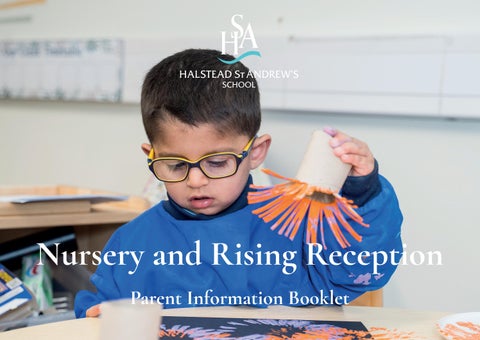

and Rising Reception
Parent Information Booklet
Nurture ~ rive ~ Succeed
Welcome to Nursery and Rising Reception
We are delighted that you have chosen Halstead St Andrew’s for your child’s prep school education and look forward to helping them and you as their parent, settle into our school community.
Being welcomed into the Nursery is the first step for your child on their educational journey through Halstead St Andrew’s. We are very much a whole School community and Nursery parents soon feel part of the school through the various parent run events during the year.
The pupils soon feel part of the whole School too as they get to know their Nursery teachers, other pupils, and staff, and move from Nursery into Rising Reception and Reception. This booklet is designed to enhance the information in the Parent Handbook to help you support your child with the transition from home onto the path of their educational journey.
Nursery provision at Halstead St Andrew’s is available 46 weeks a year. We recognise that very often both parents work and as such require nursery provision for their child to be available for the majority of the calendar year. The extended provision is known as Plus Provision. During term time, pupils will continue to participate in specialist lessons including PE, Music, Performing arts, Gym, Outdoor Learning and French for Rising Reception.
In school holidays, Plus Provision will offer weekly themes, including daily activities covering all seven areas of the Early Years Foundation Stage. The children will continue to practise skills covered throughout the term in our well-resourced classrooms and outdoor areas.
Nursery / Rising Reception Plus will open 08:00 – 17:00 (with the option to extend until 17:30) in the holidays and parents will be able to sign up to the full extended 46week provision or book days in advance (subject to availability). There is flexibility on how many days the pupils attend.
Readiness for school – what you can do
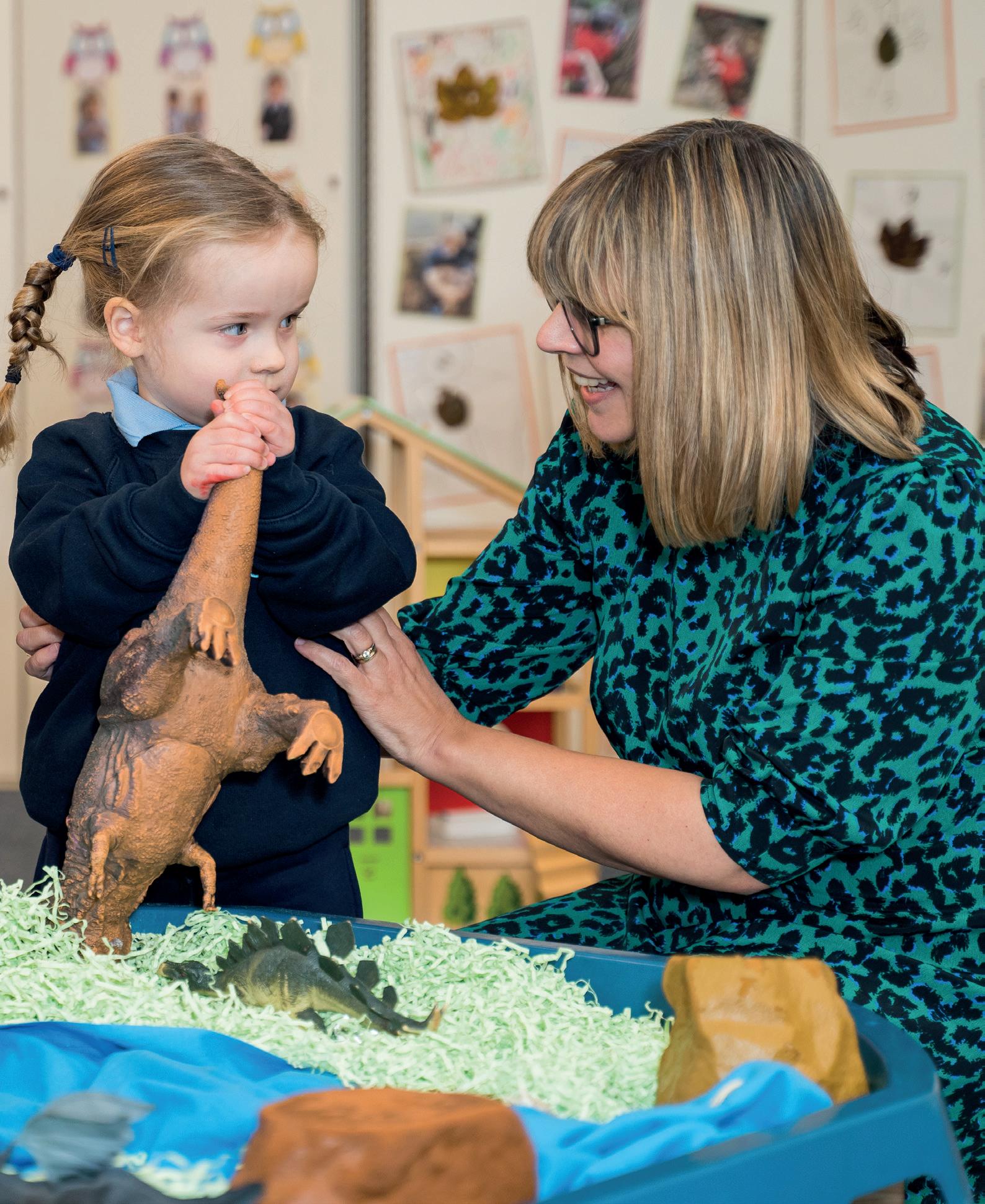
Talk to your child about starting school and share stories about the lovely things they will do with new friends in the Nursery. Your child might like to wear their uniform at home and practise getting ready for school, which can be a fun and exciting activity. We fully understand that you may be feeling a little nervous about leaving your child on their first day. This is a very common feeling but try not showing this, as your child may become anxious too.
If you have any concerns or questions, please speak to a member Mrs Brown (Nursery Manager) or Mrs Spooner (Head of Pre-Prep).
Eating
All food is provided during the school day. Please do not send any food into school with your child.
Weekly lunch and snack menus are available to view on the iSAMS Parent Portal and parent noticeboards.
Breakfast is available before school from 07:30 until 07:50 for a small charge (please see fee schedule). After this time, we expect pupils to have been given breakfast before arriving at school.
Breakfast Club should be booked in advance please via our SOCS platform Bookings can be made on an adhoc or weekly basis. If you need any assistance with the booking of Breakfast Club please email office@hsaschool.co.uk
Snacks: healthy snacks are available throughout the morning. Lunch: A delicious and nutritious lunch is provided for those pupils who stay for the whole day. Your child’s teachers will ask you about their preferred choices to ensure they are able to eat a good lunch.
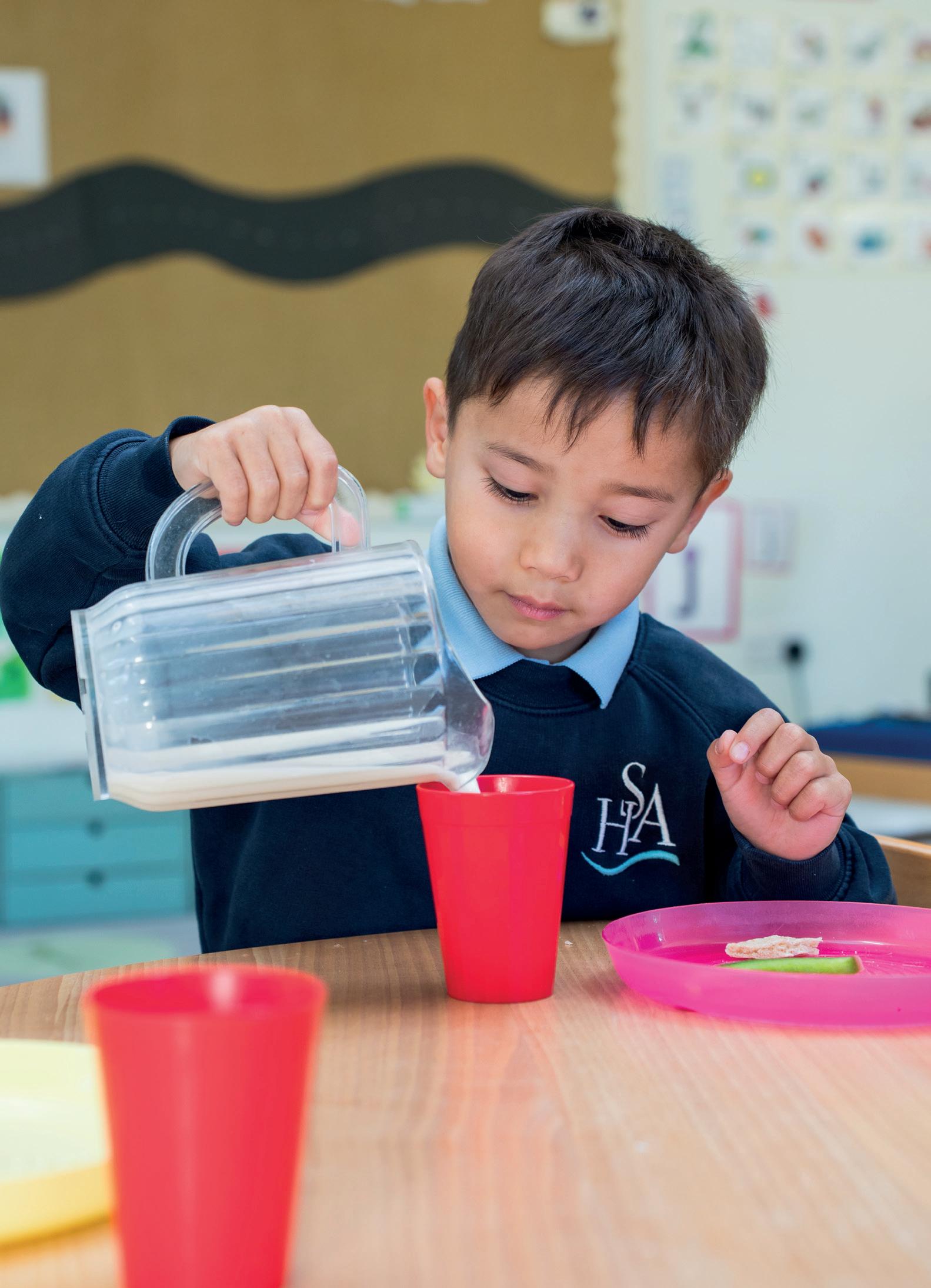
Pupils are encouraged to use cutlery at lunchtime, as appropriate to their age and stage of development. Experiencing using metal-tipped cutlery at home and encouraging self-feeding is an excellent way to help them to prepare. Please inform us of any allergies or food intolerances for specific dietary requirements.
As part of the Early Years Foundation Stage assessment, completed during Reception year, pupils are expected to be able to use cutlery with confidence in order to demonstrate good fine motor skills, so beginning to master this early will help them towards this life skill.
Developing Early Independence
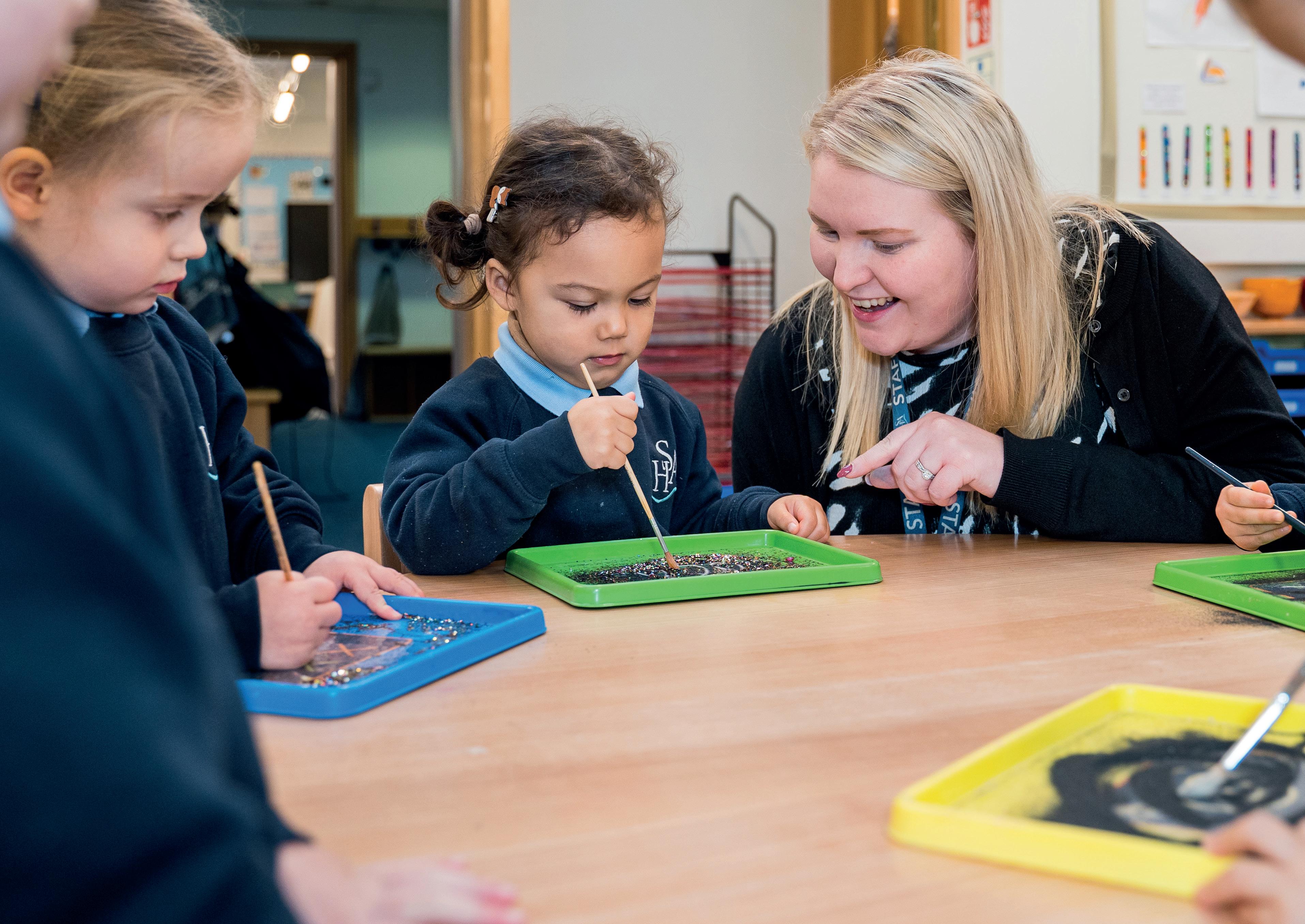
Encourage your child to ‘use their words’ when excited, frustrated, or tired, to begin to express how they are feeling, rather than just by actions. Learning to help zip up their coat or put on their hat or shoes are excellent ways to assist them towards this early independence, as they become ready to do so.
Speaking and listening skills
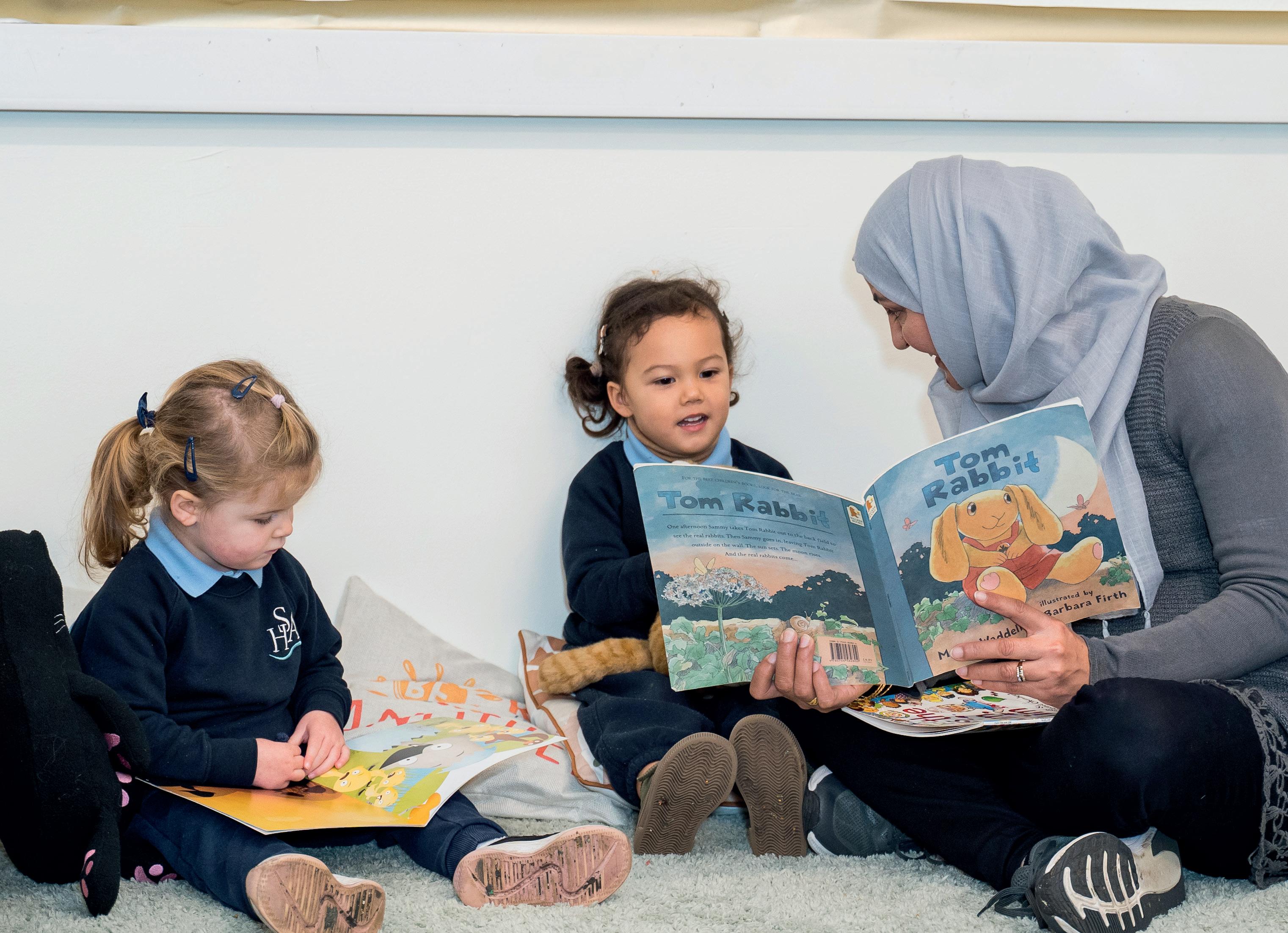
Play simple listening games with your child, identifying sounds around the house or outside. Saying rhymes and singing songs is a good way to develop early speaking and listening skills. Always model language by using clear pronunciation and avoid mimicking your child’s baby language.
The Early Years Foundation Stage
This is the curriculum through which your child is learning, and development are planned. More information on this will be shared at the Information morning at the start of the academic year or via your child’s Teacher. (You can also find further information about the Early Years Foundation here)
The Principles of the EYFS
A Unique Child - Every child is a unique child who is constantly learning and can be resilient, capable, confident and self-assured. Positive Relationships – Children learn to be strong and independent through positive relationships.
Enabling Environments – children learn and develop well in enabling environments with teaching and support from adults, who respond to their individual interests and needs and help them to build their learning over time. Children benefit from a strong partnership between practitioners and parents and/or carers.
Learning and Development – Children develop and learn at different rates. The EYFS framework covers the education and care of all children in early years provision, including children with special educational needs and disabilities (SEND).
What will my child be learning?
Prime Areas
• Personal, Social and Emotional Development
• Communication and Language
• Physical Development Specific Areas
• Literacy
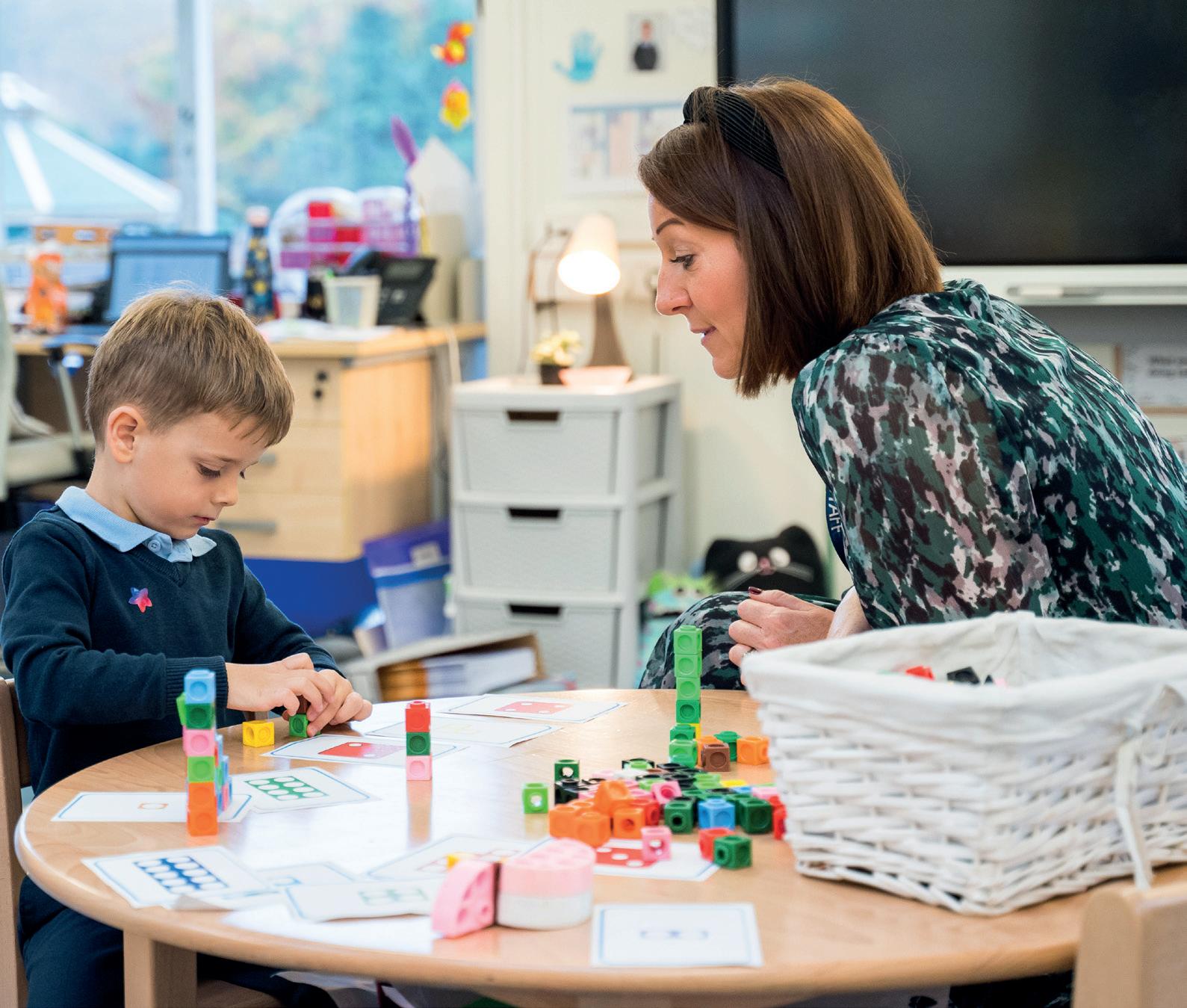
• Mathematics
• Understanding the World
• Expressive Arts and Design
All seven areas of the curriculum are connected and are equally important.
• Each child is allocated a key person who will help ensure a smooth transition into the setting. The Room Leader remains responsible for the overall care of your child and for overseeing their learning and planning their next steps.
• We keep a record of your child’s progress in all areas of learning and development in their learning journeys.
• These are available for you to look at Parents’ Evenings and at any time upon request.
• A two-year progress check will routinely be carried out in the term your child turns three unless you request a particular date to coincide with your health visitor review.
• Photos and video clips of your child are used to record their activities. These are only taken on school iPads or cameras and are for assessment purposes only.
Communication
We are always available for a brief chat about your child at the start and end of each session. However, if you need to discuss anything in more detail, please make an appointment at a mutually convenient time.
The Nursery daybook is available in the classroom for parents to jot down any messages regarding a change in who may be collecting their child. It is essential to let us know if your child is going home with somebody else. If there is a change during the morning as to who is collecting them, then please call the office to inform us or note in the diary.
Please check the calendar on the school website for relevant dates for Nursery events and Parent Portal.
Please check and empty your child’s bag each day. Encourage them to do this themselves. The bag may contain important messages from School and even more important pictures or creations from your child. Please look at and value them.
Parents’ Evenings and written reports provide us the opportunity to give you information about your child’s development. However, we will always contact you earlier if we have any concerns or questions.
Each week you will receive the School Newsletter together with an online weekly update of events and celebrations in your child’s class.
A dedicated, highly qualified and caring team of specialist early years teachers, with an in-depth knowledge of how young children learn, guide the children’s learning.
Things to remember
• A HSA waterproof coat should always be in school.
• Please ensure that your child always has a complete change of clothes in their PE bag in current school uniform colours.
• Please supply a named water bottle daily.
• If your child wears nappies, please provide enough spare ‘pull up’ and wipes for their daily care. See Toilet Training Tips.
• Please be aware that in the event of vomiting or diarrhoea, your child should remain at home for at least 48 hours to prevent the spread of infection.
• Hair accessories should only be plain school coloured (or plain gold/silver hair slides) and long hair must always be tied back.
• Please note that jewellery should not be worn in school. If your child has their ears pierced, they may wear small plain studs. These will be covered or removed during PE and gym lessons.
• Please be aware that no birthday cakes or treats are to be brought into school unless completely nut free. Please always provide a list of ingredients to prevent risk to those with allergies.
• We are happy to hand out party invitations if all the children in the class are included.
Use of Mobile Phones, Cameras and Recording Devices
As stated in our Safeguarding Policy and for safeguarding reasons please do not use electronic devices, including your mobile phone or camera when onsite and strictly not in the Early Years areas (Nursery, Rising Reception, and Reception).
It is important to drop off and greet your child with a smile, not a mobile. They will want to see you and give you a big smile or tell you about their day!
Uniform
HSA uniform is purchased online from Schoolblazer www.schoolblazer.com/how-toshop.
The HSA page of Schoolblazer is open for purchasing uniform items, please register at: www.schoolblazer.com
Children in Nursery and Rising Reception should wear black or navy school shoes or trainers.
Key events for your diary
Please see the school calendar for exact dates. There will also be reminders of dates in the weekly Newsletter.
The Principles of the EYFS
Autumn:
• Introductory morning for parents
• Reading Talk for Reception parents
• Harvest Assembly
• FOHSA Pumpkin Trail
• Parents’ Evening
• Nursery Christmas Sing-Along
• Rising Reception and Reception Nativity Play
• Christmas Party
• FOHSA Christmas Fair
Spring:
• Information morning for new families starting in the Spring Term
• Parents’ Evening
• Early Maths Talk for Rising Reception and Reception parents
Summer:
• Educational visitor or school trip for Rising Reception
• Mini Sports (Rising Reception and Reception)
• Fun Sports (for Nursery)
• Developing Independence Talk for Rising Reception parents
• End of year Report
• Parent consultation drop-in forum
Our aim is to work with parents and carers as partners, building up relationships and knowledge about your children, and to provide a well-planned and high-quality curriculum within which your child can develop at their own pace.
Each half term we share one of your child’s ‘magical moments’ with you through their Magical Moments book.
We then ask you to share with us a magical moment they have at home during the holidays. Please return the books promptly as the children are always very keen to share these at circle time.
Daily Schedule
Breakfast Club 07:30 - 08:00 Before School Care 08:00 - 08:40 8:00 onwards
drop off 08:40 at the latest 09:30 8:00 onwards
Term Dates
Autumn Term 2026
Inset Days
Tuesday 1st September, Wednesday 2nd September 2026
Start of term Thursday 3rd September 2026
Half term
Monday 19th October – Friday 30th October 2026
Plus Provision open Monday 19th October – Friday 23rd October 2026 (5 days)
Plus Provision closed Monday 26th October – Friday 30th October 2026 (5 days)
End of term Friday 11th December 2026 (12 noon)
Plus Provision open Monday 14th December – Friday 18th December 2026 (5 days)
Plus Provision closed Monday 21st December – Tuesday 5th January 2027 (10 days)
Spring Term 2027
Inset Day Tuesday 5th January 2027
Start of term Wednesday 6th January 2027
Half term
Monday 15th February – Friday 19th February 2027
Plus Provision open Monday 15th February – Friday 19th February 2027 (5 days)
End of term Thursday 25th March 2027 (12 noon)
Plus Provision closed Tuesday 30th March – Friday 2nd April 2027 (4 days)
Plus Provision Plus open Monday 5th April – Friday 16th April (10 days)
Summer Term 2027
Inset Day Monday 19th April 2027
Start of term Tuesday 20th April 2027
Half term Monday 31st May – Friday 4th June 2027
Plus Provision open Tuesday 1st June – Friday 4th June 2027 (4 days)
End of term Friday 9th July 2027 (12 noon)
Plus Provision open Monday 12th July – Friday 13th August 2027 (25 days)
Plus Provision closed Monday 16th August – Friday 27th August 2027 (10 days)
Please note Plus Provision will also be closed on Inset Days and the following Bank Holidays.
Bank Holidays
Term Friday 25th and Monday 28th December 2026
Term Friday 1st January 2027, Friday 26th March 2027, Monday 29th March 2027 Summer Term Monday 3rd May 2027, Monday 31st May 2027, Monday 30th August 2027
Appendix: Toilet Training Tips
(Guidance on Toilet Training - information taken from the Institute of Health Visiting and NHS ‘Start4Life’.)
Toilet training is one of those child developmental stages parents can find frustrating and complex.
Making the transition from nappy to toilet can certainly be a challenge. Having time at home with your child, perhaps over a half term or a holiday, helping them through this process in their familiar, home environment, is the best way to teach them these key skills.
By choosing the right time and approaching toilet training in a calm, patient manner, you can help your child to get to grips with this new skill as quickly and smoothly as possible. It is important to remember that every child is different so try not to compare your child to others. Rushing toilet training is counter-productive and it’s worth bearing in mind that:
• by the age of three, 9 out of 10 children are dry most days;
• by the age of four, most children are reliably dry.
Here are some useful tips to help you through this process:
• From about the age of 18 months your toddler will be aware that they have a wet or soiled nappy. They begin to recognise the sensation of passing urine and as they get a little older, they may tell you that they need to do a ‘wee’. Some parents start to think about toilet training their child between 18 and 24 months.
• Look out for signs such as fidgeting, walking in a funny fashion or going somewhere quiet – these are all indications that your child is aware that they are about to go to the toilet, and are cues that your child might be ready to start toilet training.
• When you are ready to start toilet training, choose a time when you can be at home and things will be calm and relaxed. If you have a busy few week ahead of you, or other pressures to contend with, it might be worth waiting until you can give toilet training your full attention, rather than trying to ‘slot it in’ to a busy schedule.
• Starting toilet training during the spring or summer months can help to minimise stress and frustration for both you and your child. There are fewer clothes for your child to take off and it is easier to dry clothes when your child has the inevitable accidents.
• Talking about toilet training with your little one is a good way to provide reassurance as they embark on this new way of doing things. Visit your local library
or ask your health visitor to recommend a picture book about toilet training that you can share with your child.
• You might also like to swap nappies for trainer pants, which can easily be pulled up and down while you are starting out on toilet training. Using ‘grown up’ training nappies can also be a good way of building confidence in your child if they are a little reluctant to move on from the security of a nappy.
• Introduce your child to a potty – explain what it is for and encourage your child to play with the potty and try sitting on it so they can get used to this new object before you start training.
• Give your child lots of praise as you go through toilet training together. Your little one needs lots of gentle encouragement and praise, as well as regular reminders to use the potty or the toilet throughout the day.
• Consistency is vital so it is a good idea to have a few quiet days at home in the early days of toilet training. If you do have to go out, take the potty with you, as it is important to keep the momentum going.
• Encourage your child to sit on the potty after each meal. Even if they do not do anything, it is a good way to encourage bowel movement as digestion is followed by a natural reflex to go to the toilet.
• It is important to wait until your child is dry during the day before attempting nighttime toilet training. Remember that nighttime bladder control may take quite a bit longer to achieve, so be patient and wait until your child is ready for this next step.
• If toilet training is not going well and you and your child are getting frustrated, try not to worry. Leave it for another month and try again, taking it more slowly and perhaps use an incentive such as a reward chart.

Church Hill House, Wilson Way Horsell, Woking Surrey GU21 4QW
T: 01483 760943
E: office@hsaschool.co.uk
“For parents wanting the personal touch, this school delivers.”