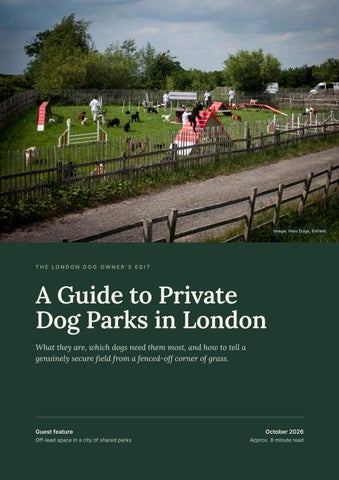
Image: Halo Dogs, Enfield
THE LONDON DOG OWNER'S EDIT
A Guide to Private Dog Parks in London What they are, which dogs need them most, and how to tell a genuinely secure field from a fenced-off corner of grass.
Guest feature
Off-lead space in a city of shared parks
October 2026
Approx. 8 minute read
P R I VAT E D O G PA R K S I N L O N D O N
G U E S T F E AT U R E
A
private dog park is a fully fenced field or paddock that you book for your own exclusive use, usually for 30 to 60 minutes at a time. For that slot, no other dogs or people can come in, so your dog can run off the lead in complete safety. Around London, most private parks sit on the edges of the city, in places like Enfield, the Hertfordshire and Essex borders and the Surrey fringe, where there is room for a proper field. Typical slots cost between £8 and £20, according to reporting in Farmers Weekly. Premium sites charge more for larger grounds, better facilities and staff on hand. This guide covers why London owners are booking them, the three kinds of off-lead space you will come across, the dogs that benefit most, and what to check before you hand over your card.
4,000
Registered dog fields in the UK by the end of 2025, up from fewer than 600 in 2018 British Dog Fields, via Farmers Weekly
11%
Of UK dogs growl, snap or bite at unfamiliar dogs PDSA PAW Report 2024
1 May
The start of compulsory leads in Richmond and Bushy Parks, running until 31 July The Royal Parks
01
Why London owners are paying for space London has wonderful parks, but they are shared, busy and increasingly regulated. That suits a confident, sociable dog with reliable recall. For many other dogs, the open park is the hardest place to relax. The rules are tightening in places. In Richmond Park and Bushy Park, The Royal Parks requires every dog to be on a lead from 1 May to 31 July while deer are giving birth. Several boroughs now license professional dog walkers. In Hammersmith and Fulham, for example, the council licence covers up to four dogs per walk in named parks. Then there are the dogs themselves. The PDSA Animal Wellbeing (PAW) Report 2024 found that 11% of UK dogs growl, snap or bite at unfamiliar dogs and 12% show signs of fear. For those dogs and their owners, a walk on Hampstead Heath or Clapham Common can mean constant scanning for the next loose dog coming over the hill. Demand has followed. Hannah James of British Dog Fields told Farmers Weekly that the UK had around 4,000 registered dog fields by the end of 2025, compared with fewer than 600 in 2018.
02
Three kinds of off-lead space, and how they differ "Private dog park" gets used loosely online, so it helps to know what you are actually booking. FREE · SHARED
B O O K E D · E XC L U S I V E
PREMIUM · SUPPORTED
Council dog enclosures
Private hire fields
Estate and centre parks
Fenced areas inside public parks, such as those reviewed across East and North East London by The Londog. Useful for a quick run. Open to everyone, so other dogs can arrive at any moment. Fence height and gate condition vary.
Farm or paddock fields booked by the slot, often through an online calendar with a gate code. The fastest-growing option around the M25. Exclusive use for your slot. Quality ranges widely, from purpose-built to a fenced corner of a farm.
Private parks run as part of a larger professional dog care site, with varied surfaces, parking and qualified staff close by. Exclusive use plus expertise on site. Best for training goals or dogs that need extra care.
03
The dogs that benefit most Any dog can enjoy a private field. For some, though, it is the difference between a stressful walk and a genuinely good one. Reactive and nervous dogs. With no surprise encounters, they can switch off their guard and simply run, sniff and play. Dogs still learning recall. A secure boundary lets you practise off-lead recall with no risk of a dash towards a road or a deer herd. Sighthounds and high-drive breeds. Greyhounds, lurchers and working breeds often need a proper sprint that a lead or a small enclosure cannot give. Rescue dogs settling in. A calm, predictable space helps a new dog build confidence before facing busy parks. Older, deaf or partially sighted dogs. They can potter at their own pace without being bowled over. Bitches in season. Exercise continues without the risk of unwanted attention from other dogs. Multi-dog households. Your own dogs can play together without the complications of a crowded park. 04
What to check before you book Photos of green grass tell you very little. The detail that matters is in the boundary, the gate and the gap between bookings.
A secure-field checklist Fence height and depth. A 1.8 metre fence, dug in at the base with small mesh, is generally treated as the standard, according to Farmers Weekly. Jumpers and diggers need both. A double-gated entrance. Two gates with a holding area between them stop an excited dog slipping past you on the way in or out. A buffer between slots. Ten minutes or so between bookings means you will not meet the previous dog at the gate, which matters most for reactive dogs. Exclusive use, in writing. Check that no staff, livestock or other customers can enter during your slot. Ground and drainage. London clay turns to mud in winter. A mix of grass and hard standing keeps sessions usable all year. Shade, water and shelter. Essential in summer, and a sign the owner has thought about welfare rather than just fencing. Parking and journey time. A short, calm drive matters for dogs that find the car stressful. Cleanliness. Bins, regular clearing and a clear policy on unwell dogs protect everyone. Who else is on site. At premium venues, a trainer, behaviourist or veterinary nurse may be close by if you need advice.
05
Getting the most from a private session The temptation is to unclip the lead and let your dog tear around for an hour. That has its place, but the real value of a private park is what it lets you practise. "Owners book a private field for freedom, and freedom is a big part of it. But the session that really changes a dog's life is the one where you practise a recall, play a scent game and finish calm. That is what carries back into the busy parks." Justin Kumaran, founder of Halo Dogs
Start on a long line. Let your dog explore the boundary first, especially on a first visit. Mix running with thinking. Scatter-feeding, hide-and-seek and short recall games tire a dog more evenly than chasing alone. Keep sessions short at first. Thirty minutes is plenty for an anxious or young dog.
End on a quiet note. A slow sniff around the edge before the lead goes back on helps the drive home. Make it a habit. A regular weekly slot builds confidence faster than an occasional treat. 06
Where private space meets professional care For many London owners, the ideal is not just a fence but a setting where help is close by. That is where estate-based parks stand apart from a field and a gate code.
NORTH LONDON
Set on 540 acres of private countryside in Enfield, Halo Dogs says its private park is booked for exclusive use in 30 to 60 minute sessions, with fully fenced grass and concrete fields and free parking. Founded in 2009, the five-star licensed centre also has qualified trainers, canine behaviourists and an on-site veterinary nurse on its team. That combination suits owners who want more than a run. A reactive dog can have a quiet session and, when the owner is ready, a trainer can help turn that calm into progress.
07
The bottom line A private dog park is one of the simplest upgrades a London owner can make to their dog's week. It is most valuable for dogs that find shared parks hard, and for owners working on recall or confidence. Choose one with a proper boundary, a double gate and genuine exclusivity, and use the time to practise as well as play. Book a regular slot, keep the sessions purposeful, and you may find the busy park on Saturday becomes a little easier too. · · ·
Sources 1. Farmers Weekly, How dog field diversifications can bring in the cash on farm (May 2026) 2. PDSA Animal Wellbeing (PAW) Report 2024: Dogs 3. The Royal Parks, Dogs on leads compulsory during the deer birthing season 4. Hammersmith & Fulham Council, Licence for professional dog walkers 5. The Londog, Enclosed dog parks of East and North-East London