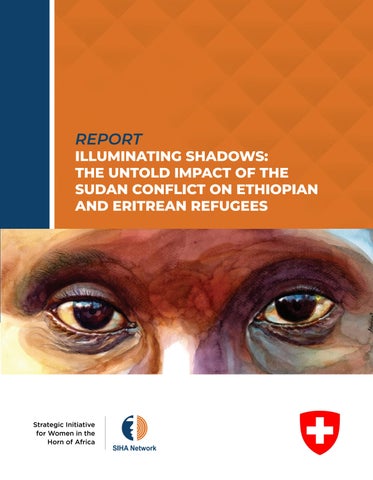
REPORT
ILLUMINATING SHADOWS: THE UNTOLD IMPACT OF THE SUDAN CONFLICT ON ETHIOPIAN AND ERITREAN REFUGEES
Strategic Initiative for Women in the Horn of Africa
DISCLAIMER This publication was produced with funding from the Swiss State Secretariat for Migration. However, the views expressed and the content included do not imply official endorsement or acceptance by the Swiss State Secretariat for Migration or their affiliated organizations.
Cover artwork: Hussein Salim Design: Marce Digital
Published: June 2024 No part of this publication may be reproduced, stored in a retrieval system, or transmitted in any form or by any means without prior approval in writing from The Research Team and SIHA Network. This Paper is not a legally binding document. It is a collaborative informational and assessment document and does not reflect the views of any of the contributing partners in all its contents. Any errors are the sole responsibility of the authors. Copyright © 2024 SIHA Network
INTRODUCTION: In April 2023, war broke out across Sudan. Sudan’s recent armed conflict has precipitated one of the most rapid crises on a global scale, affecting millions and creating a dire humanitarian situation. Almost 25 million people are projected to be in need of basic assistance in 2024 as a result of the conflict, with only 14.7 million targeted by OCHA for assistance in 2024.1 The conflict has led to unprecedented displacement, with 8 million people uprooted and over 6.5 million internally displaced within Sudan, seeking refuge in various locations. This exodus has extended beyond Sudan’s borders, with approximately 1.2 million fleeing to neighboring countries, escalating the crisis to the largest displacement event worldwide.2 This crisis has exacerbated an already critical situation in which civilians face not only violence but also risks related to food insecurity due to disruptions in agricultural systems alongside disruptions in food trading systems. The Food and Agriculture Organization notes that a third of the population, roughly 18 million people, are facing acute food insecurity in this coming year. This represents the highest number recorded during a harvest season and highlights the scale of damage and disruption in Sudan’s agricultural regions.3 For decades, Sudan has served as a haven for tens of thousands of Eritrean and Ethiopian refugees fleeing conflicts and droughts in their homelands. Many Eritreans sought refuge from the prolonged conflict with Ethiopia, which eventually led to Eritrea’s independence in 1993. Moreover, many Ethiopians came, first as labor migrants and later as refugees in the wake of the 2021 war in Tigray as well as the ongoing wars in Amhara. This history of displacement saw a significant number of Eritreans and Ethiopians making Sudan their home, with the influx of refugees notably increasing during times of intensified conflict and hardship. With the outbreak of hostilities in Sudan on April 15, a reversal of this long-standing migration pattern has emerged. Over 47,000 refugees and asylum seekers, predominantly Ethiopians who had found refuge in Sudan, have returned to Ethiopia.4 Others have remained in Sudan, facing unstable conditions, disrupted
1 https://reports.unocha.org/en/country/sudan/ 2 https://data.unhcr.org/en/situations/sudansituation Accessed April 2, 2024 3 https://www.fao.org/newsroom/detail/sudan-fao-issues-stark-warning-over-deeply-concerning-scaleof-hunger/en 4 https://www.aljazeera.com/news/2024/1/31/nearly-eight-million-people-displaced-by-war-in-sudan-un
The Untold Impact of the Sudan Conflict on Ethiopian and Eritrean Refugees
2