DISCLAIMER The production of this briefing paper titled “Inclusive Democracy in Somalia: Why One-PersonOne-Vote Must Include Women’s Quotas,” was supported by the Championing Change Project, generously funded by the Government of Ireland. The views expressed in this paper are those of the author and do not necessarily reflect the official policies of positions of the Government of Ireland.
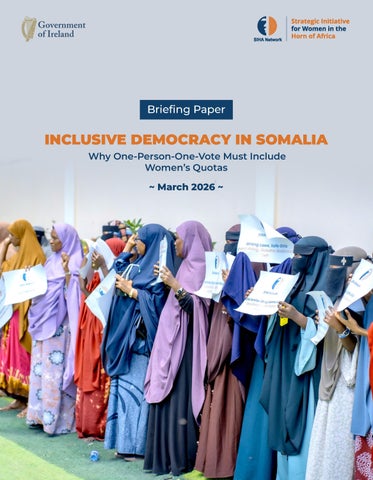
Cover Photo Photographer: Ahmed Karama Design: Marce Digital
Publish May 2026 No part of this publication may be reprinted or reproduced, or utilized in any form or by any means electronic, mechanical or other means now known or hereafter invented including copying and recording, or in any information storage or retrieval system, without permission in writing from the publishers.
Strategic Initiative for Women in the Horn of Africa P.O. Box 2793 Kampala – Uganda www.sihanet.org
©SIHA Network 2026
Page 2
Inclusive Democracy in Somalia
CONTENTS Disclaimer--------------------------------------------------------------------------------------------------------2 Acknowledgement--------------------------------------------------------------------------------------------4 Executive summary--------------------------------------------------------------------------------------------5 Current Political Dynamics in Somalia --------------------------------------------------------------------6 Women’s Political Participation Under the Current System- ----------------------------------------7 Evidence from Somaliland: Elections Without Quotas------------------------------------------------8 Why One-Person-One-Vote May Reduce Women’s Seats in Somalia------------------------------9 Comparative Insight: Somalia and Somaliland----------------------------------------------------------10 Conclusion-------------------------------------------------------------------------------------------------------11 Recommendations--------------------------------------------------------------------------------------------12
Page 3
Inclusive Democracy in Somalia
ACKNOWLEDGEMENT This briefing paper was prepared by Yousuf Ahmed Abid, the Somali Region Programme Coordinator for SIHA Network. As Somalia moved towards transitioning to the One-Person-One-Vote electoral system, this briefing paper looks at the importance of safeguarding women’s political representation during this process. In doing so, it looks at how existing quota mechanisms have supported women’s participation, and analyzes the potential risks that electoral reform may pose if gender safeguards are not maintained. In drawing comparative insights from Somaliland, this paper outlines key challenges and provides practical recommendations to keep gender quotas in place, ensuring that Somalia’s democratic progress remains inclusive and equitable. Sincere gratitude goes to the SIHA Regional Team including Hala Al-Karib, the Regional Director; Faizat Badmus Busari, the Regional Programme Manager; and Ramatoulie Jallow, the Regional Research and Advocacy Officer for their contributions and guidance throughout this process. The briefing paper should be cited as follows: The Strategic Initiative for Women in the Horn of Africa (SIHA) Network, “Inclusive Democracy in Somalia: Why One-Person-One-Vote Must Include Women’s Quotas,” 2026.
Page 4
Inclusive Democracy in Somalia
EXECUTIVE SUMMARY Somalia’s move toward a one-person-one-vote (OPOV) system is an important and hopeful step toward a more democratic future. It offers people the chance to have a direct say in how they are governed and can strengthen trust in political institutions, but as the country makes this transition, it is important to recognize what could be lost along the way. Under the current system, even with its limitations, women have managed to gain meaningful presence, though still insufficient, in parliament, largely because of negotiated quotas and deliberate efforts to include them. If these safeguards are not carried into the new system, there is a real risk that women could be pushed out of political spaces altogether. Many women already face challenges such as limited financial resources, social expectations, and lack of support within political structures, barriers that become even harder to overcome in competitive elections. Experiences from places like Somaliland show that without quotas, women can quickly disappear from decision-making bodies. For Somalia’s democratic transition to be truly fair and inclusive, it must ensure that women are not just voters, but leaders. This means putting strong, enforceable quotas in place so that progress is protected and built upon, not lost. This briefing paper aims to highlight the importance of safeguarding women’s political representation during Somalia’s transition to a OPOV electoral system. It provides an overview of the current political context, examines how existing quota mechanisms have supported women’s participation, and analyzes the potential risks that electoral reform may pose if gender safeguards are not maintained. Drawing on evidence from Somalia and comparative insights from Somaliland, the paper outlines key challenges, presents practical recommendations, and emphasizes the need for enforceable quotas and supportive measures to ensure that Somalia’s democratic progress remains inclusive and equitable.
Page 5
Inclusive Democracy in Somalia