POSITION PAPER
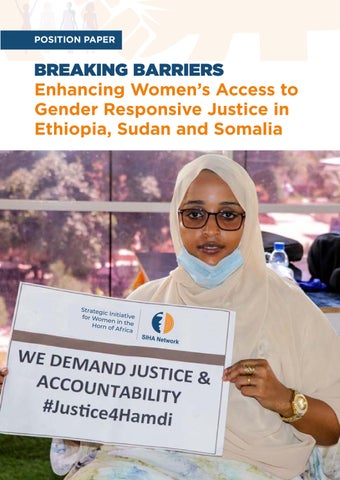
BREAKING BARRIERS Enhancing Women’s Access to Gender Responsive Justice in Ethiopia, Sudan and Somalia
Strateg ic In for Wom itiative en in th e Horn of Af rica
Cover photo: SIHA Network Design: Namanda Diana Published: October 2025 All rights reserved. No part of this publication may be reproduced, stored in a retrieval system, or transmitted in any form or by any means without prior approval in writing from The Research Team and SIHA Network. This Paper is not a legally binding document. It is a collaborative informational and assessment document and does not reflect the views of any of the contributing partners in all its contents. Any errors are the sole responsibility of the authors Copyright © 2025 SIHA Network
2
BREAKING BARRIERS: Enhancing Women’s Access to Gender Responsive Justice in Ethiopia, Sudan and Somalia
Acknowledgment This Briefing Paper was prepared by Irene Mwendwa and Garnett Achieng. It raises awareness of the barriers preventing women in Ethiopia, Sudan, and Somalia from accessing justice, and provides information to support and encourage help-seeking behaviour among these women. It concludes with key recommendations for strengthening pathways for women’s access to justice in the Horn of Africa. Sincere gratitude is extended to the SIHA Regional Team; including Hala Al Karib, Regional Director; Faizat Badmus-Busari, Regional Programme Manager; Sandra Nassali, Regional Advocacy and Communications Coordinator; and Ramatoulie Jallow, Regional Research and Advocacy Officer — for their valuable contributions and guidance throughout the process. This paper should be cited as follows: “The Strategic Initiative for Women in the Horn of Africa (SIHA) Network, “Breaking Barriers – Enhancing Women’s Access to Gender Responsive Justice in Ethiopia, Sudan and Somalia,” 2025
BREAKING BARRIERS: Enhancing Women’s Access to Gender Responsive Justice in Ethiopia, Sudan and Somalia
3
INTRODUCTION Women’s Access to Justice in Ethiopia, Sudan & Somalia Access to justice is a human right that encompasses the litigability, availability, accessibility, quality and accountability of justice systems, and the provision of remedies for victims (UN Women, 2021). The United Nations Sustainable Development Goals (SDGs) outline ambitious targets to ensure equal access to justice for all by 2030. However, women in Ethiopia, Somalia, and Sudan face structural and societal barriers that prevent them from seeking justice and securing accountability for harms and violations committed against them. Women in these three countries already face significant disadvantages with regard to marriage, family, property, inheritance and employment rights due to institutionalised discrimination. This discrimination is further compounded by the lack of access to justice, meaning that few women get redress for the injustices that they face. This position paper aims to raise awareness of the barriers preventing women in Ethiopia, Sudan and Somalia from accessing justice, and
to provide information that can promote helpseeking behaviour amongst these women.
A. Legal & Policy Gaps One of the biggest barriers to justice across the three focus countries is the complex legal landscape that forces women to navigate three distinct layers of legal systems simultaneously. In Ethiopia, Somalia, and Sudan, customary, religious, and statutory legal systems coexist, creating an intricate and often confusing framework that women must delicately navigate to seek justice. This legal pluralism creates confusion and uncertainty, as many women may not know which system applies for their case. In Ethiopia, for instance, the extent of legal protections varies by region. Women in the Somali and Afar regions face a fragmented legal system as these regions are yet to enact state family laws, limiting their ability to seek justice within their region (EWLA et al, 2024). In such situations, it is difficult for women to determine
Country
Triple Legal System
Ethiopia
1.
Statutory Legal System- Federal and State Courts
2.
Religious Legal System-Shariah Courts
3.
Customary Legal Systems (social courts)
1.
Statutory Legal System-
2.
Religious Legal System-Shariah Courts
3.
Customary Legal Systems- Xeer System
1.
Statutory Legal System
2.
Religious Legal System-Shariah Courts
3.
Customary Legal Systems
Somalia
Sudan
4
BREAKING BARRIERS: Enhancing Women’s Access to Gender Responsive Justice in Ethiopia, Sudan and Somalia
which courts have jurisdiction over their cases, their rights under each system, or how to proceed when one system fails them. Legal pluralism has been beneficial because in contrast to statutory legal systems, customary and informal justice systems are linguistically, geographically and financially accessible, faster at resolving disputes, and are perceived as more legitimate within communities (IDLO, 2019). Women, in particular, benefit from these systems as they do not have to travel far or spend a lot of money to seek remediation, and often want to maintain their status in their marriages, families and communities. In countries recovering from conflict, customary and informal justice systems offer legal recourse where formal systems are still recovering. Despite the benefits of legal pluralism, customary and informal justice systems (CIJ) tend to leave behind women and other vulnerable groups (Swenson, 2018). CIJ systems are often infiltrated with patriarchal norms, resulting in discriminatory and harmful outcomes for women and girls. The choice to seek justice at the CIJ level is also not free from influence, as women are often pressured and coerced to rely on these systems in order to preserve community and familial peace. This can be reflected in ruling decisions, such as the case of Somalia, where CIJs sometimes prioritise community peace over justice for survivors of Sexual and Gender-Based Violence (SGBV) (SIHA Network, 2023). In other cases, women may feel discouraged to solve disputes at these courts because of the public nature of the hearings which makes it hard for them to bring up topics that are shrouded in shame and stigma, such as sexual violence (IDLO, 2019). Formal justice systems in these countries are not without fault, as they are less preferred by
women due to financial inaccessibility, complex structures and procedures, lack of language support for victims and the stigma that women have to face after court rulings. The cost of pursuing cases in formal systems has deterred women as they have to account for varied costs ranging from case processing fees, legal support fees, to bribery costs to ‘facilitate’ case progression. A 2021 UN Women study also found that formal courts tended to benefit wealthier and more politically connected women more, while poorer women often had their cases dismissed because of corruption (UN Women Africa, 2021). Lastly, formal courts are difficult to navigate without legal representation. This is in contrast to CIJs where women can represent themselves, but also tend to be aware of the legal intricacies as they are derived from local cultures and religions that they have been part of all their life.
B. Setbacks from Cultural & Religious Legal Institutions Women and girls in the Horn of Africa are often subject to patriarchal values encoded in legal systems, ultimately making it difficult for them to get justice. Patriarchal ideologies legitimise male power and authority over women, and endorse punitive measures over women who deviate from societal norms. When patriarchy is enshrined not only in the law but also in the institutions that are supposed to protect women, it becomes difficult for them to trust or rely on these systems. Consequently, legal frameworks that should safeguard women’s rights often reinforce the same structures that oppress them. One way we see patriarchy encoded in legal systems in the Horn of Africa is in the inadequate
BREAKING BARRIERS: Enhancing Women’s Access to Gender Responsive Justice in Ethiopia, Sudan and Somalia
5