


This Modern Slavery Statement is submitted on behalf of Haileybury (ABN 34 004 228 906), under section 13 of the Modern Slavery Act 2018 (Cth) (MSA) to cover the reporting period of 1 January 2025 to 31 December 2025.

Acclaimed as a great independent school, Haileybury offers a uniquely rewarding educational experience. Through our innovative approach to teaching and learning, students can discover more, achieve more and become more.
Since 1892, when our doors first opened with five staff and 17 students in attendance, Haileybury has been a centre of continual development: learning, teaching and location have all undergone transformative change on our path to become the School we are today.
The School has enrolments exceeding 7,000 across its campuses and operations in Berwick, Brighton, Keysborough, Melbourne City, Darwin (Northern Territory) and across Southeast Asia in China, Vietnam, the Philippines and Timor-Leste. Haileybury’s mission is to develop high-achieving students, connected globally, to each other, and to the communities in which they live and which they will serve.
The School is strongly committed to principles of fairness, equity and human rights. We believe we have a shared responsibility to contribute to positive social change both locally and globally.
Haileybury has three wholly owned subsidiaries, none of which is a reporting entity for purposes of the MSA. These are as follows: Haileybury Foundation (ABN 70 142 288 346), Haileybury International (ABN 80 159 734 193) and Haileybury Rendall School (ABN 84 325 837 304).
This Statement extends to the activities and operations of Haileybury and its abovementioned subsidiaries.
Haileybury is committed to operating responsibly and establishing and adhering to the highest ethical standards. This is the School’s sixth Modern Slavery Statement.
As indicated above, Haileybury is an independent School for all genders, with physical campuses in Keysborough, Brighton, Berwick, and Melbourne (City), and an online campus, Haileybury Pangea. Haileybury has three subsidiaries: Haileybury Foundation, Haileybury International and Haileybury Rendall School, which is based in Darwin. None of these subsidiaries meet the reporting threshold under the MSA.
Haileybury is registered as a charity with the Australian Charities and Not-for-profits Commission and is governed by a board of directors known as its Council, comprising non-executive volunteers. The CEO | Principal, supported by the Chief Operating Officer and Senior Executive Team, is responsible for the day-to-day management and operations of the School and its subsidiaries.
The principal activity of the School operations in Australia is the provision of kindergarten, primary and secondary education.
Schooling is provided in Tianjin, China under the Haileybury name, but Haileybury does not have a majority interest in these schools,
nor does it control them. Haileybury Senior School Tianjin is a boarding school for Chinese students from Years 10 to 12. Another school, Tianjin Haileybury Elite School, which is neither owned nor controlled by Haileybury, is a Years 1–9 Chinese School that leases facilities and shares some staff with Haileybury Senior School Tianjin.
Haileybury has a non-controlling share in a joint venture company in China. That company has a Management Agreement with Haileybury Senior School Tianjin. Haileybury has two out of five members on the joint venture company board. Haileybury Senior School Tianjin is neither majority-owned nor controlled by Haileybury and its board is made up entirely of Chinese citizens, none of whom is connected to Haileybury.
Despite not directly managing the Schools, Haileybury commits to working with the management in China to investigate and manage any potential modern slavery risks in the operations and supply chains of the Chinese schools.


During the 2025 reporting period, Haileybury continued its engagement with industry experts, FairSupply Analytics, to undertake detailed supply chain mapping and risk assessment for our entire supplier base. FairSupply Analytics employs a proprietary analysis method to Haileybury’s supplier and spend data, and a multi-regional input-output table, to thoroughly map our supply chain reaching up to 10 tiers.
The vast majority of Haileybury’s Tier 1 supply chain is located in Australia, as represented in Table 1 below. This localised supply chain provides Haileybury with a greater level of influence over the practices of its suppliers, which has been a factor in designing and implementing our 3-Year Modern Slavery Action Plan, discussed later in this statement.
Country Percentage of Total Spend Australia
United
China 0.031%
Ireland 0.012%
South Africa 0.011%
India 0.007%
Spain 0.003%
Indonesia 0.002%
Denmark 0.001%
Table 1: Tier 1 Supply Chain by Country
Approximately 80% of Haileybury’s supplier spend during the reporting period occurred in the following categories. This shows some correlation with the industry-based risk ranking discussed in the subsequent section.
Table 2: top 80% of supplier spend by supplier category
The structure of spending largely aligns to the ongoing operational requirements of the School, with the exception of Construction Trades and Services, and Architectural and Design, which is reflective of several major capital projects completed or in planning within the reporting period.
This extensive analysis has provided invaluable insights to Haileybury to understand our existing risk profile as well as inform anti-modern slavery initiatives moving forward.

Having now completed five consecutive years of supply chain analysis, Haileybury has gained a deeper understanding of its supply chain risks across a range of metrics; and we are now able to draw greater insights on the nature of modern slavery risk in our supply chain and the effectiveness of our supply chain risk mitigation measures.
Supply chain risk is represented in the ‘estimated people in forced labour’ (EFL) which indicates the theoretical number of people in conditions of modern slavery within the supply chain. To consistently measure the organisation’s impacts on modern slavery, the EFL can be measured per million dollars spend (EFL/M).
Haileybury’s holistic EFL/M at the end of the 2025 reporting period was 0.0145. This represents a 6.9% decrease since the same time last year.
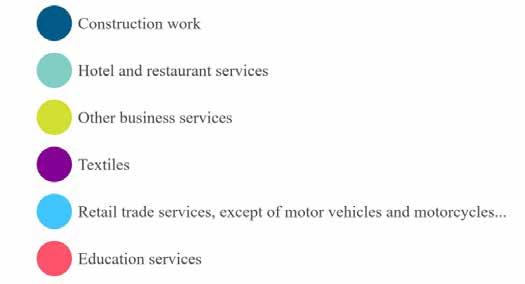
Haileybury’s top 10 industries by risk level is consistent with the prior reporting period. Notably, Construction Work features highly as a result of major capital projects undertaken during the 2025 reporting period.
Figure 1: Top 10 supply chain industries by risk level
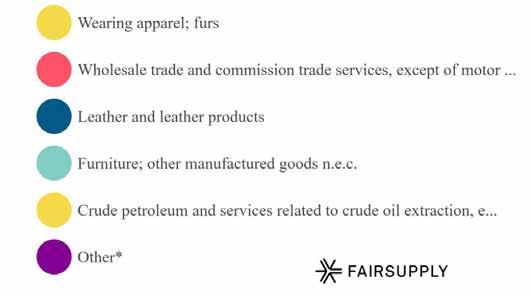
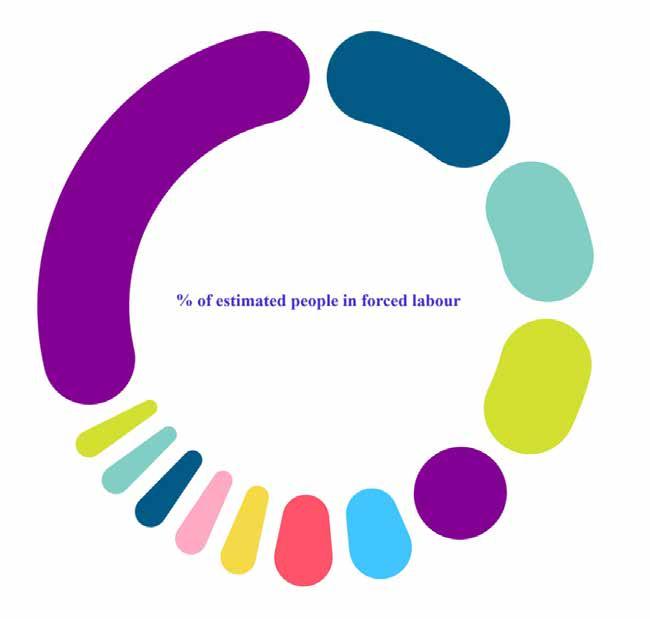
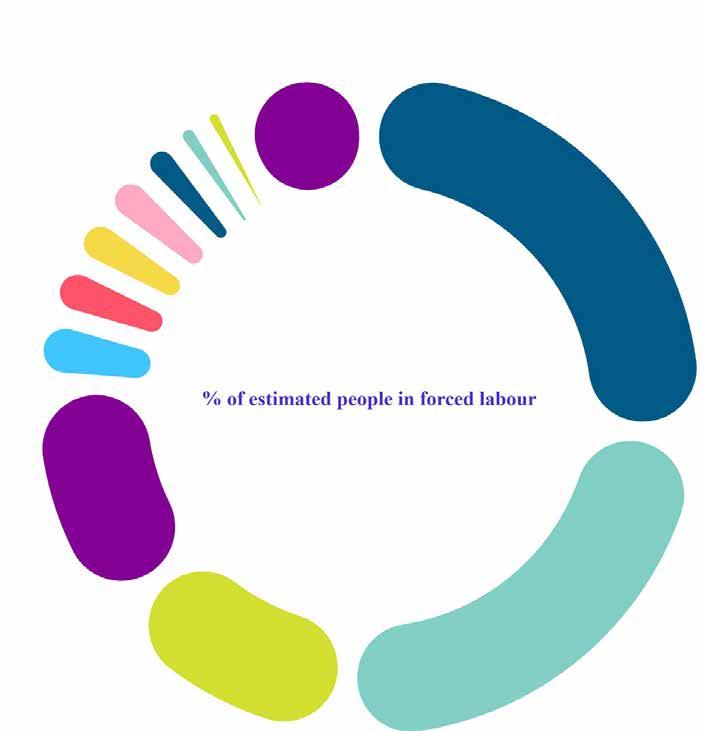
On an individual supplier level, the suppliers identified to have the highest EFL fall into the Textiles, and Computer and Related Services sectors. Despite this risk level, Textiles carries very little risk in Tier 1 of the supply chain, which is in stark contrast to Construction Work, and Hotel and Restaurant Services (i.e., travel and accommodation, as well as school events, including food and catering) where the majority of risk is held in Tier 1.
people in forced labour
Tiered risk level
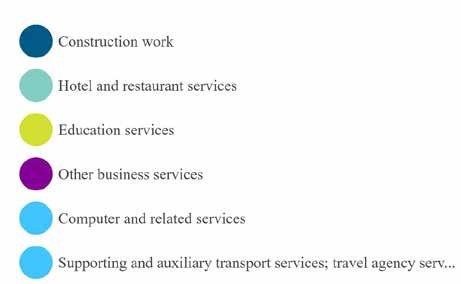
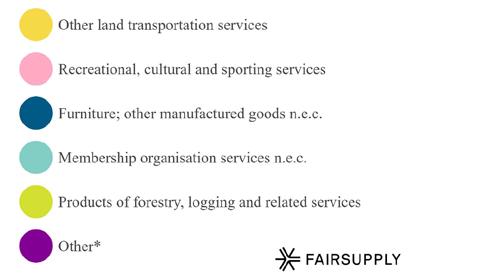
The profile of risk in Haileybury’s supply chain is similar to the prior reporting period, where Tier 1 is the most significant in terms of EFL. This is linked to the significance of construction work in our spend profile, as shown in Figure 3.
Figure 2: Theoretical slavery footprint by supply chain tier
Figure 3: Percentage of theoretical slavery footprint by industry at Tier 1 of the supply chain
% of estimated people in forced labour
The view of tiered supply chain risks supports Haileybury’s strategies for addressing modern slavery risks in our supply chain, as defined in our 3-Year Modern Slavery Action Plan. Our Action Plan has a strong focus on supplier engagement and education, which will have the greatest impacts on the top tiers of our supply chain.
4: Theoretical slavery footprint by country
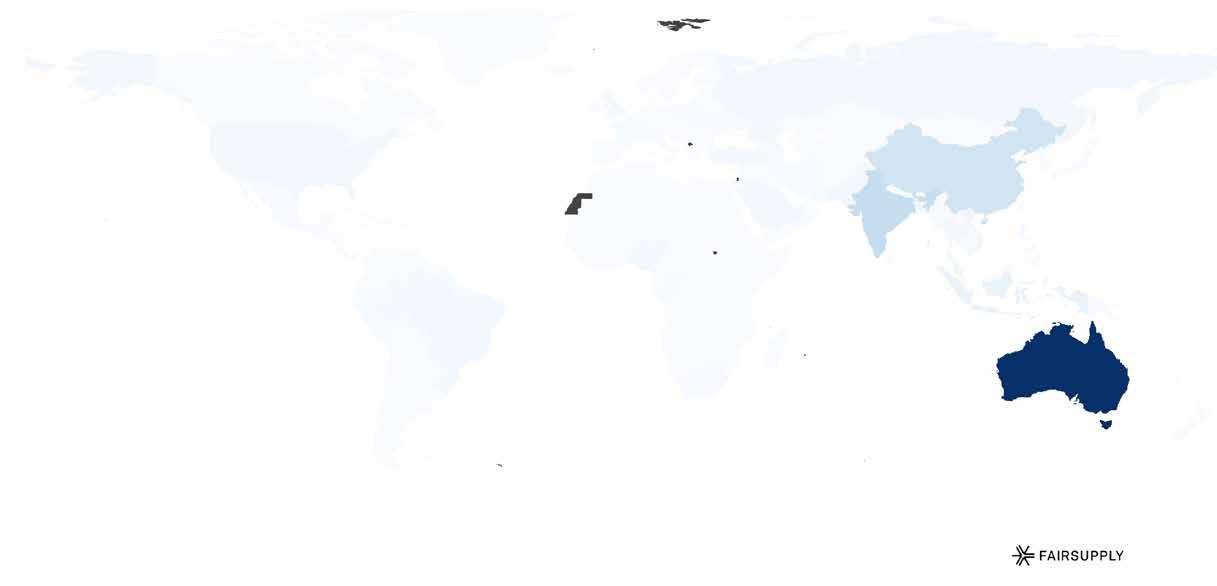
The map above represents Haileybury’s TSF by geographical location. Over 80% of Haileybury’s EFL exists within 10 countries, represented in the table below.
Using the risk analysis, Haileybury has ranked each of its suppliers by risk level. This enables greater due diligence and engagement with higher-risk suppliers to ensure that Haileybury is able to influence antimodern slavery practices in the highest impact areas of its supplier base through supplier agreements and other direct engagement. Those suppliers representing the highest risk have been the focus of the supplier engagement and education strategies articulated in our 3-Year Modern Slavery Action Plan.
Since 2021, Haileybury has conducted modern slavery questionnaires of its suppliers and has received 1,405 questionnaire responses in that time. The mandatory questionnaire for new suppliers, provides Haileybury with greater context around supplier knowledge, practices, procedures and responses to managing modern slavery risks. Further details regarding the supplier questionnaire are outlined later in this statement.
Australia ranks highly, predominantly due to the concentration of Haileybury’s Tier 1 supply chain and therefore spend. The remaining countries feature most in tiers 2 and 3, with Tier 2 being represented most highly.

Haileybury provides (either directly or through a subsidiary or affiliate):
> early learning, including kindergarten, for children aged 3–5 in Australia
> schooling for international and local children aged 5–18 in Australia
> boarding and residential care (via a thirdparty homestay provider) in Australia for local and international children
> the Victorian Certificate of Education (VCE) and English as an Additional Language (EAL) course in Chinese schools including in Qingdao, Chengdu, Tianjin, Ningbo, Wuhan, Luoyang, Tongcheng, Sanshui and Beijing (Haidian District) and in schools in Timor-Leste, the Philippines, Papua New Guinea, Vanuatu, Indonesia and Vietnam.
Haileybury’s delivery of the VCE internationally (as referred to above) extends only to the provision of curriculum advice and teacher training. Students undertaking the Haileybury VCE internationally are cared for by their local schools.
We acknowledge the potential risks that our operations pose and have taken actions as described below in order to address those potential risks. However, given our primary operations consist of the education of children, the very core of our business requires a deep understanding of how to ensure the best interests of the child are always prioritised. We are very familiar with the inherent vulnerability of children and work every day to safeguard the wellbeing and education of our students. We consider this focus of our business to lower the risks of modern slavery posed by our operations.
Through our interaction with Haileybury Senior School Tianjin and Tianjin Haileybury Elite School, we will work to influence and ensure a similar ethos within those schools’ Chinese operations, recognising that as an investment of Haileybury, it is important for us to manage any risks of modern slavery within that environment.
Being an independent school, driven by consistent demand, our budgetary pressures in relation to our operations or supply agreements are relatively unaffected. We therefore do not filter down pressure upon our own workers or suppliers or other businesses.
During the earlier reporting periods, Haileybury began to lay the foundations of its anti-modern slavery program, opening dialogue with its suppliers and initiating questionnaires to understand the maturity of approach to modern slavery within its supplier base.
During the 2025 reporting period, Haileybury has continued to advance its anti-modern slavery program by:
> undertaking a fifth round of supply chain risk assessments through engagement with FairSupply Analytics, further developing a view of supply chain risk over time
> growing and developing the Modern Slavery Working Group
> promoting awareness by inviting guest speakers to present to staff and students
> inviting suppliers to attend webinars, and information sessions
> communicating mechanisms for individuals within our supply chain to raise concerns and grievances about modern slavery
> drafting, implementing and making publicly available Haileybury’s Supplier Code of Conduct.
This is in addition to existing due diligence, governance and risk management measures, including:
> a 3-Year Modern Slavery Action Plan (covering years 2024, 2025 and 2026)
> established processes to ensure that all labour hire companies are licensed by the Victorian Labour Hire Authority or its equivalent elsewhere in Australia
> a Financial Delegation Policy and Framework governing procurement authority to ensure greater scrutiny and appropriate management oversight over supplier selection and management
> a Whistleblower program, including a dedicated, independent 24-hour whistleblowing hotline
> processes for supplier onboarding and the approval of new suppliers
> an online contracts management system.

As at the end of the 2025 reporting period, Haileybury had received approximately 1,405 modern slavery questionnaire responses from suppliers in a wide range of categories and of varying size.
The data extracted from the questionnaire is portrayed within an interactive dashboard, which in addition to the FairSupply Analytics online portal, provides further insight into supplier awareness, and their modern slavery practices and procedures. These insights help inform decision making around preventative and detective measures, provide Senior Executive greater insight into our supplier base, and determine whether to engage or continue to engage suppliers.
Currently, the Supplier Questionnaire is completed by new suppliers, however, the aim is to distribute the questionnaire annually to our active supplier base. This will ensure ongoing due diligence is conducted on our supply chain and allow Haileybury to actively assess and monitor whether suppliers are enhancing their practices and awareness; and whether we continue to engage and support suppliers in the future.
For many of Haileybury’s smaller suppliers, our questionnaire has been a catalyst for the consideration of modern slavery risks in their operations and supply chains.

We take our obligations to our students, staff and community very seriously. Haileybury has a range of reporting mechanisms to ensure that the effectiveness of our governance and risk control measures are monitored by the Senior Executive and School Council. This includes the completion of mandatory training programs, whistleblower complaints and other key assurance measures designed to ensure our risk control measures are effectively implemented.
We see collaboration in the supply chain as a critical success factor in addressing modern slavery risks and, as such, supplier engagement in our anti-modern slavery program initiatives is an important indicator of effectiveness. We are continuing to deepen supplier engagement at an earlier stage and ensure the relationship is strengthened throughout the engagement by:
> embedding modern slavery reporting in the onboarding process for all new suppliers
> incorporating modern slavery requirements in all new supplier contracts
> providing modern slavery educational resources to suppliers at the point of onboarding
> providing the opportunity to attend modern slavery seminars presented by Be Slavery Free.
Haileybury’s EFL/M will provide a key reporting metric for measuring the effectiveness of our anti-modern slavery approach. This metric can be used at a supplier or industry level, or as a holistic measure at the organisational level.
Many of Haileybury’s central functions are shared amongst its wholly owned subsidiaries referred to above, and they share our key suppliers. Many of the members of the governing bodies of our subsidiary entities are members of the Haileybury School Council.
There is significant collaboration and consultation between Haileybury entities in all aspects of our operations, including our approach to addressing modern slavery risks.
Haileybury’s 3-Year Modern Slavery Action Plan forms the basis of our efforts to combat modern slavery risk. The 2026 reporting period will mark the third and final year of the current Action Plan and comprises four pillars: Educate; Be Informed; Mitigate Risk; Evaluate.
Specific initiatives captured in Year 3 of the Action Plan include:
> providing ethical purchasing training for budget managers
> establishing targets for key modern slavery metrics
> incorporating anti-modern slavery, ethical purchasing and procurement into certain relevant curriculum and extracurricular programs
> inviting student representatives to take part in informing the School’s forward anti-modern slavery planning
> conducting audits on high-risk suppliers with a focus on supplier conduct, human rights, and risks associated with modern slavery
> leveraging existing public databases on supplier performance and human rights breaches to layer additional screening over new suppliers and contracts
> undertaking a self-assessment of organisational maturity in modern slavery risk management.
Our Modern Slavery Statement will be reviewed and updated annually.
Haileybury makes this Statement in accordance with section 13 of the Modern Slavery Act 2018 (Cth). This Modern Slavery Statement was considered and approved by the Haileybury School Council on 6 March 2026. The Haileybury School Council is Haileybury’s principal governing body under the MSA.

Prof Gregory Whitwell Chairman of Council
Responsible Member of Haileybury’s Principal Governing Body