Flexographic printing
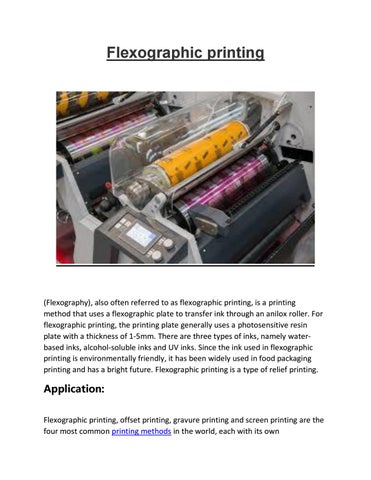
(Flexography), also often referred to as flexographic printing, is a printing method that uses a flexographic plate to transfer ink through an anilox roller. For flexographic printing, the printing plate generally uses a photosensitive resin plate with a thickness of 1-5mm. There are three types of inks, namely waterbased inks, alcohol-soluble inks and UV inks. Since the ink used in flexographic printing is environmentally friendly, it has been widely used in food packaging printing and has a bright future. Flexographic printing is a type of relief printing.
Application: Flexographic printing, offset printing, gravure printing and screen printing are the four most common printing methods in the world, each with its own
characteristics and its own merits. In countries with developed printing industries such as Europe and the United States, flexographic printing has developed rapidly. Packaging printing has changed from gravure printing and offset printing to flexographic printing, and flexographic printing is used in about 70% of packaging materials. In our country, with the development of the commodity economy and the continuous improvement of people's living standards, the packaging and printing industry is also developing in the direction of high-end, fine and multivariety. However, the market share of offset printing and gravure printing is quite large, while flexographic printing started relatively late in my country, especially in the printing of high-end products. With the continuous application of new technologies, flexographic printing has made great progress, and the quality of products directly catches up with offset printing and gravure printing, and has a fairly strong market competitiveness.
Features: Compared with gravure printing, offset printing and traditional embossing, flexographic printing has its own distinct characteristics:
Low cost: The same color group of gravure printing machine and has a corresponding offset compared to flexo printing machine price is much lower. In addition, the flexographic printing machine integrates multiple processes such as printing, die-cutting, and glazing. Multiple processes can be completed at one time without the need to purchase additional post-processing equipment, which has a high return on investment.
Simple equipment: The structure of the equipment is relatively simple, so the operation is relatively simple and convenient. Efficient: The flexographic printing uses roll material, which can not only realize double-sided printing of the printing material, but also complete in-line light (or laminating), hot stamping, die cutting, waste
discharge, and rewinding. The production cycle is greatly shortened, manpower, material and financial resources are saved, production costs are reduced, and economic benefits are improved.
Wide range: The range of printing materials is relatively wide, such as paper, plastic film, aluminum foil, self-adhesive paper and so on. Good quality: The printing quality is good, the printing accuracy can reach 150 lines/inch, and the printed matter has rich layers, bright colors and good visual effects, which is especially suitable for the requirements of packaging printing. Environmental protection: Using new water-based inks and solvent-based inks, non-toxic, non-polluting, fully meet the requirements of environmental protection, and can also meet the requirements of food packaging. Good benefit: The flexographic printing machine uses reel-type materials, which can be used online with many post- press equipment, greatly shortening the cycle. The cost of flexographic printing is only 10%-20% of gravure printing , ink consumption is 1/3 less than that of gravure printing, power saving is 40%, and the scrap rate is only 1%-2%, which is lower than that of gravure and offset printing , thus reducing The production cost.
Process flow: Mainly include two major steps of plate making and printing Plate making: Original-film (positive and negative)-back exposure-main exposure- developing and washing-drying-post-processing-post-exposure- paste plate for printing on the machine.
Print: Flexographic printing combines the characteristics of three printing processes: lead printing, flat printing, and gravure printing. For example, the use of high-elastic letterpress, the use of metal anilox rollers with holes for quantitative ink supply, the printed ink has good fluidity and viscosity With lower quick-drying solvent or water-based ink , the printing quality
can be compared with lithographic printing. It is suitable for printing various printing materials such as various papers, plastic films, metal films, stickers and so on. The flexographic printing machine adopts a metal anilox roller ink supply system with a short ink path. The ink volume is easy to control and the automation program is higher. Therefore, the printing operation technology is simpler than embossing and flat printing.
Precautions: Anilox roller The metal anilox roller is directly related to the ink supply effect and printing quality. The structure and shape of the anilox roll cells are tapered, lattice, oblique, honeycomb, etc. Honeycomb cells are more commonly used. According to the surface coating or coating material of the anilox roll, there are two types: chrome roll and ceramic roll. The chrome-plated metal anilox roll has a low cost, and the texture density (ie, the number of texture lines) can reach more than 200 lines/in. The endurance is generally between 10 and 30 million times. The ceramic metal anilox roller has a ceramic (metal oxide) coating on the metal surface. The wear resistance is 20-30 times higher than that of the chrome plated roller, the printing force can reach about 400 million times, and the cell density can be as high as 600 lines/ Above in, suitable for printing fine color prints. When printing color screen prints, in order to obtain an appropriate amount of ink, the screen density of the screen roller must match the number of screen dots of the flexographic plate. Practice has shown that the cell density of the anilox roll is 3 to 4 times the number of dot lines of the flexographic plate. For example, when using a flexographic plate with 150 lines/in (60 lines/cm), an anilox roller with 600 lines/in should be used. If an anilox roller with 360 lines/in is used, the ink supply is too large, which will cause " "Glued version” failure.
Ink: The flexographic printing ink used is similar to the gravure low viscosity inks. According to the quality requirements of the product, choose inks with different binders and solvents for printing. For example, in order to obtain printed matter with good heat resistance and toughness imprinting, an ink with acrylic alcohol resin as the linking material can be selected; if the printed matter has good gloss, an ink with polyurethane system resin as the linking material can be selected. Another example is that for printing on polyethylene non-absorbent films, you can choose fast-drying, good
adhesion ethanol solvent ink; if you are printing on corrugated paper, books, newspapers, you can choose water-based inks that are easy to clean and have no environmental pollution Ink.
Squeegee The blade plays a role in scraping off excess ink on the surface of the anilox roller. In order to ensure the ink supply effect and increase the service life of the anilox roller, the angle formed by the doctor blade and the anilox roller should be adjusted, generally between 30° and 40°. The printing process is generally as follows: Printing materials-printing (including reverse printing) -varnishing or laminating, etc.- die cutting -cutting-inspection-warehousing
Production attention: According to the manuscript and customer requirements, select the appropriate printing color number, color sequence, format and corresponding plate roller (number of teeth, number of screen lines, etc.). Many manuscripts of flexographic printing are transferred from offset printing. There is a big difference between these two printing processes. Therefore, it is impossible to copy the offset printing process (especially the color separation process). It must be based on the flexographic printing process. With its own characteristics, combined with the performance of the company's flexographic printing machine to process manuscripts, and coordinate with customers. The adjustment of printing pressure, printing speed and tension of each part should be appropriate. Because the flexo plate is composed of a layer of harder polyester plate base and highly elastic photosensitive material, its most obvious feature is its elasticity. In the printing process, a certain printing pressure needs to be applied. Although light pressure printing is used in flexographic printing, slight changes in printing pressure can also cause changes in color and gradation replication, leading to the expansion of image dots on the printed matter. Moreover, if the printing pressure is high, the dots will be enlarged seriously. The printing speed should be determined in accordance with the specific production situation. When the machine is started, start at a low speed, adjust the position of the printing plate cylinder of each color group, and gradually increase the machine speed after reaching the register, and it should be compatible with the drying performance of the ink. Pay attention to
the speed of the machine not too fast to prevent ink splashing, causing unnecessary waste and even affecting production. The adjustment and control of the tension is very important. If the tension is not proper, it will lead to inaccurate printing, skewed feeding, and uneven winding. During the printing process, check the viscosity, PH value and drying performance of the ink at any time. For the control of flexographic printing ink, mainly these three aspects. In the production process, due to the volatilization of water and solvents, the performance of the ink becomes unstable, the viscosity increases, and the pH value decreases, which affects the printability. Therefore, during the printing process, at regular intervals, an appropriate amount of PH stabilizer or corresponding solvent (to be combined with specific printing speed and ink drying conditions) should be added to adjust the pH and viscosity of the ink. At the same time, since the flexographic printing plate is short-station printing, the stroke between color and color is relatively short. If the solvent in the ink is not completely dried, it will cause poor color stacking or adhesion.
Pre-printing skills: The development of the economy has led to increasingly fierce market competition. In addition to the pure product protection function, corrugated box packaging has gradually improved its sales function to attract customers’ perspectives and stimulate purchase desire. The proportion of color corrugated boxes in cartons has rapidly increased, becoming a kind of new promotional methods, and there is a lot of room for development.
There are two main processes for traditional color carton printing: One is single-sided corrugated cardboard production or facing cardboard offset printing → double- laminated surface → die cutting /grooving → glue box / nail box, the color corrugated box produced in this way Although it exerts the commercial effect of fine printing, it will cause the corrugation to be deformed under pressure during the mounting process, which reduces the strength of the carton. Moreover, the automatic corrugation line cannot take advantage of the advantages in carton making. It can only play a semi-automatic role and reduce production efficiency. Affect the company’s benefits; the other process is three-layer or five-layer corrugated cardboard production → cardboard printing → die cutting / slotting → glue box / nail box. This processing method mainly adopts a flexible process, although it can be To meet the requirements of non-toxic and environmental protection, but due to the model structure of the printing slotting machine and the waveshaped printing surface of the printed cardboard are not suitable for exquisite printing, only low-grade color corrugated boxes such as color blocks can be printed, which cannot effectively
play the role of the carton. Commercial effect, and different degrees of deformation of the corrugated during the printing process, affecting the strength of the carton In order to meet the needs of changing the functions of corrugated boxes, pre-printing processing methods have emerged in the printing process. As the name implies, is made of pre-printed corrugated board until required for good preprinted designs, specifically speaking, it refers to the pre-printing process prior to the production of corrugated cardboard, tissue paper prior to printing on a volume for volume, both the web After printing, the material is collected into a roll, and then the printed roll of facial paper is sent to the facial paper station of the corrugated paper machine for corrugated cardboard processing, and then processed into a predetermined color corrugated cardboard box through the subsequent process , which is also facial paper printing ( Roll paper)→Corrugated board processing→Cross-cutting, die-cutting /grooving→ Gluing boxes/nail boxes.
Preprint advantage: Pre-printing technology has become an important development trend of corrugated box printing, especially high-end exquisite cartons, including large and heavy cartons, are more suitable for pre-printing. It includes three forms of offset printing, gravure printing and flexographic printing. The survey shows that in the printing of corrugated boxes in China's domestic market, offset printing still occupies a dominant position, mainly due to the first printing of sheet paper; and 70% of corrugated box printing in the United States is pre-printing processing, of which flexo printing accounts for 3/ 4. The other quarter is almost preempted by gravure printing, that is to say, the ratio of using offset printing is almost close to zero. According to expert analysis, compared with the "post-printing" processing (direct printing) of corrugated boxes, the pre-printing processing method has unique advantages: 1. High-quality colored cartons can be obtained, keeping the color consistent. 2. It can produce large-format color cartons. Compared with the previous format limitation of veneer offset printing , and the existing direct printing of flexo printing is mostly narrow and medium format, the pre-printing process can produce large format corrugated boxes . It is reported that the format can reach 1.7×1.7m, and it can complete more Color printing. Although ultra-wide offset printing presses have gradually begun the direct printing market for corrugated cardboard, the quality of ultrawide offset printing is limited to a certain extent due to the relatively imperfect technology. 3. Obtain higher-strength corrugated boxes. Because the pre-printing does not need to be embossed after the corrugated cardboard is formed, it can avoid corrugated deformation and weaken the strength of the cardboard; while
using direct printing, the cardboard will be more or less deformed. As the number of printing increases, corrugated and cardboard the deformation is getting bigger and bigger. 4. The production efficiency is high, which is convenient for production management.
Pre-printing is the printing of web paper, and its printing speed is relatively high. Although the printing machine after the corrugated board can reach a fairly high speed, the adjustment and auxiliary time of the pre-printing machine, the waste rate, and the downtime of the machine should be significantly reduced. 5. Adapt to the long version. Due to the improvement of the pre-printing production efficiency, the strong adaptability to long-press work, and the automation of the corrugated board machine, the pre-printing process is more suitable for large-scale long-press work. In addition, the advantages of the pre-printing process are also reflected in the low printing cost of its corrugated boxes and the difficulty of imitation printing, which brings direct production benefits to the company and indirect benefits brought by brand protection. The best flexographic printing company in Lahore is Biotech packages. You can also visit that company for better results.