Question Marking
M1 lone pairs and partial charges (O δ−, H δ+, :O δ−) on atoms involved in the hydrogen bond of one methanol molecule to a second methanol molecule
M2 dotted line between lone pair on O to correct H
M3 linear O–H
O
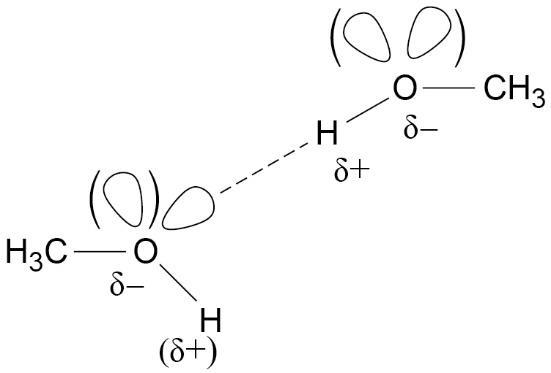
Accept two dots or two crosses for lone pair
Ignore partial charges on atoms in CH3 group
For incorrect compounds that do have hydrogen bonding (e.g. ethanol, water), M2/3 could score for a correct hydrogen bond
3 (3 x AO2)
This question is marked using levels of response. Refer to the Mark Scheme Instructions for Examiners for guidance on how to mark this question.
Level 3:
All stages are covered and each stage is generally correct and virtually complete.
(6 v 5) Answer is well structured, with no repetition or irrelevant points, and covers all aspects of the question. Accurate and clear expression of ideas with no errors in use of technical terms.
Level 2:
All stages are covered but stage(s) may be incomplete or may contain inaccuracies OR
two stages are covered and are generally correct and virtually complete.
(4 v 3) Answer has some structure and covers most aspects of the question. Ideas are expressed with reasonable clarity with, perhaps, some repetition or some irrelevant points. If any, only minor errors in use of technical terms.
Level 1:
Two stages are covered but stage(s) may be incomplete or may contain inaccuracies OR only one stage is covered but is generally correct and virtually complete.
(2 v 1) Answer includes statements which are presented in a logical order and / or linked.
Level 0
Insufficient correct chemistry to gain a mark.
Stage 1 - Shape
1a 4 bonding pairs (& no lone pairs) (allow bonds but not atoms for bonding pairs)
1b repel as far as possible / repel equally / to minimise repulsion
(covered = 1, virtually complete = 1 or 2)
Stage 2 - Polarity
2a C–Cl bonds polar
2b CCl4 not polar
2c CCl4 dipoles cancel due to symmetry
2d CHCl3 polar
2e CHCl3 dipoles do not cancel out
(covered = 2, virtually complete = 3/4/5)
Stage 3 - Boiling points (no credit for reference to breaking of covalent bonds)
3a CCl4 has van der Waals’ forces
3b CHCl3 has dipole-dipole forces and van der Waals’
3c van der Waals’/intermolecular forces in CCl4 stronger than (combined) van der Waals’ (and dipole-dipole)/ intermolecular forces in CHCl3
3d as CCl4 has more electrons (or higher Mr or bigger molecule) than CHCl3
Allow dispersion / London forces for van der Waals’
(covered = 1, virtually complete = 3 or 4)
6
(1 x AO1, 3 x AO2, 2 x AO3)
Question Marking guidance Additional Comments/Guidelines
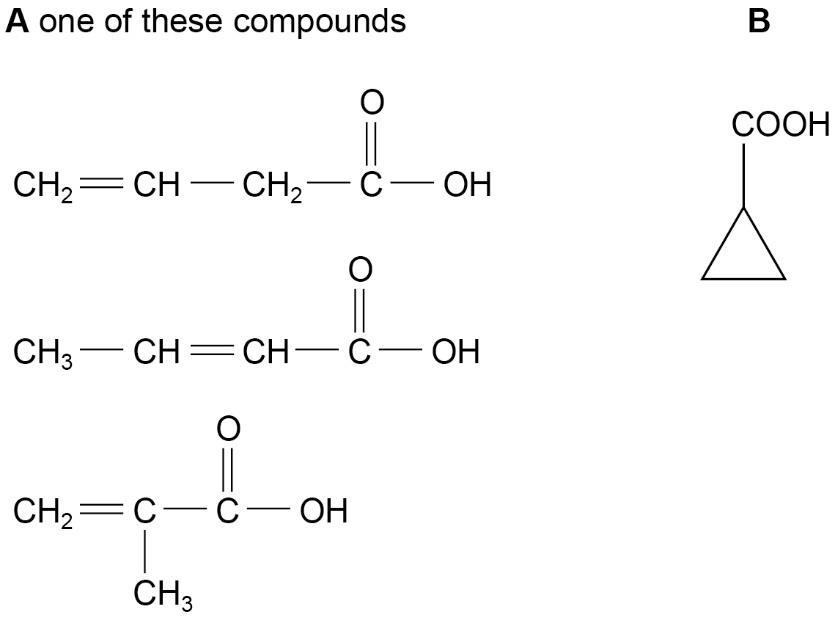
Allow any correct representation of correct answers. 2 (2 x AO3)
CLICK THE LINK BELOW TO ACCESS THIS
MERGED 2025 AQA AS CHEMISTRY Paper 2 and Mark Scheme (7404/2: Organic and Physical Chemistry)