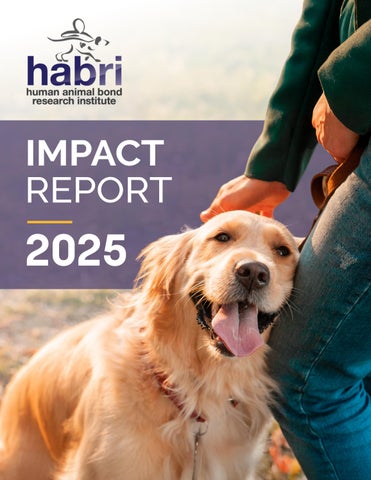
IMPACT REPORT
2025
TABLE OF CONTENTS About HABRI................................................... 2 Letter from the Chair................................. 3 Leadership........................................................ 4 Strategic Priorities....................................... 5 Core Competencies................................... 6 Research............................................................. 7 Survey Research........................................... 10 Expanding Partnerships.......................... 11 Key Programming & Events................. 13 Financial Overview...................................... 17 Supporters........................................................ 18
1
2025 IMPACT REPORT
ABOUT HABRI: HABRI is a not-for-profit organization that funds innovative scientific research to document the health benefits of companion animals; educates the public about human-animal bond research; and advocates for the beneficial role of companion animals in society.
OUR VISION: The human-animal bond is universally embraced as an essential element of human wellness.
OUR MISSION: Advance, through science, education and advocacy, the vital role of the human-animal bond in the health and well-being of people, pets, cultures and communities. 2
ADVANCING THE HUMAN-ANIMAL BOND TOGETHER: Letter from the Chair The joy, comfort, and companionship pets bring into our lives remind us every day of the powerful bond between people and animals. This bond enhances our physical health, supports our mental well-being and strengthens our communities. Across all backgrounds, cultures and circumstances, the human-animal bond continues to transform lives for the better. Yet, even with all these benefits, challenges remain. Too many people still face barriers to housing, veterinary care and social services for people with pets. A lack of pet-friendly domestic violence shelters can prevent individuals from seeking safety out of fear of leaving a pet behind. Many older adults on fixed incomes sacrifice their own needs to ensure their pets receive food and veterinary care. HABRI envisions a future where every person, regardless of their circumstances, can experience the health benefits of the human-animal bond. HABRI is working towards this vision by:
Funding scientific research projects that directly inform policymakers and practitioners, Supporting policies that help improve access to pet care, Highlighting the innovations across all sectors that honor and protect the human-animal bond in society, and Convening the broader pet care community to identify model programs and policies that help address barriers to pet ownership and care.
Through convening leaders and organizations across sectors, HABRI is moving the conversation beyond just acceptance of the science behind the human-animal bond towards advancing policies and programs that make pet-inclusive living a reality for more people. Together with Petco Love and the many companies and organizations committed to supporting the humananimal bond, HABRI leads the way on the research, education and advocacy efforts that turn knowledge into action. We are building a future where more people and pets can live healthy, happy lives together. I am encouraged by the progress this small but mighty organization has made and excited for the years ahead. I hope you will feel the same as you read this report. On behalf of the HABRI Board of Trustees, we invite you to join us in advancing this vital work so that every person, everywhere, can experience the transformative power of the human-animal bond.
— SUSANNE KOGUT Chair, HABRI Board of Trustees 3
2025 IMPACT REPORT
LEADERSHIP BOARD OF TRUSTEES Susanne Kogut
Aimee Gilbreath
Pete Scott
Vic Mason
Chair
Vice Chair
Treasurer
Secretary
President, Petco Love
President, PetSmart Charities
President and CEO, American Pet Products Association (APPA)
President, World Pet Association (WPA)
Eugene O’Neill
Janet Donlin, DVM
David Reilly
Oliver Knesl, DVM
CEO, North American Veterinary Community (NAVC)
CEO, American Veterinary Medical Association (AVMA)
Vice President, Global External Communications, Advocacy & Purpose, Mars Petcare
Director & Medical Lead, Petcare Pain Portfolio, Global Medical Affairs, Zoetis
Kirk Haggard
Joe Toscano
CEO, Independence Pet Holdings
Vice President/Director Trade and Industry Development, Nestlé Purina North America
4
STRATEGIC PRIORITIES From 2026–2028, HABRI’s strategic priorities will guide its continued efforts to advance the role of the human-animal bond in improving individual and societal well-being. These priorities reflect HABRI’s longstanding commitment to strengthening the scientific foundation and evidence base that supports the mental, physical, social and economic benefits of the human-animal bond. Together, these priorities will advance HABRI’s mission to ensure that the human-animal bond is recognized, valued and supported as a critical component of a healthy society.
ADVANCE THE ROLE OF THE HUMAN-ANIMAL BOND IN SOCIETY Strengthen the body of scientific evidence to raise awareness and educate the public about the mental, physical and social health and economic benefits of the human-animal bond. PET OWNERSHIP AND AFFORDABILITY Develop data, solutions and initiatives to make pet ownership essential and pet care services accessible for everyone, working to overcome economic and cultural barriers to pet ownership and care. PETS AND MENTAL HEALTH Build pathways to integrate pet-inclusive approaches and animalassisted interventions into everyday settings and drive societal adoption of these practices. PET-INCLUSIVE HOUSING Develop persuasive data and advocate for policies that increase the supply of pet-inclusive housing.
5
2025 IMPACT REPORT
CORE COMPETENCIES HABRI will build and maintain excellence in its core competencies listed below in pursuit of its strategic priorities. These foundational strengths enable HABRI to lead with both scientific credibility and strategic influence in advancing the human-animal bond. Through the development of rigorous research, the amplification of public awareness and the convening of key stakeholders, HABRI fosters collaboration and innovation across sectors. Through equipping partners and policymakers with reliable data and actionable insights, and by shaping policy decisions that recognize and support the value of the human-animal bond, HABRI ensures that its work drives measurable, lasting impact for people and pets alike.
1
2
3
4
5
Develop science in support of strategic priorities through thesis-driven and open-call academic research, survey research and publication.
Increase public awareness by serving as the positive voice for pet ownership, joining science and storytelling.
Convene stakeholders to collaborate on priority issues to develop and share innovative solutions.
Equip partners and policymakers with data and insights necessary to drive positive change.
Shape policy decisions by organizing stakeholders to advocate for the human-animal bond.
6
RESEARCH TO DATE, HABRI HAS FUNDED MORE THAN $4 MILLION IN RESEARCH PROJECTS. HABRI-funded research has contributed to knowledge about the health benefits of the human-animal bond. HABRI has funded over $4 million in scientific research investigating the health benefits of the human-animal bond around the world. The 63 innovative academic research projects in HABRI’s portfolio have produced over 40 publications in peer-reviewed journals across a wide range of disciplines, including child health and development, gerontology, psychology, veterinary medicine and more. Since 2014, HABRI has received proposals in response to its annual request for research proposals from over 300 different institutions worldwide, representing six continents and over 30 countries.
RESULTS OF HABRI-FUNDED RESEARCH INCLUDE: •
Service dogs are an effective complementary treatment for military veterans with post-traumatic stress, reducing stress, depression and social isolation.1
•
The presence of classroom pets may provide some positive effects for children in third and fourth grade, such as improving social skills and competence, and may also decrease select problem behaviors in the classroom.2
•
Shelter cat adoption is associated with greater empathy and less separation anxiety for children with Autism, along with fewer problem behaviors including externalizing and hyperactivity.3
•
Children in dog-owning households have lower peer problems and conduct problems, and higher pro-social behaviors than children from non-dog-owning households. Dog ownership is associated with positive social-emotional development, particularly among families who walk or play with their dog more often.4
•
Fostering a shelter cat can alleviate loneliness and improve mental health for older adults living independently. Removing perceived barriers to pet ownership can help older adults live healthier, happier lives and also spur the adoption of shelter cats into loving homes.5
•
Therapy dog visitations to pediatric emergency departments in conjunction with usual care reduces both child and parental anxiety and may also contribute to a clinically significant reduction in anxiety medication.6
[1] O'Haire, Marguerite E., and Kerri E. Rodriguez. "Preliminary efficacy of service dogs as a complementary treatment for post-traumatic stress disorder in military members and veterans." Journal of consulting and clinical psychology 86.2 (2018): 179. [2] McCullough, A., Ruehrdanz, A., Garthe, R., Hellman, C., and O’Haire, M., (2019) Measuring the Social, Behavioral, and Academic Effects of Classroom Pets on Third and Fourth-Grade Students. Human Animal Interaction Bulletin. Advance online publication. [3] Carlisle, G. K., Johnson, R. A., Wang, Z., Bibbo, J., Cheak-Zamora, N., & Lyons, L. A. (2020). Exploratory study of cat adoption in families of children with autism: Impact on children's social skills and anxiety. Journal of Pediatric Nursing, 58, 28-35. [4] Wenden, E. J., Lester, L., Zubrick, S. R., Ng, M., & Christian, H. E. (2020). The relationship between dog ownership, dog play, family dog walking, and pre-schooler social–emotional development: findings from the PLAYCE observational study. Pediatric Research, 1-7. [5] Sanderson, Sherry L., et al. "The Impact of Cat Fostering on Older Adult Well-Being and Loneliness: A Feasibility Study." The Journals of Gerontology: Series B 79.1 (2024): gbad140. [6] Kelker HP, Siddiqui HK, Beck AM, Kline JA. Therapy Dogs for Anxiety in Children in the Emergency Department: A Randomized Clinical Trial. JAMA Netw Open. 2025;8(3):e250636. doi:10.1001/jamanetworkopen.2025.0636
7
2025 IMPACT REPORT
NEW RESEARCH IN 2025: VALIDATING THE EFFECTIVENESS OF ANIMAL-ASSISTED THERAPY FOR INDIVIDUALS WITH SCI/ABI IN INPATIENT PHYSICAL REHABILITATION Edelle Field-Fote, PT, PhD - Shepherd Center This project examines the benefits of animal-assisted therapy (AAT) for individuals with spinal cord injuries (SCI) and acquired brain injuries (ABI) in inpatient physical rehabilitation. In this longitudinal study, 20 Shepherd Center patients with SCI and 20 with ABI will participate in AAT sessions lasting 60 minutes per day over four weeks. Researchers expect to demonstrate how therapy dogs can promote healing and recovery for people who require inpatient rehabilitation.
GERIATRIC AND END-OF-LIFE (EOL) PET CARE INCLUDING EUTHANASIA DECISIONS: IMPLICATIONS AND IMPACT ON ANIMAL WELFARE, OWNER WELL-BEING AND CAREGIVER BURDEN, VETERINARIAN-OWNER RELATIONSHIP, AND THE HUMAN ANIMAL BOND Kathleen Cooney, DVM, MS, DACAW - Companion Animal Euthanasia Training Academy This project investigates pet owners' experiences and needs during end-of-life pet care with a goal of understanding what support they need, how they make decisions about different death options (euthanasia, natural death or hospice care), and when veterinarians discuss end-of-life goals. This mixedmethods study will utilize an online survey of 275 pet owners who have recently experienced end-of-life care with their pets. Researchers aim to identify gaps in current veterinary practices and develop best practices for earlier, more compassionate communication between veterinarians and pet owners.
POSSIBLE MECHANISMS LINKING PET OWNERSHIP TO MORTALITY: A MEDIATION ANALYSIS OF PSYCHOSOCIAL AND HEALTH BEHAVIORAL VARIABLES AMONG OLDER ADULTS Lauren Grant, PhD - University of Guelph This research will analyze data collected from the Canadian Community Health Survey - Healthy Aging (CCHS) as well as the Canadian Vital Statistics Death Database to investigate the mechanisms by which pet ownership influences mortality among older adults. Researchers anticipate that findings will help health practitioners convey how pet ownership can improve healthy aging and mortality risk among older adults, and promote the importance of regular interaction between veterinarians, pets and pet owners to support pet and pet owner health.
8
NEW RESEARCH IN 2025 CONTINUED: DETECTION OF PRE-SEIZURE ODOR BY TRAINED DOGS: A SCIENTIFIC VALIDATION STUDY Philip Ente, MD, MS - Santa Barbara Cottage Hospital This project will investigate whether odors known to be present after epileptic seizures can be detected by trained service dogs prior to clinical onset of seizures. This research will involve collecting samples from patients in an epilepsy monitoring unit with samples taken every 15 minutes with baseline, post-seizure and pre-seizure measures being used. Positive results from this study will support the human-animal bond as an important role in long-term health management for people with epilepsy and hopefully encourage more organizations to train service dogs to work with people with epilepsy.
THE ROLE OF HUMAN-DOG INTERACTIONS IN PERINATAL MENTAL HEALTH AND WELL-BEING: AN ECOLOGICAL MOMENTARY ASSESSMENT STUDY Shelby McDonald, PhD - Colorado State University This research will examine how daily interactions between first-time mothers and their pet dog impact maternal stress, mood and well-being during the first year postpartum. Researchers will follow 150 first-time mothers with infants under one year old who live with a dog, asking them to report on their interactions with their dog and their emotional state twice daily, over two weeks. By investigating the experiences of new mothers with pet dogs, a period of major transition characterized by heightened stress and competing demands, this research will identify opportunities for the human-animal bond to improve maternal health and family well-being at a critical time.
UNDERSTANDING THE ROLE OF PET DEPOSIT ASSISTANCE IN INCREASING TENANTS’ PERCEIVED HOUSING SECURITY AND PREVENTING PET RELINQUISHMENT Kevin Morris, PhD - University of Denver This study will assess the effectiveness of pet rental deposit programs for low-income tenants with pets as an intervention for increasing housing security and supporting pet retention. Researchers aim to better understand the efficacy and cost-effectiveness of pet deposit assistance programs in jurisdictions with and without laws regulating pet deposits to increase perceived housing security for tenants with pets and prevent pet relinquishment due to housing insecurity. This will add the necessary data to the conversation toward implementing more policies and programs that keep pets in loving homes.
ENHANCING HEALTHY AGING BY PAIRING OLDER ADULTS WITH FOSTER CATS Sherry Sanderson, DVM, PhD, DACVIM - University of Georgia In 2017, HABRI awarded a grant to Dr. Sanderson for a pilot study that provided initial evidence that fostering a shelter cat may be an effective solution for alleviating loneliness and improving mental health in older adults. The current project will expand this initial research by adding a control group of older adults who will be assessed during the waiting period to receive a foster cat, assessing the stress level of the foster cats participating in the study and measuring changes in physical activity following acquisition of the foster cat, which will provide a more rigorous evaluation of the benefits of foster cats for older adults.
9
2025 IMPACT REPORT
SURVEY RESEARCH HABRI commissions survey research on timely topics and emerging issues related to the human-animal bond. In 2025, HABRI partnered with Chewy Health to examine challenges faced by pet owners, the role of new technologies and the influence of human-animal bond on these issues. Key takeaways provide practical guidance for veterinary teams and the pet care community overall.
The following is a summary of key findings from the survey:
PET HEALTH CHALLENGES STUDY •
The human-animal bond is stronger than ever, as measured across multiple HABRI surveys. Bond strength correlates to differences in attitude and behavior, from increased vet visits to greater adoption of pet care technologies.
•
82% of pet owners say they experience some challenges in understanding their pet’s health, underscoring the importance of tools that improve communication, education and confidence in care decisions.
•
The emotional toll of leaving a pet behind is a universal challenge across all demographics, signaling a need for solutions that help pet owners feel more connected and reassured when they’re away—like trusted pet sitters, cameras or check-in tools.
•
Affording quality veterinary care is a major challenge overall. Affording care disproportionately impacts younger, lower-income and multi-pet households. Thirty-five percent of <$60K households and 34% of multi-pet owners cite veterinary costs as a top concern.
•
Pet owners with the strongest human-animal bonds are significantly more likely to adopt technology solutions. Willingness to adopt tech solutions jumps from 24% among “strong bond” pet owners to over 50% among those with the “strongest bonds.” Pet owners are most willing to adopt technology solutions that are focused on affording (45%), finding (44%) and managing (43%) their pets’ veterinary care.
•
Younger pet owners, especially Gen Z, report the highest levels of care-related stress and are turning to technology for support. They use an average of 3.6 pet health tools and express interest in solutions like symptom checkers, smart feeders, robotic litter boxes, and wearables.
•
Willingness to spend on pet care is strong, with 31% of pet owners agreeing that “money is no object” when it comes to spending on their pets. More than half (52%) of pet owners with the strongest bonds hold this view on pet spending. 10
EXPANDING PARTNERSHIPS HABRI continues to partner with a broad alliance of companies and organizations to advance the human-animal bond as a vital component of personal wellness and public health. HABRI not only brings together a wide-ranging group of pet care leaders, but it is also developing new partnerships to advance the human-animal bond in society, serving as the leading global information source and educator on the human-animal bond. Below are HABRI’s ongoing efforts throughout 2025 to expand its partnerships in alignment with its mission and vision. PETS AND MENTAL HEALTH RESOURCE CENTER: This year, HABRI partnered with Mental Health America (MHA) to create an online hub featuring resources, information and tools that highlight the powerful role that companion animals can have in healing and nurturing mental health. MHA is the nation’s leading nonprofit dedicated to the promotion of mental health, well-being and prevention. A survey of 4,000 Mental Health America constituents found that pet owners overwhelmingly report positive health benefits resulting from their pet, that there is great interest and need for resources related to pets and mental health, and that this is particularly true among those living with a mental or physical disability. The resource center was created in direct response to that need and was made possible through a generous donation from the American Pet Products Association (APPA) and the World Pet Association (WPA) – the leading trade organizations for the pet care community. Designed for both current and prospective pet owners, the resource center provides expert information on the science behind the human-animal bond and its impact on health, an overview of different animal-assisted interventions, mental health resources for pet owners, guidance on choosing the right pet and providing quality care and more. The resource center is available on MHA’s website: mhanational.org/pets
11
2025 IMPACT REPORT
HUMAN-ANIMAL BOND VETERINARY SCHOLARS PROGRAM: HABRI launched the new Human-Animal Bond Veterinary Scholars Program in 2025 with support from the American Pet Products Association (APPA). Together, HABRI and APPA awarded scholarships to veterinary students at the University of Arizona College of Veterinary Medicine. Students gained hands-on experience participating in human-animal interaction research as part of the Veterinary Summer Scholars (VSS) Research Program, a ten-week, 40-hours-per-week program offered to incoming first-year veterinary students for an in-person mentored research experience. HABRI was honored to award funding to these young scholars and support their work in person at the Veterinary Scholars Symposium and the University of Arizona College of Veterinary Medicine Research Day.
SUSTAINABILITY IN THE VETERINARY PROFESSION: This year, HABRI also published a new whitepaper, Healthy Planet, Healthy Pets: Toward Sustainability in the Veterinary Profession, focused on environmental sustainability efforts among leading U.S. veterinary groups. Outlining best practices related to waste reduction, pharmaceutical stewardship, energy and water usage, and stakeholder engagement, the whitepaper seeks to inspire industry-wide action to create a more sustainable future for veterinary medicine. HABRI was honored to convene the following leading companies to complete the project: Boehringer Ingelheim, Hill’s Pet Nutrition, Mars Veterinary Health, MWI Animal Health, Virbac and Zoetis. Special thanks to Mars Veterinary Health for the collaboration and funding that made this publication possible. View the whitepaper here: https://habri.org/sustainability/
12
KEY PROGRAMMING & EVENTS HUMAN ANIMAL BOND INNOVATION AWARDS
HUMAN ANIMAL BOND
INNOVATION AWARDS PRESENTED BY
The Human Animal Bond Innovation Awards recognize individuals, companies and organizations outside of the pet care industry doing innovative work designed to advance the human animal bond and create a more pet-friendly society. Award winners are selected at the discretion of an expert committee of pet care community leaders. Participation in the program is strong. In 2025, HABRI received 57 nominations.
2025 CATEGORIES AND WINNERS: PUBLIC SERVICE
MEDIA
& Bryce Dallas Howard
PET-INCLUSIVE CULTURE
PET-INCLUSIVE INFRASTRUCTURE
The 2025 Human Animal Bond Innovation Award Winners were recognized at Super Zoo in August.
13 2025 IMPACT REPORT
Attendees of the 2025 Spring Policy Forum.
SPRING POLICY FORUM In 2025, HABRI held its second annual Spring Policy Forum. Hosted in Washington, D.C., the Forum focused on the crucial role of companion animals in the health and well-being of underserved communities. The event was attended by over 65 leaders in animal health and welfare, pet care, policy, research and social service providers.
KEY TAKEAWAYS: •
Barriers to pet ownership and care are directly connected with broader social and economic inequities.
•
When pet services are integrated into existing human service frameworks, the full context of people’s lives is acknowledged and supported.
•
By listening to lived experiences, investing in community-driven models of research and care, and ensuring that solutions are culturally responsive and inclusive, organizations in the pet space can begin to dismantle systemic barriers.
In 2026, the HABRI Spring Policy Forum will focus on the importance of research, programs and policies that expand the affordability and availability of pet-inclusive housing.
14
PET NIGHT AND PET WEEK ON CAPITOL HILL Pet Night on Capitol Hill is an in-person reception held on Capitol Hill in Washington, D.C., giving Members of Congress and congressional staff an opportunity to meet with pet care community leaders to learn about the importance of pet ownership to human health and well-being. In 2025, more than 300 attendees participated in Pet Night on Capitol Hill. The Animal Health Institute (AHI) honored the winners of the Cutest Pets on Capitol Hill contest, recognizing the most adorable animals belonging to Members of Congress and their staff. In conjunction with Pet Night, Pet Week offered a series of virtual briefings that shared information about the importance of pet ownership in America and the scientific evidence that shows how policies that strengthen the human-animal bond are necessary for public health. This year’s topics included discussions around pets and mental health, supporting cancer survivors with pets, modernizing pet food regulation, reuniting lost pets with AI, pet-inclusive housing, the science behind veterans with PTSD and service dogs, and more.
Congressional staff, industry leaders and a few furry friends.
15 2025 IMPACT REPORT
16
FINANCIAL OVERVIEW TOTAL REVENUES, INCOME AND OTHER SUPPORT
$1,598,672
FUNCTIONAL EXPENSES Research and Education Programs
$1,799,132
SUPPORT SERVICES Management and General
$145,724
Fundraising
$84,233
TOTAL FUNCTIONAL EXPENSES
$2,029,089 2024 Audited Financial Statements
89% OF EXPENSES ARE DEDICATED TO RESEARCH AND EDUCATION PROGRAMS.
17 2025 IMPACT REPORT
SUPPORTERS As a non-profit organization, HABRI relies entirely on donations to support its work to advance the science of the human-animal bond. The strong and continued support of the following companies and organizations makes the work of HABRI possible.
18
HABRI.ORG
CONTACT Steven Feldman
Matt Cryer
President
Program Associate
sfeldman@habri.org
mcryer@habri.org
Lindsey Braun
For media inquiries contact:
Vice President, Research & Operations
Hayley Maynard Inspire PR Group
lbraun@habri.org
hayley@inspireprgroup.com
Samantha Barzilay
Becca Thomas
Manager of Events & Engagement
Inspire PR Group
sbarzilay@habri.org
becca@inspireprgroup.com