H2O Magazine-trimestrale di pesca, turismo e tempo libero. Tariffa R.O.C.: Poste Italiane spa - Spedizione in abbonamento postale - D.L. 353/2003 (conv.in L. 27/02/2004 n° 46) art.1, comma 1, CN/BO In caso di mancato recapito inviare al CPO di Bologna per la restituzione al mittente previo pagamento resi. Contiene I.P..
SCANDINAVIA
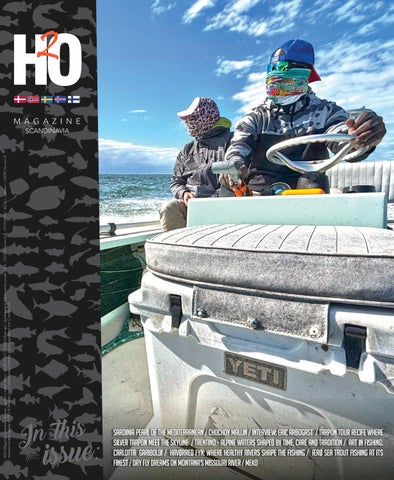
SARDINIA PEARL OF THE MEDITERRANEAN / CHOCHOY MALLIN / INTERVIEW: ERIC ARBOGAST / TARPON TOUR RECIFE WHERE SILVER TARPON MEET THE SKYLINE / TRENTINO - ALPINE WATERS SHAPED BY TIME, CARE AND TRADITION / ART IN FISHING: CARLOTTA GARIBOLDI / HAVØRRED FYN: WHERE HEALTHY RIVERS SHAPE THE FISHING / ÆRØ SEA TROUT FISHING AT ITS FINEST / DRY FLY DREAMS ON MONTANA’S MISSOURI RIVER / MEKO
H2O year I • n° 2 • summer-Autumn 2026 Director Responsable Sara Ballotta Director Editorial GIORGIO CAVATORTI Editorial board Giorgio Cavatorti Via Verdi, 30 42027 Montecchio Emilia (RE) COVER PHOTO: OMAR GADE collaborators on this issue: Mike la Blanche, OMAR GADE, guido sesani, JAN NACHTIGAL, ERIC ARBOGAST Carlotta GarIboldi, CHRISTIAN THOMSEN, Freja Kock Christlieb Morten Valeur, ALBERTO ZANGHIERI Art Director AND GRAPHICS: OMAR GADE, VALENTINA SCARABELLI, ANGLINGCONSULTING.ONE Press: Tipografia Bona Digital Print Torino - ITALY Editorial Photographer: Alessandro Seletti, ALBERTO ZANGHIERI Social Media Manager: Fulvio Oliva Translators: Rossella Catellani, Elisabetta Longhi Authorization of the Court of Bologna No. 8157 of 01/02/2011 Poste Italiane S.p.A. – Subscription Postal Delivery – 70% – ROC authorization No. 20825 of 10/03/2011 – DCB Bologna Copyright © 2008. All rights reserved. Reproduction, even in part, is prohibited without prior authorization from the Editorial Office. Unsolicited photographs and manuscripts will not be returned. For any information regarding the trips featured in the magazine, please contact: INFO@DENMARKFISHINGLODGE.COM
Editor note
D
Omar
ear readers,
Welcome to a new edition of H2O Scandinavia, where we continue our journey through remarkable destinations, inspiring people, and the timeless passion for fly fishing. Published twice a year, H2O Scandinavia is created for anglers across Scandinavia and Northern Europe, while remaining open to stories and perspectives from the international fly-fishing community. Every issue brings together travel, culture, conservation, and craftsmanship, celebrating not only the places we fish, but also the people who dedicate their lives to protecting and sharing them. As part of the H2O Magazine family, founded in Italy in 2008 and now published in several international editions, we remain committed to thoughtful storytelling, elegant design, and authentic experiences that deserve to be discovered and remembered. We hope the pages that follow will inspire your next adventure, introduce you to new waters and new friendships, and remind you that fly fishing is, above all, a way of exploring the world. Tight lines! Omar Gade H2O Scandinavia Liaison
E
Giorgio
very edition of H2O Magazine is an invitation to travel beyond the familiar, discovering destinations, traditions, and people who share the same deep respect for nature and fly fishing. In this issue, our journey takes us across an extraordinary variety of landscapes, from Scandinavian coastlines and alpine rivers to tropical flats and iconic trout waters. Along the way, you will meet remarkable personalities, explore unique destinations, and discover stories where passion, craftsmanship, and conservation come together. Our goal has always been to create more than a fishing magazine. H2O is a publication designed to be read slowly, collected, and revisited—a place where inspiring photography, meaningful stories, and practical knowledge come together in every issue. Throughout the season, you will also find us at major international fly-fishing events, where we look forward to meeting our readers, presenting new destinations, and sharing the projects that continue to shape the H2O community. Thank you for being part of this journey, and enjoy the read. Giorgio Cavatorti Editorial Director, H2O Magazine
let's keep in touch: www.h2oflyfishing.com info@denmarkfishinglodge.com
5
8 32
20
40
60 74
50 68
83
90
Contents SCANDINAVIA
8
Sardinia Pearl of the Mediterranean
There are places that hold a special place in the heart, or in the memories, of each of us...
20
Chochoy MALLIN
40
Tarpon tour Recife where tarpon meet the skyline
ART IN FISHING: Carlotta GarIboldi
32
Interview: ERIC ARBOGAST
50
TRENTINO - Alpine waters shaped by time, care and tradition
60
68
HAVØRRED FYN: Where Healthy Rivers Shape the Fishing
74
83
Dry fly dreams ON Montana’s Missouri River
90
I'm a passionate fly angler and, for all practical purposes, I've been fishing my whole life... ______________
For Scandinavian fly fishers the Alps often appear as...
On Fyn, sea trout are not treated as a passing opportunity, but as a longterm...
When I think of Montana, endless skies, rolling prairies, and rising trout come to....
For nearly twenty years, Roberto Alba and his son Luciano have been synonymous with top-tier fly ...
There are fishing destinations that require days of travel, complicated connections...
Born in Milan in 2001, I am an artist with a degree in Decoration from the Brera...
ÆRØ Sea Trout Fishing at Its Finest
With more than 160 kilometres of coastline, Ærø is one of the most diverse...
MEKO
The first time I met Meko, I immediately understood that it was not going to be just another day of...
Mike la Blanche
8
Sardinia
Pearl of the Mediterranean
9
...There are places that hold a special place in the heart, or in the memories, of each of us...
10
T
here are places that hold a special place in the heart, or in the memories, of each of us.
People we have met, emotions we have experienced, landscapes and journeys all contribute to creating an invisible bond that leads us to remember, or return to, places that have left a mark on us. Sardinia is one of those places, although my connection with the island did not originally begin through fishing. During my childhood, I became friends with two boys of my age, originally from Sardinia, who attended my elementary school. In my imagination as a child, they came from a remote and almost tropical island, and I found that fascinating. I still remember Sunday lunches as a guest of their parents, eating strictly Sardinian specialties such as pane carasau and delicious handmade malloreddus covered with wonderfully flavorful pecorino cheese. My first visit to Sardinia dates back to 1992. Since then, I have visited the island practically every year, sometimes more than once, discovering many different areas and falling more in love with it each time. The island, a rare pearl of the Mediterranean, is today a well-established destination for tourists who, during the summer season, fill its beaches and coves with crystal-clear water—among the most beautiful in the Mediterranean. Sardinia is famous for its Caribbean-like sea, but beyond the coast there is a deeper and more complex island: ancient archaeological sites, nuragic complexes, rugged mountains, wild inland landscapes, strong traditions, excellent food and wine, and a cultural identity that is sometimes fascinating, sometimes almost mystical. But can you fish there? Certainly. On an island surrounded by such a clear sea, marine fishing naturally plays an important role. Around Sardinia it is possible to practice many of the techniques common throughout the Mediterranean: offshore fishing, trolling, bottom fishing, vertical jigging, spinning and, when conditions allow, fly fishing from shore or from a boat. Tuna and other pelagic fish, dentex, amberjack,
11
12
leerfish, dorado, sea bass and barracuda are all part of the island’s fishing possibilities. For a fly angler, seeing a surface feeding frenzy within casting distance and placing a fly into the action is one of the most exciting situations the Mediterranean can offer. But the aspect of Sardinia that deserves much more attention from fly anglers is not only the sea. It is the inland water, and in particular black bass fishing. Black bass is widespread in several Sardinian lakes. This species was introduced to the island from America in the nineteenth century and today has become, in effect, the main predator of Sardinia’s inland waters. Its presence is nothing new for Italian anglers, especially for
those who practice spinning, and some wellknown lakes are quite frequented. For fly fishermen, however, Sardinian bass remain a surprisingly underestimated opportunity. In Europe, black bass is not usually one of the first species associated with fly fishing, especially when compared to trout, pike, sea bass or other predators. In my opinion, this is a mistake. Black bass are aggressive, visual, powerful and capable of producing spectacular takes, hard fights and sudden jumps. They respond beautifully to a fly rod and offer a style of fishing that is dynamic, technical and extremely enjoyable. Sardinian bass also have a special character. Their livery is often magnificent, with strong green and black contrasts, and they can reach
very respectable sizes. In the right conditions, the take can be explosive, especially when fishing close to structure or on the surface. A bass rising from under a submerged branch to attack a popper or a frog imitation is one of those moments that stays printed in the memory. The fishing mainly takes place in inland lakes, some of them large reservoirs with dams, often surrounded by dry, harsh and spectacular landscapes. These are not small ponds or easy waters. They are medium to large bodies of water, sometimes with depths of several dozen meters, and they require knowledge, timing and interpretation. During the warm season, large dam lakes can drop considerably in level due to increased water withdrawal, changing
13
14
shorelines, access points, fish behavior and the entire appearance of the lake. The most productive depth for targeting bass on the fly is usually between zero and five meters. Under the right conditions, especially during the warm season, topwater fishing can be excellent. This is perhaps the most exciting way to fish for them: casting toward the banks, working a popper, a gurgler or a frog imitation near submerged branches, weed edges or rocky structure, and waiting for the surface to open. The choice of flies is varied and allows the fly angler to use many different approaches. Effective patterns include Woolly Buggers, Clouser Minnows, Dahlberg Divers, Muddler Minnows, Bunny Leeches, Flashabou flies,
Gurglers, poppers, surface frog imitations, foam hoppers and crayfish patterns. Streamers can be used to search deeper edges or submerged timber, while surface flies come into play when the fish are active in shallow water or holding close to structure. Fishing is often concentrated in small bays, along the banks and around submerged branches, where larger bass wait in ambush for their prey. Accuracy matters. The fly often has to land close to cover, but not so close that it immediately becomes snagged. The retrieve can change everything: sometimes s h o r t strips are enough,
15
sometimes long pauses are the key, and sometimes the strike comes the instant the fly touches the water. This is not only a technical fishery; it is also a very atmospheric one. Sardinian bass lakes often have unique scenery: dry hills, rocks, warm light, silence, the smell of Mediterranean vegetation and wide spaces that can feel almost cinematic. Fishing in these environments, surrounded by an atmosphere reminiscent of the old Far West under the hot sun, is a
That is why fishing with someone who knows the island, its waters and its bass behavior can make a real difference. A good local reference can help choose the right lake according to season, water level, wind, temperature and fishing pressure, as well as avoid wasting precious time in areas that are difficult to access or not allowed. The uniqueness of Sardinia lies in this combination. It is a destination where a fly angler can travel with a partner or family, enjoy some of the most beautiful beaches in the Mediterranean, discover an island with
16
reality of its own: truly special, and at times almost surreal. As always, the best waters are often the least disturbed ones. However, attention must be paid to local rules, private access, particular restrictions and possible unmarked bans. Not all lakes can be fished, and local knowledge is extremely important. This is especially true in Sardinia, where the most interesting fishing is not always found in the most obvious places.
ancient roots and powerful traditions, and still dedicate serious days to a fascinating and underrated freshwater predator. Sardinia is often described through its sea, and rightly so. But for those willing to look inland, beyond the beaches and the summer crowds, there is another island waiting: quieter, wilder, more unexpected. An island of reservoirs, rocky banks, submerged branches and black bass hiding in the shade. For the fly angler, this is perhaps one of Sardinia’s most interesting secrets.
Not the most obvious fishing, not the most famous, but precisely for that reason, intriguing. A Mediterranean island, a warm inland lake, a floating line, a popper near the structure, and suddenly the surface explodes. That is Sardinia too. Th best contact for fly anglers is “Sardinia Bass Fishing”, which is the only existing specialized contact for fly fishing throughout the entire region, with local knowledge of the island’s inland waters and bass fishing opportunities, if you plan to visit Sardina, get in touch with: Sardinia Bass Fishing — www.sardiniabassfishing.com or visit: www.italianflyfishingtours.com (for the Swedish market, anglers can also contact “Outside Travels”, the Swedish-speaking partner of Sardinia Bass Fishing, which acts as the reference point in Sweden: www.outsidetravels.com)
...Thats is Sardinia too... 17
Guido Sesani
20
Chochoy MALLIN 21
...The following morning, at first light, we were left speechless... 22
For nearly twenty years, Roberto Alba and his son Luciano have been synonymous with toptier fly fishing. Among the various destinations they offer, the most famous and celebrated is undoubtedly Estancia Laguna Verde in Patagonia, which holds fishing rights on Lake Strobel, better known as Jurassic Lake, home to a population of rainbow trout that is quite literally unmatched anywhere in the world. Over the years, the Albas have opened another lodge on the shores of Lake Strobel, as well as the Golden Dorado River Cruiser on Argentina’s Paraná River. This year, they have also taken over the management of Estancia Chochoy Mallín, located in the remote province of Neuquén, at the foothills of the Cordillera del Viento and just a stone’s throw from the Chilean border (Paso Pichachén). From Spey casting to traditional casting. After finishing our week at El Rincón, Giorgio and I flew to Neuquén via Buenos Aires and from there, after a six-hour drive—partly on paved roads and partly on dirt tracks— we arrived at the estancia late at night. The following morning, at first light, we were left speechless. The lodge, recently built, can without exaggeration be described as luxurious: elegant, tastefully furnished, extremely welcoming, and equipped with every comfort. Spacious guest rooms with equally large beds, a wide living area with a well-stocked bar, not to mention a wine cellar offering an impressive selection of high-quality Argentine wines. Stepping outside the lodge, we found ourselves surrounded by an unusual landscape, fascinating for its variety and shape. We are at 1,200 meters above sea level: on one side rises the Andean range, already heavily snow-covered, and on the other stretch wide valleys crossed by the rivers where we would fish in the days ahead— Trocomán, Reñileuvú, and Ñireco. The setting is truly wild, yet, as I said, diverse and captivating. Given the vast fishing areas, we traveled by pickup truck, fishing in different locations each day—the choice is certainly abundant. Not far from the lodge flows the Ñireco stream, heavily overgrown with vegetation, unfortunately, but rich in small trout that readily take both dry
23
flies and nymphs. The stream flows into the Río Reñileuvú, itself a tributary of the Trocomán— both stunning and virtually untouched, meaning few, if any, have ever fished them. On the Reñileuvú in particular, we had the opportunity to fish both the lower and upper sections, the latter running through pastures
24
dotted with cattle and sheep. If overnight snowfall or rain caused the water to become murky, there was always the option of fishing in what Argentinians call a “laguna,” which is actually a lake hosting trout significantly larger than those we caught in the rivers. As for trout size, most of which are rainbow trout,
it was somewhat modest. It’s unclear whether this was due to the season (early autumn), water levels, or other factors. Charlie and Maxi, the two guides who assisted us throughout the week with professionalism, kindness, and availability, assured us that at other times of the year, fish sizes are considerably larger.
We used small black or green Woolly Buggers, as well as various types of nymphs—even tiny, weighted ones—which proved very effective. Rods of 8–9 feet with floating WF5 lines were ideal to cope with the occasional wind. Thanks to Melina, the daunting yet highly efficient coordinator of the lodge staff, guides
included, both Giorgio and I—as well as the two Americans who shared the estancia with us—were each day fully satisfied with what we caught, what we saw, and the experiences we lived. One in particular stands out: the day we were guests of the gauchos.
Literally in the middle of nowhere, at the foot of the mountains, stood a shelter inhabited by four kittens, two gauchos, a couple of horses, and, of course, the indispensable dogs without which it would be impossible to manage the herds grazing across a 15,000-hectare estancia—150 square kilometers!
25
Needless to say, they had prepared a classic whole lamb asado. The asado consists of placing a vertical cross-shaped spit in the ground, onto which the meat is fixed, slowly cooked by the heat of embers placed upwind and usually shielded by a curved metal sheet to retain the heat. It is a slow cooking method requiring 4 to 6 hours, allowing the meat to render its fat while remaining tender. An unforgettable experience—I will long remember the taste of the ribs we ate, paired with a Malbec produced in Patagonia by the estancia owner, Carlos Mabellini, just as I will not easily forget the empanadas served to us at the lodge on the evening before departure.
... stood a shelter inhabited by four kittens, two gauchos, a couple of horses... 26
27
28
Finally, a word about Luciano, “the boss,” our host, whom I had last met 14 years ago at Estancia Laguna Verde. Always cheerful, generous, and welcoming, he made our stay even more enjoyable. Thank you and… hasta la vista!
Thank you and….hasta la vista!
29
WHERE TO FIND H2O MAGAZINE SCANDINAVIA A special thank you to all the fishing shops and outdoor specialists who have supported H2O Magazine Scandinavia by making our magazine available to their customers. Thanks to their passion and commitment, our stories, destinations and inspiration reach even more fly fishermen and outdoor enthusiasts across Scandinavia and Northern Europe.
SCANDINAVIA
Fiskeshopen Mörrum
Odense Jagt & Fritid
Sweden
DENMARK
Wittlock Sportfiske
OutdoorXperten
Sweden
Wollmars Sweden
Hökensås Sportfiske Sweden
DENMARK
Fiskeshopen DENMARK
Lystfisk.dk DENMARK
Der Heiland – Flensburg
Denmark Fishing Lodge
GERMANY
DENMARK
Would you like to become an H2O Magazine Scandinavia distribution partner?
If you own a fishing shop, lodge, outdoor business or represent a fishing association, we'd be delighted to welcome you to our distribution network. Get in touch and let's grow together: info@denmarkfishinglodge.com
Interview
ERIC 32
ARBOGAST 33
Interview ERIC ARBOGAST
Eric, how did your passion for fly fishing begin, and do you remember when it became more than just a hobby? I started fishing when I was about six years old, probably because I wanted to imitate my older cousin Fred. At some point, he became interested in the intriguing art of fly fishing.
34
Eric, tell us a little about yourself. Who is Eric Arbogast? I'm a passionate Luxembourgish fly angler and, for all practical purposes, I've been fishing my whole life. I come from a family of hunters and anglers, so spending time outdoors has always been part of who I am. For me, that passion naturally found its way into fishing, and
especially fly fishing. The hunting bug never really bit me in the same way. It's a more complicated world, although I have always had a fascination with firearms—I do have a gun safe full of them, most of them family heirlooms passed down through generations.
Later on, he discovered other hobbies, but I caught the fly-fishing virus and never looked back. The deeper I got into this world, the more I realized I probably had a certain talent for it, and things simply developed from there. Eventually, I found a part-time job in a local fly
shop, which allowed me to immerse myself in the industry. I met more and more people, my passion kept growing, and before long I had started travelling around the world with a fly rod in hand.
What first led you from fishing with fly
rods to actually building and customizing them? Was there a specific rod, angler, or experience that inspired you? When you are a student with little money and a hobby that can easily become expensive, learning to make things yourself can be a real blessing. My first rod was built more than twenty-five years ago from a kit. It was a first-
quality tool, but still something I could afford. The rods that followed were existing production rods that I stripped down and rebuilt into more refined tools. Then I met an experienced rod builder who became something of a mentor. He introduced me to the world of custom rod building, where outstanding components can be transformed into truly exceptional fishing
equipment. That was around 2017, when I first cautiously entered this world. In 2018 it became a more regular pastime, and by 2019—after my divorce—it became almost a daily obsession. Being able to create something during a time of personal destruction was an incredibly welcome escape. Building something with my
own hands gave me a sense of purpose when many other things were changing. Around the same period, I also developed a great relationship with a fly line manufacturer. They did not actually produce custom lines for me, but they provided the necessary materials at reasonable cost, allowing me to build highly
functional lines for very specific purposes: stillwater fishing, float tubing, extreme-distance casting, and many other applications.
anglers value that level of individuality? My rods are a reflection of myself and of how I like to see this great fishing tool. As anglers, we pursue beautiful creatures, so it makes sense to pursue them with tools that are not only functional but also beautiful. Catching a trout with bait on ugly tackle is, in
Arbocaster Fly Rods are known for their highly personalized designs. What does a truly custom fly rod mean to you, and why do
35
my opinion, almost a disgrace. As Reverend McLean once said, we use rods, not poles. Once a rod is finished, I take great pleasure and pride in handing it over to its new owner. The owner also has a say in the final appearance of the rod, and that personal connection is an important part of the process. A happy customer makes for a happy maker. There is always something exciting about walking into a fly shop and taking a high-end
production rod off the rack. But it is even nicer to come to my workshop and leave with a personalized rod carrying your own name, built exactly the way you imagined it, with colours you will not find elsewhere—and sometimes even at a better price than the latest high-tech offering from Washington State, Colorado or Vermont.
Others already have a clear idea about the functional side—the length, line weight and intended use—but when it comes to the visual aspect, they have no real preference. And then there are those who have everything figured out in their heads. Those are the difficult ones, but also the most rewarding. They expect everything, sometimes even more than what
the market can provide. If it can be done, it usually comes at a higher cost and requires more time. Since my rods remain fishing tools first and foremost, there are occasions when a project becomes almost too extreme. In those cases, I may suggest another builder who can achieve the almost impossible, because I do not want
36
When a customer or a friend commissions a rod
design, how does the design process usually begin? Do you guide the project based on your experience, or do most clients arrive with very specific ideas and requirements already in mind? This is probably the best question so far. It really depends on the person. Some people have absolutely no idea where to start. They might need to look at pictures or at some of the rods I have built before to get inspiration.
to disappoint someone in their search for their dream rod. Over the years, how has your approach to rod building and customization evolved, and what have been the most important lessons you have learned as a custom rod maker? The biggest lesson is that you need the right
I have built rods inspired by famous brands, sometimes just to see what they would look like if they came out of my small workshop. Over time, I have developed my own style: simple, clean and functional. I leave the flashy creations to the true masters of that craft.
tools to do a proper job. On some builds you can cut corners, but most of the time a professional approach is required—and that means great components, good equipment and, above all, lots of time. Because my rods remain fishing tools first, I prefer a more sober style. I do not like too much glitter and bling. I prefer clean workmanship, especially when it comes to epoxy work on thread wraps.
Your rods can feature custom colours, inscriptions, reel seats, cork handles and even matching rod tubes. Among all these elements,
which one do you think contributes the most to making a rod truly unique? It really depends on what the new owner wants in the end. Personally, I always put function before appearance. The rod needs to perform flawlessly in the situation it was designed for. In saltwater, for example, using titanium components has the advantage of not corroding over time like steel and aluminium can. Cork is a fantastic handle material, but even the best-
quality cork will eventually deteriorate. In some cases, composite cork or even foam can actually be a better choice. Oversized or unattractive reel seats simply have no place on my rods. Colours also depend on the blank manufacturer, and there are many possibilities. A fully custom colour scheme is available, but it will always
come at a price. Usually, the colour of the blank "dictates" the thread colour—unless someone specifically wants a day-glow colour on a matte graphite blank. In the end, I think what makes a rod unique is the balance between all the components, the original idea behind it, and, of course, the new owner's name on the finished piece. I have had
customers who basically said, "I don't really care, just make me something nice," as well as people arriving with extremely specific ideas—a pink rod, for example, or even something completely crazy, like red LEDs incorporated into a white fiberglass butt section with an AA battery hidden inside the reel seat to create a kind of fishing light saber.
37
How do you balance aesthetics and performance? In other words, how do you ensure that a highly personalized rod does not affect the overall action or balance of a rod? Looking great is fine, but compromising performance by overdoing the aesthetics is not something I accept. With all the amazing components available today, it is actually difficult to ruin a rod visually or technically— although choosing completely unsuitable guides would probably be one way to do it. We choose blanks according to their casting characteristics and their ability to fight fish in the situations where they will be used. That is their primary purpose. If they cannot do that, then the rod becomes useless. I think the best answer is to keep things simple. There are two "rules" I usually follow: A fly rod should have snake guides—the classic type or single-leg versions. Lined guides, no matter how smooth or technically advanced they may be, belong on spinning rods. They can be perfectly fine as stripping guides, but I personally prefer the traditional approach. The second rule concerns hook keepers. In my opinion, they are for people who want their rod tip to break sooner! There are already enough guides along the blank where your fly can happily get caught. Most serious fly anglers use leaders that are considerably longer than their rods, so a hook keeper is often just in the way and interrupts the clean look of the rod.
38
Of course, I will make exceptions to both "rules"— but only under protest! What is the most memorable, unusual, or challenging custom rod project you have ever built for a client or a friend? The most unusual one was definitely the fiberglass rod with LED lights built into the butt section. Knowing the customer, I would not be surprised if it has never even been fished! Some of the most challenging projects involve unsanded snake-belly blanks and customers who insist on using very fine natural silk as wrapping material together with Recoil guides. These projects require a great deal of patience and precision. For readers who would like to learn more about Arbocaster Fly Rods, what is the best way to get in touch with you? The easiest way is probably through email: fishwithfriends@gmx.net
39
Tarpon tour Recife
where silver tarpon meet the skyline 40
OMAR GADE
41
...It is Recife. It is urban and tropical Brazil at the same time... 42
T
here are fishing destinations that require days of travel, complicated connections, endless transfers and hours by boat before you even see the right kind of water. And then there are places that surprise you for exactly the opposite reason: you arrive, walk out of the airport, find your guide waiting for you, and within just a few minutes you are already immersed in that atmosphere every angler dreams of during the European winter. Recife, in northeastern Brazil, was one of those surprises for me the first time.
The journey begins with a very particular feeling: you know you are heading for the tropics, but without the logistical fatigue we often associate with exotic fishing destinations. International connections are convenient, arriving in Brazil is straightforward, and once you land in Recife, the final destination is practically right there, within easy reach. The
Tarpon Tour guides came to pick me up directly at the airport, smiling, well organized, with that calm, practical attitude of people who know both anglers and the rhythm of the place very well. After the flight, I did not have to think
43
about anything: luggage loaded, rods safely stored, a short conversation about the program for the following days, and then off we went toward the hotel. My first impression of Recife was powerful. This is not the classic tropical destination isolated from the world, where everything feels distant and completely wild. Here, nature and the city coexist in a surprising way. On one side there is the modern profile of the skyline, the buildings, the lights of the coast; on the other, a network of brackish lagoons, tidal rivers, mangrove channels and warm water where tarpon and snook find a perfect environment. It is exactly this contrast that makes the experience special: fishing in tropical scenery with the city in the background, casting among mangroves and channels while, not far away, Recife continues to live its daily rhythm. The hotel was another pleasant surprise. The package includes accommodation in a comfortable, elegant 5-star hotel located on the seafront, close to the fishing areas used by Tarpon Tour. After many days spent around the world in rustic lodges or motherships, finding myself in a spacious room, with highlevel services, beach access and an ocean view gave the trip a different flavor. It was not only about fishing: it was a true tropical experience, but accessible, comfortable and also suitable for those who want to combine fishing, relaxation and travel. The following morning, the alarm rang early. Outside there was already that soft tropical light, the warm and humid air that immediately reminds you that you are far from Europe. The guides arrived punctually at the hotel. Everything was already ready: boat, equipment, water, flies, practical advice and, above all, enthusiasm. Stepping on board, I had the feeling of entering an environment that was very technical but at the same time extremely fun. We were not heading out in search of one difficult bite somewhere in the middle of nowhere: we were entering a living, dynamic system, where every bend, every channel and every ripple on the surface could hide a strike. Tarpon fishing here has a character of its own.
44
Most of the fish are medium-sized juvenile tarpon, but they are powerful, nervous and spectacular fish. Their size is perhaps the most enjoyable for the sport angler: manageable enough to allow many opportunities during the day, but strong enough to deliver jumps, sudden runs, explosive takes and memorable fights. Seeing them rolling on the surface, moving the water with that unmistakable metallic flash, is one of the images I will carry with me for a long time. With a fly rod in hand, the game becomes visual and full of adrenaline. We fished with light and fun tackle for this kind of predator: 8 and 9 weight lines, perfect for handling bulky flies, wind, quick casts and energetic fights without making the action feel too heavy. The guide reads the water, points to a spot, corrects the drift, suggests the retrieve. “Cast there.” You cast close to the tarpon’s roll, the fly starts fishing, two fast strips, a pause, and then the water opens. The strike is something violent and clean at the same time: a silver mouth appears from nowhere, the tail slaps the surface, the fly line tightens between your fingers and the fish runs. Immediately after that comes the jump. And that is when you understand why these fish become addictive. Every catch feels like a small event, and every lost fish still leaves you smiling, because the action was real, spectacular and visible. During the fishing days we targeted tarpon exclusively with fly gear, following the conditions, the tides and the activity of the fish. This is one of the great thrills of the destination: the possibility of reading the water, spotting fish on the surface, interpreting the rolls and presenting the fly at exactly the right moment. It is not monotonous fishing. It requires attention, quick reactions and constant adaptation. Sometimes you need to speed up the retrieve, other times slow it down; sometimes the fly must pass right in front of the fish, other times it is enough to enter the right line. The common denominator is action: signs of life, follows, missed takes, hooked fish, jumps and fights. Alongside tarpon, snook are the second great attraction of these waters. In Brazil they
45
can reach truly impressive sizes, and in the mangrove channels of Recife they add a very stimulating technical component. Snook are a different predator: more connected to structure, capable of sharp attacks and powerful fights. Fishing for them among roots, shaded banks and tidal currents requires precision, control and readiness. They are the perfect complement to tarpon: if tarpon are spectacle and surface action, snook are technique, tension and sudden power. The Tarpon Tour guides were essential in helping me understand the rhythm of this fishery. They know the tides, the movement of the fish, and the best channels according to light and wind. But above all, they know how to accompany an angler without turning the day into a rigid lesson. They help you, correct
46
you, put you on the action, but still leave room for the pleasure of the journey. On the boat we laughed, talked about fishing, Brazil, Europe, seasons and lost fish. It is the kind of professionalism that is not measured only by the number of catches, but by the feeling of always being in the right place at the right time. One of the most fascinating aspects was fishing among such different scenarios. At times we were surrounded by mangroves, shallow water, narrow channels and tropical birds. A short while later we would find ourselves in a more open lagoon, with the skyline of Recife in the background. This combination gives the destination a very precise identity: it is not a copy of the Caribbean, it is not classic ocean fishing, and it is not an Amazonian journey. It is Recife. It is urban and tropical Brazil at the
same time. It is a warm, brackish, dynamic destination where sport fishing meets a living and accessible city. At the end of the day, returning to the hotel was part of the pleasure. After hours under the sun, with my hands marked by fly line and fish fights, being able to come back to a comfortable structure, take a
shower and relax in the rooftop pool of a skyscraper with sea views completely changed the perception of the trip. There was none of that heavy fatigue caused by long transfers or basic accommodation. Instead, there was the feeling of having lived a full, intense day without giving up comfort. For us Europeans, Recife also has another major advantage: it is a perfect escape from winter. When in much of Europe the cold makes the days short and the waters more difficult, here you fish in warm, tropical conditions, with active fish and a completely different atmosphere. It is the kind of trip that recharges you mentally even before it does so from a fishing point of view. You leave with jackets and grey skies, and arrive among palms, brackish water and tarpon rolling on the surface.
From an economic and organizational point of view, the package has another very interesting element: it offers a tropical destination with highlevel accommodation, daily guiding and simple logistics at a super convenient price compared to many classic tropical fly fishing destinations. This is not a detail to underestimate. Exotic fishing trips often require significant budgets, remote lodges, internal flights and extra costs. Here, instead, the combination of easy access, a 5-star hotel, guided fishing and proximity to the fishing areas makes everything surprisingly practical. Of course, as in every real fishing situation, nothing is automatic. There are moments when you need to wait for the right tide, change area, adapt the retrieve, miss a few hook sets and learn from the next fish. But that is exactly
what makes the experience authentic. This is not an aquarium. It is a real ecosystem made of lagoons, rivers, mangroves, wind, light and predators. When everything comes together and a silver tarpon explodes on the fly, every moment of waiting is repaid in a single second. Looking back on the trip, what remains most vivid is not only the biggest fish or the best photo. It is the whole experience: the easy arrival, the guides at the airport, the seafront hotel, the first light of morning, the mangroves, the tarpon on the surface, the snook hidden in the structure, the city in the background and that constant feeling of being in a place unlike any other. Recife is not just a fishing destination: it is a new way to experience tropical fishing, more accessible, more comfortable, but still full of action and authenticity.
...It is not an aquarium. It is a real ecosystem.... 47
For those looking for a warm, dynamic and original winter destination, capable of combining tarpon, snook, comfort and simple logistics, Tarpon Tour represents a truly interesting proposal. Recife gave me exactly
48
what I always hope to find in a fishing journey: real fish, new landscapes, knowledgeable people and a story to tell once back home. And above all, it left me with that subtle and dangerous desire every angler knows well: to return
as soon as possible, cast again into the same channel, wait for another roll on the surface and feel the water explode once more in front of the boat.
Val di Fumo - Alto Chiese
50
Stefano Fedrizzi
Trentino Fishing
TRENTINO Alpine waters shaped by time, care and tradition
51
Torrente Avisio - marmorata
Jacopo Piazzi
...is not a place for rushed fishing. It is a destination for anglers who value structure, sustainability and time on the water...
52
F
or Scandinavian fly fishers, the Alps often appear as a distant horizon: impressive, no doubt, but fragmented, pressured and difficult to read. Trentino quietly challenges that perception. This autonomous alpine region in Northern Italy offers something increasingly rare in Europe: a high concentration of fishable waters, clear management structures and a strong conservation culture, all within a compact and accessible territory. More than 2,000 kilometres of rivers and streams and almost 300 lakes define the region’s identity. Rivers such as the Sarca, Chiese, Noce
Ibrido marmorata
and Avisio shape entire valleys, while larger systems like the Brenta and the Adige connect alpine environments with broader lowland landscapes. From highaltitude creeks to valley rivers and natural lakes, Trentino invites a slow and thoughtful approach to fishing. A compact region, a wide ecological range One of Trentino’s defining characteristics is its extraordinary ecological diversity. Within a short distance, anglers move from the Mediterraneaninfluenced climate of Lake Garda, where the Sarca flows through limestone
canyons and vineyards, to the Dolomites, the source areas of the Avisio and further into the granitic massifs of the Adamello Presanella where the Sarca, the Chiese and the Noce originate and the remote forests of the Lagorai, with countless mountain streams. Altitude, geology and climate change rapidly, and so does fishing. Techniques, insects and river behaviour vary markedly across the region. Trentino rewards anglers who observe carefully and adapt to conditions, rather than those seeking uniformity or repetition.
Stefano Fedrizzi
Rivers that define valleys, character and fishing styles Each major river system offers a distinct personality. The Noce, flowing through Val di Sole, Val di Non and Rotaliana, is known for fast water, technical fishing and strong trout adapted to current. The Avisio, crossing Val di Fiemme, combines alpine sections with broader valley reaches, offering varied water types across the season. The Sarca, linking high alpine basins to Lake
Garda, reflects an unusual ecological transition, both challenging and rewarding. The Chiese, rising in the Adamello group, retains a more secluded and quietly wild character. The Leno, draining the Vallarsa and flowing toward the Adige near Rovereto, stands out for its clear, intimate character. Smaller in scale but rich in structure, it rewards careful presentation and precise reading of the water, offering a more introspective style of fishing. Together with larger systems such as the Adige
and the Brenta, these rivers form a dense and coherent network rather than isolated fishing spots. The marble trout: a native species worth protecting Among Trentino’s fish species, the marble trout (Salmo marmoratus) stands out as both biological and cultural symbol. Powerful, selective and demanding, it represents one of Europe’s most iconic salmonids and is closely associated with rivers such as the Sarca, the
53
Sarca Val di Genova
Alberto Zanghieri Chiese, Avisio, Noce and sections of the Adige and Brenta systems. Its presence today is the result of deliberate longterm work. The Province of Trento operates a network of specialised hatcheries, where eggs and fry from native genetic lines are raised to support conservationoriented restocking programmes. The objective is not quantity, but genetic integrity, ecological balance and longterm resilience. Brown trout, rainbow trout, Arctic char, grayling and several lacustrine species complete a fish fauna shaped as much by management choices as by natural conditions. Public waters, local responsibility For many northern European anglers, fisheries management is as important as scenery. Trentino’s system is structured, transparent and familiar in spirit. All waters are public property. Their management is entrusted to local anglers’ associations, each responsible for specific rivers and catchments—such as those of the Sarca, Noce or Avisio—under concession from the Province of Trento. These associations manage fisheries on behalf of the public authority, strictly following provincial regulations regarding seasons, methods, quotas and conservation measures. This model creates a strong link between territory, users and responsibility. Habitat care, monitoring and stocking are carried out locally, while the Province ensures coherence and longterm sustainability. For visiting anglers, this results in wellmaintained waters, clear rules and a shared conservation ethic. Clear rules, simple access Access to fishing is intentionally straightforward. Through the Trentino Fishing system, anglers can find uptodate information on waters, regulations, maps and seasons for each river basin. Fishing permits are purchased online in a few minutes, requiring only an email address; no fishing licence is needed, a detail particularly appreciated by international visitors. Permits are available for different durations, allowing flexible planning. For anglers unfamiliar with alpine hydrology, certified local guides can provide valuable support—not to guarantee catches, but to understand river behaviour,
54
lago di Molveno
marmorata
Roberto Bragotto
FlyFishingNation
55
safety and seasonal dynamics. Places designed around the angler’s rhythm Accommodation options adapted to anglers range from hotels and agriturismi to alpine chalets and campsites, often located close to key rivers. Services tend to be practical rather than luxurious: flexible meal times, packed lunches, drying rooms and local information. Comfort is present, but without excess. The rhythm of the day is shaped by light, water levels and weather—an approach that resonates strongly with Scandinavian sensibilities. A destination that works beyond fishing Trentino is one of Italy’s most established
Laghi di Rava
56
MARCO SIMONINI
outdoor destinations. This makes it well suited for trips involving partners or families who do not fish. While anglers follow the rivers, others can choose from hiking, cycling, swimming, cultural visits and wellness activities. The experience is complemented by highquality local cuisine, excellent wines and a restrained Italian hospitality. Major cities such as Verona, Venice, Milan, Bologna are all within a few hours’ drive, making Trentino a natural base within a broader journey. A long season, shaped by altitude and water type The fishing season generally runs from February or March until October, depending on altitude
and river type. Early spring valley rivers, summer alpine streams and autumn fishing on larger systems such as the Adige, Brenta and lower Sarca each have their moment. Trentino is not a place for rushed fishing. It is a destination for anglers who value structure, sustainability and time on the water-a region where the Alps still feel cared for rather than consumed. Fishing in Trentino: more info at trentinofishing.it General info & services (outdoor, culture, food&wine, guest card, etc): visitrentino.info
...is one of Italy’s most established outdoor destinations. This makes it well suited for trips involving partners or families... 57
60
ART IN FISHING
CARLOTTA GARIBOLDI
61
B
orn in Milan in 2001, I am an artist with a degree in Decoration from the Brera Academy of Fine Arts, where I am also pursuing a master’s degree in the same field. Since 2023, I have been dedicated to the Japanese technique of Gyotaku, an ancient form of printing that uses real fish and ink to capture their imprint.
For me, it is not just a technique, but a ritualistic and narrative gesture. This practice stems from a deep connection with the world of fishing, rooted in my family’s history: Garue, our historic workshop, has been operating in Milan since 1885 and was originally founded as a fly-fishing shop. In 2024, I presented my first
62
63
64
solo exhibition, CONTROCORRENTE, at Piero Manzoni’s former studio in Brera, Milan. Today, my works are gradually entering private collections, homes, and hospitality spaces in various parts of the world.
65
CAPITAL OF SEA TROUT "Pssst…
Isn’t it about time you headed out yourself, instead of just reading about other people’s catches? You’ve seen the photos. You know the stories. And you know this: Sea trout don’t catch themselves. So — pack the car, call your fishing buddy, book the accommodation — and finally start the trip you’ve been talking about for far too long. Fyn and the islands are waiting for you, with more than 1,100 km of varied coastline, everything you could ever imagine — and sea trout fishing at the absolute top level!"
SPECIAL
Christian Thomsen 68
FEATURE
HAVØRRED FYN: Where Healthy Rivers Shape the Fishing 69
SPECIAL
On Fyn, sea trout are not treated as a passing opportunity, but as a longterm responsibility — and that perspective has shaped one of Northern Europe’s most recognised coastal destinations for sea trout angling. Havørred Fyn is the framework behind this development: a sustained collaboration that connects river restoration, local commitment, and practical management to the quality of the sea trout fishing along Fyn’s coastline. The project is built on a simple reality experienced anglers understand well: the strength of a coastal sea trout population is decided upstream. Spawning and nursery habitats in streams and brooks determine recruitment, resilience, and ultimately what happens along the shore. For more than three decades, Havørred Fyn has worked to improve those conditions — and the results are reflected in the fishing that we love.
70
S
FEATURE
ea Trout Fishing Built From the Rivers Up. From the beginning, the objective of Havørred Fyn has been to strengthen sea trout angling by strengthening the environment sea trout depend on. This work has focused on restoring watercourses, reopening access to spawning grounds, and improving habitat quality in streams and nursery areas. The purpose is to increase the productivity of the wild population by supporting natural recruitment.
71
SPECIAL
FEATURE
Releases of stock-smolt are used as a supportive measure, helping to stabilise the population while long-term restoration work takes effect. The sea trout on Fyn remain a naturally migrating coastal stock, shaped primarily by the rivers that feed the surrounding waters — and on Fyn, many of the people improving those rivers are sport anglers themselves, contributing
72
practical restoration work that ultimately strengthens the fishing along the coast. From Fragmented Streams to a Shared Direction The foundations of Havørred Fyn were laid in 1990, when the former County of Fyn launched Havørredeldorado Fyns Amt — Sea Trout El
Dorado. At the time, many of Fyn’s watercourses were heavily modified in favour of agriculture. Migration barriers from old water mills and irrigation systems were common, long sections were piped, and suitable spawning substrate was often absent. Sea trout were present, but encounters were often unpredictable and, for many anglers, relatively rare.
habitats has been restored — the kind of work that rarely looks dramatic in the moment, but changes everything over time. For anglers, those gains translate directly into a coastline that consistently produces opportunity. Fyn has earned its reputation as a top-class destination for coastal sea trout angling not through a single “secret” method or a brief seasonal surge, but through the steady quality of the stock behind the fishing. Spring and autumn remain the strongest periods, yet excellent fish are taken throughout the year by anglers who read conditions well and keep moving. And it is not a finished story. Streams still carry constraints that can be improved, and further restoration remains possible. Progress relies on close cooperation between municipalities, associations, landowners, and a highly committed volunteer network — the long-term commitment that has made Havørred Fyn what it is.
The project set out to reverse these conditions by addressing physical constraints in streams while recognising the broader value of a healthy coastal sea trout population. Over the years, the initiative evolved into Havørred Fyn, bringing all ten municipalities on Fyn into a coordinated effort that works across administrative boundaries and short-term planning horizons.
Building a Sea Trout Paradise, One Stream at a Time More than three decades later, the difference is tangible across Fyn. Barriers have been removed or bypassed, spawning gravel has been reintroduced, and structural complexity rebuilt where it had been stripped away. Step by step, access to upstream spawning and nursery
For visiting anglers, the outcome is straightforward and compelling: extensive, varied coastline, shifting conditions, and sea trout shaped by natural processes — strengthened through sustained restoration and supportive management. Havørred Fyn shows what is possible when the quality of the angling is allowed to grow from the health of the waters the fish return to.
73
SPECIAL
Christian Thomsen 74
Freja Kock Christlieb, Christian Thomsen
FEATURE
ÆRØ Sea Trout Fishing at Its Finest
75
SPECIAL
76
FEATURE
W
ith more than 160 kilometres of coastline, Ærø is one of the most diverse sea trout destinations in the South Funen Archipelago. Dramatic cliffs, long reefs, rocky headlands, and sheltered bays make the island a place where sea trout anglers can explore new spots day after day without running out of opportunities.
For the dedicated sea trout angler, Ærø is a true adventure land. Here, you'll find everything from exposed coastlines with strong currents to hidden coves where trout hunt for food in shallow water. Thanks to the island’s size and varied coastline, you can almost always find a stretch of water that fishes well, regardless of wind direction and weather conditions.
Spring and autumn are particularly magical on Ærø. As sea trout follow their natural migration routes through the South Funen Archipelago, many fish pass close to the island’s diverse shores. Combined with excellent accommodation options, charming harbour towns, and easy access to a wide range of fishing spots, Ærø is a destination that deserves a place on every sea trout angler’s bucket list.
77
78
SPECIAL
FEATURE
Ærø at a Glance •
Area: 88 km²
•
Length: 30 km / width: 9 km
•
Coastline: 167 km
•
Population: approx. 6,000
•
Accommodation: Ærø offers a wide range of accommodation options, including high-end hotels, holiday homes, campsites, and several Sea Trout Funen-certified accommodations.
•
Ferry: Ferry connections from Svendborg, Langeland, Faaborg, and Als. Sailing time varies depending on the route.
•
Tip: Bring your car. Ærø is significantly larger than most islands in the South Funen Archipelago, making it easier to explore the island’s many sea trout hotspots and adapt to changing weather conditions.
•
Be aware: Several coastal areas are protected. Always respect local access restrictions and seasonal closures. See www.en.seatrout.dk
79
80
82
jan nachtigal
Dry fly dreams ON
Montana’s Missouri River
83
W
hen I think of Montana, endless skies, rolling prairies, and rising trout come to mind. Last May, I spent a week on the legendary Missouri River. Once there, I met Jürgen. We have known each other for years, as he
did not take long to understand why this river has achieved legendary status among fly anglers. Everywhere we looked, trout were rising. The river seemed alive with feeding fish, but fooling them was another story.
84
has been a long-time customer at Denmark Fishing Lodge, where I work. Jürgen is a German fly fisherman currently traveling on a months-long fly fishing world tour, a fantastic adventure he organized with the support of my colleague Omar Gade. I joined Jürgen for a week on the Missouri
The hatch that day was dominated by Pale Morning Duns (PMDs), and the trout were incredibly selective. A fly that was slightly too large or sitting incorrectly on the surface was ignored. Matching the hatch was not just important—it
River, an offer I was more than happy to accept. What followed was one of the most memorable dry-fly experiences either of us had ever enjoyed. Our first day was spent drifting the Missouri with our local guide, Braden. It
was essential. We spent as much time observing insects and rising fish as we did casting. The reward came quickly. One by one, healthy rainbow and brown trout
85
began to fall for our carefully presented size 18 PMD patterns. Watching a large trout slowly emerge beneath a tiny dry fly before confidently sipping it from the surface is one of fly fishing’s greatest thrills. The highlight of the day was a magnificent 23-inch brown trout that somehow decided our little PMD imitation was the real thing. After gaining valuable insight from Braden, we spent the following days exploring the river on foot around Craig. This small Montana town
86
is considered one of the historic centers of fly fishing in the American West. Thanks to its location on one of the most productive stretches of the Missouri River, Craig has become a gathering point for dedicated trout anglers from around the world, with renowned fly shops, guides, and a strong fly fishing culture. Each morning, Craig comes alive with fly fishermen preparing for another day on the water. Dozens of guides gather
in the village before heading out, creating a unique atmosphere that is hard to find anywhere else. Despite its small size, Craig is home to three well-known fly shops, and watching the daily flow of anglers, guides, drift boats, and fishing conversations is an experience in itself. For any passionate fly fisherman, spending
time in Craig feels a bit like visiting a pilgrimage site. The weather had changed dramatically. Sunshine gave way to rain, colder temperatures, and
87
overcast skies. Yet those conditions often triggered excellent hatches and some of the best fishing of the trip. Each day brought a new puzzle. Some afternoons the trout focused on PMDs, while on other evenings different mayfly patterns proved more effective. Success depended on careful observation and constant adjustment. When we got it right, the rewards were immediate. Rising trout appeared across the river, and delicate takes replaced the explosive strikes often associated with streamer fishing. What impressed us most was the consistency of the Missouri. Despite changing weather conditions, we found active fish every day. Most trout measured between 18 and 23 inches and were in exceptional condition. Both rainbows and browns fought hard, often using the river’s powerful current to their advantage. Looking back, it was the combination of technical dry-fly fishing, prolific hatches, and stunning scenery that made this trip so special. The Missouri River is not simply a place with a lot of trout it is a river that challenges anglers to observe, adapt, and fish with precision. For those who love dry-fly fishing, it is easy to understand why the Missouri is considered one of the finest trout rivers in the world.
88 88
88
OMAR GADE
90
91
92
T
he first time I met Meko, I immediately understood that it was not going to be just another day of fishing. There are guides who take you fishing, point out a fish, tell you when to cast and bring you back to shore. And then there are guides who, even before you pick up the rod, allow you to enter a whole world. With Meko, in Grand Bahama, it was like that from the very first meeting. Since then I have gone back to visit him several times; I have met his family, he has met mine, and each time I have had the same feeling: I was not simply fishing for bonefish in the Bahamas, I was sharing the water with a man who has known, lived and loved those flats forever. The islands of the Bahamas are a destination that every fly fisherman immediately associates with bonefish. Shallow water, clear bottoms, mangroves, channels, tides, impossible reflections and those silver fish that seem to appear and disappear like ghosts. It is technical, visual fishing, the kind that becomes addictive. Grand Bahama, however, is not among the best-known islands for fly fishing. It is not an
easy or immediate destination: it is practically impossible to fish it properly on foot from shore, without a guide with a boat who truly knows the access points, tides, bottoms and movements of the fish. It is an island that still carries the deep scars of the hurricane that almost devastated it in 2019, but perhaps for this very reason it has a charm all its own: raw, authentic, different from the more polished Caribbean destinations. And then there is Meko. Meko, or rather Omeko Glinton, is one of those people who seems to have all of this in his blood. His name is well known in the world of bonefishing, but when you meet him the first thing that strikes you is not his reputation: it is his calm. He has an easy smile, attentive eyes and the quiet confidence of someone who does not need to prove anything. He speaks about the water as if it were a familiar place, almost like home. Every flat, every channel, every change of light means something to him. Where I only saw reflections and wind, he saw movement, direction, possibility.
Fishing with Meko also means entering a much larger story. His is not only a profession, but a family tradition. His grandfather was one of the first fishing guides in the Bahamas in the late 1950s, when bonefishing was beginning to build its legend and these waters were starting to attract anglers from all over the world. Then there is his father, Stanley “Stan the Man” Glinton, a very important figure for Meko and still present today, always ready to help, advise and support him. And then there is his son, Big Mike, who represents the next generation. Three generations connected to the water, to fishing, to the flats and to bonefish. Meko has also guided well-known personalities such as the actors Liam Neeson, Michael Keaton and others. The Bahamas have given birth to some of the most important figures in bonefish guiding, men who built the reputation of these waters long before the term “flats fishing” became familiar to many European anglers. In this context, Meko represents a living continuity: a generation that has inherited an enormous
93
legacy and now carries it forward with personality, competence, vision and pride. When you are on the boat with him, you do not only perceive the professional guide, but also the positive weight of a family story that continues every day on the water. There is also a documentary that I invite everyone to watch, available on Apple TV, entitled “Meko”. It tells his story and also speaks about the terrible hurricane that struck Grand Bahama in 2019. The signs of that event are still visible in many parts of the island: damaged buildings, marked areas, indelible scars in the landscape and in people’s memories. It is not something that belongs only to the past. It is a presence that can still be felt, especially when you speak with those who truly lived through it. For Meko, fly fishing has not only been a job or a passion. In a difficult moment, after the devastation of the hurricane, it was also a tool to get back on his feet. The flats, the bonefish, the anglers who returned, the guided days on the water: all of this represented a concrete form of recovery, support, dignity and continuity. In this sense, his story goes beyond sport fishing. It tells of the deep bond between a man, his island, his family, his faith, and a profession that becomes identity. Everything is fused together: family, support, fly fishing, religion, love for the sea… life. In the Bahamas, bonefish are not only a sport fish: they are culture, economy and identity. A day with Meko starts early, as always in the Bahamas. The light is still soft, the heat has not yet exploded, and the water has that unreal transparency that makes everything look easier than it really is. On the boat, Meko moves naturally. Every gesture is essential, measured, unhurried. Bonefishing with him is never just a simple sequence of casts. It is a constant dialogue. “Wait.” “Now.” “Longer cast.” “Strip.” “Stop.” Few words, always precise. Meko does not talk too much, does not confuse you, does not add unnecessary pressure. He puts you in the position to see the fish, to understand what is happening and to truly take part in the catch.
94
95
This is perhaps the greatest difference between an ordinary guide and a great guide: the ability to make you feel part of the process, not merely someone carrying out an order. The first bonefish with Meko usually do not take long to arrive. He knows his island well; it is never just a matter of pure luck. There is always a method, even when everything seems completely natural. The first runs of the bonefish are always a small revelation. Even when you know what to expect, even when you have already caught others, the speed with which they empty the line and take you into the backing remains something astonishing. On the flats, everything is amplified: the silence, the light, the shallow water, the sound of the reel, the guide telling you to stay calm. Meko always smiles. Not a routine smile, but the smile of someone who knows that this moment is the reason we are there. The flats of Grand Bahama are magnificent, but they are not simple. The wind can change everything in just a few minutes. The light can make
96
a fish invisible even at close range. A cloud at the wrong moment can erase the perfect window. Meko knows this complexity and turns it into method. He does not force the situation. He changes area, waits for the tide, moves the boat, makes you walk when necessary, lets you fish from the boat when that is better. Every choice has a reason. And then there are the moments when everything works. The light opens up, the wind drops, the fish enters the line, the fly lands well. The bonefish tilts its body, follows, eats. The strip strike, the line taking off, the reel singing. In those seconds you understand why the Bahamas have become legendary. No artificial scenery is needed. All it takes is a fish in a few inches of water, a fly line sliding through your fingers and Meko, with a smile, saying: “Good fish.” At the end of every fishing day, on the way back to shore, you realize that the value of a guide like Meko is not measured only by the fish caught. Of course, bonefish matter. The runs into the backing remain in your memory. But what truly stays with you is the feeling of having
seen a place through the eyes of someone who belongs to it. Meko does not simply guide on the flats of Grand Bahama: he interprets them. He listens to them. He respects them. And, for a few hours, he allows you to become part of them. Meko is a guide, of course. But he is also an authentic character: he smiles, he jokes, and he has created a warm and likeable personality around himself. He is a bridge between the history of Bahamian bonefishing and its future. And if there is one reason to return to Grand Bahama, besides the bonefish running like arrows across the flats, it is exactly this: sharing a few laughs with Meko, on the boat, sipping an ice-cold Kalik, the classic Bahamian beer.
97
CAPITAL OF SEA TROUT "Pssst…
Isn’t it about time you headed out yourself, instead of just reading about other people’s catches? You’ve seen the photos. You know the stories. And you know this: Sea trout don’t catch themselves. So — pack the car, call your fishing buddy, book the accommodation — and finally start the trip you’ve been talking about for far too long. Fyn and the islands are waiting for you, with more than 1,100 km of varied coastline, everything you could ever imagine — and sea trout fishing at the absolute top level!"