






Although Plaisance, a thriving East Coast village, remains a quaint and close knitted society, it has changed drastically over the years.
Located six miles (nine kilometres) from the capital, Georgetown, Plaisance is comprised of 505 acres of land.
Africans for 39,000 guilders, Plaisance did not receive official village status until 1892 when it finally met the criteria of a local village in that time.
In the early years, Plaisance was just a simple settlement of those 65 emancipated slaves, who made up 24 families and dwelled in 15 thatched cottages. It was not until 1880 that the population increased to over 3,700 persons including Creole Blacks, Portuguese, East Indians and Chinese.

It is flanked by the Seawall in the north, the water conservancy in the south, the village of Better Hope in the East and Goedverwagting in the west.
Bought in 1842 by a group of newly emancipated
The village always had a rich culture. The name Plaisance, for instance, is a French word meaning ‘pleasure’ or ‘delight’, despite settlements by both the British and the Dutch during the colonial period.
The 505 acres were well utilised: first by the French as a cotton plantation; then by A J Watershodt, who ran a cattle farm; and later by the emancipated Africans who made it into the multicultural village it is today.
Immediately upon purchase, those early years in the 1840s, the land was divided into two sections: the northern half was utilised for residential living and the southern half was utilised for agricultural purposes. By the late 1840s, 102 acres of that land were settled with wooden structures, while 403 acres were cultivated plots.
“In those days the Seawall wasn’t there, so Plaisance stretched a mile out into the north. That
was where our coffee Logie was, later it was relocated and became the St Paul’s Congregational Church,” recalled Beryl Adam-Haynes in her book, Plaisance from Emancipation to Independence and Beyond.
Adams-Haynes noted the hardship of the settlers who cultivated 403 acres of land in her book. “They planted ground provision, fruit trees and so forth…coconut was also a key part of their agriculture for as they used it to make mattress, coals, oil and so many other things.”
Although, the early settlers found prosperity with their Creole farming, they were nonetheless persuaded to replace their thriving plots with sugar cane, a more lucrative business investment for the colonialist.
“Of course this didn’t work out, so although the sugar cane productions dominated the crops by 1880, the village still engaged in rice farming, pig rearing and ground provisions,” Adams-Haynes explained to the Guyana Times Sunday Magazine
Plaisance also had several cottage industries as well, all of which provided the youths of the village with jobs. “The village had coconut factories, clothing factories, cassava, fibre… and today there is only one to my knowledge - a garment shop,” Adams-Haynes posited.
As time passed, Plaisance proved resilient in producing the first newspaper, The Echo, provided the first terminus for the Demerara Railway Company, the first village to be connected to the electricity grid; and was the first to witness the first set

of surviving quadruplets in British Guiana.
“Always a dynamic people, the villagers never accepted what they were told, they would question and fight for what they felt was right,” Adams-Haynes declared.
This was exemplified in 1849 when the villagers was fined for the flooding of the village after a front dam broke and 53 villagers petitioned the then Governor Barclay and successfully got him to rescind the penalty.
Moreover, the resilience of the villagers was also evident when a Plaisancian, Aaron Britton, in those early years, successfully took a white Governor to court for contravening the public bylaws. That Plaisancian later

became the third Chairman of the Union of Local Authorities (a society that held its first meeting in the village).
Today, Plaisance remains a peaceful and friendly society, with almost all its villagers acquainted with each other. Generations later, the descendants of those early villagers remain present in the village.
“Strangely enough,
Plaisance was required to have a school to gain village status and all the schools are currently located in Sparendaam,” AdamsHaynes mentioned. Sparendaam is a tiny village next to Plaisance; it is such an integral part of the Plaisance community that it was from the very beginning associated as one, resulting in the term the “twin villages of Plaisance/Sparendaam”.


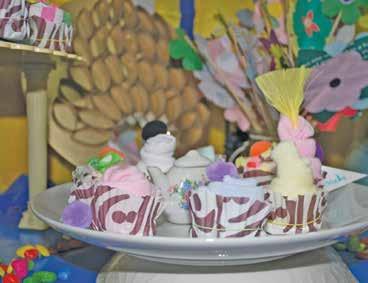
‘Everything makes Craft’ is not just a reference on the adage “one man’s trash is another man’s treasure”, but a ‘green’ movement and a need to help save the world through eco-friendly activities.
A trendy shop, Everything makes Craft is operated by Christine De CambraForrester - a young mother of two, an aunt of 13, and the sixth of eight siblings. De Cambra-Forrester gives a new purpose to everything she gets her hands on, rather than letting it go to wastethat is in the waste bin.
“Everything makes Craft is about ‘upcycling’ - when you take what you have and give it a new purpose by adding embellishment or designs. On the other hand, recycling is destroying something and putting it through a process to make it into a new product,” De CambraForrester, proprietor of the craft shop, explained to the Guyana Times Sunday Magazine
An environmentalist from a young age, De Cambra-Forrester abhors littering and seeing others doing so. “I have always had a problem with littering and

seeing others litter. Now that I have my own family, I use a lot more items and so I decided to reuse some of these things instead of throwing them out.”
Family-oriented, coming from a big family background, De CambraForrester views her craft as another way to engage family and friends. But even more
noteworthy is her altruistic nature, as her new business venture was initially an advocacy campaign.
“This ‘upcycling’ venture [Everything makes Craft] was not meant to be commercial, rather its aim was to show the public what can be done with what is considered ‘trash’ in order to promote an anti-littering environment -


them out and adding to the garbage build up in Georgetown,” expressed

De Cambra-Forrester.
Developing her talents since childhood, most of De Cambra-Forrester’s craft skills are self-taught. “We didn’t have much money, so I would just gather stuff and make gifts for family and friends,” she disclosed.
What began as a hobby soon became a business venture, as requests for craft items flowed in. This served as a motivation for De Cambra-Forrester, who was propelled into taking her craft to a higher level.
From elegant picture frames to trendy lanterns,

glass bottle figurines to wall hangings, De CambraForrester solidifies her motto that everything can be made into amazing craft. She does this by using whatever she can get her hands on, including glass bottles, buttons, cans, newspaper, pieces of cloth and plastic. “I buy things like paint, glue, staples and the like, but everything else is obtained through my own use or through family and friends. Sometimes, I post a note on Facebook asking persons to send items they would normally dispose of to me, so I am used to people showing
up with all kinds of things like cloth and ribbon and candles,” she mentioned.
Describing her craft of transforming the old into the new, De Cambra-Forrester stated, “Upcycling is a simple and inexpensive way to do things with the family, spending quality time while making little gifts and impacting the future generation.”
Everything makes Craft offers classes to those who wish to learn about ‘upcycling’. For more information, call 696-3036 or visit Everything makes Craft on Facebook.

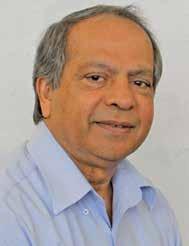
Recognised for his lifetime contribution to his work on diabetes by the University of Central Lancashire, UK, Professor Jaipaul Singh, or Prof Jai as he is known by his students and colleagues, is a champion of healthy living.
Academic life
Born at Uitvlugt Estate, West Coast of Demerara on 28 November 1946, Prof Jai came from a family of eight children. In January 1956, they moved from Uitvlugt Estate to live at La Jalousie, a village next to Windsor Forest where his father was born and his indentured great grandparents settled when they arrived in the then British Guiana.
Prof Jai went to Uitvlugt Church of Scotland Primary School and St Anthony’s Anglican School at Windsor Forest. In an interview with Guyana Times Sunday Magazine, the profes-
1963) and then to Indian Trust College (1963-1965). By August 1965, he obtained nine subjects at G C E ‘O’ Level. In November 1965, he was appointed as a junior teacher at St Jude’s Anglican School at Blankenburg on the West Coast of Demerara. While working as a teacher, he attended the University of Guyana in September 1966 during the evening studying for his Degree in Biology and Chemistry. In those days all classes were held at Queen’s College and University of Guyana (UG), which was called Jagan’s Night School. During the six years when he was attending the University of Guyana, he also worked as a teacher at Maha Sabha Secondary School at Leonora and at Zeeburg Secondary School until August 1974.
Prof Jai said that he is very proud to be a graduate of the University of Guyana and he felt that the univer-
BSc (Major Biology and Minor Chemistry) the Postgraduate Diploma in Science Education and Management respectively from the University of Guyana. Because of the lack of postgraduate research training at UG, in September 1974, he joined the University of St Andrews in Scotland, United Kingdom, where he did his PhD for a thesis entitled ‘Evidence for the involvement of intracellular cyclic nucleotides in the control of myocardial contractility’.
Following the PhD in 1978, he worked as a Research Fellow at the University of St Andrews (1978-1980), University of Dundee (1980-1981) and the Liverpool (1981984). In October 1984, he joined Preston Polytechnic (now University of Central Lancashire or UCLAN). Throughout the years he was promoted to Senior
sor stated that in 1958 his mother died from child birth and he had to help out with the rice land and farming, resulting in him dropping out of school. However, in 1960, he went back to school and in 1961 he was one of five pupils who passed the then School Leaving Examination. He said that he told his father that it was time for him to concentrate on his education, since his mother always told that education was the best investment any parents could give to their children.
Following primary school, he went to College of Arts and Sciences (1961-
sity has helped to make him what he is today. More importantly, he is very grateful to Dr Cheddi Jagan, our late beloved leader and founder of the University of Guyana. Prof Jai and other UG graduates are deeply indebted to Dr Jagan because Guyanese students back then could not afford to go to a university abroad. They had to wait until a university came to them in Guyana.
“Dr Jagan was a visionary and we owe every-thing to him in establishing a university in Guyana,” Prof Jai declared.
In September 1971 and 1972, Prof Jai gained his
Lecturer (1986), Principal Lecturer (1988), Reader (1991) and subsequently to Professor (1993).
Achievements
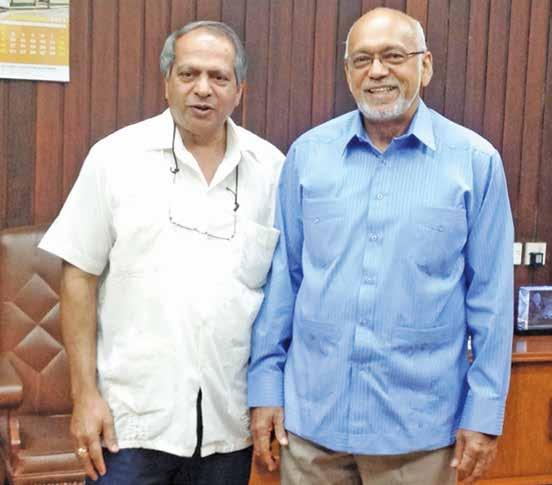
In July, 2011, Prof Jai was awarded the degree of Doctor of Science (DSc) from the University of Central Lancashire for a thesis entitled ‘Mechanism of secretory and contractile responses in tissues and cells of the body in health and disease’. He noted that this is the highest degree a professor could obtain from any university. Only himself and another Guyanese were awarded this prestigious degree.

The other Guyanese is former President Dr Bharrat Jagdeo, who was awarded for his work on climate change and being a champion of the environment.
Apart from being a very good teacher and research supervisor, Prof Jai has published 25 reviews, 20 book chapters, over 200 original manuscripts and 280 refereed abstracts in highly respected scientific and medical journals. Moreover, he has successfully supervised over 60 postgraduate research students for PhD (46), MD (1), MPhil (3) and MSc by Research (12). Currently, he is supervising six PhD students and one MD medical doctor. He has also examined over 50 postgraduate research students for the MSc by research, MPhil, MD and PhD. He is also the field editor for three scientific journals and a member of several professional scientific societies.
For his exceptional work as a Guyanese who has excelled in the UK, Prof Jai was given a Guyana High Commission Award in 2008 with other Guyanese such as Professor Cynthia Pine, David Lammy, MP, and former Minister for Science and Universities in the UK, Lord Ali and Dame Amos.
Prof Jai’s main research interest is on diabetes mellitus in both the heart and exocrine glands. He also has some interests on plantbased medicine to treat diabetes and cancers. He is particularly interested in the use of the green vegetable karela for the treatment of both diabetes and cancer. He currently holds a research grant with Dr Emanuel Cummings, from the University of Guyana, to find out what is the active ingredient(s) in karela which can kill different cancer cells, including those from the brain, breast, skin, lungs and several others.
Prof Jai is a strong believer in herbal remedy/ medicine that can be easily grown in the backyard. Concerning his research on karela (bitter gourd/melon),
commonly called “carilla” in Guyana, Prof Jai stated that if there is a potential agent found in the green vegetable to treat cancer it would be a momentous medical breakthrough. He pointed out that the research is currently ongoing at his university in the UK, which has the necessary equipment.
Since 2002, the professor revealed that he has been involved mainly with research and training of postgraduate research students in the School of Pharmacy and Biomedical Sciences and the School of Forensic and Investigative Sciences at the University of Central Lancashire. His duty as a Research Degree Tutor (RDT) involves recruitment, admission, and guiding the postgraduate students throughout their research degree career with the help of their specific supervisors. He is also responsible for all governance issues involve in research training, supervision, examination and successful completion.
Prof Jai also collaborates with several research laboratories nationally and internationally, especially in the USA, Canada, Spain, Portugal, Greece, Kuwait and the United Arab Emirates, where he recruited most of his students.
Since 1994, Prof Jai has been visiting Guyana regularly in his capacity to give back something to his beloved Guyana. From 1996 to 2003, he and his Guyanese colleagues obtained over $200,000 USAD from the British Council to help young staff members of the University of Guyana and Georgetown Public Hospital Corporation to study at the University of Central Lancashire and to get specialist training at Royal Preston Hospital, respectively.
Additionally, Prof Jai was appointed external examiner for the MBBS and BDs programmes at the University of Guyana. He has examined medical and dental students for over six years. He was also the
examiner for the Medical and Dental Schools at Mount Hope Campus of the University of the West Indies in Trinidad. Prof Jai, via his university and local hospital, donated books, computers and a CT scanner to UG and Georgetown Public Hospital. Several of his senior colleagues, including his Vice Chancellor, Deputy Vice Chancellor, Pro Vice Chancellor, Deans and other staff, visited the University of Guyana with the purpose of finding out what they can do to help improve UG’s programmes.
Prof Jai was also a candidate for the Vice Chancellor post at the University of Guyana two years ago. He revealed that he was not disappointed not getting the position, but he felt that he could have done a fairly good job to internationalise the university, get more internal and external financial supports, run cutting-edge courses, which can create jobs and emphasise more on research and research training leading to the awards of MSc by research, MPhil, PhD, MD, DSc and DLit by the University of Guyana.
“The time has now come for the Government of Guyana to establish a Graduate Research School at the University of Guyana. I firmly believe that the current Vice Chancellor of the university is doing an excellent job to build a very good institution, but he needs the full support from staff, students, the government and also the public,” the professor mentioned.
Aiming to develop his country of birth, Prof Jai is involved in bringing foreign investors to Guyana so that they can create jobs and help to improve the economy, health and education.
Prof Jai is married and has two adult children who are working and living in London. He and his wife, Aileen, also have a little granddaughter by the name of Evie.
Further information on his research, email Prof Jai at jsingh3@uclan.ac.uk or Google his name.
Professional, efficient, fun-loving and witty are some of the words that describe the three beautiful women of RED Entertainment - an event planning, marketing and entertainment company.
The three ladies, Kristina King, Chelsea Fung and Saskia Wyngaarde, founded and execute the daily functions of RED Entertainment. They are recent university graduates who add a “unique, creative flair” to their field.
Wyngaarde graduated with an Associate Degree in Business Management at Broward Community College and a Bachelor’s Degree in Marketing and International Business at Florida International University (FIU). She has worked at T.G.I.F. Fridays, in the US, where she participated in the T.G.I.F. Friday’s Flair Bartending Competition and won in her district in 2008 and 2009. Additionally, she has worked at the award winning Catch of the Day as Bar Manager, as well as Event Coordinator at Professional Catering Incorporated (PCI) in West Palm Beach, Miami, US. Above all, she is an expert in marketing having worked with the American Marketing Association (AMA).
King graduated with an Associate Degree in Business Management at Miami Dade College and a Bachelor’s Degree in Hospitality Management at Florida International University (FIU). She participated in several events hosted by FIU. Notably, she coordinated and worked with Sunny Anderson, a Food Network celebrity chef, and Famous Hot Dog, the popular hot dog franchise, at the Food Network South Beach Wine & Food Festival in Miami, Florida. She also worked in the restaurant industry at Chu’s Restaurant and Bar as a bartender/server where she gained hands-on, practical
experience in the industry.
Fung holds a Bachelor of Arts Degree in Environment & Society and Women & Gender Studies from the University of Toronto (U of T). She also has years of experience with event management. Fung has planned and coordinated numerous academic events and other initiatives as Co-President of the Women & Gender Studies Student Union at U of T. She was involved in the intricate planning and coordination of several fundraising events for Grant-a-Dream Inc. and Help & Shelter.
With such success and advanced intellect, the RED Entertainment ladies remain “down to earth” and friendly. Whether borne from their close bond or their feminine nature, they nonetheless are a force to be reckoned with in their field.
“Working with friends has been and continues to be a great creative and collaborative experience. As business owners, we all share common experiences and challenges making it easier for us to understand and communicate with each other,” Chelsea Fung told the Guyana Times Sunday Magazine
When asked by this publication if they add something new to the industry, Wyngaarde was quick to point out that they do. She posited, “Oh yes! We bring the energy, the freshness and the creativity.”
Wyngaarde added that they work “constantly at being efficient and reliable so that they can maintain loyalty and respect with their clients and fellow colleagues and entrepreneurs”. She noted, “It is difficult to sustain the efficiency as our company is growing, but we continuously adapt and reorganise our company’s strategies in order to reach our goals.”
According to the executives, the reaction of their clients, colleagues and business rivals has been “great over-

all” and “mostly supportive”, although it was a “bit tough to gain respect in the beginning”.
“As you would expect, it was a bit tough for us to gain respect in our industry as it is dominated by males. It has been a challenge for us, but [as time goes by]…we have built relationships with other entrepreneurs and businesses,” Fung explained.
King was keen to clarify, “It has been great so far, our past clients and [continuing patrons] have given us positive feedback and there isn’t any better feeling than satisfying a client. With regards to our colleagues and business rivals, they have all mostly been supportive.”
Whether you are talking to the “funny one” Saskia Wyngaarde, the “nice one” Kristina King or the “picky one” Chelsea Fung, business associates and clients can rest assured that the warm, friendly and competent company, RED Entertainment, is managed by proficient professionals.
RED Entertainment is a

relatively new company that was established because the women saw a lack of art/cultural-based entertainment in Guyana.
After some well-intentioned advice that change comes from action, the girls quickly put their academic and practical experience to-
gether and formed the company. Their first event, which was a concert with smooth jazz and jazz/reggae saxophonist Arturo Tappin and a few local artists, was a huge success.
A bond borne from years of friendship, the women have known each other from their early childhood: King and Fung through young adulthood and university life, during which Wyngaarde joined the two girls creating the dynamic trio.
For more information, visit http://redentertainmentgy.com or check out RED Entertainment on Facebook.

By PetamBer Persaud
During rehearsals for ‘Expressions 3’ – a new forum for poetry, produced by Gem MadooNascimento – a number of poems written by writers who have passed, came alive in the performances. One such poet was Mahadai Das, a promising writer cut down in the prime of her life.
Death could not silence her, a voice exploring debilitating ethnic and gender issues, a voice coming to grips with identities – Guyanese consciousness and Indian sensibility, but more importantly, a voice of anticipation and hope.
A Leaf in his Ear: Selected Poems was published posthumously to celebrate a remarkable life, a project started with the poetess, before her death, discussing same with the Jeremy Poynting of Peepal Tree Press and in cooperation of one of the writer’s sisters. A Leaf in his Ear: Selected Poems remains effectively Mahadai Das for she left instructions on what the book must portray, a map of her struggles, her shortcomings and her triumphs, of her use of literature to lobby the cause of the marginalised, the subjugated and the disempowered.
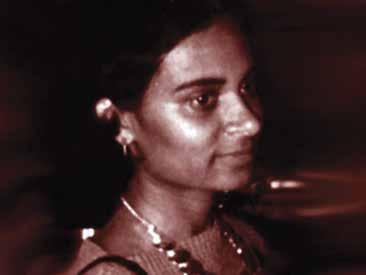
Das’ life was one of crises. Crises she transformed into challenges. Challenges of which some were pyrrhic victories.
Born in Eccles, East Bank of Demerara, Guyana, in 1954, Mahadai Das left her footprints in Uitvlugt, West Coast Demerara, lived for a number of years in the USA and died on 3 April 2003 in Barbados, where her mortal remains were laid to rest.
In 1972, she became part of the Messenger Group with Janet Naidu, Rooplall Monar and others. Later that same year, Das took part in the Caribbean Festival of Arts, Carifesta, held in Guyana.
In October of 1973, she was crowned queen of Maha Sabha Dewali Jalsa. During that same period, Das performed her poem in vernacular ‘Chile is who yuh foolin’ at the Theatre Guild as the Messenger Group staged a three-day celebration of the Coolie Art Forms.
Between 1973 and 1975, she was a significant part of the Guyana National Service, serving in its Cultural Division, burning with patriotic fervour and idealistic revolutionary imagination. This showed up in her first collection of poems, I Want to be a Poetess of my People (1976). This collection also traced her

roots from indenture to independence and included her most performed poem ‘They Came In Ships’. Das’ second book of poems, My Finer Steal Will Grow (1982), is a better crafted work than her first. In 1988, she published her most accomplished collection, Bones, confirming her individuality and her place as a top crafter of verse.
Her poems could be found in local journals like Kykoveral, and Kaie. While at Columbia University, she published in student magazines like Common Ground and Black Heights. Of great significance also is that her poems have found their way onto the syllabi of Caribbean, North American and European universities. That alone speaks volumes of the quality, content and import of her writing.
Mahadai Das was educated at Bishops’ High School in Georgetown before moving on to the University of Guyana and then the University of the West Indies. She gained a BA in Philosophy at Columbia University and a MA in the same subject at the University of Chicago.
While awaiting her PhD candidature, she underwent open-heart surgery from which she never fully recov-

ered, truncating her academic career in 1987.
A career that was fraught with so many obstacles, battles that she overcame only to lose the war. Undaunted, still resolute, she cried out for attention, “I mourn unflowered words, unborn children, inside me…absent water can has never lent itself to flowers.”
So when ‘Millicent’ (so fondly called by her relatives
and friends) became unwell, many of her colleagues rallied to her assistance. Mahadai Das dyed her name in the country’s literary heritage because she was in that first ripple of women writers of Indian ancestry staking a claim to the word ‘Guyanese’. Responses to this author: telephone (592) 226-0065 or email: oraltradition2002@yahoo.com

The states of the world, life’s relentless pace, and the complexities of modern living have all made happiness elusive for many people.
This has given birth in recent years to a new industry - books, movies and "advice" all designed to help us, or more accurately, force us, to be happy. We are told of the benefits - improved health, a more rewarding career, and an enjoyment of life - all true.
But to truly understand being happy, we need only to look at our own childhood, a period of innocence, free of judgement - a time in which we were in awe of everything around us.
We then realize that happiness is not dependent upon the outside world. It's not something we look for and then find. It's not something we get from other people. It's not something that's hard to do. It's not even an emotion to be felt here and there.
Rather, happiness is generated from within, and once firmly in place, becomes a perpetual state of being - the way we are.
There are things we can do to nurture, encourage and stimulate our state of happiness:
1. Start the day this way: Play your favorite music in the morning. Play it loud and give a little dance. Music has the power to clear the mind of its endless clutter and sets a positive tone for the day.
2. Stop the fight: We fight things because we are in a hurry. Everything becomes a struggle and nothing happens quickly enough. If we change our outlook to allow things to take as long as they take, we are able to free ourselves from the "hurry" syndrome plaguing much of society.
3. Change the program: All day long, every day, we talk to ourselves. Even in sleep. Our inner voice is a neverending narrative which, if connected to a magic machine that could turn our thoughts to audio, would sound like the ramblings of a complete mad man. While it's impossible to stop the mind's chatter, write down these words to say to yourself: "I actually like myself right now. I'm okay. I've got talents and skills and a good heart." Once a day, program something nice about yourself, to yourself.
4. Do what you love: We hear this all the time from experts. But the truth is, for most people in the world, having a "dream" job is just that - a dream. However, we can still do things within our occupation, and most certainly outside of it, that gives us pleasure. Do what you love, even if, and especially if, there is no monetary gain.
5. See yourself from above and laugh: If you do something silly, look at yourself from 10,000 feet up and laugh at that person. Many of us take ourselves far too seriously. This is unnecessary, counter-productive and repels others.
6. Don't over-analyze: Some persons have a tendency to over-analyze every conversation and everything that happen to them. We must learn to let things go for the only person we are hurting is ourselves.
7. Don't suppress emotions: Let yourself feel whatever comes upon you. Do not suppress sadness. Let it run its course. All emotion is part of the human experience and is designed to take place within the overall state of happiness.
8. Don't fake it: There are those who recommend we fake our happiness in the hopes that it will turn real. There is no such thing as faking happiness. This is akin to "Fake living".
9. Accept others for who they are: We often become frustrated with people because they don't conform to how we feel they should think and act. Let us not try to change others. Their flaws and imperfections are among the components that make them who they are.
10. Use the language of happiness: The words used in our daily language affect our subconscious mind more than we realize. Don't say "I hate..." Use as many "happy" phrases as you can through the day: "This is easy" "I find it interesting" "I am comfortable right now" "Welcome!" "That's a lot better" "I agree with what you're saying" and of course, "Awesome!"
11. Be moderately busy: Boredom can result in a state of unhappiness so strive to be busy, but not so busy that you are overly stressed. The goal is "moderate" busyness.
12. Be accepting of things you cannot control: Millions will curse tomorrow morning's traffic and weather, putting themselves in a bad mood. Let us learn to accept all things we cannot control and be the happier for it. (Excerpt from Cory Galbraith’s column on LinkedIn)


Colwyn Arvey Abrams was born on 31 May 1992 in the outskirt village of Linden called Coomacka, an Amerindian settlement. Abrams is the second of seven children. His effervescent attitude propelled him to take part in numerous competitions such as Linden Town Week of 2009 and the GT&T Jingle and Song Competition of 2011 and 2013. In April 2012, Abrams was a contestant in the Guyana Model Search and Designers Portfolio, which set out to curve the talents of upcoming models and designers in the local fashion industry. He was the winner of the Stylist Challenge Award of the Guyana Designers Portfolio 2012. In October 2013, Abrams took part in Guyana Fashion Week with his male collection, Modern Day Man, winning the prize. This win helped him to earn his way to display his collection on one of the Guyana Fashion Week 2013 international nights. In 2014, Abrams was awarded the contract to design the costume band FOLKTOBIA for the Regional Democratic Council in Linden. As he continues his love for arts and entertainment, Abrams works as a marketing agent and broadcaster for the local radio station 104.3 Power FM. He was recently a contestant in the Mr Guyana International 2014 competition. Abrams’ platform was ‘Raising Awareness on Prostate Cancer – Early Detection is Life’. He viewed the competition as a means to spread awareness on the issue with the intention of saving the lives of men across Guyana and the Caribbean. Although he was unable to cop the crown, Abrams continues to fulfil his mission on spreading awareness on prostate cancer.
It seems unfairly menacing that a snake that can literally "stand up" and look a full-grown person in the eye would also be among the most venomous on the planet, but that describes the famous king cobra.
King cobras can reach 18 feet (5.5 meters) in length, making them the longest of all venomous snakes. When confronted, they can raise up to one-third of their bodies straight off the ground and still move forward to attack. They will also flare out their iconic hoods and emit a bone-chilling hiss that sounds almost like a growling dog.
Their venom is not the most potent among venomous snakes, but the amount of neurotoxin they can deliver in a single bite—up to two-tenths of a fluid ounce (seven milliliters)—is enough to kill 20 people, or even an elephant. Fortunately, king cobras are shy and will avoid humans whenever possible, but they are fiercely aggressive when cornered.
King cobras live mainly in the rain forests and plains of India, southern China, and Southeast Asia, and their coloring can vary greatly from region to region. They are comfortable in the trees, on land, and in water, feeding mainly on other snakes, venomous and nonvenomous. They will also eat lizards, eggs, and small mammals.
They are the only snakes in the world that build nests for their eggs, which they guard ferociously until the hatchlings emerge.
King cobras may be best known as the species of choice for the snake charmers of South Asia. Although cobras can hear, they are actually deaf to ambient noises, sensing ground vibrations instead. The charmer's flute entices the cobra by its shape and movement, not by the music it emits. (National Geographic)



The objective of the game is to fill all the blank squares in a game with the correct numbers. Every row of 9 numbers must include all digits 1 through 9 in any order. Every column of 9 numbers must include all digits 1 through 9 in any order. Every 3 by 3 subsection of the 9 by 9 square must include all digits 1 through 9.


In the early 1600s, many people were unhappy with the Protestant Church of England. They thought the church was too decadent and its rituals too formal. Some wanted to separate from the church and worship in a simpler way; they became known as Separatists.
Because the Separatists wanted to purify the church, they were also known as Puritans.
While the term Pilgrim may have been used to describe the Plymouth colonists, they were more commonly known as Founders or Forefathers
In the 16th and 17th centuries, it was against the law in England to belong to any church other than the Church of England. Weary of heavy fines and jail sentences, the Separatists fled to the Dutch Netherlands where they could worship freely. But it was difficult for the Puritans to adjust to life in Holland; work was scarce, and the language was a barrier. They decided the Americas would offer more opportunities. With the help of financial investors, a group of Puritan colonists readied themselves for a journey.
About a third of the 102 colonists who arrived on the shores of New England were English Separatists. The rest were colonists hoping for adventure, financial gain and a new life.
It took the Mayflower 66 days to reach America. The colonists had hoped to settle in Jamestown, Virginia, or along the Hudson River in what is now New York, but the winds took them to Cape Cod instead. They landed at Provincetown on Nov. 21, 1620. They decided to build their colony at Plymouth. But the Pilgrims were ill-prepared for the harsh winter, and their supplies were short. Weakened by scurvy and the bitter cold, many people got sick. Only 52 people survived that first year in Plymouth. Yet, despite these hardships, the Plymouth Colony of 1620 would become the second successful English settlement in America. The first was Jamestown, Virginia, in 1607.
By Laurie Triefeldt
The Pilgrim colonists were a small group of English Protestants known as Puritans. Seeking religious freedom, about 100 people boarded a ship called the Mayflower and sailed for America. These Separatists reached what is now Provincetown Harbor in 1620 and, after exploring the region, decided to build their colony at what is now Plymouth, Massachusetts.
Boston (1630) Hull (1622)
Weymouth (1624)
MASSACHUSETTS BAY COLONY (1630)
Roger Williams’ First Settlement
Providence (1636)
Bristol (1682)
RHODE ISLAND COLONY (1644)
NOTE:
Scituate (1636)
Marshfield (1640)
Bridgewater (1656)
Taunton (1639)
Rehoboth (1645)
PLYMOUTH COLONY (1620)
Middleborough (1669)
Swansea (1667) Freetown (1683)
Rochester (1686)
Dartmouth (1664)
Little Compton (1682)
Mount Hope Wampanoag Capital
Narragansett Bay
Duxbury (1637)
Cape Cod Bay
Plymouth (Dec. 21 1620)
Aptucxet Trading Post (1629-1635)
Buzzards Bay
First landing of the Mayflower (1620)
Provincetown (Nov. 21,1620)
Eastham (1646)
Sandwich (1639) Yarmouth (1639)
Barnstable (1650)
Falmouth (1686)
NEW YORK (1664)
In October of 1621, the Pilgrims celebrated their first harvest with a three-day feast. In gratitute for their help, the English invited the Wompanoag people to join in the festivities. This famous celebration became the basis for the story of the first Thanksgiving Today, Thanksgiving is celebrated in the United States on the fourth Thursday in November. In Canada, it is celebrated on the second Monday of October.
As time passed, other settlements were established in New England. In 1691, Plymouth became part of the Massachusetts Bay Colony.
Originally, the Pilgrims had planned to travel on two ships, the Mayflower and the Speedwell. But the Speedwell was deemed unseaworthy, and the Mayflower sailed alone.
The Mayflower was followed by three more ships that made their way to Plymouth: the Fortune in 1621, and the Anne and the Little James in 1623.
The Mayflower was about 12 years old when it set sail for America with the Pilgrims. Before then, this now-famous merchantman ship was shipping wine.
Although the Pilgrims occasionally saw native people on the shore and in the forests, they did not meet face to face until about four months after their arrival. The Pokanoket Wampanoag people welcomed the colonists and signed a peace treaty with them. One Wampanoag man named Tisquantum or Squanto had learned the English language when he was captured by English sailors. Tisquantum managed to make his way home to Plymouth only to find his village had been wiped out by sickness. Tisquantum was especially helpful to the Pilgrims, teaching them many of the skills they would need to survive in the New World, including how to plant corn.
Over the next few years, more and more English colonists arrived. By 1627, Plymouth Colony had grown into a stable and comfortable community of about 160 people.
Over the years, as other European settlers arrived on the shores of New England, the relationship between the colonists and the native people became strained. Occasional fighting erupted, but the violence would escalate into a terrible and bloody war in 1675. Led by a chief called Metacom, also known as King Philip, the New England natives attacked many of the English settlements, but ultimately failed in their attempt to dislodge the settlers.
Rule 1
It's more important to look good every day than to look different every day. This is the genius of being a man.

Rule 2
The rule of shoes: Black is basic. Basic is boring. If you're wearing black, then by all means wear black shoes. But if you're wearing gray, blue, tan, or a combination thereof, brown shoes will almost always look more sophisticated. There's simply more range, from caramel to chestnut to chocolate. If you wear a belt, it should (sort of) match.
Remember: You don't need 100 new shoes to look good.


Rule 4
A man wears a watch. Men used to wear pocket watches, round clunky things. Then came the invention of the wristwatch, and now a man could juggle employers and women with just a casual flip of the wrist. Sadly, this ingenious tactic is under siege: These days, many of us tell time not by wristwatch but by our cellphones. Great devices, unless you're, well, trying to be discreet while digging one out of your pants. So we're back to square one. Be a man. Wear a watch.
Rule 5
Vertical stripes make you look thinner. So guess how horizontal stripes make you look?

Rule 6
Don't try to dazzle. Stick to basics for an interview to ensure that your qualifications are the focus. Minimize patterns and loud colours. Choose a classic tailored suit in blue or gray, and add a pop of colour with the tie or pocket square.
Rule 7
Ties run button to button. A tie should cover your collar button and most of your top trouser button. Anything shorter makes you look like you work for NASA.


Rule 8
Wear flip-flops only at home or to the beach. What makes a man a man? He is strong. He is certain. He is prepared at any moment to meet a manly challenge with courage and fortitude. When a child wanders off the curb into traffic, when a date is hassled by a street tough, when a fire breaks out and someone needs rescuing, a man is there, fast and ready. He is not skipping cloppity-clop-clop down the street, squeezing his toes together so his flip-flops don't fall off.

Rule 9
Prosperous men don't wear wrinkled clothes. Until you make it, fake it.
1. Set up shop: Fill your iron with distilled water. Mist the shirt with a spray bottle.
2. Go easy on the collar: Always iron the back of the collar, never the front, and avoid ironing the tips, to keep them from fraying.

3. Hit the shoulders and sleeves: Place each shoulder around the rounded edge of the board, and iron. Undo the sleeve button and spread out the cuff. Iron the inside here, too. Straighten each sleeve, smooth out any creases, and iron both sides.
4. Finish it off: Spread out the left side of the shirt's body, smooth the creases, and start ironing. Work your way to the right side. Air-dry the shirt on a hanger for 5 to 10 minutes, so the fabric sets.
Rule 10
Dress like you've made something of yourself in the world, even if you haven't.
Don't try to look like you did when you were just starting out. Let your wardrobe evolve with the times—and your title.

Jack Falahee is an American actor. In 2014, he began starring as Connor Walsh in the ABC legal drama series, “How to Get Away with Murder”. In 2011, Falahee graduated New York University's Tisch School of the Arts with BFA in Drama, where he studied acting and performed in a number of productions. His first screen acting job was in 2012, with guest starring role in the comedy web series, “Submissions Only”. Also in that year he had the leading role in the short film “Sunburn”. Falahee made his television debut in 2013, with guest-starring role in The CW teen comedy-drama series, “The Carrie Diaries”, and later appeared on the short-lived NBC series, “Ironside”. He starred in the Lifetime movie “Escape from Polygamy” (2013). Falahee later had roles in a number of independent films, including “Hunter”, “Blood and Circumstance” and “Slider”. In 2014, he appeared in action-thriller “Rage” opposite Nicolas Cage and Aubrey Peeples.
So that's why! Though it's no surprise, Taylor Swift finally revealed to Yahoo! Music on Thursday, Nov. 6, why she recently pulled her music from Spotify entirely.
"All I can say is that music is changing so quickly," Swift, 24, said about her controversial stance and refusal to stream music online. "The landscape of the music industry itself is changing so quickly, that everything new, like Spotify, all feels to me a bit like a grand experiment. I'm not willing to contribute my life's work to an experiment that I don't feel fairly compensates the writers, producers, artists and creators of this music. And I just don't agree with perpetuating the perception that music has no value and should be free."
Swift also cited her oped piece in the Wall Street Journal published this past summer. "I try to stay really open-minded about things, because I do think it's important to be a part of progress," she told Yahoo. "But I think it's really still up for debate whether this is actual progress, or whether this is taking the word 'music' out of the music industry."
She revealed to Yahoo that she was advised by

many experts to put her first single from 1989, "Shake It Off," on the streaming service. After briefly allowing Spotify users to stream her hit, Swift ultimately decided to pull it -- along with the rest of her smash tunes. "It didn't feel right to me," she reasoned. "I felt like I was saying to my fans, 'If you create music someday, if you create a painting someday, someone can just walk into a museum, take it off the wall, rip off a corner off it, and it's theirs now and they don't have to pay for it. And so I decided to change
the way I was doing things."
The singer, whose fifth studio album sold a record-shattering 1.2987 million copies in its first week, said she was shocked by the amount of support she's received. "I hoped that I had created something that people would want to buy," she confessed. (Swift's 1989 has boasted the biggest sales of any album in its first week since The Eminem Show in 2002.) "I just was hoping and praying that people still perceived there to be a value to someone's musical creation." (US Magazine)

Victoria’s Secret has heard the cries.
After sparking protests with the new “Perfect Body” campaign, the lingerie giant has transformed its message.
The new slogan — “A Body for Every ‘Body'” — has replaced the original “The Perfect ‘Body'” tagline on Victoria’s Secret website. The ad (for the latest Body by Victoria line) still features the same superslim models with the sub tag, “Perfect Fit. Perfect Comfort. Perfectly Soft.” Victoria’s Secret has yet to make an official statement
about the change.
British students Frances Black, Gabriella Kountourides and Laura Ferris, who started a Change.org petition in response to ads, have released a statement about the change.
“Amazing news –Victoria’s Secret have changed the wording on their website from ‘The Perfect ‘Body” to ‘A Body For Every Body.’ This is amazing news! We were not notified by Victoria’s Secret or the press about this, we found it out ourselves,” they wrote on the
petition site.
However, they’re still hoping to see a shift in the brand’s marketing strategy, adding, “The campaign is NOT over! We still want them to change all of the posters in their stores, apologise and pledge to not use such harmful marketing in the future. So let’s keep spreading the word!”
The movement caught a lot of momentum on Twitter, inciting the hashtag #iamperfect and generating people to share photos promoting positive, realistic body image. (People)
Chad Kroeger laughs off rumor of him splitting from Avril Lavigne after one year of marriage. The Nickelback member shares in a new interview with ET Canada that he finds the break-up story "amusing."
"You know my dad calls me up and he's just like, 'I haven't slept in 2 days, what's going on?' I'm like, 'Dad you're not buying all this crap are you?' You know, I get to hear all the rumor mill stuff. I find it very amusing," he says.
"When you get out of high school, and it's like, 'Ugh, okay.' All that rumor crap. All that stuff that people say behind each other's backs is minuscule, pales in comparison to the world of celebrity or being married to a celebrity," he explains. "That's high school

multiplied exponentially. It's ridiculous. How many times has Jennifer Aniston been pregnant this year? A dozen?" He jokingly adds, "Let's start a new rumor. I'm pregnant."
Kroeger gave the "When You're Gone" hitmaker a 17-carat diamond ring to celebrate their first wedding anniversary in July.
Two months later, rumors
of them separating hit the web.
Kroeger and his band recently announced a 60city North American tour scheduled for next year to support their album "No Fixed Address", hitting stores on November 17. They will kick off the tour in February 2015 in Allentown, Pa. (AceShowbiz)

Miley Cyrus is now singing "Adore You" to a brand-new man. The boundary-pushing singer, 21, is dating actor Patrick Schwarzenegger, sources confirm to Us Weekly.
The pair have been seen together in recent weeks, more than three years after Schwarzenegger, 21, first voiced his affection for Cyrus.
The handsome, buzzedabout son of Arnold Schwarzenegger and Maria Shriver was speaking to
Details about his dating prospects in May 2011 when he admitted, "My eye, though, is set on Miley." He was previously linked to the likes of Taylor Swift and his USC classmate Tootsie Burns.
After a brief fling in 2011, when Cyrus was on a break from then-boyfriend Liam Hemsworth, Schwarzenegger finally reconnected with his crush earlier this year. Insiders tell Us the stars have been quietly dating for "several months."
"They have been friends for a long time," a source tells Us. "They have a ton of common friends so they have run in the same circles for years." After splitting from Hemsworth in 2013, Cyrus dated producer Mike Will Made-It until earlier this year.
Cyrus and Schwarzenegger celebrated Halloween together at Hollywood's Roosevelt Hotel, says a second source, who adds that they went back to the "We Can't Stop" singer's house after the bash.
"She thinks he's hot, she thinks he's cool," a third source close to Cyrus told Us. "Patrick is a nice good guy. He's grown up in Hollywood just like her and it was only a matter of time before they hooked up."
The relationship is casual at this point, as sources tell Us "it's not serious," but Schwarzenegger is "seeing where it goes" and "he likes her." (US Magazine)
Selena Gomez breaks down in tears in 'The Heart Wants What It Wants'
Selena Gomez finally returns with new music. The singer debuted a new song called "The Heart Wants What It Wants" along with its accompanying music video on Thursday, November 6. "I have been waiting to share this with all of you," she told her Twitter followers and attached a link to the visuals.
The heartbreaking ballad was produced by Rock Mafia. The video, shot in black-and-white, opens with a personal recording of her discussing a man, presumably her on-again, off-again boyfriend Justin Bieber.
"I know him though, and I know that I know his heart, and I know what he wouldn't do to hurt me. But
I didn't realize that I'm feeling so confident and feeling so great about myself, and then it just be completely shattered by one thing, by something so stupid. But then you make me feel crazy. You make me feel like it's my fault," she says while crying before the clip shows her hanging out with some friends and a man at a club.
The shots of Gomez cozying up to the man intersperse with ones of her breaking down in tears as she sings, "The bed's getting cold and you're not here/ The future that we hold is so unclear/ But I'm not alive until you call/ And I'll bet the odds against it all/ Save your advice 'cause I won't hear/ You might be right but I don't

care/ There's a million reasons why I should give you up / But the heart wants what it wants."
"The Heart Wants What It Wants" is featured on Gomez's upcoming greatest hits album, "For You". The LP, which will be her last project with Hollywood Records/Disney, is scheduled to arrive on November 24. (AceShowbiz)

Puja Gupta is an Indian model and actress. Her breakthrough came in 2007, when she won the title of Miss India Universe. She went on to represent India at the 2007 Miss Universe competition in Mexico, where she made the top ten. After that she has become the face of numerous famous brands and labels. She made her acting debut in the film “F.A.L.T.U”. Since then, the model has quickly developed a successful career as an actress and has won roles in several other films. Gupta is a strong supporter of the animal rights organisation, PETA; campaigning for vegetarianism; and she also plays an active role in spreading AIDS awareness. In 2013, she appeared in “Go Goa Gone” and has appeared in the film “Shortcut Romeo”.
Arecord opening-day debut for a Bollywood film that happens to be directed by a woman is shaking up the men's-only club of filmmakers in the list of India's highest grossing movies.Farah Khan's new film, a heist caper that doubles as a song-and-dance extravaganza, is a rare blockbuster by a woman filmmaker in the Indian movie industry, the world's largest by ticket sales. Two of Khan's three previous films in the last decade were hits too, but not as big as "Happy New Year".
The choreographer-turned-filmmaker said withstanding pressure from people who expect her to make a certain kind of cinema because of her gender is her biggest success.
"Nobody is expecting a 200 crore ($33 million) hit from a woman director, which in itself is very sad and very patronizing," said Khan, whose recipe of breezy, entertaining cinema woos children and adults alike, but is panned by critics.
"I hope more women come and break this record. I think it will help every woman who wants to go out and make a movie, if our movies end up making as much money as the male directors."
Khan, 49, said she lived her dream with "Happy New Year", having wanted
to make the "biggest film you've seen in INDIA".
Her leading man Shah Rukh Khan, Bollywood's most bankable star, headlines the film's ensemble cast. In the film, Shah Rukh and his ragtag crew of loveable rogues worm their way into a global dance competition at a Dubai hotel, with their sights set on diamonds hidden in an underground vault at the venue.
Reviews have mostly been critical with Anupama Chopra writing in the Hindustan Times that "the desire to entertain overshadows everything elsescript, character, coherence, narrative logic".
But Khan is unfazed by criticism, saying she relies on her gut instinct while making movies that make her happy.
"Why should I take the pressure of making a movie that will only appeal to 10 people and not to 10 million people?" she said. "If the critics don't like it, let them keep watching boring movies, what else can I say?"
Audiences seem to have lapped it up.
Trade analyst Amod Mehra said "Happy New Year" had the "highest opening ever in the history of Indian cinema so far", raking in around 440 million ru-
pees ($7 million) in INDIA when it was released on Oct. 24, a day after Diwali, the Hindu festival of lights.
Ticket sales have dipped in the weeks since and Mehra said "Happy New Year" may still need a miracle to inch past 2 billion rupees at the Indian box office, a milestone achieved only by a handful of Bollywood films.
Khan advises her detractors to try writing the first five scenes of her movie, saying it was not easy to make a film that appeals to different audiences across India.
"It's easy to dismiss something and especially if a woman does it," said Khan, adding it had been tough balancing work and family while filming "Happy New Year" in Dubai.
The filmmaker said she has given up socializing and attending parties to assuage her "mother's guilt" and spend more time in Mumbai with her children, who are six-year-old triplets.
She's also hung up her dancing boots after choreographing Bollywood songs for 22 years, saying she no longer had the patience to make actors go through their steps.
"For me, that ship has sailed. I've had a great time, but I think it's time for me to move on." (Reuters)


Priyanka Chopra: 'I didn't need film school'

Priyanka Chopra has said she deliberately chooses varied film roles.
The actress stars in Zoya Akhtar's urban family film “Dil Dhadakne Do” and is also shooting for Sanjay Leela Bhansali's period drama “Bajirao Mastani”.
She told IANS: "I always pick interesting projects! It's a very conscious decision for me because I don't like to repeat myself. I get bored doing the same thing.
"As a person, I like variety and I like things to keep moving. As a professional, I love my job. I have spent my entire career learning it. I didn't go to film school or advisors. So, my career has been my film school," she explained.
"There's so much to learn and so much to do. There's just no end to it in this business. And maintaining variety is the key."
The former Miss World, who has also forged a career as a recording artist, recently announced her plans to turn producer. (IANS)
Abhishek Bachchan describes wife Aishwarya as his 'lucky charm'
Aishwarya Rai Bachchan was spotted in the VIP stands cheering on Chennaiyin FC and Jaipur Pink Panthers, the football and kabaddi teams co-owned by husband Abhishek.
The “Happy New Year” star tweeted a series of images from the match, which showed his wife wearing the team jersey.
The former Miss World also joined her husband in a victory lap around the stadium after their team beat Mumbai City FC 5-1 in the ongoing Indian Super League tournament.
She wore the team jersey and posed with the team and a thrilled Abhishek after the win.
Wearing a lunghi, the actor showed off his now infamous snake dance from Happy New Year.
In August, Aishwarya watched Abhishek's

Kabaddi team, Jaipur Pink Panthers, beat U Mumba 35-24 to clinch the Pro Kabaddi League title. Abhishek, who said he would like to become an ambassador for sports in India, was also recently unveiled as the team owner of the Chennai franchise of the Indian Super League (ISL) during the official launch of the football league. He also plans to launch a women's kabaddi league in the near future. (Digital Spy)
By Zenica DaBichan
Cigarettes contain the addictive substance nicotine that causes smokers to continue to smoke. Addicted smokers need enough nicotine over a day to feel normal and to satisfy cravings or control their mood. Along with nicotine, smokers inhale about 7,000 other chemicals in cigarette smoke. Many of these chemicals come from burning the tobacco leaf. These compounds trigger damaging changes in the body.
Smoking is the number one preventable cause of death in the United States. Cigarette smoking causes more than 480,000 deaths each year in the United States. This is about one in five deaths. Cigarette smoking has been shown to harm nearly every organ in the body.
Circulation
Smoking makes your blood
thicker, and increase chances of forming a blood clot. It increases your blood pressure and heart rate, making your heart work harder than normal. It contributes to the narrowing of your arteries, reducing the amount of oxygen rich blood circulating to your organs.
The heart
Smoking doubles your risk of having a heart attack. If you smoke you have twice the risk of dying from heart disease than a person who never smoked.
The brain

Smoking increases your risk of having a stroke by at least 50%, which can cause brain damage and death. And, by smoking, you double your risk of dying from a stroke.
Lungs
The lungs are badly affected by smoking. Coughs, colds, and asth-
ma are just the start. Smoking can cause deadly conditions such as pneumonia, emphysema and lung cancer. Smoking causes 84% of deaths from lung cancer and 83% of deaths from chronic obstructive lung disease, including bronchitis.
Stomach
Like diabetes, heart diseases and many others, cancer is also a major global health problem affecting several million people in the world including those in Guyana. The disease has no respect for any age group, creed, colour, religious faith, ethnicity and others. It can develop in any one of us and at any time in life.
Cancer is caused by several insults to our body including smoking, preservatives in food, chemicals, gases, some drugs, radiation, sun light, working environment and many others. Most cancers in our body are named after our different organs and tissues including the brain, skin, lung, cervix, breast, oesophagus, bowel and several others.
A cancer is really a growth of cells and tissues in the different organs of our body. This is due to constant insults by many factors mentioned above. It can be both external, like skin cancer, and internal, like the brain and other internal organs of the body. An external cancer is noticeable, but the internal cancer is not, unless it is a massive growth. In most cases, the patient will experience constant pain due to the production of numerous inflammatory mediators and markers in the body. Some people also lose weight. If diagnosed early, the disease is treatable and the patient can live a normal life for several years.
Cancers are treated in several ways using surgery, radiotherapy, chemotherapy and others either alone or in combination. Once the cancer is removed by surgery, the doctors still have to treat any remnant cancer cells around the area or those which have invaded other organs and tissues of the body. In order to do this, the doctors normally prescribe an anti-cancer drug or a combination of drugs. This is called chemotherapy. These anticancer drugs are used in high doses and they not only kill the cancer cells, but also the healthy cells of the body. Most patients get weekly or biweekly treatment depending on the dose and his or her doctor. Many patients die from the cancer or the side effects of these drugs which act like poisons to the body. An alternative form of treatment is to look around us in nature for any natural remedy. One such remedy is the use of a plant–based medicine.
A multitude of plants have been identified and used for the treatment of different diseases throughout the world, especially in poor countries. Much research has been focused on the scientific evaluation of traditional drugs from the tropical plant, Momordica charantia (M. charantia). The whole plant, its green fruits or extracts from both the plant and its fruits have been commonly or frequently used

The major problem is when the disease is left untreated and it spreads to the different organs and tissues of the body. At this stage it is called a metastasis.
as an anti-cancer and anti-diabetic agents and each is often described as food of medicine. M. charantia is commonly known as bitter melon, bitter gourd or corilla/
Smokers have an increased chance of getting stomach cancer and stomach ulcers.
Skin
Smoking reduces the amount of oxygen that gets to your skin. This means that if you smoke, your skin ages more quickly. Smoking prematurely ages your skin by between 10 and 20 years, and makes it three times more likely you'll get facial wrinkling, particularly around the eyes and mouth.
Mouth and throat
Smoking is associated with problems such as bad breath and stained teeth, and can also cause gum disease and damage your sense of taste. The most serious damage smoking causes in your mouth and throat is an increased risk of cancer in your lips, tongue, throat, voice box and gullet (oesophagus).
Reproduction and fertility
karela. Bitter gourd grows in all tropical parts of the world and it is cultivated throughout South America (including Guyana), Asia and Africa. The plant is a slender climbing annual vine with long-stalked leaves and yellow, solitary male and female flowers borne in the leaf axils. It is related to squash and cucumber plants. The fruit looks like a warty gourd. The young fruit is emerald green, turning to orange-yellow when ripe.
The Latin name Momordica means “to-bite” referring to the jagged edges of the leaves, which appear as if they have been bitten. All parts of the plant, including the fruit, the stem and seed taste very bitter due to an endogenous compound within the fruit called momordicine.
Smoking can cause male impotence, as it damages the blood vessels that supply blood to the penis. It can also damage sperm and reduce sperm count. For women, smoking while pregnant can lead to miscarriage, premature birth, stillbirth and illness in the newborn baby.
The good news is that when you stop using cigarettes, even after many years of smoking, you can greatly reduce your risk of developing many of the diseases mentioned above.
Options to help quit smoking include the use of the nicotine patch and nicotine gum, certain medications also help in reducing the urge to smoke.
If you are a smoker talk to your health care provider and get advice on options that can assist you in quitting as it can prevent many diseases and prolong your life.
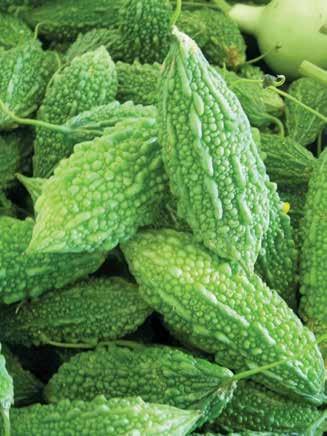
In the Amazon, local people grow bitter melon in their gardens for food and medicines. They add the fruit for bitter or sour flavour by parboiling it first with a dash of salt to remove some of the bitter taste. It is used as leaf tea for the treatment of diabetes, to expel intestinal gas, to promote menstruation and as an antiviral treatment for measles, hepatitis and feverish conditions. It is also used typically for sores, wounds, infections and also internally and externally to treat for worms and parasites. M. charantia is also used for the treatment of cancer tumours.
In the last few decades, several hundreds of studies that have been carried with M. charantia using modern tools and they have credited M. charantia with anti-diabetic, anti-viral, anti-tumour, anti-leukemic, anti-bacterial, anti-helmintics, anti-mutagenic, anti-mycobacterial, antioxidant, antiulcer, anti-inflammatory and hypo-chlolestrolemic, hypoglyceridemic, hypotensive, immune-stimulant and insecticidal properties . M. charantia seems to have universal medicinal properties for the treatment of different diseases.
Professor Jaipaul Singh, a Guyanese professor at the University of Central Lancashire in the United Kingdom, and Dr Emanuel Cummings, from the University of Guyana, have shown that a water soluble extract of corilla/karela can kill different cancer cells including those from the brain, skin, lungs and others. They both have received a research grant
from the University of Guyana to find out what is the active ingredient(s) in corilla/karela and to test it on different cancer cells. This is currently an ongoing research project.
There is no harm in eating the uncooked or raw corilla/karela daily either as a salad, a pickle, or drink it as a green juice in small amount, although it is bitter. It is advisable not to cook the corilla/ karela or heat it because you will destroy its potential medicinal values; it seems to be sensitive to heat. It is also advisable to use it like a medicine in a small amount. If you make the green juice (see recipe below), then drink about half of a whisky glass daily either morning, evening or any time. Leave the rest in the fridge for the next day. Two to three green corilla/ karela fruits can give you enough juice for a week. If you are taking any prescribed medication, please consult your doctor first and ask if there may be any interaction with the karela juice and your medicine.
Recipe for karela juice
Wash and cut long way two to three coirilla/karela (6-8 inches long). Remove seeds and white flesh using a spoon, leaving only the green flesh. Cut into small pieces and liquidise in water (enough to turn blender). Add some tropical juiceto neutralise the bitter taste (optional). Store in fridge and drink 30-50 ml daily before meals. You can also eat the fruit like a corn or as a pickle.


Your house may look clean, but these common organising mistakes can make it hard to maintain order. To avoid this, follow the rules below.




Ingredients:
2
juice
1/2 cup vegetable oil
Method:
Preheat oven to 350 degrees F (175 degrees C). Grease and flour two 8-inch round cake pans.
In a measuring cup, combine milk, 1/2 cup orange juice, oil, beaten eggs, and 1 1/2 teaspoon orange zest. Set aside.
Sift flour, salt and baking powder into a large bowl. Mix in sugar. Make a well in the centre and pour in the milk mixture. Stir until thoroughly combined. Divide batter into prepared pans. Bake in the preheated oven for 35 minutes, or until a toothpick inserted into the
3 eggs, beaten
1 1/2 teaspoons grated orange zest
6 tablespoons butter, softened
2 cups confectioners' sugar
2 tablespoons orange juice
1 teaspoon vanilla extract
1 teaspoon grated orange zest

centre of the cake comes out clean. Allow to cool.
To make Orange Butter Frosting: Cream butter until smooth. Gradually beat in confectioners' sugar. Beat
until light and fluffy. Beat in 2 tablespoons orange juice to bring to spreading consistency. Stir in vanilla and 1 teaspoon orange zest.
Ingredients: 4 1/2 cups all-purpose flour
2 teaspoons baking soda
2 cups butter, softened 1 1/2 cups packed brown sugar 1/2 cup white sugar
2 (3.4 ounce) packages instant vanilla pudding mix
4 eggs
2 teaspoons vanilla extract
4 cups semisweet chocolate chips
2 cups chopped walnuts (optional)

Method:
Preheat oven to 350 degrees F (175 degrees C). Sift together the flour and baking soda, set aside.
In a large bowl, cream together the butter, brown sugar, and white sugar. Beat in the instant pudding mix until blended. Stir in the eggs and vanilla. Blend in the flour mixture. Finally, stir in the chocolate chips and nuts. Drop cookies by rounded spoonfuls onto ungreased cookie sheets.
Bake for 10 to 12 minutes in the preheated oven. Edges should be golden brown.
Each statement describes two words that when fused together create an unrelated word. The clues do not necessarily indicate the order of the two words. The pronunciation of the new word is not necessarily the same as the individual words. Example: This is the oldness of a tablet (pill + age = pillage).
1) This is the loud and wild talk of a mongrel dog.
2) This is hair from a gymnastics surface.
3) This is only frozen water.
4) This piece of lumber is made of stellar material.



see solution on page 22 see solution on page 22



The mice once called a meeting to decide on a plan to free themselves of their enemy, the cat. At least they wished to find some way of knowing when she was coming, so they might have time to run away. Indeed, something had to be done, for they lived in such constant fear of her claws that they hardly dared stir from their dens by night or day.
Many plans were discussed, but none of them was thought good enough. At last a very young mouse got up and said: "I have a plan that seems very simple, but I know it will be successful. All we have to do is to hang a bell about the cat's neck. When we hear the bell ringing we will know immediately that our enemy is coming."
All the mice were much surprised that they had not thought of such a plan before. But in the midst of the
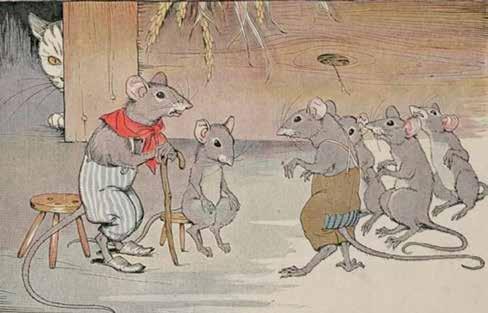
rejoicing over their good fortune, an old mouse arose and said: "I will say that the plan of the young mouse is very good. But let me ask one ques-
tion: Who will bell the cat?"
Moral of story: It is one thing to say that something should be done, but quite a different matter to do it.
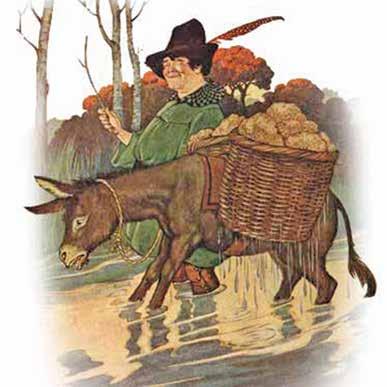
Amerchant, driving his donkey homeward from the seashore with a heavy load of salt, came to a river crossed by a shallow ford. They had crossed this river many times before without accident, but this time the donkey slipped and fell when halfway over. And when the merchant at last got him to his feet, much of the salt had melted away. Delighted to find how much lighter his burden had become, the donkey finished the journey very gaily.
Next day the merchant went for another load of salt. On the way home the donkey, remembering what had happened at the ford, purposely let himself fall into the water, and again got rid of most of his burden.
The angry merchant immediately turned about and drove the donkey back to the seashore, where he loaded him with two great baskets of sponges. At the ford the donkey again tumbled over; but when he had scrambled to his feet, it was a very sad donkey that dragged himself homeward under a load ten times heavier than before.
Moral of the story: The same measures will not suit all circumstances.
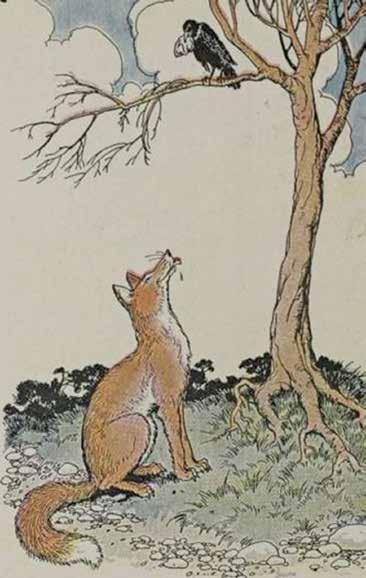
One bright morning as the fox was following his sharp nose through the wood in search of a bite to eat, he saw a crow on the limb of a tree overhead. This was by no means the first crow the fox had ever seen. What caught his attention this time and made him stop for a second look, was that the lucky crow held a bit of cheese in her beak.
"No need to search any farther," thought the sly fox. "Here is a dainty bite for my breakfast."
Up he trotted to the foot of the tree in which the crow was sitting, and looking up admiringly, he cried, "Good morning, beautiful creature!"
The crow, her head cocked on one side, watched the fox suspiciously. But she kept her beak tightly closed on the cheese and did not return his greeting.
"What a charming
creature she is!" said the fox. "How her feathers shine! What a beautiful form and what splendid wings! Such a wonderful bird should have a very lovely voice, since everything else about her is so perfect. Could she sing just one song, I know I should hail her Queen of Birds."
Listening to these flattering words, the crow forgot all her suspicion, and also her breakfast. She wanted very much to be called “Queen of Birds”.
So she opened her beak wide to utter her loudest caw, and down fell the cheese straight into the fox's open mouth.
"Thank you," said the fox sweetly, as he walked off. "Though it is cracked, you have a voice sure enough. But where are your wits?"
Moral of the story: The flatterer lives at the expense of those who will listen to him.

Look him. As quiet as a July riverbed, asleep, an trim' down like a tree.
Jesus! I never know the Lord could squeeze so dry. When I was four foot small I used to say Grampa, how come you t'in so? an him tell me, is so I stay me chile, is so I stay laughing, an fine emptying on me --
laughing? It running from him like a flood, that old molasses man. Lord, how I never see? I never know a man could sweet so, cool as rain; same way him laugh, I cry now. Wash him. Lay him out.
I know the earth going burn all him limb dem as smooth as bone, clean as a tree under the river skin, an gather us beside that distant Shore bright as a river stone.
Dennis Scott (1939-1990, Jamaican poet)
This is the spot where the walls stood: my father's father's house destroyed by fire where the smell of beet-red coffee berries filled the air and the smoke went up in silence.
The house I visited, the year my father could not bring his father back, is now either a memory or thisk brambled pit, the footpath to it overrun by leaf-of-life whose stems we'd strip to make stick dolls.
Now, under these scorched foundation stones, lies the unstirred clay steeped in grandfather's life: a life I never knew.
No photograph from which to root his face -yet his nearness throbs in the richness of a September noon.
Every memory must break somewhere -the air palpable with the grace of a drinking hen strutting to its nest with a promise to fulfill, the clucking in the shadow of banana leaves that glistened with morning dew -no telling what time was or where it went -the days replete with trees to climb.
Delores Gauntlett (Jamaica)



ARIES (March 21April 19)


TAURUS (April 20May 20)



(May 21June 20)

Attending professional meetings or functions will enable you to sharpen your people skills and interact with your superiors. Career advancement is likely if you show how responsible and forthright you can be.
This is not a good time to deal with government agencies or institutions. Your loved ones will have a lot to say if you invest in something without consulting them first.
Stand your ground. Trying to please everyone will not help you get ahead. You shouldn't feel guilty about concentrating on your own priorities. Do what's best for you.







LEO (July 23Aug. 22)
VIRGO (Aug. 23Sept. 22)
LIBRA (Sept. 23Oct. 23)



SCORPIO (Oct. 24Nov. 22)
SAGITTARIUS (Nov. 23Dec. 21)


CAPRICORN (June 21July 22)


(Jan. 20Feb. 19) (Dec. 22Jan. 19)


PISCES
(Feb. 20March 20)

Spend time with your mate or close family or friends. Your generosity will not go unnoticed, and your charisma will draw everyone to your side. Romance is in the stars.
You'll get along better with new acquaintances than you will with relatives today. Take this opportunity to cultivate friendships that are beneficial and bring you joy. Be attentive and mindful.
Uphold any commitment you've made to your employer, peers or family. Don't allow your emotions to overshadow what needs to be done. Do whatever it takes to avoid discord.
Financial gains are apparent. Look at your plans and go over every detail. Once you are satisfied with your strategy, you should present and promote what you have to offer.
A friend asking for personal advice is likely to blame you for meddling if you make suggestions. Don't get involved or take sides if you want to avoid looking guilty.
You should stay active and in control if you want to take part in something special. New beginnings may tempt you, but they will end up being disappointments. Don't take criticism or negative remarks to heart. Overreacting or becoming incensed about someone else's opinions will turn out to be a waste of time. Do your own thing and don't look back.
Consider your options. Assess your talents and focus on endeavors that would make good use of your skills. A part-time job will help pay additional end-of-year expenses.
You can find interesting and compatible companions if you attend events or community activities. Involve yourself with a cause you care about in order to expand your circle of friends.
Going gold doesn't cost you extra when buying an iPhone or iPad, but a gold Apple Watch could potentially run you thousands of dollars. According to French website iGen, the premium, goldplated Apple Watch Edition model will sell for up to $5,000, with the standard Apple Watch and Apple
Watch Sport retailing for $500 and $350, respectively. All versions are rumored to arrive on Feb. 14. So what does $5,000 get you? According to its description on Apple's website, the Watch Edition model sports an 18-karat gold watch case that is designed to be "twice as hard as standard gold." The watch utilizes a sap-

phire crystal display, and can be outfitted with either a leather or sport wristband. The less luxurious (but still suave) Apple Watch packs a stainless steel case that comes in black and silver, with the option for either a leather band or one of several steel bracelets. The Apple Watch Sport, rumored to be the most affordable of the bunch, has an anodized aluminium case and uses plastic wristbands.
We'll have to spend more time with the Apple Watch to see how it stacks up to devices like the LG G Watch R and the Samsung Gear S, but, if these rumors hold up, Apple will at least have the title of "most expensive wearable" secured. If the Watch Sport is Apple's lowest-end smartwatch
Facebook has added an Ebola button to users' profile pages to help people donate to charities fighting the disease.
The money will go to International Medical Corps, the International Federation of Red Cross and Red Crescent Societies, and Save the Children.
Facebook is also paying for 100 satellite communication terminals to help improve internet and phone services in west Africa. The disease has killed nearly 5,000 people across Liberia, Sierra Leona and Guinea.
Facebook founder Mark Zuckerberg announced the Ebola donation button with a video on his own profile page, saying "I want to make sure Facebook does its part to help fight Ebola."
Last month he donated almost $25m (£16m) to the fight against the virus.
ByTe
Aat $350, it's still more expensive than premium-looking Android Wear watches like the G Watch R. If you do have the cash
to blow on these potentially high Apple Watch prices, you can at least surprise your significant other with one. The watch is cur-
rently rumored to arrive on Valentine's Day 2015, though Apple's website still lists a vague "early 2015." (Discovery)


Headset to help blind people navigate
headset that talks visually impaired people around cities has been designed by Microsoft.
It works with a Windows phone and uses location and navigation data with a network of information beacons in urban locations to describe routes.
The headset was tested on a journey from Reading to London, including shopping, bus and train travel.
The charity Guide Dogs, which helped develop the technology, said it could help improve lives.
Of the two million registered visually impaired people in the UK, 180,000 rarely or never go out, according to the charity.
"People living with sight loss face a multitude of challenges every day that can prevent them from getting where they want to be in
life," explained Jenny Cook, head of strategy and research at Guide Dogs.
"Currently, visiting a new city is often daunting, even for people with enough confidence to tackle the challenge independently. For others, who rarely leave home alone, the thought of an unfamiliar journey leaves them stressed and anxious and visiting a new area is an impossible dream."
Eight people with sight loss have tested the headset and five of those reported feeling safer and more confident wearing it. (Excerpted from BBC)
Sspirit. A newly-designed um brella based on origa
And he's been forced to point this out again, with critics accusing him of adding the button purely as a marketing move.
"Facebook is giving everyone the ability to donate, but how much is Facebook donating? ... this seems just marketing to me one more time," said Pepe Pepe Pepe.
Zuckerberg responded in person, writing: "I personally donated $25m and Facebook is spending millions more on providing internet connectivity in the affected regions."
Facebook says it chose charities that work directly on the ground and are able to accept money globally. Ebola aid donations have so far lagged behind the money given by the public after natural disasters like last year's Typhoon Haiyan in the Philippines, or the earthquake in Haiti four years ago. (BBC)
mi, however, could make it less of a struggle. The Sa will reportedly "bounce back into shape" should it blow inside out, even in high winds.
Matthew Waldman, the Sa takes the familiar shape of the traditional umbrella, but replaces the fabric canopy with stiffer plastic in folded sections. It also does away with the traditional umbrella mechanism and skeleton that can be so easily overpowered, replacing it with another smaller inverted canopy.
bottom of the handle, releasing the top section of the handle via a spring-loaded mechanism. This top part of the handle is connected directly to the interior canopy, which itself opens and push es the exterior canopy open. The canopy panels themselves contribute to the Sa's structural in tegrity in a way that ordinary umbrella fabric cannot.
According to the designers, the Sa uses planar tension to produce its shape and structure. It is said to be lighter than a traditional umbrella, due to not
using the standard metal mechanism, and more durable due to having no exposed moving parts. Nagelberg and Waldman also claim that theners of the panels are blunted, meaning there'sly damaged. Replacing the internal mechanism, -
Among Sa's other features are magnetsels together when the umbrella is closed and wrapped around the pole. The product is also mostly recyclable due to being made primarily

At the time of writing, backers can pledge from US$89 for one Sa umbrella. Assuming the campaign and production process go to plan, deliveries are expected to begin from February or March 2015. (Gizmag)
Through her artistic paintings, Myrna Bernard captures the essence of life and passionately exhibits them for the world to see.
Bernard works in Caribbean regional administration in
Georgetown and has had no formal art training beyond her years at the Bishops’ High School, Georgetown. She has, in recent years, pursued her interest in digital photography and digital art through the use of manuals and books and also online

tutorials.
The artist has exhibited at the CARICOM Secretariat’s Annual Staff Talent Celebrations from 2006 to 2012; at the Guyana Women Artists’ Association’s Annual Exhibitions from
2008 to 2012 and their exhibitions in Guyana at Carifesta X in 2008 at the International Conference Centre, Turkeyen, for International Women’s Day at the Brazilian Cultural Centre in 2011, for the Year of People of African
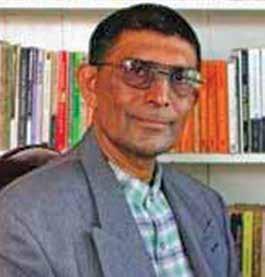
‘EXPRESSIONS 2’, as the name suggests is the second in the new series of a production staged by GEMS Theatre Productions at the playhouse in Kingston.
It brings together seasoned performers and poetry readers along with singers and dancers providing an evening for patrons to enjoy an excerpt from Shakespeare, storytelling from Paul Keens-Douglas, experimental theatre from the students of the National School of Theatre Arts, poems by Martin Carter, Elly Niland, David Dabydeen, Ian McDonald, Janet Naidu, C E J Ramcharitar-Lalla, Mahadai Das, Ruel Johnson, Cassia Alphonso, Lloyd Marshall, Kai Davis, William Blake, Chris Tse and Rudy Williams.
Local actors Sean Thompson, Mariatha Causway and Randolph Critchlow will be performing their own poems along with poets Petamber Persaud, Cassia Alphonso
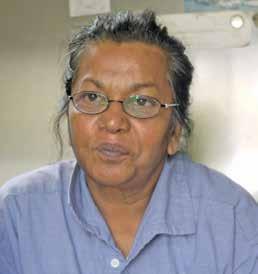
and Lloyd Marshall. Seasoned readers Vanda Radzik, Kit Nascimento and Scheherazade Khan will be taking the stage along with Damian Fernandes doing one of Robert Fernandes’s poems from his first book of poetry.
Kimberly Samuels will be using her ‘opera-style’ voice to do Franco Zeferilli’s Doctor Zhivago theme song, A Time For Us.
Other performances on stage will be Ron Robinson, Derek Gomes, Rajan Tiwari, Mark Luke-Edwards, Nuriyyih Gerrard, Nicola Moonsammy, Sonia Yarde, Paul Budnah and Rajan Tiwari.
Artworks from students of the Burrowes School of Art will enhance the foyer and will be on sale.
Tickets cost $1000 for the evening performance and are available at Oasis Café and The Theatre Guild. The event will start promptly at 6pm.
Descent at the National Museum, Georgetown in 2012, and at the IGCF in Cayenne in 2013. (Artist profile from the 26th Annual Exhibition of the Guyana Women Artists’ Association brochure done by the National Gallery)



The foundation stone of the Cathedral of the Immaculate Conception, generally known as Brickdam Cathedral, located as it is in Brickdam, Georgetown, was laid almost 100 years ago on August 15 1915, two years
after a March 7 fire destroyed the first Cathedral of the Immaculate Conception, St Mary’s Cathedral, built by Cesar Castellani.
The crabwood and greenheart construction, which was built in 1872 and described as “the finest ecclesi-
astical building in the West Indies”, was razed by the 1913 conflagration.
Immediately after the inferno, fundraising began in earnest to rebuild the church. Bearing in mind the complete destruction of the wooden building, Reverend


Compton Theodore S.J. Titular Bishop (1901-1913) insisted the new building be made of concrete. English architect Leonard Stokes was chosen to design the new church, and granite, obtained from a local Essequibo quarry, became the principal material of construction. It would be ten years later that the building would be completed, and a further two more before its scaffolding and galvanized sheet-
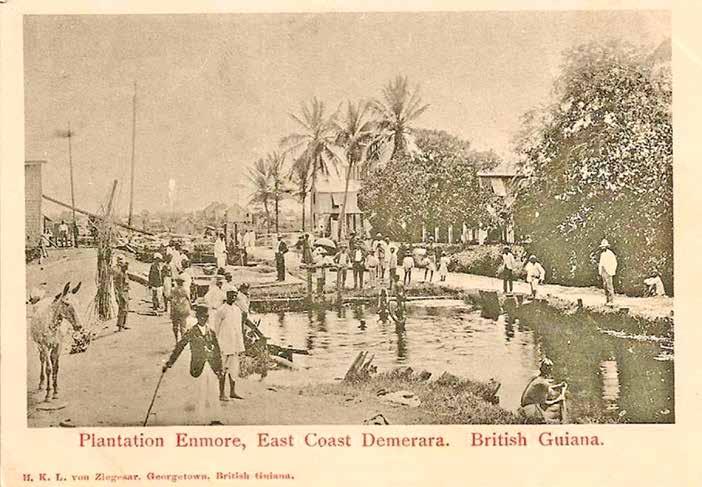
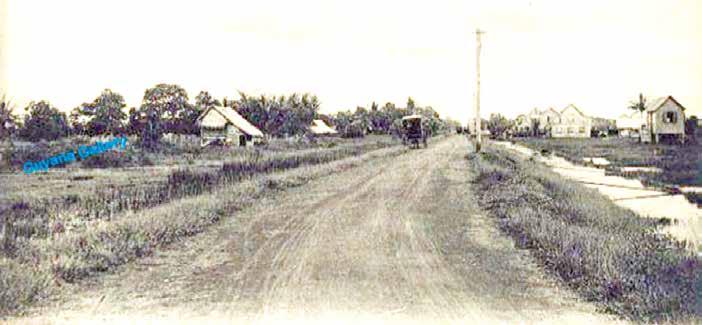
ing were removed to reveal an immense Romanesque structure. In 1930, a marble high altar, a gift from Pope Pius XI to Bishop Galton, was built, followed in 1938 by three more altars. In 1939, a marble pulpit, a memorial to the Fogarty family, was donated.
The church was consecrated October 10, 1960 by first Bishop of Georgetown, Reverend Richard Lester Guilly S.J. OBE. The only surviving structure from the 1913 fire, the iron statue of Our Lady, is mounted on the upper section of the





Visiting an Amerindian village in Mabaruma is a wonderful and interesting experience. Many people living in the villages still make their living off of the land which is rich in natural resources by hunting, farming, fishing, and much more.
One such village that holds fast to its indigenous culture is Arukamai. The village, which is located in Region One, is a river community in the Mabaruma sub-district.
Residents of Arukamai live along the river. The children take canoes or boat to school. The health post and the school are next to each other, but the homes are spread out along the river.
The boat journey to Arukamai is an adventure in and of itself. The river can be rather shallow. It depends on the tides. The river eventually leads out to the Atlantic, so it has a double-tide in a 24-hour period. (Photos and info from http:// harmonyandtravis.com)

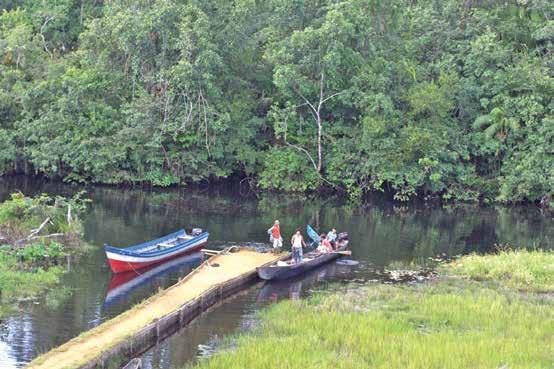
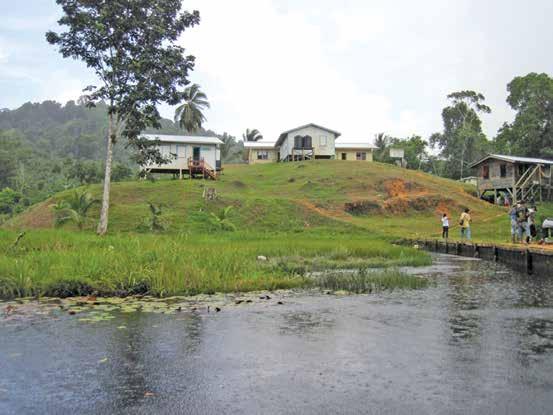

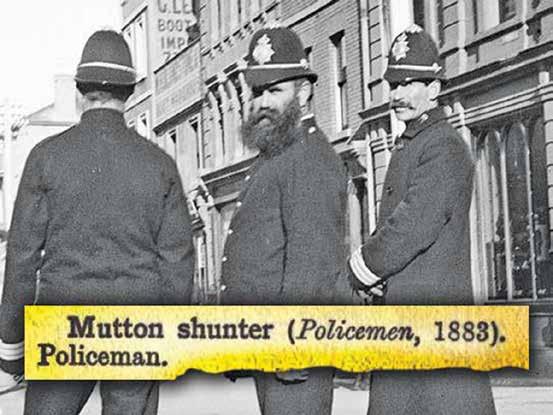
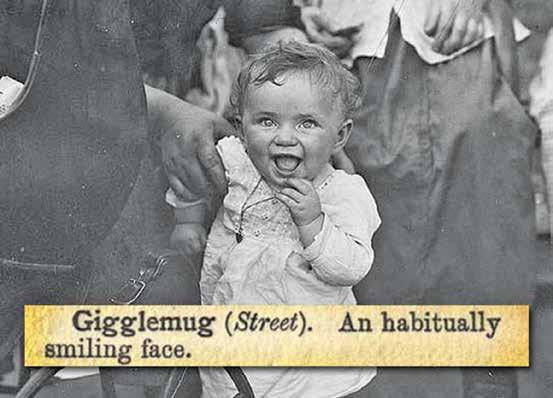

One day a florist went to a barber for a haircut. After the cut, he asked about his bill, and the barber replied, ‘I cannot accept money from you; I'm doing community service this week.'
The florist was pleased and left the shop. When the barber went to open his shop the next morning, there was a 'thank you' card and a dozen roses waiting for him at his door.
Later, a cop comes in for a haircut, and when he tries to pay his bill, the barber again replied, 'I cannot accept money from you; I'm doing community service this week.'
The cop was happy and left the shop. The next morning when the barber went to open up, there was a 'thank you' card and a dozen donuts waiting for him at his door.
Then a congressman came in for a haircut, and when he went to pay his bill, the barber again replied, 'I cannot accept money from you. I'm doing community service this week.'
The congressman was very happy and left the shop. The next morning, when the barber went to open up, there were a dozen congressmen lined up waiting for a free haircut.
And that, my friends, illustrates the fundamental difference between the citizens of our country and the politicians who run it.
At a recent software engineering management course in the US, the participants were given an awkward question to answer.
"If you had just boarded an airliner and discovered that your team of programmers had been responsible for the flight control software how many of you would disembark immediately?"
Among the ensuing forest of raised hands, only one man sat motionless. When asked what he would do, he replied that he would be quite content to stay onboard.
With his team's software, he said, the plane was unlikely to even taxi as far as the runway, let alone take off.
A couple was having a discussion about what to see and do now that they were safely in Florida on their honeymoon.
Trying to assert himself right off the bat, he exploded, "If it weren't for my money, we wouldn't be here at all!"
The wife replied, "My dear, if it weren't for your money, not only would we not be in Florida, we wouldn't on a honeymoon, nor would there be any "we" in the first place."
This is the actual radio conversation of a US naval ship with Canadian authorities off the coast of Newfoundland in October 1995. Radio conversation released by the chief of naval operations, 10-10-95.
CANADIANS: Please divert your course 15 degrees to the south to avoid a collision.
AMERICANS: Recommend you di -
vert your course 15 degrees to the north to avoid a collision.
CANADIANS: Negative. You will have to divert your course 15 degrees to the south to avoid a collision.
AMERICANS: This is the captain of a US Navy ship. I say again, divert YOUR course.
CANADIANS: No, I say again, you divert YOUR course.
AMERICANS: This is the Aircraft Carrier US LINCOLN, the second largest ship in the United States Atlantic Fleet. We are accompanied with three Destroyers, three Cruisers and numerous support vessels. I DEMAND that you change your course 15 degrees north. I say again, that's one-five degrees north, or counter-measures will be undertaken to ensure the safety of this ship.
CANADIANS: This is a lighthouse. Your call.
Airman Jones was assigned to the induction centre, where he advised new recruits about their government benefits, especially their GI insurance.
It wasn't long before Captain Smith noticed that Airman Jones was having a staggeringly high success-rate, selling insurance to nearly 100% of the recruits he advised.
Rather than ask about this, the Captain stood in the back of the room and listened to Jones' sales pitch.
Jones explained the basics of the GI Insurance to the new recruits, and then said, "If you have GI Insurance and go into battle and are killed, the government has to pay $200,000 to your beneficiaries. If you don't have GI insurance, and you go into battle and get killed, the government only has to pay a maximum of $6000.
Now," he concluded, "which group do you think they are going to send into battle first?"
A mother and her daughter were at the gynaecologist’s office. The mother asked the doctor to examine her daughter. "She has been having some strange symptoms and I'm worried about her," the mother said.
The doctor examined the daughter carefully and then announced, "Madam, I believe your daughter is pregnant."
The mother gasped, "That's nonsense! Why, my little girl has nothing whatsoever to do with men." She turned to the girl. "You don't, do you, dear?"
"No, mumsy," said the girl. "Why, you know that I have never so much as kissed a man!"
The doctor looked from mother to daughter, and back again. Then, silently he stood up and walked to the window, staring out.
He continued staring until the mother felt compelled to ask, "Doctor, is there something wrong out there?"
"No, Madam," said the doctor. "It's just that the last time anything like this happened, a star appeared in the East and I was looking to see if another one was going to show up."