The traditional cotton weaving techniques are still used by many Amerindian groups in producing beautiful hammocks and clothing.
Cotton twines and cords are made from picked and sun-dried cotton. After the cotton is dried for about two days, it is stored in a quake or openwork basket-
ry. When ready to be used, all foreign obstacles are removed from the cotton and a very important process called “the teasing process” begins.
The cotton is patted in small balls of four to four and a half inches in circumference. A large num-
The base of the shank (the portion below the guard) is then rolled with the palm of the open right
ber of such balls are placed on each other forming a pile of 6 to 7 inches high. The pile is then pressed alternately and gradually stretched; the cotton is then folded in its length and stretched again to about 2 feet long. The pad of “teased” cotton is next twisted into a spiral.
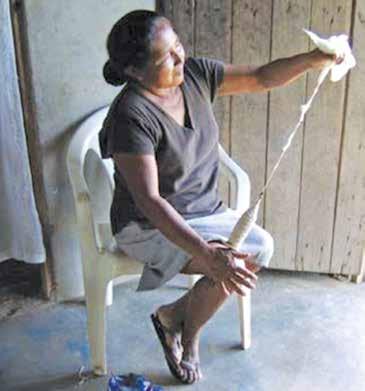
After stretching the cotton is attached by its proximal extremity to the spindle, through the nick or hook at the top of the shank.
The spindle employed in the manufacture of cotton twine consists of a tapering wooden shank through a circular guard, its distal extremity being either a nick or a small hook. The ordinary materials with which the guards are cut seem to be “bone” of the tapir or tortoise carapace as with the Machusi, Patamona, Wapisiana and in some cases they are made from two pieces of calabash.
hand sharply down the thigh.
The degree of coarseness or fineness with which the cotton is spun into twine will depend partly on the use of which it is intended. The two extremes being met with the rough string forming the basis of the cotton hammocks and the delicate twine, ornamenting the butt end if the Arawak arrow.
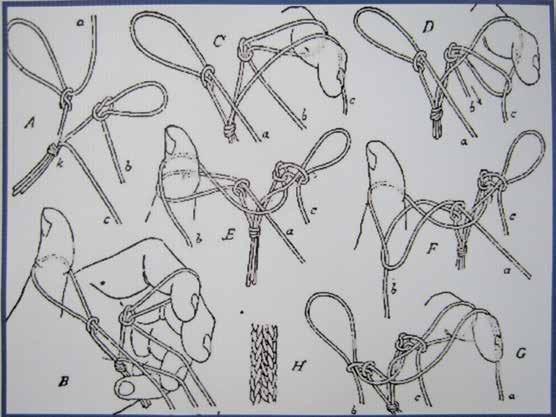
Cording is practiced by the Warau, the left thumb and four fingers replacing the two arms. They also practice a more complicated form of cording by using three strands. All three strings of the necessary lengths are tied together at the extremity.
Crochet is done by the Carib, Machusi and other women using a single hook needle to manufacture armlets and anklets, working them on the limb itself or around a wooden cylinder of about the same circumference as the ankle or arm, however, the Warau women also produce crochet work but with twohook needles.
An Amerindian woman demonstrating traditional cotton spinning
Cording technique
Demonstrating traditional Wapisiana hammock weaving
In an effort to empower and educate, the S4 Foundation, a local non-profit humanitarian group, has been working with the Amerindian women in St Cuthbert’s Mission to help diversify and sell the craft that they are already producing with the focus of helping them to become income earners/entrepreneurs.
In an interview with Guyana Times Sunday Magazine Executive Director of the S4 Foundation Imarah Radix stated that the organisation wanted to conduct service projects benefiting all Guyanese regardless of race, creed and religion, hence being inspired to launch the literacy and empowerment project in St Cuthbert’s Mission.
“We recognise the need to take a phased and sustainable approach in our work with women across Guyana. We are already doing projects in Berbice at Springlands, Linepath and No 79 Village, and we are planning projects in Haslington, Wakenaam and Leguan in
Essequibo with special focus on empowerment and education for women and girls. We hope to expand our work to other Amerindian communities who are open to working with us,” Radix declared.
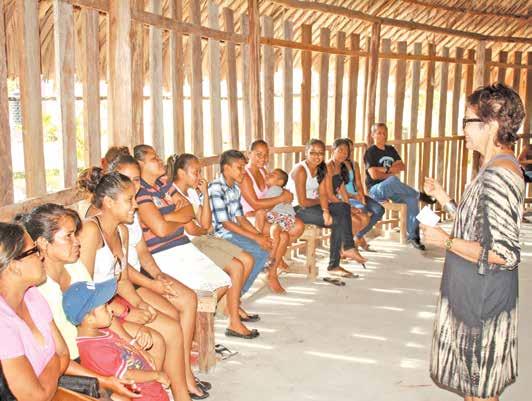
According to Radix, on expressing an interest to go into St Cuthbert’s Mission, the Toshao asked the foundation to carry out sessions with youths and women on teenage pregnancy, which were incredibly successful. Via these sessions, the women communicated their desire to diversify their skills through training. They wanted to learn how to set up and manage their own businesses, literacy classes and parenting workshops.
“Due to the success we’ve had in St Cuthbert’s, on 30 August we are partnering with Starr Computer to run a training workshop for 30 women on ‘Information Technology for Small Business’ and ‘Parenting Skills’. (15 of these women will be from St Cuthbert’s). Two of the women artisans have already taken up our offer of facilitating at a craft workshop here
ing to give of their time. The foundation will also continue to provide diversified skills training and follow-up support.
“The responses from the women have been great. They have all indicated their different interests for skills training and literacy. We are excited to empower them to diversify their skill sets. They really opened up and expressed their wish to be more financially independent,” expressed Radix.
in Georgetown in teaching Tibisiri weaving and basket making. Another accomplishment has been that they have started to bring their craft for us to publicise and sell on the S4 Foundation Facebook page. This has proved a big hit and sales have been brisk. We hope to expand both the free marketplace for women’s art and craft as well as diversified skills training for women and girls across Guyana. All of the profits gained from selling the items will go directly to the women,” outlined Radix.
Although the project is not funded at the moment, the foundation works on the goodwill of businesses and volunteers who help with outreach activities. Radix disclosed all operational costs are covered by the foundation’s trustees.
Focused on the empowerment aspect of its humanitarian work, the S4 Foundation hopes to start literacy classes for the women and girls in St Cuthbert’s, making it sustainable with the help of teachers in the community who are will-
Additionally, Radix revealed that the foundation is planning two major events before the end of the year: a black tie formal event to raise funds and the other for International Peace Day on 21 September. Also, in partnership with the Global Shapers, the foundation plans to have a medical outreach in vulnerable communities. Long term plans include working with women and girls to aid in their development, improve their literacy, and provide more opportunities for growth and financial independence.
“We are also working on setting up a Sister Network where we can swap out skills and also expand the free S4 Marketplace online to include other women artists and artisans. In the much longer term, we want to build a sustainable women’s shelter and attached mushroom farm to further empower women. It is our hope also to engage men and carry out trainings aimed at them and also for their full participation in our programmes and projects, because they are integral to the solution of ending violence. In keeping with this belief, we welcome volunteers of all ages and genders,” Radix mentioned.
Anyone interested in getting involved can help the foundation raise awareness
be made in kind or by
The organisation is currently collecting clothing, shoes, books of any kind, stationery and household articles for the Corriverton Women’s Shelter, the Library and Literacy Programme at Kingston Development Centre in No 79 Village, and for other planned outreach projects.
“We’re also looking for a loan of off-road vehicles and/or drivers, sponsorship of a workshop or being a facilitator at one of our workshops. We welcome new partnerships for training and are only too happy to receive this kind of help,”
couraged
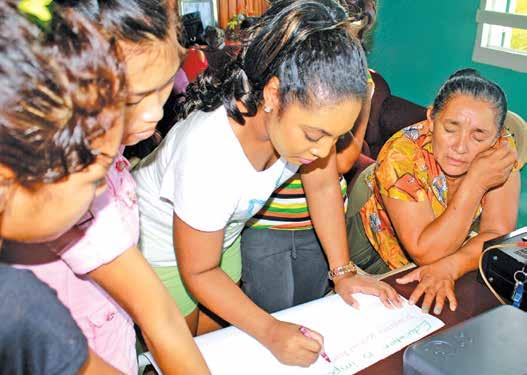
Discussing with the women and youths in the village issues affecting them
Imarah Radix (third from left) with the women from St Cuthbert's
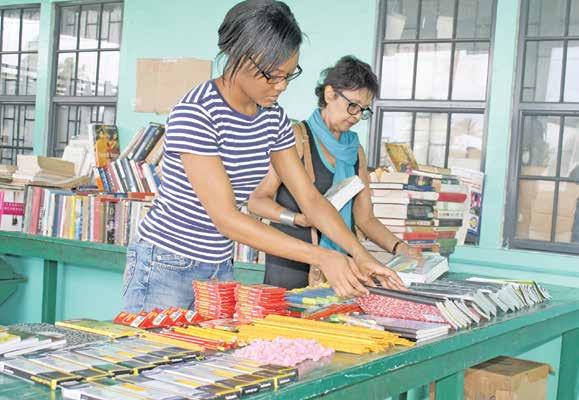
Packing stationery to be taken to the village
of the project by liking the S4 Foundation Facebook page, sharing the photo albums, directly contribute to the women by buying or ordering a piece of their craft, or volunteer with the group. Donations can
cheque.
en-
Radix.
One of the women from the village showcases her craft items
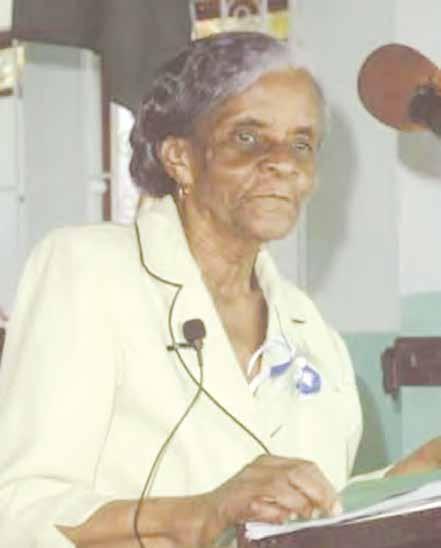
Waveney Benjamin M.S. (1932-2014)
By IndrawattIe natram
he Richard Faikall
TPolice Training College, located in Suddie on the Essequibo Coast, was established in memory of Guyanese detective sergeant #11117, Richard Faikall.
Detective Sergeant Faikall died tragically 21 November 1997, in the line of duty when he bravely confronted armed bank robbers moments after they had robbed the Guyana National Co-operative Bank in Anna Regina on the
Essequibo Coast. The courageous detective lost his life attempting to prevent the robbers from escaping.
In recognition
The initiative to establish the college on the coast was the idea of a senior official in recognition of Faikall’s commitment to his duty to protect and serve.
The college operates under the mission statement of the Guyana Police, in cooperation with the state, society and citizens of Guyana,to provide service and detect crime, maintain law and or-
der, control traffic, protect property and preserve the peace through the provision of the highest standard of professional service, with absolute integrity and complete dedication.
Approaching the county of Essequibo from Supenaam, the Police College is located aback of the Suddie Police Station adjacent to the Suddie Sea Wall, Public Hospital and obliquely opposite the Suddie High Court.
Established August 30, 2001, the college was declared opened by Ronald Gajraj then home affairs minister, and recommissioned September 24 by current home affairs minister, Clement Rohee.
The Guyana Police Force has since seen the addition of four batches of police officers emerging from across Guyana who have graduated from the Richard Faikall Police College.
There is a two-storey building has a general area reserved as a classroom; sleeping quarters, dining hall, kitchen, toilet facilities equipped with toilet and bath and comfortable drilling parapet area.
The late detective sergeant Richard Faikall was described by his colleagues as a very dedicated officer who had his work close to his heart. Officers who had
worked with him said that he was a very simple and down-to-earth man, who was also very punctual and regular on his job. They revealed that the day Faikall died was a dark day for the Force, and they reiterated that he would forever live on in the memories of everyone.
Serving the community
In an interview with Guyana Times Sunday Magazine, Inspector Bharat Persaud, who is the commandant-in-charge of the Richard Faikal Police College, mentioned that the college opened the Zara Centre on 8 June 2013. He stated that the establishment of the computer training college was a partnership with the Zara Group of Companies in the United States of America. The fully air conditioned room is equipped with 36 computer systems and trains persons from throughout Region Two in the field of Information Technology. To date, approximately 1200 persons were trained including school children, elders, and students from the New Opportunity Corps. Additionally, ‘summer’ programmes were held. The college’s future plans are to continue to extend partnership with members of the community as well as train more policemen to effectively "police" on the Essequibo Coast. The college aims to produce more policemen as well as train more persons in the field of Information Technology.
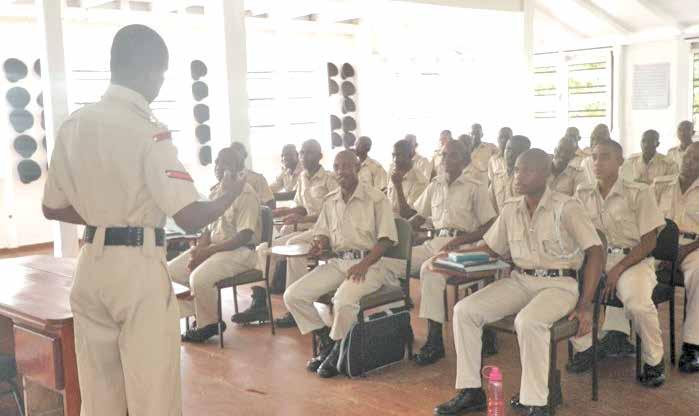
Young officers being trained at the Richard Faikall Police College
The Richard Faikall Police College
The many computer systems in the IT centre at the college
The plaque in memory of Richard Faikall on display at the college The compound
Waveney Benjamin m.S. (1932-2014)
Founder of Branches of the Mothers’ Union in all parts of Guyana and the Caribbean, Waveney Benjamin M.S. was born in Georgetown on 16 November 1932. She was the fourth of eight siblings.
Her primary education was obtained at the Kingston Methodist School. Having done well at the Government County Scholarship examination, she was enrolled at the Modern High School. Although she was eligible to attend Bishops’ High School, she would have had to be a fee-paying student, so her father resolved to have her attend Modern High School to which she had obtained a scholarship. During her secondary education she excelled in Mathematics. She was proud to proclaim that she tutored fellow students, one of whom went on to become a medical doctor. This aptitude she used to assist her older children specializing in algebra, until the advent of modern mathematics. Waveney later became a secondary school teacher.
At an early age she got married to Neil Sigismund Parkinson Benjamin. Neil Benjamin predeceased her on 11 December 1984 as a priest and Canon of the Stall of St. George of the Anglican Diocese of Guyana and retired Chaplain of the Guyana Defence Force. Waveney and Neil nurtured seven children.
During the early years of her married life, Waveney was a fulltime housewife. She could be seen riding a bicycle around town shopping with a least one child sitting on the back. It is during this period of her life that she joined the branch of the Mothers’ Union (MU) at Christ Church. She would eventually become the Enrolling Member of the Christ Church branch. She was a full active member of the Mothers’ Union and a staunch churchgoer at Christ Church.
Waveney gave yeoman service for 20 years as Diocesan Worker of the Mothers’ Union (MU) from 1974-1994, with many interesting experiences to share: some har-
rowing and life-threatening; some inspirational; some (in retrospect) amusing. This was in the course of regular visits as part of her annual work programme for the Mothers’ Union in strengthening the organization that promotes improving Christian family life, motherhood and marriage, and thereby improving the lives of all.
She started and helped in the sustaining of many branches of the MU, including several in interior locations as well as Suriname where links were established. Endless miles were covered to reach branches in Essequibo; Berbice; and all corners of DemeraraOrealla, where she walked long distances across the Rupununi savannahs; Kamarang and Jawalla, where getting there by aircraft and then speedboat was the challenge
of a lifetime; Pomeroon, braving the deep and unforgiving waters of the Pomeroon River to reach members at Kabacaburi; Sand Hills on the Berbice River, travelling in a ferry for over 12 hours.
In her tenure as Diocesan Worker, the MU Guyana began a Day Care Centre at Oronoque and Almond Streets in Queenstown and later opened another branch, both of which still exist in Georgetown today. She also coordinated feeding programmes, which ran for several years to assist children who were in need thus ensuring their nourishment and sustenance.
In the wider Caribbean, Waveney was a founding member of the
Provincial Mothers’ Union which includes representatives of the MU of several Caribbean countries who collaborate for the strengthening of relations among countries.
The risk and the hard work were all worth it since women far and wide were brought the message of Christian family life and marriage and willingly formed themselves into branches and worked together in their churches. Waveney has always been grateful for the good relationship she enjoyed with parish priests and the women of the churches who were very cooperative, receptive and hard working. Even after she retired she would still meet persons who lovingly greeted her and remembered her for her work with the Mothers’ Union.
While serving as Diocesan Worker, Waveney maintained association with and membership of the World Day of Prayer National Committee. She served as Vice President for the Southern Hemisphere. She was an active member of Church Women United, planning seminars, bible study and retreats for strengthening and upliftment of the membership. She served as General Secretary of the Young Women’s Christian Association (YWCA) for four (4) years. She collaborated with the Women’s Affairs Bureau within the Ministry of Labour on projects to improve the lives of women in the interior especially; also with the Caribbean Women’s Association (CARIWA) and the Women’s League of Social Services. She served for many years as a Trustee of the Guyana Responsible Parenthood Association (GRPA) as it carried out its mandate of helping young people and citizens at large.
She also participated in extension seminary courses sponsored by the Caribbean and Guyana Council of Churches; Mothers’
Union Workers and missionary courses in England; small business management with the Inter-American Institute for Cooperation in Agriculture(IICA); and the General Secretary’s course of the YWCA. She had the honour and the privilege of representing some of the above associations at critical meetings and courses in Guyana and abroad, and was able to continuously apply the knowledge gained for advancement of women and people in the church and wider community.
Waveney travelled far and wide internationally – Australia, South Africa, England, Canada, Switzerland, Uruguay, Curacao and several Caribbean territories including Antigua/ Barbuda, Guadeloupe, Jamaica, St. Vincent and Grenadines, St. Lucia, Barbados, Belize, Trinidad & Tobago, Tortola, BVI and Grenada. This was in addition to her frequent trips to the US and the United Kingdom to visit family and friends.
In 1991, in recognition of her long and dedicated service as a social and community worker with the Diocesan Mothers’ Union, Waveney was bestowed by Guyana with a National Award –the Medal of Service (M.S.). The Women’s Affairs Bureau also recognized her work with women with an award (for work which included the formulation and submission of a project proposal that resulted in funding for and building of a well in Yakarinta, Rupununi).
All the foregoing experiences were wonderful and enriching and Waveney was profoundly grateful to God that she was still able to meaningfully serve others and improve their lives.
Waveney Agatha Benjamin peacefully departed this life on 30 July 2014. (Taken from Guyana Cultural Association August 2014 Magazine)
Waveney Benjamin M.s
The Shaping of guyaneSe LiTeraTure
Celebrating the Sixth Anniversary of The Caribbean Press
By PetamBer Persaud
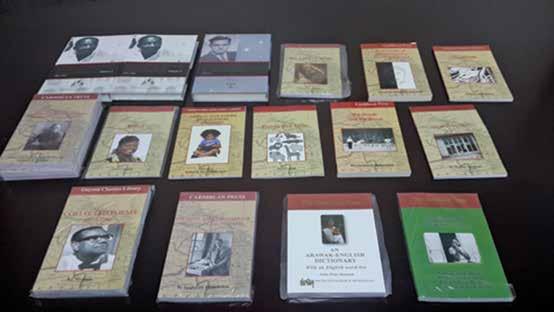
In August 2014, The Caribbean Press (TCP) celebrated its sixth anniversary with the release of a barrage of new titles. TCP is a remarkable story for any small press in any part of the world but more so in a developing country. Within six years of operation, the Press has published a mindboggling 75 books, beginning with the reprinting of titles from the earliest time and moving swiftly to present day, exposing contemporary and emerging writers, many of whom are glorying in their first publication.
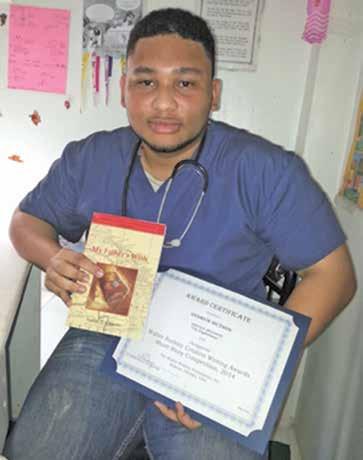
The books of imaginative literature released on 15 August 2014 included three novels namely: “My Father’s Wish” by Andrew D O Hutson; “Bitter” by Portia Dodson; “The Dumb and the Brave” by Churaumanie Bissundyal.
Five collections of poetry namely: “Heads and Tails” by Pearl Lewis; “The Hinterlands” by Stanley Niamatali; “Twentyfive Poems by Guyanese Children” Volume I edited Rev. Gideon Cecil; “Collected Poems - 1937-
1989, A.J. Seymour” edited by Ian McDonald and Jacqueline deWeever; and “Anthology of Contemporary Guyanese Verse” edited by Petamber Persaud.
The non-fiction titles released included: “Linden Forbes Sampson Burnham O.E., S.C., National Assembly Speeches, Volumes II & III”; “The Idyll and the Warrior” (Recollections of Edgar Mittelholzer) by Jacqueline Mittelholzer; “Beacons of Excellence: The Edgar
Mittelholzer, Memorial Lectures - Volumes I, II & III”.
The launch of the above books was accompanied by awesome readings from the various texts by contributors, editors and authors, bringing literature alive.
Guyanese literature, still in its formative years, is in a relatively healthy state. This will be further enhanced with the continued production of this publishing house. The idea of The Caribbean Press surfaced during Guyana’s host-
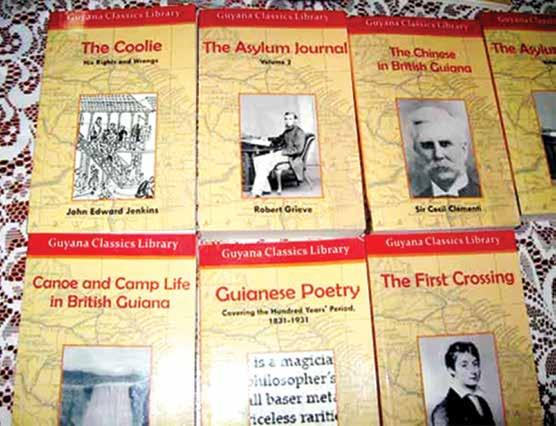
ing of the highly successful Carifesta X in 2008. The idea was later fleshed out by former President Bharrat Jagdeo and Professor David Dabydeen. Within months, the idea was manifested with the printing of the first 12 titles of The Guyana Classics Library, which included “The Discovery of Guiana” by Sir Walter Raleigh - first published in 1596; “The Coolie - His Right and Wrongs” by John Edward Jenkins; “Canoe and Camp Life in British Guiana” by Charles Barrington Brown; “The Chinese in British Guiana” by Sir Cecil Clementi; and “Guianese Poetry: covering the hundred years’ period, 1831-1931” by N E Cameron.
Each title carried its own scholarly introduction and a series preface. The series preface written by the then President of Guyana, Bharrat Jagdeo, is instructive and informative. This preface declared, “The Guyana Classics Library will republish outof-print poetry, novels and travelogues so as to remind us of our literary heritage, and it will also remind us of our reputation for scholarship in the fields of history, anthropology, sociology and politics, through the reprinting of seminal works in these subjects. The Series builds upon previous Guyanese endeav-
ours, like the institution of CARIFESTA, and the Guyana Prize. I am delighted that my government has originated the project…so that all Guyanese can appreciate our monumental achievement in moving from Exploitation to Expression…”
The Caribbean Press continues in virtual leaps and bounds to preserve the literary heritage of Guyana on two fronts - reproducing rare and out-of-print books on Guyana and to publish contemporary writings on Guyana. Within first two years of existence, this press had already produced 26 of a projected target of 36 titles in the series labelled the ‘Guyana Classics Library’.
In July 2012, The Caribbean Press launched another six titles in the Guyana Classics Library. Those books launched included two books dealing with particular fragments of the Guyana’s history, three collections of poetry, and one collection of short stories. This rich mixture of books offers two perspectives on
Guyana – a historical perspective and an imaginative creative perspective. The two history books were: “The New Slavery, an account of the Indian and Chinese Immigrant in British Guiana” by Joseph Beaumont and “British Policy Towards the Amerindians in British Guiana, 1803-1873” by Mary N Menezes. The short story collection is titled “The Short Stories of Cyril Dabydeen” by Cyril Dabydeen. The three collections of poetry are “Unclosed Entrances – Selected Poems” by Sasenarine Persaud; “Selected Poetry” by Maggie Harris; “Selected Poems” by Elly Niland. All of the above indicating various phases of the project. Although the activities of the Press are public knowledge, it is a great feeling to get hold of the physical product – the book. And there are already many more titles lined up to be rolled off the press into the public domain.
Responses to this author telephone (592) 226-0065 or email: oraltradition2002@ yahoo.com
A few of the books from the Guyana Classics Library and the Caribbean Press
Andrew Hutson displays his book, 'My Father's Wish'
Former President Bharrat Jagdeo addressing the gathering at a past launch event of the Guyana Classics
Some of the books in the Guyana Classics Library
Advice for Young Professionals: Quit Trying to Impress Your Boss
By HeatH Padgett
When I was eight years old, I wanted so badly to be accepted by my older brother and his friends. I tried so hard. I walked like them, dressed like them, and even let them beat me in basketball. But it seemed like the harder I tried to impress them, the more they didn't want me around. Why?
Because nobody wants to be around somebody who changes who they are in order to be accepted.
When Steve Jobs first landed a job at Atari before launching Apple, he was known to walk into his employers’ office without having showered in days and no shoes on his feet. Apparently, he believed that by eating organically he could go without showering and still smell decent (he was wrong).
At first the men who hired him were offended. "Who is this guy? Walking in here like he owns the place? And he stinks!?"
But they got over it quickly. They realized he did really good work, and that's just the kind of guy Steve Jobs was. He didn't mean any offense by it. He just didn't like to wear shoes and shower. His employers probably didn't love it, but they at least respected him for being his own person.
When you change your values and personal mission in life in order to land a job or keep one, you give up all respect you could have hoped for.
I would much rather my boss not like me because of my opinions, than think I'm a flake because I just say what they want to hear.
After college I was interviewing with a large financial firm. I had the job in the bag. The interview was just a precaution to make sure I wasn't crazy.
The manager was asking some pretty standard questions and then he landed on the, "Heath, where do you think you'll be in five years?"
The typical response he might have been looking for was probably this:
"Well, in five years I would have liked to build up a successful practice and continue to be growing my business by calling in on new clients and working really hard to live up to the mission of this company..."
What my actual answer was:
"Well, I'm not really a big fan of large companies (and they're a fortune 100 company). I want to launch my own company within the next five years. I know I'll be doing something like that. I really want to learn as much as I can until then. So, yeah that's where I'll be. Running my own company."
I didn't get the job.
I told him the truth.
What happens if I lie to him?
I get the job. I sit in a stuffy office somewhere in the middle of Dallas, wearing a heavy suit, doing a job I hate. I realize in a few, short months that I really don't like it and he's confused because he thought this is what I wanted.
If you lie about "why you really want this job" or "where you want to be in five years," then what happens in five years when you're working a job you hate? Why trap yourself in places you don't want to be? It may be easier to tell someone what they want to hear, but it's the dumbest decision you'll make (right after your grad night keg stand).
Trust me, it's tempting to cave in and tell someone all they want to hear.
Resist.
Resist trying to impress your boss. Resist trying to impress everyone.
Be authentic—it's the only antidote to not getting stuck in a job you hate.
Paul Anthony Charles
Knownfor his artistic dancing talent, Paul Anthony Charles launched on to the modelling scene after signing up for the Mr Guyana International competition. The 28-year-old is a student at Global Technology, a dancer, teacher, and choreographer with Classique Dance Company. A strong, determined, spiritual and ambitious individual, Charles described himself as a “complicated individual at times, which also makes him rounded”. The prolific dancer represents Guyana locally, regionally and internationally through dance, becoming a force to reckon with on stage. Due to his talents, Charles is known as the “dare of dance and Mr Adorable” on the runway. He has competed in numerous modelling competitions in Guyana and was successful. His competitions include: Super Model Search 2005, Shabeau Face Off 2006, and Guyana Model Search 2008/2012. Notably, he placed first runner-up in the Mr Tourism Guyana United Nation International, which was held in Jamaica. Most recently, Charles is vying for the title of Mr Guyana International 2014/2015. Charles always “believe in living the life you love and love the life you live” as he strives personally “to do his best at whatever he is best at”. Over the years, the model and dancer has been awarded Best Male Dancer In Production; Best Male Dancer in Guyana; Super Model Search Top 6 Photo Shoot winner 2005, Shabeau Face Off 2006, placing first runner-up and awarded Best Photo Shoot winner; Guyana Model Search 2008 Top 4 and also awarded Best Photo Shoot winner; Guyana Model Search 2012, placing third runner-up and awarded Best Photo Shoot winner and Best Outreach Award on Domestic Violence. Focused and determined on copping the Mr Guyana International title, Charles aims to “open doors for more males in Guyana and be the voice for youths who have amazing talents and strength to be ambassadors for their country”. For more information on the competition, visit the Mr Guyana International page on Facebook.
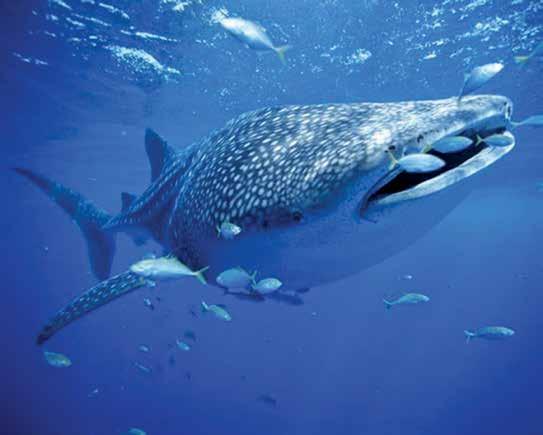
As the largest fish in the sea, reaching lengths of 40 feet (12 metres) or more, whale sharks, Rhincodon typus, have an enormous menu from which to choose. Fortunately for most sea-dwellers—and us!—their favourite meal is plankton. They scoop these tiny plants and animals up, along with any small fish that happen to be around, with their colossal gaping mouths while swimming close to the water's surface.
The whale shark, like the world's second largest fish, the basking shark, is a filter feeder. In order to eat, the beast juts out its formidably sized jaws and passively filters everything in its path. The mechanism is theorized to be a technique called “cross-flow filtration”, similar to some bony fish and baleen whales.
The whale shark's flattened head sports a blunt snout above its mouth with short barbels protruding from its nostrils. Its back and sides are gray to brown with white spots among pale vertical and horizontal stripes, and its belly is white. Its two dorsal fins are set rearward on its body, which ends in a large dual-lobbed caudal fin (or tail).
Whale Shark
Ejection seats in a plane or a jet can save a pilot’s life, but they can also be dangerous. Everything has to happen in split seconds and in the right order. If something goes wrong it can mean serious injury or death. What happens only looks simple. The pilot is lifted out of the aircraft and then a parachute opens to get the pilot safely down to the ground. The mechanism that makes an ejection seat work is a bit more complicated.
Preferring warm waters, whale sharks populate all tropical seas. They are known to migrate every spring to the continental shelf of the central west coast of Australia. The coral spawning of the area's Ningaloo Reef provides the whale shark with an abundant supply of plankton.
Although massive, whale sharks are docile fish and sometimes allow swimmers to hitch a ride. They are currently listed as a vulnerable species; however, they continue to be hunted in parts of Asia, such as the Philippines.
The largest whale shark ever measured was 40 feet (12.2 metres) long; however, the species is thought to grow even bigger.
The objective of the game is to fill all the blank squares in a game with the correct numbers. Every row of 9 numbers must include all digits 1 through 9 in any order. Every column of 9 numbers must include all digits 1 through 9 in any order. Every 3 by 3 subsection of the 9 by 9 square must include all digits 1 through 9.
Ejection seats are attached to rails. In an ejection, when the pilot activates the ejection seat, the seat moves along the rails and out of the aircraft at an angle. Next, a rocket fires to move the seat higher up and away from the aircraft. Then, a parachute opens to slow the ejection seat down as it falls to the ground. The pilot can activate the ejection seat by pulling a handle or by pulling down a protective face curtain.
What is in a name?
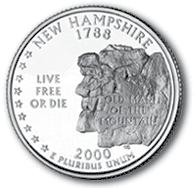
New Hampshire was named by Captain John Mason in 1629, who had fond memories of an English county with that name. It is sometimes called the Granite State because of its large deposits of this stone. The state has also been nicknamed “The Mother of Rivers,” a reference to the rivers that originate here. New Hampshire has also been called “The White Mountain State” for the White Mountain range found in the northern half of the state.
By Laurie Triefeldt
NEW HAMPSHIRE
Famous for its natural forests and sparkling lakes, this New England state is enjoyed by residents and visitors year-round, but especially in the fall when the autumn leaves are in full color. Its large, beautiful mountains have earned the state the nickname “Switzerland of America.”
Skiing and snowmobiling are popular winter activities.
People who live in New Hampshire or who come from New Hampshire are called New Hampshirites and sometimes New Hampshiremen or New Hampshirewomen.
Did you know?
New Hampshire was first settled in 1623.
On Jan. 5, 1776, New Hampshire became the first of the 13 original colonies to adopt a constitution.
The U.S. Navy’s first shipbuilding yard opened at Portsmouth in 1800.
In 1853, Franklin Pierce of New Hampshire became the 14th U.S. president.
The Karner blue butterfly, lynx, bald eagle, shortnose sturgeon, Sunapee trout and Atlantic salmon are on the state’s endangered species list.
New Hampshire’s state motto is “Live free or die.”
Some famous folk
New Hampshire is the fifth smallest, and one of the least populated U.S. state. Of all the states, it has the shortest ocean coastline, about 18 miles (29 km) long.
New Hampshire
have been an important source of granite throughout American history.
The purple finch became the state bird in 1957, beating the New Hampshire hen, which was also a contender for the title.
New Hampshire hen
The state’s flag was adopted in 1909 and bears the state seal.
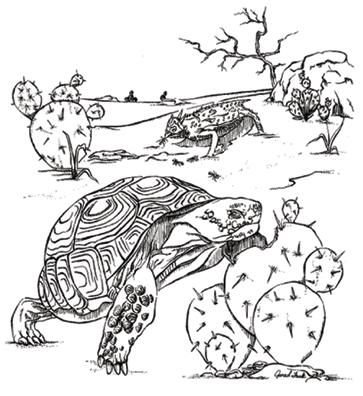
Eastern red spotted newts are found in ponds, marshes and shallow lakes. They are also found on forest floors or under logs and leaf litter.
Birch tree
Striped bass are a popular saltwater game fish.
The brook trout became the official state fish in 1994.
The Karner blue butterfly has a wingspan of about an inch. Its larvae feed exclusively on wild blue lupine leaves.
The lilac is the state flower.
In addition to President Franklin Pierce, the state is proud to have been the home of astronaut Alan Shepard, poet Robert Frost and author Dan Brown.
The ladybug became the official state insect in 1977.
quarries
Wearing tie-dye may sound like a fashion faux pas waiting to happen, but thanks to a few key designers and fashion insiders, it doesn’t have to be. Below are some tips for pulling off this fashion trend.
pattern and colour
draping a leather jacket over your shoulders to temper a flashy tie-dye skirt.
Tie-dye on tie-dye: it’s a thing.
Who knew a tie-dye jacket and full maxi-skirt was a match made in heaven?
Pair a tie-dye shirt with a slit skirt and sandals. The result? An insanely chic weekend outfit. Men’s
Wear with: Patterned tie
of opting for stripe-onstripe, look for a tie patterned with dots or diamonds.
Striped shirt
Checked jacket
Solid shirt
John Newman is an English singer and musician. He is best known for the track “Love Me Again” which peaked at number one on the UK Singles Chart in July 2013 as well as being a featured artist on Rudimental's 2012 singles "Feel the Love" and "Not Giving In", which peaked at number one and number fourteen on the chart, respectively. He was one of the most successful and praised British singers in 2013. He was nominated for three Brit Awards, including for British Male Solo Artist, at the 2014 BRIT Awards. As of February 2014, Newman has sold over 1.3 million records in the UK alone.
Miley Cyrus banned from performing in Dominican Republic
Miley Cyrus concerts are well-known for their controversy, whether she's twerking, grabbing her crotch or doing unspeakable things with huge foam fingers - and now the Wrecking Ball star has actually been banned from performing in the Dominican Republic on morality grounds.
The Dominican Republic government commission that oversees public performances has banned a 13 September gig by Miley, re-
leasing a pretty strict statement saying that the sing-
er "undertakes acts that go against morals and customs, which are punishable by Dominican law."
Well, we know Miley wears some pretty skimpy outfits, but this is pretty extreme.
Neither Miley's reps or the concert organisers in the Dominican Republic have responded to requests for comment - we just feel sorry for all the fans who have bought tickets for the concert, which have been on sale since July. (Glamour)
Beyoncé's mom puts the Jay Z divorce rumours to bed
Beyoncé's mom Tina Knowles has something to say about the Bey and Jay Z divorce rumours.
Tina was approached by a TMZ cameraman as she left a lunch date with Kelly Rowland in LA. And she told them that everything was fine and dandy between the couple:
"Haters going to be haters and there's nothing we can do about that." she said.
"Everything's perfect" she added, although she mentioned she doesn't read the gossip about her daughter:
"I just don't even read
the bull, you know?"
The denials come as rumours emerged suggesting Bey has looked to Gwyneth Paltrow for advice on "conscious uncou-
pling". Obviously the singer hasn't commented on all the allegations herself, but she has posted some cute family snaps of her, Jay Z and Blue Ivy. (Glamour)
Rihanna obtains restraining order against stalker
Rihanna obtained a restraining order against a man who was found lurking outside her house in Hollywood Hills, California last week, TMZ reported. The unidentified man was ordered to stay away from the "We Found Love" singer and her house for at least 100 yards.
Last week, RiRi's security guards saw the man hanging around her house for around three to four hours and believed he was trying to scale the fence. The man ran away after noticing the guards. However, police managed to find him and arrested him on an unrelated vandalism charge.
Law enforcement sources told the site police did not think that the man even knew the house he was lurking belonged to RiRi, but the guards disagreed with it.
RiRi will conclude her tour with Eminem on August 23. The final show on "The Monster Tour" will be held at Comerica Park in Detroit. (AceShowbiz)
Mariah Carey, Nick Cannon reportedly sign confidentiality agreement
Mariah Carey and Nick Cannon apparently will not say much about their marriage trouble to public.
According to a recent report by TMZ, the pair whose marriage is currently on the rocks has signed a confidentiality agreement which bans them from revealing anything about their separation.
The report, however, suggests that Carey has more power in the agreement. The "My All" singer reportedly is allowed to announce the separation under her terms. Meanwhile, the host of "America's Got Talent" will face severe financial penalties if he says a word.
The multi-talented star previously confirmed that he and Carey were living separately and he reportedly would reveal no more. During an outing on Thursday, August 21,
Cannon completely ignored a paparazzo who asked whether rumors of them getting divorced were true.
"We have been living in separate houses for a few months," Cannon previously
Justin Bieber's entourage allegedly bribes Canadian border official
Justin Bieber's crew has been accused of bribing a Canadian border official so that his two American friends could gain entry to the country when he performed. According to a Thursday, August 21 report by TMZ, a female officer at the Niagara Falls has been fired for accepting $10,000 in backstage pass from the 21-yearold pop star's entourage.
Canada may not allow people with criminal record to gain entry to the country. It is unclear when the incident took place, but Bieber performed twice in the country last year. The story allegedly emerged after Bieber's other friends demanded similar treatment at the border. The Canadian performer's camp has not responded to the story.
The Canada Border Services Agency (CBSA) has confirmed that they are aware of claims including "accepting gifts, hospitality and other benefits; acceptances of travel offer from a third party and misuse of government electronic networks; abuse of authority; and, engaging in preferential treatment." A spokesperson for CBSA Esme Bailey said in an email to Huffington Post that "upon learning of allegations of serious misconduct in the Southern Ontario Region, the Agency took immediate action."
In other news, last week Bieber paid over $10,700 for his pet monkey Mally which he abandoned in Germany last year, Central
revealed to Yahoo! Insider. The star, who has been married to his singer wife for six years, added, "My main focus is my kids." The pair has 3-year-old twins Moroccan and Monroe. (AceShowbiz)
European News reports. Back then, the pop star was not allowed to bring the animal into the country because he could not show the paper work. The German Federal Nature Conservation Agency said the money would be used to cover the monkey's living expenses at the shelter. (AceShowbiz)
ainaat
Arora is an Indian model turned actress who made her Debut in Bollywood comedy film, “Grand Masti”. She is the cousin of late actress Divya Bharti. Kainaat has also done special appearances and item songs in “Mankatha” and “Khatta Meetha”.
Kainaat is from Dehradun, Uttarakhand, India. She has completed her studies in merchandising at the National Institute of Fashion Technology in New Delhi. Although new to the glitz and glamour of Bollywood, the actress has expressed that she is determined to become one of the film industry’s top stars.
Bollywood
Kangana Ranaut has said she faced a struggle to be accepted in the Hindi film industry.
The former model came to fame with her gritty performance in “Gangster” and more recently has won plaudits for her portrayal of a jilted bride in Vikas Bahl's “Queen”.
Speaking to The Hindustan Times, she said:
"There was a constant struggle to be accepted by the film industry.
"Even after Gangster being a success, I was considered a B-grade actress and was a sidekick even though I was good at what I did and was jobless for two years.
"People who come from filmi families feel people like me don't deserve to be here.
Star kids are considered blue blood babas and babies even though they are older to me, whereas a Jenny from the hill, as I am referred to, is always someone to be made fun of.
"They can't understand that everybody who comes
from a humble background need not be a gold-digger who is hungry for money.
"People have humiliated me and scared me. I was humiliated at a music launch of a film where the two big stars had me removed from the posters. Just that the film had already been shot otherwise they would have wanted me to be dropped out of the film too.
"They wasted time and money to destroy my career. I am a soft target and don't have a big daddy. I am deeply sensitive and that is what makes me a good artiste. I have never sucked up to anybody. Tanu Weds Manu changed my life after which I have never looked back."
Ranaut went on to star in “Krrish 3”, “Queen” and “Revolver Rani”.
The 26-year-old star recently revealed that she has six films in the pipeline, including a French film with Irrfan Khan.
She has declined the lead role in an Italian film opposite Massimiliano Gallo.
(Hindustan Times)
Aamir Khan has challenged Salman Khan to follow his example and drop his pants.
The “PK” star controversially posed near-naked for the first poster from the film, and has said he wants Salman to prove his friendship by doing the same.
Salman supported Aamir's “Dhoom 3” promotions by wearing the actor's bowler hat from the film.
Aamir told The Times of India : "During ‘Dhoom 3’, my cap got very famous and Salman was wearing the cap on ‘Bigg Boss’, so, now I want to test his friendship.
"So let's see can he do this - he removed his shirt, now can he remove his
pants?" he joked.
The actor went on to challenge the charges of vulgarity levelled at him and
the film's makers following the release of the semi-nude image.
"For me, this poster is
not vulgar. Vulgarity is not in your clothes, it's in your mind and the way you talk," he added.
Salman also said that going 'full monty' for a role someday is not entirely out of the question.
"It's too difficult, but over the years I have realised that nothing is impossible. We can only do our work," he said.
The “PK” star has said that the film - in which he plays an alien - marks one of the most difficult roles of his career.
“PK” also stars Sanjay Dutt, Anushka Sharma and Sushant Singh Rajput, and is set for release on December 19. (Digital Spy)
Kareena Kapoor: ‘Why are people dissecting my career?’
Some called her ‘moody’ some called her ‘choosy’ — actor Kareena Kapoor Khan has been on the wrong side of criticism ever since reports of her rejecting six films in five months surfaced. None of it, however, bothers the 33-year-old.
Amused, she asks, "I believe in freedom of speech; people are free to talk or write whatever they want, but I don’t understand, why are they dissecting my career?"
In the recent past, Kareena rejected films including Goliyon Ki Raasleela - Ram Leela
(2013) and Queen, which eventually turned out to be blockbusters. She even said no to Karan Johar’s Shhuddhi, Zoya Akhtar’s Dil Dhadakne Do and Sujoy Ghosh’s Durga Rani Singh.
"It’s an actor’s prerogative what film he or she wants to be a part of ... it’s okay if I didn’t do a certain film, I have absolutely no regrets. The good thing is I am doing what I want to do, and people are loving my work," says Kareena, unabashed.
The Kapoor scion has been part of both commercially successful potboilers and critically acclaimed films in the past.
Laughing off the trend of stereotyping the heroine in an action flick, she says, "I’ve always wanted to do an Iron Man kind of film. Over the last two years, I’ve
Emraan Hashmi, who is tagged as a serial kisser, is set to give advice on love on the small screen.
The actor's Raja Natwaral will release Aug 29, but before that his fans
been doing either romantic films or serious projects, so I wanted to do something different. And Rohit has always cast me with six heroes (in the Golmaal series) and yet made sure that I have a character that entertains people."
On prodding if she walked out of Shhuddhi because Hrithik Roshan isn’t a part of it, she says, "That’s not true. Salman (Khan) is doing the film; why would I have a problem working with him? I’m anyway working with Salman in my next, Bajrangi Bhaijaan." (Hindustan Times)
can catch him on Bindass' new show “Pyaar Ka The End”.
The show tries to create awareness about how love takes a wrong turn and Emraan will give advice on how to deal with such complex situations and prevent regretful actions, read a statement.
The episode revolves around Suraj, who is dating Juhi but cheats on her with his boss Smita. (Times of India)
Ladies, if you think you can leave worrying about heart disease -- along with fixing the toilet, changing the oil and killing spiders -- to the guys, think again. Women are just as vulnerable to heart disease as men. The good news is there's a lot you can do to lower your risk. Only about 25% of heart disease risk is genetic, so you have more control than you might think. Here are eight heart-healthy habits to help you avoid the clogs, clots and other snafus that can jam a woman's heart.
Limit Red and Processed Meat
Being overweight and obese puts people at greater risk of developing 10 of the most common cancers, according to research in the Lancet medical journal.
Scientists calculated individuals carrying this extra weight could contribute to more than 12,000 cases of cancer in the UK population every year.
They warn if obesity levels continue to rise there may be an additional 3,700 cancers diagnosed annually.
The study of five million people is the largest to date to confirm the link.
Large numbers
Doctors often warn being overweight can increase the risk of developing cancer, but this study highlights those forms of the disease where the risk is greatest.
Led by scientists from the London School of Hygiene and Tropical Medicine researchers gathered data on five million people living in the UK, monitoring changes to their health over a period of seven years.
They found each 13-16kg (2-2.5 stone) of extra weight an average adult gained was linked firmly and linearly to a greater risk of six cancers.
How big this risk was varied depending on tumour type.
• Cancer of the uterus had the highest increased risk gallbladder
• kidney cervix
• thyroid leukaemia had the lowest rise in risk.
People who had a high body mass index (calculated using weight and height) were also more likely to develop cancer of the liver, colon, ovaries, and post-menopausal breast cancer.
But the effects for these cancers were less clear-cut and were influenced by individual factors such as the menopause.
Researchers say though obesity was associated with the development of the most common cancerswhich represent 90% of the cancers diagnosed in the UK, some showed no link at all.
And there is some evidence to suggest a higher BMI is associated with a lower chance of getting prostate cancer.
Modest risks
Dr Krishnan Bhaskaran, who led the research, said: "There was a lot of variation in the effect of BMI on different cancers.
"For example, risk of cancer of the uterus increased substantially at higher body mass index, for other cancer we saw a more modest increase in risk or no effect at all.
"This variation tells us BMI must affect cancer risk through a number of different processes, depending on cancer type"
Tom Stansfeld, at Cancer Research UK, said: "Although the relationship between cancer and obesity is complex, it is clear carrying excess weight increases your risk of developing cancer.
"Keeping a healthy weight reduces cancer risk and the best way to do this is through eating a healthy, balanced diet and exercising regularly." (BBC)
If red meat shows up on your plate more than a Kardashian on a tabloid cover, put down that steak knife and listen to this: People who eat 4 ounces of red meat a day (that's an average burger) up their risk of fatal heart disease by almost 30% compared to those who eat only 5 ounces a week. The same goes for processed meats (hot dogs, sausage and bacon), which aren't any better for you, according to a major study from the National Cancer Institute. In addition to raising your risk of heart disease, high cholesterol and diabetes, a diet high in red meat may also increase your risk of colon cancer. Heart-Healthy Tip: Throw a giant portobello mushroom (instead of red meat) on the grill and serve yourself a yummy portobello burger. In studies, portobello mushrooms have been rated as satisfying and as tasty as beef.
Drink Alcohol in Moderation
Research shows that having one drink a day may help protect your heart and your entire vascular system. Enjoying a moderate amount of alcohol also seems to raise levels of HDL (good) cholesterol. In addition, it relaxes you, which can only help your blood pressure. Although wine itself doesn't contain omega-3 fatty acids, research suggests that a bit of wine -- not too much, not too little -- somehow boosts blood levels of these heart-healthy fatty acids. HeartHealthy Tip: Moderate drinking for women means no more than one drink per day. That translates into a 12-ounce beer, 1.5 ounces of 80-proof liquor or a 5-ounce glass of wine. Next time you pour a glass of wine, get out your kitchen measuring cup. You might be surprised to see what 5 ounces looks like!
Take a Vacation from Stress
Taking regular time off can cut your heart attack risk by almost a third. Over-commitment leads to chronic stress, and too much stress puts you on the fast track to heart dis-
Times Healthy Living
ease. Whatever your excuse for not taking a break (too little time, money or energy), it probably isn't worth the consequences. Heart-Healthy Tip: Do this to get that blissed-out vacation feeling any time: Close your eyes, focus your attention on your heart and take slow breaths in and out. After a few breaths, imagine something that puts you at ease -- a pet, a child, flowers or a sandy beach. Hold that image and keep breathing in and out. Do this once a day for 10 minutes. Your heart will love it, and so will you.
Foster a Positive Attitude
If you constantly complain or secretly enjoy throwing pity parties for yourself more than once in a blue moon, know that an ongoing gloomy attitude triples your risk of a heart attack, a bypass and even clogged leg arteries. On the other hand, a positive attitude can improve your quality of life and help you stay well. Heart-Healthy Tip: Work on cultivating your inner optimist. Lose yourself in uplifting experiences and do things you love, whether it's spending time with your family, scrapbooking, gardening or pursuing a goal. If negative, sad or hopeless feelings persist, talk to your doctor. Many women suffer from mood disorders, such as depression or anxiety, which can be treated.
Protect Your Heart with Exercise
Women who walk or otherwise exercise each day have fewer heart attacks and strokes, lower blood pressure and higher levels of healthy HDL cholesterol. The benefits of being active add up fast. In as little as 90 days, doctors can actually measure the age-reducing effects of regular exercise. Heart-Healthy Tip: When it comes to walking and heart health, speed and frequency count. Yes, strolling is better than sitting, but you get the most benefits if you pick up the pace -- ideally, for 30 minutes most days.
Boost Your Self-Esteem
Women often have high expectations of themselves. If they fall short, anxiety, anger and depression often come knocking. Unfortunately, negative emotions aren't just unpleasant. They're bad for your heart. They fire up inflammation and damage arteries. Feeling good about your life and accomplishments, however, reduces your risk of heart disease by at least 13%. Heart-Healthy Tip: Identify your unique skills and share them! For example, if you're great with numbers, help a volunteer group with its bookkeeping. You'll gain a sense of purpose and a more meaningful life -two big happiness and self-esteem boosters.
Eat a Fiber-Rich
Diet
Fiber's heart-saving magic is a three-for-one deal: It improves cholesterol, lowers blood pressure and reduces belly fat -- all good things in terms of lowering your risk of heart disease. In a 14-year study, people who ate the most fiber (particularly from fruit and whole grains) saw their risk level drop by 18% compared to folks with minimal fiber intake. Fiber may help reduce your breast cancer risk, too. HeartHealthy Tip: Enjoy a bowl of steel-cut oatmeal with berries and walnuts for breakfast. This fruity, nutty cereal gives you two types of fiber: soluble and insoluble, both of which can keep your heart beating strong and healthy. (www.doctoroz.com)
Cheese Flaps
These backyards make the ideal, peaceful outdoor retreats. Get inspired to turn your outdoor space into a relaxing haven.
Ingredients: 4 (8g) packets of yeast 2 cups warm water 6 cups flour
Method:
Mix dry ingredients (yeast, sugar, half of flour, salt) in a large bowl. Melt margarine and water in microwave oven on low and set aside. Beat eggs, add to margarine and water. Add liquid ingredients to dry ingredients. Beat the mixture until smooth. Beat in the remainder of flour and knead to obtain a smooth and silky dough. Place in a grease bowl and leave for one hour or until the mixture doubles in size. Turn out on floured board. Divide into 24 pieces, knead into balls, cover and leave for 20 minutes. Roll out very thinly to about 8 inches in diameter, and brush with melted margarine. Fold in half and add one heaped tablespoon cheese mixture on one quarter. Fold in half again, covering the cheese and making into a triangular shape. Seal edges and prick with a fork. Place on greased cookie trays. Bake in a moderately hot oven for 25 minutes, then change shelves and increase heat to 375°F. Bake for another five minutes or until golden brown. Remove from the oven and brush with melted margarine.
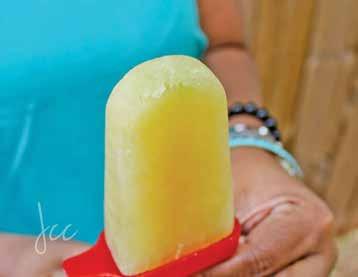
Pineapple Lime Popsicles
Ingredients: 3 cups fresh pineapple juice
Method:
Make a simple syrup by placing water and sugar in a small pot and heat until sugar has dissolved; remove from heat and allow to cool. Next in a large pitcher add pineapple juice, lime juice, lime zest and simple syrup and mix well to combine. Pour into popsicle moulds then freeze. To remove popsicles from mould, let the mould sit at room temperature for a few minutes or place the mould in warm water for about 30 seconds then enjoy!
Juice of 2 limes Zest of 2 limes 2/3 cup of sugar 2/3 cup of water
a bag. A plastic freezer bag keeps the cold air from making your ice cream rock hard. If you like straight spoons and soft ice cream, this trick is worth the extra step! Try to push out as much air out of the bag as you can before putting it in the freezer. When measuring sticky stuff like honey, molasses or peanut butter, spray your measuring cups with a non-stick spray (or make a quick coat with oil) so that it slides right out.
Cozy Gathering Space
The contemporary seating around the copper fire pit allows for a cozy large gathering. The fire pit brings warmth, while a copper water feature adds dimension to the space. Vibrant pillows are the only touches of colour in the outdoor space.
Mediterranean Paradise
This small corner garden room has an intimate feel with its abundance of greenery and Mediterranean plants. For privacy, surround the fence with tall, lush plants. A hammock provides a place to relax and read a book.
A spoonerism is a pair of words that can have their initial sounds switched to form new words. The pairs need only sound the same, not necessarily be spelled the same (power saw & sour paw, horse cart & coarse heart). There may sometimes be one or two connecting words (kick the stone & stick the cone, king of the rats & ring of the cats). Given the following definitions, what are the spoonerisms?
1) punched when starting work & discussion about scaling a mountain
2) a container of fibs & a shortage of baked goods
3) hasty vacation & prank gibe
4) a mongoose & artificial precipitation
Times Creative Writing
Tortoise and the Lizard
Tortoise had used up all his salt, and he found his meals so tasteless without it that he decided to call on his brother and ask him if he had any to spare. His brother had plenty. "How will you get it back to your home?" he asked tortoise. "If you will wrap the salt in a piece of bark cloth, and tie it up with string, then I can put the string over my shoulder and drag the parcel along the ground behind me," said tortoise. "A splendid idea!" exclaimed his brother, and between them they made a tidy package of the salt.
Then tortoise set off for his long, slow journey home, with the bundle going bump, bump, bump, along the ground behind him. Suddenly he was pulled up short, and turning round, he saw that a large lizard had jumped on to the parcel of salt and was sitting there, staring at him. "Get off my salt!" exclaimed tortoise. "How do you expect me to drag it home with you on top of it?"
"It's not your salt!' replied the lizard. “I was just walking along the path when I found this bundle lying there, so I took possession of it and now it belongs to me."
"What rubbish you talk!" said tortoise. "You know well it is mine, for I am holding the string that ties it.
"But the lizard still insisted that he had found the parcel lying in the road, and he refused to get off unless tortoise went with him to the elders, to have their case tried in court. Poor tortoise had to agree and together they went before the old men at the court.
BFirst tortoise put his case, explaining that as his arms and legs were so short he always had to carry bundles by dragging them along behind him. Then the lizard put his side of the matter, saying that he had found the bundle lying in the road.
'"Surely anything that is picked up on the road belongs to the one who picks it up?" cried the lizard.
The old men discussed the matter seriously for some time; but many of them were related to the lizard and thought that they might perhaps get a share of the salt, so eventually they decreed that the bundle should be cut into two, each animal taking half. Tortoise was disappointed, because he knew it really was his salt, but he sighed with resignation and let them divide the parcel.
The lizard immediately seized the half that was
covered with the biggest piece of cloth, leaving poor Tortoise with most of his salt escaping from his half of the parcel, and spilling out on to the ground.
In vain did tortoise try to gather his salt together. His hands were too small and there was too little cloth to wrap round it properly. Finally he departed for home, with only a fraction of his share, wrapped up in leaves and what remained of the bark cloth, while the elders scraped up all that had been spilled, dirty though it was, and took it back to their wives.
Tortoise's wife was very disappointed when she saw how little salt he had brought with him, and when he told her the whole story she was most indignant at the way he had been treated. The long, slow journey had tired him, and he had to rest for several days.
But although tortoise was so slow, he was very cunning and eventually thought up a plan to get even with the lizard.
So, saying good-bye to his wife, he plodded along the road towards the lizard's home with a gleam in his eye, and after some time he caught sight of the lizard, who was enjoying a solitary meal of flying ants.
Slowly and silently tortoise came upon him from behind and put his hands on the middle of the lizard's body. "See what I've found!" called tortoise loudly.
"What are you doing?" asked the perplexed lizard. "I was just walking along the path when I found something lying there," explained tortoise. "So I picked it up and now it belongs to me, just as you picked up my salt the other day."
When the lizard continued to wriggle and demanded that tortoise set him free, tortoise insisted that they go to the court and get the elders to judge.
The old men listened attentively to both sides of the story, and then one said: "If we are to be perfectly fair, we must give the same judgment that we gave concerning the salt."
"Yes," said the others, nodding their white heads, "and we had the bag of salt cut in two.
Therefore we must cut the lizard in two, and tortoise shall have half."
"That is fair," replied tortoise, and before the lizard could escape, he seized a knife from an elder's belt and sliced him in half, and that was the end of the greedy lizard. (An African tale)
efore several centuries, there was a very large, dense and dark forest. A group of monkeys arrived at the forest. It was winter season, and the monkeys struggled hard to survive the freezing cold nights. They were hunting for fire to get warm.
One night, they saw a firefly and considered it a dab of fire. All the monkeys in the group shouted, “Fire, Fire, Fire, Yeah we got fire!”
A couple of monkeys tried to catch the firefly and it escaped. They were sad as they could not catch the fire. They were talking to themselves that they couldn’t live in the cold if they didn’t get the fire.
The next night, again they saw many fireflies. After several attempts, the monkeys caught a few fireflies. They put the fireflies in a hole dug in the land and tried to blow the flies.
They blew the flies very hard without knowing the fact that they were flies!
An owl was watching the activities of the monkeys. The owl reached the monkeys and told them, “Hey those are not fire! They are flies. You won’t be able to make fire from it!”
The monkeys laughed at the owl. One monkey replied the owl, “Hey old owl you don’t know anything about
how to make fire. Don’t disturb us!”
The owl warned the monkeys again and asked them to stop their foolish act. “Monkeys, you cannot make fire from the flies! Please hear my words.”
The monkeys tried to make fire from the flies.
The owl told them again to stop their foolish act. “You are struggling so much, go take your shelter in a nearby cave. You can save yourself from the freezing cold! You won’t get fire!”
One monkey shouted at the owl and
the owl left the place.
The monkeys were simply doing the foolish activity for several hours and it was almost midnight. They were very tired and realized that the words of the owl were correct and they were trying to blow a fly.
They sheltered themselves at the cave and escaped from the cold.
Moral of story: We may go wrong many times and should seek and accept the advice/suggestions provided by others.
It’s almost dawn And the monster stirs, Its belly lurching Its spawn Of fumes of gas and oil.
The men awake To toil in mud and sand Searching for the dream, For their families’ sake, Of diamonds and gold.
Trees fall, Leaves wither and die Under the stench and might Of the monster’s call. While we weep.
We weep for our food
Our land
Our home
But no one hears our weeping For we are not men.
Only animals.
Sarah Allens
Live in the present moment wherever you are; It is the only certainty; Even death cannot steal that moment. Behind that is history, Beyond that is uncertainty. The present moment can mean your eternity if you hold on to it and live it as if it were your last. See God in everything –the flitting butterfly, the honey bee, the birds and flowers, the babbling brook, the stars and planets, the stone. See the clouds how they change to bring rain to the earth, The brook that constantly flows towards its goal – the river, the river towards the sea. See the connectedness in all things –See their interdependence, their interrelatedness. Hold on to the moment, don’t let it fly from you. All things belong to you, if you belong to all things.
Randall Butisingh
Apple soars to record amid optimism about coming products
Apple Inc. (AAPL)’s stock crossed an all-time high, surpassing a 2012 record as investors look ahead to new products such as bigger-screen iPhones and a wristwatch-like device that may jump-start revenue growth.
Apple rose as high as $100.77 in New York, topping the split-adjusted record of $100.72 reached on Sept. 21, 2012, when the iPhone 5 went on sale. The shares pared some of the gain and were little changed at $100.49.
After rising more than sevenfold following the 2007 debut of its smartphone, Apple’s stock lost a third of its
pushed
Apple to buy back more of its own stock earlier this year, said the rise in the company’s share price validated his earlier claim that the iPhone maker was undervalued. (Bloomberg)
Tech news Gmail smartphone app hacked by researchers
US researchers say they have been able to hack into Gmail accounts with a 92% success rate by exploiting a weakness in smartphone memory.
The researchers were able to gain access to a number of apps, including Gmail, by disguising malicious software as another downloaded app.
Gmail was among the easiest to access from the popular apps tested.
The hack was tested on an Android phone, but the researchers believe it could work on other operating systems.
A Google spokeswoman said the technology giant welcomed the research. "Third-party research is one of the ways Android is made stronger and more secure," she said.
The research is being presented later at a cybersecurity conference in San Diego by academics from the universities of Michigan and California.
Other apps hacked included H&R Block, Newegg, WebMD, Chase Bank, Hotels.com and Amazon.
The Amazon app was the hardest to access, with a 48% success rate.
The hack involves accessing the shared memory of a
Tech
ByTe
Anew software tool developed at Columbia University is providing valuable insights into how some very popular websites make use of the sensitive data they collect from their users. The software could help sniff out potential abuses from advertisers and contribute in making the usage of sensitive data a lot more transparent to the end user.
It is no secret that many of the most popular websites and online services actively track and store sensitive information from their users. The data they collect can include location, emails and search histories, which companies then attempt to monetize to the best of their ability – for instance, by producing better targeted ads, video suggestions and product recommendations.
Some of these services can be very useful, as they improve the user experience; however, it is very difficult to tell exactly how this sensitive data is be-
user's smartphone using malicious software disguised as an apparently harmless app, such as wallpaper.
This shared memory is used by all apps, and by analysing its use the researchers were able to tell when a user was logging into apps such as Gmail, giving them the opportunity to steal login details and passwords.
"The assumption has always been that these apps can't interfere with each other easily," said Zhiyun Qian, an assistant professor at the University of California and one of the researchers involved in the study.
"We show that assumption is not correct, and one app can in fact significantly impact another and result in harmful consequences for the user."
In another example the researchers were able to take advantage of a feature of the Chase Bank app which allows customers to pay in cheques by taking pictures of them with their device's camera.
The researchers were able to access the camera to steal the pictures as they were being taken, giving them access to personal information including signatures and bank details.
The tests were carried out on Android phones, but the
ing used, and that is a problem.
As web services keep aggressively collecting more and more personal data to profile their users and maximize profits, it is important to make sure that this information is used in an ethical way, preventing abuses or morally questionable business practices (such as in the case of credit com-
panies reportedly adjusting loan offers based on users' Facebook activity).
Columbia University researchers Roxana Geambasu, Augustin Chaintreau and Mathias Lecuyer have developed XRay, a software tool that aims to address this issue and bring more transparency to the web.
Their system works by tracking how the user's behavior influences "user targeting" including personalized advertisements, product recommendations and video suggestions. It then uses a probabilistic mathematical model to correlate the inputs and the outputs – the user behavior and the targeting from the website – to give users a good sense of how their personal data is being used. According to the researchers, their system has been able to predict user targeting with an accuracy of 80 to 90 percent.
In its current iteration, XRay can analyze data from Google Gmail, Amazon and YouTube. However, because of its highly flexible black box approach, Geambasu and colleagues say it could be easily adapted to new websites, even tracking data across multiple services.
The scientists created a set of emails with keywords, some of which included sensitive information, and then used XRay to
examine what ads would appear to specifically target those messages.
The analysis that followed concluded that it is indeed possible for advertisers to target sensitive topics in users' inboxes, particularly with respect to health issues – including cancer, depression and pregnancy. The scientists also discovered actual examples of such abuses, such as advertisements that targeted the topic of debt on users' inboxes in order to advertise subprime loans for second-hand cars.
XRay is still in its early stages of development, but the researchers hope that releasing the software under an open-source license, as they have done, will help the development of a new generation of software tools that can ultimately help make the web a lot more transparent.
A live online demo of the software helps users better understand the ad targeting specifically for Gmail. (Gizmag)
researchers believe the attacks could be successful on other operating systems, including Windows and the iOS system developed by Apple. (BBC)
The Main Street Artists group, a local art group that had its origins in the 1980s in central Georgetown, is currently showcasing prolific works of art at Castellani House located on Vlissengen Road.
The exhibition, which was opened on 19 August 2014, displays colourful and thought-provoking paintings, artistic sculptures inspired by Guyanese culture, and well-designed jewellery.
In celebration of Emancipation month 2014, the art exhibition is aptly themed: “Dynamic Expression”.
The artists displaying their work at the exhibition are: Roxanne Adams, Derick Boston, Brian Clarke, Francis Ferreira, George Hinds, George Hope, Ras Iah, Brentnol Lewis, Kenneth Nelson, Rawl Pillay, and Halvard Sealey –all notable artists.
The art exhibition will continue until 6 September 2014. Admission is free. Gallery hours are 10 a.m. to 5 p.m. Monday to Friday and 2 to 6 p.m. on Saturday; the gallery is closed Sundays and holidays. (Cover photo: 'Saxaphone' Halvard Sealy 2012)
'Aspirations' Brentnol Lewis (2014)
Jewellery, made from local products such as seeds and calabash, on display
'Canje Pheasant' Brentnol Lewis (2014) 'Emancipate Yourself' Ras Iah (2014)
In 1916, a group of Canadian missionary teachers made a decision to establish a top rate education institution for students in Berbice. It was owned by the Canadian Presbyterian Church.
The school’s manual states that the institution’s aim was to prepare boys and girls for the important tasks in life, to seek after truth and righteousness and to build a character worthy of emulation.
On 5 September 1916, the Berbice High School for boys was established on the bottom floor of Reverend J A Scrimgeour’s residence. Mr C A Pugsley was the head teacher for the nine students. Due to a growing population and the generosity of the public and government, in 1920, the boys’ building was erected. As a direct result to this, the Canadian Mission Council of the Presbyterian Church made the move to set up a school for girls. This was housed on the lower flat of the missionary’s residence under the charge of the Minister’s wife, Mrs McLeod.
The manual further states that the Berbice High
School for Girls and the Berbice High School for Boys continued until 1924 when the students of the fourth and fifth form were placed together for the first time to work for their Cambridge Junior and Senior School Certificate Examination.
By 1941, the manual mentions, the student population had reached 190 and a complete amalgamation was effected. It was then the name ‘Berbice High School’ came into being. In order to adequately accommodate the growing number of students on role, the Canadian Presbyterian Church, in Canada, decided to send a representative
to British Guiana to assess the situation and examine whether any assistance could come from the government. According to the document, Dr E H Johnson, Secretary for the Board of Overseas Missions, was able to influence the government to throw in 50% of the cost for the construction of the building in the master plan. In April 1919, the government made their first financial contribution towards salaries of teachers. The rate was $100 per month.
Names such as the Honourable Joseph Eleazer, Honourable E A Luckhoo, Honourable Peer Bacchus and the Honourable T T
Thompson played a fundamental part in bending the government’s arm to release more assistance to the school.
According to the document, “In 1951, Honourable W O R Kendall convinced Government of the need to increase its grant to the Berbice High School from $8,000 to $13,000. In 1955 government was again approached for an increase in the grant and as there was a consciousness of the value of education among the ranks of the government, the annual block grant was increased to $27,500.”
After 50 years of producing some of the finest students in the country, the school on 16 January 1967 was passed over to the Government of Guyana and no tuition fees were charged. The Minister of Education, who was then Winifred Gaskin, announced that the school would hold status similar to that of Queen’s College and Bishops High School.
Another page in the school’s history was written in 1919 when J I Ramphal became known as the first candidate to pass the Cambridge
Senior Examination. “Mr. Simon Mook Sang obtained the medical degree at Edinburgh after gaining university standing from the Berbice High School in 1926.”
The document notes that in 1954 the Oxford examination was introduced to the school and later the G.C.E.
A sixth form was established at the institution in 1954 but due to poor response the idea was abandoned. It was subsequently re-introduced and lasted a few years.
In 1971, the Berbice High School was twinned with the St. Rose’s High School, however, according to the manual, no known visits were made since 1976.
The school is situated at the intersection of North Road and Princess Elizabeth Road in New Amsterdam.
The population comes from several sections of East and West Berbice.
Berbice High School has produced notable individuals such as Sir Edward Luckhoo, Lionel Luckhoo and Sir Shridath Ramphal.
The Berbice High School certainly has an outstanding record behind it and may well be proud of its achievement. It has lived up to the ideals of its founder by providing the training that has fitted many of its sons and daughters to hold prominent positions in the government, judiciary, civil service, in the legal and medical professions, in teaching, in business, trade and industry.
The school continues to excel as one of the country’s high-ranking educational institutions.
Charlotte street view of the High Court (n.d.)
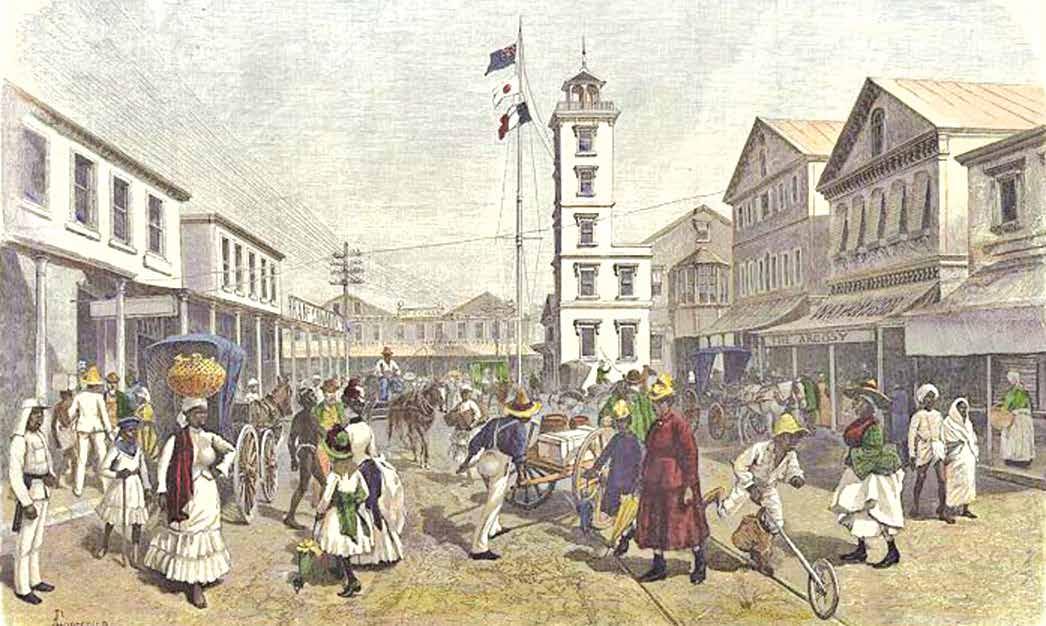
An engraving of Water street, georgetown, by Milton Prior, published in the Illustrated London News on 23 April 1888 (Guyana.org photo)
BHs continues to expand as a new wing was added earlier this year
the auditorium in 1972 (Photo courtesy of Berbice High School Alumni Association)
students going to the old 'science Building' in 1972 (Photo courtesy of Berbice High School Alumni Association)
tabali is a small community in the Mazaruni River and a short distance by boat from Bartica. Known for its tranquillity, Itabali’s trails are perfect for a cool and relaxing walk while breathing in the fresh, sweet air of nature. It is a close-knit community with a growing populace and commercial area.
The Mazaruni River flows past the Itabali landing- an area buzzing with an influx of visitors. Enjoy the scenery in Itabali. (Photos by Marco Basir)
Ferry in tepru, Itabali
Boat landing
serene Itabali
Puruni trail, Itabali (Photo by TomDiTOm on Flickr)
By Melvin Durai
RLast Laugh
anjit and his father, Ravi, were visiting Ravi’s father in the village. It had been a few years since Ranjit had seen Dadaji, and he was eager to hear one of the old man’s stories.
“Dadaji, tell me about the time you captured the tiger.”
His grandfather took him into his bedroom, opened the drawer of a cluttered desk and pulled out a large book. He turned to a page with a blackand-white photo of two bare-chested young men posing with a tiger in a cage.
“What is this book called?” Ranjit asked.
“It’s called a photo album.”
“Is it like Facebook?”
Dadaji paused for a moment, contemplating the question. “Yes, yes, it’s a book of faces. Have you seen your when he was your age?”
“Show me, show me!” Ranjit screamed.
He was thrilled to see a photo of his father as a 12-year-old, climbing a mango tree.
“Daddy, come here,” shouted. “You should scan this photo and post it on Facebook, so everyone can see what you looked like when you had hair.”
take so many photos?”
“No, not at all, Dadaji,” Ranjit said. “Digital cameras let you take unlimited photos.”
Ravi sighed deeply. “Unlimited photos, unlimited space, and unlimited grandchildren poses.”
“Why don’t you just skip over those photos, Daddy?”
“I tried that. Skipped the grandchildren photos and had to look at my niece Priya’s selfies. Every day, a new selfie.”
“What is selfie?” Dadaji asked.
“A selfie is when you take a photo of yourself,” Ranjit said.
“I don’t like Facebook anymore,” Ravi said, walking into the bedroom.
“Why not, Daddy?” Ranjit asked.
“I’m tired of it. It’s always the same thing. Aunt Manjula is always posting photos of her grandchildren. Every day, a new photo. She has posted photos of the grandchildren eating icecream, photos of the grandchildren playing on a swing, photos of the grandchildren picking their noses.”
“How can she afford to post so many photos?” Dadaji asked. “The postage is too costly these days.”
“Posting is the same as uploading, Dadaji,” Ranjit said. “She uploads them to Facebook.”
“Is uploading the same as loading up?” Dadaji asked. “In my younger days, I worked for a shipping company and loaded up many ships.”
“Yes, it’s almost the same,” Ravi said. “Aunt Manjula is loading up Facebook with photos of her grandchildren.”
“What about space?” Dadaji asked. “If she keeps loading up, will she not run out of space?”
“Oh no,” Ravi said. “Facebook, unfortunately, has unlimited space.”
“What about the cost of film? Is it not costly to
“Why is Priya taking photos of herself when there are so many people around to take photos of her?” Dadaji
“Because other people get tired of taking photos of Priya. But Priya never gets tired of taking photos of Priya.”
“Does she load them all up too?”
“Yes, she loads them up three times a day, with comments such as, ‘This is me on the bus with the conductor in the background,’ ‘This is me at the zoo with the monkey in the background,’ and ‘This is me at the bank with the robber in the background.'”
“Why don’t you skip over her photos too, Daddy?”
“I tried that, but then I had to look at my friend Jamal’s photos. He posts photos of everything he eats and drinks. Many years from now, when historians want to know what Indians ate and drank in the 21st century, they can just dig up Jamal’s Facebook account.”
“Why don’t you skip over his photos too, Daddy?”
“I tried that, but then I had to look at my friend Manish’s vacation photos. Every week, a new set of vacation photos. He posted one photo and wrote, ‘It’s so beautiful in Tahiti. Best place on earth.’ I asked him when he went to Tahiti and he said, ‘What makes you think I’ve been to Tahiti? Just because I posted a photo doesn’t mean I’ve been there.'”
As his father was talking, Ranjit spotted a pen on Dadaji’s desk and quickly scribbled something in the photo album. Dadaji slid his reading glasses on, peered through them and smiled. At the bottom of the tiger photo, on the protective plastic covering, his grandson had written a single word: “Like.”
Winners
and losers
Did you hear about the long-distance runner who took part in a 100-mile race?
Well, he was in the lead and had one more mile to go, but he was too tired to finish, so he turned around and ran back.
Hillbilly Story
A vacationer and his family were driving through the backwoods. The man took a wrong turn and got lost. He drove miles until he came to a fork in the road. There he spotted a small shack. A hillbilly was rocking on the porch.
“Hey there!” the vacationer called. “Can you tell me where the road on the left leads to?”
“Don’t rightly know,” the hillbilly replied, continuing to rock.
“Well, can you tell me where the road on the right leads to?”
“Don’t know that,” said the hillbilly, continuing to rock.
The vacationer got angry. “You’re not very bright, are you?” he said.
”Maybe not,” replied the hillbilly replied calmly, “but I’m not lost.”
At the restaurant
Customer: There’s a fly swimming in my soup! What’s he doing there?
Waiter: Looks like the backstroke to me.
The date
He: Is that perfume I smell?
She: It is - and you do.
Art for art’s sake
Woman (in art gallery): And this I suppose, is one of those hideous monstrosities you call art?
Art Dealer: No, madam, it’s a mirror.
Happy camper
Did you hear about the camper who bought a sleeping bag? He spent three weeks trying to wake it up.
You’re so weak...
You’re so weak, you couldn’t even bend a wet noodle.
You’re so weak, you couldn’t even beat a rug.
You’re so weak, if you beat an egg, we’d all be surprised.
You’re so lazy...
You’re so lazy, the only thing you do fast is get tired.
You’re so lazy, you wait for the wind to blow your nose.
Ultimate health put -downs
If your body were a building, it would be con demned.
You’re in shape all right - the wrong shape.
Your shape isn’t half bad - it’s all bad.
Ultimate medical put-downs
If you had a brain trans plant, the brain would reject
you.
In your case, a brain operation would be minor surgery.
You’re so sick, anyone who goes out with you needs a prescription.
Exercise is good for you
“Are you ready out there in radio land for your morning exercises? Good. Nowup, down, up, down, up, down. Now the other eyelid.”
No more Mister Nice guy
“This place isn’t fit for a dog.” “Yes it is -come right in.”
“I didn’t come here to be insulted.”
“Oh? Where do you usually go?’
“What kind of idiot do you think I am?” “I don’t know. What other kinds are there?”
“Do you think I am a fool?” “No, but what’s my opinion against thousands of others?”
Beauty is in the eye of the beholder
Hank: Did the mudpack help your wife’s appearance?
Chuck: It did for a few days, but then it fell off.
Almost pulled it off
The telephone rang in the office of the school principal. “Hello, may I speak to the principal, please?”
“This is the principal.”
“I’m calling to say that my son cannot come to school today because he has a bad cold.”
“Who is this speaking please?”
“This is my father.”
Scientific research
Donna: I understand that fish is brain food.
Don: Yes, I eat it all the time.
Donna: Oh well, there goes another scientific theory.
Logic
Horace: I lost my dog.
Morris: Why don’t you put an ad in the paper?
Horace: What good would that do? My dog can’t read.
The birthday gift
On Jeffrey’s birthday, his parents bought him what he always wanted - a horse. But the horse didn’t seem to have any energy. Jeffrey took it to the vet.
“This horse is very old,” the vet said, after looking him over.
“Will I be able to race him?” asked Jeffrey. The vet looked at Jeffrey and then he looked at the
“Sure,” he said, “and you’ll probably win.”
Sports jock
Dad was delighted to learn that his son had broken the school long-jump record.
“How did you do it son?” he asked.
“To tell the truth dad, I entered discus. But as I got ready to throw, I backed into