




By Michael younge
Head of State,
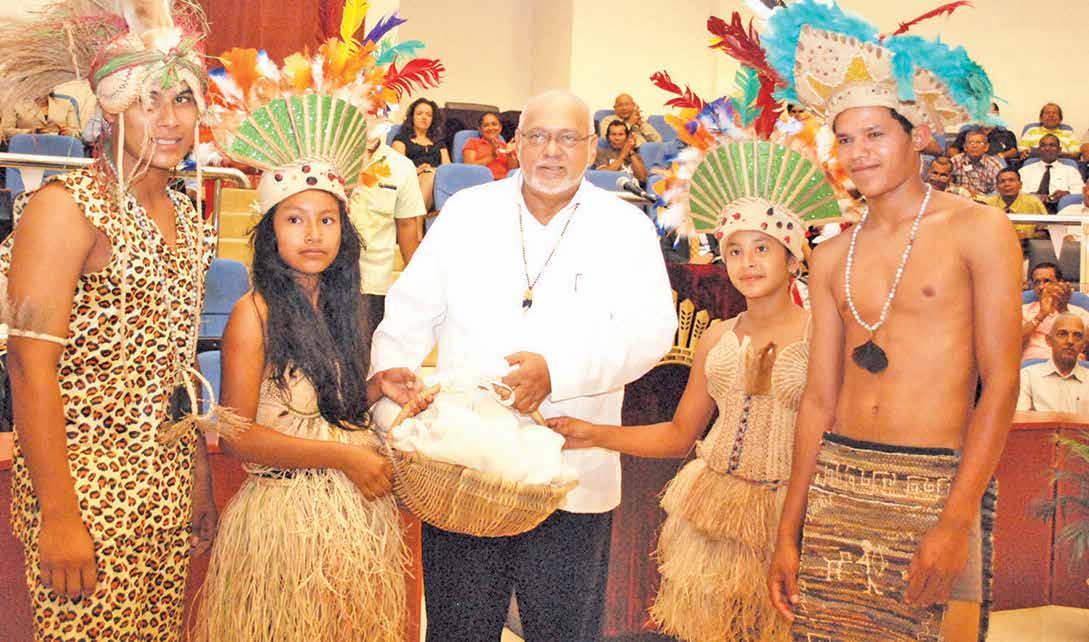
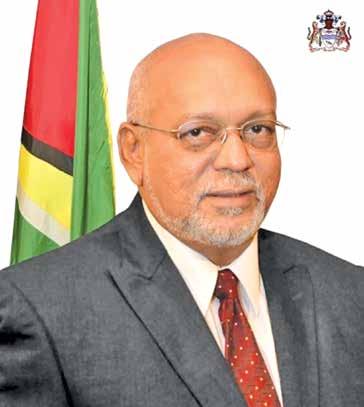
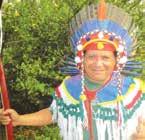
President Donald Ramotar, said his multi-ethnic heritage and cultural groundings continue to influence his quest to ensure that all Guyanese benefit from equal opportunities and positive socio-economic development regardless of their background or political beliefs.
Ramotar, speaking during an exclusive interview with the Guyana Times Sunday Magazine, hailed the contributions made by Guyana’s indigenous population, as the country celebrates their achievements with a focus on addressing existing barriers to their forward movement during Amerindian Heritage Month.
Born to a mother of mixed heritage (Amerindian and African) and an East Indian father, Ramotar recalled the fond memories and experiences he had growing up in the predominantly Amerindian settlement of Caria Caria, West
Bank Essequibo. That aside, the president noted that he has very close cousins and relatives who are of African, European and Indian descent.
“I have a strong multiethnic grounding with a
strong Amerindian heritage,” he said proudly.
President Ramotar disclosed life was never easy for him as he reflected on the sacrifices made by his parents, many other Amerindians, as well as

families of mixed origins, to ensure that their children had access to an education in the interior.
“We would have to walk about three to four miles through a track - not a road - to get to school and sometimes we would paddle with a boat regardless of the direction of the tides,” he reminisced, explaining that some of these things are constantly on his mind when he goes into hinterland communities and far flung areas.
Identifying further with the experiences of many Amerindians, and Guyanese by extension, the president stated: “We lived in a house that was collapsing and we had to ‘fork it up’ with a long piece of timber just to brace it before getting better accommodation.”
He also recalled the period when he made a decision to move to Georgetown to further his studies, leaving behind close friends and family in the process. There were no further educational opportunities in his village.
“It must have been hard for my parents…but somehow those fond memories of my upbringing among Amerindians and mixed people have kept me calm
nities and the lack of development, which stifled the overall progress of the people while retarding their ability to contribute to their own village economies and country like others groups.
“When the Amerindian Conference in 1969 was held, surprisingly the biggest outcome was that they had to pledge loyalty to the then Prime Minister [Forbes Burnham]…that was what was important to the PNC regardless of the state of the people and the challenges they were facing,” the president mentioned.
The Head of State was adamant that once the People’s Progressive Party (PPP) got into power, this started to change and the construction of schools, health centres and bridges got underway with focus on empowering Amerindians. He stated that he was a beneficiary of this development, having resided at Caria Caria.
“Once the PPP left office, all of this disappeared,” the president explained, revealing that Amerindian development restarted when the party returned to office.
Ramotar is satisfied that the PPP never took advan-
riences.
He warned that no attempt must be spared to guard the gains made as he pointed to the opportunistic ranting of the political opposition, betrayal by some Amerindians in the opposition camp of their own people, and the continuous assault on hinterland development by the parliamentary opposition.
“But I still have faith in the collective intelligence of our indigenous people,” he declared, as he expressed concerns over the alarming amount of misinformation being peddled by the opposition in the hinterland communities, which is being seen as the new battle ground.
“It’s only recently that they have developed interest in Amerindian development,” he said while arguing that the PPP has been doing that from the start. He spoke about the massive investments made in the area of land titling and demarcation, while expressing confidence that his government will continue to give Amerindians more rights and power over the land and its resources.
“We have given them
and focused. Even now I still think about the moonlight nights in Caria Caria, which is one of the most beautiful scenic experiences…” he noted.
President Ramotar insisted that these personal experiences have been the underlying drivers of his passion and commitment to ensure that Amerindians, as a people, are never again neglected and benefit from their rightful share of the development pie.
He admitted that the Amerindians have been victims of discrimination and neglect at the hands of the then colonial powers and the People’s National Congress (PNC), which came to power afterwards. Ramotar recollected the poor and callous state of Amerindian commu-
tage of the Amerindians or saw them as election prizes.
He pointed to the massive gains made by the indigenous people and the amount of work done by successive PPP governments to the dignity and integrity of these people. The PPP, he boasted, has given them equitable access to jobs, housing and a better standard of living, linking them to the rest of Guyana while empowering them through education.
“This is something that was a dream for most Amerindians,” he expressed, while indicating that the “level of the consciousness of the Amerindians are very high today”. President Ramotar feels that whenever he visits a village, it is like a homecoming for him, given his own unique expe-
more than 14% of the land mass in Guyana…many of those who lecture about human rights have not done so. We have codified laws via the Amerindian Act to empower them. I understand the importance of this. I understand their story and experiences,” he affirmed.
President Ramotar has recommitted his government towards transforming the lives of all Guyanese. Therefore, he said there is much to celebrate during Amerindian Heritage Month.
“Culture is never stagnant. It is always evolving. No men are strangers and everybody has similar desires,” he remarked while thinking about the influence of his own groundings on the path he chose in life.
By Jomo Paul
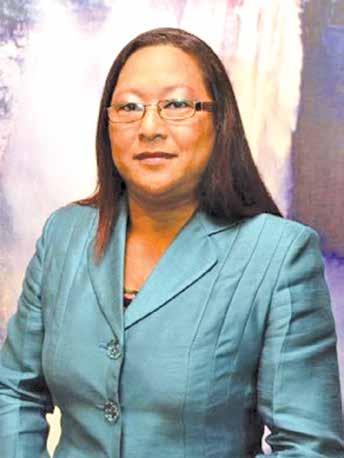
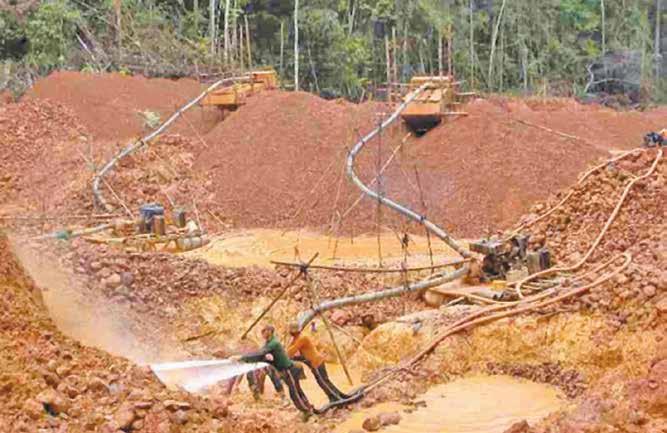
Mineral mining is an advantage for indigenous villages that fall within Guyana’s mining districts and definitely puts these communities on a faster path towards development. This is the view of Minister of Amerindian Affairs Pauline Sukhai, who spoke to Guyana Times Sunday Magazine in an exclusive interview from her Thomas and Quamina Streets office.
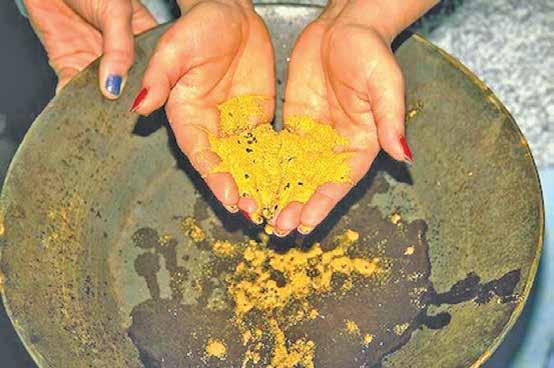
Sukhai explained that while mining has placed some of the communities on the fast track for development, it should not be relied on too heavily, given the nature of the industry. The performance of Guyana’s mining sector is particularly dependent on the international market prices. Since Guyana has no established gold refineries for value added gold production, if the price of the precious metal on the world market tumbles so will the local price.
“Their lives are so intricately involved in mining that they sometimes fail to pay attention to agriculture and other sectors…and that is something we always urge them, to balance their economic activities,” said Sukhai.
However, while this warning was issued, the minister also reflected on the positive developments that have come about in indigenous communities, primarily as a result of mining activities.
Sukhai pointed out that in several communities infrastructural developments have been given a head start, noting that in Isseneru, community members have been able to construct guest houses and a multipurpose community centre.
“When they earn from mining or forestry or fishing, there is always a need to push them to realise the higher level of livelihood from the sector that they are involved in,” she pointed out.
Mining and lands
Guyana Gold and Diamond Miners Association (GGDMA) president Patrick Harding proffered a similar view, noting that not only has mining aided Amerindian development but the development of the hinterlands in general.
But, there has been a longstanding battle between miners and indigenous Guyanese over the right to mine on titled Amerindian lands.
Presently, mining is seen as the go-to-industry for many Guyanese and foreign investors because of
the investment return possibilities. However, there has been a decrease in declarations, which the GGDMA has blamed on a decrease in production in mining communities, as gold prices tumble internationally.
As a result, there has been,
Government’s hinterland housing programme taking root Amerindian groups laud transformation of communities
4
Amerindian culture inspires chic collection
practically, a standoff between government and local miners over the low declarations.
GWI outlines plans for hinterland water security
According to Minister of Natural Resources Robert Persaud, for the first half of 2014, the Gold Board recorded only 233,305 ounces of the precious commodity being declared in comparison to 270,178 ounces last year, a 16% decrease in declarations.
Preserving the Amerindian culture through the culinary arts
21
Total gold declarations for January to May have been given as 165,595 ounces, while some 204,970.42 ounces were declared for the corresponding period last year. Persaud explained that the ministry and government cannot point definitively to any causes for the decrease in gold declarations, but alluded to the fact that it may be because of environmental issues.
In light of this, the Ministry of Natural Resources and the Guyana Geology and Mines
Commission have introduced a list of measures in an effort to return the industry to its former glory.
Minister Persaud reaffirmed the government’s commitment to expanding the mining sector, in spite of the drop in gold declarations. He outlined that there were 469 new mining permits issued between January and May, which represents an 89% increase over permits issued in the same period last year. He added that there was a 39% increase in the number of prospecting licences being granted to miners.

For years they have lived in thatch-roofed shelters and tiny, meagre wooden houses, but today, Amerindians can aspire to own modern homes through the Government’s Hinterland Housing Project, which represents the first state intervention in housing for Guyana’s indigenous population.
Financed as part of the Second Low Income Settlements Programme, which is being implemented by the Central Housing and Planning Authority (CHPA), in collaboration with the Ministry of Amerindian Affairs, with funding from the Inter-American Development Bank, the first phase targeted the housing needs of eight communities, three in Region One: Oronoque, Manawarin and Whitewater; and five in Region Nine: Kwatamang, Apoteri, Central Annai, Massara, and Kataoka.
Housing Minister Irfaan Ali told Guyana Times Sunday Magazine that the second phase will kick off in a month’s time and will include Region Eight. Ali said that he was satisfied with the first phase, noting that
the project demonstrates Government’s commitment to developing housing for all communities.
“We don’t only cater for those living in the coastlands, but all our peoples are included in this housing drive,” the minister disclosed.
Before the rollout of the first phase of the project, a pre-feasibility study was conducted in 2009 by an international consultant contracted by the IDB. The study revealed that the pilot was feasible, but only if it fully involved the community in the development of the project, including the design and construction of their own housing units. To this end, community design workshops were completed in July 2010 and November 2010 in Regions One and Nine respectively, with participation from over 70 residents of the communities being targeted for the intervention. The outcome of these design workshops was finalised designs of the houses that were appropriate to the housing needs of the respective regions.
The pre-feasibility study also found that there was
a demand for roofing, since the palms traditionally used to thatch roofs were becoming scarce. The study also recommended that a prepilot test be implemented through the construction of two prototypes, one in Region One and another in Region Nine, prior to the implementation of the pilot in the two regions. Whitewater was selected as the site for the Region One prototype and Kwatamang as the site for the Region Nine prototype, since these areas were easily accessible.
Both prototypes were successfully completed. The prototype roof was completed in Region One in one and half day during November 2011 by the beneficiary household, while the prototype house commenced in November 2011 and was completed in March 2012 in 51 non-consecutive days. Construction work was executed by a local carpenter from the village, along with a semi-skilled person, who were selected by the village council and paid by the CHPA. The beneficiary household provided three ordinary labourers to complete the team as their con-

tribution.
To date, 192 subsidies have been disbursed – 91% of the total number of subsidies, with 109 two-bedroom houses (500 square feet) completed and 83 roofs replaced. The completion of these houses and replacement of roofs improved the quality of life of 208 families, benefiting approximately 1500 persons.
The Hinterland Pilot has achieved a high level of success in that it represents a partnership between government and the target group of beneficiaries, with the village councils, the CHPA and the Ministry of Amerindian Affairs working seamlessly together to realise a project that created employment, empowered beneficiaries and improved their quality of life. It serves as a best practice in addressing the housing needs of hinterland beneficiaries.
Rupununi
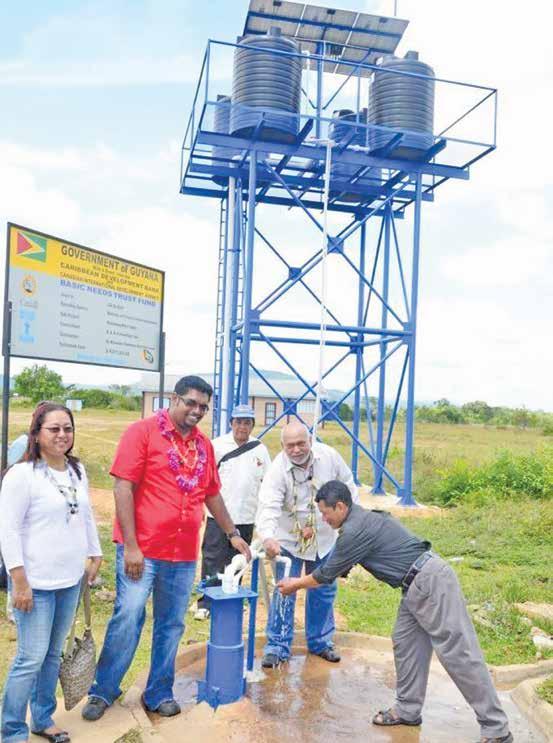
Late last year, President Donald Ramotar handed over the keys to a number of houses to residents of the North Rupununi District, Region Nine, as part of the project. The president lauded the project as a great be-
ginning, noting that it will expand from village to village until everyone in the hinterland has a better quality of life. Ramotar said he knows the housing conditions in the hinterland are not always good, pointing out that he hails from a hinterland village and has travelled extensively.
“One of the main things in having an improved quality of life is having better housing for people to live in,” he noted.
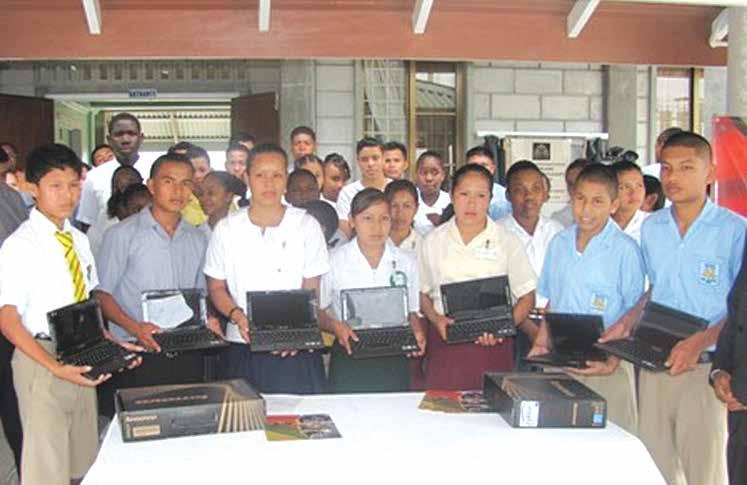
The president said his government wants to do much more for hinterland residents, and much focus is being placed on hinterland education. “I have seen for myself, having the opportunity to travel to the parts of the hinterland, the transformation that is taking place and that gives me immense joy in many ways to see our people grasp at education, grasping at opportunity and developing themselves.”
Ali mentioned that the project is a great accomplishment and a symbol of the government’s commitment to ensuring a better quality of life for its people, describing the day as a day of celebration for the beneficiaries.
“These are all investments that we are proud to make on your behalf, these are all investments we think that you so richly deserve… for us, we are all equal and we all deserve equal opportunity and equal treatment,” expressed Ali.
The minister added that the government wants to work with the people handin-hand to guarantee they obtain what they deserve.
“In the government, there is a partner that will ensure you are equally treated every single time,” Ali pointed out.
Additionally, Ali acknowledged the quality of work produced by persons who worked on the project, disclosing that the Housing Ministry would like to work with them to take their skills to another level.
“Maybe, we can take you to build some of the homes in housing schemes for the low-income families so that we can build off of the learning experiences of this project,” Ali stated.
The Minister of Housing stressed that his ministry did not want the project to just be the building of the homes, but to be an experience.
After 52 years of nursing, three retirements, eight children, 15 grandchildren, two great grandchildren, and performing countless deliveries, Veera Margaret Fraser-Boyal is finally enjoying a well deserved retirement in Georgetown
At 73 years old, Veera Margaret FraserBoyal is enjoying her final retirement after half a century of hard work and dedication to her community in the Waramuri village, Region One. Even in retirement, Boyal remains alert and in control of her environment.
Before venturing into the medical field, Boyal began her professional career as a teacher. She taught for six months after finishing school but felt unfulfilled:
“…Teaching was not for me,” she disclosed in an interview with Guyana Times Sunday Magazine
Determined to pursue her aspirations, a young Boyal left the teaching profession in the late 50s after reading an advertisement in the newspapers for a Rural Midwifery Programme.
Full of hope and excitement, she applied and was among a batch of 31 students who passed the exams out of 300 persons that applied.
Upon completing her training, Boyal became a
nurse at age 19, upon which she joined the nursing staff as a midwifery student in the hinterland in May of 1961. In December of the same year, she took another examination and soon after became a qualified midwife in Georgetown.
“Growing up, I always admired the nurses when they came to give us our vaccination in the village. This greatly inspired me to become a nurse,” Boyal reminisced.
Explaining how her family also influenced her career choice, nurse Boyal, as she is lovingly called, revealed that her paternal grandmother died hemorrhaging after giving birth to her second child because of poor medical care and facilities. “This also greatly inspired me to become a midwife; so when I saw the opportunity I took it.”
In 1963, this aspiration came to pass as Boyal was admitted to the General Nursing Council of British Guiana as a registered midwife. In the same year she was posted back to her home
village in Waramuri, where she would remain for the next 40 years serving her community to the best of her abilities.
Returning to her village in 1963, Boyal turned her grandparents’ home into a health centre, and there she worked armed with her midwifery kit and a six-month supply of medication until the community health centre was constructed - nearly 20 years later!
Over 20 years of home visits, natural deliveries and innumerable patients, Boyal received assistance from Medex Hilary Rodrigues (Kobo). The duo took up the responsibility of providing the best medical care in Waramuri and the nearby areas of Hiamaracabra and Para. After 12 years working together, Hilary was transferred from the area, leaving Boyal to once again champion the health care of the community by herself.
“It was challenging, yes, since there was no health centre, most of the time I was alone but I got the job done…Sometimes we pad-
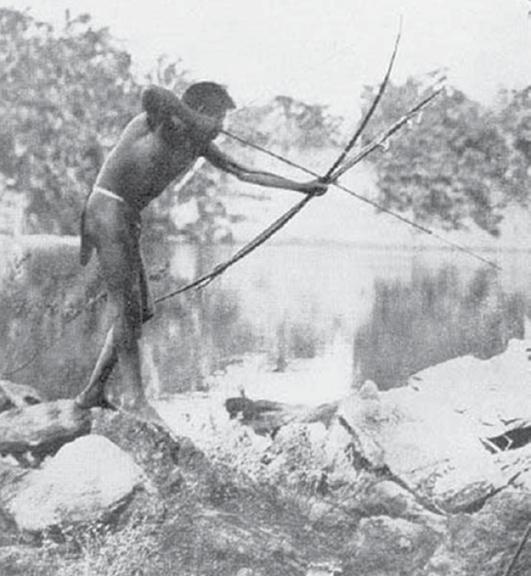
The word “Amerindian” is said to be a contraction or combination of the two words “American” and “Indian”, to describe the original inhabitants of the Americas, the continents known as the “New World”. Early Europeans, seeking trade routes to India, claimed to have discovered North, South and Central America, and labelled them the “New World’. It was in
this “New World” that they also discovered the original inhabitants whom they named “Indians”, believing that they had arrived in India.
However, the term “American Indian” was later coined to distinguish the indigenous peoples of the Americas from the original inhabitants of India, also known as “East Indians” today.
Guyana’s indigenous
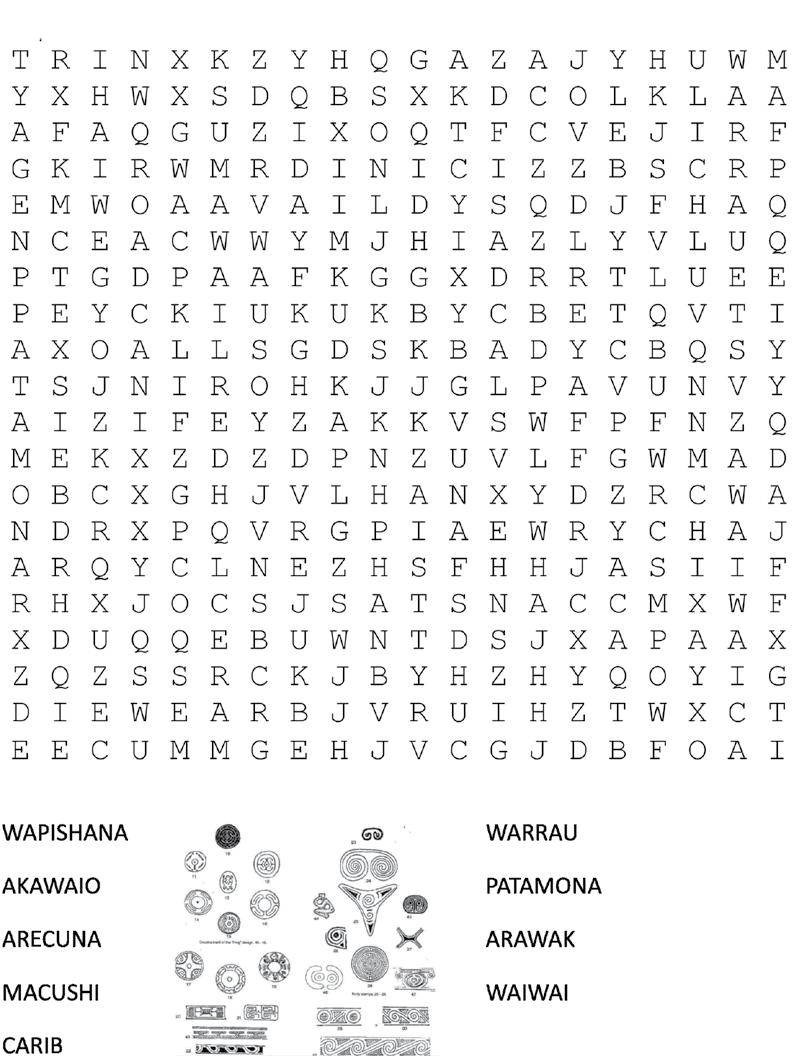
population is divided into three linguistic groups: Arawakan, Cariban, and Warauan. The Arawakan family is made up of two nations – the Lokono Arawaks and the Wapishanas. The Cariban nation is made up of six groups: Akawaios, Patamonas, Arekunas, Makushis, Caribs (Karinya), and Waiwais. The Warrau nation is the only linguistic group inhabiting Guyana.
This adds up to nine indigenous nations inhabiting Guyana to date.
Guyana’s Amerindians are estimated to have arrived on these shores some 12,000 years ago, though there is some scholarly debate as to which nation first arrived. The general consensus however, favours the thought that the Waraus were the original inhabitants.
The Arawaks later followed, then the Caribs.
As with most tribes, each nation dispersed itself throughout the vast territory of Guyana. However, with European and subsequent arrivals, many may have also retreated further continued on page 11
dled for hours for home visits, people would come and pick me up to make deliveries”, Boyal recalled.
Several years later, at age 55, Boyal felt she was ready to retire, however, there was no one to take over so she was asked to continue to serve in her position until a suitable replacement was found. That person was found 12 years after, which permitted Boyal to retire in 2008.
She was then asked to move to Kumaka District Hospital to serve for six months, which is where she ended her midwifery career and retired for the final time.
“Yes, I can say I had a fulfilling career. I have lived to see many of the babies I deliver become doctors [graduating from Cuba] and nurses [being trained at Georgetown hospital].”
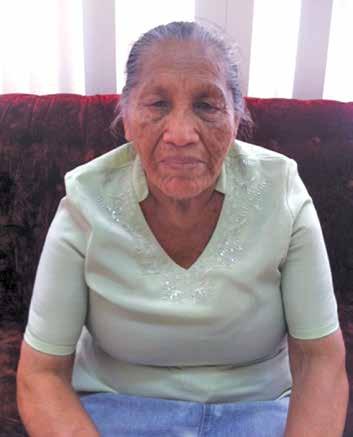
Today, Boyal’s daughter, Vanessa, carries on the midwifery legacy in Waramuri, and Boyal’s granddaughter is training to be a nurse. Proud of her achievements, Boyal enjoys her retirement
in Georgetown surrounded by her grandchildren.
“Once it’s your ambition, you go all out,” Boyal said when asked what her advice is to the youths in her village.

B y P etam B er P ersaud
There was a time when the Amerindian could not speak in English, making know his problems and challenges. That was a long, long time ago. Much has changed since then.
I live in the path of change
In my old and carefree way
Confused and bewildered I strive to understand
I’m a merry Indian no more.
-‘A Merry Indian No More’ by Basil Rodrigues
There was a time when the Amerindians spoke about their grievances but no one listened because the language used was not understood by the others. That was a long time ago. Much has changed since then.
A carefree life I’ve lived Hunting the forest land,
the river bed
A new light shines today
Which threatens my traditional way.
-‘A Merry Indian No More’ Basil Rodrigues
There was a time when the Amerindians acquired and was able to use the lingua franca of the country yet their voice was not heard.
I see the light of a new day It is coming my way
To my timid mind I dread the changes it brings
I’m a merry Indian no more.
-‘A Merry Indian No More’ Basil Rodrigues
There was a time when the voice of the Amerindian was beginning to be heard and their cause attracted many sympathisers. One such person was William Hilhouse, who was “one of the most versatile, interesting, and controversial fig -
ures in the early history of British Guiana”. Hilhouse became an “unfailing advocate” of the Amerindians. And his book, “Indian Notices”, was an “‘Expose –the fruit of nine years’ observation and acquisition of information concerning the abuses perpetrated against the Amerindians”.
The book, “Indian Notices”, was first published in 1825. In 2011, the book was reissued by The
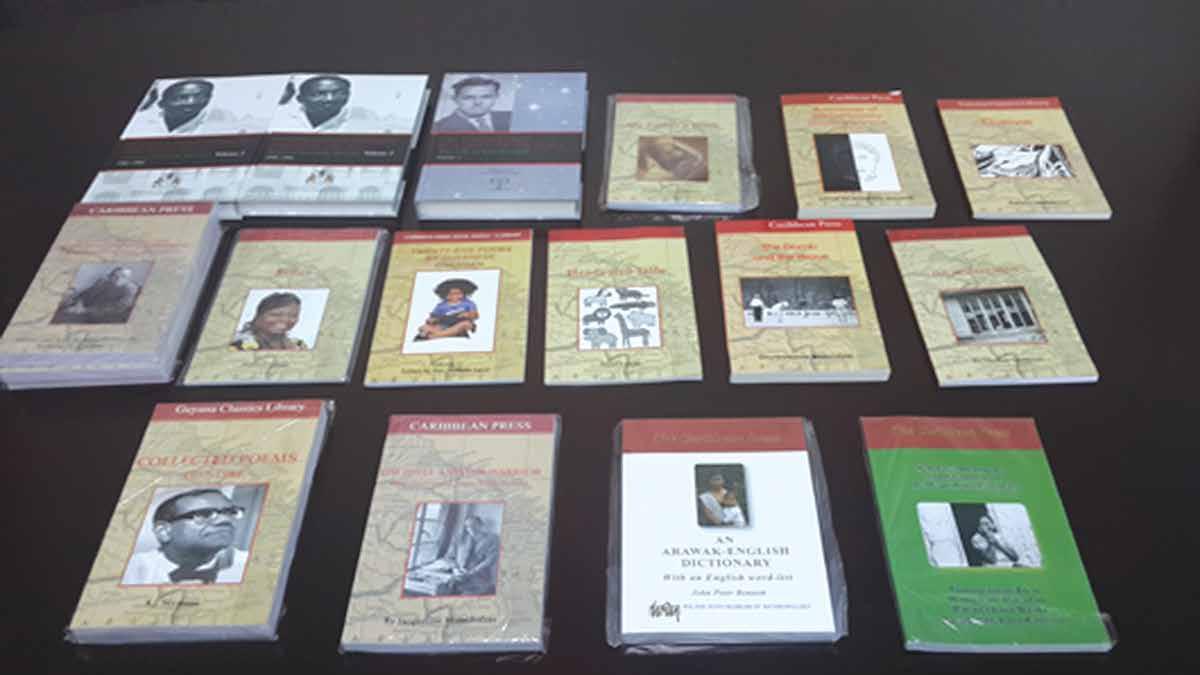
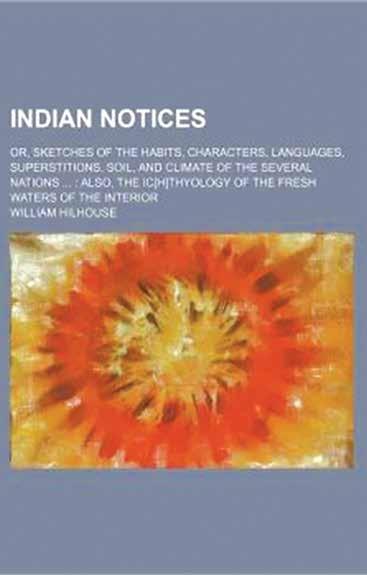
Caribbean Press, which was birthed to reprint rare and out-of-print books on and about Guyana.
“Indian Notices” is subtitled “sketches of the habits, characters, languages, superstitions, soil, and climate of the several nations; with remarks on their capacity for colonisation, present government and suggestions for future improvement and civilization. Also the ichthyology of the fresh waters of the interior”. That lengthy subtitle forms part of the table of contents, which include an Introduction by M N Menezes, Key to References, an Advice to Readers, a Postscript, Supplementary notes and Selected Bibliography. “Indian Notices” is a slim volume, amounting to 97 pages but it hurled many potent poison darts to abusers of the Amerindians.
The darts hit home in such a manner that Hilhouse invited the wrath of all in authority. Menezes in her introduction writes, “This ‘Las Casas’ of British Guiana did not hesitate to condemn the abuses of the system of government over the Indians, and his outspoken and unwelcome candour won for him the hearty dislike of Governors, Members of the Courts, Protectors of Indians, and Postholders. He became a thorn in the flesh of Governors D’Urban, Carmichael Smyth, and to a lesser extent, Light.” He was labelled “a mischievous meddler” and “a visionary and eccentric person of unsettled and wandering habits”.
Labels did not deter Hilhouse, whose goals seem to be to champion the cause of the Amerindians and to gain knowledge of the interior. It is just as well that Hilhouse continued in his quest because “Indian Notices” was foundation to “enable abler hands to advocate the cause thus brought forward”.
In his postscript, Hilhouse gave advice on how to go about the advocacy, “There is one avenue to the heart of the Indian, that is always closed to the stranger, and to the European in authority over him. Time and unremitting kindness alone opens this door of his affections, as he makes it a point of honour to lie to all the world, but be true to his friend.”
To read “Indian Notices” is to get in touch with Amerindians as living beings with a right to all the rights due to human beings.
Responses to this author telephone (592) 226-0065 or email: oraltradition2002@ yahoo.com
By Svetlana MarShall
The indigenous population in Guyana has undergone significant transformation, benefiting tremendously from improved roads, state-of-the-art educational and health institutions, but it has called for more consultations before the start up of future projects- something which Amerindian Affairs Minister Pauline Sukhai said is a feature of the government.
The Amerindian Peoples Association (APA) and the Guyanese Organisation of Indigenous People (GOIP) said much more needs to be done. In an exclusive interview with Guyana Times Sunday Magazine, APA Forest Law Enforcement Governance and Trade (FLEGT) Policy Adviser Michael McGarrell said the Low Carbon Development Strategy (LCDS), launched under the stewardship of former President Bharrat Jagdeo, coincides with a tradition that has long been established by the Amerindians.
“We have always been the guardian of the forest, because of our determination to preserve it,” McGarrell noted.
The LCDS was launched on 8 June 2009 with the intention of promoting economic development and simultaneously combating climate change through forest preservation. By November of that year,
Guyana and the Kingdom of Norway had signed a historic Memorandum of Understanding (MoU), with the latter committing to providing Guyana with up to US$250 million by 2015 for avoided deforestation once key indicators are met. To date, US$115 million has been deposited into the World Bank for Guyana.
With both Guyana and Norway fulfilling their obligations, McGarrell said hinterland communities have been benefiting from renewable energy in the form of solar photovoltaic systems. To date, more than 13,000 solar panels have been installed in almost 200 communities. Additionally, the Amerindian Development Fund (ADF) was established, through which grants are provided for the execution of priority projects that are aiding in social and economic development. The Amerindian Land Titling Programme is another initiative formed under the LCDS.
McGarrell mentioned that one cannot turn a blind eye to benefits emanating from the LCDS initiative, but the indigenous peoples would like to play a bigger role in future programmes of this nature.
“We have always felt that there must be some sort of self-determination, if I am not involved in the design process, if I am not involved in the process of implementation and if I am not involved in the process of evaluation,
then that is not development,” McGarrell opined.
The APA Policy Advisor maintained that Amerindians “must always” be integrally involved in the development, execution, and evaluation of projects and programmes executed within their communities.
Mazaruni
Regarding the Upper and Middle Mazaruni Hydropower Project, which is being studied by a Brazilian Consortium - Queiroz Galvao (QG)- and the Organisation of American States (OAS), two multimillion-dollar Brazilian companies are investing US$45 million into the pre-feasibility and feasibility studies to determine Guyana’s potential to develop hydro-power stations in the Upper and Middle Mazaruni. McGarrell said villagers may have some concerns regarding the negative impact the project could have on their livelihoods.
In an interview with Sunday Magazine, GOIP newly-appointed Chief, Colin Klautky echoed similar sentiments. Klautky said in addition to more consultations on projects, more should be done to foster development in indigenous communities.
“Indigenous development has not been taking place on indigenous terms, what you have been getting is a lot of mining companies and tim-
ber companies, going into areas within proximity of indigenous reservation, employing people and that is somehow passing down as indigenous development,” he explained. According to him, many Amerindians working with foreign mining and logging companies are being underpaid.
Development, he said, must have a “human face”. He also bemoaned the level of education and health-care services being offered to the indigenous population. While government has moved to erect schools in communities that previously had none, Klautky, who is also a teacher, said that some of these same institutions lacked the requisite materials needed for successful teaching and, notably, qualified teachers. Due to the deficiencies within the system, he said Amerindian children are underperforming.
“Our indigenous children are not doing very well; much of it has to do with the centralisation of education, many students in Region Ten, they have to migrate from their communities in Upper Essequibo (Greatfalls, Malalli and Muritaro) to attend school in Linden. That sort of urban drift needs to change,” Klautky pointed out.
It is Klautky’s opinion that government should construct more secondary schools in close proximity to Amerindian villages. According to him, the health sector is experiencing similar challenges, primarily the lack of health professionals to fill the vacant posts. Nevertheless, he applauded the government for the LCDS. Like McGarrell, Klautky said the indigenous population will continue to benefit from the initiative, as he alluded to the recent
launching of the Santac Tours and Travel Service at Santa Aratack Village, Region Three (Essequibo Islands-West Demerara).
Always consult
Meanwhile, asked to comment on some of the issues raised by the groups, Sukhai said the People’s Progressive Party/Civic (PPP/C) government develops projects in Amerindian villages in keeping with the Amerindian Act. She explained that the Act mandates village councils to design developmental projects following consultations with villagers.
“There projects are not
people are still living in the past, during that period when the previous regime did not even bat an eye on Amerindian development, much less listen to them and much less respect them,” she expressed.
The Amerindian minister said “sensible” Guyanese should ask the Opposition where consultations were done before the decision was taken to disapprove $1.1 billion that was budgeted for Amerindian development.
Questioned about Amerindians’ objection to the conduct of Pre-feasibility and feasibility studies in the Upper and Middle Mazaruni
developed by government, it is not developed by a project officer, it is not developed by the minister, the project or the Community Development Plan has to be developed by the village,” she clarified.
Sukhai further explained that project’s plans established by village councils are validated during the National Toshaos Council, before funds are provided by the government based on the approval of the National Assembly.
“But I believe that some
on hydropower potentials, Sukhai said villages within areas of study have been consulted. “We consulted with them and will continue to do so, but one must remember that this is just a study not the execution of a project.”
She maintained that adequate consultations were conducted before approval was granted for the first study to be initiated, noting too that if the studies are successful, the government will seek the villagers’ consent before committing to the project. (svetlanam@guyanatimesgy,com)

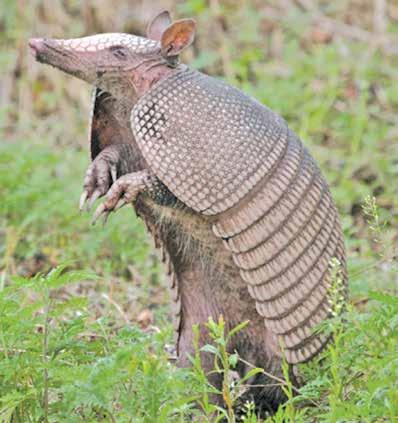
Of the 20 varieties of armadillo, Dasypodidae, all but one live in Latin America. The familiar nine-banded armadillo is the only species that includes the United States in its range.
Armadillo is a Spanish word meaning “little armoured one” and refers to the bony plates that cover the back, head, legs, and tail of most of these odd looking creatures. Armadillos are the only living mammals that wear such shells.
Closely related to anteaters and sloths, armadillos generally have a pointy or shovel-shaped snout and small eyes. They vary widely in size and colour, from the 6-inch-long (15-centimeter-long), salmon-coloured pink fairy armadillo to the 5-foot-long (1.5-meter-long), dark-brown giant armadillos. Others have black, red, gray, or yellowish colouring.
Contrary to popular belief, not all armadillos are able to encase themselves in their shells. In fact, only the three-banded armadillo can, curling its head and back feet and contorting its shell into a hard ball that confounds would-be predators.
Armadillos live in temperate and warm habitats, including rain forests, grasslands, and semi-deserts. Because of their low metabolic rate and lack of fat stores, cold is their enemy, and spates of intemperate weather can wipe out whole populations.


Most armadillo species dig burrows and sleep prolifically, up to 16 hours per day, foraging in the early morning and evening for beetles, ants, termites, and other insects. They have very poor eyesight, and utilize their keen sense of smell to hunt. Strong legs and huge front claws are used for digging, and long, sticky tongues for extracting ants and termites from their tunnels. In addition to bugs, armadillos eat small vertebrates, plants, and some fruit, as well as the occasional carrion meal.
The nine-banded armadillo’s hapless propensity for being run over by cars has earned it the nickname “Hillbilly Speed Bump”.
Their average life span in captivity is 12 to 15 years.
Population numbers of nearly all species are threatened by habitat loss and over-hunting. Many cultures in the Americas, including Guyana, consume armadillo flesh, which is said to resemble pork in its flavour and texture. Currently, only the nine-band population is expanding, and some species, including the pink fairy, are threatened.
The objective of the game is to fill all the blank squares in a game with the correct numbers. Every row of 9 numbers must include all digits 1 through 9 in any order. Every column of 9 numbers must include all digits 1 through 9 in any order. Every 3 by 3 subsection of the 9 by 9 square must include all digits 1 through 9.

please see solution on page 22

Known for its rich biodiversity, the Rupununi is an ideal tourists’ destination with some of the most interesting animals. Below are some fascinating facts on a few of the plethora of animals found in the Rupununi.
Stingrays spend majority of their time inactive, partially buried in sand, often moving only with the sway of the tide. The stingray's colouration commonly reflects the seafloor's shading, camouflaging it from predatory sharks and larger rays. Their flattened bodies are composed of pectoral fins joined to their head and trunk with an infamous tail trailing behind.
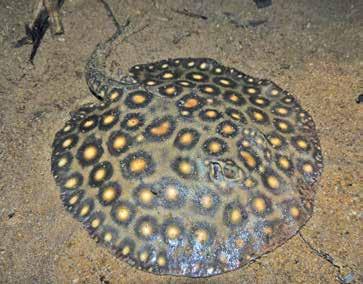
While the stingray's eyes peer out from its dorsal side, its mouth, nostrils, and gill slits are situated on its underbelly. Its eyes are therefore not thought by scientists to play a considerable role in hunting. Like its shark relatives, the stingray is outfitted with electrical sensors called ampullae of Lorenzini. Located around the stingray's mouth, these organs sense the natural electrical charges of potential prey. Many rays have jaw teeth to enable them to crush mollusks such as clams, oysters, and mussels.
When they are inclined to move, most stingrays swim by undulating their bodies like a wave; others flap their sides like wings. The tail may also be used to maneuver in the water, but its primary purpose is protection.
The stingray's spine, or barb, can be ominously fashioned with serrated edges and a sharp point. The underside may produce venom, which can be fatal to humans, and which can remain deadly even after the stingray's death. In Greek mythology, Odysseus, the great king of Ithaca, was killed when his son, Telegonus, struck him using a spear tipped with the spine of a stingray.
Outsized jaw muscles al low the black piranha to exert bite force equivalent to 30 times its bodyweight, a feat unmatched in the natural world.
In fact, the muscle complex makes more than two percent of the black piranha's total body mass.
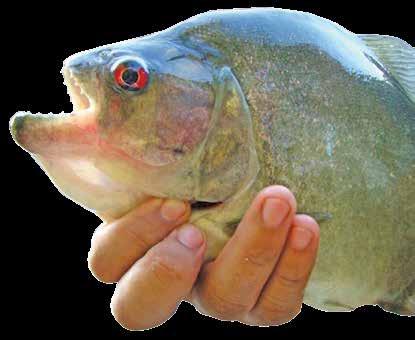
In fact, relative to their size, pira nhas outperform even prehistoric mon sters like Tyrannosaurus rex and the whale-chomping megalodon, a massive shark that preceded the great white, according to a research done in the US in 2012.
The measured bite force of the black piranha was nearly three times greater than that exerted by an American alligator of comparative size, said the study.
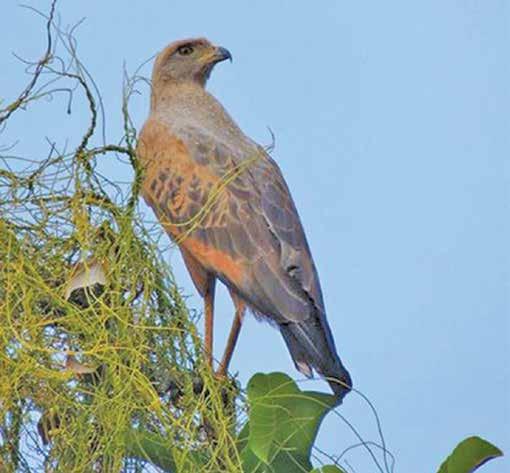
Savanna hawks are commonly seen flying around savannah and swampy areas in from Central America to the Caribbean to Southern South America. It is a carnivore, feeding on meat such as small mammals and insects.
The savanna hawk has very long legs and thus is able to easily walk on the ground to catch its prey, or, like other birds, it can swoop down from the sky or a tree.
They are known as opportunistic feeders – they eat when there is an easy opportunity to do so. For example, they follow forest fires and feed on escaping animals or steal food from other birds.
Savanna hawks build their nests out of sticks in palm trees, thorny trees or mangroves and use this same nest year after year. Its eggs however are sometimes eaten by larger birds, snakes and other animals that live in trees.
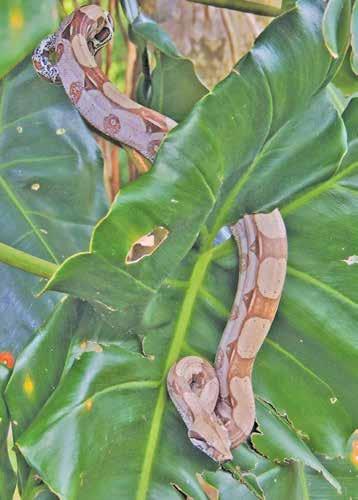
Boa constrictors wear some of the most distinctive markings of all reptiles. Depending on the habitat they are trying to blend into, their bodies can be tan, green, red, or yellow, and display cryptic patterns of jagged lines, ovals, diamonds, and circles.
Boas are non-poisonous constrictors found in tropical Central and South America. Like their anaconda cousins, they are excellent swimmers, but prefer to stay on dry land, living primarily in hollow logs and abandoned mammal burrows.
Significantly smaller than anacondas, boas can grow up to 13 feet long and weigh more than 100 pounds. Their jaws are lined with small, hooked teeth for grabbing and holding prey while they wrap their muscular bodies around their victim, squeezing until it suffocates. Boas will eat almost anything they can catch, including birds, monkeys, and wild pigs. Their jaws can stretch wide to swallow large prey whole.
Female boas incubate eggs inside their bodies and give birth up to 60 live babies. Boas are about 2 feet long when they are born and grow continually throughout their 25 to 30-year lifespan. The largest boa constrictor ever found measured 18 feet.
Hunted for their fine, ornate skin and for sale in the exotic pet trade, some boa constrictors are endangered and most have protected status in their range.
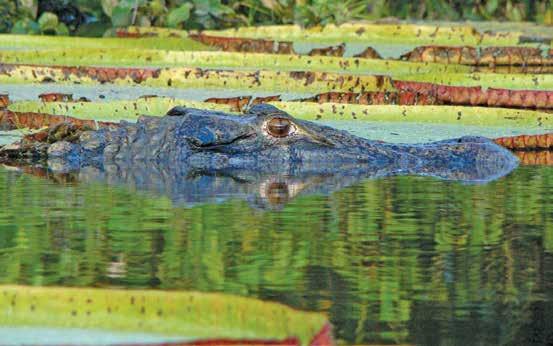
French Guiana, and can be found in shallow, freshwater habitats such as slowmoving rivers, creeks and lakes, and would venture into flooded savannah and wetlands.
Black caiman typically hunt at night, using their acute sight and hearing to locate their prey. Fish comprise the major part of the black caiman’s diet, particularly catfish and the muchfeared piranha, but adult black caiman also tackle much larger prey such as capybara, turtles and deer.
This aquatic hunter is the largest of all alligator species, with reports of individuals measuring six metres (19 feet 8 inches). Domestic animals such as dogs and pigs may be taken by large adult caiman, and there are even reports of people being the victim of an attack. Juvenile black caiman stick to smaller foods, including crustaceans, other invertebrates such as snails, and fish. (Photos by Rupununi Learners on
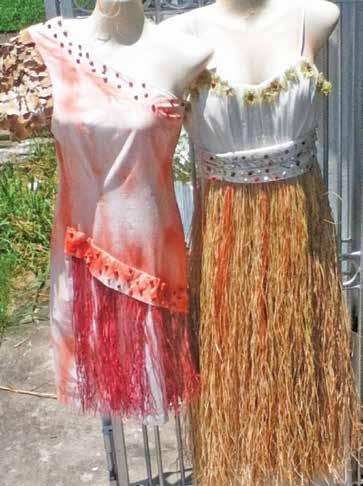
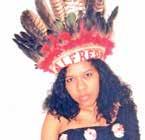
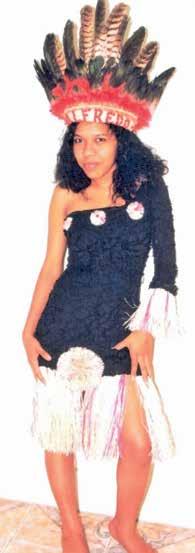
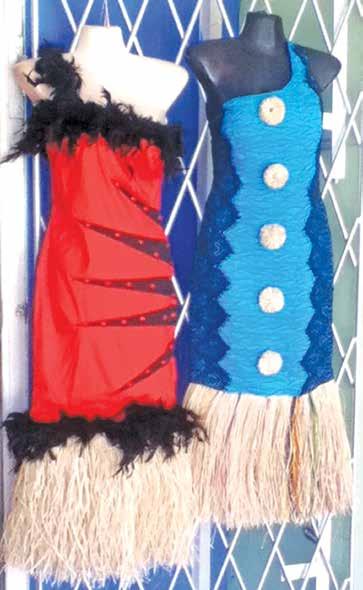
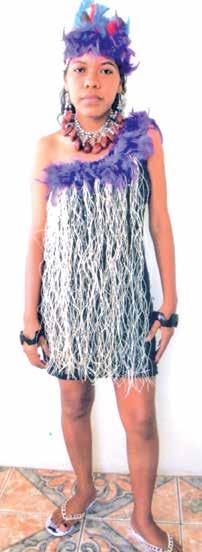
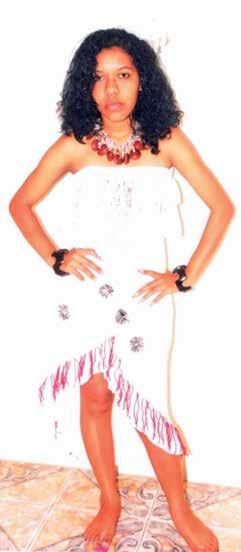
Indigenous Spice, her second collection influenced by Amerindian culture, gives local designer Natasha David a way to showcase her indigenous heritage with a kaleidoscope of colours and flare for nature.
The collection, which includes several pieces of garments made of banana leaves, beads, feathers, tibisiri, fabric and other natural materials, includes dresses, bags, head bands, slippers, dolls, baskets and functional household items.
David explained to Guyana Times Sunday Magazine that her new collection is called Indigenous Spice because “[it] demonstrates the
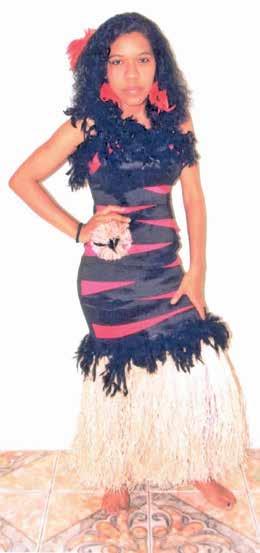
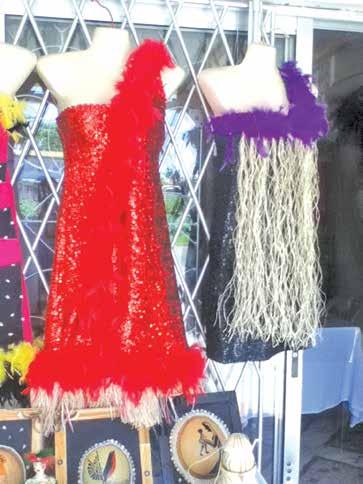
Amerindians’ love for colour” and also she “wanted to add spice to cultural and comfortable garments”.
According to the designer, this stylish collection, unlike her past collections, incorporates more fabric rather than straw.
“I used more fabric this time around because I find people are more comfortable in fabric rather than walking around in garments made entirely of straw.”
David, whose mother is a descendant of the Warrau tribe, added that venturing into this type of design helps her to keep in touch with her culture and display it culture proud -
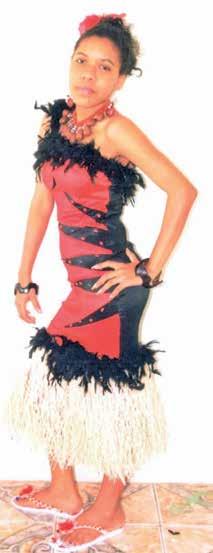
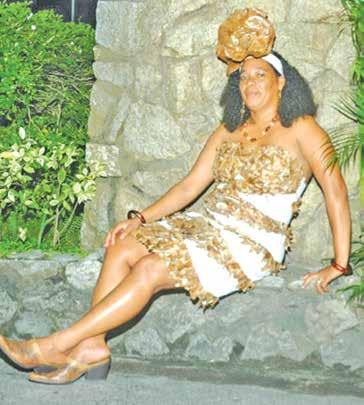
ly.
The designer disclosed that more needs to be done in showcasing the Amerindian culture, not just during Amerindian Heritage Month, but year round.
“We must be proud to display our culture, especially through clothing. This is why I will continue to design such garments because there are not many designers experimenting with the theme,” she declared.
The Indigenous Spice collection is presently displayed in front of the indigenous restaurant Tuma Sala located between Middleton and Campbell Streets, Georgetown.
Whether embraced by the fraternity of the Baha’i faith in Israel or surrounded by the picturesque beauty of Finnish landscapes, there is no place like home, the native Amerindian village of Santa Rosa in Region One, for Alexi LaRose. An educated, hardworking professional of Amerindian descent, Alexi, after years aboard, returned home to promote her culture and give back to the community through hard work and dedication.
Florence Alexi LaRoseFedee is advanced in her field, proud of her culture, and full of the zest and drive of youth. She returns to Guyana to give back the only way she knows how - by applying the knowledge she acquired after completing her Master’s in Development and International Cooperation at Jyvaskyla University in Finland to her daily work.
Born and raised in Santa Rosa, Region One, Alexi, as she is fondly called by her
friends and family, began her career as a Management Development Officer at the Ministry of Amerindian Affairs focused on development of Amerindian communities.
After completing her secondary education at St Joseph’s High School, graduating with a Bachelor’s Degree in International Relations from the University of Guyana and her Master’s in Finland, and spending two and a half years involved in voluntary service in Israel, Alexi is here to stay.
“I came back home to give back to my people, and this ministry provides a direct way for me to do so”, LaRose-Fedee told the Guyana Times Sunday Magazine. “Elevating oneself should not be seen as personal but as a way to elevate people as well.”
She explained that her passion for culture was imbedded at an early age by her grandfather, Aloysus
into more remote interior locations.
The Patamonas of Guyana are now mainly concentrated in the North Pakaraimas, though few can be found at Monkey Mountain in the South Pakaraimas, and at Mahdia and Tumatumari in Essequibo.
The Waiwai, apparently arriving from Brazil during the late 19th century, can be found mainly along the upper Essequibo River.
Also arriving during the 19th century, the Arekunas occupied upper and central Kamarang River, and are now more concentrated at Paruima.
Though they are said to be associated with the Middle-Indian period - 8, 400 years ago, the presence of the Warraus is said to have been first recorded in the 1670s. They live mainly on the low-lying coastlands, between the Barima and Pomeroon rivers and their tributaries.
Arriving in the early 18th century from the Rio Negro area of Brazil, the Wapishana are located in the Rupununi. In a 1993 census, their numbers were
recorded at some 7,000.
Calling themselves kapon, meaning “sky people”, the Akawaio nation live on the North Pakaraima plateau along the Mazaruni, Kmarang, Kato, Ataro and Kukui rivers. An estimated 4,000 Akawaio inhabit Guyana today, while many migrated across the border to Venezuela in the 70s when there were plans to flood the Upper Mazaruni District for a hydro-electric site.
The Makushis of Guyana settled in the South, Central, and North Rupununi Savannahs, inhabiting those areas since some 400 years ago.
Arriving after the Waraus some 3,350 years ago, the Arawaks first settled at Hosororo Creek on the Aruka River. They also inhabited the Corentyne River some 2,000 years ago along the coastland regions as food producers.
The Caribs, arriving from the mainland of northern Venezuela, are labelled as the “war” tribe, and it is unclear where they first settled, though there are Barima Caribs in Guyana. Like most nations, they too settled near creeks or rivers.
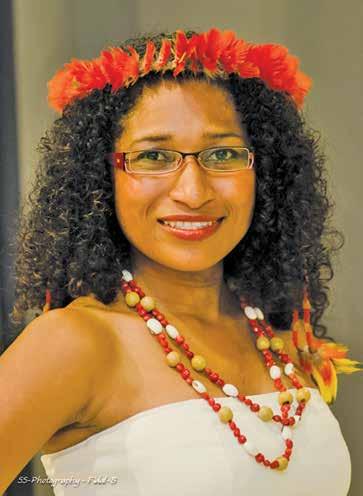
Florence Alexi LaRose-Fedee LaRose, also known as Uncle Bull, who was one of the best violinists in the Moruca area in his time.
“Since childhood, culture was always a big part of my
life because my grandfather was one of the best violinists in Moruca. So growing up, we were in a culture group and used to dance, sing and so on.”
For Alexi, particularly in terms of this year’s theme “Traditional Embodiment for Amerindian Development”, culture is integral in all things because she sees it as a part of everyday life, which is the reason for her passion for the indigenous heritage.
Working for the Ministry of Amerindian Affairs allows her to appreciate and explore the Amerindian culture even more, having travelled to all ten administrative regions of Guyana and being responsible for the management of Region One.
“Yes it’s challenging as everyday new issues arise, but I strive to rise to the challenge,” she declared.
Of the three subsidiaries of Region One (Moruca, Matarkai and Mabaruma), Alexi manages the development of the 79 villages located in the area and finds solutions to all their issues.
Growing up as the only girl with six older brothers has prepared her for life’s daily challenges.
Having travelled the world, elevating herself through tertiary education, achieving professional success and happiness in her marriage life, Alexi out-
lined the important things in life. “Life is much more important when you find a bigger purpose…serving and making contributions in your daily life.” She added: “Culture may not define who you are but it gives you foundation, grounding.” So what is next for Alexi LaRose-Fedee? She spoke enthusiastically of the language revival project to be launched in her home village of Santa Rosa (the Arawak Revival Project) and White Waters (the Warao Revival project).
“Culturally these villages are very weak in the language. You hardly find people speaking the language. So it is important for us to get in touch with ourselves, particularly for Santa Rosa as the largest Amerindian village in Guyana.” As an effervescent and resilient woman of Amerindian descent, Florence Alexi LaRoseFedee has risen to greater heights in her profession, education, and personal fulfillment, and is using her knowledge in developing numerous Amerindian communities. Surely, this makes her a woman of worth!
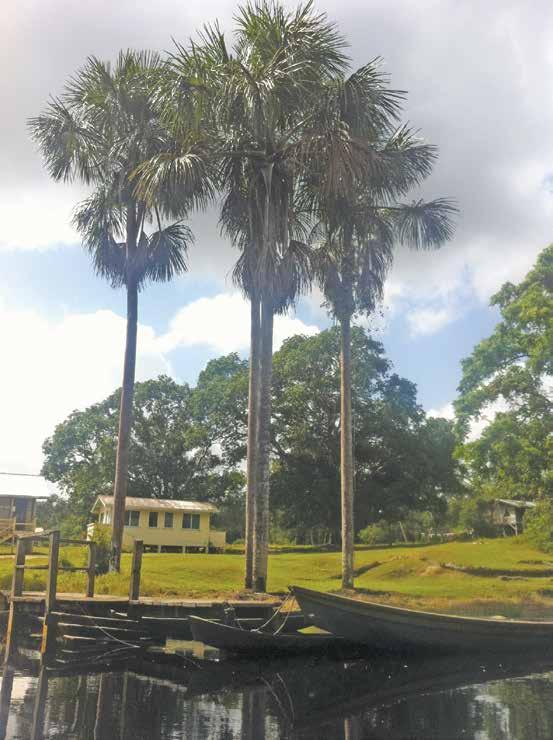
From a refreshing beverage to a tasty delicacy, the source of a staple to material for clothing, shelter and jewellery, the Ite Palm has truly been the tree of life for the indigenous society, providing all the necessities of daily living.
Upon entering the Walter Roth Museum, just to the left of the entrance, one can find an interesting exhibition on the Ite Palm. Several items created from the by-products of the palm are displayed, coupled with the ecological and historical background of the tree in English and Portuguese respectively.
Before the Arawaks brought cassava to Guyana, the wonders of the Ite Palm were explored by the Warrau tribe. “To the Warrau, the Ite was called the ‘tree of life’ and we can see why with its benefits and the fact that just about every part of the palm can be used,” explained archaeologist Jennifer Wishart in an interview with Guyana Times Sunday Magazine
Sitting in the cozy gallery of the museum, surrounded by a beam of natural light, enveloped by a cool breeze, Wishart stated that the palm, scientifically called Maurita flexuosa and is generally known as the ‘Morichi’, can be found growing in moist acidic soils in the North Western regions
along the coast and in the interior savannah of Guyana.
A wide variety of market and household products, as well as various environmental, ecological and economical benefits, can be derived from the tree itself. Even the by-products of the tree are
meaning the ‘cassava root’ in Warrau,” noted Wishart.
According to Roxanne Skeete, a resident of the Barabina Village, “when the fruit is in season it is used for several purposes around the village. The drink is very tasty when chilled and the
also be used as a good source of protein and starch.
“The tree provided a source of starch before cassava because the Arawaks were the ones who brought the knowledge of cassava here as the Warrau were already using their Ite. That is why they are called Arawak
otocumba [tacuma worm] is used in tumapot (pepperpot) or is fried to be eaten with bakes or cassava bread”.
Even left to rot, the tree proves its worth. “In event the dugout tree trunks are left to rot, the Rhyncophorus palmarum beetle comes and lays eggs in the holes. These
larvae that feed off the tree trunk develops into the otocumba worms, which are prepared as a great delicacy”, stated Skeete.
“The tacuma worms come from the fallen palm trees. We would dig out holes in the trunk, cover it with the leaves from the tree and let it rest for about six weeks. Within the six weeks we check it constantly. When we hear them buzzing, we take the axe burst it open and take all you can get,” Elysha, the young assistant from the local indigenous restaurant Tuma Sala, explained.
Traditionally, the Warrau tribe would dig out the heart of the trunk and is usually eaten raw or cooked. This pith would later be drained through a matapi and its juice is used to make the Ite drink. When the juice settles, the remnants would also produce a powder-like substance that the Warrau use as flour to make bread and cakes. Additionally, they utilised the dugout trunks to make canoes and planks to build houses and structures.
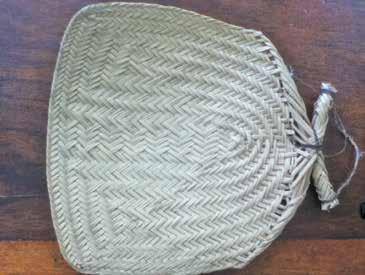
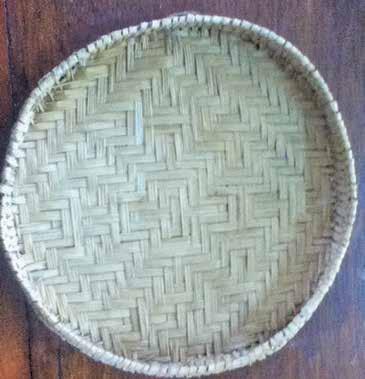
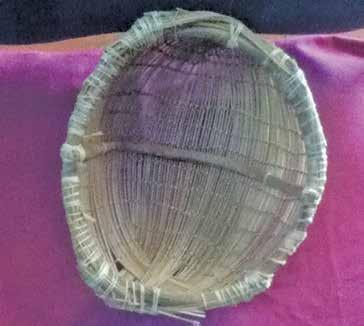
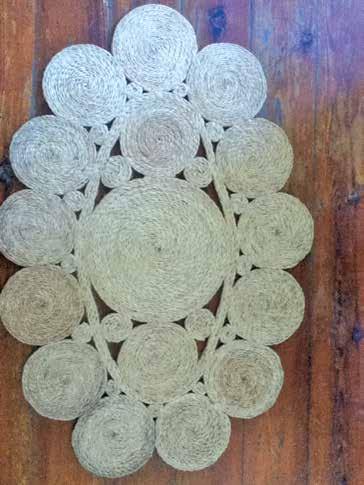
“Even the fibre of the leaves were utilised to make tibisiri, which creates intricate baskets, hammocks, furniture, carpets, thatch and warishis [haversacks]”, Wishart outlined.
The shoots of the leaves could be boiled to weave clothing and the ribs used to make kite frames during the Easter season.
Today, the tradition of using the tree’s fan-shaped leaves to bake cassava bread continues to be a dominant part of the indigenous culture.
Notably, the red-brown rounded fruit of the Ite tree, usually available in the dry season, is picked and consumed as fresh fruit or dried to make oil or vegetable ivory - both economical and sustainable alternatives to otherwise expensive and environmentally hazardous products.
“The Brazilian Indians are using the seed of the Ite Palm to make vegetable ivory, a sustainable alternative to elephant ivory,” Wishart mentioned.
When dried, the seeds can be carved and dyed just like elephant ivory to make figurines, beads, buttons and jewellery. This is a tremendous ecological and environmental benefit in preventing the deaths of hundreds of elephants who are killed yearly for the ivory found in their tusks.
Unfortunately, only a few Warrau along the Venezuelan border and their families know how to extract starch from the Ite Palm, although historically it was their staple according to an excerpt from Marileen Reinders’ “Medicinal Plants and their uses and the Ideas about Illness and healing among the Warao of Guyana”.
By Svetlana MarShall
Recognising the importance of cultural preservation, the Government of Guyana, through the Amerindian Affairs Ministry, is earnestly working towards the implementation of a policy that would allow the teaching of Amerindian languages to be weaved into the public education system.
Though the initiation of such a policy could take years, due to the complexity of Amerindian Languages, the Amerindian Affairs Ministry has been silently working behind the scenes. In an exclusive interview with Guyana Times Sunday Magazine, the Amerindian Affairs Minister Pauline Sukhai said the stage is be-
do not speak the language fluently. “So these are the three languages we are focusing on...With children being taught, they have the responsibility to pass it as the population ages.”
In addition to the 80 students in training, Minister Sukhai said the government has budgeted monies to be spent in other villages to aid in the preservation of the at risk languages, but this aspect has been hampered with the Opposition dominated National Assembly moving to disapprove $1.1 billion for Amerindian development.
Additionally, the government with international support, such as funding from the Inter-American Development Bank (IDB), is investing heavily to pro-
uisite educational materials that would allow for effective teaching in schools.
The Amerindian Affairs Ministry’s Management Development Officer Alexi La Rose, who is from the Arawak nation, in the village of Santa Rosa, acknowledged that there has been a significant decline in the Arawak language, but said through the intervention of the government it is being revived. According to La Rose, the village of Wakapoa is one of the strongest Arawak speaking villages in Guyana.
“Because of that we build on their strength by sending villagers from Wakapoa to other villages where they can teach the Arawak language, and that is how we are resuscitating the lan-
ing set. She explained that in 2013 a Language Revival Programme was launched in Capoey, Region Two, where 80 indigenous students are being taught the Arawak language. They will be graduating later in the year.
Though Guyana is known for having nine indigenous nations, previously called tribes, attention is being given to the Arawak language due to its fragile state.
“I would advise that the other languages like the Patamonas, Arekunas, Wapishanas, Makushis and the Wai Wais are spoken by the young and old in their various communities and by the nations,” Minister Sukhai explained.
It was further explained that the Arawak, Akawaios and the Carib languages are the most at risk languages. The Caribs are known for speaking their language but there are few Carib settlements remaining in Guyana.
Baramita, Region One, is the largest Carib village, but there are scattered settlers of Carib nations in Moruca and Wallaba, among other communities, but they
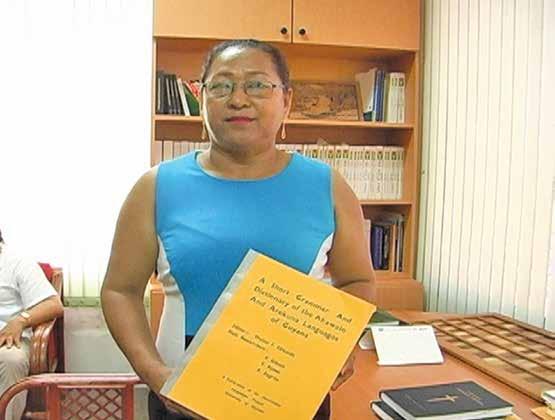
duce Amerindian dictionaries and other booklets. “Short Dictionary of the Warao Language”, “Twenty-eight lessons in Loko (Arawak)”, “Arawak English Dictionary”, “Short Dictionary of the Warao Language of Guyana” and the scholars “Dictionary and Grammar of the Wapishana language” are among materials produced. Bibles in the Patamona and Akawaio languages, in addition to over 400 story books in indigenous languages, have also been acquired by the Amerindian Affairs Ministry and the Culture Ministry.
“Approximately ten years ago, the government introduced a bilingual approach, experimenting on Wapishana language but at that time, the level of materials was not developed and so the programme was not successful. So that is why we are doing it in different stages before we introduce them in schools,” the minister explained.
She added that the languages are being taught in small groups as the Amerindian Affairs Ministry acquires the req-
guage at the community level,” La Rose reiterated.
She said that the Community Support Officers (CSOs) were also identified to be teachers of the language, but this initiative has been in the sideline due to the Opposition’s objection to developmental funds for the indigenous population.
“The CSOs are the persons who are on the ground and working on projects… one of the things they are working on is the preservation of culture, so it was decided that they should be taught so that they can have lessons with smaller batches on the ground,” La Rose explained.
La Rose’s view was supported by Jude Da Silva, who is the Amerindian Affairs Ministry Programme Coordinator.
The Principal Regional Development Officer Anil Roberts, who hails from Anai, North Rupununi, Region Nine, pointed out that his district is populated with the Makushi people who are known for preserving their language. He explained that the Makushi
language is being taught by the Makushi Research Institute, which is made up of a ‘Lady’ from all of the 14

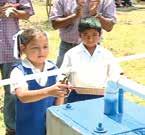
Improvements in the supply of, and access to, safe water and sanitation services are critical to achieving the objectives of
the Government of Guyana in reducing poverty levels. The government recognised the failure of previous experiments in improv-
ing rural and interior water supply through provinciallevel organisations as well as the relatively poor performance of Guyana Water


Authority (GUYWA). It was decided that a merger of GUYWA and GS&WC to form Guyana Water Inc. (GWI) is the best option to provide sufficient critical operational mass. GWI then embarked on analysing and augmenting existing needs assessments and develop-
five years are: Coverage – It is planned that more than 90% of the hinterland communities will have infrastructure to enable access to potable water as against 73% access presently; Access areas - It is targeted that main infrastructure will be constructed around villages, schools and health centres in order to provide easier access to service which is fully subsidised by the Government of Guyana; Photovoltaic System- more than 80% of the communities will have PV system installed which utilises solar energy to pump water within the communities. These systems are designed to operate under hinterland conditions and require little maintenance and solar energy. Villages are trained to manage and maintain
Kaituma; provide treated water systems such as filters, storages to ensure that improved quality of water is provided to communities; utilise gravity feed systems to supply communities which require little maintenance and no energy. Such systems are present in Mahdia, Matthew’s Ridge, Monkey Mountain, and other hinterland areas; and incorporate the use of medium depth wells, springs, creeks, rivers and rainwater harvesting to provide potable water to all hinterland communities.
According to GWI’s website, www.gwiguyana.com, “fundamental to the success of this programme (or any like it for that matter) will be the involvement of village captains, community members, regional de-
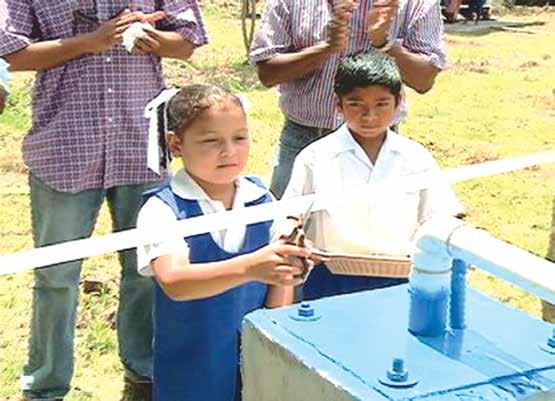
ing integrated water supply and on-site sanitation services in the Hinterland.
The hinterland covers 80% of Guyana’s land mass, about 66,000 sq miles. The population in hinterland areas is approximately 90,000 (13% of Guyana’s population). The present coverage is 73%. There are presently seven small towns with a population of 22,000 persons, which is 23% of hinterland population having access to potable water.
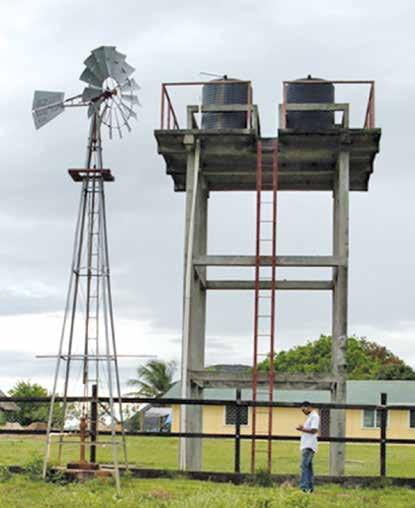
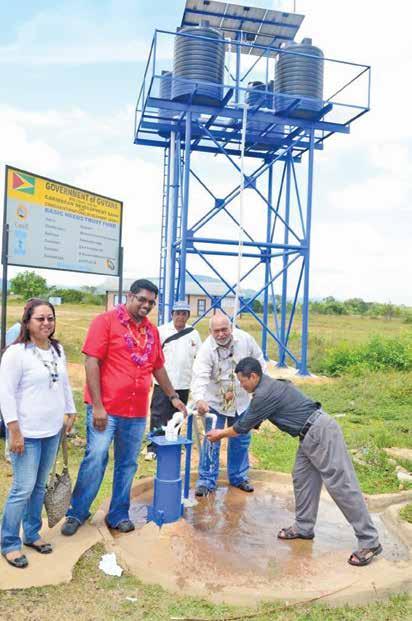
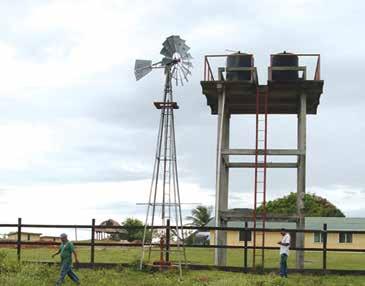
The investments in the hinterland over the last five years (2009-present) included rehabilitation of existing systems, drilling of new wells, construction of trestles, installation of photovoltaic systems and construction of gravity feed systems at a cost of GYD$600 million; resulted in the increase in the coverage from 60% to 73% presently; provided for training of hinterland communities to manage water supply systems; and more environmentally friendly projects – photo voltaic projects, gravity feed system, wind mills.
GWI plans for hinterland water security for next
these systems which attract a high capital cost for supply and installation.
Improved quality
GWI plans to have continuous collaboration between agencies with regards to Integrated Water Resource Management so as to ensure the protection of sources; use alternative source for supply to communities, which would not be easily affected from water related activities such as drilling of wells to utilise underground water instead of river water at Port
velopment councils, government agencies and line ministries, NGOs and other role players. This will include community participation in all aspects of the decision making process relating to project implementation with respect to all service deliveries. The need for an integrated approach to rural water supply issues in the hinterland as well as sanitation, health and hygiene and community organisation and management are key to the success of this programme”.


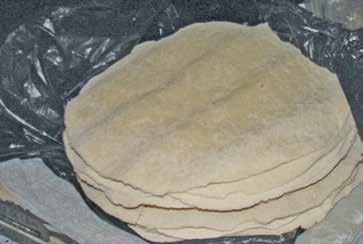
Cassava, or manioc (Manihot esculenta), is described as a root crop native to tropical America that is now consumed by millions of people throughout the tropics, and is used in food preparation in many industrialised processes.
Cassava is an exceptional producer of carbohydrates, and a plant better able to tolerate seasonal drought than other major food crops.
The cassava plant is also better able to tolerate poor soil conditions than most other food plants. It can grow in extremely poor, acidic soils because it forms a symbiotic association with soil fungi.
Both the roots and leaves of the cassava plant can be toxic to consume. The toxicity of cassava is due to the presence of cyanogenic glucosides (compounds of cyanide and glucose), which liberate hydrogen cyanide (HCN), a potent toxin, when the plant tissue is damaged.
Varieties referred to as “sweet” or low-cyanide, have low levels of cyanogenic glucosides in the flesh of the root and can be peeled and cooked like other root vegetables. Those referred to as “bitter”, or high-cyanide, have higher levels of cyanogenic glucosides throughout the root (peel and flesh) and require more extensive processing before they are safe to consume.
A number of different processing techniques are used (grating, fermenting, sun drying), all of which serve to damage the plant
tissue and hence cause the liberation and volatilisation of HCN. The potential toxicity of cassava foods depends on the effectiveness of processing and preparation techniques; high-cyanide roots can be processed to remove all most all traces of cyanide-containing compounds. Many farmers prefer to cultivate the high-cyanide varieties for reasons that are not entirely clear.
There is no evidence of acute or chronic cyanide toxicity associated with
border of Brazil, where wild relatives of cassava are currently found.
Cassava is typically grown by small-scale farmers using traditional methods, and farming on marginal lands not well suited to other crops. To harvest the plants, farmers typically cut off the top three-quarters of the plant, and then pull up the roots and separate them from one another.
Cassava roots are prepared into an amazing variety of foods. Traditional preparation techniques vary by region, and by ethnic group within a given region.
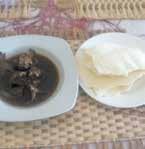
For Amerindians, the most common ways of preparing high-cyanide cassava is as bread. The bread is large, round, thin, and flat, made by peeling and grating the roots, and then sieving the grated mash to separate the liquids. The dried cassava is then cooked on a hot griddle and left to sun-dry.
Farine is another cassava product made by soaking the roots of yellow-fleshed, highcyanide varieties of cassava in water until they ferment.
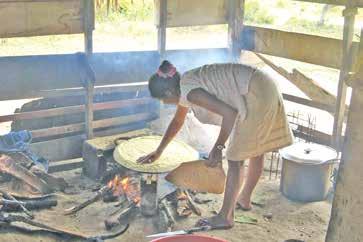
cassava consumption by Amerindians for whom cassava is a traditional dietary staple, even though some groups rely on varieties of cassava with very high cyanide content.
Cassava was domesticated sometime in the distant past, maybe five thousand years ago. Exactly where is not known, but the current consensus is that domestication took place somewhere in Central or South America, perhaps along the southern
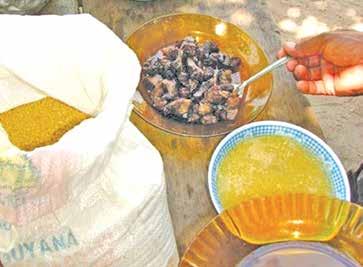
The roots are then peeled, grated, mixed with fresh grated roots and the mixture allowed to ferment for a week or more. The mash is then dewatered, sprinkled onto a hot griddle, and roasted while being stirred. The resulting product is a dry granular meal that can be stored almost indefinitely.
Cassava is also used to make an alcoholic beer, from both low-cyanide and highcyanide cassava. With lowcyanide varieties it is prepared by peeling, cooking, and mashing the roots, then adding water and some masticated roots and allowing the mixture to ferment. With high-cyanide varieties it is prepared from manicuera (the cooked juices) and very thin bread, some of which is chewed, and other cooked roots or tubers.
In our national cuisine, low-cyanide cassava is used as a vegetable (boiled or fried), and in some Amerindian communities, farine is part of traditional dishes like farine and tasso (dried broad strips of salted beef) or more recent farine and egg.
Ingredient: 1 medium (about 2 pound) young cassava root
Method: Peel the cassava with a sharp paring knife or vegetable peeler. Finely grate the cassava. Place the cassava into a bowl lined with a double-thickness of dampened cheese cloth. Bring the ends of the cheese cloth together to enclose the pulp, and wring the cloth vigorously to extract the cassava juice into the bowl. Transfer the juice to a heavy skillet. Stirring constantly, cook over moderate heat for about 1 minute, until the cassareep is smooth and thick enough to hold its shape almost solidly in the spoon. Makes about half cup.
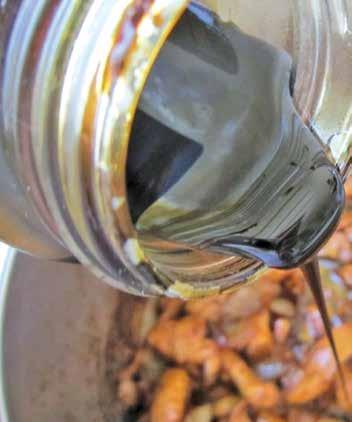
Note: The amount of liquid in the cassava may vary, depending on the age and quality of the roots available.
Older roots (dark flecks or spots of mould in the flesh of the
will yield little if any juice.
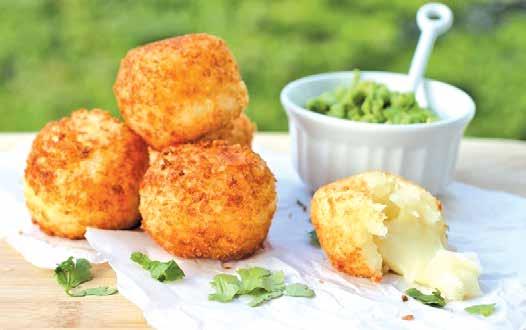
Ingredients:
1 pound frozen or fresh cassava, peeled 2 beaten eggs 1/2 cup bread crumbs 1/2 pound mozzarella cheese, cubed Vegetable oil for frying
Method: Cook the cassava in a large pot with salted water over medium heat for about 15 minutes or until fork tender. Drain the cassava and remove any fibres from the center. Transfer to a large bowl and mash.Place the eggs in a bowl. Place the breadcrumbs in another bowl. Form 12 balls with the mash. Flatten them with your hands and place 1 piece of cheese in the center and form the ball again to cover the cheese. Dip the balls into the beaten egg covering all sides, and then cover them with breadcrumbs. Fill a large skillet with oil and heat over medium-high heat to 350F. Place the balls into heated oil and fry for 4 minutes or until brown on all sides, turning over once about halfway through. Remove from the oil and place on a plate lined with paper towels.
Two people come to the Rupununi River. There is a canoe; however it can carry one person only. How can they each get to the other side of the river using the canoe?





One day as Tiger was walking by the seaside, he saw a crab a little distance away throwing into the sea some small round objects which soon after would jump out from the water and return to him.
As Tiger moved closer, to his surprise, he noticed that the crab was actually removing his eyes and throwing them into the sea.
“What are you doing, my brother?” Tiger asked in great dismay.
“Oh, I am just playing with my eyes,” the crab replied.
“Well, you seem to be having quite a good time,” said Tiger. “Show me how you do it.”
But the crab was not willing to do this.
“Look here, Tiger,” he said, “I can’t make you play this game with your eyes because a big shark is in the sea.”
Nevertheless, Tiger insisted and finally the crab agreed to show him how the game was played. As Tiger looked on, the crab removed his eyes and threw them into the sea while singing softly, “Go my eyes, go to the middle of the sea. Go, go, go!”
Now to retrieve his eyes, he began to sing this other tune, “My eyes, from the middle of the sea, come back to me, come back to me.”
And immediately, the crab’s eyes leaped out of the water and returned into their sockets.
Tiger was amazed, and excitedly he shouted: “I want to play this game! Remove my eyes and throw them in the sea as you did with yours.”
But the crab discouraged him. “I can’t let you play this game,” he told Tiger, “because a big shark is in the sea and he may eat up your eyes.”
But Tiger was eager to play this game. After continuous pleadings, the crab finally agreed. He removed Tiger’s eyes and threw them into the sea while singing loudly, “Go eyes of Tiger; go to the middle of the sea. Go, go, go!”
And his eyes leaped out of his head and flew into the sea.
Without sight and surrounded by total darkness, Tiger became very frightened and he jumped about and roared loudly.
“Bring back my eyes! Crab, bring back my eyes!” he roared angrily.
But there was no response from the crab, so the extremely scared Tiger tried on his own to get back his eyes by screaming out loudly “My eyes, from the middle of the sea, come back to me, come back to me.”
However, nothing happened. His eyes remained at the bottom of the sea.
Realising the situation, Tiger became even more afraid, and jumped and roared louder and louder. Then the crab spoke quietly to him, “It is because you are screaming and roaring that your eyes refuse to obey you.”
Tiger immediately stopped roaring. “Please, my brother, help me get back my eyes,” he begged the crab.
Then the crab sang sweetly, “Eyes of my brother, from the middle of the sea, come back to him, come back to him.”
And the eyes immediately returned to Tiger’s face and his sight was restored.
As this was done the crab advised, “Now, take care of your eyes. If you play this game, the big shark in the sea could swallow them.”
Naturally, Tiger was most happy to regain his eyes, and he felt that he had become alarmed too quickly when his eyes were in the sea. So he felt that he must play the game once more.
He begged the crab to have his eyes thrown into the sea once again but to no avail. But when his continued pleas finally got on the crab’s nerves, he finally decided to do what Tiger wanted.
So the crab sang loudly, “Go eyes of Tiger; go to the middle of the sea. Go, go, go!”
Tiger’s eyes jumped out and again flew into the sea.
But just then the big shark was swimming in the area and he swallowed them as they sank to the bottom.
Of course, neither Tiger nor the crab knew of this, so they were not alarmed. Tiger himself was more relaxed this time and was not afraid of his blindness. After a little while, he said to the crab, “Please call back my eyes.”
So the crab sang sweetly, “Eyes of my brother, from the middle of the sea, come back to him, come back to him.”
But this time the eyes did not return!
So the crab sang out once more, but still the eyes failed to come back.
The blind Tiger, realising that something had gone dreadfully wrong, also sang sweetly, “My eyes, from the middle of the sea, come back to me, come back to me.”
But his eyes failed to come back.
“Where are my eyes?” he roared in anger.
“I warned you not to play this game,” replied the crab. “It’s possible that the big shark swallowed them.”
That made Tiger even angrier and he jumped and roared and blind-
ly tried to hit the crab. But the crab managed to keep away from him and finally crawled into the sea to escape.
So the lonely, blind Tiger remained on the beach for many days. Because he could not run, he could not hunt and so he began to starve. He was dying of hunger when the paiman of the area found him stretched out near to some bushes.
“What happened to you?” enquired the piaman. “You look as if you are starving.”
“I’m very ill,” groaned Tiger. “I’m blind and hungry, because the crab caused my eyes to jump into the middle of the sea, and they never came back.”
“You really look very ill,” observed the piaman.
“Please help me,” begged Tiger. “When I recover I will hunt deer for you.”
Feeling sorry for him the piaman told him, “Stay here while I go and search for some medicine.”
He then looked for a curi tree and collected the yellow gum on its stems and returned to the seaside where Tiger was waiting. He built a fire and melted the gum into a thick liquid in a small pot.
“What are you doing?” asked Tiger impatiently.
“Have a little patience,” replied the piaman.
When the molten gum was ready, the piaman ordered Tiger to bow his head. He then drained the molten gum into Tiger’s empty eye sockets, one after the other. At first, Tiger did not feel anything, but when he straightened himself, he screamed in pain. And he rolled on the sand and roared loudly.
“Why is someone as strong and fierce as you roaring so much?” asked the piaman.
“It is because my eyes are burning badly,” Tiger responded.
“Then you must open them so that the breeze will cool them,” directed the piaman.
Carefully, Tiger opened his eyes, and at first everything seemed to be yellow in colour. Gradually, his eyesight returned, and when he looked into a nearby pool of clear seawater, he noticed that he had clear, shining yellow eyes.
“You can go now to hunt deer for me,” the piaman ordered.
And ever since that time, Tiger continued to hunt deer for the piaman to repay him for those shining yellow eyes. (“Guyana Legends – Folktales of the Indigenous Amerindians” by Odeen Ishmael. Published with permission)

Leh me tell yuh that me wake up On the beach high and dry. Yuh can call it Half drunk. Sea start sway in me head sky, She motion hypnotise me so, till swirls Of madness plough the waves inside an mek them Twinkle like dew shine.
Me see some frisky prancing Until Varuna the sea god surface. Sea hush up, wind Stop play. He wear a shirt ultra marine blue just As old folk say. He got short hair an stubble beard, Close set eyes an a nice jawbone line. I wander to her. Escaping chaos and bric-a-brac, Heart hungry to fit its pieces together Again. Sense of wonder, intact.
Face the Atlantic, watch stars burn, Paint a curve of the forest’s wings Or halo every new day.
Hear dream time move slowly. River travel for a life-enhancing Break. Beat a retreat to study the toss
Of the waves’ lacy hems. Learn from her The calligraphic style of writing, read her As I kiss swelling coco lips.
Construct. Reflect on rucks and wrinkles. Draw her energy. Breathe.
In the heady heat of May’s midday sun You display a thousand glossy roundabouts, Soft green pools, in botanical garden ponds Your shower heads, erect brown pods Above, swelling silent, full of fattening Nuts. Below you unfold a pink curved Geometry of bloom flowering open to reveal A carved, embroidered waterwheel. You let this picture minister to you When cows slowly wandered in to cool. A scene from The Holy Lakes of The Acts of Rama Lay in front of you, a scene so real, unreal. Every detail reminiscent of the holy Book. Your first serendipitous moment that day.
(Poems taken from “East of Centre” by overseas-based Guyanese poet Elly Niland)
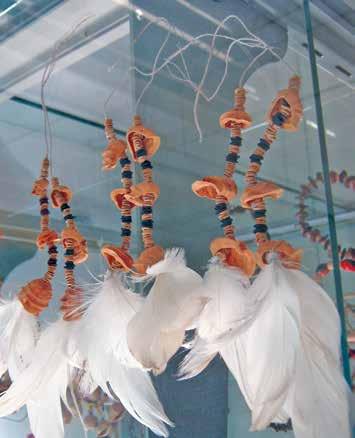
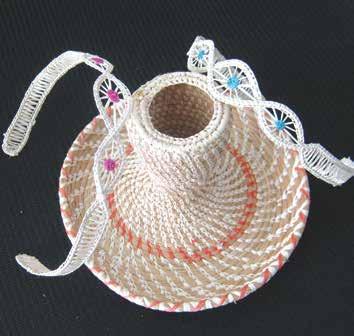
Housed at the Ministry of Amerindian Affairs, the Amerindian Handicraft and Curio Shop has been in existence since 1996. It provides a marketing outlet for handmade Amerindian craft products, and is instrumental in providing revenue for remote Amerindian villages.
The craft shop’s attendant, Jill Pillay said it was initially operated by Sister La Rose to help in marketing and providing a source of income from Amerindian craft. However, when she resigned from local government she handed it over to the ministry, and it was housed at the Amerindian hostel for a few years. It was operated by a formal committee.
As persons became more aware of the craft shop they brought their craft work to be sold and it grew. In 2000, Phillip Hamilton, then permanent secretary of the Amerindian affairs ministry, stated that all the money garnered must be overseen by the ministry to
ensure proper management of revenue and crafts. When the Ministry of Amerindian Affairs was built on Quamina and Thomas Streets in 2005 a section was built for the shop and everything was moved to that location.
Products include fruit bowls, baskets, sculptures, casareep and cassava bread, paintings, cotton hammocks, ornaments and jewellery from St Cuthbert’s Mission, Santa Mission, Pomeroon, Moruca and other villages.
Crabwood oil soap comes from the North West district and even crafts from the Monkey Mountain women’s group are sold at the shop.
Pillay said crafts are bought mainly by tourists, and those who are desirous of ordering craft in bulk can do so early because the products come from remote locations; so to get the crafts early it must be ordered in advance.
The craft shop opens market opportunities for the Amerindian communities, and creates employment and revenue for the villag-
es especially for the women’s groups in those communities that are involved in craft production.
Money from shop sales is plugged into projects in various Amerindian communities. They are basically reinvested in projects that are geared for developing the communities and increase production.
Revenue reinvested is instrumental for those remote Amerindian communities because they are able to market their craft products as most of them do not have opportunities to do so. This creates linkages and networks for these villages.
The ministry has plans for expanding the shop to include products from other Amerindian communities. The ministry is also seeking to provide training so that these craft products are produced with quality.
The handmade products are made from balata, seeds, tibisiri, bamboo, and other resources garnered from the environment. Call 223-7392 for more information.
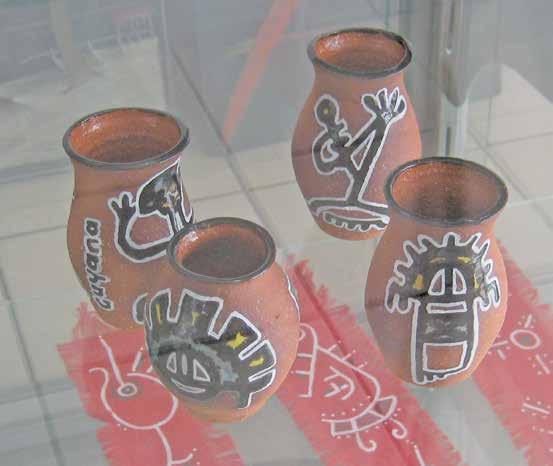
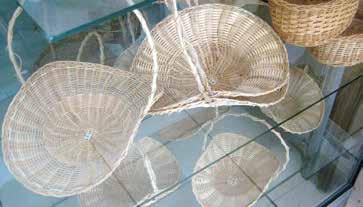
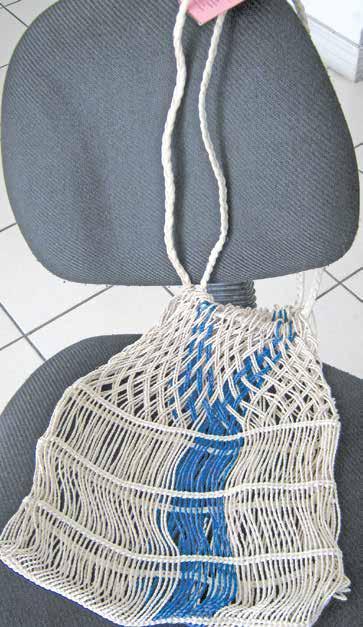
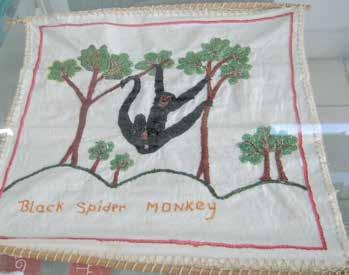
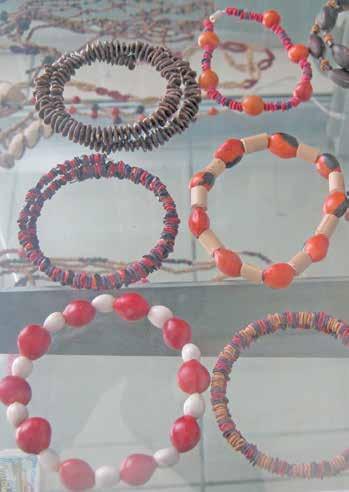
APatamona term, Tuma Sálá, pronounced with a rolling ‘r’ sound, meaning “come let’s dine”, is the first and only restaurant in Guyana that specialises and sells indigenous dishes.
The venture, which also includes a tour guide agency and a craft shop, was founded by several individuals, however, Lolita Williams, the cook and proprietress of Tuma Sálá, mainly manages the restaurant.
Williams, a charming woman, is from the Patamona tribe, hailing from the Upper North Pakaraimas in a small village called Waika. Her culture is still very much a part of her daily life despite 25 years spent in Georgetown.
The quaint culture-based restaurant, with art and
cause a lot of Amerindians live in Georgetown, so it gives not only them but person from other ethnic groups a chance to have the dishes without having to travel”.
Located in central Georgetown on Middleton and Campbell streets, Tuma Sálá truly provides an accessible way for Guyanese and foreigners alike to sample indigenous meals while enjoying the hospitable treatment, amazing art, and soothing music of the Amerindian culture.
“There are several other culture-based restaurants in Georgetown that allow persons to explore the culture of several ethnic groups but they were none promoting the indigenous heritage,” she explained. “All other ethnic groups have restaurants, the Chinese,
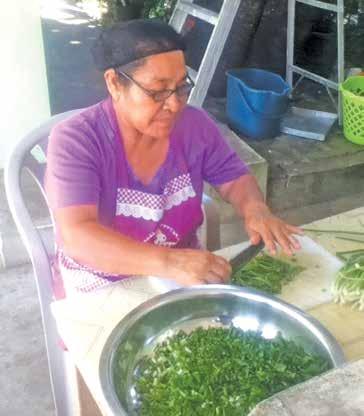
craft items influenced by the Amerindian people displayed around the interior, launched in January 2014, although its doors were officially opened in February of that same year.
Sitting with Williams in the airy courtyard behind the restaurant as she prepares to make several appetizing dishes, she explained why she believes the restaurant is important. “It [the restaurant] is important be-
East Indians, Creole…so I thought why not open an Amerindian restaurant.”
Proud of her heritage and willing to answer the questions of her customers, Williams encourages persons to try new things and easily explains the preparations of meals when asked. “Some persons would ask while others already know.”
Williams is overjoyed when customers enjoy her meals. She recalled a recent
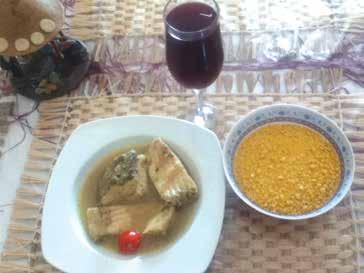
customer who enjoyed the Tuma fish so much he asked for a second helping to take with him.
“In instances like that I realise that this restaurant is more than an economic venture but a cultural one as well, giving the nation at large a glimpse of the our heritage such as getting to know how these meals are prepared and served.”
Several wild meat dishes are prepared and served at Tuma Sálá: labba, bush cow, bush hog and deer, as well as a variety of fishes such as Lukanani. These meals are generally served with a cool glass of piwari, paracari, fly (potato wine) or a choice of local fruit juices.
Most of the meals are prepared in cada (coura) sauce, made by boiling fresh cassava water for a few minutes (before it turns into cassareep), and all are served with either cassava bread or farine, dried or seasoned.
Of course, the Guyanese favourite pepperpot (made with cassareep) or tuma pot (the white sauce version) can be bought there as well as barbeque wild meat or chicken prepared the Amerindian way.
Williams disclosed that some persons still ask for Creole dishes when at the restaurant. “When they hear we have wild meat some people come asking for curry and roti or rice, but to their disappointment we try to stick the traditional methods of preparation.”
According to Williams, Guyanese need to appreciate indigenous dishes more in order to stay in touch with their culture and showcase Guyana to the best of their abilities, not only in the month of September but year round.
“The month of September helps us to remember, but we need to always keep our culture in mind.” As a result of this belief, for Amerindian Heritage Month, Tuma Sálá is offering a 10% discount on all meals and beverages.
For as long as she can
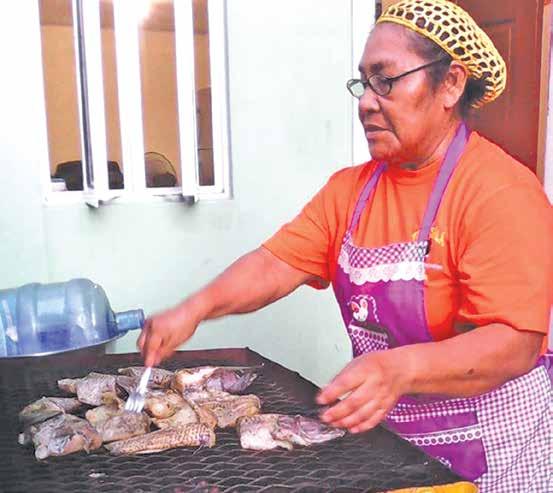
remember, Williams have been preparing indigenous dishes. “It is something you just learn growing up, passed down from generation to generation,” she pointed out. However, professionally she has been selling for six years at a stall in the Amerindian Village hosted at Sophia Exhibition Centre the heritage month.
Williams was proud to tell Guyana Times Sunday Magazine about several traditional meals and beverages, their preparations and health benefits.
The tacuma worm, as they are commonly called, comes from the Ite tree.
“The villagers would cut the trees down, dig a hole in the bark, cover it cover it with its own branches, then leave it for six weeks. In six weeks time this beetle lays its eggs which feeds off the tree and developed into the otocuma worms. The worm is rich in Vitamin D and protein and is traditionally known to help with asthma and cholesterol,” Williams explained.
She added: “Fly, also called potato wine, is made from the red potato. The po-
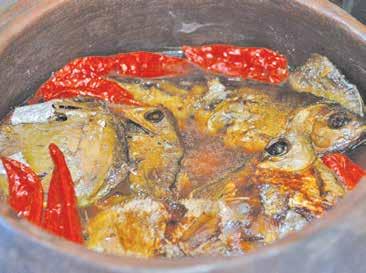
tato is scraped clean, cut into pieces, boiled until soften so it may be crushed and strained. It is then covered and left for a week or more with spice and clove to ferment.”
When ready it may be sweetened or sweetened while it ferments to make an oaky potent wine, with an old spice taste similar to that of whiskey.
One of her favourite meals, Williams was more than enthused to speak of the Acoushi ant. “It is a very tasty treat. During the rainy season we would dig holes around their nest and fill
it with water so when they come out they are stuck.”
Very rich in vitamins and a good source of protein, the ants are then collected and boiled in cada sauce or smoked and preserved to be added to meals daily.
“These ants fly and bite; however, their big behinds are filled with meat that makes a scrumptious delicacy. It has this wonderful aroma,” Williams noted.
She continued telling stories about a big nest located in the Rupununi and nostalgia set in as she dreamily sighed stating: “If I can get some now I would love it.”
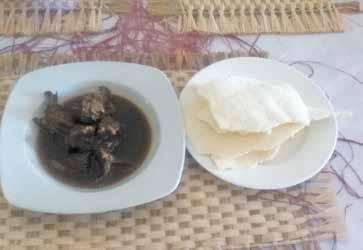
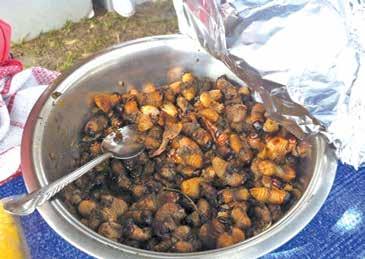
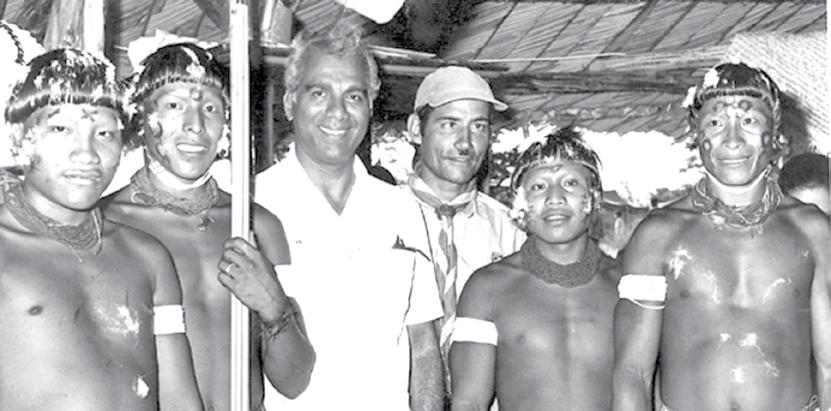
Guyana is a nation that has a colourful history and is home to several cultures. For this reason, this richness and diversity of our past, it is critical to preserve our heritage. The relevant organisation, the National Trust of Guyana, is a government enterprise whose mandate pro-
pels its commitment to the preservation and conservation of historic buildings and sites in Guyana. Therefore it aims to enlighten the public about various events, aspects, symbols, landmarks and structures that have moulded our rich and diverse heritage.
The month of September
has been dubbed Amerindian Heritage Month. Declared by the late President Cheddi Jagan, it has been celebrated grandly, with activities throughout the month of September each year since 1995.
While 10 September was chosen as Amerindian Heritage Day, the signifi-
cance of this date lies in an historic event in 1957. It was on 10 September 1957 that the first Amerindian Member of Parliament, Stephen Campbell, was appointed.
Throughout Amerindian Heritage Month various communities engage in activities such as sports, traditional dancing and exhibition of art, crafts and food as part of the customary festivity in recognition of our indigenous peoples.
This year, it is celebrated under the theme: “Traditional Embodiment for Amerindian Development”.
A village is also selected in which celebrations are held to commemorate this auspicious month since not only are they the first people, they have contributed greatly to Guyana’s development. They are credited with naming several places in Guyana including,
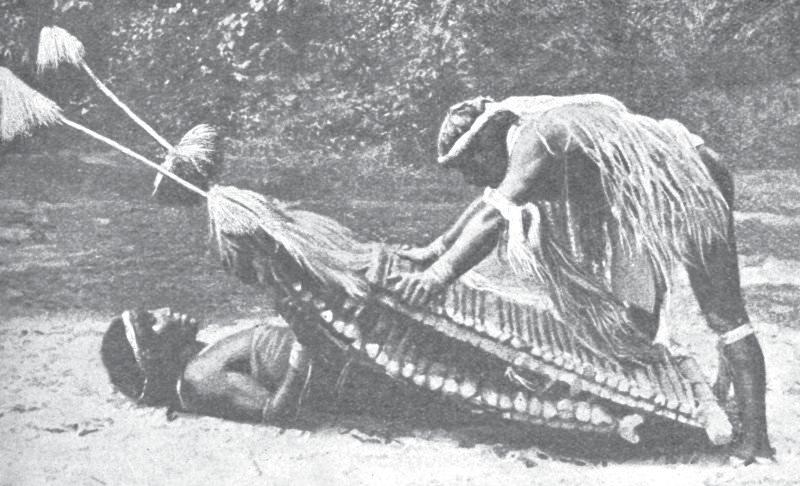
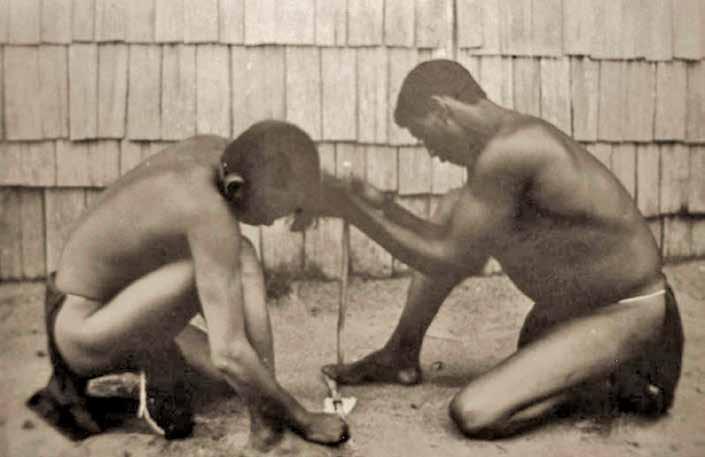
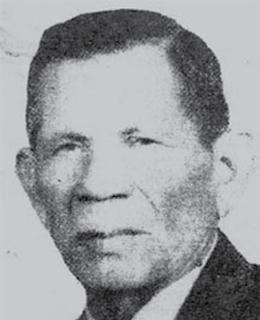
Essequibo, Moruca, Umana Yana (which was sadly burnt down), among others, including our country’s name ‘Guyana’ which means ‘land of many waters’.
With a local population
in the hinterland Regions One, Seven, Eight and Nine, with smaller populations in the other regions. Regions Three, Four, Five, and Six have one Amerindian community each.
While it may be felt that monuments or structures alone constitute our heritage, this is not so. Our heritage is made up of both tangible and intangible elements. The National Trust of Guyana, which undertakes to promote and safeguard the nation’s heritage wishes to remind citizens that preservation is a task which requires the cooperation of all Guyanese as our heritage is conserved for the enjoyment of all. The institution en-
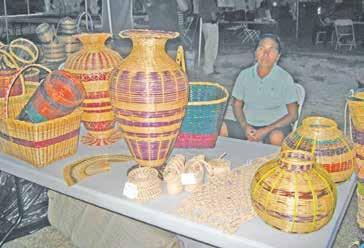
of approximately 70,000 Amerindians, divided into nine different tribes, Arawak, Carib, Warrau, Macushi, Wapishana, Wai Wai, Akawaio, Arecuna, Patamona, the majority of Amerindians still reside
courages the community to take an active role in ensuring the long term survival of Guyana’s patrimony by exercising care and respect at all times when visiting monuments and heritage sites.
(National Trust of Guyana)
They are on opposite sides of the river (nowhere does it say that they come to the river together!).
One simply uses the canoe to cross the river and the other person gets into the canoe and takes it back to where it started.



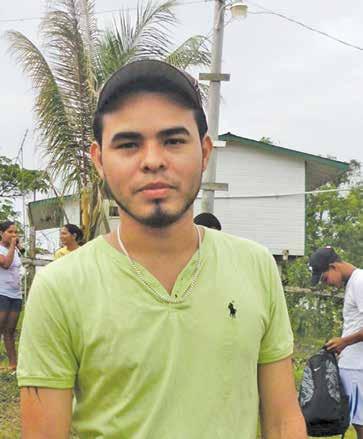
The village of Karrau, this year's Heritage Village, is thankful for the support it receives from the Government of Guyana in developing various aspects of the community.
In an interview with Guyana Times Sunday Magazine, Deputy Toshao Shane Cornelius stated that the village of Karrau has been forever grateful to the government for its presidential grant initiative, in which the village benefits yearly from a sum of $1M. Some of the noteworthy projects that fell under this initiative are: In 2007,
a boat and 40HP engine was purchased; in 2008, the construction of the community pavilion was done; in 2009, the construction of a bridge and purchase of solar system for the community pavilion; in 2010/2011, there was the construction of a guesthouse; in 2012, assist in purchasing of village ATV; and in 2013 a Village Landing Rehabilitation and Reclamation project, which is now a beach where the villagers converged to hold events or just to relax.
The village benefitted from the Ministry of Amerindian Affairs’ Amerindian Development
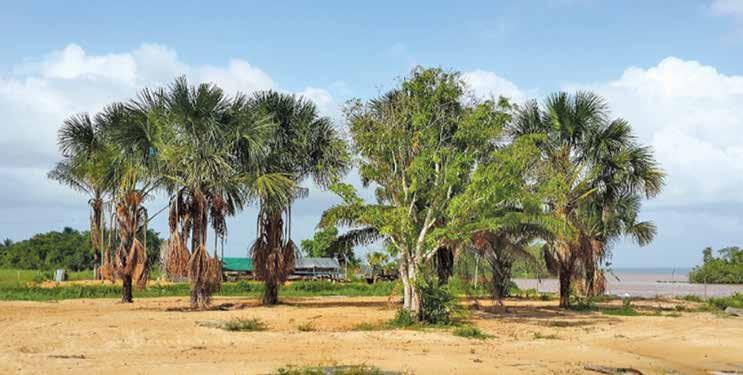
Fund programme in the following areas: In 2011, the construction of the village office was completed and in 2012, 40 water tanks, pipe lines, and one brush cutter were purchased.
Additionally, the village benefitted in the following areas, which come under capital projects for different years: In 2008, a sewing machine was purchased; in 2009, the construction of a village landing and walkway was completed and a John Deere tractor was bought; and in 2013, the construction of an eco-tourism village benab was completed.
Notably, Karrau was selected among the first 27 communities under the Amerindian Development
Fund Phase 1 project where it received $5M for the development and execution of a community development plan. The village selected cassava processing as the targeted area with the intention of developing packaged farine as the final product. Currently, more than five acres of cassava have been harvested and is ready to be processed.
Growing up in the hinterland, the Deputy Toshao recalled life being quiet in a village with not many developments. However, thanks to the funding from the government he is overjoyed that his village is being developed in many areas.
Cornelius, who holds a Bachelor’s in Computer Science, pointed out that
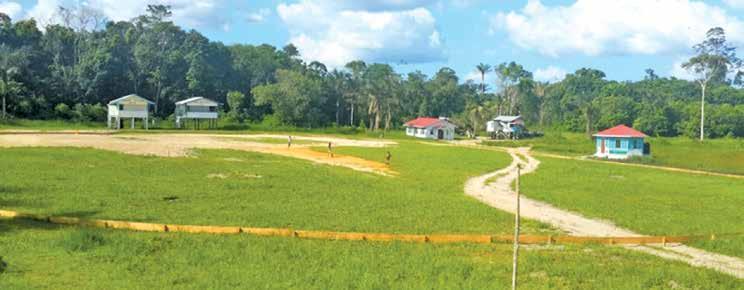
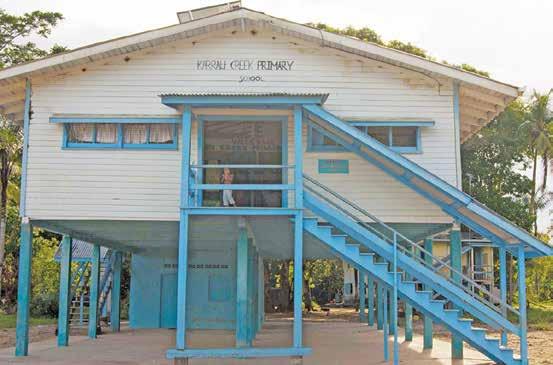
he is proud to represent his people and will work collaboratively with the government, more specifically the Ministry of Amerindian Affairs, to ensure his village is developed.
Recently, Cornelius mentioned that a community benab, not a traditional one, with ceiling and tiles, was built as a tourists’ attraction thanks to the annual funding received from the government.
Nestled approximately 36 miles from the mouth of the giant Essequibo River, Karrau is located obliquely to the busy mining town of Bartica. The reservation covers a total area of approximately 23 sq miles stretching from the mouth of the Karrau creek along the Mazaruni River to the mouth of Tiger creek along the Essequibo River.
The village of Karrau was established in the 1940s initially as a logging grant by Harry Lorrimer from the Demerara River. However, after Harry departed, two of his workers, John Cornelius and Herman Cornelius who came from Wakapoa, Region Two, remained and laid the foundation for the establishing of this village. Karrau village, which was initially called Karrau Creek, got its name after a local bird KAROW that was discovered in the nearby creek by
early settlers. Karrau became a titled Amerindian village in 2007. It has a population of approximately 310 persons representing around 80 households with the majority of inhabitants descending from the Arawak tribe.
In Karrau, there is a privately owned guesthouse with eight rooms that caters for all your needs within the heart of the village. Additionally, the village has a community guesthouse that accommodates the busy traveller.
The village has a primary school with a population of 36 pupils. It must be noted that the primary school also houses 15 nursery students. As such, a nursery section is urgently needed. The school has a total of four teachers. Additionally, the school is a beneficiary of the national school feeding programme.
There is a health centre within the village, which has two local community health workers. The main economic activities of Karrau are logging, mining and transportation services.
The majority of households in this village get their electricity from personal generators. However, 52 households get basic electricity from the government’s solar electrification programme.
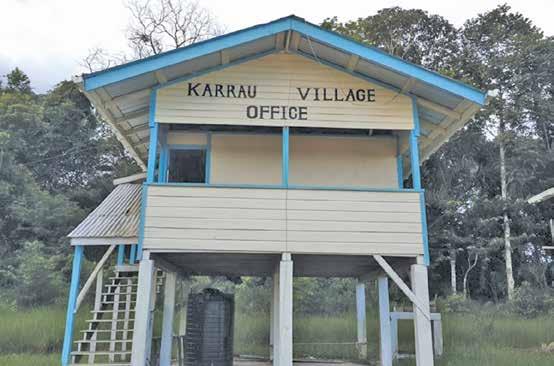
Carolyn RodriguesBirkett was born on 16 September 1973 in the Amerindian village of Santa Rosa, Region One.
Her early education began at the Santa Rosa Primary School, after which she moved to Georgetown where she attended a private school. RodriguesBirkett thereafter left for Saskatachewan, Canada, on scholarship, to pursue studies in Business Administration.
Following her return to Guyana in 1993, she read successfully for a degree in Social Work at the University of Guyana, while simultaneously managing the Amerindian Projects Programme of the Social
Impact Amelioration Programme (SIMAP), a post she held for seven years before being appointed Minister of Amerindian Affairs in 2001. Rodrigues-Birkett was the first minister to be re-appointed to her position by former President Bharrat Jagdeo in September 2006 following national elections.
On 10 April 2008, she was appointed Minister of Foreign Affairs, thereby having the distinction of being the first female to be appointed to this post. Rodrigues-Birkett is married and has two children.
In 2013, the Foreign Minister was presented with the Grand Cross of the Order of the
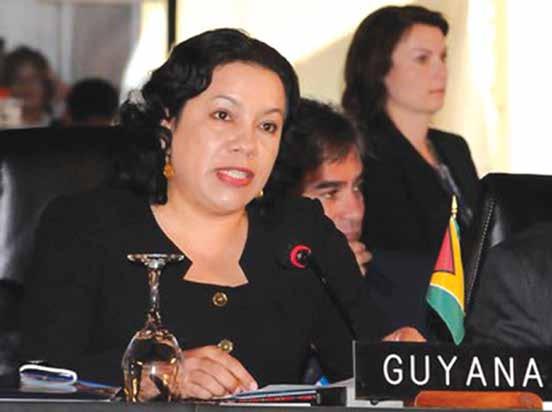
General Liberator of San Martin, the highest order of Argentina, by the Foreign Minister of the Republic of Argentina the Honourable Hector Timmerman.
Keeping close to her heart the welfare of the Amerindian people, the minister, along with several other officials, met earlier this year with political parties, the private sector, the National Toshaos Council and the Region Seven Regional Democratic Council on the development of hydropower in the Mazaruni.
The Minister of Foreign Affairs continues to ensure Guyana is aptly represented internationally and is adamant in finding ways in developing her country.
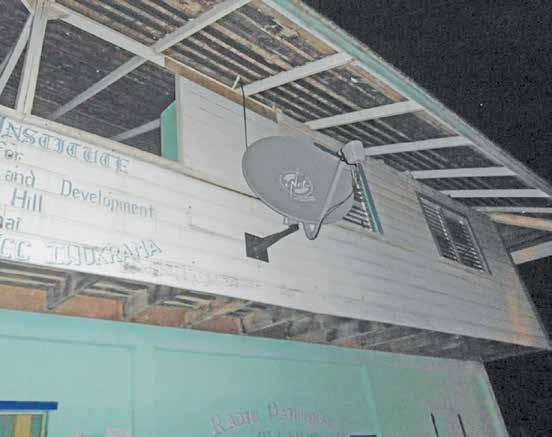
The Ministry of Amerindian Affairs and Ministry of Education are playing key roles in bridging the gap in education delivery in hinterland areas.
Recently, a number of projects are being implemented with the focus of hinterland development.
The Hinterland Education Improvement Project (HEIP) is listed in that series.
Launched with an outlook to improve the quality of teacher education in the hinterland, HEIP aligns teaching and learning resources with improved student outcomes, and improved physical facilities
through fostering better community alliances.
Over the last 20 years, the Hinterland Scholarship Programme has produced 7,000 students. In 2014, Region Seven registered the second highest number of 80 students in the programme. Scholarships are offered annually, and this programme has been a tremendous benefit to a number of students who are experiencing financial difficulties and would not have been able to make it on their own.
The objective of the scholarship programme is to provide students from hinterland communities with quality secondary or tech-
nical education, and to allow integration of hinterland students into the wider Guyanese society.
The programme offers two types of scholarships: Secondary School Scholarships and Technical Scholarships.
The institutions in hinterland communities consist of a quality learning environment with modern facilities. Also, there are trained and equipped teachers who help in delivering improved education to students. Thus the completion of the Port Kaituma dormitory and the Hosororo Primary school building, the construction of a primary school at Canal
Bank, and sanitary blocks at Kwebana, Karaburi, Koko and Bumbury nursery schools all redound to improved education for hinterland students.
From 14 nursery schools in the hinterland in 1994, that number increased to 116 in 2014. Primary schools increased from 111 to 139, and secondary schools increased from five to 12. Region Nine is the region with the most schools.
The number of trained teachers has increased from 40 percent in 1994 to 51 percent in 2014. Hinterland teachers are being sustained through the learning resource centres, with teacher accommodation which includes teachers’ housing.
This programme aims to enhance the competence and
capabilities of those youths who were not successful in gaining scholarships. The Youth Entrepreneurship and Apprenticeship Programme (YEAP) trains hinterland youths in the areas of health, education, infrastructure, cultural and youth development, and information communication technology, subjects which are beneficial to their respective village development, thus helping to bridge the digital gap that exists between the hinterland and the coastal areas.
Aided by the YEAP incentive, hinterland youth would have the knowledge of technology, which is beneficial with the completion of 100 computer centres in several Amerindian communities this past June.
The project is aimed at breaking the knowledge barrier that exists between coastland students and those from the hinterland. Youths from the hinterland would participate in the extension of ICT development in Guyana, and would be able to socialise in a computer literate society and to keep up with technological advancements.
Additionally, doing their part in providing quality and reliable internet in hinterland areas is iNet Communications. The company has been assiduously working to provide the best internet service in various far-flung locations in Guyana and educational institutions in hinterland areas.