

N&S Mattai and Company
Today, Richmond Hill in Queens New York is synonymous with the presence of the Indo-Guyanese community in New York City. By all estimates, it forms the largest concentration of Indo-Guyanese outside of Guyana. How did this occur? It started with one young man named Ramesh Dalchan Kalicharran, who hails from Bush Lot, Essequibo.
Popularly known as Kali, the eldest of 11 children, born to Ramdayal and Mangani Kalicharran, did well in his GCE exams and became a teacher. He wanted to move up. After a brief stint, Kali responded to a newspaper ad for Physicians Assistants and left at the age of 21 for New York in 1970. He was one of the early Indo-Guyanese to emigrate to the US. (Before this, England was the preferred destination, but changes in their immigration laws closed it off.)
Working full time to fund his studies, he graduated in 1973 but was forced to abandon his quest for higher education and seek work to support his relatives back in Guyana. The situation there was deteriorating under the PNC. He joined Bellevue Hospital as a lab technician (Pathology Department) and simultaneously did studies in medical illustration at Hunter College. Then he supplemented his income as manager at a department store where he met his wife, Judy. They got married in 1974. This successful union produced three talented children: Jagdesh, Nadesh, and Romanee - all of whom have become ambassadors (musical artistes and dancer) in Indian culture.
In 1976, Kali made a bold move: he entered the real estate profession, first as a salesperson and subsequently as a broker. He ended up taking an enormous risk for a person who had no prior background in real estate by purchasing the business,
Arcel, from its Italian owners. But he ended up blazing a trail in real estate, which formed the foundation for the community in Richmond Hill.
Kali made one of the first sales on Liberty Ave to a Narbada Persaud. Soon the flood of Guyanese immigrants started and they were steered to homes by Kali and others that followed in his pioneering path. The entire area was transformed. But Kali did not rest on his real-estate laurels: he became owner and president of the Kali group of companies (Kali Realty, Kali Travel, which undertakes semi-annual yatras to India, and Arcel Driving School). Additionally, in these areas, he was followed by others who saw the opportunity and took the risks to service the burgeoning Indo-Guyanese community.
But Kali was more than just a businessman. He used much of the proceeds from his business ventures to support culture - earning the title of cultural philanthropist.
He helped to found or support numerous organisations to help the Guyanese immigrants become a community. There were the Indo-Caribbean Federation, Gyaan Bhakti Satsangh, Laxhmi Mandir, USA Pandits Parishad, Phagwah Parade, Caribbean Voice Magazine, and USA Hindu Parishad, Federation of Mandirs, GOPIO, India Festival Committee, just to name a few. Very significantly he helped to deform linkages with the organisations that serviced the "Indian from India" community in New York.
He has been generous in sponsoring cultural activities, including various Indian beauty pageants, India Day Parade, Diwali Festival, Phagwah Parade, and many others. He was also a member of ICONS, a director of India Festival Committee, and the Caribbean co-ordinator of GOPIO. In addition, he has helped to organise numerous so-

cial, cultural and political events that hosted elected leaders in NY from the Caribbean, Fiji, and India. He also played a significant role in struggling for the restoration of democracy in Guyana and for assisting in a number of fund raisers for the late President Jagan when he was in the opposition. He also fundraised for former Prime Ministers Mahendra Chaudhry and Basdeo Panday.
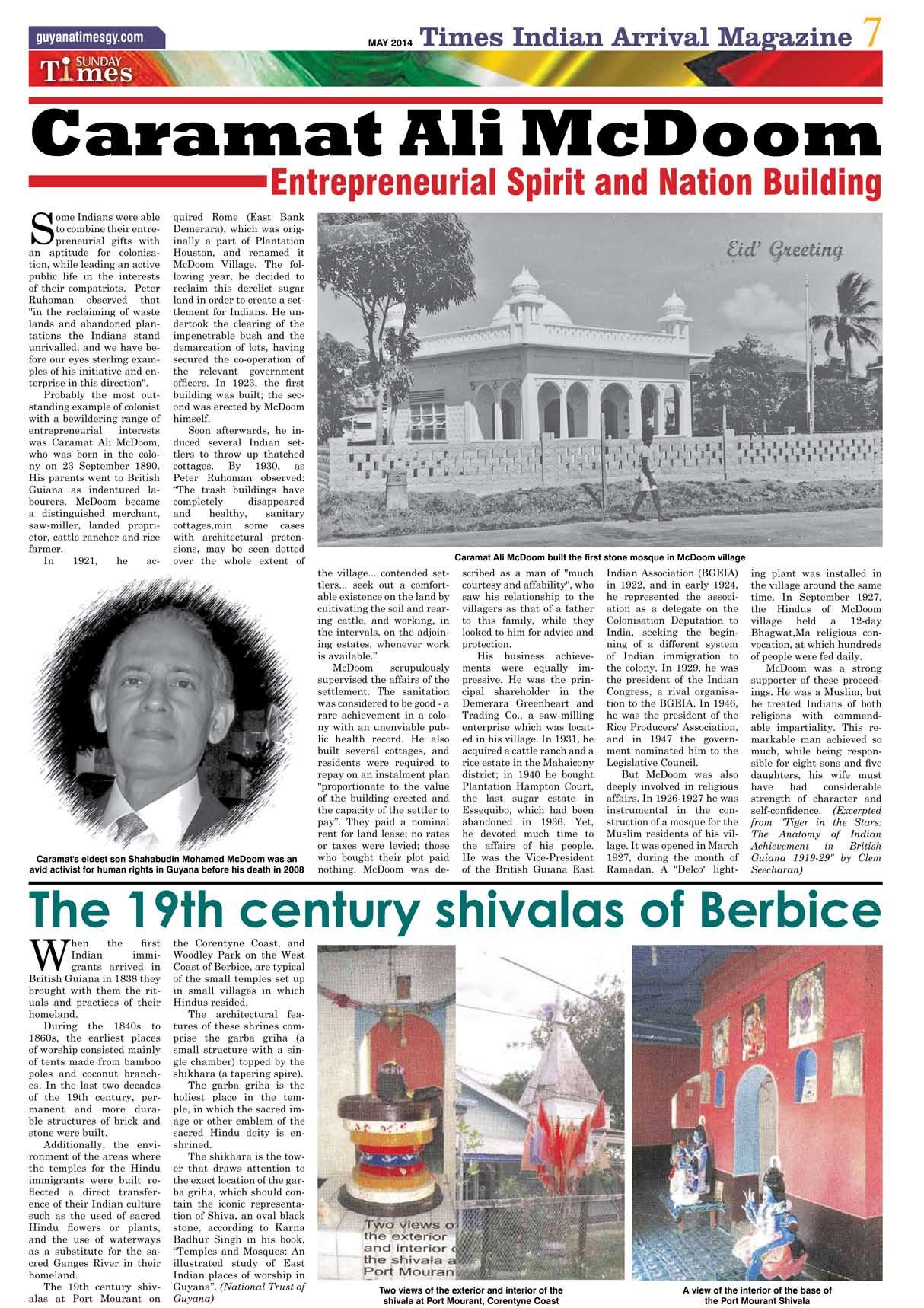
Caramat Ali McDoom
The East Indians of the Legal Profession in Guyana
First Indian Muslims arrival in Guyana
Mehndi artist and entrepreneur Anita Singh
-Preserving her cultural heritage From Stall to Grocery
Kali's activist community work has seen him aggressively raising the consciousness of New York City's officials to the presence of the large and vibrant IndoCaribbean community in Queens and their culture.
For his commitment and dedication to public life, Kali has received numerous accolades, citations, and awards, including from politicians, organisations, the Queens Borough Office, Flushing Cultural Council, GOPIO, Guyana Festival Committee, India Tourist Board, among others. He has been honoured for his achievements in business and for his outstanding contributions to culture (including sponsoring music) as well as for his invaluable services to the Indian diaspora (humanitarian work, youth involve-

ment, religion, promoting tourism to India, and much more). His long list of contributions is testimony of his qualification for any award.
In honouring him a few years ago, the president of Queens County said: “As an outstanding business and civic leader of the Guyanese community in Queens, you have generously given time, talent and resources toward the betterment of your community and the preservation of its cultural heritage. I, President Schulman, wish to express my sincere gratitude for your valuable contribution to the cultural richness and vitality of our borough.”
Kali is the epitome of entrepreneurship that is tied to a social conscience.

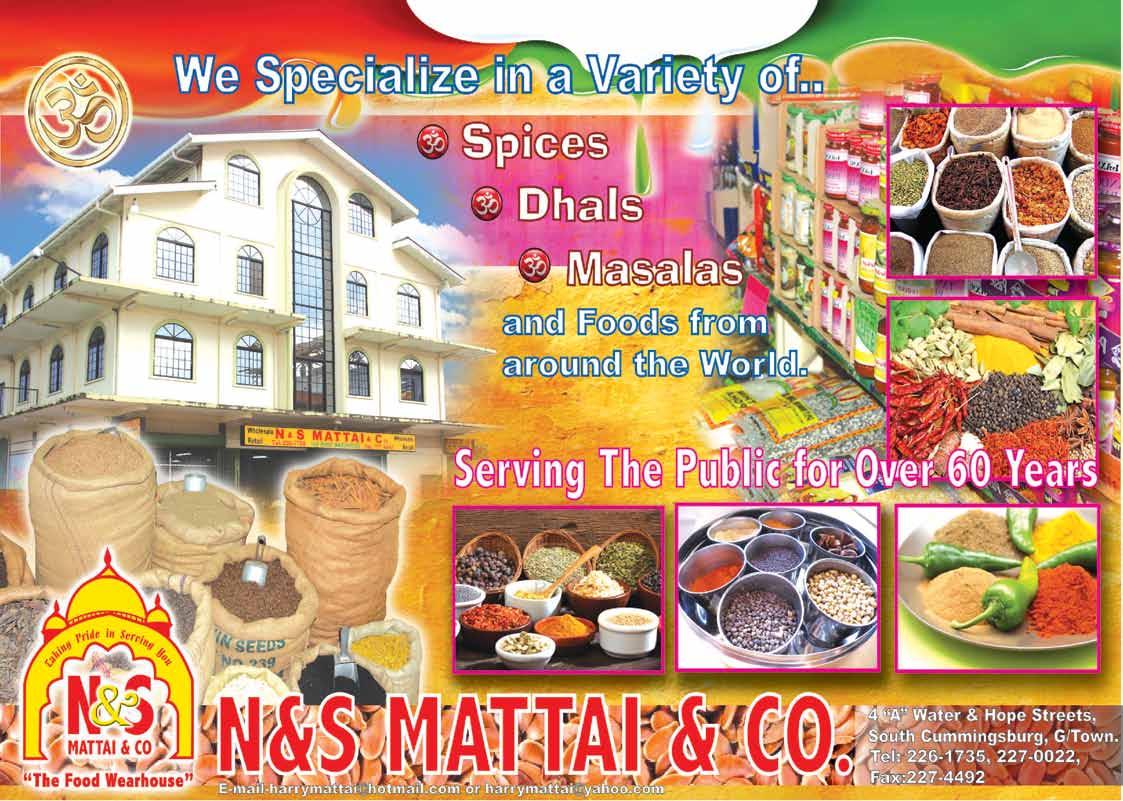
The name "Mattai" has long signified Indian spices in Guyana. In any culture, the food is the most persistent trait that survives: but it can only do so if the ingredients are made available. Mattai was one of those that identified this need and had the entrepreneurial drive to take the risk to become directly involved in importing the spices that distinguished Indian cuisine and also just as important, move to the Stabroek Market, which was the bazaar of Guyana.
The beginning: sugar and rice
Founded by Nuckshed Liliah Mattai and
Shamdayee Mattai, N&S Mattai started from very humble beginnings. Nuckshed’s parents arrived in Guyana from India as indentured labourers. Starting out at the Uitvlugt Estate, on the West Coast of Demerara, the family eventually moved to Hague Backdam where they started a rice mill to service the rice farmers who had bought plots of land on the ex-sugar estate. The father would have plunged all his hard earned savings into this venture.
Nuckshed worked with the family business for years until the passing of his par-
ents. This was one of the foundations of Indian entrepreneurship: the entire family supplied their labour to the enterprise. Nuckshed married Shamdayee in 1948 and over the course of their marriage the couple was blessed with ten childrenfive boys and five girls.
N&S Mattai & Company was formed in 1949 with the opening of a stall in Stabroek Market. This was a bold and risky move, but the young couple appreciated that the greater number of shoppers meant greater opportunities. The risk was taken. Nuckshed and Shamdayee worked tirelessly to supply
the public with basic groceries. This hard work paid off as the business steadily grew and the Mattai family moved from owning one stall at the market to owning seven.
During these years, both husband and wife made countless sacrifices in order to keep the business and the family afloat. Nuckshed spent many nights sleeping at a gas station across from Stabroek Market just so that he could open his stall as early as possible and close it as late as possible. He often waited until the 6:45am bell rang at the Market so that he could

race to remove the shutters on his stall and make the first sale. Shamdayee gave birth to the couple’s first child in 1949. During this time, poverty often prevented Nuckshed from visiting his family on the East Coast. Weeks passed without him being able to visit his children. During this time, Nuckshed also overcame language barriers to become fluent in English, having grown up speaking primarily Hindi.
In the early 1960s, Nuckshed was able to achieve his dream of owning a business in Water Streetthe epitome of the Guyanese business community. The business was moving up. He purchased the building and land at 4A Water & Hope Streets, where N & S Mattai & Company still exists today. But the couple still remained rooted in the market for a number of years. Nuckshed often managed the seven stalls in Stabroek Market while Shamdayee managed the business in Water Street. His sons often helped him after school and on weekends.
Those who knew Shamdayee at the time often describe her as a force to be reckoned with. Ever much the businessperson as her husband, she also ran the store, working side-byside with her husband even though he was opposed to her being at the market. She simultaneously raised ten children and still managed to be known as a fashion icon in society, often sporting high heels and saris.
Upheaval and migration Shamdayee and Nuckshed, along with most Guyanese, faced incredible difficulty in the 1970s and 1980s, when most basic food items such as potatoes, onions, and split peas were banned by the government. The business was hit especially hard since unavailability of these goods undermined the company’s survival and their family’s livelihood. The couple made the decision to move with their five youngest children to Canada.
The trauma of uprooting from roots, which had been so painstakingly nurtured, was alleviated somewhat because they were able provide their children with educational opportunities that were unavailable in Guyana. Like most of the Indo-Guyanese entrepreneurs, they remained adamant about proper education for all of their children. The family ran a small convenience store in Mississauga for approximately five years, which culminated in the opening a supermarket in the heart of Toronto. This was run by four of their children – Harry, Vickram, Nehaul and Vidya. During this time, the family managed to run N&S Mattai & Company in Guyana, since the sons stayed in Guyana for months at a time with their families to run the store via a shift-like system. Nuckshed and Shamdayee regularly travelled to Guyana to oversee the busi-
By PetamBer Persaud
On the first crossings, S.S. Whitby followed by S.S. Hesperus, from India to Guyana, there were 396 landed immigrants. It was a perilous
journey over the kala pani (dark water); a journey lasting sometimes over three months. Many were stricken by cholera and other diseases even though they had undergone thorough medical examination before de-
parture and only the fittest were selected. Despite that, some 13 persons died. According to the perpetrators, the lost of labour was felt economically but the deaths were of little consequence. Also treated of

little consequence was the fact that there were only 11 women among that first lot. Over time, the imbalance of female to male was vaguely addressed. Many descendants of those few women have sought to give voice to their ancestors. This paper will look at some Guyanese women writers of Indian ancestry who have dealt with the issue of indentureship and beyond.
Hear
Hear the ghungrus sing of yesterday and of today (Laxhmi Kallicharan)
Some came with dreams of milk-and-honey riches, fleeing famine and death: dancing girls, Rajput soldiers, determined, tall, escaping penalty of pride. Stolen wives, afraid and despondent, crossing black waters, Brahmin, Chammar, alike, hearts brimful of hope. (Mahadai Das)
Hear
Hear the ghungrus sing of yesterday and of today (Laxhmi Kallicharan)
I remember logies, barrackrooms, ranges, nigga-yards. My grandfather worked in the field Honourable mention. (Mahadai Das)
Hear Hear the ghungrus sing of yesterday and of today (Laxhmi Kallicharan)
Oh Grandfather, my grandfather your dhoti has become a shroud your straight hair a curse...
Rice beds no longer call your sons
They are clerks in the city of streets
Where life is a weekly paypacket (Shana Yardan)
Hear Hear
The ghungrus singFaint echoes of then Strong throbs of now (Laxhmi Kallicharan)
Ma, Will the rain Leak through The troolie leaves
And wet my katya? Will it leave Rivulets of muddy water
As it trickles on the floor Coursing its way
To merge with The swampy ground outside? (Rosetta Khalideen)
Remember one-third quota, coolie woman? Was your blood spilled
so I might regret my history –Forget tears among the paddy leaves? (Mahadai Das)
Per Aji
I can see
How in stature
Thou didst grow Shoulders up Head held high The challenge In thine eye...(Rajkumari Singh)
Responses to this author, call (592) 226-0065 or email: oraltradition2002@ yahoo.com
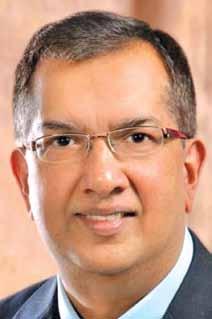
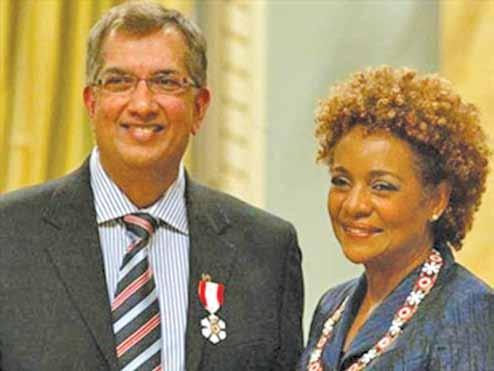
Winston Shyam Liaquat Kassim was appointed to the Order of Canada on July 1, 2009, and officially invested June 18, 2010, for his worldwide humanitarian work spanning an impressive 30-year period. The Order of Canada or Ordre du Canada is an honour for merit that is, within the Canadian system of honours, the highest civilian award administered by the GovernorGeneral-in-Council. Kassim became the first Guyanese to achieve this distinction.
Kassim was born at 132 King Edward Street, Albouystown, Georgetown, to Hajjin Noorun Nisa Kassim and late Subaydar Kassim. The sixth of seven children, Kassim obtained his primary education at St. Patrick’s Anglican School in East Canje, Berbice, and St. George’s Anglican School in Georgetown.
His family moved to Adelphi Village when he was an infant. He fondly remembers Adelphi, East Canje as a young child, as the village that moulded his formative years. Kassim recalls, “Although my father did not make much money at that time, my mother raised hens and had a large vegetable garden as such we might have been considered well to do in that time and place. So although we did not have money for luxuries, we had a roof over our heads, clothes on our back, and food in our stomach. Considering our life in Canada, our early life in Guyana could be considered financially poor, but I maintain that we were much more fortunate than others in Guyana, and around the world.”
As a teenager, Kassim began his professional career at Barclays Bank after concluding his secondary education at Indian Education Trust College in Georgetown. This foray into the world of finance was to chart the course of the young man’s career choice. He quickly demonstrated his aptitude in banking by rapidly advancing through senior positions, running various banking operations in Dominica, St. Lucia and Barbados. At age 22 he was appointed senior supervisor at Barclays Bank (now GBTI) in Guyana. Ever the academic, while working full-time, he concurrently studied for and completed all his banking exams by that age. Kassim credits his mother for instilling in him his passion for community service. She advised, “Take care of the underprivileged, but to do so in a quiet manner.”
It was his father’s experiences that instilled in him the zeal for formal education. His mother had the equivalent of a Grade Five education, while his father who grew up on the estate had the equivalent
of a grade two education. His father was determined to elevate himself academically and that drive was noted by Percy Liverpool - a headmaster who was his neighbour. Liverpool agreed to tutor his father on a part-time basis free of cost. This act of generosity enabled his father to attain a high school level education. His father’s educational development transformed the family’s circumstances and opened new windows of opportunity. His father, the late Subyadar Kassim, rose to the prominent position of Superintendent of Police and retired in 1971. His elder brother retired Deputy Commissioner of Police, Sultan Feroze Kassim followed in his father’s footsteps. His other siblings are all professionals and include his brother, the late Dr Sultan Farook Kassim and his sisters Bibi Fernando, Dolly Dhaniram, Anne Sawh and Ingrid Innes, who are all currently residing in Canada.
The act of kindness by Liverpool instilled in the impressionable youth the sentiment that to help those in need was a duty and not a luxury. Kassim feels that “education is the fundamental part of trying to upgrade a person’s skills… because had it not been for education I would not have been here today”.
As the second youngest in the family, he is forever grateful for the hand that his parents and each of his six siblings had in raising him. Kassim notes that he stands on the shoulders of his siblings and on the heads of his parents.
Presently, the Head of Strategic Portfolio Management, Canadian Banking of RBC, Kassim holds an MBA from Athabasca University. In 1975, Kassim married Kameni Cheddie. He was encouraged by his wife to move to Canada to begin a new life and look for more opportunities. He continued his career in the world of banking with a new po-
sition as a management trainee at Royal Bank of Canada. Migration did not affect his humanitarian efforts; he continued to dedicate his efforts equally to his profession and community work. He volunteered for organisations such as the Junior Achievement of Ontario and United Way.
He was instrumental in the fundraising and establishment of two prominent Greater Toronto Area mosques in 1981, the Sunatul Jamaat of Ontario Canada and the Malton Islamic Association, and continues to be involved in advisory capacities to their community programs.
By the late 1980s and early 1990s, he had assisted in establishing four more community centres for other faith-based groups, which serve as venues for social events, education and skills training.
Kassim feels comfortable in the religious world and although he regularly attends masjid, he also attends mandir and church to encourage interfaith dialogue and understanding. Through his family ties, he straddles both the Islamic and Hindu religions. He grew up in a Muslim family with his maternal grandfather as the first Imam of the Adelphi Village Mosque in the early 1900s and his marriage into Kameni’s family strengthened his Hindu ties.
In the subsequent years, Kassim expended his energies towards community building and created initiatives through his banking experience to encourage development of life skills by delivering financial seminars to various groups.
Kassim reflects fondly on the opportunity he had to meet Mandela, “Looking back at that endeavour, we had a duty to not only help a great cause, but also a great man.” Kassim continues to be an active member of the Nelson Mandela Children’s Fund (Canada), an organisation focused on becoming the foremost charity in Canada by promoting and realising Nelson Mandela’s global vision of social justice for children and youth.
As a volunteer Vice Chairman of the International Development and Relief Foundation (IDRF), an organisation that he has been a part of for ten years, Kassim made significant contributions over 30 years as a dedicated volunteer who has demonstrated exceptional
tality, the IDRF donated $1million (GYD) towards the fund for victims of the Lusignan massacre and other causes in Guyana. The programme, undertaken by Kassim through IDRF in Guyana, facilitates some 160 marginalised rural women being given an opportunity to start entrepreneurial activities. It gives technical assistance in catering, sewing and knitting. The programme aims to build capacity and self-confidence among rural women entrepreneurs through training. More than 100 women in Berbice have benefited through these initiatives and there are plans for expansion. According to Kassim, “IDRF help is not based on religion, colour, class or creed but rather on sustainable develop-
During the 1980s, he broadened his volunteerism to a more global stage. Kassim lobbied with various groups and individuals towards the release of Nelson Mandela. He represented a small but significant minority of Non-South Africans from corporate Canada engaged in this struggle. Canada, as a leader in the Commonwealth, championed the call for sanctions against South African apartheid. The international pressure sparked political and social changes in South Africa culminating in the release of Nelson Mandela. Canada’s efforts towards Mandela’s release propelled it to world prominence for its philanthropic position. Kassim regards this as one of the greatest achievements he has contributed towards. He continued his lobbying by working on the committee for the sponsorship of Nelson Mandela.
leadership with many regional, national and international charitable and humanitarian organisations. He assists in leading IDRF in projects dedicated to empowering disadvantaged people throughout the world.
“In this moment of Mr. Kassim’s recognition,” said Dr. Cassim Degani, Chair of IDRF, “We at IDRF are especially proud as he has devoted a considerable amount of time to the sustainability and growth of the IDRF over the past five years. It is volunteers such as Mr. Kassim who help IDRF positively impact disadvantaged people from all corners of the earth in some 26 countries, including Canada.”
The appointment cites Winston Kassim “for his contributions as a community volunteer who played a key role in establishing several community and religious centres that provide outreach services to refugees and immigrants”. Through Kassim’s instrumen-
ment. I hold this philosophy close and promote it widely.”
Kassim emphasised that the type of work being done in Guyana is reflective of that old adage, “Rather than giving the person the fish, we teach them how to fish.” Despite his hectic schedule, the demands of his job and his passion for humanitarian work, Kassim maintains that his top priorities are his wife Kameni, three children Nadina, Shaun and Sara, his grandson Joshua and his mother Hajjin Noorun Nisa Kassim. He takes that zest for helping the underprivileged into his home and includes his family in many of his community service and volunteer efforts.
Of humble origins, Kassim has traits worthy of emulation and serves as an inspiration to persons of all walks of life with the dream of changing the destiny of the underprivileged beyond the borders of any one country. (First published in Horizons Magazine 2010)
nized by the Indian middleclass for its work addressing the “desperate poverty on the estates.” It was a time when few Indian women would have been accepted in the public and in contrast to many women in the countryside, most women in the middle class and in Georgetown were supported by their husbands and other male associ-
ates to participate in organizations.
Pita Pyaree
One daring young girl left her foster home at Aurora Village, Essequibo, at age 13 and travelled to Georgetown with the hope of staying with her aunt. By dint of fate, she began a singing career and
later acting in the 1930s. She performed throughout Guyana, in Suriname, Trinidad and Venezuela, and became the “Indian version of the famed Madame O’Lindy”. Her name is Pita Pyaree.
Pre and postindependence efforts
In relatively recent times few women writers emerged, notably Rajkumari Singh and Mahadai Das, whose poetry reflects themes of pain, oppression and gender assertion. Rajkurmari Singh, a one-time Indian radio announcer at the Demerara Radio Station, wrote the play “Jitangali” and published “A Garland of Stories” in 1960.
She was instrumental in staging plays at the Theatre Guild.
Today even though many Indian women are now educated and have moved up in the social, political and religious organizations, they are still marginalized. In some cases, many educated Indian women who are capable of becoming leaders continue to
be restricted. While it can be argued that, in earlier times, many women suffered from a form of subservience reinforced by religious patriarchal indoctrination and other social demarcations, one can recognize that there is still a long road ahead for women to access higher leadership in such areas are unions and politics.
By Anil nAndlAll
“Those Indian hands – whether in British Guyana or Trinidad – have fed us all. They are, perhaps, our only jewels of a true native thrift and industry. They have taught us by example the value of money; for they respect money as only people with a high sense of communal responsibility can” - George Lamming, 1966.
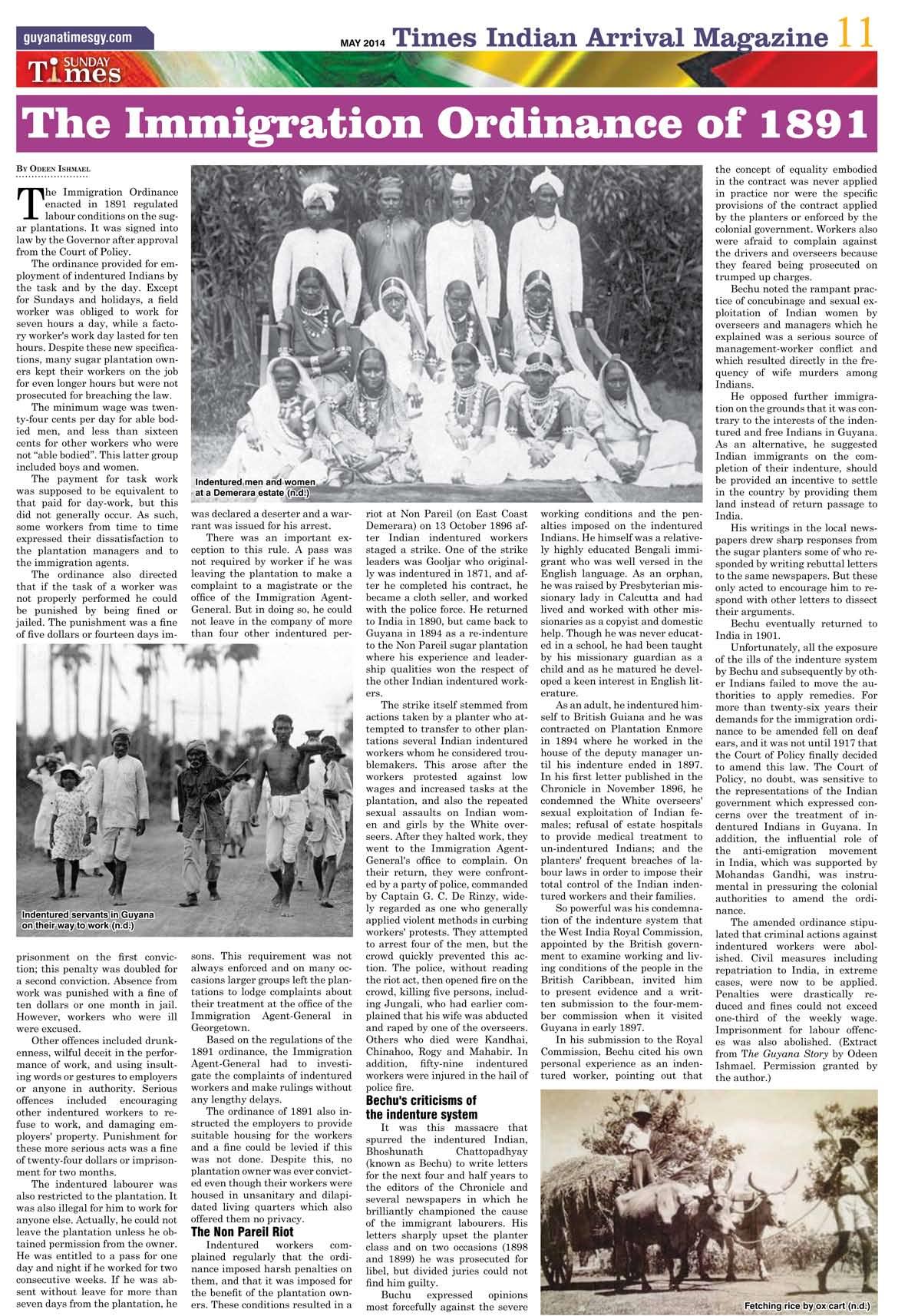
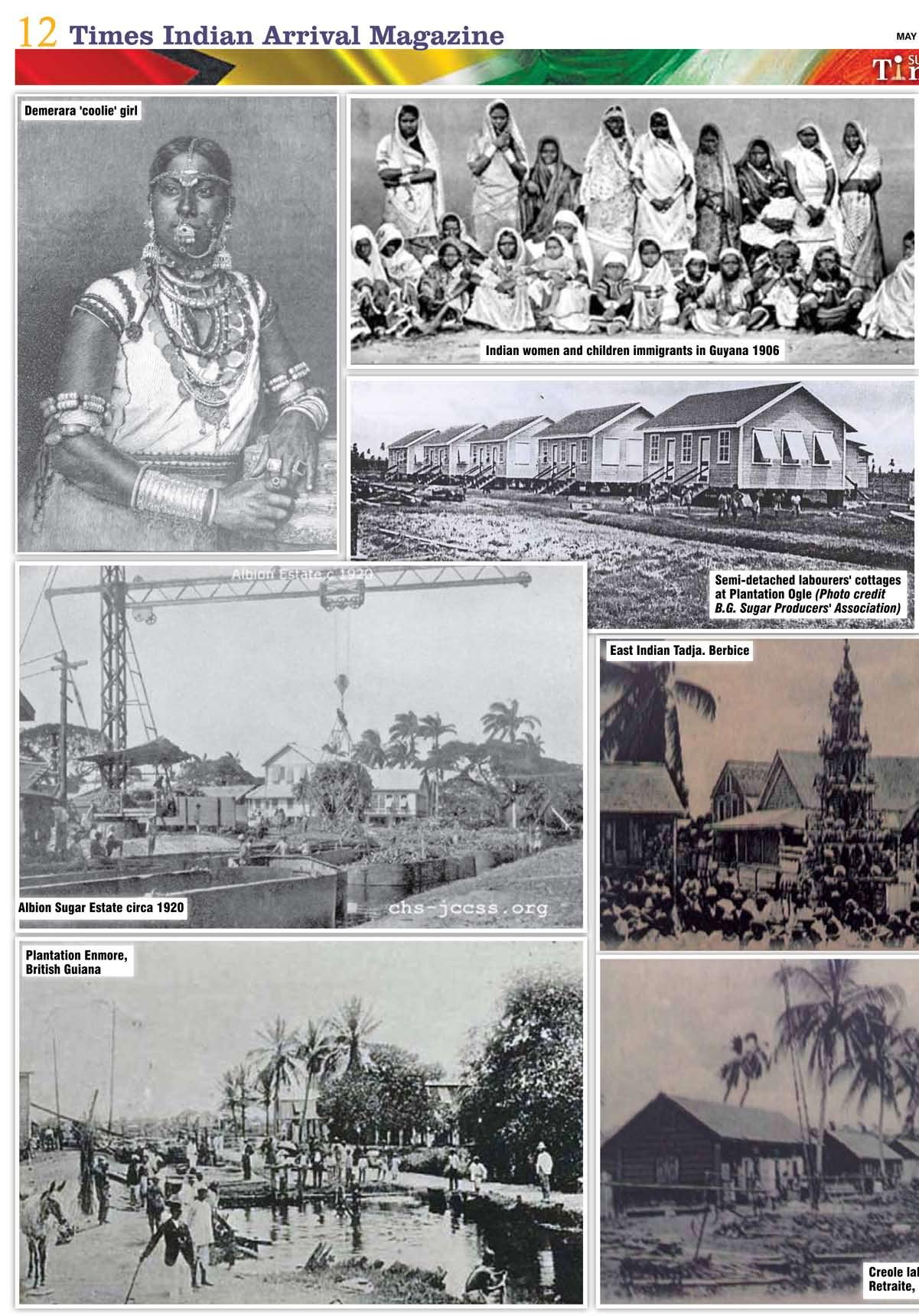
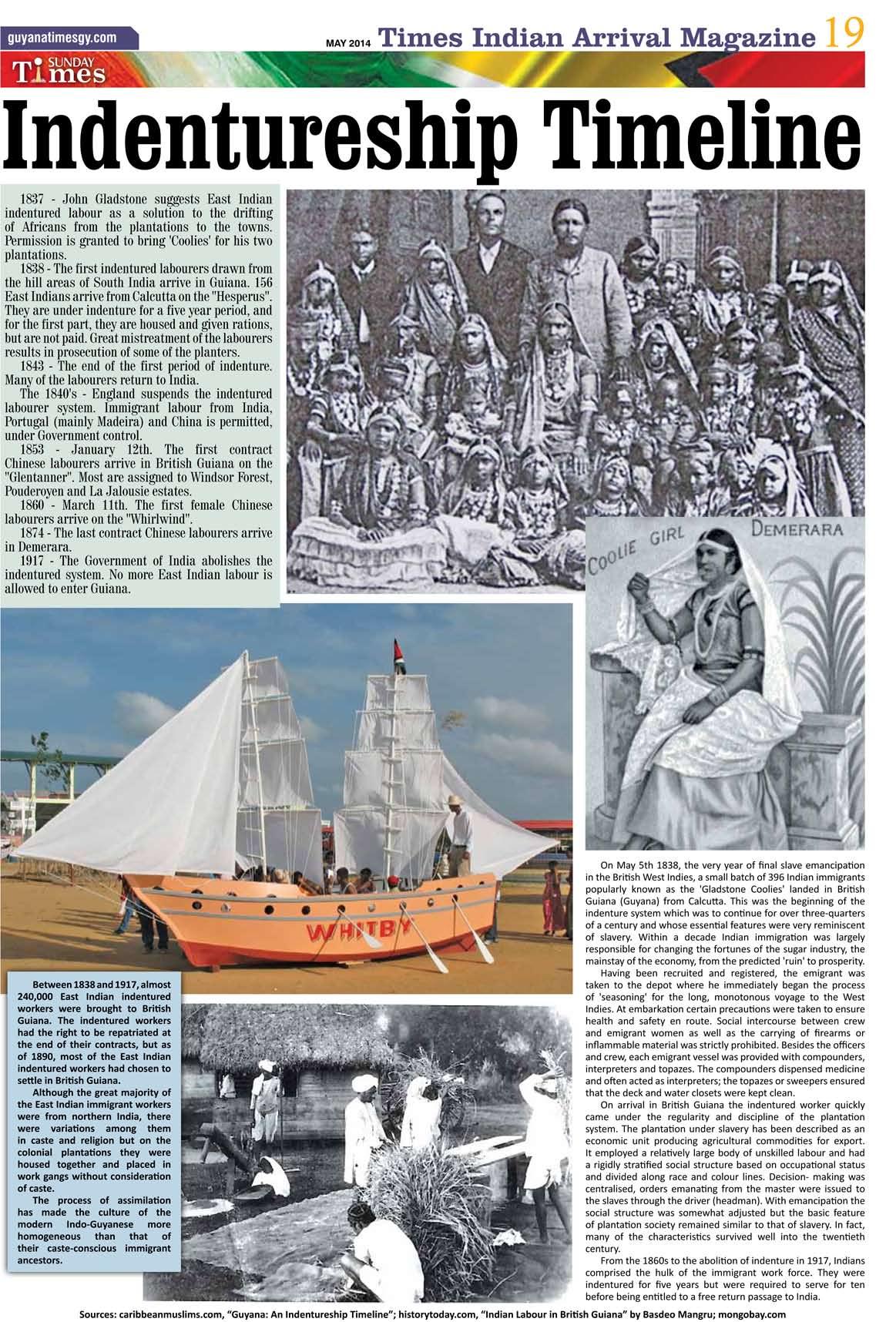
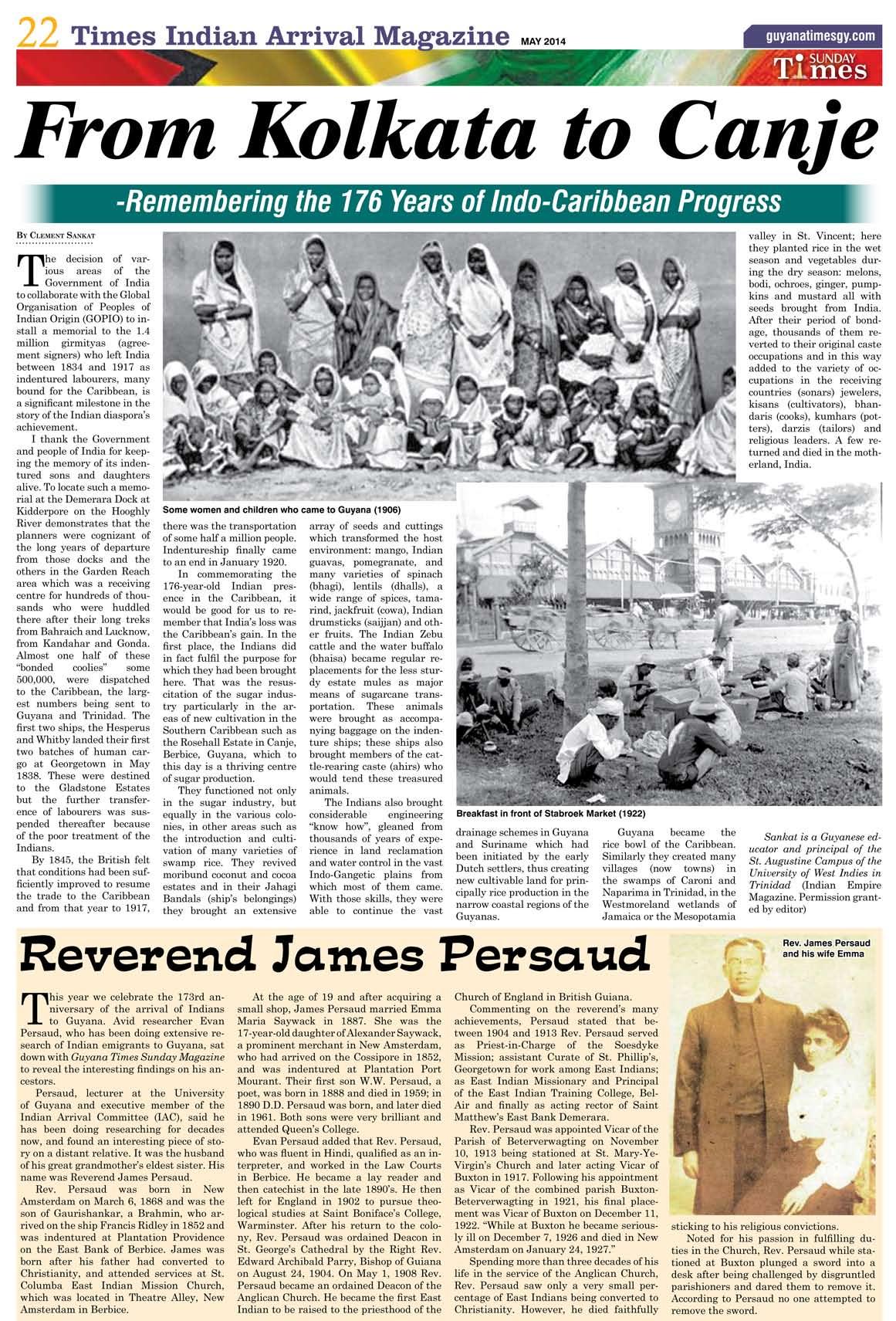
According to Dwarka Nath’s “A History of Indians in Guyana”, the first two chartered ships that brought indentured Indians to Guyana arrived on 5 May 1838. They were the Whitby and Hesperus. Four hundred and fourteen Indians boarded the ships mainly from Chota Nagpur, Burdwan and Bancoorah near Calcutta. The Whitby sailed from India on the 13 January 1838, with 249 Indians, who landed at Highbury, Waterloo, and Bellevue. The Hesperus departed Calcutta on 29 January 1838, with 165 Indians and discharged its passengers at Vreed-en-Stein, Vreed-en-Hoop and Anna Regina. Over the next three quarters of a century, approximately 240,000 Indians were brought to British Guiana from India as indentured labourers.
The impact of East Indians permeates almost every conceivable sphere of activity in today’s Guyana; their presence and contributions are deeply interwoven in that fabric, which is today called the Guyanese society.
In this essay, I briefly examine the contributions, which some East Indians have made to the legal profession in Guyana. From the outset, I wish to caution that many of the persons who are featured hereunder have made sterling contributions in endeavours that are outside the legal profession. However, it is beyond the scope of this article to chronicle those achievements. How it all started
A discourse of this kind must ineluctably commence with the Luckhoo family – a family that has had a dynasty-like involvement in the legal profession in Guyana. The history of the Luckhoo family in Guyana dates back to the year 1859. Dwarka Nath writes thus: “In the year 1859, three brothers, Prahalad, Ruhoman and Lokhooa, aged 13, 11 and 7 years, respectively, were sightseeing at Lucknow when they were met by a recruiter. The recruiter painted a bright picture of the prospect of travelling to a strange land called ‘Damra Tapu’ (Demerara), where in five years they could make a fortune and return to their native country. The three boys could not allow an opportunity like that to slip them and they accompanied the recruiter to a sub-agency and entered into agreements to serve on a sugar plantation in this colony. They arrived by the ship Victor Emmanuel and were allotted to plantation Albion. Prahalad, the eldest of the three brothers, remained a Hindu, but Ruhoman and Lokhooa later embraced the Christian faith and were known as John Ruhoman and Moses Luckhoo, respectively.”
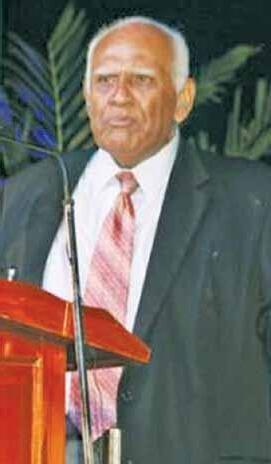
Moses Luckhoo had six sons. One of them, Edward Alfred Luckhoo, qualified as a Solicitor in England in 1899, thus becoming the first Indian Solicitor produced by British Guiana. His brother, Joseph Alexander Luckhoo, passed the Bar finals in England in 1912, thereby becoming the first Indian Barrister-at-Law in the colony. In 1923, at age 36, he achieved another ‘first’ by being appointed the first Indian King’s Counsel in British Guiana. During his time, he was regarded as one of the finest criminal lawyers in the entire English speaking Caribbean. He was later appointed First Puisne Judge of the Supreme Court and acted as Chief Justice for the colony on many occasions –again, the first Indian to have done so.
The grandsons of Moses Luckhoo continued this high legal tradition. Sir Edward Victor Luckhoo, son of Edward Alfred, had a distinguished legal career which culminated in his appointment as Chancellor of the Judiciary. Another son, Lionel Luckhoo, became one of the most celebrated criminal lawyers in the West Indies. He was knighted and was awarded the K.C.M.G., the first Indian outside of India to have received this honour. His success at the criminal bar
was phenomenal; he won over 400 consecutive murder cases. This achievement is recognised by the prestigious Guinness Book of World Records where he is listed as the world’s most successful criminal lawyer. At one time in his career, Sir Lionel joined the Chambers of the distinguished English lawyer, Edward Gardener Q.C. in London. William Hickey, the London columnist described Sir Lionel as the “Perry Mason of the Caribbean”. His stint at the English bar was equally successful. Yet, another son, Claude Lloyd Luckhoo, also had a long and distinguished legal career and was also a Queen’s Counsel.
A son of Joseph Alexander Luckhoo, Joseph (Junior) was also knighted and became Chief Justice of Guyana - the first Indian to have done so. He later migrated to Jamaica where he served for several years as a member and then President of the Jamaican Court of Appeal. His brother, Ronald Hewley Luckhoo, was also appointed a Judge of the Court of Appeal in Guyana where he served with distinction for many years rendering landmark written judgments in various areas of the law. Today, the Luckhoo’s dynasty is being carried on by Mr. Edward Luckhoo, a son of Lloyd Luckhoo. He is a most able and respected Senior Counsel at the Guyana Bar.
Apart from the Luckhoos, several East Indians have had long and distinguished careers at the Guyana Bar and on the Bench contributing to and shaping a jurisprudence that can today be considered uniquely Guyanese. Many of them were admitted to the Inner bar and conferred with silk for their long and distinguished contribution to the profession.
The last East Indian Queen’s Counsel to be appointed before Independence, that is, on the 31st March, 1966, was Dr. Mohamed Shahabudeen. The first Indians to be conferred with this distinction after independence, that is, on the 31 December 1966, were Mr. Stanley Deva Sukul Hardyal from the Berbice Bar and Mr. Frederick Ramprashad from Georgetown. In 1969, Mr. Shakoor Manraj and Mr. Bhairo Persaud were appointed Queen’s Counsel.
Mr. Hardyal S.C. was regarded as one of the finest and most crafty lawyer of his era and many who practised alongside him credit him with having an almost photographic memory. He was highly successful both at the criminal and civil bar and his long and successful career spanned over half of a century.
Mr. Shakoor Manraj S.C. also practised law for over fifty years, in Guyana, and thirty four other jurisdictions including Canada, where he served as a magistrate and is the co-author of the acclaimed work, ‘the law of Speeding and Radar” (Canada). He was
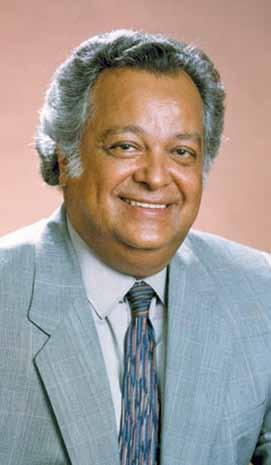
most successful at the criminal bar and argued the famous Guyanese case, Shoukat Ali v. Queen, before the Privy Council.
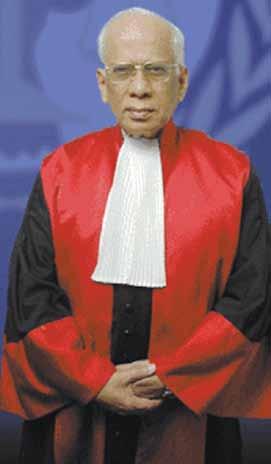
Dr. Shahabudeen has had a long and distinguished legal career and academically, until the attainment his doctorate, was largely self taught. He served as Solicitor General and Attorney-General of Guyana for several years before he was appointed to the World Court of Justice as a Judge; the only Guyanese to have ever served as a Judge of that esteemed tribunal. Dr. Shahabudeen is also the author of two invaluable and only books of their kind in Guyana, the Legal system of Guyana (1973) and Constitutional Development in Guyana 1621 – 1978. Indeed, these works are consulted regularly by lawyers and Judges alike.
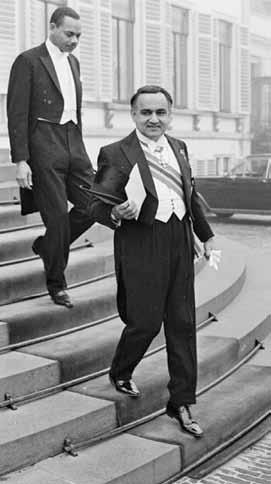
In 1970, when Guyana became a Republic, all Queen’s Counsel were reappointed Senior Counsel. In that year, Dr. Fenton H.W. Ramsahoye, another legal giant, was appointed Senior Counsel. Dr. Ramsahoye’s legal career is most illustrious. He was the first Guyanese to be appointed Attorney General of the Colony in 1961. Dr. Ramsahoye is the author of a most important text in Guyanese land law, The Development of Land Law in British Guiana (1964). Today, this book remains the most seminal, authoritative and referred academic work on the complex subject of land law
in Guyana.
At age 31, Dr. Ramsahoye was the youngest person to be appointed Attorney-General in the British Commonwealth. In 1959, he was the first person in the Caribbean to have obtained a doctorate in law. He left Guyana in the early 70’s to practice law in Trinidad and was appointed the Deputy Director of the Council of Legal Education of the Caribbean. He was the first Principal of the then newly established Hugh Wooding Law School and he served as a lecturer at that institution for several years.
Dr. Ramsahoye was knighted in 2006, by the Governor General of Antigua, Sir James Carlyle. Sir Fenton is practicing and has practised throughout the Caribbean and before Her Majesty’s Privy Council. Indeed, he holds the record for making the most appearances before the Privy Council from the Caribbean where he has argued some of the leading cases emanating from the Caribbean jurisdictions, especially, in the areas of constitutional, administrative, public and commercial law.
Another legal luminary who deserves special mention is Sir Sridath Ramphal. Sir Sridath was appointed Guyana’s first Attorney-General after independence and is credited, along with Dr. Shahabudeen, as being the drafters of the Republican Constitution (1970) and the Executive President Constitution (1980). He functioned as Guyana’s Foreign Affairs Minister for several years before he was appointed as Commonwealth Secretary General; a position which he held for over 15 years. Only recently, Sir Sridath successfully led Guyana’s legal team before a United Nations Law of the Sea Tribunal that peacefully settled the maritime boundary dispute with Suriname. The numerous other international positions which he held are outside the scope of this paper.
Derek Chunilall Jagan S.C., a former Speaker of the National Assembly is yet another legal practitioner of Indian ancestry who carved a niche for himself in the legal profession in Guyana. His legal practise lasted for more than forty years and was highly specialised. Mr. Jagan’s practice centred almost exclusively in the areas of workmen compensation and civil suits arising out of motor vehicular accidents (running down actions). It is in the latter that he built a most enviable reputation. His unparallel expertise in this area of the law was readily conceded by his peers as well as the Judges before whom he appeared. His death has left a void in the legal profession in this area of the law which may be difficult to fill in the near future.
Senior Counsel Sase Naraine, was the longest serving Speaker of the National
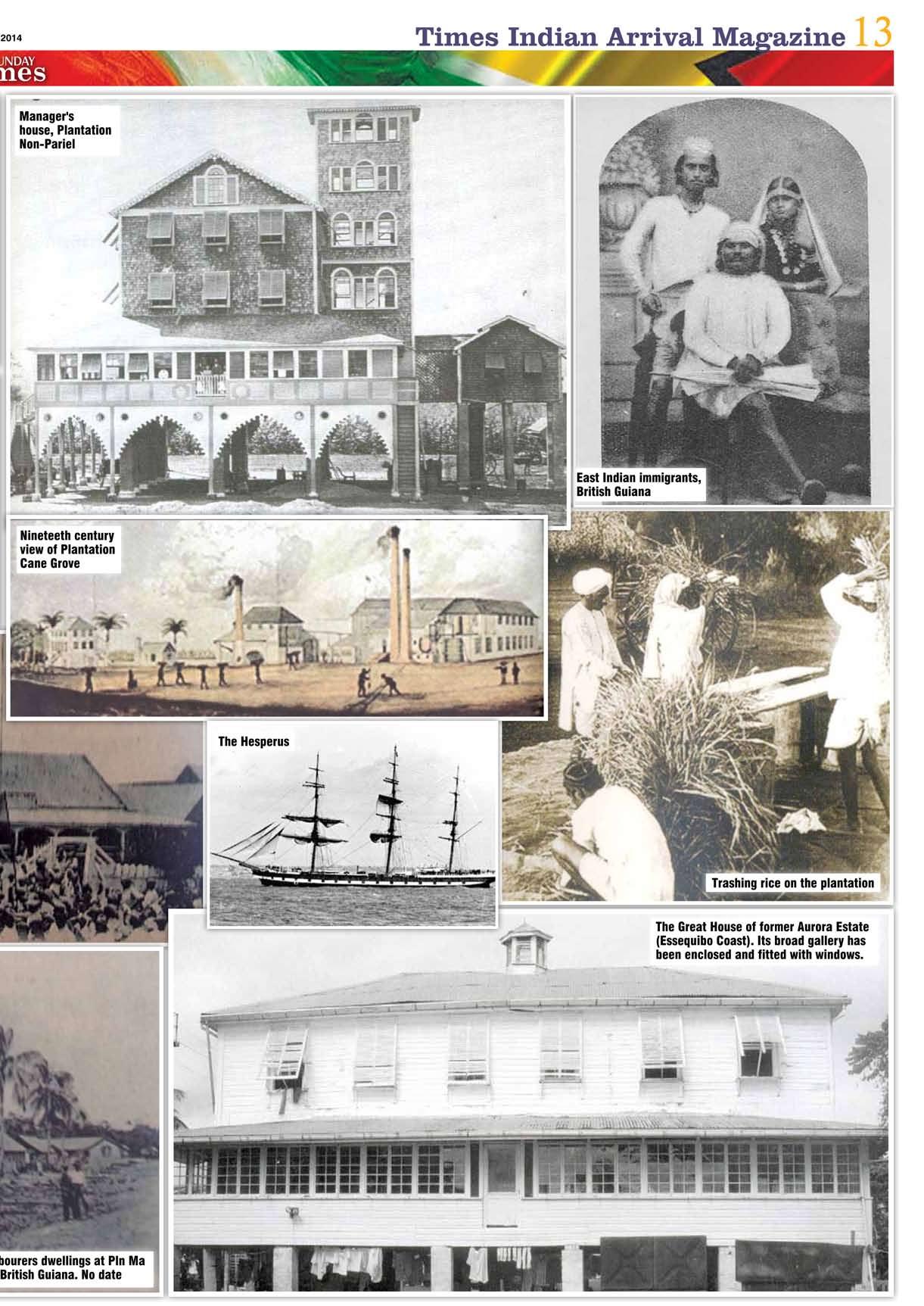
It was in the year 1838 that 94 Hindustani (Indian) Muslims arrived in the colony of British Guiana on board the first two “coolie” ships – the Hesperus and the Whitby. This account debunks the myth that Muslims were not among the first set of indentured immigrants to the colony. After slavery was abolished, the British turned to India for cheap labour which ushered in the period of indentureship.
Based on the information compiled from the two ships’ logs of the immigrants 94 passengers, or 21 percent of them were found to belong to the Muslim religion; the second largest group after the Dhangur tribesmen and women. Interestingly enough, from the Islamic names of some of these Dhangurs it is apparent that they may have converted to Islam prior to their recruitment as an indentured servant, however, on the embarkation list, Dhangur and other castes were recorded as their scheduled caste.
The Whitby was the first to set sail from Calcutta on Saturday, 13th of January 1838 with 267 immigrants and after 112 days at sea it dropped anchor off the shores of Berbice on that eventful day, Saturday 5 May 1838. 181 immigrants were unloaded - 166 men, six women who accompanied their husbands, two boys, five girls and two infants whose gender were not stated. Of the 166 males, 45 were Muslims, two of them – Ally Buckus and Chummare – were recruited to serve as mates on board the ship. Of the 45 Muslim men, five were teenage boys ranging between the ages of 14 and 15 who were registered as indentured labourers to be paid wages in the amount of six farthings monthly. Among the six women only one was a Muslim – Sheebah, aged
18 years, who accompanied her husband, Beejo number 92 in the embarkation register. This first batch of our ancestors was “bounded” to Plantation Highbury, East Coast Berbice, which was owned by Messrs. Davidsons and Company and administered by John Cameron. Having unloaded its human cargo in Berbice the Whitby then sailed to Demerara where the balance of the immigrants - comprising of 82 men, two women, one boy and one girl - were unloaded, all of whom were indentured to James Matthews, Plantation Bellevue, Property of Andrew Colville, esq., of London. One Muslim man, Nophur aged 25 from Bancoorah (District of Bankura), State of West Bengal died on the voyage, while another Muslim – Jhurri - whose name did not appear on the embarkation list, was shown as hav-
ing disembarked with the other passengers. Of the 82 men, 17 were Muslim one was a sardar, Nuthaw Khaw (spelt Nertha Khan on the disembarkation list) while, Jhurreechuck (shown as Thurry Huck on the disembarkation list) served as a mate on board the ship. Khan converted to Christianity shortly upon his arrival in the colony and was looked upon favourably by the Minister of the Parish. This trend of converting to Christianity continued throughout the years in the colony.
Up until 1966 those Indians who converted were given preferential treatment and considered more suitable for certain jobs both on the sugar plantations and in the Public Service over the other Indians who choose to follow their Hindu/Muslim religion even though in some cases they were just as qualified as the ones who con-

verted to Christianity. The second ship – The Hesperus, laden with 171 passengers, departed Calcutta 16 days after the Whitby for British Guiana on Monday, 29th January 1838 and landed later the same day as The Whitby on Saturday 5 May 1838,
remaining 61 immigrants from the Hesperus comprising 47 males, 4 women and the 10 children were bounded to John and Henry Moss Plantation at Anna Regina, Essequibo. Among this latter batch there were 11 Muslim men, one of the men, Uckloo, was accom-
Murshidabad, Azamgarh, Mirzapur, Shahabad, Sultanpur, Faizabad, Patna and Alighar. Where Agra, founded by Sultan Sikandar Lodi in the year 1506, and Lucknow, Faizabad and Patna, to name a few states, were centres of great learning and culture of the Mughal Empire.” Soon after their arrival in the colony the Muslims became organized despite the lack of the traditional structures of mosques, with the basic characteristics such as minarets or domes these early Muslims nevertheless celebrated their traditional Islamic holidays such as Eid-ul-Fitr and Eid-ulAdha as well as the Tazia festival. And today, according to the Central Islamic Organization of Guyana (CIOG), there are about 140 mosques scattered throughout Guyana. Despite attempts at conversion, humiliation, and subjugation, Islam survived in Guyana, and it is an ongoing struggle. Hindustani Muslims in Guyana have had a long history of resistance dating back to the 11 October 1838, when two Muslims – Jummun (Juman) and Pultun escaped the clutches of the gora sahibs (white masters).
at Port Demerara with 157 servants– 141 men, 6 women, 5 boys and 5 girls (which meant that 14 immigrants on the Hesperus died during the voyage). Ninetyfour men and 2 women were bound to John Gladstone owner of Plantations Vreeden-Hoop and Vriedestein. Among this batch of indentured servants on Gladstone Plantations, 14 were Muslims, one of them – Jeewoon Khaw (Irrwan Khan) was accompanied by his wife (Bharrupp), there was also one Pathan - Coda Buckus, aged 26 or 27, from Ara, Bihar. The
panied by his wife and four kids. At least two Muslim men died on the Hesperus –Soonawoolah, and Kryamt; while one immigrant - Kyut Alle - whose name did not appear on the embarkation list was shown on the list of passengers that disembarked from the vessel.
The immigrants brought with them the richness of the Mughal culture –the Urdu language, arts, cuisine, fashions, and lifestyle. They came from districts and cities where the Mughal culture proliferated - Lucknow, Ghazipur, Allahabad, Agra, Gorakpur,
The bodies of two strange men were discovered shortly afterwards at Mahaica, in the bushes who were believed to be the two “runaway coolies” Jummun and Pultun. We also saw the Rosehall uprising of 1913 where mainly Muslims were at the forefront “battling” imperialism - Moula Bux, Jahangir Khan, Dildar Khan, Chotey Khan, Aladi, and Amirbaksh stood up to the injustices on the plantations. (By Raymond Chickrie; Muslims in the Caribbean; Caribbean muslims.com)
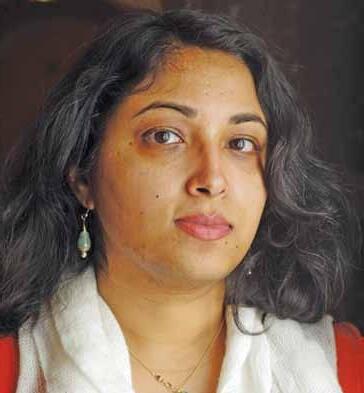
Gaiutra Bahadur's "Coolie Woman: The Odyssey of Indenture" has just been shortlisted for the prestigious British, Orwell Prize. The winner will be adjudged as the work that best “make [s] political writing into an art”. In this local review, we will look at both the political and the artistic merits of the book.
Gaiutra Bahadur’s “Coolie Woman” is undoubtedly an important piece of historical research. Where every account of indentureship until now mentions in passing that the low ratio of coolie women to men led to much violence on the plantations, Bahadur, through much painstaking research, puts names, dates and places to this once faceless abuse.
The book deals specifically with the violence meted out to coolie women on the British Guiana plantations by coolie men, and by the colonial masters through the system of indentureship itself and through illicit sexual relationships.
The overarching prem-
ise is that the low ratio of coolie women to men aggravated relationships between the sexes and led to jealousies, assaults, mutilations and murder. By the same token, the scarcity of women empowered them enough so that they could pick and choose their partners and leave a poor one for one that offered more, leading, often, to the jealousies and rage.
The author was exhaustive in her research and the many anecdotes can get overwhelming. A stranger to our history who picks up this book would believe that all coolie women suffered a similar fate when, really, this is no holistic accounting. There are no anecdotes of the larger percentage of coolie women who worked, sacrificed, lived decent lives, and ensured that the Indian cultural values, those of religion and rituals, of music, dress, food, and dance, were passed on to future generations. This is how they have survived to this day. It is because of these women. They were heroic. They were not all loose, low, grasping, and conniving.
This is not to discredit
Bahadur’s painstaking research into the horror of indentureship. The horror does need to be told and recorded. The trouble is that the book’s subtitle, “The Odyssey of Indenture” leads you to expect a definitive accounting of the story when the book gives “an” odys-
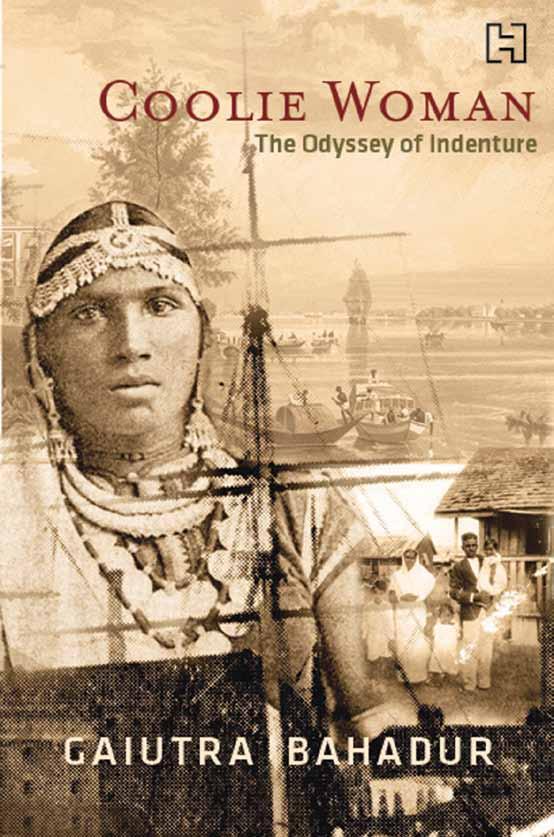
sey, gives one aspect of the whole.
Bahadur’s opening chapter “The Magician’s Box” is a brilliant piece of writing and whets the appetite for more. You look forward to more insights, more telling analysis but there are, instead, the anecdotes of the violence and analysis that, more often than not, consists of whole paragraphs of questions. This gives an impression of incompleteness, that there is more work to be done and answers yet to be arrived at.
The book could have benefited from some editing and some sharp editorial direction but, even as it stands, it would be an invaluable reference for researchers into this subject.
As much as Bahadur dwells on the violent aspects of the coolie woman’s experience and even returned a few years ago and interviewed Indian women who
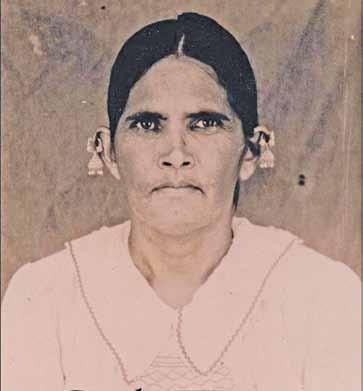
suffered domestic abuse, she leaves a large hole in the story: the subsequent racial/political violence that includes the rape, humiliation, assaults, robberies and burnings of Indian women, and the cutting of their long hair in acts of cultural rape.
Just as today’s domestic violence, alcoholism and high rates suicide among Indians have roots in indentureship, the racial/political violence also has its genesis in our colonial past. With the white master gone, it is the two larger groups who now engage in the political power struggle and the violence that has resulted is very much part of the coolie woman’s experience. It cannot be discounted, ignored, or written out.
Bahadur states that she does not see herself in our “history of hate”. She says that as a minority in the United States, the rac-
ism there connects her with Black Americans and that she has to look to the personal rather than the political for answers to her identity. She says this while choosing to conveniently ignore the fact that the racism here is very much part of her own story. It was the institutionalized racism against Indians during the Burnham regime that drove her parents to pack up and leave for America. There is nothing more personal than that.
There is always romance in such an odyssey, always elements that soar above the mean and narrow acts of surviving history, and the anecdotes that tell this side of the story, a story of bravery and triumph, do exist. It will take more than one book and one telling to complete this story and Bahadur must be commended for making a bold start.



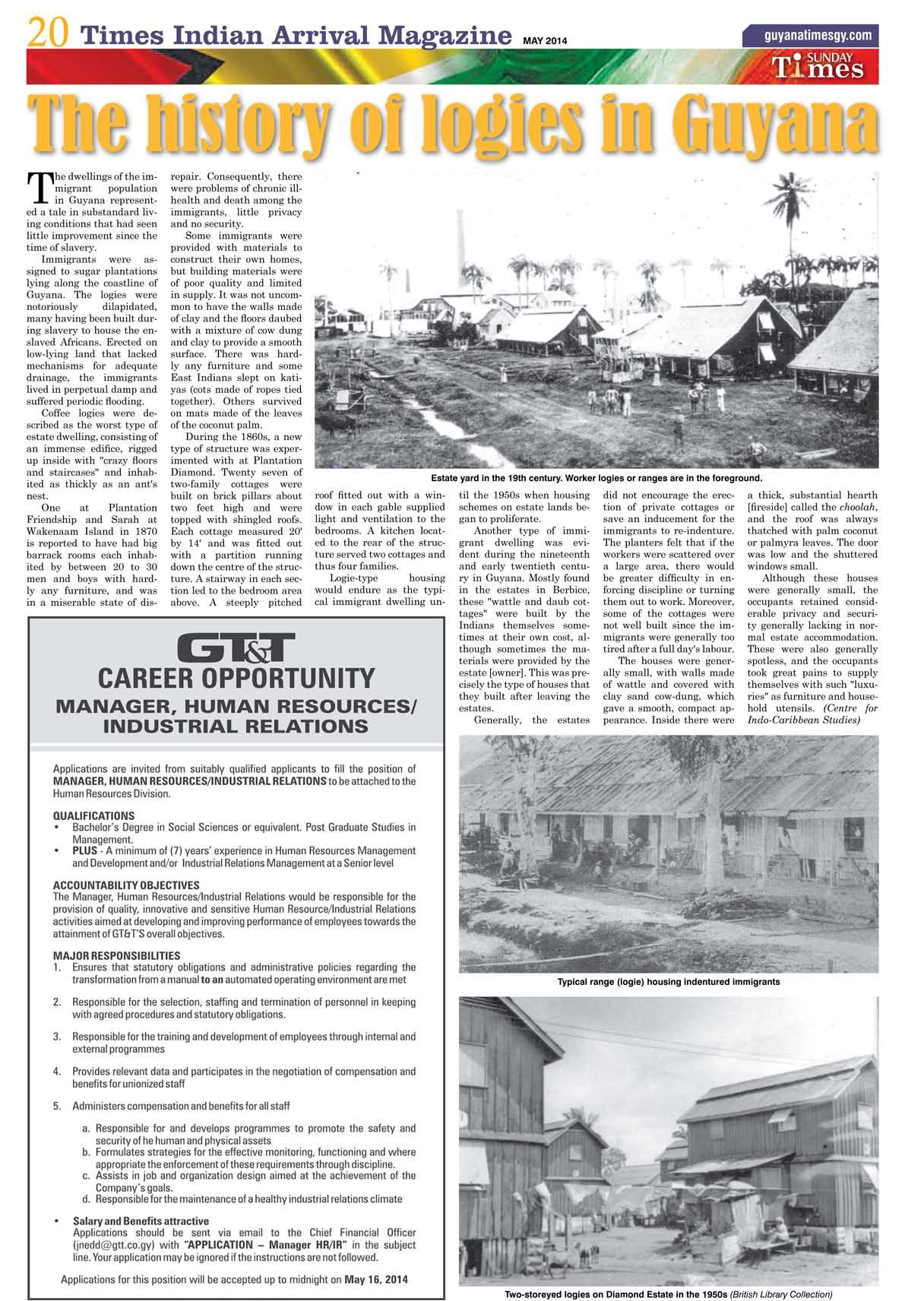
Deeply rooted in the country's culture and history, Indian interior design features rich textiles and furniture, often handmade using traditional methods. Arriving as indentured servants, Indian immigrants lived in squalid logies but remained rich in their traditions and heritage. Many homes now are often decorated to highlight this rich culture, and provide inspiration for your home.

Hand-Carved Headboard
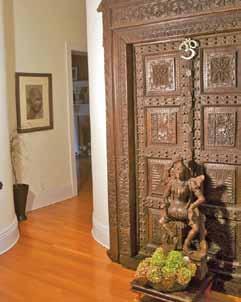
A common feature in Indian homes, carved wooden screens provide privacy while allowing the breeze to flow through the rooms.
Spiritual Elements
Indian interior design isn't just about aesthetics; it's also about creating a place that promotes health and wellbeing. This foyer was arranged to bring happiness, prosperity and abundance to the homeowners. Upon entering the home, the family is greeted with a carved statue of Vishnu, the Hindu god who preserves the world with beauty, order and peace. Behind the statue stands a set of antique doors imported from India, intricately carved and embellished with an Om, a sacred symbol in Indian religions.
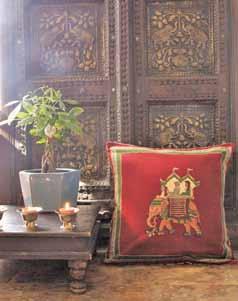
Wild Design Animal motifs are prevalent in Indian home decor, as animals play an important role in the Hindu religion. Block printed by hand in rich hues like burnt orange, ivory and green, this cushion slipcover depicts a king riding atop a richly caparisoned elephant.
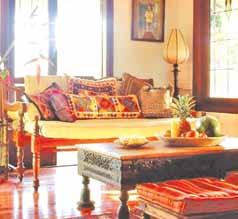
Handcrafted Furniture
Often intricately carved and made from exotic woods like teak, ebony and rosewood, authentic Indian furniture is rustic in appearance and solid in quality. When selecting furniture, work directly with the craftsmen because they embrace the natural imperfections in the wood and other materials used. In this photo, the designer balanced a heavy, wooden table with a more delicate bench-style sofa. Additional low seating and colourful accent pillows create an inviting space to gather with family.
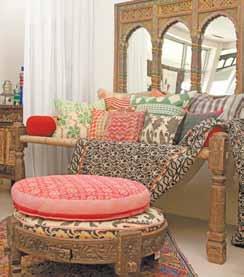
Simple and Functional Indian design often calls to mind opulent rooms draped in colourful silks, but some Indian interiors are quite simple and utilitarian. A charpoy, or a simple cot consisting of a frame strung tightly with rope, is a traditional piece of furniture popular in rural parts of the country. Here, a charpoy is dressed up with pillows made from recycled cotton saris.
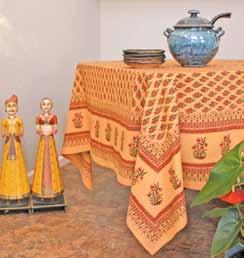
A Textile Tradition In addition to luxurious silks, printed cottons are a staple of Indian decor. Block printing, in which intricately carved wooden blocks are used to print patterns on fabrics, is one of India's oldest textile arts, as is tie-dye. This mango-hued tablecloth with a petite paisley pattern is block printed by hand, so each one has its own unique character.
authentic” than another.
Common in Bangladesh, Indian and Pakistan cuisines, Garam Masala is a general purpose, spicy warm (but not necessarily hot) Indian seasoning. It is a traditional ingredient in Indian dahl, kormas, curries, flavouring meat, samosas and tandoori.
The warm spice originated in Northern India and is also known as ‘masala curry’ or ‘masala curry powder’.
Garam Masala is a very popular Indian spice blend. The Hindi garam – meaning “hot” – and masala – meaning “spice” –is a blend of fragrant spices. Garam does not refer to the spiciness of the blend, but instead to the intensity of the spices and the warming properties in raising the metabolism.
Spices used in garam masala recipes vary from region to region. Personal taste also plays a huge part in how it is made. The most common ingredients include white and black peppercorns, malibar leaves, cloves, cumin seeds, black cumin, green, brown and black cardamom, star anise, nutmeg, long pepper (referred to as pippali) and coriander seeds. There are many versions of garam masala, but no combination is considered “more
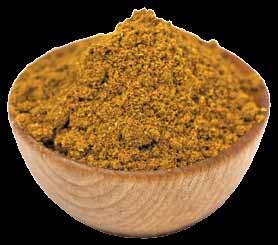
In Northwest India, garam masala normally includes cardamom, cloves, cinnamon, mace, cassia and nutmeg. Sometimes black pepper is added if the blend is going to be used straight away; adding black pepper will affect the flavour of the garam masala if it is stored. The blend is made simply by combining and grinding all the spices together, but not roasting them.
Some regions grind the spices with vinegar, water or coconut milk to make a paste. Some blend the spices with herbs, while others add onion, garlic or even nuts. In some instances, one single flavour is emphasised if it is going to be used in a certain dish. Garam masala is sometimes roasted before it is used, as this releases the aromas and flavours of the spices.
Although not a huge amount is known about the history of garam masala, it is a spice that is widely used and appreciated. In Guyana, it is no different. Based on tradition we inherited from our Indian ancestors that curry without masala is no curry at all, the garam masala has been a ‘must’ item for every Guyanese spice rack.
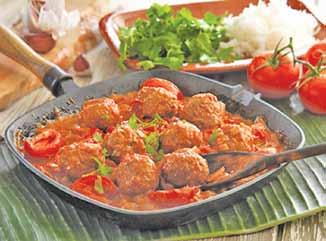
Ingredients: 1lb lean minced lamb, chicken, beef or mutton
1 tsp crushed garlic
1 large onion, finely chopped ½ tsp black pepper, coarsely ground 1 tsp garam masala 1 egg 1 tsp oil 1 tsp cumin seeds 1 tsp finely chopped root ginger
1 x 400g/14oz can chopped tomatoes
1 tsp tomato purée ½ tsp ground turmeric 60-90ml/2-3fl oz water (optional)
Method: Mix the meat, garlic, half of the onion, pepper, garam masala and egg together in a bowl. Using your hands, shape the meat mixture into 24 balls.
Preheat the grill to hot.
Line the bottom of a grill tray with aluminium foil and place the meatballs on the grill tray. (This will allow the fat to drain off into the lined tray, saving on washing up.) Grill the meatballs under a medium heat for 10-15 minutes, turning occasionally, or until nicely browned.
Heat the oil in a frying pan, and add the cumin seeds and the remaining onion. Cook for 4-5 minutes, or until softened, then stir in the ginger.
Add the chopped tomatoes, tomato purée and turmeric and cook for 10 minutes or until the sauce has thickened.
Add the cooked meatballs, reduce the heat and simmer for 20 minutes. Add 60-90ml/2-3fl oz water if the curry has dried out too much.
Serve with rice.

Ingredients: 400mls full cream milk
100gms dark chocolate (70% cocoa solids)
1 tsp light brown sugar
1 heaped tsp freshly
Method:
ground green cardamom powder 2 tbsp ginger syrup (optional)
Whipped cream and grated chocolate to garnish
Mix the meat, garlic, half of the onion, pepper, garam masIn a heavy bottom sauce pan add 200mls of the milk and bring it to a simmer. Using a whisk, mix in the dark chocolate, letting it melt on a low heat. Add the remaining milk along with the sugar, cardamom powder and ginger syrup. Stir well. Make sure it doesn’t boil and simmer for a further minute. Serve warm with a swirl of cream and grated chocolate.
By IndrawattIe natram
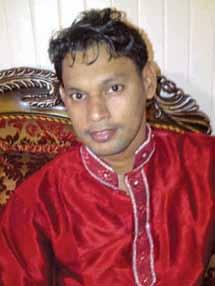
It was not an easy task for Tariq Ali, a young entrepreneur from Richmond Village on the Essequibo Coast, when he started his business, Tariq Ali Exclusive.
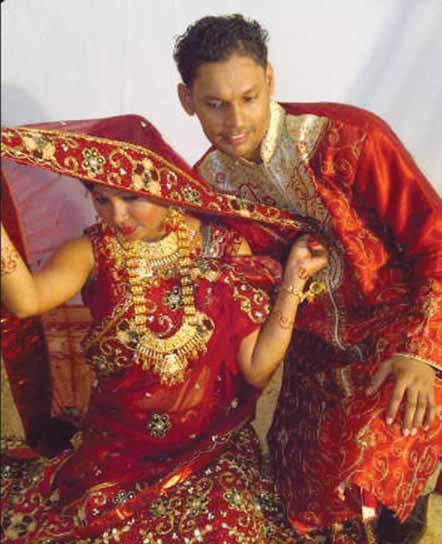
Ali’s business provides intricate, stunning Indian dresses and fashion to the people on the Essequibo Coast.
This young talented businessman realised his business potential at the age of 19 after he garnered his business skills from his parents, Mohamed Hayaat Ali and Bibi Noorjehan Ali. He said after finishing Anna Regina Multilateral Secondary School, he was unsure of his career path and so he ventured into the field of information technology. Although he was in that field, his passion for fashion motivated him to get into the industry.
He had discussions with his parents, informing them that he would like to have a business of his own. Ali said his parents were quite surprise at his proposal but gave him full encouragement. He is the eldest son for his parents.
In an interview with Guyana Times Sunday Magazine, Ali stated that his business was estab-
lished in August 1999. He was prompted to start his business because of his love for fashion and the many requests he received.
This 33-year-old businessman said that he started his business at the Anna Regina New Market and because of the resounding sales and successes he was prompted to open another venue at the Anna Regina old market. He said gone are the days when people have to source unique Indian clothes from Georgetown. “Many times people want something different however they don't know how to get it where to go and the prices are so expensive, I knew I can change all of this hence my business idea materialized.”
The businessman said that as a small boy he drew inspiration from various Indian films and admired how the Bollywood stars would be decked out in their fancy outfits. He also noted that Guyana has a rich diverse culture and as such Indian garments and trendy fashions linked with Indian ancestry are in high demand. Ali also mentioned that he supplies Indian wear to popular dance troupes, Indian weddings and other persons who are lovers of Indian fashion.
The fashion guru offers special
wedding packages, custom design outfits, pattern to simple outfits, and has outfits to suit every occasion. Ali pointed out that he is specifically linked with a wholesaler in India who assists him in placing and sending his orders.
"I love my Indian culture. When our fore parents came they brought diverse things and I am happy I am one of those persons that helps to promote their wear, everything I sell is unique, authentic and in fashion," expressed Ali.
The entrepreneur revealed that the feedback he receives from customers is overwhelming. Consequently, this prompted him to open a bigger outlet. He said customers shop at him mostly because he sells distinct pieces from India. All classical Bollywood outfits and matching jewelleries are provided.
Ali encourages youths to focus on something they are passionate about and assiduously pursue it.
Civil engineers have one of the world’s most important jobs: with creativity and technical skill, civil engineers plan, design, construct facilities essential to modern life, ranging from roads, bridges, to highway systems and are responsible for shaping our country’s infrastructure.
Jean Ramkhelawan holds not only the title of civil engineer, but the coveted title of the first female civil engineer of Indian descent in Guyana.
With determination and resiliency demanded by this taxing profession, as a civil engineer Jean has been able to tangibly contribute to Guyana’s development.
On 13 May 1955, Jean entered the world as the third child of her East Coast Demerara resident parents. There were many rough patches for this large family living in Industry, as her father was a cane cutter and her mother was a housewife. Overcoming those hurdles, she attended Cummings Lodge Secondary School on the East Coast from 1966–1972 where she successfully attained four GCE O’ Levels. Her first job was as a typist/clerk at the Ministry of Public Works in 1974.
In 1975, she took another step in life when she married. Shortly after her marriage in 1976, she was transferred to the materials division of the public works ministry as materials technician in the lab. Her curiosity about the field was aroused while working in the civil engineering lab at the ministry. This innate inquisitiveness and quest to learn more propelled her join GTI (Government Technical Institute) in 1978.
In 1980, she graduated with a technician diploma in building and system civil engineering (City and Guilds). Still maintaining her full-time job at the ministry and not satisfied with just a diploma, she enrolled at the University of Guyana in 1982 to study civil engineering.
At that time engineering, which was her passion, was a field dominated by males. In her class, she was the only female among 16 males. Not intimidated by the male presence, she was able to hold her own, as she was treated equally, and garnered their respect. After four years of hard work and keeping the same pace with the men, she graduated in 1986 with her civil engineering bachelor’s degree.
While she was breaking barriers in her academic and professional life, she was also a wife, and had become a mother in 1976, when her first son was born. She has five children.
By this time, her contract with the Ministry of Public Works was also up, but she decided to remain there with
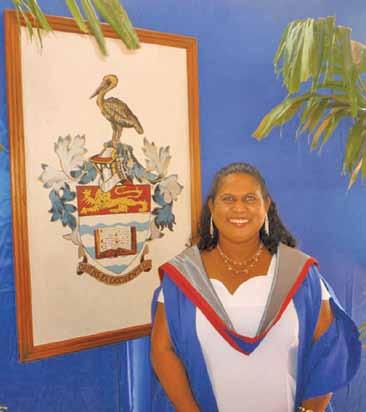
an upgraded position as Foils Engineer. In 1992, she was promoted to Chief Materials Officer and then Deputy Chief Road Officer before resigning from the ministry in 1994. She left public service completely in 1994 and started consultancy for a series of private firms. Her first consultant job for E and A Consultant Services entailed supervising construction of roads and minor design works. She later worked for a series of companies including Seeram Brothers and DIPCON Engineering Services, before returning to the public sector in 2000.
At the same time, she started lecturing at the Faculty of Technology at the University of Guyana. In 2005, she simultaneously lectured and did a short course in Project Planning and Project Management at the Critchlow Labour College. She resigned from the University in 2006 and enrolled for the Masters programme at the University of the West Indies (UWI) in Trinidad. Jean graduated in January 2009 with a distinction in construction management.
The professional’s distinguished career and achievements were augmented with time as she continuously work for the development of Guyana’s infrastructure. From 2010 to March 2012 she served as president for the Guyana Association of Professional Engineers (GAPE) and, on concluding her two-year service, she remained as an executive member for GAPE. She is also a member of the IDB Civil Society Consulting Group and a member of the American Society of Civil Engineers.
In an interview with Guyana Times Sunday Magazine, Jean stated she is currently employed as a site engineer on the East Bank Four-Lane Expansion Project.
Outlining her challenges during her career, Jean disclosed that during her career she worked with both contractors and consultants. “Some of the challenges I face are, supervising male workers on projects, performing to the same status as my male counterparts, and being the leader of a team of foreign workers. On construction sites, the culture is that men are the dominant species. The Guyanese culture is so cut out that men are the bosses. To be taking orders from a female engineer on site was something many co-workers were not too pleased about. But on site these workers were told to respect an individual's position and be co-operative, even if they do not appreciate the individual,” she recalled.
She also revealed that she was expected to perform just as equal as her male counterparts as they were all at the same level. Being in the men's domain and earning a salary at the same scale and with almost the same educational background, Jean said she had to give her best at all times.
She noted that this was one of the toughest positions she held during her career. She recalled that at one time she had about 10 foreign workers under her supervision for a special task for the company she was employed with. Although she met with some resistance at first, through motivation, determination and good leadership, she was able to help the team improve on their performance.
This exemplary woman certainly is someone who should be emulated. Her advice for women is to have a sound educational background and develop skills so that they can be their best.
“It is said that for a woman ‘beauty without brains is a waste of time’. However, education is knowledge, and our knowledge increases every day, while beauty fades as we age. Knowledge can take anyone to great heights,” she declared. (Information from 2012 Horizons Guyana Magazine)
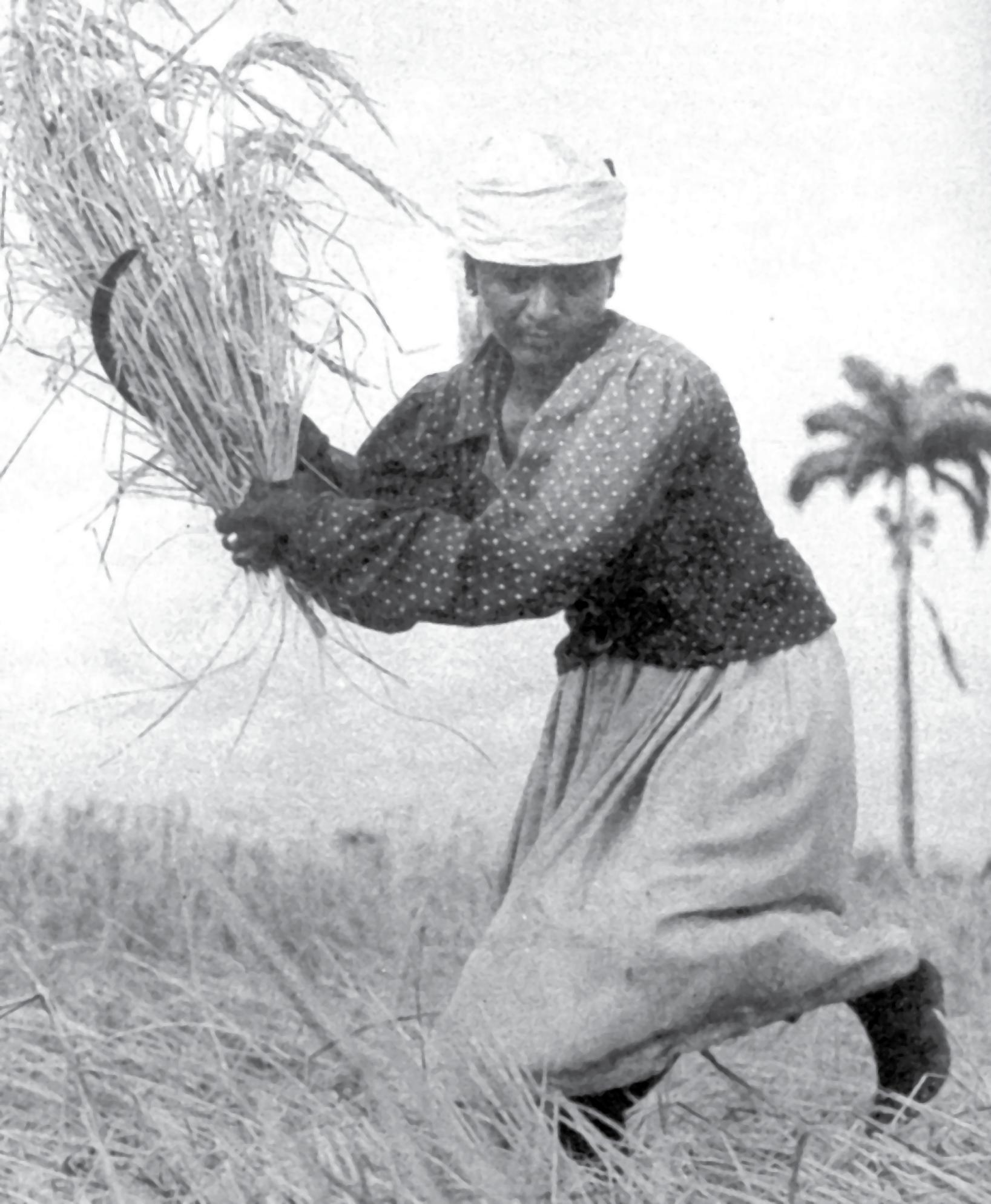
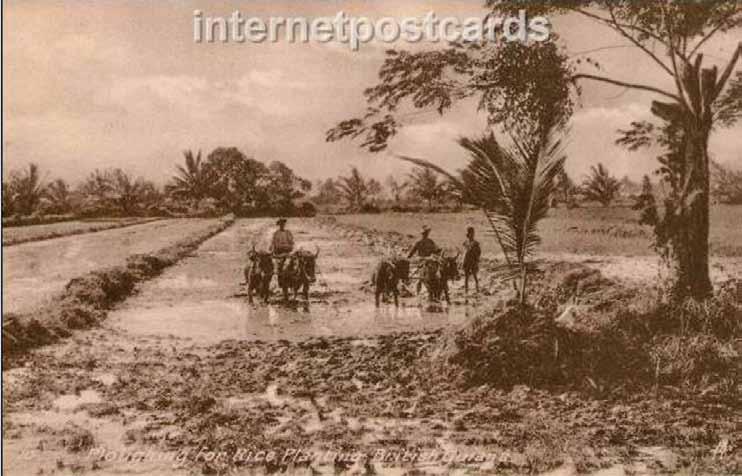
swampy land to grow rice, as many of them would have done back in India and for which they were eminently skilled. They drained the land manually with shovels on Sundays and in the "out of crop" season, planted the paddy individually, cleaned the roots of weeds, and eventually threshed the paddy with their hands. In this way, they supplemented the abysmal, subsistence wages from the sugar planters: in effect were actually subsidising their own labour costs to the sugar barons. They could now feed themselves to show up for work whenever the planters needed them. The labourers were also tied to the environs of the sugar plantations.
In 1865, in the first large scale endeavour, 16 acres of rice were planted by indentured labourers at Plantation Edinburg on the West Coast of Demerara. This is now Leonora - more specifically where the new Leonora Primary School is located, next to the first rubberised track and field facility under construction. This was a seminal entrepreneurial move as there was no guarantee of success. But it was the launch of what is now an industry that produces over 500,000 tons of rice and is the largest employer in the country.
Even though there were ups and downs, by 1884, about 2500 acres were cultivated across the coast and this increased inexorably as the farmers' gamble paid off. They were increasingly able to supply the needs of the
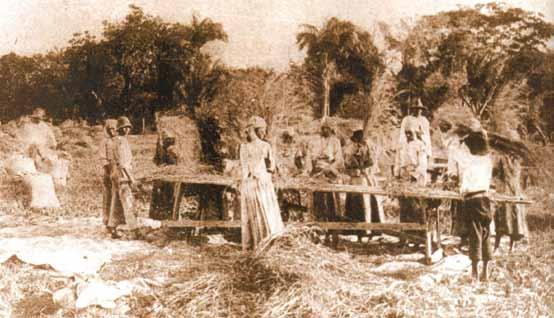
colony for rice which up to then had been imported for India and Burma, which averaged some 19,000 tons annually. By the beginning of WWII in 1914, the acreage rise to 47,000 acres and the imports down to 2500 tons. With the German blockade of shipping during WWI, no rice imports could be facilitated and the immigrant farmers rose to fill the need of the hour. By the end of indentureship in 1917, one year before the end of the war, the acreage had grown to 58,000 acres. Three tons were recorded as imported. But just as importantly for the fortunes of Guyana, in 1903, five tons of rice were exported, but this soon became a torrent as the excess beyond Guyana's needs found a ready market in the West Indies. Another boost was received during WWII, between 1938-1945, when exports jumped to 25,000
tons.
The spin-offs
Success in rice encouraged Indians to move off the sugar plantations and they took a pioneering role in bringing into cultivation vast swathes of uninhibited land on the banks of the Mahaicony and Mahaica Creeks. It was the same on the Corentyne Coast. When sugar cultivation was abandoned in Essequibo and the Islands there, rice cultivation by the descendants of indentured labourers filled the agricultural gap. Many took huge risks to expand the industry.
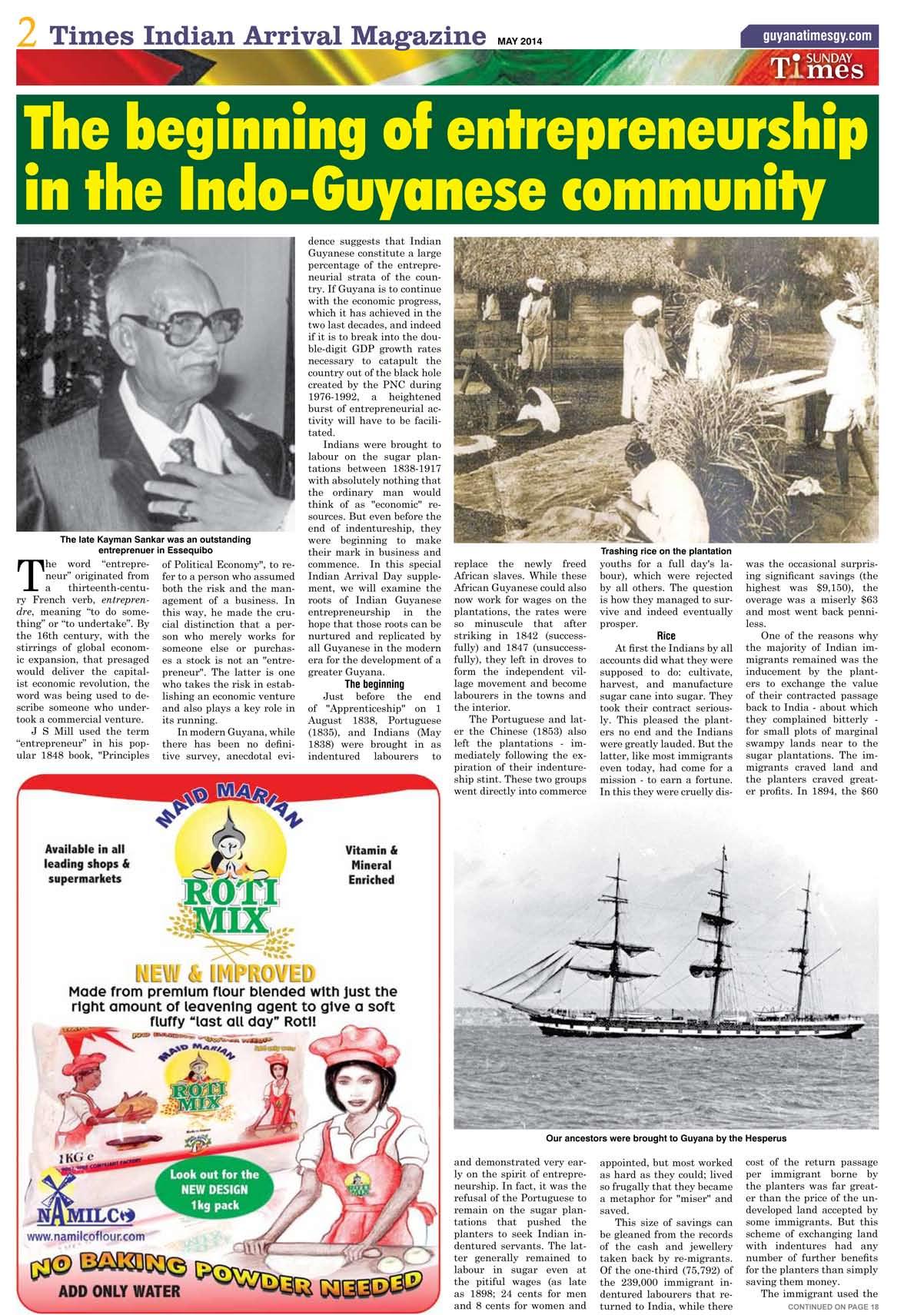
Kayman Sankar was one of those pioneers. Originally from the West Coast of Demerara, he moved to Essequibo and invested in land. Starting with two bulls, he eventually became Guyana's largest rice farmer using mechanised equipment and pioneering rice
milling and exporting packaged rice. Rice milling is a direct spin-off from the cultivation of rice and very early on, entrepreneurs invested into equipment that in most instances had to be fabricated right here in Guyana. What the rice industry has shown that once there is an identified need in any populace, there will have to be individuals who are willing to use their resources, even if it is their labour and time, to fill that need. These are the entrepreneurs that will build this country. But Kayman Sankar's company's downward trajectory in the last decade, just before his passing, demonstrates what is forgotten by most: the inherent risks in entrepreneurship can sometimes bring even the giants down. All it takes is "guts" to succeed!

ness and ensure that the company’s burgeoning reputation in quality and service continued.
The return Shortly after Nuckshed’s passing in 1994, the supermarket in Canada was closed and Nuckshed and Shamdayee’s third son
Harry returned to Guyana with his wife Bharati and their three children to run the business fulltime. The closure of Canada operations has not done much to stem the popularity of Mattai’s Garam Masala and spices in Guyanese communities abroad.
After Harry returned to Guyana, he was able to demolish the old existing building in Water Street and construct a new building. Over
the years, additional stories have been added to create the extensive building that sits on Water & Hope Streets today.
N&S Mattai & Company continues to expand to accommodate Guyana’s diversified dietary needs and desires, offering hundreds of products from around the world. N&S Mattai was the first company in Guyana to import Indian foods, spices, pickles, seasonings and snacks, catering to the Indian national community as well as the wider Guyanese population, and continues to lead the market in this area today. The company is actively involved in various areas of the community such as culture, charity, education, environment and recreation.
Harry has also transformed the company’s scope, expanding a successful grocery store into a place where customers can become more educated shoppers and have an overall better shopping experience. He makes it a point to educate himself on food trends, nutritional information and health benefits and shares this with his customers by making himself accessible for a conversation anytime and via the company’s radio programmes. Harry stays true to the company’s commitment to quality and health.
The company’s history still plays a significant part in day-to-day operations. Its original sign still hangs proudly inside the store and pictures of Nuckshed and
Shamdayee are permanent fixtures in Harry’s office. Harry honours his father’s love for racehorses and football by supporting horse racing events and sponsoring a football team in Tiger Bay. Shamdayee remains vehement that family name remain a source of pride and regularly reminds the family that she and Nuckshed worked too hard to have others squander it. Anybody who spends five minutes with Harry can plainly witness the contentment he feels by living the legacy and carrying on the family’s name and traditions.
Today, N&S Mattai & Company stands proudly as a testament to the power of hard work, determination and prayer.
Taana boy, how you do? How Shanti stay? And Sukhoo? Mosquito still a-bite all you?
Juncha dead true-true?
Mala bruk-foot set?
Food deh foh eat yet?
England nice, snow and dem ting, A land dey say fit for a king, Iceapple plenty on de tree and bird a-singIs de beginning of what dey call ‘The Spring’.
And I eating enough for all a-we And reading book bad bad.
But is what make Matam wife fall sick And Sonnel cow suck dry wid tick?
Soon, I go turn lawya or dacta, But just now, passage money run out So I tek lil wuk –I is a Deputy Sanitary Inspecta, Big-big office boy! Tie round me neck! Brand new uniform, one big bunch keys! If Ma can see me now how she go please…
By David Dabydeen (Extracted from India in the Caribbean; Edited by David Dabydeen & Brinsley Samaroo, published in 1987)
Hands beat against water hands beat a rhythm against waves
hands are hardly wet in water they sweat – oil of body and skin
pores, pores against crystal water
entering the hothouse domain next –
they raise machetes in a virulent sun assault upon history
pauper thin echoes loss and separation
words criss-crossing galley after galley
By Cyril Dabydeen (Extracted from India in the Caribbean; Edited by David Dabydeen & Brinsley Samaroo, published in 1987)

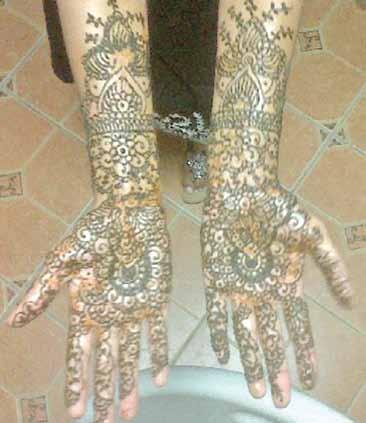
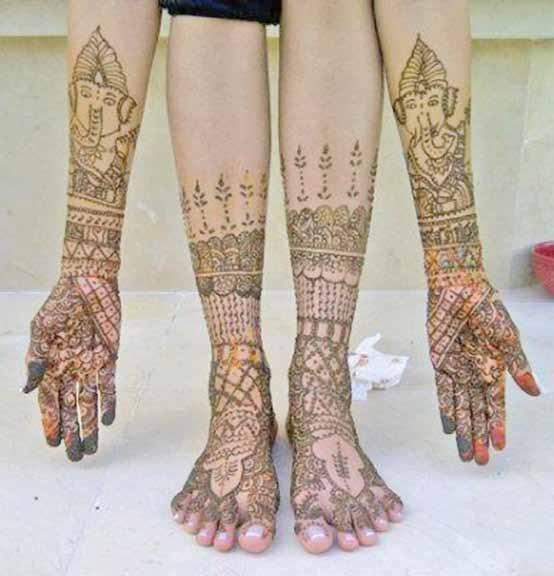
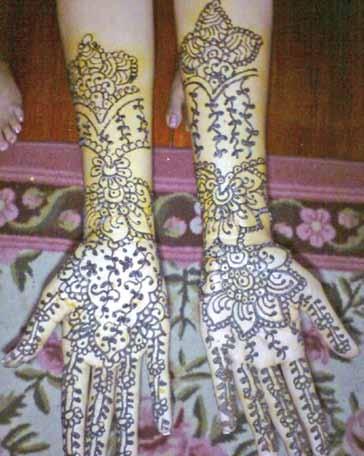
For centuries, mehndi, the art of henna painting on the body, has been practiced in India, Africa, and the Middle East, where the henna plant is believed to bring love and good fortune, and protect against evil. Mehndi is traditionally practiced for wedding ceremonies, during important rites of passage and in times of joyous celebration.
A paste made from the crushed leaves of the henna plant is applied to the skin, and when removed several hours later, leaves beautiful markings on the skin that fade naturally over 1 to 3 weeks.
Besides being the key ingredient in mehndi, henna has also been used to dye the manes and hooves of horses, and to colour wool, silk, and animal skins, as well as men's beards. Studies of mummies dating back to 1200 BC show that henna was used on the hair and nails of the pharaohs.
In Guyana, mehndi artists are widely sought after by Hindu brides who want to decorate their hands and feet with henna. The divine, feminine look of mehndi designs makes it so significant that now there is a night before the Hindu wedding that is allotted “mehendi night”, usually the Thursday before the wedding, where the bride and other females gather to get their hands and feet adorned with this ancient art.
Local mehndi artist Anita Singh, in an interview with Guyana Times Sunday Magazine, said she enjoys coming up with creative designs, and although she gets paid for it, her mehndi art is therapeutic as it is something she loves doing.
The satisfaction from the brides and others who are impressed with the mehndi designs is what motivates Anita to continue and develop her art.
“A couple of years ago I attended a mehndi night, which sparked my interest in the art. I just picked up the henna cone, without practicing any design, and started drawing. Many were impressed with my talent when I was done and asked me to do theirs. I snapped a picture of what I had done and uploaded it to Facebook. I received an overwhelming response. Now I get many requests to do mehndi for brides,” Anita disclosed.
The artist has done much research on mehndi art, which helps in conceptualizing more intricate designs. Her aunt brought a book from India on mehndi, which helped Anita to develop other excellent techniques.
Learning from the basic to the complicated, Anita encourages anyone who wants to get into this art form to do their research and practice regularly so as to perfect their skills.
She said she would usually draw the designs on paper first, which helps her to be as creative as she can. After practicing the designs on paper, she then replicates them on hands and feet, which take about 2 hours to complete.
“I design both feet and hands for weddings only. It’s part of my culture and I love the art form, and seeing my work after I’m done is fulfilling. I’m always practicing. I import my mehndi from India or the U.S., which is a better quality. I would also squeeze lime juice on the design, which helps it to stay on longer,” disclosed the selftaught mehndi artist.
Anita said to date the most designs she has done is for 45 girls in one night. Her most challenging design was done recently where she incorporated the Hindu god, Ganesh, in her mehndi design as requested by the bride. Although it was a
challenge, Anita felt satisfied after she saw the finished product.
Although her art keeps her busy, mehndi is not her only pursuit as a businesswoman.
“Sometimes my mehendi work takes me until 3 in the morning, but I’m always up for 9 to open my store. I specialize in mixing and matching jewellery accessories with any outfit. This styling aspect of my personality I also enjoy doing apart from mehndi. I started my business from selling from a box. Now I have my own boutique where I also practice my mehndi designs. I think having the patience and discipline are what helped me to develop self-confidence to pursue my dreams and to be creative. I encourage other young girls out there to do the same. Know what you would love to do and pursue that. When you do something you love it will never feel like work,” Anita urged.

By Ashook RAmsARAn
My personal quest for my own connection to India was always a yearning long before I met with Minister Jagdish Tytler of the then newly formed Ministry of Overseas Indian Affairs (MOIA) in Brussels, Belgium in October 2004.
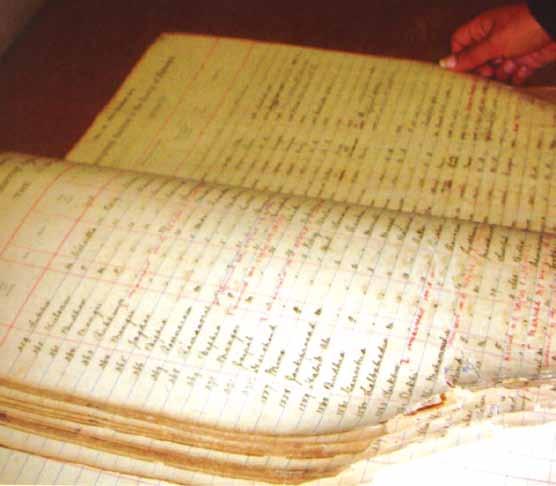
My continuing search and inquiries led me through many pathways but nothing definitive that would allow me to pursue a direct link to the ancestral village of my great grandfather Pooriya who arrived in Guyana (then British Guiana) as an Indian indentured laborer in 1853 aboard the ship Adelaide. That information was shown in the single line entry in the birth record of my grandfather Ramlochannd born March 10, 1867 in Guyana. That single line entry also listed my great grandmother Radhah having arrived in Guyana in 1860 aboard ship Colgrain. With no ship records of 1853 or 1860 available in the archives in Guyana, my search moved beyond Guyana to other possible sources such as India and the United Kingdom where I was hopeful that secondary records were kept.
In conjunction with that pursuit, I wanted to become more involved in civic organizations that focused on persons of Indian origin (PIOs) living in various countries. In 1998, I co-founded of the Guyanese East Indian Association (GEICA) which focused on adaptation and assimilation of PIOs from Guyana (and other parts of the Caribbean) in the United States. That same year, I became a life member of the Global Organization of People of Indian Origin (GOPIO International) and shortly thereafter advanced to the position of
Ram S. Singh was born March 26, 1912 in Alexander Village to indentured parents who had arrived in the colony of British Guiana in 1894. His father died in 1938 and his mother 10 years later.
Singh began his career with the British Guiana Museum of the Royal Agricultural and Commercial Society as a “washer or museum assistant” in 1924 at just age 12, after completing his basic education at the Ruimveldt Anglican School on what was then considered the East Bank of Demerara.
The then museum curator Walter E. Roth, along with P.S Perberdy, who was to succeed Water Roth as curator, further mentored the young Singh. In 1939, Singh was awarded a Diploma in Taxidermy of the North-Western School of Taxidermy in Omaha, Nebraska; then in July 1946,Singh was sent to the U.S under a special scholarship, to take a course in modern, scientific and educational techniques of taxidermy and exhibition arrangement at the Chicago Museum of National History.
Secretary General.
From both my vantage point as Secretary General of GOPIO and my regular interaction with other PIOs and non-resident Indians (NRIs) on a global scale, I was able to view the entire global landscape of PIOs and the history of emigration from India during the 19th and 20th centuries. In particular, I acquired historical details, more in-depth knowledge and valuable information on Indian indentured laborers from 1834 through 1920. This appealed to me since I was interested in knowing more about my great grandfather and his journey to Guyana, with the intent that perhaps someday I would be able to find his ancestral village.
After review of my proposal and subsequent discussions, Minister Tytler of MOIA was convinced that my request to initiate and chair a session at PBD2005 was a worthwhile one: I chaired the first “Tracing The Roots” session at Pravasi Bharatiya Divas (PBD) 2005 in Mumbai, India. That session spawned renewed intensity among PIOs and encouraged MOIA to establish “Tracing The Roots” initiatives within MOIA and those were qualified to do actual searches for families in Indian based on emigration information obtained in the countries of destination. A few Indian states, including Bihar, also initiated programs to assist PIOs to trace their respective families and their ancestral villages.
I considered this a welcome trend that contributed to more interest among descendants of Indian indentured laborers and their quest to connect to their ancestral villages and, in effect, to India itself. It was a very successful session that drew on the expe-
By courtesy of the director of the museum Colonel Clifford Gregg, Singh also received an eight-month practical course in Taxidermy, Botany, Anthropology and Zoology, and went on to study the preparation of school exhibits. Upon completion, Singh was invited to study at the Colorado Museum in Denver for two months, in which time he visited the premier museums in San Francisco, Los Angeles, Iowa, Milwaukee; the American Museum of Natural History in New York and the Smithsonian Institute in Washington.
During his time in the U.S, Ram Singh received a diploma in zoology, and was highly praised by both staff and students for the quality of his work. He became a member of the American Ornithological Union (MAOU) and the British Ornithological Union (MBOU). He returned to British Guiana June 11, 1947 to continue his work for the BG museum, when he was appointed assistant curator.
Ram Singh was also an expedition pioneer. Before his studies in the U.S, he accompanied both Walter Roth and Perberdy
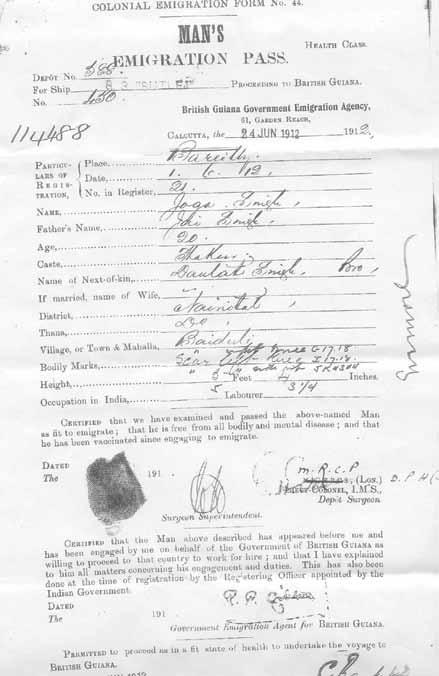
riences of many in PIO countries, historians, academicians and custodians of records of Indian emigration, in particular Indian in-
on interior scientific expeditions; going with Perberdy on the Pinkus-Perberdy Mount Roraima Expedition of 1938-1940. In 1939, Singh accompanied Dr E. Davis of Harvard University on a field expedition up the Mazaruni River.
After the Feb. 23, 1945 Great Fire of Georgetown destroyed the museum and many of its exhibits, Singh would lead at least 11 special expeditionsinto Guyana’s interior to collect new material for the museum. He first travelled to the Abaryregion Feb. 4, 1946; two years later, he reached the upper Abary, the Demerara River, through the north-west regions and the Rupununi district, collecting specimens.
He also travelled extensively along the coastlands from Essequibo to Berbice.
The specimens were stuffed in the field before being brought to Georgetown; something, it was said, that had never been done before in the colony. With his extensive knowledge gained from travels in the US, British Guiana and Brazil, Singh was able to collect, preserve and exhibit museum specimens.
dentured laborers from 1834 through 1920.
Thereafter, I was emboldened and encouraged to seek more and
to do more to fulfill that personal desire to find and connect with the land (even the village) of my ancestors.
Since that time and previous as well, it has been a journey into the unknown, seeking those I have not known but wanting to know. Yet somehow it felt that I may have known them all along but have been missing the connection that could fulfill a long desire that exists as a vacuum. For lack of success in my own quest, that personal quest was quickly transformed to a universal one, representative of the descendants of those who left India from the ports of Kolkata (Calcutta), Chennai (Madras) and Mumbai (Bombay). In so many ways, it was fulfillment of another kind, for the larger good – and how fascinating this journey has been at every single point for me.
While I was standing with Leela Sarup and MOIA officials on the Kidderpore Depot docks on July 7, 2010, that realization came to fruition when the agreement was made with Dr A Didar Singh, Secretary of MOIA, to embark on a two-phase effort to pay tribute to Indian indentured laborers of 19th and 20th centuries (in particular, from 1834 through 1920): Installation of a memorial plaque at Kidderpore Depot (to be unveiled on January 11, 2011) to be followed by a memorial museum and resource center in a suitably significant site in Kolkata. In that respect, the July 7, 2010 meeting was quite historic indeed. Born in Guyana, Ramsaran resides in the USA. President of GOPIO Int’l and advocate of interests of PIOs, spearheading the Kolkata Memorial project. (Indian Empire Magazine. Permission granted by editor)
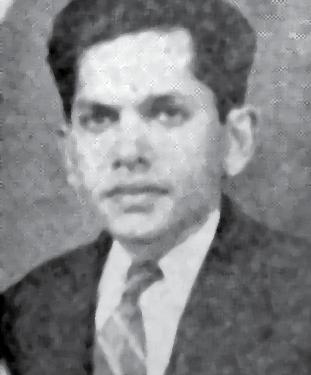
Assembly in Guyana. Prior to the fusion of the profession, he was one of the leading Solicitors in Guyana, specialising in conveyance, mortgages, land and commercial law. Mr. Sase Naraine practised for over 50 years, and occasionally, he still appears in the Courts.
Today at the Guyana Bar, the most respected and perhaps the longest serving East Indian Legal Practitioner is Senior Counsel Mr. Doodnauth Singh. Mr. Singh’s stellar legal career exceeds fifty years. In his early years, he served in the Attorney General Chambers and also acted as Police Legal Advisor for several years. But it was at the private criminal bar where he built his reputation and served with distinction. He participated in most of the major criminal cases of his time, including the famous (or infamous) three trials of Arnold Rampersaud. He not only practised in Guyana but in several Caribbean jurisdictions, including, Trinidad and Tobago, where he represented Anisa Abu Bakr, the wife of Yasseen Abu Bakr, the leader of the failed Coup d’etat (1990), in respect of charges arising out of that incident. In Grenada, he was part of the defence team representing those charged with the murder of Prime Minister Maurice Bishop
and several of his Cabinet colleagues. In Dominica, he prosecuted several cases for the Dominican Government, including charges against former Prime Minister Patrick John. In 2000, he was appointed Attorney General of Guyana, a fitting Coup de grace to an outstanding legal career. He resigned in 2008 after over 50 years of practise at the Bar.
Mr. Doodnauth Singh was succeeded by Senior Counsel Mr. Charles Ramson, who is currently the Attorney General. Ramson has served as Attorney General on two previous occasions. He also served as Justice of Appeal for approximately one year. Another East Indian lawyer whose work, because of its nature, is not usually recognised, is Senior Counsel Mr. Cecil Dhurjon. Mr. Dhurjon is currently Guyana’s Chief Parliamentary Counsel, a position which he has held for the last 25 years. He is the country’s principal legal draughtsman and is responsible for the drafting of all legislation. His legal career spans a period of over 40 years, almost all of which he spent in service to the State. As Chief Parliamentary Counsel, he would have been present in Parliament and participated at the Select Committee of every major piece of legislation enacted in this country over the last quarter of a century; this by
itself is indeed an exceptional accomplishment.
Apart from the Luckhoo’s dynasty to whom reference has already been made, many East Indians, as judges, have contributed and continue to contribute by their judgments to the rich Guyanese jurisprudence which now obtains. Prominent amongst them are Mr. Guya L. B. Persaud, Mr. Cecil Kennard who served as both Chief Justice and Chancellor, Mr. Akbar Khan, Mr. Dhanesar Jhappan, Mr. S.Y. Mohamed, Mr. Maurice Churaman, Mr. Prembishaul Persaud, who before he was appointed a Judge, was perhaps the longest serving magistrate in the entire Commonwealth Caribbean, Ms. Claudette Singh, Mr. Carl Singh, who is the current Chief Justice of Guyana performing the junctions of Chancellor of the Judiciary, Mr. Nandram Kissoon, Mr. B.S. Roy, Mr. William Ramlal, Mr. Jainarayan Singh, Mr. Rishi Persaud and Ms. Diana Insanally. The position of Commissioner of Title and Land Court Judge for both Demerara and Berbice are currently held by East Indians, Mr. Rabindra Rooplall and Mr. Sahadat Mirza, respectively. Presently, there are approximately seven East Indian Magistrates on the bench in
Guyana.
Guya became Guyana’s Solicitor General in 1960 and was then appointed a Pusine Judge in 1961. He became one of the youngest Justices of the Appeal Court in 1966 and acted as Chief Justice in 19691970. In 1976, Guya migrated to Trinidad and Tobago to take up a position as Deputy Director of the Hugh Wooding Law School. In 1971, Guya received the Cacique Crown of Honour (Guyana) and in 1991 he was awared the honour of Silk at the Guyana Bar.
At this juncture, it is apposite to recognise the contributions which IndoGuyanese have made as Judges in several jurisdictions in the Caribbean. The contributions which Mr. Joseph Alexander Luckhoo made to the Court of Appeal of Jamaica have already been noted. Mr. Guya Persaud served both in the High Court and the Court of Appeal of Trinidad and Tobago for several years where he delivered some of the leading judgments of that period. At the Eastern Caribbean Court of Appeal, Mr. Satrohan Singh, a former Magistrate in Guyana, rose to the position of Chief Justice after several years of service in both the High Court and the Court of Appeal. Mr. Maurice Churaman and Mr. Loris Ganpatsingh, both for-
mer Judges of the Guyana judiciary are currently serving as Judges in that jurisdiction.
Public Officers
The Registrar of the Supreme Court is the Chief Executive Officer of the High Court of the Supreme Court of Judicature. This most important position was held for 20 years by Ms. Sita Ramlall. As far as I am aware, she is the first female and certainly the first Indian woman to have held this high quasi-judicial office. The Director of Public Prosecutions is another important constitutional institution and it is the organ responsible for the institution and prosecution of all criminal charges in Guyana.
Ms. Shalimar Ali-Hack is the holder of this high constitutional office. Again, as far as I am aware, she is the first female and certainly the first East Indian female to have held this position. She succeeded Mr. Dennis Hanomansingh, another Indian who was a former Judge of the High Court.
Currently practising at the private Bar are many lawyers of Indian descent who have had outstanding and distinguished careers. They practise at every level of the hierarchal judicial structure, that is, from the Magistrate’s Court to the Caribbean Court of Justice.
Notably amongst them are Mr. Ralph Ramkarran S.C, who is also the Speaker of the National Assembly, Mr. Moenudin Mc Doom S.C, Mr. Jailall Kissoon, Mr. Vidyanand Persaud, Mr. K.A. Juman Yassin, Mr. Rafick Khan, Mr. Murselene Bacchus, Mr. Rajendra Poonai, Mr. Vic Puran, Mr. Khemraj Ramjattan and many more too numerous to mention. Every year more East Indians continue to be admitted to the local Bar. Refreshingly, over the last 20 years, we have witnessed a large increase in the female contingent. This is a significant accomplishment since historically and culturally, Indian women’s traditional role was seen to be that of a wife and homemaker; they were never encouraged in professional pursuits. In conclusion, the contributions which East Indians have made to the legal profession in Guyana are beyond disputations and indeed, are deeply etched in the architecture of the legal system of Guyana. It is now the responsibility of the younger practitioners at the Bar and those who are yet to come, not only to continue this great and noble tradition, but to strive to emulate and certainly surpass it. The legacy must be kept alive. (First printed in the Horizons Magazine 2010)