




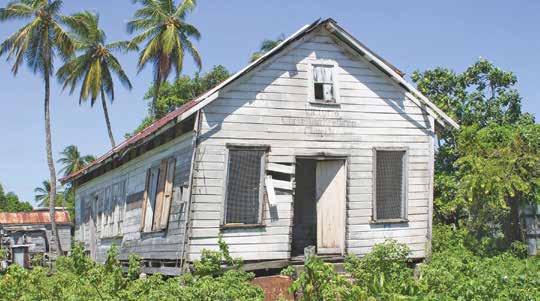
When visiting the Dharm Shala, it is difficult to miss the colonial wooden structure on the opposite side of the road. A quaint Folk Victorian style house, characterised by its two and one-half storeys, shuttered stained glass windows, gothic carpentry details and square symmetrical shape, it is a white and brown residential property that has been standing for more than 80 years.
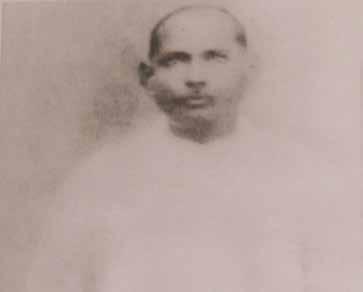
Built in 1932 by humanitarian Pandit Ramsaroop Maraj, the building has been in the family for three generations and counting; it has remained the same with no structural alterations during its 82 years of existence.
However, planks of wood


have been replaced over the years for the maintenance and preservation of the structure, Stella Ramsaroop, Maraj’s granddaughter who currently resides on the property, ex-
With what is described as ‘two and one-half’ storeys by modern architecture, the first two floors have a square symmetrical shape, while the smaller top flat, found just above an eave (an edge roof projecting beyond the building for both practical and decorative functions), has a front gable (a triangular formed sloping roof) with carpenter gothic details (gingerbread trim/intricate wooden designs).
plained to the Guyana Times Sunday Magazine
“Because it’s a wooden building, ever so often you find wood ants and such and we would have to replace the wood, but the structure is just the same, it hasn’t changed and we wouldn’t change it,” she declared.
According to Ramsaroop, they have had good luck over the years because renovations were not “necessary very often” due to the building being built with “excellent wood cured for many years”.
Built with planks of Mora, the family sprays the house quarterly for wooddestroying pests and regularly cleans it to keep it in the best shape possible.
“It is a family house, but we use it for Dharm Shala as well; we use it as a reception area and for meeting purposes,” stated Ramsaroop. She added that her grandfather built the house to keep “nearby” to his work, that is, his charity work at Dharm Shala, located opposite the house, which he founded in the early 1920s.
Such houses, Folk Victorian, are often characterised by aligned horizontally and vertically sym-
metrical windows in rows, which can also be clearly seen on the house along with the added colonial features of stained glass and wooden shutters.
After Ramsaroop’s grandfather died in 1950, the house was passed on to her late father, Harisaran Ramsaroop, who dutifully cared for it for 63 years until he died in 2013, passing it on to his children.
“My father was very efficient and conscious of things around him, he was an extraordinary person, so he kept repairing and repainting it,” Ramsaroop recalled. With the bottom floor used mainly as a store room and the very top as living quarters (mostly bedrooms), the middle flat is generally used as a reception area, a boardroom for volunteer meetings, and the operations office of the Dharm Shala.
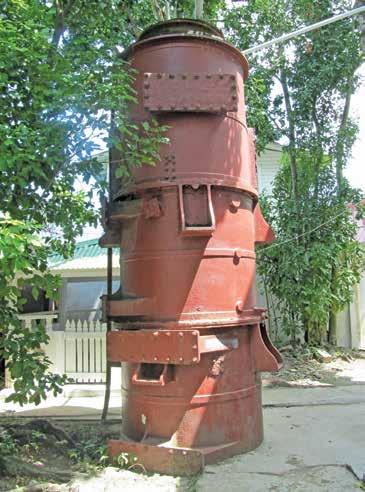
Even around the yard one can find antiquities. There is a towering tank, presumably a vacuum pan acquired by Maraj from a sugar estate (used as a water tank to this day), a small Lord Shiva mandir, and the St Francis Chapel (an old Anglican church); all fixtures present since the construction of the building.
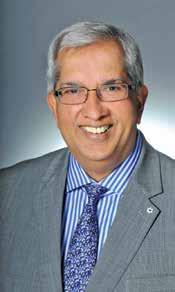
Winston Kassim, CM, ICD.D, Chairman of IDRF (International Development and Relief Foundation) says the Canadian-based charity will continue to invest US thousands of dollars in improving access to education and medical care for needy people in Guyana.
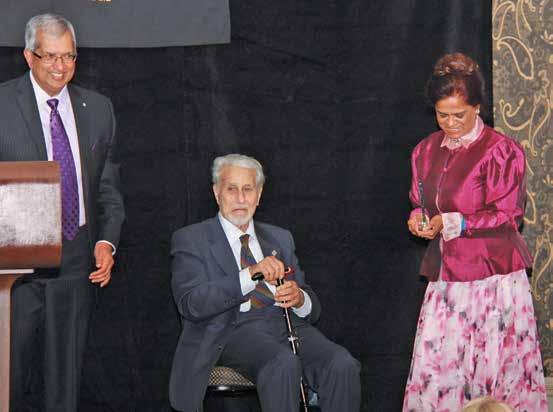
Speaking at IDRF’s 30th Anniversary Celebration Gala on 18 October 2014, Kassim told the capacity crowd of 500 supporters in Toronto that IDRF has helped millions of people in 35 countries plus Canada, over the past three decades.
A native of Guyana and the first Guyanese Order of Canada recipient, Kassim has visited a number of IDRFsponsored projects, including in Guyana, during the past three years and has come away impressed with how much was being done to support needy people.
“As a Canadian of Guyanese heritage, I am always proud to see how the generosity of our Canadian donors is being put to such good use for the benefit of needy people in Guyana. We take great pride in measur-
schools – due to the absence of transportation over long distances – are picked up and dropped off each school day.
The Doobay Medical Centre is another beneficiary of IDRF’s support. This centre provides medical services for the poor and underprivileged in Guyana, and recently opened the Doobay Renal Centre in 2012, the first pro-poor dialysis facility in the country, offering subsidized dialysis services to the poor and less fortunate.
Dr Budhendra Doobay, the leader of the clinic, was in attendance at the Toronto gala, and praised IDRF for its support which he said his helping to save the lives of many people.
Kassim, who is a VicePresident with Royal Bank of Canada (RBC), thanked his employer for sponsoring the past 10 galas and for giving him the opportunity to serve as a director of IDRF, and take the necessary time to serve as its chairman for the past four years. He also acknowledged the founders of IDRF, Dr Fuad Sahin, Ebrahim Sayed and the late Muin Muninuddin and their wives.
ciples of human dignity, selfreliance and social justice for all without discrimination, which form the foundation of IDRF’s mission. He said these principles were worth thinking about in light of the barbaric atrocities being committed by terrorist groups in Iraq and Syria purportedly in the name of Islam.
“From beheadings of aid workers, to enslavement of defenseless women, to the mass slaughter of innocent people fleeing the conflict, these atrocities are diametrically opposed to the teachings of Islam and every other major religion. As an international aid organisation dedicated to doing good, we at IDRF must stand tall in condemning these heinous acts and the terrorist groups that carry them out,” he noted.
In contrast, Kassim concluded his remarks by pointing to the inspiring example of Malala Yousafzai, the young Pakistani woman who was recently awarded a Nobel Peace Prize for her courageous and unwavering support of education for girls. After recovering from a Taliban bullet to the head for wanting nothing more than an education,
ing the performance of our partner organisations, and the strong results they have produced in Guyana made it clear to our board that they deserved our continued support,” he told Guyana Times Sunday Magazine
IDRF supports a variety of projects in Guyana as there is a growing need for health services and access to education in Guyana. He said this need will be addressed by continuing IDRF’s strong and longstanding partnerships with a number of non-profit groups in Guyana, particularly the Central Islamic Organization of Guyana (CIOG) and the Doobay Medical Centre.
IDRF partners with CIOG in providing educational assistance, ensuring that children with limited access to
“Thanks to these visionary leaders, we and our partner organisations have been able to make a meaningful difference in the lives of millions of needy people in Canada and around the world,” thanked Kassim.
Dignitaries attending the gala included the Consul General of South Africa, Nyameko Goso; the Consul General of Pakistan, Asghar Ali Golo; Sheherazade Hirji, President of the Ismaili Council of Ontario; and, International journalist and author, Sally Armstrong, who delivered a keynote speech to the gala about the need to support the education of young girls in poor countries.
In describing IDRF’s work over the past year, Kassim highlighted the Islamic prin-
he said that Malala would have been forgiven for going into hiding. But instead she responded with these courageous words: “The terrorists thought they would change my aims and stop my ambitions, but nothing changed in my life, except this: weakness, fear and hopelessness died. Strength, power and courage was born.”
Kassim said it is important to realise that Malala is not alone in her courage. Many young Muslim girls continue to go to school every day despite the dangers surrounding them.
“If they have the courage
to fight for what they believe is right, then surely we have the courage to support them,” he told his audience. “And with your support, we can and will help them get an education, and build the type of world of which we can all be truly proud.”
Kassim concluded by saying that one of the mainstays of our society is the common understanding that the stronger must share their strength with the weaker.
For instance, it is a maxim of Hinduism that “he does not live in vain who employs his wealth, his thought, and his speech to advance the good of others”.
The Taoist philosophy says: “The way to heaven is to benefit others.”
The Old Testament tells us: “Do not neglect to do good and to share what you have, for such sacrifices are pleasing to God.”
And according to the Prophet Mohammed, may the peace and blessings of God be upon him, “A man’s true wealth hereafter is the good he does in this world to his fellow man.”
“Together,” Kassim concluded, “we can fulfil the teachings of these great religions and make the world a better place.”
Founded in 1984, IDRF is a Canadian registered charitable organisation that provides humanitarian aid and sustainable development assistance around the world to the poor and disadvantaged, and to those who have been displaced by natural disasters and conflict.
The types of initiatives supported by IDRF include the provision basic necessities such as food, water, clothing, shelter, hygiene kits, trauma counselling, and medical assistance to people affected by floods, cyclones, famines and earthquakes. In addition, IDRF has opened clinics, built homes, created clean water facilities, provided job skills, helped erect waste management facilities, and much more for hundreds of needy communities. Projects have been conducted in Asia, Africa, the Middle East, Eastern Europe and the Americas. In Canada, IDRF has provided development assistance to First Nations people and to new immigrant communities.
People wishing to support the work of IDRF in Guyana and elsewhere can make a donation online at www.idrf. com. Donations can be directed to specific IDRF projects in various countries.



Alaw abiding citizen, a law enforcer and a gospel singer are the titles attributed to Aaron Daniels. Inspired by a scriptural text found in the Bible book of John, Daniels re-
leased his debut album, ‘A Voice’.
“I basically wanted it to be a voice, because I wanted to show the world I am a voice being used for something greater than I am. It’s
just not me writing music, I am writing for a higher purpose,” Daniels declared in an interview with the Guyana Times Sunday Magazine
The gospel singer, known by his moniker Mr Daniels, stated that he grew up around music. “[In] my mother’s family, almost everyone can sing…I guess I picked it up from them.” He added that he has a famous uncle, on his mother’s side, who has performed with several famous regional acts.
“I had many opportunities to sing in church, that is where my singing career actually began, but my big break came when I joined the Guyana Police Force in 2011,” Daniels mentioned.
Daniels recalled when he joined the police force, sometime after his performance in the GT&T Jingle Competition, someone referred him to his now producer, Adrian Johnson.
Johnson encouraged Daniels to compose a music
album, resulting in ‘A Voice’ - a CD with seven inspirational, “unique songs”.
Although life was not easy growing up, Daniels did not allow his challenges to deter him from his goals.
“I joined the Police Force because I wanted to maintain the family. I grew up in a single parent household; my mom took care of us.
“I just wanted something better, being raised in Sophia was tough because of the stigma attached to the area. I joined to better the family but unfortunately I wasn’t able to give back to my mom because she died, that was two years ago,” Daniels stated.
Principles such as being mannerly, always being polite and holding a professional demeanour, smiling often and remaining calm in intense confrontations, were instilled at a young age by his mother. This makes him an effective law enforcer and an overall outstanding indi-
vidual.
“I always set myself apart to be so professional that people will give the Guyana Police Force credit. I am not saying that I avoid challenges, but I combat them with the principles I learnt from my mother and the church. My mother’s teachings I never forget it, and I complement that with godly teachings,” Daniels noted.
The singer credits his spirituality for being an effective police officer. “I believe it would help others as well. I believe that life should be balanced…if you balance it [life] then you realise that you can do nothing without God.”
Daniels said that he enjoys expressing him through music. In a wistful voice, he said: “It was always my dream to sing. One morning, I remembered waking up after a dream where I was performing for a large crowd. The song was authentic, but I can only remember it in my
dream.”
A young man in his early 20s, the artist hopes that persons who listen to his music ponder on the words, rather than the rhythm since he is writing for “a higher purpose”.
‘A Voice’ features seven gospel songs. It was done in collaboration with four other Guyanese artistes: Valan, Adrian Johnson, Mark, and Sister Gayle from Freedom Life Ministries on William and Main Streets.
Daniels’ advice to young people is to always remember that “perseverance is key and that there will always be challenges, but when you love something you persevere. It is funny how things fell into place, you may not know where it is coming from but it is coming”.
Currently, the gospel singer is working on his next album, with the hope of releasing it soon.
To contact Daniels, call 695-1063.
On 7 November 1839, 175 years ago, eighty three newly emancipated African slaves in British Guiana purchased Plantation Northbrook, a rundown former cotton plantation and renamed it, ‘Victoria Village’.
Of these former slaves, hailing from Douchfour, Ann’s Grove, Hope, Paradise and Enmore, six were women, all of which contributed by pooling their resources with 77 men to purchase the 500-acre plantation for 30,000 guilders.
With nothing of any value except two or three dilapidated houses, the land was purchased from the executors of Hugh Rogers. Prior to that, the Plantation was a cotton estate with 285 slaves, all the property of James Stewart.
After Victoria’s purchase, the freed Africans utilised the north of the village for residential purposes while the remaining was used for farming. Victoria launched a fishing industry,
developed pig and poultry farms and other agricultural produce. It also became one of the leading exporters of products made from coconuts and cassava.
Victoria spearheaded Guyana's widespread village movement and flourished in the areas of culture, economy and education and fostered the cooperative spirit in its people. The successful purchase and establishment of the village hence led to the Village Movement in Guyana and across the world.
According to Carl B Greenidge’s Empowering a Peasantry in a Caribbean Context, “The village movement was estimated to result in the acquisition of some $2.5 million worth of property between 1838 and 1850 by Africans”.
The villagers also established the first indigenous governance structure, a code of conduct for a local government body established in 1845; the administration of Victoria, operating under
a village council included a strict disciplinary code.
In celebration of this phenomenal village’s 175th anniversary, the Victoria Reconstruction Trust, and the Foundation of Real Christian Education (the FORCE), with the support of the Government of Guyana and several private entities, have planned a week of events.
The week of events will begin with an opening ceremony on 2 November 2014, which will consist of a talk and address on the significance of the Victoria in Guyanese history.
The events calendar also includes a masquerade performance and a soccer match. The masquerade performance will entail a ‘sparing of sorts’ between a few bands conducting the best rendition of redemption songs and see the participation of the Buxton Steel Orchestra. The soccer match, expected to become an annual one after this year, will be a full blown
competition between several teams for the ‘Victoria Anniversary Cup’.
On 6 November, the Ministry of Agriculture and the Ministry of Culture, Youth and Sports, in collaboration with the Reconstruction Trust and the FORCE, will launch a two-day fair at the Lady Sendally Park. The fair will be in commemoration of the first Agriculture Fair to be held at the park in 1898 -
Victoria Reconstruction Trust, “it is hoped that the 175th commemorative coin and stamp will be revealed on the last day of the fair along with a flag with the Victoria logo”, a picture depicting the community mothers and fathers with a wheel barrow full of guilders to purchase the village.
On 8 November, the week of event comes to a close with a camp fire and a folk night in the heart of
when the park was established for such purposes and named after the governor’s wife at the time.
During the fair, there will be a stage reading of a few scenes from the anticipated play, ‘Victoria’s Secret’ (a play centred on the establishment of the village), as well as a cook off competition where monetary prizes will be offered for the three best dishes.
According to Desmond Saul, the president of the
the village, featuring the Mighty Jaggae. “It will be a night of storytelling, folk songs and impromptu contributions,” explained Saul.
The final event of the commemorative year will be the presentation of the play Victoria’s Secret at the National Culture Centre on 24 November.
He also took the opportunity to note that the week of events is a “one shot deal”, however it is by no means the last of commemorative
celebrations as exemplified by the 170th celebrations and the book on the history of the village launched in that year (2009).
The book, The History of Victoria Village, East Coast Demerara, by William N Arno and a commemorative magazine, ‘A New Victoria’ launched on the 170th anniversary, will once be on sale at the Village Fair.
All the events except for the camp fire and folk night will be held at the Lady Sendally Park from 3pm and is opened to the general public for a small admission fee of GY$100 for children and GY$200 for anyone above 12 years. The Reconstruction Trust has also made pass cards for all events that admits one child and an adult for just GY$1000.
“It is our hope to raise awareness on the history of the village and its importance to the Guyanese society. We want people to understand the many struggles that the slaves endured to leave the heritage we have. I hope that people will remember the history and teach it to the kids so that they can celebrate in the future…I also hope to kick start people becoming more independent,” Saul noted.
The Victoria Reconstruction Trust was formed in the 90s with the objective of being an umbrella organisation for the Victoria village, to guide those organisations that seek to help and develop the village from being repetitive and redundant. It also works to reclaim and rebuild the village to its “once pristine image”.
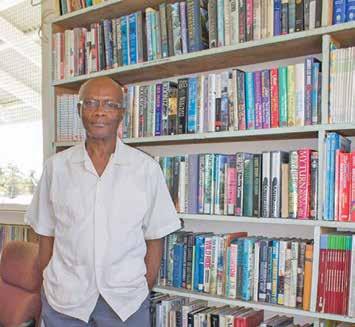
Generally persons diagnosed with a life threatening illness require much love and support from family and friends, sometimes they even require professional help for the emotional and psychological strain bought on by their condition. That’s where Donna’s Room at the Periwinkle Club comes in.
Donna’s Room is a place where those who require professional help and support can go to deal with the emotional and psychological strain of their condition or that of their loved ones.
“It is a place where those persons can come and receive counselling, a source of comfort where they can come to relax,” the Operations Officer of the Periwinkle Club described.
A collaborative effort between Periwinkle Club and the Association of Guyanese Nurses and Allied Professional (AGNAP), Donna’s Room was established on the behest of the late Donna Sage to provide counselling and complementary therapy to cancer sufferers, their caretakers and family.
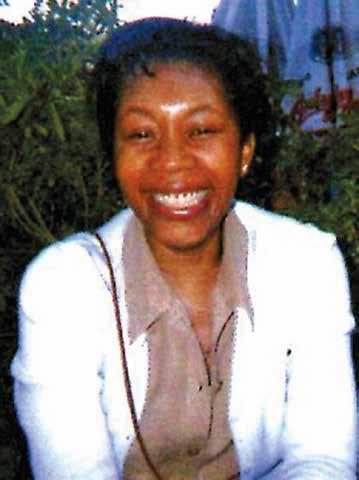
“Donna had died from breast cancer; she was my mother’s godchild. While living in London, she received treatment for her condition and was impressed by the support and medical attention offered, as a result she wanted similar treatment provided in Guyana,” Penelope Layne, a nurse and the Director of the Welfare Section at Periwinkle,
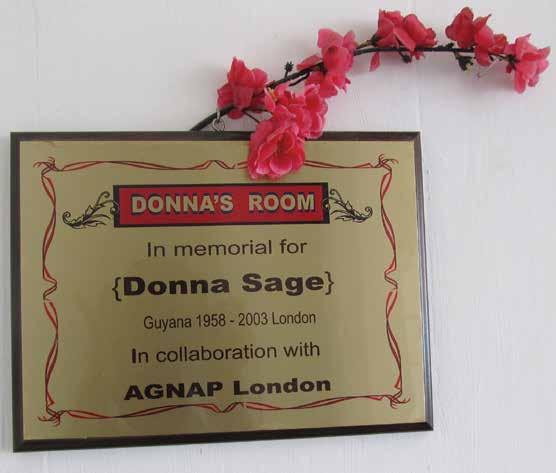
told the Guyana Times Sunday Magazine
Donna’s mother, Norma Sage, upon losing her daughter to cancer, executed Donna’s wish by approaching the organisation, AGNAP, she was aligned with to form Donna’s room in 2009 in a vacant office at the Periwinkle Club.
After benefitting from the support and counselling services in the UK, Donna’s mother approached AGNAP to help establish a similar service in Guyana.
“Donna willed money to the club to transform the vacant office into a counselling room and to make it as comfortable as possible,” Layne recalled.
Donna’s Room is a cosy
room found on the second floor of the Periwinkle Club. It is furnished with a sofa set, a Berbice chair, a television, a carpet and coffee table.
According to Layne, the money was enough to furnish the room and maintain it over the years. Nonetheless, the Periwinkle Club continues to receive support from AGNAP on an annual basis, which enables them to do more, such as training for nurses, counselling and education in cancer prevention and outreach palliative care.
The Periwinkle Club, located at 148C Albertown, Georgetown, is a cancer support group focused on raising awareness on the disease

al and emotional wellbeing, counselling services, and also facilitates breast self-examination and cervical cancer screening.
among cancer survivors and members of the public, and offering advice on coping with it.
The Club provides cancer survivors with support for diagnosis and treatment, nutrition -
The Periwinkle Club was first introduced on 17 October 2006 as a women's forum for breast and cervical cancer survivors and persons with an interest in supporting cancer patients, to meet and freely discuss their health and related experiences.
After about five months of meeting and interacting quietly, it was decided to present the club to the wider community. The Club welcomes, as members, all persons interested in working to eradicate the stigma of cancer and create equality of treatment of cancer patients in Guyana. For more information, call (592) 223-8320 or (592) 226-7152.

By PetamBer Persaud
In the pantheon of Guyanese literature, you could find a whole lot of good writing alongside some poor quality writing. Of course, you could also find writings on subjects that are delightful and on subjects that are gruesome, both types could have you thirsting for more depending on your particular taste or mood at a particular time. (Books could suit your varied tastes and varying inclinations.)
A recently acquired book, “True True Story” written by Stephanie Bowry, got me thinking about Halloween, a time for the telling of scary tales, among other features associated with the event. For related reading, I unearthed in my library, “Tales of the Spirits” by Tony Kissoon.
Both books are retelling of stories already public and of credit to both writers; both books lure the reader in a man-
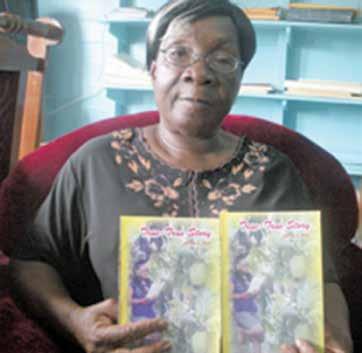
ner that the reader gets the feeling that the stories are true.
Not even the ‘Foreword’ of Bowry’s book could disman-
tle that feeling of reality. “This book is designed for those who are curious, who like surprises and suspense as well as those
who wish to relive the experience and delight of stories told to them by their grandparents and parents during moonlight nights sitting on the stairs.” (My italics.)
There are 17 stories in “True True Story”, mostly set in the county of Berbice – the birthplace of the book’s author who confesses ‘From the writer’s desk’ that “the stories are true! All of them are the experiences of real people in real places”. The ‘real places’ in the stories are historical backdrops like the sugar plantation where inhuman treatment of workers had left a stain upon the atmosphere, humble homes where horror visits with explosive consequences and innocuous shortcuts where packs with the devil are sealed.
The book “Tales of the Spirits”, as retold by Tony Kissoon, was written with Alfred Hitchcock’s flair. It is a collection of seven stories with


ominous footnotes, a tone set by the introduction, wherein Kissoon quoted Sir Arthur Conan Doyle, “The boundary between life and death is so narrow, for no-one knows where one ends and the other begins.”
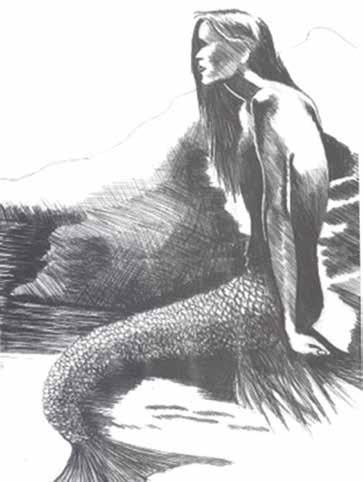
“Tales of the Spirits” are retelling of tales from the rich and varied folklore of Guyana including the Massacuraman, the Water Baby, Ole Higue, Bacoo, the Moongazer, the living dead and the White Man. “First, the Amerindian speaks of the Massacuraman and the Water Baby. “Secondly, the Afro-Guyanese describes the Old Higue and the Bacoo. Thirdly, the Indo-Guyanese talks of the Moon Gazer and the Living Dead. Fourthly, the old sugar plantation owners and managers relate tales of past dead European managers who would return to overlook the sugar domain.”
of the
After the retelling of each gruesome tale, there is a comment like this one following the Massacuraman, “Careful! You may wish to take a journey into the jungle with a porkknocker sometime. You may be ‘fortunate’ to see for yourself one of these creatures. Or you may be unfortunate. Remember, curiosity killed the cat but it may be that a massacuraman may kill you. One thing is certain, you will not be able to confirm its existence. You will be either dead or deemed crazy. Either way, you lose!”
Both writers seem wellread in this particular area of the macabre, drawing on qualified authorities like Edgar Allan Poe and Sir Arthur Conan Doyle.
Safe reading!
Responses to this author: telephone (592) 226-0065 or email: oraltradition2002@yahoo.com
In the laws of those states many Guyanese so admire and rush to migrate to, there are regulations concerning keeping a well maintained property and yard on both occupied and vacant properties.
If not adhered to, neglect of such properties can lead to fines and even jail time for owners – as one woman in East Tennessee in the US recently discovered after being slapped with a six-day prison sentence for not keeping her yard grass cut. A few years before (not being able to pay the fine for a messy yard) a person from South Carolina spent 10 days in prison.
According to US laws, you are responsible for the grass in your yard and the “tree belt surrounding your home”. (Perhaps here we call it the “parapet”.)

In the city of Edmonton in Canada, a “nuisance property” includes not just a neglected yard but a neglected building or other structure within the lot; disused vehicles and old parts, improper garbage storage or standing pools of water found there.
However, one only has to look out one’s window or arrive in Guyana and look out any window to realise there are no such laws here. Or the laws are ignored.
But why are there laws for keeping your grass cut and property maintained? It’s simply down to public health and safety.
Many illnesses were discovered to be the result of unhealthy environments just outside the home. Cockroaches, for instance, have been discovered to not only spread diseases, but their shed skin and droppings are linked to asthma and allergies when they move into your home from outdoors.
Overgrown yards attract garbage like derelict vehicles or household garbage. Some also throw trash on public reserves, which are also overgrown with weeds and soon the trash invites stray dogs, wandering cows, goats, sheep, chickens and horses; even vagrants. Then someone would think it a great idea to burn all the rubbish, sending unknown quantities of toxic substances into homes close by...
The garbage then attracts vermin: rats, cockroaches, mosquitoes, fleas or ticks; snakes even. High grass and rotting structures make ideal hiding places for pests to live and breed because there is an endless supply of food from your home next door as well.
So while you might tell yourself you don’t have an unsanitary yard, check out the neglected one next door; that’s most likely where the vermin in your house are coming from and racing over to when you (temporarily) chase them out.
Overgrown grass and derelict structures could also pose a fire hazard, especially during the dry season, and particularly on unoccupied lots. Overgrown public fields are prone to combust as well, and many nearby residents know the horror of fires so close to home.
In addition, neglected properties could attract vagrants or squatters, and create security problems for your home.
Your dirty and derelict yard, the one next door or the one in your neighbourhood can also see your property’s value diminished. If you believe you’ve worked hard to have your home and all its comforts, then you should know the distress a neglected property could bring both financially and aesthetically to you.


Bornand raised in Industry, on the East Coast of Demerara, Alicia Kirton attended Cummings Lodge Secondary School and attained her tertiary education at Cyril Potter College of Education (CPCE). She loves to challenge herself and chases after anything that would give her the opportunity for self-development. After successfully graduating from CPCE, Kirton was placed at Ketley Primary School. There, she has been the Grade One class teacher for two years. The loving teacher views her profession as a “blessing” and a chance to “wake up every day to mould the minds of children, to be a role model, and to provide them with opportunities”. Always fond of the pageantry world, Kirton, while studying at CPCE, participated in the Miss CPCE pageant, in which she placed second runner up. Given the platform via pageantry, Kirton has highlighted numerous social issues. The one which she hopes to always give a spotlight to is children on the streets begging. Kirton believes that people in leadership positions and humanitarian groups should take their responsibilities seriously and target people in need. Concerning the pageantry world, one of Kirton’s greatest achievements in life was participating in the recently concluded Miss Guyana Universe pageant. According to her, it is proof of how dignified she is to present herself to the public. One of the many things the beauty said she learnt during her journey vying for the crown is to be courageous, and she is truly grateful for that. Not winning the crown does not mean she lost. Kirton found herself and loves the woman she has become because of the experience she gained via the pageant. Although she was faced with challenges in her pageantry journey, Kirton did not give up. “I am always told that I’m too short to be in a pageant, but that didn’t stop me. I am an ambitious 23-year-old qualified teacher who lives and work consistently with my personal values and standards. My advice to youths is believe in yourself. Look for the positives and never turn down an opportunity given. Regarding pageantry, it will allow any young girl to realise their strengths and teach them how to use it.” A determined individual, Kirton now eyes the Miss India Guyana pageant. A desire to develop herself academically, Kirton’s future plan is to pursue a Degree in Education and hope to one day build her own school, which will cater to the needs of children suffering from learning disabilities. In order to wind down, Kirton enjoys swimming – her number one hobby. On weekends, she would unplug from her day-to-day routine and “float free from any worries and discomfort”.
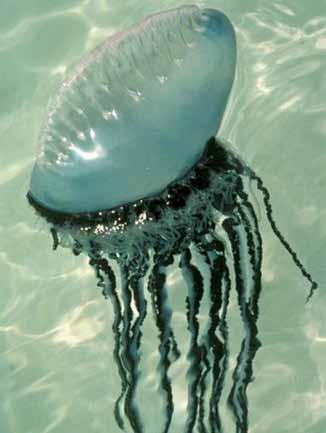
Anyone unfamiliar with the biology of the venomous Portuguese man-of-war, Physalia physalis, would likely mistake it for a jellyfish. Not only is it not a jellyfish, it's not even an "it," but a "they." The Portuguese man-of-war is a siphonophore, an animal made up of a colony of organisms working together.
The man-of-war comprises four separate polyps. It gets its name from the uppermost polyp, a gas-filled bladder, or pneumatophore, which sits above the water and somewhat resembles an old warship at full sail. Man-of-wars are also known as bluebottles for the purple-blue color of their pneumatophores.
The tentacles are the man-of-war's second organism. These long, thin tendrils can extend 165 feet (50 meters) in length below the surface, although 30 feet (10 meters) is more the average. They are covered in venom-filled nematocysts used to paralyze and kill fish and other small creatures. For humans, a man-of-war sting is excruciatingly painful, but rarely deadly. But beware—even dead man-of-wars washed up on shore can deliver a sting.
Muscles in the tentacles draw prey up to a polyp containing the gastrozooids or digestive organisms. A fourth polyp contains the reproductive organisms.
Man-of-wars are found, sometimes in groups of 1,000 or more, floating in warm waters throughout the world's oceans. They have no independent means of propulsion and either drift on the currents or catch the wind with their pneumatophores. To avoid threats on the surface, they can deflate their air bags and briefly submerge. (National Geographic)
Snakes are masters of disguise, skilled hunters, and champion eaters. Here are eight awesome things you may not have known about these carnivorous reptiles.
1. They can smell with their tongues. A snake uses its tongue to help it smell. It flicks its long, forked tongue to pick up chemical molecules from the air, ground, or water. The tongue carries the smelly molecules back to two small openings in the roof of the snake's mouth where they're analyzed. Mmmm, lunch!
2. They can "see" heat. Some snakes—such as pythons, rattlesnakes, and copperheads—can't see well and use other senses to find prey. These creatures have openings called pit holes in front of their eyes. These pits sense the heat given off by warm-blooded prey. The snakes' heat vision allows the vipers to track prey day or night.
3. Their venom can kill and cure. By sinking two hollow, pointy fangs into their prey, many snakes inject venom to paralyze or kill victims before devouring them. But scientists have also discovered that the same poison that causes awful symptoms—and even death—in people who have been bitten by a venomous snake can be turned into medicines.
4. Some species can fly. Flying snakes flatten their ribs into a concave C shape to trap air under their bodies as they fall. By undulating back and forth in an S-shape, they can actually glide through the air.
5. They can change their skin. Snakes literally grow out of their skin. Every few months, most start rubbing against the ground or tree branches. Starting at the mouth, a snake slithers out of its too-tight skin. Like a sock, the skin comes off inside out. Voilà—the snake has a fresh, shiny look.
6. They "hear" with their jaw. Snakes don't have external ears to hear sound waves in the air. Instead, bones in their lower jaw pick up vibrations in the ground or water. The vibes trigger signals in the snakes' brains, which are received as messages.
7. There are a lot to love. More than 2,500 species of snakes slither around the world.
8. They are speedy. The black mamba snake slithers up to 7 miles per hour (11 kilometers per hour)! (National Geographic)
Type: Invertebrate
Diet: Carnivore
Size: Float, 12 in (30 cm) long, 5 in (12.7 cm) wide; tentacles, up to 165 ft (50 m) long
Did you know? The tiny Nomeus gronovii fish is immune to the sting of the Portuguese man-ofwar. It lives among the tentacles and even snacks on the stinging tendrils.
Size relative to a 6-ft (2-m) man:

The objective of the game is to fill all the blank squares in a game with the correct numbers. Every row of 9 numbers must include all digits 1 through 9 in any order. Every column of 9 numbers must include all digits 1 through 9 in any order. Every 3 by 3 subsection of the 9 by 9 square must include all digits 1 through 9.


North Dakota’s state flag was adopted in 1911.
The flickertail squirrel is also known as Richardson’s ground squirrel.
Ground squirrels are sometimes called Dak rats or gophers.
The flickertail squirrel is native to the grassy plains of North America.
North Dakota was named for the Sioux Indians who lived in the region before non-native settlers arrived. The Sioux called themselves Dakota or Lakota, which translates as “allies” or “friends.”
North Dakota has been nicknamed the Peace Garden State in honor of the International Peace Garden, located on the state’s border with Manitoba, Canada. North Dakota is sometimes called the Flickertail State because it has an abundance of flickertail ground squirrels.
Large numbers of non-native settlers began to arrive in the North Dakota region in the early 1870s, when the Northern Pacific Railroad crossed the Dakota Territory. Huge farms owned by corporations and private families were established at this time. Wheat quickly became the major crop, covering enormous tracts of land in the Red River Valley.
The rich farmland created a population boom in the Dakota Territory. Between 1870 and 1890, the territory’s population grew from 2,405 to 190,983. Agriculture continues to be a large and vital part of this state’s economy.
In the 1930s, North Dakota’s economy was crippled by a severe drought and the Great Depression. In an effort to help the farmers, government projects were set up to help with irrigation and to prevent soil erosion.
This Midwestern state shares borders with the Canadian provinces of Saskatchewan and Manitoba. The North Dakota town of Rugby is the geographic center of North America. The state is famous for its fertile farmland, its rich mineral resources and its cold winters.
Chokecherry is the official state fruit.
Valuable reserves of petroleum were discovered in North Dakota in the 1950s. Hydraulic fracturing technology has given mining companies the ability to extract oil from the shale rock formations in the western part of the state.
Farms and ranches cover much of North Dakota.
The Northern
Fort Yates
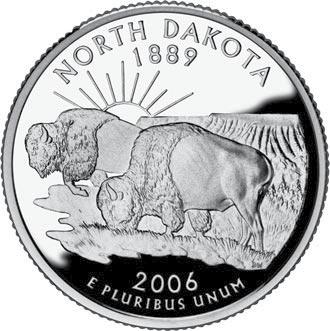
The state quarter celebrates 1889, the year North Dakota became a state. The coin also features a rising sun, American buffalo and the badlands.
North Dakota grows more sunflowers than any other state. Wheat is grown in nearly every county of North Dakota. The state grows more than 90 percent of the United States’ canola and flaxseed. It is also a major producer of sunflower seeds, beans and honey.
The Western meadowlark is the state’s official bird.
Milk became the official state beverage of North Dakota in 1983, in honor of North Dakota’s vital dairy industry.
The grave of the
is located at Fort Yates.
The wild prairie rose, the state’s official flower, can be found growing in pastures and meadows along North Dakota’s rural roads.
Lowest elevation 750 ft. (229 m) in Pembina County Agriculture Barley, beans, beef cattle, canola, corn, hay, milk, peas, potatoes, soybeans, sugar beets, sunflowers, wheat Manufacturing Computer and electronic products, fabricated metals, food products, machinery Mining Coal, natural gas, petroleum
Did you know?
Petroglyphs carved into boulders give Writing Rock State Historic Site its name.
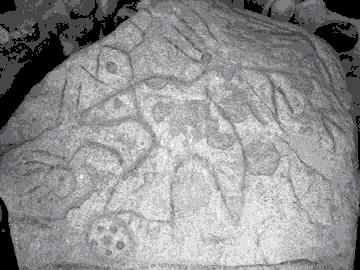
The name Devils Lake is from a Native American name that was incorrectly interpreted to mean “Bad Spirit.”
President Theodore Roosevelt first came to Dakota Territory in 1883 to hunt buffalo.
The Lewis and Clark expedition saw their first grizzly (brown) bear in North Dakota.
North Dakota is one of the leading producers of lignite coal in the United States.
North and South Dakota were admitted to the Union at the same time.
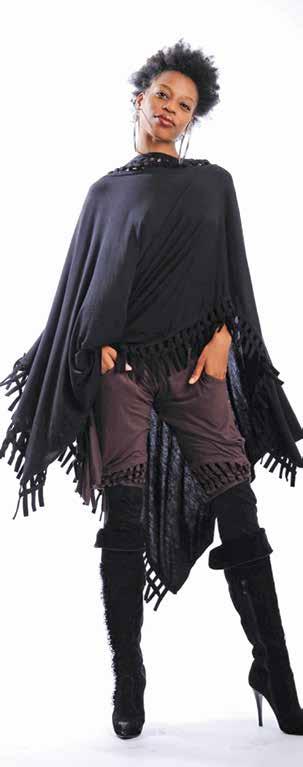
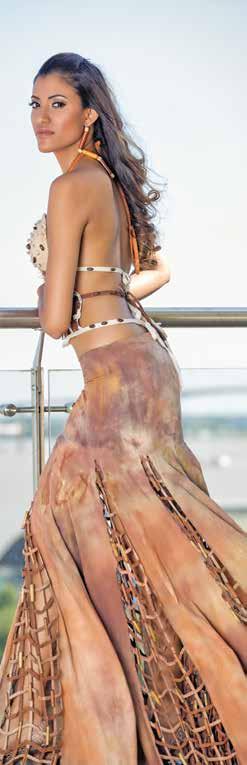
Guyanese designer Sonia Noel recently completed a photoshoot with celebrity photographer Donn Thompson in the US for her 2014/2015 Lookbook.
These pieces featured this week are just a few of what were shown in Spain earlier this month. It was a stunning display in Spain of Noel’s designing talents. This weekend the pieces were also shown at fashion events in Florida and Haiti.
The comfortable, chic collection is perfect for women who want a distinct look. Notably, the scarves in the collection can be converted to tops.
For more information call 226-3099.





Lauren London is an American film and television actress and model. Beginning her career in music videos and later transitioning into film and television acting, London earned recognition for her performance in the 2006 film “ATL” as well as the television shows “90210” and “Entourage”. She currently stars as Kiera Whitaker on the BET comedydrama, “The Game”. London has made appearances in music videos for artists such as Tyrese, Ludacris, Pharrell, and Snoop Dogg. Her breakout year came in 2006, where she made her television debut in the “Everybody Hates Funerals” episode of the sitcom “Everybody Hates Chris”. She appeared in Tyler Perry's “Madea's Big Happy Family”, which was released in April 2011. She once dated Grammy Award-winning rapper Lil Wayne; they have a son, Cameron Carter.
Mike Tyson says he was sexually abused as a child

Mthe story when he stopped by SiriusXM's Opie Radio show on Wednesday, October 29, saying that he was seven when the incident took place in Brooklyn.
"He snatched me off the street. I was a little kid...[he was an] old man," Tyson said. "[He] bullied me, sexually abused me and stuff." Tyson said he managed to escape and he had "never seen him again." Tyson never spoke to anyone about the abuse.
When asked if the scary experience changed his life, Tyson replied, "I don't know if it did or not. I don't always remember, but maybe I do but I don't. I'm not ashamed or embarrassed by it."
Tyson is currently promoting his new Adult Swim show "Mike Tyson Mysteries". On Wednesday night, he appeared on CNN to talk about the cartoon and his book "Mike Tyson: Undisputed Truth" and was unhappy when he got less air time than he expected.
"What the hell did you put me on the show for?" Tyson asked Don Lemon. "I put you on the show to talk about your series. We talked for a long time actually," the anchor replied. "We talked for a long time off the camera. ... Don Lemon's full of s**t," the boxing star said. Lemon laughed uncontrollably following Tyson's remark. (AceShowbiz)
Katy Perry is continuing with the 30th birthday celebrations by getting a tattoo of Hello Kitty on her finger.
The Roar singer unveiled her latest inking on her Instagram last night, she captioned the picture: "Does this make my gang signs look soft?" Katy joked to her fans, as she revealed the Hello Kitty logo on her middle finger.
Katy has just celebrated her milestone birthday, after inviting around 70 of her nearest and dearest to party the night away in Morocco. Read all about what went on here.
Katy has five tattoos known to the public, among them is 'Jesus' written on her left wrist, a smiling strawberry on the inside of her left ankle, a peppermint swirl on her right and 'Go with the flow' written in Sanskrit on the inside of her right bicep; her ex-husband Russell Brand has the same tattoo. She also has a lotus flower on her right wrist. (Glamour)


Robin Thicke and Pharrell Williams have lost the first round in their battle with Marvin Gaye's family. A federal judge ruled on Thursday, October 30 that trial would be needed to determine whether the duo's smashing hit single "Blurred Lines" copied elements of the late singer's music.
U.S. District Judge John
A. Kronstadt said the Gayes "have made a sufficient showing that elements of 'Blurred Lines' may be substantially similar to protected, original elements of 'Got to Give It Up'. Defendants have identified these with particularity for purposes of analytic dissection."
The similar elements include signature phrases, hooks, bass lines, keyboard
Kaley Cuoco-Sweeting
Kaley Cuoco-Sweeting was honoured with a Hollywood star today. The ‘Big Bang Theory’ actress has been given a special star on the Hollywood Walk of Fame - and wore Monique L'huiller to collect her gong.
Kaley asked for a spot near the late actor John Ritter, who she worked with on 8 Simple Rules and described as "one of my favourite people".
"He must be jumping off the walls right now," she told E! News after the ceremony. "I can't even imagine what's going on up there." She later described Ritter as "adorable" and "one of my favorite people."
Kaley also thanked her husband Ryan Sweeting: "[To] my husband, Ryan, who has also dealt with a lot of Kaley days, you have no idea how much I love you...This would not be the same without being able to share it with you today."
The actress added that the whole thing was "unbelievably sweet and overwhelming."
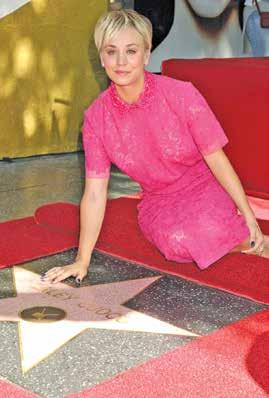
"I didn't write a speech, because I thought I would just speak from my heart and I already started crying in the car on the way over here, so I got that out of the way...I still think they are going to call and say this was a mistake," she joked.

Daniel Radcliffe hopes to hit the road as a first-time driver by early November. He tells WENN, "I'm taking my driving test at the end of the month."
chords and vocal melodies.
Responding to the ruling, Thicke and Williams's attorney Howard King said the judge's decision didn't come as a surprise for him and he's confident his clients would win the trial. "Since the compositions at issue are completely different, we remain confident of prevailing at trial," he said. A rep for the Gayes, meanwhile, hasn't commented on the ruling.
The battle between Thicke-Williams and the Gaye family has been going on for a year now. In a deposition earlier this year, Thicke admitted that he had almost nothing to do with the songwriting process, saying he showed up at the studio while being high on Vicodin and alcohol.
"The reality is, Pharrell had the beat and he wrote almost every single part of the song," he said.
A trial has been set for February 10, 2015.
(AceShowbiz)
Daniel insists that he will be a sensible first-timer and will not spend his money on a sportscar.
The "Horns" actor adds, "I'm not gonna be one of these people who when I do pass my test gets, like, a crazy fast elaborate
Willow Smith keeps rolling out new songs. Just days after she released "Female Energy (Freestyle)", the youngest daughter of Will Smith and Jada Pinkett Smith posted a brand new track called "Cares" on her SoundCloud page.
Willow, who's celebrating her 14th birthday on October 31, once again shows off her mature vocals. Over the drums, which she said she played herself, she sings about doing things her own way and not caring of what people think.
"I do not care what people say, or play this game the way I play/ And all the noises that we hear, just come from eyes, we don't have ears," she sings the first lines of the song.
Smith is currently gearing up to release her EP "3". Set for release on November 10, the record features three new tracks that she debuted at the Fader Fort during
car. A good piece of advice I was given was, 'When you're buying a car, buy a car you'll feel comfortable sitting in traffic in. If you're in a Ferrari in traffic, you're not gonna look cool!' "
Daniel shares a story about having to drive a car into a woman's driveway while fighting off a possible snake attack during the "Horns" filming. "I had to drive a Gremlin onto this woman's driveway and hit all her lawn ornaments," he recalls, "Hitting a mark in a car is a horrible thing, especially when you're not good at it. You know that all the other men on set drive, and they're all going, 'Can you just let me do this please, because he's screwing it up!' "
He continues, "Also, we had to have somebody in the back of the car who would put this snake around my neck before I got out, so they had to hide there with a python! Our snake handler had a wooden leg, so it was hard for him to get into the back of the car, so that job was delegated to someone else who is not normally in the snake handling department!"
"One of our set dec (decorating) guys got in the back and I just remember telling him, 'You know I don't drive - just so you know,' “the star of "The Woman in Black" adds, "And he's like, 'That's fine. I've never handled snakes before!' It was terrifying for both of us."
Daniel stars in "Horns" along with Juno Temple, Max Minghella, David Morse and Joe Anderson. The thriller-supernatural flick is set to hit U.S. theaters on October 31. (AceShowbiz)

the CMJ Festival in Brooklyn last week. (AceShowbiz)

Fawad Khan is a Pakistani singer, model and actor. He has established a successful career in Pakistani TV cinema. In 2014, Khan made his Bollywood debut in the release of “Khoobsurat” with Sonam Kapoor. Khan, in collaboration with his wife, established a clothing brand called SILK by Fawad Khan. He will once again collaborate with “Khoobsurat” co-star Sonam Kapoor in “Battle For Bittora”, which is produced by Rhea Kapoor and will start filming in late 2014. He has also committed to star in Akshat Verma's next who earlier directed “Delhi Belly”. He was given numerous awards for his singing and acting career. He was the recipient of the Lux Style Award for Satellite Best TV Actor.
Shah Rukh Khan's “Happy New Year” has broken records for the biggest international opener in a number of countries.
The Bollywood heist movie has set new records in the Gulf region, Sri Lanka, South Africa and Malaysia.
"The performance of the movie both in India and across the world shows the universal appeal of the movie," said Venky Mysore, CEO of Red Chillies Entertainments Pvt Ltd.
"We hope that the audience across all markets will continue to enjoy the movie."
The film is the second biggest opening ever for any Bollywood film with a number of key territories still to


Ashton Kutcher has said that he was overwhelmed after watching Alia Bhatt's short film about women's safety titled “Going Home”
The five-minute film by “Queen” director Vikas Bahl considers an idealised scenario as a young girl's car breaks down on a lonely highway.
Writing on Facebook, the “Two and a Half Men” star posted a link to the video and exclaimed: "Wow. Just wow."
Bhatt, 21, was also overwhelmed by Kutcher's public praise and tweeted: "*unable to form a sentence due to immense joy* Wohoooooooooooooooooo"
Bhatt, who won praise for her performances in “Highway” and “2 States”, is currently being directed by Bahl in his next film “Shandaar”, which stars Shahid Kapoor. (Digital Spy)

Kal Penn:
Kal Penn has said that he wants to work on a buddy comedy with Bollywood actor Saqib Saleem.
The “Harold & Kumar” actor praised the work of Saleem on his recent promotional trip to Mumbai.
Singling out his work in the episodic film “Bombay Talkies”, Penn described the actor's performance as "insanely awesome".
Penn was in India publicising his upcoming film with Rajpal Yadav “Bhopal: A Prayer for Rain”.
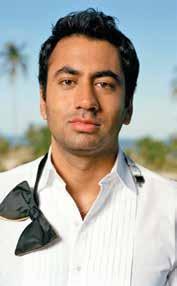
He recently said that he had no idea the role would be in Hindi when he first accepted the part. (Digital Spy)
Deepika Padukone has claimed that awards matter to her.
The actress swept the boards last year at the awards shows for her performances in the hit films “Chennai Express” and “Goliyon Ki RaasleelaRam Leela”.
She told IANS: "Awards matter to me. I would have been very disappointed if I was not given any award last year.
"No matter what we say, at the end of the day, the person who wins the award feels good about it.
"It's a sign of appreciation and hard work. If you are winning one then you are doing a good job."

SThe actress has won praise for her latest outing in the comic heist movie “Happy New Year”, in which she reunited on screen with Shah Rukh Khan for the third time.
hah Rukh Khan has been in Los Angeles for work on his next film “Fan”.
The actor went to the CounterPunch Studios for digital 3D face scanning.
Posting images on their Facebook page of the actor undergoing the scan, CounterPunch Studios said in a statement: "He [Shah Rukh Khan] has a curiosity for technology and groundbreaking processes, and was very hands on during the shoot.
"It is clear that he takes his craft very seriously and works rigorously to perfect it for
She described her chemistry with the star as "magical". (IANS)
each and every film. Our team feels very fortunate to have had the opportunity to meet such a legend in the Bollywood community."
The actor took out two days from the promotions schedule of “Happy New Year” for the work.
Khan, who has one of the greatest global fan followings of any star in Bollywood, will experience life from the point of view of an ardent fan in the film.
Produced by Yash Raj Films, “Fan” is scheduled to release on August 14, 2015. (Digital Spy)
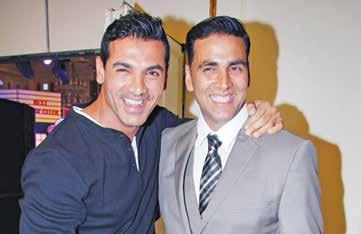
John Abraham and Akshay Kumar's “Subha Hone Na De” is the mostviewed Bollywood track on YouTube.
The “Desi Boyz” track has been watched more than 48 million times on the videosharing site.
Released in the last quarter of 2011, the music video features Kumar and Abraham with Brazilian model Bruna Abdullah.
Kumar and Abraham star as male strippers Rocco and Hunter performing to a female-only audience in the video.
Actress Deepika Padukone makes an appearance towards
the end of the song to discover her boyfriend (Abraham) is secretly working as a stripper.
The “Desi Boyz” song beats the “Aashiq Banaya Aapne” title song into second place,
and
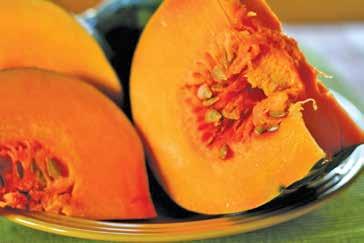
Pumpkin packs some powerful, healthy perks -- like keeping heart health, vision and waistlines in check.
Below are some impressive health benefits of pumpkin.
Sharp eyesight
A cup of cooked, mashed pumpkin contains more than 200 percent of your recommended daily intake of vitamin A, which aids vision, particularly in dim light, according to the National Institutes of Health.
Pumpkins are also rich in carotenoids, the compounds that give the gourd their bright orange colour, including beta-carotene, which the body converts into a form of Vitamin A for additional peeper protection.
Weight loss
Pumpkin is an often-overlooked source of fibre, but with three grams per one-cup serving and only 49 calories, it can keep you feeling full for longer on fewer calories.
A fibre-rich diet seems to help people eat less, and thereby shed pounds. A 2009 study found that people who ate a whole apple before lunch (the fibre is in the skin) consumed fewer calories throughout the meal than people who ate applesauce or drank apple juice.
Pumpkin seeds can help your heart
Nuts and seeds, including those of pumpkins, are naturally rich in certain plant-based chemicals called phytosterols that have been shown in studies to reduce LDL or "bad" cholesterol.
May reduce cancer risk
Like their orange comrades the sweet potato, the carrot and the butternut squash (to name a few), pumpkins boast the antioxidant beta-carotene, which may play a role in cancer prevention, according to the National Cancer Institute.
Food sources of beta-carotene seem to help more than a supplement, according to the NIH -- even more reason to scoop up some pumpkin today. And the plant sterols in pumpkin seeds have also been linked to fighting off certain cancers.
Protects the skin
The same free-radical-neutralising powers of the carotenoids in pumpkin that may keep cancer cells at bay can also help keep the skin wrinkle-free.
Pumpkin seeds can boost your mood
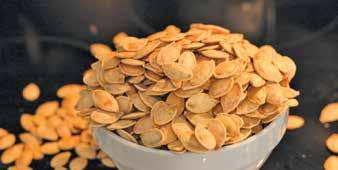
Pumpkin seeds are rich in the amino acid tryptophan - the famed ingredient in turkey that many think brings on the snooze mode. While experts agree that it's likely the overeating of turkey rather than the tryptophan lulling you to sleep, the amino acid is important in production of serotonin, one of the major players when it comes to our mood. A handful of roasted pumpkin seeds may help your outlook stay bright.
Pumpkin can help after a hard workout
Ever heard of bananas being touted as nature's energy bar? Turns out, a cup of cooked pumpkin has more of the refuelling nutrient potassium, with 564 milligrams to a banana's 422.
A little extra potassium helps restore the body's balance of electrolytes after a heavy workout and keeps muscles functioning at their best.
Boost the immune system
Whether or not vitamin C can really ward off colds is still up for debate, but pumpkins are a solid source of the essential nutrient. One cup of cooked pumpkin contains more than 11 milligrams, or nearly 20 percent of the 60 milligrams the IOM recommends women need daily. (Men should aim for around 75 milligrams.)
By Zenica DaBichan
Choosing whether to breastfeed or for mula feed a baby is one of the most important decisions a mother has to make. The World Health Organisation recommends breast milk as the only source of food for a newborn up to six months of age, with continued breastfeeding along with appropriate complementary foods up to two years of age or beyond.
Although experts believe breast milk is the best nutritional choice for infants, breastfeeding may not be possible for all women. For many women, the decision to breastfeed or formula feed is based on their comfort level, lifestyle, and specific medical conditions that they might have.
The following information may help you make an informed decision:
Breast milk is often called “the perfect food” because it provides the ideal nutrition for infants. It has a nearly perfect mix of vita mins, proteins, and fats. It is all provided in a form more easily digested than infant formula.

Breast milk contains substances that help your baby fight off infections. Breastfeeding lowers your baby's risk of developing asthma or allergies. Plus, babies who are breastfed exclusively for the first six months, without any formula, have fewer ear infections, episodes of cold and flu and bouts of diarrhoea.
Breast milk doesn't cost a cent, while the cost of formula quickly adds up. Breast milk is always fresh and available. There's no need to sterilise bottles, boil water or do any sort of preparations.
Breastfeeding also has benefits for the mother. Breastfeeding burns calories and helps shrink the womb, so nursing moms may be able to return to their pre-pregnancy shape and weight quicker. In addition, studies show that breastfeeding helps lower the risk of breast cancer, high blood pressure, diabetes, and heart disease, and also may help decrease the risk of cancer of the ovary and uterus.
Breastfeeding does require a substantial time and commitment from mothers. Then again, many worthwhile things in parenting do. Some women may be concerned that nursing will make it hard for them to work, run errands, or travel but breast milk can be pumped from the breast and stored so others can feed the baby.
Medical conditions such as HIV or AIDS or those that involve treatment with certain medications may make breastfeeding unsafe. Furthermore, an infant might have an illness where breast milk is not advised and a special formula might be needed.
Whatever nutritional option you choose, be sure to talk to your doctor about the choices available to help you make the decision that's best for both you and your baby.
Whether you have diabetes or prediabetes, or simply want to reduce your risk for developing diabetes, lowering your blood sugar is an important part of maintaining overall health. This comprehensive action plan takes you beyond the basics of simply cutting out sugar, showcasing the dietary changes, food replacements, exercise regimens, and supplement information required to lower or stabilize blood sugar.
Stock up on protein

Including protein in your meals can help you feel more full for longer at the end of the meal and can offset the effects of refined carbohydrates that cause short-term spikes in blood sugar. By getting away from refined foods, you’ll have more stable blood sugar levels. Add peanut butter, quinoa, yogurt or a hardboiled egg to your meal. It’s especially important to include items like these in your mid-day meals. Lunches high in refined carbs like table sugar, corn syrup and fruit juice can cause you lose steam and become cranky (an effect you might know as the "afternoon slump").
Rethink dessert
If you’re one of the many who need something sweet after dinner, replace traditional, sugar-loaded desserts with fiber-rich fruits like apricots or blueberries. Sugar-laden desserts late at night can cause a blood sugar spike and subsequent low that can disrupt your sleep and your metabolism. An apple or handful of blackberries will take care of your sweet tooth without sending you on a blood-sugar on a roller coaster.

People who suffer from diabetes or prediabetes are often told to avoid sugar. But simply nixing the cake and ice cream isn’t a quick fix. Simple carbs, such as those found in bread and pasta, get turned into sugar during digestion, and they can do as much to raise blood sugar levels as traditionally “sweet” things do. Instead of eating pasta with a side of salad, have a large salad full of proteins and green veggies, with small, handful-size side of pasta.
Drink in moderation
Alcohol interferes with the bloodsugar ecosystem every time it enters the body and can cause hypoglycemia up to 24 hours after consumption. Regular heavy drinking in those with Type 2 diabetes can lead to increased blood glucose by decreasing the amount of insulin made by the pancreas.
Some spices and herbs have been shown to help stabilize blood sugar. A spice that has been shown to help lower blood sugar is cinnamon.
Get physical
An hour and a half of moderately

rigorous exercise (fast walking or biking) per week can help you to maintain blood sugar control by increasing your body’s sensitivity to insulin. Diabetics should check their blood sugar levels before and after exercise to make sure levels are where they need to be. If you’re going to exercise for more than an hour, you should check your blood sugar every 30 minutes during exercise to see if you need a snack. As always, talk to your doctor before starting a new exercise regimen.
Prep your plate
When devising meals to help with blood sugar maintenance, have these proportions in mind: 50% low-glycemic vegetables (think green and crunchy), 25% lean protein, 25% slowburning carbs.
Let lentils into your life

When you begin eating with blood sugar maintenance in mind, you’ll find yourself saying goodbye to a lot of foods that are comforting and hearty, including bread, pasta, and starchy vegetables. Lentils offer a similar texture and fullness, but their soluble fiber and low glycemic load make them excellent blood sugar stabilizers. Try a lentil soup with chicken and vegetables, or a lentil burger.
Study up on supplements
Even the most regimented eaters may need help stabilizing their blood sugar. The supplement chromium polynicotinate may help maintain blood sugar levels by increasing the body’s sensitivity to insulin in combination with exercise and medications in those with diabetes. (www.doctoroz.com)


All the cables and the cords from the computer, the lamps, the TV, and others are seen as an inconvenience and we often try to hide them. But why hide the cables when you can turn them into wall art?
Get inspiration from the photos and create your wall art today!
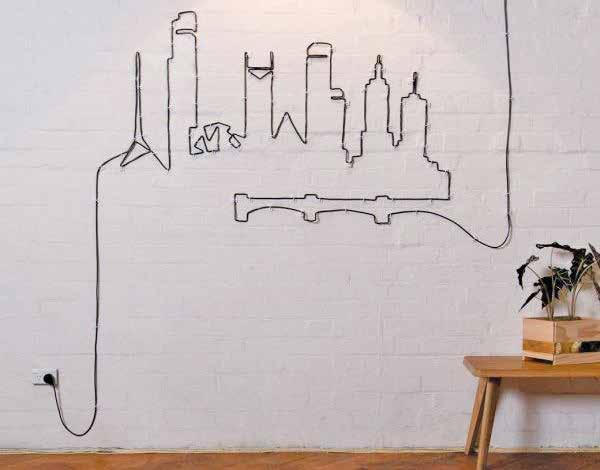
You can’t hide all the cables so have fun with them. This combination of Tv and Playstation is eye-catching mainly because of the way the cables were arranged on the
You can come up with all sorts of ideas for this type of wall art. Just pick a theme or try to create something abstract. It doesn’t have to be an exact replica of the real thing.



Ingredients:
3/4 lb beef (thinly sliced across the grain)
1/4 teaspoon salt
1/4 teaspoon black pepper
3 scallions
3 cups bell peppers
3 thin slices of ginger
2 cloves of garlic diced
1 1/2 tablespoons vegetable oil
1/4 hot red pepper
1/2 teaspoon green seasoning
1/4 teaspoon browning sauce
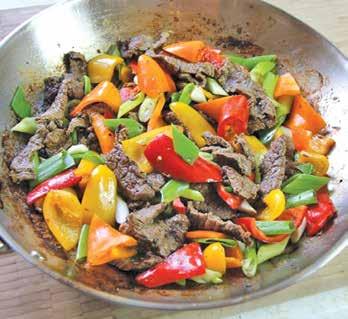
Method: Thinly slice the beef across the grain and marinate with the green seasoning, salt and black pepper for
about 1/2 hour in the fridge. Prep the other ingredients so when it’s time to cook everything will be ready. Chop the bell peppers
and scallion, slice the ginger and dice the garlic and hot red pepper finely.
Heat a heavy wide pan (or wok) on medium high heat and toss in the seasoned pieces of beef. Stir well to cook through quickly. It will cook for about 4-6 minutes and as it does, make a space in the centre of the pan and add the diced hot peppers, garlic and slices of ginger. Add the browning sauce (if you cannot source it, use 1 teaspoon soy sauce and the same amount of oyster sauce) and mix it well to add colour to all the pieces of beef. Add the bell peppers and scallions and cook for about 3 minutes (depends on how tender you want the peppers). Taste for salt and adjust accordingly.
Ingredients: 1 lb medium shrimp
Pinch of salt
2 tablespoon olive oil
2 tablespoon chilled butter
Method:
Chop the scallion and parsley and finely dice the hot/scotch bonnet pepper as well as the garlic. Clean, devein and wash the shrimp and drain dry.
Heat the oil in a heavy/ wide saucepan on medium heat and go in with the cleaned shrimp. Cook for about 2-3 minutes.
Remember to stir so the shrimp cooks evenly. Now add all the other ingredients except the chilled butter and cook for two minutes. You do not want to burn the garlic, so stir well.
Turn the heat off (or on
1 tablespoon chopped parsley
1 scallion
1/4 hot pepper/scotch bonnet pepper
2 heaping tablespoon diced garlic
Pinch black pepper

very low) the heat and add the chilled butter, stir as you do so you get a rich and creamy sauce. The diced hot/scotch
If you need only a few drops of lemon juice, avoid cutting the lemon in half – it will dry out quickly that way. Instead, puncture the fruit with a metal skewer and squeeze out exactly what you require.
A bay leaf slipped into a container of flour, pasta, or rice will help repel bugs.
The following are clues to words that start with "EX-", but the clues do not refer to the words themselves. They refer to the two words formed when the word is split after the word "EX".
For example, "Ships don't dock there any more" would result in the word "EXPORT (EX PORT)".
1. They don't publish the news anymore.
2. Money that isn't worth anything anymore.
3. It's not boring anymore.
4. It's not used to sleep in anymore.
5. It's no longer at the end of the line.





Anansi stretched his eight legs as he sat in the middle of his web, watching the people around their fires in the evening. They were restless and the children were bored.
“How can I help them?”
Anansi said to himself – he rather liked people, being one himself sometimes. “I know, stories! They need stories to tell and to listen to…mmm,” he thought.
He knew that all the stories were kept in a beautiful wooden box by Nyame, the Sky God. He also knew that Nyame kept the box close to him at all times. For this, he would not be able to use trickery and sneak it away from the Sky God.
As the great sun rose in the morning sky, Anansi spun a beautiful silken thread, long enough to reach all the way to the clouds and he scampered up to heaven to talk to Nyame.
He knew he must be polite and on his best behaviour. He bowed low. “Oh Nyame, great and wise god of the sky, I wish to have your box of stories to take back to the people. What is your price?”
Nyame’s laughter thundered out, shaking the clouds around. “Little Anansi, my price is much too high for someone like you. Great princes and rich villages have tried to buy my box, but none has been able to pay the price.”
“I will pay,” said Anansi stoutly. “I will give you your price. Name it.”
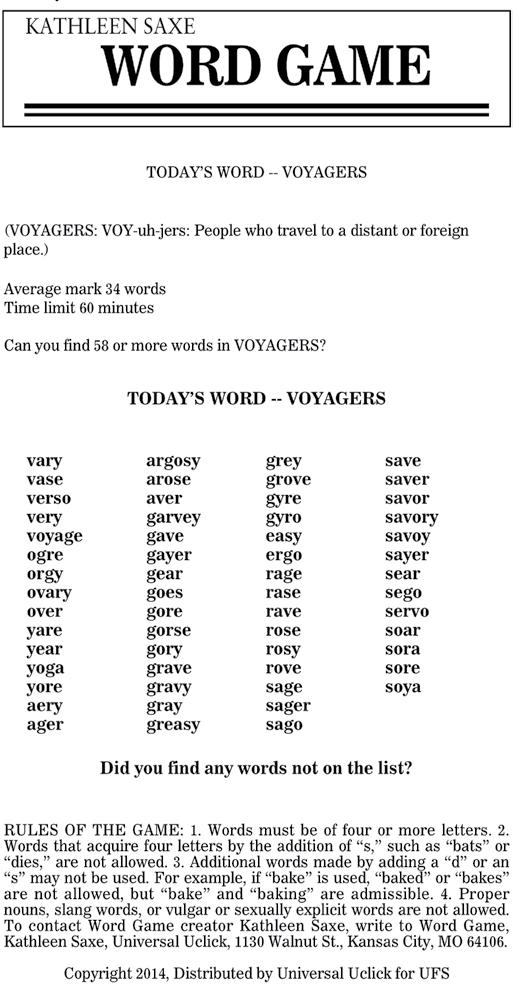
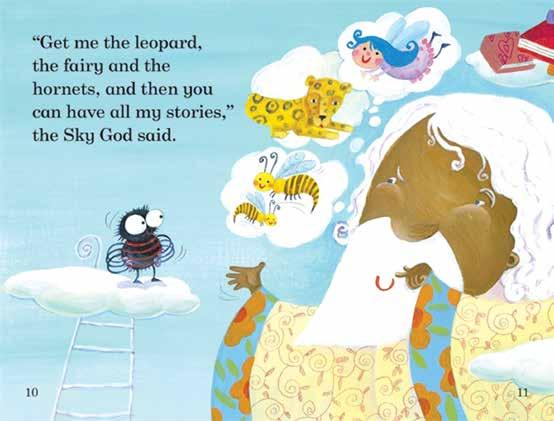
“My price is Osebo, the leopard with teeth as sharp as spears; Mmoboro, the hornet whose sting is like red hot needles and Mmoatia, the badtempered fairy that no-one can see. Bring to me all of these and my box with all the stories shall be yours.”
“I ..I ..w..will bring them,” stuttered Anansi as he backed away to the sound, once again, of Nyame’s thunderous laughter.
Anansi swung down his silken thread and consulted with his wife, and together they thought hard and devised a plan to ensnare Osebo.
Anansi searched in the forest until he came across the route that the leopard took every night to the water hole. He then looked around for a suitable place and dug a deep hole, too deep even for a leopard to escape from. It was exhausting work but little Anansi was very determined.
When he was satisfied, he carefully laid sticks across the hole and covered them with leaves and covered them with dusty earth.
By the time evening came, the hole was invisible and a tired Anansi went home to his supper and his bed, where he slept like a log.
As the great sun rose in the morning sky, Anansi went for a walk in the forest and heard screeching and scrabbling. Hurrying forward, he came to the pit and there saw an angry Osebo, desperately trying to claw his way up out of the hole.
He looked in and said, “Good morning Osebo, why are you in this hole?”
“You foolish spider, can’t you see I have fallen into a trap? You must help me to get out,” snarled Osebo.
“Oh dear no, I cannot do that,” and Anansi started to back away. “You would eat me and my wife and children if I helped you out.”
“Come back, come back. I promise little one, I will do no such thing if only you will help me,” purred Osebo.
“For that promise, I will indeed help you to get out,” said Anansi and went to the nearby willowy tree he had spotted
there was a hornets’ nest.
He poured half the water over his head so that he was dripping and then threw the rest of the water over the hornets’ nest, so that it too was dripping. Anansi then held the plantain leaf over his head as though sheltering from rain as the angry Mmoboro started to swarm out towards him.
“Oh dear, oh dear, the rains have come early. You poor creatures you have no shelter. Come, take cover in my calabash until the storm is over,” wailed Anansi,
“Thank you, thank you, Anansi,” buzzed the Mmboro as they flew into the gourd.
Anansi pulled the silken thread and the doll’s head nodded. “Oooh lovely,” squeaked the voice and Anansi watched as the dish appeared to float up into the air and the yam started to disappear. Soon it was all gone, the dish dropped to the ground and the voice said, “Thank you.”
Anansi remained still and then the voice spoke again more loudly, “Thank you.” And then again angrily, “I said thank you. Answer me or I shall have to slap you on your crying place.”
Almost immediately, the doll’s head wobbled and the voice squeaked, “Let me go, or I shall slap you on the other side.”
yesterday. He pulled its top to reach down over the hole, tied it in place with his silk, and then spun another long, strong and sticky thread to reach down into the pit.
“Wind this thread well around your tail,” he called down to Osebo. When it was fastened, Anansi cut the silk holding the tree top down. It whooshed up into the air, taking the leopard with it by his tail.
As Osebo spun round and round the top of the tree, the rest of Anansi’s strong, sticky thread wound round and round his body. When he was completely trussed, Anansi went up and snipped the thread from the tree and Osebo landed with a bump on the ground.
“You foolish leopard, now you shall come with me to Nyame,” chuckled the spider.
So saying, he hauled him up his silken thread to the clouds and presented him to the Sky God who merely said. “I see what I see. There remains what remains.”
Anansi swung down his silken thread and once more consulted with his wife, and together they thought and discussed and devised a plan to trap Mmoboro.
They hollowed out a large calabash and filled it with water. Anansi cut down a large plantain leaf and took it and the filled gourd to a tree in which
When the last one had entered, Anansi clapped the plantain leaf over the hole and wound his silk around it to hold it in place.
“You foolish Mmboro, now you shall come with me to Nyame,” crowed the spider.
So saying, he hauled the calabash up his silken thread to the clouds and presented it, filled with the angry buzzing hornets, to the Sky God who merely said. “I see what I see. There remains what remains.”
Anansi swung down his silken thread and once more consulted with his wife to devise a plan to capture Mmoatia. Anansi carved a doll from the wood of the gum tree. He then plastered it with sticky gum.
Meanwhile, his wife Aso, pounded yams into a paste with eggs and oil to make ano, which fairies love.
They knew the places the fairies like to play and dance, although they could not see them; so, in the middle of the hot day when all creatures are at rest, Anansi crept very quietly to the lovely clearing and sat the doll on the grass with the dish of yams beside it.
He spun a fine thread from the doll’s head to his hiding place in the trees. Then he waited.
As evening drew on, he heard a little voice saying, “Hello, little gum baby, may I have some of your ano?”
Soon the doll’s head wobbled again and then rocked from side to side.
“Aaaah, let me go or I shall kick you,” screamed the fairy voice.
Thump, thump came the sound of feet landing on the sticky gum doll and it began to roll and bounce and toss around the clearing as the fairy’s voice shrieked ever more loudly.
Anansi leapt from his hiding place and in no time had his sticky thread wound round and round the doll and its captive fairy.
“You foolish Mmoatia, now you shall come with me to Nyame,” whooped the spider.
So saying, he hauled the gum doll up the silken thread, with the invisible angry fairy still screaming threats, to the Sky God who stood and said. “You have paid my price. Great princes and rich villages tried and failed, but you, Anansi, have succeeded.”
He called out loudly, “Listen to me, all you who can hear.
Praise Kwaku Anansi for he has paid the price for the Sky God stories and they shall be given to him. Henceforth they shall be known as ‘spider stories’.”
So saying, he bent down and lifted the beautiful wooden box and gave it to Anansi who had paid the price so that the people would have stories to tell forever.

For a fact what I am saying I know
For it happened to me a sad blow
Now I want to warn the young ones
Make sure you don’t become bygones
For though the computer is invaluable
It can make your mind very unstable.
Many times often have we not seen
Others out for malice very unkeen
Without even thinking hit the send button
Regretting later for being so orally glutton
It’s happening and it will never end
We don’t think before we press send
To some this technology is a new found toy
It gives some courage even if they are coy
We have a new weapon it’s like a gun
We shoot them down before they run
Look at how our own kids took to this filth
Plastering private data as Facebook spilth
That is ok for kids for they are brainless
They think last they are always careless
Like morons they laugh about it quietly
As others are petrified at their depravity
They’re no excuses for adults to use this bile
Who put malicious stuff behaving so puerile
For they know better that is very wrong
Even kids know better who sing this song
It appears every time we have a new invention
We abuse it using it with the wrong intention
It happened with guns which can’t guarantee our safety Look at how others behaving because they have money
By abusing the computer we’ve lost our privacy
Lazy good for nothings can steal your identity
Our kids get fat playing video games -- suckers
Money hungry merchants fill them with sugars
We’ve used nuclear power for safety in many a nation
Yet the same technology can blow us all into oblivion
From creation we have seen how man was evil
Remember how Cain slew his only bother Abel
Some men thrive for peace for the benefit of the society
Others work overtime trying to throw it in disharmony.
This word hatred
Rhymes with dead
And it has brought so much woe
From the beginning of the get go
Hatred and envy
Friends of greedy
From the very beginning
Of the days of reckoning
Since Kane slew Abel
Which wasn’t a fable
Then Adam went and ate the forbidden fruit
Since then man start eating leaves and root
Then they start to covet one another’s land
Some take away whilst others just demand.
There’s so much hate amongst men
Who are so far different from women
If we had more women at the helm
We would’t have any of this problem
But men deliberately do keep women
From the top jobs only good for lichen
Or so they think
Cause they stink
Or are they really very afraid
She can be more than a maid
And would be better
Than their jet setter
That she has better skill And have more of a will
To negotiate for peace
Really mark her crease
Where peace is concern And not leave us to burn.
Look at the history of war
At home and even from afar
Men’s choices suck in every clime
They screwed everyone all the time
War driven stubborn and very mulish
Peace is something they don’t relish
The men at the top has failed mankind
There have to be a woman they can find
To right the wrongs of the world
And let sanity for once unfurled.
Poems by Norman Datt, Pickering, Ontario, Canada




ARIES (March 21April 19)


TAURUS (April 20May 20)



(May 21June 20)

(June 21July 22)



LEO (July 23Aug. 22)

VIRGO (Aug. 23Sept. 22)



LIBRA (Sept. 23Oct. 23)

SCORPIO (Oct. 24Nov. 22)


SAGITTARIUS (Nov. 23Dec. 21)




(Jan. 20Feb. 19) (Dec. 22Jan. 19)


PISCES
(Feb. 20March 20)

Think before you speak. If you are feeling overly sensitive, you may take something the wrong way. Listen carefully and refrain from making a lofty response.
Surround yourself with people who are encouraging and positive, and strive to be the same. The value of close, meaningful relationships cannot be denied or treated carelessly.
Touch up your surroundings. Renovations, remodeling or redecorating will add value to your property, or at the very least make you feel good. You can save money by doing the work yourself.
This is not the best time to get into a deep conversation. Plan some solitary activity where you can collect your thoughts before you speak your mind.
It’s worth your while to go the extra mile at work. Dependable, hardworking people are not always easy to find, and your efforts will be noticed and rewarded.
An outgoing and colorful someone will take you by surprise. Don’t be too quick to think this person has all the answers. If something sounds too good to be true, it’s probably false.
Little problems can grow out of proportion quickly. Electrical, plumbing or equipment concerns should not be taken lightly. If you are in doubt, have someone check it out.
Don’t judge others. You will receive valuable information from an unlikely source. A person who is often disagreeable will have the knowledge and answers you are looking for.
Don’t offer to help a stranger with a good sob story. Allowing someone to take advantage of you will lead to regret and loss. Look out for your interests.
Your steady approach will be difficult to maintain. If you make a snap decision or change of plans, let your family know to avoid putting any of them in an awkward position.
Be cautious when sharing personal secrets. Private information has a way of becoming public knowledge if you confide in the wrong person. Be smart and avoid embarrassment.
Get involved with events or organizations that are close to your heart. The more you believe in something, the more enthusiasm and energy you will offer. Expect to meet people who share your ideals.
Apple has revealed
that it has no plans to challenge Google and Microsoft in the low-end devices market, vowing that it will never launch a 'cheap' iPhone or Mac.
Speaking at the Code/ Mobile conference in California last week, Apple marketing executive Greg Joswiak acknowledged that the company is losing out to Android at the lower end of the market.
However, he said that Apple is focused on creating premium devices for the few rather than budget devices for the many.
"We were talking about some of the mistakes Apple made in the '90s, and some of it was trying to do things like making cheap products that were chasing market share instead of chasing a better experience. You make that mistake once in your

Clife, you're not going to make it twice," said Joswiak.
"Our goal is to make the best products with the best experience … we believe that if we make a better
product and a better experience, that there will always be a healthy market for that. And a healthy market doesn’t mean we have to be market-share leader."
Apple was widely ru-
moured to be working on a cheaper iPhone prior to the release of the 5c and 5s last year. However, while the iPhone 5c is more affordable
than the 5s, it is still far beyond the reach of the budget market.
Meanwhile Google and its partners already offer a range of low-cost smartphones such as the £135 Moto G, which scored 4.5 stars out of five in The Telegraph’s review.
The A50S and other Android One phones look set to lower prices even fur-
ther, bringing smartphones to millions of new customers – and potentially causing a low-end price war in Europe and the US.
Although devices like the A50S are designed to appeal to developing markets, they will also offer a tempting choice for users in the UK who want a smartphone but have no need for high-end specifications. (Telegraph)

hances are, if your computer is hooked up to the Internet, via a wire or wirelessly, you are vulnerable to hackers.
Physically isolating the computer is one way to protect against such nefarious activities, and in the realm of cybersecurity, taking such anti-surveillance measures creates what’s known as an “air gap.” The only way the device’s security can be breached is if someone physically plants a bug on the machine via a USB drive, for example.
At the MALCON 2014 conference being held last week in Puerto Rico, security experts will present a demonstration of a potential new method of hacking isolated computers and laptops using a nearby mobile phone.
Presented by security researcher Mordechai Guri, along with professor Yuval Elovici from the Cyber Security Labs at Israel’s Ben Gurion University, the so-called “AirHopper” technique makes an end-run around modern wireless tech like Bluetooth and Wi-Fi. Instead, “AirHopper” steals data by way of FM radio waves.
Details are scant, but according to the press materials released by Ben Gurion University, the technology works by using the FM radio receiver included in some mobile phones. The AirHopper method can capture keystrokes by intercepting certain radio emissions from the monitor or display unit of the isolated computer.
It’s all very cloak-and-dagger, but the team claims that textual and binary information can be gathered from a distance of up to seven meters with an effective bandwidth of 13-60 bps. “Enough to steal a secret password,” according to the news release. (Discovery)
Tech
ByTe


Google is aiming to diagnose cancers, impending heart attacks or strokes and other diseases, at a much earlier stage than is currently possible.
The company is working on technology that combines disease-detecting nanoparticles, which would enter a patient's bloodstream via a swallowed pill, with a wristworn sensor.
The idea is to identify slight changes in the person's biochemistry that could act as an early warning system.
The work is still at an early stage.
Early diagnosis is the key to treating disease. Many cancers, such as pancreatic, are detected only after they have become untreatable and fatal.
There are marked differences between cancerous and healthy tissues.
Google's ambition is to constantly monitor the blood for the unique traces of cancer, allowing diagnosis long before any physical symptoms appear.
The project is being conducted by the search company's research unit, Google X, which is dedicated to investigating potentially revolutionary innovations.
It marks the firm's latest shift into the medical sector following its work on glucosemeasuring contact lenses for patients with diabetes and the acquisition of a start-up that developed a spoon to counteract the tremors caused by Parkinson's disease. (Excerpted from BBC)
Logitech, a company that's no stranger to making keyboards for all kinds of devices, is launching Key-to-go –a new wireless iOS keyboard that features mechanical keys and a waterproof covering. This means users get the feedback of mechanical keys without having to worry about spills.
With this keyboard, Logitech has elected to leave off any method of attaching it to an iPad. This makes it easier to use with an iPhone or Apple TV, as it's just a simple Bluetooth keyboard that connects easily – users looking for an iPad case and keyboard combination are going to want to look elsewhere.
The main selling point of Logitech's new Key-to-go offering is the FabricSkin that covers the entirety of the keyboard. This makes it resistant to spills and dirt, which means users can safely type anywhere without worrying about their keyboard getting ruined. Waterproof keyboards aren't new, but
what makes this one stand out is the fact that mechanical keys are tucked under that spill-resistant coating.
The keyboard itself looks to have large enough keys to type comfortably. The device is 9.53 inches (242 mm) long, 5.39 inches (137 mm) tall, and 0.24 inches (6 mm) deep. There's no number pad, so all of that space is used to accommodate traditional keys and a few iOS shortcuts.
Logitech is offering its new keyboard for preorder in red, teal, and black for US$69. The company did not announce an exact ship date, but it did say that it intends for it to hit the streets in November. (Gizmag)


“Art makes life, makes importance, and [there is] no other substitute for the force of beauty and its process.”
These are the words by prolific artist Collette JonesChin, who holds a Diploma in Painting and Graphic Arts from the Burrowes School of Art, a BA in Art Education and Fine Art from the University of Guyana, and a Certificate in Fine Art from the Mount Allison University, New Brunswick, Canada. She also possesses several other certificates in Management and Strategic Planning.
Jones-Chin has mounted several solo exhibitions in Barbados, St Lucia, Carriacou, Trinidad and Tobago, Suriname,
‘Victoria’s
Grenanda, Anguilla, St Kitts, St Maarten, Canada, USA, and St Vincent and the Grenadines, where she resided for 15 years. She has also been an exhibitor with the Caribbean Gift and Craft Show for seven years and served as an Examiner for the Caribbean Secondary Examination Certificate in Barbados for five years.
While in St Vincent, Jones-Chin worked as a consultant on the development of the Visual and Theatre Arts Curriculum and was the recipient of many awards in the arts. In 2002, she won the award for the Most Outstanding Artist in St Vincent, and in 2012 she won the award for the St Vincent National Olympic Sport Art Competition and represented St Vincent in
secret’
London. She served as president of the St Vincent and the Grenadines Visual Arts Society.
The artist resided in Anguilla for four years and while there was contract-
ed as an Art Consultant/ Therapist, Educator and Costume Designer. In 2009 she won the award for Most Outstanding Designer.
In Canada, Jones-Chin served as a volunteer in

Aplay about facing challenges, overcoming adversity and pioneering a Code of Conduct for civilised living, ‘Victoria’s Secret’ is about the Guyanese village that spearheaded the birth of the Village Movement and the Local Government System.
“Victoria’s Secret is unfortunately not about lingerie; I used the name for marketing purposes. It is applicable to the village of Victoria, the first economic enterprise undertaken by free Africans in the New World,” Ras Leon Saul, writer of the play, said.
Described as “a dramatic historical reenactment, with a pinch of romance and a dab of comedy”, Victoria’s Secret operates on three levels: it is the story of the village, Victoria; it incorporates tales of the British Queen Victoria; and it follows a lead character, Victoria.
Victoria, known as the Northbrook Plantation 14 years before its purchase, was bought by 83 newly emancipated Africans on 7 November, 1939.
“It follows the establishment of the village from its acquisition, taking on a sixyear timeline from 1839 to 1845, the time of its purchase to the implementation of the Local Government code of regulations,” explained Saul.
The play tells a story involving 20 characters including the village fathers and village mothers (the eight women who participated in the purchase) and the legend of Aunt Berlinda Hopkinson, the village martyr who was strangled in her own scarf to protect the village from flooding.
The village was renamed to Victoria after the emancipated slaves who purchased it, applied and received the approval of the then reigning monarch of England, Queen Victoria. This was done because the villag-
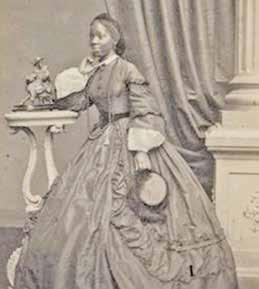
ers felt the Queen was responsible for their freedom.
The play includes a spin-off tale of Queen Victoria, the longest reigning British Monarch; the queen responsible for the Victorian era, who, according to Saul, “has secrets of her own”.
Lastly, the play takes place on a personal level, following a lead character Victoria, played by Dorset Europe, who is caught in a triangular love affair.
“Victoria personifies the village, as she is caught in a triangular love affair where she is in love with colonialism, represented by a white man magistrate Thomas Porter, but recognises her African roots by marrying a free African, the jealous Samuel Burke,” outlined Saul.
Victoria’s Secret opens on 21 November at the National Cultural Centre; however,
New Brunswick, working as an Art Therapist with the mentally challenged. She is a member of the Canadian Crossroads International.
Four years ago, upon her return to Guyana, JonesChin founded ‘Young @ Art’. This is an annual programme, held in July and August, through which she works with orphans across Guyana.
Jones-Chin currently serves as Director of the Guyana National Drama Festival 2014 and is a lecturer in Design and Production Management at the National School of Theatre Arts and Drama, Guyana. (Artist profile from the 26th Annual Exhibition of the Guyana Women Artists’ Association brochure done by the National Gallery)

there will be a play reading/stage performance of a few scenes next Thursday at the village itself.
“I am hoping to keep the play running into Black History Month (February). This January begins the International Decade for People of African Descent, so this play
is hoped to be the flag bearer of the decade,” noted Leon Saul. Saul stated his intention to make the play an international one and thanked the Ministry of Culture, Youth and Sports, which he said has recognised the “national significance of the story line”.

With a historic past coloured by conquest, colonisation and settlement, our cultural heritage is undoubtedly diverse; which is made manifest in several aspects of our day to day lives including places of worship.
The Open Air Mosque located at Cumberland, Canje, Berbice is a typical representation of traditional Indian Islamic Architecture. Built during the latter half of the 1800s by Muslim immigrants who had come to British Guiana as indentured labourers, it was constructed originally of bricks donated by the Bookers’ Sugar Estate; the land too was a gift from the estate. Believed to be oldest structure of Muslim worship in Guyana, it remained until 1932 when it was demolished and rebuilt of reinforced concrete.
Constructed to provide Muslims with a place to worship, especially for the celebration of Eid– ul – Fitr and Eid-ul-Adha, it is unlike other later construc-
tions. As the name suggests, it is open air. That is to say, there is no separation between the internal and external space nor are there any full length walls covered by a roof.
While it is not an exact replica of mosques native to India, some features reflect Indian Islamic Architecture. These include the courtyard, minarets and mihrab. The courtyard, entered from the west, boasts an arched gateway decorated with bosses and bulbous widgets at the top of the arch. Opposite the courtyard’s entrance, the mihrab is located in the eastern section. The worshippers face the mihrab to ensure they face Mecca when praying, and the Imam or leader in the prayers would stand nearby.
The minarets complement the structure at the four corners and are approximately 30 feet high, slender and square in shape which is finished by a half moon and star structure, while the western wall is decorated by various diamond shaped accentua-

tions. These unique features
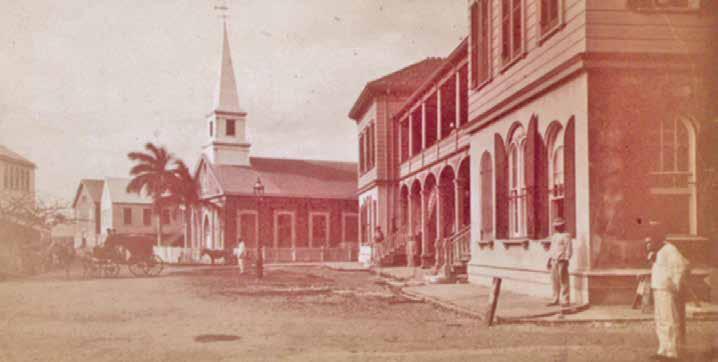
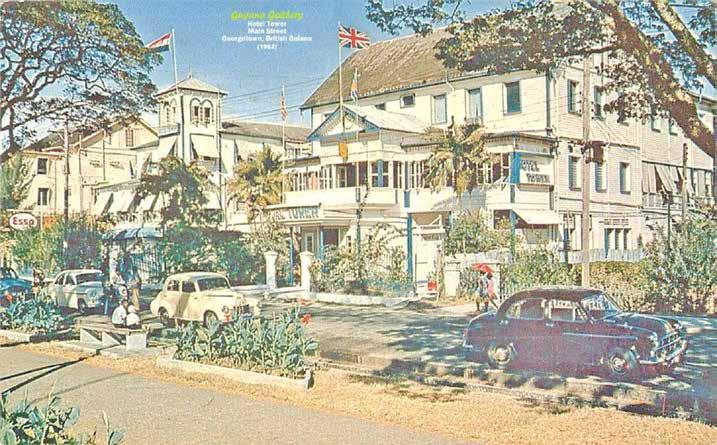
make this mosque one which helps us to trace and retain our cultural heritage as it features elements of traditional Islamic Architecture, although without the grandeur associated with it.
Today, this mosque remains and is a testament to the diversity of culture that has shaped Guyanese tradition.
While the National Trust strives to promote and safeguard the nation’s heritage, the organisation wishes to highlight that
places of worship are paramount as they form part of and are remarkable reminders of our nation’s history.
National Trust believes that preservation is a task which requires the cooperation of all and urges Guyanese to take an active role in ensuring the long term survival of Guyana’s patrimony by exercising care and respect at all times when visiting monuments and heritage sites. (National Trust of Guyana)




Rupununi Savannah
The Rupununi Savannah, which is characterised by flat grasslands and mountainous terrains, is located in Guyana, between the Rupununi River and the Brazilian border, in the Upper Takutu-Upper Essequibo region.
The savannah, an extraordinary natural area in southern Guyana, is teeming with wildlife, including 500 bird species; 1,500 different plant species; more than 400 species of fish; 120 species of snakes, lizards and frogs; 105 mammal species including the elusive jaguar, which roams the hills and mountains while the Harpy Eagle flies overhead.
Three of Guyana’s Amerindian tribes, Wapishana, Wai Wai and the Macushi, inhabit the Rupununi Savannah areas in several Amerindian villages dotted throughout, as well as many ranches worked by vaqueros (cowboys), some of whom are descendants of 19th century Scottish settlers.
The main town is Lethem, located beside the Takutu River, the border with Brazil.
North Rupununi wetland is the largest wetland found in Guyana. This wetland covers 22,000 hectares of flooded savannah and forest. The North Rupununi wetland is dominated by the Rupununi, Rewa and Essequibo Rivers. The wetland includes over 750 lakes, ponds and water inlets. More than 400 species of fish, the highest diversity of fishes in the world for areas of similar size, are found in the Rupununi wetlands. This area is also home to some of the world’s endangered giants - the arapaima (largest fresh water fish), the giant river otter ( largest of the 13 otter species), the black caiman (world’s largest of subfamily Alligatorinae), giant river turtles, the harpy eagle ( largest bird of prey), the jaguar (largest cat in South America) and hundreds of other flora and fauna.
The Rupununi Wetlands plays a very important role in the lives of more than 5,000 indigenous people of Guyana. The rivers and waterways found in the wetlands act as a source of drinking water and a main transportation route for the people living in the Rupununi.
The vegetation found in the wetlands are used by the indigenous tribes to make crafts, traditional medicine, houses, and sometimes food. (www.guyana-tourism.com) (Cover photo by Hannes Rada)
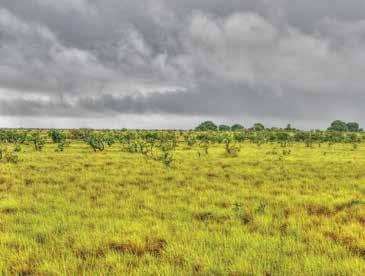

Many






Army nurse training
During basic training for the Army Nurse Corps, we were required to spend one week in the field roughing it. It rained the entire week.
We arose daily in our swampy tent, took a cold-water beauty bath from our helmets, donned our pistol belts and ponchos, and trudged through the mud to set up field hospitals. Obviously, our personal appearance frequently left much to be desired.
The final blow to our feminine pride occurred while we waited in the mess line in the mud and rain. A young private came by with a camera and asked to take our picture. "It will prove to my girlfriend," he said, "that she has NO reason to be jealous!"
Anaesthesia
An oral surgeon was scheduled to extract four wisdom teeth from Jim, a highschool football player, who had opted to be sedated for the procedure.
As the intravenous anaesthesia was being administered, the doctor asked Jim how he was feeling.
"Man," he replied, struggling to keep his eyes open, "I feel like I'm in English class."
A-hiking we will go...
Last summer, my husband, took me camping for the first time. At every opportunity, he passed along outdoor-survival lore. One day we got lost hiking in the deep woods. He tried the usual tactics to determine direction -- moss on the trees (there was none), direction of the sun (it was an overcast day), etc., etc.
Just as I was beginning to panic, he spotted a small cabin off in the distance. He pulled out his binoculars, studied the cabin, turned and led us right back to our camp.
"That was terrific," I said. "How did you do it?"
"Simple," he replied. "In this part of the country all the TV satellite dishes point south."
Abstract noun
"An abstract noun," the teacher said, "is something you can think of, but you can't touch it. Can you give me an example of one?"
"Sure," a teenage boy replied. "My father's new car."
Checking out of the grocery store, I noticed that the bag boy was eyeing my two adopted children curiously. They often draw scrutiny, since my son is a blond Russian, while my daughter has shiny black Haitian skin.
The boy continued staring as he carried our groceries to the car.
Finally, he asked. "Those your kids?"
"Yes, they are!" I answered proudly.
"They adopted?" he asked.
"Yes," I replied.
"I thought so," he concluded. "I fig ured you're too old to have kids that small."
I ate too much turkey; I ate too much corn, I ate too much pudding and pie.
I'm stuffed up with muffins and too much stuffin'
I'm probably going to die.
I piled up my plate and I ate and I ate. But I wish I had known when to stop, For I'm so crammed with yams, sauces, gravies, and jams
That my buttons are starting to pop!
I'm full of tomatoes and French fried potatoes
My stomach is swollen and sore, But there's still some dessert so I guess it won't hurt if I eat just a little bit more!
Agriculture subsidy
Honourable Secretary of Agriculture
Washington, D.C.
Dear Sir,
My friend, Ed Peterson, over at Wells Iowa, received a check for $1,000 from the government for not raising hogs. So, I want to go into the "not raising hogs" business next year.
What I want to know is, in your opinion, what is the best kind of farm not to raise hogs on, and what is the best breed of hogs not to raise? I want to be sure that I approach this endeavour in keeping with all governmental policies. I would prefer not to raise razorbacks, but if that is not a good breed not to raise, then I will just as gladly not raise Yorkshires or Durocs.
As I see it, the hardest part of this program will be in keeping an accurate inventory of how many hogs I haven't raised. My friend, Peterson, is very joyful about the future of the business. He has been raising hogs for twenty years or so, and the best he ever made on them was $422 in 1968, until this year when he got your check for $1000 for not raising hogs.
If I get $1000 for not raising 50 hogs, will I get $2000 for not raising 100 hogs? I plan to operate on a small scale at first, holding myself down to about 4000 hogs not raised, which will mean about $80,000 the first year. Then I can afford an airplane.
Now another thing, these hogs I will not raise will not eat 100,000 bushels of corn. I understand that you also pay farmers for not raising corn and wheat. Will I qualify for payments for not raising wheat and corn not to feed the 4000 hogs I am not going to raise?

Also, I am considering the "not milking cows" business, so send me any information you have on that too.
In view of these circumstances, you understand that I will be totally unemployed and plan to file for unemployment and food stamps. Be assured you will have my vote in the coming election.
Patriotically Yours, PS: Would you please notify me when you plan to distribute more free